EP1833138A2 - Nested redundant uninterruptible power supply apparatus and methods - Google Patents
Nested redundant uninterruptible power supply apparatus and methods Download PDFInfo
- Publication number
- EP1833138A2 EP1833138A2 EP07004913A EP07004913A EP1833138A2 EP 1833138 A2 EP1833138 A2 EP 1833138A2 EP 07004913 A EP07004913 A EP 07004913A EP 07004913 A EP07004913 A EP 07004913A EP 1833138 A2 EP1833138 A2 EP 1833138A2
- Authority
- EP
- European Patent Office
- Prior art keywords
- ups
- redundant
- assembly
- upss
- control circuit
- Prior art date
- Legal status (The legal status is an assumption and is not a legal conclusion. Google has not performed a legal analysis and makes no representation as to the accuracy of the status listed.)
- Granted
Links
Images




Classifications
-
- H—ELECTRICITY
- H02—GENERATION; CONVERSION OR DISTRIBUTION OF ELECTRIC POWER
- H02J—ELECTRIC POWER NETWORKS; CIRCUIT ARRANGEMENTS OR SYSTEMS FOR SUPPLYING OR DISTRIBUTING ELECTRIC POWER; SYSTEMS FOR STORING ELECTRIC ENERGY
- H02J9/00—Circuit arrangements for emergency or stand-by power supply, e.g. for emergency lighting
- H02J9/04—Circuit arrangements for emergency or stand-by power supply, e.g. for emergency lighting in which the distribution system is disconnected from the normal source and connected to a standby source
- H02J9/06—Circuit arrangements for emergency or stand-by power supply, e.g. for emergency lighting in which the distribution system is disconnected from the normal source and connected to a standby source with automatic change-over, e.g. UPS systems
- H02J9/062—Circuit arrangements for emergency or stand-by power supply, e.g. for emergency lighting in which the distribution system is disconnected from the normal source and connected to a standby source with automatic change-over, e.g. UPS systems for AC powered loads
-
- H—ELECTRICITY
- H02—GENERATION; CONVERSION OR DISTRIBUTION OF ELECTRIC POWER
- H02J—ELECTRIC POWER NETWORKS; CIRCUIT ARRANGEMENTS OR SYSTEMS FOR SUPPLYING OR DISTRIBUTING ELECTRIC POWER; SYSTEMS FOR STORING ELECTRIC ENERGY
- H02J9/00—Circuit arrangements for emergency or stand-by power supply, e.g. for emergency lighting
- H02J9/04—Circuit arrangements for emergency or stand-by power supply, e.g. for emergency lighting in which the distribution system is disconnected from the normal source and connected to a standby source
- H02J9/06—Circuit arrangements for emergency or stand-by power supply, e.g. for emergency lighting in which the distribution system is disconnected from the normal source and connected to a standby source with automatic change-over, e.g. UPS systems
-
- H—ELECTRICITY
- H02—GENERATION; CONVERSION OR DISTRIBUTION OF ELECTRIC POWER
- H02M—APPARATUS FOR CONVERSION BETWEEN AC AND AC, BETWEEN AC AND DC, OR BETWEEN DC AND DC, AND FOR USE WITH MAINS OR SIMILAR POWER SUPPLY SYSTEMS; CONVERSION OF DC OR AC INPUT POWER INTO SURGE OUTPUT POWER; CONTROL OR REGULATION THEREOF
- H02M7/00—Conversion of AC power input into DC power output; Conversion of DC power input into AC power output
- H02M7/42—Conversion of DC power input into AC power output without possibility of reversal
- H02M7/44—Conversion of DC power input into AC power output without possibility of reversal by static converters
- H02M7/48—Conversion of DC power input into AC power output without possibility of reversal by static converters using discharge tubes with control electrode or semiconductor devices with control electrode
- H02M7/493—Conversion of DC power input into AC power output without possibility of reversal by static converters using discharge tubes with control electrode or semiconductor devices with control electrode the static converters being arranged for operation in parallel
-
- H—ELECTRICITY
- H02—GENERATION; CONVERSION OR DISTRIBUTION OF ELECTRIC POWER
- H02J—ELECTRIC POWER NETWORKS; CIRCUIT ARRANGEMENTS OR SYSTEMS FOR SUPPLYING OR DISTRIBUTING ELECTRIC POWER; SYSTEMS FOR STORING ELECTRIC ENERGY
- H02J3/00—Circuit arrangements for AC mains or AC distribution networks
- H02J3/38—Arrangements for feeding a single network from two or more generators or sources in parallel; Arrangements for feeding already energised networks from additional generators or sources in parallel
Definitions
- the present invention relates to uninterruptible power supply (UPS) apparatus and methods and, more particularly, to parallel redundant UPS apparatus and methods.
- UPS uninterruptible power supply
- a variety of different techniques have been used to improve reliability of uninterruptible power supply systems.
- the techniques include standby redundant, serial redundant, and parallel redundant approaches.
- a typical standby redundant UPS configuration includes one or more UPS units operating on a stand-by basis, with no load or only a partial load, which can immediately back up a faulty UPS unit by a transfer of the load.
- a typical serial redundant arrangement involves first and second UPSs connected in a serial fashion wherein, in a first mode of operation, the first UPS is bypassed while the second UPS is serving the load and, in a second mode of operation, the second UPS is bypassed while the first UPS serves the load, such that the first and second UPSs may serve as standby backups for one another.
- UPSs uninterruptible power supplies
- UPSs AC power supplies
- United States Patent No. 5,745,357 to Tassitino, Jr. et al. United States Patent No. 6,549,440 to Tassitino, Jr. et al.
- United States Patent No. 6,803,679 to Luo et al. United States Patent No. 6,118,680 to Wallace et al.
- United States Patent No. 4,104,539 to Hase United States Patent Publication No. 2005/0162792 to Wang et al.
- United States Patent Publication No. 2005/0073783 to Luo et al United States Patent Publication No. 2005/0073783 to Luo et al .
- an uninterruptible power supply (UPS) system includes at least three UPSs configured to be connected in parallel to a common load.
- the system further includes control circuitry configured to support at least two redundant groups among the UPSs and to support at least two redundant subgroups among at least one of the redundant groups of UPSs. In this manner, a "nested" redundancy may be provided.
- control circuitry is configured to provide the at least two redundant subgroups when a loading of the at least one redundant group is less than a predetermined level.
- the control circuitry may be configured to allow selective enabling and disabling of the UPSs within the redundant group when the loading of the redundant group is less than the predetermined level and to require collective enabling and disabling of the UPSs in the redundant group when the loading of the redundant group is greater than the predetermined level.
- respective ones of the redundant groups of UPSs include respective UPS assemblies.
- Each UPS assembly includes a plurality of UPS modules and a control circuit configured to communicate with the plurality of UPS modules over a first digital communications bus and to communicate with a control circuit of another UPS assembly over a second digital communications bus.
- the control circuit may include a network bridge between the first and second digital communications busses.
- Each UPS assembly may further include a bypass circuit, and the control circuit in the UPS assembly may be configured to control the bypass circuit to bypass the UPS modules in the UPS assembly.
- the UPS modules and control circuit of a UPS assembly may be mounted in and/or on a common frame.
- a UPS assembly including a frame, a plurality of UPS modules mounted in and/or on the frame, a first digital communications bus coupled to each of the UPS modules, and a control circuit mounted in and/or on the frame, coupled to the first digital communications bus and configured to be coupled to a second digital communications bus.
- the control circuit is operative to communicate AC waveform synchronization information to the UPS modules over the first digital communications bus and to another UPS assembly over the second digital communications bus.
- the AC waveform synchronization information may include frequency and phase error information.
- the control circuit may be configured, when the UPS assembly is connected in parallel to a load with the other UPS assembly, to operate the UPS assembly as a redundant backup for the other UPS assembly and to provide at least two redundant subgroups within its plurality of UPS modules.
- the control circuit may be configured to provide the at least two redundant subgroups when a loading of the UPS assembly is less than predetermined level.
- the control circuit may be configured to allow selective enabling and disabling of the UPS modules when the loading of the UPS assembly is less than the predetermined level and to require collective enabling and disabling of the UPS modules when the loading of the UPS assembly is greater than the predetermined level.
- the UPS assembly may further include a bypass circuit mounted in and/or on the frame, and the control circuit may be configured to control the bypass circuit to bypass the plurality of UPS modules.
- the control circuit may include a network bridge between the first and second digital communications busses.
- Additional embodiments of the present invention provide methods of operating an uninterruptible power supply (UPS) system.
- UPS uninterruptible power supply
- At least three UPSs are connected in parallel to a common load.
- the at least three UPSs are controlled to support at least two redundant groups among the UPSs and to further support at least two redundant subgroups among at least one of the redundant groups of UPSs.
- Controlling the at least three UPSs to support at least two redundant groups among the UPSs and to further support at least two redundant subgroups among at least one of the redundant groups of UPSs may include providing the at least two redundant subgroups when a loading of the at least one redundant group is less than a predetermined level.
- Respective ones of the redundant groups of UPSs may include respective UPS assemblies, each UPS assembly including a plurality of UPS modules and a control circuit configured to communicate with the UPS modules of the UPS assembly and with a control circuit of another UPS assembly.
- Some embodiments of the present invention arise from a realization that improved reliability in UPS systems may be achieved by using a nested redundant arrangement of UPSs.
- a plurality of parallel-connected UPSs is controlled such that at least two redundant groups of the UPSs are provided and, within, at least one of these redundant groups, at least two redundant subgroups of the UPSs are provided.
- Such an approach may be particularly advantageous in modular UPS configurations.
- a nested redundant structure may be implemented, for example, using modular UPS assemblies that include respective pluralities of UPS modules and respective control circuits that control the UPS modules and communicate with one another to support nested redundancy.
- FIG. 1 illustrates a UPS system 100 according to some embodiments of the present invention.
- the system 100 includes a plurality of UPSs 112a, 112b, 112c, 112d connected in parallel to a load 20.
- the UPSs 112a, 112b, 112c, 112d are "on-line” UPSs, but it will be understood that, in some embodiments of the present invention, "standby,” “line interactive” or other configurations may be used.
- the UPSs 112a, 112b, 112c, 112d are controlled to provide first and second redundant groups 110a, 110b, e.g., the second group 110b may serve as a backup to the first group 110a (and/or vice versa) such that one of the groups 110a, 102b may continue to serve the load 20 in the event of failure of the other of the groups 110a, 110b.
- this redundant operation may be limited to a certain operational envelope, e.g., the redundancy may be limited to cases in which the load 20 is less than a capacity of an individual one of the UPS groups 110a, 110b, and that, when such capacity is exceeded, the UPS groups 110a, 110b may, for example, be collectively disabled and/or bypassed.
- the first subgroup 111a including two UPSs 112a, 112b and the second subgroup 111b including two UPSs 112c, 112d.
- the first subgroup 111a may serve to backup operation of the second subgroup 111b and/or vice versa.
- the groups 110a, 110b and subgroups 111a, 111b are provided for purposes of illustration, and that other redundant groupings and subgroupings may be used in other embodiments of the present invention.
- redundant subgroups may be provided in all redundant groups or only in a subset of the redundant groups.
- additional redundant groups may be provided to backup the groups 110a, 110b, and these may or may not include redundant subgroups therein.
- an even higher level of nested redundancy may be provided, e.g., some or all of the UPSs 112a, 112b, 112c, 112d may actually include multiple parallel-connected UPSs that are arranged to provide redundant subgroups therein.
- UPSs 112a, 112b, 112c, 112d may include redundant components, such as redundant rectifiers or inverters.
- redundant groups and/or subgroups may be dynamically redefined depending, for example, on loading and/or disposition (e.g., availability due to maintenance or other events) of particular UPSs.
- FIG. 2 illustrates a UPS system 200 with a modular architecture according to further embodiments of the present invention.
- First and second redundant groups of UPSs are provided in the form of respective UPS assemblies 210a, 210b.
- the UPS assemblies 210a, 210b include respective pluralities of UPS modules 214 that are connected in parallel to a load 20 and that communicate with respective control circuits 212.
- the control circuits 212 are also configured to communicate with one another.
- the control circuits 212 and the UPS modules 214 support redundant operation of the UPS assemblies 210a, 210b such that the pluralities of UPS modules 214 therein serve as respective redundant groups of UPSs, e.g., the group of UPS modules 214 of the UPS assembly 210b may act as a group to back up the group of UPS modules 214 of the UPS assembly 210a.
- the UPS assemblies 210a, 210b an inner redundancy is provided among the UPS modules 214 thereof.
- the modules 214 and control circuit 212 within a UPS assembly may be configured to provide redundant subgroups 211 a, 211b within the UPS assembly.
- each UPS module 214 within the first UPS assembly 210a may communicate status information to the associated control circuit 212.
- status information may indicate, for example, whether a failure is imminent in the UPS module 214 and information pertaining the load currently being served by the UPS module 214.
- the control circuit 212 may determine whether a selective disabling of the UPS module 214 may be allowed such that other UPS modules 214 within the UPS assembly 210a may continue to serve the load 20. For example, as explained in detail with reference to FIG.
- the control circuit 210 may further communicate this information to other UPS assemblies, so that they may take coordinated action. For example, in response to receipt of such information from the first UPS assembly 210a, if the control circuit 212 of the second UPS assembly 210b determines that it will not be able to serve the load 20 once the first UPS assembly 210a goes completely off-line, the control law of the control circuit 212 of the second UPS assembly 210b may require collective disabling of all of its currently operational UPS modules 214 as well. This election may be further communicated to the control circuit 212 of the first UPS assembly 212 and/or to other UPS assemblies (not shown) that may be connected to the load 20, so that they may take further actions. For example, if a sufficient number of UPS assemblies are not capable of serving the load 20, they may be collectively bypassed, such that an AC utility or other power source is directly connected to the load 20.
- FIG. 3 illustrates exemplary configurations for a UPS assembly 300 according to some embodiments of the present invention that may be used in a UPS system along the lines described above with reference to FIG. 2.
- UPS modules 310 include a rectifier 312 configured to receive an AC input via a first switch (e.g., a contactor or relay) 316.
- An inverter 313 is coupled by a DC bus 315 to the rectifier 312.
- An output of the inverter 313 may be connected and disconnected from a load (not shown in FIG. 3) via a second switch 317.
- a DC-DC converter 314 is also coupled to the DC bus 315 and is configured to be connected to a battery (not shown).
- the DC-DC converter 314 may allow the battery to provide DC power to the DC bus 315 in the absence of AC power at the input of the rectifier 312.
- the DC-DC converter 314 may also allow charging of the battery from the DC bus 315.
- a control circuit 311 is configured to control the rectifier 312, inverter 313, DC-DC converter 314 and the switches 316, 316.
- the control circuit 311 includes a digital communications interface, here shown as a controller area network (CAN) interface 311 a, coupled to a digital communications bus 330.
- CAN controller area network
- the CAN bus 330 is also coupled to a CAN interface 322a of a control circuit 322 of an I/O and bypass module 320 of the UPS assembly 300.
- the I/O and bypass module 320 further includes a bypass switch 326 that is configured to bypass the UPS modules 310 responsive to a control signal from the control circuit 322.
- the I/O and bypass module 320 further includes a CAN bridge 324 that provides communications between the internal communications bus 330 and an external bus 340. Via the CAN bridge 324 and the external bus 340, information may be exchanged with other UPS assemblies.
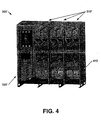
- FIG. 4 illustrates an exemplary implementation of a modular UPS assembly 300' having an architecture along the lines of the UPS assembly 300 illustrated in FIG. 3.
- three UPS modules 310' and an I/O and bypass module 320' are mounted in and/or on a common frame, here shown as a cabinet 410.
- a cabinet 410 a common frame, here shown as a cabinet 410.
- FIG. 4 may be appropriate, for example, to a relatively high capacity UPS system, and that other form factors, including greater or lesser numbers of UPS modules, may be used in other embodiments of the present invention.
- FIGs. 5 and 6 illustrate exemplary signaling that may be used in the modular UPS assembly 300 of FIG. 3.
- the control circuit 322 of the I/O and bypass module 320 may transmit waveform synchronization information and enable/disable commands to the UPS modules 310 over the internal CAN bus 330. This information may also be transmitted to another UPS assembly external to the UPS assembly 300 via the CAN bridge 324.
- the UPS modules 310 may transmit waveform synchronization information and status information to the control circuit 322 over the internal CAN bus 330.
- synchronization may be achieved without such explicit signaling, for example, by using techniques along lined described in U.S. Patent No. 5,745,355 to Tracy et al. and U.S. Patent No. 5,745,356 to Tassitino, Jr. et al , the contents of each of which is incorporated by reference herein in their entireties.
- the waveform synchronization information may include frequency and phase error information that may be used by the modules 310 to synchronize operation of their inverters 313.
- synchronization information transmitted to a control circuit of a UPS module such as the UPS modules 310 of FIG. 3, may include a target frequency and phase error that are passed to a phase locked loop controller 710 that generates a reference signal for an inverter driver 730 of the module.
- the phase lock loop compensation may be augmented by a load share controller 720 that operates responsive to a measure of power output of the module, along lines, for example, described in U.S. Patent No.
- phase locked loop and load share control functions shown in FIG. 7 may be implemented in an AC waveform reference generator 810 that generates an AC waveform reference signal for an inverter driver 820.
- FIG. 9 illustrates exemplary UPS operations for nested redundant operation of a UPS assembly according to further embodiments of the present invention.
- a load is powered by at least two parallel UPS assemblies, e.g., modular UPS assemblies such as the assemblies 300, 300' of FIGs. 3 and 4 (block 910).
- the control circuit of the first UPS assembly determines whether the level of loading allows for intra-assembly redundancy, i.e., will allow remaining operative UPS modules in the assembly to continue supplying the load (block 930).
- the control circuit may disable the failed module, and allow the remaining modules to continue to drive the load (block 940), thus providing intra-assembly redundancy. It will be understood that a second module mail fail in a second one of the UPS assemblies, which may lead to disabling of that second module without requiring changes to the operation of the first UPS assembly. If insufficient capacity exists, however, the control circuit collectively disables all of the modules in the assembly and signals another assembly to inform it of the collective shutdown (block 950). In further embodiments of the present invention, other operations may be performed. For example, in some embodiments, dynamic redefinition of redundant groups and/or subgroups may occur in response to shutdown or other unavailability of particular modules.
Landscapes
- Engineering & Computer Science (AREA)
- Power Engineering (AREA)
- Business, Economics & Management (AREA)
- Emergency Management (AREA)
- Stand-By Power Supply Arrangements (AREA)
- Inverter Devices (AREA)
- Power Sources (AREA)
- Supply And Distribution Of Alternating Current (AREA)
Abstract
Description
- The present application claims priority from
U.S. Provisional Application No. 60/781,102, filed March 10, 2006 - The present invention relates to uninterruptible power supply (UPS) apparatus and methods and, more particularly, to parallel redundant UPS apparatus and methods.
- A variety of different techniques have been used to improve reliability of uninterruptible power supply systems. The techniques include standby redundant, serial redundant, and parallel redundant approaches. A typical standby redundant UPS configuration includes one or more UPS units operating on a stand-by basis, with no load or only a partial load, which can immediately back up a faulty UPS unit by a transfer of the load. A typical serial redundant arrangement involves first and second UPSs connected in a serial fashion wherein, in a first mode of operation, the first UPS is bypassed while the second UPS is serving the load and, in a second mode of operation, the second UPS is bypassed while the first UPS serves the load, such that the first and second UPSs may serve as standby backups for one another.
- In a typical parallel redundant arrangement, multiple uninterruptible power supplies (UPSs) are coupled in parallel to a load to provide redundancy and, often, increased load capability. Parallel redundant arrangements of AC power supplies (e.g., UPSs) are described, for example, in
United States Patent No. 5,745,357 to Tassitino, Jr. et al. ,United States Patent No. 6,549,440 to Tassitino, Jr. et al. ,United States Patent No. 6,803,679 to Luo et al. ,United States Patent No. 6,118,680 to Wallace et al. ,United States Patent No. 4,104,539 to Hase ,United States Patent Publication No. 2005/0162792 to Wang et al. , andUnited States Patent Publication No. 2005/0073783 to Luo et al . - In some embodiments of the present invention, an uninterruptible power supply (UPS) system includes at least three UPSs configured to be connected in parallel to a common load. The system further includes control circuitry configured to support at least two redundant groups among the UPSs and to support at least two redundant subgroups among at least one of the redundant groups of UPSs. In this manner, a "nested" redundancy may be provided.
- In some embodiments, the control circuitry is configured to provide the at least two redundant subgroups when a loading of the at least one redundant group is less than a predetermined level. The control circuitry may be configured to allow selective enabling and disabling of the UPSs within the redundant group when the loading of the redundant group is less than the predetermined level and to require collective enabling and disabling of the UPSs in the redundant group when the loading of the redundant group is greater than the predetermined level.
- In further embodiments of the present invention, respective ones of the redundant groups of UPSs include respective UPS assemblies. Each UPS assembly includes a plurality of UPS modules and a control circuit configured to communicate with the plurality of UPS modules over a first digital communications bus and to communicate with a control circuit of another UPS assembly over a second digital communications bus. The control circuit may include a network bridge between the first and second digital communications busses. Each UPS assembly may further include a bypass circuit, and the control circuit in the UPS assembly may be configured to control the bypass circuit to bypass the UPS modules in the UPS assembly. The UPS modules and control circuit of a UPS assembly may be mounted in and/or on a common frame.
- Further embodiments of the present invention provide a UPS assembly including a frame, a plurality of UPS modules mounted in and/or on the frame, a first digital communications bus coupled to each of the UPS modules, and a control circuit mounted in and/or on the frame, coupled to the first digital communications bus and configured to be coupled to a second digital communications bus. The control circuit is operative to communicate AC waveform synchronization information to the UPS modules over the first digital communications bus and to another UPS assembly over the second digital communications bus. The AC waveform synchronization information may include frequency and phase error information. The control circuit may be configured, when the UPS assembly is connected in parallel to a load with the other UPS assembly, to operate the UPS assembly as a redundant backup for the other UPS assembly and to provide at least two redundant subgroups within its plurality of UPS modules.
- In some embodiments, the control circuit may be configured to provide the at least two redundant subgroups when a loading of the UPS assembly is less than predetermined level. The control circuit may be configured to allow selective enabling and disabling of the UPS modules when the loading of the UPS assembly is less than the predetermined level and to require collective enabling and disabling of the UPS modules when the loading of the UPS assembly is greater than the predetermined level. The UPS assembly may further include a bypass circuit mounted in and/or on the frame, and the control circuit may be configured to control the bypass circuit to bypass the plurality of UPS modules. The control circuit may include a network bridge between the first and second digital communications busses.
- Additional embodiments of the present invention provide methods of operating an uninterruptible power supply (UPS) system. At least three UPSs are connected in parallel to a common load. The at least three UPSs are controlled to support at least two redundant groups among the UPSs and to further support at least two redundant subgroups among at least one of the redundant groups of UPSs. Controlling the at least three UPSs to support at least two redundant groups among the UPSs and to further support at least two redundant subgroups among at least one of the redundant groups of UPSs may include providing the at least two redundant subgroups when a loading of the at least one redundant group is less than a predetermined level. For example, selective enabling and disabling of the UPSs within the at least one redundant group may be allowed when the loading of the at least one redundant group is less than the predetermined level and collective enabling and disabling of the UPSs in the at least one redundant group may be required when the loading of the at least one redundant group is greater than the predetermined level. Respective ones of the redundant groups of UPSs may include respective UPS assemblies, each UPS assembly including a plurality of UPS modules and a control circuit configured to communicate with the UPS modules of the UPS assembly and with a control circuit of another UPS assembly.
-
- FIG. 1 illustrates a nested redundant UPS system and operations thereof according to some embodiments of the present invention.
- FIG. 2 illustrates a nested redundant UPS system using modular UPS assemblies and operations thereof according to further embodiments of the present invention.
- FIGs. 3 and 4 illustrate a modular UPS assembly that may be used in a nested redundant UPS system according to additional embodiments of the present invention.
- FIGs. 5 and 6 illustrate communications operations of a modular UPS assembly according to some embodiments of the present invention.
- FIGs. 7 and 8 illustrate exemplary UPS module synchronization control architectures according to further embodiments of the present invention.
- FIG. 9 is a flowchart illustrating operations for nested redundant operation of a UPS system according to further embodiments of the present invention.
- Specific exemplary embodiments of the invention now will be described with reference to the accompanying drawings. This invention may, however, be embodied in many different forms and should not be construed as limited to the embodiments set forth herein; rather, these embodiments are provided so that this disclosure will be thorough and complete, and will fully convey the scope of the invention to those skilled in the art. The terminology used in the detailed description of the particular exemplary embodiments illustrated in the accompanying drawings is not intended to be limiting of the invention. In the drawings, like numbers refer to like elements.
- As used herein, the singular forms "a", "an" and "the" are intended to include the plural forms as well, unless expressly stated otherwise. It will be further understood that the terms "includes," "includes," "including" and/or "including," when used in this specification, specify the presence of stated features, integers, steps, operations, elements, and/or components, but do not preclude the presence or addition of one or more other features, integers, steps, operations, elements, components, and/or groups thereof. It will be understood that when an element is referred to as being "connected" or "coupled" to another element, it can be directly connected or coupled to the other element or intervening elements may be present. Furthermore, "connected" or "coupled" as used herein may include wirelessly connected or coupled. As used herein, the term "and/or" includes any and all combinations of one or more of the associated listed items.
- Unless otherwise defined, all terms (including technical and scientific terms) used herein have the same meaning as commonly understood by one of ordinary skill in the art to which this invention belongs. It will be further understood that terms, such as those defined in commonly used dictionaries, should be interpreted as having a meaning that is consistent with their meaning in the context of the relevant art and will not be interpreted in an idealized or overly formal sense unless expressly so defined herein.
- Some embodiments of the present invention arise from a realization that improved reliability in UPS systems may be achieved by using a nested redundant arrangement of UPSs. In some embodiments, a plurality of parallel-connected UPSs is controlled such that at least two redundant groups of the UPSs are provided and, within, at least one of these redundant groups, at least two redundant subgroups of the UPSs are provided. Such an approach may be particularly advantageous in modular UPS configurations. A nested redundant structure may be implemented, for example, using modular UPS assemblies that include respective pluralities of UPS modules and respective control circuits that control the UPS modules and communicate with one another to support nested redundancy.
- FIG. 1 illustrates a UPS
system 100 according to some embodiments of the present invention. Thesystem 100 includes a plurality of UPSs 112a, 112b, 112c, 112d connected in parallel to aload 20. As shown, the UPSs 112a, 112b, 112c, 112d are "on-line" UPSs, but it will be understood that, in some embodiments of the present invention, "standby," "line interactive" or other configurations may be used. The UPSs 112a, 112b, 112c, 112d are controlled to provide first and secondredundant groups 110a, 110b, e.g., the second group 110b may serve as a backup to thefirst group 110a (and/or vice versa) such that one of thegroups 110a, 102b may continue to serve theload 20 in the event of failure of the other of thegroups 110a, 110b. It will be appreciated that this redundant operation may be limited to a certain operational envelope, e.g., the redundancy may be limited to cases in which theload 20 is less than a capacity of an individual one of the UPSgroups 110a, 110b, and that, when such capacity is exceeded, the UPSgroups 110a, 110b may, for example, be collectively disabled and/or bypassed. - Within at least one
group 110a there are further definedredundant subgroups first subgroup 111a including two UPSs 112a, 112b and thesecond subgroup 111b including two UPSs 112c, 112d. Within thegroup 110a, for example, thefirst subgroup 111a may serve to backup operation of thesecond subgroup 111b and/or vice versa. - It will be understood that the
groups 110a, 110b andsubgroups groups 110a, 110b, and these may or may not include redundant subgroups therein. According to further embodiments, an even higher level of nested redundancy may be provided, e.g., some or all of theUPSs UPSs - FIG. 2 illustrates a
UPS system 200 with a modular architecture according to further embodiments of the present invention. First and second redundant groups of UPSs are provided in the form ofrespective UPS assemblies UPS assemblies UPS modules 214 that are connected in parallel to aload 20 and that communicate withrespective control circuits 212. Thecontrol circuits 212 are also configured to communicate with one another. According to embodiments of the present invention, thecontrol circuits 212 and theUPS modules 214 support redundant operation of theUPS assemblies UPS modules 214 therein serve as respective redundant groups of UPSs, e.g., the group ofUPS modules 214 of theUPS assembly 210b may act as a group to back up the group ofUPS modules 214 of theUPS assembly 210a. Within one or both of theUPS assemblies UPS modules 214 thereof. For example, as shown, themodules 214 andcontrol circuit 212 within a UPS assembly may be configured to provideredundant subgroups - Such nested redundancy may be achieved using communications among the
control circuits 212 and theUPS modules 214. For example, in some embodiments, eachUPS module 214 within thefirst UPS assembly 210a may communicate status information to the associatedcontrol circuit 212. Such status information may indicate, for example, whether a failure is imminent in theUPS module 214 and information pertaining the load currently being served by theUPS module 214. In response to such information, thecontrol circuit 212 may determine whether a selective disabling of theUPS module 214 may be allowed such thatother UPS modules 214 within theUPS assembly 210a may continue to serve theload 20. For example, as explained in detail with reference to FIG. 7 below, if loading of theUPS assembly 210a is below a certain threshold, it may be possible to letother UPS modules 214 in theUPS assembly 210a to continue to supply power to theload 20. If, however, the loading on theUPS assembly 210a is so high that the remainingoperational UPS modules 214 do not have sufficient capacity to serve theload 20, the control law of thecontrol circuit 212 may require collective disabling of all of theUPS modules 214 in theUPS assembly 210a. - The control circuit 210 may further communicate this information to other UPS assemblies, so that they may take coordinated action. For example, in response to receipt of such information from the
first UPS assembly 210a, if thecontrol circuit 212 of thesecond UPS assembly 210b determines that it will not be able to serve theload 20 once thefirst UPS assembly 210a goes completely off-line, the control law of thecontrol circuit 212 of thesecond UPS assembly 210b may require collective disabling of all of its currentlyoperational UPS modules 214 as well. This election may be further communicated to thecontrol circuit 212 of thefirst UPS assembly 212 and/or to other UPS assemblies (not shown) that may be connected to theload 20, so that they may take further actions. For example, if a sufficient number of UPS assemblies are not capable of serving theload 20, they may be collectively bypassed, such that an AC utility or other power source is directly connected to theload 20. - FIG. 3 illustrates exemplary configurations for a
UPS assembly 300 according to some embodiments of the present invention that may be used in a UPS system along the lines described above with reference to FIG. 2.UPS modules 310 include arectifier 312 configured to receive an AC input via a first switch (e.g., a contactor or relay) 316. Aninverter 313 is coupled by aDC bus 315 to therectifier 312. An output of theinverter 313 may be connected and disconnected from a load (not shown in FIG. 3) via asecond switch 317. A DC-DC converter 314 is also coupled to theDC bus 315 and is configured to be connected to a battery (not shown). The DC-DC converter 314 may allow the battery to provide DC power to theDC bus 315 in the absence of AC power at the input of therectifier 312. The DC-DC converter 314 may also allow charging of the battery from theDC bus 315. Acontrol circuit 311 is configured to control therectifier 312,inverter 313, DC-DC converter 314 and theswitches control circuit 311 includes a digital communications interface, here shown as a controller area network (CAN) interface 311 a, coupled to adigital communications bus 330. - The
CAN bus 330 is also coupled to aCAN interface 322a of acontrol circuit 322 of an I/O andbypass module 320 of theUPS assembly 300. The I/O andbypass module 320 further includes abypass switch 326 that is configured to bypass theUPS modules 310 responsive to a control signal from thecontrol circuit 322. The I/O andbypass module 320 further includes aCAN bridge 324 that provides communications between theinternal communications bus 330 and anexternal bus 340. Via theCAN bridge 324 and theexternal bus 340, information may be exchanged with other UPS assemblies. - FIG. 4 illustrates an exemplary implementation of a modular UPS assembly 300' having an architecture along the lines of the
UPS assembly 300 illustrated in FIG. 3. In the illustrated embodiments, three UPS modules 310' and an I/O and bypass module 320' are mounted in and/or on a common frame, here shown as acabinet 410. It will be understood that the configuration illustrated in FIG. 4 may be appropriate, for example, to a relatively high capacity UPS system, and that other form factors, including greater or lesser numbers of UPS modules, may be used in other embodiments of the present invention. - FIGs. 5 and 6 illustrate exemplary signaling that may be used in the
modular UPS assembly 300 of FIG. 3. Thecontrol circuit 322 of the I/O andbypass module 320 may transmit waveform synchronization information and enable/disable commands to theUPS modules 310 over theinternal CAN bus 330. This information may also be transmitted to another UPS assembly external to theUPS assembly 300 via theCAN bridge 324. Referring to FIG. 6, theUPS modules 310 may transmit waveform synchronization information and status information to thecontrol circuit 322 over theinternal CAN bus 330. In other embodiments of the present invention, synchronization may be achieved without such explicit signaling, for example, by using techniques along lined described inU.S. Patent No. 5,745,355 to Tracy et al. andU.S. Patent No. 5,745,356 to Tassitino, Jr. et al , the contents of each of which is incorporated by reference herein in their entireties. - According to some embodiments of the present invention, the waveform synchronization information may include frequency and phase error information that may be used by the
modules 310 to synchronize operation of theirinverters 313. For example, referring to FIG. 7, synchronization information transmitted to a control circuit of a UPS module, such as theUPS modules 310 of FIG. 3, may include a target frequency and phase error that are passed to a phase lockedloop controller 710 that generates a reference signal for aninverter driver 730 of the module. As shown, for purposes of balancing load share among modules, the phase lock loop compensation may be augmented by aload share controller 720 that operates responsive to a measure of power output of the module, along lines, for example, described inU.S. Patent No. 6,549,440 to Tassitino et al. , the disclosure of which is hereby incorporated by reference herein in its entirety. As shown in FIG. 8, in some embodiments, the phase locked loop and load share control functions shown in FIG. 7 may be implemented in an ACwaveform reference generator 810 that generates an AC waveform reference signal for aninverter driver 820. - FIG. 9 illustrates exemplary UPS operations for nested redundant operation of a UPS assembly according to further embodiments of the present invention. A load is powered by at least two parallel UPS assemblies, e.g., modular UPS assemblies such as the
assemblies 300, 300' of FIGs. 3 and 4 (block 910). Upon detection of a failure of a UPS module in a first one of the UPS assemblies (block 920), the control circuit of the first UPS assembly determines whether the level of loading allows for intra-assembly redundancy, i.e., will allow remaining operative UPS modules in the assembly to continue supplying the load (block 930). If the load is sufficiently low, the control circuit may disable the failed module, and allow the remaining modules to continue to drive the load (block 940), thus providing intra-assembly redundancy. It will be understood that a second module mail fail in a second one of the UPS assemblies, which may lead to disabling of that second module without requiring changes to the operation of the first UPS assembly. If insufficient capacity exists, however, the control circuit collectively disables all of the modules in the assembly and signals another assembly to inform it of the collective shutdown (block 950). In further embodiments of the present invention, other operations may be performed. For example, in some embodiments, dynamic redefinition of redundant groups and/or subgroups may occur in response to shutdown or other unavailability of particular modules. - In the drawings and specification, there have been disclosed exemplary embodiments of the invention. Although specific terms are employed, they are used in a generic and descriptive sense only and not for purposes of limitation, the scope of the invention being defined by the following claims.
Claims (21)
- An uninterruptible power supply (UPS) system, comprising:at least three UPSs configured to be connected in parallel to a common load: andcontrol circuitry configured to support at least two redundant groups among the UPSs and to support at least two redundant subgroups among at least one of the redundant groups of UPSs.
- The system of Claim 1, wherein the control circuitry is configured to provide the at least two redundant subgroups when a loading of the at least one redundant group is less than a predetermined level.
- The system of Claim 2, wherein the control circuitry is configured to allow selective enabling and disabling of the UPSs within the redundant group when the loading of the redundant group is less than the predetermined level and to require collective enabling and disabling of the UPSs in the redundant group when the loading of the redundant group is greater than the predetermined level.
- The system of Claim 1, wherein respective ones of the redundant groups of UPSs comprise respective UPS assemblies, each UPS assembly comprising a plurality of UPS modules and a control circuit configured to communicate with the plurality of UPS modules over a first digital communications bus and with a control circuit of another UPS assembly over a second digital communications bus.
- The system of Claim 4, wherein the control circuit comprises a network bridge between the first and second digital communications busses.
- The system of Claim 4, wherein each UPS assembly further comprises a bypass circuit, and wherein the control circuit in the UPS assembly is configured to control the bypass circuit to bypass the UPS modules in the UPS assembly.
- The system of Claim 4, wherein the plurality of UPS modules and control circuit of a UPS assembly are mounted in and/or on a common frame.
- The system of Claim 7, wherein the UPS assembly further comprises a bypass circuit mounted in and/or on the common frame, and wherein the control circuit is configured to control the bypass circuit to bypass the UPS modules.
- A UPS assembly, comprising:a frame;a plurality of UPS modules mounted in and/or on the frame;an first digital communications bus coupled to each of the UPS modules; anda control circuit mounted in and/or on the frame, coupled to the first digital communications bus and configured to be coupled to a second digital communications bus, the control circuit operative to communicate AC waveform synchronization information to the UPS modules over the first digital communications bus and to another UPS assembly over the second digital communications bus.
- The UPS assembly of Claim 9, wherein the AC waveform synchronization information comprises frequency and phase error information.
- The UPS assembly of Claim 1, wherein the control circuit is configured, when the UPS assembly is connected in parallel to a load with the other UPS assembly, to operate the UPS assembly as a redundant backup for the other UPS assembly and to provide at least two redundant subgroups within its plurality of UPS modules.
- The UPS assembly of Claim 11, wherein the control circuit provides the at least two redundant subgroups when a loading of the UPS assembly is less than predetermined level.
- The UPS system of Claim 12, wherein the control circuit is configured to allow selective enabling and disabling of the UPS modules when the loading of the UPS assembly is less than the predetermined level and to require collective enabling and disabling of the UPS modules when the loading of the UPS assembly is greater than the predetermined level.
- The UPS assembly of Claim 9, further comprising a bypass circuit mounted in and/or on the frame and wherein the control circuit is configured to control the bypass circuit to bypass the plurality of UPS modules.
- The UPS assembly of Claim 9, wherein the control circuit comprises a network bridge between the first and second digital communications busses.
- The UPS assembly of Claim 9, wherein the first digital communications bus comprises a controller area network (CAN) bus.
- A method of operating an uninterruptible power supply (UPS) system, comprising:connecting at least three UPSs in parallel to a common load: andcontrolling the at least three UPSs to support at least two redundant groups among the UPSs and to support at least two redundant subgroups among at least one of the redundant groups of UPSs.
- The method of Claim 17, wherein controlling the at least three UPSs to support at least two redundant groups among the UPSs and to support at least two redundant subgroups among at least one of the redundant groups of UPSs comprises providing the at least two redundant subgroups when a loading of the at least one redundant group is less than a predetermined level.
- The method of Claim 18, wherein providing the at least two redundant subgroups when a loading of the at least one redundant group is less than a predetermined level comprises allowing selective enabling and disabling of the UPSs within the at least one redundant group when the loading of the at least one redundant group is less than the predetermined level and requiring collective enabling and disabling of the UPSs in the at least one redundant group when the loading of the at least one redundant group is greater than the predetermined level.
- The method of Claim 17, wherein respective ones of the redundant groups of UPSs comprise respective UPS assemblies, each UPS assembly comprising a plurality of UPS modules and a control circuit configured to communicate with the UPS modules of the UPS assembly and with a control circuit of another UPS assembly.
- The method of Claim 18, wherein the UPS modules and control circuit of a UPS assembly are mounted in and/or on a common frame.
Applications Claiming Priority (1)
| Application Number | Priority Date | Filing Date | Title |
|---|---|---|---|
| US78110206P | 2006-03-10 | 2006-03-10 |
Publications (3)
| Publication Number | Publication Date |
|---|---|
| EP1833138A2 true EP1833138A2 (en) | 2007-09-12 |
| EP1833138A3 EP1833138A3 (en) | 2013-08-21 |
| EP1833138B1 EP1833138B1 (en) | 2018-08-15 |
Family
ID=38179794
Family Applications (1)
| Application Number | Title | Priority Date | Filing Date |
|---|---|---|---|
| EP07004913.5A Active EP1833138B1 (en) | 2006-03-10 | 2007-03-09 | Nested redundant uninterruptible power supply apparatus and methods |
Country Status (3)
| Country | Link |
|---|---|
| US (3) | US7638899B2 (en) |
| EP (1) | EP1833138B1 (en) |
| CN (2) | CN101060256B (en) |
Cited By (5)
| Publication number | Priority date | Publication date | Assignee | Title |
|---|---|---|---|---|
| WO2013022632A3 (en) * | 2011-08-05 | 2013-09-26 | Liebert Corporation | Intelligent arbitration of power line based coordinating signals between multiple ups buses without any auxiliary signals |
| WO2014031343A1 (en) * | 2012-08-24 | 2014-02-27 | Ainet Registry Llc | System and method for efficient power distribution and backup |
| WO2014078348A1 (en) * | 2012-11-15 | 2014-05-22 | Eaton Corporation | Ups systems and methods using ups modules with differential mode inductor coupling |
| US9312725B2 (en) | 2012-08-24 | 2016-04-12 | Ainet Registry, Llc | System and method for efficient power distribution and backup |
| EP3086438A1 (en) * | 2015-04-24 | 2016-10-26 | Delta Electronics, Inc. | Standalone uninterruptible power supply |
Families Citing this family (94)
| Publication number | Priority date | Publication date | Assignee | Title |
|---|---|---|---|---|
| US7492058B2 (en) * | 2006-11-17 | 2009-02-17 | Toshiba International Corp. | Modular uninterruptible power supply with loadsharing between modules |
| KR101391758B1 (en) * | 2007-01-11 | 2014-05-07 | 삼성전자 주식회사 | Battery module and computer system and power supply method thereof |
| CN101312302B (en) * | 2007-05-24 | 2011-02-16 | 力博特公司 | Parallel signal transmission method of uninterrupted power source |
| US7755916B2 (en) | 2007-10-11 | 2010-07-13 | Solarbridge Technologies, Inc. | Methods for minimizing double-frequency ripple power in single-phase power conditioners |
| US8001392B2 (en) * | 2007-12-14 | 2011-08-16 | Eaton Corporation | Battery load allocation in parallel-connected uninterruptible power supply systems |
| US8892775B2 (en) * | 2008-05-27 | 2014-11-18 | International Business Machines Corporation | Apparatus, system, and method for redundant device management |
| US7898106B2 (en) * | 2008-07-16 | 2011-03-01 | International Business Machines Corporation | DC UPS configured as intrinsic power transfer switch |
| US7847435B2 (en) * | 2008-07-16 | 2010-12-07 | International Business Machines Corporation | Intrinsically balanced direct current uninterruptible power supply |
| US8097978B2 (en) * | 2008-07-16 | 2012-01-17 | International Business Machines Corporation | Extending backup times of uninterruptible power supplies |
| US7763993B2 (en) * | 2008-07-16 | 2010-07-27 | International Business Machines Corporation | DC UPS with auto-ranging backup voltage capability |
| EP2409032A4 (en) * | 2008-11-26 | 2017-03-08 | Kinetic Energy Corporation | Adaptive, low-impact vehicle energy harvester |
| WO2010081113A1 (en) * | 2009-01-09 | 2010-07-15 | Kinetic Energy Corporation | Vehicle energy harvesting roadway |
| CA2788183A1 (en) | 2009-01-27 | 2010-08-05 | Kinetic Energy Corporation | Vehicle speed detection means for power generation system |
| US8796882B2 (en) * | 2009-06-04 | 2014-08-05 | Qualcomm Incorporated | System and method for supplying power on demand to a dynamic load |
| US8067857B2 (en) * | 2009-07-29 | 2011-11-29 | Hewlett-Packard Development Company, L.P. | Redundant power supply systems and methods |
| US8279642B2 (en) | 2009-07-31 | 2012-10-02 | Solarbridge Technologies, Inc. | Apparatus for converting direct current to alternating current using an active filter to reduce double-frequency ripple power of bus waveform |
| US8138625B2 (en) * | 2009-09-23 | 2012-03-20 | International Business Machines Corporation | Dual line active automatic transfer switch |
| US8207637B2 (en) * | 2009-10-09 | 2012-06-26 | Solarbridge Technologies, Inc. | System and apparatus for interconnecting an array of power generating assemblies |
| US8462518B2 (en) | 2009-10-12 | 2013-06-11 | Solarbridge Technologies, Inc. | Power inverter docking system for photovoltaic modules |
| CN102075068B (en) * | 2009-11-24 | 2015-01-28 | 通用电气公司 | Circuit and topology for high-reliability power electronic device system |
| KR101094002B1 (en) * | 2009-12-16 | 2011-12-15 | 삼성에스디아이 주식회사 | Power converter |
| US8824178B1 (en) | 2009-12-31 | 2014-09-02 | Solarbridge Technologies, Inc. | Parallel power converter topology |
| US9806445B2 (en) | 2010-01-25 | 2017-10-31 | Enphase Energy, Inc. | Method and apparatus for interconnecting distributed power sources |
| US8257106B2 (en) | 2010-01-25 | 2012-09-04 | Enphase Energy, Inc. | Method and apparatus for interconnecting distributed power sources |
| WO2011107830A1 (en) * | 2010-03-04 | 2011-09-09 | Metrolight Ltd. | Parallel-connected ballast circuits |
| TWI408865B (en) * | 2010-03-30 | 2013-09-11 | Delta Electronics Inc | Uninterruptible power supply and power suppling method thereof |
| US20120074786A1 (en) * | 2010-05-13 | 2012-03-29 | Eaton Corporation | Uninterruptible power supply systems and methods using isolated interface for variably available power source |
| US20110278932A1 (en) * | 2010-05-13 | 2011-11-17 | Eaton Corporation | Uninterruptible power supply systems and methods using isolated interface for variably available power source |
| US20120025614A1 (en) * | 2010-07-28 | 2012-02-02 | Pasi Taimela | Uninterruptible Power Supply Apparatus and Methods Using Reconfigurable Energy Storage Networks |
| USD666974S1 (en) | 2010-09-24 | 2012-09-11 | Solarbridge Technologies, Inc. | Y-junction interconnect module |
| US9160408B2 (en) | 2010-10-11 | 2015-10-13 | Sunpower Corporation | System and method for establishing communication with an array of inverters |
| US8279649B2 (en) | 2010-10-11 | 2012-10-02 | Solarbridge Technologies, Inc. | Apparatus and method for controlling a power inverter |
| US8503200B2 (en) | 2010-10-11 | 2013-08-06 | Solarbridge Technologies, Inc. | Quadrature-corrected feedforward control apparatus and method for DC-AC power conversion |
| US9467063B2 (en) | 2010-11-29 | 2016-10-11 | Sunpower Corporation | Technologies for interleaved control of an inverter array |
| US8842454B2 (en) | 2010-11-29 | 2014-09-23 | Solarbridge Technologies, Inc. | Inverter array with localized inverter control |
| US8278779B2 (en) * | 2011-02-07 | 2012-10-02 | General Electric Company | System and method for providing redundant power to a device |
| US8816533B2 (en) * | 2011-02-16 | 2014-08-26 | Eaton Corporation | Uninterruptible power supply systems and methods using an isolated neutral reference |
| US8611107B2 (en) | 2011-04-27 | 2013-12-17 | Solarbridge Technologies, Inc. | Method and system for controlling a multi-stage power inverter |
| US9065354B2 (en) | 2011-04-27 | 2015-06-23 | Sunpower Corporation | Multi-stage power inverter for power bus communication |
| US8599587B2 (en) | 2011-04-27 | 2013-12-03 | Solarbridge Technologies, Inc. | Modular photovoltaic power supply assembly |
| CN108134450A (en) * | 2011-06-09 | 2018-06-08 | 东芝三菱电机产业系统株式会社 | Uninterruptible power system |
| US8922185B2 (en) | 2011-07-11 | 2014-12-30 | Solarbridge Technologies, Inc. | Device and method for global maximum power point tracking |
| US9172271B2 (en) * | 2011-09-19 | 2015-10-27 | Schneider Electric It Corporation | Parallel control and protection for UPS |
| US8284574B2 (en) | 2011-10-17 | 2012-10-09 | Solarbridge Technologies, Inc. | Method and apparatus for controlling an inverter using pulse mode control |
| CN103312187B (en) * | 2012-03-09 | 2016-02-03 | 台达电子工业股份有限公司 | A Converter System |
| WO2013162500A1 (en) * | 2012-04-23 | 2013-10-31 | Hewlett-Packard Development Company, L.P. | Moderating a charging |
| USD708143S1 (en) | 2012-06-07 | 2014-07-01 | Enphase Energy, Inc. | Drop cable connector |
| USD707632S1 (en) | 2012-06-07 | 2014-06-24 | Enphase Energy, Inc. | Trunk connector |
| US9276635B2 (en) | 2012-06-29 | 2016-03-01 | Sunpower Corporation | Device, system, and method for communicating with a power inverter using power line communications |
| WO2014011706A1 (en) | 2012-07-09 | 2014-01-16 | Inertech Ip Llc | Transformerless multi-level medium-voltage uninterruptible power supply (ups) systems and methods |
| US9419475B2 (en) * | 2012-08-23 | 2016-08-16 | Eaton Corporation | UPS systems with modular block architectures |
| US9806560B2 (en) * | 2012-10-04 | 2017-10-31 | Eaton Corporation | UPS with multiple independent static switches |
| CN105052248B (en) * | 2012-11-28 | 2017-08-08 | 伊顿公司 | Equipment shell fan control system and method |
| US9239364B2 (en) | 2012-12-18 | 2016-01-19 | Eaton Corporation | Methods of testing unInterruptible power supply (UPS) systems with multiple UPS modules |
| US9831675B2 (en) | 2012-12-27 | 2017-11-28 | General Electric Company | System for common redundant bypass feed paths in uninterruptible power supplies |
| US9553517B2 (en) | 2013-03-01 | 2017-01-24 | Fllexgen Power Systems, Inc. | Hybrid energy storage system and methods |
| US9584044B2 (en) | 2013-03-15 | 2017-02-28 | Sunpower Corporation | Technologies for converter topologies |
| US9564835B2 (en) | 2013-03-15 | 2017-02-07 | Sunpower Corporation | Inverter communications using output signal |
| US9647491B2 (en) * | 2013-07-08 | 2017-05-09 | Eaton Corporation | UPS systems and methods using variable configuration |
| WO2015024967A1 (en) * | 2013-08-23 | 2015-02-26 | Abb Technology Ag | Power supply for critical railroad equipment |
| US20150061384A1 (en) * | 2013-08-27 | 2015-03-05 | Amazon Technologies, Inc. | Shared Backup Power For Data Centers |
| CN104600829A (en) * | 2013-10-31 | 2015-05-06 | 广东易事特电源股份有限公司 | UPS system working in parallel and control method and device for synchronous action of chargers therein and exit of UPS power modules |
| EP2887484B1 (en) * | 2013-12-20 | 2023-06-28 | Abb Ag | Switchgear assembly for AC and DC power distribution |
| US9882424B2 (en) | 2014-02-21 | 2018-01-30 | General Electric Company | Redundant uninterruptible power supply systems |
| US9685820B2 (en) | 2014-03-11 | 2017-06-20 | General Electric Company | Redundant uninterruptible power supply systems |
| US9705360B2 (en) | 2014-03-11 | 2017-07-11 | General Electric Company | Redundant uninterruptible power supply systems |
| CN106462206B (en) * | 2014-03-28 | 2020-04-24 | 施耐德电气It公司 | System and method for monitoring configuration of UPS groups having different redundancy levels |
| GB2524992A (en) * | 2014-04-08 | 2015-10-14 | Eltek As | Electic multi-mode power converter module and power system |
| EP3210297B1 (en) | 2014-10-21 | 2021-03-10 | Inertech IP LLC | Systems and methods for controlling multi-level diode-clamped inverters using space vector pulse width modulation (svpwm) |
| WO2016068994A1 (en) | 2014-10-31 | 2016-05-06 | Hewlett Packard Enterprise Development Lp | Combined backup power |
| JP6392892B2 (en) * | 2014-12-08 | 2018-09-19 | 東芝三菱電機産業システム株式会社 | Uninterruptible power system |
| US10574055B2 (en) | 2014-12-30 | 2020-02-25 | Flexgen Power Systems, Inc. | Transient power stabilization device with active and reactive power control |
| US10236714B2 (en) | 2015-04-30 | 2019-03-19 | Abb Schweiz Ag | UPS operation with high converter efficiency |
| US9859716B2 (en) | 2015-05-29 | 2018-01-02 | General Electric Company | Hybrid AC and DC distribution system and method of use |
| US9859752B2 (en) | 2015-06-05 | 2018-01-02 | General Electric Company | Uninterruptible power supply and method of use |
| US10931190B2 (en) | 2015-10-22 | 2021-02-23 | Inertech Ip Llc | Systems and methods for mitigating harmonics in electrical systems by using active and passive filtering techniques |
| US10340808B2 (en) * | 2015-12-14 | 2019-07-02 | Acbel Polytech Inc. | Redundant power supply apparatus |
| US10468909B2 (en) * | 2015-12-15 | 2019-11-05 | Eaton Intelligent Power Limited | Data center power systems with dynamic source designation |
| CN110892608B (en) * | 2017-06-28 | 2023-01-10 | 东芝三菱电机产业系统株式会社 | Uninterruptible power supply system |
| CN107733072A (en) * | 2017-10-18 | 2018-02-23 | 中国航空无线电电子研究所 | Intelligent vehicle-carried distribution system |
| US11177648B2 (en) | 2017-12-26 | 2021-11-16 | Eaton Intelligent Power Limited | System and method for compact motor control with redundant power structures |
| CN109038793A (en) * | 2018-07-11 | 2018-12-18 | 佛山市众盈电子有限公司 | A kind of open-ended modularity uninterruptible power supply |
| WO2020066246A1 (en) * | 2018-09-27 | 2020-04-02 | 富士電機株式会社 | Uninterruptible power supply device |
| US20210210978A1 (en) * | 2018-11-21 | 2021-07-08 | Toshiba Mitsubishi-Electric Industrial Systems Corporation | Power supply system |
| US11327549B2 (en) * | 2019-11-22 | 2022-05-10 | Dell Products L.P. | Method and apparatus for improving power management by controlling operations of an uninterruptible power supply in a data center |
| US12166376B2 (en) * | 2020-02-10 | 2024-12-10 | Vertiv Corporation | Power supply management system and method for use with one or multiple different utility proxies |
| US11368046B2 (en) * | 2020-02-10 | 2022-06-21 | Vertiv Corporation | Power supply management system and method for use with one or multiple different utility proxies |
| CN115706447A (en) * | 2021-08-03 | 2023-02-17 | 维谛公司 | UPS module parallel operation method and system |
| JP7326610B1 (en) * | 2022-01-07 | 2023-08-15 | 東芝三菱電機産業システム株式会社 | power supply |
| WO2023138772A1 (en) * | 2022-01-20 | 2023-07-27 | Abb Schweiz Ag | Uninterruptible power supply system |
| WO2023148935A1 (en) * | 2022-02-04 | 2023-08-10 | 東芝三菱電機産業システム株式会社 | Uninterruptible power supply system |
| US12259769B2 (en) * | 2022-04-26 | 2025-03-25 | Saudi Arabian Oil Company | Systems and methods for remote power management of a communication infrastructure device |
| KR102785163B1 (en) * | 2023-10-26 | 2025-03-20 | 한국전기연구원 | A power stabilization system for industrial automation equipment |
| US12431733B2 (en) * | 2024-02-28 | 2025-09-30 | Schneider Electric It Corporation | Systems and methods for controlling power devices |
Family Cites Families (19)
| Publication number | Priority date | Publication date | Assignee | Title |
|---|---|---|---|---|
| US4104539A (en) | 1976-04-05 | 1978-08-01 | Hase A M | Parallel redundant and load sharing regulated AC system |
| JPH05336683A (en) * | 1992-05-28 | 1993-12-17 | Nippon Electric Ind Co Ltd | Building block type ups |
| CN1028919C (en) * | 1993-09-25 | 1995-06-14 | 李士武 | Fault tolerant UPS network system |
| JP3189686B2 (en) | 1995-06-08 | 2001-07-16 | 株式会社村田製作所 | Regulator circuit and multiple output switching power supply using the regulator circuit |
| US5745356A (en) | 1996-06-25 | 1998-04-28 | Exide Electronics Corporation | Independent load sharing of AC power systems connected in parallel |
| US5745355A (en) | 1996-06-25 | 1998-04-28 | Exide Electronics Corporation | Wireless selective tripping of AC power systems connected in parallel |
| US6118680A (en) | 1999-05-28 | 2000-09-12 | Peco Ii | Methods and apparatus for load sharing between parallel inverters in an AC power supply |
| US6629247B1 (en) * | 2000-03-28 | 2003-09-30 | Powerware Corporation | Methods, systems, and computer program products for communications in uninterruptible power supply systems using controller area networks |
| US6292379B1 (en) * | 2000-03-29 | 2001-09-18 | Powerware Corporation | Distributed internal fault bypass in a modular uninterruptible power supply |
| US6549440B2 (en) | 2001-07-19 | 2003-04-15 | Powerware Corporation | AC power supply apparatus and methods providing output control based on estimated instantaneous reactive power |
| CN2591840Y (en) * | 2001-12-07 | 2003-12-10 | 广东志成冠军电子实业有限公司 | Bus controlled parallel uninterruption power source |
| TWI232371B (en) * | 2002-10-09 | 2005-05-11 | Hon Hai Prec Ind Co Ltd | An uninterruptible power supply (UPS) supporting system and method |
| US7614381B2 (en) * | 2003-03-28 | 2009-11-10 | Caterpillar Inc. | Power system with an integrated lubrication circuit |
| US20050036253A1 (en) * | 2003-08-13 | 2005-02-17 | Shou-Long Tian | Modular AC power supply system with fault bypass and method of switching output modes |
| US20050073783A1 (en) | 2003-10-02 | 2005-04-07 | Phoenixtec Power Co., Ltd. | Parallel redundant power system and the control method for the same |
| US6803679B1 (en) | 2003-10-02 | 2004-10-12 | Phoenixtec Power Co., Ltd. | Parallel redundant power system and method for control of the power system |
| US7105949B2 (en) | 2004-01-22 | 2006-09-12 | Delta Electronics, Inc. | Emergent power supply system and method of achieving input current balance in such system |
| US8754544B2 (en) * | 2005-01-27 | 2014-06-17 | General Electric Company | Apparatus for synchronizing uninterruptible power supplies |
| US7714462B2 (en) * | 2006-07-07 | 2010-05-11 | Zippy Technology Corp. | Composite backup-type power supply system |
-
2006
- 2006-11-20 US US11/561,663 patent/US7638899B2/en active Active
-
2007
- 2007-03-09 EP EP07004913.5A patent/EP1833138B1/en active Active
- 2007-03-12 CN CN2007101006912A patent/CN101060256B/en active Active
- 2007-03-12 CN CN2010101851489A patent/CN101854077B/en active Active
-
2009
- 2009-11-23 US US12/623,817 patent/US20100102636A1/en not_active Abandoned
-
2015
- 2015-06-15 US US14/739,575 patent/US20160020645A1/en not_active Abandoned
Cited By (7)
| Publication number | Priority date | Publication date | Assignee | Title |
|---|---|---|---|---|
| WO2013022632A3 (en) * | 2011-08-05 | 2013-09-26 | Liebert Corporation | Intelligent arbitration of power line based coordinating signals between multiple ups buses without any auxiliary signals |
| US9373962B2 (en) | 2011-08-05 | 2016-06-21 | Liebert Corporation | Intelligent arbitration of power line based coordinating signals between multiple UPS buses without any auxiliary signals |
| WO2014031343A1 (en) * | 2012-08-24 | 2014-02-27 | Ainet Registry Llc | System and method for efficient power distribution and backup |
| US9130406B2 (en) | 2012-08-24 | 2015-09-08 | Ainet Registry, Llc | System and method for efficient power distribution and backup |
| US9312725B2 (en) | 2012-08-24 | 2016-04-12 | Ainet Registry, Llc | System and method for efficient power distribution and backup |
| WO2014078348A1 (en) * | 2012-11-15 | 2014-05-22 | Eaton Corporation | Ups systems and methods using ups modules with differential mode inductor coupling |
| EP3086438A1 (en) * | 2015-04-24 | 2016-10-26 | Delta Electronics, Inc. | Standalone uninterruptible power supply |
Also Published As
| Publication number | Publication date |
|---|---|
| CN101854077B (en) | 2013-03-27 |
| CN101854077A (en) | 2010-10-06 |
| US7638899B2 (en) | 2009-12-29 |
| EP1833138A3 (en) | 2013-08-21 |
| CN101060256A (en) | 2007-10-24 |
| US20160020645A1 (en) | 2016-01-21 |
| EP1833138B1 (en) | 2018-08-15 |
| US20070210652A1 (en) | 2007-09-13 |
| CN101060256B (en) | 2011-01-19 |
| US20100102636A1 (en) | 2010-04-29 |
Similar Documents
| Publication | Publication Date | Title |
|---|---|---|
| EP1833138B1 (en) | Nested redundant uninterruptible power supply apparatus and methods | |
| US7265458B2 (en) | Apparatus and methods for coordinated static switch operations for load transfers in uninterruptible power supply systems | |
| US9300171B2 (en) | Emergency power supply apparatus | |
| US10554075B2 (en) | Uninterruptible power supply systems and methods using interconnected power routing units | |
| CN107005083B (en) | Power systems and methods for signalling using voltage waveforms | |
| US9054553B2 (en) | Redundant control systems, methods, and devices for parallel inverter installations | |
| US6011327A (en) | AC transfer switch | |
| WO2017023670A1 (en) | Multi-ups systems with coordinated fault response and power sharing using paralleling bus | |
| US10886775B2 (en) | Active multi-module switching system and method | |
| US7071580B2 (en) | Uninterruptible power supply apparatus | |
| KR100644335B1 (en) | Dual Uninterruptible Power Supply | |
| KR200366913Y1 (en) | A uninterruptible power supply of the mode of the dual | |
| US11611231B2 (en) | Uninterruptible power supply system having stranded power recovery | |
| JP7743365B2 (en) | Uninterruptible Power Supply System | |
| JPS61116937A (en) | Parallel redundancy synchronous operation system inverter device |
Legal Events
| Date | Code | Title | Description |
|---|---|---|---|
| PUAI | Public reference made under article 153(3) epc to a published international application that has entered the european phase |
Free format text: ORIGINAL CODE: 0009012 |
|
| AK | Designated contracting states |
Kind code of ref document: A2 Designated state(s): AT BE BG CH CY CZ DE DK EE ES FI FR GB GR HU IE IS IT LI LT LU LV MC MT NL PL PT RO SE SI SK TR |
|
| AX | Request for extension of the european patent |
Extension state: AL BA HR MK YU |
|
| RIC1 | Information provided on ipc code assigned before grant |
Ipc: H02J 9/00 20060101AFI20130226BHEP Ipc: H02J 9/06 20060101ALI20130226BHEP |
|
| RIC1 | Information provided on ipc code assigned before grant |
Ipc: H02J 9/06 20060101ALI20130613BHEP Ipc: H02J 9/00 20060101AFI20130613BHEP |
|
| PUAL | Search report despatched |
Free format text: ORIGINAL CODE: 0009013 |
|
| AK | Designated contracting states |
Kind code of ref document: A3 Designated state(s): AT BE BG CH CY CZ DE DK EE ES FI FR GB GR HU IE IS IT LI LT LU LV MC MT NL PL PT RO SE SI SK TR |
|
| AX | Request for extension of the european patent |
Extension state: AL BA HR MK RS |
|
| RIC1 | Information provided on ipc code assigned before grant |
Ipc: H02J 9/00 20060101AFI20130716BHEP Ipc: H02J 9/06 20060101ALI20130716BHEP |
|
| 17P | Request for examination filed |
Effective date: 20140221 |
|
| RBV | Designated contracting states (corrected) |
Designated state(s): AT BE BG CH CY CZ DE DK EE ES FI FR GB GR HU IE IS IT LI LT LU LV MC MT NL PL PT RO SE SI SK TR |
|
| AKX | Designation fees paid |
Designated state(s): DE FR GB |
|
| 17Q | First examination report despatched |
Effective date: 20160314 |
|
| GRAP | Despatch of communication of intention to grant a patent |
Free format text: ORIGINAL CODE: EPIDOSNIGR1 |
|
| RIC1 | Information provided on ipc code assigned before grant |
Ipc: H02J 9/00 20060101AFI20180219BHEP Ipc: H02M 7/493 20070101ALI20180219BHEP Ipc: H02J 9/06 20060101ALI20180219BHEP |
|
| INTG | Intention to grant announced |
Effective date: 20180307 |
|
| RIN1 | Information on inventor provided before grant (corrected) |
Inventor name: TASSITINO, FREDERICK, JR. Inventor name: TRACY, JOHN GAYLORD |
|
| GRAS | Grant fee paid |
Free format text: ORIGINAL CODE: EPIDOSNIGR3 |
|
| GRAA | (expected) grant |
Free format text: ORIGINAL CODE: 0009210 |
|
| AK | Designated contracting states |
Kind code of ref document: B1 Designated state(s): DE FR GB |
|
| REG | Reference to a national code |
Ref country code: GB Ref legal event code: FG4D |
|
| REG | Reference to a national code |
Ref country code: DE Ref legal event code: R096 Ref document number: 602007055718 Country of ref document: DE |
|
| REG | Reference to a national code |
Ref country code: DE Ref legal event code: R097 Ref document number: 602007055718 Country of ref document: DE |
|
| PLBE | No opposition filed within time limit |
Free format text: ORIGINAL CODE: 0009261 |
|
| STAA | Information on the status of an ep patent application or granted ep patent |
Free format text: STATUS: NO OPPOSITION FILED WITHIN TIME LIMIT |
|
| 26N | No opposition filed |
Effective date: 20190516 |
|
| P01 | Opt-out of the competence of the unified patent court (upc) registered |
Effective date: 20230521 |
|
| PGFP | Annual fee paid to national office [announced via postgrant information from national office to epo] |
Ref country code: GB Payment date: 20260219 Year of fee payment: 20 |
|
| PGFP | Annual fee paid to national office [announced via postgrant information from national office to epo] |
Ref country code: DE Payment date: 20260219 Year of fee payment: 20 |
|
| PGFP | Annual fee paid to national office [announced via postgrant information from national office to epo] |
Ref country code: FR Payment date: 20260219 Year of fee payment: 20 |