EP1826841A2 - Charging apparatus - Google Patents
Charging apparatus Download PDFInfo
- Publication number
- EP1826841A2 EP1826841A2 EP07003905A EP07003905A EP1826841A2 EP 1826841 A2 EP1826841 A2 EP 1826841A2 EP 07003905 A EP07003905 A EP 07003905A EP 07003905 A EP07003905 A EP 07003905A EP 1826841 A2 EP1826841 A2 EP 1826841A2
- Authority
- EP
- European Patent Office
- Prior art keywords
- battery pack
- charging
- terminal
- charging device
- battery
- Prior art date
- Legal status (The legal status is an assumption and is not a legal conclusion. Google has not performed a legal analysis and makes no representation as to the accuracy of the status listed.)
- Granted
Links
- 238000006243 chemical reaction Methods 0.000 claims abstract description 23
- 230000005611 electricity Effects 0.000 claims abstract description 12
- HBBGRARXTFLTSG-UHFFFAOYSA-N Lithium ion Chemical compound [Li+] HBBGRARXTFLTSG-UHFFFAOYSA-N 0.000 claims description 5
- OJIJEKBXJYRIBZ-UHFFFAOYSA-N cadmium nickel Chemical compound [Ni].[Cd] OJIJEKBXJYRIBZ-UHFFFAOYSA-N 0.000 claims description 5
- 229910001416 lithium ion Inorganic materials 0.000 claims description 5
- 229910052987 metal hydride Inorganic materials 0.000 claims description 5
- 229910052759 nickel Inorganic materials 0.000 claims description 5
- PXHVJJICTQNCMI-UHFFFAOYSA-N nickel Substances [Ni] PXHVJJICTQNCMI-UHFFFAOYSA-N 0.000 claims description 5
- -1 nickel metal hydride Chemical class 0.000 claims description 5
- 230000008878 coupling Effects 0.000 description 19
- 238000010168 coupling process Methods 0.000 description 19
- 238000005859 coupling reaction Methods 0.000 description 19
- 238000001816 cooling Methods 0.000 description 8
- 238000003780 insertion Methods 0.000 description 6
- 230000037431 insertion Effects 0.000 description 6
- 230000000994 depressogenic effect Effects 0.000 description 4
- 230000002452 interceptive effect Effects 0.000 description 4
- 238000010276 construction Methods 0.000 description 3
- 238000010586 diagram Methods 0.000 description 2
- 229910003307 Ni-Cd Inorganic materials 0.000 description 1
- 239000003638 chemical reducing agent Substances 0.000 description 1
- 230000004048 modification Effects 0.000 description 1
- 238000012986 modification Methods 0.000 description 1
Images



Classifications
-
- H—ELECTRICITY
- H01—ELECTRIC ELEMENTS
- H01M—PROCESSES OR MEANS, e.g. BATTERIES, FOR THE DIRECT CONVERSION OF CHEMICAL ENERGY INTO ELECTRICAL ENERGY
- H01M10/00—Secondary cells; Manufacture thereof
- H01M10/42—Methods or arrangements for servicing or maintenance of secondary cells or secondary half-cells
- H01M10/46—Accumulators structurally combined with charging apparatus
-
- H—ELECTRICITY
- H01—ELECTRIC ELEMENTS
- H01M—PROCESSES OR MEANS, e.g. BATTERIES, FOR THE DIRECT CONVERSION OF CHEMICAL ENERGY INTO ELECTRICAL ENERGY
- H01M50/00—Constructional details or processes of manufacture of the non-active parts of electrochemical cells other than fuel cells, e.g. hybrid cells
- H01M50/20—Mountings; Secondary casings or frames; Racks, modules or packs; Suspension devices; Shock absorbers; Transport or carrying devices; Holders
- H01M50/202—Casings or frames around the primary casing of a single cell or a single battery
-
- H—ELECTRICITY
- H01—ELECTRIC ELEMENTS
- H01M—PROCESSES OR MEANS, e.g. BATTERIES, FOR THE DIRECT CONVERSION OF CHEMICAL ENERGY INTO ELECTRICAL ENERGY
- H01M50/00—Constructional details or processes of manufacture of the non-active parts of electrochemical cells other than fuel cells, e.g. hybrid cells
- H01M50/20—Mountings; Secondary casings or frames; Racks, modules or packs; Suspension devices; Shock absorbers; Transport or carrying devices; Holders
- H01M50/244—Secondary casings; Racks; Suspension devices; Carrying devices; Holders characterised by their mounting method
-
- H—ELECTRICITY
- H01—ELECTRIC ELEMENTS
- H01M—PROCESSES OR MEANS, e.g. BATTERIES, FOR THE DIRECT CONVERSION OF CHEMICAL ENERGY INTO ELECTRICAL ENERGY
- H01M50/00—Constructional details or processes of manufacture of the non-active parts of electrochemical cells other than fuel cells, e.g. hybrid cells
- H01M50/20—Mountings; Secondary casings or frames; Racks, modules or packs; Suspension devices; Shock absorbers; Transport or carrying devices; Holders
- H01M50/296—Mountings; Secondary casings or frames; Racks, modules or packs; Suspension devices; Shock absorbers; Transport or carrying devices; Holders characterised by terminals of battery packs
-
- H—ELECTRICITY
- H01—ELECTRIC ELEMENTS
- H01M—PROCESSES OR MEANS, e.g. BATTERIES, FOR THE DIRECT CONVERSION OF CHEMICAL ENERGY INTO ELECTRICAL ENERGY
- H01M6/00—Primary cells; Manufacture thereof
- H01M6/42—Grouping of primary cells into batteries
-
- Y—GENERAL TAGGING OF NEW TECHNOLOGICAL DEVELOPMENTS; GENERAL TAGGING OF CROSS-SECTIONAL TECHNOLOGIES SPANNING OVER SEVERAL SECTIONS OF THE IPC; TECHNICAL SUBJECTS COVERED BY FORMER USPC CROSS-REFERENCE ART COLLECTIONS [XRACs] AND DIGESTS
- Y02—TECHNOLOGIES OR APPLICATIONS FOR MITIGATION OR ADAPTATION AGAINST CLIMATE CHANGE
- Y02E—REDUCTION OF GREENHOUSE GAS [GHG] EMISSIONS, RELATED TO ENERGY GENERATION, TRANSMISSION OR DISTRIBUTION
- Y02E60/00—Enabling technologies; Technologies with a potential or indirect contribution to GHG emissions mitigation
- Y02E60/10—Energy storage using batteries
Definitions
- the present invention relates to a charging device; and, more particularly, to a charging device for battery packs used in electric tools or the like.
- a battery pack 3 shown in Fig. 9a is removably mounted to a charging type electric tool 2 of Fig. 8.
- a battery pack having nickel-cadmium batteries (Ni-Cd batteries) or nickel metal hydride batteries (Ni-MH) therein is used as the battery pack 3.
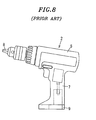
- the electric tool 2 of Fig. 8 is a pistol type impact driver, in which a handle 7 is extended from one end of a main body 6 in a direction crossing the main body 6.
- the electric tool 2 is constructed such that an output unit 8 is operated by drive force transmitted from a motor (not shown), which is installed in the main body 6, through a reducer (not shown).
- a battery pack mounting unit 9 is provided at the end of the handle 7 that is opposite of the main body 6.
- a battery pack is removably mounted to the battery pack mounting unit 9.
- a charging type electric tool and a charging device for charging a battery pack of the charging type electric tool are disclosed in Patent Reference 1 (Japanese Patent Laid-open Publication No. 2005-342796 ).
- each of the above battery packs must be charged by a dedicated charging device corresponding to each individual battery pack, a number of different charging devices are required. Therefore, when employing electric tools having different types of battery packs, it is inconvenient for users as the same number of charging devices are required.
- an object of the present invention to provide a small size charging device capable of charging different types of battery pack.
- a charging device for charging battery packs including: charging terminals, having a first charging terminal to be connected to an electrode of a first battery pack and a second charging terminal to be connected to an electrode of a second battery pack, which is different in kind from the first battery pack; and a conversion unit for supplying electricity to the first charging terminal when the electrode of the first battery pack is connected to the first charging terminal and for supplying electricity to the second charging terminal when the electrode of the second battery pack is connected to the second charging terminal.
- the single charging device can charge both the first and second battery packs. Furthermore, because the charging device of the present invention has the conversion unit for supplying electricity to the first charging terminal when the electrode of the first battery pack is connected to the first charging terminal and for supplying electricity to the second charging terminal when the electrode of the second battery pack is connected to the second charging terminal. Therefore, since it is sufficient to provide only a single charging power supply in the charging device, a reduction in size of the charging device can be achieved.
- the conversion unit may include: a conversion relay having a common terminal connected to a charging power supply, a normally closed terminal connected to the first charging terminal, and a normally open terminal connected to the second charging terminal; and a control unit such that, when the electrode of the first battery pack is connected to the first charging terminal, a contact point of the conversion relay is switched to the normally closed terminal, and, when the electrode of the second battery pack is connected to the second charging terminal, the contact point of the conversion relay is switched to the normally open terminal.
- the conversion unit can be realized by a relatively simple construction.
- the charging device may further include a first mounting bracket to mount the first battery pack thereto, and a second mounting bracket to mount the second battery pack thereto.
- the first charging terminal is provided in the first mounting bracket
- the second charging terminal is provided in the second mounting bracket. Therefore, the first battery pack can be charged merely by inserting it into the first mounting bracket, and the second battery pack can be charged merely by inserting it into the second mounting bracket.
- the first charging terminal serves to charge the first battery pack, comprising a nickel-cadmium battery or a nickel metal hydride battery
- the second charging terminal serves to charge the second battery pack, which includes a lithium-ion battery.
- the present invention different types of the first and second battery packs can be charged by a single charging device which only requires a single charging power supply type. Therefore, a reduction in size of the charging device can be achieved.
- a charging device 1 shown in Fig. 1 serves to charge battery packs 3a and 3b (see Figs. 4 and 5), which are used as secondary batteries for an electric tool 2.
- the charging device 1 is able to charge two kinds of battery packs, that is, the first battery pack 3a, which is shown in Fig. 4 and has cells 4a (see Fig. 6), each of which is made of a nickel-cadmium battery or a nickel metal hydride battery, and the second battery pack 3b, which is shown in Fig. 5 and has cells 4b (see Fig. 7), each of which is made of a lithium-ion battery.
- the charging battery set may include a combination of the charging device 1 and the first battery pack 3a, or may alternatively include a combination of the charging device 1 and the second battery pack 3b.
- the charging battery set may include a combination of the charging device 1, the first battery pack 3a and the second battery pack 3b.
- a pistol type electric tool having the same construction as that of the conventional electric tool of Fig. 8 is used as an example of the electric tool 2 to which the first battery pack 3a or the second battery pack 3b is mounted. Therefore, further explanation of the electric tool 2 is deemed unnecessary. Further, the electric tool 2 can use only one of the first and second battery packs 3a and 3b as a power supply. Thus, as for the electric tool 2, it is assumed that there are two kinds of electric tools, which include an electric tool 2 of Fig. 8 having the first battery 3a provided therewith and an electric tool having the second battery pack 3b provided therewith (not shown).
- the first and second battery packs 3a and 3b which are removably mounted to the electric tool and charged by the charging device 1, are in different shapes and sizes as well as being different in kind.
- the first battery pack 3a includes a first case 11, which has a block shape and defines the external appearance of the first battery pack 3a.
- the cells 4a are installed in the first case 11 (refer to Fig. 6).
- a first mounting boss 12 which has an asymmetrical external shape, perpendicularly protrudes downwards from the lower surface of the first case 11, which faces the electric tool 2 when the first battery pack 3a is mounted to the electric tool 2, at a predetermined position spaced apart from the center of the lower surface of the first case 11 towards a first end of the lower surface of the first case 11 by a predetermined distance.
- Electrodes 13 are provided on the circumferential outer surface of the distal end of the mounting boss 12.
- a first active connection terminal 14 (see, Fig.
- the first mounting boss 12 and the support portion 15 are removably inserted into a battery pack mounting unit 9 of the electric tool 2, and thus the electrodes 13 of the first battery pack 3a are connected to terminals (not shown), which are provided in the battery pack mounting unit 9, in order to supply power to the electric tool 2.
- the first vent port 17 includes a plurality of slots 17a, which are in parallel with the first surface of the first mounting boss 12 of the first case 11.
- the second battery pack 3b includes a second case 18, which defines the external appearance of the second battery pack 3b and has a box shape that is planar with respect to that of the first battery pack 3a, and extends a predetermined length in one direction.
- the cells 4b are installed in the second case 18.
- a second mounting boss 19 protrudes downwards from the lower surface of the second case 18, which faces the electric tool 2 when the second battery pack 3b is mounted to the electric tool 2, at a predetermined portion other than a first end in a longitudinal direction.
- the second mounting boss 19 has a rectangular shape which extends a predetermined length in the longitudinal direction of the second case 18.
- Terminal insertion slots 21, which are open downwards and towards the first end of the second case 18, when viewed in the longitudinal direction thereof, are formed in the first end of the second mounting boss 19, when viewed in the longitudinal direction of the second case 18. Electrodes 23, which are connected to the cells 4b, are provided in respective terminal insertion slots 21. Furthermore, coupling protrusions 22, each of which has an L shape when viewed from one side, integrally protrude outwards from opposite side surfaces of the second mounting boss 19. In the embodiment, several sets (in detail, three sets) of coupling protrusions 22, each set of which includes a pair of coupling protrusions 22, are arranged in the longitudinal direction of the second mounting boss 19.
- each coupling protrusion 22 is integrally level with the lower surface of the second case 18.
- the second mounting boss 19 and the coupling protrusions 22 are removably inserted into a battery pack mounting unit of the electric tool 2, and thus the electrodes 23 of the second battery pack 3b are connected to terminals (not shown) provided in the battery pack mounting unit in order to supply power to the electric tool 2.
- a depressed portion 24 is formed in the central portion of the lower surface of the second mounting boss 19.
- a battery side connector 25 protrudes downwards from the bottom end of the depressed portion 24 that is opposite of the first end of the second case 18, when viewed in the longitudinal direction thereof.
- a second active connection terminal (see, Fig. 3) is provided in the battery side connector 25.
- a second vent port 28 which communicates with the cells 4b provided in the second case 18, is formed in the lower surface of the second case 18 between the edge of the first end thereof, as viewed in the longitudinal direction thereof, and the second mounting boss 19, that is, in the lower surface of the first end of the second case 18, as viewed in the longitudinal direction.
- the second vent port 28 includes a plurality of slots 28a, each of which extends a predetermined length in the transverse direction of the second case 18.
- the charging device 1 of Fig. 1 includes a box-shaped housing 32, which is rectangular when seen in a plan view thereof, and defines the external appearance of the charging device 1.
- a first mounting bracket 30, into which the first mounting boss 12 of the first battery pack 3a is removably inserted, and a second mounting bracket 31, into which the second mounting boss 19 of the second battery pack 3b is removably inserted, are provided in one half of the upper surface of the housing 32, defined on the basis of the longitudinal axis of the housing 32.
- the first mounting bracket 30 is formed in the first end of the housing 32, when viewed in the longitudinal direction thereof.
- the second mounting bracket 31 is formed in the housing 32 at a position spaced apart from the first mounting bracket 30 towards the second end of the housing 32 in the longitudinal direction by a predetermined distance.
- a manipulation portion for manipulating the charging device for example, for switching the charging mode, and an indication portion for indicating the status of the charging device are provided on one half of the upper surface of the housing 32 that is opposite of the half in which the first mounting bracket 30 and the second mounting bracket 31 are provided.
- An air supply port 36 is formed in the upper surface of the housing 32 at an intermediate portion 35 defined between the first mounting bracket 30 and the second mounting bracket 31.
- the air supply port 36 includes a plurality of slots 36a, each of which extends a predetermined length in a transverse direction.
- the air supply port 36 communicates with a suction port 38 through an air passage 37 defined in the housing 32 (see Figs. 6 and 7).
- the suction port 38 is formed on the groove the lower surface of the housing 32, which is vertically spaced apart from the support surface by support legs 34.
- a cooling fan 39 is provided in the housing 32 at a position corresponding to the air supply port 36. Outside air is drawn into the housing 32 through the air suction port 38 by the operation of the cooling fan 39, and then the air is discharged upwards through the air supply port 36.
- the first mounting bracket 30 of the charging device 1 includes a depressed portion, which is open at the upper end thereof, and into which is mounted the first mounting boss 12 of the first battery pack 3a. Furthermore, first charging terminals 41 are provided in the inner surface of the first mounting bracket 30 at positions corresponding to the respective electrodes of the first battery pack 3a. In addition, a first passive connection terminal 42 (see, Fig. 3) is provided in the inner surface of the first mounting bracket 30 at a position corresponding to the first active connection terminal 14.
- a portion of the first case 11 of the first battery pack 3a is in contact with or is adjacent to the intermediate portion 35 of the charging device 1 and, simultaneously, the first vent port 17 of the support portion 15 of the first battery pack 3a faces the air supply port 36 of the intermediate portion 35 such that they correspond to each other when seen in a plan view.
- the first battery pack 3a when the first battery pack 3a is charged, air, which has been discharged through the air supply port 36 of the charging device 1 by the operation of the cooling fan 39, is supplied into the first case 11 of the first battery pack 3a through the first vent port 17, thus cooling the elements such as the cells 4a provided in the first battery pack 3a. Therefore, the first battery pack 3a is prevented from being heated to a high temperature while it is charged.
- the second mounting bracket 31 includes a depressed portion, which is open at the upper end thereof and at the end opposite the first mounting bracket 30.
- Second charging terminals 43 protrude upwards from the end of the bottom of the second mounting bracket 31 that is adjacent to the first mounting bracket 30.
- coupling catches 44 are provided in the second mounting bracket 31 at positions corresponding to the respective coupling protrusions 22 of the second battery pack 3b.
- the coupling catches 44 protrude inwards from upper portions of inner surfaces of opposite sidewalls of the second mounting bracket 31.
- insertion slots 45 are defined under coupling the catches 44.
- a movable support plate 49 which is elastically supported by springs 48, is provided above the bottom portion of the second mounting bracket 31. Notches 50 and a hole 51 are formed in the movable support plate 49 at positions corresponding to the second charging terminals 43, the coupling protrusions 44, and the device side connector 46 so as to allow the movable support plate 49 to pass thru the notches 50 and the hole 51.
- the movable support plate 49 is vertically movable in the second mounting bracket 31 between the normal state of Fig. 1 or 2, in which the movable support plate 49 is disposed at the upper position of the second mounting bracket 31, and the mounted state of Fig.
- the electrodes 23 of the second battery pack 3b are electrically connected to the second charging terminals 43 to charge the second battery pack 3b, and, simultaneously, the second active connection terminal 26 of the second battery pack 3b is electrically connected to the second passive connection terminal 47.
- the second mounting boss 19 of the second battery pack 3b is first placed onto the upper surface of the movable support plate 49. Thereafter, the second battery pack 3b, along with the movable support plate 49, is pushed downwards to a position around the mounted state while overcoming the elasticity of the springs 48. Then, the coupling protrusions 22 of the second battery pack 3b are moved to pass thru a gap between the coupling catches 44. Then, the coupling protrusions 22 of the second battery pack 3b are inserted into the insertion slots 45 of the respective coupling catches 44, so that the coupling protrusions 22 are locked to the respective coupling catches 44.
- the second charging terminals 43 of the charging device 1 are inserted into the respective terminal insertion slots 21 of the second battery pack 3b, thus the second charging terminals 43 are electrically connected to the respective electrodes 23 of the second battery pack 3b.
- the battery side connector 25 of the second battery pack 3b is mechanically coupled to the device side connector 46 of the charging device 1, and the second active connection terminal 26 of the second battery pack 3b is electrically connected to the second passive connection terminal 47 of the charging device 1.
- a portion of the second case 18 of the second battery pack 3b is in contact with or is adjacent to the intermediate portion 35 of the housing 32 of the charging device 1 and, simultaneously, the second vent port 28 of the second case 18 faces the air supply port 36 of the intermediate portion 35 such that they correspond to each other when seen in a plan view.
- the charging device 1 of the present invention is constructed such that, if the first battery pack 3a and the second battery pack 3b are respectively mounted to the first mounting bracket 30 and the second mounting bracket 31, in other words, if the first and second battery packs 3a and 3b are disposed at the same time at the positions at which they are charged, an interfering part 54 of the first battery pack 3a, which corresponds to the intermediate portion 35 of the charging device 1, interferes with an interfering part 55 of the second battery pack 3b, which corresponds to the intermediate portion 35 of the charging device 1.
- the second battery pack 3b When the second battery pack 3b is charged, air, which has been discharged through the air supply port 36 of the charging device 1 by the operation of the cooling fan 39, is supplied into the second case 18 of the second battery pack 3b through the second vent port 28, thus cooling the elements such as the cells 4b provided in the second battery pack 3b. Thereby, the second battery pack 3b is prevented from being heated to a high temperature while it is charged. Furthermore, in the present invention, as described above, when the first battery pack 3a and the second battery pack 3b are mounted to the first mounting bracket 30 and the second mounting bracket 31, respectively, at the same time, the interfering part 54 of the first battery pack 3a and the interfering part 55 of the second battery pack 3b interfere with each other. Therefore, the first battery pack 3a and the second battery pack 3b are prevented from being mounted to and charged by the charging device 1 at the same time.
- the charging device 1 includes a conversion unit for supplying electricity to the first charging terminals 41 when the electrodes 13 of the first battery pack 3a are connected to respective first charging terminals 41 and for supplying electricity to the second charging terminals 43 when the electrodes 23 of the second battery pack 3b are connected to respective second charging terminals 43.
- the conversion unit will be described herein below.
- the charging device 1 includes a power circuit 56, which is connected to an outer power supply, which is a power supply for charging, and is not shown in the drawings, in order to supply electricity for charging.
- the power circuit 56 is provided with two power leads, where one of the power leads is configured to be connected to one of the first and the second charging terminals 41 and 43. Further, the other power lead is connected to a common terminal 57a of a conversion relay 57. Further, a first output electrode 57b, e.g., a normally closed terminal, of the conversion relay 57 (which is a terminal connected in a demagnetized state) is connected to the first charging terminal 41, to thus be connected to the corresponding electrode 13 of the first battery pack 3a.
- a first output electrode 57b e.g., a normally closed terminal, of the conversion relay 57 (which is a terminal connected in a demagnetized state) is connected to the first charging terminal 41, to thus be connected to the corresponding electrode 13 of the first battery pack 3a.
- a second output electrode 57c e.g., a normally open terminal, of the conversion relay 57 (which is a terminal disconnected in a demagnetized state) is connected to a remaining one of the second charging terminals 43, to thus be connected to the corresponding electrode 23 of the second battery pack 3b.
- the charging device 1 includes a charging control circuit 58 therein. The charging control circuit 58 is connected both to the first passive connection terminal 42, to which the first active connection terminal 14 of the first battery pack 3a is connected, and to the second passive connection terminal 47, to which the second active connection terminal 26 of the second battery pack 3b is connected.
- the charging control circuit 58 constituting a control unit is set such that, when the first active connection terminal 14 of the first battery pack 3a is connected to the first passive connection terminal 42, the contact point of the conversion relay 57 is switched to the normally closed terminal 57b, and, when the second active connection terminal 26 of the second battery pack 3b is connected to the second passive connection terminal 47, the contact point of the conversion relay 57 is switched to the normally open terminal 57c. In other words, in the case where the electrodes 13 of the first battery pack 3a are connected to the first charging terminals 41, the contact point of the conversion relay 57 is switched to the normally closed terminal 57b.
- the contact point of the conversion relay 57 is switched to the normally open terminal 57c. Therefore, when the first mounting boss 12 of the first battery pack 3a is mounted to the first mounting bracket 30 of the charging device 1, the charging device 1 is set such that the first battery pack 3a can be charged. When the second mounting boss 19 of the second battery pack 3b is mounted to the second mounting bracket 31 of the charging device 1, the charging device 1 is set such that the second battery pack 3b can be charged.
- the single charging device 1 can charge two different kinds of battery packs, that is, first and second battery packs 3a and 3b. Furthermore, the charging device 1 can automatically and selectively supply electricity from the single charging power supply to the first charging terminal 41 or the second charging terminal 43 using the conversion relay 57. Therefore, in the charging device 1, the single charging power supply is used both as a charging power supply for the first charging terminal 41 and a charging power supply for the second charging terminal 43, so that a reduction in size of the charging device 1 can be realized.
- the single cooling fan 39 can cool the first battery pack 3a, which is mounted to the first mounting bracket 30, and can cool the second battery pack 3b, which is mounted to the second mounting bracket 31. As such, the cooling fan 39 can be used as a fan for both the first and second battery packs 3a, thus a reduction in size of the charging device 1 can be realized.
Landscapes
- Chemical & Material Sciences (AREA)
- Chemical Kinetics & Catalysis (AREA)
- Electrochemistry (AREA)
- General Chemical & Material Sciences (AREA)
- Engineering & Computer Science (AREA)
- Manufacturing & Machinery (AREA)
- Charge And Discharge Circuits For Batteries Or The Like (AREA)
- Secondary Cells (AREA)
- Battery Mounting, Suspending (AREA)
Abstract
Description
- The present invention relates to a charging device; and, more particularly, to a charging device for battery packs used in electric tools or the like.
- In general, a
battery pack 3 shown in Fig. 9a is removably mounted to a charging typeelectric tool 2 of Fig. 8. Typically, a battery pack having nickel-cadmium batteries (Ni-Cd batteries) or nickel metal hydride batteries (Ni-MH) therein is used as thebattery pack 3. Here, theelectric tool 2 of Fig. 8 is a pistol type impact driver, in which ahandle 7 is extended from one end of a main body 6 in a direction crossing the main body 6. Theelectric tool 2 is constructed such that an output unit 8 is operated by drive force transmitted from a motor (not shown), which is installed in the main body 6, through a reducer (not shown). Furthermore, a battery pack mounting unit 9 is provided at the end of thehandle 7 that is opposite of the main body 6. A battery pack is removably mounted to the battery pack mounting unit 9. Herein, examples of a charging type electric tool and a charging device for charging a battery pack of the charging type electric tool are disclosed in Patent Reference 1 (Japanese Patent Laid-open PublicationNo. 2005-342796 - In recent years, to reduce the size of the battery pack, a battery pack having lithium-ion batteries has been developed for use. Therefore, at present, electric tools using the former and the latter battery pack are available. Such battery packs are charged, for example, by the charging device 1' of Fig. 9b.
- However, since each of the above battery packs must be charged by a dedicated charging device corresponding to each individual battery pack, a number of different charging devices are required. Therefore, when employing electric tools having different types of battery packs, it is inconvenient for users as the same number of charging devices are required.
- It is, therefore, an object of the present invention to provide a small size charging device capable of charging different types of battery pack.
- To achieve the object, in accordance with one aspect of the present invention, there is provided a charging device for charging battery packs, including: charging terminals, having a first charging terminal to be connected to an electrode of a first battery pack and a second charging terminal to be connected to an electrode of a second battery pack, which is different in kind from the first battery pack; and a conversion unit for supplying electricity to the first charging terminal when the electrode of the first battery pack is connected to the first charging terminal and for supplying electricity to the second charging terminal when the electrode of the second battery pack is connected to the second charging terminal.
- With the above-mentioned construction, the single charging device can charge both the first and second battery packs. Furthermore, because the charging device of the present invention has the conversion unit for supplying electricity to the first charging terminal when the electrode of the first battery pack is connected to the first charging terminal and for supplying electricity to the second charging terminal when the electrode of the second battery pack is connected to the second charging terminal. Therefore, since it is sufficient to provide only a single charging power supply in the charging device, a reduction in size of the charging device can be achieved.
- In addition, the conversion unit may include: a conversion relay having a common terminal connected to a charging power supply, a normally closed terminal connected to the first charging terminal, and a normally open terminal connected to the second charging terminal; and a control unit such that, when the electrode of the first battery pack is connected to the first charging terminal, a contact point of the conversion relay is switched to the normally closed terminal, and, when the electrode of the second battery pack is connected to the second charging terminal, the contact point of the conversion relay is switched to the normally open terminal. Thus, the conversion unit can be realized by a relatively simple construction.
- As well, the charging device may further include a first mounting bracket to mount the first battery pack thereto, and a second mounting bracket to mount the second battery pack thereto. The first charging terminal is provided in the first mounting bracket, and the second charging terminal is provided in the second mounting bracket. Therefore, the first battery pack can be charged merely by inserting it into the first mounting bracket, and the second battery pack can be charged merely by inserting it into the second mounting bracket.
- Moreover, the first charging terminal serves to charge the first battery pack, comprising a nickel-cadmium battery or a nickel metal hydride battery, and the second charging terminal serves to charge the second battery pack, which includes a lithium-ion battery. Thus, both the first battery pack, including the nickel-cadmium battery or the nickel metal hydride battery, and the second battery pack, including the lithium-ion battery, can be charged by the charging device of the present invention.
- As described above, in the present invention, different types of the first and second battery packs can be charged by a single charging device which only requires a single charging power supply type. Therefore, a reduction in size of the charging device can be achieved.
- The above and other objects and features of the present invention will become apparent from the following description of embodiments given in conjunction with the accompanying drawings, in which:
- Fig. 1 shows a perspective view of a charging device, in accordance with to an embodiment of the present invention.
- Fig. 2 illustrates a sectional view of the charging device of Fig. 1;
- Fig. 3 depicts a block diagram of the charging device of Fig. 1;
- Fig. 4 is a perspective view showing the lower surface of a first battery pack in accordance with the embodiment of the present invention;
- Fig. 5 is a perspective view showing the lower surface of a second battery pack in accordance with the embodiment of the present invention;
- Fig. 6 is a sectional view showing the first battery pack mounted to the charging device of Fig. 1;
- Fig. 7 is a sectional view showing the second battery pack mounted to the charging device of Fig. 1;
- Fig. 8 is a sectional view of a conventional electric tool; and
- Fig. 9 shows a charging battery set for the electric tool of Fig. 8, wherein Fig. 9a illustrates a perspective view of a battery pack, and Fig. 9b illustrates a perspective view of a charging device.
- Hereinafter, an embodiment of the present invention will be described in detail with reference to the attached drawings.
- A
charging device 1 shown in Fig. 1 serves to chargebattery packs electric tool 2. Thecharging device 1 is able to charge two kinds of battery packs, that is, thefirst battery pack 3a, which is shown in Fig. 4 and hascells 4a (see Fig. 6), each of which is made of a nickel-cadmium battery or a nickel metal hydride battery, and thesecond battery pack 3b, which is shown in Fig. 5 and hascells 4b (see Fig. 7), each of which is made of a lithium-ion battery. Thus, thecharging device 1 and at lease one of the first andsecond battery packs charging device 1, form a charging battery set. In other words, the charging battery set may include a combination of thecharging device 1 and thefirst battery pack 3a, or may alternatively include a combination of thecharging device 1 and thesecond battery pack 3b. As a further alternative, the charging battery set may include a combination of thecharging device 1, thefirst battery pack 3a and thesecond battery pack 3b. - In the embodiment, a pistol type electric tool having the same construction as that of the conventional electric tool of Fig. 8 is used as an example of the
electric tool 2 to which thefirst battery pack 3a or thesecond battery pack 3b is mounted. Therefore, further explanation of theelectric tool 2 is deemed unnecessary. Further, theelectric tool 2 can use only one of the first andsecond battery packs electric tool 2, it is assumed that there are two kinds of electric tools, which include anelectric tool 2 of Fig. 8 having thefirst battery 3a provided therewith and an electric tool having thesecond battery pack 3b provided therewith (not shown). - The first and
second battery packs charging device 1, are in different shapes and sizes as well as being different in kind. - As shown in Fig. 4, the
first battery pack 3a includes afirst case 11, which has a block shape and defines the external appearance of thefirst battery pack 3a. Thecells 4a are installed in the first case 11 (refer to Fig. 6). Afirst mounting boss 12, which has an asymmetrical external shape, perpendicularly protrudes downwards from the lower surface of thefirst case 11, which faces theelectric tool 2 when thefirst battery pack 3a is mounted to theelectric tool 2, at a predetermined position spaced apart from the center of the lower surface of thefirst case 11 towards a first end of the lower surface of thefirst case 11 by a predetermined distance.Electrodes 13 are provided on the circumferential outer surface of the distal end of themounting boss 12. A first active connection terminal 14 (see, Fig. 3) is provided at the same portion as the part in which theelectrodes 13 are provided. Furthermore, arectangular support portion 15, which is lower than thefirst mounting boss 12, protrudes downwards from the central portion of the lower surface of thefirst case 11 to have a shape such that thesupport portion 15 surrounds three surfaces of the proximal end of themounting boss 12. Thefirst mounting boss 12 and thesupport portion 15 are removably inserted into a battery pack mounting unit 9 of theelectric tool 2, and thus theelectrodes 13 of thefirst battery pack 3a are connected to terminals (not shown), which are provided in the battery pack mounting unit 9, in order to supply power to theelectric tool 2. - In addition, a
first vent port 17, which communicates with thecells 4a provided in thefirst case 11, is formed in the lower surface of thesupport portion 15 of thefirst case 11 between thefirst mounting boss 12 and the edge of the lower surface of thesupport portion 15 that is opposite of thefirst mounting boss 12. Thefirst vent port 17 includes a plurality ofslots 17a, which are in parallel with the first surface of thefirst mounting boss 12 of thefirst case 11. - As shown in Fig. 5, the
second battery pack 3b includes asecond case 18, which defines the external appearance of thesecond battery pack 3b and has a box shape that is planar with respect to that of thefirst battery pack 3a, and extends a predetermined length in one direction. Thecells 4b are installed in thesecond case 18. Asecond mounting boss 19 protrudes downwards from the lower surface of thesecond case 18, which faces theelectric tool 2 when thesecond battery pack 3b is mounted to theelectric tool 2, at a predetermined portion other than a first end in a longitudinal direction. Thesecond mounting boss 19 has a rectangular shape which extends a predetermined length in the longitudinal direction of thesecond case 18.Terminal insertion slots 21, which are open downwards and towards the first end of thesecond case 18, when viewed in the longitudinal direction thereof, are formed in the first end of the second mountingboss 19, when viewed in the longitudinal direction of thesecond case 18.Electrodes 23, which are connected to thecells 4b, are provided in respectiveterminal insertion slots 21. Furthermore,coupling protrusions 22, each of which has an L shape when viewed from one side, integrally protrude outwards from opposite side surfaces of the second mountingboss 19. In the embodiment, several sets (in detail, three sets) ofcoupling protrusions 22, each set of which includes a pair ofcoupling protrusions 22, are arranged in the longitudinal direction of the second mountingboss 19. Here, the upper end of avertical part 22a of eachcoupling protrusion 22 is integrally level with the lower surface of thesecond case 18. The second mountingboss 19 and thecoupling protrusions 22 are removably inserted into a battery pack mounting unit of theelectric tool 2, and thus theelectrodes 23 of thesecond battery pack 3b are connected to terminals (not shown) provided in the battery pack mounting unit in order to supply power to theelectric tool 2. - Meanwhile, a
depressed portion 24 is formed in the central portion of the lower surface of the second mountingboss 19. Abattery side connector 25 protrudes downwards from the bottom end of thedepressed portion 24 that is opposite of the first end of thesecond case 18, when viewed in the longitudinal direction thereof. A second active connection terminal (see, Fig. 3) is provided in thebattery side connector 25. In addition, asecond vent port 28, which communicates with thecells 4b provided in thesecond case 18, is formed in the lower surface of thesecond case 18 between the edge of the first end thereof, as viewed in the longitudinal direction thereof, and the second mountingboss 19, that is, in the lower surface of the first end of thesecond case 18, as viewed in the longitudinal direction. Thesecond vent port 28 includes a plurality ofslots 28a, each of which extends a predetermined length in the transverse direction of thesecond case 18. - The charging
device 1 of Fig. 1 includes a box-shapedhousing 32, which is rectangular when seen in a plan view thereof, and defines the external appearance of thecharging device 1. A first mountingbracket 30, into which the first mountingboss 12 of thefirst battery pack 3a is removably inserted, and asecond mounting bracket 31, into which the second mountingboss 19 of thesecond battery pack 3b is removably inserted, are provided in one half of the upper surface of thehousing 32, defined on the basis of the longitudinal axis of thehousing 32. Thefirst mounting bracket 30 is formed in the first end of thehousing 32, when viewed in the longitudinal direction thereof. Thesecond mounting bracket 31 is formed in thehousing 32 at a position spaced apart from the first mountingbracket 30 towards the second end of thehousing 32 in the longitudinal direction by a predetermined distance. A manipulation portion for manipulating the charging device, for example, for switching the charging mode, and an indication portion for indicating the status of the charging device are provided on one half of the upper surface of thehousing 32 that is opposite of the half in which the first mountingbracket 30 and the second mountingbracket 31 are provided. - An
air supply port 36 is formed in the upper surface of thehousing 32 at anintermediate portion 35 defined between the first mountingbracket 30 and the second mountingbracket 31. Theair supply port 36 includes a plurality ofslots 36a, each of which extends a predetermined length in a transverse direction. Theair supply port 36 communicates with asuction port 38 through anair passage 37 defined in the housing 32 (see Figs. 6 and 7). Thesuction port 38 is formed on the groove the lower surface of thehousing 32, which is vertically spaced apart from the support surface bysupport legs 34. Furthermore, as shown, e.g., in Fig. 6, a coolingfan 39 is provided in thehousing 32 at a position corresponding to theair supply port 36. Outside air is drawn into thehousing 32 through theair suction port 38 by the operation of the coolingfan 39, and then the air is discharged upwards through theair supply port 36. - As shown in Fig. 1, the first mounting
bracket 30 of thecharging device 1 includes a depressed portion, which is open at the upper end thereof, and into which is mounted the first mountingboss 12 of thefirst battery pack 3a. Furthermore,first charging terminals 41 are provided in the inner surface of the first mountingbracket 30 at positions corresponding to the respective electrodes of thefirst battery pack 3a. In addition, a first passive connection terminal 42 (see, Fig. 3) is provided in the inner surface of the first mountingbracket 30 at a position corresponding to the firstactive connection terminal 14. - As shown in Fig. 6, when the first mounting
boss 12 of thefirst battery pack 3a is inserted into the mountingbracket 30 of thecharging device 1, theelectrodes 13 of thefirst battery pack 3a are electrically connected to the respectivefirst charging terminals 41, so that thefirst battery pack 3a is charged. Simultaneously, the firstactive connection terminal 14 of thefirst battery pack 3a is electrically connected to the firstpassive connection terminal 42. - Further, in the state in which the first mounting
boss 12 is inserted into the first mountingbracket 30 and thefirst battery pack 3a is thus disposed at the position at which it is charged, a portion of thefirst case 11 of thefirst battery pack 3a is in contact with or is adjacent to theintermediate portion 35 of thecharging device 1 and, simultaneously, thefirst vent port 17 of thesupport portion 15 of thefirst battery pack 3a faces theair supply port 36 of theintermediate portion 35 such that they correspond to each other when seen in a plan view. Therefore, when thefirst battery pack 3a is charged, air, which has been discharged through theair supply port 36 of thecharging device 1 by the operation of the coolingfan 39, is supplied into thefirst case 11 of thefirst battery pack 3a through thefirst vent port 17, thus cooling the elements such as thecells 4a provided in thefirst battery pack 3a. Therefore, thefirst battery pack 3a is prevented from being heated to a high temperature while it is charged. - Meanwhile, as shown in Fig. 1, the second mounting
bracket 31 includes a depressed portion, which is open at the upper end thereof and at the end opposite the first mountingbracket 30.Second charging terminals 43 protrude upwards from the end of the bottom of the second mountingbracket 31 that is adjacent to the first mountingbracket 30. Further, coupling catches 44 are provided in the second mountingbracket 31 at positions corresponding to therespective coupling protrusions 22 of thesecond battery pack 3b. As shown in Fig. 2, the coupling catches 44 protrude inwards from upper portions of inner surfaces of opposite sidewalls of the second mountingbracket 31. Furthermore,insertion slots 45 are defined under coupling thecatches 44. Thus, horizontal parts 22b of the reverse L-shapedcoupling protrusions 22 of thesecond battery pack 3b are inserted into theinsertion slots 45 of the respective coupling catches 45. In addition, adevice side connector 46 protrudes from the central portion of the bottom of the second mountingbracket 31. A second passive connection terminal 47 (see, Fig. 3) is provided in thedevice side connector 46. - As shown in Figs. 1, 2 and 6, a
movable support plate 49, which is elastically supported bysprings 48, is provided above the bottom portion of the second mountingbracket 31.Notches 50 and ahole 51 are formed in themovable support plate 49 at positions corresponding to thesecond charging terminals 43, thecoupling protrusions 44, and thedevice side connector 46 so as to allow themovable support plate 49 to pass thru thenotches 50 and thehole 51. Thus, themovable support plate 49 is vertically movable in the second mountingbracket 31 between the normal state of Fig. 1 or 2, in which themovable support plate 49 is disposed at the upper position of the second mountingbracket 31, and the mounted state of Fig. 7, in which themovable support plate 49 is disposed at the lower position of the second mountingbracket 31 adjacent to the bottom of the second mountingbracket 31. In the state in which the second mountingboss 19 of thesecond battery pack 3b is not inserted into the second mountingbracket 31, themovable support plate 49 is maintained at the normal position by thesprings 48, as shown in Fig. 1 or 2. In this state, thesecond charging terminals 43, the coupling catches 44 and thedevice side connector 46 may be disposed below the upper surface of themovable support plate 49. - In the state in which the second mounting
boss 19 of thesecond battery pack 3b is inserted into the second mountingbracket 31, as shown in Fig. 7, theelectrodes 23 of thesecond battery pack 3b are electrically connected to thesecond charging terminals 43 to charge thesecond battery pack 3b, and, simultaneously, the secondactive connection terminal 26 of thesecond battery pack 3b is electrically connected to the secondpassive connection terminal 47. - To insert the second mounting
boss 19 of thesecond battery pack 3b into the second mountingbracket 31 of thecharging device 1, the second mountingboss 19 of thesecond battery pack 3b is first placed onto the upper surface of themovable support plate 49. Thereafter, thesecond battery pack 3b, along with themovable support plate 49, is pushed downwards to a position around the mounted state while overcoming the elasticity of thesprings 48. Then, thecoupling protrusions 22 of thesecond battery pack 3b are moved to pass thru a gap between the coupling catches 44. Then, thecoupling protrusions 22 of thesecond battery pack 3b are inserted into theinsertion slots 45 of the respective coupling catches 44, so that thecoupling protrusions 22 are locked to the respective coupling catches 44. In addition, when thesecond battery pack 3b slides, thesecond charging terminals 43 of thecharging device 1 are inserted into the respectiveterminal insertion slots 21 of thesecond battery pack 3b, thus thesecond charging terminals 43 are electrically connected to therespective electrodes 23 of thesecond battery pack 3b. Simultaneously, thebattery side connector 25 of thesecond battery pack 3b is mechanically coupled to thedevice side connector 46 of thecharging device 1, and the secondactive connection terminal 26 of thesecond battery pack 3b is electrically connected to the secondpassive connection terminal 47 of thecharging device 1. - Furthermore, in the state in which the second mounting
boss 19 is inserted into the second mountingbracket 31 and thesecond battery pack 3b is thus disposed at the position at which it is charged, a portion of thesecond case 18 of thesecond battery pack 3b is in contact with or is adjacent to theintermediate portion 35 of thehousing 32 of thecharging device 1 and, simultaneously, thesecond vent port 28 of thesecond case 18 faces theair supply port 36 of theintermediate portion 35 such that they correspond to each other when seen in a plan view. That is, the chargingdevice 1 of the present invention is constructed such that, if thefirst battery pack 3a and thesecond battery pack 3b are respectively mounted to the first mountingbracket 30 and the second mountingbracket 31, in other words, if the first and second battery packs 3a and 3b are disposed at the same time at the positions at which they are charged, an interferingpart 54 of thefirst battery pack 3a, which corresponds to theintermediate portion 35 of thecharging device 1, interferes with an interferingpart 55 of thesecond battery pack 3b, which corresponds to theintermediate portion 35 of thecharging device 1. When thesecond battery pack 3b is charged, air, which has been discharged through theair supply port 36 of thecharging device 1 by the operation of the coolingfan 39, is supplied into thesecond case 18 of thesecond battery pack 3b through thesecond vent port 28, thus cooling the elements such as thecells 4b provided in thesecond battery pack 3b. Thereby, thesecond battery pack 3b is prevented from being heated to a high temperature while it is charged. Furthermore, in the present invention, as described above, when thefirst battery pack 3a and thesecond battery pack 3b are mounted to the first mountingbracket 30 and the second mountingbracket 31, respectively, at the same time, the interferingpart 54 of thefirst battery pack 3a and the interferingpart 55 of thesecond battery pack 3b interfere with each other. Therefore, thefirst battery pack 3a and thesecond battery pack 3b are prevented from being mounted to and charged by the chargingdevice 1 at the same time. - Here, the charging
device 1 includes a conversion unit for supplying electricity to thefirst charging terminals 41 when theelectrodes 13 of thefirst battery pack 3a are connected to respectivefirst charging terminals 41 and for supplying electricity to thesecond charging terminals 43 when theelectrodes 23 of thesecond battery pack 3b are connected to respectivesecond charging terminals 43. The conversion unit will be described herein below. - As shown in the block diagram of Fig. 3, the charging
device 1 includes apower circuit 56, which is connected to an outer power supply, which is a power supply for charging, and is not shown in the drawings, in order to supply electricity for charging. Thepower circuit 56 is provided with two power leads, where one of the power leads is configured to be connected to one of the first and thesecond charging terminals conversion relay 57. Further, afirst output electrode 57b, e.g., a normally closed terminal, of the conversion relay 57 (which is a terminal connected in a demagnetized state) is connected to the first chargingterminal 41, to thus be connected to the correspondingelectrode 13 of thefirst battery pack 3a. In addition, asecond output electrode 57c, e.g., a normally open terminal, of the conversion relay 57 (which is a terminal disconnected in a demagnetized state) is connected to a remaining one of thesecond charging terminals 43, to thus be connected to the correspondingelectrode 23 of thesecond battery pack 3b. In addition, the chargingdevice 1 includes a chargingcontrol circuit 58 therein. The chargingcontrol circuit 58 is connected both to the firstpassive connection terminal 42, to which the firstactive connection terminal 14 of thefirst battery pack 3a is connected, and to the secondpassive connection terminal 47, to which the secondactive connection terminal 26 of thesecond battery pack 3b is connected. - The charging
control circuit 58 constituting a control unit is set such that, when the firstactive connection terminal 14 of thefirst battery pack 3a is connected to the firstpassive connection terminal 42, the contact point of theconversion relay 57 is switched to the normally closed terminal 57b, and, when the secondactive connection terminal 26 of thesecond battery pack 3b is connected to the secondpassive connection terminal 47, the contact point of theconversion relay 57 is switched to the normally open terminal 57c. In other words, in the case where theelectrodes 13 of thefirst battery pack 3a are connected to thefirst charging terminals 41, the contact point of theconversion relay 57 is switched to the normally closed terminal 57b. In the case where theelectrodes 23 of thesecond battery pack 3b are connected to thesecond charging terminals 43, the contact point of theconversion relay 57 is switched to the normally open terminal 57c. Therefore, when the first mountingboss 12 of thefirst battery pack 3a is mounted to the first mountingbracket 30 of thecharging device 1, the chargingdevice 1 is set such that thefirst battery pack 3a can be charged. When the second mountingboss 19 of thesecond battery pack 3b is mounted to the second mountingbracket 31 of thecharging device 1, the chargingdevice 1 is set such that thesecond battery pack 3b can be charged. - As such, in the present invention, the
single charging device 1 can charge two different kinds of battery packs, that is, first and second battery packs 3a and 3b. Furthermore, the chargingdevice 1 can automatically and selectively supply electricity from the single charging power supply to the first chargingterminal 41 or thesecond charging terminal 43 using theconversion relay 57. Therefore, in thecharging device 1, the single charging power supply is used both as a charging power supply for the first chargingterminal 41 and a charging power supply for thesecond charging terminal 43, so that a reduction in size of thecharging device 1 can be realized. As well, thesingle cooling fan 39 can cool thefirst battery pack 3a, which is mounted to the first mountingbracket 30, and can cool thesecond battery pack 3b, which is mounted to the second mountingbracket 31. As such, the coolingfan 39 can be used as a fan for both the first andsecond battery packs 3a, thus a reduction in size of thecharging device 1 can be realized. - While the invention has been shown and described with respect to the embodiments, it will be understood by those skilled in the art that various changes and modification may be made without departing from the scope of the invention as defined in the following claims.
Claims (4)
- A charging device for charging battery packs, comprising:charging terminals including a first charging terminal to be connected to an electrode of a first battery pack and a second charging terminal to be connected to an electrode of a second battery pack, the first and the second battery pack being different in kind; anda conversion unit for supplying electricity to the first charging terminal when the electrode of the first battery pack is connected to the first charging terminal and supplying electricity to the second charging terminal when the electrode of the second battery pack is connected to the second charging terminal.
- The charging device of claim 1, wherein the conversion unit includes:a conversion relay having a common terminal connected to a charging power supply of the charging device, a normally closed terminal connected to the first charging terminal, and a normally open terminal connected to the second charging terminal; anda control unit switching the conversion relay to the normally closed terminal, when the electrode of the first battery pack is connected to the first charging terminal, and connecting the conversion relay to the normally open terminal when the electrode of the second battery pack is connected to the second charging terminal.
- The charging device of claim 1 or 2, further comprising a first mounting bracket for mounting the first battery pack thereto, and a second mounting bracket for mounting the second battery pack thereto,
wherein the first charging terminal is provided in the first mounting bracket, and the second charging terminal is provided in the second mounting bracket. - The charging device of any one of claims 1 to 3, wherein the first charging terminal switches to charge the first battery pack which includes a nickel-cadmium battery or a nickel metal hydride battery, and the second charging terminal serves to charge the second battery pack which includes a lithium-ion battery.
Applications Claiming Priority (1)
| Application Number | Priority Date | Filing Date | Title |
|---|---|---|---|
| JP2006051102A JP2007236027A (en) | 2006-02-27 | 2006-02-27 | Charging equipment |
Publications (3)
| Publication Number | Publication Date |
|---|---|
| EP1826841A2 true EP1826841A2 (en) | 2007-08-29 |
| EP1826841A3 EP1826841A3 (en) | 2012-06-06 |
| EP1826841B1 EP1826841B1 (en) | 2019-10-09 |
Family
ID=38051949
Family Applications (1)
| Application Number | Title | Priority Date | Filing Date |
|---|---|---|---|
| EP07003905.2A Active EP1826841B1 (en) | 2006-02-27 | 2007-02-26 | Charging apparatus |
Country Status (4)
| Country | Link |
|---|---|
| US (1) | US7843165B2 (en) |
| EP (1) | EP1826841B1 (en) |
| JP (1) | JP2007236027A (en) |
| CN (1) | CN100544113C (en) |
Cited By (2)
| Publication number | Priority date | Publication date | Assignee | Title |
|---|---|---|---|---|
| EP3068010A1 (en) * | 2015-03-10 | 2016-09-14 | HILTI Aktiengesellschaft | Battery charger and charging system that can be operated on mains power |
| DE102018222092A1 (en) | 2018-12-18 | 2020-06-18 | Robert Bosch Gmbh | Method for operating a loading device |
Families Citing this family (9)
| Publication number | Priority date | Publication date | Assignee | Title |
|---|---|---|---|---|
| TWM383869U (en) * | 2009-12-07 | 2010-07-01 | Samya Technology Co Ltd | All-in-one lithium battery charger |
| JP2011155821A (en) * | 2010-01-28 | 2011-08-11 | Sanyo Electric Co Ltd | Battery charger |
| US9077053B2 (en) | 2011-07-20 | 2015-07-07 | Milwaukee Electric Tool Corporation | Battery charger including multiple charging ports on surfaces forming an apex |
| DK2815483T3 (en) | 2012-02-17 | 2022-02-28 | Milwaukee Electric Tool Corp | MULTIROOM DATAR CHARGER |
| TWI464997B (en) * | 2012-05-02 | 2014-12-11 | 緯創資通股份有限公司 | Battery charging circuit |
| KR102314047B1 (en) * | 2015-04-27 | 2021-10-18 | 삼성에스디아이 주식회사 | Battery module |
| JP2018196242A (en) * | 2017-05-17 | 2018-12-06 | 株式会社マキタ | Charger that charges the battery pack of the power tool |
| JP7720534B2 (en) * | 2020-09-25 | 2025-08-08 | パナソニックIpマネジメント株式会社 | assembly |
| DE102021203224A1 (en) * | 2021-03-30 | 2022-10-06 | Robert Bosch Gesellschaft mit beschränkter Haftung | Charging device for a battery pack |
Family Cites Families (20)
| Publication number | Priority date | Publication date | Assignee | Title |
|---|---|---|---|---|
| JPH0353388A (en) * | 1989-07-21 | 1991-03-07 | Hitachi Ltd | Two-dimensional encoded data decoding and reducing device |
| JPH0619264A (en) | 1992-03-12 | 1994-01-28 | Ricoh Co Ltd | Image forming device |
| JPH0619264U (en) * | 1992-05-29 | 1994-03-11 | 古河電池株式会社 | Battery charger with battery discrimination function |
| JPH06164469A (en) * | 1992-11-25 | 1994-06-10 | Fujitsu Ltd | Charger for mobile terminal device having on-hook / off-hook detection means and battery identification means |
| JPH0799731A (en) * | 1993-09-27 | 1995-04-11 | Matsushita Electric Ind Co Ltd | Charge control device |
| EP0736828A3 (en) * | 1995-04-06 | 1997-11-12 | Seiko Epson Corporation | Battery driven electronic apparatus and method of controlling power supply in the apparatus |
| JPH09266639A (en) * | 1996-03-27 | 1997-10-07 | Makita Corp | Charging device |
| US6625477B1 (en) * | 1996-06-12 | 2003-09-23 | Ericsson Inc. | Apparatus and method for identifying and charging batteries of different types |
| KR100263551B1 (en) * | 1996-10-12 | 2000-08-01 | 윤종용 | Secondary battery charging circuit |
| US5844400A (en) * | 1997-02-20 | 1998-12-01 | Telxon Corporation | Battery discriminating system for charging a battery of a mobile terminal |
| US6222343B1 (en) * | 1998-08-14 | 2001-04-24 | Milwaukee Electric Tool Corporation | Battery charger, a method for charging a battery, and a software program for operating the battery charger |
| JP2001045671A (en) * | 1999-07-28 | 2001-02-16 | Ricoh Co Ltd | Bus address switching device for battery pack for electronic equipment |
| US6204632B1 (en) * | 1999-09-08 | 2001-03-20 | Selfcharge | Apparatus for charging multiple batteries |
| JP2002209339A (en) * | 2001-01-10 | 2002-07-26 | Sony Corp | Charging method and charging device |
| JP2002320341A (en) | 2001-02-14 | 2002-10-31 | Sony Corp | Charge / discharge device and method, power supply device and method, power supply system and method, program storage medium, and program |
| JP2002315198A (en) * | 2001-04-17 | 2002-10-25 | Makita Corp | Battery-powered equipment |
| CN2537133Y (en) | 2002-04-06 | 2003-02-19 | 富士康(昆山)电脑接插件有限公司 | charger |
| US6597152B1 (en) * | 2002-08-23 | 2003-07-22 | S-B Power Tool Corporation | Battery charger splitting adapter |
| JP2004357481A (en) * | 2003-05-30 | 2004-12-16 | Sanyo Electric Co Ltd | How to charge and discharge multiple batteries |
| US20060022635A1 (en) * | 2004-07-30 | 2006-02-02 | Gpe International Limited | Battery chargers |
-
2006
- 2006-02-27 JP JP2006051102A patent/JP2007236027A/en active Pending
-
2007
- 2007-02-26 EP EP07003905.2A patent/EP1826841B1/en active Active
- 2007-02-27 CN CNB2007100842245A patent/CN100544113C/en active Active
- 2007-02-27 US US11/711,059 patent/US7843165B2/en not_active Expired - Fee Related
Non-Patent Citations (1)
| Title |
|---|
| None |
Cited By (3)
| Publication number | Priority date | Publication date | Assignee | Title |
|---|---|---|---|---|
| EP3068010A1 (en) * | 2015-03-10 | 2016-09-14 | HILTI Aktiengesellschaft | Battery charger and charging system that can be operated on mains power |
| WO2016142458A1 (en) * | 2015-03-10 | 2016-09-15 | Hilti Aktiengesellschaft | Mains-operatable battery charger and charging system |
| DE102018222092A1 (en) | 2018-12-18 | 2020-06-18 | Robert Bosch Gmbh | Method for operating a loading device |
Also Published As
| Publication number | Publication date |
|---|---|
| US20070216350A1 (en) | 2007-09-20 |
| EP1826841B1 (en) | 2019-10-09 |
| CN101051698A (en) | 2007-10-10 |
| JP2007236027A (en) | 2007-09-13 |
| EP1826841A3 (en) | 2012-06-06 |
| US7843165B2 (en) | 2010-11-30 |
| CN100544113C (en) | 2009-09-23 |
Similar Documents
| Publication | Publication Date | Title |
|---|---|---|
| EP1826841B1 (en) | Charging apparatus | |
| KR100863729B1 (en) | Battery module interface | |
| EP1726410B1 (en) | Power tool | |
| US9577228B2 (en) | Battery packs for electric tools | |
| WO2020241329A1 (en) | Battery pack and electric device | |
| EP2843725A1 (en) | Battery Pack | |
| US20070122692A1 (en) | Battery venting system | |
| US20150318733A1 (en) | Hand-held power tool rechargeable battery | |
| US10541452B2 (en) | Battery pack including circuit board having protruding surface | |
| CN101140984A (en) | Batteries and components of batteries and electric tools or chargers | |
| CN217607501U (en) | Charger adapted to charge either of first battery pack and second battery pack, and kit | |
| KR101036060B1 (en) | Connector and battery pack with same | |
| JP7272430B2 (en) | Battery packs and electrical equipment | |
| JP2002093393A (en) | Equipment with elastic contacts | |
| WO2020066905A1 (en) | Battery pack, electrical device, and electrical device system | |
| JP2014038720A (en) | Battery pack | |
| KR100595378B1 (en) | Rechargeable Battery Packs for Cell Phones and Mobile Devices | |
| EP1705733A1 (en) | Portable power source and portable power source system | |
| JP2018092742A (en) | Connector protecting case, water-proof relay connector device, and electric tool including the same | |
| EP3582933B1 (en) | Power and home tools | |
| JP4400582B2 (en) | Charging device and rechargeable battery set provided with the same | |
| JP7053866B2 (en) | Battery packs and electronic devices equipped with them | |
| CN101263618A (en) | rechargeable battery | |
| JP2005174681A (en) | Detachable mechanism | |
| CN219350544U (en) | Battery pack and electrical equipment system |
Legal Events
| Date | Code | Title | Description |
|---|---|---|---|
| PUAI | Public reference made under article 153(3) epc to a published international application that has entered the european phase |
Free format text: ORIGINAL CODE: 0009012 |
|
| AK | Designated contracting states |
Kind code of ref document: A2 Designated state(s): AT BE BG CH CY CZ DE DK EE ES FI FR GB GR HU IE IS IT LI LT LU LV MC NL PL PT RO SE SI SK TR |
|
| AX | Request for extension of the european patent |
Extension state: AL BA HR MK YU |
|
| RAP1 | Party data changed (applicant data changed or rights of an application transferred) |
Owner name: PANASONIC ELECTRIC WORKS CO., LTD. |
|
| RAP1 | Party data changed (applicant data changed or rights of an application transferred) |
Owner name: PANASONIC CORPORATION |
|
| PUAL | Search report despatched |
Free format text: ORIGINAL CODE: 0009013 |
|
| AK | Designated contracting states |
Kind code of ref document: A3 Designated state(s): AT BE BG CH CY CZ DE DK EE ES FI FR GB GR HU IE IS IT LI LT LU LV MC NL PL PT RO SE SI SK TR |
|
| AX | Request for extension of the european patent |
Extension state: AL BA HR MK RS |
|
| RIC1 | Information provided on ipc code assigned before grant |
Ipc: H01M 2/10 20060101AFI20120503BHEP |
|
| 17P | Request for examination filed |
Effective date: 20121206 |
|
| AKX | Designation fees paid |
Designated state(s): AT BE BG CH CY CZ DE DK EE ES FI FR GB GR HU IE IS IT LI LT LU LV MC NL PL PT RO SE SI SK TR |
|
| RAP1 | Party data changed (applicant data changed or rights of an application transferred) |
Owner name: PANASONIC INTELLECTUAL PROPERTY MANAGEMENT CO., LT |
|
| STAA | Information on the status of an ep patent application or granted ep patent |
Free format text: STATUS: EXAMINATION IS IN PROGRESS |
|
| 17Q | First examination report despatched |
Effective date: 20170405 |
|
| GRAP | Despatch of communication of intention to grant a patent |
Free format text: ORIGINAL CODE: EPIDOSNIGR1 |
|
| STAA | Information on the status of an ep patent application or granted ep patent |
Free format text: STATUS: GRANT OF PATENT IS INTENDED |
|
| INTG | Intention to grant announced |
Effective date: 20190423 |
|
| GRAS | Grant fee paid |
Free format text: ORIGINAL CODE: EPIDOSNIGR3 |
|
| GRAA | (expected) grant |
Free format text: ORIGINAL CODE: 0009210 |
|
| STAA | Information on the status of an ep patent application or granted ep patent |
Free format text: STATUS: THE PATENT HAS BEEN GRANTED |
|
| AK | Designated contracting states |
Kind code of ref document: B1 Designated state(s): AT BE BG CH CY CZ DE DK EE ES FI FR GB GR HU IE IS IT LI LT LU LV MC NL PL PT RO SE SI SK TR |
|
| REG | Reference to a national code |
Ref country code: GB Ref legal event code: FG4D |
|
| REG | Reference to a national code |
Ref country code: CH Ref legal event code: EP |
|
| REG | Reference to a national code |
Ref country code: IE Ref legal event code: FG4D |
|
| REG | Reference to a national code |
Ref country code: DE Ref legal event code: R096 Ref document number: 602007059317 Country of ref document: DE |
|
| REG | Reference to a national code |
Ref country code: AT Ref legal event code: REF Ref document number: 1189852 Country of ref document: AT Kind code of ref document: T Effective date: 20191115 |
|
| REG | Reference to a national code |
Ref country code: NL Ref legal event code: MP Effective date: 20191009 |
|
| REG | Reference to a national code |
Ref country code: LT Ref legal event code: MG4D |
|
| REG | Reference to a national code |
Ref country code: AT Ref legal event code: MK05 Ref document number: 1189852 Country of ref document: AT Kind code of ref document: T Effective date: 20191009 |
|
| PG25 | Lapsed in a contracting state [announced via postgrant information from national office to epo] |
Ref country code: PT Free format text: LAPSE BECAUSE OF FAILURE TO SUBMIT A TRANSLATION OF THE DESCRIPTION OR TO PAY THE FEE WITHIN THE PRESCRIBED TIME-LIMIT Effective date: 20200210 Ref country code: NL Free format text: LAPSE BECAUSE OF FAILURE TO SUBMIT A TRANSLATION OF THE DESCRIPTION OR TO PAY THE FEE WITHIN THE PRESCRIBED TIME-LIMIT Effective date: 20191009 Ref country code: ES Free format text: LAPSE BECAUSE OF FAILURE TO SUBMIT A TRANSLATION OF THE DESCRIPTION OR TO PAY THE FEE WITHIN THE PRESCRIBED TIME-LIMIT Effective date: 20191009 Ref country code: LT Free format text: LAPSE BECAUSE OF FAILURE TO SUBMIT A TRANSLATION OF THE DESCRIPTION OR TO PAY THE FEE WITHIN THE PRESCRIBED TIME-LIMIT Effective date: 20191009 Ref country code: GR Free format text: LAPSE BECAUSE OF FAILURE TO SUBMIT A TRANSLATION OF THE DESCRIPTION OR TO PAY THE FEE WITHIN THE PRESCRIBED TIME-LIMIT Effective date: 20200110 Ref country code: AT Free format text: LAPSE BECAUSE OF FAILURE TO SUBMIT A TRANSLATION OF THE DESCRIPTION OR TO PAY THE FEE WITHIN THE PRESCRIBED TIME-LIMIT Effective date: 20191009 Ref country code: FI Free format text: LAPSE BECAUSE OF FAILURE TO SUBMIT A TRANSLATION OF THE DESCRIPTION OR TO PAY THE FEE WITHIN THE PRESCRIBED TIME-LIMIT Effective date: 20191009 Ref country code: BG Free format text: LAPSE BECAUSE OF FAILURE TO SUBMIT A TRANSLATION OF THE DESCRIPTION OR TO PAY THE FEE WITHIN THE PRESCRIBED TIME-LIMIT Effective date: 20200109 Ref country code: PL Free format text: LAPSE BECAUSE OF FAILURE TO SUBMIT A TRANSLATION OF THE DESCRIPTION OR TO PAY THE FEE WITHIN THE PRESCRIBED TIME-LIMIT Effective date: 20191009 Ref country code: SE Free format text: LAPSE BECAUSE OF FAILURE TO SUBMIT A TRANSLATION OF THE DESCRIPTION OR TO PAY THE FEE WITHIN THE PRESCRIBED TIME-LIMIT Effective date: 20191009 Ref country code: LV Free format text: LAPSE BECAUSE OF FAILURE TO SUBMIT A TRANSLATION OF THE DESCRIPTION OR TO PAY THE FEE WITHIN THE PRESCRIBED TIME-LIMIT Effective date: 20191009 |
|
| PG25 | Lapsed in a contracting state [announced via postgrant information from national office to epo] |
Ref country code: IS Free format text: LAPSE BECAUSE OF FAILURE TO SUBMIT A TRANSLATION OF THE DESCRIPTION OR TO PAY THE FEE WITHIN THE PRESCRIBED TIME-LIMIT Effective date: 20200224 |
|
| REG | Reference to a national code |
Ref country code: DE Ref legal event code: R097 Ref document number: 602007059317 Country of ref document: DE |
|
| PG2D | Information on lapse in contracting state deleted |
Ref country code: IS |
|
| PG25 | Lapsed in a contracting state [announced via postgrant information from national office to epo] |
Ref country code: RO Free format text: LAPSE BECAUSE OF FAILURE TO SUBMIT A TRANSLATION OF THE DESCRIPTION OR TO PAY THE FEE WITHIN THE PRESCRIBED TIME-LIMIT Effective date: 20191009 Ref country code: CZ Free format text: LAPSE BECAUSE OF FAILURE TO SUBMIT A TRANSLATION OF THE DESCRIPTION OR TO PAY THE FEE WITHIN THE PRESCRIBED TIME-LIMIT Effective date: 20191009 Ref country code: DK Free format text: LAPSE BECAUSE OF FAILURE TO SUBMIT A TRANSLATION OF THE DESCRIPTION OR TO PAY THE FEE WITHIN THE PRESCRIBED TIME-LIMIT Effective date: 20191009 Ref country code: EE Free format text: LAPSE BECAUSE OF FAILURE TO SUBMIT A TRANSLATION OF THE DESCRIPTION OR TO PAY THE FEE WITHIN THE PRESCRIBED TIME-LIMIT Effective date: 20191009 Ref country code: IS Free format text: LAPSE BECAUSE OF FAILURE TO SUBMIT A TRANSLATION OF THE DESCRIPTION OR TO PAY THE FEE WITHIN THE PRESCRIBED TIME-LIMIT Effective date: 20200209 |
|
| PLBE | No opposition filed within time limit |
Free format text: ORIGINAL CODE: 0009261 |
|
| STAA | Information on the status of an ep patent application or granted ep patent |
Free format text: STATUS: NO OPPOSITION FILED WITHIN TIME LIMIT |
|
| PG25 | Lapsed in a contracting state [announced via postgrant information from national office to epo] |
Ref country code: SK Free format text: LAPSE BECAUSE OF FAILURE TO SUBMIT A TRANSLATION OF THE DESCRIPTION OR TO PAY THE FEE WITHIN THE PRESCRIBED TIME-LIMIT Effective date: 20191009 Ref country code: IT Free format text: LAPSE BECAUSE OF FAILURE TO SUBMIT A TRANSLATION OF THE DESCRIPTION OR TO PAY THE FEE WITHIN THE PRESCRIBED TIME-LIMIT Effective date: 20191009 |
|
| 26N | No opposition filed |
Effective date: 20200710 |
|
| REG | Reference to a national code |
Ref country code: CH Ref legal event code: PL |
|
| REG | Reference to a national code |
Ref country code: BE Ref legal event code: MM Effective date: 20200229 |
|
| PG25 | Lapsed in a contracting state [announced via postgrant information from national office to epo] |
Ref country code: MC Free format text: LAPSE BECAUSE OF FAILURE TO SUBMIT A TRANSLATION OF THE DESCRIPTION OR TO PAY THE FEE WITHIN THE PRESCRIBED TIME-LIMIT Effective date: 20191009 Ref country code: LU Free format text: LAPSE BECAUSE OF NON-PAYMENT OF DUE FEES Effective date: 20200226 |
|
| REG | Reference to a national code |
Ref country code: DE Ref legal event code: R079 Ref document number: 602007059317 Country of ref document: DE Free format text: PREVIOUS MAIN CLASS: H01M0002100000 Ipc: H01M0050200000 |
|
| PG25 | Lapsed in a contracting state [announced via postgrant information from national office to epo] |
Ref country code: CH Free format text: LAPSE BECAUSE OF NON-PAYMENT OF DUE FEES Effective date: 20200229 Ref country code: LI Free format text: LAPSE BECAUSE OF NON-PAYMENT OF DUE FEES Effective date: 20200229 Ref country code: SI Free format text: LAPSE BECAUSE OF FAILURE TO SUBMIT A TRANSLATION OF THE DESCRIPTION OR TO PAY THE FEE WITHIN THE PRESCRIBED TIME-LIMIT Effective date: 20191009 |
|
| PG25 | Lapsed in a contracting state [announced via postgrant information from national office to epo] |
Ref country code: IE Free format text: LAPSE BECAUSE OF NON-PAYMENT OF DUE FEES Effective date: 20200226 |
|
| PG25 | Lapsed in a contracting state [announced via postgrant information from national office to epo] |
Ref country code: BE Free format text: LAPSE BECAUSE OF NON-PAYMENT OF DUE FEES Effective date: 20200229 |
|
| PGFP | Annual fee paid to national office [announced via postgrant information from national office to epo] |
Ref country code: FR Payment date: 20210224 Year of fee payment: 15 |
|
| PGFP | Annual fee paid to national office [announced via postgrant information from national office to epo] |
Ref country code: GB Payment date: 20220223 Year of fee payment: 16 |
|
| PG25 | Lapsed in a contracting state [announced via postgrant information from national office to epo] |
Ref country code: TR Free format text: LAPSE BECAUSE OF FAILURE TO SUBMIT A TRANSLATION OF THE DESCRIPTION OR TO PAY THE FEE WITHIN THE PRESCRIBED TIME-LIMIT Effective date: 20191009 Ref country code: CY Free format text: LAPSE BECAUSE OF FAILURE TO SUBMIT A TRANSLATION OF THE DESCRIPTION OR TO PAY THE FEE WITHIN THE PRESCRIBED TIME-LIMIT Effective date: 20191009 |
|
| PG25 | Lapsed in a contracting state [announced via postgrant information from national office to epo] |
Ref country code: FR Free format text: LAPSE BECAUSE OF NON-PAYMENT OF DUE FEES Effective date: 20220228 |
|
| GBPC | Gb: european patent ceased through non-payment of renewal fee |
Effective date: 20230226 |
|
| PG25 | Lapsed in a contracting state [announced via postgrant information from national office to epo] |
Ref country code: GB Free format text: LAPSE BECAUSE OF NON-PAYMENT OF DUE FEES Effective date: 20230226 |
|
| PG25 | Lapsed in a contracting state [announced via postgrant information from national office to epo] |
Ref country code: GB Free format text: LAPSE BECAUSE OF NON-PAYMENT OF DUE FEES Effective date: 20230226 |
|
| PGFP | Annual fee paid to national office [announced via postgrant information from national office to epo] |
Ref country code: DE Payment date: 20250218 Year of fee payment: 19 |