EP1826251A1 - Ink, ink cartridge and inkjet recording method - Google Patents
Ink, ink cartridge and inkjet recording method Download PDFInfo
- Publication number
- EP1826251A1 EP1826251A1 EP05795239A EP05795239A EP1826251A1 EP 1826251 A1 EP1826251 A1 EP 1826251A1 EP 05795239 A EP05795239 A EP 05795239A EP 05795239 A EP05795239 A EP 05795239A EP 1826251 A1 EP1826251 A1 EP 1826251A1
- Authority
- EP
- European Patent Office
- Prior art keywords
- ink
- recording medium
- nozzle
- water
- pigment
- Prior art date
- Legal status (The legal status is an assumption and is not a legal conclusion. Google has not performed a legal analysis and makes no representation as to the accuracy of the status listed.)
- Withdrawn
Links
Images


Classifications
-
- B—PERFORMING OPERATIONS; TRANSPORTING
- B41—PRINTING; LINING MACHINES; TYPEWRITERS; STAMPS
- B41J—TYPEWRITERS; SELECTIVE PRINTING MECHANISMS, i.e. MECHANISMS PRINTING OTHERWISE THAN FROM A FORME; CORRECTION OF TYPOGRAPHICAL ERRORS
- B41J2/00—Typewriters or selective printing mechanisms characterised by the printing or marking process for which they are designed
- B41J2/005—Typewriters or selective printing mechanisms characterised by the printing or marking process for which they are designed characterised by bringing liquid or particles selectively into contact with a printing material
- B41J2/01—Ink jet
- B41J2/135—Nozzles
- B41J2/145—Arrangement thereof
- B41J2/155—Arrangement thereof for line printing
-
- C—CHEMISTRY; METALLURGY
- C09—DYES; PAINTS; POLISHES; NATURAL RESINS; ADHESIVES; COMPOSITIONS NOT OTHERWISE PROVIDED FOR; APPLICATIONS OF MATERIALS NOT OTHERWISE PROVIDED FOR
- C09D—COATING COMPOSITIONS, e.g. PAINTS, VARNISHES OR LACQUERS; FILLING PASTES; CHEMICAL PAINT OR INK REMOVERS; INKS; CORRECTING FLUIDS; WOODSTAINS; PASTES OR SOLIDS FOR COLOURING OR PRINTING; USE OF MATERIALS THEREFOR
- C09D11/00—Inks
- C09D11/30—Inkjet printing inks
-
- B—PERFORMING OPERATIONS; TRANSPORTING
- B41—PRINTING; LINING MACHINES; TYPEWRITERS; STAMPS
- B41J—TYPEWRITERS; SELECTIVE PRINTING MECHANISMS, i.e. MECHANISMS PRINTING OTHERWISE THAN FROM A FORME; CORRECTION OF TYPOGRAPHICAL ERRORS
- B41J2/00—Typewriters or selective printing mechanisms characterised by the printing or marking process for which they are designed
- B41J2/005—Typewriters or selective printing mechanisms characterised by the printing or marking process for which they are designed characterised by bringing liquid or particles selectively into contact with a printing material
- B41J2/01—Ink jet
-
- B—PERFORMING OPERATIONS; TRANSPORTING
- B41—PRINTING; LINING MACHINES; TYPEWRITERS; STAMPS
- B41M—PRINTING, DUPLICATING, MARKING, OR COPYING PROCESSES; COLOUR PRINTING
- B41M5/00—Duplicating or marking methods; Sheet materials for use therein
- B41M5/0023—Digital printing methods characterised by the inks used
-
- B—PERFORMING OPERATIONS; TRANSPORTING
- B41—PRINTING; LINING MACHINES; TYPEWRITERS; STAMPS
- B41M—PRINTING, DUPLICATING, MARKING, OR COPYING PROCESSES; COLOUR PRINTING
- B41M5/00—Duplicating or marking methods; Sheet materials for use therein
- B41M5/50—Recording sheets characterised by the coating used to improve ink, dye or pigment receptivity, e.g. for ink-jet or thermal dye transfer recording
-
- B—PERFORMING OPERATIONS; TRANSPORTING
- B41—PRINTING; LINING MACHINES; TYPEWRITERS; STAMPS
- B41M—PRINTING, DUPLICATING, MARKING, OR COPYING PROCESSES; COLOUR PRINTING
- B41M5/00—Duplicating or marking methods; Sheet materials for use therein
- B41M5/50—Recording sheets characterised by the coating used to improve ink, dye or pigment receptivity, e.g. for ink-jet or thermal dye transfer recording
- B41M5/52—Macromolecular coatings
-
- C—CHEMISTRY; METALLURGY
- C09—DYES; PAINTS; POLISHES; NATURAL RESINS; ADHESIVES; COMPOSITIONS NOT OTHERWISE PROVIDED FOR; APPLICATIONS OF MATERIALS NOT OTHERWISE PROVIDED FOR
- C09D—COATING COMPOSITIONS, e.g. PAINTS, VARNISHES OR LACQUERS; FILLING PASTES; CHEMICAL PAINT OR INK REMOVERS; INKS; CORRECTING FLUIDS; WOODSTAINS; PASTES OR SOLIDS FOR COLOURING OR PRINTING; USE OF MATERIALS THEREFOR
- C09D11/00—Inks
- C09D11/30—Inkjet printing inks
- C09D11/32—Inkjet printing inks characterised by colouring agents
- C09D11/324—Inkjet printing inks characterised by colouring agents containing carbon black
Definitions
- the water-soluble organic solvent used in the ink according to the present invention it is desirable that at least one kind amongst an aliphatic monohydric alcohol, a polyhydric alcohol and a polyhydric alcohol derivative be used.
- this absorption coefficient Ka is less than 9ml/m 2 ⁇ sec 1/2 , a photographic print in a state of insufficient permeation is overlapped by a subsequent photographic print, so that letters/characters will be rubbed off, and transfer to the back will arise.
- this absorption coefficient Ka is greater than 84.2ml/m 2 ⁇ sec 1/2 , then letters/characters will look blurred, thereby worsening printing quality. Accordingly, it is desirable that the absorption coefficient Ka be in the range of 9-84.2ml/m 2 ⁇ sec 1/2 . Additionally, it is more desirable that the absorption coefficient Ka be in the range of 12.7-77ml/m 2 sec ⁇ 1/2 .
- FIG. 1 is a figure schematically showing an apparatus for measuring the absorption coefficient Ka of an ink.
- This printer apparatus 1 has an inkjet printer head cartridge (hereinafter written as a head cartridge) 3 installed in it.
- a head cartridge (hereinafter written as a head cartridge) 3 installed in it.
- the head cartridge 3 is provided with a jetting means whereby ink is jetted in the form of minute particles, and images, letters/characters and the like are recorded by spraying ink in a state of droplets to the main surface of an object such as the recording paper P.
- ink-jetting openings nozzles are disposed roughly linearly in the widthwise direction of the recording paper P, namely in the direction of the arrow W in FIG. 3, in such a manner as to correspond with the printing width of the recording paper P, and inks are jetted from the nozzles.
- the head chip 53 serving as a jetting means which jets ink droplets from the nozzles 55a
- the head chip 53 includes: a board 54 that is a base; a nozzle sheet 55 in which the plurality of nozzles 55a are formed; a film 56 which divides the board 54 from the nozzle sheet 55 and is concomitant with the nozzles 55a; an ink liquid chamber 57 which pressurizes the ink 2 supplied through the ink flow path 52; and a heat element 58 which heats the ink 2 supplied to the ink liquid chamber 57.
- plain paper As a recording medium, plain paper can be used.
- plain paper denotes copy paper internally filled with a sizing agent, commonly used in offices.
- plain papers fine-quality papers, recycled papers and color copy papers used for copying machines, such as My Paper and My Recycle Paper produced by Ricoh Co., Ltd. and P Paper and Green 100 produced by Xerox Corporation, can be mentioned.
- an ink including a pigment, water, and a water-soluble organic solvent; wherein the absorption coefficient Ka to a recording medium is in the range of 9-84.2m1/m2 ⁇ sec 1/2 ; and the aforesaid ink is used in a recording apparatus in which a nozzle is placed in a perpendicular direction to the conveyance direction of the aforesaid recording medium, and a head supporting this nozzle is fixed. Therefore, it is possible to improve absorption of an ink into a recording medium, and also to curb running of the ink on the recording medium. As a result of this, it is possible to provide an ink wherein ink fixation properties are good and also printing quality is good.
- an ink cartridge is used in a recording apparatus in which a nozzle is placed in a perpendicular direction to the conveyance direction of a recording medium, and a head supporting this nozzle is fixed; and the aforesaid ink includes a pigment, water, and a water-soluble organic solvent, and the absorption coefficient Ka to the aforesaid recording medium is in the range of 9-84.2ml/m 2 ⁇ sec 1/2 . Therefore, the aforesaid ink cartridge accommodates an ink able to improve absorption into a recording medium and also to curb running on the recording medium. As a result of this, it is possible to provide an ink cartridge which accommodates an ink wherein ink fixation properties are good and also printing quality is good.
- ink fixation is O or ⁇
- character quality is A or B
- the absorption coefficient Ka at that time is in the range of 9-84.2ml/m 2 ⁇ sec 1/2
- ink fixation is o
- character quality is A, hence an even better result.
- the absorption coefficient Ka at that time is in the range of 12.7-77ml/m 2 ⁇ sec 1/2 .
- the absorption coefficient Ka be in the range of 9-84.2ml/m 2 ⁇ sec 1/2 , and it is more desirable that the absorption coefficient Ka be in the range of 12.7-77ml/m 2 ⁇ sec1/2. It has been proved that: if the absorption coefficient Ka is less than 9ml/m 2 sec 1/2 , absorption of ink worsens and so fixation worsens; meanwhile, if the absorption coefficient Ka is greater than 84.2ml/m 2 ⁇ sec 1/2 , ink runs on plain paper, and so character quality worsens.
Landscapes
- Chemical & Material Sciences (AREA)
- Life Sciences & Earth Sciences (AREA)
- Engineering & Computer Science (AREA)
- Materials Engineering (AREA)
- Wood Science & Technology (AREA)
- Organic Chemistry (AREA)
- Ink Jet Recording Methods And Recording Media Thereof (AREA)
- Inks, Pencil-Leads, Or Crayons (AREA)
- Ink Jet (AREA)
Abstract
An ink according to the present invention is an ink including a pigment, water, and a water-soluble organic solvent, characterized in that
the absorption coefficient Ka to a recording medium is in the range of 9-84.2m1/m2sec1/2; and the aforesaid ink is used in a recording apparatus in which a nozzle is placed in a perpendicular direction to the conveyance direction of the aforesaid recording medium, and a head supporting this nozzle is fixed; thus, superior ink fixation properties and printing quality can be obtained.
the absorption coefficient Ka to a recording medium is in the range of 9-84.2m1/m2sec1/2; and the aforesaid ink is used in a recording apparatus in which a nozzle is placed in a perpendicular direction to the conveyance direction of the aforesaid recording medium, and a head supporting this nozzle is fixed; thus, superior ink fixation properties and printing quality can be obtained.
Description
- The present invention relates to an ink, an ink cartridge and an inkjet recording method, wherein ink fixation properties are good and also printing quality is good.
- In recent years, regarding images by color inkjet printers, there has been almost no granular feeling created due to the use of photo ink and the miniaturization of flying droplets, and it has been becoming possible to obtain images which are even closer to photographs.
- Also, further swiftness has been achieved by increasing the number of nozzles and augmenting the frequency of ink jets.
- In this situation, as properties required for black ink, printing quality of documents to plain paper is required in addition to fixative properties, conservative properties and hues.
- It has been reported that it is possible to procure both printing quality and fixative properties, by setting the absorption coefficient Ka to recording paper, measured in accordance with the Bristow method, in the range of 2-10ml/m2·sec1/2 (refer to
Japanese registered patent No. 2692963 - However, the foregoing printers are serial head printers in which printing takes several tens of seconds per sheet; there is a problem of bad fixation as regards high-speed photographic printing printers such as line head printers.
- Also, a method of reducing a droplet amount to obtain fixation in a short period of time can be thought about; in this case, however, the amount of ink per unit area decreases, and so sufficient concentration cannot be obtained, thereby causing printing quality to diminish.
- The present invention is aimed at solving the above-mentioned problems, and providing an ink wherein ink fixation properties are good and also printing quality is good.
- Also, the present invention is aimed at providing an ink cartridge for accommodating an ink wherein ink fixation properties are good and also printing quality is good.
- Also, the present invention is aimed at providing an inkjet recording method wherein ink fixation properties are good and also printing quality is good.
- In order to achieve the above-mentioned aims, an ink according to the present invention is designed to be an ink including a pigment, water, and a water-soluble organic solvent; wherein the absorption coefficient Ka to a recording medium is in the range of 9-84.2ml/m2·sec1/2; and the aforesaid ink is used in a recording apparatus in which a nozzle is placed in a perpendicular direction to the conveyance direction of the aforesaid recording medium, and a head supporting this nozzle is fixed.
- According to the foregoing ink, it is possible to improve absorption into a recording medium, and also to curb running on the recording medium.
- An ink cartridge according to the present invention is an ink cartridge accommodating an ink; wherein the aforesaid ink cartridge is used in a recording apparatus in which a nozzle is placed in a perpendicular direction to the conveyance direction of a recording medium, and a head supporting this nozzle is fixed; and the aforesaid ink includes a pigment, water, and a water-soluble organic solvent, and the absorption coefficient Ka to the aforesaid recording medium is in the range of 9-84.2ml/m2·sec1/2.
- An inkjet recording method according to the present invention is an inkjet recording method in which an ink is jetted from a nozzle; wherein the aforesaid ink includes a pigment, water, and a water-soluble organic solvent, and the absorption coefficient Ka to a recording medium is in the range of 9-84.2ml/m2·sec1/2; the aforesaid nozzle is placed in a perpendicular direction to the conveyance direction of the aforesaid recording medium; and a head supporting the aforesaid nozzle is fixed.
- According to an inkjet recording method by the present invention, it is possible to improve absorption of an ink into a recording medium, and also to curb running of the ink on the recording medium; therefore, it is possible to perform high-quality recording.
-
- FIG. 1 is a figure showing an apparatus for measuring the absorption coefficient Ka of an ink.
- FIG. 2 is a figure showing a relationship between the absorption time of an ink and the transfer amount of the ink.
- FIG. 3 is a schematic perspective view showing one example of an ink cartridge accommodating an ink according to the present invention, and also showing a printer apparatus incorporating this ink cartridge.
- FIG. 4 is a schematic perspective view showing one example of an ink cartridge accommodating an ink according to the present invention.
- FIG. 5 is a schematic sectional view showing one example of an ink cartridge according to the present invention.
- FIG. 6 is a schematic diagram which helps explain an inkjet recording method according to the present invention.
- FIGS. 7A to 7C are schematic diagrams showing a principle of one example of an inkjet recording method according to the present invention.
- The following explains the best mode for carrying out the invention, with respect to an ink, an ink cartridge and an inkjet recording method.
- First of all, an ink is to be explained.
- An ink according to the present invention is an ink including, a pigment, water, a water-soluble organic solvent, a surfactant and the like.
- As the pigment, a carbon black, an organic pigment, an inorganic pigment or the like can be mentioned.
- As the carbon black, a publicly known carbon black such as furnace black, acetylene black or channel black can be used. Also, a self-dispersion type carbon black is allowed to be used.
- As for the amount of carbon black contained, if it is too small, the photographic printing concentration is low and so printing quality diminishes; meanwhile, if it is too large, there is an increase in viscosity, whereby the flight velocity of an ink lowers, and clogging in an ink nozzle is liable to arise; accordingly, it is desirable that the amount be 1-10 mass%, more desirably 3-7 mass%.
- As for the amount of organic pigment contained, if it is too small, the photographic printing concentration is low and so printing quality diminishes; meanwhile, if it is too large, there is an increase in viscosity, whereby the flight velocity of an ink lowers, and clogging in the ink nozzle is liable to arise; accordingly, it is desirable that the amount be 1-10 mass%, more desirably 3-7 mass%.
- As for the amount of inorganic pigment contained, if it is too small, the photographic printing concentration is low and so printing quality diminishes; meanwhile, if it is too large, there is an increase in viscosity, whereby the flight velocity of an ink lowers, and clogging in the ink nozzle is liable to arise; accordingly, it is desirable that the amount be 1-10 mass%, more desirably 3-7 mass%.
- As the water-soluble organic solvent used in the ink according to the present invention, it is desirable that at least one kind amongst an aliphatic monohydric alcohol, a polyhydric alcohol and a polyhydric alcohol derivative be used.
- As the aliphatic monohydric alcohol, ethyl alcohol, isopropyl alcohol, n-propyl alcohol or the like is desirable.
- As the polyhydric alcohol, a glycol such as ethylene glycol, diethylene glycol, triethylene glycol, tetraethylene glycol, propylene glycol, dipropylene glycol, butylene glycol, glycerol, hexylene glycol, polyethylene glycol or polypropylene glycol; or a derivative thereof is desirable in terms of preventing head clogging and the freezing of ink.
- As the polyhydric alcohol derivative, a lower alkyl ether of any of the above-mentioned polyhydric alcohols, such as ethylene glycol dimethyl ether; a lower carboxylic acid ester of any of the above-mentioned polyhydric alcohols, such as ethylene glycol diacetate; or the like is desirable.
- Also, a pyrrolidone such as 2-pyrrolidone or N-methyl-2-pyrrolidone, or other water-soluble organic solvent used for inkjet printing is allowed to be used.
- As for the amount of the foregoing water-soluble organic solvent contained, if it is too small, clogging in the ink nozzle is liable to arise; whereas if it is too large, there is a high-viscosity ink whereby the flight velocity of the ink lowers; accordingly, it is desirable that the amount be 1-40 mass%, more desirably 5-20 mass%.
- As the surfactant, it is desirable that acetylene glycol be used; for example, OLFINE E1010 (Chemical Formula 1) produced by Nissin Chemical Industry Co., Ltd. can be mentioned. Besides, an anionic surfactant such as a fatty acid salt, a higher alcohol sulfate, a liquid fatty oil sulfate or an alkyl aryl sulfonate; a nonionic surfactant such as a polyoxyethylene alkyl ether, a polyoxyethylene alkyl ester or a polyoxyethylene sorbitan alkyl ester; or the like can be used.
- As for the amount of the foregoing surfactant contained, if it is too small, permeation into a recording medium becomes slow and so fixation takes time; therefore, at the time of continuous photographic printing, transfer to the back side can arise, or the thing printed can be rubbed off with the fingers. Meanwhile, if it is too large, running arises and there is a decrease in concentration, so that letters/characters become difficult to see; accordingly, it is desirable that the amount be 0.1-3 mass%, more desirably 0.2-1.0 mass%.
- Further, a defoaming agent, a preservative and a pH adjuster are allowed to be contained in an ink according to the present invention.
- Regarding the defoaming agent, a standard defoaming agent which has the effect of curbing the occurrence of bubbles in an ink and enhancing the jetting stability of the ink can be used; for example, an aliphatic monohydric alcohol can be mentioned. It is desirable that the amount of the foregoing defoaming agent contained in the ink be 0.5-20 mass%, more desirably 1-10 mass%.
- As the preservative, a chemical compound which has the effect of preventing decay of an ink and enhancing the conservative stability of the ink is used; specifically, sodium dehydroacetate, sodium sorbate, sodium benzoate, pentachlorophenol sodium or the like can be mentioned. It is desirable that the amount of the foregoing preservative contained in the ink be 0.01-5 mass%, more desirably 0.1-2 mass%.
- As the pH adjuster, it is advisable to use a pH adjuster which removes effects on a material contiguous with an ink and protects a recording apparatus used, or a standard pH adjuster which has the effect of enhancing the conservative properties of the ink; accordingly, it is desirable to adjust the pH of an ink composition to the range of 7-10.
- Also, as the pH adjuster, ammonia; an organic amine such as monoethanolamine, diethanolamine or triethanolamine; an inorganic alkali agent exemplified by an alkali metal hydroxide such as sodium hydroxide or lithium hydroxide; an organic acid; a mineral acid; or the like can be mentioned.
- As a production method of an ink, it is possible to employ a method in which an adjustment is made such that a pigment, water, a water-soluble organic solvent, a surfactant and the like are mixed together. Also, it is possible to employ a method in which an adjustment is made such that a dispersion liquid is produced at the beginning by mixing together a pigment, water, a dispersion agent and the like, then this dispersion liquid, water, a water-soluble organic solvent, an additive and the like are mixed together.
- According to an examination of the present invention, the following meaning is provided, the greater the value of the absorption coefficient Ka to a recording medium is, the greater the permeation speed is. In conducting continuous photographic printing with a line head, if this absorption coefficient Ka is less than 9ml/m2·sec1/2, a photographic print in a state of insufficient permeation is overlapped by a subsequent photographic print, so that letters/characters will be rubbed off, and transfer to the back will arise. Meanwhile, if this absorption coefficient Ka is greater than 84.2ml/m2·sec1/2, then letters/characters will look blurred, thereby worsening printing quality. Accordingly, it is desirable that the absorption coefficient Ka be in the range of 9-84.2ml/m2·sec1/2. Additionally, it is more desirable that the absorption coefficient Ka be in the range of 12.7-77ml/m2sec·1/2.
- The absorption coefficient Ka according to the present invention can be calculated, using a dynamic permeation testing machine in accordance with J.TAPPI No. 51-87. This method is referred to as the Bristow method.
- FIG. 1 is a figure schematically showing an apparatus for measuring the absorption coefficient Ka of an ink.
- First of all, a liquid of a known amount is completely absorbed into a
paper 6 through aslit 7. On this occasion, the absorption time T is defined by the contact time shown by the equation below, in light of the slit width and the movement velocity of a specimen.
- Meanwhile, as the amount of liquid added to a head box is made Xµ1, and the length of a transfer trace left by the liquid until it finishes being transferred to a paper surface (trace length) is made Amm, the transfer amount V of the liquid is indicated by the following equation:

- Absorption characteristics can be known by the absorption time and the transfer amount of a liquid; if the transfer amount is plotted against the square root of the absorption time, there will generally be an absorption curve in FIG. 2, and the following equation is obtained.

Ka is calculated from this equation. - Next, an ink cartridge is to be explained.
- FIG. 3 shows an inkjet printer apparatus (hereinafter written as a printer apparatus) 1 using an ink cartridge according to the present invention.
- The
printer apparatus 1 is a so-called line-type printer apparatus capable of high-speed jetting, in which images and letters/characters are printed by jetting ink or the like to a recording paper P running in a predetermined direction. - This
printer apparatus 1 has an inkjet printer head cartridge (hereinafter written as a head cartridge) 3 installed in it. - The
head cartridge 3 has a cartridgemain body 21, and an ink cartridge 5 (described later) is installed in this cartridgemain body 21. - This
head cartridge 3 is installed from the upper surface side of a printermain body 4, namely in the direction of the arrow A in FIG. 3. - The
head cartridge 3 is provided with a jetting means whereby ink is jetted in the form of minute particles, and images, letters/characters and the like are recorded by spraying ink in a state of droplets to the main surface of an object such as the recording paper P. Regarding thehead cartridge 3, ink-jetting openings (nozzles) are disposed roughly linearly in the widthwise direction of the recording paper P, namely in the direction of the arrow W in FIG. 3, in such a manner as to correspond with the printing width of the recording paper P, and inks are jetted from the nozzles. - As shown in FIG. 4,
ink cartridges ink 2, are attached to thehead cartridge 3 in a detachable manner. Specifically, there are anink cartridge 5y of yellow, anink cartridge 5m of magenta, anink cartridge 5c of cyanogen and anink cartridge 5k of black. Note that ink cartridges are allowed to be formed such that a photo ink with less coloring material, or other color than yellow, magenta, cyanogen and black is additionally used. - As shown in FIG. 5, the
ink cartridge 5 has acartridge vessel 11. Thecartridge vessel 11 is provided with: anink accommodating portion 12 which accommodates theink 2; anink supply portion 13 which supplies theink 2 to the cartridgemain body 21 of thehead cartridge 3 from theink accommodating portion 12; an externalcontinuous hole 14 through which air is taken into theink accommodating portion 12 from outside; anair introduction path 15 which introduces the air taken in through the externalcontinuous hole 14 into theink accommodating portion 12; and aretention portion 16 which temporarily retains theink 2 between the externalcontinuous hole 14 and theair introduction path 15. - The ink cartridge is not confined to the above-mentioned type of ink cartridge that is divided into sections according to inks. Besides, any kind of ink cartridge commonly used, including one in which a plurality of ink accommodating portions are formed as a single unit, can be employed.
- Next, an inkjet recording method is to be explained.
- FIG. 6 schematically shows a
head cartridge 3 used in an inkjet recording method according to the present invention. Anink 2 accommodated in anink cartridge 5 is supplied to a connectingportion 26 through anink supply portion 13. Theink 2 is supplied to anink flow path 52 of an ink-jettinghead 27 through anink holding portion 31, afilter 33, avalve mechanism 34 and anink supply opening 51, which constitute the connectingportion 26. Further, theink 2 is supplied tonozzles 55a from theink flow path 52. - In the ink-jetting
head 27 is placed ahead chip 53; and in thehead chip 53 are disposed thenozzles 55a roughly linearly in the widthwise direction of a recording paper P, namely in the direction of the arrow W in FIG. 6, according to colors. - As shown in FIG. 7A, serving as a jetting means which jets ink droplets from the
nozzles 55a, thehead chip 53 includes: aboard 54 that is a base; anozzle sheet 55 in which the plurality ofnozzles 55a are formed; afilm 56 which divides theboard 54 from thenozzle sheet 55 and is concomitant with thenozzles 55a; anink liquid chamber 57 which pressurizes theink 2 supplied through theink flow path 52; and aheat element 58 which heats theink 2 supplied to theink liquid chamber 57. - The
heat element 58 is placed on theboard 54 facing theink liquid chamber 57, and is electrically connected with a control circuit of thisboard 54. Thenozzles 55a are circular minute holes made in thenozzle sheet 55, and are placed opposite theheat element 58. - In this
head chip 53, the control circuit of theboard 54 controls theheat element 58, supplying a pulse current to theheat element 58. Thus, theheat element 58 is rapidly heated. As a result of it, theink 2 contiguous to the surface of theheat element 58 is rapidly heated, and the temperature of theink 2 rises, exceeding a normal boiling point, and reaches a spontaneous nucleation temperature of approximately 330°C. This heating by theheat element 58 is short-time heating, so that the temperature gradient in theink liquid chamber 57 becomes extremely steep, and all at once theink 2 on the surface of theheat element 58 gets into a boiling state, hence a so-called film boiling state. After that, inside a bubble generated by the boiling, active boiling continues, and an ink bubble b grows as shown in FIG. 7B. - Then, as shown in FIG. 7C, the
ink 2 in theink liquid chamber 57 juts out from anozzle 55a due to the force of the growth of the ink bubble b, the ink bubble b is deprived of heat of vaporization in large quantities owing to its expansion, and a bubble lower in atmospheric pressure than the outside air rapidly contracts. Regarding theink 2 which has jutted out from thenozzle 55a, a tail protruding outward from thenozzle 55a is cut off because of the inertia of theink 2 and the contraction of the ink bubble b, and so an ink droplet i is jetted from thenozzle 55a. - Then, an
ink 2 which is equal in amount to theink 2 jetted out from thenozzle 55a is supplied to theink liquid chamber 57 from theink flow path 52 by means of the capillary tube power of thenozzle 55a with which the original meniscus (the liquid level of thenozzle 55a) is restored; meanwhile, the ink bubble b contracts further because of the flow of thisfresh ink 2, and later disappears. - It should be noted that although the above-mentioned
head chip 53 employs an electrothermal conversion method in which anink 2 is jetted out while heated by theheat element 58, ahead chip 53 is allowed for example to employ an electromechanical conversion method in which droplets of anink 2 are electromechanically jetted out by an electromechanical conversion element such as a piezoelectric element, apart from the foregoing method. - As a recording medium, plain paper can be used. Here, plain paper denotes copy paper internally filled with a sizing agent, commonly used in offices. As plain papers, fine-quality papers, recycled papers and color copy papers used for copying machines, such as My Paper and My Recycle Paper produced by Ricoh Co., Ltd. and P Paper and Green 100 produced by Xerox Corporation, can be mentioned.
- It is desirable that the conveyance velocity of a recording medium at the time of photographic printing be in the range of 20-100mm/s. If the conveyance velocity is less than 20mm/s, the target-hitting accuracy of dots improves, but the time required for photographic printing lengthens. Meanwhile, if the conveyance velocity is greater than 100mm/s, the time required for photographic printing shortens, but target-hitting accuracy lowers and letter/character quality therefore diminishes, which is not favorable.
- It is desirable that the amount of ink jetted in photographic printing be in the range of 1-50pl/dot. If the amount of ink jetted is less than 1pl/dot, an apparatus for making droplets will have difficulty; further, droplets are subject to air resistance while flying, so that target-hitting accuracy diminishes. Meanwhile, if the amount of ink jetted is greater than 50dl/dot, dots become conspicuous and so the quality of images worsens, which is not favorable.
- Thus, according to the best mode for carrying out the present invention, there is an ink including a pigment, water, and a water-soluble organic solvent; wherein the absorption coefficient Ka to a recording medium is in the range of 9-84.2m1/m2·sec1/2; and the aforesaid ink is used in a recording apparatus in which a nozzle is placed in a perpendicular direction to the conveyance direction of the aforesaid recording medium, and a head supporting this nozzle is fixed. Therefore, it is possible to improve absorption of an ink into a recording medium, and also to curb running of the ink on the recording medium. As a result of this, it is possible to provide an ink wherein ink fixation properties are good and also printing quality is good.
- Also, according to the best mode for carrying out the present invention, an ink cartridge is used in a recording apparatus in which a nozzle is placed in a perpendicular direction to the conveyance direction of a recording medium, and a head supporting this nozzle is fixed; and the aforesaid ink includes a pigment, water, and a water-soluble organic solvent, and the absorption coefficient Ka to the aforesaid recording medium is in the range of 9-84.2ml/m2·sec1/2. Therefore, the aforesaid ink cartridge accommodates an ink able to improve absorption into a recording medium and also to curb running on the recording medium. As a result of this, it is possible to provide an ink cartridge which accommodates an ink wherein ink fixation properties are good and also printing quality is good.
- Also, according to the best mode for carrying out the present invention, there is an inkjet recording method in which an ink is jetted from a nozzle; wherein the aforesaid ink includes a pigment, water, and a water-soluble organic solvent, and the absorption coefficient Ka to a recording medium is in the range of 9-84.2ml/m2·sec1/2; the aforesaid nozzle is placed in a perpendicular direction to the conveyance direction of the aforesaid recording medium; and a head supporting the aforesaid nozzle is fixed. Therefore, the aforesaid inkjet recording method makes it possible to conduct recording in which absorption of an ink into a recording medium is improved and also running of the ink on the recording medium is curbed. As a result of this, it is possible to provide an inkjet recording method wherein ink fixation properties are good and also printing quality is good.
- It should be noted that the present invention is not confined to the above-mentioned best mode for carrying out the invention but able to employ various other structures without deviating from the gist of the present invention, of course.
- Next, working examples concerning the present invention are to be explained concretely. But note that the present invention is not confined to these working examples.
- After mixed together by means of agitation and irradiated with a supersonic wave of 1kW for 30 minutes, the ingredients written below underwent pressure filtration with a fluoropore filter of 3.0µm in pore size, and an ink was thus prepared. The ink composition of Working Example 1:
Carbon black (Trade name: CABOJET300 produced by Cabot Corporation) 5 mass % diethylene glycol 5 mass% glycerin 10 mass% OLFINE E1010 (Chemical Formula 1) (surfactant produced by Nissin Chemical Industry Co., Ltd.) 0.2 mass% Water 79.8 mass% 
- The characteristic evaluation written below was carried out, using the above-mentioned ink and a plain paper (P Paper produced by Xerox Corporation).
- The absorption time T and the transfer amount V of a liquid were measured using a dynamic permeation testing machine (Type S, Toyo Seiki Seisaku-sho,LTD.), and the value of the absorption coefficient Ka was worked out in accordance with the Bristow method.
- A line head printer (LPR-5000 produced by Sony Corporation) was used for an evaluation of ink fixation. An ink cartridge was filled with the ink, and an alphabet of MS10pt was printed with this line head printer. The conveyance velocity of the plain paper was 50mm/s, and the amount of ink jetted was 20pl/dot. Immediately after the printing, a Super Fine Paper (produced by SEIKO EPSON CORP.) was laid over a printed part, and a weight of 50g/cm2 was put thereon; then one minute afterward, whether or not there was transfer of letters/characters to the Super Fine Paper was investigated. Symbols for the evaluation are as follows, with O and Δ deemed good results.

○: No transfer
Δ: Transfer slightly found
×: Transfer obviously found - On this occasion, Chinese characters "", "
 " and "
 " of MS
 4-6pt were printed with the above-mentioned printer, and the quality was classified into three grades that are A to C, according to how those characters ran. A and B are deemed good results.
- A: Edges are sharp, and characters of 4pt are legible
- B: Characters of 4pt are illegible, but characters of 5 or 6pt are legible
- C: Illegible regardless of the pt number
- An ink was prepared in a similar manner to Working Example 1, according to the ink composition written below. The ink composition of Working Example 2:
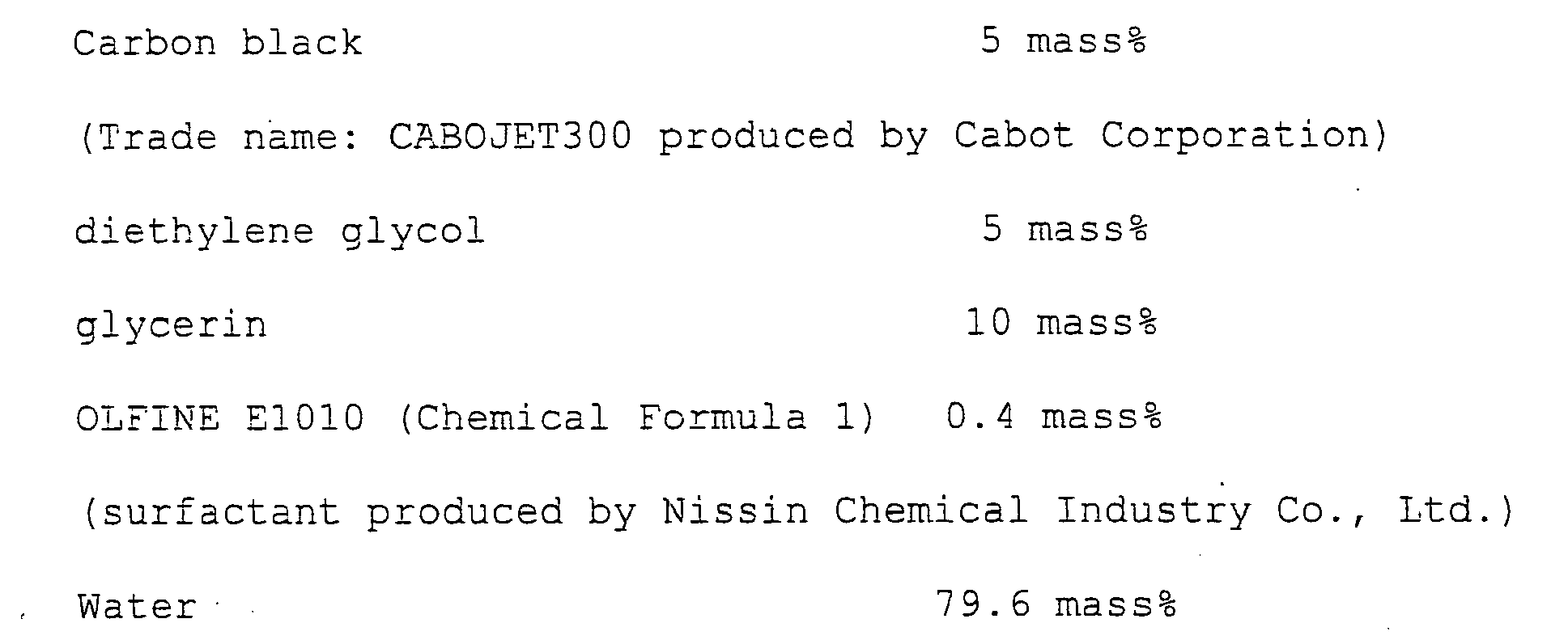
- A similar evaluation to the one in Working Example 1 was carried out, using a plain paper (My Paper produced by NBS Ricoh Co., Ltd.).
- An ink was prepared in a similar manner to Working Example 1, according to the ink composition written below. The ink composition of Working Example 3:
Carbon black 5 mass% (Trade name: CABOJET300 produced by Cabot Corporation) diethylene glycol 5 mass% glycerin 10 mass% OLFINE E1010 (Chemical Formula 1) (surfactant produced by Nissin Chemical Industry Co., Ltd.) 0.5 mass% Water 79.5 mass% - A similar evaluation to the one in Working Example 1 was carried out, using a plain paper (My Paper produced by NBS Ricoh Co., Ltd.).
- An ink was prepared in a similar manner to Working Example 1, according to the ink composition written below. The ink composition of Working Example 4:
Carbon black (Trade name: CABOJET300 produced by Cabot Corporation) 5mass% 2-pyrrolidone 10 mass% glycerin 10 mass% OLFINE E1010 (Chemical Formula 1) (surfactant produced by Nissin Chemical Industry Co., Ltd.) 0.5 mass% Water 74.5 mass% - A similar evaluation to the one in Working Example 1 was carried out, using a plain paper (My Paper produced by NBS Ricoh Co., Ltd.).
- An ink was prepared in a similar manner to Working Example 1, according to the ink composition written below. The ink composition of Working Example 5:
Carbon black (Trade name: CABOJET300 produced by Cabot Corporation) 5 mass% 2-pyrrolidone 10 mass% glycerin 10 mass% OLFINE E1010 (Chemical Formula 1) (surfactant produced by Nissin Chemical Industry Co., Ltd.) 0.7 mass% Water 74.3 mass% - A similar evaluation to the one in Working Example 1 was carried out, using a plain paper (My Paper produced by NBS Ricoh Co., Ltd.).
- An ink was prepared in a similar manner to Working Example 1, according to the ink composition written below. The ink composition of Working Example 6:
Carbon black (Trade name: CABOJET300 produced by Cabot Corporation) 5 mass% 2-pyrrolidone 10 mass% glycerin 10 mass% OLFINE E1010 (Chemical Formula 1) (surfactant produced by Nissin Chemical Industry Co., Ltd.) 1.0 mass% Water 73.5 mass% - A similar evaluation to the one in Working Example 1 was carried out, using a plain paper (My Paper produced by NBS Ricoh Co., Ltd.).
- A similar evaluation to the one in Working Example 1 was carried out, except that the ink in Working Example 5 was used.
- A similar evaluation to the one in Working Example 1 was carried out, except that the ink in Working Example 6 was used.
- A similar evaluation to the one in Working Example 1 was carried out, except that a plain paper (My Paper produced by NBS Ricoh Co., Ltd.) was used.
- An ink was prepared in a similar manner to Working Example 1, according to the ink composition written below. The ink composition of Comparative Example 2:
Carbon black (Trade name: CABOJET300 produced by Cabot Corporation) 5 mass% 2-pyrrolidone 10 mass% glycerin 10 mass% OLFINE E1010 (Chemical Formula 1) (surfactant produced by Nissin Chemical Industry Co., Ltd.) 1.5 mass% Water 73.5 mass% - A similar evaluation to the one in Working Example 1 was carried out, using a plain paper (My Paper produced by NBS Ricoh Co., Ltd.).
- Next, an evaluation result of ink fixation and character quality concerning Working Examples 1 to 8 and Comparative Examples 1 and 2 is to be explained. The evaluation result is indicated in Table 1.
-
Table 1 Evaluation Result Ka Value Ink Fixation Character Quality Comparative Example 1 4.5 × A Working Example 1 9 Δ A Working Example 2 12.7 ○ A Working Example 3 33.9 ○ A Working Example 4 50.8 ○ A Working Example 5 63.1 ○ A Working Example 6 75.6 ○ A Working Example 7 77 ○ A Working Example 8 84.2 ○ B Comparative Example 2 92.3 O C - According to the result of Table 1, as regards Working Examples 1 to 8, ink fixation is O or Δ, and character quality is A or B, hence a good result. The absorption coefficient Ka at that time is in the range of 9-84.2ml/m2·sec1/2. As regards Working Examples 2 to 7, ink fixation is o, and character quality is A, hence an even better result. The absorption coefficient Ka at that time is in the range of 12.7-77ml/m2·sec1/2.
- If the Ka value is 4.5ml/m2·sec1/2 as in Comparative Example 1, character quality is good, but ink fixation is bad as a result. Meanwhile, if the Ka value is 92.3ml/m2·sec1/2 as in Comparative Example 2, ink fixation is good, but character quality is bad as a result.
- In light of these results, in order to procure both character quality and ink fixation, it is desirable that the absorption coefficient Ka be in the range of 9-84.2ml/m2·sec1/2, and it is more desirable that the absorption coefficient Ka be in the range of 12.7-77ml/m2·sec1/2. It has been proved that: if the absorption coefficient Ka is less than 9ml/m2sec1/2, absorption of ink worsens and so fixation worsens; meanwhile, if the absorption coefficient Ka is greater than 84.2ml/m2·sec1/2, ink runs on plain paper, and so character quality worsens.
- As described above, an ink according to the present invention is an ink including a pigment, water, and a water-soluble organic solvent; wherein the absorption coefficient Ka to a recording medium is in the range of 9-84.2ml/m2·sec1/2; and the aforesaid ink is used in a recording apparatus in which a nozzle is placed in a perpendicular direction to the conveyance direction of the aforesaid recording medium, and a head supporting this nozzle is fixed. Therefore, it has been made possible to provide an ink wherein ink fixation properties are good and also printing quality is good.
- Also, the present invention incorporates an ink cartridge accommodating an ink; wherein the aforesaid ink cartridge is used in a recording apparatus in which a nozzle is placed in a perpendicular direction to the conveyance direction of a recording medium, and a head supporting this nozzle is fixed; and the aforesaid ink includes a pigment, water, and a water-soluble organic solvent, and the absorption coefficient Ka to the aforesaid recording medium is in the range of 9-84·2m1/m2·sec1/2. Therefore, it has been made possible to provide an ink cartridge which accommodates an ink wherein ink fixation properties are good and also printing quality is good.
- Also, the present invention incorporates an inkjet recording method in which an ink is jetted from a nozzle; wherein the aforesaid ink includes a pigment, water, and a water-soluble organic solvent, and the absorption coefficient Ka to a recording medium is in the range of 9-84.2ml/m2·sec1/2; the aforesaid nozzle is placed in a perpendicular direction to the conveyance direction of the aforesaid recording medium; and a head supporting the aforesaid nozzle is fixed. Therefore, it has been made possible to provide an inkjet recording method wherein ink fixation properties are good and also printing quality is good.
Claims (15)
- An ink comprising: a pigment, water, and a water-soluble organic solvent, characterized in that
the absorption coefficient Ka to a recording medium is in the range of 9-84.2ml/m2.sec1/2; and
said ink is used in a recording apparatus in which a nozzle is placed in a perpendicular direction to the conveyance direction of said recording medium, and a head supporting this nozzle is fixed. - An ink comprising: a pigment, water, and a water-soluble organic solvent, characterized in that
the absorption coefficient Ka to a recording medium is in the range of 12.7-77ml/m2·sec1/2; and
said ink is used in a recording apparatus in which a nozzle is placed in a perpendicular direction to the conveyance direction of said recording medium, and a head supporting this nozzle is fixed. - An ink according to Claim 1, characterized in that the conveyance velocity of a recording medium at the time of photographic printing is in the range of 20-100mm/s.
- An ink according to Claim 1, characterized in that a pigment is carbon black.
- An ink according to Claim 1, characterized in that a recording medium is a plain paper.
- An ink cartridge accommodating an ink, characterized in that
said ink cartridge is used in a recording apparatus in which a nozzle is placed in a perpendicular direction to the conveyance direction of a recording medium, and a head supporting this nozzle is fixed; and
said ink comprises a pigment, water, and a water-soluble organic solvent, and the absorption coefficient Ka to said recording medium is in the range of 9-84.2ml/m2·sec1/2 - An ink cartridge accommodating an ink, characterized in that
said ink cartridge is used in a recording apparatus in which a nozzle is placed in a perpendicular direction to the conveyance direction of a recording medium, and a head supporting this nozzle is fixed; and
said ink comprises a pigment, water, and a water-soluble organic solvent, and the absorption coefficient Ka to said recording medium is in the range of 12.7-77ml/m2·sec1/2. - An ink cartridge according to Claim 6, characterized in that the conveyance velocity of a recording medium at the time of photographic printing is in the range of 20-100mm/s.
- An ink cartridge according to Claim 6, characterized in that a pigment is carbon black.
- An ink cartridge according to Claim 6, characterized in that a recording medium is a plain paper.
- An inkjet recording method in which an ink is jetted from a nozzle, characterized in that
said ink comprises a pigment, water, and a water-soluble organic solvent, and the absorption coefficient Ka to a recording medium is in the range of 9-84.2ml/m2·sec1/2;
said nozzle is placed in a perpendicular direction to the conveyance direction of said recording medium; and
a head supporting said nozzle is fixed. - An inkjet recording method in which an ink is jetted from a nozzle, characterized in that
said ink comprises a pigment, water, and a water-soluble organic solvent, and the absorption coefficient Ka to a recording medium is in the range of 12.7-77ml/m2·sec1/2;
said nozzle is placed in a perpendicular direction to the conveyance direction of said recording medium; and
a head supporting said nozzle is fixed. - An inkjet recording method according to Claim 11, characterized in that the conveyance velocity of a recording medium at the time of photographic printing is in the range of 20-100mm/s .
- An inkjet recording method according to Claim 11, characterized in that a pigment is carbon black.
- An inkjet recording method according to Claim 11, characterized in that a recording medium is a plain paper.
Applications Claiming Priority (2)
| Application Number | Priority Date | Filing Date | Title |
|---|---|---|---|
| JP2004307267A JP2006117801A (en) | 2004-10-21 | 2004-10-21 | Ink, ink cartridge, and ink jet recording method |
| PCT/JP2005/019461 WO2006043695A1 (en) | 2004-10-21 | 2005-10-18 | Ink, ink cartridge and inkjet recording method |
Publications (2)
| Publication Number | Publication Date |
|---|---|
| EP1826251A1 true EP1826251A1 (en) | 2007-08-29 |
| EP1826251A4 EP1826251A4 (en) | 2007-11-14 |
Family
ID=36203102
Family Applications (1)
| Application Number | Title | Priority Date | Filing Date |
|---|---|---|---|
| EP05795239A Withdrawn EP1826251A4 (en) | 2004-10-21 | 2005-10-18 | Ink, ink cartridge and inkjet recording method |
Country Status (7)
| Country | Link |
|---|---|
| US (1) | US20090066766A1 (en) |
| EP (1) | EP1826251A4 (en) |
| JP (1) | JP2006117801A (en) |
| KR (1) | KR20070065396A (en) |
| CN (1) | CN101084282A (en) |
| TW (1) | TW200628314A (en) |
| WO (1) | WO2006043695A1 (en) |
Families Citing this family (1)
| Publication number | Priority date | Publication date | Assignee | Title |
|---|---|---|---|---|
| GB2469859B (en) * | 2009-04-30 | 2012-07-25 | Samsung Electronics Co Ltd | Processing code-modulated signals |
Family Cites Families (14)
| Publication number | Priority date | Publication date | Assignee | Title |
|---|---|---|---|---|
| JP2692963B2 (en) * | 1989-07-13 | 1997-12-17 | キヤノン株式会社 | Inkjet recording method |
| JP3576582B2 (en) * | 1993-12-17 | 2004-10-13 | キヤノン株式会社 | Ink set, inkjet recording method, bleed reduction method, and inkjet recording apparatus |
| JPH10237370A (en) * | 1997-02-27 | 1998-09-08 | Fujitsu Ltd | Ink jet recording ink and ink jet recording method |
| JP4250249B2 (en) * | 1998-04-01 | 2009-04-08 | キヤノン株式会社 | Ink jet ink, ink cartridge, recording unit, ink set, image recording method, and image recording apparatus |
| JP3997019B2 (en) * | 1998-12-25 | 2007-10-24 | キヤノン株式会社 | Printing method and printing apparatus |
| JP2000336290A (en) * | 1999-05-28 | 2000-12-05 | General Kk | Ink composition |
| US6899751B2 (en) * | 2000-09-29 | 2005-05-31 | Ricoh Company, Ltd. | Ink for ink jet recording, ink jet recording method, ink cartridge and ink jet recording apparatus |
| US6730149B2 (en) * | 2001-01-22 | 2004-05-04 | Ricoh Company Limited | Ink composition and inkjet recording method and apparatus using the ink composition |
| JP3927850B2 (en) * | 2001-05-09 | 2007-06-13 | キヤノン株式会社 | RECORDING METHOD, RECORDING DEVICE, RECORDED PRODUCT, RECORDED PRODUCT MANUFACTURING METHOD |
| EP1457533B1 (en) * | 2001-09-21 | 2006-02-15 | Ricoh Company, Ltd. | Ink, method of ink-jet recording with the same, ink cartridge, recording unit, and ink-jet recording apparatus |
| JP2003094749A (en) * | 2001-09-26 | 2003-04-03 | Sony Corp | Inkjet printer |
| JP2004058351A (en) * | 2002-07-26 | 2004-02-26 | Fuji Xerox Co Ltd | Ink supply unit, ink supply mechanism, inkjet recorder, and ink supply method |
| CA2511100C (en) * | 2002-12-27 | 2008-12-23 | Canon Kabushiki Kaisha | Water base ink, method of ink jet recording, ink cartridge, recording unit, ink jet recording apparatus and method of image formation |
| JP4428929B2 (en) * | 2003-02-19 | 2010-03-10 | キヤノン株式会社 | Inkjet recording method |
-
2004
- 2004-10-21 JP JP2004307267A patent/JP2006117801A/en not_active Abandoned
-
2005
- 2005-10-18 KR KR20077008997A patent/KR20070065396A/en not_active Withdrawn
- 2005-10-18 US US11/577,552 patent/US20090066766A1/en not_active Abandoned
- 2005-10-18 TW TW094136374A patent/TW200628314A/en not_active IP Right Cessation
- 2005-10-18 EP EP05795239A patent/EP1826251A4/en not_active Withdrawn
- 2005-10-18 CN CNA2005800439569A patent/CN101084282A/en active Pending
- 2005-10-18 WO PCT/JP2005/019461 patent/WO2006043695A1/en not_active Ceased
Also Published As
| Publication number | Publication date |
|---|---|
| EP1826251A4 (en) | 2007-11-14 |
| JP2006117801A (en) | 2006-05-11 |
| TWI296238B (en) | 2008-05-01 |
| WO2006043695A1 (en) | 2006-04-27 |
| KR20070065396A (en) | 2007-06-22 |
| CN101084282A (en) | 2007-12-05 |
| TW200628314A (en) | 2006-08-16 |
| US20090066766A1 (en) | 2009-03-12 |
Similar Documents
| Publication | Publication Date | Title |
|---|---|---|
| US6637875B2 (en) | Aqueous recording liquid, recording method and apparatus using same | |
| JP5109262B2 (en) | Water-based ink set for inkjet recording | |
| US20100214351A1 (en) | Ink jet image-forming method, ink jet color image-forming method and ink jet recording apparatus | |
| JP2003213179A (en) | Ink jet recording ink and ink jet recording method | |
| WO2009014242A1 (en) | Ink jet recording ink, ink jet image-forming method and ink jet recording apparatus | |
| JP2002179958A (en) | Recording liquid, recording liquid cartridge, recording method, recording apparatus, and recording medium | |
| KR0136737B1 (en) | Inkjet recording method employing inks of different characteristics and apparatus therefor different characteristics an apparatus therefor | |
| EP0583096B1 (en) | Ink-jet recording method and apparatus | |
| US7604340B2 (en) | Water-based ink set for ink-jet recording | |
| JP2009221455A (en) | Ink-jet recording ink, method for forming ink-jet image and ink-jet recording apparatus | |
| EP1036830B1 (en) | Ink containing a colouring material and an aqueous medium | |
| JP4056260B2 (en) | Aqueous recording liquid, and recording method, ink cartridge, and ink jet recording apparatus using the aqueous recording liquid | |
| JP2002332436A (en) | Ink set, method of forming colored portion on recording medium, and ink jet recording apparatus | |
| WO2004106439A1 (en) | Recording fluid and recording method using the same | |
| EP1826251A1 (en) | Ink, ink cartridge and inkjet recording method | |
| JP2005075849A (en) | Ink, recording method and inkjet recording method | |
| JP2003003098A (en) | Aqueous recording liquid, recording method and apparatus using the liquid | |
| US7226157B2 (en) | Ink-jet recording process | |
| EP1613475B1 (en) | Image forming apparatus, image forming process, recording composition, and cartridge | |
| JP2011046924A (en) | Aqueous ink | |
| JP5250927B2 (en) | INK FOR RECORDING, INK CARTRIDGE, INK RECORDED MATERIAL, INKJET RECORDING DEVICE AND INKJET RECORDING METHOD | |
| JP3809196B2 (en) | INKJET RECORDING METHOD, INKJET RECORDING DEVICE, AND INKJET RECORDED IMAGE FIXING IMPROVEMENT METHOD | |
| JP2007160840A (en) | Ink jet image recording apparatus and ink jet image forming method | |
| JP2004249725A (en) | Inkjet recording method | |
| JP2007181972A (en) | Inkjet image recorder and inkjet image forming method |
Legal Events
| Date | Code | Title | Description |
|---|---|---|---|
| PUAI | Public reference made under article 153(3) epc to a published international application that has entered the european phase |
Free format text: ORIGINAL CODE: 0009012 |
|
| 17P | Request for examination filed |
Effective date: 20070511 |
|
| AK | Designated contracting states |
Kind code of ref document: A1 Designated state(s): DE FR GB |
|
| A4 | Supplementary search report drawn up and despatched |
Effective date: 20071016 |
|
| RBV | Designated contracting states (corrected) |
Designated state(s): DE FR GB |
|
| DAX | Request for extension of the european patent (deleted) | ||
| 17Q | First examination report despatched |
Effective date: 20080117 |
|
| STAA | Information on the status of an ep patent application or granted ep patent |
Free format text: STATUS: THE APPLICATION IS DEEMED TO BE WITHDRAWN |
|
| 18D | Application deemed to be withdrawn |
Effective date: 20091014 |