EP1817407B1 - Hefestamm und screening-verfahren zur identifizierung von inhibitoren der expression der hexosetransportergenen mittels eines positiven phänotypes - Google Patents
Hefestamm und screening-verfahren zur identifizierung von inhibitoren der expression der hexosetransportergenen mittels eines positiven phänotypes Download PDFInfo
- Publication number
- EP1817407B1 EP1817407B1 EP20050813655 EP05813655A EP1817407B1 EP 1817407 B1 EP1817407 B1 EP 1817407B1 EP 20050813655 EP20050813655 EP 20050813655 EP 05813655 A EP05813655 A EP 05813655A EP 1817407 B1 EP1817407 B1 EP 1817407B1
- Authority
- EP
- European Patent Office
- Prior art keywords
- hxt7
- re700a
- strain
- pdr5
- cerevisiae
- Prior art date
- Legal status (The legal status is an assumption and is not a legal conclusion. Google has not performed a legal analysis and makes no representation as to the accuracy of the status listed.)
- Expired - Lifetime
Links
Images







Classifications
-
- C—CHEMISTRY; METALLURGY
- C12—BIOCHEMISTRY; BEER; SPIRITS; WINE; VINEGAR; MICROBIOLOGY; ENZYMOLOGY; MUTATION OR GENETIC ENGINEERING
- C12N—MICROORGANISMS OR ENZYMES; COMPOSITIONS THEREOF; PROPAGATING, PRESERVING, OR MAINTAINING MICROORGANISMS; MUTATION OR GENETIC ENGINEERING; CULTURE MEDIA
- C12N15/00—Mutation or genetic engineering; DNA or RNA concerning genetic engineering, vectors, e.g. plasmids, or their isolation, preparation or purification; Use of hosts therefor
- C12N15/09—Recombinant DNA-technology
- C12N15/63—Introduction of foreign genetic material using vectors; Vectors; Use of hosts therefor; Regulation of expression
- C12N15/79—Vectors or expression systems specially adapted for eukaryotic hosts
- C12N15/80—Vectors or expression systems specially adapted for eukaryotic hosts for fungi
- C12N15/81—Vectors or expression systems specially adapted for eukaryotic hosts for fungi for yeasts
-
- C—CHEMISTRY; METALLURGY
- C07—ORGANIC CHEMISTRY
- C07K—PEPTIDES
- C07K14/00—Peptides having more than 20 amino acids; Gastrins; Somatostatins; Melanotropins; Derivatives thereof
- C07K14/37—Peptides having more than 20 amino acids; Gastrins; Somatostatins; Melanotropins; Derivatives thereof from fungi
- C07K14/39—Peptides having more than 20 amino acids; Gastrins; Somatostatins; Melanotropins; Derivatives thereof from fungi from yeasts
Definitions
- the present invention provides screening procedures for identifying inhibitors of components of regulatory networks by a positive phenotype and modified yeast cell lines suitable for said screening.
- the screening procedures are especially suited to screen for substances that re-sensitize resistant pathogenic microorganisms or tumor cells by suspending the expression of resistance-relevant genes.
- the invention further provides methods for constructing said cell lines and their use in screening systems.
- MDR Multiple drug resistance
- MDR is frequently due to the altered expression of an ATP-binding cassette (ABC) transporter
- ABSC ATP-binding cassette
- Over one hundred ABC transporters have been identified in species ranging from Escherichia coli to humans ( Higgins, C.F., Cell 82:693-696 (1995 )).
- Prominent representatives of MDR pumps conferring multidrug resistance are in Saccharomyces cerevisiae Pdr5p, Snq2p, Yor1 p ( Balzi, E. et al., Journal of Biological Chemistry 269:2206-2214 (1994 ); Decottignies, A.
- Pdr5p is part of the well known multiple drug resistance (MDR) network of S. cerevisiae (also called pleiotropic drug resistance, PDR).
- MDR multiple drug resistance
- Pgp provides one mechanism of possibly inhibiting resistance in tumor cells to chemotherapeutic agents ( Senior, A.E. et al., FEBS Letters, 377:285-289 (1995 ); Abraham, E.H. et al., Proc. Natl. Acad. Sci. USA 90:312-316 (1993 )).
- chemotherapeutic agents Senior, A.E. et al., FEBS Letters, 377:285-289 (1995 ); Abraham, E.H. et al., Proc. Natl. Acad. Sci. USA 90:312-316 (1993 )
- An alternative approach which underlies the present invention and which should solve these problems in therapy, is to inhibit the expression of the transporter genes.
- the therapeutics cannot be transported out of the cells.
- the inhibition of the expression can occur at different steps in the regulatory network, e.g. at the promoter level of the transporter genes, at the level of transcription factor(s) of the promoters or even at the promoter level of the transcription factor(s).
- inhibition of any element of the MDR regulatory network would lead to (re)sensitised formerly resistant cells. Applying such an inhibitory substance in combination with not any more effective antibiotics or chemotherapeutics would restore their antibiotic or chemotherapeutic effect in currently resistant pathogens or tumour cells, respectively.
- GFP green fluorescent protein
- Most of the known screening systems for regulatory effectors have been based on measuring the activity of the respective promoters by using appropriate reporter genes, e.g. coding for the green fluorescent protein (GFP) ( Chalfie, M. et al., Science 263:802-805 (1994 ); Cormack, B.P. et al., Microbiology 143:303-311 (1997 ); Wiesner, C. et al., Nucleic Acids Research 80:e80 (2002 ); Barelle, C.J. et al., Yeast 21:333-340 (2004 )), for the ⁇ -galactosidase ( Leuker, C.E.
- GFP green fluorescent protein
- a common characteristic of all of these systems and methods is that the inhibition of the transcription results in a negative phenotype and that the quantification of the phenotype requires individual measurements.
- a negative phenotype does not necessarily result from inhibition of the expression of the reporter gene but can also result from an unspecific metabolic inhibition within the cell. The above mentioned screening systems can not distinguish between specific inhibition of the regulatory network or unspecific metabolic inhibition.
- One screening system ( Kozovská, Z. et al., Int. J. Antimicrobial Agents 22:284-290 (2003 ); Kozowska, Z. et al., Int. J. Antimicrob. Agents 24:386-392 (2004 )) is based on a dominant lethal reporter gene that allows to distinguish between a specific and an unspecific inhibition.
- the reporter gene is expressed under the control of the promoter of a MDR conferring gene, which in turn is under control of a transcription factor, the expression of which is inducible. Only the inhibition of the promoter (or the gene product itself) allows for growth of the cell. I n this respect, unspecific metabolic inhibition is not detected by the system as it would also not allow cell growth.
- the reporter gene is lethal for the cell. Thus, cloning of the test strain is very difficult. It is only possible if the reporter gene is not expressed and thus, the lethal gene product not present in the cell. This also explains the elaborate promoter construct.
- the choice of promoters to be screened is limited to those that have no (or very low) basal activity and are controlled by transcription factors.
- some of the genes conferring MDR possess very active promoters.
- the CDR1 gene which is mainly responsible for C. albicans MDR, has a promoter which is quite active in C. albicans and S. cerevisiae, even without the presence of additional transcription factor(s).
- This promoter could not be used in the screening system of Kozowska et al. Moreover, also promoters of the transcription factors cannot be involved into the screening system as transcription factors can be introduced into the system only under the control of an inducible promoter. Otherwise, growth of the test strain is not possible. However, the upstream elements of a regulatory network are especially interesting as target for inhibition since they control the expression of several different MDR-genes. Consequently, such a screening system is not suitable to search for prospective agents to combat multidrug resistance in pathogenic organisms or cancerous cells.
- the present invention provides the first easy to handle and reliable high throughput system to identify substances that specifically inhibit target promoters or their transcription factors or even the promoters of the transcription factors.
- This system is able to identify specific inhibitors for the whole regulatory network of the expression of the target gene.
- the system enables the analysis of substances in an one-step high throughput procedure, based on an easily detectable positive growth phenotype.
- This novel screening system is based on a facultative lethal reporter gene product.
- the gene product is only lethal for the cells under appropriate non-permissive conditions but under permissive conditions it does not hamper the cell growth. Therefore, test strains can be constructed under permissive conditions by transform ation of a basal strain (expressing the reporter gene under the control of the particular target gene promoter) with corresponding transcription factor gene(s) including its/their promoter(s).
- the choice of potential target gene promoters is not limited, i.e., all promoters and their regulatory network, irrespective of their activity, can be included into the screening system. In this respect, the whole regulatory network that is present in the pathogenic/tumor cell is covered by the screen. Thus, the chance to find an inhibitor is significantly increased.
- the inhibition of the expression can occur at different steps in the regulatory network, e.g. at the promoter level of the transporter genes, at the level of transcription factor(s) of the promoters or even at the promoter level of the transcription factor(s).
- the inhibition of an upstream element of the regulatory network is more effective than inhibition of the promoter of the target gene since in the first case several drug pumps (all those under the control of the inhibited upstream regulatory element) would be inactivated concurrently.
- the present invention combines all advantages of the latest state of engineering: I ) consideration of the whole regulatory network, II ) exclusion of the detection of metabolic inhibitors, III ) easy detection of specific effects in IV ) a one-step-high-throughput system.
- the invention provides a novel screening system substances that hamper or undo the development of resistances by (re)sensitising formerly resistant cells. Contrary to new antibiotics and/or chemotherapeutics, to which cells develop resistance in due time, the novel inhibitors of the MDR-regulatory network to be screened cannot lead to development of extended resistance.
- reporter gene in the context of present invention means that its expression results in a characteristic phenotype "reporting" its successful expression.
- Suitable reporters include the facultatively lethal reporters as defined herein before.
- Transformed in the context of the present invention includes chromosomal integration and episomal expression of a particular nucleic acid sequence.
- “Native” means “natural(ly)” or “naturally occurring”, more specifically “naturally occurring in the specified organism” or “naturally occurring in connection with the specified gene”.
- a “regulatory network” in the context of present invention is a network which regulates the gene transcription (“transcriptional regulatory network”) in an organism. Specifically, it is a collection of gene segments like promoters and of proteins like transcription factors controlling said promoters, which interact with each other and with other elements of a cell, thereby governing the rate and amount at which genes controlled by the network are transcribed.
- a " regulatory element” is a part of said regulatory network, e.g. a promoter or transcription factor.
- a "regulatory element of a MDR coferring gene” may be the native promoter of said gene, e.g. R PDR5. It may also be a transcription factor controlling the expression of said gene in its native environment, e.g. Pdr1p, Pdr3p, Tac1p and the like.
- a "comparative yeast strain” is a genetically modified yeast strain suitable as control strain in the method of present invention. It allows the exclusion of false positive results in the method of the present invention.
- test compound in the context of present invention is any compound which could be an inhibitor of regulatory elements within a transcriptional regulatory network and which may therefore be tested for said inhibitory effect in the method of the present invention.
- a “derivative" of a chemical compound is a compound that is formed from said chemical compound or arises theoretically from said compound by replacement of at least one atom or group of atoms with another atom or group of atoms.
- the replaced atom or group is (part of) a functional group or is positioned at a chemically reactive center, (like, e.g., an acidic hydrogen or a hydroxy function).
- Common hexose derivatives are N-acetyl-hexosamines like N-acetylglucosamine, deoxyhexoses like deoxyglucose, etc.
- the regulatory element used is preferably a regulatory element of MDR conferring genes.
- the method of embodiment (1) comprises in another favourable aspect
- the method of embodiment (1) comprises steps (i) and (ii), and optionally step (iii).
- One variant of this preferred aspect of embodiment (1) is its application in a way which allows the exclusion of false positive results by the parallel treatment of a comparative genetically modified yeast strain (comparative yeast strain) with the respective test compound.
- the regulatory element is a constitutively active promoter, preferably the yeast PMA1-promoter (P PMA1 ).
- P PMA1 yeast PMA1-promoter
- one preferred aspect of embodiment (1) is a performance wherein the growth measurement and the identification of positives and the exclusion of false positives are carried out automatically in micro-plates using a micro-plate reader and a personal computer.
- the growth measurements may be carried out via measurement of the optical density at 570-600 nm of cultures grown in liquid medium and/or via comparison of colony sizes grown on solid medium.
- Said above performance of embodiment (1) is especially favourable if it is designed as high throughput screening.
- This screening is preferably performed in micro-titre plates (96-1586 wells), which are filled with the culture medium containing the appropriate 2-DG concentration, a defined test strain inoculum and the test compound or solvent. All measurements are carried out in quadruplicates. To determine maximal growth, in a certain number of wells cells are incubated without 2-DG. To correct for media absorption, a certain number of wells is incubated with culture medium without cells. Depending on the number of repetitions per test substrate, this screening system can be up-scaled to a high throughput system testing substrate libraries in one step.
- the optical density of the single wells is determined with a micro-titre plate reader.
- measurements are performed every 15 min.
- the threshold for growth inhibition can be chosen individually between maximum and minimum growth according to the requirements of the test.
- the growth measurement and the identification of positives and the exclusion of false positives can be carried out manually or automatically, but preferably they are done automatically in micro-titre plates using a microtiter-plate reader and a personal computer.
- the modified yeast strain used as test yeast strain and comparative yeast strain in embodiments (1) and (2), and according to embodiments (3) and (4) of the invention is preferably of the phylum Ascomycota, more preferably of the order Saccharomycetales, the family Candidaceae or the genus Kluyveromyces. Of these, the yeasts of the order Saccharomycetales, especially those of the family Saccharomycetaceae, are preferred.
- the most suitable Saccharomycetaceae are the species Saccharomyces cerevisiae and Saccharomyces uvarum, S. cerevisiae being preferred.
- the functional nucleic acid segment which is used to transform the yeast strain of any one of embodiments (1) to (4) is episomally expressed and/or integrated into the yeast host strain's genome. Preferably, it is integrated into the yeast host strain's genome.
- any promoter of any transcriptional regulatory network can be used to control the expression of the reporter gene. Also transcription factors of the respective promoters can be cloned under the control of their own promoters. Thus, any part of the complete regulatory network can be introduced into the test yeast strains and included in the screen for inhibitors.
- the test yeast strain further comprises (c) one or more additional gene(s) encoding one or more components of the regulatory network of the promoter.
- Said additional gene(s) (c) are preferably comprised in the functional nucleic acid segment with which the test yeast strain is transformed. More preferably, said one or more additional gene(s) encode one or more transcription factor(s) controlling said promoter. Most preferably, said transcription factors are selected from the group consisting of
- the transcription factors controlling the promoter in the cell of embodiment (4) of the invention are preferably
- the preferred yeast host strain used in the method is a mutant strain lacking genes coding for transporters, preferably hexose transporters, more preferably glucose transporters, and preferably a S . cerevisiae mutant strain.
- the most preferred yeast host strain in the method of said embodiments (1) and (2) and for the yeast strain of embodiment (5) (i) is the strain S . cerevisiae RE700A (see Tab.1), deprived of the seven most important glucose transporters (HXT1 -7) ( Reifenberger, E. et al., Molecular Microbiology 16:157-167 (1995 )). The strain is not able to grow on glucose as the sole carbon source. It grows on maltose (2% (w/v)) as the sole carbon source.
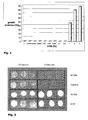
- the strain grows well on maltose also in the presence of up to 0.5% (w/v) 2-deoxy-glucose (2-DG), a toxic glucose analogue, in the medium ( Fig. 1 ). Growth is inhibited by 50% at a 2-DG concentration in liquid media of ⁇ 1% (w/v) ( Fig. 1 ).
- 2-DG 2-deoxy-glucose
- the gene encoding the facultatively lethal reporter protein is a gene encoding a protein which under certain culture conditions gives rise to a lethal phenotype (reporter gene).
- said reporter gene is selected from genes encoding membrane integral proteins, more preferably from transporter genes, most preferably from hexose transporter genes including HXT1-7 and Ght1-6.
- the reporter gene of embodiment (5) (ii) is a gene whose expression is facultatively lethal to the cell. "Facultatively lethal" means that the expression of the gene is lethal for the cell only under certain metabolic conditions such as incubation of the cells in the presence of certain toxic substances. Under permissive conditions the expression of the gene does not hamper the growth of the cells.
- Particularly preferred are genes encoding membrane integral proteins, particularly transporter protein genes including hexose transporter genes such as HXT1-7, Ght1-6 and the like.
- HXT7 encoding Hxt7p, a glucose transporter of S. cerevisiae, serves as reporter gene.
- HXT7 is (either episomally or chromosomally) introduced into S. cerevisiae RE700A under the transcriptional control of a promoter that is either the putative target for inhibitors itself or regulated by the target transcription factor and/or its respective gene promoter that is/are to be tested.
- a promoter that is either the putative target for inhibitors itself or regulated by the target transcription factor and/or its respective gene promoter that is/are to be tested.
- permissive conditions i.e. with maltose as carbon source and without 2-DG, growth of this strain is unaffected by the expression of the reporter gene HXT7.
- facultatively lethal genes apt for embodiments (1), (2) and (5)(ii) comprise the glucose transporter genes HXT1-7 , Ght1-6 (such as Ght1, 2, 5), Glut1-2 which are lethal only if 2-deoxy-glucose is present in the medium.
- the Schizosaccharomyces pombe gene car1+ is facultatively lethal if expressed in S. cerevisiae cells grown in the presence of Amiloride ( Jia, Z.P. et al., Mol. Gen. Genet. 241:298-304 (1993 ); Niederberger, C. et al., Gene 171:119-122 (1996 )).
- S. cerevisiae gene TOK1 is facultatively lethal if S. cerevisiae cells are grown in the presence of Cs + ions ( Bertl, A. et al., Molecular Microbiology 47:767-780 (2003 )).
- the lethal phenotype of the yeast strain according to embodiments (1) to (6) can be induced by the presence of a defined concentration of a toxic substrate of the reporter gene product in the culture/growth medium, preferably a hexose or a hexose derivative, most preferably a hexose derivative, especially 2-deoxyglucose (2-DG).
- a toxic substrate of the reporter gene product in the culture/growth medium preferably a hexose or a hexose derivative, most preferably a hexose derivative, especially 2-deoxyglucose (2-DG).
- the promoter (b) is preferably selected from yeast promoters and promoters controlling the expression of MDR conferring genes. Like the promoter according to embodiment (5)(iii), it includes procaryotic and eucaryotic promoters. More preferably, the promoter (b) in embodiments (1), (2) and (5)(iii) is a promoter which is part of the regulation network for MDR , most preferably a promoter which controls the expression of genes conferring drug resistance to pathogens or tumor cells. This includes promoters controlling the MDR in yeast and mammals, preferably promoters of the PDR and CDR gene families. It preferably includes promoters from Saccharomyces spp., most preferably from S.
- P PDR5 S. cerevisiae PDR5-promoter
- It furthermore preferably includes promoters from Candida spp., most preferably from C. albicans, especially the C. albicans CDR1-promoter P CDR1 and the C. albicans CDR2-promoter P CDR2 .
- It further includes P CaMDR of C. albicans as well as the promoters of PMT gene encoding C. albicans glycosylation proteins relevant to Candida MDR, especially P PMT1, P PMT2 and P PMT4 , and promoters from mammalian tumor cells such as P MDR1 , P MRP1-7 .
- the promoter (b) according to embodiments (1), (2) and (5)(iii) may also be a constitutively active yeast promoter, preferably a promoter driving the expression of a housekeeping gene like P PMA1 , P cyc1 and P pyk1 , most preferably the S. cerevisiae PMA1-promoter (P PMA1 ).
- One aspect of embodiment (4) is the use of transcription factor genes selected from transcription factors regulating the expression of MDR elements in Candida ssp. and Saccharomyces ssp., most preferably the S. cerevisiae Pdr1 protein Pdr1 p and/or the S. cerevisiae Pdr3 protein Pdr3p. Since no specific inhibitors of the MDR network in S. cerevisiae are known so far, the inhibition of two relevant transcription factors, Pdr1p and Pdr3p, that are known to activate P P PDR5 can be mimicked by their disruption in RE700A (Example 3). This results in considerable loss of activity of P PDR5 . Thus, if an inhibitor of transcription factors or of the expression of those transcription factors needed to activate the promoter controlling the reporter gene is applied to the modified yeast cell according to embodiment (4) it can be identified as potential MDR inhibitor using the method of embodiment (1).
- the functional nucleic acid segment may further carry functional sequences selected from marker genes, including fluorescence markers such as GFP and GFP derivatives, resistance markers, splice donor and acceptor sequences, etc.
- the test yeast strain is in a preferred aspect a S. cerevisiae RE700A strain comprising HXT7 as reporter gene.
- Yeast strains used in embodiments (1) and (2), and according to embodiment (3) in their most preferred aspect are S. cerevisiae RE700A strains comprising HXT7 as reporter gene under the control of promoters or transcription factors of genes selected from the group consisting of MDR conferring genes and constitutively active yeast promoters.
- strains as listed in Table 1 are even more preferred, especially the ones selected from the group consisting of RE700A e P PDR5 -HXT7 (ET[PDR]), RE700A e P CDR1 -HXT7 (ET[CDR1]), RE700A e P CDR2 -HXT7 (ET[CDR2]), RE700A e P CUP -HXT7 (ECFP), RE700A i R PDR5 -HXT7 (IT[PDR]), RE700A i P CDR1 -HXT7 (IT[CDR1]), RE700A i P CDR2 -HXT7 (IT[CDR2]), RE700A i P PMA1 -HXT7 (ICFP), RE700A ⁇ pdr1 tok1 ::P PDR5 - HXT7 , RE700A ⁇ pdr3 tok1 ::P PDR5 - HXT7 ,
- Table 1 Constructed strains: The parental strains and the plasmids that were used for transformation are listed. The names and abbreviations of the newly generated strains are given in the third column. In addition the respective genotypes are shown in the utmost right column.
- the integration vector of embodiment (7) of the invention comprises the functional nucleic acid segment as defined in connection with embodiments (3) to (6).
- the integration vector is suitable for chromosomal integration, and in addition the functional nucleic acid segment is preferably flanked by sequences homologous to the target site DNA sequences in the host strain.
- the method according to embodiment (8) of the invention comprises the inserting of a gene cassette into the yeast genome using an integration vector according to embodiment (7).
- the yeast transformation can be effected in accordance with the lithium acetate method as described by R. Rothstein in Methods in Enzymology 194:281-302 (1991 ).
- Yeast genetic methods, especially for S. cerevisiae are in accordance with the methods described in F. Sherman et al., Cold Spring Harbor Laboratory, Cold Spring Harbor, NY (1981).
- the integration is preferably followed by means of selection, in one preferred aspect by growth on media lacking uracil. Correct integration is proved by means of diagnostic PCR and Southern blotting.
- One aspect of embodiment (8) is the introduction of the gene cassette comprising the reporter gene and the promoter into a chromosomal gene locus of the host cell. This can be done by recombinant DNA methods introducing selectable marker genes at the same time.
- Preferred marker genes are coding for proteins conferring resistances and/or auxotrophic needs, especially the auxotrophy markers URA3 and LEU2 or genes conferring resistance to G418 (aminoglycosid phosphotransferase gene).
- Constructs comprising those marker genes together with the gene cassette to be transferred can be linearized and introduced into the yeast host cell. There they will replace the wild type loci by homologous recombination. The strains bearing the modified loci can then be found by selection on the marker gene.
- Preferred yeast loci for introduction of those genes are single copy genes, the most preferred locus is the tok1 locus.
- TOK1 gene is a single copy gene coding for potassium channels in yeast. Its replacement by homologous recombination was first described in WO 03/031600 .
- test system of embodiment (1) is the use of a S . cerevisiae cell line with an episomally introduced reporter gene.
- a cell line comprising a reporter gene under control of one of the S . cerevisia MDR regulatory network promoters is used, most preferably a strain comprising the HXT7 gene.
- a test strain ET[PDR] see Table 1.
- test strain ET[PDR] can be incubated in selective YNB medium with 2% (w/v) maltose as the carbon source and 0.03% (w/v) 2-DG. Under these non-permissive conditions the growth of the test strain ET[PDR] was inhibited when F PDR5 was active ( Fig. 3 ). Test compounds dissolved in solvent or solvent alone are added and growth is analysed. ET[PDR] will grow under non-permissive conditions (primary positive result) only when the test compound inhibits one (or more) crucial component(s) of the S. cerevisia MDR network (true positive result), or if the activity of the reporter gene product Hxt7p is directly inhibited by this compound (false positive result).
- RE700A can also be grown under the conditions described above (i.e. YNB medium + 2% (w/v) maltose + 0.03% (w/v) 2-DG, without compound but with solvent) to determine maximal growth, corresponding to a complete inhibition of Hxt7p function.
- test system of embodiment (1) is the use of a S . cerevisiae cell line with an chromosomally introduced reporter gene.
- a cell line comprising a reporter gene under control of one of the S . cerevisia MDR regulatory network promoters is used, most preferably a strain comprising the HXT7 gene.
- the test strain IT[PDR] see Table 1).
- test strain IT[PDR] can be incubated in YNB medium with 2% (w/v) maltose as the carbon source and 0.05% (w/v) 2-DG. Under these non-permissive conditions the growth of the test strain IT[PDR] was inhibited when P PDR5 was active ( Fig. 3 ). Test compounds dissolved in solvent or solvent alone are added and growth is analysed. IT[PDR] will grow under non-permissive conditions (primary positive result) only when the test compound inhibits one (or more) crucial component(s) of the S . cerevisia MDR network (true positive result), or if the activity of the reporter gene product Hxt7p is directly inhibited by this compound (false positive result).
- RE700A can also be grown under the conditions described above (i.e. YNB medium + 2% (w/v) maltose + 0.05% (w/v) 2-DG, without compound but with solvent) to determine maximal growth, corresponding to a complete inhibition of Hxt7p function.
- a S . cerevisiae cell line with an episomally introduced reporter gene in the test system of embodiment (1) is the use of a cell line comprising a reporter gene under control of one of the C. albicans MDR regulatory network promoters, most preferably a strain comprising the HXT7 gene.
- a test strain ET[CDR1] see Table 1.
- test strain ET[CDR1] can be incubated in selective YNB medium with 2% (w/v) maltose as the carbon source and 0.05% (w/v) 2-DG. Under these non-permissive conditions the growth of the test strain ET[CDR1] was inhibited when P CDR1 was active ( Fig. 6 ). Test compounds dissolved in solvent or solvent alone are added and growth is analysed. ET[CDR1] will grow under non-permissive conditions (primary positive result) only when the test compound inhibits P CDR1 (true positive result), or if the activity of the reporter gene product Hxt7p is directly inhibited by this compound (false positive result).
- RE700A can also be grown under the conditions described above (i.e. YNB medium + 2% (w/v) maltose + 0.05% (w/v) 2-DG, without the test compound but with solvent) to determine maximal growth, corresponding to a complete inhibition of Hxt7p function.
- the inhibitory efficacy of the test compound is determined by using CQ[CDR1]: Strain CQ[CDR1] is incubated in selective YNB medium with 2% (w/v) maltose as the carbon source and 0.05% (w/v) 2-DG. The test compound dissolved in solvent or solvent alone are added and the decrease of GFP fluorescence induced by the compound is quantified.
- a S . cerevisiae cell line with an episomally introduced reporter gene in the test system of embodiment (1) is the use of a cell line comprising a reporter gene under control of one of the C. albicans MDR regulatory network promoters, most preferably a strain comprising the HXT7 gene.
- a test strain ET[CDR2] see Table 1.
- test strain ET[CDR2] can be incubated in selective YNB medium with 2% (w/v) maltose as the carbon source and 0.2% (w/v) 2-DG. Under these non-permissive conditions the growth of the test strain ET[CDR2] was inhibited when P CDR1 was active ( Fig. 6 ). Test compounds dissolved in solvent or solvent alone are added and growth is analysed. ET[CDR2] will grow under non-permissive conditions (primary positive result) only when the test compound inhibits P CDR1 (true positive result), or if the activity of the reporter gene product Hxt7p is directly inhibited by this compound (false positive result).
- RE700A can also be grown under the conditions described above (i.e. YNB medium + 2% (w/v) maltose + 0.2% (w/v) 2-DG, without the test compound but with solvent) to determine maximal growth, corresponding to a complete inhibition of Hxt7p function.
- the inhibitory efficacy of the test compound is determined by using CQ[CDR2] : Strain CQ[CDR2] is incubated in selective YNB medium with 2% (w/v) maltose as the carbon source and 0.2% (w/v) 2-DG. The test compound dissolved in solvent or solvent alone are added and the decrease of GFP fluorescence induced by the compound is quantified.
- a S . cerevisiae cell line with a chromosomally introduced reporter gene in the test system of embodiment (1) is the use of a cell line comprising a reporter gene under control of one of the C . albicans MDR regulatory network promoters, most preferably a strain comprising the HXT7 gene.
- a test strain IT[CDR1] see Table 1.
- test strain IT[CDR1] is incubated in YNB medium with 2% (w/v) maltose as the carbon source and 0.03% (w/v) 2-DG. Under these non-permissive conditions the growth of the test strain IT[CDR1] is inhibited when P CDR1 is active. Test compounds dissolved in solvent or solvent alone are added and growth is analysed. IT[CDR1] will grow under non-permissive conditions (primary positive result) only when the test compound inhibits P CDR1 (true positive result), or if the activity of the reporter gene product Hxt7p is directly inhibited by this compound (false positive result).
- RE700A can also be grown under the conditions described above (i.e. YNB medium + 2% (w/v) maltose + 0.03% (w/v) 2-DG, without test compound but with solvent) to determine maximal growth, corresponding to a complete inhibition of Hxt7p function.
- a S . cerevisiae cell line with a chromosomally introduced reporter gene in the test system of embodiment (1) is the use of a cell line comprising a reporter gene under control of one of the C . albicans MDR regulatory network promoters, most preferably a strain comprising the HXT7 gene.
- a test strain IT[CDR2] see Table 1.
- test strain IT[CDR2] is incubated in selective YNB medium with 2% (w/v) maltose as the carbon source and 2% (w/v) 2-DG. Under these non-permissive conditions the growth of the test strain IT[CDR2] is inhibited when P CDR2 is active ( Fig. 8 ). Test compounds dissolved in solvent or solvent alone are added and growth is analysed. IT[CDR2] will grow under non-permissive conditions (primary positive result) only when the test compound inhibits P CDR2 (true positive result), or if the activity of the reporter gene product Hxt7p is directly inhibited by this compound (false positive result).
- RE700A can also be grown under the conditions described above (i.e. YNB medium + 2% (w/v) maltose + 1-2% (w/v) 2-DG, without compound but with solvent) to determine maximal growth, corresponding to a complete inhibition of Hxt7p function.
- the kit of embodiment (10) may further comprise a comparative yeast strain as defined above and/or culture media for the test yeast strain and/or the comparative yeast strain.
- the S . cerevisiae mutant strain RE700A i P PDR5 -HXT7 (MATa ura3-52 his3-11,15 lue2-3,112 MAL2 SUC2 GAL MEL hxt1 ⁇ ::HIS3:: ⁇ hxt4 hxt5::LEU2 hxt2 ⁇ ::HIS3 hxt3 ⁇ ::LEU2:: ⁇ hxt6 hxt7:: HIS3 tok1::P PDR5 HXT7; also referred to as RE700A i PPDR5-HXT7) was deposited at the DSMZ, Deutsche Sammlung von Mikroorganismen und Zellkulturen GmbH, Mascheroder Weg 1b, 38124 Braunschweig, Germany, as DSM 16852 on November 3, 2004.
- Media YNB-medium: 1.7 g/l Yeast Nitrogen Base without amino acids and ammonium sulfate, 5 g/l ammonium sulfate, 0.5 g/I amino acid drop out mix (composition: 150 mg lysine, 300 mg valine, 150 mg tyrosine, 500 mg threonine, 500 mg serine, 250 mg phenylalanine, 100 mg arginine, 100 mg methionine, 500 mg tryptophane, 250 mg adenine, 100 mg asparagine, 100 mg glutamic acid). + glucose/maltose: 20 g/l.
- strain growth The growth of the strains in liquid medium was determined by measuring the optical density at 600 nm. To obtain growth curves, measurements were performed every 15 min. Alternatively, start and endpoint (after 12-16h) measurements were carried out.
- S . cerevisiae HXT7 gene in the S . cerevisiae mutant strain RE700A under the control of different promoters, multicopy plasmids and integration cassettes were constructed.
- deletion cassettes were constructed.
- control plasmids and control integration cassettes were constructed.
- Genomic DNA from S. cerevisiae strain PLY 232 was isolated using standard protocols (Sambrook, J. et al., Cold Spring Harbour Laboratory Press (1989)). 500 ng of chromosomal DNA were used in polymerase chain reactions (PCR) to obtain the desired DNA fragments.
- PCR conditions were as follows: Step 1: denaturation; 2 m in 95 °C Step 2: denaturation; 20 s 94°C Step 3: annealing; 45 s 55°C Step 4: elongation; 2 min/kb length of fragment to be amplified 72°C Step 5: elongation; 5 min 72 °C Repeat steps 2-4 30 times
- Thermostable DNA polymerase Pwo-Polymerase
- HXT7 To amplify the HXT7 gene (NCBI geneID: 851943, NC_001136 chromosome IV, 1154208-1155920, complementary) (PCR-HXT7; SEQ ID NO:1) the oligo-nucleotides 5'GAGAGCATGCGGATCCACCATGTCACAAGACGCTGCTATTGC (SEQ ID NO:2), position 1-23 referring to the coding sequence of HXT7 and 5' GAGA CTGCAG TTATTTGGTGCTGAACATCTC (SEQ ID NO:3), position 1692-1713 referring to the HXT7 coding sequence, were used as primers in a PCR.
- PDR5 promoter To amplify the promoter of PDR5 (P PDR5 ) (NC_001147, S . cerevisiae chromosome XV, 619480-619839) (PCR-P PDR5 ; SEQ ID NO:4) the oligo-nucleotides 5' GAGA CTCGAG GATCTGTATTCCTACTTATG (SEQ ID NO:5), position -360--341 referring to the coding sequence of PDR5 (SEQ ID NO:6) (NCBI geneID: 854324, NC_001147, S .
- Target region pre PDR1 To amplify the target regions pre PDR1 (NC_001139, S. cerevisiae chromosome VII, 472304-472719) (PCR-pre-PDR1; SEQ ID NO:8) the oligo-nucleotides 5' GAGA CGTACG CGATCGCGTAATACCGGCAATTACGG (SEQ ID NO:9), position -416--390 referring to the coding sequence of PDR1 (SEQ ID NO:10) (NCBI geneID: 852871, NC_001139, S.
- Target region post PDR1 To amplify the target regions post PDR1 (NC_001139, S. cerevisiae chromosome VII, 468830-469194) (PCR-post-PDR1; SEQ ID NO:12) the oligo-nucleotides 5'CGCAAGTCCAATCTAATAAACCAATCAATGC (SEQ ID NO:13), position 2941-2971 referring to the coding sequence of PDR1 and 5' GAGA CCGCGG AGTTTAGCTTTTTTTACGTTAGCCTC (SEQ I D NO:14), position +3448-+3473 referring to the coding sequence of PDR1, were used. Additional nucleotides are typed in italics, restriction site ( Sac II) is underlined.
- Target region pre PDR3 To amplify the target region pre PDR3 (NC_001134, S. cerevisiae chromosome II, 217153-217472) (PCR-pre-PDR3; SEQ ID NO:15) the oligo-nucleotides 5' GAGA CGTACG CACCGTGCTCTGCTGCTTTCAGG (SEQ ID NO:16), position -320--297 referring to the coding sequence of PDR3 (SEQ ID NO:17) (NCBI geneID: 852278, NC_001134, S.
- PDR3 is the 5'-noncoding region of the PDR3 gene.
- Target region post PDR3 To amplify the target region post PDR3 (NC_001134, S. cerevisiae chromosome II, 220404-220799) (PCR-post-PDR3; SEQ ID NO:19) the oligo-nucleotides 5'GAGAATAG TAAACGCAAAAGAAATAGGGAAGCAGAGCATAACC (SEQ ID NO:20), position +2921-+2964 referring to the coding sequence of PDR3 and 5' GAGA GTTAAC CGCAACGGCAGCAGAATAGAGAAAGCG (SEQ ID NO:21), position +3300-+3326 referring to the coding sequence of PDR3 were used. Additional nucleotides are typed in italics, restriction sites that were introduced to facilitate cloning ( Spe l and Hpa l, respectively) are underlined. Post PDR3 is the 3' - non-coding region of PDR3.
- Ura3 gene 100ng of pYEX TM - BX (SEQ ID NO:22) (Clontech) plasm id DNA was used as template in a PCR to amplify the URA3 gene (NCBI geneID: 856692, NC_001137, S.
- URA3 cerevisiae chromosome V, 116167-116970
- PCR-URA3 SEQ ID NO:23
- oligo-nucleotides 5'GAGAGCCGGCCAAGAATTAGCTTTTCAATTCA ATCC SEQ ID NO:24
- binding at position 2473-2498 of pYEX-BX and 5'GAGAGACGTCGGGTAATAACTGATATAATTAAATTG (SEQ ID NO:25)
- binding at position 1383-1408 of pYEX-BX binding at position 1383-1408 of pYEX-BX.
- the coding sequence of URA3 is located at position 1464-2264 of pYEX-BX.
- URA3 is a biosynthetic S. cerevisiae gene coding for the orotidine-5'-phosphate decarboxylase.
- Candida albicans CDR1 and CDR2 promoters 500 ng of Candida albicans genom ic DNA was used in a PCR to amplify the promoters of CDR1 (P CDR1 ) and CDR2 (P CDR2 ).
- Additional nucleotides are typed in italics, restriction sites that were introduced to facilitate cloning (Xhol, BclI and Sph l, respectively) are underlined.
- PCR-P CDR2 PCR-P CDR2 ; SEQ ID NO:30
- the oligo-nucleotides 5' GAGAC TCGAG GGTTCCTCTAAATAAAAACTAG SEQ ID NO:31
- position -901--879 referring to the coding sequence of CDR2
- SEQ ID NO:32 NCBI U63812, 902-5401
- 5' GAGA GGATCC A TGTTTTTATTGTATGTGTTAATTAG SEQ ID NO:33
- Additional nucleotides are typed in italics, restriction sites that were introduced to facilitate cloning ( Xho I and BamH I , respectively) are underlined.
- the PCR-product PCR-P PDR5 (SEQ ID NO:4) was digested with Xho I and BamH I .
- the resulting 0.366 kb fragment was ligated to the 7.845 kb Xho I / BamH I fragment from pYEX-BX-rad54/GFP (SEQ ID NO:35) ( Lichtenberg-Frate, H. et al., Toxicology in Vitro 17:709-716 (2003 )).
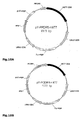
- the multicopy plasmid pY-P PDR5 -HXT7 (SEQ ID NO:36) ( Fig. 10 ) was used.
- the PCR-product PCR-HXT7 (SEQ ID NO:1) was digested with BamH I and Pst I .
- the 1.726 kb fragment was ligated to a 7.253 kb fragment, that was obtained from pY-P PDR5 -GFP (SEQ ID NO:34) after digestion with BamH I and Pst I .
- the multicopy plasmid pY-P CDR1 -HXT7 (SEQ ID NO:37) ( Fig. 10 ) was used.
- the PCR-product PCR-HXT7 (see above) was digested with Sph l and Pst I , the resulting 1.728 kb fragment was ligated to the 8.044 kb fragment obtained from pY-P CDR1 -GFP (SEQ ID NO:38) ( Fig. 9 ) after digestion with Sph I and Pst I .
- the plasmid pY-P CDR1 -GFP was constructed by ligation of the 1.159 kb fragment of the PCR-product PCR-P CDR1 (SEQ ID NO:26), obtained after digestion with Bcl I and Xho I to the 7.844 kb BamH I / Xho I fragment from pY- P PDR5 -GFP (SEQ ID NO:34).
- plasmid pY-P CDR2 -HXT7 (SEQ ID NO:39) ( Fig. 10 ) was used.
- the PCR-product PCR-HXT7 (SEQ ID NO:1) was digested with BamH I and Pst I to get a 1.726 kb fragment that was ligated to the 7.794 kb fragment of pY-P CDR2 -GFP (SEQ ID NO:40), obtained after digestion of this plasmid with BamH I and Pst I .
- the plasmid pY-P CDR2 -GFP ( Fig.
- plasmid pY-P CUP1 -HXT7 (SEQ ID NO:41) ( Fig. 10 ) was used.
- the PCR-product PCR-HXT7 (SEQ ID NO:1) was digested with BamH I and Pst I to get a 1.726 kb fragment that subsequently was ligated to the 7.112 kb fragment obtained from pYEX-BX-GFP (SEQ I D NO:42), after digestion with BamH I and Pst I .
- p77t-(ura) SEQ ID NO:45: The plasmid p77x (identical with p77-tok-pma1, H. Lichtenberg, J. Ludwig, PCT WO 03/031600 A1 ) (SEQ I D NO:44) was digested with Nael and Aatll. The resulting 4.568 kb fragment was ligated to the 1.124 kb fragment obtained by digestion of the PCR product PCR- URA3 (SEQ ID NO:23) with Nae I and Aat lI .
- p77t-(ura)-w/o-prom (SEQ ID NO:47): p77x (SEQ ID NO:44) was digested with Sal I, and Apal. The sticky ends of the resulting 6.506 kb fragment were blunted by treatment with T4-DNA polymerase followed by self ligation resulting in p77t-w/o-prom (SEQ ID NO:46). The 2.832 kb fragment obtained from p77t-w/o-prom after digestion with Not I and Aatl I was ligated to the 1.928 kb fragment obtained from of p77t-(ura) (SEQ ID NO:45), digested with Not I and Aat II .
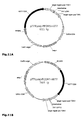
- p77t-(ura)-P PDR5 -HXT7 (SEQ ID NO:48) ( Fig. 11 ): The 4.723 kb fragment obtained from p77t-(ura)-w/o-prom, by digestion with Pst I and Sal I, was ligated to the 2.092 kb fragment obtained from pY-P PDR5 -HXT7 by digestion with Xho I and Pst I .
- p77t-(ura)-P PDRR5long -HXT7 (SEQ ID NO: 84) ( Fig. 11E ): The 8.613 kb fragment obtained from pY-P PDR5 -HXT7 (SEQ I D NO: 36) by digestion with BamH I and Xho I, was ligated to the 1.188 kb fragment obtained from pSK-P PDR5 -PPUS ( Nakamura et al., Antimicrob. Agents Chemother. 45: 3366-3374 (2001 )) (SEQ ID NO: 85) by digestion with Ba mHI and Xho I.
- p77t-(ura)-P CDR1 -HXT7 SEQ ID NO:49 ( Fig. 11 ): The 4.723 kb fragment obtained from p77t-(ura)-w/o-prom, by digestion with Pst I and Sal I, was ligated to the 2.885 kb fragment obtained from pY-P CDR1 -HXT7, by digestion with Xho I and Pst I .
- p77t-(ura)-P CDR2 -HXT7 (SEQ ID NO:50) ( Fig. 11 ): The 4.723 kb fragment obtained from p77t-(ura)-wlo-prom, by digestion with Pst I and Sal I, was ligated to the 2.633 kb fragment obtained from pY-P CDR2 -HXT7, by digestion with Xho I and Pst I.
- p77t-(ura)-P PMA1 -HXT7 (SEQ ID NO:51) ( Fig. 11 ): The 2.127 kb fragment obtained from pYEX-P PMA1 -HXT7 (SEQ ID NO:52), by digestion with Age I and Pst I, was ligated to the 5.259 kb fragment obtained from p77t-(ura) (SEQ ID NO:45), by digestion with Age I and Pst I.
- P PMA1 is the yeast promoter of the plasma membrane ATPase PMA1. This promoter is constitutively active in S . cerevisiae.
- pYEX-P PMA1 -HXT7 (SEQ ID NO:52) : The PCR product PCR-HXT7 (SEQ ID NO:1) was digested with Bam HI and Pst I to get a 1.726 kb fragment that subsequently was ligated to the 7.840 kb fragment obtained from pY-P PMA1 -GFP (SEQ ID NO: 78) after digestion with Bam HI and Pst I .
- pY-P PMA1 -GFP pYEX-BX-GFP (SEQ ID NO:42) was digested with BamH I and Xba I (completely filled in) to get a 7.831 kb fragment that subsequently was ligated to the 966 bp fragment obtained from pUC18-PMA1 (SEQ ID NO: 79) after digestion with BamH I and EcoR I.
- P PMA1 was amplified using the oligonucleotides 5' GAGA GAGCTC CACCGCGGTGGCGGCC AGCTTCCTGAAACGGAGAAACATAAAC (SEQ ID NO:80), positions -908--935 referring to the coding sequence of PMA1 (NC 001139 Pos. 479915-482671) (SEQ ID NO:83), and 5' TCTCG GATCCT CTAGC GATATTGTTTGATAATTAAATCTTTC (SEQ ID NO:81), positions -4--30 referring to the coding sequence of PMA1.
- Additional nucleotides are typed in italics, restriction sites that were introduced to facilitate cloning ( Sac I and BamH I, respectively) are underlined, and digested with Sac I and Bam HI. The resulting 959 bp fragment was subsequently ligated to the 2.672 kb fragment obtained from pUC18 (Fermentas; SEQ ID NO:82) after digestion with Sac I and Bam HI .
- pUG6-pre-pdr1 SEQ ID NO:55: The 3.997 kb fragment obtained from pUG6 (SEQ ID NO:54) ( Güldener, U. et al, Nucleic Acids Research 24:2519-2524 (1996 )), by digestion with BsiW I and Sal I, was ligated to the 0.422 kb fragment obtained from the PCR-product PCR-pre-PDR1 (SEQ ID NO:8), by digestion with BsiW I and Sal I.
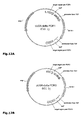
- pUG6- ⁇ pdr1 (SEQ ID NO:53) ( Fig. 12 ): The 4.399 kb fragment obtained from pUG6-pre-pdr1, by digestion with Sac II and Spe I, was ligated to the 0.369 kb fragment obtained from the PCR-product PCR-post-PDR1 (SEQ ID NO:12), by digestion with Spe I and Sac II.
- pUG6-pre-pdr3 (SEQ ID NO:57): The 3.997 kb fragment obtained from pUG6 (SEQ ID NO:54) ( Güldener, U. et al, Nucleic Acids Research 24:2519-2524 (1996 )), by digestion with Bsi WI and Sal I was ligated to the 0.326 kb fragment obtained from the PCR-product PCR-pre-PDR3 (SEQ ID NO:15), by digestion with BsiW I and Sal I.
- pUG6- ⁇ pdr3 (SEQ ID NO:56) ( Fig. 12 ): The 4.251 kb fragment obtained from pUG6-pre-pdr3 (SEQ ID NO:57), by digestion with Hpa I and Spe I, was ligated to the 0.404 kb fragment obtained from the PCR-product PCR-post-PDR3 (SEQ ID NO:19), by digestion with Hpa I and Spe I.
- the disruption cassettes ⁇ pdr1 and ⁇ pdr3 were generated by PCR using the oligo-nucleotides 5'GATCGCGTAATACCGGCAATTACGG (SEQ ID NO:58) and 5'GTTTAGCT TTTTTTACGTTAGCCTCATAT (SEQ ID NO:59) with pUG6- ⁇ pdr1 as template and 5'ACCGTGCTCTGCTGCTTTCAGG (SEQ ID NO:60) and 5'CGCAACGGCAGCAGAATAG AGAAAGC (SEQ ID NO:61) with pUG6- ⁇ pdr3 as template, respectively.
- the disruption cassettes ⁇ pdr1 and ⁇ pdr3 were used to transform S. cerevisiae RE700A cells yielding RE700A ⁇ pdr1:: KAN r and RE700A ⁇ pdr3:: KAN r .
- the presence of the KAN r - Marker gene flanked by IoxP sites conferred resistance to G418 (250 ⁇ g/ml) to RE700A ⁇ pdr1 and RE700A ⁇ pdr3.
- the KAN r gene was subsequently removed by cre-recombinase mediated recombination ( Güldener, U.
- RE700A ⁇ pdr1: : KAN r and RE700A ⁇ pdr3:: KAN r were transformed with the cre expression plasmid pSH47 ( Güldener, U. et al, Nucleic Acids Research 24:2519-2524 (1996 )), which carries the URA3 marker gene and the cre gene under the control of the inducible GAL1 promoter. Expression of the cre recombinase was induced by shifting cells from maltose medium to galactose medium. The cre expression plasmid was removed by streaking cells on plates containing 5-fluoroorotic acid to select for the loss of pSH47, yielding strains RE700A ⁇ pdr1 and RE700A ⁇ pdr3.
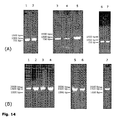
- the primer 5'GAGGCAGAGAAATTAGCTGG (SEQ ID NO:64) and 5'ACTATACCTATCACGAGTGC (SEQ ID NO:65) were used in PCR to amplify a 1.402 kb fragment with genomic DNA of generated strains as template ( Fig. 14 ).
- RE700A i P PDR5 -HXT7 (IT[PDR]), RE700A i R CDR1 -HXT7 (IT[CDR1]), RE700A i P CDR2 -HXT7 (IT[CDR2]), RE700A i P PMA1 -HXT7 (ICFP), RE700A ⁇ pdr1 tok1:: P PDR5 - HXT7, RE700A ⁇ pdr3 tok1 ::P PDR5 - HXT7 and RE700A ⁇ pdr1 ⁇ pdr3 tok1 ::P PDR5 - HXT7 (Table 1, Fig. 14 ).
- Genomic DNA was isolated from RE700A ⁇ pdr1, RE700A ⁇ pdr3 and RE700A ⁇ pdr1,pdr3 was isolated and 1 ⁇ g of each DNA was digested with Pstl. Another 1 ⁇ g of each DNA was digested with Bgl II. Digested DNAs were separated by agarose gel electrophoresis, blotted on a nylon membrane and cross linked by UV irradiation.
- Probe genomic DNA digested with RE700A expected length of labelled fragment [kb]
- Strains with disrupted gene(s) expected length of labelled fragment [kb]
- 10.862 RE700A ?pdr1 (7.821) pre-pdr3 Pst I 6.252 RE700A ?pdr3 (3.394) post-pdr3 Bgl II 7.700 RE700A ?pdr3 (4.842) pre-pdr3 Pst I RE700A ?pdr1,pdr3 (3.394) post-pdr3 Bgl II
- Genomic DNA was isolated from RE700A, RE700A tok1 ::P PDR5 long -HXT7, RE700A ⁇ pdr1 tok1 ::P PDR5long -HXT7, RE700A ⁇ pdr3 tok1 ::P PDR5long -HXT7 and RE700A ⁇ pdr1,3 tok1 ::P PDR5long -HXT7 and 1 ⁇ g of each DNA was digested with Pst I. Another 1 pg of each DNA was digested with EcoR V. Digested DNAs were separated by agarose gel electrophoresis, blotted on a nylon membrane and cross-linked by UV irradiation.
- Table 4 Verification of correct integration of P PDR5long -HXT7 into the TOK locus of the genome of S . cerevisiae strains by Southern blot analysis. Probes and expected length of labelled fragments.
- Example 3 HXT7 Screening system for S . cerevisiae MDR inhibition
- the screening system used Saccharomyces cerevisiae RE700A, a yeast strain deprived of the seven most important glucose transporters (HXT1 -7) ( Reifenberger, E. et al., Molecular Microbiology 16:157-167 (1995 )).
- the strain is not able to grow on glucose as the sole carbon source. It grows on maltose (2% (w/v)) as the sole carbon source.
- the strain grows well on maltose also in the presence of up to 0.5% (w/v) 2-deoxy-glucose (2-DG), a toxic glucose analogue, in the medium ( Fig. 1 ). Growth is inhibited by 50% at a 2-DG concentration in liquid media of ⁇ 1% (w/v) ( Fig. 1 ).
- HXT7 encoding Hxt7p, a glucose transporter of S. cerevisiae, served as reporter gene.
- HXT7 was introduced into S. cerevisiae RE700A under the transcriptional control of a promoter and/or transcription factor that was to be tested.
- the multiple drug resistance (MDR) network of S . cerevisiae was used to establish a model screening system.
- the promoter of PDR5 was the target promoter, which in turn can be activated by the transcription factors Pdr1p and Pdr3p that were also included in this screening system.
- the strain RE700A was genetically modified, as described in Example 2, expressing episomally (e) or chromosomally (i) the HXT7 gene, encoding the glucose transporter Hxt7p, under the control of the promoter of PDR5, a PDR mediating gene of S . cerevisiae, leading to the strains RE700A e P PDR5 -HXT7 (strain ET[PDR]) and RE700A i P PDR5 -HXT7 (strain IT[PDR]), respectively.
- strain ET[PDR] strain ET[PDR]
- RE700A i P PDR5 -HXT7 strain IT[PDR]
- strains ECFP, ICFP, ET[PDR] and IT[PDR] in liquid media containing maltose as the only carbon source was inhibited by 2-DG at concentrations that did not affect the growth of RE700A and strain CQ[PDR].
- strains expressing HXT7 were tested for sensitivity to 2-DG.
- the strains expressing GFP under the control of P PDR5 were additionally analysed for GFP fluorescence in comparison to RE700A e P PDR5 -GFP (strain CQ[PDR]).
- the strain RE700A tok1 ::P PDR5 - HXT7 showed 50% growth inhibition at a 2-DG concentration in liquid media of 0.021% (w/v) whereas the strains RE700A ⁇ pdr1 tok1 :: P PDR5 -HXT7 and RE700A ⁇ pdr3 tok1 :: P PDR5 -HXT7 exhibited 50% growth inhibition at 2-DG concentration of 0.026% (w/v).
- the strain RE700A ⁇ pdr1,pdr3 tok1 :: P PDR5 -HXT7 did not show significant 2-DG sensitivity up to concentrations of 0.03% (w/v) ( Fig. 4A ).
- the strain RE700A tok1 ::P PDR5long -HXT7 showed a 50% growth inhibition at a 2-DG concentration in liquid media of 0,025% (w/v), and is therewith slightly more affected by 2-DG than RE700A ⁇ pdr3 tok1:: P PDR5long - HXT7 cells, who showed a 50% growth inhibition at 2-DG concentrations of 0,029% (w/v).
- RE700A ⁇ pdr1 tok1 ::P PDR5long - HXT7 cells were even more resistant to 2-DG with a 50% growth inhibition at a 2-DG concentration of 0,068% (w/v).
- Example 3 The screening system described in Example 3 was adapted to search for inhibitors of the regulatory elements of Candida albicans MDR conferring gene expression, namely the promoters of the C. albicans MDR pump genes CDR1 and CDR2 (P CDR1 and P CDR2 ).
Landscapes
- Life Sciences & Earth Sciences (AREA)
- Health & Medical Sciences (AREA)
- Genetics & Genomics (AREA)
- Chemical & Material Sciences (AREA)
- Mycology (AREA)
- Organic Chemistry (AREA)
- Engineering & Computer Science (AREA)
- General Engineering & Computer Science (AREA)
- Bioinformatics & Cheminformatics (AREA)
- Biophysics (AREA)
- Zoology (AREA)
- Molecular Biology (AREA)
- Wood Science & Technology (AREA)
- Biochemistry (AREA)
- General Health & Medical Sciences (AREA)
- Microbiology (AREA)
- Biomedical Technology (AREA)
- Biotechnology (AREA)
- Gastroenterology & Hepatology (AREA)
- Plant Pathology (AREA)
- Physics & Mathematics (AREA)
- Proteomics, Peptides & Aminoacids (AREA)
- Medicinal Chemistry (AREA)
- Micro-Organisms Or Cultivation Processes Thereof (AREA)
- Measuring Or Testing Involving Enzymes Or Micro-Organisms (AREA)
Claims (24)
- Verfahren zum Identifzieren von Inhibitoren von Transcriptionsfaktoren und/oder Gen-Promotoren (regulatorischen Elementen) innerhalb eines transcriptionsregulatorischen Netzwerks durch einen positiven Phänotyp unter Verwendung eines genetisch modifizierten Hefestamms (Testhefestamms), der ein mutanter Stamm ist, dem Gene, die Hexose-Transporter codieren, fehlen und der mit einem funktionellen Nucleinsäuresegment transformiert ist, umfassend:(a) ein Gen, das ein fakultativ letales Reporterprotein codiert, bei dem es sich um ein Transporter-Gen handelt, das unter Kulturbedingungen, die Hexose oder Hexosederivate umfassen, zu einem letalen Phänotyp führt; und(b) einen Promotor, der die Expression des Gens (a) steuert, der Teil des transcriptionsregulatorischen Netzwerks ist;wobei das Verfahren Folgendes umfasst:(i) In-Kontakt-Bringen des Hefestamms mit einer Testverbindung oder einem Gemisch von Testverbindungen; und(ii) Bestimmen des Zellwachstums während oder nach dieser Behandlung unter Bedingungen, die für die modifizierten Hefezellen, welche das Reporter-Gen exprimieren, letal sind; und gegebenenfalls(iii) Identifizieren derjenigen Testverbindungen, die als Inhibitoren des regulatorischen Elements das Zellwachstum ermöglichen.
- Verfahren gemäß Anspruch 1, wobei das regulatorische Element ein regulatorisches Element von Genen, die MDR (multiple drug resistance; multiple Wirkstoffresistenz) verleihen, ist.
- Verfahren gemäß Anspruch 1, das den Ausschluss von falsch positiven Ergebnissen erlaubt durch:(i) In-Kontakt-Bringen eines genetisch modifizierten Vergleichshefestamms, bei dem das regulatorische Element ein konstitutiv aktiver Promotor, vorzugsweise der Hefe-PMA1-Promotor (PPMA1), ist, mit der jeweiligen Testverbindung; und(ii) Identifizieren derjenigen Testverbindungen, die das Zellwachstum der Zellen, die ein anderes regulatorisches Element als den konstitutiv aktiven Promotor umfassen (Testhefestamm), ermöglichen, aber nicht das Zellwachstum der Zellen, die den konstitutiv aktiven Promotor umfassen (Vergleichshefestamm), ermöglichen.
- Verfahren gemäß Anspruch 1 oder 3, wobei(i) die Wachstumsmessung und das Identifizieren von positiven Ergebnissen und der Ausschluss von falsch positiven Ergebnissen automatisch in Mikroplatten unter Verwendung eines Mikroplatten-Lesegeräts und eines PCs durchgeführt werden; und/oder(ii) die Wachstumsmessungen durch Messung der optischen Dichte von Kulturen, die in flüssigem Medium gewachsen sind, bei 570-600 nm durchgeführt werden; und/oder(iii) die Wachstumsmessungen durch Vergleich der Größen von Kolonien, die auf festem Medium gewachsen sind, durchgeführt werden.
- Verfahren gemäß einem der Ansprüche 1 bis 4, wobei der Testhefestamm weiterhin (c) ein oder mehrere zusätzliche Gene umfasst, die eine Komponente des regulatorischen Netzwerks des Promotors codieren, wobei das eine oder die mehreren zusätzlichen Gene vorzugsweise einen oder mehrere Transcriptionsfaktoren, die den Promotor steuern, codieren.
- Verfahren gemäß Anspruch 5, wobei(i) die Transeriptionsfaktoren die Expression von Candida-MDR-Elementen in Candida sp. und von S.-cerevisiae-MDR-Elementen in Saccharomyces sp. (pleiotrope Wirkstoffresistenz), vorzugsweise des S.-cerevisiae-Pdr1-Proteins Pdr1p und/oder des S.-cerevisiae-Pdr3-Proteins Pdr3p und/oder der mutmaßlichen C.-albicans-Transcriptionsfaktoren, die die Expression von Candida-MDRrelevanten Genen aktivieren, regulieren; und/oder(ii) die Transcriptionsfaktoren die Expression von MDR-Elementen in Säugern regulieren;wobei das oder die zusätzlichen Gene (c) vorzugsweise in dem funktionellen Nucleinsäuresegment gemäß Anspruch 1 enthalten sind.
- Verfahren gemäß einem der Ansprüche 1 bis 6, wobei(i) der Hefewirtsstamm zur Abteilung Ascomycota gehört, vorzugsweise ein Hefestamm der Ordnung Saccharomycetales, der Familie Candidaceae oder der Gattung Kluyveromyces ist, besonders bevorzugt zur Ordnung Saccharomycetales, am meisten bevorzugt zur Familie Saccharomycetaceae, insbesondere zur Spezies S. cerevisiae oder S. uvarum, insbesondere S. cerevisiae, gehört; und/oder(ii) der Hefewirtsstamm ein mutanter Stamm ist, dem Gene, die Glucose-Transporter codieren, fehlen, und vorzugsweise ein mutanter S.-cerevisiae-Stamm ist, am meisten bevorzugt die S.-cerevisiae-Mutante RE700A (MATa ura3-52 his3-11,15 lue2-3,112 MAL2 SUC2 GAL MEL hxt1Δ::HIS3::Δhxt4 hxt5::LEU2 hxt2Δ::HIS3 hxt3Δ::LEU2::Δhxt6 hxt7::HIS3).
- Verfahren gemäß einem der Ansprüche 1 bis 7, wobei(i) das Hexose-Transporter-Gen aus HXT1-7 und Ght1-6 ausgewählt ist und es sich vorzugsweise um S. cerevisiae HXT7 handelt; und/oder(ii) der Promotor aus Hefepromotoren und Promotoren, die die Expression von MDR verleihenden Genen steuern, ausgewählt ist, vorzugsweise aus S.-cerevisiae-Promotoren (vorzugsweise Promotoren der PDR-Genfamilie, am meisten bevorzugt der S.-cerevisiae-PDR5-Promotor (PPDR5)), Promotoren humanpathogener Hefen (vorzugsweise aus Candida sp., am meisten bevorzugt aus C. albicans, insbesondere der C.-albicans-CDR1-Promotor PCDR1 und der C.-albicans-CDR2-Promotor PCDR2), Promotoren, die die Expression von MDR verleihenden Genen in Pathogenen oder Säugertumorzellen steuern, und konstitutiv aktiven Hefepromotoren (vorzugsweise der Hefe-PMA1-Promotor (PPMA1)); und/oder(iii) das funktionelle Nucleinsäuresegment in dem Hefewirtsstamm episomal exprimiert und/oder chromosomal integriert, vorzugsweise chromosomal integriert, wird; und/oder(iv) das funktionelle Nucleinsäuresegment weiterhin funktionelle Sequenzen trägt, die aus Marker-Genen einschließlich Fluoreszenzmarkern, wie GFP und GFP-Derivaten, Resistenzmarkern, Spleißdonor- und -akzeptorsequenzen usw. ausgewählt sind.
- Verfahren gemäß einem der Ansprüche 1 bis 8, wobei es sich bei dem modifizierten Hefestamm um S. cerevisiae RE700A handelt, der HXT7 als Reporter-Gen umfasst.
- Verfahren gemäß Anspruch 9, wobei der modifizierte Hefestamm aus den in Tabelle 1 aufgeführten Stämmen ausgewählt ist, vorzugsweise ausgewählt ist aus RE700A e PPDR5-HXT7, RE700A e PCDR1-HXT7, RE700A e PCDR2-HXT7, RE700A e PCUP-HXT7, RE700A i PPDR5-HXT7, RE700A i PCDR1-HXT7, RE700A i PCDR2-HXT7, RE700A i PPMA1-HXT7, RE700A Δpdr1 tok1::PPDR5-HXT7, RE700A Δpdr3 tok1::PPPR5-HXT7 und RE700A Δpdr1 Δpdr3 tok1::PPDR5-HXT7, am meisten bevorzugt Stamm RE700A i PPDR5-HXT7 (MATa ura3-52 his3-11,15 lue2-3,112 MAL2 SUC2 GAL MEL hxt1Δ::HiS3::dhxt4 hxt5::LEU2 hxt2Δ::HIS3 hxt3Δ::LEU2::Δhxt6 hxt7::HIS3 tok1::PPDR5HXT7), hinterlegt als DSM 16852.
- Verfahren gemäß einem der Ansprüche 1 bis 10, wobei der letale Phänotyp durch eine definierte Konzentration der Hexose oder des Hexosederivate, vorzugsweise durch 2-Desoxyglucose, induziert wird.
- Modifizierter Hefestamm, der ein mutanter Stamm ist, dem Gene, die Hexose-Transporter codieren, fehlen und der mit einem funktionellen Nucleinsäuresegment transformiert ist, umfassend:(a) ein Gen, das ein fakultativ letales Reporterprotein codiert, bei dem es sich um ein Transporter-Gen handelt, das unter Kulturbedingungen, die Hexose oder Hexosederivate umfassen, zu einem letalen Phänotyp führt; und(b) einen Promotor, der die Expression des Gens (a) steuert, der Teil des transcriptionsregulatorischen Netzwerks ist.
- Modifizierter Hefestamm gemäß Anspruch 12, der weiterhin (c) ein oder mehrere zusätzliche Gene umfasst, die eine Komponente des regulatorischen Netzwerks des Promotors codieren, wobei das eine oder die mehreren zusätzlichen Gene vorzugsweise einen oder mehrere Transcriptionsfaktoren, die den Promotor steuern, codieren, besonders bevorzugt(i) Transcriptionsfaktoren, die die Expression von Candida-MDR-Elementen in Candida sp. und von S.-cerevisiae-MDR-Elementen in Saccharomyces sp. (pleiotrope Wirkstoffresistenz), vorzugsweise des S.-cerevisiae-Pdr1-Proteins Pdr1p und/oder des S.-cerevisiae-Pdr3-Proteins Pdr3p und/oder der mutmaßlichen C.-albicans-Transcriptionsfaktoren, die die Expression von Candida-MDRrelevanten Genen aktivieren, regulieren; und/oder(ii) Transcriptionsfaktoren, die die Expression von MDR-Elementen in Säugern regulieren;wobei das oder die zusätzlichen Gene (c) vorzugsweise in dem funktionellen Nucleinsäuresegment gemäß Anspruch 12 enthalten sind.
- Modifizierter Hefestamm gemäß Anspruch 12 oder 13, wobei(i) der Hefewirtsstamm zur Abteilung Ascomycota gehört, vorzugsweise ein Hefestamm der Ordnung Saccharomycetales, der Familie Candidaceae oder der Gattung Kluyveromyces ist, besonders bevorzugt zur Ordnung Saccharomycetales, am meisten bevorzugt zur Familie Saccharomycetaceae, insbesondere zur Spezies S. cerevisiae oder S. uvarum, insbesondere S. cerevisiae, gehört; und/oder(ii) der Hefewirtsstamm ein mutanter Stamm ist, dem Gene, die Glucose-Transporter codieren, fehlen, und vorzugsweise ein mutanter S.-cerevisiae-Stamm ist, am meisten bevorzugt die S.-cerevisiae-Mutante RE700A (MATa ura3-52 his3-11,15 lue2-3,112 MAL2 SUC2 GAL MEL hxt1A::HIS3::Ahxt4 hxt5::LEU2 hxt2Δ::HIS3 hxt3Δ::LEU2::Δhxt6 hxt7::HIS3).
- Modifizierter Hefestamm gemäß einem der Ansprüche 12 bis 14, wobei(i) das Hexose-Transporter-Gen aus HXT1-7 und Ght1-6 ausgewählt ist und es sich vorzugsweise um S. cerevisiae HXT7 handelt; und/oder(ii) der Promotor aus Hefepromotoren und Promotoren, die die Expression von MDR verleihenden Genen steuern, ausgewählt ist, vorzugsweise aus S.-cerevisiae-Promotoren (vorzugsweise Promotoren der PDR-Genfamilie, am meisten bevorzugt der S.-cerevisiae-PDR5-Promotor (PPDR5)), Promotoren humanpathogener Hefen (vorzugsweise aus Candida sp., am meisten bevorzugt aus C. albicans, insbesondere der C.-albicans-CDR1-Promotor PCDR1 und der C.-albicans-CDR2-Promotor PCDR2), Promotoren, die die Expression von MDR verleihenden Genen in Pathogenen oder Säugertumorzellen steuern, und konstitutiv aktiven Hefepromotoren (vorzugsweise der Hefe-PMA1-Promotor (PPMA1)); und/oder(iii) das funktionelle Nucleinsäuresegment in dem Hefewirtsstamm episomal exprimiert und/oder chromosomal integriert, vorzugsweise chromosomal integriert, wird; und/oder(iv) das funktionelle Nucleinsäuresegment weiterhin funktionelle Sequenzen trägt, die aus Marker-Genen einschließlich Fluoreszenzmarkern, wie GFP und GFP-Derivaten, Resistenzmarkern, Spleißdonor- und -akzeptorsequenzen usw. ausgewählt sind.
- Modifizierter Hefestamm gemäß einem der Ansprüche 12 bis 15, wobei es sich bei dem Stamm um S. cerevisiae RE700A handelt, der HXT7 als Reporter-Gen unter der Kontrolle von Promotoren oder Transcriptionsfaktoren von Genen, die aus der Gruppe ausgewählt sind, die aus MDR verleihenden Genen besteht, und konstitutiv aktiven Hefepromotoren umfasst.
- Modifizierter Hefestamm gemäß Anspruch 16, der aus den in Tabelle 1 aufgeführten Stämmen ausgewählt ist, vorzugsweise ausgewählt ist aus RE700A e PPDR5-HXT7, RE700A e PCDR1-HXT7, RE700A e PCDR2-HXT7, RE700A e PCUP-HXT7, RE700A i PPDR5-HXT7, RE700A i PCDR1-HXT7, RE700A i PCDR2-HXT7, RE700A i PPMA1-HXT7, RE700A Δpdr1 tok1::PPDR5-HXT7, RE700A Δpdr3 tok1::PPDR5-HXT7 und RE700A Δpdr1 Δpdr3 tok1::PPDR5-HXT7, am meisten bevorzugt Stamm RE700A i PPDR5-HXT7 (MATa ura3-52 his3-11,15 lue2-3,112 MAL2 SUC2 GAL MEL hxt1Δ::HIS3::Δhxt4 hxt5::LEU2 hxt2Δ::HIS3 hxt3Δ::LEU2::Δhxt6 hxt7::HIS3 tok1::PPDR5HXT7), hinterlegt als DSM 16852.
- Modifizierter Hefestamm gemäß einem der Ansprüche 12 bis 17, wobei der letale Phänotyp durch eine definierte Konzentration der Hexose oder des Hexosederivats, vorzugsweise durch 2-Desoxyglucose, in dem Wachstumsmedium induziert wird.
- Integrationsvektor, der ein funktionelles Nucleinsäuresegment gemäß einem der Ansprüche 12 bis 17 umfasst.
- Integrationsvektor gemäß Anspruch 19, der für die chromosomale Integration geeignet ist, wobei das funktionelle Nucleinsäuresegment vorzugsweise durch Sequenzen flankiert ist, die zu den DNA-Sequenzen der Zielstelle in dem Wirtsstamm homolog sind.
- Verfahren zur Herstellung eines modifizierten Hefestammes gemäß einem der Ansprüche 12 bis 18, umfassend die Integration des funktionellen Nucleinsäuresegments in einen Hefewirtsstamm unter Verwendung eines Integrationsvektors, wie er in den Ansprüchen 19 oder 20 definiert ist.
- Verwendung eines Hefestammes gemäß einem der Ansprüche 12 bis 18 zum Testen der Hemmung der Promotoren und/oder Transcriptionsfaktoren, die an regulatorischen Netzwerken beteiligt sind, insbesondere an der MDR von Pathogenen oder Tumorzellen.
- Kit zum Durchführen des Verfahrens gemäß einem der Ansprüche 1 bis 11, umfassend:(i) einen modifizierten Hefestamm gemäß einem oder mehreren der Ansprüche 12 bis 18; und/oder(ii) einen Integrationsvektor gemäß Anspruch 19 oder 20.
- Kit gemäß Anspruch 23, weiterhin umfassend:(iii) einen Vergleichshefestamm gemäß Anspruch 4; und/oder(iv) Kulturmedien für (i) und/oder (iii).
Priority Applications (1)
| Application Number | Priority Date | Filing Date | Title |
|---|---|---|---|
| EP20050813655 EP1817407B1 (de) | 2004-11-29 | 2005-11-25 | Hefestamm und screening-verfahren zur identifizierung von inhibitoren der expression der hexosetransportergenen mittels eines positiven phänotypes |
Applications Claiming Priority (3)
| Application Number | Priority Date | Filing Date | Title |
|---|---|---|---|
| EP20040106160 EP1661981A1 (de) | 2004-11-29 | 2004-11-29 | Hefestamm und Screening-Verfahren zur Identifizierung von Inhibitoren der Expression der Hexosetransportergenen mittels eines positiven Phänotypes |
| EP20050813655 EP1817407B1 (de) | 2004-11-29 | 2005-11-25 | Hefestamm und screening-verfahren zur identifizierung von inhibitoren der expression der hexosetransportergenen mittels eines positiven phänotypes |
| PCT/EP2005/056216 WO2006056597A1 (en) | 2004-11-29 | 2005-11-25 | Yeast strain and screening method for identifying inhibitors of the expression of the hexose transporter genes by a positive phenotype |
Publications (2)
| Publication Number | Publication Date |
|---|---|
| EP1817407A1 EP1817407A1 (de) | 2007-08-15 |
| EP1817407B1 true EP1817407B1 (de) | 2013-04-10 |
Family
ID=34929961
Family Applications (2)
| Application Number | Title | Priority Date | Filing Date |
|---|---|---|---|
| EP20040106160 Withdrawn EP1661981A1 (de) | 2004-11-29 | 2004-11-29 | Hefestamm und Screening-Verfahren zur Identifizierung von Inhibitoren der Expression der Hexosetransportergenen mittels eines positiven Phänotypes |
| EP20050813655 Expired - Lifetime EP1817407B1 (de) | 2004-11-29 | 2005-11-25 | Hefestamm und screening-verfahren zur identifizierung von inhibitoren der expression der hexosetransportergenen mittels eines positiven phänotypes |
Family Applications Before (1)
| Application Number | Title | Priority Date | Filing Date |
|---|---|---|---|
| EP20040106160 Withdrawn EP1661981A1 (de) | 2004-11-29 | 2004-11-29 | Hefestamm und Screening-Verfahren zur Identifizierung von Inhibitoren der Expression der Hexosetransportergenen mittels eines positiven Phänotypes |
Country Status (5)
| Country | Link |
|---|---|
| US (1) | US9121026B2 (de) |
| EP (2) | EP1661981A1 (de) |
| AU (1) | AU2005308775B2 (de) |
| CA (1) | CA2589754A1 (de) |
| WO (1) | WO2006056597A1 (de) |
Families Citing this family (1)
| Publication number | Priority date | Publication date | Assignee | Title |
|---|---|---|---|---|
| CN103103193B (zh) * | 2013-02-05 | 2014-12-03 | 中南大学 | 一种人参pdr跨膜转运蛋白基因启动子及其应用 |
Family Cites Families (2)
| Publication number | Priority date | Publication date | Assignee | Title |
|---|---|---|---|---|
| US6589773B1 (en) * | 2000-02-17 | 2003-07-08 | Morphochem, Inc. | Methods and compositions for a modified yeast strain with increased permeability and uses thereof |
| DE10106718A1 (de) * | 2001-02-14 | 2002-09-05 | Aventis Pharma Gmbh | Hefestamm von Saccharomyces cerevisiae mit funktioneller Expression eines Glut-Transporters |
-
2004
- 2004-11-29 EP EP20040106160 patent/EP1661981A1/de not_active Withdrawn
-
2005
- 2005-11-25 EP EP20050813655 patent/EP1817407B1/de not_active Expired - Lifetime
- 2005-11-25 US US11/791,704 patent/US9121026B2/en not_active Expired - Fee Related
- 2005-11-25 WO PCT/EP2005/056216 patent/WO2006056597A1/en not_active Ceased
- 2005-11-25 CA CA 2589754 patent/CA2589754A1/en not_active Abandoned
- 2005-11-25 AU AU2005308775A patent/AU2005308775B2/en not_active Ceased
Also Published As
| Publication number | Publication date |
|---|---|
| CA2589754A1 (en) | 2006-06-01 |
| AU2005308775A1 (en) | 2006-06-01 |
| WO2006056597A1 (en) | 2006-06-01 |
| EP1817407A1 (de) | 2007-08-15 |
| EP1661981A1 (de) | 2006-05-31 |
| US20090035755A1 (en) | 2009-02-05 |
| US9121026B2 (en) | 2015-09-01 |
| AU2005308775B2 (en) | 2012-02-16 |
Similar Documents
| Publication | Publication Date | Title |
|---|---|---|
| Camonis et al. | Characterization, cloning and sequence analysis of the CDC25 gene which controls the cyclic AMP level of Saccharomyces cerevisiae. | |
| Luke et al. | The SAPs, a new family of proteins, associate and function positively with the SIT4 phosphatase | |
| Brôco et al. | FLR1 gene (ORF YBR008c) is required for benomyl and methotrexate resistance in Saccharomyces cerevisiae and its benomyl‐induced expression is dependent on Pdr3 transcriptional regulator | |
| US8728797B2 (en) | Yeast membrane protein expression system and its application in drug screening | |
| Santos et al. | CHS5, a gene involved in chitin synthesis and mating in Saccharomyces cerevisiae | |
| Andrianopoulos et al. | Cloning and analysis of the positively acting regulatory gene amdR from Aspergillus nidulans | |
| Gupta et al. | Identification of polymorphic mutant alleles of CaMDR1, a major facilitator of Candida albicans which confers multidrug resistance, and its in vitro transcriptional activation | |
| Goldway et al. | Multidrug resistance in Candida albicans: disruption of the BENr gene | |
| AU2002330796A1 (en) | Yeast membrane protein expression system and its application in drug screening | |
| Xu et al. | Inhibition of Ty1 transposition by mating pheromones in Saccharomyces cerevisiae | |
| Fabian et al. | RRP1, a Saccharomyces cerevisiae gene affecting rRNA processing and production of mature ribosomal subunits | |
| US6200803B1 (en) | Essential genes of yeast as targets for antifungal agents, herbicides, insecticides and anti-proliferative drugs | |
| EP0690874B1 (de) | Materialien und methoden die sich auf mit casein kinase i wechselwirkende proteine beziehen | |
| Gray et al. | Isolation and analysis of the yeast TEA1 gene, which encodes a zinc cluster Ty enhancer-binding protein | |
| Chiannilkulchai et al. | RPC82 encodes the highly conserved, third-largest subunit of RNA polymerase Q (III) from Saccharomyces cerevisiae | |
| Byström et al. | A functional analysis of the repeated methionine initiator tRNA genes (IMT) in yeast | |
| Gatherar et al. | Identification of a novel gene hbrB required for polarised growth in Aspergillus nidulans | |
| US9121026B2 (en) | Yeast strain and screening method for identifying inhibitors of the expression of the hexose transporter genes by a positive phenotype | |
| Lebel et al. | New tools for phenotypic analysis in Candida albicans: the WAR1 gene confers resistance to sorbate | |
| Cooper et al. | Allantoin transport in Saccharomyces cerevisiae is regulated by two induction systems | |
| JPH11514885A (ja) | キチンシンターゼ1 | |
| US7052900B2 (en) | Saccharomyces cerevisiae yeast strain with functional expression of a Glut transporter | |
| Maftahi et al. | Generation of Saccharomyces cerevisiae deletants and basic phenotypic analysis of eight novel genes from the left arm of chromosome XIV | |
| Garfinkel et al. | [23] Ty mutagenesis in Saccharomyces cerevisiae | |
| Gromadka et al. | Subtelomeric duplications in Saccharomyces cerevisiae chromosomes III and XI: Topology, arrangements, corrections of sequence and strain‐specific polymorphism |
Legal Events
| Date | Code | Title | Description |
|---|---|---|---|
| PUAI | Public reference made under article 153(3) epc to a published international application that has entered the european phase |
Free format text: ORIGINAL CODE: 0009012 |
|
| 17P | Request for examination filed |
Effective date: 20070530 |
|
| AK | Designated contracting states |
Kind code of ref document: A1 Designated state(s): AT BE BG CH CY CZ DE DK EE ES FI FR GB GR HU IE IS IT LI LT LU LV MC NL PL PT RO SE SI SK TR |
|
| RIN1 | Information on inventor provided before grant (corrected) |
Inventor name: SUBIK, JULIUS,COMENIUS UNIVERSITAET BRATISLAVA Inventor name: SCHWANEWILM, PETRA Inventor name: LUDWIG, JOST |
|
| 17Q | First examination report despatched |
Effective date: 20070918 |
|
| DAX | Request for extension of the european patent (deleted) | ||
| GRAP | Despatch of communication of intention to grant a patent |
Free format text: ORIGINAL CODE: EPIDOSNIGR1 |
|
| RAP1 | Party data changed (applicant data changed or rights of an application transferred) |
Owner name: HOEFER, MILAN Owner name: UNIVERSITY OF SOUTH BOHEMIA, CESKE BUDEJOVICE |
|
| GRAS | Grant fee paid |
Free format text: ORIGINAL CODE: EPIDOSNIGR3 |
|
| GRAA | (expected) grant |
Free format text: ORIGINAL CODE: 0009210 |
|
| AK | Designated contracting states |
Kind code of ref document: B1 Designated state(s): AT BE BG CH CY CZ DE DK EE ES FI FR GB GR HU IE IS IT LI LT LU LV MC NL PL PT RO SE SI SK TR |
|
| REG | Reference to a national code |
Ref country code: GB Ref legal event code: FG4D |
|
| REG | Reference to a national code |
Ref country code: CH Ref legal event code: EP Ref country code: AT Ref legal event code: REF Ref document number: 606028 Country of ref document: AT Kind code of ref document: T Effective date: 20130415 |
|
| REG | Reference to a national code |
Ref country code: IE Ref legal event code: FG4D |
|
| REG | Reference to a national code |
Ref country code: DE Ref legal event code: R096 Ref document number: 602005039069 Country of ref document: DE Effective date: 20130606 |
|
| PG25 | Lapsed in a contracting state [announced via postgrant information from national office to epo] |
Ref country code: SI Free format text: LAPSE BECAUSE OF FAILURE TO SUBMIT A TRANSLATION OF THE DESCRIPTION OR TO PAY THE FEE WITHIN THE PRESCRIBED TIME-LIMIT Effective date: 20130410 |
|
| REG | Reference to a national code |
Ref country code: AT Ref legal event code: MK05 Ref document number: 606028 Country of ref document: AT Kind code of ref document: T Effective date: 20130410 |
|
| REG | Reference to a national code |
Ref country code: LT Ref legal event code: MG4D Ref country code: NL Ref legal event code: VDEP Effective date: 20130410 |
|
| PG25 | Lapsed in a contracting state [announced via postgrant information from national office to epo] |
Ref country code: GR Free format text: LAPSE BECAUSE OF FAILURE TO SUBMIT A TRANSLATION OF THE DESCRIPTION OR TO PAY THE FEE WITHIN THE PRESCRIBED TIME-LIMIT Effective date: 20130711 Ref country code: FI Free format text: LAPSE BECAUSE OF FAILURE TO SUBMIT A TRANSLATION OF THE DESCRIPTION OR TO PAY THE FEE WITHIN THE PRESCRIBED TIME-LIMIT Effective date: 20130410 Ref country code: SE Free format text: LAPSE BECAUSE OF FAILURE TO SUBMIT A TRANSLATION OF THE DESCRIPTION OR TO PAY THE FEE WITHIN THE PRESCRIBED TIME-LIMIT Effective date: 20130410 Ref country code: LT Free format text: LAPSE BECAUSE OF FAILURE TO SUBMIT A TRANSLATION OF THE DESCRIPTION OR TO PAY THE FEE WITHIN THE PRESCRIBED TIME-LIMIT Effective date: 20130410 Ref country code: PT Free format text: LAPSE BECAUSE OF FAILURE TO SUBMIT A TRANSLATION OF THE DESCRIPTION OR TO PAY THE FEE WITHIN THE PRESCRIBED TIME-LIMIT Effective date: 20130812 Ref country code: NL Free format text: LAPSE BECAUSE OF FAILURE TO SUBMIT A TRANSLATION OF THE DESCRIPTION OR TO PAY THE FEE WITHIN THE PRESCRIBED TIME-LIMIT Effective date: 20130410 Ref country code: BE Free format text: LAPSE BECAUSE OF FAILURE TO SUBMIT A TRANSLATION OF THE DESCRIPTION OR TO PAY THE FEE WITHIN THE PRESCRIBED TIME-LIMIT Effective date: 20130410 Ref country code: AT Free format text: LAPSE BECAUSE OF FAILURE TO SUBMIT A TRANSLATION OF THE DESCRIPTION OR TO PAY THE FEE WITHIN THE PRESCRIBED TIME-LIMIT Effective date: 20130410 Ref country code: IS Free format text: LAPSE BECAUSE OF FAILURE TO SUBMIT A TRANSLATION OF THE DESCRIPTION OR TO PAY THE FEE WITHIN THE PRESCRIBED TIME-LIMIT Effective date: 20130810 Ref country code: ES Free format text: LAPSE BECAUSE OF FAILURE TO SUBMIT A TRANSLATION OF THE DESCRIPTION OR TO PAY THE FEE WITHIN THE PRESCRIBED TIME-LIMIT Effective date: 20130721 |
|
| PG25 | Lapsed in a contracting state [announced via postgrant information from national office to epo] |
Ref country code: PL Free format text: LAPSE BECAUSE OF FAILURE TO SUBMIT A TRANSLATION OF THE DESCRIPTION OR TO PAY THE FEE WITHIN THE PRESCRIBED TIME-LIMIT Effective date: 20130410 Ref country code: BG Free format text: LAPSE BECAUSE OF FAILURE TO SUBMIT A TRANSLATION OF THE DESCRIPTION OR TO PAY THE FEE WITHIN THE PRESCRIBED TIME-LIMIT Effective date: 20130710 Ref country code: CY Free format text: LAPSE BECAUSE OF FAILURE TO SUBMIT A TRANSLATION OF THE DESCRIPTION OR TO PAY THE FEE WITHIN THE PRESCRIBED TIME-LIMIT Effective date: 20130410 Ref country code: LV Free format text: LAPSE BECAUSE OF FAILURE TO SUBMIT A TRANSLATION OF THE DESCRIPTION OR TO PAY THE FEE WITHIN THE PRESCRIBED TIME-LIMIT Effective date: 20130410 |
|
| PG25 | Lapsed in a contracting state [announced via postgrant information from national office to epo] |
Ref country code: CZ Free format text: LAPSE BECAUSE OF FAILURE TO SUBMIT A TRANSLATION OF THE DESCRIPTION OR TO PAY THE FEE WITHIN THE PRESCRIBED TIME-LIMIT Effective date: 20130410 Ref country code: SK Free format text: LAPSE BECAUSE OF FAILURE TO SUBMIT A TRANSLATION OF THE DESCRIPTION OR TO PAY THE FEE WITHIN THE PRESCRIBED TIME-LIMIT Effective date: 20130410 Ref country code: EE Free format text: LAPSE BECAUSE OF FAILURE TO SUBMIT A TRANSLATION OF THE DESCRIPTION OR TO PAY THE FEE WITHIN THE PRESCRIBED TIME-LIMIT Effective date: 20130410 Ref country code: DK Free format text: LAPSE BECAUSE OF FAILURE TO SUBMIT A TRANSLATION OF THE DESCRIPTION OR TO PAY THE FEE WITHIN THE PRESCRIBED TIME-LIMIT Effective date: 20130410 |
|
| PLBE | No opposition filed within time limit |
Free format text: ORIGINAL CODE: 0009261 |
|
| STAA | Information on the status of an ep patent application or granted ep patent |
Free format text: STATUS: NO OPPOSITION FILED WITHIN TIME LIMIT |
|
| PG25 | Lapsed in a contracting state [announced via postgrant information from national office to epo] |
Ref country code: IT Free format text: LAPSE BECAUSE OF FAILURE TO SUBMIT A TRANSLATION OF THE DESCRIPTION OR TO PAY THE FEE WITHIN THE PRESCRIBED TIME-LIMIT Effective date: 20130410 Ref country code: RO Free format text: LAPSE BECAUSE OF FAILURE TO SUBMIT A TRANSLATION OF THE DESCRIPTION OR TO PAY THE FEE WITHIN THE PRESCRIBED TIME-LIMIT Effective date: 20130410 |
|
| 26N | No opposition filed |
Effective date: 20140113 |
|
| REG | Reference to a national code |
Ref country code: DE Ref legal event code: R097 Ref document number: 602005039069 Country of ref document: DE Effective date: 20140113 |
|
| REG | Reference to a national code |
Ref country code: CH Ref legal event code: PL |
|
| PG25 | Lapsed in a contracting state [announced via postgrant information from national office to epo] |
Ref country code: CH Free format text: LAPSE BECAUSE OF NON-PAYMENT OF DUE FEES Effective date: 20131130 Ref country code: LI Free format text: LAPSE BECAUSE OF NON-PAYMENT OF DUE FEES Effective date: 20131130 Ref country code: MC Free format text: LAPSE BECAUSE OF FAILURE TO SUBMIT A TRANSLATION OF THE DESCRIPTION OR TO PAY THE FEE WITHIN THE PRESCRIBED TIME-LIMIT Effective date: 20130410 |
|
| REG | Reference to a national code |
Ref country code: IE Ref legal event code: MM4A |
|
| PG25 | Lapsed in a contracting state [announced via postgrant information from national office to epo] |
Ref country code: IE Free format text: LAPSE BECAUSE OF NON-PAYMENT OF DUE FEES Effective date: 20131125 |
|
| PGFP | Annual fee paid to national office [announced via postgrant information from national office to epo] |
Ref country code: GB Payment date: 20141120 Year of fee payment: 10 |
|
| PGFP | Annual fee paid to national office [announced via postgrant information from national office to epo] |
Ref country code: FR Payment date: 20141118 Year of fee payment: 10 |
|
| PG25 | Lapsed in a contracting state [announced via postgrant information from national office to epo] |
Ref country code: TR Free format text: LAPSE BECAUSE OF FAILURE TO SUBMIT A TRANSLATION OF THE DESCRIPTION OR TO PAY THE FEE WITHIN THE PRESCRIBED TIME-LIMIT Effective date: 20130410 |
|
| PG25 | Lapsed in a contracting state [announced via postgrant information from national office to epo] |
Ref country code: HU Free format text: LAPSE BECAUSE OF FAILURE TO SUBMIT A TRANSLATION OF THE DESCRIPTION OR TO PAY THE FEE WITHIN THE PRESCRIBED TIME-LIMIT; INVALID AB INITIO Effective date: 20051125 Ref country code: LU Free format text: LAPSE BECAUSE OF NON-PAYMENT OF DUE FEES Effective date: 20131125 |
|
| GBPC | Gb: european patent ceased through non-payment of renewal fee |
Effective date: 20151125 |
|
| REG | Reference to a national code |
Ref country code: FR Ref legal event code: ST Effective date: 20160729 |
|
| PG25 | Lapsed in a contracting state [announced via postgrant information from national office to epo] |
Ref country code: GB Free format text: LAPSE BECAUSE OF NON-PAYMENT OF DUE FEES Effective date: 20151125 |
|
| PG25 | Lapsed in a contracting state [announced via postgrant information from national office to epo] |
Ref country code: FR Free format text: LAPSE BECAUSE OF NON-PAYMENT OF DUE FEES Effective date: 20151130 |
|
| PGFP | Annual fee paid to national office [announced via postgrant information from national office to epo] |
Ref country code: DE Payment date: 20171204 Year of fee payment: 13 |
|
| REG | Reference to a national code |
Ref country code: DE Ref legal event code: R119 Ref document number: 602005039069 Country of ref document: DE |
|
| PG25 | Lapsed in a contracting state [announced via postgrant information from national office to epo] |
Ref country code: DE Free format text: LAPSE BECAUSE OF NON-PAYMENT OF DUE FEES Effective date: 20190601 |