EP1808463A2 - Metal complex azo dyes - Google Patents
Metal complex azo dyes Download PDFInfo
- Publication number
- EP1808463A2 EP1808463A2 EP06124132A EP06124132A EP1808463A2 EP 1808463 A2 EP1808463 A2 EP 1808463A2 EP 06124132 A EP06124132 A EP 06124132A EP 06124132 A EP06124132 A EP 06124132A EP 1808463 A2 EP1808463 A2 EP 1808463A2
- Authority
- EP
- European Patent Office
- Prior art keywords
- group
- groups
- alkyl
- arylalkyl
- unsubstituted
- Prior art date
- Legal status (The legal status is an assumption and is not a legal conclusion. Google has not performed a legal analysis and makes no representation as to the accuracy of the status listed.)
- Granted
Links
Classifications
-
- C—CHEMISTRY; METALLURGY
- C09—DYES; PAINTS; POLISHES; NATURAL RESINS; ADHESIVES; COMPOSITIONS NOT OTHERWISE PROVIDED FOR; APPLICATIONS OF MATERIALS NOT OTHERWISE PROVIDED FOR
- C09B—ORGANIC DYES OR CLOSELY-RELATED COMPOUNDS FOR PRODUCING DYES, e.g. PIGMENTS; MORDANTS; LAKES
- C09B67/00—Influencing the physical, e.g. the dyeing or printing properties of dyestuffs without chemical reactions, e.g. by treating with solvents grinding or grinding assistants, coating of pigments or dyes; Process features in the making of dyestuff preparations; Dyestuff preparations of a special physical nature, e.g. tablets, films
- C09B67/006—Preparation of organic pigments
-
- C—CHEMISTRY; METALLURGY
- C09—DYES; PAINTS; POLISHES; NATURAL RESINS; ADHESIVES; COMPOSITIONS NOT OTHERWISE PROVIDED FOR; APPLICATIONS OF MATERIALS NOT OTHERWISE PROVIDED FOR
- C09B—ORGANIC DYES OR CLOSELY-RELATED COMPOUNDS FOR PRODUCING DYES, e.g. PIGMENTS; MORDANTS; LAKES
- C09B45/00—Complex metal compounds of azo dyes
- C09B45/02—Preparation from dyes containing in o-position a hydroxy group and in o'-position hydroxy, alkoxy, carboxyl, amino or keto groups
- C09B45/14—Monoazo compounds
- C09B45/16—Monoazo compounds containing chromium
-
- C—CHEMISTRY; METALLURGY
- C09—DYES; PAINTS; POLISHES; NATURAL RESINS; ADHESIVES; COMPOSITIONS NOT OTHERWISE PROVIDED FOR; APPLICATIONS OF MATERIALS NOT OTHERWISE PROVIDED FOR
- C09B—ORGANIC DYES OR CLOSELY-RELATED COMPOUNDS FOR PRODUCING DYES, e.g. PIGMENTS; MORDANTS; LAKES
- C09B45/00—Complex metal compounds of azo dyes
- C09B45/02—Preparation from dyes containing in o-position a hydroxy group and in o'-position hydroxy, alkoxy, carboxyl, amino or keto groups
- C09B45/14—Monoazo compounds
-
- C—CHEMISTRY; METALLURGY
- C09—DYES; PAINTS; POLISHES; NATURAL RESINS; ADHESIVES; COMPOSITIONS NOT OTHERWISE PROVIDED FOR; APPLICATIONS OF MATERIALS NOT OTHERWISE PROVIDED FOR
- C09B—ORGANIC DYES OR CLOSELY-RELATED COMPOUNDS FOR PRODUCING DYES, e.g. PIGMENTS; MORDANTS; LAKES
- C09B45/00—Complex metal compounds of azo dyes
- C09B45/02—Preparation from dyes containing in o-position a hydroxy group and in o'-position hydroxy, alkoxy, carboxyl, amino or keto groups
- C09B45/14—Monoazo compounds
- C09B45/20—Monoazo compounds containing cobalt
-
- C—CHEMISTRY; METALLURGY
- C09—DYES; PAINTS; POLISHES; NATURAL RESINS; ADHESIVES; COMPOSITIONS NOT OTHERWISE PROVIDED FOR; APPLICATIONS OF MATERIALS NOT OTHERWISE PROVIDED FOR
- C09B—ORGANIC DYES OR CLOSELY-RELATED COMPOUNDS FOR PRODUCING DYES, e.g. PIGMENTS; MORDANTS; LAKES
- C09B69/00—Dyes not provided for by a single group of this subclass
- C09B69/02—Dyestuff salts, e.g. salts of acid dyes with basic dyes
- C09B69/04—Dyestuff salts, e.g. salts of acid dyes with basic dyes of anionic dyes with nitrogen containing compounds
- C09B69/045—Dyestuff salts, e.g. salts of acid dyes with basic dyes of anionic dyes with nitrogen containing compounds of anionic azo dyes
-
- C—CHEMISTRY; METALLURGY
- C09—DYES; PAINTS; POLISHES; NATURAL RESINS; ADHESIVES; COMPOSITIONS NOT OTHERWISE PROVIDED FOR; APPLICATIONS OF MATERIALS NOT OTHERWISE PROVIDED FOR
- C09D—COATING COMPOSITIONS, e.g. PAINTS, VARNISHES OR LACQUERS; FILLING PASTES; CHEMICAL PAINT OR INK REMOVERS; INKS; CORRECTING FLUIDS; WOODSTAINS; PASTES OR SOLIDS FOR COLOURING OR PRINTING; USE OF MATERIALS THEREFOR
- C09D11/00—Inks
-
- C—CHEMISTRY; METALLURGY
- C09—DYES; PAINTS; POLISHES; NATURAL RESINS; ADHESIVES; COMPOSITIONS NOT OTHERWISE PROVIDED FOR; APPLICATIONS OF MATERIALS NOT OTHERWISE PROVIDED FOR
- C09D—COATING COMPOSITIONS, e.g. PAINTS, VARNISHES OR LACQUERS; FILLING PASTES; CHEMICAL PAINT OR INK REMOVERS; INKS; CORRECTING FLUIDS; WOODSTAINS; PASTES OR SOLIDS FOR COLOURING OR PRINTING; USE OF MATERIALS THEREFOR
- C09D11/00—Inks
- C09D11/30—Inkjet printing inks
- C09D11/32—Inkjet printing inks characterised by colouring agents
- C09D11/328—Inkjet printing inks characterised by colouring agents characterised by dyes
-
- C—CHEMISTRY; METALLURGY
- C09—DYES; PAINTS; POLISHES; NATURAL RESINS; ADHESIVES; COMPOSITIONS NOT OTHERWISE PROVIDED FOR; APPLICATIONS OF MATERIALS NOT OTHERWISE PROVIDED FOR
- C09D—COATING COMPOSITIONS, e.g. PAINTS, VARNISHES OR LACQUERS; FILLING PASTES; CHEMICAL PAINT OR INK REMOVERS; INKS; CORRECTING FLUIDS; WOODSTAINS; PASTES OR SOLIDS FOR COLOURING OR PRINTING; USE OF MATERIALS THEREFOR
- C09D11/00—Inks
- C09D11/30—Inkjet printing inks
- C09D11/34—Hot-melt inks
Definitions
- colorant compounds More specifically, disclosed herein are colorant compounds particularly suitable for use in hot melt or phase change inks.
- One embodiment is directed to colorant compounds of the formulae and wherein R 1 , R 2 , and R 3 each, independently of the others, is a hydrogen atom, an alkyl group, including linear and branched, saturated and unsaturated, cyclic and acyclic, and substituted and unsubstituted alkyl groups, and wherein hetero atoms either may or may not be present in the alkyl group, an arylalkyl group, including substituted and unsubstituted arylalkyl groups, wherein the alkyl portion of the arylalkyl group can be linear or branched, saturated or unsaturated, cyclic or acyclic, and substituted or unsubstituted, and wherein hetero atoms either may or may not be present in either the aryl or the alkyl portion of the arylalkyl group, or an alky
- phase change inks (sometimes referred to as "hot melt inks”) are in the solid phase at ambient temperature, but exist in the liquid phase at the elevated operating temperature of an ink jet printing device. At the jet operating temperature, droplets of liquid ink are ejected from the printing device and, when the ink droplets contact the surface of the recording substrate, either directly or via an intermediate heated transfer belt or drum, they quickly solidify to form a predetermined pattern of solidified ink drops.
- Phase change inks have also been used in other printing technologies, such as gravure printing, as disclosed in, for example, U.S. Patent 5,496,879 and German Patent Publications DE 4205636 AL and DE 4205713 AL, the disclosures of each of which are totally incorporated herein by reference.
- Phase change inks for color printing typically comprise a phase change ink carrier composition which is combined with a phase change ink compatible colorant.
- a series of colored phase change inks can be formed by combining ink carrier compositions with compatible subtractive primary colorants.
- the subtractive primary colored phase change inks can comprise four component dyes, namely, cyan, magenta, yellow and black, although the inks are not limited to these four colors.
- These subtractive primary colored inks can be formed by using a single dye or a mixture of dyes.
- magenta can be obtained by using a mixture of Solvent Red Dyes or a composite black can be obtained by mixing several dyes.
- U.S. Patent 4,889,560 U.S.
- C.I. Color Index
- U.S. Patent 5,621,022 the disclosure of which is totally incorporated herein by reference, discloses the use of a specific class of polymeric dyes in phase change ink compositions.
- Phase change inks have also been used for applications such as postal marking, industrial marking, and labelling.
- Phase change inks are desirable for ink jet printers because they remain in a solid phase at room temperature during shipping, long term storage, and the like.
- the problems associated with nozzle clogging as a result of ink evaporation with liquid ink jet inks are largely eliminated, thereby improving the reliability of the ink jet printing.
- the droplets solidify immediately upon contact with the substrate, so that migration of ink along the printing medium is prevented and dot quality is improved.
- compositions suitable for use as phase change ink carrier compositions are known.
- Some representative examples of references disclosing such materials include U.S. Patent 3,653,932 , U.S. Patent 4,390,369 , U.S. Patent 4,484,948 , U.S. Patent 4,684,956 , U.S. Patent 4,851,045 , U.S. Patent 4,889,560 , U.S. Patent 5,006,170 , U.S. Patent 5,151,120 , U.S. Patent 5,372,852 , U.S.
- Suitable carrier materials can include paraffins, microcrystalline waxes, polyethylene waxes, ester waxes, fatty acids and other waxy materials, fatty amide containing materials, sulfonamide materials, resinous materials made from different natural sources (tall oil rosins and rosin esters, for example), and many synthetic resins, oligomers, polymers, and copolymers.
- U.S. Patent 6,147,140 discloses a phase change ink composition
- a phase change ink carrier system in combination with a compatible colorant system, the colorant system comprising a combination of (1) a black colorant having an absorbance in the 475 nanometer region which is less than 80 percent of the absorbance at the 580 nanometer region and (2) a sufficient amount of at least one other colorant having an absorbance in the 475 nanometer region whereby the colorant has a ratio of absorbance in the 475 nanometer region to the 580 nanometer region from about 0.92:1.0 to about 1.01:1.0.
- colorant compounds that exhibit a high degree of lightfastness in phase change inks.
- a need also remains for colorant compounds that exhibit a relatively low degree of diffusion and bleeding into adjoining printed areas of different colors when incorporated into phase change inks and printed.
- a need remains for colorant compounds that are safe to handle. Further, a need remains for colorant compounds that enable generation of prints with reduced pile height.
- the present invention provides:
- R 1 , R 2 , and R 3 each, independently of the others, is a hydrogen atom, an alkyl group, including linear and branched, saturated and unsaturated, cyclic and acyclic, and substituted and unsubstituted alkyl groups, and wherein hetero atoms either may or may not be present in the alkyl group, an arylalkyl group, including substituted and unsubstituted arylalkyl groups, wherein the alkyl portion of the arylalkyl group can be linear or branched, saturated or unsaturated, cyclic or acyclic, and substituted or unsubstituted, and wherein hetero atoms either may or may not be present in either the aryl or the alkyl portion of the arylalkyl group, or an alkylaryl group, including substituted and unsubstituted alkylaryl groups, wherein the alkyl portion of the alkylaryl
- each A, each E, and each G independently of the other, represents a substituent on a phenyl or pyrazolone ring, such as (but not limited to) an alkyl group (including linear and branched, saturated and unsaturated, cyclic and acyclic, and substituted and unsubstituted alkyl groups, and wherein hetero atoms, such as oxygen, nitrogen, sulfur, silicon, phosphorus, boron, and the like either may or may not be present in the alkyl group), in one embodiment with at least 1 carbon atom, and in one embodiment with no more than about 50 carbon atoms, in another embodiment with no more than about 18 carbon atoms, and in yet another embodiment with no more than about 2 carbon atoms, although the number of carbon atoms can be outside of these ranges, an aryl group (including substituted and unsubstituted aryl groups, and wherein hetero atoms, such as oxygen, nitrogen, sulfur,
- n represents both the charge on the chromogen compound complex and the number of countercations present. This integer is at least 1, and can also be 2 or 3.
- Suitable metals M include any metals that form complexes with the above-indicated compounds wherein the complex will have a negative charge of at least -1.
- suitable metals include (but are not limited to) chromium, iron, cobalt, molybdenum, tungsten, ruthenium, osmium, rhodium, iridium, manganese, rhenium, vanadium, niobium, tantalum, titanium, zirconium, hafnium, scandium, yttrium, lanthanum, zinc, aluminum, metals in the Lanthanide Series, and the like, as well as mixtures thereof.
- the complexes formed are as follows: wherein the dotted lines and arrows represent coordination bonds between the lone pair electrons on the nitrogen atoms and the metal atom. Since the oxygen atoms each impart a negative charge to the resulting complex, the resulting charge of the compound depends upon the valence state of the metal.
- Suitable chromogenic compound complexes for the compounds disclosed herein include (but are not limited to) the following: and the like, as well as mixtures thereof.
- the chromogenic compound complexes have a negative charge of at least -1, and accordingly are associated with a counterion.
- the counterion is of the formula wherein R 1 , R 2 , and R 3 each, independently of the others, can be (i) a hydrogen atom, (ii) an alkyl group (including linear and branched, saturated and unsaturated, cyclic and acyclic, and substituted and unsubstituted alkyl groups, and wherein hetero atoms, such as oxygen, nitrogen, sulfur, silicon, phosphorus, boron, and the like either may or may not be present in the alkyl group), in one embodiment with at least 1 carbon atom, and in one embodiment with no more than about 150 carbon atoms, in another embodiment with no more than about 54 carbon atoms, and in yet another embodiment with no more than about 48 carbon atoms, although the number of carbon atoms can be outside of these ranges, (iii) an arylalkyl group (including substituted and unsub
- R 1 , R 2 , and R 3 are the same as each other. In another embodiment, at least two of R 1 , R 2 , and R 3 are different from each other. In yet another embodiment, all three of R 1 , R 2 , and R 3 are different from each other.
- the colorant compounds disclosed herein can be prepared by any desired or effective method.
- a chromogenic compound having a different counterion or in the free acid form can be obtained commercially and the counterion can be replaced with the desired counterion.
- Metallizing azo dyes can be done by any desired or effective method, such as that described in, for example, " British Intelligence Objectives Subcommittee Report 961," Publications Board No. 86139, Library of Congress, Washington, D.C. 1947, pp. 71-72, 110, 149-151, 160, 163, 164 , the disclosure of which is totally incorporated herein by reference.
- the desired counterions can generally be derived from commercially available amine compounds as well.
- Primary, secondary, and tertiary amines can also be prepared as described in, for example, Comprehensive Organic Transformations - A Guide to Functional Group Preparations, 2nd Ed., Richard C. Larock, Wiley-VCH, 1999 ISBN 0-471-19031-4 New York, NY , the disclosure of which is totally incorporated herein by reference.
- the chromogenic compound and the amine compound from which the counterion is to be derived can be heated together until the ion exchange is complete, followed by distilling off the solvent (if a solvent is used) and recovery of the colorant compound thus prepared.
- any desired or effective relative amounts of the chromogenic compound and the amine compound from which the counterion is to be derived can be employed.
- the relative amounts can be, for example, in one embodiment at least about 0.1 mole of chromogenic compound per every one mole of amine compound, in another embodiment at least about 0.5 mole of chromogenic compound per every one mole of amine compound, and in yet another embodiment at least about 0.9 mole of chromogenic compound per every one mole of amine compound, and in one embodiment no more than about 3 moles of chromogenic compound per every one mole of amine compound, in another embodiment no more than about 2 moles of chromogenic compound per every one mole of amine compound, and in yet another embodiment no more than about 1.1 moles of chromogenic compound per every one mole of amine compound, although the relative amounts can be outside of these ranges.
- the charge on the chromogenic compound is -2, the amount of amine compound will, of course be
- any desired or effective solvent can be employed.
- suitable solvents include methyl isobutyl ketone, methyl ethyl ketone, acetone, methanol, ethanol, n-propanol, isopropanol, butanol, and the like, as well as mixtures thereof.
- the reactants are present in the solvent in any desired or effective amount, in one embodiment at least about 1 gram of reactants per liter of solvent, in another embodiment at least about 225 grams of reactants per liter of solvent, and in yet another embodiment at least about 450 grams of reactants per liter of solvent, and in one embodiment no more than about 2,000 grams of reactants per liter of solvent, in another embodiment no more than about 1,000 grams of reactants per liter of solvent, and in yet another embodiment no more than about 500 grams of reactants per liter of solvent, although the relative amounts of reactants and solvent can be outside of these ranges.
- the reactants can be heated to any desired or effective temperature, in one embodiment at least about 25°C, in another embodiment at least about 65°C, and in yet another embodiment at least about 110°C, and in one embodiment no more than about 150°C, in another embodiment no more than about 125°C, and in yet another embodiment no more than about 110°C, although the temperature can be outside of these ranges.
- the reactants can be heated for any desired or effective period of time, in one embodiment at least about 1 hour, in another embodiment at least about 12 hours, and in yet another embodiment at least about 16 hours, and in one embodiment no more than about 7 days, in another embodiment no more than about 1 day, and in yet another embodiment no more than about 18 hours, although the period of time can be outside of these ranges.
- the colorant compound thus prepared can be recovered by any desired or effective method, such as by distillation, vacuum, quenching into a solvent in which the product is not soluble (such as water), or the like.
- Example II The process of Example II was repeated except that about 5.11 g (0.015 moles) of SA19.3 (obtained from Tomah Products Inc., Milton, Wisconsin) was substituted for the 6.2 g (0.015 moles) of PA28.
- SA19.3 obtained from Tomah Products Inc., Milton, Wisconsin
- the product was believed to be of the formula
- Example II The process of Example II was repeated except that about 10.3 g (0.015 moles) of trihexadecylamine (ARMEEN® 316 obtained from Akzo Nobel, McCook, Illinois) was substituted for the 6.2 g (0.015 moles) of PA28.
- ARMEEN® 316 obtained from Akzo Nobel, McCook, Illinois
- Example II The process of Example II was repeated except that about 7.8 g (0.015 moles) of tridodecylamine (ARMEEN® 312 obtained from Akzo Nobel, McCook, Illinois) was substituted for the 6.2 g (0.015 moles) of PA28.
- ARMEEN® 312 obtained from Akzo Nobel, McCook, Illinois
- Ink compositions were prepared by the following process. All ink ingredients except colorant(s) were charged into a stainless steel beaker. The resulting mixture was then melted together in an oven, followed by blending by stirring in a temperature controlled mantle at the same temperature as the oven for about 0.3 hour, at a temperature of about 110°C for Inks A and B and Comparative Ink 1 and at a temperature of about 135 for Ink C. To this mixture was then added the colorant(s). After stirring for about 2 additional hours, the ink thus formed was filtered through a heated MOTT® apparatus (obtained from Mott Metallurgical) using Whatman #3 filter paper under a pressure of about 15 pounds per square inch.
- MOTT® apparatus obtained from Mott Metallurgical
- the filtered phase change ink thus formed was poured into molds and allowed to solidify to form ink sticks.
- Inks were prepared from the following ingredients: polyethylene wax (PE 500, obtained from Baker Petrolite, Tulsa, OK); polyethylene wax (PE 655, obtained from Baker Petrolite, Tulsa, OK); a branched triamide of the formula wherein p, q, and r each have an average value of about 35, prepared as described in Example II of U.S.
- Patent 6,860,930 the disclosure of which is totally incorporated herein by reference; a tetra-amide (obtained from the reaction of one equivalent of a C-36 dimer acid obtained from Uniqema, New Castle, DE with two equivalents of ethylene diamine and UNICID® 700 (obtained from Baker Petrolite, Tulsa, OK, a long chain hydrocarbon having a terminal carboxylic acid group), prepared as described in Example 1 of U.S.
- Patent 6,174,937 the disclosure of which is totally incorporated herein by reference
- stearyl stearamide wax KEMAMIDE® S-180, obtained from Crompton Corporation, Greenwich, CT
- KE-100 Resin triglycerides of hydrogenated abietic (rosin) acid, commercially available from Arakawa Chemical Industries, Ltd.
- a urethane resin obtained from the reaction of two equivalents of ABITOL® E hydroabietyl alcohol (obtained from Hercules Inc., Wilmington, DE) and one equivalent of isophorone diisocyanate, prepared as described in Example 1 of U.S.
- urethane resin #1 a urethane resin that was the adduct of three equivalents of stearyl isocyanate and a glycerol-based alcohol, prepared as described in Example 4 of U.S. Patent 6,309,453 , the disclosure of which is totally incorporated herein by reference (hereinafter referred to as urethane resin #2); NAUGUARD® 445 antioxidant (obtained from Uniroyal Chemical Co., Middlebury, CT); Disperse Orange 47 dye (DO-47, obtained from Keystone Aniline Corporation, Chicago, IL), and the colorant prepared as described in Example I.
- the ratio of the filtered ink's spectral strength to the unfiltered ink's spectral strength is a measure of dye solubility; to the degree that the SS ratio is significantly less than 1, it indicates poor solubility of the dye in the ink base.
- Glass transition temperature (Tg) was measured by Dynamic Mechanic Analysis using a Rheometrics Solid Analyzer (RSA II). Melting point and freezing point were measured by Differential Scanning Calorimetry (DSC) using a DUPONT 2100 calorimeter.
- Ink C was incorporated into a XEROX® PHASER® 8400 printing at the standard printing temperature and was printed successfully. As the data indicate, the colorant prepared in Example I dissolved well in the inks. In contrast, the commercial colorant dissolved poorly, as indicated by the spectral strength ratio of filtered to unfiltered ink at 580 nanometers of 0.69.
Landscapes
- Chemical & Material Sciences (AREA)
- Organic Chemistry (AREA)
- Wood Science & Technology (AREA)
- Life Sciences & Earth Sciences (AREA)
- Engineering & Computer Science (AREA)
- Materials Engineering (AREA)
- Chemical Kinetics & Catalysis (AREA)
- Inks, Pencil-Leads, Or Crayons (AREA)
- Ink Jet (AREA)
- Ink Jet Recording Methods And Recording Media Thereof (AREA)
- Plural Heterocyclic Compounds (AREA)
- Compositions Of Macromolecular Compounds (AREA)
- Developing Agents For Electrophotography (AREA)
- Coloring (AREA)
Abstract


Description
- Disclosed herein are colorant compounds. More specifically, disclosed herein are colorant compounds particularly suitable for use in hot melt or phase change inks. One embodiment is directed to colorant compounds of the formulae


- In general, phase change inks (sometimes referred to as "hot melt inks") are in the solid phase at ambient temperature, but exist in the liquid phase at the elevated operating temperature of an ink jet printing device. At the jet operating temperature, droplets of liquid ink are ejected from the printing device and, when the ink droplets contact the surface of the recording substrate, either directly or via an intermediate heated transfer belt or drum, they quickly solidify to form a predetermined pattern of solidified ink drops. Phase change inks have also been used in other printing technologies, such as gravure printing, as disclosed in, for example,
U.S. Patent 5,496,879 and German Patent PublicationsDE 4205636 AL andDE 4205713 AL, the disclosures of each of which are totally incorporated herein by reference. - Phase change inks for color printing typically comprise a phase change ink carrier composition which is combined with a phase change ink compatible colorant. In a specific embodiment, a series of colored phase change inks can be formed by combining ink carrier compositions with compatible subtractive primary colorants. The subtractive primary colored phase change inks can comprise four component dyes, namely, cyan, magenta, yellow and black, although the inks are not limited to these four colors. These subtractive primary colored inks can be formed by using a single dye or a mixture of dyes. For example, magenta can be obtained by using a mixture of Solvent Red Dyes or a composite black can be obtained by mixing several dyes.
U.S. Patent 4,889,560 ,U.S. Patent 4,889,761 , andU.S. Patent 5,372,852 , the disclosures of each of which are totally incorporated herein by reference, teach that the subtractive primary colorants employed can comprise dyes from the classes of Color Index (C.I.) Solvent Dyes, Disperse Dyes, modified Acid and Direct Dyes, and Basic Dyes.U.S. Patent 5,621,022 , the disclosure of which is totally incorporated herein by reference, discloses the use of a specific class of polymeric dyes in phase change ink compositions. - Phase change inks have also been used for applications such as postal marking, industrial marking, and labelling.
- Phase change inks are desirable for ink jet printers because they remain in a solid phase at room temperature during shipping, long term storage, and the like. In addition, the problems associated with nozzle clogging as a result of ink evaporation with liquid ink jet inks are largely eliminated, thereby improving the reliability of the ink jet printing. Further, in phase change ink jet printers wherein the ink droplets are applied directly onto the final recording substrate (for example, paper, transparency material, and the like), the droplets solidify immediately upon contact with the substrate, so that migration of ink along the printing medium is prevented and dot quality is improved.
- Compositions suitable for use as phase change ink carrier compositions are known. Some representative examples of references disclosing such materials include
U.S. Patent 3,653,932 ,U.S. Patent 4,390,369 ,U.S. Patent 4,484,948 ,U.S. Patent 4,684,956 ,U.S. Patent 4,851,045 ,U.S. Patent 4,889,560 ,U.S. Patent 5,006,170 ,U.S. Patent 5,151,120 ,U.S. Patent 5,372,852 ,U.S. Patent 5,496,879 ,European Patent Publication 0187352 ,European Patent Publication 0206286 , German Patent PublicationDE 4205636 AL, German Patent PublicationDE 4205713 AL, andPCT Patent Application WO 94/04619 -
U.S. Patent 6,147,140 (Jaeger et al.), the disclosure of which is totally incorporated herein by reference, discloses a phase change ink composition comprising a phase change ink carrier system in combination with a compatible colorant system, the colorant system comprising a combination of (1) a black colorant having an absorbance in the 475 nanometer region which is less than 80 percent of the absorbance at the 580 nanometer region and (2) a sufficient amount of at least one other colorant having an absorbance in the 475 nanometer region whereby the colorant has a ratio of absorbance in the 475 nanometer region to the 580 nanometer region from about 0.92:1.0 to about 1.01:1.0. - While known compositions and processes are suitable for their intended purposes, a need remains for improved colorant compounds. In addition, a need remains for colorant compounds particularly suitable for use in phase change inks. Further, a need remains for colorant compounds with a desirable degree of thermal stability. Additionally, a need remains for colorant compounds that exhibit a desirable degree of solubility in vehicles employed in phase change inks. There is also a need for colorant compounds that are compatible with phase change ink vehicles capable of operating with reduced energy requirements. In addition, there is a need for colorant compounds that exhibit desirably high chroma in phase change inks. Further, there is a need for colorant compounds that exhibit satisfactory hue in phase change inks. Additionally, there is a need for colorant compounds that exhibit a high degree of lightfastness in phase change inks. A need also remains for colorant compounds that exhibit a relatively low degree of diffusion and bleeding into adjoining printed areas of different colors when incorporated into phase change inks and printed. In addition, a need remains for colorant compounds that are safe to handle. Further, a need remains for colorant compounds that enable generation of prints with reduced pile height.
- The present invention provides:
- (1) colorant compounds of the formulae


- (2) the colorant compound according to (1) of the formula

- (3) the colorant compound according to (1) of the formula

- (4) colorant compounds according to (1) wherein at least one of A, E, G, and J is an alkyl group, provided that when A is the at least one alkyl group, m is at least 1, and provided that when E is the at least one alkyl group, p is at least 1;
- (5) colorant compounds according to (4) wherein the alkyl group is a substituted alkyl group;
- (6) colorant compounds according to (4) wherein the alkyl group is an unsubstituted alkyl group;
- (7) colorant compounds according to (4) wherein the alkyl group contains at least one heteroatom therein;
- (8) colorant compounds according to (4) wherein the alkyl group contains no heteroatoms therein;
- (9) colorant compounds according to (1) wherein at least one of A, E, G, and J is an aryl group, provided that when A is the at least one aryl group, m is at least 1, and provided that when E is the at least one aryl group, p is at least 1;
- (10) colorant compounds according to (9) wherein the aryl group is a substituted aryl group;
- (11) colorant compounds according to (9) wherein the aryl group is an unsubstituted aryl group;
- (12) colorant compounds according to (9) wherein the aryl group contains at least one heteroatom therein;
- (13) colorant compounds according to (9) wherein the aryl group contains no heteroatoms therein;
- (14) colorant compounds according to (1) wherein at least one of A, E, G, and J is an arylalkyl or alkylaryl group, provided that when A is the at least one arylalkyl or alkylaryl group, m is at least 1, and provided that when E is the at least one arylalkyl or alkylaryl group, p is at least 1;
- (15) colorant compounds according to (14) wherein the arylalkyl or alkylaryl group is a substituted arylalkyl or alkylaryl group;
- (16) colorant compounds according to (14) wherein the arylalkyl or alkylaryl group is an unsubstituted arylalkyl or alkylaryl group;
- (17) colorant compounds according to (14) wherein the arylalkyl or alkylaryl group contains at least one heteroatom therein;
- (18) colorant compounds according to (14) wherein the arylalkyl or alkylaryl group contains no heteroatoms therein;
- (19) colorant compounds according to (1) wherein at least one of A, E, and G is a substituent selected from the group consisting of a hydroxy group, a halogen atom, an amine group, an imine group, an ammonium group, a cyano group, a pyridine group, a pyridinium group, an ether group, an aldehyde group, a ketone group, an ester group, an amide group, a carbonyl group, a thiocarbonyl group, a sulfate group, a sulfonate group, a sulfonic acid group, a sulfide group, a sulfoxide group, a phosphine group, a phosphonium group, a phosphate group, a nitrile group, a mercapto group, a nitro group, a nitroso group, a sulfone group, an acyl group, an azo group, a cyanato group, a carboxylate group, a carboxylic acid group, a urethane group, a urea group, or mixtures thereof, provided that when A is the at least one substituent, m is at least 1, and provided that when E is the at least one substituent, p is at least 1;
- (20) colorant compounds according to (1) wherein n is 1;
- (21) colorant compounds according to (1) wherein n is 2;
- (22) colorant compounds according to (1) wherein n is 3;
- (23) colorant compounds according to (1) wherein M is a metal in the Lanthanide Series;
- (24) colorant compounds according to (1) wherein M is chromium, iron, cobalt, molybdenum, tungsten, ruthenium, osmium, rhodium, iridium, manganese, rhenium, vanadium, niobium, tantalum, titanium, zirconium, hafnium, scandium, yttrium, lanthanum, zinc, aluminum, or mixtures thereof;
- (25) colorant compounds according to (1) wherein M is chromium, iron, cobalt, or mixtures thereof;
- (26) colorant compounds according to (1) wherein M is chromium;
- (27) the colorant compound according to (1) of the formula


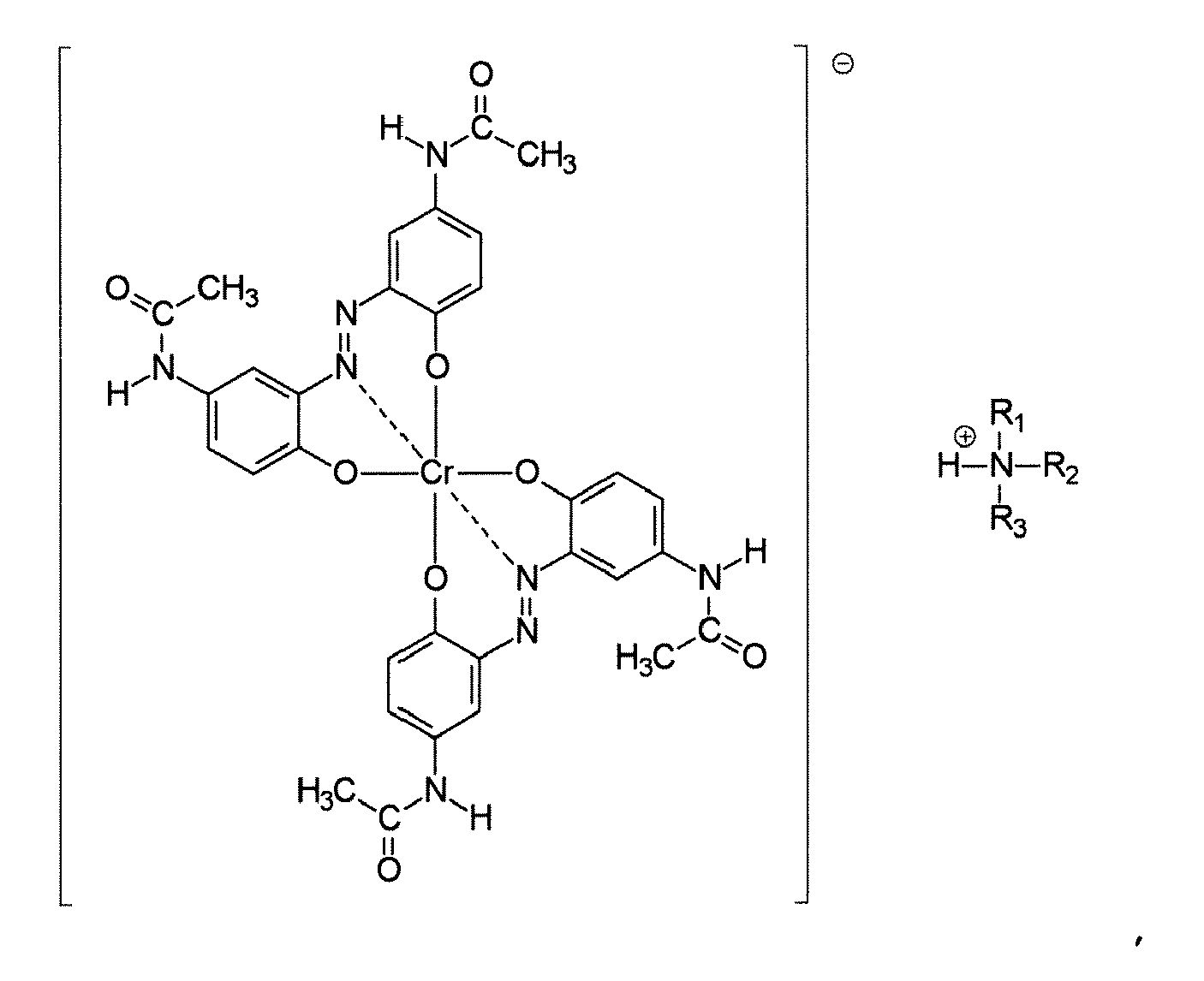


- (28) the colorant compound according to (1) of the formula

- (29) the colorant compound according to (1) wherein R1, R2, and R3 each, independently of the others, are hydrogen atoms or alkyl groups, including linear and branched, saturated and unsaturated, cyclic and acyclic, and substituted and unsubstituted alkyl groups, and wherein hetero atoms, such as oxygen, nitrogen, sulfur, silicon, phosphorus, boron, and the like either may or may not be present in the alkyl group;
- (30) the colorant compound according to (29) wherein at least one of the alkyl groups is linear;
- (31) the colorant compound according to (29) wherein at least one of the alkyl groups is branched;
- (32) the colorant compound according to (29) wherein at least one of the alkyl groups is substituted;
- (33) the colorant compound according to (29) wherein at least one of the alkyl groups is unsubstituted;
- (34) the colorant compound according to (29) wherein at least one of the alkyl groups has hetero atoms therein;
- (35) the colorant compound according to (29) wherein at least one of the alkyl groups has no hetero atoms therein;
- (36) the colorant compound according to (29) wherein R1, R2, and R3 are the same as each other;
- (37) the colorant compound according to (29) wherein at least two of R1, R2, and R3 are different from each other;
- (38) the colorant compound according to (29) wherein all three of R1, R2, and R3 are different from each other;
- (39) the colorant compound according to (29) wherein the compound is of the formula


- (40) the colorant compound according to (29) wherein the compound is of the formula


- (41) the colorant compound according to (29) wherein the compound is of the formula


- (42) the colorant compound according to (29) wherein the compound is of the formula


- (43) the colorant compound according to (29) wherein the compound is of the formula


- (44) the colorant compound according to (29) wherein the compound is of the formula


- (45) the colorant compound according to (1) wherein at least one of R1, R2, and R3 is an aryl group, an arylalkyl group, or an alkylaryl group;
- (46) the colorant compound according to (45) wherein the aryl, arylalkyl, or alkylaryl group is substituted;
- (47) the colorant compound according to (45) wherein the aryl, arylalkyl, or alkylaryl group is unsubstituted;
- (48) the colorant compound according to (45) wherein the aryl, arylalkyl, or alkylaryl group contains at least one heteroatom therein; and
- (49) the colorant compound according to (45) wherein the aryl, arylalkyl, or alkylaryl group contains no heteroatoms therein.
- Disclosed herein are colorant compounds of the formulae


- Disclosed herein are colorant compounds of the formulae


- The integer "n" represents both the charge on the chromogen compound complex and the number of countercations present. This integer is at least 1, and can also be 2 or 3.
- These compounds form complexes with metal compounds to form chromogenic compounds. Suitable metals M include any metals that form complexes with the above-indicated compounds wherein the complex will have a negative charge of at least -1. Examples of suitable metals include (but are not limited to) chromium, iron, cobalt, molybdenum, tungsten, ruthenium, osmium, rhodium, iridium, manganese, rhenium, vanadium, niobium, tantalum, titanium, zirconium, hafnium, scandium, yttrium, lanthanum, zinc, aluminum, metals in the Lanthanide Series, and the like, as well as mixtures thereof.
- While not being limited to any particular theory, it is believed that the complexes formed are as follows:


- Some specific examples of suitable chromogenic compound complexes for the compounds disclosed herein include (but are not limited to) the following:


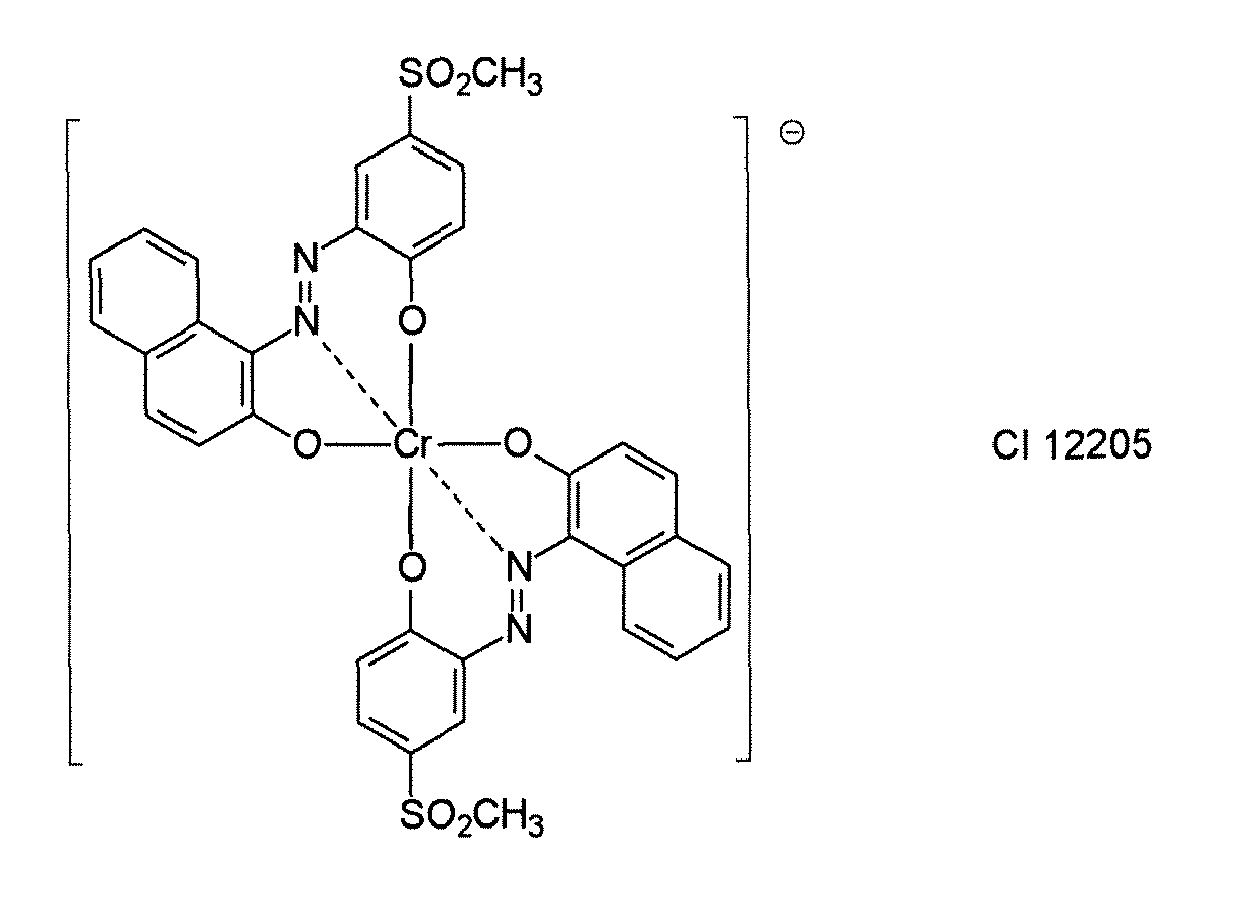

- The chromogenic compound complexes have a negative charge of at least -1, and accordingly are associated with a counterion. The counterion is of the formula

- The colorant compounds disclosed herein can be prepared by any desired or effective method. For example, a chromogenic compound having a different counterion or in the free acid form can be obtained commercially and the counterion can be replaced with the desired counterion. Metallizing azo dyes can be done by any desired or effective method, such as that described in, for example, "British Intelligence Objectives Subcommittee Report 961," Publications Board No. 86139, Library of Congress, Washington, D.C. 1947, pp. 71-72, 110, 149-151, 160, 163, 164, the disclosure of which is totally incorporated herein by reference. The desired counterions can generally be derived from commercially available amine compounds as well. Primary, secondary, and tertiary amines can also be prepared as described in, for example, Comprehensive Organic Transformations - A Guide to Functional Group Preparations, 2nd Ed., Richard C. Larock, Wiley-VCH, 1999 ISBN 0-471-19031-4 New York, NY, the disclosure of which is totally incorporated herein by reference.
- For example, in one embodiment, the chromogenic compound and the amine compound from which the counterion is to be derived can be heated together until the ion exchange is complete, followed by distilling off the solvent (if a solvent is used) and recovery of the colorant compound thus prepared.
- Any desired or effective relative amounts of the chromogenic compound and the amine compound from which the counterion is to be derived can be employed. When the charge on the chromogenic compound is -1, the relative amounts can be, for example, in one embodiment at least about 0.1 mole of chromogenic compound per every one mole of amine compound, in another embodiment at least about 0.5 mole of chromogenic compound per every one mole of amine compound, and in yet another embodiment at least about 0.9 mole of chromogenic compound per every one mole of amine compound, and in one embodiment no more than about 3 moles of chromogenic compound per every one mole of amine compound, in another embodiment no more than about 2 moles of chromogenic compound per every one mole of amine compound, and in yet another embodiment no more than about 1.1 moles of chromogenic compound per every one mole of amine compound, although the relative amounts can be outside of these ranges. When the charge on the chromogenic compound is -2, the amount of amine compound will, of course be doubled, and when the charge on the chromogenic compound is higher, the amount of amine compound will, of course, be adjusted accordingly.
- When a solvent is used, any desired or effective solvent can be employed. Examples of suitable solvents include methyl isobutyl ketone, methyl ethyl ketone, acetone, methanol, ethanol, n-propanol, isopropanol, butanol, and the like, as well as mixtures thereof.
- The reactants are present in the solvent in any desired or effective amount, in one embodiment at least about 1 gram of reactants per liter of solvent, in another embodiment at least about 225 grams of reactants per liter of solvent, and in yet another embodiment at least about 450 grams of reactants per liter of solvent, and in one embodiment no more than about 2,000 grams of reactants per liter of solvent, in another embodiment no more than about 1,000 grams of reactants per liter of solvent, and in yet another embodiment no more than about 500 grams of reactants per liter of solvent, although the relative amounts of reactants and solvent can be outside of these ranges.
- The reactants can be heated to any desired or effective temperature, in one embodiment at least about 25°C, in another embodiment at least about 65°C, and in yet another embodiment at least about 110°C, and in one embodiment no more than about 150°C, in another embodiment no more than about 125°C, and in yet another embodiment no more than about 110°C, although the temperature can be outside of these ranges.
- The reactants can be heated for any desired or effective period of time, in one embodiment at least about 1 hour, in another embodiment at least about 12 hours, and in yet another embodiment at least about 16 hours, and in one embodiment no more than about 7 days, in another embodiment no more than about 1 day, and in yet another embodiment no more than about 18 hours, although the period of time can be outside of these ranges.
- Thereafter, the colorant compound thus prepared can be recovered by any desired or effective method, such as by distillation, vacuum, quenching into a solvent in which the product is not soluble (such as water), or the like.
- Specific embodiments will now be described in detail. These examples are intended to be illustrative, and the claims are not limited to the materials, conditions, or process parameters set forth in these embodiments. All parts and percentages are by weight unless otherwise indicated.
- To a 2-liter 3-necked round bottom flask equipped with TEFLON® coated magnet, silicone oil bath, magnetically stirred hot plate, and condenser was charged 1,100 g methyl isobutyl ketone (obtained from Aldrich Chemical Co., Milwaukee, WI). Stirring was initiated and Solvent Black 45 free acid dye (about 250 g, 0.275 moles, obtained from Orient Chemical Industries Ltd, Osaka, Japan), of the formula


- To a 100-milliliter 3-necked round bottom flask equipped with TEFLON® coated magnet, silicone oil bath, magnetically stirred hot plate, and condenser was charged 75 g methyl isobutyl ketone (obtained from Aldrich Chemical Co., Milwaukee, WI). Stirring was initiated and Solvent Black 45 free acid dye (about 10 g, 0.015 moles, obtained from Orient Chemical Industries Ltd, Osaka, Japan) was added to the flask. The oil bath was heated to 120°C for about 0.5 hours until the dye was completely dissolved. About 6.2 g (0.015 moles) of PA28 (obtained from Tomah Products Inc., Milton, Wisconsin) was subsequently added, and the reaction mixture was then refluxed for about 16 hours. A distillation setup was thereafter attached and the solvent was distilled off with the aid of a nitrogen inlet. When the distillation appeared complete, the flask was then transferred to an oven at 120°C and secured upside down for about 1 hour, and the product was collected. The product was believed to be of the formula

- The process of Example II was repeated except that about 5.11 g (0.015 moles) of SA19.3 (obtained from Tomah Products Inc., Milton, Wisconsin) was substituted for the 6.2 g (0.015 moles) of PA28. The product was believed to be of the formula
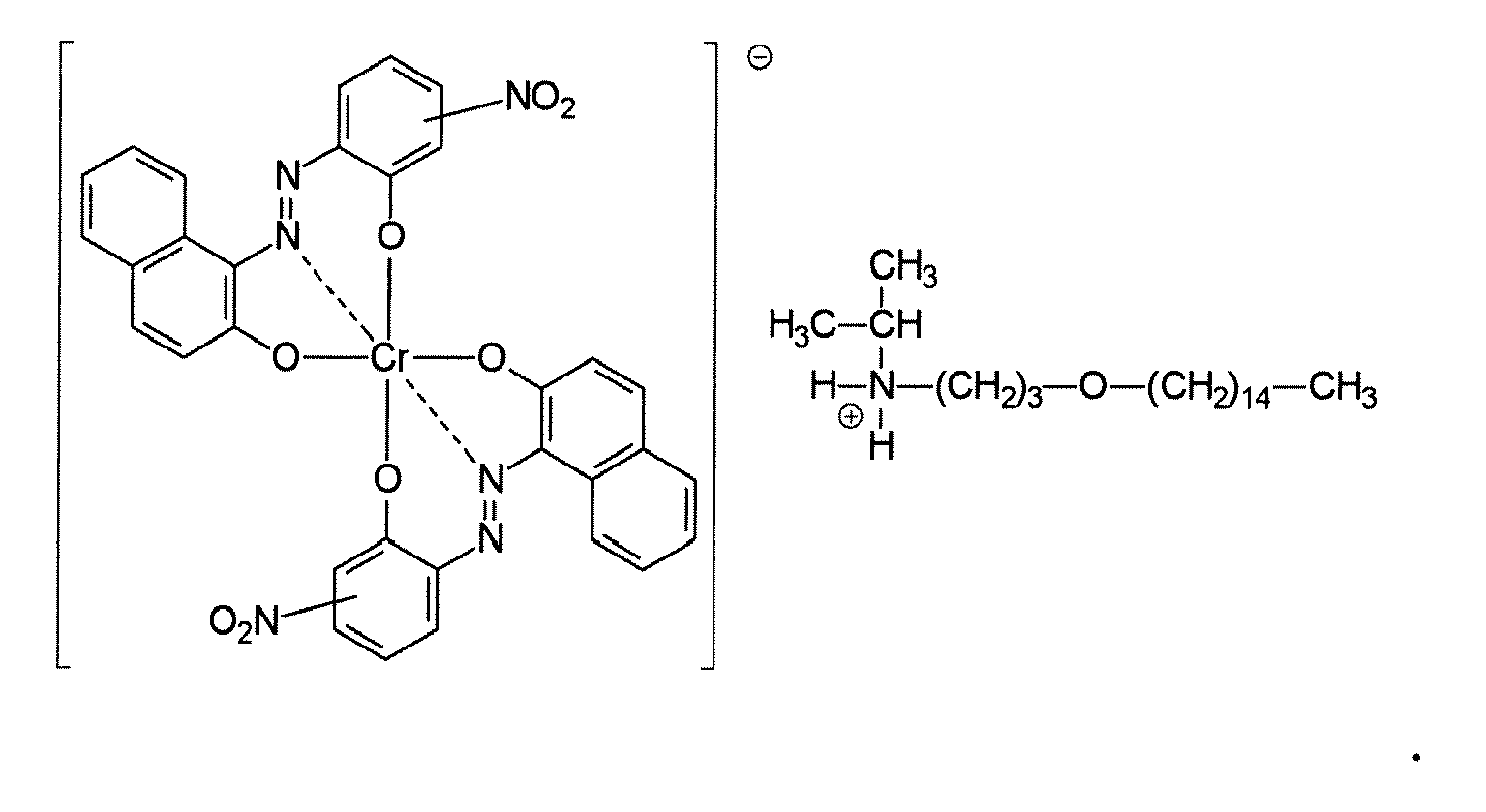
- To a 100-milliliter 3-necked round bottom flask equipped with TEFLON® coated magnet, silicone oil bath, magnetically stirred hot plate, and condenser was charged 35 g methyl isobutyl ketone (obtained from Aldrich Chemical Co., Milwaukee, WI). Stirring was initiated and Solvent Black 45 free acid dye (about 5 g, 0.0075 moles, obtained from Orient Chemical Industries Ltd, Osaka, Japan) was added to the flask. The oil bath was heated to 120°C for about 0.5 hours until the dye was completely dissolved. About 2.9 g (0.0075 moles) of PROPOMEEN O/12 (obtained from Akzo Nobel, McCook, Illinois) was subsequently added, and the reaction mixture was then refluxed for about 16 hours. A distillation setup was thereafter attached and the solvent was distilled off with the aid of a nitrogen inlet. When the distillation appeared complete, the flask was then transferred to an oven at 120°C and secured upside down for about 1 hour, and the product was collected. The product was believed to be of the formula

- The process of Example II was repeated except that about 10.3 g (0.015 moles) of trihexadecylamine (ARMEEN® 316 obtained from Akzo Nobel, McCook, Illinois) was substituted for the 6.2 g (0.015 moles) of PA28. The product was believed to be of the formula

- The process of Example II was repeated except that about 7.8 g (0.015 moles) of tridodecylamine (ARMEEN® 312 obtained from Akzo Nobel, McCook, Illinois) was substituted for the 6.2 g (0.015 moles) of PA28. The product was believed to be of the formula

- The processes of Examples I through VI are repeated using Cl 12695 as the free acid dye instead of Solvent Black 45 (Cl 12195). It is believed that similar results will be obtained.
- The processes of Examples I through VI are repeated using Cl 12696 as the free acid dye instead of Solvent Black 45 (Cl 12195). It is believed that similar results will be obtained.
- The processes of Examples I through VI are repeated using Cl 12716 as the free acid dye instead of Solvent Black 45 (Cl 12195). It is believed that similar results will be obtained.
- The processes of Examples I through VI are repeated using Cl 11836 as the free acid dye instead of Solvent Black 45 (Cl 12195). It is believed that similar results will be obtained.
- The processes of Examples I through VI are repeated using Cl 12196 as the free acid dye instead of Solvent Black 45 (Cl 12195). It is believed that similar results will be obtained.
- The processes of Examples I through VI are repeated using Cl 12205 as the free acid dye instead of Solvent Black 45 (Cl 12195). It is believed that similar results will be obtained.
- Ink compositions were prepared by the following process. All ink ingredients except colorant(s) were charged into a stainless steel beaker. The resulting mixture was then melted together in an oven, followed by blending by stirring in a temperature controlled mantle at the same temperature as the oven for about 0.3 hour, at a temperature of about 110°C for Inks A and B and Comparative Ink 1 and at a temperature of about 135 for Ink C. To this mixture was then added the colorant(s). After stirring for about 2 additional hours, the ink thus formed was filtered through a heated MOTT® apparatus (obtained from Mott Metallurgical) using Whatman #3 filter paper under a pressure of about 15 pounds per square inch. The filtered phase change ink thus formed was poured into molds and allowed to solidify to form ink sticks. Inks were prepared from the following ingredients: polyethylene wax (PE 500, obtained from Baker Petrolite, Tulsa, OK); polyethylene wax (PE 655, obtained from Baker Petrolite, Tulsa, OK); a branched triamide of the formula

U.S. Patent 6,860,930 , the disclosure of which is totally incorporated herein by reference; a tetra-amide (obtained from the reaction of one equivalent of a C-36 dimer acid obtained from Uniqema, New Castle, DE with two equivalents of ethylene diamine and UNICID® 700 (obtained from Baker Petrolite, Tulsa, OK, a long chain hydrocarbon having a terminal carboxylic acid group), prepared as described in Example 1 ofU.S. Patent 6,174,937 , the disclosure of which is totally incorporated herein by reference); stearyl stearamide wax (KEMAMIDE® S-180, obtained from Crompton Corporation, Greenwich, CT); KE-100 Resin (triglycerides of hydrogenated abietic (rosin) acid, commercially available from Arakawa Chemical Industries, Ltd.); a urethane resin obtained from the reaction of two equivalents of ABITOL® E hydroabietyl alcohol (obtained from Hercules Inc., Wilmington, DE) and one equivalent of isophorone diisocyanate, prepared as described in Example 1 ofU.S. Patent 5,782,966 , the disclosure of which is totally incorporated herein by reference (hereinafter referred to as urethane resin #1); a urethane resin that was the adduct of three equivalents of stearyl isocyanate and a glycerol-based alcohol, prepared as described in Example 4 ofU.S. Patent 6,309,453 , the disclosure of which is totally incorporated herein by reference (hereinafter referred to as urethane resin #2); NAUGUARD® 445 antioxidant (obtained from Uniroyal Chemical Co., Middlebury, CT); Disperse Orange 47 dye (DO-47, obtained from Keystone Aniline Corporation, Chicago, IL), and the colorant prepared as described in Example I. The amounts of each ingredient are listed in the table below for each ink:Ink A B C 1 polyethylene wax 500 55.45 52.28 0 56.50 polyethylene wax 655 0 0 35.95 0 branched triamide 10.99 12.29 0 11.2 tetra-amide 0 0 13.41 0 stearyl stearamide wax 13.53 15.03 23.99 13.60 KE-100 Resin 9.70 10.86 0 10.20 urethane resin #1 0 0 12.26 0 urethane resin #2 3.96 4.37 8.02 4.0 antioxidant 0.18 0.17 0.20 0.20 DO-47 0.20 0.20 0.20 0.20 Example I colorant 5.99 4.80 5.99 0 Solvent Black 45 0 0 0 4.10 Ink A B C 1 unfiltered spectral strength at 380 nm 1014 812 1030 884 unfiltered spectral strength at 480 nm 973 827 959 808 unfiltered spectral strength at 580 nm 1142 886 1115 928 filtered spectral strength at 380 nm 993 796 1028 543 filtered spectral strength at 480 nm 841 724 957 490 filtered spectral strength at 580 nm 1129 883 1111 545 SS ratio (filtered/unfiltered at 580 nm) 0.99 1.00 1.00 0.69 viscosity at 110°C (centipoise) (filtered) 10.45 10.83 --- 9.59 viscosity at 140°C (centipoise) (filtered) --- --- 10.86 --- Tg 9.63 11.8 --- --- melting point (°C) 80.2 80.2 --- --- freezing point (°C) 67.2, 72.4 68.7, 74.5 --- --- - Other embodiments and modifications of the present invention may occur to those of ordinary skill in the art subsequent to a review of the information presented herein; these embodiments and modifications, as well as equivalents thereof, are also included within the scope of this invention.
- The recited order of processing elements or sequences, or the use of numbers, letters, or other designations therefor, is not intended to limit a claimed process to any order except as specified in the claim itself.
Claims (10)
- Colorant compounds of the formulae


- A colorant compound according to claim 1 of the formula

- A colorant compound according to claim 1 of the formula

- Colorant compounds according to claim 1 wherein at least one of A, E, G, and J is an alkyl group, provided that when A is the at least one alkyl group, m is at least 1, and provided that when E is the at least one alkyl group, p is at least 1.
- Colorant compounds according to claim 1 wherein at least one of A, E, G, and J is an aryl group, provided that when A is the at least one aryl group, m is at least 1, and provided that when E is the at least one aryl group, p is at least 1.
- Colorant compounds according to claim 1 wherein at least one of A, E, G, and J is an arylalkyl or alkylaryl group, provided that when A is the at least one arylalkyl or alkylaryl group, m is at least 1, and provided that when E is the at least one arylalkyl or alkylaryl group, p is at least 1.
- A colorant compound according to claim 1 of the formula


- A colorant compound according to claim 1 of the formula

- A colorant compound according to claim 1 wherein R1, R2, and R3 each, independently of the others, are hydrogen atoms or alkyl groups, including linear and branched, saturated and unsaturated, cyclic and acyclic, and substituted and unsubstituted alkyl groups, and wherein hetero atoms, such as oxygen, nitrogen, sulfur, silicon, phosphorus, boron, and the like either may or may not be present in the alkyl group.
- A colorant compound according to claim 9 wherein the compound is of the formula


Applications Claiming Priority (1)
| Application Number | Priority Date | Filing Date | Title |
|---|---|---|---|
| US11/291,056 US7294730B2 (en) | 2005-11-30 | 2005-11-30 | Colorant compounds |
Publications (3)
| Publication Number | Publication Date |
|---|---|
| EP1808463A2 true EP1808463A2 (en) | 2007-07-18 |
| EP1808463A3 EP1808463A3 (en) | 2009-02-18 |
| EP1808463B1 EP1808463B1 (en) | 2010-10-06 |
Family
ID=38088419
Family Applications (1)
| Application Number | Title | Priority Date | Filing Date |
|---|---|---|---|
| EP06124132A Not-in-force EP1808463B1 (en) | 2005-11-30 | 2006-11-15 | Metal complex azo dyes |
Country Status (8)
| Country | Link |
|---|---|
| US (1) | US7294730B2 (en) |
| EP (1) | EP1808463B1 (en) |
| JP (1) | JP5117707B2 (en) |
| KR (1) | KR101355009B1 (en) |
| CN (1) | CN1974674B (en) |
| BR (1) | BRPI0604984B1 (en) |
| CA (1) | CA2568927C (en) |
| DE (1) | DE602006017326D1 (en) |
Cited By (2)
| Publication number | Priority date | Publication date | Assignee | Title |
|---|---|---|---|---|
| EP1958992A1 (en) * | 2007-02-06 | 2008-08-20 | Xerox Corporation | Phase change inks containing colorant compounds |
| US8303671B2 (en) | 2007-02-06 | 2012-11-06 | Xerox Corporation | Colorant compounds |
Families Citing this family (21)
| Publication number | Priority date | Publication date | Assignee | Title |
|---|---|---|---|---|
| US7442242B2 (en) * | 2005-11-30 | 2008-10-28 | Xerox Corporation | Phase change inks containing specific colorants |
| US7381255B2 (en) * | 2005-11-30 | 2008-06-03 | Xerox Corporation | Phase change inks |
| US20080187664A1 (en) * | 2007-02-06 | 2008-08-07 | Xerox Corporation | Phase change inks containing colorant compounds |
| US20090223409A1 (en) * | 2008-03-07 | 2009-09-10 | Xerox Corporation | Compounds suitable for use in inks and inks having such compounds |
| CN111808084A (en) | 2008-11-10 | 2020-10-23 | 阿布特斯生物制药公司 | Novel lipids and compositions for delivery of therapeutic agents |
| US7985286B2 (en) * | 2008-11-24 | 2011-07-26 | Xerox Corporation | Solid inks with lower coefficient of friction |
| TWI526502B (en) * | 2009-12-25 | 2016-03-21 | Sumitomo Chemical Co | Pyridine ketone compound compounds |
| TWI531622B (en) * | 2009-12-25 | 2016-05-01 | Sumitomo Chemical Co | Pyridine ketone compound compounds |
| US8460447B2 (en) | 2011-04-27 | 2013-06-11 | Xerox Corporation | Substituted oxazoline compounds or substituted oxazoline derivatives |
| US8500260B2 (en) | 2011-04-27 | 2013-08-06 | Xerox Corporation | Ink compositions incorporating substituted oxazoline compounds or substituted oxazoline derivatives |
| CN102796400B (en) * | 2011-05-25 | 2013-12-04 | 上海雅运纺织化工股份有限公司 | Yellow azo metallized dye composition, method and application thereof |
| US9109124B2 (en) | 2011-06-01 | 2015-08-18 | Xerox Corporation | Solid ink compositions comprising semicrystalline oligomer resins |
| US8888907B2 (en) | 2011-08-02 | 2014-11-18 | Xerox Corporation | Solid phase change ink compositions comprising oxazolines |
| US8952191B2 (en) | 2012-11-19 | 2015-02-10 | Xerox Corporation | Ester resin compositions |
| US8936359B2 (en) | 2012-11-19 | 2015-01-20 | Xerox Corporation | Ink compositions incorporating ester resins |
| US9228097B2 (en) * | 2013-08-28 | 2016-01-05 | Xerox Corporation | Phase change inks |
| US9481803B2 (en) | 2014-12-13 | 2016-11-01 | Xerox Corporation | Water dispersible phase change ink suitable for use as a photo-mask |
| US9388320B2 (en) | 2014-12-13 | 2016-07-12 | Xerox Corporation | Water cleanable phase change ink for ophthalmic lens marking |
| CN104610777B (en) * | 2015-01-13 | 2017-07-04 | 青岛双桃精细化工(集团)有限公司 | A kind of red composite dye for hair brocade blend dyeing |
| TWI732111B (en) | 2017-03-28 | 2021-07-01 | 日商住友電木股份有限公司 | Photosensitive compositions, color filter and microlens derived therefrom |
| CN109096498B (en) * | 2018-08-27 | 2021-08-13 | 广东工业大学 | A kind of two-dimensional conductive metal organic framework material and preparation method thereof |
Family Cites Families (45)
| Publication number | Priority date | Publication date | Assignee | Title |
|---|---|---|---|---|
| NL130115C (en) * | 1965-12-10 | 1970-06-15 | ||
| CH524012A (en) * | 1969-02-25 | 1972-01-31 | Ciba Geigy Ag | Process for the continuous dyeing or printing of textile material made of synthetic polyamide |
| BE755392A (en) | 1969-08-28 | 1971-02-01 | Teletype Corp | INK AND ELECTROSTATIC PRINTING APPARATUS |
| FR2096808B1 (en) * | 1970-07-01 | 1975-01-10 | Soltex Soc Civ | |
| NL173862C (en) * | 1971-08-10 | 1984-03-16 | Ciba Geigy | PROCESS FOR PREPARING AMMONIUM SALTS OF ANIONOGENIC DYES |
| US3994872A (en) * | 1971-08-10 | 1976-11-30 | Ciba-Geigy Corporation | Tertiary-alkylamine salts of metal complex dyestuffs |
| JPS5139575B2 (en) * | 1972-04-10 | 1976-10-28 | ||
| JPS50156541A (en) * | 1974-06-11 | 1975-12-17 | ||
| NL7706727A (en) * | 1976-06-24 | 1977-12-28 | Ciba Geigy | PROCESS FOR PREPARING NEW CHROME COMPLEX DYES REACTIVE REGARDING THE FIBERS AND THE USE OF THESE DYES. |
| DE2862357D1 (en) * | 1977-06-23 | 1984-02-02 | Ciba Geigy Ag | Method of mass-dyeing linear polyamides using dyesalts from 1:2 chromium complexes of monoazodyes; the fibres obtained therefrom |
| US4390369A (en) | 1981-12-17 | 1983-06-28 | Exxon Research And Engineering Co. | Natural wax-containing ink jet inks |
| US4484948A (en) | 1981-12-17 | 1984-11-27 | Exxon Research And Engineering Co. | Natural wax-containing ink jet inks |
| EP0167247B1 (en) | 1984-05-10 | 1990-08-08 | Willett International Limited | Method for applying thermoplastic inks to a substrate and a composition for use therein |
| EP0180655B1 (en) * | 1984-11-05 | 1988-04-06 | Hodogaya Chemical Co., Ltd. | Electrophotographic toner |
| EP0187352B1 (en) | 1984-12-31 | 1991-06-05 | Howtek, Inc. | A method of ink jet colour printing |
| DE3671460D1 (en) | 1985-06-25 | 1990-06-28 | Howtek Inc | INK FOR INK JET PRINT. |
| JPH0623861B2 (en) * | 1986-08-04 | 1994-03-30 | 日本化薬株式会社 | Toner for electrophotographic printing |
| JPS6354476A (en) | 1986-08-25 | 1988-03-08 | Seiko Epson Corp | Hot-melting ink |
| US4889560A (en) | 1988-08-03 | 1989-12-26 | Tektronix, Inc. | Phase change ink composition and phase change ink produced therefrom |
| US4889761A (en) | 1988-08-25 | 1989-12-26 | Tektronix, Inc. | Substrates having a light-transmissive phase change ink printed thereon and methods for producing same |
| JPH02229870A (en) * | 1989-03-02 | 1990-09-12 | Seiko Epson Corp | Ink composition |
| US5151120A (en) | 1989-03-31 | 1992-09-29 | Hewlett-Packard Company | Solid ink compositions for thermal ink-jet printing having improved printing characteristics |
| US5006170A (en) | 1989-06-22 | 1991-04-09 | Xerox Corporation | Hot melt ink compositions |
| GB8915958D0 (en) * | 1989-07-12 | 1989-08-31 | Ici Plc | Solvent-soluble dye |
| GB8915960D0 (en) * | 1989-07-12 | 1989-08-31 | Ici Plc | Solvent soluble dye |
| US5084099A (en) | 1991-06-17 | 1992-01-28 | Tektronix, Inc. | Phase change ink colorants and phase change inks produced therefrom |
| DE4141761A1 (en) * | 1991-12-18 | 1993-06-24 | Basf Ag | LIQUID PREPARATIONS OF A 1: 2 CHROME COMPLEX DYE |
| DE4205713C2 (en) | 1992-02-25 | 1994-08-04 | Siegwerk Druckfarben Gmbh & Co | Printing ink, process for its production and its use |
| US5385957A (en) | 1992-08-24 | 1995-01-31 | Videojet Systems International, Inc. | Hotmelt ink jet comprising ionomers having melting points from about 50° C. to about 130° or a softening point below about 80° C., and an image-forming agent |
| US5372852A (en) | 1992-11-25 | 1994-12-13 | Tektronix, Inc. | Indirect printing process for applying selective phase change ink compositions to substrates |
| US5621022A (en) | 1992-11-25 | 1997-04-15 | Tektronix, Inc. | Use of polymeric dyes in hot melt ink jet inks |
| JPH07104519A (en) * | 1993-09-29 | 1995-04-21 | Hodogaya Chem Co Ltd | Toner for electrostatic image development |
| US6245135B1 (en) | 1997-08-22 | 2001-06-12 | Xerox Corporation | Phase change ink composition |
| GB9616555D0 (en) * | 1996-08-06 | 1996-09-25 | Clariant Int Ltd | Organic compounds |
| JP3122628B2 (en) * | 1997-06-13 | 2001-01-09 | 株式会社巴川製紙所 | Development method |
| JPH115931A (en) * | 1997-06-17 | 1999-01-12 | Hodogaya Chem Co Ltd | Recording liquid |
| DE19905279A1 (en) * | 1999-02-09 | 2000-08-10 | Bayer Ag | Use of liquid dye preparations for coloring wood |
| JP2001316600A (en) * | 2000-05-10 | 2001-11-16 | Hodogaya Chem Co Ltd | Metal complex salt azo dye |
| US6350795B1 (en) * | 2000-06-07 | 2002-02-26 | Xerox Corporation | Ink compositions |
| DE10032138A1 (en) * | 2000-07-01 | 2002-01-10 | Clariant Gmbh | Use of iron azo complex compounds as charge control agents |
| AU2002246661A1 (en) * | 2000-11-13 | 2002-08-06 | E.I. Dupont De Nemours And Company | Resin compositions for laser welding containing anthraquinone and monoazo dyes |
| JP2002254813A (en) * | 2001-03-02 | 2002-09-11 | Ricoh Co Ltd | Optical recording medium |
| US20030229163A1 (en) * | 2002-03-28 | 2003-12-11 | Fuji Photo Film Co., Ltd. | Dye-containing curable composition, color filter prepared using the same, and process of preparing color filter |
| JP2004099761A (en) * | 2002-09-10 | 2004-04-02 | Hitachi Chem Co Ltd | Moistureproof insulating coating for mount circuit board and method for producing insulation-treated electronic component |
| JP4344580B2 (en) * | 2003-10-15 | 2009-10-14 | オリヱント化学工業株式会社 | Method for producing charge control agent |
-
2005
- 2005-11-30 US US11/291,056 patent/US7294730B2/en not_active Expired - Lifetime
-
2006
- 2006-11-15 EP EP06124132A patent/EP1808463B1/en not_active Not-in-force
- 2006-11-15 DE DE602006017326T patent/DE602006017326D1/en active Active
- 2006-11-23 CA CA2568927A patent/CA2568927C/en not_active Expired - Fee Related
- 2006-11-27 JP JP2006318156A patent/JP5117707B2/en not_active Expired - Fee Related
- 2006-11-29 CN CN200610163181.5A patent/CN1974674B/en not_active Expired - Fee Related
- 2006-11-30 KR KR1020060119897A patent/KR101355009B1/en not_active Expired - Fee Related
- 2006-11-30 BR BRPI0604984-2A patent/BRPI0604984B1/en not_active IP Right Cessation
Cited By (3)
| Publication number | Priority date | Publication date | Assignee | Title |
|---|---|---|---|---|
| EP1958992A1 (en) * | 2007-02-06 | 2008-08-20 | Xerox Corporation | Phase change inks containing colorant compounds |
| US7997712B2 (en) | 2007-02-06 | 2011-08-16 | Xerox Corporation | Phase change inks containing colorant compounds |
| US8303671B2 (en) | 2007-02-06 | 2012-11-06 | Xerox Corporation | Colorant compounds |
Also Published As
| Publication number | Publication date |
|---|---|
| JP5117707B2 (en) | 2013-01-16 |
| KR20070057047A (en) | 2007-06-04 |
| BRPI0604984A (en) | 2007-10-09 |
| EP1808463B1 (en) | 2010-10-06 |
| DE602006017326D1 (en) | 2010-11-18 |
| CN1974674A (en) | 2007-06-06 |
| EP1808463A3 (en) | 2009-02-18 |
| US20070123701A1 (en) | 2007-05-31 |
| US7294730B2 (en) | 2007-11-13 |
| CA2568927A1 (en) | 2007-05-30 |
| BRPI0604984B1 (en) | 2018-02-14 |
| CN1974674B (en) | 2014-04-02 |
| CA2568927C (en) | 2011-01-25 |
| JP2007154193A (en) | 2007-06-21 |
| KR101355009B1 (en) | 2014-02-18 |
Similar Documents
| Publication | Publication Date | Title |
|---|---|---|
| EP1808463B1 (en) | Metal complex azo dyes | |
| EP1491595B1 (en) | Phase change inks containing colorant compounds | |
| EP1491596B1 (en) | Phase change inks containing colorant compounds | |
| EP1491590B1 (en) | Triphenylmethane colorant compounds and phase change inks containing the same | |
| EP1958992B1 (en) | Phase change inks containing colorant compounds | |
| JP2008195937A (en) | Phase change ink composition containing colorant compound | |
| JP5259948B2 (en) | Phase change ink composition and image forming method using phase change ink composition | |
| US8303671B2 (en) | Colorant compounds | |
| EP1792957B1 (en) | Phase change inks | |
| EP1958990B1 (en) | Colorant compounds | |
| MXPA06013691A (en) | Colorant compounds | |
| MXPA06013696A (en) | Phase change inks | |
| MXPA06013693A (en) | Phase change inks containing specific colorants |
Legal Events
| Date | Code | Title | Description |
|---|---|---|---|
| PUAI | Public reference made under article 153(3) epc to a published international application that has entered the european phase |
Free format text: ORIGINAL CODE: 0009012 |
|
| AK | Designated contracting states |
Kind code of ref document: A2 Designated state(s): AT BE BG CH CY CZ DE DK EE ES FI FR GB GR HU IE IS IT LI LT LU LV MC NL PL PT RO SE SI SK TR |
|
| AX | Request for extension of the european patent |
Extension state: AL BA HR MK YU |
|
| PUAL | Search report despatched |
Free format text: ORIGINAL CODE: 0009013 |
|
| AK | Designated contracting states |
Kind code of ref document: A3 Designated state(s): AT BE BG CH CY CZ DE DK EE ES FI FR GB GR HU IE IS IT LI LT LU LV MC NL PL PT RO SE SI SK TR |
|
| AX | Request for extension of the european patent |
Extension state: AL BA HR MK RS |
|
| 17P | Request for examination filed |
Effective date: 20090818 |
|
| 17Q | First examination report despatched |
Effective date: 20090916 |
|
| AKX | Designation fees paid |
Designated state(s): DE FR GB |
|
| GRAP | Despatch of communication of intention to grant a patent |
Free format text: ORIGINAL CODE: EPIDOSNIGR1 |
|
| GRAS | Grant fee paid |
Free format text: ORIGINAL CODE: EPIDOSNIGR3 |
|
| GRAA | (expected) grant |
Free format text: ORIGINAL CODE: 0009210 |
|
| AK | Designated contracting states |
Kind code of ref document: B1 Designated state(s): DE FR GB |
|
| REG | Reference to a national code |
Ref country code: GB Ref legal event code: FG4D |
|
| REF | Corresponds to: |
Ref document number: 602006017326 Country of ref document: DE Date of ref document: 20101118 Kind code of ref document: P |
|
| PLBE | No opposition filed within time limit |
Free format text: ORIGINAL CODE: 0009261 |
|
| STAA | Information on the status of an ep patent application or granted ep patent |
Free format text: STATUS: NO OPPOSITION FILED WITHIN TIME LIMIT |
|
| 26N | No opposition filed |
Effective date: 20110707 |
|
| REG | Reference to a national code |
Ref country code: DE Ref legal event code: R097 Ref document number: 602006017326 Country of ref document: DE Effective date: 20110707 |
|
| REG | Reference to a national code |
Ref country code: FR Ref legal event code: PLFP Year of fee payment: 10 |
|
| REG | Reference to a national code |
Ref country code: FR Ref legal event code: PLFP Year of fee payment: 11 |
|
| REG | Reference to a national code |
Ref country code: FR Ref legal event code: PLFP Year of fee payment: 12 |
|
| REG | Reference to a national code |
Ref country code: FR Ref legal event code: PLFP Year of fee payment: 13 |
|
| PGFP | Annual fee paid to national office [announced via postgrant information from national office to epo] |
Ref country code: DE Payment date: 20191021 Year of fee payment: 14 |
|
| PGFP | Annual fee paid to national office [announced via postgrant information from national office to epo] |
Ref country code: FR Payment date: 20191022 Year of fee payment: 14 |
|
| PGFP | Annual fee paid to national office [announced via postgrant information from national office to epo] |
Ref country code: GB Payment date: 20191022 Year of fee payment: 14 |
|
| REG | Reference to a national code |
Ref country code: DE Ref legal event code: R119 Ref document number: 602006017326 Country of ref document: DE |
|
| GBPC | Gb: european patent ceased through non-payment of renewal fee |
Effective date: 20201115 |
|
| PG25 | Lapsed in a contracting state [announced via postgrant information from national office to epo] |
Ref country code: FR Free format text: LAPSE BECAUSE OF NON-PAYMENT OF DUE FEES Effective date: 20201130 |
|
| PG25 | Lapsed in a contracting state [announced via postgrant information from national office to epo] |
Ref country code: DE Free format text: LAPSE BECAUSE OF NON-PAYMENT OF DUE FEES Effective date: 20210601 Ref country code: GB Free format text: LAPSE BECAUSE OF NON-PAYMENT OF DUE FEES Effective date: 20201115 |