US6860930B2 - Phase change inks containing branched triamides - Google Patents
Phase change inks containing branched triamides Download PDFInfo
- Publication number
- US6860930B2 US6860930B2 US10/606,099 US60609903A US6860930B2 US 6860930 B2 US6860930 B2 US 6860930B2 US 60609903 A US60609903 A US 60609903A US 6860930 B2 US6860930 B2 US 6860930B2
- Authority
- US
- United States
- Prior art keywords
- phase change
- carbon atoms
- group
- ink composition
- change ink
- Prior art date
- Legal status (The legal status is an assumption and is not a legal conclusion. Google has not performed a legal analysis and makes no representation as to the accuracy of the status listed.)
- Expired - Lifetime, expires
Links
- 0 [4*]C(=O)N([H])[2*]N([H])C(=O)[1*]C(=O)N([H])[3*]N([H])C([5*])=O Chemical compound [4*]C(=O)N([H])[2*]N([H])C(=O)[1*]C(=O)N([H])[3*]N([H])C([5*])=O 0.000 description 27
- WMCPXIVOKNJBTM-UHFFFAOYSA-N CCC(COCC(C)NC(C)=O)(COCC(C)NC(C)=O)COCC(C)NC(C)=O Chemical compound CCC(COCC(C)NC(C)=O)(COCC(C)NC(C)=O)COCC(C)NC(C)=O WMCPXIVOKNJBTM-UHFFFAOYSA-N 0.000 description 8
- FHBANZXZJPXNRM-UHFFFAOYSA-N CCCCCCCCCCCCCCCCC(C)C(CCCCCCC(CCCC(=O)NCCNC(C)=O)C(C)CCCCCCCCCC)CCCC(=O)NC Chemical compound CCCCCCCCCCCCCCCCC(C)C(CCCCCCC(CCCC(=O)NCCNC(C)=O)C(C)CCCCCCCCCC)CCCC(=O)NC FHBANZXZJPXNRM-UHFFFAOYSA-N 0.000 description 2
- DXTYRJPTZQZODB-UHFFFAOYSA-N CCC(COCC(C)N)(COCC(C)N)COCC(C)N Chemical compound CCC(COCC(C)N)(COCC(C)N)COCC(C)N DXTYRJPTZQZODB-UHFFFAOYSA-N 0.000 description 1
Classifications
-
- C—CHEMISTRY; METALLURGY
- C09—DYES; PAINTS; POLISHES; NATURAL RESINS; ADHESIVES; COMPOSITIONS NOT OTHERWISE PROVIDED FOR; APPLICATIONS OF MATERIALS NOT OTHERWISE PROVIDED FOR
- C09D—COATING COMPOSITIONS, e.g. PAINTS, VARNISHES OR LACQUERS; FILLING PASTES; CHEMICAL PAINT OR INK REMOVERS; INKS; CORRECTING FLUIDS; WOODSTAINS; PASTES OR SOLIDS FOR COLOURING OR PRINTING; USE OF MATERIALS THEREFOR
- C09D11/00—Inks
- C09D11/30—Inkjet printing inks
- C09D11/34—Hot-melt inks
Definitions
- the present invention is directed to hot melt or phase change inks. More specifically, the present invention is directed to phase change inks particularly suitable for use in phase change ink jet printers.
- One embodiment of the present invention is directed to a phase change ink composition comprising (a) a colorant and (b) a carrier comprising a polyamide, wherein the polyamide component of the carrier contains at least about 10 percent by weight of a branched triamide.
- phase change ink composition comprising (a) a colorant and (b) a phase change ink carrier comprising a polyamide, wherein the polyamide component of the carrier contains at least about 10 percent by weight of a branched triamide which is the reaction product of either (i) a mixture consisting essentially of at least one monoacid, at least one branched triamine, and optional ingredients nonreactive with the monoacid, the triamine, and the reaction product thereof, or (ii) a mixture consisting essentially of at least one monoamine, at least one branched triacid, and optional ingredients nonreactive with the triacid, the monoamine, and the reaction product thereof.
- Yet another embodiment of the present invention is directed to a phase change ink composition
- a phase change ink composition comprising (a) a colorant and (b) a phase change ink carrier comprising a polyamide, wherein the polyamide component of the carrier contains at least about 10 percent by weight of a branched triamide which is the reaction product of either (i) a mixture comprising at least one branched triamine and at least one monoacid present in an amount of at least about 3 moles of monoacid per every one mole of branched triamine, or (b) a mixture comprising at least one branched triacid and at least one monoamine present in an amount of at least about 2.5 moles of monoamine per every one mole of branched triacid.
- phase change inks are in the solid phase at ambient temperature, but exist in the liquid phase at the elevated operating temperature of an ink jet printing device. At the jet operating temperature, droplets of liquid ink are ejected from the printing device and, when the ink droplets contact the surface of the recording substrate, either directly or via an intermediate heated transfer belt or drum, they quickly solidify to form a predetermined pattern of solidified ink drops.
- Phase change inks have also been used in other printing technologies, such as gravure printing, as disclosed in, for example, U.S. Pat. No. 5,496,879 and German Patent Publications DE 4205636AL and DE 4205713AL, the disclosures of each of which are totally incorporated herein by reference.
- Phase change inks for color printing typically comprise a phase change ink carrier composition which is combined with a phase change ink compatible colorant.
- a series of colored phase change inks can be formed by combining ink carrier compositions with compatible subtractive primary colorants.
- the subtractive primary colored phase change inks can comprise four component dyes, namely, cyan, magenta, yellow and black, although the inks are not limited to these four colors.
- These subtractive primary colored inks can be formed by using a single dye or a mixture of dyes.
- magenta can be obtained by using a mixture of Solvent Red Dyes or a composite block can be obtained by mixing several dyes.
- the subtractive primary colorants employed can comprise dyes from the classes of Color Index (C.I.) Solvent Dyes, Disperse Dyes, modified Acid and Direct Dyes, and Basic Dyes.
- the colorants can also include pigments, as disclosed in, for example, U.S. Pat. No. 5,221,335, the disclosure of which is totally incorporated herein by reference.
- U.S. Pat. No. 5,621,022 the disclosure of which is totally incorporated herein by reference, discloses the use of a specific class of polymeric dyes in phase change ink compositions.
- Phase change inks have also been used for applications such as postal marking, industrial marking, and labelling.
- Phase change inks are desirable for ink jet printers because they remain in a solid phase at room temperature during shipping, long term storage, and the like.
- the problems associated with nozzle clogging as a result of ink evaporation with liquid ink jet inks are largely eliminated, thereby improving the reliability of the ink jet printing.
- the droplets solidify immediately upon contact with the substrate, so that migration of ink along the printing medium is prevented and dot quality is improved.
- compositions suitable for use as phase change ink carrier compositions are known.
- Some representative examples of references disclosing such materials include U.S. Pat. No. 3,653,932, U.S. Pat. No. 4,390,369, U.S. Pat. No. 4,484,948, U.S. Pat. No. 4,684,956, U.S. Pat. No. 4,851,045, U.S. Pat. No. 4,889,560, U.S. Pat. No. 5,006,170, U.S. Pat. No. 5,151,120, U.S. Pat. No. 5,372,852, U.S. Pat. No.
- Suitable carrier materials can include paraffins, microcrystalline waxes, polyethylene waxes, ester waxes, fatty acids and other waxy materials, fatty amide containing materials, sulfonamide materials, resinous materials made from different natural sources (tall oil rosins and rosin esters, for example), and many synthetic resins, oligomers, polymers, and copolymers.
- U.S. Pat. No. 4,830,671 discloses an ink composition having the properties of stability and uniformity of performance under ink jet printing conditions and desired printing properties which can be obtained with hot melt ink compositions consisting of a resinous binder comprised of a compound of the formula wherein R 1 represents a polymerized fatty acid residue with two carboxylic acid groups removed, R 2 and R 3 are the same or different and each represent an alkylene with up to 12 carbon atoms, a cycloalkylene with 6 to 12 carbon atoms, an arylene with 6 to 12 carbon atoms, or an alkarylene with 7 to 12 carbon atoms, and R 4 and R 5 are the same or different and each represents an alkyl having up to 36 carbon atoms, a cycloalkyl having up to 36 carbon atoms and aryl having up to 36 carbon atoms, or an alkaryl having up to 36 carbon atom
- U.S. Pat. No. 5,194,638 discloses a resinous binder for use in hot melt ink compositions, which ink compositions may be used in hot melt ink jet printing applications.
- the resinous binder has a melt viscosity of 250 cps or less at 150° C., is sufficiently transparent to allow a colorant to be distributed through the resinous binder in an amount effective to import a pre-determined color to the resulting hot melt ink composition, and has a blocking temperature greater than 100° C.
- U.S. Pat. No. 5,645,632 discloses solid diesters for hot-melt inks which are prepared by reaction of polymerized fatty acid with long chain primary monohydric alcohols, optionally in the presence of diamine.
- the long chain alcohols have at least about 20 carbon atoms, and preferably have 24 or more carbon atoms.
- the esterification of liquid polymerized fatty acid with monohydric alcohol provides a diester that is solid at room temperature and has a melting point of less than about 150° C.
- the diester can be formulated with colorants and/or other image-producing materials to provide an ink for hot-melt printing, e.g., hot-melt ink jet, gravure or intaglio printing.
- U.S. Pat. No. 6,174,937 (Banning et al.), the disclosure of which is totally incorporated herein by reference, discloses a phase change ink comprising a material of the formula wherein X 1 , X 2 , X 3 , and X 4 are segments comprising atoms selected from groups V and VI of the periodic table; wherein at least one R 1 and R 5 comprises at least 37 carbon units; and wherein R 2 , R 3 , and R 4 each comprise at least one carbon unit.
- the invention further encompasses a composition of matter, as well as methods of reducing coefficients of friction of phase change ink formulations.
- U.S. Pat. No. 4,889,560 discloses a phase change ink carrier composition combined with a compatible colorant to form a phase change ink composition.
- a thin film of substantially uniform thickness of that phase change ink carrier composition, and the ink produced therefrom, has a high degree of lightness and chroma.
- the thin films of a substantially uniform thickness of the ink composition are also rectilinearly light transmissive.
- the carrier composition is preferably a fatty amide-containing compound.
- U.S. Pat. No. 4,889,761 discloses a method for producing a light-transmissive phase change ink printed substrate which comprises providing a substrate, and then printing on at least one surface of the substrate a predetermined pattern of a light-transmissive phase change ink which initially transmits light in a non-rectilinear path.
- the pattern of solidified phase change ink is then reoriented to form an ink layer of substantially uniform thickness. This ink layer will, in turn, produce an image which then will transmit light in a substantially rectilinear path.
- the substrate is light transmissive, and the reoriented printed substrate exhibits a high degree of lightness and chroma, and transmits light in a substantially rectilinear path.
- the reoriented printed substrate can be used in a projection device to project an image containing clear, saturated colors.
- a composition for the ink carrier comprises an unsaturated bis-amide as a transparency enhancer, a low viscosity monoamide as a thinner material, and a polyamide resin as a base and binder.
- British Patent GB 2 238 792 discloses a coating composition comprising a film-forming resinous component together with a liquid carrier thereafter, in which composition the film-forming resinous component contains a film-forming polyamide containing fluorine atoms.
- phase change ink composition that is indirectly applied to a substrate by raising the temperature of the phase change ink composition to form a liquid phase change ink composition, applying droplets of the phase change ink composition in a liquid phase to a liquid intermediate transfer surface on a solid support in a pattern using a device such as an ink jet printhead, solidifying the phase change ink composition on the liquid intermediate transfer surface, transferring the phase change ink composition from the liquid intermediate transfer surface to the substrate, and fixing the phase change ink composition to the substrate.
- the phase change ink composition is malleable when the ink is transferred from the intermediate transfer surface to the substrate and is ductile after the ink has been transferred to the substrate and cooled to ambient temperature to preclude the ink from crumbling and cracking.
- U.S. Pat. No. 4,895,982 discloses tricarboxylic acids that are prepared by reacting unsaturated mono- and dicarboxylic acids of specific carbon atom content in the presence of a catalytic proportion of an unactivated clay and water.
- the product acids of 34, 35, 36, 38, or 40 carbon atoms are useful as corrosion inhibitors, epoxy resins curing agents, lubricants, polymeric resin plasticizers and intermediates for synthetic polymeric resins.
- said binder comprising a synthetic polyamide resin or synthetic polyesteramide resin, each resin being the condensation product of (1) an acid component comprising a dimerized fatty acid and a monocarboxylic acid and (2) an amine component comprising a diamine and, in the case of the polyesteramide resin, additionally comprising a diol and/or alkanolamine.
- U.S. Pat. No. 3,622,604 discloses synthetic polyamides, useful as binders in the formulation of printing inks, formed between a dimeric fatty acid, an unsubstituted lower aliphatic monocarboxylic acid, ethylene diamine, and certain aromatic, cycloaliphatic, and other aliphatic diamines, including aliphatic ether diamines, and methods for preparing such amides.
- U.S. Pat. No. 5,510,821 (Jones et al.), the disclosure of which is totally incorporated herein by reference, discloses an ink stick shape for use in a printer ink stick feed chute wherein the opposing sides of the ink stick are tapered or angled from the horizontal so that at least one area intermediate the top and the bottom of the ink stick is a greater distance from the horizontal than the junction of the side walls and the bottom of the ink stick.
- the ink stick shape or geometry may be keyed to a particular color.
- U.S. Pat. No. 5,988,805 discloses an ink stick shape for use in a printer ink stick feed chute wherein the opposing sides of the ink stick are tapered or angled from the horizontal so that at least one area intermediate the top and the bottom of the ink stick is a greater distance from the horizontal than the junction of the side walls and the bottom of the ink stick.
- the ink stick shape or geometry may be keyed to a particular color.
- U.S. Pat. No. 6,133,353 (Bui et al.), the disclosure of which is totally incorporated herein by reference, discloses a solubilizing agent and a compound made by reacting selected nucleophiles, including fatty acid reactants and amines with an isocyanate. The addition of the isocyanate and the different nucleophiles will create a di-urethane tetra-amide solubilizing agent product.
- the polyamide-solubilizing agent is useful as an ingredient in a phase change solid imaging material and as carrier compositions used to make phase change ink jet inks.
- U.S. Pat. No. 6,528,613 (Bui et al.), the disclosure of which is totally incorporated herein by reference, discloses a solubilizing agent and a compound made by reacting selected nucleophiles, including fatty acid reactants and amines with an isocyanate. The addition of the isocyanate and the different nucleophiles will create a di-urethane tetra-amide solubilizing agent product.
- the polyamide-solubilizing agent is useful as an ingredient in a phase change solid imaging material and as carrier compositions used to make phase change ink jet inks.
- Diamidediurethanes may be prepared by reaction of a hydroxycarboxylic acid and/or lactone with either (1) monoamine and diisocyanate or (2) diamine and monoisocyanate.
- the diamidediurethane may be prepared by reacting a non-hydric carboxylic acid and/or anhydride with a hydroxyamine and a diisocyanate.
- the reactant identity and stoichiometry, as well as the reaction conditions, may be tailored to optimize the formation of diamidediurethane in preference to high molecular weight oligomers.
- the hot-melt inks may be used in ink jet, flexographic, gravure and intaglio printing.
- phase change inks While known compositions and processes are suitable for their intended purposes, a need remains for improved phase change inks. In addition, a need remains for phase change inks having ink carriers having improved miscibility with polyethylene waxes. Further, a need remains for phase change inks containing branched, rather than linear, amide carriers. Additionally a need remains for phase change inks containing amide carriers with reduced viscosity. There is also a need for phase change inks containing amide carriers having desirably low melting points compared to other amides of similar molecular weight and similar ratio of amide groups to hydrocarbon portion.
- the present invention is directed to a phase change ink composition
- a phase change ink composition comprising (a) a colorant and (b) a carrier comprising a polyamide, wherein the polyamide component of the carrier contains at least about 10 percent by weight of a branched triamide.
- Another embodiment of the present invention is directed to a phase change ink composition comprising (a) a colorant and (b) a phase change ink carrier comprising a polyamide, wherein the polyamide component of the carrier contains at least about 10 percent by weight of a branched triamide which is the reaction product of either (i) a mixture consisting essentially of at least one monoacid, at least one branched triamine, and optional ingredients nonreactive with the monoacid, the triamine, and the reaction product thereof, or (ii) a mixture consisting essentially of at least one monoamine, at least one branched triacid, and optional ingredients nonreactive with the triacid, the monoamine, and the reaction product thereof.
- Yet another embodiment of the present invention is directed to a phase change ink composition
- a phase change ink composition comprising (a) a colorant and (b) a phase change ink carrier comprising a polyamide, wherein the polyamide component of the carrier contains at least about 10 percent by weight of a branched triamide which is the reaction product of either (i) a mixture comprising at least one branched triamine and at least one monoacid present in an amount of at least about 3 moles of monoacid per every one mole of branched triamine, or (b) a mixture comprising at least one branched triacid and at least one monoamine present in an amount of at least about 2.5 moles of monoamine per every one mole of branched triacid.
- the ink compositions of the present invention contain an ink carrier which comprises a polyamide, wherein the polyamide component of the carrier contains at least about 10 percent by weight of a branched triamide.
- branched triamide is meant that the structure of the triamide can be drawn so that each amide group is bonded to an atom or group of atoms contained in a branch other than that of the others, and that each amide group is in a different branch.
- each amide group is in a different branch is meant that the triamide is not linear; by “linear” is meant a molecule wherein all three amide groups can be drawn as being in the same molecular chain or branch, such as linear triamides of the formulae or the like.
- linear triamides include those wherein a line can be drawn through the three amide groups, even if one would ordinarily draw a different line.
- a compound of the formula is considered a linear compound for purposes of the present invention, because it can also be drawn as follows: and accordingly would not be considered to be a branched triamide within the scope of the present invention.
- branched triamines “branched triacids”, “branched monoamino diacids”, and “branched diamino monoacids” have similar definitions in that each of the three functional groups named can be drawn as being in a different branch from the other two.
- branched triamides include (but are not limited to) those generated from branched triamines, said branched triamides being of the formula wherein R 1 is (i) an alkylene group (including linear, branched, saturated, unsaturated, cyclic, substituted, and unsubstituted alkylene groups, and wherein hetero atoms, such as oxygen, nitrogen, sulfur, silicon, phosphorus, and the like either may or may not be present in the alkylene group), in one embodiment with at least about 3 carbon atoms, in another embodiment with at least about 4 carbon atoms, in yet another embodiment with at least about 5 carbon atoms, in another embodiment with at least about 15 carbon atoms, and in yet another embodiment with at least about 21 carbon atoms, and in one embodiment with no more than about 200 carbon atoms, in another embodiment with no more than about 150 carbon atoms, and in yet another embodiment with no more than about 100 carbon atoms, although the number of carbon atoms can be outside of these ranges, (ii)
- the total number of carbon atoms in R 1 +R a +R b +R c +R d +R e +R f is at least about 7, in another embodiment at least about 10, and in yet another embodiment at least about 12, and in one embodiment no more than about 500, in another embodiment no more than about 350, and in yet another embodiment no more than about 300, although the total number of carbon atoms can be outside of these ranges.
- the total number of carbon atoms in R 2 +R g +R h +R j +R k +R p +R q is at least about 7, in another embodiment at least about 10, and in yet another embodiment at least about 12, and in one embodiment no more than about 500, in another embodiment no more than about 350, and in yet another embodiment no more than about 300, although the total number of carbon atoms can be outside of these ranges.
- the total number of carbon atoms in R 1 +R a +R b +R d +R e +R g +R h is at least about 7, in another embodiment at least about 10, and in yet another embodiment at least about 12, and in one embodiment no more than about 500, in another embodiment no more than about 350, and in yet another embodiment no more than about 300, although the total number of carbon atoms can be outside of these ranges.
- the total number of carbon atoms in R 2 +R a +R d +R g +R h +R j +R k is at least about 7, in another embodiment at least about 10, and in yet another embodiment at least about 12, and in one embodiment no more than about 500, in another embodiment no more than about 350, and in yet another embodiment no more than about 300, although the total number of carbon atoms can be outside of these ranges.
- each amide group in the first formula need to be directly bonded to the same atom in the R 1 or R 2 group, and in one specific embodiment of the present invention, each amide group is bonded to a different atom in the R 1 or R 2 group.
- Compounds of the formula can be prepared by reacting a branched triamine with at least one monoacid. When only one monoacid is used, the reaction proceeds as follows: When a mixture of monoacids is used, such as a mixture containing R d —COOH, R e —COOH, and R f —COOH, products of the formula can be obtained.
- the triamine and monoacid are present in any desired or effective relative amounts, in one embodiment at least about 3 moles of monoacid per every one mole of triamine, in another embodiment at least about 3.1 moles of monoacid per every one mole of triamine, and in yet another embodiment at least about 4 moles of monoacid per every one mole of triamine, and in one embodiment no more than about 30 moles of monoacid per every one mole of triamine, in another embodiment no more than about 25 moles of monoacid per every one mole of triamine, in yet another embodiment no more than about 20 moles of monoacid per every one mole of triamine, and in another embodiment no more than about 5 moles of monoacid per every one mole of triamine, although the relative amounts can be outside of these ranges.
- Compounds of the formula can be prepared by reacting a branched triacid with at least one monoamine. When only one monoamine is used, the reaction proceeds as follows: When a mixture of monoamines is used, such as a mixture containing products of the formula can be obtained.
- the triacid and monoamine are present in any desired or effective relative amounts, in one embodiment at least about 2.5 moles of monoamine per every one mole of triacid, in another embodiment at least about 2.9 moles of monoamine per every one mole of triacid, and in yet another embodiment at least about 3 moles of monoamine per every one mole of triacid, and in one embodiment no more than about 15 moles of monoamine per every one mole of triacid, in another embodiment no more than about 12 moles of monoamine per every one mole of triacid, in yet another embodiment no more than about 10 moles of monoamine per every one mole of triacid, and in yet another embodiment no more than about 4 moles of monoamine per every one mole of triacid, although the relative amounts can be outside of these ranges.
- the compounds of the formulae and can be prepared by similar methods, in one embodiment in a process in which the amine group or groups are first protected by any desired or effective method, such as reaction with phosgene derivatives of the formula followed by reacting the acid group or groups with the monoamine, followed by deprotection of the protected amine groups, followed by reacting the amine group or groups with the monoacid.
- any desired or effective method such as reaction with phosgene derivatives of the formula followed by reacting the acid group or groups with the monoamine, followed by deprotection of the protected amine groups, followed by reacting the amine group or groups with the monoacid.
- the reaction between the acid and the amine can take place neat in the absence of a solvent, or, optionally in the presence of a solvent.
- Particularly desirable solvents are those that can form an azeotrope with water and carry out the water byproduct of the amidation reaction, such as toluene, xylene, or the like.
- the solvent is present in any desired or effective amount, in one embodiment up to about 5 parts by weight per every one part by weight of the total reactants, although the amount can be outside of this range.
- no solvent it can be useful to remove the water byproduct from the reaction mixture by other means, such as by blowing a gas through the reaction mixture, pulling a vacuum on the reaction mixture, or the like to drive the reaction to completion.
- the amine and the acid can be reacted in an inert atmosphere, particularly when it is desired to reduce or eliminate color in the triamide product.
- the amine and the acid are admixed with each other.
- the acid is heated, followed by addition of the amine to the heated acid, which enables production of less colored products, although the reaction can also be performed by adding the acid to the amine.
- the amine and the acid are allowed to react at any desired or effective temperature, in one embodiment at least about 120° C., in another embodiment at least about 150° C., and in yet another embodiment at least about 180° C., and in one embodiment no more than about 300° C., in another embodiment no more than about 260° C., and in yet another embodiment no more than about 240° C., although the reaction temperature can be outside of these ranges.
- the amine and the acid are allowed to react for any desired or effective period of time, in one embodiment at least about 1 hour, in another embodiment at least about 3 hours, and in yet another embodiment at least about 4 hours, and in one embodiment no more than about 12 hours, in another embodiment no more than about 10 hours, and in yet another embodiment no more than about 8 hours, although the reaction time can be outside of these ranges.
- the reaction mixture can also contain ingredients that do not react with the acid, the amine, or the reaction product thereof, such as antioxidants commonly used in phase change inks (which, when present in the reaction mixture, can in some cases reduce coloration of the reaction product), waxes, such as polyethylene waxes commonly used in phase change inks, or the like.
- ingredients that do not react with the acid, the amine, or the reaction product thereof such as antioxidants commonly used in phase change inks (which, when present in the reaction mixture, can in some cases reduce coloration of the reaction product), waxes, such as polyethylene waxes commonly used in phase change inks, or the like.
- the triamide can, if desired, function as the sole ink carrier.
- the triamide can be admixed with other materials to create an ink carrier.
- Any desired or effective carrier composition can be used.
- suitable ink carrier materials include fatty amides, such as monoamides, tetra-amides, mixtures thereof, and the like. Further information on fatty amide carrier materials is disclosed in, for example, U.S. Pat. No. 4,889,560, U.S. Pat. No. 4,889,761, U.S. Pat. No. 5,194,638, U.S. Pat. No. 4,830,671, U.S. Pat. No. 6,174,937, U.S. Pat. No. 5,372,852, U.S. Pat.
- the ink carder contains other polyamides, such as tetra-amides or the like, the polyamide component of the carrier contains at least about 10 percent by weight of the branched triamide.
- the polyamide component of the ink carrier contains at least about 20 percent by weight of the branched triamide, in another embodiment at least about 50 percent by weight of the branched triamide, in yet another embodiment at least about 60 percent by weight of the branched triamide, in still another embodiment at least about 70 percent by weight of the branched triamide, in yet still another embodiment at least about 80 percent by weight of the branched triamide, in another embodiment at least about 90 percent by weight of the branched triamide, and in yet another embodiment about 100 percent by weight of the branched triamide.
- phase change ink carrier materials are isocyanate-derived resins and waxes, such as urethane isocyanate-derived materials, urea isocyanate-derived materials, urethane/urea isocyanate-derived materials, mixtures thereof, and the like.
- isocyanate-derived carrier materials is disclosed in, for example, U.S. Pat. No. 5,750,604, U.S. Pat. No. 5,780,528, U.S. Pat. No. 5,782,966, U.S. Pat. No. 5,783,658, U.S. Pat. No. 5,827,918, U.S. Pat. No. 5,830,942, U.S. Pat. No. 5,919,839, U.S. Pat.
- Mixtures of fatty amide materials and isocyanate-derived materials can also be employed in the ink carrier composition for inks of the present invention.
- phase change ink carrier materials for the present invention include paraffins, microcrystalline waxes, polyethylene waxes, ester waxes, amide waxes, fatty acids, fatty alcohols, fatty amides and other waxy materials, sulfonamide materials, resinous materials made from different natural sources (such as, for example, tall oil rosins and rosin esters), and many synthetic resins, oligomers, polymers and copolymers, such as ethylene/vinyl acetate copolymers, ethylene/acrylic acid copolymers, ethylene/vinyl acetate/acrylic acid copolymers, copolymers of acrylic acid with polyamides, and the like, ionomers, and the like, as well as mixtures thereof.
- these materials can also be employed in a mixture with a fatty amide material and/or an isocyanate-derived material.
- the polyamide component is present in any desired or effective amount, in one embodiment at least about 5 percent by weight of the carrier, in another embodiment at least about 15 percent by weight of the carrier, and in yet another embodiment at least about 25 percent by weight of the carrier, and in one embodiment no more than about 90 percent by weight of the carrier, in another embodiment no more than about 80 percent by weight of the carrier, and in yet another embodiment no more than about 70 percent by weight of the carrier, although the amount of triamide or polyamide mixture can be outside of these ranges.
- the ink carrier is present in the phase change ink of the present invention in any desired or effective amount, in one embodiment of at least about 0.1 percent by weight of the ink, in another embodiment of at least about 50 percent by weight of the ink, and in yet another embodiment of at least about 90 percent by weight of the ink, and in one embodiment of no more than about 99 percent by weight of the ink. In another embodiment of no more than about 98 percent by weight of the ink, and in yet another embodiment of no more than about 95 percent by weight of the ink, although the amount can be outside of these ranges.
- polyamides such as tetra-amides which tend to be linear and of general formulae such as the triamides of the present invention are branched or star-shaped.
- the branched or star shape of these materials enables the triamides to have reduced viscosity compared to, for example, tetra-amides of comparable molecular weight and comparable ratio of amide groups to hydrocarbon in the molecule, in addition, while not being limited to any particular theory, it is believed that the branched or star shape of these materials enables the triamides to exhibit miscibility with polyethylene waxes over a wider mixing range; for example, when a tetra-amide might exhibit a miscibility with polyethylene waxes over a range of only about 20 percent by weight or more amide in the wax, a triamide might exhibit a miscibility with polyethylene waxes over a range of from about 10 to about 70 percent by
- phase change ink compositions of the present invention also contain a colorant.
- a colorant Any desired or effective colorant can be employed in the inks of the present invention, including dyes, pigments, mixtures thereof, and the like, provided that the colorant can be dissolved or dispersed in the ink vehicle.
- the phase change carrier compositions of the current invention can be used in combination with conventional phase change ink colorant materials, such as Color Index (C.I.) Solvent Dyes, Disperse Dyes, modified Acid and Direct Dyes, Basic Dyes, Sulphur Dyes, Vat Dyes, and the like.
- Suitable dyes include Neozapon Red 492 (BASF); Orasol Red G (Ciba-Geigy); Direct Brilliant Pink B (Crompton & Knowles); Aizen Spilon Red C-BH (Hodogaya Chemical); Kayanol Red 3BL (Nippon Kayaku); Levanol Brilliant Red 3BW (Mobay Chemical); Levaderm Lemon Yellow (Mobay Chemical); Spirit Fast Yellow 3G; Aizen Spilon Yellow C-GNH (Hodogaya Chemical); Sirius Supra Yellow GD 167; Cartasol Brilliant Yellow 4GF (Sandoz); Pergasol Yellow CGP (Ciba-Geigy); Orasol Black RLP (Ciba-Geigy); Savinyl Black RLS (Sandoz); Dermacarbon 2GT (Sandoz); Pyrazol Black BG (ICI); Morfast Black Conc.
- BASF Neozapon Red 492
- Orasol Red G Ciba-Geig
- Disperse Yellow 238, Neptune Red Base NB543 (BASF, C.I. Solvent Red 49), Neopen Blue FF-4012 from BASF, Lampronol Black BR from ICI (C.I. Solvent Black 35), Morton Morplas Magenta 36 (C.I. Solvent Red 172), metal phthalocyanine colorants such as those disclosed in U.S. Pat. No. 6,221,137, the disclosure of which is totally incorporated herein by reference, and the like.
- Polymeric dyes can also be used, such as those disclosed in, for example, U.S. Pat. No. 5,621,022 and U.S. Pat. No.
- Pigments are also suitable colorants for the phase change inks of the present invention.
- suitable pigments include Violet Toner VT-8015 (Paul Uhlich); Paliogen Violet 5100 (BASF); Paliogen Violet 5890 (BASF); Permanent Violet VT 2645 (Paul Uhlich); Heliogen Green L8730 (BASF); Argyle Green XP-111-S (Paul Uhlich); Brilliant Green Toner GR 0991 (Paul Uhlich); Lithol Scarlet D3700 (BASF); Toluidine Red (Aldrich); Scarlet for Thermoplast NSD PS PA (Ugine Kuhlmann of Canada); E.D.
- Toluidine Red (Aldrich); Lithol Rubine Toner (Paul Uhlich); Lithol Scarlet 4440 (BASF); Bon Red C (Dominion Color Company); Royal Brilliant Red RD-8192 (Paul Uhlich); Oracet Pink RF (Ciba-Geigy); Paliogen Red 3871K (BASF); Paliogen Red 3340 (BASF); Lithol Fast Scarlet L4300 (BASF); Heliogen Blue L6900, L7020 (BASF); Heliogen Blue K6902, K6910 (BASF); Heliogen Blue D6840, D7080 (BASF); Sudan Blue OS (BASF); Neopen Blue FF4012 (BASF); PV Fast Blue B2G01 (American Hoechst); Irgalite Blue BCA (Ciba-Geigy), Paliogen Blue 6470 (BASF); Sudan III (Red Orange) (Matheson, Colemen Bell); Sudan II (Orange) (Matheson, Colemen Bell); Sudan Orange G (Aldrich), Sudan
- infrared (IR) or ultraviolet (UV) absorbing dyes can also be incorporated into the inks of the present invention for use in applications such as “invisible” coding or marking of products.
- examples of such infrared and ultraviolet absorbing dyes are disclosed in, for example, U.S. Pat. No. 5,378,574, U.S. Pat. No. 5,146,087, U.S. Pat. No. 5,145,518, U.S. Pat. No. 5,543,177, U.S. Pat. No. 5,225,900, U.S. Pat. No.
- the colorant is an isocyanate-derived colored resin as disclosed in, for example, U.S. Pat. No. 5,780,528 and U.S. Pat. No. 5,919,839, the disclosures of each of which are totally incorporated herein by reference.
- the colorant is the reaction product of a hydroxyl-substituted or primary or secondary amino-substituted chromophore with an isocyanate.
- Suitable isocyanates include monoisocyanates, diisocyanates, triisocyanates, copolymers of a diisocyanate, copolymers of a triisocyanate, polyisocyanates (having more than three isocyanate functional groups), and the like, as well as mixtures thereof.
- Specific examples of suitable isocyanates include those listed hereinabove as being suitable for reaction with the hydroxyl-substituted or amino-substituted antioxidant.
- suitable hydroxyl-substituted and primary or secondary amino-substituted chromophores include those disclosed in, for example, U.S. Pat. No. 3,157,633, U.S. Pat. No. 3,927,044, U.S. Pat.
- Hydroxyl-containing and primary or secondary amino-containing colorants from the classes of Color Index (C.I.) Solvent Dyes, Disperse Dyes, modified Acid and Direct Dyes, Basic Dyes, Sulphur Dyes, Vat Dyes, and the like can also be used.
- C.I. Color Index
- the colorant is present in the phase change ink of the present invention in any desired or effective amount to obtain the desired color or hue, typically at least about 0.1 percent by weight of the ink, preferably at least about 0.2 percent by weight of the ink, and more preferably at least about 0.5 percent by weight of the ink, and typically no more than about 50 percent by weight of the ink, preferably no more than about 20 percent by weight of the ink, and more preferably no more than about 10 percent by weight of the ink, although the amount can be outside of these ranges.
- the inks of the present invention can also optionally contain an antioxidant.
- the optional antioxidants of the ink compositions protect the images from oxidation and also protect the ink components from oxidation during the heating portion of the ink preparation process.
- suitable antioxidants include NAUGUARD® 524, NAUGUARD® 76, and NAUGUARD® 512 (commercially available from Uniroyal Chemical Company, Oxford, Conn.), IRGANOX® 1010 (commercially available from Ciba Geigy), and the like.
- the optional antioxidant is present in the ink in any desired or effective amount, in one embodiment of at least about 0.01 percent by weight of the ink, in another embodiment of at least about 0.1 percent by weight of the ink, and in yet another embodiment of at least about 1 percent by weight of the ink, and in one embodiment of no more than about 20 percent by weight of the ink, in another embodiment of no more than about 5 percent by weight of the ink, and in yet another embodiment of no more than about 3 percent by weight of the ink, although the amount can be outside of these ranges.
- the inks of the present invention can also optionally contain a viscosity modifier.
- suitable viscosity modifiers include aliphatic ketones, such as stearone, and the like.
- the optional viscosity modifier is present in the ink in any desired or effective amount, in one embodiment of at least about 0.1 percent by weight of the ink, in another embodiment of at least about 1 percent by weight of the ink, and in yet another embodiment of at least about 10 percent by weight of the ink, and in one embodiment of no more than about 99 percent by weight of the ink, in another embodiment of no more than about 30 percent by weight of the ink, and in yet another embodiment of no more than about 15 percent by weight of the ink, although the amount can be outside of these ranges.
- clarifiers such as UNION CAMP® X37-523-235 (commercially available from Union Camp), in an amount in one embodiment of at least about 0.01 percent by weight of the ink, in another embodiment of at least about 0.1 percent by weight of the ink, and in yet another embodiment of at least about 5 percent by weight of the ink, and in one embodiment of no more than about 98 percent by weight of the ink, in another embodiment of no more than about 50 percent by weight of the ink, and in yet another embodiment of no more than about 10 percent by weight of the ink, although the amount can be outside of these ranges, tackifiers, such as FORAL® 85, a glycerol ester of hydrogenated abietic (rosin) acid (commercially available from Hercules), FORAL® 105, a pentaerythritol ester of hydroabietic (rosin) acid (commercially available from Hercules), CELLOLYN® 21, a hydroabietic (rosin) alcohol
- tackifiers such as FOR
- the inks of the present invention can also optionally contain other materials.
- the phase change carrier composition is typically designed for use in either a direct printing mode or an indirect or offset printing transfer system.
- the phase change carrier composition in specific embodiments contains one or more materials that enable the phase change ink (1) to be applied in a thin film of uniform thickness on the final recording substrate (such as paper, transparency material, or the like) when cooled to ambient temperature after printing directly to the recording substrate, (2) to be ductile while retaining sufficient flexibility so that the applied image on the substrate will not fracture upon bending, and (3) to possess a high degree of lightness, chroma, transparency, and thermal stability.
- the final recording substrate such as paper, transparency material, or the like
- phase change carrier composition in specific embodiments exhibits not only the characteristics desirable for direct printing mode inks, but also certain fluidic and mechanical properties desirable for use in such a system, as described in, for example, U.S. Pat. No. 5,389,958 the disclosure of which is totally incorporated herein by reference.
- the ink compositions of the present invention typically have melting points no lower than about 50° C., preferably no lower than about 70° C., and more preferably no lower than about 80° C., and typically have melting points no higher than about 160° C., preferably no higher than about 140° C., and more preferably no higher than about 100° C., although the melting point can be outside of these ranges.
- the ink compositions of the present invention generally have melt viscosities at the jetting temperature (typically no lower than about 75° C., preferably no lower than about 100° C., and more preferably no lower than about 120° C., and typically no higher than about 180° C., preferably no higher than about 150° C., and more preferably no higher than about 130° C., although the jetting temperature can be outside of these ranges) typically of no more than about 30 centipoise, preferably no more than about 20 centipoise, and even more preferably no more than about 15 centipoise, and typically of no less than about 2 centipoise, preferably no less than about 5 centipoise, and even more preferably no less than about 7 centipoise, although the melt viscosity can be outside of these ranges. Since image hardness tend to drop with lower viscosities, it is preferred that the viscosity be as low as possible while still retaining the desired degree of image hardness.
- the ink compositions of the present invention can be prepared by any desired or suitable method.
- the ink ingredients can be mixed together, followed by heating, typically to a temperature of from about 100 to about 140° C., although the temperature can be outside of this range, and stirring until a homogeneous ink composition is obtained, followed by cooling the ink to ambient temperature (typically from about 20 to about 25° C.).
- the inks of the present invention are solid at ambient temperature.
- the inks of the present invention can be employed in apparatus for direct printing ink jet processes and in indirect (offset) printing ink jet applications.
- Another embodiment of the present invention is directed to a process which comprises incorporating an ink of the present invention into an ink jet printing apparatus, melting the ink, and causing droplets of the melted ink to be ejected in an imagewise pattern onto a recording substrate.
- a direct printing process is also disclosed in, for example, U.S. Pat. No. 5,195,430, the disclosure of which is totally incorporated herein by reference.
- Yet another embodiment of the present invention is directed to a process which comprises incorporating an ink of the present invention into an ink jet printing apparatus, melting the ink, causing droplets of the melted ink to be ejected in an imagewise pattern onto an intermediate transfer member, and transferring the ink in the imagewise pattern from the intermediate transfer member to a final recording substrate.
- An offset or indirect printing process is also disclosed in, for example, U.S. Pat. No. 5,389,958, the disclosure of which is totally incorporated herein by reference.
- the intermediate transfer member is heated to a temperature above that of the final recording sheet and below that of the melted ink in the printing apparatus.
- the printing apparatus employs a piezoelectric printing process wherein droplets of the ink are caused to be ejected in imagewise pattern by oscillations of piezoelectric vibrating elements.
- Inks of the present invention can also be employed in other hot melt printing processes, such as hot melt acoustic ink jet printing, hot melt thermal ink jet printing, hot melt continuous stream or deflection ink jet printing, or the like.
- Phase change inks of the present invention can also be used in printing processes other than hot melt ink jet printing processes, such as hot melt gravure printing, hot melt medical imaging printing, or the like.
- Any suitable substrate or recording sheet can be employed, including plain papers such as XEROX® 4024 papers, XEROX® image Series papers, Courtland 4024 DP paper, ruled notebook paper, bond paper, silica coated papers such as Sharp Company silica coated paper, JuJo paper, and the like, transparency materials, fabrics, textile products, plastics, polymeric films, inorganic substrates such as metals and wood, and the like.
- JEFFAMINE T-403 mixture of triamines obtained from Huntsman Corporation, Houston, Tex., of the formula wherein x, y, and z are each integers representing the number of repeat propyleneoxy units, wherein x, y, and z may each be zero, and wherein the sum of x+y+z is from about 5 to about 6) was then added to the reaction mixture, and the reaction temperature was increased to 200° C. gradually over 0.5 hour and held at that temperature for another 3 hours. Some water was carried out by slow blowing N 2 and condensed into the trap when the mixture temperature reached about 180° C.
- the trap and condenser were then removed, and vacuum (about 25 mm Hg) was applied for about 0.5 hour and then released.
- the liquid product was cooled down to about 150° C. and poured onto aluminum to solidify.
- the resulting product was believed to be of the formula wherein n, x, y, and z are as defined hereinabove in this Example.
- This material is an example of one having heteroatoms (i.e., oxygen) in a central R alkylene group.
- the resulting triamide product was titrated for its acid number and amine value measured in units of mg KOH per gram.
- Acid and amine values were determined by dissolving the material in a mixture of 50 percent by weight butanol and 50 percent by weight toluene, heating, and titrating the acid number with aqueous potassium hydroxide and titrating the amine number with aqueous hydrogen chloride.
- the acid and amine numbers indicated the degree of reaction completion, indicating how much amine remained in the molecule; residual amine can in some instances discolor if incorporated into a phase change ink. Its viscosity was measured (in centipoise) on a Ferrani-Shirley cone-plate viscometer at 135° C.
- Example I The procedure of Example I was repeated with the same stoichiometry but UNICID 550 (a mono-acid obtained from Baker-Petrolite Corp., Cincinnati, Ohio, of the formula CH 3 (CH 2 ) n COOH, wherein n has an average value of about 37 and is believed to have a range of from about 34 to about 40).
- the product was believed to be of the formula n is as defined hereinabove in this Example and x, y, and z are as defined in Example I.
- the properties of the resulting triamide product are listed in Tables 1 and 2.
- Example I The procedure of Example I was repeated with the same stoichiometry but UNICID 350 (a mono-acid obtained from Baker-Petrolite Corp., Cincinnati, Ohio, of the formula CH 3 (CH 2 ) n COOH, wherein n has an average value of about 23 and is believed to have a range of from about 20 to about 26) was used instead of UNICID 700.
- UNICID 350 a mono-acid obtained from Baker-Petrolite Corp., Cincinnati, Ohio, of the formula CH 3 (CH 2 ) n COOH, wherein n has an average value of about 23 and is believed to have a range of from about 20 to about 26
- the product was believed to be of the formula n is as defined hereinabove in this Example and x, y, and z are as defined in Example I.
- the properties of the resulting triamide product are listed in Tables 1 and 2.
- Example I The procedure of Example I was repeated with the same stoichiometry but stearic acid (a mono-acid obtained from Aldrich Chemical Company, Inc., Milwaukee, Wis.), of the formula CH 3 (CH 2 ) 16 COOH was used instead of UNICID 700.
- stearic acid a mono-acid obtained from Aldrich Chemical Company, Inc., Milwaukee, Wis.
- CH 3 (CH 2 ) 16 COOH was used instead of UNICID 700.
- the product was believed to be of the formula n is 16 and x, y, and z are as defined in Example I.
- the properties of the resulting triamide product are listed in Tables 1 and 2.
- Example II The procedure of Example I was repeated with the same stoichiometry but tris(2-aminoethyl)amine (TREN-HP, 98+%, obtained from Pressure Chemical Co., Pittsburgh, Pa., of the formula N(CH 2 CH 2 NH 2 ) 3 ) was used instead of JEFFAMINE T-403.
- TREN-HP tris(2-aminoethyl)amine
- 98+% obtained from Pressure Chemical Co., Pittsburgh, Pa.
- N(CH 2 CH 2 NH 2 ) 3 was used instead of JEFFAMINE T-403.
- the product was believed to be of the formula N(CH 2 CH 2 —NH—C( ⁇ O)—(CH 2 ) 46 CH 3 ) 3 .
- This material is an example of one having a heteroatom (i.e., nitrogen) in a central R alkylene group.
- the properties of the resulting triamide product are listed in Tables 1 and 2.
- Example I The procedure of Example I was repeated with the same stoichiometry but tris(2-aminoethyl)amine (TREN-HP, 98+%, obtained from Pressure Chemical Co., Pittsburgh, Pa., of the formula N(CH 2 CH 2 NH 2 ) 3 ) was used instead of JEFFAMINE T-403 and UNICID 350 (a mono-acid obtained from Baker-Petrolite Corp., Cincinnati, Ohio, of the formula CH 3 (CH 2 ) n COOH, wherein n has an average value of about 23 and is believed to have a range of from about 20 to about 26) was used instead of UNICID 700.
- TREN-HP tris(2-aminoethyl)amine
- N(CH 2 CH 2 NH 2 ) 3 ) tris(2-aminoethyl)amine
- UNICID 350 a mono-acid obtained from Baker-Petrolite Corp., Cincinnati, Ohio, of the formula CH 3 (CH 2 ) n COOH, wherein n
- Example I The procedure of Example I was repeated with the same stoichiometry but stearic amine (AMINE D, obtained from Hercules Inc., Wilmington, Del., of the formula CH 3 (CH 2 ) 17 —NH 2 ) was used instead of JEFFAMINE T-403 and EMPOL 1045 (a trimer acid mixture obtained from Henkel Corporation, Cincinnati, Ohio, believed to contain various branched isomers which may include unsaturations and cyclic groups and believed to have about 54 carbon atoms, including the three carbon atoms in the three —COOH groups; further information on trimer acids of this type is disclosed in, for example, “Dimer Acids,” Kirk - Othmer Encyclopedia of Chemical Technology , Vol. 8, 4 th Ed. (1992), pp.
- Example II The procedure of Example I was repeated except that a mixture of 162.82 grams (0.283 moles) of dimer acid (EMPOL 1008, a dimer acid obtained from Henkel Corporation, Cincinnati, Ohio), 583.83 grams (0.612 moles) of UNICID 700, and 1.5 grams of NAUGARD 524 were heated to melt before adding 33.06 grams (0.55 moles) of ethylene diamine (obtained from Aldrich Chemical Company, Milwaukee, Wis.). The properties of the resultant tetra-amide product are listed in Tables 1 and 2.
- UniRez 2970 a tetra-amide obtained from Union Camp Corporation, Jacksonville, Fla., a dimer acid mixture obtained from Henkel Corporation, Cincinnati, Ohio, believed to contain various branched isomers which may include unsaturations and cyclic groups and believed to have about 36 carbon atoms, including the two carbon atoms in the two —COOH groups; further information on dimer acids of this type is disclosed in, for example, “Dimer Acids,” Kirk - Othmer Encyclopedia of Chemical Technology , Vol. 8, 4 th Ed. (1992), pp. 223 to 237, and in U.S. Pat. No. 2,793,219 and U.S. Pat. No. 2,793,220, the disclosures of each of which are totally incorporated herein by reference) were also measured.
- the spectral strength of the ink was determined by dissolving the ink in butanol and measuring the absorbance using a Perkin-Elmer Lambda 2S UV/VIS spectrophotometer. The spectral strength of the ink was measured as 1193 milliliters•Absorbance unit per gram at ⁇ max .
- This ink was printed on papers using a PHASER 840 printer, which uses an indirect printing process.
- Example VIII The process of Example VIII is repeated except that the triamides from Examples I, III, IV, V, VI, and VII are used instead of the triamide from Example II. It is believed that similar results will be obtained.
Landscapes
- Chemical & Material Sciences (AREA)
- Life Sciences & Earth Sciences (AREA)
- Engineering & Computer Science (AREA)
- Materials Engineering (AREA)
- Wood Science & Technology (AREA)
- Organic Chemistry (AREA)
- Inks, Pencil-Leads, Or Crayons (AREA)
- Ink Jet Recording Methods And Recording Media Thereof (AREA)
- Ink Jet (AREA)
- Organic Low-Molecular-Weight Compounds And Preparation Thereof (AREA)
- Paints Or Removers (AREA)
Abstract
Description

wherein R1 represents a polymerized fatty acid residue with two carboxylic acid groups removed, R2 and R3 are the same or different and each represent an alkylene with up to 12 carbon atoms, a cycloalkylene with 6 to 12 carbon atoms, an arylene with 6 to 12 carbon atoms, or an alkarylene with 7 to 12 carbon atoms, and R4 and R5 are the same or different and each represents an alkyl having up to 36 carbon atoms, a cycloalkyl having up to 36 carbon atoms and aryl having up to 36 carbon atoms, or an alkaryl having up to 36 carbon atoms, said resinous binder having a melt viscosity of less than 250 CPS at 50° C. and a colorant distributed through the resinous binder in an effective amount sufficient to impart a predetermined color to the resulting hot melt ink composition.

wherein X1, X2, X3, and X4 are segments comprising atoms selected from groups V and VI of the periodic table; wherein at least one R1 and R5 comprises at least 37 carbon units; and wherein R2, R3, and R4 each comprise at least one carbon unit. The invention further encompasses a composition of matter, as well as methods of reducing coefficients of friction of phase change ink formulations.

or the like. For purposes of the present invention, linear triamides include those wherein a line can be drawn through the three amide groups, even if one would ordinarily draw a different line. For example, a compound of the formula

is considered a linear compound for purposes of the present invention, because it can also be drawn as follows:

and accordingly would not be considered to be a branched triamide within the scope of the present invention. For purposes of the present invention, “branched triamines”, “branched triacids”, “branched monoamino diacids”, and “branched diamino monoacids” have similar definitions in that each of the three functional groups named can be drawn as being in a different branch from the other two.

wherein R1 is (i) an alkylene group (including linear, branched, saturated, unsaturated, cyclic, substituted, and unsubstituted alkylene groups, and wherein hetero atoms, such as oxygen, nitrogen, sulfur, silicon, phosphorus, and the like either may or may not be present in the alkylene group), in one embodiment with at least about 3 carbon atoms, in another embodiment with at least about 4 carbon atoms, in yet another embodiment with at least about 5 carbon atoms, in another embodiment with at least about 15 carbon atoms, and in yet another embodiment with at least about 21 carbon atoms, and in one embodiment with no more than about 200 carbon atoms, in another embodiment with no more than about 150 carbon atoms, and in yet another embodiment with no more than about 100 carbon atoms, although the number of carbon atoms can be outside of these ranges, (ii) an arylene group (including unsubstituted and substituted arylene groups, and wherein hetero atoms, such as oxygen, nitrogen, sulfur, silicon, phosphorus, and the like either may or may not be present in the arylene group), in one embodiment with at least about 6 carbon atoms, in another embodiment with at least about 10 carbon atoms, and in yet another embodiment with at least about 14 carbon atoms, and in one embodiment with no more than about 200 carbon atoms, in another embodiment with no more than about 150 carbon atoms, and in yet another embodiment with no more than about 100 carbon atoms, although the number of carbon atoms can be outside of these ranges, (iii) an arylalkylene group (including unsubstituted and substituted arylalkylene groups, wherein the alkyl portion of the arylalkylene group can be linear, branched, saturated, unsaturated, and/or cyclic, and wherein hetero atoms, such as oxygen, nitrogen, sulfur, silicon, phosphorus, and the like either may or may not be present in either or both of the alkyl portion and the aryl portion of the arylalkylene group), in one embodiment with at least about 7 carbon atoms, in another embodiment with at least about 8 carbon atoms, and in yet another embodiment with at least about 9 carbon atoms, and in one embodiment with no more than about 200 carbon atoms, in another embodiment with no more than about 150 carbon atoms, and in yet another embodiment with no more than about 100 carbon atoms, although the number of carbon atoms can be outside of these ranges, such as benzylene or the like, or (iv) an alkylarylene group (including unsubstituted and substituted alkylarylene groups, wherein the alkyl portion of the alkylarylene group can be linear, branched, saturated, unsaturated, and/or cyclic, and wherein hetero atoms, such as oxygen, nitrogen, sulfur, silicon, phosphorus, and the like either may or may not be present in either or both of the alkyl portion and the aryl portion of the alkylarylene group), in one embodiment with at least about 7 carbon atoms, in another embodiment with at least about 8 carbon atoms, and in yet another embodiment with at least about 9 carbon atoms, and in one embodiment with no more than about 200 carbon atoms, in another embodiment with no more than about 150 carbon atoms, and in yet another embodiment with no more than about 100 carbon atoms, although the number of carbon atoms can be outside of these ranges, such as tolylene or the like, Ra, Rb, and Rc each, independently of the others, is (i) a hydrogen atom, (ii) an alkyl group (including linear, branched, saturated, unsaturated, cyclic, substituted, and unsubstituted alkyl groups, and wherein hetero atoms, such as oxygen, nitrogen, sulfur, silicon, phosphorus, and the like either may or may not be present in the alkyl group), in one embodiment with at least 1 carbon atom, in another embodiment with at least about 2 carbon atoms, in yet another embodiment with at least about 6 carbon atoms, in another embodiment with at least about 7 carbon atoms, and in yet another embodiment with at least about 10 carbon atoms, and in one embodiment with no more than about 200 carbon atoms, in another embodiment with no more than about 150 carbon atoms, and in yet another embodiment with no more than about 100 carbon atoms, although the number of carbon atoms can be outside of these ranges, (iii) an aryl group (including unsubstituted and substituted aryl groups, and wherein hetero atoms, such as oxygen, nitrogen, sulfur, silicon, phosphorus, and the like either may or may not be present in the aryl group), in one embodiment with at least about 6 carbon atoms, in another embodiment with at least about 10 carbon atoms, and in yet another embodiment with at least about 14 carbon atoms, and in one embodiment with no more than about 200 carbon atoms, in another embodiment with no more than about 150 carbon atoms, and in yet another embodiment with no more than about 100 carbon atoms, although the number of carbon atoms can be outside of these ranges, (iv) an arylalkyl group (including unsubstituted and substituted arylalkyl groups, wherein the alkyl portion of the arylalkyl group can be linear, branched, saturated, unsaturated, and/or cyclic, and wherein hetero atoms, such as oxygen, nitrogen, sulfur, silicon, phosphorus, and the like either may or may not be present in either or both of the alkyl portion and the aryl portion of the arylalkyl group), in one embodiment with at least about 6 carbon atoms, in another embodiment with at least about 7 carbon atoms, and in yet another embodiment with at least about 8 carbon atoms, and in one embodiment with no more than about 200 carbon atoms, in another embodiment with no more than about 150 carbon atoms, and in yet another embodiment with no more than about 100 carbon atoms, although the number of carbon atoms can be outside of these ranges, such as benzyl or the like, or (v) an alkylaryl group (including unsubstituted and substituted alkylaryl groups, wherein the alkyl portion of the alkylaryl group can be linear, branched, saturated, unsaturated, and/or cyclic, and wherein hetero atoms, such as oxygen, nitrogen, sulfur, silicon, phosphorus, and the like either may or may not be present in either or both of the alkyl portion and the aryl portion of the alkylaryl group), in one embodiment with at least about 6 carbon atoms, in another embodiment with at least about 7 carbon atoms, and in yet another embodiment with at least about 8 carbon atoms, and in one embodiment with no more than about 200 carbon atoms, in another embodiment with no more than about 150 carbon atoms, and in yet another embodiment with no more than about 100 carbon atoms, although the number of carbon atoms can be outside of these ranges, such as tolyl or the like, Rd, Re, and Rf each, independently of the others, is (i) an alkyl group (including linear, branched, saturated, unsaturated, cyclic, substituted, and unsubstituted alkyl groups, and wherein hetero atoms, such as oxygen, nitrogen, sulfur, silicon, phosphorus, and the like either may or may not be present in the alkyl group), in one embodiment with at least 1 carbon atom, in another embodiment with at least about 2 carbon atoms, in yet another embodiment with at least about 6 carbon atoms, in another embodiment with at least about 17 carbon atoms, and in yet another embodiment with at least about 36 carbon atoms, and in one embodiment with no more than about 200 carbon atoms, in another embodiment with no more than about 150 carbon atoms, and in yet another embodiment with no more than about 100 carbon atoms, although the number of carbon atoms can be outside of these ranges, (ii) an aryl group (including unsubstituted and substituted aryl groups, and wherein hetero atoms, such as oxygen, nitrogen, sulfur, silicon, phosphorus, and the like either may or may not be present in the aryl group), in one embodiment with at least about 6 carbon atoms, in another embodiment with at least about 10 carbon atoms, and in yet another embodiment with at least about 14 carbon atoms, and in one embodiment with no more than about 200 carbon atoms, in another embodiment with no more than about 150 carbon atoms, and in yet another embodiment with no more than about 100 carbon atoms, although the number of carbon atoms can be outside of these ranges, (iii) an arylalkyl group (including unsubstituted and substituted arylalkyl groups, wherein the alkyl portion of the arylalkyl group can be linear, branched, saturated, unsaturated, and/or cyclic, and wherein hetero atoms, such as oxygen, nitrogen, sulfur, silicon, phosphorus, and the like either may or may not be present in either or both of the alkyl portion and the aryl portion of the arylalkyl group), in one embodiment with at least about 6 carbon atoms, in another embodiment with at least about 7 carbon atoms, and in yet another embodiment with at least about 8 carbon atoms, and in one embodiment with no more than about 200 carbon atoms, in another embodiment with no more than about 150 carbon atoms, and in yet another embodiment with no more than about 100 carbon atoms, although the number of carbon atoms can be outside of these ranges, such as benzyl or the like, or (iv) an alkylaryl group (including unsubstituted and substituted alkylaryl groups, wherein the alkyl portion of the alkylaryl group can be linear, branched, saturated, unsaturated, and/or cyclic, and wherein hetero atoms, such as oxygen, nitrogen, sulfur, silicon, phosphorus, and the like either may or may not be present in either or both of the alkyl portion and the aryl portion of the alkylaryl group), in one embodiment with at least about 6 carbon atoms, in another embodiment with at least about 7 carbon atoms, and in yet another embodiment with at least about 8 carbon atoms, and in one embodiment with no more than about 200 carbon atoms, in another embodiment with no more than about 150 carbon atoms, and in yet another embodiment with no more than about 100 carbon atoms, although the number of carbon atoms can be outside of these ranges, such as tolyl or the like, those generated from branched triacids, said branched triamides being of the formula

wherein R2 is (i) an alkylene group (including linear, branched, saturated, unsaturated, cyclic, substituted, and unsubstituted alkylene groups, and wherein hetero atoms, such as oxygen, nitrogen, sulfur, silicon, phosphorus, and the like either may or may not be present in the alkylene group), in one embodiment with at least about 3 carbon atoms, in another embodiment with at least about 4 carbon atoms, in yet another embodiment with at least about 5 carbon atoms, in another embodiment with at least about 15 carbon atoms, and in yet another embodiment with at least about 21 carbon atoms, and in one embodiment with no more than about 200 carbon atoms, in another embodiment with no more than about 150 carbon atoms, and in yet another embodiment with no more than about 100 carbon atoms, although the number of carbon atoms can be outside of these ranges, (ii) an arylene group (including unsubstituted and substituted arylene groups, and wherein hetero atoms, such as oxygen, nitrogen, sulfur, silicon, phosphorus, and the like either may or may not be present in the arylene group), in one embodiment with at least about 6 carbon atoms, in another embodiment with at least about 10 carbon atoms, and in yet another embodiment with at least about 14 carbon atoms, and in one embodiment with no more than about 200 carbon atoms, in another embodiment with no more than about 150 carbon atoms, and in yet another embodiment with no more than about 100 carbon atoms, although the number of carbon atoms can be outside of these ranges, (iii) an arylalkylene group (including unsubstituted and substituted arylalkylene groups, wherein the alkyl portion of the arylalkylene group can be linear, branched, saturated, unsaturated, and/or cyclic, and wherein hetero atoms, such as oxygen, nitrogen, sulfur, silicon, phosphorus, and the like either may or may not be present in either or both of the alkyl portion and the aryl portion of the arylalkylene group), in one embodiment with at least about 7 carbon atoms, in another embodiment with at least about 8 carbon atoms, and in yet another embodiment with at least about 9 carbon atoms, and in one embodiment with no more than about 200 carbon atoms, in another embodiment with no more than about 150 carbon atoms, and in yet another embodiment with no more than about 100 carbon atoms, although the number of carbon atoms can be outside of these ranges, such as benzylene or the like, or (iv) an alkylarylene group (including unsubstituted and substituted alkylarylene groups, wherein the alkyl portion of the alkylarylene group can be linear, branched, saturated, unsaturated, and/or cyclic, and wherein hetero atoms, such as oxygen, nitrogen, sulfur, silicon, phosphorus, and the like either may or may not be present in either or both of the alkyl portion and the aryl portion of the alkylarylene group), in one embodiment with at least about 7 carbon atoms, in another embodiment with at least about 8 carbon atoms, and in yet another embodiment with at least about 9 carbon atoms, and in one embodiment with no more than about 200 carbon atoms, in another embodiment with no more than about 150 carbon atoms, and in yet another embodiment with no more than about 100 carbon atoms, although the number of carbon atoms can be outside of these ranges, such as tolylene or the like, Rg, Rj, and Rp each, independently of the others, is (i) a hydrogen atom, (ii) an alkyl group (including linear, branched, saturated, unsaturated, cyclic, substituted, and unsubstituted alkyl groups, and wherein hetero atoms, such as oxygen, nitrogen, sulfur, silicon, phosphorus, and the like either may or may not be present in the alkyl group), in one embodiment with at least about 1 carbon atoms, in another embodiment with at least about 2 carbon atoms, in yet another embodiment with at least about 3 carbon atoms, in another embodiment with at least about 6 carbon atoms, and in yet another embodiment with at least about 18 carbon atoms, and in one embodiment with no more than about 200 carbon atoms, in another embodiment with no more than about 150 carbon atoms, and in yet another embodiment with no more than about 100 carbon atoms, although the number of carbon atoms can be outside of these ranges, (iii) an aryl group (including unsubstituted and substituted aryl groups, and wherein hetero atoms, such as oxygen, nitrogen, sulfur, silicon, phosphorus, and the like either may or may not be present in the aryl group), in one embodiment with at least about 6 carbon atoms, in another embodiment with at least about 10 carbon atoms, and in yet another embodiment with at least about 14 carbon atoms, and in one embodiment with no more than about 200 carbon atoms, in another embodiment with no more than about 150 carbon atoms, and in yet another embodiment with no more than about 100 carbon atoms, although the number of carbon atoms can be outside of these ranges, (iv) an arylalkyl group (including unsubstituted and substituted arylalkyl groups, wherein the alkyl portion of the arylalkyl group can be linear, branched, saturated, unsaturated, and/or cyclic, and wherein hetero atoms, such as oxygen, nitrogen, sulfur, silicon, phosphorus, and the like either may or may not be present in either or both of the alkyl portion and the aryl portion of the arylalkyl group), in one embodiment with at least about 7 carbon atoms, in another embodiment with at least about 8 carbon atoms, and in yet another embodiment with at least about 9 carbon atoms, and in one embodiment with no more than about 200 carbon atoms, in another embodiment with no more than about 150 carbon atoms, and in yet another embodiment with no more than about 100 carbon atoms, although the number of carbon atoms can be outside of these ranges, such as benzyl or the like, or (v) an alkylaryl group (including unsubstituted and substituted alkylaryl groups, wherein the alkyl portion of the alkylaryl group can be linear, branched, saturated, unsaturated, and/or cyclic, and wherein hetero atoms, such as oxygen, nitrogen, sulfur, silicon, phosphorus, and the like either may or may not be present in either or both of the alkyl portion and the aryl portion of the alkylaryl group), in one embodiment with at least about 7 carbon atoms, in another embodiment with at least about 8 carbon atoms, and in yet another embodiment with at least about 9 carbon atoms, and in one embodiment with no more than about 200 carbon atoms, in another embodiment with no more than about 150 carbon atoms, and in yet another embodiment with no more than about 100 carbon atoms, although the number of carbon atoms can be outside of these ranges, such as tolyl or the like, Rh, Rk, and Rq each, independently of the others, is (i) a hydrogen atom, (ii) an alkyl group (including linear, branched, saturated, unsaturated, cyclic, substituted, and unsubstituted alkyl groups, and wherein hetero atoms, such as oxygen, nitrogen, sulfur, silicon, phosphorus, and the like either may or may not be present in the alkyl group), in one embodiment with at least about 1 carbon atom, in another embodiment with at least about 2 carbon atoms, in yet another embodiment with at least about 3 carbon atoms, in another embodiment with at least about 4 carbon atoms, and in yet another embodiment with at least about 5 carbon atoms, and in one embodiment with no more than about 200 carbon atoms, in another embodiment with no more than about 150 carbon atoms, and in yet another embodiment with no more than about 100 carbon atoms, although the number of carbon atoms can be outside of these ranges, (iii) an aryl group (including unsubstituted and substituted aryl groups, and wherein hetero atoms, such as oxygen, nitrogen, sulfur, silicon, phosphorus, and the like either may or may not be present in the aryl group), in one embodiment with at least about 6 carbon atoms, in another embodiment with at least about 7 carbon atoms, and in yet another embodiment with at least about 8 carbon atoms, and in one embodiment with no more than about 200 carbon atoms, in another embodiment with no more than about 150 carbon atoms, and in yet another embodiment with no more than about 100 carbon atoms, although the number of carbon atoms can be outside of these ranges, (iv) an arylalkyl group (including unsubstituted and substituted arylalkyl groups, wherein the alkyl portion of the arylalkyl group can be linear, branched, saturated, unsaturated, and/or cyclic, and wherein hetero atoms, such as oxygen, nitrogen, sulfur, silicon, phosphorus, and the like either may or may not be present in either or both of the alkyl portion and the aryl portion of the arylalkyl group), in one embodiment with at least about 7 carbon atoms, in another embodiment with at least about 8 carbon atoms, and in yet another embodiment with at least about 9 carbon atoms, and in one embodiment with no more than about 200 carbon atoms, in another embodiment with no more than about 150 carbon atoms, and in yet another embodiment with no more than about 100 carbon atoms, although the number of carbon atoms can be outside of these ranges, such as benzyl or the like, or (v) an alkylaryl group (including unsubstituted and substituted alkylaryl groups, wherein the alkyl portion of the alkylaryl group can be linear, branched, saturated, unsaturated, and/or cyclic, and wherein hetero atoms, such as oxygen, nitrogen, sulfur, silicon, phosphorus, and the like either may or may not be present in either or both of the alkyl portion and the aryl portion of the alkylaryl group), in one embodiment with at least about 7 carbon atoms, in another embodiment with at least about 8 carbon atoms, and in yet another embodiment with at least about 9 carbon atoms, and in one embodiment with no more than about 200 carbon atoms, in another embodiment with no more than about 150 carbon atoms, and in yet another embodiment with no more than about 100 carbon atoms, although the number of carbon atoms can be outside of these ranges, such as tolyl or the like, those generated from branched diamino monoacid compounds, said branched triamides being of the formula

wherein R1, Ra, Rb, Rd, Re, Rg, and Rh are as defined hereinabove, those generated from branched monoamino diacid compounds, said branched triamides being of the formula

wherein R2, Ra, Rd, Rg, Rh, Rj, and Rk are as defined hereinabove, and the like, wherein the substituents on the substituted alkyl, alkylene, aryl, arylene, arylalkyl, arylalkylene, alkylaryl, and alkylarylene groups can be (but are not limited to) hydroxy groups, halogen atoms, imine groups, ammonium groups, cyano groups, pyridine groups, pyridinium groups, ether groups, aldehyde groups, ketone groups, ester groups, carbonyl groups, thiocarbonyl groups, sulfate groups, sulfonate groups, sulfonic acid groups, sulfide groups, sulfoxide groups, phosphine groups, phosphonium groups, phosphate groups, nitrile groups, mercapto groups, nitro groups, nitroso groups, sulfone groups, azide groups, azo groups, cyanato groups, carboxylate groups, mixtures thereof, and the like, wherein two or more substituents can be joined together to form a ring.

the total number of carbon atoms in R1+Ra+Rb+Rc+Rd+Re+Rf is at least about 7, in another embodiment at least about 10, and in yet another embodiment at least about 12, and in one embodiment no more than about 500, in another embodiment no more than about 350, and in yet another embodiment no more than about 300, although the total number of carbon atoms can be outside of these ranges.

the total number of carbon atoms in R2+Rg+Rh+Rj+Rk+Rp+Rq is at least about 7, in another embodiment at least about 10, and in yet another embodiment at least about 12, and in one embodiment no more than about 500, in another embodiment no more than about 350, and in yet another embodiment no more than about 300, although the total number of carbon atoms can be outside of these ranges.

the total number of carbon atoms in R1+Ra+Rb+Rd+Re+Rg+Rh is at least about 7, in another embodiment at least about 10, and in yet another embodiment at least about 12, and in one embodiment no more than about 500, in another embodiment no more than about 350, and in yet another embodiment no more than about 300, although the total number of carbon atoms can be outside of these ranges.

the total number of carbon atoms in R2+Ra+Rd+Rg+Rh+Rj+Rk is at least about 7, in another embodiment at least about 10, and in yet another embodiment at least about 12, and in one embodiment no more than about 500, in another embodiment no more than about 350, and in yet another embodiment no more than about 300, although the total number of carbon atoms can be outside of these ranges.

can be prepared by reacting a branched triamine with at least one monoacid. When only one monoacid is used, the reaction proceeds as follows:

When a mixture of monoacids is used, such as a mixture containing Rd—COOH, Re—COOH, and Rf—COOH, products of the formula
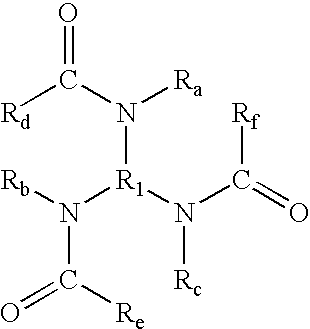
can be obtained. The triamine and monoacid are present in any desired or effective relative amounts, in one embodiment at least about 3 moles of monoacid per every one mole of triamine, in another embodiment at least about 3.1 moles of monoacid per every one mole of triamine, and in yet another embodiment at least about 4 moles of monoacid per every one mole of triamine, and in one embodiment no more than about 30 moles of monoacid per every one mole of triamine, in another embodiment no more than about 25 moles of monoacid per every one mole of triamine, in yet another embodiment no more than about 20 moles of monoacid per every one mole of triamine, and in another embodiment no more than about 5 moles of monoacid per every one mole of triamine, although the relative amounts can be outside of these ranges.

can be prepared by reacting a branched triacid with at least one monoamine. When only one monoamine is used, the reaction proceeds as follows:

When a mixture of monoamines is used, such as a mixture containing

products of the formula

can be obtained. The triacid and monoamine are present in any desired or effective relative amounts, in one embodiment at least about 2.5 moles of monoamine per every one mole of triacid, in another embodiment at least about 2.9 moles of monoamine per every one mole of triacid, and in yet another embodiment at least about 3 moles of monoamine per every one mole of triacid, and in one embodiment no more than about 15 moles of monoamine per every one mole of triacid, in another embodiment no more than about 12 moles of monoamine per every one mole of triacid, in yet another embodiment no more than about 10 moles of monoamine per every one mole of triacid, and in yet another embodiment no more than about 4 moles of monoamine per every one mole of triacid, although the relative amounts can be outside of these ranges.

and

can be prepared by similar methods, in one embodiment in a process in which the amine group or groups are first protected by any desired or effective method, such as reaction with phosgene derivatives of the formula

followed by reacting the acid group or groups with the monoamine, followed by deprotection of the protected amine groups, followed by reacting the amine group or groups with the monoacid.

the triamides of the present invention are branched or star-shaped. Again, while not being limited to any particular theory, it is believed that the branched or star shape of these materials enables the triamides to have reduced viscosity compared to, for example, tetra-amides of comparable molecular weight and comparable ratio of amide groups to hydrocarbon in the molecule, in addition, while not being limited to any particular theory, it is believed that the branched or star shape of these materials enables the triamides to exhibit miscibility with polyethylene waxes over a wider mixing range; for example, when a tetra-amide might exhibit a miscibility with polyethylene waxes over a range of only about 20 percent by weight or more amide in the wax, a triamide might exhibit a miscibility with polyethylene waxes over a range of from about 10 to about 70 percent by weight amide in the wax. These characteristics of the triamides provide another level of freedom in optimizing phase change ink formulations having desirable viscosity values and desirable performance in automatic document handlers and feeders.

wherein x, y, and z are each integers representing the number of repeat propyleneoxy units, wherein x, y, and z may each be zero, and wherein the sum of x+y+z is from about 5 to about 6) was then added to the reaction mixture, and the reaction temperature was increased to 200° C. gradually over 0.5 hour and held at that temperature for another 3 hours. Some water was carried out by slow blowing N2 and condensed into the trap when the mixture temperature reached about 180° C. The trap and condenser were then removed, and vacuum (about 25 mm Hg) was applied for about 0.5 hour and then released. The liquid product was cooled down to about 150° C. and poured onto aluminum to solidify. The resulting product was believed to be of the formula

wherein n, x, y, and z are as defined hereinabove in this Example. This material is an example of one having heteroatoms (i.e., oxygen) in a central R alkylene group. The resulting triamide product was titrated for its acid number and amine value measured in units of mg KOH per gram. Acid and amine values were determined by dissolving the material in a mixture of 50 percent by weight butanol and 50 percent by weight toluene, heating, and titrating the acid number with aqueous potassium hydroxide and titrating the amine number with aqueous hydrogen chloride. The acid and amine numbers indicated the degree of reaction completion, indicating how much amine remained in the molecule; residual amine can in some instances discolor if incorporated into a phase change ink. Its viscosity was measured (in centipoise) on a Ferrani-Shirley cone-plate viscometer at 135° C. Its melting point was measured (in ° C.) by differential scanning calorimetry using a TA instrument 2920 calorimeter at a scanning rate of 20° C. per minute; the DSC scan had two melting peaks, and both numbers are reported. The results were as indicated below in Table 1. Miscibility of this triamide product with POLYWAX PE 655 (polyethylene wax obtained from Baker-Petrolite Co., Tulsa, Okla.) was tested by melting, shaking the mixture at 135° C., and then checking its clarity visually. The mixtures were melted, shaken, and then checked visually; clear mixtures were considered miscible, and hazy mixtures were considered not miscible. The hazy mixtures eventually become two phase mixtures after standing still in the oven at 135° C. The results were as indicated below in Table 2.

n is as defined hereinabove in this Example and x, y, and z are as defined in Example I. The properties of the resulting triamide product are listed in Tables 1 and 2.

n is as defined hereinabove in this Example and x, y, and z are as defined in Example I. The properties of the resulting triamide product are listed in Tables 1 and 2.
CH3(CH2)16COOH
was used instead of UNICID 700. The product was believed to be of the formula

n is 16 and x, y, and z are as defined in Example I. The properties of the resulting triamide product are listed in Tables 1 and 2.
| TABLE 1 | ||||
| Example | viscosity | Melting point | acid number | amine value |
| I | 27.9 | 98.3, 104.5 | 9.6 | 1.7 |
| II | 22.9 | 92.3, 100.3 | 5.6 | 1 |
| III | 13.4 | 58.5, 67.9 | 18 | 1.5 |
| IV | 14.1 | 51.4, 60.8 | 22.3 | 7 |
| V | 39.0 | 115.0 | 4.6 | 0.1 |
| VI | 18.7 | 102.9 | 9.6 | 0.7 |
| VII | 49.8 | 56.14 | 27 | — |
| A | 66 to 69 | 116 to 119 | 7.7 to 14 | 0.4 |
| B | 81 | 108, 125 | — | — |
| Tetra- | ||
| wt. % | Triamides | amides |
| in PE | I | II | III | IV | V | VI | VII | A | B |
| 10 | clear | clear | clear | Clear | clear | clear | — | haze | haze |
| 15 | — | — | — | — | — | — | — | haze | — |
| 20 | clear | clear | clear | Clear | clear | clear | haze | clear | haze |
| 25 | — | — | — | — | — | — | — | clear | — |
| 30 | clear | clear | clear | Clear | clear | clear | — | clear | haze |
| 35 | — | — | — | — | — | — | — | clear | — |
| 40 | clear | clear | clear | Clear | clear | clear | haze | clear | — |
| 50 | clear | clear | clear | Clear | clear | clear | haze | ||
| 60 | — | — | — | — | — | — | haze | clear | — |
| 70 | clear | clear | clear | Clear | clear | clear | — | — | haze |
| 80 | — | — | — | — | — | — | clear | clear | — |
| — = not measured | |||||||||
Claims (48)


N(CH2CH2—NH—C(═O)—(CH2)46CH3)3;
N(CH2CH2—NH—C(═O)—(CH2)nCH3)3
Priority Applications (7)
| Application Number | Priority Date | Filing Date | Title |
|---|---|---|---|
| US10/606,099 US6860930B2 (en) | 2003-06-25 | 2003-06-25 | Phase change inks containing branched triamides |
| EP04012626A EP1514912B1 (en) | 2003-06-25 | 2004-05-27 | Phase change inks containing branched triamides |
| DE602004026515T DE602004026515D1 (en) | 2003-06-25 | 2004-05-27 | Branched triamide containing phase change inks |
| CA002470977A CA2470977C (en) | 2003-06-25 | 2004-06-15 | Phase change inks containing branched triamides |
| JP2004185456A JP4813776B2 (en) | 2003-06-25 | 2004-06-23 | Phase change ink composition and printing method using the same |
| BRPI0402513-0A BRPI0402513B1 (en) | 2003-06-25 | 2004-06-24 | Phase change ink composition containing branched triamides and their incorporation process in a printing apparatus |
| CNB2004100694678A CN100497501C (en) | 2003-06-25 | 2004-06-24 | Contains phase change inks with branched triamides |
Applications Claiming Priority (1)
| Application Number | Priority Date | Filing Date | Title |
|---|---|---|---|
| US10/606,099 US6860930B2 (en) | 2003-06-25 | 2003-06-25 | Phase change inks containing branched triamides |
Publications (2)
| Publication Number | Publication Date |
|---|---|
| US20040261656A1 US20040261656A1 (en) | 2004-12-30 |
| US6860930B2 true US6860930B2 (en) | 2005-03-01 |
Family
ID=33539986
Family Applications (1)
| Application Number | Title | Priority Date | Filing Date |
|---|---|---|---|
| US10/606,099 Expired - Lifetime US6860930B2 (en) | 2003-06-25 | 2003-06-25 | Phase change inks containing branched triamides |
Country Status (7)
| Country | Link |
|---|---|
| US (1) | US6860930B2 (en) |
| EP (1) | EP1514912B1 (en) |
| JP (1) | JP4813776B2 (en) |
| CN (1) | CN100497501C (en) |
| BR (1) | BRPI0402513B1 (en) |
| CA (1) | CA2470977C (en) |
| DE (1) | DE602004026515D1 (en) |
Cited By (90)
| Publication number | Priority date | Publication date | Assignee | Title |
|---|---|---|---|---|
| US20060257773A1 (en) * | 2005-05-11 | 2006-11-16 | Xerox Corporation | Polyalkylene materials |
| US20070030322A1 (en) * | 2005-08-04 | 2007-02-08 | Xerox Corporation | Processes for preparing phase change inks |
| US20070120914A1 (en) * | 2005-11-30 | 2007-05-31 | Xerox Corporation | Phase change inks containing Fischer-Tropsch waxes |
| US20070120916A1 (en) * | 2005-11-30 | 2007-05-31 | Xerox Corporation | Phase change inks |
| US20070120915A1 (en) * | 2005-11-30 | 2007-05-31 | Xerox Corporation | Phase change inks containing specific colorants |
| US20070120917A1 (en) * | 2005-11-30 | 2007-05-31 | Xerox Corporation | Phase change inks |
| US20070120927A1 (en) * | 2005-11-30 | 2007-05-31 | Xerox Corporation | Phase change inks |
| US20070119338A1 (en) * | 2005-11-30 | 2007-05-31 | Xerox Corporation | Ink carriers, phase change inks including same and methods for making same |
| US20070131138A1 (en) * | 2005-12-12 | 2007-06-14 | Xerox Corporation | Carbon black inks and method for making same |
| US20070252879A1 (en) * | 2006-04-28 | 2007-11-01 | Xerox Corporation | Phase change ink additives |
| US20080103250A1 (en) * | 2006-10-27 | 2008-05-01 | Xerox Corporation | Nanostructed particles, phase change inks including same and methods for making same |
| US20080098929A1 (en) * | 2006-10-26 | 2008-05-01 | Xerox Corporation | Phase change inks |
| US20080098927A1 (en) * | 2006-10-26 | 2008-05-01 | Xerox Corporation | Pigmented phase change inks |
| US20080098930A1 (en) * | 2006-11-01 | 2008-05-01 | Xerox Corporation | Colorant dispersant |
| US20080118677A1 (en) * | 2006-11-22 | 2008-05-22 | Bhatt Jayprakash C | Reactive ink and ink-media system for reduced air fade on porous media |
| US20080145557A1 (en) * | 2006-12-18 | 2008-06-19 | Xerox Corporation | Phase change inks containing dialkyl ethers |
| US7407539B2 (en) | 2005-11-30 | 2008-08-05 | Xerox Corporation | Phase change inks |
| US20080187664A1 (en) * | 2007-02-06 | 2008-08-07 | Xerox Corporation | Phase change inks containing colorant compounds |
| US20080297556A1 (en) * | 2007-05-30 | 2008-12-04 | Xerox Corporation | Solid ink set incorporating naturally derived materials and processes thereof |
| EP2036956A2 (en) | 2007-06-07 | 2009-03-18 | Xerox Corporation | Quinacridone nanoscale pigment particles |
| US20090082489A1 (en) * | 2007-09-21 | 2009-03-26 | Xerox Corporation | Phase change ink compositions |
| EP2098502A1 (en) | 2008-03-07 | 2009-09-09 | Xerox Corporation | Compounds suitable for use in inks and inks having such compounds |
| EP2107088A1 (en) | 2008-04-03 | 2009-10-07 | Xerox Corporation | Phase change inks containing Fischer-Tropsch Waxes |
| US20090297714A1 (en) * | 2008-06-02 | 2009-12-03 | Xerox Corporation | Flush pigment for solid inkjet ink |
| US20090321676A1 (en) * | 2008-06-26 | 2009-12-31 | Xerox Corporation | Ferromagnetic nanoparticles with high magnetocrystalline anisotropy for micr ink applications |
| US20100028537A1 (en) * | 2008-08-04 | 2010-02-04 | Xerox Corporation | Ink Carriers Containing Surface Modified Nanoparticles, Phase Change Inks Including Same, and Methods for Making Same |
| EP2166047A1 (en) | 2008-09-19 | 2010-03-24 | Xerox Corporation | Solid phase change fluorescent ink and ink sets |
| US20100075038A1 (en) * | 2008-09-23 | 2010-03-25 | Xerox Corporation | Ink Carriers Containing Low Viscosity Functionalized Waxes, Phase Change Inks Including Same, And Methods For Making Same |
| EP2169016A1 (en) | 2008-09-30 | 2010-03-31 | Xerox Corporation | Phase change inks |
| US20100086701A1 (en) * | 2008-10-06 | 2010-04-08 | Xerox Corporation | Radiation curable ink containing fluorescent nanoparticles |
| US20100086683A1 (en) * | 2008-10-06 | 2010-04-08 | Xerox Corporation | Fluorescent solid ink made with fluorescent nanoparticles |
| US20100084610A1 (en) * | 2008-10-06 | 2010-04-08 | Xerox Corporation | Fluorescent organic nanoparticles and a process for producing fluorescent organic nanoparticles |
| US20100083869A1 (en) * | 2008-10-06 | 2010-04-08 | Xerox Corporation | Fluorescent nanoscale particles |
| US20100086867A1 (en) * | 2008-10-06 | 2010-04-08 | Xerox Corporation | Toner containing fluorescent nanoparticles |
| US20100123746A1 (en) * | 2008-11-17 | 2010-05-20 | Xerox Corporation | Ink jet inks containing nanodiamond black colorants |
| US20100122642A1 (en) * | 2008-11-17 | 2010-05-20 | Xerox Corporation | Inks including carbon nanotubes dispersed in a polymer matrix |
| US20100124611A1 (en) * | 2008-11-17 | 2010-05-20 | Xerox Corporation | Phase Change Inks Containing Graphene-Based Carbon Allotrope Colorants |
| US20100130657A1 (en) * | 2008-11-24 | 2010-05-27 | Xerox Corporation | Solid inks with lower coefficient of friction |
| EP2210923A1 (en) | 2009-01-27 | 2010-07-28 | Xerox Corporation | Pigmented phase change inks with dispersant and synergist |
| EP2210924A1 (en) | 2009-01-27 | 2010-07-28 | Xerox Corporation | Method of making a pigmented phase change ink with dispersant and synergist |
| US20100292467A1 (en) * | 2009-05-18 | 2010-11-18 | Xerox Corporation | Low molecular weight quaternary ammonium salt dispersants |
| US20100288162A1 (en) * | 2009-05-18 | 2010-11-18 | Xerox Corporation | Pigmented phase change inks containing low molecular weight quaternary ammonium salt dispersants |
| US20100313788A1 (en) * | 2009-06-10 | 2010-12-16 | Xerox Corporation | Solid or phase change inks with improved properties |
| EP2305759A2 (en) | 2009-07-24 | 2011-04-06 | Xerox Corporation | Nonpolar liquid and solid phase change ink compositions comprising nanosized particles of benzimidazolone pigments |
| US20110130502A1 (en) * | 2009-12-02 | 2011-06-02 | Xerox Corporation | Solid inks incorporating a polyhydroxyalkanoate compound for enhanced properties |
| US20110146537A1 (en) * | 2009-12-18 | 2011-06-23 | Xerox Corporation | Low molecular weight pigment dispersants for phase change ink |
| US20110151123A1 (en) * | 2009-12-18 | 2011-06-23 | Xerox Corporation | Pigmented Phase Change Inks Containing Low Molecular Weight Pigment Dispersants |
| DE102011002514A1 (en) | 2010-01-19 | 2011-07-21 | Xerox Corp., N.Y. | ink compositions |
| US20110177247A1 (en) * | 2010-01-19 | 2011-07-21 | Xerox Corporation | Ink compositions |
| US8123848B2 (en) | 2010-05-03 | 2012-02-28 | Xerox Corporation | Fluorescent ink compositions and fluorescent particles |
| US20120154479A1 (en) * | 2010-12-16 | 2012-06-21 | Xerox Corporation | Solid inks containing ketone waxes and branched amides |
| US20120162330A1 (en) * | 2010-12-22 | 2012-06-28 | Xerox Corporation | Phase Change Magnetic Ink And Process For Preparing Same |
| US8273166B2 (en) | 2011-01-18 | 2012-09-25 | Xerox Corporation | Phase change ink compositions and colorants for use in the same |
| US20120251939A1 (en) * | 2011-03-29 | 2012-10-04 | Canon Kabushiki Kaisha | Pigment dispersion and yellow toner |
| DE102012205442A1 (en) | 2011-04-12 | 2012-10-18 | Xerox Corp. | Clear topcoat compositions and methods for their stabilization |
| US8360546B2 (en) | 2010-12-22 | 2013-01-29 | Xerox Corporation | Phase change magnetic ink and process for preparing same |
| US8449096B2 (en) | 2010-12-06 | 2013-05-28 | Xerox Corporation | Five member ring stabilizers for quinacridone-type pigments in solid ink |
| US8545612B1 (en) | 2012-04-23 | 2013-10-01 | Xerox Corporation | Phase change ink compositions and sulfonated compounds for use in the same |
| US8616693B1 (en) | 2012-11-30 | 2013-12-31 | Xerox Corporation | Phase change ink comprising colorants derived from plants and insects |
| US8647422B1 (en) | 2012-11-30 | 2014-02-11 | Xerox Corporation | Phase change ink comprising a modified polysaccharide composition |
| US8646896B2 (en) | 2011-03-17 | 2014-02-11 | Xerox Corporation | Phase change magnetic ink comprising surfactant coated magnetic nanoparticles and process for preparing same |
| US8657431B2 (en) | 2011-03-17 | 2014-02-25 | Xerox Corporation | Phase change magnetic ink comprising carbon coated magnetic nanoparticles and process for preparing same |
| US20140080063A1 (en) * | 2011-05-10 | 2014-03-20 | Canon Kabushiki Kaisha | Pigment dispersion, ink composition including pigment dispersion, and color filter yellow resist composition including pigment dispersion |
| US8696100B1 (en) | 2012-10-02 | 2014-04-15 | Xerox Corporation | Phase change ink containing synergist for pigment dispersion |
| US8703981B2 (en) | 2012-08-03 | 2014-04-22 | Xerox Corporation | Lignosulfonate compounds for solid ink applications |
| US8702217B2 (en) | 2011-03-17 | 2014-04-22 | Xerox Corporation | Phase change magnetic ink comprising polymer coated magnetic nanoparticles and process for preparing same |
| US8714724B2 (en) | 2012-10-02 | 2014-05-06 | Xerox Corporation | Phase change inks containing novel synergist |
| DE102013220878A1 (en) | 2012-11-02 | 2014-05-08 | Xerox Corporation | Formulations for red solid ink |
| DE102013222797A1 (en) | 2012-11-27 | 2014-05-28 | Xerox Corporation | PHASE CHANGE INK WITH ETHYLENE VINYL ACETATE |
| US8741041B2 (en) | 2012-08-03 | 2014-06-03 | Xerox Corporation | Phase change ink compositions containing lignosulfonate compounds |
| DE102013225286A1 (en) | 2012-12-18 | 2014-06-18 | Xerox Corporation | Phenylcyclohexanolderivate as wax modifiers and gelators |
| JP2014122341A (en) * | 2012-12-21 | 2014-07-03 | Xerox Corp | Phase change ink composition and process for preparing the same |
| DE102014201905A1 (en) | 2013-02-08 | 2014-08-14 | Xerox Corporation | With carbon black pigmented phase change ink formulations |
| US20140277337A1 (en) * | 2013-03-14 | 2014-09-18 | Medtronic Vascular, Inc. | Medical Device and Plasticized Nylon |
| US8894762B2 (en) | 2012-09-24 | 2014-11-25 | Xerox Corporation | Phase change ink comprising a polyhydroxyalkanoate compound |
| US8901517B2 (en) | 2012-06-29 | 2014-12-02 | Xerox Corporation | Fluorescent security phase change ink |
| DE102014216683A1 (en) | 2013-08-26 | 2015-02-26 | Xerox Corporation | DYE COMPOUNDS, METHOD FOR THE PREPARATION OF THE COMPOUNDS AND PRINTING COLOR COMPOSITION CONTAINING THE COMPOUNDS |
| DE102014216775A1 (en) | 2013-08-28 | 2015-03-05 | Xerox Corporation | PHASE CHANGE INKS |
| US8980406B2 (en) | 2012-08-28 | 2015-03-17 | 3D Systems, Inc. | Color stable inks and applications thereof |
| DE102014201690A1 (en) | 2013-12-09 | 2015-06-11 | Xerox Corporation | PHENYLCYCLOHEXANOL DERIVATIVES AS WAX MODIFIERS AND GELATORS |
| US9090758B2 (en) | 2012-11-30 | 2015-07-28 | Xerox Corporation | Phase change ink comprising modified naturally-derived colorants |
| US9090777B2 (en) | 2013-04-04 | 2015-07-28 | Xerox Corporation | Low cost process for solid ink using dry flushed pigments |
| US9157002B2 (en) | 2013-07-12 | 2015-10-13 | Xerox Corporation | Phase change ink pigment dispersion process |
| US20160090492A1 (en) * | 2014-09-25 | 2016-03-31 | Markem-Imaje Corporation | Novel Compounds |
| US9334335B2 (en) | 2012-11-30 | 2016-05-10 | Xerox Corporation | Surface layer |
| DE102015223781A1 (en) | 2014-12-13 | 2016-06-16 | Xerox Corporation | Water-cleanable phase change ink for marking ophthalmic lenses |
| DE102015223761A1 (en) | 2014-12-13 | 2016-06-16 | Xerox Corporation | PHASE CHANGE PRINTING COLOR FOR THE MARKING OF OPHTHALMIC LENSES |
| DE102015223774A1 (en) | 2014-12-13 | 2016-06-16 | Xerox Corporation | White phase change ink composition |
| US9481803B2 (en) | 2014-12-13 | 2016-11-01 | Xerox Corporation | Water dispersible phase change ink suitable for use as a photo-mask |
| US9657186B2 (en) | 2012-09-13 | 2017-05-23 | 3D Systems, Inc. | Opaque inks and applications thereof |
Families Citing this family (13)
| Publication number | Priority date | Publication date | Assignee | Title |
|---|---|---|---|---|
| EP1630600A3 (en) * | 2004-07-29 | 2006-03-22 | Rohm and Haas Electronic Materials, L.L.C. | Hot melt composition and method involving forming a masking pattern |
| US7665835B2 (en) * | 2005-11-30 | 2010-02-23 | Xerox Corporation | Phase change inks and methods for making same |
| US7781026B2 (en) * | 2006-12-19 | 2010-08-24 | Xerox Corporation | Ink compositions |
| US7713342B2 (en) * | 2006-12-19 | 2010-05-11 | Xerox Corporation | Phase change inks |
| US8057589B2 (en) * | 2006-12-21 | 2011-11-15 | Xerox Corporation | Phase change inks |
| US20080154032A1 (en) * | 2006-12-21 | 2008-06-26 | Xerox Corporation | Colorant compounds |
| US7465348B1 (en) | 2007-06-07 | 2008-12-16 | Xerox Corporation | Nanosized particles of monoazo laked pigment |
| JP5882603B2 (en) * | 2011-05-26 | 2016-03-09 | キヤノン株式会社 | Pigment dispersion, yellow toner |
| US9381154B2 (en) * | 2011-06-09 | 2016-07-05 | Xerox Corporation | Direct inkjet fabrication of drug delivery devices |
| US8920551B1 (en) * | 2013-08-28 | 2014-12-30 | Xerox Corporation | Phase change inks |
| FR3073843A1 (en) * | 2017-11-21 | 2019-05-24 | Arkema France | RHEOLOGY ADDITIVES BASED ON DI- OR TRI-AMIDES AND THEIR MIXTURES |
| FR3094367B1 (en) | 2019-03-29 | 2023-03-03 | Arkema France | Rheology additives based on hydroxylated di- or tri-amides and mixtures thereof |
| CN115052923B (en) * | 2020-02-03 | 2024-01-19 | 路博润先进材料公司 | thermoplastic composition |
Citations (31)
| Publication number | Priority date | Publication date | Assignee | Title |
|---|---|---|---|---|
| US3253940A (en) | 1962-09-10 | 1966-05-31 | Gen Mills Inc | Polyamides of improved melting point and increased solubility for ink binders |
| US3622604A (en) | 1964-10-15 | 1971-11-23 | Schering Ag | Synthetic polyamides of a dimeric fatty acid, a lower aliphatic carboxylic acid ethylene diamine, and a co-diamine |
| US3653932A (en) | 1969-08-28 | 1972-04-04 | Teletype Corp | Electrostatic printing composition comprising didodecyl sebacate |
| US4066585A (en) | 1975-08-05 | 1978-01-03 | Schering Aktiengesellschaft | Printing inks and printing methods employing the same |
| US4390369A (en) | 1981-12-17 | 1983-06-28 | Exxon Research And Engineering Co. | Natural wax-containing ink jet inks |
| US4484948A (en) | 1981-12-17 | 1984-11-27 | Exxon Research And Engineering Co. | Natural wax-containing ink jet inks |
| EP0187352A2 (en) | 1984-12-31 | 1986-07-16 | Howtek, Inc. | A method of ink jet colour printing |
| EP0206286A1 (en) | 1985-06-25 | 1986-12-30 | Howtek, Inc. | Ink jet printer ink |
| US4684956A (en) | 1984-05-10 | 1987-08-04 | Willett International Limited | Method for applying a hot melt ink to a substrate |
| US4830671A (en) | 1987-09-18 | 1989-05-16 | Union Camp Corporation | Ink compositions for ink jet printing |
| US4851045A (en) | 1986-08-25 | 1989-07-25 | Seiko Epson Corporation | Hot-melt ink |
| US4889560A (en) | 1988-08-03 | 1989-12-26 | Tektronix, Inc. | Phase change ink composition and phase change ink produced therefrom |
| US4889761A (en) | 1988-08-25 | 1989-12-26 | Tektronix, Inc. | Substrates having a light-transmissive phase change ink printed thereon and methods for producing same |
| US4895982A (en) | 1986-06-20 | 1990-01-23 | Union Camp Corporation | Tricarboxylic acids |
| US5006170A (en) | 1989-06-22 | 1991-04-09 | Xerox Corporation | Hot melt ink compositions |
| GB2238792A (en) | 1989-09-07 | 1991-06-12 | Coates Brothers Plc | Polyamides |
| US5151120A (en) | 1989-03-31 | 1992-09-29 | Hewlett-Packard Company | Solid ink compositions for thermal ink-jet printing having improved printing characteristics |
| US5194638A (en) | 1987-09-18 | 1993-03-16 | Union Camp Corporation | Resinous binders for use in ink compositions for ink jet printing |
| US5221335A (en) | 1990-05-23 | 1993-06-22 | Coates Electrographics Limited | Stabilized pigmented hot melt ink containing nitrogen-modified acrylate polymer as dispersion-stabilizer agent |
| WO1994004619A1 (en) | 1992-08-24 | 1994-03-03 | The General Electric Company Plc | Ionomer based hot-melt inks |
| US5372852A (en) | 1992-11-25 | 1994-12-13 | Tektronix, Inc. | Indirect printing process for applying selective phase change ink compositions to substrates |
| US5496879A (en) | 1992-02-25 | 1996-03-05 | Siegwerk Druckfarben Gmbh & Co. Kg | Printing ink |
| US5510821A (en) | 1994-09-20 | 1996-04-23 | Tektronix, Inc. | Solid ink stick |
| US5597856A (en) | 1993-09-24 | 1997-01-28 | Dataproducts Corporation | Hot melt ink for transparency applications |
| US5621022A (en) | 1992-11-25 | 1997-04-15 | Tektronix, Inc. | Use of polymeric dyes in hot melt ink jet inks |
| US5645632A (en) | 1996-02-14 | 1997-07-08 | Union Camp Corporation | Diesters of polymerized fatty acids useful in formulating hot-melt inks |
| US5777023A (en) | 1996-10-01 | 1998-07-07 | Union Camp Corporation | Diamidediurethanes and hot-melt printing therewith |
| US5863319A (en) | 1996-12-10 | 1999-01-26 | Markem Corporation | Thermally stable hot melt ink |
| US5988805A (en) | 1997-03-10 | 1999-11-23 | Tektronix, Inc | Chiral shaped ink sticks |
| US6133353A (en) | 1999-11-11 | 2000-10-17 | 3D Systems, Inc. | Phase change solid imaging material |
| US6174937B1 (en) | 1999-07-16 | 2001-01-16 | Xerox Corporation | Composition of matter, a phase change ink, and a method of reducing a coefficient of friction of a phase change ink formulation |
Family Cites Families (22)
| Publication number | Priority date | Publication date | Assignee | Title |
|---|---|---|---|---|
| US5378574A (en) | 1988-08-17 | 1995-01-03 | Xerox Corporation | Inks and liquid developers containing colored silica particles |
| US5145518A (en) | 1990-06-27 | 1992-09-08 | Xerox Corporation | Inks containing block copolymer micelles |
| US5225900A (en) | 1990-12-31 | 1993-07-06 | Xerox Corporation | Method of storing information within a reproduction system |
| US5286286A (en) | 1991-05-16 | 1994-02-15 | Xerox Corporation | Colorless fast-drying ink compositions for printing concealed images detectable by fluorescence |
| JP3045819B2 (en) * | 1991-07-17 | 2000-05-29 | 株式会社リコー | Ink composition for inkjet recording |
| US5146087A (en) | 1991-07-23 | 1992-09-08 | Xerox Corporation | Imaging process with infrared sensitive transparent receiver sheets |
| JP3127412B2 (en) * | 1992-01-23 | 2001-01-22 | 日立工機株式会社 | Hot melt ink composition for inkjet |
| JPH05302045A (en) * | 1992-02-26 | 1993-11-16 | Ricoh Co Ltd | Ink composition |
| US5543177A (en) | 1992-11-05 | 1996-08-06 | Xerox Corporation | Marking materials containing retroreflecting fillers |
| GB2290793B (en) | 1994-06-20 | 1998-05-06 | Cray Valley Ltd | Powder coating compositions |
| GB2294939A (en) | 1994-11-08 | 1996-05-15 | Coates Brothers Plc | Hot melt ink jet printing composition comprising an oligourea |
| GB2305670A (en) | 1995-09-27 | 1997-04-16 | Coates Brothers Plc | Hot melt ink jet vehicles |
| GB2305928A (en) | 1995-10-06 | 1997-04-23 | Coates Brothers Plc | Coloured hot melt ink jet vehicle |
| US5750604A (en) | 1996-06-28 | 1998-05-12 | Tektronix, Inc. | Phase change ink formulation using a urethane isocyanate-derived resin |
| US5827918A (en) | 1996-06-28 | 1998-10-27 | Tektronix, Inc. | Phase change ink formulation using urea and urethane isocyanate-derived resins |
| US5919839A (en) | 1996-06-28 | 1999-07-06 | Tektronix, Inc. | Phase change ink formulation using an isocyanate-derived wax and a clear ink carrier base |
| US5783658A (en) | 1996-06-28 | 1998-07-21 | Tektronix, Inc. | Phase change ink formulation using a urethane isocyanate-derived resin and a urethane isocyanate-derived wax |
| US5782966A (en) | 1996-06-28 | 1998-07-21 | Tektronix, Inc. | Isocyanate-derived materials for use in phase change ink jet inks |
| US5780528A (en) | 1996-06-28 | 1998-07-14 | Tektronix, Inc. | Isocyanate-derived colored resins for use in phase change ink jet inks |
| US5830942A (en) | 1996-06-28 | 1998-11-03 | Tektronix, Inc. | Phase change ink formulation using a urethane and urethane/urea isocyanate-derived resins |
| US6309453B1 (en) | 1999-09-20 | 2001-10-30 | Xerox Corporation | Colorless compounds, solid inks, and printing methods |
| US6492458B1 (en) * | 2000-05-16 | 2002-12-10 | Arizona Chemical Company | Polyalkyleneoxydiamine polyamides useful for formulating inks for phase-change jet printing |
-
2003
- 2003-06-25 US US10/606,099 patent/US6860930B2/en not_active Expired - Lifetime
-
2004
- 2004-05-27 DE DE602004026515T patent/DE602004026515D1/en not_active Expired - Lifetime
- 2004-05-27 EP EP04012626A patent/EP1514912B1/en not_active Expired - Lifetime
- 2004-06-15 CA CA002470977A patent/CA2470977C/en not_active Expired - Fee Related
- 2004-06-23 JP JP2004185456A patent/JP4813776B2/en not_active Expired - Fee Related
- 2004-06-24 BR BRPI0402513-0A patent/BRPI0402513B1/en not_active IP Right Cessation
- 2004-06-24 CN CNB2004100694678A patent/CN100497501C/en not_active Expired - Fee Related
Patent Citations (33)
| Publication number | Priority date | Publication date | Assignee | Title |
|---|---|---|---|---|
| US3253940A (en) | 1962-09-10 | 1966-05-31 | Gen Mills Inc | Polyamides of improved melting point and increased solubility for ink binders |
| US3622604A (en) | 1964-10-15 | 1971-11-23 | Schering Ag | Synthetic polyamides of a dimeric fatty acid, a lower aliphatic carboxylic acid ethylene diamine, and a co-diamine |
| US3653932A (en) | 1969-08-28 | 1972-04-04 | Teletype Corp | Electrostatic printing composition comprising didodecyl sebacate |
| US4066585A (en) | 1975-08-05 | 1978-01-03 | Schering Aktiengesellschaft | Printing inks and printing methods employing the same |
| US4390369A (en) | 1981-12-17 | 1983-06-28 | Exxon Research And Engineering Co. | Natural wax-containing ink jet inks |
| US4484948A (en) | 1981-12-17 | 1984-11-27 | Exxon Research And Engineering Co. | Natural wax-containing ink jet inks |
| US4684956A (en) | 1984-05-10 | 1987-08-04 | Willett International Limited | Method for applying a hot melt ink to a substrate |
| EP0187352A2 (en) | 1984-12-31 | 1986-07-16 | Howtek, Inc. | A method of ink jet colour printing |
| EP0206286A1 (en) | 1985-06-25 | 1986-12-30 | Howtek, Inc. | Ink jet printer ink |
| US4895982A (en) | 1986-06-20 | 1990-01-23 | Union Camp Corporation | Tricarboxylic acids |
| US4851045A (en) | 1986-08-25 | 1989-07-25 | Seiko Epson Corporation | Hot-melt ink |
| US4830671A (en) | 1987-09-18 | 1989-05-16 | Union Camp Corporation | Ink compositions for ink jet printing |
| US5194638A (en) | 1987-09-18 | 1993-03-16 | Union Camp Corporation | Resinous binders for use in ink compositions for ink jet printing |
| US4889560A (en) | 1988-08-03 | 1989-12-26 | Tektronix, Inc. | Phase change ink composition and phase change ink produced therefrom |
| US4889761A (en) | 1988-08-25 | 1989-12-26 | Tektronix, Inc. | Substrates having a light-transmissive phase change ink printed thereon and methods for producing same |
| US5151120A (en) | 1989-03-31 | 1992-09-29 | Hewlett-Packard Company | Solid ink compositions for thermal ink-jet printing having improved printing characteristics |
| US5006170A (en) | 1989-06-22 | 1991-04-09 | Xerox Corporation | Hot melt ink compositions |
| GB2238792A (en) | 1989-09-07 | 1991-06-12 | Coates Brothers Plc | Polyamides |
| US5221335A (en) | 1990-05-23 | 1993-06-22 | Coates Electrographics Limited | Stabilized pigmented hot melt ink containing nitrogen-modified acrylate polymer as dispersion-stabilizer agent |
| US5496879A (en) | 1992-02-25 | 1996-03-05 | Siegwerk Druckfarben Gmbh & Co. Kg | Printing ink |
| WO1994004619A1 (en) | 1992-08-24 | 1994-03-03 | The General Electric Company Plc | Ionomer based hot-melt inks |
| US5621022A (en) | 1992-11-25 | 1997-04-15 | Tektronix, Inc. | Use of polymeric dyes in hot melt ink jet inks |
| US5372852A (en) | 1992-11-25 | 1994-12-13 | Tektronix, Inc. | Indirect printing process for applying selective phase change ink compositions to substrates |
| US5597856A (en) | 1993-09-24 | 1997-01-28 | Dataproducts Corporation | Hot melt ink for transparency applications |
| US5510821A (en) | 1994-09-20 | 1996-04-23 | Tektronix, Inc. | Solid ink stick |
| US5510821B1 (en) | 1994-09-20 | 2000-05-02 | Tektronix Inc | Solid ink stick |
| US5645632A (en) | 1996-02-14 | 1997-07-08 | Union Camp Corporation | Diesters of polymerized fatty acids useful in formulating hot-melt inks |
| US5777023A (en) | 1996-10-01 | 1998-07-07 | Union Camp Corporation | Diamidediurethanes and hot-melt printing therewith |
| US5863319A (en) | 1996-12-10 | 1999-01-26 | Markem Corporation | Thermally stable hot melt ink |
| US5988805A (en) | 1997-03-10 | 1999-11-23 | Tektronix, Inc | Chiral shaped ink sticks |
| US6174937B1 (en) | 1999-07-16 | 2001-01-16 | Xerox Corporation | Composition of matter, a phase change ink, and a method of reducing a coefficient of friction of a phase change ink formulation |
| US6133353A (en) | 1999-11-11 | 2000-10-17 | 3D Systems, Inc. | Phase change solid imaging material |
| US6528613B1 (en) | 1999-11-11 | 2003-03-04 | 3D Systems, Inc. | Phase change solid imaging material |
Non-Patent Citations (2)
| Title |
|---|
| English abstract for German Patent Publication DE 4205636AL. |
| English abstract for German Patent Publication DE 4205713AL. |
Cited By (166)
| Publication number | Priority date | Publication date | Assignee | Title |
|---|---|---|---|---|
| US7879143B2 (en) | 2005-05-11 | 2011-02-01 | Xerox Corporation | Polyalkylene materials |
| US20060257773A1 (en) * | 2005-05-11 | 2006-11-16 | Xerox Corporation | Polyalkylene materials |
| US20070030322A1 (en) * | 2005-08-04 | 2007-02-08 | Xerox Corporation | Processes for preparing phase change inks |
| US7556679B2 (en) | 2005-08-04 | 2009-07-07 | Xerox Corporation | Processes for preparing phase change inks |
| US7658486B2 (en) | 2005-11-30 | 2010-02-09 | Xerox Corporation | Phase change inks |
| US20070120915A1 (en) * | 2005-11-30 | 2007-05-31 | Xerox Corporation | Phase change inks containing specific colorants |
| US20070120927A1 (en) * | 2005-11-30 | 2007-05-31 | Xerox Corporation | Phase change inks |
| US20070119338A1 (en) * | 2005-11-30 | 2007-05-31 | Xerox Corporation | Ink carriers, phase change inks including same and methods for making same |
| US7572325B2 (en) | 2005-11-30 | 2009-08-11 | Xerox Corporation | Ink carriers, phase change inks including same and methods for making same |
| US7442242B2 (en) | 2005-11-30 | 2008-10-28 | Xerox Corporation | Phase change inks containing specific colorants |
| US7311768B2 (en) | 2005-11-30 | 2007-12-25 | Xerox Corporation | Phase change inks containing Fischer-Tropsch waxes |
| US7407539B2 (en) | 2005-11-30 | 2008-08-05 | Xerox Corporation | Phase change inks |
| US20070120914A1 (en) * | 2005-11-30 | 2007-05-31 | Xerox Corporation | Phase change inks containing Fischer-Tropsch waxes |
| US20070120916A1 (en) * | 2005-11-30 | 2007-05-31 | Xerox Corporation | Phase change inks |
| US7381254B2 (en) | 2005-11-30 | 2008-06-03 | Xerox Corporation | Phase change inks |
| US20070120917A1 (en) * | 2005-11-30 | 2007-05-31 | Xerox Corporation | Phase change inks |
| US7377971B2 (en) | 2005-11-30 | 2008-05-27 | Xerox Corporation | Phase change inks |
| US7655084B2 (en) | 2005-12-12 | 2010-02-02 | Xerox Corporation | Carbon black inks and method for making same |
| US20070131138A1 (en) * | 2005-12-12 | 2007-06-14 | Xerox Corporation | Carbon black inks and method for making same |
| US20070252879A1 (en) * | 2006-04-28 | 2007-11-01 | Xerox Corporation | Phase change ink additives |
| US20080098927A1 (en) * | 2006-10-26 | 2008-05-01 | Xerox Corporation | Pigmented phase change inks |
| US20080098929A1 (en) * | 2006-10-26 | 2008-05-01 | Xerox Corporation | Phase change inks |
| US20080103250A1 (en) * | 2006-10-27 | 2008-05-01 | Xerox Corporation | Nanostructed particles, phase change inks including same and methods for making same |
| US7786209B2 (en) | 2006-10-27 | 2010-08-31 | Xerox Corporation | Nanostructured particles, phase change inks including same and methods for making same |
| US20080098930A1 (en) * | 2006-11-01 | 2008-05-01 | Xerox Corporation | Colorant dispersant |
| WO2008064127A3 (en) * | 2006-11-22 | 2008-08-14 | Hewlett Packard Development Co | Reactive ink and ink-media system for reduced air fade on porous media |
| US20080118677A1 (en) * | 2006-11-22 | 2008-05-22 | Bhatt Jayprakash C | Reactive ink and ink-media system for reduced air fade on porous media |
| US8158221B2 (en) | 2006-11-22 | 2012-04-17 | Hewlett-Packard Development Company, L.P. | Reactive ink and ink-media system for reduced air fade on porous media |
| US20080145557A1 (en) * | 2006-12-18 | 2008-06-19 | Xerox Corporation | Phase change inks containing dialkyl ethers |
| EP1935950A1 (en) | 2006-12-18 | 2008-06-25 | Xerox Corporation | Phase Change Inks Containing Dialkyl Ethers |
| US20080187664A1 (en) * | 2007-02-06 | 2008-08-07 | Xerox Corporation | Phase change inks containing colorant compounds |
| US7677713B2 (en) | 2007-05-30 | 2010-03-16 | Xerox Corporation | Solid ink set incorporating naturally derived materials and processes thereof |
| US20080297556A1 (en) * | 2007-05-30 | 2008-12-04 | Xerox Corporation | Solid ink set incorporating naturally derived materials and processes thereof |
| EP2000514A1 (en) | 2007-05-30 | 2008-12-10 | Xerox Corporation | Solid Ink Set Incorporating Naturally Derived Materials and Processes Thereof |
| EP2036956A2 (en) | 2007-06-07 | 2009-03-18 | Xerox Corporation | Quinacridone nanoscale pigment particles |
| US8791202B2 (en) | 2007-09-21 | 2014-07-29 | Xerox Corporation | Phase change ink compositions |
| US20090082489A1 (en) * | 2007-09-21 | 2009-03-26 | Xerox Corporation | Phase change ink compositions |
| EP2514741A1 (en) | 2008-03-07 | 2012-10-24 | Xerox Corporation | Compounds suitable for use in inks and inks having such compounds |
| EP2098502A1 (en) | 2008-03-07 | 2009-09-09 | Xerox Corporation | Compounds suitable for use in inks and inks having such compounds |
| EP2107088A1 (en) | 2008-04-03 | 2009-10-07 | Xerox Corporation | Phase change inks containing Fischer-Tropsch Waxes |
| US8603235B2 (en) | 2008-04-03 | 2013-12-10 | Xerox Corporation | Phase change inks containing Fischer-Tropsch waxes |
| US20090249977A1 (en) * | 2008-04-03 | 2009-10-08 | Xerox Corporation | Phase change inks containing fischer-tropsch waxes |
| EP2130879A1 (en) | 2008-06-02 | 2009-12-09 | Xerox Corporation | Flush pigment for solid inkjet ink |
| US20090297714A1 (en) * | 2008-06-02 | 2009-12-03 | Xerox Corporation | Flush pigment for solid inkjet ink |
| US20090321676A1 (en) * | 2008-06-26 | 2009-12-31 | Xerox Corporation | Ferromagnetic nanoparticles with high magnetocrystalline anisotropy for micr ink applications |
| US8236192B2 (en) | 2008-06-26 | 2012-08-07 | Xerox Corporation | Ferromagnetic nanoparticles with high magnetocrystalline anisotropy for MICR ink applications |
| US20100028537A1 (en) * | 2008-08-04 | 2010-02-04 | Xerox Corporation | Ink Carriers Containing Surface Modified Nanoparticles, Phase Change Inks Including Same, and Methods for Making Same |
| US8123344B2 (en) | 2008-08-04 | 2012-02-28 | Xerox Corporation | Ink carriers containing surface modified nanoparticles, phase change inks including same, and methods for making same |
| EP2154211A1 (en) | 2008-08-04 | 2010-02-17 | Xerox Corporation | Ink carriers containing surface modified nanoparticles, phase change inks including same, and methods for making same |
| EP2166047A1 (en) | 2008-09-19 | 2010-03-24 | Xerox Corporation | Solid phase change fluorescent ink and ink sets |
| US20100071590A1 (en) * | 2008-09-19 | 2010-03-25 | Xerox Corporation | Solid phase change fluorescent ink and ink sets |
| US7857900B2 (en) | 2008-09-19 | 2010-12-28 | Xerox Corporation | Solid phase change fluorescent ink and ink sets |
| US8029861B2 (en) | 2008-09-23 | 2011-10-04 | Xerox Corporation | Ink carriers containing low viscosity functionalized waxes, phase change inks including same, and methods for making same |
| US20100075038A1 (en) * | 2008-09-23 | 2010-03-25 | Xerox Corporation | Ink Carriers Containing Low Viscosity Functionalized Waxes, Phase Change Inks Including Same, And Methods For Making Same |
| US9234109B2 (en) * | 2008-09-30 | 2016-01-12 | Xerox Corporation | Phase change inks |
| EP2169016A1 (en) | 2008-09-30 | 2010-03-31 | Xerox Corporation | Phase change inks |
| US20100080922A1 (en) * | 2008-09-30 | 2010-04-01 | Xerox Corporation | Phase change inks |
| US8236198B2 (en) | 2008-10-06 | 2012-08-07 | Xerox Corporation | Fluorescent nanoscale particles |
| US20100086683A1 (en) * | 2008-10-06 | 2010-04-08 | Xerox Corporation | Fluorescent solid ink made with fluorescent nanoparticles |
| US20100084610A1 (en) * | 2008-10-06 | 2010-04-08 | Xerox Corporation | Fluorescent organic nanoparticles and a process for producing fluorescent organic nanoparticles |
| US20100086701A1 (en) * | 2008-10-06 | 2010-04-08 | Xerox Corporation | Radiation curable ink containing fluorescent nanoparticles |
| US20100083869A1 (en) * | 2008-10-06 | 2010-04-08 | Xerox Corporation | Fluorescent nanoscale particles |
| US8147714B2 (en) | 2008-10-06 | 2012-04-03 | Xerox Corporation | Fluorescent organic nanoparticles and a process for producing fluorescent organic nanoparticles |
| US20100086867A1 (en) * | 2008-10-06 | 2010-04-08 | Xerox Corporation | Toner containing fluorescent nanoparticles |
| US8586141B2 (en) | 2008-10-06 | 2013-11-19 | Xerox Corporation | Fluorescent solid ink made with fluorescent nanoparticles |
| US8541154B2 (en) | 2008-10-06 | 2013-09-24 | Xerox Corporation | Toner containing fluorescent nanoparticles |
| US8222313B2 (en) | 2008-10-06 | 2012-07-17 | Xerox Corporation | Radiation curable ink containing fluorescent nanoparticles |
| US8177897B2 (en) | 2008-11-17 | 2012-05-15 | Xerox Corporation | Phase change inks containing graphene-based carbon allotrope colorants |
| US8348409B2 (en) | 2008-11-17 | 2013-01-08 | Xerox Corporation | Ink jet inks containing nanodiamond black colorants |
| US20100122642A1 (en) * | 2008-11-17 | 2010-05-20 | Xerox Corporation | Inks including carbon nanotubes dispersed in a polymer matrix |
| US20100123746A1 (en) * | 2008-11-17 | 2010-05-20 | Xerox Corporation | Ink jet inks containing nanodiamond black colorants |
| US20100124611A1 (en) * | 2008-11-17 | 2010-05-20 | Xerox Corporation | Phase Change Inks Containing Graphene-Based Carbon Allotrope Colorants |
| US20100130657A1 (en) * | 2008-11-24 | 2010-05-27 | Xerox Corporation | Solid inks with lower coefficient of friction |
| US7985286B2 (en) | 2008-11-24 | 2011-07-26 | Xerox Corporation | Solid inks with lower coefficient of friction |
| US7776147B1 (en) | 2009-01-27 | 2010-08-17 | Xerox Corporation | Pigmented phase change inks with dispersant and synergist |
| EP2210923A1 (en) | 2009-01-27 | 2010-07-28 | Xerox Corporation | Pigmented phase change inks with dispersant and synergist |
| EP2210924A1 (en) | 2009-01-27 | 2010-07-28 | Xerox Corporation | Method of making a pigmented phase change ink with dispersant and synergist |
| US20100190904A1 (en) * | 2009-01-27 | 2010-07-29 | Xerox Corporation | Pigmented phase change inks with dispersant and synergist |
| US7780774B2 (en) | 2009-01-27 | 2010-08-24 | Xerox Corporation | Method of making a pigmented phase change ink with dispersant and synergist |
| US8118922B2 (en) | 2009-05-18 | 2012-02-21 | Xerox Corporation | Pigmented phase change inks containing low molecular weight quaternary ammonium salt dispersants |
| EP2253611A1 (en) | 2009-05-18 | 2010-11-24 | Xerox Corporation | Low molecular weight quaternary ammonium salt dispersants |
| EP2253680A1 (en) | 2009-05-18 | 2010-11-24 | Xerox Corporation | Pigmented phase change inks containing low molecular weight quaternary ammonium salt dispersants |
| US20100288162A1 (en) * | 2009-05-18 | 2010-11-18 | Xerox Corporation | Pigmented phase change inks containing low molecular weight quaternary ammonium salt dispersants |
| US8101801B2 (en) | 2009-05-18 | 2012-01-24 | Xerox Corporation | Low molecular weight quaternary ammonium salt dispersants |
| US20100292467A1 (en) * | 2009-05-18 | 2010-11-18 | Xerox Corporation | Low molecular weight quaternary ammonium salt dispersants |
| US8915993B2 (en) | 2009-06-10 | 2014-12-23 | Xerox Corporation | Solid or phase change inks with improved properties |
| US20100313788A1 (en) * | 2009-06-10 | 2010-12-16 | Xerox Corporation | Solid or phase change inks with improved properties |
| EP2305759A2 (en) | 2009-07-24 | 2011-04-06 | Xerox Corporation | Nonpolar liquid and solid phase change ink compositions comprising nanosized particles of benzimidazolone pigments |
| US8002399B2 (en) | 2009-12-02 | 2011-08-23 | Xerox Corporation | Solid inks incorporating a polyhydroxyalkanoate compound for enhanced properties |
| US20110130502A1 (en) * | 2009-12-02 | 2011-06-02 | Xerox Corporation | Solid inks incorporating a polyhydroxyalkanoate compound for enhanced properties |
| DE102010061931A1 (en) | 2009-12-02 | 2011-06-30 | XEROX CORPORATION, Conn. | Solid inks containing a polyhydroxyalkanoate compound for improved properties |
| US20110151123A1 (en) * | 2009-12-18 | 2011-06-23 | Xerox Corporation | Pigmented Phase Change Inks Containing Low Molecular Weight Pigment Dispersants |
| US20110146537A1 (en) * | 2009-12-18 | 2011-06-23 | Xerox Corporation | Low molecular weight pigment dispersants for phase change ink |
| US7973186B1 (en) | 2009-12-18 | 2011-07-05 | Xerox Corporation | Low molecular weight pigment dispersants for phase change ink |
| US8507041B2 (en) | 2009-12-18 | 2013-08-13 | Xerox Corporation | Pigmented phase change inks containing low molecular weight pigment dispersants |
| US8652575B2 (en) | 2010-01-19 | 2014-02-18 | Xerox Corporation | Ink compositions |
| DE102011002514A1 (en) | 2010-01-19 | 2011-07-21 | Xerox Corp., N.Y. | ink compositions |
| US20110177247A1 (en) * | 2010-01-19 | 2011-07-21 | Xerox Corporation | Ink compositions |
| DE102011002594A1 (en) | 2010-01-19 | 2011-07-28 | Xerox Corporation Patent Documentation Center, N.Y. | ink compositions |
| DE102011007594B4 (en) | 2010-05-03 | 2019-03-28 | Xerox Corp. | Fluorescent ink compositions and methods of making the same |
| DE102011007594A1 (en) | 2010-05-03 | 2013-06-20 | Xerox Corp. | Fluorescent ink compositions and fluorescent particles |
| US8123848B2 (en) | 2010-05-03 | 2012-02-28 | Xerox Corporation | Fluorescent ink compositions and fluorescent particles |
| US8449096B2 (en) | 2010-12-06 | 2013-05-28 | Xerox Corporation | Five member ring stabilizers for quinacridone-type pigments in solid ink |
| US8544998B2 (en) * | 2010-12-16 | 2013-10-01 | Xerox Corporation | Solid inks containing ketone waxes and branched amides |
| US20120154479A1 (en) * | 2010-12-16 | 2012-06-21 | Xerox Corporation | Solid inks containing ketone waxes and branched amides |
| US8544999B2 (en) * | 2010-12-22 | 2013-10-01 | Xerox Corporation | Phase change magnetic ink and process for preparing same |
| US9328251B2 (en) * | 2010-12-22 | 2016-05-03 | Xerox Corporation | Phase change magnetic ink and process for preparing same |
| US8360546B2 (en) | 2010-12-22 | 2013-01-29 | Xerox Corporation | Phase change magnetic ink and process for preparing same |
| US20130335477A1 (en) * | 2010-12-22 | 2013-12-19 | Xerox Corporation | Phase Change Magnetic Ink And Process For Preparing Same |
| US20120162330A1 (en) * | 2010-12-22 | 2012-06-28 | Xerox Corporation | Phase Change Magnetic Ink And Process For Preparing Same |
| US8273166B2 (en) | 2011-01-18 | 2012-09-25 | Xerox Corporation | Phase change ink compositions and colorants for use in the same |
| US8702217B2 (en) | 2011-03-17 | 2014-04-22 | Xerox Corporation | Phase change magnetic ink comprising polymer coated magnetic nanoparticles and process for preparing same |
| US8646896B2 (en) | 2011-03-17 | 2014-02-11 | Xerox Corporation | Phase change magnetic ink comprising surfactant coated magnetic nanoparticles and process for preparing same |
| US8657431B2 (en) | 2011-03-17 | 2014-02-25 | Xerox Corporation | Phase change magnetic ink comprising carbon coated magnetic nanoparticles and process for preparing same |
| US20120251939A1 (en) * | 2011-03-29 | 2012-10-04 | Canon Kabushiki Kaisha | Pigment dispersion and yellow toner |
| US8603711B2 (en) * | 2011-03-29 | 2013-12-10 | Canon Kabushiki Kaisha | Pigment dispersion and yellow toner |
| US8956717B2 (en) | 2011-04-12 | 2015-02-17 | Xerox Corporation | Clear overcoat compositions and methods for stabilizing the same |
| DE102012205442A1 (en) | 2011-04-12 | 2012-10-18 | Xerox Corp. | Clear topcoat compositions and methods for their stabilization |
| US20140080063A1 (en) * | 2011-05-10 | 2014-03-20 | Canon Kabushiki Kaisha | Pigment dispersion, ink composition including pigment dispersion, and color filter yellow resist composition including pigment dispersion |
| US9102811B2 (en) * | 2011-05-10 | 2015-08-11 | Canon Kabushiki Kaisha | Pigment dispersion, ink composition including pigment dispersion, and color filter yellow resist composition including pigment dispersion |
| US8545612B1 (en) | 2012-04-23 | 2013-10-01 | Xerox Corporation | Phase change ink compositions and sulfonated compounds for use in the same |
| US8901517B2 (en) | 2012-06-29 | 2014-12-02 | Xerox Corporation | Fluorescent security phase change ink |
| US8703981B2 (en) | 2012-08-03 | 2014-04-22 | Xerox Corporation | Lignosulfonate compounds for solid ink applications |
| US8741041B2 (en) | 2012-08-03 | 2014-06-03 | Xerox Corporation | Phase change ink compositions containing lignosulfonate compounds |
| US9469073B2 (en) | 2012-08-28 | 2016-10-18 | 3D Systems, Inc. | Color stable inks and applications thereof |
| US8980406B2 (en) | 2012-08-28 | 2015-03-17 | 3D Systems, Inc. | Color stable inks and applications thereof |
| US9657186B2 (en) | 2012-09-13 | 2017-05-23 | 3D Systems, Inc. | Opaque inks and applications thereof |
| US8894762B2 (en) | 2012-09-24 | 2014-11-25 | Xerox Corporation | Phase change ink comprising a polyhydroxyalkanoate compound |
| US8696100B1 (en) | 2012-10-02 | 2014-04-15 | Xerox Corporation | Phase change ink containing synergist for pigment dispersion |
| US8714724B2 (en) | 2012-10-02 | 2014-05-06 | Xerox Corporation | Phase change inks containing novel synergist |
| DE102013220878A1 (en) | 2012-11-02 | 2014-05-08 | Xerox Corporation | Formulations for red solid ink |
| DE102013222797A1 (en) | 2012-11-27 | 2014-05-28 | Xerox Corporation | PHASE CHANGE INK WITH ETHYLENE VINYL ACETATE |
| US8974047B2 (en) | 2012-11-27 | 2015-03-10 | Xerox Corporation | Phase change ink containing ethylene vinyl acetate |
| DE102013223280A1 (en) | 2012-11-30 | 2014-06-05 | Xerox Corp. | Phase change ink having a modified polysaccharide composition |
| DE102013223280B4 (en) | 2012-11-30 | 2020-06-04 | Xerox Corp. | Phase change ink composition with modified polysaccharide and rod or pellet containing it |
| DE102013223281A1 (en) | 2012-11-30 | 2014-06-05 | Xerox Corporation | Phase change Ink with colorants derived from plants and insects |
| DE102013223281B4 (en) | 2012-11-30 | 2020-07-09 | Xerox Corporation | Phase change ink composition with colorants obtained from plants and insects, processes for their preparation and rod or pellet, comprising this composition |
| US9334335B2 (en) | 2012-11-30 | 2016-05-10 | Xerox Corporation | Surface layer |
| US9090758B2 (en) | 2012-11-30 | 2015-07-28 | Xerox Corporation | Phase change ink comprising modified naturally-derived colorants |
| US8616693B1 (en) | 2012-11-30 | 2013-12-31 | Xerox Corporation | Phase change ink comprising colorants derived from plants and insects |
| US8647422B1 (en) | 2012-11-30 | 2014-02-11 | Xerox Corporation | Phase change ink comprising a modified polysaccharide composition |
| US8911543B2 (en) | 2012-12-18 | 2014-12-16 | Xerox Corporation | Phenylcyclohexanol derivatives as wax modifiers and gelators |
| DE102013225286A1 (en) | 2012-12-18 | 2014-06-18 | Xerox Corporation | Phenylcyclohexanolderivate as wax modifiers and gelators |
| US9228099B2 (en) | 2012-12-21 | 2016-01-05 | Xerox Corporation | Phase change ink composition and process for preparing same |
| JP2014122341A (en) * | 2012-12-21 | 2014-07-03 | Xerox Corp | Phase change ink composition and process for preparing the same |
| DE102014201905A1 (en) | 2013-02-08 | 2014-08-14 | Xerox Corporation | With carbon black pigmented phase change ink formulations |
| US10729817B2 (en) | 2013-03-14 | 2020-08-04 | Medtronic Vascular, Inc. | Medical device and plasticized nylon |
| US10052413B2 (en) * | 2013-03-14 | 2018-08-21 | Medtronic Vascular, Inc. | Medical device and plasticized nylon |
| US20140277337A1 (en) * | 2013-03-14 | 2014-09-18 | Medtronic Vascular, Inc. | Medical Device and Plasticized Nylon |
| US9090777B2 (en) | 2013-04-04 | 2015-07-28 | Xerox Corporation | Low cost process for solid ink using dry flushed pigments |
| US9157002B2 (en) | 2013-07-12 | 2015-10-13 | Xerox Corporation | Phase change ink pigment dispersion process |
| DE102014216683A1 (en) | 2013-08-26 | 2015-02-26 | Xerox Corporation | DYE COMPOUNDS, METHOD FOR THE PREPARATION OF THE COMPOUNDS AND PRINTING COLOR COMPOSITION CONTAINING THE COMPOUNDS |
| US9228097B2 (en) * | 2013-08-28 | 2016-01-05 | Xerox Corporation | Phase change inks |
| US20150065620A1 (en) * | 2013-08-28 | 2015-03-05 | Xerox Corporation | Phase Change Inks |
| DE102014216775A1 (en) | 2013-08-28 | 2015-03-05 | Xerox Corporation | PHASE CHANGE INKS |
| DE102014201690A1 (en) | 2013-12-09 | 2015-06-11 | Xerox Corporation | PHENYLCYCLOHEXANOL DERIVATIVES AS WAX MODIFIERS AND GELATORS |
| US9944806B2 (en) * | 2014-09-25 | 2018-04-17 | Markem-Imaje Corporation | Urethane compounds |
| US20160090492A1 (en) * | 2014-09-25 | 2016-03-31 | Markem-Imaje Corporation | Novel Compounds |
| US9567472B2 (en) | 2014-12-13 | 2017-02-14 | Xerox Corporation | Phase change ink for ophthalmic lens marking |
| US9481803B2 (en) | 2014-12-13 | 2016-11-01 | Xerox Corporation | Water dispersible phase change ink suitable for use as a photo-mask |
| US9388320B2 (en) | 2014-12-13 | 2016-07-12 | Xerox Corporation | Water cleanable phase change ink for ophthalmic lens marking |
| DE102015223774A1 (en) | 2014-12-13 | 2016-06-16 | Xerox Corporation | White phase change ink composition |
| DE102015223761A1 (en) | 2014-12-13 | 2016-06-16 | Xerox Corporation | PHASE CHANGE PRINTING COLOR FOR THE MARKING OF OPHTHALMIC LENSES |
| DE102015223781A1 (en) | 2014-12-13 | 2016-06-16 | Xerox Corporation | Water-cleanable phase change ink for marking ophthalmic lenses |
| DE102015223781B4 (en) | 2014-12-13 | 2022-03-03 | Xerox Corporation | Water dispersible phase change ink composition, ink jet print bar or bead |
| DE102015223761B4 (en) | 2014-12-13 | 2022-04-21 | Xerox Corporation | Use of a phase change ink composition for printing on ophthalmic lenses |
Also Published As
| Publication number | Publication date |
|---|---|
| JP4813776B2 (en) | 2011-11-09 |
| US20040261656A1 (en) | 2004-12-30 |
| CA2470977C (en) | 2009-12-15 |
| CN100497501C (en) | 2009-06-10 |
| BRPI0402513A (en) | 2005-05-24 |
| CA2470977A1 (en) | 2004-12-25 |
| EP1514912A3 (en) | 2005-03-23 |
| DE602004026515D1 (en) | 2010-05-27 |
| EP1514912A2 (en) | 2005-03-16 |
| BRPI0402513B1 (en) | 2014-09-23 |
| JP2005015799A (en) | 2005-01-20 |
| CN1576332A (en) | 2005-02-09 |
| EP1514912B1 (en) | 2010-04-14 |
Similar Documents
| Publication | Publication Date | Title |
|---|---|---|
| CA2470977C (en) | Phase change inks containing branched triamides | |
| US7541406B2 (en) | Phase change inks containing curable isocyanate-derived compounds | |
| CA2674216C (en) | Ink carriers containing surface modified nanoparticles, phase change inks including same, and methods for making same | |
| US7674842B2 (en) | Phase change inks containing curable isocyanate-derived compounds and phase change inducing components | |
| US8372189B2 (en) | Phase change inks and methods of making the same | |
| US7665835B2 (en) | Phase change inks and methods for making same | |
| EP2166048B1 (en) | Ink carriers containing low viscosity functionalized waxes, phase change inks including same, and methods for making same | |
| US9051486B2 (en) | Phase change ink components and methods of making the same | |
| US7572325B2 (en) | Ink carriers, phase change inks including same and methods for making same | |
| US7563313B2 (en) | Ink carriers, phase change inks including same and methods for making same | |
| EP1666548A1 (en) | Phase change inks containing trans-1,2-cyclohexane bis(urea-urethane) compounds | |
| US6811596B1 (en) | Phase change inks with improved image permanence | |
| EP1666549B1 (en) | Phase change inks containing bis(urea-urethane) compounds | |
| US7084189B2 (en) | Phase change inks with isocyanate-derived antioxidants and UV stabilizers | |
| JP6195503B2 (en) | Pigment-based magenta and yellow phase change inks | |
| US9062226B2 (en) | Compositions of pigment concentrates in phase change inks | |
| US9279061B2 (en) | Phase change ink with compostable wax |
Legal Events
| Date | Code | Title | Description |
|---|---|---|---|
| AS | Assignment |
Owner name: XEROX CORPORATION, CONNECTICUT Free format text: ASSIGNMENT OF ASSIGNORS INTEREST;ASSIGNORS:WU, BO;BANNING, JEFFERY H.;TITTERINGTON, DONALD R.;AND OTHERS;REEL/FRAME:014258/0892 Effective date: 20030620 |
|
| AS | Assignment |
Owner name: JPMORGAN CHASE BANK, AS COLLATERAL AGENT, TEXAS Free format text: SECURITY AGREEMENT;ASSIGNOR:XEROX CORPORATION;REEL/FRAME:015722/0119 Effective date: 20030625 Owner name: JPMORGAN CHASE BANK, AS COLLATERAL AGENT,TEXAS Free format text: SECURITY AGREEMENT;ASSIGNOR:XEROX CORPORATION;REEL/FRAME:015722/0119 Effective date: 20030625 |
|
| STCF | Information on status: patent grant |
Free format text: PATENTED CASE |
|
| AS | Assignment |
Owner name: JP MORGAN CHASE BANK,TEXAS Free format text: SECURITY AGREEMENT;ASSIGNOR:XEROX CORPORATION;REEL/FRAME:016761/0158 Effective date: 20030625 Owner name: JP MORGAN CHASE BANK, TEXAS Free format text: SECURITY AGREEMENT;ASSIGNOR:XEROX CORPORATION;REEL/FRAME:016761/0158 Effective date: 20030625 |
|
| FPAY | Fee payment |
Year of fee payment: 4 |
|
| FPAY | Fee payment |
Year of fee payment: 8 |
|
| FPAY | Fee payment |
Year of fee payment: 12 |
|
| AS | Assignment |
Owner name: XEROX CORPORATION, CONNECTICUT Free format text: RELEASE BY SECURED PARTY;ASSIGNOR:JPMORGAN CHASE BANK, N.A. AS SUCCESSOR-IN-INTEREST ADMINISTRATIVE AGENT AND COLLATERAL AGENT TO BANK ONE, N.A.;REEL/FRAME:061360/0628 Effective date: 20220822 Owner name: XEROX CORPORATION, CONNECTICUT Free format text: RELEASE BY SECURED PARTY;ASSIGNOR:JPMORGAN CHASE BANK, N.A. AS SUCCESSOR-IN-INTEREST ADMINISTRATIVE AGENT AND COLLATERAL AGENT TO BANK ONE, N.A.;REEL/FRAME:061360/0501 Effective date: 20220822 Owner name: XEROX CORPORATION, CONNECTICUT Free format text: RELEASE OF SECURITY INTEREST;ASSIGNOR:JPMORGAN CHASE BANK, N.A. AS SUCCESSOR-IN-INTEREST ADMINISTRATIVE AGENT AND COLLATERAL AGENT TO BANK ONE, N.A.;REEL/FRAME:061360/0501 Effective date: 20220822 |
|
| AS | Assignment |
Owner name: CITIBANK, N.A., AS AGENT, DELAWARE Free format text: SECURITY INTEREST;ASSIGNOR:XEROX CORPORATION;REEL/FRAME:062740/0214 Effective date: 20221107 |
|
| AS | Assignment |
Owner name: XEROX CORPORATION, CONNECTICUT Free format text: RELEASE OF SECURITY INTEREST IN PATENTS AT R/F 062740/0214;ASSIGNOR:CITIBANK, N.A., AS AGENT;REEL/FRAME:063694/0122 Effective date: 20230517 |
|
| AS | Assignment |
Owner name: CITIBANK, N.A., AS COLLATERAL AGENT, NEW YORK Free format text: SECURITY INTEREST;ASSIGNOR:XEROX CORPORATION;REEL/FRAME:064760/0389 Effective date: 20230621 |
|
| AS | Assignment |
Owner name: JEFFERIES FINANCE LLC, AS COLLATERAL AGENT, NEW YORK Free format text: SECURITY INTEREST;ASSIGNOR:XEROX CORPORATION;REEL/FRAME:065628/0019 Effective date: 20231117 |
|
| AS | Assignment |
Owner name: XEROX CORPORATION, CONNECTICUT Free format text: TERMINATION AND RELEASE OF SECURITY INTEREST IN PATENTS RECORDED AT RF 064760/0389;ASSIGNOR:CITIBANK, N.A., AS COLLATERAL AGENT;REEL/FRAME:068261/0001 Effective date: 20240206 Owner name: CITIBANK, N.A., AS COLLATERAL AGENT, NEW YORK Free format text: SECURITY INTEREST;ASSIGNOR:XEROX CORPORATION;REEL/FRAME:066741/0001 Effective date: 20240206 |