EP1807500B1 - Methods and compositions for fining beverages - Google Patents
Methods and compositions for fining beverages Download PDFInfo
- Publication number
- EP1807500B1 EP1807500B1 EP05784633.9A EP05784633A EP1807500B1 EP 1807500 B1 EP1807500 B1 EP 1807500B1 EP 05784633 A EP05784633 A EP 05784633A EP 1807500 B1 EP1807500 B1 EP 1807500B1
- Authority
- EP
- European Patent Office
- Prior art keywords
- pectin
- beer
- finings
- formulation according
- methyl ester
- Prior art date
- Legal status (The legal status is an assumption and is not a legal conclusion. Google has not performed a legal analysis and makes no representation as to the accuracy of the status listed.)
- Expired - Lifetime
Links
Images


Classifications
-
- C—CHEMISTRY; METALLURGY
- C12—BIOCHEMISTRY; BEER; SPIRITS; WINE; VINEGAR; MICROBIOLOGY; ENZYMOLOGY; MUTATION OR GENETIC ENGINEERING
- C12H—PASTEURISATION, STERILISATION, PRESERVATION, PURIFICATION, CLARIFICATION OR AGEING OF ALCOHOLIC BEVERAGES; METHODS FOR ALTERING THE ALCOHOL CONTENT OF FERMENTED SOLUTIONS OR ALCOHOLIC BEVERAGES
- C12H1/00—Pasteurisation, sterilisation, preservation, purification, clarification, or ageing of alcoholic beverages
- C12H1/02—Pasteurisation, sterilisation, preservation, purification, clarification, or ageing of alcoholic beverages combined with removal of precipitate or added materials, e.g. adsorption material
- C12H1/04—Pasteurisation, sterilisation, preservation, purification, clarification, or ageing of alcoholic beverages combined with removal of precipitate or added materials, e.g. adsorption material with the aid of ion-exchange material or inert clarification material, e.g. adsorption material
- C12H1/0416—Pasteurisation, sterilisation, preservation, purification, clarification, or ageing of alcoholic beverages combined with removal of precipitate or added materials, e.g. adsorption material with the aid of ion-exchange material or inert clarification material, e.g. adsorption material with the aid of organic added material
- C12H1/0424—Pasteurisation, sterilisation, preservation, purification, clarification, or ageing of alcoholic beverages combined with removal of precipitate or added materials, e.g. adsorption material with the aid of ion-exchange material or inert clarification material, e.g. adsorption material with the aid of organic added material with the aid of a polymer
-
- C—CHEMISTRY; METALLURGY
- C12—BIOCHEMISTRY; BEER; SPIRITS; WINE; VINEGAR; MICROBIOLOGY; ENZYMOLOGY; MUTATION OR GENETIC ENGINEERING
- C12H—PASTEURISATION, STERILISATION, PRESERVATION, PURIFICATION, CLARIFICATION OR AGEING OF ALCOHOLIC BEVERAGES; METHODS FOR ALTERING THE ALCOHOL CONTENT OF FERMENTED SOLUTIONS OR ALCOHOLIC BEVERAGES
- C12H1/00—Pasteurisation, sterilisation, preservation, purification, clarification, or ageing of alcoholic beverages
- C12H1/12—Pasteurisation, sterilisation, preservation, purification, clarification, or ageing of alcoholic beverages without precipitation
- C12H1/14—Pasteurisation, sterilisation, preservation, purification, clarification, or ageing of alcoholic beverages without precipitation with non-precipitating compounds, e.g. sulfiting; Sequestration, e.g. with chelate-producing compounds
Definitions
- the present invention relates to methods and formulations for fining beverages. More particularly the present invention relates to formulations useful as finings agents, the use of finings agents in the production of beverage products, and beverage products produced by the use of such finings agents.
- the finings agents find particular utility in fining beverages produced by fermentation.
- Fermented or fruit based beverages in particular are often cloudy or hazy.
- the haze in fermented beverages is due to the presence of protein and tannin molecules, along with yeast cells.
- clarification removes molecules which could aggregate and block processing equipment.
- acceptable levels of clarification may occur by standing the beverage over an extended period to allow agents producing the haze to settle.
- shelf life is not particularly long, it is necessary to effect rapid clarification to speed up delivery of the product to the consumer.
- Brewers aim for short production times and limited inventories.
- Various additives or finings agents are generally used to enhance solids separation in beer streams.
- Finings agents are used to associate with proteinaceous material in the beverage and form a precipitate which rapidly falls to the bottom of the storage vessel as a dense floc which then can be removed.
- Isinglass is a fish bladder collagen preparation, which is added to storage beer to promote beer clarity and so improve filtration performance.
- Auxiliary finings agents such as silicates or polysaccharides may be used together with Isinglass.
- Bovine-sourced replacement collagens need not carry the same warning.
- bovine products have negative sentiment in the market because of Bovine Spongiform Encephalopathy (BSE) disease and may, at best, be considered short-term replacement finings agents.
- BSE Bovine Spongiform Encephalopathy
- Isinglass as a finings agent for wine is that Isinglass takes out polyphenols in the wine and therefore may alter some of the characteristics of the wine.
- pectin a plant derived, non-allergenic polysaccharide
- provide effective fining activity to a level equal or superior to that achieved with Isinglass.
- addition of certain additives to the pectin provide an enhanced finings effect.
- the present invention provides a finings formulation comprising a pectin and a donor of sulphur dioxide.
- the finings formulation also comprises a buffering agent capable of buffering the pH of the formulation when in solution to the pH that is optimum for the activity, solubility and stability of the pectin.
- the finings formulation preferably also comprises a sequestering agent.
- the present invention provides for the use of a pectin as a finings agents.
- the pectin for use in the second aspect of the invention is preferably provided as the finings formulation according to the first aspect of the invention.
- the present invention provides a method of fining a beverage, the method comprising adding to the beverage an effective amount of a pectin.
- the pectin for use in the method according to the third aspect of the invention is preferably provided by the finings formulation according to the first aspect of the invention.
- the method of the third aspect of the invention preferably also comprises the steps of allowing floc to form between proteinaceous material and the pectin; and removing the floc and associated pectin from the beverage.
- the present invention provides a beverage which has undergone a fining process using a pectin.
- the pectin is preferably provided by the finings formulation according to the first aspect of the invention.
- Pectins are polysaccharide materials having gelling properties, which are found in variable amounts in the primary cell walls and intercellular tissues of many plants. They are most abundant in fruits and vegetables, especially in the rinds of citrus fruits.
- Pectins with a degree of esterification (DE) of 50% or more are known as high methyl ester pectins and are capable of forming gels in aqueous systems with high contents of soluble solids and low pH values.
- DE degree of esterification
- High methyl ester (HM) pectins are used to achieve gel formation in fruit-based systems with high contents of solid and low pH values. Gels made with high methyl ester pectins have a firm and short structure and are clear and transparent with excellent flavour release. Such gels are not shear-reversible or heat-reversible. High methyl ester pectins are also widely used in acidified milk products due to their protein stabilising effect at a low pH.
- Low methyl ester or low methoxy (LM) pectins are defined as those with a degree of esterification (DE) of 50% or less.
- This group of pectins is divided into two sub-groups, i.e. conventional low methyl ester (LMC) pectin and amidated, low methyl ester (LMA) pectin. Both sub-groups are characterised by their ability to form gels in systems with low solids content and a wide pH range. Both types form gels in the presence of calcium.
- LMC low methyl ester
- DA degree of amidation
- LMA pectins are generally used to assist gelation in low-sugar fruit preparations, particularly in low-sugar jams and jellies. They are calcium sensitive and are consequently able to gel as a result of the calcium content in fruit. LMC pectins are less calcium reactive than LMA preparations, and will only act as thickening agents in fruit preparations. However, if additional calcium is added, gelation will take place. LMC pectins are used in fruit yoghurt, ice cream ripple and similar products.
- pectins are used in beverage products.
- US patent application 20030064143 assigned to CP Kelco and US patent number 6,143,346 assigned to Hercules Incorporated both describe a process for making a clear beverage using a pectin which has a high DE (greater than 70%) and is not sensitive to calcium and which increases the viscosity of the beverage.
- the pectins are used to thicken materials, including foodstuffs and cosmetics.
- the pectin is used as an additive, in an amount of at least 0.025%, which remains in the final product. It is not suggested as a finings agent.
- the pectin is used as a processing agent for increasing clarity only; it is not retained, other than in a negligible amount, in the final beverage product.
- pectins as finings agents, the pectin having a molecular size range indicated by limiting viscosity number less than 0.5, and preferably from 0.005 to 0.2 and a degree of esterification of 10-50%, preferably less than 30%.
- the pectin disclosed for use by Laporte is derived from nature but must be converted to the desired form by depolymerisation with pectinase. This is not necessarily the case in the present invention.
- the amount of pectin disclosed for use as a finings agent in Laporte is in the range of 0.5 to 2.0%. This is far more than is contemplated by the present invention.
- Finings agents such as Isinglass and animal finings are used in beer manufacture to accelerate the clarification of beer once the fermentation process is complete and when the beer is in storage.
- Many beers, especially lager beers are filtered after time in storage by membrane filtration, or by diatomaceous earth-assisted filtration.
- the finings process ideally produces compact flocs which are not easily disturbed in the storage tanks upon drawing off the beer prior to passage to membrane or DE-filtration but are not nevertheless so compact that removal is difficult with the usual cleaning regimes applied in this art. Finings favour more efficient filtration and longer filtration runs.
- Finings agents are dosed into beer on passing into settling tanks, usually after passage of the beer through the yeast centrifuges that reduce the yeast cell load typically to about 10 6 /ml.
- the high Reynolds number associated with dosing usually ensures that the finings agent is dispersed aggressively in the beer.
- the main component of pectin is galacturonic acid, which is bound to a galacturonate chain with glycosidic links.
- the galacturonic acid units are partially esterified with methanol and this in turn determines the DE value, the degree of esterification, which in turn has a decisive influence on the functional properties of the pectin.
- Low methyl ester pectin (also referred to herein as low methoxy pectin) is the partial methyl ester of 1,4-linked poly-alpha-D-galacturonic acid.
- the structure is complicated however by interruption with single 1,2-alpha-L-rhamnose residues.
- Low methoxy pectins will form firm calcium gels and the method of cross linking can be considered in terms of the 'egg-box' model, which requires cooperative binding of calcium ions between aligned polygalacturonate ribbons.
- the affinity towards calcium can be modified by amidation of the acid groups and by esterification - by changing charge and charge distribution.
- the affinity of pectin in solution will also be affected by pH, temperature and the concentration of sugars and macromolecules in solution.
- finings agents are dosed from concentrated stock solutions.
- concentration there are upper limits to the usable range of concentration for pectin-based finings agents in breweries, based on process considerations: finings viscosity, finings stability, fining activity and finally the efficacy of finings dispersion into the beer stream.
- pectin-protein flocs involves a sequence of events which may include gel formation, decoration, particle precipitation and floc formation.
- Beer contains significant amounts of calcium and magnesium ions as well as other cations. Calcium may typically be in the order 50ppm, and magnesium likewise about 100ppm. These values may vary considerably depending on the malt and brewhouse process, whether the wort is high gravity or very high gravity (e.g. 14-18°P), whether sugar adjuncts are used, and on any additions made in the brewhouse, which may include gypsum, and kettle finings. This is not meant to be an exclusive list as there are many variations practised according to the art of beer making.
- Dispersion of the finings agents involves the injection of a liquid stream into a beer stream.
- the injection of the finings agents creates an interface(s) between the finings concentrate and the beer. Ideally this inhomogeneity is a momentary phenomenon, and disappears as the pectin equilibrates within the beer.
- the dispersion is inadequate (low Reynold's number), or if the finings agent at the interface is very reactive (e.g. towards calcium ions), the interface may be stabilised and a stable colloidal suspension may result. This will prevent the finings agents interacting with proteins, yeast cells, polyphenols and other substances in the beer and enhance haze and limit clarification and the formation of a compact floc. Therefore the make-up of the finings agent is important.
- the finings agent dispersion should be assisted by good agitation.
- the formation of stable pectin-colloids in beer can be avoided by the appropriate choice of pectin, and by the use of agents in the dosing solution which limit reactivity during dispersion, such as for example, the inclusion of chelating or sequestering agents.
- Floc formation may also be promoted by targeting the redox state of the beer proteins (e.g. by sulphitolysis.
- pectins used in the formulations and methods of the present invention may be commercially available and obtained "off the shelf” or prepared by the conventional processes of de-esterification or amidation of naturally occurring pectins, e.g. fruit pectins such as apple or citrus pectins, or root or tuber pectins such as beet, carrot or potato pectins, or sunflower pectins.
- fruit pectins such as apple or citrus pectins
- root or tuber pectins such as beet, carrot or potato pectins, or sunflower pectins.
- standardised pectins These often contain about 20-50% sugars. Pectins without any added sugar are referred to as “active pectins”.
- active pectins When referred to herein, the concentration of pectin in a finings agent, unless otherwise noted, refers to the concentration of standardised pectins, i.e. including any sugars.
- dryings agent refers to any material that is used to clear a ferment (clarification) by promoting aggregation and compact settling (compact/coherent settling).
- fining process refers to any process that uses a finings agent to clear a ferment (clarification) by promoting aggregation and compact settling (compact/coherent settling).
- Clarification refers to the clearing of a ferment.
- a beverage that is clarified is judged, by observation or measurement, by one or several or all of the criteria: an increase in visual transparency, an increase in light transmittance, a decrease in turbidity or light scattering, a reduction in particle number, an improvement in the filterability of the clarified beverage through a membrane of restricted porosity.
- Effective fining activity is defined herein as fining activity comparable to the finings performance of Isinglass in beer.
- addition of Isinglass to pre-fined beer reduced the absorbance at 500 nm wavelength from 1.322 to 0.31, e.g. by over a factor of 4.
- the benchmark is a bovine collagen dispersion.
- bovine collagen we have found bovine collagen to have comparable and in general better, finings activity than Isinglass in high and ultra high gravity beers.
- wt/v or w/v refers to a weight for volume relationship, i.e. x% wt/v refers to x g of solid formulation in 100 ml of liquid.
- wt/wt or w/w refers to a weight for weight relationship, i.e. x% wt/wt refers to x g of solid formulation in 100 g of the solid formulation.
- the % solution refers to the amount of pectin in the solution and not the other components.
- a 5% pectin solution will have 5g of pectin in 100ml.
- Other components may be present.
- the finings agents are high methyl ester pectins with a DE of 50-65% and most preferably between 50-60%, low methyl ester pectins with a DE of greater than or equal to 20%, preferably 30-50%, more preferably 35-45%, most preferably 40% and amidated low methyl ester pectins with a DE of 20-40%, preferably 30-37% and a degree of amidation (DA) of 10-25%, preferably 14-18%.
- DA degree of amidation
- pectins that can be used as finings agents in accordance with the present invention, which can be obtained off the shelf are CP Kelco LMA pectin, type 101 and Herbstreith and Fox Gmb LMC pectin type AF702. Other examples are provided in Table 1.
- the finings formulation may comprise a combination of one or more pectins.
- the pectin is provided with a donor of sulphur dioxide, wherein the ratio of pectin to donor of sulphur dioxide is 3.5:1 to 7.5:1.
- the donor of sulphur dioxide is preferably potassium metabisulphite or sodium metabisulphite. This agent enhances the finings effect whist avoiding contamination.
- the finings formulation preferably further comprises a buffering agent.
- This buffering agent must be capable of maintaining the pH of the finings formulation, when in solution, to an optimum pH for the activity, stability and solubility of the pectin.
- the optimum pH for pectin activity, solubility and stability is between pH 4 and 5, preferably between pH 4.5 and 5 and most preferably about pH 4.7 or 4.8.
- the optimum pH of the finings formulation may be different. A person skilled in the art should be able to determine the optimal pH for the formulation for use in a particular beverage without undue experimentation.
- the preferred pH of the finings formulation is between pH 4 and pH 5.
- a suitable agent for buffering at this pH is citrate buffer, which should buffer any solution at around pH 4.8.
- Other buffers may be used in place of citrate and suitable buffers can be readily determined by those skilled in the art.
- the advantage of using citrate as a buffer is that it is capable of binding calcium ions. Solubility of the pectins increases as pH increases.
- Suitable buffers include acetate, lactate, phosphate, malate, succinate and propionate buffers.
- the formulation of the first aspect of the invention may further comprise a sequestering (or chelating) agent.
- a sequestering agent or chelating agent.
- the purpose of this agent is to combine with any divalent ions which may influence the finings activity of the pectin.
- the sequestering agent preferably chelates calcium, magnesium, iron and, or copper ions.
- Preferred sequestering agents are tri-sodium citrate, citric acid or a combination of both.
- Other suitable sequestering agents include phosphate, polyphosphates, products based on amino/carboxylate functionality, products based on carboxy functionality or carboxylic acid chemistry, compounds based on polyphenol activity such as tannic acid, catechins and the like.
- the buffering agent is citrate it will also have activity in sequestering ions.
- some additives which are able to increase finings effect (rates of clarification, and reduction in residual fining components in the final product), may be added to the finings formulation or during the fining process:
- pectins normally 50,000-150,000 affects pectin finings activity; low molecular weight pectins are generally less favourable than high MW proteins.
- the finings formulation according to the first aspect of the invention is preferably made into a stock solution in water.
- the preferred amount of pectin in the stock solution is in the range of 1-10%. Above 10% the pectin is not generally soluble.
- Best solubility is achieved at a stock solution concentration towards the low end of the range, i.e. at 1%, as at this concentration the pectin is able to disperse well and mix with the beverage that it is to act on. Concentrated pectin is more convenient for shipping and storing and for end users. However at higher concentrations the may pectin come out of solution over time and there appears to be a reduction in finings activity. Additionally, for higher pectin concentrations there is a greater propensity for the pectin to aggregate or gel rather than disperse evenly in the beverage. Accordingly a stock solution of 4 - 8.5% is preferred, with a stock solution of 5, 5.5 or 6% pectin being most preferred.
- a preferred fining formulation according to the first aspect of the invention comprises 25-91% (w/w) pectin, 5.5-50% (w/w) citrate and about 3.5-25% a donor of sulphur dioxide (w/w).
- the amounts refer to the composition of a solid formulation, i.e. dry weight.
- the ratio of pectin to donor of sulphur dioxide is 3.5-7.5:1, more preferably 5:1.
- the finings formulation is preferably provided as an aqueous solution.
- a preferred fining formulation in aqueous solution with water comprises is 5.5% (w/v) pectin, 1.5% (w/v) sodium citrate, 0.5% (w/v) citric acid, 1.0% (w/v)potassium metabisulphite.
- the concentration of pectin used as a finings agent is at least 10 ppm (parts per million) final concentration of the fluid volume of the beverag. Effective fining activity may be achieved with a concentration of pectin of between 10 and 300 ppm of the total fluid volume of the beverage.
- the amount of finings agent used to provide effective fining activity depends on the type of pectin used, high methyl ester, low methyl ester or amidated low methyl ester pectin.
- the preferred concentration of pectin in the total fluid volume of the beverage product to give effective fining activity is 10, 20, 30, 40, 50, 60, 70, 80, 90, 100, 110, 120, 130, 140, 150, 160, 170, 180, 190, 200, 210, 220, 230, 240, 250, 260, 270, 280, 290, 300 ppm. This equates to an amount of pectin in the final beverage to be fined of 0.001 to 0.03 % (w/v).
- the concentration of pectin used in the beverage is in the range of 40 to 80 ppm, i.e. an amount of 0.005 to 0.008 (w/v).
- the use and method according to the second and third aspects of the invention relate to standard fining processes, as would be carried out with known finings agents.
- the fining method comprises making an 1-10% aqueous solution of pectins, adding an amount of the solution to a post separation beer to obtain a concentration of pectins of about 10 to 300 ppm, preferably 40-80 ppm, processing beer finings for 12-168 hours and then filtering.
- a good finings agent will have a comparable filterability rate to Isinglass or bovine collagen.
- the present invention finds its major utility in fining alcoholic beverages, particularly those that are fermented such as beers, lagers, ales, cider, perry and wine. It may also find utility in alcopops and alcoholic fruit mixes.
- pectin as a finings agent is proposed to have little or no adverse effect on the beverage to which it is added. It is proposed that the beverage has the same mouth feel, taste etc as the same beverage when fined with Isinglass or bovine collagen.
- a dry finings agent comprising a mixture containing 25-91% (w/w) pectins, about 5.5-50% (w/w) citrate and about 3.5-25% (w/w) a donor of sulphur dioxide, preferably potassium metabisulphite or sodium metabisulphite is prepared by dry blending. The mixture is then slowly added to water at room temperature with preferably continuous mixing until the solids are completely solubilized.
- This process can be enhanced using a recirculation pump, an homogeniser, or an eductor, and no doubt other variations and mechanical devices.
- the pectin concentration of the fining solution can be as high as 5-10% (w/v) depending on the type and nature of the pectin and the temperature.
- the dry finings mixture may be stored for several months at 4°C in an airtight container.
- the liquid finings preparation is stable microbiologically and in fining activity for several weeks.
- the finings agent is mixed with beer usually after centrifuging to reduce the yeast contents, to obtain a concentration of about 20-200 ppm of standardised pectin, preferably 40-80 ppm for most tested beers.
- Yeast levels are generally of the order of 10 6 -10 7 cells/ml.
- Preferred final concentrations for citrate and sulphur dioxide in the beer are 5-20 ppm and 5-8 ppm respectively.
- Some additives such as tannic acid, basic proteins or hop extracts may be added at this time to increase finings effect. The effect of these additives will depend to some degree on the nature of the beer.
- the beer should be stored, preferably at about 4 °C for at least 12, if not 24 hrs to 168 hrs before final filtration.
- Pectin solution [1% HM121 (100ml)] was digested by adding pectinase (from Rhizopus sp. Sigma, EC 3.2.1.15) (2U, 5U, 10U, 20U and 50U). The solution was at first incubated at 25°C for 1 hour and subsequently for 10min at 80°C to deactivate the enzyme. After cooling to 20 °C, the finings activity of the treated pectin solution was tested.
- pectinase from Rhizopus sp. Sigma, EC 3.2.1.15
- the aim of the washing was to remove any blended sugar and metallic ions from the standardised pectin samples.
- Pectin for instance HM121 (50 g) was washed with 60% ethanol with continuous stirring (magnetic stirrer or mixer, 400 mL x 0.5-1 h; 300 mL x 0.5-1 h; 300 mL x 0.5-1 h). The treated pectin was recovered by centrifuging (1,000 - 4,000g for 5 - 20 minutes). The pectin was dehydrated by resuspension in absolute ethanol (200 mL for 10 min). The pectin was recovered by filtration (Whatman No.541 filter). The pectin was air dried, followed by drying in a conventional oven (with ventilation) at 50-55°C.
- the bovine collagen is provided as a 2% w/v protein solution. This material gave at least comparable and in general better finings performance as judged by clarification and compactness of flocs than commercial Isinglass preparations with the same beer streams, in our experience, as a laboratory reference tool and in regular commercial usage.
- the filtration apparatus is a 'dead end' Millipore Model YT 30 140HW with a fixed internal volume and filtration area ( Figure 2 ).
- the filter is prepared by placing two glass fibre pre-filters onto the filter support screen and wetted. The endplates are clamped on, after which a slurry of precoat (Freshwater Speedflow) at a rate of 0.115g/cm 2 is added using distilled water to fill the apparatus.
- the precoat was 'bedded in' by passing deaerated water at 100kPa through the apparatus until there was a clear layer of liquid above the precoat.
- the apparatus is subsequentially switched to beer, which is passed through at 100 kPa pressure.
- the filtrate is collected in another 9L keg placed on top of a top-loading balance. Weight measurements are collected every 10 seconds for 10 or 15 minutes via a connection from the balance to a PC where it is interpreted by an excel spreadsheet.
- Clarity improvement (C i ): Definition of beer clarity improvement is the difference of turbidity between tested sample and the control by the time against actual turbidity of the control.
- c i Turbidity of the control EBC - tested sample
- the range of pectins included in this study are summarised in Table 1.
- Sugar concentration in pectins was analysed by HPLC with a RI detector. Total sugar may account for 1-40% (w/w).
- the level of esterification (DE) of conventional pectins is around 20-70%, split between low methyl ester pectins with a DE greater than or equal to 20%, preferably 30-50%, more preferably 35-45% and high methyl ester pectins with a DE of 50-70%, preferably 50-60%.
- DE is about 20-40%, preferably 30-37% and DA is in the range of 10-25%, preferably 14-18%.
- the types of beer used in the finings trials are summarised in Table 2.
- the initial gravity of high gravity beer (HG) is around 13.5-14.2 °P (Plato) and for ultra high gravity beer (UHG) it is about 18 °P.
- Turbidity values or else a range of turbidity is provided depending on whether a single batch or multiple batches of beer have been analysed.
- Isinglass is used as a filtration aid in the brewing industry very little is known about the way it works. Knowledge of the chemical composition and the physical nature of the material that is settled by the action of Isinglass will contribute to a better understanding of its mechanism of action. This in turn will assist in designing suitable alternatives for the industry.
- untreated beer, Isinglass-treated beer and Isinglass samples were dialysed (10,000 MW cut-off) against Milli-Q water and freeze-dried before analysis. Freeze-dried Isinglass floc was not completely soluble in water.
- Total carbohydrate was determined by the colorimetric assay of Dubois (1956) with glucose as the standard.
- Uronic acid content was estimated by the method of Filisetti-Cozzi and Carpita (1991) with galacturonic acid as the standard.
- Monosaccharide and monosaccharide-linkage composition was determined by methylation analysis as described by Ciucanu and Kerek (1984) and modified by McConville et al (1990). Derivatised sugars were injected onto a CPSIL 5 column at 250°C, with helium as the carrier gas at 0.8ml/min, and eluted with an oven temperature profile of 110°C to 320°C at 3°C/min. Spectra were collected for the mass range of 100 to 400 m/z.
- Soluble protein was estimated with the BioRad protein assay reagent according to the manufacturers instructions. BSA was used as the standard.
- Total protein was estimated from nitrogen analysis. Nitrogen and carbon were analysed using a Carlos Erba NA 1500 Series 2 NCS Analyzer and AS-200 Autosampler (Fisons Instruments, Milan, Italy).
- Isoelectric focusing was conducted on a Pharmacia IEF (3-9) phastgel.
- a broad range pI calibration kit (pI 3-10) provided standards. Non-dialysed samples were concentrated under vacuum and loaded in urea sample buffer (9M Urea, 35 mM Tris-Base, 4% CHAPS, 1% w/v DTT, 1% ampholytes pH 3-9). Gels were fixed then stained with Coomassie Blue and destained in 40% methanol, 10% acetic acid.
- Soluble phenolics were estimated with the Folin-Ciocalteu's reagent using ferulic acid as a standard (Fry, 1988).
- Ester-linked phenolic acids were released by treatment of sample with 2M NaOH.
- the samples were acidified and the phenolic acids extracted into ethyl acetate. Extracts were sialylated with TriSil and analysed by GCMS on a CPSIL5 column. The sample was injected at 240°C and eluted with a temperature gradient from 110 to 320°C at 6°C/min.
- Lipids and fatty acids were extracted into chloroform:methanol (2:1) then treated with methanolic-HCl (0.5M) at 80°C for 16 h.
- the fatty acid methyl-esters were sialylated with MSTFA according to manufacturers instructions and analysed by GC-MS on a CPSIL 5 column. Samples were injected at 240°C and eluted with an oven temperature gradient from 80°C to 245°C at 5°C/min. Spectra were collected in scan mode from 40 to 800 m/z.
- the ash content of non-dialysed samples was determined from the weight of sample residue after heating at 600 °C. Elemental composition was determined by ICP-OES.
- the carbohydrate contents of the dialysed beer samples range from 56% to 100% (Table 3.1- Carbohydrate content (%(w/w)) dried beer)).
- Untreated beer contains 94% carbohydrate while in the settled beer tops, Isinglass treated and untreated, the colorimetric assay estimates that 100% of the material recovered after dialysis (>10,000 Da) is carbohydrate. The least amount of carbohydrate is found in the Isinglass floc (56%). The levels of uronic acids, as estimated by the colorimetric assay, are negligible. Table 3.1.
- Monosaccharide linkage composition gives an indication of the types of polysaccharide present in a sample.
- the monosaccharide composition of all the beer samples tested is similar (Table 3.2 - Monosaccharide linkage composition (mol%)), with glucose the predominant sugar constituent, along with smaller amounts of xylose and arabinose. Although not shown in Table 3.2, trace amounts of mannose and galactose were also present.
- the glucose exists as 4-linked, terminal and 4,6-linked residues, all of which are typical of the linkages found in starches or maltodextrins.
- the colorimetric assay for protein (Table 4.1 - Protein content (%(w/w)) estimated by the Biorad Protein Assay) suggests that the untreated beer and the settled beer tops (treated and untreated) contain approximately 3% (w/w) protein after dialysis.
- the Isinglass-treated floc contains considerably more protein (10%). These levels are likely to be underestimated since the assay depends on soluble protein.
- the beer samples all contain an insoluble component.
- Amino acid analysis of untreated beer, Isinglass floc and Isinglass alone is presented in Table 4.3 (Amino Acid Analysis (tr, trace ⁇ 1%; nd, not detected). Isinglass is rich in glycine and hydroxyproline, which is reflected in the amino acid analysis. Hydroxylysine is also expected to be found in Isinglass but was not detected in this analysis.
- the amino acid composition of untreated beer and the Isinglass floc is similar except that the Isinglass floc contains less proline and more cysteine and hydroxyproline.
- Reverse-phase HPLC can be used to look for overall differences in the profile (absorbance at 280nm) of soluble proteins in different samples.
- the profiles of beer samples from different fractions are shown in Fig 3 . These include proteins from beer tops that are soluble at room temperature ( Fig. 3a ), room temperature insoluble proteins from the tops that are solubilised by heating at 50°C for 1h ( Fig. 3b ), and proteins from the floc that are soluble after heating ( Fig. 3c ).
- the profiles of cold-soluble proteins from the settled beer tops are very similar for untreated beer (NT-ss) and Isinglass treated beer (IT-ss).
- NT-ss untreated beer
- IT-ss Isinglass treated beer
- the untreated sample appears to have more protein components than the Isinglass treated sample (IT-ps).
- the protein components in the heat-solubilised beer flocs are similar for untreated (NF-ps) and treated (IF-ps) samples.
- the variation in the peak heights of some components may be the result of sample preparation as it is difficult to obtain untreated floc material without including unsettled beer material.
- FIG 4 shows SDS-PAGE of proteins in different fractions of treated and untreated beer.
- treatment removes the insoluble proteins (top pellets) while most of the soluble proteins remain (top supernatant).
- Comparison of the proteins in the floc suggests that there is little difference in the proteins present with and without Isinglass treatment.
- the band just below the 181.8 kDa marker originates from the Isinglass, not the beer.
- the beer samples tested contain some fatty acids. These include myristic, pentadecanoic, palmitic, margaric (heptadecanoic) and stearic acids in the untreated beer and Isinglass floc; and palmitic, linoleic, 10-octadecanoic and stearic acids in the untreated floc. The quantitative analysis of these fatty acids is currently underway.
- the level of total soluble phenolics in Isinglass treated and untreated beer was estimated by a colorimetric assay. Based on this assay, untreated beer, settled beer tops and settled beer flocs all contain approximately 4% phenolics (Table 5.1 - Phenolic content of beer samples (%(w/w) and Table 5.2 - Phenolic ester composition). The Isinglass floc had a higher level of phenolics at 9.6 %, although some of this could be due to the elevated protein content.
- Carbohydrate analysis suggested the presence of arabinoxylan in the beer samples.
- Phenolic acids are known to associate with this polysaccharide in barley, and to test whether or not there is a difference in phenolic acid content for Isinglass treated samples compared to untreated beer, the ester-linked phenolics were measured.
- the overall levels of ester-linked phenolics in the dialysed samples are low, with untreated beer containing the most at 1.4 ppm, followed by the Isinglass floc and the settled beer floc.
- Ferulic acid is the most abundant phenolic acid in all samples, while o-coumaric acid appears only in the untreated beer.
- Cinnamic acid appears in both flocs, but p-coumaric and syringic acids are only found in the Isinglass floc.
- Table 5.1 Sample Phenolics untreated beer 3.9 settled beer top 4.1 settled beer floc* 4.2 Isinglass-fined top 3.8 Isinglass-fined floc 9.6 * Settled beer floc also contains unsettled beer due to the limited availability of material
- Untreated beer and Isinglass floc were collected and dried for elemental analysis. The results (Table 5.3) suggest that there is an increase in calcium, iron, copper and aluminium in the floc. The floc also contains more ash than the untreated beer. Table 5.3 Element Untreated Beer (ppm) Isinglass Floc (ppm) Calcium 942 2160 Magnesium 1260 955 Potassium 3490 3760 Sodium 4800 2290 Iron 2 15 Phosphorous 2650 2250 Copper 1 16 Zinc ⁇ 0.1 1 Manganese 1 0.3 Aluminium 6 16 % Mineral ash (w/w) 0.03 2.09
- Electrophoretic mobility and zeta potential measurements show that Isinglass is positively charged and the particles in beer are negatively charged. In general particles with zeta potentials of >30 mV (positive or negative) are electrophoretically stable. The low zeta potential values of the beer and floc particles are indicative of unstable systems, which are more likely to aggregate.
- the floc from Isinglass treated beer contains more protein, phenolics and cations than untreated beer but has similar charge characteristics.
- the dialysed Isinglass floc is composed of polysaccharide (56%), protein (38%) and phenolics (9.6%). Some fatty acids were also identified.
- the polysaccharides present are mostly starch-based (malto-dextrins) but also include arabinoxylan.
- the proteins are rich in glutamine/glutamate and proline and contain more cysteine than those in untreated beer. They generally have acidic pIs ( ⁇ pI 5) and a broad molecular weight distribution, although there are groups of proteins that run at -40 and below 20kDa on SDS-PAGE gels.
- Isinglass alternative will show similar activity to Isinglass but will not be animal derived and will be cost competitive and amenable to current manufacturing processes.
- a number of essentially plant-derived materials have been used in a scaled-down version of the test for sedimentation in an attempt to find a suitable Isinglass alternative.
- Un-fined high gravity beer was produced by Calton and United Breweries (CUB) although any source of un-fined beer could be used.
- Isinglass, semi-refind kappa-carrageenan, polyvinyl pyrroloidone (PVP), and polymerised PVP (PVPP) are universally available, for example PVPP is available from BASF, Germany, under the name Divergen.
- PB-A plant biopolymer A
- PB-B plant biopolymer B
- PB-C plant biopolymer C
- PB-D plant biopolymer D
- the plant biopolymer preparations PB-A and PB-B appear to show some potential as an Isinglass alternative.
- Proteins in the Isinglass floc and top were separated by 2-DE ( Fig. 7 .
- the protein pattern of both samples is very similar, consisting of major proteins of acidic, but differing pI at approximately 40 kDa.
- In-gel tryptic digests of the 40kDa band on SDS-PAGE gels allowed for sequencing of this band. Sequenced peptides matched protein z-type serpin from barley (see below SEQ ID NO. 1).
- Diatomaceous earth (DE) filtration was conducted on the supernatant.
- DE (Filchem - 577), 7.5 g was added to the beer and the solution was continuously mixed using a magnetic stir-bar.
- the subsequent removal of DE was performed with a Millipore horizontal filtration apparatus, using a 120 cm 2 cross sectional area column with 100 kPa upstream pressure.
- the filter was precoated with two Millipore type AP prefilters, followed by 0.115 g/cm 2 of DE precoat powder (Filchem - DU40).
- the volume of filtered beer was monitored with time and the filterability index was calculated using a method reported by Lim et al. 1992.
- the chart shown in Figure 8 shows the laboratory DE filtration performance of beer without finings (control) compared to beer treated with bovine collagen and the two pectin samples, HM-SS-121 and LMC-710.
- sample 121 high methyl ester pectin is comparable to beef collagen.
- Sample 710 does aid clarification but does not perform nearly as well as sample 121.
- the pectins were dosed at a higher rate compared to the beef collagen (10ppm versus 80ppm).
- the clarification shows a sharp dependence on pectin DE ( Figure 9 ).
- the optimum range for pectin DE is between 45-50% based on clarity achievement and the compactness of the sediments. Sediment volume within this range is ⁇ 1% of the suspension volume.
- reduced DE e.g. ⁇ 40%
- the sediment becomes 'fluffier' and the apparent volume of the sediment increases quite sharply as DE levels are reduced below 40%.
- higher DE values e.g. >50%) the sediment volume diminishes as a consequence no doubt of the reduced clarification achieved.
- HM121 did not when compared to the no-finings-addition control.
- the finings performance of the pectins thus depends on functionality as well as concentration. In this respect it is no different to the collagen finings that shows dose dependency and dependence on the source and the protocols of preparation (functionality).
- Table 12 Pectin Conc.
- the effect of the initial turbidity of beer on non-amidated pectin finings efficiency in settling tests is illustrated in Table 13. Beer was dosed as indicated and monitored for 72 hours. LAGER beer with low and high initial turbidity (45 vs 75 EBC) was used in the study. The pectin dosing solution contained 1% pectin (w/w). The final concentration of pectin in the beer ranged from 50-100ppm. In the low turbidity beer (45 EBC LAGER, Table 13), the turbidity of the control beer that received no finings after 72h of settling was down to 33 EBC. The collagen-treated beer (0.02%) at the same time had a turbidity of 5.7 EBC.
- HM121-treated beer at 70-100ppm was 5.4 EBC or less. At 60ppm the turbidity had increased slightly to 11.8 EBC. With 50ppm pectin this had increased noticeably to 31.7 EBC. There was scarcely any difference to the control, untreated beer. By way of contrast, in the highly turbid beer (75 EBC LAGER, Table 13), it can be seen that fining did not take place until the pectin level in the beer was 70ppm. The collagen treated beer reached 13.8 EBC after 72h. To get the same clarity required 100ppm of HM121, although satisfactory clarification rates were obtained with 80ppm HM121.
- Both LM101 and LA110 are classified by their commercial suppliers as having low Ca 2+ sensitivity for gel formation, whereas the least effective pectins in the cohort, albeit still effective clarifying agents under the conditions chosen, are CF010 and CF005.
- the Ca 2+ sensitivity series for gel formation is CF020 > CF010 > CF005, or according to the manufacturer's description, CF020 has high, CF010 has medium and CF005 has low sensitivity to Ca 2+ judged by gel formation under standard conditions.
- the CF005 specification has a broad range of DE (32-40%) and DA (11-17%) which may make it less comparable to the other pectins in this cohort.
- beer fining capability is significantly prescribed by the levels of esterification and amidation, and thus by residual charge, as well as by the Ca 2+ sensitivity of gelling.
- the latter is, as is known in the literature also linked to the distribution of charge along the polygalacturate backbone of the pectins.
- pectins e.g. citrus, apple, or hop pectins which may differ in the distribution of pectin carboxyl groups, may have different fining activity for equivalent DE and DA.
- the crowding of carboxyl groups also affects the pKa values of the carboxyls, which may be a factor at low beer pH values.
- pectins with high Ca 2+ sensitivity when added to beers tend to form small colloidal particles, which may remain in suspension in the beer for extended times. If the clarification sequence involves a transient, quasi-gel state, and subsequent decoration with protein and other beer components, prior to flocculation, then the formation of Ca 2+ -coated residues is definitely not desirable. The sequence of the process, and the timing of protein decoration of the colloids must clearly play a key role in compaction of these beer flocs. The Ca 2+ effect may be minimised by the use of chelating agents. The reactivity of proteins may be modified by altering their redox state.
- the sulphonation will increase protein negative charge, and thus may affect interactions with pectin based on electrostatic attraction.
- Localised sulphite may also act as a buffer against peroxide.
- Peroxides do accumulated in beer. Oxidation of protein thiols produces hydrogen peroxide, and forms a disulphide bridge. Oxidation of vicinal thiols will tend to favour intramolecular bridge formation, whereas floc formation is more concerned with extended macromolecular lattice production.
- the finings solution is air saturated. During dispersion the accompanying oxygen in the finings can cause protein oxidation. Disulphide cross linking between proteins will occur more slowly than vicinal thiol oxidation. But the intracellular events will be less likely to take place if oxygen is limiting.
- Sulphitolysis can reverse thiol oxidation, albeit some loss will occur over time, and this ought to promote protein cross linking events and floc formation.
- elevated concentrations of sulphite in beer under normal packaged conditions will promote particle formation even after short storage times.
- Sulphite also acts as a reactive oxygen scavenger or free radical scavenger and may have benefit for beer stability as well as floc formation.
- SO 2 accumulates in beer during fermentation and typically can reach 10 ppm, more or less at the end of fermentation.
- SO 2 is a reducing agent, and it may also act as a free radical quencher.
- SO 2 may also result in sulphitolysis of proteins, by which disulphide bridges in proteins are cleaved to produce a free thiol group and a sulphonate group (Example 7 above). Proteins can become more reactive or 'sticky' as a consequence, and this has been attributed as the cause for the formation of particulate matter in some beers.
- SO 2 as sulphite is frequently added to beer prior to packing, and finished beer total SO 2 levels can range up to 25 ppm or higher.
- pectin finings 1% w/w LMC710, 1% LA110 or 1% LM101; sodium sulphite 1.86 or 3.72 g/L
- the final concentration of pectin in the beer was 50 ppm.
- the final SO 2 concentration was either 8 or 16 ppm.
- the effect of sulphite on the finings effect of amidated and non-amidated pectin finings (50 ppm) on LAGER (high gravity beer) is shown in Table 15.
- Citrate targets cations and hence moderates the progression from 'monomeric' form to gel to particulate floc. Sulphite may result in sulphitolysis and also the formation of carbonyl adducts. It may promote macromolecular crosslinking.
- LM101 (50ppm), citrate (13ppm) and sulphite (8ppm) in dosed LAGER beer was equivalent to 20ppm collagen finings in terms of the rate of clarification as well as the end point reached. However lower levels of the LM101 in combination with citrate and sulphite may in fact be equivalent also to the benchmark collagen clarification.
- Cytochrome c (20ppm) or BSA (20ppm) was added together with HM121 (60ppm) to LAGER beer (14°P original wort) to determine the effect on clarification.
- Table 17 shows the effect of cytochrome c and bovine serum albumin (BSA) supplementation on the finings activity of pectin HM121 in high gravity beer shown by settling results.
- the results in Table 17 show that cytochrome c (20ppm) improved the rate of clarification and lowered the endpoint turbidity compared to the HM121 control.
- BSA low pI protein
- the rate of clarification was slower and the end-point clarity not as good as the pectin-only control.
- Cytochrome c is positively charged at beer pH (4.1); BSA carries little net charge as beer pH is almost the same as the isoelectronic point. Cytochrome c may act as a bridging agent for decoration of the acidic pectin groups and in addition, binding of the more acidic proteins in beer.
- Table 17 Pectin (ppm) Additive (ppm) Turbidity (EBC) 0h 24h 48h 72h Control - 59.8 59.4 54.7 52.2 HM121 - 59.8 59.4 31.9 22.0 HM121 Cytochrome C (20) 60.2 19.2 13.2 10.8 HM121 BSA (20) 59.2 60.6 47.7 36.6
- HP6 is a commercial extract of Pride of Ringwood hops. HP6 (25 International Bittering Units (IBU), final) and pectin LM101 (75ppm, final) plus citrate (13ppm, final) and SO 2 (8ppm, final) were dosed together into post-centrifuged LAGER beer. Settling tests were carried out. The filterability with HP6 present was noticeably improved compared to the one without HP6 ( Figure 12 ).
- pectin-finings solution ages pectin-citrate-SO 2 , 1-5% w/v
- finings effect clarification and filterability, Table 20
- drop-off in the positive effect on both by hop extract HP6
- hop bittering agents improve the performance of pectin-based finings when introduced in the kettle boil or even later in the process, and especially at the time of addition of the pectin finings, prior to storage.
- Example 12 Fining of high gravity and ultra high gravity beers
- HG beer (VB; 14°P) was dosed with LM101 (75ppm) with citrate and SO 2 (13ppm and 8ppm final concentration respectively) and filterability was tested ( Figure 13 ).
- Non-treated beer was used for the negative control and collagen (20 ml/hL) was used as a positive control. Both the collagen and pectin-treated beers were 2 or 3 times faster through the filter compared to non-treated beer (control). The pectin-treated beer was less turbid after the fining compared to collagen-treated beer (data not shown), yet the filterability of the pectin-treated beer was not quite equivalent to the collagen-treated beer. Residual pectin may reduce filterability.
- CPL is a kettle-hopped ultra high gravity beer.
- the estimated residual pectin left in the beer is reduced in the kettle-hopped beers, compared to CPL.
- Isohumulones react with Mg ++ and Ca 2+ to form insoluble salts.
- One explanation for the kettle-hopping phenomenon is that it causes a reduction in cation levels which leads to a less favourable condition for gelling and a reduction in residual pectin.
- Pectinase targets the galactouronic acid backbone, and may produce a population of pectin molecules of reduced molecular weight compared to the original substrate.
- Treated or untreated pectin 1% w/w was added to LAGER (high gravity) green beer (14°P original wort) to 100 ppm.
- LAGER high gravity green beer
- the units of pectinase added to 1ml of the dosing pectin solution are shown in parentheses in Table 21. The results of settling tests shown in Table 21 are typical of several trials. None of the pectinase-treated pectins showed any finings effect compared to the original HM121 pectin.
- Pectinase activity in beer will affect the performance of pectin-based finings agents.
- Table 21 Pectin Turbidity (EBC) 0h 24h 48h 72h Control 59.8 59.4 54.7 52.2 HM121 59.8 18.6 8.9 6.9 HM121 (2U) 59.6 61.1 60.8 56.7 HM121 (5U) 59.5 60.2 57.3 54.8 HM121 (10U) 59.8 59.7 57.9 54.6 HM121 (20U) 59.2 59.1 58.9 56.4 HM121 (50U) 59.5 62.5 60.9 58.4
- Elevated pectin concentration in the finings dosing solution minimises the volume of finings added to the passing beer, which is more likely to suit modern processing requirements. Hence the desirability of a high pectin concentration in the dosing material.
- Pectin (LM101) was added to LAGER to achieve a final concentration of 75ppm, and a citrate concentration of 13ppm final and a SO 2 level of 8ppm.
- the concentration of pectin in the dosing solution was 5%.
- the results are shown in Figure 15 .
- the clarification improvement was almost the same as that achieved with a 1% pectin dosing solution (compare Figures 4 and 15 ).
- the sediment volume was ⁇ 1% for pectins within the DE range from 40-50%, which is similar to the result achieved with the 1% pectin stock solution ( Figure 8 ). In fact the pectins within the DE range from 35-50% have sedimentation volumes ⁇ 1.5 of the total treated beer volume.
- pectin based finings pectin from CP Kelco, LM101
- high gravity beer Oletial Gravity 14°P
- the pectin finings was compared with a bovine collagen - based finings.
- a pallecon of the finings solution (nominally 5%) was prepared and transported to the brewery site.
- the pallecon was located on the finings dosing stand, and the outlet connected directly to the inlet of the dosing pump.
- the trial was run under normal plant conditions. Additional sampling and quality assessments were carried out to meet the trial objectives.
- the identified fermenter was passed through the centrifuges and finings were dosed after the post separator buffer tank and after the post separator heat exchanger.
- the beer was transferred to storage vessels (SV). After an appropriate storage time (typically 2 days) and after relevant quality assessments had been successfully completed, the beer was adjusted to meet finished product parameters, filtered, adjusted to sales gravity and moved to a Bright Beer Tank (BBT).
- SV storage vessels
- BBT Bright Beer Tank
- a 75 kg batch (three bags) of pectin LM101 was received from CP Kelco (Batch number S42251).
- the pectin LM101 used for the plant trials contained 62% w/w pectin (referred to as active pectin hereafter) and the remainder was sugar.
- the level of the added sugar was detected using HPLC. Additionally, the level of pectin was determined by a gravimetric method after removal of sugars by extraction with aqueous ethanolic solution.
- the finings recipe was as follows: Standardised pectin LM101 (BN: S42251) 5.5% Sodium citrate (Na 2 C 6 H 5 O 7 -anhydrous) 1.5% Citric acid (C 6 H 8 O 7 -anhydrous) 0.5% Potassium metabisulphite (K 2 S 2 O 5 ) 1.0%
- Standardised pectin LM101 55kg Sodium citrate 15kg Citric acid 5kg Potassium metabisulphite 10kg Deionised water 950L
- the pectin was suspended in 950L of deionised water at room temperature (22°C). A standard food grade homogeniser provided agitation. The pectin was added slowly (over 60min) with continuous agitation. The pH was adjusted as required by either citrate or citric acid. Sulphite was added finally and the pH was again checked and adjusted as required to 4.5-4.9. The solution was transferred to a 1000L pallecon container for transport to the brewery site. The level of active pectin in this solution was 3.3%, w/w. The pH and the viscosity of the made-up pectin dosing solution were 4.8 and around 500-740 mPa.sec.
- the trial was beer dosed with LM101 based finings at a dose rate of 4.94mg/hL active pectin.
- the control was the collagen based finings (batch DFS007/05) dosed at 200 mg/L of nominally 2 wt/wt% slurry.
- the collagen material was supplied as a suspension in pallecons which were stored under normal environmental temperature, 10-18°C. This is the usual winter daily temperature variation for a Melbourne winter.
- the beer was transferred to two separators running at a combined rate of 600hL/h.
- the pectin finings solution was added after the separators using a set point of 150g/hL. This equates to 4.94 g active pectin/hL beer.
- the trial beer (pectin finings) was treated first, followed by the collagen treated control beer.
- the storage vessels used for holding the treated beer were horizontal 950hL tanks.
- Yeast was not dosed back onto the centrifuges, and there was no addition of reclaim beer.
- the trial beer was passed in 3h 20min. The temperature of the beer in storage was 0°C.
- the combined volume of the trial tanks was 1920hL and approximately 300L of the finings solution was used. This equates closely to the target dosing rate.
- Plant analytical data are summarised in the following Table 22, which shows analytical data for pectin fined beer, and collagen fined beer, taken from storage tanks (2 tanks for each beer). Samples were taken after the tanks were filled. The data shows no significant difference in the analytical detail for the pectin fined beers versus the collagen fined beers in storage. The brewing staff qualitatively judged the compactness of the tank bottoms as 'tight', not fluffy.
- Filtration was carried out on a Filtrox Candle filter. A freshly prepared filter was used, with the control running first followed by the trial.
- the filter aid used for the pre-coat was Dicalite Speedplus (freshwater) and the filter aid used as the body feed was Celite Standard Supercel (marine).
- the trial beer did use more filter aid powder and there was a greater increase in filter differential pressure with filtration time.
- the rate of increase in pressure was 32 kPa/h for the control, and 68 kPa/h for the trial.
- the average powder-dosing rate was 22g/hL and 40g/hL for the control and the trial respectively.
- the powder use and the rate of pressure increase can vary due to variability in beer quality from fermentation to fermentation; this can be managed. For instance, even slightly longer settling times (3 days) significantly reduces both the rate of pressure increase and the powder usage, so that the collagen-fined and pectin-fined beers approach comparable values (refer to Example 9).
- the particle size distribution was determined using a Coulter Multisizer III with a 70 micron tube, counting between 2 and 42 microns, and using Isoton II electrolyte ( Fig 18 ).
- the filterability of the collagen treated beer was better in this test than the trial beer. This is in line with expectations, and is compatible with the data from the plant trial ( Figures 16 and 17 ).
- the haze in the pectin-fined beer was lower than the collagen beer (c.f. Table 24 haze data for the laboratory filtered beers).
- the reduced filterability of the pectin-beer compared to the collagen-fined beer in this trial may be caused by pectin residue in the beer as proposed in Example 11. This may be improved by the addition of hop extract, by increasing storage time and by avoiding overdosing of the pectin solution.
- Table 25 presents the data for sulphur dioxide and haze levels in the pectin-fined storage beer presented to the finings dosing point from the centrifuges prior to dosing of finings. There was little difference in the beer being presented to the finings dosing point, with a slight increase in haze towards the end of the run.
- Table 25 Time (min) Total SO 2 (mg/L) Pre dosing haze (EBC, HACH 2100AN, ratio mode)) Start 11 32 64 12 29.6 110 11 29.6 239 11 34.1 354 12 34.8
- the data indicates that the beer from filtration for the trial was cleaner than the control. This is in line with the in-line haze meter and the haze in process data and particle size distribution data.
- the haze profile during the process is in line with expectations.
- the pectin finings clarifies faster than the collagen finings and clarification is almost complete after 24 hours.
- the collagen finings takes 48 hours to achieve a similar haze result.
- the sulphur dioxide profile was measured during the trial and is tabulated in Figure 20 .
- the trial finings contains a significant level of sulphur dioxide and an increase in sulphur dioxide level in storage was expected.
- the sulphur dioxide level increased from 11.3 mg/L to 16.8 mg/L, as compared to the control that showed no change from immediately after the separators.
- bright beer irrespective of finings treatment, exhibited the same sulphur dioxide level.
- Some sulphur dioxide, either natural or added, may be removed from the beer with the sediment in the storage tank by reaction with protein by sulphitolysis to produce sulphonic derivatives.
- Beer was packed off into 375ml cans. The beer was analysed for brand character and sensory quality by a panel of expert tasters.
- Trial cans pectin fined: waxy, creamy, well-balanced, slightly dry, 7 (based on an 8 point system 1-8 in which 8 is exceptional example, 1 is unacceptable).
- Control cans (collagen fined): slightly dirty, slightly thin, creamy, slightly sulphury, bitter, 6. There were no adverse issues identified by the expert taste panels in either beer.
- Electron Spin Resonance based measurement of hydroxyl radical formation showed that pectin treated beer exhibited a longer lag time than the control beer, treated with collagen (Table 28). This difference was maintained after 14 and 28 days storage of cans at a temperature of 30°C.
- the lag time calculated from the ESR data is believed to be related to the antioxidant potential of the beer. The longer the lag time, referred to as Ea, the greater the antioxidant potential of the beer. If so, the pectin treated beer is showing a greater anti-oxidant potential than the control.
- the increase in furfural level can be ascribed to the trial beer being able to handle heat stress better than the control.
- the analysis indicates that the expert panel regards the trial product similar to the fresh beer and fresher than the control.
- the control beer was judged to be more aged than the fresh beer.
- flavour ratings from the expert panel have been summarised in the accompanying spider graph ( Figure 21 ), along with the unforced flavour comments (Table 33 - Tasting panel descriptors for the collagen-fined, and pectin-fined beers and a fresh sample of beer for reference).
- the ESR results are a measure of flavour stability, and show a similar trend with the trial beer having a higher value.
- pectin-based finings can clarify high gravity beer after relatively short storage times. Filtration of pectin-fined beer is within the limits of acceptable practice and can be optimised to best practice performance.
- Packaged cans of pectin fined beer show no sensory defects compared to collagen fined beer in the trial. Pectin fined beers appear to age better than the collagen fined beer used in this trial.
- Example 15 A brewery trial was carried out with CP Kelco pectin based-finings (LM101) with a high gravity beer (OG 14 °P). A total 4000hL of beer was dosed with LM101 pectin-finings under the same dosing conditions as in Example 15. A second fermenter of the same beer acted as the control beer, which was dosed with collagen finings. The details of the trial were the same as those outlined in Example 15.
- the pectin-treated beer filtration data are shown in Figure 22 for the LM101 pectin-fined beer.
- the control was filtered in two parts, with data for the second part of the control beer (collagen-fined) shown in Figure 23 .
- the filter aid powder dosing rate was controlled by a fuzzy logic controller (Autodose), with rate of pressure increase and turbidity as the main inputs.
- the rate of pressure increase for the trial was 46 kPa/hr with a powder dose rate of 24 g/hL.
- the average rate of pressure increase was 36 kPa/hr with a powder dose rate of 32 g/hL.
- the trial beer was held in three tanks.
- the sensory notes form the expert brewers' tasting panel were as follows: Tank 1 estery, bitter, full Tank 2 waxy, fruity, solvent-like, slight butter note and after taste Tank 3 waxy, fruity, bitter
- the sensory panel assessed the trial beer as acceptable for the brand type.
- the feed beer for the pectin addition has a sulphur dioxide level of 11 mg/hL with a haze of 35 EBC units.
- the haze dropped to 11 EBC after approximately 24 hours.
- Table 34 Time min Haze in (EBC) Haze out (EBC) Vol passed hL Start 12.5 0.75 300 70 14.1 0.51 1000 155 13.7 0.51 2000 255 14.3 0.48 3000 380 14.4 0.49 4000
- Beer was packaged off into 375ml cans. The beer was analysed for brand character analytes (Table 35) and sensory quality by a panel of expert tasters. Table 35 TRIAL (cans) Control (cans) Sample Number 108184 108820 Sampled Date 23/08/2005 16:46 23/08/2005 16:46 Process Stage FINAL FINAL Pack Type 375C 375C Alcohol % v/v 4.9 4.96 Chill Haze Initial FTU ASBC 45 50 Chill Haze - Forced FTU ASBC 120 125 Carbon Dioxide % w/v 0.518 0.53 Colour EBC Units 9 9.2 Diacetyl mg/L 0.03 0.01 Pentane dione mg/L 0.02 0.01 Total vicinal di ketone mg/L 0.05 0.02 Head Retention-Nibem secs 233 233 Calcium mg/L 34 30 Copper mg/L 0.04 0.03 Iron mg/L 0.04 0.03 Magnesium mg/L 56 59 Potassium mg/L 366 371 Sodium
- the trial beer was rated estery, slightly dull, soft, resinous, and received a rating or 6 using the standard reference chart referred to in Example 15.
- the control beer was rated resinous, dry, slightly harsh and was also rated 6.
- An Ultra High Gravity beer nominally 18°P Original Gravity, was treated with LM101 pectin-finings, and with collagen finings.
- a 2000hL fermenter served for each of the control (collagen finings) and the trial (pectin finings).
- the conditions of finings preparation and dosing were described in Example 15.
- the dosing levels for the collagen finings were the same as those used in Example 15.
- the pectin finings was dosed at 1.6 g active pectin/hL at fermenter gravity.
- Table 37 The tasting comments (sensory descriptors) for samples removed from the trial and the test beer storage tanks are set out in Table 37.
- Table 37 Taste Comments Collagen fined Sweet, caramel, estery Collagen fined Sulphur, caramel, estery LM 101 pectin fined Lacks sweetness, dry, "phenolic”. Slight sulphur, "very dry” LM 101 pectin fined Overripe fruity, lacks esters, unbalanced, dry
- the sensory panellists noted differences between the two beers. However this was ascribed to variation in the quality of the two fermenters chosen for the study, rather than differences due to the finings. The differences were in keeping with previously noted variation between fermenters at this stage of the process. The beers were regarded as true to type and considered to be consistent with brand character.
- the trial sample was dosed with one third the rate of pectin used in Example 15 (1.6 g/hL versus 4.94 g/hL).
- the level of introduced sulphur dioxide was correspondingly lower at approximately 1.3 mg/L (at sales gravity).
- the dose rate in the filter room of the sulphur dioxide source was adjusted to meet an overall requirement of a maximum addition level of 8 mg/L.
- Table 39 CONTROL (Collagen) TRIAL (pectin) - Autodose control) Rate of pressure increase 102 kPa/h 43.3 kPa/hr Average powder dosing rate 46 g/hL 44 g/hL
- the two beers were filtered after 48 hours of storage as described in Example 15.
- the sulphur dioxide levels were similar as shown in Table 41 (sulphur dioxide levels in collagen-fined UHG beer and the LM101 pectin-fined UHG beer post filtration).
- Table 41 Stage Pectin treated beer sulphur dioxide, mg/L Collagen treated - beer sulphur dioxide, mg/L Post Filtration - line sample Amount Filtered (hL) 300 12 10 900 12 13 1800 13 13 BBT 9 12
- Trial beer (LM101 pectin-fined) slightly sweet, good esters, slightly plastic finish, slightly hoppy aroma, hoppy pallet. Dry finish - rating 6.
- Control beer (Collagen-fined) lower apparent esters, thin, lacked hops, dull, slight sulphur, falls away - rating 5.
- the ionics for both the collagen and the LM 1010-fined beers are comparable.
- Table 43 is a comparison of the standard analytical analyses for the trial and control finished product. No significant differences were noted. Table 43 Comment Bottles - TRIAL (pectin) Bottles - CONTROL (Collagen) Sample Number 103422 103424 Sampled Date 8/08/2005 16:46 8/08/2005 16:46 Process Stage FINAL FINAL Pack Type 375B 375B Alcohol % v/v 2.77 2.79 Chill Haze Initial FTU ASBC 30 30 Chill Haze - Forced FTU ASBC 75 115 Carbon Dioxide % w/v 0.542 0.53 Colour EBC Units 10.7 10.8 Free Diacetyl mg/L 0.01 0.01 Free Pentane dione mg/L 0.01 0.01 Free Total Vicinal Diketones mg/L 0.02 0.02 Head Retention - Nibem secs 302 295 Calcium mg/L 22 23 Copper mg/L 0.03 0.04 Iron mg/L 0.04 0.03 Magnesium mg/L 50 47 Potassium mg/L 271 262 Sodium mg
- Table 44 The initial flavour assessment of the expert (National) sensory panel on the finished product is shown in Table 44.
- Table 44 LM 101 pectin-fined citral, waxy, slightly hop, resinous, plastic, ionic, rating 6 Collagen-fined dusty, plastic, dull, resin, low hoppy palate, rating 5
- ESR Lag time (Ea) values are biased towards sulphur dioxide levels. Generally higher beer sulphur dioxide levels result in longer lag times. Based on these measurements the stability of the pectin-fined beer is the more stable of the two, which would not have been predicted from sulphur dioxide level alone.
- the LM 101 dosing rate of 1.6 mg/L applied in this example is not considered the optimum dosage rate, it still performed as well as the collagen finings. In fact, the sensory evaluation of the pectin fined finished beer was ahead of the collagen fined control. The stability of the pectin fined beer was better on predictive tests, and it appears that the pectin finings perform better in filtration than the collagen fined product.
- Example 18 Laboratory and plant trials: treatment of ultra high gravity beer with non-amidinated pectin finings
- the apple pectin, AF702 is a non-amidated apple pectin supplied by Herbstreith & Fox.
- the pectin dosing solution was prepared as a mixture containing the pectin, sodium metabiite, sodium citrate and water as described in Example 9.
- the nominal concentration of the standardised pectin in the finings solution was 5% (wt/wt). Vis:
- the made-up solution is slightly viscous, and light brown in colour.
- the level of active pectin was 78% based on the methods described in Example 15.
- the concentration of the finings solution was therefore 3.8 % wt/wt based on active pectin.
- the trial was carried out with high gravity beer (14P Original Gravity) from a 4000hL fermenter which was divided between control (collagen finings), and trial (AF702 Herbstrieth and Fox Gmb pectin finings).
- the beer was centrifuged as previously described in Example 15 before being dosed on the way to storage. The beers were held in storage for 48 hours.
- Beers dosed with AF702 pectin shows better filterability than the beer dosed with the collagen.
- the collagen filterability was 21.3 s/L ⁇ 2, while the control was 38.3 s/L ⁇ 2.
- the filterbilities for the AF702 finings treated beer were 13.2 s/L ⁇ 2 and 12.8 s/L ⁇ 2 (5.85, 4.68 g/hL active pectin dose rate respectively).
- the pre-filter haze was very low for the AF702 finings beer at 5.85 g/hL at 2.97 EBC, whereas the trial haze was 21.9 EBC.
- Plant dosed beer (Table 46, storage vessel) performed best in terms of filterability.
- the haze was similar to that of the laboratory beer that received 4.68g/hL of pectin. There is therefore every likelihood that the dose rate could be reduced further.
- Example 15 A plant trial was carried based on the protocol outlined in Example 15. This filtration was at least as good as generally expected for the collagen based finings regime.
- the plant filtration data showed that the rate of pressure increase for the control beer was 68 kPa/h, and for the trial it was 41 kPa/h.
- the powder dose rate for the control was 40g/hL, compared with the trial of 25g/hL.
- Sulphite attenuates the activity of pectin finings, possibly through sulphitolysis, and possibly by affecting protein charge.
- Sulphitolysis breaks disulphide linkages to form free thiols and charged sulphonates. Protein thiols are able to reform disulphide linkages by oxidation with molecular oxygen. When this happens there is a chance that different proteins will be coupled together and form larger aggregates. Intramolecular links could also form. These intramolecular bonds would not assist flocculation but protein-to-protein crosslinking probably would.
- Thiols are known to be involved in the formation of particles in beer during storage. The more sulphite present in beer, in the presence of divalent cations such as Fe ++ , the more likely this is. Perhaps the most reactive redox proteins end up in pectin flocs. It is also possible that other rather stable proteins, such as albumin that normally would not participate in floc formation do so because of exposed reactive thiols formed during sulphitolysis.
- Floc proteins can be separated and stained for redox activity with thiol specific reagents.
- the proteins can be separated by one-dimensional or two-dimensional electrophoresis, and on the basis of charge and size. Hence it is possible to assess whether pectin flocs show preference for basic versus acidic proteins, small versus large proteins, or thiol-reactive versus thiol-inactive proteins.
- VB beers were treated with pectin finings with LM101, LM121, LMC710, or AF702 (1% w/w pectin dosing solution) and at 70ppm, at 4°C, and allowed to stand for 48h. The supernatants were decanted off the pellet. The pellet suspension, usually about 5% of the original beer volume was transferred to a centrifuge tube and centrifuged at 10,000g for 5min. The pellets were recovered after decanting off the top supernatant.
- the floc pellets were resuspended in 1 ml of SDS (-) sample buffer (0.0625M Tris-Cl pH 6.8, 2% SDS, (-) no reductant present) containing 1mM EDTA and extracted at room temperature for 15 min. The samples were then centrifuged at 14000g for 15 mins. Supernatants were collected and stored as aliquots at -30 °C for later analysis.
- the Thiol concentration of the floc pellets was measured using the standard DTNB assay (5,5'-disthiol(2-nitrobenzoic acid)) (Pierce Biotechnology Instruments: Ellman Reagent, application no 22582 ).
- Free protein thiols in the flocs were labelled with MPB ((N'-(3-maleimidylpropionyl)biocytin, Molecular Probes) a biotinylated derivative of N-ethylmaleimide NEM. It reacts specifically with free thiols resulting in the attachment of a biotin residue, which can be subsequently detected on Western Blots using avidin-peroxidase as the developing reagent.
- MPB (N'-(3-maleimidylpropionyl)biocytin, Molecular Probes) a biotinylated derivative of N-ethylmaleimide NEM. It reacts specifically with free thiols resulting in the attachment of a biotin residue, which can be subsequently detected on Western Blots using avidin-peroxidase as the developing reagent.
- MPB labelled samples of floc pellets were analysed for total protein profile by SDS PAGE on 15% gels with Commassie staining and for protein thiol profiles by a parallel SDS PAGE followed by Western Blotting with avidin-peroxidase development followed by chemiluminescence detection using the Amersham luminol development procedure (ECL, Amersham, Castle Hill, NSW, Australia; Vision Works software package and analysed using the GDS 7600 gel documentation and analysis system (Ultra-Violet Products, Cambridge, UK).
- One set of gels was loaded with the samples on an equal volume basis to allow comparison of the relative amounts of protein/protein thiols present in the different samples.
- Another set of gels was loaded with samples on an equal protein basis (50ug).
- samples were prepared in SDS(+) sample buffer ((+) sample buffer contains 20mM dithiothrietol).
- Second dimension analyses were performed on InVitroGen pH 3-10 Isoelectric Focusing Strips loaded with 30ug of floc pellet samples (not MPB labelled). Second dimension analyses were by SDS PAGE on 15% gels. Second dimension gels were stained with Ruby Red and the fluorescent pattern of protein spots was recorded using an FLA Imager using an excitation wavelength of 435nm.
- Protein thiol levels in flocs are summarised in Table 47
- Table 47 Thiols in floc proteins from VB beer Floc Floc Pellets mg/ml uM SH nmoles SH/mg AF 702 7.2 11 1.5 LM 101 11.3 11 1.0 LM 121 12.8 15 1.2 ISSINGLASS 2-9 9.0 11 4.4 WHOLE BEER 2-9 2.8 11 3.9
- the Isinglass floc has a higher thiol:protein ratio than the pectin flocs.
- the proteins removed by pectin must presumably represent a different distribution to those removed with Isinglass.
- the flocs were resuspended in slightly alkaline buffer and mixed with the thiol probe, MPB, and then analysed using SDS PAGE and 2D gel electrophoresis.
- Figure 32(A) shows the SDS PAGE / Coumassie Staining patterns for the pectin VB beer floc proteins, the Isinglass VB floc protein and whole VB beer protein.
- lane 2-AF 702 lane 4-LM 101, lane 6-LM121, lane 8-Isinglass, lane 10-whole beer
- Figure 32(B) shows the SDS PAGE / Western Blot and visualises protein thiol labelling (protein redox state).
- the flocs stained with Coomassie Blue show typical beer staining patterns for the pectin floc samples.
- a strong band corresponding to the albumin protein is present at a position corresponding to 40,000 molecular weight, and a range of low molecular weight proteins from below ⁇ 20,000 Daltons can also be seen.
- the protein profiles and the MPB-labelling profiles were similar for all of the pectin finings agents, however the Isinglass profile was different. All except Isinglass pulled out principally a 40K protein with a group of proteins of lower MW in the region 10-15K and some even lower MW material not resolved by these gels. The Isinglass seems to target, in the main, proteins in the 10-15K region (the same as can be seen in the control beer pellets not treated with any finings agent (c.f. lanes 8 and 10, Figure 32(A) ).
- the pectin flocs show a series of spots in the low molecular weight, 10-15K protein region, spread over a range of pIs (isoelectric points) from about 5 to 7.5 ( Figure 34 ).
- the patterns in this 10-15K region are very similar both in terms of the spots present and in terms of the relative intensity of the spots. This is shown clearly in Figure 35 which shows the low molecular weight region of the 2D analyses for the different pectins and the Isinglass floc ((a) LM101, (b) LM121, (c) AF702, (d) LMC702, (e) Isinglass).
- the Isinglass targets the acidic (more oxidised) protein forms more so than the pectin variants.
- the pectin flocs are more reliant on electrostatic forces to form flocs, preferably with basic (positive) proteins.
- Pectins seem less likely to accumulate high amounts of thiol reactive proteins. So sulphite could in this situation activate these flocs by reduction of protein disulphides, which would, in effect create reactive free thiols. These thiols could then participate in crosslinking to stabilise and grow the flocs.
Landscapes
- Chemical & Material Sciences (AREA)
- Organic Chemistry (AREA)
- Engineering & Computer Science (AREA)
- General Health & Medical Sciences (AREA)
- Food Science & Technology (AREA)
- Biochemistry (AREA)
- Bioinformatics & Cheminformatics (AREA)
- General Engineering & Computer Science (AREA)
- Health & Medical Sciences (AREA)
- Genetics & Genomics (AREA)
- Life Sciences & Earth Sciences (AREA)
- Wood Science & Technology (AREA)
- Zoology (AREA)
- Non-Alcoholic Beverages (AREA)
- Polysaccharides And Polysaccharide Derivatives (AREA)
- Distillation Of Fermentation Liquor, Processing Of Alcohols, Vinegar And Beer (AREA)
- Jellies, Jams, And Syrups (AREA)
Description
- The present invention relates to methods and formulations for fining beverages. More particularly the present invention relates to formulations useful as finings agents, the use of finings agents in the production of beverage products, and beverage products produced by the use of such finings agents. The finings agents find particular utility in fining beverages produced by fermentation.
- Fermented or fruit based beverages in particular are often cloudy or hazy. The haze in fermented beverages is due to the presence of protein and tannin molecules, along with yeast cells.
- Due to consumer preference, it is often desirable to clarify the haze from such beverages. Additionally, clarification removes molecules which could aggregate and block processing equipment. In wine and some beers, acceptable levels of clarification may occur by standing the beverage over an extended period to allow agents producing the haze to settle. However, in the case of many beverages, particularly ales, lagers and fruit juices, where shelf life is not particularly long, it is necessary to effect rapid clarification to speed up delivery of the product to the consumer.
- Brewers aim for short production times and limited inventories. Various additives or finings agents are generally used to enhance solids separation in beer streams.
- Finings agents are used to associate with proteinaceous material in the beverage and form a precipitate which rapidly falls to the bottom of the storage vessel as a dense floc which then can be removed.
- Isinglass is a fish bladder collagen preparation, which is added to storage beer to promote beer clarity and so improve filtration performance. Auxiliary finings agents such as silicates or polysaccharides may be used together with Isinglass.
- Recently it became mandatory to label beer for the presence of fish-derived ingredients because of allergy issues. Bovine-sourced replacement collagens, need not carry the same warning. However bovine products have negative sentiment in the market because of Bovine Spongiform Encephalopathy (BSE) disease and may, at best, be considered short-term replacement finings agents. There are no known non-collagen alternatives that are as cost effective as Isinglass. Brewers are anxious to find an acceptable Isinglass replacement.
- Another problem with using Isinglass as a finings agent for wine is that Isinglass takes out polyphenols in the wine and therefore may alter some of the characteristics of the wine.
- Competitive finings agents such as Silicasol™ and carrageenans provide variable results according to the industry and may have drawbacks - fluffy bottoms and contamination of yeast residues.
- It is an aim of the present invention to provide a reliable Isinglass alternative for use in clarifying beverages, particularly fermented beverages such as beer and wine.
- It will be clearly understood that, although a number of prior art publications are referred to herein, this reference does not constitute an admission that any of these documents forms part of the common general knowledge in the art, in Australia or in any other country.
- The inventors have found that particular types of pectin, a plant derived, non-allergenic polysaccharide, provide effective fining activity, to a level equal or superior to that achieved with Isinglass. They have also determined that the addition of certain additives to the pectin provide an enhanced finings effect.
- Accordingly, in a first aspect the present invention provides a finings formulation comprising a pectin and a donor of sulphur dioxide.
- As pectin activity, stability and solubility is reliant upon pH, it is preferred that the finings formulation also comprises a buffering agent capable of buffering the pH of the formulation when in solution to the pH that is optimum for the activity, solubility and stability of the pectin.
- As pectin activity may be influenced by the presence of divalent ions, the finings formulation preferably also comprises a sequestering agent.
- In a second aspect the present invention provides for the use of a pectin as a finings agents. The pectin for use in the second aspect of the invention is preferably provided as the finings formulation according to the first aspect of the invention.
- In a third aspect the present invention provides a method of fining a beverage, the method comprising adding to the beverage an effective amount of a pectin. The pectin for use in the method according to the third aspect of the invention is preferably provided by the finings formulation according to the first aspect of the invention.
- The method of the third aspect of the invention preferably also comprises the steps of allowing floc to form between proteinaceous material and the pectin; and removing the floc and associated pectin from the beverage.
- In a fourth aspect the present invention provides a beverage which has undergone a fining process using a pectin. The pectin is preferably provided by the finings formulation according to the first aspect of the invention.
- Pectins are polysaccharide materials having gelling properties, which are found in variable amounts in the primary cell walls and intercellular tissues of many plants. They are most abundant in fruits and vegetables, especially in the rinds of citrus fruits.
- Pectins with a degree of esterification (DE) of 50% or more are known as high methyl ester pectins and are capable of forming gels in aqueous systems with high contents of soluble solids and low pH values. The higher the DE, the lower the amount of soluble solids required and the higher the pH value at which gels can be formed.
- High methyl ester (HM) pectins are used to achieve gel formation in fruit-based systems with high contents of solid and low pH values. Gels made with high methyl ester pectins have a firm and short structure and are clear and transparent with excellent flavour release. Such gels are not shear-reversible or heat-reversible. High methyl ester pectins are also widely used in acidified milk products due to their protein stabilising effect at a low pH.
- Low methyl ester or low methoxy (LM) pectins are defined as those with a degree of esterification (DE) of 50% or less. This group of pectins is divided into two sub-groups, i.e. conventional low methyl ester (LMC) pectin and amidated, low methyl ester (LMA) pectin. Both sub-groups are characterised by their ability to form gels in systems with low solids content and a wide pH range. Both types form gels in the presence of calcium. The DE (degree of esterification) and DA (degree of amidation) of pectins are both known to have an influence on the ability of pectins to form gels, since DE and DA determine the calcium reactivity of pectins.
- LMA pectins are generally used to assist gelation in low-sugar fruit preparations, particularly in low-sugar jams and jellies. They are calcium sensitive and are consequently able to gel as a result of the calcium content in fruit. LMC pectins are less calcium reactive than LMA preparations, and will only act as thickening agents in fruit preparations. However, if additional calcium is added, gelation will take place. LMC pectins are used in fruit yoghurt, ice cream ripple and similar products.
- Other than their use as gelling agents in fruit-based and milk products, it is known to use pectins in beverage products.
US patent application 20030064143 assigned to CP Kelco andUS patent number 6,143,346 assigned to Hercules Incorporated both describe a process for making a clear beverage using a pectin which has a high DE (greater than 70%) and is not sensitive to calcium and which increases the viscosity of the beverage. InUS 6,143,346 the pectins are used to thicken materials, including foodstuffs and cosmetics. In both the prior art documents the pectin is used as an additive, in an amount of at least 0.025%, which remains in the final product. It is not suggested as a finings agent. In the present invention the pectin is used as a processing agent for increasing clarity only; it is not retained, other than in a negligible amount, in the final beverage product. - International patent application
PCT/GB97/01546 - Finings agents, such as Isinglass and animal finings are used in beer manufacture to accelerate the clarification of beer once the fermentation process is complete and when the beer is in storage. Many beers, especially lager beers, are filtered after time in storage by membrane filtration, or by diatomaceous earth-assisted filtration. The finings process ideally produces compact flocs which are not easily disturbed in the storage tanks upon drawing off the beer prior to passage to membrane or DE-filtration but are not nevertheless so compact that removal is difficult with the usual cleaning regimes applied in this art. Finings favour more efficient filtration and longer filtration runs.
- Finings agents are dosed into beer on passing into settling tanks, usually after passage of the beer through the yeast centrifuges that reduce the yeast cell load typically to about 106/ml. The high Reynolds number associated with dosing usually ensures that the finings agent is dispersed aggressively in the beer. The main component of pectin is galacturonic acid, which is bound to a galacturonate chain with glycosidic links. The galacturonic acid units are partially esterified with methanol and this in turn determines the DE value, the degree of esterification, which in turn has a decisive influence on the functional properties of the pectin.
- Low methyl ester pectin (also referred to herein as low methoxy pectin) is the partial methyl ester of 1,4-linked poly-alpha-D-galacturonic acid. The structure is complicated however by interruption with single 1,2-alpha-L-rhamnose residues. Low methoxy pectins will form firm calcium gels and the method of cross linking can be considered in terms of the 'egg-box' model, which requires cooperative binding of calcium ions between aligned polygalacturonate ribbons. The affinity towards calcium can be modified by amidation of the acid groups and by esterification - by changing charge and charge distribution. The affinity of pectin in solution will also be affected by pH, temperature and the concentration of sugars and macromolecules in solution.
- To minimise dilution of beer and for convenience of handling, finings agents are dosed from concentrated stock solutions. We have determined that there are upper limits to the usable range of concentration for pectin-based finings agents in breweries, based on process considerations: finings viscosity, finings stability, fining activity and finally the efficacy of finings dispersion into the beer stream.
- It is proposed that the formation of pectin-protein flocs involves a sequence of events which may include gel formation, decoration, particle precipitation and floc formation. Beer contains significant amounts of calcium and magnesium ions as well as other cations. Calcium may typically be in the order 50ppm, and magnesium likewise about 100ppm. These values may vary considerably depending on the malt and brewhouse process, whether the wort is high gravity or very high gravity (e.g. 14-18°P), whether sugar adjuncts are used, and on any additions made in the brewhouse, which may include gypsum, and kettle finings. This is not meant to be an exclusive list as there are many variations practised according to the art of beer making.
- Dispersion of the finings agents involves the injection of a liquid stream into a beer stream. The injection of the finings agents creates an interface(s) between the finings concentrate and the beer. Ideally this inhomogeneity is a momentary phenomenon, and disappears as the pectin equilibrates within the beer. However if the dispersion is inadequate (low Reynold's number), or if the finings agent at the interface is very reactive (e.g. towards calcium ions), the interface may be stabilised and a stable colloidal suspension may result. This will prevent the finings agents interacting with proteins, yeast cells, polyphenols and other substances in the beer and enhance haze and limit clarification and the formation of a compact floc. Therefore the make-up of the finings agent is important.
- The finings agent dispersion should be assisted by good agitation. The formation of stable pectin-colloids in beer can be avoided by the appropriate choice of pectin, and by the use of agents in the dosing solution which limit reactivity during dispersion, such as for example, the inclusion of chelating or sequestering agents.
- Floc formation may also be promoted by targeting the redox state of the beer proteins (e.g. by sulphitolysis.
- Without wishing to be bound by theory the inventors propose that the progress of fining action may be summarised as follows (refering to
Figure 1 ) - i. The mechanism is explained by (a) the interaction of pectin with cations such as Mg2+ and Ca2+ which are found at levels of 100 and 50ppm respectively in beer; (b) the binding of basic proteins, polyphenols and protein-polyphenol complexes to negatively charged pectins; (c) the equilibrium between pectin gels and insoluble pectin precipitates.
- ii. Pectin binds Ca2+ ions and other divalent cations; this association is slow enough to allow dispersion of pectin in the beer matrix. M2+ binding (divalent cations) favours gel formation through the binding of, for example, Ca2+ ions by aligned polygalacturonic acid ribbons that leads to cross linking and gel formation. Other charged groups such as positively charged proteins (basic proteins) compete for negative sites on pectin. Beer proteins bind cations such as Zn2+, Fe2+, Cu2+ and which may be stabilised by thiol groups. Polyphenols are also bound to some proteins in beer. Polyphenols may also remain in beer in polymerised or monomeric forms. Existing aggregates of two or more of these components may be involved in targeting and binding charged sites and specific structural sites in/on the pectins.
- iii. Pectin is decorated with protein, polyphenols and Ca2+, M2+. The decoration favours precipitation of the complexes. Colloids continue to be decorated and particles aggregate together to form flocs. Syneresis accelerates and a compact sediment forms.
- iv. Pectins with appropriate Ca2+ reactivity will result in both clarification of the beer and compaction of the sediment. At least for the low methoxy pectins the finings efficiency will depend on tuning the level of the pectin and beer divalent cations.
- The pectins used in the formulations and methods of the present invention may be commercially available and obtained "off the shelf" or prepared by the conventional processes of de-esterification or amidation of naturally occurring pectins, e.g. fruit pectins such as apple or citrus pectins, or root or tuber pectins such as beet, carrot or potato pectins, or sunflower pectins.
- Commercially available pectins are termed "standardised pectins". These often contain about 20-50% sugars. Pectins without any added sugar are referred to as "active pectins". When referred to herein, the concentration of pectin in a finings agent, unless otherwise noted, refers to the concentration of standardised pectins, i.e. including any sugars.
- The term "finings agent" refers to any material that is used to clear a ferment (clarification) by promoting aggregation and compact settling (compact/coherent settling).
- The term "fining process" refers to any process that uses a finings agent to clear a ferment (clarification) by promoting aggregation and compact settling (compact/coherent settling).
- Clarification (or clarifying) as referred to herein refers to the clearing of a ferment. A beverage that is clarified is judged, by observation or measurement, by one or several or all of the criteria: an increase in visual transparency, an increase in light transmittance, a decrease in turbidity or light scattering, a reduction in particle number, an improvement in the filterability of the clarified beverage through a membrane of restricted porosity.
- Effective fining activity is defined herein as fining activity comparable to the finings performance of Isinglass in beer. In sedimentation tests, as described in the examples, addition of Isinglass to pre-fined beer reduced the absorbance at 500 nm wavelength from 1.322 to 0.31, e.g. by over a factor of 4.
- In Examples 7 to 19 the benchmark is a bovine collagen dispersion. We have found bovine collagen to have comparable and in general better, finings activity than Isinglass in high and ultra high gravity beers.
- When the amount of a component is expressed as a percentage it shall be appreciated that all the amounts of the components add up to 100%.
- Any reference herein to wt/v or w/v refers to a weight for volume relationship, i.e. x% wt/v refers to x g of solid formulation in 100 ml of liquid.
- Any reference herein to wt/wt or w/w refers to a weight for weight relationship, i.e. x% wt/wt refers to x g of solid formulation in 100 g of the solid formulation.
- Generally when expressed herein the % solution refers to the amount of pectin in the solution and not the other components. For example a 5% pectin solution will have 5g of pectin in 100ml. Other components may be present.
- Although all three types of pectin have some capacity to clarify beer, some are more effective than others. Whilst not wishing to be bound by theory, the inventors propose that the overall charge density is an important factor.
- In the formulation according to the first aspect of the invention or the methods or uses of the second and third aspects of the invention the finings agents are high methyl ester pectins with a DE of 50-65% and most preferably between 50-60%, low methyl ester pectins with a DE of greater than or equal to 20%, preferably 30-50%, more preferably 35-45%, most preferably 40% and amidated low methyl ester pectins with a DE of 20-40%, preferably 30-37% and a degree of amidation (DA) of 10-25%, preferably 14-18%.
- Examples of pectins that can be used as finings agents in accordance with the present invention, which can be obtained off the shelf are CP Kelco LMA pectin, type 101 and Herbstreith and Fox Gmb LMC pectin type AF702. Other examples are provided in Table 1. The finings formulation may comprise a combination of one or more pectins.
- In the formulation according to the first aspect of the invention the pectin is provided with a donor of sulphur dioxide, wherein the ratio of pectin to donor of sulphur dioxide is 3.5:1 to 7.5:1.
- The donor of sulphur dioxide is preferably potassium metabisulphite or sodium metabisulphite. This agent enhances the finings effect whist avoiding contamination.
- The finings formulation preferably further comprises a buffering agent. This buffering agent must be capable of maintaining the pH of the finings formulation, when in solution, to an optimum pH for the activity, stability and solubility of the pectin. For a finings formulation for use in beers the optimum pH for pectin activity, solubility and stability is between
pH - For beer the preferred pH of the finings formulation is between
pH 4 andpH 5. A suitable agent for buffering at this pH is citrate buffer, which should buffer any solution at around pH 4.8. Other buffers may be used in place of citrate and suitable buffers can be readily determined by those skilled in the art. The advantage of using citrate as a buffer is that it is capable of binding calcium ions. Solubility of the pectins increases as pH increases. - Other suitable buffers include acetate, lactate, phosphate, malate, succinate and propionate buffers.
- The formulation of the first aspect of the invention may further comprise a sequestering (or chelating) agent. The purpose of this agent is to combine with any divalent ions which may influence the finings activity of the pectin. The sequestering agent preferably chelates calcium, magnesium, iron and, or copper ions.
- Preferred sequestering agents are tri-sodium citrate, citric acid or a combination of both. Other suitable sequestering agents include phosphate, polyphosphates, products based on amino/carboxylate functionality, products based on carboxy functionality or carboxylic acid chemistry, compounds based on polyphenol activity such as tannic acid, catechins and the like.
- If the buffering agent is citrate it will also have activity in sequestering ions.
- Based on the initial concentration of proteins, polyphenols, metal ions, and carbohydrates in the beverage, some additives which are able to increase finings effect (rates of clarification, and reduction in residual fining components in the final product), may be added to the finings formulation or during the fining process:
- a. Tannic acids at the final concentration of 10-50 ppm, preferably 30-50 ppm;
- b. Hop extracts by 30-50% ethanol or acidic water [(pH 1.8-2.0) at 0.1-0.5% (v/v) of total volume], or commercial hop extracts, such as Carlton United Breweries Ltd HP6, hop extract or like isomerised or reduced hop extracts;
- c. Some basic proteins, such as cytochrome C or like basic beer/cereal proteins (e.g. 5-20 ppm) but not excluding other proteins from other sources.
- The structure and molecular weight of pectins (normally 50,000-150,000) affects pectin finings activity; low molecular weight pectins are generally less favourable than high MW proteins.
- For use in a finings process the finings formulation according to the first aspect of the invention is preferably made into a stock solution in water. The preferred amount of pectin in the stock solution is in the range of 1-10%. Above 10% the pectin is not generally soluble.
- Best solubility is achieved at a stock solution concentration towards the low end of the range, i.e. at 1%, as at this concentration the pectin is able to disperse well and mix with the beverage that it is to act on. Concentrated pectin is more convenient for shipping and storing and for end users. However at higher concentrations the may pectin come out of solution over time and there appears to be a reduction in finings activity. Additionally, for higher pectin concentrations there is a greater propensity for the pectin to aggregate or gel rather than disperse evenly in the beverage. Accordingly a stock solution of 4 - 8.5% is preferred, with a stock solution of 5, 5.5 or 6% pectin being most preferred.
- Whilst higher temperature increases pectin solubility and reduces viscosity it brings with it increased likelihood of pectin deactivation.
- A preferred fining formulation according to the first aspect of the invention comprises 25-91% (w/w) pectin, 5.5-50% (w/w) citrate and about 3.5-25% a donor of sulphur dioxide (w/w). The amounts refer to the composition of a solid formulation, i.e. dry weight. The ratio of pectin to donor of sulphur dioxide is 3.5-7.5:1, more preferably 5:1.
- The finings formulation is preferably provided as an aqueous solution. A preferred fining formulation in aqueous solution with water comprises is 5.5% (w/v) pectin, 1.5% (w/v) sodium citrate, 0.5% (w/v) citric acid, 1.0% (w/v)potassium metabisulphite.
- In accordance with the present invention in the second or third aspects, preferably the concentration of pectin used as a finings agent is at least 10 ppm (parts per million) final concentration of the fluid volume of the beverag. Effective fining activity may be achieved with a concentration of pectin of between 10 and 300 ppm of the total fluid volume of the beverage.
- The amount of finings agent used to provide effective fining activity depends on the type of pectin used, high methyl ester, low methyl ester or amidated low methyl ester pectin. The preferred concentration of pectin in the total fluid volume of the beverage product to give effective fining activity is 10, 20, 30, 40, 50, 60, 70, 80, 90, 100, 110, 120, 130, 140, 150, 160, 170, 180, 190, 200, 210, 220, 230, 240, 250, 260, 270, 280, 290, 300 ppm. This equates to an amount of pectin in the final beverage to be fined of 0.001 to 0.03 % (w/v). Preferably the concentration of pectin used in the beverage is in the range of 40 to 80 ppm, i.e. an amount of 0.005 to 0.008 (w/v).
- The use and method according to the second and third aspects of the invention relate to standard fining processes, as would be carried out with known finings agents.
- Preferably the fining method comprises making an 1-10% aqueous solution of pectins, adding an amount of the solution to a post separation beer to obtain a concentration of pectins of about 10 to 300 ppm, preferably 40-80 ppm, processing beer finings for 12-168 hours and then filtering. A good finings agent will have a comparable filterability rate to Isinglass or bovine collagen.
- The present invention finds its major utility in fining alcoholic beverages, particularly those that are fermented such as beers, lagers, ales, cider, perry and wine. It may also find utility in alcopops and alcoholic fruit mixes.
- Using pectin as a finings agent is proposed to have little or no adverse effect on the beverage to which it is added. It is proposed that the beverage has the same mouth feel, taste etc as the same beverage when fined with Isinglass or bovine collagen.
- In a preferred finings process, a dry finings agent (mixture) comprising a mixture containing 25-91% (w/w) pectins, about 5.5-50% (w/w) citrate and about 3.5-25% (w/w) a donor of sulphur dioxide, preferably potassium metabisulphite or sodium metabisulphite is prepared by dry blending. The mixture is then slowly added to water at room temperature with preferably continuous mixing until the solids are completely solubilized. This process can be enhanced using a recirculation pump, an homogeniser, or an eductor, and no doubt other variations and mechanical devices. The pectin concentration of the fining solution can be as high as 5-10% (w/v) depending on the type and nature of the pectin and the temperature. The dry finings mixture may be stored for several months at 4°C in an airtight container. The liquid finings preparation is stable microbiologically and in fining activity for several weeks.
- The finings agent is mixed with beer usually after centrifuging to reduce the yeast contents, to obtain a concentration of about 20-200 ppm of standardised pectin, preferably 40-80 ppm for most tested beers. Yeast levels are generally of the order of 106-107 cells/ml. Preferred final concentrations for citrate and sulphur dioxide in the beer are 5-20 ppm and 5-8 ppm respectively. Some additives such as tannic acid, basic proteins or hop extracts may be added at this time to increase finings effect. The effect of these additives will depend to some degree on the nature of the beer.
- The beer should be stored, preferably at about 4 °C for at least 12, if not 24 hrs to 168 hrs before final filtration.
- For the purposes of this specification it will be clearly understood that the word "comprising" means "including but not limited to", and that the word "comprises" has a corresponding meaning.
- It will be apparent to the person skilled in the art that while the invention has been described in some detail for the purposes of clarity and understanding, various modifications and alterations to the embodiments and methods described herein may be made without departing from the scope of the inventive concept disclosed in this specification.
- The invention will now be described in detail by way of reference only to the following non-limiting examples and drawings.
-
-
Figure 1 shows a diagrammatic representation of the proposed mechanism of finings action by pectins. -
Figure 2 is a schematic diagram of a filtration system. -
Figure 3 shows reverse phase HPLC profiles of soluble proteins at 280nm.Figure 3a shows proteins in beer tops from a cold soluble fraction,Figure 3b shows proteins in post-finings clarified beer from a hot soluble fraction andFigure 3c shows proteins in beer flocs from a hot soluble fraction. -
Figure 4 shows SDS-PAGE of beer fractions with different treatments. -
Figure 5 shows an isoelectric focussing gel. -
Figure 6 shows SDS-PAGE of beer fractions treated with Isinglass, LMA pectin A (CP Kelco, type 101) and LMA pectin B (CP Kelco, type 104). -
Figure 7 shows separation of proteins in Isinglass floc and top by 2-D electrophoresis. -
Figure 8 is a chart showing time/volume against volume to indicate filtration performance. -
Figure 9 is a chart showing the relationship between non-amidated pectin DE (%) clarity after settling (48h) and the volume of floc. -
Figure 10 is a chart showing the effect of citrate and sulphur dioxide on finings performance using pectin solution (1%). -
Figure 11 is a chart showing pectin fining of UHB beer (18°P, kettle hoping) and HG beers (14°P, no kettle hoping). -
Figure 12 is a chart showing the effect of HP6 addition on the finings performance of non-kettle hopping beer using a pectin solution. -
Figure 13 is a chart showing the filterability of pectin fined HG beer. -
Figure 14 is a chart showing the filterability of pectin fined UHG beer. -
Figure 15 is a chart showing the effect of increasing the concentration of the non-amidated pectin (with variable DE) finings solution plus addition of citrate and sulphur dioxide on the improvement of beer clarity and the volume of floc. -
Figure 16 shows a chart plotting filtration data - turbidity, powder flow rate and haze of the exiting beer (discharge beer) for LM101 pectin (trial) fined VB and bovine collagen (control) fined storage VB beer. The control storage beer data appears first followed by the trial beer data (changeover at 12.30 pm). -
Figure 17 shows a chart plotting filtration data - sludge volume in the candle filter, powder flow rate, filter discharge pressure, filter inlet pressure, filter flow rate - for LM101 pectin (trial) fined VB and bovine collagen (control) fined storage VB beer. The control storage beer data appears first followed by the trial beer data (changeover at 12.00 pm). -
Figure 18 is a chart showing particulate size distribution in storage beer for the collagen fined VB beer (control) and LM101 pectin fined VB beer. Three samples of each were analysed over a time period of 3-4 hours. -
Figure 19 charts haze profile in EBC units for collagen fined VB beer (control) and LM101 pectin fined beer (trial) at the following stages of the beer process - pre separator, storage tank initially and when full, storage tank after 24 hours, storage tank after 48 hours, pre filter and post filter. -
Figure 20 charts sulphur dioxide in collagen fined VB beer (control) and LM101 pectin fined beer (trial) at the following stages of the beer process - pre separator, storage tank initially and when full, storage tank after 24 hours, storage tank after 48 hours, pre filter and post filter. -
Figure 21 shows a spider graph indicating flavour wheel character changes after aging for 2 weeks at 30°C for collagen fined VB beer and LM101 pectin fined VB beer. -
Figure 22 shows LM101 pectin dosed VB beer filtration variables. -
Figure 23 shows bovine collagen dosed VB beer filtration variables. -
Figure 24 shows product haze (EBC) at various stages of the process for the LM101 pectin fined VB trial beer. -
Figure 25 shows sulphur dioxide at various stages of the process for the LM101 pectin fined VB trial beer. -
Figure 26 shows the filterability of LM101 pectin fined and collagen fined (control) CCLP beer samples removed from the storage tanks during the plant trial. -
Figure 27 shows main filtration variables for LM101 pectin fined CCLP beer. -
Figure 28 shows main filtration variables for bovine collagen (control) fined CCLP beer. -
Figure 29 charts plant haze performance: UHG CCLP beer; collagen (control) fined versus LM101 pectin (trial) fined beer. -
Figure 30 shows sulphur dioxide in process: UHG CCLP beer; collagen (control) fined versus LM101 pectin (trial) fined beer. -
Figure 31 shows laboratory filtration results using plant beer. -
Figure 32 shows MPB labelled floc pellet samples analysed on an equal protein basis. (A) SDS PAGE/Coomassie Blue stained proteins; (B) SDS PAGE Western Blot MPB labelling of protein thiols. -
Figure 33 shows a 2D gel analysis of pectin LM121 floc from VB beer. -
Figure 34 shows a 2D gel analysis of Isinglass floc from VB beer. -
Figure 35 shows Coomassie Blue stained 2D gel electrophoresis of floc pellet samples (a) pectin LM101, (b) pectin LM121, (c) AF702, (d) LMC710 and (e) Isinglass. - Pectin solution [1% HM121 (100ml)] was digested by adding pectinase (from Rhizopus sp. Sigma, EC 3.2.1.15) (2U, 5U, 10U, 20U and 50U). The solution was at first incubated at 25°C for 1 hour and subsequently for 10min at 80°C to deactivate the enzyme. After cooling to 20 °C, the finings activity of the treated pectin solution was tested.
- The aim of the washing was to remove any blended sugar and metallic ions from the standardised pectin samples.
- Pectin, for instance HM121 (50 g) was washed with 60% ethanol with continuous stirring (magnetic stirrer or mixer, 400 mL x 0.5-1 h; 300 mL x 0.5-1 h; 300 mL x 0.5-1 h). The treated pectin was recovered by centrifuging (1,000 - 4,000g for 5 - 20 minutes). The pectin was dehydrated by resuspension in absolute ethanol (200 mL for 10 min). The pectin was recovered by filtration (Whatman No.541 filter). The pectin was air dried, followed by drying in a conventional oven (with ventilation) at 50-55°C.
- All clarification tests were conducted at 4 °C using post-separation (unfined) beer. Fining agent was added to 1L beer in a 2 L Schott bottle to provide for mixing, and subsequently transferred to a glass cylinder and allowed to settle for up to 168 hrs. At various times thereafter, 30 ml aliquots of beer were collected by sampling at 10 cm from the top of cylinder. Beer turbidity, measured in EBC units (European Brewery Convention) were obtained using a Laboratory Turbidimeter (Hach, 2100AN). Both a negative (no finings agent) and a positive control (0.02% w/v bovine collagen) were carried out. Bovine collagen is used as a benchmark as well as Isinglass. The bovine collagen is provided as a 2% w/v protein solution. This material gave at least comparable and in general better finings performance as judged by clarification and compactness of flocs than commercial Isinglass preparations with the same beer streams, in our experience, as a laboratory reference tool and in regular commercial usage.
- The filtration apparatus is a 'dead end'
Millipore Model YT 30 140HW with a fixed internal volume and filtration area (Figure 2 ). The filter is prepared by placing two glass fibre pre-filters onto the filter support screen and wetted. The endplates are clamped on, after which a slurry of precoat (Freshwater Speedflow) at a rate of 0.115g/cm2 is added using distilled water to fill the apparatus. The precoat was 'bedded in' by passing deaerated water at 100kPa through the apparatus until there was a clear layer of liquid above the precoat. The apparatus is subsequentially switched to beer, which is passed through at 100 kPa pressure. The filtrate is collected in another 9L keg placed on top of a top-loading balance. Weight measurements are collected every 10 seconds for 10 or 15 minutes via a connection from the balance to a PC where it is interpreted by an excel spreadsheet. - Clarity improvement (C i ): Definition of beer clarity improvement is the difference of turbidity between tested sample and the control by the time against actual turbidity of the control.

- The range of pectins included in this study are summarised in Table 1. Sugar concentration in pectins was analysed by HPLC with a RI detector. Total sugar may account for 1-40% (w/w). The level of esterification (DE) of conventional pectins is around 20-70%, split between low methyl ester pectins with a DE greater than or equal to 20%, preferably 30-50%, more preferably 35-45% and high methyl ester pectins with a DE of 50-70%, preferably 50-60%. For amidated pectins, DE is about 20-40%, preferably 30-37% and DA is in the range of 10-25%, preferably 14-18%.
- The types of beer used in the finings trials are summarised in Table 2. The initial gravity of high gravity beer (HG) is around 13.5-14.2 °P (Plato) and for ultra high gravity beer (UHG) it is about 18 °P. Turbidity values or else a range of turbidity is provided depending on whether a single batch or multiple batches of beer have been analysed.
- In Table 2:
- Malt charge = % of extract in wort that comes from the malt (based on malt gives 73% by mass of sugar extract);
- Kettle hops = hops is added to the kettle when the wort is boiled;
- Kettle finings = addition of kettle finings (carageenans usually) to the wort during the kettle boil;
- Yeast = yeast strain - industrial yeast;
- Initial turbidity = turbidity of the beer after passage through the centrifuges after chill back of the fermented; and
- Ca2+ = Ca2+ in the post centrifuge beer.
- Other terms used in the brew house are described as follows:
- Mash tun - extraction of sugars -> Lauter tun separation of extract -> Whirlpool, separation of trub -> kettle boil removal of protein, lipid, polyphenols, assisted in some cases by the addition of kettle finings and addition sometimes of hops -> fermentation -> chill back of beer in fermenters -> separators - removal of most yeast → post filter addition of FININGS → Storage of beer → filtration -> dilution to sales strength beer, addition of hop extract sometimes - packaging.
- Although Isinglass is used as a filtration aid in the brewing industry very little is known about the way it works. Knowledge of the chemical composition and the physical nature of the material that is settled by the action of Isinglass will contribute to a better understanding of its mechanism of action. This in turn will assist in designing suitable alternatives for the industry. The chemical composition of beer material, with and without Isinglass treatment, was determined with respect to carbohydrate, protein, fatty acid and phenolic content.
- Samples were taken from the top and floc of treated and untreated beer (see Isinglass Alternative Screen, Materials and Methods for details).
- Unless otherwise stated, untreated beer, Isinglass-treated beer and Isinglass samples were dialysed (10,000 MW cut-off) against Milli-Q water and freeze-dried before analysis. Freeze-dried Isinglass floc was not completely soluble in water.
- Total carbohydrate was determined by the colorimetric assay of Dubois (1956) with glucose as the standard.
- Uronic acid content was estimated by the method of Filisetti-Cozzi and Carpita (1991) with galacturonic acid as the standard.
- Monosaccharide and monosaccharide-linkage composition was determined by methylation analysis as described by Ciucanu and Kerek (1984) and modified by McConville et al (1990). Derivatised sugars were injected onto a
CPSIL 5 column at 250°C, with helium as the carrier gas at 0.8ml/min, and eluted with an oven temperature profile of 110°C to 320°C at 3°C/min. Spectra were collected for the mass range of 100 to 400 m/z. - Soluble protein was estimated with the BioRad protein assay reagent according to the manufacturers instructions. BSA was used as the standard.
- Total protein was estimated from nitrogen analysis. Nitrogen and carbon were analysed using a
Carlos Erba NA 1500Series 2 NCS Analyzer and AS-200 Autosampler (Fisons Instruments, Milan, Italy). - Samples were hydrolysed in 6M HCl at 110°C for 16 hours for amino acid analysis. Amino acids were derivatised according to Persson and Nasholm (2001) and analysed on a GC-MS by injection at 270°C onto a CPSIL5 column with an oven temperature profile of 130°C to 290 C at 10°C/min. Spectra were collected for the mass range of 50 to 550 m/z.
- Aliquots (non-dialysed) of 1 ml treated or untreated beer and 0.1 ml flocculated material, were centrifuged (13,000xg, 15 min, RT) to isolate the insoluble pellet fraction. The supernatant was transferred to a new tube and concentrated under vacuum. All samples were suspended in SDS loading buffer and run on 4-20% pre-cast polyacrylamide gels (Laemmli, 1970). Gels were stained with GelCode Reagent as per manufacturer's instructions.
- Isoelectric focusing was conducted on a Pharmacia IEF (3-9) phastgel. A broad range pI calibration kit (pI 3-10) provided standards. Non-dialysed samples were concentrated under vacuum and loaded in urea sample buffer (9M Urea, 35 mM Tris-Base, 4% CHAPS, 1% w/v DTT, 1% ampholytes pH 3-9). Gels were fixed then stained with Coomassie Blue and destained in 40% methanol, 10% acetic acid.
- Aliquots (non-dialysed) of 1 ml treated or untreated beer and 0.1 ml flocculated material, were centrifuged (13,000xg, 15 min, RT) to separate the insoluble (pellet) from the soluble (supernatant) fraction. Pellets were resuspended in MQ water. Samples were incubated at 50°C for 1h and centrifuged, as above, to separate insoluble and heat soluble material. Reverse-phase HPLC of soluble proteins was performed on a C8 (RP300) HPLC column and eluted with a linear gradient of 0.1% TFA to 80% acetonitrile, 0.0895% TFA. Protein elution was monitored by absorbance at 280 nm with a UV detector.
- Soluble phenolics were estimated with the Folin-Ciocalteu's reagent using ferulic acid as a standard (Fry, 1988).
- Ester-linked phenolic acids were released by treatment of sample with 2M NaOH. The samples were acidified and the phenolic acids extracted into ethyl acetate. Extracts were sialylated with TriSil and analysed by GCMS on a CPSIL5 column. The sample was injected at 240°C and eluted with a temperature gradient from 110 to 320°C at 6°C/min.
- Lipids and fatty acids were extracted into chloroform:methanol (2:1) then treated with methanolic-HCl (0.5M) at 80°C for 16 h. The fatty acid methyl-esters were sialylated with MSTFA according to manufacturers instructions and analysed by GC-MS on a
CPSIL 5 column. Samples were injected at 240°C and eluted with an oven temperature gradient from 80°C to 245°C at 5°C/min. Spectra were collected in scan mode from 40 to 800 m/z. - The ash content of non-dialysed samples was determined from the weight of sample residue after heating at 600 °C. Elemental composition was determined by ICP-OES.
- Samples of Isinglass, untreated beer, and Isinglass floc were tested for zeta potential on a Zeta PALS Zeta Potential Analyzer (Brookhaven Instruments Corp.).
- The carbohydrate contents of the dialysed beer samples range from 56% to 100% (Table 3.1- Carbohydrate content (%(w/w)) dried beer)). Untreated beer contains 94% carbohydrate while in the settled beer tops, Isinglass treated and untreated, the colorimetric assay estimates that 100% of the material recovered after dialysis (>10,000 Da) is carbohydrate. The least amount of carbohydrate is found in the Isinglass floc (56%). The levels of uronic acids, as estimated by the colorimetric assay, are negligible.
Table 3.1. Sample % Total CHO % Uronics Untreated beer 94 < 0.01 Settled beer top 101 < 0.01 settled beer floc* 96 < 0.01 Isinglass top 102 < 0.01 Isinglass floc 56 < 0.01 *Settled beer floc also contains unsettled beer due to the limited availability of material - Monosaccharide linkage composition gives an indication of the types of polysaccharide present in a sample. The monosaccharide composition of all the beer samples tested is similar (Table 3.2 - Monosaccharide linkage composition (mol%)), with glucose the predominant sugar constituent, along with smaller amounts of xylose and arabinose. Although not shown in Table 3.2, trace amounts of mannose and galactose were also present.
- The glucose exists as 4-linked, terminal and 4,6-linked residues, all of which are typical of the linkages found in starches or maltodextrins. The presence of xylose as 4-Xyl and 2,3,4-Xyl, along with t-Ara, is indicative of an arabinoxylan component.
Table 3.2. Glycosyl Residue Deduced Linkage Untreated Beer Settled Beer Top Settled Beer Floc* Isinglass Top Isinglass Floc Ara (f) t- 6 5 5 5 6 3- Tr - - - tr 5- Tr tr tr tr tr 6 5 5 5 6 Xyl (p) t- Tr tr tr tr tr 2- Tr tr tr tr tr 4- 4 3 4 4 4 2,4- Tr tr 1 1 1 3,4- Tr tr tr tr tr 2,3,4 2 2 2 2 2 7 6 8 7 7 Glc (p) t- 19 18 18 18 19 3 - Tr tr tr tr tr 4 - 62 63 60 60 61 2,4 - - - tr tr - 3,4 - - tr tr tr tr 4,6 - 6 6 7 8 5 Glucitol Tr tr tr 1 tr 87 88 86 87 86 * Settled beer floc also contains unsettled beer due to the limited availability of material
tr, trace <1%; -, not detected. - The colorimetric assay for protein (Table 4.1 - Protein content (%(w/w)) estimated by the Biorad Protein Assay) suggests that the untreated beer and the settled beer tops (treated and untreated) contain approximately 3% (w/w) protein after dialysis. The Isinglass-treated floc contains considerably more protein (10%). These levels are likely to be underestimated since the assay depends on soluble protein. The beer samples all contain an insoluble component.
- It is possible to estimate total protein content (soluble and insoluble) from the nitrogen levels in a sample. Based on nitrogen analysis, the Isinglass top contains 12.6% protein and the floc, 38.2% protein (Table 4.2 - Protein content based on nitrogen analysis (%(w/w)).
Table 4.1 Sample % Soluble Protein Untreated beer 2.9 Settled beer top 3.3 Settled beer floc* 3.1 Isinglass top 2.9 Isinglass-fined floc 10.0 * Settled beer floc also contains unsettled beer due to the limited availability of material Table 4.2 Sample % Nitrogen % Carbon % Protein (N x 6.25) Isinglass-fined top 2.02 42.76 12.6 Isinglass-fined floc 6.11 45.21 38.2 Table 2.3 Amino Acid Amino Acid (mol%) Isinglass Untreated Beer Isinglass Floc Ala 9 10 8 Gly 17 6 7 Val 3 5 5 Leu 5 4 5 Ile 2 2 3 Pro 7 23 13 GABA Tr tr tr Cle Tr tr tr Met 1 1 1 Ser 3 4 4 Thr 3 2 2 Phe 2 2 3 Asx 5 7 7 Hyp 30 1 4 Cys Nd 2 8 Glx 7 27 22 Lys 1 2 0 Arg 4 2 2 His 1 0 1 Tyr 1 1 2 Cys2 Nd nd 2 - Amino acid analysis of untreated beer, Isinglass floc and Isinglass alone is presented in Table 4.3 (Amino Acid Analysis (tr, trace < 1%; nd, not detected). Isinglass is rich in glycine and hydroxyproline, which is reflected in the amino acid analysis. Hydroxylysine is also expected to be found in Isinglass but was not detected in this analysis. The amino acid composition of untreated beer and the Isinglass floc is similar except that the Isinglass floc contains less proline and more cysteine and hydroxyproline.
- Reverse-phase HPLC can be used to look for overall differences in the profile (absorbance at 280nm) of soluble proteins in different samples. The profiles of beer samples from different fractions are shown in
Fig 3 . These include proteins from beer tops that are soluble at room temperature (Fig. 3a ), room temperature insoluble proteins from the tops that are solubilised by heating at 50°C for 1h (Fig. 3b ), and proteins from the floc that are soluble after heating (Fig. 3c ). - The profiles of cold-soluble proteins from the settled beer tops (
Fig. 3a ) are very similar for untreated beer (NT-ss) and Isinglass treated beer (IT-ss). In the case of the top beer proteins solubilised by heating (Fig. 3b ), the untreated sample (NT-ps) appears to have more protein components than the Isinglass treated sample (IT-ps). The protein components in the heat-solubilised beer flocs (Fig. 3c ) are similar for untreated (NF-ps) and treated (IF-ps) samples. The variation in the peak heights of some components may be the result of sample preparation as it is difficult to obtain untreated floc material without including unsettled beer material. - SDS-PAGE under denaturing conditions can be used to look at differences in soluble and insoluble proteins of different sizes.
Fig 4 shows SDS-PAGE of proteins in different fractions of treated and untreated beer. In the settled tops, treatment removes the insoluble proteins (top pellets) while most of the soluble proteins remain (top supernatant). Comparison of the proteins in the floc (supernatant and pellet) suggests that there is little difference in the proteins present with and without Isinglass treatment. The band just below the 181.8 kDa marker originates from the Isinglass, not the beer. - When beer proteins are run on an IEF gel, not all proteins enter the gel due to their insoluble nature. The majority of proteins that do enter the gel run at isoelectric points between 4.55 and 5.2 (
Fig. 5 ). - The beer samples tested (untreated beer, Isinglass floc and untreated floc) contain some fatty acids. These include myristic, pentadecanoic, palmitic, margaric (heptadecanoic) and stearic acids in the untreated beer and Isinglass floc; and palmitic, linoleic, 10-octadecanoic and stearic acids in the untreated floc. The quantitative analysis of these fatty acids is currently underway.
- The level of total soluble phenolics in Isinglass treated and untreated beer was estimated by a colorimetric assay. Based on this assay, untreated beer, settled beer tops and settled beer flocs all contain approximately 4% phenolics (Table 5.1 - Phenolic content of beer samples (%(w/w) and Table 5.2 - Phenolic ester composition). The Isinglass floc had a higher level of phenolics at 9.6 %, although some of this could be due to the elevated protein content.
- Carbohydrate analysis suggested the presence of arabinoxylan in the beer samples. Phenolic acids are known to associate with this polysaccharide in barley, and to test whether or not there is a difference in phenolic acid content for Isinglass treated samples compared to untreated beer, the ester-linked phenolics were measured. The overall levels of ester-linked phenolics in the dialysed samples are low, with untreated beer containing the most at 1.4 ppm, followed by the Isinglass floc and the settled beer floc. Ferulic acid is the most abundant phenolic acid in all samples, while o-coumaric acid appears only in the untreated beer. Cinnamic acid appears in both flocs, but p-coumaric and syringic acids are only found in the Isinglass floc.
Table 5.1 Sample Phenolics untreated beer 3.9 settled beer top 4.1 settled beer floc* 4.2 Isinglass-fined top 3.8 Isinglass-fined floc 9.6 * Settled beer floc also contains unsettled beer due to the limited availability of material Table 5.2 Phenolic acid Untreated beer (mol%) Isinglass floc (mol%) Settled beer floc (mol%) Cinnamic nd 6 15 o-coumaric 28 nd nd Syringic nd 7 nd p- coumaric nd 4 nd Ferulic 72 83 85 Total (ppm) 1.4 1.0 0.7 nd, not detected. - Untreated beer and Isinglass floc were collected and dried for elemental analysis. The results (Table 5.3) suggest that there is an increase in calcium, iron, copper and aluminium in the floc. The floc also contains more ash than the untreated beer.
Table 5.3 Element Untreated Beer (ppm) Isinglass Floc (ppm) Calcium 942 2160 Magnesium 1260 955 Potassium 3490 3760 Sodium 4800 2290 Iron 2 15 Phosphorous 2650 2250 Copper 1 16 Zinc <0.1 1 Manganese 1 0.3 Aluminium 6 16 % Mineral ash (w/w) 0.03 2.09 - Electrophoretic mobility and zeta potential measurements (Table 6) show that Isinglass is positively charged and the particles in beer are negatively charged. In general particles with zeta potentials of >30 mV (positive or negative) are electrophoretically stable. The low zeta potential values of the beer and floc particles are indicative of unstable systems, which are more likely to aggregate.
Table 6 Mobility Zeta Potential (mV) Untreated beer -0.26 -3.36 Isinglass alone 1.69 21.61 Isinglass floc -0.39 -5.05 - The floc from Isinglass treated beer contains more protein, phenolics and cations than untreated beer but has similar charge characteristics. The dialysed Isinglass floc is composed of polysaccharide (56%), protein (38%) and phenolics (9.6%). Some fatty acids were also identified. The polysaccharides present are mostly starch-based (malto-dextrins) but also include arabinoxylan. The proteins are rich in glutamine/glutamate and proline and contain more cysteine than those in untreated beer. They generally have acidic pIs (∼pI 5) and a broad molecular weight distribution, although there are groups of proteins that run at -40 and below 20kDa on SDS-PAGE gels. It appears that all the proteins that settle with Isinglass treatment are present in untreated beer, and are still present in the settled tops as soluble proteins. Ester-linked phenolic acid levels are low. The influence of phenolic compounds on the action of Isinglass remains unclear.
- An ideal Isinglass alternative will show similar activity to Isinglass but will not be animal derived and will be cost competitive and amenable to current manufacturing processes. A number of essentially plant-derived materials have been used in a scaled-down version of the test for sedimentation in an attempt to find a suitable Isinglass alternative.
- Un-fined high gravity beer was produced by Calton and United Breweries (CUB) although any source of un-fined beer could be used. Isinglass, semi-refind kappa-carrageenan, polyvinyl pyrroloidone (PVP), and polymerised PVP (PVPP) are universally available, for example PVPP is available from BASF, Germany, under the name Divergen. Commercial suppliers for other products are: Plantis M and Plantis WT (Australian Winemakers, North Melbourne); Klebosol (Clariant, France); Baykisol (Victus International, Albert Park; manufactured by Bayer Chemicals, Germany); kappa-carrageenan, sodium alginate and xanthan gum (Sigma, USA); carboxymethyl chitosan (types N-, O-, N, O-, sol, and gel; from V-LABS, Inc., USA); Gellan gum (Gelrire; from PhytoTechnology Laboratories, USA); HM pectins (types RS-109, USP and SS-121; from Citrus Colloids, now part of Hercules - contact Copenhagen Pectin A/S Lille Skensved, Denmark); HM pectins (types RS-400, RS-450, MRS-351, and SS-200; from Danisco - contact Danisco Ingredients, Brabrand, Denmark); LMC pectin (type 710 also from Danisco); LMC pectin (type 18CG from CP Kelco- contact CP Kelco Lille Skevensved, Denmark); LMA pectins (
types - In the experiments that follow PB-A (plant biopolymer A) is CP Kelco type 101, PB-B (plant biopolymer B) is LMA pectin, Danisco type 210, PB-C (plant biopolymer C) is CP Kelco type 104 and PB-D (plant biopolymer D) is Unipectine type 290 NH.
- All sedimentation tests are conducted at 4°C using unsettled, pre-fined beer. Finings agent is added to unsettled beer to a final volume of 250 ml. The solution is mixed using a magnetic stir-bar (5 min, medium speed), transferred to a glass cylinder and allowed to settle for up to 113 h. To asses beer turbidity, the absorbance (wavelength - 500nm; ref - water) of ∼1 ml beer, taken from the 210 ml cylinder graduation line, is measured at various time-points following finings agent addition. Both a negative (no finings agent) and a positive control (0.002% Isinglass) are included in every test. At the conclusion of each test, 20 ml of beer from between the 210 and 190 ml graduation marks (Top) and material from the bottom of the cylinder (Floc) are retained for analysis.
- In the sedimentation tests (Table 7 -A500nm of unsettled beer -1.350), Baykisol imparts some clarity to the beer as does Plantis M. Baykisol is not as effective as Isinglass, and Plantis M, a commercial protein preparation sold for the clarification of wines in combination with bentonite, is only effective after treatment for an extended period of time. From the initial trials, only plant biopolymer B (PB-B) showed some potential. A series of other plant biopolymers of a similar composition to PB-B were tested (Table 8). PB-A was also effective as an Isinglass alternative while PB-C and PB-D were not.


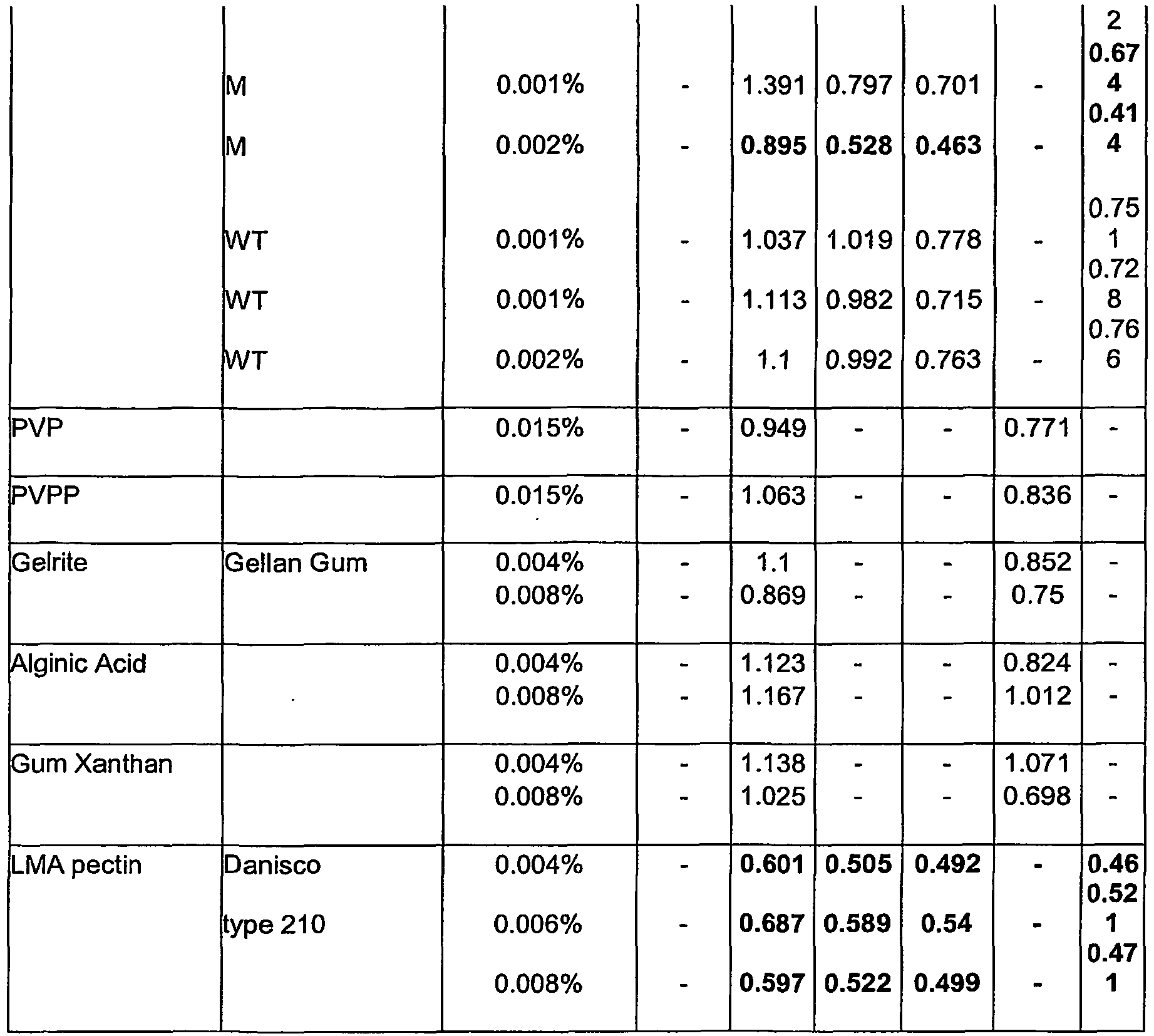
Table 8 Finings Agent Concentration Absorbance (500 nm) 21 h 24 h 43 h 48 h 66 h 72 h 92h 96 h 113 h None - 1.198 - 0.976 - 0.873 - 0.704 - Isinglass 0.002% - 0.307 - 0.261 - 0.226 - 0.225 - PB-A CP Kelco type 101 0.001 % - 1.22 - - - - - - - LMA pectin 0.002% - 0.937 - - - - - - - 0.004% - 0.404 - - - - - - - 0.008% - 0.266 - - - - - - - 0.008% 0.223 - 0.133 - - - - - - 0.012% - 0.221 - - - - - - - PB- B 0.002% - 0.559 - - - - - - 0.539 LMA pectin Danisco type 210 0.004% - 0.349 0.316 - - - - - - 0.004% - 0.468 - - - - - - 0.336 0.004% - 0.561 - 0.465 0.415 - - - - 0.006% - 0.435 - - - - - - 0.335 0.006% - 0.489 - 0.437 0.39 - - - - 0.008% - 0.313 0.274 - - - - - - 0.008% - 0.312 - - - - - - 0.309 0.008% - 0.439 - 0.451 0.391 - - - - 0.012% - 0.435 0.311 - - - - - - 0.016% - 0.477 0.355 - - - - - - PB-B 0.006% - 0.49 - 0.45 0.39 - - - - LMA pectin (de-sugared) Danisco type 210 0.008% - 0.489 - 0.488 0.419 - - - - 0.010% - 0.606 - 0.548 0.489 - - - - PB-C CP Kelco type 104 LMA pectin 0.008% 0.836 0.672 - - - - - - PB-D Unipectine type 290NH 0.004% - 0.895 - - - - - - 0.745 LMA pectin 0.006% - 0.85 - - - - - - 0.754 0.008% - 0.735 - - - - - - 0.604 - Comparison of the protein profiles by SDS-PAGE (
Fig. 6 ), suggest that Isinglass and PB-A interact with proteins differently. Similar to Isinglass, PB-A depletes the top pellet fraction of protein, whereas PB-C, which is not an effective finings agent, does not. However, PB-A appears to collect more of one protein in particular (∼40kDa) in the treated floc. Isinglass and PB-C also pull down the same band but to a lesser extent. - Of the different material tested, the plant biopolymer preparations PB-A and PB-B appear to show some potential as an Isinglass alternative.
- Sample preparation, phenolic ester analysis and sedimentation tests were performed as described in Examples 1 and 2. For the 2-D electrophoresis, samples (0.5 to 1.0 mg) were suspended in thiourea sample buffer and focused on 18 cm IPG strips covering a pH range of 3 to 10. IPG strips were equilibrated and placed across a 12.5% polyacrylamide gel for the second dimension. In-gel trypsin digests were performed on the 40kDa band on SDS-PAGE (see Examples 1 and 2). The peptide fragments were analysed by mass spectrometry and sequences matched to known proteins by database searches.
- Analysis for phenolic esters was repeated due to the extremely low levels found in the samples contributing to possible errors in the analysis. The levels of ester-linked phenolics in whole beer, the Isinglass floc and top are very low with less than 50ng in 5mg of dialysed, freeze-dried material (Table 9 - Ester-linked phenolic acid analysis). The major phenolic acid is ferulic acid in all samples, with trace amounts of syringic, cinnamic and p-coumaric acids. On a weight basis, it appears that the greatest amount of phenolics is found in the Isinglass floc, which consists of more syringic and coumaric acid as a percentage than the untreated beer and Isinglass top.
Table 9 Phenolic acid Whole beer Isinglass FLOC Isinglass TOP Cinnamic tr 0.2% 0.3% o-coumaric nd Nd nd Syringic 0.3% 1.5% 0.6% p-coumaric 0.5% 1.7% 0.3% Ferulic 99.1% 96.5% 98.8% Total in 5 mg (ng) 38.9 46.4 29.5 % in sample 0.0008% 0.0009% 0.0006% - Proteins in the Isinglass floc and top were separated by 2-DE (
Fig. 7 . The protein pattern of both samples is very similar, consisting of major proteins of acidic, but differing pI at approximately 40 kDa. In-gel tryptic digests of the 40kDa band on SDS-PAGE gels allowed for sequencing of this band. Sequenced peptides matched protein z-type serpin from barley (see below SEQ ID NO. 1). - Peptide match from MS/MS sequencing
- Match to: gi|1310677 Score: 216
- (X97636) protein z-type serpin [Hordeum vulgare subsp. vulgare]
- Nominal mass (Mr): 43307; Calculated pI value: 5.61 Taxonomy: Hordeum vulgare subsp. vulgare
- Cleavage by semiTrypsin: cuts C-term side of KR unless next residue is P
- Sequence Coverage: 16%
- Matched peptides shown in bold and underlined in SEQ ID NO. 1


- Early trials suggested that there was potential for pectin (PB A and PB B) to act as an Isinglass alternative. The biopolymers used in the previous trial (PB A and PB B) were examples of amidated pectin. The current trial was performed to determine the relevance of the amide group on the pectin. In this trial high methyl ester, low methyl ester and amidated low methyl ester pectin were assessed for activity in sedimentation tests (Table 10). It is important to note these preparations are typically highly blended at production and that the chemistry listed in Table 10 is based on product specification not real chemical analysis of each batch. Also, these values are indicative of population averages and do not consider differences in the distribution pattern of individual polymers.
- The results suggest that all 3 types of pectin have some capacity to clarify beer but not all pectins are effective. We propose that the difference between pectins that are active and those that are not is related to overall charge density. LM pectins are generally more effective than HM regardless of whether or not the LM pectin is amidated. HM pectin is effective but generally only when the proportion of free COOH is greater than 35%. The upper and lower limits for degree of esterification (DE) and degree of amidation (DA) to give effective fining activity are under further study.
- Filtration tests were conducted at 2°C using unsettled pre-fined high gravity beer. Finings agents were added to pre fined high gravity beer to a final volume of 8.5 litres. The solution was mixed by rolling the vessel (stainless steel pre mix tank) for 3 minutes and then allowed to settle for 48 hrs. The supernatant (7.5 1) was transferred to another vessel via a short spear leaving the sediment behind.
- Diatomaceous earth (DE) filtration was conducted on the supernatant. DE (Filchem - 577), 7.5 g was added to the beer and the solution was continuously mixed using a magnetic stir-bar. The subsequent removal of DE was performed with a Millipore horizontal filtration apparatus, using a 120 cm2 cross sectional area column with 100 kPa upstream pressure. The filter was precoated with two Millipore type AP prefilters, followed by 0.115 g/cm2 of DE precoat powder (Filchem - DU40). To calculate filtration performance, the volume of filtered beer was monitored with time and the filterability index was calculated using a method reported by Lim et al. 1992.
- By plotting t/V against V a straight line is obtained with the slope equal to the filterability index. A low value indicates good filterability, a high value the converse.
- The filterability index results for beer treated with different finings aids, as shown in Table 11, show that beer treated with Pectin 121 is comparable to collagen treated beer. Beer treated with Pectin 710 showed good improvement compared to a control without finings but not as good as Pectin 121.
Table 11 Finings Agent Rate (mg/L) Filterability Index (sec/L2) None 43.4 Collagen 5 7.1 Pectin 121 100 7.5 Pectin 710 100 19.8 - The chart shown in
Figure 8 shows the laboratory DE filtration performance of beer without finings (control) compared to beer treated with bovine collagen and the two pectin samples, HM-SS-121 and LMC-710. - Flat lines with low slopes (sec/l2) indicate a faster filtration. From this result it appears that sample 121, high methyl ester pectin is comparable to beef collagen. Sample 710 does aid clarification but does not perform nearly as well as sample 121. The pectins were dosed at a higher rate compared to the beef collagen (10ppm versus 80ppm).
- It seems likely from work in progress that finings agents are able to capture specific proteins to form stable aggregates and in so doing stabilise and facilitate the extension of the flocs over time. Our work has shown that there is a specific group of low molecular weight, redox proteins in beer that have reactive thiols. These proteins can be identified by tracking these protein thiols (see later Example 19).
- Antibodies that recognize specific structural signatures, associated with the pectin finings agent(s) are under development. This data can be used for optimising the dosage rates, and to control the unauthorised use of this technology. The finings pectins defined in this patent application will exhibit unique reactivity that can therefore be used for authentication, against a variety of other pectins.
- A series of tests were performed with non-amidated pectins of variable esterification, in which beer clarity and sediment volume were compared under standard settling conditions.
Figure 9 shows the relationship between the degree of pectin esterification (DE, %, beer clarity (after 48h) and the apparent volume of the sediment or floc. Pectin (1% stock solution) was dosed into UHG beer (CPL, Table 2; 18°P original wort) to give 50 ppm. (The pectin solution was prepared in water and contained no other additives.)
Clarity improvement = (turbidity)control - (turbidity)pectin / (turbidity)control x 100. The settlement refers to sediment volume; settlement = apparent volume sediment / totalbeer volume x 100. The clarification shows a sharp dependence on pectin DE (Figure 9 ). The optimum range for pectin DE is between 45-50% based on clarity achievement and the compactness of the sediments. Sediment volume within this range is <1% of the suspension volume. At reduced DE (e.g. < 40%) the sediment becomes 'fluffier' and the apparent volume of the sediment increases quite sharply as DE levels are reduced below 40%. At higher DE values (e.g. >50%) the sediment volume diminishes as a consequence no doubt of the reduced clarification achieved. - The finings effect of two different pectins - HM121 (ethanol washed) and LMC710 (refer to Table 1), was tested using a VB beer with high turbidity (e.g. 88 EBC, Table 12 which shows the effect of dosing high gravity beer with pectin based finings: settling tests and turbidity measurements). Pectin was dosed to a final concentration of 50ppm or 100ppm. Bovine collagen (4-10ppm protein/hL) was used as the positive control. The results (Table 3) showed that collagen finings clarified the beer progressively over time. By 48h the treated beer appeared optically clear, bearing in mind this describes the appearance of the beer sample in a standard 1 L cylinder. The turbidity stabilised at about 8 EBC after 72 h. HM121 and LM101 (100ppm) produced equivalent clarification after 72h (7.9 verus 10.7 EBC). LMC710 showed activity at the lower dose rate of 50ppm. HM121 did not when compared to the no-finings-addition control. The finings performance of the pectins thus depends on functionality as well as concentration. In this respect it is no different to the collagen finings that shows dose dependency and dependence on the source and the protocols of preparation (functionality).
Table 12 Pectin Conc. (ppm) Turbidity (EBC) 0h 8h 24h 48h 72h Control - 88.4 88.0 86.7 85.7 84.4 HM121 100 87.6 46.1 25.7 11.3 7.9 HM121 50 84.4 86.7 85.7 84.7 82.4 LMC710 100 83.2 17.0 14.6 13.3 10.7 LMC710 50 83.3 42.8 38.2 36.1 34.7 Collagen 0.02% 82.8 56.7 28.9 12.7 8.9 - The effect of the initial turbidity of beer on non-amidated pectin finings efficiency in settling tests is illustrated in Table 13. Beer was dosed as indicated and monitored for 72 hours. LAGER beer with low and high initial turbidity (45 vs 75 EBC) was used in the study. The pectin dosing solution contained 1% pectin (w/w). The final concentration of pectin in the beer ranged from 50-100ppm. In the low turbidity beer (45 EBC LAGER, Table 13), the turbidity of the control beer that received no finings after 72h of settling was down to 33 EBC. The collagen-treated beer (0.02%) at the same time had a turbidity of 5.7 EBC. HM121-treated beer at 70-100ppm was 5.4 EBC or less. At 60ppm the turbidity had increased slightly to 11.8 EBC. With 50ppm pectin this had increased noticeably to 31.7 EBC. There was scarcely any difference to the control, untreated beer. By way of contrast, in the highly turbid beer (75 EBC LAGER, Table 13), it can be seen that fining did not take place until the pectin level in the beer was 70ppm. The collagen treated beer reached 13.8 EBC after 72h. To get the same clarity required 100ppm of HM121, although satisfactory clarification rates were obtained with 80ppm HM121. Consequently the initial turbidity of the beer for treatment (mainly caused by the residual yeast cells) can markedly influence the pectin finings capability.
Table 13 Pectin Conc. (ppm) Turbidity (EBC) 0h 4h 18h 24h 48h 72h Lager (initial turbidity: ∼45 EBC) Control - 45.0 45.5 45.2 43.1 36.4 33.3 HM121 50 44.3 43.2 40.3 37.1 34.6 31.7 HM121 60 45.1 40.2 26.1 20.5 14.0 11.8 HM121 70 46.7 41.7 14.4 12.0 8.9 7.4 HM121 80 45.8 40.7 7.9 6.8 5.9 5.4 HM121 90 45.6 40.3 7.9 6.8 5.4 5.1 HM121 100 44.3 38.9 10.3 7.8 5.0 4.8 Collagen 0.02% 45.7 42.2 16.7 11.4 8.1 5.7 Lager (Initial Turbidity: ∼75 EBC) Control - 77.6 76.7 75.8 74.7 74.9 72.8 HM121 50 77.2 77.2 76.0 72.8 72.1 70.0 HM121 60 73.4 76.6 76.5 72.8 72.3 70.1 HM121 70 74.8 73.7 75.1 71.8 68.8 59.8 HM121 80 74.8 75.2 74.4 72.6 51.3 36.0 HM121 90 73.3 76.8 67.7 51.9 25.6 20.0 HM121 100 74.3 70.3 30.8 24.5 13.5 11.3 Collagen 0.02% 77.2 68.7 32.3 25.7 16.7 13.8 - The finings effect of amidated pectin has been investigated. Amidated pectins with variable DE and DA values (refer to Table 1) were used in the study. 1% pectin solution was dosed into VB beer at a final concentration at 75ppm. The beer was stored at 4°C for 72 hours. During this time aliquots were removed to determine the turbidity. The settlings results showed (Table 14) that although addition of all the amidated pectins led to an improvement in beer clarity (72h), LM101 and LA110 appeared to be far more effective than others.
Table 14 Pectin DE (%) DA (%) Ca++ reactivity Turbidity (EBC) 0h 4h 18h 24h 48h 72h Control - - - 35.7 - 33.3 32.1 27.6 23.4 LM101 35 15 Low 35.7 14.3 10.9 8.74 7.43 5.95 LM102 30 19 Medium 39.2 - 13.1 12.2 11.7 9.98 CF005 32-40 11-17 Low 35.7 22.7 17.5 16.3 14.8 14.2 CF010 30-36 14-20 Medium 35.7 19.6 16.5 14.7 13.2 13.0 CF020 27-32 18-23 High 35.7 37.5 36.8 35.6 32.8 30.3 LA110 33 17 Low 41.2 - - 10.4 8.42 7.61 Collagen N/A N/A N/A 45.7 42.2 16.7 11.4 8.1 5.7 - For LM101 and LA110, DE and DA add up to 50%. However as the other pectins in this cohort have similar (DE + DA) values (Table 14), the superior performance of these two pectins is likely to be a consequence of other factor(s). Pectin colloidal properties are especially sensitive to the presence of Ca2+, as well as other cations. Ca2+ and Mg2+ levels for instance in beers are of the order of 50 and >100 ppm, as already mentioned, although there will be considerable variation in the art. Both LM101 and LA110 are classified by their commercial suppliers as having low Ca2+ sensitivity for gel formation, whereas the least effective pectins in the cohort, albeit still effective clarifying agents under the conditions chosen, are CF010 and CF005. The Ca2+ sensitivity series for gel formation is CF020 > CF010 > CF005, or according to the manufacturer's description, CF020 has high, CF010 has medium and CF005 has low sensitivity to Ca2+ judged by gel formation under standard conditions. The CF005 specification has a broad range of DE (32-40%) and DA (11-17%) which may make it less comparable to the other pectins in this cohort. But taken together, the data indicates that beer fining capability is significantly prescribed by the levels of esterification and amidation, and thus by residual charge, as well as by the Ca2+ sensitivity of gelling. The latter is, as is known in the literature also linked to the distribution of charge along the polygalacturate backbone of the pectins. Thus it is no surprise that different pectins, e.g. citrus, apple, or hop pectins which may differ in the distribution of pectin carboxyl groups, may have different fining activity for equivalent DE and DA. The crowding of carboxyl groups also affects the pKa values of the carboxyls, which may be a factor at low beer pH values. We observed that pectins with high Ca2+ sensitivity when added to beers tend to form small colloidal particles, which may remain in suspension in the beer for extended times. If the clarification sequence involves a transient, quasi-gel state, and subsequent decoration with protein and other beer components, prior to flocculation, then the formation of Ca2+-coated residues is definitely not desirable. The sequence of the process, and the timing of protein decoration of the colloids must clearly play a key role in compaction of these beer flocs. The Ca2+ effect may be minimised by the use of chelating agents. The reactivity of proteins may be modified by altering their redox state. This can be achieved by sulphitolysis, which disrupts disulphide linkages and creates a reactive thiol and adds a sulphonate group. The sulphonation will increase protein negative charge, and thus may affect interactions with pectin based on electrostatic attraction. Localised sulphite may also act as a buffer against peroxide.
- Peroxides do accumulated in beer. Oxidation of protein thiols produces hydrogen peroxide, and forms a disulphide bridge. Oxidation of vicinal thiols will tend to favour intramolecular bridge formation, whereas floc formation is more concerned with extended macromolecular lattice production. The finings solution is air saturated. During dispersion the accompanying oxygen in the finings can cause protein oxidation. Disulphide cross linking between proteins will occur more slowly than vicinal thiol oxidation. But the intracellular events will be less likely to take place if oxygen is limiting.
- Sulphitolysis can reverse thiol oxidation, albeit some loss will occur over time, and this ought to promote protein cross linking events and floc formation. Certainly elevated concentrations of sulphite in beer under normal packaged conditions will promote particle formation even after short storage times. Sulphite also acts as a reactive oxygen scavenger or free radical scavenger and may have benefit for beer stability as well as floc formation.
- SO2 accumulates in beer during fermentation and typically can reach 10 ppm, more or less at the end of fermentation. SO2 is a reducing agent, and it may also act as a free radical quencher. SO2 may also result in sulphitolysis of proteins, by which disulphide bridges in proteins are cleaved to produce a free thiol group and a sulphonate group (Example 7 above). Proteins can become more reactive or 'sticky' as a consequence, and this has been attributed as the cause for the formation of particulate matter in some beers. SO2 as sulphite is frequently added to beer prior to packing, and finished beer total SO2 levels can range up to 25 ppm or higher.
- Sodium sulphite was added to pectin finings (1% w/w LMC710, 1% LA110 or 1% LM101; sodium sulphite 1.86 or 3.72 g/L) prepared from either an amidated or a non-amidated pectin. The final concentration of pectin in the beer was 50 ppm. The final SO2 concentration was either 8 or 16 ppm. The effect of sulphite on the finings effect of amidated and non-amidated pectin finings (50 ppm) on LAGER (high gravity beer) is shown in Table 15. Sulphite (8 or 16 ppm) improved the rate of clarification compared to the samples that did not have sulphite in the dosing solution, for the two amidated pectins (LA110 and LM101) and for the non-amidated LMC710. LMC710 (50ppm) plus 16ppm SO2 clarification was almost equivalent to the collagen fining after 48h.
Table 15 Pectin SO2 (ppm) Turbidity (EBC) 0h 18h 24h 48h 72h Control - 54.3 59.7 59.5 57.2 54.1 LMC710 - 54.4 23.1 - 19.2 - LMC710 8 53.7 22.6 - 16.5 - LMC710 16 54.3 16.1 - 13.0 - LM101 - 45.1 - 17.8 LM101 6 45.5 - 16.6 LA110 - 44.7 - 23.7 LA110 6 45.1 - 19.6 Collagen - 50.6 17.6 - 8.7 6.9 - These trials were extended to include the effect of citrate as well as sulphite on beer clarification (Table 16). Two amidated pectins (LM101 and LA110) were chosen for further study. The pectin-sulphite finings solution was fortified with sodium citrate so that the final citrate level in the dosed LAGER beer was 13 ppm. Citrate produces an improvement in beer clarification (50 ppm LM101 pectin, LA110) in addition to the effect of sulphite with both pectin-types. The result appears to be additive as opposed to synergistic, which agrees with the proposed action of citrate as opposed to sulphite. Citrate targets cations and hence moderates the progression from 'monomeric' form to gel to particulate floc. Sulphite may result in sulphitolysis and also the formation of carbonyl adducts. It may promote macromolecular crosslinking. LM101 (50ppm), citrate (13ppm) and sulphite (8ppm) in dosed LAGER beer was equivalent to 20ppm collagen finings in terms of the rate of clarification as well as the end point reached. However lower levels of the LM101 in combination with citrate and sulphite may in fact be equivalent also to the benchmark collagen clarification.
Table 16 Pectin (ppm) Citrate (ppm) SO2 (ppm) Turbidity (EBC) 0h 24h 48h 72h Control - - 45.1 45.8 43.3 40.1 LM101 - - 45.1 17.8 15.2 14.8 LM101 - 8 45.2 16.6 13.7 11.9 LM101 13 8 45.5 12.1 10.5 8.7 LM101 13 - 45.2 12.4 10.7 8.9 LA110 - - 45.3 23.7 21.7 21.5 LA110 - 8 45.0 19.6 17.4 15.1 LA110 13 8 45.2 16.7 14.9 13.8 Collagen 0.02% - 45.1 11.6 9.0 7.9 - The effect of citrate and SO2 on the finings performance was also conducted for a range of non-amidated pectins (
Figure 10 ; DE, 25-58%). Pectin was added to CPL beer to a final concentration of 50ppm with and without accompanying citrate (13ppm final) and SO2 (8ppm final). Citrate enhanced the finings effect as judged by the improvement in clarity (EBC units,Figure 10 ). The results with CPL beer, after settling are shown in Table 16. The positive effect of citrate applied to all the samples of pectin in the tests. Citrate is a good chelator of Ca2+ and may compete with pectins for Ca2+ in the beer. The Ca2+ content of beer is about 40ppm; Mg2+ levels are generally ∼100ppm. Mg2+ may also interact with pectins. - Cytochrome c (20ppm) or BSA (20ppm) was added together with HM121 (60ppm) to LAGER beer (14°P original wort) to determine the effect on clarification. Table 17 shows the effect of cytochrome c and bovine serum albumin (BSA) supplementation on the finings activity of pectin HM121 in high gravity beer shown by settling results. The results in Table 17 show that cytochrome c (20ppm) improved the rate of clarification and lowered the endpoint turbidity compared to the HM121 control. BSA (low pI protein) had the opposite effect. The rate of clarification was slower and the end-point clarity not as good as the pectin-only control. Cytochrome c is positively charged at beer pH (4.1); BSA carries little net charge as beer pH is almost the same as the isoelectronic point. Cytochrome c may act as a bridging agent for decoration of the acidic pectin groups and in addition, binding of the more acidic proteins in beer.
Table 17 Pectin (ppm) Additive (ppm) Turbidity (EBC) 0h 24h 48h 72h Control - 59.8 59.4 54.7 52.2 HM121 - 59.8 59.4 31.9 22.0 HM121 Cytochrome C (20) 60.2 19.2 13.2 10.8 HM121 BSA (20) 59.2 60.6 47.7 36.6 - The effect of tannic acid supplementation on the finings action of pectin HM121 in high gravity beer as shown by settling tests was investigated (Table 18). Control beer (
LAGER beer 14°P original gravity) showed a slight reduction in EBC turbidity units after 120h of settling. HM121 (80ppm) addition reduced turbidity to just under 10 after 58h. But as shown previously in Table 13, HM121 fining activity dropped off rapidly at levels <80ppm. The presence of tannic acid offset this decline (Table 18). For example, with 50ppm tannic acid present and 50ppm HM121 the turbidity after 48h of settling was 8 EBC units, compared to 9.8 for 80 ppm HM121-only beer. There is some finings action from tannic acid alone; for instance 50ppm reduced the turbidity after 48h to 32 EBC. But overall there appears to be an improved outcome when both the tannic acid and the polyphenol are present together. It was also noted that polyphenols as well as protein and pectin accumulate in the flocs. This data together with this analytical data indicates the sediments are formed, at least in part, as a result of the interaction between proteins, and tannin (polyphenols) and the pectin.Table 18 HM121 (ppm) Tannic acids (ppm) Turbidity (EBC) 0h 18h 24h 48h 72h 96h 120h Control - 59.8 - 59.1 54.4 - - 44.4 80 - 58.8 48.7 11.9 9.8 8.9 8.3 - 17 17 60.2 - 78.1 74.2 - - 72.3 32 32 59.7 - 95.0 55.2 - - 33.9 49 49 59.8 - 11.9 7.8 - - 5.3 65 65 62.2 - 9.9 6.6 - - 5.1 40 40 66.9 25.0 19.7 14.5 11.7 10.0 - 50 50 65.8 13.5 11.4 8.0 7.0 5.7 - 60 60 66.4 12.5 9.5 7.7 5.9 4.7 - - 50 67.9 32.3 31.7 32.2 30.4 30.2 - Collagen 0.02% 58.9 22.1 13.6 9.4 7.7 5.9 - - Three kettle hopped beers (FLEX, CPL and CNM, 18°P Table 2) and three non-kettle hopped beers (LAGER, VB and CD, 14°P Table 2) were fined using LM101 at 40-100ppm. Beer clarity improvement (Ci,(%)) after 48h is dependent on pectin concentration (
Figure 11 ). Clarity improvement for the kettle hopped varieties were >88% even at low pectin levels (40ppm), and could be as high as 95% for CPL for pectin concentrations >60ppm. For beers that did not receive kettle hopping, there was a drop-off in clarity once the pectin concentration was reduced below 80ppm. However even at a dose rate of 60ppm pectin the clarification index exceeded >70%. - The dependence on kettle hopping was supported by examining the effect of hop extracts prepared by ethanolic extraction of Pride of Ringwood hop pellets [(50ml ethanol (30%) plus 5g pellets, 20°C)] on HM121 (60ppm) fining activity (Table 19 - results of settling tests with high gravity beer). Hop extract increased the rate of clarification and reduced the final turbidity after 72h of settling compared to the HM121 control.
Table 19 Pectin (ppm) Additive (ppm) Turbidity (EBC) 0h 24h 48h 72h Control - 59.8 59.4 54.7 52.2 HM121 - 59.8 59.4 31.9 22.0 HM121 Hop extract (2% w/w) 60.2 46.7 24.5 16.4 - Furthermore since ethanol extracts of hops also contain some proteins as well as isohumulones, we also tested the effect of co-addition of a CO2-liquid hop extract on pectin activity. HP6 is a commercial extract of Pride of Ringwood hops. HP6 (25 International Bittering Units (IBU), final) and pectin LM101 (75ppm, final) plus citrate (13ppm, final) and SO2 (8ppm, final) were dosed together into post-centrifuged LAGER beer. Settling tests were carried out. The filterability with HP6 present was noticeably improved compared to the one without HP6 (
Figure 12 ). Filterability values approached 12 sL-1, which is almost at the top end of 'best' filterability (∼10sL-1). Similar improvement in filterability can be achieved with reduced HP6 additions (equivalent to 10 IBU, final). Thus kettle hopping effects on subsequent clarification by pectin-based agents, may be due to the availability of isohumulones. In turn this may affect the availability of pectin-reacting cations. - It was also noted that as pectin-finings solution ages (pectin-citrate-SO2, 1-5% w/v), there appears to be an increase in finings effect (clarification and filterability, Table 20) and a drop-off in the positive effect on both by hop extract (HP6).
Table 20 Finings additions (1% w/v pectin, citrate, SO2) Turbidity (EBC) Filterability (sL-1) Initial 48h Initial LAGER - no additions 32 28 27 - 0.02% Collagen 32 9 12.4 - LM101, 75ppm final 32 7.5 17.3 After 20 days LAGER - no additions 36 29 27 - 0.02% Collagen 36 11 15 - LM101, 75ppm 36 13 18 - LM101, 75ppm + HP6 (25 IBU) 36 8 12 After 30 days LAGER - no additions 42 40 32 - 0.02 % Collagen 42 14 20 - LM101, 75ppm 42 13 10 - LM101, 75ppm + HP6 (10 IBU) 42 7 10.4 - LM101, 75ppm + HP6 (20 IBU) 42 5 10 - LM101, 75ppm + HP6 (30 IBU) 42 13 10.6 - This presumably is linked to structure and thus functionality changes in the pectin, and implies change in cation activity.
- Taken together, hop bittering agents improve the performance of pectin-based finings when introduced in the kettle boil or even later in the process, and especially at the time of addition of the pectin finings, prior to storage.
- HG beer (VB; 14°P) was dosed with LM101 (75ppm) with citrate and SO2 (13ppm and 8ppm final concentration respectively) and filterability was tested (
Figure 13 ). - Non-treated beer was used for the negative control and collagen (20 ml/hL) was used as a positive control. Both the collagen and pectin-treated beers were 2 or 3 times faster through the filter compared to non-treated beer (control). The pectin-treated beer was less turbid after the fining compared to collagen-treated beer (data not shown), yet the filterability of the pectin-treated beer was not quite equivalent to the collagen-treated beer. Residual pectin may reduce filterability.
- Filterability of model beers (4% ethanol, 50mM citrate and 20 IBU) dosed with pectin, indicate that residual pectin > 2ppm will noticeably reduce filtration through standard 0.65µm micron nylon66 filter. Estimates based on such measures, and based on filterability of these model beers indicate that in the case above the residual pectin was <2ppm.
- A similar series of tests was carried out with UHG beer (CPL)(
Figure 14 ). LM101 was dosed to 50ppm and citrate and SO2 to 9 and 6ppm respectively. The filtration results show that filtration efficiency was higher in the pectin-treated beer compared to collagen-treated beer and the no-addition control, which is consistent with the settling tests which showed that the rate of clarification and the sedimentation volume were faster and more compact than in the case of the collagen-treated beer. - CPL is a kettle-hopped ultra high gravity beer. An equivalent beer stream that did not receive kettle hops, was less readily filtered after the same finings treatment. Again this indicates that the bittering agents may be contributing to the difference. The estimated residual pectin left in the beer is reduced in the kettle-hopped beers, compared to CPL. Isohumulones react with Mg++ and Ca2+ to form insoluble salts. One explanation for the kettle-hopping phenomenon is that it causes a reduction in cation levels which leads to a less favourable condition for gelling and a reduction in residual pectin.
- Pectinase targets the galactouronic acid backbone, and may produce a population of pectin molecules of reduced molecular weight compared to the original substrate. Treated or untreated pectin (1% w/w) was added to LAGER (high gravity) green beer (14°P original wort) to 100 ppm. The units of pectinase added to 1ml of the dosing pectin solution are shown in parentheses in Table 21. The results of settling tests shown in Table 21 are typical of several trials. None of the pectinase-treated pectins showed any finings effect compared to the original HM121 pectin. Pectinase activity in beer will affect the performance of pectin-based finings agents.
Table 21 Pectin Turbidity (EBC) 0h 24h 48h 72h Control 59.8 59.4 54.7 52.2 HM121 59.8 18.6 8.9 6.9 HM121 (2U) 59.6 61.1 60.8 56.7 HM121 (5U) 59.5 60.2 57.3 54.8 HM121 (10U) 59.8 59.7 57.9 54.6 HM121 (20U) 59.2 59.1 58.9 56.4 HM121 (50U) 59.5 62.5 60.9 58.4 - Elevated pectin concentration in the finings dosing solution minimises the volume of finings added to the passing beer, which is more likely to suit modern processing requirements. Hence the desirability of a high pectin concentration in the dosing material.
- Pectin (LM101) was added to LAGER to achieve a final concentration of 75ppm, and a citrate concentration of 13ppm final and a SO2 level of 8ppm. The concentration of pectin in the dosing solution was 5%. The results are shown in
Figure 15 . The clarification improvement was almost the same as that achieved with a 1% pectin dosing solution (compareFigures 4 and15 ). The sediment volume was <1% for pectins within the DE range from 40-50%, which is similar to the result achieved with the 1% pectin stock solution (Figure 8 ). In fact the pectins within the DE range from 35-50% have sedimentation volumes <1.5 of the total treated beer volume. - Taken together, delivery of LM101-pectin finings from a 5% stock solution as opposed to a 1% stock solution, resulted in no adverse changes in finings efficiency when tested with high gravity beer. Concentrated pectin is more convenient for shipping product, as well as for end users. Higher concentration of pectin, in excess of 7% tend to separate over time, and there appears to be a reduction in finings activity. There is a greater chance that this concentrate will separate rather than disperse evenly in the beer. Higher temperature increases pectin solubility and reduces viscosity albeit with increased likelihood of pectin deactivation.
- A brewery trial was carried out with a pectin based finings (pectin from CP Kelco, LM101) in a high gravity beer (
Original Gravity 14°P). The pectin finings was compared with a bovine collagen - based finings. - A pallecon of the finings solution (nominally 5%) was prepared and transported to the brewery site. The pallecon was located on the finings dosing stand, and the outlet connected directly to the inlet of the dosing pump.
- The trial was run under normal plant conditions. Additional sampling and quality assessments were carried out to meet the trial objectives.
- The identified fermenter was passed through the centrifuges and finings were dosed after the post separator buffer tank and after the post separator heat exchanger.
- The beer was transferred to storage vessels (SV). After an appropriate storage time (typically 2 days) and after relevant quality assessments had been successfully completed, the beer was adjusted to meet finished product parameters, filtered, adjusted to sales gravity and moved to a Bright Beer Tank (BBT).
- Final quality assessments were completed and the beer was released to packaging.
- A 75 kg batch (three bags) of pectin LM101 was received from CP Kelco (Batch number S42251).
- The pectin LM101 used for the plant trials contained 62% w/w pectin (referred to as active pectin hereafter) and the remainder was sugar. The level of the added sugar was detected using HPLC. Additionally, the level of pectin was determined by a gravimetric method after removal of sugars by extraction with aqueous ethanolic solution.
- The finings recipe was as follows:
Standardised pectin LM101 (BN: S42251) 5.5% Sodium citrate (Na2C6H5O7-anhydrous) 1.5% Citric acid (C6H8O7-anhydrous) 0.5% Potassium metabisulphite (K2S2O5) 1.0% - For a 1000L pod, the following amounts were required:
Standardised pectin LM101 55kg Sodium citrate 15kg Citric acid 5kg Potassium metabisulphite 10kg Deionised water 950L - The pectin was suspended in 950L of deionised water at room temperature (22°C). A standard food grade homogeniser provided agitation. The pectin was added slowly (over 60min) with continuous agitation. The pH was adjusted as required by either citrate or citric acid. Sulphite was added finally and the pH was again checked and adjusted as required to 4.5-4.9. The solution was transferred to a 1000L pallecon container for transport to the brewery site. The level of active pectin in this solution was 3.3%, w/w. The pH and the viscosity of the made-up pectin dosing solution were 4.8 and around 500-740 mPa.sec.
- The trial was carried out with high gravity beer of Original Gravity (OG) 14°P from a 4000Hl (1Hl = 100L) fermenter split into two equal parts for trial and control. The trial was beer dosed with LM101 based finings at a dose rate of 4.94mg/hL active pectin. The control was the collagen based finings (batch DFS007/05) dosed at 200 mg/L of nominally 2 wt/wt% slurry. The collagen material was supplied as a suspension in pallecons which were stored under normal environmental temperature, 10-18°C. This is the usual winter daily temperature variation for a Melbourne winter.
- Following fermentation, and chill back to 4°C, the beer was transferred to two separators running at a combined rate of 600hL/h. The pectin finings solution was added after the separators using a set point of 150g/hL. This equates to 4.94 g active pectin/hL beer. The trial beer (pectin finings) was treated first, followed by the collagen treated control beer. The storage vessels used for holding the treated beer were horizontal 950hL tanks. Yeast was not dosed back onto the centrifuges, and there was no addition of reclaim beer. The trial beer was passed in 3h 20min. The temperature of the beer in storage was 0°C.
- The combined volume of the trial tanks was 1920hL and approximately 300L of the finings solution was used. This equates closely to the target dosing rate.
- Plant analytical data are summarised in the following Table 22, which shows analytical data for pectin fined beer, and collagen fined beer, taken from storage tanks (2 tanks for each beer). Samples were taken after the tanks were filled. The data shows no significant difference in the analytical detail for the pectin fined beers versus the collagen fined beers in storage. The brewing staff qualitatively judged the compactness of the tank bottoms as 'tight', not fluffy.
Table 22 Control Control Trial Trial Sample Number 96902 96950 96590 96717 Sampled Date 2/08/2005 16:38 2/08/2005 18:14 2/08/2005 10:59 2/08/2005 12:59 Sampling Location ST_N16 ST_N17 ST_N13 ST_N14 Taste in Product PASS PASS PASS PASS Alcohol % v/v 6.35 6.32 6.32 6.38 Specific Gravity (20/20) 1.00819 1.0083 1.00803 1.00821 Present Gravity °P 2.1 2.13 2.06 2.11 Original Gravity ° P 14 13.9 13.9 14 Colour EBC Units 11.5 11.3 10.7 10.9 pH 4.02 4.02 4.04 4.03 Total SO2 mg/ L 11 11 17 17 Oxygen mg/L 0.09 0.1 0.19 0.19 - Filtration was carried out on a Filtrox Candle filter. A freshly prepared filter was used, with the control running first followed by the trial. The filter aid used for the pre-coat was Dicalite Speedplus (freshwater) and the filter aid used as the body feed was Celite Standard Supercel (marine).
- In the
Figures 16 and17 , the changes in sludge volume, filter aid powder flow rate, filter inlet pressure, filter flow rate (Fig 17 ) and inlet turbidity, and discharge haze (Fig 16 ) are recorded over the length of the run. - The trial beer met quality standards with filter haze within specification.
- According to the Filter room operators at the Abbotsford brewery, the pectin dosed beer performed within expectations for similar beers.
- The trial beer did use more filter aid powder and there was a greater increase in filter differential pressure with filtration time.
- The rate of increase in pressure was 32 kPa/h for the control, and 68 kPa/h for the trial. The average powder-dosing rate was 22g/hL and 40g/hL for the control and the trial respectively.
- The powder use and the rate of pressure increase can vary due to variability in beer quality from fermentation to fermentation; this can be managed. For instance, even slightly longer settling times (3 days) significantly reduces both the rate of pressure increase and the powder usage, so that the collagen-fined and pectin-fined beers approach comparable values (refer to Example 9).
- Following filtration the control and the trial beer were analysed as summarised in the following Table 23 which shows brewing descriptors for the bright beer tank samples recovered for the pectin fined beer and the collagen-fined beer.
- The data for the pectin-fined beer and the collagen-fined beer are very similar. Both were assessed positively as 'clean, solventy, creamy and fruity'. Haze in process was 33 FTU ASBC compared to 22 FTU ASBC for the trial beer. Both are well within the target level of 50 FTU ASBC and specification of 60 FTU ASBC. (FTU means formazin turbidity units).
Table 23 Control Trial Sample Number 98274 98375 Sampled Date 4/08/2005 9:41 4/08/2005 11:04 Sampling Location BB_L12 BB_L11 Taste in Product PASS Pass Comment FIG CONTROL clean; solventy; creamy; fruity FIG TRIAL clean; solventy; creamy; fruity Alcohol % v/v 4.87 4.87 Specific Gravity (20/20) 1.00626 1.00617 Present Gravity °P 1.61 1.58 Original Gravity °P 10.9 10.9 Bitterness (Abs x 70) Mg/L 24.2 25.3 Colour EBC Units 9.1 9.1 pH 4.16 4.16 Carbon Dioxide % w/v 0.52 0.54 Oxygen Mg/L 0.2 0.16 Haze in Process FTU ASBC 33 22 - The particle size distribution was determined using a Coulter Multisizer III with a 70 micron tube, counting between 2 and 42 microns, and using Isoton II electrolyte (
Fig 18 ). - Three samples of each beer type were taken over a 3 hour period. The pectin-fined beer had a lower particle count initially and this decreased progressively over the period of sampling. The collagen-fined beer had a higher particle count for the equivalent time in storage and this also decreased progressively but not as obviously over the time period.
- Samples of control and trial beer from the storage vessels were tested using the filterability rig described in
Figure 2 . The results appear in Table 24, which shows laboratory estimation of filterability of the plant beers; LM101 pectin-fined beer, collagen-fined beer and an unfined beer for comparison. In Table 24 the filterability and the prefilter haze in a beer (with no finings), the collagen-treated control and the pectin treated-trial beer are compared. Haze values were obtained with a HACH 2100AN using ratio mode.Table 24 Finings treatment Pectin LM101 finings Collagen finings No finings Filterability sec/^2 17.3 12.4 26.6 Prefilter haze EBC units 7.47 8.67 28 - The filterability of the collagen treated beer was better in this test than the trial beer. This is in line with expectations, and is compatible with the data from the plant trial (
Figures 16 and17 ). The haze in the pectin-fined beer was lower than the collagen beer (c.f. Table 24 haze data for the laboratory filtered beers). The reduced filterability of the pectin-beer compared to the collagen-fined beer in this trial may be caused by pectin residue in the beer as proposed in Example 11. This may be improved by the addition of hop extract, by increasing storage time and by avoiding overdosing of the pectin solution. - Sulphur dioxide levels and haze levels were monitored during the trial. Table 25 presents the data for sulphur dioxide and haze levels in the pectin-fined storage beer presented to the finings dosing point from the centrifuges prior to dosing of finings. There was little difference in the beer being presented to the finings dosing point, with a slight increase in haze towards the end of the run.
Table 25 Time (min) Total SO2 (mg/L) Pre dosing haze (EBC, HACH 2100AN, ratio mode)) Start 11 32 64 12 29.6 110 11 29.6 239 11 34.1 354 12 34.8 - The turbidity of the emerging product from the filter was also monitored. The data is tabulated below (Table 26 which shows the inlet and the outlet turbidity of collagen-fined beer and pectin-fined beer). The pectin-fined beer is consistently lower in turbidity than that of the collagen-fined beer.
Table 26 Filtration (min) Inlet turbidity (EBC) Outlet turbidity (EBC) Collagen Control run Start 16.7 0.57 5 15.2 0.75 110 14.1 0.77 Pectin Trial Run Start 11.5 0.6 69 8.5 0.50 119 7.9 0.60 - The data indicates that the beer from filtration for the trial was cleaner than the control. This is in line with the in-line haze meter and the haze in process data and particle size distribution data.
- The haze profile for trial and control beers at various stages after the beers had passed through the separator are shown in
Figure 19 . - The haze profile during the process is in line with expectations. The pectin finings clarifies faster than the collagen finings and clarification is almost complete after 24 hours. The collagen finings takes 48 hours to achieve a similar haze result.
- Similarly the sulphur dioxide profile was measured during the trial and is tabulated in
Figure 20 . The trial finings contains a significant level of sulphur dioxide and an increase in sulphur dioxide level in storage was expected. The sulphur dioxide level increased from 11.3 mg/L to 16.8 mg/L, as compared to the control that showed no change from immediately after the separators. However bright beer, irrespective of finings treatment, exhibited the same sulphur dioxide level. Some sulphur dioxide, either natural or added, may be removed from the beer with the sediment in the storage tank by reaction with protein by sulphitolysis to produce sulphonic derivatives. - In Australia additions in excess of 10ppm sulphur dioxide require mandatory labelling while the maximum level in beer is restricted to 25ppm. If the present pectin finings formulation were classified as a process aid this would not apply. A process aid provides a technological function process and does not carry through to the final product. If it does not apply, the flexibility to add sulphur dioxide to beer will be restricted. If this is unacceptable the level of sulphur dioxide in the finings solution can be reduced as needed. There may be an accompanying decrease in efficiency but this will be dependent on the beer type.
- Beer was packed off into 375ml cans. The beer was analysed for brand character and sensory quality by a panel of expert tasters.
- The tasting notes from the expert panel follow: Trial cans (pectin fined): waxy, creamy, well-balanced, slightly dry, 7 (based on an 8 point system 1-8 in which 8 is exceptional example, 1 is unacceptable). Control cans (collagen fined): slightly dirty, slightly thin, creamy, slightly sulphury, bitter, 6. There were no adverse issues identified by the expert taste panels in either beer.
- The finished product analyses were comparable as shown in Table 27 which shows the analysis of cans of pectin-fined cans (Trial) and collagen-fined beer cans (Control).
Table 27 Comment FIG Trial 1 (Cans) TRIAL (S11) FIG Trial 1 (Cans) Control (S12) Sample Number 100049 100051 Sampled Date 8/08/2005 16:46 8/08/2005 16:46 Process Stage FINAL FINAL Pack Type 375C 375C Alcohol % v/v 4.91 4.92 Chill Haze Initial FTU ASBC 35 40 Carbon Dioxide % w/v 0.533 0.517 Colour EBC Units 9.3 9.3 Diacetyl mg/L 0.02 0.01 Pentane dione mg/L 0.01 0.01 Total Vicinal Diketones mg/L 0.03 0.02 Head Retention - Nibem secs 235 238 Calcium mg/L 31 31 Copper mg/L 0.03 0.03 Iron mg/L 0.04 0.03 Magnesium mg/L 58 58 Potassium mg/L 364 365 Sodium mg/L 73 70 Chloride mg/L 211 213 Sulphate mg/L 175 177 Bitterness (Abs x 70) mg/L 24.4 23.9 Original Gravity op 10.9 10.9 Present Gravity op 1.59 1.59 Ph 4.11 4.11 Comment some small PM present some small PM present Particulate PASS PASS Matter Initial Real Extract °P 3.41 3.41 Specific Gravity (20/20) 1.00621 1.00618 Free Dimethyl sulphide µg/L 12 11 Hydrogen sulphide µg/L 2 3 Methane thiol µg/L 1 1 Ethyl Acetate mg/L 20.4 18.2 Ethyl Hexonate mg/L 0.2 0.2 Ethyl Octonate mg/L 0.56 0.51 Iso Amyl Acetate mg/L 2.13 2.08 Phenyl Ethyl Acetate mg/L 0.93 0.77 Total Esters mg/L 24.2 21.8 Iso Amyl Alcohol mg/L 75.8 73.4 Iso Butanol mg/L 16.6 16.1 n Propanol mg/L 13.3 12.5 Phenyl Ethyl Alcohol mg/L 40.2 34.2 Total Alcohols mg/L 145.9 136.2 Alcohol/Ester Ratio 6.03 6.25 Total sulphur Dioxide mg/L 13 12 - There is no significant change in any of the analyses.
- Electron Spin Resonance based measurement of hydroxyl radical formation (PBN as the free radical capture agent) showed that pectin treated beer exhibited a longer lag time than the control beer, treated with collagen (Table 28). This difference was maintained after 14 and 28 days storage of cans at a temperature of 30°C. The lag time calculated from the ESR data is believed to be related to the antioxidant potential of the beer. The longer the lag time, referred to as Ea, the greater the antioxidant potential of the beer. If so, the pectin treated beer is showing a greater anti-oxidant potential than the control.
Table 28 Sample Days after packaging at 30°C ESR lag time (min) Total SO2 (mg/L) Furfural (microgram/L) Trial - pectin finings beer 0 112 15 - 14 85 10 24 28 90 11 46 Control- Collagen finings beer 0 80 18 - 14 70 9 38 28 79 10 79 - The increase in furfural level can be ascribed to the trial beer being able to handle heat stress better than the control.
- Aged flavour assessment was carried by a group of experienced tasters:
- Three beers were presented:
- Trial beer after storage in a 30°C hot room for 2 weeks
- Control beer stored under the same conditions
- A "fresh" beer - taken from recent production at Abbotsford.
- Panellists were asked to rate various aged parameters, based on the Flavour Stability Wheel as drafted by the EBC Sensory Subgroup. A 0-5 scale was used where 0 indicated not detected and 5 was intense. The panellists were then asked to rate (1-5 scale with 1 = not aged, and 5 = very aged) and rank the beers on an aged scale (1 = least aged, 3 = most aged). Panellists were asked for any flavour comments. Standard statistical analyses were carried out to identify significant differences.
- The ranking taste test evaluation was undertaken as usually applied in the industry. The data are shown in the following table (Table 29 - Ranking Taste Test evaluation data (Note 1 = least aged, 3 = most aged)). The data was analysed in terms of criteria blocks.
Table 29 Taster Pectin LM101 (2 weeks 30°C) beer - canCollagen (2 weeks 30°C) beer - canFresh beer - can 1 1 3 2 2 3 2 1 3 2 3 1 4 2 3 1 5 1 3 2 6 1 2 3 Rank sums 10 16 10 Average 1.67 2.67 1.67 - The analysis of the Ranking Taste Test data are shown in Table 30 - Ranking Taste Test Evaluation (1-5 scale with 1= not aged, 5 = very aged). The conclusion is that there is no significant difference or preference between the 3 beer samples.
Table 30 Criteria block Alpha (5%) Alpha (1%) F (Friedman's test) 5.99 9.21 4 - Taste test data was analysed for preference. The results are summarised in the following Tables 31 and 32.
Table 31 Taster Pectin LM101 (2 weeks 30°C) beer (A)Collagen (2 weeks 30°C) beer (B)Fresh beer (C) 1 1 2 1 2 2 3 1 3 2 3 1 4 2 3 1 5 1 2 1 6 1 3 4 Sum 9 16 9 - The analysis of the data is summarised below (Table 32).
Table 32 A-B B-C A-C 1 -1 1 0 2 -1 2 1 3 -1 2 1 4 -1 2 1 5 -1 1 0 6 -2 -1 -3 Sum -7 7 0 Average -1.17 1.17 0.00 Std Dev, s 0.408 1.169 1.549 Student's statistic -7.00 2.44 0.00 % 0.046% 2.916% 50.000% - The analysis indicates that the expert panel regards the trial product similar to the fresh beer and fresher than the control. The control beer was judged to be more aged than the fresh beer.
- The flavour ratings from the expert panel have been summarised in the accompanying spider graph (
Figure 21 ), along with the unforced flavour comments (Table 33 - Tasting panel descriptors for the collagen-fined, and pectin-fined beers and a fresh sample of beer for reference).Table 33 SAMPLE Pectin LM101 ( 2wks 30C)Collagen (2 wks, 30C) Fresh sample Panellist 1 All similar - none particularly aged 2 Dull sulphury Dull Fresh 3 Slightly cooked aroma, lowish ester nose Lowish esters soft and more bland palate (diacetyl), slightly sweet Estery on nose and palate, crisp bitter, slightly resinous 4 slightly harsh and astringent, slightly dull and aged Slightly harsh and astringent, slightly oxidised + dry/resinous, slightly sweet v slightly age, v slightly astringent 5 No noticeable aged aroma, no noticeable aged flavour Slightly barley sugar nose, but not obvious aged aroma. Slightly aged flavour but barely noticeable No noticeable aged aroma 6 Grainy, husky-dusty, straw Papery, cardboard, biscuits, dough, bread crust, bread Leathery, papery - Taken together the results show a trend that the trial beer (pectin) is aging better than the Collagen control.
- The ESR results (lag time) are a measure of flavour stability, and show a similar trend with the trial beer having a higher value. Thus this trial indicates that pectin-based finings can clarify high gravity beer after relatively short storage times. Filtration of pectin-fined beer is within the limits of acceptable practice and can be optimised to best practice performance. Packaged cans of pectin fined beer show no sensory defects compared to collagen fined beer in the trial. Pectin fined beers appear to age better than the collagen fined beer used in this trial.
- A brewery trial was carried out with CP Kelco pectin based-finings (LM101) with a high gravity beer (
OG 14 °P). A total 4000hL of beer was dosed with LM101 pectin-finings under the same dosing conditions as in Example 15. A second fermenter of the same beer acted as the control beer, which was dosed with collagen finings. The details of the trial were the same as those outlined in Example 15. - The pectin-treated beer filtration data are shown in
Figure 22 for the LM101 pectin-fined beer. The control was filtered in two parts, with data for the second part of the control beer (collagen-fined) shown inFigure 23 . The filter aid powder dosing rate was controlled by a fuzzy logic controller (Autodose), with rate of pressure increase and turbidity as the main inputs. The rate of pressure increase for the trial was 46 kPa/hr with a powder dose rate of 24 g/hL. - For the second part of the control the average rate of pressure increase was 36 kPa/hr with a powder dose rate of 32 g/hL.
- The trial beer was held in three tanks. The sensory notes form the expert brewers' tasting panel were as follows:
Tank 1estery, bitter, full Tank 2 waxy, fruity, solvent-like, slight butter note and after taste Tank 3 waxy, fruity, bitter - The comments for similar products at the time were: waxy, sweet, solventy, slight astringency, slightly dry, fruity, grainy, dusty, slight sulphur, full, candy-like. The national sensory group also assessed samples of the 3 trial tanks on the day of release. Their comments were as follows:
Tank 1clean, slightly estery, good beer character Tank 2 slightly fruitier, otherwise very similar Tank 3 clean, fruity. Estery, slightly powdery - The sensory panel assessed the trial beer as acceptable for the brand type.
- Before finings addition, the feed beer for the pectin addition has a sulphur dioxide level of 11 mg/hL with a haze of 35 EBC units. After dosing of the LM101 pectin-based finings the haze dropped to 11 EBC after approximately 24 hours. The post filter haze readings in feed and exiting LM101 pectin fined beer are shown in Table 34.
Table 34 Time min Haze in (EBC) Haze out (EBC) Vol passed hL Start 12.5 0.75 300 70 14.1 0.51 1000 155 13.7 0.51 2000 255 14.3 0.48 3000 380 14.4 0.49 4000 - The haze profile through the process to post filter is shown in
Figure 24 . After 24 hours in storage the turbidity had stabilised. There was a slight increase in haze immediately before the filter due presumably to transfers. The post filter haze was very low (0.5 EBC). sulphur dioxide levels in the predosing feed were 11 mg/L. After the addition of the pectin finings solution the level reached 15mg/L, and then declined to 13mg/L in the finished product (Figure 25 ). - Beer was packaged off into 375ml cans. The beer was analysed for brand character analytes (Table 35) and sensory quality by a panel of expert tasters.
Table 35 TRIAL (cans) Control (cans) Sample Number 108184 108820 Sampled Date 23/08/2005 16:46 23/08/2005 16:46 Process Stage FINAL FINAL Pack Type 375C 375C Alcohol % v/v 4.9 4.96 Chill Haze Initial FTU ASBC 45 50 Chill Haze - Forced FTU ASBC 120 125 Carbon Dioxide % w/v 0.518 0.53 Colour EBC Units 9 9.2 Diacetyl mg/L 0.03 0.01 Pentane dione mg/L 0.02 0.01 Total vicinal di ketone mg/L 0.05 0.02 Head Retention-Nibem secs 233 233 Calcium mg/L 34 30 Copper mg/L 0.04 0.03 Iron mg/L 0.04 0.03 Magnesium mg/L 56 59 Potassium mg/L 366 371 Sodium mg/L 72 63 Chloride mg/L 209 208 Sulphate mg/L 178 162 Bitterness (Abs x 70) mg/L 25.2 24.9 Original Gravity op 10.9 11.1 Present Gravity °p 1.6 1.72 pH 4.07 4.12 Comment some small PM present some small PM present Particulate Matter Initial PASS PASS Real Extract °P 3.42 3.55 Specific Gravity (20/20) 1.00625 1.00669 Free Di Methyl Sulphide µg/L 14 14 H2S µg/L 2 2 Methane thiol µg/L 1 1 Ethyl Hexonate mg/L 0.22 0.21 Ethyl Acetate mg/L 20.1 18.2 Ethyl Octonate mg/L 0.39 0.53 Iso Amyl Acetate mg/L 2.5 2.22 Phenyl Ethyl Acetate mg/L 1.21 0.96 Total Esters mg/L 24.4 22.1 Iso Amyl Alcohol mg/L 87.3 68.9 Iso Butanol mg/L 20.9 18.4 n Propanol mg/L 15.2 12.6 Phenyl Ethyl Alcohol mg/L 43.9 44 Total Alcohols mg/L 167.3 143.9 Ratio 6.86 6.51 Total Sulphur Dioxide mg/L 13 11 - It was concluded that there were no significant discrepancies between the control and the trial beers. An expert sensory panel also assessed the beers. The trial beer was rated estery, slightly dull, soft, resinous, and received a rating or 6 using the standard reference chart referred to in Example 15. The control beer was rated resinous, dry, slightly harsh and was also rated 6.
- In summary, this trial which treated twice the volume used in Example 15, but used a separate fermenter beer as the trial, confirmed the findings from example 15. The pectin treated beer in this trial however filtered better than in the former, and the filtration performance approached the very high performance standard of the collagen fined beer. There were no adverse sensory effects, and again the sensory evaluation as well as the ESr predictive tests, and sensory tests of storage beer indicate that the pectin finings provide some sensory stability benefit.
- An Ultra High Gravity beer, nominally 18°P Original Gravity, was treated with LM101 pectin-finings, and with collagen finings. A 2000hL fermenter served for each of the control (collagen finings) and the trial (pectin finings). The conditions of finings preparation and dosing were described in Example 15. The dosing levels for the collagen finings were the same as those used in Example 15. The pectin finings was dosed at 1.6 g active pectin/hL at fermenter gravity.
- Both the trial and the control beers were each held in two horizontal storage vessels. The analytical data for the storage tanks are shown in Table 36. There were no significant differences between the two beers.
Table 36 Comment Collagen-fined Collagen-fined Pectin-fined LM101 Pectin-fined LM101 Sample Number 100917 100954 100540 100675 Sampled Date 9/08/2005 16:29 9/08/2005 18:14 9/08/2005 10:32 9/08/2005 12:05 Sampling Location ST_N14 ST_N17 ST_N26 ST_N27 From Location 1FVB03 FVB03 FVB08 FVB08 Alcohol % v/v 6.51 6.5 6.41 6.49 Specific Gravity (20/20) 1.02316 1.02307 1.02273 1.02306 Present Gravity °P 5.86 5.84 5.76 5.84 Original Gravity °P 17.7 17.6 17.4 17.6 Bitterness (Abs x 50) BU 17.4 17.3 16.5 16.5 Colour EBC Units 25.4 25 26.4 26.8 pH 4.22 4.22 4.27 4.26 Total Sulphur Dioxide mg/ L 14 13 15 15 Oxygen mg/L 0.15 0.17 0.15 0.13 Taste in Product PASS PASS PASS PASS - The tasting comments (sensory descriptors) for samples removed from the trial and the test beer storage tanks are set out in Table 37.
Table 37 Taste Comments Collagen fined Sweet, caramel, estery Collagen fined Sulphur, caramel, estery LM 101 pectin fined Lacks sweetness, dry, "phenolic". Slight sulphur, "very dry" LM 101 pectin fined Overripe fruity, lacks esters, unbalanced, dry - The sensory panellists noted differences between the two beers. However this was ascribed to variation in the quality of the two fermenters chosen for the study, rather than differences due to the finings. The differences were in keeping with previously noted variation between fermenters at this stage of the process. The beers were regarded as true to type and considered to be consistent with brand character.
- The trial sample was dosed with one third the rate of pectin used in Example 15 (1.6 g/hL versus 4.94 g/hL). The level of introduced sulphur dioxide was correspondingly lower at approximately 1.3 mg/L (at sales gravity). The dose rate in the filter room of the sulphur dioxide source was adjusted to meet an overall requirement of a maximum addition level of 8 mg/L.
- The filterability of the storage tank beers was tested using the laboratory rig described in Example 12. The data are shown in Table 38. The filterability of the two beers is comparable. This is evident in
Figure 26 that shows the graphical comparison for the filterability of these beers.Table 38 Pectin-fined beer Collagen-fined beer Filterability (sec/L^2) 104.6 95.9 Pre Filter Haze EBC 47.9 67.8 Post Filter Haze EBC 1.95 2.05 - Trend Charts for the trial and the control beers are reported in
Figures 27 and 28 and were used to determine body feed usage and the rate of pressure increase. - The plant filterability is summarised in Table 39.
Table 39 CONTROL (Collagen) TRIAL (pectin) - Autodose control) Rate of pressure increase 102 kPa/h 43.3 kPa/hr Average powder dosing rate 46 g/hL 44 g/hL - During the trial filtration, the filter management control changed. Towards the end of the trial, this resulted in a reduction in powder dosing rate and a corresponding increase in rate of pressure increase. The control logic was not able to recover and the filter went out on high pressure. The trial data in Table 39 are the results for the period the filter was under the fuzzy logic Autodose control.
- During this phase of the trial, for comparable filter aid dosing levels, the rate of pressure increase for the trial (pectin) was significantly below that for the collagen treated beer.
- The two beers were filtered after 48 hours of storage as described in Example 15.
- Analysis of bright beer tank samples for the collagen-fined UHG beer and the LM101 pectin-fined UHG beer as shown in Table 40 indicates that the analytical data for the two beers recovered from the bright beer tanks are comparable.
Table 40 Comment Collagen Fined Pectin LM101 fined Sample Number 101854 102091 Sampled Date 10/08/2005 21:08 11/08/2005 8:38 Sample Type BRGT_GEN BRGT_GEN Sampling Location BB_L06 BB_M04 Alcohol % v/v 2.77 2.76 Specific Gravity (20/20) 1.00986 1.00976 Present Gravity °P 2.52 2.5 Original Gravity °P 7.9 7.8 Bitterness (Abs x 70) Mg/L 23.7 23.9 Colour EBC Units 11 10.8 pH 4.32 4.34 Carbon Dioxide % w/v 0.53 0.525 Oxygen Mg/L 0.2 0.15 Total Sulphur Dioxide Mg/ L 12 9 Haze in Process FTU ASBC 37 37 Taste in Product PASS PASS Comment CONTROL toasty; slightly hoppy TRIAL slightly sulphury; dry; roasty; coconut; only slightly hoppy - Haze in both trial and control beers were similar, and pre-filter slightly less for the pectin-fined beer. Sulphur dioxide levels peaked in storage, with the pectin beer about 15 mg/L versus 13.5 mg/L for the control. In the finished product the sulphur dioxide levels was 12 mg/L for the pectin trial beer and 14 mg/L for the control.
- At the filtration point, the sulphur dioxide levels were similar as shown in Table 41 (sulphur dioxide levels in collagen-fined UHG beer and the LM101 pectin-fined UHG beer post filtration).
Table 41 Stage Pectin treated beer sulphur dioxide, mg/L Collagen treated - beer sulphur dioxide, mg/L Post Filtration - line sample Amount Filtered (hL) 300 12 10 900 12 13 1800 13 13 BBT 9 12 - The plant haze data post-finings dosing are summarised in
Figures 29 and 30 . - An expert brewers taste panel (National) evaluated samples of the bright beer tanks. The comments of the taste panel were as follows:
Trial beer (LM101 pectin-fined) Lacked hops on the nose, some on the palate, clean, ionic - rating 5 (rating described in Example 15) Control beer (Collagen-fined) Less hops on nose, more on palate, floral plastic, rating 5 - Samples of the trial and the test beers were tasted by the expert sensory panel on a second day and the comments were as follows:
Trial beer (LM101 pectin-fined) slightly sweet, good esters, slightly plastic finish, slightly hoppy aroma, hoppy pallet. Dry finish - rating 6.Control beer (Collagen-fined) lower apparent esters, thin, lacked hops, dull, slight sulphur, falls away - rating 5. - The sensory defects were judged to be process related rather than associated with the difference in finings used for the trial and the control beers.
- Both beers (Bright Beer Tanks) were analysed for ionics (Table 42).
Table 42 Collagen Pectin Iron 0.04 0.04 Copper 0.03 0.04 Calcium 29 33 Magnesium 71 71 Sodium 70 78 Potassium 377 389 - The ionics for both the collagen and the LM 1010-fined beers are comparable.
- Table 43 is a comparison of the standard analytical analyses for the trial and control finished product. No significant differences were noted.
Table 43 Comment Bottles - TRIAL (pectin) Bottles - CONTROL (Collagen) Sample Number 103422 103424 Sampled Date 8/08/2005 16:46 8/08/2005 16:46 Process Stage FINAL FINAL Pack Type 375B 375B Alcohol % v/v 2.77 2.79 Chill Haze Initial FTU ASBC 30 30 Chill Haze - Forced FTU ASBC 75 115 Carbon Dioxide % w/v 0.542 0.53 Colour EBC Units 10.7 10.8 Free Diacetyl mg/L 0.01 0.01 Free Pentane dione mg/L 0.01 0.01 Free Total Vicinal Diketones mg/L 0.02 0.02 Head Retention - Nibem secs 302 295 Calcium mg/L 22 23 Copper mg/L 0.03 0.04 Iron mg/L 0.04 0.03 Magnesium mg/L 50 47 Potassium mg/L 271 262 Sodium mg/L 54 55 Chloride mg/L 175 176 sulphate mg/L 129 134 Bitterness (Abs x 70) mg/L 23.2 23.9 Original Gravity °P 7.8 7.9 Present Gravity °P 2.47 2.51 pH 4.31 4.28 Particulate Matter Initial PASS PASS Real Extract °P 3.52 3.56 Specific Gravity (20/20) 1.00966 1.00982 Free Di Methyl sulphide µg/L 10 11 Hydrogen sulphide µg/L 1 1 Methane thiol µg/L 1 1 Ethyl Acetate mg/L 10.2 10.8 Ethyl Hexonate mg/L 0.05 0.05 Ethyl Octonate mg/L 0.13 0.1 Iso Amyl Acetate mg/L 0.54 0.52 Phenyl Ethyl Acetate mg/L 0.44 0.4 Total Esters mg/L 11.4 11.9 Phenyl Ethyl Alcohol mg/L 20.8 19.5 Iso Amyl Alcohol mg/L 33.8 28.6 Iso Butanol mg/L 6.3 5.4 n Propanol mg/L 6.1 5.1 Total Higher Alcohols mg/L 67 58.6 Higher Alcohol/ester ratio 5.88 4.92 Total sulphur Dioxide mg/L 12 14 - The initial flavour assessment of the expert (National) sensory panel on the finished product is shown in Table 44.
Table 44 LM 101 pectin-fined citral, waxy, slightly hop, resinous, plastic, ionic, rating 6Collagen-fined dusty, plastic, dull, resin, low hoppy palate, rating 5 - The tasters referred to the range of variation in brand character. The present assessments were considered within the range of flavour and taste notes for this beer. The trial beer rated higher than the control. This shows a similar trend to that shown in Examples 15 and 16. The Ea values from ESR analysis, which measure hydroxyl radical suppression, are presented in Table 45.
Table 45 ESR, Lag time (Ea), min sulphur Dioxide, mg/L Trial 95 12 Control 85 14 - The ESR Lag time (Ea) values are biased towards sulphur dioxide levels. Generally higher beer sulphur dioxide levels result in longer lag times. Based on these measurements the stability of the pectin-fined beer is the more stable of the two, which would not have been predicted from sulphur dioxide level alone.
- Although the LM 101 dosing rate of 1.6 mg/L applied in this example is not considered the optimum dosage rate, it still performed as well as the collagen finings. In fact, the sensory evaluation of the pectin fined finished beer was ahead of the collagen fined control. The stability of the pectin fined beer was better on predictive tests, and it appears that the pectin finings perform better in filtration than the collagen fined product.
- Laboratory and plant trials were carried out with a non-amidated pectin finings and a high gravity beer (14P Original Gravity).
- The apple pectin, AF702, is a non-amidated apple pectin supplied by Herbstreith & Fox. The pectin dosing solution was prepared as a mixture containing the pectin, sodium metabiite, sodium citrate and water as described in Example 9. The nominal concentration of the standardised pectin in the finings solution was 5% (wt/wt). Vis:
- For 1000L pectin (standardized) solution:
- 50 kg pectin powder - AF702 supplied by H & F
- 20 kg sodium citrate (no citric acid required)
- 10 kg sodium (or potassium) metabisulphite
- 950 L deionised water
- The made-up solution is slightly viscous, and light brown in colour. The level of active pectin was 78% based on the methods described in Example 15. The concentration of the finings solution was therefore 3.8 % wt/wt based on active pectin.
- The trial was carried out with high gravity beer (14P Original Gravity) from a 4000hL fermenter which was divided between control (collagen finings), and trial (AF702 Herbstrieth and Fox Gmb pectin finings). The beer was centrifuged as previously described in Example 15 before being dosed on the way to storage. The beers were held in storage for 48 hours.
- A sample of the pre-dosed beer was tested in the laboratory for filterability. The beer was dosed with finings, and after 48 hours, the filterability was measured (see Example 11 filterability description). The results are shown in
Figure 31 . A plant sample (48h in storage) was also included in the tests. Beer dosed with 60 and 75ppm (4.68 and 5.85 g/hL respectively AF702-finings) had equivalent filterability, and both gave better results than the control. The plant storage tank sample showed the best filterability. Given the extreme plant mixing this is not surprising (Table 46).Table 46 Finings Regime AF702 5.85 g/hL Collagen at 200 mg/L* Storage Vessel (AF702 at 5.85 g/hL) AF702 4.68 g/hL Control (no finings) Filterability (s/L^2) 13.2 21.3 9.4 12.8 38.3 Pre-Filter Haze EBC 2.97 21.90 7.23 6.02 45 Post-Filter Haze EBC 0.78 1.21 0.88 1.01 1.25 * The concentration of collagen finings was 2% wt/wt. - Beers dosed with AF702 pectin shows better filterability than the beer dosed with the collagen. The collagen filterability was 21.3 s/L^2, while the control was 38.3 s/L^2. The filterbilities for the AF702 finings treated beer were 13.2 s/L^2 and 12.8 s/L^2 (5.85, 4.68 g/hL active pectin dose rate respectively). The pre-filter haze was very low for the AF702 finings beer at 5.85 g/hL at 2.97 EBC, whereas the trial haze was 21.9 EBC.
- Plant dosed beer (Table 46, storage vessel) performed best in terms of filterability. The haze was similar to that of the laboratory beer that received 4.68g/hL of pectin. There is therefore every likelihood that the dose rate could be reduced further.
- A plant trial was carried based on the protocol outlined in Example 15. This filtration was at least as good as generally expected for the collagen based finings regime.
- The data presented below is for a filtration run for the control at 2050 hL and the trial at 1759 hL.
- The plant filtration data showed that the rate of pressure increase for the control beer was 68 kPa/h, and for the trial it was 41 kPa/h. The powder dose rate for the control was 40g/hL, compared with the trial of 25g/hL.
- In this trial with ultra high gravity beer AF 702 finings performed even more effectively than the usual collagen finings.
- Sulphite attenuates the activity of pectin finings, possibly through sulphitolysis, and possibly by affecting protein charge.
- Sulphitolysis breaks disulphide linkages to form free thiols and charged sulphonates. Protein thiols are able to reform disulphide linkages by oxidation with molecular oxygen. When this happens there is a chance that different proteins will be coupled together and form larger aggregates. Intramolecular links could also form. These intramolecular bonds would not assist flocculation but protein-to-protein crosslinking probably would.
- Thiols are known to be involved in the formation of particles in beer during storage. The more sulphite present in beer, in the presence of divalent cations such as Fe++, the more likely this is. Perhaps the most reactive redox proteins end up in pectin flocs. It is also possible that other rather stable proteins, such as albumin that normally would not participate in floc formation do so because of exposed reactive thiols formed during sulphitolysis.
- Floc proteins can be separated and stained for redox activity with thiol specific reagents. The proteins can be separated by one-dimensional or two-dimensional electrophoresis, and on the basis of charge and size. Hence it is possible to assess whether pectin flocs show preference for basic versus acidic proteins, small versus large proteins, or thiol-reactive versus thiol-inactive proteins.
- VB beers were treated with pectin finings with LM101, LM121, LMC710, or AF702 (1% w/w pectin dosing solution) and at 70ppm, at 4°C, and allowed to stand for 48h. The supernatants were decanted off the pellet. The pellet suspension, usually about 5% of the original beer volume was transferred to a centrifuge tube and centrifuged at 10,000g for 5min. The pellets were recovered after decanting off the top supernatant.
- The floc pellets were resuspended in 1 ml of SDS (-) sample buffer (0.0625M Tris-Cl pH 6.8, 2% SDS, (-) no reductant present) containing 1mM EDTA and extracted at room temperature for 15 min. The samples were then centrifuged at 14000g for 15 mins. Supernatants were collected and stored as aliquots at -30 °C for later analysis.
- Protein concentrations of floc pellet samples were determined using the Lowry procedure (BioRad).
- The Thiol concentration of the floc pellets was measured using the standard DTNB assay (5,5'-disthiol(2-nitrobenzoic acid)) (Pierce Biotechnology Instruments: Ellman Reagent, application no
22582 - Free protein thiols in the flocs were labelled with MPB ((N'-(3-maleimidylpropionyl)biocytin, Molecular Probes) a biotinylated derivative of N-ethylmaleimide NEM. It reacts specifically with free thiols resulting in the attachment of a biotin residue, which can be subsequently detected on Western Blots using avidin-peroxidase as the developing reagent.
- Aliquots of the samples were adjusted to pH 8.0 by adding 1 part of 0.2M Sodium Phosphate Buffer, pH 8.0 per 5 parts of sample. MPB was immediately added to a concentration of 250uM and the samples incubated at room temperature for 30 min. The excess MPB was the quenched by the addition of DTT to a final concentration of 1mM and incubation for 15 min at room temperature. The MPB samples were then stored as aliquots at -30C until analysed by SDS PAGE and Western Blot.
- MPB labelled samples of floc pellets were analysed for total protein profile by SDS PAGE on 15% gels with Commassie staining and for protein thiol profiles by a parallel SDS PAGE followed by Western Blotting with avidin-peroxidase development followed by chemiluminescence detection using the Amersham luminol development procedure (ECL, Amersham, Castle Hill, NSW, Australia; Vision Works software package and analysed using the GDS 7600 gel documentation and analysis system (Ultra-Violet Products, Cambridge, UK).
- One set of gels was loaded with the samples on an equal volume basis to allow comparison of the relative amounts of protein/protein thiols present in the different samples. Another set of gels was loaded with samples on an equal protein basis (50ug).
- In all cases samples were prepared in SDS(+) sample buffer ((+) sample buffer contains 20mM dithiothrietol).
- First dimension analyses were performed on InVitroGen pH 3-10 Isoelectric Focusing Strips loaded with 30ug of floc pellet samples (not MPB labelled). Second dimension analyses were by SDS PAGE on 15% gels. Second dimension gels were stained with Ruby Red and the fluorescent pattern of protein spots was recorded using an FLA Imager using an excitation wavelength of 435nm.
- Protein thiol levels in flocs are summarised in Table 47
Table 47 Thiols in floc proteins from VB beer Floc Floc Pellets mg/ml uM SH nmoles SH/mg AF 702 7.2 11 1.5 LM 101 11.3 11 1.0 LM 121 12.8 15 1.2 ISSINGLASS 2-9 9.0 11 4.4 WHOLE BEER 2-9 2.8 11 3.9 - The Isinglass floc has a higher thiol:protein ratio than the pectin flocs. The proteins removed by pectin must presumably represent a different distribution to those removed with Isinglass.
- To test this, the flocs were resuspended in slightly alkaline buffer and mixed with the thiol probe, MPB, and then analysed using SDS PAGE and 2D gel electrophoresis.
- Samples of the MPB-labelled floc pellets were analysed on parallel SDS PAGE gels with Coomassie Blue staining and by SDS PAGE/ Western Blots to reveal protein thiol redox status (
Figure 32(A) &(B)). The MPB labelled floc pellet samples were analysed on an equal protein basis (loading 50µg protein). -
Figure 32(A) shows the SDS PAGE / Coumassie Staining patterns for the pectin VB beer floc proteins, the Isinglass VB floc protein and whole VB beer protein. (lane 2-AF 702, lane 4-LM 101, lane 6-LM121, lane 8-Isinglass, lane 10-whole beer) -
Figure 32(B) shows the SDS PAGE / Western Blot and visualises protein thiol labelling (protein redox state). The flocs stained with Coomassie Blue show typical beer staining patterns for the pectin floc samples. A strong band corresponding to the albumin protein is present at a position corresponding to 40,000 molecular weight, and a range of low molecular weight proteins from below ∼20,000 Daltons can also be seen. - The protein profiles and the MPB-labelling profiles were similar for all of the pectin finings agents, however the Isinglass profile was different. All except Isinglass pulled out principally a 40K protein with a group of proteins of lower MW in the region 10-15K and some even lower MW material not resolved by these gels. The Isinglass seems to target, in the main, proteins in the 10-15K region (the same as can be seen in the control beer pellets not treated with any finings agent (c.f.
lanes Figure 32(A) ). - Most of the floc MPB labelling (
Figure 32(B) is associated with the bands in the 10-15K region, although some labelling is also seen in the 40K region for those samples that contain this protein(s). While there are variations in the intensity of labelling for the different finings agents, the patterns obtained with Isinglass are the weakest of all. This suggests that the 10-15K polypeptides targeted by the Isinglass have fewer free thiols (perhaps are more oxidised) than the 10-15K polypeptides removed by the pectins. - 2D Gel analyses were performed on floc pellet samples using Ruby Red protein staining (e.g. LM121 versus Isinglass flocs, VB beer;
Figure 33 and 34 ). - The patterns obtained with pectin finings are all rather similar whereas the pattern obtained for the floc from Isinglass treatment is distinctly different.
- The pectin flocs show a series of spots in the low molecular weight, 10-15K protein region, spread over a range of pIs (isoelectric points) from about 5 to 7.5 (
Figure 34 ). The patterns in this 10-15K region are very similar both in terms of the spots present and in terms of the relative intensity of the spots. This is shown clearly inFigure 35 which shows the low molecular weight region of the 2D analyses for the different pectins and the Isinglass floc ((a) LM101, (b) LM121, (c) AF702, (d) LMC702, (e) Isinglass). - In the Isinglass pattern,
Figure 35(e) , the relative intensity of the spots is very different from that in the other patterns ((a-d),Figure 35 )). This is made obvious by comparing the patterns overall or by comparing clusters of spots. - Clearly the bands around 10-15K as seen in the one dimension gels (
Figure 35 ), contain a whole range of isoelectric variants and the more acidic (oxidised forms probably) tend to dominate in the material bound to the Isinglass. - It seems that the Isinglass targets the acidic (more oxidised) protein forms more so than the pectin variants. Whereas it seems the pectin flocs are more reliant on electrostatic forces to form flocs, preferably with basic (positive) proteins.
- Since collagen flocs contain predominately low molecular weight, redox active proteins, it is not surprising that the Isinglass finings action is not so dependent on sulphite effects given such a relative abundance of reactive thiols.
- Pectins, on the other hand, seem less likely to accumulate high amounts of thiol reactive proteins. So sulphite could in this situation activate these flocs by reduction of protein disulphides, which would, in effect create reactive free thiols. These thiols could then participate in crosslinking to stabilise and grow the flocs.
-
- Ciucanu I. and Kerek F. (1984) Carbohydr. Res., 131, 209-217.
- Dubois, M., Gilles, K. A., Hamilton, J. K., Rebeis, P. A. and Smith, F. (1956) Anal. Chem., 18, 350-356.
- Filisetti-Cozzi T.M.C.C. and Carpita N.C. (1991) Anal. Biochem., 197, 157-162.
- Fry S. (1988) The Growing Plant Cell Wall: Chemical and Metabolic Analysis. Longman Scientific and Technical, London.
- Laemmli E.K. (1970) Nature 227, 680-685.
- Lim, YH, M. Pecar, D. Sudarmana, R. Peel, M. Freeman, and D. Hawthorne, "Effect of storage conditions on the filterability of beer," Master Brewers Association of the Americas Technical Quarterly, vol. 29, pp. 37 - 41, 1992.
- McConville, M. J., Homans, S. W., Thomas-Oates, J. E., Dell, A. and Bacic, A. (1990) J. Biol. Chem., 265, 7385-7394.
- Persson J. and Nasholm T. (2001) Physiol. Plant. 113,352-358.
| Finings Agent | Pectin | ||||||
| Name | Company* | %COOMe | %CONH2 | %COOH | %Product | Assumed % Active | Absorbance λ |
| Unsettled | - | - | 1.473 | ||||
| No Finings | - | - | 1.322 | ||||
| Isinglass | 0.31 | ||||||
| HM pectin | |||||||
| RS-109 | CC Colloids | 70 | - | 30 | 0.008 | 0.004 | 0.954 |
| 0.016 | 0.008 | 1.039 | |||||
| RS-400 | Danisco | 70 | 30 | 0.008 | 0.004 | 0.923 | |
| 0.016 | 0.008 | 1.025 | |||||
| RS-450 | Danisco | 69 | - | 31 | 0.008 | 0.004 | 0.967 |
| 0.016 | 0.008 | 1.028 | |||||
| MRS-351 | Danisco | 68 | - | 32 | 0.008 | 0.004 | 1.807 |
| 0.016 | 0.008 | 1.668 | |||||
| SS-200 | Danisco | 64 | - | 36 | 0.008 | 0.004 | 1.74 |
| 0.016 | 0.008 | 0.759 | |||||
| 0.024 | 0.012 | 1.696 | |||||
| 0.032 | 0.016 | 0.299 | |||||
| USP | CC Colloids | 61 | - | 39 | 0.008 | 0.004 | 1.796 |
| 0.016 | 0.008 | 1.91 | |||||
| SS-121 | CC Colloids | 58 | - | 42 | 0.002 | 0.002 | 0.988 |
| 0.004 | 0.004 | 0.692 | |||||
| 0.008 | 0.008 | 0.359 | |||||
| 0.012 | 0.012 | 0.272 | |||||
| 0.016 | 0.016 | 0.249 | |||||
| 0.020 | 0.020 | 0.176 | |||||
| 0.024 | 0.024 | 0.180 | |||||
| LMC pectin | |||||||
| Type 710 | Danisco | 48 | - | 52 | 0.002 | 0.002 | 0.57 |
| 0.004 | 0.004 | 0.362 | |||||
| 0.008 | 0.008 | 0.304 | |||||
| 0.012 | 0.012 | 0.201 | |||||
| 0.016 | 0.016 | 0.22 | |||||
| 0.020 | 0.020 | 0.165 | |||||
| 0.024 | 0.024 | 0.175 | |||||
| Type 18CG | CP Kelco | 39 | - | 61 | 0.008 | 0.004 | 0.729 |
| 0.016 | 0.0008 | 0.631 | |||||
| LMA pectin | |||||||
| Type 3000 | CC Colloids | 36 | 14 | 50 | 0.002 | 0.002 | 0.634 |
| 0.004 | 0.004 | 0.44 | |||||
| 0.008 | 0.008 | 0.393 | |||||
| 0.012 | 0.012 | 0.33 | |||||
| 0.016 | 0.016 | 0.325 | |||||
| 0.02 | 0.02 | 0.294 | |||||
| 0.024 | 0.024 | 0.242 | |||||
| Type 101 | CP Kelco | 36 | 50 | 0.002 | 0.001 | 1.22 | |
| 0.004 | 0.002 | 0.937 | |||||
| 0.008 | 0.004 | 0.375 | |||||
| 0.016 | 0.008 | 0.278 | |||||
| 0.024 | 0.012 | 0.221 | |||||
| Type 210 (minus sugar) | Danisco | 33 | 16 | 51 | 0.006 | 0.006 | 0.49 |
| 0.008 | 0.008 | 0.489 | |||||
| 0.010 | 0.010 | 0.606 | |||||
| Type 2000 | CC Colloids | 32 | 18 | 50 | 0.008 | 0.004 | 0.427 |
| 0.016 | 0.008 | 0.343 | |||||
| Type 104 D) | CP Kelco | 30 | 18 | 52 | 0.016 | 0.008 | 0.836 |
| Type 1000 | CC Colloids | 28 | 20 | 52 | 0.008 | 0.004 | 0.654 |
| 0.016 | 0.008 | 0.558 | |||||
| * CC: Citrus Colloids. |
| Pectin | Supplier | DE (%) | DA (%) | Sugar conc. (%) | Metallic ion and Citrate (%) | ||||||||
| Sucrose | Glucose | Fructose | Fe | Cu | Ca | Mg | Na | K | Citrate | ||||
| HM121 | Citrus Colloids | 57 | N/A | 21.7 | 1.1 | 0.8 | <0.01 | <0.01 | 0.01 | <0.01 | 0.80 | 0.05 | N/A |
| LM101 | CP Kelco | 35 | 15 | 33.0 | 3.6 | 1.7 | <0.01 | <0.01 | 0.01 | <0.01 | 0.80 | 0.02 | 0.46 |
| LA110 | Danisco | 33 | 17 | <0.1 | 29.5 | <0.1 | <0.01 | <0.01 | 0.02 | <0.01 | 0.50 | 0.01 | 0.03 |
| LM102 | CP Kelco | 30 | 19 | 33.3 | 0.6 | 0.7 | <0.01 | <0.01 | 0.01 | <0.01 | 0.50 | 0.01 | 0.69 |
| CF005 | Herbstreith & Fox | 32-40 | 11-17 | 24 | 0.5 | <0.1 | <0.01 | <0.01 | 0.01 | 0.02 | 0.65 | 0.06 | 0.02 |
| CF010 | Herbstreith & Fox | 30-36 | 14-20 | 22 | 0.2 | <0.1 | <0.01 | <0.01 | 0.01 | <0.01 | 0.45 | 0.03 | 0.03 |
| CF020 | Herbstreith & Fox | 27-32 | 18-23 | 28 | 1.2 | <0.1 | <0.01 | <0.01 | 0.01 | 0.01 | 1.24 | 0.17 | N/A |
| AY901 | Herbstreith & Fox | 42-47 | N/A | <0.1 | 26.6 | <0.1 | <0.01 | <0.01 | 0.10 | <0.01 | 1.40 | 0.30 | 0.03 |
| AY801 | Herbstreith & Fox | 43-48 | N/A | <0.1 | 5.4 | 0.1 | <0.01 | <0.01 | 1.20 | <0.01 | 2.40 | 0.20 | N/A |
| LMC710 | Danisco | 48 | N/A | <0.10 | 0.4 | <0.1 | <0.01 | <0.01 | 0.02 | <0.01 | 1.20 | 0.12 | N/A |
| AF702 | Herbstreith & Fox | 38-44 | N/A | 20.0 | 0.33 | <0.1 | <0.01 | <0.01 | 0.01 | <0.01 | 0.46 | 0.08 | N/A |
| Beer | Style | Malt charge | Kettle Hops | Kettle Finings | Yeast | Initial Turbidity (EBC) | Ca2+ (mg/L) |
| LAGER | HG | 75 | No | No | A | 50.8-76.8 | 24 |
| FLEX | HG | 75 | 25% | Yes | A | 20.4 | 33 |
| VB | HG | 71 | No | No | A | 33.8-62.3 | 30-35 |
| FICE | UHG | 70 | No | No | A | N/A | 37 |
| CPL | UHG | 80 | 40% | No | A | 61.8 | 39 |
| RPL | HG | 63 | 80% | No | J | 36.2-49.6 | N/A |
| CNM | UHG | 80 | 40% | No | A | 57.8-77.2 | 59 |
| CD | HG | 67 | No | Yes | A | 32.9-45.3 | N/A |
| STELLA | HG | 80 | 100% | No | I | 10.9 | N/A |
| CC | HG | 67 | No | Yes | A | 61.4-65.3 | N/A |
Claims (42)
- A finings formulation for use in fining beer, the formulation comprising a pectin selected from the group consisting of a high methyl ester pectin with a DE of 50 to 65%, a low methyl ester pectin with a DE of greater than or equal to 20%, and an amidated low methyl ester pectin with a DE of 20 to 40%, and a donor of sulphur dioxide, wherein the ratio of pectin to donor of sulphur dioxide is 3.5:1 to 7.5:1.
- The finings formulation according to claim 1, in which the ratio of pectin to donor of sulphur dioxide is 5:1.
- The finings formulation according to claim 1 or claim 2, in which the donor of sulphur dioxide is potassium metabisulphite or sodium metabisulphite.
- The finings formulation according to any one of claims 1 to 3, in which the pectin is a high methyl ester pectin with a DE of 50 to 60%.
- The finings formulation according to any one of claims 1 to 4, in which the pectin is a low methyl ester pectin with a DE of 30 to 50%.
- The finings formulation according to claim 5, in which the pectin is a low methyl ester pectin with a DE of 35 to 45%.
- The finings formulation according to claim 5, in which the pectin is a low methyl ester pectin with a DE of 40%.
- The finings formulation according to any one of claims 1 to 7, in which the pectin is an amidated low methyl ester pectin with a DE of 30 to 37%.
- The finings formulation according to claim 8, in which the degree of amidation of the amidated low methyl ester pectin is 10 to 25%.
- The finings formulation according to claim 8, in which the degree of amidation of the amidated low methyl ester pectin is 14 to 18%.
- The finings formulation according to any preceding claim, comprising more than one pectin.
- The finings formulation according to any preceding claim, further comprising a buffering agent capable of buffering the pH of a solution of the formulation to a pH from 4.0 to 5.0.
- The finings formulation according to claim 12, in which the buffering agent is capable of buffering the solution to pH 4.5 to pH 5.0.
- The finings formulation according to claim 12 or claim 13, in which the buffering agent is capable of buffering the solution to around pH 4.8.
- The finings formulation according to any one of claims 12 to 14, in which the buffering agent is citrate buffer.
- The finings formulation according to any preceding claim, further comprising a sequestering agent for at least one divalent ion.
- The finings formulation according to claim 16, in which the sequestering agent chelates at least one of calcium, magnesium, iron and copper ions.
- The finings formulation according to claim 16 or claim 17, in which the sequestering agent is tri-sodium citrate, citric acid or a combination thereof.
- The finings formulation according to any preceding claim, wherein the finings formulation is in aqueous solution.
- The finings formulation according to claim 19, in which the pectin in the aqueous solution is present at 1 to 10% (w/v).
- The finings formulation according to claim 19 or claim 20, in which the pectin in aqueous solution is present at 4 to 8.5% (w/v).
- The finings formulation according to any one of claims 19 to 21, in which the pectin in aqueous solution is present at 5.5% (w/v).
- The finings formulation according to any preceding claim, further comprising at least one additive.
- The finings formulation according to claim 23, in which the at least one additive is tannic acid.
- The finings formulation according to claim 24, in which the tannic acid is present at a final concentration of 10 to 50 ppm of total beer volume.
- The finings formulation according to claim 24 or claim 25, in which the tannic acid is present at a final concentration of 30 to 50 ppm of total beer volume.
- The finings formulation according to claim 23, in which the at least one additive is hop extracts with 30 to 50% ethanol or hop extracts with acidic water of a pH ranging from 1.8 to 2.0 at 0.1 to 0.5% (v/v) of total volume of the acidic water.
- The finings formulation according to claim 23, in which the at least one additive is commercial hop extract.
- The finings formulation according to claim 23, in which the at least one additive is cytochrome C.
- The fining formulation according to claim 29, in which cytochrome C is present at a final concentration of 5 to 20 ppm of total beer volume.
- The finings formulation according to any preceding claim, comprising 25 to 91% (w/w) pectin, 5.5 to 50% (w/w) citrate and 3.5 to 25% (w/w) a donor of sulphur dioxide.
- The finings formulation according to any of claims 1 to 30, comprising 5.5% (w/v) pectin, 1.5% (w/v) sodium citrate, 0.5% (w/v) citric acid and 1.0% (w/v)potassium metabisulphite.
- Use of a pectin selected from the group consisting of a high methyl ester pectin with a DE of 50 to 65%, a low methyl ester pectin with a DE of greater than or equal to 20%, and an amidated low methyl ester pectin with a DE of 20 to 40%, and a donor of sulphur dioxide, wherein the ratio of pectin to donor of sulphur dioxide is 3.5:1 to 7.5:1, as a finings formulation for fining beer, in which an amount of pectin is in the range of 10 to 300 ppm inclusive of the total beer volume.
- The use according to claim 33, in which the amount of pectin is in the range of 40 to 80 ppm inclusive of the total beer volume.
- Use of a finings formulation according to any one of claims 1 to 32 in fining beer.
- A method of fining beer, comprising adding to beer a finings formulation comprising a pectin selected from the group consisting of a high methyl ester pectin with a DE of 50 to 65%, a low methyl ester pectin with a DE of greater than or equal to 20%, and an amidated low methyl ester pectin with a DE of 20 to 40%, and a donor of sulphur dioxide, wherein the ratio of pectin to donor of sulphur dioxide is 3.5:1 to 7.5:1, and in which an amount of pectin is in the range of 10 to 300ppm inclusive of the total beer volume.
- The method according to claim 36, in which the amount of pectin is in the range of 40 to 80 ppm inclusive of the total beer volume.
- A method of fining beer, comprising adding to beer a finings formulation according to any one of claims 1 to 32.
- The use according to any one of claims 33 to 35 or method according to any one of claims 36 to 38, further comprising the steps of allowing floc to form between proteinaceous material and the pectin; and removing the floc and associated pectin from the beer.
- The use according to any one of claims 33 to 35 or method according to any one of claims 36 to 38, in which the beer to which the pectin has been added is processed for 12 to 168 hours.
- The use according to any one of claims 33 to 35 or method according to any one of claims 36 to 38, further comprising filtering the treated beer.
- A beer that has undergone a fining process according to the method of any one of claims 36 to 38.
Priority Applications (2)
| Application Number | Priority Date | Filing Date | Title |
|---|---|---|---|
| PL05784633T PL1807500T3 (en) | 2004-09-20 | 2005-09-20 | Methods and compositions for fining beverages |
| SI200531875T SI1807500T1 (en) | 2004-09-20 | 2005-09-20 | Methods and compositions for fining beverages |
Applications Claiming Priority (2)
| Application Number | Priority Date | Filing Date | Title |
|---|---|---|---|
| AU2004905416A AU2004905416A0 (en) | 2004-09-20 | Methods and compositions for clarifying beverages | |
| PCT/AU2005/001439 WO2006032088A2 (en) | 2004-09-20 | 2005-09-20 | Methods and compositions for fining beverages |
Publications (3)
| Publication Number | Publication Date |
|---|---|
| EP1807500A2 EP1807500A2 (en) | 2007-07-18 |
| EP1807500A4 EP1807500A4 (en) | 2013-03-13 |
| EP1807500B1 true EP1807500B1 (en) | 2014-05-14 |
Family
ID=36090361
Family Applications (1)
| Application Number | Title | Priority Date | Filing Date |
|---|---|---|---|
| EP05784633.9A Expired - Lifetime EP1807500B1 (en) | 2004-09-20 | 2005-09-20 | Methods and compositions for fining beverages |
Country Status (7)
| Country | Link |
|---|---|
| US (1) | US8697169B2 (en) |
| EP (1) | EP1807500B1 (en) |
| ES (1) | ES2507840T3 (en) |
| NZ (2) | NZ554208A (en) |
| PL (1) | PL1807500T3 (en) |
| SI (1) | SI1807500T1 (en) |
| WO (1) | WO2006032088A2 (en) |
Families Citing this family (17)
| Publication number | Priority date | Publication date | Assignee | Title |
|---|---|---|---|---|
| NZ554208A (en) | 2004-09-20 | 2011-04-29 | Carlton And United Beverages Ltd | Methods and compositions for fining beverages |
| WO2008092190A1 (en) * | 2007-01-31 | 2008-08-07 | Carlton And United Beverages Limited | Calcium reducing agents and methods |
| GB0701951D0 (en) | 2007-02-01 | 2007-03-14 | Lallemand Uk Ltd | Clarification agent |
| AU2008258267B2 (en) * | 2007-06-04 | 2013-05-16 | Danstar Ferment Ag | Methods and compositions for fining fermentable beverages |
| CN102905560A (en) * | 2010-05-27 | 2013-01-30 | 不二制油株式会社 | Method for improving storage stability of protein drink |
| EP2900091B1 (en) * | 2012-09-25 | 2017-01-25 | Technische Universität Berlin | Clarification method |
| GB201305297D0 (en) * | 2013-03-22 | 2013-05-01 | Univ Nottingham | Novel agents and uses thereof |
| FR3049287B1 (en) | 2016-03-25 | 2019-09-06 | Biolaffort | METHOD FOR CLARIFYING, IMPROVING THE FILTERABILITY AND STABILIZATION OF A FOOD LIQUID MEDIUM |
| JP2018108977A (en) * | 2016-12-28 | 2018-07-12 | 花王株式会社 | Oral agent for improving rough and dry skin |
| US12152224B2 (en) | 2017-08-11 | 2024-11-26 | Mark Anthony International Srl | Refined fermented beverages, and a method thereof |
| US10745658B2 (en) | 2017-08-11 | 2020-08-18 | Mark Anthony International Srl | Clarified fermented beverages, and a method thereof |
| JP2020074707A (en) * | 2018-11-07 | 2020-05-21 | 三栄源エフ・エフ・アイ株式会社 | Effervescent drink with suppressed turbidity, method for producing the same, turbidity suppressive method for effervescent drink, and turbidity suppressor for acidic beverage |
| JP7527804B2 (en) * | 2020-02-14 | 2024-08-05 | サッポロビール株式会社 | Alcoholic beverage, method for producing alcoholic beverage, and method for improving the drinking sensation of alcoholic beverage |
| BR112023023484A2 (en) * | 2021-05-10 | 2024-01-30 | Kerry Group Services International Ltd | NATURAL THINNING AGENT FOR BEVERAGES |
| US20220356424A1 (en) * | 2021-05-10 | 2022-11-10 | Kerry Group Services International Limited | Natural fining agent for beverages |
| CN117295812A (en) * | 2021-05-10 | 2023-12-26 | 凯里集团国际有限公司 | Natural beverage clarifying agent |
| GB202305914D0 (en) | 2023-04-21 | 2023-06-07 | Pq Silicas Uk Ltd | Clarifying agents |
Family Cites Families (25)
| Publication number | Priority date | Publication date | Assignee | Title |
|---|---|---|---|---|
| US1631384A (en) | 1926-07-17 | 1927-06-07 | Frostilla Company | Lotion |
| GB555089A (en) | 1942-01-26 | 1943-08-04 | African Sisal & Produce Compan | A method of and means for the fining of alcoholic beverages |
| US2419930A (en) | 1942-02-16 | 1947-04-29 | Fruit Growers Exchange Ca | Process for clarifying liquids |
| GB571368A (en) | 1942-02-16 | 1945-08-22 | Fruit Growers Exchange Ca | Improvements relating to the clarification of liquids |
| US3052548A (en) * | 1959-02-09 | 1962-09-04 | Anthony L Nugey | Method of stabilizing foam on malt beverages |
| US3293040A (en) * | 1964-05-25 | 1966-12-20 | American Tansul Company | Method for chill-proofing beer with water soluble alkyl cellulose ethers |
| US3770454A (en) * | 1971-12-21 | 1973-11-06 | Chillproofing of fermented malt beverages | |
| AR231374A1 (en) | 1982-12-06 | 1984-11-30 | Sumitomo Chemical Co | SUNFLOWER SEED MILK AND METHOD TO OBTAIN IT |
| JPS61132140A (en) | 1984-12-01 | 1986-06-19 | Morinaga Milk Ind Co Ltd | Production of sterilized yogurt |
| JP2818827B2 (en) * | 1988-06-24 | 1998-10-30 | サンヨーファイン株式会社 | Iron supplement drink |
| ATE102898T1 (en) | 1988-12-22 | 1994-04-15 | Unilever Nv | STABLE SILICA DE SUSPENSIONS. |
| US5059431A (en) | 1990-12-07 | 1991-10-22 | State Of Oregon Acting By And Through The State Board Of Higher Education On Behalf Of Oregon State University | Process for deacidifying wine |
| FR2673122B1 (en) | 1991-02-25 | 1994-09-09 | Moet & Chandon | IONOTROPIC GEL DEFICIENT IN IONIC ENTITY OF GELLING, PROCESS FOR PREPARING SUCH GEL AND USE THEREOF IN PARTICULAR IN A PROCESS FOR PRODUCING SPARKLING WINE. |
| GB2314564B (en) * | 1996-06-29 | 2000-09-27 | Laporte Bsd Limited | Colloidal compositions and their use in the clarification of aqueous liquids |
| DE941304T1 (en) * | 1996-10-31 | 2000-06-08 | Interbrew, Bruessel/Bruxelles | FERMENTED BEVERAGE DRINK AND METHOD FOR PRODUCING IT |
| AU8564598A (en) | 1997-08-01 | 1999-02-22 | Marine Shuttle Operations As | Method and transporter for installation or removal of an offshore platform topsides |
| US20040096565A1 (en) * | 1997-10-23 | 2004-05-20 | Quest International B.V. | Flavour of fermented beverages |
| US6045852A (en) | 1997-12-16 | 2000-04-04 | Charvid Limited Liability Co. | Composition for clarifying beverage solutions used to prepare fermented beverages |
| GB2342921A (en) * | 1998-10-24 | 2000-04-26 | Zylepsis Ltd | Demethoxylation of pectins, plant extracts containing PME and the uses thereof |
| US6699977B1 (en) * | 2000-06-09 | 2004-03-02 | Cp Kelco Aps | Low methoxyl pectins, processes thereof, and stabilized aqueous systems comprising the same |
| US20030064143A1 (en) * | 2001-07-05 | 2003-04-03 | Cp Kelco | Pectin-containing clear beverages |
| US20030157218A1 (en) * | 2002-02-20 | 2003-08-21 | Donhowe Erik Thurman | Product and process of making a protein, vitamin, mineral and antioxidant fortified sport beer |
| EP1878788B1 (en) | 2002-06-25 | 2010-05-19 | Sapporo Breweries Limited | Beer-taste alcoholic beverage and method for producing the same |
| GB2395413A (en) | 2002-11-21 | 2004-05-26 | Danisco | Stabilised fluid composition comprising suspended particulates |
| NZ554208A (en) | 2004-09-20 | 2011-04-29 | Carlton And United Beverages Ltd | Methods and compositions for fining beverages |
-
2005
- 2005-09-20 NZ NZ554208A patent/NZ554208A/en not_active IP Right Cessation
- 2005-09-20 PL PL05784633T patent/PL1807500T3/en unknown
- 2005-09-20 NZ NZ591991A patent/NZ591991A/en not_active IP Right Cessation
- 2005-09-20 EP EP05784633.9A patent/EP1807500B1/en not_active Expired - Lifetime
- 2005-09-20 SI SI200531875T patent/SI1807500T1/en unknown
- 2005-09-20 WO PCT/AU2005/001439 patent/WO2006032088A2/en not_active Ceased
- 2005-09-20 ES ES05784633.9T patent/ES2507840T3/en not_active Expired - Lifetime
- 2005-09-20 US US11/663,274 patent/US8697169B2/en not_active Expired - Fee Related
Also Published As
| Publication number | Publication date |
|---|---|
| ES2507840T3 (en) | 2014-10-15 |
| NZ591991A (en) | 2012-07-27 |
| PL1807500T3 (en) | 2014-11-28 |
| US20090169691A1 (en) | 2009-07-02 |
| WO2006032088A3 (en) | 2006-10-19 |
| WO2006032088A2 (en) | 2006-03-30 |
| SI1807500T1 (en) | 2014-09-30 |
| US8697169B2 (en) | 2014-04-15 |
| NZ554208A (en) | 2011-04-29 |
| EP1807500A4 (en) | 2013-03-13 |
| EP1807500A2 (en) | 2007-07-18 |
Similar Documents
| Publication | Publication Date | Title |
|---|---|---|
| US8697169B2 (en) | Methods and compositions for fining beverages | |
| Bamforth | Beer haze | |
| Beveridge et al. | Haze and cloud in apple juices | |
| NZ249359A (en) | Preparation of fermented malt beverage having enhanced foam stability by adding an isohumulone extract and foaming proteins | |
| US4729900A (en) | Foam-stabilized malt beverage | |
| CN109414040B (en) | Use of yeast protein extract for stabilizing beer haze | |
| AU2005287868B2 (en) | Methods and compositions for fining beverages | |
| US20220356424A1 (en) | Natural fining agent for beverages | |
| HK1107366B (en) | Methods and compositions for fining beverages | |
| HK1107366A (en) | Methods and compositions for fining beverages | |
| EP1955750A1 (en) | Clarification agent | |
| AU2013324626B2 (en) | Clarification method | |
| Zoecklein et al. | Fining and fining agents | |
| JP2024518065A (en) | Natural Beverage Clarifiers | |
| CN112940899A (en) | Yeast source fining clarifying agent and preparation method and application thereof | |
| CN117295812A (en) | Natural beverage clarifying agent | |
| RU2185434C1 (en) | Method of vodka production | |
| EP1917345B1 (en) | Use of a fungal biomass extract as technological additive for treating food-grade liquids | |
| EP2118258B1 (en) | Calcium reducing agents and methods | |
| Gadon | A novel beer fining agent extracted from hops | |
| WO1997006274A1 (en) | Composition and its use | |
| Iturmendi et al. | Potato, a new source of vegetal protein for allergen-free fining of juice and wine | |
| AU665735B2 (en) | Fining method and agents | |
| JP7157143B2 (en) | Beer-taste beverage with reduced photodegradation and method for producing the same | |
| GB2280908A (en) | Process for clarifying a beverage brew |
Legal Events
| Date | Code | Title | Description |
|---|---|---|---|
| PUAI | Public reference made under article 153(3) epc to a published international application that has entered the european phase |
Free format text: ORIGINAL CODE: 0009012 |
|
| 17P | Request for examination filed |
Effective date: 20070418 |
|
| AK | Designated contracting states |
Kind code of ref document: A2 Designated state(s): AT BE BG CH CY CZ DE DK EE ES FI FR GB GR HU IE IS IT LI LT LU LV MC NL PL PT RO SE SI SK TR |
|
| DAX | Request for extension of the european patent (deleted) | ||
| REG | Reference to a national code |
Ref country code: HK Ref legal event code: DE Ref document number: 1107366 Country of ref document: HK |
|
| RIN1 | Information on inventor provided before grant (corrected) |
Inventor name: HOSKING, PETER Inventor name: LENTINI, ALDO,CARLTON & UNITED BEVERAGES LIMITED Inventor name: DUAN, WEIDONG Inventor name: LIAO, MING-LONG,PLANT CELL BIOLOGY RES. CENTRE Inventor name: OLIVER, TONY,CARLTON AND UNITED BEVERAGES LIMITED Inventor name: PETTOLINO, F.,PLANT CELL BIOLOGY RESEARCH CENTRE Inventor name: GIANDINOTO, C.,CARLTON & UNITED BEVERAGES LIMITED Inventor name: ROGERS, PETER,CARLTON & UNITED BEVERAGES LIMITED Inventor name: BACIC, ANTONY,PLANT CELL BIOLOGY RESEARCH CENTRE Inventor name: GOLDSMITH, MARK,CARLTON & UNITED BEVERAGES LTD Inventor name: SMITH, PETER |
|
| A4 | Supplementary search report drawn up and despatched |
Effective date: 20130207 |
|
| RIC1 | Information provided on ipc code assigned before grant |
Ipc: C12H 1/056 20060101AFI20130201BHEP |
|
| GRAJ | Information related to disapproval of communication of intention to grant by the applicant or resumption of examination proceedings by the epo deleted |
Free format text: ORIGINAL CODE: EPIDOSDIGR1 |
|
| GRAP | Despatch of communication of intention to grant a patent |
Free format text: ORIGINAL CODE: EPIDOSNIGR1 |
|
| INTG | Intention to grant announced |
Effective date: 20131128 |
|
| RIN1 | Information on inventor provided before grant (corrected) |
Inventor name: ROGERS, PETER, CARLTON & UNITED BEVERAGES LIMITED Inventor name: OLIVER, TONY, CARLTON AND UNITED BEVERAGES LIMITED Inventor name: BACIC, ANTONY, PLANT CELL BIOLOGY RESEARCH CENTRE Inventor name: PETTOLINO, F., PLANT CELL BIOLOGY RESEARCH CENTRE Inventor name: GOLDSMITH, MARK, CARLTON & UNITED BEVERAGES LTD Inventor name: HOSKING, PETER Inventor name: DUAN, WEIDONG Inventor name: SMITH, PETER Inventor name: GIANDINOTO, CAROLINE, CARLTON & UNITED BEVERAGES L Inventor name: LIAO, MING-LONG, PLANT CELL BIOLOGY RESEARCH CENTR Inventor name: LENTINI, ALDO, CARLTON & UNITED BEVERAGES LIMITED |
|
| GRAS | Grant fee paid |
Free format text: ORIGINAL CODE: EPIDOSNIGR3 |
|
| GRAA | (expected) grant |
Free format text: ORIGINAL CODE: 0009210 |
|
| AK | Designated contracting states |
Kind code of ref document: B1 Designated state(s): AT BE BG CH CY CZ DE DK EE ES FI FR GB GR HU IE IS IT LI LT LU LV MC NL PL PT RO SE SI SK TR |
|
| REG | Reference to a national code |
Ref country code: GB Ref legal event code: FG4D |
|
| REG | Reference to a national code |
Ref country code: DE Ref legal event code: R081 Ref document number: 602005043652 Country of ref document: DE Owner name: DANSTAR FERMENT AG, CH Free format text: FORMER OWNER: CARLTON AND UNITED BEVERAGES LTD., SOUTHBANK, VICTORIA, AU Ref country code: DE Ref legal event code: R081 Ref document number: 602005043652 Country of ref document: DE Owner name: CUB PTY LTD., AU Free format text: FORMER OWNER: CARLTON AND UNITED BEVERAGES LTD., SOUTHBANK, VICTORIA, AU |
|
| REG | Reference to a national code |
Ref country code: AT Ref legal event code: REF Ref document number: 668338 Country of ref document: AT Kind code of ref document: T Effective date: 20140615 |
|
| REG | Reference to a national code |
Ref country code: IE Ref legal event code: FG4D |
|
| REG | Reference to a national code |
Ref country code: DE Ref legal event code: R096 Ref document number: 602005043652 Country of ref document: DE Effective date: 20140626 |
|
| REG | Reference to a national code |
Ref country code: CH Ref legal event code: NV Representative=s name: FIAMMENGHI-FIAMMENGHI, CH |
|
| REG | Reference to a national code |
Ref country code: NL Ref legal event code: T3 |
|
| REG | Reference to a national code |
Ref country code: AT Ref legal event code: MK05 Ref document number: 668338 Country of ref document: AT Kind code of ref document: T Effective date: 20140514 Ref country code: ES Ref legal event code: FG2A Ref document number: 2507840 Country of ref document: ES Kind code of ref document: T3 Effective date: 20141015 |
|
| REG | Reference to a national code |
Ref country code: LT Ref legal event code: MG4D |
|
| PG25 | Lapsed in a contracting state [announced via postgrant information from national office to epo] |
Ref country code: IS Free format text: LAPSE BECAUSE OF FAILURE TO SUBMIT A TRANSLATION OF THE DESCRIPTION OR TO PAY THE FEE WITHIN THE PRESCRIBED TIME-LIMIT Effective date: 20140914 Ref country code: LT Free format text: LAPSE BECAUSE OF FAILURE TO SUBMIT A TRANSLATION OF THE DESCRIPTION OR TO PAY THE FEE WITHIN THE PRESCRIBED TIME-LIMIT Effective date: 20140514 Ref country code: CY Free format text: LAPSE BECAUSE OF FAILURE TO SUBMIT A TRANSLATION OF THE DESCRIPTION OR TO PAY THE FEE WITHIN THE PRESCRIBED TIME-LIMIT Effective date: 20140514 Ref country code: GR Free format text: LAPSE BECAUSE OF FAILURE TO SUBMIT A TRANSLATION OF THE DESCRIPTION OR TO PAY THE FEE WITHIN THE PRESCRIBED TIME-LIMIT Effective date: 20140815 Ref country code: FI Free format text: LAPSE BECAUSE OF FAILURE TO SUBMIT A TRANSLATION OF THE DESCRIPTION OR TO PAY THE FEE WITHIN THE PRESCRIBED TIME-LIMIT Effective date: 20140514 |
|
| PG25 | Lapsed in a contracting state [announced via postgrant information from national office to epo] |
Ref country code: LV Free format text: LAPSE BECAUSE OF FAILURE TO SUBMIT A TRANSLATION OF THE DESCRIPTION OR TO PAY THE FEE WITHIN THE PRESCRIBED TIME-LIMIT Effective date: 20140514 Ref country code: SE Free format text: LAPSE BECAUSE OF FAILURE TO SUBMIT A TRANSLATION OF THE DESCRIPTION OR TO PAY THE FEE WITHIN THE PRESCRIBED TIME-LIMIT Effective date: 20140514 Ref country code: AT Free format text: LAPSE BECAUSE OF FAILURE TO SUBMIT A TRANSLATION OF THE DESCRIPTION OR TO PAY THE FEE WITHIN THE PRESCRIBED TIME-LIMIT Effective date: 20140514 |
|
| REG | Reference to a national code |
Ref country code: PL Ref legal event code: T3 |
|
| PG25 | Lapsed in a contracting state [announced via postgrant information from national office to epo] |
Ref country code: PT Free format text: LAPSE BECAUSE OF FAILURE TO SUBMIT A TRANSLATION OF THE DESCRIPTION OR TO PAY THE FEE WITHIN THE PRESCRIBED TIME-LIMIT Effective date: 20140915 |
|
| REG | Reference to a national code |
Ref country code: HK Ref legal event code: GR Ref document number: 1107366 Country of ref document: HK |
|
| PG25 | Lapsed in a contracting state [announced via postgrant information from national office to epo] |
Ref country code: EE Free format text: LAPSE BECAUSE OF FAILURE TO SUBMIT A TRANSLATION OF THE DESCRIPTION OR TO PAY THE FEE WITHIN THE PRESCRIBED TIME-LIMIT Effective date: 20140514 Ref country code: RO Free format text: LAPSE BECAUSE OF FAILURE TO SUBMIT A TRANSLATION OF THE DESCRIPTION OR TO PAY THE FEE WITHIN THE PRESCRIBED TIME-LIMIT Effective date: 20140514 Ref country code: BE Free format text: LAPSE BECAUSE OF FAILURE TO SUBMIT A TRANSLATION OF THE DESCRIPTION OR TO PAY THE FEE WITHIN THE PRESCRIBED TIME-LIMIT Effective date: 20140514 Ref country code: SK Free format text: LAPSE BECAUSE OF FAILURE TO SUBMIT A TRANSLATION OF THE DESCRIPTION OR TO PAY THE FEE WITHIN THE PRESCRIBED TIME-LIMIT Effective date: 20140514 Ref country code: DK Free format text: LAPSE BECAUSE OF FAILURE TO SUBMIT A TRANSLATION OF THE DESCRIPTION OR TO PAY THE FEE WITHIN THE PRESCRIBED TIME-LIMIT Effective date: 20140514 |
|
| REG | Reference to a national code |
Ref country code: DE Ref legal event code: R097 Ref document number: 602005043652 Country of ref document: DE |
|
| PLBE | No opposition filed within time limit |
Free format text: ORIGINAL CODE: 0009261 |
|
| STAA | Information on the status of an ep patent application or granted ep patent |
Free format text: STATUS: NO OPPOSITION FILED WITHIN TIME LIMIT |
|
| 26N | No opposition filed |
Effective date: 20150217 |
|
| PG25 | Lapsed in a contracting state [announced via postgrant information from national office to epo] |
Ref country code: IT Free format text: LAPSE BECAUSE OF FAILURE TO SUBMIT A TRANSLATION OF THE DESCRIPTION OR TO PAY THE FEE WITHIN THE PRESCRIBED TIME-LIMIT Effective date: 20140514 |
|
| REG | Reference to a national code |
Ref country code: DE Ref legal event code: R097 Ref document number: 602005043652 Country of ref document: DE Effective date: 20150217 |
|
| REG | Reference to a national code |
Ref country code: FR Ref legal event code: PLFP Year of fee payment: 11 |
|
| PG25 | Lapsed in a contracting state [announced via postgrant information from national office to epo] |
Ref country code: BG Free format text: LAPSE BECAUSE OF FAILURE TO SUBMIT A TRANSLATION OF THE DESCRIPTION OR TO PAY THE FEE WITHIN THE PRESCRIBED TIME-LIMIT Effective date: 20140514 |
|
| REG | Reference to a national code |
Ref country code: CH Ref legal event code: PFA Owner name: CUB PTY LTD, AU Free format text: FORMER OWNER: CARLTON AND UNITED BEVERAGES LIMITED, AU Ref country code: CH Ref legal event code: PUE Owner name: DANSTAR FERMENT AG, CH Free format text: FORMER OWNER: CUB PTY LTD, AU |
|
| REG | Reference to a national code |
Ref country code: DE Ref legal event code: R081 Ref document number: 602005043652 Country of ref document: DE Owner name: DANSTAR FERMENT AG, CH Free format text: FORMER OWNER: CARLTON AND UNITED BEVERAGES LTD., SOUTHBANK, VICTORIA, AU Ref country code: DE Ref legal event code: R082 Ref document number: 602005043652 Country of ref document: DE Representative=s name: KILBURN & STRODE LLP, NL Ref country code: DE Ref legal event code: R082 Ref document number: 602005043652 Country of ref document: DE Representative=s name: KILBURN & STRODE LLP, GB Ref country code: DE Ref legal event code: R081 Ref document number: 602005043652 Country of ref document: DE Owner name: CUB PTY LTD., AU Free format text: FORMER OWNER: CARLTON AND UNITED BEVERAGES LTD., SOUTHBANK, VICTORIA, AU |
|
| PG25 | Lapsed in a contracting state [announced via postgrant information from national office to epo] |
Ref country code: HU Free format text: LAPSE BECAUSE OF FAILURE TO SUBMIT A TRANSLATION OF THE DESCRIPTION OR TO PAY THE FEE WITHIN THE PRESCRIBED TIME-LIMIT; INVALID AB INITIO Effective date: 20050920 Ref country code: TR Free format text: LAPSE BECAUSE OF FAILURE TO SUBMIT A TRANSLATION OF THE DESCRIPTION OR TO PAY THE FEE WITHIN THE PRESCRIBED TIME-LIMIT Effective date: 20140514 |
|
| REG | Reference to a national code |
Ref country code: FR Ref legal event code: PLFP Year of fee payment: 12 |
|
| REG | Reference to a national code |
Ref country code: NL Ref legal event code: PD Owner name: DANSTAR FERMENT AG; CH Free format text: DETAILS ASSIGNMENT: VERANDERING VAN EIGENAAR(S), OVERDRACHT; FORMER OWNER NAME: CUB PTY LIMITED Effective date: 20160923 Ref country code: NL Ref legal event code: HC Owner name: CUB PTY LIMITED; AU Free format text: DETAILS ASSIGNMENT: VERANDERING VAN EIGENAAR(S), VERANDERING VAN NAAM VAN DE EIGENAAR(S); FORMER OWNER NAME: FOSTER'S AUSTRALIA LIMITED Effective date: 20160923 |
|
| REG | Reference to a national code |
Ref country code: FR Ref legal event code: CD Owner name: DANSTAR FERMENT AG, CH Effective date: 20161019 |
|
| REG | Reference to a national code |
Ref country code: FR Ref legal event code: TP Owner name: DANSTAR FERMENT AG, CH Effective date: 20161020 |
|
| REG | Reference to a national code |
Ref country code: SI Ref legal event code: SP73 Owner name: DANSTAR FERMENT AG; CH Effective date: 20161003 |
|
| REG | Reference to a national code |
Ref country code: GB Ref legal event code: 732E Free format text: REGISTERED BETWEEN 20161110 AND 20161116 |
|
| REG | Reference to a national code |
Ref country code: DE Ref legal event code: R082 Ref document number: 602005043652 Country of ref document: DE Representative=s name: KILBURN & STRODE LLP, GB Ref country code: DE Ref legal event code: R082 Ref document number: 602005043652 Country of ref document: DE Representative=s name: KILBURN & STRODE LLP, NL Ref country code: DE Ref legal event code: R081 Ref document number: 602005043652 Country of ref document: DE Owner name: DANSTAR FERMENT AG, CH Free format text: FORMER OWNER: CUB PTY LTD., SOUTHBANK, AU |
|
| REG | Reference to a national code |
Ref country code: FR Ref legal event code: PLFP Year of fee payment: 13 |
|
| REG | Reference to a national code |
Ref country code: FR Ref legal event code: PLFP Year of fee payment: 14 |
|
| PGFP | Annual fee paid to national office [announced via postgrant information from national office to epo] |
Ref country code: IE Payment date: 20200909 Year of fee payment: 16 Ref country code: CZ Payment date: 20200909 Year of fee payment: 16 Ref country code: LU Payment date: 20200910 Year of fee payment: 16 Ref country code: MC Payment date: 20200826 Year of fee payment: 16 |
|
| PGFP | Annual fee paid to national office [announced via postgrant information from national office to epo] |
Ref country code: CH Payment date: 20200916 Year of fee payment: 16 Ref country code: SI Payment date: 20200803 Year of fee payment: 16 |
|
| REG | Reference to a national code |
Ref country code: DE Ref legal event code: R082 Ref document number: 602005043652 Country of ref document: DE Representative=s name: KILBURN & STRODE LLP, NL |
|
| REG | Reference to a national code |
Ref country code: CH Ref legal event code: PL |
|
| PG25 | Lapsed in a contracting state [announced via postgrant information from national office to epo] |
Ref country code: MC Free format text: LAPSE BECAUSE OF NON-PAYMENT OF DUE FEES Effective date: 20210930 Ref country code: CZ Free format text: LAPSE BECAUSE OF NON-PAYMENT OF DUE FEES Effective date: 20210920 |
|
| REG | Reference to a national code |
Ref country code: SI Ref legal event code: KO00 Effective date: 20220520 |
|
| PG25 | Lapsed in a contracting state [announced via postgrant information from national office to epo] |
Ref country code: LU Free format text: LAPSE BECAUSE OF NON-PAYMENT OF DUE FEES Effective date: 20210920 Ref country code: IE Free format text: LAPSE BECAUSE OF NON-PAYMENT OF DUE FEES Effective date: 20210920 |
|
| PG25 | Lapsed in a contracting state [announced via postgrant information from national office to epo] |
Ref country code: LI Free format text: LAPSE BECAUSE OF NON-PAYMENT OF DUE FEES Effective date: 20210930 Ref country code: CH Free format text: LAPSE BECAUSE OF NON-PAYMENT OF DUE FEES Effective date: 20210930 |
|
| P01 | Opt-out of the competence of the unified patent court (upc) registered |
Effective date: 20230426 |
|
| PGFP | Annual fee paid to national office [announced via postgrant information from national office to epo] |
Ref country code: PL Payment date: 20240627 Year of fee payment: 20 |
|
| PGFP | Annual fee paid to national office [announced via postgrant information from national office to epo] |
Ref country code: NL Payment date: 20240705 Year of fee payment: 20 |
|
| PGFP | Annual fee paid to national office [announced via postgrant information from national office to epo] |
Ref country code: DE Payment date: 20240702 Year of fee payment: 20 |
|
| PGFP | Annual fee paid to national office [announced via postgrant information from national office to epo] |
Ref country code: GB Payment date: 20240701 Year of fee payment: 20 |
|
| PGFP | Annual fee paid to national office [announced via postgrant information from national office to epo] |
Ref country code: BE Payment date: 20240703 Year of fee payment: 20 |
|
| PGFP | Annual fee paid to national office [announced via postgrant information from national office to epo] |
Ref country code: FR Payment date: 20240702 Year of fee payment: 20 |
|
| PGFP | Annual fee paid to national office [announced via postgrant information from national office to epo] |
Ref country code: ES Payment date: 20241007 Year of fee payment: 20 |
|
| REG | Reference to a national code |
Ref country code: DE Ref legal event code: R071 Ref document number: 602005043652 Country of ref document: DE |
|
| REG | Reference to a national code |
Ref country code: NL Ref legal event code: MK Effective date: 20250919 |
|
| REG | Reference to a national code |
Ref country code: ES Ref legal event code: FD2A Effective date: 20251001 |
|
| PG25 | Lapsed in a contracting state [announced via postgrant information from national office to epo] |
Ref country code: ES Free format text: LAPSE BECAUSE OF EXPIRATION OF PROTECTION Effective date: 20250921 |
|
| REG | Reference to a national code |
Ref country code: GB Ref legal event code: PE20 Expiry date: 20250919 |
|
| REG | Reference to a national code |
Ref country code: BE Ref legal event code: MK Effective date: 20250920 |