EP1806605A1 - Filter and cyanine compound - Google Patents
Filter and cyanine compound Download PDFInfo
- Publication number
- EP1806605A1 EP1806605A1 EP05765593A EP05765593A EP1806605A1 EP 1806605 A1 EP1806605 A1 EP 1806605A1 EP 05765593 A EP05765593 A EP 05765593A EP 05765593 A EP05765593 A EP 05765593A EP 1806605 A1 EP1806605 A1 EP 1806605A1
- Authority
- EP
- European Patent Office
- Prior art keywords
- group
- compound
- formula
- optical filter
- cyanine
- Prior art date
- Legal status (The legal status is an assumption and is not a legal conclusion. Google has not performed a legal analysis and makes no representation as to the accuracy of the status listed.)
- Withdrawn
Links
- -1 cyanine compound Chemical class 0.000 title claims abstract description 124
- 230000003287 optical effect Effects 0.000 claims abstract description 55
- 238000004040 coloring Methods 0.000 claims abstract description 54
- 150000003839 salts Chemical class 0.000 claims abstract description 31
- 125000000217 alkyl group Chemical group 0.000 claims abstract description 24
- ANRHNWWPFJCPAZ-UHFFFAOYSA-M thionine Chemical compound [Cl-].C1=CC(N)=CC2=[S+]C3=CC(N)=CC=C3N=C21 ANRHNWWPFJCPAZ-UHFFFAOYSA-M 0.000 claims abstract description 21
- 125000005647 linker group Chemical group 0.000 claims abstract description 15
- 125000004183 alkoxy alkyl group Chemical group 0.000 claims abstract description 12
- 239000000298 carbocyanine Substances 0.000 claims abstract description 7
- 150000001768 cations Chemical class 0.000 claims abstract description 7
- 125000001624 naphthyl group Chemical group 0.000 claims abstract description 7
- 125000001997 phenyl group Chemical group [H]C1=C([H])C([H])=C(*)C([H])=C1[H] 0.000 claims abstract description 7
- QWYZFXLSWMXLDM-UHFFFAOYSA-M pinacyanol iodide Chemical compound [I-].C1=CC2=CC=CC=C2N(CC)C1=CC=CC1=CC=C(C=CC=C2)C2=[N+]1CC QWYZFXLSWMXLDM-UHFFFAOYSA-M 0.000 claims abstract description 6
- 125000001424 substituent group Chemical group 0.000 claims abstract description 6
- 150000001875 compounds Chemical class 0.000 claims description 62
- 125000005843 halogen group Chemical group 0.000 claims description 19
- 150000001450 anions Chemical class 0.000 claims description 9
- 125000001041 indolyl group Chemical group 0.000 claims description 9
- 125000000956 methoxy group Chemical group [H]C([H])([H])O* 0.000 claims description 5
- 125000002496 methyl group Chemical group [H]C([H])([H])* 0.000 claims description 5
- PXHVJJICTQNCMI-UHFFFAOYSA-N Nickel Chemical compound [Ni] PXHVJJICTQNCMI-UHFFFAOYSA-N 0.000 claims description 4
- 239000006096 absorbing agent Substances 0.000 claims description 3
- IEQIEDJGQAUEQZ-UHFFFAOYSA-N phthalocyanine Chemical class N1C(N=C2C3=CC=CC=C3C(N=C3C4=CC=CC=C4C(=N4)N3)=N2)=C(C=CC=C2)C2=C1N=C1C2=CC=CC=C2C4=N1 IEQIEDJGQAUEQZ-UHFFFAOYSA-N 0.000 claims description 3
- 238000004132 cross linking Methods 0.000 claims description 2
- 229910052759 nickel Inorganic materials 0.000 claims description 2
- 229910052754 neon Inorganic materials 0.000 abstract description 11
- GKAOGPIIYCISHV-UHFFFAOYSA-N neon atom Chemical compound [Ne] GKAOGPIIYCISHV-UHFFFAOYSA-N 0.000 abstract description 11
- 238000002834 transmittance Methods 0.000 abstract description 8
- OKKJLVBELUTLKV-UHFFFAOYSA-N Methanol Chemical compound OC OKKJLVBELUTLKV-UHFFFAOYSA-N 0.000 description 108
- 229920005989 resin Polymers 0.000 description 53
- 239000011347 resin Substances 0.000 description 53
- 238000000034 method Methods 0.000 description 37
- 230000000052 comparative effect Effects 0.000 description 36
- 238000002835 absorbance Methods 0.000 description 29
- 238000010521 absorption reaction Methods 0.000 description 28
- WFDIJRYMOXRFFG-UHFFFAOYSA-N Acetic anhydride Chemical compound CC(=O)OC(C)=O WFDIJRYMOXRFFG-UHFFFAOYSA-N 0.000 description 27
- ZWEHNKRNPOVVGH-UHFFFAOYSA-N 2-Butanone Chemical compound CCC(C)=O ZWEHNKRNPOVVGH-UHFFFAOYSA-N 0.000 description 24
- ZMXDDKWLCZADIW-UHFFFAOYSA-N N,N-Dimethylformamide Chemical compound CN(C)C=O ZMXDDKWLCZADIW-UHFFFAOYSA-N 0.000 description 18
- 238000000354 decomposition reaction Methods 0.000 description 17
- QTBSBXVTEAMEQO-UHFFFAOYSA-N Acetic acid Chemical compound CC(O)=O QTBSBXVTEAMEQO-UHFFFAOYSA-N 0.000 description 16
- 238000012360 testing method Methods 0.000 description 14
- 150000003949 imides Chemical class 0.000 description 13
- XLYOFNOQVPJJNP-UHFFFAOYSA-N water Substances O XLYOFNOQVPJJNP-UHFFFAOYSA-N 0.000 description 13
- 239000012295 chemical reaction liquid Substances 0.000 description 12
- 230000015572 biosynthetic process Effects 0.000 description 11
- 238000003786 synthesis reaction Methods 0.000 description 11
- ZYZCALPXKGUGJI-DDVDASKDSA-M (e,3r,5s)-7-[3-(4-fluorophenyl)-2-phenyl-5-propan-2-ylimidazol-4-yl]-3,5-dihydroxyhept-6-enoate Chemical compound C=1C=C(F)C=CC=1N1C(\C=C\[C@@H](O)C[C@@H](O)CC([O-])=O)=C(C(C)C)N=C1C1=CC=CC=C1 ZYZCALPXKGUGJI-DDVDASKDSA-M 0.000 description 10
- 239000013078 crystal Substances 0.000 description 10
- KQZLRWGGWXJPOS-NLFPWZOASA-N 1-[(1R)-1-(2,4-dichlorophenyl)ethyl]-6-[(4S,5R)-4-[(2S)-2-(hydroxymethyl)pyrrolidin-1-yl]-5-methylcyclohexen-1-yl]pyrazolo[3,4-b]pyrazine-3-carbonitrile Chemical compound ClC1=C(C=CC(=C1)Cl)[C@@H](C)N1N=C(C=2C1=NC(=CN=2)C1=CC[C@@H]([C@@H](C1)C)N1[C@@H](CCC1)CO)C#N KQZLRWGGWXJPOS-NLFPWZOASA-N 0.000 description 9
- ZLMJMSJWJFRBEC-UHFFFAOYSA-N Potassium Chemical compound [K] ZLMJMSJWJFRBEC-UHFFFAOYSA-N 0.000 description 9
- 229940125877 compound 31 Drugs 0.000 description 9
- 229910052700 potassium Inorganic materials 0.000 description 9
- 239000011591 potassium Substances 0.000 description 9
- 238000013112 stability test Methods 0.000 description 9
- 239000000758 substrate Substances 0.000 description 9
- 239000010410 layer Substances 0.000 description 8
- 239000000203 mixture Substances 0.000 description 8
- 239000002904 solvent Substances 0.000 description 8
- LFQSCWFLJHTTHZ-UHFFFAOYSA-N Ethanol Chemical compound CCO LFQSCWFLJHTTHZ-UHFFFAOYSA-N 0.000 description 7
- JWUQFQYYMGMPKE-UHFFFAOYSA-N 2-chloro-3-(hydroxymethylidene)cyclohexene-1-carbaldehyde Chemical compound OC=C1CCCC(C=O)=C1Cl JWUQFQYYMGMPKE-UHFFFAOYSA-N 0.000 description 6
- 229940126062 Compound A Drugs 0.000 description 6
- NLDMNSXOCDLTTB-UHFFFAOYSA-N Heterophylliin A Natural products O1C2COC(=O)C3=CC(O)=C(O)C(O)=C3C3=C(O)C(O)=C(O)C=C3C(=O)OC2C(OC(=O)C=2C=C(O)C(O)=C(O)C=2)C(O)C1OC(=O)C1=CC(O)=C(O)C(O)=C1 NLDMNSXOCDLTTB-UHFFFAOYSA-N 0.000 description 6
- KFZMGEQAYNKOFK-UHFFFAOYSA-N Isopropanol Chemical compound CC(C)O KFZMGEQAYNKOFK-UHFFFAOYSA-N 0.000 description 6
- ZMANZCXQSJIPKH-UHFFFAOYSA-N Triethylamine Chemical compound CCN(CC)CC ZMANZCXQSJIPKH-UHFFFAOYSA-N 0.000 description 6
- 229960000583 acetic acid Drugs 0.000 description 6
- 239000000853 adhesive Substances 0.000 description 6
- 230000001070 adhesive effect Effects 0.000 description 6
- 229910052787 antimony Inorganic materials 0.000 description 6
- WATWJIUSRGPENY-UHFFFAOYSA-N antimony atom Chemical compound [Sb] WATWJIUSRGPENY-UHFFFAOYSA-N 0.000 description 6
- BGTOWKSIORTVQH-UHFFFAOYSA-N cyclopentanone Chemical compound O=C1CCCC1 BGTOWKSIORTVQH-UHFFFAOYSA-N 0.000 description 6
- 239000011541 reaction mixture Substances 0.000 description 6
- VEXZGXHMUGYJMC-UHFFFAOYSA-N Hydrochloric acid Chemical compound Cl VEXZGXHMUGYJMC-UHFFFAOYSA-N 0.000 description 5
- 239000011230 binding agent Substances 0.000 description 5
- 125000004432 carbon atom Chemical group C* 0.000 description 5
- 239000008199 coating composition Substances 0.000 description 5
- 238000006482 condensation reaction Methods 0.000 description 5
- 229910052731 fluorine Inorganic materials 0.000 description 5
- 239000011521 glass Substances 0.000 description 5
- 239000012535 impurity Substances 0.000 description 5
- GLUUGHFHXGJENI-UHFFFAOYSA-N Piperazine Chemical compound C1CNCCN1 GLUUGHFHXGJENI-UHFFFAOYSA-N 0.000 description 4
- NQRYJNQNLNOLGT-UHFFFAOYSA-N Piperidine Chemical compound C1CCNCC1 NQRYJNQNLNOLGT-UHFFFAOYSA-N 0.000 description 4
- 229910052801 chlorine Inorganic materials 0.000 description 4
- 125000001309 chloro group Chemical group Cl* 0.000 description 4
- 239000011248 coating agent Substances 0.000 description 4
- 238000000576 coating method Methods 0.000 description 4
- 229920001577 copolymer Polymers 0.000 description 4
- JHIVVAPYMSGYDF-UHFFFAOYSA-N cyclohexanone Chemical compound O=C1CCCCC1 JHIVVAPYMSGYDF-UHFFFAOYSA-N 0.000 description 4
- 125000001153 fluoro group Chemical group F* 0.000 description 4
- 238000010438 heat treatment Methods 0.000 description 4
- 229910052751 metal Inorganic materials 0.000 description 4
- 239000002184 metal Substances 0.000 description 4
- 239000000178 monomer Substances 0.000 description 4
- SCVFZCLFOSHCOH-UHFFFAOYSA-M potassium acetate Chemical compound [K+].CC([O-])=O SCVFZCLFOSHCOH-UHFFFAOYSA-M 0.000 description 4
- 238000010992 reflux Methods 0.000 description 4
- AOSZTAHDEDLTLQ-AZKQZHLXSA-N (1S,2S,4R,8S,9S,11S,12R,13S,19S)-6-[(3-chlorophenyl)methyl]-12,19-difluoro-11-hydroxy-8-(2-hydroxyacetyl)-9,13-dimethyl-6-azapentacyclo[10.8.0.02,9.04,8.013,18]icosa-14,17-dien-16-one Chemical compound C([C@@H]1C[C@H]2[C@H]3[C@]([C@]4(C=CC(=O)C=C4[C@@H](F)C3)C)(F)[C@@H](O)C[C@@]2([C@@]1(C1)C(=O)CO)C)N1CC1=CC=CC(Cl)=C1 AOSZTAHDEDLTLQ-AZKQZHLXSA-N 0.000 description 3
- GHYOCDFICYLMRF-UTIIJYGPSA-N (2S,3R)-N-[(2S)-3-(cyclopenten-1-yl)-1-[(2R)-2-methyloxiran-2-yl]-1-oxopropan-2-yl]-3-hydroxy-3-(4-methoxyphenyl)-2-[[(2S)-2-[(2-morpholin-4-ylacetyl)amino]propanoyl]amino]propanamide Chemical compound C1(=CCCC1)C[C@@H](C(=O)[C@@]1(OC1)C)NC([C@H]([C@@H](C1=CC=C(C=C1)OC)O)NC([C@H](C)NC(CN1CCOCC1)=O)=O)=O GHYOCDFICYLMRF-UTIIJYGPSA-N 0.000 description 3
- IUSARDYWEPUTPN-OZBXUNDUSA-N (2r)-n-[(2s,3r)-4-[[(4s)-6-(2,2-dimethylpropyl)spiro[3,4-dihydropyrano[2,3-b]pyridine-2,1'-cyclobutane]-4-yl]amino]-3-hydroxy-1-[3-(1,3-thiazol-2-yl)phenyl]butan-2-yl]-2-methoxypropanamide Chemical compound C([C@H](NC(=O)[C@@H](C)OC)[C@H](O)CN[C@@H]1C2=CC(CC(C)(C)C)=CN=C2OC2(CCC2)C1)C(C=1)=CC=CC=1C1=NC=CS1 IUSARDYWEPUTPN-OZBXUNDUSA-N 0.000 description 3
- STBLNCCBQMHSRC-BATDWUPUSA-N (2s)-n-[(3s,4s)-5-acetyl-7-cyano-4-methyl-1-[(2-methylnaphthalen-1-yl)methyl]-2-oxo-3,4-dihydro-1,5-benzodiazepin-3-yl]-2-(methylamino)propanamide Chemical compound O=C1[C@@H](NC(=O)[C@H](C)NC)[C@H](C)N(C(C)=O)C2=CC(C#N)=CC=C2N1CC1=C(C)C=CC2=CC=CC=C12 STBLNCCBQMHSRC-BATDWUPUSA-N 0.000 description 3
- WZZBNLYBHUDSHF-DHLKQENFSA-N 1-[(3s,4s)-4-[8-(2-chloro-4-pyrimidin-2-yloxyphenyl)-7-fluoro-2-methylimidazo[4,5-c]quinolin-1-yl]-3-fluoropiperidin-1-yl]-2-hydroxyethanone Chemical compound CC1=NC2=CN=C3C=C(F)C(C=4C(=CC(OC=5N=CC=CN=5)=CC=4)Cl)=CC3=C2N1[C@H]1CCN(C(=O)CO)C[C@@H]1F WZZBNLYBHUDSHF-DHLKQENFSA-N 0.000 description 3
- FTAWOEWBFDYOPP-UHFFFAOYSA-N 5-chloro-1-(2-methoxyethyl)-3,3-dimethyl-2-methylideneindole Chemical compound ClC1=CC=C2N(CCOC)C(=C)C(C)(C)C2=C1 FTAWOEWBFDYOPP-UHFFFAOYSA-N 0.000 description 3
- WKBOTKDWSSQWDR-UHFFFAOYSA-N Bromine atom Chemical group [Br] WKBOTKDWSSQWDR-UHFFFAOYSA-N 0.000 description 3
- 229940126657 Compound 17 Drugs 0.000 description 3
- 229940126639 Compound 33 Drugs 0.000 description 3
- YMWUJEATGCHHMB-UHFFFAOYSA-N Dichloromethane Chemical compound ClCCl YMWUJEATGCHHMB-UHFFFAOYSA-N 0.000 description 3
- PNUZDKCDAWUEGK-CYZMBNFOSA-N Sitafloxacin Chemical compound C([C@H]1N)N(C=2C(=C3C(C(C(C(O)=O)=CN3[C@H]3[C@H](C3)F)=O)=CC=2F)Cl)CC11CC1 PNUZDKCDAWUEGK-CYZMBNFOSA-N 0.000 description 3
- VMHLLURERBWHNL-UHFFFAOYSA-M Sodium acetate Chemical compound [Na+].CC([O-])=O VMHLLURERBWHNL-UHFFFAOYSA-M 0.000 description 3
- SMNRFWMNPDABKZ-WVALLCKVSA-N [[(2R,3S,4R,5S)-5-(2,6-dioxo-3H-pyridin-3-yl)-3,4-dihydroxyoxolan-2-yl]methoxy-hydroxyphosphoryl] [[[(2R,3S,4S,5R,6R)-4-fluoro-3,5-dihydroxy-6-(hydroxymethyl)oxan-2-yl]oxy-hydroxyphosphoryl]oxy-hydroxyphosphoryl] hydrogen phosphate Chemical compound OC[C@H]1O[C@H](OP(O)(=O)OP(O)(=O)OP(O)(=O)OP(O)(=O)OC[C@H]2O[C@H]([C@H](O)[C@@H]2O)C2C=CC(=O)NC2=O)[C@H](O)[C@@H](F)[C@@H]1O SMNRFWMNPDABKZ-WVALLCKVSA-N 0.000 description 3
- 230000008859 change Effects 0.000 description 3
- 229940125797 compound 12 Drugs 0.000 description 3
- 229940125878 compound 36 Drugs 0.000 description 3
- 229940125807 compound 37 Drugs 0.000 description 3
- 238000004455 differential thermal analysis Methods 0.000 description 3
- 150000002500 ions Chemical class 0.000 description 3
- 239000005340 laminated glass Substances 0.000 description 3
- 239000000463 material Substances 0.000 description 3
- 239000003960 organic solvent Substances 0.000 description 3
- 239000002685 polymerization catalyst Substances 0.000 description 3
- 230000008569 process Effects 0.000 description 3
- LVTJOONKWUXEFR-FZRMHRINSA-N protoneodioscin Natural products O(C[C@@H](CC[C@]1(O)[C@H](C)[C@@H]2[C@]3(C)[C@H]([C@H]4[C@@H]([C@]5(C)C(=CC4)C[C@@H](O[C@@H]4[C@H](O[C@H]6[C@@H](O)[C@@H](O)[C@@H](O)[C@H](C)O6)[C@@H](O)[C@H](O[C@H]6[C@@H](O)[C@@H](O)[C@@H](O)[C@H](C)O6)[C@H](CO)O4)CC5)CC3)C[C@@H]2O1)C)[C@H]1[C@H](O)[C@H](O)[C@H](O)[C@@H](CO)O1 LVTJOONKWUXEFR-FZRMHRINSA-N 0.000 description 3
- 239000001632 sodium acetate Substances 0.000 description 3
- 235000017281 sodium acetate Nutrition 0.000 description 3
- 239000000126 substance Substances 0.000 description 3
- 238000012719 thermal polymerization Methods 0.000 description 3
- 230000004580 weight loss Effects 0.000 description 3
- YQOLEILXOBUDMU-KRWDZBQOSA-N (4R)-5-[(6-bromo-3-methyl-2-pyrrolidin-1-ylquinoline-4-carbonyl)amino]-4-(2-chlorophenyl)pentanoic acid Chemical compound CC1=C(C2=C(C=CC(=C2)Br)N=C1N3CCCC3)C(=O)NC[C@H](CCC(=O)O)C4=CC=CC=C4Cl YQOLEILXOBUDMU-KRWDZBQOSA-N 0.000 description 2
- BQCIDUSAKPWEOX-UHFFFAOYSA-N 1,1-Difluoroethene Chemical compound FC(F)=C BQCIDUSAKPWEOX-UHFFFAOYSA-N 0.000 description 2
- ZTUKGBOUHWYFGC-UHFFFAOYSA-N 1,3,3-trimethyl-2-methylideneindole Chemical compound C1=CC=C2N(C)C(=C)C(C)(C)C2=C1 ZTUKGBOUHWYFGC-UHFFFAOYSA-N 0.000 description 2
- OZAIFHULBGXAKX-UHFFFAOYSA-N 2-(2-cyanopropan-2-yldiazenyl)-2-methylpropanenitrile Chemical compound N#CC(C)(C)N=NC(C)(C)C#N OZAIFHULBGXAKX-UHFFFAOYSA-N 0.000 description 2
- 239000004925 Acrylic resin Substances 0.000 description 2
- 229920000178 Acrylic resin Polymers 0.000 description 2
- RTZKZFJDLAIYFH-UHFFFAOYSA-N Diethyl ether Chemical compound CCOCC RTZKZFJDLAIYFH-UHFFFAOYSA-N 0.000 description 2
- XLOMVQKBTHCTTD-UHFFFAOYSA-N Zinc monoxide Chemical compound [Zn]=O XLOMVQKBTHCTTD-UHFFFAOYSA-N 0.000 description 2
- 229910052785 arsenic Inorganic materials 0.000 description 2
- RQNWIZPPADIBDY-UHFFFAOYSA-N arsenic atom Chemical compound [As] RQNWIZPPADIBDY-UHFFFAOYSA-N 0.000 description 2
- 238000005266 casting Methods 0.000 description 2
- 239000003054 catalyst Substances 0.000 description 2
- 238000006243 chemical reaction Methods 0.000 description 2
- 229940125904 compound 1 Drugs 0.000 description 2
- 229940126214 compound 3 Drugs 0.000 description 2
- 229940125844 compound 46 Drugs 0.000 description 2
- 230000002939 deleterious effect Effects 0.000 description 2
- 239000003822 epoxy resin Substances 0.000 description 2
- 150000002148 esters Chemical class 0.000 description 2
- 125000001495 ethyl group Chemical group [H]C([H])([H])C([H])([H])* 0.000 description 2
- 239000012362 glacial acetic acid Substances 0.000 description 2
- 229910001385 heavy metal Inorganic materials 0.000 description 2
- 239000003999 initiator Substances 0.000 description 2
- 125000000959 isobutyl group Chemical group [H]C([H])([H])C([H])(C([H])([H])[H])C([H])([H])* 0.000 description 2
- 125000001449 isopropyl group Chemical group [H]C([H])([H])C([H])(*)C([H])([H])[H] 0.000 description 2
- 238000004898 kneading Methods 0.000 description 2
- 238000005259 measurement Methods 0.000 description 2
- 238000002156 mixing Methods 0.000 description 2
- 125000004108 n-butyl group Chemical group [H]C([H])([H])C([H])([H])C([H])([H])C([H])([H])* 0.000 description 2
- IOMMMLWIABWRKL-WUTDNEBXSA-N nazartinib Chemical compound C1N(C(=O)/C=C/CN(C)C)CCCC[C@H]1N1C2=C(Cl)C=CC=C2N=C1NC(=O)C1=CC=NC(C)=C1 IOMMMLWIABWRKL-WUTDNEBXSA-N 0.000 description 2
- 150000007524 organic acids Chemical class 0.000 description 2
- 229920002037 poly(vinyl butyral) polymer Polymers 0.000 description 2
- 229920000647 polyepoxide Polymers 0.000 description 2
- 238000006116 polymerization reaction Methods 0.000 description 2
- 229920005672 polyolefin resin Polymers 0.000 description 2
- 229920002451 polyvinyl alcohol Polymers 0.000 description 2
- 229920000915 polyvinyl chloride Polymers 0.000 description 2
- 235000011056 potassium acetate Nutrition 0.000 description 2
- 239000011342 resin composition Substances 0.000 description 2
- 229920006395 saturated elastomer Polymers 0.000 description 2
- 125000000999 tert-butyl group Chemical group [H]C([H])([H])C(*)(C([H])([H])[H])C([H])([H])[H] 0.000 description 2
- JOXIMZWYDAKGHI-UHFFFAOYSA-N toluene-4-sulfonic acid Chemical class CC1=CC=C(S(O)(=O)=O)C=C1 JOXIMZWYDAKGHI-UHFFFAOYSA-N 0.000 description 2
- 125000002023 trifluoromethyl group Chemical group FC(F)(F)* 0.000 description 2
- 125000000391 vinyl group Chemical group [H]C([*])=C([H])[H] 0.000 description 2
- 229920002554 vinyl polymer Polymers 0.000 description 2
- GCECACVNILMTRD-WQLSENKSSA-N (2z)-2-(1,3,3-trimethylindol-2-ylidene)acetaldehyde Chemical compound C1=CC=C2N(C)\C(=C/C=O)C(C)(C)C2=C1 GCECACVNILMTRD-WQLSENKSSA-N 0.000 description 1
- OXYKVVLTXXXVRT-UHFFFAOYSA-N (4-chlorobenzoyl) 4-chlorobenzenecarboperoxoate Chemical compound C1=CC(Cl)=CC=C1C(=O)OOC(=O)C1=CC=C(Cl)C=C1 OXYKVVLTXXXVRT-UHFFFAOYSA-N 0.000 description 1
- 125000004178 (C1-C4) alkyl group Chemical group 0.000 description 1
- 125000000229 (C1-C4)alkoxy group Chemical group 0.000 description 1
- 125000006527 (C1-C5) alkyl group Chemical group 0.000 description 1
- XVOUMQNXTGKGMA-OWOJBTEDSA-N (E)-glutaconic acid Chemical compound OC(=O)C\C=C\C(O)=O XVOUMQNXTGKGMA-OWOJBTEDSA-N 0.000 description 1
- QDCUFMACXXYLSY-UHFFFAOYSA-N 1-(2-methoxyethyl)-3,3-dimethyl-2-methylideneindole Chemical compound C1=CC=C2N(CCOC)C(=C)C(C)(C)C2=C1 QDCUFMACXXYLSY-UHFFFAOYSA-N 0.000 description 1
- OEVSHJVOKFWBJY-UHFFFAOYSA-M 1-ethyl-2-methylquinolin-1-ium;iodide Chemical compound [I-].C1=CC=C2[N+](CC)=C(C)C=CC2=C1 OEVSHJVOKFWBJY-UHFFFAOYSA-M 0.000 description 1
- ZFFMLCVRJBZUDZ-UHFFFAOYSA-N 2,3-dimethylbutane Chemical group CC(C)C(C)C ZFFMLCVRJBZUDZ-UHFFFAOYSA-N 0.000 description 1
- JHQVCQDWGSXTFE-UHFFFAOYSA-N 2-(2-prop-2-enoxycarbonyloxyethoxy)ethyl prop-2-enyl carbonate Chemical compound C=CCOC(=O)OCCOCCOC(=O)OCC=C JHQVCQDWGSXTFE-UHFFFAOYSA-N 0.000 description 1
- KXGFMDJXCMQABM-UHFFFAOYSA-N 2-methoxy-6-methylphenol Chemical compound [CH]OC1=CC=CC([CH])=C1O KXGFMDJXCMQABM-UHFFFAOYSA-N 0.000 description 1
- FCYVWWWTHPPJII-UHFFFAOYSA-N 2-methylidenepropanedinitrile Chemical compound N#CC(=C)C#N FCYVWWWTHPPJII-UHFFFAOYSA-N 0.000 description 1
- WUCZUQICQZYPSX-UHFFFAOYSA-N 3,3-dimethyl-2-methylidene-1-[2-(oxolan-2-yl)ethyl]indole Chemical compound C12=CC=CC=C2C(C)(C)C(=C)N1CCC1CCCO1 WUCZUQICQZYPSX-UHFFFAOYSA-N 0.000 description 1
- MJFITTKTVWJPNO-UHFFFAOYSA-N 3h-dithiole;nickel Chemical compound [Ni].C1SSC=C1 MJFITTKTVWJPNO-UHFFFAOYSA-N 0.000 description 1
- BWGRDBSNKQABCB-UHFFFAOYSA-N 4,4-difluoro-N-[3-[3-(3-methyl-5-propan-2-yl-1,2,4-triazol-4-yl)-8-azabicyclo[3.2.1]octan-8-yl]-1-thiophen-2-ylpropyl]cyclohexane-1-carboxamide Chemical compound CC(C)C1=NN=C(C)N1C1CC2CCC(C1)N2CCC(NC(=O)C1CCC(F)(F)CC1)C1=CC=CS1 BWGRDBSNKQABCB-UHFFFAOYSA-N 0.000 description 1
- ZCYVEMRRCGMTRW-UHFFFAOYSA-N 7553-56-2 Chemical group [I] ZCYVEMRRCGMTRW-UHFFFAOYSA-N 0.000 description 1
- 239000004342 Benzoyl peroxide Substances 0.000 description 1
- OMPJBNCRMGITSC-UHFFFAOYSA-N Benzoylperoxide Chemical compound C=1C=CC=CC=1C(=O)OOC(=O)C1=CC=CC=C1 OMPJBNCRMGITSC-UHFFFAOYSA-N 0.000 description 1
- QZCJFANZYRGBTD-UHFFFAOYSA-M CCCC[S+]1C2=CC=CC=C2N=C1C.[I-] Chemical compound CCCC[S+]1C2=CC=CC=C2N=C1C.[I-] QZCJFANZYRGBTD-UHFFFAOYSA-M 0.000 description 1
- RYGMFSIKBFXOCR-UHFFFAOYSA-N Copper Chemical compound [Cu] RYGMFSIKBFXOCR-UHFFFAOYSA-N 0.000 description 1
- 239000005749 Copper compound Substances 0.000 description 1
- QPLDLSVMHZLSFG-UHFFFAOYSA-N Copper oxide Chemical compound [Cu]=O QPLDLSVMHZLSFG-UHFFFAOYSA-N 0.000 description 1
- 239000005751 Copper oxide Substances 0.000 description 1
- VGGSQFUCUMXWEO-UHFFFAOYSA-N Ethene Chemical compound C=C VGGSQFUCUMXWEO-UHFFFAOYSA-N 0.000 description 1
- JOYRKODLDBILNP-UHFFFAOYSA-N Ethyl urethane Chemical compound CCOC(N)=O JOYRKODLDBILNP-UHFFFAOYSA-N 0.000 description 1
- 239000005977 Ethylene Substances 0.000 description 1
- YCKRFDGAMUMZLT-UHFFFAOYSA-N Fluorine atom Chemical compound [F] YCKRFDGAMUMZLT-UHFFFAOYSA-N 0.000 description 1
- 229920000877 Melamine resin Polymers 0.000 description 1
- 239000004640 Melamine resin Substances 0.000 description 1
- VVQNEPGJFQJSBK-UHFFFAOYSA-N Methyl methacrylate Chemical compound COC(=O)C(C)=C VVQNEPGJFQJSBK-UHFFFAOYSA-N 0.000 description 1
- 229920002292 Nylon 6 Polymers 0.000 description 1
- 229920002302 Nylon 6,6 Polymers 0.000 description 1
- 229930040373 Paraformaldehyde Natural products 0.000 description 1
- 239000004952 Polyamide Substances 0.000 description 1
- 239000004698 Polyethylene Substances 0.000 description 1
- 239000004642 Polyimide Substances 0.000 description 1
- 239000004793 Polystyrene Substances 0.000 description 1
- 239000004372 Polyvinyl alcohol Substances 0.000 description 1
- 229920001328 Polyvinylidene chloride Polymers 0.000 description 1
- 229920000297 Rayon Polymers 0.000 description 1
- 229920002125 Sokalan® Polymers 0.000 description 1
- XTXRWKRVRITETP-UHFFFAOYSA-N Vinyl acetate Chemical compound CC(=O)OC=C XTXRWKRVRITETP-UHFFFAOYSA-N 0.000 description 1
- 239000011358 absorbing material Substances 0.000 description 1
- 239000000654 additive Substances 0.000 description 1
- 230000000996 additive effect Effects 0.000 description 1
- 125000001931 aliphatic group Chemical group 0.000 description 1
- 150000001338 aliphatic hydrocarbons Chemical class 0.000 description 1
- 229910052783 alkali metal Inorganic materials 0.000 description 1
- 150000001340 alkali metals Chemical class 0.000 description 1
- 150000004945 aromatic hydrocarbons Chemical class 0.000 description 1
- 125000003118 aryl group Chemical group 0.000 description 1
- 235000019400 benzoyl peroxide Nutrition 0.000 description 1
- 238000012662 bulk polymerization Methods 0.000 description 1
- 229910052799 carbon Inorganic materials 0.000 description 1
- 125000002091 cationic group Chemical group 0.000 description 1
- UOCJDOLVGGIYIQ-PBFPGSCMSA-N cefatrizine Chemical group S([C@@H]1[C@@H](C(N1C=1C(O)=O)=O)NC(=O)[C@H](N)C=2C=CC(O)=CC=2)CC=1CSC=1C=NNN=1 UOCJDOLVGGIYIQ-PBFPGSCMSA-N 0.000 description 1
- 229920006026 co-polymeric resin Polymers 0.000 description 1
- 239000011247 coating layer Substances 0.000 description 1
- 239000003086 colorant Substances 0.000 description 1
- 150000004696 coordination complex Chemical class 0.000 description 1
- 229910052802 copper Inorganic materials 0.000 description 1
- 239000010949 copper Substances 0.000 description 1
- 150000001880 copper compounds Chemical class 0.000 description 1
- 229910000431 copper oxide Inorganic materials 0.000 description 1
- OMZSGWSJDCOLKM-UHFFFAOYSA-N copper(II) sulfide Chemical compound [S-2].[Cu+2] OMZSGWSJDCOLKM-UHFFFAOYSA-N 0.000 description 1
- 238000005520 cutting process Methods 0.000 description 1
- 125000006165 cyclic alkyl group Chemical group 0.000 description 1
- 125000004772 dichloromethyl group Chemical group [H]C(Cl)(Cl)* 0.000 description 1
- 125000006001 difluoroethyl group Chemical group 0.000 description 1
- 125000001028 difluoromethyl group Chemical group [H]C(F)(F)* 0.000 description 1
- HBGGXOJOCNVPFY-UHFFFAOYSA-N diisononyl phthalate Chemical compound CC(C)CCCCCCOC(=O)C1=CC=CC=C1C(=O)OCCCCCCC(C)C HBGGXOJOCNVPFY-UHFFFAOYSA-N 0.000 description 1
- 230000000694 effects Effects 0.000 description 1
- 239000002305 electric material Substances 0.000 description 1
- 125000005448 ethoxyethyl group Chemical group [H]C([H])([H])C([H])([H])OC([H])([H])C([H])([H])* 0.000 description 1
- 238000011156 evaluation Methods 0.000 description 1
- 150000002221 fluorine Chemical class 0.000 description 1
- 239000011737 fluorine Substances 0.000 description 1
- 125000001188 haloalkyl group Chemical group 0.000 description 1
- 229910052736 halogen Inorganic materials 0.000 description 1
- 150000002367 halogens Chemical class 0.000 description 1
- LNEPOXFFQSENCJ-UHFFFAOYSA-N haloperidol Chemical compound C1CC(O)(C=2C=CC(Cl)=CC=2)CCN1CCCC(=O)C1=CC=C(F)C=C1 LNEPOXFFQSENCJ-UHFFFAOYSA-N 0.000 description 1
- 125000006343 heptafluoro propyl group Chemical group 0.000 description 1
- 125000004435 hydrogen atom Chemical group [H]* 0.000 description 1
- 230000006872 improvement Effects 0.000 description 1
- 229910052740 iodine Inorganic materials 0.000 description 1
- 150000002576 ketones Chemical class 0.000 description 1
- 239000007788 liquid Substances 0.000 description 1
- 238000004519 manufacturing process Methods 0.000 description 1
- 230000007246 mechanism Effects 0.000 description 1
- 125000004184 methoxymethyl group Chemical group [H]C([H])([H])OC([H])([H])* 0.000 description 1
- 239000012046 mixed solvent Substances 0.000 description 1
- 238000000465 moulding Methods 0.000 description 1
- DQTPZLSLOQMAOA-UHFFFAOYSA-N n-[[2-chloro-3-(phenyliminomethyl)cyclopent-2-en-1-ylidene]methyl]aniline Chemical compound ClC1=C(C=NC=2C=CC=CC=2)CCC1=CNC1=CC=CC=C1 DQTPZLSLOQMAOA-UHFFFAOYSA-N 0.000 description 1
- 125000004123 n-propyl group Chemical group [H]C([H])([H])C([H])([H])C([H])([H])* 0.000 description 1
- 230000007935 neutral effect Effects 0.000 description 1
- AICOOMRHRUFYCM-ZRRPKQBOSA-N oxazine, 1 Chemical compound C([C@@H]1[C@H](C(C[C@]2(C)[C@@H]([C@H](C)N(C)C)[C@H](O)C[C@]21C)=O)CC1=CC2)C[C@H]1[C@@]1(C)[C@H]2N=C(C(C)C)OC1 AICOOMRHRUFYCM-ZRRPKQBOSA-N 0.000 description 1
- 239000008188 pellet Substances 0.000 description 1
- 125000006340 pentafluoro ethyl group Chemical group FC(F)(F)C(F)(F)* 0.000 description 1
- VLTRZXGMWDSKGL-UHFFFAOYSA-M perchlorate Chemical compound [O-]Cl(=O)(=O)=O VLTRZXGMWDSKGL-UHFFFAOYSA-M 0.000 description 1
- 125000005003 perfluorobutyl group Chemical group FC(F)(F)C(F)(F)C(F)(F)C(F)(F)* 0.000 description 1
- 125000005005 perfluorohexyl group Chemical group FC(F)(F)C(F)(F)C(F)(F)C(F)(F)C(F)(F)C(F)(F)* 0.000 description 1
- 125000005007 perfluorooctyl group Chemical group FC(C(C(C(C(C(C(C(F)(F)F)(F)F)(F)F)(F)F)(F)F)(F)F)(F)F)(F)* 0.000 description 1
- 150000002978 peroxides Chemical class 0.000 description 1
- 229920001568 phenolic resin Polymers 0.000 description 1
- 239000004014 plasticizer Substances 0.000 description 1
- 229920002239 polyacrylonitrile Polymers 0.000 description 1
- 229920002647 polyamide Polymers 0.000 description 1
- 239000004417 polycarbonate Substances 0.000 description 1
- 229920000515 polycarbonate Polymers 0.000 description 1
- 229920005668 polycarbonate resin Polymers 0.000 description 1
- 239000004431 polycarbonate resin Substances 0.000 description 1
- 229920000728 polyester Polymers 0.000 description 1
- 229920006267 polyester film Polymers 0.000 description 1
- 229920000570 polyether Polymers 0.000 description 1
- 229920000573 polyethylene Polymers 0.000 description 1
- 229920000139 polyethylene terephthalate Polymers 0.000 description 1
- 239000005020 polyethylene terephthalate Substances 0.000 description 1
- 229920001721 polyimide Polymers 0.000 description 1
- 229920000642 polymer Polymers 0.000 description 1
- 239000003505 polymerization initiator Substances 0.000 description 1
- 229920000193 polymethacrylate Polymers 0.000 description 1
- 229920006324 polyoxymethylene Polymers 0.000 description 1
- 229920001184 polypeptide Polymers 0.000 description 1
- 229920001296 polysiloxane Polymers 0.000 description 1
- 229920002223 polystyrene Polymers 0.000 description 1
- 229920005990 polystyrene resin Polymers 0.000 description 1
- 229920001343 polytetrafluoroethylene Polymers 0.000 description 1
- 229920002635 polyurethane Polymers 0.000 description 1
- 239000004814 polyurethane Substances 0.000 description 1
- 229920002689 polyvinyl acetate Polymers 0.000 description 1
- 239000011118 polyvinyl acetate Substances 0.000 description 1
- 239000004800 polyvinyl chloride Substances 0.000 description 1
- 229920002620 polyvinyl fluoride Polymers 0.000 description 1
- 229920002981 polyvinylidene fluoride Polymers 0.000 description 1
- 239000000843 powder Substances 0.000 description 1
- 102000004196 processed proteins & peptides Human genes 0.000 description 1
- 108090000765 processed proteins & peptides Proteins 0.000 description 1
- 238000012545 processing Methods 0.000 description 1
- 238000010298 pulverizing process Methods 0.000 description 1
- 150000003254 radicals Chemical class 0.000 description 1
- 230000001105 regulatory effect Effects 0.000 description 1
- 229920002050 silicone resin Polymers 0.000 description 1
- 229910001495 sodium tetrafluoroborate Inorganic materials 0.000 description 1
- KVCGISUBCHHTDD-UHFFFAOYSA-M sodium;4-methylbenzenesulfonate Chemical compound [Na+].CC1=CC=C(S([O-])(=O)=O)C=C1 KVCGISUBCHHTDD-UHFFFAOYSA-M 0.000 description 1
- 238000005507 spraying Methods 0.000 description 1
- 125000006337 tetrafluoro ethyl group Chemical group 0.000 description 1
- 229920002803 thermoplastic polyurethane Polymers 0.000 description 1
- GKASDNZWUGIAMG-UHFFFAOYSA-N triethyl orthoformate Chemical compound CCOC(OCC)OCC GKASDNZWUGIAMG-UHFFFAOYSA-N 0.000 description 1
- 125000004205 trifluoroethyl group Chemical group [H]C([H])(*)C(F)(F)F 0.000 description 1
- 125000000725 trifluoropropyl group Chemical group [H]C([H])(*)C([H])([H])C(F)(F)F 0.000 description 1
- 150000003658 tungsten compounds Chemical class 0.000 description 1
- 229910052724 xenon Inorganic materials 0.000 description 1
- FHNFHKCVQCLJFQ-UHFFFAOYSA-N xenon atom Chemical compound [Xe] FHNFHKCVQCLJFQ-UHFFFAOYSA-N 0.000 description 1
- 239000011787 zinc oxide Substances 0.000 description 1
Classifications
-
- G—PHYSICS
- G02—OPTICS
- G02B—OPTICAL ELEMENTS, SYSTEMS OR APPARATUS
- G02B5/00—Optical elements other than lenses
- G02B5/20—Filters
-
- C—CHEMISTRY; METALLURGY
- C07—ORGANIC CHEMISTRY
- C07D—HETEROCYCLIC COMPOUNDS
- C07D209/00—Heterocyclic compounds containing five-membered rings, condensed with other rings, with one nitrogen atom as the only ring hetero atom
- C07D209/02—Heterocyclic compounds containing five-membered rings, condensed with other rings, with one nitrogen atom as the only ring hetero atom condensed with one carbocyclic ring
- C07D209/04—Indoles; Hydrogenated indoles
- C07D209/10—Indoles; Hydrogenated indoles with substituted hydrocarbon radicals attached to carbon atoms of the hetero ring
- C07D209/14—Radicals substituted by nitrogen atoms, not forming part of a nitro radical
-
- C—CHEMISTRY; METALLURGY
- C07—ORGANIC CHEMISTRY
- C07D—HETEROCYCLIC COMPOUNDS
- C07D209/00—Heterocyclic compounds containing five-membered rings, condensed with other rings, with one nitrogen atom as the only ring hetero atom
- C07D209/56—Ring systems containing three or more rings
- C07D209/58—[b]- or [c]-condensed
- C07D209/60—Naphtho [b] pyrroles; Hydrogenated naphtho [b] pyrroles
-
- C—CHEMISTRY; METALLURGY
- C07—ORGANIC CHEMISTRY
- C07D—HETEROCYCLIC COMPOUNDS
- C07D215/00—Heterocyclic compounds containing quinoline or hydrogenated quinoline ring systems
- C07D215/02—Heterocyclic compounds containing quinoline or hydrogenated quinoline ring systems having no bond between the ring nitrogen atom and a non-ring member or having only hydrogen atoms or carbon atoms directly attached to the ring nitrogen atom
- C07D215/04—Heterocyclic compounds containing quinoline or hydrogenated quinoline ring systems having no bond between the ring nitrogen atom and a non-ring member or having only hydrogen atoms or carbon atoms directly attached to the ring nitrogen atom with only hydrogen atoms or radicals containing only hydrogen and carbon atoms, directly attached to the ring carbon atoms
- C07D215/06—Heterocyclic compounds containing quinoline or hydrogenated quinoline ring systems having no bond between the ring nitrogen atom and a non-ring member or having only hydrogen atoms or carbon atoms directly attached to the ring nitrogen atom with only hydrogen atoms or radicals containing only hydrogen and carbon atoms, directly attached to the ring carbon atoms having only hydrogen atoms, hydrocarbon or substituted hydrocarbon radicals, attached to the ring nitrogen atom
-
- C—CHEMISTRY; METALLURGY
- C07—ORGANIC CHEMISTRY
- C07D—HETEROCYCLIC COMPOUNDS
- C07D401/00—Heterocyclic compounds containing two or more hetero rings, having nitrogen atoms as the only ring hetero atoms, at least one ring being a six-membered ring with only one nitrogen atom
- C07D401/14—Heterocyclic compounds containing two or more hetero rings, having nitrogen atoms as the only ring hetero atoms, at least one ring being a six-membered ring with only one nitrogen atom containing three or more hetero rings
-
- C—CHEMISTRY; METALLURGY
- C07—ORGANIC CHEMISTRY
- C07D—HETEROCYCLIC COMPOUNDS
- C07D405/00—Heterocyclic compounds containing both one or more hetero rings having oxygen atoms as the only ring hetero atoms, and one or more rings having nitrogen as the only ring hetero atom
- C07D405/02—Heterocyclic compounds containing both one or more hetero rings having oxygen atoms as the only ring hetero atoms, and one or more rings having nitrogen as the only ring hetero atom containing two hetero rings
- C07D405/06—Heterocyclic compounds containing both one or more hetero rings having oxygen atoms as the only ring hetero atoms, and one or more rings having nitrogen as the only ring hetero atom containing two hetero rings linked by a carbon chain containing only aliphatic carbon atoms
-
- C—CHEMISTRY; METALLURGY
- C07—ORGANIC CHEMISTRY
- C07D—HETEROCYCLIC COMPOUNDS
- C07D405/00—Heterocyclic compounds containing both one or more hetero rings having oxygen atoms as the only ring hetero atoms, and one or more rings having nitrogen as the only ring hetero atom
- C07D405/14—Heterocyclic compounds containing both one or more hetero rings having oxygen atoms as the only ring hetero atoms, and one or more rings having nitrogen as the only ring hetero atom containing three or more hetero rings
-
- C—CHEMISTRY; METALLURGY
- C07—ORGANIC CHEMISTRY
- C07D—HETEROCYCLIC COMPOUNDS
- C07D417/00—Heterocyclic compounds containing two or more hetero rings, at least one ring having nitrogen and sulfur atoms as the only ring hetero atoms, not provided for by group C07D415/00
- C07D417/02—Heterocyclic compounds containing two or more hetero rings, at least one ring having nitrogen and sulfur atoms as the only ring hetero atoms, not provided for by group C07D415/00 containing two hetero rings
- C07D417/10—Heterocyclic compounds containing two or more hetero rings, at least one ring having nitrogen and sulfur atoms as the only ring hetero atoms, not provided for by group C07D415/00 containing two hetero rings linked by a carbon chain containing aromatic rings
-
- C—CHEMISTRY; METALLURGY
- C09—DYES; PAINTS; POLISHES; NATURAL RESINS; ADHESIVES; COMPOSITIONS NOT OTHERWISE PROVIDED FOR; APPLICATIONS OF MATERIALS NOT OTHERWISE PROVIDED FOR
- C09B—ORGANIC DYES OR CLOSELY-RELATED COMPOUNDS FOR PRODUCING DYES, e.g. PIGMENTS; MORDANTS; LAKES
- C09B23/00—Methine or polymethine dyes, e.g. cyanine dyes
- C09B23/0066—Methine or polymethine dyes, e.g. cyanine dyes the polymethine chain being part of a carbocyclic ring,(e.g. benzene, naphtalene, cyclohexene, cyclobutenene-quadratic acid)
-
- C—CHEMISTRY; METALLURGY
- C09—DYES; PAINTS; POLISHES; NATURAL RESINS; ADHESIVES; COMPOSITIONS NOT OTHERWISE PROVIDED FOR; APPLICATIONS OF MATERIALS NOT OTHERWISE PROVIDED FOR
- C09B—ORGANIC DYES OR CLOSELY-RELATED COMPOUNDS FOR PRODUCING DYES, e.g. PIGMENTS; MORDANTS; LAKES
- C09B23/00—Methine or polymethine dyes, e.g. cyanine dyes
- C09B23/02—Methine or polymethine dyes, e.g. cyanine dyes the polymethine chain containing an odd number of >CH- or >C[alkyl]- groups
- C09B23/06—Methine or polymethine dyes, e.g. cyanine dyes the polymethine chain containing an odd number of >CH- or >C[alkyl]- groups three >CH- groups, e.g. carbocyanines
-
- C—CHEMISTRY; METALLURGY
- C09—DYES; PAINTS; POLISHES; NATURAL RESINS; ADHESIVES; COMPOSITIONS NOT OTHERWISE PROVIDED FOR; APPLICATIONS OF MATERIALS NOT OTHERWISE PROVIDED FOR
- C09B—ORGANIC DYES OR CLOSELY-RELATED COMPOUNDS FOR PRODUCING DYES, e.g. PIGMENTS; MORDANTS; LAKES
- C09B23/00—Methine or polymethine dyes, e.g. cyanine dyes
- C09B23/02—Methine or polymethine dyes, e.g. cyanine dyes the polymethine chain containing an odd number of >CH- or >C[alkyl]- groups
- C09B23/08—Methine or polymethine dyes, e.g. cyanine dyes the polymethine chain containing an odd number of >CH- or >C[alkyl]- groups more than three >CH- groups, e.g. polycarbocyanines
- C09B23/083—Methine or polymethine dyes, e.g. cyanine dyes the polymethine chain containing an odd number of >CH- or >C[alkyl]- groups more than three >CH- groups, e.g. polycarbocyanines five >CH- groups
-
- C—CHEMISTRY; METALLURGY
- C09—DYES; PAINTS; POLISHES; NATURAL RESINS; ADHESIVES; COMPOSITIONS NOT OTHERWISE PROVIDED FOR; APPLICATIONS OF MATERIALS NOT OTHERWISE PROVIDED FOR
- C09B—ORGANIC DYES OR CLOSELY-RELATED COMPOUNDS FOR PRODUCING DYES, e.g. PIGMENTS; MORDANTS; LAKES
- C09B23/00—Methine or polymethine dyes, e.g. cyanine dyes
- C09B23/02—Methine or polymethine dyes, e.g. cyanine dyes the polymethine chain containing an odd number of >CH- or >C[alkyl]- groups
- C09B23/08—Methine or polymethine dyes, e.g. cyanine dyes the polymethine chain containing an odd number of >CH- or >C[alkyl]- groups more than three >CH- groups, e.g. polycarbocyanines
- C09B23/086—Methine or polymethine dyes, e.g. cyanine dyes the polymethine chain containing an odd number of >CH- or >C[alkyl]- groups more than three >CH- groups, e.g. polycarbocyanines more than five >CH- groups
-
- C—CHEMISTRY; METALLURGY
- C09—DYES; PAINTS; POLISHES; NATURAL RESINS; ADHESIVES; COMPOSITIONS NOT OTHERWISE PROVIDED FOR; APPLICATIONS OF MATERIALS NOT OTHERWISE PROVIDED FOR
- C09B—ORGANIC DYES OR CLOSELY-RELATED COMPOUNDS FOR PRODUCING DYES, e.g. PIGMENTS; MORDANTS; LAKES
- C09B69/00—Dyes not provided for by a single group of this subclass
- C09B69/02—Dyestuff salts, e.g. salts of acid dyes with basic dyes
- C09B69/06—Dyestuff salts, e.g. salts of acid dyes with basic dyes of cationic dyes with organic acids or with inorganic complex acids
-
- G—PHYSICS
- G02—OPTICS
- G02B—OPTICAL ELEMENTS, SYSTEMS OR APPARATUS
- G02B5/00—Optical elements other than lenses
- G02B5/20—Filters
- G02B5/22—Absorbing filters
- G02B5/223—Absorbing filters containing organic substances, e.g. dyes, inks or pigments
Definitions
- the present invention relates to an optical filter and a cyanine compound. More specifically, the present invention relates to an optical filter comprising a cyanine compound and absorbing red to near infrared rays, a material which can be used for said filter comprising said compound and absorbing red to near infrared rays, and a novel cyanine compound. Further more specifically, the present invention relates to an optical filter comprising a cyanine compound having a high molecular absorbance coefficient (mass absorbance coefficient) and a very sharp absorption waveform, and is suitable for cutting-off near infrared rays and/or improving image characteristics particularly for displays such as plasma display TV, a resin composition comprising said cyanine compound, and a novel cyanine compound.
- a large-sized flat-screen TV which has been intensively studied and a plasma display panel (hereinafter, abbreviated as PDP) which has been attracting attentions as a display need an electromagnetic interference shielding material, a near infrared rays cutting-off filter, a neon light cutting-off filter, or the like, to shield electromagnetic waves, near infrared rays, neon light, and the like, which are inevitably generated due to the mechanisms thereof. And many studies have been done for these materials. For example, near infrared rays cutting-off filter has been disclosed in Patent Literature 1, and the like.
- coloring matters for shielding emission lines originated from neon and the like, and/or preventing reflection of fluorescent light, and improving image characteristics, and molded resin products such as film or optical filter using said coloring matter or the like are studied.
- a coloring matter having a sharp absorption at a specified wavelength is needed in order to shield unnecessary near infrared rays, neon light, and the like, which are inevitably generated.
- an optical filter containing such a coloring matter for improving image characteristics image characteristics of an image display device can be significantly improved.
- Patent Literature 1 JP-A-2000-81511
- Patent Literature 2 JP-B-5-37119
- Patent Literature 3 JP No. 3045404
- the present invention was made under the consideration of such circumstances, and an object of the present invention is to provide an optical filter which can improve image characteristics by cutting off infrared rays, neon light and the like impeditive to image characteristics or the like, and having superior transmittance for visible light, as well as maintain said performances for a long period of time, and also a novel cyanine compound suitable to the filter, which is superior in moisture resistance, heat resistance, and light resistance, in particular, in wet heat resistance.
- the present invention relates to:
- the salt of a cyanine coloring matter with a di(halogenoalkylsulfonyl)imide to be used in the present invention is a compound, which does not contain antimony, arsenic or the like nor correspond to deleterious substances, and has a high molar absorbance coefficient selectively in the wavelength regions including infrared region and other regions relating to emission lines originating from neon and the like and/or reflection of fluorescent light, and is also superior in heat resistance, light resistance, solubility, and the like. Further, compared with the conventional salt with hexafluorophosphate, said compound is more superior, in particular, in heat resistance.
- the optical filter of the present invention characterized by comprising said compound does not contain antimony or the like, and is extremely superior in heat resistance and hardly gives rise to reactions such as decomposition due to heat. Due to such features, the optical filter of the present invention is suitable to, for example, a near infrared rays absorbing filter for plasma display and an optical filter for improving image characteristics. Further, the optical filter can be also used for applications such as heat insulating films and sunglasses.
- the optical filter of the present invention comprises a salt of a cyanine coloring matter with a di (halogenoalkylsulfonyl) imide (a compound comprising a cation of a cyanine coloring matter and a di(halogenoalkylsulfonyl)imide anion).
- a di (halogenoalkylsulfonyl) imide a compound comprising a cation of a cyanine coloring matter and a di(halogenoalkylsulfonyl)imide anion.
- di(halogenoalkylsulfonyl)imide anion in said salt di(trifluoromethylsulfonyl)imide anion is preferable.
- Compounds having di(trifluoromethylsulfonyl)imide anion preferably include a compound represented by the following formula (1) :
- each of Q and Q' independently represents a benzene ring or a naphthalene ring which may have a substituent; each of R and R' independently represents an alkyl group or an alkoxyalkyl group; and L represents a linking group to form a carbocyanine).
- the substituent, which the benzene ring or the naphthalene ring of Q and Q' may have, includes a halogen atom, an alkyl group and an alkoxyalkyl group, preferably a halogen atom and a methoxy group.
- R 1 represents a halogen atom, an alkyl group or an alkoxyalkyl group; and p represents 0 or an integer not larger than 4. Further, R means the same as in the above formula (1).
- L represents a linking group to formmono-, di- or tri-carbocyanine, and is preferably any one of the following formulae (5) to (10).
- Y represents a hydrogen atom; a halogen atom such as fluorine atom, chlorine atom, bromine atom, and the like; a diphenylamino group; or a C1-C4 lower alkyl group such as a methyl group, an ethyl group, an i-propyl group, a n-butyl group, an i-butyl group, a t-butyl group, and the like; and is preferably a chlorine atom.
- each of R and R' independently represents an alkyl group or an alkoxyalkyl group.
- the alkyl group includes, for example, a C1-C5 alkyl group such as a methyl group, an ethyl group, a n-propyl group, an i-propyl group, a n-butyl group, an i-butyl group, a t-butyl group, a n-amyl group, an i-amyl group and a t-amyl group
- the alkoxyalkyl group includes, for example, a (C1-C4)alkoxy(C1-C4)alkyl group such as a methoxymethyl group, a methoxyethyl group or an ethoxyethyl group.
- R or R' is preferably a methyl group or a methoxyethyl group, and preferably both of R and R' are the same groups to each other from the viewpoint of e
- the alkyl group in the di(halogenoalkylsulfonyl)imide anion includes a saturated or an unsaturated, straight, branched or cyclic alkyl group generally having 1 to 36 carbon atoms.
- the alkyl group is preferably a saturated straight alkyl group having 1 to 20 carbon atoms, preferably 1 to 10 carbon atoms, further preferably 1 to 4 carbon atoms, and most preferably 1 carbon atom, which may have a substituent.
- the halogen atom in the di(halogenoalkylsulfonyl)imide anion is preferably a fluorine atom, a chlorine atom, a bromine atom or an iodine atom, more preferably a fluorine atom , a chlorine atom or a bromine atom, and most preferably a fluorine atom.
- the halogenoalkyl group in the di(halogenoalkylsulfonyl)imide anion includes a trifluoromethyl group, a difluoromethyl group, a monofluoromethyl group, a dichloromethyl group, a monochloromethyl group, a dibromomethyl group, a difluorochloromethyl group, a pentafluoroethyl group, a tetrafluoroethyl group, a trifluoroethyl group, a trifluorochloroethyl group, a difluoroethyl group, a monofluoroethyl group, a trifluoroiodoethyl group, a heptafluoropropyl group, a hexafluoropropyl group, a pentafluoropropyl group, a tetrafluoropropyl group, a trifluoropropyl
- the cyanine compound represented by the formula (1) can be produced through various processes, for example, through the following processes described in Patent Literature 3. Namely, 2 moles of a compound represented by the formula (11) :
- a salt such as a salt of the di(halogenoalkylsulfonyl)imide with an alkali metal are condensed, if necessary, in the presence of a basic catalyst such as sodium acetate, potassium acetate, piperazine and piperidine, in a dehydrating organic acid such as acetic anhydride or a mixture of acetic anhydride and glacial acetic acid, under the heating conditions, for example, at 50 to 140°C for generally 10 to 12 hours, preferably 10 to 60 minutes, to synthesize a symmetrical cyanine compound (a compound where Q' and R' in the formula (1) are same to Q and R, respectively).
- a basic catalyst such as sodium acetate, potassium acetate, piperazine and piperidine
- a dehydrating organic acid such as acetic anhydride or a mixture of acetic anhydride and glacial acetic acid
- An asymmetrical cyanine compound can be synthesized by the same procedure as in the above description except that 1 mole of a compound of the formula (11) and 1 mole of another compound of the formula (11) which has different Q and R from the above compound (Q' and R' different from Q and R in the formula (1)) are used instead of 2 moles of a compound of the formula (11).
- a salt of the di(halogenoalkylsulfonyl)imide are condensed, if necessary, in the presence of a basic catalyst such as sodium acetate, potassium acetate, piperazine and piperidine, in a dehydrating organic acid such as acetic anhydride or a mixture of acetic anhydride and glacial acetic acid, under the heating conditions, for example, at 50 to 140°C for generally 10 to 12 hours, preferably 10 to 60 minutes, to synthesize a symmetrical or an asymmetrical cyanine compound.
- the product may be purified by recrystallizing from methanol, ethanol, or other organic solvent, if necessary.
- the cyanine compound to be used in the present invention preferably the cyanine compound of the present invention, is suitably used as a near infrared rays absorbing coloring matter for a near infrared rays absorbing filter, a near infrared rays absorbing coloring matter for an optical filter, a coloring matter for improving image characteristics to be used for obtaining neutral gray and the like.
- the cyanine compound can be also used in an optical information recording medium.
- the optical filter of the present invention can be obtained typically by dissolving the cyanine compound to be used in the present invention in a solvent or the like, mixing, with a resin liquid or the like, if necessary, and then coating or molding.
- a way by which the cyanine compound is contained is not particularly limited, so long as the compound is contained so that unnecessary near infrared rays can be cut off.
- a solution containing said cyanine compound may be coated on a substrate, or may be coated on a substrate together with a binder resin to form a film.
- a resin layer containing said cyanine compound may be provided on a substrate.
- a substrate itself may be a layer comprising a resin composition (or hardened body thereof) containing the cyanine compound to be used in the present invention.
- substrate is not particularly limited, so long as the substrate can be used for the optical filter or the like, but usually a substrate made of a resin is used. Thickness of the layer is usually around 0.1 ⁇ m to 10 mm, but it is decided, as appropriate, depending on, the target of cutoff rate for near infrared rays, or the like. Further, content of the cyanine compound to be used in the present invention is also decided, as appropriate, depending on the target of cutoff rate for near infrared rays or the like.
- concentration of said cyanine compound and thickness of the layer are preferably adjusted so that a cutoff rate for near infrared rays or the like as a target becomes not less than 50%, preferably not less than 60% with a film layer containing said cyanine compound having a thickness of 0.5 to 10 ⁇ m.
- Concentration of said cyanine compound to be compounded in the resin varies depending on absorbance of the compound, film thickness, target cutoff rate, and the like, therefore it is not categorically described, but it is usually around 0.01 to 40 parts in a film layer containing said cyanine compound, and around 0.1 to 30 parts in the case of a film layer having the above thickness based on 100 parts of resin.
- the resin to be used is not particularly limited so long as the resin is capable of forming a film layer, and includes vinyl compounds such as polyethylene, polystyrene, poly(acrylic acid), poly(acrylate ester), poly(vinyl acetate), polyacrylonitrile, poly(vinyl chloride), poly(vinyl fluoride) and addition polymers of these vinyl compounds; poly(methacrylic acid); poly(methacrylate ester); poly(vinylidene chloride); poly (vinylidene fluoride); poly(vinylidene cyanide); copolymers of a vinyl compound or a fluorine type compound such as vinylidene fluoride / trifluoroethylene copolymer, vinylidene fluoride / tetrafluoroethylene copolymer, and vinylidene cyanide / vinyl acetate copolymer; fluorine-containing resins such as poly(trifluoroethylene), poly(tetrafluoroethylene) and poly(hex
- Method for preparing the optical filter of the present invention is not particularly limited, and, for example, the following methods well-known per se can be utilized.
- the production method of (1) generally includes a method to produce a resin plate by adding the cyanine coloring matter to be used in the present invention to powder or pellet of a substrate resin and heating to 150 to 350°C to dissolve followed by forming, a method to make a film (resin plate) using an extruder and the like, although processing temperature and film(plate)-making conditions, etc. differ to some extent depending on the resin to be used.
- Amount of the cyanine coloring matter of the present invention to be added varies depending on thickness, absorption intensity, transmittance for visible light, and the like of a resin plate or a film to be made, but it is usually 0.01 to 30% by mass, preferably 0.03 to 15% by mass based on the mass of substrate resin.
- forming is performed by injecting the above compound and a resin monomer or a prepolymer of a resin monomer into a mold in the presence of a polymerization catalyst to react to harden therein, or casting into a metal mold to solidify to a hard product in the mold.
- resins can be formed by this process, and specific examples of the resin, to which such a method can be applied, include acrylic resin, diethyleneglycol-bis(allylcarbonate) resin, epoxy resin, phenol-formaldehyde resin, polystyrene resin, silicone resin, and the like.
- casting method by mass polymerization of methyl methacrylate which gives an acrylic resin sheet superior in hardness, heat resistance and chemical resistance, is preferable.
- radical thermal polymerization initiators can be utilized as polymerization catalyst.
- Those initiators include peroxides such as benzoyl peroxide, p-chlorobenzoyl peroxide, diisopropyl peroxicarbonate, and the like; and azo compounds such as azobisisobutyronitrile.
- Amount thereof to be used is generally 0.01 to 5% by mass based on the total amount of the mixture.
- Heating temperature in the thermal polymerization is generally 40 to 200°C, and polymerization time is generally around 30 minutes to 8 hours.
- photopolymerization method can be employed by adding a photopolymerization initiator or a sensitizer.
- the method (3) includes a method to prepare a coating composition by dissolving the cyanine coloring matter to be used in the present invention in a binder resin and an organic solvent, a method to prepare an aqueous coating composition by pulverizing and dispersing the above compound in the presence of a resin, and the like.
- the resin which can be used as a binder include, for example, aliphatic ester resin, acryl-based resin, melamine resin, urethane resin, aromatic ester resin, polycarbonate resin, polyvinyl-based resin, aliphatic polyolefin resin, aromatic polyolefin resin, polyvinyl alcohol resin, modified polyvinyl resin, and the like, or copolymer resin thereof.
- a solvent of halogen type, alcohol type, ketone type, ester type, aliphatic hydrocarbon type, aromatic hydrocarbon type and ether type, or a mixture thereof can be used.
- Concentration of the cyanine coloring matter to be used in the present invention varies depending on thickness, absorption intensity and transmittance for visible light of a coating layer to be prepared, but is generally 0.1 to 30% by mass, based on the binder resin.
- coating can be performed on a transparent resin film, a transparent resin plate, a transparent glass plate, or the like using a spin coater, a bar coater, a roll coater, spraying, or the like to obtain a near infrared rays absorbing filter.
- a resin for adhesive well-known transparent adhesives for resin such as silicone type, urethane type, acryl type or the like, or for laminated glass such as polyvinyl butyral adhesive for laminated glass, ethylene / vinyl acetate type adhesive or the like, can be used.
- transparent resin plates with each other a resin plate with a resin film, a resin plate with a glass, resin films with each other, a resin film with a glass, and glass plates with each other are adhered to produce an optical filter.
- an additive usually used in resin forming such as UV absorber, plasticizer, or the like may be added.
- the optical filter in particular, a filter for absorbing near infrared rays of the present invention may be produced by comprising one or more kinds of the cyanine compounds to be used in the present invention only as a near infrared rays absorbing compound, or further comprising a near infrared rays absorbing compound other than the cyanine compound to be used in the present invention in combination.
- Other near infrared rays absorbing compound which can be used in combination includes, for example, diimonium type coloring matter, phthalocyanine type coloring matter, metal complex coloring matter such as nickel dithiol complex.
- a counter anion thereof is preferably the same anion to the cyanine compound to be used in the present invention.
- the near infrared rays absorbing compound is preferably a diimonium type coloring matter, and further preferably a diimonium type coloring matter whose anion is the same anion to the cyanine coloring matter to be used in the present invention.
- examples of inorganic metal near infrared rays absorbing compound capable of being used in combination include, for example, copper compound such as metal copper, copper sulfide and copper oxide, metal mixture containing zinc oxide as a main component, tungsten compound, ITO, ATO, and the like.
- the optical filter of the present invention is an optical filter for improving image characteristics (mainly for cutting-off neon light other than near infrared rays and/or for preventing reflection of fluorescent light)
- the optical filter may comprise one or more kinds of the cyanine compounds of the present invention only which has absorbability in said wavelength region, or further comprise the above near infrared rays absorbing compound in combination.
- a near infrared rays absorbing compound is used in combination, an optical filter having both functions of absorption of near infrared rays and improvement of image characteristics can be obtained.
- the cyanine compound to be used in the present invention or other coloring matter may be added as a coloring matter having an absorption in the visible region (a coloring matter for improving image characteristics).
- an optical filter containing a coloring matter for improving image characteristics only is produced, and thereafter the optical filter can be laminated with the optical filter for absorbing near infrared rays of the present invention.
- transmittance for visible light is desirably as high as possible, and needs to be not less than 40%, preferably not less than 50%.
- the near infrared rays region to be cut-off is preferably 750 to 1,200 nm, more preferably 800 to 1,000 nm, and a desirable average transmittance of near infrared rays in this region is not more than 50%, more preferably not more than 30%, further more preferably not more than 20%, and particularly preferably not more than 10%.
- a coloring matter for improving image characteristics because unnecessary neon light other than the ideal emissions of three primary colors is absorbed, preferably a coloring matter having a sharp absorption at a specified wavelength region of around 580 to 620 nm is used. Furthermore, a superior optical filter can be obtained by using, for example, a coloring matter having a sharp absorption in a region of 490 to 550 nm as a countermeasure for reflection of fluorescent light, and a coloring matter having a sharp absorption in a region of 560 to 580 nm to absorb an emission of xenon, respectively.
- the cyanine compound may be selected so that the coloring matter has a sharp absorption at any region in the wavelengths of 490 to 1,200 nm corresponding to the purpose.
- a compound, whose maximum absorption wavelength is located within the wavelength region to be cut-off, is preferably used.
- the filter of the present invention for absorbing near infrared rays can be used not only for an application such as a front plate of displays, but for a filter or a film which needs to cut-off near infrared rays, such as heat insulating film, optical product, sunglasses, and the like.
- the optical filter of the present invention does not contain antimony nor arsenic, and is environment-friendly and more superior in stability compared with a conventional near infrared rays absorbing filter which does not contain antimony but contains perchlorate ion, hexafluorophosphate ion or fluoroborate ion. Furthermore, the filter of the present invention has a sufficient solubility and is superior in processability.
- the filter of the present invention is extremely superior in heat resistance, wet heat resistance and light resistance, and hardly brings on a reaction such as heat decomposition, an optical filter which hardly gives rise to coloring in the visible region can be obtained.
- the filter is suitable to a near infrared rays absorbing filter for plasma display or the like.
- the filter can be suitably used for a near infrared rays absorbing film such as heat insulating film and sunglasses, or the like.
- Example 2 The same procedures were repeated as in Example 1 except that 14.9 parts of 4,5-benzo-1-(2-methoxyethyl)-3,3-dimethyl-2-methyleneindoline was used instead of 9.6 parts of 1,3,3-trimethyl-2-methyleneindoline, to obtain 18.3 parts of the aforementioned Compound 12.
- Spectroscopic characteristics of the resultant Compound 12 were as follows. Maximum absorption wavelength: 555 nm (in methanol); Molar absorbance coefficient: 119,000 (in methanol).
- Example 6 The same procedures were repeated as in Example 6 except that 5.7 parts of glutaconic acid aldehydedianil ⁇ hydrochloride was used instead of 3.6 parts of 2-chloro-1-formyl-3-hydroxymethylenecyclohexene, to obtain 9.9 parts of the aforementioned Compound 36.
- Spectroscopic characteristics and decomposition temperature of the resultant Compound 36 were as follows. Maximum absorption wavelength: 751 nm (in methanol); Molar absorbance coefficient: 273,000 (in methanol); Decomposition temperature: 226.6°C (TG-DTA).
- Example 6 The same procedures were repeated as in Example 6 except that 10.2 parts of 1-(2-methoxyethyl)-3,3-dimethyl-2-methyleneindoline was used instead of 13.2 parts of 5-chloro-1-(2-methoxyethyl)-3,3-dimethyl-2-methyleneindolin e, to obtain 8.8 parts of the following Compound A.
- Spectroscopic characteristics and decomposition temperature of the resultant Compound A below were as follows. Maximum absorption wavelength: 780 nm (in methanol); Molar absorbance coefficient: 278,000 (in methanol); Decomposition temperature: 224.6°C (TG-DTA).
- Example 12 The same procedures were repeated as in Example 12 using Compound 35 obtained in the above Example 6, to produce a filter, which was evaluated similarly. The results are shown in Table 1.
- Example 12 The same procedures were repeated as in Example 12 using the above Compound 30, Compound A obtained in the above Example, the following Compound B and Compound C, respectively, to produce filters containing each of above compounds, and evaluation thereof was carried out in the same manner as in Example 12. The results are shown in Table 2.
- Example 5 The same procedures were repeated as in Example 5 except that sodium hexafluoroantimonate was used instead of potassium (bis-trifluoromethanesulfonyl)imide, to synthesize a hexafluoroantimonate salt (SbF 6 salt), and the same procedures were repeated as in Example 12 except that this compound was used, to produce a filter, which was evaluated similarly.
- Table 1 The results are shown in Table 1.
- Example 5 The same procedures were repeated as in Example 5 except that sodium tetrafluoroborate and sodium p-toluenesulfonate was used instead of potassium (bis-trifluoromethanesulfonyl)imide, to synthesize tetrafluoroborate salt (BF 4 salt) (Comparative Example 3) and p-toluenesulfonate salt (PTS salt) (Comparative Example 4), respectively, instead of the (bis-trifluoromethanesulfonyl)imide salt in Compound 31.
- Example 12 the same procedures were repeated as in Example 12 except that each of these compounds was used, to produce filters, which were evaluated similarly. The results are shown in Table 1.
- Example 12 The filter obtained in Example 12 (the filter using Compound 31) was left to stand in a high temperature constant humidity chamber at 85°C and 85% RH for 3 days. Absorbance (OD value) of the filter was measured with a spectrophotometer before and after the test, and residual ratio of the coloring matter was determined from the change of the absorbance (OD value) at the maximum absorption wavelength.
- Example 12 The same procedures were repeated as in Example 12 except that the filter obtained in Example 13 was used, to perform the wet heat resistance test, and residual ratio of the coloring matter was determined. The results are shown in Table 3.
- Example 14 The same procedures were repeated as in Example 12 except that the filters obtained in Example 14 (the filters using each of Compounds 30, A, B and C, respectively) were used, to perform the wet heat resistance test, and residual ratios of the coloring matters were determined. The results are shown in Table 3.
- the filters obtained in Comparative Examples 1 to 6 were left to stand in a high temperature constant humidity chamber at 85°C and 85% RH for 3 days. Then absorbances (OD values) of the filters were measured with a spectrophotometer before and after the test, and residual ratios of the coloring matters were determined from the changes of the absorbances (OD values) at each maximum absorption wavelength.
- Comparative Example 7 The test using the filter obtained in Comparative Example 1 is termed as Comparative Example 7
- Comparative Example 2 the test using the filter obtained in Comparative Example 2 is termed as Comparative Example 8
- Comparative Example 3 the test using the filter obtained in Comparative Example 3 is termed as Comparative Example 9
- Comparative Example 4 the test using the filter obtained in Comparative Example 4
- Comparative Example 5 the test using the filter obtained in Comparative Example 5
- Comparative Example 6 is termed as Comparative Example 12.
- Table 3 The results are shown in Table 3.
- Spectroscopic characteristics and decomposition temperature of the resultant Compound 46 were as follows. In this connection, decomposition temperature was shown by a value of the temperature at which weight loss initiated in a thermogravimetric - differential thermal analysis (TG-DTA). Maximum absorption wavelength: 845 nm (in methanol); Molar absorbance coefficient: 275,000 (in methanol); Decomposition temperature: 213.0°C (TG-DTA). Further, solubility to various kinds of solvents at room temperature was as follows. N,N-dimethylformamide: 3.4%; Methyl ethyl ketone (MEK): 0.2%; Cyclopentanone: 3.1%; Cyclohexanone: 0.8%.
- TG-DTA thermogravimetric - differential thermal analysis
- Spectroscopic characteristics and decomposition temperature of the resultant Compound 47 were as follows.
- decomposition temperature was shown by a value of the temperature at which weight loss initiated in a thermogravimetric - differential thermal analysis (TG-DTA).
- Maximum absorption wavelength 845 nm (in methanol); Molar absorbance coefficient: 275,000 (in methanol); Decomposition temperature: 186.0°C (TG-DTA).
- solubility to various kinds of solvents at room temperature was as follows. N,N-dimethylformamide: 4.5%; Methyl ethyl ketone (MEK): 1.6%; Cyclopentanone: 0.9%; Cyclohexanone: 2.6%.
- the optical filter of the present invention is capable of, for example, cutting-off near infrared rays, neon light or the like, as well as superior in transmittance for visible light, and at the same time, the coloring matter contained in said filter is also superior in wet heat resistance and the like, the optical filter of the present invention is useful as an optical filter for plasma displays, etc., and the like.
Landscapes
- Chemical & Material Sciences (AREA)
- Organic Chemistry (AREA)
- Physics & Mathematics (AREA)
- General Physics & Mathematics (AREA)
- Optics & Photonics (AREA)
- Inorganic Chemistry (AREA)
- Optical Filters (AREA)
- Devices For Indicating Variable Information By Combining Individual Elements (AREA)
Abstract
Description
- The present invention relates to an optical filter and a cyanine compound. More specifically, the present invention relates to an optical filter comprising a cyanine compound and absorbing red to near infrared rays, a material which can be used for said filter comprising said compound and absorbing red to near infrared rays, and a novel cyanine compound. Further more specifically, the present invention relates to an optical filter comprising a cyanine compound having a high molecular absorbance coefficient (mass absorbance coefficient) and a very sharp absorption waveform, and is suitable for cutting-off near infrared rays and/or improving image characteristics particularly for displays such as plasma display TV, a resin composition comprising said cyanine compound, and a novel cyanine compound.
- Recently, a large-sized flat-screen TV which has been intensively studied and a plasma display panel (hereinafter, abbreviated as PDP) which has been attracting attentions as a display need an electromagnetic interference shielding material, a near infrared rays cutting-off filter, a neon light cutting-off filter, or the like, to shield electromagnetic waves, near infrared rays, neon light, and the like, which are inevitably generated due to the mechanisms thereof. And many studies have been done for these materials. For example, near infrared rays cutting-off filter has been disclosed in Patent Literature 1, and the like. At the same time, coloring matters for shielding emission lines originated from neon and the like, and/or preventing reflection of fluorescent light, and improving image characteristics, and molded resin products such as film or optical filter using said coloring matter or the like are studied. As the coloring matter for improving image characteristics, a coloring matter having a sharp absorption at a specified wavelength is needed in order to shield unnecessary near infrared rays, neon light, and the like, which are inevitably generated. By using an optical filter containing such a coloring matter for improving image characteristics, image characteristics of an image display device can be significantly improved. However, in view of heat resistance, light resistance, absorption characteristics for unnecessary near infrared rays and neon light, transmittance for visible light, and the like of a coloring matter to be used, a satisfactory coloring matter has not been provided.
Conventionally, as a red to infrared rays absorbing material, several cyanine compounds had been known (see, for example, Patent Literatures 2 and 3). Among these compounds, compounds whose counter ion is antimony hexafluoride ion had been mainly used due to superior heat resistance thereof. However, since antimony-containing compounds correspond to deleterious substances, a compound not containing a heavy metal had been desired in recent years, in the industry fields where use of heavy metals or the like is regulated, in particular, in the electric materials field. - Patent Literature 1:
JP-A-2000-81511
Patent Literature 2:JP-B-5-37119
Patent Literature 3:JP No. 3045404 - The present invention was made under the consideration of such circumstances, and an object of the present invention is to provide an optical filter which can improve image characteristics by cutting off infrared rays, neon light and the like impeditive to image characteristics or the like, and having superior transmittance for visible light, as well as maintain said performances for a long period of time, and also a novel cyanine compound suitable to the filter, which is superior in moisture resistance, heat resistance, and light resistance, in particular, in wet heat resistance.
- The present inventors have, after intensively studying a way to solve the above problem, completed the present invention. Thus, the present invention relates to:
- (1) An optical filter comprising a salt of a cation of a cyanine coloring matter with a di(halogenoalkylsulfonyl)imide anion.
- (2) The optical filter according to the above item (1), wherein the salt of a cation of a cyanine coloring matter with a di(halogenoalkylsulfonyl)imide anion is represented by the following formula (1) :

- (3) The optical filter according to the above item (2), wherein L in the formula (1) is one group selected from the group consisting of carbocyanine crosslinking groups represented by the following formulae:

- (4) The optical filter according to the above item (2) or (3), wherein R and R' in the formula (1) are a methyl group or a methoxyethyl group.
- (5) The optical filter according to any one of the above items (1) to (4), wherein said filter is for cutting-off near infrared rays, improving image characteristics, or both thereof.
- (6) The optical filter according to any one of the above items (1) to (5), wherein said filter is for a plasma display panel.
- (7) The optical filter according to any one of the above items (1) to (6), further comprising, as a near infrared rays absorbing agent, any coloring matter of a diimonium compound, a phthalocyanine type compound, or a nickel complex type compound.
- (8) The optical filter according to the above item (7), wherein an anion of diimonium compound is the same anion as a cyanine coloring matter.
- (9) A cyanine compound represented by the following formula (1) :


- (10) The cyanine compound according to the above item (9), wherein, in the formula (1), an indole group having Q or Q' linking to L is a group represented by an indole group represented by the following formula (4) (in the case of an indole group having Q', the formula (4) should be read as a corresponding structural formula):

- (11) The cyanine compound according to the above item (9) or (10), wherein, in the formula (1), the linking group represented by L is a linking group represented by the following formula (9):

- (12) The cyanine compound according to the above item (9) or (10), wherein, in the formula (1), the linking group represented by L is a linking group represented by the following formula (8):

- The salt of a cyanine coloring matter with a di(halogenoalkylsulfonyl)imide to be used in the present invention is a compound, which does not contain antimony, arsenic or the like nor correspond to deleterious substances, and has a high molar absorbance coefficient selectively in the wavelength regions including infrared region and other regions relating to emission lines originating from neon and the like and/or reflection of fluorescent light, and is also superior in heat resistance, light resistance, solubility, and the like. Further, compared with the conventional salt with hexafluorophosphate, said compound is more superior, in particular, in heat resistance. Therefore, the optical filter of the present invention characterized by comprising said compound does not contain antimony or the like, and is extremely superior in heat resistance and hardly gives rise to reactions such as decomposition due to heat. Due to such features, the optical filter of the present invention is suitable to, for example, a near infrared rays absorbing filter for plasma display and an optical filter for improving image characteristics. Further, the optical filter can be also used for applications such as heat insulating films and sunglasses.
- Hereinafter, the present invention will be explained in detail. The optical filter of the present invention comprises a salt of a cyanine coloring matter with a di (halogenoalkylsulfonyl) imide (a compound comprising a cation of a cyanine coloring matter and a di(halogenoalkylsulfonyl)imide anion). As the di(halogenoalkylsulfonyl)imide anion in said salt, di(trifluoromethylsulfonyl)imide anion is preferable. Compounds having di(trifluoromethylsulfonyl)imide anion preferably include a compound represented by the following formula (1) :
-

- (wherein each of Q and Q' independently represents a benzene ring or a naphthalene ring which may have a substituent; each of R and R' independently represents an alkyl group or an alkoxyalkyl group; and L represents a linking group to form a carbocyanine). Here, the substituent, which the benzene ring or the naphthalene ring of Q and Q' may have, includes a halogen atom, an alkyl group and an alkoxyalkyl group, preferably a halogen atom and a methoxy group.
- In the above formula (1), specific examples of the indole group having Q and Q' include groups represented by the following formulae (2) to (4). However, in the case of Q' , the indole group in the following formulae should be read as structures corresponding to the indole group having Q' in the formula (1).
-

-
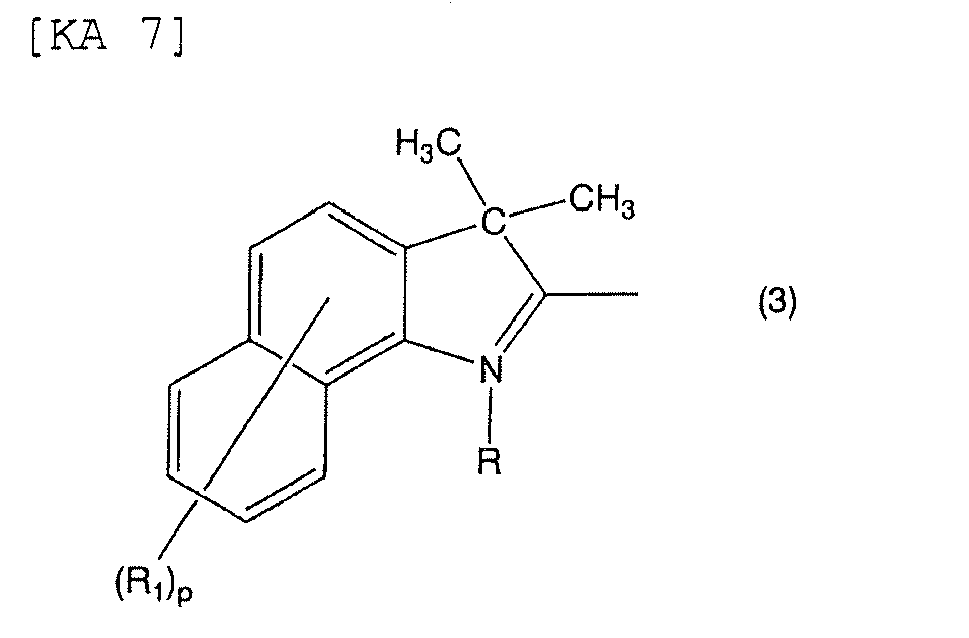
-

- In the above formulae (2) to (4), R1 represents a halogen atom, an alkyl group or an alkoxyalkyl group; and p represents 0 or an integer not larger than 4. Further, R means the same as in the above formula (1). In the above formula (1), L represents a linking group to formmono-, di- or tri-carbocyanine, and is preferably any one of the following formulae (5) to (10).
-
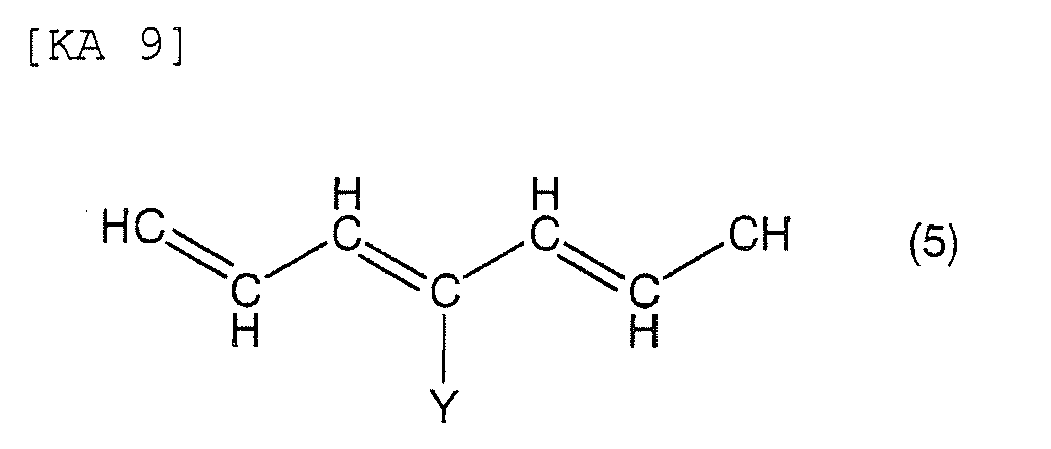


-


- In the formula (1), each of R and R' independently represents an alkyl group or an alkoxyalkyl group. The alkyl group includes, for example, a C1-C5 alkyl group such as a methyl group, an ethyl group, a n-propyl group, an i-propyl group, a n-butyl group, an i-butyl group, a t-butyl group, a n-amyl group, an i-amyl group and a t-amyl group, and the alkoxyalkyl group includes, for example, a (C1-C4)alkoxy(C1-C4)alkyl group such as a methoxymethyl group, a methoxyethyl group or an ethoxyethyl group. R or R' is preferably a methyl group or a methoxyethyl group, and preferably both of R and R' are the same groups to each other from the viewpoint of easiness in synthesis.
- The alkyl group in the di(halogenoalkylsulfonyl)imide anion includes a saturated or an unsaturated, straight, branched or cyclic alkyl group generally having 1 to 36 carbon atoms. The alkyl group is preferably a saturated straight alkyl group having 1 to 20 carbon atoms, preferably 1 to 10 carbon atoms, further preferably 1 to 4 carbon atoms, and most preferably 1 carbon atom, which may have a substituent. The halogen atom in the di(halogenoalkylsulfonyl)imide anion is preferably a fluorine atom, a chlorine atom, a bromine atom or an iodine atom, more preferably a fluorine atom , a chlorine atom or a bromine atom, and most preferably a fluorine atom. The halogenoalkyl group in the di(halogenoalkylsulfonyl)imide anion includes a trifluoromethyl group, a difluoromethyl group, a monofluoromethyl group, a dichloromethyl group, a monochloromethyl group, a dibromomethyl group, a difluorochloromethyl group, a pentafluoroethyl group, a tetrafluoroethyl group, a trifluoroethyl group, a trifluorochloroethyl group, a difluoroethyl group, a monofluoroethyl group, a trifluoroiodoethyl group, a heptafluoropropyl group, a hexafluoropropyl group, a pentafluoropropyl group, a tetrafluoropropyl group, a trifluoropropyl group, a difluoropropyl group, a monofluoropropyl group, a perfluorobutyl group, a perfluorohexyl group, a perfluorooctyl group, a perfluorooctylethyl group, a pentafluoroisopropyl group, a heptafluoroisopropyl group, a perfluoro-3-methylbutyl group and a perfluoro-3-methylhexyl group, and is preferably a trifluoromethyl group.
- The cyanine compound represented by the formula (1) can be produced through various processes, for example, through the following processes described in Patent Literature 3. Namely, 2 moles of a compound represented by the formula (11) :
-

- [KA 16]
OHC-L=CHOH (12)
-

- (wherein, in the formula (12) and the formula (13), L means the same as in the above formula (1));
- and 1 mole of a salt such as a salt of the di(halogenoalkylsulfonyl)imide with an alkali metal are condensed, if necessary, in the presence of a basic catalyst such as sodium acetate, potassium acetate, piperazine and piperidine, in a dehydrating organic acid such as acetic anhydride or a mixture of acetic anhydride and glacial acetic acid, under the heating conditions, for example, at 50 to 140°C for generally 10 to 12 hours, preferably 10 to 60 minutes, to synthesize a symmetrical cyanine compound (a compound where Q' and R' in the formula (1) are same to Q and R, respectively). An asymmetrical cyanine compound can be synthesized by the same procedure as in the above description except that 1 mole of a compound of the formula (11) and 1 mole of another compound of the formula (11) which has different Q and R from the above compound (Q' and R' different from Q and R in the formula (1)) are used instead of 2 moles of a compound of the formula (11).
- Alternatively, 1 mole of a compound of the formula (14):
-

-

- Next, specific examples of the salt of a cation of the cyanine coloring matter with a di(halogenoalkylsulfonyl)imide anion to be used in the present invention are shown below. However, examples of the compounds to be used in the present invention are not limited to these compounds.
-


-


-


-


-


-


- The cyanine compound to be used in the present invention, preferably the cyanine compound of the present invention, is suitably used as a near infrared rays absorbing coloring matter for a near infrared rays absorbing filter, a near infrared rays absorbing coloring matter for an optical filter, a coloring matter for improving image characteristics to be used for obtaining neutral gray and the like. The cyanine compound can be also used in an optical information recording medium.
- The optical filter of the present invention can be obtained typically by dissolving the cyanine compound to be used in the present invention in a solvent or the like, mixing, with a resin liquid or the like, if necessary, and then coating or molding. In the optical filter of the present invention, a way by which the cyanine compound is contained, is not particularly limited, so long as the compound is contained so that unnecessary near infrared rays can be cut off. For example, a solution containing said cyanine compound may be coated on a substrate, or may be coated on a substrate together with a binder resin to form a film. Or otherwise, a resin layer containing said cyanine compound may be provided on a substrate. Alternatively, a substrate itself may be a layer comprising a resin composition (or hardened body thereof) containing the cyanine compound to be used in the present invention. Generally, substrate is not particularly limited, so long as the substrate can be used for the optical filter or the like, but usually a substrate made of a resin is used. Thickness of the layer is usually around 0.1 µm to 10 mm, but it is decided, as appropriate, depending on, the target of cutoff rate for near infrared rays, or the like. Further, content of the cyanine compound to be used in the present invention is also decided, as appropriate, depending on the target of cutoff rate for near infrared rays or the like. Usually, concentration of said cyanine compound and thickness of the layer are preferably adjusted so that a cutoff rate for near infrared rays or the like as a target becomes not less than 50%, preferably not less than 60% with a film layer containing said cyanine compound having a thickness of 0.5 to 10 µm. Concentration of said cyanine compound to be compounded in the resin varies depending on absorbance of the compound, film thickness, target cutoff rate, and the like, therefore it is not categorically described, but it is usually around 0.01 to 40 parts in a film layer containing said cyanine compound, and around 0.1 to 30 parts in the case of a film layer having the above thickness based on 100 parts of resin. The resin to be used is not particularly limited so long as the resin is capable of forming a film layer, and includes vinyl compounds such as polyethylene, polystyrene, poly(acrylic acid), poly(acrylate ester), poly(vinyl acetate), polyacrylonitrile, poly(vinyl chloride), poly(vinyl fluoride) and addition polymers of these vinyl compounds; poly(methacrylic acid); poly(methacrylate ester); poly(vinylidene chloride); poly (vinylidene fluoride); poly(vinylidene cyanide); copolymers of a vinyl compound or a fluorine type compound such as vinylidene fluoride / trifluoroethylene copolymer, vinylidene fluoride / tetrafluoroethylene copolymer, and vinylidene cyanide / vinyl acetate copolymer; fluorine-containing resins such as poly(trifluoroethylene), poly(tetrafluoroethylene) and poly(hexafluoropropylene); polyamides such as nylon 6 and nylon 66; polyimides; polyurethanes; polypeptides; polyesters such as polyethylene terephthalate; polycarbonates; polyethers such as polyoxymethylene; epoxy resins; poly(vinyl alcohol); poly(vinyl butyral); and the like.
- Method for preparing the optical filter of the present invention is not particularly limited, and, for example, the following methods well-known per se can be utilized.
- (1) A method to produce a resin plate or a film by kneading the cyanine compound to be used in the present invention with a resin followed by hot forming;
- (2) A method to produce a resin plate or a film by performing cast polymerization the cyanine compound to be used in the present invention with a resin monomer or a prepolymer of a resin monomer in the presence of a polymerization catalyst;
- (3) A method by preparing a coating composition containing the cyanine compound to be used in the present invention and coating on a transparent resin plate, a transparent film, or a transparent glass plate;
- (4) A method to produce a laminated resin plate, a laminated resin film, or a laminated glass plate by using a composition containing the cyanine compound to be used in the present invention and a resin (adhesive).
- The production method of (1) generally includes a method to produce a resin plate by adding the cyanine coloring matter to be used in the present invention to powder or pellet of a substrate resin and heating to 150 to 350°C to dissolve followed by forming, a method to make a film (resin plate) using an extruder and the like, although processing temperature and film(plate)-making conditions, etc. differ to some extent depending on the resin to be used. Amount of the cyanine coloring matter of the present invention to be added varies depending on thickness, absorption intensity, transmittance for visible light, and the like of a resin plate or a film to be made, but it is usually 0.01 to 30% by mass, preferably 0.03 to 15% by mass based on the mass of substrate resin.
- In the method (2), forming is performed by injecting the above compound and a resin monomer or a prepolymer of a resin monomer into a mold in the presence of a polymerization catalyst to react to harden therein, or casting into a metal mold to solidify to a hard product in the mold. A number of resins can be formed by this process, and specific examples of the resin, to which such a method can be applied, include acrylic resin, diethyleneglycol-bis(allylcarbonate) resin, epoxy resin, phenol-formaldehyde resin, polystyrene resin, silicone resin, and the like. Among them, casting method by mass polymerization of methyl methacrylate which gives an acrylic resin sheet superior in hardness, heat resistance and chemical resistance, is preferable.
- As polymerization catalyst, well-known radical thermal polymerization initiators can be utilized. Those initiators include peroxides such as benzoyl peroxide, p-chlorobenzoyl peroxide, diisopropyl peroxicarbonate, and the like; and azo compounds such as azobisisobutyronitrile. Amount thereof to be used is generally 0.01 to 5% by mass based on the total amount of the mixture. Heating temperature in the thermal polymerization is generally 40 to 200°C, and polymerization time is generally around 30 minutes to 8 hours. Further, besides the thermal polymerization, photopolymerization method can be employed by adding a photopolymerization initiator or a sensitizer.
- The method (3) includes a method to prepare a coating composition by dissolving the cyanine coloring matter to be used in the present invention in a binder resin and an organic solvent, a method to prepare an aqueous coating composition by pulverizing and dispersing the above compound in the presence of a resin, and the like. Among these, in the method to prepare a coating composition by dissolving the cyanine coloring matter to be used in the present invention in a binder resin and an organic solvent, the resin which can be used as a binder include, for example, aliphatic ester resin, acryl-based resin, melamine resin, urethane resin, aromatic ester resin, polycarbonate resin, polyvinyl-based resin, aliphatic polyolefin resin, aromatic polyolefin resin, polyvinyl alcohol resin, modified polyvinyl resin, and the like, or copolymer resin thereof.
- As a solvent, a solvent of halogen type, alcohol type, ketone type, ester type, aliphatic hydrocarbon type, aromatic hydrocarbon type and ether type, or a mixture thereof can be used. Concentration of the cyanine coloring matter to be used in the present invention varies depending on thickness, absorption intensity and transmittance for visible light of a coating layer to be prepared, but is generally 0.1 to 30% by mass, based on the binder resin.
- Using the thus produced coating composition, coating can be performed on a transparent resin film, a transparent resin plate, a transparent glass plate, or the like using a spin coater, a bar coater, a roll coater, spraying, or the like to obtain a near infrared rays absorbing filter.
In the method (4), as a resin for adhesive, well-known transparent adhesives for resin such as silicone type, urethane type, acryl type or the like, or for laminated glass such as polyvinyl butyral adhesive for laminated glass, ethylene / vinyl acetate type adhesive or the like, can be used. Using an adhesive containing 0.1 to 30% by mass of the cyanine coloring matter to be used in the present invention, transparent resin plates with each other, a resin plate with a resin film, a resin plate with a glass, resin films with each other, a resin film with a glass, and glass plates with each other are adhered to produce an optical filter.
In this connection, when kneading or mixing is performed in each method, an additive usually used in resin forming such as UV absorber, plasticizer, or the like may be added. - The optical filter, in particular, a filter for absorbing near infrared rays of the present invention may be produced by comprising one or more kinds of the cyanine compounds to be used in the present invention only as a near infrared rays absorbing compound, or further comprising a near infrared rays absorbing compound other than the cyanine compound to be used in the present invention in combination. Other near infrared rays absorbing compound which can be used in combination includes, for example, diimonium type coloring matter, phthalocyanine type coloring matter, metal complex coloring matter such as nickel dithiol complex. When basic structure of these other near infrared rays absorbing compounds capable of being used in combination is a cationic coloring matter, a counter anion thereof is preferably the same anion to the cyanine compound to be used in the present invention. In particular, the near infrared rays absorbing compound is preferably a diimonium type coloring matter, and further preferably a diimonium type coloring matter whose anion is the same anion to the cyanine coloring matter to be used in the present invention. Further, examples of inorganic metal near infrared rays absorbing compound capable of being used in combination include, for example, copper compound such as metal copper, copper sulfide and copper oxide, metal mixture containing zinc oxide as a main component, tungsten compound, ITO, ATO, and the like.
- Further, even when the optical filter of the present invention is an optical filter for improving image characteristics (mainly for cutting-off neon light other than near infrared rays and/or for preventing reflection of fluorescent light), the optical filter may comprise one or more kinds of the cyanine compounds of the present invention only which has absorbability in said wavelength region, or further comprise the above near infrared rays absorbing compound in combination. When a near infrared rays absorbing compound is used in combination, an optical filter having both functions of absorption of near infrared rays and improvement of image characteristics can be obtained.
Still further, in order to change color tone of the optical filter, the cyanine compound to be used in the present invention or other coloring matter may be added as a coloring matter having an absorption in the visible region (a coloring matter for improving image characteristics). Alternatively, an optical filter containing a coloring matter for improving image characteristics only is produced, and thereafter the optical filter can be laminated with the optical filter for absorbing near infrared rays of the present invention. - In such an optical filter for absorbing near infrared rays and the like, when it is used as a front plate of a plasma display, transmittance for visible light is desirably as high as possible, and needs to be not less than 40%, preferably not less than 50%.
The near infrared rays region to be cut-off is preferably 750 to 1,200 nm, more preferably 800 to 1,000 nm, and a desirable average transmittance of near infrared rays in this region is not more than 50%, more preferably not more than 30%, further more preferably not more than 20%, and particularly preferably not more than 10%.
Further, as a coloring matter for improving image characteristics, because unnecessary neon light other than the ideal emissions of three primary colors is absorbed, preferably a coloring matter having a sharp absorption at a specified wavelength region of around 580 to 620 nm is used. Furthermore, a superior optical filter can be obtained by using, for example, a coloring matter having a sharp absorption in a region of 490 to 550 nm as a countermeasure for reflection of fluorescent light, and a coloring matter having a sharp absorption in a region of 560 to 580 nm to absorb an emission of xenon, respectively. Thus, in the optical filter of the present invention, the cyanine compound may be selected so that the coloring matter has a sharp absorption at any region in the wavelengths of 490 to 1,200 nm corresponding to the purpose.
As the cyanine compound to be used in the present invention, a compound, whose maximum absorption wavelength is located within the wavelength region to be cut-off, is preferably used. - The filter of the present invention for absorbing near infrared rays can be used not only for an application such as a front plate of displays, but for a filter or a film which needs to cut-off near infrared rays, such as heat insulating film, optical product, sunglasses, and the like.
The optical filter of the present invention does not contain antimony nor arsenic, and is environment-friendly and more superior in stability compared with a conventional near infrared rays absorbing filter which does not contain antimony but contains perchlorate ion, hexafluorophosphate ion or fluoroborate ion. Furthermore, the filter of the present invention has a sufficient solubility and is superior in processability. In particular, since the filter of the present invention is extremely superior in heat resistance, wet heat resistance and light resistance, and hardly brings on a reaction such as heat decomposition, an optical filter which hardly gives rise to coloring in the visible region can be obtained. Further, due to such features, the filter is suitable to a near infrared rays absorbing filter for plasma display or the like. Still further, the filter can be suitably used for a near infrared rays absorbing film such as heat insulating film and sunglasses, or the like. - Hereinafter, the present invention will be further specifically explained using Examples. In Examples, parts and % mean parts by mass and % by mass, respectively, unless otherwise noted.
In this connection, absorbance (OD value) was measured using a spectrophotometer UV-3150 made by Shimadzu Corp. When measurement was carried out using a solvent, the same solvent was measured as a blank, and when measurement was carried out using a filter, a filter which had the same composition except that only the cyanine compound was not contained was produced and measured as a blank. - A mixture of 9.6 parts of 1,3,3-trimethyl-2-methyleneindoline, 10.6 parts of 1,3,3-trimethyl-2-formylmethyleneindoline, 17.6 parts of potassium (bis-trifluoromethanesulfonyl)imide represented by the following formula:
-

- in 75 parts of acetic anhydride was boiled under cooling-reflux for 1 hour, then cooled to room temperature. Subsequently, the reaction liquid was filtered under aspiration to remove insoluble impurity. Thereafter, 100 parts of water was added dropwise to the reaction liquid. The precipitated crystal was filtered under aspiration, recrystallized from 40 parts of methanol, washed with 5 parts of methanol, then with water, and dried, to obtain 19.4 parts of the aforementioned Compound 1. Spectroscopic characteristics of the resultant Compound 1 were as follows.
Maximum absorption wavelength: 544 nm (in methanol);
Molar absorbance coefficient: 133,000 (in methanol). - Into a mixed solvents of 50 parts of acetic anhydride and 25 parts of acetic acid, 14.9 parts of 4,5-benzo-1-(2-methoxyethyl)-3,3-dimethyl-2-methyleneindoli ne, 8.9 parts of triethyl orthoformate, 8.8 parts of potassium (bis-trifluoromethanesulfonyl)imide and 2.5 parts of concentrated hydrochloric acid were charged, and the reaction mixture was boiled under cooling-reflux for 2 hours, then cooled to room temperature. Subsequently, 25 parts of water was added, and the precipitated crystal was filtered under aspiration. The crystal was boiled in 15 parts of isopropyl alcohol under cooling-reflux for 1 hour, and then cooled to room temperature. The crystal was filtered under aspiration, washed with 5 parts of isopropyl alcohol, then with water, and dried, to obtain 13. 4 parts of the aforementioned Compound 3. Spectroscopic characteristics of the resultant Compound 3 were as follows.
Maximum absorption wavelength: 588 nm (in methanol);
Molar absorbance coefficient: 119,000 (in methanol). - The same procedures were repeated as in Example 1 except that 14.9 parts of 4,5-benzo-1-(2-methoxyethyl)-3,3-dimethyl-2-methyleneindoline was used instead of 9.6 parts of 1,3,3-trimethyl-2-methyleneindoline, to obtain 18.3 parts of the aforementioned Compound 12. Spectroscopic characteristics of the resultant Compound 12 were as follows.
Maximum absorption wavelength: 555 nm (in methanol);
Molar absorbance coefficient: 119,000 (in methanol). - Into 50 parts of acetic acid, 14.9 parts of 4,5-benzo-1-(2-methoxyethyl)-3,3-dimethyl-2-methyleneindoli ne, 6.5 parts of malonaldehydedianyl·hydrochloride, and 4.1 parts of sodium acetate were charged and the reaction mixture was heated up to 60°C. 5.1 parts of acetic anhydride was added dropwise thereto at 50°C to 60°C over 1 hour, and then stirred at 50°C to 60°C for further 2 hours to complete the condensation reaction. The reaction liquid was cooled to room temperature, and then filtered under aspiration to remove insoluble impurity. Subsequently, a solution of 8.8 parts of potassium (bis-trifluoromethanesulfonyl)imide in 40 parts of water was added dropwise to the reaction liquid. The precipitated crystal was filtered under aspiration, recrystallized from 40 parts of methanol, washed with 5 parts of methanol, then with water, and dried, to obtain 14.9 parts of the aforementioned Compound 17. Spectroscopic characteristics of the resultant Compound 17 were as follows.
Maximum absorption wavelength: 680 nm (in methanol);
Molar absorbance coefficient: 220,000 (in methanol). - Into 25 parts of acetic acid, 14.9 parts of 4,5-benzo-1-(2-methoxyethyl)-3,3-dimethyl-2-methyleneindoli ne and 4.5 parts of 2-chloro-1-formyl-3-hydroxymethylenecyclohexene were charged and the reaction mixture was heated up to 60°C. 5.1 parts of acetic anhydride was added dropwise thereto at 50°C to 60°C over 1 hour, and then stirred at 50°C to 60°C for further 2 hours to complete the condensation reaction. The reaction liquid was cooled to room temperature, and then filtered under aspiration to remove insoluble impurity. Subsequently, a solution of 8.8 parts of potassium (bis-trifluoromethanesulfonyl)imide in 40 parts of water was added dropwise to the reaction liquid. The precipitated crystal was filtered under aspiration, recrystallized from 70 parts of N,N-dimethylformamide, washed with 5 parts of methanol, then with water, and dried, to obtain 19.1 parts of the aforementioned Compound 31. Spectroscopic characteristics and decomposition temperature of the resultant Compound 31 were as follows. In this connection, decomposition temperature was shown by a value of the temperature at which weight loss initiated in a thermogravimetric - differential thermal analysis (TG-DTA).
Maximum absorption wavelength: 820 nm (in methanol);
Molar absorbance coefficient: 270,000 (in methanol);
Decomposition temperature: 242.9°C (TG-DTA).
Further, solubility to various types of solvents at room temperature was as follows.
Dichloromethane: 19.2%;
N,N-dimethylformamide: 24.6%;
Methyl ethyl ketone(MEK): 2.9%;
Cyclopentanone: 14.5%. - Into 25 parts of acetic acid, 13.2 parts of 5-chloro-1-(2-methoxyethyl)-3,3-dimethyl-2-methyleneindolin e and 3.6 parts of 2-chloro-1-formyl-3-hydroxymethylenecyclohexene were charged and the reaction mixture was heated up to 60°C. 4.1 parts of acetic anhydride was added dropwise thereto at 50°C to 60°C over 2 hours, then stirred at 50°C to 60°C for further 1 hour to complete the condensation reaction. The reaction liquid was cooled to room temperature, and then filtered under aspiration to remove insoluble impurity. Subsequently, a solution of 7.0 parts of potassium (bis-trifluoromethanesulfonyl)imide in 45 parts of water was added dropwise to the reaction liquid. The precipitated crystal was filtered under aspiration, recrystallized from 15 parts of N,N-dimethylformamide, washed with 5 parts of methanol, then with water, and dried, to obtain 10.2 parts of the aforementioned Compound 35. Spectroscopic characteristics and decomposition temperature of the resultant Compound 35 were as follows.
Maximum absorption wavelength: 790 nm (in methanol);
Molar absorbance coefficient: 285,000 (in methanol);
Decomposition temperature: 226.3°C (TG-DTA). - The same procedures were repeated as in Example 6 except that 5.7 parts of glutaconic acid aldehydedianil·hydrochloride was used instead of 3.6 parts of 2-chloro-1-formyl-3-hydroxymethylenecyclohexene, to obtain 9.9 parts of the aforementioned Compound 36. Spectroscopic characteristics and decomposition temperature of the resultant Compound 36 were as follows.
Maximum absorption wavelength: 751 nm (in methanol);
Molar absorbance coefficient: 273,000 (in methanol);
Decomposition temperature: 226.6°C (TG-DTA). - The same procedures were repeated as in Example 6 except that 10.2 parts of 1-(2-methoxyethyl)-3,3-dimethyl-2-methyleneindoline was used instead of 13.2 parts of 5-chloro-1-(2-methoxyethyl)-3,3-dimethyl-2-methyleneindolin e, to obtain 8.8 parts of the following Compound A. Spectroscopic characteristics and decomposition temperature of the resultant Compound A below were as follows.
Maximum absorption wavelength: 780 nm (in methanol);
Molar absorbance coefficient: 278,000 (in methanol);
Decomposition temperature: 224.6°C (TG-DTA). -


- The same procedures were repeated as in Example 6 except that 15.3 parts of 3,3-dimethyl-2-methylene-1-(tetrahydrofurfuryl)methylindoli ne represented by the following formula:
-

- was used instead of 13.2 parts of 5-chloro-1-(2-methoxyethyl)-3,3-dimethyl-2-methyleneindolin e, to obtain 16.4 parts of the aforementioned Compound 33. Spectroscopic characteristics of the resultant Compound 33 were as follows.
Maximum absorption wavelength: 823 nm (in methanol);
Molar absorbance coefficient: 264,000 (in methanol). - Into 50 parts of ethanol, 17.5 parts of 1-n-butyl-2-methylbenzothiazolium iodide and 3.6 parts of 2-chloro-1-formyl-3-hydroxymethylenecyclohexene were charged and the reaction mixture was heated up to 60°C. 10.6 parts of triethylamine was added dropwise thereto at 50°C to 60°C over 1 hour, then stirred at 50°C to 60°C for further 1 hour to complete the condensation reaction. The reaction liquid was cooled to room temperature, and then filtered under aspiration to remove insoluble impurity. Subsequently, a solution of 7.0 parts of potassium (bis-trifluoromethanesulfonyl)imide in 45 parts of water was added dropwise to the reaction liquid. The precipitated crystal was filtered under aspiration, recrystallized from 25 parts of N,N-dimethylformamide, washed with 15 parts of methanol, then with water, and dried, to obtain 3.3 parts of the aforementioned Compound 34. Spectroscopic characteristics of the resultant Compound 34 were as follows.
Maximum absorption wavelength: 797 nm (in methanol);
Molar absorbance coefficient: 331,000 (in methanol). - Into 50 parts of ethanol, 15.7 parts of 1-ethyl-2-methylquinolinium iodide, 3.6 parts of 2-chloro-1-formyl-3- hydroxymethylenecyclohexene and 7.0 parts of potassium (bis-trifluoromethanesulfonyl)imide were charged and the reaction mixture was heated up to 60°C. 10.6 parts of triethylamine was added dropwise thereto at 50°C to 60°C over 1 hour, then stirred at 50°C to 60°C for further 1 hour to complete the condensation reaction. The reaction liquid was cooled to room temperature. The precipitated crystal was filtered under aspiration, and then boiled in 50 parts of methanol under cooling-reflux for 1 hour. Subsequently, the reaction liquid was cooled to room temperature. The precipitated crystal was filtered under aspiration, washed with 15 parts of methanol, then with water, and dried, to obtain 11.4 parts of the aforementioned Compound 37. Spectroscopic characteristics of the resultant Compound 37 were as follows.
Maximum absorption wavelength: 846 nm (in methanol);
Molar absorbance coefficient: 235,000 (in methanol). - In 18.8 parts of MEK, 0.4 parts of Compound 31 obtained in the above Example 5 was dissolved. To this solution, 80 parts of a resin solution prepared by dissolving 25 parts of an acryl-based resin (DIANAL (RTM) BR-80, made by Mitsubishi Rayon Co., Ltd.) in 75 parts of MEK was mixed to obtain a solution for coating. This solution was coated on a polyester film so that thickness becomes 2 to 4 µm, dried at 80°C to obtain an optical filter of the present invention. This filter was used as a filter for absorbing near infrared rays.
The resultant filter for absorbing near infrared rays was left to stand in an oven at 80°C for 7 days. Then absorbance (OD value) of the filter was measured with a spectrophotometer before and after the test, and residual ratio of the coloring matter was determined from the change of the absorbance (OD value) at the maximum absorption wavelength. The results of the heat resistance test are shown in Table 1.
Residual ratio = (Absorbance after the test / Absorbance before the test) x 100 - The same procedures were repeated as in Example 12 using Compound 35 obtained in the above Example 6, to produce a filter, which was evaluated similarly. The results are shown in Table 1.
- The same procedures were repeated as in Example 12 using the above Compound 30, Compound A obtained in the above Example, the following Compound B and Compound C, respectively, to produce filters containing each of above compounds, and evaluation thereof was carried out in the same manner as in Example 12. The results are shown in Table 2.
-
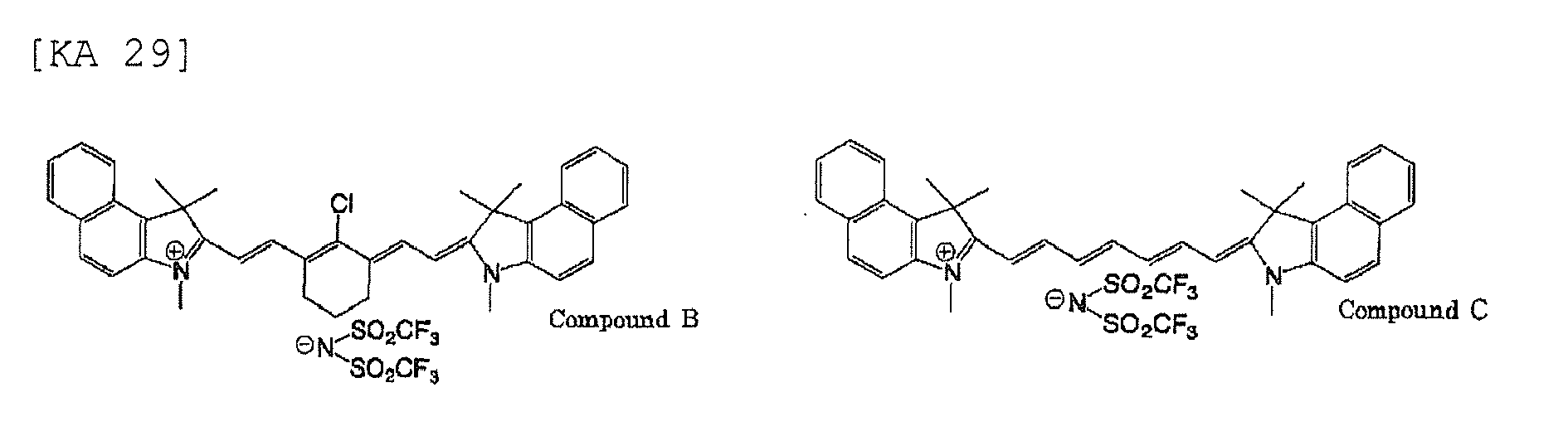
- The same procedures were repeated as in Example 5 except that sodium hexafluoroantimonate was used instead of potassium (bis-trifluoromethanesulfonyl)imide, to synthesize a hexafluoroantimonate salt (SbF6 salt), and the same procedures were repeated as in Example 12 except that this compound was used, to produce a filter, which was evaluated similarly. The results are shown in Table 1.
- A compound in which the (bis-trifluoromethanesulfonyl)imide salt in Compound 35 obtained in Example 6 was replaced with hexafluoroantimonate salt (SbF6 salt) was synthesized in the same manner as in Comparative Example 1, then a filter was produced using the compound in the same manner as in Example 13, and evaluated similarly. The results are shown in Table 1.
- The same procedures were repeated as in Example 5 except that sodium tetrafluoroborate and sodium p-toluenesulfonate was used instead of potassium (bis-trifluoromethanesulfonyl)imide, to synthesize tetrafluoroborate salt (BF4 salt) (Comparative Example 3) and p-toluenesulfonate salt (PTS salt) (Comparative Example 4), respectively, instead of the (bis-trifluoromethanesulfonyl)imide salt in Compound 31. Then the same procedures were repeated as in Example 12 except that each of these compounds was used, to produce filters, which were evaluated similarly. The results are shown in Table 1.
Similarly to the above, compounds in which the (bis-trifluoromethanesulfonyl)imide salt in Compound 35 obtained in Example 6 was replaced with a tetrafluoroborate salt (BF4 salt) (Comparative Example 5) and a p-toluenesulfonate salt (PTS salt) (Comparative Example 6), respectively, were synthesized. Then the same procedures were repeated as in Example 13 except that each of these compounds was used, to produce filters, which were evaluated similarly. The results are shown in Table 1. - [Table 1]
Table 1, Heat resistance stability test Compound No. Compound No. Absorbance (OD value) Residual Ratio Initial After 7 days Example 12 (Compound 31) 0.65 0.52 80.9% Comparative Example 1 (SbF6 salt) 0.66 0.50 75.0% Comparative Example 3 (BF4 salt) 0.71 0.55 77.4% Comparative Example 4 (PTS salt) 0.51 0.36 69.5% Example 13 (Compound 35) 0.76 0.67 89.1% Comparative Example 2 (SbF6 salt) 0.73 0.58 79.2% Comparative Example 5 (BF4 salt) 0.77 0.62 81.2% Comparative Example 6 (PTS salt) 0.55 0.35 62.8% - [Table 2]
Table 2, Heat resistance stability test Compound No. Absorbance (OD value) Residual Ratio Initial After 7 days Example 14 (Compound 30) 0.83 0.74 89.7% Example 14 (Compound A) 0.83 0.72 87.2% Example 14 (Compound B) 0.67 0.57 85.6% Example 14 (Compound C) 0.75 0.61 80.9% - From Table 1, it is understood that the filters produced using the compounds of the present invention ((bis-trifluoromethanesulfonyl)imide salts) are superior in stability under high temperature condition from their higher residual ratios compared with those of the filters produced using the compounds of Comparative Examples having different kinds of anions.
From Table 2, it is understood that the other compounds of the present invention are also superior in stability under high temperature condition. - The filter obtained in Example 12 (the filter using Compound 31) was left to stand in a high temperature constant humidity chamber at 85°C and 85% RH for 3 days. Absorbance (OD value) of the filter was measured with a spectrophotometer before and after the test, and residual ratio of the coloring matter was determined from the change of the absorbance (OD value) at the maximum absorption wavelength.
- The same procedures were repeated as in Example 12 except that the filter obtained in Example 13 was used, to perform the wet heat resistance test, and residual ratio of the coloring matter was determined. The results are shown in Table 3.
- The same procedures were repeated as in Example 12 except that the filters obtained in Example 14 (the filters using each of Compounds 30, A, B and C, respectively) were used, to perform the wet heat resistance test, and residual ratios of the coloring matters were determined. The results are shown in Table 3.
- The filters obtained in Comparative Examples 1 to 6 were left to stand in a high temperature constant humidity chamber at 85°C and 85% RH for 3 days. Then absorbances (OD values) of the filters were measured with a spectrophotometer before and after the test, and residual ratios of the coloring matters were determined from the changes of the absorbances (OD values) at each maximum absorption wavelength. The test using the filter obtained in Comparative Example 1 is termed as Comparative Example 7, the test using the filter obtained in Comparative Example 2 is termed as Comparative Example 8, the test using the filter obtained in Comparative Example 3 is termed as Comparative Example 9, the test using the filter obtained in Comparative Example 4 is termed as Comparative Example 10, the test using the filter obtained in Comparative Example 5 is termed as Comparative Example 11, and the test using the filter obtained in Comparative Example 6 is termed as Comparative Example 12. The results are shown in Table 3.
- [Table 3]
Table 3, Wet heat resistance stability test Compound No. Absorbance (OD value) Residual Ratio Initial After 3 days Example 15 (Compound 31) 0.65 0.59 90.9% Comparative Example 7 (SbF6 salt) 0.66 0.54 81.0% Comparative Example 9 (BF4 salt) 0.71 0.63 88.2% Comparative Example 10 (PTS salt) 0.51 0.43 84.2% Example 16 (Compound 35) 0.76 0.71 93.9% Comparative Example 8 (SbF6 salt) 0.73 0.62 84.9% Comparative Example 11 (BF4 salt) 0.77 0.61 79.0% Comparative Example 12 (PTS salt) 0.55 0.46 83.2% Example 17 (Compound 30) 0.83 0.80 97.3% Example 17 (Compound A) 0.83 0.82 99.9% Example 17 (Compound B) 0.67 0.63 93.6% Example 17 (Compound C) 0.75 0.67 89.7% - From Table 3, it is understood that the filters produced using the compounds obtained in Examples of the present invention are also superior in high temperature and high humidity condition from higher residual ratios of coloring matters compared with those of the filters produced using the compounds obtained in Comparative Examples.
- The same procedures were repeated as in Example 5 except that 9.1 parts of (2-chloro-3-phenylaminomethylene-cyclopenta-1-enylmethylene )-phenylammonium·hydrochloride represented by the following formula:
-


- was used instead of 4.5 parts of 2-chloro-1-formyl-3-hydroxymethylenecyclohexene, to obtain 17 parts of Compound 46 represented by the following formula:
-

- Spectroscopic characteristics and decomposition temperature of the resultant Compound 46 were as follows. In this connection, decomposition temperature was shown by a value of the temperature at which weight loss initiated in a thermogravimetric - differential thermal analysis (TG-DTA).
Maximum absorption wavelength: 845 nm (in methanol);
Molar absorbance coefficient: 275,000 (in methanol);
Decomposition temperature: 213.0°C (TG-DTA).
Further, solubility to various kinds of solvents at room temperature was as follows.
N,N-dimethylformamide: 3.4%;
Methyl ethyl ketone (MEK): 0.2%;
Cyclopentanone: 3.1%;
Cyclohexanone: 0.8%. - The same procedures were repeated as in Example 5 except that 17.3 parts of 4,5-benzo-1-(2-n-butoxyethyl)-3,3-dimethyl-2-methyleneindol ine was used instead of 14.9 parts of 4,5-benzo-1-(2-methoxyethyl)-3,3-dimethyl-2-methyleneindoli ne, to obtain 18.6 parts of Compound 47 represented by the following formula:
-

Maximum absorption wavelength: 845 nm (in methanol);
Molar absorbance coefficient: 275,000 (in methanol);
Decomposition temperature: 186.0°C (TG-DTA).
Further, solubility to various kinds of solvents at room temperature was as follows.
N,N-dimethylformamide: 4.5%;
Methyl ethyl ketone (MEK): 1.6%;
Cyclopentanone: 0.9%;
Cyclohexanone: 2.6%. - Since the optical filter of the present invention is capable of, for example, cutting-off near infrared rays, neon light or the like, as well as superior in transmittance for visible light, and at the same time, the coloring matter contained in said filter is also superior in wet heat resistance and the like, the optical filter of the present invention is useful as an optical filter for plasma displays, etc., and the like.
Claims (12)
- An optical filter comprising a salt of a cation of a cyanine coloring matter with a di (halogenoalkylsulfonyl) imide anion.
- The optical filter according to claim 1, wherein the salt of a cation of a cyanine coloring matter with a di(halogenoalkylsulfonyl)imide anion is represented by the following formula (1):

- The optical filter according to claim 2, wherein L in the formula (1) is one group selected from the group consisting of carbocyanine crosslinking groups represented by the following formulae:


- The optical filter according to claim 2 or 3, wherein R and R' in the formula (1) are a methyl group or a methoxyethyl group.
- The optical filter according to any one of claims 1 to 3, wherein said filter is for cutting-off near infrared rays, improving image characteristics, or both thereof.
- The optical filter according to any one of claims 1 to 3, wherein said filter is for a plasma display panel.
- The optical filter according to any one of claims 1 to 3, further comprising, as a near infrared rays absorbing agent, any coloring matter of a diimonium compound, a phthalocyanine type compound, or a nickel complex type compound.
- The optical filter according to claim 7, wherein an anion of diimonium compound is the same anion as a cyanine coloring matter.
- A cyanine compound represented by the following formula (1):


- The cyanine compound according to claim 9, wherein, in the formula (1), an indole group having Q or Q' linking to L is a group represented by an indole group represented by the following formula (4) (in the case of an indole group having Q' , the formula (4) should be read as a corresponding structural formula):


- The cyanine compound according to claim 9 or 10, wherein, in the formula (1), the linking group represented by L is a linking group represented by the following formula (9):
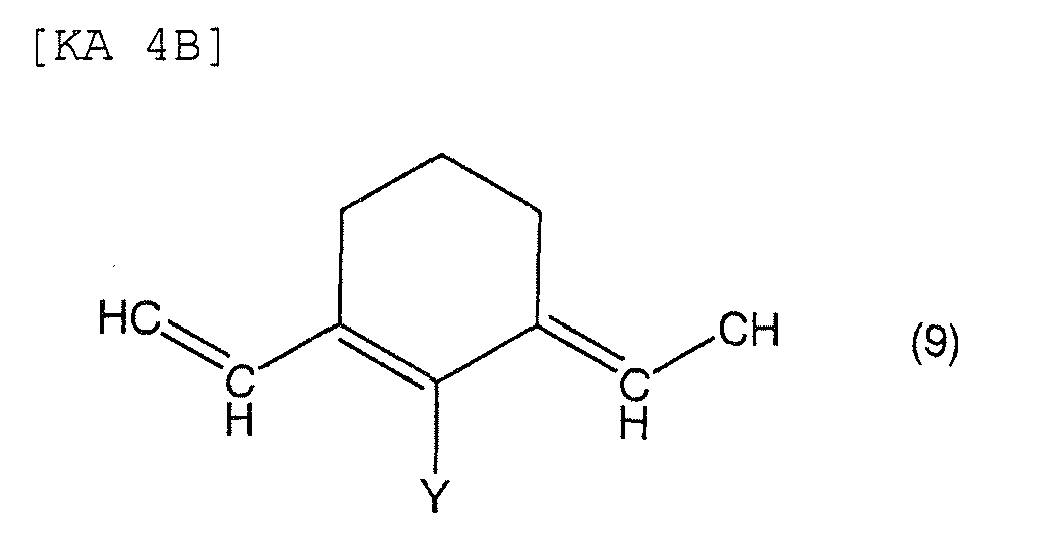
- The cyanine compound according to claim 9 or 10, wherein, in the formula (1), the linking group represented by L is a linking group represented by the following formula (8):

Applications Claiming Priority (2)
| Application Number | Priority Date | Filing Date | Title |
|---|---|---|---|
| JP2004204982 | 2004-07-12 | ||
| PCT/JP2005/012791 WO2006006573A1 (en) | 2004-07-12 | 2005-07-11 | Filter and cyanine compound |
Publications (2)
| Publication Number | Publication Date |
|---|---|
| EP1806605A1 true EP1806605A1 (en) | 2007-07-11 |
| EP1806605A4 EP1806605A4 (en) | 2008-09-24 |
Family
ID=35783914
Family Applications (1)
| Application Number | Title | Priority Date | Filing Date |
|---|---|---|---|
| EP05765593A Withdrawn EP1806605A4 (en) | 2004-07-12 | 2005-07-11 | Filter and cyanine compound |
Country Status (6)
| Country | Link |
|---|---|
| US (1) | US20080048155A1 (en) |
| EP (1) | EP1806605A4 (en) |
| JP (1) | JP4635007B2 (en) |
| KR (1) | KR20070041718A (en) |
| CN (1) | CN100501462C (en) |
| WO (1) | WO2006006573A1 (en) |
Cited By (1)
| Publication number | Priority date | Publication date | Assignee | Title |
|---|---|---|---|---|
| EP2677364A4 (en) * | 2011-02-18 | 2015-05-13 | Adeka Corp | PHOTOSENSITIVE COLORING COMPOSITION |
Families Citing this family (31)
| Publication number | Priority date | Publication date | Assignee | Title |
|---|---|---|---|---|
| US7939644B2 (en) * | 2003-08-21 | 2011-05-10 | Merck Patent Gmbh | Cyanoborate, fluoroalkylphosphate, fluoroalkylborate or imide dyes |
| JP4785588B2 (en) * | 2006-03-24 | 2011-10-05 | 株式会社Adeka | Optical filter |
| JP4808085B2 (en) * | 2006-06-09 | 2011-11-02 | 株式会社Adeka | Optical recording material |
| JP2008088426A (en) * | 2006-09-06 | 2008-04-17 | Nippon Kayaku Co Ltd | New cyanine compound and use of the same |
| US20090279168A1 (en) * | 2006-09-29 | 2009-11-12 | Yuka Hiwatashi | Adhesive composition for optical filter, optical filter and display device |
| KR100951524B1 (en) * | 2007-04-23 | 2010-04-07 | 삼성코닝정밀유리 주식회사 | Optical Filters for Display Devices |
| CN102947733B (en) * | 2010-06-23 | 2016-06-22 | 三菱化学株式会社 | Colored resin composition, color filter, liquid crystal display device, and organic EL display |
| JP5782797B2 (en) * | 2010-11-12 | 2015-09-24 | 信越化学工業株式会社 | Near infrared light absorbing dye compound, near infrared light absorbing film forming material, and near infrared light absorbing film formed thereby |
| KR101360014B1 (en) | 2010-11-12 | 2014-02-11 | 신에쓰 가가꾸 고교 가부시끼가이샤 | Near-Infrared Absorbing Dye, Near-Infrared Absorptive Film-Forming Composition, and Near-Infrared Absorptive Film |
| JP2014016376A (en) * | 2010-11-18 | 2014-01-30 | Nippon Kayaku Co Ltd | Color resin composition |
| KR101050270B1 (en) * | 2011-01-06 | 2011-07-19 | 최희선 | Synthetic wood for thermal expansion |
| US8722307B2 (en) | 2011-05-27 | 2014-05-13 | International Business Machines Corporation | Near-infrared absorptive layer-forming composition and multilayer film comprising near-infrared absorptive layer |
| CA2838581A1 (en) * | 2011-06-06 | 2012-12-13 | Asahi Glass Company, Limited | Optical filter, solid-state imaging element, imaging device lens and imaging device |
| KR101969612B1 (en) * | 2011-10-14 | 2019-04-16 | 제이에스알 가부시끼가이샤 | Optical filter, solid state image-capturing device using same, and camera module using same |
| KR101515429B1 (en) | 2011-11-11 | 2015-04-27 | 제일모직 주식회사 | Photosensitive resin composition and color filter using the same |
| JP5924241B2 (en) * | 2012-01-12 | 2016-05-25 | Jsr株式会社 | Colorant, coloring composition, color filter and display element |
| JP5904546B2 (en) * | 2012-08-03 | 2016-04-13 | 日本化薬株式会社 | Novel cyanine dye compound, resin composition and near-infrared cut filter |
| JP2014080584A (en) * | 2012-09-28 | 2014-05-08 | Jsr Corp | Coloring composition, color filter and display element |
| KR101556280B1 (en) * | 2012-12-07 | 2015-09-30 | 제일모직 주식회사 | Photosensitive resin composition for color filter and color filter using the same |
| US10011672B2 (en) | 2013-05-16 | 2018-07-03 | Samsung Sdi Co., Ltd. | Photosensitive resin composition for color filter and color filter using the same |
| CN104166308B (en) * | 2013-05-16 | 2018-04-10 | 第一毛织株式会社 | For colored filter photosensitive resin composition and use its colored filter |
| JP2015004838A (en) * | 2013-06-21 | 2015-01-08 | Jsr株式会社 | Near-infrared ray cut filter for solid imaging device, and solid imaging device and camera module using the filter |
| JP6052891B2 (en) * | 2013-08-09 | 2016-12-27 | 日本化薬株式会社 | Thermosetting resin composition and its near infrared cut filter |
| JP6496350B2 (en) * | 2013-09-06 | 2019-04-03 | 富士フイルム株式会社 | Colored composition, cured film, color filter, method of producing color filter, solid-state imaging device, image display device, polymer, xanthene dye |
| JP6226842B2 (en) * | 2014-09-16 | 2017-11-08 | 富士フイルム株式会社 | Near-infrared absorbing composition, cured film, near-infrared absorbing filter, solid-state imaging device, infrared sensor, compound |
| KR102455527B1 (en) | 2017-09-12 | 2022-10-14 | 삼성전자주식회사 | COMPOSITION FOR Near-Infrared Absorbing Film, Near-Infrared Absorbing Film, CAMERA MODULE AND ECTRONIC DEVICE |
| KR102025478B1 (en) | 2017-11-28 | 2019-09-25 | 주식회사 엘지화학 | Process for producing colorant composition, colorant composition using thereof, colorant dispersed solution, photosensitive resin composition, color filter and liquid crystal display |
| US11702546B2 (en) | 2018-10-24 | 2023-07-18 | California Institute Of Technology | Near-infrared heptamethine dyes for generation of singlet oxygen |
| TWI884985B (en) * | 2019-09-17 | 2025-06-01 | 日商凸版印刷股份有限公司 | Infrared light cutoff filter, filter for solid-state imaging element, solid-state imaging element, and method for manufacturing filter for solid-state imaging element |
| CN115040650A (en) * | 2022-07-13 | 2022-09-13 | 北京化工大学常州先进材料研究院 | Preparation and application methods of quinoline cyanine photo-thermal nanoparticles with aggregation-enhanced photo-thermal characteristics |
| KR102913750B1 (en) * | 2025-03-31 | 2026-01-19 | 한국화학연구원 | Near-infrared absorption materials and near-infrared blocking filter including the same |
Family Cites Families (11)
| Publication number | Priority date | Publication date | Assignee | Title |
|---|---|---|---|---|
| US5541235A (en) * | 1995-03-06 | 1996-07-30 | Minnesota Mining And Manufacturing Company | Organic soluble cationic dyes with fluorinated alkylsulfonyl counterions |
| JP4148548B2 (en) * | 1996-11-07 | 2008-09-10 | 富士フイルム株式会社 | Antireflection film and plasma display using the same |
| JPH10180922A (en) * | 1996-12-25 | 1998-07-07 | Nippon Kayaku Co Ltd | Infrared absorbing body |
| EP0934822B1 (en) * | 1998-02-04 | 2005-05-04 | Mitsubishi Chemical Corporation | Positive photosensitive composition, positive photosensitive lithographic printing plate and method for forming a positive image |
| EP1142961B1 (en) * | 2000-04-06 | 2008-08-06 | FUJIFILM Corporation | Dye complex and optical information recording medium |
| JP4596682B2 (en) * | 2001-05-30 | 2010-12-08 | 株式会社Adeka | Optical filter |
| JP2003337410A (en) * | 2002-05-20 | 2003-11-28 | Mitsubishi Chemicals Corp | Photopolymerizable composition, photopolymerizable image forming material, and image forming method using the same |
| JP4168031B2 (en) * | 2002-11-22 | 2008-10-22 | 日本カーリット株式会社 | Near-infrared absorbing dye and near-infrared blocking filter |
| JP4266708B2 (en) * | 2003-05-30 | 2009-05-20 | 株式会社シマノ | Electronic circuit device for fishing reel |
| JP4440720B2 (en) * | 2003-07-11 | 2010-03-24 | 旭硝子株式会社 | Optical film |
| JP3838234B2 (en) * | 2003-09-01 | 2006-10-25 | 東洋インキ製造株式会社 | Energy sensitive acid generator, acid generating method, and energy sensitive curable composition |
-
2005
- 2005-07-11 KR KR1020077000693A patent/KR20070041718A/en not_active Ceased
- 2005-07-11 US US11/630,811 patent/US20080048155A1/en not_active Abandoned
- 2005-07-11 JP JP2006529044A patent/JP4635007B2/en not_active Expired - Fee Related
- 2005-07-11 WO PCT/JP2005/012791 patent/WO2006006573A1/en not_active Ceased
- 2005-07-11 CN CNB2005800196285A patent/CN100501462C/en not_active Expired - Fee Related
- 2005-07-11 EP EP05765593A patent/EP1806605A4/en not_active Withdrawn
Cited By (2)
| Publication number | Priority date | Publication date | Assignee | Title |
|---|---|---|---|---|
| EP2677364A4 (en) * | 2011-02-18 | 2015-05-13 | Adeka Corp | PHOTOSENSITIVE COLORING COMPOSITION |
| US9239408B2 (en) | 2011-02-18 | 2016-01-19 | Adeka Corporation | Colored photosensitive composition |
Also Published As
| Publication number | Publication date |
|---|---|
| CN1969205A (en) | 2007-05-23 |
| US20080048155A1 (en) | 2008-02-28 |
| KR20070041718A (en) | 2007-04-19 |
| EP1806605A4 (en) | 2008-09-24 |
| WO2006006573A1 (en) | 2006-01-19 |
| JP4635007B2 (en) | 2011-02-16 |
| JPWO2006006573A1 (en) | 2008-04-24 |
| CN100501462C (en) | 2009-06-17 |
Similar Documents
| Publication | Publication Date | Title |
|---|---|---|
| US20080048155A1 (en) | Filter and Cyanine Compound | |
| JP2008088426A (en) | New cyanine compound and use of the same | |
| CN100348669C (en) | Dyes that absorb near-infrared rays and filters that block near-infrared rays | |
| KR101475588B1 (en) | Colorant, coloring composition, color filter and display device | |
| EP2371904B1 (en) | Near-infrared-ray absorbing material containing cyanine compound, and cyanine compound | |
| EP1846423B1 (en) | Borate and near-infrared ray absorption material | |
| CN102575107A (en) | Color tone correction agent, squarylium compound and optical filter | |
| WO2006109618A1 (en) | Cyanine compounds, optical filters and optical recording materials | |
| US9158048B2 (en) | Diimmonium-based component and near infrared absorption filter using same | |
| US20070293666A1 (en) | Optical Filter and Its Applications, and Porphyrin Compound Used in Optical Filter | |
| US6866927B2 (en) | Filter for image display device | |
| TWI398676B (en) | Filter | |
| JP5665204B2 (en) | Novel cyanine compounds and uses thereof | |
| JP2000081511A (en) | Ir cut filter | |
| WO2007097368A1 (en) | Diimmonium salt compound, near-infrared absorbing composition containing same, near-infrared absorbing filter and front plate for display | |
| JP2014080487A (en) | Resin composition and near infrared ray cutting filter | |
| KR20090022692A (en) | Cyanine dye compound and optical filter for plasma display panel containing same | |
| JP4318462B2 (en) | Filter for electronic display device | |
| JP2003096040A (en) | Diimonium salt compound and near-infrared ray absorption filter using the same | |
| KR20030065338A (en) | Filters for electronic display device | |
| JP2006189751A (en) | Optical filter for display | |
| JP3641220B2 (en) | Front panel for video display equipment | |
| JP2009280639A (en) | Immonium compound | |
| TW201815783A (en) | Polymethine compound | |
| JP2007197492A (en) | Immonium compound and use thereof |
Legal Events
| Date | Code | Title | Description |
|---|---|---|---|
| PUAI | Public reference made under article 153(3) epc to a published international application that has entered the european phase |
Free format text: ORIGINAL CODE: 0009012 |
|
| 17P | Request for examination filed |
Effective date: 20070104 |
|
| AK | Designated contracting states |
Kind code of ref document: A1 Designated state(s): DE FR GB |
|
| RBV | Designated contracting states (corrected) |
Designated state(s): DE FR GB |
|
| R17P | Request for examination filed (corrected) |
Effective date: 20070104 |
|
| DAX | Request for extension of the european patent (deleted) | ||
| RBV | Designated contracting states (corrected) |
Designated state(s): DE FR GB |
|
| A4 | Supplementary search report drawn up and despatched |
Effective date: 20080827 |
|
| 17Q | First examination report despatched |
Effective date: 20081117 |
|
| STAA | Information on the status of an ep patent application or granted ep patent |
Free format text: STATUS: THE APPLICATION IS DEEMED TO BE WITHDRAWN |
|
| 18D | Application deemed to be withdrawn |
Effective date: 20100219 |