EP1803708A1 - Adamantane derivative, process for producing the same, and photosensitive material for photoresist - Google Patents
Adamantane derivative, process for producing the same, and photosensitive material for photoresist Download PDFInfo
- Publication number
- EP1803708A1 EP1803708A1 EP05785928A EP05785928A EP1803708A1 EP 1803708 A1 EP1803708 A1 EP 1803708A1 EP 05785928 A EP05785928 A EP 05785928A EP 05785928 A EP05785928 A EP 05785928A EP 1803708 A1 EP1803708 A1 EP 1803708A1
- Authority
- EP
- European Patent Office
- Prior art keywords
- group
- adamantyl
- adamantane derivative
- formula
- acrylate
- Prior art date
- Legal status (The legal status is an assumption and is not a legal conclusion. Google has not performed a legal analysis and makes no representation as to the accuracy of the status listed.)
- Withdrawn
Links
- ORILYTVJVMAKLC-UHFFFAOYSA-N C(C(C1)C2)C3CC2CC1C3 Chemical compound C(C(C1)C2)C3CC2CC1C3 ORILYTVJVMAKLC-UHFFFAOYSA-N 0.000 description 3
- 0 CCC*(C)C1C(CC(C2)CC(C3)C4)C24C3C1 Chemical compound CCC*(C)C1C(CC(C2)CC(C3)C4)C24C3C1 0.000 description 2
- GIVDCANKMZGWGZ-UHFFFAOYSA-N C(C(C1)CC2)C3CCC2CC1C3 Chemical compound C(C(C1)CC2)C3CCC2CC1C3 GIVDCANKMZGWGZ-UHFFFAOYSA-N 0.000 description 1
Classifications
-
- C—CHEMISTRY; METALLURGY
- C07—ORGANIC CHEMISTRY
- C07C—ACYCLIC OR CARBOCYCLIC COMPOUNDS
- C07C323/00—Thiols, sulfides, hydropolysulfides or polysulfides substituted by halogen, oxygen or nitrogen atoms, or by sulfur atoms not being part of thio groups
- C07C323/10—Thiols, sulfides, hydropolysulfides or polysulfides substituted by halogen, oxygen or nitrogen atoms, or by sulfur atoms not being part of thio groups containing thio groups and singly-bound oxygen atoms bound to the same carbon skeleton
- C07C323/11—Thiols, sulfides, hydropolysulfides or polysulfides substituted by halogen, oxygen or nitrogen atoms, or by sulfur atoms not being part of thio groups containing thio groups and singly-bound oxygen atoms bound to the same carbon skeleton having the sulfur atoms of the thio groups bound to acyclic carbon atoms of the carbon skeleton
- C07C323/12—Thiols, sulfides, hydropolysulfides or polysulfides substituted by halogen, oxygen or nitrogen atoms, or by sulfur atoms not being part of thio groups containing thio groups and singly-bound oxygen atoms bound to the same carbon skeleton having the sulfur atoms of the thio groups bound to acyclic carbon atoms of the carbon skeleton the carbon skeleton being acyclic and saturated
-
- C—CHEMISTRY; METALLURGY
- C07—ORGANIC CHEMISTRY
- C07C—ACYCLIC OR CARBOCYCLIC COMPOUNDS
- C07C309/00—Sulfonic acids; Halides, esters, or anhydrides thereof
- C07C309/63—Esters of sulfonic acids
- C07C309/71—Esters of sulfonic acids having sulfur atoms of esterified sulfo groups bound to carbon atoms of rings other than six-membered aromatic rings
-
- C—CHEMISTRY; METALLURGY
- C08—ORGANIC MACROMOLECULAR COMPOUNDS; THEIR PREPARATION OR CHEMICAL WORKING-UP; COMPOSITIONS BASED THEREON
- C08F—MACROMOLECULAR COMPOUNDS OBTAINED BY REACTIONS ONLY INVOLVING CARBON-TO-CARBON UNSATURATED BONDS
- C08F220/00—Copolymers of compounds having one or more unsaturated aliphatic radicals, each having only one carbon-to-carbon double bond, and only one being terminated by only one carboxyl radical or a salt, anhydride ester, amide, imide or nitrile thereof
- C08F220/02—Monocarboxylic acids having less than ten carbon atoms; Derivatives thereof
- C08F220/10—Esters
- C08F220/20—Esters of polyhydric alcohols or phenols, e.g. 2-hydroxyethyl (meth)acrylate or glycerol mono-(meth)acrylate
-
- C—CHEMISTRY; METALLURGY
- C08—ORGANIC MACROMOLECULAR COMPOUNDS; THEIR PREPARATION OR CHEMICAL WORKING-UP; COMPOSITIONS BASED THEREON
- C08F—MACROMOLECULAR COMPOUNDS OBTAINED BY REACTIONS ONLY INVOLVING CARBON-TO-CARBON UNSATURATED BONDS
- C08F220/00—Copolymers of compounds having one or more unsaturated aliphatic radicals, each having only one carbon-to-carbon double bond, and only one being terminated by only one carboxyl radical or a salt, anhydride ester, amide, imide or nitrile thereof
- C08F220/02—Monocarboxylic acids having less than ten carbon atoms; Derivatives thereof
- C08F220/10—Esters
- C08F220/26—Esters containing oxygen in addition to the carboxy oxygen
- C08F220/28—Esters containing oxygen in addition to the carboxy oxygen containing no aromatic rings in the alcohol moiety
-
- C—CHEMISTRY; METALLURGY
- C08—ORGANIC MACROMOLECULAR COMPOUNDS; THEIR PREPARATION OR CHEMICAL WORKING-UP; COMPOSITIONS BASED THEREON
- C08F—MACROMOLECULAR COMPOUNDS OBTAINED BY REACTIONS ONLY INVOLVING CARBON-TO-CARBON UNSATURATED BONDS
- C08F220/00—Copolymers of compounds having one or more unsaturated aliphatic radicals, each having only one carbon-to-carbon double bond, and only one being terminated by only one carboxyl radical or a salt, anhydride ester, amide, imide or nitrile thereof
- C08F220/02—Monocarboxylic acids having less than ten carbon atoms; Derivatives thereof
- C08F220/10—Esters
- C08F220/38—Esters containing sulfur
- C08F220/382—Esters containing sulfur and containing oxygen, e.g. 2-sulfoethyl (meth)acrylate
-
- G—PHYSICS
- G03—PHOTOGRAPHY; CINEMATOGRAPHY; ANALOGOUS TECHNIQUES USING WAVES OTHER THAN OPTICAL WAVES; ELECTROGRAPHY; HOLOGRAPHY
- G03F—PHOTOMECHANICAL PRODUCTION OF TEXTURED OR PATTERNED SURFACES, e.g. FOR PRINTING, FOR PROCESSING OF SEMICONDUCTOR DEVICES; MATERIALS THEREFOR; ORIGINALS THEREFOR; APPARATUS SPECIALLY ADAPTED THEREFOR
- G03F7/00—Photomechanical, e.g. photolithographic, production of textured or patterned surfaces, e.g. printing surfaces; Materials therefor, e.g. comprising photoresists; Apparatus specially adapted therefor
- G03F7/004—Photosensitive materials
- G03F7/039—Macromolecular compounds which are photodegradable, e.g. positive electron resists
- G03F7/0392—Macromolecular compounds which are photodegradable, e.g. positive electron resists the macromolecular compound being present in a chemically amplified positive photoresist composition
- G03F7/0397—Macromolecular compounds which are photodegradable, e.g. positive electron resists the macromolecular compound being present in a chemically amplified positive photoresist composition the macromolecular compound having an alicyclic moiety in a side chain
-
- C—CHEMISTRY; METALLURGY
- C07—ORGANIC CHEMISTRY
- C07C—ACYCLIC OR CARBOCYCLIC COMPOUNDS
- C07C2603/00—Systems containing at least three condensed rings
- C07C2603/56—Ring systems containing bridged rings
- C07C2603/58—Ring systems containing bridged rings containing three rings
- C07C2603/70—Ring systems containing bridged rings containing three rings containing only six-membered rings
- C07C2603/74—Adamantanes
Definitions
- the present invention relates to a novel adamantane derivative, to a method for producing the derivative, and to a photosensitive material for photoresists produced from the adamantane derivative. More particularly, the invention relates to a novel modified alkyl (thio)ether-substituted adamantyl (meth)acrylate useful as a monomer for producing functional resins such as photosensitive resins particularly for use in lithography, to an effective method for producing the derivative, and to a photosensitive material for photoresists containing a polymer produced from the modified alkyl (thio)ether-substituted adamantyl (moth)acrylate.
- Adamantane is a stable compound having a highly symmetric structure in which four cyclohexane rings are condensed to form a cage.
- Derivatives of adamantane are known to exhibit a variety of functions, and thus the derivatives are useful sources for drugs, high-function industrial materials, etc.
- Patent Document 1 and 2, etc. disclose studies on use of such derivatives as optical disk substrates, optical fibers, lenses, etc. by virtue of their useful properties such as optical characteristics and heat resistance.
- Patent Document 3 discloses studies on use of adamantane esters as a source resin for photoresists on the basis of properties thereof such as acid-sensitivity, dry-etching resistance, and UV transmittance.
- a lithographic step in the production of semiconductor devices is required to be performed with more rigorous micro-scale precision.
- various micro-pattern formation methods employing a photoresist which functions with respect to a short-wavelength radiation such as a KrF beam, an ArF beam, or an F 2 excimer laser beam.
- DOE depth of focus
- NA numerical aperture
- the present invention has been conceived under such circumstances, and an object of the present invention is to provide a novel adamantane derivative useful as a monomer for producing functional resins such as photosensitive resins for use in lithography. Another object of the invention is to provide a method for producing the derivative. Still another object of the invention is to provide a photosensitive material for photoresists produced from the adamantane derivative.
- the present inventors have conducted extensive studies in order to attain the aforementioned object, and have found that a modified alkyl (thio)ether-substituted adamantyl (meth)acrylate having a specific structure is a novel compound which meets the requirement, and that the compound can be produced at high efficiency from a compound having the corresponding adamantyl group.
- the present invention has been accomplished on the basis of these findings.
- the present invention provides an adamantine derivative, and photosensitive material for photoresist, as described below.
- the adamantane derivative according to the present invention is a novel modified alkyl (thio)ether-substituted adamantyl (meth)acrylate, which is useful as a monomer for producing functional resins such as photosensitive resins for use in lithography.
- the photosensitive material for photoresists containing a polymer of the adamantane derivative ensures resolution within a wide depth of focus (DOF) range even when exposure light of a large numerical aperture (NA) is employed.
- DOF depth of focus
- NA numerical aperture
- the photosensitive material is expected to attain high resolution.
- the adamantane derivative of the present invention is a compound represented by formula (I-a), which is an absolutely novel compound which has never been disclosed in the literature. Hereinafter, the compound and the production method will be described.
- the adamantane derivative of the present invention is a modified alkyl (thio)ether-substituted adamantyl (meth)acrylate having a structure represented by the following formula (I-a).
- R 1 represents a hydrogen atom, a methyl group, or a trifluoromethyl group
- R 2a represents a C1 to C30 alkyl group or a hydrocarbon group containing a C3 to C30 cycloalkyl group or a C6 to C30 aryl group, the alkyl group or the hydrocarbon group having a hetero atom
- each of X 1 and X 2 represents an oxygen atom or a sulfur atom
- a plurality of Ys may be identical to or different from one another
- k represents an integer of 0 to 14
- each of m and n is an integer of 0 to 2.
- the C1 to C30 alkyl group denoted by R 2a may be a linear or branched-chain alkyl group.
- the alkyl group include a methyl group, an ethyl group, various propyl groups, various butyl groups, various pentyl groups, various hexyl groups, various heptyl groups, various octyl groups, various nonyl groups, various decyl groups, various dodecyl groups, and various tetradecyl groups.
- Examples of the C3 to C30 cycloalkyl group contained in the hydrocarbon group include a cyclopentyl group and a cyclohexyl group.
- Examples of the C6 to C30 aryl group contained in the hydrocarbon group include a phenyl group, a tolyl group, a xylyl group, a naphthyl group, and a methylnaphthyl group.
- Examples of the hetero atom include nitrogen, oxygen, and sulfur.
- the C1 to C10 alkyl group denoted by Y may be linear, branched, or cyclic.
- the alkyl group include a methyl group, an ethyl group, various propyl groups, various butyl groups, various pentyl groups, various hexyl groups, various heptyl groups, various octyl groups, various nonyl groups, various decyl groups, a cyclopentyl group, and a cyclohexyl group.
- These alkyl groups may be substituted by an appropriate group such as a halogen atom or a hydroxyl group.
- the "n" is preferably 0.
- the halogen atom denoted by Y include fluorine, chlorine, bromine, and iodine.
- Examples of the compound represented by formula (I) include 3-methylthiomethyloxy-1-adamantyl acrylate, 3-(methylthiomethyloxy)methyl-1-adamantylmethyl acrylate, 2-[3-[2-(methylthiomethyloxy)ethyl]-1-adamantyl]ethyl acrylate, 3-[(1-ethylthio)ethan-1-yloxy]-1-adamantyl acrylate, 3-[(1-ethylthio)ethan-1-yloxy]methyl-1-adamantylmethyl acrylate, 2- ⁇ 3-[2-[(1-ethylthio)ethan-1-yloxy]ethyl]-1-adamantyl ⁇ ethyl acrylate, 3-[(1-propylthio)propan-1-yloxy]-1-adamantylmethyl acrylate, 3-[(1-propylthio)propan-1-yloxy]methyl-1-adamantylmethyl acryl
- 3-methylthiomethyloxy-1-adamantyl acrylate and 3-methylthiomethyloxy-1-adamantyl methacrylate are preferred.
- the adamantane derivative of the present invention represented by formula (I-a) may be synthesized from an adamantane derivative represented by the following formula (II): (wherein R 1 , X 1 , X 2 , Y, k, m, and n have the same meanings as defined above) serving as a starting material.
- Examples of the adamantane derivative represented by formula (II) include 3-hydroxy-1-adamantyl acrylate (Adamantate HA, product of Idemitsu Kosan Co., Ltd.), 3-hydroxy-1-adamantyl methacrylate (Adamantate HM, product of Idemitsu Kosan Co., Ltd.), 3-hydroxy-1-adamantyl ⁇ -trifluoromethylacrylate, [3-(hydroxymethyl)-1-adamantyl]methyl acrylate, [3-(hydroxymethyl)-1-adamantyl]methyl methacrylate, [3-(hydroxymethyl)-1-adamantyl]methyl ⁇ -trifluaromethylacrylate, [3-(hydroxyethyl)-1-adamantyl]ethyl acrylate, [3-(hydraxyethyl)-1-adamantyl]ethyl methacrylate, [3-(hydroxyethyl)-1-adamantyl]ethy
- the adamantane derivative represented by formula (I-a) may be produced from an adamantane derivative represented by formula (II) serving as a starting material.
- the heteroatom in R 2a is a sulfur atom
- reaction, for example, between the adamantane derivative and sulfoxide in an acid anhydride forms the formula (I-a) adamantane derivative.
- sulfoxide examples include dimethyl sulfoxide, diethyl sulfoxide, di-n-propyl sulfoxide, diisopropyl sulfoxide, di-n-butyl sulfoxide, diisobutyl sulfoxide, di-sec-butyl sulfoxide, diisopentyl sulfoxide, didodecyl sulfoxide, phenyl methyl sulfoxide, phenyl ethyl sulfoxide, p-tolyl methyl sulfoxide, ethyl thiomethyl sulfoxide, ethyl naphthyl sulfoxide, ethyl p-tolyl sulfoxide, methyl phenyl sulfoxide, methyl p-tolyl sulfoxide, and phenyl propyl sulfoxide.
- dimethyl sulfoxide diethyl
- the sulfoxide is generally fed in an amount of about 1 to about 100 mol based on the 1 mol of the adamantane derivative represented by formula (II), preferably 20 to 40 mol.
- Examples of the acid anhydride include acetic anhydride, propionic anhydride, butyric anhydride, isobutyric anhydride, valeric anhydride, pivalic anhydride, benzoic anhydride, chloroacetic anhydride, and trifluoroacetic anhydride. Of these, acetic anhydride is preferred in the present invention.
- the acid anhydride is generally fed in an amount of about 1 to about 100 mol based on the 1 mol of the adamantane derivative represented by formula (II), preferably 10 to 30 mol.
- a solvent is employed in accordance with needs.
- the adamantane derivative represented by formula (II) can be dissolved in a mixed solution of the sulfoxide and the acid anhydride, no particular solvent is needed.
- a solvent may be employed in accordance with needs.
- the solvent employed in the invention preferably has a solubility (at reaction temperature) of the adamantane derivative represented by formula (II) of 0.5 mass% or more, more preferably 5 mass% or more.
- the amount of the solvent is such that the adamantane derivative concentration of the reaction mixture is preferably adjusted to 0.5 mass% or more, more preferably 5 mass% or more.
- the aforementioned adamantane derivative may be in the form of dispersion and is preferably in the form of solution.
- water contained in the solvent is removed before use.
- the solvent examples include hydrocarbon solvents such as n-hexane and n-heptane; ether solvents such as diethyl ether and tetrahydrofuran (THF); and halogen-containing solvents such as dichloromethane and carbon tetrachloride. These solvents may be used singly or in combination or two or more species.
- the adamantane derivative represented by formula (I-a) may be synthesized through for example, the following procedure.
- An adamantane derivative represented by formula (II) is reacted with dialkyl sulfoxide in an acid anhydride. After completion of reaction, the reaction mixture is neutralized, and the formed salt is removed through washing with water. Subsequently, the formed adamantyl-group-containing polymer and adamantyl-group-containing oligomer are removed through re-precipitation, to thereby synthesize the formula (I-a) adamantane derivative.
- the reaction is generally performed at -200°C to 200°C.
- the reaction temperature is preferably -50°C to 50°C.
- the pressure at which the reaction is performed is generally an absolute pressure of 0.01 to 10 MPa.
- the pressure is preferably normal pressure to 1 MPa.
- the reaction time is generally 1 to 120 hours, preferably 6 to 48 hours. When the reaction time is our hour or longer, practically effective percent conversion can be attained. When the reaction time is 120 hours or shorter, production efficiency increases. In other words, a reaction time of 1 to 120 hours is economically advantageous.
- a solvent for re-precipitation such as methanol is employed, to thereby precipitate the by-produced polymer and oligomer.
- the precipitates are removed through a technique such as filtration.
- Examples of a subsequent purification procedure include distillation, crystallization, and separation by means of a column.
- An appropriate purification procedure may be selected in accordance with properties of the reaction product and the type of impurities.
- the thus-produced compounds may be identified through gas chromatography (GC), liquid chromatography (LC), gas chromatography-mass analysis (GC-MS), nuclear magnetic resonance spectrometry (NMR), infrared spectrometry (IR), melting point measurement, or a similar method.
- GC gas chromatography
- LC liquid chromatography
- GC-MS gas chromatography-mass analysis
- NMR nuclear magnetic resonance spectrometry
- IR infrared spectrometry
- melting point measurement or a similar method.
- the present invention also provides a method for producing the adamantane derivative represented by the following formula.
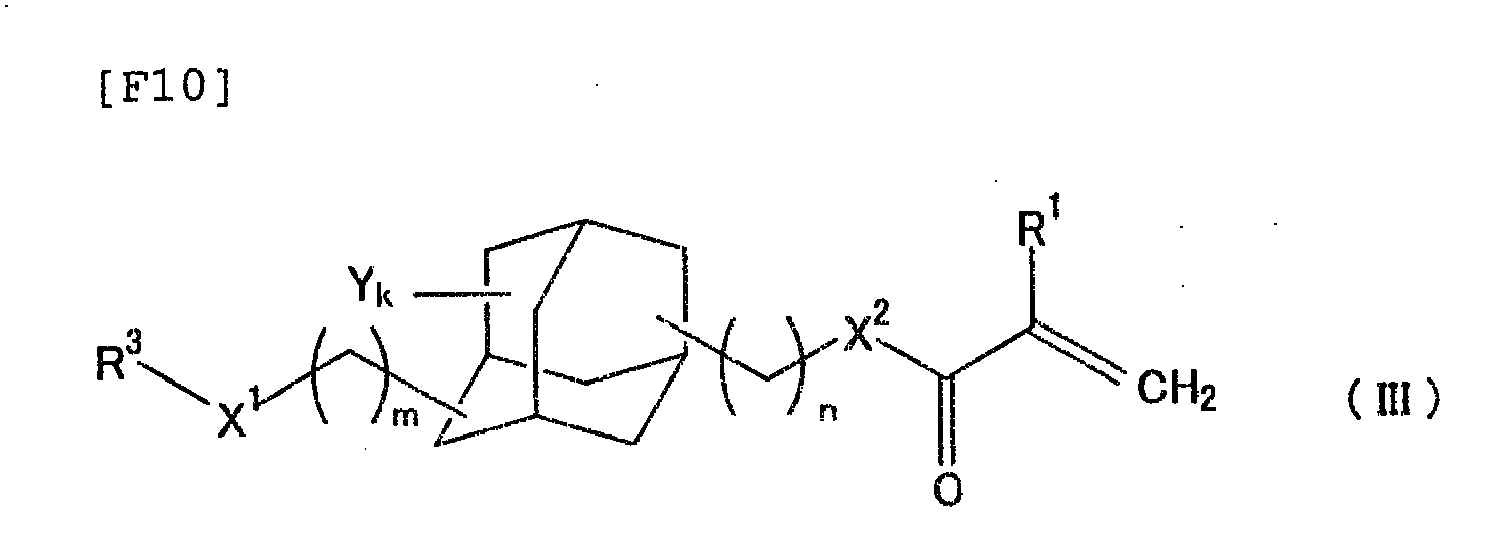
- the adamantane derivative represented by the following formula (I-b) can be produced from an adamantane derivative represented by the following formula (III): (wherein R 1 , X 1 , X 2 , Y, k, m, and n have the same meanings as defined above, and R 3 X 1 represents a leaving group) as a starting material.
- R 3 X 1 represents a leaving group
- Examples of the leaving group denoted by R 3 in formula (III) include a methanesulfonyl group, a trifluoromethanesulfonyl group, and a p-toluenesulfonyl group.
- Examples of the adamantane derivative represented by formula (III) include 3-methanesulfonyloxy-1-adamantyl acrylate, 3-methanesulfonyloxy-1-adamantyl methacrylate, 3-methanesulfonyloxy-1-adamantyl ⁇ -trifluoromethylacrylate, 3-trifluoromethanesulfonyloxy-1-adamantyl acrylate, 3-trifluoromethanesulfonyloxy-1-adamantyl methacrylate, 3-trifluoromethanesulfonyloxy-1-adamantyl ⁇ -trifluoromethylacrylate, 3-toluenesulfonyloxy-1-adamantyl acrylate, 3-toluenesulfonyloxy-1-adamantyl methacrylate, 3-toluenesulfonyloxy-1-adamantyl ⁇ -trifluoromethylacrylate,
- the aforementioned adamantane derivative represented by formula (I-b) may be produced from an adamantane derivative represented by formula (III) as a starting material.
- the starting adamantane derivative is reacted to a (thio)alcohol in the presence of a base, to thereby produce the formula (I-b) adamantane derivative.
- Examples of the (thio)alcohol include methanol, ethanol, n-propanol, isopropanol, n-butanol, isobutanol, sec-butanol, tert-butanol, pentanol, hexanol, heptanol, octanol, nonanol, n-decanol, adamantanol, adamantylmethylthiol, 2-methyl-2-adamantanol, methanethiol, ethanethiol, n-propanethiol, isopropanethiol, n-butanethiol, isobutanethiol, sec-butanethiol, tert-butanethiol, pentanethiol, hexanethiol, heptanethiol, octanethiol, nonanethiol, n-
- 1,4-dithian-2,5-diol and 1,4-dithian-2,5-diyldimethanol are preferred in the present invention.
- the (thio)alcohol is generally fed in an amount of about 1 to about 100 mol based on 1 mol of the adamantane derivative represented by formula (III), preferably 20 to 40 mol.
- Examples of the base include sodium amide, triethylamine, tributylamine, trioctylamine, pyridine, N,N-dimethylaniline, 1,5-diazabicyclo[4.3.0]nonene-5 (DBN), 1,8-diazabicyclo[5.4.0]undecene-7 (DBU), sodium hydroxide, potassium hydroxide, sodium hydride, potassium carbonate, silver oxide, sodium methoxide, and potassium t-butoxide.
- triethylamine and pyridine are preferred in the present invention.
- the base is generally fed in an amount of about 0.1 to about 50 mol based on 1 mol of the adamantane derivative represented by formula (III), preferably 1 to 5 mol.
- Polymers of the modified alkyl (thio)ether-substituted adamantyl (meth)acrylate represented by formula (I-a) suitably serve as a photosensitive material for photoresists.
- the polymers may be produced through homopolymerization of the modified alkyl (thio)ether-substituted adamantyl (meth)acrylate or through copolymerization of the modified alkyl (thio)ether-substituted adamantyl (meth)acrylate with another co-monomer.
- the ratio by mass of modified alkyl (thio)ether-substituted adamantyl (meth)acrylate to another co-monomer is preferably 50/50 to 1/99, more preferably 25/75 to 5/95.
- reaction mixture was transferred to a separating funnel, and diethyl ether (500 mL) and water (200 mL) were added to the mixture, followed by vigorous shaking. The mixture was left to stand, and the lower aqueous layer was separated from the mixture. The procedure was further repeated five times.
- the organic layer was dried with sodium sulfate anhydrate, and the solvent was removed. Further, light impurities were removed through distillation under reduced pressure (50°C/ ⁇ 0.1 kPa). The distillation residue was added slowly and dropwise to methanol (300 mL) while it was vigorously stirred, whereby the formed polymers and oligomers were re-precipitated. The precipitates were filtered out by means of a membrane filter (pore size: 0.5 ⁇ m).
- the thus-produced compound was analyzed through nuclear magnetic resonance spectrometry (NMR) and gas chromatography-mass analysis (GC-MS).
- NMR nuclear magnetic resonance spectrometry
- GC-MS gas chromatography-mass analysis
- the thus-produced compound was measured in terms of refractive index and Abbe's number. Table 1 shows the results.
- Refractive index of a compound which assumes liquid at 23°C was measured at 23°C by means of an Abbe's refractometer (product of Atago Co., Ltd.).
- Abbe's refractometer product of Atago Co., Ltd.
- refractive index of the solution was measured at 23°C.
- Abbe's number was calculated from the refractive index. Specifically, refractive index of 3-methylthiomethyloxy-1-adamantyl methacrylate was measured in the liquid state, whereas refractive indexes of 1-adamantyl methacrylate and 3-hydroxy-1-adamantyl methacrylate were measured in the form of tetrahydrofuran solutions.
- novel modified alkyl (thio)ether-substituted adamantyl (meth)acryl.ate of the present invention is useful as a monomer for producing functional resins such as photosensitive resins particularly for use in lithography, and is preferably employed in the field where specific optical properties (i.e., refractive index and Abbe's number) are required.
Landscapes
- Chemical & Material Sciences (AREA)
- Organic Chemistry (AREA)
- Health & Medical Sciences (AREA)
- Chemical Kinetics & Catalysis (AREA)
- Medicinal Chemistry (AREA)
- Polymers & Plastics (AREA)
- Physics & Mathematics (AREA)
- Spectroscopy & Molecular Physics (AREA)
- General Physics & Mathematics (AREA)
- Organic Low-Molecular-Weight Compounds And Preparation Thereof (AREA)
- Addition Polymer Or Copolymer, Post-Treatments, Or Chemical Modifications (AREA)
- Materials For Photolithography (AREA)
Abstract
The invention provides a novel adamantane derivative useful as a monomer for producing functional resins such as photosensitive resins particularly for use in lithography, and a method for producing the derivative. The adamantane derivative has a structure represented by formula (I-a) and the method for producing the adamantane derivative employs a corresponding adamantane derivative serving as a starting material. In formula (I), R1 represents H, CH3, or CF3; R2a represents a C1 to C30 alkyl group or a hydrocarbon group containing a C3 to C30 cycloalkyl group or a C6 to C30 aryl group, the alkyl group or the hydrocarbon group having a hetero atom; each of X1 and X2 represents O or S; Y represents a C1 to C10 alkyl group, a halogen atom, OH, or SH, or two Ys are linked to form =O or =S; k represents an integer of 0 to 14; and each of m and n is an integer of 0 to 2.
Description
- The present invention relates to a novel adamantane derivative, to a method for producing the derivative, and to a photosensitive material for photoresists produced from the adamantane derivative. More particularly, the invention relates to a novel modified alkyl (thio)ether-substituted adamantyl (meth)acrylate useful as a monomer for producing functional resins such as photosensitive resins particularly for use in lithography, to an effective method for producing the derivative, and to a photosensitive material for photoresists containing a polymer produced from the modified alkyl (thio)ether-substituted adamantyl (moth)acrylate.
- Adamantane is a stable compound having a highly symmetric structure in which four cyclohexane rings are condensed to form a cage. Derivatives of adamantane are known to exhibit a variety of functions, and thus the derivatives are useful sources for drugs, high-function industrial materials, etc. For example, Patent Document 1 and 2, etc. disclose studies on use of such derivatives as optical disk substrates, optical fibers, lenses, etc. by virtue of their useful properties such as optical characteristics and heat resistance.
- Patent Document 3 discloses studies on use of adamantane esters as a source resin for photoresists on the basis of properties thereof such as acid-sensitivity, dry-etching resistance, and UV transmittance.
- In a trend of recent years toward micro-scaling of semiconductor devices, a lithographic step in the production of semiconductor devices is required to be performed with more rigorous micro-scale precision. To satisfy the requirement, there have been studied various micro-pattern formation methods employing a photoresist which functions with respect to a short-wavelength radiation such as a KrF beam, an ArF beam, or an F2 excimer laser beam. These patterning formation methods employing such exposure techniques have now been developed to liquid-immersion lithography. The new lithographic technique has a drawback in that the range of depth of focus (DOF) where resolution of the photocured resin is ensured becomes considerably narrower with an increase in the numerical aperture (NA) of the lens employed in photolithography. In order to overcome the drawback, there is a demand for a new photoresist material which can improve DOF characteristics; i.e., a high-refractive-index resist material which ensures resolution within a wide DOF margin (an area ensuring resolution even when the area is apart from the focus), even when a high-NA exposure light is employed.
- Meanwhile, a modified alkyl (thio)ether-substituted polymerizable adamantane derivative has never been developed, since synthesis of such a compound is technically difficult.
- [Patent Document 1]
Japanese Patent Application Laid-Open (kokai) No. Heisei 6(1994)-305044 - [Patent Document 2]
Japanese Patent Application Laid-Open (kokai) No. Heisei 9(1997)-302077 - [Patent Document 3]
Japanese Patent Application Laid-Open (kokai) No. Heisei 4(1992)-39665 - The present invention has been conceived under such circumstances, and an object of the present invention is to provide a novel adamantane derivative useful as a monomer for producing functional resins such as photosensitive resins for use in lithography. Another object of the invention is to provide a method for producing the derivative. Still another object of the invention is to provide a photosensitive material for photoresists produced from the adamantane derivative.
- The present inventors have conducted extensive studies in order to attain the aforementioned object, and have found that a modified alkyl (thio)ether-substituted adamantyl (meth)acrylate having a specific structure is a novel compound which meets the requirement, and that the compound can be produced at high efficiency from a compound having the corresponding adamantyl group. The present invention has been accomplished on the basis of these findings.
- Accordingly, the present invention provides an adamantine derivative, and photosensitive material for photoresist, as described below.
- 1. An adamantane derivative having a structure represented by formula (I-a):

- 2. A method for producing an adamantane derivative having a structure represented by formula (I-a):


- 3. A method as described in 2 above, wherein the adamantane derivative represented by formula (II) is 3-hydroxy-1-adamantyl (meth)acrylate.
- 4. A method for producing an adamantane derivative having a structure represented by formula (I-b):


- 5. A method as described in 4 above, wherein the adamantane derivative represented by formula (III) may be 3-methanesulfonyloxy-1-adamantyl (meth)acrylate.
- 6. In a fourth aspect of the present invention, there is provided a photosensitive material for photoresist, which material comprises a polymer formed from, as a component thereof, an adamantane derivative represented by formula (I-a):

- The adamantane derivative according to the present invention is a novel modified alkyl (thio)ether-substituted adamantyl (meth)acrylate, which is useful as a monomer for producing functional resins such as photosensitive resins for use in lithography. The photosensitive material for photoresists containing a polymer of the adamantane derivative ensures resolution within a wide depth of focus (DOF) range even when exposure light of a large numerical aperture (NA) is employed. The photosensitive material is expected to attain high resolution.
- The adamantane derivative of the present invention is a compound represented by formula (I-a), which is an absolutely novel compound which has never been disclosed in the literature. Hereinafter, the compound and the production method will be described.
- The adamantane derivative of the present invention is a modified alkyl (thio)ether-substituted adamantyl (meth)acrylate having a structure represented by the following formula (I-a).

- In formula (1-a), R1 represents a hydrogen atom, a methyl group, or a trifluoromethyl group; R2a represents a C1 to C30 alkyl group or a hydrocarbon group containing a C3 to C30 cycloalkyl group or a C6 to C30 aryl group, the alkyl group or the hydrocarbon group having a hetero atom; each of X1 and X2 represents an oxygen atom or a sulfur atom; Y represents a C1 to C10 alkyl group, a halogen atom, a hydroxyl group, or a mercapto group, or two Ys are linked to form =0 or =S; a plurality of Ys may be identical to or different from one another; k represents an integer of 0 to 14; and each of m and n is an integer of 0 to 2.
- The C1 to C30 alkyl group denoted by R2a may be a linear or branched-chain alkyl group. Examples of the alkyl group include a methyl group, an ethyl group, various propyl groups, various butyl groups, various pentyl groups, various hexyl groups, various heptyl groups, various octyl groups, various nonyl groups, various decyl groups, various dodecyl groups, and various tetradecyl groups. Examples of the C3 to C30 cycloalkyl group contained in the hydrocarbon group include a cyclopentyl group and a cyclohexyl group. Examples of the C6 to C30 aryl group contained in the hydrocarbon group include a phenyl group, a tolyl group, a xylyl group, a naphthyl group, and a methylnaphthyl group. Examples of the hetero atom include nitrogen, oxygen, and sulfur.
- The C1 to C10 alkyl group denoted by Y may be linear, branched, or cyclic. Examples of the alkyl group include a methyl group, an ethyl group, various propyl groups, various butyl groups, various pentyl groups, various hexyl groups, various heptyl groups, various octyl groups, various nonyl groups, various decyl groups, a cyclopentyl group, and a cyclohexyl group. These alkyl groups may be substituted by an appropriate group such as a halogen atom or a hydroxyl group. The "n" is preferably 0. Examples of the halogen atom denoted by Y include fluorine, chlorine, bromine, and iodine.
- Examples of the compound represented by formula (I) include 3-methylthiomethyloxy-1-adamantyl acrylate, 3-(methylthiomethyloxy)methyl-1-adamantylmethyl acrylate, 2-[3-[2-(methylthiomethyloxy)ethyl]-1-adamantyl]ethyl acrylate, 3-[(1-ethylthio)ethan-1-yloxy]-1-adamantyl acrylate, 3-[(1-ethylthio)ethan-1-yloxy]methyl-1-adamantylmethyl acrylate, 2-{3-[2-[(1-ethylthio)ethan-1-yloxy]ethyl]-1-adamantyl}ethyl acrylate, 3-[(1-propylthio)propan-1-yloxy]-1-adamantylmethyl acrylate, 3-[(1-propylthio)propan-1-yloxy]methyl-1-adamantylmethyl acrylate, 2-{3-[2-[(1-propylthio)propan-1-yloxy]ethyl]-1-adamantyl}ethyl acrylate, 3-[(1-butylthio)butan-1-yloxy]-1-adamantyl acrylate, 3-[(1-butylthio)butan-1-yloxy]methyl-1-adamantylmethyl acrylate, 2-{3-[2-[(1-butylthio)butan-1-yloxy]ethyl]-1-adamantyl}ethyl acrylate, 3-phenylthiomethyloxy-1-adamantyl acrylate, 3-(phenylthiomethyloxy)methyl-1-adamantylmethyl acrylate, 2-[3-[2-(phenylthiomethyloxy)ethyl]-1-adamantyl]ethyl acrylate, 3-methylthiomethylthio-1-adamantyl acrylate, 3-(methylthiomethylthio)methyl-1-adamantylmethyl acrylate, 2-[3-[2-(methylthiomethylthio)ethyl]-1-adamantyl]ethyl acrylate, 3-[(1-ethylthio)ethan-1-ylthio]-1-adamantyl acrylate, 3-[(1-ethylthio)ethan-1-ylthio]methyl-1-adamantylmethyl acrylate, 2-{3-[2-[(1-ethylthio)ethan-1-ylthio]ethyl]-1-adamantyl}ethyl acrylate, 3-[(1-propylthio)propan-1-ylthio]-1-adamantylmethyl acrylate, 3-[(1-propylthio)propan-1-ylthio]methyl-1-adamantylmethyl acrylate, 2-{3-[2-[(1-propylthio)propan-1-ylthio]ethyl]-1-adamantyl}ethyl acrylate, 3-[(1-butylthio)butan-1-ylthio]-1-adamantyl acrylate, 3-[(1-butylthio)butan-1-ylthio]methyl-1-adamantylmethyl acrylate, 2-{3-[2-[(1-butylthio)butan-1-ylthio]ethyl]-1-adamantyl}ethyl acrylate, 3-phenylthiomethylthio-1-adamantyl acrylate, 3-(phenylthiomethylthio)methyl-1-adamantylmethyl acrylate, 2-[3-[2-(phenylthiomethylthio)ethyl]-1-adamantyl]ethyl acrylate, 3-methylthiomethyloxy-1-adamantyl α-trifluoromethylacrylate, 3-(methylthiomethyloxy)methyl-1-adamantylmethyl α-trifluoromethylacrylate, 3-(methylthiomethyloxy)ethyl-1-adamantylethyl α-trifluoromethylacrylate, 3-methylthiomethylthio-1-adamantyl α-trifluoromethylacrylate, 3-(methylthiomethylthio)methyl-1-adamantylmethyl α-trifluoromethylacrylate, and 3-(methylthiomethylthio)ethyl-1-adamantylethyl α-trifluoromethylacrylate. Similar compounds, which are derived by substituting the acrylate group of these compounds with methacrylate, α-trifluoromethylacrylate, S-thioacrylate, S-thiomethacrylate, or S-thio-α-trifluoromethylacrylate, are also included in the compound represented by formula (I).
- Of these, 3-methylthiomethyloxy-1-adamantyl acrylate and 3-methylthiomethyloxy-1-adamantyl methacrylate are preferred.
- The adamantane derivative of the present invention represented by formula (I-a) may be synthesized from an adamantane derivative represented by the following formula (II):

- The adamantane derivative represented by formula (I-a) may be produced from an adamantane derivative represented by formula (II) serving as a starting material. In the case where the heteroatom in R2a is a sulfur atom, reaction, for example, between the adamantane derivative and sulfoxide in an acid anhydride forms the formula (I-a) adamantane derivative.
- Examples of the sulfoxide include dimethyl sulfoxide, diethyl sulfoxide, di-n-propyl sulfoxide, diisopropyl sulfoxide, di-n-butyl sulfoxide, diisobutyl sulfoxide, di-sec-butyl sulfoxide, diisopentyl sulfoxide, didodecyl sulfoxide, phenyl methyl sulfoxide, phenyl ethyl sulfoxide, p-tolyl methyl sulfoxide, ethyl thiomethyl sulfoxide, ethyl naphthyl sulfoxide, ethyl p-tolyl sulfoxide, methyl phenyl sulfoxide, methyl p-tolyl sulfoxide, and phenyl propyl sulfoxide. In the present invention, dimethyl sulfoxide is preferred.
- The sulfoxide is generally fed in an amount of about 1 to about 100 mol based on the 1 mol of the adamantane derivative represented by formula (II), preferably 20 to 40 mol.
- Examples of the acid anhydride include acetic anhydride, propionic anhydride, butyric anhydride, isobutyric anhydride, valeric anhydride, pivalic anhydride, benzoic anhydride, chloroacetic anhydride, and trifluoroacetic anhydride. Of these, acetic anhydride is preferred in the present invention.
- The acid anhydride is generally fed in an amount of about 1 to about 100 mol based on the 1 mol of the adamantane derivative represented by formula (II), preferably 10 to 30 mol.
- In the above reaction, a solvent is employed in accordance with needs. In other words, when the adamantane derivative represented by formula (II) can be dissolved in a mixed solution of the sulfoxide and the acid anhydride, no particular solvent is needed. However, a solvent may be employed in accordance with needs.
- The solvent employed in the invention preferably has a solubility (at reaction temperature) of the adamantane derivative represented by formula (II) of 0.5 mass% or more, more preferably 5 mass% or more. The amount of the solvent is such that the adamantane derivative concentration of the reaction mixture is preferably adjusted to 0.5 mass% or more, more preferably 5 mass% or more. In this case, the aforementioned adamantane derivative may be in the form of dispersion and is preferably in the form of solution. Preferably, water contained in the solvent is removed before use. Specific examples of the solvent include hydrocarbon solvents such as n-hexane and n-heptane; ether solvents such as diethyl ether and tetrahydrofuran (THF); and halogen-containing solvents such as dichloromethane and carbon tetrachloride. These solvents may be used singly or in combination or two or more species.
- In the case where the heteroatom in R2a, is a sulfur atom, the adamantane derivative represented by formula (I-a) may be synthesized through for example, the following procedure. An adamantane derivative represented by formula (II) is reacted with dialkyl sulfoxide in an acid anhydride. After completion of reaction, the reaction mixture is neutralized, and the formed salt is removed through washing with water. Subsequently, the formed adamantyl-group-containing polymer and adamantyl-group-containing oligomer are removed through re-precipitation, to thereby synthesize the formula (I-a) adamantane derivative.
- The reaction is generally performed at -200°C to 200°C. However, in consideration of factors such as rate of reaction and prevention of by-production of polymer, the reaction temperature is preferably -50°C to 50°C. When the reaction temperature is adjusted to -200°C or higher, an appropriate rate of reaction is ensured. When the reaction temperature is adjusted to 200°C or lower, the amount of by-produced polymer decreases. The pressure at which the reaction is performed is generally an absolute pressure of 0.01 to 10 MPa. When the pressure falls within the range, a particularly designed pressure-resistant apparatus is not needed, which is economically advantageous. The pressure is preferably normal pressure to 1 MPa. The reaction time is generally 1 to 120 hours, preferably 6 to 48 hours. When the reaction time is our hour or longer, practically effective percent conversion can be attained. When the reaction time is 120 hours or shorter, production efficiency increases. In other words, a reaction time of 1 to 120 hours is economically advantageous.
- In one embodiment of the re-precipitation process, a solvent for re-precipitation such as methanol is employed, to thereby precipitate the by-produced polymer and oligomer. The precipitates are removed through a technique such as filtration. Examples of a subsequent purification procedure include distillation, crystallization, and separation by means of a column. An appropriate purification procedure may be selected in accordance with properties of the reaction product and the type of impurities.
- The thus-produced compounds may be identified through gas chromatography (GC), liquid chromatography (LC), gas chromatography-mass analysis (GC-MS), nuclear magnetic resonance spectrometry (NMR), infrared spectrometry (IR), melting point measurement, or a similar method.
- The present invention also provides a method for producing the adamantane derivative represented by the following formula. Specifically, the adamantane derivative represented by the following formula (I-b) can be produced from an adamantane derivative represented by the following formula (III):

- Examples of the adamantane derivative represented by formula (III) include 3-methanesulfonyloxy-1-adamantyl acrylate, 3-methanesulfonyloxy-1-adamantyl methacrylate, 3-methanesulfonyloxy-1-adamantyl α-trifluoromethylacrylate, 3-trifluoromethanesulfonyloxy-1-adamantyl acrylate, 3-trifluoromethanesulfonyloxy-1-adamantyl methacrylate, 3-trifluoromethanesulfonyloxy-1-adamantyl α-trifluoromethylacrylate, 3-toluenesulfonyloxy-1-adamantyl acrylate, 3-toluenesulfonyloxy-1-adamantyl methacrylate, 3-toluenesulfonyloxy-1-adamantyl α-trifluoromethylacrylate, 3-nitrobenzenesulfonyloxy-1-adamantyl acrylate, 3-nitrabenzenesulfonyloxy-1-adamantyl methacrylate, 3-nitrobenzenesulfonyloxy-1-adamantyl α-trifluoromethylacrylate, 3-methanesulfonyloxy-1-adamantylmethyl acrylate, 3-methanesulfonyloxy-1-adamantylmethyl methacrylate, 3-methanesulfonyloxy-1-adamantylmethyl α-trifluoromethylacrylate, 3-trifluoromethanesulfonyloxy-1-adamantylmethyl acrylate, 3-trifluoromethanesulfonyloxy-1-adamantylmethyl methacrylate, 3-trifluoromethanesulfonyloxy-1-adamantylmethyl α-trifluoromethylacrylate, 3-toluenesulfonyloxy-1-adamantylmethyl acrylate, 3-toluenesulfonyloxy-1-adamantylmethyl methacrylate, 3-toluenesulfonyloxy-1-adamantylmethyl α-trifluoromethylacrylate, 3-nitrobenzenesulfonyloxy-1-adamantylmethyl acrylate, 3-nitrobenzenesulfonyloxy-1-adamantylmethyl methacrylate, 3-nitrobenzenesulfonyloxy-1-adamantylmethyl α-trifluoromethylacrylate, 3-methanesulfonyloxymethyl-1-adamantylmethyl acrylate, 3-methanesulfonyloxymethyl-1-adamantylmethyl methacrylate, 3-methanesulfonyloxymethyl-1-adamantylmethyl α-trifluoromethylacrylate, 3-trifluoromethanesulfonyloxymethyl-1-adamantylmethyl acrylate, 3-trifluoromethanesulfonyloxymethyl-1-adamantylmethyl methacrylate, 3-trifluoromethanesulfonyloxymethyl-1-adamantylmethyl α-trifluoromethylacrylate, 3-toluenesulfonyloxymethyl-1-adamantylmethyl acrylate, 3-toluenesulfonyloxymethyl-1-adamantylmethyl methacrylate, 3-toluenesulfonyloxymethyl-1-adamantylmethyl α-trifluoromethylacrylate, 3-nitrobenzenesulfonyloxymethyl-1-adamantylmethyl acrylate, 3-nitrobenzenesulfonyloxymethyl-1-adamantylmethyl methacrylate, 3-nitrobenzenesulfonyloxymethyl-1-adamantylmethyl α-trifluoromethylacrylate, 3-methanesulfonylthio-1-adamantyl acrylate, 3-methanesulfonylthio-1-adamantyl methacrylate, 3-methanesulfonylthio-1-adamantyl α-trifluoromethylacrylate, 3-trifluoromethanesulfonylthio-1-adamantyl acrylate, 3-trifluoromethanesulfonylthio-1-adamantyl methacrylate, 3-trifluoromethanesulfonylthio-1-adamantyl α-trifluoromethylacrylate, 3-toluenesulfonylthio-1-adamantyl acrylate, 3-toluenesulfonylthio-1-adamantyl methacrylate, 3-toluenesulfonylthio-1-adamantyl α-trifluoromethylacrylate, 3-nitrobenzenesulfonylthio-1-adamantyl acrylate, 3-nitrobenzenesulfonylthio-1-adamantyl methacrylate, and 3-nitrobenzenesulfonylthio-1-adamantyl α-trifluoromethylacrylate. Of these, 3-methanesulfonyloxy-1-adamantyl acrylate and 3-methanesulfonyloxy-1-adamantyl methacrylate are preferred in the present invention.
- The aforementioned adamantane derivative represented by formula (I-b) may be produced from an adamantane derivative represented by formula (III) as a starting material. In one specific procedure, the starting adamantane derivative is reacted to a (thio)alcohol in the presence of a base, to thereby produce the formula (I-b) adamantane derivative.
- Examples of the (thio)alcohol include methanol, ethanol, n-propanol, isopropanol, n-butanol, isobutanol, sec-butanol, tert-butanol, pentanol, hexanol, heptanol, octanol, nonanol, n-decanol, adamantanol, adamantylmethylthiol, 2-methyl-2-adamantanol, methanethiol, ethanethiol, n-propanethiol, isopropanethiol, n-butanethiol, isobutanethiol, sec-butanethiol, tert-butanethiol, pentanethiol, hexanethiol, heptanethiol, octanethiol, nonanethiol, n-decanethiol, adamantanethiol, 2-methyl-2-adamantanethiol, bis(mercaptotricyclo[5.2.1.02,6]decyloxy)ethylene, bis(mercaptotricyclo[5.2.1.02,6]decyl)ether, (mercaptotricyclo)[5.2.1.02,6]decyloxy)propanethiol, (mercaptopentacyclo[9.2.1.13,9.02,10.04,8]pentadecane)-propanethiol, (mercaptopentacyclo[9.2.1.14,7.02,10.03,8]pentadecane)-propanethiol, mercaptotricyclo[5.2.1.02,6]decylthiol, [mercaptomethyl(tricyclo[5.2.1.02,6]decyl)]methanethiol, mercaptopentacyclo[9.2.1. 13,9.02.10.04,8]pentadecylthiol, mercaptopentacyclo[9.2.1.14,7.02,10.03,8]pentadecylthiol, 1,4-dithian-2, 5-diol, 1,4-dithian-2,5-diyldimethanol, 5-hydroxymethyl-1,4-dithianyl-2-methanol, 5-mercaptomethyl-1,4-dithianyl-2-methanethiol, and 4-thiatricyclo[3.2.1.03,6] octan-2,8-diol. Of these, 1,4-dithian-2,5-diol and 1,4-dithian-2,5-diyldimethanol are preferred in the present invention.
- The (thio)alcohol is generally fed in an amount of about 1 to about 100 mol based on 1 mol of the adamantane derivative represented by formula (III), preferably 20 to 40 mol.
- Examples of the base include sodium amide, triethylamine, tributylamine, trioctylamine, pyridine, N,N-dimethylaniline, 1,5-diazabicyclo[4.3.0]nonene-5 (DBN), 1,8-diazabicyclo[5.4.0]undecene-7 (DBU), sodium hydroxide, potassium hydroxide, sodium hydride, potassium carbonate, silver oxide, sodium methoxide, and potassium t-butoxide. Of these, triethylamine and pyridine are preferred in the present invention.
- The base is generally fed in an amount of about 0.1 to about 50 mol based on 1 mol of the adamantane derivative represented by formula (III), preferably 1 to 5 mol.
- The solvent, reaction conditions, and other conditions employed are the same as employed in the synthesis from the adamantane derivative represented by formula (II) as a starting material.
- Polymers of the modified alkyl (thio)ether-substituted adamantyl (meth)acrylate represented by formula (I-a) suitably serve as a photosensitive material for photoresists. The polymers may be produced through homopolymerization of the modified alkyl (thio)ether-substituted adamantyl (meth)acrylate or through copolymerization of the modified alkyl (thio)ether-substituted adamantyl (meth)acrylate with another co-monomer. In the case of copolymerization, the ratio by mass of modified alkyl (thio)ether-substituted adamantyl (meth)acrylate to another co-monomer is preferably 50/50 to 1/99, more preferably 25/75 to 5/95.
- The present invention will next be described in more detail by way of examples, which should not be construed as limiting the invention thereto.
- To a glass reactor (capacity: 1L) equipped with an agitator, 3-hydroxy-1-adamantyl methacrylate [Adamantate HM, product of Idemitsu Kosan Co., Ltd., FW (molecular weight) : 236.31] (52.02 g, 220 mmol) and methoquinone (52 mg, 1,000 ppm by mass) serving as an inhibitor were added.
- DMSO (dimethylsulfoxide) [FW: 78.14, d (density): 1.101 g/cm3] (450 mL, 6.3 mol) and acetic anhydride [FW: 102.09, d: 1.082 g/cm3] (300 mL, 3.2 mol) were added to the adamantane derivative. Through stirring, the mixture was gradually dissolved, and the solution was allowed to react at room temperature. After 48 hours from the start of reaction, percent conversion of the starting materials of about 100% was confirmed through GC (gas chromatography).
- The reaction mixture was transferred to a separating funnel, and diethyl ether (500 mL) and water (200 mL) were added to the mixture, followed by vigorous shaking. The mixture was left to stand, and the lower aqueous layer was separated from the mixture. The procedure was further repeated five times.
- Subsequently, 10-mass% aqueous ammonia (100 mL) was added to the organic layer, followed by vigorous shaking. The mixture was left to stand, whereby the lower aqueous layer was separated from the mixture. The procedure was further repeated twice. The final aqueous layer was confirmed to have a pH of about 6.
- The organic layer was dried with sodium sulfate anhydrate, and the solvent was removed. Further, light impurities were removed through distillation under reduced pressure (50°C/≤0.1 kPa). The distillation residue was added slowly and dropwise to methanol (300 mL) while it was vigorously stirred, whereby the formed polymers and oligomers were re-precipitated. The precipitates were filtered out by means of a membrane filter (pore size: 0.5 µm).
- Methanol was thoroughly removed from the thus-produced solution, and the residue was dissolved in hexane (200 mL). The solution was decolored by adding activated carbon (5 g) to the solution, and the decolored solution was filtered through a membrane filter (pore size: 0.5 µm). Subsequently, hexane was removed and dried under reduced pressure, to thereby yield 47.09 g of a target 3-methylthiomethyloxy-1-adamantyl methacrylate (FW: 269.43, isolated yield: 72.2%). The product was found to have a GC purity of 99% or higher and a GPC purity of 99%.
- The thus-produced compound was analyzed through nuclear magnetic resonance spectrometry (NMR) and gas chromatography-mass analysis (GC-MS). The thus-determined physical properties are as follows.
- Nuclear magnetic resonance spectrometry (NMR): CDCl3
1H-NMR (500MHz): 1.56 (dd, J=13.0Hz, 32.9Hz, 2H, h or i), 1.80 (dd, J=11.1Hz, 37.9Hz, 4H, f or j), 1.89 (s, 3H, a), 2.09 (dd, J=11.5Hz, 40.5Hz, 4H, j or f), 2.19 (s, 3H, m), 2.23 (s, 2H, g), 2.36 (br-s, 2H, i or h), 4.60 (s, 2H, 1), 5.49 (t, J=1.5Hz, 1H, b1), 6.01 (s, 1H, b2)
13C-NMR(127MHz): 14.29 (m), 18.23(a), 30.90 (h), 34.93 (g or i), 40.01 (f or j), 40.45 (j or f), 45.33 (i or g), 65.95 (1), 75.72 (k), 81.10 (e), 124.58 (b), 137.63 (c), 166.25 (d)

- Gas chromatography-mass analysis (GC-MS): EI
297 (M++1, 0.3%), 296 (M+, 1.7%), 266 (4.3%), 249 (5.7%), 219 (55.7%), 133 (16.8%), 69 (100%), 61 (16.7%) - The thus-produced compound was measured in terms of refractive index and Abbe's number. Table 1 shows the results.
- Refractive index of a compound which assumes liquid at 23°C was measured at 23°C by means of an Abbe's refractometer (product of Atago Co., Ltd.). In the case of a compound which is solid at 23°C, the compound was dissolved in tetrahydrofuran, and refractive index of the solution was measured at 23°C. Abbe's number was calculated from the refractive index. Specifically, refractive index of 3-methylthiomethyloxy-1-adamantyl methacrylate was measured in the liquid state, whereas refractive indexes of 1-adamantyl methacrylate and 3-hydroxy-1-adamantyl methacrylate were measured in the form of tetrahydrofuran solutions.
- In a manner similar to that of Example 1, refractive indexes and Abbe' numbers of 1-adamantyl methacrylate (Comparative Example 1) and 3-hydroxy-1-adamantyl methacrylate (Adamantate HM, product of Idemitsu Kosan Co., Ltd.) (Comparative Example 2) were measured. The results are shown in Table 1.
- [Table 1]
Table 1 Samples Refractive index nD Abbe's No. Ex. 1 3-methylthiomethyloxy-1-adamantyl methacrylate 1.5226 46.2 Comp. Ex. 1 1-adamantyl methacrylate 1.4987 48.0 Comp. Ex. 2 3-hydroxy-1-adamantyl methacrylate (Adamantate HM, product of Idemitsu Kosan Co., Ltd.) 1.5099 54.4 - The novel modified alkyl (thio)ether-substituted adamantyl (meth)acryl.ate of the present invention is useful as a monomer for producing functional resins such as photosensitive resins particularly for use in lithography, and is preferably employed in the field where specific optical properties (i.e., refractive index and Abbe's number) are required.
Claims (6)
- An adamantane derivative having a structure represented by formula (I-a):

- A method for producing an adamantane derivative having a structure represented by formula (I-a):


- A method as described in claim 2, wherein the adamantane derivative represented by formula (II) is 3-hydroxy-1-adamantyl (meth) acrylate.
- A method for producing an adamantane derivative having a structure represented by formula (I-b):


- A method as described in claim 4, wherein the adamantane derivative represented by formula (III) is 3-methansulfonyloxy-1-adamantyl (meth)acrylate.
- A photosensitive material for photoresist, which material comprises a polymer formed from, as a component thereof, an adamantane derivative represented by formula (I-a):

Applications Claiming Priority (2)
| Application Number | Priority Date | Filing Date | Title |
|---|---|---|---|
| JP2004277184A JP2006089412A (en) | 2004-09-24 | 2004-09-24 | Adamantane derivative, method for producing the same, and photosensitive material for photoresist |
| PCT/JP2005/017400 WO2006033359A1 (en) | 2004-09-24 | 2005-09-21 | Adamantane derivative, process for producing the same, and photosensitive material for photoresist |
Publications (1)
| Publication Number | Publication Date |
|---|---|
| EP1803708A1 true EP1803708A1 (en) | 2007-07-04 |
Family
ID=36090116
Family Applications (1)
| Application Number | Title | Priority Date | Filing Date |
|---|---|---|---|
| EP05785928A Withdrawn EP1803708A1 (en) | 2004-09-24 | 2005-09-21 | Adamantane derivative, process for producing the same, and photosensitive material for photoresist |
Country Status (7)
| Country | Link |
|---|---|
| US (1) | US7456311B2 (en) |
| EP (1) | EP1803708A1 (en) |
| JP (1) | JP2006089412A (en) |
| KR (1) | KR20070061546A (en) |
| CN (2) | CN101671287A (en) |
| TW (1) | TW200615251A (en) |
| WO (1) | WO2006033359A1 (en) |
Cited By (3)
| Publication number | Priority date | Publication date | Assignee | Title |
|---|---|---|---|---|
| EP1712542A4 (en) * | 2004-02-05 | 2008-01-16 | Idemitsu Kosan Co | ADAMANTANE DERIVATIVES AND METHOD OF PRODUCTION |
| EP1882705A4 (en) * | 2005-05-20 | 2009-12-09 | Idemitsu Kosan Co | POLYMERIZABLE COMPOUND FOR PHOTORESISTANT VARNISH, POLYMER THEREOF, AND PHOTORESISTANT VARIOUS COMPOSITION CONTAINING SUCH A POLYMER |
| US8383318B2 (en) | 2009-02-19 | 2013-02-26 | Brewer Science Inc. | Acid-sensitive, developer-soluble bottom anti-reflective coatings |
Families Citing this family (12)
| Publication number | Priority date | Publication date | Assignee | Title |
|---|---|---|---|---|
| JP4494159B2 (en) * | 2004-10-13 | 2010-06-30 | 東京応化工業株式会社 | POLYMER COMPOUND, POSITIVE RESIST COMPOSITION AND METHOD FOR FORMING RESIST PATTERN |
| JP5249760B2 (en) * | 2006-08-04 | 2013-07-31 | 出光興産株式会社 | Adamantane structure-containing polymerizable compound, method for producing the same, and resin composition |
| JPWO2008015999A1 (en) * | 2006-08-04 | 2009-12-24 | コニカミノルタオプト株式会社 | Composite material and optical element |
| KR101325848B1 (en) | 2007-12-14 | 2013-11-05 | 후지쯔 가부시끼가이샤 | Thiopyran derivative, polymer, resist composition and process for producing semiconductor device with the use of the resist composition |
| JP5250309B2 (en) * | 2008-05-28 | 2013-07-31 | 東京応化工業株式会社 | Resist composition and resist pattern forming method |
| WO2009144801A1 (en) | 2008-05-29 | 2009-12-03 | 富士通株式会社 | Dithiane derivative, polymer, resist composition, and process for producing semiconductor using the resist composition |
| JP5542412B2 (en) * | 2009-10-28 | 2014-07-09 | 東京応化工業株式会社 | Positive resist composition, resist pattern forming method, polymer compound |
| JP5708082B2 (en) * | 2010-03-24 | 2015-04-30 | 信越化学工業株式会社 | Pattern forming method and negative resist composition |
| JP5608009B2 (en) | 2010-08-12 | 2014-10-15 | 大阪有機化学工業株式会社 | Homoadamantane derivative, method for producing the same, and photoresist composition |
| KR101172763B1 (en) | 2010-12-24 | 2012-08-09 | 금호석유화학 주식회사 | Polymer, manufacturing method thereof and resist composition containing the same |
| WO2019190495A1 (en) * | 2018-03-28 | 2019-10-03 | Intel Corporation | Carbon-based dielectric materials for semiconductor structure fabrication and the resulting structures |
| CN119119348B (en) * | 2024-11-14 | 2025-08-15 | 拓烯科技(衢州)有限公司 | Methacrylate-styrene copolymer and preparation method and application thereof |
Family Cites Families (16)
| Publication number | Priority date | Publication date | Assignee | Title |
|---|---|---|---|---|
| DE3165043D1 (en) * | 1980-06-11 | 1984-08-30 | Battelle Memorial Institute | Unsaturated esters of adamantane containing diols and thermo-resistant cross-linked polymers therefrom |
| JP2509622B2 (en) * | 1987-06-06 | 1996-06-26 | 白水化学工業株式会社 | Adamantyl diacrylate or dimethacrylate derivative |
| JPH1135522A (en) * | 1997-05-23 | 1999-02-09 | Daicel Chem Ind Ltd | Polymerizable adamantane derivative and its production |
| JP4434358B2 (en) * | 1998-05-25 | 2010-03-17 | ダイセル化学工業株式会社 | Photoresist compound and photoresist resin composition |
| JP3330903B2 (en) * | 1999-08-05 | 2002-10-07 | ダイセル化学工業株式会社 | Polymer compound for photoresist and resin composition for photoresist |
| JP2001097928A (en) * | 1999-09-28 | 2001-04-10 | Daicel Chem Ind Ltd | Adamantane derivative and method for producing the same |
| JP5105667B2 (en) * | 2000-03-28 | 2012-12-26 | 富士通株式会社 | Negative resist composition, method of forming resist pattern, and method of manufacturing semiconductor device |
| US7122288B2 (en) * | 2000-03-28 | 2006-10-17 | Fujitsu Limited | Negative resist composition, a method for forming a resist pattern thereof, and a method for fabricating a semiconductor device |
| JP4790153B2 (en) * | 2000-09-01 | 2011-10-12 | 富士通株式会社 | Negative resist composition, method of forming resist pattern, and method of manufacturing electronic device |
| JP5036932B2 (en) * | 2000-11-24 | 2012-09-26 | 株式会社ダイセル | Production method of tertiary alcohol ester |
| JP4646389B2 (en) * | 2000-12-04 | 2011-03-09 | ダイセル化学工業株式会社 | Method for producing tertiary alcohol ester |
| JP2004069981A (en) | 2002-08-06 | 2004-03-04 | Fuji Photo Film Co Ltd | Positive resist composition |
| JP2005075406A (en) | 2003-08-29 | 2005-03-24 | Nihon Tetra Pak Kk | Re-sealing structure for a container made of paper |
| US7528279B2 (en) * | 2004-02-05 | 2009-05-05 | Idemitsu Kosan Co., Ltd. | Adamantane derivatives and process for producing the same |
| JP4429754B2 (en) | 2004-02-05 | 2010-03-10 | 出光興産株式会社 | Adamantane derivative and method for producing the same |
| JP4790290B2 (en) * | 2004-03-10 | 2011-10-12 | 出光興産株式会社 | Adamantane derivative and method for producing the same |
-
2004
- 2004-09-24 JP JP2004277184A patent/JP2006089412A/en active Pending
-
2005
- 2005-09-21 EP EP05785928A patent/EP1803708A1/en not_active Withdrawn
- 2005-09-21 CN CN200910204756A patent/CN101671287A/en active Pending
- 2005-09-21 CN CN2005800324211A patent/CN101027281B/en not_active Expired - Fee Related
- 2005-09-21 WO PCT/JP2005/017400 patent/WO2006033359A1/en not_active Ceased
- 2005-09-21 KR KR1020077006018A patent/KR20070061546A/en not_active Withdrawn
- 2005-09-21 US US11/575,555 patent/US7456311B2/en not_active Expired - Fee Related
- 2005-09-23 TW TW094133139A patent/TW200615251A/en unknown
Non-Patent Citations (1)
| Title |
|---|
| See references of WO2006033359A1 * |
Cited By (4)
| Publication number | Priority date | Publication date | Assignee | Title |
|---|---|---|---|---|
| EP1712542A4 (en) * | 2004-02-05 | 2008-01-16 | Idemitsu Kosan Co | ADAMANTANE DERIVATIVES AND METHOD OF PRODUCTION |
| US7528279B2 (en) | 2004-02-05 | 2009-05-05 | Idemitsu Kosan Co., Ltd. | Adamantane derivatives and process for producing the same |
| EP1882705A4 (en) * | 2005-05-20 | 2009-12-09 | Idemitsu Kosan Co | POLYMERIZABLE COMPOUND FOR PHOTORESISTANT VARNISH, POLYMER THEREOF, AND PHOTORESISTANT VARIOUS COMPOSITION CONTAINING SUCH A POLYMER |
| US8383318B2 (en) | 2009-02-19 | 2013-02-26 | Brewer Science Inc. | Acid-sensitive, developer-soluble bottom anti-reflective coatings |
Also Published As
| Publication number | Publication date |
|---|---|
| CN101671287A (en) | 2010-03-17 |
| JP2006089412A (en) | 2006-04-06 |
| US20080009647A1 (en) | 2008-01-10 |
| WO2006033359A1 (en) | 2006-03-30 |
| CN101027281A (en) | 2007-08-29 |
| US7456311B2 (en) | 2008-11-25 |
| KR20070061546A (en) | 2007-06-13 |
| CN101027281B (en) | 2011-04-20 |
| TW200615251A (en) | 2006-05-16 |
Similar Documents
| Publication | Publication Date | Title |
|---|---|---|
| US7456311B2 (en) | Adamantane derivative, process for producing the same, and photosensitive material for photoresist | |
| EP2048128A1 (en) | Polymerizable compound having adamantane structure, process for production of the same, and resin composition | |
| CN101528660A (en) | Adamantane derivative, process for producing the same, resin composition, and cured product thereof | |
| JP5629454B2 (en) | Polymerizable compound, lactone-containing compound, method for producing lactone-containing compound, and polymer compound obtained by polymerizing the polymerizable compound | |
| KR20060065724A (en) | Multifunctional (meth) acrylate and preparation method thereof | |
| JP6274288B2 (en) | Compounds and polymers | |
| KR101114585B1 (en) | Adamantane derivatives and process for producing the same | |
| JP4429754B2 (en) | Adamantane derivative and method for producing the same | |
| KR100857957B1 (en) | Manufacturing method of (meth) acrylic anhydride and manufacturing method of (meth) acrylic acid ester | |
| JP2009286721A (en) | alpha-SUBSTITUTED ACRYLATE DERIVATIVE, AND METHOD FOR PRODUCING THE SAME | |
| JP5193597B2 (en) | Polymerizable compound for photoresist, polymer thereof and photoresist composition containing the polymer | |
| JP2014111550A (en) | Method of producing polymerizable monomer | |
| KR100602039B1 (en) | Novel ester compounds | |
| KR100518392B1 (en) | Novel ester compounds | |
| EP1731504A1 (en) | Adamantane derivative and process for producing the same | |
| JP2005247745A (en) | (Meth) acrylate and method for producing the same | |
| JP4594695B2 (en) | Method for producing adamantane derivative | |
| JP2005154363A (en) | Adamantane derivative and method for producing the same | |
| WO2026014372A1 (en) | Method for producing polymer | |
| JP2011148719A (en) | Sulfur-containing compound and production method of the same | |
| JP2020023457A (en) | Method for producing (meth) acrylate, hydroxy compound, and (meth) acrylate | |
| JP2007131582A (en) | Adamantyl ester compounds | |
| JP2001097927A (en) | Adamantane derivative and method for producing the same |
Legal Events
| Date | Code | Title | Description |
|---|---|---|---|
| PUAI | Public reference made under article 153(3) epc to a published international application that has entered the european phase |
Free format text: ORIGINAL CODE: 0009012 |
|
| 17P | Request for examination filed |
Effective date: 20070411 |
|
| AK | Designated contracting states |
Kind code of ref document: A1 Designated state(s): BE DE FR GB |
|
| RBV | Designated contracting states (corrected) |
Designated state(s): BE DE FR GB |
|
| DAX | Request for extension of the european patent (deleted) | ||
| RBV | Designated contracting states (corrected) |
Designated state(s): BE DE FR GB |
|
| STAA | Information on the status of an ep patent application or granted ep patent |
Free format text: STATUS: THE APPLICATION HAS BEEN WITHDRAWN |
|
| 18W | Application withdrawn |
Effective date: 20091221 |