EP1801820A1 - NiCuZn-base ferrites and electronic parts using the same - Google Patents
NiCuZn-base ferrites and electronic parts using the same Download PDFInfo
- Publication number
- EP1801820A1 EP1801820A1 EP06020928A EP06020928A EP1801820A1 EP 1801820 A1 EP1801820 A1 EP 1801820A1 EP 06020928 A EP06020928 A EP 06020928A EP 06020928 A EP06020928 A EP 06020928A EP 1801820 A1 EP1801820 A1 EP 1801820A1
- Authority
- EP
- European Patent Office
- Prior art keywords
- basis
- amount
- mol
- oxide
- sub
- Prior art date
- Legal status (The legal status is an assumption and is not a legal conclusion. Google has not performed a legal analysis and makes no representation as to the accuracy of the status listed.)
- Granted
Links
Images

Classifications
-
- H—ELECTRICITY
- H01—ELECTRIC ELEMENTS
- H01F—MAGNETS; INDUCTANCES; TRANSFORMERS; SELECTION OF MATERIALS FOR THEIR MAGNETIC PROPERTIES
- H01F1/00—Magnets or magnetic bodies characterised by the magnetic materials therefor; Selection of materials for their magnetic properties
- H01F1/01—Magnets or magnetic bodies characterised by the magnetic materials therefor; Selection of materials for their magnetic properties of inorganic materials
- H01F1/03—Magnets or magnetic bodies characterised by the magnetic materials therefor; Selection of materials for their magnetic properties of inorganic materials characterised by their coercivity
- H01F1/12—Magnets or magnetic bodies characterised by the magnetic materials therefor; Selection of materials for their magnetic properties of inorganic materials characterised by their coercivity of soft-magnetic materials
- H01F1/34—Magnets or magnetic bodies characterised by the magnetic materials therefor; Selection of materials for their magnetic properties of inorganic materials characterised by their coercivity of soft-magnetic materials non-metallic substances, e.g. ferrites
- H01F1/342—Oxides
- H01F1/344—Ferrites, e.g. having a cubic spinel structure (X2+O)(Y23+O3), e.g. magnetite Fe3O4
-
- C—CHEMISTRY; METALLURGY
- C04—CEMENTS; CONCRETE; ARTIFICIAL STONE; CERAMICS; REFRACTORIES
- C04B—LIME, MAGNESIA; SLAG; CEMENTS; COMPOSITIONS THEREOF, e.g. MORTARS, CONCRETE OR LIKE BUILDING MATERIALS; ARTIFICIAL STONE; CERAMICS; REFRACTORIES; TREATMENT OF NATURAL STONE
- C04B35/00—Shaped ceramic products characterised by their composition; Ceramics compositions; Processing powders of inorganic compounds preparatory to the manufacturing of ceramic products
- C04B35/01—Shaped ceramic products characterised by their composition; Ceramics compositions; Processing powders of inorganic compounds preparatory to the manufacturing of ceramic products based on oxide ceramics
- C04B35/26—Shaped ceramic products characterised by their composition; Ceramics compositions; Processing powders of inorganic compounds preparatory to the manufacturing of ceramic products based on oxide ceramics based on ferrites
-
- C—CHEMISTRY; METALLURGY
- C04—CEMENTS; CONCRETE; ARTIFICIAL STONE; CERAMICS; REFRACTORIES
- C04B—LIME, MAGNESIA; SLAG; CEMENTS; COMPOSITIONS THEREOF, e.g. MORTARS, CONCRETE OR LIKE BUILDING MATERIALS; ARTIFICIAL STONE; CERAMICS; REFRACTORIES; TREATMENT OF NATURAL STONE
- C04B35/00—Shaped ceramic products characterised by their composition; Ceramics compositions; Processing powders of inorganic compounds preparatory to the manufacturing of ceramic products
- C04B35/01—Shaped ceramic products characterised by their composition; Ceramics compositions; Processing powders of inorganic compounds preparatory to the manufacturing of ceramic products based on oxide ceramics
- C04B35/26—Shaped ceramic products characterised by their composition; Ceramics compositions; Processing powders of inorganic compounds preparatory to the manufacturing of ceramic products based on oxide ceramics based on ferrites
- C04B35/265—Compositions containing one or more ferrites of the group comprising manganese or zinc and one or more ferrites of the group comprising nickel, copper or cobalt
-
- C—CHEMISTRY; METALLURGY
- C04—CEMENTS; CONCRETE; ARTIFICIAL STONE; CERAMICS; REFRACTORIES
- C04B—LIME, MAGNESIA; SLAG; CEMENTS; COMPOSITIONS THEREOF, e.g. MORTARS, CONCRETE OR LIKE BUILDING MATERIALS; ARTIFICIAL STONE; CERAMICS; REFRACTORIES; TREATMENT OF NATURAL STONE
- C04B35/00—Shaped ceramic products characterised by their composition; Ceramics compositions; Processing powders of inorganic compounds preparatory to the manufacturing of ceramic products
- C04B35/622—Forming processes; Processing powders of inorganic compounds preparatory to the manufacturing of ceramic products
- C04B35/626—Preparing or treating the powders individually or as batches ; preparing or treating macroscopic reinforcing agents for ceramic products, e.g. fibres; mechanical aspects section B
- C04B35/62605—Treating the starting powders individually or as mixtures
- C04B35/62645—Thermal treatment of powders or mixtures thereof other than sintering
- C04B35/62655—Drying, e.g. freeze-drying, spray-drying, microwave or supercritical drying
-
- C—CHEMISTRY; METALLURGY
- C04—CEMENTS; CONCRETE; ARTIFICIAL STONE; CERAMICS; REFRACTORIES
- C04B—LIME, MAGNESIA; SLAG; CEMENTS; COMPOSITIONS THEREOF, e.g. MORTARS, CONCRETE OR LIKE BUILDING MATERIALS; ARTIFICIAL STONE; CERAMICS; REFRACTORIES; TREATMENT OF NATURAL STONE
- C04B35/00—Shaped ceramic products characterised by their composition; Ceramics compositions; Processing powders of inorganic compounds preparatory to the manufacturing of ceramic products
- C04B35/622—Forming processes; Processing powders of inorganic compounds preparatory to the manufacturing of ceramic products
- C04B35/626—Preparing or treating the powders individually or as batches ; preparing or treating macroscopic reinforcing agents for ceramic products, e.g. fibres; mechanical aspects section B
- C04B35/62605—Treating the starting powders individually or as mixtures
- C04B35/62685—Treating the starting powders individually or as mixtures characterised by the order of addition of constituents or additives
-
- C—CHEMISTRY; METALLURGY
- C04—CEMENTS; CONCRETE; ARTIFICIAL STONE; CERAMICS; REFRACTORIES
- C04B—LIME, MAGNESIA; SLAG; CEMENTS; COMPOSITIONS THEREOF, e.g. MORTARS, CONCRETE OR LIKE BUILDING MATERIALS; ARTIFICIAL STONE; CERAMICS; REFRACTORIES; TREATMENT OF NATURAL STONE
- C04B35/00—Shaped ceramic products characterised by their composition; Ceramics compositions; Processing powders of inorganic compounds preparatory to the manufacturing of ceramic products
- C04B35/622—Forming processes; Processing powders of inorganic compounds preparatory to the manufacturing of ceramic products
- C04B35/626—Preparing or treating the powders individually or as batches ; preparing or treating macroscopic reinforcing agents for ceramic products, e.g. fibres; mechanical aspects section B
- C04B35/63—Preparing or treating the powders individually or as batches ; preparing or treating macroscopic reinforcing agents for ceramic products, e.g. fibres; mechanical aspects section B using additives specially adapted for forming the products, e.g.. binder binders
- C04B35/632—Organic additives
- C04B35/634—Polymers
- C04B35/63404—Polymers obtained by reactions only involving carbon-to-carbon unsaturated bonds
- C04B35/63416—Polyvinylalcohols [PVA]; Polyvinylacetates
-
- C—CHEMISTRY; METALLURGY
- C04—CEMENTS; CONCRETE; ARTIFICIAL STONE; CERAMICS; REFRACTORIES
- C04B—LIME, MAGNESIA; SLAG; CEMENTS; COMPOSITIONS THEREOF, e.g. MORTARS, CONCRETE OR LIKE BUILDING MATERIALS; ARTIFICIAL STONE; CERAMICS; REFRACTORIES; TREATMENT OF NATURAL STONE
- C04B2235/00—Aspects relating to ceramic starting mixtures or sintered ceramic products
- C04B2235/02—Composition of constituents of the starting material or of secondary phases of the final product
- C04B2235/30—Constituents and secondary phases not being of a fibrous nature
- C04B2235/32—Metal oxides, mixed metal oxides, or oxide-forming salts thereof, e.g. carbonates, nitrates, (oxy)hydroxides, chlorides
- C04B2235/327—Iron group oxides, their mixed metal oxides, or oxide-forming salts thereof
- C04B2235/3279—Nickel oxides, nickalates, or oxide-forming salts thereof
-
- C—CHEMISTRY; METALLURGY
- C04—CEMENTS; CONCRETE; ARTIFICIAL STONE; CERAMICS; REFRACTORIES
- C04B—LIME, MAGNESIA; SLAG; CEMENTS; COMPOSITIONS THEREOF, e.g. MORTARS, CONCRETE OR LIKE BUILDING MATERIALS; ARTIFICIAL STONE; CERAMICS; REFRACTORIES; TREATMENT OF NATURAL STONE
- C04B2235/00—Aspects relating to ceramic starting mixtures or sintered ceramic products
- C04B2235/02—Composition of constituents of the starting material or of secondary phases of the final product
- C04B2235/30—Constituents and secondary phases not being of a fibrous nature
- C04B2235/32—Metal oxides, mixed metal oxides, or oxide-forming salts thereof, e.g. carbonates, nitrates, (oxy)hydroxides, chlorides
- C04B2235/3281—Copper oxides, cuprates or oxide-forming salts thereof, e.g. CuO or Cu2O
-
- C—CHEMISTRY; METALLURGY
- C04—CEMENTS; CONCRETE; ARTIFICIAL STONE; CERAMICS; REFRACTORIES
- C04B—LIME, MAGNESIA; SLAG; CEMENTS; COMPOSITIONS THEREOF, e.g. MORTARS, CONCRETE OR LIKE BUILDING MATERIALS; ARTIFICIAL STONE; CERAMICS; REFRACTORIES; TREATMENT OF NATURAL STONE
- C04B2235/00—Aspects relating to ceramic starting mixtures or sintered ceramic products
- C04B2235/02—Composition of constituents of the starting material or of secondary phases of the final product
- C04B2235/30—Constituents and secondary phases not being of a fibrous nature
- C04B2235/32—Metal oxides, mixed metal oxides, or oxide-forming salts thereof, e.g. carbonates, nitrates, (oxy)hydroxides, chlorides
- C04B2235/3284—Zinc oxides, zincates, cadmium oxides, cadmiates, mercury oxides, mercurates or oxide forming salts thereof
-
- C—CHEMISTRY; METALLURGY
- C04—CEMENTS; CONCRETE; ARTIFICIAL STONE; CERAMICS; REFRACTORIES
- C04B—LIME, MAGNESIA; SLAG; CEMENTS; COMPOSITIONS THEREOF, e.g. MORTARS, CONCRETE OR LIKE BUILDING MATERIALS; ARTIFICIAL STONE; CERAMICS; REFRACTORIES; TREATMENT OF NATURAL STONE
- C04B2235/00—Aspects relating to ceramic starting mixtures or sintered ceramic products
- C04B2235/02—Composition of constituents of the starting material or of secondary phases of the final product
- C04B2235/30—Constituents and secondary phases not being of a fibrous nature
- C04B2235/32—Metal oxides, mixed metal oxides, or oxide-forming salts thereof, e.g. carbonates, nitrates, (oxy)hydroxides, chlorides
- C04B2235/3293—Tin oxides, stannates or oxide forming salts thereof, e.g. indium tin oxide [ITO]
-
- C—CHEMISTRY; METALLURGY
- C04—CEMENTS; CONCRETE; ARTIFICIAL STONE; CERAMICS; REFRACTORIES
- C04B—LIME, MAGNESIA; SLAG; CEMENTS; COMPOSITIONS THEREOF, e.g. MORTARS, CONCRETE OR LIKE BUILDING MATERIALS; ARTIFICIAL STONE; CERAMICS; REFRACTORIES; TREATMENT OF NATURAL STONE
- C04B2235/00—Aspects relating to ceramic starting mixtures or sintered ceramic products
- C04B2235/02—Composition of constituents of the starting material or of secondary phases of the final product
- C04B2235/30—Constituents and secondary phases not being of a fibrous nature
- C04B2235/32—Metal oxides, mixed metal oxides, or oxide-forming salts thereof, e.g. carbonates, nitrates, (oxy)hydroxides, chlorides
- C04B2235/3298—Bismuth oxides, bismuthates or oxide forming salts thereof, e.g. zinc bismuthate
-
- C—CHEMISTRY; METALLURGY
- C04—CEMENTS; CONCRETE; ARTIFICIAL STONE; CERAMICS; REFRACTORIES
- C04B—LIME, MAGNESIA; SLAG; CEMENTS; COMPOSITIONS THEREOF, e.g. MORTARS, CONCRETE OR LIKE BUILDING MATERIALS; ARTIFICIAL STONE; CERAMICS; REFRACTORIES; TREATMENT OF NATURAL STONE
- C04B2235/00—Aspects relating to ceramic starting mixtures or sintered ceramic products
- C04B2235/65—Aspects relating to heat treatments of ceramic bodies such as green ceramics or pre-sintered ceramics, e.g. burning, sintering or melting processes
- C04B2235/656—Aspects relating to heat treatments of ceramic bodies such as green ceramics or pre-sintered ceramics, e.g. burning, sintering or melting processes characterised by specific heating conditions during heat treatment
-
- H—ELECTRICITY
- H01—ELECTRIC ELEMENTS
- H01F—MAGNETS; INDUCTANCES; TRANSFORMERS; SELECTION OF MATERIALS FOR THEIR MAGNETIC PROPERTIES
- H01F17/00—Fixed inductances of the signal type
- H01F17/04—Fixed inductances of the signal type with magnetic core
Definitions
- the present invention relates generally to an NiCuZn-base ferrite and an electronic part using it, and more particularly to a ferrite used as a material for electronic parts that form a closed magnetic circuit and an electronic part fabricated using it.
- ferrites in the form of oxide magnetic materials containing Ni, Cu, Zn, etc. because of possessing good magnetic properties, have been used as core (magnetic core) materials for various electronic parts or as materials for inductor parts such as multilayer chip inductors.
- inductance when it comes to an electronic part including a coil conductor such as a multilayer chip inductor, inductance can decrease depending on a current value as direct currents pass through the coil conductor in a closed magnetic circuit.
- inductance decreases must be reduced as much as possible even with relatively large currents passing through it. It is thus desired that the rate of inductance changes be reduced or limited applying direct-current bias; that is, DC bias characteristics be in good condition.
- JP-A-2003-272912 has come up with an oxide magnetic material comprising an Ni-Cu-Zn ferrite material having a given composition as a main component with 0.2 to 3 wt% of SnO 2 added to it for the purpose of achieving an oxide magnetic material that is used for an closed magnetic circuit-forming electronic part, and that, even at a large applied external stress, can ensure the desired magnetic properties and has good direct-current bias characteristics as well, and a multilayer electronic part using the same.
- the publication alleges that even at an applied compression stress of 40 MPa, the rate of change in its initial permeability is kept within 10%, and good direct-current bias characteristics is gained. By the addition of SnO 2 alone, however, there would be no significant improvement in direct-current bias characteristics.
- JP-A-2002-255637 has proposed an oxide magnetic porcelain composition comprising an Ni-Cu-Zn ferrite material having a given composition as a main component and further containing 1.5 percent by weight to 3.0 percent by weight of SnO 2 , 0.02 percent by weight to 0.20 percent by weight of Co 3 O 4 and up to 0.45 percent by weight of Bi 2 O 3 with a view to achieving an oxide magnetic porcelain composition with little or no characteristic value change due to temperature changes and, at the same time, with high specific resistance, and an inductor part using the same.
- the publication alleges that there is a high-performance electronic part obtainable, which has little or no characteristic value change due to temperature changes and, at the same time, has so high specific resistance that eddy-current losses are reduced with a Q value improvement.
- the invention has for its object the provision of a ferrite with a dramatic improvement in direct-current bias characteristics, and an electronic part using the same.
- an NiCuZn-base ferrite comprising as main components an iron oxide in an amount of 45.0 to 49.0 mol% on Fe 2 O 3 basis, a copper oxide in an amount of 5.0 to 14.0 mol% on CuO basis and a zinc oxide in an amount of 1.0 to 32.0 mol% on ZnO basis with a nickel oxide accounting for the rest mol% on NiO basis, wherein, with respect to said main components, a bismuth oxide is contained in an amount of 0.25 exclusive to 0.40% by weight on Bi 2 O 3 basis, and a tin oxide is contained in an amount of 1.00 to 2.50% by weight on SnO 2 basis.
- Another aspect of the invention is concerned with an electronic part comprising an NiCuZn-base ferrite, wherein said ferrite comprises as main components an iron oxide in an amount of 45.0 to 49.0 mol% on Fe 2 O 3 basis, a copper oxide in an amount of 5.0 to 14.0 mol% on CuO basis and a zinc oxide in an amount of 1.0 to 32.0 mol% on ZnO basis with a nickel oxide accounting for the rest mol% on NiO basis, wherein, with respect to said main components, a bismuth oxide is contained in an amount of 0.25 exclusive to 0.40% by weight on Bi 2 O 3 basis, and a tin oxide is contained in an amount of 1.00 to 2.50% by weight on SnO 2 basis.
- said electronic part is in the form of a multilayer inductor or LC composite part that includes a coil conductor and a core portion comprising said ferrite, wherein said core portion forms a closed magnetic circuit.
- NiCuZn-base ferrite of the invention is such that with respect to the given main component blend composition, there is a very narrow range of 0.25 exclusive to 0.40% by weight for the bismuth oxide on Bi 2 O 3 basis, and 1.00 to 2.50% by weight for the tin oxide on SnO 2 basis; however, there is a leap upward achieved in direct-current bias characteristics within such narrow a range.
- NiCuZn-base ferrite (oxide magnetic material) of the invention is now explained in details.
- the NiCuZn-base ferrite of the invention comprises as substantial main components an iron oxide in an amount of 45.0 to 49.0 mol% (most preferably 47.0 to 48.8 mol%) on Fe 2 O 3 basis, an copper oxide in an amount of 5.0 to 14.0 mol% (most preferably 7.0 to 12 mol%) on CuO basis and a zinc oxide in an amount of 1.0 to 32.0 mol% (most preferably 14.0 to 28.0 mol%) on ZnO basis with a nickel oxide accounting for the rest mol% on NiO basis.
- the NiCuZn-base ferrite of the invention contains as auxiliary components a bismuth oxide in an amount of 0.25 exclusive to 0.40% by weight (most preferably 0.26 to 0.33% by weight) on Bi 2 O 3 basis, and a tin oxide in an amount of 1.00 to 2.50% by weight (most preferably 1.00 to 2.20% by weight) on SnO 2 basis, with respect to such main components.
- the content of the iron oxide (Fe 2 O 3 ) being below 45 mol% is not preferable, because the specific resistivity tends to become low, and the initial permeability ⁇ i tends to become low, too.
- the content of the iron oxide (Fe 2 O 3 ) exceeds 49.0 mol%, on the other hand, it causes inconveniences like noticeable deterioration in sinter ability.
- the content of the copper oxide (CuO) is below 5.0 mol%, there can be inconveniences like deterioration in sinter ability.
- the content of the copper oxide (CuO) exceeds 14.0 mol%, on the other hand, there can be inconveniences such as specific resistivity drops, and noticeable segregation at grain boundaries of the ferrite upon sintering.
- the initial permeability ⁇ i becomes too low to be fit or preferable for electronic parts material.
- the content of the zinc oxide (ZnO) exceeds 32.0 mol%, on the other hand, the Curie temperature is lower than 100°C, and there can be inconvenience like difficulty of practical use.
- the composition ranges for the auxiliary components used with the main components are now explained.
- the content of the bismuth oxide (Bi 2 O 3 ) is 0.25% or less by weight, there can be inconveniences like no significant improvement in direct-current bias characteristics.
- the content of the bismuth oxide (Bi 2 O 3 ) exceeds 0.40% by weight, on the other hand, there can be inconveniences like abnormally grown particles that may otherwise degrade magnetic properties.
- the content of the tin oxide (SnO 2 ) is below 1.00% by weight, there can be inconveniences like no significant improvement in direct-current bias characteristics. As the content of the tin oxide (SnO 2 ) exceeds 2.50% by weight, on the other hand, there can be inconveniences like grave deterioration in sinter ability.
- additives such as Mn 3 O 4 and ZrO 2 could be used in addition to the main components plus the auxiliary components.
- the acceptable range of the additives to be added is such that the advantages of the invention are not adversely affected.
- the ferrite material of the invention may be available in the form of a multilayer electronic part obtained by firing a stack of magnetic or dielectric sheets subjected beforehand to given processing, that is, a multilayer type inductor or a multilayer type LC composite part.
- a multilayer type inductor a plurality of ferrite composition sheets, each including an internal conductor for forming an coiled portion, may be stacked one upon another, and then fired.
- the ferrite material of the invention may also be formed into a fixed inductor, a chip inductor or the like by, for instance, processing it into a core material of given shape, and winding the necessary wire around the core material, followed by resin molding (resin covering).
- resin molding resin covering
- These elements are in turn used as various electronic devices for televisions, video recorders, and mobile communications units such as cellular phones and car phones.
- the core may be configured into a drum shape of 2 mm or less in both outside diameter and length.
- thermoplastic resins and thermosetting resins may be used for the resin used as the molding (covering) material. More specifically, polyolefin resins, polyester resins, polyamide resins, polycarbonate resins, polyurethane resins, phenol resins, urea resins, and epoxy resins may be used. Specific means for molding the molding material, for instance, include dipping, coating, and spraying. Besides, means such as injection molding and cast molding may be used.
- chip inductor (electronic part) using the ferrite of the invention is now explained.
- that chip inductor comprises a cylindrical core formed of the ferrite material of the invention with large diameter collars at both its ends, a wire wound around the barrel of the core, terminal electrodes adapted to connect the ends of the wire to an external electric circuit and located at both ends of the core for fixing the core in a resin, and a molding resin formed in such a way as to cover the outside of these components.
- the starting material for the main components and the raw material for the auxiliary components (additives) in given amounts are blended together in such a way as to come within the given range for the ferrite of the invention to prepare the starting blend.
- the obtained starting blend is wet mixed in a ball mill or the like.
- the mixture is dried, and then calcined.
- Calcining is carried out in an oxidative atmosphere, for instance, in air.
- the calcining temperature is 500 to 900°C and the calcining time is 1 to 20 hours.
- the resulting calcined product is pulverized to the given size by means of ball milling or the like.
- the raw materials for the auxiliary components should preferably be added and mixed during (or after) that pulverization.
- the powders are formed into the desired shape with the addition to it of a suitable amount of a suitable binder such as polyvinyl alcohol.
- the formed product is then fired. Firing is carried out in an oxidative atmosphere, usually in air.
- the firing temperature is about 800 to 1,000°C and the firing time is about 1 to 5 hours.
- the resulting mixed powders were dried, and then calcined at 750°C in air for 10 hours to obtain calcined powders.
- auxiliary components Bi 2 O 3 and SnO 2
- pulverization was then carried out for 16 hours in a steel ball mill to obtain powders.
- the ensuing powders (ferrite powders) were mixed together with the addition to it of a 6% polyvinyl alcohol solution, and then granulated by means of a spray dryer.
- the resulting granules were formed at a density of 3.10 Mg/m 3 into a toroidal shape of 13 mm in outside diameter, 6 mm in inside diameter and 3 mm in height.
- the resulting compact was fired at 900°C in the atmosphere for 2 hours to obtain a toroidal core sample.
- the compact was fired at two different temperatures, say, 900°C and 920°C in the atmosphere for 2 hours to obtain toroidal core samples fired at two such different temperatures for the same composition.
- the ferrite composition of the invention contains 0.25 exclusive to 0.40% by weight of bismuth oxide on Bi 2 O 3 basis and 1.00 to 2.50% by weight of tin oxide on SnO 2 basis relative to the given main component blend composition, ensuring a leap upward in direct-current bias characteristics.
- NiCuZn-base ferrites of the invention could be widely used in a variety of electrical parts industries.
Landscapes
- Chemical & Material Sciences (AREA)
- Engineering & Computer Science (AREA)
- Ceramic Engineering (AREA)
- Manufacturing & Machinery (AREA)
- Materials Engineering (AREA)
- Structural Engineering (AREA)
- Organic Chemistry (AREA)
- Inorganic Chemistry (AREA)
- Chemical Kinetics & Catalysis (AREA)
- Dispersion Chemistry (AREA)
- Power Engineering (AREA)
- Physics & Mathematics (AREA)
- Thermal Sciences (AREA)
- Magnetic Ceramics (AREA)
- Soft Magnetic Materials (AREA)
- Inorganic Compounds Of Heavy Metals (AREA)
- Coils Or Transformers For Communication (AREA)
Abstract
Description
- The present invention relates generally to an NiCuZn-base ferrite and an electronic part using it, and more particularly to a ferrite used as a material for electronic parts that form a closed magnetic circuit and an electronic part fabricated using it.
- So far, ferrites in the form of oxide magnetic materials containing Ni, Cu, Zn, etc., because of possessing good magnetic properties, have been used as core (magnetic core) materials for various electronic parts or as materials for inductor parts such as multilayer chip inductors.
- For such magnetic cores or inductor parts, it is desired that, in consideration of varying temperature environments where they are used, the rate of changes in their initial permeability µi with changing temperatures be reduced or limited; that is, the temperature dependency of their initial permeability µi be in good condition (or fluctuate little with temperature).
- Here, when it comes to an electronic part including a coil conductor such as a multilayer chip inductor, inductance can decrease depending on a current value as direct currents pass through the coil conductor in a closed magnetic circuit. For an electronic part, inductance decreases must be reduced as much as possible even with relatively large currents passing through it. It is thus desired that the rate of inductance changes be reduced or limited applying direct-current bias; that is, DC bias characteristics be in good condition.
- To meet such demands,
JP-A-2003-272912 -
JP-A-2002-255637 - However, the art of that publication is not to improve on direct-current bias characteristics, nor is there any disclosure of the composition of the invention in its specific examples. For instance, at the same initial permeability µi on the order of 80 to 130 with all other conditions being equal, there would be no NiCuZn-base ferrites as yet, where much improved direct-current bias characteristics as achieved herein is available.
- Such being the situation, the invention has for its object the provision of a ferrite with a dramatic improvement in direct-current bias characteristics, and an electronic part using the same.
- According to one aspect of the invention, such an object is accomplishable by the provision of an NiCuZn-base ferrite comprising as main components an iron oxide in an amount of 45.0 to 49.0 mol% on Fe2O3 basis, a copper oxide in an amount of 5.0 to 14.0 mol% on CuO basis and a zinc oxide in an amount of 1.0 to 32.0 mol% on ZnO basis with a nickel oxide accounting for the rest mol% on NiO basis, wherein, with respect to said main components, a bismuth oxide is contained in an amount of 0.25 exclusive to 0.40% by weight on Bi2O3 basis, and a tin oxide is contained in an amount of 1.00 to 2.50% by weight on SnO2 basis.
- Another aspect of the invention is concerned with an electronic part comprising an NiCuZn-base ferrite, wherein said ferrite comprises as main components an iron oxide in an amount of 45.0 to 49.0 mol% on Fe2O3 basis, a copper oxide in an amount of 5.0 to 14.0 mol% on CuO basis and a zinc oxide in an amount of 1.0 to 32.0 mol% on ZnO basis with a nickel oxide accounting for the rest mol% on NiO basis, wherein, with respect to said main components, a bismuth oxide is contained in an amount of 0.25 exclusive to 0.40% by weight on Bi2O3 basis, and a tin oxide is contained in an amount of 1.00 to 2.50% by weight on SnO2 basis.
- In a preferred embodiment of the invention, said electronic part is in the form of a multilayer inductor or LC composite part that includes a coil conductor and a core portion comprising said ferrite, wherein said core portion forms a closed magnetic circuit.
- The NiCuZn-base ferrite of the invention is such that with respect to the given main component blend composition, there is a very narrow range of 0.25 exclusive to 0.40% by weight for the bismuth oxide on Bi2O3 basis, and 1.00 to 2.50% by weight for the tin oxide on SnO2 basis; however, there is a leap upward achieved in direct-current bias characteristics within such narrow a range.
-
- Fig. 1 is a graph indicative of a set of results in Table 1, with initial permeability µi as abscissa and a current Idc (synonymous with Idc10%down) at which the initial permeability µi is 10% down as ordinate.
- The NiCuZn-base ferrite (oxide magnetic material) of the invention is now explained in details.
- The NiCuZn-base ferrite of the invention comprises as substantial main components an iron oxide in an amount of 45.0 to 49.0 mol% (most preferably 47.0 to 48.8 mol%) on Fe2O3 basis, an copper oxide in an amount of 5.0 to 14.0 mol% (most preferably 7.0 to 12 mol%) on CuO basis and a zinc oxide in an amount of 1.0 to 32.0 mol% (most preferably 14.0 to 28.0 mol%) on ZnO basis with a nickel oxide accounting for the rest mol% on NiO basis.
- Further, the NiCuZn-base ferrite of the invention contains as auxiliary components a bismuth oxide in an amount of 0.25 exclusive to 0.40% by weight (most preferably 0.26 to 0.33% by weight) on Bi2O3 basis, and a tin oxide in an amount of 1.00 to 2.50% by weight (most preferably 1.00 to 2.20% by weight) on SnO2 basis, with respect to such main components.
- Referring here to the composition ranges for the main components, the content of the iron oxide (Fe2O3) being below 45 mol% is not preferable, because the specific resistivity tends to become low, and the initial permeability µi tends to become low, too. As the content of the iron oxide (Fe2O3) exceeds 49.0 mol%, on the other hand, it causes inconveniences like noticeable deterioration in sinter ability.
- As the content of the copper oxide (CuO) is below 5.0 mol%, there can be inconveniences like deterioration in sinter ability. As the content of the copper oxide (CuO) exceeds 14.0 mol%, on the other hand, there can be inconveniences such as specific resistivity drops, and noticeable segregation at grain boundaries of the ferrite upon sintering.
- As the content of the zinc oxide (ZnO) is below 1.0 mol%, the initial permeability µi becomes too low to be fit or preferable for electronic parts material. As the content of the zinc oxide (ZnO) exceeds 32.0 mol%, on the other hand, the Curie temperature is lower than 100°C, and there can be inconvenience like difficulty of practical use.
- The composition ranges for the auxiliary components used with the main components are now explained. As the content of the bismuth oxide (Bi2O3) is 0.25% or less by weight, there can be inconveniences like no significant improvement in direct-current bias characteristics. As the content of the bismuth oxide (Bi2O3) exceeds 0.40% by weight, on the other hand, there can be inconveniences like abnormally grown particles that may otherwise degrade magnetic properties.
- As the content of the tin oxide (SnO2) is below 1.00% by weight, there can be inconveniences like no significant improvement in direct-current bias characteristics. As the content of the tin oxide (SnO2) exceeds 2.50% by weight, on the other hand, there can be inconveniences like grave deterioration in sinter ability.
- According to the invention, further additive components such as Mn3O4 and ZrO2 could be used in addition to the main components plus the auxiliary components. The acceptable range of the additives to be added is such that the advantages of the invention are not adversely affected.
- The ferrite material of the invention may be available in the form of a multilayer electronic part obtained by firing a stack of magnetic or dielectric sheets subjected beforehand to given processing, that is, a multilayer type inductor or a multilayer type LC composite part. For the multilayer type inductor, a plurality of ferrite composition sheets, each including an internal conductor for forming an coiled portion, may be stacked one upon another, and then fired.
- The ferrite material of the invention may also be formed into a fixed inductor, a chip inductor or the like by, for instance, processing it into a core material of given shape, and winding the necessary wire around the core material, followed by resin molding (resin covering). These elements are in turn used as various electronic devices for televisions, video recorders, and mobile communications units such as cellular phones and car phones. By way of example but not by way of limitation, the core may be configured into a drum shape of 2 mm or less in both outside diameter and length.
- For the resin used as the molding (covering) material, for instance, thermoplastic resins and thermosetting resins may be used. More specifically, polyolefin resins, polyester resins, polyamide resins, polycarbonate resins, polyurethane resins, phenol resins, urea resins, and epoxy resins may be used. Specific means for molding the molding material, for instance, include dipping, coating, and spraying. Besides, means such as injection molding and cast molding may be used.
- One exemplary arrangement of the chip inductor (electronic part) using the ferrite of the invention is now explained. Typically, that chip inductor comprises a cylindrical core formed of the ferrite material of the invention with large diameter collars at both its ends, a wire wound around the barrel of the core, terminal electrodes adapted to connect the ends of the wire to an external electric circuit and located at both ends of the core for fixing the core in a resin, and a molding resin formed in such a way as to cover the outside of these components.
- One exemplary process of fabricating the ferrite of the invention is now explained.
- First of all, the starting material for the main components and the raw material for the auxiliary components (additives) in given amounts are blended together in such a way as to come within the given range for the ferrite of the invention to prepare the starting blend.
- Then, the obtained starting blend is wet mixed in a ball mill or the like. The mixture is dried, and then calcined. Calcining is carried out in an oxidative atmosphere, for instance, in air. Preferably, the calcining temperature is 500 to 900°C and the calcining time is 1 to 20 hours. The resulting calcined product is pulverized to the given size by means of ball milling or the like. For the ferrite of the invention, it is noted that the raw materials for the auxiliary components should preferably be added and mixed during (or after) that pulverization.
- After the pulverization of the calcined product, the powders are formed into the desired shape with the addition to it of a suitable amount of a suitable binder such as polyvinyl alcohol.
- The formed product is then fired. Firing is carried out in an oxidative atmosphere, usually in air. The firing temperature is about 800 to 1,000°C and the firing time is about 1 to 5 hours.
- The invention is now explained in further details with reference to specific examples.
- Given amounts of the respective raw materials for the main components in the composition, Fe2O3, NiO, CuO and ZnO, were blended together in such a way as to give such composition ratios as shown in Table 1 below, and the blend was then wet mixed together for about 16 hours in a ball mill.
- The resulting mixed powders were dried, and then calcined at 750°C in air for 10 hours to obtain calcined powders. Given amount of the respective raw materials for the auxiliary components, Bi2O3 and SnO2, were added to the calcined powders in such a way as to give such composition ratios as shown in Table 1 below, and pulverization was then carried out for 16 hours in a steel ball mill to obtain powders.
- The ensuing powders (ferrite powders) were mixed together with the addition to it of a 6% polyvinyl alcohol solution, and then granulated by means of a spray dryer. The resulting granules were formed at a density of 3.10 Mg/m3 into a toroidal shape of 13 mm in outside diameter, 6 mm in inside diameter and 3 mm in height. The resulting compact was fired at 900°C in the atmosphere for 2 hours to obtain a toroidal core sample.
- Specifically, the compact was fired at two different temperatures, say, 900°C and 920°C in the atmosphere for 2 hours to obtain toroidal core samples fired at two such different temperatures for the same composition.
- For each sample, measurements were taken of (1) initial permeability at 100 kHz and (2) direct-current bias characteristics, with the results set out in Table 1 below.
- Note here that the measurements (1) and (2) were obtained as follows.
- Twenty (20) turns of wire were wound around each toroidal core sample fabricated at the respective firing temperature of 900°C, and 920°C, after which inductance and other values were measured on an LCR meter to find initial permeability values µi900 and µi920 at 100 kHz and 25°C, with the numerical subscripts indicative of the firing temperatures.
- For each toroidal core sample with about 20 turns of wire wound around it, measurements were taken of µ changes upon conduction of direct currents to prepare a µ vs. direct current graph. Then, this graph was used to calculate a current value at which the initial permeability µi at the time of a direct current 0 mA was down by 10%. In this way, the current value Idc10%down (mA) at which the initial permeability µi was down by 10% was found.

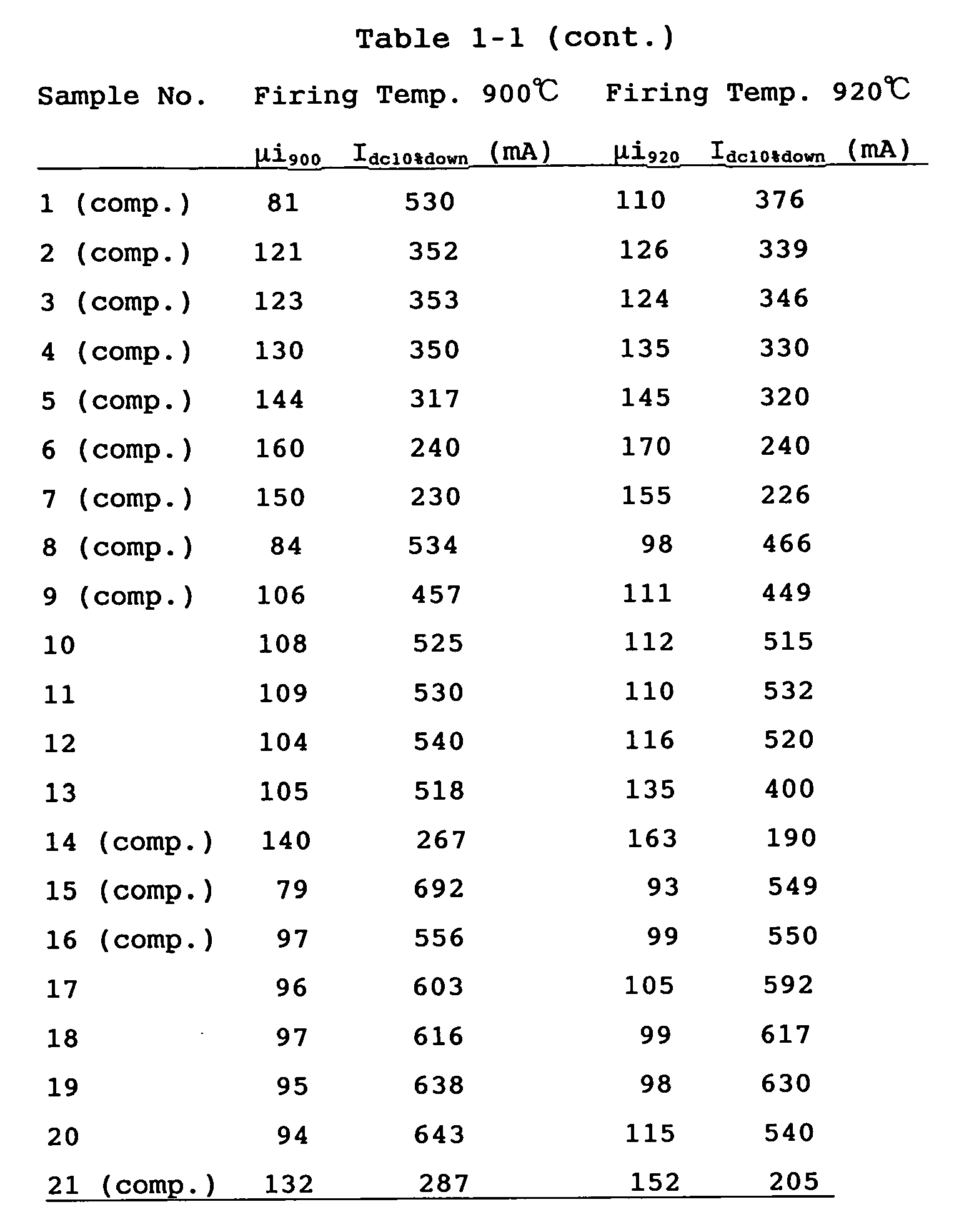


- To have a graphical understanding of the advantages of the invention, the results of Table 1 above are plotted in Fig. 1. From the results set out in Table 1 and illustrated in Fig. 1, the advantages of the invention would be evident.
- That is, it is understood that the ferrite composition of the invention contains 0.25 exclusive to 0.40% by weight of bismuth oxide on Bi2O3 basis and 1.00 to 2.50% by weight of tin oxide on SnO2 basis relative to the given main component blend composition, ensuring a leap upward in direct-current bias characteristics.
- The NiCuZn-base ferrites of the invention could be widely used in a variety of electrical parts industries.
Claims (3)
- An NiCuZn-base ferrite comprising as main components an iron oxide in an amount of 45.0 to 49.0 mol% on Fe2O3 basis, an copper oxide in an amount of 5.0 to 14.0 mol% on CuO basis and a zinc oxide in an amount of 1.0 to 32.0 mol% on ZnO basis with a nickel oxide accounting for the rest mol% on NiO basis, wherein, with respect to said main components, a bismuth oxide is contained in an amount of 0.25 exclusive to 0.40% by weight on Bi2O3 basis, and a tin oxide is contained in an amount of 1.00 to 2.50% by weight on SnO2 basis.
- An electronic part comprising an NiCuZn-base ferrite, wherein said ferrite comprises as main components an iron oxide in an amount of 45.0 to 49.0 mol% on Fe2O3 basis, an copper oxide in an amount of 5.0 to 14.0 mol% on CuO basis and a zinc oxide in an amount of 1.0 to 32.0 mol% on ZnO basis with a nickel oxide accounting for the rest mol% on NiO basis, wherein, with respect to said main components, a bismuth oxide is contained in an amount of 0.25 exclusive to 0.40% by weight on Bi2O3 basis, and a tin oxide is contained in an amount of 1.00 to 2.50% by weight on SnO2 basis.
- An electronic part as recited in claim 2, wherein said electronic part is a multilayer inductor or LC composite part that includes a coil conductor and a core portion comprising said ferrite, in which said core portion forms a closed magnetic circuit.
Applications Claiming Priority (1)
| Application Number | Priority Date | Filing Date | Title |
|---|---|---|---|
| JP2005368381A JP4532401B2 (en) | 2005-12-21 | 2005-12-21 | NiCuZn-based ferrite and electronic component using the same |
Publications (2)
| Publication Number | Publication Date |
|---|---|
| EP1801820A1 true EP1801820A1 (en) | 2007-06-27 |
| EP1801820B1 EP1801820B1 (en) | 2008-07-23 |
Family
ID=37876891
Family Applications (1)
| Application Number | Title | Priority Date | Filing Date |
|---|---|---|---|
| EP06020928A Active EP1801820B1 (en) | 2005-12-21 | 2006-10-05 | NiCuZn-base ferrites and electronic parts using the same |
Country Status (7)
| Country | Link |
|---|---|
| US (1) | US7527744B2 (en) |
| EP (1) | EP1801820B1 (en) |
| JP (1) | JP4532401B2 (en) |
| KR (1) | KR100757903B1 (en) |
| CN (1) | CN100543886C (en) |
| DE (1) | DE602006001928D1 (en) |
| TW (1) | TW200733151A (en) |
Families Citing this family (10)
| Publication number | Priority date | Publication date | Assignee | Title |
|---|---|---|---|---|
| JP5098782B2 (en) * | 2008-04-30 | 2012-12-12 | Tdk株式会社 | NiCuZn-based ferrite and electronic component using the same |
| JP6149386B2 (en) * | 2012-04-13 | 2017-06-21 | 株式会社村田製作所 | Multilayer electronic components |
| JP5880517B2 (en) | 2013-10-16 | 2016-03-09 | Tdk株式会社 | Ferrite composition and electronic component |
| DE102014005118A1 (en) * | 2014-04-08 | 2015-10-08 | Rosenberger Hochfrequenztechnik Gmbh & Co. Kg | suppression choke |
| CN105084882A (en) * | 2015-07-24 | 2015-11-25 | 天长市中德电子有限公司 | High-magnetic-permeability low-loss soft-magnetic ferrite material and preparation method |
| CN105777098B (en) * | 2016-03-15 | 2019-03-05 | 广东风华高新科技股份有限公司 | Ferritic preparation method, ferrite and inductor |
| CN109485399A (en) * | 2018-12-20 | 2019-03-19 | 贵州振华红云电子有限公司 | NiCuZn ferrite magnetic sheet for NFC and wireless charging |
| JP7715512B2 (en) * | 2021-03-24 | 2025-07-30 | Tdk株式会社 | Ferrite composition and electronic component |
| JP2023180401A (en) * | 2022-06-09 | 2023-12-21 | Tdk株式会社 | Ferrite compositions, ferrite sintered bodies and electronic components |
| CN119569434A (en) * | 2024-11-29 | 2025-03-07 | 横店集团东磁股份有限公司 | A NiZn ferrite and its preparation method and use |
Citations (2)
| Publication number | Priority date | Publication date | Assignee | Title |
|---|---|---|---|---|
| JPH10223424A (en) * | 1997-02-07 | 1998-08-21 | Tdk Corp | Multilayer inductor |
| JP2003272912A (en) * | 2002-03-15 | 2003-09-26 | Murata Mfg Co Ltd | Oxide magnetic material and laminated electronic component using the same |
Family Cites Families (5)
| Publication number | Priority date | Publication date | Assignee | Title |
|---|---|---|---|---|
| JP3147496B2 (en) * | 1992-05-25 | 2001-03-19 | 株式会社村田製作所 | Ferrite material |
| JP4384346B2 (en) | 2000-10-13 | 2009-12-16 | 東光株式会社 | Ni-Cu-Zn ferrite magnetic material |
| JP2002141215A (en) | 2000-11-07 | 2002-05-17 | Sumitomo Metal Ind Ltd | Oxide magnetic material, method of manufacturing the same, and multilayer chip inductor |
| JP4576727B2 (en) * | 2001-02-23 | 2010-11-10 | 株式会社村田製作所 | Oxide magnetic ceramic composition and inductor component using the same |
| JP3971766B2 (en) * | 2004-11-29 | 2007-09-05 | Tdk株式会社 | Ferrite material and electronic parts using the same |
-
2005
- 2005-12-21 JP JP2005368381A patent/JP4532401B2/en not_active Expired - Lifetime
-
2006
- 2006-08-30 US US11/468,599 patent/US7527744B2/en active Active
- 2006-09-08 TW TW095133302A patent/TW200733151A/en unknown
- 2006-09-28 KR KR1020060094832A patent/KR100757903B1/en active Active
- 2006-10-05 EP EP06020928A patent/EP1801820B1/en active Active
- 2006-10-05 DE DE602006001928T patent/DE602006001928D1/en active Active
- 2006-11-21 CN CNB2006101493054A patent/CN100543886C/en active Active
Patent Citations (2)
| Publication number | Priority date | Publication date | Assignee | Title |
|---|---|---|---|---|
| JPH10223424A (en) * | 1997-02-07 | 1998-08-21 | Tdk Corp | Multilayer inductor |
| JP2003272912A (en) * | 2002-03-15 | 2003-09-26 | Murata Mfg Co Ltd | Oxide magnetic material and laminated electronic component using the same |
Also Published As
| Publication number | Publication date |
|---|---|
| CN1988067A (en) | 2007-06-27 |
| US7527744B2 (en) | 2009-05-05 |
| DE602006001928D1 (en) | 2008-09-04 |
| EP1801820B1 (en) | 2008-07-23 |
| KR100757903B1 (en) | 2007-09-11 |
| TW200733151A (en) | 2007-09-01 |
| TWI317955B (en) | 2009-12-01 |
| KR20070066848A (en) | 2007-06-27 |
| JP2007169105A (en) | 2007-07-05 |
| JP4532401B2 (en) | 2010-08-25 |
| US20070138431A1 (en) | 2007-06-21 |
| CN100543886C (en) | 2009-09-23 |
Similar Documents
| Publication | Publication Date | Title |
|---|---|---|
| KR102155356B1 (en) | Ferrite composition and electronic device | |
| EP1314697B1 (en) | Ferrite material | |
| KR101928210B1 (en) | Ferrite composition, ferrite sintered body, electronic device, and chip coil | |
| KR101764422B1 (en) | Ferrite composition and electronic device | |
| JP3971766B2 (en) | Ferrite material and electronic parts using the same | |
| EP1801820B1 (en) | NiCuZn-base ferrites and electronic parts using the same | |
| JP5702913B2 (en) | Ferrite materials and electronic components | |
| JP2006151742A (en) | Ferrite material and electronic component using the same | |
| JP2006151741A (en) | Ferrite material and electronic component using the same | |
| JP4369936B2 (en) | NiCuZn-based ferrite and electronic component using the same | |
| CN115124335B (en) | Ferrite composition and electronic component | |
| JP2007063123A (en) | Ferrite material and electronic component using the same | |
| JP3692057B2 (en) | Ferrite material | |
| JP5098782B2 (en) | NiCuZn-based ferrite and electronic component using the same | |
| HK1092583B (en) | Ferrite material and electronic component using the same | |
| JP2006148023A (en) | Toroidal coil, electric circuit element, and signal transmission unit |
Legal Events
| Date | Code | Title | Description |
|---|---|---|---|
| PUAI | Public reference made under article 153(3) epc to a published international application that has entered the european phase |
Free format text: ORIGINAL CODE: 0009012 |
|
| AK | Designated contracting states |
Kind code of ref document: A1 Designated state(s): AT BE BG CH CY CZ DE DK EE ES FI FR GB GR HU IE IS IT LI LT LU LV MC NL PL PT RO SE SI SK TR |
|
| AX | Request for extension of the european patent |
Extension state: AL BA HR MK YU |
|
| 17P | Request for examination filed |
Effective date: 20071026 |
|
| GRAP | Despatch of communication of intention to grant a patent |
Free format text: ORIGINAL CODE: EPIDOSNIGR1 |
|
| AKX | Designation fees paid |
Designated state(s): DE FI FR GB HU NL |
|
| GRAS | Grant fee paid |
Free format text: ORIGINAL CODE: EPIDOSNIGR3 |
|
| GRAA | (expected) grant |
Free format text: ORIGINAL CODE: 0009210 |
|
| AK | Designated contracting states |
Kind code of ref document: B1 Designated state(s): DE FI FR GB HU NL |
|
| REG | Reference to a national code |
Ref country code: GB Ref legal event code: FG4D |
|
| REF | Corresponds to: |
Ref document number: 602006001928 Country of ref document: DE Date of ref document: 20080904 Kind code of ref document: P |
|
| NLV1 | Nl: lapsed or annulled due to failure to fulfill the requirements of art. 29p and 29m of the patents act | ||
| PG25 | Lapsed in a contracting state [announced via postgrant information from national office to epo] |
Ref country code: NL Free format text: LAPSE BECAUSE OF FAILURE TO SUBMIT A TRANSLATION OF THE DESCRIPTION OR TO PAY THE FEE WITHIN THE PRESCRIBED TIME-LIMIT Effective date: 20080723 |
|
| PLBE | No opposition filed within time limit |
Free format text: ORIGINAL CODE: 0009261 |
|
| STAA | Information on the status of an ep patent application or granted ep patent |
Free format text: STATUS: NO OPPOSITION FILED WITHIN TIME LIMIT |
|
| 26N | No opposition filed |
Effective date: 20090424 |
|
| PG25 | Lapsed in a contracting state [announced via postgrant information from national office to epo] |
Ref country code: HU Free format text: LAPSE BECAUSE OF FAILURE TO SUBMIT A TRANSLATION OF THE DESCRIPTION OR TO PAY THE FEE WITHIN THE PRESCRIBED TIME-LIMIT Effective date: 20090124 |
|
| PGFP | Annual fee paid to national office [announced via postgrant information from national office to epo] |
Ref country code: GB Payment date: 20131002 Year of fee payment: 8 Ref country code: FR Payment date: 20131009 Year of fee payment: 8 |
|
| PGFP | Annual fee paid to national office [announced via postgrant information from national office to epo] |
Ref country code: FI Payment date: 20131010 Year of fee payment: 8 |
|
| GBPC | Gb: european patent ceased through non-payment of renewal fee |
Effective date: 20141005 |
|
| PG25 | Lapsed in a contracting state [announced via postgrant information from national office to epo] |
Ref country code: FI Free format text: LAPSE BECAUSE OF NON-PAYMENT OF DUE FEES Effective date: 20141005 Ref country code: GB Free format text: LAPSE BECAUSE OF NON-PAYMENT OF DUE FEES Effective date: 20141005 |
|
| REG | Reference to a national code |
Ref country code: FR Ref legal event code: ST Effective date: 20150630 |
|
| PG25 | Lapsed in a contracting state [announced via postgrant information from national office to epo] |
Ref country code: FR Free format text: LAPSE BECAUSE OF NON-PAYMENT OF DUE FEES Effective date: 20141031 |
|
| PGFP | Annual fee paid to national office [announced via postgrant information from national office to epo] |
Ref country code: DE Payment date: 20250902 Year of fee payment: 20 |