EP1799646B1 - Novel pyridinone derivatives and their use as positive allosteric modulators of mglur2-receptors - Google Patents
Novel pyridinone derivatives and their use as positive allosteric modulators of mglur2-receptors Download PDFInfo
- Publication number
- EP1799646B1 EP1799646B1 EP05787278.0A EP05787278A EP1799646B1 EP 1799646 B1 EP1799646 B1 EP 1799646B1 EP 05787278 A EP05787278 A EP 05787278A EP 1799646 B1 EP1799646 B1 EP 1799646B1
- Authority
- EP
- European Patent Office
- Prior art keywords
- pyridin
- alkyl
- chlorobenzyl
- fluorobenzyl
- chloro
- Prior art date
- Legal status (The legal status is an assumption and is not a legal conclusion. Google has not performed a legal analysis and makes no representation as to the accuracy of the status listed.)
- Expired - Lifetime
Links
- 0 CCC1=CC=CC(N)=*C1 Chemical compound CCC1=CC=CC(N)=*C1 0.000 description 4
- MKFCYQTVSDCXAQ-UHFFFAOYSA-N Cc(c(F)c1)ccc1Cl Chemical compound Cc(c(F)c1)ccc1Cl MKFCYQTVSDCXAQ-UHFFFAOYSA-N 0.000 description 3
- DAXZMQLYCPBEKJ-UHFFFAOYSA-N CC(CC=C1F)C=C1F Chemical compound CC(CC=C1F)C=C1F DAXZMQLYCPBEKJ-UHFFFAOYSA-N 0.000 description 1
- HSSPELNUAWHAAE-UHFFFAOYSA-N CC(COc(cc1)ccc1C(C=C1)=CN(Cc(c(F)c2)ccc2Cl)C1=O)=O Chemical compound CC(COc(cc1)ccc1C(C=C1)=CN(Cc(c(F)c2)ccc2Cl)C1=O)=O HSSPELNUAWHAAE-UHFFFAOYSA-N 0.000 description 1
- VUWMTVMIATZAFQ-UHFFFAOYSA-N CC(N(CCOc1ccc(C)cc1)C(C)=O)=O Chemical compound CC(N(CCOc1ccc(C)cc1)C(C)=O)=O VUWMTVMIATZAFQ-UHFFFAOYSA-N 0.000 description 1
- YICAMJWHIUMFDI-UHFFFAOYSA-N CC(Nc1ccc(C)cc1)=O Chemical compound CC(Nc1ccc(C)cc1)=O YICAMJWHIUMFDI-UHFFFAOYSA-N 0.000 description 1
- YUVPILCEQWUWFU-UHFFFAOYSA-N COCc1ccc(CN(C=C(C=C2)c(cc3)ccc3OC)C2=O)cc1 Chemical compound COCc1ccc(CN(C=C(C=C2)c(cc3)ccc3OC)C2=O)cc1 YUVPILCEQWUWFU-UHFFFAOYSA-N 0.000 description 1
- WYUIWKFIFOJVKW-UHFFFAOYSA-N Cc(cc1)cc(Cl)c1Cl Chemical compound Cc(cc1)cc(Cl)c1Cl WYUIWKFIFOJVKW-UHFFFAOYSA-N 0.000 description 1
- VIFWVCGXJMGMMF-UHFFFAOYSA-N Cc(cc1)ccc1N[S](C)(=O)#[O] Chemical compound Cc(cc1)ccc1N[S](C)(=O)#[O] VIFWVCGXJMGMMF-UHFFFAOYSA-N 0.000 description 1
- BUKHBVPVKOXGSO-UHFFFAOYSA-N Cc(cc1)ccc1OCC(OC)=O Chemical compound Cc(cc1)ccc1OCC(OC)=O BUKHBVPVKOXGSO-UHFFFAOYSA-N 0.000 description 1
- IOHNXSCOTFMSGK-UHFFFAOYSA-N Cc(cc1)ccc1OCc1n[nH]nn1 Chemical compound Cc(cc1)ccc1OCc1n[nH]nn1 IOHNXSCOTFMSGK-UHFFFAOYSA-N 0.000 description 1
- AQKKPRVATDKXLU-UHFFFAOYSA-N Cc(cc1)ccc1OCc1ncc[n]1C Chemical compound Cc(cc1)ccc1OCc1ncc[n]1C AQKKPRVATDKXLU-UHFFFAOYSA-N 0.000 description 1
- YYDNBUBMBZRNQQ-UHFFFAOYSA-N Cc(cc1)ccc1S(C)(=O)=O Chemical compound Cc(cc1)ccc1S(C)(=O)=O YYDNBUBMBZRNQQ-UHFFFAOYSA-N 0.000 description 1
- VOZKAJLKRJDJLL-UHFFFAOYSA-N Cc(ccc(N)c1)c1N Chemical compound Cc(ccc(N)c1)c1N VOZKAJLKRJDJLL-UHFFFAOYSA-N 0.000 description 1
- BCJLWYKGUBGKFP-UHFFFAOYSA-N Cc(cn1)cnc1OC Chemical compound Cc(cn1)cnc1OC BCJLWYKGUBGKFP-UHFFFAOYSA-N 0.000 description 1
- VJYXZJGDFJJDGF-UHFFFAOYSA-N Cc1cc(C(F)(F)F)ccc1 Chemical compound Cc1cc(C(F)(F)F)ccc1 VJYXZJGDFJJDGF-UHFFFAOYSA-N 0.000 description 1
- ZXKXFAICSSDQSN-UHFFFAOYSA-N Cc1cc(COc2ccc(C)cc2)n[o]1 Chemical compound Cc1cc(COc2ccc(C)cc2)n[o]1 ZXKXFAICSSDQSN-UHFFFAOYSA-N 0.000 description 1
- QZYHIOPPLUPUJF-UHFFFAOYSA-N Cc1cc([N+]([O-])=O)ccc1 Chemical compound Cc1cc([N+]([O-])=O)ccc1 QZYHIOPPLUPUJF-UHFFFAOYSA-N 0.000 description 1
- ZPNLOOFQYOBFGO-UHFFFAOYSA-N O=C(C=C1)N(CC(C(F)=C2)=CCC2Cl)C=C1c1ccc2[s]ccc2c1 Chemical compound O=C(C=C1)N(CC(C(F)=C2)=CCC2Cl)C=C1c1ccc2[s]ccc2c1 ZPNLOOFQYOBFGO-UHFFFAOYSA-N 0.000 description 1
- WJYJUSSZRXDZIA-UHFFFAOYSA-N O=C(C=C1)N(Cc2cccc(F)c2)C=C1C#Cc1cnccc1 Chemical compound O=C(C=C1)N(Cc2cccc(F)c2)C=C1C#Cc1cnccc1 WJYJUSSZRXDZIA-UHFFFAOYSA-N 0.000 description 1
Classifications
-
- C—CHEMISTRY; METALLURGY
- C07—ORGANIC CHEMISTRY
- C07D—HETEROCYCLIC COMPOUNDS
- C07D213/00—Heterocyclic compounds containing six-membered rings, not condensed with other rings, with one nitrogen atom as the only ring hetero atom and three or more double bonds between ring members or between ring members and non-ring members
- C07D213/02—Heterocyclic compounds containing six-membered rings, not condensed with other rings, with one nitrogen atom as the only ring hetero atom and three or more double bonds between ring members or between ring members and non-ring members having three double bonds between ring members or between ring members and non-ring members
- C07D213/04—Heterocyclic compounds containing six-membered rings, not condensed with other rings, with one nitrogen atom as the only ring hetero atom and three or more double bonds between ring members or between ring members and non-ring members having three double bonds between ring members or between ring members and non-ring members having no bond between the ring nitrogen atom and a non-ring member or having only hydrogen or carbon atoms directly attached to the ring nitrogen atom
- C07D213/60—Heterocyclic compounds containing six-membered rings, not condensed with other rings, with one nitrogen atom as the only ring hetero atom and three or more double bonds between ring members or between ring members and non-ring members having three double bonds between ring members or between ring members and non-ring members having no bond between the ring nitrogen atom and a non-ring member or having only hydrogen or carbon atoms directly attached to the ring nitrogen atom with hetero atoms or with carbon atoms having three bonds to hetero atoms with at the most one bond to halogen, e.g. ester or nitrile radicals, directly attached to ring carbon atoms
- C07D213/62—Oxygen or sulfur atoms
- C07D213/63—One oxygen atom
- C07D213/64—One oxygen atom attached in position 2 or 6
-
- C—CHEMISTRY; METALLURGY
- C07—ORGANIC CHEMISTRY
- C07D—HETEROCYCLIC COMPOUNDS
- C07D211/00—Heterocyclic compounds containing hydrogenated pyridine rings, not condensed with other rings
- C07D211/04—Heterocyclic compounds containing hydrogenated pyridine rings, not condensed with other rings with only hydrogen or carbon atoms directly attached to the ring nitrogen atom
- C07D211/68—Heterocyclic compounds containing hydrogenated pyridine rings, not condensed with other rings with only hydrogen or carbon atoms directly attached to the ring nitrogen atom having one double bond between ring members or between a ring member and a non-ring member
- C07D211/72—Heterocyclic compounds containing hydrogenated pyridine rings, not condensed with other rings with only hydrogen or carbon atoms directly attached to the ring nitrogen atom having one double bond between ring members or between a ring member and a non-ring member with hetero atoms or with carbon atoms having three bonds to hetero atoms, with at the most one bond to halogen, directly attached to ring carbon atoms
- C07D211/74—Oxygen atoms
- C07D211/76—Oxygen atoms attached in position 2 or 6
-
- A—HUMAN NECESSITIES
- A61—MEDICAL OR VETERINARY SCIENCE; HYGIENE
- A61K—PREPARATIONS FOR MEDICAL, DENTAL OR TOILETRY PURPOSES
- A61K31/00—Medicinal preparations containing organic active ingredients
- A61K31/33—Heterocyclic compounds
- A61K31/395—Heterocyclic compounds having nitrogen as a ring hetero atom, e.g. guanethidine or rifamycins
- A61K31/435—Heterocyclic compounds having nitrogen as a ring hetero atom, e.g. guanethidine or rifamycins having six-membered rings with one nitrogen as the only ring hetero atom
- A61K31/44—Non condensed pyridines; Hydrogenated derivatives thereof
- A61K31/4412—Non condensed pyridines; Hydrogenated derivatives thereof having oxo groups directly attached to the heterocyclic ring
-
- A—HUMAN NECESSITIES
- A61—MEDICAL OR VETERINARY SCIENCE; HYGIENE
- A61P—SPECIFIC THERAPEUTIC ACTIVITY OF CHEMICAL COMPOUNDS OR MEDICINAL PREPARATIONS
- A61P25/00—Drugs for disorders of the nervous system
-
- A—HUMAN NECESSITIES
- A61—MEDICAL OR VETERINARY SCIENCE; HYGIENE
- A61P—SPECIFIC THERAPEUTIC ACTIVITY OF CHEMICAL COMPOUNDS OR MEDICINAL PREPARATIONS
- A61P25/00—Drugs for disorders of the nervous system
- A61P25/04—Centrally acting analgesics, e.g. opioids
-
- A—HUMAN NECESSITIES
- A61—MEDICAL OR VETERINARY SCIENCE; HYGIENE
- A61P—SPECIFIC THERAPEUTIC ACTIVITY OF CHEMICAL COMPOUNDS OR MEDICINAL PREPARATIONS
- A61P25/00—Drugs for disorders of the nervous system
- A61P25/06—Antimigraine agents
-
- A—HUMAN NECESSITIES
- A61—MEDICAL OR VETERINARY SCIENCE; HYGIENE
- A61P—SPECIFIC THERAPEUTIC ACTIVITY OF CHEMICAL COMPOUNDS OR MEDICINAL PREPARATIONS
- A61P25/00—Drugs for disorders of the nervous system
- A61P25/08—Antiepileptics; Anticonvulsants
-
- A—HUMAN NECESSITIES
- A61—MEDICAL OR VETERINARY SCIENCE; HYGIENE
- A61P—SPECIFIC THERAPEUTIC ACTIVITY OF CHEMICAL COMPOUNDS OR MEDICINAL PREPARATIONS
- A61P25/00—Drugs for disorders of the nervous system
- A61P25/14—Drugs for disorders of the nervous system for treating abnormal movements, e.g. chorea, dyskinesia
-
- A—HUMAN NECESSITIES
- A61—MEDICAL OR VETERINARY SCIENCE; HYGIENE
- A61P—SPECIFIC THERAPEUTIC ACTIVITY OF CHEMICAL COMPOUNDS OR MEDICINAL PREPARATIONS
- A61P25/00—Drugs for disorders of the nervous system
- A61P25/14—Drugs for disorders of the nervous system for treating abnormal movements, e.g. chorea, dyskinesia
- A61P25/16—Anti-Parkinson drugs
-
- A—HUMAN NECESSITIES
- A61—MEDICAL OR VETERINARY SCIENCE; HYGIENE
- A61P—SPECIFIC THERAPEUTIC ACTIVITY OF CHEMICAL COMPOUNDS OR MEDICINAL PREPARATIONS
- A61P25/00—Drugs for disorders of the nervous system
- A61P25/18—Antipsychotics, i.e. neuroleptics; Drugs for mania or schizophrenia
-
- A—HUMAN NECESSITIES
- A61—MEDICAL OR VETERINARY SCIENCE; HYGIENE
- A61P—SPECIFIC THERAPEUTIC ACTIVITY OF CHEMICAL COMPOUNDS OR MEDICINAL PREPARATIONS
- A61P25/00—Drugs for disorders of the nervous system
- A61P25/22—Anxiolytics
-
- A—HUMAN NECESSITIES
- A61—MEDICAL OR VETERINARY SCIENCE; HYGIENE
- A61P—SPECIFIC THERAPEUTIC ACTIVITY OF CHEMICAL COMPOUNDS OR MEDICINAL PREPARATIONS
- A61P25/00—Drugs for disorders of the nervous system
- A61P25/24—Antidepressants
-
- A—HUMAN NECESSITIES
- A61—MEDICAL OR VETERINARY SCIENCE; HYGIENE
- A61P—SPECIFIC THERAPEUTIC ACTIVITY OF CHEMICAL COMPOUNDS OR MEDICINAL PREPARATIONS
- A61P25/00—Drugs for disorders of the nervous system
- A61P25/28—Drugs for disorders of the nervous system for treating neurodegenerative disorders of the central nervous system, e.g. nootropic agents, cognition enhancers, drugs for treating Alzheimer's disease or other forms of dementia
-
- A—HUMAN NECESSITIES
- A61—MEDICAL OR VETERINARY SCIENCE; HYGIENE
- A61P—SPECIFIC THERAPEUTIC ACTIVITY OF CHEMICAL COMPOUNDS OR MEDICINAL PREPARATIONS
- A61P25/00—Drugs for disorders of the nervous system
- A61P25/30—Drugs for disorders of the nervous system for treating abuse or dependence
-
- A—HUMAN NECESSITIES
- A61—MEDICAL OR VETERINARY SCIENCE; HYGIENE
- A61P—SPECIFIC THERAPEUTIC ACTIVITY OF CHEMICAL COMPOUNDS OR MEDICINAL PREPARATIONS
- A61P25/00—Drugs for disorders of the nervous system
- A61P25/30—Drugs for disorders of the nervous system for treating abuse or dependence
- A61P25/32—Alcohol-abuse
-
- A—HUMAN NECESSITIES
- A61—MEDICAL OR VETERINARY SCIENCE; HYGIENE
- A61P—SPECIFIC THERAPEUTIC ACTIVITY OF CHEMICAL COMPOUNDS OR MEDICINAL PREPARATIONS
- A61P25/00—Drugs for disorders of the nervous system
- A61P25/30—Drugs for disorders of the nervous system for treating abuse or dependence
- A61P25/34—Tobacco-abuse
-
- A—HUMAN NECESSITIES
- A61—MEDICAL OR VETERINARY SCIENCE; HYGIENE
- A61P—SPECIFIC THERAPEUTIC ACTIVITY OF CHEMICAL COMPOUNDS OR MEDICINAL PREPARATIONS
- A61P25/00—Drugs for disorders of the nervous system
- A61P25/30—Drugs for disorders of the nervous system for treating abuse or dependence
- A61P25/36—Opioid-abuse
-
- A—HUMAN NECESSITIES
- A61—MEDICAL OR VETERINARY SCIENCE; HYGIENE
- A61P—SPECIFIC THERAPEUTIC ACTIVITY OF CHEMICAL COMPOUNDS OR MEDICINAL PREPARATIONS
- A61P3/00—Drugs for disorders of the metabolism
- A61P3/04—Anorexiants; Antiobesity agents
-
- A—HUMAN NECESSITIES
- A61—MEDICAL OR VETERINARY SCIENCE; HYGIENE
- A61P—SPECIFIC THERAPEUTIC ACTIVITY OF CHEMICAL COMPOUNDS OR MEDICINAL PREPARATIONS
- A61P43/00—Drugs for specific purposes, not provided for in groups A61P1/00-A61P41/00
-
- C—CHEMISTRY; METALLURGY
- C07—ORGANIC CHEMISTRY
- C07D—HETEROCYCLIC COMPOUNDS
- C07D217/00—Heterocyclic compounds containing isoquinoline or hydrogenated isoquinoline ring systems
- C07D217/22—Heterocyclic compounds containing isoquinoline or hydrogenated isoquinoline ring systems with hetero atoms or with carbon atoms having three bonds to hetero atoms with at the most one bond to halogen, e.g. ester or nitrile radicals, directly attached to carbon atoms of the nitrogen-containing ring
- C07D217/24—Oxygen atoms
-
- C—CHEMISTRY; METALLURGY
- C07—ORGANIC CHEMISTRY
- C07D—HETEROCYCLIC COMPOUNDS
- C07D241/00—Heterocyclic compounds containing 1,4-diazine or hydrogenated 1,4-diazine rings
- C07D241/02—Heterocyclic compounds containing 1,4-diazine or hydrogenated 1,4-diazine rings not condensed with other rings
- C07D241/10—Heterocyclic compounds containing 1,4-diazine or hydrogenated 1,4-diazine rings not condensed with other rings having three double bonds between ring members or between ring members and non-ring members
- C07D241/14—Heterocyclic compounds containing 1,4-diazine or hydrogenated 1,4-diazine rings not condensed with other rings having three double bonds between ring members or between ring members and non-ring members with hetero atoms or with carbon atoms having three bonds to hetero atoms with at the most one bond to halogen, e.g. ester or nitrile radicals, directly attached to ring carbon atoms
- C07D241/18—Oxygen or sulfur atoms
-
- C—CHEMISTRY; METALLURGY
- C07—ORGANIC CHEMISTRY
- C07D—HETEROCYCLIC COMPOUNDS
- C07D401/00—Heterocyclic compounds containing two or more hetero rings, having nitrogen atoms as the only ring hetero atoms, at least one ring being a six-membered ring with only one nitrogen atom
- C07D401/02—Heterocyclic compounds containing two or more hetero rings, having nitrogen atoms as the only ring hetero atoms, at least one ring being a six-membered ring with only one nitrogen atom containing two hetero rings
- C07D401/04—Heterocyclic compounds containing two or more hetero rings, having nitrogen atoms as the only ring hetero atoms, at least one ring being a six-membered ring with only one nitrogen atom containing two hetero rings directly linked by a ring-member-to-ring-member bond
-
- C—CHEMISTRY; METALLURGY
- C07—ORGANIC CHEMISTRY
- C07D—HETEROCYCLIC COMPOUNDS
- C07D401/00—Heterocyclic compounds containing two or more hetero rings, having nitrogen atoms as the only ring hetero atoms, at least one ring being a six-membered ring with only one nitrogen atom
- C07D401/02—Heterocyclic compounds containing two or more hetero rings, having nitrogen atoms as the only ring hetero atoms, at least one ring being a six-membered ring with only one nitrogen atom containing two hetero rings
- C07D401/10—Heterocyclic compounds containing two or more hetero rings, having nitrogen atoms as the only ring hetero atoms, at least one ring being a six-membered ring with only one nitrogen atom containing two hetero rings linked by a carbon chain containing aromatic rings
-
- C—CHEMISTRY; METALLURGY
- C07—ORGANIC CHEMISTRY
- C07D—HETEROCYCLIC COMPOUNDS
- C07D401/00—Heterocyclic compounds containing two or more hetero rings, having nitrogen atoms as the only ring hetero atoms, at least one ring being a six-membered ring with only one nitrogen atom
- C07D401/02—Heterocyclic compounds containing two or more hetero rings, having nitrogen atoms as the only ring hetero atoms, at least one ring being a six-membered ring with only one nitrogen atom containing two hetero rings
- C07D401/12—Heterocyclic compounds containing two or more hetero rings, having nitrogen atoms as the only ring hetero atoms, at least one ring being a six-membered ring with only one nitrogen atom containing two hetero rings linked by a chain containing hetero atoms as chain links
-
- C—CHEMISTRY; METALLURGY
- C07—ORGANIC CHEMISTRY
- C07D—HETEROCYCLIC COMPOUNDS
- C07D405/00—Heterocyclic compounds containing both one or more hetero rings having oxygen atoms as the only ring hetero atoms, and one or more rings having nitrogen as the only ring hetero atom
- C07D405/02—Heterocyclic compounds containing both one or more hetero rings having oxygen atoms as the only ring hetero atoms, and one or more rings having nitrogen as the only ring hetero atom containing two hetero rings
- C07D405/04—Heterocyclic compounds containing both one or more hetero rings having oxygen atoms as the only ring hetero atoms, and one or more rings having nitrogen as the only ring hetero atom containing two hetero rings directly linked by a ring-member-to-ring-member bond
-
- C—CHEMISTRY; METALLURGY
- C07—ORGANIC CHEMISTRY
- C07D—HETEROCYCLIC COMPOUNDS
- C07D405/00—Heterocyclic compounds containing both one or more hetero rings having oxygen atoms as the only ring hetero atoms, and one or more rings having nitrogen as the only ring hetero atom
- C07D405/02—Heterocyclic compounds containing both one or more hetero rings having oxygen atoms as the only ring hetero atoms, and one or more rings having nitrogen as the only ring hetero atom containing two hetero rings
- C07D405/06—Heterocyclic compounds containing both one or more hetero rings having oxygen atoms as the only ring hetero atoms, and one or more rings having nitrogen as the only ring hetero atom containing two hetero rings linked by a carbon chain containing only aliphatic carbon atoms
-
- C—CHEMISTRY; METALLURGY
- C07—ORGANIC CHEMISTRY
- C07D—HETEROCYCLIC COMPOUNDS
- C07D409/00—Heterocyclic compounds containing two or more hetero rings, at least one ring having sulfur atoms as the only ring hetero atoms
- C07D409/02—Heterocyclic compounds containing two or more hetero rings, at least one ring having sulfur atoms as the only ring hetero atoms containing two hetero rings
- C07D409/04—Heterocyclic compounds containing two or more hetero rings, at least one ring having sulfur atoms as the only ring hetero atoms containing two hetero rings directly linked by a ring-member-to-ring-member bond
-
- C—CHEMISTRY; METALLURGY
- C07—ORGANIC CHEMISTRY
- C07D—HETEROCYCLIC COMPOUNDS
- C07D409/00—Heterocyclic compounds containing two or more hetero rings, at least one ring having sulfur atoms as the only ring hetero atoms
- C07D409/02—Heterocyclic compounds containing two or more hetero rings, at least one ring having sulfur atoms as the only ring hetero atoms containing two hetero rings
- C07D409/10—Heterocyclic compounds containing two or more hetero rings, at least one ring having sulfur atoms as the only ring hetero atoms containing two hetero rings linked by a carbon chain containing aromatic rings
-
- C—CHEMISTRY; METALLURGY
- C07—ORGANIC CHEMISTRY
- C07D—HETEROCYCLIC COMPOUNDS
- C07D409/00—Heterocyclic compounds containing two or more hetero rings, at least one ring having sulfur atoms as the only ring hetero atoms
- C07D409/02—Heterocyclic compounds containing two or more hetero rings, at least one ring having sulfur atoms as the only ring hetero atoms containing two hetero rings
- C07D409/12—Heterocyclic compounds containing two or more hetero rings, at least one ring having sulfur atoms as the only ring hetero atoms containing two hetero rings linked by a chain containing hetero atoms as chain links
-
- C—CHEMISTRY; METALLURGY
- C07—ORGANIC CHEMISTRY
- C07D—HETEROCYCLIC COMPOUNDS
- C07D413/00—Heterocyclic compounds containing two or more hetero rings, at least one ring having nitrogen and oxygen atoms as the only ring hetero atoms
- C07D413/02—Heterocyclic compounds containing two or more hetero rings, at least one ring having nitrogen and oxygen atoms as the only ring hetero atoms containing two hetero rings
- C07D413/06—Heterocyclic compounds containing two or more hetero rings, at least one ring having nitrogen and oxygen atoms as the only ring hetero atoms containing two hetero rings linked by a carbon chain containing only aliphatic carbon atoms
-
- C—CHEMISTRY; METALLURGY
- C07—ORGANIC CHEMISTRY
- C07D—HETEROCYCLIC COMPOUNDS
- C07D413/00—Heterocyclic compounds containing two or more hetero rings, at least one ring having nitrogen and oxygen atoms as the only ring hetero atoms
- C07D413/02—Heterocyclic compounds containing two or more hetero rings, at least one ring having nitrogen and oxygen atoms as the only ring hetero atoms containing two hetero rings
- C07D413/12—Heterocyclic compounds containing two or more hetero rings, at least one ring having nitrogen and oxygen atoms as the only ring hetero atoms containing two hetero rings linked by a chain containing hetero atoms as chain links
-
- C—CHEMISTRY; METALLURGY
- C07—ORGANIC CHEMISTRY
- C07D—HETEROCYCLIC COMPOUNDS
- C07D417/00—Heterocyclic compounds containing two or more hetero rings, at least one ring having nitrogen and sulfur atoms as the only ring hetero atoms, not provided for by group C07D415/00
- C07D417/02—Heterocyclic compounds containing two or more hetero rings, at least one ring having nitrogen and sulfur atoms as the only ring hetero atoms, not provided for by group C07D415/00 containing two hetero rings
- C07D417/04—Heterocyclic compounds containing two or more hetero rings, at least one ring having nitrogen and sulfur atoms as the only ring hetero atoms, not provided for by group C07D415/00 containing two hetero rings directly linked by a ring-member-to-ring-member bond
-
- C—CHEMISTRY; METALLURGY
- C07—ORGANIC CHEMISTRY
- C07D—HETEROCYCLIC COMPOUNDS
- C07D417/00—Heterocyclic compounds containing two or more hetero rings, at least one ring having nitrogen and sulfur atoms as the only ring hetero atoms, not provided for by group C07D415/00
- C07D417/02—Heterocyclic compounds containing two or more hetero rings, at least one ring having nitrogen and sulfur atoms as the only ring hetero atoms, not provided for by group C07D415/00 containing two hetero rings
- C07D417/06—Heterocyclic compounds containing two or more hetero rings, at least one ring having nitrogen and sulfur atoms as the only ring hetero atoms, not provided for by group C07D415/00 containing two hetero rings linked by a carbon chain containing only aliphatic carbon atoms
-
- C—CHEMISTRY; METALLURGY
- C07—ORGANIC CHEMISTRY
- C07D—HETEROCYCLIC COMPOUNDS
- C07D417/00—Heterocyclic compounds containing two or more hetero rings, at least one ring having nitrogen and sulfur atoms as the only ring hetero atoms, not provided for by group C07D415/00
- C07D417/02—Heterocyclic compounds containing two or more hetero rings, at least one ring having nitrogen and sulfur atoms as the only ring hetero atoms, not provided for by group C07D415/00 containing two hetero rings
- C07D417/12—Heterocyclic compounds containing two or more hetero rings, at least one ring having nitrogen and sulfur atoms as the only ring hetero atoms, not provided for by group C07D415/00 containing two hetero rings linked by a chain containing hetero atoms as chain links
-
- C—CHEMISTRY; METALLURGY
- C07—ORGANIC CHEMISTRY
- C07F—ACYCLIC, CARBOCYCLIC OR HETEROCYCLIC COMPOUNDS CONTAINING ELEMENTS OTHER THAN CARBON, HYDROGEN, HALOGEN, OXYGEN, NITROGEN, SULFUR, SELENIUM OR TELLURIUM
- C07F7/00—Compounds containing elements of Groups 4 or 14 of the Periodic Table
- C07F7/02—Silicon compounds
- C07F7/08—Compounds having one or more C—Si linkages
- C07F7/0803—Compounds with Si-C or Si-Si linkages
- C07F7/081—Compounds with Si-C or Si-Si linkages comprising at least one atom selected from the elements N, O, halogen, S, Se or Te
- C07F7/0812—Compounds with Si-C or Si-Si linkages comprising at least one atom selected from the elements N, O, halogen, S, Se or Te comprising a heterocyclic ring
-
- C—CHEMISTRY; METALLURGY
- C07—ORGANIC CHEMISTRY
- C07F—ACYCLIC, CARBOCYCLIC OR HETEROCYCLIC COMPOUNDS CONTAINING ELEMENTS OTHER THAN CARBON, HYDROGEN, HALOGEN, OXYGEN, NITROGEN, SULFUR, SELENIUM OR TELLURIUM
- C07F7/00—Compounds containing elements of Groups 4 or 14 of the Periodic Table
- C07F7/02—Silicon compounds
- C07F7/08—Compounds having one or more C—Si linkages
- C07F7/10—Compounds having one or more C—Si linkages containing nitrogen having a Si-N linkage
Definitions
- the present invention relates to novel compounds, in particular novel pyridinone-derivatives that are positive allosteric modulators of metabotropic receptors - subtype 2 ("mGluR2") which are useful for the treatment or prevention of neurological and psychiatric disorders associated with glutamate dysfunction and diseases in which the mGluR2 subtype of metabotropic receptors is involved.
- mGluR2 metabotropic receptors - subtype 2
- the invention is also directed to the pharmaceutical compositions, and the use of such compounds for the prevention and treatment of such diseases in which mGluR2 is involved.
- Glutamate is the major amino-acid transmitter in the mammalian central nervous system (CNS). Glutamate plays a major role in numerous physiological functions, such as learning and memory but also sensory perception, development of synaptic plasticity, motor control, respiration, and regulation of cardiovascular function. Furthermore, glutamate is at the centre of several different neurological and psychiatric diseases, where there is an imbalance in glutamatergic neurotransmission.
- iGluRs ionotropic glutamate receptors channels
- NMDA NMDA
- AMPA kainate receptors
- glutamate activates metabotropic glutamate receptors (mGluRs) which have a more modulatory role that contributes to the fine-tuning of synaptic efficacy.
- mGluRs metabotropic glutamate receptors
- the mGluRs are seven-transmembrane G protein-coupled receptors (GPCRs) belonging to family 3 of GPCRs along with the calcium-sensing, GABAb, and pheromone receptors.
- Glutamate activates the mGluRs through binding to the large extracellular amino-terminal domain of the receptor, herein called the orthosteric binding site. This binding induces a conformational change in the receptor which results in the activation of the G-protein and intracellular signalling pathways.
- the mGluR family is composed of eight members. They are classified into three groups (group I comprising mGluR1 and mGluR5; group II comprising mGluR2 and mGluR3; group III comprising mGluR4, mGluR6, mGluR7, and mGluR8) according to sequence homology, pharmacological profile, and nature of intracellular signalling cascades activated ( Schoepp et al. (1999) Neuropharmacology, 38:1431-76 ).
- the mGluR2 subtype is negatively coupled to adenylate cyclase via activation of G ⁇ i-protein, and its activation leads to inhibition of glutamate release in the synapse ( Cartmell & Schoepp (2000) J Neurochem 75:889-907 ).
- mGluR2 receptors are abundant mainly throughout cortex, thalamic regions, accessory olfactory bulb, hippocampus, amygdala, caudate-putamen and nucleus accumbens ( Ohishi et al. (1998) Neurosci Res 30:65-82 ).
- Activating mGluR2 was shown in clinical trials to be efficacious to treat anxiety disorders ( Levine et al. (2002) Neuropharmacology 43: 294 ; Holden (2003) Science 300:1866-68 ; Grillon et al. (2003) Psychopharmacology 168:446-54 ; Kellner et al. (2005) Psychopharmacology 179: 310-15 ).
- activating mGluR2 in various animal models was shown to be efficacious, thus representing a potential novel therapeutic approach for the treatment of schizophrenia (reviewed in Schoepp & Marek (2002) Curr Drug Targets. 1:215-25 ), epilepsy (reviewed in Moldrich et al. (2003) Eur J Pharmacol.
- a new avenue for developing selective compounds acting at mGluRs is to identify molecules that act through allosteric mechanisms, modulating the receptor by binding to a site different from the highly conserved orthosteric binding site.
- WO2004092135 NPS & Astra Zeneca
- WO04018386 Merck
- WO0156990 Eli Lilly
- phenyl sulfonamid, acetophenone and pyridylmethyl sulfonamide derivatives as mGluR2 positive allosteric modulators.
- none of the specifically disclosed compounds are structurally related to the compounds of the invention.
- Allosteric modulators of mGluR2 have the same effects in anxiety and psychosis models as those obtained with orthosteric agonists. Allosteric modulators of mGluR2 were shown to be active in fear-potentiated startle ( Johnson et al. (2003) J Med Chem. 46:3189-92 ; Johnson et al. (2005) Psychopharmacology 179:271-83 ), and in stress-induced hyperthermia ( Johnson et al. (2005) Psychopharmacology 179:271-83 ) models of anxiety. Furthermore, such compounds were shown to be active in reversal of ketamine- ( Govek et al.
- Positive allosteric modulators enable potentiation of the glutamate response, but they have also been shown to potentiate the response to orthosteric mGluR2 agonists such as LY379268 ( Johnson et al. (2004) Biochem Soc Trans 32:881-87 ) or DCG-IV ( Poisik et al. (2005) Neuropharmacology 49:57-69 ).
- orthosteric mGluR2 agonists such as LY379268 ( Johnson et al. (2004) Biochem Soc Trans 32:881-87 ) or DCG-IV ( Poisik et al. (2005) Neuropharmacology 49:57-69 ).
- the invention relates to compounds having metabotropic glutamate receptor 2 modulator activity.
- the present invention provides a compound having the Formula (Vb),
- Particular preferred compounds of the invention are compounds as mentioned in the following list (List of Particular Preferred Compounds), as well as a pharmaceutically acceptable acid or base addition salt thereof, a stereochemically isomeric form thereof and an N -oxide form thereof.
- (C 1 -C 6 ) means a carbon radical having 1, 2, 3,4,5 or 6 carbon atoms.
- (C 0 -C 6 ) means a carbon radical having 0, 1, 2, 3, 4, 5 or 6 carbon atoms.
- C means a carbon atom
- N means a nitrogen atom
- S means a sulphur atom.
- a subscript is the integer 0 (zero) the radical to which the subscript refers, indicates that the radical is absent, i.e. there is a direct bond between the radicals.
- alkyl includes both straight and branched chain alkyl radicals and may be methyl, ethyl, n-propyl, i-propyl, n-butyl, i-butyl, s-butyl, t-butyl, n-pentyl, i-pentyl, t-pentyl, neo-pentyl, n-hexyl or i-hexyl, t-hexyl.
- (C 0 -C 3 )alkyl refers to an alkyl radical having 0, 1, 2 or 3 carbon atoms, and may be methyl, ethyl, n-propyl and i-propyl.
- cycloalkyl refers to an optionally substituted carbocycle containing no heteroatoms, including mono-, bi-, and tricyclic saturated carbocycles, as well as fused ring systems.
- fused ring systems can include one ring that is partially or fully unsaturated such as a benzene ring to form fused ring systems such as benzo- fused carbocycles.
- Cycloalkyl includes such fused ring systems as spirofused ring systems.
- cycloalkyl examples include cyclopropyl, cyclobutyl, cyclopentyl, cyclohexyl, decahydronaphthalene, adamantane, indanyl, fluorenyl, 1,2,3,4-tetrahydronaphthalene and the like.
- (C 3 -C 7 )cycloalkyl may be cyclopropyl, cyclobutyl, cyclopentyl, cyclohexyl, cycloheptyl and the like.
- alkenyl includes both straight and branched chain alkenyl radicals.
- (C 2 -C 6 )alkenyl refers to an alkenyl radical having 2 to 6 carbon atoms and one or two double bonds, and may be, but is not limited to vinyl, allyl, propenyl, i-propenyl, butenyl, i-butenyl, crotyl, pentenyl, i-pentenyl and hexenyl.
- alkynyl includes both straight and branched chain alkynyl radicals.
- aryl refers to radicals selected from the group consisting of phenyl, naphtyl, 1,2,3,4-tetrahydronaphthyl, indyl and indenyl.
- heteroaryl refers to an optionally substituted monocyclic or bicyclic unsaturated, aromatic ring system containing at least one heteroatom selected independently from N, O or S.
- heteroaryl may be, but are not limited to thiophene, thienyl, pyridyl, thiazolyl, isothiazolyl, furyl, pyrrolyl, triazolyl, imidazolyl, oxadiazolyl, oxazolyl, isoxazolyl, pyrazolyl, imidazolonyl,oxazolonyl, thiazolonyl, tetrazolyl and thiadiazolyl, benzoimidazolyl, benzooxazolyl, benzothiazolyl, tetrahydrotriazolopyridyl, tetrahydrotriazolopyrimidinyl, benzofuryl, thion
- alkylaryl refers respectively to a substituent that is attached via the alkyl radical to an aryl, heteroaryl or cycloalkyl radical, respectively.
- (C 1 -C 6 )alkylaryl includes aryl-C 1 -C 6 -alkyl, radicals such as benzyl, 1-phenylethyl, 2-phenylethyl, 1-phenylpropyl, 2-phenylpropyl, 3-phenylpropyl, 1-naphtylmethy, 2-naphtylmethyl, or the like.
- (C 1 -C 6 )alkyheteroaryl includes heteroaryl-C 1 -C 3 -alkyl radicals, wherein examples of heteroaryl are the same as those illustrated in the above definition, such as 2-furylmethyl, 3-furylmethyl, 2-thienylmethyl, 3-thienylmethyl, 1-imidazolylmethyl, 2-imidazolylmethyl, 2-thiazolylmethyl, 2-pyridylmethyl, 3-pyridylmethyl, 1-quinolylmethyl, or the like.
- heterocycle refers to an optionally substituted, monocyclic or bicyclic saturated, partially saturated or unsaturated ring system containing at least one heteroatom selected independently from N, O and S.
- a 5- or 6-membered ring containing one or more atoms independently selected from C, N, O and S includes aromatic and heteroaromatic rings as well as carbocyclic and heterocyclic rings which may be saturated or unsaturated.
- Such rings may be, but are not limited to, furyl, isoxazolyl, isothiazolyl, oxazolyl, pyrazinyl, pyrazolyl, pyridazinyl, pyridyl, pyrimidyl, pyrrolyl, thiazolyl, thienyl, imidazolyl, imidazolidinyl, imidazolinyl, triazolyl, morpholinyl, piperazinyl, piperidyl, piperidonyl, pyrazolidinyl, pyrazolinyl, pyrrolidinyl, pyrrolinyl, tetrahydropyranyl, thiomorpholinyl, phenyl, cyclohexyl, cyclopentyl, cyclohexenyl, and the like.
- a 3- to 10-membered ring containing one or more atoms independently selected from C, N, O and S includes aromatic and heteroaromatic rings as well as carbocyclic and heterocyclic rings which may be saturated or unsaturated.
- rings may be, but are not limited to imidazolidinyl, imidazolinyl, morpholinyl, piperazinyl, piperidyl, piperidonyl, pyrazolidinyl, pyrazolinyl, pyrrolidinyl, pyrrolinyl, tetrahydropyranyl, thiomorpholinyl, tetrahydrothiopyranyl, furyl, pyrrolyl, isoxazolyl, isothiazolyl, oxazolyl, oxazolidinonyl, pyrazinyl, pyrazolyl, pyridazinyl, pyridyl, pyrimidyl, pyrrolyl, thiazolyl, thienyl, imidazolyl, triazolyl, phenyl, cyclopropyl, aziridinyl, cyclobutyl, azetidinyl, cyclopent
- halo may be fluoro, chloro, bromo or iodo.
- alkylhalo means an alkyl radical as defined above, substituted with one or more halo radicals.
- (C 1 -C 6 )alkylhalo may include, but is not limited to, fluoromethyl, difluoromethyl, trifluoromethyl, fluoroethyl and difluoroethyl.
- the term "O-C 1 -C 6 -alkylhalo” may include, but is not limited to, fluoromethoxy, difluoromethoxy, trifluoromethoxy and fluoroethoxy.
- alkylcyano means an alkyl radical as defined above, substituted with one or more cyano.
- the term "optionally substituted” refers to radicals further bearing one or more substituents which are preferably selected from the group of (C 1 -C 6 )alkyl; (C 1 -C 6 )alkyloxy; hydroxy(C 1 -C 6 )alkyloxy; (C 1 -C 6 )alkyloxy(C 1 -C 6 )alkyl; (C 1 -C 6 )alkyloxy(C 1 -C 6 )alkyloxy; (C 1 -C 6 )alkyloxycarbonyl; (C 1 -C 6 )alkyloxycarbonyl(C 1 -C 6 )alkyl; (C 1 -C 6 )alkyloxycarbonyloxy; (C 1 -C 6 )alkyloxycarbonyl(C 1 -C 6 )-alkyloxy; (C 1 -C 6 )alkylcarban
- solvate refers to a complex of variable stoichiometry formed by a solute (e.g. a compound of Formula (I)) and a solvent.
- the solvent is a pharmaceutically acceptable solvent as preferably water ; such solvent may not interfere with the biological activity of the solute.
- positive allosteric modulator of mGluR2 or “allosteric modulator of mGluR2” refers also to a pharmaceutically acceptable acid or base addition salt thereof, a stereochemically isomeric form thereof and an N -oxide form thereof.
- Positive allosteric modulators of mGluR2 described herein, and the pharmaceutically acceptable salts, solvates and hydrates thereof can be used in pharmaceutical preparations in combination with a pharmaceutically acceptable carrier or diluent.
- Suitable pharmaceutically acceptable carriers include inert solid fillers or diluents and sterile aqueous or organic solutions.
- the positive allosteric modulators of mGluR2 will be present in such pharmaceutical compositions in amounts sufficient to provide the desired dosage amount in the range described herein. Techniques for Formulation and administration of the compounds of the instant invention can be found in Remington: the Science and Practice of Pharmacy, 19th edition, Mack Publishing Co., Easton, PA (1995 ).
- the amount of positive allosteric modulators of mGluR2, administered to the subject will depend on the type and severity of the disease or condition and on the characteristics of the subject, such as general health, age, sex, body weight and tolerance to drugs. The skilled artisan will be able to determine appropriate dosages depending on these and other factors. Effective dosages for commonly used CNS drugs are well known to the skilled person.
- the total daily dose usually ranges from about 0.05 - 2000 mg.
- compositions which provide from about 0.01 to 1000 mg of the active ingredient per unit dose.
- the compositions may be administered by any suitable route.
- parenterally in the form of solutions for injection topically in the form of onguents or lotions, ocularly in the form of eye-drops, rectally in the form of suppositories, intranasally or transcutaneously in the form of delivery system like patches.
- the positive allosteric modulators of mGluR2 thereof can be combined with a suitable solid or liquid carrier or diluent to form capsules, tablets, pills, powders, syrups, solutions, suspensions and the like.
- the tablets, pills, capsules, and the like contain from about 0.01 to about 99 weight percent of the active ingredient and a binder such as gum tragacanth, acacias, corn starch or gelatin; excipients such as dicalcium phosphate; a disintegrating agent such as corn starch, potato starch, alginic acid, a lubricant such as magnesium stearate; and a sweetening agent such as sucrose lactose or saccharin.
- a dosage unit form is a capsule, it may contain, in addition to materials of the above type, a liquid carrier such as a fatty oil.
- tablets may be coated with shellac, sugar or both.
- a syrup or elixir may contain, in addition to the active ingredient, sucrose as a sweetening agent, methyl and propylparabens as preservatives, a dye and a flavoring such as cherry or orange flavor.
- the disclosed positive allosteric modulators of mGluR2 can be combined with sterile aqueous or organic media to form injectable solutions or suspensions.
- injectable solutions or suspensions for example, solutions in sesame or peanut oil, aqueous propylene glycol and the like can be used, as well as aqueous solutions of water-soluble pharmaceutically-acceptable salts of the compounds.
- Dispersions can also be prepared in glycerol, liquid polyethylene glycols and mixtures thereof in oils. Under ordinary conditions of storage and use, these preparations contain a preservative to prevent the growth of microorganisms.
- the compounds may also be formulated as a depot preparation.
- Such long acting formulations may be administered by implantation, for example, subcutaneously or intramuscularly or by intramuscular injection.
- implantation for example, subcutaneously or intramuscularly or by intramuscular injection.
- sparingly soluble derivatives for example, as sparingly soluble salts.
- Preferably disclosed positive allosteric modulators of mGluR2 or pharmaceutical formulations containing these compounds are in unit dosage form for administration to a mammal.
- the unit dosage form can be any unit dosage form known in the art including, for example, a capsule, an IV bag, a tablet, or a vial.
- the quantity of active ingredient in a unit dose of composition is an effective amount and may be varied according to the particular treatment involved. It may be appreciated that it may be necessary to make routine variations to the dosage depending on the age and condition of the patient.
- the dosage will also depend on the route of administration which may be by a variety of routes including oral, aerosol, rectal, transdermal, subcutaneous, intravenous, intramuscular, intraperitoneal and intranasal.
- the compounds provided in this invention are positive allosteric modulators of metabotropic receptors, in particular they are positive allosteric modulators of mGluR2.
- the compounds of the present invention do not appear to bind to the glutamate recognition site, the orthosteric ligand site, but instead to an allosteric site within the seven transmembrane region of the receptor.
- the compounds of this invention increase the mGluR2 response.
- the compounds provided in this invention are expected to have their effect at mGluR2 by virtue of their ability to increase the response of such receptors to glutamate or mGluR2 agonists, enhancing the response of the receptor.
- the present invention relates to a compound for use as a medicine, as well as to a compound according to the invention or a pharmaceutical composition according to the invention for use in treating or preventing a condition in a mammal, including a human, the treatment or prevention of which is affected or facilitated by the neuromodulatory effect of mGluR2 allosteric modulators, in particular positive mGluR2 allosteric modulators.
- the present invention relates to a compound according to the invention or a pharmaceutical composition according to the invention for use in treating, or preventing, ameliorating, controlling or reducing the risk of various neurological and psychiatric disorders associated with glutamate dysfunction in a mammal, including a human, the treatment or prevention of which is affected or facilitated by the neuromodulatory effect of mGluR2 positive allosteric modulators.
- the invention is said to relate to a compound or composition according to the invention for the manufacture of a medicament for use in e.g. the treatment of a mammal, it is understood that such use is to be interpreted in certain jurisdictions as a method of e.g. treatment of a mammal, comprising administering to a mammal in need of such e.g. a treatment, an effective amount of a compound or composition according to the invention.
- the neurological and psychiatric disorders associated with glutamate dysfunction include one or more of the following conditions or diseases: acute neurological and psychiatric disorders such as cerebral deficits subsequent to cardiac bypass surgery and grafting, stroke, cerebral ischemia, spinal cord trauma, head trauma, perinatal hypoxia, cardiac arrest, hypoglycemic neuronal damage, dementia (including AIDS-induced dementia), Alzheimer's disease, Huntington's Chorea, amyotrophic lateral sclerosis, ocular damage, retinopathy, cognitive disorders, idiopathic and drug-induced Parkinson's disease, muscular spasms and disorders associated with muscular spasticity including tremors, epilepsy, convulsions, migraine (including migraine headache), urinary incontinence, substance tolerance, substance withdrawal (including substances such as opiates, nicotine, tobacco products, alcohol, benzodiazepines, cocaine, sedatives, hypnotics, etc.), psychosis, schizophrenia, anxiety (including generalized anxiety disorder, panic disorder, and obsessive comp
- condition or disease is a central nervous system disorder selected from the group of anxiety disorders, psychotic disorders, personality disorders, substance-related disorders, eating disorders, mood disorders, migraine, epilepsy or convulsive disorders, childhood disorders, cognitive disorders, neurodegeneration, neurotoxicity and ischemia.
- the central nervous system disorder is an anxiety disorder, selected from the group of agoraphobia, generalized anxiety disorder (GAD), obsessive-compulsive disorder (OCD), panic disorder, posttraumatic stress disorder (PTSD), social phobia and other phobias.
- GAD generalized anxiety disorder
- OCD obsessive-compulsive disorder
- PTSD posttraumatic stress disorder
- social phobia other phobias.
- the central nervous system disorder is a psychotic disorder selected from the group of schizophrenia, delusional disorder, schizoaffective disorder, schizophreniform disorder and substance-induced psychotic disorder
- the central nervous system disorder is a personality disorder selected from the group of obsessive-compulsive personality disorder and schizoid, schizotypal disorder.
- the central nervous system disorder is a substance-related disorder selected from the group of alcohol abuse, alcohol dependence, alcohol withdrawal, alcohol withdrawal delirium, alcohol-induced psychotic disorder, amphetamine dependence, amphetamine withdrawal, cocaine dependence, cocaine withdrawal, nicotine dependence, nicotine withdrawal, opioid dependence and opioid withdrawal.
- the central nervous system disorder is an eating disorder selected from the group of anorexia nervosa and bulimia nervosa.
- the central nervous system disorder is a mood disorder selected from the group of bipolar disorders (I & II), cyclothymic disorder, depression, dysthymic disorder, major depressive disorder and substance-induced mood disorder.
- bipolar disorders I & II
- cyclothymic disorder depression
- dysthymic disorder major depressive disorder
- substance-induced mood disorder substance-induced mood disorder
- the central nervous system disorder is migraine.
- the central nervous system disorder is epilepsy or a convulsive disorder selected from the group of generalized nonconvulsive epilepsy, generalized convulsive epilepsy, petit mal status epilepticus, grand mal status epilepticus, partial epilepsy with or without impairment of consciousness, infantile spasms, epilepsy partialis continua, and other forms of epilepsy.
- the central nervous system disorder is attention-deficit/hyperactivity disorder.
- the central nervous system disorder is a cognitive disorder selected from the group of delirium, substance-induced persisting delirium, dementia, dementia due to HIV disease, dementia due to Huntington's disease, dementia due to Parkinson's disease, dementia of the Alzheimer's type, substance-induced persisting dementia and mild cognitive impairment.
- DSM-IV Diagnostic & Statistical Manual of Mental Disorders
- positive allosteric modulators of mGluR2, including compounds of Formula (I) enhance the response of mGluR2 to agonists
- the present invention extends to the treatment of neurological and psychiatric disorders associated with glutamate dysfunction by administering an effective amount of a positive allosteric modulator of mGluR2, including compounds of Formula (I), in combination with an mGluR2 agonist.
- the compounds of the present invention may be utilized in combination with one or more other drugs in the treatment, prevention, control, amelioration, or reduction of risk of diseases or conditions for which compounds of Formula (I) or the other drugs may have utility, where the combination of the drugs together are safer or more effective than either drug alone.
- the compounds according to the invention in particular the compounds according to the Formula (I), (II), (II-a), (II-b), (II-c), (II-c1), (II-c2), (II-c3), (III), (III-a), (III-b), (III-c), (III-c1), (III-c2), (III-c3), (IV), (V), (V-a) and (V-b), may be prepared by methods known in the art of organic synthesis or by the following synthesis schemes. In all of the schemes described below it is understood that protecting groups for sensitive or reactive groups are employed where necessary in accordance with the general principles of organic chemistry. Protecting groups are manipulated according to standard methods ( T.W. Green and P.G.M. Wuts, 1991, Protecting Groups in Organic Synthesis, John Wiley & Sons, Inc. ). These groups are then removed at a convenient stage of the synthesis using methods that are readily apparent to those skilled in the art.
- the compounds according to the invention may be represented as a mixture of enantiomers which may be resolved into their individual R - or S -enantiomers. If for instance, a particular enantiomer is required it may be prepared by asymmetric synthesis or by derivation with a chiral auxiliary and the resulting diastereomeric mixture separated. The auxiliary group can then be cleaved to provide the desired pure enantiomers.
- a basic functional group such as an amino or an acidic functional group such as a carboxyl functional group
- resolution may be performed by fractional crystallization from various solvents as the salt of an optical active acid or by other methods known in the literature (e.g. chiral column chromatography).
- Resolution of the final product, an intermediate or a starting material may be performed by any suitable method known in the art ( E.L. Eliel, S.H. Wilen and L.N. Mander, 1984, Stereochemistry of Organic Compounds, Wiley-Interscience ).
- heterocyclic compounds of Formula (I) to (V-b) where M 1 or M 2 is a heteroaromatic or heterocyclic group may be prepared using synthetic routes well known in the art ( A.R. Katrizky and C. W. Rees, 1984, Comprehensive Heterocyclic Chemistry, Pergamon Press ).
- the invention provides compounds of Formula V, where the V 1 T 1 M 1 group can be introduced by alkylation (N-C, bond formation) using the appropriate starting materials (i.e . pyridine derivatives or pyridinone derivatives).
- the V 1 T 1 M 1 group can be introduced by an alkylation (O-C or N-C, bond formation), a reductive amination (C-N, bond formation), or by displacement of a leaving group Cl, Br, I or OP, where OP is defined as a leaving group (e.g.
- Pyridinones g1 are commercially available or may be synthesized in ways described in the literature ( Synthesis, 2002, 79-82 ; Tetrahedron Asymmetry, 1998, 2027 ; J. Heterocycl. Chem., 1974, 251 ; Synth. Commun., 1994, 1367 ). Selective bromination of a suitably substituted pyridine g1 leads to bromopyridine g2. It is well known that such brominations can lead to isomers ( Bioorg. Med. Chem. Lett., 2002, 197-202 ) which can be separated by crystallization or column chromatography.
- the group V 1 T 1 M 1 can then be introduced in one step by alkylation using an elaborated W-V 1 T 1 M 1 group (where W is Cl, Br or OP) or alternatively, a HO-V 1 T 1 M 1 group using Mitsunobu conditions ( Tetrahedron Letters, 1994, 2819-2822 ). It is described in the literature that this procedure may give undesired O-alkylated product which can be separated by crystallization or column chromatography.
- the group V 1 T 1 M 1 can be introduced by reaction of a suitably substituted 2-methoxypyridine with an elaborated W-V 1 T 1 M 1 where W is Cl, Br or OP (Scheme 2).
- V 2 T 2 M 2 The introduction of the V 2 T 2 M 2 can be done through carbon-carbon bond formation (Scheme 3).
- the Suzuki-Miyaura (Method A, Scheme 3) carbon-carbon coupling reaction requires a catalyst such as PdCl 2 (PPh 3 ) 2 , Pd(PPh 3 ) 4 , Pd 2 (dba) 3 , Pd 2 (dppf) or Pd(OAc) 2 and an aqueous or non-aqueous base such as sodium carbonate, potassium carbonate, sodium hydroxide or cesium fluoride in a suitable solvent such as dioxane, toluene, dimethoxyethane or DMF.
- a catalyst such as PdCl 2 (PPh 3 ) 2 , Pd(PPh 3 ) 4 , Pd 2 (dba) 3 , Pd 2 (dppf) or Pd(OAc) 2
- an aqueous or non-aqueous base such as sodium carbonate, potassium carbonate, sodium hydroxide or cesium fluoride in a suitable solvent such as dioxane, tolu
- the Sonogashira (Method B, Scheme 3) carbon-carbon coupling reaction requires a catalyst such as PdCl 2 (PPh 3 ) 2 , Pd(PPh 3 ) 4 or Pd(OAc) 2 in a suitable solvent such as DMF, acetonitrile or benzene.
- a co-catalyst such as copper (I) iodide and a base such as triethylamine, diisopropylamine, or KOAc will also be present in the reaction mixture.
- the Suzuki-Miyaura and Sonogashira reactions typically react at temperatures ranging from 0°C to 150°C. Typically, the reaction is maintained for 1 to 24 hours, with 12 hours usually being sufficient.
- the product of the reaction can be isolated and purified using standard techniques such as solvent extraction, column chromatography, crystallization, distillation and sublimation.
- compound g7 can be hydrogenated under catalytic conditions using for example Pd/C and H 2 or ammonium formate (as hydrogen source) to afford the partially reduced analogs g8 which are also part of this invention. It is noteworthy that a full hydrogenated version cannot be achieved under these conditions and therefore another approach should be envisaged to achieve fully reduced compounds (Scheme 8).
- the inventors are aware that some chemical groups within V 1 T 1 M 1 may not be compatible with the aforementioned carbon-carbon bond forming reaction (i.e.
- V 1 T 1 M 1 group can be introduced later in the synthesis (Scheme 4, Method A) and for example the Sonogashira reaction could be performed in the first step on a suitably substituted 2-methoxypyridine 5-boronic acid g9.
- the synthesis of such boronic acid is well described in the literature ( J. Org. Chem., 2002, 67, 7541-7543 ) from commercial precursors with aryl and heteroaryl triflates or bromides. Aryl and heteroaryl bromides are available from commercial sources.
- the synthesis can also be performed from a suitably substituted 2-methoxypyridine having in position 5 an halide or a triflate reacting in a Suzuki-Miyaura reaction with a boronic compound Q-M 2 where Q is B(OR) 2 .
- V 2 T 2 M 2 (in this case V 2 and T 2 are bonds and M 2 is aryl, alkenearyl, aryl or heteroaryl) group can be introduced onto g2 in the first step (Scheme 5), to yield compound g12 which is then subjected to W-V 1 T 1 M 1 under conditions similar to those described in Scheme 1, Step 2.
- the acid compound generated from the ester g5 is an excellent anchoring point for heterocycle formation such as benzothiazole, oxadiazole, benzoxazole or isoxazole.
- the composition of the invention is not limited only to the aforementioned heterocycles but extends to our preferred list of heterocycles which may be synthesized through a similar scheme. ( A. R. Katrizky and C. W. Rees, 1984, Comprehensive Heterocyclic Chemistry, Pergamon Press ).
- V 1 T 1 M 1 group assembly may be constructed stepwise to afford compounds g20 and g22 (Scheme 9).
- the acid moiety present in g21 is an excellent anchoring point for heterocycle formation such as benzothiazole g23, benzoxazole g24, oxadiazole g25 and isoxazole (Scheme 10) which are also compounds of this invention.
- the composition of the invention is not limited only to the aforementioned heterocycles but extend to our preferred list of heterocycles which can be synthesized through a similar scheme ( A. R. Katrizky and C. W. Rees, 1984, Comprehensive Heterocyclic Chemistry, Pergamon Press ; Chem. Pharm. Bull., 1999, 47, 120-122 ).
- the invention provides compounds of Formula (II) (Scheme 11).
- starting materials i.e. isoquinolin-1-one derivatives
- Chem. Ber., 1972, 3726-3747 Chem. Pharm. Bull., 1982, 1680-1691, Chem. Pharm. Bull., 1986, 2754-2759 ).
- the preferred substituents as defined in the claims can be introduced using similar chemistry.
- V 1 T 1 M 1 may be introduced using an elaborated W-V 1 T 1 M 1 (where W is Cl, Br or OP) in the presence of base such as NaH, K 2 CO 3 or NaHMDS in a suitable solvent such as THF or DMF. It is noteworthy that these procedures may lead to undesired O-alkylated product which can be separated by crystallization or column chromatography.
- the invention provides compounds of Formula (III) (Scheme 12).
- Scheme 12 The syntheses of similar compounds are well described in the literature ( Magn. Reson. Chem., 26, 1988, 511-517 ; J. Chem. Soc. Perkin Trans., 1, 1980, 197-202 ; J. Heterocycl. Chem., 1983, 1707-1708 , Heterocycles, 1997, 483-492 ).
- preferred substituents as defined in the claims can be introduced using similar chemistry.
- V 1 T 1 M 1 can be introduced using an elaborated W-V 1 T 1 M 1 (where W is Cl, Br or OP) in presence of base such as NaH or K 2 CO 3 or alternatively, with HO-V 1 T 1 M 1 using Mitsunobu condition ( Tetrahedron Letters, 1994, 2819-2822 ) It is noteworthy that this procedure may lead to undesired O-alkylated product which can be separated by crystallization or column chromatography.
- compounds of Formula (V) may be prepared in accordance with Scheme 14.
- Compound g31 can be deprotected in the presence of BBr 3 ( J. Med. Chem., 1997, 40, 2085-2101 ).
- the resulting alcohol g32 can be alkylated by XCH 2 R where X may be a good leaving group such as Cl, Br, I or OP in the presence of a base such as K 2 CO 3 , Cs 2 CO 3 or NaH in a suitable solvent such as DMF, acetone or tetrahydrofuran at an appropriate temperature or acylated by XCOR where X is Cl in the presence of a base such as Et 3 N or DIEA in a suitable solvent.
- the compounds of Formula (V) may be prepared according to the synthetic sequences illustrated in Scheme 15.
- Compound g35 may be hydrolyzed by standard procedures followed by reaction with a primary or secondary amine in order to lead to compound g37 (Scheme 6).
- Compounds g36 and g38 represent an excellent anchoring point (acid, nitrile or amide) for heterocycle formation such as thiazole, oxadiazole, oxazole or isoxazole.
- the composition of the invention is not limited only to the aforementioned heterocycles but extends to our preferred list of heterocycles which can be synthesized through a similar scheme ( A. R. Katrizky and C. W. Rees, 1984, Comprehensive Heterocyclic Chemistry, Pergamon Press ).
- compounds of Formula (V) may be prepared in accordance with Scheme 16.
- aldehyde g4 can be reduced using LiAlH 4 to afford the alcohol g40 which can be alkylated using either R'X (where X is Cl, Br or OP) in the presence of a base such as K 2 CO 3 , Cs 2 CO 3 or NaH in a suitable solvent such as DMF, acetone or tetrahydrofuran or alternatively, using R'OH with Mitsunobu conditions as described in Scheme 1.
- R'X where X is Cl, Br or OP
- compounds of Formula (V-b) may be prepared according to the synthetic sequences illustrated in Scheme 17.
- Compound g3 can be transformed into boronic esters via metal-halogen exchange in the presence of Pd(PPh 3 ) 4 .
- the resulting boronic esters can be coupled to M 2 via Suzuki-Miyaura coupling as described in Scheme 3.
- compounds of Formula (V) may be prepared in accordance with Scheme 18.
- ester g44 can be reduced using LiAlH 4 to afford the alcohol g45.
- the compounds of Formula (V) may be also prepared according to the synthetic sequences illustrated in Scheme 19.
- Compound g3 can be submitted to Suzuki-Miyaura coupling with boronic compounds being substituted by a protected amino moiety.
- Method A the removal of the Boc group in compound g46 may be achieved under classical conditions well known in the art such as HCl or TFA.
- the resulting primary amine can then be either acylated by standard procedure or submitted to reductive amination (Scheme 7).
- compound g46 can be submitted first to alkylation using preferentially NaH as base and tetrahydrofurane as organic solvent followed by deprotection under acidic conditions (for example the reaction can be done in an organic solvent such as DCM with an acid such as TFA typically at room temperature to give compound g48b.
- organometallic reagents such as the Grignard reagent exemplified here (Scheme 20).
- Scheme 20 organometallic reagents
- many alternative organometallic reagents may be used and their preparation and use is well exemplified in the literature ( M. Schlosser, 1994, Organometallics in Synthesis, John Wiley & Sons, Inc. ).
- Another embodiment of the invention provides compounds of Formula (IV) (exemplified in Scheme 21).
- Substituted 3-bromo-pyridine or 3-iodopyridine g51 can be subjected to directed ortho metalation at low temperatures (e.g. -78°C) in a solvent such as. THF or diethyl ether with lithium diisopropylamide and subsequently quenched with an electrophilic halogen source (e.g. Br 2 or I 2 ).
- 4-halopyridine g52 can then be functionalized by carbon-carbon bond forming reaction (Step 2, exemplified here by Suzuki-Miyaura or Stille reaction) under condition similar to those described in Scheme 3.
- Displacement of 2-halopyridine g53 by sodium methoxide in methanol yielded 2-methoxypyridine g54.
- Subsequent alkylation was then performed as described in Scheme 2 to yield pyridinone g55.
- Another embodiment of the invention provides compounds of Formula (V) (exemplified in Scheme 22).
- Method A substituted 5-bromo-2-methoxy-pyridine g4 was subjected to lithium-halogen exchange at -78°C in an a solvent such as THF or diethyl ether with butyl lithium and quenched with a substituted alkyl bromide (M 2 V 2 T 2 X) to give compound g56.
- Alkylation was then performed as described in example 1 to give compound g57.
- Another embodiment of the invention provides compounds of Formula (V-b) (Scheme 25).
- Alkylation of 2-hydroxypyridine g2 was performed as described in example 1.
- Step 2 bromopyridine 3 was first functionalized by carbon-carbon bond forming reaction (exemplified here by Suzuki-Miyaura reaction) under conditions similar to those described in Scheme 3.
- the alcohol g65 was then alkylated to obtain compound g66.
- Or bromination of compound g65 was achieved using PPh 3 , NBS and Et 2 0 at - 20°C (Step 3).
- the resulting bromide was alkylated using standard Williamson ether synthesis to yield ether g66 (Step 4, alkyl alcohol, NaH and DMF at 0°C).
- Another embodiment of the invention provides compounds of Formula (V-b) (Scheme 26).
- Step 1 lithium-halogen exchange on substituted 5-bromo-2-methoxy-pyridine g4 at -78°C in THF with butyl lithium was reacted with a substituted carbonyl compounds.
- the resulting alcohol g67 was then eliminated using MsCl, TEA and DCM at room temperature (Step 2).
- the olefin g68 was then hydrogenated using standard conditions (H 2 , Pd/C in EtOH). Finally, the compound was alkylated as described for Scheme 2 to give compound g70.
- Another embodiment of the invention provides compounds of Formula (I) (Scheme 27).
- W is Cl, Br, I and OTf
- pyrazine g71 was alkylated using standard conditions (Step 1). NaH, DMF or K 2 CO 3 , MeCN, at room temperature, elevated temperatures or with microwave irradiation.
- W is OH
- alkylation could be performed by Mitsunobu reaction using, DEAD, PPh 3 , THF at room temperature or 60°C.
- the bromopyrazine g72 was then subjected to a carbon-carbon bond forming reaction (Step 2, exemplified here by Suzuki-Miyaura reaction) under conditions similar to those described in Scheme 3 to give compound g73.
- the compounds of Formula (II) may be prepared according to the synthetic sequences illustrated in Scheme 28.
- Isoquinoline g74 can be converted into isoquinolone g76 ( Heterocycles, 1996, 42, 415 ) via oxidation with mCPBA followed by rearrangement of the N -oxide in the presence of acetic anhydride and then by basic sodium hydroxide cleavage.
- the compounds of Formula (II) may be prepared according to the synthetic sequences illustrated in Scheme 29.
- Compound g77 can be submitted to a Sonogashira coupling and reduced (Scheme 8) to yield compound g79.
- the isoquinoline may be transformed into alkylated isoquinolone g82 as presented in Scheme 29.
- compounds of Formula (V-b) can be prepared in accordance with Scheme 30.
- Bromopyridine g83 can be functionalized by carbon-carbon bond forming reaction (exemplified here by Suzuki-Miyaura reaction) under condition similar to those described in Scheme 3.
- the resulting pyridine g84 can be lithiated by strong base such as butyl lithium or LDA in THF at low temperatures ( e.g. -78°C) and subsequently quenched with paraformaldehyde to give alcohol g86 after workup.
- N-Alkylation by NaI in acetonitrile at elevated temperatures using W-V 1 T 1 M 1 yields compound g86.
- the resulting alcohol g86 can be alkylated by the methods described in Scheme 24, step 3.
- compounds of Formula (V-b) can be prepared in accordance with Scheme 31.
- Pyridine g84 was prepared as described in Scheme 30. Bromination with NBS under UV light in CCl 4 at reflux gave compound g88. Alkylation using ROH and sodium methoxide at reflux gave compound g89. The resulting alcohol g89 can then be alkylated by the methods described in Scheme 1.
- Compound g93 (Scheme 32) can be synthesized from either bromide g91 or alcohol g92 using any one of the procedures known in the art, for example, using a copper catalyzed coupling reaction conditions when R is aryl or via a Mitsunobu reaction conditions when R is alkyl respectively. Finally, the resulting ether g93 can be alkylated with for example alkyl halide, in an organic solvent such as acetonitrile or dimethylformamide and with a base such as K 2 CO 3 .
- Compound g96 (Scheme 33) can be synthesized from pyridine g95 (prepared as described in Schemes 1 and 3) via halogen exchange. Then the iodopyridine may be coupled through Sonogashira or Heck conditions to alkynes or alkenes respectively. The resulting insaturated compound g97 can then be reduced as exemplified earlier by hydrogenation to give compound g98.
- the compounds of Formula (II) may be prepared according to the synthetic sequences illustrated in Scheme 34.
- Isoquinoline g99 can be converted into his N -oxide g100 via oxidation in the presence of MCPBA followed by standard alkylation.
- Rearrangement of N -oxide g101 in the presence of acetic anhydride and basic sodium hydroxide cleavage yielded isoquinolone g102.
- the resulting isoquinolone g102 can be alkylated as described in Scheme 1. It is obvious that introduction of V 1 T 1 M 1 or V 2 T 2 M 2 groups can be done through the same process as described earlier.
- the microwave oven used is an apparatus from Biotage (Optimizer TM ) equipped with an internal probe that monitors reaction temperature and pressure, and maintains the desired temperature by computer control.
- Step 1 A mixture of 2-hydroxypyridine (1eq, 100mmol, 10.0g) in AcOH (100mL) was treated with NBS (1.06eq, 110mmol, 19.8g) at room temperature for 4 hours. The mixture was concentrated, azeotroped twice with EtOH then the solid was taken up in hot EtOH (100mL). After cooling to room temperature, the precipitate was removed by filtration and recrystallized from EtOH to provide 5-bromopyridin-2(1 H )-one (51.7mmol, 9.00g, 49%) as a pale brown solid.
- Step 2 1-(4-Chloro-2-fluorobenzyl)-5-bromopyridin-2(1H)-one
- Step 2 K 2 CO 3 (10eq, 0.11mmol, 16.0g) and 1-(bromomethyl)-4-chloro-2-fluorobenzene (1.5eq, 17.0mmol, 3.90g) was added to a solution of 5-bromopyridin-2(1 H )-one (1eq, 11.0mmol, 2.00g), in THF (100mL). The suspension was stirred for 2 hours at room temperature and 17 hours at 60°C. The reaction mixture was filtered and the mother liquor was concentrated under reduced pressure.
- Step 3 1-(4-Chloro-2-fluorobenzyl)-5-(6-methoxypyridin-3-yl)pyridin-2(1H)-one
- the crude product was purified by silica gel chromatography (AIT Flashsmart prepacked column 25g SiO 2 , CH 2 Cl 2 /AcOEt 70/30) and by crystallization in pentane/Et 2 O to afford 1-(4-chloro-2-fluorobenzyl)-5-(6-methoxypyridin-3-yl)pyridin-2(1 H )-one (0.91mmol, 0.40g, 91%) as a white solid.
- Step 1 1-(4-Chlorobenzyl)-5-bromopyridin-2(1H)-one
- Step 2 The title compound was prepared from 5-bromopyridin-2(1 H )-one (1eq, 29.0mmol, 5.00g, Example 1 Step 1) and 4-chlorobenzyl bromide (1.2eq, 34.0mmol, 7.10g) according to the procedure described for Example 1 Step 2. After concentration of the solvent, water was added. The aqueous phase was extracted with AcOEt and the combined organic fractions were dried over Na 2 SO 4 , filtered and concentrated under reduced pressure.
- Step 2 1-(4-Chlorobenzyl)-5-(4-(3-hydroxypropyl)phenyl)pyridin-2(1H)-one
- Step 2 The title compound was prepared from 5-bromopyridin-2(1 H )-one (1eq, 0.01mol, 1.73g) and 1-isopentylbromide (1eq, 0.01mmol, 1.51g) according to the procedure described for Example 1 Step 2. Reaction conditions: 3 hours under reflux in acetonitrile. The crude product was purified by flash chromatography over silica gel (AIT Flashsmart prepacked column SiO 2 ) using CH 2 Cl 2 /AcOEt (80/20) as the eluent to afford 5-bromo-1-isopentylpyridin-2(1 H )-one (6.23mmol, 1.52g, 62%) as a brown oil.
- Step 2 N-(3-(1-Isopentyl-6-oxo-1,6-dihydropyridin-3-yl)phenyl)methanesulfonamide
- Step 1 4-Methoxy-3-(methylsulfonamido)phenylboronic acid
- Step 2 N-(5-(1-(4-Chlorobenzyl)-6-oxo-1,6-dihydropyridin-3-yl)-2-methoxyphenyl) methane sulphonamide
- Step 1 1-(3-Fluorobenzyl)-5-bromopyridin-2(1H)-one
- Step 2 1-(3-Fluorobenzyl)-5-(2-(pyridin-3 yl)ethynyl)pyridin-2(1H)-one hydrochloride
- Step 1 2-(6-Methoxypyridin-3-yl)benzo[d]thiazole
- Step 2 1-(4-Chloro-3-fluorobenzyl)-5-(benzo[d]thiazol-2-yl)pyridin-2(1H)-one
- Step 1 A mixture of 2-(6-methoxypyridin-3-yl)benzo[ d ]thiazole (1eq, 0.25mmol, 60mg), Nal (5eq, 1.20mmol, 0.19g) and 4-chloro-3-fluorobenzylbromide (5eq, 1.20mmol, 0.28g) in acetonitrile (10mL) was stirred for 14 hours at 90°C. The crude residue was partitioned between CH 2 Cl 2 and water. The aqueous layer was extracted with CH 2 Cl 2 . The combined organic layers were dried over MgSO 4 , filtered and evaporated.
- Step 2 The title compound was prepared from 5-(4-methoxyphenyl)-(1 H )-pyridin-2-one (1eq, 0.50mmol, 0.10g, Example 7 Step 1) and 5-(chloromethyl)-2-(trifluoromethyl)pyridine (1.5eq, 0.74mmol, 0.15g) according to the procedure described for Example 1 Step 2. Reaction conditions: 6 hours at 70°C and 48 hours at room temperature. The crude product was purified by silica gel chromatography (AIT Flashsmart prepacked column 10g SiO 2 , CH 2 Cl 2 AcOEt 90/10). The purified oil was dissolved in Et 2 O and HCl (4M in dioxane) was added.
- Step 2 To a solution of 5-(4-methoxyphenyl)pyridin-2(1 H )-one (1eq, 0.35mmol, 70mg, Example 7 Step 1) in acetonitrile (2mL) were added K 2 CO 3 (10eq, 3.50mmol, 0.48g) and (bromomethyl)cyclohexane (10eq, 3.50mmol, 0.49mL). The reaction was microwaved for 10 minutes at 180°C. The reaction was allowed to cool. The reaction was then filtered and concentrated under reduced pressure.
- the product was further purified by reverse phase C 18 column using water/acetonitrile 60/40 to afford 1-(cyclohexylmethyl)-5-(4-methoxyphenyl)pyridin-2(1 H )-one (0.11mmol, 32mg, 31%) as a colorless oil.
- reaction mixture was stirred at room temperature for 2 days.
- the solvent was removed under reduced pressure and the residue was dissolved in CH 2 Cl 2 and NH 4 OH.
- the aqueous phase was extracted 3 times with CH 2 Cl 2 .
- the combined organic fractions were washed with brine, dried over Na 2 SO 4 , filtered and concentrated under reduced pressure.
- Step 1 1-(2-Fluoro-4-chlorobenzyl)-5-(4-methoxyphenyl)pyridin-2(1H)-one
- Step 2 1-(4-Chloro-2-fluorobenzyl)-5-(4-hydroxyphenyl)pyridin-2(1H)-one
- Step 1 BBr 3 (4eq, 65.6mmol, 6.56mL) was added to a solution of 1-(2-fluoro-4-chlorobenzyl)-5-(4-methoxyphenyl)pyridin-2(1 H )-one (16.4mmol, 5.64g) in CH 2 Cl 2 at -50°C.
- the reaction mixture was stirred 1.5 hour at - 40°C, overnight at room temperature then BBr 3 (20mL) was added at -30°C and the reaction mixture was stirred 4 hours at room temperature.
- the reaction mixture was cooled down to -40°C then MeOH (50mL) was added dropwise and the crude mixture was stirred at room temperature.
- Step 3 2-(4-(1-(4-Chloro-2-fluorobenzyl)-6-oxo-1,6-dihydropyridin-3-yl)phenoxy)-acetonitrile
- Step 1 2-(4-(1-(4-Chlorobenzyl)-1,6-dihydro-6-oxopyridin-3-yl)phenyl)acetic acid
- Step 2 2-(4-(1-(4-Chlorobenzyl)-1,6-dihydro-6-oxopyridin-3-yl)phenyl)-N-methyl acetamide
- Step 1 2-(4-(1-(4-Chlorobenzyl)-1,6-dihydro-6-oxopyridin-3-yl)phenyl)acetonitrile
- Step 2 5-(4-((2H-Tetrazol-5 yl)methyl)phenyl)-1-(4-chlorobenzyl)pyridin-2(1H)-one
- Step 1 1-(4-Chloro-2-fluorobenzyl)-5-(4,4,5,5-tetramethyl-1,3,2-dioxaborolan-2-yl)pyridin-2(1H)-one
- Step 1 To a solution of 1-(4-chloro-2-fluorobenzyl)-5-bromopyridin-2(1 H )-one (1eq, 1.26mmol, 0.40g, Example 1 Step 2) in degazed dioxane (20mL) was added under nitrogen 4,4,5,5-tetramethyl-2-(4,4,5,5-tetramethyl-1,3,2-dioxaborolan-2-yl)-1,3,2-dioxaborolane (1.3eq, 1.64mmol, 0.42g), PdCl 2 (dppf) 2 (0.03eq, 38 ⁇ mol, 28mg), dppf (0.06eq, 76 ⁇ mol, 42mg) and KOAc (3eq, 3.79mmol, 0.37g).
- Step 2 1-(4-Chloro-2-fluorobenzyl)-5-(benzo[b]thiophen-5-yl)pyridin-2(1H)-one
- Step 1 Methyl 1-(4-chlorobenzyl)-5-bromo-2-oxo-1,2-dihydropyridine-3-carboxylate
- Step 2 The title compound was prepared from methyl 5-bromo-2-oxo-1,2-dihydropyridine-3-carboxylate (1eq, 10.0mmol, 3.00g) and 1-(bromomethyl)-4-chlorobenzene (1.5eq, 20.0mmol, 4.00g) according to the procedure described for Example 1 Step 2. Reaction conditions: 3 hours at 50°C in THF/DMF (2:1, 300mL).
- Step 2 Methyl 1-(4-chlorobenzyl)-5-(4-methoxyphenyl)-2-oxo-1,2-dihydropyridine-3-carboxylate
- Step 3 1-(4-Chlorobenzyl)-3-(hydroxymethyl)-5-(4-methoxyphenyl)pyridin-2(1H)-one
- the aqueous phase was extracted 3 times with AcOEt and the combined organic fractions were washed twice with water, dried over Na 2 SO 4 , filtered and concentrated under reduced pressure.
- the crude product was purified by flash chromatography over silica gel (AIT Flashsmart prepacked 50g column SiO 2 ) using CH 2 Cl 2 /AcOEt 80/20 as eluent which was then recrystallized from pentane/Et 2 O to afford the title compound (0.04mmol, 16.0mg, 9%) as a beige solid.
- Step 1 tert-Butyl 4-(1-(4-chloro-2-fluorobenzyl)-6-oxo-1,6-dihydropyridin-3-yl) phenylcarbamate
- Step 1 The title compound was prepared from 1-(4-chloro-2-fluorobenzyl)-5-bromopyridin-2(1 H )-one (1eq, 2.81mmol, 0.89g, Example 1 Step 2) and 4-( tert -butoxycarbonyl)aminophenylboronic acid (1.5eq, 4.20mmol, 1.00g) according to the procedure described for Example 1 Step 3. Reaction conditions: 2 hours at 80°C. The crude product was purified by silica gel chromatography (AIT Flashsmart prepacked column 50g SiO 2 , CH 2 Cl 2 /AcOEt 90/10).
- Step 2 1-(4-Chloro-2-fluorobenzyl)-5-(4-aminophenyl)pyridin-2(1H)-one hydrochloride
- Step 2 HCl/dioxane (10eq, 4M, 5.00mL) was added to a solution of tert-butyl 4-(1-(4-chloro-2-fluorobenzyl)-6-oxo-1,6-dihydropyridin-3-yl)phenylcarbamate (1eq, 2.00mmol, 1.00g) in MeOH (20mL) at 0°C. The reaction was stirred for 2 days at 80°C, then the solvent was concentrated and Et 2 O was added.
- Step 1 tert-Butyl 2-(4-(1-(4-chloro-2-fluorobenzyl)-6-oxo-1,6-dihydropyridin-3-yl)phenoxy)ethylcarbamate
- Step 2 1-(4-Chloro-2-fluorobenzyl)-5-(4-(2-aminoethoxy)phenyl)pyridin-2(1H)-one
- Step 3 N-(2-(4-(1-(4-Chloro-2-fluorobenzyl)-6-oxo-1,6-dihydropyridin-3-yl)phenoxy) ethyl)acetamide
- Step 3 To a solution of 1-(4-chloro-2-fluorobenzyl)-5-(4-(2-aminoethoxy)phenyl)pyridin-2(1 H )-one (1eq, 0.18mmol, 0.07g) in CH 2 Cl 2 (5mL) at 0°C were added Et 3 N (6eq, 1.10mmol, 0.15mL) and 30 min. later acetyl chloride (1.5eq, 0.27mmol, 19 ⁇ L) and. The reaction mixture was stirred 1 hour at room temperature. The reaction mixture was quenched with water and extracted with CH 2 Cl 2 . The organic phase was dried over Na 2 SO 4 , filtered and evaporated.
- EXAPLE 30 1-(4-Chlorobenzyl)-5-(4-(2-hydroxypropan-2-yl)phenyl)pyridin-2(1 H -one (Final Compound 2-15)
- Step 1 1-(4-Chlorobenzyl)-5-(4-acetylphenyl)pyridin-2(1H)-one
- Step 2 1-(4-Chlorobenzyl)-5-(4-(2-hydroxypropan-2-yl)phenyl)pyridin-2(1H)-one
- Step 3 2,4-Dimethoxy-5-(4-methoxyphenyl)pyridine
- Step 4 1-(4-Chloro-2-fluorobenzyl)-4-methoxy-5-(4-methoxyphenyl)pyridin-2(1H)-one
- Step 2 1-(4-(Hydroxymethyl)benzyl)-5-(4-methoxyphenyl)pyridin-2(1H)-one
- Step 3 1-(4-(Methoxymethyl)benzyl)-5-(4-methoxyphenyl)pyridin-2(1H)-one
- Step 3 A mixture of 1-(4-(hydroxymethyl)benzyl)-5-(4-methoxyphenyl)pyridin-2(1 H )-one (1eq, 0.25mmol, 0.08g), NaH (55%, 1.5eq, 0.37mmol, 18mg) and iodomethane (3eq, 0.75mmol, 0.11g) in DMF (2mL) was stirred at room temperature overnight. The crude was diluted with AcOEt. The organic layer was washed with water, dried over Na 2 SO 4 , filtered and evaporated under reduced pressure.
- Step 1 1-(4-Chlorobenzyl)-5-(4-(hydroxymethyl)phenyl)pyridin-2(1H)-one
- Step 2 The title compound was prepared from 1-(4-chlorobenzyl)-5-bromopyridin-2(1 H )-one (1eq, 3.30mmol, 1.00g, Example 2 Step 1) and 4-(hydroxymethyl)phenylboronic acid (1.5eq, 5.00mmol, 0.76g) according to the procedure described for Example 1 Step 3. Reaction conditions: overnight at 80°C.
- Step 2 1-(4-Chlorobenzyl)-5-(4-(ethoxymethyl)phenyl)pyridin-2(1H)-one
- Step 1 To a stirred solution of 4-bromo-2-methoxypyridine (1eq, 5.30mmol, 1.00g) in anhydrous THF (30mL) at -78°C under nitrogen was added dropwise a solution of butyl lithium (1.3eq, 2.5M solution in hexane, 6.90mmol, 2.8mL). The reaction was then stirred at -78°C for 2 hours. Cyclohexanone (5eq, 27.0mmol, 2.8mL) was then added dropwise over 5 minutes. The reaction was stirred at -78°C for two hours then allowed to warm to room temperature. The reaction was stirred for a further 16 hours then quenched with water.
- Step 2 The title compound was prepared from 1-(6-methoxypyridin-3-yl)cyclohexanol (1eq, 1.21mmol, 0.25g) and methanesulfonyl chloride (4eq, 4.82mmol, 0.37mL) according to the procedure described for Example 4 Step 1.
- the crude residue was purified by chromatography over silicagel (AIT Flashsmart prepacked column 10g SiO 2 , AcOEt/pentane 30/10 to pure AcOEt), yielding the title compound (0.76mmol, 0.14g, 63%) as a colorless oil.
- Step 4 1-(4-Chlorobenzyl)-5-cyclohexylpyridin-2(1H)-one
- the title compound was prepared from 2,3-dimethoxypyridine (1eq, 7.19mmol, 1.00g) according to the procedure described for Example 1 Step 1. Reaction conditions: 48 hours at room temperature. The crude product was purified by flash chromatography over silica gel (AIT Flashsmart prepacked column 25g SiO 2 ) using cyclohexane/AcOEt 96/4 to afford 5-bromo-2,3-dimethoxypyridine (3.81mmol, 0.83g, 53%).
- Step 2 2,3-Dimethoxy-5-(4-methoxyphenyl)pyridine
- Step 3 1-(4-Chloro-2-fluorobenzyl)-3-methoxy-5-(4-methoxyphenyl)pyridin-2(1H)-one
- the crude product was purified by silica gel chromatography (AIT Flashsmart prepacked column 10g SiO 2 ) using cyclohexane/AcOEt 70/30 to 50/50 as eluent to afford 1-(4-Chloro-2-fluorobenzyl)-3-methoxy-5-(4-methoxyphenyl)pyridin-2(1H)-one (0.24mmol, 0.09g, 59%).
- Method B A suspension of 1-(4-chloro-2-fluorobenzyl)-5-(4-hydroxyphenyl)pyridin-2(1 H )-one (1eq, 0.61mmol, 0.20g, Example 20 Step 2), K 2 CO 3 (10eq, 6.10mmol, 0.84g) and methylchloroformate (4eq, 2.43mmol, 0.19mL) in THF (10mL) was stirred overnight at room temperature. Water was added to the reaction mixture, then the aqueous phase was extracted with AcOEt. The organic phase was dried over MgSO 4 , filtered and evaporated.
- Step 1 ter.t Butyl 4-(1-(4-chlorobenzyl)-6-oxo-1,6-dihydropyridin-3-yl)phenyl carbamate
- Step 1 A suspension of 1-(4-chlorobenzyl)-5-bromopyridin-2(1 H )-one (3.3mmol, 1.00g, Example 2 Step 1), N- tert -butoxycarbonyl-4-aminophenylboronic acid (6.03mmol 1.42g), Pd(PPh 3 ) 4 (0.17mmol, 195mg), Na 2 CO 3 (13.4mmol, 1.42g) in DME (20mL) and H 2 O (5mL) was degassed to remove the oxygen. The mixture was heated at 85°C for 20 hours. The resulting suspension was filtered off and the filtrate was washed with CH 2 Cl 2 .
- Step 2 tert-Butyl 4-(1-(4-chlorobenzyl)-6-oxo-1,6-dihydropyridin-3-yl)phenyl(2-(dimethylamino)ethyl)carbamate
- Step 4 tert -Butyl 4-(1-(4-chlorobenzyl)-6-oxo-1,6-dihydropyridin-3-yl)phenylcarbamate (0.34mmol 0.14g) was dissolved in dry THF (4mL) and the resulting solution was cooled at 0°C. Then, NaH (60% mineral oil; 1.02mmol, 40.8mg) was added, the mixture was stirred at 0°C for 10 minutes, warmed at room temperature and stirred for 30 minutes.
- Step 3 1-(4-Chlorobenzyl)-5-(4-(2-(dimethylamino)ethylamino)phenyl)pyridin-2(1H)-one
- Step 5 tert -Butyl 4-(1-(4-chlorobenzyl)-6-oxo-1,6-dihydropyridin-3-yl)phenyl(2-(dimethylamino)ethyl)carbamate (0.16mmol, 79.0mg) was dissolved in dry CH 2 Cl 2 (30mL). Then TFA (7mL) was added dropwise and the resulting solution was stirred at room temperature for 3 hours. Then the solvent was evaporated under reduced pressure and the resulting residue thus obtained was resulting suspension was taken up in CH 2 Cl 2 , washed with a saturated aqueous NaHCO 3 solution.
- the organic solvent was separated, dried (Na 2 SO 4 ) and the solvent was evaporated under reduced pressure.
- the residue was purified in a manifold (vac.) using a Sep-Pak silica cartridge CH 2 Cl 2 /MeOH(NH 3 )sat. 95/5.
- Step 3 To a solution of 1-(4-chlorobenzyl)-5-(4-(hydroxymethyl)phenyl)pyridin-2(1 H )-one (1eq, 3.07mmol, 1.00g, Example 35 Step 1) in THF (8mL) were added NBS (1.22eq, 3.74mmol, 0.67g) and PPh 3 (1.20eq, 3.68mmol, 0.97g) at -20°C for 4 hours.
- Step 2 N-(2-(4-(1-(4-Chlorobenzyl)-6-oxo-1, 6-dihydropyridin-3-yl)benzyloxy)ethyl) acetamide
- Step 1 2-Methoxy-5-(4-methoxyphenyl)-4-methylpyridine
- Step 1 The title compound was prepared from 5-bromo-2-methoxy-4-methylpyridine (1eq, 15.8mmol, 3.20g) and 4-methoxyphenylboronic acid (1.5eq, 23.8mmol, 3.61g) according to the procedure described for Example 1 Step 3. Reaction conditions: 21 hours at 80°C.
- the crude product was purified by flash chromatography over silica gel (AIT Flashsmart prepacked column 130g SiO 2 ) using AcOEt/MeOH (95/5) as the eluent to afford 2-methoxy-5-(4-methoxyphenyl)-4-methylpyridine (12.8mmol, 2.94g, 81%) as a light yellow solid.
- Step 2 To a stirred solution of 2-methoxy-5-(4-methoxyphenyl)-4-methylpyridine (1eq, 10.0mmol, 2.30g) in anhydrous THF (66mL) at -78°C under argon was added dropwise butyl lithium (2.5M, 1.5eq, 15.1mmol, 6.0mL). The reaction mixture was stirred for one hour and then allowed to warm slowly to 0°C and stirred at 0°C for a further 30 minutes. The reaction mixture was then cooled to -78°C and paraformaldehyde (6.07g) was added. The reaction mixture was then allowed to warm to room temperature and was stirred for 2 hours.
- the reaction was quenched with saturated aqueous NH 4 Cl (30mL), diluted with AcOEt and the aqueous phase was extracted (x3). The combined organic fractions were dried (Na 2 SO 4 ), filtered and concentrated under reduced pressure.
- HCl 3M (15mL) was added to the solution of the crude residue diluted in acetonitrile (10mL). The reaction mixture was stirred for 2 hours at 60°C. The aqueous phase was extracted with Et 2 O, then neutralized with NaHCO 3 (40mL). The aqueous phase was extracted with CH 2 Cl 2 . The combined organic fractions were dried (Na 2 SO 4 ), filtered and concentrated under reduced pressure.
- Step 3 1-(4-Chlorobenzyl)-4-(2-hydroxyethyl)-5-(4-methoxyphenyl)pyridin-2(1H)-one
- Step 4 1-(4-Chlorobenzyl)-4-(2-methoxyethyl)-5-(4-methoxyphenyl)pyridin-2(1H)-one
- the product was further purified by flash chromatography over silica gel (AIT Flashsmart prepacked column 5g SiO 2 ) using Et 2 O/pentane 90/10 to afford 1-(4-chlorobenzyl)-4-(2-methoxyethyl)-5-(4-methoxyphenyl)pyridin-2(1 H )-one (0.12mmol, 47mg, 91%) as a colorless oil.
- Step 1 4-(Bromomethyl)-2-methoxy-5-(4-methoxyphenyl)pyridine
- Step 2 2-Methoxy-4-(methoxymethyl)-5-(4-methoxyphenyl)pyridine
- Step 3 1-(4-Chloro-2-fluorobenzyl)-4-(methoxymethyl)-5-(4-methoxyphenyl)pyridin-2(1H)-one
- the crude product was purified by silica gel chromatography (AIT Flashsmart prepacked column 25g SiO 2 ) using CH 2 Cl 2 /MeOH 98/2 as the eluent to afford 1-(4-chloro-2-fluorobenzyl)-4-(methoxymethyl)-5-(4-methoxyphenyl)pyridin-2(1 H )-one (5 ⁇ mol, 2mg, 1%) as yellow oil.
- Step 1 1-((6-Chloropyridin-3-yl)methyl)-5-(4-methoxyphenyl)pyridin-2(1H)-one
- Step 2 1-((6-Iodopyridin-3-yl)methyl)-5-(4-methoxyphenyl)pyridin-2(1H)-one
- Step 1 1-((6-Chloropyridin-3-yl)methyl)-5-(4-methoxyphenyl)pyridin-2(1 H )-one (2.54mmol, 0.83g), trimethylsilyl chloride (3.3mmol, 0.42mL) and NaI (7.60mmol, 1.14g) in propionitrile (20mL) were heated at 140°C. for 20 minutes under microwave irradiation conditions. Then the suspension was filtered off and the solid obtained was partitioned between CH 2 Cl 2 /water. The aqueous layer was extracted several times with CH 2 Cl 2 ; the organic layers were combined, dried (Na 2 SO 4 ) and the solvent was evaporated under reduced pressure.
- Step 3 5-(4-Methoxyphenyl)-1-((6-(2-(trimethylsilyl)ethynyl)pyridin-3-yl)methyl) pyridin-2(1H)-one
- Step 2 A mixture of 1-((6-iodopyridin-3-yl)methyl)-5-(4-methoxyphenyl)pyridin-2(1 H )-one (0.48mmol, 200mg), PdCl 2 (PPh 3 ) 2 (33 ⁇ mol, 23mg), Cul (24 ⁇ mol, 4.5mg), i Pr 2 EtN (0.99mmol, 1.72 ⁇ l), trimethylsilylacetylene (1.43mmol, 203 ⁇ L) and DMF (3 mL, previously deoxygenated) was stirred at room temperature for 2 hours. The solvent was evaporated under reduced pressure.
- Step 4 1-((6-Ethynylpyridin-3-yl)methyl)-5-(4-methoxyphenyl)pyridin-2(1H)-one
- Step 5 1-((6-Ethylpyridin-3-yl)methyl)-5-(4-methoxyphenyl)pyridin-2(1H)-one
- Step 3 To a suspension of Pd/C 10% (0.05 eq) in MeOH (10mL) under N 2 atmosphere, a solution of 1-((6-ethynylpyridin-3-yl)methyl)-5-(4-methoxyphenyl)pyridin-2(1 H )-one (0.15mmol, 48mg) was added at room temperature. The flask was evacuated and filled with hydrogen until the pressure reached 20 psi. The resulting suspension was shaken at room temperature for 1 hour. The catalyst was filtered off and the filtrate was evaporated under vacuum to give a residue. The residue was purified in a circular chromatography-TLC CH 2 Cl 2 /MeOH(NH 3 )sat.
- LCMS were recorded on a Waters Micromass ZQ 2996 system by the following conditions.
- UV detection Diode Array 200-400nm; Injection volume: 3 ⁇ l.
- ACE-C 18 column (3.0 ⁇ m, 4.6 x 30 mm) from Advanced Chromatography Technologies, with a flow rate of 1.5 mL/min.
- the standard gradient conditions used are: 80 % A (0.5 g/l ammonium acetate solution), 10 % B (acetonitrile), 10 % C (methanol) to 50 % B and 50 % C in 6.5 min., to 100 % B at 7 min. and equilibrated to initial conditions at 7.5 min. until 9.0 min. A 5 ⁇ L volume of the sample was injected. In some cases sodium bicarbonate (1g/l) was used as buffer. All mass spectra were taken under electrospray ionisation (ESI) methods.
- ESI electrospray ionisation
- the compounds provided in the present invention are positive allosteric modulators of mGluR2. As such, these compounds do not appear to bind to the orthosteric glutamate recognition site, and do not activate the mGluR2 by themselves. Instead, the response of mGluR2 to a concentration of glutamate or mGluR2 agonist is increased when compounds of Formula (I) are present. Compounds of Formula (I) are expected to have their effect at mGluR2 by virtue of their ability to enhance the function of the receptor.
- the behavior of positive allosteric modulators, more particular the ones described by Formula (I), at mGluR2 is shown in Example A, which is suitable for the identification of such compounds.
- the [ 35 S]GTP ⁇ S binding is a functional membrane-based assay used to study G-protein coupled receptor (GPCR) function.
- GPCR G-protein coupled receptor
- This method is using a binding assay to assess the initial step in receptor-mediated G protein activation in membranes prepared from cells expressing recombinant GPCR or using membranes from discrete area of the rat brain.
- the assay is measuring the activation of G proteins by catalyzing the exchange of guanosine 5'-diphosphate (GDP) by guanosine 5'-triphosphate (GTP) at the ⁇ subunit.
- GDP guanosine 5'-diphosphate
- GTP guanosine 5'-triphosphate
- GTP is rapidly hydrolysed by the G ⁇ -subunit (GTPases) and the G protein is deactivated and ready for new GTP exchange cycle ( Harper (1998) Curr Protoc Pharmacol 2.6.1-10, John Wiley & Sons, Inc. ).
- GTPases G ⁇ -subunit
- [ 35 S]GTP ⁇ S a non-hydrolyzed analogue of GTP, is used for this purpose.
- mGluR2 receptors are expressed in the rat brain cortex ( Mutel et al (1998) J. Neurochem. 71:2558-64 ; Schaffhauser et al (1998) Mol. Pharmacol. 53:228-33 ) and are coupled to G ⁇ i-protein, a preferential coupling for this method.
- the study of the pharmacological characterisation of metabotropic glutamate receptor-mediated high-affinity GTPase activity ( Nishi et al (2000) Br. J. Pharmacol. 130:1664-1670 ) showed that the activation of G-proteins in rat cerebral cortical membranes is mediated by group II mGluRs, and in particular by mGluR2.
- the supernatant was centrifuged at 40,000g for 20 min (4°C). The supernatant was discarded and the pellet washed twice by resuspension in 10 volumes 5 mM HEPES-KOH, pH 7.4. The homogenate was frozen and thawed twice and centrifuged at 40,000g for 20 min. The final pellet was resuspended in 5 mM HEPES-KOH, pH 7.4 and stored at -80°C before its use. Protein concentration was determined by the Bradford method (Bio-Rad protein assay, Reinach, Switzerland) with bovine serum albumin as standard.
- rat cortical membrane 1.5 ⁇ g were incubated in 96-well microplates for 15 min at 30°C in assay buffer (50 mM HEPES pH 7.4, 100 mM NaCl, 5 mM MgCl 2 , 10 ⁇ M GDP, 10 ⁇ g/ml saponin, EGTA 0.2 mM) with increasing concentrations of positive allosteric modulator (from 1 nM to 10 ⁇ M) and a minimal concentration of DCG-IV or LY379268, a selective mGluR2 agonist, that has been determined in previous experiments and that corresponds to the EC 20 , a concentration that gives 20 % of the maximal response of the agonist, and is in accordance to published data ( Pin et al.
- concentration-response curves of a selective mGluR2 agonist in the absence or in the presence of representative compounds of the present invention were also generated using Prism Graph-Pad program (Graph Pad Software Inc, San Diego, USA).
- Table 19 shows representative compounds of the present invention that were clustered into three classes according to their ability to leftward-shift the concentration-response curve of a selective mGluR2 agonist such as LY379268 and/or to increase its maximal efficacy.
- Table 19 Activity data for selected compounds Compound no.
- the positive allosteric modulators provided in the present invention are expected to increase the effectiveness of glutamate or mGluR2 agonists at mGluR2, and therefore, these positive allosteric modulators are expected to be useful for treatment of various neurological and psychiatric disorders associated with glutamate dysfunction described to be treated herein and others that can be treated by such positive allosteric modulators.
- Phencyclidine (PCP) model of schizophrenia PCP-induced increases in locomotor ambulation are a widely accepted animal model of schizophrenia. This model is based on the evidence that phencyclidine induces a schizophrenia-like syndrome in humans including increased motor behaviors, disruption of cognition and impairment of working memory ( Steinfeld RE (1996) Behav Br Res. 74:45-55 ; Abi-Saab et al. (1998) Pharmacopsychiatry, 31:104-109 ). Further, it has also been shown that antipsychotic drugs that are effective in the treatment of schizophrenia reduce the locomotor activating effect of PCP ( Gleason & Shannon (1997) Psychopharmacology, 129:79-84 ). These results demonstrate that locomotor activation induced by PCP is a useful model for screening of compounds which may be useful in the treatment of schizophrenia.
- Amphetamine model of schizophrenia Amphetamine-induced increases in locomotor ambulation are well known and are widely used as a model of the positive symptoms of schizophrenia. This model is based on evidence that amphetamine increases motor behaviors and can induce a psychotic state in humans ( Yui et al. (2000) Ann NY Acad Sci 914:1-12 ). Further, it is well known that amphetamine-induced increases in locomotor activity are blocked by antipsychotics drugs that are effective in the treatment of schizophrenia ( Arnt (1995) Eur J Pharmacol 283:55-62 ). These results demonstrate that locomotor activation induced by amphetamine is a useful model for screening of compounds which may be useful in the treatment of schizophrenia.
- mice Male C57BL6/j mice (20-30 g) 7 weeks of age at the time of delivery were group housed in a temperature and humidity controlled facility on a 12 hour light /dark cycle for at least 5 days before use. Mice had access to food and water ad libitum except during locomotor activity experiments.
- mice The effects of compounds on PCP-or amphetamine-induced locomotor activation in mice were tested. Locomotor activity of mice was tested in white plastic boxes 35 cm X 35 cm square with walls 40 cm in height. Locomotor activity (ambulations) was monitored by a videotracking system (VideoTrack, Viewpoint, Champagne au Mont d'Or, France) that recorded the ambulatory movements of mice. Mice were naive to the apparatus prior to testing. On test days, test compounds (200 mg/kg i.p. (intraperitoneal)) or vehicle were administered immediately before the PCP (5 mg/kg s.c.(sub-cutaneous), amphetamine (3.0 mg/kg s.c.) or saline injection. Mice were placed into the locomotor boxes immediately after the PCP, amphetamine or saline vehicle injection and their locomotor activity, defined as the distance traveled in centimeters (cm), was measured for 60 minutes.
- test compounds 200 mg/kg i.p. (intraperitoneal
- Compound administration Compounds were dissolved in dimethyl sulfoxide (DMSO) (4% of final volume) and then mixed with Labrafil M1944 CS (apricot kernel oil - Gattefossé, Saint Priest, France) (40% of final volume), sterile water (56% of final volume) and Tween 80 (10 ⁇ L per 10 ml solution) and administered in a volume of 10 ml/kg.
- DMSO dimethyl sulfoxide
- Labrafil M1944 CS apricot kernel oil - Gattefossé, Saint Priest, France
- sterile water 56% of final volume
- Tween 80 10 ⁇ L per 10 ml solution
- Compound-vehicle-treated mice received the equivalent volume of vehicle solution i.p. in the absence of added compound.
- PCP hydrochloride (Sigma, Switzerland) was dissolved in saline and was administered at a dose of 5 mg/kg s.c. in a volume of 10 ml/kg.
- PCP-vehicle-treated mice received an equal volume of saline vehicle injected s.c.
- D-amphetamine sulfate (Amino AG, Neuenhof, Switzerland) was dissolved in saline and administered at a dose of 3.0 mg/kg s.c. in a volume of 10 ml/kg.
- D-amphetamine-vehicle-treated mice received an equivalent volume of saline vehicle injected s.c.
- Statistical analyses were performed using GraphPad PRISM statistical software (GraphPad, San Diego, CA, USA). Data were analyzed using unpaired t-tests. The significance level was set at p ⁇ 0.05.
- Compound 4-16 can be replaced with the same amount of any of the compounds according to the present invention, in particular by the same amount of any of the exemplified compounds.
- An aqueous suspension is prepared for oral administration so that each 1 milliliter contains 1 to 5 mg of one of the active compounds , 50 mg of sodium carboxymethyl cellulose, 1 mg of sodium benzoate, 500 mg of sorbitol and water ad 1 ml.
- a parenteral composition is prepared by stirring 1.5 % by weight of active ingredient of the invention in 10% by volume propylene glycol and water.
- Compound 4-16 can be replaced with the same amount of any of the compounds according to the present invention, in particular by the same amount of any of the exemplified compounds.
Landscapes
- Chemical & Material Sciences (AREA)
- Organic Chemistry (AREA)
- Health & Medical Sciences (AREA)
- Engineering & Computer Science (AREA)
- Bioinformatics & Cheminformatics (AREA)
- Veterinary Medicine (AREA)
- Public Health (AREA)
- General Health & Medical Sciences (AREA)
- Animal Behavior & Ethology (AREA)
- Life Sciences & Earth Sciences (AREA)
- Medicinal Chemistry (AREA)
- Pharmacology & Pharmacy (AREA)
- Chemical Kinetics & Catalysis (AREA)
- Neurology (AREA)
- General Chemical & Material Sciences (AREA)
- Neurosurgery (AREA)
- Nuclear Medicine, Radiotherapy & Molecular Imaging (AREA)
- Biomedical Technology (AREA)
- Addiction (AREA)
- Psychiatry (AREA)
- Pain & Pain Management (AREA)
- Psychology (AREA)
- Child & Adolescent Psychology (AREA)
- Diabetes (AREA)
- Hematology (AREA)
- Obesity (AREA)
- Hospice & Palliative Care (AREA)
- Epidemiology (AREA)
- Pharmaceuticals Containing Other Organic And Inorganic Compounds (AREA)
- Pyridine Compounds (AREA)
- Plural Heterocyclic Compounds (AREA)
- Other In-Based Heterocyclic Compounds (AREA)
- Quinoline Compounds (AREA)
Description
- The present invention relates to novel compounds, in particular novel pyridinone-derivatives that are positive allosteric modulators of metabotropic receptors - subtype 2 ("mGluR2") which are useful for the treatment or prevention of neurological and psychiatric disorders associated with glutamate dysfunction and diseases in which the mGluR2 subtype of metabotropic receptors is involved. The invention is also directed to the pharmaceutical compositions, and the use of such compounds for the prevention and treatment of such diseases in which mGluR2 is involved.
- Glutamate is the major amino-acid transmitter in the mammalian central nervous system (CNS). Glutamate plays a major role in numerous physiological functions, such as learning and memory but also sensory perception, development of synaptic plasticity, motor control, respiration, and regulation of cardiovascular function. Furthermore, glutamate is at the centre of several different neurological and psychiatric diseases, where there is an imbalance in glutamatergic neurotransmission.
- Glutamate mediates synaptic neurotransmission through the activation of ionotropic glutamate receptors channels (iGluRs), the NMDA, AMPA and kainate receptors which are responsible for fast excitatory transmission (Nakanishi et al., (1998) Brain Res Brain Res Rev., 26:230-235).
- In addition, glutamate activates metabotropic glutamate receptors (mGluRs) which have a more modulatory role that contributes to the fine-tuning of synaptic efficacy.
- The mGluRs are seven-transmembrane G protein-coupled receptors (GPCRs) belonging to family 3 of GPCRs along with the calcium-sensing, GABAb, and pheromone receptors.
- Glutamate activates the mGluRs through binding to the large extracellular amino-terminal domain of the receptor, herein called the orthosteric binding site. This binding induces a conformational change in the receptor which results in the activation of the G-protein and intracellular signalling pathways.
- The mGluR family is composed of eight members. They are classified into three groups (group I comprising mGluR1 and mGluR5; group II comprising mGluR2 and mGluR3; group III comprising mGluR4, mGluR6, mGluR7, and mGluR8) according to sequence homology, pharmacological profile, and nature of intracellular signalling cascades activated (Schoepp et al. (1999) Neuropharmacology, 38:1431-76).
- Among mGluR members, the mGluR2 subtype is negatively coupled to adenylate cyclase via activation of Gαi-protein, and its activation leads to inhibition of glutamate release in the synapse (Cartmell & Schoepp (2000) J Neurochem 75:889-907). In the CNS, mGluR2 receptors are abundant mainly throughout cortex, thalamic regions, accessory olfactory bulb, hippocampus, amygdala, caudate-putamen and nucleus accumbens (Ohishi et al. (1998) Neurosci Res 30:65-82).
- Activating mGluR2 was shown in clinical trials to be efficacious to treat anxiety disorders (Levine et al. (2002) Neuropharmacology 43: 294 ; Holden (2003) Science 300:1866-68; Grillon et al. (2003) Psychopharmacology 168:446-54 ; Kellner et al. (2005) Psychopharmacology 179: 310-15). In addition, activating mGluR2 in various animal models was shown to be efficacious, thus representing a potential novel therapeutic approach for the treatment of schizophrenia (reviewed in Schoepp & Marek (2002) Curr Drug Targets. 1:215-25), epilepsy (reviewed in Moldrich et al. (2003) Eur J Pharmacol. 476:3- 16), migraine (Johnson et al. (2002) Neuropharmacology 43:291), addiction/drug dependence (Helton et al. (1997) J Pharmacol Exp Ther 284: 651-660), Parkinson's disease (Bradley et al (2000) J Neurosci. 20(9):3085-94), pain (Simmons et al. (2002) Pharmacol Biochem Behav 73:419-27), sleep disorders (Feinberg et al. (2002) Pharmacol Biochem Behav 73:467-74) and Huntington's disease (Schiefer et al. (2004) Brain Res 1019:246-54).
- To date, most of the available pharmacological tools targeting mGluRs are orthosteric ligands which activate several members of the family as they are structural analogs of glutamate (Schoepp et al. (1999) Neuropharmacology, 38:1431-76).
- A new avenue for developing selective compounds acting at mGluRs is to identify molecules that act through allosteric mechanisms, modulating the receptor by binding to a site different from the highly conserved orthosteric binding site.
- Positive allosteric modulators of mGluRs have emerged recently as novel pharmacological entities offering this attractive alternative. This type of molecule has been discovered for several mGluRs (reviewed in Mutel (2002) Expert Opin. Ther. Patents 12:1-8). In particular molecules have been described as mGluR2 positive allosteric modulators (Johnson MP et al. (2003) J Med Chem. 46:3189-92; Pinkerton et al. (2004) J Med Chem. 47:4595-9).
-
WO2004092135 (NPS & Astra Zeneca),WO04018386 WO0156990 - It was demonstrated that such molecules do not activate the receptor by themselves (Johnson MP et al. (2003) J Med Chem. 46:3189-92; Schaffhauser et al. (2003) Mol Pharmacol. 64:798-810). Rather, they enable the receptor to produce a maximal response to a concentration of glutamate which by itself induces a minimal response. Mutational analysis have demonstrated unequivocally that the binding of mGluR2 positive allosteric modulators does not occur at the orthosteric site, but instead at an allosteric site situated within the seven transmembrane region of the receptor (Schaffhauser et al. (2003) Mol Pharmacol. 64:798-810).
- Animal data are suggesting that positive allosteric modulators of mGluR2 have the same effects in anxiety and psychosis models as those obtained with orthosteric agonists. Allosteric modulators of mGluR2 were shown to be active in fear-potentiated startle (Johnson et al. (2003) J Med Chem. 46:3189-92; Johnson et al. (2005) Psychopharmacology 179:271-83), and in stress-induced hyperthermia (Johnson et al. (2005) Psychopharmacology 179:271-83) models of anxiety. Furthermore, such compounds were shown to be active in reversal of ketamine- (Govek et al. (2005) Bioorg Med Chem Lett 15(18):4068-72) or amphetamine- (Galici et al. (2005) J Pharm Exp Ther Fast Forward, 2005 Aug 25, Epub ahead of print) induced hyperlocomotion, and in reversal of amphetamine-induced disruption of prepulse inhibition of the acoustic startle effect (Galici et al. J Pharm Exp Ther Fast Forward, 2005 Aug 25, Epub ahead of print) models of schizophrenia.
- Positive allosteric modulators enable potentiation of the glutamate response, but they have also been shown to potentiate the response to orthosteric mGluR2 agonists such as LY379268 (Johnson et al. (2004) Biochem Soc Trans 32:881-87) or DCG-IV (Poisik et al. (2005) Neuropharmacology 49:57-69). These data provide evidence for yet another novel therapeutic approach to treat above mentioned neurological diseases involving mGluR2, which would use a combination of a positive allosteric modulator of mGluR2 together with an orthosteric agonist of mGluR2.
- The invention relates to compounds having metabotropic glutamate receptor 2 modulator activity. In its most general compound aspect, the present invention provides a compound having the Formula (Vb),

- a pharmaceutically acceptable acid or base addition salt thereof, a stereochemically isomeric form thereof and an N-oxide form thereof, wherein :
- V1 is -(C1-C6)alkyl, optionally substituted by one or more -OCH3, -OCF3, -CF3, fluoro or cyano radicals ; and
- M1 and M2 are each independently an optionally substituted radical selected from aryl, thienyl, pyridyl, thiazolyl, isothiazolyl, oxazolyl, isoxazolyl, benzoimidazolyl, benzooxazolyl, benzothiazolyl, thionaphtyl, indolyl, pyrimidinyl, quinolyl, cyclohexyl and cyclopentyl; and
- R2 is hydrogen;
- R4 and R5 are each independently selected from the group of hydrogen, halogen, -CN, -OH, -NO2, -CF3, -SH, -NH2, and an optionally substituted radical selected from the group of -(C1-C6)alkyl, -(C1-C6)alkylhalo, -(C2-C6)alkynyl, -(C2-C6)alkenyl, -(C3-C7)cycloalkyl, -(C1-C6)alkylcyano, -O-(C1-C6)alkyl, -O-(C1-C6)-alkylhalo, -O-(C1-C6)alkylcyano, -O-(C3-C6)alkynyl, -O-(C3-C7)cycloalkyl, -O-(C2-C6)alkenyl, -O-(C2-C6)alkyl-OR18 -O-(C1-C6)alkyl-heteroaryl, -O-(C0-C6)alkylaryl, -(C0-C6)alkyl-OR18, -(C3-C7)cycloalkyl-(C1-C6)alkyl, -O-(C3-C7 )cycloalkyl-(C1-C6)alkyl, -O-heteroaryl, -(C1-C6)alkyl-heteroaryl, -(C1-C6)alkylaryl, -(C1-C6)alkylhalo-OR18, -(C3-C6)alkynyl-OR18, -(C3-C6)alkenyl-OR18, -(C0-C6)alkyl-SR18, -O-(C2-C6)alkyl-SR18, -(C1-C6)alkyl-S(=O)R18, -O-(C1-C6)alkyl-S(=O)R18,-(C0-C6)alkyl-S(=O)2R18, -O-(C1-C6)alkyl-S(=O)2R18, -(C0-C6)alkyl-NR18R19, -(C0-C3)alkyl-O-(C2-C6)alkyl-NR18R19, -(C0-C6)alkyl-S(=O)2NR18R19, -(C0-C6)alkyl-NR18-S(=O)2R19, -(C0-C3)alkyl-O-(C1-C6)alkyl-S(=O)2NR18R19, -(C0-C3)alkyl-O-(C1-C6)alkyl-NR18-S(=O)2R19, -(C0-C6)alkyl-C(=O)-NR18R19, -(C0-C6)alkyl-NR18C(=O)-R19, -(C0-C3)alkyl-O-(C1-C6)alkylC(=O)-NR18R19, -(C0-C3)alkyl-O-(C1-C6)alkyl-NR18C(=O)-R19, -(C0-C6)alkyl-OC(=O)-R18, -(C0-C6)alkyl-C(=O)-OR18,-O-(C1-C6)alkyl-OC(=O)-R18, -O-(C1-C6)alkyl-C(=O)-OR18, -(C0-C6)alkyl-C(=O)-R18 and -O-(C1-C6)alkyl-C(=O)-R18.
- R18, and R19, are each independently selected from hydrogen and an optionally substituted radical selected from the group of -(C1-C6)alkylhalo, -(C1-C6)alkyl,-(C1-C6)alkylcyano, -(C2-C6)alkynyl, -(C2-C6)alkenyl, -(C3-C7)cycloalkyl, -(C4-C10)alkylcycloalkyl, heteroaryl, -(C1-C6)alkylheteroaryl, aryl, -(C1-C6)alkylaryl,-(C2-C6)alkynyl-(C3-C7)cycloalkyl, -(C2-C6)alkynyl-heteroaryl, -(C2-C6)alkynyl-aryl, -(C2-C6)alkenyl-(C3-C7)cycloalkyl, -(C2-C6)alkenyl-heteroaryl and -(C2-C6)alkenyl-aryl; and
- R18, and R19, may be taken together to form an optionally substituted 3 to 10 membered non-aromatic heterocyclic ring or an optionally substituted 5 to 10 membered aromatic heterocyclic ring, wherein said heterocyclic ring contains one or more atoms independently selected from N, O and S;
- wherein the the term "optionally substituted" refers to radicals further bearing one or more substituents selected from the group of (C1-C6)alkyl; (C1-C6)alkyloxy; hydroxy(C1-C6)alkyloxy; (C1-C6)alkyloxy(C1-C6)alkyl; (C1-C6)alkyloxy(C1-C6)alkyloxy; (C1-C6)alkyloxycarbonyl; (C1-C6)alkyloxycarbonyl-(C1-C6)alkyl; (C1-C6)alkyloxycarbonyloxy; (C1-C6)alkyloxycarbonyl(C1-C6)-alkyloxy; (C1-C6)alkylcarbonyl; (C1-C6)alkylcarbonyl(C1-C6)alkyloxy; (C1-C6)alkyl-carbonyloxy; (C1-C6)alkylthieno; (C1-C6)alkylsulfonyl; heterocyclic-sulfonyl, (C1-C6)alkylsulfonylamino; (C1-C6)alkenyl; aryl; carboxyl(C1-C6)alkyl; carbonyl(C1-C6)alkyloxy; halo; hydroxy; hydroxy(C1-C6)alkyl; phenyl(C1-C6)alkyloxy; cyano; cyano(C1-C6)alkyloxy; trifluoro(C1-C6)alkyl; trifluoro(C1-C6)alkyloxy; amino; amino(C1-C6)alkyloxy; mono- and di((C1-C6)alkyl)amino; mono- and di((C1-C6)alkylcarbonyl)amino; mono- and di((C1-C6)alkyloxycarbonyl)amino; mono-and di((C1-C6)alkylcarbonyl)amino(C1-C6)alkyl; mono- and di((C1-C6)alkylsulfonyl)amino(C1-C6)alkyloxy; mono- and di((C1-C6)alkyl)amino(C1-C6)alkyloxy; mono- and di((C1-C6)alkylcarbonyl)amino(C1-C6)alkyloxy; mono- and di((C1-C6)-alkyl)aminocarbonyl; mono- and di((C1-C6)alkyl)aminocarbonyl(C1-C6)alkyl; mono- and di((C1-C6)alkyl)aminocarbonyl(C1-C6)alkyloxo; mono- and di((C1-C6)-alkyl)amino(C1-C6)alkylamino; nitro; tri(C1-C6)alkylsilyl; heterocyclic; heterocyclic-(C1-C6)alkyl; and heterocyclic-(C1-C6)alkyloxy;
- and wherein the term "aryl" refers to radicals selected from the group consisting of phenyl, naphthyl, 1,2,3,4-tetrahydronaphthyl, indyl and indenyl;
- with the proviso that the compounds

- are excluded
- Particular preferred compounds of the invention are compounds as mentioned in the following list (List of Particular Preferred Compounds), as well as a pharmaceutically acceptable acid or base addition salt thereof, a stereochemically isomeric form thereof and an N-oxide form thereof.
- 1-benzyl-5-(4-fluorophenyl)pyridin-2(1H)-one
- 1-((2,4-difluorobenzyl)-5-(4-fluorophenyl)pyridin-2(1H)-one
- 1-((3-chlorobenzyl)-5-(4-fluorophenyl)pyridin-2(1H)-one
- 1-benzyl-5-(4-methoxyphenyl)pyridin-2(1H)-one
- 1-((3-(trifluoromethyl)benzyl)-5-phenylpyridin-2(1H)-one
- 1-((2,4-difluorobenzyl)-5-(thiophen-2-yl)pyridin-2(1H)-one
- 1-benzyl-5-(4-chlorophenyl)pyridin-2(1H)-one
- 1-((3-(trifluoromethyl)benzyl)-5-(4-chlorophenyl)pyridin-2(1H)-one
- 1-((2,4-difluorobenzyl)-5-(4-chlorophenyl)pyridin-2(1H)-one
- 1-((2,4-dichlorobenzyl)-5-(4-methoxyphenyl)pyrimidin-2(1H)-one
- 1-((3-chlorobenzyl)-5-phenylpyridin-2(1H)-one
- 1-((3-chlorobenzyl)-5-(4-methoxyphenyl)pyridin-2(1H)-one
- 1-Benzyl-5-phenylpyridin-2(1H)-one
- 1-((2,4-difluorobenzyl)-5-phenylpyridin-2(1H)-one
- 1-Benzyl-5-(3-methoxyphenyl)pyridin-2(1H)-one
- 1-Benzyl-5-(3-chlorophenyl)pyridin-2(1H)-one
- 1-Benzyl-5-(4-cyanophenyl)pyridin-2(1H)-one
- 1-Benzyl-5-(3-nitrophenyl)pyridin-2(1H)-one
- 1-Benzyl-5-(2-fluorophenyl)pyridin-2(1H)-one
- 1-Benzyl-5-(3,4-dimethoxyphenyl)pyridin-2(1H)-one
- 1-Benzyl-5-(naphthalen-2-yl)pyridin-2(1H)-one
- 1-Benzyl-5-(2-methoxyphenyl)pyridin-2(1H)-one
- 1-Benzyl-5-m-tolylpyridin-2(1H)-one
- 1-Benzyl-5-(3-chloro-4-isopropyxyphenyl)pyridin-2(1H)-one
- Ethyl-4-(1-benzyl-6-oxo-1,6-dihydropyridin-3-yl)benzoate
- 1-Benzyl-5-(2-fluoro-5-methoxyphenyl)pyridin-2(1H)-one
- 1-Benzyl-5-(4-tolyl)pyridin-2(1H)-one
- 1-Benzyl-5-(4-(trifluoromethoxy)phenyl)pyridin-2(1H)-one
- 1-Benzyl-5-(4-acetylphenyl)pyridin-2(1H)-one
- 1-((2-Fluorobenzyl)-5-(4-methoxyphenyl)pyridin-2(1H)-one
- 1-((4-Fluorobenzyl)-5-(4-methoxyphenyl)pyridin-2(1H)-one
- 1-((3,4-Dichlorobenzyl)-5-(4-methoxyphenyl)pyridin-2(1H)-one
- 1-((3-Methoxybenzyl)-5-(4-methoxyphenyl)pyridin-2(1H)-one
- 1-((Benzo[d]thiazol-2-ylmethyl)-5-(4-methoxyphenyl)pyridin-2(1H)-one
- 1-Benzyl-5-(4-isobutoxyphenyl)pyridin-2(1H)-one
- 1-Benzyl-5-(2-phenylethynyl)pyridin-2(1H)-one
- 1-Benzyl-5-(4-hydroxyphenyl)pyridin-2(1H)-one
- 1-((4-Methoxybenzyl)-5-(4-methoxyphenyl)pyridin-2(1H)-one
- 1-((4-Chlorobenzyl)-5-(4-methoxyphenyl)pyridin-2(1H)-one
- 3-(((5-(4-Methoxyphenyl)-2-oxopyridin-1(2H)-yl)methyl)benzonitrile
- 1-((3-Fluorobenzyl)-5-(4-methoxyphenyl)pyridin-2(1H)-one
- 5-((4-Methoxyphenyl)-1-(1-phenylethyl)pyridin-2(1H)-one
- 5-((4-Methoxyphenyl)-1-(pyridin-3-ylmethyl)pyridin-2(1H)-one
- 1-Benzyl-5-(4-ethylphenyl)pyridin-2(1H)-one
- 1-Benzyl-5-(2,3-dihydro-1-benzofuran-5-yl)pyridin-2(1H)-one
- 1-Benzyl-5-(4-(dimethylamino)phenyl)pyridin-2(1H)one
- 1-Benzyl-5-(3,4-dimethylphenyl)pyridin-2(1H)-one
- 1-Benzyl-5-(3,4-dichlorophenyl)pyridin-2(1H)-one
- 1-Benzyl-5-(4-tert-butylphenyl)pyridin-2(1H)-one
- 1-Benzyl-5-(indol-5-yl)pyridin-2(1H)-one
- 1-Benzyl-5-(4-propoxyphenyl)pyridin-2(1H)-one
- 1-Benzyl-5-(4-(trimethylsilyl)phenyl)pyridin-2(1H)-one
- 1-Benzyl-5-(3,5-difluorophenyl)pyridin-2(1H)-one
- N-(4-Fluorobenzyl)-2-(5-(4-methoxyphenyl)-2-oxopyridin-1(2H)-yl)-N-methylacetamide
- 1-(((5-Fluorobenzo[d]oxazol-2-yl)methyl)-5-(4-methoxyphenyl)pyridin-2(1H)-one
- 1-Benzyl-5-(4-methoxyphenyl)-3-methylpyridin-2(1H)-one
- 1-Benzyl-5-(4-methoxyphenyl)-4-methylpyridin-2(1H)-one
- 1-Benzyl-5-(6-methoxypyridin-3-yl)pyridin-2(1H)-one
- 1-Benzyl-5-(4-methoxyphenyl)-3-nitropyridin-2(1H)-one
- 1-((3,4-Difluorobenzyl)-5-(4-methoxyphenyl)pyridin-2(1H)-one
- 1-((4-(Trifluoromethyl)benzyl)-5-(4-methoxyphenyl)pyridin-2(1H)-one
- 4-(((5-(4-Methoxyphenyl)-2-oxopyridin-1(2H)-yl)methyl)benzonitrile
- 5-((4-Methoxyphenyl)-1-(naphthalen-2-ylmethyl)pyridin-2(1H)-one
- 1-((3-Fluoro-4-(trifluoromethyl)benzyl)-5-(4-methoxyphenyl)pyridin-2(1H)-one
- 1-((3-Chloro-4-fluorobenzyl)-5-(4-methoxyphenyl)pyridin-2(1H)-one
- 1-((4-Chloro-3-(trifluoromethyl)benzyl)-5-(4-methoxyphenyl)pyridin-2(1H)-one
- 1-((2-Fluoro-4-(trifluoromethyl)benzyl)-5-(4-methoxyphenyl)pyridin-2(1H)-one
- 1-((2-Fluoro-4-chlorobenzyl)-5-(4-methoxyphenyl)pyridin-2(1H)-one
- 1-Benzyl-5-phenethylpyridin-2(1H)-one
- 1-((3-Fluorobenzyl)-3-chloro-5-(4-methoxyphenyl)pyridin-2(1H)-one
- 5-((4-Methoxyphenyl)-1-((5-methylisoxazol-3-yl)methyl)pyridin-2(1H)-one
- 1-((4-Chlorobenzyl)-5-(2,5-difluorophenyl)pyridin-2(1H)-one
- 1-((4-Chlorobenzyl)-5-(3-fluoro-4-methylphenyl)pyridin-2(1H)-one
- 1-((4-Chlorobenzyl)-5-(2-ethoxyphenyl)pyridin-2(1H)-one
- 1-((4-Chlorobenzyl)-5-(quinolin-3-yl)pyridin-2(1H)-one
- 1-((4-Chlorobenzyl)-5-(4-tolyl)pyridin-2(1H)-one
- 1-((4-Chlorobenzyl)-5-(2-fluorophenyl)pyridin-2(1H)-one
- Methyl-3-(4-(1-(4-chlorobenzyl)-1,6-dihydro-6-oxopyridin-3-yl)phenyl) propanoate
- 1-((4-Chlorobenzyl)-5-(4-isobutylphenyl)pyridin-2(1H)-one
- 1-((4-Chlorobenzyl)-5-(4-sec-butylphenyl)pyridin-2(1H)-one
- 1-((4-Chlorobenzyl)-5-(4-vinylphenyl)pyridin-2(1H)-one
- 1-((4-Chlorobenzyl)-5-(3-methoxyphenyl)pyridin-2(1H)-one
- 1-((4-Chlorobenzyl)-5-(4-acetylphenyl)pyridin-2(1H)-one
- 3-((4-(1-(4-Chlorobenzyl)-1,6-dihydro-6-oxopyridin-3-yl)phenyl)propanoic acid
- Methyl 3-(3-(1-(4-chlorobenzyl)-6-oxo-1,6-dihydropyridin-3-yl)phenyl)propanoate
- 1-((4-Chlorobenzyl)-5-(4-(ethylthio)phenyl)pyridin-2(1H)-one
- 1-((4-Chlorobenzyl)-5-(3-ethoxyphenyl)pyridin-2(1H)-one
- N-(3-(1-(4-Chlorobenzyl)-6-oxo-1,6-dihydropyridin-3-yl)phenyl)methanesulfonamide
- 1-((4-Chlorobenzyl)-5-(6-methoxypyridin-3-yl)pyridin-2(1H)-one
- 1-((4-Chlorobenzyl)-5-(4-(methoxymethyl)phenyl)pyridin-2(1H)-one
- 1-((4-Chlorobenzyl)-5-((3-methoxymethyl)phenyl)pyridin-2(1H)-one
- 1-((4-Chlorobenzyl)-5-(1-benzyl-1H-pyrazol-4-yl)pyridin-2(1H)-one
- 1-((4-Chlorobenzyl)-5-(4-(methylthio)phenyl)pyridin-2(1H)-one
- 1-((4-Chlorobenzyl)-5-(1-methyl-1H-indol-5-yl)pyridin-2(1H)-one
- 1-((3-Fluorobenzyl)-5-p-tolylpyridin-2(1H)-one
- 5-((4-((2H-Tetrazol-5-yl)methyl)phenyl)-1-(4-chlorobenzyl)pyridin-2(1H)-one
- 1-((4-Chlorobenzyl)-5-(4-(methylsulfonyl)phenyl)pyridin-2(1H)-one
- 1-((4-Chlorobenzyl)-5-(1H-indol-5-yl)pyridin-2(1H)-one
- 1-(((6-Chloropyridin-3-yl)methyl)-5-(4-methoxyphenyl)pyridin-2(1H)-one
- 1-((4-Chloro-3-fluorobenzyl)-5-(4-methoxyphenyl)pyridin-2(1H)-one
- 1-((3,4-Difluorobenzyl)-5-(4-(methoxymethyl)phenyl)pyridin-2(1H)-one
- 1-((3,4-Difluorobenzyl)-5-(4-acetylphenyl)pyridin-2(1H)-one
- 1-((3,4-Difluorobenzyl)-5-(3-methoxyphenyl)pyridin-2(1H)-one
- 5-((4-Methoxyphenyl)-1-(3-phenylpropyl)pyridin-2(1H)-one
- 1-((4-Fluorophenethyl)-5-(4-methoxyphenyl)pyridin-2(1H)-one
- 5-((4-Methoxyphenyl)-1-(4-phenylbutyl)pyridin-2(1H)-one
- 1-((4-Chlorobenzyl)-5-(4-hydroxyphenyl)pyridin-2(1H)-one
- 1-((4-Chlorobenzyl)-5-(4-isopropoxyphenyl)pyridin-2(1H)-one
- Ethyl 2-(4-(1-(4-chlorobenzyl)-6-oxo-1,6-dihydropyridin-3-yl)phenoxy)acetate
- 1-((4-Chlorobenzyl)-5-(4-fluorobenzyl)pyridin-2(1H)-one
- 1-((4-Chlorobenzyl)-5-(4-sec-butoxyphenyl)pyridin-2(1H)-one
- 5-((3-Methoxybenzyl)-1-(4-chlorobenzyl)pyridin-2(1H)-one
- 1-((4-Chloro-2-fluorobenzyl)-4-methyl-5-phenylpyridin-2(1H)-one
- 1-((4-Chloro-3-fluorobenzyl)-5-(benzo[d]thiazol-2-yl)pyridin-2(1H)-one
- 1-((3,4-Difluorobenzyl)-5-(thiophen-2-yl)pyridin-2(1H)-one
- 4-((1-(3,4-Difluorobenzyl)-6-oxo-1,6-dihydropyridin-3-yl)benzonitrile
- N-(4-(1-(3,4-Difluorobenzyl)-6-oxo-1,6-dihydropyridin-3-yl)phenyl)methanesulfonamide
- 1-((3,4-Difluorobenzyl)-5-(6-methoxypyridin-3-yl)pyridine-2(1H)-one
- 1-((4-Chloro-2-fluorobenzyl)-5-(4-(trifluoromethyl)phenyl)pyridin-2(1H)-one
- 1-((4-Chloro-2-fluorobenzyl)-5-(3-fluoro-4-methoxyphenyl)pyridin-2(1H)-one
- 1-((4-(Trifluoromethoxy)benzyl)-5-(4-methoxyphenyl)pyridin-2(1H)-one
- 1-((2,4-Difluorobenzyl)-5-(4-methoxyphenyl)pyridin-2(1H)-one
- 1-((2,3-Difluorobenzyl)-5-(4-methoxyphenyl)pyridin-2(1H)-one
- 1-((4-Chlorobenzyl)-5-phenylpyridin-2(1H)-one
- 1-((2,4,6-Trifluorobenzyl)-5-(4-methoxyphenyl)pyridin-2(1H)-one
- 1-((2-Chlorobenzyl)-5-(4-methoxyphenyl)pyridin-2(1H)-one
- 5-((4-Methoxyphenyl)-1-((6-(trifluoromethyl)pyridin-3-yl)methyl)pyridin-2(1H)-one hydrochloride
- 4-((1-(4-Methoxybenzyl)-6-oxo-1,6-dihydropyridin-3-yl)benzonitrile
- 1-((4-Methoxybenzyl)-5-(4-acetylphenyl)pyridin-2(1H)-one
- 5-((4-Methoxyphenyl)-1-((6-methoxypyridin-3-yl)methyl)pyridin-2(1H)-one hydrochloride
- 1-((4-Chloro-2-fluorobenzyl)-5-(3,4-dimethoxyphenyl)pyridin-2(1H)-one
- 1-((4-Chloro-2-fluorobenzyl)-5-(4-hydroxyphenyl)pyridin-2(1H)-one
- 1-((4-Chloro-2-fluorobenzyl)-5-(4-(pyrrolidin-1-ylsulfonyl)phenyl)pyridin-2(1H)-one
- 1-((4-Chloro-2-fluorobenzyl)-5-(4-(morpholinosulfonyl)phenyl)pyridin-2(1H)-one
- 1-(((4-Fluorobenzo[d]thiazol-2-yl)methyl)-5-(4-methoxyphenyl)pyridin-2(1H)-one
- 1-((4-Chloro-2-fluorobenzyl)-5-(4-(2-methoxyethoxy)phenyl)pyridin-2(1H)-one
- 1-((4-Chloro-2-fluorobenzyl)-5-bromopyridin-2(1H)-one
- 1-((4-Chlorobenzyl)-3-(hydroxymethyl)-5-(4-methoxyphenyl)pyridin-2(1H)-one
- 1-((4-Chloro-2-fluorobenzyl)-5-(4-(2-morpholinoethoxy)phenyl)pyridin-2(1H)-one
- 1-((Benzo[d]thiazol-2-ylmethyl)-5-phenylpyridin-2(1H)-one
- 1-((4-Chloro-2-fluorobenzyl)-5-(4-(2-(dimethylamino)ethoxy)phenyl)pyridin-2(1H)-one
- 2-((4-(1-(4-Chloro-2-fluorobenzyl)-6-oxo-1,6-dihydropyridin-3-yl)phenoxy)acetonitrile
- 5-((4-((2H-Tetrazol-5-yl)methoxy)phenyl)-1-(4-chloro-2-fluorobenzyl)pyridin-2(1H)-one
- 1-((4-Chloro-2-fluorobenzyl)-5-(4-(3-morpholinopropoxy)phenyl)pyridin-2(1H)-one hydrochloride
- 1-((4-Chloro-2-fluorobenzyl)-5-(4-(3-(dimethylamino)propoxy)phenyl)pyridin-2(1H)-one
- 4-((1-(4-Chloro-2-fluorobenzyl)-6-oxo-1,6-dihydropyridin-3-yl)phenyl methyl carbonate
- 1-((4-Chloro-2-fluorobenzyl)-5-(4-(2-oxopropoxy)phenyl)pyridin-2(1H)-one
- 1-((4-Chloro-2-fluorobenzyl)-5-(4-isobutoxyphenyl)pyridin-2(1H)-one
- 1-((4-Chloro-2-fluorobenzyl)-5-(4-methoxy-3-methylphenyl)pyridin-2(1H)-one
- Methyl 2-(4-(1-(4-chloro-2-fluorobenzyl)-6-oxo-1,6-dihydropyridin-3-yl)phenoxy)acetate
- 5-((4-(1H-Tetrazol-5-yl)phenyl)-1-(4-chloro-2-fluorobenzyl)pyridin-2(1H)-one
- 1-((4-Chloro-2-fluorobenzyl)-5-(4-aminophenyl)pyridin-2(1H)-one hydrochloride
- 1-((4-Chloro-2-fluorobenzyl)-5-(3-aminophenyl)pyridin-2(1H)-one
- 1-((4-Chloro-2-fluorobenzyl)-5-(4-(hydroxymethyl)phenyl)pyridin-2(1H)-one
- 1-((4-Chloro-2-fluorobenzyl)-3-fluoro-5-(4-methoxyphenyl)pyridin-2(1H)-one
- 1-((4-Chloro-2-fluorobenzyl)-5-(4-methoxy-3,5-dimethylphenyl)pyridin-2(1H)-one
- 1-((Cyclohexylmethyl)-5-(4-methoxyphenyl)pyridin-2(1H)-one
- N-(4-(1-(4-Chloro-2-fluorobenzyl)-6-oxo-1,6-dihydropyridin-3-yl)phenyl)acetamide
- 1-((4-Chloro-2-fluorobenzyl)-5-(4-((2-methylthiazol-4-yl)methoxy)phenyl)pyridin-2(1H)-one
- 1-((4-Chloro-2-fluorobenzyl)-5-(4-((1-methyl-1H-imidazol-2-yl)methoxy)phenyl)pyridin-2(1H)-one
- 1-((4-Chloro-2-fluorobenzyl)-5-(4-(2-aminoethoxy)phenyl)pyridin-2(1H)-one
- 1-((4-Chloro-2-fluorobenzyl)-5-(4-((5-methylisoxazol-3-yl)methoxy)phenyl)pyridin-2(1H)-one
- tert-Butyl 4-(1-(4-chloro-2-fluorobenzyl)-6-oxo-1,6-dihydropyridin-3-yl)benzylcarbamate
- 1-((4-Chloro-2-fluorobenzyl)-5-(4-propoxyphenyl)pyridin-2(1H)-one
- 1-((4-Chloro-2-fluorobenzyl)-4-methoxy-5-(4-methoxyphenyl)pyridin-2(1H)-one
- N-(3-(1-(4-Chloro-2-fluorobenzyl)-6-oxo-1,6-dihydropyridin-3-yl)phenyl)acetamide
- 1-((4-Chloro-2-fluorobenzyl)-5-(4-(aminomethyl)phenyl)pyridin-2-(1H)-one
- 1-((4-Chlorobenzyl)-5-(3-hydroxyphenyl)pyridin-2(1H)-one
- N-(4-(1-(4-Chloro-2-fluorobenzyl)-6-oxo-1,6-dihydropyridin-3-yl)benzyl)acetamide
- N-(4-(1-(4-Chloro-2-fluorobenzyl)-6-oxo-1,6-dihydropyridin-3-yl)benzyl)methanesulfonamide
- N-(3-(1-(4-Chloro-2-fluorobenzyl)-6-oxo-1,6-dihydropyridin-3-yl)benzyl)acetamide
- N-(3-(1-(4-Chloro-2-fluorobenzyl)-6-oxo-1,6-dihydropyridin-3-yl)benzyl)methanesulfonamide
- 1-((4-Chloro-3-fluorobenzyl)-5-bromo-4-methylpyridin-2(1H)-one
- 5-((4-Methoxyphenyl)-1-((5-(trifluoromethyl)furan-2-yl)methyl)pyridin-2(1H)-one
- 1-((4-Chloro-3-fluorobenzyl)-5-bromo-4-methylpyridin-2(1H)-one
- 1-((4-Chloro-2-fluorobenzyl)-5-(4-(2-(2-oxopyrrolidin-1-yl)ethoxy)phenyl)pyridin-2(1H)-one
- 2-((4-(1-(4-Chloro-2-fluorobenzyl)-6-oxo-1,6-dihydropyridin-3-yl)phenoxy)-N-methylacetamide
- 1-((4-Chloro-2-fluorobenzyl)-5-(4-(3-aminopropoxy)phenyl)pyridin-2(1H)-one
- 1-((4-chlorobenzyl)-5-(4-(ethoxymethyl)phenyl)pyridin-2(1H)-one
- N-(2-(4-(1-(4-Chloro-2-fluorobenzyl)-6-oxo-1,6-dihydropyridin-3-yl)phenoxy)ethyl)acetamide
- N-Acetyl-N-(2-(4-[1-(4-chloro-2-fluorobenzyl)-6-oxo-1,6-dihydropyridin-3-yl]phenoxy)ethyl)acetamide
- N-(2-(4-(1-(4-Chloro-2-fluorobenzyl)-6-oxo-1,6-dihydropyridin-3-yl)phenoxy)ethyl)methanesulfonamide
- N-(3-(4-(1-(4-Chloro-2-fluorobenzyl)-6-oxo-1,6-dihydropyridin-3-yl)phenoxy)propyl)methanesulfonamide
- N-Acetyl-N-(3-(4-(1-(4-chloro-2-fluorobenzyl)-6-oxo-1,6-dihydropyridin-3-yl)phenoxy)propyl)acetamide
- N-(3-(4-(1-(4-Chloro-2-fluorobenzyl)-6-oxo-1,6-dihydropyridin-3-yl)phenoxy)propyl)acetamide
- 1-((4-Chlorobenzyl)-5-(6-(dimethylamino)pyridin-3-yl)pyridin-2(1H)-one
- 1-((4-Chlorobenzyl)-5-(3-amino-4-methoxyphenyl)pyridin-2(1H)-one
- 1-((4-Chlorobenzyl)-5-(4-morpholinophenyl)pyridin-2(1H)-one
- 1-((4-Chlorobenzyl)-5-(5-methylthiophen-2-yl)pyridin-2(1H)-one
- 1-((4-Chlorobenzyl)-5-(6-morpholinopyridin-3-yl)pyridin-2(1H)-one
- 1-((4-Ch]oro-2-fluorobenzyl)-5-(6-methoxypyridin-3-yl)pyridin-2(1H)-one
- 5-((6-Methoxypyridin-3-yl)-1-((6-(trifluoromethyl)pyridin-3-yl)methyl)pyridin-2(1H)-one
- 1-((4-Chlorobenzyl)-5-(4-(ethoxymethyl)phenyl)pyridin-2(1H)-one
- 1-((4-Chlorobenzyl)-5-(4-(benzyloxymethyl)phenyl)pyridin-2(1H)-one
- 1-((4-Chlorobenzyl)-5-(4-(hydroxymethyl)phenyl)pyridin-2(1H)-one
- 1-((4-Chlorobenzyl)-5-(4-(dimethylamino)phenyl)pyridin-2(1H)-one
- Methyl 4-(1-(4-chlorobenzyl)-6-oxo-1,6-dihydropyridin-3-yl)benzoate
- 1-((4-Chlorobenzyl)-5-(4-(3-hydroxypropyl)phenyl)pyridin-2(1H)-one
- 3-((1-(4-Chloro-2-fluorobenzyl)-6-oxo-1,6-dihydropyridin-3-yl)benzonitrile
- 1-((4-Chlorobenzyl)-5-(6-chloropyridin-3-yl)pyridin-2(1H)-one
- N-(5-(1-(4-Chlorobenzyl)-6-oxo-1,6-dihydropyridin-3-yl)-2-methoxyphenyl)methanesulfonamide
- 1-((Cyclopropylmethyl)-5-(4-methoxyphenyl)pyridin-2(1H)-one
- 1-((Cyclopentylmethyl)-5-(4-methoxyphenyl)pyridin-2(1H)-one
- Methyl 2-(4-(1-(4-chlorobenzyl)-6-oxo-1,6-dihydropyridin-3-yl)phenyl)acetate
- 1-((4-Chlorobenzyl)-5-(quinolin-7-yl)pyridin-2(1H)-one
- 1-((4-Chloro-2-fluorobenzyl)-5-(4-(furan-2-ylmethoxy)phenyl)pyridin-2(1H)-one
- 5-((3-(2H-Tetrazol-5-yl)phenyl)-1-(4-chloro-2-fluorobenzyl)pyridin-2(1H)-one
- 1-((4-Chlorobenzyl)-5-(4-(2-hydroxypropan-2-yl)phenyl)pyridin-2(1H)-one
- 1-((4-Chlorobenzyl)-5-(4-(isobutoxymethyl)phenyl)pyridin-2(1H)-one
- 1-((4-Chlorobenzyl)-5-(4-((2-(dimethylamino)ethoxy)methyl)phenyl)pyridin-2(1H)-one
- 1-((4-Chlorobenzyl)-5-(4-((2-morpholinoethoxy)methyl)phenyl)pyridin-2(1H)-one
- 2-((4-(1-(4-Chlorobenzyl)-6-oxo-1,6-dihydropyridin-3-yl)phenyl)acetic acid
- 4-((1-(4-Chlorobenzyl)-6-oxo-1,6-dihydropyridin-3-yl)-N,N-dimethylbenzamide
- 2-((4-(1-(4-Chlorobenzyl)-6-oxo-1,6-dihydropyridin-3-yl)phenyl)-N,N-dimethylacetamide
- N-(2-(4-(1-(4-chlorobenzyl)-6-oxo-1,6-dihydropyridin-3-yl)benzyloxy)ethyl)acetamide
- 1-((4-Chlorobenzyl)-5-(4-((2-methoxyethoxy)methyl)phenyl)pyridin-2(1H)-one
- 2-((4-(1-(4-Chlorobenzyl)-6-oxo-1,6-dihydropyridin-3-yl)phenyl)-N-methylacetamide
- 3-((4-(1-(4-Chlorobenzyl)-6-oxo-1,6-dihydropyridin-3-yl)phenyl)-N-methylpropanamide
- 3-((4-(1-(4-Chlorobenzyl)-6-oxo-1,6-dihydropyridin-3-yl)phenyl)-N,N-dimethylpropanamide
- 1-((4-Chloro-2-fluorobenzyl)-5-(4-(2-hydroxypropoxy)phenyl)pyridin-2(1H)-one
- 1-((4-Chlorobenzyl)-5-(4-(2-(dimethylamino)ethylamino)phenyl)pyridin-2(1H)-one
- 1-((4-Chlorobenzyl)-5-(4-(2-methoxyethylamino)phenyl)pyridin-2(1H)-one
- 1-((4-Chlorobenzyl)-5-(4-(propylamino)phenyl)pyridin-2(1H)-one
- 1-((4-Chloro-2-fluorobenzyl)-5-(4-(pyridin-3-ylmethoxy)phenyl)pyridin-2(1H)-one
- 1-((4-Chlorobenzyl)-4-(2-hydroxyethyl)-5-(4-methoxyphenyl)pyridin-2(1H)-one
- 1-((4-Chlorobenzyl)-5-(4-fluorophenoxy)pyridin-2(1H)-one
- 1-((4-Chlorobenzyl)-5-(5-methylpyridin-2-yl)pyridin-2(1H)-one
- 1-((4-Chloro-2-fluorobenzyl)-5-(4-(pyridin-2-ylmethoxy)phenyl)pyridin-2(1H)-one
- 1-((4-Chloro-2-fluorobenzyl)-4-(methoxymethyl)-5-(4-methoxyphenyl)pyridin-2(1H)-one
- 1-((4-Chlorobenzyl)-4-(2-methoxyethyl)-5-(4-methoxyphenyl)pyridin-2(1H)-one
- 1-((4-Chlorobenzyl)-3-chloro-5-phenylpyridin-2(1H)-one
- 1-((4-Chloro-2-fluorobenzyl)-3-methoxy-5-(4-methoxyphenyl)pyridin-2(1H)-one
- N-(3-(1-(4-Chlorobenzyl)-5-chloro-6-oxo-1,6-dihydropyridin-3-yl)phenyl)acetamide
- 5-((Phenoxymethyl)-1-((6-(trifluoromethyl)pyridin-3-yl)methyl)pyridin-2(1H)-one mixture of isomers of 1-(4-chloro-2-fluorobenzyl)-5-(4-((2-methyl-2H-tetrazol-5-yl)methoxy)phenyl)pyridin-2(1H)-one
- 1-((4-Chlorobenzyl)-3-chloro-5-(4-methoxyphenyl)pyridin-2(1H)-one
- 1-((4-Chlorobenzyl)-5-(4-fluorophenyl)pyridin-2(1H)-one
- 1-((4-Ethoxybenzyl)-5-(4-methoxyphenyl)pyridin-2(1H)-one
- 1-((4-Chlorobenzyl)-5-(2-fluoro-4-methoxyphenyl)pyridin-2(1H)-one
- 1-((4-Chlorobenzyl)-5-(2-methoxypyrimidin-5-yl)pyridin-2(1H)-one
- Listed below are definitions of various terms used in the specification and claims to describe the present invention.
- For the avoidance of doubt it is to be understood that in this specification "(C1-C6)" means a carbon radical having 1, 2, 3,4,5 or 6 carbon atoms. "(C0-C6)" means a carbon radical having 0, 1, 2, 3, 4, 5 or 6 carbon atoms. In this specification "C" means a carbon atom, "N" means a nitrogen atom and "S" means a sulphur atom.
- In the case where a subscript is the integer 0 (zero) the radical to which the subscript refers, indicates that the radical is absent, i.e. there is a direct bond between the radicals.
- When two or more bonds are adjacent to one another, they are assumed to be equal to one bond. For example, a radical -A-B-, wherein both A and B may be a bond, the radical is depicting a single bond.
- In this specification, unless stated otherwise, the term "bond" refers to a saturated covalent bond.
- In this specification, unless stated otherwise, the term "alkyl" includes both straight and branched chain alkyl radicals and may be methyl, ethyl, n-propyl, i-propyl, n-butyl, i-butyl, s-butyl, t-butyl, n-pentyl, i-pentyl, t-pentyl, neo-pentyl, n-hexyl or i-hexyl, t-hexyl. The term "(C0-C3)alkyl" refers to an alkyl radical having 0, 1, 2 or 3 carbon atoms, and may be methyl, ethyl, n-propyl and i-propyl.
- In this specification, unless stated otherwise, the term "cycloalkyl" refers to an optionally substituted carbocycle containing no heteroatoms, including mono-, bi-, and tricyclic saturated carbocycles, as well as fused ring systems. Such fused ring systems can include one ring that is partially or fully unsaturated such as a benzene ring to form fused ring systems such as benzo- fused carbocycles. Cycloalkyl includes such fused ring systems as spirofused ring systems. Examples of cycloalkyl include cyclopropyl, cyclobutyl, cyclopentyl, cyclohexyl, decahydronaphthalene, adamantane, indanyl, fluorenyl, 1,2,3,4-tetrahydronaphthalene and the like. The term "(C3-C7)cycloalkyl" may be cyclopropyl, cyclobutyl, cyclopentyl, cyclohexyl, cycloheptyl and the like.
- In this specification, unless stated otherwise, the term "alkenyl" includes both straight and branched chain alkenyl radicals. The term "(C2-C6)alkenyl" refers to an alkenyl radical having 2 to 6 carbon atoms and one or two double bonds, and may be, but is not limited to vinyl, allyl, propenyl, i-propenyl, butenyl, i-butenyl, crotyl, pentenyl, i-pentenyl and hexenyl.
- In this specification, unless stated otherwise, the term "alkynyl" includes both straight and branched chain alkynyl radicals. The term (C2-C6)alkynyl having 2 to 6 carbon atoms and one or two triple bonds, and may be, but is not limited to ethynyl, propargyl, butynyl, ibutynyl, pentynyl, i-pentynyl and hexynyl.
- The term "aryl refers to radicals selected from the group consisting of phenyl, naphtyl, 1,2,3,4-tetrahydronaphthyl, indyl and indenyl.
- In this specification, unless stated otherwise, the term "heteroaryl" refers to an optionally substituted monocyclic or bicyclic unsaturated, aromatic ring system containing at least one heteroatom selected independently from N, O or S. Examples of "heteroaryl" may be, but are not limited to thiophene, thienyl, pyridyl, thiazolyl, isothiazolyl, furyl, pyrrolyl, triazolyl, imidazolyl, oxadiazolyl, oxazolyl, isoxazolyl, pyrazolyl, imidazolonyl,oxazolonyl, thiazolonyl, tetrazolyl and thiadiazolyl, benzoimidazolyl, benzooxazolyl, benzothiazolyl, tetrahydrotriazolopyridyl, tetrahydrotriazolopyrimidinyl, benzofuryl, thionaphtyl, indolyl, isoindolyl, pyridonyl, pyridazinyl, pyrazinyl, pyrimidinyl, quinolyl, , phtalazinyl, naphthyridinyl, quinoxalinyl, quinazolyl, imidazopyridyl, oxazolopyridyl, thiazolopyridyl, pyridyl, imidazopyridazinyl, oxazolopyridazinyl, thiazolopyridazinyl, cynnolyl, pteridinyl, furazanyl, benzotriazolyl, pyrazolopyridinyl, purinyl and the like.
- In this specification, unless stated otherwise, the term "alkylaryl", "alkylheteroaryl" and "alkylcycloalkyl" refers respectively to a substituent that is attached via the alkyl radical to an aryl, heteroaryl or cycloalkyl radical, respectively. The term "(C1-C6)alkylaryl" includes aryl-C1-C6-alkyl, radicals such as benzyl, 1-phenylethyl, 2-phenylethyl, 1-phenylpropyl, 2-phenylpropyl, 3-phenylpropyl, 1-naphtylmethy, 2-naphtylmethyl, or the like. The term "(C1-C6)alkyheteroaryl" includes heteroaryl-C1-C3-alkyl radicals, wherein examples of heteroaryl are the same as those illustrated in the above definition, such as 2-furylmethyl, 3-furylmethyl, 2-thienylmethyl, 3-thienylmethyl, 1-imidazolylmethyl, 2-imidazolylmethyl, 2-thiazolylmethyl, 2-pyridylmethyl, 3-pyridylmethyl, 1-quinolylmethyl, or the like.
- In this specification, the term "heterocycle" refers to an optionally substituted, monocyclic or bicyclic saturated, partially saturated or unsaturated ring system containing at least one heteroatom selected independently from N, O and S.
- In this specification, unless stated otherwise, a 5- or 6-membered ring containing one or more atoms independently selected from C, N, O and S, includes aromatic and heteroaromatic rings as well as carbocyclic and heterocyclic rings which may be saturated or unsaturated. Examples of such rings may be, but are not limited to, furyl, isoxazolyl, isothiazolyl, oxazolyl, pyrazinyl, pyrazolyl, pyridazinyl, pyridyl, pyrimidyl, pyrrolyl, thiazolyl, thienyl, imidazolyl, imidazolidinyl, imidazolinyl, triazolyl, morpholinyl, piperazinyl, piperidyl, piperidonyl, pyrazolidinyl, pyrazolinyl, pyrrolidinyl, pyrrolinyl, tetrahydropyranyl, thiomorpholinyl, phenyl, cyclohexyl, cyclopentyl, cyclohexenyl, and the like.
- In this specification, unless stated otherwise, a 3- to 10-membered ring containing one or more atoms independently selected from C, N, O and S, includes aromatic and heteroaromatic rings as well as carbocyclic and heterocyclic rings which may be saturated or unsaturated. Examples of such rings may be, but are not limited to imidazolidinyl, imidazolinyl, morpholinyl, piperazinyl, piperidyl, piperidonyl, pyrazolidinyl, pyrazolinyl, pyrrolidinyl, pyrrolinyl, tetrahydropyranyl, thiomorpholinyl, tetrahydrothiopyranyl, furyl, pyrrolyl, isoxazolyl, isothiazolyl, oxazolyl, oxazolidinonyl, pyrazinyl, pyrazolyl, pyridazinyl, pyridyl, pyrimidyl, pyrrolyl, thiazolyl, thienyl, imidazolyl, triazolyl, phenyl, cyclopropyl, aziridinyl, cyclobutyl, azetidinyl, cyclopentyl, cyclopentenyl, cyclohexyl, cyclohexenyl, cycloheptyl, cycloheptenyl, cyclooctyl, cyclooctenyl, and the like.
- In this specification, unless stated otherwise, the term "halo" may be fluoro, chloro, bromo or iodo.
- In this specification, unless stated otherwise, the term "alkylhalo" means an alkyl radical as defined above, substituted with one or more halo radicals. The term "(C1-C6)alkylhalo" may include, but is not limited to, fluoromethyl, difluoromethyl, trifluoromethyl, fluoroethyl and difluoroethyl. The term "O-C1-C6-alkylhalo" may include, but is not limited to, fluoromethoxy, difluoromethoxy, trifluoromethoxy and fluoroethoxy.
- In this specification, unless stated otherwise, the term "alkylcyano" means an alkyl radical as defined above, substituted with one or more cyano.
- In this specification, the term "optionally substituted" refers to radicals further bearing one or more substituents which are preferably selected from the group of (C1-C6)alkyl; (C1-C6)alkyloxy; hydroxy(C1-C6)alkyloxy; (C1-C6)alkyloxy(C1-C6)alkyl; (C1-C6)alkyloxy(C1-C6)alkyloxy; (C1-C6)alkyloxycarbonyl; (C1-C6)alkyloxycarbonyl(C1-C6)alkyl; (C1-C6)alkyloxycarbonyloxy; (C1-C6)alkyloxycarbonyl(C1-C6)-alkyloxy; (C1-C6)alkylcarbonyl; (C1-C6)alkylcarbanyl(C1-C6)alkyloxy; (C1-C6)alkyl-carbonyloxy; (C1-C6)alkylthieno; (C1-C6)alkylsulfonyl; heterocyclic-sulfonyl, preferably morpholinylsulfonyl and pyrrolidinylsulfonyl; (C1-C6)alkylsulfonylamino; (C1-C6)alkenyl; aryl, preferably phenyl; carboxyl(C1-C6)alkyl; carbonyl(C1-C6)-alkyloxy; halo, preferably fluoro and chloro; hydroxy; hydroxy(C1-C6)alkyl; phenyl(C1-C6)alkyloxy; cyano; cyano(C1-C6)alkyloxy; trifluoro(C1-C6)alkyl; trifluoro(C1-C6)-alkyloxy; amino; amino(C1-C6)alkyloxy; mono- and di((C1-C6)alkyl)amino; mono- and di((C1-C6)alkylcarbonyl)amino; mono- and di((C1-C6)alkyloxycarbonyl)amino; mono- and di((C1-C6)alkylcarbonyl)amino(C1-C6)alkyl; mono- and di((C1-C6)alkylsulfonyl)amino(C1-C6)alkyloxy; mono- and di((C1-C6)alkyl)amino(C1-C6)alkyloxy; mono- and di((C1-C6)alkylcarbonyl)amino(C1-C6)alkyloxy; mono- and di((C1-C6)-alkyl)aminocarbonyl; mono- and di((C1-C6)alkyl)aminocarbonyl(C1-C6)alkyl; mono- and di((C1-C6)alkyl)aminocarbonyl(C1-C6)alkyloxo; mono- and di((C1-C6)alkyl)-amino(C1-C6)alkylamino; nitro; tri(C1-C6)alkylsilyl; heterocyclic, preferably morpholinyl; heterocyclic-(C1-C6)alkyl, preferably (C1-C6)alkyltetrazolyl; and heterocyclic-(C1-C6)alkyloxy, the heterocyclic preferably being pyridinyl, morpholinyl, pyrrolidinyl, optionally substituted with oxo, isoxazolyl, imidazolyl, tetrazolyl or thiazolyl.
- In this specification, the term "solvate" refers to a complex of variable stoichiometry formed by a solute (e.g. a compound of Formula (I)) and a solvent. The solvent is a pharmaceutically acceptable solvent as preferably water ; such solvent may not interfere with the biological activity of the solute.
- In this specification, unless stated otherwise, the term "positive allosteric modulator of mGluR2" or "allosteric modulator of mGluR2" refers also to a pharmaceutically acceptable acid or base addition salt thereof, a stereochemically isomeric form thereof and an N-oxide form thereof.
- Positive allosteric modulators of mGluR2 described herein, and the pharmaceutically acceptable salts, solvates and hydrates thereof can be used in pharmaceutical preparations in combination with a pharmaceutically acceptable carrier or diluent. Suitable pharmaceutically acceptable carriers include inert solid fillers or diluents and sterile aqueous or organic solutions. The positive allosteric modulators of mGluR2 will be present in such pharmaceutical compositions in amounts sufficient to provide the desired dosage amount in the range described herein. Techniques for Formulation and administration of the compounds of the instant invention can be found in Remington: the Science and Practice of Pharmacy, 19th edition, Mack Publishing Co., Easton, PA (1995).
- The amount of positive allosteric modulators of mGluR2, administered to the subject will depend on the type and severity of the disease or condition and on the characteristics of the subject, such as general health, age, sex, body weight and tolerance to drugs. The skilled artisan will be able to determine appropriate dosages depending on these and other factors. Effective dosages for commonly used CNS drugs are well known to the skilled person. The total daily dose usually ranges from about 0.05 - 2000 mg.
- The present invention relates to pharmaceutical compositions which provide from about 0.01 to 1000 mg of the active ingredient per unit dose. The compositions may be administered by any suitable route. For example orally in the form of capsules, etc..., parenterally in the form of solutions for injection, topically in the form of onguents or lotions, ocularly in the form of eye-drops, rectally in the form of suppositories, intranasally or transcutaneously in the form of delivery system like patches.
- For oral administration, the positive allosteric modulators of mGluR2 thereof can be combined with a suitable solid or liquid carrier or diluent to form capsules, tablets, pills, powders, syrups, solutions, suspensions and the like.
- The tablets, pills, capsules, and the like contain from about 0.01 to about 99 weight percent of the active ingredient and a binder such as gum tragacanth, acacias, corn starch or gelatin; excipients such as dicalcium phosphate; a disintegrating agent such as corn starch, potato starch, alginic acid, a lubricant such as magnesium stearate; and a sweetening agent such as sucrose lactose or saccharin. When a dosage unit form is a capsule, it may contain, in addition to materials of the above type, a liquid carrier such as a fatty oil.
- Various other materials may be present as coatings or to modify the physical form of the dosage unit. For instance, tablets may be coated with shellac, sugar or both. A syrup or elixir may contain, in addition to the active ingredient, sucrose as a sweetening agent, methyl and propylparabens as preservatives, a dye and a flavoring such as cherry or orange flavor.
- For parenteral administration the disclosed positive allosteric modulators of mGluR2 can be combined with sterile aqueous or organic media to form injectable solutions or suspensions. For example, solutions in sesame or peanut oil, aqueous propylene glycol and the like can be used, as well as aqueous solutions of water-soluble pharmaceutically-acceptable salts of the compounds. Dispersions can also be prepared in glycerol, liquid polyethylene glycols and mixtures thereof in oils. Under ordinary conditions of storage and use, these preparations contain a preservative to prevent the growth of microorganisms.
- In addition, to the formulations described previously, the compounds may also be formulated as a depot preparation. Such long acting formulations may be administered by implantation, for example, subcutaneously or intramuscularly or by intramuscular injection. Thus, for example, as an emulsion in an acceptable oil, or ion exchange resins, or as sparingly soluble derivatives, for example, as sparingly soluble salts.
- Preferably disclosed positive allosteric modulators of mGluR2 or pharmaceutical formulations containing these compounds are in unit dosage form for administration to a mammal. The unit dosage form can be any unit dosage form known in the art including, for example, a capsule, an IV bag, a tablet, or a vial. The quantity of active ingredient in a unit dose of composition is an effective amount and may be varied according to the particular treatment involved. It may be appreciated that it may be necessary to make routine variations to the dosage depending on the age and condition of the patient. The dosage will also depend on the route of administration which may be by a variety of routes including oral, aerosol, rectal, transdermal, subcutaneous, intravenous, intramuscular, intraperitoneal and intranasal.
- The compounds provided in this invention are positive allosteric modulators of metabotropic receptors, in particular they are positive allosteric modulators of mGluR2. The compounds of the present invention do not appear to bind to the glutamate recognition site, the orthosteric ligand site, but instead to an allosteric site within the seven transmembrane region of the receptor. In the presence of glutamate or an agonist of mGluR2, the compounds of this invention increase the mGluR2 response. The compounds provided in this invention are expected to have their effect at mGluR2 by virtue of their ability to increase the response of such receptors to glutamate or mGluR2 agonists, enhancing the response of the receptor. Hence, the present invention relates to a compound for use as a medicine, as well as to a compound according to the invention or a pharmaceutical composition according to the invention for use in treating or preventing a condition in a mammal, including a human, the treatment or prevention of which is affected or facilitated by the neuromodulatory effect of mGluR2 allosteric modulators, in particular positive mGluR2 allosteric modulators.
- Also, the present invention relates to a compound according to the invention or a pharmaceutical composition according to the invention for use in treating, or preventing, ameliorating, controlling or reducing the risk of various neurological and psychiatric disorders associated with glutamate dysfunction in a mammal, including a human, the treatment or prevention of which is affected or facilitated by the neuromodulatory effect of mGluR2 positive allosteric modulators.
- Where the invention is said to relate to a compound or composition according to the invention for the manufacture of a medicament for use in e.g. the treatment of a mammal, it is understood that such use is to be interpreted in certain jurisdictions as a method of e.g. treatment of a mammal, comprising administering to a mammal in need of such e.g. a treatment, an effective amount of a compound or composition according to the invention.
- In particular, the neurological and psychiatric disorders associated with glutamate dysfunction, include one or more of the following conditions or diseases: acute neurological and psychiatric disorders such as cerebral deficits subsequent to cardiac bypass surgery and grafting, stroke, cerebral ischemia, spinal cord trauma, head trauma, perinatal hypoxia, cardiac arrest, hypoglycemic neuronal damage, dementia (including AIDS-induced dementia), Alzheimer's disease, Huntington's Chorea, amyotrophic lateral sclerosis, ocular damage, retinopathy, cognitive disorders, idiopathic and drug-induced Parkinson's disease, muscular spasms and disorders associated with muscular spasticity including tremors, epilepsy, convulsions, migraine (including migraine headache), urinary incontinence, substance tolerance, substance withdrawal (including substances such as opiates, nicotine, tobacco products, alcohol, benzodiazepines, cocaine, sedatives, hypnotics, etc.), psychosis, schizophrenia, anxiety (including generalized anxiety disorder, panic disorder, and obsessive compulsive disorder), mood disorders (including depression, mania, bipolar disorders), trigeminal neuralgia, hearing loss, tinnitus, macular degeneration of the eye, emesis, brain edema, pain (including acute and chronic states, severe pain, intractable pain, neuropathic pain, and posttraumatic pain), tardive dyskinesia, sleep disorders (including narcolepsy), attention deficit/hyperactivity disorder, and conduct disorder.
- In particular, the condition or disease is a central nervous system disorder selected from the group of anxiety disorders, psychotic disorders, personality disorders, substance-related disorders, eating disorders, mood disorders, migraine, epilepsy or convulsive disorders, childhood disorders, cognitive disorders, neurodegeneration, neurotoxicity and ischemia.
- Preferably, the central nervous system disorder is an anxiety disorder, selected from the group of agoraphobia, generalized anxiety disorder (GAD), obsessive-compulsive disorder (OCD), panic disorder, posttraumatic stress disorder (PTSD), social phobia and other phobias.
- Preferably, the central nervous system disorder is a psychotic disorder selected from the group of schizophrenia, delusional disorder, schizoaffective disorder, schizophreniform disorder and substance-induced psychotic disorder
- Preferably, the central nervous system disorder is a personality disorder selected from the group of obsessive-compulsive personality disorder and schizoid, schizotypal disorder.
- Preferably, the central nervous system disorder is a substance-related disorder selected from the group of alcohol abuse, alcohol dependence, alcohol withdrawal, alcohol withdrawal delirium, alcohol-induced psychotic disorder, amphetamine dependence, amphetamine withdrawal, cocaine dependence, cocaine withdrawal, nicotine dependence, nicotine withdrawal, opioid dependence and opioid withdrawal.
- Preferably, the central nervous system disorder is an eating disorder selected from the group of anorexia nervosa and bulimia nervosa.
- Preferably, the central nervous system disorder is a mood disorder selected from the group of bipolar disorders (I & II), cyclothymic disorder, depression, dysthymic disorder, major depressive disorder and substance-induced mood disorder.
- Preferably, the central nervous system disorder is migraine.
- Preferably, the central nervous system disorder is epilepsy or a convulsive disorder selected from the group of generalized nonconvulsive epilepsy, generalized convulsive epilepsy, petit mal status epilepticus, grand mal status epilepticus, partial epilepsy with or without impairment of consciousness, infantile spasms, epilepsy partialis continua, and other forms of epilepsy.
- Preferably, the central nervous system disorder is attention-deficit/hyperactivity disorder.
- Preferably, the central nervous system disorder is a cognitive disorder selected from the group of delirium, substance-induced persisting delirium, dementia, dementia due to HIV disease, dementia due to Huntington's disease, dementia due to Parkinson's disease, dementia of the Alzheimer's type, substance-induced persisting dementia and mild cognitive impairment.
- Of the disorders mentioned above, the treatment of anxiety, schizophrenia, migraine, depression, and epilepsy are of particular importance.
- At present, the fourth edition of the Diagnostic & Statistical Manual of Mental Disorders (DSM-IV) of the American Psychiatric Association provides a diagnostic tool for the identification of the disorders described herein. The person skilled in the art will recognize that alternative nomenclatures, nosologies, and classification systems for neurological and psychiatric disorders described herein exist, and that these evolve with medical and scientific progresses.
- Because such positive allosteric modulators of mGluR2, including compounds of Formula (I), enhance the response of mGluR2 to glutamate, it is an advantage that the present methods utilize endogenous glutamate.
- Because positive allosteric modulators of mGluR2, including compounds of Formula (I), enhance the response of mGluR2 to agonists, it is understood that the present invention extends to the treatment of neurological and psychiatric disorders associated with glutamate dysfunction by administering an effective amount of a positive allosteric modulator of mGluR2, including compounds of Formula (I), in combination with an mGluR2 agonist.
- The compounds of the present invention may be utilized in combination with one or more other drugs in the treatment, prevention, control, amelioration, or reduction of risk of diseases or conditions for which compounds of Formula (I) or the other drugs may have utility, where the combination of the drugs together are safer or more effective than either drug alone.
- The compounds according to the invention, in particular the compounds according to the Formula (I), (II), (II-a), (II-b), (II-c), (II-c1), (II-c2), (II-c3), (III), (III-a), (III-b), (III-c), (III-c1), (III-c2), (III-c3), (IV), (V), (V-a) and (V-b), may be prepared by methods known in the art of organic synthesis or by the following synthesis schemes. In all of the schemes described below it is understood that protecting groups for sensitive or reactive groups are employed where necessary in accordance with the general principles of organic chemistry. Protecting groups are manipulated according to standard methods (T.W. Green and P.G.M. Wuts, 1991, Protecting Groups in Organic Synthesis, John Wiley & Sons, Inc.). These groups are then removed at a convenient stage of the synthesis using methods that are readily apparent to those skilled in the art.
- The compounds according to the invention may be represented as a mixture of enantiomers which may be resolved into their individual R- or S-enantiomers. If for instance, a particular enantiomer is required it may be prepared by asymmetric synthesis or by derivation with a chiral auxiliary and the resulting diastereomeric mixture separated. The auxiliary group can then be cleaved to provide the desired pure enantiomers. Alternatively, where the molecule contains a basic functional group such as an amino or an acidic functional group such as a carboxyl functional group, resolution may be performed by fractional crystallization from various solvents as the salt of an optical active acid or by other methods known in the literature (e.g. chiral column chromatography).
- Resolution of the final product, an intermediate or a starting material may be performed by any suitable method known in the art (E.L. Eliel, S.H. Wilen and L.N. Mander, 1984, Stereochemistry of Organic Compounds, Wiley-Interscience).
- Many of the heterocyclic compounds of Formula (I) to (V-b) where M1 or M2 is a heteroaromatic or heterocyclic group may be prepared using synthetic routes well known in the art (A.R. Katrizky and C. W. Rees, 1984, Comprehensive Heterocyclic Chemistry, Pergamon Press).
- The synthesis of mGluR2 modulators disclosed herein are shown in the following synthetic schemes. Specific conditions for carrying out these reactions are provided in the examples. In one embodiment, the invention provides compounds of Formula V, where the V1T1M1 group can be introduced by alkylation (N-C, bond formation) using the appropriate starting materials (i.e. pyridine derivatives or pyridinone derivatives). The V1T1M1 group can be introduced by an alkylation (O-C or N-C, bond formation), a reductive amination (C-N, bond formation), or by displacement of a leaving group Cl, Br, I or OP, where OP is defined as a leaving group (e.g. tosylate, and mesylate) (C-N or C-O, bond formation). C-N, C-O and C-C bond formation are well understood by a person skilled in the art of organic chemistry. The synthetic schemes described below show exemplified approaches to compounds of the present invention but these routes should not be taken as the only possible synthetic routes to compounds of the present invention.
- Pyridinones g1 are commercially available or may be synthesized in ways described in the literature (Synthesis, 2002, 79-82; Tetrahedron Asymmetry, 1998, 2027; J. Heterocycl. Chem., 1974, 251; Synth. Commun., 1994, 1367). Selective bromination of a suitably substituted pyridine g1 leads to bromopyridine g2. It is well known that such brominations can lead to isomers (Bioorg. Med. Chem. Lett., 2002, 197-202) which can be separated by crystallization or column chromatography. The group V1T1M1 can then be introduced in one step by alkylation using an elaborated W-V1T1M1 group (where W is Cl, Br or OP) or alternatively, a HO-V1T1M1 group using Mitsunobu conditions (Tetrahedron Letters, 1994, 2819-2822). It is described in the literature that this procedure may give undesired O-alkylated product which can be separated by crystallization or column chromatography.

- Alternatively, the group V1T1M1 can be introduced by reaction of a suitably substituted 2-methoxypyridine with an elaborated W-V1T1M1 where W is Cl, Br or OP (Scheme 2).

- Suitably substituted, means in the context of the invention, substituents as defined in the list of preferred substituents or substituent which can be precursor of the aforementioned preferred substituents and are therefore protected in a manner that a person skilled in the art would recognize.
- The introduction of the V2T2M2 can be done through carbon-carbon bond formation (Scheme 3).
- Using a boronic acid under Suzuki-Miyaura conditions (Chem. Rev., 1995, 95, 54, 263) where V2T2 are bonds and M2 is aryl, heteroaryl, cycloalkenearyl or cycloalkeneheteroaryl (Method A).
- Using a suitable alkylidinyl group under Sonogashira condition (J. Med. Chem., 2000, 43, 4288-4312) where V2T2 is an alkylidinyl group and M2 is aryl, alkylaryl, heteroaryl or alkylheteroaryl (Method B).
- Using a suitable alkylidenyl group under Heck condition where V2T2 is alkylidenyl group and M2 is aryl, alkylaryl, heteroaryl or alkylheteroaryl.
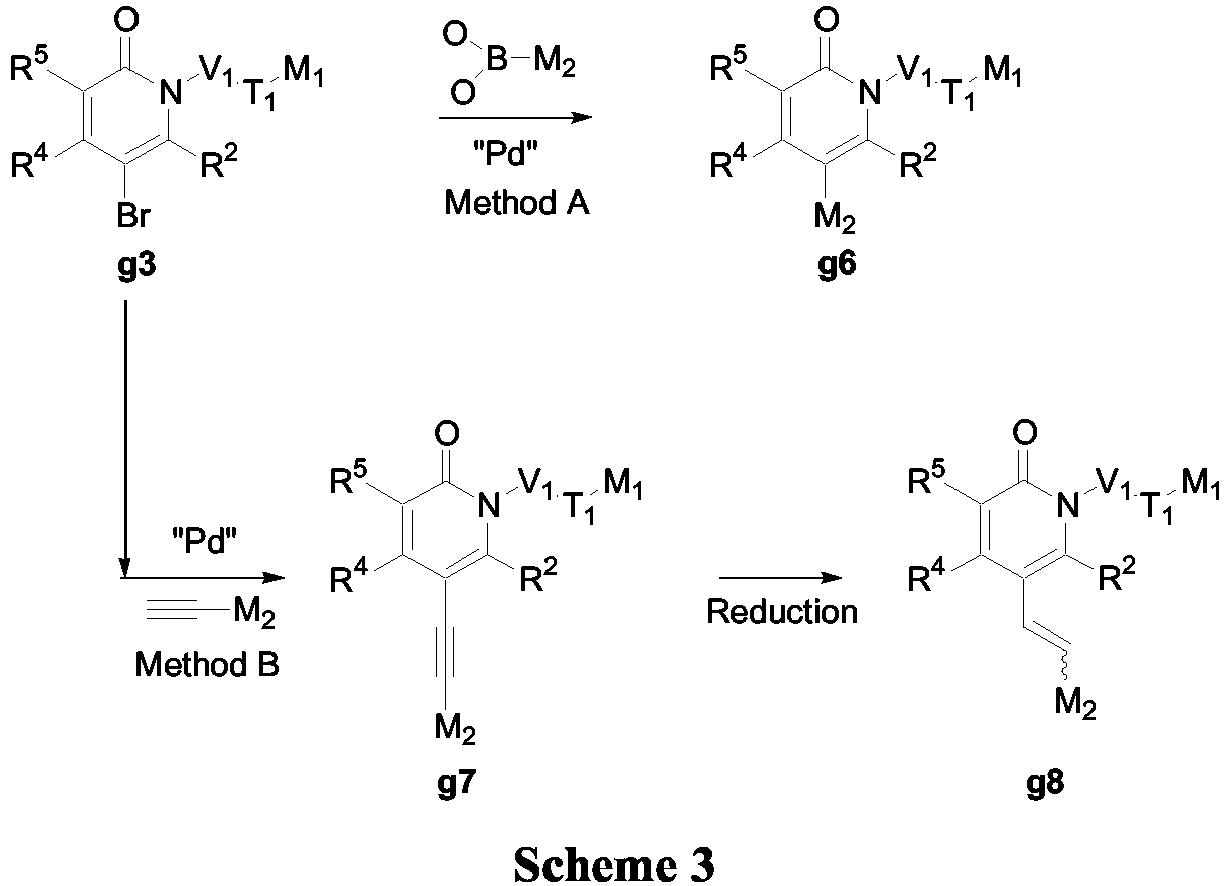
- The Suzuki-Miyaura (Method A, Scheme 3) carbon-carbon coupling reaction requires a catalyst such as PdCl2(PPh3)2, Pd(PPh3)4, Pd2(dba)3, Pd2(dppf) or Pd(OAc)2 and an aqueous or non-aqueous base such as sodium carbonate, potassium carbonate, sodium hydroxide or cesium fluoride in a suitable solvent such as dioxane, toluene, dimethoxyethane or DMF. The Sonogashira (Method B, Scheme 3) carbon-carbon coupling reaction requires a catalyst such as PdCl2(PPh3)2, Pd(PPh3)4 or Pd(OAc)2 in a suitable solvent such as DMF, acetonitrile or benzene. Typically, a co-catalyst such as copper (I) iodide and a base such as triethylamine, diisopropylamine, or KOAc will also be present in the reaction mixture. The Suzuki-Miyaura and Sonogashira reactions typically react at temperatures ranging from 0°C to 150°C. Typically, the reaction is maintained for 1 to 24 hours, with 12 hours usually being sufficient. The product of the reaction can be isolated and purified using standard techniques such as solvent extraction, column chromatography, crystallization, distillation and sublimation.
For a person skilled in the art of organic chemistry it is well understood that compound g7 can be hydrogenated under catalytic conditions using for example Pd/C and H2 or ammonium formate (as hydrogen source) to afford the partially reduced analogs g8 which are also part of this invention. It is noteworthy that a full hydrogenated version cannot be achieved under these conditions and therefore another approach should be envisaged to achieve fully reduced compounds (Scheme 8).
The inventors are aware that some chemical groups within V1T1M1 may not be compatible with the aforementioned carbon-carbon bond forming reaction (i.e. Sonogashira, Heck or Suzuki-Miyaura). Therefore, the V1T1M1 group can be introduced later in the synthesis (Scheme 4, Method A) and for example the Sonogashira reaction could be performed in the first step on a suitably substituted 2-methoxypyridine 5-boronic acid g9. The synthesis of such boronic acid is well described in the literature (J. Org. Chem., 2002, 67, 7541-7543) from commercial precursors with aryl and heteroaryl triflates or bromides. Aryl and heteroaryl bromides are available from commercial sources. The synthesis can also be performed from a suitably substituted 2-methoxypyridine having in position 5 an halide or a triflate reacting in a Suzuki-Miyaura reaction with a boronic compound Q-M2 where Q is B(OR)2. (Method B)
- Likewise, the V2T2M2 (in this case V2 and T2 are bonds and M2 is aryl, alkenearyl, aryl or heteroaryl) group can be introduced onto g2 in the first step (Scheme 5), to yield compound g12 which is then subjected to W-V1T1M1 under conditions similar to those described in Scheme 1, Step 2.

- For a person skilled in the art of organic chemistry it is well understood that functionalities present in compound g5 (where Y is COOMe, CN or CHO) may be further transformed into compound g13 as exemplified where Y is COOMe (Scheme 6).

- The acid compound generated from the ester g5 is an excellent anchoring point for heterocycle formation such as benzothiazole, oxadiazole, benzoxazole or isoxazole. The composition of the invention is not limited only to the aforementioned heterocycles but extends to our preferred list of heterocycles which may be synthesized through a similar scheme. (A. R. Katrizky and C. W. Rees, 1984, Comprehensive Heterocyclic Chemistry, Pergamon Press).
- For one skilled in the art of organic chemistry it is well understood that functionalities present in compound g5 (where Y is COOMe, CN or CHO) may be further transformed into compounds g14, g15, g16 and g17 (Scheme 7).

- The reductive amination to afford compound g14 is well documented in the literature (Helv. Chim. Acta, 1998, 81, 1754). The synthesis of alcohol g15 may utilize organometallic reagents such as the Grignard reagent exemplified here. However, many alternative organometallic reagents may be used and their preparation and use is well exemplified in the literature (M. Schlosser, 1994, Organometallics in Synthesis, John Wiley & Sons, Inc.). Compound g15 can be subsequently transformed into ketone g16 via oxidation or into alkyl g17 via reductive elimination.
- The inventors are aware that for specific compounds of the invention for instance compound g19 neither compound g5 nor compound g3 are compatible intermediates, therefore, compound g4 would be a suitable starting material (Scheme 8).
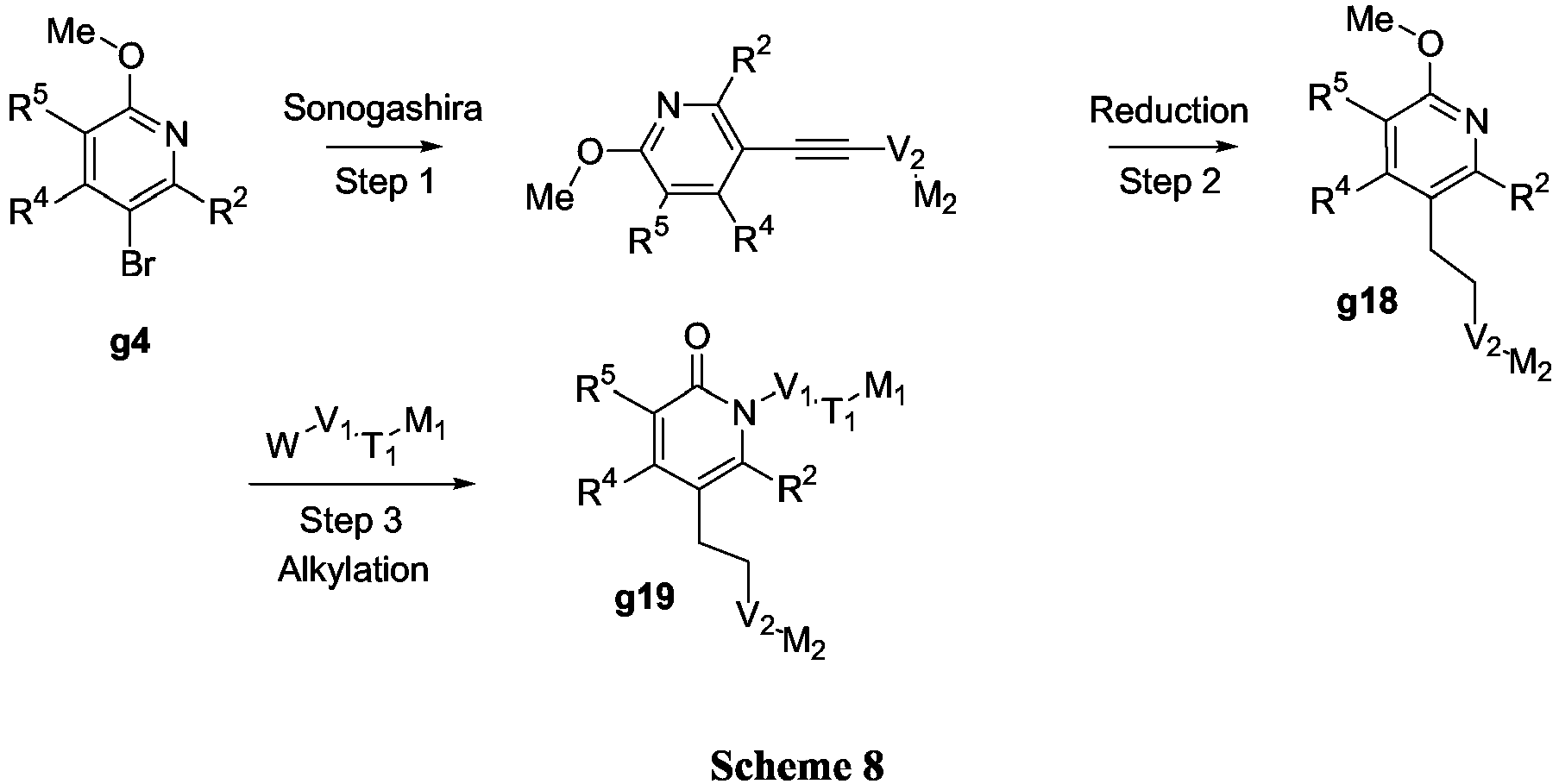
- All the methods used in Scheme 8 have been described in previous schemes.
- A person skilled in the art of organic chemistry would recognise that the V1T1M1 group assembly may be constructed stepwise to afford compounds g20 and g22 (Scheme 9).

- The acid moiety present in g21 is an excellent anchoring point for heterocycle formation such as benzothiazole g23, benzoxazole g24, oxadiazole g25 and isoxazole (Scheme 10) which are also compounds of this invention. The composition of the invention is not limited only to the aforementioned heterocycles but extend to our preferred list of heterocycles which can be synthesized through a similar scheme (A. R. Katrizky and C. W. Rees, 1984, Comprehensive Heterocyclic Chemistry, Pergamon Press; Chem. Pharm. Bull., 1999, 47, 120-122).

- In another embodiment, the invention provides compounds of Formula (II) (Scheme 11). The synthesis of starting materials (i.e. isoquinolin-1-one derivatives) when not commercially available are well described in the literature (Chem. Ber., 1972, 3726-3747; Chem. Pharm. Bull., 1982, 1680-1691, Chem. Pharm. Bull., 1986, 2754-2759). For a person skilled in the art of organic chemistry it is well understood that the preferred substituents as defined in the claims can be introduced using similar chemistry. V1T1M1 may be introduced using an elaborated W-V1T1M1 (where W is Cl, Br or OP) in the presence of base such as NaH, K2CO3 or NaHMDS in a suitable solvent such as THF or DMF. It is noteworthy that these procedures may lead to undesired O-alkylated product which can be separated by crystallization or column chromatography.
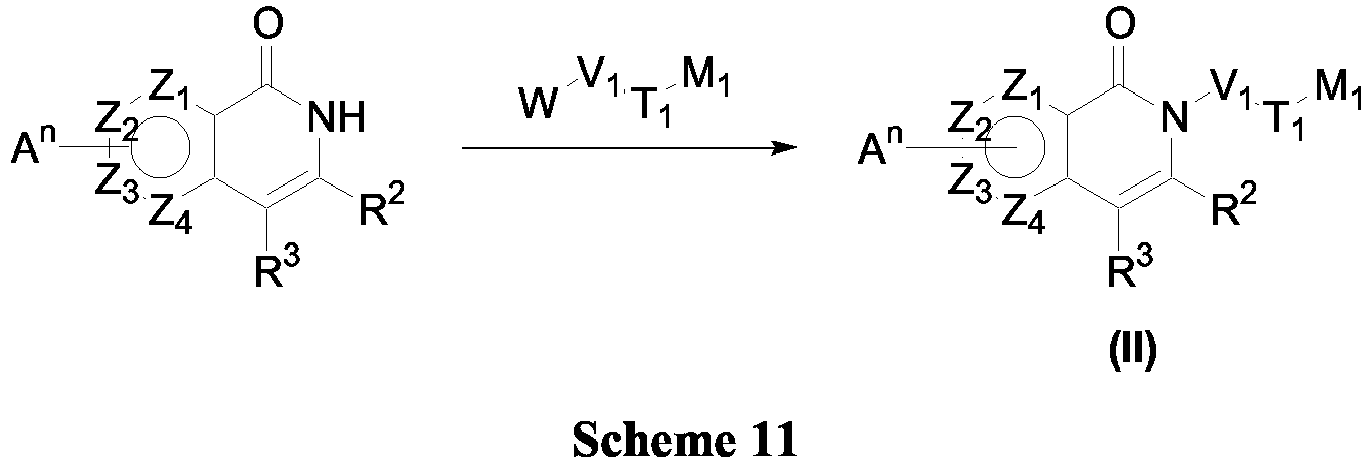
- In another embodiment, the invention provides compounds of Formula (III) (Scheme 12). The syntheses of similar compounds are well described in the literature (Magn. Reson. Chem., 26, 1988, 511-517; J. Chem. Soc. Perkin Trans., 1, 1980, 197-202; J. Heterocycl. Chem., 1983, 1707-1708, Heterocycles, 1997, 483-492). For a person skilled in the art of organic chemistry it is well understood that preferred substituents as defined in the claims can be introduced using similar chemistry. V1T1M1 can be introduced using an elaborated W-V1T1M1 (where W is Cl, Br or OP) in presence of base such as NaH or K2CO3 or alternatively, with HO-V1T1M1 using Mitsunobu condition (Tetrahedron Letters, 1994, 2819-2822) It is noteworthy that this procedure may lead to undesired O-alkylated product which can be separated by crystallization or column chromatography.

- In another embodiment of the invention provides compounds of Formula (IV) (Scheme 13).

- Alkylation of 2,4-dihydroxypyridine (commercially available) with a substituted benzyl halide is achieved using a base such as K2CO3 in a suitable solvent such as THF, CH3CN or DMF under heating at 80°C. This transformation may lead to a mixture of products which can then be separated to isolate intermediate g27. The deprotection of the hydroxybenzyl moiety can be selectively achieved using Pd/C and H2 or ammonium formate (as hydrogen source). The subsequent alcohol can either be alkylated as described previously or transformed into a triflate. Triflate g28 is a rather sensitive molecule and is used in the carbon-carbon bond formation (exemplified here with a Suzuki-Miyaura reaction or Sonogashira coupling, Scheme 3).
- In another embodiment of the present invention compounds of Formula (V) may be prepared in accordance with Scheme 14. Compound g31 can be deprotected in the presence of BBr3 (J. Med. Chem., 1997, 40, 2085-2101). The resulting alcohol g32 can be alkylated by XCH2R where X may be a good leaving group such as Cl, Br, I or OP in the presence of a base such as K2CO3, Cs2CO3 or NaH in a suitable solvent such as DMF, acetone or tetrahydrofuran at an appropriate temperature or acylated by XCOR where X is Cl in the presence of a base such as Et3N or DIEA in a suitable solvent.

- In another embodiment of the present invention, the compounds of Formula (V) may be prepared according to the synthetic sequences illustrated in Scheme 15. Compound g35 may be hydrolyzed by standard procedures followed by reaction with a primary or secondary amine in order to lead to compound g37 (Scheme 6). Compounds g36 and g38 represent an excellent anchoring point (acid, nitrile or amide) for heterocycle formation such as thiazole, oxadiazole, oxazole or isoxazole. The composition of the invention is not limited only to the aforementioned heterocycles but extends to our preferred list of heterocycles which can be synthesized through a similar scheme (A. R. Katrizky and C. W. Rees, 1984, Comprehensive Heterocyclic Chemistry, Pergamon Press).

- In another embodiment of the present invention, compounds of Formula (V) may be prepared in accordance with Scheme 16. For a person skilled in the art of organic chemistry it is well understood that aldehyde g4 can be reduced using LiAlH4 to afford the alcohol g40 which can be alkylated using either R'X (where X is Cl, Br or OP) in the presence of a base such as K2CO3, Cs2CO3 or NaH in a suitable solvent such as DMF, acetone or tetrahydrofuran or alternatively, using R'OH with Mitsunobu conditions as described in Scheme 1. Another way to synthesize compound g42 is to first alkylate compound g4 then reduce and finally to alkylate a second time.
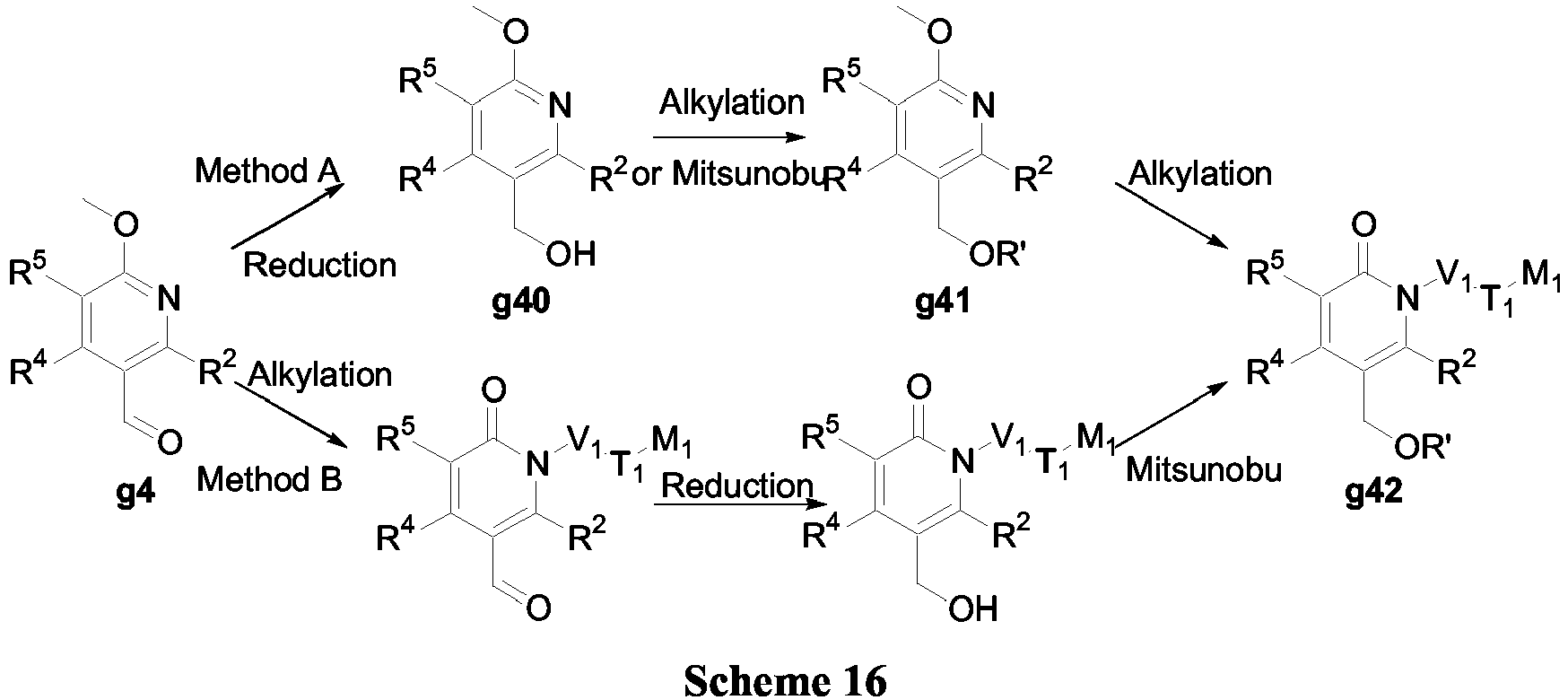
- In one embodiment of the present invention compounds of Formula (V-b) may be prepared according to the synthetic sequences illustrated in Scheme 17. Compound g3 can be transformed into boronic esters via metal-halogen exchange in the presence of Pd(PPh3)4. The resulting boronic esters can be coupled to M2 via Suzuki-Miyaura coupling as described in Scheme 3.
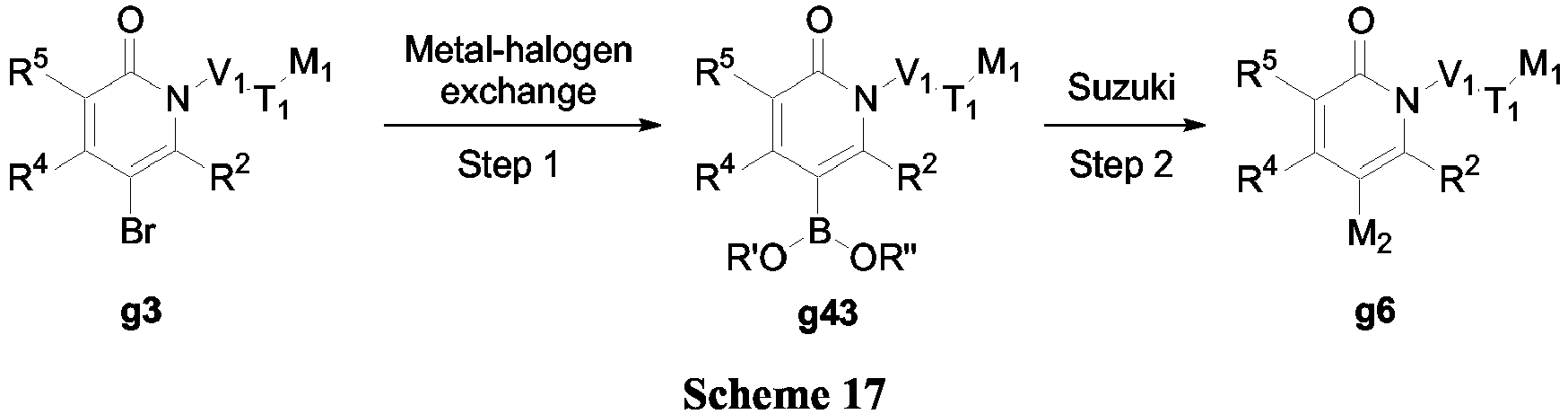
- In another embodiment of the present invention, compounds of Formula (V) may be prepared in accordance with Scheme 18. For one skilled in the art of organic chemistry it is well understood that ester g44 can be reduced using LiAlH4 to afford the alcohol g45.
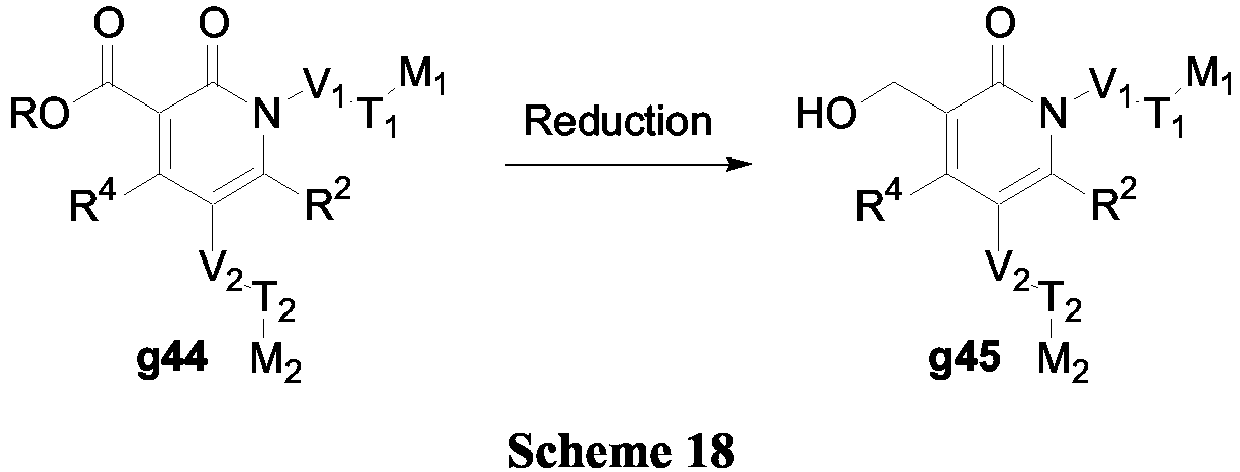
- In another embodiment of the present invention, the compounds of Formula (V) may be also prepared according to the synthetic sequences illustrated in Scheme 19. Compound g3 can be submitted to Suzuki-Miyaura coupling with boronic compounds being substituted by a protected amino moiety. Then in Method A, the removal of the Boc group in compound g46 may be achieved under classical conditions well known in the art such as HCl or TFA. The resulting primary amine can then be either acylated by standard procedure or submitted to reductive amination (Scheme 7). And in Method B, compound g46 can be submitted first to alkylation using preferentially NaH as base and tetrahydrofurane as organic solvent followed by deprotection under acidic conditions (for example the reaction can be done in an organic solvent such as DCM with an acid such as TFA typically at room temperature to give compound g48b.

- The synthesis of alcohol g50 may requires organometallic reagents such as the Grignard reagent exemplified here (Scheme 20). However, many alternative organometallic reagents may be used and their preparation and use is well exemplified in the literature (M. Schlosser, 1994, Organometallics in Synthesis, John Wiley & Sons, Inc.).

- Another embodiment of the invention provides compounds of Formula (IV) (exemplified in Scheme 21). Substituted 3-bromo-pyridine or 3-iodopyridine g51 can be subjected to directed ortho metalation at low temperatures (e.g. -78°C) in a solvent such as. THF or diethyl ether with lithium diisopropylamide and subsequently quenched with an electrophilic halogen source (e.g. Br2 or I2). 4-halopyridine g52 can then be functionalized by carbon-carbon bond forming reaction (Step 2, exemplified here by Suzuki-Miyaura or Stille reaction) under condition similar to those described in Scheme 3. Displacement of 2-halopyridine g53 by sodium methoxide in methanol yielded 2-methoxypyridine g54. Subsequent alkylation was then performed as described in Scheme 2 to yield pyridinone g55.

- Another embodiment of the invention provides compounds of Formula (V) (exemplified in Scheme 22). Method A, substituted 5-bromo-2-methoxy-pyridine g4 was subjected to lithium-halogen exchange at -78°C in an a solvent such as THF or diethyl ether with butyl lithium and quenched with a substituted alkyl bromide (M2V2T2X) to give compound g56. Alkylation was then performed as described in example 1 to give compound g57.
- In a similar manner, compound g4 can be involved in a Buchwald reaction (Method B) with an amine in conditions known in the art using palladium, a suitable catalyst and a ligand to afford after alkylation compound g57 (where V2 = NH or N-alkyl).

- Another embodiment of the invention provides compounds of Formula (V-b) (Scheme 23). Step 1, nucleophilic displacement of 2-halopyridine g58 (where X = I, Br, Cl or F) by sodium methoxide in methanol yielded 2-methoxypyridine g59. Bromination was achieved using bromine, aqueous potassium bromide, potassium hydroxide and water (Step 2). The bromopyridine g60 was then functionalized by carbon-carbon bond forming reaction (Step 3, exemplified here by Suzuki-Miyaura reaction) under conditions similar to those described in Scheme 3. Step 4, alkylation was then performed as described in Scheme 2 to give compound g62.

- Another embodiment of the invention provides compounds of Formula (V-b) (Scheme 24). Step 1, substituted pyridine g2 (where X = Br, I or TfO) was first functionalized by carbon-carbon bond forming reaction (Step 1, exemplified here by Suzuki-Miyaura reaction) under conditions similar to those described in Scheme 3. Alkylation was performed with alkyl halides (W-R1), NaI in MeCN at 70°C (Step 2). The resulting alcohol g63 was alkylated using standard Williamson ether synthesis (Step 3, NaH, DMF and alkyl halide at 0°C) to yield compound g64.

- Another embodiment of the invention provides compounds of Formula (V-b) (Scheme 25). Alkylation of 2-hydroxypyridine g2 was performed as described in example 1. Step 2, bromopyridine 3 was first functionalized by carbon-carbon bond forming reaction (exemplified here by Suzuki-Miyaura reaction) under conditions similar to those described in Scheme 3. The alcohol g65 was then alkylated to obtain compound g66. Or bromination of compound g65 was achieved using PPh3, NBS and Et20 at - 20°C (Step 3). The resulting bromide was alkylated using standard Williamson ether synthesis to yield ether g66 (Step 4, alkyl alcohol, NaH and DMF at 0°C).
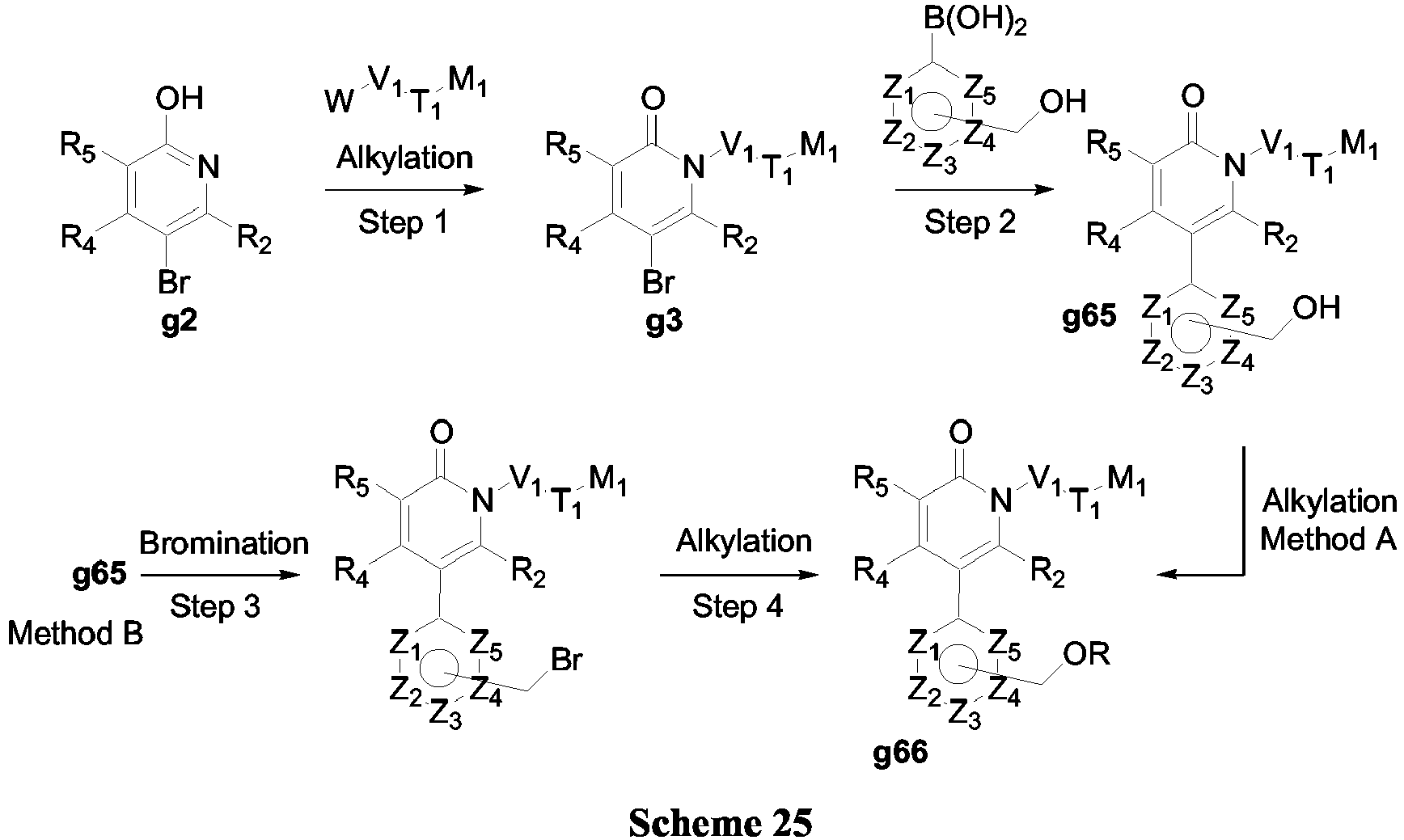
- Another embodiment of the invention provides compounds of Formula (V-b) (Scheme 26). Step 1, lithium-halogen exchange on substituted 5-bromo-2-methoxy-pyridine g4 at -78°C in THF with butyl lithium was reacted with a substituted carbonyl compounds. The resulting alcohol g67 was then eliminated using MsCl, TEA and DCM at room temperature (Step 2). The olefin g68 was then hydrogenated using standard conditions (H2, Pd/C in EtOH). Finally, the compound was alkylated as described for Scheme 2 to give compound g70.

- Another embodiment of the invention provides compounds of Formula (I) (Scheme 27). Where W is Cl, Br, I and OTf, pyrazine g71 was alkylated using standard conditions (Step 1). NaH, DMF or K2CO3, MeCN, at room temperature, elevated temperatures or with microwave irradiation. Alternatively, where W is OH, alkylation could be performed by Mitsunobu reaction using, DEAD, PPh3, THF at room temperature or 60°C. The bromopyrazine g72 was then subjected to a carbon-carbon bond forming reaction (Step 2, exemplified here by Suzuki-Miyaura reaction) under conditions similar to those described in Scheme 3 to give compound g73.
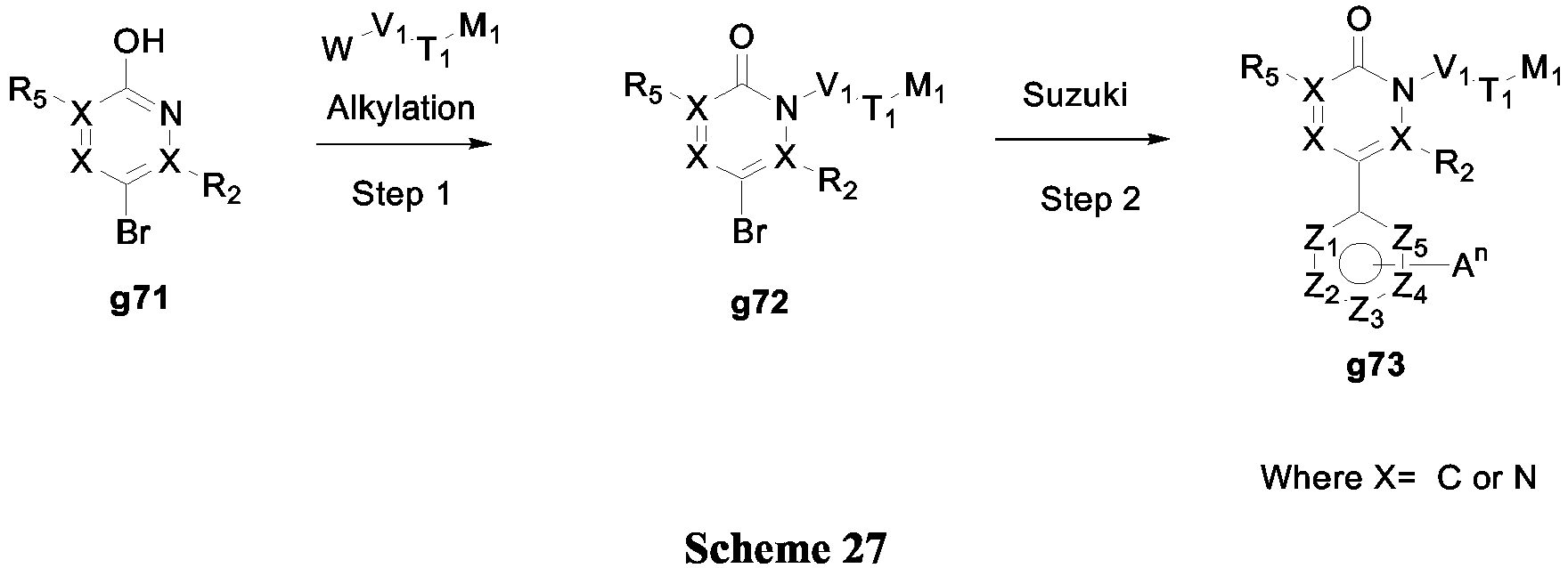
- In another embodiment of the present invention, the compounds of Formula (II) may be prepared according to the synthetic sequences illustrated in Scheme 28. Isoquinoline g74 can be converted into isoquinolone g76 (Heterocycles, 1996, 42, 415) via oxidation with mCPBA followed by rearrangement of the N-oxide in the presence of acetic anhydride and then by basic sodium hydroxide cleavage. Finally, the resulting isoquinolone g76 can be alkylated as described in Scheme 1 and submitted to Buchwald coupling (if V2=NR) as in Scheme 22. It is obvious that introduction of V1T1M1 or V2T2M2 groups can be done through the same process as described earlier.

- In another embodiment of the present invention, the compounds of Formula (II) may be prepared according to the synthetic sequences illustrated in Scheme 29. Compound g77 can be submitted to a Sonogashira coupling and reduced (Scheme 8) to yield compound g79. Then the isoquinoline may be transformed into alkylated isoquinolone g82 as presented in Scheme 29.
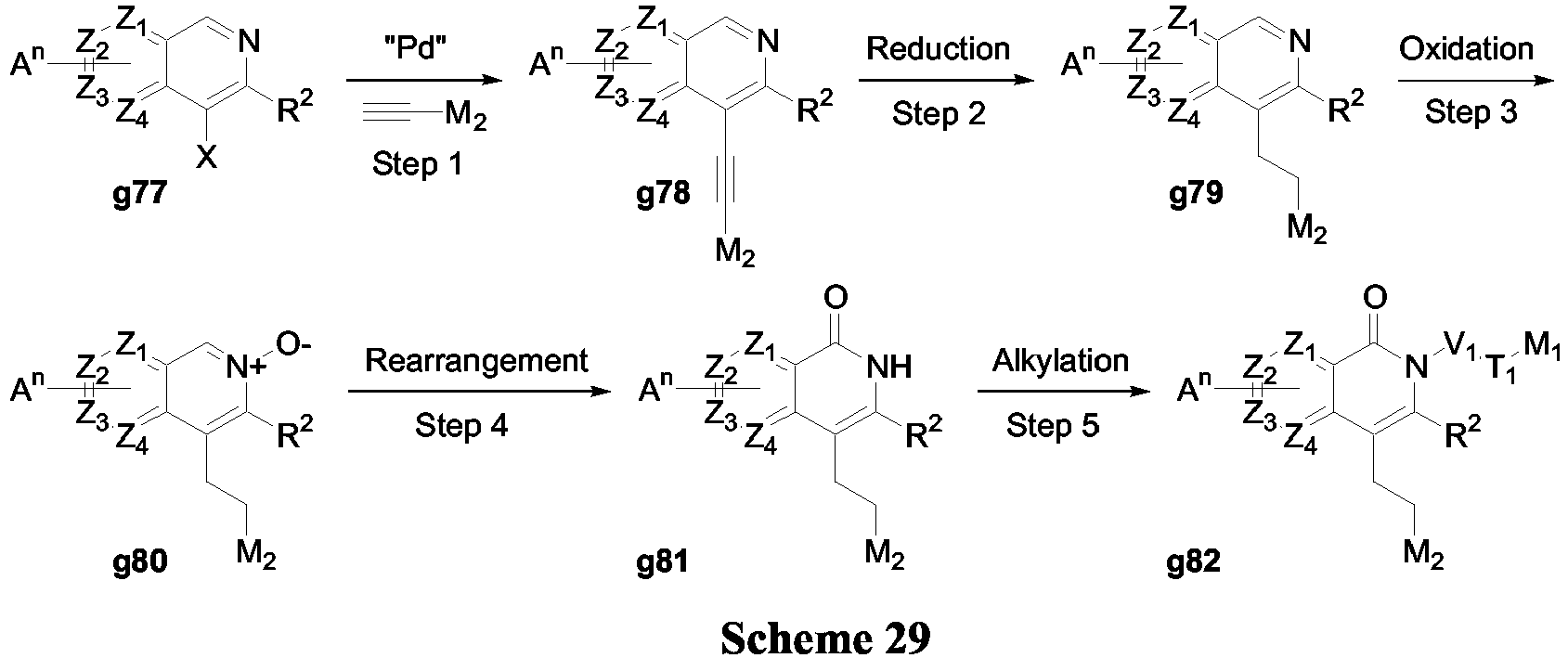
- In another embodiment of the present invention, compounds of Formula (V-b) can be prepared in accordance with Scheme 30. Bromopyridine g83 can be functionalized by carbon-carbon bond forming reaction (exemplified here by Suzuki-Miyaura reaction) under condition similar to those described in Scheme 3. The resulting pyridine g84 can be lithiated by strong base such as butyl lithium or LDA in THF at low temperatures (e.g. -78°C) and subsequently quenched with paraformaldehyde to give alcohol g86 after workup. N-Alkylation by NaI in acetonitrile at elevated temperatures using W-V1T1M1 yields compound g86. The resulting alcohol g86 can be alkylated by the methods described in Scheme 24, step 3.

- In another embodiment of the present invention, compounds of Formula (V-b) can be prepared in accordance with Scheme 31. Pyridine g84 was prepared as described in Scheme 30. Bromination with NBS under UV light in CCl4 at reflux gave compound g88. Alkylation using ROH and sodium methoxide at reflux gave compound g89. The resulting alcohol g89 can then be alkylated by the methods described in Scheme 1.

- Compound g93 (Scheme 32) can be synthesized from either bromide g91 or alcohol g92 using any one of the procedures known in the art, for example, using a copper catalyzed coupling reaction conditions when R is aryl or via a Mitsunobu reaction conditions when R is alkyl respectively. Finally, the resulting ether g93 can be alkylated with for example alkyl halide, in an organic solvent such as acetonitrile or dimethylformamide and with a base such as K2CO3.

- Compound g96 (Scheme 33) can be synthesized from pyridine g95 (prepared as described in Schemes 1 and 3) via halogen exchange. Then the iodopyridine may be coupled through Sonogashira or Heck conditions to alkynes or alkenes respectively. The resulting insaturated compound g97 can then be reduced as exemplified earlier by hydrogenation to give compound g98.

- In another embodiment of the present invention, the compounds of Formula (II) may be prepared according to the synthetic sequences illustrated in Scheme 34. Isoquinoline g99 can be converted into his N-oxide g100 via oxidation in the presence of MCPBA followed by standard alkylation. Rearrangement of N-oxide g101 in the presence of acetic anhydride and basic sodium hydroxide cleavage yielded isoquinolone g102. Finally, the resulting isoquinolone g102 can be alkylated as described in Scheme 1. It is obvious that introduction of V1T1M1 or V2T2M2 groups can be done through the same process as described earlier.

- Several methods for preparing the compounds of this invention are illustrated in the following Examples.
- Unless otherwise noted, all starting materials were obtained from commercial suppliers and used without further purification.
- Specifically, the following abbreviations may be used in the examples and throughout the specification.
AcOEt (ethyl acetate) M (molar) AcOH (acetic acid) MeOH (methanol) BBr3 (boron tribromide) mg (milligrams) BINAP (±-1,1'-Bi(2-naphthol) MgSO4 (magnesium sulphate) Br2 (bromine) MHz (megahertz) CDCl3 (deuterated chloroform) min (minutes) CCl4 (carbon tetrachloride) µL(microliters) CH2Cl2 (dichloromethane) mL (milliliters) MCPBA (3-chloroperbenzoic acid) mmol (millimoles) DEAD (diethyl azodicarboxylate) M.p. (melting point) DIBAL (diisobutyl aluminium hydride) NaBH(OAc)3 (sodium borohydride triacetate) DME (dimethoxyethane) Na2CO3 (sodium carbonate) DMF (dimethylformamide) NaH (sodium hydride) DMSO (dimethyl sulfoxide) NaHCO3 (sodium hydrogenocarbonate) Dppf (1,1'-bis(diphenylphosphanyl)ferrocene) NaHMDS (sodium hexamethyldisilazane) EDCI.HCl (1-3(dimethylaminopropyl)-3-ethylcarbodiimide, hydrochloride) NaI (sodium iodide) Et3N (triethylamine) NaOtBu (sodium tert-butoxide) Et2O (diethyl ether) Na2SO4 (sodium sulphate) EtOH (ethanol) NBS (N-bromosuccinimide) g (grams) NH4Cl (ammonium chloride) 1H (proton) NH4OH (ammonium hydroxide) H2 (hydrogen) NMR (Nuclear Magnetic Reasonance) HCl (hydrochloric acid) Pd2(dba)3 (palladium (II)dibenzylideneacetone) HPLC (High Pressure Liquid Chromatography) PdCl2(dppf)2 (Bis(1,1'-bis(diphenylphosphanyl)ferrocene palladium (II) dichloride) Hz (Hertz) PdCl2(PPh3)2 (Bis(triphenylphosphine) palladium (II) dichloride KBr (potassium bromide) Pd(OAc)2 K2CO3 (potassium carbonate) Pd(PPh3)4 (tetrakis(triphenylphosphine)palladium(0)) KOAc (potassium acetate) PPh3 (triphenylphosphine) KI (potassium iodide) Rf KOtBu (potassium tert-butoxide) RT (Retention Time) KOH (potassium hydroxide) TFA (trifluoroacetic acid) K3PO4 (potassium phosphate) THF (tetrahydrofuran) LCMS (Liquid Chromatography Mass Spectrum) TLC (thin layer chromatography) LiAlH4 (lithium aluminium hydride) - All references to brine refer to a saturated aqueous solution of NaCl. Unless otherwise indicated, all temperatures are expressed in °C (degrees Celsius). All reactions are conducted not under an inert atmosphere at room temperature unless otherwise noted.
- The microwave oven used is an apparatus from Biotage (Optimizer™) equipped with an internal probe that monitors reaction temperature and pressure, and maintains the desired temperature by computer control.
-

- According to Scheme 1 Step 1: A mixture of 2-hydroxypyridine (1eq, 100mmol, 10.0g) in AcOH (100mL) was treated with NBS (1.06eq, 110mmol, 19.8g) at room temperature for 4 hours. The mixture was concentrated, azeotroped twice with EtOH then the solid was taken up in hot EtOH (100mL). After cooling to room temperature, the precipitate was removed by filtration and recrystallized from EtOH to provide 5-bromopyridin-2(1H)-one (51.7mmol, 9.00g, 49%) as a pale brown solid.
Rf = 0.60 (AcOEt/MeOH/NEt3 100/15/1); LC (XTerra RP18, 3.5µm, 3.0x50mm Column): RT = 0.59-2.46min; MS m/z (CI) [MH]+= 174, 176. - According to Scheme 1 Step 2: K2CO3 (10eq, 0.11mmol, 16.0g) and 1-(bromomethyl)-4-chloro-2-fluorobenzene (1.5eq, 17.0mmol, 3.90g) was added to a solution of 5-bromopyridin-2(1H)-one (1eq, 11.0mmol, 2.00g), in THF (100mL). The suspension was stirred for 2 hours at room temperature and 17 hours at 60°C. The reaction mixture was filtered and the mother liquor was concentrated under reduced pressure. The crude product was purified by flash chromatography over silica gel (AIT Flashsmart prepacked column 70g SiO2) using CH2Cl2/AcOEt 80/20 as eluent to afford the title compound 1-(4-chloro-2-fluorobenzyl)-5-bromopyridin-2(1H)-one (9.10mmol, 2.87g, 79%) as a white solid.
LC (XTerra RP18, 3.5µm, 3.0x50mm Column): RT = 4.12min; MS m/z (CI) [MH]+= 316, 318. - According to Scheme 3 Method A: To a mixture of 1-(4-chloro-2-fluorobenzyl)-5-bromopyridin-2(1H)-one (1eq, 1.00mmol, 0.40g) in dioxane/K3PO4 (2M, 10mL), were added Pd(PPh3)4 (0.3eq, 0.4mmol, 0.4g) and 6-methoxypyridin-3-ylboronic acid (1.5eq, 2.00mmol, 0.30g) then the reaction mixture was heated at 80°C for 17 hours. The mixture was diluted with AcOEt. The organic fraction was washed with brine, dried over Na2SO4, filtered and concentrated under reduced pressure. The crude product was purified by silica gel chromatography (AIT Flashsmart prepacked column 25g SiO2, CH2Cl2/AcOEt 70/30) and by crystallization in pentane/Et2O to afford 1-(4-chloro-2-fluorobenzyl)-5-(6-methoxypyridin-3-yl)pyridin-2(1H)-one (0.91mmol, 0.40g, 91%) as a white solid.
M.p.: 136°C; LC (XTerra RP18, 3.5µm, 3.0x50mm Column): RT = 4.13min; MS m/z (CI) [MH]+= 345, 347; 1H NMR (300MHz, DMSO-d6) δ 3.87 (s, 3H), 5.17 (s, 2H), 6.53 (d, J=9.5Hz, 1H), 6.89 (d, J=8.7Hz, 1H), 7.17-7.24 (m, 1H), 7.27 (dd, J=2.0Hz and 8.4Hz, 1H), 7.46 (dd, J=2.0Hz and 10.2Hz, 1H), 7.84-7.94 (m, 2H), 8.20 (d, J=2.6Hz, 1H), 8.38 (d, J=2.3Hz, 1H). -

- According to Scheme 1 Step 2: The title compound was prepared from 5-bromopyridin-2(1H)-one (1eq, 29.0mmol, 5.00g, Example 1 Step 1) and 4-chlorobenzyl bromide (1.2eq, 34.0mmol, 7.10g) according to the procedure described for Example 1 Step 2. After concentration of the solvent, water was added. The aqueous phase was extracted with AcOEt and the combined organic fractions were dried over Na2SO4, filtered and concentrated under reduced pressure. The crude product was recristallized with pentane/Et2O 50/50 to afford 1-(4-chlorobenzyl)-5-bromopyridin-2(1H)-one (26.2mmol, 7.82g, 91%) as a white solid.
LC (XTerra RP18, 3.5µm, 3.0x50mm Column): RT = 4.18min; MS m/z (CI) [MH]+= 299, 301. - According to Scheme 3 Method A: To a solution of 1-(4-chlorobenzyl)-5-bromopyridin-2(1H)-one (1eq, 0.33mmol, 0.10g) in dioxane/saturated aqueous NaHCO3 (1:1, 6mL) was added Pd(PPh3)4 (0.15eq, 0.05mmol, 58mg) and 4-(3-hydroxypropyl)phenylboronic acid (1.5eq, 0.50mmol, 90.0mg). The reaction was then stirred at 90°C for 4.5 hours. The reaction was allowed to cool and diluted with AcOEt. The reaction was washed with saturated NH4Cl solution, brine and the organic phase extracted (x3). The combined organic fractions were dried (Na2SO4), filtered and concentrated under reduced pressure. The crude product was purified by flash chromatography over silica gel (AIT Flashsmart prepacked column 15g SiO2) using pure AcOEt as the eluent to afford 1-(4-chlorobenzyl)-5-(4-(3-hydroxypropyl)phenyl)pyridin-2(1H)-one (0.22 mmol, 78 mg, 66%) as a white solid.
M.p.: 165°C; Rf = 0.05 (CH2Cl2/AcOEt 80/20); LC (XTerra RP18, 3.5µm, 3.0x50mm Column): RT = 3.78min; MS mlz (CI) [MH]+= 354, 356; 1H NMR (300MHz, DMSO-d6) δ 1.64-1.77 (m, 2H), 2.61 (t, J=7.3Hz, 2H), 3.32-3.46 (m, 2H), 4.48 (t, J=5.1Hz, 1H), 5.15 (s, 2H), 6.52 (d, J=9.5Hz, 1H), 7.24 (d, J=8.1Hz, 2H), 7.35-7.44 (4H), 7.47 (d, J=8.1Hz, 2H), 7.83 (dd, J=2.6Hz, 9.5Hz, 1H), 8.23 (d, J=2.6Hz, 1H). -
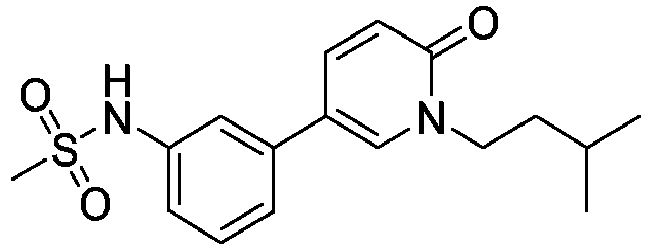
- According to Scheme 1 Step 2: The title compound was prepared from 5-bromopyridin-2(1H)-one (1eq, 0.01mol, 1.73g) and 1-isopentylbromide (1eq, 0.01mmol, 1.51g) according to the procedure described for Example 1 Step 2. Reaction conditions: 3 hours under reflux in acetonitrile. The crude product was purified by flash chromatography over silica gel (AIT Flashsmart prepacked column SiO2) using CH2Cl2/AcOEt (80/20) as the eluent to afford 5-bromo-1-isopentylpyridin-2(1H)-one (6.23mmol, 1.52g, 62%) as a brown oil.
- According to scheme 3 Method A: The title compound was prepared from 5-bromo-1-isopentylpyridin-2(1H)-one (1eq, 0.41mmol, 0.10g) and 3-(methylsulfonamido)phenylboronic acid (1.5eq, 0.61mmol, 0.13g) according to the procedure described for Example 2 Step 2. The crude product was purified by flash chromatography over silica gel (AIT Flashsmart prepacked column 15g SiO2) using CH2Cl2/AcOEt (80/20) as the eluent to afford N-(3-(1-isopentyl-6-oxo-1,6-dihydropyridin-3-yl)phenyl)methanesulfonamide (0.32mmol, 0.11g, 77%) as a white solid.
M.p.:159°C; Rf = 0.42 (CH2Cl2/AcOEt 50/50); LC (XTerra RP18, 3.5µm, 3.0x50mm Column): RT = 3.49min; MS m/z (CI) [MH]+= 335; 1H NMR (300MHz, DMSO-d6) δ 0.93 (d, 6H), 1.49-1.62 (m, 3H), 3.02 (s, 3H), 3.91-4.00 (m, 2H), 6.48 (d, J=9.4Hz, 1H), 7.10-7.18 (m, 1H), 7.28-7.42 (m, 3H), 7.70 (dd, J=2.6Hz, 9.4Hz, 1H), 8.03 (d, J=2.6Hz, 1H), 9.78 (s, 1H). -

- To a solution of 3-amino-4-methoxyphenylboronic acid (1eq, 2.10mmol, 0.35g) in CH2Cl2 (5mL) at -78°C was added Et3N (6eq, 13.0mmol, 1.7mL). The reaction was stirred for 30 minutes then methanesulfonyl chloride (1.1eq, 2.3 mmol, 0.26g) was added. The reaction was then stirred at -78°C for 1 hour. The reaction was allowed to warm to room temperature and diluted with CH2Cl2. The reaction was washed with 1.0N aqueous HCl and the organic phase was extracted (x3). The combined organic fractions were dried (Na2SO4), filtered and concentrated under reduced pressure to afford 4-methoxy-3-(methylsulfonamido)phenylboronic acid (1.92mmol, 0.49g, 96%) as a white solid.
LC (XTerra RP18, 3.5µm, 3.0x50mm Column): RT = 2.11min; MS m/z (CI) [MH]+= 246. - According to Scheme 3 Method A: The title compound was prepared from 1-(4-chlorobenzyl)-5-bromopyridin-2(1H)-one (1eq, 1.80mmol, 0.55g, Example 2 Step 1) and 4-methoxy-3-(methylsulfonamido)phenylboronic acid (1.1eq, 2.00mmol, 0.49g) according to the procedure described for Example 1 Step 3. Reaction conditions: 4 hours at 80°C. The crude product was purified by flash chromatography over silica gel (AIT Flashsmart prepacked column 25g SiO2) using CH2Cl2/AcOEt (90/10) then recrystallized from pentane/Et2O to afford N-(5-(1-(4-chlorobenzyl)-6-oxo-1,6-dihydropyridin-3-yl)-2-methoxyphenyl)methanesulphonamide (0.31mmol, 0.32g, 41%) as a white solid.
M.p.: 151°C; LC (XTerra RP18, 3.5µm, 3.0x50mm Column): RT = 3.75min; MS m/z (CI) [MH]+= 419, 421; 1H NMR (300MHz, DMSO-d6) δ 2.88 (s, 3H), 3.76 (s, 3H), 5.08 (s, 2H), 6.44 (d, J=10.9Hz, 1H), 7.05 (d, J=10.9Hz, 1H), 7.27-7.35 (m, 3H), 7.42-7.60 (m, 3H), 7.68 (dd, J=3.5Hz, J=10.9Hz, 1H), 8.08 (d, J=3.5Hz, 1H), 8.94 (s, 1H). -

- According to Scheme 1 Step 2: 1-(3-Fluorobenzyl)-5-bromopyridin-2(1H)-one was prepared from 5-bromopyridin-2(1H)-one (Example 1 Step 1) and 3-fluorobenzyl bromide according to the procedure described for Example 2 Step 1. The crude product was washed with pentane/Et2O 50/50 to afford 1-(3-fluorobenzyl)-5-bromopyridin-2(1H)-one (10.7mmol, 3.00g, 62%) as a white solid.
LC (XTerra RP18, 3.5µm, 3.0x50mm Column): RT = 4.05min; MS m/z (CI) [MH]+= 283. - According to Scheme 3 Method B: Copper iodide (0.1eq, 6.7mg, 35µmol) and Et3N (20eq, 7.09mmol, 1.00mL) in DMF (5mL) were stirred under nitrogen for 10 min. PdCl2(PPh3)2 (0.1eq, 35µmol, 25mg) was added to the reaction mixture and the reaction mixture was stirred for a further 15 min at room temperature. 1-(3-Fluorobenzyl)-5-bromopyridin-2(1H)-one (1eq, 0.35mmol, 0.10g) and 3-ethynylpyridine (1.2eq, 0.43mmol, 0.04g) were successively added to the reaction mixture. After stirring at 80°C for 4 hours, the reaction mixture was quenched with water and the aqueous layer was washed with AcOEt (3x30mL). The combined organic layers were dried over Na2SO4, filtered and evaporated under reduced pressure. The crude product was purified by chromatography on silica gel using CH2Cl2/AcOEt 90/10 + 1% HCl 2M in dioxane as eluent. 1-(3-Fluorobenzyl)-5-(2-(pyridin-3-yl)ethynyl)pyridin-2(1H)-one hydrochloride was obtained as a beige solid (32 µmol, 11mg, 9%).
M.p.: 179°C; LC (XTerra RP18, 3.5µm, 3.0x50mm Column): RT = 3.68 min; MS m/z (CI) [MH]+= 305; 1H NMR (500MHz, DMSO-d6) δ 5.12 (s, 2H), 6.50 (d, J=9.4Hz, 1H), 7.11-7.20 (3H), 7.37-7.43 (m, 1H), 7.51 (dd, J=5.0Hz and 8.0Hz, 1H), 7.58 (dd, J=2.5Hz and 9.4Hz, 1H), 7.96-8.00 (m, 1H), 8.37 (d, J=2.4Hz, 1H), 8.59 (dd, J=1.6Hz and 5.0Hz, 1H), 8.73 (d, J=2.1Hz, 1H). -

- According to Scheme 4 Method A: The title compound was prepared from 2-bromobenzo[d]thiazole (1eq, 0.91mmol, 0.20g) and 6-methoxypyridin-3-ylboronic acid (1.5eq, 1.36mmol, 0.21g) according to the procedure described for Example 2 Step 2. The crude product was purified by silica gel chromatography (AIT Flashsmart prepacked column 25g SiO2) using cyclohexane/AcOEt 95/5 as eluent to afford 2-(6-methoxypyridin-3-yl)benzo[d]thiazole (0.74mmol, 0.18g, 82%) as a white solid.
- According to Scheme 4, Step 1: A mixture of 2-(6-methoxypyridin-3-yl)benzo[d]thiazole (1eq, 0.25mmol, 60mg), Nal (5eq, 1.20mmol, 0.19g) and 4-chloro-3-fluorobenzylbromide (5eq, 1.20mmol, 0.28g) in acetonitrile (10mL) was stirred for 14 hours at 90°C. The crude residue was partitioned between CH2Cl2 and water. The aqueous layer was extracted with CH2Cl2. The combined organic layers were dried over MgSO4, filtered and evaporated. The crude product was purified by silica gel chromatography (AIT Flashsmart prepacked column 25g SiO2) using CH2Cl2/AcOEt 95/5 as eluent to afford 1-(4-chloro-3-fluorobenzyl)-5-(benzo[d]thiazol-2-yl)pyridin-2(1H)-one (0.14mmol, 0.05g, 58%) as a beige solid.
M.p.:164°C; LC (XTerra RP18, 3.5µm, 3.0x50mm Column): RT = 4.89min; MS m/z (CI) [MH]+= 371, 373; 1H NMR (500MHz, CDCl3) δ 5.26 (s, 2H), 6.61 (d, J=9.5Hz, 1H), 7.22-7.25 (m, 1H), 7.41-7.45 (m, 1H), 7.45-7.48 (m, 1H), 7.50-7.54 (m, 1H), 7.56-7.60 (m, 1H), 7.96 (d, J=7.7Hz, 1H), 8.11 (dd, J=2.7Hz and 9.5Hz, 1H), 8.11-8.13 (m, 1H), 8.81 (d, J=2.6Hz, 1H). -

- According to Scheme 5 Step 2: The title compound was prepared from 5-(4-methoxyphenyl)-(1H)-pyridin-2-one (1eq, 0.50mmol, 0.10g, Example 7 Step 1) and 5-(chloromethyl)-2-(trifluoromethyl)pyridine (1.5eq, 0.74mmol, 0.15g) according to the procedure described for Example 1 Step 2. Reaction conditions: 6 hours at 70°C and 48 hours at room temperature. The crude product was purified by silica gel chromatography (AIT Flashsmart prepacked column 10g SiO2, CH2Cl2 AcOEt 90/10). The purified oil was dissolved in Et2O and HCl (4M in dioxane) was added. The resulting precipitate was filtered, dried to afford 5-(4-methoxyphenyl)-1-((6-(trifluoromethyl)pyridin-3-yl)methyl)pyridin-2(1H)-one hydrochloride (83µmol, 30mg, 17%) as a white solid.
M.p.: 168°C; LC (XTerra RP18, 3.5µm, 3.0x50mm Column): RT = 4.06min; MS mlz (CI) [MH]+= 361; 1H NMR (500Hz, CDCl3) δ 3.76 (s, 3H), 5.27 (s, 2H), 6.51 (d, J=9.4Hz, 1H), 6.98 (d, J=6.7Hz, 2H), 7.51 (d, J=6.7Hz, 2H), 7.83 (dd, J=2.7Hz and 9.4Hz, 1H), 7.88 (d, J=8.2Hz, 1H), 8.00 (dd, J=1.7Hz and 8.2Hz, 1H), 8.28 (d, J=2.5Hz, 1H), 8.81 (d, J=1.7Hz, 1H). -

- According to Scheme 5 Step 2: To a solution of 5-(4-methoxyphenyl)pyridin-2(1H)-one (1eq, 0.35mmol, 70mg, Example 7 Step 1) in acetonitrile (2mL) were added K2CO3 (10eq, 3.50mmol, 0.48g) and (bromomethyl)cyclohexane (10eq, 3.50mmol, 0.49mL). The reaction was microwaved for 10 minutes at 180°C. The reaction was allowed to cool. The reaction was then filtered and concentrated under reduced pressure. The crude product was purified by flash chromatography over silica gel (AIT Flashsmart prepacked column 15g SiO2) using CH2Cl2/AcOEt (80/20, Rf=0.3). The product was further purified by reverse phase C18 column using water/acetonitrile 60/40 to afford 1-(cyclohexylmethyl)-5-(4-methoxyphenyl)pyridin-2(1H)-one (0.11mmol, 32mg, 31%) as a colorless oil.
LC (XTerra RP18, 3.5µm, 3.0x50mm Column): RT = 4.72min; MS m/z (CI) [MH]+= 298; 1H NMR (300MHz, CDCl3) δ 0.85-1.09 (m, 2H), 1.09-1.32 (m, 3H), 1.53-1.78 (m, 5H), 1.78-2.00 (m, 1H), 3.74 (d, J=7.3Hz, 2H), 3.77 (s, 3H), 6.57 (d, J=9.4Hz, 1H), 6.88 (d, J=8.7Hz, 2H), 7.29-7.35 (3H), 7.49 (dd, J=2.7Hz, 9.4Hz, 1H). -

- According to Scheme 10 Method A: A solution of PPh3 (3eq, 1.04mmol, 0.27g) in 1:1 acetonitrile/pyridine (3mL) was added dropwise over a period of 1 hour to a mixture of 2-(5-(4-methoxyphenyl)-2-oxopyridin-1(2H)-yl)acetic acid (1eq, 0.35mmol, 0.09g, Example 14 Step 2), 2-amino-4-fluorophenol (1eq, 0.35mmol, 0.04g), Et3N (3eq, 1.04mmol, 0.15mL) and CCl4 (4eq, 1.39mmol, 0.13mL) in 1:1 mixture of acetonitrile/pyridine (3mL). The reaction mixture was stirred at room temperature for 2 days. The solvent was removed under reduced pressure and the residue was dissolved in CH2Cl2 and NH4OH. The aqueous phase was extracted 3 times with CH2Cl2. The combined organic fractions were washed with brine, dried over Na2SO4, filtered and concentrated under reduced pressure. The crude product was purified by flash chromatography over silica gel (AIT Flashsmart prepacked column 15g SiO2) using CH2Cl2/AcOEt 90/10 as eluent to afford 1-((5-fluorobenzo[d]oxazol-2-yl)methyl)-5-(4-methoxyphenyl)pyridin-2(1H)-one (0.06mmol, 0.02g, 16%) as a brown solid.
M.p.:115°C; Rf = 0.21 (CH2Cl2/AcOEt 90/10); LC (XTerra RP18, 3.5µm, 3.0x50mm Column): RT = 4.06min; MS m/z (CI) [MH]+= 351; 1H NMR (500MHz, CDCl3) δ 3.84 (s, 3H), 5.46 (s, 2H), 6.74 (d, J=9.5Hz, 1H), 6.96 (d, J=8.8Hz, 2H), 7.05-7.12 (m, 1H), 7.35 (d, J=8.8Hz, 2H), 7.40 (dd, J=8.3Hz and 2.6Hz, 1H), 7.46 (dd, J=9.1Hz and 4.2Hz, 1H), 7.58 (d, J= 2.6Hz, 1H), 7.66 (dd, J=9.5Hz and 2.6Hz, 1H). -
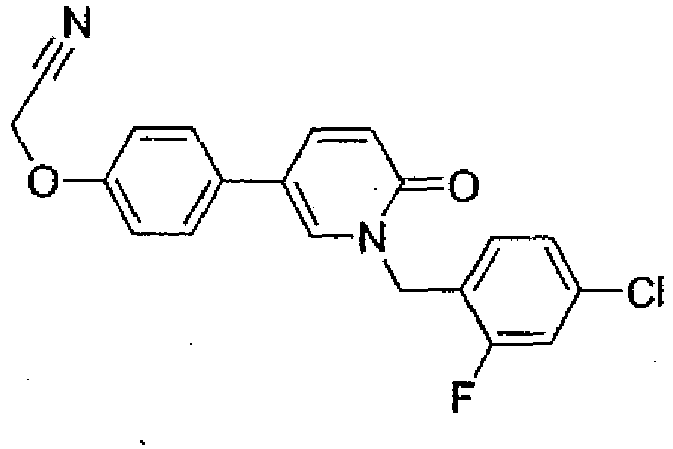
- According to Scheme 3 Method A: The title compound was prepared from 1-(4-chloro-2-fluorobenzyl)-5-bromopyridin-2(1H)-one (1eq, 16.4mmol, 5.20g, Example 1 Step 2) and 4-methoxyphenylboronic acid (1.5eq, 25.0mmol, 3.80g) according to the procedure described for Example 1 Step 3. The crude product was purified by flash chromatography over silica gel using CH2Cl2/AcOEt 95/5 to 80/20 as eluent to afford 1-(2-fluoro-4-chlorobenzyl)-5-(4-methoxyphenyl)pyridin-2(1H)-one (16.4mmol, 5.64g, 100%) as a white solid.
Rf= 0.29 (CH2Cl2/AcOEt 90/10); LC (XTerra RP18, 3.5µm, 3.0x50mm Column): RT = 4.58min; MS m/z (CI) [MH]+= 344, 346. - According to Scheme 14 Step 1: BBr3 (4eq, 65.6mmol, 6.56mL) was added to a solution of 1-(2-fluoro-4-chlorobenzyl)-5-(4-methoxyphenyl)pyridin-2(1H)-one (16.4mmol, 5.64g) in CH2Cl2 at -50°C. The reaction mixture was stirred 1.5 hour at - 40°C, overnight at room temperature then BBr3 (20mL) was added at -30°C and the reaction mixture was stirred 4 hours at room temperature. The reaction mixture was cooled down to -40°C then MeOH (50mL) was added dropwise and the crude mixture was stirred at room temperature. After evaporation, the crude mixture was purified by silica gel chromatography (300g SiO2) using CH2Cl2/MeOH 95/5 to afford 1-(4-chloro-2-fluorobenzyl)-5-(4-hydroxyphenyl)pyridin-2(1H)-one (14.9mmol, 4.80g, 83%) as an orange solid.
M.p.: 207°C; LC (XTerra RP18, 3.5µm, 3.0x50mm Column): RT = 3.67min; MS m/z (CI) [MH]+= 330; 1H NMR (500MHz, CDCl3) δ 5.16 (s, 2H), 6.47 (d, J=9.5Hz, 1H), 6.79 (d, J=8.7Hz, 2H), 7.15-7.20 (m, 1H), 7.25 (dd, J=2.1Hz and 8.7Hz, 1H), 7.34 (d, J=6.6Hz, 2H), 7.45 (dd, J=2.1Hz and 10.1Hz, 1H), 7.77 (dd, J=2.7Hz and 9.5Hz, 1H), 8.03 (d, J=2.7Hz, 1H), 9.51 (s, 1H). - According to Scheme 14 Method A: A suspension of 1-(4-chloro-2-fluorobenzyl)-5-(4-hydroxyphenyl)pyridin-2(1H)-one (1eq, 1.21mmol, 0.40g), K2CO3 (10eq, 12.1mmol, 1.68g) and 2-bromoacetonitrile (1eq, 1.21mmol, 0.15g) in acetonitrile (10mL) was heated in a microwave at 180°C during 5 min. The reaction mixture was filtered, the filtrate was concentrated and the resulting crude residue was dissolved in CH2Cl2. The organic phase was washed with water, dried over MgSO4, filtered and evaporated. The crude oil was purified by flash chromatography over silica gel (AIT Flashsmart prepacked column 25g SiO2) using CH2Cl2/MeOH 98/2 as eluent followed by trituration in acetonitrile to afford 2-(4-(1-(4-chloro-2-fluorobenzyl)-6-oxo-1,6-dihydropyridin-3-yl)phenoxy)acetonitrile (0.51mmol, 0.19g, 42%) as a white solid. M.p.: 160°C; LC (XTerra RP18, 3.5µm, 3.0x50mm Column): RT = 4.20min; MS m/z (CI) [MH]+= 369, 371; 1H NMR (300MHz, CDCl3) δ 5.19 (s, 2H), 5.20 (s, 2H), 6.52 (d, J=9.5Hz, 1H), 7.11-7.16 (m, 2H), 7.18-7.23 (m, 1H), 7.27 (dd, J=2.0Hz and 8.4Hz, 1H), 7.46 (dd, J=2.0Hz and 10.1Hz, 1H), 7.55-7.60 (m, 2H), 7.86 (dd, J=2.7Hz and 9.5Hz, 1H), 8.16 (d, J=2.7Hz, 1H).
-
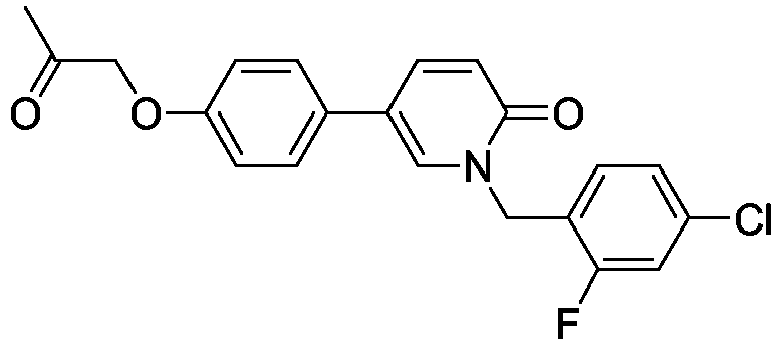
- According to Scheme 14 Method A: A suspension of 1-(4-chloro-2-fluorobenzyl)-5-(4-hydroxyphenyl)pyridin-2(1H)-one (1eq, 0.61mmol, 0.20g, Example 20 Step 2), K2CO3 (10eq, 6.10mmol, 0.84g) and chloroacetone (4eq, 2.43mmol, 0.20mL) in THF (10mL) was heated in a microwave at 110°C during 30 min. After filtration and evaporation, the resulting crude oil was purified by flash chromatography over silica gel (AIT Flashsmart prepacked column 25g SiO2) using CH2Cl2/AcOEt 80/20 then was washed with Et2O and was dried to afford 1-(4-chloro-2-fluorobenzyl)-5-(4-(2-oxopropoxy)phenyl)pyridin-2(1H)-one (0.12mmol, 46mg, 20%) as a white solid.
M. p.: 127°C; LC (XTerra RP18, 3.5µm, 3.0x50mm Column): RT = 4.02min; MS m/z (CI) [MH]+= 386, 388; 1H NMR (300MHz, CDCl3) δ 2.16 (s, 3H), 4.83 (s, 2H), 5.18 (s, 2H), 6.50 (d, J=9.3Hz, 1H), 6.93-7.02 (m, 2H), 7.15-7.24 (m, 1H), 7.27 (dd, J=2.1Hz and 8.7Hz, 1H), 7.42-7.51 (3H), 7.83 (dd, J=2.4Hz and 9.3Hz, 1H), 8.11 (d, J=2.4Hz, 1H). -

- According to Scheme 3 Method A: The title compound was prepared according to Example 2 Step 2, from 1-(4-chlorobenzyl)-5-bromopyridin-2(1H)-one (1eq, 0.67mmol, 0.20g, Example 2 Step 1) and 2-(4-(4,4,5,5-tetramethyl-1,3,2-dioxaborolan-2-yl)phenyl)acetic acid (1.5eq, 1.00mmol, 0.26g). Reaction conditions: 4.5 hours at 90°C. The reaction mixture was made acidic then extracted with AcOEt. The organic layer was washed with brine, dried over Na2SO4, filtered and concentrated. The residue was purified by chromatography over silicagel (AIT Flashsmart prepacked column 25g SiO2, AcOEt/MeOH 95/5), yielding the title compound (0.24g, 100%) as a white solid. LC (XTerra RP18, 3.5µm, 3.0x50mm Column): RT = 3.53min; MS m/z (CI) [MH]+= 354, 356.
- Scheme 15 Method B: The title compound was prepared according to Example 14 Step 3, from 2-(4-(1-(4-chlorobenzyl)-1,6-dihydro-6-oxopyridin-3-yl)phenyl)acetic acid (1eq, 0.10mmol, 50mg) and methylamine (2M in MeOH, 0.10mmol, 0.07mL), then purified by chromatography over silicagel (AIT Flashsmart prepacked column 10g SiO2, CH2Cl2/AcOEt 50/50), yielding the title compound (0.07mmol, 34mg, 66%) as a white solid.
M.p.: 183°C; LC (XTerra RP18, 3.5µm, 3.0x50mm Column): RT = 3.32min; MS m/z (CI) [MH]+= 367, 369; 1H NMR (300 MHz, DMSO-d6) δ 2.56 (d, J=4.6Hz, 3H), 3.36 (s, 2H), 5.15 (s, 2H), 6.52 (d, J=9.5Hz, 1H), 7.29 (d, J=8.2Hz, 2H), 7.33-7.45 (4H), 7.49 (d, J=8.2Hz, 2H), 7.83 (dd, J= J=2.6Hz, 9.45Hz, 1H), 7.92-8.01 (m, 1H), 8.24 (d, J=2.6Hz, 1H). -

- According to Scheme 3 Method A: The title compound was synthesized as described in Example 2 Step 2 using 4-(cyanomethyl)phenyl boronic acid (1.5eq, 0.50mmol, 80.9mg) and 1-(4-chlorobenzyl)-5-bromopyridin-2(1H)-one (1eq, 0.33mmol, 0.10g, Example 2 Step 1) as substrates. The crude product was purified by flash chromatography over silica gel (AIT Flashsmart prepacked column 25g SiO2) using CH2Cl2/AcOEt to afford 2-(4-(1-(4-chlorobenzyl)-1,6-dihydro-6-oxopyridin-3-yl)phenyl)acetonitrile as a yellow solid (0.33mmol, 110mg, 98%). M.p.: 172°C; LC (XTerra RP18, 3.5µm, 3.0x50mm Column): RT = 4.18 min, MS m/z (CI) [MH]+= 335, 337.
- According to Scheme 15 Method D: 2-(4-(1-(4-Chlorobenzyl)-1,6-dihydro-6-oxopyridin-3-yl)phenyl)acetonitrile (1eq, 0.24mmol, 0.08g) was heated at 110°C under nitrogen overnight with dibutyltin oxide (0.22eq, 0.05mmol, 0.01g) and azidotrimethylsilane (6.0eq, 1.43mmol, 0.19mL) in toluene (4mL). The suspension was filtered and the filtrate concentrated under vacuo. The crude product was purified by chromatography on silica gel using MeOH/AcOEt 20/80 as eluent and recristallised in diisopropyl ether to afford the title compound as a white solid (0.09mmol, 35mg, 39%).
M.p.: 231°C; LC (XTerra RP18, 3.5µm, 3.0x50mm Column): RT = 3.56 min; MS m/z (CI) [MH]+= 376, 378; 1H NMR (500MHz, DMSO-d6) δ 3.99 (s, 2H), 5.13 (s, 2H), 6.48 (d, J= 9.5Hz, 1H), 7.25 (d, J=8.4Hz, 2H), 7.35-7.40 (4H), 7.42 (d, J=8.4Hz, 2H), 7.80 (dd, J=2.7Hz and 9.5Hz, 1H), 8.21 (d, J=2.5Hz, 1H). -
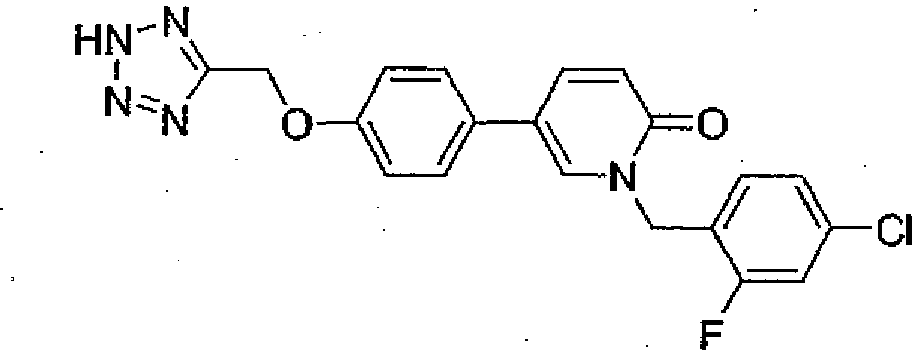
- According to Scheme 15 Method D: The title compound was prepared from 2-(4-(1-(4-chloro-2-fluorobenzyl)-6-oxo-1,6-dihydropyridin-3-yl)phenoxy)acetonitrile (1eq, 0.35mmol, 0.13g, Example 20 Step 3) according to the procedure described for Example 23 Step 2. The crude product was purified by silica gel chromatography (AIT Flashsmart prepacked column 10g SiO2) using CH2Cl2/MeOH 95/5 as eluent followed by trituration in Et2O to afford 5-(4-((2H-tetrazol-5-yl)methoxy)phenyl)-1-(4-chloro-2-fluorobenzyl)pyridin-2(1H)-one (85µmol, 35mg, 24%) as a white solid. M.p.: 197°C; LC (XTerra RP18, 3.5µm, 3.0x50mm Column): RT = 3.57min; MS m/z (CI) [MH]+= 412, 414; 1H NMR (300MHz, CDCl3) δ 3.00-3.60 (br. s, 1H), 5.18 (s, 2H), 5.35 (s, 2H), 6.50 (d, J=9.5Hz, 1H), 7.11-7.17 (m, 2H), 7.18-7.23 (m, 1H), 7.27 (dd, J=2.0Hz and 8.4Hz, 1H), 7.45 (dd, J=2.0Hz and 10.2MHz, 1H), 7.47-7.60 (m, 2H), 7.84 (dd, J=2.7Hz and 9.5Hz, 1H), 8.13 (d, J=2.7Hz, 1H).
-

- According to Scheme 17 Step 1: To a solution of 1-(4-chloro-2-fluorobenzyl)-5-bromopyridin-2(1H)-one (1eq, 1.26mmol, 0.40g, Example 1 Step 2) in degazed dioxane (20mL) was added under nitrogen 4,4,5,5-tetramethyl-2-(4,4,5,5-tetramethyl-1,3,2-dioxaborolan-2-yl)-1,3,2-dioxaborolane (1.3eq, 1.64mmol, 0.42g), PdCl2(dppf)2 (0.03eq, 38µmol, 28mg), dppf (0.06eq, 76µmol, 42mg) and KOAc (3eq, 3.79mmol, 0.37g). The reaction mixture was stirred at 80°C for 4 hours, was quenched with water and the aqueous phase was extracted with AcOEt. The organic phase was dried over Na2SO4, filtered and concentrated. The crude product was purified by silica gel chromatography (AIT Flashsmart prepacked column 25g SiO2) using CH2Cl2/AcOEt 90/10 as eluent to afford 1-(4-chloro-2-fluorobenzyl)-5-(4,4,5,5-tetramethyl-1,3,2-dioxaborolan-2-yl)pyridin-2(1H)-one (0.74mmol, 0.27g, 59%) as a pale oil.
LC (XTerra RP18, 3.5µm, 3.0x50mm Column): RT = 3.03min; MS m/z (CI) [MH]+= 364, 366. - According to Scheme 17 Step 2: The title compound was prepared from 1-(4-chloro-2-fluorobenzyl)-5-(4,4,5,5-tetramethyl-1,3,2-dioxaborolan-2-yl)pyridin-2(1H)-one (1eq, 1.26mmol, 0.40g) and 5-bromobenzo[b]thiophene (1.5eq, 0.29mmol, 0.06g) according to the procedure described for Example 1 Step 2. The crude product was purified by flash chromatography over silica gel (AIT Flashsmart prepacked column 25g SiO2) using CH2Cl2/AcOEt 90/10 and by crystallization with diisopropyl ether/pentane to afford the title compound (17µmol, 6.4mg, 9%) as a white solid.
M.p.: 110°C; LC (XTerra RP18, 3.5µm, 3.0x50mm Column): RT = 5.03min; MS m/z (CI) [MH]+= 370, 372; 1H NMR (500MHz, DMSO-d6) δ 5.21 (s, 2H), 6.55 (d, J=9.5Hz, 1H), 7.19-7.24 (m, 1H), 7.26-7.30 (m, 1H), 7.43-7.49 (m, 2H), 7.57 (dd, J=1.8Hz and 8.6Hz, 1H), 7.80 (d, J=5.4Hz, 1H), 7.95 (dd, J=2.7Hz and 9.4Hz, 1H), 8.05 (d, J=8.4Hz, 1H), 8.07 (d, J=1.6Hz, 1H), 8.28 (d, J=2.3Hz, 1H). -
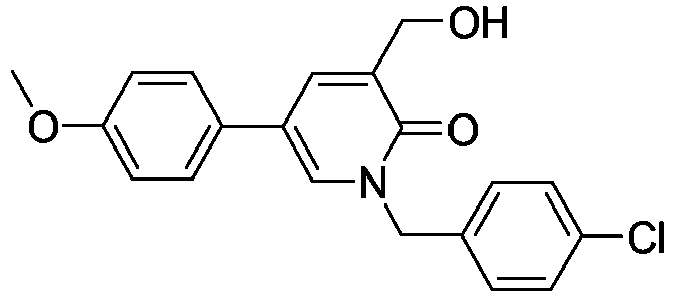
- According to Scheme 1 Step 2: The title compound was prepared from methyl 5-bromo-2-oxo-1,2-dihydropyridine-3-carboxylate (1eq, 10.0mmol, 3.00g) and 1-(bromomethyl)-4-chlorobenzene (1.5eq, 20.0mmol, 4.00g) according to the procedure described for Example 1 Step 2. Reaction conditions: 3 hours at 50°C in THF/DMF (2:1, 300mL). The crude product was purified by flash chromatography over silica gel (AIT Flashsmart prepacked 130g column SiO2) using CH2Cl2/AcOEt 85/15 as the eluent and recrystallized from Et2O to afford the title compound (9.00mmol, 4.17g, 90%) as a white solid.
LC (XTerra RP18, 3.5µm, 3.0x50mm Column): RT = 4.05min; MS m/z (CI) [MH]+= 357,359. - According to Scheme 3 Method A: The title compound was prepared from methyl 1-(4-chlorobenzyl)-5-bromo-2-oxo-1,2-dihydropyridine-3-carboxylate (1eq, 7.00mmol, 2.50g) and 4-methoxyphenyl boronic acid (1.5eq, 11.0mmol, 1.60g) according to the procedure described for Example 1 Step 3. Reaction conditions: 4 hours at 80°C. The crude product was purified by flash chromatography over silica gel (AIT Flashsmart prepacked column 80g SiO2) using CH2Cl2/AcOEt 80/20 and by recrystallization with Et2O/pentane to afford methyl 1-(4-chlorobenzyl)-5-(4-methoxyphenyl)-2-oxo-1,2-dihydropyridine-3-carboxylate (5.74mmol, 2.22g, 82%) as a beige solid.
LC (XTerra RP18, 3.5µm, 3.0x50mm Column): RT = 4.38min; MS m/z (CI) [MH]+= 384, 386. - According to Scheme 18: To a solution of methyl 1-(4-chlorobenzyl)-5-(4-methoxyphenyl)-2-oxo-1,2-dihydropyridine-3-carboxylate (1eq, 0.52mmol, 0.20g) in Et2O (7mL) at -78°C was added DIBAL (3eq, 1.60mmol, 1.11g). The reaction was stirred at -78°C for 30 minutes and 0°C for 1 hour. The reaction was then allowed to warm to room temperature and quenched with saturated aqueous NH4Cl solution. The aqueous phase was extracted 3 times with AcOEt and the combined organic fractions were washed twice with water, dried over Na2SO4, filtered and concentrated under reduced pressure. The crude product was purified by flash chromatography over silica gel (AIT Flashsmart prepacked 50g column SiO2) using CH2Cl2/AcOEt 80/20 as eluent which was then recrystallized from pentane/Et2O to afford the title compound (0.04mmol, 16.0mg, 9%) as a beige solid.
M.p.: 128°C; LC (XTerra RP18, 3.5µm, 3.0x50mm Column): RT = 3.98min; MS m/z (CI) [MH]+= 356, 358; 1H NMR (300MHz, DMSO-d6) δ 3.77 (s, 3H), 4.37 (d, J=5.8Hz, 2H), 5.12-5.19 (3H), 7.00 (d, J=8.9Hz, 2H), 7.35-7.43 (m, 4H), 7.44-7.52 (m, 2H), 7.72-7.76 (m, 1H), 8.07-8.10 (m, 1H). -

- According to Scheme 19 Step 1: The title compound was prepared from 1-(4-chloro-2-fluorobenzyl)-5-bromopyridin-2(1H)-one (1eq, 2.81mmol, 0.89g, Example 1 Step 2) and 4-(tert-butoxycarbonyl)aminophenylboronic acid (1.5eq, 4.20mmol, 1.00g) according to the procedure described for Example 1 Step 3. Reaction conditions: 2 hours at 80°C. The crude product was purified by silica gel chromatography (AIT Flashsmart prepacked column 50g SiO2, CH2Cl2/AcOEt 90/10). The resulting brown solid was washed twice with acetonitrile to afford tert-butyl 4-(1-(4-chloro-2-fluorobenzyl)-6-oxo-1,6-dihydropyridin-3-yl)phenylcarbamate (2.11mmol, 0.90g, 75%) as a beige solid.
M.p.: 208°C; LC (XTerra RP18, 3.5µm, 3.0x50mm Column): RT = 4.82min; MS m/z (CI) [MH]+= 429, 431. - According to Scheme 19 Step 2: HCl/dioxane (10eq, 4M, 5.00mL) was added to a solution of tert-butyl 4-(1-(4-chloro-2-fluorobenzyl)-6-oxo-1,6-dihydropyridin-3-yl)phenylcarbamate (1eq, 2.00mmol, 1.00g) in MeOH (20mL) at 0°C. The reaction was stirred for 2 days at 80°C, then the solvent was concentrated and Et2O was added. The solid was filtered and dried to yield 1-(4-chloro-2-fluorobenzyl)-5-(4-aminophenyl)pyridin-2(1H)-one hydrochloride (1.78mmol, 0.76g, 89%) as a beige solid.
M.p.: 266°C; LC (XTerra RP18, 3.5µm, 3.0x50mm Column): RT = 3.18min; MS m/z (CI) [MH]+= 329, 331; 1H NMR (300MHz, DMSO-d6) δ 3.10-3.70 (br s, 3H), 5.19 (s, 2H), 6.53 (d, J=9.5Hz, 1H), 7.16-7.24 (m, 1H), 7.24-7.37 (3H), 7.46 (dd, J=1.8Hz and 10.2Hz, 1H), 7.63 (dd, J=8.2Hz, 2H), 7.87 (dd, J=2.6Hz and 9.5Hz, 1H), 8.23 (s, 1H). -
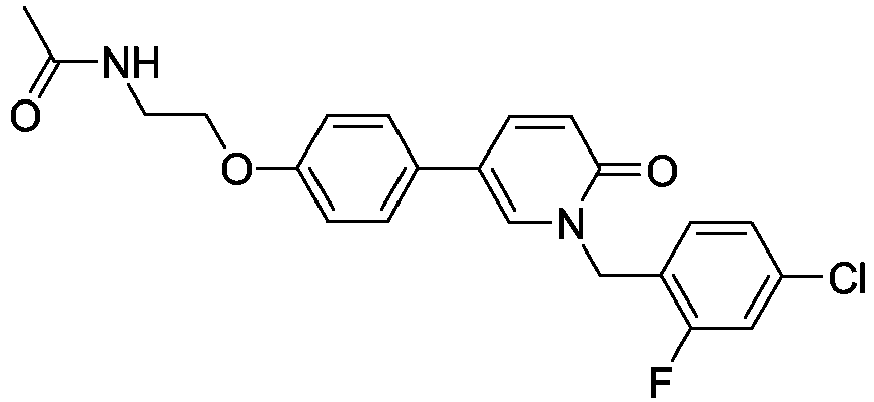
- The title compound was prepared from 1-(4-chloro-2-fluorobenzyl)-5-(4-hydroxyphenyl)pyridin-2(1H)-one (1eq, 0.60mmol, 0.20g, Example 20 Step 2) and tert-butyl 2-hydroxyethylcarbamate (1.5eq, 0.90mmol, 0.10g) according to the procedure described for Example 25 Step 2. The crude product was purified by crystallization in pentane/Et2O followed by silica gel chromatography (AIT Flashsmart prepacked column 25g SiO2, CH2Cl2/AcOEt 80/20) to afford tert-butyl 2-(4-(1-(4-chloro-2-fluorobenzyl)-6-oxo-1,6-dihydropyridin-3-yl)phenoxy)ethylcarbamate (0.40mmol, 0.19g, 66%) as a yellow oil.
LC (XTerra RP18, 3.5µm, 3.0x50mm Column): RT = 4.73min; MS mlz (CI) [MH]+= 473,475. - According to Scheme 19 Step 2: The title compound was prepared from tert-butyl 2-(4-(1-(4-chloro-2-fluorobenzyl)-6-oxo-1,6-dihydropyridin-3-yl)phenoxy)ethylcarbamate (1eq, 0.40mmol, 0.19g) according to the procedure described for Example 28 Step 2. Reaction conditions: room temperature overnight. After trituration with Et2O, 1-(4-chloro-2-fluorobenzyl)-5-(4-(2-aminoethoxy)phenyl)pyridin-2(1H)-one (0.40mmol, 0.16g, 100%) was obtained as a white solid.
M.p.: 226°C; LC (XTerra RP18, 3.5µm, 3.0x50mm Column): RT = 2.63min; MS m/z (CI) [MH]+= 373, 375. - According to Scheme 19 Step 3: To a solution of 1-(4-chloro-2-fluorobenzyl)-5-(4-(2-aminoethoxy)phenyl)pyridin-2(1H)-one (1eq, 0.18mmol, 0.07g) in CH2Cl2 (5mL) at 0°C were added Et3N (6eq, 1.10mmol, 0.15mL) and 30 min. later acetyl chloride (1.5eq, 0.27mmol, 19µL) and. The reaction mixture was stirred 1 hour at room temperature. The reaction mixture was quenched with water and extracted with CH2Cl2. The organic phase was dried over Na2SO4, filtered and evaporated. The crude product was purified by silica gel chromatography (AIT Flashsmart prepacked column 25g SiO2, CH2Cl2/AcOEt 70/30) to afford N-(2-(4-(1-(4-chloro-2-fluorobenzyl)-6-oxo-1,6-dihydropyridin-3-yl)phenoxy)ethyl)acetamide (0.08mmol, 0.04g, 47%) as a white solid.
M.p.: 153°C; LC (XTerra RP18, 3.5µm, 3.0x50mm Column): RT = 3.51min; MS m/z (CI) [MH]+=415, 417; 1H NMR (300MHz, DMSO-d6) δ 3.16 (s, 3H), 3.99 (t, J=5.6Hz, 2H), 5.18 (s, 2H), 5.75 (s, 1H), 6.51 (d, J=9.5Hz, 1H), 7.00 (d, J=8.7Hz, 2H), 7.15-7.23 (m, 1H), 7.23-7.29 (m, 1H), 7.43-7.53 (m, 3H), 7.84 (dd, J=2.8Hz and 9.5Hz, 1H), 8.09-8.20 (m, 1H). -

- According to Scheme 3 Method A: The title compound was prepared from 1-(4-chlorobenzyl)-5-bromopyridin-2(1H)-one (Example 2 Step 1) and 4-acetylphenylboronic acid according to the procedure described for Example 2 Step 2. Reaction conditions: 4 hours at 80°C. The crude product was purified by silica gel chromatography (AIT Flashsmart prepacked column 25g SiO2) using CH2Cl2/AcOEt 50/50 as eluent to afford 1-(4-chlorobenzyl)-5-(4-acetylphenyl)pyridin-2(1H)-one (0.29mmol, 0.10g, 86%) as a yellow solid.
M.p.: 162°C; LC (XTerra RP18, 3.5µm, 3.0x50mm Column): RT = 4.21min; MS mlz (CI) [MH]+= 338, 340; 1H NMR (500Hz, DMSO-d6) δ 2.58 (s, 3H), 5.17 (s, 2H), 6.55 (d, J=9.4Hz, 1H), 7.37-7.42 (4H), 7.74 (d, J=2.6Hz, 2H), 7.95 (dd, J=2.6Hz and 9.4Hz, 1H), 7.99 (d, J=8.6Hz, 2H), 8.45 (d, J=2.6Hz, 1H). - According to Scheme 20: To a solution of 1-(4-chlorobenzyl)-5-(4-acetylphenyl)pyridin-2(1H)-one (1eq, 0.20mmol, 80mg) in THF (5mL) at -50°C was added a solution of methyl magnesium bromide (3M, 1.3eq, 0.30mmol, 0.04g) and the reaction stirred at -50°C for 1 hour. The reaction was quenched at -78°C with saturated aqueous NH4Cl. The reaction was allowed to warm to room temperature and diluted with AcOEt and the organic phase extracted (x3). The combined organic fractions were dried (Na2SO4), filtered and concentrated under reduced pressure. The crude product was purified by flash chromatography over silica gel (AIT Flashsmart prepacked column 25g SiO2) using CH2Cl2/AcOEt 80/20 and was recrystallized from pentane/Et2O to afford 1-(4-chlorobenzyl)-5-(4-(2-hydroxypropan-2-yl)phenyl)pyridin-2(1H)-one (0.08mmol, 30mg, 36%) as a white solid.
M.p.: 157°C. LC (XTerra RP18, 3.5µm, 3.0x50mm Column): RT = 3.86min; MS m/z (CI) [MH]+= 354, 356. 1H NMR (300MHz, DMSO-d6) δ 1.42 (s, 6H), 5.05 (s, 1H), 5.15 (s, 2H), 6.52 (d, J=9.7Hz, 1H), 7.32-7.43 (m, 4H), 7.43-7.52 (m, 3H), 7.84 (dd, J=1.8Hz, 9.5Hz, 1H), 8.22 (d, J=1.8Hz, 1H). -
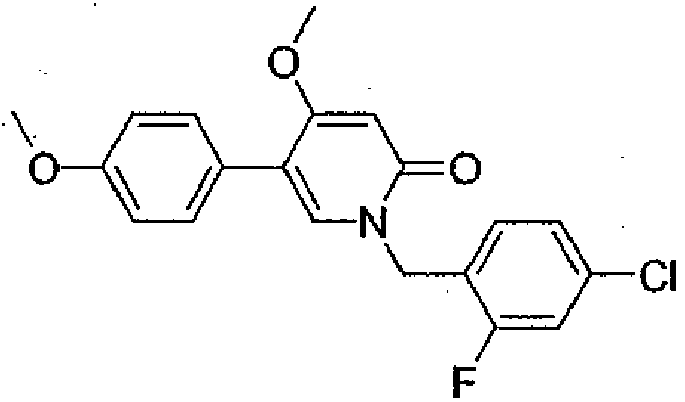
- According to Scheme 23 Step 1: To a solution of sodium methoxide (30% in MeOH, 2eq, 35mmol) was added 2-chloro-4-methoxypyridine (1eq, 17.mmol, 2.50g). The reaction was refluxed overnight. The reaction was allowed to cool, poured onto water (10mL) and extracted with CH2Cl2 (3x10mL). The combined organic fractions were dried (Na2SO4), filtered and concentrated under reduced pressure to afford 2,4-dimethoxypyridine (10.1mmol, 1.40g, 58%) as a colorless oil. The crude product was reacted on.
LC (XTerra RP18, 3.5µm, 3.0x50mm Column): RT = 1.40min; MS m/z (CI) [MH]+= 140. - According to Scheme 23 Step 2: To a solution of KOH (0.5eq, 0.8mmol, 40mg) in water (75mL) was added 2,4-dimethoxypyridine (1eq, 2.00mmol, 0.21g) followed by the dropwise addition of Br2 (1eq, 2.00mmol, 0.20g) in 1M aqueous KBr solution (75mL). The reaction was stirred at room temperature for 5 hours and then poured onto water (10mL) and extracted with CH2Cl2 (3x10mL). The combined organic fractions were dried (MgSO4), filtered and concentrated under reduced pressure to afford 5-bromo-2,4-dimethoxypyridine (1.40mmol, 0.30g, 70%) as a colorless oil. The crude product was reacted on.
LC (XTerra RP18, 3.5µm, 3.0x50mm Column): RT = 3.92min; MS m/z (CI) [MH]+= 219,221. - According to Scheme 23 Step 3: The title compound was prepared from 5-bromo-2,4-dimethoxypyridine (1eq, 1.40mmol, 0.30g) and 4-methoxyphenylboronic acid (1.5eq, 2.10mmol, 0.32g) according to the procedure described for Example 1 Step 3. The crude product was purified by flash chromatography over silica gel (AIT Flashsmart prepacked column 25g SiO2) using CH2Cl2/MeOH 98/2 to afford 2,4-dimethoxy-5-(4-methoxyphenyl)pyridine (1.39mmol, 0.34g, 99%) as a brown oil.
LC (XTerra RP18, 3.5µm, 3.0x50mm Column): RT = 3.85min; MS m/z (CI) [MH]+= 246, 248. - According to Scheme 23 Step 4: The title compound was prepared from 2,4-dimethoxy-5-(4-methoxyphenyl)pyridine (1eq, 0.20mmol, 0.05g) and 4-chlorobenzyl-2-fluorobenzyl bromide (1.5eq, 0.30mmol, 68mg) according to the procedure described for Example 6 Step 2. Reaction conditions: 80°C for 2 days. The crude product was purified by flash chromatography over silica gel (AIT Flashsmart prepacked column 25g SiO2) using CH2Cl2/MeOH 98/2 to afford 1-(4-chloro-2-fluorobenzyl)-4-methoxy-5-(4-methoxyphenyl)pyridin-2(1H)-one (0.10mmol, 36mg, 48%).
LC (XTerra RP18, 3.5µm, 3.0x50mm Column): RT = 4.62min; MS m/z (CI) [MH]+= 374, 376; 1H NMR (300 MHz, CDCl3) δ 3.78 (s, 3H), 3.82 (s, 3H), 5.11 (s, 2H), 5.99 (s, 1H), 6.88-6.95 (m, 2H), 7.08-7.15 (m, 2H), 7.20-7.30 (m, 3H), 7.40-7.50 (m, 1H). -
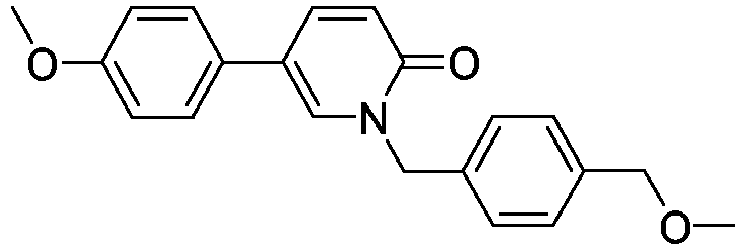
- According to Scheme 4 Method B: The title compound was prepared according to Example 1 Step 3 from 5-bromo-2-methoxypyridine (12.1mmol, 2.30g) and 4-methoxyphenylboronic acid (18.2mmol, 2.76g), then purified by flash chromatography over silica gel (AIT Flashsmart prepacked column 25g SiO2, CH2Cl2/MeOH 100/0 to 95/5), yielding the title compound (1.60g, 61%).
LC (XTerra RP18, 3.5µm, 3.0x50mm Column): RT = 3.03min; MS m/z (CI) [MH]+= 216. - According to Scheme 4 Step 1: The title compound was prepared according to Example 6 Step 2, from 2-methoxy-5-(4-methoxyphenyl)pyridine (1eq, 4.60mmol, 1.00g) and (4-(bromomethyl)phenyl)methanol (1.1eq, 5.10mmol 1.00g). Reaction conditions: 5 hours at 70°C and room temperature overnight. The residue was triturated with pentane, yielding the title compound (3.70mmol, 1.20g, 80%).
LC (XTerra RP18, 3.5µm, 3.0x50mm Column): RT = 3.23min; MS m/z (CI) [MH]+= 322. - According to Scheme 24 Step 3: A mixture of 1-(4-(hydroxymethyl)benzyl)-5-(4-methoxyphenyl)pyridin-2(1H)-one (1eq, 0.25mmol, 0.08g), NaH (55%, 1.5eq, 0.37mmol, 18mg) and iodomethane (3eq, 0.75mmol, 0.11g) in DMF (2mL) was stirred at room temperature overnight. The crude was diluted with AcOEt. The organic layer was washed with water, dried over Na2SO4, filtered and evaporated under reduced pressure. The residue was purified by flash chromatography over silica gel (AIT Flashsmart prepacked column 5g SiO2, CH2Cl2/MeOH 99/1), yielding the title compound (0.14mmol, 46mg, 55%) as white solid.
M.p.: 72°C; LC (Zorbax C18, 3.5µm, 4.6x50mm Column): RT = 3.92min; MS m/z (CI) [MH]+= 336; 1H NMR (300 MHz, CDCl3) δ 3.25 (s, 3H), 3.77 (s, 3H), 4.36 (s, 2H), 5.15 (s, 2H), 6.50 (d, J=9.3Hz, 1H), 6.98 (d, J=9.0Hz, 2H), 7.25-7.39 (m, 4H), 7.49 (d, J=9.0Hz, 2H), 7.80 (dd, J=2.7Hz and 9.6Hz, 1H), 8.15 (d, J=2.7Hz, 1H). -

- According to Scheme 25 Step 2: The title compound was prepared from 1-(4-chlorobenzyl)-5-bromopyridin-2(1H)-one (1eq, 3.30mmol, 1.00g, Example 2 Step 1) and 4-(hydroxymethyl)phenylboronic acid (1.5eq, 5.00mmol, 0.76g) according to the procedure described for Example 1 Step 3. Reaction conditions: overnight at 80°C. The crude product was purified by flash chromatography over silica gel (AIT Flashsmart prepacked column 70g SiO2) using CH2Cl2/MeOH 98/2 as the eluent to afford 1-(4-chlorobenzyl)-5-(4-(hydroxymethyl)phenyl)pyridin-2(1H)-one (1.72mmol, 0.62g, 52%) as a brown oil LC (XTerra RP18, 3.5µm, 3.0x50mm Column): RT = 3.47min; MS m/z (CI) [MH]+= 326, 328.
- According to Scheme 25 Method A: The title compound was prepared from 1-(4-chlorobenzyl)-5-(4-(hydroxymethyl)phenyl)pyridin-2(1H)-one (1eq, 2.50mmol, 0.80g) and iodoethane (3eq, 7.40mmol, 1.10g) ) according to the procedure described for Example 34 Step 3. The crude product was purified by flash chromatography over silica gel (AIT Flashsmart prepacked column 5g SiO2) using CH2Cl2/MeOH 99/1 as eluent to afford 1-(4-chlorobenzyl)-5-(4-(ethoxymethyl)phenyl)pyridin-2(1H)-one (1.02mmol, 0.36g, 41%) as a yellow solid.
M.p.: 109°C; LC (Zorbax C18, 3.5µm, 4.6x50mm Column): RT = 4.62min; MS m/z (CI) [MH]+= 354, 356; 1H NMR (300 MHz, DMSO-d6) δ 1.15 (t, J=6.9Hz, 3H), 3.47 (q, J=6.9Hz, 2H), 4.45 (s, 2H), 5.16 (s, 2H), 6.53 (d, J=9.6Hz, 1H), 7.32-7.40 (4H), 7.55 (d, J=8.4Hz, 2H), 7.85 (dd, J=2.7Hz and 9.3Hz, 1H), 8.28 (d, J=2.7Hz, 1H). -

- According to Scheme 26 Step 1: To a stirred solution of 4-bromo-2-methoxypyridine (1eq, 5.30mmol, 1.00g) in anhydrous THF (30mL) at -78°C under nitrogen was added dropwise a solution of butyl lithium (1.3eq, 2.5M solution in hexane, 6.90mmol, 2.8mL). The reaction was then stirred at -78°C for 2 hours. Cyclohexanone (5eq, 27.0mmol, 2.8mL) was then added dropwise over 5 minutes. The reaction was stirred at -78°C for two hours then allowed to warm to room temperature. The reaction was stirred for a further 16 hours then quenched with water. The reaction was evaporated in vacuo, redissolved in CH2Cl2 (100mL) and washed with brine (100mL). The organic phase was extracted, dried over MgSO4, filtered and evaporated to leave a yellow oil. The oil was purified by column chromatography (AIT Flashsmart prepacked column 25g SiO2, pure AcOEt), yielding the title compound (4.10mmol, 0.86g, 78%) as a colorless oil which solidified on standing.
LC (Zorbax C18, 3.5µm, 4.6x50mm Column): RT = 3.33min; MS m/z (CI) [MH]+= 208. - According to Scheme 26 Step 2: The title compound was prepared from 1-(6-methoxypyridin-3-yl)cyclohexanol (1eq, 1.21mmol, 0.25g) and methanesulfonyl chloride (4eq, 4.82mmol, 0.37mL) according to the procedure described for Example 4 Step 1. The crude residue was purified by chromatography over silicagel (AIT Flashsmart prepacked column 10g SiO2, AcOEt/pentane 30/10 to pure AcOEt), yielding the title compound (0.76mmol, 0.14g, 63%) as a colorless oil.
LC (Zorbax C18, 3.5µm, 4.6x50mm Column): RT = 5.08min; MS m/z (CI) [MH]+= 190. - According to Scheme 26 Step 3: The title compound was prepared according to Example 19 Step 2, from 5-cyclohexenyl-2-methoxypyridine (1eq, 0.74mmol, 0.14g). Reaction conditions: 32 hours at room temperature. The residue was purified by chromatography over silicagel (AIT Flashsmart prepacked column 10g SiO2, CH2Cl2/AcOEt 95/5), yielding the title compound (0.33mmol, 63mg, 45%) as a colorless oil.
LC (Zorbax C18, 3.5µm, 4.6x50mm Column): RT = 5.15min; MS m/z (CI) [MH]+= 192. - According to Scheme 26 Step 4: The title compound was prepared according to Example 6 Step 2, from 5-cyclohexyl-2-methoxypyridine (1eq, 0.30mmol. 57mg) and 1-(bromomethyl)-4-chlorobenzene (1.5eq, 0.44mmol, 92mg), then purified by chromatography over silicagel (AIT Flashsmart prepacked column 5g SiO2, CH2Cl2/MeOH 98/2) then recrystallized in pentane/diisopropyl ether, yielding the title compound (0.20mmol, 0.09g, 68%) as a beige solid.
M.p.: 72°C; LC (Zorbax C18, 3.5µm, 4.6x50mm Column): RT = 5.07min; MS mlz (CI) [MH]+= 302, 304; 1H NMR (300 MHz, CDCl3) δ 1.07-1.43 (5H), 1.63-1.86 (5H), 2.13-2.28 (m, 1H), 5.08 (s, 2H), 6.58 (d, J=9.5Hz, 1H), 6.99 (d, J=2.6Hz, 1H), 7.20-7.25 (m, 2H), 7.26-7.30 (m, 2H), 7.31-7.33 (m, 1H). -
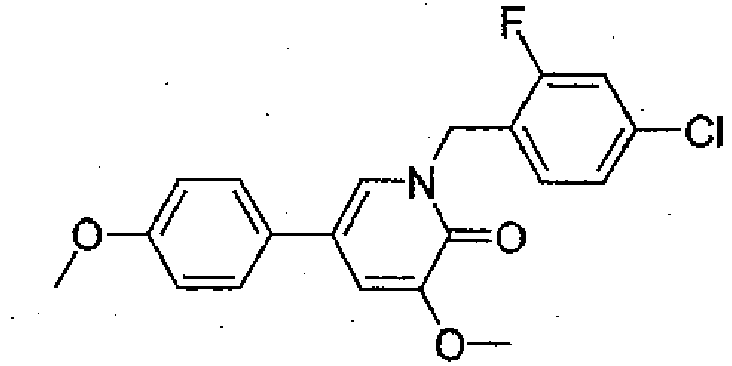
- The title compound was prepared from 2,3-dimethoxypyridine (1eq, 7.19mmol, 1.00g) according to the procedure described for Example 1 Step 1. Reaction conditions: 48 hours at room temperature. The crude product was purified by flash chromatography over silica gel (AIT Flashsmart prepacked column 25g SiO2) using cyclohexane/AcOEt 96/4 to afford 5-bromo-2,3-dimethoxypyridine (3.81mmol, 0.83g, 53%).
- According to Scheme 4 Method B: The title compound was prepared from 5-bromo-2,3-dimethoxypyridine (1eq, 1.83mmol, 0.40g) and 4-methoxyphenyl boronic acid (1eq, 1.83mmol, 0.28g) according to the procedure described for Example 1 Step 3. The crude product was purified by flash chromatography on silica gel using cyclohexane/AcOEt 90/10 as eluent to afford the title compound 2,3-dimethoxy-5-(4-methoxyphenyl)pyridine (0.82mmol, 0.20g, 45%) was obtained.
LC (XTerra RP18, 3.5µm, 3.0x50mm Column): RT = 4.27 min; MS m/z (CI) [MH]+= 246. - According to Scheme 4 Step 1: The title compound was prepared from 2,3-dimethoxy-5-(4-methoxyphenyl)pyridine (1eq, 0.41mol, 0.10g) and 1-(bromomethyl)-4-chloro-2-fluorobenzene (2eq, 0.82mmol, 0.18g) according to the procedure described for Example 6 Step 2. Reaction conditions: 14 hours at 80°C in acetonitrile. The crude product was purified by silica gel chromatography (AIT Flashsmart prepacked column 10g SiO2) using cyclohexane/AcOEt 70/30 to 50/50 as eluent to afford 1-(4-Chloro-2-fluorobenzyl)-3-methoxy-5-(4-methoxyphenyl)pyridin-2(1H)-one (0.24mmol, 0.09g, 59%).
LC (XTerra RP18, 3.5µm, 3.0x50mm Column): RT = 4.53min; MS m/z (CI) [MH]+= 374, 376; 1H NMR (300MHz, CDCl3) δ 3.83 (s, 3H), 3.87 (s, 3H), 5.22 (s, 2H), 6.82 (d, J=2.3Hz, 1H), 6.95 (d, J=8.7Hz, 2H), 7.07-7.12 (m, 2H), 7.13-7.15 (m, 1H), 7.32 (d, J=9.0Hz, 2H), 7.47-7.55 (m, 1H). -

- According to Scheme 14 Method B: A suspension of 1-(4-chloro-2-fluorobenzyl)-5-(4-hydroxyphenyl)pyridin-2(1H)-one (1eq, 0.61mmol, 0.20g, Example 20 Step 2), K2CO3 (10eq, 6.10mmol, 0.84g) and methylchloroformate (4eq, 2.43mmol, 0.19mL) in THF (10mL) was stirred overnight at room temperature. Water was added to the reaction mixture, then the aqueous phase was extracted with AcOEt. The organic phase was dried over MgSO4, filtered and evaporated. The resulting crude oil was purified by flash chromatography over silica gel (AIT Flashsmart prepacked column 10g SiO2) using CH2Cl2/AcOEt 90/10 then was washed with Et2O and was dried to afford 4-(1-(4-chloro-2-fluorobenzyl)-6-oxo-1,6-dihydropyridin-3-yl)phenyl methyl carbonate (0.36mmol, 139mg, 59%) as a white solid.
M.p.: 124°C; LC (XTerra RP18, 3.5µm, 3.0x50mm Column): RT = 4.28min; MS m/z (CI) [MH]+= 388, 390; 1H NMR (300MHz, CDCl3) δ 3.84 (s, 3H), 5.19 (s, 2H), 6.53 (d, J=9.6Hz, 1H), 7.17-7.27 (m, 2H), 7.27-7.33 (3H), 7.45 (dd, J=2.1Hz and 9.9Hz, 1H), 7.58-7.66 (m, 2H), 7.88 (dd, J=2.7Hz and 9.9Hz, 1H), 8.23 (d, J=2.7Hz, 1H). -

- According to Scheme 19 Step 1: A suspension of 1-(4-chlorobenzyl)-5-bromopyridin-2(1H)-one (3.3mmol, 1.00g, Example 2 Step 1), N-tert-butoxycarbonyl-4-aminophenylboronic acid (6.03mmol 1.42g), Pd(PPh3)4 (0.17mmol, 195mg), Na2CO3 (13.4mmol, 1.42g) in DME (20mL) and H2O (5mL) was degassed to remove the oxygen. The mixture was heated at 85°C for 20 hours. The resulting suspension was filtered off and the filtrate was washed with CH2Cl2. The organic solvent was separated, dried (Na2SO4) and the solvent was evaporated under reduced pressure. The residue was purified in a manifold (vac.) using a Sep-Pak silica cartridge CH2Cl2/MeOH(NH3)sat. 98/2. The product fractions were collected and the solvent was evaporated to yield the title compound (627mg, 46%).
- According to Scheme 19 Step 4: tert-Butyl 4-(1-(4-chlorobenzyl)-6-oxo-1,6-dihydropyridin-3-yl)phenylcarbamate (0.34mmol 0.14g) was dissolved in dry THF (4mL) and the resulting solution was cooled at 0°C. Then, NaH (60% mineral oil; 1.02mmol, 40.8mg) was added, the mixture was stirred at 0°C for 10 minutes, warmed at room temperature and stirred for 30 minutes. After, N,N-dimethylaminoethyl chloride (0.69mmol) and KI (0.34mmol, 57.0mg) were added and the reaction mixture was heated at 90°C for 16 hours. The resulting suspension was taken up in CH2Cl2, washed with water, washed with brine, filtered off and the filtrate was washed with CH2Cl2. The organic solvent was separated, dried (Na2SO4) and the solvent was evaporated under reduced pressure. The residue was purified in a manifold (vac.) using a Sep-Pak silica cartridge (CH2Cl2/MeOH(NH3)sat. 95/5). The product fractions were collected and the solvent was evaporated to yield tert-butyl 4-(1-(4-chlorobenzyl)-6-oxo-1,6-dihydropyridin-3-yl)phenyl(2-(dimethylamino)ethyl)carbamate (87.9mg)
- According to Scheme 19 Step 5: tert-Butyl 4-(1-(4-chlorobenzyl)-6-oxo-1,6-dihydropyridin-3-yl)phenyl(2-(dimethylamino)ethyl)carbamate (0.16mmol, 79.0mg) was dissolved in dry CH2Cl2 (30mL). Then TFA (7mL) was added dropwise and the resulting solution was stirred at room temperature for 3 hours. Then the solvent was evaporated under reduced pressure and the resulting residue thus obtained was resulting suspension was taken up in CH2Cl2, washed with a saturated aqueous NaHCO3 solution. The organic solvent was separated, dried (Na2SO4) and the solvent was evaporated under reduced pressure. The residue was purified in a manifold (vac.) using a Sep-Pak silica cartridge CH2Cl2/MeOH(NH3)sat. 95/5. The product fractions were collected and the solvent was evaporated to yield 1-(4-chlorobenzyl)-5-(4-(2-(dimethylamino)ethylamino)phenyl)pyridin-2(1H)-one (16.4mg, 26%)
LC (ACE Column): RT = 3.23min; MS m/z (CI) [MH]+ 382; 1H NMR (400 MHz, CDCl3) δ 7.58 (dd, 1H, J=9.5, 2.6 Hz); 7.34 (d, 1H, J=2.6 Hz); 7.26-7.33 (m, 4H); 7.17 (d, 2H, J=8.7 Hz); 6.67 (d, 1H, J=9.5 Hz); 6.64 (d, 2H, J=8.4 Hz); 5.15 (s, 2H); 4.43 (s, 1 H); 3.16 (t, 2H, J=5.8 MHz); 2.58 (t, 2H, J=5.8 Hz); 2.27 (s, 6H). -

- According to Scheme 25 Step 3: To a solution of 1-(4-chlorobenzyl)-5-(4-(hydroxymethyl)phenyl)pyridin-2(1H)-one (1eq, 3.07mmol, 1.00g, Example 35 Step 1) in THF (8mL) were added NBS (1.22eq, 3.74mmol, 0.67g) and PPh3 (1.20eq, 3.68mmol, 0.97g) at -20°C for 4 hours. After evaporation of the solvent, the crude product was purified by silica gel chromatography (AIT Flashsmart prepacked column 50g SiO2) using CH2Cl2/MeOH 98/2 to afford 1-(4-chlorobenzyl)-5-(4-(bromomethyl)phenyl)pyridin-2(1H)-one (2.06mmol, 0.80g, 67%).
LC (XTerra RP18, 3.5µm, 3.0x50mm Column): RT = 4.71min; MS m/z (CI) [MH]+= 388, 90. - According to Scheme 25 Step 4: The title compound was prepared from 1-(4-chlorobenzyl)-5-(4-(bromomethyl)phenyl)pyridin-2(H)-one (1eq, 0.26mmol, 0.10g) and (1.5eq, 0.39mmol, 0.04g) according to the procedure described for Example 34 Step 3. The crude product was purified by flash chromatography over silica gel (AIT Flashsmart prepacked column 5g SiO2) using CH2Cl2/MeOH 98/2 as the eluent to afford N-(2-(4-(1-(4-chlorobenzyl)-6-oxo-1,6-dihydropyridin-3-yl)benzyloxy)ethyl) acetamide (0.13mmol, 54mg, 51%) as a white solid.
M.p.:152°C; LC (XTerra RP18, 3.5µm, 3.0x50mm Column): RT = 3.55min; MS m/z (CI) [MH]+= 411, 413; 1H NMR (300MHz, DMSO-d6) δ 1.80 (s, 3H), 3.18-3.27 (m, 2H), 3.42 (t, J=6.0Hz, 2H), 4.48 (s, 2H), 5.16 (s, 2H), 6.52 (d, J=9.6Hz, 1H), 7.35-7.42 (6H), 7.56 (d, J=7.8Hz, 2H), 7.86 (dd, J=2.7Hz and 9.6Hz, 2H), 8.28 (d, J= 2.7Hz, 1H). -

- According to Scheme 30 Step 1: The title compound was prepared from 5-bromo-2-methoxy-4-methylpyridine (1eq, 15.8mmol, 3.20g) and 4-methoxyphenylboronic acid (1.5eq, 23.8mmol, 3.61g) according to the procedure described for Example 1 Step 3. Reaction conditions: 21 hours at 80°C. The crude product was purified by flash chromatography over silica gel (AIT Flashsmart prepacked column 130g SiO2) using AcOEt/MeOH (95/5) as the eluent to afford 2-methoxy-5-(4-methoxyphenyl)-4-methylpyridine (12.8mmol, 2.94g, 81%) as a light yellow solid.
LC (Zorbax C18, 3.5µm, 4.60x50mm Column): RT = 4.52min; MS m/z (CI) [MH]+= 230. - According to Scheme 30 Step 2: To a stirred solution of 2-methoxy-5-(4-methoxyphenyl)-4-methylpyridine (1eq, 10.0mmol, 2.30g) in anhydrous THF (66mL) at -78°C under argon was added dropwise butyl lithium (2.5M, 1.5eq, 15.1mmol, 6.0mL). The reaction mixture was stirred for one hour and then allowed to warm slowly to 0°C and stirred at 0°C for a further 30 minutes. The reaction mixture was then cooled to -78°C and paraformaldehyde (6.07g) was added. The reaction mixture was then allowed to warm to room temperature and was stirred for 2 hours. The reaction was quenched with saturated aqueous NH4Cl (30mL), diluted with AcOEt and the aqueous phase was extracted (x3). The combined organic fractions were dried (Na2SO4), filtered and concentrated under reduced pressure. HCl 3M (15mL) was added to the solution of the crude residue diluted in acetonitrile (10mL). The reaction mixture was stirred for 2 hours at 60°C. The aqueous phase was extracted with Et2O, then neutralized with NaHCO3 (40mL). The aqueous phase was extracted with CH2Cl2. The combined organic fractions were dried (Na2SO4), filtered and concentrated under reduced pressure. The crude product was purified by flash chromatography over silica gel (AIT Flashsmart prepacked column 20g SiO2) using CH2Cl2/AcOEt (99/1) as the eluent to afford 2-(2-methoxy-5-(4-methoxyphenyl)pyridin-4-yl)ethanol (0.62mmol, 0.16g, 6%) as a colorless oil.
LC (Zorbax C18, 3.5µm, 4.6x50mm Column): RT = 3.42min; MS mlz (CI) [MH]+= 260. - According to Scheme 30 Step 3: The title compound was prepared from 2-(2-methoxy-5-(4-methoxyphenyl)pyridin-4-yl)ethanol (1eq, 0.62mmol, 0.16g) and 1-(bromomethyl)-4-chlorobenzene (1.5eq, 0.93mmol, 0.19g) according to the procedure described for Example 6 Step 2. Reaction conditions: 19 hours under 90°C. The crude product was purified by silica gel chromatography (AIT Flashsmart prepacked column 10g SiO2) using CH2Cl2/MeOH 98/2 as eluent afford 1-(4-chlorobenzyl)-4-(2-hydroxyethyl)-5-(4-methoxyphenyl)pyridin-2(1H)-one (0.22mmol, 82mg, 36%) as a pale yellow solid.
LC (Zorbax C18, 3.5µm, 4.6x50mm Column): RT = 3.83min; MS m/z (CI) [MH]+= 370, 372. - According to Scheme 30 Step 4: The title compound was prepared from 1-(4-chlorobenzyl)-4-(2-hydroxyethyl)-5-(4-methoxyphenyl)pyridin-2(1H)-one (1eq, 0.14mmol, 50mg) and iodomethane (3eq, 0.41mmol, 58mg) according to the procedure described for Example 34 Step 3. The product was further purified by flash chromatography over silica gel (AIT Flashsmart prepacked column 5g SiO2) using Et2O/pentane 90/10 to afford 1-(4-chlorobenzyl)-4-(2-methoxyethyl)-5-(4-methoxyphenyl)pyridin-2(1H)-one (0.12mmol, 47mg, 91%) as a colorless oil.
LC (Zorbax C18, 3.5µm, 4.6x50mm Column): RT = 4.49min; MS m/z (CI) [MH]+= 384, 386; 1H NMR (300MHz, CDCl3) δ 2.65 (t, J=6.7Hz, 2H), 3.25 (s, 3H), 3.44 (t, J=6.7Hz, 2H), 3.82 (s, 3H), 5.09 (s, 2H), 6.58 (s, 1H), 6.90 (d, J=8.7Hz, 2H), 7.06 (s, 1H), 7.11 (d, J=8.7Hz, 2H), 7.23-7.32 (4H). -

- According to Scheme 31 Step 2: To a solution of 2-methoxy-5-(4-methoxyphenyl)-4-methylpyridine (2.20mmol, 0.50g, Example 48 Step 1) in CCl4 (10mL) was added NBS (2eq, 4.40mmol, 0.78g). The reaction was then heated to reflux and subjected to UV light for 48 hours. The reaction was allowed to cool, filtered and concentrated under reduced pressure to afford crude 4-(bromomethyl)-2-methoxy-5-(4-methoxyphenyl)pyridine (0.70g) as a yellow oil which was used without any purification in the next step.
LC (XTerra RP18, 3.5µm, 3.0x50mm Column): RT = 4.87min; MS m/z (CI) [MH]+= 307,309. - According to Scheme 31 Step 3: The title compound was prepared from 4-(bromomethyl)-2-methoxy-5-(4-methoxyphenyl)pyridine (1eq, 2.30mmol, 0.70g) according to the procedure described for Example 33 Step 1. After work up, 2-methoxy-4-(methoxymethyl)-5-(4-methoxyphenyl)pyridine (0.66mmol, 0.17g) as a light yellow oil.
LC (XTerra RP18, 3.5µm, 3.0x50mm Column): RT = 4.56min; MS m/z (CI) [MH]+= 260. - According to Scheme 31 Step 4: The title compound was prepared from 2-methoxy-4-(methoxymethyl)-5-(4-methoxyphenyl)pyridine (1eq, 0.66mmol, 0.17g) and 1-(bromomethyl)-4-chloro-2-fluorobenzene (1.5eq, 0.98mmol, 0.22g) according to the procedure described for Example 6 Step 2. Reaction conditions: 12 hours at 80°C. The crude product was purified by silica gel chromatography (AIT Flashsmart prepacked column 25g SiO2) using CH2Cl2/MeOH 98/2 as the eluent to afford 1-(4-chloro-2-fluorobenzyl)-4-(methoxymethyl)-5-(4-methoxyphenyl)pyridin-2(1H)-one (5µmol, 2mg, 1%) as yellow oil.
LC (XTerra RP18, 3.5µm, 3.0x50mm Column): RT = 3.83min; MS m/z (CI) [MH]+= 388, 390; 1H NMR (300MHz, CDCl3) δ 1.64 (s, 2H), 2.07 (s, 3H), 3.83 (s, 3H), 5.12 (s, 2H), 6.48 (s, 1H), 6.93 (d, J=9.0Hz, 2H), 7.13-7.28 (m, 5H), 7.40-7.46 (m, 1H). -

- 5-(4-Methoxyphenyl)pyridine-2(1H)-one (4.20mmol 0.85g), 2-chloro-5-(chloromethyl)pyridine (1.5eq, 6.30mmol, 1.02g), K2CO3 (2eq, 8.40mmol, 1.17g) in THF (10mL) were heated at 70°C for 2 hours. Then, the reaction was cooled to room temperature. The suspension was filtered off and the filtrate was evaporated under reduced pressure. The residue was puridied by short open column chromatography CH2Cl2/MeOH(NH3)sat. 1% yielding 1-((6-chloropyridin-3-yl)methyl)-5-(4-methoxyphenyl)pyridin-2(1H)-one as white solid (1.04g, 75%)
- According to Scheme 33 Step 1: 1-((6-Chloropyridin-3-yl)methyl)-5-(4-methoxyphenyl)pyridin-2(1H)-one (2.54mmol, 0.83g), trimethylsilyl chloride (3.3mmol, 0.42mL) and NaI (7.60mmol, 1.14g) in propionitrile (20mL) were heated at 140°C. for 20 minutes under microwave irradiation conditions. Then the suspension was filtered off and the solid obtained was partitioned between CH2Cl2/water. The aqueous layer was extracted several times with CH2Cl2; the organic layers were combined, dried (Na2SO4) and the solvent was evaporated under reduced pressure. The residue was treated with Et2O giving an 1-((b-iodopyridin-3-yl)methyl)-5-(4-methoxyphenyl)pyridin-2(1H)-one (600mg, 61%) as a pale grey solid.
- According to Scheme 33 Step 2: A mixture of 1-((6-iodopyridin-3-yl)methyl)-5-(4-methoxyphenyl)pyridin-2(1H)-one (0.48mmol, 200mg), PdCl2(PPh3)2 (33µmol, 23mg), Cul (24µmol, 4.5mg), iPr2EtN (0.99mmol, 1.72µl), trimethylsilylacetylene (1.43mmol, 203µL) and DMF (3 mL, previously deoxygenated) was stirred at room temperature for 2 hours. The solvent was evaporated under reduced pressure. The residue was purified in a manifold (vac.) using a Sep-Pak silica cartridge CH2Cl2/MeOH(NH3)sat. 3% yielding 5-(4-methoxyphenyl)-1-((6-(2-(trimethylsilyl)ethynyl)pyridin-3-yl)methyl)pyridin-2(1H)-one (174mg, 93%).
- A mixture of 5-(4-methoxyphenyl)-1-((6-(2-(trimethylsilyl)ethynyl)pyridin-3-yl)methyl)pyridin-2(1H)-one (0.60mmol, 240mg), tetrabutylammonium fluoride (1.20mmol, 1.2mL) in THF (5mL) and H2O (1mL) was stirred at room temperature for 2 hours. The solvent was evaporated under reduced pressure. The residue was taken up in CH2Cl2, was washed with water, dried (Na2SO4) and evaporated under reduced pressure. The residue was purified in a manifold (vac.) using a Sep-Pak silica cartridge CH2Cl2/MeOH(NH3)sat. 3%. The fractions were collected and evaporated. The residue thus obtained was triturated with diisopropyl ether. The precipitated solid was filtered off and dried. Further purification by circular chromatography-TLC CH2Cl2/MeOH(NH3)sat. 3% yielding 1-((6-ethynylpyridin-3-yl)methyl)-5-(4-methoxyphenyl)pyridin-2(1H)-one (68mg, 35%).
M.p.: 273°C; 1H NMR (400 MHz, CDCl3) δ8.61 (d, 1H, J=2.1 Hz); 7.72 (dd, 1H, J=8.1, 2.1 Hz); 7.60 (dd, 1H, J=9.4, 2.6 Hz); 7.46 (d, 1H, J=8.1 Hz); 7.40 (d, 1H, J=2.7 Hz); 7.28 (d, 2H, J=8.5 Hz); 6.94 (d, 2H, J=8.7 Hz); 6.64 (d, 2H, J=8.7 Hz); 7.28 (d, 2H, J=8.5 Hz); 6.94 (d, 2H, J=8,7 Hz); 6.70 (d, 1H, J=9.5 Hz); 5.21 (s, 2H); 3.83 (s, 3H); 3.16 (s, 1H). - According to Scheme 33 Step 3: To a suspension of Pd/C 10% (0.05 eq) in MeOH (10mL) under N2 atmosphere, a solution of 1-((6-ethynylpyridin-3-yl)methyl)-5-(4-methoxyphenyl)pyridin-2(1H)-one (0.15mmol, 48mg) was added at room temperature. The flask was evacuated and filled with hydrogen until the pressure reached 20 psi. The resulting suspension was shaken at room temperature for 1 hour. The catalyst was filtered off and the filtrate was evaporated under vacuum to give a residue. The residue was purified in a circular chromatography-TLC CH2Cl2/MeOH(NH3)sat. 2% yielding 1-((6-ethylpyridin-3-yl)methyl)-5-(4-methoxyphenyl)pyridin-2(1H)-one (30mg, 61 %).
M.p.: 130°C; LC (ACE Column): RT = 3.55min; MS m/z (CI) [MH]+= 321; 1H NMR (400 MHz, CDCl3) δ 8.53 (d, 1H, J=2.1 Hz); 7.66 (dd, 1H, J=8.0, 2.4 Hz); 7.58 (dd, 1H, J=9.5, 2.7 Hz); 7.42 (d, 1H, J=2.3 Hz); 7.25-7.30 (m, 2H); 7.15 (d, 1H, J=7.9 Hz); 6.90-6.95 (m,-2 H); 6.69 (d, 1H, J=9.5 Hz); 5.18 (s, 2H); 3.83 (s, 3H); 2.81 (q, 2H, J=7.7 Hz); 1.29 (t, 3H; J=7.6 Hz). - The compounds in the following Tables have been synthezised according to the previous examples, as denoted in the column denoted as "Exp. Nr". The compound denoted with the asterisk has been exemplified in the Examples. When it concerns the bivalent linkers V1 and V2, it is noted that the left part of the linkers V1 and V2 is attached to the pyridinyl-moiety.
Table 1 
Co.nr. Exp. nr. R3 1-01 1 
1-02 2 
1-03 2 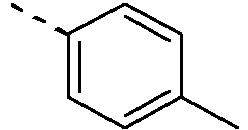
1-04 7 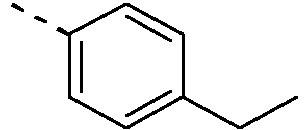
1-05 2 
1-06 2 
1-07 2 
1-08 1 
1-09 2 
1-10 2 
1-11 1 
1-12 2 
1-13 20 
1-14 2 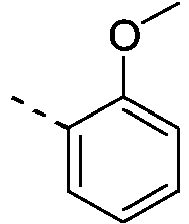
1-15 2 
1-16 1 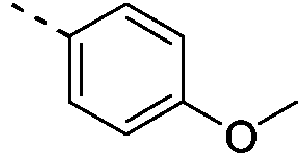
1-17 2 
1-18 20 
1-19 2 
1-20 2 
1-21 2 
1-22 2 
1-23 2 
1-24 2 
1-25 2 
1-26 2 
1-27 2 
1-28 2 
1-29 1 
1-30 2 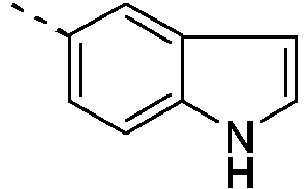
1-31 2 
1-32 2 
Table 2 
Co.nr. Exp. nr. R3 2-01 36* 
2-02 2 
2-03 2 
2-04 1 
2-05 1 
2-06 1 
2-07 2 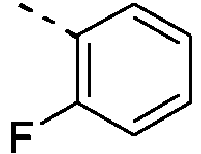
2-08 2 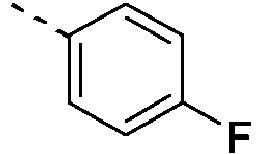
2-09 2 
2-10 2 
2-11 2 
2-12 20 
2-13 20 
2-14 35 
2-15 30* 
2-16 2* 
2-17 1 
2-18 2 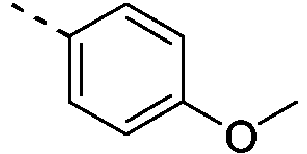
2-19 1 
2-20 2 
2-21 20 
2-22 20 
2-23 2 
2-24 2 
2-25 35* 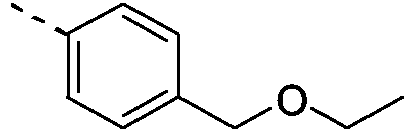
2-26 47 
2-27 35 
2-28 47 
2-29 21 
2-30 1 
2-31 22 
2-32 22 
2-33 2 
2-34 2 
2-35 1 
2-36 1 
2-37 1 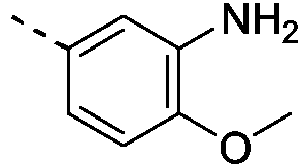
2-38 47 
2-39 47 
2-40 45 
2-41 1 
2-42 47* 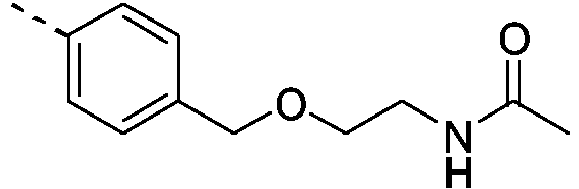
2-43 22 
2-44 22* 
2-45 22 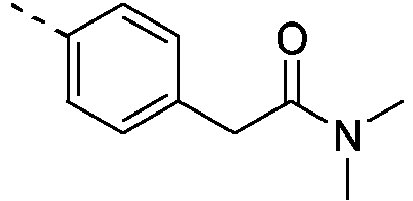
2-46 22 
2-47 22 
2-48 2 
2-49 45 
2-50 45* 
2-51 23* 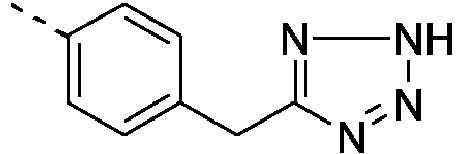
2-52 2 
2-53 1 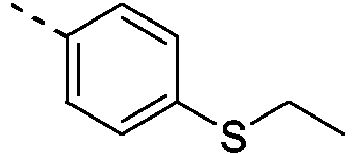
2-54 2 
2-55 4 
2-56 4* 
2-61 1 
2-62 1 
2-63 1 
2-64 1 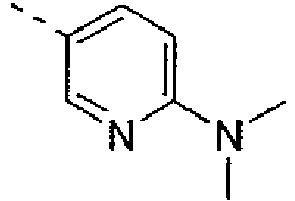
2-65 1 
2-66 1 
2-67 2 
2-68 2 
2-70 1 
2-71 1 
Table 4 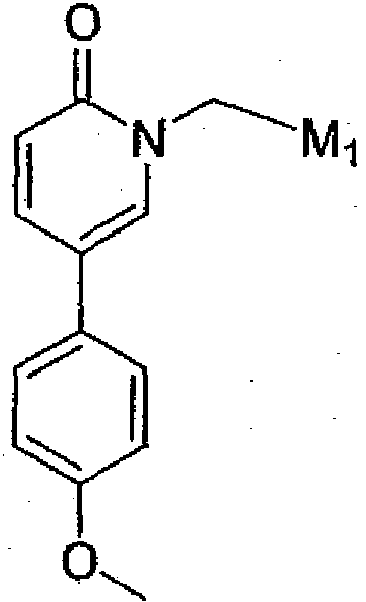
Co.nr. Exp. nr. M1 4-02 9 
4-03 9* 
4-04 9 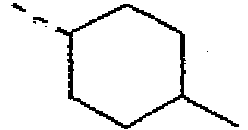
4-05 7 
4-06 7 
4-07 7 
4-08 7 
4-09 7 
4-10 7 
4-11 7 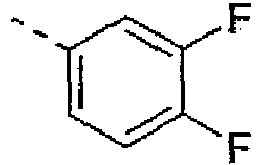
4-12 7 
4-13 7 
4-14 7 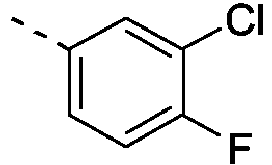
4-15 7 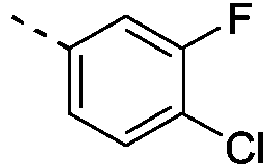
4-16 7 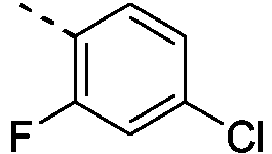
4-17 7 
4-18 7 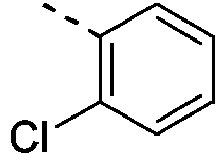
4-19 1 
4-20 7 
4-21 7 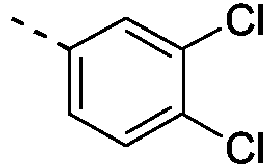
4-22 7 
4-23 7 
4-24 34 
4-25 34* 
4-26 34 
4-27 7 
4-28 7 
4-29 7 
4-30 7 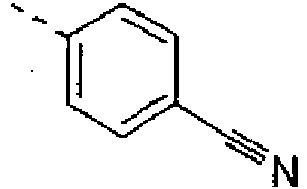
4-31 7 
4-32 7 
4-33 7 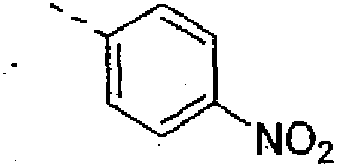
4-34 7 
4-35 7 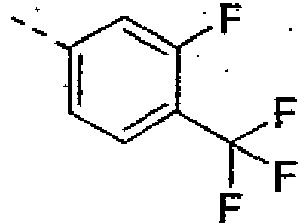
4-36 7 
4-37 7 
4-38 7 
4-40 7 
4-43 8 
4-44 8 
4-45 52* 
4-46 8 
.HCl 4-47 8* 
4-48 52 
4-49 52 
4-51 15* 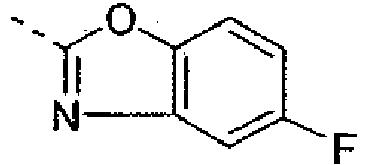
4-52 8 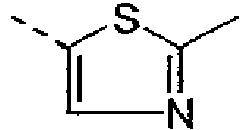
4-53 7 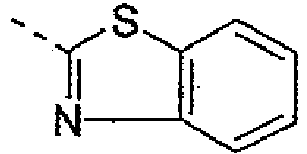
4-54 15 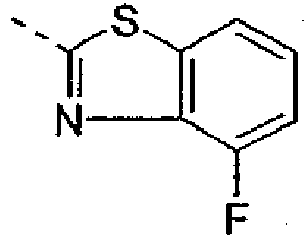
Table 5 
Co.nr. Exp. nr. V1 M1 V2 5-04 7 --CH2-CH2-- 
cb 5-05 7 --CH(CH3)-- 
cb Table 6 
Co.nr. Exp. nr. M1 R3 6-01 1 
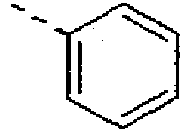
6-02 1 

6-03 1 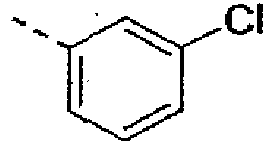

6-04 2 

6-05 1 

6-06 1 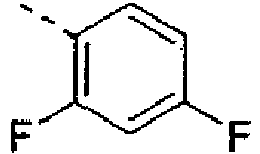

6-07 1 

6-09 1 

6-10 2 
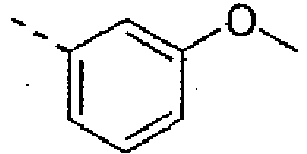
6-11 2 

6-12 2 

6-13 2 

6-14 4 

6-15 2 

6-16 1 

6-19 6* 

6-21 20 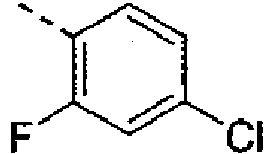
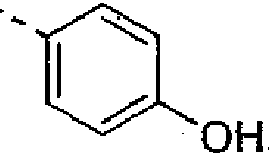
6-22 28 

6-23 28* 

HCl 6-24 28 

6-25 2 

6-26 2 

6-27 1 

6-28 1 
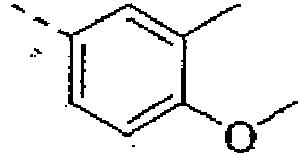
6-29 2 

6-30 1 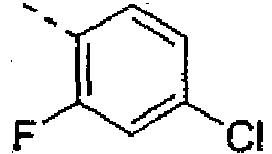

6-31 1 

6-32 20 

6-33 20 

6-34 20 
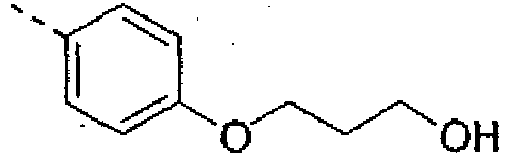
6-35 20 

6-36 20 

6-37 20 

6-39 43* 

6-40 21* 

6-41 21 

6-42 28 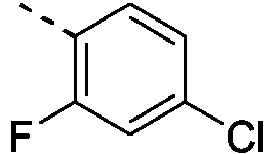

6-43 28 

6-44 20 

6-45 20 

6-46 20* 

6-47 20 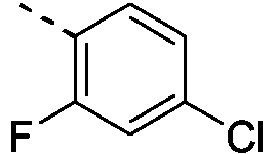

6-48 20 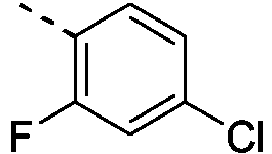

6-49 20 
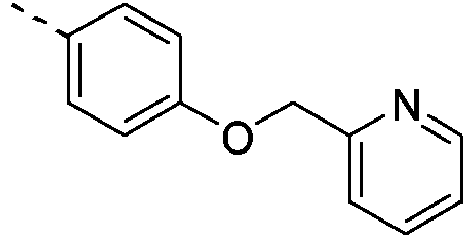
6-50 20 

6-51 1* 

6-52 21 

6-53 29* 

6-54 29 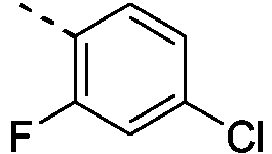

6-55 29 

6-56 29 
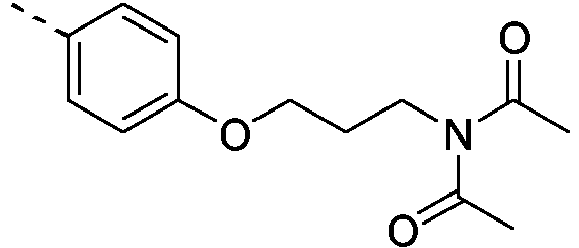
6-57 29 

6-58 29 

6-59 29 

6-60 29 

6-61 29 
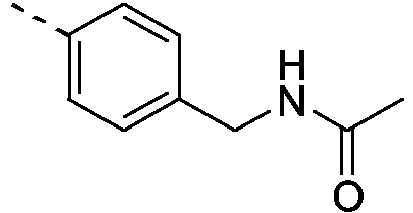
6-62 20 

6-63 20 

6-64 20 

6-65 24* 

6-82 24 

6-66 20 
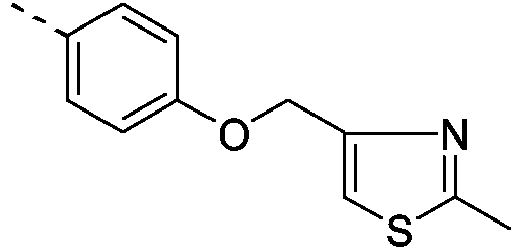
6-67 23 

6-68 23 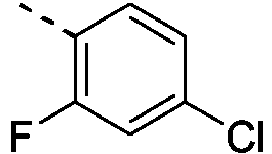

6-69 26* 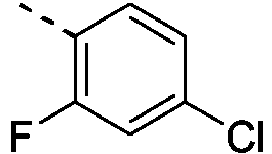

6-70 29 

6-71 29 

6-72 29 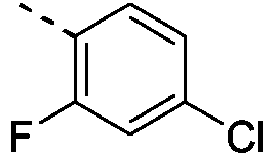

6-73 29 

6-74 1 

6-75 1 

6-76 2 

6-77 2 
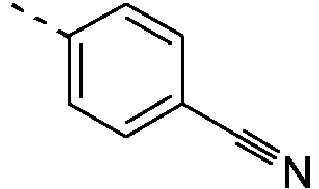
6-78 1 

6-79 1 

6-80 1 

6-81 2 

Table 9 
Co.nr. Exp. nr. R4 R5 V1 M1 R3 9-01 2 --H --Cl -CH2-- 

9-02 2 --H --Cl --CH2-- 

9-03 2 --H --Cl -CH2- 

9-05 2 --H --Cl --CH2-- 

9-06 6 --H --F --CH2-- 

9-07 2 --H --CH3 --CH2-- 

9-08 27* --H --CH2OH --CH2-- 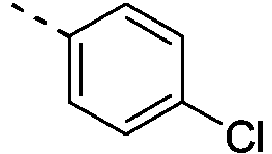

9-09 1 --H --COOCH3 --CH2-- 

9-10 40* --H --O-CH3 --CH2-- 

9-11 2 --H --NO2 --CH2-- 

9-12 2 --CH3 --H --CH2-- 

9-13 2 --CH3 --H --CH2-- 

9-14 2 --CH3 --H --CH2-- 

9-15 48 --CH2-CH2-OH --H --CH2-- 

9-16 49* --CH2-O-CH3 --H --CH2-- 

9-17 48* --CH2-CH2-O-CH3 --H --CH2-- 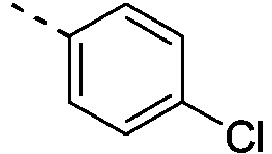

9-18 33* --OCH3 --H --CH2-- 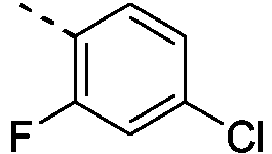

- 1H NMR spectra were recorded on Bruker 500MHz or 300MHz. Chemical shifts are expressed in parts of million (ppm, δ units). Coupling constants are in units of hertz (Hz). Splitting patterns describe apparent multiplicities and are designated as s (singulet), d (doublet), t (triplet), q (quadruple), m (multiplet).
- LCMS were recorded on a Waters Micromass ZQ 2996 system by the following conditions. Column 3.0*50mm stainless steel packed with 5µm XTerra RP C-18; flow rate 1ml/min; mobile phase: A phase = 0.1% formic acid in water, B phase = 0.07% formic acid in acetonitrile. 0-0.5min (A: 95%, B: 5%), 0.5-6.0min (A: 0%, B: 100%), 6.0-6.5min (A: 95%, B: 5%), 6.5-7min (A: 95%, B: 5%); UV detection Diode Array: 200-400nm; Injection volume: 3µl. For the ACE-C18 column (3.0 µm, 4.6 x 30 mm) from Advanced Chromatography Technologies, with a flow rate of 1.5 mL/min. The standard gradient conditions used are: 80 % A (0.5 g/l ammonium acetate solution), 10 % B (acetonitrile), 10 % C (methanol) to 50 % B and 50 % C in 6.5 min., to 100 % B at 7 min. and equilibrated to initial conditions at 7.5 min. until 9.0 min. A 5 µL volume of the sample was injected. In some cases sodium bicarbonate (1g/l) was used as buffer. All mass spectra were taken under electrospray ionisation (ESI) methods.
- Most of the reaction were monitored by thin-layer chromatography on 0.25mm Macherey-Nagel silica gel plates (60F-2254), visualized with UV light. Flash column chromatography was performed on silica gel (220-440 mesh, Fluka).
- Melting point determination was performed on a Buchi B-540 apparatus.
Table: 17 : Physico-chemical data Co.Nr Melting point (°C) [MH+] RT (min) Physical form 273°c 381 4.32 n 145-157°c 426,428 4.08, 4.30 beige soild 1-01 - - - white semi-solid 1-02 - 276 4.28 brown oil 1-03 110°c 276 4.29 white solid 1-04 80°c 290 3.99 orange solid 1-05 145°c 318 5.31 white solid 1-06 118°c 290 4.04 white solid 1-07 - 280 4.08 brown oil 1-09 98°c 298 4.46 brown solid 1-10 120°c 296 4.41 white solid 1-12 134°c 330, 332 4.24 white solid 1-13 202°c - - beige solid 1-14 - 292 4.04 yellow oil 1-15 - 292 4.04 colorless oil 1-17 88°c 320 4.88 brown solid 1-18 110°c 334 4.31 beige solid 1-19 120°c 322 3.69 white solid 1-20 115°c 346 4.59 white solid 1-21 - 310 4.11 brown oil 1-22 - 354 4.76 brown oil 1-23 118°c 304 3.71 white solid 1-24 115°c 334 4.31 white solid 1-25 131°c 287 3.89 white solid 1-26 153°c 305 2.76 dark yellow solid 1-27 149°c 307 4.04 colorless solid 1-28 132°c 334 5.51 white solid 1-29 180-181°c 293 3.81 white solid 1-30 93°c 301 3.96 brown solid 1-31 - 304 3.61 orange semi-solid 1-32 114°c 312 4.63 brown solid 2-01 72°c 302, 304 5.07 beige solid 2-02 - 296, 298 4.53 brown oil 2-03 126-128°c 310, 312 4.86 white solid 2-04 115°c 352 5.69 beige solid 2-05 73°c 352 5.64 beige solid 2-06 125°c 322 4.93 beige solid 2-07 - 314, 316 4.61 brown oil 2-08 - 314 4.49 light yellow oil 2-09 - 332 4.64 colorless oil 2-10 109-112°c 328, 330 4.93 white solid 2-11 89°c 344, 346 4.56 white solid 2-12 - 312, 314 3.78 beige solid 2-13 202°c 312, 314 3.68 beige solid 2-14 155°c 326 3.47 yellow solid 2-15 157°c 354, 356 3.85 white solid 2-16 165°c 354, 356 3.78 white solid 2-17 - 326 4.58 brown oil 2-18 - 340, 342 4.69 brown oil 2-19 - 340 4.86 oil 2-20 120-121°c 340, 342 4.88 white solid 2-21 118°c 354 4.99 white solid 2-22 - 368 5.33 yellow oil 2-23 - 340, 342 4.49 colorless oil 2-24 109°c 340, 342 4.46 white solid 2-25 109°c 354, 356 4.62 white solid 2-26 91°c 382, 384 5.38 white solid 2-27 101°c 416, 418 5.18 white solid 2-28 79°c 384, 386 4.26 white solid 2-29 - 398 4.48 colorless oil 2-30 162°c 338 4.21 yellow solid 2-31 180°c 354, 356 3.57 white solid 2-32 185°c 368, 370 3.89 white solid 2-33 175°c 354, 356 4.36 white solid 2-34 - 368, 370 4.24 brown oil 2-35 - 382 4.61 oil 2-36 105°c 382 4.59 yellow solid 2-37 175°c 341, 343 3.62 white solid 2-38 70°c 397, 399 2.95 white solid 2-39 68°c 439, 441 2.89 white solid 2-40 106°c 369 4.25 - 2-41 126°c 381 4.18 white solid 2-42 152°c 411, 413 3.55 white solid 2-43 176°c 367, 369 3.52 white solid 2-44 183°c 367, 369 3.32 white solid 2-45 161°c 381, 383 3.66 white solid 2-46 197°c 381, 383 3.52 white solid 2-47 104°c 395, 397 3.86 white solid 2-48 155°c 339,341 4.28 grey solid 2-49 - 353 5.02 - 2-50 - 382 3.23 - 2-51 231°c 376, 378 3.56 white solid 2-52 132°c 342, 344 4.84 yellow solid 2-53 109°c 356 5.13 white solid 2-54 199-200°c 374 3.76 white solid 2-55 169°c 389 3.83 white solid 2-56 151°c 419, 421 3.73 white solid 2-61 135°c 311, 313 4.01 beige solid 2-62 191°c 327 4.19 white solid 2-63 169°c 331, 333 4.07 yellow solid 2-64 164°c 340, 342 2.53 beige solid 2-65 154°c 382, 384 3.21 white solid 2-66 191°c 328, 330 3.56 beige solid 2-67 - 335, 337 4.04 brown oil 2-68 144-147°c 349, 351 4.69 beige solid 2-70 165°c 347, 349 4.06 white solid 2-71 261°c 347, 349 3.43 yellow solid 4-02 - 284 4.45 colorless oil 4-03 - 298 4.72 colorless oil 4-04 - 312 5.06 colorless oil 4-05 122°c 306 4.38 white solid 4-06 123-124°c 306 4.48 clear yellow solid 4-07 131-132°c 360 4.59 white solid 4-08 - 310 3.69 yellow oil 4-09 89°c 310 3.69 white solid 4-10 103°c 310 3.71 white solid 4-11 - 328 4.33 colorless oil 4-12 109°c 328 4.28 white solid 4-13 71°c 328 4.26 white solid 4-14 - 344 4.53 brown oil 4-15 - 344, 346 4.51 white solid 4-16 88°c 344, 346 4.58 white solid 4-17 112°c 346 4.24 white solid 4-18 125°c 326 4.44 white solid 4-20 142°c 326 3.91 white solid 4-21 - 380, 362 4.16 pale yellow solid 4-22 - 322 4.14 yellow oil 4-23 103°c 322 3.64 clear yellow solid 4-24 - - - yellow oil 4-25 72°c 336 3.92 white solid 4-26 - 350 4.22 yellow oil 4-27 147-150°c 350 4.11 white solid 4-28 - 350 3.85 clear yellow oil 4-29 165°c 317 3.51 white solid 4-30 119-120°c 317 3.98 white solid 4-31 130°c 376 4.64 white solid 4-32 - 337 3.69 yellow oil 4-33 95°c 337 3.69 white solid 4-34 131-134°c 378 4.68 brown solid 4-35 82-84°c 378 4.64 white solid 4-36 98-100°c 324 4.51 white solid 4-37 - 394, 396 4.83 yellow oil 4-38 145-148°c 342 4.68 white solid 4-40 100-102°c 297 3.66 white solid 4-43 - 293 2.24 yellow oil 4-44 135°c 321, 329 3.83 white solid 4-45 130°c 321 3.55 - 4-46 126°c 323 3.73 yellow solid 4-47 168°c 361 4.06 white solid 4-48 273°c 317 3.18 - 4-49 - 399 4.31 - 4-51 115°c 351 4.06 white solid 4-52 127-130°c 313 3.54 beige solid 4-53 121°c 349 3.68 beige solid 4-54 126°c 367 4.1 brown solid 5-04 125°c 324 4.28 white solid 5-05 92°c 306 3.73 clear yellow solid 5-07 - 320 4.51 colorless oil 5-09 79°c 334 4.79 yellow solid 6-04 112-113°c 294 4.59 clear brown solid 6-10 - 328 4.34 grey solid 6-11 85°c 342 4.21 pale gray crystals 6-12 142°c 340 3.99 pale pink crystals 6-13 139°c 323 4.09 white solid 6-14 - 391 3.58 pale brown glass oil 6-15 96°c 304 4.24 pale grey solid 6-16 120°c 329 3.94 white solid 6-19 164°c 371, 373 4.89 pale beige solid 6-21 224°c 330 3.67 white solid 6-22 70°c 329, 331 3.45 beige solid 6-23 266°c 329, 331 3.18 beige solid 6-24 139°c 343, 345 2.52 beige solid 6-25 140°c 339, 341 4.26 white solid 6-26 176°c 344, 346 3.53 white solid 6-27 127°c 382 5.03 white solid 6-28 104°C 358, 360 4.85 white solid 6-29 - 372, 374 5.08 yellow oil 6-30 - 362, 364 4.69 brown oil 6-31 141°c 374, 376 4.13 white solid 6-32 107°c 372, 374 5.38 white solid 6-33 88°c 386 5.45 white solid 6-34 129°c 354.1, 356.1 4.62 white solid 6-35 - 388, 390 3.92 pale oil 6-36 90°c 388 4.3 yellow solid 6-37 114°c 410, 412 4.78 white solid 6-39 124°c 388, 390 4.28 white solid 6-40 127°c 388, 388 4.02 white solid 6-41 119°C 402 4.3 white solid 6-42 226°c 373, 375 2.63 white solid 6-43 253°c 387, 389 2.8 white solid 6-44 85°c 401 2.67 white solid 6-45 104°c 415 2.83 white solid 6-46 160°c 369, 371 4.2 pale beige solid 6-47 80°c 444 2.67 yellow solid 6-48 153°c 457 2.9 beige solid 6-49 - 421 4.34 yellow solid 6-50 - 421 3.73 yellow oil 6-51 136°c 345, 347 4.13 beige solid 6-52 162°c 401, 403 3.58 white solid 6-53 153°c 415 3.51 white solid 6-54 - 429, 431 3.63 pale oil 6-55 121°c 457, 459 4.24 white solid 6-56 131°c 471, 473 4.34 white solid 6-57 194°c 371, 373 3.72 beige solid 6-58 230°c 371, 373 3.53 beige solid 6-59 126°c 443, 445 4.62 brown solid 6-60 143°c 385 3.47 beige solid 6-61 150°c 385, 387 3.42 beige solid 6-62 180°c 441, 443 3.9 beige solid 6-63 135°c 425, 427 4.57 white solid 6-64 - 424, 426 2.87 brown oil 6-65 197°c 412, 414 3.57 white solid 6-66 90°c 441, 443 4.55 white solid 6-67 240°c 382, 384 3.6 white solid 6-68 241°c 382 3.6 white solid 6-69 110°c 370, 372 5.03 beige solid 6-70 139°c 451 3.75 beige solid 6-71 157°c 465, 467 3.88 white solid 6-72 110°c 421, 423 3.77 beige solid 6-73 165°c 421 3.7 beige solid 6-74 141°c 463, 465 4.07 white solid 6-75 177°c 447, 449 4.33 pink solid 6-76 97°c 334 3.72 white solid 6-77 134°c 317 3.83 white solid 6-80 160°c 362 3.6 beige solid 6-81 149°c 319 4.08 grey solid 9-01 121°c 344, 346 4.61 beige solid 9-02 - 360 4.79 green oil 9-03 - 330 4.86 colorless oil 9-05 212-213°c 387 4.02 white solid 9-06 261°c 362 4.7 beige solid 9-07 109-110°c 306 4.49 white solid 9-08 128°c 356, 358 3.98 beige solid 9-09 125°c 354, 356 4.43 beige solid 9-10 - 374, 376 4.53 brown oil 9-11 148-150°c 337 4.44 orange solid 9-12 79°c 306 4.49 white solid 9-13 - 328, 330 4.79 white solid 9-14 125°c 358, 360 4.71 white solid 9-15 151°c 370 3.83 pale yellow solid 9-16 - 388, 390 3.83 green oil 9-17 - 384, 386 4.49 white oil 9-18 - 374, 376 4.62 yellow oil Table 18 : NMR-data Co.Nr NMR-data 1-02 1H NMR (500MHz, CDCl3) δ 2.39 (s, 3H), 5.23 (s, 2H), 6.75 (d, J=9.4Hz, 1H), 7.15 (m, 3H), 7.32 (m, 6H), 7.48 (d, J=2.6Hz, 1H), 7.64 (dd, J=2.6Hz, J=9.4Hz, 1H). 1-03 1H NMR (500MHz, CDCl3) δ 2.37 (s, 3H), 5.22 (s, 2H), 6.71 (d, J=9.4Hz, 1H), 7.20 (d, J=8.2Hz, 2H), 7.25 (d, J=8.2Hz, 2H), 7.28-7.42 (m, 5H), 7.45 (d, J=2.7Hz, 1H), 7.61 (dd, J=9.4Hz, J=2.7Hz, 1H). 1-06 1H NMR (500MHz, CDCl3) δ 2.28 (s, 3H), 2.29 (s, 3H), 5.23 (s, 2H), 6.73 (dd, J=2.4Hz and 9.4Hz, 1H), 7.09 (dd, J=2.0Hz and 7.8Hz, 1H), 7.12-7.17 (2H), 7.29-7.38 (5H), 7.45 (d, J=2.6Hz, 1H), 7.62 (dd, J=2.6Hz and 9.4Hz, 1H). 1-07 1H NMR (500MHz, CDCl3) δ 5.23 (s, 2H), 6.74 (d, J=9.4Hz, 1H), 7.15 (m, 2H), 7.32 (m, 7H), 7.58 (m, 2H). 1-09 1H NMR (500MHz, CDCl3) δ 5.23 (s, 2H), 6.71-6.78 (2H), 6.84-6.90 (2H), 7.32-7.41 (5H), 7.49 (d, J=2.7Hz, 1H), 7.56 (dd, J=2.7Hz and 9.5Hz, 1H). 1-10 1H NMR (500MHz, CDCl3) δ 5.24 (s, 2H), 6.77 (d, J=9.4Hz, 1H), 7.20-7.40 (m, 9H), 7.50 (d, J=2.7Hz, 1H), 7.60 (dd, J=9.4Hz, J=2.7Hz, 1H). 1-14 1H NMR (500MHz, CDCl3) δ 3.78 (s, 3H), 5.20 (s, 2H), 6.74 (d, J=9.4Hz, 1H), 6.94 (d, J=8.3, 1H), 6.99 (t, J=7.5Hz, 1H), 7.19 (dd, J=1.6Hz, J=7.5Hz, 1H), 7.32 (m, 2H), 7.37 (d, J=4.3Hz, 4H), 7.54 (d, J=2.5Hz, 1H), 7.61 (dd, J=2.5Hz, J=9.4Hz, 1H) 1-15 1H NMR (500MHz, CDCl3) δ 3.84 (s, 3H), 5.24 (s, 2H), 6.78 (d, J=9.4Hz, 1H), 6.84-6.90 (2H), 6.94 (d, J=7.7Hz, 1H), 7.29-7.39 (6H), 7.51 (d, J=2.6Hz, 1H), 7.64 (dd, J=2.6Hz and 9.4Hz, 1H). 1-19 1H NMR (500MHz, CDCl3) δ 3.90 (s, 3H), 3.91 (s, 3H), 5.24 (s, 2H), 6.75 (d, J=9.4Hz, 1H), 6.84 (s, 1H), 6.89 (d, J=0.9Hz, 2H), 7.29-7.39 (5H), 7.42 (d, J=2.6Hz, 1H), 7.61 (dd, J=2.6Hz and 9.4Hz, 1H). 1-21 1H NMR (500MHz, CDCl3) δ 3.80 (s, 3H), 5.22 (s, 2H), 6.73 (d, J=9.5Hz, 1H), 6.78 (m, 2H), 7.03 (m, 1H), 7.32-7.38 (m, 5H), 7.56 (s, 1H), 7.58 (s, 1H). 1-22 1H NMR (500MHz, CDCl3) δ 1.3 (d, J=5.0Hz, 6H), 4.48 (p, J=6.1Hz, 1H), 5.14 (s, 2H), 6.64 (d, J=9.4Hz, 1H), 6.88 (d, J=8.5Hz, 1H), 7.08 (dd, J=2.3Hz, J=8.5Hz, 1H), 7.19 (s, 1H), 7.27 (m, 5H), 7.34 (d, J=2.6Hz, 1H), 7.48 (dd, J=2.6Hz, J=9.4Hz, 1H). 1-23 1H NMR (500MHz, CDCl3) δ 2.62 (s, 3H), 5.24 (s, 2H), 6.75 (d, J=9.5Hz, 1H), 7.29-7.41 (m, 5H), 7.45 (d, J=8.6Hz, 2H), 7.58 (d, J=2.7Hz, 1H), 7.66 (dd, J=9.5Hz, J=2.7Hz, 1H), 7.98 (d, J=8.6Hz, 2H). 1-24 1H NMR (500MHz, CDCl3) δ 1.41 (t, J=7.1Hz, 3H), 4.39 (q, J=7.1Hz, 2H), 5.24 (s, 2H), 6.75 (d, J=9.4Hz, 1H), 7.30-7.40 (5H), 7.42 (d, J=8.3Hz, 2H), 7.56 (d, J=2.6Hz, 1H), 7.66 (dd, J=2.6Hz and 9.4Hz, 1H), 8.06 (d, J=8.3Hz, 2H). 1-25 1H NMR (500MHz, CDCl3) δ 5.25 (s, 2H), 6.78 (d, J=9.5Hz, 1H), 7.31-7.41 (m, 5H), 7.46 (d, J=8.5Hz, 2H), 7.56 (d, J=2.6Hz, 1H), 7.63 (dd, J=9.5Hz, J=2.6Hz, 1H), 7.68 (d, J=8.4Hz, 2H). 1-27 1H NMR (500MHz, CDCl3) δ 5.26 (s, 2H), 6.81 (d, J=9.4Hz, 1H), 7.31-7.40 (5H), 7.56-7.60 (2H), 7.64-7.70 (2H), 8.15-8.18 (m, 1H), 8.22-8.25 (m, 1H). 1-28 1H NMR (500MHz, CDCl3) δ 0.28 (s, 9H), 5.23 (s, 2H), 6.73 (d, J=9.4Hz, 1H), 7.29-7.39 (7H), 7.48 (d, J=2.6Hz, 1H), 7.53-7.57 (2H), 7.63 (dd, J=2.6Hz and 9.4Hz, 1H). 1-29 1H NMR (500MHz, CDCl3) δ 3.93 (s, 3H), 5.22 (s, 2H), 6.73 (d, J=9.4Hz, 1H), 6.77 (dd, J=8.6Hz, J=0.7Hz, 1H), 7.30-7.40 (m, 5H), 7.54 (m, 2H), 8.15 (dd, J=2.6Hz, J=0.7Hz, 1H). 1-30 1H NMR (500MHz, CDCl3) δ 5.25 (s, 2H), 6.57 (m, 1H), 6.75 (d, J=9.4Hz, 1H), 7.19 (dd, J=8.4Hz, J=1.8Hz, 1H), 7.24-7.39 (m, 6H), 7.42 (d, J=8.4Hz, 1H), 7.50 (d, J=2.6Hz, 1H), 7.62 (s, 1H), 7.70 (dd, J=9.4Hz, J=2.6Hz, 1H), 8.24 (s, 1H). 1-31 1H NMR (500MHz, CDCl3) δ 3.24 (t, J=8.7Hz, 2H), 4.61 (t, J=8.7Hz, 2H), 5.31 (s, 2H), 6.80 (d, J=8.3Hz, 1H), 6.90 (m, 1H), 7.10 (dd, J=8.2Hz, J=1.2Hz, 1H), 7.19 (s, 1H), 7.29-7.41 (m, 5H), 7.43 (d, J=2.8Hz, 1H), 7.62 (m, 1H). 1-32 1H NMR (500MHz, CDCl3) δ 5.28 (s, 2H), 6.79 (d, J=9.4Hz, 1H), 7.30-7.54 (m, 8H), 7.62 (d, J=2.6Hz, 1H), 7.78 (dd, J=9.4Hz, J=2.6Hz, 1H), 7.80-7.89 (m, 4H). 2-01 1H NMR (300 MHz, CDCl3) δ 1.07-1.43 (5H), 1.63-1.86 (5H), 2.13-2.28 (m, 1H), 5.08 (s, 2H), 6.58 (d, J=9.5Hz, 1H), 6.99 (d, J=2.6Hz, 1H), 7.20-7.25 (m, 2H), 7.26-7.30 (m, 2H), 7.31-7.33 (m, 1H). 2-02 1H NMR (500MHz, CDCl3) δ 5.15 (s, 2H), 6.52 (d, J=9.4Hz, 1H), 7.30 (m, 1H), 7.40 (m, 6H), 7.56 (d, J=8.2Hz, 2H), 7.85 (dd, J=9.4Hz, J=2.70Hz, 1H), 8.27 (d, J=2.7Hz, 1H). 2-03 1H NMR (500MHz, CDCl3) δ 2.37 (s, 3H), 5.18 (s, 2H), 6.70 (d, J=9.4Hz, 1H), 7.16-7.35 (m, 8H), 7.43 (d, J=2.4Hz, 1H), 7.62 (dd, J=9.4Hz, J=2.4Hz, 1H). 2-07 1H NMR (500MHz, CDCl3) δ 5.17 (s, 2H), 6.71 (d, J=9.4Hz, 1H), 7.11-7.20 (m, 2H), 7.28-7.35 (m, 7H), 7.54 (d, J=2.5Hz, 1H). 2-08 1H NMR (300MHz, CDCl3) δ 5.10 (s, 2H), 6.65 (d, J=9.5Hz, 1H), 7.05 (m, 2H), 7.25 (m, 6H), 7.35 (d, J=2.0Hz, 1H), 7.50 (dd, J=2.8Hz, J=9.5Hz, 1H). 2-09 1H NMR (500MHz, CDCl3) δ 5.18 (s, 2H), 6.71 (d, J=10.0Hz, 1H), 6.99 (m, 2H), 7.09 (m, 1H), 7.32 (dd, J=10.0Hz, J=6.4Hz, 4H), 7.56 (s, 2H). 2-10 1H NMR (500MHz, CDCl3) δ 2.29 (s, 3H), 5.18 (s, 2H), 6.71 (d, J=9.4Hz, 1H), 7.02 (t, J=11.7Hz, 2H), 7.20 (t, 8.3Hz, 1H), 7.32 (m, 4H), 7.44 (d, J=2.6Hz, 1H), 7.59 (dd, J=9.4Hz, J=2.7Hz, 1H). 2-12 1H NMR (300MHz, DMSO-d6) δ 5.07 (s, 2H), 6.42 (d, J=9.9Hz, 1H), 6.62 (d, J=7.8Hz, 1H), 6.83 (s, 1H), 6.88 (d, J=8.4Hz, 1H), 7.21 (t, J=8.1Hz, 1H), 7.31 (s, 3H), 7.68 (d, J=11.7Hz, 1H), 8.11 (s, 1H), 9.44 (s, 1H). 2-14 NMR (300MHz, CDCl3) δ 4.50 (d, J=6.4Hz, 2H), 5.16 (s, 2H), 5.22 (t, J=4.3Hz, 1H), 6.51 (d, J=9.0Hz, 1H), 7.31-7.44 (m, 6H), 7.54 (d, J=9.0Hz, 2H), 7.86 (dd, J=10.7Hz, J=3.9Hz, 1H), 8.27 (d, J=2.3Hz, 1H). 2-15 1H NMR (300MHz, DMSO-d6) δ 1.42 (s, 6H), 5.05 (s, 1H), 5.15 (s, 2H), 6.52 (d, J=9.7Hz, 1H), 7.32-7.43 (m, 4H), 7.43-7.52 (m, 3H), 7.84 (dd, J=1.8Hz, 9.5Hz, 1H), 8.22 (d, J=1.8Hz, 1H). 2-16 1H NMR (300MHz, DMSO-d6) δ 1.64-1.7 (m, 2H), 2.61 (t, J=7.3Hz, 2H), 3.32-3.46 (m, 2H), 4.48 (t, J=5.1Hz, 1H), 5.15 (s, 2H), 6.52 (d, J=9.5Hz, 1H), 7.24 (d, J=8.1Hz, 2H), 7.35-7.44 (4H), 7.47 (d, J=8.1Hz, 2H), 7.83 (dd, J=2.6Hz, 9.5Hz, 1H), 8.23 (d, J=2.6Hz, 1H). 2-17 1H NMR (DMSO-d6) δ 8.28(dd, 1H, J= 2.5 Hz, J=9.4Hz); 7.84-7.81 (dd, 1H, J= 2.5 Hz); 7.33 (m, 4H); 7.30 (m, 1H); 7.13 (m, 2H); 6.87 (d, 1H, J=9.4 Hz); 6.49 (m, 1H); 5.15 (s, 2H); 3.79 (s, 3H). 2-18 1H NMR (500MHz, CDCl3) δ 2.21 (s, 3H), 3.85 (s, 3H), 5.41 (s, 2H), 6.62 (d, J=9.3Hz, 1H), 6.93 (d, J=8.8Hz, 2H), 7.14 (m, 4H), 7.31 (m, 3H). 2-19 1H NMR (DMSO-d6) δ 8.28 (dd, 1H, J= 2.5Hz, J=9.4Hz); 7.84-7.81 (dd, 1H, J= 2.5Hz); 7.33 (m, 4H); 7.30 (m, 1H); 7.13 (m, 2H); 6.87 (d, 1H, J=9.45 Hz); 6.49 (m, 1H); 5.15 (s, 2H); 4.13- 4.09 (q, 2H), 1.55 (t, 3H). 2-22 1H NMR (500MHz, CDCl3) δ 0.99 (t, J=7.4Hz, 3H), 1.31 (d, J=6.1Hz, 3H), 1.75 (p, J=6.3Hz, 2H), 4.31 (s, J=6.1Hz, 1H), 5.18 (s, 2H), 6.72 (d, J=9.4Hz, 1H), 6.92 (d, J=8.7Hz, 2H), 7.24-7.34 (m, 6H), 7.38 (d, J=2.6Hz, 1H), 7.60 (dd, J=2.6Hz, 9.4Hz, 1H). 2-23 1H NMR (500MHz, CDCl3) δ 3.43 (s, 3H), 4.49 (s, 2H), 5.18 (s, 2H), 6.71 (d, J=9.4Hz, 1H), 7.26-7.41 (m, 8H), 7.48 (d, J=2.6Hz, 1H), 7.65 (dd, J=9.4Hz, J=2.6Hz, 1H). 2-24 1H NMR (500MHz, CDCl3) δ 3.42 (s, 3H), 4.48 (s, 2H), 5.19 (s, 2H), 6.72 (d, J=9.5Hz, 1H), 7.34 (m, 8H), 7.46 (d, J=2.2Hz, 1H), 7.63 (dd, J=9.4Hz, J=2.7Hz, 1H). 2-25 1H NMR (300 MHz, DMSO-d6) δ 1.15 (t, J=6.9Hz, 3H), 3.47 (q, J=6.9Hz, 2H), 4.45 (s, 2H), 5.16 (s, 2H), 6.53 (d, J=9.6Hz, 1H), 7.32-7.40 (4H), 7.55 (d, J=8.4Hz, 2H), 7.85 (dd, J=2.7Hz and 9.3Hz, 1H), 8.28 (d, J=2.7Hz, 1H). 2-29 1H NMR (500MHz, CDCl3) δ 1.32 (t, J=7.1Hz, 3H), 4.29 (q, J=7.1Hz, 2H), 4.64 (s, 2H), 5.17 (s, 2H), 6.70 (d, J=9.4Hz, 1H), 6.94 (d, J=8.9Hz, 2H), 7.28-7.34 (m, 6H), 7.39 (d, J=2.6Hz, 1H), 7.58 (dd, J=2.7Hz, J=9.4Hz, 1H). 2-30 1H NMR (500MHz, DMSO-d6) δ 2.58 (s, 3H), 5.17 (s, 2H), 6.55 (d, J=9.4Hz, 1H), 7.37-7.42 (4H), 7.74 (d, J=2.6Hz, 2H), 7.95 (dd, J=2.6Hz and 9.4Hz, 1H), 7.99 (d, J=8.6Hz, 2H), 8.45 (d, J=2.6Hz, 1H). 2-32 1H NMR (DMSO-d6) δ 12.10 (s, 1H); 8.23 (dd, 1H, J= 2.5Hz, J=9.4Hz); 7.84-7.81 (dd, 1H, J= 2.5Hz); 7.48-7.47 (m, 2H); 7.39 (m, 4H); 7.27-7.26 (m, 2H); 6.52 (d, 1H, J=9.4Hz); 5.15 (s, 2H); 3.58 (s, 3H); 2.82 (m, 2H); 2.52 (m, 2H). 2-34 1H NMR (300MHz, CDCl3) δ 3.64 (s, 2H), 3.70 (s, 3H), 5.17 (s, 2H), 6.71 (d, J=9.5Hz, 1H), 7.28-7.35 (8H), 7.43 (d, J=2.6Hz, 1H), 7.61 (dd, J=2.8Hz and 9.5Hz, 1H). 2-35 1H NMR (500MHz, DMSO-d6) δ 2.67 (t, J=8.0Hz, 2H), 2.87 (t, J=7.6Hz, 2H), 3.57 (s, 3H), 5.15 (s, 2H), 6.52 (d, J=9.4Hz, 1H), 7.15 (d, J=7.4Hz, 1H), 7.32 (t, J=7.6Hz, 1H), 7.36-7.41 (m, 5H), 7.44 (s, 1H), 7.85 (dd, J=2.7Hz, J=9.5Hz, 1H), 8.25 (d, J=2.6Hz, 1H). 2-36 1H NMR (DMSO-d6) δ 8.23(dd, 1H, J= 2.5Hz, J=9.4Hz); 7.84-7.81 (dd, 1H, J= 2.5Hz); 7.48-7.47 (m, 2H); 7.39 (m, 4H); 7.27-7.26 (m, 2H); 6.52 (d, 1H, J=9.4 Hz); 5.15 (s, 2H); 3.58 (s, 3H) 2.82 (m, 2H); 2.52 (m, 2H). 2-42 1H NMR (300MHz, DMSO-d6) δ 1.80 (s, 3H), 3.18-3.27 (m, 2H), 3.42 (t, J=6.0Hz, 2H), 4.48 (s, 2H), 5.16 (s, 2H), 6.52 (d, J=9.6Hz, 1H), 7.35-7.42 (6H), 7.56 (d, J=7.8Hz, 2H), 7.86 (dd, J=2.7Hz and 9.6Hz, 2H), 8.28 (d, J= 2.7Hz, 1H). 2-44 1H NMR (300 MHz, DMSO-d6) δ 2.56 (d, J=4.6Hz, 3H), 3.36 (s, 2H), 5.15 (s, 2H), 6.52 (d, J=9.5Hz, 1H), 7.29 (d, J=8.2Hz, 2H), 7.33-7.45 (4H), 7.49 (d, J=8.2Hz, 2H), 7.83 (dd, J= J=2.6Hz, 9.45Hz, 1H), 7.92-8.01 (m, 1H), 8.24 (d, J=2.6Hz, 1H). 2-50 1H NMR (400 MHz, CDCl3) δ 7.58 (dd, 1H, J=9.5, 2.6 Hz); 7.34 (d, 1H, J=2.6 Hz); 7.26-7.33 (m, 4H); 7.17 (d, 2H, J=8.7 Hz); 6.67 (d, 1H, J=9.5 Hz); 6.64 (d, 2H, J=8.4 Hz); 5.15 (s, 2H); 4.43 (s, 1H); 3.16 (t, 2H, J=5.8 Hz); 2.58 (t, 2H, J=5.8 Hz); 2.27 (s, 6H). 2-51 1H NMR (500MHz, DMSO-d6) δ 3.99 (s, 2H), 5.13 (s, 2H), 6.48 (d, J= 9.5Hz, 1H), 7.25 (d, J=8.4Hz, 2H), 7.35-7.40 (4H), 7.42 (d, J=8.4Hz, 2H), 7.80 (dd, J=2.7Hz and 9.5Hz, 1H), 8.21 (d, J=2.5Hz, 1H). 2-52 1H NMR (500MHz, CDCl3) δ 2.51 (s, 3H), 5.18 (s, 2H), 6.71 (d, J=9.4Hz, 1H), 7.30 (m, 8H), 7.43 (d, J=2.6Hz, 1H), 7.61 (dd, J=9.4Hz, J=2.7Hz, 1H). 2-55 1H NMR (500MHz, DMSO-d6) δ 3.00 (s, 3H), 5.16 (s, 2H), 6.54 (d, J=9.4Hz, 1H), 7.12-7.17 (m, 1H), 7.26-7.31 (m, 2H), 7.34-7.43 (5H), 7.74 (dd, J=2.6Hz and 9.4Hz, 1H), 8.19 (d, J=2.6Hz, 1H), 9.70-9.80 (br. s, 1H). 2-56 1H NMR (300MHz, DMSO-d6) δ 2.88 (s, 3H), 3.76 (s, 3H), 5.08 (s, 2H), 6.44 (d, J=10.9Hz, 1H), 7.05 (d, J=10.9Hz, 1H), 7.27-7.35 (m, 3H), 7.42-7.60 (m, 3H), 7.68 (dd, J=3.5Hz, J=10.9Hz, 1H), 8.08 (d, J=3.5Hz, 1H), 8.94 (s, 1H). 2-62 1NMR (500MHz, DMSO-d6) δ 3.86 (s, 3H), 5.12 (s, 2H), 6.52 (d, J=9.4Hz, 1H), 6.87 (dd, J=0.6Hz and 8.6Hz, 1H), 7.37-7.41 (4H), 7.83 (dd, J= 2.7Hz and 9.4Hz, 1H), 7.90 (dd, J=2.6Hz and 8.6Hz, 1H), 8.37 (d, J=2.5Hz, 1H), 8:37 (dd, J=0.6Hz and 2.6Hz, 1H). 2-67 1H NMR (500MHz, CDCl3) δ 5.20 (s, 2H), 6.58 (s, 1H), 6.76 (d, J=9.4Hz, 1H), 7.19 (d, J=1.8Hz, 1H), 7.34 (s, 5H), 7.44 (d, J=8.4Hz, 1H), 7.47 (s, 1H), 7.62 (s, 1H), 7.71 (dd, J=9.4Hz, J=2.6Hz, 1H), 8.34 (s, 1H). 2-68 1H NMR (500MHz, CDCl3) δ 3.82 (s, 3H), 5.20 (s, 2H), 6.50 (dd, J=3.1Hz, J=0.8Hz, 1H), 6.73 (d, J=9.4, 1H), 7.10 (d, J=3.1Hz, 1H), 7.21 (dd, J=8.5Hz, J=1.2Hz, 1H), 7.30-7.37 (m, 5H), 7.47 (d, J=2.2Hz, 1H), 7.60 (d, J=1.2Hz, 7.72 (dd, J=9.40Hz, J=2.20Hz, 2-70 1H NMR (500MHz, CDCl3) δ 5.23 (s, 2H), 6.81 (d, J=9.4Hz, 1H), 7.35 (m, 4H), 7.60 (dd, J=8.2Hz, J=0.9Hz, 1H), 7.62 (d, J=2.7Hz, 1H), 7.72 (d, J=1.6Hz, 1H), 7.75 (dd, J=9.4Hz, J=2.7Hz, 1H), 7.84 (dd, J=8.2Hz, J=1.6Hz, 1H), 8.11 (d, J=2.3Hz, 1H), 8.20 (d, J=8.7Hz, 1H), 8.96 (d, J=2.3Hz, 1H). 4-02 1H NMR (300MHz, CDCl3) δ 1.21-1.36 (m, 2H), 1.48-1.83 (6H), 2.37-2.50 (m, 1H), 3.84 (s, 3H), 3.94 (d, J=7.7Hz, 2H), 6.65 (d, J=9.5Hz, 1H), 6.95 (d, J=8.4Hz, 2H), 7.32 (d, J=8.4Hz, 2H), 7.39 (d, J=2.6Hz, 1H), 7.56 (dd, J=2.8Hz and 9.5Hz, 1H). 4-03 1H NMR (300MHz, CDCl3) δ 0.85-1.09 (m, 2H), 1.09-1.32 (m, 3H), 1.53-1.78 (m, 5H), 1.78-2.00 (m, 1H), 3.74 (d, J=7.3Hz, 2H), 3.77 (s, 3H), 6.57 (d, J=9.4Hz, 1H), 6.88 (d, J=8.7Hz, 2H), 7.29-7.35 (3H), 7.49 (dd, J=2.7Hz, 9.4Hz, 1H). 4-06 1H NMR (500MHz CDCl3) δ 2.34 (s, 3H), 3.83 (s, 3H), 5.17 (s, 2H), 6.70 (d, J=9.3Hz, 1H), 6.92 (d, J=8.8Hz, 2H), 7.16 (d, J=7.8Hz, 2H), 7.23-7.29 (m, 4H), 7.40 (d, J=2.6, 1H), 7.57 (dd, J=9.3Hz, J=2.6Hz, 1H). 4-07 1H NMR (500MHz, CDCl3) δ 3.84 (s, 3H), 5.16 (s, 2H), 6.70 (d, J=10.0Hz, 1H), 6.94 (d, J=13.0Hz, 2H), 7.10 (t, J=9.0Hz, 2H), 7.16 (t, J=9.0Hz, 1H), 7.27 (m, 3H), 7.38 (d, J=4.0Hz, 1H), 7.59 (dd, J=1.5Hz, J=9.0Hz, 1H). 4-08 1H NMR (500MHz, CDCl3) δ 3.84 (s, 3H), 5.25 (s, 2H), 6.67 (d, J=9.4Hz, 1H), 6.93-6.96 (m, 2H), 7.06-7.16 (2H), 7.28-7.33 (3H), 7.47-7.52 (m, 1H), 7.53-7.55 (m, 1H), 7.58 (dd, J=2.6Hz and 9.4Hz, 1H). 4-09 1H NMR (500MHz, CDCl3) δ 3.83 (s, 3H), 5.21 (s, 2H), 6.72 (d, J=9.4Hz, 1H), 6.94 (d, J=8,8Hz, 2H), 7.01 (m, 1H), 7.04 (d, J=9.5Hz, 1H), 7.12 (d, J=8.2Hz, 1H), 7.29 (d, J=8.8Hz, 2H), 7.32 (m, 1H), 7.39 (d, J=2.6Hz, 1H), 7.61 (dd, J=9.4Hz, J=2.6Hz, 1H). 4-10 1H NMR (500MHz, CDCl3) δ 3.83 (s, 3H), 5.18 (s, 2H), 6.70 (d, J=9.4Hz, 1H), 6.94 (d, J=8.8Hz, 2H), 7.04 (m, 2H), 7.28 (d, J=8.8Hz, 2H), 7.35 (m, 2H), 7.40 (d, J=2.7Hz, 1H), 7.59 (dd, J=9.4Hz, J=2.7, 1H). 4-11 1H NMR (500MHz, CDCl3) δ 3.84 (s, 3H), 5.15 (s, 2H), 6.71 (d, J=9.4, 1H), 6.95 (d, J=8.8Hz, 2H), 7.07-7.22 (m, 3H), 7.29 (d, J=8.8Hz, 2H), 7.39 (d, J=2.6Hz, 1H), 7.61 (dd, J=9.4Hz, J=2.6Hz, 1H). 4-12 1H NMR (500Hz, CDCl3) δ 3.76 (s, 3H), 5.16 (s, 2H), 6.48 (d, J=9.4Hz, 1H), 6.96-7.01 (m, 2H), 7.02-7.08 (m, 1H), 7.22-7.30 (2H), 7.45-7.50 (m, 2H), 7.81 (dd, J=2.7Hz and 9.4Hz, 1H), 8.08 (d, J=2.7Hz, 1H). 4-13 1H NMR (500Hz, CDCl3) δ 3.76 (s, 3H), 5.24 (s, 2H), 6.50 (d, J=9.4Hz,1H), 6.93-7.01 (3H), 7.13-7.19 (m, 1H), 7.32-7.39 (m, 1H), 7.47-7.51 (m, 2H), 7.83 (dd, J=2.7Hz and 9.4Hz, 1H), 8.12 (d, J=2.7Hz, 1H). 4-14 1H NMR (500MHz, CDCl3) δ 3.84 (s, 3H), 5.14 (s, 2H), 6.71 (d, J=9.4Hz, 1H), 6.95 (d, J=8.8Hz, 2H), 7.10-7.14 (m, 1H), 7.23-7.27 (m, 1H), 7.30 (d, J=8.8Hz, 2H), 7.39 (d, J=2.5Hz, 1H), 7.42 (dd, J=2.1Hz, 6.9Hz, 1H), 7.61 (dd, J=2.6Hz, 9.4Hz, 1H). 4-15 1H NMR (500MHz, CDCl3) δ 3.84 (s, 3H), 5.16 (s, 2H), 6.71 (d, J=9.4Hz, 1H), 6.95 (d, J=8.7Hz, 2H), 7.09 (d, J=8.2Hz, 1H), 7.15 (dd, J=8.2Hz, J=1.89, 1H), 7.28 (t, J=8.7Hz, 2H), 7.38 (m, 2H), 7.61 (dd, J=9.4Hz, J=2.6Hz, 1H). 4-16 1H NMR (500MHz, CDCl3) δ 3.84 (s, 3H), 5.19 (s, 2H), 6.66 (d, J=9.4Hz, 1H), 6.95 (d, J=8.8Hz, 2H), 7.13 (m, 2H), 7.31 (d, J=8.8Hz, 2H), 7.49 (dd, J=8.6Hz, J=8.0Hz, 1H), 7.52 (m, 1H), 7.59 (dd, J=9.4Hz, J=2.6Hz, 1H). 4-17 1H NMR (500MHz, CDCl3) δ 3.77 (s, 3H), 5.15 (s, 2H), 6.40 (d, J=9.4Hz, 1H), 6.97-7.02 (m, 2H), 7.14-7.22 (m, 2H), 7.42-7.49 (m, 2H), 7.77 (dd, J=2.7Hz and 9.4Hz, 1H), 8.09 (s, 1H). 4-20 1HNMR (500MHz, CDCl3) δ 3.83 (s, 3H), 5.17 (s, 2H), 6.70 (d, J=9.4Hz, 1H), 6.94 (d, J=8.8Hz, 2H), 7.28 (d, J=8.8Hz, 2H), 7.29-7.35 (m, 4H), 7.38 (d, J=2.6Hz, 1H), 7.59 (dd, J=9.4Hz, J=2.6Hz, 1H). 4-21 1H NMR (500MHz, CDCl3) δ 3.84 (s, 3H), 5.17 (s, 2H), 6.71 (d, J=9.4Hz, 1H), 6.95 (m, 2H), 7.20 (dd, J=2.1Hz, J=8.3Hz, 1H), 7.30 (m, 2H), 7.38 (d, J=2.6Hz, 1H), 7.42 (d, J=8.3Hz, 1H), 7.45 (d, J=2.1Hz, 1H), 7.61 (dd, J=2.6Hz, J=9.4Hz, 1H). 4-22 1H NMR (500MHz, CDCl3) δ 3.80 (s, 3H), 3.83 (s, 3H), 5.19 (s, 2H), 6.70 (d, J=9.4Hz, 1H), 6.85 (dd, J=2.4Hz, J=7.67Hz, 1H), 6.83-6.95 (m, 4H), 7.26-7.29 (m, 3H), 7.40 (d, J=2.5, 1H), 7.58 (dd, J=2.7Hz, J=9.4Hz, 1H). 4-23 1H NMR (500MHz, CDCl3) δ 3.80 (s, 3H), 3.83 (s, 3H), 5.15 (s, 2H), 6.69 (d, J=9.4Hz, 1H), 6.89 (d, J=8.6Hz, 2H), 6.92 (d, J=8.8Hz, 2H), 7.27 (d, J=8.8Hz, 2H), 7.31 (d, J=8.6Hz, 2H), 7.40 (d, J=2.6Hz, 1H), 7.56 (dd, J=9.4Hz, J=2.6Hz). 4-25 1H NMR (300 MHz, CDCl3) δ 3.25 (s, 3H), 3.77 (s, 3H), 4.36 (s, 2H), 5.15 (s, 2H), 6.50 (d, J=9.3Hz, 1H), 6.98 (d, J=9.0Hz, 2H), 7.25-7.39 (m, 4H), 7.49 (d, J=9.0Hz, 2H), 7.80 (dd, J=2.7Hz and 9.6Hz, 1H), 8.15 (d, J=2.7Hz, 1H). 4-26 1H NMR (300MHz, DMSO-d6) δ 1.11 (t, J=7.1Hz, 3H), 3.45 (q, J=7.1Hz, 2H), 3.68 (s, 3H), 4.40 (s, 2H), 5.15 (s, 2H), 6.50 (d, J=9.5Hz, 1H), 6.97 (d, J=9.0Hz, 2H), 7.32 (q, J=8.2Hz, 4H), 7.50 (d, J=8.7Hz, 2H), 7.80 (dd, J=2.8Hz, J=9.5Hz, 1H), 8.15 (d, J=2.6Hz, 1H). 4-27 1H NMR (500MHz, CDCl3) δ 3.83 (s, 3H), 3.92 (s, 3H), 5.29 (s, 2H), 6.72 (d, J=9.7Hz, 1H), 6.93 (d, J=8.8Hz, 2H), 7.29 (s, 2H), 7.40 (m, 3H), 7.62 (dd, J=2.8Hz, J=9.7Hz, 1H), 8.03 (d, J=8.3Hz, 2H). 4-28 1H NMR (300MHz, CDCl3) δ 2.28 (s, 3H), 3.82 (s, 3H), 5.19 (s, 2H), 6.69 (d, J=9.5Hz, 1H), 6.92 (d, J=8.2Hz, 2H), 7.07 (d, J=8.2Hz, 2H), 7.23-7.30 (m, 2H), 7.34-7.36 (m, 1H), 7.36-7.43 (m, 2H), 7.58 (dd, J=2.8Hz and 9.5Hz, 1H). 4-30 1H NMR (500MHz, CDCl3) δ 3.84 (s, 3H), 5.26 (s, 2H), 6.72 (d, J=9.4Hz, 1H), 6.95 (d, J=8.8Hz, 2H), 7.30 (d, J=8.8Hz, 2H), 7.39 (d, J=2.6Hz, 1H), 7.44 (d, J=8.5Hz, 2H), 7.62 (d, J=2.6, 1H), 7.65 (m, 2H). 4-31 1H NMR (500MHz, CDCl3) δ 3.76 (s, 3H), 5.17 (s, 2H), 6.50 (d, J=9.4Hz, 1H), 6.97 (d, J=8.8Hz, 2H), 7.33 (d, J=8.0Hz, 2H), 7.45-7.51 (4H), 7.80 (dd, J=2.7Hz and 9.4Hz, 1H), 8.19 (d, J=2.7Hz, 1H). 4-32 1H NMR (500MHz, CDCl3) δ 3.84 (s, 3H), 5.30 (s, 2H), 6.72 (d, J=9.4Hz, 1H), 6.95 (m, 2H), 7.31 (m, 2H), 7.44 (d, J=2.4Hz, 1H), 7.55 (t, J=7.9Hz, 1H), 7.64 (dd, J=2.6Hz, J=9.5Hz, 1H), 7.73 (d, J=7.7Hz, 1H), 8.18 (m, 2H). 4-34 1H NMR (500MHz, CDCl3) δ 3.85 (s, 3H), 5.27 (s, 2H), 6.68 (d, J=9.4Hz, 1H), 6.96 (d, J=8.8Hz, 2H), 7.32 (d, J=6.7Hz, 2H), 7.37 (d, J=9.9Hz, 1H), 7.42 (d, J=8.0Hz, 1H), 7.53 (s, 1H), 7.62 (m, 2H). 4-35 1H NMR (500MHz, CDCl3) δ 3.84 (s, 3H), 5.24 (s, 2H), 6.73 (d, J=9.5Hz, 1H), 6.95 (d, J=8.8Hz, 2H), 7.19 (m, 2H) 7.31 (d, J=8.8Hz, 2H), 7.40 (d, J=2.5Hz, 1H), 7.59 (t, J=7.6Hz, 1H), 7.64 (dd, J=2.6Hz, J=9.5Hz, 1H). 4-36 1H NMR (500Hz, CDCl3) δ 1.57 (s, 3H), 3.84 (s, 3H), 5.28 (s, 2H), 6.71 (d, J=9.4Hz, 1H), 6.92 (d, J=8.8Hz, 2H), 7.29 (d, J=8.8Hz, 1H), 7.40 (d, J=2.5Hz, 1H), 7.46 (d, J=8.1Hz, 2H), 7.62 (m, 3H). 4-37 1H NMR (500MHz, CDCl3) δ 3.84 (s, 3H), 5.20 (s, 2H), 6.72 (d, J=9.5Hz, 1H), 6.96 (m, 2H), 7.30 (m, 2H), 7.40 (d, J=2.6Hz, 1H), 7.49 (s, 2H), 7.63 (dd, J=2.6Hz, 9.4Hz, 1H), 7.68 (s, 1H). 4-38 1H NMR (500MHz, CDCl3) δ 3.81 (s, 3H), 5.39 (s, 2H), 6.75 (d, J=9.4Hz, 1H), 6.91 (d, J=8.8Hz, 2H), 7.25 (s, 2H), 7.45 (d, J=2.6Hz, 1H), 7.47 (d, J=1.7Hz, 1H), 7.49 (m, 2H), 7.60 (dd, J=2.6Hz, J=9.4Hz, 1H), 7.79 (s, 1H), 7.83 (m, 3H). 4-43 1H NMR (500MHz, CDCl3) δ 3.83 (s, 3H), 5.22 (s, 2H), 6.70 (d, J=9.4Hz), 6.94 (d, J=8.8Hz, 2H), 7.29 (d, J= 8.8Hz, 2H), 7.31 (m, 1H), 7.42 (d, J=2.6Hz, 1H), 7.60 (dd, J=9.4Hz, J=2.6Hz, 1H), 7.75 (dd, J=7.9Hz, J=1.2Hz, 1H), 8.57 (dd, J=4.7Hz, J=1.2, 1H), 8.65 (s, 1H). 4-44 1H NMR (500MHz, CDCl3) δ 3.84 (s, 3H), 5.18 (s, 2H), 6.70 (d, J=9.4Hz, 1H), 6.95 (d, J=8.8Hz, 2H), 7.29 (d, J=8.8Hz, 2H), 7.32 (d, J=8.3Hz. 1H), 7.41 (d, J=2.6Hz, 1H), 7.61 (dd, J=9.4Hz,1=2.6Hz, 1H), 7.75 (dd, J=8.3Hz, J=2.3Hz, 1H), 8.43 (d, J=2.3Hz, 1H). 4-45 1H NMR (400 MHz, CDCl3) δ 8.53 (d, 1H, J=2.1 Hz); 7.66 (dd, 1H, J=8.0, 2.4 Hz); 7.58 (dd, 1H, J=9.5, 2.7 Hz); 7.42 (d, 1H, J=2.3 Hz); 7.25-7.30 (m, 2H); 7.15 (d, 1H, J=7.9 Hz); 6.90-6.95 (m, 2 H); 6.69 (d, 1H, J=9.5 Hz); 5.18 (s, 2H); 3.83 (s, 3H); 2.81 (q, 2H, J=7.7 Hz); 1.29 (t, 3H, J=7.6 Hz). 4-46 1H NMR (500MHz, DMSO-d6) δ 3.76 (s, 3H), 3.80 (s, 3H), 5.08 (s, 2H), 6.47 (d, J=9.4Hz, 1H), 6.78 (dd, J=0.4Hz and 8.5Hz, 1H), 6.95-7.00 (m, 2H), 7.46-7.51 (m, 2H), 7.74-7.76 (m, 1H), 7.76-7.79 (m, 1H), 8.20 (d, J=2.5Hz, 1H), 8.26 (d, J=2.1Hz, 1H). 4-47 1H NMR (500MHz, CDCl3) δ 3.76 (s, 3H), 5.27 (s, 2H), 6.51 (d, J=9.4Hz, 1H), 6.98 (d, J=6.7Hz, 2H), 7.51 (d, J=6.7Hz, 2H), 7.83 (dd, J=2.7Hz and 9.4Hz, 1H), 7.88 (d, J=8.2Hz, 1H), 8.00 (dd, J=1.7Hz and 8.2Hz, 1H), 8.28 (d, J=2.5Hz, 1H), 8.81 (d, J=1.7Hz, 1H). 4-51 1H NMR (500Hz, CDCl3) δ 3.84 (s, 3H), 5.46 (s, 2H), 6.74 (d, J=9.5Hz, 1H), 6.96 (d, J=8.8Hz, 2H), 7.05-7.12 (m, 1H), 7.35 (d, J=8.8Hz, 2H), 7.40 (dd, J=8.3Hz and 2.6Hz, 7.46 (dd, 1=9.Hz and 4.2Hz, 1H), 7.58 (d, J= 2.6Hz, 1H), 7.66 (dd, J=9.5Hz and 2.6Hz, 1H). 4-53 1H NMR (500MHz, CDCl3) δ 3.83 (s, 3H), 5.59 (s, 2H), 6.73 (d, J=9.4Hz, 1H), 6.94 (d, J=8.8Hz, 2H), 7.32 (d, J=8.8Hz, 2H), 7.41 (ddd, J= 8.3Hz, J=8.3Hz, J=1.1Hz, 1H), 7.49 (ddd, J=8.3Hz, J=8.3Hz, J=1.2Hz, 1H), 7.63 (dd, J=9.4Hz, J=2.6Hz, 1H), 7.76 (d, J=2.6Hz, 1H), 7.87 (dd, J=8.3Hz, J=1.2Hz, 1H), 8.03 (dd, J=8.3Hz, J=1.1Hz, 1H). 4-54 1H NMR (300MHz, CDCl3) δ 3.76 (s, 3H), 5.52 (s, 2H), 6.66 (d, J=9.4Hz, 1H), 6.86 (d, J=8.8Hz, 2H), 7.11 (m, 1H), 7.25 (d, J=8.8Hz, 2H), 7.29 (m, 1H), 7.56 (m, 1H), 7.58 (m, 1H), 7.61 (m, 1H). 5-05 1H NMR (500MHz, CDCl3) δ 1.78 (d, J=7.09Hz, 3H), 3.81 (s, 3H), 6.52 (q, J=7.09Hz, 1H), 6.70 (d, J=9.4Hz, 1H), 6.90 (d, J=8.8Hz, 2H), 7.19 (d, J=8.8Hz, 2H), 7.23 (d, J=2.6Hz, 1H), 7.30-7.41 (m, 5H), 7.54 (dd, J=9.4Hz, J=2.6Hz, 1H). 5-07 1H NMR (500MHz, CDCl3) δ 2.51 (d, J=7.7Hz, 2H), 2.74 (t, J=7.8Hz, 2H), 3.85 (s, 3H), 4.03 (t, J=7.5Hz, 2H), 6.66 (d, J=9.4Hz, 1H), 6.96 (d, J=8.7Hz, 2H), 7.22 (m, 3H), 7.31 (m, 5H), 7.58 (dd, J=9.4Hz, J=2.7Hz, 1H). 5-09 1H NMR (500MHz, CDCl3) δ 1.58 (m, 2H); 1.85 (m, 4H), 2.73 (t, J=7.1Hz, 2H), 3.87 (s, 3H), 4.38 (t, J=6.3Hz, 2H), 6.78 (d, J= 8.8Hz, 1H), 6.98 (d, J=8.8Hz, 2H), 7.26 (m, 3H), 7.46 (d, J=8.8Hz, 2H), 7.75 (dd, J=8.6Hz, J=2.6Hz, 1H), 8.33 (d, J=2.5Hz, 1H). 6-04 1H NMR (500MHz, CDCl3) δ 2.38 (s, 3H), 5.21 (s, 2H), 6.72 (d, J=9.4Hz,1H), 7.00 (dd, J=8.3Hz, J=2.5Hz, 1H), 7.04 (ddd, J=9.6Hz, J=2.3Hz, J=1.7Hz, 1H), 7.12 (dd, J=7.7Hz, J=0.6Hz, 1H), 7.21 (d, J=8.0Hz, 2H), 7.26 (d, J=8.0Hz, 2H), 7.32 (m, 1H), 7.44 (d, J=2.6Hz, 1H), 7.63 (dd, J= 9.4Hz, J=2.6Hz, 1H). 6-10 1H NMR (500MHz, CDCl3) δ 3.85 (s, 3H), 5.15 (s, 2H), 6.71 (d, J=9.4Hz,1H), 6.86-6.91 (2H), 6.94-6.97 (m, 1H), 7.07-7.11 (m, 1H), 7.11-7.16 (m, 1H), 7.16-7.23 (m, 1H), 7.31-7.36 (m, 1H), 7.46 (d, J=2.6Hz, 1H), 7,63 (dd, J=2.6Hz and 9.4Hz, 1H). 6-11 1H NMR (500MHz, CDCl3) δ 3.41 (s, 3H), 4.48 (s, 2H), 5.16 (s, 2H), 6.72 (d, J=9.4Hz, 1H), 7.07-7.23 (3H), 7.34-7.42 (4H), 7.46 (d, J=2.6Hz, 1H), 7.65 (dd, J=2.6Hz and 9.4Hz, 1H). 6-14 1H NMR (500MHz, DMSO-d6) δ 2.98 (s, 3H), 5.12 (s, 2H), 6.51 (d, 9.5Hz, 1H), 7.24 (d, J=8.7Hz, 3H), 7.39-7.62 (m, 4H), 7.81 (dd, J=2.7Hz, J=9.5Hz, 1H), 8.23 (d, J=2.6Hz, 1H). 6-15 1H NMR (500MHz, CDCl3) δ 5.12 (s, 2H), 6.51 (d, J=9.4Hz, 1H), 7.08 (dd, J=3.6Hz and 5.1Hz, 1H), 7.18-7,23 (m, 1H), 7.32 (dd, J=1.2Hz and 3.6Hz, 1H), 7.38-7.43 (m, 1H), 7.44-7.49 (2H), 7.77 (dd, J=2.7Hz and 9.5Hz, 1H), 8.24 (d, J=2.5Hz, 1H). 6-16 1H NMR (500MHz, CDCl3) δ 3.84 (s, 3H), 5.11 (s, 2H), 6.52 (d, J=9.4Hz, 1H), 6.88 (d, J=8.6Hz, 1H), 7.22-7.26 (m, 1H), 7.36-7.43 (m, 1H), 7.46-7.52 (m, 1H), 7.83 (dd, J=2.7Hz and 9.4Hz, 1H), 7.91 (dd, J=2.6Hz and 8.6Hz, 1H), 8.26 (d, J=2.6Hz, 1H), 8.38 (d, J=2.7Hz, 1H). 6-19 1H MMR (500MHz, CDCl3) δ 5.26 (s, 2H),6.61 (d, J=9.5Hz, 1H), 7.22-7.25 (m, 1H), 7.41-7.45 (m, 1H), 7.45-7.48 (m, 1H), 7.50-7.54 (m, 1H), 7.56-7.60 (m, 1H), 7.96 (d, J=7.7Hz, 1H), 8.11 (dd, J=2.7Hz and 9.5Hz, 1H), 8.11-8.13 (m, 1H), 8.81 (d, J=2.6Hz, 1H). 6-22 1H NMR (300MHz, DMSO-d6) δ 5.19 (s, 2H), 6.47-6.54 (m, 2H), 6.64-6.70 (m, 2H), 7.01-7.10 (m, 1H), 7.14-7.23 (m, 1H), 7.28 (dd, J=2.0Hz and 8.5Hz, 1H), 7.46 (dd, J=2.0Hz and 10.2Hz, 1H), 7.73 (dd, J=2.6Hz and 9.5Hz, 1H), 8.03 (d, J=2.6Hz, 1H). 6-23 1H NMR (300Hz, DMSO-d6) δ 3.10-3.70 (br s, 3H), 5.19 (s, 2H), 6.53 (d, J=9.5Hz, 1H), 7.16-7.24 (m, 1H), 7.24-7.37 (3H), 7.46 (dd, J=1.8Hz and 10.2Hz, 1H), 7.63 (dd, J=8.2Hz, 2H), 7.87 (dd, J=2.6Hz and 9.5Hz, 1H), 8.23 (s, 1H). 6-26 1H NMR (300MHz, DMSO-d6) δ 4.51 (d, J=5.4Hz, 2H), 5.19 (s, 2H), 5.19-5.26 (m, 1H), 6.52 (d, J=9.5Hz, 1H), 7.16-7.24 (m, 1H), 7.27 (dd, J=2.0Hz and 8.2Hz, 1H), 7.36 (d, J=8.2Hz, 2H), 7.46 (dd, J=2.0Hz and 10.2Hz, 1H), 7.53 (d, J=8.2Hz, 2H), 7.88 (dd, J=2.8Hz and 9.5Hz, 1H), 8.21 (d, J=2.3Hz, 1H). 6-29 1H NMR (300MHz, CDCl3) δ 2.50 (s, 6H), 3.65 (s, 3H), 5.17 (s, 2H), 6.49 (d, J=9.3Hz, 1H), 7.12-7.30 (m, 4H), 7.06 (dd, J=2.1Hz, J=9.9Hz, 1H), 7.83 (dd, J=2.7Hz, J=9.3Hz, 1H), 8.12 (d, J=2.4Hz, 1H). 6-30 1H NMR (500MHz, DMSO-d6) δ 3.78 (s, 3H), 5.17 (s, 2H), 6.49 (d, J=9.5Hz, 1H), 6.86 (dd, J=2.6Hz and 8.6Hz, 1H), 6.93 (dd, J=2.6Hz and 13.0Hz, 1H), 7.20-7.25 (m, 1H), 7.28 (dd, J=2.0Hzand 8.6Hz, 1H), 7.37-7.42 (m, 1H), 7.45 (dd, J=2.0Hz and 10.1Hz, 1H), 7.63-7.67 (m, 1H), 7.97 (d, J=2.3Hz, 1H). 6-31 1H NMR (500MHz, DMSO-d6) δ 3.76 (s, 3H), 3.80 (s, 3H), 5.18 (s, 2H), 6.49 (d, J=9.5Hz, 1H), 6.98 (d, J=8.3Hz, 1H), 7.07 (dd, J=2.1Hz and 8.3Hz, 1H), 7.12 (d, J=2.1Hz 1H), 7.13-7.18 (m, 1H), 7.27 (dd, J=1.9Hz and 8.3Hz, 1H), 7.46 (dd, J=2.1Hz and 10.1Hz, 1H), 7.87 (dd, J=2.6Hzand 9.5Hz, 1H), 8.14 (d, J=2.6Hz, 1H). 6-35 1H NMR (300MHz, DMSO-d6) δ 1.01-1.14 (m, 3H), 3.64-3.79 (m, 2H), 3.82-3.91 (m, 1H), 4.72-4.83 (m, 1H), 5.02-5.13 (m, 2H), 6.33-6.45 (m, 1H), 6.79-6,95 (m, 2H), 7.06-7.20 (m, 2H), 7.29-7.43 (m, 3H), 7.70-7.78 (m, 1H), 7.97-8.05 (m, 1H). 6-39 1H NMR (300MHz, CDCl3) δ 3.84 (s, 3H), 5.19 (s, 2H), 6.53 (d, J=9.6Hz, 1H), 7.17-7.27 (m, 2H), 7.27-7.33 (3H), 7.45 (dd, J=2.1Hz and 9.9Hz, 1H) 7.58-7.66 (m, 2H), 7.88 (dd, J=2.7Hz and 9.9Hz, 1H), 8.23 (d, J=2.7Hz, 1H). 6-40 1H NMR (300MHz, CDCl3) δ 2.16 (s, 3H), 4.83 (s, 2H), 5.18 (s, 2H), 6.50 (d, J=9.3Hz, 1H), 6.93-7.02 (m, 2H), 7.15-7.24 (m, 1H), 7.27 (dd, J=2.1Hz and 8.7Hz, 1H), 7.42-7.51 (3H), 7.83 (dd, J=2.4Hz and 9.3Hz, 1H), 8.11 (d, J=2.4Hz, 1H). 6-41 1H NMR (300MHz, CDCl3) δ 3.70 (s, 3H), 4.83 (s, 2H), 5.18 (s, 2H), 6.50 (d, J=9.3Hz, 1H), 6.95-7.02 (m, 2H), 7.14-7.24 (m, 1H), 7.27 (dd, J=2.1Hz and 8.4Hz, 1H), 7.43-7.51 (3H), 7.83 (dd, J=2.4Hz and 9.3Hz, 1H), 8.12 (d, J=2.4Hz, 1H). 6-45 1H NMR (300MHz, CDCl3) δ 2.14-2.27 (m, 2H), 2.56 (s, 6H), 2.82-2.92 (m, 2H), 4.08 (t, J=6.0Hz, 2H), 5.18 (s, 2H), 6.65 (d, J=9.6Hz, 1H), 6.88-6.95 (m, 2H), 7.08-7.12 (m, 1H), 7.12-7.15 (m, 1H), 7.26-7.31 (m, 2H), 7.43-7.51 (2H), 7.56 (dd, J=2.7Hz and 9.6Hz, 1H). 6-46 1H NMR (300MHz, CDCl3) δ 5.19 (s, 2H), 5.20 (s, 2H), 6.52 (d, J=9.5Hz, 1H), 7.11-7.16 (m,2H), 7.18-7.23 (m, 1H), 7.27 (dd, J=2.0Hz and 8.4Hz, 1H), 7.46 (dd, J=2.0Hz and 10.1Hz, 1H), 7.55-7.60 (m, 2H), 7.86 (dd, J=2.7Hz and 9.5Hz, 1H), 8.16 (d, J=2.7Hz, 1H). 6-48 1H NMR (300MHz, CDCl3) δ 2.43-2.56 (m, 2H), 2.57-2.80 (m, 1H), 2.83-3.01 (m, 2H), 3.16-3.29 (m, 2H), 3.50-3.55 (m, 1H), 3.99 (d, J=3.3Hz, 1H), 4.03 (d, J=3.3Hz, 1H), 4.10-4.17 (m, 2H), 4.27-4.40 (m, 2H), 5.26 (s,2H), 6.93 (d,J=8.7Hz, 2H), 7.10-7.16 (m, 1H), 7.17 (d, J=8.7Hz, 2H), 7.33 (d, J=8.7Hz, 2H), 7.48-7.56 (m, 1H), 7.65-7.69 (m, 1H), 7.73 (dd, J=2.7Hz and 9.6Hz, 1H). 6-50 1H NMR (300MHz, CDCl3) δ 5.11 (s, 2H), 5.18 (s, 2H), 6.66 (d, J=9.2Hz, 1H), 7.01 (d, J=8.7Hz, 2H), 7.08-7.16 (m, 2H), 7.27-7.40 (4H), 7.43-7.53 (m, 2H), 7.54-7.63 (m, 1H), 7.80 (d, J=9.2Hz, 1H), 8.55-8.79 (m, 1H). 6-51 1H NMR (300MHz, DMSO-d6) δ 3.87 (s, 3H), 5.17 (s, 2H), 6.53 (d, J=9.5Hz, 1H), 6.89 (d, J=8.7Hz, 1H), 7.17-7.24 (m, 1H), 7.27 (dd, J=2.0Hz and 8.4Hz, 1H), 7.46 (dd, J=2.0Hz and 10.2Hz, 1H), 7.84-7.94 (m, 2H), 8.20 (d, J=2.6Hz, 1H), 8.38 (d, J=2.3Hz, 1H). 6-53 1H NMR (300MHz, DMSO-d6) δ 3.16 (s, 3H), 3.99 (t, J=5.6Hz, 2H), 5.18 (s, 2H); 5.75 (s, 1H), 6.51 (d, J=9.5Hz, 1H), 7.00 (d, J=8.7Hz, 2H), 7.15-7.23 (m 1H), 7.23-7.29 (m, 1H), 7.43-7.53 (m, 3H), 7.84 (dd, J=2.8Hz and 9.5Hz,1H), 8.09-8.20 (m, 1H). 6-54 1H NMR (300MHz, CDCl3) δ 1.92 (s, 3H), 3.40 (q, J=6.4Hz, 2H), 3.98 (t, J=5.9Hz, 2H), 5.11 (s, 2H), 6.59 (d, J=9.5Hz, 1H), 6.85 (d, J=8.7Hz, 2H), 7.02-7.07 (m, 2H), 7.18-7.23 (m, 4H), 7.37-7.52 (m, 3H). 6-64 1H NMR (300MHz, DMSO-d6) δ 3.59 (s, 2H), 5.05-5.12 (m, 2H), 6.39-6.46 (m, 1H), 6.73 (d, J= 8.7Hz, 1H), 6.78 (s, 1H), 7.02-7.23 (m, 4H), 7.27 (d, J=8.7Hz, 1H), 7.34-7.46 (m, 3H), 7.63-7.80 (m, 1H), 7.95 (s, 1H), 8.06 (s, 1H). 9.46 (bs, 1H). 6-65 1H NMR (300Hz, CDCl3) δ 3.00-3.60 (br. s, 1H), 5.18 (s, 2H), 5.35 (s, 2H), 6.50 (d, J=9.5Hz, 1H), 7.11-7.17 (m, 2H), 7.18-7.23 (m, 1H), 7.27 (dd, J=2.0Hz and 8.4Hz, 1H), 7.45 (dd, J=2.0Hz and 10.2Hz, 1H), 7.47-7.60 (m, 2H), 7.84 (dd, J=2.7Hz and 9.5Hz, 1H), 8.13 (d, J=2.7Hz, 1H). 6-69 1H NMR (500MHz, DMSO-d6) δ 5.21 (s, 2H), 6.55 (d, J=9.5Hz, 1H), 7.19-7.24 (m, 1H), 7.26-7.30 (m, 1H), 7.43-7.49 (m, 2H), 7.57 (dd, J=1.8Hz and 8.6Hz, 1H), 7.80 (d, J=5.4Hz, 1H), 7.95 (dd, J=2.7Hz and 9.4Hz, 1H), 8.05 (d, J=8.4Hz, 1H), 8.07 (d, J=1.6Hz, 1H), 8.28 (d, J=2.3Hz, 1H). 6-76 1H NMR (500Hz, CDCl3) δ 2.57 (s, 3H), 3.70 (s, 3H), 5.10 (s, 2H), 6.52 (d, J=9.5Hz, 1H), 6.89 (d, J=8.7Hz, 2H), 7.35 (d, J=8.7Hz, 2H), 7.72 (d, J=8.7Hz, 2H), 7.90 (dd, J=2.7Hz and 9.5Hz, 1H), 7.97 (d, J=8.7Hz, 2H), 8.42 (d, J=2.7Hz, 1H). 9-01 1H NMR (DMSO-d6) δ 7.80 (d, 1H, J=2.5 Hz); 7.36 (d, 1H, J=2.5 Hz); 7.33-7.31 (m,1H); 7.27-7.26 (m, 3H); 7.15 (m, 1H); 7.06 (m, 2H); 6.94 (m, 2H); 5.23 (s, 2H); 3.83 (s, 3H). 9-03 1H NMR (300Hz, CDCl3) δ 5.17 (s, 2H), 5.23 (s, 2H), 6.65 (d, J=9.4Hz, 1H), 7.02 (d, J=8.7Hz, 2H), 7.08-7.15 (m, 2H), 7.25-7.31 (m, 4H), 7.42-7.61 (m, 3H), 7.71-7.76 (m, 1H), 8.54 (s, 1H). 9-07 1H NMR (500MHz, CDCl3) δ 2.26 (s, 3H), 3.83 (s, 3H), 5.23 (s, 2H), 6.92 (d, J=8.8Hz, 2H), 7.29 (d, J=8.8Hz, 2H), 7.30-7.37 (m, 6H), 7.47 (m, 1H). 9-08 1H NMR (300MHz, DMSO-d6) δ·3.77 (s, 3H), 4.37 (d, J=5.8Hz, 2H), 5.12-5.19 (3H), 7.00(d, J=8.9Hz, 2H), 7.35-7.43 (m, 4H), 7.44-7.52 (m, 2H), 7.72-7.76 (m, 1H), 8.07-8.10 (m, 1H). 9-10 1H NMR (300MHz, CDCl3) δ 3.83 (s, 3H), 3.87 (s, 3H), 5.22 (s, 2H), 6.82 (d, J=2.3Hz, 1H), 6.95 (d, J=8.7Hz, 2H), 7.07-7.12 (m, 2H), 7.13-7.15 (m, 1H), 7.32 (d, J=9.0Hz, 2H), 7.47-7.55 (m, 1H). 9-12 1H NMR (500MHz, CDCl3) δ 2.08 (s, 3H), 3.83 (s, 3H), 5.16 (s, 2H), 6.53 (s, 1H), 6.91 (d, J=8.7Hz, 2H), 7.09 (s, 1H), 7.11 (d, J=8.7Hz, 2H), 7.28-7.37 (m, 5H). 9-13 1H NMR (500MHz, CDCl3) δ 2.09 (s, 3H), 5.14 (s, 2H), 6.51 (s, 1H), 7.10 (dd, J=9.8Hz, J=2.0Hz, 1H), 7.13 (dd, J=8.4Hz, J=2.5Hz, 1H), 7.23 (m, 3H), 7.39 (m, 3H), 7.48 (t, J=8.2Hz, 1H). 9-14 1H NMR (500MHz, CDCl3) δ 2.08 (s, 3H), 3.84 (s, 3H), 5.12 (s, 2H), 6.49 (s,1H), 6.93 (d, J=8.8Hz, 2H), 7.13 (m, 4H), 7.19 (s, 1H), 7.48 (t, J=8.2Hz, 1H). 9-16 1H NMR (300MHz, CDCl3) δ 1.64 (s, 2H), 2.07 (s, 3H), 3.83 (s, 3H), 5.12 (s, 2H), 6.48 (s, 1H), 6.93 (d, J=9.0Hz, 2H), 7.13-7.28 (m, 5H), 7.40-7.46 (m, 1H). 9-17 1H NMR (300MHz, CDCl3) δ 2.65 (t, J=6.7Hz, 2H), 3.25 (s, 3H), 3.44 (t, J=6.7Hz, 2H), 3.82 (s, 3H), 5.09 (s, 2H), 6.58 (s, 1H), 6.90 (d, J=8.7Hz, 2H), 7.06 (s, 1H), 7.11 (d, J=8.7Hz, 2H), 7.23-7.32 (4H). 9-18 1H NMR (300 MHz, CDCl3) δ 3.78 (s, 3H), 3.82 (s, 3H), 5.11 (s, 2H), 5.99 (s, 1H), 6.88-6.95 (m, 2H), 7.08-7.15 (m, 2H), 7.20-7.30 (m, 3H), 7.40-7.50 (m, 1H). - The compounds provided in the present invention are positive allosteric modulators of mGluR2. As such, these compounds do not appear to bind to the orthosteric glutamate recognition site, and do not activate the mGluR2 by themselves. Instead, the response of mGluR2 to a concentration of glutamate or mGluR2 agonist is increased when compounds of Formula (I) are present. Compounds of Formula (I) are expected to have their effect at mGluR2 by virtue of their ability to enhance the function of the receptor. The behavior of positive allosteric modulators, more particular the ones described by Formula (I), at mGluR2 is shown in Example A, which is suitable for the identification of such compounds.
- The [35S]GTPγS binding is a functional membrane-based assay used to study G-protein coupled receptor (GPCR) function. This method is using a binding assay to assess the initial step in receptor-mediated G protein activation in membranes prepared from cells expressing recombinant GPCR or using membranes from discrete area of the rat brain. In brief, the assay is measuring the activation of G proteins by catalyzing the exchange of guanosine 5'-diphosphate (GDP) by guanosine 5'-triphosphate (GTP) at the α subunit. The GTP-bounded G proteins dissociate into two subunits, Gα-GTP and Gβγ, which in turn regulate intracellular enzymes and ion channels. GTP is rapidly hydrolysed by the Gα-subunit (GTPases) and the G protein is deactivated and ready for new GTP exchange cycle (Harper (1998) Curr Protoc Pharmacol 2.6.1-10, John Wiley & Sons, Inc.). [35S]GTPγS, a non-hydrolyzed analogue of GTP, is used for this purpose.
- This method is widely used to study receptor activation of G protein in membranes prepared from rat brain tissue, including mGluR2 receptors (Schaffhauser et al 2003, Pinkerton et al, 2004). mGluR2 receptors are expressed in the rat brain cortex (Mutel et al (1998) J. Neurochem. 71:2558-64; Schaffhauser et al (1998) Mol. Pharmacol. 53:228-33) and are coupled to Gαi-protein, a preferential coupling for this method. The study of the pharmacological characterisation of metabotropic glutamate receptor-mediated high-affinity GTPase activity (Nishi et al (2000) Br. J. Pharmacol. 130:1664-1670) showed that the activation of G-proteins in rat cerebral cortical membranes is mediated by group II mGluRs, and in particular by mGluR2.
- [35S]GTPγS binding assay using cortical rat brain membranes preparation was used and adapted from Schaffhauser et al ((2003) Mol. Pharmacol. 4:798-810) for the detection of the positive allosteric modulator properties of the compounds of this invention on native rat mGluR2. In order to eliminate the possible interference with group III Gαi-protein coupled mGluRs (mGluR4, mGluR7, mGluR8; mGluR6 is not expressed in the cortex (Laurie et al (1997) Neuropharmacol. 36:145-52)), the potentiation of the response to a selective mGluR2 agonist, such as DCG-IV (Cartmell et al. (1998) Br. J. Pharmacol. 123(3):497-504) or LY379268 (Monn et al. (1999) J. Med. Chem 42:1027-40), by compounds described in the present invention was performed.
- Membrane preparation. Cortices were dissected out from brains of 200-300 g Sprague-Dawley rats (Charles River Laboratories, L'Arbresle, France). Tissues were homogenized in 6 volumes (vol/wt) of 10% sucrose at 4°C using a glass-teflon homogenizer. The homogenate was centrifuged at 1250g for 10 min, and the supernatant was centrifuged at 40,000g for 20 min (4°C). The pellet was resuspended in 25 ml water using a Polytron disrupter (Kinematica AG, Luzern, Switzerland) and centrifuged for 10 min at 3000 g. (4°C). The supernatant was centrifuged at 40,000g for 20 min (4°C). The supernatant was discarded and the pellet washed twice by resuspension in 10 volumes 5 mM HEPES-KOH, pH 7.4. The homogenate was frozen and thawed twice and centrifuged at 40,000g for 20 min. The final pellet was resuspended in 5 mM HEPES-KOH, pH 7.4 and stored at -80°C before its use. Protein concentration was determined by the Bradford method (Bio-Rad protein assay, Reinach, Switzerland) with bovine serum albumin as standard.
- [35S]GTPγS binding assay. Measurement of mGluR2 positive allosteric modulators properties in rat cortical membranes was performed as follows: rat cortical membrane (1.5 µg) were incubated in 96-well microplates for 15 min at 30°C in assay buffer (50 mM HEPES pH 7.4, 100 mM NaCl, 5 mM MgCl2, 10 µM GDP, 10 µg/ml saponin, EGTA 0.2 mM) with increasing concentrations of positive allosteric modulator (from 1 nM to 10 µM) and a minimal concentration of DCG-IV or LY379268, a selective mGluR2 agonist, that has been determined in previous experiments and that corresponds to the EC20, a concentration that gives 20 % of the maximal response of the agonist, and is in accordance to published data (Pin et al. (1999) Eur. J. Pharmacol. 375:277-294). Likewise, 10-point concentration-response curves of an mGluR2 selective agonist such as DCG-IV or LY379268, were tested in the absence or in the presence of 3 or 10 µM of positive allosteric modulator in order to detect a leftward-shift of the concentration-response curve of the agonist (appreciated by a decrease in the EC50) and/or an increase of its maximal efficacy. After addition of 0.1 nM [35S]GTPγS to achieve a total reaction volume of 200 µl, microplates were shaken for 1 min and further incubated at 30°C for 30 min. The incubation was stopped by rapid vacuum filtration over glass-fiber filter plates (Unifilter 96-well GF/C filter plates, Perkin-Elmer, Schwerzenbach, Switzerland) microplate using a 96-well plate cell harvester (Filtermate, Perkin-Elmer, Downers Grove, USA). The Unifilter plate was washed three times with 300 µl of ice-cold wash buffer (20 mM HEPES pH 7.4, 100 mM NaCl). When filters are dried, 40 µl of liquid scintillation cocktail (Microscint 20) was added to each well. The amount of membrane-bound [35S]GTPγS is measured using a 96-well plate reader (Top-Count, Perkin-Elmer, Downers Grove, USA). Non specific [35S]GTPγS binding is determined in the presence of 10 µM of GTP.
- Data analysis. The concentration-response curves of representative compounds of the present invention in the presence of EC20 of mGluR2 agonist were generated using the Prism Graph-Pad program (Graph Pad Software Inc, San Diego, USA). The curves were fitted to a four-parameter logistic equation (Y=Bottom + (Top-Bottom)/(1+10^((LogEC50-X)*Hill Slope) allowing determination of EC50 values. Each curve was performed using triplicate sample per data point and 10 concentrations. The concentration-response curves of a selective mGluR2 agonist in the absence or in the presence of representative compounds of the present invention were also generated using Prism Graph-Pad program (Graph Pad Software Inc, San Diego, USA). The curves were fitted to a four-parameter logistic equation (Y=Bottom + (Top-Bottom)/(1+10^((LogEC50-X)*Hill Slope) allowing determination of EC50 values of the selective mGluR2 agonist. Each curve was performed using triplicate sample per data point and 10 concentrations.
- Data presented in the Figure C below represent the ability of 10 µM of Compound 4-16 to increase the [GTPγ35S] binding induced by 50 nM of DCG-IV, an mGluR2 agonist. Said compound has no statistically significant agonistic activity when tested in the absence of 50 nM DCG-IV, as compared to buffer value (0% of maximal response). Instead, when compounds are added together with an mGluR2 agonist like glutamate or DCG-IV, the effect measured is significantly potentiated compared to the effect of the agonist alone at the same concentration. Each bar graph is the mean and S.E.M. of triplicate data points and is representative of three independent experiments.

- Table 19 shows representative compounds of the present invention that were clustered into three classes according to their ability to leftward-shift the concentration-response curve of a selective mGluR2 agonist such as LY379268 and/or to increase its maximal efficacy.
Table 19 : Activity data for selected compounds Compound no. Activity 9-18 + 9-17 + 2-32 ++ 2-55 ++ 6-16 ++ 6-73 ++ 2-61 ++ 4-20 +++ 4-47 +++ 6-65 +++ 9-06 +++ (+): left-ward shift of agonist mGluR2 concentration-response curve [< 2]
(++) : left-ward shift of agonist mGluR2 concentration-response curve [2- to 3.5-fold]
(+++) : left-ward shift of agonist mGluR2 concentration-response curve [> 3.5] - Thus, the positive allosteric modulators provided in the present invention are expected to increase the effectiveness of glutamate or mGluR2 agonists at mGluR2, and therefore, these positive allosteric modulators are expected to be useful for treatment of various neurological and psychiatric disorders associated with glutamate dysfunction described to be treated herein and others that can be treated by such positive allosteric modulators.
- Phencyclidine (PCP) model of schizophrenia PCP-induced increases in locomotor ambulation are a widely accepted animal model of schizophrenia. This model is based on the evidence that phencyclidine induces a schizophrenia-like syndrome in humans including increased motor behaviors, disruption of cognition and impairment of working memory (Steinpreis RE (1996) Behav Br Res. 74:45-55; Abi-Saab et al. (1998) Pharmacopsychiatry, 31:104-109). Further, it has also been shown that antipsychotic drugs that are effective in the treatment of schizophrenia reduce the locomotor activating effect of PCP (Gleason & Shannon (1997) Psychopharmacology, 129:79-84). These results demonstrate that locomotor activation induced by PCP is a useful model for screening of compounds which may be useful in the treatment of schizophrenia.
- Amphetamine model of schizophrenia Amphetamine-induced increases in locomotor ambulation are well known and are widely used as a model of the positive symptoms of schizophrenia. This model is based on evidence that amphetamine increases motor behaviors and can induce a psychotic state in humans (Yui et al. (2000) Ann NY Acad Sci 914:1-12). Further, it is well known that amphetamine-induced increases in locomotor activity are blocked by antipsychotics drugs that are effective in the treatment of schizophrenia (Arnt (1995) Eur J Pharmacol 283:55-62). These results demonstrate that locomotor activation induced by amphetamine is a useful model for screening of compounds which may be useful in the treatment of schizophrenia.
- Subjects: The present studies were performed in accordance with the animal care and use policies of Addex Pharmaceuticals and the EEC directives on the protection of animals used for experimental and other scientific purposes (86/609/EEC and subsequent revisions). Male C57BL6/j mice (20-30 g) 7 weeks of age at the time of delivery were group housed in a temperature and humidity controlled facility on a 12 hour light /dark cycle for at least 5 days before use. Mice had access to food and water ad libitum except during locomotor activity experiments.
- Assessment of locomotor (ambulatory) activity: The effects of compounds on PCP-or amphetamine-induced locomotor activation in mice were tested. Locomotor activity of mice was tested in white plastic boxes 35 cm X 35 cm square with walls 40 cm in height. Locomotor activity (ambulations) was monitored by a videotracking system (VideoTrack, Viewpoint, Champagne au Mont d'Or, France) that recorded the ambulatory movements of mice. Mice were naive to the apparatus prior to testing. On test days, test compounds (200 mg/kg i.p. (intraperitoneal)) or vehicle were administered immediately before the PCP (5 mg/kg s.c.(sub-cutaneous), amphetamine (3.0 mg/kg s.c.) or saline injection. Mice were placed into the locomotor boxes immediately after the PCP, amphetamine or saline vehicle injection and their locomotor activity, defined as the distance traveled in centimeters (cm), was measured for 60 minutes.
- Compound administration: Compounds were dissolved in dimethyl sulfoxide (DMSO) (4% of final volume) and then mixed with Labrafil M1944 CS (apricot kernel oil - Gattefossé, Saint Priest, France) (40% of final volume), sterile water (56% of final volume) and Tween 80 (10µL per 10 ml solution) and administered in a volume of 10 ml/kg. Compound-vehicle-treated mice received the equivalent volume of vehicle solution i.p. in the absence of added compound. PCP hydrochloride (Sigma, Switzerland) was dissolved in saline and was administered at a dose of 5 mg/kg s.c. in a volume of 10 ml/kg. PCP-vehicle-treated mice received an equal volume of saline vehicle injected s.c. D-amphetamine sulfate (Amino AG, Neuenhof, Switzerland) was dissolved in saline and administered at a dose of 3.0 mg/kg s.c. in a volume of 10 ml/kg. D-amphetamine-vehicle-treated mice received an equivalent volume of saline vehicle injected s.c.
- Statistical analyses: Statistical analyses were performed using GraphPad PRISM statistical software (GraphPad, San Diego, CA, USA). Data were analyzed using unpaired t-tests. The significance level was set at p<0.05.
- Data from such an experiment using a representative compound is shown below.

- As can be seen in the Figure D, the representative compound significantly attenuated the increase in locomotor activity induced by PCP (t=4.491, df=29, n=15 veh/PCP group; n=16 Compound 4-16/PCP group). These results suggest that compounds of Formula (I) may be useful in the treatment of schizophrenia.
- Data from such an experiment using a representative compound is shown below.

- As can be seen in the Figure E, the representative compound significantly attenuated the increase in locomotor activity induced by amphetamine (t=3.213, df=30, n=16 mice per group). These results suggest that compounds of Formula I may be useful in the treatment of schizophrenia.
- The effect of Compound 4-16, a representative compound of the present invention, on exploratory (saline-treated) locomotor activity in mice is shown in below.

- As can be seen in the Figure F, Compound 4-16, had no statistically significant effect on locomotor activity in mice (t=0.5793, df=30, n=16 mice per group). These results demonstrate that Compound 4-16 has no effect on exploratory locomotor activity in non-habituated, saline-treated mice. Thus, attenuation by Compound 4-16, a representative compound of the present invention, of the hyperlocomotion induced by either PCP or amphetamine is specific to PCP- or amphetamine-induced hyperlocomotion and not a non-specific decrease in locomotor activity. These results further support the potential of compounds of Formula (I) in the treatment of schizophrenia.
- Typical examples of recipes for the formulation of the invention are as follows:
-
Compound 4-16 5 to 50 mg Di-calcium phosphate 20 mg Lactose 30 mg Talcum 10 mg Magnesium stearate 5 mg Potato starch ad 200 mg - In this Example, Compound 4-16 can be replaced with the same amount of any of the compounds according to the present invention, in particular by the same amount of any of the exemplified compounds.
- An aqueous suspension is prepared for oral administration so that each 1 milliliter contains 1 to 5 mg of one of the active compounds , 50 mg of sodium carboxymethyl cellulose, 1 mg of sodium benzoate, 500 mg of sorbitol and water ad 1 ml.
- A parenteral composition is prepared by stirring 1.5 % by weight of active ingredient of the invention in 10% by volume propylene glycol and water.
-
Compound 4-16 5 to 1000 mg Stearyl alcohol 3 g Lanoline 5 g White petroleum 15 g Water ad 100 g - In this Example, Compound 4-16 can be replaced with the same amount of any of the compounds according to the present invention, in particular by the same amount of any of the exemplified compounds.
- Reasonable variations are not to be regarded as a departure from the scope of the invention. It will be obvious that the thus described invention may be varied in many ways by those skilled in the art.
Claims (22)
- A compound according to claim 1 having the Formula (Vb),
 V1 is -(C1-C6)alkyl, optionally substituted by one or more -OCH3, -OCF3, -CF3, fluoro or cyano radicals ; andM1 and M2 are each independently an optionally substituted radical selected from aryl, thienyl, pyridyl, thiazolyl, isothiazolyl, oxazolyl, isoxazolyl, benzoimidazolyl, benzooxazolyl, benzothiazolyl, thionaphtyl, indolyl, pyrimidinyl, quinolyl, cyclohexyl and cyclopentyl; andR2 is hydrogen;R4 and R5 are each independently selected from the group of hydrogen, halogen, -CN, -OH, -NO2, -CF3, -SH, -NH2, and an optionally substituted radical selected from the group of -(C1-C6)alkyl, -(C1-C6)alkylhalo, -(C2-C6)alkynyl, -(C2-C6)alkenyl, -(C3-C7)cycloalkyl, -(C1-C6)alkylcyano, -O-(C1-C6)alkyl, -O-(C1-C6)alkylhalo, -O-(C1-C6)alkylcyano, -O-(C3-C6)alkynyl, -O-(C3-C7)cycloalkyl, -O-(C2-C6)alkenyl, -O-(C2-C6)alkyl-OR18, -O-(C1-C6)alkyl-heteroaryl, -O-(C0-C6)alkylaryl, -(C0-C6)alkyl-OR18, -(C3-C7)cycloalkyl-(C1-C6)alkyl, -O-(C3-C7)cycloalkyl-(C1-C6)alkyl, -O-heteroaryl, -(C1-C6)alkyl-heteroaryl, -(C1-C6)alkylaryl, -(C1-C6)alkylhalo-OR18, -(C3-C6)alkynyl-OR18, -(C3-C6)alkenyl-OR18, -(C0-C6)alkyl-SR18, -O-(C2-C6)alkyl-SR18,-(C1-C6)alkyl-S(=O)R18, -O-(C1-C6)alkyl-S(=O)R18, -(C0-C6)alkyl-S(=O)2R18, -O-(C1-C6)alkyl-S(=O)2R18, -(C0-C6)alkyl-NR18R19, -(C0-C3)alkyl-O-(C2-C6)alkyl-NR18R19,-(C0-C6)alkyl-S(=O)2NR18R19, -(C0-C6)alkyl-NR18-S(=O)2R19, -(C0-C3)alkyl-O-(C1-C6)alkyl-S(=O)2NR18R19, -(C0-C3)alkyl-O-(C1-C6)alkyl-NR18-S(=O)R19, -(C0-C6)alkyl-C(=O)-NR18R19, -(C0-C6)alkyl-NR18C(=O)-R19, -(C0-C3)alkyl-O-(C1-C6)alkylC(=O)-NR18R19, -(C0-C3)alkyl-O-(C1-C6)alkyl-NR18C(=O)-R19, -(C0-C6)alkyl-OC(=O)-R18, -(C0-C6)alkyl-C(=O)-OR18, -O-(C1-C6)alkyl-OC(=O)-R18, -O-(C1-C6)alkyl-C(=O)-OR18, -(C0-C6)alkyl-C(=O)-R18 and -O-(C1-C6)alkyl-C(=O)-R18.R18, and R19, are each independently selected from hydrogen and an optionally substituted radical selected from the group of -(C1-C6)alkylhalo, -(C1-C6)alkyl, -(C1-C6)alkylcyano, -(C2-C6)alkynyl, -(C2-C6)alkenyl, -(C3-C7)cycloalkyl, -(C4-C10)alkylcycloalkyl, heteroaryl, -(C1-C6)alkylheteroaryl, aryl, -(C1-C6)alkylaryl, -(C2-C6)alkynyl-(C3-C7)cycloalkyl, -(C2-C6)alkynyl-heteroaryl, -(C2-C6)alkynyl-aryl, -(C2-C6)alkenyl-(C3-C7)cycloalkyl, -(C2-C6)alkenyl-heteroaryl and -(C2-C6)alkenyl-aryl; andR18, and R19, may be taken together to form an optionally substituted 3 to 10 membered non-aromatic heterocyclic ring or an optionally substituted 5 to 10 membered aromatic heterocyclic ring, wherein said heterocyclic ring contains one or more atoms independently selected from N, O and S;wherein the the term "optionally substituted" refers to radicals further bearing one or more substituents selected from the group of (C1-C6)alkyl; (C1-C6)alkyloxy; hydroxy(C1-C6)alkyloxy; (C1-C6)alkyloxy(C1-C6)alkyl; (C1-C6)alkyloxy(C1-C6)alkyloxy; (C1-C6)alkyloxycarbonyl; (C1-C6)alkyloxycarbonyl(C1-C6)alkyl; (C1-C6)alkyloxycarbonyloxy; (C1-C6)alkyloxycarbonyl(C1-C6)alkyloxy; (C1-C6)alkylcarbonyl; (C1-C6)alkylcarbonyl(C1-C6)alkyloxy; (C1-C6)alkylcarbonyloxy; (C1-C6)alkylthieno; (C1-C6)alkylsulfonyl; heterocyclic-sulfonyl, (C1-C6)alkyl-sulfonylamino; (C1-C6)alkenyl; aryl; carboxyl(C1-C6)alkyl; carbonyl(C1-C6)alkyloxy; halo; hydroxy; hydroxy(C1-C6)alkyl; phenyl(C1-C6)alkyloxy; cyano; cyano(C1-C6)alkyloxy; trifluoro(C1-C6)alkyl; trifluoro(C1-C6)alkyloxy; amino; amino(C1-C6)alkyloxy; mono- and di((C1-C6)alkyl)amino; mono- and di((C1-C6)alkylcarbonyl)amino; mono- and di((C1-C6)alkyloxycarbonyl)amino; mono- and di((C1-C6)alkylcarbonyl)amino(C1-C6)alkyl; mono- and di((C1-C6)alkyl-sulfonyl)amino(C1-C6)alkyloxy; mono- and di((C1-C6)alkyl)amino(C1-C6)alkyloxy; mono- and di((C1-C6)alkylcarbonyl)amino(C1-C6)alkyloxy; mono- and di((C1-C6)-alkyl)aminocarbonyl; mono- and di((C1-C6)alkyl)aminocarbonyl(C1-C6)alkyl; mono- and di((C1-C6)alkyl)aminocarbonyl(C1-C6)alkyloxo; mono- and di((C1-C6)alkyl)-amino(C1-C6)alkylamino; nitro; tri(C1-C6)alkylsilyl; heterocyclic; heterocyclic-(C1-C6)alkyl; and heterocyclic-(C1-C6)alkyloxy;and wherein the term "aryl" refers to radicals selected from the group consisting of phenyl, naphthyl, 1,2,3,4-tetrahydronaphthyl, indyl and indenyl;with the proviso that the compounds
 are excluded
 - A compound, according to Claim 1, or a pharmaceutically acceptable acid or base addition salt thereof, a stereochemically isomeric form thereof and an N-oxide form thereof, wherein said compound is selected from1-benzyl-5-(4-fluorophenyl)pyridin-2(1H)-one;1-((2,4-difluorobenzyl)-5-(4-fluorophenyl)pyridin-2(1H)-one;1-((3-chlorobenzyl)-5-(4-fluorophenyl)pyridin-2(1H)-one;1-benzyl-5-(4-methoxyphenyl)pyridin-2(1H)-one;1-((3-(trifluoromethyl)benzyl)-5-phenylpyridin-2(1H)-one;1-((2,4-difluorobenzyl)-5-(thiophen-2-yl)pyridin-2(1H)-one;1-benzyl-5-(4-chlorophenyl)pyridin-2(1H)-one;1-((3-(trifluoromethyl)benzyl)-5-(4-chlorophenyl)pyridin-2(1H)-one;1-((2,4-difluorobenzyl)-5-(4-chlorophenyl)pyridin-2(1H)-one;1-((2,4-dichlorobenzyl)-5-(4-methoxyphenyl)pyrimidin-2(1H)-one;1-((3-chlorobenzyl)-5-phenylpyridin-2(1H)-one;1-((3-chlorobenzyl)-5-(4-methoxyphenyl)pyridin-2(1H)-one;1-Benzyl-5-phenylpyridin-2(1H)-one;1-((2,4-difluorobenzyl)-5-phenylpyridin-2(1H)-one;1-Benzyl-5-(3-methoxyphenyl)pyridin-2(1H)-one;1-Benzyl-5-(3-chlorophenyl)pyridin-2(1H)-one;1-Benzyl-5-(4-cyanophenyl)pyridin-2(1H)-one;1-Benzyl-5-(3-nitrophenyl)pyridin-2(1H)-one;1-Benzyl-5-(2-fluorophenyl)pyridin-2(1H)-one;1-Benzyl-5-(3,4-dimethoxyphenyl)pyridin-2(1H)-one;1-Benzyl-5-(naphthalen-2-yl)pyridin-2(1H)-one;1-Benzyl-5-(2-methoxyphenyl)pyridin-2(1H)-one;1-Benzyl-5-m-tolylpyridin-2(1H)-one;1-Benzyl-5-(3-chloro-4-isopropoxyphenyl)pyridin-2(1H)-one;Ethyl-4-(1-benzyl-6-oxo-1,6-dihydropyridin-3-yl)benzoate;1-Benzyl-5-(2-fluoro-5-methoxyphenyl)pyridin-2(1H)-one;1-Benzyl-5-(4-tolyl)pyridin-2(1H)-one;1-Benzyl-5-(4-(trifluoromethoxy)phenyl)pyridin-2(1H)-one;1-Benzyl-5-(4-acetylphenyl)pyridin-2(1H)-one;1-((2-Fluorobenzyl)-5-(4-methoxyphenyl)pyridin-2(1H)-one;1-((4-Fluorobenzyl)-5-(4-methoxyphenyl)pyridin-2(1H)-one;1-((3,4-Dichlorobenzyl)-5-(4-methoxyphenyl)pyridin-2(1H)-one;1-((3-Methoxybenzyl)-5-(4-methoxyphenyl)pyridin-2(1H)-one;1-((Benzo[d]thiazol-2-ylmethyl)-5-(4-methoxyphenyl)pyridin-2(1H)-one;1-Benzyl-5-(4-isobutoxyphenyl)pyridin-2(1H)-one;1-Benzyl-5-(2-phenylethynyl)pyridin-2(1H)-one;1-Benzyl-5-(4-hydroxyphenyl)pyridin-2(1H)-one;1-((4-Methoxybenzyl)-5-(4-methoxyphenyl)pyridin-2(1H)-one;1-((4-Chlorobenzyl)-5-(4-methoxyphenyl)pyridin-2(1H)-one;3-(((5-(4-Methoxyphenyl)-2-oxopyridin-1(2H)-yl)methyl)benzonitrile;1-((3-Fluorobenzyl)-5-(4-methoxyphenyl)pyridin-2(1H)-one;5-((4-Methoxyphenyl)-1 -(1-phenylethyl)pyridin-2(1H)-one;5-((4-Methoxyphenyl)-1-(pyridin-3-ylmethyl)pyridin-2(1H)-one;1-Benzyl-5-(4-ethylphenyl)pyridin-2(1H)-one;1-Benzyl-5-(2,3-dihydro-1-benzofuran-5-yl)pyridin-2(1H)-one;1-Benzyl-5-(4-(dimethylamino)phenyl)pyridin-2(1H)-one;1-Benzyl-5-(3,4-dimethylphenyl)pyridin-2(1H)-one;1-Benzyl-5-(3,4-dichlorophenyl)pyridin-2(1H)-one;1-Benzyl-5-(4-tert-butylphenyl)pyridin-2(1H)-one;1-Benzyl-5-(indol-5-yl)pyridin-2(1H)-one;1-Benzyl-5-(4-propoxyphenyl)pyridin-2(1H)-one;1-Benzyl-5-(4-(trimethylsilyl)phenyl)pyridin-2(1H)-one;1-Benzyl-5-(3,5-difluorophenyl)pyridin-2(1H)-one;N-(4-Fluorobenzyl)-2-(5-(4-methoxyphenyl)-2-oxopyridin-1(2H)-yl)-N-methylacetamide;1-(((5-Fluorobenzo[d]oxazol-2-yl)methyl)-5-(4-methoxyphenyl)pyridin-2(1H)-one;1-Benzyl-5-(4-methoxyphenyl)-3-methylpyridin-2(1H)-one;1-Benzyl-5-(4-methoxyphcnyl)-4-methylpyridin-2(1H)-one;1-Benzyl-5-(6-methoxypyridin-3-yl)pyridin-2(1H)-one;1-Benzyl-5-(4-methoxyphenyl)-3-nitropyridin-2(1H)-one;1-((3,4-Difluorobenzyl)-5-(4-methoxyphenyl)pyridin-2(1H)-one;1-((4-(Trifluoromethyl)benzyl)-5-(4-methoxyphenyl)pyridin-2(1H)-one;4-(((5-(4-Methoxyphenyl)-2-oxopyridin-1(2H)-yl)methyl)benzonitrile;-(4-Methoxyphenyl)-1-(naphthalen-2-ylmethyl)pyridin-2(1H)-one;1-((3-Fluoro-4-(trifluoromethyl)benzyl)-5-(4-methoxyphenyl)pyridin-2(1H)-one;1-((3-Chloro-4-fluorobenzyl)-5-(4-methoxyphenyl)pyridin-2(1H)-one;1-((4-Chloro-3-(trifluoromethyl)benzyl)-5-(4-methoxyphenyl)pyridin-2(1H)-one;1-((2-Fluoro-4-(trifluoromethyl)benzyl)-5-(4-methoxyphenyl)pyridin-2(1H)-one;1-((2-Fluoro-4-chlorobenzyl)-5-(4-methoxyphenyl)pyridin-2(1H)-one;1-Benzyl-5-phenethylpyridin-2(1H)-one;1-((3-Fluorobenzyl)-3-chloro-5-(4-methoxyphenyl)pyridin-2(1H)-one;5-((4-Methoxyphenyl)-1-((5-methylisoxazol-3-yl)methyl)pyridin-2(1H)-one;1-((4-Chlorobenzyl)-5-(2,5-difluorophenyl)pyridin-2(1H)-one;1-((4-Chlorobenzyl)-5-(3-fluoro-4-methylphenyl)pyridin-2(1H)-one;1-((4-Chlorobenzyl)-5-(2-ethoxyphenyl)pyridin-2(1H)-one;1-((4-Chlorobenzyl)-5-(quinolin-3-yl)pyridin-2(1H)-one;1-((4-Chlorobenzyl)-5-(4-tolyl)pyridin-2(1H)-one;1-((4-Chlorobenzyl)-5-(2-fluorophenyl)pyridin-2(1H)-one;Methyl-3-(4-(1-(4-chlorobenzyl)-1,6-dihydro-6-oxopyridin-3-yl)phenyl) propanoate;1-((4-Chlorobenzyl)-5-(4-isobutylphenyl)pyridin-2(1H)-one;1-((4-Chlorobenzyl)-5-(4-sec-butylphenyl)pyridin-2(1H)-one;1-((4-Chlorobenzyl)-5-(4-vinylphenyl)pyridin-2(1H)-one;1-((4-Chlorobenzyl)-5-(3-methoxyphenyl)pyridin-2(1H)-one;1-((4-Chlorobenzyl)-5-(4-acetylphenyl)pyridin-2(1H)-one;3-((4-(1-(4-Chlorobenzyl)-1,6-dihydro-6-oxopyridin-3-yl)phenyl)propanoic acid;Methyl 3-(3-(1-(4-chlorobenzyl)-6-oxo-1,6-dihydropyridin-3-yl)phenyl)propanoate;1-((4-Chlorobenzyl)-5-(4-(ethylthio)phenyl)pyridin-2(1H)-one;1-((4-Chlorobenzyl)-5-(3-ethoxyphenyl)pyridin-2(1H)-one;N-(3-(1-(4-Chlorobenzyl)-6-oxo-1,6-dihydropyridin-3-yl)phenyl)methanesulfonamide;1-((4-Chlorobenzyl)-5-(6-methoxypyridin-3-yl)pyridin-2(1H)-one;1-((4-Chlorobenzyl)-5-(4-(methoxymethyl)phenyl)pyridin-2(1H)-one;1-((4-Chlorobenzyl)-5-((3-methoxymethyl)phenyl)pyridin-2(1H)-one;1-((4-Chlorobenzyl)-5-(1-benzyl-1H-pyrazol-4-yl)pyridin-2(1H)-one;1-((4-Chlorobenzyl)-5-(4-(methylthio)phenyl)pyridin-2(1H)-one;1-((4-Chlorobenzyl)-5-(1-methyl-1H-indol-5-yl)pyridin-2(1H)-one;1-((3-Fluorobenzyl)-5-p-tolylpyridin-2(1H)-one;5-((4-((2H-Tetrazol-5-yl)methyl)phenyl)-1-(4-chlorobenzyl)pyridin-2(1H)-one;1-((4-Chlorobenzyl)-5-(4-(methylsulfonyl)phenyl)pyridin-2(1H)-one;1-((4-Chlorobenzyl)-5-(1H-indol-5-yl)pyridin-2(1H)-one;1-((4-Chlorobenzyl)-5-(4-methoxyphenyl)-6-methylpyridin-2(1H)-one;1-(((6-Chloropyridin-3-yl)methyl)-5-(4-methoxyphenyl)pyridin-2(1H)-one;1-((4-Chloro-3-fluorobenzyl)-5-(4-methoxyphenyl)pyridin-2(1H)-one;1-((3,4-Difluorobenzyl)-5-(4-(methoxymethyl)phenyl)pyridin-2(1H)-one;1-((3,4-Difluorobenzyl)-5-(4-acetylphenyl)pyridin-2(1H)-one;1-((3,4-Difluorobenzyl)-5-(3-methoxyphenyl)pyridin-2(1H)-one;5-((4-Methoxyphenyl)-1-(3-phenylpropyl)pyridin-2(1H)-one;1-((4-Fluorophenethyl)-5-(4-methoxyphenyl)pyridin-2(1H)-one;5-((4-Methoxyphenyl)-1-(4-phenylbutyl)pyridin-2(1H)-one;1-((4-Chlorobenzyl)-5-(4-hydroxyphenyl)pyridin-2(1H)-one;1-((4-Chlorobenzyl)-5-(4-isopropoxyphenyl)pyridin-2(1H)-one;Ethyl 2-(4-(1-(4-chlorobenzyl)-6-oxo-1,6-dihydropyridin-3-yl)phenoxy)acetate;1-((4-Chlorobenzyl)-5-(4-fluorobenzyl)pyridin-2(1H)-one;1-((4-Chlorobenzyl)-5-(4-sec-butoxyphenyl)pyridin-2(1H)-one;5-((3-Methoxybenzyl)-1-(4-chlorobenzyl)pyridin-2(1H)-one;1-((4-Chloro-2-fluorobenzyl)-4-methyl-5-phenylpyridin-2(1H)-one;1-((4-Chloro-3-fluorobenzyl)-5-(benzo[d]thiazol-2-yl)pyridin-2(1H)-one;1-((3,4-Difluorobenzyl)-5-(thiophen-2-yl)pyridin-2(1H)-one;4-((1-(3,4-Difluorobenzyl)-6-oxo-1,6-dihydropyridin-3-yl)benzonitrile;N-(4-(1-(3,4-Difluorobenzyl)-6-oxo-1,6-dihydropyridin-3-yl)phenyl)methanesulfonamide;1-((3,4-Difluorobenzyl)-5-(6-methoxypyridin-3-yl)pyridine-2(1H)-one;1-((4-Chloro-2-fluorobenzyl)-5-(4-(trifluoromethyl)phenyl)pyridin-2(1H)-one;1-((4-Chloro-2-fluorobenzyl)-5-(3-fluoro-4-methoxyphenyl)pyridin-2(1H)-one;1-((4-(Trifluoromethoxy)benzyl)-5-(4-methoxyphenyl)pyridin-2(1H)-one;1-((2,4-Difluorobenzyl)-5-(4-methoxyphenyl)pyridin-2(1H)-one;1-((2,3-Difluorobenzyl)-5-(4-methoxyphenyl)pyridin-2(1H)-one;1-((4-Chlorobenzyl)-5-phenylpyridin-2(1H)-one;1-((2,4,6-Trifluorobenzyl)-5-(4-methoxyphenyl)pyridin-2(1H)-one;1-((2-Chlorobenzyl)-5-(4-methoxyphenyl)pyridin-2(1H)-one;5-((4-Methoxyphenyl)-1-((6-(trifluoromethyl)pyridin-3-yl)methyl)pyridin-2(1H)-one hydrochloride;4-((1-(4-Methoxybenzyl)-6-oxo-1,6-dihydropyridin-3-yl)benzonitrile;1-((4-Methoxybenzyl)-5-(4-acetylphenyl)pyridin-2(1H)-one;5-((4-Methoxyphenyl)-1-((6-methoxypyridin-3-yl)methyl)pyridin-2(1H)-one hydrochloride;1-((4-Chloro-2-fluorobenzyl)-5-(3,4-dimethoxyphenyl)pyridin-2(1H)-one;1-((4-Chloro-2-fluorobenzyl)-5-(4-hydroxyphenyl)pyridin-2(1H)-one;1-((4-Chloro-2-fluorobenzyl)-5-(4-(pyrrolidin-1-ylsulfonyl)phenyl)pyridin-2(1H)-one;1-((4-Chloro-2-fluorobenzyl)-5-(4-(morpholinosulfonyl)phenyl)pyridin-2(1H)-one;1-(((4-Fluorobenzo[d]thiazol-2-yl)methyl)-5-(4-methoxyphenyl)pyridin-2(1H)-one;1-((4-Chloro-2-fluorobenzyl)-5-(4-(2-methoxyethoxy)phenyl)pyridin-2(1H)-one;1-((4-Chloro-2-fluorobenzyl)-5-bromopyridin-2(1H)-one;1-((4-Chlorobenzyl)-3-(hydroxymethyl)-5-(4-methoxyphenyl)pyridin-2(1H)-one;1-((4-Chloro-2-fluorobenzyl)-5-(4-(2-morpholinoethoxy)phenyl)pyridin-2(1H)-one;1-((Benzo[d]thiazol-2-ylmethyl)-5-phenylpyridin-2(1H)-one;1-((4-Chloro-2-fluorobenzyl)-5-(4-(2-(dimethylamino)ethoxy)phenyl)pyridin-2(1H)-one;2-((4-(1-(4-Chloro-2-fluorobenzyl)-6-oxo-1,6-dihydropyridin-3-yl)phenoxy)acetonitrile;5-((4-((2H-Tetrazol-5-yl)methoxy)phenyl)-1-(4-chloro-2-fluorobenzyl)pyridin-2(1H)-one;1-((4-Chloro-2-fluorobenzyl)-5-(4-(3-morpholinopropoxy)phenyl)pyridin-2(1H)-one hydrochloride;1-((4-Chloro-2-fluorobenzyl)-5-(4-(3-(dimethylamino)propoxy)phenyl)pyridin-2(1H)-one;4-((1-(4-Chloro-2-fluorobenzyl)-6-oxo-1,6-dihydropyridin-3-yl)phenyl methyl carbonate;1-((4-Chloro-2-fluorobenzyl)-5-(4-(2-oxopropoxy)phenyl)pyridin-2(1H)-one;1-((4-Chloro-2-fluorobenzyl)-5-(4-isobutoxyphenyl)pyridin-2(1H)-one;1-((4-Chloro-2-fluorobenzyl)-5-(4-methoxy-3-methylphenyl)pyridin-2(1H)-one;Methyl 2-(4-(1-(4-chloro-2-fluorobenzyl)-6-oxo-1,6-dihydropyridin-3-yl)phenoxy)acetate;5-((4-(1H-Tetrazol-5-yl)phenyl)-1-(4-chloro-2-fluorobenzyl)pyridin-2(1H)-one;1-((4-Chloro-2-fluorobenzyl)-5-(4-aminophenyl)pyridin-2(1H)-one hydrochloride;1-((4-Chloro-2-fluorobenzyl)-5-(3-aminophenyl)pyridin-2(1H)-one;1-((4-Chloro-2-fluorobenzyl)-5-(4-(hydroxymethyl)phenyl)pyridin-2(1H)-one;1-((4-Chloro-2-fluorobenzyl)-3-fluoro-5-(4-methoxyphenyl)pyridin-2(1H)-one;1-((4-Chloro-2-fluorobenzyl)-5-(4-methoxy-3,5-dimethylphenyl)pyridin-2(1H)-one;1-((Cyclohexylmethyl)-5-(4-methoxyphenyl)pyridin-2(1H)-one;N-(4-(1-(4-Chloro-2-fluorobenzyl)-6-oxo-1,6-dihydropyridin-3-yl)phenyl)acetamide;1-((4-Chloro-2-fluorobenzyl)-5-(4-((2-methylthiazol-4-yl)methoxy)phenyl)pyridin-2(1H)-one;1-((4-Chloro-2-fluorobenzyl)-5-(4-((1-methyl-1H-imidazol-2-yl)methoxy)phenyl)pyridin-2(1H)-one;1-((4-Chloro-2-fluorobenzyl)-5-(4-(2-aminoethoxy)phenyl)pyridin-2(1H)-one;1-((4-Chloro-2-fluorobenzyl)-5-(4-((5-methylisoxazol-3-yl)methoxy)phenyl)pyridin-2(1H)-one;tert-Butyl 4-(1-(4-chloro-2-fluorobenzyl)-6-oxo-1,6-dihydropyridin-3-yl)benzylcarbamate;1-((4-Chloro-2-fluorobenzyl)-5-(4-propoxyphenyl)pyridin-2(1H)-one;1-((4-Chloro-2-fluorobenzyl)-4-methoxy-5-(4-methoxyphenyl)pyridin-2(1H)-one;N-(3-(1-(4-Chloro-2-fluorobenzyl)-6-oxo-1,6-dihydropyridin-3-yl)phenyl)acetamide;1-((4-Chloro-2-fluorobenzyl)-5-(4-(aminomethyl)phenyl)pyridin-2(1H)-one;1-((4-Chlorobenzyl)-5-(3-hydroxyphenyl)pyridin-2(1H)-one;N-(4-(1-(4-Chloro-2-fluorobenzyl)-6-oxo-1,6-dihydropyridin-3-yl)benzyl)acetamide;N-(4-(1-(4-Chloro-2-fluorobenzyl)-6-oxo-1,6-dihydropyridin-3-yl)benzyl)methanesulfonamide;N-(3-(1-(4-Chloro-2-fluorobenzyl)-6-oxo-1,6-dihydropyridin-3-yl)benzyl)acetamide;N-(3-(1-(4-Chloro-2-fluorobenzyl)-6-oxo-1,6-dihydropyridin-3-yl)benzyl)methanesulfonamide;1-((4-Chloro-3-fluorobenzyl)-5-bromo-4-methylpyridin-2(1H)-one;5-((4-Methoxyphenyl)-1-((5-(trifluoromethyl)furan-2-yl)methyl)pyridin-2(1H)-one;1-((4-Chloro-3-fluorobenzyl)-5-bromo-4-methylpyridin-2(1H)-one;1-((4-Chloro-2-fluorobenzyl)-5-(4-(2-(2-oxopyrrolidin-1-yl)ethoxy)phenyl)pyridin-2(1H)-one;2-((4-(1-(4-Chloro-2-fluorobenzyl)-6-oxo-1,6-dihydropyridin-3-yl)phenoxy)-N-methylacetamide;1-((4-Chloro-2-fluorobenzyl)-5-(4-(3-aminopropoxy)phenyl)pyridin-2(1H)-one;1-((4-chlorobenzyl)-5-(4-(ethoxymethyl)phenyl)pyridin-2(1H)-one;N-(2-(4-(1-(4-Chloro-2-fluorobenzyl)-6-oxo-1,6-dihydropyridin-3-yl)phenoxy)ethyl)acetamide;N-Acetyl-N-(2-(4-[1-(4-chloro-2-fluorobenzyl)-6-oxo-1,6-dihydropyridin-3-yl]phenoxy)ethyl)acetamide;N-(2-(4-(1-(4-Chloro-2-fluorobenzyl)-6-oxo-1,6-dihydropyridin-3-yl)phenoxy)ethyl)methanesulfonamide;N-(3-(4-(1-(4-Chloro-2-fluorobenzyl)-6-oxo-1,6-dihydropyridin-3-yl)phenoxy)propyl)methanesulfonamide;N-Acetyl-N-(3-(4-(1-(4-chloro-2-fluorobenzyl)-6-oxo-1,6-dihydropyridin-3-yl)phenoxy)propyl)acetamide;N-(3-(4-(1-(4-Chloro-2-fluorobenzyl)-6-oxo-1,6-dihydropyridin-3-yl)phenoxy)propyl)acetamide;1-((4-Chlorobenzyl)-5-(6-(dimethylamino)pyridin-3-yl)pyridin-2(1H)-one;1-((4-Chlorobenzyl)-5-(3-amino-4-methoxyphenyl)pyridin-2(1H)-one;1-((4-Chlorobenzyl)-5-(4-morpholinophenyl)pyridin-2(1H)-one;1-((4-Chlorobenzyl)-5-(5-methylthiophen-2-yl)pyridin-2(1H)-one;1-((4-Chlorobenzyl)-5-(6-morpholinopyridin-3-yl)pyridin-2(1H)-one;1-((4-Chloro-2-fluorobenzyl)-5-(6-methoxypyridin-3-yl)pyridin-2(1H)-one;5-((6-Methoxypyridin-3-yl)-1-((6-(trifluoromethyl)pyridin-3-yl)methyl)pyridin-2(1H)-one; 1-(4-Chlorobenzyl)-5-(4-(ethoxymethyl)phenyl)pyridin-2(1H)-one;1-((4-Chlorobenzyl)-5-(4-(benzyloxymethyl)phenyl)pyridin-2(1H)-one;1-((4-Chlorobenzyl)-5-(4-(hydroxymethyl)phenyl)pyridin-2(1H)-one;1-((4-Chlorobenzyl)-5-(4-(dimethylamino)phenyl)pyridin-2(1H)-one;Methyl 4-(1-(4-chlorobenzyl)-6-oxo-1,6-dihydropyridin-3-yl)benzoate;1-((4-Chlorobenzyl)-5-(4-(3-hydroxypropyl)phenyl)pyridin-2(1H)-one;3-((1-(4-Chloro-2-fluorobenzyl)-6-oxo-1,6-dihydropyridin-3-yl)benzonitrile;1-((4-Chlorobenzyl)-5-(6-chloropyridin-3-yl)pyridin-2(1H)-one;N-(5-(1-(4-Chlorobenzyl)-6-oxo-1,6-dihydropyridin-3-yl)-2-methoxyphenyl)methanesulfonamide;1-((Cyclopropylmethyl)-5-(4-methoxyphenyl)pyridin-2(1H)-one;1-((Cyclopentylmethyl)-5-(4-methoxyphenyl)pyridin-2(1H)-one;Methyl 2-(4-(1-(4-chlorobenzyl)-6-oxo-1,6-dihydropyridin-3-yl)phenyl)acetate;1-((4-Chlorobenzyl)-5-(quinolin-7-yl)pyridin-2(1H)-one;1-((4-Chloro-2-fluorobenzyl)-5-(4-(furan-2-ylmethoxy)phenyl)pyridin-2(1H)-one;5-((3-(2H-Tetrazol-5-yl)phenyl)-1-(4-chloro-2-fluorobenzyl)pyridin-2(1H)-one;1-((4-Chlorobenzyl)-5-(4-(2-hydroxypropan-2-yl)phenyl)pyridin-2(1H)-one;1-((4-Chlorobenzyl)-5-(4-(isobutoxymethyl)phenyl)pyridin-2(1H)-one;1-((4-Chlorobenzyl)-5-(4-((2-(dimethylamino)ethoxy)methyl)phenyl)pyridin-2(1H)-one;1-((4-Chlorobenzyl)-5-(4-((2-morpholinoethoxy)methyl)phenyl)pyridin-2(1H)-one;2-((4-(1-(4-Chlorobenzyl)-6-oxo-1,6-dihydropyridin-3-yl)phenyl)acetic acid;4-((1-(4-Chlorobenzyl)-6-oxo-1,6-dihydropyridin-3-yl)-N,N-dimethylbenzamide;2-((4-(1-(4-Chlorobenzyl)-6-oxo-1,6-dihydropyridin-3-yl)phenyl)-N,N-dimethylacetamide;N-(2-(4-(1-(4-chlorobenzyl)-6-oxo-1,6-dihydropyridin-3-yl)benzyloxy)ethyl)acetamide;1-((4-Chlorobenzyl)-5-(4-((2-methoxyethoxy)methyl)phenyl)pyridin-2(1H)-one;2-((4-(1-(4-Chlorobenzyl)-6-oxo-1,6-dihydropyridin-3-yl)phenyl)-N-methylacetamide;3-((4-(1-(4-Chlorobenzyl)-6-oxo-1,6-dihydropyridin-3-yl)phenyl)-N-methylpropanamide;3-((4-(1-(4-Chlorobenzyl)-6-oxo-1,6-dihydropyridin-3-yl)phenyl)-N,N-dimethylpropanamide;1-((4-Chloro-2-fluorobenzyl)-5-(4-(2-hydroxypropoxy)phenyl)pyridin-2(1H)-one;1-((4-Chlorobenzyl)-5-(4-(2-(dimethylamino)ethylamino)phenyl)pyridin-2(1H)-one;1-((4-Chlorobenzyl)-5-(4-(2-methoxyethylamino)phenyl)pyridin-2(1H)-one;1-((4-Chlorobenzyl)-5-(4-(propylamino)phenyl)pyridin-2(1H)-one;1-((4-Chloro-2-fluorobenzyl)-5-(4-(pyridin-3-ylmethoxy)phenyl)pyridin-2(1H)-one;1-((4-Chlorobenzyl)-4-(2-hydroxyethyl)-5-(4-methoxyphenyl)pyridin-2(1H)-one;1-((4-Chlorobenzyl)-5-(4-fluorophenoxy)pyridin-2(1H)-one;1-((4-Chlorobenzyl)-5-(5-methylpyridin-2-yl)pyridin-2(1H)-one;1-((4-Chloro-2-fluorobenzyl)-5-(4-(pyridin-2-ylmethoxy)phenyl)pyridin-2(1H)-one;1-((4-Chloro-2-fluorobenzyl)-4-(methoxymethyl)-5-(4-methoxyphenyl)pyridin-2(1H)-one;1-((4-Chlorobenzyl)-4-(2-methoxyethyl)-5-(4-methoxyphenyl)pyridin-2(1H)-one;1-((4-Chlorobenzyl)-3-chloro-5-phenylpyridin-2(1H)-one;1-((4-Chloro-2-fluorobenzyl)-3-methoxy-5-(4-methoxyphenyl)pyridin-2(1H)-one;N-(3-(1-(4-Chlorobenzyl)-5-chloro-6-oxo-1,6-dihydropyridin-3-yl)phenyl)acetamide;5-((Phenoxymethyl)-1-((6-(trifluoromethyl)pyridin-3-yl)methyl)pyridin-2(1H)-one;mixture of isomers of 1-(4-chloro-2-fluorobenzyl)-5-(4-((2-methyl-2H-tetrazol-5-yl)methoxy)phenyl)pyridin-2(1H)-one;1-((4-Chlorobenzyl)-3-chloro-5-(4-methoxyphenyl)pyridin-2(1H)-one;1-((4-Chlorobenzyl)-5-(4-fluorophenyl)pyridin-2(1H)-one;1-((4-Ethoxybenzyl)-5-(4-methoxyphenyl)pyridin-2(1H)-one;1-((4-Chlorobenzyl)-5-(2-fluoro-4-methoxyphenyl)pyridin-2(1H)-one;1-((4-Chlorobenzyl)-5-(2-methoxypyrimidin-5-yl)pyridin-2(1H)-one;
- A compound according to claim 1 or 2, which exists as optical isomers, wherein said compound is either a racemic mixture or the individual isomer.
- A pharmaceutical composition comprising a therapeutically effective amount of a compound according to any of claims 1 to 3 not including the proviso thereof and a pharmaceutically acceptable carrier and/or excipient.
- A compound according to the general Formula (Vb),
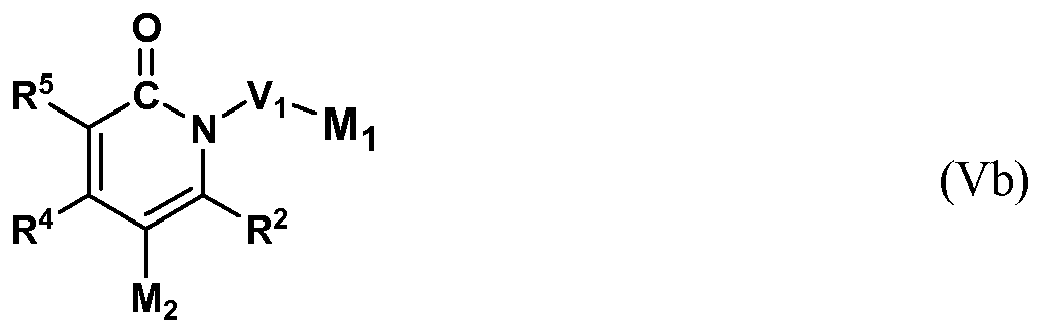 V1 is -(C1-C6)alkyl, optionally substituted by one or more -OCH3, -OCF3, -CF3, fluoro or cyano radicals ; andM1 and M2 are each independently an optionally substituted radical selected from aryl, thienyl, pyridyl, thiazolyl, isothiazolyl, oxazolyl, isoxazolyl, benzoimidazolyl, benzooxazolyl, benzothiazolyl, thionaphtyl, indolyl, pyrimidinyl, quinolyl, cyclohexyl and cyclopentyl; andR2 is hydrogen;R4 and R5 are each independently selected from the group of hydrogen, halogen, -CN, -OH, -NO2, -CF3, -SH, -NH2, and an optionally substituted radical selected from the group of -(C1-C6)alkyl, -(C1-C6)alkylhalo, -(C2-C6)alkynyl, -(C2-C6)alkenyl, -(C3-C7)cycloalkyl, -(C1-C6)alkylcyano, -O-(C1-C6)alkyl, -O-(C1-C6)alkylhalo, -O-(C1-C6)alkylcyano, -O-(C3-C6)alkynyl, -O-(C3-C7)cycloalkyl, -O-(C2-C6)alkenyl, -O-(C2-C6)alkyl-OR18, -O-(C1-C6)alkyl-heteroaryl, -O-(C0-C6)alkylaryl, -(C0-C6)alkyl-OR18, -(C3-C7)cycloalkyl-(C1-C6)alkyl, -O-(C3-C7)cycloalkyl-(C1-C6)alkyl, -O-heteroaryl, -(C1-C6)alkyl-heteroaryl, -(C1-C6)alkylaryl, -(C1-C6)alkylhalo-OR18, -(C3-C6)alkynyl-OR18, -(C3-C6)alkenyl-OR18, -(C0-C6)alkyl-SR18, -O-(C2-C6)alkyl-SR18, - (C1-C6)alkyl-S(=O)R18, -O-(C1-C6)alkyl-S(=O)R18, -(C0-C6)alkyl-S(=O)2R18, -O-(C1-C6)alkyl-S(=O)2R18, -(C0-C6)alkyl-NR18R19, -(C0-C3)alkyl-O-(C2-C6)alkyl-NR18R19, - (C0-C6)alkyl-S(=O)2NR18R19, -(C0-C6)alkyl-NR18-S(=O)2R19, -(C0-C3)alkyl-O-(C1-C6)alkyl-S(=O)2NR18R19, -(C0-C3)alkyl-O-(C1-C6)alkyl-NR18-S(=O)2R19, -(C0-C6)alkyl-C(=O)-NR18R19, -(C0-C6)alkyl-NR18C(=O)-R19, -(C0-C3)alkyl-O-(C1-C6)alkylC(=O)-NR18R19, -(C0-C3)alkyl-O-(C1-C6)alkyl-NR18C(=O)-R19, -(C0-C6)alkyl-OC(=O)-R18, -(C0-C6)alkyl-C(=O)-OR18, -O-(C1-C6)alkyl-OC(=O)-R18, -O-(C1-C6)alkyl-C(=O)-OR18, -(C0-C6)alkyl-C(=O)-R18 and -O-(C1-C6)alkyl-C(=O)-R18.R18, and R19, are each independently selected from hydrogen and an optionally substituted radical selected from the group of -(C1-C6)alkylhalo, -(C1-C6)alkyl, -(C1-C6)alkylcyano, -(C2-C6)alkynyl, -(C2-C6)alkenyl, -(C3-C7)cycloalkyl, -(C4-C10)alkylcycloalkyl, heteroaryl, -(C1-C6)alkylheteroaryl, aryl, -(C1-C6)alkylaryl, -(C2-C6)alkynyl-(C3-C7)cycloalkyl, -(C2-C6)alkynyl-heteroaryl, -(C2-C6)alkynyl-aryl, -(C2-C6)alkenyl-(C3-C7)cycloalkyl, -(C2-C6)alkenyl-heteroaryl and -(C2-C6)alkenyl-aryl; andR18 and R19, may be taken together to form an optionally substituted 3 to 10 membered non-aromatic heterocyclic ring or an optionally substituted 5 to 10 membered aromatic heterocyclic ring, wherein said heterocyclic ring contains one or more atoms independently selected from N, O and S;wherein the the term "optionally substituted" refers to radicals further bearing one or more substituents selected from the group of (C1-C6)alkyl; (C1-C6)alkyloxy; hydroxy(C1-C6)alkyloxy; (C1-C6)alkyloxy(C1-C6)alkyl; (C1-C6)alkyloxy(C1-C6)alkyloxy; (C1-C6)alkyloxycarbonyl; (C1-C6)alkyloxycarbonyl(C1-C6)alkyl; (C1-C6)alkyloxycarbonyloxy; (C1-C6)alkyloxycarbonyl(C1-C6)alkyloxy; (C1-C6)alkylcarbonyl; (C1-C6)alkylcarbonyl(C1-C6)alkyloxy; (C1-C6)alkylcarbonyloxy; (C1-C6)alkylthieno; (C1-C6)alkylsulfonyl; heterocyclic-sulfonyl, (C1-C6)alkyl-sulfonylamino; (C1-C6)alkenyl; aryl; carboxyl(C1-C6)alkyl; carbonyl(C1-C6)alkyloxy; halo; hydroxy; hydroxy(C1-C6)alkyl; phenyl(C1-C6)alkyloxy; cyano; cyano(C1-C6)alkyloxy; trifluoro(C1-C6)alkyl; trifluoro(C1-C6)alkyloxy; amino; amino(C1-C6)alkyloxy; mono- and di((C1-C6)alkyl)amino; mono- and di((C1-C6)alkylcarbonyl)amino; mono- and di((C1-C6)alkyloxycarbonyl)amino; mono- and di((C1-C6)alkylcarbonyl)amino(C1-C6)alkyl; mono- and di((C1-C6)alkyl-sulfonyl)amino(C1-C6)alkyloxy; mono- and di((C1-C6)alkyl)amino(C1-C6)alkyloxy; mono- and di((C1-C6)alkylcarbonyl)amino(C1-C6)alkyloxy; mono- and di((C1-C6)-alkyl)aminocarbonyl; mono- and di((C1-C6)alkyl)aminocarbonyl(C1-C6)alkyl; mono-and di((C1-C6)alkyl)aminocarbonyl(C1-C6)alkyloxo; mono- and di((C1-C6)alkyl)-amino(C1-C6)alkylamino; nitro; tri(C1-C6)alkylsilyl; heterocyclic; heterocyclic-(C1-C6)alkyl; and heterocyclic-(C1-C6)alkyloxy;and wherein the term "aryl" refers to radicals selected from the group consisting of phenyl, naphthyl, 1,2,3,4-tetrahydronaphthyl, indyl and indenyl;for use as a medicament.
 - A compound or a pharmaceutically acceptable acid or base addition salt thereof, a stereochemically isomeric form thereof or an N-oxide form thereof, according to claim 2 for use as a medicament.
- A compound as defined in any of claims 5 to 6 for use in treating or preventing a condition in a mammal, including a human, the treatment or prevention of which is affected or facilitated by the neuromodulatory effect of mGluR2 positive allosteric modulators.
- A compound as defined in any of claims 5 to 6 for use in treating, or preventing, ameliorating, controlling or reducing the risk of various neurological and psychiatric disorders associated with glutamate dysfunction in a mammal, including a human, the treatment or prevention of which is affected or facilitated by the neuromodulatory effect of mGluR2 positive allosteric modulators.
- A compound for use according to claim 7 or 8, wherein the condition or disorder is a central nervous system disorder selected from the group of anxiety disorders, psychotic disorders, personality disorders, substance-related disorders, eating disorders, mood disorders, migraine, epilepsy or convulsive disorders, childhood disorders, cognitive disorders, neurodegeneration, neurotoxicity and ischemia.
- A compound for use according to claim 9, wherein the central nervous system disorder is an anxiety disorder, selected from the group of agoraphobia, generalized anxiety disorder, obsessive-compulsive disorder, panic disorder, posttraumatic stress disorder and social phobia.
- A compound for use according to claim 9, wherein the central nervous system disorder is a psychotic disorder selected from the group of schizophrenia, delusional disorder, schizoaffective disorder, schizophreniform disorder and substance-induced psychotic disorder.
- A compound for use according to claim 9, wherein the central nervous system disorder is a personality disorder selected from the group of obsessive-compulsive personality disorder and schizoid, schizotypal disorder.
- A compound for use according to claim 9, wherein the central nervous system disorder is a substance-related disorder selected from the group of alcohol abuse, alcohol dependence, alcohol withdrawal, alcohol withdrawal delirium, alcohol-induced psychotic disorder, amphetamine dependence, amphetamine withdrawal, cocaine dependence, cocaine withdrawal, nicotine dependence, nicotine withdrawal, opioid dependence and opioid withdrawal.
- A compound for use according to claim 9, wherein the central nervous system disorder is an eating disorder selected from the group of anorexia nervosa and bulimia nervosa.
- A compound for use according to claim 9, wherein the central nervous system disorder is a mood disorder selected from the group of bipolar disorders (I & II), cyclothymic disorder, depression, dysthymic disorder, major depressive disorder and substance-induced mood disorder.
- A compound for use according to claim 9, wherein the central nervous system disorder is migraine.
- A compound for use according to claim 9, wherein the central nervous system disorder is epilepsy or a convulsive disorder selected from the group of generalized nonconvulsive epilepsy, generalized convulsive epilepsy, petit mal status epilepticus, grand mal status epilepticus, partial epilepsy with or without impairment of consciousness, infantile spasms, epilepsy partialis continua and other forms of epilepsy.
- A compound for use according to claim 9, wherein the childhood disorder is attention-deficit/hyperactivity disorder.
- A compound for use according to claim 9, wherein the central nervous system disorder is a cognitive disorder selected from the group of delirium, substance-induced persisting delirium, dementia, dementia due to HIV disease, dementia due to Huntington's disease, dementia due to Parkinson's disease, dementia of the Alzheimer's type, substance-induced persisting dementia and mild cognitive impairment.
- A compound for use according to claim 9, wherein the central nervous system disorder is selected from the group of anxiety, schizophrenia, migraine, depression, and epilepsy.
- A compound for use according to any one of claims 9 to 20, wherein the mGluR2 positive allosteric modulator has an ED50 of about 1 µM or less.
- A compound as defined in any of claims 5 to 6 in combination with an orthosteric agonist of mGluR2 for use in treating or preventing a condition as cited in any one of claims 7 to 20, in a mammal, including a human, the treatment or prevention of which is affected or facilitated by the neuromodulatory effect of mGluR2 allosteric modulators.
Applications Claiming Priority (2)
| Application Number | Priority Date | Filing Date | Title |
|---|---|---|---|
| GB0420722A GB0420722D0 (en) | 2004-09-17 | 2004-09-17 | Novel allosteric modulators |
| PCT/EP2005/054636 WO2006030032A1 (en) | 2004-09-17 | 2005-09-16 | Novel pyridinone derivatives and their use as positive allosteric modulators of mglur2-receptors |
Publications (2)
| Publication Number | Publication Date |
|---|---|
| EP1799646A1 EP1799646A1 (en) | 2007-06-27 |
| EP1799646B1 true EP1799646B1 (en) | 2014-12-10 |
Family
ID=33306768
Family Applications (1)
| Application Number | Title | Priority Date | Filing Date |
|---|---|---|---|
| EP05787278.0A Expired - Lifetime EP1799646B1 (en) | 2004-09-17 | 2005-09-16 | Novel pyridinone derivatives and their use as positive allosteric modulators of mglur2-receptors |
Country Status (20)
| Country | Link |
|---|---|
| US (2) | US8399493B2 (en) |
| EP (1) | EP1799646B1 (en) |
| JP (2) | JP5179873B2 (en) |
| KR (1) | KR20070085262A (en) |
| CN (1) | CN101061098B (en) |
| AU (1) | AU2005284098B2 (en) |
| BR (1) | BRPI0515412A (en) |
| CA (1) | CA2581144C (en) |
| EA (1) | EA013740B1 (en) |
| ES (1) | ES2527418T3 (en) |
| GB (1) | GB0420722D0 (en) |
| IL (1) | IL181742A0 (en) |
| MX (1) | MX2007003006A (en) |
| NO (1) | NO20071660L (en) |
| NZ (1) | NZ554041A (en) |
| SG (1) | SG155938A1 (en) |
| TW (1) | TW200633982A (en) |
| UA (1) | UA98098C2 (en) |
| WO (1) | WO2006030032A1 (en) |
| ZA (1) | ZA200703088B (en) |
Families Citing this family (161)
| Publication number | Priority date | Publication date | Assignee | Title |
|---|---|---|---|---|
| SE0302486D0 (en) | 2003-09-18 | 2003-09-18 | Astrazeneca Ab | Novel compounds |
| GB0420722D0 (en) | 2004-09-17 | 2004-10-20 | Addex Pharmaceuticals Sa | Novel allosteric modulators |
| US9512125B2 (en) | 2004-11-19 | 2016-12-06 | The Regents Of The University Of California | Substituted pyrazolo[3.4-D] pyrimidines as anti-inflammatory agents |
| US7297700B2 (en) | 2005-03-24 | 2007-11-20 | Renovis, Inc. | Bicycloheteroaryl compounds as P2X7 modulators and uses thereof |
| ES2524922T3 (en) | 2005-05-10 | 2014-12-15 | Intermune, Inc. | Pyridone derivatives to modulate the stress-activated protein kinase system |
| TW200736252A (en) | 2006-01-27 | 2007-10-01 | Astrazeneca Ab | Novel heteroaryl substituted benzothiazoles |
| EP1834527A1 (en) * | 2006-03-13 | 2007-09-19 | Purac Biochem BV | Food product comprising a mixture of calcium salts or a calcium double salt |
| TWI417095B (en) * | 2006-03-15 | 2013-12-01 | Janssen Pharmaceuticals Inc | 1,4-disubstituted 3-cyano-pyridone derivatives and their use as positive allosteric modulators of mglur2-receptors |
| WO2007114926A2 (en) | 2006-04-04 | 2007-10-11 | The Regents Of The University Of California | Kinase antagonists |
| TW200808771A (en) | 2006-05-08 | 2008-02-16 | Astrazeneca Ab | Novel compounds II |
| TW200808763A (en) | 2006-05-08 | 2008-02-16 | Astrazeneca Ab | Novel compounds I |
| TW200813035A (en) | 2006-06-19 | 2008-03-16 | Astrazeneca Ab | Novel heteroaryl substituted benzoxazoles |
| TW200821305A (en) * | 2006-10-05 | 2008-05-16 | Astrazeneca Ab | MGluR5 modulators |
| TW200901998A (en) | 2007-03-06 | 2009-01-16 | Astrazeneca Ab | Novel 2-heteroaryl substituted benzothiophenes and benzofuranes |
| TW200900391A (en) * | 2007-03-07 | 2009-01-01 | Janssen Pharmaceutica Nv | 3-cyano-4-(4-phenyl-piperidin-1-yl)-pyridin-2-one derivatives |
| TW200900065A (en) * | 2007-03-07 | 2009-01-01 | Janssen Pharmaceutica Nv | 3-cyano-4-(4-pyridinyloxy-phenyl)-pyridin-2-one derivatives |
| TW200845978A (en) * | 2007-03-07 | 2008-12-01 | Janssen Pharmaceutica Nv | 3-cyano-4-(4-tetrahydropyran-phenyl)-pyridin-2-one derivatives |
| NZ579431A (en) * | 2007-03-09 | 2012-04-27 | Sanofi Aventis | Substituted dihydro and tetrahydro oxazolopyrimidinones, preparation and use thereof |
| TWI443090B (en) | 2007-05-25 | 2014-07-01 | Abbvie Deutschland | Heterocyclic compounds as positive modulators of metabotropic glutamate receptor 2 (mglu2 receptor) |
| WO2009004430A1 (en) * | 2007-06-29 | 2009-01-08 | Pfizer Inc. | N-benzyl oxazolidinones and related heterocycleic compounds as potentiators of glutamate receptors |
| PL2203439T3 (en) | 2007-09-14 | 2011-06-30 | Addex Pharmaceuticals Sa | 1',3'-disubstituted-4-phenyl-3,4,5,6-tetrahydro-2h, 1'h-ý1, 4'¨bipyridinyl-2'-ones |
| US8252937B2 (en) | 2007-09-14 | 2012-08-28 | Janssen Pharmaceuticals, Inc. | 1,3-disubstituted 4-(aryl-X-phenyl)-1H-pyridin-2-ones |
| US8722894B2 (en) | 2007-09-14 | 2014-05-13 | Janssen Pharmaceuticals, Inc. | 1,3-disubstituted-4-phenyl-1H-pyridin-2-ones |
| GB2467670B (en) | 2007-10-04 | 2012-08-01 | Intellikine Inc | Chemical entities and therapeutic uses thereof |
| WO2009061271A1 (en) | 2007-11-06 | 2009-05-14 | Astrazeneca Ab | Some 2-pyrazinone derivatives and their use as inhibitors of neutrophile elastase |
| RU2492170C9 (en) | 2007-11-14 | 2013-12-27 | Орто-Макнейл-Янссен Фармасьютикалз, Инк. | Imidazo[1,2-a]pyridine derivatives and their application as positive allosteric modulators of mglur2 receptors |
| EP3613743B1 (en) | 2008-01-04 | 2022-03-16 | Intellikine, LLC | Processes for the preparation of 1h-pyrazolo[3,4-d]pyrimidin-4-amine derivatives |
| US8193182B2 (en) | 2008-01-04 | 2012-06-05 | Intellikine, Inc. | Substituted isoquinolin-1(2H)-ones, and methods of use thereof |
| MY150379A (en) | 2008-02-26 | 2013-12-31 | Takeda Pharmaceutical | Fused heterocyclic derivative and use thereof |
| JP5309162B2 (en) * | 2008-03-06 | 2013-10-09 | サノフイ | Substituted dihydro, trihydro and tetrahydrocycloalkyl oxazolopyrimidinones, their preparation and use |
| US8207181B2 (en) | 2008-03-06 | 2012-06-26 | Sanofi | Substituted dihydro, trihydro and tetrahydro cycloalkyloxazolopyrimidinones, preparation and use thereof |
| US8637542B2 (en) | 2008-03-14 | 2014-01-28 | Intellikine, Inc. | Kinase inhibitors and methods of use |
| US8993580B2 (en) | 2008-03-14 | 2015-03-31 | Intellikine Llc | Benzothiazole kinase inhibitors and methods of use |
| CA2726588C (en) | 2008-06-03 | 2019-04-16 | Karl Kossen | Compounds and methods for treating inflammatory and fibrotic disorders |
| JP5788316B2 (en) | 2008-07-08 | 2015-09-30 | インテリカイン, エルエルシー | Kinase inhibitors and methods of use |
| US20110224223A1 (en) | 2008-07-08 | 2011-09-15 | The Regents Of The University Of California, A California Corporation | MTOR Modulators and Uses Thereof |
| JP5547194B2 (en) * | 2008-09-02 | 2014-07-09 | ジャンセン ファーマシューティカルズ, インコーポレイテッド. | 3-Azabicyclo [3.1.0] hexyl derivatives as modulators of metabotropic glutamate receptors |
| US8703778B2 (en) | 2008-09-26 | 2014-04-22 | Intellikine Llc | Heterocyclic kinase inhibitors |
| WO2010045542A2 (en) | 2008-10-16 | 2010-04-22 | The Regents Of The University Of California | Fused ring heteroaryl kinase inhibitors |
| RU2517181C2 (en) | 2008-10-16 | 2014-05-27 | Орто-Макнейл-Янссен Фармасьютикалз, Инк. | Indole and benzomorpholine derivatives as modulator of metabotropic glutamate receptors |
| US8476431B2 (en) | 2008-11-03 | 2013-07-02 | Itellikine LLC | Benzoxazole kinase inhibitors and methods of use |
| WO2010060589A1 (en) | 2008-11-28 | 2010-06-03 | Ortho-Mcneil-Janssen Pharmaceuticals, Inc. | Indole and benzoxazine derivatives as modulators of metabotropic glutamate receptors |
| TW201036957A (en) * | 2009-02-20 | 2010-10-16 | Astrazeneca Ab | Novel salt 628 |
| EP2427195B1 (en) | 2009-05-07 | 2019-05-01 | Intellikine, LLC | Heterocyclic compounds and uses thereof |
| CN102439008B (en) | 2009-05-12 | 2015-04-29 | 杨森制药有限公司 | 1,2,4-Triazolo[4,3-A]pyridine derivatives and their use for the treatment or prevention of neurological and psychiatric disorders |
| MY153912A (en) * | 2009-05-12 | 2015-04-15 | Janssen Pharmaceuticals Inc | 1, 2, 4,-triazolo[4,3-a[pyridine derivatives and their use as positive allosteric modulators of mglur2 receptors |
| MY153913A (en) | 2009-05-12 | 2015-04-15 | Janssen Pharmaceuticals Inc | 7-aryl-1,2,4-triazolo[4,3-a]pyridine derivatives and their use as positive allosteric modulators of mglur2 receptors |
| US8927718B2 (en) | 2009-08-26 | 2015-01-06 | Takeda Pharmaceutical Company Limited | Fused heterocyclic ring derivative and use thereof |
| JP5599802B2 (en) | 2009-08-26 | 2014-10-01 | 武田薬品工業株式会社 | Fused heterocyclic derivatives and uses thereof |
| EP2471789B9 (en) | 2009-08-26 | 2015-03-25 | Takeda Pharmaceutical Company Limited | Fused heterocyclic ring derivative and use thereof |
| EP2471793B1 (en) | 2009-08-26 | 2016-10-05 | Takeda Pharmaceutical Company Limited | Fused heterocyclic ring derivative and use thereof |
| CA2773618A1 (en) * | 2009-10-02 | 2011-04-07 | Astrazeneca Ab | 2-pyridone compounds used as inhibitors of neutrophil elastase |
| US8980899B2 (en) | 2009-10-16 | 2015-03-17 | The Regents Of The University Of California | Methods of inhibiting Ire1 |
| WO2011114103A1 (en) * | 2010-03-18 | 2011-09-22 | Biolipox Ab | Pyrimidinones for use as medicaments |
| US8664214B2 (en) | 2010-03-30 | 2014-03-04 | AbbVie Deutschland GmbH & Co. KG | Small molecule potentiators of metabotropic glutamate receptors I |
| US8314120B2 (en) | 2010-03-30 | 2012-11-20 | Abbott Gmbh & Co. Kg | Small molecule potentiators of metabotropic glutamate receptors |
| EP2563143A4 (en) | 2010-04-29 | 2013-09-25 | Merck Sharp & Dohme | SUBSTITUTED 1,3-BENZOTHIAZOL-2 (3H) -ONES AND [1,3] THIAZOLO [5,4-B] PYRIDIN-2 (1H) -ONES FORMING POSITIVE ALLOSTERIC EFFECTORS OF MGLUR2 |
| CA2799579A1 (en) | 2010-05-21 | 2011-11-24 | Intellikine, Inc. | Chemical compounds, compositions and methods for kinase modulation |
| EP2579717A4 (en) | 2010-06-09 | 2013-12-11 | Merck Sharp & Dohme | POSITIVE ALLOSTERIC MODULATORS OF MGLUR2 |
| US8993779B2 (en) | 2010-08-12 | 2015-03-31 | Merck Sharp & Dohme Corp. | Positive allosteric modulators of MGLUR2 |
| PL2649069T3 (en) | 2010-11-08 | 2016-01-29 | Janssen Pharmaceuticals Inc | 1,2,4-TRIAZOLO[4,3-a]PYRIDINE DERIVATIVES AND THEIR USE AS POSITIVE ALLOSTERIC MODULATORS OF MGLUR2 RECEPTORS |
| EP2661435B1 (en) | 2010-11-08 | 2015-08-19 | Janssen Pharmaceuticals, Inc. | 1,2,4-TRIAZOLO[4,3-a]PYRIDINE DERIVATIVES AND THEIR USE AS POSITIVE ALLOSTERIC MODULATORS OF MGLUR2 RECEPTORS |
| CN103261195B (en) | 2010-11-08 | 2015-09-02 | 杨森制药公司 | 1,2,4-Triazolo[4,3-a]pyridine derivatives and their use as positive allosteric modulators of the MGLUR2 receptor |
| JP2013545749A (en) | 2010-11-10 | 2013-12-26 | インフィニティー ファーマシューティカルズ, インコーポレイテッド | Heterocyclic compounds and uses thereof |
| TWI674262B (en) | 2011-01-10 | 2019-10-11 | 美商英菲尼提製藥股份有限公司 | Processes for preparing isoquinolinones and solid forms of isoquinolinones |
| US9295673B2 (en) | 2011-02-23 | 2016-03-29 | Intellikine Llc | Combination of mTOR inhibitors and P13-kinase inhibitors, and uses thereof |
| CN103635472B (en) | 2011-02-28 | 2018-01-12 | 阵列生物制药公司 | Serine/threonine kinase inhibitor |
| MX2014000648A (en) | 2011-07-19 | 2014-09-25 | Infinity Pharmaceuticals Inc | Heterocyclic compounds and uses thereof. |
| WO2013012915A1 (en) | 2011-07-19 | 2013-01-24 | Infinity Pharmaceuticals Inc. | Heterocyclic compounds and uses thereof |
| JP6097289B2 (en) | 2011-08-04 | 2017-03-15 | アレイ バイオファーマ、インコーポレイテッド | Quinazoline compounds as serine / threonine kinase inhibitors |
| KR20140075693A (en) | 2011-08-29 | 2014-06-19 | 인피니티 파마슈티칼스, 인코포레이티드 | Heterocyclic compounds and uses thereof |
| MX370814B (en) | 2011-09-02 | 2020-01-08 | Univ California | Substituted pyrazolo[3,4-d]pyrimidines and uses thereof. |
| MD20140044A2 (en) | 2011-11-11 | 2014-08-31 | Pfizer Inc. | 2-Thiopyrimidinones and their use for the treatment of cardiovascular diseases |
| RU2630677C2 (en) * | 2011-12-21 | 2017-09-12 | Оно Фармасьютикал Ко., Лтд. | Compounds |
| HK1203412A1 (en) | 2011-12-28 | 2015-10-30 | Global Blood Therapeutics, Inc. | Substituted heteroaryl aldehyde compounds and methods for their use in increasing tissue oxygenation |
| ES2643403T3 (en) | 2011-12-28 | 2017-11-22 | Global Blood Therapeutics, Inc. | Substituted benzaldehyde compounds and methods for use in increasing tissue oxygenation |
| HUE053994T2 (en) | 2012-03-01 | 2021-08-30 | Array Biopharma Inc | Serine / threonine kinase inhibitors |
| US8940742B2 (en) | 2012-04-10 | 2015-01-27 | Infinity Pharmaceuticals, Inc. | Heterocyclic compounds and uses thereof |
| JP6215315B2 (en) * | 2012-06-12 | 2017-10-18 | アッヴィ・インコーポレイテッド | Pyridinone and pyridazinone derivatives |
| US8828998B2 (en) | 2012-06-25 | 2014-09-09 | Infinity Pharmaceuticals, Inc. | Treatment of lupus, fibrotic conditions, and inflammatory myopathies and other disorders using PI3 kinase inhibitors |
| AR092253A1 (en) | 2012-08-27 | 2015-04-08 | Array Biopharma Inc | SERINA / TREONINA CINASA INHIBITORS |
| MX2015003874A (en) | 2012-09-26 | 2015-12-16 | Univ California | Modulation of ire1. |
| AR092742A1 (en) | 2012-10-02 | 2015-04-29 | Intermune Inc | ANTIFIBROTIC PYRIDINONES |
| EP2914296B2 (en) | 2012-11-01 | 2021-09-29 | Infinity Pharmaceuticals, Inc. | Treatment of cancers using pi3 kinase isoform modulators |
| US9073878B2 (en) | 2012-11-21 | 2015-07-07 | Zenith Epigenetics Corp. | Cyclic amines as bromodomain inhibitors |
| US9765039B2 (en) | 2012-11-21 | 2017-09-19 | Zenith Epigenetics Ltd. | Biaryl derivatives as bromodomain inhibitors |
| TW201441193A (en) | 2012-12-06 | 2014-11-01 | Kyowa Hakko Kirin Co Ltd | Pyridone compound |
| AU2013365926B9 (en) | 2012-12-21 | 2019-01-17 | Zenith Epigenetics Ltd. | Novel heterocyclic compounds as bromodomain inhibitors |
| ES2925071T3 (en) | 2013-02-08 | 2022-10-13 | Gen Mills Inc | Reduced sodium food products |
| US8952171B2 (en) | 2013-03-15 | 2015-02-10 | Global Blood Therapeutics, Inc. | Compounds and uses thereof for the modulation of hemoglobin |
| CN105073728A (en) | 2013-03-15 | 2015-11-18 | 全球血液疗法股份有限公司 | Compounds and their use for regulating hemoglobin |
| US9481667B2 (en) | 2013-03-15 | 2016-11-01 | Infinity Pharmaceuticals, Inc. | Salts and solid forms of isoquinolinones and composition comprising and methods of using the same |
| WO2014150258A1 (en) | 2013-03-15 | 2014-09-25 | Global Blood Therapeutics, Inc. | Compounds and uses thereof for the modulation of hemoglobin |
| EP2968295A1 (en) * | 2013-03-15 | 2016-01-20 | Global Blood Therapeutics, Inc. | Compositions and methods for the modulation of hemoglobin (s) |
| US9458139B2 (en) | 2013-03-15 | 2016-10-04 | Global Blood Therapeutics, Inc. | Compounds and uses thereof for the modulation of hemoglobin |
| US9422279B2 (en) | 2013-03-15 | 2016-08-23 | Global Blood Therapeutics, Inc. | Compounds and uses thereof for the modulation of hemoglobin |
| US10266551B2 (en) | 2013-03-15 | 2019-04-23 | Global Blood Therapeutics, Inc. | Compounds and uses thereof for the modulation of hemoglobin |
| MX379235B (en) | 2013-03-15 | 2025-03-11 | Global Blood Therapeutics Inc | COMPOUNDS AND THEIR USES TO MODULATE HEMOGLOBIN. |
| US9802900B2 (en) | 2013-03-15 | 2017-10-31 | Global Blood Therapeutics, Inc. | Bicyclic heteroaryl compounds and uses thereof for the modulation of hemoglobin |
| US9604999B2 (en) | 2013-03-15 | 2017-03-28 | Global Blood Therapeutics, Inc. | Compounds and uses thereof for the modulation of hemoglobin |
| US10100043B2 (en) | 2013-03-15 | 2018-10-16 | Global Blood Therapeutics, Inc. | Substituted aldehyde compounds and methods for their use in increasing tissue oxygenation |
| TWI633089B (en) | 2013-03-28 | 2018-08-21 | 拜耳製藥股份有限公司 | Substituted oxopyridine derivatives |
| JO3368B1 (en) | 2013-06-04 | 2019-03-13 | Janssen Pharmaceutica Nv | 6, 7- dihydropyrazolu [5,1-a] pyrazine-4 (5 hands) -on compounds and their use as negative excretory regulators of Miglore 2 receptors. |
| CA2915838C (en) | 2013-06-21 | 2023-04-18 | Zenith Epigenetics Corp. | Bicyclic bromodomain inhibitors |
| EP3010918B1 (en) | 2013-06-21 | 2018-08-15 | Zenith Epigenetics Ltd. | Novel substituted bicyclic compounds as bromodomain inhibitors |
| CA2918814C (en) * | 2013-07-23 | 2021-10-12 | Bayer Pharma Aktiengesellschaft | Substituted oxopyridine derivatives and use thereof as factor xia/plasma |
| JP6542212B2 (en) | 2013-07-31 | 2019-07-10 | ゼニス・エピジェネティクス・リミテッドZenith Epigenetics Ltd. | Novel quinazolinones as bromodomain inhibitors |
| JO3367B1 (en) | 2013-09-06 | 2019-03-13 | Janssen Pharmaceutica Nv | 1,2,4-TRIAZOLO[4,3-a]PYRIDINE COMPOUNDS AND THEIR USE AS POSITIVE ALLOSTERIC MODULATORS OF MGLUR2 RECEPTORS |
| MX2021012208A (en) | 2013-10-04 | 2023-01-19 | Infinity Pharmaceuticals Inc | Heterocyclic compounds and uses thereof. |
| WO2015051241A1 (en) | 2013-10-04 | 2015-04-09 | Infinity Pharmaceuticals, Inc. | Heterocyclic compounds and uses thereof |
| EP3290407B1 (en) | 2013-10-18 | 2020-01-01 | Celgene Quanticel Research, Inc | Bromodomain inhibitors |
| CA2928867A1 (en) | 2013-10-30 | 2015-05-07 | Bayer Pharma Aktiengesellschaft | Substituted oxopyridine derivatives |
| EA201992707A1 (en) | 2013-11-18 | 2020-06-30 | Глобал Блад Терапьютикс, Инк. | COMPOUNDS AND THEIR APPLICATIONS FOR HEMOGLOBIN MODULATION |
| KR20220049612A (en) | 2014-01-21 | 2022-04-21 | 얀센 파마슈티카 엔.브이. | Combinations comprising positive allosteric modulators or orthosteric agonists of metabotropic glutamatergic receptor subtype 2 and their use |
| HUE053734T2 (en) | 2014-01-21 | 2021-07-28 | Janssen Pharmaceutica Nv | Combinations and use of positive allosteric modulators of metabotropic glutamatergic receptor subtype 2 |
| EA038715B1 (en) * | 2014-01-24 | 2021-10-08 | Селджен Квонтисел Рисёрч, Инк. | Bromodomain inhibitors |
| CN114181195A (en) | 2014-02-07 | 2022-03-15 | 全球血液疗法股份有限公司 | Crystalline polymorph of a compound |
| NZ724368A (en) | 2014-03-19 | 2023-07-28 | Infinity Pharmaceuticals Inc | Heterocyclic compounds for use in the treatment of pi3k-gamma mediated disorders |
| MX382781B (en) | 2014-04-02 | 2025-03-13 | Intermune Inc | ANTI-FIBROTIC PYRIDINONES. |
| WO2015160975A2 (en) | 2014-04-16 | 2015-10-22 | Infinity Pharmaceuticals, Inc. | Combination therapies |
| US10138236B2 (en) | 2014-09-24 | 2018-11-27 | Bayer Pharma Aktiengesellschaft | Factor xia-inhibiting pyridobenzazepine and pyridobenzazocine derivatives |
| ES2722425T3 (en) | 2014-09-24 | 2019-08-12 | Bayer Pharma AG | (2H) -2-Oxopyridines as inhibitors of factor XIa for the treatment of thrombotic diseases |
| US10077265B2 (en) | 2014-09-24 | 2018-09-18 | Bayer Pharma Aktiengesellschaft | Substituted oxopyridine derivatives |
| JP6517925B2 (en) * | 2014-09-24 | 2019-05-22 | バイエル ファーマ アクチエンゲゼルシャフト | Substituted oxopyridine derivatives |
| WO2016046156A1 (en) | 2014-09-24 | 2016-03-31 | Bayer Pharma Aktiengesellschaft | Substituted oxopyridine derivatives |
| ES2716417T3 (en) | 2014-09-24 | 2019-06-12 | Bayer Pharma AG | Derivatives of oxopyridine substituted with anti-inflammatory and antithrombotic action |
| WO2016054491A1 (en) | 2014-10-03 | 2016-04-07 | Infinity Pharmaceuticals, Inc. | Heterocyclic compounds and uses thereof |
| EP3227281A4 (en) | 2014-12-01 | 2018-05-30 | Zenith Epigenetics Ltd. | Substituted pyridinones as bromodomain inhibitors |
| HK1246273B (en) | 2014-12-01 | 2019-12-06 | 恒翼生物医药(上海)股份有限公司 | Substituted pyridines as bromodomain inhibitors |
| MX385021B (en) | 2014-12-10 | 2025-03-14 | Ono Pharmaceutical Co | DIHYDROINDOLIZINONE DERIVATIVE. |
| EP3230277B1 (en) | 2014-12-11 | 2019-09-18 | Zenith Epigenetics Ltd. | Substituted heterocycles as bromodomain inhibitors |
| HK1245247A1 (en) | 2014-12-17 | 2018-08-24 | 恒翼生物医药科技(上海)有限公司 | Inhibitors of bromodomains |
| AR104259A1 (en) | 2015-04-15 | 2017-07-05 | Celgene Quanticel Res Inc | BROMODOMINUM INHIBITORS |
| US10702517B2 (en) | 2015-04-22 | 2020-07-07 | Celgene Quanticel Research, Inc. | Bromodomain inhibitor |
| TW201642860A (en) * | 2015-04-22 | 2016-12-16 | 塞爾基因定量細胞研究公司 | Bromo domain inhibitor |
| AU2016257179A1 (en) | 2015-05-05 | 2017-11-02 | Pfizer Inc. | 2-thiopyrimidinones |
| KR101974793B1 (en) | 2015-07-06 | 2019-05-02 | 길리애드 사이언시즈, 인코포레이티드 | Cot modifiers and their use |
| JO3703B1 (en) | 2015-07-09 | 2021-01-31 | Bayer Pharma AG | Substituted oxopyridine derivatives |
| EP3344618A1 (en) | 2015-09-04 | 2018-07-11 | Bayer Pharma Aktiengesellschaft | Substituted oxopyridine derivatives |
| EP4585268A3 (en) | 2015-09-14 | 2025-10-15 | Twelve Therapeutics, Inc. | Solid forms of isoquinolinone derivatives, process of making, compositions comprising, and methods of using the same |
| SG11201804647TA (en) | 2015-12-04 | 2018-06-28 | Global Blood Therapeutics Inc | Dosing regimens for 2-hydroxy-6-((2-(1-isopropyl-1h-pyrazol-5-yl)pyridin-3-yl)methoxy)benzaldehyde |
| US10759806B2 (en) | 2016-03-17 | 2020-09-01 | Infinity Pharmaceuticals, Inc. | Isotopologues of isoquinolinone and quinazolinone compounds and uses thereof as PI3K kinase inhibitors |
| AU2017252276A1 (en) | 2016-04-18 | 2018-11-15 | Celgene Quanticel Research, Inc. | Therapeutic compounds |
| US10150754B2 (en) | 2016-04-19 | 2018-12-11 | Celgene Quanticel Research, Inc. | Histone demethylase inhibitors |
| TWI663160B (en) | 2016-05-12 | 2019-06-21 | 全球血液治療公司 | Process for synthesizing 2-hydroxy-6-((2-(1-isopropyl-1h-pyrazol-5-yl)-pyridin-3-yl)methoxy)benzaldehyde |
| WO2017214269A1 (en) | 2016-06-08 | 2017-12-14 | Infinity Pharmaceuticals, Inc. | Heterocyclic compounds and uses thereof |
| RU2754507C2 (en) | 2016-06-24 | 2021-09-02 | Инфинити Фармасьютикалз, Инк. | Combination therapy |
| TW202332423A (en) | 2016-10-12 | 2023-08-16 | 美商全球血液治療公司 | Tablets comprising 2-hydroxy-6-((2-(1-isopropyl-1h-pyrazol-5-yl)pyridin-3-yl)methoxy)benzaldehyde |
| EP3612522A4 (en) | 2017-04-18 | 2021-07-07 | Celgene Quanticel Research, Inc. | THERAPEUTIC LINKS |
| EP3459939A1 (en) * | 2017-09-26 | 2019-03-27 | Pragma Therapeutics | Novel heterocyclic compounds as modulators of mglur7 |
| PE20210165A1 (en) | 2018-04-10 | 2021-01-26 | Bayer Pharma AG | A SUBSTITUTED OXOPYRIDINE DERIVATIVE |
| US11014884B2 (en) | 2018-10-01 | 2021-05-25 | Global Blood Therapeutics, Inc. | Modulators of hemoglobin |
| CR20210342A (en) | 2018-12-21 | 2021-08-09 | Bayer Ag | Substituted oxopyridine derivatives |
| US20220144848A1 (en) | 2018-12-21 | 2022-05-12 | Bayer Aktiengesellschaft | Substituted oxopyridine derivatives |
| US12479816B2 (en) | 2019-02-08 | 2025-11-25 | University of Pittsburgh—of the Commonwealth System of Higher Education | 20-HETE formation inhibitors |
| TWI770527B (en) | 2019-06-14 | 2022-07-11 | 美商基利科學股份有限公司 | Cot modulators and methods of use thereof |
| AU2021249010B2 (en) | 2020-03-30 | 2024-09-26 | Gilead Sciences, Inc. | Solid forms of (S)-6-(((1-(bicyclo[1.1.1]pentan-1-yl)-1H-1,2,3-triazol-4-yl)2-methyl-1-oxo-1,2- dihydroisoquinolin-5-yl)methyl)))amino)8-chloro-(neopentylamino)quinoline-3-carb onitrile a cot inhibitor compound |
| JP7446475B2 (en) | 2020-04-02 | 2024-03-08 | ギリアード サイエンシーズ, インコーポレイテッド | Process for preparing COT inhibitor compounds |
| JP2024506858A (en) | 2021-02-02 | 2024-02-15 | リミナル・バイオサイエンシーズ・リミテッド | GPR84 antagonists and their uses |
| EP4299124A1 (en) | 2022-06-30 | 2024-01-03 | Universite De Montpellier | Anti-mglur2 nanobodies for use as biomolecule transporter |
| EP4628482A1 (en) * | 2022-11-28 | 2025-10-08 | Unimatec Co., Ltd. | Fluorine-containing pyridone compound and method for producing same |
Family Cites Families (145)
| Publication number | Priority date | Publication date | Assignee | Title |
|---|---|---|---|---|
| BE790440A (en) | 1971-10-23 | 1973-04-24 | Bayer Ag | |
| SU509588A1 (en) * | 1974-06-10 | 1976-04-05 | Донецкое Отделение Физико-Органическойхимии Института Физическойхимии Ан Украинской Сср | Method for preparing imidazo (4,5-c) quinolines |
| IE43079B1 (en) | 1975-03-20 | 1980-12-17 | Ici Ltd | Quinolone derivatives |
| GB1502312A (en) | 1975-03-20 | 1978-03-01 | Ici Ltd | Quinolone derivatives |
| CA1082514A (en) * | 1976-03-01 | 1980-07-29 | Wilbert J. Humphlett | Dry heat-activated bleaching of silver images |
| JPS5721371A (en) * | 1980-07-11 | 1982-02-04 | Daito Koeki Kk | Quinolinoneiminecarboxylic ester derivative, its preparation and anti-inflammatory and analgesic agent composition containing the same |
| US4358453A (en) | 1982-01-08 | 1982-11-09 | Schering Corporation | 1,2,4-Triazolo[4,3-a]pyridines |
| US4550166A (en) | 1984-05-21 | 1985-10-29 | American Cyanamid Company | (Pyridinyl)-1,2,4-triazolo[4,3-a]pyridines |
| GB8804448D0 (en) | 1988-02-25 | 1988-03-23 | Smithkline Beckman Intercredit | Compounds |
| US5032602A (en) * | 1988-12-14 | 1991-07-16 | Bayer Aktiengesellschaft | Inhibiting HMG-CoA reductase with novel substituted 2-pyridones and pyrid-2-thiones |
| US5236917A (en) | 1989-05-04 | 1993-08-17 | Sterling Winthrop Inc. | Saccharin derivatives useful as proteolytic enzyme inhibitors and compositions and method of use thereof |
| AU622330B2 (en) | 1989-06-23 | 1992-04-02 | Takeda Chemical Industries Ltd. | Condensed heterocyclic compounds having a nitrogen atom in the bridgehead for use as fungicides |
| IL96432A0 (en) | 1989-11-30 | 1991-08-16 | Schering Ag | Pesticidal compositions containing pyridine derivatives and novel pyridine derivatives |
| SU1731773A1 (en) * | 1990-03-16 | 1992-05-07 | Институт биофизики | Method of producing 2-iminothiazolidine derivatives |
| GB9104238D0 (en) | 1990-03-16 | 1991-04-17 | Ici Pharma | 3-tetrazolylthiomethyl cephalosporin antibiotics |
| BR9101256A (en) | 1990-03-30 | 1991-11-05 | Dowelanco | COMPOUND, FUNGICIDE COMPOSITION, FUNGICIDE PROCESS, INSECTICIDE OR ACARICIDE COMPOSITION AND INSECTICIDE OR ACARICIDE PROCESS |
| RU1796625C (en) | 1990-06-27 | 1993-02-23 | Киевский Государственный Университет Им.Т.Г.Шевченко | 3-amino-7-nitro-4-(2,3,4-trimethoxyphenyl)-2-phenyl-1(2h) isoquinolone having analeptic effect |
| KR920008026A (en) * | 1990-10-24 | 1992-05-27 | 오노 화아마슈티칼 캄파니 리미팃드 | Isoquinolinone derivatives or nontoxic acid addition salts thereof or hydrates thereof, methods for preparing the same, and pharmaceutical compositions comprising the same |
| DE4221583A1 (en) | 1991-11-12 | 1993-05-13 | Bayer Ag | SUBSTITUTED BIPHENYLPYRIDONE |
| JP2878531B2 (en) | 1991-12-16 | 1999-04-05 | 富士写真フイルム株式会社 | Silver halide photographic material |
| DE4326758A1 (en) | 1993-08-10 | 1995-02-16 | Basf Ag | [1,3,4] triazolo [1,5-a] pyridines |
| CA2171842A1 (en) * | 1993-10-18 | 1995-04-27 | Rahim Hani | Substituted pyridine-2-ones and substituted pyridine-2-thiones as biocides |
| US5424435A (en) | 1993-10-18 | 1995-06-13 | Olin Corporation | 1-hydroxy-6-substituted-2-pyridones |
| FR2728900B1 (en) * | 1994-12-29 | 1997-01-31 | Synthelabo | 3-PHENYLISOQUINOLEIN-1 (2H) -ONE DERIVATIVES, THEIR PREPARATION AND THEIR THERAPEUTIC APPLICATION |
| DE19510965A1 (en) | 1995-03-24 | 1996-09-26 | Asta Medica Ag | New pyrido / 3,2-e / pyrazinone with anti-asthmatic activity and process for their preparation |
| SI0850235T1 (en) * | 1995-09-15 | 2000-04-30 | Sanofi-Synthelabo | Quinolein-2(1h)-one derivatives as serotonin antagonists |
| DE69620445T2 (en) | 1995-12-08 | 2002-12-12 | Janssen Pharmaceutica N.V., Beerse | (IMIDAZOL-5-YL) METHYL-2-CHINOLINO DERIVATIVES AS A FARNESYL PROTEIN TRANSFERASE INHIBITOR |
| DE19632423A1 (en) | 1996-08-12 | 1998-02-19 | Merck Patent Gmbh | Thienopyrimidines |
| US6159980A (en) | 1996-09-16 | 2000-12-12 | Dupont Pharmaceuticals Company | Pyrazinones and triazinones and their derivatives thereof |
| DE19644228A1 (en) | 1996-10-24 | 1998-04-30 | Merck Patent Gmbh | Thienopyrimidines |
| IL130181A0 (en) | 1996-12-05 | 2000-06-01 | Amgen Inc | Substituted pyrimidone and pyridone compounds and methods of use |
| ATE236188T1 (en) | 1997-01-24 | 2003-04-15 | Conpharma As | GEMCITABINE DERIVATIVES |
| GB2321454A (en) * | 1997-01-24 | 1998-07-29 | Norsk Hydro As | Gemcitabine esters and amides |
| BR9909976A (en) * | 1998-04-27 | 2000-12-26 | Centre Nat Rech Scient | Compound, process for obtaining compounds, lithium derivative, pharmaceutical compositions, and processes for treating HIV-related diseases and treating HIV infection |
| CA2333770A1 (en) | 1998-06-04 | 1999-12-09 | Abbott Laboratories | Cell adhesion-inhibiting antinflammatory compounds |
| FR2781218B1 (en) | 1998-07-15 | 2001-09-07 | Lafon Labor | PHARMACEUTICAL COMPOSITIONS COMPRISING 2-QUINOLONES |
| JP2000072751A (en) * | 1998-08-26 | 2000-03-07 | Tanabe Seiyaku Co Ltd | Isoquinolinone derivative |
| US6133271A (en) | 1998-11-19 | 2000-10-17 | Cell Pathways, Inc. | Method for inhibiting neoplastic cells and related conditions by exposure thienopyrimidine derivatives |
| US5948911A (en) | 1998-11-20 | 1999-09-07 | Cell Pathways, Inc. | Method for inhibiting neoplastic cells and related conditions by exposure to thienopyrimidine derivatives |
| EP1006112A1 (en) | 1998-12-01 | 2000-06-07 | Cerebrus Pharmaceuticals Limited | 3-Hydroxy-2(1H)-pyridinone or 3-hydroxy-4(1H)-pyridinone derivatives useful as reactive oxygen species (ROS) scavengers |
| EP1133474B1 (en) | 1998-12-04 | 2007-02-21 | Bristol-Myers Squibb Company | 3-substituted-4-arylquinolin-2-one derivatives as potassium channel modulators |
| EP1048293A1 (en) | 1999-04-23 | 2000-11-02 | The School Of Pharmacy, University Of London | Headlice treatment compositions |
| JP2004509059A (en) | 1999-06-03 | 2004-03-25 | アボット・ラボラトリーズ | Cell adhesion inhibitory anti-inflammatory compound |
| HRP20020349A2 (en) | 1999-10-19 | 2004-02-29 | Merck & Co Inc | Tyrosine kinase inhibitors |
| EP1230225A2 (en) | 1999-11-01 | 2002-08-14 | Eli Lilly And Company | Pharmaceutically active 4-substituted pyrimidine derivatives |
| WO2001056990A2 (en) | 2000-02-03 | 2001-08-09 | Eli Lilly And Company | Pyridine derivates as potentiators of glutamate receptors |
| DE10012373A1 (en) | 2000-03-14 | 2001-09-20 | Dresden Arzneimittel | Treating erectile dysfunction using new or known imidazo(1,5-a)pyrido(3,2-e)pyrazinone derivatives, as cGMP-selective phosphodiesterase V inhibitors free of cardiovascular side-effects |
| GB0007108D0 (en) | 2000-03-23 | 2000-05-17 | Novartis Ag | Organic compounds |
| WO2001083481A1 (en) | 2000-04-27 | 2001-11-08 | Yamanouchi Pharmaceutical Co., Ltd. | Imidazopyridine derivatives |
| IL152848A0 (en) | 2000-06-12 | 2003-06-24 | Eisai Co Ltd | 1,2-dihydropyridine derivatives, pharmaceutical compositions containing the same and methods for the production thereof |
| JP2002012533A (en) | 2000-06-27 | 2002-01-15 | Kao Corp | Hair dye composition |
| JP2002040252A (en) | 2000-07-27 | 2002-02-06 | Shiseido Co Ltd | Optical sheet containing cholesteric liquid crystal layer, information recording body using the same, method for recording information and method for discriminating information |
| DE10038019A1 (en) | 2000-08-04 | 2002-02-14 | Bayer Ag | Substituted triazolopyride (az) ine |
| CZ304344B6 (en) * | 2000-09-11 | 2014-03-19 | Novartis Vaccines & Diagnostics, Inc. | Quinolinone derivatives and their use as well as pharmaceutical compositions in which the derivatives are comprised |
| CN1703403A (en) * | 2000-10-02 | 2005-11-30 | 詹森药业有限公司 | Metabotropic glutamate receptor antagonists |
| JP2002308882A (en) | 2001-02-08 | 2002-10-23 | Yamanouchi Pharmaceut Co Ltd | Thienopyrimidine derivative |
| DE10291003D2 (en) | 2001-03-08 | 2004-04-15 | Ilfa Industrieelektronik Und L | Multi-layer circuit board |
| SE0101579D0 (en) * | 2001-05-04 | 2001-05-04 | Astrazeneca Ab | New compounds |
| CA2446980A1 (en) * | 2001-05-14 | 2002-11-21 | Argyrios G. Arvanitis | Substituted pyrazinones, pyridines and pyrimidines as corticotropin releasing factor ligands |
| US6806268B2 (en) | 2001-05-30 | 2004-10-19 | Alteon, Inc. | Method for treating glaucoma V |
| CA2448306A1 (en) | 2001-05-30 | 2002-12-05 | Alteon Inc. | Method for treating fibrotic diseases or other indications |
| CA2451057A1 (en) * | 2001-06-14 | 2002-12-27 | Banyu Pharmaceutical Co., Ltd. | Novel isoxazolopyridone derivatives and use thereof |
| ES2309206T3 (en) | 2001-10-02 | 2008-12-16 | Smithkline Beecham Corporation | CHEMICAL COMPOUNDS. |
| US6921762B2 (en) | 2001-11-16 | 2005-07-26 | Amgen Inc. | Substituted indolizine-like compounds and methods of use |
| WO2003059884A1 (en) | 2001-12-21 | 2003-07-24 | X-Ceptor Therapeutics, Inc. | Modulators of lxr |
| US20050113283A1 (en) | 2002-01-18 | 2005-05-26 | David Solow-Cordero | Methods of treating conditions associated with an EDG-4 receptor |
| EP1513522A2 (en) | 2002-01-18 | 2005-03-16 | Sri International | Methods of treating conditions associated with an edg receptor |
| AU2003210869A1 (en) | 2002-02-07 | 2003-09-02 | University Of Miami | Schwann cell and phosphodiesterase inhibitors based therapy |
| AU2003211931A1 (en) * | 2002-02-13 | 2003-09-04 | Takeda Chemical Industries, Ltd. | Jnk inhibitor |
| RS52392B (en) | 2002-02-14 | 2013-02-28 | Pharmacia Corporation | SUBSTITUTED PYRIDINONES AS P38 MAP KINASE MODULATORS |
| EP3384931B1 (en) * | 2002-03-01 | 2019-07-24 | Chiesi Farmaceutici S.p.A. | Formoterol superfine formulation |
| WO2004017950A2 (en) | 2002-08-22 | 2004-03-04 | Piramed Limited | Phosphadidylinositol 3,5-biphosphate inhibitors as anti-viral agents |
| JP2006502143A (en) | 2002-08-26 | 2006-01-19 | メルク エンド カムパニー インコーポレーテッド | An acetophenone potentiator of metabotropic glutamate receptors |
| MY139563A (en) | 2002-09-04 | 2009-10-30 | Bristol Myers Squibb Co | Heterocyclic aromatic compounds useful as growth hormone secretagogues |
| US7067658B2 (en) | 2002-09-30 | 2006-06-27 | Bristol-Myers Squibb Company | Pyridino and pyrimidino pyrazinones |
| DE10306250A1 (en) | 2003-02-14 | 2004-09-09 | Aventis Pharma Deutschland Gmbh | Substituted N-aryl heterocycles, processes for their preparation and their use as pharmaceuticals |
| PL378754A1 (en) * | 2003-03-03 | 2006-05-15 | F.Hoffmann-La Roche Ag | 2,5- and 2,6-substituted tetrahydroisoquinolines for use as 5-ht6 modulators |
| ITFI20030058A1 (en) | 2003-03-06 | 2004-09-07 | Univ Firenze | PHARMACEUTICAL FORMULATIONS CONTAINING THIAZOLIDINEDIONI |
| WO2004092123A2 (en) | 2003-04-10 | 2004-10-28 | Microbia, Inc. | Inhibitors of fungal invasion |
| JP2006523707A (en) | 2003-04-15 | 2006-10-19 | アストラゼネカ アクツィエボラーグ | Therapeutic compound |
| WO2005040337A2 (en) | 2003-05-20 | 2005-05-06 | The Regents Of The University Of California | METHODS FOR BINDING AGENTS TO β-AMYLOID PLAQUES |
| WO2005002585A1 (en) | 2003-07-02 | 2005-01-13 | Warner-Lambert Company Llc | Combination of an allosteric inhibitor of matrix metalloproteinase-13 and a ligand to an alpha-2-delta receptor |
| EA009920B1 (en) | 2003-08-29 | 2008-04-28 | Вернэлис (Кембридж) Лимитед | Pyrimidothiophene compounds |
| GB0320300D0 (en) | 2003-08-29 | 2003-10-01 | Cancer Rec Tech Ltd | Pyrimidothiophene compounds |
| GB0322016D0 (en) | 2003-09-19 | 2003-10-22 | Merck Sharp & Dohme | New compounds |
| TW200533664A (en) | 2004-02-18 | 2005-10-16 | Astrazeneca Ab | Tetrazole compounds and their use as metabotropic glutamate receptor antagonists |
| US7306631B2 (en) | 2004-03-30 | 2007-12-11 | The Procter & Gamble Company | Keratin dyeing compounds, keratin dyeing compositions containing them, and use thereof |
| GB0413605D0 (en) * | 2004-06-17 | 2004-07-21 | Addex Pharmaceuticals Sa | Novel compounds |
| US8063004B2 (en) | 2004-07-22 | 2011-11-22 | Malcera, L.L.C. | Chemical composition of matter for the liquefaction and dissolution of asphaltene and paraffin sludges into petroleum crude oils and refined products at ambient temperatures and method of use |
| EP1773792A1 (en) | 2004-07-30 | 2007-04-18 | Merck & Co., Inc. | Indanone potentiators of metabotropic glutamate receptors |
| EP1773774A4 (en) | 2004-07-30 | 2009-12-30 | Merck & Co Inc | HETEROCYCLIC ACETOPHENONE POTENTIALIZERS OF METABOTROPIC GLUTAMATE RECEPTORS |
| JP2008508337A (en) | 2004-08-02 | 2008-03-21 | シュバルツ ファルマ アクチェンゲゼルシャフト | Indolizine carboxamide and its aza and diaza derivatives |
| WO2006024970A1 (en) | 2004-08-11 | 2006-03-09 | Koninklijke Philips Electronics, N.V. | Ultrasonic diagnosis of ischemic cardiodisease |
| TW200613272A (en) | 2004-08-13 | 2006-05-01 | Astrazeneca Ab | Isoindolone compounds and their use as metabotropic glutamate receptor potentiators |
| BRPI0514391A (en) | 2004-08-18 | 2008-06-10 | Pharmacia & Upjohn Co Llc | triazolopyridine compounds for the treatment of inflammation |
| GB0420722D0 (en) | 2004-09-17 | 2004-10-20 | Addex Pharmaceuticals Sa | Novel allosteric modulators |
| GB0420719D0 (en) | 2004-09-17 | 2004-10-20 | Addex Pharmaceuticals Sa | Novel allosteric modulators |
| US7434262B2 (en) | 2004-12-08 | 2008-10-07 | At&T Intellectual Property I, L.P. | Methods and systems that selectively resurrect blocked communications between devices |
| US7456289B2 (en) | 2004-12-31 | 2008-11-25 | National Health Research Institutes | Anti-tumor compounds |
| US7572807B2 (en) | 2005-06-09 | 2009-08-11 | Bristol-Myers Squibb Company | Heteroaryl 11-beta-hydroxysteroid dehydrogenase type I inhibitors |
| US7579360B2 (en) | 2005-06-09 | 2009-08-25 | Bristol-Myers Squibb Company | Triazolopyridine 11-beta hydroxysteroid dehydrogenase type I inhibitors |
| EP1764099A3 (en) | 2005-09-17 | 2007-05-09 | Speedel Experimenta AG | Diaminoalcohol derivatives for the treatment of Alzheimer, malaria, HIV |
| CN101268074B (en) | 2005-09-17 | 2011-09-21 | 斯皮德尔实验股份公司 | 5-amino-4-hydroxy-7- (imidazo [1,2-A] pyridin-6- ylmethyl)-8-methyl-nonamide derivatives and related compounds as renin inhibitors for the treatment of hypertension |
| US8492428B2 (en) | 2005-09-20 | 2013-07-23 | Mayo Foundation For Medical Education And Research | Small-molecule botulinum toxin inhibitors |
| AU2006298829B2 (en) | 2005-09-27 | 2011-03-03 | F. Hoffmann-La Roche Ag | Oxadiazolyl pyrazolo-pyrimidines as mGluR2 antagonists |
| ES2364901T3 (en) | 2005-11-15 | 2011-09-16 | Array Biopharma, Inc. | PROCESSES AND INTERMEDIATES FOR THE PREPARATION OF DERIVATIVES OF N4-FENIL-QUINAZOLIN-4-AMINA. |
| EP1993539A4 (en) | 2006-03-02 | 2010-05-19 | Glaxosmithkline Llc | Thiazolones for use as pi3 kinase inhibitors |
| TWI417095B (en) | 2006-03-15 | 2013-12-01 | Janssen Pharmaceuticals Inc | 1,4-disubstituted 3-cyano-pyridone derivatives and their use as positive allosteric modulators of mglur2-receptors |
| GB0606774D0 (en) | 2006-04-03 | 2006-05-10 | Novartis Ag | Organic compounds |
| GB0608263D0 (en) | 2006-04-26 | 2006-06-07 | Glaxo Group Ltd | Compounds |
| WO2007135527A2 (en) | 2006-05-23 | 2007-11-29 | Pfizer Products Inc. | Benzimidazolyl compounds |
| WO2007135529A2 (en) | 2006-05-23 | 2007-11-29 | Pfizer Products Inc. | Azabenzimidazolyl compounds as mglur2 potentiators |
| US20100035756A1 (en) | 2006-07-12 | 2010-02-11 | Syngenta Limited | Triazolophyridine derivatives as herbicides |
| US8217177B2 (en) | 2006-07-14 | 2012-07-10 | Amgen Inc. | Fused heterocyclic derivatives and methods of use |
| PE20080403A1 (en) | 2006-07-14 | 2008-04-25 | Amgen Inc | FUSED HETEROCYCLIC DERIVATIVES AND METHODS OF USE |
| US8198448B2 (en) | 2006-07-14 | 2012-06-12 | Amgen Inc. | Fused heterocyclic derivatives and methods of use |
| WO2008012622A2 (en) | 2006-07-25 | 2008-01-31 | Pfizer Products Inc. | Azabenzimidazolyl compounds as potentiators of mglur2 subtype of glutamate receptor |
| EP2086973B1 (en) | 2006-10-11 | 2012-01-25 | Amgen Inc., | Imidazo- and triazolo-pyridine compounds and methods of use therof |
| US7994190B2 (en) | 2006-11-01 | 2011-08-09 | Bristol-Myers Squibb Company | Modulators of glucocorticoid receptor, AP-1, and/or NF-κB activity and use thereof |
| TW200831085A (en) | 2006-12-13 | 2008-08-01 | Merck & Co Inc | Non-nucleoside reverse transcriptase inhibitors |
| CN101679409B (en) | 2006-12-22 | 2014-11-26 | Astex治疗学有限公司 | Bicyclic heterocyclic derivative compounds, pharmaceutical compositions thereof and uses thereof |
| WO2008078091A1 (en) | 2006-12-22 | 2008-07-03 | Astex Therapeutics Limited | Bicyclic heterocyclic compounds as fgfr inhibitors |
| ES2320955B1 (en) | 2007-03-02 | 2010-03-16 | Laboratorios Almirall S.A. | NEW DERIVATIVES OF 3 - ((1,2,4) TRIAZOLO (4,3-A) PIRIDIN-7-IL) BENZAMIDA. |
| TW200845978A (en) | 2007-03-07 | 2008-12-01 | Janssen Pharmaceutica Nv | 3-cyano-4-(4-tetrahydropyran-phenyl)-pyridin-2-one derivatives |
| TW200900065A (en) | 2007-03-07 | 2009-01-01 | Janssen Pharmaceutica Nv | 3-cyano-4-(4-pyridinyloxy-phenyl)-pyridin-2-one derivatives |
| TW200900391A (en) | 2007-03-07 | 2009-01-01 | Janssen Pharmaceutica Nv | 3-cyano-4-(4-phenyl-piperidin-1-yl)-pyridin-2-one derivatives |
| WO2008124085A2 (en) | 2007-04-03 | 2008-10-16 | Exelixis, Inc. | Methods of using combinations of mek and jak-2 inhibitors |
| US8252937B2 (en) | 2007-09-14 | 2012-08-28 | Janssen Pharmaceuticals, Inc. | 1,3-disubstituted 4-(aryl-X-phenyl)-1H-pyridin-2-ones |
| US8722894B2 (en) | 2007-09-14 | 2014-05-13 | Janssen Pharmaceuticals, Inc. | 1,3-disubstituted-4-phenyl-1H-pyridin-2-ones |
| PL2203439T3 (en) | 2007-09-14 | 2011-06-30 | Addex Pharmaceuticals Sa | 1',3'-disubstituted-4-phenyl-3,4,5,6-tetrahydro-2h, 1'h-ý1, 4'¨bipyridinyl-2'-ones |
| US8119658B2 (en) | 2007-10-01 | 2012-02-21 | Bristol-Myers Squibb Company | Triazolopyridine 11-beta hydroxysteroid dehydrogenase type I inhibitors |
| RU2492170C9 (en) | 2007-11-14 | 2013-12-27 | Орто-Макнейл-Янссен Фармасьютикалз, Инк. | Imidazo[1,2-a]pyridine derivatives and their application as positive allosteric modulators of mglur2 receptors |
| DE102008001056A1 (en) | 2008-04-08 | 2009-10-15 | Robert Bosch Gmbh | Deflection device for a beam of an electromagnetic wave |
| TWI496779B (en) | 2008-08-19 | 2015-08-21 | Array Biopharma Inc | Triazolopyridine compounds as pim kinase inhibitors |
| WO2010022081A1 (en) | 2008-08-19 | 2010-02-25 | Array Biopharma Inc. | Triazolopyridine compounds as pim kinase inhibitors |
| JP5547194B2 (en) | 2008-09-02 | 2014-07-09 | ジャンセン ファーマシューティカルズ, インコーポレイテッド. | 3-Azabicyclo [3.1.0] hexyl derivatives as modulators of metabotropic glutamate receptors |
| RU2517181C2 (en) | 2008-10-16 | 2014-05-27 | Орто-Макнейл-Янссен Фармасьютикалз, Инк. | Indole and benzomorpholine derivatives as modulator of metabotropic glutamate receptors |
| WO2010060589A1 (en) | 2008-11-28 | 2010-06-03 | Ortho-Mcneil-Janssen Pharmaceuticals, Inc. | Indole and benzoxazine derivatives as modulators of metabotropic glutamate receptors |
| AT507619B1 (en) | 2008-12-05 | 2011-11-15 | Oesterreichisches Forschungs Und Pruefzentrum Arsenal Ges M B H | PROCESS FOR APPROXIMATING THE TIMELY OF TRAFFIC DATA |
| CA2744946A1 (en) | 2009-02-04 | 2010-08-12 | Boehringer Ingelheim International Gmbh | Cyclic inhibitors of 11.beta.-hydroxysteroid dehydrogenase 1 |
| EP2417135A1 (en) | 2009-04-07 | 2012-02-15 | Schering Corporation | Substituted triazolopyridines and analogs thereof |
| ES2611661T3 (en) | 2009-04-23 | 2017-05-09 | Saab Ab | Distribution unit with lockable countermeasure compartments |
| MY153913A (en) | 2009-05-12 | 2015-04-15 | Janssen Pharmaceuticals Inc | 7-aryl-1,2,4-triazolo[4,3-a]pyridine derivatives and their use as positive allosteric modulators of mglur2 receptors |
| MY153912A (en) | 2009-05-12 | 2015-04-15 | Janssen Pharmaceuticals Inc | 1, 2, 4,-triazolo[4,3-a[pyridine derivatives and their use as positive allosteric modulators of mglur2 receptors |
| CN102002040A (en) | 2009-09-01 | 2011-04-06 | 上海药明康德新药开发有限公司 | Synthesis method of triazol pyridine ring compound |
-
2004
- 2004-09-17 GB GB0420722A patent/GB0420722D0/en not_active Ceased
-
2005
- 2005-09-16 EP EP05787278.0A patent/EP1799646B1/en not_active Expired - Lifetime
- 2005-09-16 ES ES05787278.0T patent/ES2527418T3/en not_active Expired - Lifetime
- 2005-09-16 CA CA2581144A patent/CA2581144C/en not_active Expired - Fee Related
- 2005-09-16 ZA ZA200703088A patent/ZA200703088B/en unknown
- 2005-09-16 KR KR1020077008762A patent/KR20070085262A/en not_active Ceased
- 2005-09-16 US US11/575,433 patent/US8399493B2/en not_active Expired - Fee Related
- 2005-09-16 NZ NZ554041A patent/NZ554041A/en not_active IP Right Cessation
- 2005-09-16 BR BRPI0515412-0A patent/BRPI0515412A/en not_active IP Right Cessation
- 2005-09-16 SG SG200906238-1A patent/SG155938A1/en unknown
- 2005-09-16 UA UAA200703393A patent/UA98098C2/en unknown
- 2005-09-16 WO PCT/EP2005/054636 patent/WO2006030032A1/en not_active Ceased
- 2005-09-16 EA EA200700617A patent/EA013740B1/en not_active IP Right Cessation
- 2005-09-16 JP JP2007531759A patent/JP5179873B2/en not_active Expired - Fee Related
- 2005-09-16 AU AU2005284098A patent/AU2005284098B2/en not_active Ceased
- 2005-09-16 MX MX2007003006A patent/MX2007003006A/en not_active Application Discontinuation
- 2005-09-16 CN CN2005800367503A patent/CN101061098B/en not_active Expired - Fee Related
- 2005-09-19 TW TW094132375A patent/TW200633982A/en unknown
-
2007
- 2007-03-06 IL IL181742A patent/IL181742A0/en not_active IP Right Cessation
- 2007-03-29 NO NO20071660A patent/NO20071660L/en not_active Application Discontinuation
-
2012
- 2012-10-26 JP JP2012236973A patent/JP5723850B2/en not_active Expired - Fee Related
- 2012-12-20 US US13/721,230 patent/US20130109652A1/en not_active Abandoned
Non-Patent Citations (1)
| Title |
|---|
| NARANO, HIROTO ET AL: "Ratio of 3-phenyl and 5-phenyl, 1-alkyl-pyridones formed by oxidation of 1-alkyl-3-phenylpyridinium salt with potassium Ferricyanide", ANNUAL REPORT OF TOHUKU COLLEGE OF PHARMACY, vol. 46, 1998, pages 145 - 148 * |
Also Published As
| Publication number | Publication date |
|---|---|
| JP5179873B2 (en) | 2013-04-10 |
| JP2013047254A (en) | 2013-03-07 |
| AU2005284098B2 (en) | 2011-06-16 |
| JP2008513414A (en) | 2008-05-01 |
| US8399493B2 (en) | 2013-03-19 |
| EA013740B1 (en) | 2010-06-30 |
| IL181742A0 (en) | 2007-07-04 |
| GB0420722D0 (en) | 2004-10-20 |
| NZ554041A (en) | 2010-01-29 |
| KR20070085262A (en) | 2007-08-27 |
| NO20071660L (en) | 2007-06-15 |
| CA2581144C (en) | 2014-04-01 |
| MX2007003006A (en) | 2007-07-24 |
| ES2527418T3 (en) | 2015-01-23 |
| CN101061098B (en) | 2012-05-23 |
| BRPI0515412A (en) | 2008-07-22 |
| US20070213323A1 (en) | 2007-09-13 |
| WO2006030032A1 (en) | 2006-03-23 |
| CA2581144A1 (en) | 2006-03-23 |
| TW200633982A (en) | 2006-10-01 |
| EA200700617A1 (en) | 2007-10-26 |
| AU2005284098A1 (en) | 2006-03-23 |
| ZA200703088B (en) | 2008-08-27 |
| SG155938A1 (en) | 2009-10-29 |
| JP5723850B2 (en) | 2015-05-27 |
| UA98098C2 (en) | 2012-04-25 |
| CN101061098A (en) | 2007-10-24 |
| EP1799646A1 (en) | 2007-06-27 |
| US20130109652A1 (en) | 2013-05-02 |
Similar Documents
| Publication | Publication Date | Title |
|---|---|---|
| EP1799646B1 (en) | Novel pyridinone derivatives and their use as positive allosteric modulators of mglur2-receptors | |
| JP5720959B2 (en) | Pyridine and pyrimidine derivatives as mGluR2 antagonists | |
| CN1738618B (en) | pharmaceutical composition and application thereof | |
| CN1328277C (en) | Substituted pyrimidinone and pyridinone compounds and their use | |
| TWI404715B (en) | Biaryl ether urea compounds | |
| CN102712589B (en) | Aryl-pyridine derivatives as aldosterone synthase inhibitors | |
| TW200815402A (en) | 1,2-dihydropyridine compounds, process preparation of the same and use thereof | |
| CN101001846A (en) | Novel alkynyl derivatives as modulators of metabotropic glutamate receptors | |
| SG195020A1 (en) | Novel imidazole derivatives useful for the treatment of arthritis | |
| JP2010510191A (en) | 2-Carboxythiophene derivatives as antiviral agents | |
| JP2000510481A (en) | Nicotinamide derivatives | |
| TW200911244A (en) | New azabiphenylaminobenzoic acid derivatives | |
| KR20070010157A (en) | Substituted pyridones as inhibitors of poly (ADP-ribose) polymerase (PARP) | |
| TW201418218A (en) | Partially saturated nitrogen-containing heterocyclic compound | |
| KR20150061647A (en) | Substituted sulfonamide compounds | |
| KR20120093425A (en) | Azocyclic inhibitors of fatty acid amide hydrolase | |
| CA2853008A1 (en) | Pharmaceutical compounds | |
| CA3205277A1 (en) | Erap inhibitors | |
| KR101128372B1 (en) | 1H-pyridin-2-one derivatives | |
| HK40068354A (en) | Arylsulfonamide derivatives as mglur4 negative allosteric modulators | |
| HK40039580A (en) | Condensed azaheteroaryl compounds having antibacterial activity against tuberculosis bacteria | |
| UA81271C2 (en) | 2-pyridone derivatives as inhibitors of neutrophile elastase, process for the preparation thereof and pharmaceutical composition based thereon |
Legal Events
| Date | Code | Title | Description |
|---|---|---|---|
| PUAI | Public reference made under article 153(3) epc to a published international application that has entered the european phase |
Free format text: ORIGINAL CODE: 0009012 |
|
| 17P | Request for examination filed |
Effective date: 20070413 |
|
| AK | Designated contracting states |
Kind code of ref document: A1 Designated state(s): AT BE BG CH CY CZ DE DK EE ES FI FR GB GR HU IE IS IT LI LT LU LV MC NL PL PT RO SE SI SK TR |
|
| AX | Request for extension of the european patent |
Extension state: AL BA HR MK YU |
|
| RAP1 | Party data changed (applicant data changed or rights of an application transferred) |
Owner name: ADDEX PHARMA SA Owner name: JANSSEN PHARMACEUTICA N.V. |
|
| REG | Reference to a national code |
Ref country code: HK Ref legal event code: DE Ref document number: 1102329 Country of ref document: HK |
|
| RAP1 | Party data changed (applicant data changed or rights of an application transferred) |
Owner name: ADDEX PHARMA SA Owner name: ORTHO-MCNEIL-JANSSEN PHARMACEUTICALS, INC. |
|
| RAP1 | Party data changed (applicant data changed or rights of an application transferred) |
Owner name: ADDEX PHARMA SA Owner name: JANSSEN PHARMACEUTICALS, INC. |
|
| 17Q | First examination report despatched |
Effective date: 20120511 |
|
| REG | Reference to a national code |
Ref country code: HK Ref legal event code: WD Ref document number: 1102329 Country of ref document: HK |
|
| GRAP | Despatch of communication of intention to grant a patent |
Free format text: ORIGINAL CODE: EPIDOSNIGR1 |
|
| INTG | Intention to grant announced |
Effective date: 20140708 |
|
| GRAS | Grant fee paid |
Free format text: ORIGINAL CODE: EPIDOSNIGR3 |
|
| GRAA | (expected) grant |
Free format text: ORIGINAL CODE: 0009210 |
|
| AK | Designated contracting states |
Kind code of ref document: B1 Designated state(s): AT BE BG CH CY CZ DE DK EE ES FI FR GB GR HU IE IS IT LI LT LU LV MC NL PL PT RO SE SI SK TR |
|
| AX | Request for extension of the european patent |
Extension state: AL BA HR MK YU |
|
| REG | Reference to a national code |
Ref country code: GB Ref legal event code: FG4D |
|
| REG | Reference to a national code |
Ref country code: CH Ref legal event code: EP |
|
| REG | Reference to a national code |
Ref country code: IE Ref legal event code: FG4D |
|
| REG | Reference to a national code |
Ref country code: DE Ref legal event code: R096 Ref document number: 602005045420 Country of ref document: DE Effective date: 20150115 Ref country code: AT Ref legal event code: REF Ref document number: 700577 Country of ref document: AT Kind code of ref document: T Effective date: 20150115 |
|
| REG | Reference to a national code |
Ref country code: SE Ref legal event code: TRGR |
|
| REG | Reference to a national code |
Ref country code: ES Ref legal event code: FG2A Ref document number: 2527418 Country of ref document: ES Kind code of ref document: T3 Effective date: 20150123 |
|
| REG | Reference to a national code |
Ref country code: AT Ref legal event code: MK05 Ref document number: 700577 Country of ref document: AT Kind code of ref document: T Effective date: 20141210 Ref country code: NL Ref legal event code: VDEP Effective date: 20141210 |
|
| REG | Reference to a national code |
Ref country code: NL Ref legal event code: VDEP Effective date: 20141210 |
|
| PG25 | Lapsed in a contracting state [announced via postgrant information from national office to epo] |
Ref country code: FI Free format text: LAPSE BECAUSE OF FAILURE TO SUBMIT A TRANSLATION OF THE DESCRIPTION OR TO PAY THE FEE WITHIN THE PRESCRIBED TIME-LIMIT Effective date: 20141210 Ref country code: LT Free format text: LAPSE BECAUSE OF FAILURE TO SUBMIT A TRANSLATION OF THE DESCRIPTION OR TO PAY THE FEE WITHIN THE PRESCRIBED TIME-LIMIT Effective date: 20141210 |
|
| REG | Reference to a national code |
Ref country code: LT Ref legal event code: MG4D |
|
| PG25 | Lapsed in a contracting state [announced via postgrant information from national office to epo] |
Ref country code: AT Free format text: LAPSE BECAUSE OF FAILURE TO SUBMIT A TRANSLATION OF THE DESCRIPTION OR TO PAY THE FEE WITHIN THE PRESCRIBED TIME-LIMIT Effective date: 20141210 Ref country code: LV Free format text: LAPSE BECAUSE OF FAILURE TO SUBMIT A TRANSLATION OF THE DESCRIPTION OR TO PAY THE FEE WITHIN THE PRESCRIBED TIME-LIMIT Effective date: 20141210 Ref country code: GR Free format text: LAPSE BECAUSE OF FAILURE TO SUBMIT A TRANSLATION OF THE DESCRIPTION OR TO PAY THE FEE WITHIN THE PRESCRIBED TIME-LIMIT Effective date: 20150311 |
|
| PG25 | Lapsed in a contracting state [announced via postgrant information from national office to epo] |
Ref country code: NL Free format text: LAPSE BECAUSE OF FAILURE TO SUBMIT A TRANSLATION OF THE DESCRIPTION OR TO PAY THE FEE WITHIN THE PRESCRIBED TIME-LIMIT Effective date: 20141210 |
|
| PG25 | Lapsed in a contracting state [announced via postgrant information from national office to epo] |
Ref country code: CZ Free format text: LAPSE BECAUSE OF FAILURE TO SUBMIT A TRANSLATION OF THE DESCRIPTION OR TO PAY THE FEE WITHIN THE PRESCRIBED TIME-LIMIT Effective date: 20141210 Ref country code: PT Free format text: LAPSE BECAUSE OF FAILURE TO SUBMIT A TRANSLATION OF THE DESCRIPTION OR TO PAY THE FEE WITHIN THE PRESCRIBED TIME-LIMIT Effective date: 20150410 Ref country code: EE Free format text: LAPSE BECAUSE OF FAILURE TO SUBMIT A TRANSLATION OF THE DESCRIPTION OR TO PAY THE FEE WITHIN THE PRESCRIBED TIME-LIMIT Effective date: 20141210 Ref country code: RO Free format text: LAPSE BECAUSE OF FAILURE TO SUBMIT A TRANSLATION OF THE DESCRIPTION OR TO PAY THE FEE WITHIN THE PRESCRIBED TIME-LIMIT Effective date: 20141210 Ref country code: SK Free format text: LAPSE BECAUSE OF FAILURE TO SUBMIT A TRANSLATION OF THE DESCRIPTION OR TO PAY THE FEE WITHIN THE PRESCRIBED TIME-LIMIT Effective date: 20141210 |
|
| PG25 | Lapsed in a contracting state [announced via postgrant information from national office to epo] |
Ref country code: IS Free format text: LAPSE BECAUSE OF FAILURE TO SUBMIT A TRANSLATION OF THE DESCRIPTION OR TO PAY THE FEE WITHIN THE PRESCRIBED TIME-LIMIT Effective date: 20150410 Ref country code: PL Free format text: LAPSE BECAUSE OF FAILURE TO SUBMIT A TRANSLATION OF THE DESCRIPTION OR TO PAY THE FEE WITHIN THE PRESCRIBED TIME-LIMIT Effective date: 20141210 |
|
| REG | Reference to a national code |
Ref country code: DE Ref legal event code: R097 Ref document number: 602005045420 Country of ref document: DE |
|
| PLBE | No opposition filed within time limit |
Free format text: ORIGINAL CODE: 0009261 |
|
| STAA | Information on the status of an ep patent application or granted ep patent |
Free format text: STATUS: NO OPPOSITION FILED WITHIN TIME LIMIT |
|
| PG25 | Lapsed in a contracting state [announced via postgrant information from national office to epo] |
Ref country code: DK Free format text: LAPSE BECAUSE OF FAILURE TO SUBMIT A TRANSLATION OF THE DESCRIPTION OR TO PAY THE FEE WITHIN THE PRESCRIBED TIME-LIMIT Effective date: 20141210 |
|
| 26N | No opposition filed |
Effective date: 20150911 |
|
| PG25 | Lapsed in a contracting state [announced via postgrant information from national office to epo] |
Ref country code: SI Free format text: LAPSE BECAUSE OF FAILURE TO SUBMIT A TRANSLATION OF THE DESCRIPTION OR TO PAY THE FEE WITHIN THE PRESCRIBED TIME-LIMIT Effective date: 20141210 |
|
| PG25 | Lapsed in a contracting state [announced via postgrant information from national office to epo] |
Ref country code: MC Free format text: LAPSE BECAUSE OF FAILURE TO SUBMIT A TRANSLATION OF THE DESCRIPTION OR TO PAY THE FEE WITHIN THE PRESCRIBED TIME-LIMIT Effective date: 20141210 Ref country code: LU Free format text: LAPSE BECAUSE OF FAILURE TO SUBMIT A TRANSLATION OF THE DESCRIPTION OR TO PAY THE FEE WITHIN THE PRESCRIBED TIME-LIMIT Effective date: 20150916 |
|
| REG | Reference to a national code |
Ref country code: FR Ref legal event code: PLFP Year of fee payment: 12 |
|
| PGFP | Annual fee paid to national office [announced via postgrant information from national office to epo] |
Ref country code: GB Payment date: 20160919 Year of fee payment: 12 Ref country code: DE Payment date: 20160922 Year of fee payment: 12 Ref country code: CH Payment date: 20160920 Year of fee payment: 12 Ref country code: IE Payment date: 20160916 Year of fee payment: 12 |
|
| PGFP | Annual fee paid to national office [announced via postgrant information from national office to epo] |
Ref country code: SE Payment date: 20160923 Year of fee payment: 12 Ref country code: FR Payment date: 20160921 Year of fee payment: 12 |
|
| PGFP | Annual fee paid to national office [announced via postgrant information from national office to epo] |
Ref country code: BE Payment date: 20160920 Year of fee payment: 12 Ref country code: ES Payment date: 20160921 Year of fee payment: 12 |
|
| PGFP | Annual fee paid to national office [announced via postgrant information from national office to epo] |
Ref country code: IT Payment date: 20160927 Year of fee payment: 12 |
|
| PG25 | Lapsed in a contracting state [announced via postgrant information from national office to epo] |
Ref country code: HU Free format text: LAPSE BECAUSE OF FAILURE TO SUBMIT A TRANSLATION OF THE DESCRIPTION OR TO PAY THE FEE WITHIN THE PRESCRIBED TIME-LIMIT; INVALID AB INITIO Effective date: 20050916 Ref country code: BG Free format text: LAPSE BECAUSE OF FAILURE TO SUBMIT A TRANSLATION OF THE DESCRIPTION OR TO PAY THE FEE WITHIN THE PRESCRIBED TIME-LIMIT Effective date: 20141210 |
|
| PG25 | Lapsed in a contracting state [announced via postgrant information from national office to epo] |
Ref country code: CY Free format text: LAPSE BECAUSE OF FAILURE TO SUBMIT A TRANSLATION OF THE DESCRIPTION OR TO PAY THE FEE WITHIN THE PRESCRIBED TIME-LIMIT Effective date: 20141210 |
|
| PG25 | Lapsed in a contracting state [announced via postgrant information from national office to epo] |
Ref country code: TR Free format text: LAPSE BECAUSE OF FAILURE TO SUBMIT A TRANSLATION OF THE DESCRIPTION OR TO PAY THE FEE WITHIN THE PRESCRIBED TIME-LIMIT Effective date: 20141210 |
|
| REG | Reference to a national code |
Ref country code: DE Ref legal event code: R119 Ref document number: 602005045420 Country of ref document: DE |
|
| REG | Reference to a national code |
Ref country code: CH Ref legal event code: PL |
|
| REG | Reference to a national code |
Ref country code: SE Ref legal event code: EUG |
|
| GBPC | Gb: european patent ceased through non-payment of renewal fee |
Effective date: 20170916 |
|
| REG | Reference to a national code |
Ref country code: IE Ref legal event code: MM4A |
|
| REG | Reference to a national code |
Ref country code: BE Ref legal event code: FP Effective date: 20150226 Ref country code: BE Ref legal event code: MM Effective date: 20170930 |
|
| REG | Reference to a national code |
Ref country code: FR Ref legal event code: ST Effective date: 20180531 |
|
| PG25 | Lapsed in a contracting state [announced via postgrant information from national office to epo] |
Ref country code: IE Free format text: LAPSE BECAUSE OF NON-PAYMENT OF DUE FEES Effective date: 20170916 Ref country code: LI Free format text: LAPSE BECAUSE OF NON-PAYMENT OF DUE FEES Effective date: 20170930 Ref country code: GB Free format text: LAPSE BECAUSE OF NON-PAYMENT OF DUE FEES Effective date: 20170916 Ref country code: CH Free format text: LAPSE BECAUSE OF NON-PAYMENT OF DUE FEES Effective date: 20170930 Ref country code: DE Free format text: LAPSE BECAUSE OF NON-PAYMENT OF DUE FEES Effective date: 20180404 |
|
| PG25 | Lapsed in a contracting state [announced via postgrant information from national office to epo] |
Ref country code: BE Free format text: LAPSE BECAUSE OF NON-PAYMENT OF DUE FEES Effective date: 20170930 Ref country code: IT Free format text: LAPSE BECAUSE OF NON-PAYMENT OF DUE FEES Effective date: 20170916 Ref country code: FR Free format text: LAPSE BECAUSE OF NON-PAYMENT OF DUE FEES Effective date: 20171002 |
|
| REG | Reference to a national code |
Ref country code: ES Ref legal event code: FD2A Effective date: 20181019 |
|
| PG25 | Lapsed in a contracting state [announced via postgrant information from national office to epo] |
Ref country code: ES Free format text: LAPSE BECAUSE OF NON-PAYMENT OF DUE FEES Effective date: 20170917 |
|
| PG25 | Lapsed in a contracting state [announced via postgrant information from national office to epo] |
Ref country code: SE Free format text: LAPSE BECAUSE OF NON-PAYMENT OF DUE FEES Effective date: 20170917 |