EP1798124A2 - Reservoir apparatus for a bicycle brake lever device - Google Patents
Reservoir apparatus for a bicycle brake lever device Download PDFInfo
- Publication number
- EP1798124A2 EP1798124A2 EP06023693A EP06023693A EP1798124A2 EP 1798124 A2 EP1798124 A2 EP 1798124A2 EP 06023693 A EP06023693 A EP 06023693A EP 06023693 A EP06023693 A EP 06023693A EP 1798124 A2 EP1798124 A2 EP 1798124A2
- Authority
- EP
- European Patent Office
- Prior art keywords
- reservoir
- master cylinder
- chamber
- reservoir chamber
- fluid
- Prior art date
- Legal status (The legal status is an assumption and is not a legal conclusion. Google has not performed a legal analysis and makes no representation as to the accuracy of the status listed.)
- Granted
Links
Images

Classifications
-
- B—PERFORMING OPERATIONS; TRANSPORTING
- B60—VEHICLES IN GENERAL
- B60T—VEHICLE BRAKE CONTROL SYSTEMS OR PARTS THEREOF; BRAKE CONTROL SYSTEMS OR PARTS THEREOF, IN GENERAL; ARRANGEMENT OF BRAKING ELEMENTS ON VEHICLES IN GENERAL; PORTABLE DEVICES FOR PREVENTING UNWANTED MOVEMENT OF VEHICLES; VEHICLE MODIFICATIONS TO FACILITATE COOLING OF BRAKES
- B60T7/00—Brake-action initiating means
- B60T7/02—Brake-action initiating means for personal initiation
- B60T7/08—Brake-action initiating means for personal initiation hand actuated
- B60T7/10—Disposition of hand control
-
- B—PERFORMING OPERATIONS; TRANSPORTING
- B60—VEHICLES IN GENERAL
- B60T—VEHICLE BRAKE CONTROL SYSTEMS OR PARTS THEREOF; BRAKE CONTROL SYSTEMS OR PARTS THEREOF, IN GENERAL; ARRANGEMENT OF BRAKING ELEMENTS ON VEHICLES IN GENERAL; PORTABLE DEVICES FOR PREVENTING UNWANTED MOVEMENT OF VEHICLES; VEHICLE MODIFICATIONS TO FACILITATE COOLING OF BRAKES
- B60T11/00—Transmitting braking action from initiating means to ultimate brake actuator without power assistance or drive or where such assistance or drive is irrelevant
- B60T11/10—Transmitting braking action from initiating means to ultimate brake actuator without power assistance or drive or where such assistance or drive is irrelevant transmitting by fluid means, e.g. hydraulic
- B60T11/16—Master control, e.g. master cylinders
- B60T11/22—Master control, e.g. master cylinders characterised by being integral with reservoir
-
- B—PERFORMING OPERATIONS; TRANSPORTING
- B60—VEHICLES IN GENERAL
- B60T—VEHICLE BRAKE CONTROL SYSTEMS OR PARTS THEREOF; BRAKE CONTROL SYSTEMS OR PARTS THEREOF, IN GENERAL; ARRANGEMENT OF BRAKING ELEMENTS ON VEHICLES IN GENERAL; PORTABLE DEVICES FOR PREVENTING UNWANTED MOVEMENT OF VEHICLES; VEHICLE MODIFICATIONS TO FACILITATE COOLING OF BRAKES
- B60T17/00—Component parts, details, or accessories of power brake systems not covered by groups B60T8/00, B60T13/00 or B60T15/00, or presenting other characteristic features
- B60T17/06—Applications or arrangements of reservoirs
-
- B—PERFORMING OPERATIONS; TRANSPORTING
- B62—LAND VEHICLES FOR TRAVELLING OTHERWISE THAN ON RAILS
- B62L—BRAKES SPECIALLY ADAPTED FOR CYCLES
- B62L3/00—Brake-actuating mechanisms; Arrangements thereof
- B62L3/02—Brake-actuating mechanisms; Arrangements thereof for control by a hand lever
- B62L3/023—Brake-actuating mechanisms; Arrangements thereof for control by a hand lever acting on fluid pressure systems
Definitions
- the present invention is, directed to bicycles and, more particularly, to a hydraulic apparatus for a bicycle brake lever device.
- Hydraulic disk brake systems typically include a caliper housing, first and second brake pads mounted on opposite inner sides of the caliper housing so as to face each other, and one or more pistons that move the first and/or second brake pads towards each other in response to hydraulic pressure created by the actuation of a brake lever assembly mounted to the bicycle handlebar.
- a rotor that rotates with the bicycle wheel is disposed between the first and second brake pads. The first and second brake pads apply a frictional force to the rotor when they move towards each other in response to the hydraulic pressure created by the actuation of the brake lever assembly, thereby stopping rotation of the rotor and the bicycle wheel.
- the brake lever assembly typically comprises a base member structured to attach to the bicycle handlebar and a brake lever pivotably coupled to the base member.
- the base member includes or is attached to a master cylinder and a fluid reservoir that supplies brake fluid to the master cylinder through appropriate orifices.
- the fluid reservoir has a removable cap so that brake fluid may be added as necessary.
- the master cylinder includes a brake fluid outlet and a piston that reciprocates in response to pivoting of the brake lever.
- a tube is connected between the brake fluid outlet and the caliper housing to communicate brake fluid between the master cylinder and the caliper housing. Pivoting the brake lever toward the handlebar causes the brake lever to press against the piston so that the piston forces brake fluid through the brake fluid outlet to the caliper housing, thereby causing the first and second brake pads to contact the rotor.
- Brake fluid is a substantially compressionless fluid that allows the brake fluid to properly communicate the force from the piston in the brake lever assembly to the piston(s) in the caliper housing. Accordingly, it is necessary to ensure that there is no air, which is highly compressible, in the path from the piston in the brake lever assembly to the piston(s) in the caliper. Conventionally, this is accomplished by installing a bleeder screw at the fluid reservoir in the caliper housing.
- the bleeder screw typically has a solid inner end and an internal fluid passage that extends from a side of the screw near the inner end to the outer end of the screw. When the bleeder screw is screwed into the caliper housing, the solid inner end closes an orifice at the fluid reservoir.
- Loosening the bleeder screw allows brake fluid to move past the solid inner end, through the internal fluid passage and out of the outer end of the screw.
- fluid is forced from the reservoir in the brake lever assembly, through the tubing connecting the master cylinder to the caliper housing, arid through the bleeder screw. Any air in the path from the master cylinder to the caliper housing exits through the bleeder screw together with any air entrained in the brake fluid.
- the bleeder screw then is tightened to seal the system.
- sometimes entrained air in the fluid reservoir may enter the master cylinder and be introduced into the path from the piston in the brake lever assembly to the piston(s) in the caliper, thereby degrading braking performance.
- a reservoir apparatus for a bicycle brake lever device comprises a master cylinder and a fluid reservoir including first and second reservoirs.
- the master cylinder has a master cylinder chamber dimensioned for receiving a master cylinder piston therein.
- the first reservoir has a first reservoir chamber in fluid communication with the master cylinder chamber for supplying a hydraulic fluid to the master cylinder chamber. At least a portion of the first reservoir chamber is disposed below a portion of the master cylinder chamber.
- the second reservoir has a second reservoir chamber in fluid communication with the first reservoir chamber, wherein the second reservoir chamber includes an air entrainment surface. The air entrainment surface is positioned higher than an upper surface of the first reservoir chamber.
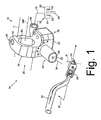
- Fig. 1 is a schematic view of a bicycle brake system
- Fig. 2 is a bottom view of a reservoir assembly with the bottom cover removed;
- Fig. 3 is a front cutaway view of the reservoir assembly.
- Fig. 1 is a schematic view of a bicycle brake system 10.
- Bicycle brake system 10 includes a brake lever assembly 14, a caliper assembly 18, and a brake fluid tube 19 connected between brake lever assembly 14 and caliper assembly 18.
- Caliper assembly 18 may be a conventional caliper assembly comprising a caliper housing 20 that supports a pair of oppositely facing brake pads 22 that frictionally contact a rotor 24 in response to hydraulic pressure applied to one or more pistons (not shown).
- a fluid reservoir (not shown) is disposed within caliper housing 20, and a bleeding screw 25 is screwed into caliper housing 20 for bleeding a fluid such as air and/or brake fluid from the fluid reservoir.
- Brake lever assembly 14 includes a brake lever mounting assembly 26 and a brake lever 30.
- Brake lever mounting assembly 26 includes a handlebar mount 34 defining a handlebar mounting axis HM, a fluid reservoir 38, and a master cylinder 42.
- both reservoir assembly 38 and master cylinder 42 are disposed entirely below handlebar mounting axis HM to provide a compact structure.
- terms such as "upper,” “below,” etc. are determined from the orientation shown in Fig. 1, which also corresponds to a configuration wherein brake lever assembly 14 is mounted to handlebar H with brake lever 30 located in front of handlebar H.
- Handlebar mount 34 has a conventional structure that wraps around a handlebar H and is tightened in a conventional manner by a screw (not shown) that is screwed into aligned openings 46 in mounting ears 50.
- brake lever mounting assembly 26 portions of brake lever mounting assembly 26, particularly the portions that connect brake lever 30 to reservoir assembly 38 and master cylinder 42, have been omitted to facilitate viewing. It should be sufficient to say that brake lever 30 is pivotably mounted relative to master cylinder 42 through a pivot shaft 54 defining a rotational axis R so that brake lever 30 rotates around axis R within a plane P toward and away from handlebar H.
- Brake lever 30 includes a conventional piston interface structure 58 that interfaces with a shaft 63 of a master cylinder piston 65 for reciprocally moving master cylinder piston 65 along a movement axis M.
- Master cylinder piston 65 includes a conventional return spring (not shown) that biases master cylinder piston 65 outwardly (toward the left in Fig. 1).
- Reservoir assembly 38 includes a cover 62, a first reservoir 66 (Fig. 2) having a first reservoir chamber 70, and a second reservoir 74 having a second reservoir chamber 78.
- First reservoir chamber 70 is in fluid communication with a master cylinder chamber 82 (Fig. 3) through a timing port 86 and a compensation port 90, both of which are formed in an upper surface 94 of first reservoir chamber 70.
- the functions of timing port 86 and compensation port 90 are well known and will not be described further.
- Fluid entering master cylinder chamber 82 is communicated to a fluid outlet 96 connected to brake fluid tube 19. As shown in Fig.
- a vertical length L1 of first reservoir chamber 70 is less than a horizontal length H1 of first reservoir chamber 70; a vertical length L2 of second reservoir chamber 78 is less than a horizontal length H2 of second reservoir chamber 78; vertical length L1 of first reservoir chamber 70 is less than vertical length L2 of second reservoir chamber 78; and horizontal length H1 of first reservoir chamber 70 is greater than horizontal length H2 of second reservoir chamber 78.
- a junction between first reservoir 66 and second reservoir 74 forms a stepped surface 98.
- first reservoir chamber 70 and second reservoir chamber 78 are formed by cover 62 and are at the same vertical level. However, an upper surface 102 of second reservoir chamber 68 is positioned vertically higher than upper surface 94 of first reservoir chamber 70.
- first reservoir chamber 70 and ports 86 and 90 are disposed below master cylinder chamber 82 and movement axis M
- master cylinder chamber 82 and movement axis M are disposed laterally adjacent to second reservoir chamber 78
- upper surface 102 is disposed above movement axis M and ports 86 and 90.
- Upper surface 102 functions as an air entrainment surface such that any air that enters reservoir assembly 38 will be urged towards second reservoir chamber 78 and upper surface 102.
- timing port 86 and compensation port 90 will be continually immersed in brake fluid, no air will enter the path between master cylinder 42 and caliper housing 18, and firm and reliable brake operation will be maintained.
- brake lever mounting assembly 26 is rotated around handlebar mounting axis HM until cover 62 is facing upwardly. Cover 62 is be removed, brake fluid is installed into first reservoir chamber 70 and second reservoir chamber 78, bleeder screw 25 at caliper housing 20 is loosened, and brake lever 30 is operated to force brake fluid through master cylinder chamber 82, brake fluid tube 19 and the fluid reservoir in caliper housing 20 until brake fluid flows through bleeder screw 25 without air bubbles. Bleeder screw 25 then is tightened, cover 62 is reinstalled, and brake lever mounting assembly 26 is rotated around handlebar mounting axis HM until reservoir assembly 38 is disposed below handlebar H in the operating position.
- bleeder screw 25 at caliper housing 20 may be loosened and brake fluid pumped through bleeder screw 25 until the brake fluid fills the reservoir chamber in caliper housing 20, flows through brake fluid tube 19 and fills first reservoir chamber 70 and second reservoir chamber 78.
- cover 62 is reinstalled, and brake lever mounting assembly 26 is rotated around handlebar mounting axis HM until reservoir assembly 38 is disposed below handlebar H in the operating position.
- any air remaining in reservoir assembly 38 will migrate toward upper surface 102 in second reservoir chamber 78 and be entrained. As a result, air will not be allowed to enter the path between master cylinder 42 and caliper housing 18 as noted above.
- a bleeder screw 220 may be added to second reservoir 74 in the embodiment shown in Fig. 1 so that brake fluid may be installed without removing cover 62.
- upper surface 98 in the disclosed embodiment is generally flat and horizontal, the shape of upper surface 94 may vary.
- upper surface 94 may be replaced by an inclined upper surface 230.
- the size, shape, location or orientation of the various components may be changed as desired. Components that are shown directly connected or contacting each other may have intermediate structures disposed between them. The functions of one element may be performed by two, and vice versa.
Landscapes
- Engineering & Computer Science (AREA)
- Mechanical Engineering (AREA)
- Transportation (AREA)
- Physics & Mathematics (AREA)
- Fluid Mechanics (AREA)
- Transmission Of Braking Force In Braking Systems (AREA)
Abstract
Description
- The present invention is, directed to bicycles and, more particularly, to a hydraulic apparatus for a bicycle brake lever device.
- In recent years, some high performance bicycles have been equipped with hydraulic disk brake systems. Hydraulic disk brake systems typically include a caliper housing, first and second brake pads mounted on opposite inner sides of the caliper housing so as to face each other, and one or more pistons that move the first and/or second brake pads towards each other in response to hydraulic pressure created by the actuation of a brake lever assembly mounted to the bicycle handlebar. A rotor that rotates with the bicycle wheel is disposed between the first and second brake pads. The first and second brake pads apply a frictional force to the rotor when they move towards each other in response to the hydraulic pressure created by the actuation of the brake lever assembly, thereby stopping rotation of the rotor and the bicycle wheel.
- The brake lever assembly typically comprises a base member structured to attach to the bicycle handlebar and a brake lever pivotably coupled to the base member. The base member includes or is attached to a master cylinder and a fluid reservoir that supplies brake fluid to the master cylinder through appropriate orifices. The fluid reservoir has a removable cap so that brake fluid may be added as necessary. The master cylinder includes a brake fluid outlet and a piston that reciprocates in response to pivoting of the brake lever. A tube is connected between the brake fluid outlet and the caliper housing to communicate brake fluid between the master cylinder and the caliper housing. Pivoting the brake lever toward the handlebar causes the brake lever to press against the piston so that the piston forces brake fluid through the brake fluid outlet to the caliper housing, thereby causing the first and second brake pads to contact the rotor.
- Brake fluid is a substantially compressionless fluid that allows the brake fluid to properly communicate the force from the piston in the brake lever assembly to the piston(s) in the caliper housing. Accordingly, it is necessary to ensure that there is no air, which is highly compressible, in the path from the piston in the brake lever assembly to the piston(s) in the caliper. Conventionally, this is accomplished by installing a bleeder screw at the fluid reservoir in the caliper housing. The bleeder screw typically has a solid inner end and an internal fluid passage that extends from a side of the screw near the inner end to the outer end of the screw. When the bleeder screw is screwed into the caliper housing, the solid inner end closes an orifice at the fluid reservoir. Loosening the bleeder screw allows brake fluid to move past the solid inner end, through the internal fluid passage and out of the outer end of the screw. Thus, by loosening the bleeder screw and operating the brake lever, fluid is forced from the reservoir in the brake lever assembly, through the tubing connecting the master cylinder to the caliper housing, arid through the bleeder screw. Any air in the path from the master cylinder to the caliper housing exits through the bleeder screw together with any air entrained in the brake fluid. The bleeder screw then is tightened to seal the system. However, sometimes entrained air in the fluid reservoir may enter the master cylinder and be introduced into the path from the piston in the brake lever assembly to the piston(s) in the caliper, thereby degrading braking performance.
- The present invention is directed to various features of a bicycle brake device. In one embodiment, a reservoir apparatus for a bicycle brake lever device comprises a master cylinder and a fluid reservoir including first and second reservoirs. The master cylinder has a master cylinder chamber dimensioned for receiving a master cylinder piston therein. The first reservoir has a first reservoir chamber in fluid communication with the master cylinder chamber for supplying a hydraulic fluid to the master cylinder chamber. At least a portion of the first reservoir chamber is disposed below a portion of the master cylinder chamber. The second reservoir has a second reservoir chamber in fluid communication with the first reservoir chamber, wherein the second reservoir chamber includes an air entrainment surface. The air entrainment surface is positioned higher than an upper surface of the first reservoir chamber. Additional inventive features will become apparent from the description below, and such features alone or in combination with the above features may form the basis of further inventions as recited in the claims and their equivalents.
- Fig. 1 is a schematic view of a bicycle brake system;
- Fig. 2 is a bottom view of a reservoir assembly with the bottom cover removed; and
- Fig. 3 is a front cutaway view of the reservoir assembly.
- Fig. 1 is a schematic view of a
bicycle brake system 10.Bicycle brake system 10 includes abrake lever assembly 14, acaliper assembly 18, and abrake fluid tube 19 connected betweenbrake lever assembly 14 andcaliper assembly 18.Caliper assembly 18 may be a conventional caliper assembly comprising acaliper housing 20 that supports a pair of oppositely facingbrake pads 22 that frictionally contact arotor 24 in response to hydraulic pressure applied to one or more pistons (not shown). A fluid reservoir (not shown) is disposed withincaliper housing 20, and ableeding screw 25 is screwed intocaliper housing 20 for bleeding a fluid such as air and/or brake fluid from the fluid reservoir. -
Brake lever assembly 14 includes a brakelever mounting assembly 26 and abrake lever 30. Brakelever mounting assembly 26 includes ahandlebar mount 34 defining a handlebar mounting axis HM, afluid reservoir 38, and amaster cylinder 42. In this embodiment, bothreservoir assembly 38 andmaster cylinder 42 are disposed entirely below handlebar mounting axis HM to provide a compact structure. As used herein, terms such as "upper," "below," etc. are determined from the orientation shown in Fig. 1, which also corresponds to a configuration whereinbrake lever assembly 14 is mounted to handlebar H withbrake lever 30 located in front of handlebarH. Handlebar mount 34 has a conventional structure that wraps around a handlebar H and is tightened in a conventional manner by a screw (not shown) that is screwed into alignedopenings 46 inmounting ears 50. - Portions of brake
lever mounting assembly 26, particularly the portions that connectbrake lever 30 toreservoir assembly 38 andmaster cylinder 42, have been omitted to facilitate viewing. It should be sufficient to say thatbrake lever 30 is pivotably mounted relative tomaster cylinder 42 through apivot shaft 54 defining a rotational axis R so thatbrake lever 30 rotates around axis R within a plane P toward and away from handlebarH. Brake lever 30 includes a conventionalpiston interface structure 58 that interfaces with ashaft 63 of amaster cylinder piston 65 for reciprocally movingmaster cylinder piston 65 along a movement axis M.Master cylinder piston 65 includes a conventional return spring (not shown) that biasesmaster cylinder piston 65 outwardly (toward the left in Fig. 1). -
Reservoir assembly 38 includes acover 62, a first reservoir 66 (Fig. 2) having afirst reservoir chamber 70, and asecond reservoir 74 having asecond reservoir chamber 78.First reservoir chamber 70 is in fluid communication with a master cylinder chamber 82 (Fig. 3) through atiming port 86 and acompensation port 90, both of which are formed in anupper surface 94 offirst reservoir chamber 70. The functions oftiming port 86 andcompensation port 90 are well known and will not be described further. Fluid enteringmaster cylinder chamber 82 is communicated to afluid outlet 96 connected tobrake fluid tube 19. As shown in Fig. 3, a vertical length L1 offirst reservoir chamber 70 is less than a horizontal length H1 offirst reservoir chamber 70; a vertical length L2 ofsecond reservoir chamber 78 is less than a horizontal length H2 ofsecond reservoir chamber 78; vertical length L1 offirst reservoir chamber 70 is less than vertical length L2 ofsecond reservoir chamber 78; and horizontal length H1 offirst reservoir chamber 70 is greater than horizontal length H2 ofsecond reservoir chamber 78. As a result, a junction betweenfirst reservoir 66 andsecond reservoir 74 forms astepped surface 98. - The bottom surfaces of
first reservoir chamber 70 andsecond reservoir chamber 78 are formed bycover 62 and are at the same vertical level. However, anupper surface 102 of second reservoir chamber 68 is positioned vertically higher thanupper surface 94 offirst reservoir chamber 70. As a result: of the foregoing structure,first reservoir chamber 70 andports master cylinder chamber 82 and movement axis M,master cylinder chamber 82 and movement axis M are disposed laterally adjacent tosecond reservoir chamber 78, andupper surface 102 is disposed above movement axis M andports Upper surface 102 functions as an air entrainment surface such that any air that entersreservoir assembly 38 will be urged towardssecond reservoir chamber 78 andupper surface 102. The entrained air will be trapped insecond reservoir chamber 78 even during rough operation of the bicycle. As a result,timing port 86 andcompensation port 90 will be continually immersed in brake fluid, no air will enter the path betweenmaster cylinder 42 andcaliper housing 18, and firm and reliable brake operation will be maintained. - To install brake fluid into the above-described system, brake
lever mounting assembly 26 is rotated around handlebar mounting axis HM untilcover 62 is facing upwardly.Cover 62 is be removed, brake fluid is installed intofirst reservoir chamber 70 andsecond reservoir chamber 78,bleeder screw 25 atcaliper housing 20 is loosened, andbrake lever 30 is operated to force brake fluid throughmaster cylinder chamber 82,brake fluid tube 19 and the fluid reservoir incaliper housing 20 until brake fluid flows throughbleeder screw 25 without air bubbles.Bleeder screw 25 then is tightened,cover 62 is reinstalled, and brakelever mounting assembly 26 is rotated around handlebar mounting axis HM untilreservoir assembly 38 is disposed below handlebar H in the operating position. - Alternatively, once
cover 62 is removed,bleeder screw 25 atcaliper housing 20 may be loosened and brake fluid pumped throughbleeder screw 25 until the brake fluid fills the reservoir chamber incaliper housing 20, flows throughbrake fluid tube 19 and fillsfirst reservoir chamber 70 andsecond reservoir chamber 78. Thereafter,cover 62 is reinstalled, and brakelever mounting assembly 26 is rotated around handlebar mounting axis HM untilreservoir assembly 38 is disposed below handlebar H in the operating position. In either case, once brakelever mounting assembly 26 is in the proper position, any air remaining inreservoir assembly 38 will migrate towardupper surface 102 insecond reservoir chamber 78 and be entrained. As a result, air will not be allowed to enter the path betweenmaster cylinder 42 andcaliper housing 18 as noted above. - While the above is a description of various embodiments of inventive features, further modifications may be employed without departing from the spirit and scope of the present invention. For example, a
bleeder screw 220 may be added tosecond reservoir 74 in the embodiment shown in Fig. 1 so that brake fluid may be installed without removingcover 62. Whileupper surface 98 in the disclosed embodiment is generally flat and horizontal, the shape ofupper surface 94 may vary. For example,upper surface 94 may be replaced by an inclinedupper surface 230. The size, shape, location or orientation of the various components may be changed as desired. Components that are shown directly connected or contacting each other may have intermediate structures disposed between them. The functions of one element may be performed by two, and vice versa. The function of one element may be performed by another, and functions may be interchanged among the elements. The structures and functions of one embodiment may be adopted in another embodiment. It is not necessary for all advantages to be present in a particular embodiment at the same time. Every feature which is unique from the prior art, alone or in combination with other features, also should be considered a separate description of further inventions by the applicant, including the structural and/or functional concepts embodied by such feature(s). Thus, the scope of the invention should not be limited by the specific structures disclosed or the apparent initial focus or emphasis on a particular structure or feature.
Claims (10)
- A reservoir apparatus for a bicycle brake lever device comprising:a master cylinder having a master cylinder chamber dimensioned for receiving a master cylinder piston therein; anda fluid reservoir including:wherein at least a portion of the first reservoir chamber is disposed below a portion of the master cylinder chamber;a first reservoir having a first reservoir chamber in fluid communication with the master cylinder chamber for supplying a hydraulic fluid to the master cylinder chamber;
a second reservoir having a second reservoir chamber in fluid communication with the first reservoir chamber;
wherein the second reservoir chamber includes an air entrainment surface; and
wherein the air entrainment surface is positioned higher than an upper surface of the first reservoir chamber. - The apparatus according to claim 1 wherein a junction between the first reservoir and the second reservoir forms a stepped surface.
- The apparatus according to claim 1 or 2 wherein the master cylinder chamber has a movement axis, and wherein the air entrainment surface is disposed above the movement axis.
- The apparatus according to any one of claims 1 to 3 wherein the master cylinder has a port that communicates the hydraulic fluid between the master cylinder chamber and the first reservoir chamber, and wherein the air entrainment surface is positioned higher than the port.
- The apparatus according to claim 4 wherein the master cylinder chamber has a movement axis, and wherein the port is disposed below the movement axis.
- The apparatus according to claim 4 or 5 wherein the port is disposed in an upper surface of the first reservoir.
- The apparatus according to any one of claims 1 to 6 wherein the master cylinder chamber has a movement axis, wherein at least a portion of the first reservoir chamber is disposed below the movement axis, and wherein the air entrainment surface is disposed above the movement axis.
- The apparatus according to any one of claims 1 to 7 wherein the master cylinder chamber is disposed above the first reservoir chamber, and wherein the master cylinder chamber is disposed laterally of the second reservoir chamber.
- The apparatus according to any one of claims 1 to 8 wherein a vertical length of the first reservoir chamber is less than a horizontal length of the first reservoir chamber, and wherein a vertical length of the second reservoir chamber is greater than a horizontal length of the second reservoir chamber.
- The apparatus according to claim any one of claims 1 to 9 wherein the upper surface is inclined.
Applications Claiming Priority (1)
| Application Number | Priority Date | Filing Date | Title |
|---|---|---|---|
| US11/164,996 US7500545B2 (en) | 2005-12-13 | 2005-12-13 | Reservoir apparatus for a bicycle brake lever device |
Publications (3)
| Publication Number | Publication Date |
|---|---|
| EP1798124A2 true EP1798124A2 (en) | 2007-06-20 |
| EP1798124A3 EP1798124A3 (en) | 2007-11-21 |
| EP1798124B1 EP1798124B1 (en) | 2008-11-12 |
Family
ID=37846147
Family Applications (1)
| Application Number | Title | Priority Date | Filing Date |
|---|---|---|---|
| EP06023693A Ceased EP1798124B1 (en) | 2005-12-13 | 2006-11-14 | Reservoir apparatus for a bicycle brake lever device |
Country Status (6)
| Country | Link |
|---|---|
| US (1) | US7500545B2 (en) |
| EP (1) | EP1798124B1 (en) |
| JP (1) | JP4667323B2 (en) |
| CN (1) | CN100500487C (en) |
| DE (1) | DE602006003614D1 (en) |
| TW (1) | TWI304783B (en) |
Families Citing this family (11)
| Publication number | Priority date | Publication date | Assignee | Title |
|---|---|---|---|---|
| US20080155982A1 (en) * | 2006-12-28 | 2008-07-03 | Jones Christopher S | Hydraulic Brake Master Cylinder |
| TWM386235U (en) | 2010-03-30 | 2010-08-11 | Shimano Kk | Brake rod device of bike |
| TWM387056U (en) | 2010-03-30 | 2010-08-21 | Shimano Kk | Brake rod device of bike |
| US10144483B2 (en) | 2011-08-01 | 2018-12-04 | Shimano Inc. | Bicycle component control device |
| US8714322B2 (en) * | 2012-01-16 | 2014-05-06 | Sram, Llc | Hydraulic brake mechanism |
| US9321505B2 (en) | 2012-03-30 | 2016-04-26 | Shimano Inc. | Bicycle hydraulic component operating device |
| US9365260B2 (en) | 2012-04-18 | 2016-06-14 | Shimano Inc. | Bicycle hydraulic operating device |
| US8905205B2 (en) | 2012-12-26 | 2014-12-09 | Shimano Inc. | Bicycle hydraulic component operating device |
| US9726315B2 (en) * | 2014-07-16 | 2017-08-08 | New York Air Brake, LLC | Branch pipe tee with integral volume for short cars |
| FR3046594B1 (en) * | 2016-01-12 | 2018-02-09 | Decathlon | BRAKING DEVICE FOR A VEHICLE COMPRISING A HANDLEBAR AND A BRAKE CABLE |
| US10183721B2 (en) | 2016-08-10 | 2019-01-22 | Shimano Components (Malaysia) Sdn. Bhd. | Bicycle control device |
Family Cites Families (30)
| Publication number | Priority date | Publication date | Assignee | Title |
|---|---|---|---|---|
| GB977809A (en) | 1962-09-25 | 1964-12-16 | Girling Ltd | Improvements in reservoirs for hydraulic braking systems |
| JPS5849549A (en) * | 1981-09-19 | 1983-03-23 | Honda Motor Co Ltd | Hydraulic master cylinder device for vehicles such as motorcycles |
| US4560049A (en) * | 1982-09-28 | 1985-12-24 | Honda Giken Kogyo Kabushiki Kaisha | Operation device for clutch master cylinder with means to adjust the play stroke of the clutch lever |
| JPS60252054A (en) * | 1984-05-30 | 1985-12-12 | Honda Motor Co Ltd | Braking device for vehicles |
| US4626045A (en) * | 1984-06-07 | 1986-12-02 | Honda Giken Kogyo Kabushiki Kaisha | Control unit for antilock brake systems |
| GB8421830D0 (en) * | 1984-08-29 | 1984-10-03 | Automotive Prod Plc | Hydraulic master cylinder |
| GB8616677D0 (en) | 1986-07-09 | 1986-08-13 | Lucas Ind Plc | Master cylinder |
| US4838113A (en) * | 1985-10-15 | 1989-06-13 | Honda Giken Kogyo Kabushiki Kaisha | Throttle actuator for a vehicle |
| IT1209673B (en) * | 1985-11-19 | 1989-08-30 | Sarano Di Santa Lucia Di Piave | BRAKE OPERATION DEVICE FOR BICYCLES, IN PARTICULAR FOR RACING BICYCLES. |
| JPH0777877B2 (en) * | 1985-12-06 | 1995-08-23 | 本田技研工業株式会社 | Adjustable operating lever for vehicle |
| ATA172386A (en) * | 1986-06-24 | 1988-06-15 | Evva Werke | CYLINDER LOCK |
| KR900008424B1 (en) * | 1987-06-05 | 1990-11-20 | 닛신 고오교오 가부시끼가이샤 | Vehicle lever device |
| JP2700555B2 (en) * | 1988-04-13 | 1998-01-21 | ヤマハ発動機株式会社 | Motorcycle hydraulic operating device |
| JP3282054B2 (en) * | 1993-12-08 | 2002-05-13 | 日信工業株式会社 | Hydraulic master cylinder device for vehicles |
| US5632362A (en) * | 1995-08-15 | 1997-05-27 | Rockshox, Inc. | Bicycle disc brake |
| JP2002506408A (en) * | 1998-04-28 | 2002-02-26 | ロックショックス インコーポレイテッド | Concentric correction chamber and master cylinder for disc brake systems |
| US6209687B1 (en) * | 1999-07-02 | 2001-04-03 | Travis S. Hundley | Dual brake handle |
| JP4357660B2 (en) * | 1999-08-27 | 2009-11-04 | 本田技研工業株式会社 | Master cylinder device for vehicle |
| US6347689B1 (en) * | 2000-06-30 | 2002-02-19 | Shimano Inc. | Roll back seal for disc brake |
| JP4965058B2 (en) * | 2000-11-30 | 2012-07-04 | フレニ・ブレンボ エス・ピー・エー | Master cylinder for vehicles that can be controlled by a handlebar |
| TW525615U (en) * | 2000-12-13 | 2003-03-21 | Lee Chi Entpr Co Ltd | Anti-lock braking structure for disc brake of bicycle |
| US6871729B2 (en) * | 2001-03-02 | 2005-03-29 | Freni Brembo S.P.A. | Master cylinder for a brake or clutch of a motorcycle or bike |
| US20030121736A1 (en) * | 2001-12-28 | 2003-07-03 | Avid, L.L.C. | Master cylinder lever for a hydraulic disc brake having a backpack reservoir |
| US6804961B2 (en) * | 2001-12-28 | 2004-10-19 | Sram Corporation | Master cylinder lever for a hydraulic disk brake having on the fly dead-band adjustment |
| JP4100951B2 (en) * | 2002-04-05 | 2008-06-11 | 川崎重工業株式会社 | Master cylinder device for brake |
| ITFI20030044A1 (en) * | 2003-02-20 | 2004-08-21 | Formula Srl | DEVICE FOR THE CONTROL OF BRAKES IN CYCLES AND SIMILAR |
| DE20309131U1 (en) | 2003-06-12 | 2003-08-14 | Chun, Te Wen, Taichung | Hand lever for bicycle's hydraulic brake has main component of irregular shape and equipped with oil reservoir, cylinder and lever, and joint extending from one end of cylinder pivot-connects lever to main body |
| ITFI20030241A1 (en) * | 2003-09-15 | 2005-03-16 | Formula Srl | DEVICE FOR THE CONTROL OF HYDRAULIC BRAKES IN CYCLES, |
| US6883647B1 (en) * | 2003-09-16 | 2005-04-26 | Chun Te Wen | Hydraulic brake lever for a bicycle |
| CN1930038A (en) | 2004-03-09 | 2007-03-14 | 海斯自行车集团公司 | Lever assembly and master cylinder |
-
2005
- 2005-12-13 US US11/164,996 patent/US7500545B2/en not_active Expired - Lifetime
-
2006
- 2006-08-23 JP JP2006225987A patent/JP4667323B2/en not_active Expired - Fee Related
- 2006-08-24 TW TW095131199A patent/TWI304783B/en active
- 2006-09-06 CN CNB2006101281864A patent/CN100500487C/en active Active
- 2006-11-14 EP EP06023693A patent/EP1798124B1/en not_active Ceased
- 2006-11-14 DE DE602006003614T patent/DE602006003614D1/en active Active
Also Published As
| Publication number | Publication date |
|---|---|
| US20070131495A1 (en) | 2007-06-14 |
| DE602006003614D1 (en) | 2008-12-24 |
| JP4667323B2 (en) | 2011-04-13 |
| EP1798124A3 (en) | 2007-11-21 |
| TWI304783B (en) | 2009-01-01 |
| JP2007161227A (en) | 2007-06-28 |
| CN100500487C (en) | 2009-06-17 |
| EP1798124B1 (en) | 2008-11-12 |
| US7500545B2 (en) | 2009-03-10 |
| CN1982132A (en) | 2007-06-20 |
| TW200722334A (en) | 2007-06-16 |
Similar Documents
| Publication | Publication Date | Title |
|---|---|---|
| US8146716B2 (en) | Reservoir tank for hydraulic brake lever assembly | |
| JP4838825B2 (en) | Hydraulic device for bicycle brake lever device. | |
| EP1798124B1 (en) | Reservoir apparatus for a bicycle brake lever device | |
| CN103895791B (en) | Bicycle hydraulic component operating device | |
| US9365260B2 (en) | Bicycle hydraulic operating device | |
| EP1514791B1 (en) | Apparatus for controlling hydraulic brakes in bicycles, motorbicycles and the like | |
| EP1514757B1 (en) | Apparatus for controlling hydraulic brakes in bicycles motorcycles and the like | |
| CN109018155B (en) | Disc brake caliper and disc brake caliper assembly | |
| TWI711556B (en) | Bicycle disc brake caliper | |
| TWI677451B (en) | Bicycle hydraulic operating device | |
| CN109305279B (en) | Hydraulic operating system | |
| CN105947086B (en) | Bicycle rim brake | |
| US20180093738A1 (en) | Bicycle hydraulic operating device | |
| JP2002506408A (en) | Concentric correction chamber and master cylinder for disc brake systems | |
| TW202129168A (en) | Disc brake caliper | |
| EP3063045B1 (en) | Lever actuated device for a brake and/or a clutch, in particular for motorcycles | |
| JP4726918B2 (en) | Caliper body for disc brakes for vehicles | |
| JP2005138769A (en) | Mounting structure of hydraulic master cylinder | |
| KR19980048340A (en) | Air bleeding device of brake caliper | |
| JP2005297886A (en) | Brake device |
Legal Events
| Date | Code | Title | Description |
|---|---|---|---|
| PUAI | Public reference made under article 153(3) epc to a published international application that has entered the european phase |
Free format text: ORIGINAL CODE: 0009012 |
|
| AK | Designated contracting states |
Kind code of ref document: A2 Designated state(s): AT BE BG CH CY CZ DE DK EE ES FI FR GB GR HU IE IS IT LI LT LU LV MC NL PL PT RO SE SI SK TR |
|
| AX | Request for extension of the european patent |
Extension state: AL BA HR MK YU |
|
| PUAL | Search report despatched |
Free format text: ORIGINAL CODE: 0009013 |
|
| AK | Designated contracting states |
Kind code of ref document: A3 Designated state(s): AT BE BG CH CY CZ DE DK EE ES FI FR GB GR HU IE IS IT LI LT LU LV MC NL PL PT RO SE SI SK TR |
|
| AX | Request for extension of the european patent |
Extension state: AL BA HR MK YU |
|
| 17P | Request for examination filed |
Effective date: 20071122 |
|
| GRAP | Despatch of communication of intention to grant a patent |
Free format text: ORIGINAL CODE: EPIDOSNIGR1 |
|
| GRAS | Grant fee paid |
Free format text: ORIGINAL CODE: EPIDOSNIGR3 |
|
| AKX | Designation fees paid |
Designated state(s): DE IT |
|
| GRAA | (expected) grant |
Free format text: ORIGINAL CODE: 0009210 |
|
| AK | Designated contracting states |
Kind code of ref document: B1 Designated state(s): DE IT |
|
| REF | Corresponds to: |
Ref document number: 602006003614 Country of ref document: DE Date of ref document: 20081224 Kind code of ref document: P |
|
| PLBE | No opposition filed within time limit |
Free format text: ORIGINAL CODE: 0009261 |
|
| STAA | Information on the status of an ep patent application or granted ep patent |
Free format text: STATUS: NO OPPOSITION FILED WITHIN TIME LIMIT |
|
| 26N | No opposition filed |
Effective date: 20090813 |
|
| PGFP | Annual fee paid to national office [announced via postgrant information from national office to epo] |
Ref country code: IT Payment date: 20101115 Year of fee payment: 5 |
|
| PG25 | Lapsed in a contracting state [announced via postgrant information from national office to epo] |
Ref country code: IT Free format text: LAPSE BECAUSE OF NON-PAYMENT OF DUE FEES Effective date: 20121114 |
|
| P01 | Opt-out of the competence of the unified patent court (upc) registered |
Effective date: 20230421 |
|
| PGFP | Annual fee paid to national office [announced via postgrant information from national office to epo] |
Ref country code: DE Payment date: 20230929 Year of fee payment: 18 |
|
| REG | Reference to a national code |
Ref country code: DE Ref legal event code: R119 Ref document number: 602006003614 Country of ref document: DE |
|
| PG25 | Lapsed in a contracting state [announced via postgrant information from national office to epo] |
Ref country code: DE Free format text: LAPSE BECAUSE OF NON-PAYMENT OF DUE FEES Effective date: 20250603 |