EP1796471B1 - Formulierung für ein herbizides suspensionskonzentrat - Google Patents
Formulierung für ein herbizides suspensionskonzentrat Download PDFInfo
- Publication number
- EP1796471B1 EP1796471B1 EP05753194A EP05753194A EP1796471B1 EP 1796471 B1 EP1796471 B1 EP 1796471B1 EP 05753194 A EP05753194 A EP 05753194A EP 05753194 A EP05753194 A EP 05753194A EP 1796471 B1 EP1796471 B1 EP 1796471B1
- Authority
- EP
- European Patent Office
- Prior art keywords
- alkyl
- alkoxy
- halogen
- substituted
- cyano
- Prior art date
- Legal status (The legal status is an assumption and is not a legal conclusion. Google has not performed a legal analysis and makes no representation as to the accuracy of the status listed.)
- Expired - Lifetime
Links
- 0 CC(CC(*)C(O)=C1C(c2c(COCCOC)nc(C(F)(F)F)cc2)=O)C1=O Chemical compound CC(CC(*)C(O)=C1C(c2c(COCCOC)nc(C(F)(F)F)cc2)=O)C1=O 0.000 description 5
- VIXCLRUCUMWJFF-UHFFFAOYSA-N CS(c(cc1)cc(Cl)c1C(C(C(C1CC2CC1)=O)=C2Sc1ccccc1)=O)(=O)=O Chemical compound CS(c(cc1)cc(Cl)c1C(C(C(C1CC2CC1)=O)=C2Sc1ccccc1)=O)(=O)=O VIXCLRUCUMWJFF-UHFFFAOYSA-N 0.000 description 1
Classifications
-
- A—HUMAN NECESSITIES
- A01—AGRICULTURE; FORESTRY; ANIMAL HUSBANDRY; HUNTING; TRAPPING; FISHING
- A01N—PRESERVATION OF BODIES OF HUMANS OR ANIMALS OR PLANTS OR PARTS THEREOF; BIOCIDES, e.g. AS DISINFECTANTS, AS PESTICIDES OR AS HERBICIDES; PEST REPELLANTS OR ATTRACTANTS; PLANT GROWTH REGULATORS
- A01N25/00—Biocides, pest repellants or attractants, or plant growth regulators, characterised by their forms, or by their non-active ingredients or by their methods of application, e.g. seed treatment or sequential application; Substances for reducing the noxious effect of the active ingredients to organisms other than pests
- A01N25/02—Biocides, pest repellants or attractants, or plant growth regulators, characterised by their forms, or by their non-active ingredients or by their methods of application, e.g. seed treatment or sequential application; Substances for reducing the noxious effect of the active ingredients to organisms other than pests containing liquids as carriers, diluents or solvents
- A01N25/04—Dispersions, emulsions, suspoemulsions, suspension concentrates or gels
-
- A—HUMAN NECESSITIES
- A01—AGRICULTURE; FORESTRY; ANIMAL HUSBANDRY; HUNTING; TRAPPING; FISHING
- A01N—PRESERVATION OF BODIES OF HUMANS OR ANIMALS OR PLANTS OR PARTS THEREOF; BIOCIDES, e.g. AS DISINFECTANTS, AS PESTICIDES OR AS HERBICIDES; PEST REPELLANTS OR ATTRACTANTS; PLANT GROWTH REGULATORS
- A01N61/00—Biocides, pest repellants or attractants, or plant growth regulators containing substances of unknown or undetermined composition, e.g. substances characterised only by the mode of action
Definitions
- the present invention relates to a method of improving the stability of an HPPD inhibitor in water.
- mesotrione 2-(4-methylsulphonyl-2-nitrobenzoyl)cyclohexane-1,3-dione, an HPPD inhibitor.
- Mesotrione is not substantially soluble in water and has solubility of 2.2 g/l (pH 4.8), 15 g/l (pH 6.9) and 22 g/l (pH 9) all at 20°C (data taken from The Pesticide Manual, 12 th Edition).
- Mesotrione is usually formulated for sale as a concentrated suspension of solid mesotrione in water. The concentrate typically contains between 100 and 500g/l of mesotrione. This concentrate is then diluted by the end user, shortly before application, to give a final ready-to-use composition that typically comprises between 1 and 10g/l of mesotrione.
- mesotrione and other HPPD inhibitors, are unstable, that is it breaks down in the presence of water. The breakdown is slow, but results in a noticeable reduction in mesotrione content when the concentrate is stored for reasonable lengths of time, particularly in warm conditions. For example, a 10% SC formulation of mesotrione, stored at 54°C for 2 weeks at pH 5 will decompose by approximately 45%.
- a measure of whether a composition is stable is that there is less than 20%, suitably less than 10% decomposition in 2 years at ambient temperatures in a temperate climate.
- the present invention provides the use of an electrolyte to improve the stability of an HPPD inhibitor selected from the group consisting of isoxazoles, triketones, pyrazoles, benzobicyclon and ketospiradox in an aqueous pre-mix suspension concentrate formulation comprising:
- the isoxazole is a compound of formula (IA)
- R is hydrogen;
- R 1 is cyclopropyl;
- R 2 is halogen (preferably chloro), -S(O) b CH 3 , or C 1-4 haloalkyl (preferably trifluoromethyl); and a is two.
- Particularly preferred compounds of formula (IA) include 5-cyclopropyl-4-(2-methylsulfonyl-4-trifluoromethyl)benzoylisoxazole (isoxaflutole) and 4-(2-chloro-4-methylsulphonyl)benzoyl-5-cyclopropylisoxazole (isoxachlortole), especially isoxaflutole.
- the triketone is a compound of formula (IB),
- R 9 is chloro, bromo, nitro, cyano, C 1-4 alkyl, -CF 3 , -S(O) f R 12 , or -OR 12 ; each R 10 is independently chloro, bromo, nitro, cyano, C 1-4 alkyl, -CF 3 , -OR 12 , - OS(O) f R 16 or -S(O) f R 16 ; d is zero and e is one or two.
- Preferred compounds of formula (IB) are 2-(2'-nitro-4'-methylsulphonylbenzoyl)-1,3-cyclohexanedione (mesotrione), 2-(2'-nitro-4'-methylsulphonyloxybenzoyl)-1,3-cyclohexanedione, 4,4-dimethyl-2-(4-methanesulphonyl-2-nitrobenzoyl)-1,3-cyclohexanedione, 2-(2-chloro-3-ethoxy-4-methanesulphonylbenzoyl)-5-methyl-1,3-cyclohexanedione and 2-(2-chloro-3-ethoxy-4-ethanesulphonylbenzoyl)-5-methyl-1,3-cyclohexanedione; most preferably is 2-(2'-nitro-4'-methylsulphonyl benzoyl)-1,3-cyclohexanedione.
- the compounds of formula (IB) may exist in enolic tautomeric forms that may give rise to geometric isomers. Furthermore, in certain cases, the various substituents may contribute to optical isomerism and/or stereoisomerism. All such tautomeric forms, racemic mixtures and isomers are included within the scope of the present invention.
- the triketone is a compound of formula (IC)
- the triketone may be present in an enolic form and is a compound of formula (ID) wherein R 31 and R 32 are both hydrogen or together form an ethylene bridge.
- compound (IDa) The compound of formula (ID) wherein both R 31 and R 32 are hydrogen is hereinafter referred to as compound (IDa), and the compound of formula (ID) wherein R 31 and R 32 together form an ethylene bridge is hereinafter referred to as compound (IDb).
- the pyrazole is a compound of formula (IE)
- R 33 , R 34 , R 35 and R 36 are each independently hydrogen, chloro or methyl.
- Preferred compounds of formula (IE) include 2-[[4-(2,4-dichloro-3-methylbenzoyl)-1,3-dimethyl-1 H -pyrazol-5-yl]oxy]-1-(4-methylphenyl)ethanone (benzofenap), (2,4-dichlorophenyl)[1,3-dimethyl-5-[[(4-methylphenyl)sulfonyl]oxy]-1 H pyrazol-4-yl]methanone (pyrazolynate) and 2-[[4-(2,4-dichlorobenzoyl)-1,3-dimethyl-1 H -pyrazol-5-yl]oxy]-1-phenylethanone (pyrazoxyfen).
- the pyrazole is a compound of formula (IF) wherein R 37 is C 1-2 alkyl or chloro; R 38 is hydrogen or C 1-4 alkyl; and R 39 is C 1-4 alkyl.
- Benzobicyclon is a compound of formula (IG)
- Ketospiradox is a compound of formula (IH)
- the HPPD inhibitor is selected from the group consisting of benzobicyclon, benzofenap, isoxaflutole, mesotrione, pyrazolynate and pyrazoxyfen.
- the HPPD inhibitor is mesotrione.
- the HPPD inhibitor is isoxaflutole.
- electrolyte' we mean a substance that, when dissolved in water, dissociates to ionic species.
- the electrolyte may be selected from the group consisting of:
- the ratio of HPPD inhibitor:electrolyte in the concentrate formulation is from 70:1 to 1:5 and preferably from 35:1 to 1:1.
- the concentrate comprises from 10 to 600g/l of HPPD inhibitor, preferably 10 to 100g/l.
- the concentrate comprises from 10 to 700 g/l of electrolyte, and preferably from 50 to 400g/l.
- a number of adjuvants may be included in the aqueous pre-mix concentrate formulation. These may include, but are not restricted to, suspending agents, surfactants, buffers, stabilisers and biocides. Adjuvants may be included in the concentrate of the invention to enhance the efficacy of the mesotrione and/or electrolyte.
- a broad range of surface-active agents are advantageously employed in liquid compositions, especially those designed to be diluted with carrier before application.
- the surface-active agents can be anionic, cationic, nonionic or polymeric in character and can be employed as emulsifying agents, wetting agents, suspending agents, or for other purposes.
- Typical surface active agents include salts of alkyl sulfates, such as diethanolammonium lauryl sulfate; alkylarylsulfonate salts, such as calcium dodecylbenzenesulfonate; alkylphenol-alkylene oxide addition products, such as nonylphenol-C.sub.18 ethoxylate; alcohol-alkylene oxide addition products, such as tridecyl alcohol-C.sub.16 ethoxylate; soaps, such as sodium stearate; alkylnaphthalenesulfonate salts, such as sodium dibutylnaphthalenesulfonate; dialkyl esters of sulfosuccinate salts, such as sodium di(2-ethylhexyl) sulfosuccinate; sorbitol esters, such as sorbitol oleate; alkyl polyglycoside; quaternary amines, such as lauryl trimethylammoni
- adjuvants commonly utilized in agricultural compositions include crystallization inhibitors, viscosity modifiers, suspending agents, spray droplet modifiers, pigments, antioxidants, foaming agents, light-blocking agents, compatibilizing agents, antifoam agents, sequestering agents, neutralizing agents and buffers, corrosion inhibitors, dyes, odorants, spreading agents, penetration aids, micronutrients, emolients, lubricants, sticking agents, dispersing agents, thickening agents, freezing point depressants, antimicrobial agents, and the like.
- compositions can also contain other compatible components, for example, other herbicides, herbicide safeners, plant growth regulants, fungicides, insecticides, and the like and can be formulated with liquid fertilizers or solid, particulate fertilizer carriers such as ammonium nitrate, urea and the like.
- aqueous pre-mix concentrate formulation of the invention can be made by preparing a HPPD inhibitor mill base and then adding the millbase and electrolyte, plus any additional adjuvants required, to water.
- the aqueous pre-mix concentrate formulation may be used for the control of unwanted vegetation, particularly unwanted vegetation in a field of useful crops, such as maize, soybean, cereals, rape, sugar beet, sugar cane, plantation crops, rice and cotton.
- a field of useful crops such as maize, soybean, cereals, rape, sugar beet, sugar cane, plantation crops, rice and cotton.
- the crop is maize or soybean and preferably maize.
- Crops are to be understood as including those crop which have been made tolerant to one or more herbicides or one or more classes of herbicide by conventional methods of breeding or gene technology.
- a 'herbicidally effective amount' is the quantity of the ready-to-use formulation, which is capable of producing a controlling or modifying effect on the growth of plants.
- Typical application rates are 50 to 1500g HPPD inhibitor+electrolyte/hectare, preferably 100 to 1250g HPPD inhibitor+electrolyte/hectare.
- Controlling or modifying effects include all deviation from natural development, for example, non-germination of seeds, plant death, retardation or growth, leaf burn, albinism, dwarfing and the like.
- 'Locus' means any part of the plants themselves, their seeds, or the ground or other medium where such plants might germinate or grow.
- the ready-to-use aqueous composition may be applied by any of the usual application methods known in agriculture, most preferably by spraying.
- the invention provides a process for improving the stability of an HPPD inhibitor in an aqueous concentrate formulation, said process comprising the addition of a HPPD inhibitor-stabilising amount of an electrolyte to said aqueous formulation.
- HPPD inhibitor-stabilising amount we mean an amount of electrolyte that will give a stabilising effect, for example from 10 to 700g/l.
- a 35% w/w mesotrione acid millbase was prepared, which also contained, Tween 20 (2.1% w/w), Phosphoric acid (1.9% w/w), Atlox 4913 (1.1% w/w) and tap water (to 100% w/w).
- This millbase was prepared using mesotrione technical (approx 80% wet paste).
- a typical high shear mixer and then a "bead mill” were used to mix and comminute the millbase to give an approximate mean D(4,3) particle size of 2-3 microns.
- the final suspension was then prepared by combining the millbase, water and pre-prepared /pre-swollen kelzan gel (2%) (containing Proxel GXL) (0.375 g/l).
- a 35% w/w mesotrione acid millbase was prepared, which also contained, Tween 20 (2.1% w/w), Phosphoric acid (1.9% w/w), Atlox 4913 (1.1% w/w), and tap water (to 100% w/w).
- This millbase was prepared using mesotrione technical (approx 80% wet paste).
- a high shear mixer and then a bead mill were used to mix and comminute the millbase to give an approximate mean D(4,3) particle size of 2-3 microns.
- the final suspension (360 g/L glyphosate, 12 g/L mesotrione) was then prepared by combining the millbase, glyphosate (using 46% w/w glyphosate acid equivalent as its potassium salt), pre-prepared/pre-swollen kelzan gel (containing Proxel GXL) and finally water.
- Simple mixing sufficed to give a homogeneous preparation, which can be summaried as follows: Constituent Name g/L Glyphosate (as Potassium) 360 Potassium hydroxide 100% 134 Mesotrione (as acid) 12 Tween 20 0.5 Atlox 4913 0.2 Phosphoric Acid 0.05 Xanthan gum 5.0 Proxel GXL 0.375 Water To 1 litre
- aqueous millbase formulations were made comprising mesotrione millbase (12 g/L or 10,000 approximately) and varying amounts of glyphosate-potassium, ammonium sulphate, and sodium chloride. All samples were held at a pH of approximately 5 by using phosphoric acid for adjustment. The amount of mesotrione in solution was determined using UV-visible spectrophotometry, since the aqueous solubility of mesotrione is related to the expected rate of decomposition of this active ingredient in such systems. The results are shown in Table 2.
- Table 2 clearly shows that the electrolyte has a strong effect on reducing the amount of dissolved mesotrione in the aqueous solution surrounding the mesotrione particles and backs up the Examples (1 and 2) as regards to reduction in chemical decomposition of mesotrione.
- the sample is placed in a round bottomed flask ( ⁇ 140mls) and mixed at 150rpm for 15 minutes until homogeneous.
- An equal volume of glass beads is added to the flask (0.8 -1.0 mm diameter) and the sample is milled at 650 rpm of 60 minutes.
- the particle size was checked. Further milling of the sample continued (60 minutes for mesotrione and 150 minutes for isoxaflutole). The particle size was checked again and all particles met the specification of ⁇ 5 microns (D(4,3) volume weighted mean diameter).
- the samples were extracted under vacuum through a sieve to disengage the beads from the millbases.
- the two millbases shown below were checked for AI content and used in the preparation of the salt mixtures.
- the final mixtures were then placed on storage at -18°C (controlled initial sample) and +45°C for 8 weeks. Analysis was then carried out using validated methods.
- the salts used were: glyphosate potassium aqueous solution; diquat dibromide aqueous solution; paraquat dichloride aqueous solution.
Landscapes
- Life Sciences & Earth Sciences (AREA)
- Health & Medical Sciences (AREA)
- General Health & Medical Sciences (AREA)
- Wood Science & Technology (AREA)
- Environmental Sciences (AREA)
- Engineering & Computer Science (AREA)
- Dentistry (AREA)
- Pest Control & Pesticides (AREA)
- Agronomy & Crop Science (AREA)
- Zoology (AREA)
- Plant Pathology (AREA)
- Chemical & Material Sciences (AREA)
- Dispersion Chemistry (AREA)
- Toxicology (AREA)
- Agricultural Chemicals And Associated Chemicals (AREA)
- Catching Or Destruction (AREA)
- Organic Low-Molecular-Weight Compounds And Preparation Thereof (AREA)
- Plural Heterocyclic Compounds (AREA)
Claims (13)
- Verwendung eines Elektrolyten zur Verbesserung der Stabilität von einem HPPD-Inhibitor, ausgewählt aus der Gruppe, bestehend aus Isoxazolen, Triketonen, Pyrazolen, Benzobicyclon und Ketospiradox, in einer wässrigen Pre-mix-Suspensions-Konzentrat-Formulierung, umfassend:(i) Wasser,(ii) den HPPD-Inhibitor, in Suspension in dem Wasser, und(iii) den Elektrolyten, in Lösung in dem Wasser.
- Verwendung nach Anspruch 1, wobei das Isoxazol eine Verbindung der Formel (IA) darstellt
 worin R Wasserstoff oder -CO2R3 darstellt;R1 C1-4-Alkyl oder C3-6-Cycloalkyl, gegebenenfalls substituiert mit C1-6-Alkyl, darstellt;R2 unabhängig aus Halogen, Nitro, Cyano, C1-4-Alkyl, C1-4-Halogenalkyl, C1-6-Alkoxy, C1-4-Halogenalkoxy, -(CR4R5)cS(O)bR6, -S(O)bR6, -OSO2R6 und -N(R7)SO2R6 ausgewählt ist;oder zwei Gruppen R2, an benachbarten Kohlenstoff-Atomen von dem Phenyl-Ring zusammen mit den Kohlenstoff-Atomen, an die sie gebunden sind, einen 5- oder 6-gliedrigen gesättigten oder ungesättigten heterocyclischen Ring bilden können, enthaltend bis zu drei Ring-Heteroatome, ausgewählt aus Stickstoff, Sauerstoff und Schwefel, wobei der Ring gegebenenfalls mit einer oder mehreren Gruppen, ausgewählt aus Halogen, Nitro, C1-4-Alkyl, C1-4-Alkoxy, C1-4-Halogenalkyl, C1-4-Halogenalkoxy und -S(O)bR6, substituiert sein kann, wobei es verständlich ist, dass ein SchwefelAtom, falls in dem Ring vorliegend, in Form einer Gruppe -SO- oder -SO2- vorliegen kann;R3 C1-4-Alkyl darstellt;R4 und R5 unabhängig Wasserstoff oder C1-4-Alkyl darstellen; R6 C1-4-Alkyl, oder Phenyl oder Benzyl darstellt, wobei jedes von Phenyl und Benzyl gegebenenfalls von einem an oder fünf Substituenten, die gleich oder verschieden sein können, ausgewählt aus der Gruppe, bestehend aus Halogen, C1-4-Alkyl, C1-4-Alkoxy, C1-4-Halogenalkyl, C1-4-Halogenalkoxy, Nitro und -S(O)bCH3, trägt;R7 Wasserstoff oder C1-6-Alkyl darstellt;a eine ganze Zahl von eins bis fünf ist;b null, eins oder zwei ist; undc eins oder zwei ist (wenn c zwei ist, können die Gruppen (CR4R5) gleich oder verschieden sein).
 - Verwendung nach Anspruch 1, wobei das Triketon eine Verbindung der Formel (IB) darstellt,
 worin jedes R8 unabhängig (C1-4)-Alkyl oder -CO2R11 wiedergibt;R9 ein Halogen-Atom; eine gerad- oder verzweigt-kettige Alkyl- oder Alkoxy-Gruppe, enthaltend bis zu sechs Kohlenstoff-Atome, die gegebenenfalls mit einer oder mehreren Gruppen -OR12 oder einem oder mehreren Halogen-Atomen substituiert ist; oder eine Gruppe, ausgewählt aus Nitro, Cyano, -CO2R13, -S(O)fR12, -O(CH2)gOR12, -COR13, -NR13R14, -SO2NR13R14, -CONR13R14, -CSNR13R14 und -OSO2R15, wiedergibt;worin jedes R10 unabhängig Halogen, Nitro, Cyano, S(O)fR16, OS(O)fR16, C1-6-Alkyl, C1-6-Alkoxy, C1-6-Halogenalkyl, C1-6-Halogenalkoxy, Carboxy, C1-6-Alkylcarbonyloxy, C1-6-Alkoxycarbonyl, C1-6-Alkylcarbonyl, Amino, C1-6-Alkylamino, C1-6-Dialkylamino, unabhängig mit der ausgewiesenen Anzahl an Kohlenstoff-Atomen in jeder Alkyl-Gruppe, C1-6-Alkylcarbonylamino, C1-6-Alkoxycarbonylamino, C1-6-Alkylaminocarbonylamino, C1-6-Dialkylaminocarbonylamino, unabhängig mit der ausgewiesenen Anzahl an Kohlenstoff-Atomen in jeder Alkyl-Gruppe, C1-6-Alkoxycarbonyloxy, C1-6-Alkylaminocarbonyloxy, C1-6-Dialkylcarbonyloxy, Phenylcarbonyl, substituiertes Phenylcarbonyl, Phenylcarbonyloxy, substituiertes Phenylcarbonyloxy, Phenylcarbonylamino, substituiertes Phenylcarbonylamino, Phenoxy oder substituiertes Phenoxy wiedergibt;R11 C1-4-Alkyl darstellt;R12 eine gerad- oder verzweigt-kettige Alkyl-Gruppe, enthaltend bis zu sechs Kohlenstoff-Atome, die gegebenenfalls mit einem oder mehreren Halogen-Atomen substituiert ist, wiedergibt;R13 und R14 jeweils unabhängig ein Wasserstoff-Atom oder eine gerad- oder verzweigt-kettige Alkyl-Gruppe, enthaltend bis zu sechs Kohlenstoff-Atome, die gegebenenfalls mit einem oder mehreren Halogen-Atomen substituiert ist, wiedergeben;R15 eine gerad- oder verzweigt-kettige Alkyl-, Alkenyl- oder Alkinyl-Gruppe, enthaltend bis zu sechs Kohlenstoff-Atome, die gegebenenfalls mit einem oder mehreren Halogen-Atomen substituiert ist, oder eine Cycloalkyl-Gruppe, enthaltend von drei bis sechs Kohlenstoff-Atome, wiedergibt;R16 eine gerad- oder verzweigt-kettige Alkyl-Gruppe, enthaltend bis zu sechs Kohlenstoff-Atome, wiedergibt;d null oder eine ganze Zahl von eins bis sechs ist;e null oder eine ganze Zahl von eins bis vier ist;f null, eins oder zwei ist; undg eins, zwei oder drei ist;mit der Ausnahme von 2-(2'Chlor-4'-methylsulfonyl-benzoyl)-1,3-cyclohexandion.
 - Verwendung nach Anspruch 1, wobei das Triketon eine Verbindung der Formel (IC) darstellt
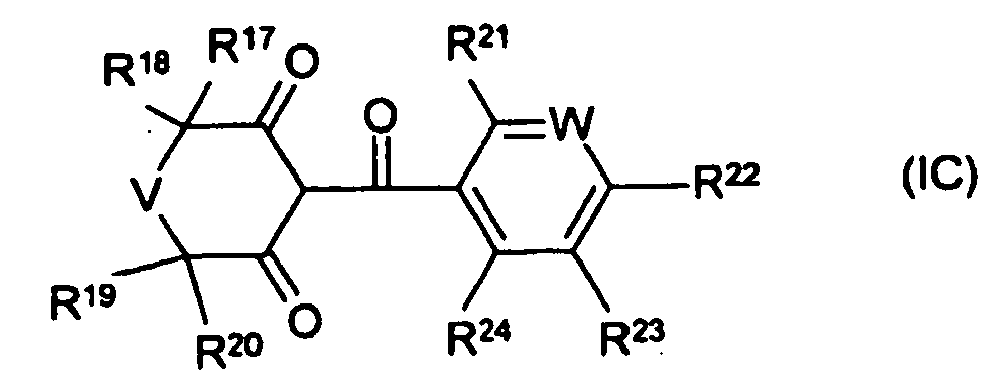 worin V C1-2-Alkylen, das ein- oder mehrfach mit R26 substituiert sein kann, darstellt; oder, wenn R18 und R19 von C2-3-Alkylen verschieden sind, kann V zusätzlich Carbonyl, Sauerstoff oder -NR27- sein;W CR28 oder N(O)g darstellt;R17, R18, R19 und R20 unabhängig Wasserstoff, C1-4-Alkyl, Phenyl, C1-4-Alkoxy, Halogen, Hydroxy, Cyano, Hydroxycarbonyl oder C1-4-Alkoxycarbonyl darstellen; oder R18 und R19 zusammen C2-3-Alkylen, das ein- oder mehrfach mit R25 substituiert sein kann, darstellen;R21 Wasserstoff, C1-6-Alkyl, C1-6-Halogenalkyl, C2-6-Alkenyl, C2-6-Halogenalkenyl, C1-2-Alkoxycarbonyl- oder Phenyl-substituiertes Vinyl, C2-6-Alkinyl, C2-6-Halogenalkinyl, Trimethylsilyl-, Hydroxy-, C1-6-Alkoxy-, C Alkoxycarbonyl- oder Phenyl-substituiertes Ethinyl, C3-6-Allenyl, C3-6-Cycloalkyl, Halogen- oder C1-3-Alkoxymethyl-substituiertes C3-6-Cycloalkyl, C1-6-Alkoxy, C3-6-Alkenyloxy, C3-6-Alkinyloxy, C1-6-Halogenalkoxy, C3-6-Halogenalkenyloxy, Cyano-C1-4-alkoxy, C1-4-Alkoxy-C1-4-alkoxy, C1-4-Alkylthio-C1-4-alkoxy, C1-4-Alkylsulfinyl-C1-4-alkoxy, C1-4-Alkylsulfonyl-C1-4-alkoxy, C1-4-Alkoxycarbonyl-C1-4-alkoxy, C1-6-Alkylthio, C1-6-Alkylsulfinyl, C1-6-Alkylsulfonyl, C1-6-Halogenalkylthio, C1-6-Halogen-alkylsulfinyl, C1-6-Halogen-alkylsulfonyl, C1-4-Alkoxycarbonyl-C1-4-alkylthio, C1-4-Alkoxycarbonyl-C1-4-alkylsulfinyl, C1-4-Alkoxycarbonyl-C1-4-alkylsulfonyl, C1-6-Alkylamino, Di-(C1-6-alkyl)-amino, C1-3-Alkoxy-C1-3-alkylamino, C1-3-Alkoxy-C1-3-alkyl-N-(C1-3-alkyl), C1-6-Alkylaminosulfonyl, Di-(C1-6-alkyl)-aminosulfonyl, C1-4-Alkylsulfonyloxy, C1-4-Halogen-alkylsulfonyloxy, C1-4-Alkylsulfonyl-amino, C1-4-Alkylsulfonyl-N-(C1-4-alkyl), Cyano, Carbamoyl, C1-4-Alkoxycarbonyl, Formyl, Halogen, Rhodano, Amino, Hydroxy-C1-4-alkyl, C1-4-Alkoxy-C1-4-alkyl, C1-4-Alkylthio-C1-4-alkyl, C1-4-Alkylsulfinyl-C1-4-alkyl, C1-4-Alkylsulfonyl-C1-4-alkyl, Cyano-C1-4-alkyl, C1-6-Alkylcarbonyloxy-C1-4-alkyl, C1-4-Alkoxycarbonyl-C1-4-alkyl, C1-4-Alkoxycarbonyloxy-C1-4-alkyl, Rhodano-C1-4-alkyl, Phenyl-C1-4-alkyl, Phenoxy-C1-4-alkyl, Benzyloxy-C1-4-alkyl, Benzoyloxy-C1-4-alkyl, (2-Oxiranyl)-C1-4-alkyl, C1-4-Alkylamino-C1-4-alkyl, Di-(C1-4-alkyl)-amino-C1-4-alkyl, C1-12-Alkylthiocarbonyl-C1-4-alkyl oder Formyl-C1-4-alkyl, oder Benzylthio, Benzylsulfinyl, Benzylsulfonyl, Benzyloxy, Benzyl, Phenyl, Phenoxy, Phenylthio, Phenylsulfinyl oder Phenylsulfonyl, wobei die Phenyl-enthaltenden Gruppen selbst mit C1-3-Alkyl, C1-3-Halogenalkyl, C1-3-Alkoxy, C1-3-Halogenalkoxy, Halogen, Cyano oder mit Nitro substituiert sein können, darstellt; oderR21 ein drei- bis zehn-gliedriges monocyclisches oder kondensiertes bicyclisches Ringsystem darstellt, das aromatisch, gesättigt oder teilweise gesättigt sein kann und von 1 bis 4 Heteroatome, ausgewählt aus Stickstoff, Sauerstoff und Schwefel, enthalten kann, wobei das Ringsystem an den die Gruppe W enthaltenden aromatischen Ring mit Hilfe einer C1-4-Alkylen-, C2-4-Alkenylen- oder C2-4-Alkinylen-Brücke, die unterbrochen sein kann durch Sauerstoff, -N(C1-4-Alkyl)-, Schwefel, Sulfinyl, Sulfonyl oder durch Carbonyl, gebunden ist und jedes Ringsystem nicht mehr als zwei Sauerstoff-Atome und nicht mehr als zwei Schwefel-Atome enthalten kann, und das Ringsystem selbst ein-, zwei- oder dreifach mit C1-6-Alkyl, C1-6-Halogenalkyl, C2-6-Alkenyl, C2-6-Halogenalkenyl, C2-6-Alkinyl, C2-6-Halogenalkinyl, C1-6-Alkoxy, C1-6-Halogenalkoxy, C3-6-Alkenyloxy, C3-6-Alkinyloxy, Hydroxy, Mercapto, C1-6-Alkylthio, C1-6-Halogenalkylthio, C3-6-Alkenylthio, C3-6-Halogenalkenylthio, C3-6-Alkinylthio, C1-4-Alkoxy-C1-3-alkylthio, C1-4-Alkylcarbonyl-C1-3-alkylthio, C1-4-Alkoxycarbonyl-C1-3-alkylthio, Cyano-C1-3-alkylthio, C1-6-Alkylsulfinyl, C1-6-Halogen-alkylsulfinyl, C1-6-Alkylsulfonyl, C1-6-Halogen-alkylsulfonyl, Aminosulfonyl, C1-4-Alkylaminosulfonyl, Di-(C1-4-alkyl)-aminosulfonyl, Di-(C1-4-alkyl)-amino, Halogen, Cyano, Nitro, Phenyl und/oder mit Benzylthio substituiert sein kann, wobei Phenyl und Benzylthio selbst an dem Phenyl-Ring mit C1-3-Alkyl, C1-3-Halogenalkyl, C1-3-Alkoxy, C1-3-Halogenalkoxy, Halogen, Cyano oder mit Nitro substituiert sein können, und wobei die Substituenten an dem Stickstoff in dem heterocyclischen Ring von Halogen verschieden sind, darstellt; oderR21 die Gruppe -D1-D3 oder die Gruppe -D2-D1-D3 darstellt;R22 Wasserstoff, C1-6-Alkyl, C1-6-Halogenalkyl, C2-6-Alkenyl, C2-6-Halogenalkenyl, C2-6-Alkinyl, C2-6-Halogenalkinyl, C3-6-Cycloalkyl, C1-6-Alkoxy, C1-6-Halogenalkoxy, C1-6-Alkylthio, C1-6-Alkylsulfinyl, C1-6-Alkylsulfonyl, C1-6-Halogen-alkylthio, C1-6-Halogen-alkylsulfinyl, C1-6-Halogen-alkylsulfonyl, C1-6-Alkylsulfonyloxy, Hydroxy, Mercapto, Amino, C1-6-Alkylamino, Di-(C1-6-alkyl)-amino, C1-4-Alkylsulfonylamino, C1-4-Alkylsulfonyl-N-(C1-4-alkyl)-, C1-6-Alkylaminosulfonyl, Di-(C1-6-alkyl)-aminosulfonyl, Cyano, Halogen, C1-4-Alkoxy-C1-4-alkyl, C1-4-Alkylthio-C1-4-alkyl, C1-4-Alkylsulfinyl-C1-4-alkyl, C1-4-Alkylsulfonyl-C1-4-alkyl, Triazolyl, Phenyl, Phenylthio, Phenylsulfinyl, Phenylsulfonyl oder Phenoxy, worin die Phenyl-enthaltenden Gruppen mit C1-3-Alkyl, C1-3-Halogenalkyl, C1-3-Alkoxy, C1-3-Halogenalkoxy, Halogen, Cyano oder mit Nitro substituiert sein können, darstellt;R23 Wasserstoff, C1-6-Alkyl, Hydroxy, C1-6-Alkoxy, C1-6-Halogenalkoxy, C3-6-Alkenyloxy, C3-6-Halogen-alkenyloxy, C3-6-Alkinyloxy, C1-4-Alkylcarbonyloxy, C1-4-Alkylsulfonyloxy, Phenylsulfonyloxy, C1-4-Alkylthio, C1-4-Alkylsulfinyl, C1-4-Alkylsulfonyl, C1-4-Alkylamino, Di-(C1-4-alkyl)-amino, C1-4-Alkoxycarbonyl, C1-4-Halogenalkyl, Formyl, Cyano, Halogen, Phenyl oder Phenoxy, wobei die Phenyl-enthaltenden Gruppen selbst mit C1-3-Alkyl, C1-3-Halogenalkyl, C1-3-Alkoxy, C1-3-Halogenalkoxy, Halogen, Cyano oder mit Nitro substituiert sein können, darstellt; oderR23 ein drei- bis zehn-gliedriges monocyclisches oder, zusammen mit R25 oder R27, kondensiertes bicyclisches Ringsystem, das von 1 bis 4 Heteroatome, ausgewählt aus Stickstoff, Sauerstoff und Schwefel, enthalten kann, wobei, wenn das Ringsystem nicht kondensiert ist, es an den W enthaltenden aromatischen Ring, entweder direkt oder mit Hilfe einer C1-4-Alkylen-, C2-4-Alkenylen- oder C2-4-Alkinylen-Brücke, die unterbrochen sein kann durch Sauerstoff, -N(C1-4-Alkyl)-, Schwefel, Sulfinyl, Sulfonyl oder durch Carbonyl, gebunden ist und das Ringsystem nicht mehr als zwei Sauerstoff-Atome und nicht mehr als zwei Schwefel-Atome enthalten kann, und das Ringsystem selbst ein-, zwei- oder dreifach mit C1-6-Alkyl, C1-6-Halogenalkyl, C2-6-Alkenyl, C2-6-Halogenalkenyl, C2-6-Alkinyl, C2-6-Halogenalkinyl, C1-6-Alkoxy, C1-6-Halogenalkoxy, C3-6-Alkenyloxy, C3-6-Alkinyloxy, C1-6-Alkylthio, C1-6-Halogenalkylthio, C3-6-Alkenylthio, C3-6-Halogenalkenylthio, C3-6-Alkinylthio, C1-4-Alkoxy-C1-2-alkylthio, C1-4-Alkylcarbonyl-C1-2-alkylthio, C1-4-Alkoxycarbonyl-C1-2-alkylthio, Cyano-C1-4-alkylthio, C1-6-Alkylsulfinyl, C1-6-Halogenalkylsulfinyl, C1-6-Alkylsulfonyl, C1-6-Halogenalkylsulfonyl, Aminosulfonyl, C1-4-Alkyl-aminosulfonyl, Di-(C1-4-alkyl)-aminosulfonyl, Amino, C1-4-Alkylamino, Di-(C1-4-alkyl)-amino, Halogen, Cyano, Nitro, Phenyl und/oder mit Benzylthio substituiert ist, wobei Phenyl und Benzylthio selbst an dem Phenyl-Ring mit C1-3-Alkyl, C1-3-Halogenalkyl, C1-3-Alkoxy, C1-3-Halogenalkoxy, Halogen, Cyano oder mit Nitro substituiert sein können, und wobei die Substituenten an dem Stickstoff in dem heterocyclischen Ring von Halogen verschieden sind, darstellt;R24 Wasserstoff, C1-6-Alkyl, C1-6-Halogenalkyl, C2-6-Alkenyl, C2-6-Halogenalkenyl, C2-6-Alkinyl, C2-6-Halogenalkinyl, C3-6-Cycloalkyl, C1-6-Alkoxy, C1-6-Halogenalkoxy, C1-6-Alkylthio, C1-6-Alkylsulfinyl, C1-6-Alkylsulfonyl, C1-6-Halogenalkylthio, C1-6-Halogen-alkylsulfinyl, C1-6-Halogen-alkylsulfonyl, Amino, C1-6-Alkylamino, Di-(C1-6-alkyl)-amino, C1-4-Alkylsulfonyl-N-(C1-4-alkyl)-, C1-6-Alkylaminosulfonyl, Di-(C1-6-alkyl)-aminosulfonyl, Cyano, Halogen, C1-4-Alkoxy-C1-4-alkyl, C1-4-Alkylthio-C1-4-alkyl, C1-4-Alkylsulfinyl-C1-4-alkyl, C1-4-Alkylsulfonyl-C1-4-alkyl, Phenyl, Phenylthio, Phenylsulfinyl, Phenylsulfonyl oder Phenoxy, wobei die Phenyl-Gruppen selbst mit C1-3-Alkyl, C1-3-Halogenalkyl, C1-3-Alkoxy, C1-3-Halogenalkoxy, Halogen, Cyano oder mit Nitro substituiert sein können, darstellt;R25 und R26 jeweils unabhängig Wasserstoff, C1-4-Alkyl, Phenyl, C1-4-Alkoxy, Halogen, Hydroxy, Cyano, Hydroxycarbonyl oder C1-4-Alkoxycarbonyl darstellen;R27 C1-4-Alkyl, Alkoxycarbonyl oder C1-4-Alkylcarbonyl darstellt;R28 Wasserstoff, C1-6-Alkyl, Hydroxy, C1-6-Alkoxy, C1-6-Halogenalkoxy, C3-6-Alkenyloxy, C3-6-Halogenalkenyloxy, C3-6-Alkinyloxy, C1-4-Alkylcarbonyloxy, C1-4-Alkylsulfonyloxy, Phenylsulfonyloxy, C1-6-Alkylthio, C1-6-Alkylsulfinyl, C1-6-Alkylsulfonyl, C1-6-Alkylamino, Di-(C1-6-alkyl)-amino, C1-3-Alkoxy-C1-3-alkylamino, C1-3-Alkoxy-C1-3-alkyl-N-(C1-3-alkyl)-, C1-4-Alkoxycarbonyl, C1-6-Halogenalkyl, Formyl, Cyano, Halogen, Phenyl oder Phenoxy, wobei die Phenyl-enthaltenden Gruppen selbst mit C1-3-Alkyl, C1-3-Halogenalkyl, C1-3-Alkoxy, C1-3-Halogenalkoxy, Halogen, Cyano oder mit Nitro substituiert sein können, darstellt; oderR28 ein drei- bis zehn-gliedriges monocyclisches oder, zusammen mit R21 oder R22 kondensiertes bicyclisches Ringsystem darstellt, das einmal oder bis zu dreimal unterbrochen sein kann mit heterocyclischen Substituenten, ausgewählt aus Sauerstoff, Schwefel, S(O), SO2, N(R29), Carbonyl und C(=NOR30), und wobei, wenn das Ringsystem nicht kondensiert ist, es an das Kohlenstoff-Atom von dem Substituenten W, entweder direkt oder mit Hilfe einer C1-4-Alkylen-, C2-4-Alkenylen- oder C2-4-Alkinylen-Brücke, die unterbrochen sein kann durch Sauerstoff, -N(C1-4-Alkyl)-, Schwefel, Sulfinyl oder durch Sulfonyl, gebunden ist, und das Ringsystem nicht mehr als zwei Sauerstoff-Atome und nicht mehr als zwei Schwefel-Atome enthalten kann, und das Ringsystem selbst ein-, zwei- oder dreifach mit C1-6-Alkyl, C1-6-Halogenalkyl, C2-6-Alkenyl, C2-6-Halogenalkenyl, C2-6-Alkinyl, C2-6-Halogenalkinyl, C1-6-Alkoxy, C1-6-Halogenalkoxy, C3-6-Alkenyloxy, C3-6-Alkinyloxy, C1-6-Alkylthio, C1-6-Halogenalkylthio, C3-6-Alkenylthio, C3-6-Halogenalkenylthio, C3-6-Alkinylthio, C1-4-Alkoxy-C1-2-alkylthio, C1-4-Alkylcarbonyl-C1-2-alkylthio, C1-4-Alkoxycarbonyl-C1-2-alkylthio, Cyano-C1-4-alkylthio, C1-6-Alkylsulfinyl, C1-6-Halogenalkylsulfinyl, C1-6-Alkylsulfonyl, C1-6-Halogenalkylsulfonyl, Aminosulfonyl, C1-4-Alkylaminosulfonyl, Di-(C1-4-alkyl)-aminosulfonyl, Di-(C1-4-alkyl)-amino, Halogen, Cyano, Nitro, Phenyl, Benzyloxy und/oder mit Benzylthio substituiert sein kann, und wobei die Phenyl-enthaltenden Gruppen selbst an dem Phenyl-Ring mit C1-3-Alkyl, C1-3-Halogenalkyl, C1-3-Alkoxy, C1-3-Halogenalkoxy, Halogen, Cyano oder mit Nitro substituiert sein können, und wobei die Substituenten an dem Stickstoff in dem heterocyclischen Ring von Halogen verschieden sind;oder R28 die Gruppe -D4-D6 oder die Gruppe -D5-D4-D6 darstellt;R29 Wasserstoff, C1-4-Alkyl, C1-4-Alkylthio-C1-4-alkylcarbonyl, C1-4-Alkylsulfinyl-C1-4-alkylcarbonyl, C1-4-Alkylsulfonyl-C1-4-alkylcarbonyl, C1-4-Alkoxycarbonyl, C1-4-Alkylcarbonyl, Phenylcarbonyl oder Phenyl, wobei die Phenyl-Gruppen selbst mit C1-4-Alkyl, C1-4-Halogenalkyl, C1-4-Alkoxy, C1-4-Halogenalkoxy, C1-4-Alkylcarbonyl, C1-4-Alkoxycarbonyl, C1-4-Alkylamino, Di-(C1-4-alkyl)-amino, C1-4-Alkylthio, C1-4-Alkylsulfinyl, C1-4-Alkyl-SO2, C1-4-Alkyl-S(O)2O, C1-4-Halogenalkylthio, C1-4-Halogenalkylsulfinyl, C1-4-Halogenalkyl-SO2, C1-4-Halogenalkyl-S(O)2O, C1-4-Alkyl-S(O)2NH, C1-4-Alkyl-S(O)2N(C1-4-alkyl)-, Halogen, Nitro oder mit Cyano substituiert sein können, darstellt;R30 Wasserstoff, C1-4-Alkyl, C3-4-Alkenyl, C3-4-Alkinyl oder Benzyl darstellt;h 0 oder 1 ist;D1 Sauerstoff, -O(CO)-, -(CO)O-, -O(CO)O-, -N(C1-4-Alkyl)-O-, -O-N(C1-4-Alkyl)-, Thio, Sulfinyl, Sulfonyl, -SO2N(C1-4-Alkyl)-, -N(C1-4-Alkyl)SO2-, -N(C1-2-Alkoxy-C1-2-alkyl)SO2- oder -N(C1-4-Alkyl)- darstellt;D2 eine C1-6-Alkylen-, C3-6-Alkenylen- oder C3-6-Alkinylen-Kette darstellt, die mit Halogen oder mit D7 ein- oder mehrfach substituiert sein kann, wobei die ungesättigten Bindungen der Kette nicht direkt an den Substituenten D1 gebunden sind;D3 und D6 jeweils unabhängig von dem anderen eine C1-8-Alkyl-, C3-6-Alkenyl- oder C3-6-Alkinyl-Gruppe, die ein- oder mehrfach substituiert sein kann mit Halogen, Hydroxy, Amino, Formyl, Nitro, Cyano, Mercapto, Carbamoyl, C1-6-Alkoxy, C1-6-Alkoxycarbonyl, C2-6-Alkenyl, C2-6-Halogenalkenyl, C2-6-Alkinyl, C2-6-Halogenalkinyl, C3-6-Cycloalkyl, Halogen-substituiertem C3-6-Cycloalkyl, C3-6-Alkenyloxy, C3-6-Alkinyloxy, C1-6-Halogenalkoxy, C3-6-Halogenalkenyloxy, Cyano-C1-6-alkoxy, C1-6-Alkoxy-C1-6-alkoxy, C1-6-Alkoxy-C1-6-alkoxy-C1-6-alkoxy, C1-6-Alkylthio-C1-6-alkoxy, C1-6-Alkylsulfinyl-C1-6-alkoxy, C1-6-Alkylsulfonyl-C1-6-alkoxy, C1-6-Alkoxy-carbonyl-C1-6-alkoxy, C1-6-Alkoxycarbonyl, C1-6-Alkylcarbonyl, C1-6-Alkylthio, C1-6-Alkylsulfinyl, C1-6-Alkylsulfonyl, C1-6-Halogenalkylthio, C1-6-Halogenalkylsulfinyl, C1-6-Halogenalkyl-sulfonyl, Oxiranyl, das selbst substituiert sein kann mit C1-6-Alkyl, (3-Oxetanyl)-oxy, das selbst substituiert sein kann mit C1-6-Alkyl, Benzyloxy, Benzylthio, Benzylsulfinyl, Benzylsulfonyl, C1-6-Alkylamino, Di-(C1-6-alkyl)-amino, C1-4-Alkyl-S(O)2O, Di-(C1-4-alkyl)-aminosulfonyl, Rhodano, Phenyl, Phenoxy, Phenylthio, Phenylsulfinyl oder mit Phenylsulfonyl, und wobei die Phenyl- oder Benzyl-enthaltenden Gruppen selbst mit einer oder mehreren C1-6-Alkyl-, C1-6-Halogenalkyl-, C1-6-Alkoxy-, C1-6-Halogenalkoxy-, Halogen-, Cyano-, Hydroxy- oder Nitro-Gruppen substituiert sein können, darstellen; oderD3 und D6 jeweils unabhängig von dem anderen Phenyl, das ein-, zwei- oder dreifach mit C1-6-Alkyl, C1-6-Halogenalkyl, C1-6-Alkoxy, C1-6-Halogenalkoxy, Halogen, Cyano, Hydroxy oder mit Nitro substituiert sein kann, darstellen; oderD3 und D6 jeweils unabhängig von dem anderen C3-6-Cycloalkyl, C1-6-Alkoxy- oder C1-6-Alkyl-substituiertes C3-6-Cycloalkyl, 3-Oxetanyl oder C1-6-Alkyl-substituiertes 3-Oxetanyl darstellen; oderD3 und D6 jeweils unabhängig von dem anderen ein drei- bis zehn-gliedriges monocyclisches oder kondensiertes bicyclisches Ringsystem, das aromatisch, gesättigt oder teilweise gesättigt sein kann und von 1 bis 4 Heteroatome, ausgewählt aus Stickstoff, Sauerstoff und Schwefel, enthalten kann, wobei das Ringsystem an den Substituenten D1 oder D4 direkt oder mit Hilfe einer C1-4-Alkylen-, C2-4-Alkenylen-, C2-4-Alkinylen-, -N(C1-4-Alkyl)-C1-4-alkylen-, -S(O)-C1-4-Alkylen- oder -SO2-C1-4-Alkylen-Gruppe gebunden ist, und jedes Ringsystem nicht mehr als zwei Sauerstoff-Atome und nicht mehr als zwei Schwefel-Atome enthalten kann, und das Ringsystem selbst ein-, zwei- oder dreifach mit C1-6-Alkyl, C1-6-Halogenalkyl, C2-6-Alkenyl, C2-6-Halogenalkenyl, C2-6-Alkinyl, C2-6-Halogenalkinyl, C1-6-Alkoxy, Hydroxy, C1-6-Halogenalkoxy, C3-6-Alkenyloxy, C3-6-Alkinyloxy, Mercapto, C1-6-Alkylthio, C1-6-Halogenalkylthio, C3-6-Alkenylthio, C3-6-Halogenalkenylthio, C3-6-Alkinylthio, C1-3-Alkoxy-C1-3-alkylthio, C1-4-Alkylcarbonyl-C1-2-alkylthio, C1-4-Alkoxycarbonyl-C1-2-alkylthio, Cyano-C1-3-alkylthio, C1-6-Alkylsulfinyl, C1-6-Halogenalkylsulfinyl, C1-6-Alkylsulfonyl, C1-6-Halogenalkylsulfonyl, Aminosulfonyl, C1-2-Alkylaminosulfonyl, Di-(C1-2-alkyl)-aminosulfonyl, Di-(C1-4-alkyl)-amino, C1-6-Carbonylamino, Halogen, Cyano, Nitro, Phenyl, Benzyloxy und/oder mit Benzylthio substituiert sein kann, wobei die Phenyl-Gruppen selbst an dem Phenyl-Ring mit C1-3-Alkyl, C1-3-Halogenalkyl, C1-3-Alkoxy, C1-3-Halogenalkoxy, Halogen, Cyano oder mit Nitro substituiert sein können, und wobei die Substituenten an dem Stickstoff in dem heterocyclischen Ring von Halogen verschieden sind, darstellen;D4 Sauerstoff, -O(CO)-, -(CO)O-, -O(CO)O-, -N(C1-4-Alkyl)-O-, -O-N(C1-4-Alkyl)-, Schwefel, Sulfinyl, Sulfonyl, -SO2N(C1-4-Alkyl)-, -N(C1-4-Alkyl)SO2-, -N(C1-2-Alkoxy-C1-2-alkyl)SO2- oder -N(C1-4-Alkyl)- darstellt;D5 eine C1-6-Alkylen-, C3-6-Alkenylen- oder C3-6-Alkinylen-Kette, die ein- oder mehrfach mit Halogen oder mit D8 substituiert sein kann, wobei die ungesättigten Bindungen der Kette nicht direkt an den Substituenten D4 gebunden sind, darstellt;D7 und D8 jeweils unabhängig von dem anderen Hydroxy, C1-6-Alkoxy, (C3-6-Cycloalkyl)-oxy, C1-6-Alkoxy-C1-6-alkoxy, C1-6-Alkoxy-C1-6-alkoxy-C1-6-alkoxy oder C1-6-Alkylsulfonyloxy darstellen;und agronomisch verträgliche Salze / N-Oxide / Isomere / Enantiomere von solchen Verbindungen.
 - Verwendung nach Anspruch 1, wobei das Triketon eine Verbindung der Formel (ID) darstellt

- Verwendung nach Anspruch 1, wobei das Pyrazol eine Verbindung der Formel (IE) darstellt
 worin R33, R34, R35 und R36 jeweils unabhängig aus Wasserstoff, Halogen oder C1-4-Alkyl ausgewählt sind;X -SO2- oder -CH2CO- darstellt;j 2 oder 3 ist; undk null oder 1 ist.
 - Verwendung nach Anspruch 1, wobei das Pyrazol eine Verbindung der Formel (IF) darstellt

- Verwendung nach Anspruch 1, wobei der HPPD-Inhibitor Benzobicyclon darstellt.
- Verwendung nach Anspruch 1, wobei der HPPD-Inhibitor Ketospiradox darstellt.
- Verwendung nach einem der Ansprüche 1 bis 9, wobei der Elektrolyt aus der Gruppe, bestehend aus einer einfachen ionischen Spezies oder einem zusätzlichen Wirkbestandteil, ausgewählt ist.
- Verwendung nach einem vorangehenden Anspruch, wobei das Verhältnis von HPPD-Inhibitor zu Elektrolyt in der Formulierung von 70 : 1 bis 1 : 5 ist.
- Verwendung nach einem vorangehenden Anspruch, wobei die Konzentration von HPPD-Inhibitor in der Formulierung von 10 bis 600 g/l ist.
- Verwendung nach einem vorangehenden Anspruch, wobei die Konzentration von Elektrolyt in der Formulierung von 10 bis 700 g/l ist.
Applications Claiming Priority (2)
| Application Number | Priority Date | Filing Date | Title |
|---|---|---|---|
| GBGB0414895.3A GB0414895D0 (en) | 2004-07-02 | 2004-07-02 | Herbicidal formulation |
| PCT/GB2005/002443 WO2006003371A2 (en) | 2004-07-02 | 2005-06-21 | Herbicidal suspension concentrate formulation |
Publications (2)
| Publication Number | Publication Date |
|---|---|
| EP1796471A2 EP1796471A2 (de) | 2007-06-20 |
| EP1796471B1 true EP1796471B1 (de) | 2008-12-31 |
Family
ID=32843495
Family Applications (1)
| Application Number | Title | Priority Date | Filing Date |
|---|---|---|---|
| EP05753194A Expired - Lifetime EP1796471B1 (de) | 2004-07-02 | 2005-06-21 | Formulierung für ein herbizides suspensionskonzentrat |
Country Status (15)
| Country | Link |
|---|---|
| US (1) | US20080269060A1 (de) |
| EP (1) | EP1796471B1 (de) |
| JP (1) | JP4965441B2 (de) |
| CN (1) | CN1976589B (de) |
| AR (1) | AR052975A1 (de) |
| AT (1) | ATE418867T1 (de) |
| BR (1) | BRPI0512849B1 (de) |
| CA (1) | CA2569897C (de) |
| DE (1) | DE602005012129D1 (de) |
| GB (1) | GB0414895D0 (de) |
| GT (1) | GT200500181A (de) |
| MX (1) | MXPA06014153A (de) |
| UA (1) | UA87506C2 (de) |
| WO (1) | WO2006003371A2 (de) |
| ZA (1) | ZA200609992B (de) |
Families Citing this family (13)
| Publication number | Priority date | Publication date | Assignee | Title |
|---|---|---|---|---|
| GB0601304D0 (en) * | 2006-01-23 | 2006-03-01 | Syngenta Ltd | Herbicide formulation |
| UA89599C2 (uk) * | 2006-08-04 | 2010-02-10 | Басф Се | Водний концентрат діючої речовини з гербіцидною дією та спосіб боротьби з небажаним ростом рослин |
| GB0708588D0 (en) * | 2007-05-03 | 2007-06-13 | Syngenta Participations Ag | Herbicidal formulation |
| EP2249642B1 (de) * | 2008-02-20 | 2012-09-12 | Syngenta Participations AG | Herbizidformulierung |
| GB0810554D0 (en) * | 2008-06-09 | 2008-07-16 | Syngenta Ltd | Herbicde composition |
| US9301932B2 (en) | 2011-06-23 | 2016-04-05 | Swedish Orphan Biovitrum International Ab | Liquid pharmaceutical composition comprising nitisinone |
| EP2545774A1 (de) | 2011-07-12 | 2013-01-16 | Cheminova A/S | Suspensionskonzentratzusammensetzungen enthaltend Inhibitoren von HPPD und Smektit-Ton |
| GB201114332D0 (en) | 2011-08-19 | 2011-10-05 | Nufarm Uk Ltd | Novel inhibitor compositions and methods of use |
| WO2017188070A1 (ja) * | 2016-04-28 | 2017-11-02 | クミアイ化学工業株式会社 | 除草農薬組成物及びそれを用いた除草方法 |
| JP6871591B2 (ja) * | 2016-10-11 | 2021-05-12 | フマキラー株式会社 | 除草剤 |
| JP7079375B2 (ja) * | 2019-03-18 | 2022-06-01 | クミアイ化学工業株式会社 | 水性懸濁農薬組成物およびその散布方法 |
| US20210378241A1 (en) * | 2020-06-03 | 2021-12-09 | Generic Crop Science LLC | Combination comprising a benzamide herbicide and a pyridine carboxylic acid herbicide, and a method for making and using the combination |
| US12575570B2 (en) * | 2020-12-02 | 2026-03-17 | Valent U.S.A., Llc | Aqueous composition of Epyrifenacil, Mesotrione and Pyroxasulfone |
Family Cites Families (11)
| Publication number | Priority date | Publication date | Assignee | Title |
|---|---|---|---|---|
| DK169734B1 (da) * | 1993-03-09 | 1995-01-30 | Kvk Agro As | Herbicidpræparat, fremgangsmåde til fremstilling heraf samt aktiverende additiv til opblanding med herbicidpræparater |
| DE19836684A1 (de) * | 1998-08-13 | 2000-02-17 | Hoechst Schering Agrevo Gmbh | Herbizide Mittel für tolerante oder resistente Reiskulturen |
| GB9904012D0 (en) * | 1999-02-22 | 1999-04-14 | Zeneca Ltd | Agrochemical formulation |
| EP1161868A1 (de) * | 2000-06-07 | 2001-12-12 | Aventis Cropscience S.A. | Herbizide Zusammensetzungen |
| JP2002068903A (ja) * | 2000-08-29 | 2002-03-08 | Sds Biotech:Kk | 水面施用乳・懸濁状農薬組成物 |
| GB0103761D0 (en) * | 2001-02-15 | 2001-04-04 | Syngenta Ltd | Agrochemical formulation |
| US6423667B1 (en) * | 2001-05-15 | 2002-07-23 | Honeywell International Inc. | Ammonium sulfate suspensions in oils |
| GB0228326D0 (en) * | 2002-12-04 | 2003-01-08 | Syngenta Ltd | Method of controlling unwanted vegitation |
| GB0305679D0 (en) * | 2003-03-12 | 2003-04-16 | Syngenta Ltd | Agrochemical formulation |
| AU2004296743B2 (en) * | 2003-12-05 | 2010-08-05 | Syngenta Participations Ag | Submicron mesotrione compositions |
| GB0405760D0 (en) * | 2004-03-15 | 2004-04-21 | Syngenta Participations Ag | Agrochemical formulation |
-
2004
- 2004-07-02 GB GBGB0414895.3A patent/GB0414895D0/en not_active Ceased
-
2005
- 2005-06-21 BR BRPI0512849-8A patent/BRPI0512849B1/pt active IP Right Grant
- 2005-06-21 EP EP05753194A patent/EP1796471B1/de not_active Expired - Lifetime
- 2005-06-21 CN CN2005800217633A patent/CN1976589B/zh not_active Expired - Lifetime
- 2005-06-21 JP JP2007518675A patent/JP4965441B2/ja not_active Expired - Lifetime
- 2005-06-21 UA UAA200701039A patent/UA87506C2/ru unknown
- 2005-06-21 US US11/570,820 patent/US20080269060A1/en not_active Abandoned
- 2005-06-21 AT AT05753194T patent/ATE418867T1/de not_active IP Right Cessation
- 2005-06-21 MX MXPA06014153A patent/MXPA06014153A/es active IP Right Grant
- 2005-06-21 WO PCT/GB2005/002443 patent/WO2006003371A2/en not_active Ceased
- 2005-06-21 DE DE602005012129T patent/DE602005012129D1/de not_active Expired - Lifetime
- 2005-06-21 CA CA2569897A patent/CA2569897C/en not_active Expired - Lifetime
- 2005-06-30 AR ARP050102735A patent/AR052975A1/es active IP Right Grant
- 2005-07-01 GT GT200500181A patent/GT200500181A/es unknown
-
2006
- 2006-11-29 ZA ZA200609992A patent/ZA200609992B/en unknown
Also Published As
| Publication number | Publication date |
|---|---|
| JP2008504354A (ja) | 2008-02-14 |
| CA2569897C (en) | 2012-10-16 |
| BRPI0512849B1 (pt) | 2019-10-01 |
| UA87506C2 (ru) | 2009-07-27 |
| AR052975A1 (es) | 2007-04-18 |
| ZA200609992B (en) | 2008-07-30 |
| US20080269060A1 (en) | 2008-10-30 |
| WO2006003371A2 (en) | 2006-01-12 |
| CN1976589A (zh) | 2007-06-06 |
| GB0414895D0 (en) | 2004-08-04 |
| EP1796471A2 (de) | 2007-06-20 |
| BRPI0512849A (pt) | 2008-04-08 |
| MXPA06014153A (es) | 2007-01-29 |
| CA2569897A1 (en) | 2006-01-12 |
| GT200500181A (es) | 2006-03-02 |
| JP4965441B2 (ja) | 2012-07-04 |
| DE602005012129D1 (de) | 2009-02-12 |
| ATE418867T1 (de) | 2009-01-15 |
| WO2006003371A3 (en) | 2006-04-27 |
| CN1976589B (zh) | 2012-12-12 |
Similar Documents
| Publication | Publication Date | Title |
|---|---|---|
| EP2249642B1 (de) | Herbizidformulierung | |
| EP2250890B1 (de) | Synergistische herbizide Mittel | |
| ES2727658T3 (es) | Composiciones herbicidas que comprenden ácido 4-amino-3-cloro-5-fluoro-6-(4-cloro-2-fluoro-3-metoxifenil)piridina-2-carboxílico | |
| RU2632942C2 (ru) | Гербицидные композиции, содержащие 4-амино-3-хлор-5-фтор-6-(4-хлор-2-фтор-3-метоксифенил)пиридин-2-карбоновую кислоту или ее производное и диметоксипиримидин и его производные | |
| JP7015816B2 (ja) | ペノキシスラムおよびベンゾビシクロンまたはクロマゾンおよびベンゾビシクロンの施用からの相乗的雑草防除 | |
| DE102005031787A1 (de) | Kulturpflanzenverträgliche herbizide Mittel enthaltend Herbizide Safener | |
| CA2569897C (en) | Herbicidal suspension concentrate formulation | |
| WO2010136165A2 (de) | Herbizid-kombinationen enthaltend tefuryltrione für den einsatz in reis-kulturen | |
| BR102014006037A2 (pt) | composições herbicidas compreendendo ácido 4-amino-3-cloro-5-flúor-6-(4-cloro-2-flúor-3-metoxifenil) piridina-2-carboxílico ou um derivado do mesmo e fungicidas | |
| WO2006103002A1 (de) | Synergistische kulturpflanzenverträgliche herbizide mittel enthaltend herbizide aus der gruppe der benzoylpyrazole | |
| BR112021008290A2 (pt) | composições compreendendo halauxifeno e outros herbicidas e métodos das mesmas | |
| WO2025163678A1 (en) | Herbicidal composition | |
| WO2025163578A1 (en) | Herbicidal compositions and methods for controlling weeds | |
| BR112021008242A2 (pt) | composições que compreendem halauxifeno e outros herbicidas e seus métodos |
Legal Events
| Date | Code | Title | Description |
|---|---|---|---|
| PUAI | Public reference made under article 153(3) epc to a published international application that has entered the european phase |
Free format text: ORIGINAL CODE: 0009012 |
|
| 17P | Request for examination filed |
Effective date: 20070202 |
|
| AK | Designated contracting states |
Kind code of ref document: A2 Designated state(s): AT BE BG CH CY CZ DE DK EE ES FI FR GB GR HU IE IS IT LI LT LU MC NL PL PT RO SE SI SK TR |
|
| AX | Request for extension of the european patent |
Extension state: AL BA HR LV MK YU |
|
| 17Q | First examination report despatched |
Effective date: 20070706 |
|
| GRAP | Despatch of communication of intention to grant a patent |
Free format text: ORIGINAL CODE: EPIDOSNIGR1 |
|
| GRAS | Grant fee paid |
Free format text: ORIGINAL CODE: EPIDOSNIGR3 |
|
| GRAA | (expected) grant |
Free format text: ORIGINAL CODE: 0009210 |
|
| AK | Designated contracting states |
Kind code of ref document: B1 Designated state(s): AT BE BG CH CY CZ DE DK EE ES FI FR GB GR HU IE IS IT LI LT LU MC NL PL PT RO SE SI SK TR |
|
| AX | Request for extension of the european patent |
Extension state: AL BA HR LV MK YU |
|
| REG | Reference to a national code |
Ref country code: CH Ref legal event code: EP Ref country code: GB Ref legal event code: FG4D |
|
| REF | Corresponds to: |
Ref document number: 602005012129 Country of ref document: DE Date of ref document: 20090212 Kind code of ref document: P |
|
| REG | Reference to a national code |
Ref country code: IE Ref legal event code: FG4D |
|
| REG | Reference to a national code |
Ref country code: RO Ref legal event code: EPE |
|
| PG25 | Lapsed in a contracting state [announced via postgrant information from national office to epo] |
Ref country code: FI Free format text: LAPSE BECAUSE OF FAILURE TO SUBMIT A TRANSLATION OF THE DESCRIPTION OR TO PAY THE FEE WITHIN THE PRESCRIBED TIME-LIMIT Effective date: 20081231 Ref country code: NL Free format text: LAPSE BECAUSE OF FAILURE TO SUBMIT A TRANSLATION OF THE DESCRIPTION OR TO PAY THE FEE WITHIN THE PRESCRIBED TIME-LIMIT Effective date: 20081231 Ref country code: PL Free format text: LAPSE BECAUSE OF FAILURE TO SUBMIT A TRANSLATION OF THE DESCRIPTION OR TO PAY THE FEE WITHIN THE PRESCRIBED TIME-LIMIT Effective date: 20081231 Ref country code: SI Free format text: LAPSE BECAUSE OF FAILURE TO SUBMIT A TRANSLATION OF THE DESCRIPTION OR TO PAY THE FEE WITHIN THE PRESCRIBED TIME-LIMIT Effective date: 20081231 |
|
| NLV1 | Nl: lapsed or annulled due to failure to fulfill the requirements of art. 29p and 29m of the patents act | ||
| REG | Reference to a national code |
Ref country code: HU Ref legal event code: AG4A Ref document number: E004951 Country of ref document: HU |
|
| PG25 | Lapsed in a contracting state [announced via postgrant information from national office to epo] |
Ref country code: LT Free format text: LAPSE BECAUSE OF FAILURE TO SUBMIT A TRANSLATION OF THE DESCRIPTION OR TO PAY THE FEE WITHIN THE PRESCRIBED TIME-LIMIT Effective date: 20081231 Ref country code: ES Free format text: LAPSE BECAUSE OF FAILURE TO SUBMIT A TRANSLATION OF THE DESCRIPTION OR TO PAY THE FEE WITHIN THE PRESCRIBED TIME-LIMIT Effective date: 20090411 Ref country code: BE Free format text: LAPSE BECAUSE OF FAILURE TO SUBMIT A TRANSLATION OF THE DESCRIPTION OR TO PAY THE FEE WITHIN THE PRESCRIBED TIME-LIMIT Effective date: 20081231 Ref country code: EE Free format text: LAPSE BECAUSE OF FAILURE TO SUBMIT A TRANSLATION OF THE DESCRIPTION OR TO PAY THE FEE WITHIN THE PRESCRIBED TIME-LIMIT Effective date: 20081231 |
|
| PG25 | Lapsed in a contracting state [announced via postgrant information from national office to epo] |
Ref country code: AT Free format text: LAPSE BECAUSE OF FAILURE TO SUBMIT A TRANSLATION OF THE DESCRIPTION OR TO PAY THE FEE WITHIN THE PRESCRIBED TIME-LIMIT Effective date: 20081231 Ref country code: SE Free format text: LAPSE BECAUSE OF FAILURE TO SUBMIT A TRANSLATION OF THE DESCRIPTION OR TO PAY THE FEE WITHIN THE PRESCRIBED TIME-LIMIT Effective date: 20090331 Ref country code: IS Free format text: LAPSE BECAUSE OF FAILURE TO SUBMIT A TRANSLATION OF THE DESCRIPTION OR TO PAY THE FEE WITHIN THE PRESCRIBED TIME-LIMIT Effective date: 20090430 Ref country code: CZ Free format text: LAPSE BECAUSE OF FAILURE TO SUBMIT A TRANSLATION OF THE DESCRIPTION OR TO PAY THE FEE WITHIN THE PRESCRIBED TIME-LIMIT Effective date: 20081231 Ref country code: PT Free format text: LAPSE BECAUSE OF FAILURE TO SUBMIT A TRANSLATION OF THE DESCRIPTION OR TO PAY THE FEE WITHIN THE PRESCRIBED TIME-LIMIT Effective date: 20090601 |
|
| PG25 | Lapsed in a contracting state [announced via postgrant information from national office to epo] |
Ref country code: SK Free format text: LAPSE BECAUSE OF FAILURE TO SUBMIT A TRANSLATION OF THE DESCRIPTION OR TO PAY THE FEE WITHIN THE PRESCRIBED TIME-LIMIT Effective date: 20081231 |
|
| PLBI | Opposition filed |
Free format text: ORIGINAL CODE: 0009260 |
|
| PLAB | Opposition data, opponent's data or that of the opponent's representative modified |
Free format text: ORIGINAL CODE: 0009299OPPO |
|
| PG25 | Lapsed in a contracting state [announced via postgrant information from national office to epo] |
Ref country code: DK Free format text: LAPSE BECAUSE OF FAILURE TO SUBMIT A TRANSLATION OF THE DESCRIPTION OR TO PAY THE FEE WITHIN THE PRESCRIBED TIME-LIMIT Effective date: 20081231 |
|
| 26 | Opposition filed |
Opponent name: BASF SE Effective date: 20090929 |
|
| R26 | Opposition filed (corrected) |
Opponent name: BASF SE Effective date: 20090929 |
|
| PLAX | Notice of opposition and request to file observation + time limit sent |
Free format text: ORIGINAL CODE: EPIDOSNOBS2 |
|
| PG25 | Lapsed in a contracting state [announced via postgrant information from national office to epo] |
Ref country code: MC Free format text: LAPSE BECAUSE OF NON-PAYMENT OF DUE FEES Effective date: 20090630 Ref country code: BG Free format text: LAPSE BECAUSE OF FAILURE TO SUBMIT A TRANSLATION OF THE DESCRIPTION OR TO PAY THE FEE WITHIN THE PRESCRIBED TIME-LIMIT Effective date: 20090331 |
|
| GBPC | Gb: european patent ceased through non-payment of renewal fee |
Effective date: 20090621 |
|
| PLAF | Information modified related to communication of a notice of opposition and request to file observations + time limit |
Free format text: ORIGINAL CODE: EPIDOSCOBS2 |
|
| PG25 | Lapsed in a contracting state [announced via postgrant information from national office to epo] |
Ref country code: IE Free format text: LAPSE BECAUSE OF NON-PAYMENT OF DUE FEES Effective date: 20090621 |
|
| PG25 | Lapsed in a contracting state [announced via postgrant information from national office to epo] |
Ref country code: GB Free format text: LAPSE BECAUSE OF NON-PAYMENT OF DUE FEES Effective date: 20090621 |
|
| PLBB | Reply of patent proprietor to notice(s) of opposition received |
Free format text: ORIGINAL CODE: EPIDOSNOBS3 |
|
| PG25 | Lapsed in a contracting state [announced via postgrant information from national office to epo] |
Ref country code: GR Free format text: LAPSE BECAUSE OF FAILURE TO SUBMIT A TRANSLATION OF THE DESCRIPTION OR TO PAY THE FEE WITHIN THE PRESCRIBED TIME-LIMIT Effective date: 20090401 |
|
| PG25 | Lapsed in a contracting state [announced via postgrant information from national office to epo] |
Ref country code: LU Free format text: LAPSE BECAUSE OF NON-PAYMENT OF DUE FEES Effective date: 20090621 |
|
| PG25 | Lapsed in a contracting state [announced via postgrant information from national office to epo] |
Ref country code: TR Free format text: LAPSE BECAUSE OF FAILURE TO SUBMIT A TRANSLATION OF THE DESCRIPTION OR TO PAY THE FEE WITHIN THE PRESCRIBED TIME-LIMIT Effective date: 20081231 |
|
| PG25 | Lapsed in a contracting state [announced via postgrant information from national office to epo] |
Ref country code: CY Free format text: LAPSE BECAUSE OF FAILURE TO SUBMIT A TRANSLATION OF THE DESCRIPTION OR TO PAY THE FEE WITHIN THE PRESCRIBED TIME-LIMIT Effective date: 20081231 |
|
| PLCK | Communication despatched that opposition was rejected |
Free format text: ORIGINAL CODE: EPIDOSNREJ1 |
|
| PLBN | Opposition rejected |
Free format text: ORIGINAL CODE: 0009273 |
|
| STAA | Information on the status of an ep patent application or granted ep patent |
Free format text: STATUS: OPPOSITION REJECTED |
|
| 27O | Opposition rejected |
Effective date: 20111215 |
|
| REG | Reference to a national code |
Ref country code: DE Ref legal event code: R100 Ref document number: 602005012129 Country of ref document: DE Effective date: 20111215 |
|
| REG | Reference to a national code |
Ref country code: FR Ref legal event code: PLFP Year of fee payment: 11 |
|
| PGFP | Annual fee paid to national office [announced via postgrant information from national office to epo] |
Ref country code: RO Payment date: 20150528 Year of fee payment: 11 Ref country code: CH Payment date: 20150528 Year of fee payment: 11 |
|
| PGFP | Annual fee paid to national office [announced via postgrant information from national office to epo] |
Ref country code: HU Payment date: 20150526 Year of fee payment: 11 Ref country code: FR Payment date: 20150528 Year of fee payment: 11 Ref country code: IT Payment date: 20150611 Year of fee payment: 11 |
|
| PGFP | Annual fee paid to national office [announced via postgrant information from national office to epo] |
Ref country code: DE Payment date: 20150630 Year of fee payment: 11 |
|
| REG | Reference to a national code |
Ref country code: DE Ref legal event code: R119 Ref document number: 602005012129 Country of ref document: DE |
|
| PG25 | Lapsed in a contracting state [announced via postgrant information from national office to epo] |
Ref country code: RO Free format text: LAPSE BECAUSE OF NON-PAYMENT OF DUE FEES Effective date: 20160621 |
|
| REG | Reference to a national code |
Ref country code: CH Ref legal event code: PL |
|
| REG | Reference to a national code |
Ref country code: FR Ref legal event code: ST Effective date: 20170228 |
|
| PG25 | Lapsed in a contracting state [announced via postgrant information from national office to epo] |
Ref country code: FR Free format text: LAPSE BECAUSE OF NON-PAYMENT OF DUE FEES Effective date: 20160630 Ref country code: CH Free format text: LAPSE BECAUSE OF NON-PAYMENT OF DUE FEES Effective date: 20160630 Ref country code: DE Free format text: LAPSE BECAUSE OF NON-PAYMENT OF DUE FEES Effective date: 20170103 Ref country code: HU Free format text: LAPSE BECAUSE OF NON-PAYMENT OF DUE FEES Effective date: 20160622 Ref country code: LI Free format text: LAPSE BECAUSE OF NON-PAYMENT OF DUE FEES Effective date: 20160630 |
|
| PG25 | Lapsed in a contracting state [announced via postgrant information from national office to epo] |
Ref country code: IT Free format text: LAPSE BECAUSE OF NON-PAYMENT OF DUE FEES Effective date: 20160621 |