EP1792959A1 - Phase Change Inks Containing Specific Colorants - Google Patents
Phase Change Inks Containing Specific Colorants Download PDFInfo
- Publication number
- EP1792959A1 EP1792959A1 EP06124207A EP06124207A EP1792959A1 EP 1792959 A1 EP1792959 A1 EP 1792959A1 EP 06124207 A EP06124207 A EP 06124207A EP 06124207 A EP06124207 A EP 06124207A EP 1792959 A1 EP1792959 A1 EP 1792959A1
- Authority
- EP
- European Patent Office
- Prior art keywords
- group
- ink
- another embodiment
- carbon atoms
- groups
- Prior art date
- Legal status (The legal status is an assumption and is not a legal conclusion. Google has not performed a legal analysis and makes no representation as to the accuracy of the status listed.)
- Granted
Links
- 230000008859 change Effects 0.000 title claims abstract description 73
- 239000003086 colorant Substances 0.000 title claims abstract description 62
- 239000000976 ink Substances 0.000 title description 397
- -1 polyethylene Polymers 0.000 claims abstract description 89
- 239000004698 Polyethylene Substances 0.000 claims abstract description 79
- 229920000573 polyethylene Polymers 0.000 claims abstract description 65
- 239000000203 mixture Substances 0.000 claims abstract description 60
- 150000001875 compounds Chemical class 0.000 claims abstract description 35
- 150000001408 amides Chemical class 0.000 claims abstract description 7
- 125000004432 carbon atom Chemical group C* 0.000 claims description 272
- 125000000217 alkyl group Chemical group 0.000 claims description 159
- 125000003710 aryl alkyl group Chemical group 0.000 claims description 94
- 125000005842 heteroatom Chemical group 0.000 claims description 94
- 125000002877 alkyl aryl group Chemical group 0.000 claims description 93
- 125000003118 aryl group Chemical group 0.000 claims description 90
- 125000002015 acyclic group Chemical group 0.000 claims description 64
- 125000004122 cyclic group Chemical group 0.000 claims description 64
- 229920006395 saturated elastomer Polymers 0.000 claims description 64
- 238000002844 melting Methods 0.000 claims description 49
- 230000008018 melting Effects 0.000 claims description 49
- 238000000034 method Methods 0.000 claims description 44
- 238000012546 transfer Methods 0.000 claims description 42
- 230000008569 process Effects 0.000 claims description 35
- 125000001424 substituent group Chemical group 0.000 claims description 30
- 125000004435 hydrogen atom Chemical group [H]* 0.000 claims description 25
- 239000000758 substrate Substances 0.000 claims description 20
- 125000004429 atom Chemical group 0.000 claims description 19
- 229910052751 metal Inorganic materials 0.000 claims description 16
- 239000002184 metal Substances 0.000 claims description 16
- 125000001997 phenyl group Chemical group [H]C1=C([H])C([H])=C(*)C([H])=C1[H] 0.000 claims description 16
- ZLCUIOWQYBYEBG-UHFFFAOYSA-N 1-Amino-2-methylanthraquinone Chemical compound C1=CC=C2C(=O)C3=C(N)C(C)=CC=C3C(=O)C2=C1 ZLCUIOWQYBYEBG-UHFFFAOYSA-N 0.000 claims description 15
- JEXVQSWXXUJEMA-UHFFFAOYSA-N pyrazol-3-one Chemical group O=C1C=CN=N1 JEXVQSWXXUJEMA-UHFFFAOYSA-N 0.000 claims description 14
- 238000007641 inkjet printing Methods 0.000 claims description 13
- IJGRMHOSHXDMSA-UHFFFAOYSA-N Atomic nitrogen Chemical compound N#N IJGRMHOSHXDMSA-UHFFFAOYSA-N 0.000 description 78
- 239000001993 wax Substances 0.000 description 77
- 239000012071 phase Substances 0.000 description 67
- 229910052799 carbon Inorganic materials 0.000 description 44
- 229910052757 nitrogen Inorganic materials 0.000 description 39
- ZOXJGFHDIHLPTG-UHFFFAOYSA-N Boron Chemical compound [B] ZOXJGFHDIHLPTG-UHFFFAOYSA-N 0.000 description 36
- OAICVXFJPJFONN-UHFFFAOYSA-N Phosphorus Chemical compound [P] OAICVXFJPJFONN-UHFFFAOYSA-N 0.000 description 36
- XUIMIQQOPSSXEZ-UHFFFAOYSA-N Silicon Chemical compound [Si] XUIMIQQOPSSXEZ-UHFFFAOYSA-N 0.000 description 36
- NINIDFKCEFEMDL-UHFFFAOYSA-N Sulfur Chemical compound [S] NINIDFKCEFEMDL-UHFFFAOYSA-N 0.000 description 36
- QVGXLLKOCUKJST-UHFFFAOYSA-N atomic oxygen Chemical compound [O] QVGXLLKOCUKJST-UHFFFAOYSA-N 0.000 description 36
- 229910052796 boron Inorganic materials 0.000 description 36
- 229910052760 oxygen Inorganic materials 0.000 description 36
- 239000001301 oxygen Substances 0.000 description 36
- 229910052698 phosphorus Inorganic materials 0.000 description 36
- 239000011574 phosphorus Substances 0.000 description 36
- 239000010703 silicon Substances 0.000 description 36
- 229910052710 silicon Inorganic materials 0.000 description 36
- 239000011593 sulfur Substances 0.000 description 36
- 229910052717 sulfur Inorganic materials 0.000 description 36
- 238000007639 printing Methods 0.000 description 33
- 239000002904 solvent Substances 0.000 description 28
- 239000000975 dye Substances 0.000 description 22
- 239000000463 material Substances 0.000 description 20
- 239000003593 chromogenic compound Substances 0.000 description 16
- 239000000047 product Substances 0.000 description 13
- 230000008014 freezing Effects 0.000 description 12
- 238000007710 freezing Methods 0.000 description 12
- PEDCQBHIVMGVHV-UHFFFAOYSA-N Glycerine Chemical compound OCC(O)CO PEDCQBHIVMGVHV-UHFFFAOYSA-N 0.000 description 11
- 125000003368 amide group Chemical group 0.000 description 11
- 239000010948 rhodium Chemical group 0.000 description 11
- 230000035900 sweating Effects 0.000 description 11
- JUJWROOIHBZHMG-UHFFFAOYSA-N Pyridine Chemical group C1=CC=NC=C1 JUJWROOIHBZHMG-UHFFFAOYSA-N 0.000 description 10
- 239000000980 acid dye Substances 0.000 description 10
- 239000000376 reactant Substances 0.000 description 10
- 238000004821 distillation Methods 0.000 description 9
- 239000012943 hotmelt Substances 0.000 description 9
- 239000002244 precipitate Substances 0.000 description 9
- 238000005227 gel permeation chromatography Methods 0.000 description 8
- 239000007787 solid Substances 0.000 description 8
- 239000000126 substance Substances 0.000 description 8
- 229920002803 thermoplastic polyurethane Polymers 0.000 description 8
- 125000002947 alkylene group Chemical group 0.000 description 7
- 125000001797 benzyl group Chemical group [H]C1=C([H])C([H])=C(C([H])=C1[H])C([H])([H])* 0.000 description 7
- 238000000113 differential scanning calorimetry Methods 0.000 description 7
- 239000011347 resin Substances 0.000 description 7
- 229920005989 resin Polymers 0.000 description 7
- 229910052703 rhodium Inorganic materials 0.000 description 7
- 125000003944 tolyl group Chemical group 0.000 description 7
- RSWGJHLUYNHPMX-UHFFFAOYSA-N Abietic-Saeure Natural products C12CCC(C(C)C)=CC2=CCC2C1(C)CCCC2(C)C(O)=O RSWGJHLUYNHPMX-UHFFFAOYSA-N 0.000 description 6
- LFQSCWFLJHTTHZ-UHFFFAOYSA-N Ethanol Chemical compound CCO LFQSCWFLJHTTHZ-UHFFFAOYSA-N 0.000 description 6
- XEEYBQQBJWHFJM-UHFFFAOYSA-N Iron Chemical group [Fe] XEEYBQQBJWHFJM-UHFFFAOYSA-N 0.000 description 6
- KHPCPRHQVVSZAH-HUOMCSJISA-N Rosin Natural products O(C/C=C/c1ccccc1)[C@H]1[C@H](O)[C@@H](O)[C@@H](O)[C@@H](CO)O1 KHPCPRHQVVSZAH-HUOMCSJISA-N 0.000 description 6
- 239000012876 carrier material Substances 0.000 description 6
- 230000000052 comparative effect Effects 0.000 description 6
- 239000004615 ingredient Substances 0.000 description 6
- 229910052702 rhenium Inorganic materials 0.000 description 6
- 230000003595 spectral effect Effects 0.000 description 6
- 238000003756 stirring Methods 0.000 description 6
- KHPCPRHQVVSZAH-UHFFFAOYSA-N trans-cinnamyl beta-D-glucopyranoside Natural products OC1C(O)C(O)C(CO)OC1OCC=CC1=CC=CC=C1 KHPCPRHQVVSZAH-UHFFFAOYSA-N 0.000 description 6
- 241000364021 Tulsa Species 0.000 description 5
- 238000002835 absorbance Methods 0.000 description 5
- 239000002253 acid Substances 0.000 description 5
- 125000003172 aldehyde group Chemical group 0.000 description 5
- QGZKDVFQNNGYKY-UHFFFAOYSA-O ammonium group Chemical group [NH4+] QGZKDVFQNNGYKY-UHFFFAOYSA-O 0.000 description 5
- 239000003963 antioxidant agent Substances 0.000 description 5
- 125000000732 arylene group Chemical group 0.000 description 5
- 125000000751 azo group Chemical group [*]N=N[*] 0.000 description 5
- 125000002915 carbonyl group Chemical group [*:2]C([*:1])=O 0.000 description 5
- 150000007942 carboxylates Chemical group 0.000 description 5
- 125000001651 cyanato group Chemical group [*]OC#N 0.000 description 5
- 125000004093 cyano group Chemical group *C#N 0.000 description 5
- 125000004185 ester group Chemical group 0.000 description 5
- 125000001033 ether group Chemical group 0.000 description 5
- 125000005843 halogen group Chemical group 0.000 description 5
- 125000002887 hydroxy group Chemical group [H]O* 0.000 description 5
- 125000000879 imine group Chemical group 0.000 description 5
- 239000012948 isocyanate Substances 0.000 description 5
- 150000002513 isocyanates Chemical class 0.000 description 5
- 125000000468 ketone group Chemical group 0.000 description 5
- 150000002739 metals Chemical class 0.000 description 5
- 125000002560 nitrile group Chemical group 0.000 description 5
- 125000000449 nitro group Chemical group [O-][N+](*)=O 0.000 description 5
- 125000000018 nitroso group Chemical group N(=O)* 0.000 description 5
- 125000002467 phosphate group Chemical group [H]OP(=O)(O[H])O[*] 0.000 description 5
- XYFCBTPGUUZFHI-UHFFFAOYSA-N phosphine group Chemical group P XYFCBTPGUUZFHI-UHFFFAOYSA-N 0.000 description 5
- 125000005496 phosphonium group Chemical group 0.000 description 5
- 125000003107 substituted aryl group Chemical group 0.000 description 5
- QAOWNCQODCNURD-UHFFFAOYSA-L sulfate group Chemical group S(=O)(=O)([O-])[O-] QAOWNCQODCNURD-UHFFFAOYSA-L 0.000 description 5
- 125000001273 sulfonato group Chemical group [O-]S(*)(=O)=O 0.000 description 5
- 125000001174 sulfone group Chemical group 0.000 description 5
- 125000000542 sulfonic acid group Chemical group 0.000 description 5
- 125000003375 sulfoxide group Chemical group 0.000 description 5
- 125000002813 thiocarbonyl group Chemical group *C(*)=S 0.000 description 5
- 125000000101 thioether group Chemical group 0.000 description 5
- 125000003396 thiol group Chemical group [H]S* 0.000 description 5
- JOYRKODLDBILNP-UHFFFAOYSA-N urethane group Chemical group NC(=O)OCC JOYRKODLDBILNP-UHFFFAOYSA-N 0.000 description 5
- VYZAMTAEIAYCRO-UHFFFAOYSA-N Chromium Chemical group [Cr] VYZAMTAEIAYCRO-UHFFFAOYSA-N 0.000 description 4
- NTIZESTWPVYFNL-UHFFFAOYSA-N Methyl isobutyl ketone Chemical compound CC(C)CC(C)=O NTIZESTWPVYFNL-UHFFFAOYSA-N 0.000 description 4
- UIHCLUNTQKBZGK-UHFFFAOYSA-N Methyl isobutyl ketone Natural products CCC(C)C(C)=O UIHCLUNTQKBZGK-UHFFFAOYSA-N 0.000 description 4
- LRHPLDYGYMQRHN-UHFFFAOYSA-N N-Butanol Chemical compound CCCCO LRHPLDYGYMQRHN-UHFFFAOYSA-N 0.000 description 4
- VYPSYNLAJGMNEJ-UHFFFAOYSA-N Silicium dioxide Chemical compound O=[Si]=O VYPSYNLAJGMNEJ-UHFFFAOYSA-N 0.000 description 4
- 0 [O-][N+](*(C=CC=C1[N-][N+]2c3c(cccc4)c4ccc3O3)C=C1OCl231(Oc2ccc(cccc3)c3c2[N+]1[N-]C1=CC=C2)OC1=C*2[N+]([O-])=O)=O Chemical compound [O-][N+](*(C=CC=C1[N-][N+]2c3c(cccc4)c4ccc3O3)C=C1OCl231(Oc2ccc(cccc3)c3c2[N+]1[N-]C1=CC=C2)OC1=C*2[N+]([O-])=O)=O 0.000 description 4
- 125000002252 acyl group Chemical group 0.000 description 4
- 125000003277 amino group Chemical group 0.000 description 4
- 230000008901 benefit Effects 0.000 description 4
- 125000002843 carboxylic acid group Chemical group 0.000 description 4
- 229910052804 chromium Inorganic materials 0.000 description 4
- 239000011651 chromium Substances 0.000 description 4
- 230000014759 maintenance of location Effects 0.000 description 4
- 239000011572 manganese Substances 0.000 description 4
- 125000000547 substituted alkyl group Chemical group 0.000 description 4
- 238000012360 testing method Methods 0.000 description 4
- XSQUKJJJFZCRTK-UHFFFAOYSA-N urea group Chemical group NC(=O)N XSQUKJJJFZCRTK-UHFFFAOYSA-N 0.000 description 4
- PBKONEOXTCPAFI-UHFFFAOYSA-N 1,2,4-trichlorobenzene Chemical compound ClC1=CC=C(Cl)C(Cl)=C1 PBKONEOXTCPAFI-UHFFFAOYSA-N 0.000 description 3
- QWDQYHPOSSHSAW-UHFFFAOYSA-N 1-isocyanatooctadecane Chemical compound CCCCCCCCCCCCCCCCCCN=C=O QWDQYHPOSSHSAW-UHFFFAOYSA-N 0.000 description 3
- ZWEHNKRNPOVVGH-UHFFFAOYSA-N 2-Butanone Chemical compound CCC(C)=O ZWEHNKRNPOVVGH-UHFFFAOYSA-N 0.000 description 3
- CSCPPACGZOOCGX-UHFFFAOYSA-N Acetone Chemical compound CC(C)=O CSCPPACGZOOCGX-UHFFFAOYSA-N 0.000 description 3
- OKKJLVBELUTLKV-UHFFFAOYSA-N Methanol Chemical compound OC OKKJLVBELUTLKV-UHFFFAOYSA-N 0.000 description 3
- 229920006362 Teflon® Polymers 0.000 description 3
- KBAYQFWFCOOCIC-GNVSMLMZSA-N [(1s,4ar,4bs,7s,8ar,10ar)-1,4a-dimethyl-7-propan-2-yl-2,3,4,4b,5,6,7,8,8a,9,10,10a-dodecahydrophenanthren-1-yl]methanol Chemical compound OC[C@@]1(C)CCC[C@]2(C)[C@H]3CC[C@H](C(C)C)C[C@H]3CC[C@H]21 KBAYQFWFCOOCIC-GNVSMLMZSA-N 0.000 description 3
- 230000003078 antioxidant effect Effects 0.000 description 3
- 229910017052 cobalt Inorganic materials 0.000 description 3
- 239000010941 cobalt Chemical group 0.000 description 3
- GUTLYIVDDKVIGB-UHFFFAOYSA-N cobalt atom Chemical group [Co] GUTLYIVDDKVIGB-UHFFFAOYSA-N 0.000 description 3
- RDYMFSUJUZBWLH-UHFFFAOYSA-N endosulfan Chemical compound C12COS(=O)OCC2C2(Cl)C(Cl)=C(Cl)C1(Cl)C2(Cl)Cl RDYMFSUJUZBWLH-UHFFFAOYSA-N 0.000 description 3
- XXUJMEYKYHETBZ-UHFFFAOYSA-N ethyl 4-nitrophenyl ethylphosphonate Chemical compound CCOP(=O)(CC)OC1=CC=C([N+]([O-])=O)C=C1 XXUJMEYKYHETBZ-UHFFFAOYSA-N 0.000 description 3
- 150000002193 fatty amides Chemical class 0.000 description 3
- 238000010438 heat treatment Methods 0.000 description 3
- 229910052742 iron Inorganic materials 0.000 description 3
- 239000007788 liquid Substances 0.000 description 3
- 238000005259 measurement Methods 0.000 description 3
- DJWFNQUDPJTSAD-UHFFFAOYSA-N n-octadecyloctadecanamide Chemical group CCCCCCCCCCCCCCCCCCNC(=O)CCCCCCCCCCCCCCCCC DJWFNQUDPJTSAD-UHFFFAOYSA-N 0.000 description 3
- 239000003921 oil Substances 0.000 description 3
- 229920000642 polymer Polymers 0.000 description 3
- 238000002360 preparation method Methods 0.000 description 3
- 150000003141 primary amines Chemical group 0.000 description 3
- 239000011541 reaction mixture Substances 0.000 description 3
- 238000011084 recovery Methods 0.000 description 3
- 150000003335 secondary amines Chemical group 0.000 description 3
- 229920002545 silicone oil Polymers 0.000 description 3
- 150000003512 tertiary amines Chemical group 0.000 description 3
- 239000003981 vehicle Substances 0.000 description 3
- PAYRUJLWNCNPSJ-UHFFFAOYSA-N Aniline Chemical compound NC1=CC=CC=C1 PAYRUJLWNCNPSJ-UHFFFAOYSA-N 0.000 description 2
- 239000005058 Isophorone diisocyanate Substances 0.000 description 2
- KFZMGEQAYNKOFK-UHFFFAOYSA-N Isopropanol Chemical compound CC(C)O KFZMGEQAYNKOFK-UHFFFAOYSA-N 0.000 description 2
- ZOKXTWBITQBERF-UHFFFAOYSA-N Molybdenum Chemical group [Mo] ZOKXTWBITQBERF-UHFFFAOYSA-N 0.000 description 2
- 239000004952 Polyamide Substances 0.000 description 2
- KJTLSVCANCCWHF-UHFFFAOYSA-N Ruthenium Chemical group [Ru] KJTLSVCANCCWHF-UHFFFAOYSA-N 0.000 description 2
- RTAQQCXQSZGOHL-UHFFFAOYSA-N Titanium Chemical compound [Ti] RTAQQCXQSZGOHL-UHFFFAOYSA-N 0.000 description 2
- HCHKCACWOHOZIP-UHFFFAOYSA-N Zinc Chemical compound [Zn] HCHKCACWOHOZIP-UHFFFAOYSA-N 0.000 description 2
- QCWXUUIWCKQGHC-UHFFFAOYSA-N Zirconium Chemical compound [Zr] QCWXUUIWCKQGHC-UHFFFAOYSA-N 0.000 description 2
- 229910052782 aluminium Inorganic materials 0.000 description 2
- XAGFODPZIPBFFR-UHFFFAOYSA-N aluminium Chemical compound [Al] XAGFODPZIPBFFR-UHFFFAOYSA-N 0.000 description 2
- 125000005428 anthryl group Chemical group [H]C1=C([H])C([H])=C2C([H])=C3C(*)=C([H])C([H])=C([H])C3=C([H])C2=C1[H] 0.000 description 2
- 238000006243 chemical reaction Methods 0.000 description 2
- 238000001816 cooling Methods 0.000 description 2
- 229920006037 cross link polymer Polymers 0.000 description 2
- 238000010017 direct printing Methods 0.000 description 2
- 238000009826 distribution Methods 0.000 description 2
- 150000002148 esters Chemical class 0.000 description 2
- 230000001747 exhibiting effect Effects 0.000 description 2
- 238000001914 filtration Methods 0.000 description 2
- 125000000524 functional group Chemical group 0.000 description 2
- 229910052735 hafnium Inorganic materials 0.000 description 2
- VBJZVLUMGGDVMO-UHFFFAOYSA-N hafnium atom Chemical compound [Hf] VBJZVLUMGGDVMO-UHFFFAOYSA-N 0.000 description 2
- 229910052741 iridium Inorganic materials 0.000 description 2
- GKOZUEZYRPOHIO-UHFFFAOYSA-N iridium atom Chemical group [Ir] GKOZUEZYRPOHIO-UHFFFAOYSA-N 0.000 description 2
- ULNRRNBMNIIOJK-UHFFFAOYSA-N isocyanatourea Chemical compound NC(=O)NN=C=O ULNRRNBMNIIOJK-UHFFFAOYSA-N 0.000 description 2
- NIMLQBUJDJZYEJ-UHFFFAOYSA-N isophorone diisocyanate Chemical compound CC1(C)CC(N=C=O)CC(C)(CN=C=O)C1 NIMLQBUJDJZYEJ-UHFFFAOYSA-N 0.000 description 2
- 229910052747 lanthanoid Inorganic materials 0.000 description 2
- 150000002602 lanthanoids Chemical class 0.000 description 2
- 229910052746 lanthanum Inorganic materials 0.000 description 2
- FZLIPJUXYLNCLC-UHFFFAOYSA-N lanthanum atom Chemical compound [La] FZLIPJUXYLNCLC-UHFFFAOYSA-N 0.000 description 2
- WPBNNNQJVZRUHP-UHFFFAOYSA-L manganese(2+);methyl n-[[2-(methoxycarbonylcarbamothioylamino)phenyl]carbamothioyl]carbamate;n-[2-(sulfidocarbothioylamino)ethyl]carbamodithioate Chemical group [Mn+2].[S-]C(=S)NCCNC([S-])=S.COC(=O)NC(=S)NC1=CC=CC=C1NC(=S)NC(=O)OC WPBNNNQJVZRUHP-UHFFFAOYSA-L 0.000 description 2
- 238000002156 mixing Methods 0.000 description 2
- 238000012986 modification Methods 0.000 description 2
- 230000004048 modification Effects 0.000 description 2
- 229910052750 molybdenum Inorganic materials 0.000 description 2
- 239000011733 molybdenum Chemical group 0.000 description 2
- 125000001624 naphthyl group Chemical group 0.000 description 2
- 229910052758 niobium Inorganic materials 0.000 description 2
- 239000010955 niobium Substances 0.000 description 2
- GUCVJGMIXFAOAE-UHFFFAOYSA-N niobium atom Chemical compound [Nb] GUCVJGMIXFAOAE-UHFFFAOYSA-N 0.000 description 2
- 230000010355 oscillation Effects 0.000 description 2
- 229910052762 osmium Inorganic materials 0.000 description 2
- SYQBFIAQOQZEGI-UHFFFAOYSA-N osmium atom Chemical group [Os] SYQBFIAQOQZEGI-UHFFFAOYSA-N 0.000 description 2
- 230000003647 oxidation Effects 0.000 description 2
- 238000007254 oxidation reaction Methods 0.000 description 2
- XNGIFLGASWRNHJ-UHFFFAOYSA-N phthalic acid Chemical compound OC(=O)C1=CC=CC=C1C(O)=O XNGIFLGASWRNHJ-UHFFFAOYSA-N 0.000 description 2
- 239000004014 plasticizer Substances 0.000 description 2
- 229920002647 polyamide Polymers 0.000 description 2
- 150000003097 polyterpenes Chemical class 0.000 description 2
- BDERNNFJNOPAEC-UHFFFAOYSA-N propan-1-ol Chemical compound CCCO BDERNNFJNOPAEC-UHFFFAOYSA-N 0.000 description 2
- WUAPFZMCVAUBPE-UHFFFAOYSA-N rhenium atom Chemical compound [Re] WUAPFZMCVAUBPE-UHFFFAOYSA-N 0.000 description 2
- MHOVAHRLVXNVSD-UHFFFAOYSA-N rhodium atom Chemical group [Rh] MHOVAHRLVXNVSD-UHFFFAOYSA-N 0.000 description 2
- 229910052707 ruthenium Inorganic materials 0.000 description 2
- 229910052706 scandium Inorganic materials 0.000 description 2
- SIXSYDAISGFNSX-UHFFFAOYSA-N scandium atom Chemical compound [Sc] SIXSYDAISGFNSX-UHFFFAOYSA-N 0.000 description 2
- 239000000377 silicon dioxide Substances 0.000 description 2
- 238000001542 size-exclusion chromatography Methods 0.000 description 2
- 239000007790 solid phase Substances 0.000 description 2
- 238000003860 storage Methods 0.000 description 2
- 125000005649 substituted arylene group Chemical group 0.000 description 2
- 210000004243 sweat Anatomy 0.000 description 2
- 229910052715 tantalum Inorganic materials 0.000 description 2
- GUVRBAGPIYLISA-UHFFFAOYSA-N tantalum atom Chemical compound [Ta] GUVRBAGPIYLISA-UHFFFAOYSA-N 0.000 description 2
- 229910052719 titanium Inorganic materials 0.000 description 2
- 239000010936 titanium Substances 0.000 description 2
- 125000005628 tolylene group Chemical group 0.000 description 2
- 150000003626 triacylglycerols Chemical class 0.000 description 2
- WTLBZVNBAKMVDP-UHFFFAOYSA-N tris(2-butoxyethyl) phosphate Chemical compound CCCCOCCOP(=O)(OCCOCCCC)OCCOCCCC WTLBZVNBAKMVDP-UHFFFAOYSA-N 0.000 description 2
- WFKWXMTUELFFGS-UHFFFAOYSA-N tungsten Chemical group [W] WFKWXMTUELFFGS-UHFFFAOYSA-N 0.000 description 2
- 229910052721 tungsten Inorganic materials 0.000 description 2
- 239000010937 tungsten Chemical group 0.000 description 2
- 229910052720 vanadium Inorganic materials 0.000 description 2
- GPPXJZIENCGNKB-UHFFFAOYSA-N vanadium Chemical compound [V]#[V] GPPXJZIENCGNKB-UHFFFAOYSA-N 0.000 description 2
- 229910052727 yttrium Inorganic materials 0.000 description 2
- VWQVUPCCIRVNHF-UHFFFAOYSA-N yttrium atom Chemical compound [Y] VWQVUPCCIRVNHF-UHFFFAOYSA-N 0.000 description 2
- 229910052725 zinc Inorganic materials 0.000 description 2
- 239000011701 zinc Substances 0.000 description 2
- 229910052726 zirconium Inorganic materials 0.000 description 2
- BTXXTMOWISPQSJ-UHFFFAOYSA-N 4,4,4-trifluorobutan-2-one Chemical class CC(=O)CC(F)(F)F BTXXTMOWISPQSJ-UHFFFAOYSA-N 0.000 description 1
- YUBUBHDOWDLFAO-BSRQYYOTSA-N CS(c(cc1[N-][NH+]2c3c(cccc4)c4ccc3O3)ccc1O[Cl]231Oc(ccc2c3cccc2)c3/N=N/c2cc(S(C)(=O)=O)ccc2O1)(=O)=O Chemical compound CS(c(cc1[N-][NH+]2c3c(cccc4)c4ccc3O3)ccc1O[Cl]231Oc(ccc2c3cccc2)c3/N=N/c2cc(S(C)(=O)=O)ccc2O1)(=O)=O YUBUBHDOWDLFAO-BSRQYYOTSA-N 0.000 description 1
- MQIUGAXCHLFZKX-UHFFFAOYSA-N Di-n-octyl phthalate Natural products CCCCCCCCOC(=O)C1=CC=CC=C1C(=O)OCCCCCCCC MQIUGAXCHLFZKX-UHFFFAOYSA-N 0.000 description 1
- VOWAEIGWURALJQ-UHFFFAOYSA-N Dicyclohexyl phthalate Chemical compound C=1C=CC=C(C(=O)OC2CCCCC2)C=1C(=O)OC1CCCCC1 VOWAEIGWURALJQ-UHFFFAOYSA-N 0.000 description 1
- OWYWGLHRNBIFJP-UHFFFAOYSA-N Ipazine Chemical compound CCN(CC)C1=NC(Cl)=NC(NC(C)C)=N1 OWYWGLHRNBIFJP-UHFFFAOYSA-N 0.000 description 1
- 238000005299 abrasion Methods 0.000 description 1
- 238000010521 absorption reaction Methods 0.000 description 1
- 238000009825 accumulation Methods 0.000 description 1
- 239000000654 additive Substances 0.000 description 1
- 239000000853 adhesive Substances 0.000 description 1
- 230000001070 adhesive effect Effects 0.000 description 1
- 238000004164 analytical calibration Methods 0.000 description 1
- 238000004458 analytical method Methods 0.000 description 1
- IVRMZWNICZWHMI-UHFFFAOYSA-N azide group Chemical group [N-]=[N+]=[N-] IVRMZWNICZWHMI-UHFFFAOYSA-N 0.000 description 1
- 239000000987 azo dye Substances 0.000 description 1
- 239000000981 basic dye Substances 0.000 description 1
- 230000015572 biosynthetic process Effects 0.000 description 1
- BJQHLKABXJIVAM-UHFFFAOYSA-N bis(2-ethylhexyl) phthalate Chemical compound CCCCC(CC)COC(=O)C1=CC=CC=C1C(=O)OCC(CC)CCCC BJQHLKABXJIVAM-UHFFFAOYSA-N 0.000 description 1
- 230000000740 bleeding effect Effects 0.000 description 1
- 230000000903 blocking effect Effects 0.000 description 1
- 239000002131 composite material Substances 0.000 description 1
- 229920001577 copolymer Polymers 0.000 description 1
- 238000013461 design Methods 0.000 description 1
- 235000014113 dietary fatty acids Nutrition 0.000 description 1
- 238000009792 diffusion process Methods 0.000 description 1
- 239000000982 direct dye Substances 0.000 description 1
- 239000000986 disperse dye Substances 0.000 description 1
- 238000004090 dissolution Methods 0.000 description 1
- QQVHEQUEHCEAKS-UHFFFAOYSA-N diundecyl benzene-1,2-dicarboxylate Chemical compound CCCCCCCCCCCOC(=O)C1=CC=CC=C1C(=O)OCCCCCCCCCCC QQVHEQUEHCEAKS-UHFFFAOYSA-N 0.000 description 1
- 238000001035 drying Methods 0.000 description 1
- 238000005265 energy consumption Methods 0.000 description 1
- 238000005516 engineering process Methods 0.000 description 1
- RJLZSKYNYLYCNY-UHFFFAOYSA-N ethyl carbamate;isocyanic acid Chemical compound N=C=O.CCOC(N)=O RJLZSKYNYLYCNY-UHFFFAOYSA-N 0.000 description 1
- 238000001704 evaporation Methods 0.000 description 1
- 230000008020 evaporation Effects 0.000 description 1
- 239000004744 fabric Substances 0.000 description 1
- 239000000194 fatty acid Substances 0.000 description 1
- 229930195729 fatty acid Natural products 0.000 description 1
- 150000004665 fatty acids Chemical class 0.000 description 1
- 238000005187 foaming Methods 0.000 description 1
- 238000009472 formulation Methods 0.000 description 1
- 239000011521 glass Substances 0.000 description 1
- 230000009477 glass transition Effects 0.000 description 1
- 230000005484 gravity Effects 0.000 description 1
- 238000007646 gravure printing Methods 0.000 description 1
- 238000002347 injection Methods 0.000 description 1
- 239000007924 injection Substances 0.000 description 1
- 238000005342 ion exchange Methods 0.000 description 1
- 238000002372 labelling Methods 0.000 description 1
- 239000007791 liquid phase Substances 0.000 description 1
- 230000007774 longterm Effects 0.000 description 1
- 239000000155 melt Substances 0.000 description 1
- 150000002736 metal compounds Chemical class 0.000 description 1
- 239000004200 microcrystalline wax Substances 0.000 description 1
- 235000019808 microcrystalline wax Nutrition 0.000 description 1
- 238000013508 migration Methods 0.000 description 1
- 230000005012 migration Effects 0.000 description 1
- LYYLWJOKAQADDU-UHFFFAOYSA-N n,n-dihexadecylhexadecan-1-amine Chemical compound CCCCCCCCCCCCCCCCN(CCCCCCCCCCCCCCCC)CCCCCCCCCCCCCCCC LYYLWJOKAQADDU-UHFFFAOYSA-N 0.000 description 1
- HKUFIYBZNQSHQS-UHFFFAOYSA-N n-octadecyloctadecan-1-amine Chemical compound CCCCCCCCCCCCCCCCCCNCCCCCCCCCCCCCCCCCC HKUFIYBZNQSHQS-UHFFFAOYSA-N 0.000 description 1
- 125000004433 nitrogen atom Chemical group N* 0.000 description 1
- 125000004430 oxygen atom Chemical group O* 0.000 description 1
- 229920003023 plastic Polymers 0.000 description 1
- 239000004033 plastic Substances 0.000 description 1
- 238000012545 processing Methods 0.000 description 1
- 238000000746 purification Methods 0.000 description 1
- 238000010791 quenching Methods 0.000 description 1
- 230000000171 quenching effect Effects 0.000 description 1
- 238000001448 refractive index detection Methods 0.000 description 1
- 239000012260 resinous material Substances 0.000 description 1
- 238000012552 review Methods 0.000 description 1
- 239000000523 sample Substances 0.000 description 1
- 239000012488 sample solution Substances 0.000 description 1
- 238000000926 separation method Methods 0.000 description 1
- 239000000243 solution Substances 0.000 description 1
- 239000000992 solvent dye Substances 0.000 description 1
- 229910001220 stainless steel Inorganic materials 0.000 description 1
- 239000010935 stainless steel Substances 0.000 description 1
- 229940124530 sulfonamide Drugs 0.000 description 1
- 150000003456 sulfonamides Chemical class 0.000 description 1
- 230000002459 sustained effect Effects 0.000 description 1
- 239000000057 synthetic resin Substances 0.000 description 1
- 229920003002 synthetic resin Polymers 0.000 description 1
- 239000003784 tall oil Substances 0.000 description 1
- 239000004753 textile Substances 0.000 description 1
- 238000010023 transfer printing Methods 0.000 description 1
- 230000009466 transformation Effects 0.000 description 1
- 238000000844 transformation Methods 0.000 description 1
- SWZDQOUHBYYPJD-UHFFFAOYSA-N tridodecylamine Chemical compound CCCCCCCCCCCCN(CCCCCCCCCCCC)CCCCCCCCCCCC SWZDQOUHBYYPJD-UHFFFAOYSA-N 0.000 description 1
- UFTFJSFQGQCHQW-UHFFFAOYSA-N triformin Chemical compound O=COCC(OC=O)COC=O UFTFJSFQGQCHQW-UHFFFAOYSA-N 0.000 description 1
- JNXDCMUUZNIWPQ-UHFFFAOYSA-N trioctyl benzene-1,2,4-tricarboxylate Chemical compound CCCCCCCCOC(=O)C1=CC=C(C(=O)OCCCCCCCC)C(C(=O)OCCCCCCCC)=C1 JNXDCMUUZNIWPQ-UHFFFAOYSA-N 0.000 description 1
- XZZNDPSIHUTMOC-UHFFFAOYSA-N triphenyl phosphate Chemical compound C=1C=CC=CC=1OP(OC=1C=CC=CC=1)(=O)OC1=CC=CC=C1 XZZNDPSIHUTMOC-UHFFFAOYSA-N 0.000 description 1
- XLYOFNOQVPJJNP-UHFFFAOYSA-N water Substances O XLYOFNOQVPJJNP-UHFFFAOYSA-N 0.000 description 1
- 239000002023 wood Substances 0.000 description 1
Images

Classifications
-
- C—CHEMISTRY; METALLURGY
- C09—DYES; PAINTS; POLISHES; NATURAL RESINS; ADHESIVES; COMPOSITIONS NOT OTHERWISE PROVIDED FOR; APPLICATIONS OF MATERIALS NOT OTHERWISE PROVIDED FOR
- C09D—COATING COMPOSITIONS, e.g. PAINTS, VARNISHES OR LACQUERS; FILLING PASTES; CHEMICAL PAINT OR INK REMOVERS; INKS; CORRECTING FLUIDS; WOODSTAINS; PASTES OR SOLIDS FOR COLOURING OR PRINTING; USE OF MATERIALS THEREFOR
- C09D11/00—Inks
-
- C—CHEMISTRY; METALLURGY
- C09—DYES; PAINTS; POLISHES; NATURAL RESINS; ADHESIVES; COMPOSITIONS NOT OTHERWISE PROVIDED FOR; APPLICATIONS OF MATERIALS NOT OTHERWISE PROVIDED FOR
- C09D—COATING COMPOSITIONS, e.g. PAINTS, VARNISHES OR LACQUERS; FILLING PASTES; CHEMICAL PAINT OR INK REMOVERS; INKS; CORRECTING FLUIDS; WOODSTAINS; PASTES OR SOLIDS FOR COLOURING OR PRINTING; USE OF MATERIALS THEREFOR
- C09D11/00—Inks
- C09D11/30—Inkjet printing inks
- C09D11/34—Hot-melt inks
-
- B—PERFORMING OPERATIONS; TRANSPORTING
- B41—PRINTING; LINING MACHINES; TYPEWRITERS; STAMPS
- B41J—TYPEWRITERS; SELECTIVE PRINTING MECHANISMS, i.e. MECHANISMS PRINTING OTHERWISE THAN FROM A FORME; CORRECTION OF TYPOGRAPHICAL ERRORS
- B41J2/00—Typewriters or selective printing mechanisms characterised by the printing or marking process for which they are designed
- B41J2/005—Typewriters or selective printing mechanisms characterised by the printing or marking process for which they are designed characterised by bringing liquid or particles selectively into contact with a printing material
- B41J2/01—Ink jet
-
- B—PERFORMING OPERATIONS; TRANSPORTING
- B41—PRINTING; LINING MACHINES; TYPEWRITERS; STAMPS
- B41M—PRINTING, DUPLICATING, MARKING, OR COPYING PROCESSES; COLOUR PRINTING
- B41M5/00—Duplicating or marking methods; Sheet materials for use therein
Definitions
- phase change inks More specifically, disclosed herein are phase change inks containing specific colorant compositions in specific vehicle formulations.
- a phase change ink composition comprising (a) a phase change ink carrier comprising (1) an amide; and (2) a polyethylene wax having an average peak molecular weight of from about 350 to about 730 and a polydispersity of from about 1.0001 to about 1.5; and (b) a colorant compound of the formula or mixtures thereof, wherein R 1 , R 2 , and R 3 each, independently of the others, is a hydrogen atom, an alkyl group, including linear and branched, saturated and unsaturated, cyclic and acyclic, and substituted and unsubstituted alkyl groups, and wherein hetero atoms either may or may not be present in the alkyl group, an arylalkyl group, including substituted and unsubstituted arylalkyl groups, wherein the alkyl portion of the aryl
- phase change inks (sometimes referred to as "hot melt inks”) are in the solid phase at ambient temperature, but exist in the liquid phase at the elevated operating temperature of an ink jet printing device. At the jet operating temperature, droplets of liquid ink are ejected from the printing device and, when the ink droplets contact the surface of the recording substrate, either directly or via an intermediate heated transfer belt or drum, they quickly solidify to form a predetermined pattern of solidified ink drops.
- Phase change inks have also been used in other printing technologies, such as gravure printing, as disclosed in, for example, U.S. Patent 5,496,879 and German Patent Publications DE 4205636 AL and DE 4205713 AL, the disclosures of each of which are totally incorporated herein by reference.
- Phase change inks for color printing typically comprise a phase change ink carrier composition which is combined with a phase change ink compatible colorant.
- a series of colored phase change inks can be formed by combining ink carrier compositions with compatible subtractive primary colorants.
- the subtractive primary colored phase change inks can comprise four component dyes, namely, cyan, magenta, yellow and black, although the inks are not limited to these four colors.
- These subtractive primary colored inks can be formed by using a single dye or a mixture of dyes.
- magenta can be obtained by using a mixture of Solvent Red Dyes or a composite black can be obtained by mixing several dyes.
- U.S. Patent 4,889,560 U.S.
- U.S. Patent 5,621,022 discloses the use of a specific class of polymeric dyes in phase change ink compositions.
- Phase change inks have also been used for applications such as postal marking, industrial marking, and labelling.
- Phase change inks are desirable for ink jet printers because they remain in a solid phase at room temperature during shipping, long term storage, and the like.
- the problems associated with nozzle clogging as a result of ink evaporation with liquid ink jet inks are largely eliminated, thereby improving the reliability of the ink jet printing.
- the droplets solidify immediately upon contact with the substrate, so that migration of ink along the printing medium is prevented and dot quality is improved.
- compositions suitable for use as phase change ink carrier compositions are known.
- Some representative examples of references disclosing such materials include U.S. Patent 3,653,932 , U.S. Patent 4,390,369 , U.S. Patent 4,484,948 , U.S. Patent 4,684,956 , U.S. Patent 4,851,045 , U.S. Patent 4,889,560 , U.S. Patent 5,006,170 , U.S. Patent 5,151,120 , U.S. Patent 5,372,852 , U.S.
- Suitable carrier materials can include paraffins, microcrystalline waxes, polyethylene waxes, ester waxes, fatty acids and other waxy materials, fatty amide containing materials, sulfonamide materials, resinous materials made from different natural sources (tall oil rosins and rosin esters, for example), and many synthetic resins, oligomers, polymers, and copolymers.
- U.S. Patent 6,147,140 discloses a phase change ink composition
- a phase change ink carrier system in combination with a compatible colorant system
- the colorant system comprising a combination of (1) a black colorant having an absorbance in the 475 nanometer region which is less than 80 percent of the absorbance at the 580 nanometer region and (2) a sufficient amount of at least one other colorant having an absorbance in the 475 nanometer region whereby the colorant has a ratio of absorbance in the 475 nanometer region to the 580 nanometer region from about 0.92:1.0 to about 1.01:1.0.
- U.S. Patent Publication 2005/0130054 discloses wax based inks for phase change/hot melt inkjet printing or thermal transfer printing applications. Also disclosed are waxes useful for toners for use in electrostatographic printing applications. Both materials are prepared using a wax having a narrow melting range. The narrow melting range of the wax reduces energy requirements in printing applications. The use of the waxes also promotes release for high speed printing and especially promotes fast drying in wax based ink applications.
- phase change (hot melt) ink compositions for use in a phase change (hot melt) ink jet recording device in which recording is conducted by thermally melting the ink at a temperature above ambient temperature (20°C) to provide prints that possess high quality images, scratch resistance, abrasion resistance, low-temperature storage stability and flexibility, offset and pick resistance, adhesion, and other desired properties to comprise: (a) from about 0.1 % to about 30% of one or more colorants; and (b) from about 0.1 to about 99.9% of one or more reversibly-crosslinked-polymers.
- the invention also includes methods for the preparation of reversibly-crosslinked-polymers and for their use in the above-described inks.
- phase change inks that exhibit a high degree of lightfastness in phase change inks.
- a need also remains for colorant compounds that exhibit a relatively low degree of diffusion and bleeding into adjoining printed areas of different colors when incorporated into phase change inks and printed.
- a need remains for colorant compounds that are safe to handle.
- a need remains for colorant compounds that enable generation of prints with reduced pile height.
- a need remains for phase change inks that can be jetted at temperatures below about 125°C.
- phase change inks that can be jetted with reduced energy requirements.
- a need remains for phase change inks that can be jetted with less expensive printheads.
- phase change inks that enable improved thermal stability of the inks manifested as the color's stability over time when heated in printers.
- phase change inks that enable improved printer reliability.
- phase change inks that enable quick recovery times from standby mode.
- phase change inks that enable printing with "instant-on" mode.
- a need also remains for phase change inks that exhibit desirable viscosity values at reduced printing temperatures.
- phase change inks that enable the aforementioned advantages and also exhibit good printing characteristics, such as transfixing properties (including dither and solid fill dropout performance), acceptable missed jets, folding and creasing performance, gloss, color intensity, recovery after standby mode, and the like. Further, a need remains for phase change inks that generate images with improved hardness. Additionally, a need remains for phase change inks that generate images with improved gloss.
- phase change inks that exhibit reduced sweating; sweating is a problem wherein some ink ingredients migrate to the surface of solid ink sticks and aggregate at the ink stick surface inside the printer; the sticky "sweat" gradually drains down to the bottom and can cause the ink sticks to be difficult to slide in the ink load racks in the printers.
- phase change inks that generate images with reduced showthrough when printed on paper substrates.
- phase change inks that exhibit reduced clogging of printheads while exhibiting all of the aforementioned advantages.
- phase change inks that enable reduced standby temperatures of phase change ink jet printheads without leading to clogging of the printhead.
- a need also remains for phase change inks with desirably low freezing points.
- a need remains for phase change inks that transfer efficiently from an intermediate transfer member to a final recording substrate with reduced pixels left on the intermediate transfer member when the intermediate transfer member is at a desirably high temperature to enable efficient transfer member cooling and avoid automatic printer shutoff from heating of the intermediate transfer member by the ink, while also enabling jetting of the ink at a desirably low temperature.
- a need remains for phase change inks that exhibit desirably high smudge temperatures when still-hot prints pass along guidance tracks in the printer, thereby reducing accumulation of ink along these guidance tracks that could later be transferred to blank paper.
- a need remains for phase change inks with the above advantages that contain desirably high concentrations of a black colorant.
- the present invention provides:
- phase change ink composition comprising (a) a phase change ink carrier comprising (1) an amide; and (2) a polyethylene wax having an average peak molecular weight of from about 350 to about 730 and a polydispersity of from about 1.0001 to about 1.5; and (b) a colorant compound of the formula or mixtures thereof, wherein R 1 , R 2 , and R 3 each, independently of the others, is a hydrogen atom, an alkyl group, including linear and branched, saturated and unsaturated, cyclic and acyclic, and substituted and unsubstituted alkyl groups, and wherein hetero atoms either may or may not be present in the alkyl group, an arylalkyl group, including substituted and unsubstituted arylalkyl groups, wherein the alkyl portion of the arylalkyl group can be linear or branched, saturated or unsaturated, cyclic or acyclic, and substituted or unsubstitute
- the Figure is a reproduction of high temperature gel permeation chromatography (also called size exclusion chromatography (SEC)) curves obtained for polyethylene waxes of different average peak molecular weight values, showing the relative amounts of molecules with different molecular weights present in the sample on the "y" axis and the retention time on the "x" axis.
- SEC size exclusion chromatography
- each A, each E, and each G independently of the other, represents a substituent on a phenyl or pyrazolone ring, such as (but not limited to) an alkyl group (including linear and branched, saturated and unsaturated, cyclic and acyclic, and substituted and unsubstituted alkyl groups, and wherein hetero atoms, such as oxygen, nitrogen, sulfur, silicon, phosphorus, boron, and the like either may or may not be present in the alkyl group), in one embodiment with at least 1 carbon atom, and in one embodiment with no more than about 50 carbon atoms, in another embodiment with no more than about 18 carbon atoms, and in yet another embodiment with no more than about 2 carbon atoms, although the number of carbon atoms can be outside of these ranges, an aryl group (including substituted and unsubstituted aryl groups, and wherein hetero atoms, such as oxygen, nitrogen, sulfur,
- n represents both the charge on the chromogen compound complex and the number of countercations present. This integer is at least 1, and can also be 2 or 3.
- Suitable metals M include any metals that form complexes with the above-indicated compounds wherein the complex will have a negative charge of at least -1.
- suitable metals include (but are not limited to) chromium, iron, cobalt, molybdenum, tungsten, ruthenium, osmium, rhodium, iridium, manganese, rhenium, vanadium, niobium, tantalum, titanium, zirconium, hafnium, scandium, yttrium, lanthanum, zinc, aluminum, metals in the Lanthanide Series, and the like, as well as mixtures thereof.
- the complexes formed are as follows: wherein the dotted lines and arrows represent coordination bonds between the lone pair electrons on the nitrogen atoms and the metal atom. Since the oxygen atoms each impart a negative charge to the resulting complex, the resulting charge of the compound depends upon the valence state of the metal.
- Suitable chromogenic compound complexes for the compounds disclosed herein include (but are not limited to) the following: and the like, as well as mixtures thereof.
- the chromogenic compound complexes have a negative charge of at least -1, and accordingly are associated with a counterion.
- the counterion is of the formula wherein R 1, R 2 , and R 3 each, independently of the others, can be (i) a hydrogen atom, (ii) an alkyl group (including linear and branched, saturated and unsaturated, cyclic and acyclic, and substituted and unsubstituted alkyl groups, and wherein hetero atoms, such as oxygen, nitrogen, sulfur, silicon, phosphorus, boron, and the like either may or may not be present in the alkyl group), in one embodiment with at least 1 carbon atom, and in one embodiment with no more than about 150 carbon atoms, in another embodiment with no more than about 54 carbon atoms, and in yet another embodiment with no more than about 48 carbon atoms, although the number of carbon atoms can be outside of these ranges, (iii) an arylalkyl group (including substituted and unsubstit
- the colorant compounds disclosed herein can be prepared by any desired or effective method.
- a chromogenic compound having a different counterion or in the free acid form can be obtained commercially and the counterion can be replaced with the desired counterion.
- Metallizing azo dyes can be done by any desired or effective method, such as that described in, for example, "British Intelligence Objectives Subcommittee Report 961," Publications Board No. 86139, Library of Congress, Washington, D.C. 1947, pp. 71-72, 110, 149-151, 160, 163, 164, the disclosure of which is totally incorporated herein by reference.
- the desired counterions can generally be derived from commercially available amine compounds as well.
- Primary, secondary, and tertiary amines can also be prepared as described in, for example, Comprehensive Organic Transformations - A Guide to Functional Group Preparations, 2 nd Ed., Richard C. Larock, Wley-VCH, 1999 ISBN 0-471-19031-4 New York, NY , the disclosure of which is totally incorporated herein by reference.
- the chromogenic compound and the amine compound from which the counterion is to be derived can be heated together until the ion exchange is complete, followed by distilling off the solvent (if a solvent is used) and recovery of the colorant compound thus prepared.
- any desired or effective relative amounts of the chromogenic compound and the amine compound from which the counterion is to be derived can be employed.
- the relative amounts can be, for example, in one embodiment at least about 0.1 mole of chromogenic compound per every one mole of amine compound, in another embodiment at least about 0.5 mole of chromogenic compound per every one mole of amine compound, and in yet another embodiment at least about 0.9 mole of chromogenic compound per every one mole of amine compound, and in one embodiment no more than about 3 moles of chromogenic compound per every one mole of amine compound, in another embodiment no more than about 2 moles of chromogenic compound per every one mole of amine compound, and in yet another embodiment no more than about 1.1 moles of chromogenic compound per every one mole of amine compound, although the relative amounts can be outside of these ranges.
- the charge on the chromogenic compound is -2, the amount of amine compound will, of course be
- any desired or effective solvent can be employed.
- suitable solvents include methyl isobutyl ketone, methyl ethyl ketone, acetone, methanol, ethanol, n-propanol, isopropanol, butanol, and the like, as well as mixtures thereof.
- the reactants are present in the solvent in any desired or effective amount, in one embodiment at least about 1 gram of reactants per liter of solvent, in another embodiment at least about 225 grams of reactants per liter of solvent, and in yet another embodiment at least about 450 grams of reactants per liter of solvent, and in one embodiment no more than about 2,000 grams of reactants per liter of solvent, in another embodiment no more than about 1,000 grams of reactants per liter of solvent, and in yet another embodiment no more than about 500 grams of reactants per liter of solvent, although the relative amounts of reactants and solvent can be outside of these ranges.
- the reactants can be heated to any desired or effective temperature, in one embodiment at least about 25°C, in another embodiment at least about 65°C, and in yet another embodiment at least about 110°C, and in one embodiment no more than about 150°C, in another embodiment no more than about 125°C, and in yet another embodiment no more than about 110°C, although the temperature can be outside of these ranges.
- the reactants can be heated for any desired or effective period of time, in one embodiment at least about 1 hour, in another embodiment at least about 12 hours, and in yet another embodiment at least about 16 hours, and in one embodiment no more than about 7 days, in another embodiment no more than about 1 day, and in yet another embodiment no more than about 18 hours, although the period of time can be outside of these ranges.
- the colorant compound thus prepared can be recovered by any desired or effective method, such as by distillation, vacuum, quenching into a solvent in which the product is not soluble (such as water), or the like.
- the colorant compound is present in the ink in any desired or effective amount, in one embodiment at least about 0.1 percent by weight of the ink, in another embodiment at least about 0.2 percent by weight of the ink, and in yet another embodiment at least about 0.5 percent by weight of the ink, and in one embodiment no more than about 50 percent by weight of the ink, in another embodiment no more than about 25 percent by weight of the ink, and in yet another embodiment no more than about 20 percent by weight of the ink, although the amount can be outside of these ranges.
- the inks disclosed herein also comprise a branched triamide.
- Branched triamides are disclosed in, for example, U.S. Patent 6,860,930 , the disclosure of which is totally incorporated herein by reference.
- branched triamide is meant that the structure of the triamide can be drawn so that each amide group is bonded to an atom or group of atoms contained in a branch other than that of the others, and that each amide group is in a different branch.
- each amide group is in a different branch is meant that the triamide is not linear; by “linear” is meant a molecule wherein all three amide groups can be drawn as being in the same molecular chain or branch, such as linear triamides of the formulae or the like.
- linear triamides include those wherein a line can be drawn through the three amide groups, even if one would ordinarily draw a different line.
- a compound of the formula is considered a linear compound for purposes of the present invention, because it can also be drawn as follows: and accordingly would not be considered to be a branched triamide for the purposes of the inks discloses herein.
- branched triamines For purposes of the inks disclosed herein, "branched triamines”, “branched triacids”, “branched monoamino diacids”, and “branched diamino monoacids” have similar definitions in that each of the three functional groups named can be drawn as being in a different branch from the other two.
- branched triamides include (but are not limited to) those generated from branched triamines, said branched triamides being of the formula wherein R 1 is (i) an alkylene group (including linear, branched, saturated, unsaturated, cyclic, acyclic, substituted, and unsubstituted alkylene groups, and wherein hetero atoms, such as oxygen, nitrogen, sulfur, silicon, phosphorus, boron, and the like either may or may not be present in the alkylene group), in one embodiment with at least about 3 carbon atoms, in another embodiment with at least about 4 carbon atoms, in yet another embodiment with at least about 5 carbon atoms, in another embodiment with at least about 15 carbon atoms, and in yet another embodiment with at least about 21 carbon atoms, and in one embodiment with no more than about 200 carbon atoms, in another embodiment with no more than about 150 carbon atoms, and in yet another embodiment with no more than about 100 carbon atoms, although the number of carbon atoms can be
- the total number of carbon atoms in R 1 + R a +R b + R c +R d + R e + R f is at least about 7, in another embodiment at least about 10, and in yet another embodiment at least about 12, and in one embodiment no more than about 500, in another embodiment no more than about 350, and in yet another embodiment no more than about 300, although the total number of carbon atoms can be outside of these ranges.
- each of R a , R d , R b , R e , R c , and R f independently of the others, has no more than about 50 carbon atoms, and in yet another specific embodiment no more than about 48 carbon atoms, although the number of carbon atoms can be outside of these ranges.
- the total number of carbon atoms in R 2 + R g +R h + R j +R k + R p + R q is at least about 7, in another embodiment at least about 10, and in yet another embodiment at least about 12, and in one embodiment no more than about 500, in another embodiment no more than about 350, and in yet another embodiment no more than about 300, although the total number of carbon atoms can be outside of these ranges.
- each of R g , R h , R j , R k , R p , and R q independently of the others, has no more than about 50 carbon atoms, and in yet another specific embodiment no more than about 48 carbon atoms, although the number of carbon atoms can be outside of these ranges.
- the total number of carbon atoms in R 1 + R a +R b + R d +R e + R g + R h is at least about 7, in another embodiment at least about 10, and in yet another embodiment at least about 12, and in one embodiment no more than about 500, in another embodiment no more than about 350, and in yet another embodiment no more than about 300, although the total number of carbon atoms can be outside of these ranges.
- each of R a , R d , R b , R e , R g , and R h independently of the others, has no more than about 50 carbon atoms, and in yet another specific embodiment no more than about 48 carbon atoms, although the number of carbon atoms can be outside of these ranges.
- the total number of carbon atoms in R 2 + R a +R d + R g +R h + R j + R k is at least about 7, in another embodiment at least about 10, and in yet another embodiment at least about 12, and in one embodiment no more than about 500, in another embodiment no more than about 350, and in yet another embodiment no more than about 300, although the total number of carbon atoms can be outside of these ranges.
- each of R a , R d , R g , R h , R j , and R k independently of the others, has no more than about 50 carbon atoms, and in yet another specific embodiment no more than about 48 carbon atoms, although the number of carbon atoms can be outside of these ranges.
- each amide group in the first formula need to be directly bonded to the same atom in the R 1 or R 2 group, and in one specific embodiment of the present invention, each amide group is bonded to a different atom in the R 1 or R 2 group.
- the branched triamide is of the formula wherein x, y, and z each, independently represent the number of propyleneoxy repeat units and x+y+z is from about 5 to about 6, and wherein p, q, and r each, independently of the others, are integers representing the number of repeat -(CH 2 )- units and are in one embodiment at least about 15, in another embodiment is at least about 20, and in another embodiment is at least about 26, and are one embodiment no more than about 60, in another embodiment are no more than about 55, and are in yet another embodiment no more than about 45, although the value of p, q, and r can be outside of these ranges.
- the triamide composition is frequently obtained as a mixture of materials, wherein p, q, and r are each peak average chain length numbers within the composition, rather than uniform compositions wherein each molecule has the same value for p, q, and r, and it must be understood that within the mixture, some individual chains may be longer or shorter than the given numbers.
- the triamide is present in the ink in any desired or effective amount, in one embodiment at least about 2 percent by weight of the phase change ink carrier, in another embodiment at least about 5 percent by weight of carrier, and in yet another embodiment at least about 10 percent by weight of the carrier, and in one embodiment no more than about 50 percent by weight of the carrier, in another embodiment no more than about 40 percent by weight of the carrier, and in yet another embodiment no more than about 35 percent by weight of the carrier, although the amount can be outside of these ranges.
- the phase change inks disclosed herein also contain a polyethylene wax.
- This polyethylene wax has an average peak molecular weight, as measured by high temperature gel permeation chromatography, of in one embodiment at least about 350, in another embodiment at least about 400, and in yet another embodiment at least about 470, and in one embodiment no more than about 730, in another embodiment no more than about 700, and in yet another embodiment no more than about 600, although the average peak molecular weight can be outside of these ranges.
- the polyethylene wax has a polydispersity (determined by dividing weight average molecular weight by number average molecular weight) in one embodiment of at least about 1.0001, and in one embodiment of no more than about 1.5, in another embodiment of no more than about 1.4, in yet another embodiment of no more than about 1.3, in still another embodiment of no more than about 1.2, in another embodiment of no more than about 1.1, and in yet another embodiment of no more than about 1.05, although the polydispersity can be outside of these ranges.
- a polydispersity determined by dividing weight average molecular weight by number average molecular weight
- the polyethylene wax has a peak melting point (as measured by differential scanning calorimetry (DSC)) in one embodiment of at least about 50°C, in another embodiment at least about 60°C, and in yet another embodiment of at least about 70°C, and in one embodiment of no more than about 130°C, in another embodiment of no more than about 125°C, and in yet another embodiment of no more than about 120°C, although the peak melting point can be outside of these ranges.
- DSC differential scanning calorimetry
- the polyethylene wax has an onset melting point (as measured by differential scanning calorimetry (DSC)) in one embodiment of at least about 50°C, in another embodiment at least about 52°C, and in yet another embodiment of at least about 55°C, and in one embodiment of no more than about 71°C, in another embodiment of no more than about 70°C, and in yet another embodiment of no more than about 69°C, although the onset melting point can be outside of these ranges.
- DSC differential scanning calorimetry
- the polyethylene wax has a melting range, which is defined as the difference between ending melting point and onset melting point as defined in ASTM D3418-03, in one embodiment of at least about 5°C, in another embodiment at least about 8°C, and in yet another embodiment of at least about 10°C, and in one embodiment of no more than about 40°C, in another embodiment of no more than about 35°C, and in yet another embodiment of no more than about 30°C, although the melting range can be outside of these ranges.
- a melting range which is defined as the difference between ending melting point and onset melting point as defined in ASTM D3418-03, in one embodiment of at least about 5°C, in another embodiment at least about 8°C, and in yet another embodiment of at least about 10°C, and in one embodiment of no more than about 40°C, in another embodiment of no more than about 35°C, and in yet another embodiment of no more than about 30°C, although the melting range can be outside of these ranges.
- the polyethylene wax has a freezing point (as measured by differential scanning calorimetry (DSC)) in one embodiment of at least about 40°C, in another embodiment at least about 50°C, and in yet another embodiment of at least about 55°C, and in one embodiment of no more than about 80°C, in another embodiment of no more than about 75°C, and in yet another embodiment of no more than about 70°C, although the freezing point can be outside of these ranges.
- DSC differential scanning calorimetry
- the polyethylene wax has a viscosity at about 110°C in one embodiment of at least about 3 centipoise, in another embodiment of at least about 4 centipoise, and in yet another embodiment of at least about 4.5 centipoise, and in one embodiment of no more than about 10 centipoise, in another embodiment of no more than about 9 centipoise, and in yet another embodiment of no more than about 8 centipoise, although the viscosity can be outside of these ranges.
- average peak molecular weight is meant that the polyethylene wax, while comprising a mixture of molecules of the formula -(CH 2 ) n - wherein n is an integer representing the number of repeat -CH 2 - units, has a distribution of molecules such that a plot of the relative amount of molecules versus the retention time or molecular weight would appear as a bell curve, wherein the peak of the bell curve represents the average peak molecular weight.
- polyethylene waxes having a different average peak molecular weight value, while they may contain materials that overlap in the value of "n”, will have different characteristics.
- PE 500 lowest 15% removed and highest 15% removed PE 655 750 0.1 -0.9 -0.7 755 0.2 -0.9 -0.6 760 0.2 -0.9 -0.4 765 0.2 -0.9 -0.1 770 0.3 -0.9 0.1 775 0.3 -0.9 0.6 780 0.4 -0.9 1.2 785 0.6 -0.9 2.1 790 0.8 -0.9 3.6 795 1.0 -1.0 6.0 800 1.3 -1.0 9.7 805 1.8 -1.0 14.8 810 2.3 -1.0 21.8 815 3.2 -1.0 30.6 820 4.5 -1.0 41.1 825 6.3 -0.9 52.6 830 8.9 -0.9 64.5 835 12.6 -0.7 75.9 840 17.6 -0.3 85.8 845 24.1 0.6 93.5 850 32.0 2.8 98.3 855 41.3 7.0 100.0 860 51.4 14.4 98.6 865 61.9 26.0 94.3 870 72.2 41.3 87.8 875 81.7 58.
- the polyethylene wax in the inks disclosed herein have had some of the lowest molecular weight fraction removed therefrom and some of the highest molecular weight fraction removed therefrom, in one embodiment at least about the lowest 5 percent molecular weight fraction removed therefrom, in another embodiment at least about the lowest 7.5 percent molecular weight fraction removed therefrom, in yet another embodiment at least about the lowest 10 percent molecular weight fraction removed therefrom, in still another embodiment, at least about the lowest 12.5 molecular weight fraction removed therefrom, and in yet still another embodiment at least about the lowest 15 percent molecular weight fraction removed therefrom, and in one embodiment least about the highest 5 percent molecular weight fraction removed therefrom, in another embodiment at least about the highest 7.5 percent molecular weight fraction removed therefrom, in yet another embodiment at least about the highest 10 percent molecular weight fraction removed therefrom, in still another embodiment, at least about the highest 12.5 molecular weight fraction removed therefrom, and in yet still another embodiment at least about the highest 15 percent molecular weight fraction removed therefrom, although the amount removed therefrom can be outside of
- the lowest molecular weight fraction and the highest molecular weight fraction can be removed from the polyethylene wax by any desired or effective method, including (but not limited to) the distillation methods described in U.S. Patent Publication 2005/0130054 , the disclosure of which is totally incorporated herein by reference, the purification methods set forth in Copending Application 11/126,745 , the disclosure of which is totally incorporated herein by reference, or the like.
- the polyethylene wax is present in the ink in any desired or effective amount, in one embodiment at least about 10 percent by weight of the phase change ink carrier, in another embodiment at least about 20 percent by weight of carrier, and in yet another embodiment at least about 30 percent by weight of the carrier, and in one embodiment no more than about 90 percent by weight of the carrier, in another embodiment no more than about 85 percent by weight of the carrier, and in yet another embodiment no more than about 80 percent by weight of the carrier, although the amount can be outside of these ranges.
- phase change ink carrier materials are monoamides, tetra-amides, mixtures thereof, and the like.
- suitable fatty amide ink carrier materials include stearyl stearamide, such as KEMAMIDE S-180, available from Crompton Corporation, Greenwich, CT, and the like. Further information on fatty amide carrier materials is disclosed in, for example, U.S. Patent 4,889,560 , U.S. Patent 4,889,761 , U.S. Patent 5,194,638 , U.S. Patent 4,830,671 , U.S. Patent 6,174,937 , U.S. Patent 5,372,852 , U.S. Patent 5,597,856 , U.S.
- a monoamide is present in the ink carrier in an amount in one embodiment of at least about 0.01 percent by weight of the carrier, in another embodiment of at least 2 percent by weight of the carrier, and in yet another embodiment of at least about 5 percent by weight of the carrier, and in one embodiment of no more than about 90 percent by weight of the carrier, in another embodiment of no more than about 80 percent by weight of the carrier, and in yet another embodiment of no more than about 70 percent by weight of the carrier, although the amount can be outside of these ranges.
- phase change ink carrier materials are isocyanate-derived resins and waxes, such as urethane isocyanate-derived materials, urea isocyanate-derived materials, urethane/urea isocyanate-derived materials, mixtures thereof, and the like.
- isocyanate-derived carrier materials is disclosed in, for example, U.S. Patent 5,750,604 , U.S. Patent 5,780,528 , U.S. Patent 5,782,966 , U.S. Patent 5,783,658 , U.S. Patent 5,827,918 , U.S. Patent 5,830,942 , U.S. Patent 5,919,839 , U.S.
- the ink can contain a urethane resin obtained from the reaction of two equivalents of ABITOL® E hydroabietyl alcohol (available from Hercules Inc., Wilmington, DE) and one equivalent of isophorone diisocyanate, prepared as described in Example 1 of U.S. Patent 5,782,966 , the disclosure of which is totally incorporated herein by reference.
- ABITOL® E hydroabietyl alcohol available from Hercules Inc., Wilmington, DE
- isophorone diisocyanate prepared as described in Example 1 of U.S. Patent 5,782,966 , the disclosure of which is totally incorporated herein by reference.
- this resin is present in the ink in one embodiment in an amount of at least about 2 percent by weight of the ink carrier, in another embodiment at least about 3 percent by weight of the ink carrier, and in yet another embodiment at least about 5 percent by weight of the ink carrier, and in one embodiment no more than about 80 percent by weight of the ink carrier, in another embodiment no more than about 70 percent by weight of the ink carrier, and in yet another embodiment no more than about 60 percent by weight of the ink carrier, although the amount can be outside of these ranges.
- the ink can contain a urethane resin that is the adduct of three equivalents of stearyl isocyanate and a glycerol-based alcohol prepared as described in Example 4 of U.S. Patent 6,309,453 , the disclosure of which is totally incorporated herein by reference.
- this resin is present in the ink in one embodiment in an amount of at least about 0.5 percent by weight of the ink carrier, in another embodiment at least about 1 percent by weight of the ink carrier, and in yet another embodiment at least about 2 percent by weight of the ink carrier, and in one embodiment no more than about 40 percent by weight of the ink carrier, in another embodiment no more than about 35 percent by weight of the ink carrier, and in yet another embodiment no more than about 30 percent by weight of the ink carrier, although the amount can be outside of these ranges.
- the ink carrier is present in the phase change ink in any desired or effective amount, in one embodiment of at least about 0.1 percent by weight of the ink, in another embodiment of at least about 50 percent by weight of the ink, and in yet another embodiment of at least about 90 percent by weight of the ink, and in one embodiment of no more than about 99 percent by weight of the ink, in another embodiment of no more than about 98 percent by weight of the ink, and in yet another embodiment of no more than about 95 percent by weight of the ink, although the amount can be outside of these ranges.
- the colorant is present in combination with Disperse Orange 47 dye.
- the ratio of this colorant to Disperse Orange 47 can be any ratio desired to obtain the desired color or hue, in one embodiment at least about 0.01 part by weight Disperse Orange 47 per every one part by weight colorant as disclosed herein, in another embodiment at least about 0.05 part by weight Disperse Orange 47 per every one part by weight colorant as disclosed herein, and in yet another embodiment at least about 0.1 part by weight Disperse Orange 47 per every one part by weight colorant as disclosed herein, and in one embodiment no more than about 1 part by weight Disperse Orange 47 per every one part by weight colorant as disclosed herein, in another embodiment no more than about 0.8 part by weight Disperse Orange 47 per every one part by weight colorant as disclosed herein, and in yet another embodiment no more than about 0.5 part by weight Disperse Orange 47 per every one part by weight colorant as disclosed herein, although the relative amounts can be outside of these ranges.
- the inks can also optionally contain an antioxidant.
- the optional antioxidants of the ink compositions protect the images from oxidation and also protect the ink components from oxidation during the heating portion of the ink preparation process.
- suitable antioxidants include NAUGUARD® 524, NAUGUARD® 76, and NAUGUARD® 512 (commercially available from Uniroyal Chemical Company, Oxford, CT), IRGANOX® 1010 (commercially available from Ciba Geigy), and the like.
- the optional antioxidant is present in the ink in any desired or effective amount, in one embodiment of at least about 0.01 percent by weight of the ink, in another embodiment of at least about 0.05 percent by weight of the ink, and in yet another embodiment of at least about 0.1 percent by weight of the ink, and in one embodiment of no more than about 20 percent by weight of the ink, in another embodiment of no more than about 5 percent by weight of the ink, and in yet another embodiment of no more than about 3 percent by weight of the ink, although the amount can be outside of these ranges.
- clarifiers such as UNION CAMP® X37-523-235 (commercially available from Union Camp), in an amount in one embodiment of at least about 0.01 percent by weight of the ink, in another embodiment of at least about 0.1 percent by weight of the ink, and in yet another embodiment of at least about 5 percent by weight of the ink, and in one embodiment of no more than about 98 percent by weight of the ink, in another embodiment of no more than about 50 percent by weight of the ink, and in yet another embodiment of no more than about 10 percent by weight of the ink, although the amount can be outside of these ranges, tackifiers, such as FORAL® 85, a glycerol ester of hydrogenated abietic (rosin) acid (commercially available from Hercules), FORAL® 105, a pentaerythritol ester of hydroabietic (rosin) acid (commercially available from Hercules), CELLOLYN® 21, a hydroabietic (rosin) alcohol
- tackifiers such as FOR
- the ink compositions in one embodiment have peak melting points of no lower than about 50°C, in another embodiment of no lower than about 60°C, and in yet another embodiment of no lower than about 70°C, and have melting points in one embodiment of no higher than about 160°C, in another embodiment of no higher than about 140°C, and in yet another embodiment of no higher than about 100°C, although the peak melting point can be outside of these ranges.
- the ink compositions generally have melt viscosities at the jetting temperature (in one embodiment no lower than about 75°C, in another embodiment no lower than about 85°C, and in yet another embodiment no lower than about 95°C, and in one embodiment no higher than about 150°C, and in another embodiment no higher than about 120°C, although the jetting temperature can be outside of these ranges) in one embodiment of no more than about 30 centipoise, in another embodiment of no more than about 20 centipoise, and in yet another embodiment of no more than about 15 centipoise, and in one embodiment of no less than about 2 centipoise, in another embodiment of no less than about 5 centipoise, and in yet another embodiment of no less than about 7 centipoise, although the melt viscosity can be outside of these ranges.
- the inks have viscosities of from about 7 to about 15 centipoise at temperatures of about 110, 115, and/or 120°C.
- the ink compositions can be prepared by any desired or suitable method.
- the ink ingredients can be mixed together, followed by heating, to a temperature in one embodiment of at least about 100°C, and in one embodiment of no more than about 140°C, although the temperature can be outside of these ranges, and stirring until a homogeneous ink composition is obtained, followed by cooling the ink to ambient temperature (typically from about 20 to about 25°C).
- the inks are solid at ambient temperature.
- the inks in their molten state are poured into molds and then allowed to cool and solidify to form ink sticks.
- the inks can be employed in apparatus for direct printing ink jet processes and in indirect (offset) printing ink jet applications.
- Another embodiment disclosed herein is directed to a process which comprises incorporating an ink as disclosed herein into an ink jet printing apparatus, melting the ink, and causing droplets of the melted ink to be ejected in an imagewise pattern onto a recording substrate.
- a direct printing process is also disclosed in, for example, U.S. Patent 5,195,430 , the disclosure of which is totally incorporated herein by reference.
- Yet another embodiment disclosed herein is directed to a process which comprises incorporating an ink as disclosed herein into an ink jet printing apparatus, melting the ink, causing droplets of the melted ink to be ejected in an imagewise pattern onto an intermediate transfer member, and transferring the ink in the imagewise pattern from the intermediate transfer member to a final recording substrate.
- the intermediate transfer member is heated to a temperature above that of the final recording sheet and below that of the melted ink in the printing apparatus.
- both the intermediate transfer member and the final recording sheet are heated; in this embodiment, both the intermediate transfer member and the final recording sheet are heated to a temperature below that of the melted ink in the printing apparatus; in this embodiment, the relative temperatures of the intermediate transfer member and the final recording sheet can be (1) the intermediate transfer member is heated to a temperature above that of the final recording substrate and below that of the melted ink in the printing apparatus; (2) the final recording substrate is heated to a temperature above that of the intermediate transfer member and below that of the melted ink in the printing apparatus; or (3) the intermediate transfer member and the final recording sheet are heated to approximately the same temperature.
- An offset or indirect printing process is also disclosed in, for example, U.S.
- the printing apparatus employs a piezoelectric printing process wherein droplets of the ink are caused to be ejected in imagewise pattern by oscillations of piezoelectric vibrating elements.
- Inks as disclosed herein can also be employed in other hot melt printing processes, such as hot melt acoustic ink jet printing, hot melt thermal ink jet printing, hot melt continuous stream or deflection ink jet printing, and the like. Phase change inks as disclosed herein can also be used in printing processes other than hot melt ink jet printing processes.
- Any suitable substrate or recording sheet can be employed, including plain papers such as XEROX@ 4024 papers, XEROX@ Image Series papers, Courtland 4024 DP paper, ruled notebook paper, bond paper, silica coated papers such as Sharp Company silica coated paper, JuJo paper, HAMMERMILL LASERPRINT® paper, and the like, transparency materials, fabrics, textile products, plastics, polymeric films, inorganic substrates such as metals and wood, and the like.
- plain papers such as XEROX@ 4024 papers, XEROX@ Image Series papers, Courtland 4024 DP paper, ruled notebook paper, bond paper, silica coated papers such as Sharp Company silica coated paper, JuJo paper, HAMMERMILL LASERPRINT® paper, and the like
- transparency materials fabrics, textile products, plastics, polymeric films, inorganic substrates such as metals and wood, and the like.
- Example II The process of Example II was repeated except that about 5.11 g (0.015 moles) of SA19.3 (obtained from Tomah Products Inc., Milton, Wisconsin) was substituted for the 6.2 g (0.015 moles) of PA28.
- SA19.3 obtained from Tomah Products Inc., Milton, Wisconsin
- the product was believed to be of the formula
- Example II The process of Example II was repeated except that about 10.3 g (0.015 moles) of trihexadecylamine (ARMEEN® 316 obtained from Akzo Nobel, McCook, Illinois) was substituted for the 6.2 g (0.015 moles) of PA28.
- ARMEEN® 316 obtained from Akzo Nobel, McCook, Illinois
- Example II The process of Example II was repeated except that about 7.8 g (0.015 moles) of tridodecylamine (ARMEEN® 312 obtained from Akzo Nobel, McCook, Illinois) was substituted for the 6.2 g (0.015 moles) of PA28.
- ARMEEN® 312 obtained from Akzo Nobel, McCook, Illinois
- Ink compositions were prepared by the following process. All ink ingredients except colorant(s) were charged into a stainless steel beaker. The resulting mixture was then melted together at a temperature of about 110°C in an oven, followed by blending by stirring in a temperature controlled mantle at about 110°C for about 0.3 hour. To this mixture was then added the colorant(s). After stirring for about 2 additional hours, the ink thus formed was filtered through a heated MOTT® apparatus (obtained from Mott Metallurgical) using Whatman #3 filter paper under a pressure of about 15 pounds per square inch. The filtered phase change ink thus formed was poured into molds and allowed to solidify to form ink sticks.
- MOTT® apparatus obtained from Mott Metallurgical
- Patent 6,860,930 the disclosure of which is totally incorporated herein by reference; stearyl stearamide wax (KEMAMIDE® S-180, obtained from Crompton Corporation, Greenwich, CT); KE-100 Resin (triglycerides of hydrogenated abietic (rosin) acid, obtained from Arakawa Chemical Industries (USA) Inc., Chicago, IL); a urethane resin that was the adduct of three equivalents of stearyl isocyanate and a glycerol-based alcohol, prepared as described in Example 4 of U.S.
- KEMAMIDE® S-180 obtained from Crompton Corporation, Greenwich, CT
- KE-100 Resin triglycerides of hydrogenated abietic (rosin) acid, obtained from Arakawa Chemical Industries (USA) Inc., Chicago, IL
- a urethane resin that was the adduct of three equivalents of stearyl isocyanate and a glycerol-based alcohol, prepared as described in
- Patent 6,309,453 the disclosure of which is totally incorporated herein by reference; NAUGUARD® 445 antioxidant (obtained from Uniroyal Chemical Co., Middlebury, CT); Disperse Orange 47 dye, obtained as DO-47 from Keystone Aniline Corporation, Chicago, IL; Solvent Black 45 dye, obtained as TELASOL BLACK K45 from Clariant Corp., Charlotte, NC; and the black dye prepared as described in Example I above.
- Viscosity ( ⁇ , centipoise) was measured by a Rheometrics DSR-2000 cone-plate rheometer at 110°C.
- the spectral strength (SS in A*mL/g) at various wavelengths was determined using a spectrophotographic procedure based on the measurement of the ink absorption in solution by dissolving the ink in n-butanol and measuring the absorbance using a Perkin Elmer Lambda 2S UV/VIS spectrophotometer. Glass transition temperature (Tg in °C) was measured by Dynamic Mechanic Analysis using a Rheometrics Solid Analyzer (RSA II).
- Peak melting point (MP in °C) and peak freezing point (FP in °C) were measured by differential scanning calorimetry (DSC) using a DUPONT 2100 calorimeter.
- DSC differential scanning calorimetry
- spectral strengths at 580 nm of the inks were used as the measurement of dye solubility in the filtered and unfiltered inks. Any undissolved dye in the ink was filtered out, resulting in the smaller spectral strength of the filtered ink compared to that of the unfiltered ink.
- the ratio of the filtered ink's spectral strength to the unfiltered ink's spectral strength is a measure of dye solubility; to the degree that the SS ratio is significantly less than 1, it indicates poor solubility of the dye in the ink base.
- the peak melting points of Inks 1 and 2 are about 80°C, and their viscosities are close to about 10.6 at 110°C, indicating that they are suitable for jetting at temperatures of from about 105 to about 115°C.
- the inks prepared from the narrow waxes having about 15 percent of the lower molecular weight fraction and about 15 percent of the upper molecular weight fraction removed therefrom exhibited desirably lower freezing points as compared to Comparative Inks A and B, enabling setting printer standby temperatures at lower settings and thus enabling low energy consumption.
- the reduced freezing points of inks 1 and 2 is believed to be attributable to the removal of the upper molecular weight fraction of the polyethylene wax.
- ink reliability in a printhead is whether it will clog the printhead during performance in a printer over time. Tests were performed mimicking the true filtration behavior inside a printer in which the ink passed through a screen filter driven by gravity at 110°C. Clogging of the filter screen led to a decrease of the ink flow rate, which in turn would cause weak or missing jets. Comparative Ink A, containing commercial polyethylene wax PE 500, and Ink 2, containing "narrow" molecular weight range polyethylene wax, were both tested at 110°C. The inks were tested fresh and after 6 days at 110°C. Comparative Ink A failed this test, exhibiting substantial filter clogging manifested by slowing in the filtration rate and eventual stoppage of flow of the inks through the filter, whereas Ink 2 passed this test with no obvious clogging of the filter.
- Inks A, 1, and 2 were incorporated into a XEROX® PHASER® 8400 printer modified to enable various temperatures to be tested. From a systems design point of view, it can be desirable to increase the temperature of both the final printing substrate and the intermediate transfer drum. Increased drum temperature facilitates the needed temperature gradient relative to ambient in order to transfer sufficient heat such that sustained printing can be achieved. To measure cohesive failure the drum temperature is increased until the ink is so soft that it fractures and, therefore, does not transfer off the drum. Increased final medium preheating typically maximizes image transfer efficiency and ink durability. Medium preheating can be accomplished using direct heat conduction through the contact of a metal plate-on-plate paper preheater that contacts the medium on both sides just prior to transferring the image to the medium.
- the medium already has one side imaged, and the ink itself thus must contact the metal plate preheater. If the ink smears or smudges down the page during the contact of the preheater, this is termed smudge.
- the highest temperature the medium preheater can obtain without any noticeable smudge is the smudge temperature, and is the highest temperature at which the preheater can be operated. Accordingly, it can be desirable to increase the setpoint of the intermediate transfer member and desirable to increase the temperature of the final transfer recording sheet medium for better control, or to avoid blocking, duplex smudging, or the like. Thus, phase change inks that provide the flexibility of allowing such temperature increases are desirable.
- Ink A and Inks 1 and 2 had the following maximum temperatures (°C) in the test fixture: Cohesive Failure temp. Intermediate Transfer Member Setpoint temp. Smudge Failure temp. Ink A 58 40 - 44 55 Ink 1 63 42 - 52 60 Ink 2 64 - 63 49 - 52 60 As the results indicate, the inks containing the "narrow" molecular weight range polyethylene wax enabled higher maximum temperatures, thereby enabling greater flexibility in printer temperature settings than the ink containing the commercial polyethylene wax PE 500.
- Inks A, 1, and 2 were tested for jetting, transfixing, and durability of the resultant prints. The results are summarized in the table below after the inks were jetted at 110°C in a XEROX® PHASER® 8400 with various intermediate transfer drum temperatures. Inks 1 and 2 exhibited good jetting and transfixing performance as evidenced by their score marks of dropouts. In contrast, Comparative Ink B exhibited poor dropout at relatively high drum temperatures. The performance is scored relative to dropout performance of the ink supplied commercially for the XEROX® PHASER® 8400 printer under its standard printing mode. "Better" means less dropout. Dropout refers to the efficiency of ink transfer from the print engine to the final recording sheet.
- Dither dropout refers to a transfer failure when printing dithered images (for example, 30 percent to 70 percent coverage) and on rough recording sheets.
- Solid dropout refers to a transfer failure when printing a solid fill (the highest fill for any given color) on smooth or rough recording sheets.
- a chase recording sheet with a very smooth surface is run at relatively slow transfix velocity immediately after a print. The chase sheet is used to pick up any ink that was left on the intermediate transfer member. The chase sheet is scanned and the value of dropout is recorded. In all instances, the paper temperature was 60°C.
- Inks A and 2 were evaluated for sweating, which is a problem wherein some ink ingredients migrate to the surface of solid ink sticks and aggregate at the ink stick surface inside the printer; the sticky "sweat” gradually drains down to the bottom and can cause the ink sticks to adhere to the ink load racks in the printers. Sticks were formed of the inks and sweating was evaluated visually by placing the sticks in pans in an oven at various temperatures for three days. The results are summarized in the table below.
- the ink prepared containing the wax having the "narrow" molecular weight range polyethylene wax exhibited improved behavior compared to the ink containing the commercial polyethylene wax.
Landscapes
- Chemical & Material Sciences (AREA)
- Life Sciences & Earth Sciences (AREA)
- Engineering & Computer Science (AREA)
- Materials Engineering (AREA)
- Wood Science & Technology (AREA)
- Organic Chemistry (AREA)
- Inks, Pencil-Leads, Or Crayons (AREA)
- Ink Jet Recording Methods And Recording Media Thereof (AREA)
- Ink Jet (AREA)
- Paints Or Removers (AREA)
Abstract
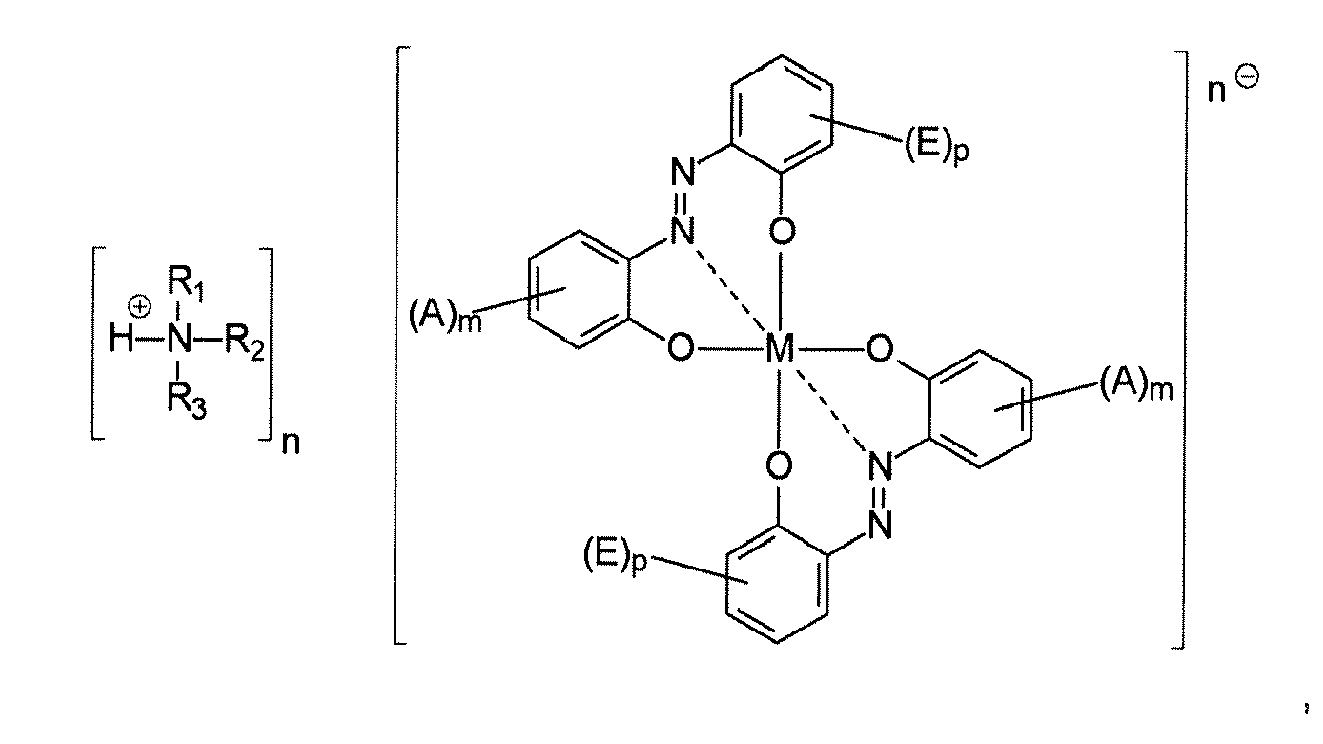

Description
- Disclosed herein are phase change inks. More specifically, disclosed herein are phase change inks containing specific colorant compositions in specific vehicle formulations. One embodiment is directed to a phase change ink composition comprising (a) a phase change ink carrier comprising (1) an amide; and (2) a polyethylene wax having an average peak molecular weight of from about 350 to about 730 and a polydispersity of from about 1.0001 to about 1.5; and (b) a colorant compound of the formula


- In general, phase change inks (sometimes referred to as "hot melt inks") are in the solid phase at ambient temperature, but exist in the liquid phase at the elevated operating temperature of an ink jet printing device. At the jet operating temperature, droplets of liquid ink are ejected from the printing device and, when the ink droplets contact the surface of the recording substrate, either directly or via an intermediate heated transfer belt or drum, they quickly solidify to form a predetermined pattern of solidified ink drops. Phase change inks have also been used in other printing technologies, such as gravure printing, as disclosed in, for example,
U.S. Patent 5,496,879 and German Patent PublicationsDE 4205636 AL andDE 4205713 AL, the disclosures of each of which are totally incorporated herein by reference. - Phase change inks for color printing typically comprise a phase change ink carrier composition which is combined with a phase change ink compatible colorant. In a specific embodiment, a series of colored phase change inks can be formed by combining ink carrier compositions with compatible subtractive primary colorants. The subtractive primary colored phase change inks can comprise four component dyes, namely, cyan, magenta, yellow and black, although the inks are not limited to these four colors. These subtractive primary colored inks can be formed by using a single dye or a mixture of dyes. For example, magenta can be obtained by using a mixture of Solvent Red Dyes or a composite black can be obtained by mixing several dyes.
U.S. Patent 4,889,560 ,U.S. Patent 4,889,761 , andU.S. Patent 5,372,852 , the disclosures of each of which are totally incorporated herein by reference, teach that the subtractive primary colorants employed can comprise dyes from the classes of Color Index (C.l.) Solvent Dyes, Disperse Dyes, modified Acid and Direct Dyes, and Basic Dyes.U.S. Patent 5,621,022 , the disclosure of which is totally incorporated herein by reference, discloses the use of a specific class of polymeric dyes in phase change ink compositions. - Phase change inks have also been used for applications such as postal marking, industrial marking, and labelling.
- Phase change inks are desirable for ink jet printers because they remain in a solid phase at room temperature during shipping, long term storage, and the like. In addition, the problems associated with nozzle clogging as a result of ink evaporation with liquid ink jet inks are largely eliminated, thereby improving the reliability of the ink jet printing. Further, in phase change ink jet printers wherein the ink droplets are applied directly onto the final recording substrate (for example, paper, transparency material, and the like), the droplets solidify immediately upon contact with the substrate, so that migration of ink along the printing medium is prevented and dot quality is improved.
- Compositions suitable for use as phase change ink carrier compositions are known. Some representative examples of references disclosing such materials include
U.S. Patent 3,653,932 ,U.S. Patent 4,390,369 ,U.S. Patent 4,484,948 ,U.S. Patent 4,684,956 ,U.S. Patent 4,851,045 ,U.S. Patent 4,889,560 ,U.S. Patent 5,006,170 ,U.S. Patent 5,151,120 ,U.S. Patent 5,372,852 ,U.S. Patent 5,496,879 ,European Patent Publication 0187352 ,European Patent Publication 0206286 , German Patent PublicationDE 4205636 AL, German Patent PublicationDE 4205713 AL, andPCT Patent Application WO 94/04619 -
U.S. Patent 6,147,140 (Jaeger et al. ), the disclosure of which is totally incorporated herein by reference, discloses a phase change ink composition comprising a phase change ink carrier system in combination with a compatible colorant system, the colorant system comprising a combination of (1) a black colorant having an absorbance in the 475 nanometer region which is less than 80 percent of the absorbance at the 580 nanometer region and (2) a sufficient amount of at least one other colorant having an absorbance in the 475 nanometer region whereby the colorant has a ratio of absorbance in the 475 nanometer region to the 580 nanometer region from about 0.92:1.0 to about 1.01:1.0. -
U.S. Patent 6,860,930 (Wu et al. ), the disclosure of which is totally incorporated herein by reference, discloses a phase change ink composition comprising (a) a colorant and (b) a carrier comprising a polyamide, wherein the polyamide component of the carrier contains at least about 10 percent by weight of a branched triamide. -
U.S. Patent Publication 2005/0130054 (Yuan et al. ), the disclosure of which is totally incorporated herein by reference, discloses wax based inks for phase change/hot melt inkjet printing or thermal transfer printing applications. Also disclosed are waxes useful for toners for use in electrostatographic printing applications. Both materials are prepared using a wax having a narrow melting range. The narrow melting range of the wax reduces energy requirements in printing applications. The use of the waxes also promotes release for high speed printing and especially promotes fast drying in wax based ink applications. -
U.S. Patent 6,001,904 (Matzinger et al. ), the disclosure of which is totally incorporated herein by reference, discloses phase change (hot melt) ink compositions for use in a phase change (hot melt) ink jet recording device in which recording is conducted by thermally melting the ink at a temperature above ambient temperature (20°C) to provide prints that possess high quality images, scratch resistance, abrasion resistance, low-temperature storage stability and flexibility, offset and pick resistance, adhesion, and other desired properties to comprise: (a) from about 0.1 % to about 30% of one or more colorants; and (b) from about 0.1 to about 99.9% of one or more reversibly-crosslinked-polymers. Components other than those listed above may be included in the ink compositions to achieve specific printer, substrate, or end use requirements. Furthermore, the invention also includes methods for the preparation of reversibly-crosslinked-polymers and for their use in the above-described inks. - While known compositions and processes are suitable for their intended purposes, a need remains for improved colorant compounds. In addition, a need remains for colorant compounds particularly suitable for use in phase change inks. Further, a need remains for colorant compounds with a desirable degree of thermal stability. Additionally, a need remains for colorant compounds that exhibit a desirable degree of solubility in vehicles employed in phase change inks. There is also a need for colorant compounds that are compatible with phase change ink vehicles capable of operating with reduced energy requirements. In addition, there is a need for colorant compounds that exhibit desirably high chroma in phase change inks. Further, there is a need for colorant compounds that exhibit satisfactory hue in phase change inks. Additionally, there is a need for colorant compounds that exhibit a high degree of lightfastness in phase change inks. A need also remains for colorant compounds that exhibit a relatively low degree of diffusion and bleeding into adjoining printed areas of different colors when incorporated into phase change inks and printed. In addition, a need remains for colorant compounds that are safe to handle. Further, a need remains for colorant compounds that enable generation of prints with reduced pile height. In addition, a need remains for phase change inks that can be jetted at temperatures below about 125°C. Further, a need remains for phase change inks that can be jetted with reduced energy requirements. Additionally, a need remains for phase change inks that can be jetted with less expensive printheads. There is also a need for phase change inks that enable improved thermal stability of the inks manifested as the color's stability over time when heated in printers. In addition, there is a need for phase change inks that enable improved printer reliability. Further, there is a need for phase change inks that enable quick recovery times from standby mode. Additionally, there is a need for phase change inks that enable printing with "instant-on" mode. A need also remains for phase change inks that exhibit desirable viscosity values at reduced printing temperatures. In addition, a need remains for phase change inks that enable the aforementioned advantages and also exhibit good printing characteristics, such as transfixing properties (including dither and solid fill dropout performance), acceptable missed jets, folding and creasing performance, gloss, color intensity, recovery after standby mode, and the like. Further, a need remains for phase change inks that generate images with improved hardness. Additionally, a need remains for phase change inks that generate images with improved gloss. There is also a need for phase change inks that exhibit reduced sweating; sweating is a problem wherein some ink ingredients migrate to the surface of solid ink sticks and aggregate at the ink stick surface inside the printer; the sticky "sweat" gradually drains down to the bottom and can cause the ink sticks to be difficult to slide in the ink load racks in the printers. In addition, there is a need for phase change inks that generate images with reduced showthrough when printed on paper substrates. Further, there is a need for phase change inks that exhibit reduced clogging of printheads while exhibiting all of the aforementioned advantages. Additionally, there is a need for phase change inks that enable reduced standby temperatures of phase change ink jet printheads without leading to clogging of the printhead. A need also remains for phase change inks with desirably low freezing points. In addition, a need remains for phase change inks that transfer efficiently from an intermediate transfer member to a final recording substrate with reduced pixels left on the intermediate transfer member when the intermediate transfer member is at a desirably high temperature to enable efficient transfer member cooling and avoid automatic printer shutoff from heating of the intermediate transfer member by the ink, while also enabling jetting of the ink at a desirably low temperature. Further, a need remains for phase change inks that exhibit desirably high smudge temperatures when still-hot prints pass along guidance tracks in the printer, thereby reducing accumulation of ink along these guidance tracks that could later be transferred to blank paper. Additionally, a need remains for phase change inks with the above advantages that contain desirably high concentrations of a black colorant.
- The present invention provides:
- (1) a phase change ink composition comprising (a) a phase change ink carrier comprising (1) an amide; and (2) a polyethylene wax having an average peak molecular weight of from about 350 to about 730 and a polydispersity of from about 1.0001 to about 1.5; and (b) a colorant compound of the formula


- (2) the ink according to (1) wherein the polyethylene wax has an average peak molecular weight of from about 400 to about 700;
- (3) the ink according to (1) wherein the polyethylene wax has an average peak molecular weight of from about 470 to about 600;
- (4) the ink according to (1) wherein the polyethylene wax has a polydispersity of no more than about 1.200;
- (5) the ink according to (1) wherein the polyethylene wax has a polydispersity of no more than about 1.100;
- (6) the ink according to (1) wherein the polyethylene wax has a polydispersity of no more than about 1.050;
- (7) the ink according to (1) wherein the polyethylene wax has a peak melting point of at least about 50°C;
- (8) the ink according to (1) wherein the polyethylene wax has a peak melting point of at least about 70°C;
- (9) the ink according to (1) wherein the polyethylene wax has an onset melting point of at least about 50°C;
- (10) the ink according to (1) wherein the polyethylene wax has an onset melting point of at least about 55°C;
- (11) the ink according to (1) wherein the polyethylene wax has a viscosity at about 110°C of at least about 3 centipoise;
- (12) the ink according to (1) wherein the polyethylene wax has a viscosity at about 110°C of no more than about 10 centipoise;
- (13) the ink according to (1) wherein the polyethylene wax is present in the ink in an amount of at least about 10 percent by weight of the ink carrier;
- (14) the ink according to (1) wherein the polyethylene wax is present in the ink in an amount of no more than about 90 percent by weight of the carrier;
- (15) the ink according to (1) wherein the branched triamide is of the formula

- (16) the ink according to (15) wherein p, q, and r have an average peak value of from about 15 to about 60;
- (17) the ink according to (15) wherein p, q, and r have an average peak value of from about 26 to about 45;
- (18) the ink according to (1) wherein the triamide is present in the ink in an amount of at least about 2 percent by weight of the ink carrier;
- (19) the ink according to (1) wherein the triamide is present in the ink in an amount of no more than about 50 percent by weight of the ink carrier;
- (20) the ink according to (1) wherein the colorant is present in the ink in an amount of at least about 0.1 percent by weight of the ink;
- (21) the ink according to (1) further containing a monoamide;
- (22) the ink according to (21) wherein the monoamide is stearyl stearamide;
- (23) the ink according to (21) wherein the monoamide is present in the ink in an amount of at least about 2 percent by weight of the ink;
- (24) the ink according to (1) further containing an isocyanate-derived material;
- (25) the ink according to (24) wherein the isocyanate-derived material is a urethane resin obtained from the reaction of two equivalents of hydroabietyl alcohol and one equivalent of isophorone diisocyanate;
- (26) the ink according to (24) wherein the urethane resin is present in the ink in an amount of at least about 2 percent by weight of the ink carrier;
- (27) the ink according to (24) wherein the isocyanate-derived material is a urethane resin that is the adduct of three equivalents of stearyl isocyanate and a glycerol-based alcohol;
- (28) the ink according to (27) wherein the urethane resin is present in the ink in an amount of at least about 0.5 percent by weight of the ink carrier;
- (29) the ink according to (1) further containing a triglyceride of hydrogenated abietic acid;
- (30) the ink according to (1) further containing Disperse Orange 47;
- (31) the ink according to (30) wherein the Disperse Orange is present in the ink in an amount of at least about 0.01 part by weight Disperse Orange 47 per every one part by weight colorant of the formula


- (32) the ink according to (30) wherein the Disperse Orange is present in the ink in an amount of no more than about 1 part by weight Disperse Orange 47 per every one part by weight colorant of the formula


- (33) the ink according to (1) wherein the colorant of the formula
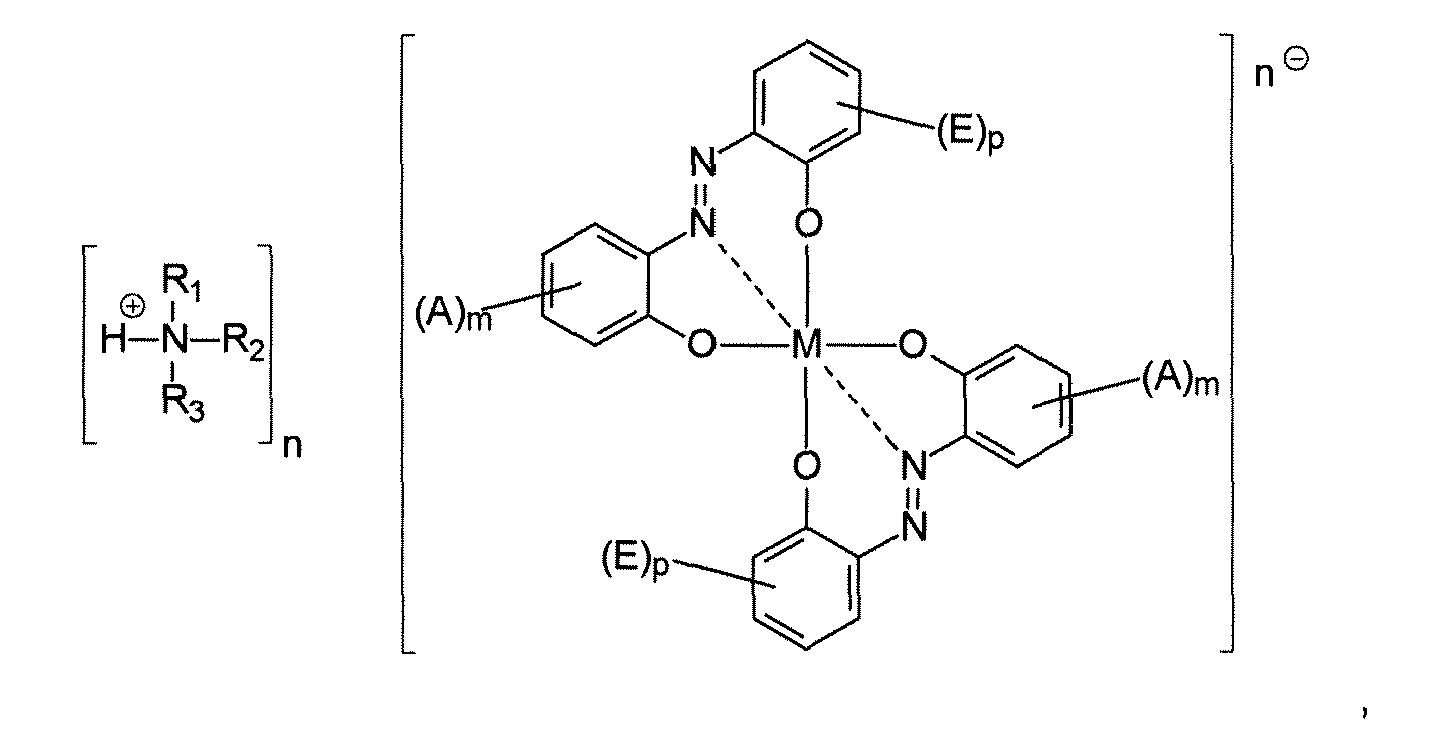

- (34) the ink according to (1) wherein the colorant of the formula


- (35) the ink according to (1) wherein the colorant is of the formula

- (36) the ink according to (1) wherein the colorant is of the formula

- (37) the ink according to (1) wherein at least one of A, E, G, and J is an alkyl group, provided that when A is the at least one alkyl group, m is at least 1, and provided that when E is the at least one alkyl group, p is at least 1;
- (38) the ink according to (37) wherein the alkyl group is a substituted alkyl group;
- (39) the ink according to (37) wherein the alkyl group is an unsubstituted alkyl group;
- (40) the ink according to (37) wherein the alkyl group contains at least one heteroatom therein;
- (41) the ink according to (37) wherein the alkyl group contains no heteroatoms therein;
- (42) the ink according to (1) wherein at least one of A, E, G, and J is an aryl, arylalkyl, or alkylaryl group, provided that when A is the at least one aryl, arylalkyl, or alkylaryl group, m is at least 1, and provided that when E is the at least one aryl, arylalkyl, or alkylaryl group, p is at least 1;
- (43) the ink according to (42) wherein the aryl, arylalkyl, or alkylaryl group is a substituted aryl, arylalkyl, or alkylaryl group;
- (44) the ink according to (42) wherein the aryl, arylalkyl, or alkylaryl group is an unsubstituted aryl, arylalkyl, or alkylaryl group;
- (45) the ink according to (42) wherein the aryl, arylalkyl, or alkylaryl group contains at least one heteroatom therein;
- (46) the ink according to (42) wherein the aryl, arylalkyl, or alkylaryl group contains no heteroatoms therein;
- (47) the ink according to (1) wherein at least one of A, E, and G is a substituent selected from the group consisting of a hydroxy group, a halogen atom, an amine group an imine group, an ammonium group, a cyano group, a pyridine group, a pyridinium group, an ether group, an aldehyde group, a ketone group, an ester group, an amide group, a carbonyl group, a thiocarbonyl group, a sulfate group, a sulfonate group, a sulfonic acid group, a sulfide group, a sulfoxide group, a phosphine group, a phosphonium group, a phosphate group, a nitrile group, a mercapto group, a nitro group, a nitroso group, a sulfone group, an acyl group, an azo group, a cyanato group, a carboxylate group, a carboxylic acid group, a urethane group, a urea group, or mixtures thereof, provided that when A is the at least one substituent, m is at least 1, and provided that when E is the at least one substituent, p is at least 1;
- (48) the ink according to (1) wherein n is 1;
- (49) the ink according to (1) wherein n is 2 or 3;
- (50) the ink according to (1) wherein M is a metal in the Lanthanide Series;
- (51) the ink according to (1) wherein M is chromium, iron, cobalt, molybdenum, tungsten, ruthenium, osmium, rhodium, iridium, manganese, rhenium, vanadium, niobium, tantalum, titanium, zirconium, hafnium, scandium, yttrium, lanthanum, zinc, aluminum, or mixtures thereof;
- (52) the ink according to (1) wherein M is chromium, iron, cobalt, or mixtures thereof;
- (53) the ink according to (1) wherein M is chromium;
- (54) the ink according to (1) wherein the colorant is of the formula


- (55) the ink according to (1) wherein the colorant is of the formula

- (56) the ink according to (1) wherein R1, R2, and R3 each, independently of the others, are hydrogen atoms or alkyl groups, including linear and branched, saturated and unsaturated, cyclic and acyclic, and substituted and unsubstituted alkyl groups, and wherein hetero atoms, such as oxygen, nitrogen, sulfur, silicon, phosphorus, boron, and the like either may or may not be present in the alkyl group;
- (57) the ink according to (56) wherein at least one of the alkyl groups is linear;
- (58) the ink according to (56) wherein at least one of the alkyl groups is branched;
- (59) the ink according to (56) wherein at least one of the alkyl groups is substituted;
- (60) the ink according to (56) wherein at least one of the alkyl groups is unsubstituted;
- (61) the ink according to (56) wherein at least one of the alkyl groups has hetero atoms therein;
- (62) the ink according to (56) wherein at least one of the alkyl groups has no hetero atoms therein;
- (63) the ink according to (56) wherein R1, R2, and R3 are the same as each other;
- (64) the ink according to (56) wherein at least two of R1, R2, and R3 are different from each other;
- (65) the ink according to (56) wherein all three of R1, R2, and R3 are different from each other;
- (66) the ink according to (1) wherein at least one of R1, R2, and R3 is an aryl group, an arylalkyl group, or an alkylaryl group;
- (67) the ink according to (66) wherein the aryl, arylalkyl, or alkylaryl group is substituted;
- (68) the ink according to (66) wherein the aryl, arylalkyl, or alkylaryl group is unsubstituted;
- (69) the ink according to (66) wherein the aryl, arylalkyl, or alkylaryl group contains at least one heteroatom therein;
- (70) the ink according to (66) wherein the aryl, arylalkyl, or alkylaryl group contains no heteroatoms therein;
- (71) the ink according to (1) wherein the colorant compound is of the formula


- (72) the ink according to (1) wherein the ink has a peak melting point of at least about 50°C;
- (73) the ink according to (1) wherein the ink has a peak melting point of at least about 70°C;
- (74) the ink according to (1) wherein the ink has a peak melting point of no more than about 140°C;
- (75) the ink according to (1) wherein the ink has a peak melting point of no more than about 100°C;
- (76) the ink according to (1) wherein the ink has a viscosity at the jetting temperature of no more than about 20 centipoise;
- (77) the ink according to (76) wherein the jetting temperature is no more than about 120°C;
- (78) the ink according to (1) wherein the ink has a viscosity at the jetting temperature of no more than about 15 centipoise;
- (79) the ink according to (78) wherein the jetting temperature is no more than about 120°C;
- (80) the ink according to (1) wherein the ink has a viscosity of from about 7 to about 15 centipoise at about 110°C;
- (81) the ink according to (1) wherein the ink has a viscosity of from about 7 to about 15 centipoise at about 115°C;
- (82) the ink according to (1) wherein the ink has a viscosity of from about 7 to about 15 centipoise at about 120°C;
- (83) the ink according to (1) wherein the polyethylene wax has a melting range of at least about 5°C;
- (84) the ink according to (1) wherein the polyethylene wax has a melting range of no more than about 40°C;
- (85) the ink according to (1) wherein the polyethylene wax has a melting range of no more than about 35°C;
- (86) the ink according to (1) wherein the polyethylene wax has a melting range of no more than about 30°C;
- (87) the ink according to (1) wherein the polyethylene wax has a freezing point of at least about 40°C;
- (88) the ink according to (1) wherein the polyethylene wax has a freezing point of no more than about 80°C;
- (89) the ink according to (1) wherein the polyethylene wax has a freezing point of no more than about 75°C;
- (90) the ink according to (1) wherein the polyethylene wax has a freezing point of no more than about 70°C;
- (91) the ink according to (1) wherein the polyethylene wax has a peak melting point of from about 70°C to about 120°C and a polydispersity of no more than about 1.050;
- (92) the ink according to (1) wherein the polyethylene wax has a peak melting point of from about 70°C to about 120°C and a viscosity at 110°C of no more than about 10 centipoise;
- (93) the ink according to (1) wherein the polyethylene wax has a peak melting point of from about 70°C to about 120°C and an onset melting point of from about 55°C to about 69°C;
- (94) the ink according to (1) wherein the polyethylene wax has a peak melting point of from about 70°C to about 120°C and a melting range of no more than about 30°C;
- (95) the ink according to (1) wherein the polyethylene wax has an onset melting point of at least about 55°C and a freezing point lower than about 70°C;
- (96) the ink according to (1) wherein the polyethylene wax has a peak melting point of from about 70°C to about 120°C, an onset melting point of at least about 55°C, and a melting range of no more than about 30°C;
- (97) a process which comprises (1) incorporating into an ink jet printing apparatus a phase change ink composition comprising (a) a phase change ink carrier comprising (1) an amide; and (2) a polyethylene wax having an average peak molecular weight of from about 350 to about 730 and a polydispersity of from about 1.0001 to about 1.5; and (b) a colorant compound of the formula


- (98) the process according to (97) wherein the printing apparatus employs a piezoelectric printing process wherein droplets of the ink are caused to be ejected in imagewise pattern by oscillations of piezoelectric vibrating elements;
- (99) the process according to (97) wherein the substrate is a final recording sheet and droplets of the melted ink are ejected in an imagewise pattern directly onto the final recording sheet;
- (100) the process according to (97) wherein the substrate is an intermediate transfer member and droplets of the melted ink are ejected in an imagewise pattern onto the intermediate transfer member followed by transfer of the imagewise pattern from the intermediate transfer member to a final recording sheet;
- (101) the process according to (100) wherein the intermediate transfer member is heated to a temperature above that of the final recording sheet and below that of the melted ink in the printing apparatus;
- (102) the process according to (100) wherein both the intermediate transfer member and the final recording sheet are heated to a temperature below that of the melted ink in the printing apparatus, and wherein the final recording sheet is heated to a temperature above that of the intermediate transfer member and below that of the melted ink in the printing apparatus; and
- (103) the process according to (100) wherein both the intermediate transfer member and the final recording sheet are heated to a temperature below that of the melted ink in the printing apparatus, and wherein the intermediate transfer member is heated to a temperature above that of the final recording sheet and below that of the melted ink in the printing apparatus.
- Disclosed herein is a phase change ink composition comprising (a) a phase change ink carrier comprising (1) an amide; and (2) a polyethylene wax having an average peak molecular weight of from about 350 to about 730 and a polydispersity of from about 1.0001 to about 1.5; and (b) a colorant compound of the formula


- The Figure is a reproduction of high temperature gel permeation chromatography (also called size exclusion chromatography (SEC)) curves obtained for polyethylene waxes of different average peak molecular weight values, showing the relative amounts of molecules with different molecular weights present in the sample on the "y" axis and the retention time on the "x" axis.
- Disclosed herein are colorant compounds of the formulae


- The integer "n" represents both the charge on the chromogen compound complex and the number of countercations present. This integer is at least 1, and can also be 2 or 3.
- These compounds form complexes with metal compounds to form chromogenic compounds. Suitable metals M include any metals that form complexes with the above-indicated compounds wherein the complex will have a negative charge of at least -1. Examples of suitable metals include (but are not limited to) chromium, iron, cobalt, molybdenum, tungsten, ruthenium, osmium, rhodium, iridium, manganese, rhenium, vanadium, niobium, tantalum, titanium, zirconium, hafnium, scandium, yttrium, lanthanum, zinc, aluminum, metals in the Lanthanide Series, and the like, as well as mixtures thereof.
- While not being limited to any particular theory, it is believed that the complexes formed are as follows:


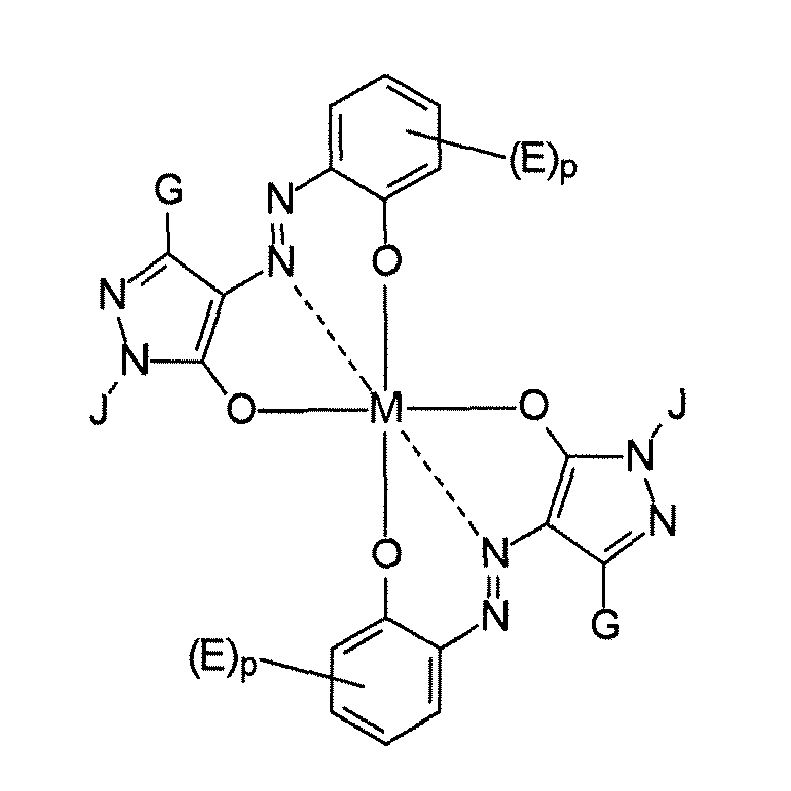

- Some specific examples of suitable chromogenic compound complexes for the compounds disclosed herein include (but are not limited to) the following:


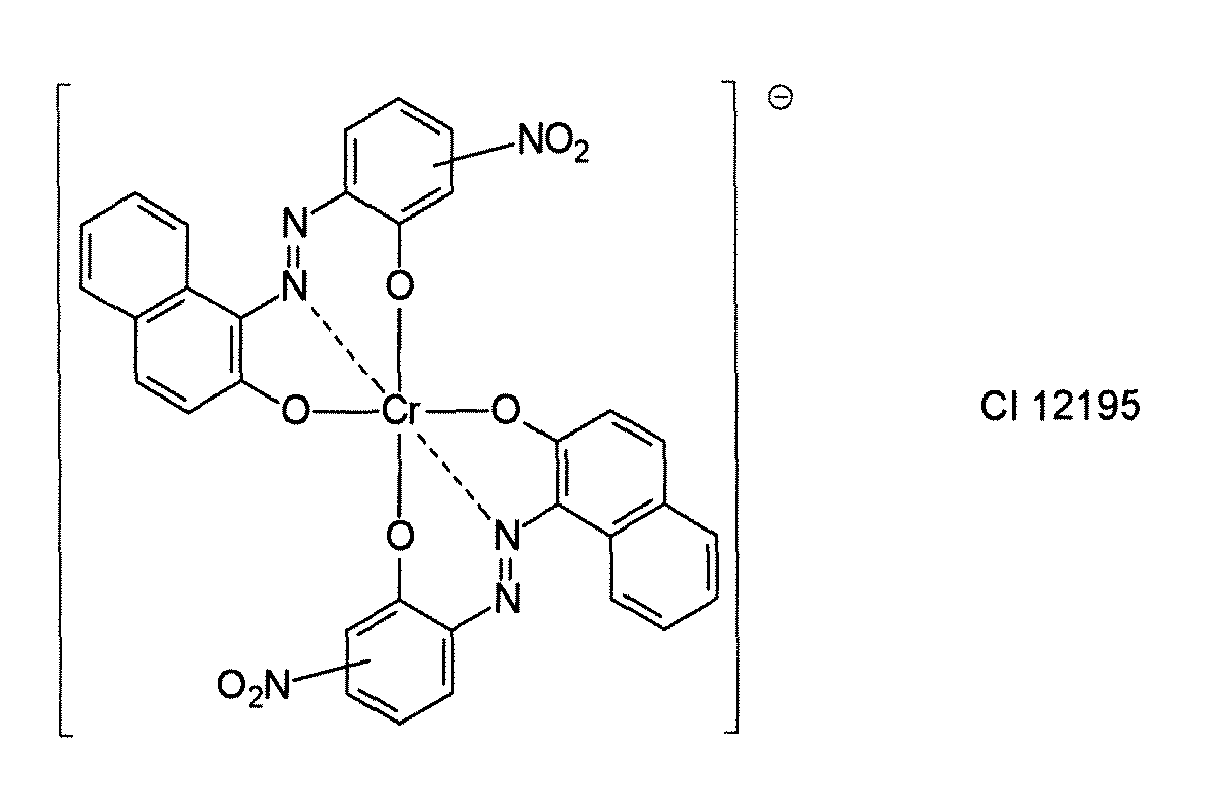


- The chromogenic compound complexes have a negative charge of at least -1, and accordingly are associated with a counterion. The counterion is of the formula

- The colorant compounds disclosed herein can be prepared by any desired or effective method. For example, a chromogenic compound having a different counterion or in the free acid form can be obtained commercially and the counterion can be replaced with the desired counterion. Metallizing azo dyes can be done by any desired or effective method, such as that described in, for example, "British Intelligence Objectives Subcommittee Report 961," Publications Board No. 86139, Library of Congress, Washington, D.C. 1947, pp. 71-72, 110, 149-151, 160, 163, 164, the disclosure of which is totally incorporated herein by reference. The desired counterions can generally be derived from commercially available amine compounds as well. Primary, secondary, and tertiary amines can also be prepared as described in, for example, Comprehensive Organic Transformations - A Guide to Functional Group Preparations, 2 nd Ed., Richard C. Larock, Wley-VCH, 1999 ISBN 0-471-19031-4 New York, NY, the disclosure of which is totally incorporated herein by reference.
- For example, in one embodiment, the chromogenic compound and the amine compound from which the counterion is to be derived can be heated together until the ion exchange is complete, followed by distilling off the solvent (if a solvent is used) and recovery of the colorant compound thus prepared.
- Any desired or effective relative amounts of the chromogenic compound and the amine compound from which the counterion is to be derived can be employed. When the charge on the chromogenic compound is -1, the relative amounts can be, for example, in one embodiment at least about 0.1 mole of chromogenic compound per every one mole of amine compound, in another embodiment at least about 0.5 mole of chromogenic compound per every one mole of amine compound, and in yet another embodiment at least about 0.9 mole of chromogenic compound per every one mole of amine compound, and in one embodiment no more than about 3 moles of chromogenic compound per every one mole of amine compound, in another embodiment no more than about 2 moles of chromogenic compound per every one mole of amine compound, and in yet another embodiment no more than about 1.1 moles of chromogenic compound per every one mole of amine compound, although the relative amounts can be outside of these ranges. When the charge on the chromogenic compound is -2, the amount of amine compound will, of course be doubled, and when the charge on the chromogenic compound is higher, the amount of amine compound will, of course, be adjusted accordingly.
- When a solvent is used, any desired or effective solvent can be employed. Examples of suitable solvents include methyl isobutyl ketone, methyl ethyl ketone, acetone, methanol, ethanol, n-propanol, isopropanol, butanol, and the like, as well as mixtures thereof.
- The reactants are present in the solvent in any desired or effective amount, in one embodiment at least about 1 gram of reactants per liter of solvent, in another embodiment at least about 225 grams of reactants per liter of solvent, and in yet another embodiment at least about 450 grams of reactants per liter of solvent, and in one embodiment no more than about 2,000 grams of reactants per liter of solvent, in another embodiment no more than about 1,000 grams of reactants per liter of solvent, and in yet another embodiment no more than about 500 grams of reactants per liter of solvent, although the relative amounts of reactants and solvent can be outside of these ranges.
- The reactants can be heated to any desired or effective temperature, in one embodiment at least about 25°C, in another embodiment at least about 65°C, and in yet another embodiment at least about 110°C, and in one embodiment no more than about 150°C, in another embodiment no more than about 125°C, and in yet another embodiment no more than about 110°C, although the temperature can be outside of these ranges.
- The reactants can be heated for any desired or effective period of time, in one embodiment at least about 1 hour, in another embodiment at least about 12 hours, and in yet another embodiment at least about 16 hours, and in one embodiment no more than about 7 days, in another embodiment no more than about 1 day, and in yet another embodiment no more than about 18 hours, although the period of time can be outside of these ranges.
- Thereafter, the colorant compound thus prepared can be recovered by any desired or effective method, such as by distillation, vacuum, quenching into a solvent in which the product is not soluble (such as water), or the like.
- The colorant compound is present in the ink in any desired or effective amount, in one embodiment at least about 0.1 percent by weight of the ink, in another embodiment at least about 0.2 percent by weight of the ink, and in yet another embodiment at least about 0.5 percent by weight of the ink, and in one embodiment no more than about 50 percent by weight of the ink, in another embodiment no more than about 25 percent by weight of the ink, and in yet another embodiment no more than about 20 percent by weight of the ink, although the amount can be outside of these ranges.
- The inks disclosed herein also comprise a branched triamide. Branched triamides are disclosed in, for example,
U.S. Patent 6,860,930 , the disclosure of which is totally incorporated herein by reference. By "branched triamide" is meant that the structure of the triamide can be drawn so that each amide group is bonded to an atom or group of atoms contained in a branch other than that of the others, and that each amide group is in a different branch. By "each amide group is in a different branch" is meant that the triamide is not linear; by "linear" is meant a molecule wherein all three amide groups can be drawn as being in the same molecular chain or branch, such as linear triamides of the formulae


- Examples of suitable branched triamides include (but are not limited to) those generated from branched triamines, said branched triamides being of the formula


- In one specific embodiment, when the triamide is of the formula

- In one specific embodiment, when the triamide is of the formula

- In one specific embodiment, when the triamide is of the formula

- In one specific embodiment, when the triamide is of the formula

- It must be emphasized that not all of the amide groups in the first formula need to be directly bonded to the same atom in the R1 or R2 group, and in one specific embodiment of the present invention, each amide group is bonded to a different atom in the R1 or R2 group.
- In one specific embodiment, the branched triamide is of the formula

- The triamide is present in the ink in any desired or effective amount, in one embodiment at least about 2 percent by weight of the phase change ink carrier, in another embodiment at least about 5 percent by weight of carrier, and in yet another embodiment at least about 10 percent by weight of the carrier, and in one embodiment no more than about 50 percent by weight of the carrier, in another embodiment no more than about 40 percent by weight of the carrier, and in yet another embodiment no more than about 35 percent by weight of the carrier, although the amount can be outside of these ranges.
- The phase change inks disclosed herein also contain a polyethylene wax. This polyethylene wax has an average peak molecular weight, as measured by high temperature gel permeation chromatography, of in one embodiment at least about 350, in another embodiment at least about 400, and in yet another embodiment at least about 470, and in one embodiment no more than about 730, in another embodiment no more than about 700, and in yet another embodiment no more than about 600, although the average peak molecular weight can be outside of these ranges.
- The polyethylene wax has a polydispersity (determined by dividing weight average molecular weight by number average molecular weight) in one embodiment of at least about 1.0001, and in one embodiment of no more than about 1.5, in another embodiment of no more than about 1.4, in yet another embodiment of no more than about 1.3, in still another embodiment of no more than about 1.2, in another embodiment of no more than about 1.1, and in yet another embodiment of no more than about 1.05, although the polydispersity can be outside of these ranges.
- The polyethylene wax has a peak melting point (as measured by differential scanning calorimetry (DSC)) in one embodiment of at least about 50°C, in another embodiment at least about 60°C, and in yet another embodiment of at least about 70°C, and in one embodiment of no more than about 130°C, in another embodiment of no more than about 125°C, and in yet another embodiment of no more than about 120°C, although the peak melting point can be outside of these ranges.
- The polyethylene wax has an onset melting point (as measured by differential scanning calorimetry (DSC)) in one embodiment of at least about 50°C, in another embodiment at least about 52°C, and in yet another embodiment of at least about 55°C, and in one embodiment of no more than about 71°C, in another embodiment of no more than about 70°C, and in yet another embodiment of no more than about 69°C, although the onset melting point can be outside of these ranges.
- The polyethylene wax has a melting range, which is defined as the difference between ending melting point and onset melting point as defined in ASTM D3418-03, in one embodiment of at least about 5°C, in another embodiment at least about 8°C, and in yet another embodiment of at least about 10°C, and in one embodiment of no more than about 40°C, in another embodiment of no more than about 35°C, and in yet another embodiment of no more than about 30°C, although the melting range can be outside of these ranges.
- The polyethylene wax has a freezing point (as measured by differential scanning calorimetry (DSC)) in one embodiment of at least about 40°C, in another embodiment at least about 50°C, and in yet another embodiment of at least about 55°C, and in one embodiment of no more than about 80°C, in another embodiment of no more than about 75°C, and in yet another embodiment of no more than about 70°C, although the freezing point can be outside of these ranges.
- The polyethylene wax has a viscosity at about 110°C in one embodiment of at least about 3 centipoise, in another embodiment of at least about 4 centipoise, and in yet another embodiment of at least about 4.5 centipoise, and in one embodiment of no more than about 10 centipoise, in another embodiment of no more than about 9 centipoise, and in yet another embodiment of no more than about 8 centipoise, although the viscosity can be outside of these ranges.
- By "average peak molecular weight" is meant that the polyethylene wax, while comprising a mixture of molecules of the formula -(CH2)n- wherein n is an integer representing the number of repeat -CH2- units, has a distribution of molecules such that a plot of the relative amount of molecules versus the retention time or molecular weight would appear as a bell curve, wherein the peak of the bell curve represents the average peak molecular weight. In contrast, polyethylene waxes having a different average peak molecular weight value, while they may contain materials that overlap in the value of "n", will have different characteristics.
- Shown in the Figure are measurements of molecular weight taken for some polyethylene waxes by high temperature gel permeation chromatography with a Polymer Labs 220HT system using refractive index detection, a mobile phase of 1,2,4-trichlorobenzene, and two Polymer 3 µm Mixed-E columns for separation. The entire system and the sample solution before injection were heated to 140°C. The molecular weights were characterized using polyethylene standards for calibration. One material was a polyethylene wax commercially available from Baker Petrolite, Tulsa, OK, being POLYWAX 500 (PE 500). Also measured was a polyethylene wax commercially available from Baker Petrolite, Tulsa, OK, being POLYWAX 655 (PE 655). Also measured was a polyethylene wax which was obtained from Baker Petrolite, Tulsa, OK, being similar to POLYWAX 500 but which was distilled to remove both the lowest 15 percent molecular weight fraction and the highest 15 percent molecular weight fraction. This distillation can be carried out as described in, for example,
U.S. Patent Publication 2005/0130054 , the disclosure of which is totally incorporated herein by reference. Some of the data for the retention times of these materials were as follows. Note that in this instance, the x-axis is "reversed" in that the high molecular weight materials appear on the left and the low molecular weight materials appear on the right. Negative numbers are attributable to instrument calibration, and data on the y-axis reflect relative amounts.retention times (sec.) PE 500 lowest 15% removed and highest 15% removed PE 655 750 0.1 -0.9 -0.7 755 0.2 -0.9 -0.6 760 0.2 -0.9 -0.4 765 0.2 -0.9 -0.1 770 0.3 -0.9 0.1 775 0.3 -0.9 0.6 780 0.4 -0.9 1.2 785 0.6 -0.9 2.1 790 0.8 -0.9 3.6 795 1.0 -1.0 6.0 800 1.3 -1.0 9.7 805 1.8 -1.0 14.8 810 2.3 -1.0 21.8 815 3.2 -1.0 30.6 820 4.5 -1.0 41.1 825 6.3 -0.9 52.6 830 8.9 -0.9 64.5 835 12.6 -0.7 75.9 840 17.6 -0.3 85.8 845 24.1 0.6 93.5 850 32.0 2.8 98.3 855 41.3 7.0 100.0 860 51.4 14.4 98.6 865 61.9 26.0 94.3 870 72.2 41.3 87.8 875 81.7 58.7 79.7 880 89.6 75.3 70.6 885 95.5 78.2 61.2 890 99.0 81.0 52.0 891 99.4 86.1 50.3 895 100.0 88.4 43.4 900 98.6 96.6 35.7 905 95.0 97.7 28.7 910 89.7 99.9 22.8 910.5 89.1 100.0 22.2 915 82.8 98.5 17.9 920 75.0 93.4 13.9 925 67.4 84.9 10.5 930 58.8 83.9 8.0 935 51.2 73.2 5.7 940 43.9 60.1 4.3 945 36.7 46.3 2.9 950 31.3 32.7 2.0 955 25.2 22.0 1.2 960 21.4 13.2 0.8 965 16.9 7.7 0.2 970 13.5 3.9 0.1 975 11.4 2.0 -0.3 980 7.4 0.7 -0.4 985 6.8 0.1 -0.6 990 4.4 -0.4 -0.8 995 2.9 -0.6 -0.7 1000 2.6 -0.8 -0.9 1005 1.5 -0.9 -0.9 1010 0.9 -1.0 -0.9 1015 0.9 -1.0 -0.9 1020 0.6 -1.0 -1.1 1025 0.4 -1.1 -1.1 1030 0.4 -1.1 -1.5 1035 0.7 -1.1 -2.0 1040 0.9 -1.1 -2.2 1045 0.8 -1.2 -1.6 Mp Mn Mw MWD PE 500 572 516 570 1.10 lowest 15% removed and highest 15% removed 582 562 579 1.03 PE 655 795 729 785 1.08 peak MP onset MP melting range viscosity FP PE 500 81.2 52.5 42.2 5.44 70.3 lowest 15% removed and highest 15% removed 83.8 65.5 24.1 5.18 67.4 PE 655 94.6 72.3 29.6 ~ 33.0 9.80 85.5 - Melted liquid clearness of the waxes was evaluated by melting samples of the waxes in glass jars and keeping them in an oven at various temperatures, followed by checking them with the naked eye for clearness versus the presence of precipitates over time. The results were as follows:
PE 500PE 655 lowest 15% removed and highest 15% removed 1 day at 120°C clear a little precipitate clear 3 days at 110°C a little precipitate a little precipitate clear 6 days at 105°C a little precipitate some precipitate clear 11 days at 100°C a little precipitate some precipitate clear - The polyethylene wax in the inks disclosed herein have had some of the lowest molecular weight fraction removed therefrom and some of the highest molecular weight fraction removed therefrom, in one embodiment at least about the lowest 5 percent molecular weight fraction removed therefrom, in another embodiment at least about the lowest 7.5 percent molecular weight fraction removed therefrom, in yet another embodiment at least about the lowest 10 percent molecular weight fraction removed therefrom, in still another embodiment, at least about the lowest 12.5 molecular weight fraction removed therefrom, and in yet still another embodiment at least about the lowest 15 percent molecular weight fraction removed therefrom, and in one embodiment least about the highest 5 percent molecular weight fraction removed therefrom, in another embodiment at least about the highest 7.5 percent molecular weight fraction removed therefrom, in yet another embodiment at least about the highest 10 percent molecular weight fraction removed therefrom, in still another embodiment, at least about the highest 12.5 molecular weight fraction removed therefrom, and in yet still another embodiment at least about the highest 15 percent molecular weight fraction removed therefrom, although the amount removed therefrom can be outside of these ranges.
- The lowest molecular weight fraction and the highest molecular weight fraction can be removed from the polyethylene wax by any desired or effective method, including (but not limited to) the distillation methods described in
U.S. Patent Publication 2005/0130054 , the disclosure of which is totally incorporated herein by reference, the purification methods set forth in Copending Application11/126,745 - The polyethylene wax is present in the ink in any desired or effective amount, in one embodiment at least about 10 percent by weight of the phase change ink carrier, in another embodiment at least about 20 percent by weight of carrier, and in yet another embodiment at least about 30 percent by weight of the carrier, and in one embodiment no more than about 90 percent by weight of the carrier, in another embodiment no more than about 85 percent by weight of the carrier, and in yet another embodiment no more than about 80 percent by weight of the carrier, although the amount can be outside of these ranges.
- Additional examples of suitable phase change ink carrier materials are monoamides, tetra-amides, mixtures thereof, and the like. Specific examples of suitable fatty amide ink carrier materials include stearyl stearamide, such as KEMAMIDE S-180, available from Crompton Corporation, Greenwich, CT, and the like. Further information on fatty amide carrier materials is disclosed in, for example,
U.S. Patent 4,889,560 ,U.S. Patent 4,889,761 ,U.S. Patent 5,194,638 ,U.S. Patent 4,830,671 ,U.S. Patent 6,174,937 ,U.S. Patent 5,372,852 ,U.S. Patent 5,597,856 ,U.S. Patent 6,174,937 , andBritish Patent GB 2 238 792 - Also suitable as phase change ink carrier materials are isocyanate-derived resins and waxes, such as urethane isocyanate-derived materials, urea isocyanate-derived materials, urethane/urea isocyanate-derived materials, mixtures thereof, and the like. Further information on isocyanate-derived carrier materials is disclosed in, for example,
U.S. Patent 5,750,604 ,U.S. Patent 5,780,528 ,U.S. Patent 5,782,966 ,U.S. Patent 5,783,658 ,U.S. Patent 5,827,918 ,U.S. Patent 5,830,942 ,U.S. Patent 5,919,839 ,U.S. Patent 6,255,432 ,U.S. Patent 6,309,453 ,British Patent GB 2 294 939 British Patent GB 2 305 928 British Patent GB 2 305 670 British Patent GB 2 290 793 PCT Publication WO 94/14902 PCT Publication WO 97/12003 PCT Publication WO 97/13816 PCT Publication WO 96/14364 PCT Publication WO 97/33943 PCT Publication WO 95/04760 - In one specific embodiment, the ink can contain a urethane resin obtained from the reaction of two equivalents of ABITOL® E hydroabietyl alcohol (available from Hercules Inc., Wilmington, DE) and one equivalent of isophorone diisocyanate, prepared as described in Example 1 of
U.S. Patent 5,782,966 , the disclosure of which is totally incorporated herein by reference. When present, this resin is present in the ink in one embodiment in an amount of at least about 2 percent by weight of the ink carrier, in another embodiment at least about 3 percent by weight of the ink carrier, and in yet another embodiment at least about 5 percent by weight of the ink carrier, and in one embodiment no more than about 80 percent by weight of the ink carrier, in another embodiment no more than about 70 percent by weight of the ink carrier, and in yet another embodiment no more than about 60 percent by weight of the ink carrier, although the amount can be outside of these ranges. - In another specific embodiment, the ink can contain a urethane resin that is the adduct of three equivalents of stearyl isocyanate and a glycerol-based alcohol prepared as described in Example 4 of
U.S. Patent 6,309,453 , the disclosure of which is totally incorporated herein by reference. When present, this resin is present in the ink in one embodiment in an amount of at least about 0.5 percent by weight of the ink carrier, in another embodiment at least about 1 percent by weight of the ink carrier, and in yet another embodiment at least about 2 percent by weight of the ink carrier, and in one embodiment no more than about 40 percent by weight of the ink carrier, in another embodiment no more than about 35 percent by weight of the ink carrier, and in yet another embodiment no more than about 30 percent by weight of the ink carrier, although the amount can be outside of these ranges. - The ink carrier is present in the phase change ink in any desired or effective amount, in one embodiment of at least about 0.1 percent by weight of the ink, in another embodiment of at least about 50 percent by weight of the ink, and in yet another embodiment of at least about 90 percent by weight of the ink, and in one embodiment of no more than about 99 percent by weight of the ink, in another embodiment of no more than about 98 percent by weight of the ink, and in yet another embodiment of no more than about 95 percent by weight of the ink, although the amount can be outside of these ranges.
- In one specific embodiment, the colorant is present in combination with Disperse Orange 47 dye. In this embodiment, the ratio of this colorant to Disperse Orange 47 can be any ratio desired to obtain the desired color or hue, in one embodiment at least about 0.01 part by weight Disperse Orange 47 per every one part by weight colorant as disclosed herein, in another embodiment at least about 0.05 part by weight Disperse Orange 47 per every one part by weight colorant as disclosed herein, and in yet another embodiment at least about 0.1 part by weight Disperse Orange 47 per every one part by weight colorant as disclosed herein, and in one embodiment no more than about 1 part by weight Disperse Orange 47 per every one part by weight colorant as disclosed herein, in another embodiment no more than about 0.8 part by weight Disperse Orange 47 per every one part by weight colorant as disclosed herein, and in yet another embodiment no more than about 0.5 part by weight Disperse Orange 47 per every one part by weight colorant as disclosed herein, although the relative amounts can be outside of these ranges.
- The inks can also optionally contain an antioxidant. The optional antioxidants of the ink compositions protect the images from oxidation and also protect the ink components from oxidation during the heating portion of the ink preparation process. Specific examples of suitable antioxidants include NAUGUARD® 524, NAUGUARD® 76, and NAUGUARD® 512 (commercially available from Uniroyal Chemical Company, Oxford, CT), IRGANOX® 1010 (commercially available from Ciba Geigy), and the like. When present, the optional antioxidant is present in the ink in any desired or effective amount, in one embodiment of at least about 0.01 percent by weight of the ink, in another embodiment of at least about 0.05 percent by weight of the ink, and in yet another embodiment of at least about 0.1 percent by weight of the ink, and in one embodiment of no more than about 20 percent by weight of the ink, in another embodiment of no more than about 5 percent by weight of the ink, and in yet another embodiment of no more than about 3 percent by weight of the ink, although the amount can be outside of these ranges.
- Other optional additives to the inks include clarifiers, such as UNION CAMP® X37-523-235 (commercially available from Union Camp), in an amount in one embodiment of at least about 0.01 percent by weight of the ink, in another embodiment of at least about 0.1 percent by weight of the ink, and in yet another embodiment of at least about 5 percent by weight of the ink, and in one embodiment of no more than about 98 percent by weight of the ink, in another embodiment of no more than about 50 percent by weight of the ink, and in yet another embodiment of no more than about 10 percent by weight of the ink, although the amount can be outside of these ranges, tackifiers, such as FORAL® 85, a glycerol ester of hydrogenated abietic (rosin) acid (commercially available from Hercules), FORAL® 105, a pentaerythritol ester of hydroabietic (rosin) acid (commercially available from Hercules), CELLOLYN® 21, a hydroabietic (rosin) alcohol ester of phthalic acid (commercially available from Hercules), ARAKAWA KE-311 and KE-100 Resins, triglycerides of hydrogenated abietic (rosin) acid (commercially available from Arakawa Chemical Industries, Ltd.), synthetic polyterpene resins such as NEVTAC® 2300, NEVTAC® 100, and NEVTAC® 80 (commercially available from Neville Chemical Company), WINGTACK® 86, a modified synthetic polyterpene resin (commercially available from Goodyear), and the like, in an amount in one embodiment of at least about 0.1 percent by weight of the ink, in another embodiment of at least about 5 percent by weight of the ink, and in yet another embodiment of at least about 10 percent by weight of the ink, and in one embodiment of no more than about 98 percent by weight of the ink, in another embodiment of no more than about 75 percent by weight of the ink, and in yet another embodiment of no more than about 50 percent by weight of the ink, although the amount can be outside of these ranges, adhesives, such as VERSAMID® 757, 759, or 744 (commercially available from Henkel), in an amount in one embodiment of at least about 0.1 percent by weight of the ink, in another embodiment of at least about 1 percent by weight of the ink, and in yet another embodiment of at least about 5 percent by weight of the ink, and in one embodiment of no more than about 98 percent by weight of the ink, in another embodiment of no more than about 50 percent by weight of the ink, and in yet another embodiment of no more than about 10 percent by weight of the ink, although the amount can be outside of these ranges, plasticizers, such as UNIPLEX® 250 (commercially available from Uniplex), the phthalate ester plasticizers commercially available from Monsanto under the trade name SANTICIZER®, such as dioctyl phthalate, diundecyl phthalate, alkylbenzyl phthalate (SANTICIZER® 278), triphenyl phosphate (commercially available from Monsanto), KP-140®, a tributoxyethyl phosphate (commercially available from FMC Corporation), MORFLEX® 150, a dicyclohexyl phthalate (commercially available from Morflex Chemical Company Inc.), trioctyl trimellitate (commercially available from Eastman Kodak Co.), and the like, in an amount in one embodiment of at least about 0.1 percent by weight of the ink, in another embodiment of at least about 1 percent by weight of the ink, and in yet another embodiment of at least about 2 percent by weight of the ink, and in one embodiment of no more than about 50 percent by weight of the ink, in another embodiment of no more than about 30 percent by weight of the ink, and in yet another embodiment of no more than about 10 percent by weight of the ink, although the amount can be outside of these ranges, and the like.
- The ink compositions in one embodiment have peak melting points of no lower than about 50°C, in another embodiment of no lower than about 60°C, and in yet another embodiment of no lower than about 70°C, and have melting points in one embodiment of no higher than about 160°C, in another embodiment of no higher than about 140°C, and in yet another embodiment of no higher than about 100°C, although the peak melting point can be outside of these ranges.
- The ink compositions generally have melt viscosities at the jetting temperature (in one embodiment no lower than about 75°C, in another embodiment no lower than about 85°C, and in yet another embodiment no lower than about 95°C, and in one embodiment no higher than about 150°C, and in another embodiment no higher than about 120°C, although the jetting temperature can be outside of these ranges) in one embodiment of no more than about 30 centipoise, in another embodiment of no more than about 20 centipoise, and in yet another embodiment of no more than about 15 centipoise, and in one embodiment of no less than about 2 centipoise, in another embodiment of no less than about 5 centipoise, and in yet another embodiment of no less than about 7 centipoise, although the melt viscosity can be outside of these ranges. In another specific embodiment, the inks have viscosities of from about 7 to about 15 centipoise at temperatures of about 110, 115, and/or 120°C.
- The ink compositions can be prepared by any desired or suitable method. For example, the ink ingredients can be mixed together, followed by heating, to a temperature in one embodiment of at least about 100°C, and in one embodiment of no more than about 140°C, although the temperature can be outside of these ranges, and stirring until a homogeneous ink composition is obtained, followed by cooling the ink to ambient temperature (typically from about 20 to about 25°C). The inks are solid at ambient temperature. In a specific embodiment, during the formation process, the inks in their molten state are poured into molds and then allowed to cool and solidify to form ink sticks.
- The inks can be employed in apparatus for direct printing ink jet processes and in indirect (offset) printing ink jet applications. Another embodiment disclosed herein is directed to a process which comprises incorporating an ink as disclosed herein into an ink jet printing apparatus, melting the ink, and causing droplets of the melted ink to be ejected in an imagewise pattern onto a recording substrate. A direct printing process is also disclosed in, for example,
U.S. Patent 5,195,430 , the disclosure of which is totally incorporated herein by reference. Yet another embodiment disclosed herein is directed to a process which comprises incorporating an ink as disclosed herein into an ink jet printing apparatus, melting the ink, causing droplets of the melted ink to be ejected in an imagewise pattern onto an intermediate transfer member, and transferring the ink in the imagewise pattern from the intermediate transfer member to a final recording substrate. In a specific embodiment, the intermediate transfer member is heated to a temperature above that of the final recording sheet and below that of the melted ink in the printing apparatus. In another specific embodiment, both the intermediate transfer member and the final recording sheet are heated; in this embodiment, both the intermediate transfer member and the final recording sheet are heated to a temperature below that of the melted ink in the printing apparatus; in this embodiment, the relative temperatures of the intermediate transfer member and the final recording sheet can be (1) the intermediate transfer member is heated to a temperature above that of the final recording substrate and below that of the melted ink in the printing apparatus; (2) the final recording substrate is heated to a temperature above that of the intermediate transfer member and below that of the melted ink in the printing apparatus; or (3) the intermediate transfer member and the final recording sheet are heated to approximately the same temperature. An offset or indirect printing process is also disclosed in, for example,U.S. Patent 5,389,958 , the disclosure of which is totally incorporated herein by reference. In one specific embodiment, the printing apparatus employs a piezoelectric printing process wherein droplets of the ink are caused to be ejected in imagewise pattern by oscillations of piezoelectric vibrating elements. Inks as disclosed herein can also be employed in other hot melt printing processes, such as hot melt acoustic ink jet printing, hot melt thermal ink jet printing, hot melt continuous stream or deflection ink jet printing, and the like. Phase change inks as disclosed herein can also be used in printing processes other than hot melt ink jet printing processes. - Any suitable substrate or recording sheet can be employed, including plain papers such as XEROX@ 4024 papers, XEROX@ Image Series papers, Courtland 4024 DP paper, ruled notebook paper, bond paper, silica coated papers such as Sharp Company silica coated paper, JuJo paper, HAMMERMILL LASERPRINT® paper, and the like, transparency materials, fabrics, textile products, plastics, polymeric films, inorganic substrates such as metals and wood, and the like.
- Specific embodiments will now be described in detail. These examples are intended to be illustrative, and the claims are not limited to the materials, conditions, or process parameters set forth in these embodiments. All parts and percentages are by weight unless otherwise indicated.
- To a 2-liter 3-necked round bottom flask equipped with TEFLON® coated magnet, silicone oil bath, magnetically stirred hot plate, and condenser was charged 1,100 g methyl isobutyl ketone (obtained from Aldrich Chemical Co., Milwaukee, WI). Stirring was initiated and Solvent Black 45 free acid dye (about 250 g, 0.275 moles, obtained from Orient Chemical Industries Ltd, Osaka, Japan), of the formula


- To a 100-milliliter 3-necked round bottom flask equipped with TEFLON® coated magnet, silicone oil bath, magnetically stirred hot plate, and condenser was charged 75 g methyl isobutyl ketone (obtained from Aldrich Chemical Co., Milwaukee, WI). Stirring was initiated and Solvent Black 45 free acid dye (about 10 g, 0.015 moles, obtained from Orient Chemical Industries Ltd, Osaka, Japan) was added to the flask. The oil bath was heated to 120°C for about 0.5 hours until the dye was completely dissolved. About 6.2 g (0.015 moles) of PA28 (obtained from Tomah Products Inc., Milton, Wisconsin) was subsequently added, and the reaction mixture was then refluxed for about 16 hours. A distillation setup was thereafter attached and the solvent was distilled off with the aid of a nitrogen inlet. When the distillation appeared complete, the flask was then transferred to an oven at 120°C and secured upside down for about 1 hour, and the product was collected. The product was believed to be of the formula

- The process of Example II was repeated except that about 5.11 g (0.015 moles) of SA19.3 (obtained from Tomah Products Inc., Milton, Wisconsin) was substituted for the 6.2 g (0.015 moles) of PA28. The product was believed to be of the formula

- To a 100-milliliter 3-necked round bottom flask equipped with TEFLON® coated magnet, silicone oil bath, magnetically stirred hot plate, and condenser was charged 35 g methyl isobutyl ketone (obtained from Aldrich Chemical Co., Milwaukee, WI). Stirring was initiated and Solvent Black 45 free acid dye (about 5 g, 0.0075 moles, obtained from Orient Chemical Industries Ltd, Osaka, Japan) was added to the flask. The oil bath was heated to 120°C for about 0.5 hours until the dye was completely dissolved. About 2.9 g (0.0075 moles) of PROPOMEEN O/12 (obtained from Akzo Nobel, McCook, Illinois) was subsequently added, and the reaction mixture was then refluxed for about 16 hours. A distillation setup was thereafter attached and the solvent was distilled off with the aid of a nitrogen inlet. When the distillation appeared complete, the flask was then transferred to an oven at 120°C and secured upside down for about 1 hour, and the product was collected. The product was believed to be of the formula

- The process of Example II was repeated except that about 10.3 g (0.015 moles) of trihexadecylamine (ARMEEN® 316 obtained from Akzo Nobel, McCook, Illinois) was substituted for the 6.2 g (0.015 moles) of PA28. The product was believed to be of the formula

- The process of Example II was repeated except that about 7.8 g (0.015 moles) of tridodecylamine (ARMEEN® 312 obtained from Akzo Nobel, McCook, Illinois) was substituted for the 6.2 g (0.015 moles) of PA28. The product was believed to be of the formula

- The processes of Examples I through VI are repeated using Cl 12695 as the free acid dye instead of Solvent Black 45 (Cl 12195). It is believed that similar results will be obtained.
- The processes of Examples I through VI are repeated using Cl 12696 as the free acid dye instead of Solvent Black 45 (Cl 12195). It is believed that similar results will be obtained.
- The processes of Examples I through VI are repeated using Cl 12716 as the free acid dye instead of Solvent Black 45 (Cl 12195). It is believed that similar results will be obtained.
- The processes of Examples I through VI are repeated using Cl 11836 as the free acid dye instead of Solvent Black 45 (Cl 12195). It is believed that similar results will be obtained.
- The processes of Examples I through VI are repeated using Cl 12196 as the free acid dye instead of Solvent Black 45 (Cl 12195). It is believed that similar results will be obtained.
- The processes of Examples I through VI are repeated using Cl 12205 as the free acid dye instead of Solvent Black 45 (Cl 12195). It is believed that similar results will be obtained.
- Ink compositions were prepared by the following process. All ink ingredients except colorant(s) were charged into a stainless steel beaker. The resulting mixture was then melted together at a temperature of about 110°C in an oven, followed by blending by stirring in a temperature controlled mantle at about 110°C for about 0.3 hour. To this mixture was then added the colorant(s). After stirring for about 2 additional hours, the ink thus formed was filtered through a heated MOTT® apparatus (obtained from Mott Metallurgical) using Whatman #3 filter paper under a pressure of about 15 pounds per square inch. The filtered phase change ink thus formed was poured into molds and allowed to solidify to form ink sticks. Inks were prepared from the following ingredients: polyethylene wax, Mp=572, Mn=516, Mw=570, Mwd=1.10 as measured by HT-GPC (PE 500, obtained from Baker Petrolite, Tulsa, OK); narrow molecular weight distribution polyethylene wax, distilled to remove about 15 percent of the lower molecular weight fraction and about 15 percent of the upper molecular weight fraction, Mp=582, Mn=562, Mw=579, Mwd=1.03 as measured by HT-GPC (obtained from Baker Petrolite, Tulsa, OK); a branched triamide of the formula

U.S. Patent 6,860,930 , the disclosure of which is totally incorporated herein by reference; stearyl stearamide wax (KEMAMIDE® S-180, obtained from Crompton Corporation, Greenwich, CT); KE-100 Resin (triglycerides of hydrogenated abietic (rosin) acid, obtained from Arakawa Chemical Industries (USA) Inc., Chicago, IL); a urethane resin that was the adduct of three equivalents of stearyl isocyanate and a glycerol-based alcohol, prepared as described in Example 4 ofU.S. Patent 6,309,453 , the disclosure of which is totally incorporated herein by reference; NAUGUARD® 445 antioxidant (obtained from Uniroyal Chemical Co., Middlebury, CT); Disperse Orange 47 dye, obtained as DO-47 from Keystone Aniline Corporation, Chicago, IL; Solvent Black 45 dye, obtained as TELASOL BLACK K45 from Clariant Corp., Charlotte, NC; and the black dye prepared as described in Example I above. The amounts in percent by weight of the ink of each ingredient are listed in the table below for each ink:Ink A Ink B Ink 1 Ink 2 PE 50052.28 56.44 0 0 narrow wax 0 0 52.28 55.43 triamide 12.29 11.20 12.29 11.00 S-180 15.03 13.77 15.03 13.53 KE-100 10.86 9.88 10.86 9.70 urethane resin 4.37 4.03 4.37 3.96 N-445 0.17 0.18 0.17 0.18 DO-47 0.20 0.20 0.20 0.20 SK45 dye 0 4.30 0 0 Example I dye 4.80 0 4.80 6.00 - Various characteristics of the inks were measured and are indicated in the table below. Viscosity (η, centipoise) was measured by a Rheometrics DSR-2000 cone-plate rheometer at 110°C. The spectral strength (SS in A*mL/g) at various wavelengths was determined using a spectrophotographic procedure based on the measurement of the ink absorption in solution by dissolving the ink in n-butanol and measuring the absorbance using a Perkin Elmer Lambda 2S UV/VIS spectrophotometer. Glass transition temperature (Tg in °C) was measured by Dynamic Mechanic Analysis using a Rheometrics Solid Analyzer (RSA II). Peak melting point (MP in °C) and peak freezing point (FP in °C) were measured by differential scanning calorimetry (DSC) using a DUPONT 2100 calorimeter. To evaluate the dye solubility in the ink base, spectral strengths at 580 nm of the inks were used as the measurement of dye solubility in the filtered and unfiltered inks. Any undissolved dye in the ink was filtered out, resulting in the smaller spectral strength of the filtered ink compared to that of the unfiltered ink. Accordingly, the ratio of the filtered ink's spectral strength to the unfiltered ink's spectral strength ("SS ratio") is a measure of dye solubility; to the degree that the SS ratio is significantly less than 1, it indicates poor solubility of the dye in the ink base.
Ink A Ink B Ink 1 Ink 2 η 10.83 9.44 10.71 10.37 Tg 11.8 --- 10.1 10.3 MP 80.2 79.2 80.5 80.2 FP 68.7,74.5 71.2,73.1 67.9 67.4 SS at 380 nm unfiltered 812 1818 808 1022 SS at 380 nm filtered 796 561 801 994 SS at 480 nm unfiltered 827 1827 797 975 SS at 480 nm filtered 724 488 729 857 SS at 580 nm unfiltered 886 1940 880 1141 SS at 580 nm filtered 883 571 886 1123 SS ratio 1.00 0.29 1.01 0.98 - One aspect of ink reliability in a printhead is whether it will clog the printhead during performance in a printer over time. Tests were performed mimicking the true filtration behavior inside a printer in which the ink passed through a screen filter driven by gravity at 110°C. Clogging of the filter screen led to a decrease of the ink flow rate, which in turn would cause weak or missing jets. Comparative Ink A, containing commercial
polyethylene wax PE 500, and Ink 2, containing "narrow" molecular weight range polyethylene wax, were both tested at 110°C. The inks were tested fresh and after 6 days at 110°C. Comparative Ink A failed this test, exhibiting substantial filter clogging manifested by slowing in the filtration rate and eventual stoppage of flow of the inks through the filter, whereas Ink 2 passed this test with no obvious clogging of the filter. - Inks A, 1, and 2 were incorporated into a XEROX® PHASER® 8400 printer modified to enable various temperatures to be tested. From a systems design point of view, it can be desirable to increase the temperature of both the final printing substrate and the intermediate transfer drum. Increased drum temperature facilitates the needed temperature gradient relative to ambient in order to transfer sufficient heat such that sustained printing can be achieved. To measure cohesive failure the drum temperature is increased until the ink is so soft that it fractures and, therefore, does not transfer off the drum. Increased final medium preheating typically maximizes image transfer efficiency and ink durability. Medium preheating can be accomplished using direct heat conduction through the contact of a metal plate-on-plate paper preheater that contacts the medium on both sides just prior to transferring the image to the medium. During a duplex print job, however, the medium already has one side imaged, and the ink itself thus must contact the metal plate preheater. If the ink smears or smudges down the page during the contact of the preheater, this is termed smudge. The highest temperature the medium preheater can obtain without any noticeable smudge is the smudge temperature, and is the highest temperature at which the preheater can be operated. Accordingly, it can be desirable to increase the setpoint of the intermediate transfer member and desirable to increase the temperature of the final transfer recording sheet medium for better control, or to avoid blocking, duplex smudging, or the like. Thus, phase change inks that provide the flexibility of allowing such temperature increases are desirable. Ink A and Inks 1 and 2 had the following maximum temperatures (°C) in the test fixture:
Cohesive Failure temp. Intermediate Transfer Member Setpoint temp. Smudge Failure temp. Ink A 58 40 - 44 55 Ink 1 63 42 - 52 60 Ink 2 64 - 63 49 - 52 60 polyethylene wax PE 500. - Inks A, 1, and 2 were tested for jetting, transfixing, and durability of the resultant prints. The results are summarized in the table below after the inks were jetted at 110°C in a XEROX® PHASER® 8400 with various intermediate transfer drum temperatures. Inks 1 and 2 exhibited good jetting and transfixing performance as evidenced by their score marks of dropouts. In contrast, Comparative Ink B exhibited poor dropout at relatively high drum temperatures. The performance is scored relative to dropout performance of the ink supplied commercially for the XEROX® PHASER® 8400 printer under its standard printing mode. "Better" means less dropout. Dropout refers to the efficiency of ink transfer from the print engine to the final recording sheet. When dropout is very bad, part of the image is missing from the print (i.e., the pixels are not transferred from the intermediate transfer member to the final recording sheet). Dither dropout refers to a transfer failure when printing dithered images (for example, 30 percent to 70 percent coverage) and on rough recording sheets. Solid dropout refers to a transfer failure when printing a solid fill (the highest fill for any given color) on smooth or rough recording sheets. To measure dropout, a chase recording sheet with a very smooth surface is run at relatively slow transfix velocity immediately after a print. The chase sheet is used to pick up any ink that was left on the intermediate transfer member. The chase sheet is scanned and the value of dropout is recorded. In all instances, the paper temperature was 60°C.
Dither Dropout Solid Fill Dropout Drum Temp. 48°C 52°C 58° C 50°C 55°C 60°C Ink A similar worse worse worse worse worse Ink 1 better similar similar similar worse worse Ink 2 better similar similar better better better - Inks A and 2 were evaluated for sweating, which is a problem wherein some ink ingredients migrate to the surface of solid ink sticks and aggregate at the ink stick surface inside the printer; the sticky "sweat" gradually drains down to the bottom and can cause the ink sticks to adhere to the ink load racks in the printers. Sticks were formed of the inks and sweating was evaluated visually by placing the sticks in pans in an oven at various temperatures for three days. The results are summarized in the table below.
50°C 60° C 70°C Ink A no sweating a little sweating much sweating Ink 2 no sweating no sweating no sweating - Other embodiments and modifications of the present invention may occur to those of ordinary skill in the art subsequent to a review of the information presented herein; these embodiments and modifications, as well as equivalents thereof, are also included within the scope of this invention.
- The recited order of processing elements or sequences, or the use of numbers, letters, or other designations therefor, is not intended to limit a claimed process to any order except as specified in the claim itself.
Claims (10)
- A phase change ink composition comprising (a) a phase change ink carrier comprising (1) an amide; and (2) a polyethylene wax having an average peak molecular weight of from about 350 to about 730 and a polydispersity of from about 1.0001 to about 1.5; and (b) a colorant compound of the formula


- An ink according to claim 1 wherein the polyethylene wax has a polydispersity of no more than about 1.100.
- An ink according to claim 1 wherein the polyethylene wax has a peak melting point of at least about 50°C.
- An ink according to claim 1 further containing a monoamide.
- An ink according to claim 1 further containing Disperse Orange 47.
- An ink according to claim 1 wherein the colorant is of the formula


- An ink according to claim 1 wherein the colorant is of the formula

- An ink according to claim 1 wherein the colorant compound is of the formula


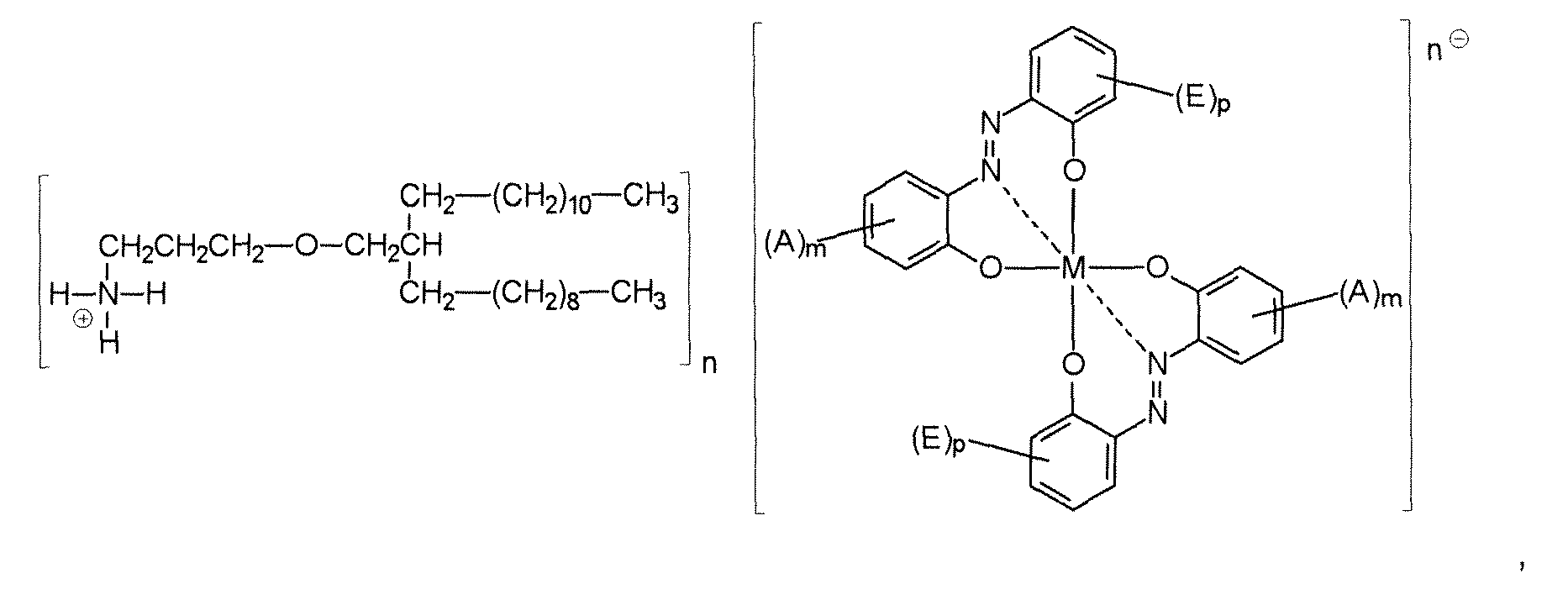


- A process which comprises (1) incorporating into an ink jet printing apparatus a phase change ink composition comprising (a) a phase change ink carrier comprising (1) an amide; and (2) a polyethylene wax having an average peak molecular weight of from about 350 to about 730 and a polydispersity of from about 1.0001 to about 1.5; and (b) a colorant compound of the formula


- A process according to claim 9 wherein the substrate is an intermediate transfer member and droplets of the melted ink are ejected in an imagewise pattern onto the intermediate transfer member followed by transfer of the imagewise pattern from the intermediate transfer member to a final recording sheet.
Applications Claiming Priority (1)
| Application Number | Priority Date | Filing Date | Title |
|---|---|---|---|
| US11/290,258 US7442242B2 (en) | 2005-11-30 | 2005-11-30 | Phase change inks containing specific colorants |
Publications (2)
| Publication Number | Publication Date |
|---|---|
| EP1792959A1 true EP1792959A1 (en) | 2007-06-06 |
| EP1792959B1 EP1792959B1 (en) | 2008-07-30 |
Family
ID=37715941
Family Applications (1)
| Application Number | Title | Priority Date | Filing Date |
|---|---|---|---|
| EP06124207A Not-in-force EP1792959B1 (en) | 2005-11-30 | 2006-11-16 | Phase Change Inks Containing Specific Colorants |
Country Status (8)
| Country | Link |
|---|---|
| US (1) | US7442242B2 (en) |
| EP (1) | EP1792959B1 (en) |
| JP (1) | JP5259948B2 (en) |
| KR (1) | KR101363882B1 (en) |
| CN (1) | CN101191026B (en) |
| BR (1) | BRPI0604985A (en) |
| CA (1) | CA2568767C (en) |
| DE (1) | DE602006002015D1 (en) |
Cited By (1)
| Publication number | Priority date | Publication date | Assignee | Title |
|---|---|---|---|---|
| EP3000856A1 (en) * | 2014-09-25 | 2016-03-30 | Markem-Imaje Corporation | Hot melt inks |
Families Citing this family (4)
| Publication number | Priority date | Publication date | Assignee | Title |
|---|---|---|---|---|
| US7879143B2 (en) * | 2005-05-11 | 2011-02-01 | Xerox Corporation | Polyalkylene materials |
| US8545612B1 (en) | 2012-04-23 | 2013-10-01 | Xerox Corporation | Phase change ink compositions and sulfonated compounds for use in the same |
| US8920551B1 (en) * | 2013-08-28 | 2014-12-30 | Xerox Corporation | Phase change inks |
| US9410051B2 (en) | 2014-09-25 | 2016-08-09 | Markem-Imaje Corporation | Hot melt inks |
Citations (1)
| Publication number | Priority date | Publication date | Assignee | Title |
|---|---|---|---|---|
| EP0519138A2 (en) * | 1991-06-17 | 1992-12-23 | Tektronix Inc. | Phase change ink colorants and phase change inks produced therefrom |
Family Cites Families (33)
| Publication number | Priority date | Publication date | Assignee | Title |
|---|---|---|---|---|
| US130054A (en) * | 1872-07-30 | Improvement in egg-inspectors | ||
| BE755392A (en) * | 1969-08-28 | 1971-02-01 | Teletype Corp | INK AND ELECTROSTATIC PRINTING APPARATUS |
| NL173862C (en) * | 1971-08-10 | 1984-03-16 | Ciba Geigy | PROCESS FOR PREPARING AMMONIUM SALTS OF ANIONOGENIC DYES |
| CH624981A5 (en) * | 1977-03-21 | 1981-08-31 | Ciba Geigy Ag | Process for the preparation of salts of 1:2 metal complex dyes which are free from sulphonic acid groups |
| US4390369A (en) * | 1981-12-17 | 1983-06-28 | Exxon Research And Engineering Co. | Natural wax-containing ink jet inks |
| US4484948A (en) * | 1981-12-17 | 1984-11-27 | Exxon Research And Engineering Co. | Natural wax-containing ink jet inks |
| DE3579067D1 (en) * | 1984-05-10 | 1990-09-13 | Willett Int Ltd | METHOD FOR COATING A SUBSTRATE WITH THERMOPLASTIC INKS, AND COATING COMPOSITION. |
| EP0187352B1 (en) | 1984-12-31 | 1991-06-05 | Howtek, Inc. | A method of ink jet colour printing |
| DE3671460D1 (en) | 1985-06-25 | 1990-06-28 | Howtek Inc | INK FOR INK JET PRINT. |
| JPH0623861B2 (en) * | 1986-08-04 | 1994-03-30 | 日本化薬株式会社 | Toner for electrophotographic printing |
| JPS6354476A (en) * | 1986-08-25 | 1988-03-08 | Seiko Epson Corp | Hot-melting ink |
| US4889560A (en) * | 1988-08-03 | 1989-12-26 | Tektronix, Inc. | Phase change ink composition and phase change ink produced therefrom |
| US4889761A (en) * | 1988-08-25 | 1989-12-26 | Tektronix, Inc. | Substrates having a light-transmissive phase change ink printed thereon and methods for producing same |
| JPH02229870A (en) * | 1989-03-02 | 1990-09-12 | Seiko Epson Corp | Ink composition |
| US5151120A (en) * | 1989-03-31 | 1992-09-29 | Hewlett-Packard Company | Solid ink compositions for thermal ink-jet printing having improved printing characteristics |
| US5006170A (en) * | 1989-06-22 | 1991-04-09 | Xerox Corporation | Hot melt ink compositions |
| JPH04359073A (en) * | 1991-06-04 | 1992-12-11 | Seiko Epson Corp | hot melt ink composition |
| DE4205713C2 (en) * | 1992-02-25 | 1994-08-04 | Siegwerk Druckfarben Gmbh & Co | Printing ink, process for its production and its use |
| JPH06336567A (en) * | 1993-05-28 | 1994-12-06 | Mitsubishi Pencil Co Ltd | Ethanol-based ink for marking pen |
| US5385957A (en) | 1992-08-24 | 1995-01-31 | Videojet Systems International, Inc. | Hotmelt ink jet comprising ionomers having melting points from about 50° C. to about 130° or a softening point below about 80° C., and an image-forming agent |
| US5621022A (en) * | 1992-11-25 | 1997-04-15 | Tektronix, Inc. | Use of polymeric dyes in hot melt ink jet inks |
| US5372852A (en) * | 1992-11-25 | 1994-12-13 | Tektronix, Inc. | Indirect printing process for applying selective phase change ink compositions to substrates |
| JPH11501877A (en) * | 1995-03-13 | 1999-02-16 | マーケム コーポレイション | Ink for inkjet printing |
| JPH0841399A (en) * | 1995-04-18 | 1996-02-13 | Brother Ind Ltd | Hot melt ink for inkjet printer |
| US6245135B1 (en) * | 1997-08-22 | 2001-06-12 | Xerox Corporation | Phase change ink composition |
| US6028138A (en) * | 1996-06-28 | 2000-02-22 | Tektronix, Inc. | Phase change ink formulation using urethane isocyanate-derived resins, a polyethylene wax and toughening agent |
| US6001904A (en) * | 1998-05-08 | 1999-12-14 | Westvaco Corporation | Shear-thinning phase change ink jet inks and method of printing therewith |
| JP2000273371A (en) * | 1999-03-19 | 2000-10-03 | Hitachi Koki Co Ltd | Hot melt type pigment ink composition for inkjet |
| US6133353A (en) * | 1999-11-11 | 2000-10-17 | 3D Systems, Inc. | Phase change solid imaging material |
| JP2001316600A (en) * | 2000-05-10 | 2001-11-16 | Hodogaya Chem Co Ltd | Metal complex salt azo dye |
| US6860930B2 (en) * | 2003-06-25 | 2005-03-01 | Xerox Corporation | Phase change inks containing branched triamides |
| US20050130054A1 (en) | 2003-11-25 | 2005-06-16 | Baker Hughes Incorporated | Toners and inks prepared using polyolefin waxes |
| US7294730B2 (en) * | 2005-11-30 | 2007-11-13 | Xerox Corporation | Colorant compounds |
-
2005
- 2005-11-30 US US11/290,258 patent/US7442242B2/en not_active Expired - Fee Related
-
2006
- 2006-11-16 DE DE602006002015T patent/DE602006002015D1/en active Active
- 2006-11-16 EP EP06124207A patent/EP1792959B1/en not_active Not-in-force
- 2006-11-23 CA CA2568767A patent/CA2568767C/en not_active Expired - Fee Related
- 2006-11-27 JP JP2006318167A patent/JP5259948B2/en not_active Expired - Fee Related
- 2006-11-29 CN CN2006101631656A patent/CN101191026B/en not_active Expired - Fee Related
- 2006-11-30 BR BRPI0604985-0A patent/BRPI0604985A/en not_active Application Discontinuation
- 2006-11-30 KR KR1020060119891A patent/KR101363882B1/en not_active Expired - Fee Related
Patent Citations (1)
| Publication number | Priority date | Publication date | Assignee | Title |
|---|---|---|---|---|
| EP0519138A2 (en) * | 1991-06-17 | 1992-12-23 | Tektronix Inc. | Phase change ink colorants and phase change inks produced therefrom |
Cited By (1)
| Publication number | Priority date | Publication date | Assignee | Title |
|---|---|---|---|---|
| EP3000856A1 (en) * | 2014-09-25 | 2016-03-30 | Markem-Imaje Corporation | Hot melt inks |
Also Published As
| Publication number | Publication date |
|---|---|
| CN101191026A (en) | 2008-06-04 |
| EP1792959B1 (en) | 2008-07-30 |
| CN101191026B (en) | 2011-04-06 |
| KR20070057046A (en) | 2007-06-04 |
| CA2568767A1 (en) | 2007-05-30 |
| CA2568767C (en) | 2010-03-16 |
| DE602006002015D1 (en) | 2008-09-11 |
| US20070120915A1 (en) | 2007-05-31 |
| JP5259948B2 (en) | 2013-08-07 |
| JP2007154194A (en) | 2007-06-21 |
| KR101363882B1 (en) | 2014-02-21 |
| BRPI0604985A (en) | 2007-10-09 |
| US7442242B2 (en) | 2008-10-28 |
Similar Documents
| Publication | Publication Date | Title |
|---|---|---|
| CA2568928C (en) | Phase change inks | |
| EP1792953B1 (en) | Phase change inks | |
| EP1808463B1 (en) | Metal complex azo dyes | |
| JP4866538B2 (en) | Phase change ink with improved image performance | |
| EP2107088B1 (en) | Phase change inks containing Fischer-Tropsch Waxes | |
| EP1792959B1 (en) | Phase Change Inks Containing Specific Colorants | |
| EP1792958B1 (en) | Phase change inks containing Fischer-Tropsch waxes | |
| EP1958992B1 (en) | Phase change inks containing colorant compounds | |
| EP1935950B1 (en) | Phase Change Inks Containing Dialkyl Ethers | |
| EP1792957B1 (en) | Phase change inks | |
| MXPA06013693A (en) | Phase change inks containing specific colorants | |
| CA2832620C (en) | Phase change ink containing ethylene vinyl acetate | |
| MXPA06013696A (en) | Phase change inks | |
| MXPA06013715A (en) | Phase change inks |
Legal Events
| Date | Code | Title | Description |
|---|---|---|---|
| PUAI | Public reference made under article 153(3) epc to a published international application that has entered the european phase |
Free format text: ORIGINAL CODE: 0009012 |
|
| AK | Designated contracting states |
Kind code of ref document: A1 Designated state(s): AT BE BG CH CY CZ DE DK EE ES FI FR GB GR HU IE IS IT LI LT LU LV MC NL PL PT RO SE SI SK TR |
|
| AX | Request for extension of the european patent |
Extension state: AL BA HR MK YU |
|
| 17P | Request for examination filed |
Effective date: 20071206 |
|
| GRAP | Despatch of communication of intention to grant a patent |
Free format text: ORIGINAL CODE: EPIDOSNIGR1 |
|
| AKX | Designation fees paid |
Designated state(s): DE FR GB |
|
| GRAS | Grant fee paid |
Free format text: ORIGINAL CODE: EPIDOSNIGR3 |
|
| GRAA | (expected) grant |
Free format text: ORIGINAL CODE: 0009210 |
|
| AK | Designated contracting states |
Kind code of ref document: B1 Designated state(s): DE FR GB |
|
| REG | Reference to a national code |
Ref country code: GB Ref legal event code: FG4D |
|
| REF | Corresponds to: |
Ref document number: 602006002015 Country of ref document: DE Date of ref document: 20080911 Kind code of ref document: P |
|
| PLBE | No opposition filed within time limit |
Free format text: ORIGINAL CODE: 0009261 |
|
| STAA | Information on the status of an ep patent application or granted ep patent |
Free format text: STATUS: NO OPPOSITION FILED WITHIN TIME LIMIT |
|
| 26N | No opposition filed |
Effective date: 20090506 |
|
| REG | Reference to a national code |
Ref country code: FR Ref legal event code: PLFP Year of fee payment: 10 |
|
| REG | Reference to a national code |
Ref country code: FR Ref legal event code: PLFP Year of fee payment: 11 |
|
| REG | Reference to a national code |
Ref country code: FR Ref legal event code: PLFP Year of fee payment: 12 |
|
| REG | Reference to a national code |
Ref country code: FR Ref legal event code: PLFP Year of fee payment: 13 |
|
| PGFP | Annual fee paid to national office [announced via postgrant information from national office to epo] |
Ref country code: DE Payment date: 20191021 Year of fee payment: 14 |
|
| PGFP | Annual fee paid to national office [announced via postgrant information from national office to epo] |
Ref country code: FR Payment date: 20191022 Year of fee payment: 14 |
|
| PGFP | Annual fee paid to national office [announced via postgrant information from national office to epo] |
Ref country code: GB Payment date: 20191022 Year of fee payment: 14 |
|
| REG | Reference to a national code |
Ref country code: DE Ref legal event code: R119 Ref document number: 602006002015 Country of ref document: DE |
|
| GBPC | Gb: european patent ceased through non-payment of renewal fee |
Effective date: 20201116 |
|
| PG25 | Lapsed in a contracting state [announced via postgrant information from national office to epo] |
Ref country code: FR Free format text: LAPSE BECAUSE OF NON-PAYMENT OF DUE FEES Effective date: 20201130 |
|
| PG25 | Lapsed in a contracting state [announced via postgrant information from national office to epo] |
Ref country code: DE Free format text: LAPSE BECAUSE OF NON-PAYMENT OF DUE FEES Effective date: 20210601 Ref country code: GB Free format text: LAPSE BECAUSE OF NON-PAYMENT OF DUE FEES Effective date: 20201116 |