EP1786860B1 - In-can stabilizers - Google Patents
In-can stabilizers Download PDFInfo
- Publication number
- EP1786860B1 EP1786860B1 EP05779826A EP05779826A EP1786860B1 EP 1786860 B1 EP1786860 B1 EP 1786860B1 EP 05779826 A EP05779826 A EP 05779826A EP 05779826 A EP05779826 A EP 05779826A EP 1786860 B1 EP1786860 B1 EP 1786860B1
- Authority
- EP
- European Patent Office
- Prior art keywords
- oxyl
- diethyl
- trimethyl
- pigments
- resins
- Prior art date
- Legal status (The legal status is an assumption and is not a legal conclusion. Google has not performed a legal analysis and makes no representation as to the accuracy of the status listed.)
- Expired - Lifetime
Links
- PLDSNBJFZSMLQW-UHFFFAOYSA-N CCCC(CC)C1C(C)C=CC1 Chemical compound CCCC(CC)C1C(C)C=CC1 PLDSNBJFZSMLQW-UHFFFAOYSA-N 0.000 description 1
- GBUFXEYWHCZPPP-UHFFFAOYSA-N CCOP(C(C(C)(C)C)N(C(C)(C)C)[O]=C)(OCC)=O Chemical compound CCOP(C(C(C)(C)C)N(C(C)(C)C)[O]=C)(OCC)=O GBUFXEYWHCZPPP-UHFFFAOYSA-N 0.000 description 1
Classifications
-
- C—CHEMISTRY; METALLURGY
- C08—ORGANIC MACROMOLECULAR COMPOUNDS; THEIR PREPARATION OR CHEMICAL WORKING-UP; COMPOSITIONS BASED THEREON
- C08K—Use of inorganic or non-macromolecular organic substances as compounding ingredients
- C08K5/00—Use of organic ingredients
- C08K5/16—Nitrogen-containing compounds
- C08K5/34—Heterocyclic compounds having nitrogen in the ring
- C08K5/3412—Heterocyclic compounds having nitrogen in the ring having one nitrogen atom in the ring
- C08K5/3432—Six-membered rings
- C08K5/3435—Piperidines
-
- C—CHEMISTRY; METALLURGY
- C08—ORGANIC MACROMOLECULAR COMPOUNDS; THEIR PREPARATION OR CHEMICAL WORKING-UP; COMPOSITIONS BASED THEREON
- C08K—Use of inorganic or non-macromolecular organic substances as compounding ingredients
- C08K5/00—Use of organic ingredients
- C08K5/04—Oxygen-containing compounds
- C08K5/07—Aldehydes; Ketones
-
- C—CHEMISTRY; METALLURGY
- C08—ORGANIC MACROMOLECULAR COMPOUNDS; THEIR PREPARATION OR CHEMICAL WORKING-UP; COMPOSITIONS BASED THEREON
- C08K—Use of inorganic or non-macromolecular organic substances as compounding ingredients
- C08K5/00—Use of organic ingredients
- C08K5/16—Nitrogen-containing compounds
- C08K5/315—Compounds containing carbon-to-nitrogen triple bonds
-
- C—CHEMISTRY; METALLURGY
- C08—ORGANIC MACROMOLECULAR COMPOUNDS; THEIR PREPARATION OR CHEMICAL WORKING-UP; COMPOSITIONS BASED THEREON
- C08K—Use of inorganic or non-macromolecular organic substances as compounding ingredients
- C08K5/00—Use of organic ingredients
- C08K5/16—Nitrogen-containing compounds
- C08K5/34—Heterocyclic compounds having nitrogen in the ring
- C08K5/3442—Heterocyclic compounds having nitrogen in the ring having two nitrogen atoms in the ring
- C08K5/3462—Six-membered rings
-
- C—CHEMISTRY; METALLURGY
- C08—ORGANIC MACROMOLECULAR COMPOUNDS; THEIR PREPARATION OR CHEMICAL WORKING-UP; COMPOSITIONS BASED THEREON
- C08K—Use of inorganic or non-macromolecular organic substances as compounding ingredients
- C08K5/00—Use of organic ingredients
- C08K5/49—Phosphorus-containing compounds
- C08K5/51—Phosphorus bound to oxygen
- C08K5/53—Phosphorus bound to oxygen bound to oxygen and to carbon only
- C08K5/5317—Phosphonic compounds, e.g. R—P(:O)(OR')2
- C08K5/5333—Esters of phosphonic acids
- C08K5/5353—Esters of phosphonic acids containing also nitrogen
Definitions
- the present invention relates to the use of highly sterically hindered nitroxyl radicals as in-can stabilizers for UV-curable resins.
- UV-curable inks and varnishes have been one of the fastest growing technologies In the past two decades. This growth is forecast to continue well into the future with the development of new applications for UV curing, such as inks for food packaging. New raw materials are required to ensure that UV-technology can meet the challenging demands of low odor and low migration, low yellowing while maintaining high reactivity.
- the UV-curable resins are composed of a monofunctional or multifunctional monomer, oligomer or polymer molecule and a photoinitiating compound.
- Monomers, oligomers or polymers typically used for UV curing have at least one ethylenically unsaturated group like an acrylate or methacrylate functional groups. Polymerization is achieved by exposure to UV radiation.
- UV-curable resins frequently have to be stabilised against undesired polymerisation or crosslinking of the ethylenically unsaturated group in order that they have adequate storage stability without reducing the cure-speed when radiated.
- the stabilizers should be compatible with a wide range of commercially available oligomers such as epoxy-, urethane-, polyester- and acrylate- systems.
- the problem underlying the present invention is therefore to provide In-can stabilizers which are radical scavengers that have a high affinity to radicals formed in UV curable resins containing ethylenically unsaturated monomers, oligomers and/or polymers and a photoinitiator during storage without reducing the cure-speed when radiated and which radical scavengers prevent the geling of UV curable resins and thus increase the storage stability throughout their life cycle from manufacturing to curing compared to the state of art stabilizers, especially in pigmented systems.
- Some pigments, for instance orange, green and black pigments are known to have a negative influence on the storage stability. A specific problem occurs when Orange 34 is used.
- the present invention relates to the use of stable highly sterically hindered nitroxyl radicals selected from 2,6-diethyl-2,3,6-trimethyl-4-hydroxypiperidine-1-oxyl, 2,6-diethyl-2,3,6-trimethyl-4-oxopiperldlne-1-oxyl, 7,9-diethyl-6,7,9-trimethyl-1,4-dioxe-B-aza-spiro[4.5]decan-8-oxyl, octadecanoic acid 3,8,10-triethyl-7,8,10-trimethyl-1,5-dioxa-9-aza-spiro[5,5]undec-3-ylmethyl ester-9-oxyl, 1-t-butyl-3,3,5,5-tetraethyl-piperazin-2-on-4-oxyl, 1-t-octyl-3,3-diethyl-5,5-dimethyl-piperazin-2-on-4-oxyl, tert-
- ring nitroxyl radicals are more hindered than ring nitroxyl radicals having 4 methyl groups in the alpha position to the N-atom, for example more hindered than TEMPO (2,2,6,6-tetramethylpiperidinyl-1-oxy-radical).
- In can stabilizer a stabilizer that improves the storage stability.
- In-can stabilizers are radical scavengers that have a high affinity to radicals formed in UV curable resins during storage without reducing the cure-speed when radiated. In-can stabilizers prevent the geling of UV curable resins and thus increase the storage stability throughout their life cycle from manufacturing to curing.
- UV-curable resin Is meant a coating or ink which achieves the desired degree of hardness upon exposure to ultraviolet radiation. This occurs due to the presence of a photoinitiating compound which absorbs UV light (light of wavelength from about 200 nm to about 600 nm), generates a free radical, and causes polymerization or cross-linking of functional groups on resin monomers, oligomers or polymers.
- the UV curable resin is a pigmented or unpigmented urethane resins, acrylic resins, polyester resins, and epoxy resins. These resins are known in the art. Pigmented systems are preferred.
- Suitable photoinitiators are known to those skilled in the art. For example, ⁇ -hydroxyketones and ⁇ -aminoketones, phenylglyoxalates or phospinoxides are photoinitiators commonly used in graphic arts applications.
- Pigments which may be used in the invention include organic and inorganic pigments, alone or In combination. The exact choice of pigments will depend upon the specific application and performance requirements such as color reproduction and image stability. Pigments suitable for use in the present invention include, for example, azo pigments, monoazo pigments, disazo pigments, azo pigment lakes, beta-Naphthol pigments, Naphthol AS pigments, benzimidazolone pigments, disazo condensation pigments, metal complex pigments, isoindolinone and isoindoline pigments, polycyclic pigments, phthalocyanine pigments, quinacridone pigments, perylene and perinone pigments, thioindigo pigments, anthrapyrimidone pigments, flavanthrone pigments, anthanthrone pigments, dioxazine pigments, triarylcarbonium pigments, quinophthalone pigments, diketopyrrolo pyrrole pigments, titanium oxide, iron oxide, and carbon black.
- Typical examples of pigments which may be used include Color Index (C.I.) Pigment Yellow 1, 2, 3, 5, 6, 10, 12, 13, 14, 16, 17, 62, 65, 73, 74, 75, 81, 83, 87, 90, 93, 94, 95, 97, 98, 99, 100, 101, 104, 106, 108, 109, 110, 111, 113, 114, 116, 117, 120, 121, 123, 124, 126, 127, 128, 129, 130, 133, 136, 138, 139, 147, 148, 150, 151, 152, 153, 154, 155, 165, 166, 167, 168, 169, 170, 171, 172, 173, 174, 175, 176, 177, 179, 180, 181, 182, 183, 184, 185, 187, 188, 190, 191, 192, 193, 194; C.I.
- Pigment Orange 1 2, 5, 6, 13, 15, 16, 17, 17:1, 19, 22, 24, 31, 34, 36, 38, 40, 43, 44, 46, 48, 49, 51. 69, 60, 61, 62, 64, 65, 66, 67, 68, 69; 0.1.
- the pigment employed is C.I. Pigment Blue 15:3, C.I. Pigment Red 122, C,I. Pigment Yellow 155, C.I. Pigment Yellow 74, bis(phthalocyanylalumlno)tetraphenyJdisiloxane or C.I. Pigment Black 7.
- the resin composition of the present invention can further contain additives commonly employed in the art.
- the stabilizer also increases the storage stability of a coating or an ink composition which does not contain a photoinitiator.
- the storage stabilisation of resins not containing a photoinitiator is especially important if a reactive binder such as an amine acrylate is present.
- the stabilizer is added in an amount of from 0.0001 to 10% by weight, based on the total amount of coating composition or ink composition, preferably 0.01 to 5%.
- WO03/054073 WO03/07605 and WO 03/085039 describe acrylic resins containing highly sterically nitroxyl radicals and their use as flame retardants, The use to increase the storage stability is not disclosed therein.
- These compounds may be used together with a radical source to effect polymerization of ethylenically unsaturated monomers or oligomers.
- WO96/24620 (Elf Atochem) describes compounds of the formula used for controlled polymerization of ethylenically unsaturated monomers.
- WO20022048205 (Ciba) describes compounds of the formula used for controlled polymerisation.
- 2,6-diethyl-2,3,6-trimethyl-4-oxopiperidine is prepared in analogy to example 1 by oxidizing 16g (0,08 mol) 2,6-diethyl-2,3,6-trimethyl-4-oxopiperidine with m-chlor-perbenzoic acid. 10g 2,6-diethyl,2,3,6-trimethyl-4-oxypiperidine-1-oxyl are obtained as red liquid. Elemental analysis calculated for C 12 H 22 NO 2 : C 67.89%; H 10.44%; N 6.60%. Found: C 68.00%; H 10.42%; N 6.61%.
- the title compound is prepared by oxidizing octadecanoic acid 3,8,10-triethyl-7,8,10-trimethyl-1,5-dioxa-9-aza-spiro[5,5]undec-3-yl-methyl ester (prepared In analogy to US 4,105,626 , Example 4) as a red oil.
- the compound is transformed into the title compound as red crystals, m.p. 34-37 °C. 45,3 g (0.2 Mol) of raw compound are dissolved In 450 ml of ethylacetate and 51.1 ml (0.3 Mol) of peracetic acid (39% in acetic acid) are added to the stirred solution under cooling within 20 minutes. The solution is stirred for another 2.5 hours, then diluted with 100 ml of hexane and washed with NaHCO 3 solution till neutral.
- the title compound is obtained after evaporation of hexane, chromatography of the residue on Silica gel with hexane-EtOAc (5:1) and crystallization from pentane.
- 0.2 g of a TMPTA solution containing 2.5 wt-% stabilizer were added to 5.0 g of a commercial orange offset ink (w/o previously added stabilizer) and were distributed homogeneously in a muller.
- 2.4 g of the Ink were filled into a weighing container (glass, diameter 13 mm) and placed in a drying oven. The samples were stored at 70 °C and the polymerization of the ink (usually starting at the bottom, to the top) was checked with a spatula (reported as days until the polymerization started).
- Composition of the blue offset ink Weight (g) Raw material Remark 18.3 Ebecryl 1608 (UCB) Diluted epoxyacrylate in GPTA 18.3 Ebecryl 657 (UCB) Polyester tetraacrylate 20.0 Ebecryl 220 (UCB) Aromatic urethane hexaacrylate 20.9 Ebecryl 150 (UCB) Diluting epoxyacrylate 22.5 Irgalite Blue GLO (Ciba) Copper phthalocyanine pigment ( ⁇ -form) 6.0 Irgacure 1300 (Ciba) Fotoinitiator (Irgacure 369 + Irgacure 651 benzildimethylketal) 106.0 Total formulation
- 0.2 g of a TMPTA solution containing 2.5 wt-% stabilizer were added to 5.0 g of the blue offset ink and were distributed homogeneously in a muller.
- the inks were printed with a beaubau multipurpose printability tester on white Lumiart paper (1.5 g/m 2 ) and were exposed to the radiation of one medium-pressure mercury lamp, at 150 W/cm in an UV curing unit from IST-Metz.
- the through cure (line speed in m/min) and the surface cure (y/n) of the ink were assessed after the exposure.
- the high sterically hindered nitroxyl radicals show a higher stabilization effect like the commercial products Florstab UV1 and Irgastab UV10, in particular in the TMPTA / irgacure 369 mixture. They have no or only a small negative Influence on the curing efficiency of the blue offset Ink.
Landscapes
- Chemical & Material Sciences (AREA)
- Health & Medical Sciences (AREA)
- Chemical Kinetics & Catalysis (AREA)
- Medicinal Chemistry (AREA)
- Polymers & Plastics (AREA)
- Organic Chemistry (AREA)
- Compositions Of Macromolecular Compounds (AREA)
- Hydrogenated Pyridines (AREA)
- Inks, Pencil-Leads, Or Crayons (AREA)
- Paints Or Removers (AREA)
- Polymerisation Methods In General (AREA)
- Organic Low-Molecular-Weight Compounds And Preparation Thereof (AREA)
Abstract
Description
- The present invention relates to the use of highly sterically hindered nitroxyl radicals as in-can stabilizers for UV-curable resins.
- UV-curable inks and varnishes have been one of the fastest growing technologies In the past two decades. This growth is forecast to continue well into the future with the development of new applications for UV curing, such as inks for food packaging. New raw materials are required to ensure that UV-technology can meet the challenging demands of low odor and low migration, low yellowing while maintaining high reactivity.
- The UV-curable resins are composed of a monofunctional or multifunctional monomer, oligomer or polymer molecule and a photoinitiating compound. Monomers, oligomers or polymers typically used for UV curing have at least one ethylenically unsaturated group like an acrylate or methacrylate functional groups. Polymerization is achieved by exposure to UV radiation.
- UV-curable resins frequently have to be stabilised against undesired polymerisation or crosslinking of the ethylenically unsaturated group in order that they have adequate storage stability without reducing the cure-speed when radiated.
The stabilizers should be compatible with a wide range of commercially available oligomers such as epoxy-, urethane-, polyester- and acrylate- systems. - In the prior art, for example in
WO01/42313 - The problem underlying the present invention is therefore to provide In-can stabilizers which are radical scavengers that have a high affinity to radicals formed in UV curable resins containing ethylenically unsaturated monomers, oligomers and/or polymers and a photoinitiator during storage without reducing the cure-speed when radiated and which radical scavengers prevent the geling of UV curable resins and thus increase the storage stability throughout their life cycle from manufacturing to curing compared to the state of art stabilizers, especially in pigmented systems. Some pigments, for instance orange, green and black pigments are known to have a negative influence on the storage stability. A specific problem occurs when Orange 34 is used.
- It has now been found that this problem is solved by adding to the ethylenically unsaturated monomer-, oligomer- or polymer molecules stable highly sterically hindered nitroxyl radicals,
- The present invention relates to the use of stable highly sterically hindered nitroxyl radicals selected from
2,6-diethyl-2,3,6-trimethyl-4-hydroxypiperidine-1-oxyl,
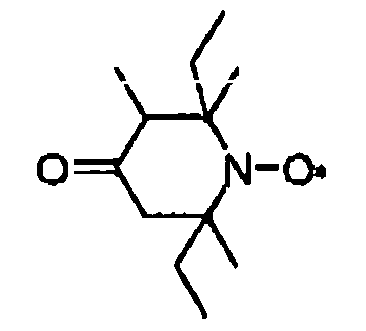


- By the term "highly sterically hindered" is meant that ring nitroxyl radicals are more hindered than ring nitroxyl radicals having 4 methyl groups in the alpha position to the N-atom, for example more hindered than TEMPO (2,2,6,6-tetramethylpiperidinyl-1-oxy-radical).
- By the term "in can stabilizer" is meant a stabilizer that improves the storage stability.
In-can stabilizers are radical scavengers that have a high affinity to radicals formed in UV curable resins during storage without reducing the cure-speed when radiated. In-can stabilizers prevent the geling of UV curable resins and thus increase the storage stability throughout their life cycle from manufacturing to curing. - By the term "UV-curable resin" Is meant a coating or ink which achieves the desired degree of hardness upon exposure to ultraviolet radiation. This occurs due to the presence of a photoinitiating compound which absorbs UV light (light of wavelength from about 200 nm to about 600 nm), generates a free radical, and causes polymerization or cross-linking of functional groups on resin monomers, oligomers or polymers.
- The UV curable resin is a pigmented or unpigmented urethane resins, acrylic resins, polyester resins, and epoxy resins. These resins are known in the art. Pigmented systems are preferred.
- Among those resins especially inks and overprint varnishes are stabilized. Inks are especially offset inks, Printing Ink and overprint varnish formulations are well known. Examples of suitable formulations are described, for example in "Printing Ink and Overprint Varnish Formulations" (2nd Edition), published by William Andrew Publishing/Noyes, 1999, which are incorporated by reference herein.
- Suitable photoinitiators are known to those skilled in the art.
For example, α-hydroxyketones and α-aminoketones, phenylglyoxalates or phospinoxides are photoinitiators commonly used in graphic arts applications. - Especially preferred are, for example, the following commercially available photoinitiators:
- Darocur 1173: 2-hydroxy-2-rnethyl-1-phenyl-1-propanone (HMPP) and Oligomeric HMPP,
- Irgacure 184: 1-hydroxy-cyclohexyl-phenylketone,
- Irgacure 2959: 2-hydroxy-1-[4-(2-hydroxyethoxy)phenyl]-2-methyl-1-propanone,
- Irgacure 369; 2-benzyl-2-(dimethylamino)-1-[4-(4-morpholinyl)phenyl]-1-butanone,
- Irgacure 1300: Irgacure 369 + Irgacure 651 (benzildimethylketal),
- Irgacure 379: 2-(4-Methylbenzyl)-2-(dimethylamino)-1-[4-(4-morpholinyl)phenyl]-1-butanone,
- Irgacure 127: 2-Hydroxy-1-{4-[4-(2-hydroxy-2-methyl-propionyl)-benzyl]-phenyl}-2-methylpropan-1-one,
- Irgacure 754: oxo-phonyl-acatic acid 1-methyl-2-[2-(2-oxo-2-phenyl-acetoxy)-propoxy]-ethyl ester,
- Irgacure 819; bis(2,4,6-trimethylbenzoyl)-phenylphosphine oxide,
- Irgacure 2100: a mixture of Irgacure 819 and Lucerin TPO (2,4,6-Trimethylbenzoyl-phenyl phosphinic acid ethyl ester),
- lrgacure 2022: a mixture of Irgacure 819 and Lucerin TPO and Darocur 1173,
- lrgacur 250: 4-isobutylphanyl-4'-mothylphenyl iodonium hexafluorophosphate,
- Darocur ITX: 2-isopropylthloxanthone and 4-isopropylthioxanthone,
- Darocur EDB: ethyl-4-dimethylamino benzoate,
- Darocur EHA: 2-athylhexyl-4-dimethylamino benzoate.
- The above examples of photoinitiators are not limiting.
- Pigments which may be used in the invention include organic and inorganic pigments, alone or In combination. The exact choice of pigments will depend upon the specific application and performance requirements such as color reproduction and image stability. Pigments suitable for use in the present invention include, for example, azo pigments, monoazo pigments, disazo pigments, azo pigment lakes, beta-Naphthol pigments, Naphthol AS pigments, benzimidazolone pigments, disazo condensation pigments, metal complex pigments, isoindolinone and isoindoline pigments, polycyclic pigments, phthalocyanine pigments, quinacridone pigments, perylene and perinone pigments, thioindigo pigments, anthrapyrimidone pigments, flavanthrone pigments, anthanthrone pigments, dioxazine pigments, triarylcarbonium pigments, quinophthalone pigments, diketopyrrolo pyrrole pigments, titanium oxide, iron oxide, and carbon black. Typical examples of pigments which may be used include Color Index (C.I.) Pigment Yellow 1, 2, 3, 5, 6, 10, 12, 13, 14, 16, 17, 62, 65, 73, 74, 75, 81, 83, 87, 90, 93, 94, 95, 97, 98, 99, 100, 101, 104, 106, 108, 109, 110, 111, 113, 114, 116, 117, 120, 121, 123, 124, 126, 127, 128, 129, 130, 133, 136, 138, 139, 147, 148, 150, 151, 152, 153, 154, 155, 165, 166, 167, 168, 169, 170, 171, 172, 173, 174, 175, 176, 177, 179, 180, 181, 182, 183, 184, 185, 187, 188, 190, 191, 192, 193, 194; C.I. Pigment Orange 1, 2, 5, 6, 13, 15, 16, 17, 17:1, 19, 22, 24, 31, 34, 36, 38, 40, 43, 44, 46, 48, 49, 51. 69, 60, 61, 62, 64, 65, 66, 67, 68, 69; 0.1. Pigment Red 1, 2, 3, 4, 5, 6, 7, 8, 9, 10, 11, 12, 13, 14, 15. 16, 17, 18, 21, 22, 23, 31, 32, 38, 48:1, 48:2, 48:3. 48:4, 49:1, 49:2, 49:3, 50;1, 51, 52:1. 52:2, 53:1, 57:1, 60:1, 63:1, 66, 67, 68, 81, 95, 112, 114, 119, 122, 136, 144, 146, 147, 148, 149, 150, 151, 164, 166, 168, 169, 170, 171, 172, 175, 176, 177, 178, 179, 181, 184, 165, 187, 188, 190, 192, 194, 200, 202, 204, 206, 207, 210, 211, 212, 213, 214, 216, 220, 222. 237, 238, 239, 240, 242, 243, 245, 247, 248, 251, 252, 253, 254, 255, 256, 258. 261, 264; C.I. Pigment Violet 1, 2, 3, 5:1, 13, 19, 23, 25, 27, 29, 31, 32, 37, 39, 42, 44, 50; C.I. Pigment Blue 1, 2, 9, 10, 14, 15:1, 15:2, 15:3, 15:4, 15:6, 15, 16, 18, 19, 24:1, 25, 56, 60, 61, 62, 63, 64, 66; C.I. Pigment Green 1, 2, 4, 7, 8, 10, 36, 45; C. 1. Pigment Black 1, 7, 20, 31, 32, and C.I. Pigment Brown 1,5, 22, 23, 25, 38, 41, 42. In a preferred embodiment of the invention, the pigment employed is C.I. Pigment Blue 15:3, C.I. Pigment Red 122, C,I. Pigment Yellow 155, C.I. Pigment Yellow 74, bis(phthalocyanylalumlno)tetraphenyJdisiloxane or C.I. Pigment Black 7.
- If desired, the resin composition of the present invention can further contain additives commonly employed in the art.
- The stabilizer also increases the storage stability of a coating or an ink composition which does not contain a photoinitiator. The storage stabilisation of resins not containing a photoinitiator is especially important if a reactive binder such as an amine acrylate is present.
- The stabilizer is added in an amount of from 0.0001 to 10% by weight, based on the total amount of coating composition or ink composition, preferably 0.01 to 5%.
- Highly sterically hindered nitroxyl radicals as well as acrylic resins containing them are known per se and are described for various applications in the prior art.
- A well known application is the use as flame retardant.
WO03/054073 WO03/07605 WO 03/085039 -
US 6,518,326 (Ciba) relates to compounds of formulae
- These compounds may be used together with a radical source to effect polymerization of ethylenically unsaturated monomers or oligomers.
-
WO96/24620 
-
US 6,353,107 (Ciba describes sterically highly hindered piperidine nitoxldes
-
WO20022048205 
-
US6,479,608 (Ciba) describes compounds of the formulae
- 2,6-diethyl-2,3,6-trimethyl-4-hydroxypiperidine-1-oxyl

- To a solution of 118.2g (0.6mol) 2,6-diethyl-2,3,6-trimethyl-4-oxopiperidine In 1000ml ethanol 18.2g (0.4 mol) sodium borohydride are added In portions and the temperature is kept below 30 °C. Subsequently the solution is stirred for 2 hours at 50°C. Ethanol is distilled off, 500 ml water are added to the residue which is subsequently extracted several times with CH2Cl2. The extract is dried over Na2SO4 and the solution is filtered. After removing the solvent 116g (97%) 2,6-diethyl-2,3,6-trimethyl-4-hydroxypiperidin are obtained as yellowish liquid.
Elemental analysis calculated for C12H25NO: C 72,31%; H 12.64%; N 7.03%, Found: C 71.44%; H 12,71%; N 6.87%. - To a solution of 25.7g (0.13 mol) 2,6-diethyl-2,3,6-trimethyl-4-hydroxypiperidine in 120 ml tetrahydrofurane a solution of a solution of 54.5g (0,22 mol) m-chlor-perbenzoic acid (70%) In 230 ml tetrahydrofurane is droppwise added under stirring within 2 hours at 0°C. The red to brown solution is stirred over night at room temperature and 500 ml hexane, are added. The solution is neutralized by shaking several times with 1 N NaHCO3 and finally with water. The solvent is evaporated and 27.0g (97%) 2,6-diethyl-2,3,6-trimethyl-4-hydroxypiperidine-1-oxyl are obtained as red liquid,
Elemental analysis calculated for C12H24NO2; C 67.25%; H 11.29%; N 6.54%. Found: C 67.10%; H 11.42%; N 6.68%. - 2,6-diethyl-2,3,6-trimethyl-4-oxopiperidine-1-oxyl

- 2,6-diethyl-2,3,6-trimethyl-4-oxopiperidine is prepared in analogy to example 1 by oxidizing 16g (0,08 mol) 2,6-diethyl-2,3,6-trimethyl-4-oxopiperidine with m-chlor-perbenzoic acid. 10g 2,6-diethyl,2,3,6-trimethyl-4-oxypiperidine-1-oxyl are obtained as red liquid.
Elemental analysis calculated for C12H22NO2: C 67.89%; H 10.44%; N 6.60%. Found: C 68.00%; H 10.42%; N 6.61%. - 7,9-Diethyl-6,7,9-trimethyl-1,4-dioxa-8-aza-spiro[4.5]decan-8-oxyl

- According to Example 5 in
US4,105,626 8 - octadecanoic acid 3,8,10-triethyl-7,8,10-trimethyl-1,5-dioxa-9-aza-spiro[5.5]undec-3-ylmethyl ester-9-oxyl

- The title compound is prepared by oxidizing octadecanoic acid 3,8,10-triethyl-7,8,10-trimethyl-1,5-dioxa-9-aza-spiro[5,5]undec-3-yl-methyl ester (prepared In analogy to
US 4,105,626 , Example 4) as a red oil. MS (Cl): MH+=595 (C36H68NO5 = 594.95). - 1-t-Butyl-3,3,5,5-tatraethyl-piperazin-2-on-4-oxyl

- 40 g (1 mol) of finely ground NaOH are added, with stirring, to a solution of 0.189 mol of 1.1-diethyl-2-t-butylaminoethylamin, (prepared In accordance with M. Senkus.: J,Am. Chem. Soc. 68, 10 (1946)) and 25 ml (0.3 mol) of chloroform in 250 ml of diethyl ketone at 10 °C. The reaction mixture is stirred for 16 hours at room temperature and is then filtered. The filtrate, concentrated by evaporation in a rotary evaporator, is chromatographed over silica gel with hexane/ethyl acetate (3:2). The pure fractions are concentrated by evaporation, to give 1-t-butyl-3,3,5,5-tetraethyl-piperazin-2-on (52%) as a yellow oil.
- The compound is transformed into the title compound as red crystals, m.p. 34-37 °C. 45,3 g (0.2 Mol) of raw compound are dissolved In 450 ml of ethylacetate and 51.1 ml (0.3 Mol) of peracetic acid (39% in acetic acid) are added to the stirred solution under cooling within 20 minutes. The solution is stirred for another 2.5 hours, then diluted with 100 ml of hexane and washed with NaHCO3 solution till neutral. The title compound is obtained after evaporation of hexane, chromatography of the residue on Silica gel with hexane-EtOAc (5:1) and crystallization from pentane.
- 1-t-octyl-3,3-diethyl-5,5-dimethyl-piperazin-2-on-4-oxyl

- In analogy to Example 5 1,1-dimethyl-2-t-octylaminoethylamin, diethyl keton, chloroform and NaOH are reacted to give 1-t-octyl-3,3-diethyl-5,5-dimethyl-piperazin-2-on compound as a yellow oil.
- 0.4 g of sodium tungstate, 2 g of sodium carbonate and then, at 10 °C, 27.5 ml of hydrogen peroxide (35%, in water) are added to a solution of 0.064 mol of 1-t-octyl-3,3-diethyl-5,5-dimethyl-piperazin-2-on in 50 ml of methanol. The reaction mixture is stirred for 40 hours at room temperature and is then diluted with 100 ml of saturated NaCl solution and extracted with 5 x 50 ml of methyl-tert-butyl ether. The extracts are dried over MgSO4, concentrated by evaporation and chromatographed over silica gel with hexane/ ethyl acetate (3:1). The pure fractions are concentrated by evaporation, giving the title compound as red crystals, m.p. 54-56 °C.
- tert-butyl-(1-dietylphosphono-2,2-dimethyl)-amine-N-oxyl

WO96/24620 - Two technical parameters of the new stabilizers were tested:
- 1. Stabilization efficiency at 70 °C
- a) in TMPTA (Trimethylolpropane triacrylate) which contains 5% photoinitiator IRGACURE 369 (2-benxyl-2-(dimethylamino)-1-[4-(4-morpholinyl)phenyl]-1-butanone)
- b) in UV-curable offset Ink, which contains Pigment Orange 34.
- 2. Influence of the presence of the new In-can stabilizer on the curing efficiency of blue UV-curable offset ink.
- 5 g IRGACURE 369 were added to 95 g TMPTA (UCB) and stirred to give a clear, yellowish solution with an initiator concentration of 5 wt-%, 0.1 g stabilizer were added to the solution and stirred until the substance was dissolved completely. 2 ml of the solutions were filled into 2.5 ml-analytical vials and placed In a drying oven (2 samples per substance and concentration). The samples were stored at 70 °C and the polymerization (usually starting at the bottom, to the top) was checked visually (reported as days until the polymerization started).
- 0.2 g of a TMPTA solution containing 2.5 wt-% stabilizer were added to 5.0 g of a commercial orange offset ink (w/o previously added stabilizer) and were distributed homogeneously in a muller. 2.4 g of the Ink were filled into a weighing container (glass, diameter 13 mm) and placed in a drying oven. The samples were stored at 70 °C and the polymerization of the ink (usually starting at the bottom, to the top) was checked with a spatula (reported as days until the polymerization started).
- For the assessment of the influence on curing efficiency, a blue UV offset ink was selected as appropriate testing system.
- Composition of the blue offset ink:
Weight (g) Raw material Remark 18.3 Ebecryl 1608 (UCB) Diluted epoxyacrylate in GPTA 18.3 Ebecryl 657 (UCB) Polyester tetraacrylate 20.0 Ebecryl 220 (UCB) Aromatic urethane hexaacrylate 20.9 Ebecryl 150 (UCB) Diluting epoxyacrylate 22.5 Irgalite Blue GLO (Ciba) Copper phthalocyanine pigment (β-form) 6.0 Irgacure 1300 (Ciba) Fotoinitiator (Irgacure 369 + Irgacure 651 benzildimethylketal) 106.0 Total formulation - 0.2 g of a TMPTA solution containing 2.5 wt-% stabilizer were added to 5.0 g of the blue offset ink and were distributed homogeneously in a muller. The inks were printed with a Prüfbau multipurpose printability tester on white Lumiart paper (1.5 g/m2) and were exposed to the radiation of one medium-pressure mercury lamp, at 150 W/cm in an UV curing unit from IST-Metz. The through cure (line speed in m/min) and the surface cure (y/n) of the ink were assessed after the exposure.
-
Stabilizer Concentration [Wt-%] Start of TMPTA polymerization at 70°C [days] Start of polymerization of orange offset ink at 70 °C [days] Line speed for curing of blue offset ink [m/min] References Blank - 1-2 3 130 Florstab UV-11 1.02 13 >24 120 Irgastab UV103 0.1 18 3 90 Nitroxyl radicals 
0.1 >33 >24 100 
0.1 >33 >24 100 
0.1 >33 >24 110 
0.1 >33 >24 90 
0.1 >33 >24 120 
0.1 >15 >15 80 
0.1 (not tested) >25 100 1) Kromachem.
2) Commonly used concentration of Florstab UV1 in UV inks.
3) Irgastab UV 10
- The high sterically hindered nitroxyl radicals show a higher stabilization effect like the commercial products Florstab UV1 and Irgastab UV10, in particular in the TMPTA / irgacure 369 mixture. They have no or only a small negative Influence on the curing efficiency of the blue offset Ink.
Claims (2)
- The use of stable highly sterically hindered nitroxyl radicals selected from
2,6-diethyl-2,3,6-trimethyl-4-hydroxypiperidine- 1-oxyl,


- The use of stable highly sterically hindered nitroxyl radicals according to claim 1 as inc- can stabilizer for overprint varnishes and inks.
Priority Applications (2)
| Application Number | Priority Date | Filing Date | Title |
|---|---|---|---|
| EP07118127A EP1873199A1 (en) | 2004-09-03 | 2005-08-24 | In-can stabilizers |
| EP05779826A EP1786860B1 (en) | 2004-09-03 | 2005-08-24 | In-can stabilizers |
Applications Claiming Priority (3)
| Application Number | Priority Date | Filing Date | Title |
|---|---|---|---|
| EP04104248 | 2004-09-03 | ||
| PCT/EP2005/054146 WO2006024621A1 (en) | 2004-09-03 | 2005-08-24 | In-can stabilizers |
| EP05779826A EP1786860B1 (en) | 2004-09-03 | 2005-08-24 | In-can stabilizers |
Related Child Applications (1)
| Application Number | Title | Priority Date | Filing Date |
|---|---|---|---|
| EP07118127A Division EP1873199A1 (en) | 2004-09-03 | 2005-08-24 | In-can stabilizers |
Publications (2)
| Publication Number | Publication Date |
|---|---|
| EP1786860A1 EP1786860A1 (en) | 2007-05-23 |
| EP1786860B1 true EP1786860B1 (en) | 2008-03-26 |
Family
ID=34929527
Family Applications (2)
| Application Number | Title | Priority Date | Filing Date |
|---|---|---|---|
| EP05779826A Expired - Lifetime EP1786860B1 (en) | 2004-09-03 | 2005-08-24 | In-can stabilizers |
| EP07118127A Withdrawn EP1873199A1 (en) | 2004-09-03 | 2005-08-24 | In-can stabilizers |
Family Applications After (1)
| Application Number | Title | Priority Date | Filing Date |
|---|---|---|---|
| EP07118127A Withdrawn EP1873199A1 (en) | 2004-09-03 | 2005-08-24 | In-can stabilizers |
Country Status (7)
| Country | Link |
|---|---|
| US (2) | US20070225397A1 (en) |
| EP (2) | EP1786860B1 (en) |
| JP (1) | JP5245046B2 (en) |
| AT (1) | ATE390457T1 (en) |
| DE (1) | DE602005005692T2 (en) |
| TW (1) | TWI449739B (en) |
| WO (1) | WO2006024621A1 (en) |
Families Citing this family (28)
| Publication number | Priority date | Publication date | Assignee | Title |
|---|---|---|---|---|
| EP1871829B1 (en) * | 2005-04-21 | 2009-12-02 | Basf Se | In-can stabilizer blend |
| JP5075467B2 (en) * | 2007-04-27 | 2012-11-21 | 富士フイルム株式会社 | Cycloolefin resin composition, cycloolefin resin film and polarizing plate, optical compensation film, antireflection film and liquid crystal display device using the same |
| US7731787B2 (en) * | 2008-05-13 | 2010-06-08 | Invista North America S.A. R.L. | Stabilization of triphenylboron-pyridine |
| JP5445730B2 (en) * | 2008-08-11 | 2014-03-19 | セイコーエプソン株式会社 | Photo-curable ink composition for inkjet recording |
| US8697792B2 (en) | 2009-09-24 | 2014-04-15 | Basf Se | Migration-free coloured copolycondensates for colouring polymers |
| WO2013090530A2 (en) * | 2011-12-16 | 2013-06-20 | Sun Chemical Corporation | Stray light resistance of uv inkjet inks |
| JP5697617B2 (en) * | 2012-02-09 | 2015-04-08 | 富士フイルム株式会社 | Ink composition for ink jet recording, ink jet recording method, and printed matter |
| WO2013156360A1 (en) * | 2012-04-20 | 2013-10-24 | Hilti Aktiengesellschaft | Combination of a stable nitroxyl radical and a quinone methide as stabiliser for reaction resin mortars based on radically curable compounds |
| US9441120B2 (en) * | 2012-06-15 | 2016-09-13 | Sun Chemical Corporation | Lithographic offset inks with water and filler content |
| JP2014047305A (en) | 2012-08-31 | 2014-03-17 | Fujifilm Corp | Ink pack |
| CN111936315A (en) | 2018-04-25 | 2020-11-13 | 巴斯夫欧洲公司 | Method for preparing strong adhesive liquid crystal film on flexible substrate |
| US20210086545A1 (en) | 2018-04-25 | 2021-03-25 | Basf Se | Process for the production of strongly adherent (embossed) films on flexible substrates |
| WO2020064522A1 (en) | 2018-09-24 | 2020-04-02 | Basf Se | Photocurable composition for use in 3d printing |
| US11999865B2 (en) | 2018-09-24 | 2024-06-04 | Basf Se | UV curable composition for use in 3D printing |
| MX2021004736A (en) | 2018-10-25 | 2021-06-04 | Basf Se | Compositions, comprising silver nanoplatelets. |
| EP3680263A1 (en) | 2019-01-14 | 2020-07-15 | Basf Se | Limonene-based (meth)acrylates for use in 3d printing |
| EP3680274A1 (en) | 2019-01-14 | 2020-07-15 | Basf Se | Hydroxyurethane (meth)acrylate prepolymers for use in 3d printing |
| CN113302064A (en) | 2019-01-21 | 2021-08-24 | 巴斯夫欧洲公司 | Security element |
| WO2020156858A1 (en) | 2019-01-29 | 2020-08-06 | Basf Se | Security element |
| CN113811409A (en) | 2019-05-06 | 2021-12-17 | 巴斯夫欧洲公司 | Compositions containing silver nanosheets |
| EP4017938A1 (en) | 2019-08-19 | 2022-06-29 | Basf Se | A process for the production of fingerprint texture free liquid crystal films |
| WO2021089313A1 (en) | 2019-11-07 | 2021-05-14 | Basf Se | Water-washable compositions for use in 3d printing |
| WO2021213942A1 (en) | 2020-04-23 | 2021-10-28 | Basf Se | Compositions, comprising platelet-shaped transition metal particles |
| EP3922462B1 (en) | 2020-06-08 | 2023-03-01 | Agfa Offset Bv | Lithographic photopolymer printing plate precursor with improved daylight stability |
| EP4288229A1 (en) | 2021-02-03 | 2023-12-13 | Basf Se | Compositions, comprising silver nanoplatelets |
| CA3218468A1 (en) | 2021-05-12 | 2022-11-17 | Basf Se | Compositions, comprising platelet-shaped transition metal particles |
| EP4423176A1 (en) | 2021-10-26 | 2024-09-04 | Basf Se | A method for producing interference elements |
| JP7757762B2 (en) * | 2021-12-14 | 2025-10-22 | セイコーエプソン株式会社 | Radiation-curable inkjet composition |
Family Cites Families (30)
| Publication number | Priority date | Publication date | Assignee | Title |
|---|---|---|---|---|
| GB1127127A (en) * | 1966-04-26 | 1968-09-11 | Bp Chem Int Ltd | Stabilization of acrylic acid |
| US3644539A (en) * | 1969-07-28 | 1972-02-22 | Exxon Research Engineering Co | Synthesis of hindered alkenyl phenols |
| JPS5848580B2 (en) * | 1975-05-28 | 1983-10-29 | 三共株式会社 | The best way to do it |
| US4264709A (en) * | 1977-08-01 | 1981-04-28 | Eastman Kodak Company | Synergistic photoinitiators for ultraviolet curable resins |
| AU6672286A (en) * | 1986-01-06 | 1987-07-09 | Dow Chemical Company, The | Electrocatalytic method for producing quinone methides and dihydroxybenzophenones |
| CA1333820C (en) * | 1988-09-13 | 1995-01-03 | Masahiko Sekiya | Magneto-optical recording medium |
| US5492733A (en) * | 1990-03-05 | 1996-02-20 | International Paper Company | High gloss ultraviolet curable coating |
| US5639881A (en) * | 1991-11-08 | 1997-06-17 | Arizona Board Of Regents Acting On Behalf Of Arizona State University | Synthesis and elucidation of pyrimido (4,5-Q) quinazoline derivatives |
| TW237471B (en) * | 1992-09-03 | 1995-01-01 | Ciba Geigy | |
| ZA941879B (en) * | 1993-03-18 | 1994-09-19 | Ciba Geigy | Curing compositions containing bisacylphosphine oxide photoinitiators |
| US5583247A (en) * | 1995-04-14 | 1996-12-10 | Ciba-Geigy Corporation | 7-substituted quinone methides as inhibitors for unsaturated monomers |
| US5616774A (en) * | 1995-04-14 | 1997-04-01 | Ciba-Geigy Corporation | Inhibition of unsaturated monomers with 7-aryl quinone methides |
| US5907071A (en) * | 1998-04-21 | 1999-05-25 | Betzdearborn Inc. | Compositions and methods for inhibiting vinyl aromatic monomer polymerization |
| DE19917967A1 (en) * | 1998-05-16 | 1999-11-18 | Basf Ag | Mixture of substances containing vinyl compounds to be stabilized against premature polymerisation, e.g. during purification or distillation |
| DE69916455T2 (en) * | 1998-07-31 | 2004-09-09 | Ciba Specialty Chemicals Holding Inc. | OPEN CHAIN ALKOXYAMINE COMPOUNDS AND THEIR USE AS A POLYMERIZATION REGULATOR |
| US6126731A (en) * | 1998-08-21 | 2000-10-03 | Idea Development Company | Polymerizable ink composition |
| IE980775A1 (en) * | 1998-09-17 | 2000-03-22 | Loctite R & D Ltd | Auto-oxidation systems for air-activatable polymerisable compositions |
| ATE287901T1 (en) * | 1999-12-09 | 2005-02-15 | Ciba Sc Holding Ag | USE OF AN ADDITIONAL COMPOSITION TO INCREASE THE STORAGE STABILITY OF ETHYLENE UNSATURATED RESINS |
| US6579328B2 (en) * | 2000-05-01 | 2003-06-17 | Ciba Specialty Chemicals Corporation | Transition-metal-catalyzed process for the preparation of sterically hindered N-substituted aryloxyamines |
| JP4248875B2 (en) * | 2000-10-16 | 2009-04-02 | ケムチュア コーポレイション | Mixtures of quinone alkaides and nitroxyl compounds as polymerization inhibitors |
| TW557305B (en) * | 2000-12-14 | 2003-10-11 | Ciba Sc Holding Ag | N-alkoxy-4,4-dioxy-polyalkyl-piperidine compounds, their corresponding n-oxides and controlled radical polymerization therewith |
| EP1379584B1 (en) * | 2001-03-20 | 2005-08-24 | Ciba Specialty Chemicals Holding Inc. | Flame retardant compositions |
| US6547841B2 (en) * | 2001-04-02 | 2003-04-15 | Ciba Specialty Chemicals Corporation | Transition-metal-catalyzed process for the preparation of sterically hindered N-substituted alkoxy amines |
| FR2829130A1 (en) * | 2001-08-30 | 2003-03-07 | Atofina | STABILIZATION OF ACROLEIN |
| CN1302060C (en) * | 2001-12-21 | 2007-02-28 | 西巴特殊化学品控股有限公司 | New Flame Retardant Compounds |
| US7323502B2 (en) * | 2002-03-12 | 2008-01-29 | Ciba Specialty Chemicals Corporation | Flame retardant compositions |
| KR20040106339A (en) * | 2002-04-10 | 2004-12-17 | 시바 스페셜티 케미칼스 홀딩 인크. | Flame retardant coatings |
| US20040002559A1 (en) * | 2002-04-10 | 2004-01-01 | Malisa Troutman | Flame retardant coatings |
| US20040147650A1 (en) * | 2003-01-24 | 2004-07-29 | General Electric Company | Process for stabilization of polymer compositions |
| CN1961035B (en) * | 2004-05-26 | 2010-11-03 | 西巴特殊化学品控股有限公司 | flame retardant |
-
2005
- 2005-08-24 DE DE602005005692T patent/DE602005005692T2/en not_active Expired - Lifetime
- 2005-08-24 WO PCT/EP2005/054146 patent/WO2006024621A1/en not_active Ceased
- 2005-08-24 EP EP05779826A patent/EP1786860B1/en not_active Expired - Lifetime
- 2005-08-24 AT AT05779826T patent/ATE390457T1/en not_active IP Right Cessation
- 2005-08-24 US US11/661,351 patent/US20070225397A1/en not_active Abandoned
- 2005-08-24 EP EP07118127A patent/EP1873199A1/en not_active Withdrawn
- 2005-08-24 JP JP2007529355A patent/JP5245046B2/en not_active Expired - Fee Related
- 2005-09-02 TW TW094130129A patent/TWI449739B/en not_active IP Right Cessation
-
2011
- 2011-09-07 US US13/226,630 patent/US20110319535A1/en not_active Abandoned
Also Published As
| Publication number | Publication date |
|---|---|
| JP5245046B2 (en) | 2013-07-24 |
| DE602005005692D1 (en) | 2008-05-08 |
| TW200621869A (en) | 2006-07-01 |
| WO2006024621A1 (en) | 2006-03-09 |
| JP2008511714A (en) | 2008-04-17 |
| US20110319535A1 (en) | 2011-12-29 |
| ATE390457T1 (en) | 2008-04-15 |
| TWI449739B (en) | 2014-08-21 |
| DE602005005692T2 (en) | 2008-11-27 |
| US20070225397A1 (en) | 2007-09-27 |
| EP1873199A1 (en) | 2008-01-02 |
| EP1786860A1 (en) | 2007-05-23 |
Similar Documents
| Publication | Publication Date | Title |
|---|---|---|
| US20110319535A1 (en) | In-can stabilizers | |
| EP1871829B1 (en) | In-can stabilizer blend | |
| DE60216490T2 (en) | MULTI-FUNCTIONAL THIOXANTHON PHOTOINITIATORS | |
| US8674089B2 (en) | Michael addition reaction product and active energy ray-curable composition | |
| EP2121771B1 (en) | Novel radiation curable compositions | |
| KR102575388B1 (en) | Acrylate-based monomer for use as a reactive diluent in printing formulations | |
| ES2871398T3 (en) | Acrylate-based monomers for use as reactive diluents in printing formulations | |
| KR20080017404A (en) | Low Extraction Radiation Curing Compositions Containing Aminoacrylates | |
| JP2017019979A (en) | Active energy ray-curable printing ink, and printed matter thereof | |
| US20240368417A1 (en) | Printing ink | |
| DE602004001517T2 (en) | HYDROXYLAMINESTER COATING COMPOSITION CONTAINING | |
| JP2018002958A (en) | Active energy ray-curable printing ink and printed matter of the same | |
| JP5689614B2 (en) | Active energy ray-curable inkjet ink composition and printed matter | |
| JP4457907B2 (en) | Curable resin composition and use thereof | |
| JP2018002957A (en) | Active energy ray-curable printing ink and printed matter of the same | |
| US8632858B2 (en) | Methods of photocuring and imaging | |
| JP2017014310A (en) | Active energy ray-curable printing ink and printed matter thereof | |
| GB2606449A (en) | Printing ink |
Legal Events
| Date | Code | Title | Description |
|---|---|---|---|
| PUAI | Public reference made under article 153(3) epc to a published international application that has entered the european phase |
Free format text: ORIGINAL CODE: 0009012 |
|
| 17P | Request for examination filed |
Effective date: 20070202 |
|
| AK | Designated contracting states |
Kind code of ref document: A1 Designated state(s): AT BE BG CH CY CZ DE DK EE ES FI FR GB GR HU IE IS IT LI LT LU LV MC NL PL PT RO SE SI SK TR |
|
| 17Q | First examination report despatched |
Effective date: 20070717 |
|
| GRAP | Despatch of communication of intention to grant a patent |
Free format text: ORIGINAL CODE: EPIDOSNIGR1 |
|
| DAX | Request for extension of the european patent (deleted) | ||
| GRAS | Grant fee paid |
Free format text: ORIGINAL CODE: EPIDOSNIGR3 |
|
| GRAA | (expected) grant |
Free format text: ORIGINAL CODE: 0009210 |
|
| AK | Designated contracting states |
Kind code of ref document: B1 Designated state(s): AT BE BG CH CY CZ DE DK EE ES FI FR GB GR HU IE IS IT LI LT LU LV MC NL PL PT RO SE SI SK TR |
|
| RAP1 | Party data changed (applicant data changed or rights of an application transferred) |
Owner name: CIBA SPECIALTY CHEMICALS HOLDING INC. |
|
| REG | Reference to a national code |
Ref country code: GB Ref legal event code: FG4D |
|
| REG | Reference to a national code |
Ref country code: IE Ref legal event code: FG4D Ref country code: CH Ref legal event code: EP |
|
| REF | Corresponds to: |
Ref document number: 602005005692 Country of ref document: DE Date of ref document: 20080508 Kind code of ref document: P |
|
| REG | Reference to a national code |
Ref country code: CH Ref legal event code: PFA Owner name: CIBA HOLDING INC. Free format text: CIBA SPECIALTY CHEMICALS HOLDING INC.#KLYBECKSTRASSE 141#4057 BASEL (CH) -TRANSFER TO- CIBA HOLDING INC.#KLYBECKSTRASSE 141#4057 BASEL (CH) |
|
| PG25 | Lapsed in a contracting state [announced via postgrant information from national office to epo] |
Ref country code: FI Free format text: LAPSE BECAUSE OF FAILURE TO SUBMIT A TRANSLATION OF THE DESCRIPTION OR TO PAY THE FEE WITHIN THE PRESCRIBED TIME-LIMIT Effective date: 20080326 |
|
| PG25 | Lapsed in a contracting state [announced via postgrant information from national office to epo] |
Ref country code: AT Free format text: LAPSE BECAUSE OF FAILURE TO SUBMIT A TRANSLATION OF THE DESCRIPTION OR TO PAY THE FEE WITHIN THE PRESCRIBED TIME-LIMIT Effective date: 20080326 |
|
| NLV1 | Nl: lapsed or annulled due to failure to fulfill the requirements of art. 29p and 29m of the patents act | ||
| PG25 | Lapsed in a contracting state [announced via postgrant information from national office to epo] |
Ref country code: PL Free format text: LAPSE BECAUSE OF FAILURE TO SUBMIT A TRANSLATION OF THE DESCRIPTION OR TO PAY THE FEE WITHIN THE PRESCRIBED TIME-LIMIT Effective date: 20080326 Ref country code: LV Free format text: LAPSE BECAUSE OF FAILURE TO SUBMIT A TRANSLATION OF THE DESCRIPTION OR TO PAY THE FEE WITHIN THE PRESCRIBED TIME-LIMIT Effective date: 20080326 Ref country code: BE Free format text: LAPSE BECAUSE OF FAILURE TO SUBMIT A TRANSLATION OF THE DESCRIPTION OR TO PAY THE FEE WITHIN THE PRESCRIBED TIME-LIMIT Effective date: 20080326 Ref country code: SI Free format text: LAPSE BECAUSE OF FAILURE TO SUBMIT A TRANSLATION OF THE DESCRIPTION OR TO PAY THE FEE WITHIN THE PRESCRIBED TIME-LIMIT Effective date: 20080326 |
|
| PG25 | Lapsed in a contracting state [announced via postgrant information from national office to epo] |
Ref country code: SE Free format text: LAPSE BECAUSE OF FAILURE TO SUBMIT A TRANSLATION OF THE DESCRIPTION OR TO PAY THE FEE WITHIN THE PRESCRIBED TIME-LIMIT Effective date: 20080626 Ref country code: ES Free format text: LAPSE BECAUSE OF FAILURE TO SUBMIT A TRANSLATION OF THE DESCRIPTION OR TO PAY THE FEE WITHIN THE PRESCRIBED TIME-LIMIT Effective date: 20080707 Ref country code: PT Free format text: LAPSE BECAUSE OF FAILURE TO SUBMIT A TRANSLATION OF THE DESCRIPTION OR TO PAY THE FEE WITHIN THE PRESCRIBED TIME-LIMIT Effective date: 20080901 Ref country code: SK Free format text: LAPSE BECAUSE OF FAILURE TO SUBMIT A TRANSLATION OF THE DESCRIPTION OR TO PAY THE FEE WITHIN THE PRESCRIBED TIME-LIMIT Effective date: 20080326 Ref country code: CZ Free format text: LAPSE BECAUSE OF FAILURE TO SUBMIT A TRANSLATION OF THE DESCRIPTION OR TO PAY THE FEE WITHIN THE PRESCRIBED TIME-LIMIT Effective date: 20080326 |
|
| PG25 | Lapsed in a contracting state [announced via postgrant information from national office to epo] |
Ref country code: NL Free format text: LAPSE BECAUSE OF FAILURE TO SUBMIT A TRANSLATION OF THE DESCRIPTION OR TO PAY THE FEE WITHIN THE PRESCRIBED TIME-LIMIT Effective date: 20080326 Ref country code: RO Free format text: LAPSE BECAUSE OF FAILURE TO SUBMIT A TRANSLATION OF THE DESCRIPTION OR TO PAY THE FEE WITHIN THE PRESCRIBED TIME-LIMIT Effective date: 20080326 |
|
| PG25 | Lapsed in a contracting state [announced via postgrant information from national office to epo] |
Ref country code: IS Free format text: LAPSE BECAUSE OF FAILURE TO SUBMIT A TRANSLATION OF THE DESCRIPTION OR TO PAY THE FEE WITHIN THE PRESCRIBED TIME-LIMIT Effective date: 20080726 |
|
| ET | Fr: translation filed | ||
| PG25 | Lapsed in a contracting state [announced via postgrant information from national office to epo] |
Ref country code: LT Free format text: LAPSE BECAUSE OF FAILURE TO SUBMIT A TRANSLATION OF THE DESCRIPTION OR TO PAY THE FEE WITHIN THE PRESCRIBED TIME-LIMIT Effective date: 20080326 Ref country code: DK Free format text: LAPSE BECAUSE OF FAILURE TO SUBMIT A TRANSLATION OF THE DESCRIPTION OR TO PAY THE FEE WITHIN THE PRESCRIBED TIME-LIMIT Effective date: 20080326 |
|
| PLBE | No opposition filed within time limit |
Free format text: ORIGINAL CODE: 0009261 |
|
| STAA | Information on the status of an ep patent application or granted ep patent |
Free format text: STATUS: NO OPPOSITION FILED WITHIN TIME LIMIT |
|
| 26N | No opposition filed |
Effective date: 20081230 |
|
| PG25 | Lapsed in a contracting state [announced via postgrant information from national office to epo] |
Ref country code: MC Free format text: LAPSE BECAUSE OF NON-PAYMENT OF DUE FEES Effective date: 20080831 |
|
| PG25 | Lapsed in a contracting state [announced via postgrant information from national office to epo] |
Ref country code: BG Free format text: LAPSE BECAUSE OF FAILURE TO SUBMIT A TRANSLATION OF THE DESCRIPTION OR TO PAY THE FEE WITHIN THE PRESCRIBED TIME-LIMIT Effective date: 20080626 Ref country code: EE Free format text: LAPSE BECAUSE OF FAILURE TO SUBMIT A TRANSLATION OF THE DESCRIPTION OR TO PAY THE FEE WITHIN THE PRESCRIBED TIME-LIMIT Effective date: 20080326 |
|
| PG25 | Lapsed in a contracting state [announced via postgrant information from national office to epo] |
Ref country code: IE Free format text: LAPSE BECAUSE OF NON-PAYMENT OF DUE FEES Effective date: 20080825 |
|
| PG25 | Lapsed in a contracting state [announced via postgrant information from national office to epo] |
Ref country code: CY Free format text: LAPSE BECAUSE OF FAILURE TO SUBMIT A TRANSLATION OF THE DESCRIPTION OR TO PAY THE FEE WITHIN THE PRESCRIBED TIME-LIMIT Effective date: 20080326 |
|
| PG25 | Lapsed in a contracting state [announced via postgrant information from national office to epo] |
Ref country code: HU Free format text: LAPSE BECAUSE OF FAILURE TO SUBMIT A TRANSLATION OF THE DESCRIPTION OR TO PAY THE FEE WITHIN THE PRESCRIBED TIME-LIMIT Effective date: 20080927 Ref country code: LU Free format text: LAPSE BECAUSE OF NON-PAYMENT OF DUE FEES Effective date: 20080824 |
|
| PG25 | Lapsed in a contracting state [announced via postgrant information from national office to epo] |
Ref country code: TR Free format text: LAPSE BECAUSE OF FAILURE TO SUBMIT A TRANSLATION OF THE DESCRIPTION OR TO PAY THE FEE WITHIN THE PRESCRIBED TIME-LIMIT Effective date: 20080326 |
|
| PG25 | Lapsed in a contracting state [announced via postgrant information from national office to epo] |
Ref country code: GR Free format text: LAPSE BECAUSE OF FAILURE TO SUBMIT A TRANSLATION OF THE DESCRIPTION OR TO PAY THE FEE WITHIN THE PRESCRIBED TIME-LIMIT Effective date: 20080627 |
|
| REG | Reference to a national code |
Ref country code: FR Ref legal event code: PLFP Year of fee payment: 12 |
|
| PGFP | Annual fee paid to national office [announced via postgrant information from national office to epo] |
Ref country code: IT Payment date: 20160822 Year of fee payment: 12 Ref country code: GB Payment date: 20160831 Year of fee payment: 12 Ref country code: CH Payment date: 20160824 Year of fee payment: 12 |
|
| PGFP | Annual fee paid to national office [announced via postgrant information from national office to epo] |
Ref country code: FR Payment date: 20160829 Year of fee payment: 12 |
|
| PGFP | Annual fee paid to national office [announced via postgrant information from national office to epo] |
Ref country code: DE Payment date: 20161031 Year of fee payment: 12 |
|
| REG | Reference to a national code |
Ref country code: DE Ref legal event code: R119 Ref document number: 602005005692 Country of ref document: DE |
|
| REG | Reference to a national code |
Ref country code: CH Ref legal event code: PL |
|
| GBPC | Gb: european patent ceased through non-payment of renewal fee |
Effective date: 20170824 |
|
| PG25 | Lapsed in a contracting state [announced via postgrant information from national office to epo] |
Ref country code: LI Free format text: LAPSE BECAUSE OF NON-PAYMENT OF DUE FEES Effective date: 20170831 Ref country code: CH Free format text: LAPSE BECAUSE OF NON-PAYMENT OF DUE FEES Effective date: 20170831 |
|
| REG | Reference to a national code |
Ref country code: FR Ref legal event code: ST Effective date: 20180430 |
|
| PG25 | Lapsed in a contracting state [announced via postgrant information from national office to epo] |
Ref country code: DE Free format text: LAPSE BECAUSE OF NON-PAYMENT OF DUE FEES Effective date: 20180301 Ref country code: GB Free format text: LAPSE BECAUSE OF NON-PAYMENT OF DUE FEES Effective date: 20170824 |
|
| PG25 | Lapsed in a contracting state [announced via postgrant information from national office to epo] |
Ref country code: IT Free format text: LAPSE BECAUSE OF NON-PAYMENT OF DUE FEES Effective date: 20170824 Ref country code: FR Free format text: LAPSE BECAUSE OF NON-PAYMENT OF DUE FEES Effective date: 20170831 |