EP1781568B1 - Method of production of coatings of synthetic nano-sized crystalline calcium phosphate - Google Patents
Method of production of coatings of synthetic nano-sized crystalline calcium phosphate Download PDFInfo
- Publication number
- EP1781568B1 EP1781568B1 EP05752154.4A EP05752154A EP1781568B1 EP 1781568 B1 EP1781568 B1 EP 1781568B1 EP 05752154 A EP05752154 A EP 05752154A EP 1781568 B1 EP1781568 B1 EP 1781568B1
- Authority
- EP
- European Patent Office
- Prior art keywords
- liquid crystalline
- crystalline phase
- calcium phosphate
- nano
- microemulsion
- Prior art date
- Legal status (The legal status is an assumption and is not a legal conclusion. Google has not performed a legal analysis and makes no representation as to the accuracy of the status listed.)
- Expired - Lifetime
Links
Images


Classifications
-
- C—CHEMISTRY; METALLURGY
- C09—DYES; PAINTS; POLISHES; NATURAL RESINS; ADHESIVES; COMPOSITIONS NOT OTHERWISE PROVIDED FOR; APPLICATIONS OF MATERIALS NOT OTHERWISE PROVIDED FOR
- C09D—COATING COMPOSITIONS, e.g. PAINTS, VARNISHES OR LACQUERS; FILLING PASTES; CHEMICAL PAINT OR INK REMOVERS; INKS; CORRECTING FLUIDS; WOODSTAINS; PASTES OR SOLIDS FOR COLOURING OR PRINTING; USE OF MATERIALS THEREFOR
- C09D1/00—Coating compositions, e.g. paints, varnishes or lacquers, based on inorganic substances
-
- C—CHEMISTRY; METALLURGY
- C01—INORGANIC CHEMISTRY
- C01B—NON-METALLIC ELEMENTS; COMPOUNDS THEREOF; METALLOIDS OR COMPOUNDS THEREOF NOT COVERED BY SUBCLASS C01C
- C01B25/00—Phosphorus; Compounds thereof
- C01B25/16—Oxyacids of phosphorus; Salts thereof
- C01B25/26—Phosphates
- C01B25/32—Phosphates of magnesium, calcium, strontium, or barium
- C01B25/322—Preparation by neutralisation of orthophosphoric acid
-
- B—PERFORMING OPERATIONS; TRANSPORTING
- B82—NANOTECHNOLOGY
- B82B—NANOSTRUCTURES FORMED BY MANIPULATION OF INDIVIDUAL ATOMS, MOLECULES, OR LIMITED COLLECTIONS OF ATOMS OR MOLECULES AS DISCRETE UNITS; MANUFACTURE OR TREATMENT THEREOF
- B82B3/00—Manufacture or treatment of nanostructures by manipulation of individual atoms or molecules, or limited collections of atoms or molecules as discrete units
-
- B—PERFORMING OPERATIONS; TRANSPORTING
- B82—NANOTECHNOLOGY
- B82Y—SPECIFIC USES OR APPLICATIONS OF NANOSTRUCTURES; MEASUREMENT OR ANALYSIS OF NANOSTRUCTURES; MANUFACTURE OR TREATMENT OF NANOSTRUCTURES
- B82Y30/00—Nanotechnology for materials or surface science, e.g. nanocomposites
-
- B—PERFORMING OPERATIONS; TRANSPORTING
- B82—NANOTECHNOLOGY
- B82Y—SPECIFIC USES OR APPLICATIONS OF NANOSTRUCTURES; MEASUREMENT OR ANALYSIS OF NANOSTRUCTURES; MANUFACTURE OR TREATMENT OF NANOSTRUCTURES
- B82Y40/00—Manufacture or treatment of nanostructures
-
- Y—GENERAL TAGGING OF NEW TECHNOLOGICAL DEVELOPMENTS; GENERAL TAGGING OF CROSS-SECTIONAL TECHNOLOGIES SPANNING OVER SEVERAL SECTIONS OF THE IPC; TECHNICAL SUBJECTS COVERED BY FORMER USPC CROSS-REFERENCE ART COLLECTIONS [XRACs] AND DIGESTS
- Y10—TECHNICAL SUBJECTS COVERED BY FORMER USPC
- Y10T—TECHNICAL SUBJECTS COVERED BY FORMER US CLASSIFICATION
- Y10T428/00—Stock material or miscellaneous articles
- Y10T428/25—Web or sheet containing structurally defined element or component and including a second component containing structurally defined particles
- Y10T428/258—Alkali metal or alkaline earth metal or compound thereof
-
- Y—GENERAL TAGGING OF NEW TECHNOLOGICAL DEVELOPMENTS; GENERAL TAGGING OF CROSS-SECTIONAL TECHNOLOGIES SPANNING OVER SEVERAL SECTIONS OF THE IPC; TECHNICAL SUBJECTS COVERED BY FORMER USPC CROSS-REFERENCE ART COLLECTIONS [XRACs] AND DIGESTS
- Y10—TECHNICAL SUBJECTS COVERED BY FORMER USPC
- Y10T—TECHNICAL SUBJECTS COVERED BY FORMER US CLASSIFICATION
- Y10T428/00—Stock material or miscellaneous articles
- Y10T428/29—Coated or structually defined flake, particle, cell, strand, strand portion, rod, filament, macroscopic fiber or mass thereof
- Y10T428/2982—Particulate matter [e.g., sphere, flake, etc.]
Definitions
- the present invention relates to a method of producing a coating of nano-sized crystalline calcium phosphate, in particular hydroxyapatite.
- Bioinert materials are in a sense seen as foreign objects when they come in contact with living tissue.
- the body encapsulates the object with thin tissue and hence mechanically fixates the object within the body.
- Typical bioinert materials are ceramics, such as aluminium oxide and zirconium dioxide and different non-biodegradable polymers.
- Bioresorbable materials such as tricalcium phosphate, calcium sulfate and biodegradable polymers are used to replace damaged tissue. These are eventually dissolved and replaced by body tissue.
- Bioactive materials include, for example, hydroxyapatite and some glass and glass-ceramics and are characterized by their ability to initiate a biological response, leading to a chemical and biological binding to the living tissue.
- Osseointegration meaning the integration of an implant for repairing or replacement of hard tissues in a body and the surrounding biological tissue, i.e. bone, is decisive for the success of the implantation procedure.
- a deficient osseointegration may lead to implant detachment.
- implant design such as the distance between the threads on dental implant screws ( Wennerberg, A., et al., "Design And Surface Characteristics Of 13 Commercially Available Oral Implant Systems," International Journal of Oral & Maxillofacial Implants, vol. 8, No. 6, pp. 622-623 (1993 ); Wennerberg A, Albrektsson T, Lausmaa J.
- HA Hydroxyapatite
- Ca 10 (PO 4 ) 6 (OH) 2 is one of the major mineral components in animal and human bodies, and it gives hardness and strength to bone and teeth.
- HA exists as tiny crystals with a needle shaped structure ( Lowenstam, H. A., and Weiner, S. On biomineralization, Oxford University Press, New York, 1989 .).
- the needles are roughly 1-2 nm thick, 2-4 nm wide and 20-40 nm in length.
- HA is, for example, used in percutaneous devices, periodontal treatment, alveolar ridge augmentation, orthopedics, maxillofacial surgery, otolaryngology, and spinal surgery. ( Hench (1991) J. Am. Cer. Soc. 74:1487 ), but is most extensively used for orthopedic and dental implant applications.
- HA cannot be used for heavy load-carrying applications by itself ( Synthesis and characterization of nano-HA/PA66 composites Mie Huang, Jianqing Feng, Jianxin Wang, Xingdong Zhang, Yubao Li, Yonggang Yan Journal of Materials Science: Materials in Medicine 14 (2003) 655-660 ).
- HA is incorporated into another "softer" tissue, thus forming a composite.
- the human tooth is made up of a mixture of Collagen and HA, which makes it strong against cracking.
- the most widespread use of synthetic hydroxyapatite is as coatings of titanium implants.
- US2002/0031534 discloses a powder comprising a base substance usable as a powder for cosmetics, a hydroxyapatite and a zinc oxide.
- the powder is obtained by forming a hydroxyapatite coating layer on the surface of the base substance and then fixing zinc oxide to this coating layer.
- HA films there are various methods for applying HA films onto implant objects.
- a) Thermal plasma spray During the plasma spray process plasma is produced by letting an electric arc pass through a stream of mixed gases. This results in partial melting of a HA feedstock, which in turn is hurled at a relatively high velocity hitting the outer surface of the object to be coated. This treatment gives rise to locally high temperatures, hence affecting the HA crystallinity by giving other polymorphs as well as partial amorphous HA. This amorphous HA has a tendency to dissolve in the body giving poorer osseointegration. Furthermore, the HA-layer is relatively thick (10 ⁇ m minimum), which gives problems with regard to adhesion to the implant ( Cheang, P.; Khor, K. A.
- the present invention provides a method of producing highly crystalline nano-sized apatites, especially hydroxyapatite, in the form of a coating on a surface.
- a thin, clean and highly crystalline apatite, i.e. calcium phosphate, such as hydroxyapatite, coating can be applied onto objects, e.g. implants, by using the method of the invention which will be detailed below.
- the method of the invention can be used for the forming of several products where the use of small particles are of an advantage. Further, the method uses a solution which easily can be deposited on surfaces of either metal or non-metal substrates. The nanoparticles present in the solution adhere to the substrate electrostatically, and thus the substrate should have an oxide layer in order to maximize the adherence to the surface. This leads to a surface consisting of a very thin layer (such as 150 nm or less) of crystalline apatite, which can be applied irrespectively of substrate shapes. Further, the invention gives an apatite layer which can follow the surface roughness of the substrate giving the possibilities of combining surface structure and apatite-coating, which is of great importance in osseointegration.
- hydroxyapatite nano-crystals in the form of a coating on a surface are advantageous when using them to increase the surface area of implants made of metals or non-metal as well as giving a bioactive surface. This will result in a quicker and more controlled osseointegration.
- the synthetic nano-sized crystals of hydroxyapatite produced by the method of the invention have, to our knowledge, the highest specific surface area ever presented. They resemble the HA particles that are present in the living body, which make them highly suitable in the biomimicking of body tissue for the making of body implants.
- the HA is suitable for being deposited on the surface of an implant giving it a highly bioactive surface in order to stimulate the bone growth during the initial healing process.
- the human tooth is made out of nanoparticles consisting of HA embedded in a matrix of the protein polymer collagen, which gives them the right mechanical strength and stability.
- Fig. 4 shows an X-Ray diffractogram of a HA powder with a specific surface area of 220 m 2 /g.
- the synthetic nano-sized crystalline calcium phosphate produced according to the invention may have a specific surface area in the range of 150 m 2 /g to 300 m 2 /g, such as 180 m 2 /g to 280 m 2 /g as measured by the BET method ( S. Brunauer, P.H. Emmet, E. Teller, J. Am. Chem. Soc. 1938, 60, 309-319 ).
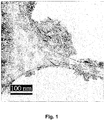
- the crystals have an average particle size of 1-10 nm, such as 2-10 nm, and preferably 1-5 nm in diameter, and 20-40 in length, which can be estimated from the TEM image shown in Fig.1 .
- the calcium phosphate is hydroxyapatite.
- the synthetic nano-sized crystalline calcium phosphate produced according to the invention has a specific surface area selected from 180 m 2 /g, 220 m 2 /g and 280 m 2 /g.
- the synthetic nano-sized crystalline calcium phosphate produced according to the invention is in the form of a coating on a surface, e.g. a metal surface, such as a titanium surface.
- the coating has a thickness of less than or equal to 150 nm, such as less than or equal to 100 nm.
- the calcium to phosphorous ratio is 1.67.
- the invention is directed to a method of producing a powder or coating of nano-sized crystalline calcium phosphate comprising the steps of
- the stoichiometric dissolved amounts in a) are water-dissolved amounts, but in some other embodiments where the phosphorous precursor is not water-soluble, e.g. triethyl phosphite or calcium propionate, the dissolved amounts are tenside-dissolved or oil-dissolved, respectively.
- the surfactant in b) is a non-ionic surfactant.
- nano-sized crystalline calcium phosphate having a specific surface in the range of 50 m 2 /g to 300 m 2 /g, even though a presently preferred range is 150 m 2 /g to 300 m 2 /g.
- the oxide layer-coated surface of f1) or f2) is a metal surface, such as a titanium surface.
- the object of f1) or f2) is a body implant, for example a dental implant.
- Embodiments of the method of the invention comprise the calcium phosphate as hydroxyapatite, the phosphorous precursor as phosphoric acid, the calcium salt precursor as calcium nitrate, and the calcium to phosphorous ratio as 1.67.
- the Ca/P ratio of 1.67 is the ratio of naturally occurring hydroxyapatite.
- other calcium phosphate compounds can be produced according to the method of the invention by altering the ratio of the calcium and phosphorous precursors, such as di-, tri- or tetracalcium phosphate.
- phosphorous precursors include, in addition to phosphoric acid, phosphorous acid, hypophosphorous acid and phosphorous acid esters, such as triethyl phosphite.
- the calcium salt precursor examples include, in addition to calcium nitrate, for example calcium chloride, calcium acetate, and calcium alkoxides such as calcium ethoxide
- the synthetic nano-sized crystalline calcium phosphate in particular hydroxyapatite, can be deposited on any surface of interest such as for example metals, polymers and any other organic materials, ceramics and other inorganic materials, as long as they have an oxide-layer.
- the object or implant may be flat like, round, concentric or of any complex shape, and the surface can be either smooth or porous.
- Metals used as body implants such as titanium (which always has a titanium dioxide layer present on the surface), stainless steel, molybdenum, zirconium etc., can hence be bioactivated by the coating action described by this invention.
- the substrate surface In order to get good adhesion to the substrate, the substrate surface should be properly cleaned. This is to get rid of contaminants that might influence the binding.
- mechanical such as blasting and polishing
- chemical such as washing with organic solvents and water.
- surfactant self-assembly In order to control the crystal size as well as getting its desired crystallinity, i.e. its apatite structure, surfactant self-assembly has been utilized in the method of the invention.
- Surfactants are amphiphilic molecules consisting of one or more hydrophilic part and one or more hydrophobic part.
- the hydrophilic part means that it is lyophilic towards water, i.e. is water loving, which also is referred to as the head is more or less water soluble.
- the hydrophobic part means that it is non-lyophilic towards water, i.e. not water loving, which often is referred to as the tail is not water soluble or less water soluble than the hydrophilic part.
- surfactants can be for example double headed with one or more hydrophobic tail, or the opposite, a double tailed molecule with one or more head.
- surfactants are divided into different groups depending on the type of head, i.e. ionic or non-ionic, the ionic being positive, negative, zwitterionic or amphoteric.
- Zwitterionic surfactants contain both a positive and a negative charge. Often the positive charge is invariably ammonium and the negative charge may vary, but usually it is a carboxylate.
- amphoteric surfactants which in a certain pH range is zwitterionic.
- the most important feature of surfactants are their tendency to adsorb on interfaces, for example the air-liquid interface, air-solid interface and liquid-solid interface.
- monomers or unimers When the surfactants are free in the sense of not being in an aggregated form, they are called monomers or unimers.
- micelles This concentration is called the Critical Micelle Concentration and is often denoted as the CMC. This micelle formation can be viewed as an alternative to adsorption on an interface, hence reducing its free energy according to the rules of thermodynamics.
- the CMC When using water as the solvent for the micellization, the CMC is reached at very low micelle concentrations. It is not unusual with values of 1mM and below. Increasing the surfactant concentration further beyond the CMC the micelles starts to grow in size. At higher surfactant concentration the micelles reach the stage when they start to pack close to each other forming new, more viscous, structures, i.e. liquid crystalline phases. These entities are formed in water or organic solvents or in mixtures of water and organic solvents.
- Surfactant self-assembly in the form of liquid crystalline structures exists in a range of different geometries. Examples of these geometries are lamellar, hexagonal, reversed hexagonal and cubic. All of these geometries are possible to obtain with the present invention.
- Other surfactant phases that exist are the so-called isotropic solution phases, and examples of these are dilute and concentrated micellar solutions, reversed micellar solutions, microemulsions and vesicle solutions.
- the more highly concentrated systems, i.e. liquid crystalline phases have a short-range disorder but some order at larger distances. This compared to ordinary crystals such as inorganic crystals that have both a long as well as a short-range order. These properties make the liquid crystals a rigid structure, but more liquid-like compared to ordinary crystals.
- the typical size-ranges for these structures are in the meso range, i.e. 2-50 nm.
- the method of using liquid crystalline phases and their rich phase behavior makes it a very promising route also for making porous materials (mesoporous), which would be interesting in the application of replacing damaged bone.
- the materials made utilizing the highly concentrated liquid crystalline phase have a specific surface area of more than 50 m 2 /g, such as 100 m 2 /g, preferably more 150 m 2 /g, e.g 200 m 2 /g and most preferably 280 m 2 /g, which to our knowledge is the highest reported surface area for synthetic HA utilizing the conventional N 2 adsorption method (It should be noted that Rudin et. al. ( WO 02/02461 ) stated that they have made HA with a specific surface area of 920 m 2 /g. However, these values are not comparable to values obtained with the standard N 2 adsorption method).
- the surfactant used in the present invention as a structure directing agent for the formation of the crystalline apatite, e.g. HA, particles may also function as a dispersing agent stabilizing the colloidal suspension, and as wetting agent in case dispersion of the particles onto an object is wanted.
- Suitable surfactants for the production of nano-sized calcium phosphates are the non-ionic surfactants of the type block-poly(ethylene glycol)-block-poly(propylene glycol)-block-poly(ethylene glycol). As mentioned above, there exist several different lyotropic liquid crystalline structures or phases.
- phase one will get depends on the surfactant, hydrophobic phase (if present), applied pressure, temperature, pH and concentrations, and it is possible to shift phase by changing one or more of these parameters.
- This feature makes it possible to start with one specific surfactant phase, carry out the desired reaction in that specific embedded environment, and change one or more parameters to convert into another phase.
- This other phase may have other properties wanted for the production procedure, which can be utilized in another further step.
- parameters such as temperatures and surfactant concentrations it is possible to produce the desired phase and by the invention presented nano-particles, and to shift to another phase more desirable as a stable suspension.
- these surfactant systems under known conditions thermodynamically systems can be achieved and retained. This means that the phase never will phase separate into its own respective components even if it is stored for a long time. This is a desired property when it comes to practical issues such as product and production reproducibility.
- the possibly used organic solvent may be selected from a large number of different solvents, and examples of solvents include butylacetate and p-xylene.
- the powder is manufactured using a liquid crystalline phase.
- a phase is built-up of surfactants, water and optionally a hydrophobic phase that is an organic solvent.
- the surfactants that we have used are so-called block co-polymers of the structure PEG-PPG-PEG (block poly (ethylene glycol)-block poly (propylene glycol)-block poly (ethylene glycol)).
- BASF manufactures this polymer series under the name Pluronic, but the chemical company Aldrich also sells almost identical block co-polymers.
- Pluronic Pluronic
- Aldrich chemical company Aldrich also sells almost identical block co-polymers.
- the liquid crystalline phase is allowed to equilibrate for some hours before it is treated in an ammonia atmosphere.
- the ammonia precipitates the hydroxyapatite since the pH of the water domains is raised.
- the surfactant is removed with a solvent (e.g. ethanol or toluene).
- the hydroxyapatite is filtered, washed and air-dried. Due to the fact that the crystallization occurs in the very small water domains that are present in the liquid crystalline phase (5-10 nm in diameter) the powder becomes extremely fine-grained.
- the coating is obtained by diluting the ammonia treated liquid crystalline phase with an organic solvent that has to be insoluble in water. Instead of removing the surfactants and filter the powder as in Example 1, more of the water insoluble component is added to the liquid crystalline phase. In such a way a so-called water-in-oil microemulsion is obtained, wherein the hydroxyapatite crystals exist in small water droplets in the solution, approximately 10 nm in diameter.
- the amount of solvent that is added is important in order to retain the microemulsion. If too much solvent is added the hydroxyapatite will precipitate and sediment.
- the hydroxyapatite When a metal such as titanium is dipped into the solution, the hydroxyapatite will attach to the metal, together with the surfactant and the organic solvent. After the dipping, the sample is dried for half an hour, so that the organic solvent evaporates. As the surfactant subsequently is burned away at 550 °C in 5 minutes, only pure hydroxyapatite remains. The hydroxyapatite will be completely crystalline and moreover have a high specific surface area. With other methods, such as plasma sputtering, a thick layer of partly amorphous hydroxyapatite is obtained together with a low specific surface. Our heat-treatment is conducted in a so-called tube-type furnace, with nitrogen gas flowing past the sample and thereby preventing further oxidation of the titanium surface.
- the coating is obtained by diluting the liquid crystalline phase, which has not been treated in an ammonia atmosphere, with an organic solvent that has to be insoluble in water.
- a water-in-oil microemulsion is obtained, but since the liquid crystalline phase has not been exposed to ammonia, no hydroxyapatite crystals are present in the water droplets of the microemulsion. Instead these water droplets contain the calcium and phosphorous precursors.
- the composition of the microemulsion is identical to the one in example 2:
- the main difference between the two alternative methods of producing a nano-crystalline coating on a surface is that in the latter case the liquid crystalline phase is not treated with ammonia for 4 days. Instead the surface is treated with ammonia after the dipping, the pH is raised and HA is deposited on the surface.
- the final step of removing the surfactants in a furnace is the same in both methods. The methods give the same result, but the latter method is performed in a shorter time.
- hydroxyapatite provided there is an oxide layer on the surface (otherwise the hydroxyapatite in the microemulsion will not attach to the substrate satisfactorily) and that the material will withstand thermal treatment.
- materials amenable for coating with HA include metals such as stainless steel and titanium, and ceramics such as zirconium oxide and ordinary glass.
Landscapes
- Chemical & Material Sciences (AREA)
- Organic Chemistry (AREA)
- Engineering & Computer Science (AREA)
- Inorganic Chemistry (AREA)
- Nanotechnology (AREA)
- Crystallography & Structural Chemistry (AREA)
- Materials Engineering (AREA)
- Physics & Mathematics (AREA)
- Composite Materials (AREA)
- Condensed Matter Physics & Semiconductors (AREA)
- General Physics & Mathematics (AREA)
- Life Sciences & Earth Sciences (AREA)
- Wood Science & Technology (AREA)
- Manufacturing & Machinery (AREA)
- Materials For Medical Uses (AREA)
Priority Applications (6)
| Application Number | Priority Date | Filing Date | Title |
|---|---|---|---|
| DK16162786.4T DK3059208T3 (en) | 2004-06-15 | 2005-06-14 | SYNTHETIC CRYSTALLINE CALCIUM PHOSPHATE IN NANO SIZE |
| PL05752154T PL1781568T3 (pl) | 2004-06-15 | 2005-06-14 | Sposób wytwarzania powłok syntetycznego nanowymiarowego krystalicznego fosforanu wapnia |
| SI200532081A SI1781568T1 (sl) | 2004-06-15 | 2005-06-14 | Postopek proizvodnje prevlek iz sintetičnega nano-velikega kristaliničnega kalcijevega fosfata |
| EP16162786.4A EP3059208B1 (en) | 2004-06-15 | 2005-06-14 | Synthetic nano-sized crystalline calcium phosphate |
| PL16162786T PL3059208T3 (pl) | 2004-06-15 | 2005-06-14 | Syntetyczny nanowymiarowy krystaliczny fosforan wapnia |
| EP10177647A EP2289847A1 (en) | 2004-06-15 | 2005-06-14 | Method of producing a powder |
Applications Claiming Priority (2)
| Application Number | Priority Date | Filing Date | Title |
|---|---|---|---|
| SE0401524A SE527610C2 (sv) | 2004-06-15 | 2004-06-15 | Förfarande för framställning av syntetiskt, kristallint kalciumfosfat i nanostorlek |
| PCT/SE2005/000896 WO2005123579A1 (en) | 2004-06-15 | 2005-06-14 | Synthetic nano-sized crystalline calcium phosphate and method of production |
Related Child Applications (2)
| Application Number | Title | Priority Date | Filing Date |
|---|---|---|---|
| EP10177647A Division-Into EP2289847A1 (en) | 2004-06-15 | 2005-06-14 | Method of producing a powder |
| EP16162786.4A Division EP3059208B1 (en) | 2004-06-15 | 2005-06-14 | Synthetic nano-sized crystalline calcium phosphate |
Publications (2)
| Publication Number | Publication Date |
|---|---|
| EP1781568A1 EP1781568A1 (en) | 2007-05-09 |
| EP1781568B1 true EP1781568B1 (en) | 2016-04-20 |
Family
ID=32710046
Family Applications (3)
| Application Number | Title | Priority Date | Filing Date |
|---|---|---|---|
| EP05752154.4A Expired - Lifetime EP1781568B1 (en) | 2004-06-15 | 2005-06-14 | Method of production of coatings of synthetic nano-sized crystalline calcium phosphate |
| EP10177647A Withdrawn EP2289847A1 (en) | 2004-06-15 | 2005-06-14 | Method of producing a powder |
| EP16162786.4A Expired - Lifetime EP3059208B1 (en) | 2004-06-15 | 2005-06-14 | Synthetic nano-sized crystalline calcium phosphate |
Family Applications After (2)
| Application Number | Title | Priority Date | Filing Date |
|---|---|---|---|
| EP10177647A Withdrawn EP2289847A1 (en) | 2004-06-15 | 2005-06-14 | Method of producing a powder |
| EP16162786.4A Expired - Lifetime EP3059208B1 (en) | 2004-06-15 | 2005-06-14 | Synthetic nano-sized crystalline calcium phosphate |
Country Status (19)
| Country | Link |
|---|---|
| US (3) | US8206813B2 (enExample) |
| EP (3) | EP1781568B1 (enExample) |
| JP (1) | JP5285273B2 (enExample) |
| KR (2) | KR101271834B1 (enExample) |
| CN (1) | CN1997589B (enExample) |
| AU (1) | AU2005254440B2 (enExample) |
| CA (1) | CA2569756C (enExample) |
| DK (1) | DK3059208T3 (enExample) |
| ES (2) | ES2659811T3 (enExample) |
| HU (2) | HUE035681T2 (enExample) |
| IL (1) | IL179955A (enExample) |
| NZ (1) | NZ552035A (enExample) |
| PL (2) | PL1781568T3 (enExample) |
| PT (2) | PT3059208T (enExample) |
| RU (1) | RU2402482C2 (enExample) |
| SE (1) | SE527610C2 (enExample) |
| SI (2) | SI1781568T1 (enExample) |
| WO (1) | WO2005123579A1 (enExample) |
| ZA (1) | ZA200610514B (enExample) |
Families Citing this family (37)
| Publication number | Priority date | Publication date | Assignee | Title |
|---|---|---|---|---|
| US20090253613A1 (en) * | 2006-01-04 | 2009-10-08 | Do-Coop Technologies Ltd. | Solid-Fluid Composition |
| EP1981514A2 (en) * | 2006-01-12 | 2008-10-22 | Rutgers, The State University of New Jersey | Biomimetic hydroxyapatite synthesis |
| US20100040668A1 (en) * | 2006-01-12 | 2010-02-18 | Rutgers, The State University Of New Jersey | Biomimetic Hydroxyapatite Composite Materials and Methods for the Preparation Thereof |
| US8287914B2 (en) | 2006-01-12 | 2012-10-16 | Rutgers, The State University Of New Jersey | Biomimetic hydroxyapatite synthesis |
| CA2646486A1 (en) * | 2006-03-23 | 2007-09-27 | Citagenix Inc. | Reverse phase osteoconductive composition |
| CN100422075C (zh) * | 2006-09-29 | 2008-10-01 | 浙江大学 | 磷酸钙纳米颗粒的制备方法 |
| EP2002799A1 (en) | 2007-06-14 | 2008-12-17 | Nobel Biocare Services AG | Ceramic medical implant having an osseconductive coating |
| SE531779C2 (sv) | 2007-11-26 | 2009-08-04 | Promimic Ab | Framställning av kalciumfosfatpartiklar i nanostorlek som pulver eller beläggning via bifunktionella prekursorer |
| RU2367633C2 (ru) * | 2007-12-05 | 2009-09-20 | Учреждение Российской академии наук Институт металлургии и материаловедения им. А.А. Байкова РАН | Способ получения наноразмерного порошка на основе системы трикальцийфосфат-гидроксиапатит для синтеза керамических биоматериалов |
| RU2359708C1 (ru) * | 2007-12-05 | 2009-06-27 | Учреждение Российской академии наук Институт металлургии и материаловедения им. А.А. Байкова РАН | Наноструктурированный кальцийфосфатный керамический материал на основе системы трикальцийфосфат-гидроксиапатит для реконструкции костных дефектов |
| CN101298469B (zh) * | 2008-05-28 | 2011-07-27 | 哈尔滨工业大学 | 一种竹筏状羟基磷灰石及其制备方法 |
| RU2391119C1 (ru) * | 2008-10-09 | 2010-06-10 | Федеральное агентство по науке и инновациям | Способ получения наночастиц фосфатов кальция, стабилизированных солевой матрицей |
| DE102008043970A1 (de) * | 2008-11-21 | 2010-05-27 | Biotronik Vi Patent Ag | Verfahren zur Herstellung einer korrosionshemmenden Beschichtung auf einem Implantat aus einer biokorrodierbaren Magnesiumlegierung sowie nach dem Verfahren hergestelltes Implantat |
| US8632843B2 (en) * | 2008-11-24 | 2014-01-21 | Promimic Ab | Methods and systems of controlled coating of nanoparticles onto micro-rough implant surfaces and associated implants |
| US20100226956A1 (en) * | 2009-03-06 | 2010-09-09 | Per Kjellin | Production of moldable bone substitute |
| KR20180114970A (ko) * | 2009-05-06 | 2018-10-19 | 라보라토리 스킨 케어, 인크. | 활성제-칼슘 포스페이트 입자 복합체를 포함하는 피부 전달 조성물 및 이들을 이용하는 방법 |
| WO2013025951A1 (en) * | 2011-08-16 | 2013-02-21 | Laboratoy Skin Care, Inc. | Fine dry particulate adenosine compositions and topical formulations including the same |
| PT2453934E (pt) * | 2009-06-18 | 2013-09-09 | Teknimed | Método de activação da superfície de biomateriais porosos |
| MX350166B (es) * | 2009-09-04 | 2017-08-28 | Procter & Gamble | Aparato y métodos para demostrar visualmente la erosión dental en materiales dentales simulados. |
| JP5724050B2 (ja) * | 2009-09-28 | 2015-05-27 | Hoya株式会社 | 粉体、粉体の製造方法、吸着装置 |
| US9095510B2 (en) | 2009-11-10 | 2015-08-04 | Laboratory Skin Care, Inc. | Sunscreen compositions comprising uniform, rigid, spherical, nanoporous calcium phosphate particles and methods of making and using the same |
| PH12013501524A1 (en) | 2011-01-19 | 2022-10-26 | Laboratory Skin Care Inc | Topical minocycline compositions and methods of using the same |
| CN102051569B (zh) * | 2011-01-26 | 2012-12-19 | 沈阳工业大学 | 一种制备钛/羟基磷灰石复合涂层的方法 |
| RU2465886C2 (ru) * | 2011-10-28 | 2012-11-10 | Михаил Николаевич Михеев | Продукт для изготовления зубных паст и порошков и способ его получения |
| MY175420A (en) | 2013-03-15 | 2020-06-24 | Laboratory Skin Care Inc | Fine dry particulate resveratrol active agent compositions and topical formulations including the same |
| CN104355297B (zh) * | 2014-10-24 | 2016-06-22 | 武汉理工大学 | 一种介孔羟基磷灰石粉体的制备方法 |
| RU2614772C1 (ru) * | 2015-12-17 | 2017-03-29 | Федеральное государственное автономное образовательное учреждение высшего образования "Национальный исследовательский Нижегородский государственный университет им. Н.И. Лобачевского" | Способ получения наногидроксиапатита |
| US10537661B2 (en) * | 2017-03-28 | 2020-01-21 | DePuy Synthes Products, Inc. | Orthopedic implant having a crystalline calcium phosphate coating and methods for making the same |
| US10537658B2 (en) | 2017-03-28 | 2020-01-21 | DePuy Synthes Products, Inc. | Orthopedic implant having a crystalline gallium-containing hydroxyapatite coating and methods for making the same |
| GB201802184D0 (en) | 2018-02-09 | 2018-03-28 | Promimic Ab | Products and methods |
| KR102209912B1 (ko) | 2019-01-23 | 2021-02-01 | 김인 | 히드록시아파타이트 숙성 결정을 포함하는 구취제거용 액상 조성물 |
| CN109980200B (zh) * | 2019-03-21 | 2021-01-15 | 北京工业大学 | 一种晶畴弥散分布非晶体磷基负极材料及其制备方法 |
| US12251312B1 (en) * | 2019-10-07 | 2025-03-18 | Smith & Nephew, Inc. | Medical devices and methods for forming medical devices having a porous structure |
| CN113026147B (zh) * | 2021-03-17 | 2022-03-11 | 电子科技大学 | 一种用于高效分离铀的磷酸氢钙纳米纤维的制备方法 |
| GB202111039D0 (en) | 2021-07-30 | 2021-09-15 | Promimic Ab | Materials and methods |
| WO2023201078A1 (en) * | 2022-04-15 | 2023-10-19 | The Regents Of The University Of California | Host cells and methods useful for producing calcium phosphate based composite biomaterials |
| CN117865084B (zh) * | 2023-12-11 | 2024-08-09 | 湖北三峡实验室 | 一种纳米球形β-磷酸三钙的制备方法 |
Citations (1)
| Publication number | Priority date | Publication date | Assignee | Title |
|---|---|---|---|---|
| US20020031534A1 (en) * | 2000-07-06 | 2002-03-14 | Miyoshi Kasei, Inc. | Sebum-adsorbent powder and use thereof |
Family Cites Families (21)
| Publication number | Priority date | Publication date | Assignee | Title |
|---|---|---|---|---|
| SE416175B (sv) | 1979-03-07 | 1980-12-08 | Per Ingvar Branemark | For implantering i kroppsvevnad serskilt benvevnad, avsett material |
| JPS58192001A (ja) * | 1982-05-06 | 1983-11-09 | Takashi Mori | 太陽光集光器 |
| NO924697D0 (no) | 1992-12-04 | 1992-12-04 | Jan Erik Ellingsen | Kirurgisk implantat og en fremgangsmaate for behandling avkirurgisk implantat |
| RU2077475C1 (ru) * | 1993-03-09 | 1997-04-20 | Владимир Федорович Комаров | Способ получения гидроксиапатита |
| JP3562878B2 (ja) * | 1995-07-07 | 2004-09-08 | 丸尾カルシウム株式会社 | 花弁状多孔質ヒドロキシアパタイト微粒子及びその製造方法 |
| US6013591A (en) * | 1997-01-16 | 2000-01-11 | Massachusetts Institute Of Technology | Nanocrystalline apatites and composites, prostheses incorporating them, and method for their production |
| US6012591A (en) * | 1997-01-23 | 2000-01-11 | Brandenberg; Carl Brock | Apparatus for supporting modular and cooperating components |
| SE513481C2 (sv) | 1997-05-16 | 2000-09-18 | Nobel Biocare Ab | Implantatelement utfört av titan med en titanoxidyta modifierad med eloxidering |
| BG101544A (en) * | 1997-05-30 | 1998-11-30 | Медицински Университет-Ректорат | Method for the preparation of biologically active coatings over titanium osteal implants |
| JPH1161197A (ja) * | 1997-08-08 | 1999-03-05 | Asahi Optical Co Ltd | 泡状洗浄剤 |
| JP3653948B2 (ja) * | 1997-09-25 | 2005-06-02 | 東レ株式会社 | ポリエステル組成物およびそれからなるフィルム |
| US6048626A (en) * | 1997-09-25 | 2000-04-11 | Toray Industries, Inc. | Polyester composition and film made therefrom |
| US6736849B2 (en) * | 1998-03-11 | 2004-05-18 | Depuy Products, Inc. | Surface-mineralized spinal implants |
| RU2159049C1 (ru) * | 1999-05-25 | 2000-11-20 | Чудаев Валерий Георгиевич | Способ производства вермишели быстрого приготовления и упаковка вермишели быстрого приготовления |
| ES2258466T3 (es) * | 2000-07-03 | 2006-09-01 | Zakrytoe Aktsionernoe Obschestvo Ostim | Metodo para producir hidroxiapatito cristalino de tamaño nanometrico. |
| KR100362699B1 (ko) * | 2000-08-28 | 2002-11-27 | 주식회사 오스코텍 | 칼슘 포스페이트 초박막 코팅된 우골 분말 |
| US6730324B2 (en) * | 2001-04-20 | 2004-05-04 | The University Of British Columbia | Biofunctional hydroxyapatite coatings and microspheres for in-situ drug encapsulation |
| JP4204772B2 (ja) * | 2001-08-30 | 2009-01-07 | 独立行政法人科学技術振興機構 | 生体内薬物徐放材料の製造方法 |
| US7087086B2 (en) * | 2003-01-31 | 2006-08-08 | Depuy Products, Inc. | Biological agent-containing ceramic coating and method |
| US8029755B2 (en) * | 2003-08-06 | 2011-10-04 | Angstrom Medica | Tricalcium phosphates, their composites, implants incorporating them, and method for their production |
| CN1228097C (zh) * | 2003-08-08 | 2005-11-23 | 浙江大学 | 一种具有含氟的钙磷酸盐涂层的医用材料及其制备方法 |
-
2004
- 2004-06-15 SE SE0401524A patent/SE527610C2/sv not_active IP Right Cessation
-
2005
- 2005-06-14 EP EP05752154.4A patent/EP1781568B1/en not_active Expired - Lifetime
- 2005-06-14 HU HUE16162786A patent/HUE035681T2/hu unknown
- 2005-06-14 DK DK16162786.4T patent/DK3059208T3/en active
- 2005-06-14 ZA ZA200610514A patent/ZA200610514B/en unknown
- 2005-06-14 KR KR1020127030700A patent/KR101271834B1/ko not_active Expired - Fee Related
- 2005-06-14 WO PCT/SE2005/000896 patent/WO2005123579A1/en not_active Ceased
- 2005-06-14 HU HUE05752154A patent/HUE032423T2/en unknown
- 2005-06-14 US US11/629,215 patent/US8206813B2/en active Active
- 2005-06-14 PL PL05752154T patent/PL1781568T3/pl unknown
- 2005-06-14 CN CN2005800196213A patent/CN1997589B/zh not_active Expired - Lifetime
- 2005-06-14 RU RU2006144275/15A patent/RU2402482C2/ru active
- 2005-06-14 CA CA2569756A patent/CA2569756C/en not_active Expired - Lifetime
- 2005-06-14 EP EP10177647A patent/EP2289847A1/en not_active Withdrawn
- 2005-06-14 SI SI200532081A patent/SI1781568T1/sl unknown
- 2005-06-14 AU AU2005254440A patent/AU2005254440B2/en not_active Expired
- 2005-06-14 NZ NZ552035A patent/NZ552035A/en not_active IP Right Cessation
- 2005-06-14 SI SI200532193T patent/SI3059208T1/en unknown
- 2005-06-14 PT PT161627864T patent/PT3059208T/pt unknown
- 2005-06-14 ES ES16162786.4T patent/ES2659811T3/es not_active Expired - Lifetime
- 2005-06-14 JP JP2007516431A patent/JP5285273B2/ja not_active Expired - Fee Related
- 2005-06-14 KR KR1020077000880A patent/KR101248673B1/ko not_active Expired - Fee Related
- 2005-06-14 ES ES05752154.4T patent/ES2583130T3/es not_active Expired - Lifetime
- 2005-06-14 PT PT57521544T patent/PT1781568T/pt unknown
- 2005-06-14 PL PL16162786T patent/PL3059208T3/pl unknown
- 2005-06-14 EP EP16162786.4A patent/EP3059208B1/en not_active Expired - Lifetime
-
2006
- 2006-12-10 IL IL179955A patent/IL179955A/en active IP Right Grant
-
2012
- 2012-05-30 US US13/483,482 patent/US8460788B2/en not_active Expired - Fee Related
-
2013
- 2013-05-13 US US13/892,423 patent/US20130251982A1/en not_active Abandoned
Patent Citations (1)
| Publication number | Priority date | Publication date | Assignee | Title |
|---|---|---|---|---|
| US20020031534A1 (en) * | 2000-07-06 | 2002-03-14 | Miyoshi Kasei, Inc. | Sebum-adsorbent powder and use thereof |
Non-Patent Citations (1)
| Title |
|---|
| WOLKE J.G.C., DE GROOT K., JANSEN J.A.: "In vivo dissolution behaviour of various RF magnetron sponsored Ca-P coatings", JOURNAL OF BIOMEDICAL MATERIAL RESEARCH, vol. 39, no. 4, 15 March 1998 (1998-03-15), pages 524 - 530 * |
Also Published As
Similar Documents
| Publication | Publication Date | Title |
|---|---|---|
| EP3059208B1 (en) | Synthetic nano-sized crystalline calcium phosphate | |
| Liu et al. | Water-based sol–gel synthesis of hydroxyapatite: process development | |
| EP2219696B1 (en) | Production of nanosized calcium phosphate particles as powder or coating via bifunctional precursors | |
| JP7583848B2 (ja) | インプラント及び他の基材用のジルコニウム及びリン酸チタンコーティング | |
| Furkó et al. | Comparative study on preparation and characterization of bioactive coatings for biomedical applications—A review on recent patents and literature | |
| EP2828100A1 (en) | Surface treatment for an implant surface | |
| Xia et al. | Biomimetic hydroxyapatite deposition on titanium oxide surfaces for biomedical application | |
| Darroudi et al. | Synthesis of nano-fluorohydroxyapatite thin films by sol-gel method | |
| Nasr-Esfahani et al. | Bonding strength, hardness and bioactivity of nano bioglass-titania nano composite coating deposited on NiTi nails | |
| Youssefi | Synthesis of Nano-Fluorohydroxyapatite Thin Films by Sol-Gel Method Majid Darroudi", Hossein Eshtiagh-Hosseini", Mohammad Reza Housaindokht “ | |
| Köseoğlu et al. | Effects of Mg doping on sol–gel derived nanocrystalline hydroxyapatite thin films |
Legal Events
| Date | Code | Title | Description |
|---|---|---|---|
| PUAI | Public reference made under article 153(3) epc to a published international application that has entered the european phase |
Free format text: ORIGINAL CODE: 0009012 |
|
| 17P | Request for examination filed |
Effective date: 20070108 |
|
| AK | Designated contracting states |
Kind code of ref document: A1 Designated state(s): AT BE BG CH CY CZ DE DK EE ES FI FR GB GR HU IE IS IT LI LT LU MC NL PL PT RO SE SI SK TR |
|
| RIN1 | Information on inventor provided before grant (corrected) |
Inventor name: KJELLIN, PER Inventor name: ANDERSSON, MARTIN |
|
| DAX | Request for extension of the european patent (deleted) | ||
| 17Q | First examination report despatched |
Effective date: 20071219 |
|
| REG | Reference to a national code |
Ref country code: DE Ref legal event code: R079 Ref document number: 602005049073 Country of ref document: DE Free format text: PREVIOUS MAIN CLASS: C01B0025320000 Ipc: B82Y0030000000 |
|
| GRAP | Despatch of communication of intention to grant a patent |
Free format text: ORIGINAL CODE: EPIDOSNIGR1 |
|
| RIC1 | Information provided on ipc code assigned before grant |
Ipc: B82Y 30/00 20110101AFI20151007BHEP Ipc: C09D 1/00 20060101ALI20151007BHEP Ipc: C01B 25/32 20060101ALI20151007BHEP |
|
| INTG | Intention to grant announced |
Effective date: 20151026 |
|
| GRAS | Grant fee paid |
Free format text: ORIGINAL CODE: EPIDOSNIGR3 |
|
| GRAA | (expected) grant |
Free format text: ORIGINAL CODE: 0009210 |
|
| AK | Designated contracting states |
Kind code of ref document: B1 Designated state(s): AT BE BG CH CY CZ DE DK EE ES FI FR GB GR HU IE IS IT LI LT LU MC NL PL PT RO SE SI SK TR |
|
| REG | Reference to a national code |
Ref country code: GB Ref legal event code: FG4D |
|
| REG | Reference to a national code |
Ref country code: CH Ref legal event code: EP |
|
| REG | Reference to a national code |
Ref country code: AT Ref legal event code: REF Ref document number: 792239 Country of ref document: AT Kind code of ref document: T Effective date: 20160515 |
|
| REG | Reference to a national code |
Ref country code: IE Ref legal event code: FG4D |
|
| REG | Reference to a national code |
Ref country code: DE Ref legal event code: R096 Ref document number: 602005049073 Country of ref document: DE |
|
| REG | Reference to a national code |
Ref country code: PT Ref legal event code: SC4A Ref document number: 1781568 Country of ref document: PT Date of ref document: 20160727 Kind code of ref document: T Free format text: AVAILABILITY OF NATIONAL TRANSLATION Effective date: 20160719 |
|
| REG | Reference to a national code |
Ref country code: DK Ref legal event code: T3 Effective date: 20160801 |
|
| REG | Reference to a national code |
Ref country code: NL Ref legal event code: FP |
|
| REG | Reference to a national code |
Ref country code: SE Ref legal event code: TRGR |
|
| REG | Reference to a national code |
Ref country code: LT Ref legal event code: MG4D |
|
| REG | Reference to a national code |
Ref country code: FR Ref legal event code: PLFP Year of fee payment: 12 |
|
| REG | Reference to a national code |
Ref country code: ES Ref legal event code: FG2A Ref document number: 2583130 Country of ref document: ES Kind code of ref document: T3 Effective date: 20160919 |
|
| PG25 | Lapsed in a contracting state [announced via postgrant information from national office to epo] |
Ref country code: LT Free format text: LAPSE BECAUSE OF FAILURE TO SUBMIT A TRANSLATION OF THE DESCRIPTION OR TO PAY THE FEE WITHIN THE PRESCRIBED TIME-LIMIT Effective date: 20160420 |
|
| PG25 | Lapsed in a contracting state [announced via postgrant information from national office to epo] |
Ref country code: GR Free format text: LAPSE BECAUSE OF FAILURE TO SUBMIT A TRANSLATION OF THE DESCRIPTION OR TO PAY THE FEE WITHIN THE PRESCRIBED TIME-LIMIT Effective date: 20160721 |
|
| REG | Reference to a national code |
Ref country code: SK Ref legal event code: T3 Ref document number: E 21500 Country of ref document: SK |
|
| REG | Reference to a national code |
Ref country code: DE Ref legal event code: R097 Ref document number: 602005049073 Country of ref document: DE |
|
| PG25 | Lapsed in a contracting state [announced via postgrant information from national office to epo] |
Ref country code: MC Free format text: LAPSE BECAUSE OF FAILURE TO SUBMIT A TRANSLATION OF THE DESCRIPTION OR TO PAY THE FEE WITHIN THE PRESCRIBED TIME-LIMIT Effective date: 20160420 Ref country code: RO Free format text: LAPSE BECAUSE OF FAILURE TO SUBMIT A TRANSLATION OF THE DESCRIPTION OR TO PAY THE FEE WITHIN THE PRESCRIBED TIME-LIMIT Effective date: 20160420 Ref country code: EE Free format text: LAPSE BECAUSE OF FAILURE TO SUBMIT A TRANSLATION OF THE DESCRIPTION OR TO PAY THE FEE WITHIN THE PRESCRIBED TIME-LIMIT Effective date: 20160420 |
|
| PLBE | No opposition filed within time limit |
Free format text: ORIGINAL CODE: 0009261 |
|
| STAA | Information on the status of an ep patent application or granted ep patent |
Free format text: STATUS: NO OPPOSITION FILED WITHIN TIME LIMIT |
|
| 26N | No opposition filed |
Effective date: 20170123 |
|
| REG | Reference to a national code |
Ref country code: FR Ref legal event code: PLFP Year of fee payment: 13 |
|
| PGFP | Annual fee paid to national office [announced via postgrant information from national office to epo] |
Ref country code: SK Payment date: 20170525 Year of fee payment: 13 |
|
| PGFP | Annual fee paid to national office [announced via postgrant information from national office to epo] |
Ref country code: BE Payment date: 20170616 Year of fee payment: 13 Ref country code: PL Payment date: 20170517 Year of fee payment: 13 Ref country code: AT Payment date: 20170628 Year of fee payment: 13 Ref country code: NL Payment date: 20170615 Year of fee payment: 13 Ref country code: SI Payment date: 20170523 Year of fee payment: 13 |
|
| REG | Reference to a national code |
Ref country code: HU Ref legal event code: AG4A Ref document number: E032423 Country of ref document: HU |
|
| PGFP | Annual fee paid to national office [announced via postgrant information from national office to epo] |
Ref country code: TR Payment date: 20170605 Year of fee payment: 13 Ref country code: HU Payment date: 20170516 Year of fee payment: 13 |
|
| PGFP | Annual fee paid to national office [announced via postgrant information from national office to epo] |
Ref country code: ES Payment date: 20170703 Year of fee payment: 13 |
|
| PGFP | Annual fee paid to national office [announced via postgrant information from national office to epo] |
Ref country code: BG Payment date: 20170630 Year of fee payment: 13 |
|
| REG | Reference to a national code |
Ref country code: HU Ref legal event code: HC9C |
|
| PG25 | Lapsed in a contracting state [announced via postgrant information from national office to epo] |
Ref country code: CY Free format text: LAPSE BECAUSE OF FAILURE TO SUBMIT A TRANSLATION OF THE DESCRIPTION OR TO PAY THE FEE WITHIN THE PRESCRIBED TIME-LIMIT Effective date: 20160420 |
|
| REG | Reference to a national code |
Ref country code: FR Ref legal event code: PLFP Year of fee payment: 14 |
|
| PG25 | Lapsed in a contracting state [announced via postgrant information from national office to epo] |
Ref country code: LU Free format text: LAPSE BECAUSE OF NON-PAYMENT OF DUE FEES Effective date: 20160614 Ref country code: IS Free format text: LAPSE BECAUSE OF FAILURE TO SUBMIT A TRANSLATION OF THE DESCRIPTION OR TO PAY THE FEE WITHIN THE PRESCRIBED TIME-LIMIT Effective date: 20160420 |
|
| PG25 | Lapsed in a contracting state [announced via postgrant information from national office to epo] |
Ref country code: CZ Free format text: LAPSE BECAUSE OF NON-PAYMENT OF DUE FEES Effective date: 20180614 Ref country code: PT Free format text: LAPSE BECAUSE OF NON-PAYMENT OF DUE FEES Effective date: 20181214 |
|
| REG | Reference to a national code |
Ref country code: NL Ref legal event code: MM Effective date: 20180701 |
|
| REG | Reference to a national code |
Ref country code: AT Ref legal event code: MM01 Ref document number: 792239 Country of ref document: AT Kind code of ref document: T Effective date: 20180614 |
|
| REG | Reference to a national code |
Ref country code: SK Ref legal event code: MM4A Ref document number: E 21500 Country of ref document: SK Effective date: 20180614 |
|
| REG | Reference to a national code |
Ref country code: BE Ref legal event code: FP Effective date: 20160719 Ref country code: BE Ref legal event code: MM Effective date: 20180630 |
|
| PG25 | Lapsed in a contracting state [announced via postgrant information from national office to epo] |
Ref country code: NL Free format text: LAPSE BECAUSE OF NON-PAYMENT OF DUE FEES Effective date: 20180701 |
|
| REG | Reference to a national code |
Ref country code: SI Ref legal event code: KO00 Effective date: 20190215 |
|
| PG25 | Lapsed in a contracting state [announced via postgrant information from national office to epo] |
Ref country code: HU Free format text: LAPSE BECAUSE OF NON-PAYMENT OF DUE FEES Effective date: 20180615 Ref country code: AT Free format text: LAPSE BECAUSE OF NON-PAYMENT OF DUE FEES Effective date: 20180614 |
|
| PG25 | Lapsed in a contracting state [announced via postgrant information from national office to epo] |
Ref country code: SI Free format text: LAPSE BECAUSE OF NON-PAYMENT OF DUE FEES Effective date: 20180615 Ref country code: BE Free format text: LAPSE BECAUSE OF NON-PAYMENT OF DUE FEES Effective date: 20180630 Ref country code: SK Free format text: LAPSE BECAUSE OF NON-PAYMENT OF DUE FEES Effective date: 20180614 |
|
| PG25 | Lapsed in a contracting state [announced via postgrant information from national office to epo] |
Ref country code: BG Free format text: LAPSE BECAUSE OF NON-PAYMENT OF DUE FEES Effective date: 20190430 |
|
| REG | Reference to a national code |
Ref country code: ES Ref legal event code: FD2A Effective date: 20190916 |
|
| PG25 | Lapsed in a contracting state [announced via postgrant information from national office to epo] |
Ref country code: ES Free format text: LAPSE BECAUSE OF NON-PAYMENT OF DUE FEES Effective date: 20180615 |
|
| REG | Reference to a national code |
Ref country code: AT Ref legal event code: UEP Ref document number: 792239 Country of ref document: AT Kind code of ref document: T Effective date: 20160420 |
|
| PG25 | Lapsed in a contracting state [announced via postgrant information from national office to epo] |
Ref country code: PL Free format text: LAPSE BECAUSE OF NON-PAYMENT OF DUE FEES Effective date: 20180614 |
|
| PG25 | Lapsed in a contracting state [announced via postgrant information from national office to epo] |
Ref country code: TR Free format text: LAPSE BECAUSE OF NON-PAYMENT OF DUE FEES Effective date: 20180614 |
|
| P01 | Opt-out of the competence of the unified patent court (upc) registered |
Effective date: 20230602 |
|
| PGFP | Annual fee paid to national office [announced via postgrant information from national office to epo] |
Ref country code: IE Payment date: 20240618 Year of fee payment: 20 |
|
| PGFP | Annual fee paid to national office [announced via postgrant information from national office to epo] |
Ref country code: GB Payment date: 20240618 Year of fee payment: 20 |
|
| PGFP | Annual fee paid to national office [announced via postgrant information from national office to epo] |
Ref country code: DE Payment date: 20240612 Year of fee payment: 20 |
|
| PGFP | Annual fee paid to national office [announced via postgrant information from national office to epo] |
Ref country code: DK Payment date: 20240619 Year of fee payment: 20 |
|
| PGFP | Annual fee paid to national office [announced via postgrant information from national office to epo] |
Ref country code: FR Payment date: 20240618 Year of fee payment: 20 Ref country code: FI Payment date: 20240617 Year of fee payment: 20 |
|
| PGFP | Annual fee paid to national office [announced via postgrant information from national office to epo] |
Ref country code: SE Payment date: 20240620 Year of fee payment: 20 |
|
| PGFP | Annual fee paid to national office [announced via postgrant information from national office to epo] |
Ref country code: IT Payment date: 20240530 Year of fee payment: 20 |
|
| PGFP | Annual fee paid to national office [announced via postgrant information from national office to epo] |
Ref country code: CH Payment date: 20240701 Year of fee payment: 20 |
|
| REG | Reference to a national code |
Ref country code: DE Ref legal event code: R071 Ref document number: 602005049073 Country of ref document: DE |
|
| REG | Reference to a national code |
Ref country code: DK Ref legal event code: EUP Expiry date: 20250614 |
|
| REG | Reference to a national code |
Ref country code: CH Ref legal event code: PL |
|
| REG | Reference to a national code |
Ref country code: GB Ref legal event code: PE20 Expiry date: 20250613 |
|
| PG25 | Lapsed in a contracting state [announced via postgrant information from national office to epo] |
Ref country code: GB Free format text: LAPSE BECAUSE OF EXPIRATION OF PROTECTION Effective date: 20250613 |
|
| REG | Reference to a national code |
Ref country code: CH Ref legal event code: PL |
|
| REG | Reference to a national code |
Ref country code: SE Ref legal event code: EUG |
|
| REG | Reference to a national code |
Ref country code: IE Ref legal event code: MK9A |
|
| PG25 | Lapsed in a contracting state [announced via postgrant information from national office to epo] |
Ref country code: IE Free format text: LAPSE BECAUSE OF EXPIRATION OF PROTECTION Effective date: 20250614 |