EP1779604B1 - Verfahren zum administrieren eines sich auf mindestens eine zelle erstreckenden kommunikationssystems zur drahtlosen kommunikation mit synchronisiert zu einer basisstation zellenbeschränkter und/oder - übergreifender, drahtloser direkt- kommunikationsmöglichkeit zwischen mobilteilen - Google Patents
Verfahren zum administrieren eines sich auf mindestens eine zelle erstreckenden kommunikationssystems zur drahtlosen kommunikation mit synchronisiert zu einer basisstation zellenbeschränkter und/oder - übergreifender, drahtloser direkt- kommunikationsmöglichkeit zwischen mobilteilen Download PDFInfo
- Publication number
- EP1779604B1 EP1779604B1 EP06777540A EP06777540A EP1779604B1 EP 1779604 B1 EP1779604 B1 EP 1779604B1 EP 06777540 A EP06777540 A EP 06777540A EP 06777540 A EP06777540 A EP 06777540A EP 1779604 B1 EP1779604 B1 EP 1779604B1
- Authority
- EP
- European Patent Office
- Prior art keywords
- information
- bank
- communication system
- cell
- base station
- Prior art date
- Legal status (The legal status is an assumption and is not a legal conclusion. Google has not performed a legal analysis and makes no representation as to the accuracy of the status listed.)
- Not-in-force
Links
- 238000004891 communication Methods 0.000 title claims abstract description 81
- 238000000034 method Methods 0.000 title claims abstract description 22
- 230000001360 synchronised effect Effects 0.000 title claims abstract description 5
- 102100040605 1,2-dihydroxy-3-keto-5-methylthiopentene dioxygenase Human genes 0.000 claims description 12
- 101000966793 Homo sapiens 1,2-dihydroxy-3-keto-5-methylthiopentene dioxygenase Proteins 0.000 claims description 12
- 230000015572 biosynthetic process Effects 0.000 abstract description 5
- 230000010267 cellular communication Effects 0.000 abstract description 2
- JEIPFZHSYJVQDO-UHFFFAOYSA-N ferric oxide Chemical compound O=[Fe]O[Fe]=O JEIPFZHSYJVQDO-UHFFFAOYSA-N 0.000 description 6
- 230000005540 biological transmission Effects 0.000 description 2
- 238000012986 modification Methods 0.000 description 2
- 230000004048 modification Effects 0.000 description 2
- 238000000926 separation method Methods 0.000 description 2
- 238000010276 construction Methods 0.000 description 1
- 230000001419 dependent effect Effects 0.000 description 1
- 238000013461 design Methods 0.000 description 1
- 238000011161 development Methods 0.000 description 1
- 230000018109 developmental process Effects 0.000 description 1
- 238000009472 formulation Methods 0.000 description 1
- 238000004519 manufacturing process Methods 0.000 description 1
- 239000000203 mixture Substances 0.000 description 1
- 230000001052 transient effect Effects 0.000 description 1
- 238000010396 two-hybrid screening Methods 0.000 description 1
Images


Classifications
-
- H—ELECTRICITY
- H04—ELECTRIC COMMUNICATION TECHNIQUE
- H04W—WIRELESS COMMUNICATION NETWORKS
- H04W84/00—Network topologies
- H04W84/02—Hierarchically pre-organised networks, e.g. paging networks, cellular networks, WLAN [Wireless Local Area Network] or WLL [Wireless Local Loop]
- H04W84/10—Small scale networks; Flat hierarchical networks
- H04W84/16—WPBX [Wireless Private Branch Exchange]
-
- H—ELECTRICITY
- H04—ELECTRIC COMMUNICATION TECHNIQUE
- H04W—WIRELESS COMMUNICATION NETWORKS
- H04W8/00—Network data management
- H04W8/26—Network addressing or numbering for mobility support
Definitions
- DECT D igital E nhanced Cordless Telecommunication
- DDC wireless direct communication facility
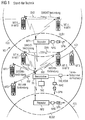
- FIGURE 1 shows such a CMI-based DECT communication system KS.
- the multicellular communication system KS has a first radio cell FZ1, which serves as a radio coverage area for a DECT base station BS and in which, in addition to the base station BS, five mobile units MT1... MT5 are arranged, all of which are radio-connected to the base station BS.
- the base station BS which is connected to the power supply via a network connection device NAG to a voltage network SPN, is either connected via a telecommunication connection unit TAE or a private branch exchange NStA with the fixed network.
- a telecommunications terminal TKE is connected to the base station BS, which may preferably be configured as a bell system, fax machine, personal computer, etc.
- a first mobile unit MT1 maintains an EXTERNAL connection EXV to an external subscriber in the fixed network via the base station BS
- a second mobile unit MT2 and a third mobile unit MT3 each have an INTERNAL connection INV for system-internal communication to the base station BS maintains.
- a first DIRECT connection DV1 between a fourth mobile part MT4 and a fifth mobile part MT5 in the first radio cell FZ1 of the communication system KS.
- the role of the "master” in the "Distributed Communication DECT Local Network” can in principle be taken over by any “DCDL-Net” terminal, ie also "member”. However, preferably, because it is obvious, it is perceived by the base station of the Distributed Communication DECT Local Network.
- the communication system KS In addition to the first radio cell FZ1, in the course of the expansion from a "single cell” system to a "multi-cell” system, the communication system KS also has two further radio cells, a second radio cell FZ2 and a third radio cell FZ3.
- a first overlapping area ÜLB1 between the first radio cell FZ1 and the second radio cell FZ2 and in A second overlap area ÜLB2 between the first radio cell FZ1 and the third radio cell FZ3 contains repeaters formed as an intermediate station or relay station, a first repeater RP1 in the first overlap area ÜLB1 and a second repeater RP2 in the second overlap area ÜLB2.
- Both repeaters RP1, RP2 are like the base station BS in the first radio cell FZ1 connected via a network connection device NAG to a voltage network SPN.
- the first repeater RP1 is wirelessly connected to two other handsets, a sixth handset MT6 and a seventh handset MT7, both located outside the first radio cell FZ1 in the second radio cell FZ2.
- the base station BS has to allocate as the "master" of the communication system KS every "member" in the first and second radio cell FZ1, FZ2 of the communication system KS an "I Dentity N umber" (IdN), but with respect to having the third and fourth hybrid Handset H-MT3, H-MT4 in the second radio cell FZ2 no knowledge about which "Radio Fixed Part Number's" are allocated by the first repeater RP1.
- the first repeater RP1 has no knowledge of which "Radio Fixed Part Number” is already blocked as "Identity Number”.
- a collision-free allocation of the "Identity Number” and "Radio Fixed Part Number” can only be solved by a higher-level administration, which one usually does not want or can not implement for small DECT systems for the home market.
- FIGURE 2 shows how the resource "time” in the INTERNAL connection INV as conventional connectivity between two handsets, here eg the second handset MT2 and the third handset MT3, in the DECT-based multi-cell communication system KS is occupied (time slot assignment).
- MT3 in the communication system KS after the FIGURE 1 be according to the FIGURE 2
- the following time slots occupied For the connection (duplex connection) between the base station BS and the second handset MT2, the time slots "2" and “14" are used, while for the connection (duplex connection) between the base station BS and the third Handset MT3 time slots "4" and "16" are occupied.
- FIG. 3 shows how the resource "time" in the DIRECT connections (Distributed Communications) DV1, DV2 as a direct, direct connection between two hybrid handsets, here, for example, the first handset H-MT1 and the second handset H-MT2 and the third Handset H-MT3 and the fourth handset H-MT4, is occupied in the DECT-based multi-cell communication system KS (time slot assignment).
- DIRECT connections Distributed Communications
- DV1, DV2 distributed Communications
- Hybrid handset Since this "Idle Receiver Scanning" is very energy consuming, Hybrid handset will usually not perform the "Idle Receiver Scanning" permanently. A hybrid handset to be called will not start idle receiver scanning until it is prompted otherwise.
- the DECT standard provides for a procedure "Indirect Link Establishment” (see: EN 300 175-5, paragraph I.3.8, November 2004).
- a conventional internal connection can also be used to initiate the establishment of a "distributed communication", ie also to activate the "idle receiver scanning" in the hybrid handset to be called.
- This alternative has been preferably used in previous GIGASET cordless telephones in order to minimize the modification effort and inputs in the base station of the phones.
- the time slot assignment for the second DIRECT connection DV2 between the third mobile part H-MT3 and the fourth mobile part H-MT4 in the communication system KS according to the FIGURE 1 takes place, although in the FIGURE 2 not shown, in principle analog, wherein the "master" in this case is not the base station BS, but the first repeater RP1.
- FIG. 4 shows a unique addressing information used for the administration of the DECT-based multi-cell communication system KS ["Radio Fixed Part Identity” (RFPI)].
- RFPI Radio Fixed Part Identity
- the “Identity Number” is thus the end number of the "Radio Fixed Part Identity", which uses the hybrid handset for the “Distributed Communication", if the hybrid handset is the called subscriber of the "Distributed Communication” Therefore, in the "Connection Setup” procedure, the role of the "Fixed Part” takes over.
- the "Identity Number” is also very similar to the "Radio Fixed Part Number” (RPN) of a conventional fixed part or a conventional base station (see: EN 300 175-6, Chapter 5, November 2004).
- the "Radio Fixed Part Number” is 8 bit wide for the Access Rights Classes defined in the DECT standard for an "Access Rights Class A” 3 bits and for "Access Rights Classes B, C, D, E”.
- Identity Number is basically 8 bits wide according to the DECT standard (compare: EN 300 175-5, chapter 1.3.10.1, November 2004) However, chapter I.3.10.2 of the DECT standard limits the use of the" Identity Number "for the" Access Rights Class A "also on the last 3 bits.
- the addressing information ADI1, ADI2 contains information units IE, which are preferably distributed as bits on an information head IK, the so-called header, a predetermined - in the sense of once determinable - first supply V1 and a variable second supply V2 in the order mentioned.
- the information units IE which are contained in the second supply V2 of the first addressing information ADI1, form a first identification number IN1
- the information units IE which are contained in the second supply V2 of the second addressing information ADI2 form a second identification number IN2.
- the address information ADI1, ADI2 ', the identifier KE, the first identification number IN1 and the second identification number IN2 respectively correspond in each case substantially to the "Radio Fixed Part Identity” RFPI specified in the DECT standard, the "Access Rights Identifier” ARI, the "Radio Fixed Part Number “RPN and the” Identity Number “IdN, while the size of the second information unit supply IE, V2 according to the DECT standard is preferably three or eight bits.
- R adio F ixed P art I dentities differ from hybrid handsets and " R adio F ixed P art I dentities (RFPI) "of base stations of a DECT system only in the RPN area. So "Radio Fixed Part Number” and “Identity Number” have to be administered in such a way that they do not collide.
- the object underlying the invention is to specify a method for administering a communication system for wireless communication extending to at least one cell synchronized with a base station of cell-limited and / or -intermediate, wireless direct communication possibility between handsets, in which two for the administration the communication system with the given direct communication option between the handsets used identification numbers, both of which originate from a common number of stores, do not collide.
- the idea on which the invention is based is that at least one information unit of a first information unit store is assigned to a second information unit store for the formation of one of two identification numbers from a unique addressing information used for the administration of a cellular communication system with cell-limited and / or transient wireless direct communication between handsets is added that for the formation of the said identification number can now be resorted to a larger number of information units, without changing the size of the inventories and for the unique addressing information, a comparison between the two identification numbers is required.
- the invention describes a method such as "Identity Number” without knowledge in the system used "Radio Fixed Part Number” and partially deviating from the rules described in the DECT standard (see: EN 300 175-5, Chapter I, November 2004) without a collision between the two identification numbers.
- the "Identity Number” is not limited to the RPN area of the "Radio Fixed Part Identity”, but must also cover the back of the "Access Rights Identifier”. This is easily possible with "Access Rights Class A” with a 3-bit-wide "Radio Fixed Part Number” and an 8-bit "Identity Number”. For the higher "Access Rights Classes” with an 8-bit wide "Radio Fixed Part Number”, the “Identity Number” must be correspondingly broader coded.
- the "Identity Number” is not described in the RPN area as described in the DECT standard (see: EN 300 175-5, Chapter I, November 2004) allocated the "Radio Fixed Part Identity", which would require a comparison between "Radio Fixed Part Number” and “Identity Number” distribution in order to avoid double assignments.
- the "Identity Number” for hybrid handsets are chosen so that they also cover the back of the "Access Rights Identifier” and differ in this part of the "Access Rights Identifier” already existing “Radio Fixed Part Identities”. In this way, "Identity Number” and “Radio Fixed Part Number” distribution in a "Distributed Communication DECT Local Network” can be operated completely decoupled from each other.
- FIGURES 1 to 4 An embodiment of the invention is based on the FIGURES 1 to 4 based on FIGURES 5 and 6 described. Show it:
- FIG. 5 starting from the FIG. 4 unambiguous addressing information ["Radio Fixed Part Identity” (RFPI)] - the unchanged first addressing information and a modified second addressing information, for the administration of the DECT-based multi-cell communication system,
- RFPI Radio Fixed Part Identity
- FIG. 6 Coding in the FIG. 5 shown unique addressing information ["Radio Fixed Part Identity” (RFPI)] for the administration of in the FIGURE 1 represented DECT-based multi-cell communication system.
- RFPI Radio Fixed Part Identity
- FIG. 5 shows starting from the FIG. 4 unambiguous addressing information [Radio Fixed Part Identity (RFPI)] - the unchanged first addressing information ADI1 for the base station BS and the repeaters RP1, RP2 and one opposite to the second addressing information ADI2 in the FIG. 4 Modified addressing information ADI2 'for the hybrid handsets H-MT1, H-MT2, H-MT3, H-MT4 - for the administration of the DECT-based multi-cell communication system KS.
- the Modification of the second addressing information ADI2 is necessary so that the "Radio Fixed Part Number" used in a "Distributed Communication DECT Local Network" does not block the use of the "Identity Number” and vice versa.
- the otherwise in terms of the FIG. 4 made general to the DECT standard related comments on the unique addressing information in the context of the "Distributed Communication” apply analogously to the modified second addressing information ADI2 '.
- the difference between the second addressing information ADI2 and the modified second addressing information ADI2 ' is that in the modified addressing information ADI2' from the first supply V1 to information units IE at least one information unit IE the second supply V2 to information units IE for the formation of the second identification number IN2 is added.
- the first identification number IN1 (see comments on the first addressing information ADI in the FIG. 4 ) is preferably assigned during the commissioning of the communication system KS by the system operator.
- the second identification number IN2 is preferably assigned in the direct or indirect registration of the relevant handset H-MT1, H-MT2, H-MT3, H-MT4 at the base station BS by the base station BS. Indirect registration again refers to the registration via the repeater RP1, RP2.
- the address information ADI1, ADI2 ', the identifier KE, the first identification number IN1 and the second identification number IN2 again correspond in each case essentially to the "Radio Fixed Part Identity” RFPI specified in the DECT standard, the "Access Rights Identifier” ARI, the "Radio Fixed Part Number “RPN and the” Identity Number “IdN, while the size of the second information unit supply IE, V2 according to the DECT standard is preferably three or eight bits.
- FIG. 6 shows to administer the in the FIGURE 1 illustrated DECT-based multi-cell communication system KS a possible coding in the FIG. 5
- the coding values are shown in the following table in hex code.
Landscapes
- Engineering & Computer Science (AREA)
- Computer Networks & Wireless Communication (AREA)
- Signal Processing (AREA)
- Databases & Information Systems (AREA)
- Mobile Radio Communication Systems (AREA)
- Small-Scale Networks (AREA)
Description
- Wie das Verfahren zum Administrieren eines sich auf mindestens eine Zelle erstreckenden Kommunikationssystems zur drahtlosen Kommunikation, vorzugsweise ein DECT-System (Digital Enhanced Cordless Telecommunication), mit synchronisiert zu einer Basisstation zellenbeschränkter und/oder -übergreifender, drahtloser Direkt-Kommunikationsmöglichkeit (DECT Distributed Communication, DDC) zwischen Mobilteilen gemäß dem Stand der Technik funktioniert, ist in den
FIGUREN 1 bis 4 dargestellt. Dabei wird unter Bezugnahme auf die relevanten Kapitel des DECT-Standards EN 300 175-1...8, November 2004 in die Thematik "Distributed Communication nach dem DECT Standard" eingeführt. - Die
FIGUREN 1 bis 4 zeigen: -
FIGUR 1 ein DECT-basiertes Mehrzellen-Kommunikationssystem, -
FIGUR 2 Zeitschlitzbelegung bei konventioneller INTERN-Verbindung in dem DECT-basierten Mehrzellen-Kommunikationssystem, -
FIGUR 3 Zeitschlitzbelegung bei einer DDC-Verbindung in dem DECT-basierten Mehrzellen-Kommunikationssystem, -
FIGUR 4 eine für die Administrierung des DECT-basierten Mehrzellen-Kommunikationssystem gemäß dem DECT-Standard zur Verfügung stehende, eindeutige Adressierungsinformation ["Radio Fixed Part Identity" (RFPI)]. - In dem DECT-Standard (vgl.: EN 300 175-5, Kapitel I.3.10.2, November 2004) wird beschreiben, dass für "Single Cell"-basierte DECT-Systeme eindeutige "Identity Number" (IdN) aus einem in dem DECT-System zur Verfügung stehenden Nummernbereich, dem so genannten RPN-Bereich Radio fixed Part Number), allokiert werden können, während für mehrzellenbasierte DECT-Systeme (CMI-basierte DECT-Systeme, Cordless Multicell Integration) lediglich vorgegeben wird, dass bei der Allokation von "Radio fixed Part Number's" (RPN's) aktiver Festteile oder Basisstationen (Radio Fixed Part, RFP) nicht als "Identity Number" verwendet werden dürfen. Ein Verfahren, wie dieses gewährleistet werden kann, wird jedoch nicht angegeben. Die diesbezüglich im Standard verwendete Formulierung lässt jedoch vermuten, dass für die Allokation eine Administration nötig ist, die bei größeren Business-Systemen (z.B. HICOM-basierte Cordless Systeme) aber auch durchaus üblich ist.
- Darüber hinaus ist es möglich, kleine "Single Cell"-basierte DECT-Systeme für den Heimbereich durch die Ergänzung einer Zwischenstation oder Relaisstation, den sogenannten Repeater (Cordless Radio Fixed Part, CRFP), zu CMI-basierten DECT-Systemen zu erweitern.
-
FIGUR 1 zeigt ein solches CMI-basiertes DECT-Kommunikationssystem KS. Das mehrzellige Kommunikationssystem KS weist eine erste Funkzelle FZ1 auf, die als Funkversorgungsbereich für eine DECT-Basisstation BS dient und in der neben der Basisstation BS fünf Mobilteile MT1...MT5 angeordnet sind, die allesamt funktechnisch mit der Basisstation BS verbunden sind. Die Basisstation BS, die zur Stromversorgung über ein Netzanschlussgerät NAG an ein Spannungsnetz SPN angeschlossen ist, ist entweder über eine Telekommunikationsanschlusseinheit TAE oder eine Nebenstellenanlage NStA mit dem Festnetz verbunden. Darüber hinaus ist an der Basisstation BS ein Telekommunikationsendgerät TKE angeschlossen, das vorzugsweise als Klingelanlage, Faxgerät, Personal Computer etc. ausgebildet sein kann. - Von den fünf Mobilteilen MT1...MT5 unterhält ein erstes Mobilteil MT1 über die Basisstation BS eine EXTERN-Verbindung EXV zu einem Extern-Teilnehmer im Festnetz, während ein zweites Mobilteil MT2 und ein drittes Mobilteil MT3 für eine systeminterne Kommunikation jeweils eine INTERN Verbindung INV zur Basisstation BS unterhält. Neben dieser INTERN-Verbindung INV zwischen dem zweiten Mobilteil MT2 und dem dritten Mobilteil MT3 gibt es in der ersten Funkzelle FZ1 des Kommunikationssystems KS noch eine erste DIREKT-Verbindung DV1 zwischen einem vierten Mobilteil MT4 und einem fünften Mobilteil MT5.
- Wegen dieser zusätzlichen Direktverbindungsmöglichkeit zwischen dem vierten Mobilteil MT4 und dem fünften Mobilteil MT5 (Distributed Communication) spricht man bei dem Kommunikationssystem KS gemäß dem DECT-Standard (vgl.: EN 300 175-5 V1.8.1, November 2004, Annex I) von einem "Distributed Communication DECT Local Network (DCDL-Net)". Die Teilnehmer eines "Distributed Communication DECT Local Network", die eine DIREKT-Verbindung aufbauen können, werden als "Member" bezeichnet und müssen die Fähigkeiten sowohl einer "Portable Termination (PT)" als auch einer "Fixed Termination (FT)" haben. Sie werden deshalb auch als Hybrid-Mobilteile bezeichnet, so dass das vierte Mobilteil MT4 ein erstes Hybrid-Mobilteil H-MT1 und das fünfte Mobilteil MT5 ein zweites Hybrid-Mobilteil H-MT2 ist. Die Rolle des "Master" in dem "Distributed Communication DECT Local Network" kann im Prinzip von jedem "DCDL-Net"-Terminal, also auch "Member" übernommen werden. Allerdings wird sie vorzugsweise, weil nahe liegend, durch die Basisstation des "Distributed Communication DECT Local Network" wahrgenommen.
- Zusätzlich zu der ersten Funkzelle FZ1 weist das Kommunikationssystem KS im Zuge der Erweiterung von einem "Single Cell"-System zu einem "Multi-Cell"-System noch zwei weitere Funkzellen, eine zweite Funkzelle FZ2 und eine dritte Funkzelle FZ3 auf. In einem ersten Überlappungsbereich ÜLB1 zwischen der ersten Funkzelle FZ1 und der zweiten Funkzelle FZ2 und in einem zweiten Überlappungsbereich ÜLB2 zwischen der ersten Funkzelle FZ1 und der dritten Funkzelle FZ3 befinden sich als Zwischenstation oder Relaisstation ausgebildete Repeater, ein erster Repeater RP1 im ersten Überlappungsbereich ÜLB1 und ein zweiter Repeater RP2 im zweiten Überlappungsbereich ÜLB2. Beide Repeater RP1, RP2 sind wie die Basisstation BS in der ersten Funkzelle FZ1 über ein Netzanschlussgerät NAG an ein Spannungsnetz SPN angeschlossen. Der erste Repeater RP1 ist funktechnisch mit zwei weiteren Mobilteilen, einem sechsten Mobilteil MT6 und einem siebten Mobilteil MT7 verbunden, die sich beide außerhalb der ersten Funkzelle FZ1 in der zweiten Funkzelle FZ2 befinden. Zwischen dem sechsten Mobilteil MT6 und dem siebten Mobilteil MT7 besteht eine zweite DIREKT-Verbindung DV2, weshalb das sechste Mobilteil MT6 als drittes Hybrid-Mobilteil H-MT3 und das siebte Mobilteil MT7 als viertes Hybrid-Mobilteil H-MT4 bezeichnet wird.
- Die Basisstation BS, die als "Master" des Kommunikationssystems KS jedem "Member" in der ersten und zweiten Funkzelle FZ1, FZ2 des Kommunikationssystems KS eine "Identity Number" (IdN) zuzuweisen hat, besitzt jedoch bezüglich des dritten und vierten Hybrid-Mobilteils H-MT3, H-MT4 in der zweiten Funkzelle FZ2 keine Kenntnis darüber, welche "Radio fixed Part Number's" durch den ersten Repeater RP1 allokiert werden. Andererseits hat der erste Repeater RP1 beim Allokationsprozess der "Radio fixed Part Number" keine Kenntnis darüber, welche "Radio fixed Part Number" bereits als "Identity Number" blockiert ist. Eine kollisionsfreie Vergabe der "Identity Number" und "Radio fixed Part Number" ist also nur durch eine übergeordnete Administration zu lösen, die man bei kleinen DECT-Systemen für den Heimmarkt in der Regel nicht implementieren will oder kann.
-
FIGUR 2 zeigt, wie die Ressource "Zeit" bei der INTERN-Verbindung INV als konventionelle Verbindungsmöglichkeit zwischen zwei Mobilteilen, hier z.B. das zweite Mobilteil MT2 und das dritte Mobilteil MT3, in dem DECT-basierten Mehrzellen-Kommunikationssystem KS belegt wird (Zeitschlitzbelegung). - Interne Verbindungen in DECT-basierten Kommunikationssystemen sind in der Regel so gelöst, dass beide Teilnehmer respektive beide Mobilteile eine Verbindung zur Basisstation haben, die die beiden Datenströme verbindet. Da bei einer INTERN-Verbindung durch die Basisstation mehr Bandbreite belegt wird, als für die Nutzdatenübertragung eigentlich nötig ist - es wird die doppelte Bandbreite belegt - und gleichzeitig die für die Basisstation zur Verfügung stehende Bandbreite begrenzt ist, erweist sich der Aufbau einer INTERN-Verbindung insbesondere dann als nachteilig, wenn interne Verbindungen mit höherem Datenaufkommen hergestellt werden sollen.
- Zum Aufbau der INTERN-Verbindung INV zwischen den Mobilteilen MT2, MT3 in dem Kommunikationssystem KS nach der
FIGUR 1 werden gemäß derFIGUR 2 z.B. folgende Zeitschlitze belegt: Für die Verbindung (Duplex-Verbindung) zwischen der Basisstation BS und dem zweiten Mobilteil MT2 werden die Zeitschlitze "2" und "14" verwendet, während für die Verbindung (Duplex-Verbindung) zwischen der Basisstation BS und dem dritten Mobilteil MT3 die Zeitschlitze "4" und "16" belegt werden. -
FIGUR 3 zeigt, wie die Ressource "Zeit" bei den DIREKT-Verbindungen (Distributed Communications) DV1, DV2 als direkte, unmittelbare Verbindungsmöglichkeit zwischen zwei Hybrid-Mobilteilen, hier z.B. das erste Mobilteil H-MT1 und das zweite Mobilteil H-MT2 bzw. das dritte Mobilteil H-MT3 und das vierte Mobilteil H-MT4, in dem DECT-basierten Mehrzellen-Kommunikationssystem KS belegt wird (Zeitschlitzbelegung). - Für die Aufbau einer "Distributed Communication" muss mindestens das zu rufende Hybrid-Mobilteil ein "Idle Receiver Scanning" nach "Bearer-Request-Messages" durchführen, wie es in dem DECT-Standard (vgl.: EN 300 175-3, Absatz 11.8, November 2004) für Basisstationen beschrieben ist.
- Da dieses "Idle Receiver Scanning" sehr energieaufwendig ist, werden Hybrid-Mobilteil das "Idle Receiver Scanning" in der Regel nicht permanent durchführen. Ein zu rufendes Hybrid-Mobilteil wird in einer nahe liegenden Ausführung ein "Idle Receiver Scanning" erst dann starten, wenn es auf anderem Wege dazu aufgefordert worden ist. Der DECT-Standard sieht dafür eine Prozedur "Indirect Link Establishment" vor (vgl.: EN 300 175-5, Absatz I.3.8, November 2004).
- Alternativ kann auch eine konventionelle Intern-Verbindung dazu benutzt werden, den Aufbau einer "Distributed Communication" einzuleiten, also auch das "Idle Receiver Scanning" beim zu rufenden Hybrid-Mobilteil zu aktiveren. Diese Alternative ist bei bisherigen GIGASET-Schnurlostelefonen bevorzugt eingesetzt worden, um den Änderungsaufwand und Vorleistungen in der Basisstation der Telefone zu minimieren.
- Für den weiteren Verbindungsaufbau einer "Distributed Communication" können dann die bekannten Regeln für einen "Connection- und Bearer-Setup" angewandt werden, wie sie in dem DECT-Standard (vgl.: EN 300 175-3, Kapitel 10.2 und 10.5, November 2004) beschrieben sind. Innerhalb dieser Prozeduren verhält sich das rufende Hybrid-Mobilteil wie ein gewöhnliches Mobilteil (Portable Part) und das gerufene Hybrid-Mobilteil wie eine Basisstation (Fixed Part).
- Die Zeitschlitzbelegung für die erste DIREKT-Verbindung DV1 zwischen dem ersten Mobilteil H-MT1 und dem zweiten Mobilteil H-MT2 in dem Kommunikationssystem KS gemäß der
FIGUR 1 erfolgt entsprechend den vorstehenden Ausführungen gemäß derFIGUR 2 z.B. folgendermaßen: - Für die Übertragung der "Bearer-Request-Messages" von der Basisstation BS an das erste Hybrid-Mobilteil H-MT1 und/oder an das zweite Hybrid-Mobilteil H-MT2 wird der Zeitschlitz "2" verwendet, während für den "Connection- und Bearer-Setup" der DIREKT-Verbindung DV1 zwischen dem ersten Hybrid-Mobilteil H-MT1 und dem zweiten Hybrid-Mobilteil H-MT2 die Zeitschlitze "4" und "16" belegt werden.
- Die Zeitschlitzbelegung für die zweite DIREKT-Verbindung DV2 zwischen dem dritten Mobilteil H-MT3 und dem vierten Mobilteil H-MT4 in dem Kommunikationssystem KS gemäß der
FIGUR 1 erfolgt, wenngleich in derFIGUR 2 nicht dargestellt, im Prinzip analog, wobei der "Master" in diesem Fall nicht die Basisstation BS, sondern der erste Repeater RP1 ist. -
FIGUR 4 zeigt eine für die Administrierung des DECT-basierten Mehrzellen-Kommunikationssystem KS verwendete eindeutige Adressierungsinformation ["Radio Fixed Part Identity" (RFPI)]. Bevor im Einzelnen auf die Adressierungsinformation und deren Inhalt eingegangen wird, vorab noch ein paar allgemeine auf den DECT-Standard bezogene Bemerkungen zu diesen Adressierungsinformationen im Zusammenhang mit der "Distributed Communication". - Für das "Idle Receiver Scanning" und die "Connection- und Bearer-Setup"-Prozedur im Rahmen des Aufbaus der "Distributed Communication" ist es wichtig, dass die einzelnen Hybrid-Mobilteile (Member) eindeutig identifizierbar sind.
- Für die "Bearer-Setup"-Prozedur werden Identitäten "Radio Fixed Part Identity (RFPI)" und "Fixed Part MAG IDentity(FMID)" benötigt, wobei die "Fixed Part MAC IDentity" nur die letzten 12 Bits der "Radio Fixed Part Identity" darstellt. Die "Radio Fixed Part Identity", mit der ein "Member" den Aufbau einer "Distributed Communication" betreibt, ergibt sich gemäß dem DECT-Standard (vgl.: EN 300 175-5, Kapitel I.3.10.2, November 2004) aus einer "Access Rights Identity (ARI)" des "Master" (Basisstation) und der eindeutigen "Identity Number" (IdN) eines jeden "Member" (Hybrid-Mobilteil).
- Die "Identity Number" ist somit die Endnummer der "Radio Fixed Part Identity", die das Hybrid-Mobilteil für die "Distributed Communication" verwendet, sofern das Hybrid-Mobilteil der gerufene Teilnehmer der "Distributed Communication" ist und in der "Connection-Setup"-Prozedur deshalb die Rolle des "Fixed Part" übernimmt.
- Die "Identity Number" ist aber auch sehr ähnlich der "Radio fixed Part Number" (RPN) eines konventionellen Festteils bzw. einer konventionellen Basisstation (vgl.: EN 300 175-6, Kapitel 5, November 2004). Die "Radio fixed Part Number" ist für die im DECT-Standard definierten "Access Rights Classes bei einer "Access Rights Class A" 3 Bit und bei "Access Rights Classes B, C, D, E" jeweils 8 Bit breit. Die "Identity Number" ist nach dem DECT-Standard (vgl.: EN 300 175-5, Kapitel 1.3.10.1, November 2004) grundsätzlich 8 Bit breit. Allerdings schränkt Kapitel I.3.10.2 des DECT-Standards die Benutzung der "Identity Number" für die "Access Rights Class A" ebenfalls auf die letzten 3 Bit ein.
- Nach dem DECT-Standard (vgl.: EN 300 175-5, Kapitel I.3.2 und I.3.10.3, November 2004) wird die "Identity Number" dem einzelnen "Member" vom "Master" im Rahmen einer "Membership Access Rights Allocation"-Prozedur zugewiesen.
- Grundsätzlich gilt hierfür die Anforderung, dass die verwendete "Radio fixed Part Number" nicht als "Identity Number" wieder verwendet werden darf. Dies gilt auch für die zuvor genannten "Single Cell"-Systeme, bei denen die jeweilige Basisstation bereits eine "Radio fixed Part Number" allokiert hat, die somit für die Verwendung als "Identity Number" blockiert ist.
- Zur Administrierung des DECT-basierten Mehrzellen-Kommunikationssystem KS wird gemäß der
FIGUR 4 eine erste Adressierungsinformation ADI1 für die Basisstation BS und die Repeater RP1, RP2 zur Identifikation von Kommunikationsverbindungen verwendet, während eine zweite Adressierungsinformation ADI2 für die "Member" zu deren jeweiligen Identifikation verwendet wird. - Die Adressierungsinformation ADI1, ADI2 enthält Informationseinheiten IE, die vorzugsweise als Bits auf einen Informationskopf IK, dem so genannten Header, einen vorgegebenen - im Sinne von einmalig festlegbar - ersten Vorrat V1 und einen veränderbaren zweiten Vorrat V2 in der genannten Reihenfolge verteilt sind.
- Die in dem Informationskopf IK der ersten Adressierungsinformation ADI1 enthaltenen Bits haben einen beliebigen Wert "E", während die in dem Informationskopf IK der zweiten Adressierungsinformation ADI2 enthaltenen Bits einen Wert "E=0" haben.
- Die Informationseinheiten IE, die in den ersten Vorräten V1 der Adressierungsinformation ADI1, ADI2 enthalten sind, bilden eine Kennung KE, die im vorliegenden Fall, wo es sich bei dem Kommunikationssystem KS um ein DECT-System handelt, im wesentlichen der "Access Rights Identity" ARI entspricht.
- Die Informationseinheiten IE, die in dem zweiten Vorrat V2 der ersten Adressierungsinformation ADI1 enthalten sind, bilden eine erste Identifikationsnummer IN1, wohingegen die Informationseinheiten IE, die in dem zweiten Vorrat V2 der zweiten Adressierungsinformation ADI2 enthalten sind, eine zweite Identifikationsnummer IN2 bilden.
- Die Adressinformation ADI1, ADI2', die Kennung KE, die erste Identifikationsnummer IN1 und die zweite Identifikationsnummer IN2 entsprechen jeweils im Wesentlichen der im DECT-Standard spezifizierten "Radio Fixed Part Identity" RFPI, dem "Access Rights Identifier" ARI, der "Radio Fixed Part Number" RPN und der "Identity Number" IdN, während die Größe des zweiten Informationseinheitenvorrates IE, V2 gemäß dem DECT-Standard vorzugsweise drei oder acht Bit beträgt.
- Wie bereits eingangs erwähnt, besteht bei "Single Cell"-Systemen normalerweise keine Gefahr der Kollision der "Identity Number" mit der aktiven "Radio fixed Part Number" (RPN), weil der gesamte RPN-Bereich mit Ausnahme der "Radio fixed Part Number" der einzigen Basisstation für die Allokation von "Identity Number" zur Verfügung steht und dieser RPN-Bereich in der Regel ausreicht.
- Für DECT basierte Mehrzellen-Kommunikationssysteme gilt diese Aussage so nicht.
- Im DECT-Standard ist hinsichtlich solcher Mehrzellen-Kommunikationssysteme lediglich die Anforderung nicht kollidierender "Identity Number" und "Radio fixed Part Number" beschrieben und es wird angedeutet, dass das Kollisionsproblem scheinbar nur durch eine übergeordnete Administration zu lösen ist, die sich für herkömmlich DECT-Schnurlostelefone (kleine Heimanlagen) kaum rechnen dürfte.
- Nach den Vorgaben im DECT-Standards (vgl.: EN 300 175-5, Annex I, November 2004) unterscheiden sich "Radio Fixed Part Identities (RFPI)" von Hybrid-Mobilteilen und "Radio Fixed Part Identities (RFPI)" von Basisstationen eines DECT-Systems lediglich im RPN-Bereich. "Radio fixed Part Number" und "Identity Number" müssen also so administriert werden, dass sie nicht kollidieren.
- Die der Erfindung zugrunde liegende Aufgabe besteht darin, ein Verfahren zum Administrieren eines sich auf mindestens eine Zelle erstreckenden Kommunikationssystems zur drahtlosen Kommunikation mit synchronisiert zu einer Basisstation zellenbeschränkter und/oder -übergreifender, drahtloser Direkt-kommunikationsmöglichkeit zwischen Mobilteilen anzugeben, bei dem zwei für die Administrierung des Kommunikationssystems mit der gegebenen Direktkommunikationsmöglichkeit zwischen den Mobilteilen benutzte Identifikationsnummern, die beide einem gemeinsamen Nummernvorrat entstammen, nicht kollidieren.
- Diese Aufgabe wird durch die Verfahrensmerkmale des Patentanspruches 1 gelöst.
- Die der Erfindung zugrunde liegende Idee besteht darin, dass von einer für die Administrierung eines zellularen Kommunikationssystems mit zellenbeschränkter und/oder -übergreifender, drahtloser Direktkommunikationsmöglichkeit zwischen Mobilteilen verwendeten eindeutigen Adressierungsinformation mindestens eine Informationseinheit eines ersten Informationseinheitenvorrates einem zweiten Informationseinheitenvorrat für die Bildung einer von zwei Identifikationsnummern derart zugeschlagen wird, dass für die Bildung der besagten Identifikationsnummer nunmehr auf eine größere Anzahl von Informationseinheiten zurückgegriffen werden kann, ohne dass dabei die Größe der Vorräte verändert wird und für die eindeutige Adressierungsinformation ein Abgleich zwischen den beiden Identifikationsnummern erforderlich ist.
- Handelt es sich dabei um ein "Distributed Communication DECT Local Network", so wird das mit dieser Maßnahme verfolgte Ziel erreicht, eine gegenseitige Blockade bei der Verwendung einer "Radio fixed Part Number" und einer "Identity Number" in dem "Distributed Communication DECT Local Network" zu verhindern.
- Die Erfindung beschreibt ein Verfahren, wie "Identity Number" ohne Kenntnis im System benutzter "Radio fixed Part Number" und teilweise abweichend von den im DECT-Standard (vgl.: EN 300 175-5, Kapitel I, November 2004) beschriebenen Regeln allokiert werden können, ohne dass es zu einer Kollision zwischen den beiden Identifikationsnummern kommt.
- Die Trennung von "Radio Fixed Part Identities" für die Mobilteile mit Direktkommunikationsfähigkeit, den Hybrid-Mobilteilen, und "Radio Fixed Part Identities" für Basisstationen und Repeater wird durch unterschiedliche "Access Rights Identifier (ARI)" in den Radio Fixed Part Identities" erzielt. Die Vergabe/Reservierung weiterer "Access Rights Identifier (ARI)" für die Hybrid-Mobilteile ist nur nötig, um mehr Codierungen für "Identity Number" zu reservieren, die ohne Abgleich mit den verwendeten "Radio fixed Part Number" zu eindeutigen "Radio Fixed Part Identities" führen.
- Die "Identity Number" ist dazu nicht nur beschränkt auf den RPN-Bereich der "Radio Fixed Part Identity", sondern muss auch noch den hinteren Teil des "Access Rights Identifier" überdecken. Das ist bei "Access Rights Class A" mit einer 3 Bit breiten "Radio fixed Part Number" und einer 8 Bit breiten "Identity Number" einfach möglich. Für die höheren "Access Rights Classes" mit einer 8 Bit breiten "Radio fixed Part Number" muss die "Identity Number" entsprechend breiter codiert sein.
- Einziger eindeutiger "Access Rights Identifier" für das "Distributed Communication DECT Local Network", für die Synchronisation und die Prüfung des Zugriffsrechts bleibt weiterhin der "Access Rights Identifier" der Basisstation (des "Master"). Der "Access Rights Identifier" muss für die meisten "Access Rights Classes" weltweit einmalig sein (vgl.: EN 300 175-6, Kapitel 5.1). Das stellt in der Regel der Hersteller in der Fertigung sicher. Vergibt der "Master", wie in dieser Erfindung, "Identity Number", so dass implizit weitere "Access Rights Identifier" für die Hybrid-Mobilteile allokiert werden, so muss der Hersteller diese weiteren "Access Rights Identifier" ebenfalls für diesen "Master" reservieren, um sicherzustellen, dass auch diese weiteren "Access Rights Identifier" weltweit einmalig sind.
- Die durch diese Erfindung erzielte Trennung der "Radio Fixed Part Identities" für Hybrid-Mobilteile und konventionelle "Radio Fixed Part Identities" (Repeater und/oder Basisstation) erübrigt eine aufwendige Administration der "Identity Number"- und "Radio fixed Part Number"-Vergabe, die bei Schnurlostelefonen (kleinen Heimanlagen) unter Wirtschaftlichkeitsgesichtspunkten nicht zu leisten wäre.
- Die "Identity Number" wird nicht wie im DECT-Standard (vgl.: EN 300 175-5, Kapitel I, November 2004) beschrieben, im RPN-Bereich der "Radio Fixed Part Identity" allokiert, wodurch ein Abgleich zwischen "Radio fixed Part Number"- und "Identity Number"-Vergabe nötig wäre, um doppelte Vergaben zu vermeiden. Die "Identity Number" für Hybrid-Mobilteile werden so gewählt, dass sie auch den hinteren Teil des "Access Rights Identifier" überdecken und sich in diesem Teil von dem "Access Rights Identifier" bereits vorhandener "Radio Fixed Part Identities" unterscheiden. Auf diese Weise können "Identity Number"- und "Radio fixed Part Number"-Vergabe in einem "Distributed Communication DECT Local Network" völlig entkoppelt voneinander betrieben werden.
- Vorteilhafte Weiterbildungen der Erfindung sind in den abhängigen Patentansprüchen (Unteransprüchen) angegeben.
- Ein Ausführungsbeispiel der Erfindung wird ausgehend von den
FIGUREN 1 bis 4 anhand derFIGUREN 5 und6 beschrieben. Es zeigen: -
FIGUR 5 ausgehend von derFIGUR 4 eine eindeutige Adressierungsinformation ["Radio Fixed Part Identity" (RFPI)] - die unveränderte erste Adressierungsinformation und eine modifizierte zweite Adressierungsinformation, für die Administrierung des DECT-basierten Mehrzellen-Kommunikationssystems, -
FIGUR 6 Codierung der in derFIGUR 5 dargestellten eindeutigen Adressierungsinformation ["Radio Fixed Part Identity" (RFPI)] für die Administrierung des in derFIGUR 1 dargestellten DECT-basierten Mehrzellen-Kommunikationssystems. -
FIGUR 5 zeigt ausgehend von derFIGUR 4 eine eindeutige Adressierungsinformation ["Radio Fixed Part Identity" (RFPI)] - die unveränderte erste Adressierungsinformation ADI1 für die Basisstation BS und die Repeater RP1, RP2 und eine gegenüber der zweiten Adressierungsinformation ADI2 in derFIGUR 4 modifizierte Adressierungsinformation ADI2' für die Hybrid-Mobilteile H-MT1, H-MT2, H-MT3, H-MT4 - zur Administrierung des DECT-basierten Mehrzellen-Kommunikationssystem KS. Die Modifizierung der zweiten Adressierungsinformation ADI2 ist notwendig, damit die in einem "Distributed Communication DECT Local Network" verwendete "Radio fixed Part Number" eine Verwendung der "Identity Number" nicht blockiert und umgekehrt. Die ansonsten in Bezug auf dieFIGUR 4 gemachten allgemeinen auf den DECT-Standard bezogenen Bemerkungen zu der eindeutigen Adressierungsinformation im Zusammenhang mit der "Distributed Communication" gelten analog für die modifizierte zweite Adressierungsinformation ADI2'. - Der Unterschied zwischen der zweiten Adressierungsinformation ADI2 und der modifizierten zweiten Adressierungsinformation ADI2' besteht darin, dass bei der modifizierten Adressierungsinformation ADI2' von dem ersten Vorrat V1 an Informationseinheiten IE mindestens eine Informationseinheit IE dem zweiten Vorrat V2 an Informationseinheiten IE für die Bildung der zweiten Identifikationsnummer IN2 zugeschlagen wird.
- Dadurch, dass für die Bildung der zweiten Identifikationsnummer IN2 nunmehr auf eine größere Anzahl von Informationseinheiten IE zurückgegriffen werden kann, ohne dass dabei die Größe der Vorräte V1, V2 verändert wird, wird das mit dieser Maßnahme verfolgte Ziel, eine gegenseitige Blockade bei der Verwendung der "Radio fixed Part Number" und der "Identity Number" in einem "Distributed Communication DECT Local Network" zu verhindern, erreicht.
- Die erste Identifikationsnummer IN1 (vgl. Ausführungen zur ersten Adressierungsinformation ADI in der
FIGUR 4 ) wird vorzugsweise bei der Inbetriebnahme des Kommunikationssystems KS durch den Systembetreiber vergeben. - Die zweite Identifikationsnummer IN2 wird vorzugsweise bei der direkten oder indirekten Anmeldung des betreffenden Mobilteils H-MT1, H-MT2, H-MT3, H-MT4 an der Basisstation BS durch die Basisstation BS vergeben. Mit der indirekten Anmeldung ist wieder die Anmeldung über den Repeater RP1, RP2 gemeint.
- Die Größe des zweiten Informationseinheitenvorrates IE, V2, beträgt je nach Typ des Kommunikationssystems KS mindestens zwei Bit, wobei der jeweilige Typ des Kommunikationssystems KS in der Kennung KE codiert ist.
- Die Adressinformation ADI1, ADI2', die Kennung KE, die erste Identifikationsnummer IN1 und die zweite Identifikationsnummer IN2 entsprechen wieder jeweils im Wesentlichen der im DECT-Standard spezifizierten "Radio Fixed Part Identity" RFPI, dem "Access Rights Identifier" ARI, der "Radio Fixed Part Number" RPN und der "Identity Number" IdN, während die Größe des zweiten Informationseinheitenvorrates IE, V2 gemäß dem DECT-Standard vorzugsweise drei oder acht Bit beträgt.
-
FIGUR 6 zeigt zur Administrierung des in derFIGUR 1 dargestellten DECT-basierten Mehrzellen-Kommunikationssystems KS eine mögliche Codierung der in derFIGUR 5 dargestellten eindeutigen Adressierungsinformation ["Radio Fixed Part Identity" (RFPI)] - die unveränderte erste Adressierungsinformation ADI1 der Basisstation BS und der Repeater RP1, RP2 und die modifizierte zweite Adressierungsinformation ADI2' der Hybrid-Mobilteile H-MT1...H-MT4. Die Codierungswerte sind in der nachfolgenden Tabelle im Hex-Code dargestellt.Gerätetyp ADI1,ADI2' (RFPI) ARI IdN RPN BS 0 000021131 1 000021131 1 RP1 0 000021131 2 000021131 2 RP2 0 000021131 3 000021131 3 H-MT1 0 000021131 9 000021131 9 H-MT2 0 000021131 A 000021131 A H-MT3 0 000021131 B 000021131 B H-MT4 0 000021131 C 000021131 C
Claims (8)
- Verfahren zum Administrieren eines sich auf mindestens eine Zelle (FZ1, FZ2, FZ3) erstreckenden Kommunikationssystems (KS) zur drahtlosen Kommunikation mit synchronisiert zu einer Basisstation (BS) zellenbeschränkter und/oder -übergreifender, drahtloser Direktkommunikationsmöglichkeit (DV1, DV2) zwischen Mobilteilen (H-MT1, H-MT2, H-MT3, H-MT4) mit folgenden Merkmalen:a) Von einer für die Administrierung des Kommunikationssystems (KS) eindeutigen Adressierungsinformation (ADI1, ADI2', RFPI) mit einem ersten Vorrat (V1) und einem dem ersten Vorrat (V1) nachfolgenden zweiten Vorrat (V2) von Informationseinheiten (IE) wird mindestens eine Informationseinheit (IE) des ersten Vorrats (V1), die jeweils zu den Informationseinheiten (IE) des zweiten Vorrats (V2) jeweils nächstliegend ist, dem zweiten Vorrat (V2) zum Zwecke des Merkmals c) zugeschlagen,b) eine zur Identifikation von Basisstationen und/oder Repeatern (BS, RP1, RP2) in einer Zelle (FZ1, FZ2, FZ3,) des Kommunikationssystems (KS) benutzte erste Identifikationsnummer (IN1, RPN) wird aus dem zweiten Informationseinheitenvorrat (IE, V2) gebildet,c) eine zur Identifikation von Mobilteilen (H-MT1, H-MT2, H-MT3, H-MT4) mit einer Direkt-Kommunikationsfähigkeit (DV1, DV2) benutzte zweite Identifikationsnummer (IN2, IdN) wird aus dem zweiten Informationseinheitenvorrat (IE, V2) und der diesem Vorrat (IE, V2) zugeschlagenen Informationseinheit (IE) des ersten Informationseinheitenvorrats (IE, V1) gebildet.
- Verfahren nach Anspruch 1, dadurch gekennzeichnet, dass die erste Identifikationsnummer (IN1, RPN) bei der Inbetriebnahme des Kommunikationssystems (KS) durch den Systembetreiber vergeben wird.
- Verfahren nach Anspruch 1, dadurch gekennzeichnet, dass die zweite Identifikationsnummer (IN2, IdN) bei der direkten oder indirekten Anmeldung des betreffenden Mobilteils (H-MT1, H-MT2, H-MT3, H-MT4) an der Basisstation (BS) durch die Basisstation (BS) vergeben wird.
- Verfahren nach einem der Ansprüche 1 bis 3, dadurch gekennzeichnet, dass ein Bit als die Informationseinheit (IE) benutzt wird.
- Verfahren nach einem der Ansprüche 1 bis 4, dadurch gekennzeichnet, dass der zweite Informationseinheitenvorrat (IE, V2) dem ersten Informationseinheitenvorrat (IE, V1) unmittelbar nachfolgt.
- Verfahren nach einem der Ansprüche 1 bis 5, dadurch gekennzeichnet, dass eine Kennung (KE) aus dem ersten Informationseinheitenvorrat (IE, V1) gebildet wird.
- Verfahren nach Anspruch 1, 4 und 6, dadurch gekennzeichnet, dass die Größe des zweiten Informationseinheitenvorrates (IE, V2), je nach Typ des Kommunikationssystems (KS) mindestens zwei Bit beträgt, wobei der jeweilige Typ des Kommunikationssystems (KS) in der Kennung (KE) codiert ist.
- Verfahren nach einem der Ansprüche 1 bis 7, dadurch gekennzeichnet, dass ein nach dem DECT-Standard spezifiziertes Schnurlos-Telekommunikationssystem als das Kommunikationssystem (KS) benutzt wird, wobei eine im DECT-Standard spezifizierte "Radio Fixed Part Identity" (RFPI) die Adressinformation (ADI1, ADI2'), ein im DECT-Standard spezifizierte "Access Rights Identifier" (ARI) die Kennung (KE), eine im DECT-Standard spezifizierte "Radio Fixed Part Number" (RPN) die erste Identifikationsnummer (IN1) und eine im DECT-Standard spezifizierte "Identity Number" (IdN) die zweite Identifikationsnummer (IN2) bilden und wobei die Größe des zweiten Informationseinheitenvorrates (IE, V2) drei oder acht Bit beträgt.
Priority Applications (1)
| Application Number | Priority Date | Filing Date | Title |
|---|---|---|---|
| PL06777540T PL1779604T3 (pl) | 2005-07-01 | 2006-07-03 | Sposób zarządzania obejmującym co najmniej jedną komórkę systemem telekomunikacji bezprzewodowej z synchronizowaną ze stacją bazową możliwością ograniczonej do komórki i/albo wykraczającej poza jej obszar bezpośredniej komunikacji bezprzewodowej między członami ruchomymi |
Applications Claiming Priority (2)
| Application Number | Priority Date | Filing Date | Title |
|---|---|---|---|
| DE102005030830 | 2005-07-01 | ||
| PCT/EP2006/063780 WO2007003616A1 (de) | 2005-07-01 | 2006-07-03 | Verfahren zum administrieren eines sich auf mindestens eine zelle erstreckenden kommunikationssystems zur drahtlosen kommunikation mit synchronisiert zu einer basisstation zellenbeschränkter und/oder - übergreifender, drahtloser direkt- kommunikationsmöglichkeit zwischen mobilteilen |
Publications (2)
| Publication Number | Publication Date |
|---|---|
| EP1779604A1 EP1779604A1 (de) | 2007-05-02 |
| EP1779604B1 true EP1779604B1 (de) | 2008-04-09 |
Family
ID=37084682
Family Applications (1)
| Application Number | Title | Priority Date | Filing Date |
|---|---|---|---|
| EP06777540A Not-in-force EP1779604B1 (de) | 2005-07-01 | 2006-07-03 | Verfahren zum administrieren eines sich auf mindestens eine zelle erstreckenden kommunikationssystems zur drahtlosen kommunikation mit synchronisiert zu einer basisstation zellenbeschränkter und/oder - übergreifender, drahtloser direkt- kommunikationsmöglichkeit zwischen mobilteilen |
Country Status (7)
| Country | Link |
|---|---|
| US (1) | US20070287443A1 (de) |
| EP (1) | EP1779604B1 (de) |
| AT (1) | ATE392073T1 (de) |
| DE (1) | DE502006000601D1 (de) |
| ES (1) | ES2301155T3 (de) |
| PL (1) | PL1779604T3 (de) |
| WO (1) | WO2007003616A1 (de) |
Families Citing this family (1)
| Publication number | Priority date | Publication date | Assignee | Title |
|---|---|---|---|---|
| EP2119050B1 (de) | 2007-02-01 | 2010-12-22 | Gigaset Communications GmbH | Verfahren zur steuerung der synchronisation in einem sich auf mindestens eine zelle erstreckenden kommunikationssystem zur drahtlosen kommunikation mit synchronisiert zu einer basisstation zellenbeschränkter und/oder -übergreifender, drahtloser direkt-kommunikationsmöglichkeit zwischen mobilteilen |
Family Cites Families (7)
| Publication number | Priority date | Publication date | Assignee | Title |
|---|---|---|---|---|
| SE510850C2 (sv) * | 1996-12-23 | 1999-06-28 | Ericsson Telefon Ab L M | Metod och arrangemang för flexibel administrering av lokaliseringsområden |
| NO308500B1 (no) * | 1998-12-01 | 2000-09-18 | Ericsson Telefon Ab L M | Anordning ved et nett, spesielt for store digitale forbedrede trÕdløse telekommunikasjonssystemer (DECT) |
| EP1253792A1 (de) * | 2001-04-25 | 2002-10-30 | Swissvoice AG | Kommunikationssystem, Kommunikationsverfahren und Basisstation |
| AU2003298477B2 (en) * | 2003-12-30 | 2008-10-02 | Nokia Technologies Oy | Communication system using relay base stations with asymmetric data links |
| WO2006043902A1 (en) * | 2004-10-21 | 2006-04-27 | Matsushita Electric Industrial Co., Ltd. | Method and system for identifying a relay mobile station in a wireless communication network |
| US7406060B2 (en) * | 2005-07-06 | 2008-07-29 | Nortel Networks Limited | Coverage improvement in wireless systems with fixed infrastructure based relays |
| US7542439B2 (en) * | 2005-09-09 | 2009-06-02 | Intel Corporation | Methods and apparatus for providing a cooperative relay system associated with a broadband wireless access network |
-
2006
- 2006-07-03 EP EP06777540A patent/EP1779604B1/de not_active Not-in-force
- 2006-07-03 DE DE502006000601T patent/DE502006000601D1/de active Active
- 2006-07-03 WO PCT/EP2006/063780 patent/WO2007003616A1/de not_active Ceased
- 2006-07-03 ES ES06777540T patent/ES2301155T3/es active Active
- 2006-07-03 PL PL06777540T patent/PL1779604T3/pl unknown
- 2006-07-03 AT AT06777540T patent/ATE392073T1/de not_active IP Right Cessation
- 2006-07-03 US US11/661,371 patent/US20070287443A1/en not_active Abandoned
Also Published As
| Publication number | Publication date |
|---|---|
| WO2007003616A1 (de) | 2007-01-11 |
| DE502006000601D1 (de) | 2008-05-21 |
| ATE392073T1 (de) | 2008-04-15 |
| EP1779604A1 (de) | 2007-05-02 |
| US20070287443A1 (en) | 2007-12-13 |
| ES2301155T3 (es) | 2008-06-16 |
| PL1779604T3 (pl) | 2008-09-30 |
Similar Documents
| Publication | Publication Date | Title |
|---|---|---|
| DE69414818T2 (de) | Verfahren, mobilvermittlung und teilnehmerstation in einem mobilfunksystem zum verbindungsaufbau eines hochprioritaetsanrufs | |
| EP0667078B1 (de) | Verfahren zum zusammenschluss von sende-/empfangseinrichtungen eines schnurlos-kommunikationssystems zu einer kommunikationsfähigen einheit | |
| DE69217908T2 (de) | Verfahren zur bildung eines gruppenanrufs in einer zellularen funkübertragungsanordnung | |
| EP0947059B1 (de) | Verfahren zum aufbauen von telekommunikationsverbindungen zwischen telekommunikationsgeräten in drahtlosen telekommunikationssystemen, insbesondere zwischen dect-geräten eines dect-systems | |
| DE69534498T2 (de) | Gruppenrufaufbau in einem mobilen funksystem | |
| DE69604268T2 (de) | Sprachberechtigungzuteilung an mobilen Einheiten, die auf einem direkten Modus-Kanal kommunizieren | |
| DE69821243T2 (de) | Rekonfigurierung eines zellularen telefonnetzes | |
| DE2559006A1 (de) | Nachrichtenuebertragungsanlage, insbesondere fernsprech- und datenvermittlungssystem | |
| DE112014003439T5 (de) | Verfahren und System zur Bündel- und Breitbandfunkkommunikation | |
| DE602004013190T2 (de) | Verfahren und Mobilstation zur Implementierung einer Sprachgruppenabtastfunktionalität im Direkt-Modus Betrieb | |
| DE102015004784A1 (de) | Verfahren und Vorrichtung zum Antworten auf ein potentielles Massen-Zufallszugriff-Ereignis | |
| EP1779604B1 (de) | Verfahren zum administrieren eines sich auf mindestens eine zelle erstreckenden kommunikationssystems zur drahtlosen kommunikation mit synchronisiert zu einer basisstation zellenbeschränkter und/oder - übergreifender, drahtloser direkt- kommunikationsmöglichkeit zwischen mobilteilen | |
| DE4293920C2 (de) | Verfahren der Kanalzuteilung in einem Funksystem | |
| DE69331191T2 (de) | Anrufverfahren für mobile Funktelefone | |
| EP0667077B1 (de) | Verfahren zur verwaltung von mehreren, in einer basisstation registrierten mobilstationen eines schnurlos-kommunikationssystems | |
| EP2178322B1 (de) | Verfahren zur Ansteuerung einer Mehrgerätekonfiguration von Telekommunikationsendgeräten | |
| EP0885494B1 (de) | Verfahren und anordnung zum verbessern des ausnutzungsgrades von telekommunikationskanälen in örtlich konzentrierten, asynchronen, drahtlosen telekommunikationssystemen | |
| EP0671857A2 (de) | Verfahren und Schaltungsanordnung zur Koordination des Zugriffs mehrerer Nachrichtenquellen auf einen Bus | |
| EP0947115B1 (de) | Verfahren zur anpassung von realisierungsversions-spezifischen abweichungen von komponenten eines kommunikationsnetzes | |
| WO2023134833A1 (de) | Verfahren für den aufbau einer kommunikationsverbindung zwischen wenigstens zwei kommunikationsteilnehmern | |
| DE19844099A1 (de) | Hausinternes Subsystem in einem Mobilfunknetz | |
| DE69112530T2 (de) | Funkverbindungsarchitektur für drahtlose Kommunikationssysteme. | |
| EP0183926A2 (de) | Verfahren zum Übertragen von digitalen Informationen in einem Funktelefonnetz | |
| EP0687117A2 (de) | Funktelefonsystem | |
| DE10330860A1 (de) | Funknetz und Verfahren zu seinem Betrieb |
Legal Events
| Date | Code | Title | Description |
|---|---|---|---|
| PUAI | Public reference made under article 153(3) epc to a published international application that has entered the european phase |
Free format text: ORIGINAL CODE: 0009012 |
|
| 17P | Request for examination filed |
Effective date: 20070129 |
|
| AK | Designated contracting states |
Kind code of ref document: A1 Designated state(s): AT BE BG CH CY CZ DE DK EE ES FI FR GB GR HU IE IS IT LI LT LU LV MC NL PL PT RO SE SI SK TR |
|
| AX | Request for extension of the european patent |
Extension state: AL BA HR MK YU |
|
| GRAP | Despatch of communication of intention to grant a patent |
Free format text: ORIGINAL CODE: EPIDOSNIGR1 |
|
| GRAS | Grant fee paid |
Free format text: ORIGINAL CODE: EPIDOSNIGR3 |
|
| GRAA | (expected) grant |
Free format text: ORIGINAL CODE: 0009210 |
|
| RAP1 | Party data changed (applicant data changed or rights of an application transferred) |
Owner name: SIEMENS HOME AND OFFICE COMMUNICATION DEVICES GMBH |
|
| AK | Designated contracting states |
Kind code of ref document: B1 Designated state(s): AT BE BG CH CY CZ DE DK EE ES FI FR GB GR HU IE IS IT LI LT LU LV MC NL PL PT RO SE SI SK TR |
|
| REG | Reference to a national code |
Ref country code: GB Ref legal event code: FG4D Free format text: NOT ENGLISH |
|
| REG | Reference to a national code |
Ref country code: CH Ref legal event code: EP |
|
| GBT | Gb: translation of ep patent filed (gb section 77(6)(a)/1977) |
Effective date: 20080415 |
|
| REG | Reference to a national code |
Ref country code: IE Ref legal event code: FG4D Free format text: LANGUAGE OF EP DOCUMENT: GERMAN |
|
| REF | Corresponds to: |
Ref document number: 502006000601 Country of ref document: DE Date of ref document: 20080521 Kind code of ref document: P |
|
| REG | Reference to a national code |
Ref country code: ES Ref legal event code: FG2A Ref document number: 2301155 Country of ref document: ES Kind code of ref document: T3 |
|
| ET | Fr: translation filed | ||
| PG25 | Lapsed in a contracting state [announced via postgrant information from national office to epo] |
Ref country code: SI Free format text: LAPSE BECAUSE OF FAILURE TO SUBMIT A TRANSLATION OF THE DESCRIPTION OR TO PAY THE FEE WITHIN THE PRESCRIBED TIME-LIMIT Effective date: 20080409 |
|
| REG | Reference to a national code |
Ref country code: PL Ref legal event code: T3 |
|
| PG25 | Lapsed in a contracting state [announced via postgrant information from national office to epo] |
Ref country code: PT Free format text: LAPSE BECAUSE OF FAILURE TO SUBMIT A TRANSLATION OF THE DESCRIPTION OR TO PAY THE FEE WITHIN THE PRESCRIBED TIME-LIMIT Effective date: 20080911 Ref country code: BG Free format text: LAPSE BECAUSE OF FAILURE TO SUBMIT A TRANSLATION OF THE DESCRIPTION OR TO PAY THE FEE WITHIN THE PRESCRIBED TIME-LIMIT Effective date: 20080709 Ref country code: FI Free format text: LAPSE BECAUSE OF FAILURE TO SUBMIT A TRANSLATION OF THE DESCRIPTION OR TO PAY THE FEE WITHIN THE PRESCRIBED TIME-LIMIT Effective date: 20080409 |
|
| PG25 | Lapsed in a contracting state [announced via postgrant information from national office to epo] |
Ref country code: LV Free format text: LAPSE BECAUSE OF FAILURE TO SUBMIT A TRANSLATION OF THE DESCRIPTION OR TO PAY THE FEE WITHIN THE PRESCRIBED TIME-LIMIT Effective date: 20080409 |
|
| REG | Reference to a national code |
Ref country code: IE Ref legal event code: FD4D |
|
| PG25 | Lapsed in a contracting state [announced via postgrant information from national office to epo] |
Ref country code: IS Free format text: LAPSE BECAUSE OF FAILURE TO SUBMIT A TRANSLATION OF THE DESCRIPTION OR TO PAY THE FEE WITHIN THE PRESCRIBED TIME-LIMIT Effective date: 20080809 |
|
| PG25 | Lapsed in a contracting state [announced via postgrant information from national office to epo] |
Ref country code: IE Free format text: LAPSE BECAUSE OF FAILURE TO SUBMIT A TRANSLATION OF THE DESCRIPTION OR TO PAY THE FEE WITHIN THE PRESCRIBED TIME-LIMIT Effective date: 20080409 Ref country code: DK Free format text: LAPSE BECAUSE OF FAILURE TO SUBMIT A TRANSLATION OF THE DESCRIPTION OR TO PAY THE FEE WITHIN THE PRESCRIBED TIME-LIMIT Effective date: 20080409 Ref country code: CZ Free format text: LAPSE BECAUSE OF FAILURE TO SUBMIT A TRANSLATION OF THE DESCRIPTION OR TO PAY THE FEE WITHIN THE PRESCRIBED TIME-LIMIT Effective date: 20080409 Ref country code: LT Free format text: LAPSE BECAUSE OF FAILURE TO SUBMIT A TRANSLATION OF THE DESCRIPTION OR TO PAY THE FEE WITHIN THE PRESCRIBED TIME-LIMIT Effective date: 20080409 Ref country code: SE Free format text: LAPSE BECAUSE OF FAILURE TO SUBMIT A TRANSLATION OF THE DESCRIPTION OR TO PAY THE FEE WITHIN THE PRESCRIBED TIME-LIMIT Effective date: 20080709 |
|
| PLBE | No opposition filed within time limit |
Free format text: ORIGINAL CODE: 0009261 |
|
| STAA | Information on the status of an ep patent application or granted ep patent |
Free format text: STATUS: NO OPPOSITION FILED WITHIN TIME LIMIT |
|
| PG25 | Lapsed in a contracting state [announced via postgrant information from national office to epo] |
Ref country code: RO Free format text: LAPSE BECAUSE OF FAILURE TO SUBMIT A TRANSLATION OF THE DESCRIPTION OR TO PAY THE FEE WITHIN THE PRESCRIBED TIME-LIMIT Effective date: 20080409 Ref country code: SK Free format text: LAPSE BECAUSE OF FAILURE TO SUBMIT A TRANSLATION OF THE DESCRIPTION OR TO PAY THE FEE WITHIN THE PRESCRIBED TIME-LIMIT Effective date: 20080409 |
|
| 26N | No opposition filed |
Effective date: 20090112 |
|
| PG25 | Lapsed in a contracting state [announced via postgrant information from national office to epo] |
Ref country code: MC Free format text: LAPSE BECAUSE OF NON-PAYMENT OF DUE FEES Effective date: 20080731 |
|
| PG25 | Lapsed in a contracting state [announced via postgrant information from national office to epo] |
Ref country code: EE Free format text: LAPSE BECAUSE OF FAILURE TO SUBMIT A TRANSLATION OF THE DESCRIPTION OR TO PAY THE FEE WITHIN THE PRESCRIBED TIME-LIMIT Effective date: 20080409 |
|
| PG25 | Lapsed in a contracting state [announced via postgrant information from national office to epo] |
Ref country code: CY Free format text: LAPSE BECAUSE OF FAILURE TO SUBMIT A TRANSLATION OF THE DESCRIPTION OR TO PAY THE FEE WITHIN THE PRESCRIBED TIME-LIMIT Effective date: 20080409 |
|
| PG25 | Lapsed in a contracting state [announced via postgrant information from national office to epo] |
Ref country code: AT Free format text: LAPSE BECAUSE OF NON-PAYMENT OF DUE FEES Effective date: 20080703 |
|
| REG | Reference to a national code |
Ref country code: GB Ref legal event code: 732E Free format text: REGISTERED BETWEEN 20100506 AND 20100512 |
|
| PG25 | Lapsed in a contracting state [announced via postgrant information from national office to epo] |
Ref country code: LU Free format text: LAPSE BECAUSE OF NON-PAYMENT OF DUE FEES Effective date: 20080703 Ref country code: HU Free format text: LAPSE BECAUSE OF FAILURE TO SUBMIT A TRANSLATION OF THE DESCRIPTION OR TO PAY THE FEE WITHIN THE PRESCRIBED TIME-LIMIT Effective date: 20081010 Ref country code: BE Free format text: LAPSE BECAUSE OF NON-PAYMENT OF DUE FEES Effective date: 20080731 |
|
| PG25 | Lapsed in a contracting state [announced via postgrant information from national office to epo] |
Ref country code: TR Free format text: LAPSE BECAUSE OF FAILURE TO SUBMIT A TRANSLATION OF THE DESCRIPTION OR TO PAY THE FEE WITHIN THE PRESCRIBED TIME-LIMIT Effective date: 20080409 |
|
| PG25 | Lapsed in a contracting state [announced via postgrant information from national office to epo] |
Ref country code: GR Free format text: LAPSE BECAUSE OF FAILURE TO SUBMIT A TRANSLATION OF THE DESCRIPTION OR TO PAY THE FEE WITHIN THE PRESCRIBED TIME-LIMIT Effective date: 20080710 |
|
| REG | Reference to a national code |
Ref country code: CH Ref legal event code: PL |
|
| PG25 | Lapsed in a contracting state [announced via postgrant information from national office to epo] |
Ref country code: LI Free format text: LAPSE BECAUSE OF NON-PAYMENT OF DUE FEES Effective date: 20100731 Ref country code: CH Free format text: LAPSE BECAUSE OF NON-PAYMENT OF DUE FEES Effective date: 20100731 |
|
| REG | Reference to a national code |
Ref country code: DE Ref legal event code: R082 Ref document number: 502006000601 Country of ref document: DE Representative=s name: MICHALSKI HUETTERMANN & PARTNER PATENTANWAELTE, DE Ref country code: DE Ref legal event code: R081 Ref document number: 502006000601 Country of ref document: DE Owner name: GIGASET COMMUNICATIONS GMBH, DE Free format text: FORMER OWNER: GIGASET COMMUNICATIONS GMBH, 81379 MUENCHEN, DE |
|
| REG | Reference to a national code |
Ref country code: FR Ref legal event code: PLFP Year of fee payment: 10 |
|
| PGFP | Annual fee paid to national office [announced via postgrant information from national office to epo] |
Ref country code: PL Payment date: 20150623 Year of fee payment: 10 Ref country code: FR Payment date: 20150626 Year of fee payment: 10 |
|
| PGFP | Annual fee paid to national office [announced via postgrant information from national office to epo] |
Ref country code: NL Payment date: 20150721 Year of fee payment: 10 |
|
| PGFP | Annual fee paid to national office [announced via postgrant information from national office to epo] |
Ref country code: ES Payment date: 20150728 Year of fee payment: 10 Ref country code: GB Payment date: 20150721 Year of fee payment: 10 Ref country code: DE Payment date: 20150721 Year of fee payment: 10 |
|
| PGFP | Annual fee paid to national office [announced via postgrant information from national office to epo] |
Ref country code: IT Payment date: 20150727 Year of fee payment: 10 |
|
| REG | Reference to a national code |
Ref country code: DE Ref legal event code: R119 Ref document number: 502006000601 Country of ref document: DE |
|
| REG | Reference to a national code |
Ref country code: NL Ref legal event code: MM Effective date: 20160801 |
|
| GBPC | Gb: european patent ceased through non-payment of renewal fee |
Effective date: 20160703 |
|
| PG25 | Lapsed in a contracting state [announced via postgrant information from national office to epo] |
Ref country code: DE Free format text: LAPSE BECAUSE OF NON-PAYMENT OF DUE FEES Effective date: 20170201 Ref country code: FR Free format text: LAPSE BECAUSE OF NON-PAYMENT OF DUE FEES Effective date: 20160801 Ref country code: NL Free format text: LAPSE BECAUSE OF NON-PAYMENT OF DUE FEES Effective date: 20160801 |
|
| REG | Reference to a national code |
Ref country code: FR Ref legal event code: ST Effective date: 20170331 |
|
| PG25 | Lapsed in a contracting state [announced via postgrant information from national office to epo] |
Ref country code: GB Free format text: LAPSE BECAUSE OF NON-PAYMENT OF DUE FEES Effective date: 20160703 |
|
| PG25 | Lapsed in a contracting state [announced via postgrant information from national office to epo] |
Ref country code: IT Free format text: LAPSE BECAUSE OF NON-PAYMENT OF DUE FEES Effective date: 20160703 |
|
| PG25 | Lapsed in a contracting state [announced via postgrant information from national office to epo] |
Ref country code: PL Free format text: LAPSE BECAUSE OF NON-PAYMENT OF DUE FEES Effective date: 20160703 |
|
| PG25 | Lapsed in a contracting state [announced via postgrant information from national office to epo] |
Ref country code: ES Free format text: LAPSE BECAUSE OF NON-PAYMENT OF DUE FEES Effective date: 20160704 |
|
| REG | Reference to a national code |
Ref country code: ES Ref legal event code: FD2A Effective date: 20181204 |