EP1777270A1 - Oil-based white ink for inkjet recording - Google Patents
Oil-based white ink for inkjet recording Download PDFInfo
- Publication number
- EP1777270A1 EP1777270A1 EP05780250A EP05780250A EP1777270A1 EP 1777270 A1 EP1777270 A1 EP 1777270A1 EP 05780250 A EP05780250 A EP 05780250A EP 05780250 A EP05780250 A EP 05780250A EP 1777270 A1 EP1777270 A1 EP 1777270A1
- Authority
- EP
- European Patent Office
- Prior art keywords
- ink
- ink jet
- mentioned
- titanium oxide
- nonionic surfactant
- Prior art date
- Legal status (The legal status is an assumption and is not a legal conclusion. Google has not performed a legal analysis and makes no representation as to the accuracy of the status listed.)
- Granted
Links
Classifications
-
- C—CHEMISTRY; METALLURGY
- C09—DYES; PAINTS; POLISHES; NATURAL RESINS; ADHESIVES; COMPOSITIONS NOT OTHERWISE PROVIDED FOR; APPLICATIONS OF MATERIALS NOT OTHERWISE PROVIDED FOR
- C09D—COATING COMPOSITIONS, e.g. PAINTS, VARNISHES OR LACQUERS; FILLING PASTES; CHEMICAL PAINT OR INK REMOVERS; INKS; CORRECTING FLUIDS; WOODSTAINS; PASTES OR SOLIDS FOR COLOURING OR PRINTING; USE OF MATERIALS THEREFOR
- C09D11/00—Inks
- C09D11/30—Inkjet printing inks
- C09D11/32—Inkjet printing inks characterised by colouring agents
- C09D11/322—Pigment inks
-
- C—CHEMISTRY; METALLURGY
- C09—DYES; PAINTS; POLISHES; NATURAL RESINS; ADHESIVES; COMPOSITIONS NOT OTHERWISE PROVIDED FOR; APPLICATIONS OF MATERIALS NOT OTHERWISE PROVIDED FOR
- C09D—COATING COMPOSITIONS, e.g. PAINTS, VARNISHES OR LACQUERS; FILLING PASTES; CHEMICAL PAINT OR INK REMOVERS; INKS; CORRECTING FLUIDS; WOODSTAINS; PASTES OR SOLIDS FOR COLOURING OR PRINTING; USE OF MATERIALS THEREFOR
- C09D11/00—Inks
- C09D11/30—Inkjet printing inks
- C09D11/36—Inkjet printing inks based on non-aqueous solvents
Definitions
- the present invention relates to an oil-based white ink for ink jet recording (hereinafter occasionally simply referred to as a "white ink” or “ink”), and particularly relate to an oil-based white ink for ink jet recording which is stable in ejection properties and excellent in recovery properties after standing for a long period of time.
- a white ink for ink jet recording
- an ink jet recording system is a recording system in which ink liquid droplets are ejected from a print head or a spray nozzle toward a material to be recorded, at high speed according to electronic signals from a computer or the like to perform printing on an ink receiving layer of the material to be recorded.
- the noise is small, and recording is possible at high speed, so that the system has widely prevailed in copies, facsimiles, posters, displays and the like.
- an ink used in this ink jet recording system has no variation with time, and can maintain sufficient density for a long period of time when an image has been formed, and that the image printed on the material to be recorded has excellent original reproducibility and sufficient density.
- the ink used does not clog in the nozzle of a head, and does not clog a filter through which it passes in the course from an ink cartridge to the head.
- the ink therefore, it is necessary to adjust ink characteristics such as density, viscosity, particle size and concentration.
- the above-mentioned ink is generally constituted by a coloring agent such as a dye or a pigment, a dispersant or solvent for dispersing these, and an additive as needed.
- a white ink for ink jet is printed on a low-brightness black-based or transparent material to be recorded, thereby obtaining printed matter having good visibility. It is therefore effective for marking of various products. Further, when the above-mentioned material to be recorded is printed with a colored ink other than the white ink, clear printing cannot be reproduced under the influence of a base color. For this reason, it is required that base printing is performed with a white ink having sufficient hiding properties to a ground to hide the blank ground, followed by printing on the white ground with the other colored ink.
- a titanium oxide pigment is used as the coloring agent
- redispersibility of the titanium oxide pigment becomes deteriorated due to the specific gravity of pigment particles, a solvent used and the like during storage, particularly, when an alcoholic solvent is used, by sedimentation and coagulation of the titanium oxide pigment with time.
- a white pigment composition (patent document 1) is proposed.
- the redispersibility of a white pigment precipitated is improved by dispersing a titanium oxide pigment only treated with aluminum, in an alcoholic solvent using a carboxylic group-containing acrylic resin as a dispersant.
- the composition can be used as such without performing redispersion of the pigment sedimented in the ink.
- the titanium oxide pigment is used as the white pigment, coagulation and sedimentation of the pigment in the ink are liable to proceed in storage of the ink.
- the long period during which a printer is not used conceivably causes the case of unstable ejection or the case of clogging a nozzle of the printer, resulting in the necessity of replacing a head of the printer in the worst case.
- the invention relates to an ink jet ink which is an oil-based white ink for ink jet recording containing (a) titanium oxide having an average particle size of 0.15 to 0.25 ⁇ m, (b) a resin, (c) an organic solvent and (d) a nonionic surfactant, wherein the above-mentioned nonionic surfactant comprises at least one member selected from polyoxyethylene alkyl ethers and polyoxyethylene phenyl ethers, which are polyoxyethylene derivatives.
- the present inventors have found that the above-mentioned oil-based white ink for ink jet recording stabilizes ejection, and is an ink excellent in recovery properties even when it is allowed to stand for a long period of time, thus resulting in the invention.
- an ink which is excellent in sedimentation resistance with time, good in ejection stability, and further extremely good in recovery properties even when solidification of an ink proceeds in a nozzle due to evaporation of a solvent and the like after standing for a long period of time.
- Component (a) which characterizes the invention is fine titanium oxide particles having an average particle size of 0.15 to 0.25 ⁇ m.
- the fine titanium oxide particles used in the invention are preferably coated with an oxide of aluminum and/or silicon, and coated titanium oxide is preferably a white pigment which is further surface-treated with a SiH-containing polysiloxane and/or dimethyl polysiloxane at a ratio of 0.01 to 2.5% by mass.
- oxide used in the invention means an anhydrous oxide, a hydrous oxide or a mixture of both.
- titanium oxide there can be used known rutile type and/or anatase type titanium dioxide, and preferably, rutile type titanium dioxide is used.
- oxides include, for example, oxides such as SiO 2 and Al 2 O 3 , and hydrous oxides such as SiO 2 ⁇ nH 2 O and Al 2 O 3 -nH 2 O, and preferably, Al 2 O 3 and the hydrous oxide thereof are used.
- the above-mentioned component (a) is fine particles having an average particle size of 0.15 to 0.25 ⁇ m, preferably 0.15 to 0.21 ⁇ m, in a state in which the particles are surface-treated with the above-mentioned oxide or hydrous oxide thereof.
- the mass ratio of the fine titanium oxide particles to the above-mentioned oxide in this case is not particularly limited, the above-mentioned oxide is generally about 0.01 to 30 parts by mass per 100 parts by mass of the fine titanium oxide particles.
- the average particle size of the above-mentioned component (a) exceeds the above-mentioned upper limit, the pigment is liable to coagulate and sediment during storage, resulting in deterioration of storage stability, although the hiding properties of the resulting ink to a ground increases. Further, the ink becomes liable to clog in a print head during printing.
- the average particle size of the above-mentioned component (a) is less than the above-mentioned lower limit, the hiding properties to a ground of the printed matter are insufficient, although the pigment does not sediment during storage to give good storage stability.
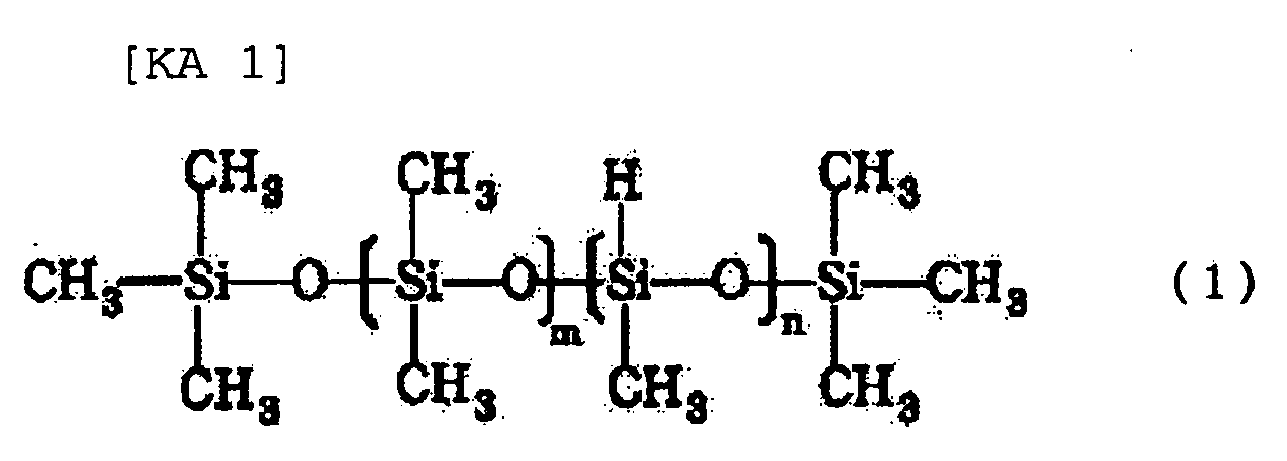
- SiH-containing polysiloxanes include, for example, SiH group-containing polysiloxanes such as one containing as a main component a methylhydrogenpolysiloxane represented by the following general formula (1), a methylhydrogencyclopolysiloxane and a derivative thereof. Above all, a methylhydrogenpolysiloxane represented by the following general formula (1) is preferred.
- m is an integer of 0 or more
- n is an integer of 1 or more
- m+n is an integer of 3 to 500.
- More preferred examples of the methylhydrogenpolysiloxanes include one in which m+n is 10 to 100 in the following formula.
- m+n is 10 to 100 in the following formula.
- the above-mentioned methylhydrogenpolysiloxane is available from Shin-Etsu Chemical Co., Ltd. under the trade name of Methylhydrogenpolysiloxane "KF-99", and can be used in the invention.
- dimethylpolysiloxanes include, for example, one containing as a main component a straight chain type dimethylpolysiloxane represented by the following general formula (2) (n represents an integer of 1 or more).
- dimethylpolysiloxane is available from Shin-Etsu Chemical Co., Ltd. under the trade name of Dimethylpolysiloxane "KF-96", and can be used in the invention.
- component (a) used in the invention can be treated by using a silicone oil such as a methylphenylsilicone oil, a polyether-modified silicone oil, an alkyl-modified silicone oil, an amino-modified silicone oil, a mercapto-modified silicone oil or a fluorine-modified silicone oil in combination with the above-mentioned polysiloxane.
- a silicone oil such as a methylphenylsilicone oil, a polyether-modified silicone oil, an alkyl-modified silicone oil, an amino-modified silicone oil, a mercapto-modified silicone oil or a fluorine-modified silicone oil in combination with the above-mentioned polysiloxane.
- titanium oxide treated with the above-mentioned oxide of aluminum and/or silicon is further coated with the above-mentioned polysiloxane.
- the amount of the above-mentioned polysiloxane coated on the pigment is from 0.01 to 2.5% by mass, and preferably from 0.3 to 1.0% by mass.
- component (a) comes to be easily sedimented in the resulting ink.
- the amount of the polysiloxane coated is less than the above-mentioned lower limit, the whiteness having sufficient density is not obtained in the resulting ink, resulting in insufficient hiding properties to the ground of the printed matter.
- component (b) used in the invention is a resin, which is a polymeric dispersant or a fixing resin.
- polymeric dispersants include known polymeric dispersants, for example, proteins such as gelatin, casein and albumin; natural gums such as arabic gum and tragacanth gum; alginic acid derivatives such as triethanolamine alginate and ammonium alginate; polyvinyl alchohols; polyvinylpyrrolidones; ammonium or amine salts of polyacrylic acid, acrylic copolymers such as an acrylic acid-acrylonitrile copolymer, a vinyl acetate-acrylic ester copolymer and an acrylic acid-alkyl acrylate copolymer, styrene-acrylic copolymers such as a styrene-methacrylic acid copolymer and a styrene-methacrylic acid-alkyl acrylate copolymer, styrene-acrylic copoly
- the above-mentioned salts include an amine salt of a polymer and a copolymer comprising a monomer such as an amine salt-containing acrylic ester such as a tertiary amino group-containing monomer, as a monomer constituting at least a part of the resulting polymer, for example, using dimethylaminoethyl (meth)acrylate, diethylaminoethyl (meth)acrylate, dimethylaminopropyl(meth)acrylamide or diethylaminopropyl(meth)acrylamide.
- polymeric dispersants include an amine salt of an acrylic copolymer having a weight average molecular weight of 40,000 to 60,000, and particularly preferred example thereof include a tertiary amine salt.
- the above-mentioned polymeric dispersant is available from BYK-Cheimie Co. under the trade name of "Disperbyk (registered trade mark) 2050" or the like, and can be used in the invention.
- the above-mentioned fixing resin is preferably a (meth)acrylic resin, that is to say, an acrylic resin or a methacrylic resin. In a more preferred embodiment, it is a homopolymer of methyl methacrylate alone or a copolymer of methyl methacrylate and butyl methacrylate.
- component (c) used in the invention includes an organic solvent having good wettability with component (a) and containing as a main component a glycol ether which is effective for printability of the resulting ink.
- glycol ethers include, for example, monobutyl ether of di- or tri-ethylene glycol, monobutyl ether; monoethyl ether, monopropyl ether or monomethyl ether of propylene glycol; ethers such as monobutyl ether of dipropylene glycol and monohexyl ether of diethylene glycol; a mixture thereof; and the like, and preferably include at least one member selected from diethylene glycol diethyl ether, dipropylene glycol monomethyl ether and triethylene glycol monomethyl ether.
- the lactone solvent is a compound having a cyclic structure by an ester bond, and includes a ⁇ -lactone of a 5-membered ring structure, a ⁇ -lactone of a 6-membered ring structure, an ⁇ -lactone of a 7-membered ring structure and the like.
- ⁇ -butyrolactone ⁇ -valerolactone, ⁇ -hexalactone, ⁇ -heptalactone, ⁇ -octalactone, ⁇ -nonalactone, ⁇ -decalactone, ⁇ -undecalactone, ⁇ -caprolactone and a mixture thereof.
- Component (d) used in the invention is a nonionic surfactant, and comprises at least one member selected from polyoxyethylene alkyl ethers and polyoxyethylene phenyl ethers, which are polyoxyethylene derivatives.
- a polyoxyethylene alkyl ether, a polyoxyethylene alkyl phenol ether and a mixture of a polyoxyethylene alkyl ether and a polyoxyalkylene mono(or di)fatty acid ester are preferred, and it is more preferred that they are in liquid form at ordinary temperature, 20 ⁇ 5°C, under atmospheric pressure.
- the amount of the nonionic surfactant added is preferably from 20% by mass to 100% by mass based on component (a). When the amount added is lower than the above-mentioned range, redissolution properties in the case of being solidified significantly decreases.
- the HLB (hydrophile-lipophile balance) value of the nonionic surfactant is preferably from 10 to 13.
- polyoxyethylene alkylphenol ethers are available to use, for example, under the trade names of HS-206 and HS-208 manufactured by NOF Corporation, and the like
- polyoxyethylene alkyl ethers are available to use, for example, under the trade names of Noigen LP-70 and Noigen LP-100 manufactured by Dai-Ichi Kogyo Seiyaku Co., Ltd., Naroacty HN70 and Naroacty HN85 manufactured by Sanyo Chemical Industries, Ltd., Pegnol O-6A manufactured by Toho Chemical Industry Co., Ltd., Emalgen LS-106 and Emalgen LS-114 manufactured by Kao Corporation, NIKKOL BT-5 and NIKKOL BT-7 manufactured by Nikko Chemicals Co., Ltd., and the like.
- the mixtures of a polyoxyethylene alkyl ether and a polyoxyethylene monofatty acid ester are available to use under the trade names of Flowlen D-90 manufactured by Kyoeisha Chemical
- the ink of the invention can contain, as needed, a resin which can be mixed and dispersed in the above-mentioned solvent mainly containing the glycol ether and/or the glycol, for example, a vinyl chloride-vinyl acetate copolymer, a rosin-modified phenol resin, a polyester resin, a polyamide resin or an epoxy resin.
- a resin which can be mixed and dispersed in the above-mentioned solvent mainly containing the glycol ether and/or the glycol, for example, a vinyl chloride-vinyl acetate copolymer, a rosin-modified phenol resin, a polyester resin, a polyamide resin or an epoxy resin.
- known additives such as a wax, an antioxidant, a surfactant, a viscosity modifier, a plasticizer, an antifoaming agent, an antioxidant and an ultraviolet absorber can be added to use within the range in which the object of the invention is not hindered.
- the ink of the invention is prepared by homogeneously mixing the above-mentioned respective components by a known method to disperse the above-mentioned component (a) in a solvent.
- Preparation methods include, for example, a method of performing dispersion with zirconia beads having a diameter of 0.8 mm in a paint shaker for 1 hour, and then, performing dispersion with zirconia beads having a diameter of 0.3 mm for 5 hours to adjust the viscosity of the ink to 4.0 to 4.5 mPa ⁇ s.
- Viscosity measurement of the ink is a value measured with a falling-ball type viscometer (AMVn manufactured by Nihon Siber Hegner KK). Printing to a usual material to be recorded with the above-mentioned ink can be performed by using a commercially available ink jet printer.
- component (a), component (b), component (c) and component (d) were homogeneously mixed and dispersed by the above-mentioned preparation method to prepare ink V1 of the invention having a viscosity of 4.0 to 4.5 mPa ⁇ s.
- Component (a), component (b), component (c) and component (d) are as follows:
- Ink V2 of the example was prepared in the same manner as in Example 1 with the exception that 3.0 parts of Naroacty HN70 (manufactured by Sanyo Chemical Industries, Ltd., HLB 11.7) was used in place of Noigen LP-70 used in Example 1.
- Ink V3 of the example was prepared in the same manner as in Example 1 with the exception that 3.0 parts of Naroacty HN85 (manufactured by Sanyo Chemical Industries, Ltd., HLB 12.6) was used in place of Noigen LP-70 used in Example 1, and that ⁇ -valerolactone was changed to ⁇ -butyrolactone.
- Ink V4 of the example was prepared in the same manner as in Example 1 with the exception that 3.0 parts of Flowlen D-90 (manufactured by Kyoeisha Chemical Co., Ltd., HLB 12.6) was used in place of Noigen LP-70 used in Example 1.
- Ink V5 of the example was prepared in the same manner as in Example 1 with the exception that 3.0 parts of a polyoxyethylene alkyl ether, Pegnol 0-6A (manufactured by Toho Chemical Industry Co., Ltd., HLB 9.6), was used in place of Noigen LP-70 used in Example 1.
- a polyoxyethylene alkyl ether Pegnol 0-6A (manufactured by Toho Chemical Industry Co., Ltd., HLB 9.6)
- Ink V6 of the example was prepared in the same manner as in Example 1 with the exception that 3.0 parts of a polyoxyethylene alkyl ether, Emalgen LS-114 manufactured by Kao Corporation, HLB 14.0), was used in place of Noigen LP-70 used in Example 1.
- Ink Y1 of the comparative example was prepared in the same manner as in Example 1 with the exception that Noigen LP-70 used in Example 1 was not added.
- Ink Y2 of the comparative example was prepared in the same manner as in Example 1 with the exception that 3.0 parts of NIKKOL DECAGLYN 1-IS (manufactured by Nikko Chemicals Co., Ltd., HLB 12.0) of a polyglycerin fatty acid ester was used in place of Noigen LP-70 used in Example 1.
- NIKKOL DECAGLYN 1-IS manufactured by Nikko Chemicals Co., Ltd., HLB 12.0
- Ink Y3 of the comparative example was prepared in the same manner as in Example 1 with the exception that 3.0 parts of NIKKOL TO-30 (manufactured by Nikko Chemicals Co., Ltd., HLB 11.0) of a polyoxyethylene sorbitan fatty acid ester was used in place of Noigen LP-70 used in Example 1.
- Ink Y4 of the comparative example was prepared in the same manner as in Example 1 with the exception that 3.0 parts of NIKKOL MYO-10 (manufactured by Nikko Chemicals Co., Ltd., HLB 11.0) of a polyethylene glycol fatty acid ester was used in place of Noigen LP-70 used in Example 1.
- the ink of the invention does not bring about clogging in a print head, and makes it possible to perform continuous printing having no print trouble.
- a printer is not used for a long period of time, deflection or clogging is difficult to occur, and it can be easily recovered, even when such a symptom has occurred.
Landscapes
- Chemical & Material Sciences (AREA)
- Life Sciences & Earth Sciences (AREA)
- Engineering & Computer Science (AREA)
- Materials Engineering (AREA)
- Wood Science & Technology (AREA)
- Organic Chemistry (AREA)
- Inks, Pencil-Leads, Or Crayons (AREA)
- Ink Jet Recording Methods And Recording Media Thereof (AREA)
- Ink Jet (AREA)
- Pigments, Carbon Blacks, Or Wood Stains (AREA)
Abstract
Description
- The present invention relates to an oil-based white ink for ink jet recording (hereinafter occasionally simply referred to as a "white ink" or "ink"), and particularly relate to an oil-based white ink for ink jet recording which is stable in ejection properties and excellent in recovery properties after standing for a long period of time.
- Conventionally, an ink jet recording system is a recording system in which ink liquid droplets are ejected from a print head or a spray nozzle toward a material to be recorded, at high speed according to electronic signals from a computer or the like to perform printing on an ink receiving layer of the material to be recorded. In the above-mentioned ink jet recording system, the noise is small, and recording is possible at high speed, so that the system has widely prevailed in copies, facsimiles, posters, displays and the like. Based on this, it is required that an ink used in this ink jet recording system has no variation with time, and can maintain sufficient density for a long period of time when an image has been formed, and that the image printed on the material to be recorded has excellent original reproducibility and sufficient density.
- For this reason, it is required that the ink used does not clog in the nozzle of a head, and does not clog a filter through which it passes in the course from an ink cartridge to the head. For the ink, therefore, it is necessary to adjust ink characteristics such as density, viscosity, particle size and concentration. The above-mentioned ink is generally constituted by a coloring agent such as a dye or a pigment, a dispersant or solvent for dispersing these, and an additive as needed.
- In particular, a white ink for ink jet is printed on a low-brightness black-based or transparent material to be recorded, thereby obtaining printed matter having good visibility. It is therefore effective for marking of various products. Further, when the above-mentioned material to be recorded is printed with a colored ink other than the white ink, clear printing cannot be reproduced under the influence of a base color. For this reason, it is required that base printing is performed with a white ink having sufficient hiding properties to a ground to hide the blank ground, followed by printing on the white ground with the other colored ink.
- However, in the above-mentioned white ink, a titanium oxide pigment is used as the coloring agent, and in the white ink in which a conventional titanium oxide pigment is used, redispersibility of the titanium oxide pigment becomes deteriorated due to the specific gravity of pigment particles, a solvent used and the like during storage, particularly, when an alcoholic solvent is used, by sedimentation and coagulation of the titanium oxide pigment with time. In order to solve such a problem, a white pigment composition (patent document 1) is proposed. However, in the white pigment composition disclosed in patent document 1, the redispersibility of a white pigment precipitated is improved by dispersing a titanium oxide pigment only treated with aluminum, in an alcoholic solvent using a carboxylic group-containing acrylic resin as a dispersant. In an actual operation, however, it has been desired that the composition can be used as such without performing redispersion of the pigment sedimented in the ink. Further, when the titanium oxide pigment is used as the white pigment, coagulation and sedimentation of the pigment in the ink are liable to proceed in storage of the ink. In particular, when it is used in an ink jet ink, the long period during which a printer is not used conceivably causes the case of unstable ejection or the case of clogging a nozzle of the printer, resulting in the necessity of replacing a head of the printer in the worst case.
-
- Patent Document 1:
JP-A-6-107964 - It is therefore an object of the invention to provide an oil-based white ink for ink jet recording excellent, particularly in ejection stability and recovery properties after standing for a long period of time.
- The above-mentioned object is achieved by the following invention. That is to say, the invention relates to an ink jet ink which is an oil-based white ink for ink jet recording containing (a) titanium oxide having an average particle size of 0.15 to 0.25 µm, (b) a resin, (c) an organic solvent and (d) a nonionic surfactant, wherein the above-mentioned nonionic surfactant comprises at least one member selected from polyoxyethylene alkyl ethers and polyoxyethylene phenyl ethers, which are polyoxyethylene derivatives.
The present inventors have found that the above-mentioned oil-based white ink for ink jet recording stabilizes ejection, and is an ink excellent in recovery properties even when it is allowed to stand for a long period of time, thus resulting in the invention. - According to the invention, by dispersing a specific white pigment into a specific dispersant and solvent and by adding thereto a specific surfactant, there can be provided an ink which is excellent in sedimentation resistance with time, good in ejection stability, and further extremely good in recovery properties even when solidification of an ink proceeds in a nozzle due to evaporation of a solvent and the like after standing for a long period of time.
- With reference to the best mode for carrying out the invention, the invention will be described in detail below. Component (a) which characterizes the invention is fine titanium oxide particles having an average particle size of 0.15 to 0.25 µm. The fine titanium oxide particles used in the invention are preferably coated with an oxide of aluminum and/or silicon, and coated titanium oxide is preferably a white pigment which is further surface-treated with a SiH-containing polysiloxane and/or dimethyl polysiloxane at a ratio of 0.01 to 2.5% by mass. The term "oxide" used in the invention means an anhydrous oxide, a hydrous oxide or a mixture of both.
- As the above-mentioned titanium oxide, there can be used known rutile type and/or anatase type titanium dioxide, and preferably, rutile type titanium dioxide is used. Further, the above-mentioned oxides (and hydrous oxides thereof) include, for example, oxides such as SiO2 and Al2O3, and hydrous oxides such as SiO2·nH2O and Al2O3-nH2O, and preferably, Al2O3 and the hydrous oxide thereof are used. The above-mentioned component (a) is fine particles having an average particle size of 0.15 to 0.25 µm, preferably 0.15 to 0.21 µm, in a state in which the particles are surface-treated with the above-mentioned oxide or hydrous oxide thereof. Although the mass ratio of the fine titanium oxide particles to the above-mentioned oxide in this case is not particularly limited, the above-mentioned oxide is generally about 0.01 to 30 parts by mass per 100 parts by mass of the fine titanium oxide particles.
- When the average particle size of the above-mentioned component (a) exceeds the above-mentioned upper limit, the pigment is liable to coagulate and sediment during storage, resulting in deterioration of storage stability, although the hiding properties of the resulting ink to a ground increases. Further, the ink becomes liable to clog in a print head during printing. On the other hand, when the average particle size of the above-mentioned component (a) is less than the above-mentioned lower limit, the hiding properties to a ground of the printed matter are insufficient, although the pigment does not sediment during storage to give good storage stability.
- The above-mentioned SiH-containing polysiloxanes include, for example, SiH group-containing polysiloxanes such as one containing as a main component a methylhydrogenpolysiloxane represented by the following general formula (1), a methylhydrogencyclopolysiloxane and a derivative thereof. Above all, a methylhydrogenpolysiloxane represented by the following general formula (1) is preferred.
- In the following formula, m is an integer of 0 or more, n is an integer of 1 or more, and m+n is an integer of 3 to 500. More preferred examples of the methylhydrogenpolysiloxanes include one in which m+n is 10 to 100 in the following formula. When the value of the above-mentioned m+n is too high or too low, the dispersibility of the pigment is lowered. The above-mentioned methylhydrogenpolysiloxane is available from Shin-Etsu Chemical Co., Ltd. under the trade name of Methylhydrogenpolysiloxane "KF-99", and can be used in the invention.
-
- Further, the above-mentioned dimethylpolysiloxanes include, for example, one containing as a main component a straight chain type dimethylpolysiloxane represented by the following general formula (2) (n represents an integer of 1 or more).
-


- The above-mentioned dimethylpolysiloxane is available from Shin-Etsu Chemical Co., Ltd. under the trade name of Dimethylpolysiloxane "KF-96", and can be used in the invention.
- Further, component (a) used in the invention can be treated by using a silicone oil such as a methylphenylsilicone oil, a polyether-modified silicone oil, an alkyl-modified silicone oil, an amino-modified silicone oil, a mercapto-modified silicone oil or a fluorine-modified silicone oil in combination with the above-mentioned polysiloxane.
- In a preferred embodiment of component (a) used in the invention, titanium oxide treated with the above-mentioned oxide of aluminum and/or silicon is further coated with the above-mentioned polysiloxane. The amount of the above-mentioned polysiloxane coated on the pigment is from 0.01 to 2.5% by mass, and preferably from 0.3 to 1.0% by mass. When the amount of the above-mentioned polysiloxane coated exceeds the above-mentioned upper limit, component (a) comes to be easily sedimented in the resulting ink. On the other hand, when the amount of the polysiloxane coated is less than the above-mentioned lower limit, the whiteness having sufficient density is not obtained in the resulting ink, resulting in insufficient hiding properties to the ground of the printed matter.
- Further, component (b) used in the invention is a resin, which is a polymeric dispersant or a fixing resin. Preferred examples of the above-mentioned polymeric dispersants include known polymeric dispersants, for example, proteins such as gelatin, casein and albumin; natural gums such as arabic gum and tragacanth gum; alginic acid derivatives such as triethanolamine alginate and ammonium alginate; polyvinyl alchohols; polyvinylpyrrolidones; ammonium or amine salts of polyacrylic acid, acrylic copolymers such as an acrylic acid-acrylonitrile copolymer, a vinyl acetate-acrylic ester copolymer and an acrylic acid-alkyl acrylate copolymer, styrene-acrylic copolymers such as a styrene-methacrylic acid copolymer and a styrene-methacrylic acid-alkyl acrylate copolymer, styrene-maleic acid copolymers, vinyl acetate-based copolymers such as a vinyl acetate-ethylene copolymer, a vinyl acetate-maleic ester copolymer and a vinyl acetate-crotonic acid copolymer, and the like.
- The above-mentioned salts include an amine salt of a polymer and a copolymer comprising a monomer such as an amine salt-containing acrylic ester such as a tertiary amino group-containing monomer, as a monomer constituting at least a part of the resulting polymer, for example, using dimethylaminoethyl (meth)acrylate, diethylaminoethyl (meth)acrylate, dimethylaminopropyl(meth)acrylamide or diethylaminopropyl(meth)acrylamide.
- Preferred examples of the polymeric dispersants include an amine salt of an acrylic copolymer having a weight average molecular weight of 40,000 to 60,000, and particularly preferred example thereof include a tertiary amine salt. The above-mentioned polymeric dispersant is available from BYK-Cheimie Co. under the trade name of "Disperbyk (registered trade mark) 2050" or the like, and can be used in the invention.
- The above-mentioned fixing resin is preferably a (meth)acrylic resin, that is to say, an acrylic resin or a methacrylic resin. In a more preferred embodiment, it is a homopolymer of methyl methacrylate alone or a copolymer of methyl methacrylate and butyl methacrylate.
- Further, component (c) used in the invention includes an organic solvent having good wettability with component (a) and containing as a main component a glycol ether which is effective for printability of the resulting ink.
- The above-mentioned glycol ethers include, for example, monobutyl ether of di- or tri-ethylene glycol, monobutyl ether; monoethyl ether, monopropyl ether or monomethyl ether of propylene glycol; ethers such as monobutyl ether of dipropylene glycol and monohexyl ether of diethylene glycol; a mixture thereof; and the like, and preferably include at least one member selected from diethylene glycol diethyl ether, dipropylene glycol monomethyl ether and triethylene glycol monomethyl ether.
- Another organic solvent, for example, an ester such as ethylene glycol monomethyl ether acetate, ethylene glycol monoethyl ether acetate, diethylene glycol monomethyl ether acetate or propylene glycol monomethyl ether acetate, a lactone solvent or the like can be used in combination with the above-mentioned component (c), as needed. The lactone solvent is a compound having a cyclic structure by an ester bond, and includes a γ-lactone of a 5-membered ring structure, a δ-lactone of a 6-membered ring structure, an ε-lactone of a 7-membered ring structure and the like. For example, there can be used γ-butyrolactone, γ-valerolactone, γ-hexalactone, γ-heptalactone, δ-octalactone, δ-nonalactone, δ-decalactone, δ-undecalactone, ε-caprolactone and a mixture thereof.
- Component (d) used in the invention is a nonionic surfactant, and comprises at least one member selected from polyoxyethylene alkyl ethers and polyoxyethylene phenyl ethers, which are polyoxyethylene derivatives. Above all, a polyoxyethylene alkyl ether, a polyoxyethylene alkyl phenol ether and a mixture of a polyoxyethylene alkyl ether and a polyoxyalkylene mono(or di)fatty acid ester are preferred, and it is more preferred that they are in liquid form at ordinary temperature, 20±5°C, under atmospheric pressure.
- The amount of the nonionic surfactant added is preferably from 20% by mass to 100% by mass based on component (a). When the amount added is lower than the above-mentioned range, redissolution properties in the case of being solidified significantly decreases.
- On the other hand, when the amount added is more than the above-mentioned range, drying properties at the time when printed decrease, and coating strength decreases.
- Further, from miscibility with an ink system and redissolution properties in the case of being solidified, the HLB (hydrophile-lipophile balance) value of the nonionic surfactant is preferably from 10 to 13.
- As the preferred surfactants, polyoxyethylene alkylphenol ethers are available to use, for example, under the trade names of HS-206 and HS-208 manufactured by NOF Corporation, and the like, and polyoxyethylene alkyl ethers are available to use, for example, under the trade names of Noigen LP-70 and Noigen LP-100 manufactured by Dai-Ichi Kogyo Seiyaku Co., Ltd., Naroacty HN70 and Naroacty HN85 manufactured by Sanyo Chemical Industries, Ltd., Pegnol O-6A manufactured by Toho Chemical Industry Co., Ltd., Emalgen LS-106 and Emalgen LS-114 manufactured by Kao Corporation, NIKKOL BT-5 and NIKKOL BT-7 manufactured by Nikko Chemicals Co., Ltd., and the like. Further, the mixtures of a polyoxyethylene alkyl ether and a polyoxyethylene monofatty acid ester are available to use under the trade names of Flowlen D-90 manufactured by Kyoeisha Chemical Co., Ltd., and the like.
- The ink of the invention can contain, as needed, a resin which can be mixed and dispersed in the above-mentioned solvent mainly containing the glycol ether and/or the glycol, for example, a vinyl chloride-vinyl acetate copolymer, a rosin-modified phenol resin, a polyester resin, a polyamide resin or an epoxy resin. Further, to the ink of the invention, known additives such as a wax, an antioxidant, a surfactant, a viscosity modifier, a plasticizer, an antifoaming agent, an antioxidant and an ultraviolet absorber can be added to use within the range in which the object of the invention is not hindered.
- The ink of the invention is prepared by homogeneously mixing the above-mentioned respective components by a known method to disperse the above-mentioned component (a) in a solvent. Preparation methods include, for example, a method of performing dispersion with zirconia beads having a diameter of 0.8 mm in a paint shaker for 1 hour, and then, performing dispersion with zirconia beads having a diameter of 0.3 mm for 5 hours to adjust the viscosity of the ink to 4.0 to 4.5 mPa·s. Viscosity measurement of the ink is a value measured with a falling-ball type viscometer (AMVn manufactured by Nihon Siber Hegner KK). Printing to a usual material to be recorded with the above-mentioned ink can be performed by using a commercially available ink jet printer.
- The present invention will be illustrated in greater detail with reference to the following examples and comparative examples, but the invention should not be construed as being limited to the following examples. The "parts" and "%" are given on mass basis, unless otherwise specified.
- The following component (a), component (b), component (c) and component (d) were homogeneously mixed and dispersed by the above-mentioned preparation method to prepare ink V1 of the invention having a viscosity of 4.0 to 4.5 mPa·s. Component (a), component (b), component (c) and component (d) are as follows:
- Component (a): A white pigment in which titanium dioxide surface-treated with alumina and having an average particle size of 0.21 µm is further 0.75% treated with a methylhydrogenpolysiloxane (Methylhydrogenpolysiloxane KF-99 manufactured by Shin-Etsu Chemical Co., Ltd., 6.0 parts
- Component (b): An acrylic polymeric dispersant (manufactured by BYK-Cheimie Co., Disperbyk-2050, weight average molecular weight 50,000), 1.4 parts, and an acrylic resin (manufactured by Rohm & Haas Company, Paraloid E60), 2.0 parts
- Component (c): A mixed solvent of 62.6 parts of diethylene glycol diethyl ether, 15.0 parts of γ-valerolactone and 10.0 parts of tetraethylene glycol monobutyl ether
- Component (d): Noigen LP-70 (manufactured by Dai-Ichi Kogyo Seiyaku Co., Ltd., HLB 10.5), 3.0 parts
- Ink V2 of the example was prepared in the same manner as in Example 1 with the exception that 3.0 parts of Naroacty HN70 (manufactured by Sanyo Chemical Industries, Ltd., HLB 11.7) was used in place of Noigen LP-70 used in Example 1.
- Ink V3 of the example was prepared in the same manner as in Example 1 with the exception that 3.0 parts of Naroacty HN85 (manufactured by Sanyo Chemical Industries, Ltd., HLB 12.6) was used in place of Noigen LP-70 used in Example 1, and that γ-valerolactone was changed to γ-butyrolactone.
- Ink V4 of the example was prepared in the same manner as in Example 1 with the exception that 3.0 parts of Flowlen D-90 (manufactured by Kyoeisha Chemical Co., Ltd., HLB 12.6) was used in place of Noigen LP-70 used in Example 1.
- Ink V5 of the example was prepared in the same manner as in Example 1 with the exception that 3.0 parts of a polyoxyethylene alkyl ether, Pegnol 0-6A (manufactured by Toho Chemical Industry Co., Ltd., HLB 9.6), was used in place of Noigen LP-70 used in Example 1.
- Ink V6 of the example was prepared in the same manner as in Example 1 with the exception that 3.0 parts of a polyoxyethylene alkyl ether, Emalgen LS-114 manufactured by Kao Corporation, HLB 14.0), was used in place of Noigen LP-70 used in Example 1.
- Ink Y1 of the comparative example was prepared in the same manner as in Example 1 with the exception that Noigen LP-70 used in Example 1 was not added.
- Ink Y2 of the comparative example was prepared in the same manner as in Example 1 with the exception that 3.0 parts of NIKKOL DECAGLYN 1-IS (manufactured by Nikko Chemicals Co., Ltd., HLB 12.0) of a polyglycerin fatty acid ester was used in place of Noigen LP-70 used in Example 1.
- Ink Y3 of the comparative example was prepared in the same manner as in Example 1 with the exception that 3.0 parts of NIKKOL TO-30 (manufactured by Nikko Chemicals Co., Ltd., HLB 11.0) of a polyoxyethylene sorbitan fatty acid ester was used in place of Noigen LP-70 used in Example 1.
- Ink Y4 of the comparative example was prepared in the same manner as in Example 1 with the exception that 3.0 parts of NIKKOL MYO-10 (manufactured by Nikko Chemicals Co., Ltd., HLB 11.0) of a polyethylene glycol fatty acid ester was used in place of Noigen LP-70 used in Example 1.
- Using the respective inks obtained in the abovementioned Examples and Comparative Examples, a redissolution test and evaluation of nozzle recovery properties and ejection with MJ-8000C (manufactured by EPSON) were performed.
- One gram of an ink was taken in a petri dish, and allowed to stand at 40°C for 3 days. The ink was dropped again onto the dried and solidified ink to confirm redissolution (dispersing) properties. Evaluation:
- A: Redissolved.
- B: Partially redissolved.
- C: Not redissolved.
- An ink was filled, and continuous printing was performed for 1 hour. Thereafter, it was allowed to stand for 1 hour, and printing was performed again. Then, the presence or absence of deflected ejection and dot missing was confirmed, and recovery properties by a cleaning operation were evaluated.
Evaluation: - A: There is no deflection or no dot missing.
- B: There is deflection or dot missing, but it recovers by several or more times of cleaning.
- C: There is deflection or dot missing, and it does not recover even by cleaning.
- An ink was filled, and continuous printing was performed for 1 day. Thereafter, it was allowed to stand at 35°C for 2 weeks, and printing was performed again. Then, the presence or absence of deflected ejection and dot missing was confirmed, and recovery properties by a cleaning operation were evaluated.
Evaluation: - A: There is deflection or dot missing, but it recovers by one or two times of cleaning.
- B: There is deflection or dot missing, but it recovers by three or more times of cleaning.
- C: There is deflection or dot missing, and it does not recover even by cleaning.
- An ink was filled, and continuous printing was performed for 1 day. Thereafter, it was allowed to stand at 5°C to 25°C for 1 month, and printing was performed again. Then, the presence or absence of deflected ejection and dot missing was confirmed, and recovery properties by a cleaning operation were evaluated.
Evaluation: - A: There is deflection or dot missing, but it recovers by one or two times of cleaning.
- B: There is deflection or dot missing, but it recovers by three or more times of cleaning.
- C: There is deflection or dot missing, and it does not recover even by cleaning.
-
Table 1 V1 V2 V3 V4 V5 V6 Y1 Y2 Y3 Y4 Redissoltion Properties A A A A B B C C C C Intermittent Ejection A A A A A A B B B B Long-Term Standing 1 A A A A B A C C C C Long-Term Standing 2 A A A A B B C C C C - From the above-mentioned evaluation results, as for the inks of the invention, deflection or clogging is difficult to occur, even when they are allowed to stand for a long period of time under the above-mentioned conditions. Further, even when it has occurred, it can be quickly recovered.
While the present invention has been described in detail and with reference to specific embodiments thereof, it will be apparent to one skilled in the art that various changes and modifications can be made therein without departing from the spirit and scope thereof.
This application is based onJapanese Patent Application No. 2004-235273 filed on August 12, 2004 - According to the invention, the ink of the invention does not bring about clogging in a print head, and makes it possible to perform continuous printing having no print trouble. When a printer is not used for a long period of time, deflection or clogging is difficult to occur, and it can be easily recovered, even when such a symptom has occurred.
- Consequently, it can be efficiently used as an extremely excellent oil-based white ink for ink jet recording which can largely decrease the load of maintenance.
Claims (6)
- An ink jet ink which is an oil-based white ink for ink jet recording containing (a) titanium oxide having an average particle size of 0.15 to 0.25 µm, (b) a resin, (c) an organic solvent and (d) a nonionic surfactant, wherein the nonionic surfactant comprises at least one member selected from the group consisting of polyoxyethylene alkyl ethers and polyoxyethylene phenyl ethers.
- The ink jet ink according to claim 1, wherein the content of the nonionic surfactant is from 20% by mass to 100% by mass based on the titanium oxide.
- The ink jet ink according to claim 1 or 2, wherein the nonionic surfactant has an HLB value of from 10 to 13.
- The ink jet ink according to any one of claims 1 to 3, wherein the titanium oxide is coated with an oxide of aluminum and/or silicon.
- The ink jet ink according to claim 4, wherein the titanium oxide is further surface-treated with a SiH-containing polysiloxane and/or dimethyl polysiloxane at a ratio of 0.01 to 2.5% by mass.
- The ink jet ink according to any one of claims 1 to 5, wherein the organic solvent (c) comprises a mixed solvent of diethylene glycol diethyl ether and a lactone.
Applications Claiming Priority (2)
| Application Number | Priority Date | Filing Date | Title |
|---|---|---|---|
| JP2004235273 | 2004-08-12 | ||
| PCT/JP2005/014836 WO2006016674A1 (en) | 2004-08-12 | 2005-08-12 | Oil-based white ink for inkjet recording |
Publications (3)
| Publication Number | Publication Date |
|---|---|
| EP1777270A1 true EP1777270A1 (en) | 2007-04-25 |
| EP1777270A4 EP1777270A4 (en) | 2009-12-02 |
| EP1777270B1 EP1777270B1 (en) | 2011-12-28 |
Family
ID=35839431
Family Applications (1)
| Application Number | Title | Priority Date | Filing Date |
|---|---|---|---|
| EP20050780250 Expired - Lifetime EP1777270B1 (en) | 2004-08-12 | 2005-08-12 | Oil-based white ink for inkjet recording |
Country Status (6)
| Country | Link |
|---|---|
| US (1) | US7897656B2 (en) |
| EP (1) | EP1777270B1 (en) |
| JP (1) | JP4891082B2 (en) |
| CN (1) | CN101027370B (en) |
| AU (1) | AU2005272336B2 (en) |
| WO (1) | WO2006016674A1 (en) |
Cited By (2)
| Publication number | Priority date | Publication date | Assignee | Title |
|---|---|---|---|---|
| EP2141208A4 (en) * | 2007-03-29 | 2012-11-14 | Inctec Inc | WHITE INK-BASED INK FOR INKJET PRINTING AND METHOD FOR PRODUCING THE SAME |
| EP4053231A4 (en) * | 2019-10-30 | 2023-12-20 | Sakata INX Corporation | WATER-FREE INKJET INK COMPOSITION |
Families Citing this family (24)
| Publication number | Priority date | Publication date | Assignee | Title |
|---|---|---|---|---|
| DE602007003136D1 (en) | 2006-05-16 | 2009-12-24 | Inctec Inc | Oil-based ink compositions for ink-jet printers |
| JP6078430B2 (en) * | 2007-01-29 | 2017-02-08 | セイコーエプソン株式会社 | Ink set, ink jet recording method and recorded matter |
| JP5441238B2 (en) * | 2008-01-07 | 2014-03-12 | 株式会社パイロットコーポレーション | Water-based ballpoint pen ink composition |
| JP5424104B2 (en) * | 2009-08-31 | 2014-02-26 | セイコーエプソン株式会社 | Ink composition |
| ES2386104T3 (en) | 2009-10-02 | 2012-08-09 | Agfa Graphics N.V. | UV inkjet compositions for high density printheads |
| JP5508189B2 (en) * | 2010-08-10 | 2014-05-28 | 株式会社セイコーアドバンス | Inks, sheets and molded products |
| JP2012144639A (en) * | 2011-01-12 | 2012-08-02 | Riso Kagaku Corp | Solvent ink and inkjet printing method |
| WO2012170032A1 (en) * | 2011-06-10 | 2012-12-13 | Hewlett-Packard Development Company, L.P. | White ink-jet inks |
| WO2014051538A1 (en) * | 2012-09-25 | 2014-04-03 | Empire Technology Development Llc | Oxidizing agents on pigments |
| JP2014094495A (en) * | 2012-11-09 | 2014-05-22 | Seiko Epson Corp | Inkjet recording method |
| US9624391B2 (en) | 2012-12-27 | 2017-04-18 | Zebra Co., Ltd. | Water-based ink composition and water-based ballpoint pen |
| EP3004264B1 (en) * | 2013-05-30 | 2020-03-04 | Hewlett-Packard Development Company, L.P. | White inkjet ink |
| WO2016175750A1 (en) * | 2015-04-27 | 2016-11-03 | Hewlett-Packard Development Company, L.P. | Fluid sets for inkjet imaging |
| EP3240837B1 (en) * | 2015-04-27 | 2020-07-15 | Hewlett-Packard Development Company, L.P. | White pigment dispersions |
| JP6858120B2 (en) * | 2015-06-26 | 2021-04-14 | セーレン株式会社 | Inkjet ink and method for manufacturing inkjet prints using it |
| JP6217950B2 (en) * | 2016-12-07 | 2017-10-25 | セイコーエプソン株式会社 | Inkjet recording method and photocurable ink composition for inkjet recording |
| US10865320B2 (en) * | 2017-02-28 | 2020-12-15 | Riso Kagaku Corporation | Oil-based inkjet ink |
| CN108504192B (en) | 2017-02-28 | 2021-09-28 | 理想科学工业株式会社 | Oil-based ink-jet ink |
| EP3366734B1 (en) | 2017-02-28 | 2020-09-23 | Riso Kagaku Corporation | Oil-based inkjet ink |
| EP3366736B1 (en) | 2017-02-28 | 2023-11-22 | Riso Kagaku Corporation | Oil-based inkjet ink |
| US10793734B2 (en) * | 2017-02-28 | 2020-10-06 | Riso Kagaku Corporation | Oil-based inkjet ink |
| CN108504193B (en) | 2017-02-28 | 2021-05-07 | 理想科学工业株式会社 | Oil-based inkjet ink |
| JP6904865B2 (en) | 2017-09-29 | 2021-07-21 | 理想科学工業株式会社 | Printed matter manufacturing method |
| JP7014558B2 (en) | 2017-09-29 | 2022-02-01 | 理想科学工業株式会社 | Oil-based inkjet ink set and printed matter manufacturing method |
Family Cites Families (16)
| Publication number | Priority date | Publication date | Assignee | Title |
|---|---|---|---|---|
| JPS60118767A (en) | 1983-11-30 | 1985-06-26 | Tokyo Ohka Kogyo Co Ltd | White ink composition for jet printing |
| JPH04187229A (en) * | 1990-11-21 | 1992-07-03 | Kanebo Ltd | Reformed powder |
| JPH05237360A (en) * | 1992-02-27 | 1993-09-17 | Kanebo Ltd | Reformed fine particle and cosmetic material compounded with the same |
| JPH05287214A (en) * | 1992-04-07 | 1993-11-02 | Kanebo Ltd | Modified powder and cosmetic containing the same |
| JPH06107964A (en) | 1992-09-29 | 1994-04-19 | Pentel Kk | White pigment composition |
| JPH06118767A (en) | 1992-10-01 | 1994-04-28 | Konica Corp | Electrifier |
| KR970010596B1 (en) | 1994-05-03 | 1997-06-28 | 이철규 | Preparations of white ink for marker pen |
| US5690860A (en) * | 1995-12-04 | 1997-11-25 | Dow Corning Corporation | Particulate inorganic oxide treated with cyclic polysiloxane |
| US6554891B1 (en) | 1999-05-25 | 2003-04-29 | Seiko Epson Corporation | Ink composition and method for inkjet recording using the same |
| EP1367101B1 (en) * | 2001-01-15 | 2007-12-19 | Seiko Epson Corporation | Oily ink composition for ink-jet recording, and ink-jet recording method |
| JP3915554B2 (en) * | 2001-03-14 | 2007-05-16 | セイコーエプソン株式会社 | White ink for inkjet and titanium dioxide slurry used therefor |
| EP1325944A3 (en) * | 2001-12-18 | 2003-07-23 | Toda Kogyo Corporation | Fine organic pigment particles, dispersion containing said fine particles and process for producing the fine organic pigment particles |
| JP2004018736A (en) * | 2002-06-18 | 2004-01-22 | Fuji Photo Film Co Ltd | Oil-base ink composition for inkjet printer |
| TW200413485A (en) * | 2002-07-26 | 2004-08-01 | Orient Chemical Ind | Solid pigment composition for pigment ink, pigment ink containing the same, and process for preparing these |
| JP2004090223A (en) * | 2002-08-29 | 2004-03-25 | Konica Minolta Holdings Inc | Inkjet printer and image recording method |
| JP2004115706A (en) | 2002-09-27 | 2004-04-15 | Fuji Photo Film Co Ltd | Oily ink composition for inkjet printer and process for preparing the same |
-
2005
- 2005-08-12 WO PCT/JP2005/014836 patent/WO2006016674A1/en not_active Ceased
- 2005-08-12 EP EP20050780250 patent/EP1777270B1/en not_active Expired - Lifetime
- 2005-08-12 CN CN2005800272772A patent/CN101027370B/en not_active Expired - Lifetime
- 2005-08-12 AU AU2005272336A patent/AU2005272336B2/en not_active Expired
- 2005-08-12 US US11/659,588 patent/US7897656B2/en active Active
- 2005-08-12 JP JP2006531764A patent/JP4891082B2/en not_active Expired - Lifetime
Cited By (4)
| Publication number | Priority date | Publication date | Assignee | Title |
|---|---|---|---|---|
| EP2141208A4 (en) * | 2007-03-29 | 2012-11-14 | Inctec Inc | WHITE INK-BASED INK FOR INKJET PRINTING AND METHOD FOR PRODUCING THE SAME |
| US8440744B2 (en) | 2007-03-29 | 2013-05-14 | The Inctec Inc. | Oil-based white ink jet recording composition and process for producing the same |
| EP4053231A4 (en) * | 2019-10-30 | 2023-12-20 | Sakata INX Corporation | WATER-FREE INKJET INK COMPOSITION |
| AU2020376411B2 (en) * | 2019-10-30 | 2026-01-22 | Sakata Inx Corporation | Ink composition for non-aqueous inkjet |
Also Published As
| Publication number | Publication date |
|---|---|
| JPWO2006016674A1 (en) | 2008-05-01 |
| JP4891082B2 (en) | 2012-03-07 |
| EP1777270A4 (en) | 2009-12-02 |
| CN101027370B (en) | 2011-05-25 |
| US20080194754A1 (en) | 2008-08-14 |
| CN101027370A (en) | 2007-08-29 |
| AU2005272336A1 (en) | 2006-02-16 |
| EP1777270B1 (en) | 2011-12-28 |
| AU2005272336B2 (en) | 2008-09-18 |
| US7897656B2 (en) | 2011-03-01 |
| WO2006016674A1 (en) | 2006-02-16 |
Similar Documents
| Publication | Publication Date | Title |
|---|---|---|
| EP1777270B1 (en) | Oil-based white ink for inkjet recording | |
| EP3272818B1 (en) | Ink composition and ink jet recording method using same | |
| JP5407594B2 (en) | Water-based ink for liquid ejection device and ink cartridge containing the ink | |
| EP1867690B1 (en) | Non-aqueous ink-set for ink-jet and ink-jet recording method | |
| CN104745004B (en) | Ink composition for ink jet recording | |
| JP5209491B2 (en) | Pigment-type ink formulation containing dispersant and binder and method for producing the same | |
| CN105968956B (en) | Solvent-based inkjet ink composition | |
| JP5519112B2 (en) | Oil-based white dispersion for inkjet recording, process for producing the same, and oil-based white ink composition for inkjet recording | |
| JP2004059933A (en) | Colorless inkjet ink composition for image quality improvement | |
| JP6709514B2 (en) | Aqueous ink composition | |
| JP4678573B2 (en) | Ink for inkjet recording | |
| JP4672270B2 (en) | Oil-based white ink for inkjet recording | |
| JP4595286B2 (en) | Aqueous pigment dispersion, water-based ink for inkjet, and method for producing aqueous pigment dispersion | |
| JP2009191221A (en) | Oil-based white ink composition for inkjet recording and method for producing the same | |
| EP2338944B1 (en) | Postal blue ink with improved durability | |
| EP2204421B1 (en) | Postal blue ink with high reliability | |
| JP2004250559A (en) | White pigment ink composition for inkjet recording | |
| US20040266909A1 (en) | Pigment type ink composition having superior gas fastness, and recording method and recorded matter by using the same | |
| US7553885B2 (en) | Ink for inkjet recording | |
| JP2000178489A (en) | Water-color ink and ink-jet printer | |
| JP4213461B2 (en) | Ink composition for ink jet recording and ink jet recording method | |
| JP2001010033A (en) | Yellow organic pigment ink composition and ink jet recording method using the same | |
| JP2003003093A (en) | Ink set | |
| JP4872310B2 (en) | Ink set comprising at least three black ink compositions | |
| JP2004250558A (en) | White pigment ink composition for inkjet recording |
Legal Events
| Date | Code | Title | Description |
|---|---|---|---|
| PUAI | Public reference made under article 153(3) epc to a published international application that has entered the european phase |
Free format text: ORIGINAL CODE: 0009012 |
|
| 17P | Request for examination filed |
Effective date: 20070208 |
|
| AK | Designated contracting states |
Kind code of ref document: A1 Designated state(s): DE FR GB IT |
|
| DAX | Request for extension of the european patent (deleted) | ||
| RBV | Designated contracting states (corrected) |
Designated state(s): DE FR GB IT |
|
| A4 | Supplementary search report drawn up and despatched |
Effective date: 20091030 |
|
| 17Q | First examination report despatched |
Effective date: 20100129 |
|
| GRAP | Despatch of communication of intention to grant a patent |
Free format text: ORIGINAL CODE: EPIDOSNIGR1 |
|
| GRAS | Grant fee paid |
Free format text: ORIGINAL CODE: EPIDOSNIGR3 |
|
| GRAA | (expected) grant |
Free format text: ORIGINAL CODE: 0009210 |
|
| RAP1 | Party data changed (applicant data changed or rights of an application transferred) |
Owner name: DNP FINE CHEMICALS CO., LTD. Owner name: SEIKO EPSON CORPORATION |
|
| AK | Designated contracting states |
Kind code of ref document: B1 Designated state(s): DE FR GB IT |
|
| REG | Reference to a national code |
Ref country code: GB Ref legal event code: FG4D |
|
| REG | Reference to a national code |
Ref country code: DE Ref legal event code: R096 Ref document number: 602005031907 Country of ref document: DE Effective date: 20120308 |
|
| PLBE | No opposition filed within time limit |
Free format text: ORIGINAL CODE: 0009261 |
|
| STAA | Information on the status of an ep patent application or granted ep patent |
Free format text: STATUS: NO OPPOSITION FILED WITHIN TIME LIMIT |
|
| 26N | No opposition filed |
Effective date: 20121001 |
|
| REG | Reference to a national code |
Ref country code: DE Ref legal event code: R097 Ref document number: 602005031907 Country of ref document: DE Effective date: 20121001 |
|
| REG | Reference to a national code |
Ref country code: FR Ref legal event code: PLFP Year of fee payment: 12 |
|
| REG | Reference to a national code |
Ref country code: FR Ref legal event code: PLFP Year of fee payment: 13 |
|
| REG | Reference to a national code |
Ref country code: FR Ref legal event code: PLFP Year of fee payment: 14 |
|
| PGFP | Annual fee paid to national office [announced via postgrant information from national office to epo] |
Ref country code: GB Payment date: 20240627 Year of fee payment: 20 |
|
| PGFP | Annual fee paid to national office [announced via postgrant information from national office to epo] |
Ref country code: DE Payment date: 20240702 Year of fee payment: 20 |
|
| PGFP | Annual fee paid to national office [announced via postgrant information from national office to epo] |
Ref country code: FR Payment date: 20240702 Year of fee payment: 20 |
|
| PGFP | Annual fee paid to national office [announced via postgrant information from national office to epo] |
Ref country code: IT Payment date: 20240710 Year of fee payment: 20 |
|
| REG | Reference to a national code |
Ref country code: DE Ref legal event code: R071 Ref document number: 602005031907 Country of ref document: DE |
|
| REG | Reference to a national code |
Ref country code: GB Ref legal event code: PE20 Expiry date: 20250811 |