EP1777225A1 - Fused benzamide compound and vanilloid receptor 1 (vr1) activity inhibitor - Google Patents
Fused benzamide compound and vanilloid receptor 1 (vr1) activity inhibitor Download PDFInfo
- Publication number
- EP1777225A1 EP1777225A1 EP05766173A EP05766173A EP1777225A1 EP 1777225 A1 EP1777225 A1 EP 1777225A1 EP 05766173 A EP05766173 A EP 05766173A EP 05766173 A EP05766173 A EP 05766173A EP 1777225 A1 EP1777225 A1 EP 1777225A1
- Authority
- EP
- European Patent Office
- Prior art keywords
- benzo
- dihydro
- oxazine
- carboxamide
- group
- Prior art date
- Legal status (The legal status is an assumption and is not a legal conclusion. Google has not performed a legal analysis and makes no representation as to the accuracy of the status listed.)
- Withdrawn
Links
- 0 *C(c(cc1)ccc1NC(c(cccc1N(C2)c3c(*)cccn3)c1OC2(*)Cl=I)=O)(N)N* Chemical compound *C(c(cc1)ccc1NC(c(cccc1N(C2)c3c(*)cccn3)c1OC2(*)Cl=I)=O)(N)N* 0.000 description 27
- MQJVKUHUMYXDQP-LPRJTOQXSA-N C/C=C/OC(CCC1)CN1c(ccc(NC(c1c2OCCN(c3ccc(C4CC4)cc3)c2ccc1)=O)c1)c1F Chemical compound C/C=C/OC(CCC1)CN1c(ccc(NC(c1c2OCCN(c3ccc(C4CC4)cc3)c2ccc1)=O)c1)c1F MQJVKUHUMYXDQP-LPRJTOQXSA-N 0.000 description 1
- JDAPKNYMFULSPO-UHFFFAOYSA-N CC(C=C)(C=C)c(cc1)ccc1NC(c(cccc12)c1OCCC2c(cc1)ncc1NC(CC=C)=O)=O Chemical compound CC(C=C)(C=C)c(cc1)ccc1NC(c(cccc12)c1OCCC2c(cc1)ncc1NC(CC=C)=O)=O JDAPKNYMFULSPO-UHFFFAOYSA-N 0.000 description 1
- JDWHTCFLBGXXNL-FXIRQEPWSA-N CC1(C(F)=CC(NC(c2cccc3c2OC[C@H](CO)N3c2ncccc2Cl)=O)=CC1)OCC=[IH] Chemical compound CC1(C(F)=CC(NC(c2cccc3c2OC[C@H](CO)N3c2ncccc2Cl)=O)=CC1)OCC=[IH] JDWHTCFLBGXXNL-FXIRQEPWSA-N 0.000 description 1
- RIXINXONRKYUMI-UHFFFAOYSA-N Cc(cc1)cnc1N1c2cccc(C(Nc(cc3)ccc3C(N)=O)=O)c2OCC1 Chemical compound Cc(cc1)cnc1N1c2cccc(C(Nc(cc3)ccc3C(N)=O)=O)c2OCC1 RIXINXONRKYUMI-UHFFFAOYSA-N 0.000 description 1
- AYXYRZIEOQJGRC-UHFFFAOYSA-N Cc1c(N2c3cccc(C(Nc4ccc(C(F)(F)F)cc4)=O)c3OCC2)ncc(CO)c1 Chemical compound Cc1c(N2c3cccc(C(Nc4ccc(C(F)(F)F)cc4)=O)c3OCC2)ncc(CO)c1 AYXYRZIEOQJGRC-UHFFFAOYSA-N 0.000 description 1
- HAXBLNQEPVIASD-UHFFFAOYSA-N Nc(cc1)cnc1N1c2cccc(C(Nc3ccc(C(F)(F)F)cc3)=O)c2OCC1 Chemical compound Nc(cc1)cnc1N1c2cccc(C(Nc3ccc(C(F)(F)F)cc3)=O)c2OCC1 HAXBLNQEPVIASD-UHFFFAOYSA-N 0.000 description 1
- ANRKNSVUNGMUDK-UHFFFAOYSA-N O=C(c(cccc12)c1OCCN2c(nccc1)c1Cl)Nc1cc(C(F)(F)F)ccc1 Chemical compound O=C(c(cccc12)c1OCCN2c(nccc1)c1Cl)Nc1cc(C(F)(F)F)ccc1 ANRKNSVUNGMUDK-UHFFFAOYSA-N 0.000 description 1
- LEMIXHJITDTWEU-UHFFFAOYSA-N O=C(c(cccc12)c1OCCN2c(nccc1)c1Cl)Nc1nc(C(F)(F)F)c[s]1 Chemical compound O=C(c(cccc12)c1OCCN2c(nccc1)c1Cl)Nc1nc(C(F)(F)F)c[s]1 LEMIXHJITDTWEU-UHFFFAOYSA-N 0.000 description 1
- OWADTTCRKZWKGQ-LRTDYKAYSA-N OC([C@@H]1N2c3cccc(C(Nc(cc4)ccc4OC(F)(F)F)=O)c3OC1)=[Cl]C1C2=CC=CC1 Chemical compound OC([C@@H]1N2c3cccc(C(Nc(cc4)ccc4OC(F)(F)F)=O)c3OC1)=[Cl]C1C2=CC=CC1 OWADTTCRKZWKGQ-LRTDYKAYSA-N 0.000 description 1
- YVQGAVUEBAIHQC-UHFFFAOYSA-N OCCOc(cc1)cnc1N1c2cccc(C(Nc(cc3)ccc3OC(F)(F)F)=O)c2OCC1 Chemical compound OCCOc(cc1)cnc1N1c2cccc(C(Nc(cc3)ccc3OC(F)(F)F)=O)c2OCC1 YVQGAVUEBAIHQC-UHFFFAOYSA-N 0.000 description 1
- IRKKRJHFPNDCQI-OOJLDXBWSA-N OC[C@@H](COc(c1ccc2)c2C(Nc2ccc(C([ClH]I)[Cl]=[IH])cc2)=O)N1c1ncccc1Cl Chemical compound OC[C@@H](COc(c1ccc2)c2C(Nc2ccc(C([ClH]I)[Cl]=[IH])cc2)=O)N1c1ncccc1Cl IRKKRJHFPNDCQI-OOJLDXBWSA-N 0.000 description 1
- GGDKIYXCCMUMNZ-KRWDZBQOSA-N OC[C@@H]1N(c(cc2)ccc2Cl)c(cccc2C(Nc(cc3)ccc3OC(F)(F)F)=O)c2OC1 Chemical compound OC[C@@H]1N(c(cc2)ccc2Cl)c(cccc2C(Nc(cc3)ccc3OC(F)(F)F)=O)c2OC1 GGDKIYXCCMUMNZ-KRWDZBQOSA-N 0.000 description 1
- GCEWSIPPVKZMOS-INIZCTEOSA-N OC[C@@H]1N(c(cccc2)c2Cl)c(cccc2C(Nc3ccc(C(F)(F)F)cc3)=O)c2OC1 Chemical compound OC[C@@H]1N(c(cccc2)c2Cl)c(cccc2C(Nc3ccc(C(F)(F)F)cc3)=O)c2OC1 GCEWSIPPVKZMOS-INIZCTEOSA-N 0.000 description 1
- OXEQDAZZPFNDFB-OAHLLOKOSA-N OC[C@H](COc(c1ccc2)c2C(Nc2ccc(C(F)(F)F)cc2)=O)N1c(nccc1)c1Cl Chemical compound OC[C@H](COc(c1ccc2)c2C(Nc2ccc(C(F)(F)F)cc2)=O)N1c(nccc1)c1Cl OXEQDAZZPFNDFB-OAHLLOKOSA-N 0.000 description 1
- FPTYCCNZUHDGCR-UHFFFAOYSA-N OCc(cc1Cl)cnc1N1c2cccc(C(Nc(cc3)ccc3Br)=O)c2OCC1 Chemical compound OCc(cc1Cl)cnc1N1c2cccc(C(Nc(cc3)ccc3Br)=O)c2OCC1 FPTYCCNZUHDGCR-UHFFFAOYSA-N 0.000 description 1
- JFQMIGQZKSMCHL-UHFFFAOYSA-N OCc1cc(N2c3cccc(C(Nc4ccc(C(F)(F)F)cc4)=O)c3OCC2)ncc1 Chemical compound OCc1cc(N2c3cccc(C(Nc4ccc(C(F)(F)F)cc4)=O)c3OCC2)ncc1 JFQMIGQZKSMCHL-UHFFFAOYSA-N 0.000 description 1
- FHDDOJBQCOHEPU-CQSZACIVSA-N O[C@H](C1)COc(c(C(Nc(cc2)ccc2OC(F)(F)F)=O)ccc2)c2N1c(nccc1)c1Cl Chemical compound O[C@H](C1)COc(c(C(Nc(cc2)ccc2OC(F)(F)F)=O)ccc2)c2N1c(nccc1)c1Cl FHDDOJBQCOHEPU-CQSZACIVSA-N 0.000 description 1
Classifications
-
- C—CHEMISTRY; METALLURGY
- C07—ORGANIC CHEMISTRY
- C07D—HETEROCYCLIC COMPOUNDS
- C07D265/00—Heterocyclic compounds containing six-membered rings having one nitrogen atom and one oxygen atom as the only ring hetero atoms
- C07D265/28—1,4-Oxazines; Hydrogenated 1,4-oxazines
- C07D265/34—1,4-Oxazines; Hydrogenated 1,4-oxazines condensed with carbocyclic rings
- C07D265/36—1,4-Oxazines; Hydrogenated 1,4-oxazines condensed with carbocyclic rings condensed with one six-membered ring
-
- A—HUMAN NECESSITIES
- A61—MEDICAL OR VETERINARY SCIENCE; HYGIENE
- A61K—PREPARATIONS FOR MEDICAL, DENTAL OR TOILETRY PURPOSES
- A61K45/00—Medicinal preparations containing active ingredients not provided for in groups A61K31/00 - A61K41/00
- A61K45/06—Mixtures of active ingredients without chemical characterisation, e.g. antiphlogistics and cardiaca
-
- A—HUMAN NECESSITIES
- A61—MEDICAL OR VETERINARY SCIENCE; HYGIENE
- A61P—SPECIFIC THERAPEUTIC ACTIVITY OF CHEMICAL COMPOUNDS OR MEDICINAL PREPARATIONS
- A61P1/00—Drugs for disorders of the alimentary tract or the digestive system
-
- A—HUMAN NECESSITIES
- A61—MEDICAL OR VETERINARY SCIENCE; HYGIENE
- A61P—SPECIFIC THERAPEUTIC ACTIVITY OF CHEMICAL COMPOUNDS OR MEDICINAL PREPARATIONS
- A61P1/00—Drugs for disorders of the alimentary tract or the digestive system
- A61P1/04—Drugs for disorders of the alimentary tract or the digestive system for ulcers, gastritis or reflux esophagitis, e.g. antacids, inhibitors of acid secretion, mucosal protectants
-
- A—HUMAN NECESSITIES
- A61—MEDICAL OR VETERINARY SCIENCE; HYGIENE
- A61P—SPECIFIC THERAPEUTIC ACTIVITY OF CHEMICAL COMPOUNDS OR MEDICINAL PREPARATIONS
- A61P11/00—Drugs for disorders of the respiratory system
-
- A—HUMAN NECESSITIES
- A61—MEDICAL OR VETERINARY SCIENCE; HYGIENE
- A61P—SPECIFIC THERAPEUTIC ACTIVITY OF CHEMICAL COMPOUNDS OR MEDICINAL PREPARATIONS
- A61P11/00—Drugs for disorders of the respiratory system
- A61P11/02—Nasal agents, e.g. decongestants
-
- A—HUMAN NECESSITIES
- A61—MEDICAL OR VETERINARY SCIENCE; HYGIENE
- A61P—SPECIFIC THERAPEUTIC ACTIVITY OF CHEMICAL COMPOUNDS OR MEDICINAL PREPARATIONS
- A61P11/00—Drugs for disorders of the respiratory system
- A61P11/06—Antiasthmatics
-
- A—HUMAN NECESSITIES
- A61—MEDICAL OR VETERINARY SCIENCE; HYGIENE
- A61P—SPECIFIC THERAPEUTIC ACTIVITY OF CHEMICAL COMPOUNDS OR MEDICINAL PREPARATIONS
- A61P13/00—Drugs for disorders of the urinary system
- A61P13/02—Drugs for disorders of the urinary system of urine or of the urinary tract, e.g. urine acidifiers
-
- A—HUMAN NECESSITIES
- A61—MEDICAL OR VETERINARY SCIENCE; HYGIENE
- A61P—SPECIFIC THERAPEUTIC ACTIVITY OF CHEMICAL COMPOUNDS OR MEDICINAL PREPARATIONS
- A61P13/00—Drugs for disorders of the urinary system
- A61P13/10—Drugs for disorders of the urinary system of the bladder
-
- A—HUMAN NECESSITIES
- A61—MEDICAL OR VETERINARY SCIENCE; HYGIENE
- A61P—SPECIFIC THERAPEUTIC ACTIVITY OF CHEMICAL COMPOUNDS OR MEDICINAL PREPARATIONS
- A61P17/00—Drugs for dermatological disorders
- A61P17/02—Drugs for dermatological disorders for treating wounds, ulcers, burns, scars, keloids, or the like
-
- A—HUMAN NECESSITIES
- A61—MEDICAL OR VETERINARY SCIENCE; HYGIENE
- A61P—SPECIFIC THERAPEUTIC ACTIVITY OF CHEMICAL COMPOUNDS OR MEDICINAL PREPARATIONS
- A61P17/00—Drugs for dermatological disorders
- A61P17/04—Antipruritics
-
- A—HUMAN NECESSITIES
- A61—MEDICAL OR VETERINARY SCIENCE; HYGIENE
- A61P—SPECIFIC THERAPEUTIC ACTIVITY OF CHEMICAL COMPOUNDS OR MEDICINAL PREPARATIONS
- A61P25/00—Drugs for disorders of the nervous system
-
- A—HUMAN NECESSITIES
- A61—MEDICAL OR VETERINARY SCIENCE; HYGIENE
- A61P—SPECIFIC THERAPEUTIC ACTIVITY OF CHEMICAL COMPOUNDS OR MEDICINAL PREPARATIONS
- A61P25/00—Drugs for disorders of the nervous system
- A61P25/04—Centrally acting analgesics, e.g. opioids
-
- A—HUMAN NECESSITIES
- A61—MEDICAL OR VETERINARY SCIENCE; HYGIENE
- A61P—SPECIFIC THERAPEUTIC ACTIVITY OF CHEMICAL COMPOUNDS OR MEDICINAL PREPARATIONS
- A61P25/00—Drugs for disorders of the nervous system
- A61P25/06—Antimigraine agents
-
- A—HUMAN NECESSITIES
- A61—MEDICAL OR VETERINARY SCIENCE; HYGIENE
- A61P—SPECIFIC THERAPEUTIC ACTIVITY OF CHEMICAL COMPOUNDS OR MEDICINAL PREPARATIONS
- A61P25/00—Drugs for disorders of the nervous system
- A61P25/28—Drugs for disorders of the nervous system for treating neurodegenerative disorders of the central nervous system, e.g. nootropic agents, cognition enhancers, drugs for treating Alzheimer's disease or other forms of dementia
-
- A—HUMAN NECESSITIES
- A61—MEDICAL OR VETERINARY SCIENCE; HYGIENE
- A61P—SPECIFIC THERAPEUTIC ACTIVITY OF CHEMICAL COMPOUNDS OR MEDICINAL PREPARATIONS
- A61P29/00—Non-central analgesic, antipyretic or antiinflammatory agents, e.g. antirheumatic agents; Non-steroidal antiinflammatory drugs [NSAID]
-
- A—HUMAN NECESSITIES
- A61—MEDICAL OR VETERINARY SCIENCE; HYGIENE
- A61P—SPECIFIC THERAPEUTIC ACTIVITY OF CHEMICAL COMPOUNDS OR MEDICINAL PREPARATIONS
- A61P37/00—Drugs for immunological or allergic disorders
- A61P37/08—Antiallergic agents
-
- A—HUMAN NECESSITIES
- A61—MEDICAL OR VETERINARY SCIENCE; HYGIENE
- A61P—SPECIFIC THERAPEUTIC ACTIVITY OF CHEMICAL COMPOUNDS OR MEDICINAL PREPARATIONS
- A61P43/00—Drugs for specific purposes, not provided for in groups A61P1/00-A61P41/00
-
- A—HUMAN NECESSITIES
- A61—MEDICAL OR VETERINARY SCIENCE; HYGIENE
- A61P—SPECIFIC THERAPEUTIC ACTIVITY OF CHEMICAL COMPOUNDS OR MEDICINAL PREPARATIONS
- A61P9/00—Drugs for disorders of the cardiovascular system
-
- A—HUMAN NECESSITIES
- A61—MEDICAL OR VETERINARY SCIENCE; HYGIENE
- A61P—SPECIFIC THERAPEUTIC ACTIVITY OF CHEMICAL COMPOUNDS OR MEDICINAL PREPARATIONS
- A61P9/00—Drugs for disorders of the cardiovascular system
- A61P9/10—Drugs for disorders of the cardiovascular system for treating ischaemic or atherosclerotic diseases, e.g. antianginal drugs, coronary vasodilators, drugs for myocardial infarction, retinopathy, cerebrovascula insufficiency, renal arteriosclerosis
-
- C—CHEMISTRY; METALLURGY
- C07—ORGANIC CHEMISTRY
- C07D—HETEROCYCLIC COMPOUNDS
- C07D401/00—Heterocyclic compounds containing two or more hetero rings, having nitrogen atoms as the only ring hetero atoms, at least one ring being a six-membered ring with only one nitrogen atom
- C07D401/02—Heterocyclic compounds containing two or more hetero rings, having nitrogen atoms as the only ring hetero atoms, at least one ring being a six-membered ring with only one nitrogen atom containing two hetero rings
- C07D401/04—Heterocyclic compounds containing two or more hetero rings, having nitrogen atoms as the only ring hetero atoms, at least one ring being a six-membered ring with only one nitrogen atom containing two hetero rings directly linked by a ring-member-to-ring-member bond
-
- C—CHEMISTRY; METALLURGY
- C07—ORGANIC CHEMISTRY
- C07D—HETEROCYCLIC COMPOUNDS
- C07D413/00—Heterocyclic compounds containing two or more hetero rings, at least one ring having nitrogen and oxygen atoms as the only ring hetero atoms
- C07D413/02—Heterocyclic compounds containing two or more hetero rings, at least one ring having nitrogen and oxygen atoms as the only ring hetero atoms containing two hetero rings
- C07D413/04—Heterocyclic compounds containing two or more hetero rings, at least one ring having nitrogen and oxygen atoms as the only ring hetero atoms containing two hetero rings directly linked by a ring-member-to-ring-member bond
-
- C—CHEMISTRY; METALLURGY
- C07—ORGANIC CHEMISTRY
- C07D—HETEROCYCLIC COMPOUNDS
- C07D413/00—Heterocyclic compounds containing two or more hetero rings, at least one ring having nitrogen and oxygen atoms as the only ring hetero atoms
- C07D413/14—Heterocyclic compounds containing two or more hetero rings, at least one ring having nitrogen and oxygen atoms as the only ring hetero atoms containing three or more hetero rings
-
- C—CHEMISTRY; METALLURGY
- C07—ORGANIC CHEMISTRY
- C07D—HETEROCYCLIC COMPOUNDS
- C07D417/00—Heterocyclic compounds containing two or more hetero rings, at least one ring having nitrogen and sulfur atoms as the only ring hetero atoms, not provided for by group C07D415/00
- C07D417/02—Heterocyclic compounds containing two or more hetero rings, at least one ring having nitrogen and sulfur atoms as the only ring hetero atoms, not provided for by group C07D415/00 containing two hetero rings
- C07D417/04—Heterocyclic compounds containing two or more hetero rings, at least one ring having nitrogen and sulfur atoms as the only ring hetero atoms, not provided for by group C07D415/00 containing two hetero rings directly linked by a ring-member-to-ring-member bond
-
- C—CHEMISTRY; METALLURGY
- C07—ORGANIC CHEMISTRY
- C07D—HETEROCYCLIC COMPOUNDS
- C07D417/00—Heterocyclic compounds containing two or more hetero rings, at least one ring having nitrogen and sulfur atoms as the only ring hetero atoms, not provided for by group C07D415/00
- C07D417/14—Heterocyclic compounds containing two or more hetero rings, at least one ring having nitrogen and sulfur atoms as the only ring hetero atoms, not provided for by group C07D415/00 containing three or more hetero rings
Definitions
- the present invention relates to a novel condensed benzamide compound having an inhibitory effect on vanilloid receptor subtype 1 (VR1) activity, and a pharmaceutical composition comprising the compound as an active ingredient, particularly a remedy of pain.
- VR1 vanilloid receptor subtype 1
- Capsaicin which is the main ingredient of red pepper, is a pungency causing ingredient as well as a pain producing substance. It has been reported that many nociceptive nerves, particularly unmyelinated C fibers have capsaicin sensitivity and it is known that C fibers will selectively drop out when capsaicin is administered to an infant rodent. It has been also reported that there are many sites of action for capsaicin distributed in the skin, cornea, and oral mucosa, and the distribution thereof is also observed in the muscles, joints and internal organs, particularly in the cardiovascular system, respiratory system and bladder urinary tract system, and it is important for autonomic nerve reflex.
- capsaicin sensitivity is also observed in the nerves of the preoptic area of the thalamus, and involvement in the regulation of body temperature is presumed.
- Depolarization by inflow of Na + and Ca 2+ by capsaicin administration is observed in the nociceptive nerves and discharge of glutamic acid and neuropeptides (mainly Substance P and calcitoningene-related peptide) from the center side end of the primary afferent fiber of the spinal dorsal horn is resulted.
- the capsaicin receptor gene was cloned in 1997 (see, for example, Caterina MJ, Schumacher MA Tominaga M, Posen TA, Levine JD, Julius D. (1997) Nature 389, 816-824 ). It was presumed from its amino acid sequence that it was an ion channel having a six-transmembrane domain. Since capsaicin has a vanillyl group in the structure, it is generically referred to as vanilloids along with its analogs such as RTX, and the cloned receptor was named vanilloid receptor subtype 1 (hereinafter referred to as VR 1; This VR1 may be also referred to as TRPV1 (transient receptor potential vanilloid receptor 1)).
- capsaicin is a pain causing substance, it is used as an analgesic agent to mitigate pain in diabetic neuropathy or rheumatic neurosis (see, for example, Szallasi A, Blumberg PM. (1999) Pharmacol. Rev. 51, 159-212 ). It is understood that such mitigation is resulted from a phenomenon that the sensory nerve end exposed to capsaicin stops answering to pain stimulus, that is, desensitization. Although it is considered that the desensitization mechanism of VR1 involves Ca 2+ -mediated regulation, regulation depending on potential, activity control of VR1 by phosphorylation and dephosphorylation, etc., many points remain unclear.
- Acidification occurs in an organ in the case of inflammation or ischemia and it is known to cause or enhance pain (see, for example, Bevan S, Geppetti P. (1994) Trends Neurosci. 17, 509-512 ). It has turned out that when the pH outside cells is reduced within the limits of the acidification which takes place in the case of an organ lesion, VR1 can be directly activated by the acidification (proton) alone, and it is surmised that VR1 is the actual molecule which receives stimulation by acidification in an organ which takes place in the case of inflammation or ischemia (see, for example, Yang D, Gereau RW 4th. (2002) J. Neurosci. 22, 6388-6393 ).
- VR1-deficient mouse did not show the pain reaction following capsaicin administration, and sensitivity to heat stimulation decreases and inflammatory hyperalgesia is not observed (see, for example, Caterina MJ, Leffler A, Malmberg AB, Martin WJ, Trafton J, Peterson-Zeitz KR, Koltzenburg M, Basbaum AI, Julius D. (2000) Science 288, 306-313 and Davis LB, Gray J, Gunthorpe MJ et al. (2000) Nature 405, 183-187 ). Thus, it has been confirmed also on an individual level from the analysis of VR1-deficient mouse that VR1 functions as a wide range pain stimulation receptor.
- VR1 vanilloid receptor subtype 1
- capsazepine which is known as a VR1 antagonist has exhibited a significant analgesic effect in an animal model (see, for example, Ikeda Y, Ueno A, Naraba H, Oh-ishi S, (2001) Life Science 69, 2911-2919 ), and use is expected as a new therapeutical agent of pain having an inhibitory effect of VR1 activity.
- a substance having an inhibitory effect to the vanilloid receptor subtype 1 (VR1), particularly antagonist of VR1 receptor is useful for preventing and treating diseases related to VR1 activity, particularly urgent urinary incontinence, overactive bladder, chronic pain, neuropathic pain, postoperative pain, rheumatoid arthritis pain, neuralgia, neuropathy, hyperalgesia, nerve damage, ischemic symptom, neurodegenerative, cerebral apoplexy, incontinence, inflammatory disease, urgent urinary incontinence (UUI) and/or conditions and diseases including overactive bladder (see, for example, JP 2003-192673 ).
- diseases related to VR1 activity particularly urgent urinary incontinence, overactive bladder, chronic pain, neuropathic pain, postoperative pain, rheumatoid arthritis pain, neuralgia, neuropathy, hyperalgesia, nerve damage, ischemic symptom, neurodegenerative, cerebral apoplexy, incontinence, inflammatory disease, urgent urinary incontinence (UUI) and
- diseases relevant to the vanilloid receptor activity may include pain, acute pain, chronic pain, neuropathic pain, postoperative pain, migraine, jointpain, neuropathy, nerve damage, diabetic nervous disease, neurodegenerative disease, neurogenic skin disorder, cerebral apoplexy, bladder hypersensitivity, irritable bowel syndrome, abnormalities in respiratory organs such as asthma and chronic obstructive pulmonary disease, stimulation of skin, eye or mucosa, fever, stomach or duodenal ulcer, inflammatory bowel disease, inflammatory disease, etc (see, for example, JP 2004-506714 T2 ).
- substances having vanilloid receptor subtype 1 (VR1) antagonistic activity is useful as a therapeutic agent for conditions in which C fibers participates, for example, not to mention pruritus, allergic and allergic rhinitis, overactive bladder type frequent urination and urinary incontinence, apoplexy, irritable bowel syndrome, respiratory ailment such as asthma and chronic obstructive pulmonary disease, dermatitis, mucositis, stomach and duodenal ulcer, inflammatory bowel disease, etc.
- VR1 vanilloid receptor subtype 1
- amide-type compounds represented by the following general formula [A], [B] and [C] are disclosed in WO03/068749 as compounds exhibiting antagonism to VR1.
- the urea-type compound represented by the following general formula [D] is disclosed in WO03/080578 as a compound exhibiting antagonism to VR1.
- Quinuclidine-3'-yl 1-phenyl-1,2,3,4-tetrahydroisoquinoline-2-carboxylate is disclosed as a compound exhibiting an inhibitory effect against capsaicin-induced extravasation of a plasma protein in the bladder is disclosed in WO03/006019 .
- the urea-type compound represented by the following general formula [E] is disclosed in WO03/053945 as a compound exhibiting antagonism to VR1.
- the compound represented by the following general formula [F] is disclosed as a compound in WO03/099284 as a compound exhibiting binding activity to VR1.
- narcotic analgesics morphine etc.
- nonnarcotic analgesics NSAID (nonsteroidal anti-inflammatory drug)
- use of narcotic analgesics is severely restricted due to development of resistance/dependency and other serious side effects. It is known well other that an upper gastrointestinal tract disorder and a liver disorder frequently occur during long-term administration of nonnarcotic analgesics, and analgesic agent with a few side effects with higher analgesic effect is eagerly desired.
- Capsaicin-like compounds which act on VR1 are considered to develop the analgesic effect based on a pharmacological mechanism completely different from those of existing analgesic agents (desensitization of capsaicin-sensitive nerves), and the efficacy is greatly expected as a therapeutic agent for neuropathic pain and the pain which originates in various conditions such as rheumatic arthritis for which the existing analgesic agents are not effective.
- VR1 the final target of various inflammation related substances is VR1 suggests possibility that an agent which acts on VR1 is effective for various inflammatory pains and interstitial cystitis and its efficacy is greatly expected as an analgesic agent which replaces the existing analgesic agents.
- the purpose of the present invention is to provide a new analgesic agent based on the pharmacological mechanism completely different from those of existing analgesic agents (desensitization of capsaicin-sensitive nerves), i.e., VR1 activity inhibitor.
- the condensed benzamide compound of the present invention effectively inhibits vanilloid receptor subtype 1 (VR1) activity, and therefore it is effective in the medical treatment and/or prevention of diseases such as pain, acute pain, chronic pain, neuropathic pain, rheumatoid arthritis pain, neuralgia, neuropathy, hyperalgesia, migraine, joint pain, acute postherpetic neuralgia, postherpetic neuralgia, chronic postherpetic neuralgia, postoperative pain, cancer pain, inflammatory pain, interstitial cystitis, posttraumatic neuralgia, diabetic neuropathy, neurodegenerative disease, cerebral apoplexy, ischemic symptom, nerve injury, neurogenic skin disorder, inflammatory disease, pruritus, allergic rhinitis, apoplexy, irritable bowel syndrome, asthma, chronic obstructive pulmonary disease, dermatitis, mucositis, stomach and duodenal ulcer and inflammatory bowel disease, bladder hypersensitivity, and overactive bladder type frequent urination and urinary
- a therapeutic agent and preventive agent of diseases accompanied with pain condition such as pain, acute pain, chronic pain, neuropathic pain, rheumatoid arthritis pain, neuralgia, neuropathy, hyperalgesia, migraine, joint pain, acute postherpetic neuralgia, postherpetic neuralgia, chronic postherpetic neuralgia, postoperative pain, cancer pain, inflammatory pain, interstitial cystitis, posttraumatic neuralgia, diabetic neuropathy and neurodegenerative disease.
- pain condition such as pain, acute pain, chronic pain, neuropathic pain, rheumatoid arthritis pain, neuralgia, neuropathy, hyperalgesia, migraine, joint pain, acute postherpetic neuralgia, postherpetic neuralgia, chronic postherpetic neuralgia, postoperative pain, cancer pain, inflammatory pain, interstitial cystitis, posttraumatic neuralgia, diabetic neuropathy and neurodegenerative disease.
- effects by different mechanism from the conventional analgesics are
- a "C1-6 alkyl group” represents a linear or branched alkyl group having 1 to 6 carbon atoms, and specifically includes a methyl group, an ethyl group, a propyl group, an isopropyl group, a butyl group, an isobutyl group, a sec-butyl group, a tert-butyl group, a pentyl group, an isopentyl group, a tert-pentyl group, a hexyl group, etc.
- a "C1-4 alkyl group” represents a linear or branched alkyl group having 1 to 4 carbon atoms, and specifically includes a methyl group, an ethyl group, a propyl group, an isopropyl group, a butyl group, an isobutyl group, a sec-butyl group, and a tert-butyl.
- a preferred "C1-6 alkyl group" as R 1 , R 2 , R 3 , R 4 , R 5 , R 6 , R 7 , R 8 , R 9 , R 10 , R 11 , R 12 , R 13 , R 14 , R 15 , R 16 , R 17 , R 18 , R 19 R 20 , R 21 , R 22 , R 23 , R 24 , R 25 , R 26 and R 27 is a "C1-4 alkyl group," particularly a methyl group and an ethyl group.
- a preferred C1-6 alkyl group in a P1 ring and a P2 ring which may be substituted is a C1-4 alkyl group, particularly a methyl group, an ethyl group, a propyl group, an isopropyl group, a butyl group, an isobutyl group, a sec-butyl group and a tert-butyl group.
- a "halogen atom” is a fluorine atom, a chlorine atom, a bromine atom or an iodine atom, and a fluorine atom and a chlorine atom are preferred.
- R 4 preferred is a chlorine atom, and as a halogen atom in a P1 ring and a P2 ring which may be substituted, preferred are a chlorine atom and a fluorine atom.
- a "halo C1-6 alkyl group” is a "C1-6 alkyl group” of the above-mentioned definition substituted with "halogen atom” of the above-mentioned definition, and preferably a halogenated alkyl group in which the alkyl group thereof is a linear or branched alkyl group having 1 to 4 carbon atoms. Specifically, it includes a fluoromethyl group, a difluoromethyl group, a trifluoromethyl group, a bromomethyl group, a chloromethyl group, a 1,2-dichloromethyl group, a 2,2-dichloromethylgroup, a 2,2,2-trifluoroethylgroup, etc.
- a "C1-6 alkoxy group” is an alkoxy group in which the alkyl part thereof is a "C1-6 alkyl group" of the above-mentioned definition. Specifically, it includes a methoxy group, an ethoxy group, a propoxy group, an isopropoxy group, a butoxy group, an isobutoxy group, a s-butoxy group, a tert-butyloxy group, a pentyloxy group, an isopentyloxy group, a 2-methylbutoxy group, a neopentyloxy group, a1-ethylpropoxy group, a hexyloxy group, a 4-methylpentyloxy group, a 3-methylpentyloxy group, a 2-methylpentyloxy group, a 1-methylpentyloxy group, a 3,3-dimethylbutoxy group, a 2,2-dimethylbutoxy group, a 1,1-dimethylbutoxy group, a 1,2-d
- a "halo C1-6 alkoxy group” is a haloalkoxy group in which the "C1-6 alkyl group” which constitutes the C1-6 alkoxy-group part thereof is substituted with one or more and the same or different halogen atoms, and, specifically includes a fluoromethoxy group, a difluoromethoxy group, a trifluoromethoxy group, a bromomethoxy group, a chloromethoxy group, a 1,2-dichloromethoxy group, a 2,2-dichloromethoxy group, a 2,2,2-trifluoroethoxy group, etc.
- a "C1-6 alkylthio group” is a"C1-6 alkyl group” mentioned above attached to a sulfur atom, and for example, a linear or branched alkylthio group having 1 to 6 carbon atoms such as a methylthio group, ethylthio group, propylthio group, isopropylthio group, butylthio group, isobutylthio group, s-butylthio group, t-butylthio group, pentylthio group, isopentylthio group, 2-methylbutylthio group, neopentylthio group, hexylthio group, 4-methylpentylthio group, 3-methylpentylthio group, 2-methylpentylthio group, 3,3-dimethylbutylthio group, 2,2-dimethylbutylthio group, 1,1-dimethylbutylthio group, 1,2-dimethylbutylthio group,
- a “C1-6 alkoxycarbonyl group” is a linear or branched "C1-6 alkoxy group” attached to a carbonyl group, and specifically includes a methoxycarbonyl group, an ethoxycarbonyl group, a propoxycarbonyl group, an isopropoxycarbonyl group, a butoxycarbonyl group, an isobutoxycarbonyl group, a s-butoxycarbonyl group, a t-butoxycarbonyl group, a pentyloxycarbonyl group, an isopentyloxycarbonyl group, a 2-methylbutoxycarbonyl group, a neopentyloxycarbonyl group, a 1 -ethyl propoxycarbonyl group, a hexyloxycarbonyl group, a 4-methylpentyloxycarbonyl group, a 3-methylpentyloxycarbonyl group, a 2-methylpentyloxycarbonyl group, a 1-methylpentyloxycarbony
- an "acyl group” include a formyl group; a carboxyl group; a carbamoyl group; a thiocarbamoyl group; a C1-6 alkyl-carbonyl group (e.g. an acetyl group, propionyl group, butyryl group, isobutyryl group, valeryl group, isovaleryl group, pivaloyl group and hexanoyl group); a C2 - alkenyl-carbonyl group (e.g. a crotonyl group); a C3-8 cycloalkyl-carbonyl group (e.g.
- a cyclobutanecarbonyl group cyclopentanecarbonyl group, cyclohexanecarbonyl group and cycloheptanecarbonyl group
- a C3-8 cycloalkenyl-carbonyl group e.g. a 2-cyclohexanecarbonyl group
- a C6-14 aryl-carbonyl group e.g. a benzoyl group, 1-naphthoyl group and 2-naphthoyl group
- a C7-14 aralkyl-carbonyl group e.g.
- a benzylcarbonyl group phenethylcarbonylphenylpropylcarbonyl group and phenylbutylcarbonyl group
- a C8-13 arylalkenyl-carbonyl group e.g. a styrylcarbonyl group
- a C8-13 arylalkynyl-carbonyl group e.g. a phenylethynylcarbonyl group
- an aromatic heterocyclic carbonyl group e.g.
- a nicotinoyl group isonicotinoyl group, furylcarbonyl group, thienylcarbonyl group, pyrimidinylcarbonyl group, benzofuranylcarbonyl group, 1H-indazolylcarbonyl group and quinolylcarbonyl group
- a non-aromatic heterocyclic carbonyl group e.g.
- a pyrrolidinylcarbonyl group piperidinocarbonyl group, morpholinocarbonyl group, thiomorpholinocarbonyl group, piperazinocarbonyl group, thiazolidinylcarbonyl group, hexamethyleneiminylcarbonyl group and tetrahydroisoquinolylcarbonyl group); a C1-6 alkoxy-carbonyl group (e.g. a methoxycarbonyl group, ethoxycarbonyl group, propoxycarbonyl group, butoxycarbonyl group and tert-butoxycarbonyl group); a C6-14 aryloxy-carbonyl group (e.g.
- a phenyloxycarbonyl group and naphthyloxycarbonyl group a C7-14 aralkyloxy-carbonyl group (e.g. a benzyloxycarbonyl group and phenethyloxycarbonyl group) ; amonoordi-C1-6 alkylcarbamoyl group (e.g.
- a methylcarbamoyl group ethylcarbamoyl group, dimethylcarbamoyl group, diethylcarbamoyl group, ethylmethylcarbamoyl group, propylcarbamoyl group, butylcarbamoyl group, tert-butylcarbamoyl group, pentylcarbamoyl group, hexylcarbamoyl group); a mono or di-C1-6 alkyl-thiocarbamoyl group (e.g.
- a methylsulfinyl group and ethylsulfinyl group a C1-10 alkylsulfonyl group (e.g. a methylsulfonyl group and ethylsulfonyl group); a C6-14 arylsulfonyl group (e.g. a phenylsulfonyl group) ; a (mono or di-C1-10 alkyl)phosphono group which may form a ring (e.g.
- a dimethylphosphono group a diethylphosphono group; a diisopropropylphosphono group; a dibutylphosphono group; a 2-oxide-1,3,2-dioxaphosphinanyl group; a mono or di-(C1-6 alkyl group which may be substituted with 1 to 3 halogen)-sulfamoyl group (e.g. a methylsulfamoyl group and ethylsulfamoyl group), etc.
- acyloxy group include an acyloxy group with 2 to 13 carbon atoms, for example, a C1-6 alkyl-carbonyloxy etc (e.g. an acetyloxy, propionyloxy, butyryloxy and isobutyryloxy).
- heteroaryloxy group examples include 5 to 7-membered single ring type heteroaryloxy group, for example, 2-pyridyloxy, 3-pyridyloxy, 2-imidazolyloxy, 2-pyrimidinyloxy, 1,2,4-triazol-5-yloxy etc.
- a “carbocyclic group” is a saturated or unsaturated cyclic hydrocarbon group having 3 to 14 carbon atoms, and specifically means an aryl group, a cycloalkyl group, cycloalkenyl group described below or a condensed carbocyclic ring in which these rings are condensed.
- an "aryl group” is an aromatic hydrocarbon group having 6 to 14 carbon atoms, and specifically includes a phenyl group, a naphthyl group, a biphenyl group, an anthryl group, an indenyl group, a pentalenyl group, an azulenyl group, a fluorenyl group, a phenanthryl group, etc.
- it is a phenyl group, a naphthyl group, and a biphenyl group.
- Particularly preferred is a phenyl group.
- a "cycloalkyl group” is a saturated cycloalkyl group having 3 to 8 carbon atoms, and specifically includes a cyclopropyl group, a cyclobutyl group, a cyclopentyl group, a cyclohexyl group, a cycloheptyl group, and a cyclooctyl group.
- a "cycloalkenyl group” is a cycloalkenyl group having 3 to 8 carbon atoms, and preferably contains at least one, preferably one or two double bonds. Specifically it includes a cyclopropenyl group, a cyclobutenyl group, a cyclopentenyl group, a cyclopentadienyl group, a cyclohexenyl group, cyclohexadienyl groups (2,4-cyclohexadien-1-yl group, 2,5-cyclohexadien-1-yl group, etc.), a cycloheptenyl group, a cyclooctenyl group, etc.
- a “condensed carbocyclic group” in which the "aryl group, " “cycloalkyl group,” and “cycloalkenyl group” are condensed specifically includes an indenyl group, an indanyl group, a 1,4-dihydronaphthyl group, a 1,2,3,4-tetrahydronaphthyl group (a 1,2,3,4-tetrahydro-2-naphthyl group, a 5,6,7,8-tetrahydro-2-naphthyl group, etc.), a perhydronaphthyl group, etc.
- a P2 ring preferred is an aryl group and a cycloalkyl group, and a phenyl group, a biphenyl group and a cyclohexyl group are more preferably.
- an “aralkyl group” is an arylalkyl group in which the aryl part thereof is an aryl group as mentioned above, particularly a phenyl group and the alkyl part thereof is a "C1-6 alkyl group" of the above-mentioned definition, and specifically it includes a benzyl group, a phenethyl group, a 3-phenyl propyl group, a 4-phenylbutyl group, a 6-phenyl hexyl group, etc.
- a “aralkoxy group” is an arylalkoxy group in which the aryl part thereof is an aryl group as mentioned above, particularly a phenyl group and the alkoxy part thereof is a "C1-6 alkoxy group" of the above-mentioned definition, and, specifically it includes a benzyloxy group, a 3-phenylpropyloxy group, a 4-phenylbutyloxy group, a 6-phenylhexyloxy group, etc.
- a “cycloalkylalkoxy group” is a cycloalkylalkoxy group in which the cycloalkyl part thereof is a "cycloalkyl group” of the above-mentioned definition and the alkoxy part thereof is a "C1-6 alkoxy group” of the above-mentioned definition, and, specifically it includes a cyclopropylmethoxy group, a cyclobutylmethoxy group, a cyclopentylmethoxy group, a cyclohexylmethoxy group, etc.
- heterocyclic group means a saturated or unsaturated (including partial unsaturation and complete unsaturation) 5-membered or 6-membered monocyclic heterocyclic ring containing at least one, preferably 1 to 4 hetero atoms selected from a nitrogen atom, an oxygen atom and a sulfur atom besides the carbon atoms, or a condensed ring of these heterocyclic rings or a condensed ring of these heterocyclic rings and a carbocyclic ring selected from benzene, cyclopentane and cyclohexane.
- a "saturated monocyclic heterocyclic group” includes a pyrrolidinyl group, a tetrahydrofuryl group, a tetrahydrothienyl group, an imidazolidinyl group, a pyrazolidinyl group, a 1,3-dioxolanyl group, a 1,3-oxathiolanyl group, an oxazolidinyl group, a thiazolidinyl group, a piperidinyl group, a piperidino group, a piperazinyl group, a piperazino group, a tetrahydropyranyl group, a tetrahydrothiopyranyl group, a dioxanyl group, a morpholinyl group, a thiomorpholinyl group, a 2-oxopyrrolidinyl group, a 2-oxopiperidinyl group, a 4-oxopiperidinyl group,
- a "unsaturated monocyclic heterocyclic group” includes a pyrrolyl group, a furyl group, a thienyl group, an imidazolyl group,al,2-dihydro-2-oxoimidazolylgroup,apyrazolylgroup, a diazolyl group, an oxazolyl group, an isoxazolyl group, a thiazolyl group, an isothiazolyl group, a 1,2,4-triazolyl group, a 1,2,3-triazolyl group, a tetrazolyl group, a 1,3,4-oxadiazolyl group, a 1,2,4-oxadiazolyl group, a 1,3,4-thiadiazolyl group, a 1,2,4-thiadiazolyl group, a furazanyl group, a pyridyl group, a pyrimidinyl group, a 3,4-dihydro-4-oxopyrimidinyl
- a “condensed heterocyclic ring” includes an indolyl group (for example, a 4-indolyl group, a 7-indolyl group, etc.), an isoindolyl group, a 1,3-dihydro-1,3-dioxo isoindolyl group, a benzofuranyl group (for example, a 4-benzofuranyl group, a 7-benzofuranyl group, etc.), an indazolyl group, an isobenzofuranyl group, a benzothiophenyl group (for example, a 4-benzothiophenyl group, a 7-benzothiophenyl group, etc.) a benzooxazolyl group (for example, a 4-benzooxazolyl group, a 7-benzooxazolyl group, etc.), a benzimidazolyl group (for example, a 4-benzimidazolyl group, a 7-benzimid
- Zispreferably-O-, -NR 5 -, -S-or-SO-, and R 5 is preferably a hydrogen atom or a C1-4 alkyl group.
- Preferable Z is -O-, -S- or -SO-.
- 1 is 0 or 1 and preferably m is 0 or 1.
- 1+m is 1 or 2 and it is more preferably 1.
- R 1 is preferably a C1-6 alkyl group which may be preferably substituted with a hydroxyl group, or a hydrogen atom. Particularly preferable R 1 is a hydrogen atom.
- R 2 is preferably a hydrogen atom, a hydroxyl group, a C1-6 alkyl group (preferably a C1-4 alkyl group), a carboxyl group, a C1-6 alkoxycarbonyl group (preferably a C1-4 alkoxycarbonyl group), a C1-6 alkyl group substituted with a hydroxyl group (preferably a hydroxy substituted C1-4 alkyl group), a carbamoyl group (preferably a carbamoyl group, a mono C1-4 alkyl substituted carbamoyl group or a di-C1-4 alkyl substituted carbamoyl group), a C1-6 alkyl group substituted with a acylamino group (preferably an acylamino substituted C1-4 alkyl group) or R 1 and R 2 combined together form a carbonyl group.
- R 2 is particularly preferably a hydrogen atom or a C1-4 alkyl group substituted with a hydroxy group.
- R 3 is a hydrogen atom or a C1-6 alkyl group and preferably a hydrogen atom or a methyl group.
- R 4 is preferably a hydrogen atom or a halogen atom.
- V is preferably a single bond or - (CH 2 ) n - wherein n is 1 or 2. It is particularly preferably a single bond.
- P1 and P2 rings each is a heterocyclic group (preferably a 5-membered or 6-membered heterocyclic ring containing 1 to 4, more preferably 1 to 3 hetero atoms preferably selected from a nitrogen atom, an oxygen atom and a sulfur atom, or a condensed ring of these heterocyclic rings which may be the same or different, or a condensed ring of these heterocyclic rings and a carbocyclic ring selected from benzene, cyclopentane and cyclohexane (particularly preferably a pyridyl group, a thiazolyl group, a pyrazinyl group, a pyridazinyl group, a pyrimidinyl group, more preferably a pyridyl group), or a carbocyclic group selected from C3-8 cycloalkyl groups (for example, a cyclohexyl group, a cyclopentyl group, etc.), a C3
- the P1 ring is preferably a 5-membered or 6-membered monocyclic aromatic heterocyclic group or aromatic
- the preferable aromatic heterocyclic group for the P1 ring is a 5-membered or 6-membered monocyclic aromatic heterocyclic group having at least one nitrogen atom and preferably an aromatic heterocyclic group as follows.
- the preferable aromatic carbocyclic group for the P1 ring is a phenyl group, a biphenyl group or a naphthyl group and particularly preferably a phenyl group.
- a pyridyl group or a phenyl group is particularly preferably as a P1 ring.
- a ring preferable as P2 is an aromatic carbocyclic group, a 5-membered or 6-membered cycloalkyl group, a 5-membered or 6-membered saturated heterocyclic group or a 5-membered or 6-membered aromatic heterocyclic group and more details are as follows.
- the preferable aromatic carbocyclic group in the P2 ring is a phenyl group, a biphenyl group or a naphthyl group and particularly preferably a phenyl group. These aromatic carbocyclic groups may be substituted with a methylenedioxy group or an ethylenedioxy group as shown below.
- Preferable 5-membered or 6-memberedcycloalkyl group for the P2 ring is specifically a cyclopentyl group or a cyclohexyl group, and may be substituted with an oxo group as shown below, and may form an ethylenedioxy group and a spiro ring.
- the saturated 5-membered or 6-membered heterocyclic group which may form a preferable condensed ring in the P2 ring may be substituted with an oxo group as follows.
- It is preferably a piperidyl group, a piperidino group and a tetrahydroquinolyl group as follows.
- the 5-membered or 6-membered aromatic heterocyclic group which may form a preferable condensed ring for the P2 ring is 5-membered or 6-membered monocyclic aromatic heterocyclic group which preferably has at least one nitrogen atom, and is specifically an aromatic heterocyclic group as follows.
- P2 ring is a ring group as follows.
- heterocyclic group and carbocyclic group of these rings P1 and P2 may be substituted with 1 to 3 substituents selected from the following group, respectively:
- the P2 ring is preferably a carbocyclic group (more preferably an aryl group such as a phenyl group or a C3-8 cycloalkyl group, particularly preferably a phenyl group or a C5-6 cycloalkyl group), or a heterocyclic group (wherein this heterocyclic group is a saturated or unsaturated 5-membered or 6-membered heterocyclic group which contains 1 to 3 hetero atoms, preferably nitrogen atoms and/or sulfur atoms, particularly preferably 1 to 3 nitrogen atoms, a condensed ring group of these heterocyclic rings or a condensed heterocyclic group of these heterocyclic rings which may be the same or different and a carbocyclic ring selected from benzene, cyclopentane and cyclohexane.
- the preferable heterocyclic group are a thiazolyl group, a pyridyl group, a piperidyl group, a piperidino group, a quinolyl group or a 1,2,3,4-tetrahydroquinolyl group, a benzothiazolyl group, a benzimidazolyl group, a pyrrolidino group, etc.), and the carbocyclic group and heterocyclic group may be substituted with a substituent group selected from the following:
- Preferable substituent group for the aromatic carbocyclic group which constitutes P2 ring is a substituent group as follows:
- Particularly preferable substituent group as a substituent group in P1 ring is a halogen atom (particularly a fluorine atom and a chlorine atom), a C1-4 alkyl group, a C1-4 alkyl group substituted with a hydroxyl group, a C1-4 alkyl group substituted with a C1-4 alkyl group, a C1-4 alkoxy group, an amino group, an amino group substituted with a C1-4 alkyl group or an amino group substituted with two identical or different C1-4 alkyl groups.
- a halogen atom particularly a fluorine atom and a chlorine atom
- Particularly preferable substituents for an aromatic carbocyclic group in P2 ring are the following substituents:
- a “pharmaceutically acceptable salt” may be any kind of salt as long as it forms a nontoxic salt with a compound represented by the above-mentioned general formula [1], and can be obtained by reacting it with, for example, an inorganic acid such as hydrochloric acid, sulfuric acid, phosphoric acid, or hydrobromic acid; an organic acid such as oxalic acid, malonic acid, citric acid, fumaric acid, lactic acid, malic acid, succinic acid, tartaric acid, acetic acid, trifluoroacetic acid, gluconic acid, ascorbic acid, methylsulfonic acid, orbenzylsulfonic acid; an inorganic base such as sodium hydroxide, potassium hydroxide, calcium hydroxide, magnesium hydroxide, or ammonium hydroxide; an organic base such as methylamine, diethylamine, triethylamine, triethanolamine, ethylenediamine, tris(hydroxymethyl)methylamine, guanidine, choline,
- E isomer and Z isomer exist as geometric isomers, and when an asymmetric carbon atom exists, enantiomers and diastereomers exist as stereoisomers based on these, and tautomers may exist. Therefore, all of these isomers and the mixtures thereof are included in the range of the present invention.
- the present invention also encompasses prodrug compounds of these compounds and metabolite compounds as equivalent compounds besides the compound represented by the above-mentioned general formula [1].
- a “prodrug” is a derivative of the compound of the present invention having a group which may be decomposed chemically or metabolically and after administered to a living body, it goes through a chemical change to a compound which has an activity as a drug and exhibits original pharmacological effect, and complexes and salts not by a covalent bond are included.
- a prodrug is used for improving absorption upon oral administration or targeting to a target site.
- Moieties to be modified for forming a prodrug include reactive functional groups such as a hydroxyl group, a carboxyl group, an amino group, and a thiol group in the compound of the present invention .
- Specific examples of the modifying group for a hydroxyl group include an acetyl group, a propionyl group, an isobutyryl group, a pivaloyl group, a benzoyl group, a 4-methylbenzoyl group, a dimethylcarbamoyl group, a sulfo group, etc.
- modifying group for a carboxyl group examples include an ethyl group, a pivaloyloxymethyl group, a 1-(acetyloxy)ethyl group, a1-(ethoxycarbonyloxy)ethyl group, a 1-(cyclohexyloxycarbonyloxy)ethyl group, a carboxylmethyl group, a methyl (5-methyl-2-oxo-1,3-dioxol-4-yl) group, a phenyl group, an o-tolyl group, etc.
- modifying group for an amino group examples include a hexylcarbamoyl group, a 3-methylthio-1-(acetylamino)propylcarbonyl group, a 1-sulfo-1-(3-ethoxy-4-hydroxyphenyl)methyl group, a methyl(5-methyl-2-oxo-1,3-dioxol-4-yl) group, etc.
- composition encompassesacombination drug with another drugs, etc., besides the so-called “composition” which comprises an active ingredient as a drug and a combinational agent, etc.
- composition which comprises an active ingredient as a drug and a combinational agent, etc.
- the pharmaceutical composition of the present invention may be used in combination with any kind of other drugs as long as it is permitted in the medical scene. Therefore, it can also be said that this pharmaceutical composition is a pharmaceutical composition for the combined use with other drugs.
- a "pain” means every type of pain condition no matter what the condition is (for example, no matter whether it is a dull pain or a sharp pain, chronic or acute, etc.), no matter which disease causes the pain (for example, no matter whether the pain is resulted from rheumatism, or the pain resulted from cancer, etc.).
- the "pain” as used herein encompasses, in addition to the so-called “pain, acute pain, chronic pain, neuropathic pain, rheumatoid arthritis pain, neuralgia, neuropathy, hyperalgesia, migraine, joint pain, acute postherpetic neuralgia, postherpetic neuralgia, chronic postherpetic neuralgia, postoperative pain, cancer pain, inflammatory pain, interstitial cystitis, posttraumatic neuralgia, diabetic neuropathy, and neurodegenerative disease.
- an “inhibitor of vanilloid receptor subtype 1 (VR1) activity” means a substance which inhibits the function of the vanilloid receptor subtype 1 as an ion channel, and eliminates or attenuates the activity. Specifically, it includes vanilloid receptor subtype 1 antagonist, etc.
- the vanilloid receptor subtype 1 antagonist means a substance which inhibits the effect of the agonist which acts on the vanilloid receptor subtype 1, thereby inhibiting the function of the vanilloid receptor subtype 1 as an ion channel.
- the inhibitor of the present invention has not to compete with the agonist but may also inhibit the function as a VR1 ion channel.
- agonists which act on the vanilloid receptor subtype 1 include capsaicin, capsaicin derivatives, acid stimulation (proton), heat stimulation, etc.
- the inhibitor of vanilloid receptor subtype 1 (VR1) activity may be a substance which inhibits the Ca 2+ inflow into the cell caused by agonist stimulation of capsaicin, acid stimulation (proton) or heat stimulation.
- the pharmaceutical composition of the present invention can be administered to human as well as other mammals (mouse, rat, hamster, rabbit, cat, dog, cow, horse, sheep, monkey, etc.). Therefore, the pharmaceutical composition of the present invention is useful also as a drug for animal not to mention for human.
- the compound of the present invention when used as a pharmaceutical preparation, it can be mixed with a pharmacologically acceptable carrier usually known in itself, excipient, diluent, extender, disintegrating agent, stabilizer, preservative, buffer, emulsifier, flavor, colorant, sweetener, thickner, corrigent, dissolution auxiliary agent, and other additive agents, specifically water, plant oil, alcohol such as ethanol or benzyl alcohol, carbohydrates such as polyethylene glycol, glycerol triacetate, gelatin, lactose and starch, magnesium stearate, talc, lanolin, vaseline, etc.
- a pharmacologically acceptable carrier usually known in itself, excipient, diluent, extender, disintegrating agent, stabilizer, preservative, buffer, emulsifier, flavor, colorant, sweetener, thickner, corrigent, dissolution auxiliary agent, and other additive agents, specifically water, plant oil, alcohol such as ethanol or benzyl alcohol, carbohydrates such as poly
- a drug in the form such as tablet, pill, powder, granule, suppository, injection agent, eye-drops, liquid medicine, capsule agent, troche, aerosol agent, elixir agent, suspension, emulsion and syrup for systemic or local administration by oral or parenteral route.
- the dosage varies depending on age, weight, condition, therapeutical effect, administration methods, etc., it is usually administered at a dose in the range of 0.01 mg to 1 g per dose, 1 time to several times per day, to adults, in the form of an oral preparate or injection preparation such as an intravenous injection, etc.
- Preventing is the so-called prevention, and means, for example, suppressing the onset of neuralgia or chronicity of neuralgia prophylactically.
- pain specifically included is prophylactically suppressing the onset of acute postherpetic neuralgia, onset of postherpetic neuralgia, transition to postherpetic neuralgia from acute herpetic pain, chronicity of postherpetic neuralgia, onset of postoperative pain, chronicity of postoperative pain, onset of symptoms of cancer pain, chronicity of cancer pain, onset of symptoms of inflammatory pain, onset of interstitial cystitis, chronicity of inflammatory pain, onset of posttraumatic neuralgia or chronicity of posttraumatic neuralgia.
- a "drug comprising a combination” means a drug characterized in that it is a formulation containing a pharmaceutical composition or an agent to be combined, a drug characterized in that it is a kit comprising a pharmaceutical composition or an agent to be combined, a drug characterized in that a pharmaceutical composition or an agent to be combined is administered via the same or different administration routes, respectively.
- the compound and pharmaceutical composition of the present invention can be used in combination with one or more other agents following a general method currently performed in the usual medical site.
- the drug to be used with may be administered simultaneously or separately with a time lag.
- an anti-virus agent an antidepressant, an anticonvulsant, an antiarrhythmic drug, a local anesthetic, an anesthetic drug, a N-methyl-D-aspartate receptor antagonist, adrenal cortical steroid, a nerve block, a nonsteroidal antiinflammatory analgesic, narcotics, an antagonist analgesic, an ? 2 -adrenaline receptor agonist, a stimulation analgesic method, drugs for external application, a calcium channel antagonist, and a potassium channel opener.
- the anti-virus agent specifically includes vidarabine, acyclovir, ganciclovir, zidovudine, didanosine, amantadine, and idoxuridine, interferon, etc.
- the antidepressant specifically includes amitriptyline, imipramine, clomipramine, trimipramine, lofepramine, dosulepin, desipramine, amoxapine, nortriptyline, fluoxetine, fluvoxamine, maprotiline, mianserin, setiptiline, trazodone, etc.
- the anticonvulsant specifically includes gabapentin, pregabalin, phenobarbital, primidone, phenytoin, mephenytoin, nirvanol, ethotoin, trimethadione, ethosuximide, acetylpheneturide, carbamazepine, zonisamide, acetazolamide, diazepam, clonazepam, nitrazepam, diphenylhydantoin, valproic acid, baclofen, etc.
- the antiarrhythmic drug specifically includes quinidine, disopyramide, procainamide, ajmaline, prajmalium, cibenzoline, lidocaine, mexiletine, aprindine, tonicaid, phenytoin, flecainide, pilcicainide, propafenone, propranolol, amiodarone, verapamil, bepridil, etc.
- the local anesthetic specifically includes lidocaine, mexiletine, cocaine, procaine, bupivacaine, mepivacaine, prilocaine, tetracaine, dibucaine, ethyl aminobenzoate, etc.
- the anesthetic drug specifically includes benzodiazepine, diazepam, midazolam, thiopental, thiamylal, propofol, baclofen, droperidol, sufentanil, etc. are mentioned.
- the N-methyl-D-aspartate receptor antagonist specifically includes ketamine, dextromethorphan, memantine, amantadine, etc. are included.
- the adrenal cortical steroid specifically includes cortisol, cortisone, prednisolone, triamcinolone, dexamethasone, betamethasone, paramethasone, fluocinolone acetonide, fluocinonide, beclomethasone, fludrocortisone, etc.
- the nerve block specifically includes stellate ganglion block, epidural ganglion block, brachial plexus ganglion block, nerve root block, thoracic/lumbar sympathetic ganglion, trigger point block, subarachnoid ganglion block, trigeminal nerveblock, sympatheticnerveblock,localinfiltrationblock, peripheral nerve block, etc.
- the nonsteroidal antiinflammatory analgesic specifically includes celecoxib, rofecoxib, etodolac, meloxicam, nimesulid, sodium diclofenac, mefenamic acid, zaltoprofen, sodium loxoprofen, sulindac, nabumetone, diflunisal, piroxicam, ibuprofen, naproxen, fenoprofen, acetylsalicylic acid, tolmetin, indomethacin, flurbiprofen, oxaprozin, ketoprofen, mofezolac, acetaminophen, ketorolac, zomepirac, nitroaspirin, tiaprofen, ampiroxicam, tiaramide, epirizole, etc.
- the narcotics specifically include morphine, fentanyl, oxycodone, methadon, codeine, cocaine, pethidine, opium, ipecac, etc.
- the antagonist analgesic specifically includes pentagyn, buprenorphine, nalorphine, cyclazocine, butorphanol, etc.
- the ? 2 -adrenaline receptor agonist specifically includes clonidine, dexmedetomidine, tizanidine, guanfacine, guanabenz, etc.
- the medicine for external application specifically includes capsaicin cream etc.
- the stimulation analgesic method specifically includes acupuncture, a percutaneous electricity needle stimulation therapy, a percutaneous electricity nerve stimulation therapy, a silver spike point (SSP) treatment, a peripheral nerve stimulus, a spine electricity stimulus, an electric spasm treatment, laser surgery, a low-frequency therapy, etc.
- acupuncture a percutaneous electricity needle stimulation therapy, a percutaneous electricity nerve stimulation therapy, a silver spike point (SSP) treatment, a peripheral nerve stimulus, a spine electricity stimulus, an electric spasm treatment, laser surgery, a low-frequency therapy, etc.
- SSP silver spike point
- the compound of the present invention can be used following the general method usually performed in the art by administration after performing a surgical operation to prevent or treat pain.
- various surgical operations can be performed in combination with the compound of the present invention, cicatrectomy, nerve freezing, peripheral nerve excision, spinal dorsal root excision, sympathectomy, spinal cord dorsal root entry zone destruction, cordotomy, and frontal lobe excision are particularly preferable.
- the compound of the present invention can be applied to the conditions in which C fibers participates, for example, pruritus, allergic and allergic rhinitis, overactive bladder type frequent urination and urinary incontinence, apoplexy, irritable bowel syndrome, respiratory ailment such as asthma and a chronic obstructive pulmonary disease, dermatitis, mucositis, stomach and duodenal ulcer, inflammatory bowel disease, etc.
- the compound of the present invention may be synthesized according to the following manufacture methods A, B or C, but it can be prepared according to the below-mentioned examples, or referring to these processes.
- the order of reaction operation can be changed suitably. It can be performed starting from the reaction step or substitution part considered to be rational.
- the P2 ring may be introduced before the P1 ring is introduced, and this order may be reversed.
- a closed ring reaction may be performed to form this hetero ring before introducing the P1 ring and/or P2 ring or alternatively, a closed ring reaction may be performed to form this hetero ring after introducing the P1 ring and/or P2 ring. Protection and deprotection may be suitably conducted when there is a reactant functional group. In order to enhance development of the reaction, reagents other than those illustrated can be used suitably.
- R represents a carboxyl protecting group (the carboxyl protecting group here includes, for example, a methyl group, an ethyl group, a propyl group, a tert-butyl group, a benzyl group, a paramethoxy benzyl group, etc.), and forms an ester which is easily led to a carboxylic acid by hydrolysis or catalytic hydrogenation reaction.
- the carboxyl protecting group here includes, for example, a methyl group, an ethyl group, a propyl group, a tert-butyl group, a benzyl group, a paramethoxy benzyl group, etc.
- X represents a halogen atom such as chloro and bromo or a sulfonyloxy group such as a 3-nitrobenzene sulfonyloxy group, a p-toluenesulfonyloxy group, a benzene sulfonyloxy group, a p-bromobenzenesulfonyloxy group, a methanesulfonyloxy group or a trifluoromethanesulfonyloxy group, and each other symbol is the same as above.
- the compound (IIIA) can be obtained by reacting the (IA) with the compound (IIA) in toluene, 1,4-dioxane, tetrahydrofuran or the like or a mixed solvent of these, using a palladium catalyst such as a mixture of palladium acetate and 2,2'-bis(diphenylphosphino)-1,1'-binaphthyl, bis(diphenylphosphino)ferrocene palladium chloride (II) or tris(dibenzylideneacetone)dipalladium together with a base such as sodium carbonate, tripotassium phosphate (K 3 PO 4 ), potassium carbonate, cesium carbonate, sodium bicarbonate, potassium bicarbonate or potassium tert butoxide, at a temperature of 20?C to reflux temperature, preferably 60?C to reflux temperature for 5 hours to 96 hours preferably for 8 hours to 48 hours.
- a palladium catalyst such as a mixture of
- the compound (IIA) is not used and the reaction builds up the aromatic hetero ring by a known method and proceeds to the Second Step.
- the compound (IA) is reacted with thiophosgene or 1,1-thiocarbonyldiimidazole etc., in tetrahydrofuran, ethyl acetate, toluene, water or a mixed solvent of these, in the presence or absence of a base such as triethylamine, sodium bicarbonate, potassium carbonate or pyridine to form an isothiocyanate compound which is then allowed to react with 1-azidoacetone and triphenylphosphine in a solvent such as dichloromethane, dichloroethane and chloroform at a temperature of -20?C to reflux temperature, preferably 0?C to 50?C for 0.5 hour to 24 hours, preferably 2 hours to 8 hours to obtain the compound (IIIA).
- a solvent such as dichloromethane, dichloroethane and chloroform at a temperature of -20?C to reflux temperature, preferably 0?C to 50?C for 0.5 hour to 24 hours
- the compound (IA) is reacted with thiophosgene or 1,1-thiocarbonyldiimidazole, etc., in tetrahydrofuran, ethyl acetate, toluene, water or a mixed solvent of these, in the presence or absence of a base such as triethylamine, sodium bicarbonate, potassium carbonate or pyridine to form an isothiocyanate compound which is then allowed to react with ammonia water and the like to obtain a thiourea compound, and this compound is allowed to react with 1-chloroacetone, 1-bromoacetone, etc.
- a base such as triethylamine, sodium bicarbonate, potassium carbonate or pyridine
- the compound (IIIA) can be hydrolyzed in water, methanol, ethanol, propanol, tetrahydrofuran, or a mixed solvent of these using a base such as sodium hydroxide, potassium hydroxide, lithium hydroxide, potassium carbonate or sodium carbonate, at a temperature of -20?C to reflux temperature, preferably 20?C to reflux temperature for 0.5 hour to 24 hours, preferably 0.5 hour to 8 hours to obtain the compound (IVA).
- a base such as sodium hydroxide, potassium hydroxide, lithium hydroxide, potassium carbonate or sodium carbonate
- the compound (IVA) can be obtained by the reaction of the compound (IIIA) without a solvent or in water, methanol, ethanol, propanol, tetrahydrofuran or a mixed solvent of these using an acid such as hydrochloric acid or trifluoroacetic acid at a temperature of 0?C to reflux temperature, preferably 0?C to 50?C for 0.5 hour to 24 hours, preferably 0.5 hour to 8 hours.
- an acid such as hydrochloric acid or trifluoroacetic acid
- the compound (IVA) can be obtained by the reaction in methanol, ethanol, propanol, tetrahydrofuran or a mixed solvent of these in the presence of palladium carbon catalyst, etc. using hydrogen or ammonium formate at a temperature of about 0?C to reflux temperature, preferably about 20?C to reflux temperature for 0.5 hour to 96 hours, preferably 1 hour to 48 hours.
- the condensation reaction can be performed using a condensing agent, or via an acid chloride etc.
- a compound (IVA) is reacted with a compound (VA) in N,N-dimethylformamide, methylene chloride, chloroform etc. or a mixed solvent of these using a condensing agent such as dicyclohexylcarbodiimide or 1-ethyl-3-(3-dimethylaminopropyl)carbodiimide at a temperature of -20?C to reflux temperature, preferably about 0?C to 50?C for 1 hour to 48 hours, preferably about 1 hour to 24 hours.
- additives such as hydroxybenzotriazole or N-hydroxysuccinic acid imide .
- the compound (IVA) is reacted with thionylchloride, oxalyl chloride, etc. in chloroform, methylene chloride, tetrahydrofuran, etc. or a mixed solvent of these to obtain an acid chloride of (IVA) and this is reacted with a compound (VA) in toluene, chloroform, tetrahydrofuran or a mixed solvent of these in the presence of a base such as triethylamine or pyridine at a temperature of -20?C to reflux temperature, preferably about 0?C to 40?C for 0.5 hour to 24 hours, preferably about 0.5 hour to 12 hours to obtain the compound (1).
- a base such as triethylamine or pyridine
- Z is an oxygen atom
- R is a C1-6 alkyl group and forms an ester which is easily led to a carboxylic acid by hydrolysis or catalytic hydrogenation reaction.
- R' represents a protecting group of a phenolic hydroxyl group easily removable by hydrolysis or catalytic hydrogenation reaction. Each other symbol is the same as above.
- the compound (IIB) can be obtained by reacting the (IB) with the compound (IIA) in toluene, 1,4-dioxane, tetrahydrofuran or the like or a mixed solvent of these, using a palladium catalyst such as a mixture of palladium acetate and 2,2'-bis(diphenylphosphino)-1,1'-binaphthyl, bis(diphenylphosphino)ferrocene palladium chloride (II) or tris(dibenzylideneacetone)dipalladium together with a base such as sodium carbonate, tripotassium phosphate (K 3 PO 4 ), potassium carbonate, cesium carbonate, sodium bicarbonate, potassium bicarbonate or potassium tert butoxide, at a temperature of 20?C to reflux temperature, preferably 60?C to reflux temperature for 5 hours to 96 hours preferably for 8 hours to 48 hours.
- a palladium catalyst such as a mixture
- the compound (IB) is reacted with thiophosgene or 1,1-thiocarbonyldiimidazole etc., in tetrahydrofuran, ethyl acetate', toluene, water or a mixed solvent of these, in the presence or absence of a base such as triethylamine, sodium bicarbonate, potassium carbonate or pyridine to form an isothiocyanate compound which is then allowed to react with 1-azidoacetone and triphenylphosphine in a solvent such as dichloromethane, dichloroethane or chloroform at a temperature of -20?C to reflux temperature, preferably 0?C to 50?C for 0.5 hour to 24 hours, preferably 2 hours to 8 hours to obtain the compound (IIB).
- a solvent such as dichloromethane, dichloroethane or chloroform at a temperature of -20?C to reflux temperature, preferably 0?C to 50?C for 0.5 hour to
- the compound (IB) is reacted with thiophosgene or 1,1-thiocarbonyldiimidazole etc., in tetrahydrofuran, ethyl acetate, toluene, water or a mixed solvent of these, in the presence or absence of a base such as triethylamine, sodium bicarbonate, potassium carbonate or pyridine to form an isothiocyanate compound which is then allowed to react with ammonia water or the like to obtain a thiourea compound, and this compound is allowed to react with 1-chloroacetone, 1-bromoacetone, etc.
- a base such as triethylamine, sodium bicarbonate, potassium carbonate or pyridine
- the compound (IIIB) can be obtained by reacting the compound (IIB) without solvent or in water, methanol, ethanol, isopropanol, tetrahydrofuran, chloroform or a mixed solvent of these using an acid such as sulfuric acid, hydrochloric acid or trifluoroacetic acid at a temperature of 0?C to reflux temperature, preferably 0?C to 50?C for 0.5 hour to 24 hours, preferably 0.5 hour to 8 hours.
- an acid such as sulfuric acid, hydrochloric acid or trifluoroacetic acid
- the compound (IIIB) is reacted with a dihalo reagent such as 1,2-dibromoethane, 1,2-dichloroethane or 1-bromo-2-chloroethane, in chloroform, tetrahydrofuran, N,N-dimethylformamide, dimethylsulfoxide, ethyl acetate, methanol, water or a mixed solvent of these in the presence of a base such as sodium carbonate, potassium carbonate, sodium hydroxide, potassium hydroxide or triethylamine at a temperature of 0?C to reflux temperature, preferably 0?C to 60?C for 0.5 hour to 24 hours to obtain a compound (IIIA).
- a dihalo reagent such as 1,2-dibromoethane, 1,2-dichloroethane or 1-bromo-2-chloroethane, in chloroform, tetrahydrofuran, N,N-dimethylformamide, dimethylsulfox
- the compound (IIIA) can also obtained by performing a reduction reaction in tetrahydrofuran using a borane-tetrahydrofuran complex reagent etc at 0?C to reflux temperature for 0.5 hour to 8 hours.
- the similar reaction as a dihalo reagent can be performed using glycidyl chloride, glycidyl tosylate or glycidyl nosylate to obtain a compound (IIIA).
- the produced hydroxyl group may be subjected to a step to introduce a widely used protecting group such as an acetyl group, a methoxymethyl group, a tetrahydropyranyl group or a benzyl group, and used in the following steps, and can be suitably deprotected to the compound (1).
- R is a C1-6 alkyl group and forms an ester which is easily led to a carboxylic acid by hydrolysis or catalytic hydrogenation reaction.
- R" represents a protecting group of an amino group easily removable by hydrolysis or catalytic hydrogenation reaction. Each other symbol is the same as above.
- the compounds (IC) is reacted with a dihalo reagent such as 1,2-dibromoethane, 1,2-dichloroethane or 1-bromo-2-chloroethane in chloroform, tetrahydrofuran, N,N-dimethylformamide, dimethylsulfoxide, ethyl acetate, methanol, water or a mixed solvent of these in the presence of a base such as sodium carbonate, potassium carbonate, sodium hydroxide, potassium hydroxide or triethylamine at a temperature of 0?C to reflux temperature for 0.5 hour to 8 hours to obtain a compound (IIC).
- a base such as sodium carbonate, potassium carbonate, sodium hydroxide, potassium hydroxide or triethylamine at a temperature of 0?C to reflux temperature for 0.5 hour to 8 hours to obtain a compound (IIC).
- the compound (IIC) can be obtained using the compound (IC) along with glycidyl chloride, glycidyl tosylate or glycidyl nosylate in the similar reaction as with a dihalo reagent.
- the produced hydroxyl group may be subjected to a step to introduce a widely used protection group such as an acetyl group, a methoxymethyl group, a tetrahydropyranyl group or a benzyl group, and used in the following steps, and can be suitably deprotected to the compound (1).
- the compound (IIIC) can be obtained by hydrolyzing the compound (IIC) in water, methanol, ethanol, propanol, tetrahydrofuran, etc. or a mixed solvent of these using a base such as sodium hydroxide, potassium hydroxide, lithium hydroxide, potassium carbonate and sodium carbonate or an aqueous solution of these at a temperature of -20?C to reflux temperature preferably 20?C to reflux temperature for 0.5 hour to 24 hours, preferably for 0.5 hour to 8 hours.
- a base such as sodium hydroxide, potassium hydroxide, lithium hydroxide, potassium carbonate and sodium carbonate or an aqueous solution of these at a temperature of -20?C to reflux temperature preferably 20?C to reflux temperature for 0.5 hour to 24 hours, preferably for 0.5 hour to 8 hours.
- the compound (IIIC) can be obtained by reacting the compound (IIC) without solvent or in water, methanol, ethanol, propanol, or tetrahydrofuran, etc. or a mixed solvent of these using an acid such as hydrochloric acid or trifluoroacetic acid, at a temperature of 0?C to reflux temperature preferably 0?C to 50?C for 0.5 hour to 24 hours, preferably 0.5 hour to 8 hours.
- an acid such as hydrochloric acid or trifluoroacetic acid
- the compound (IIIC) can be obtained by reacting in methanol, ethanol, propanol, tetrahydrofuran, etc. or a mixed solvent of these using hydrogen or ammonium formate in the presence of a palladium carbon catalyst, etc. at a temperature of about 0?C to reflux temperature, preferably about 20?C to 50?C for 0.5 hour to 96 hours, preferably 1 hour to 48 hours.
- the condensation reaction can be performed either by a method using a condensing agent or by a method via an acid chloride, etc.
- the compound (IVC) can be obtained by reacting the compound (IIIC) with the compound (VA) in N,N-dimethylformamide, methylene chloride, chloroform, etc. or a mixed solvent of these using a condensing agent such as dicyclohexylcarbodiimide or 1-ethyl-3-(3-dimethylaminopropyl)-carbodiimide at a temperature of -20?C to reflux temperature, preferably about 0?C to 50?C for 1 hour to 48 hours, preferably 1 hour to 24 hours.
- additives such as hydroxybenzotriazole and N-hydroxysuccinic acid imide.
- the compound (IIIC) is reacted with thionyl chloride, oxalyl chloride etc. in chloroform, methylene chloride, tetrahydrofuran, etc. or a mixed solvent of these to obtain an acid chloride of (IIIC), and this compound is reacted with the compound (VA) in toluene, chloroform, or tetrahydrofuran, etc.
- the compound (VC) when R" is an acetyl group or a formyl group, the compound (VC) can be obtained by reacting the compound (IVC) in tetrahydrofuran, methanol, ethanol, isopropanol, water or a mixed solvent of these in the presence of a base such as sodium hydroxide, potassium hydroxide, lithium hydroxide or sodium methoxide or in the presence of an acid such as sulfuric acid, hydrochloric acid or trifluoroacetic acidatatemperatureof -20?C to reflux temperature, preferably about 0?C to reflux temperature for 0.5 hour to 24 hours, preferably 0.5 hour to 8 hours.
- a base such as sodium hydroxide, potassium hydroxide, lithium hydroxide or sodium methoxide
- an acid such as sulfuric acid, hydrochloric acid or trifluoroacetic acidatatemperatureof -20?C to reflux temperature, preferably about 0?C to reflux temperature for 0.5 hour to 24 hours, preferably 0.5 hour
- the compound (VC) when R" is a tert-butoxycarbonyl group, the compound (VC) can be obtained by reacting the compound (IVC) without solvent or in tetrahydrofuran, methanol, ethanol, isopropanol, chloroform, water or a mixed solvent of these in the presence of an acid such as hydrochloric acid or trifluoroacetic acid at a temperature of 0?C to reflux temperature, preferably about 0?C to 50?C for 0.5 hour to 24 hours, preferably 0.5 hour to 8 hours.
- an acid such as hydrochloric acid or trifluoroacetic acid
- the compound (VC) can be obtained by reacting the compound (IVC) in methanol, ethanol, propanol, tetrahydrofuran, etc. or a mixed solvent of these using hydrogen or ammonium formate in the presence of a palladium carbon catalyst, etc. at a temperature of about 0?C to reflux temperature, preferably about 20?C to 50?C for 0.5 hour to 96 hours, preferably 1 hour to 48 hours.
- the compound (1) can be obtained by reacting the compound (VC) with the compound (IIA) in toluene, 1,4-dioxane, tetrahydrofuran or the like or a mixed solvent of these, using a palladium catalyst such as a mixture of palladium acetate and 2,2'-bis(diphenylphosphino)-1,1'-binaphthyl, bis(diphenylphosphino)ferrocene palladium chloride (II) or tris(dibenzylideneacetone)dipalladium together with a base such as sodium carbonate, tripotassium phosphate (K 3 PO 4 ), potassium carbonate, cesium carbonate, sodium bicarbonate, potassium bicarbonate, or potassium tert-butoxide, at a temperature of 20?C to reflux temperature, preferably 60?C to reflux temperature for 5 hours to 96 hours preferably for 8 hours to 48 hours.
- a palladium catalyst such as a mixture of pal
- the compound (IIA) is not used and the reaction builds up the aromatic hetero ring by a known method and proceeds to the Second Step.
- the compound (VC) is reacted with thiophosgene or 1,1-thiocarbonyldiimidazole etc., in tetrahydrofuran, ethyl acetate, toluene, water, etc.
- the compound (VC) is reacted with thiophosgene or 1,1-thiocarbonyldiimidazole etc., in tetrahydrofuran, ethyl acetate, toluene, water, etc. or a mixed solvent of these in the presence or absence of a base such as triethylamine, sodium bicarbonate, potassium carbonate or pyridine to form an isothiocyanate compound which is then allowed to react with ammonia water and the like to obtain a thiourea compound, and this compound is allowed to react with 1-chloroacetone, 1-bromoacetone, etc.
- a base such as triethylamine, sodium bicarbonate, potassium carbonate or pyridine
- 3-Nitrosalicylate (7.19 g) obtained in the First Step was dissolved in tetrahydrofuran (100 ml) and ethyl acetate (50 ml), 5% palladium-carbon (water content 50%) (0.70 g) was added, and the mixture was stirred at room temperature for 2 hours under hydrogen atmosphere. Palladium-carbon was filtered off from the reaction suspension, the filtrate was concentrated, and n-hexane was added. The precipitated white solid was filtered off and dried to obtain the title compound (5.59 g).
- 3-Aminosalicylate (5.59 g) obtained in the Second Step was dissolved in chloroform (100 ml), aqueous saturated sodium hydrogencarbonate (50 ml) was added, further chloroacetyl chloride (3.2 ml) was added with vigorous stirring under ice-cooling, then the mixture was stirred for 1.5 hours under ice-cooling. The reaction mixture was partitioned, and the chloroform layer was dried over anhydrous magnesium sulfate and concentrated to obtain the title compound (white solid 8.07 g).
- Methyl 3-chloroacetylaminosalicylate (8.07 g) obtained in the Third Step was dissolved in N,N-dimethylformamide (80 ml), potassium carbonate (9.15 g) was added, and the mixture was stirred at 80?C for 1 hour.
- the reaction suspension was concentrated, and white solid precipitate obtained by adding water was filtered, washed with water and dried to obtain the title compound (6.37 g).
- Methyl-3,4-dihydro-2H-benzo[1,4]oxazine-8-carboxylat e (2.07 g) obtained in the Fourth Step was suspended in tetrahydrofuran (20 ml), 1 M solution of borane-tetrahydrofuran complex in tetrahydrofuran (12 ml) was added under ice-cooling with stirring, and the mixture was refluxed for 1 hour in a stream of argon. The reaction mixture was cooled on ice, water (10 ml) and acetone (5 ml) were added in this order to terminate the reaction, further 6 N hydrochloric acid (10 ml) was added, and the mixture was stirred for 1 hour.
- reaction mixture was adjusted to pH 8-9 by adding 4 N sodium hydroxide and aqueous saturated sodium hydrogencarbonate, and extracted with ethyl acetate.
- the ethyl acetate layer was washed with water and saturated sodium chloride solution in this order, dried over anhydrous sodium sulfate and concentrated to obtain the title compound (1.82 g) as colorless oil.
- Methyl 3,4-dihydro-2H-benzo[1,4]oxazine-8-carboxylate (0.58 g) obtained in the Fifth Step was dissolved in toluene (7.5 ml), 2,3-dichloropyridine (0.44 g), tris(dibenzylideneacetone)dipalladium (69 mg), 2,2'-bis(diphenylphosphino)-1,1'-binaphthyl (93 mg) and cesium carbonate (1.47 g) were added in this order, and the mixture was stirred at 80?C for 24 hours.
- 3-Nitrosalysilic acid (10.0 g) was dissolved in methylene chloride (100 ml), oxalyl chloride (6.2 ml) and N,N-dimethylformamide (0.1 ml) were added, and the mixture was stirred at room temperature for 2 hours.
- the reaction mixture was concentrated, and the concentrate was added to a solution of 4-tert-butylaniline (5.2 g) and triethylamine (5.1 ml) in acetonitrile (100 ml), then the mixture was stirred at room temperature for 3 hours. After concentrating the reaction mixture, the reaction mixture was partitioned between chloroform and water.
- N-(4-tert-butylphenyl)-3-nitro-2-hydroxybenzamide (3.0 g) obtained in the First Step was dissolved in methanol (100 ml), iron(III) chloride hexahydrate (0.27 g) and active charcoal (0.5 g) were added, and the mixture was stirred at 80?C, and hydrazine hydrate (2.6 ml) was added dropwise. After stirring under heating for 1 hour, the reaction mixture was cooled and insoluble substance was filtered off, then the solvent was evaporated in vacuo. The residue was partitioned between ethyl acetate and water.
- reaction mixture was diluted with ethyl acetate (10 ml), active charcoal (1 g) was added, and the mixture was stirred and filtered with Celite.
- the filtrate was concentrated and purified by the use of silica gel chromatography (gradient elution with n-hexane - ethyl acetate) to obtain the pale yellowish solid in the title (1.03 g).
- Methyl 3-nitrosalycilate (1.95 g) obtained in the First Step of Example 1-001 was dissolved in N,N-dimethylformamide (20 ml), potassium carbonate (2.73 g) and bromoacetone (1.1 ml) were added, and the mixture was stirred at room temperature overnight.
- the reaction mixture was partitioned between water and ethyl acetate, and the ethyl acetate layer was washed twice with saturated sodium chloride solution, dried over anhydrous sodium sulfate and concentrated to obtain brownish oily compound in the title (2.46 g).
- Methyl 2-chloro-3-nitrobenzoate (2.0 g) obtained in the First Step was dissolved in n-butanol (20 ml), sodium carbonate (2.46 g) and sarcosine ethyl ester hydrochloride (2.14 g) were added, and the mixture was refluxed for 4.5 hours with stirring.
- the cooled reaction mixture was poured into a mixture of 1 M hydrochloric acid (50 ml)/ethyl acetate (50 ml) under ice-cooling with stirring.
- the ethyl acetate layer was washed with saturated sodium chloride solution, dried over anhydrous sodium sulfate, and concentrated to obtain red oily substance containing the title compound which was supplied to the subsequent step without purification.
- Methyl 4-methyl-1,2,3,4-tetrahydroquinoxaline-5-carboxylate (206 mg) obtained in the Fourth Step was subjected to the reaction in a similar manner as in the Fourth Step in Example 1-002 to obtain pale yellowish brown solid compound in the title (179 mg).
- Methyl 1-(3-chloropyridin-2-yl)-4-methyl-1,2,3,4-tetrahydroquinoxaline-5-carboxylic acid (130 mg) obtained in the Sixth Step was subjected to the reaction in a similar manner as in the Eighth Step in Example 1-001, and the reaction mixture was partitioned between aqueous saturated sodium hydrogencarbonate solution and ethyl acetate. The ethyl acetate layer was washed with saturated sodium chloride solution, washed with saturated sodium chloride solution, dried over anhydrous sodium sulfate and then concentrated.
- Methyl 5-chlorosalicylate (5.0 g) was dissolved in concentrated sulfuric acid (15 ml), a mixture of concentrated nitric acid (1.2 ml) and concentrated sulfuric acid (1.2 ml) was added dropwise with stirring under ice-cooling, and further stirred after finishing the dropwise addition.
- the reaction mixture was poured into ice-water, the precipitated solid substance was filtered off, washed with water, then and dried to obtain the title compound (5.51 g).
- Methyl 3-amino-S-chlorosalicylate (4.46 g) obtained in the Second Step was dissolved in tetrahydrofuran (50 ml), and pyridine (2 ml) and acetyl chloride (1.6 ml) were added with stirring under ice-cooling. After 30 minutes, the reaction mixture was concentrated and partitioned between water and ethyl acetate. The ethyl acetate layer was washed with 1 M hydrochloric acid, saturated sodium chloride solution, saturated aqueous sodium hydrogencarbonate and saturated sodium chloride solution, in this order, dried over anhydrous sodium sulfate and concentrated to obtain the white solid compound in the title (4.86 g).
- Methyl 9-acetyl-2-chloro-6,7,8,9-tetrahydro-5-oxa-9-aza-benzocyc loheptene-4-carboxylate (1.9 g) obtained by the same method of the Fourth Step was dissolved in tetrahydrofuran (20 ml) and methanol (20 ml), 5% palladium carbon (0.2 g) and triethylamine (1.2 ml) were added, and the mixture was stirred at room temperature for 45 hours under hydrogen atmosphere. The catalyst was filtered off from the reaction suspension, the filtrate was concentrated, and the concentrate was partitioned between water and ethyl acetate. The ethyl acetate layer was washed with water and saturated sodium chloride solution in this order, dried over anhydrous sodium sulfate and concentrated to obtain the colorless oily compound in the title (1.45 g).
- Example 1-006 In the method similar to Example 1-001, corresponding carboxylic acid and amine were used to obtain the compound of Example 1-006 shown in the following table.
- Example 1-007 In the method similar to Example 1-001, corresponding carboxylic acid and amine were used to obtain the compound of Example 1-007 shown in the following table.
- Example 1-008 In the method similar to Example 1-001, corresponding carboxylic acid and amine were used to obtain the compound of Example 1-008 shown in the following table.
- Example 1-009 In the method similar to Example 1-001, corresponding carboxylic acid and amine were used to obtain the compound of Example 1-009 shown in the following table.
- Example 1-010 In the method similar to Example 1-001, corresponding carboxylic acid and amine were used to obtain the compound of Example 1-010 shown in the following table.
- Example 1-011 In the method similar to Example 1-001, corresponding carboxylic acid and amine were used to obtain the compound of Example 1-011 shown in the following table.
- Example 1-012 In the method similar to Example 1-001, corresponding carboxylic acid and amine were used to obtain the compound of Example 1-012 shown in the following table.
- Example 1-013 In the method similar to Example 1-001, corresponding carboxylic acid and amine were used to obtain the compound of Example 1-013 shown in the following table.
- Example 1-014 In the method similar to Example 1-001, corresponding carboxylic acid and amine were used to obtain the compound of Example 1-014 shown in the following table.
- Example 1-015 In the method similar to Example 1-001, corresponding carboxylic acid and amine were used to obtain the compound of Example 1-015 shown in the following table.
- Tetrahydrofuran (1 ml) and 1 M sodium hydroxide solution (1 ml) were added to 4-trifluoroaniline (48 mg), and a solution of the acid chloride in tetrahydrofuran (1 ml) was added with stirring under ice-cooling, and the reaction mixture was stirred at room temperature for 30 minutes.
- the reaction mixture was concentrated, partitioned between ethyl acetate and water, and the ethyl acetate layer was washed with 1 M sodium hydroxide and saturated sodium chloride solution in this order, dried over anhydrous magnesium sulfate and then concentrated. The residue was suspended in n-hexane, filtered off and dried to obtain the title compound (72 mg).
- Example 1-022 In the method similar to Example 1-021, corresponding carboxylic acid and amine were used to obtain the compound of Example 1-022 shown in the following table.
- Example 1-023 In the method similar to Example 1-021, corresponding carboxylic acid and amine were used to obtain the compound of Example 1-023 shown in the following table.
- Example 1-024 In the method similar to Example 1-021, corresponding carboxylic acid and amine were used to obtain the compound of Example 1-024 shown in the following table.
- Example 1-025 In the method similar to Example 1-021, corresponding carboxylic acid and amine were used to obtain the compound of Example 1-025 shown in the following table.
- Example 1-026 In the method similar to Example 1-021, corresponding carboxylic acid and amine were used to obtain the compound of Example 1-026 shown in the following table.
- Example 1-027 In the method similar to Example 1-021, corresponding carboxylic acid and amine were used to obtain the compound of Example 1-027 shown in the following table.
- Example 1-028 In the method similar to Example 1-021, corresponding carboxylic acid and amine were used to obtain the compound of Example 1-028 shown in the following table.
- Example 1-029 In the method similar to Example 1-021, corresponding carboxylic acid and amine were used to obtain the compound of Example 1-029 shown in the following table.
- Example 1-030 In the method similar to Example 1-021, corresponding carboxylic acid and amine were used to obtain the compound of Example 1-030 shown in the following table.
- Example 1-031 In the method similar to Example 1-021, corresponding carboxylic acid and amine were used to obtain the compound of Example 1-031 shown in the following table.
- Example 1-032 In the method similar to Example 1-021, corresponding carboxylic acid and amine were used to obtain the compound of Example 1-032 shown in the following table.
- Example 1-033 In the method similar to Example 1-021, corresponding carboxylic acid and amine were used to obtain the compound of Example 1-033 shown in the following table.
- Methyl 4-aminobenzoate (260 mg) was used in the method similar to Example 1-021 to obtain the title compound (515 mg).
- Example 1-034 4-(3-Chloropyridin-2-yl)-N-(methoxycarbonylphenyl)-3 ,4-dihydro-2H-benzo[1,4]oxazine-8-carboxamide (500 mg) produced in Example 1-034 was dissolved in tetrahydrofuran (5 ml) and methanol (5 ml), 4 M sodium hydroxide solution (1 ml) was added, and the mixture was stirred at 60?C for 5 hours. The reaction mixture was neutralized by adding 1 M hydrochloric acid and then concentrated. The concentrate was diluted with water and stirred, and white solid substance was collected by filtration and dried to obtain the title compound (433 mg).
- Example 1-036 4-(3-Chloropyridin-2-yl)-N-(methoxycarbonylphenyl)-3 ,4-dihydro-2H-benzo[1,4]oxazine-8-carboxamide (500 mg) produced in Example 1-034 was dissolved in
- Example 1-037 In the method similar to Example 1-036, corresponding carboxylic acid and amine were used to obtain the compound of Example 1-037 shown in the following table.
- Example 1-038 In the method similar to Example 1-036, corresponding carboxylic acid and amine were used to obtain the compound of Example 1-038 shown in the following table.
- Example 1-040 4'-aminoacetophenone (279 mg) was used in the similar method of Example 1-021 to obtain the title compound (673 mg).
- Example 1-040 4'-aminoacetophenone (279 mg) was used in the similar method of Example 1-021 to obtain the title compound (673 mg).
- Example 1-040 4'-aminoacetophenone (279 mg) was used in the similar method of Example 1-021 to obtain the title compound (673 mg).
- Example 1-040 4'-aminoacetophenone (279 mg) was used in the similar method of Example 1-021 to obtain the title compound (673 mg).
- Example 1-040 4'-aminoacetophenone (279 mg) was used in the similar method of Example 1-021 to obtain the title compound (673 mg).
- Example 1-040 4'-aminoacetophenone (279 mg) was used in the similar method of Example 1-021 to obtain the title compound (673 mg).
- Example 1-040 4'-aminoacetophenone
- N-(4-acetylphenyl)-4-(3-chloropyridin-2-yl)-3,4-dihy dro-2H-benzo[1,4]oxazine-8-carboxamide (150mg) obtained in Example 1-039 was dissolved in tetrahydrofuran (15 ml), 1 M methyl magnesium bromide - tetrahydrofuran solution (1.1 ml) was added under ice-cooling, and then the mixture was stirred at room temperature for 30 minutes . Then, 1 M methyl magnesium bromide - tetrahydrofuran solution (0.37 ml) was further added and stirred and the mixture was at room temperature for 30 minutes.
- Example 1-042 In the method similar to Example 1-001, corresponding carboxylic acid and amine were used to obtain the compound of Example 1-042 shown in the following table.
- Example 1-043 In the method similar to Example 1-001, corresponding carboxylic acid and amine were used to obtain the compound of Example 1-043 shown in the following table.
- Example 1-044 In the method similar to Example 1-001, corresponding carboxylic acid and amine were used to obtain the compound of Example 1-044 shown in the following table.
- Example 1-045 In the method similar to Example 1-001, corresponding carboxylic acid and amine were used to obtain the compound of Example 1-045 shown in the following table.
- Example 1-001 4-bromopyridine was used in the place of 2,3-dichloropyridine and others were treated by the same manner as in the example to obtain the compound of Example 1-046 shown in the following table.
- Example 1-048 In the method similar to Example 1-021, corresponding carboxylic acid and amine were used to obtain the compound of Example 1-048 shown in the following table.
- Example 1-049 In the method similar to Example 1-021, corresponding carboxylic acid and amine were used to obtain the compound of Example 1-049 shown in the following table.
- Example 21 In the method similar to Example 21, corresponding carboxylic acid and amine were used to obtain the compound of Example 1-050 shown in the following table.
- Example 1-051 In the method similar to Example 1-021, corresponding carboxylic acid and amine were used to obtain the compound of Example 1-051 shown in the following table.
- Example 1-052 In the method similar to Example 1-021, corresponding carboxylic acid and amine were used to obtain the compound of Example 1-052 shown in the following table.
- Example 1-053 In the method similar to Example 1-021, corresponding carboxylic acid and amine were used to obtain the compound of Example 1-053 shown in the following table.
- Example 1-054 In the method similar to Example 1-021, corresponding carboxylic acid and amine were used to obtain the compound of Example 1-054 shown in the following table.
- Example 1-055 In the method similar to Example 1-021, corresponding carboxylic acid and amine were used to obtain the compound of Example 1-055 shown in the following table.
- Example 1-056 In the method similar to Example 1-021, corresponding carboxylic acid and amine were used to obtain the compound of Example 1-056 shown in the following table.
- Example 1-057 In the method similar to Example 1-021, corresponding carboxylic acid and amine were used to obtain the compound of Example 1-057 shown in the following table.
- Example 1-059 compound shown in the following table was obtained from the corresponding bromopicoline by applying the similar method as of Example 21.
- Example 1-060 compound shown in the following table was obtained from the corresponding bromopicoline by applying the similar method as of Example 1-021.
- a compound of Examples 1-061 to 1-236 hereinbelow were obtained by similarly performing any methods described in the general processes A to C for producing the compound and/or a method described in Examples 1-001 to 1-060 hereinbefore.
- reaction mixture was partitioned between water and ethyl acetate, and the ethyl acetate layer was washed with water, diluted aqueous potassium hydrogen sulfate, diluted aqueous sodium hydroxide and saturated sodium chloride solution, dried over magnesium sulfate and then concentrated to obtain residue containing the title compound, which was supplied to the subsequent process without purification.
- the concentrated residue obtained in the First Step was dissolved in tetrahydrofuran (3 ml), 6 M hydrochloric acid (3 ml) was added, and the mixture was stirred at room temperature for 1 hour.
- the reaction mixture was partitioned between water and ethyl acetate, and the ethyl acetate layer was washed with water and saturated sodium chloride solution in this order, dried over anhydrous magnesium sulfate and then concentrated.
- the thus obtained concentrated residue was purified by the use of silica gel chromatography to obtain the title compound (71 mg).
- Methyl 4- ⁇ 5-(tetrahydropyran-2-yl)oxymethylpyridin-2-yl ⁇ -3,4-dih ydro-2H-benzo[1,4]oxazine-8-carboxylate (560 mg), which was obtained by using 2-chloro-5-(tetrahydropyran-2-yl)oxymethylpyridine in the place of 2,3-dichloro-5-(tetrahydropyran-2-yl)oxymethylpyridine in the First Step of Example 2-01, was dissolved in methanol (8 ml), 4 M sodium hydroxide solution (1.1 ml) was added, and the mixture was stirred at 60?C for 2 hours.
- the reaction mixture was concentrated, and the concentrate was partitioned by adding water and ethyl acetate.
- the aqueous layer was adjusted to pH 4 by adding hydrochloric acid and was extracted with ethyl acetate.
- the ethyl acetate layer was dried over anhydrous sodium sulfate and then concentrated.
- Precipitated solid obtained by adding diisopropyl ether was collected by filtration and dried to obtain the title compound (420 mg).
- a reaction similar to that of the First Step of Example 2-05 was performed by using 4- ⁇ 5-(tetrahydropyran-2-yl)oxymethylpyridin-2-yl ⁇ -3,4-dih ydro-2H-benzo[1,4]oxazine-8-carboxylicacid(200g) obtained in the First Step of Example 2-05 to obtain a concentrated residue containing the title compound.
- the concentrated residue obtained in the First Step was dissolved in N,N-dimethylformamide (5 ml), sodium hydride (50%) (0.32 g) was added, and the mixture was stirred at room temperature until foaming was terminated. Subsequently, sodium iodide (1 ml) was added and the mixture was further stirred for 1 hour. The reaction mixture was partitioned between water and ethyl acetate, and the ethyl acetate layer was washed with water, dried over anhydrous sodium sulfate and then concentrated. The concentrate was purified by the use of silica gel chromatography to obtain the oily compound in the title (1.20 g).
- reaction mixture was partitioned between water and ethyl acetate, and the ethyl acetate layer was washed with water, dried over anhydrous magnesium sulfate and then concentrated.
- Precipitated solid obtained by adding n-hexane and diethyl ether to the concentrate was collected by filtration and dried to obtain the title compound (64 mg).
- the reaction mixture was neutralized and then concentrated.
- the concentrate was partitioned by adding water and ethyl acetate.
- the ethyl acetate layer was washed with water and saturated sodium chloride solution in this order, dried over anhydrous magnesium sulfate and concentrated to obtain the title compound (913 mg).
- the ethyl acetate layer was washed with water and saturated sodium chloride in this order, dried over anhydrous magnesium sulfate and then concentrated.
- the concentrate was purified by the use of silica gel chromatography. To the purified concentrated substance was added tetrahydrofuran (5 ml) and 6 M hydrochloric acid (2 ml) and stirred at room temperature for 2 hours. The reaction mixture was partitioned between water and ethyl acetate. The ethyl acetate layer was washed with water and saturated sodium chloride solution in this order, dried over anhydrous magnesium sulfate and then concentrated. The concentrate was purified by the use of silica gel chromatography to obtain the title compound (12 mg).
- N-(4-trifluoromethoxyphenyl)-4- ⁇ 3-(tetrahydropyran-2 -yl)oxymethylpyridin-2-yl ⁇ -3,4-dihydro-2H-benzo[1,4]oxazi ne-8-carboxamide (217 mg) obtained in the Third Step was dissolved in methanol (5 ml), 6 M hydrochloric acid (0.3 ml) added, and the mixture was stirred at room temperature for 1 hour. The reaction mixture was diluted with water, neutralized by adding sodium hydroxide solution and extracted with ethyl acetate. The ethyl acetate layer was dried over anhydrous sodium sulfate, concentrated and purified by the use of silica gel chromatography to obtain the title compound (164 mg).
- Methyl 3-aminosalicylate (10 g) obtained in the Second Step of Example 1-001 was dissolved in ethyl acetate (30 ml), water (30 ml) and sodium hydrogencarbonate (5. 54 g) were added, and acetyl chloride (5 ml) was added with stirring under ice-cooling. After stirring at room temperature for 30 minutes, the ethyl acetate layer was dried over anhydrous sodium sulfate and concentrated to obtain the title compound (11.47 g).
- Methyl 3-acetamide-2-hydroxybenzoate obtained in the First Step was dissolved in N,N-dimethylformamide (42 ml), potassium carbonate (9.67g) and 1-bromo-2-chloroethane (4 .99 ml) were added, and the mixture was stirred at 50?C overnight.
- the reaction mixture was partitioned between ethyl acetate and water, and ethyl acetate layer was washed with water, dried over anhydrous sodium sulfate and concentrated to obtain the title compound (4.32 g).
- reaction mixture was partitioned between water and ethyl acetate, and the ethyl acetate layer was washed with water, dried over anhydrous sodium sulfate and then concentrated.
- Precipitated solid obtained by adding n-hexane and diethyl ether to the concentrate was collected by filtration and dried to obtain the title compound (2.70 g).
- Tetrahydrofuran (15 ml) was added to 4-acetyl-N-(4-trifluoromethylphenyl)-3,4-dihydro-2H-benzo [1,4]oxazine-8-carboxamide (2.70 g) obtained in the Fourth Step, water (15 ml) and concentrated sulfuric acid (5 ml) were added, and the mixture was refluxed for 4 hours with stirring. The reaction mixture was cooled, neutralized with sodium hydroxide solution and extracted with ethyl acetate. The ethyl acetate layer was concentrated and purified by the use of silica gel column chromatography to obtain the title compound (1.94 g).
- 2,3-dichloro-5--(1-hydroxy)ethylpyridine (7.58 g) was dissolved in tetrahydrofuran (65 ml), (R)-2-phenylpropion acid (5.5 ml), diisopropyl azodicarboxylate (9.5 ml) and triphenylphosphine (12.54 g) were added, and the mixture was stirred for 1 hour under ice-cooling.
- Example 2-12 4-trifluoromethoxyaniline (2.25 g) was used in the place of 4-trifluoromethylaniline, and the reaction similar to that of the processes 4 and 5 of Example 2 - 12 was performed to obtain the title compound (1.77 g).
- N-(4-trifluoromethoxyphenyl)-3,4-dihydro-2H-benzo[1, 4]oxazine-8-carboxamide (334 mg) obtained in the First Step and a more polar isomer of (2R)-2-phenylpropionate 1-(5,6-dichloropyridine-3-yl)ethyl ester (320 mg) obtained in the Sixth Step of Example 2-12 were used, and the reaction subsequent to the Seventh Step of Example 2-12 was performed to obtain dextro-compound in the title (197 mg).
- Methyl 3-nitrosalicylate (5.91 g) obtained in the First Step of Example 1-001 was dissolved in N,N-dimethylformamide (60 ml), potassium carbonate (8.29g) was added, methoxymethyl chloride (2.73 ml) was added with stirring under ice-cooling, and the mixture was stirred for 4.5 hours.
- the reaction mixture was concentrated and was partitioned between ethyl acetate and water. The ethyl acetate layer was washed with water, dried over anhydrous sodium sulfate and concentrated to obtain the title compound (6.98 g).
- Methyl 2-methoxymethyloxy-3-nitrobenzoate (6.98 g) obtained in the First Step was subjected to hydrogenation similar to the Second Step of Example 1-001 to obtain the title compound (6.11 g).
- Methyl 3-amino-2-methoxymethyloxybenzoate (6.11 g) obtained in the Second Step and 2,3-dichloropyridine (4.29 g) were subjected to the reaction similar to that of the First Step of Example 2-01 to obtain the title compound (7.46 g).
- Methyl 3-(3-chloropyridin-2-yl)amino-2-methoxymethyloxybenzoate (7.46 g) obtained in the Third Step was dissolved in methanol (50 ml), 6 M hydrochloric acid was added, and the mixture was stirred at 40?C for 1 hour. The reaction mixture was concentrated. The solid substance precipitated by adding water was collected by filtration and dried to obtain the title compound (5.64 g).
- Methyl 3-(3-chloropyridin-2-ylamino)salicylate (3.08 g) obtained in the Fourth Step was dissolved in methanol (20 ml), 4 M sodium hydroxide (8.3 ml) was added, and the mixture was stirred at 70?C for 3 hours. The reaction mixture was concentrated. Aqueous citric acid solution was added to the residue, and the solid was substance precipitated collected by filtration and dried to obtain the title compound (2.73 g).
- the ethyl acetate layer was washed with water, aqueous citric acid solution, aqueous sodium hydrogencarbonate and saturated sodium chloride solution, in this order, dried over anhydrous sodium sulfate and concentrated to obtain residue containing the title compound.
- Example 4-02 The process similar to Example 4-02 was performed by using (S)-4-(5-chloropyridin-2-yl)-3-(tetrahydropyran-2-yl)oxym ethyl-3,4-dihydro-2H-benzo[1,4]oxazine-8-carboxylic acid (500 mg) obtained in the Second Step to obtain the title compound (104 mg).
- Example 4-05 6-chloro-3-picoline was used in the place of 2,5-dichloropyridine, and was subjected to the reaction similar to that of the process to obtain the title compound (91 mg).
- Example 4-06 6 -chloro-3 -picoline was used in the place of 2,5-dichloropyridine, and subjected to the reaction similar to that of the process to obtain the title compound (167 mg).
- Example 4-09 to Example 4-56 6 -chloro-3 -picoline was used in the place of 2,5-dichloropyridine, and subjected to the reaction similar to that of the process to obtain the title compound (167 mg).
- Example 4-04 In the production process of Example 4-04, when the reaction similar to that of the Sixth Step of Example 4-01 was performed, the title compound of white solid substance was obtained as the by-product.
- the reaction mixture was partitioned between water and ethyl acetate, and the ethyl acetate layer was dried over anhydrous sodium sulfate and then concentrated. The residue was dissolved in methanol with heating. The solution was cooled to obtain a solid substance, which was collected by filtration and dried to obtain the title compound (12 mg).
- Methyl 3,4-dihydro-2H-benzo[1,4]oxazine-8-carboxylate (677 mg) obtained in the Fifth Step of Example 1-001 and 2-chloro-4-ethylpyrimidine (500 mg) were used, and the coupling reaction similar to that of the Fourth Step of Example 1-002 was performed to obtain the yellowish oily compound in the title (944 mg).
- Methyl 4-thiocarbamide-3,4-dihydro-2H-benzo[1,4]oxazine-8-carbox ylate (1.10 g) obtained in the First Step was dissolved in methanol (15 ml), chloroacetone (0.4 ml) was added, and the mixture was refluxed for 5 hours. The reaction mixture was concentrated and partitioned between ethyl acetate and saturated sodium hydrogencarbonate solution. The ethyl acetate layer was washed with water, aqueous citric acid and saturated sodium chloride solution, in this order, dried over anhydrous sodium sulfate and concentrated to obtain the residue containing the title compound.
- Methyl2-methoxymethyloxy-3-thioureidbenzoate(1.64g) obtained in the First Step was subjected to the reaction similar to that of the First Step of example 5-06 to obtain the title compound (734 mg).
- Methyl 3-amino-2-methoxymethyloxybenzoate (21.12 g) obtained in the Second Step of Example 3 was dissolved in ethyl acetate (100 ml), water (100 ml) and sodium hydrogencarbonate (25.2 g) were added, and thiophosgene (7.62 ml) was added dropwise with stirring under ice-cooling. After passing 0.5 hour, propargylamine (7.2 ml) was added, and the mixture was stirred at room temperature for 2 hours . The reaction mixture was partitioned and ethyl acetate layer was washed with water, dried over anhydrous sodium sulfate and concentrated to obtain the brownish oily substance (36.16 g) containing the title compound.
- the brownish oily substance (36.16 g) obtained in the First Step was dissolved in methanol (200 ml), p-toluenesulfonic acid (1.90 g) was added, and the mixture was refluxed for 2 hours with stirring.
- the reaction mixture was concentrated and partitioned between ethyl acetate and saturated aqueous sodium hydrogencarbonate.
- the ethyl acetate layer was washed with water and saturated sodium chloride solution in this order, dried over anhydrous sodium sulfate and concentrated to obtain the title compound (34.42 g).
- Methyl 2-methoxymethyloxy-3-(5-methylene-4,5-dihydrothiazol-2-yl )aminobenzoate (34.42 g) obtained in the Second Step was stirred at 50?C for 30 minutes in a solution of 25% hydrogen bromide/acetic acid (60 ml). The reaction mixture was cooled, 4 N sodium hydroxide (75 ml) was added with stirring, and the precipitated solid substance was collected by filtration and dried to obtain the title compound.
- Methyl 3-(5-methylthiazol-2-yl)aminosalicylate (3.54 g) obtained in the Third Step was subjected to the reaction similar to that of the Third Step and Fourth Step of Example 6-01 to obtain the title compound (4.29 g).
- Methyl 3-amino-2-methoxymethyloxybenzoate (2.0 g) obtained in the Second Step of Example 3 was dissolved in tetrahydrofuran (20 ml), and triethylamine (4 ml) was added, and thiophosgene (0.76 ml) was added dropwise under ice-cooling and stirred at room temperature for 1 hour. After adding water, the reaction mixture was concentrated and partitioned by adding ethyl acetate. The ethyl acetate layer was washed with water, dried over anhydrous sodium sulfate and concentrated to obtain the title compound (2.4 g).
- Methyl 3-(5-methyloxazol-2-yl)aminosalicylate (1.4 g) obtained in the Third Step was subjected to the reaction similar to that of the Third Step to Sixth Step of Example 6-01 to obtain the title compound (760 mg).
- Methyl 3-(4,5-dimethylthiazol-2-yl)aminosalicylate obtained in the Second Step was subjected to the reaction similar to those of the process Third Step to Eighth Step of Example 6-001 to obtain the title compound.
- Methyl 3-(4,5-dimethylthiazol-2-yl)aminosalicylate obtained in the Second Step of Example 6-13 was subjected to the reaction similar to those of the process Third Step to Sixth Step of Example 6-01 and the First Step and Second Step of Example 6-02 to obtain the title compound.
- Methyl 3-(5-methyl[1,3,4]thiadiazol-2-yl)aminosalicylate obtained in the Second Step was subjected to the reaction similar to those of the process Third Step to Eighth Step of Example 6-001 to obtain the title compound.
- Methyl 3-(5-methyl[1,3,4]thiadiazol-2-yl)aminosalicylate obtained in the Second Step of Example 6-15 was subjected to the reaction similar to those of the process Third Step to Sixth Step of Example 6-001 and the First Step and Second Step of Example 6-02 to obtain the title compound.
- Example 1-001 The same reaction as in the Eighth Step of Example 1-001 was performed for 4-(4,5-dimethyl-thiazol-2-yl)-3,4-dihydro-2H-benzo[1,4]th iazine-8-carboxylic acid obtained in the above step (1.40 g) and 4-trifluoromethoxyaniline (809 mg) to obtain the title compound (1.03 g) as a white solid.
- reaction mixture was partitioned between water and ethyl acetate.
- the ethyl acetate layer was dried over anhydrous sodium sulfate and then concentrated.
- Precipitated solid obtained by adding hexane to the residue was collected by filtration, and dried to obtain the title compound (48 mg).
- Methyl 3-(2-chlorophenyl)aminosalicylate methyl obtained in the Second Step was subjected to the reaction of the Third Step below in Example 6-01 to obtain the title compound.
Landscapes
- Health & Medical Sciences (AREA)
- Chemical & Material Sciences (AREA)
- Organic Chemistry (AREA)
- Veterinary Medicine (AREA)
- Pharmacology & Pharmacy (AREA)
- Public Health (AREA)
- General Health & Medical Sciences (AREA)
- Animal Behavior & Ethology (AREA)
- Medicinal Chemistry (AREA)
- Life Sciences & Earth Sciences (AREA)
- Bioinformatics & Cheminformatics (AREA)
- Engineering & Computer Science (AREA)
- General Chemical & Material Sciences (AREA)
- Nuclear Medicine, Radiotherapy & Molecular Imaging (AREA)
- Chemical Kinetics & Catalysis (AREA)
- Pulmonology (AREA)
- Biomedical Technology (AREA)
- Neurology (AREA)
- Neurosurgery (AREA)
- Urology & Nephrology (AREA)
- Pain & Pain Management (AREA)
- Cardiology (AREA)
- Heart & Thoracic Surgery (AREA)
- Dermatology (AREA)
- Epidemiology (AREA)
- Vascular Medicine (AREA)
- Psychiatry (AREA)
- Rheumatology (AREA)
- Hospice & Palliative Care (AREA)
- Immunology (AREA)
- Otolaryngology (AREA)
- Pharmaceuticals Containing Other Organic And Inorganic Compounds (AREA)
- Heterocyclic Carbon Compounds Containing A Hetero Ring Having Nitrogen And Oxygen As The Only Ring Hetero Atoms (AREA)
- Plural Heterocyclic Compounds (AREA)
- Medicines That Contain Protein Lipid Enzymes And Other Medicines (AREA)
Abstract
Description
- The present invention relates to a novel condensed benzamide compound having an inhibitory effect on vanilloid receptor subtype 1 (VR1) activity, and a pharmaceutical composition comprising the compound as an active ingredient, particularly a remedy of pain.
- Capsaicin, which is the main ingredient of red pepper, is a pungency causing ingredient as well as a pain producing substance. It has been reported that many nociceptive nerves, particularly unmyelinated C fibers have capsaicin sensitivity and it is known that C fibers will selectively drop out when capsaicin is administered to an infant rodent. It has been also reported that there are many sites of action for capsaicin distributed in the skin, cornea, and oral mucosa, and the distribution thereof is also observed in the muscles, joints and internal organs, particularly in the cardiovascular system, respiratory system and bladder urinary tract system, and it is important for autonomic nerve reflex. In addition, capsaicin sensitivity is also observed in the nerves of the preoptic area of the thalamus, and involvement in the regulation of body temperature is presumed. Depolarization by inflow of Na+ and Ca2+ by capsaicin administration is observed in the nociceptive nerves and discharge of glutamic acid and neuropeptides (mainly Substance P and calcitoningene-related peptide) from the center side end of the primary afferent fiber of the spinal dorsal horn is resulted. Now that specific binding activity of resiniferatoxin (RTX) which brings about similar effecs to that of capsaicin has been observed, and that capsazepine has been revealed as a competitive inhibitor, liposoluble capsaicin is considered to act on receptor protein (see Szallasi A, Blumberg PM. (1999) Pharmacol. Rev. 51, 159-212).
- The capsaicin receptor gene was cloned in 1997 (see, for example, Caterina MJ, Schumacher MA Tominaga M, Posen TA, Levine JD, Julius D. (1997) Nature 389, 816-824). It was presumed from its amino acid sequence that it was an ion channel having a six-transmembrane domain. Since capsaicin has a vanillyl group in the structure, it is generically referred to as vanilloids along with its analogs such as RTX, and the cloned receptor was named vanilloid receptor subtype 1 (hereinafter referred to as VR 1; This VR1 may be also referred to as TRPV1 (transient receptor potential vanilloid receptor 1)). Then, electrophysiological functional analysis using the patch clamping method has been performed by making oocytes of Xenopus laevis and human derived cultured cells to express VR1, and it has been revealed that VR1 is directly activated by capsaicin, without mediated by an intracellular second messenger (see, for example, Caterina MJ, Schumacher MA Tominaga M, Posen TA, Levine JD, Julius D. (1997) Nature 389, 816-824), and that VR1 is a non-selective cation ion channel having high Ca2+ permeability with an outward rectification property (see, for example, Premkumar LS, Agarwal S, Steffen D. (2002) J. Physiol. 545, 107-117).
- Although capsaicin is a pain causing substance, it is used as an analgesic agent to mitigate pain in diabetic neuropathy or rheumatic neurosis (see, for example, Szallasi A, Blumberg PM. (1999) Pharmacol. Rev. 51, 159-212). It is understood that such mitigation is resulted from a phenomenon that the sensory nerve end exposed to capsaicin stops answering to pain stimulus, that is, desensitization. Although it is considered that the desensitization mechanism of VR1 involves Ca2+-mediated regulation, regulation depending on potential, activity control of VR1 by phosphorylation and dephosphorylation, etc., many points remain unclear.
- As well as capsaicin, heat and acid also cause pain and it is known that the capsaicin sensitive nociceptive nerves respond to two or more types of stimulation. It was found that VR1 was directly activated by not only capsaicin but heat stimulation of 43?C or more (see, for example, Yang D, Gereau RW 4th. (2002) J. Neurosci. 22, 6388-6393). The temperature of 43?C is mostly in agreement with the temperature threshold which causes a pain in humans and animals, suggesting that VR1 participates in nociceptive heat stimulation receptance.
- Acidification occurs in an organ in the case of inflammation or ischemia and it is known to cause or enhance pain (see, for example, Bevan S, Geppetti P. (1994) Trends Neurosci. 17, 509-512). It has turned out that when the pH outside cells is reduced within the limits of the acidification which takes place in the case of an organ lesion, VR1 can be directly activated by the acidification (proton) alone, and it is surmised that VR1 is the actual molecule which receives stimulation by acidification in an organ which takes place in the case of inflammation or ischemia (see, for example, Yang D, Gereau RW 4th. (2002) J. Neurosci. 22, 6388-6393).
- Immunohistological analysis using a specific antibody has confirmed that the number of unmyelinated C fibers expressing VR1 increases in an inflamed region as compared in a normal region (see, for example, Carlton SM, Coggeshall RE. (2001) Neurosci. Lett. 310, 53-56). The enhancement of VR1 expression in submucosal plexus has been actually observed in human inflammatory bowel disease (see, for example, Yiangou Y, Facer P, Dyer NH, Chan CL, Knowles C, Williams NS, Anand P. (2001) Lancet 357, 1338-1339). Such an increase in the amount of VR1 expression causes peripheral sensitization in an inflamed organ and presumably contributes to duration of inflammatory hyperalgesia.
- It has been also reported that extracellular ATP, bradykinin and a neuro growth factor which are inflammation related substances increase VR1 activity (see, for example, Tominaga M, Wada M, Masu M. (2001) Proc. Natl. Acad. Sci. USA 98, 6951-6956; Shu X, Mendell LM. (1999) Neurosci. Lett. 274, 159-162; Chuang HH, Prescott ED, Kong H, Shields S, Jordt SE, Basbaum AI, Chao, MV, Julius D. (2001) Nature 411, 957-962; and Sugiura T, Tominaga M, Katsuya H, Mizumura K. (2002) J. Neurophysiol. 88, 544-548) and it is said to be a fact without doubt that VR1 involves in pain and hypersensitivity of pain including those caused by inflammation (see, for example, Numazaki M, Tominaga M (2003) Biochemistry 75, 359-371).
- The sensory nerve cells in a VR1-deficient mouse responded to none of capsaicin, proton and heat stimulation. It is also reported that in action analysis, VR1-deficient mouse does not show the pain reaction following capsaicin administration, and sensitivity to heat stimulation decreases and inflammatory hyperalgesia is not observed (see, for example, Caterina MJ, Leffler A, Malmberg AB, Martin WJ, Trafton J, Peterson-Zeitz KR, Koltzenburg M, Basbaum AI, Julius D. (2000) Science 288, 306-313 and Davis LB, Gray J, Gunthorpe MJ et al. (2000) Nature 405, 183-187). Thus, it has been confirmed also on an individual level from the analysis of VR1-deficient mouse that VR1 functions as a wide range pain stimulation receptor.
- Moreover, as for the relation between vanilloid receptor subtype 1 (VR1) and a disease, it has been reported already that a substance which inhibits VR1 activity is useful as a therapeutical agent of various diseases.
- Particularly with regard to a therapeutical agent of pain, there is a report that capsazepine which is known as a VR1 antagonist has exhibited a significant analgesic effect in an animal model (see, for example, Ikeda Y, Ueno A, Naraba H, Oh-ishi S, (2001) Life Science 69, 2911-2919), and use is expected as a new therapeutical agent of pain having an inhibitory effect of VR1 activity.
- It has been confirmed with regard to bladder hyperstrain type frequent urination and urinary incontinence that the bladder contraction function of VR1-deficient mouse decreases and there is a report that a compound having a capsaicin-like pharmacological mechanism or a compound having an inhibitory action on VR1, i.e., a compound inhibiting vanilloid receptor subtype 1 (VR1) activity is useful for improving bladder function, for example, as a therapeutical agent of frequent urination, urinary incontinence, etc (see, for example, (2002) Nat. Neurosci. 5, 856-860).
- In addition, another reference reports that a substance having an inhibitory effect to the vanilloid receptor subtype 1 (VR1), particularly antagonist of VR1 receptor is useful for preventing and treating diseases related to VR1 activity, particularly urgent urinary incontinence, overactive bladder, chronic pain, neuropathic pain, postoperative pain, rheumatoid arthritis pain, neuralgia, neuropathy, hyperalgesia, nerve damage, ischemic symptom, neurodegenerative, cerebral apoplexy, incontinence, inflammatory disease, urgent urinary incontinence (UUI) and/or conditions and diseases including overactive bladder (see, for example,
JP 2003-192673 - Furthermore, it is also known that diseases relevant to the vanilloid receptor activity may include pain, acute pain, chronic pain, neuropathic pain, postoperative pain, migraine, jointpain, neuropathy, nerve damage, diabetic nervous disease, neurodegenerative disease, neurogenic skin disorder, cerebral apoplexy, bladder hypersensitivity, irritable bowel syndrome, abnormalities in respiratory organs such as asthma and chronic obstructive pulmonary disease, stimulation of skin, eye or mucosa, fever, stomach or duodenal ulcer, inflammatory bowel disease, inflammatory disease, etc (see, for example,
JP 2004-506714 T2 - Accordingly, it can be said that substances having vanilloid receptor subtype 1 (VR1) antagonistic activity is useful as a therapeutic agent for conditions in which C fibers participates, for example, not to mention pruritus, allergic and allergic rhinitis, overactive bladder type frequent urination and urinary incontinence, apoplexy, irritable bowel syndrome, respiratory ailment such as asthma and chronic obstructive pulmonary disease, dermatitis, mucositis, stomach and duodenal ulcer, inflammatory bowel disease, etc. but also pain, acute pain, chronic pain, neuropathic pain, postoperative pain, migraine, joint pain, neuropathy, nerve damage, diabetic nervous disease, neurodegenerative disease, rheumatoid arthritis pain, neuralgia, neuropathy, hyperalgesia, neurogenic skin disorder, apoplexy, overweight, urgent urinary incontinence, ischemic symptom and an inflammatory disease, etc.
- Next, compounds considered to relatively resemble the known vanilloid receptor subtype 1 (VR1) antagonist and the compound of present invention are described.
- The amide-type compounds represented by the following general formula [A], [B] and [C] are disclosed in
WO03/068749 


- The urea-type compound represented by the following general formula [D] is disclosed in
WO03/080578 
- Quinuclidine-3'-yl 1-phenyl-1,2,3,4-tetrahydroisoquinoline-2-carboxylate is disclosed as a compound exhibiting an inhibitory effect against capsaicin-induced extravasation of a plasma protein in the bladder is disclosed in
WO03/006019 - The urea-type compound represented by the following general formula [E] is disclosed in
WO03/053945 
- The compound represented by the following general formula [F] is disclosed as a compound in
WO03/099284 
- However, these compounds are different from the compound of the present invention in the structure, and there can be found no description which suggests the compound of the present invention.
- As an analgesic agent, narcotic analgesics (morphine etc.), nonnarcotic analgesics (NSAID (nonsteroidal anti-inflammatory drug)), etc. are mainly used now. However, use of narcotic analgesics is severely restricted due to development of resistance/dependency and other serious side effects. It is known well other that an upper gastrointestinal tract disorder and a liver disorder frequently occur during long-term administration of nonnarcotic analgesics, and analgesic agent with a few side effects with higher analgesic effect is eagerly desired. Furthermore, as for diabetes-induced neuropathic pain, postherpetic neuralgia, and neuropathic pain such as trigeminal neuralgia, no effective analgesic agent has been found yet and development of an effective analgesic agent thereof is also expected.
- Capsaicin-like compounds which act on VR1 are considered to develop the analgesic effect based on a pharmacological mechanism completely different from those of existing analgesic agents (desensitization of capsaicin-sensitive nerves), and the efficacy is greatly expected as a therapeutic agent for neuropathic pain and the pain which originates in various conditions such as rheumatic arthritis for which the existing analgesic agents are not effective.
- The fact that the final target of various inflammation related substances is VR1 suggests possibility that an agent which acts on VR1 is effective for various inflammatory pains and interstitial cystitis and its efficacy is greatly expected as an analgesic agent which replaces the existing analgesic agents.
- Therefore, the purpose of the present invention is to provide a new analgesic agent based on the pharmacological mechanism completely different from those of existing analgesic agents (desensitization of capsaicin-sensitive nerves), i.e., VR1 activity inhibitor.
- As a result of intensive study for developing an analgesic agent based on new action mechanism which will replace conventional analgesic agents such as nonnarcotic analgesics, pyrazoloneanalgesics, non-pyrazolone analgesics and NSAIDs, the present inventors have found out a condensed benzamide compound which has excellent inhibitory effect on VR1, and completed the present invention. The present invention is described in more detail below.
- 1. A condensed benzamide compound represented by the following general formula [1] or a pharmaceutically acceptable salt thereof:

- (1) -O-,
- (2) -NR5- (wherein R5 is a hydrogen atom or a C1-6 alkyl group),
- (3) -S-,
- (4) -SO- or
- (5) -SO2-;
- 1 is 0, 1 or 2;
- m is 0, 1 or 2;
- R1 is
- (1) a hydrogen atom or
- (2) a C1-6 alkyl group which may be substituted with 1 to 5 substituents selected from the following Group A:
- Group A:
- (a) a halogen atom,
- (b) a hydroxyl group,
- (c) a C1-6 alkoxy group,
- (d) a carboxyl group,
- (e) a C1-6 alkoxycarbonyl group,
- (f) -CONR6R7 (wherein R6 and R7 are the same or different and each represents a hydrogen atom, a C1-6 alkyl group or an acyl group and said alkyl group may be substituted with a hydroxyl group or an acyloxy group),
- (g) -NR6R7 (wherein R6 and R7 are the same as above),
- (h) -NR6COR7 (wherein R6 and R7 are the same as above),
- (i) -NR8CONR6R7 (wherein R6 and R7 are the same as above, and R8 is a hydrogen atom or a C1-6 alkyl group); and
- (j) -NR6SO2R9 (wherein R6 is the same as above, and R9 is a C1-6 alkyl group);
- Group A:
- (1) a hydrogen atom,
- (2) a hydroxyl group,
- (3) a C1-6 alkyl group which may be substituted with 1 to 5 substituents selected from the Group A (wherein the Group A is the same as above),
- (4) a carboxyl group,
- (5) a C1-6 alkoxycarbonyl group or
- (6)-CONR10R11 (wherein R10 and R11 are the same or different and each represents a hydrogen atom or a C1-6 alkyl group); or R2 together with R1 forms =0;
- (1) a hydrogen atom, or
- (2) a C1-6 alkyl group;
- (1) a hydrogen atom,
- (2) a halogen atom
- (3) a C1-6 alkyl group which may be substituted with 1 to 5 substituents selected from the following Group B,
- (4) a C1-6 alkoxy group which may be substituted with 1 to 5 substituents selected from the following Group B,
- (5) a cycloalkyl group which may be substituted with 1 to 5 substituents selected from the following Group B,
- (6) an aralkyl group which may be substituted with 1 to 5 substituents selected from the following Group B,
- (7) an aralkoxy group which may be substituted with 1 to 5 substituents selected from the following Group B, or
- (8) a cycloalkylalkoxy group which may be substituted with 1 to 5 substituents selected from the following Group B,
Group B:- (a) a halogen atom,
- (b) a halo C1-6 alkyl group,
- (c) a hydroxyl group,
- (d) a halo C1-6 alkoxy group,
- (e) a C1-6 alkoxycarbonyl group,
- (f) a C1-6 alkoxy group,
- (g) a carboxyl group,
- (h) -CONR12R13 (wherein R12 and R13 are the same or different and each represents a hydrogen atom or a C1-6 alkyl group);
- (i) -NR12R13 (wherein R12 and R13 are the same as above),
- (j) -NR12COR13 (wherein R12 and R13 are the same as above),
- (k) -NR14CONR12R13 (wherein R12 and R13 are the same as above, and R14 is a hydrogen atom or a C1-6 alkyl group),
- (l) -SO2R15 (wherein R15 is a C1-6 alkyl group), and
- (m) -NR12SO2R15 (wherein R12 and R15 are the same as above);
- (9) a hydroxyl group,
- (10) -NR16R17 (wherein R16 and R17 are the same or different and each represents a hydrogen atom or a C1-6 alkyl group),
- (11) -COR18 (wherein R18 is a C1-6 alkyl group, a C1-6 alkoxy group, a cycloalkyl group, an aralkyl group, an aralkoxy group, a cycloalkylalkoxy group or a hydroxyl group),
- (12) -CONR16R17 (wherein R16 and R17 are the same as above),
- (13) -NR19CONR16R17 (wherein R16 and R17 are the same as above, and R19 is a hydrogen atom or a C1-6 alkyl group),
- (14) -NR16COOR20 (wherein R16 is the same as above, and R20 is a C1-6 alkyl group or a cycloalkyl group),
- (15) -SR20 (wherein R20 is the same as above),
- (16) -SOR20 (wherein R20 is the same as above),
- (17) -SO2R20 (wherein R20 is the same as above),
- (18) -SO2NR16R17 (wherein R16 and R17 are the same as above) or
- (19) -NR16COR18 (wherein R16 and R18 are the same as above); V is
- (1) a single bond or
- (2) - (CR21R22)n- (wherein R21 and R22 are the same or different and each represents a hydrogen atom or a C1-6 alkyl group, and n is 1 or 2);
P1 and P2 rings are the same or different and each represents
- (1) a carbocyclic group which may be substituted with 1 to 5 substituents selected from the following group C or
- (2) a heterocyclic group which may be substituted with 1 to 5 substituents selected from the following group,
Group C:- (a) a halogen atom,
- (b) a hydroxyl group,
- (c) a C1-6 alkoxy group which may be substituted with 1 to 5 substituents selected from the Group A,
- (d) an C1-6 alkylthio group,
- (e) a C1-6 alkyl group which may be substituted with 1 to 5 substituents selected from the Group A,
- (f) -CONR23R24 (wherein R23 and R24 are the same or different and each represents a hydrogen atom or a C1-6 alkyl group which may be substituted with 1 to 5 substituents selected from the Group A),
- (g) -NR123R124 (wherein R123 and R124 are the same or different and each represents a hydrogen atom or a C1-6 alkyl group which may be substituted with 1 to 5 substituents selected from the Group A),
- (h) -NR223COR224 (wherein R223 and R224 are the same or different and each represents a hydrogen atom or a C1-6 alkyl group which may be substituted with 1 to 5 substituents selected from the Group A),
- (i) -NR25CONR323R324 (wherein R323 and R324 are the same or different and each represents a hydrogen atom or a C1-6 alkyl group which may be substituted with 1 to 5 substituents selected from the Group A),
- (j) -SR26 (wherein R26 is a C1-6 alkyl group),
- (k) -SOR126 (wherein R126 is a C1-6 alkyl group),
- (l) -SO2R226 (wherein R226 is a C1-6 alkyl group),
- (m) -NR423SO2R326 (wherein R423 is a hydrogen atom or a C1-6 alkyl groupwhichmaybe substitutedwith 1 to 5 substituents selected from the Group A, and R326 is a C1-6 alkyl group),
- (n) -SO2NR523R524 (wherein R523 and R524 are the same or different and each represents a hydrogen atom or a C1-6 alkyl group which may be substituted with 1 to 5 substituents selected from the Group A),
- (o) -COR27 (wherein R27 is a C1-6 alkyl group, C1-6 alkoxy group, a cycloalkyl group, an aralkyl group, an aralkoxy group, a cycloalkylalkoxy group or a hydroxyl group),
- (p) a carbocyclic group which may be substituted with 1 to 5 substituents selected from (a) to (o) of the Group C,
- (q) a heterocyclic group which may be substituted with 1 to 5 substituents selected from (a) to (o) of the Group C,
- (r) -O-R28 (wherein R28 is an acyl group, a carbocyclic group which may be substituted with 1 to 5 substituents selected from (a) to (o) of the Group C or a heterocyclic group which may be substituted with 1 to 5 substituents selected from (a) to (o) of the Group C),
- (s) -O- (CR21R22)n-R28 (wherein R21, R22, n, and R28 are the same as above),
- (t) a nitro group, and
- (u) a cyano group.
- 2. The condensed benzamide compound or pharmaceutically acceptable salt thereof according to above 1 wherein Z is -0-, -NR5- , -S- or -SO-.
- 3. The condensed benzamide compound or pharmaceutically acceptable salt thereof according to above 1 or 2 wherein R3 is a hydrogen atom or a C1-4 alkyl group.
- 4. The condensed benzamide compound or pharmaceutically acceptable salt thereof according to above 1 to 3 wherein the P1 ring is a saturated or unsaturated 5-membered or 6-membered heterocyclic ring having 1 to 4 hetero atoms selected from a nitrogen atom, an oxygen atom and a sulfur atom, or a condensed ring of these heterocyclic rings, or a condensed heterocyclic ring of said heterocyclic ring and a carbocyclic ring selected from benzene, cyclopentane and cyclohexane, or a phenyl group (wherein said heterocyclic ring may be substituted with a halogen atom, a hydroxyl group, a C1-6 alkyl group which may be substituted with 1 to 5 substituents selected from the Group A, and a C1-6 alkoxy group which may be substituted with 1 to 5 substituents selected from the Group A).
- 5. The condensed benzamide compound or pharmaceutically acceptable salt thereof according to above 4 wherein the P1 ring is a saturated or unsaturated 5-membered or 6-membered heterocyclic ring having at least 1 to 3 nitrogen atoms or a phenyl group (wherein said heterocyclic ring may be substituted with a C1-6 alkyl group which may be substituted with a hydroxyl group or a C1-6 alkyl group, a halogen atom, a hydroxyl group, and a C1-6 alkoxy group which may be substituted with 1 to 5 substituents selected from the Group A).
- 6. The condensed benzamide compound or a pharmaceutically acceptable salt thereof according to above 5 wherein the P1 ring is a heterocyclic group selected from a pyridyl group, a pyrazinyl group and a thiazolyl group or a phenyl group (wherein these heterocyclic groups may be substituted with a C1-6 alkyl group which may be substituted with a hydroxyl group, a halogen atom, a hydroxyl group, and a C1-6 alkoxy groupwhichmaybe substituted with 1 to 5 substituents selected from the Group A).
- 7. The condensed benzamide compound or a pharmaceutically acceptable salt thereof according to above 1 to 3 wherein the P2 ring is a carbon cyclic group which may be substituted with a substituent group selected from
- a halogen atom,
- a hydroxyl group,
- a C1-6 alkoxy group (wherein said alkoxy group may be substituted with a halogen atom, -CONR623R624 (wherein R623 and R624 are the same or different and each represents a hydrogen atom or a C1-6 alkyl group which may be substituted with 1 to 5 substituents selected from the Group A), a C3-8 cycloalkyl group, a C1-6 alkoxy group, a carboxyl group or a C1-6 alkoxycarbonyl group),
- a C1-6 alkyl group (wherein said alkyl group may be substituted with a halogen atom, a hydroxyl group or a C1-6 alkoxy group),
- -NR123R124 (wherein R123 and R124 are the same as above),
- -NR223COR224 (wherein R223 and R224 are the same as above),
- -COR27 (wherein R27 is a C1-6 alkyl group, C1-6 alkoxy group, a cycloalkyl group, an aralkyl group, an aralkoxy group, a cycloalkylalkoxy group or a hydroxyl group),
- -CONR23R24 (wherein R23 and R24 are the same as above),
- a heterocyclic group as a saturated or unsaturated substituent group which has 1 to 3 nitrogen atoms as hetero atoms (wherein said heterocyclic group may be substituted with a substituent group selected from a hydroxyl group, -CONR723R724 (wherein R723 and R724 are the same or different and each represents a hydrogen atom or a C1-6 alkyl group which may be substituted with 1 to 5 substituents selected from the Group A), a C1-6 alkoxy group, a carboxyl group, a C1-6 alkyl group which may be substituted with a C1-6 alkoxy group, a C1-6 alkoxycarbonyl group and an acyloxy group),
- -O-R28 (wherein R28 is an acyl group, a carbocyclic group which may be substituted with 1 to 5 substituents selected from (a) to (i) of the Group C or a heterocyclic group which may be substituted with 1 to 5 substituents selected from (a) to (1) of the Group C),
- -O- (CR121R122)n-R128 (wherein R121 and R122 are the same or different and each represents a hydrogen atom or a C1-6 alkyl group, n is 1 or 2, and R28 is an acyl group, a carbocyclic group which may be substituted with 1 to 5 substituents selected from (a) to (i) of the Group C or a heterocyclic group which may be substituted with 1 to 5 substituents selected from (a) to (1) of the Group C),
- a nitro group and
- a cyano group, or
- 8. The condensed benzamide compound or a pharmaceutically acceptable salt thereof according to above 7 wherein the P2 ring as a carbocyclic group is a phenyl group or a cyclohexyl group, or a heterocyclic group as the P2 ring is a thiazolyl group, a pyridyl group, a piperidyl group, a piperidino group, a quinolyl group, a benzo[1,3]dioxo group, a 2,3-dihydrobenzo[1,4]dioxo group or a 1,2,3,4-tetrahydroquinolyl group.
- 9. The condensed benzamide compound according to above 1 selected from the following group or a pharmaceutically acceptable salt thereof:
- 1)N-(4-tert-butylphenyl)-4-(3-chloropyridin-2-yl)-3,4-dihydro-2H-benzo[1,4]oxazine-8-carboxamide,
- 2)8-(4-tert-butylphenyl)carbamoyl-4-(3-chloropyridin-2-yl)-3,4-dihydro-2H-benzo[1,4]oxazine-2-carboxylic acid,
- 3)N-(4-tert-butylphenyl)-4-(3-chloropyridin-2-yl)-3-methyl-3,4-dihydro-2H-benzo[1,4]oxazine-8-carboxamide,
- 4)N-(4-tert-butylphenyl)-1-(3-chloropyridin-2-yl)-4-methyl-1,2,3,4-tetrahydroquinoxaline-5-carboxamide,
- 5)N-(4-tert-butylphenyl)-9-(3-chloropyridin-2-yl)-6,7,8,9-tetrahydro-5-oxa-9-aza-benzocycloheptene-4-carboxamide,
- 6)N-(4-chlorophenyl)-4-(3-chloropyridin-2-yl)-3,4-dihydro-2H-benzo[1,4]oxazine-8-carboxamide,
- 7)4-(3-chloropyridin-2-yl)-N-(4-isopropoxyphenyl)-3,4-dihydro-2H-benzo[1,4]oxazine-8-carboxamide,
- 8)N-(1-tert-butylpiperidin-4-yl)-4-(3-chloropyridin-2-yl)-3,4-dihydro-2H-benzo[1,4]oxazine-8-carboxamide,
- 9)4-(3-chloropyridin-2-yl)-N-(4-methylphenyl)-3,4-dihydro-2H-benzo[1,4]oxazine-8-carboxamide,
- 10)4-(3-chloropyridin-2-yl)-N-(trans-4-methylcyclohexyl)-3,4-dihydro-2H-benzo[1,4]oxazine-8-carboxamide,
- 11)4-(3-chloropyridin-2-yl)-N-(4-isobutyloxyphenyl)-3,4-dihydro-2H-benzo[1,4]oxazine-8-carboxamide,
- 12)N-benzyl-4-(3-chloropyridin-2-yl)-3,4-dihydro-2H-benzo[1,4]oxazine-8-carboxamide,
- 13)N-(4-chlorophenyl)methyl-4-(3-chloropyridin-2-yl)-3,4-dihydro-2H-benzo[1,4]oxazine-8-carboxamide,
- 14)N-(4-tert-butylphenyl)methyl-4-(3-chloropyridin-2-yl)-3,4-dihydro-2H-benzo[1,4]oxazine-8-carboxamide,
- 15)4-(3-chloropyridin-2-yl)-N-(4-trifluoromethylphenyl)methyl-3,4-dihydro-2H-benzo[1,4]oxazine-8-carboxamide,
- 16)N-(4-tert-butylphenyl)-4-(pyridin-2-yl)-3,4-dihydro-2H-benzo[1,4]oxazine-8-carboxamide,
- 17)N-(4-tert-butylphenyl)-4-(3-trifluoromethylpyridin-2-yl)-3,4-dihydro-2H-benzo[1,4]oxazine-8-carboxamide,
- 18)N-(4-tert-butylphenyl)-4-(3-chloropyridin-2-yl)-2,2-dimethyl-3,4-dihydro-2H-benzo[1,4]oxazine-8-carboxamide,
- 19)N-(4-tert-butylphenyl)-4-(3-chloropyridin-2-yl)-2-methyl-3,4-dihydro-2H-benzo[1,4]oxazine-8-carboxamide,
- 20)N-(4-tert-butylphenyl)-6-chloro-4-(3-chloropyridin-2-yl)-3,4-dihydro-2H-benzo[1,4]oxazine-8-carboxamide,
- 21)4-(3-chloropyridin-2-yl)-N-(4-trifluoromethylphenyl)-3,4-dihydro-2H-benzo[1,4]oxazine-8-carboxamide,
- 22)4-(3-chloropyridin-2-yl)-N-(4-trifluoromethoxyphenyl)-3,4-dihydro-2H-benzo[1,4]oxazine-8-carboxamide,
- 23)4-(3-chloropyridin-2-yl)-N-(4-methoxyphenyl)-3,4-dihydro-2H-benzo[1,4]oxazine-8-carboxamide,
- 24)N-(trans-4-tert-butylcyclohexyl)-4-(3-chloropyridin-2-yl)-3,4-dihydro-2H-benzo[1,4]oxazine-8-carboxamide,
- 25)4-(3-chloropyridin-2-yl)-N-(4-chloro-3-trifluoromethylphenyl)-3,4-dihydro-2H-benzo[1,4]oxazine-8-carboxamide,
- 26)4-(3-chloropyridin-2-yl)-N-(4-fluorophenyl)-3,4-dihydr o-2H-benzo[1,4]oxazine-8-carboxamide,
- 27)4-(3-chloropyridin-2-yl)-N-(3-trifluoromethylphenyl)-3,4-dihydro-2H-benzo[1,4]oxazine-8-carboxamide,
- 28)4-(3-chloropyridin-2-yl)-N-(4-trifluoromethylthiazol-2-yl)-3,4-dihydro-2H-benzo[1,4]oxazine-8-carboxamide,
- 29)4-(3-chloropyridin-2-yl)-N-(5-trifluoromethylpyridin-2-yl)-3,4-dihydro-2H-benzo[1,4]oxazine-8-carboxamide,
- 30)4-(3-chloropyridin-2-yl)-N-(2-trifluoromethylpyridin-5-yl)-3,4-dihydro-2H-benzo[1,4]oxazine-8-carboxamide,
- 31)4-(3-chloropyridin-2-yl)-N-(4-isopropylphenyl)-3,4-dihydro-2H-benzo[1,4]oxazine-8-carboxamide,
- 32)4-(3-chloropyridin-2-yl)-N-(quinolin-7-yl)-3,4-dihydro-2H-benzo[1,4]oxazine-8-carboxamide,
- 33)4-(3-chloropyridin-2-yl)-N-(1-methyl-1,2,3,4-tetrahydroquinolin-7-yl)-3,4-dihydro-2H-benzo[1,4]oxazine-8-carboxamide,
- 34)4-(3-chloropyridin-2-yl)-N-(4-methoxycarbonylphenyl)-3,4-dihydro-2H-benzo[1,4]oxazine-8-carboxamide,
- 35)4-[4-(3-chloropyridin-2-yl)-3,4-dihydro-2H-benzo[1,4]oxazine-8-carbonyl]aminobenzoic acid,
- 36)N-(4-carbamoylphenyl)-4-(3-chloropyridin-2-yl)-3,4-dihydro-2H-benzo[1,4]oxazine-8-carboxamide,
- 37)4-(3-chloropyridin-2-yl)-N-(4-methylcarbamoylphenyl)-3,4-dihydro-2H-benzo[1,4]oxazine-8-carboxamide,
- 38)4-(3-chloropyridin-2-yl)-N-(4-dimethylcarbamoylphenyl)-3,4-dihydro-2H-benzo[1,4]oxazine-8-carboxamide,
- 39)N-(4-acetylphenyl)-4-(3-chloropyridin-2-yl)-3,4-dihydro-2H-benzo[1,4]oxazine-8-carboxamide,
- 40)4-(3-chloropyridin-2-yl)-N-[4-(1-hydroxy-1-methyl)ethylphenyl]-3,4-dihydro-2H-benzo[1,4]oxazine-8-carboxamide,
- 41)4-(3-chloropyridin-2-yl)-N-[4-(1-hydroxy-1-methyl)propylphenyl]-3,4-dihydro-2H-benzo[1,4]oxazine-8-carboxamide,
- 42)4-(3-chloropyridin-2-yl)-N-(1-isobutyrylpiperidin-4-yl)phenyl-3,4-dihydro-2H-benzo[1,4]oxazine-8-carboxamide,
- 43)N-(trans-4-tert-butoxycyclohexyl)-4-(3-chloropyridin-2-yl)-3,4-dihydro-2H-benzo[1,4]oxazine-8-carboxamide,
- 44)4-(3-chloropyridin-2-yl)-N-(3-isopropoxyphenyl)-3,4-dihydro-2H-benzo[1,4]oxazine-8-carboxamide,
- 45)4-(3-chloropyridin-2-yl)-N-(3-isobutyloxyphenyl)-3,4-dihydro-2H-benzo[1,4]oxazine-8-carboxamide,
- 46)N-(4-tert-butylphenyl)-4-(pyridin-4-yl)-3,4-dihydro-2H-benzo[1,4]oxazine-8-carboxamide,
- 47)N-(4-tert-butylphenyl)-4-(3-methylpyridin-2-yl)-3,4-dihydro-2H-benzo[1,4]oxazine-8-carboxamide,
- 48)4-(3-chloropyridin-2-yl)-N-(4-piperidinophenyl)-3,4-dihydro-2H-benzo[1,4]oxazine-8-carboxamide,
- 49)4-(3-chloropyridin-2-yl)-N-(4-dimethylaminophenyl)-3,4-dihydro-2H-benzo[1,4]oxazine-8-carboxamide,
- 50)4-(3-chloropyridin-2-yl)-N-(4-morpholinophenyl)-3,4-dihydro-2H-benzo[1,4]oxazine-8-carboxamide,
- 51)4-(3-chloropyridin-2-yl)-N-(3-fluoro-4-isopropoxyphenyl)-3,4-dihydro-2H-benzo[1,4]oxazine-8-carboxamide,
- 52)4-(3-chloropyridin-2-yl)-N-(2-fluoro-4-isopropoxyphenyl)-3,4-dihydro-2H-benzo[1,4]oxazine-8-carboxamide,
- 53)4-(3-chloropyridin-2-yl)-N-(4-fluoro-3-trifluoromethylphenyl)-3,4-dihydro-2H-benzo[1,4]oxazine-8-carboxamide,
- 54)4-(3-chloropyridin-2-yl)-N-(4-dimethylamino-3-trifluoromethylphenyl)-3,4-dihydro-2H-benzo[1,4]oxazine-8-carboxamide,
- 55)4-(3-chloropyridin-2-yl)-N-(4-isopropoxy-3-trifluoromethylphenyl)-3,4-dihydro-2H-benzo[1,4]oxazine-8-carboxamide,
- 56)4-(3-chloropyridin-2-yl)-N-(4-methoxy-3-trifluoromethylphenyl)-3,4-dihydro-2H-benzo[1,4]oxazine-8-carboxamide,
- 57)4-(3-chloropyridin-2-yl)-N-(4-isobutyloxy-3-trifluoromethylphenyl)-3,4-dihydro-2H-benzo[1,4]oxazine-8-carboxamide,
- 58)N-(4-tert-butylphenyl)-4-(4-methylpyridin-2-yl)-3,4-dihydro-2H-benzo[1,4]oxazine-8-carboxamide,
- 59)N-(4-tert-butylphenyl)-4-(6-methylpyridin-2-yl)-3,4-dihydro-2H-benzo[1,4]oxazine-8-carboxamide,
- 60)N-(4-tert-butylphenyl)-4-(5-methylpyridin-2-yl)-3,4-dihydro-2H-benzo[1,4]oxazine-8-carboxamide,
- 61)N-(4-tert-butylphenyl)-4-(pyridin-3-yl)-3,4-dihydro-2H-benzo[1,4]oxazine-8-carboxamide,
- 62)N-(4-cyanophenyl)-4-(5-methylpyridin-2-yl)-3,4-dihydro-2H-benzo[1,4]oxazine-8-carboxamide,
- 63)N-(3-amino-4-chlorophenyl)-4-(5-methylpyridin-2-yl)-3,4-dihydro-2H-benzo[1,4]oxazine-8-carboxamide,
- 64)N-(3-acetamido-4-chlorophenyl)-4-(5-methylpyridin-2-yl)-3,4-dihydro-2H-benzo[1,4]oxazine-8-carboxamide,
- 65)N-[4-(4-carbamoylpiperidin-1-yl)-3-fluorophenyl]-4-(5-methylpyridin-2-yl)-3,4-dihydro-2H-benzo[1,4]oxazine-8-carboxamide,
- 66)N-[3-fluoro-4-(4-methylcarbamoylpiperidin-1-yl)phenyl]-4-(5-methylpyridin-2-yl)-3,4-dihydro-2H-benzo[1,4]oxazine-8-carboxamide,
- 67)N-[4-(4-dimethylcarbamoylpiperidin-1-yl)-3-fluorophenyl]-4-(5-methylpyridin-2-yl)-3,4-dihydro-2H-benzo[1,4]oxazine-8-carboxamide,
- 68)N-[4-(4-ethoxypiperidin-1-yl)-3-fluorophenyl]-4-(5-methylpyridin-2-yl)-3,4-dihydro-2H-benzo[1,4]oxazine-8-carboxamide,
- 69)N-[3-fluoro-4-(4-isopropoxypiperidin-1-yl)phenyl]-4-(5-methylpyridin-2-yl)-3,4-dihydro-2H-benzo[1,4]oxazine-8-carboxamide,
- 70)N-[3-fluoro-4-(3-methoxypiperidin-1-yl)phenyl]-4-(5-methylpyridin-2-yl)-3,4-dihydro-2H-benzo[1,4]oxazine-8-carboxamide,
- 71)N-[3-fluoro-4-(4-methoxymethylpiperidin-1-yl)phenyl]-4-(5-methylpyridin-2-yl)-3,4-dihydro-2H-benzo[1,4]oxazine-8-carboxamide,
- 72)N-[3-fluoro-4-(3-methoxypyrrolidin-1-yl)phenyl]-4-(5-methylpyridin-2-yl)-3,4-dihydro-2H-benzo[1,4]oxazine-8-carboxamide,
- 73)N-(4-isobutyloxy-3-methoxycarbonylphenyl)-4-(5-methylpyridin-2-yl)-3,4-dihydro-2H-benzo[1,4]oxazine-8-carboxamide,
- 74)2-isobutyloxy-{[4-(5-methylpyridin-2-yl)-3,4-dihydro-2H-benzo[1,4]oxazine-8-carbonyl]amino}benzoic acid,
- 75)N-(3-carbamoyl-4-isobutyloxyphenyl)-4-(5-methylpyridin-2-yl)-3,4-dihydro-2H-benzo[1,4]oxazine-8-carboxamide,
- 76) N-(4-isobutyloxy-3-methylcarbamoylphenyl)-4-(5-methylpyridin-2-yl)-3,4-dihydro-2H-benzo[1,4]oxazine-8-carboxamide,
- 77)N-(3-dimethylcarbamoyl-4-isobutyloxyphenyl)-4-(5-methylpyridin-2-yl)-3,4-dihydro-2H-benzo[1,4]oxazine-8-carboxamide,
- 78)N-(4-acetylphenyl)-4-(5-methylpyridin-2-yl)-3,4-dihydro-2H-benzo[1,4]oxazine-8-carboxamide,
- 79)N-[4-(1-hydroxy-1-methyl)ethylphenyl]-4-(5-methylpyridin-2-yl)-3,4-dihydro-2H-benzo[1,4]oxazine-8-carboxamide,
- 80)N-(3-acetyl-4-chlorophenyl)-4-(5-methylpyridin-2-yl)-3,4-dihydro-2H-benzo[1,4]oxazine-8-carboxamide,
- 81)N-[4-chloro-3-(1-hydroxy-1-methyl)ethylphenyl]-4-(5-me thylpyridin-2-yl)-3,4-dihydro-2H-benzo[1,4]oxazine-8-carb oxamide,
- 82)N-[4-(1-methoxy-1-methyl)ethylphenyl]-4-(5-methylpyridin-2-yl)-3,4-dihydro-2H-benzo[1,4]oxazine-8-carboxamide,
- 83)N-(3-chloro-4-methoxyphenyl)-4-(5-methylpyridin-2-yl)-3,4-dihydro-2H-benzo[1,4]oxazine-8-carboxamide,
- 84)4-(5-methylpyridin-2-yl)-N-(4-propoxyphenyl)-3,4-dihydro-2H-benzo[1,4]oxazine-8-carboxamide,
- 85)N-(3-fluoro-4-propoxyphenyl)-4-(5-methylpyridin-2-yl)-3,4-dihydro-2H-benzo[1,4]oxazine-8-carboxamide,
- 86)N-(4-ethoxy-3-fluorophenyl)-4-(5-methylpyridin-2-yl)-3,4-dihydro-2H-benzo[1,4]oxazine-8-carboxamide,
- 87)N-(3-ethoxy-4-methylphenyl)-4-(5-methylpyridin-2-yl)-3,4-dihydro-2H-benzo[1,4]oxazine-8-carboxamide,
- 88) N-(3-carbamoylmethyloxy-4-methylphenyl)-4-(5-methylpyridin-2-yl)-3,4-dihydro-2H-benzo[1,4]oxazine-8-carboxamide,
- 89) N-(3-methoxyethyloxy-4-methylphenyl)-4-(5-methylpyridin-2-yl)-3,4-dihydro-2H-benzo[1,4]oxazine-8-carboxamide,
- 90) N-[3-fluoro-4-(2-methoxymethylpiperidin-1-yl)phenyl]-4-(5-methylpyridin-2-yl)-3,4-dihydro-2H-benzo[1,4]oxazine-8-carboxamide,
- 91)N-(4-chlorophenyl)-4-(5-methylpyridin-2-yl)-3,4-dihydro-2H-benzo[1,4]oxazine-8-carboxamide,
- 92)N-(3-fluoro-4-methylphenyl)-4-(5-methylpyridin-2-yl)-3,4-dihydro-2H-benzo[1,4]oxazine-8-carboxamide,
- 93)N-(2-chloropyridin-5-yl)-4-(5-methylpyridin-2-yl)-3,4-dihydro-2H-benzo[1,4]oxazine-8-carboxamide,
- 94)4-(3-chloropyridin-2-yl)-N-(4-ethoxyphenyl)-3,4-dihydro-2H-benzo[1,4]oxazine-8-carboxamide,
- 95)4-(3-chloropyridin-2-yl)-N-(3-fluoro-4-piperidinophenyl)-3,4-dihydro-2H-benzo[1,4]oxazine-8-carboxamide,
- 96)4-(3-chloropyridin-2-yl)-N-(trans-4-ethoxycyclohexyl)-3,4-dihydro-2H-benzo[1,4]oxazine-8-carboxamide,
- 97)4-(3-chloropyridin-2-yl)-N-(trans-4-isopropoxycyclohexyl)-3,4-dihydro-2H-benzo[1,4]oxazine-8-carboxamide,
- 98)4-(3-chloropyridin-2-yl)-N-(trans-4-cyclopentyloxycyclohexyl)-3,4-dihydro-2H-benzo[1,4]oxazine-8-carboxamide,
- 99)4-(3-chloropyridin-2-yl)-N-(trans-4-cyclohexyloxycyclohexyl)-3,4-dihydro-2H-benzo[1,4]oxazine-8-carboxamide,
- 100)4-(3-chloropyridin-2-yl)-N-(4-trifluoromethylphenyl)-3,4-dihydro-2H-benzo[1,4]oxazine-8-carboxamide,
- 101)4-(3-chloropyridin-2-yl)-N-[3-fluoro-4-(4-methoxypiperidin-1-yl)phenyl]-3,4-dihydro-2H-benzo[1,4]oxazine-8-carboxamide,
- 102)4-(3-chloropyridin-2-yl)-N-[4-(4-ethoxypiperidin-1-yl)-3-fluorophenyl]-3,4-dihydro-2H-benzo[1,4]oxazine-8-carboxamide,
- 103)4-(3-chloropyridin-2-yl)-N-[3-fluoro-4-(4-isopropoxypiperidin-1-yl)phenyl]-3,4-dihydro-2H-benzo[1,4]oxazine-8-carboxamide,
- 104)4-(3-chloropyridin-2-yl)-N-(3-fluoro-4-isobutyloxyphenyl)-3,4-dihydro-2H-benzo[1,4]oxazine-8-carboxamide,
- 105)N-(trans-4-ethoxycyclohexyl)-4-(5-methylpyridin-2-yl)-3,4-dihydro-2H-benzo[1,4]oxazine-8-carboxamide,
- 106)N-(trans-4-isopropoxycyclohexyl)-4-(5-methylpyridin-2-yl)-3,4-dihydro-2H-benzo[1,4]oxazine-8-carboxamide,
- 107)N-(trans-4-cyclohexyloxycyclohexyl)-4-(5-methylpyridin-2-yl)-3,4-dihydro-2H-benzo[1,4]oxazine-8-carboxamide,
- 108)N-(trans-4-aminocyclohexyl)-4-(5-methylpyridin-2-yl)-3,4-dihydro-2H-benzo[1,4]oxazine-8-carboxamide,
- 109)N-(1,4-dioxa-spiro[4,5]deca-8-yl)-4-(5-methylpyridin-2-yl)-3,4-dihydro-2H-benzo[1,4]oxazine-8-carboxamide,
- 110)4-(5-methylpyridin-2-yl)-N-(4-oxocyclohexyl)-3,4-dihydro-2H-benzo[1,4]oxazine-8-carboxamide,
- 111)4-(5-methylpyridin-2-yl)-N-(cis-4-morpholinocyclohexyl)-3,4-dihydro-2H-benzo[1,4]oxazine-8-carboxamide,
- 112)N-(trans-4-dimethylaminocyclohexyl)-4-(5-methylpyridin-2-yl)-3,4-dihydro-2H-benzo[1,4]oxazine-8-carboxamide,
- 113)N-(trans-4-diethylaminocyclohexyl)-4-(5-methylpyridin-2-yl)-3,4-dihydro-2H-benzo[1,4]oxazine-8-carboxamide,
- 114)4-(5-methylpyridin-2-yl)-N-[cis-4-(pyrrolidin-1-yl)cyclohexyl]-3,4-dihydro-2H-benzo[1,4]oxazine-8-carboxamide,
- 115)4-(5-methylpyridin-2-yl)-N-[trans-4-(pyrrolidin-1-yl)cyclohexyl]-3,4-dihydro-2H-benzo[1,4]oxazine-8-carboxamide,
- 116)4-(5-methylpyridin-2-yl)-N-(4-piperidinocyclohexyl)-3,4-dihydro-2H-benzo[1,4]oxazine-8-carboxamide,
- 117)4-(5-methylpyridin-2-yl)-N-(cis-4-morpholinocyclohexyl)-3,4-dihydro-2H-benzo[1,4]oxazine-8-carboxamide,
- 118)N-(trans-4-acetamidocyclohexyl)-4-(5-methylpyridin-2-yl)-3,4-dihydro-2H-benzo[1,4]oxazine-8-carboxamide,
- 119)N-(trans-4-cyclohexyloxycyclohexyl)-4-(5-methylpyridin-2-yl)-3,4-dihydro-2H-benzo[1,4]oxazine-8-carboxamide,
- 120)4-(5-chloropyridin-2-yl)-N-(4-ethoxyphenyl)-3,4-dihydro-2H-benzo[1,4]oxazine-8-carboxamide,
- 121)N-(4-chlorophenyl)-4-(5-chloropyridin-2-yl)-3,4-dihydro-2H-benzo[1,4]oxazine-8-carboxamide,
- 122)4-(5-chloropyridin-2-yl)-N-[3-fluoro-4-(4-methoxypiperidin-1-yl)phenyl]-3,4-dihydro-2H-benzo[1,4]oxazine-8-carboxamide,
- 123)4-(5-chloropyridin-2-yl)-N-(4-trifluoromethylphenyl)-3,4-dihydro-2H-benzo[1,4]oxazine-8-carboxamide,
- 124)4-(5-methylpyridin-2-yl)-N-(2-phenylethyl)-3,4-dihydro-2H-benzo[1,4]oxazine-8-carboxamide,
- 125)N-[2-(4-chlorophenyl)ethyl]-4-(5-methylpyridin-2-yl)-3,4-dihydro-2H-benzo[1,4]oxazine-8-carboxamide,
- 126)N-[2-(3-chlorophenyl)ethyl]-4-(5-methylpyridin-2-yl)-3,4-dihydro-2H-benzo[1,4]oxazine-8-carboxamide,
- 127)N-[2-(2-chlorophenyl)ethyl]-4-(5-methylpyridin-2-yl)-3,4-dihydro-2H-benzo[1,4]oxazine-8-carboxamide,
- 128)6-[8-(4-trifluoromethylphenyl)carbamoyl-2,3-dihydro-benzo[1,4]oxazin-4-yl]nicotinic acid,
- 129)4-[3-chloro-5-(1-hydroxy-1-methyl)ethylpyridin-2-yl]-N-(4-trifluoromethylphenyl)-3,4-dihydro-2H-benzo[1,4]oxazine-8-carboxamide,
- 130)4-[3-chloro-5-(1-hydroxyethyl)pyridin-2-yl]-N-(4-trifluoromethylphenyl)-3,4-dihydro-2H-benzo[1,4]oxazine-8-carboxamide,
- 131)5-chloro-6-[8-(3-fluoro-4-trifluoromethylphenyl)carbamoyl-2,3-dihydro-benzo[1,4]oxazin-4-yl]nicotinic acid,
- 132)N-(4-tert-butylphenyl)-4-(5-methoxycarbonylpyridin-2-yl)-3,4-dihydro-2H-benzo[1,4]oxazine-8-carboxamide,
- 133)6-[8-(4-tert-butylphenyl)carbamoyl-2,3-dihydro-benzo[1,4]oxazin-4-yl]nicotinic acid,
- 134)5-chloro-6-[8-(4-trifluoromethylphenyl)carbamoyl-2,3-dihydro-benzo[1,4]oxazin-4-yl]nicotinic acid,
- 135)5-chloro-6-[8-(4-tert-butylphenyl)carbamoyl-2,3-dihydro-benzo[1,4]oxazin-4-yl]nicotinic acid,
- 136)4-(5-acetyl-3-chloropyridin-2-yl)-N-(4-trifluoromethylphenyl)-3,4-dihydro-2H-benzo[1,4]oxazine-8-carboxamide,
- 137)N-(4-tert-butylphenyl)-4-(5-methylcarbamoylpyridin-2-yl)-3,4-dihydro-2H-benzo[1,4]oxazine-8-carboxamide,
- 138)N-(4-tert-butylphenyl)-4-(5-carbamoylpyridin-2-yl)-3,4-dihydro-2H-benzo[1,4]oxazine-8-carboxamide,
- 139)N-(4-tert-butylphenyl)-4-(5-diethylaminopyridin-2-yl)-3,4-dihydro-2H-benzo[1,4]oxazine-8-carboxamide,
- 140)N-(4-tert-butylphenyl)-4-(5-nitropyridin-2-yl)-3,4-dihydro-2H-benzo[1,4]oxazine-8-carboxamide,
- 141)4-(5-aminopyridin-2-yl)-N-(4-tert-butylphenyl)-3,4-dihydro-2H-benzo[1,4]oxazine-8-carboxamide,
- 142)4-(5-acetamidopyridin-2-yl)-N-(4-tert-butylphenyl)-3,4-dihydro-2H-benzo[1,4]oxazine-8-carboxamide,
- 143)4-(5-methoxymethylpyridin-2-yl)-N-(4-trifluoromethylphenyl)-3,4-dihydro-2H-benzo[1,4]oxazine-8-carboxamide,
- 144)4-(5-ethoxypyridin-2-yl)-N-(4-trifluoromethylphenyl)-3,4-dihydro-2H-benzo[1,4]oxazine-8-carboxamide,
- 145)4-(3-chloro-5-methoxypyridin-2-yl)-N-(4-trifluoromethylphenyl)-3,4-dihydro-2H-benzo[1,4]oxazine-8-carboxamide,
- 146)4-(5-hydroxypyridin-2-yl)-N-(4-trifluoromethylphenyl)-3,4-dihydro-2H-benzo[1,4]oxazine-8-carboxamide,
- 147)4-(5-methoxypyridin-2-yl)-N-(4-trifluoromethylphenyl)-3,4-dihydro-2H-benzo[1,4]oxazine-8-carboxamide,
- 148)N-(4-tert-butylphenyl)-4-(4-chloropyridin-2-yl)-3,4-dihydro-2H-benzo[1,4]oxazine-8-carboxamide,
- 149)4-(5-fluoropyridin-2-yl)-N-(4-trifluoromethylphenyl)-3,4-dihydro-2H-benzo[1,4]oxazine-8-carboxamide,
- 150)4-(3,5-difluoropyridin-2-yl)-N-(4-trifluoromethylphenyl)-3,4-dihydro-2H-benzo[1,4]oxazine-8-carboxamide,
- 151)N-(4-tert-butylphenyl)-4-(3-methoxypyridin-2-yl)-3,4-dihydro-2H-benzo[1,4]oxazine-8-carboxamide,
- 152)N-(4-tert-butylpiperidin-1-yl)-4-(5-methylpyridin-2-yl)-3,4-dihydro-2H-benzo[1,4]oxazine-8-carboxamide,
- 153)4-[5-(2-hydroxyethoxy)pyridin-2-yl]-N-(4-trifluoromethylphenyl)-3,4-dihydro-2H-benzo[1,4]oxazine-8-carboxamide
- 154)4-[3-chloro-5-(2-hydroxyethyl)pyridin-2-yl]-N-(4-trifluoromethylphenyl)-3,4-dihydro-2H-benzo[1,4]oxazine-8-carboxamide,
- 155)4-(5-methylpyridin-2-yl)-N-(4-neopentyloxyphenyl)-3,4-dihydro-2H-benzo[1,4]oxazine-8-carboxamide,
- 156)N-(3-fluoro-4-piperidinophenyl)-4-(5-methylpyridin-2-yl)-3,4-dihydro-2H-benzo[1,4]oxazine-8-carboxamide,
- 157)N-(3-fluoro-4-morpholinophenyl)-4-(5-methylpyridin-2-yl)-3,4-dihydro-2H-benzo[1,4]oxazine-8-carboxamide,
- 158)N-(3,4-difluorophenyl)-4-(5-methylpyridin-2-yl)-3,4-dihydro-2H-benzo[1,4]oxazine-8-carboxamide,
- 159)N-(3-fluoro-4-methoxyphenyl)-4-(5-methylpyridin-2-yl)-3,4-dihydro-2H-benzo[1,4]oxazine-8-carboxamide,
- 160)N-(4-ethoxyphenyl)-4-(5-methylpyridin-2-yl)-3,4-dihydro-2H-benzo[1,4]oxazine-8-carboxamide,
- 161)N-[4-(2-oxo-piperidin-1-yl)phenyl]-4-(5-methylpyridin-2-yl)-3,4-dihydro-2H-benzo[1,4]oxazine-8-carboxamide,
- 162)4-(5-methylpyridin-2-yl)-N-(1-methyl-1,2,3,4-tetrahydroquinolin-7-yl)-3,4-dihydro-2H-benzo[1,4]oxazine-8-carboxamide,
- 163)N-(4-dimethylamino-3-fluorophenyl)-4-(5-methylpyridin-2-yl)-3,4-dihydro-2H-benzo[1,4]oxazine-8-carboxamide,
- 164)N-{3-fluoro-4-[N-(2-methoxyethyl)-isopropylamino]phenyl}-4-(5-methylpyridin-2-yl)-3,4-dihydro-2H-benzo[1,4]oxazine-8-carboxamide,
- 165)N-{4-[N-(2-acetoxyethyl)-isopropylamino]-3-fluorophenyl}-4-(5-methylpyridin-2-yl)-3,4-dihydro-2H-benzo[1,4]oxazine-8-carboxamide,
- 166)N-{3-fluoro-4-[N-(2-hydroxyethyl)-isopropylamino]phenyl}-4-(5-methylpyridin-2-yl)-3,4-dihydro-2H-benzo[1,4]oxazine-8-carboxamide,
- 167)N-[4-(4-ethoxycarbonylpiperidin-1-yl)-3-fluorophenyl]-4-(5-methylpyridin-2-yl)-3,4-dihydro-2H-benzo[1,4]oxazine-8-carboxamide,
- 168)1-(4-{[4-(5-methylpyridin-2-yl) -3,4-dihydro-2H-benzo [1,4]oxazine-8-carbonyl]amino}phenyl)piperidine-4-carboxylic acid,
- 169)N-[3-fluoro-4-(4-methoxypiperidin-1-yl)phenyl]-4-(5-methylpyridin-2-yl)-3,4-dihydro-2H-benzo[1,4]oxazine-8-carboxamide,
- 170)N-[4-(4-acetoxypiperidin-1-yl)-3-fluorophenyl]-4-(5-methylpyridin-2-yl)-3,4-dihydro-2H-benzo[1,4]oxazine-8-carboxamide,
- 171)N-[3-fluoro-4-(4-hydroxypiperidin-1-yl)phenyl]-4-(5-methylpyridin-2-yl)-3,4-dihydro-2H-benzo[1,4]oxazine-8-carboxamide,
- 172)N-(3-methoxy-4-methylphenyl)-4-(5-methylpyridin-2-yl)-3,4-dihydro-2H-benzo[1,4]oxazine-8-carboxamide,
- 173)N-[3-(2-hydroxyethoxy)-4-methylphenyl]-4-(5-methylpyridin-2-yl)-3,4-dihydro-2H-benzo[1,4]oxazine-8-carboxamide
- 174)N-[4-(1-tert-butoxycarbonylpiperidin-4-yl)oxy-3-fluorophenyl]-4-(5-methylpyridin-2-yl)-3,4-dihydro-2H-benzo[1,4]oxazine-8-carboxamide,
- 175)N-[4-(piperidin-4-yl)oxy-3-fluorophenyl]-4-(5-methylpyridin-2-yl)-3,4-dihydro-2H-benzo[1,4]oxazine-8-carboxamide,
- 176)N-(trans-4-ethoxycarbonylmethyloxycyclohexyl)-4-(5-methylpyridin-2-yl)-3,4-dihydro-2H-benzo[1,4]oxazine-8-carboxamide,
- 177)(trans-4-{[4-(5-methylpyridin-2-yl)-3,4-dihydro-2H-benzo[1,4]oxazine-8-carbonyl]amino}cyclohexyloxy)acetic acid,
- 178)N-(trans-4-carbamoylmethoxycyclohexyl)-4-(5-methylpyridin-2-yl)-3,4-dihydro-2H-benzo[1,4]oxazine-8-carboxamide
- 179)N-(trans-4-methylcarbamoylmethoxycyclohexyl)-4-(5-methylpyridin-2-yl)-3,4-dihydro-2H-benzo[1,4]oxazine-8-carboxamide,
- 180)N-(trans-4-dimethylcarbamoylmethoxycyclohexyl)-4-(5-methylpyridin-2-yl)-3,4-dihydro-2H-benzo[1,4]oxazine-8-carboxamide,
- 181)N-[trans-4-(2-hydroxyethyloxy)cyclohexyl]-4-(5-methylpyridin-2-yl)-3,4-dihydro-2H-benzo[1,4]oxazine-8-carboxamide,
- 182)N-(trans-4-methoxymethylcyclohexyl)-4-(5-methylpyridin-2-yl)-3,4-dihydro-2H-benzo[1,4]oxazine-8-carboxamide,
- 183)N-(trans-4-isopropoxymethylcyclohexyl)-4-(5-methylpyridin-2-yl)-3,4-dihydro-2H-benzo[1,4]oxazine-8-carboxamide
- 184)N-(cis-4-methoxymethylcyclohexyl)-4-(5-methylpyridin-2-yl)-3,4-dihydro-2H-benzo[1,4]oxazine-8-carboxamide,
- 185)N-(cis-4-isopropoxymethylcyclohexyl)-4-(5-methylpyridin-2-yl)-3,4-dihydro-2H-benzo[1,4]oxazine-8-carboxamide,
- 186)N-(trans-4-tert-butoxymethylcyclohexyl)-4-(5-methylpyridin-2-yl)-3,4-dihydro-2H-benzo[1,4]oxazine-8-carboxamide,
- 187)N-(trans-4-isobutyloxycyclohexyl)-4-(5-methylpyridin-2-yl)-3,4-dihydro-2H-benzo[1,4]oxazine-8-carboxamide,
- 188)N-(4,4-dimethylcyclohexyl)-4-(5-methylpyridin-2-yl)-3,4-dihydro-2H-benzo[1,4]oxazine-8-carboxamide,
- 189)N-[trans-4-(3-methylbutyloxy)cyclohexyl]-4-(5-methylpyridin-2-yl)-3,4-dihydro-2H-benzo[1,4]oxazine-8-carboxamide,
- 190)N-(trans-4-benzyloxycyclohexyl)-4-(5-methylpyridin-2-yl)-3,4-dihydro-2H-benzo[1,4]oxazine-8-carboxamide,
- 191)N-(trans-4-isopropylcyclohexyl)-4-(5-methylpyridin-2-yl)-3,4-dihydro-2H-benzo[1,4]oxazine-8-carboxamide,
- 192)N-(trans-4-propylcyclohexyl)-4-(5-methylpyridin-2-yl)-3,4-dihydro-2H-benzo[1,4]oxazine-8-carboxamide,
- 193)N-(trans-4-neopentyloxycyclohexyl)-4-(5-methylpyridin-2-yl)-3,4-dihydro-2H-benzo[1,4]oxazine-8-carboxamide,
- 194)N-(4-tert-butylphenyl)-4-(5-methoxymethylpyridin-2-yl)-3,4-dihydro-2H-benzo[1,4]oxazine-8-carboxamide,
- 195)5-chloro-6-[8-(3-chloro-4-trifluoromethoxyphenyl)carbamoyl-2,3-dihydro-benzo[1,4]oxazin-4-yl]nicotinic acid,
- 196)5-chloro-6-[8-(4-trifluoromethoxyphenyl)carbamoyl-2,3-dihydro-benzo[1,4]oxazin-4-yl]nicotinic acid,
- 197)4-(5-methylaminopyridin-2-yl)-N-(4-trifluoromethoxyphenyl)-3,4-dihydro-2H-benzo[1,4]oxazine-8-carboxamide,
- 198)4-(5-ethoxypyridin-2-yl)-N-(4-trifluoromethoxyphenyl)-3,4-dihydro-2H-benzo[1,4]oxazine-8-carboxamide,
- 199)4-(3-chloro-5-methoxypyridin-2-yl)-N-(4-trifluoromethoxyphenyl)-3,4-dihydro-2H-benzo[1,4]oxazine-8-carboxamide
- 200)4-[5-(2-hydroxyethoxy)pyridin-2-yl]-N-(4-trifluoromethoxyphenyl)-3,4-dihydro-2H-benzo[1,4]oxazine-8-carboxamide,
- 201)4-(5-hydroxypyridin-2-yl)-N-(4-trifluoromethoxyphenyl)-3,4-dihydro-2H-benzo[1,4]oxazine-8-carboxamide,
- 202)4-(5-methoxypyridin-2-yl)-N-(4-trifluoromethoxyphenyl)-3,4-dihydro-2H-benzo[1,4]oxazine-8-carboxamide,
- 203)4-(3-cyanopyridin-2-yl)-N-(4-trifluoromethoxyphenyl)-3,4-dihydro-2H-benzo[1,4]oxazine-8-carboxamide,
- 204)4-(3-carbamoylpyridin-2-yl)-N-(4-trifluoromethoxyphenyl)-3,4-dihydro-2H-benzo[1,4]oxazine-8-carboxamide,
- 205)4-(3-methylcarbamoylpyridin-2-yl)-N-(4-trifluoromethoxyphenyl)-3,4-dihydro-2H-benzo[1,4]oxazine-8-carboxamide,
- 206)4-(3-dimethylcarbamoylpyridin-2-yl)-N-(4-trifluoromethoxyphenyl)-3,4-dihydro-2H-benzo[1,4]oxazine-8-carboxamide,
- 207)4-(3-benzyloxycarbonylpyridin-2-yl)-N-(4-trifluoromethoxyphenyl)-3,4-dihydro-2H-benzo[1,4]oxazine-8-carboxamide,
- 208)2-[8-(4-trifluoromethoxyphenyl)carbamoyl-2,3-dihydro-benzo[1,4]oxazin-4-yl]nicotinic acid,
- 209)4-(3-benzyloxypyridin-2-yl)-N-(4-trifluoromethoxyphenyl)-3,4-dihydro-2H-benzo[1,4]oxazine-8-carboxamide,
- 210)4-(3-hydroxypyridin-2-yl)-N-(4-trifluoromethoxyphenyl)-3,4-dihydro-2H-benzo[1,4]oxazine-8-carboxamide,
- 211)4-[3-(2-hydroxyethoxy)pyridin-2-yl]-N-(4-trifluoromethoxyphenyl)-3,4-dihydro-2H-benzo[1,4]oxazine-8-carboxamide,
- 212){2-[8-(4-trifluoromethoxyphenylcarbamoyl)-2,3-dihydro-benzo[1,4]oxazin-4-yl]pyridin-3-yl}oxyacetic acid,
- 213)4-(3-carbamoylmethoxypyridin-2-yl)-N-(4-trifluoromethoxyphenyl)-3,4-dihydro-2H-benzo[1,4]oxazine-8-carboxamide
- 214)4-(3-methylcarbamoylmethoxypyridin-2-yl)-N-(4-trifluoromethoxyphenyl)-3,4-dihydro-2H-benzo[1,4]oxazine-8-carboxamide,
- 215)4-(3-dimethylcarbamoylmethoxypyridin-2-yl)-N-(4-trifluoromethoxyphenyl)-3,4-dihydro-2H-benzo[1,4]oxazine-8-carboxamide,
- 216)4-[3-(pyridin-2-yl)methyloxypyridin-2-yl]-N-(4-trifluoromethoxyphenyl)-3,4-dihydro-2H-benzo[1,4]oxazine-8-carboxamide,
- 217)4-[3-(pyridin-3-yl)methyloxypyridin-2-yl]-N-(4-trifluoromethoxyphenyl)-3,4-dihydro-2H-benzo[1,4]oxazine-8-carboxamide,
- 218)4-(5-cyanopyridin-2-yl)-N-(4-trifluoromethoxyphenyl)-3,4-dihydro-2H-benzo[1,4]oxazine-8-carboxamide,
- 219)4-(5-acetamidomethylpyridin-2-yl)-N-(4-trifluoromethoxyphenyl)-3,4-dihydro-2H-benzo[1,4]oxazine-8-carboxamide,
- 220)4-(3-chloro-5-methoxymethylpyridin-2-yl)-N-(4-trifluoromethoxyphenyl)-3,4-dihydro-2H-benzo[1,4]oxazine-8-carboxamide,
- 221)4-[5-(N-methylacetamido)methylpyridin-2-yl]-N-(4-trifluoromethoxyphenyl)-3,4-dihydro-2H-benzo[1,4]oxazine-8-carboxamide,
- 222)4-(5-aminomethylpyridin-2-yl)-N-(4-trifluoromethoxyphenyl)-3,4-dihydro-2H-benzo[1,4]oxazine-8-carboxamide,
- 223)4-(5-dimethylaminomethylpyridin-2-yl)-N-(4-trifluoromethoxyphenyl)-3,4-dihydro-2H-benzo[1,4]oxazine-8-carboxamide,
- 224)4-(3-chloropyridin-2-yl)-2-methylcarbamoyl-N-(4-trifluoromethoxyphenyl)-3,4-dihydro-2H-benzo[1,4]oxazine-8-carboxamide,
- 225)4-(6-hydroxymethylpyridin-2-yl)-N-(4-trifluoromethylphenyl)-3,4-dihydro-2H-benzo[1,4]oxazine-8-carboxamide,
- 226)4-(3-chloropyridin-2-yl)-2-dimethylcarbamoyl-N-(4-trifluoromethoxyphenyl)-3,4-dihydro-2H-benzo[1,4]oxazine-8-carboxamide,
- 227)4-(5-carbamoyl-3-chloropyridin-2-yl)-N-(4-trifluoromethoxyphenyl)-3,4-dihydro-2H-benzo[1,4]oxazine-8-carboxamide,
- 228)(S)-3-acetamidomethyl-4-(3-chloropyridin-2-yl)-N-(4-trifluoromethylphenyl)-3,4-dihydro-2H-benzo[1,4]oxazine-8-carboxamide,
- 229)(R)-4-(3-chloropyridin-2-yl)-8-(4-trifluoromethylphenylcarbamoyl)-3,4-dihydro-2H-benzo[1,4]oxazine-3-carboxylic acid,
- 230)4-(3-chloropyridin-2-yl)-2-methoxycarbonyl-N-(4-trifluoromethoxyphenyl)-3,4-dihydro-2H-benzo[1,4]oxazine-8-carboxamide,
- 231)4-(3-chloropyridin-2-yl)-2-hydroxymethyl-N-(4-trifluoromethoxyphenyl)-3,4-dihydro-2H-benzo[1,4]oxazine-8-carboxamide,
- 232)4-(3-chloropyridin-2-yl)-8-(4-trifluoromethoxyphenylcarbamoyl)-3,4-dihydro-2H-benzo[1,4]oxazine-2-carboxylicacid,
- 233)(S)-3-carbamoyl-4-(3-chloropyridin-2-yl)-N-(4-trifluoromethylphenyl)-3,4-dihydro-2H-benzo[1,4]oxazine-8-carboxamide,
- 234)(S)-4-(3-chloropyridin-2-yl)-3-methylcarbamoyl-N-(4-trifluoromethylphenyl)-3,4-dihydro-2H-benzo[1,4]oxazine-8-carboxamide,
- 235)2-carbamoyl-4-(3-chloropyridin-2-yl)-N-(4-trifluoromethoxyphenyl)-3,4-dihydro-2H-benzo[1,4]oxazine-8-carboxamide,
- 236)N-(4-chlorophenyl)-N-methyl-4-(5-methylpyridin-2-yl)-3,4-dihydro-2H-benzo[1,4]oxazine-8-carmoxamide,
- 237)N-(benzo[1,3]dioxol-5-yl)-4-(3-chloro-5-hydroxymethylpyridin-2-yl)-3,4-dihydro-2H-benzo[1,4]oxazine-8-carmoxamide,
- 238)N-(2,3-dihydrobenzo[1,4]dioxin-6-yl)-4-(3-chloro-5-hydroxymethylpyridin-2-yl)-3,4-dihydro-2H-benzo[1,4] oxazine-8-carboxamide,
- 239)4-(3-chloro-5-hydroxymethylpyridin-2-yl)-N-(4-trifluoromethoxyphenyl)-3,4-dihydro-2H-benzo[1,4]oxazine-8-carboxamide,
- 240)4-(3-chloro-5-hydroxymethylpyridin-2-yl)-N-(3-chloro-4-trifluoromethoxyphenyl)-3,4-dihydro-2H-benzo[1,4]oxazine-8-carboxamide,
- 241)4-(3-chloro-5-hydroxymethylpyridin-2-yl)-N-(4-trifluoromethylphenyl)-3,4-dihydro-2H-benzo[1,4]oxazine-8-carboxamide,
- 242)4-(3-chloro-5-hydroxymethylpyridin-2-yl)-N-(3-fluoro-4-trifluoromethylphenyl)-3,4-dihydro-2H-benzo[1,4]oxazine-8-carboxamide,
- 243)4-(5-hydroxymethylpyridin-2-yl)-N-(4-trifluoromethylphenyl)-3,4-dihydro-2H-benzo[1,4]oxazine-8-carboxamide,
- 244)4-(5-hydroxymethylpyridin-2-yl)-N-(4-isobutyloxyphenyl)-3,4-dihydro-2H-benzo[1,4]oxazine-8-carboxamide,
- 245)4-(3-chloro-5-methoxymethylpyridin-2-yl)-N-(4-trifluoromethylphenyl)-3,4-dihydro-2H-benzo[1,4]oxazine-8-carboxamide,
- 246)4-(4-hydroxymethylpyridin-2-yl)-N-(4-trifluoromethylphenyl)-3,4-dihydro-2H-benzo[1,4]oxazine-8-carboxamide,
- 247)4-(3-hydroxymethylpyridin-2-yl)-N-(4-trifluoromethoxyphenyl)-3,4-dihydro-2H-benzo[1,4]oxazine-8-carboxamide,
- 248)(+)-4-(3-chloro-5-(1-hydroxyethyl)pyridin-2-yl)-N-(4-trifluoromethylphenyl)-3,4-dihydro-2H-benzo[1,4]oxazine-8-carboxamide,
- 249)(-)-4-{3-chloro-5-(1-hydroxyethyl)pyridin-2-yl}-N-(4-trifluoromethylphenyl)-3,4-dihydro-2H-benzo[1,4]oxazine-8-carboxamide,
- 250)(+)-4-{3-chloro-5-(1-hydroxyethyl)pyridin-2-yl}-N-(4-trifluoromethoxyphenyl)-3,4-dihydro-2H-benzo[1,4]oxazine-8-carboxamide,
- 251)(-)-4-{3-chloro-5-(1-hydroxyethyl)pyridin-2-yl}-N-(4-trifluoromethoxyphenyl)-3,4-dihydro-2H-benzo[1,4]oxazine-8-carboxamide,
- 252)4-(3-chloro-5-hydroxymethylpyridin-2-yl)-N-(2-trifluoromethylpyridin-5-yl)-3,4-dihydro-2H-benzo[1,4]oxazine-8-carboxamide,
- 253)N-(4-bromo-3-chlorophenyl)-4-(3-chloro-5-hydroxymethylpyridin-2-yl)-3,4-dihydro-2H-benzo[1,4]oxazine-8-carboxamide,
- 254)4-[5-(1-hydroxy-1-methyl)ethylpyridin-2-yl]-N-(4-trifluoromethylphenyl)-3,4-dihydro-2H-benzo[1,4]oxazine-8-carboxamide,
- 255)4-(3-chloro-5-hydroxymethylpyridin-2-yl)-N-(4-isopropoxy-3-trifluoromethylphenyl)-3,4-dihydro-2H-benzo[1,4]oxazine-8-carboxamide,
- 256)4-(3-chloro-5-hydroxymethylpyridin-2-yl)-N-(2,3-dichloropyridin-5-yl)-3,4-dihydro-2H-benzo[1,4]oxazine-8-carboxamide,
- 257)4-(3-chloro-5-hydroxymethylpyridin-2-yl)-N-(3,4,5-trichlorophenyl)-3,4-dihydro-2H-benzo[1,4]oxazine-8-carboxamide,
- 258)4-(3-chloro-5-hydroxymethylpyridin-2-yl)-N-(6-fluorobenzothiazol-2-yl)-3,4-dihydro-2H-benzo[1,4]oxazine-8-carboxamide,
- 259)N-(4-bromo-3-trifluoromethylphenyl)-4-(3-chloro-5-hydroxymethylpyridin-2-yl)-3,4-dihydro-2H-benzo[1,4]oxazine-8-carboxamide,
- 260)4-(3-chloro-5-hydroxymethylpyridin-2-yl)-N-(2-trifluoromethylbenzimidazol-5-yl)-3,4-dihydro-2H-benzo[1,4]oxazine-8-carboxamide,
- 261)4-(3-chloro-5-hydroxymethylpyridin-2-yl)-N-(3,4,5-trifluorophenyl)-3,4-dihydro-2H-benzo[1,4]oxazine-8-carboxamide,
- 262)4-(3-chloro-5-hydroxymethylpyridin-2-yl)-N-(4-fluoro-3-nitrophenyl)-3,4-dihydro-2H-benzo[1,4]oxazine-8-carboxamide,
- 263)N-(3-amino-4-fluorophenyl)-4-(3-chloro-5-hydroxymethylpyridin-2-yl)-3,4-dihydro-2H-benzo[1,4]oxazine-8-carboxamide,
- 264)N-(tert-butylphenyl)-4-(5-hydroxymethylpyridin-2-yl)-3,4-dihydro-2H-benzo[1,4]oxazine-8-carboxamide,
- 265)N-(3,5-bistrifluoromethylphenyl)-4-(3-chloro-5-hydroxymethylpyridin-2-yl)-3,4-dihydro-2H-benzo[1,4]oxazine-8-carboxamide,
- 266)4-(3-chloro-5-hydroxymethylpyridin-2-yl)-N-[(2,2,2-trifluoroethoxy)phenyl]-3,4-dihydro-2H-benzo[1,4]oxazine-8-carboxamide,
- 267)4-(3-chloro-5-hydroxymethylpyridin-2-yl)-N-[3-chloro-(2,2,2-trifluoroethoxy)phenyl]-3,4-dihydro-2H-benzo[1,4]oxazine-8-carboxamide,
- 268)4-(3-chloro-5-hydroxymethylpyridin-2-yl)-N-(4-trifluoromethylmercaptophenyl)-3,4-dihydro-2H-benzo[1,4]oxazine-8-carboxamide,
- 269)N-(trans-4-tert-butylcyclohexyl)-4-(3-chloro-5-hydroxymethylpyridin-2-yl)-3,4-dihydro-2H-benzo[1,4]oxazine-8-carboxamide,
- 270)4-(3-chloro-5-hydroxymethylpyridin-2-yl)-N-(3-fluoro-4-isopropoxyphenyl)-3,4-dihydro-2H-benzo[1,4]oxazine-8-carboxamide,
- 271)4-(3-chloro-5-hydroxymethylpyridin-2-yl)-N-(3-fluoro-4-piperidinophenyl)-3,4-dihydro-2H-benzo[1,4]oxazine-8-carboxamide,
- 272)N-(4-tert-butylphenyl)-4-(3-chloro-5-hydroxymethylpyridin-2-yl)-3,4-dihydro-2H-benzo[1,4]oxazine-8-carboxamide,
- 273)4-(3-chloro-5-hydroxymethylpyridin-2-yl)-N-[4-(1-hydroxy-2,2,2-trifluoro-1-trifluoromethyl)ethylphenyl]-3,4-dihydro-2H-benzo[1,4]oxazine-8-carboxamide,
- 274)4-(3-chloro-5-hydroxymethylpyridin-2-yl)-N-(2,2,3,3-tetrafluoro-2,3-dihydrobenzo[1,4]dioxin-6-yl)-3,4-dihydro-2H-benzo[1,4]oxazine-8-carboxamide,
- 275)4-(3-chloro-5-hydroxymethylpyridin-2-yl)-N-(4-isobutyloxyphenyl)-3,4-dihydro-2H-benzo[1,4]oxazine-8-carboxamide,
- 276)4-(3-chloro-5-hydroxymethylpyridin-2-yl)-N-(2,3-dichlorophenyl)-3,4-dihydro-2H-benzo[1,4]oxazine-8-carboxamide,
- 277)N-(4-bromo-3-fluorophenyl)-4-(3-chloro-5-hydroxymethylpyridin-2-yl)-3,4-dihydro-2H-benzo[1,4]oxazine-8-carboxamide,
- 278)N-(4-bromophenyl)-4-(3-chloro-5-hydroxymethylpyridin-2-yl)-3,4-dihydro-2H-benzo[1,4]oxazine-8-carboxamide,
- 279)4-(3-chloro-5-hydroxymethylpyridin-2-yl)-N-(3,5-dichlorophenyl)-3,4-dihydro-2H-benzo[1,4]oxazine-8-carboxamide,
- 280)4-(3-chloro-5-hydroxymethylpyridin-2-yl)-N-(4-difluoromethoxyphenyl)-3,4-dihydro-2H-benzo[1,4]oxazine-8-carboxamide,
- 281)4-(3-chloro-5-hydroxymethylpyridin-2-yl)-N-(4-chlorophenyl)-3,4-dihydro-2H-benzo[1,4]oxazine-8-carboxamide,
- 282)4-(3-chloro-5-hydroxymethylpyridin-2-yl)-N-(4-isopropylphenyl)-3,4-dihydro-2H-benzo[1,4]oxazine-8-carboxamide,
- 283)4-(3-chloro-5-hydroxymethylpyridin-2-yl)-N-(3-trifluoromethoxyphenyl)-3,4-dihydro-2H-benzo[1,4]oxazine-8-carboxamide,
- 284)4-[3-chloro-5-(1-hydroxyethyl)pyridin-2-yl]-N-(3-trifluoromethoxyphenyl)-3,4-dihydro-2H-benzo[1,4]oxazine-8-carboxamide,
- 285)4-(3-chloro-pyridin-2-yl)-N-(4-trifluoromethoxyphenyl)-3,4-dihydro-3-oxo-2H-benzo[1,4]oxazine-8-carboxamide,
- 286)(R)-4-(3-chloropyridin-2-yl)-3-hydroxymethyl-N-(4-trifluoromethoxyphenyl)-3,4-dihydro-2H-benzo[1,4]oxazine-8-carboxamide,
- 287)(R)-4-(3-chloropyridin-2-yl)-3-hydroxymethyl-N-(4-trifluoromethylphenyl)-3,4-dihydro-2H-benzo[1,4]oxazine-8-carboxamide,
- 288)(S)-4-(3-chloropyridin-2-yl)-3-hydroxymethyl-N-(4-trifluoromethoxyphenyl)-3,4-dihydro-2H-benzo[1,4]oxazine-8-carboxamide,
- 289)(S)-4-(3-chloropyridin-2-yl)-3-hydroxymethyl-N-(4-trifluoromethylphenyl)-3,4-dihydro-2H-benzo[1,4]oxazine-8-carboxamide,
- 290)(S)-4-(5-chloropyridin-2-yl)-3-hydroxymethyl-N-(4-trifluoromethoxyphenyl)-3,4-dihydro-2H-benzo[1,4]oxazine-8-carboxamide,
- 291)(S)-4-(5-chloropyridin-2-yl)-3-hydroxymethyl-N-(4-trifluoromethylphenyl)-3,4-dihydro-2H-benzo[1,4]oxazine-8-carboxamide,
- 292)(S)-3-hydroxymethyl-4-(5-methylpyridin-2-yl)-N-(4-trifluoromethoxyphenyl)-3,4-dihydro-2H-benzo[1,4]oxazine-8-carboxamide,
- 293)(S)-3-hydroxymethyl-4-(5-methylpyridin-2-yl)-N-(4-trifluoromethylphenyl)-3,4-dihydro-2H-benzo[1,4]oxazine-8-carboxamide,
- 294)(S)-4-(3-chloropyridin-2-yl)-N-(3-fluoro-4-isopropoxyphenyl)-3-hydroxymethyl-3,4-dihydro-2H-benzo[1,4]oxazine-8-carboxamide,
- 295)(S)-4-(3-chloropyridin-2-yl)-N-(3-fluoro-4-trifluoromethoxyphenyl)-3-hydroxymethyl-3,4-dihydro-2H-benzo[1,4]oxazine-8-carboxamide,
- 296)(S)-4-(3-chloropyridin-2-yl)-N-(3-chloro-4-piperidinophenyl)-3-hydroxymethyl-3,4-dihydro-2H-benzo[1,4]oxazine-8-carboxamide,
- 297)(S)-4-(3-chloropyridin-2-yl)-N-(4-dimethylamino-3-fluorophenyl)-3-hydroxymethyl-3,4-dihydro-2H-benzo[1,4]oxazine-8-carboxamide,
- 298)(S)-4-(3-chloropyridin-2-yl)-N-(3-fluoro-4-methylphenyl)-3-hydroxymethyl-3,4-dihydro-2H-benzo[1,4]oxazine-8-carboxamide,
- 299)(S)-N-(trans-4-tert-butylcyclohexyl)-4-(3-chloropyridin-2-yl)-3-hydroxymethyl-3,4-dihydro-2H-benzo[1,4]oxazine-8-carboxamide,
- 300)(S)-4-(3-chloropyridin-2-yl)-3-hydroxymethyl-N-(trans-4-neopentyloxycyclohexyl)-3,4-dihydro-2H-benzo[1,4]oxazine-8-carboxamide,
- 301)(S)-N-(4-chlorophenyl)-4-(3-chloropyridin-2-yl)-3-hydroxymethyl-3,4-dihydro-2H-benzo[1,4]oxazine-8-carboxamide,
- 302)(S)-4-(3-chloropyridin-2-yl)-3-hydroxymethyl-N-(4-isopropylphenyl)-3,4-dihydro-2H-benzo[1,4]oxazine-8-carboxamide,
- 303)(S)-4-(3-chloropyridin-2-yl)-N-(4-fluoro-3-trifluoromethylphenyl)-3-hydroxymethyl-3,4-dihydro-2H-benzo[1,4]oxazine-8-carboxamide,
- 304)(S)-N-(4-bromo-3-chlorophenyl)-4-(3-chloropyridin-2-yl)-3-hydroxymethyl-3,4-dihydro-2H-benzo[1,4]oxazine-8-carboxamide,
- 305)(S)-4-(3-chloropyridin-2-yl)-N-(4-dimethylamino-3-trifluoromethylphenyl)-3-hydroxymethyl-3,4-dihydro-2H-benzo[1,4]oxazine-8-carboxamide,
- 306)(S)-4-(3-chloropyridin-2-yl)-N-(4-isopropoxy-3-trifluoromethylphenyl)-3-hydroxymethyl-3,4-dihydro-2H-benzo[1,4]oxazine-8-carboxamide,
- 307)(S)-4-(3-chloropyridin-2-yl)-3-hydroxymethyl-N-(4-piperidino-3-trifluoromethylphenyl)-3,4-dihydro-2H-benzo[1,4]oxazine-8-carboxamide,
- 308)(S)-4-(3-chloropyridin-2-yl)-N-(4-ethoxy-3-fluorophenyl)-3-hydroxymethyl-3,4-dihydro-2H-benzo[1,4]oxazine-8-carboxamide,
- 309)(S)-4-(3-chloropyridin-2-yl)-3-hydroxymethyl-N-(4-methoxy-3-trifluoromethylphenyl)-3,4-dihydro-2H-benzo[1,4]oxazine-8-carboxamide,
- 310)(S)-4-(3--chloro-5-methoxypyridin-2-yl)-3-hydroxymethyl-N-(4-trifluoromethylphenyl)-3,4-dihydro-2H-benzo[1,4]oxazine-8-carboxamide,
- 311)(S)-4-(3-chloro-5-methoxypyridin-2-yl)-3-hydroxymethyl-N-(4-trifluoromethoxyphenyl)-3,4-dihydro-2H-benzo[1,4]oxazine-8-carboxamide,
- 312)(S)-3-hydroxymethyl-4-(5-methylpyridin-2-yl)-N-(2-trifluoromethylpyridin-5-yl)-3,4-dihydro-2H-benzo[1,4]oxazine-8-carboxamide,
- 313)(S)-3-hydroxymethyl-N-(4-methoxy-3-trifluoromethylphenyl)-4-(5-methylpyridin-2-yl)-3,4-dihydro-2H-benzo[1,4]oxazine-8-carboxamide,
- 314) (S)-3-hydroxymethyl-4-(5-methylpyridin-2-yl)-N-(4-piperidino-3-trifluoromethylphenyl)-3,4-dihydro-2H-benzo[1,4]oxazine-8-carboxamide,
- 315)(S)-N-(3-fluoro-4-trifluoromethylphenyl)-3-hydroxymethyl-4-(5-methylpyridin-2-yl)-3,4-dihydro-2H-benzo[1,4]oxazine-8-carboxamide,
- 316)(S)-N-(3-chloro-4-trifluoromethoxyphenyl)-3-hydroxymethyl-4-(5-methylpyridin-2-yl)-3,4-dihydro-2H-benzo[1,4]oxazine-8-carboxamide,
- 317)(S)-N-(3,4-dichlorophenyl)-3-hydroxymethyl-4-(5-methylpyridin-2-yl)-3,4-dihydro-2H-benzo[1,4]oxazine-8-carboxamide,
- 318)(S)-4-(3-chloropyridin-2-yl)-3-hydroxymethyl-N-(4-isobutyloxy-3-trifluoromethylphenyl)-3,4-dihydro-2H-benzo[1,4]oxazine-8-carboxamide,
- 319)(S)-4-(3-chloropyridin-2-yl)-N-(3,4-dichlorophenyl)-3-hydroxymethyl-3,4-dihydro-2H-benzo[1,4]oxazine-8-carboxamide,
- 320)(S)-4-(3-chloropyridin-2-yl)-N-(4-chloro-3-trifluoromethylphenyl)-3-hydroxymethyl-3,4-dihydro-2H-benzo[1,4]oxazine-8-carboxamide,
- 321)(S)-N-(4-bromo-3-fluorophenyl)-4-(3-chloropyridin-2-yl)-3-hydroxymethyl-3,4-dihydro-2H-benzo[1,4]oxazine-8-carboxamide,
- 322)(S)-N-(4-chloro-3-trifluoromethylphenyl)-3-hydroxymethyl-4-(5-methylpyridin-2-yl)-3,4-dihydro-2H-benzo[1,4]oxazine-8-carboxamide,
- 323)(S)-3-hydroxymethyl-N-(4-isopropoxy-3-trifluoromethylphenyl)-4-(5-methylpyridin-2-yl)-3,4-dihydro-2H-benzo[1,4]oxazine-8-carboxamide,
- 324)(S)-4-(3-chloropyridin-2-yl)-3-hydroxymethyl-N-(4-morpholino-3-trifluoromethylphenyl)-3,4-dihydro-2H-benzo(1,4]oxazine-8-carboxamide,
- 325)(S)-N-(2-chloro-4-trifluoromethylphenyl)-3-hydroxymethyl-4-(5-methylpyridin-2-yl)-3,4-dihydro-2H-benzo[1,4]oxazine-8-carboxamide,
- 326)(S)-3-hydroxymethyl-4-(3-methylpyridin-2-yl)-N-(4-trifluoromethoxyphenyl)-3,4-dihydro-2H-benzo[1,4]oxazine-8-carboxamide,
- 327)(S)-3-hydroxymethyl-4-(3-methylpyridin-2-yl)-N-(4-trifluoromethylphenyl)-3,4-dihydro-2H-benzo[1,4]oxazine-8-carboxamide,
- 328)(S)-N-(4-tert-butoxy-3-fluorophenyl)-4-(3-chloropyridin-2-yl) -3-hydroxymethyl-3,4-dihydro-2H-benzo [1,4] oxazine-8-carboxamide,
- 329)(S)-4-(3-chloropyridin-2-yl)-N-(3-fluoro-4-isobutyloxyphenyl)-3-hydroxymethyl-3,4-dihydro-2H-benzo[1,4]oxazine-8-carboxamide,
- 330)(s)-3-hydroxymethyl-N-(4-isobutyloxy-3-trifluoromethylphenyl)-4-(5-methylpyridin-2-yl)-3,4-dihydro-2H-benzo[1,4] oxazine-8-carboxamide,
- 331)(s)-N-(3-fluoro-4-isopropoxyphenyl)-3-hydroxymethyl-4-(5-methylpyridin-2-yl)-3,4-dihydro-2H-benzo[1,4]oxazine-8-carboxamide,
- 332)(S)-N-(3-fluoro-4-morpholinophenyl)-3-hydroxymethyl-4-(5-methylpyridin-2-yl)-3,4-dihydro-2H-benzo[1,4]oxazine-8-carboxamide,
- 333)(S)-N-(4-chlorophenyl)-3-hydroxymethyl-4-(5-methylpyridin-2-yl)-3,4-dihydro-2H-benzo[1,4]oxazine-8-carboxamide,
- 334)(S)-3-hydroxymethyl-4-(5-methylpyridin-2-yl)-N-(2-morpholino-4-trifluoromethylphenyl)-3,4-dihydro-2H-benzo[1,4]oxazine-8-carboxamide,
- 335)(S)-N-(4-tert-butoxy-3-fluorophenyl)-3-hydroxymethyl-4-(5-methylpyridin-2-yl)-3,4-dihydro-2H-benzo[1,4]oxazine-8-carboxamide,
- 336)(S)-N-(4-bromo-3-fluorophenyl)-3-hydroxymethyl-4-(5-methylpyridin-2-yl)-3,4-dihydro-2H-benzo[1,4]oxazine-8-carboxamide,
- 337)4-(3-chloropyridin-2-yl)-3-hydroxymethyl-N-(4-trifluoromethoxyphenyl)-3,4-dihydro-2H-benzo[1,4]oxazine-8-carboxamide,
- 338)(S)-4-(3-chloropyridin-2-yl)-N-(3-fluoro-4-trifluoromethylphenyl)-3-hydroxymethyl-3,4-dihydro-2H-benzo[1,4]oxazine-8-carboxamide,
- 339)(S)-N-(3-fluoro-4-isobutyloxyphenyl)-3-hydroxymethyl-4-(5-methylpyridin-2-yl)-3,4-dihydro-2H-benzo[1,4]oxazine-8-carboxamide,
- 340)(S)-N-(4-fluoro-3-trifluoromethylphenyl)-3-hydroxymethyl-4-(5-methylpyridin-2-yl)-3,4-dihydro-2H-benzo[1,4]oxazine-8-carboxamide,
- 341)4-(3-chloropyridin-2-yl)-3-(1-hydroxyethyl)-N-(4-trifluoromethoxyphenyl)-3,4-dihydro-2H-benzo[1,4]oxazine-8-carboxamide,
- 342)(R)-9-(3-chloropyridin-2-yl)-7-hydroxy-N-(4-trifluoromethoxyphenyl)-6,7,8,9-tetrahydro-5-oxa-9-azabenzocycloheptane-4-carboxamide,
- 343)(R)-9-(3-chloropyridin-2-yl)-7-hydroxy-N-(4-trifluoromethylphenyl)-6,7,8,9-tetrahydro-5-oxa-9-azabenzocycloheptane-4-carboxamide,
- 344)(S)-9-(3-chloropyridin-2-yl)-7-hydroxy-N-(4-trifluoromethoxyphenyl)-6,7,8,9-tetrahydro-5-oxa-9-azabenzocycloheptane-4-carboxamide,
- 345)N-(4-tert-butylphenyl)-4-(pyrazin-2-yl)-3,4-dihydro-2H-benzo[1,4]oxazine-8-carboxamide,
- 346)N-(4-chlorophenyl)-4-(5-ethylpyrimidin-2-yl)-3,4-dihydro-2H-benzo[1,4]oxazine-8-carboxamide,
- 347)N-(4-ethoxyphenyl)-4-(5-ethylpyrimidin-2-yl)-3,4-dihydro-2H-benzo[1,4]oxazine-8-carboxamide,
- 348)4-(6-chloropyridazin-3-yl)-N-(4-trifluoromethylphenyl)-3,4-dihydro-2H-benzo[1,4]oxazine-8-carboxamide,
- 349)4-(4-methylthiazol-2-yl)-N-(4-trifluoromethoxyphenyl)-3,4-dihydro-2H-benzo[1,4]oxazine-8-carboxamide,
- 350)4-(5-methylthiazol-2-yl)-N-(4-trifluoromethoxyphenyl)-3,4-dihydro-2H-benzo[1,4]oxazine-8-carboxamide ;
- 351)(S)-3-hydroxymethyl-4-(5-methylthiazol-2-yl)-N-(4-trifluoromethoxyphenyl)-3,4-dihydro-2H-benzo[1,4]oxazine-8-carboxamide,
- 352)(S)-3-hydroxymethyl-4-(5-methylthiazol-2-yl)-N-(4-trifluoromethylphenyl)-3,4-dihydro-2H-benzo[1,4]oxazine-8-carboxamide,
- 353)(S)-N-(3,4-dichlorophenyl)-3-hydroxymethyl-4-(5-methylthiazol-2-yl)-3,4-dihydro-2H-benzo[1,4]oxazine-8-carboxamide,
- 354)(S)-N-(3-fluoro-4-isopropoxyphenyl)-3-hydroxymethyl-4-(5-methylthiazol-2-yl)-3,4-dihydro-2H-benzo[1,4]oxazine-8-carboxamide,
- 355)(S)-N-(3-fluoro-4-tert-butoxyphenyl)-3-hydroxymethyl-4-(5-methylthiazol-2-yl)-3,4-dihydro-2H-benzo[1,4]oxazine-8-carboxamide,
- 356)(S)-N-(3-fluoro-4-isobutyloxyphenyl)-3-hydroxymethyl-4-(5-methylthiazol-2-yl)-3,4-dihydro-2H-benzo[1,4]oxazine-8-carboxamide,
- 357)(S)-N-(4-bromo-3-fluorophenyl)-3-hydroxymethyl-4-(5-methylthiazol-2-yl)-3,4-dihydro-2H-benzo[1,4]oxazine-8-carboxamide,
- 358)(S)-N-(4-fluoro-3-trifluoromethylphenyl)-3-hydroxymethyl-4-(5-methylthiazol-2-yl)-3,4-dihydro-2H-benzo[1,4]oxazine-8-carboxamide,
- 359)(S)-N-(3-fluoro-4-morpholinophenyl)-3-hydroxymethyl-4-(5-methylthiazol-2-yl)-3,4-dihydro-2H-benzo[1,4]oxazine-8-carboxamide,
- 360)(S)-3-hydroxymethyl-4-(5-methylthiazol-2-yl)-N-(2-trifluoromethylpyridin-5-yl)-3,4-dihydro-2H-benzo[1,4]oxazine-8-carboxamide,
- 361)(S)-3-hydroxymethyl-4-(5-methyloxazol-2-yl)-N-(4-trifluoromethoxyphenyl)-3,4-dihydro-2H-benzo[1,4]oxazine-8-carboxamide,
- 362)(S)-3-hydroxymethyl-4-(5-methyloxazol-2-yl)-N-(4-trifluoromethylphenyl)-3,4-dihydro-2H-benzo[1,4]oxazine-8-carboxamide,
- 363)(S)-4-(4,5-dimethylthiazol-2-yl)-3-hydroxymethyl-N-(4-trifluoromethoxyphenyl)-3,4-dihydro-2H-benzo[1,4]oxazine-8-carboxamide,
- 364)(S)-4-(4,5-dimethylthiazol-2-yl)-3-hydroxymethyl-N-(4-trifluoromethylphenyl)-3,4-dihydro-2H-benzo[1,4]oxazine-8-carboxamide,
- 365)(S)-3-hydroxymethyl-4-(5-methyl[1,3,4]thiadiazol-2-yl)-N-(4-trifluoromethoxyphenyl)-3,4-dihydro-2H-benzo[1,4]0xazine-8-carboxamide,
- 366)(S)-3-hydroxymethyl-4-(5-methyl[1,3,4]thiadiazol-2-yl)-N-(4-trifluoromethylphenyl)-3,4-dihydro-2H-benzo[1,4] oxazine-8-carboxamide,
- 367)4-(4,5-dimethylthiazol-2-yl)-N-(4-trifluoromethoxyphenyl)-3,4-dihydro-2H-benzo[1,4]thiazine-8-carboxamide,
- 368)4-(4,5-dimethylthiazol-2-yl)-N-(4-trifluoromethoxyphenyl)-1-oxo-3,4-tetrahydro-benzo[1,4]thiazine-8-carboxamide,
- 369)N-(4-tert-butylphenyl)-4-(4-methoxyphenyl)-3,4-dihydro-2H-benzo[1,4]oxazine-8-carboxamide,
- 370)N-(4-isobutyloxyphenyl)-4-(4-methoxyphenyl)-3,4-dihydro-2H-benzo[1,4]oxazine-8-carboxamide,
- 371)N-(4-chlorophenyl)-4-(4-methoxyphenyl)-3,4-dihydro-2H-benzo[1,4]oxazine-8-carboxamide,
- 372)(S)-4-(2-chlorophenyl)-3-hydroxymethyl-N-(4-trifluoromethoxyphenyl)-3,4-dihydro-2H-benzo[1,4]oxazine-8-carboxamide,
- 373)(S)-4-(2-chlorophenyl)-3-hydroxymethyl-N-(4-trifluoromethylphenyl)-3,4-dihydro-2H-benzo[1,4]oxazine-8-carboxamide,
- 374)(S)-4-(2-chlorophenyl)-N-(3-fluoro-4-trifluoromethylphenyl)-3-hydroxymethyl-3,4-dihydro-2H-benzo[1,4]oxazine-8-carboxamide,
- 375)(S)-4-(4-chlorophenyl)-3-hydroxymethyl-N-(4-trifluoromethoxyphenyl)-3,4-dihydro-2H-benzo[1,4]oxazine-8-carboxamide,
- 376)(S)-3-hydroxymethyl-4-(4-methoxyphenyl)-N-(4-trifluoromethoxyphenyl)-3,4-dihydro-2H-benzo[1,4]oxazine-8-carboxamide,
- 377)(S)-3-hydroxymethyl-4-(4-methoxyphenyl)-N-(4-trifluoromethylphenyl)-3,4-dihydro-2H-benzo[1,4]oxazine-8-carboxamide,
- 378)(S)-4-(4-chlorophenyl)-3-hydroxymethyl-N-(4-trifluoromethylphenyl)-3,4-dihydro-2H-benzo[1,4]oxazine-8-carboxamide, and
- 379)(S)-4-(4-chlorophenyl)-N-(4-chlorophenyl)-3-hydroxymethyl-3,4-dihydro-2H-benzo[1,4]oxazine-8-carboxamide.
- 10. A pharmaceutical composition comprising a condensed benzamide compound or a pharmaceutically acceptable salt thereof according to any of above 1 to 9 and a pharmaceutically acceptable carrier.
- 11. A pharmaceutical composition comprising a condensed benzamide compound or a pharmaceutically acceptable salt thereof according to any of above 1 to 9 and a pharmaceutically acceptable carrier for treating and/or preventing a disease selected from pain, acute pain, chronic pain, neuropathic pain, rheumatoid arthritis pain, neuralgia, neuropathy, hyperalgesia, migraine, joint pain, acute postherpetic neuralgia, postherpetic neuralgia, chronic postherpetic neuralgia, postoperative pain, cancer pain, inflammatory pain, interstitial cystitis, posttraumatic neuralgia, diabetic neuropathy, neurodegenerative disease, cerebral apoplexy, ischemic symptom, nerve injury, neurogenic skin disorder, inflammatory disease, pruritus, allergic rhinitis, apoplexy, irritable bowel syndrome, asthma, chronic obstructive pulmonary disease, dermatitis, mucositis, stomach and duodenal ulcer and inflammatory bowel disease, bladder hypersensitivity, and overactive bladder type frequent urination and urinary incontinence.
- 12. A pharmaceutical composition for treating and/or preventing pain comprising a condensed benzamide compound or a pharmaceutically acceptable salt thereof according to any of above 1 to 9 and a pharmaceutically acceptable carrier.
- 13. The pharmaceutical composition according to above 12 wherein the pain is acute pain, chronic pain, neuropathic pain, rheumatoid arthritis pain, neuralgia, neuropathy, hyperalgesia, migraine, joint pain, acute postherpetic neuralgia, postherpetic neuralgia, chronic postherpetic neuralgia, postoperative pain, cancer pain, inflammatory pain, interstitial cystitis, posttraumatic neuralgia, diabetic neuropathy or neurodegenerative disease.
- 14. An inhibitor of vanilloid receptor subtype 1 (VR1) activity comprising a condensed benzamide compound or a pharmaceutically acceptable salt thereof according to any of above 1 to 9 and a pharmaceutically acceptable carrier.
- 15. A method for treating and/or preventing a disease selected from pain, acute pain, chronic pain, neuropathic pain, rheumatoid arthritis pain, neuralgia, neuropathy, hyperalgesia, migraine, joint pain, acute postherpetic neuralgia, postherpetic neuralgia, chronic postherpetic neuralgia,postoperative pain, cancer pain, inflammatory pain, interstitial cystitis, posttraumatic neuralgia, diabetic neuropathy, neurodegenerative disease, cerebral apoplexy, ischemic symptom, nerve injury, neurogenic skin disorder, inflammatory disease, pruritus, allergic rhinitis, apoplexy, irritable bowel syndrome, asthma, chronic obstructive pulmonary disease, dermatitis, mucositis, stomach and duodenal ulcer and inflammatory bowel disease, bladder hypersensitivity, and overactive bladder type frequent urination and urinary incontinence characterized in that the method comprises administering a pharmacologically effective amount of a condensed benzamide compound or a pharmaceutically acceptable salt thereof according to any of above 1 to 9.
- 16. A method for treating and/or preventing pain characterized in that the method comprises administering a pharmacologically effective amount of a condensed benzamide compound or a pharmaceutically acceptable salt thereof according to any of above 1 to 9.
- 17. The treating and/or preventing method according to above 16 wherein the pain is acute pain, chronic pain, neuropathic pain, rheumatoid arthritis pain, neuralgia, neuropathy, hyperalgesia, migraine, joint pain, acute postherpetic neuralgia, postherpetic neuralgia, chronic postherpetic neuralgia, postoperative pain, cancer pain, inflammatory pain, interstitial cystitis, posttraumatic neuralgia, diabetic neuropathy or neurodegenerative disease.
- 18. A commercial package comprising a pharmaceutical composition according to any of above 10 to 13 and written instructions concerning this pharmaceutical composition stating that said composition can be used or should be used for treating and/or preventing a disease selected from pain, acute pain, chronic pain, neuropathic pain, rheumatoid arthritis pain, neuralgia, neuropathy, hyperalgesia, migraine, joint pain, acute postherpetic neuralgia, postherpetic neuralgia, chronic postherpetic neuralgia, postoperative pain, cancer pain, inflammatory pain, interstitial cystitis, posttraumatic neuralgia, diabetic neuropathy, neurodegenerative disease, cerebral apoplexy, ischemic symptom, nerve injury, neurogenic skin disorder, inflammatory disease, pruritus, allergic rhinitis, apoplexy, irritable bowel syndrome, asthma, chronic obstructive pulmonary disease, dermatitis, mucositis, stomach and duodenal ulcer and inflammatory bowel disease, bladder hypersensitivity, and overactive bladder type frequent urination and urinary incontinence.
- 19. Use of a condensed benzamide compound or a pharmaceutically acceptable salt thereof according to any of above 1 to 9 for preparing a pharmaceutical composition according to above 11 for treating and/or preventing a disease selected from pain, acute pain, chronic pain, neuropathic pain, rheumatoid arthritis pain, neuralgia, neuropathy, hyperalgesia, migraine, joint pain, acute postherpetic neuralgia, postherpetic neuralgia, chronic postherpetic neuralgia, postoperative pain,cancer pain,inflammatory pain, interstitial cystitis, posttraumatic neuralgia, diabetic neuropathy, neurodegenerative disease, cerebral apoplexy, ischemic symptom, nerve injury, neurogenic skin disorder, inflammatory disease, pruritus, allergic rhinitis, apoplexy, irritable bowel syndrome, asthma, chronic obstructive pulmonary disease, dermatitis, mucositis, stomach and duodenal ulcer and inflammatory bowel disease, bladder hypersensitivity, and overactive bladder type frequent urination and urinary incontinence.
- 20. Use of a condensed benzamide compound or a pharmaceutically acceptable salt thereof according to any of above 1 to 9 for preparing a pharmaceutical composition for treating and/or preventing pain according to above 12.
- 21. The use of a condensed benzamide compound or a pharmaceutically acceptable salt thereof according to above 20 wherein the pain is acute pain, chronic pain, neuropathic pain, rheumatoid arthritis pain, neuralgia, neuropathy, hyperalgesia, migraine, joint pain, acute postherpetic neuralgia, postherpetic neuralgia, chronic postherpetic neuralgia, postoperative pain, cancer pain, inflammatory pain, interstitial cystitis, posttraumatic neuralgia, diabetic neuropathy or neurodegenerative disease.
- 22. A drug comprising a combination of a pharmaceutical composition comprising a condensed benzamide compound or a pharmaceutically acceptable salt thereof according to any of above 1 to 9 and a pharmaceutically acceptable carrier with one or more agents selected from the group which consists of an anti-virus agent, an antidepressant, an anticonvulsant, an antiarrhythmic drug, a local anesthetic, an anesthetic drug, an N-methyl-D-aspartate receptor antagonist, adrenal cortical steroid, a nerve block, a nonsteroidal antiinflammatory analgesic, narcotics, an antagonist analgesic, ?2-adrenaline receptor agonist, a medicine for external application, a calcium channel antagonist, and a potassium channel opener.
- 23. Use of a condensed benzamide compound or a pharmaceutically acceptable salt thereof according to any of above 1 to 9 for preparing a drug according to above 22.
- 24. A method for treating and/or preventing a disease selected from pain, acute pain, chronic pain, neuropathic pain, rheumatoid arthritis pain, neuralgia, neuropathy, hyperalgesia, migraine, joint pain, acute postherpetic neuralgia, postherpetic neuralgia, chronic postherpetic neuralgia, postoperative pain, cancer pain,inflammatory pain, interstitial cystitis, posttraumatic neuralgia, diabetic neuropathy, neurodegenerative disease, cerebral apoplexy, ischemic symptom, nerve injury, neurogenic skin disorder, inflammatory disease, pruritus, allergic rhinitis, apoplexy, irritable bowel syndrome, asthma, chronic obstructive pulmonary disease, dermatitis, mucositis, stomach and duodenal ulcer and inflammatory bowel disease, bladder hypersensitivity, and overactive bladder type frequent urination and urinary incontinence characterized in that one or more agents selected from the group which consists of an anti-virus agent, an antidepressant, an anticonvulsant, an antiarrhythmic drug, a local anesthetic, an anesthetic drug, an N-methyl-D-aspartate receptor antagonist, adrenal cortical steroid, a nerve block, a nonsteroidal antiinflammatory analgesic, narcotics, an antagonist analgesic, ?2-adrenaline receptor agonist, a medicine for external application, a calcium channel antagonist, and a potassium channel opener are used in combination with a pharmacologically effective amount of an inhibitor of vanilloid receptor subtype 1 (VR1) activity.
- 25. The treating and/or preventing method according to above 24 wherein the inhibitor of vanilloid receptor subtype 1 (VR1) activity is a condensed benzamide compound or a pharmaceutically acceptable salt thereof according to any of above 1 to 9.
- 26. A method for treating and/or preventing pain characterized in that the method uses administration of an inhibitor of vanilloid receptor subtype 1 (VR1) activity in combination with stimulation-produced analgesia selected from acupuncture, transcutaneous electroacupuncture stimulation therapy, transcutaneous electrical nerve stimulation therapy, silver spike point (SSP) therapy, peripheral nerve stimulation therapy, spinal cord electrical stimulation therapy, electroconvulsive therapy, laser therapy and low-frequency therapy.
- 27. The treating and/or preventing method according to above 26 wherein the inhibitor of vanilloid receptor subtype 1 (VR1) activity is a condensed benzamide compound or a pharmaceutically acceptable salt thereof according to any of above 1 to 9.
- 28. A method for treating and/or preventing postoperative neuralgia characterized in that an inhibitor of vanilloid receptor subtype 1 (VR1) activity is administered after performing a surgical operation selected from cicatrectomy, nerve freezing solidification, peripheral nerve excision, spinal cord dorsal root excision, sympathectomy, spinal cord dorsal root entry zone destruction, cordotomy, and frontal lobe excision.
- 29. The treating and/or preventing method according to above 28 wherein the inhibitor of vanilloid receptor subtype 1 (VR1) activity is a condensed benzamide compound or a pharmaceutically acceptable salt thereof according to any of above 1 to 9.
- The condensed benzamide compound of the present invention effectively inhibits vanilloid receptor subtype 1 (VR1) activity, and therefore it is effective in the medical treatment and/or prevention of diseases such as pain, acute pain, chronic pain, neuropathic pain, rheumatoid arthritis pain, neuralgia, neuropathy, hyperalgesia, migraine, joint pain, acute postherpetic neuralgia, postherpetic neuralgia, chronic postherpetic neuralgia, postoperative pain, cancer pain, inflammatory pain, interstitial cystitis, posttraumatic neuralgia, diabetic neuropathy, neurodegenerative disease, cerebral apoplexy, ischemic symptom, nerve injury, neurogenic skin disorder, inflammatory disease, pruritus, allergic rhinitis, apoplexy, irritable bowel syndrome, asthma, chronic obstructive pulmonary disease, dermatitis, mucositis, stomach and duodenal ulcer and inflammatory bowel disease, bladder hypersensitivity, and overactive bladder type frequent urination and urinary incontinence. Particularly, it is effective as a therapeutic agent and preventive agent of diseases accompanied with pain condition such as pain, acute pain, chronic pain, neuropathic pain, rheumatoid arthritis pain, neuralgia, neuropathy, hyperalgesia, migraine, joint pain, acute postherpetic neuralgia, postherpetic neuralgia, chronic postherpetic neuralgia, postoperative pain, cancer pain, inflammatory pain, interstitial cystitis, posttraumatic neuralgia, diabetic neuropathy and neurodegenerative disease. In addition, effects by different mechanism from the conventional analgesics are also expected.
- The definition of each term used in this specification is as follows.
- A "C1-6 alkyl group" represents a linear or branched alkyl group having 1 to 6 carbon atoms, and specifically includes a methyl group, an ethyl group, a propyl group, an isopropyl group, a butyl group, an isobutyl group, a sec-butyl group, a tert-butyl group, a pentyl group, an isopentyl group, a tert-pentyl group, a hexyl group, etc. A "C1-4 alkyl group" represents a linear or branched alkyl group having 1 to 4 carbon atoms, and specifically includes a methyl group, an ethyl group, a propyl group, an isopropyl group, a butyl group, an isobutyl group, a sec-butyl group, and a tert-butyl.
- A preferred "C1-6 alkyl group" as R1, R2, R3, R4, R5, R6, R7, R8, R9, R10, R11, R12, R13, R14, R15, R16, R17, R18, R19 R20, R21, R22, R23, R24, R25, R26 and R27 is a "C1-4 alkyl group," particularly a methyl group and an ethyl group. A preferred C1-6 alkyl group in a P1 ring and a P2 ring which may be substituted is a C1-4 alkyl group, particularly a methyl group, an ethyl group, a propyl group, an isopropyl group, a butyl group, an isobutyl group, a sec-butyl group and a tert-butyl group.
- A "halogen atom" is a fluorine atom, a chlorine atom, a bromine atom or an iodine atom, and a fluorine atom and a chlorine atom are preferred.
- As R4, preferred is a chlorine atom, and as a halogen atom in a P1 ring and a P2 ring which may be substituted, preferred are a chlorine atom and a fluorine atom.
- A "halo C1-6 alkyl group" is a "C1-6 alkyl group" of the above-mentioned definition substituted with "halogen atom" of the above-mentioned definition, and preferably a halogenated alkyl group in which the alkyl group thereof is a linear or branched alkyl group having 1 to 4 carbon atoms. Specifically, it includes a fluoromethyl group, a difluoromethyl group, a trifluoromethyl group, a bromomethyl group, a chloromethyl group, a 1,2-dichloromethyl group, a 2,2-dichloromethylgroup, a 2,2,2-trifluoroethylgroup, etc.
- A "C1-6 alkoxy group" is an alkoxy group in which the alkyl part thereof is a "C1-6 alkyl group" of the above-mentioned definition. Specifically, it includes a methoxy group, an ethoxy group, a propoxy group, an isopropoxy group, a butoxy group, an isobutoxy group, a s-butoxy group, a tert-butyloxy group, a pentyloxy group, an isopentyloxy group, a 2-methylbutoxy group, a neopentyloxy group, a1-ethylpropoxy group, a hexyloxy group, a 4-methylpentyloxy group, a 3-methylpentyloxy group, a 2-methylpentyloxy group, a 1-methylpentyloxy group, a 3,3-dimethylbutoxy group, a 2,2-dimethylbutoxy group, a 1,1-dimethylbutoxy group, a 1,2-dimethylbutoxy group, a 1,3-dimethylbutoxy group, a 2,3-dimethylbutoxy group, a 2-ethylbutoxy group, etc. Preferred is an alkoxy group in which the alkyl part thereof is a linear or branched alkyl group having 1 to 4 carbon atoms.
- A "halo C1-6 alkoxy group" is a haloalkoxy group in which the "C1-6 alkyl group" which constitutes the C1-6 alkoxy-group part thereof is substituted with one or more and the same or different halogen atoms, and, specifically includes a fluoromethoxy group, a difluoromethoxy group, a trifluoromethoxy group, a bromomethoxy group, a chloromethoxy group, a 1,2-dichloromethoxy group, a 2,2-dichloromethoxy group, a 2,2,2-trifluoroethoxy group, etc.
- A "C1-6 alkylthio group" is a"C1-6 alkyl group" mentioned above attached to a sulfur atom, and for example, a linear or branched alkylthio group having 1 to 6 carbon atoms such as a methylthio group, ethylthio group, propylthio group, isopropylthio group, butylthio group, isobutylthio group, s-butylthio group, t-butylthio group, pentylthio group, isopentylthio group, 2-methylbutylthio group, neopentylthio group, hexylthio group, 4-methylpentylthio group, 3-methylpentylthio group, 2-methylpentylthio group, 3,3-dimethylbutylthio group, 2,2-dimethylbutylthio group, 1,1-dimethylbutylthio group, 1,2-dimethylbutylthio group, 1,3-dimethylbutylthio group, 2,3-dimethylbutylthio group, and preferably a C1-4 alkylthio group.
- A "C1-6 alkoxycarbonyl group" is a linear or branched "C1-6 alkoxy group" attached to a carbonyl group, and specifically includes a methoxycarbonyl group, an ethoxycarbonyl group, a propoxycarbonyl group, an isopropoxycarbonyl group, a butoxycarbonyl group, an isobutoxycarbonyl group, a s-butoxycarbonyl group, a t-butoxycarbonyl group, a pentyloxycarbonyl group, an isopentyloxycarbonyl group, a 2-methylbutoxycarbonyl group, a neopentyloxycarbonyl group, a 1 -ethyl propoxycarbonyl group, a hexyloxycarbonyl group, a 4-methylpentyloxycarbonyl group, a 3-methylpentyloxycarbonyl group, a 2-methylpentyloxycarbonyl group, a 1-methylpentyloxycarbonyl group, a 3,3-dimethylbutoxycarbonyl group, a 2,2-dimethylbutoxycarbonyl group, a 1,1-dimethylbutoxycarbonyl group, a 1,2-dimethylbutoxycarbonyl group, a 1,3-dimethylbutoxycarbonyl group, a 2,3-dimethylbutoxycarbonyl group, a 2-ethylbutoxycarbonyl group, etc. Preferred is an alkoxycarbonyl group in which the alkoxy group part thereof is a linear or branched alkoxy group having 1 to 4 carbon atoms.
- Preferable examples of an "acyl group" include a formyl group; a carboxyl group; a carbamoyl group; a thiocarbamoyl group; a C1-6 alkyl-carbonyl group (e.g. an acetyl group, propionyl group, butyryl group, isobutyryl group, valeryl group, isovaleryl group, pivaloyl group and hexanoyl group); a C2 - alkenyl-carbonyl group (e.g. a crotonyl group); a C3-8 cycloalkyl-carbonyl group (e.g. a cyclobutanecarbonyl group, cyclopentanecarbonyl group, cyclohexanecarbonyl group and cycloheptanecarbonyl group); a C3-8 cycloalkenyl-carbonyl group (e.g. a 2-cyclohexanecarbonyl group); a C6-14 aryl-carbonyl group (e.g. a benzoyl group, 1-naphthoyl group and 2-naphthoyl group); a C7-14 aralkyl-carbonyl group (e.g. a benzylcarbonyl group, phenethylcarbonylphenylpropylcarbonyl group and phenylbutylcarbonyl group); a C8-13 arylalkenyl-carbonyl group (e.g. a styrylcarbonyl group); a C8-13 arylalkynyl-carbonyl group (e.g. a phenylethynylcarbonyl group); an aromatic heterocyclic carbonyl group (e.g. a nicotinoyl group, isonicotinoyl group, furylcarbonyl group, thienylcarbonyl group, pyrimidinylcarbonyl group, benzofuranylcarbonyl group, 1H-indazolylcarbonyl group and quinolylcarbonyl group); a non-aromatic heterocyclic carbonyl group (e.g. a pyrrolidinylcarbonyl group, piperidinocarbonyl group, morpholinocarbonyl group, thiomorpholinocarbonyl group, piperazinocarbonyl group, thiazolidinylcarbonyl group, hexamethyleneiminylcarbonyl group and tetrahydroisoquinolylcarbonyl group); a C1-6 alkoxy-carbonyl group (e.g. a methoxycarbonyl group, ethoxycarbonyl group, propoxycarbonyl group, butoxycarbonyl group and tert-butoxycarbonyl group); a C6-14 aryloxy-carbonyl group (e.g. a phenyloxycarbonyl group and naphthyloxycarbonyl group); a C7-14 aralkyloxy-carbonyl group (e.g. a benzyloxycarbonyl group and phenethyloxycarbonyl group) ; amonoordi-C1-6 alkylcarbamoyl group (e.g. a methylcarbamoyl group, ethylcarbamoyl group, dimethylcarbamoyl group, diethylcarbamoyl group, ethylmethylcarbamoyl group, propylcarbamoyl group, butylcarbamoyl group, tert-butylcarbamoyl group, pentylcarbamoyl group, hexylcarbamoyl group); a mono or di-C1-6 alkyl-thiocarbamoyl group (e.g. a methylthiocarbamoyl group and ethylthiocarbamoyl group); a C6-14 aryl-carbamoyl group (e.g. a phenylcarbamoyl group); a C3-10 cycloalkyl-carbamoyl group (e.g. a cyclopropylcarbamoyl group, cyclopentylcarbamoyl group and cyclohexylcarbamoyl group); a C7-14 aralkyl-carbamoyl group (e.g. a benzylcarbamoyl group, phenethylcarbamoyl group and diphenylethylcarbamoyl group); a C4-13 cycloalkylalkyl-carbamoyl group (e.g. a cyclohexylmethylcarbamoyl group); an aromatic heterocyclic carbamoyl group (e.g. an isoxazolylcarbamoyl group and benzothiazolylcarbamoyl group); a non-aromatic heterocyclic carbamoyl group (e.g. apyrrolidinylcarbamoyl group); a C1-10 alkylsulfinyl group (e.g. a methylsulfinyl group and ethylsulfinyl group); a C1-10 alkylsulfonyl group (e.g. a methylsulfonyl group and ethylsulfonyl group); a C6-14 arylsulfonyl group (e.g. a phenylsulfonyl group) ; a (mono or di-C1-10 alkyl)phosphono group which may form a ring (e.g. a dimethylphosphono group; a diethylphosphono group; a diisopropropylphosphono group; a dibutylphosphono group; a 2-oxide-1,3,2-dioxaphosphinanyl group; a mono or di-(C1-6 alkyl group which may be substituted with 1 to 3 halogen)-sulfamoyl group (e.g. a methylsulfamoyl group and ethylsulfamoyl group), etc.
- Preferable examples of "acyloxy group" include an acyloxy group with 2 to 13 carbon atoms, for example, a C1-6 alkyl-carbonyloxy etc (e.g. an acetyloxy, propionyloxy, butyryloxy and isobutyryloxy).
- Preferable examples of "heteroaryloxy group" include 5 to 7-membered single ring type heteroaryloxy group, for example, 2-pyridyloxy, 3-pyridyloxy, 2-imidazolyloxy, 2-pyrimidinyloxy, 1,2,4-triazol-5-yloxy etc.
- A "carbocyclic group" is a saturated or unsaturated cyclic hydrocarbon group having 3 to 14 carbon atoms, and specifically means an aryl group, a cycloalkyl group, cycloalkenyl group described below or a condensed carbocyclic ring in which these rings are condensed.
- Here, an "aryl group" is an aromatic hydrocarbon group having 6 to 14 carbon atoms, and specifically includes a phenyl group, a naphthyl group, a biphenyl group, an anthryl group, an indenyl group, a pentalenyl group, an azulenyl group, a fluorenyl group, a phenanthryl group, etc. Preferably, it is a phenyl group, a naphthyl group, and a biphenyl group. Particularly preferred is a phenyl group.
- Here, a "cycloalkyl group" is a saturated cycloalkyl group having 3 to 8 carbon atoms, and specifically includes a cyclopropyl group, a cyclobutyl group, a cyclopentyl group, a cyclohexyl group, a cycloheptyl group, and a cyclooctyl group.
- A "cycloalkenyl group" is a cycloalkenyl group having 3 to 8 carbon atoms, and preferably contains at least one, preferably one or two double bonds. Specifically it includes a cyclopropenyl group, a cyclobutenyl group, a cyclopentenyl group, a cyclopentadienyl group, a cyclohexenyl group, cyclohexadienyl groups (2,4-cyclohexadien-1-yl group, 2,5-cyclohexadien-1-yl group, etc.), a cycloheptenyl group, a cyclooctenyl group, etc.
- A "condensed carbocyclic group" in which the "aryl group, " "cycloalkyl group," and "cycloalkenyl group" are condensed specifically includes an indenyl group, an indanyl group, a 1,4-dihydronaphthyl group, a 1,2,3,4-tetrahydronaphthyl group (a 1,2,3,4-tetrahydro-2-naphthyl group, a 5,6,7,8-tetrahydro-2-naphthyl group, etc.), a perhydronaphthyl group, etc. As a P2 ring, preferred is an aryl group and a cycloalkyl group, and a phenyl group, a biphenyl group and a cyclohexyl group are more preferably.
- An "aralkyl group" is an arylalkyl group in which the aryl part thereof is an aryl group as mentioned above, particularly a phenyl group and the alkyl part thereof is a "C1-6 alkyl group" of the above-mentioned definition, and specifically it includes a benzyl group, a phenethyl group, a 3-phenyl propyl group, a 4-phenylbutyl group, a 6-phenyl hexyl group, etc.
- A "aralkoxy group" is an arylalkoxy group in which the aryl part thereof is an aryl group as mentioned above, particularly a phenyl group and the alkoxy part thereof is a "C1-6 alkoxy group" of the above-mentioned definition, and, specifically it includes a benzyloxy group, a 3-phenylpropyloxy group, a 4-phenylbutyloxy group, a 6-phenylhexyloxy group, etc.
- A "cycloalkylalkoxy group" is a cycloalkylalkoxy group in which the cycloalkyl part thereof is a "cycloalkyl group" of the above-mentioned definition and the alkoxy part thereof is a "C1-6 alkoxy group" of the above-mentioned definition, and, specifically it includes a cyclopropylmethoxy group, a cyclobutylmethoxy group, a cyclopentylmethoxy group, a cyclohexylmethoxy group, etc.
- A "heterocyclic group" means a saturated or unsaturated (including partial unsaturation and complete unsaturation) 5-membered or 6-membered monocyclic heterocyclic ring containing at least one, preferably 1 to 4 hetero atoms selected from a nitrogen atom, an oxygen atom and a sulfur atom besides the carbon atoms, or a condensed ring of these heterocyclic rings or a condensed ring of these heterocyclic rings and a carbocyclic ring selected from benzene, cyclopentane and cyclohexane.
- A "saturated monocyclic heterocyclic group" includes a pyrrolidinyl group, a tetrahydrofuryl group, a tetrahydrothienyl group, an imidazolidinyl group, a pyrazolidinyl group, a 1,3-dioxolanyl group, a 1,3-oxathiolanyl group, an oxazolidinyl group, a thiazolidinyl group, a piperidinyl group, a piperidino group, a piperazinyl group, a piperazino group, a tetrahydropyranyl group, a tetrahydrothiopyranyl group, a dioxanyl group, a morpholinyl group, a thiomorpholinyl group, a 2-oxopyrrolidinyl group, a 2-oxopiperidinyl group, a 4-oxopiperidinyl group, a 2,6-dioxopiperidinyl group etc.
- A "unsaturated monocyclic heterocyclic group" includes a pyrrolyl group, a furyl group, a thienyl group, an imidazolyl group,al,2-dihydro-2-oxoimidazolylgroup,apyrazolylgroup, a diazolyl group, an oxazolyl group, an isoxazolyl group, a thiazolyl group, an isothiazolyl group, a 1,2,4-triazolyl group, a 1,2,3-triazolyl group, a tetrazolyl group, a 1,3,4-oxadiazolyl group, a 1,2,4-oxadiazolyl group, a 1,3,4-thiadiazolyl group, a 1,2,4-thiadiazolyl group, a furazanyl group, a pyridyl group, a pyrimidinyl group, a 3,4-dihydro-4-oxopyrimidinyl group, a pyridazinyl group, a pyrazinyl group, a 1,3,5-triazinyl group, an imidazolinyl group, a pyrazolinyl group and an oxazolinyl group (a 2-oxazolinyl group, a 3-oxazolinyl group and a 4-oxazolinyl group), an isooxazolinyl group, a thiazolinyl group, an isothiazolinyl group, a pyranyl group, a 2-oxopyranyl group, a 2-oxo-2,5-dihydrofuranyl group, a 1,1-dioxo-1H-isothiazolyl group.
- A "condensed heterocyclic ring" includes an indolyl group (for example, a 4-indolyl group, a 7-indolyl group, etc.), an isoindolyl group, a 1,3-dihydro-1,3-dioxo isoindolyl group, a benzofuranyl group (for example, a 4-benzofuranyl group, a 7-benzofuranyl group, etc.), an indazolyl group, an isobenzofuranyl group, a benzothiophenyl group (for example, a 4-benzothiophenyl group, a 7-benzothiophenyl group, etc.) a benzooxazolyl group (for example, a 4-benzooxazolyl group, a 7-benzooxazolyl group, etc.), a benzimidazolyl group (for example, a 4-benzimidazolyl group, a 7-benzimidazolyl group, etc.), a benzothiazolyl group (for example, a4-benzothiazolyl group, a 7-benzothiazolyl group, etc.), an indolidinyl group, a quinolyl group, an iso quinolyl group, a 1,2-dihydro-2-oxoquinolyl group, a quinazolinyl group, a quinoxalinyl group, a cinnolinyl group, a phthalazinyl group; a quinolidinyl group, a puryl group, a pteridinyl group, an indolinyl group, an isoindolinyl group, a 5,6,7,8-tetrahydroquinolyl group, a 1,2,3,4-tetrahydroquinolyl group, a 2-oxo-1,2,3,4-tetrahydroquinolyl group, a benzo[1,3]dioxolylgroup,a2,3-dihydrobenzo[1,4]dioxosilyl group, a 3,4-methylene dioxypyridyl group, a 4,5-ethylene dioxypyrimidinyl group, a chromenyl group, a chromanyl group, an isochromanyl group, etc.
- As for the group not specifically defined here, usual definition is to be followed.
- In the general formula [1], preferable examples and particularly preferable examples of each symbol are as follows. However, the present invention is not limited thereto.
- Zispreferably-O-, -NR5-, -S-or-SO-, and R5 is preferably a hydrogen atom or a C1-4 alkyl group. Preferable Z is -O-, -S- or -SO-.
- Preferably 1 is 0 or 1 and preferably m is 0 or 1. Preferably 1+m is 1 or 2 and it is more preferably 1.
- R1 is preferably a C1-6 alkyl group which may be preferably substituted with a hydroxyl group, or a hydrogen atom. Particularly preferable R1 is a hydrogen atom.
- R2 is preferably a hydrogen atom, a hydroxyl group, a C1-6 alkyl group (preferably a C1-4 alkyl group), a carboxyl group, a C1-6 alkoxycarbonyl group (preferably a C1-4 alkoxycarbonyl group), a C1-6 alkyl group substituted with a hydroxyl group (preferably a hydroxy substituted C1-4 alkyl group), a carbamoyl group (preferably a carbamoyl group, a mono C1-4 alkyl substituted carbamoyl group or a di-C1-4 alkyl substituted carbamoyl group), a C1-6 alkyl group substituted with a acylamino group (preferably an acylamino substituted C1-4 alkyl group) or R1 and R2 combined together form a carbonyl group.
- R2 is particularly preferably a hydrogen atom or a C1-4 alkyl group substituted with a hydroxy group.
- R3 is a hydrogen atom or a C1-6 alkyl group and preferably a hydrogen atom or a methyl group.
- R4 is preferably a hydrogen atom or a halogen atom.
- V is preferably a single bond or - (CH2)n- wherein n is 1 or 2. It is particularly preferably a single bond.
- P1 and P2 rings each is a heterocyclic group (preferably a 5-membered or 6-membered heterocyclic ring containing 1 to 4, more preferably 1 to 3 hetero atoms preferably selected from a nitrogen atom, an oxygen atom and a sulfur atom, or a condensed ring of these heterocyclic rings which may be the same or different, or a condensed ring of these heterocyclic rings and a carbocyclic ring selected from benzene, cyclopentane and cyclohexane (particularly preferably a pyridyl group, a thiazolyl group, a pyrazinyl group, a pyridazinyl group, a pyrimidinyl group, more preferably a pyridyl group), or a carbocyclic group selected from C3-8 cycloalkyl groups (for example, a cyclohexyl group, a cyclopentyl group, etc.), a C3-8 cycloalkenyl group (for example, a cyclohexenyl group), and an aryl group (for example, a phenyl group, etc.).
- The P1 ring is preferably a 5-membered or 6-membered monocyclic aromatic heterocyclic group or aromatic
- The preferable aromatic heterocyclic group for the P1 ring is a 5-membered or 6-membered monocyclic aromatic heterocyclic group having at least one nitrogen atom and preferably an aromatic heterocyclic group as follows.


- It is more preferably an aromatic heterocyclic group as follows.

- The preferable aromatic carbocyclic group for the P1 ring is a phenyl group, a biphenyl group or a naphthyl group and particularly preferably a phenyl group.
- A pyridyl group or a phenyl group is particularly preferably as a P1 ring.
- A ring preferable as P2 is an aromatic carbocyclic group, a 5-membered or 6-membered cycloalkyl group, a 5-membered or 6-membered saturated heterocyclic group or a 5-membered or 6-membered aromatic heterocyclic group and more details are as follows.
- The preferable aromatic carbocyclic group in the P2 ring is a phenyl group, a biphenyl group or a naphthyl group and particularly preferably a phenyl group. These aromatic carbocyclic groups may be substituted with a methylenedioxy group or an ethylenedioxy group as shown below.

- Preferable 5-membered or 6-memberedcycloalkyl group for the P2 ring is specifically a cyclopentyl group or a cyclohexyl group, and may be substituted with an oxo group as shown below, and may form an ethylenedioxy group and a spiro ring.

- The saturated 5-membered or 6-membered heterocyclic group which may form a preferable condensed ring in the P2 ring may be substituted with an oxo group as follows.

- It is preferably a piperidyl group, a piperidino group and a tetrahydroquinolyl group as follows.

- The 5-membered or 6-membered aromatic heterocyclic group which may form a preferable condensed ring for the P2 ring is 5-membered or 6-membered monocyclic aromatic heterocyclic group which preferably has at least one nitrogen atom, and is specifically an aromatic heterocyclic group as follows.

- Particularly preferred as P2 ring is a ring group as follows.

- The heterocyclic group and carbocyclic group of these rings P1 and P2 may be substituted with 1 to 3 substituents selected from the following group, respectively:
- a halogen atom,
- a hydroxyl group,
- a C1-6 alkoxy group (wherein the C1-6 alkoxy group may be substituted with a carboxyl group, a hydroxyl group, and
- CONR6R7 (wherein R6 and R7 are the same or different and each represents a hydrogen atom or a C1-6 alkyl group, and the alkyl group may be substituted with a hydroxyl group or an acyloxy group)),
- a C1-6 alkyl group (wherein the C1-6 alkyl group may be substitutedwith 1 to 5, preferably 1 to 3 substituents selected from a halogen atom, a hydroxyl group, a C1-6 alkoxy group,
- NR6R7 (wherein R6 and R7 are the same or different and each represents a hydrogen atom or a C1-6 alkyl group, and the alkyl group may be substituted with a hydroxyl group or an acyloxy group), -NR6COR7 (wherein R6 and R7 are the same or different and each represents a hydrogen atom or a C1-6 alkyl group, and the alkyl group may be substituted with a hydroxyl group or an acyloxy group)),
- -CONR23R24 (wherein R23 and R24 are the same or different and each represents a hydrogen atom or a C1-6 alkyl group which may be substituted with 1 to 5 substituents selected from or the above-mentioned Group A),
- -NR123R124 (wherein R123 and R124 are the same or different and each represents a hydrogen atom or a C1-6 alkyl group which may be substituted with 1 to 5 substituents selected from the Group A),
- -NR223COR224 (wherein R223 and R224 are the same or different and each represents a hydrogen atom or a C1-6 alkyl group which may be substituted with 1 to 5 substituents selected from the Group A),
- -COR27 (wherein R27 is a C1-6 alkyl group, C1-6 alkoxy group, a C3-8 cycloalkyl group, an aralkyl group, an aralkoxy group, a cycloalkylalkoxy group or a hydroxyl group),
- -O-(CR121R122)n-R128 (wherein R121 and R122 are the same or different and each represents a hydrogen atom or a C1-6 alkyl group, n is 1 or 2, and R128 is an acyl group, a carbocyclic groupwhichmaybe substituted with 1 to 5 substituents selected from (a) to (i) of the Group C or a heterocyclic group which may be substituted with 1 to 5 substituents selected from (a) to (1) of the Group C, wherein R128 is preferably a 5-membered or 6-membered heterocyclic group which preferably contains 1 to 3 nitrogen atoms and/or sulfur atoms, more preferably an unsaturated monocyclic heterocyclic group such as a pyridyl group, or an aryl group such as a phenyl group), and
- a cyano group.
- The P2 ring is preferably a carbocyclic group (more preferably an aryl group such as a phenyl group or a C3-8 cycloalkyl group, particularly preferably a phenyl group or a C5-6 cycloalkyl group), or a heterocyclic group (wherein this heterocyclic group is a saturated or unsaturated 5-membered or 6-membered heterocyclic group which contains 1 to 3 hetero atoms, preferably nitrogen atoms and/or sulfur atoms, particularly preferably 1 to 3 nitrogen atoms, a condensed ring group of these heterocyclic rings or a condensed heterocyclic group of these heterocyclic rings which may be the same or different and a carbocyclic ring selected from benzene, cyclopentane and cyclohexane. Specific examples of the preferable heterocyclic group are a thiazolyl group, a pyridyl group, a piperidyl group, a piperidino group, a quinolyl group or a 1,2,3,4-tetrahydroquinolyl group, a benzothiazolyl group, a benzimidazolyl group, a pyrrolidino group, etc.), and the carbocyclic group and heterocyclic group may be substituted with a substituent group selected from the following:
- a halogen atom,
- a hydroxyl group,
- a C1-6 alkoxy group which may be substituted with a halogen atom, -CONR23R24 (wherein R23 and R24 are the same or different and each represents a hydrogen atom or a C1-6 alkyl group. The alkyl group may be further substituted with a hydroxyl group or an acyloxy group), a C3-8 cycloalkyl group, a C1-6 alkoxy group, a carboxyl group or a C1-6 alkoxycarbonyl group,
- a C1-6 alkyl group which may be substituted with a halogen atom, a hydroxyl group or a C1-6 alkoxy group,
- -NR123R124 (wherein R123 and R124 are the same or different and each represents a hydrogen atom or a C1-6 alkyl group),
- -NR223COR224 (wherein R223 and R224 are the same or different and each represents a hydrogen atom or a C1-6 alkyl group which may be substituted with 1 to 5 substituents selected from the Group A),
- -COR27 (wherein R27 is preferably a C1-6 alkyl group, C1-6 alkoxy group, a C3-8 cycloalkyl group, an aralkyl group, an aralkoxy group, a cycloalkylalkoxy group or a hydroxyl group),
- a saturated or unsaturated heterocyclic group having 1 to 3 nitrogen atoms as hetero atom (preferably a piperidinyl group, a piperidino group, a 2-oxopiperidino group, a morpholino group or a piperazino group, a 1,3-dioxolanyl group (spiro), a pyrrolidino group, etc., and these heterocyclic rings group may be substituted with a substituent group selected from a hydroxyl group, -CONR23R24 (wherein R23 and R24 are the same as above), a C1-6 alkoxy group, a carboxyl group, a C1-6 alkyl group which may be substituted with a C1-6 alkoxy group, a C1-6 alkoxycarbonyl group and an acyloxy group),
- -O-R28 (wherein R28 is an acyl group, a carbocyclic group which may be substituted with 1 to 5 substituents selected from (a) to (1) of the Group C or a heterocyclic group which may be substituted with 1 to 5 substituents selected from (a) to (1) of the Group C),
- -O- (CR121R122)n-R128 (wherein R121 and R122 are the same or different and each represents a hydrogen atom or a C1-6 alkyl group, n is 1 or 2, and R128 is an acyl group, a carbocyclic groupwhichmaybe substituted with 1 to 5 substituents selected from (a) to (i) of the Group C or a heterocyclic group which may be substituted with 1 to 5 substituents selected from (a) to (1) of the Group C),
- a nitro group, and
- a cyano group.
- More specifically, the following is preferable as a substituent group in P1 ring:
- a halogen atom, particularly preferably a fluorine atom, a chlorine atom,
- a C1-6 alkyl group (preferably a C1-4 alkyl group),
- a cyano group,
- a hydroxyl group,
- a carboxyl group,
- a C1-6 alkoxycarbonyl group (preferably a C1-4 alkoxycarbonyl group),
- -NR123R124 (wherein R123 and R124 are the same or different and each represents a hydrogen atom or a C1-6 alkyl group which may be substituted with 1 to 5 substituents selected from the Group A),
- a C1-6 alkoxy group (preferably a C1-4 alkoxy group (wherein the alkoxy group may be substituted with 1 to 2 substituents selected from a hydroxyl group, a carboxyl group, -CONR23R24 (wherein R23 and R24 are the same as above) and a 5-membered or 6-membered monocyclic aromatic heterocyclic group (preferably a pyridyl group),
- an aralkoxy group (preferably a benzyloxy group),
- an aralkoxycarbonyl group (preferably a benzyloxycarbonyl group),
- a C1-6 alkyl group (preferably a C1-4 alkyl group) substituted with 1 to 2 substituents selected from a hydroxyl group, a C1-4 alkoxy group and -NR123R124 (wherein R123 and R124 are the same as above), or
- -CONR23R24 (wherein R23 and R24 are the same as above).
- Preferable substituent group for the aromatic carbocyclic group which constitutes P2 ring is a substituent group as follows:
- a halogen atom,
- a C1-6 alkyl group (preferably a C1-4 alkyl group) which may be branched,
- a C1-6 alkoxy group (preferably a C1-4 alkoxy group) (wherein the C1-6 alkoxy group may be substituted with a hydroxyl group, a carbamoyl group or a C1-6 alkoxy group),
- a nitro group,
- a cyano group,
- a carboxyl group,
- a halo C1-6 alkoxy group (preferably a halo C1-4 alkoxy group),
- a halo C1-6 alkylthio group (preferably a halo C1-4 alkylthio group),
- a C1-6 alkoxycarbonyl group (preferably a C1-4 alkoxycarbonyl group),
- an acyl group,
- a C1-6 alkyl group substituted with 1 to 3 substituents selected a hydroxyl group, a halogen atom and a C1-6 alkoxy group (preferably a C1-4 alkoxy group),
- -NR123R124 (wherein R123 and R124 are the same as above),
- - CONR23R24 (wherein R23 and R24 are the same as above),
- a saturated 5-membered or 6-membered heterocyclic ring containing at least one nitrogen atom (preferably a piperidino group, a pyrrolidino group or a morpholino group which may be substituted with an oxo group) which may be substituted with a substituent group selected from a hydroxyl group, a C1-6 alkoxy group, a carboxyl group, a C1-6 alkoxycarbonyl group, a C1-6 alkyl group (wherein the C1-6 alkyl group may be substituted with a hydroxyl group or a C1-6 alkoxy group), a carbamoyl group, and an acyloxy group, or
- a piperidyloxy group which may be substituted with a C1-6 alkoxycarbonyl group.
- Particularly preferable substituent group as a substituent group in P1 ring is a halogen atom (particularly a fluorine atom and a chlorine atom), a C1-4 alkyl group, a C1-4 alkyl group substituted with a hydroxyl group, a C1-4 alkyl group substituted with a C1-4 alkyl group, a C1-4 alkoxy group, an amino group, an amino group substituted with a C1-4 alkyl group or an amino group substituted with two identical or different C1-4 alkyl groups.
-
- a halogen atom,
- a C1-6 alkyl group (preferably a C1-4 alkyl group) which may be branched,
- a C1-6 alkoxy group (wherein the C1-6 alkoxy group may be substituted with a hydroxyl group, a carbamoyl group or a C1-6 alkoxy group),
- a nitro group,
- a cyano group,
- a carboxyl group,
- a halo C1-6 alkoxy group (preferably a halo C1-4 alkoxy group),
- a halo C1-6 alkylthio group (preferably a halo C1-4 alkylthio group),
- a C1-6 alkoxycarbonyl group (preferably a C1-4 alkoxycarbonyl group),
- an acyl group,
- a C1-6 alkyl group substituted with 1 to 3 substituents selected from a hydroxyl group, a halogen atom and a C1-6 alkoxy group (preferably a C1-4 alkoxy group),
- NR123R121 (wherein R123 and R124 are the same as above),
- -CONR23R24 (wherein R23 and R24 are the same as above),
- a saturated 5-membered or 6-membered heterocyclic ring containing at least one nitrogen atom (preferably a piperidino group, a pyrrolidino group or a morpholino group which may be substituted with an oxo group) which may be substituted with a substituent group selected from a hydroxyl group, a C1-6 alkoxy group, a carboxyl group, a C1-6 alkoxycarbonyl group, a C1-6 alkyl group (wherein the C1-6 alkyl group may be substituted with a hydroxyl group or a C1-6 alkoxy group), a carbamoyl group, and an acyloxy group, or
- a piperidyloxy group which may be substituted with a C1-6 alkoxycarbonyl group.
- Particularly preferable substituents for an aromatic carbocyclic group in P2 ring are the following substituents:
- a halogen atom,
- a C1-6 alkyl group (preferably C1-4 alkyl group) which may be branched,
- a C1-6 alkoxy group (wherein the C1-6 alkoxy group may be substituted with a hydroxyl group, a carbamoyl group or a C1-6 alkoxy group),
- a halo C1-6 alkyl group (preferably a halo C1-4 alkyl group, particularly preferably a trifluoromethyl group),
- a halo C1-6 alkoxy group (preferably a halo C1-4 alkoxy group),
- -NR123R124 (wherein R123 and R124 are the same as above, and particularly, it may be a di-C1-4 alkylamino group),
- a saturated 5-membered or 6-membered heterocyclic ring containing at least one nitrogen atom (preferably a piperidino group, a pyrrolidino group or a morpholino group which may be substituted with an oxo group), which may be substituted with a substituent group selected from a C1-6 alkoxy group, a C1-6 alkoxycarbonyl group, and a C1-6 alkyl group (wherein the C1-6 alkyl group may be substituted with a C1-6 alkoxy group), or
- a piperidyloxy group which may be substituted with a C1-6 alkoxycarbonyl group.
-
- a C1-6 alkyl group (wherein the C1-6 alkyl group may be substituted with a hydroxyl group or a C1-6 alkoxy group),
- a C1-6 alkoxy group (wherein the C1-6 alkoxy group may be substitutedwith a carboxyl group, a C1-6 alkoxycarbonyl group, a carbamoyl group),
- an aralkoxy group,
- -NR123R124 (wherein R123 and R124 are the same as above),
- an oxo group,
- a C3-6 cycloalkyl C1-6 alkoxy group,
- a -C3-6 cycloalkyloxy group or
- a saturated 5-membered or 6-membered heterocyclic ring containing at least one nitrogen atom (preferably a piperidino group, a pyrrolidino group, a morpholino group which may be substituted with an oxo group),
-
- a C1-6 alkyl group (particularly a C1-4 alkyl group),
- a C1-6 alkoxy group (particularly a C1-4 alkoxy group), or
-
- a C1-6 alkyl group (wherein the C1-6 alkyl group may be substituted with a hydroxyl group or a C1-6 alkoxy group),
- a C1-6 alkoxy group,
- a carbamoyl group or
- an acyl group.
-
- a halogen atom,
- a C1-6 alkyl group or
- a halo C1-6 alkyl group.
- A "pharmaceutically acceptable salt" may be any kind of salt as long as it forms a nontoxic salt with a compound represented by the above-mentioned general formula [1], and can be obtained by reacting it with, for example, an inorganic acid such as hydrochloric acid, sulfuric acid, phosphoric acid, or hydrobromic acid; an organic acid such as oxalic acid, malonic acid, citric acid, fumaric acid, lactic acid, malic acid, succinic acid, tartaric acid, acetic acid, trifluoroacetic acid, gluconic acid, ascorbic acid, methylsulfonic acid, orbenzylsulfonic acid; an inorganic base such as sodium hydroxide, potassium hydroxide, calcium hydroxide, magnesium hydroxide, or ammonium hydroxide; an organic base such as methylamine, diethylamine, triethylamine, triethanolamine, ethylenediamine, tris(hydroxymethyl)methylamine, guanidine, choline, or cinchonine; or an amino acid such as lysine, arginine or alanine. A hydrated compound, hydrate and solvate of each compound are also included in the present invention.
- In addition, various isomers exist for the compound represented by the above-mentioned general formula [1]. For example, E isomer and Z isomer exist as geometric isomers, and when an asymmetric carbon atom exists, enantiomers and diastereomers exist as stereoisomers based on these, and tautomers may exist. Therefore, all of these isomers and the mixtures thereof are included in the range of the present invention. In addition, the present invention also encompasses prodrug compounds of these compounds and metabolite compounds as equivalent compounds besides the compound represented by the above-mentioned general formula [1].
- A "prodrug" is a derivative of the compound of the present invention having a group which may be decomposed chemically or metabolically and after administered to a living body, it goes through a chemical change to a compound which has an activity as a drug and exhibits original pharmacological effect, and complexes and salts not by a covalent bond are included.
- A prodrug is used for improving absorption upon oral administration or targeting to a target site. Moieties to be modified for forming a prodrug include reactive functional groups such as a hydroxyl group, a carboxyl group, an amino group, and a thiol group in the compound of the present invention . Specific examples of the modifying group for a hydroxyl group include an acetyl group, a propionyl group, an isobutyryl group, a pivaloyl group, a benzoyl group, a 4-methylbenzoyl group, a dimethylcarbamoyl group, a sulfo group, etc. Specific examples of the modifying group for a carboxyl group include an ethyl group, a pivaloyloxymethyl group, a 1-(acetyloxy)ethyl group, a1-(ethoxycarbonyloxy)ethyl group, a 1-(cyclohexyloxycarbonyloxy)ethyl group, a carboxylmethyl group, a methyl (5-methyl-2-oxo-1,3-dioxol-4-yl) group, a phenyl group, an o-tolyl group, etc. Specific examples of the modifying group for an amino group include a hexylcarbamoyl group, a 3-methylthio-1-(acetylamino)propylcarbonyl group, a 1-sulfo-1-(3-ethoxy-4-hydroxyphenyl)methyl group, a methyl(5-methyl-2-oxo-1,3-dioxol-4-yl) group, etc.
- A"pharmaceuticalcomposition"encompassesacombination drug with another drugs, etc., besides the so-called "composition" which comprises an active ingredient as a drug and a combinational agent, etc. Needless to say, the pharmaceutical composition of the present invention may be used in combination with any kind of other drugs as long as it is permitted in the medical scene. Therefore, it can also be said that this pharmaceutical composition is a pharmaceutical composition for the combined use with other drugs.
- A "pain" means every type of pain condition no matter what the condition is (for example, no matter whether it is a dull pain or a sharp pain, chronic or acute, etc.), no matter which disease causes the pain (for example, no matter whether the pain is resulted from rheumatism, or the pain resulted from cancer, etc.). Therefore, the "pain" as used herein encompasses, in addition to the so-called "pain, acute pain, chronic pain, neuropathic pain, rheumatoid arthritis pain, neuralgia, neuropathy, hyperalgesia, migraine, joint pain, acute postherpetic neuralgia, postherpetic neuralgia, chronic postherpetic neuralgia, postoperative pain, cancer pain, inflammatory pain, interstitial cystitis, posttraumatic neuralgia, diabetic neuropathy, and neurodegenerative disease.
- An "inhibitor of vanilloid receptor subtype 1 (VR1) activity" means a substance which inhibits the function of the vanilloid receptor subtype 1 as an ion channel, and eliminates or attenuates the activity. Specifically, it includes vanilloid receptor subtype 1 antagonist, etc. The vanilloid receptor subtype 1 antagonist means a substance which inhibits the effect of the agonist which acts on the vanilloid receptor subtype 1, thereby inhibiting the function of the vanilloid receptor subtype 1 as an ion channel. The inhibitor of the present invention has not to compete with the agonist but may also inhibit the function as a VR1 ion channel. Specifically, agonists which act on the vanilloid receptor subtype 1 include capsaicin, capsaicin derivatives, acid stimulation (proton), heat stimulation, etc., the inhibitor of vanilloid receptor subtype 1 (VR1) activity may be a substance which inhibits the Ca2+ inflow into the cell caused by agonist stimulation of capsaicin, acid stimulation (proton) or heat stimulation.
- The pharmaceutical composition of the present invention can be administered to human as well as other mammals (mouse, rat, hamster, rabbit, cat, dog, cow, horse, sheep, monkey, etc.). Therefore, the pharmaceutical composition of the present invention is useful also as a drug for animal not to mention for human.
- When the compound of the present invention is used as a pharmaceutical preparation, it can be mixed with a pharmacologically acceptable carrier usually known in itself, excipient, diluent, extender, disintegrating agent, stabilizer, preservative, buffer, emulsifier, flavor, colorant, sweetener, thickner, corrigent, dissolution auxiliary agent, and other additive agents, specifically water, plant oil, alcohol such as ethanol or benzyl alcohol, carbohydrates such as polyethylene glycol, glycerol triacetate, gelatin, lactose and starch, magnesium stearate, talc, lanolin, vaseline, etc. to prepare a drug in the form such as tablet, pill, powder, granule, suppository, injection agent, eye-drops, liquid medicine, capsule agent, troche, aerosol agent, elixir agent, suspension, emulsion and syrup for systemic or local administration by oral or parenteral route.
- Although the dosage varies depending on age, weight, condition, therapeutical effect, administration methods, etc., it is usually administered at a dose in the range of 0.01 mg to 1 g per dose, 1 time to several times per day, to adults, in the form of an oral preparate or injection preparation such as an intravenous injection, etc.
- "Preventing" is the so-called prevention, and means, for example, suppressing the onset of neuralgia or chronicity of neuralgia prophylactically. As for pain, specifically included is prophylactically suppressing the onset of acute postherpetic neuralgia, onset of postherpetic neuralgia, transition to postherpetic neuralgia from acute herpetic pain, chronicity of postherpetic neuralgia, onset of postoperative pain, chronicity of postoperative pain, onset of symptoms of cancer pain, chronicity of cancer pain, onset of symptoms of inflammatory pain, onset of interstitial cystitis, chronicity of inflammatory pain, onset of posttraumatic neuralgia or chronicity of posttraumatic neuralgia.
- A "drug comprising a combination" means a drug characterized in that it is a formulation containing a pharmaceutical composition or an agent to be combined, a drug characterized in that it is a kit comprising a pharmaceutical composition or an agent to be combined, a drug characterized in that a pharmaceutical composition or an agent to be combined is administered via the same or different administration routes, respectively.
- The compound and pharmaceutical composition of the present invention can be used in combination with one or more other agents following a general method currently performed in the usual medical site. When used in combination, the drug to be used with may be administered simultaneously or separately with a time lag. Although there are various compounds which can be used in combination with the compound of the present invention, particularly preferred are an anti-virus agent, an antidepressant, an anticonvulsant, an antiarrhythmic drug, a local anesthetic, an anesthetic drug, a N-methyl-D-aspartate receptor antagonist, adrenal cortical steroid, a nerve block, a nonsteroidal antiinflammatory analgesic, narcotics, an antagonist analgesic, an ?2-adrenaline receptor agonist, a stimulation analgesic method, drugs for external application, a calcium channel antagonist, and a potassium channel opener.
- The anti-virus agent specifically includes vidarabine, acyclovir, ganciclovir, zidovudine, didanosine, amantadine, and idoxuridine, interferon, etc.
- The antidepressant specifically includes amitriptyline, imipramine, clomipramine, trimipramine, lofepramine, dosulepin, desipramine, amoxapine, nortriptyline, fluoxetine, fluvoxamine, maprotiline, mianserin, setiptiline, trazodone, etc.
- The anticonvulsant specifically includes gabapentin, pregabalin, phenobarbital, primidone, phenytoin, mephenytoin, nirvanol, ethotoin, trimethadione, ethosuximide, acetylpheneturide, carbamazepine, zonisamide, acetazolamide, diazepam, clonazepam, nitrazepam, diphenylhydantoin, valproic acid, baclofen, etc.
- The antiarrhythmic drug specifically includes quinidine, disopyramide, procainamide, ajmaline, prajmalium, cibenzoline, lidocaine, mexiletine, aprindine, tonicaid, phenytoin, flecainide, pilcicainide, propafenone, propranolol, amiodarone, verapamil, bepridil, etc.
- The local anesthetic specifically includes lidocaine, mexiletine, cocaine, procaine, bupivacaine, mepivacaine, prilocaine, tetracaine, dibucaine, ethyl aminobenzoate, etc.
- The anesthetic drug specifically includes benzodiazepine, diazepam, midazolam, thiopental, thiamylal, propofol, baclofen, droperidol, sufentanil, etc. are mentioned. The N-methyl-D-aspartate receptor antagonist specifically includes ketamine, dextromethorphan, memantine, amantadine, etc. are included.
- The adrenal cortical steroid specifically includes cortisol, cortisone, prednisolone, triamcinolone, dexamethasone, betamethasone, paramethasone, fluocinolone acetonide, fluocinonide, beclomethasone, fludrocortisone, etc.
- The nerve block specifically includes stellate ganglion block, epidural ganglion block, brachial plexus ganglion block, nerve root block, thoracic/lumbar sympathetic ganglion, trigger point block, subarachnoid ganglion block, trigeminal nerveblock, sympatheticnerveblock,localinfiltrationblock, peripheral nerve block, etc.
- The nonsteroidal antiinflammatory analgesic specifically includes celecoxib, rofecoxib, etodolac, meloxicam, nimesulid, sodium diclofenac, mefenamic acid, zaltoprofen, sodium loxoprofen, sulindac, nabumetone, diflunisal, piroxicam, ibuprofen, naproxen, fenoprofen, acetylsalicylic acid, tolmetin, indomethacin, flurbiprofen, oxaprozin, ketoprofen, mofezolac, acetaminophen, ketorolac, zomepirac, nitroaspirin, tiaprofen, ampiroxicam, tiaramide, epirizole, etc.
- The narcotics specifically include morphine, fentanyl, oxycodone, methadon, codeine, cocaine, pethidine, opium, ipecac, etc.
- The antagonist analgesic specifically includes pentagyn, buprenorphine, nalorphine, cyclazocine, butorphanol, etc.
- The ?2-adrenaline receptor agonist specifically includes clonidine, dexmedetomidine, tizanidine, guanfacine, guanabenz, etc.
- The medicine for external application specifically includes capsaicin cream etc.
- The stimulation analgesic method specifically includes acupuncture, a percutaneous electricity needle stimulation therapy, a percutaneous electricity nerve stimulation therapy, a silver spike point (SSP) treatment, a peripheral nerve stimulus, a spine electricity stimulus, an electric spasm treatment, laser surgery, a low-frequency therapy, etc.
- In addition, the compound of the present invention can be used following the general method usually performed in the art by administration after performing a surgical operation to prevent or treat pain. Although various surgical operations can be performed in combination with the compound of the present invention, cicatrectomy, nerve freezing, peripheral nerve excision, spinal dorsal root excision, sympathectomy, spinal cord dorsal root entry zone destruction, cordotomy, and frontal lobe excision are particularly preferable.
- Although application of the compound of the present invention has been described mainly as a use for preventing or treating pain, the compound of the present invention can be applied to the conditions in which C fibers participates, for example, pruritus, allergic and allergic rhinitis, overactive bladder type frequent urination and urinary incontinence, apoplexy, irritable bowel syndrome, respiratory ailment such as asthma and a chronic obstructive pulmonary disease, dermatitis, mucositis, stomach and duodenal ulcer, inflammatory bowel disease, etc.
- Next, a preparation method of the compound represented by the general formula [1] of the present invention is described specifically but, needless to say, the present invention is not limited to these preparation methods. Therefore, the compound of the present invention may be synthesized according to the following manufacture methods A, B or C, but it can be prepared according to the below-mentioned examples, or referring to these processes. In preparation of the compound of the present invention, the order of reaction operation can be changed suitably. It can be performed starting from the reaction step or substitution part considered to be rational. For example, the P2 ring may be introduced before the P1 ring is introduced, and this order may be reversed. As for the formation of the hetero ring condensed to the benzene ring (of benzamide group), a closed ring reaction may be performed to form this hetero ring before introducing the P1 ring and/or P2 ring or alternatively, a closed ring reaction may be performed to form this hetero ring after introducing the P1 ring and/or P2 ring. Protection and deprotection may be suitably conducted when there is a reactant functional group. In order to enhance development of the reaction, reagents other than those illustrated can be used suitably.
- The following production process flow is an example of the typical preparation method, but preparation of the compound of the present invention is not particularly limited to the following method. Each compound obtained at each step can be isolated and purified by a usual method, but depending on the case the compound can be used in the next step without being isolated and purified.
-

- This is the reaction for obtaining a compound (IIIA) by the palladium catalyzed Buchwald/Hartwig type amination reaction from a compound (IA) and a compound (IIA).
- The compound (IIIA) can be obtained by reacting the (IA) with the compound (IIA) in toluene, 1,4-dioxane, tetrahydrofuran or the like or a mixed solvent of these, using a palladium catalyst such as a mixture of palladium acetate and 2,2'-bis(diphenylphosphino)-1,1'-binaphthyl, bis(diphenylphosphino)ferrocene palladium chloride (II) or tris(dibenzylideneacetone)dipalladium together with a base such as sodium carbonate, tripotassium phosphate (K3PO4), potassium carbonate, cesium carbonate, sodium bicarbonate, potassium bicarbonate or potassium tert butoxide, at a temperature of 20?C to reflux temperature, preferably 60?C to reflux temperature for 5 hours to 96 hours preferably for 8 hours to 48 hours.
- When the P1 ring is an aromatic hetero ring such as oxazole, thiazole or 1, 3, 4-thiadiazole, the compound (IIA) is not used and the reaction builds up the aromatic hetero ring by a known method and proceeds to the Second Step.
- For example, when the P1 ring is 5-methyloxazole, the compound (IA) is reacted with thiophosgene or 1,1-thiocarbonyldiimidazole etc., in tetrahydrofuran, ethyl acetate, toluene, water or a mixed solvent of these, in the presence or absence of a base such as triethylamine, sodium bicarbonate, potassium carbonate or pyridine to form an isothiocyanate compound which is then allowed to react with 1-azidoacetone and triphenylphosphine in a solvent such as dichloromethane, dichloroethane and chloroform at a temperature of -20?C to reflux temperature, preferably 0?C to 50?C for 0.5 hour to 24 hours, preferably 2 hours to 8 hours to obtain the compound (IIIA).
- When the P1 ring is 4-methylthiazole, the compound (IA) is reacted with thiophosgene or 1,1-thiocarbonyldiimidazole, etc., in tetrahydrofuran, ethyl acetate, toluene, water or a mixed solvent of these, in the presence or absence of a base such as triethylamine, sodium bicarbonate, potassium carbonate or pyridine to form an isothiocyanate compound which is then allowed to react with ammonia water and the like to obtain a thiourea compound, and this compound is allowed to react with 1-chloroacetone, 1-bromoacetone, etc. in a solvent such as methanol, ethanol, tetrahydrofuran or acetone at a temperature of -20?C to reflux temperature, preferably 0?C to reflux temperature for 0.5 hour to 24 hours, preferably 1 hour to 12 hours to obtain the compound (IIIA).
- This is a step to remove R from the compound (IIIA) and obtain a carboxylic acid (IVA).
- For example, when R is a methyl group, ethyl group, propyl group, etc., the compound (IIIA) can be hydrolyzed in water, methanol, ethanol, propanol, tetrahydrofuran, or a mixed solvent of these using a base such as sodium hydroxide, potassium hydroxide, lithium hydroxide, potassium carbonate or sodium carbonate, at a temperature of -20?C to reflux temperature, preferably 20?C to reflux temperature for 0.5 hour to 24 hours, preferably 0.5 hour to 8 hours to obtain the compound (IVA).
- For example, when R is a tert-butyl group, the compound (IVA) can be obtained by the reaction of the compound (IIIA) without a solvent or in water, methanol, ethanol, propanol, tetrahydrofuran or a mixed solvent of these using an acid such as hydrochloric acid or trifluoroacetic acid at a temperature of 0?C to reflux temperature, preferably 0?C to 50?C for 0.5 hour to 24 hours, preferably 0.5 hour to 8 hours.
- When R is a benzyl group, paramethoxybenzyl group, etc., the compound (IVA) can be obtained by the reaction in methanol, ethanol, propanol, tetrahydrofuran or a mixed solvent of these in the presence of palladium carbon catalyst, etc. using hydrogen or ammonium formate at a temperature of about 0?C to reflux temperature, preferably about 20?C to reflux temperature for 0.5 hour to 96 hours, preferably 1 hour to 48 hours.
- This is a reaction to obtain a compound (1) by condensation reaction of a compound (IVA) and a compound (VA).
- The condensation reaction can be performed using a condensing agent, or via an acid chloride etc.
- When a direct condensation reaction is performed using a condensing agent, a compound (IVA) is reacted with a compound (VA) in N,N-dimethylformamide, methylene chloride, chloroform etc. or a mixed solvent of these using a condensing agent such as dicyclohexylcarbodiimide or 1-ethyl-3-(3-dimethylaminopropyl)carbodiimide at a temperature of -20?C to reflux temperature, preferably about 0?C to 50?C for 1 hour to 48 hours, preferably about 1 hour to 24 hours. In this case, it is preferable to add additives such as hydroxybenzotriazole or N-hydroxysuccinic acid imide .
- When the process goes via an acid chloride, the compound (IVA) is reacted with thionylchloride, oxalyl chloride, etc. in chloroform, methylene chloride, tetrahydrofuran, etc. or a mixed solvent of these to obtain an acid chloride of (IVA) and this is reacted with a compound (VA) in toluene, chloroform, tetrahydrofuran or a mixed solvent of these in the presence of a base such as triethylamine or pyridine at a temperature of -20?C to reflux temperature, preferably about 0?C to 40?C for 0.5 hour to 24 hours, preferably about 0.5 hour to 12 hours to obtain the compound (1).
-
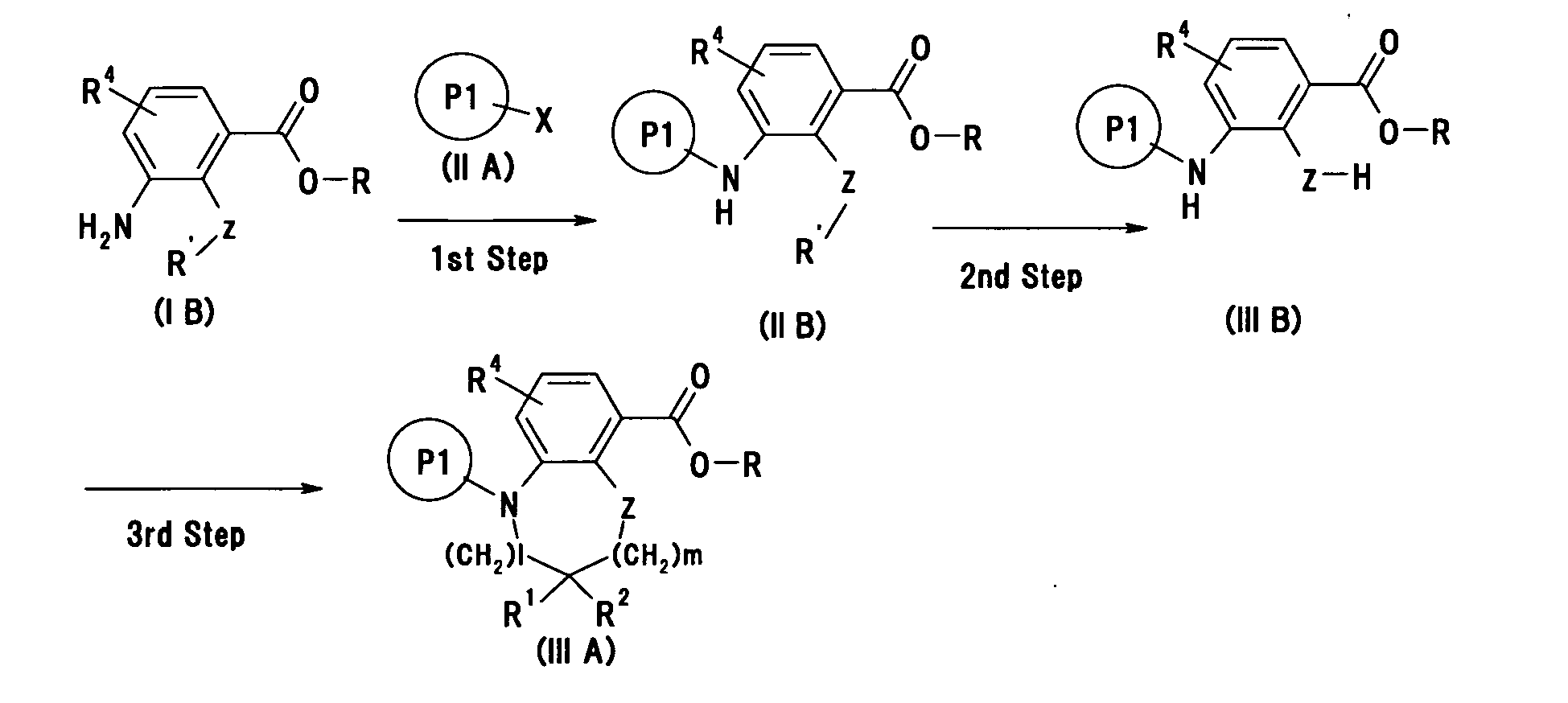
- This is an alternative method of preparing a compound (IIIA) in which Z is an oxygen atom in the Preparation method A.
(wherein, Z is an oxygen atom, R is a C1-6 alkyl group and forms an ester which is easily led to a carboxylic acid by hydrolysis or catalytic hydrogenation reaction. R' represents a protecting group of a phenolic hydroxyl group easily removable by hydrolysis or catalytic hydrogenation reaction. Each other symbol is the same as above.) - This is the reaction for obtaining a compound (IIB) by the palladium catalyzed Buchwald/Hartwig type amination reaction from a compound (IB) and a compound (IIA).
- The compound (IIB) can be obtained by reacting the (IB) with the compound (IIA) in toluene, 1,4-dioxane, tetrahydrofuran or the like or a mixed solvent of these, using a palladium catalyst such as a mixture of palladium acetate and 2,2'-bis(diphenylphosphino)-1,1'-binaphthyl, bis(diphenylphosphino)ferrocene palladium chloride (II) or tris(dibenzylideneacetone)dipalladium together with a base such as sodium carbonate, tripotassium phosphate (K3PO4), potassium carbonate, cesium carbonate, sodium bicarbonate, potassium bicarbonate or potassium tert butoxide, at a temperature of 20?C to reflux temperature, preferably 60?C to reflux temperature for 5 hours to 96 hours preferably for 8 hours to 48 hours.
- When P1 ring is an aromatic hetero ring such as oxazole, thiazole or 1, 3, 4-thiadiazole, the compound (IIA) is not used and the reaction builds up the aromatic hetero ring by a known method and proceeds to the Second Step.
- For example, when the P1 ring is 5-methyloxazole, the compound (IB) is reacted with thiophosgene or 1,1-thiocarbonyldiimidazole etc., in tetrahydrofuran, ethyl acetate', toluene, water or a mixed solvent of these, in the presence or absence of a base such as triethylamine, sodium bicarbonate, potassium carbonate or pyridine to form an isothiocyanate compound which is then allowed to react with 1-azidoacetone and triphenylphosphine in a solvent such as dichloromethane, dichloroethane or chloroform at a temperature of -20?C to reflux temperature, preferably 0?C to 50?C for 0.5 hour to 24 hours, preferably 2 hours to 8 hours to obtain the compound (IIB).
- When the P1 ring is 4-methylthiazole, the compound (IB) is reacted with thiophosgene or 1,1-thiocarbonyldiimidazole etc., in tetrahydrofuran, ethyl acetate, toluene, water or a mixed solvent of these, in the presence or absence of a base such as triethylamine, sodium bicarbonate, potassium carbonate or pyridine to form an isothiocyanate compound which is then allowed to react with ammonia water or the like to obtain a thiourea compound, and this compound is allowed to react with 1-chloroacetone, 1-bromoacetone, etc. in a solvent such as methanol, ethanol, tetrahydrofuran or acetone at a temperature of -20?C to reflux temperature, preferably 0?C to reflux temperature for 0.5 hour to 24 hours, preferably 1 hour to 12 hours to obtain the compound (IIB).
- This is a step to remove R' which is a protecting group of the phenolic hydroxyl group of the compound (IIB).
- For example, when R' is a methoxymethyl group, a tetrahydropyranyl group, etc., the compound (IIIB) can be obtained by reacting the compound (IIB) without solvent or in water, methanol, ethanol, isopropanol, tetrahydrofuran, chloroform or a mixed solvent of these using an acid such as sulfuric acid, hydrochloric acid or trifluoroacetic acid at a temperature of 0?C to reflux temperature, preferably 0?C to 50?C for 0.5 hour to 24 hours, preferably 0.5 hour to 8 hours.
- This is a step to obtain a cyclic compound (IIIA) from the compound (IIIB).
- For example, when 1 is 1, R1 and R2 are hydrogen atoms and m is 0, the compound (IIIB) is reacted with a dihalo reagent such as 1,2-dibromoethane, 1,2-dichloroethane or 1-bromo-2-chloroethane, in chloroform, tetrahydrofuran, N,N-dimethylformamide, dimethylsulfoxide, ethyl acetate, methanol, water or a mixed solvent of these in the presence of a base such as sodium carbonate, potassium carbonate, sodium hydroxide, potassium hydroxide or triethylamine at a temperature of 0?C to reflux temperature, preferably 0?C to 60?C for 0.5 hour to 24 hours to obtain a compound (IIIA). Alternatively, after making it react with a haloacetic acid chloride such as acetyl chloride, and forming a cyclic lactam, the compound (IIIA) can also obtained by performing a reduction reaction in tetrahydrofuran using a borane-tetrahydrofuran complex reagent etc at 0?C to reflux temperature for 0.5 hour to 8 hours.
- For example, when 1 is 1; R1 is a hydroxymethyl group; R2 is a hydrogen atom and m is 0, the similar reaction as a dihalo reagent can be performed using glycidyl chloride, glycidyl tosylate or glycidyl nosylate to obtain a compound (IIIA). In this case, the produced hydroxyl group may be subjected to a step to introduce a widely used protecting group such as an acetyl group, a methoxymethyl group, a tetrahydropyranyl group or a benzyl group, and used in the following steps, and can be suitably deprotected to the compound (1).
- This is an alternative method of preparing a compound (1) in which Z is an oxygen atom in the Preparation method A.

- This is a step to obtain a cyclic compound (IIC) from a compound (IC).
- For example, when 1 is 1, R1 and R2 are hydrogen atoms, and m is 0, the compounds (IC) is reacted with a dihalo reagent such as 1,2-dibromoethane, 1,2-dichloroethane or 1-bromo-2-chloroethane in chloroform, tetrahydrofuran, N,N-dimethylformamide, dimethylsulfoxide, ethyl acetate, methanol, water or a mixed solvent of these in the presence of a base such as sodium carbonate, potassium carbonate, sodium hydroxide, potassium hydroxide or triethylamine at a temperature of 0?C to reflux temperature for 0.5 hour to 8 hours to obtain a compound (IIC).
- For example, when 1 is 1, R1 is a hydroxymethyl group, R2 is a hydrogen atom, and m is 0, the compound (IIC) can be obtained using the compound (IC) along with glycidyl chloride, glycidyl tosylate or glycidyl nosylate in the similar reaction as with a dihalo reagent. In this case, the produced hydroxyl group may be subjected to a step to introduce a widely used protection group such as an acetyl group, a methoxymethyl group, a tetrahydropyranyl group or a benzyl group, and used in the following steps, and can be suitably deprotected to the compound (1).
- This is a step to remove R of the compound (IIC) to obtain a carboxylic acid compound (IIIC).
- For example, when R is a methyl group, ethyl group, propyl group, etc., the compound (IIIC) can be obtained by hydrolyzing the compound (IIC) in water, methanol, ethanol, propanol, tetrahydrofuran, etc. or a mixed solvent of these using a base such as sodium hydroxide, potassium hydroxide, lithium hydroxide, potassium carbonate and sodium carbonate or an aqueous solution of these at a temperature of -20?C to reflux temperature preferably 20?C to reflux temperature for 0.5 hour to 24 hours, preferably for 0.5 hour to 8 hours.
- For example, when R is a tert-butyl group, the compound (IIIC) can be obtained by reacting the compound (IIC) without solvent or in water, methanol, ethanol, propanol, or tetrahydrofuran, etc. or a mixed solvent of these using an acid such as hydrochloric acid or trifluoroacetic acid, at a temperature of 0?C to reflux temperature preferably 0?C to 50?C for 0.5 hour to 24 hours, preferably 0.5 hour to 8 hours.
- When R is a benzyl or paramethoxybenzyl group, etc., the compound (IIIC) can be obtained by reacting in methanol, ethanol, propanol, tetrahydrofuran, etc. or a mixed solvent of these using hydrogen or ammonium formate in the presence of a palladium carbon catalyst, etc. at a temperature of about 0?C to reflux temperature, preferably about 20?C to 50?C for 0.5 hour to 96 hours, preferably 1 hour to 48 hours.
- This is a reaction which obtains a compound (IVC) by the condensation reaction of a compound (IIIC) and a compound (VA). The condensation reaction can be performed either by a method using a condensing agent or by a method via an acid chloride, etc.
- When a direct condensation reaction using a condensing agent is performed, the compound (IVC) can be obtained by reacting the compound (IIIC) with the compound (VA) in N,N-dimethylformamide, methylene chloride, chloroform, etc. or a mixed solvent of these using a condensing agent such as dicyclohexylcarbodiimide or 1-ethyl-3-(3-dimethylaminopropyl)-carbodiimide at a temperature of -20?C to reflux temperature, preferably about 0?C to 50?C for 1 hour to 48 hours, preferably 1 hour to 24 hours. In this case, it is preferable to add additives such as hydroxybenzotriazole and N-hydroxysuccinic acid imide.
- When a reaction via an acid chloride is performed, the compound (IIIC) is reacted with thionyl chloride, oxalyl chloride etc. in chloroform, methylene chloride, tetrahydrofuran, etc. or a mixed solvent of these to obtain an acid chloride of (IIIC), and this compound is reacted with the compound (VA) in toluene, chloroform, or tetrahydrofuran, etc. or a mixed solvent of these in the presence of a base such as triethylamine orpyridine at a temperature of -20?C to reflux temperature, preferably about 0?C to 40?C for 0.5 hour to 24 hours, preferably 0.5 hour to 12 hours and thereby the compound (IVC) can be obtained.
- This is a step to remove the amino protecting group R" of compound (IVC) and obtain a compound (VC).
- For example, when R" is an acetyl group or a formyl group, the compound (VC) can be obtained by reacting the compound (IVC) in tetrahydrofuran, methanol, ethanol, isopropanol, water or a mixed solvent of these in the presence of a base such as sodium hydroxide, potassium hydroxide, lithium hydroxide or sodium methoxide or in the presence of an acid such as sulfuric acid, hydrochloric acid or trifluoroacetic acidatatemperatureof -20?C to reflux temperature, preferably about 0?C to reflux temperature for 0.5 hour to 24 hours, preferably 0.5 hour to 8 hours.
- For example, when R" is a tert-butoxycarbonyl group, the compound (VC) can be obtained by reacting the compound (IVC) without solvent or in tetrahydrofuran, methanol, ethanol, isopropanol, chloroform, water or a mixed solvent of these in the presence of an acid such as hydrochloric acid or trifluoroacetic acid at a temperature of 0?C to reflux temperature, preferably about 0?C to 50?C for 0.5 hour to 24 hours, preferably 0.5 hour to 8 hours.
- When R' is a benzyloxycarbonyl group, a benzyl group, etc., the compound (VC) can be obtained by reacting the compound (IVC) in methanol, ethanol, propanol, tetrahydrofuran, etc. or a mixed solvent of these using hydrogen or ammonium formate in the presence of a palladium carbon catalyst, etc. at a temperature of about 0?C to reflux temperature, preferably about 20?C to 50?C for 0.5 hour to 96 hours, preferably 1 hour to 48 hours.
- This is a reaction for obtaining a compound (1) by the palladium catalyzed Buchwald/Hartwig type amination reaction from a compound (VC) and a compound (IIA).
- The compound (1) can be obtained by reacting the compound (VC) with the compound (IIA) in toluene, 1,4-dioxane, tetrahydrofuran or the like or a mixed solvent of these, using a palladium catalyst such as a mixture of palladium acetate and 2,2'-bis(diphenylphosphino)-1,1'-binaphthyl, bis(diphenylphosphino)ferrocene palladium chloride (II) or tris(dibenzylideneacetone)dipalladium together with a base such as sodium carbonate, tripotassium phosphate (K3PO4), potassium carbonate, cesium carbonate, sodium bicarbonate, potassium bicarbonate, or potassium tert-butoxide, at a temperature of 20?C to reflux temperature, preferably 60?C to reflux temperature for 5 hours to 96 hours preferably for 8 hours to 48 hours.
- When the P1 ring is an aromatic hetero ring such as oxazole, thiazole or 1, 3, 4-thiadiazole, the compound (IIA) is not used and the reaction builds up the aromatic hetero ring by a known method and proceeds to the Second Step.
- When the P1 ring is 5-methyloxazole, the compound (VC) is reacted with thiophosgene or 1,1-thiocarbonyldiimidazole etc., in tetrahydrofuran, ethyl acetate, toluene, water, etc. or a mixed solvent of these in the presence or absence of a base such as triethylamine, sodium bicarbonate, potassium carbonate or pyridine to form an isothiocyanate compound which is then allowed to react with 1-azidoacetone and triphenylphosphine in a solvent such as dichloromethane, dichloroethane or chloroform at a temperature of -20?C to reflux temperature, preferably 0?C to 50?C for 0.5 hour to 24 hours, preferably 2 hours to 8 hours to obtain the compound (1).
- When the P1 ring is 4-methylthiazole, the compound (VC) is reacted with thiophosgene or 1,1-thiocarbonyldiimidazole etc., in tetrahydrofuran, ethyl acetate, toluene, water, etc. or a mixed solvent of these in the presence or absence of a base such as triethylamine, sodium bicarbonate, potassium carbonate or pyridine to form an isothiocyanate compound which is then allowed to react with ammonia water and the like to obtain a thiourea compound, and this compound is allowed to react with 1-chloroacetone, 1-bromoacetone, etc. in a solvent such as methanol, ethanol, tetrahydrofuran or acetone at a temperature of -20?C to reflux temperature, preferably 0?C to reflux temperature for 0.5 hour to 24 hours, preferably 1 hour to 12 hours to obtain the compound (1).
- 3-Nitrosalycylic acid (7.5 g) was dissolved in methanol (75 ml), concentrated sulfuric acid (2 ml) was added, and the mixture was refluxed for 24 hours. Reaction mixture was left cool to and the precipitated pale yellowish solid was collected by filtration, washed with water and dried in vacuo to obtain the title compound (7.19 g).
- 3-Nitrosalicylate (7.19 g) obtained in the First Step was dissolved in tetrahydrofuran (100 ml) and ethyl acetate (50 ml), 5% palladium-carbon (water content 50%) (0.70 g) was added, and the mixture was stirred at room temperature for 2 hours under hydrogen atmosphere. Palladium-carbon was filtered off from the reaction suspension, the filtrate was concentrated, and n-hexane was added. The precipitated white solid was filtered off and dried to obtain the title compound (5.59 g).
- 3-Aminosalicylate (5.59 g) obtained in the Second Step was dissolved in chloroform (100 ml), aqueous saturated sodium hydrogencarbonate (50 ml) was added, further chloroacetyl chloride (3.2 ml) was added with vigorous stirring under ice-cooling, then the mixture was stirred for 1.5 hours under ice-cooling. The reaction mixture was partitioned, and the chloroform layer was dried over anhydrous magnesium sulfate and concentrated to obtain the title compound (white solid 8.07 g).
- Methyl 3-chloroacetylaminosalicylate (8.07 g) obtained in the Third Step was dissolved in N,N-dimethylformamide (80 ml), potassium carbonate (9.15 g) was added, and the mixture was stirred at 80?C for 1 hour. The reaction suspension was concentrated, and white solid precipitate obtained by adding water was filtered, washed with water and dried to obtain the title compound (6.37 g).
- Methyl-3,4-dihydro-2H-benzo[1,4]oxazine-8-carboxylat e (2.07 g) obtained in the Fourth Step was suspended in tetrahydrofuran (20 ml), 1 M solution of borane-tetrahydrofuran complex in tetrahydrofuran (12 ml) was added under ice-cooling with stirring, and the mixture was refluxed for 1 hour in a stream of argon. The reaction mixture was cooled on ice, water (10 ml) and acetone (5 ml) were added in this order to terminate the reaction, further 6 N hydrochloric acid (10 ml) was added, and the mixture was stirred for 1 hour. The reaction mixture was adjusted to pH 8-9 by adding 4 N sodium hydroxide and aqueous saturated sodium hydrogencarbonate, and extracted with ethyl acetate. The ethyl acetate layer was washed with water and saturated sodium chloride solution in this order, dried over anhydrous sodium sulfate and concentrated to obtain the title compound (1.82 g) as colorless oil.
- Methyl 3,4-dihydro-2H-benzo[1,4]oxazine-8-carboxylate (0.58 g) obtained in the Fifth Step was dissolved in toluene (7.5 ml), 2,3-dichloropyridine (0.44 g), tris(dibenzylideneacetone)dipalladium (69 mg), 2,2'-bis(diphenylphosphino)-1,1'-binaphthyl (93 mg) and cesium carbonate (1.47 g) were added in this order, and the mixture was stirred at 80?C for 24 hours. 2,3-Dichloropyridine (0.44 g), tris(dibenzylideneacetone)dipalladium (69 mg) and 2,2'-bis(diphenylphosphino)-1,1'-binaphthyl (93 mg) were added again and stirring was further continued for 15 hours under excessive heating. After cooling, the reaction mixture was partitioned between the ethyl acetate and water. The obtained ethyl acetate layer was washed with saturated sodium chloride solution, dried over anhydrous sodium sulfate and then concentrated. The thus obtained residue was purified by the use of silica gel chromatography (hexane - tetrahydrofuran = 3 : 1) to obtain the orange colored oily compound in the title (0.53 g).
- Methyl 4-(3-chloropyridin-2-yl)-3,4-dihydro-2H-benzo[1,4]oxazine -8-carboxylate (0.53 g) obtained in the Sixth Step was dissolved in methanol (5 ml), 4 M sodium hydroxide solution (1 ml) was added, and the mixture was stirred at 60?C for 1 hour under heating. After cooling, the reaction mixture was neutralized by adding 1 M hydrochloric acid (4 ml), water (20 ml) was added, the precipitated solid was filtered off and dried to obtain the pale orange solid compound in the title (0.43 g) .
- 4-(3-chloropyridin-2-yl)-3,4-dihydro-2H-benzo[1,4]ox azine-8-carboxylic acid (0.43 g) obtained in the Seventh Step was dissolved in N,N-dimethylformamide (5 ml), 4-tert-butylaniline (0.24 g), 1-hydroxybenzotriazole (0.25 g) and 1-ethyl-3-(3-dimethylaminopropyl)-carbodiimide hydrochloride (0.31 g) were added in this order, and the mixture was stirred at room temperature for 1 hour. After adding water and saturated sodium hydrogencarbonate solution, the mixture was extracted with ethyl acetate. The ethyl acetate layer was washed with saturated sodium chloride solution, dried over anhydrous sodium sulfate and then concentrated. The thus obtained residue was purified by the use of silica gel chromatography (hexane - ethyl acetate = 3 : 2) to obtain the white amorphous solid compound in the title (0.42 g).
1H-NMR 400MHz (CDCl3) ?=1.33 (s, 9H) 3.88-3.97 (m, 2H) 4.57-4.65 (m, 2H) 6.66 (dd, J=8.00, 1.28 Hz, 1H) 6.90 (t, J=7.88 Hz, 1H) 7.11 (dd, J=7.88, 4.87 Hz, 1H) 7.38 (d, J=8.58 Hz, II H) 7.60 (d, J=8.58 Hz, 2H) 7.77-7.82 (m, 2H) 8.37 (dd, J=4.75, 1.28 Hz, 1H) 9.57 (s, 1H). - 3-Nitrosalysilic acid (10.0 g) was dissolved in methylene chloride (100 ml), oxalyl chloride (6.2 ml) and N,N-dimethylformamide (0.1 ml) were added, and the mixture was stirred at room temperature for 2 hours. The reaction mixture was concentrated, and the concentrate was added to a solution of 4-tert-butylaniline (5.2 g) and triethylamine (5.1 ml) in acetonitrile (100 ml), then the mixture was stirred at room temperature for 3 hours. After concentrating the reaction mixture, the reaction mixture was partitioned between chloroform and water. The obtained chloroform layer was washed with water, dried over anhydrous sodium sulfate and then concentrated. The thus obtained residue was purified by the use of silica gel chromatography (hexane - ethyl acetate = 1 : 1) to obtain the title compound (3.0 g).
- N-(4-tert-butylphenyl)-3-nitro-2-hydroxybenzamide (3.0 g) obtained in the First Step was dissolved in methanol (100 ml), iron(III) chloride hexahydrate (0.27 g) and active charcoal (0.5 g) were added, and the mixture was stirred at 80?C, and hydrazine hydrate (2.6 ml) was added dropwise. After stirring under heating for 1 hour, the reaction mixture was cooled and insoluble substance was filtered off, then the solvent was evaporated in vacuo. The residue was partitioned between ethyl acetate and water. The obtained ethyl acetate layer was washed with saturated sodium chloride solution, dried over anhydrous magnesium sulfate and then concentrated. The thus obtained residue was dissolved in ethyl acetate, n-hexane was added, the precipitated solid was filtered off and dried to obtain the title compound (1.61 g).
- 3-Amino-N-(4-tert-butylphenyl)-2-hydroxybenzamide (1.6 g) obtained in the Second Step was dissolved in acetone (20 ml), ethyl 2,3-dibromopropionate (2.2 g) and potassium carbonate (2.3 g) were added, and the mixture was stirred at room temperature for 16 hours. The reaction mixture was concentrated, water was added, and the precipitated solid substance was filtered off. The thus obtained solid substance was suspended in and washed with a mixed solvent of ethyl acetate and n-hexane, filtered off and dried to obtain the title compound (1.67 g).
- 8-(4-tert-butylphenyl)carbamoyl-3,4-dihydro-2H-benzo [1,4] oxazine-2-carboxylate (1 .66 g) obtained in the Third Step was dissolved in toluene (10 ml), 2,3-dichloropyridine (0.64 g), tris(dibenzylideneacetone)dipalladium (394 mg), 2,2'-bis(diphenylphosphino)-1,1'-binaphthyl (270 mg) and caesium carbonate (3.5 g) were added in this order, and the mixture was stirred at 80?C for 24 hours. The reaction mixture was diluted with ethyl acetate (10 ml), active charcoal (1 g) was added, and the mixture was stirred and filtered with Celite. The filtrate was concentrated and purified by the use of silica gel chromatography (gradient elution with n-hexane - ethyl acetate) to obtain the pale yellowish solid in the title (1.03 g).
- 8-(4-tert-butylphenyl)carbamoyl-4-(3-chloropyridin-2 -yl)-3,4-dihydro-2H-benzo[1,4]oxazine-2-carboxylate (1.03 g) obtained in the Fourth Step was dissolved in tetrahydrofuran (10 ml) and ethanol (10 ml), 2 M sodium hydroxide (2 ml)was added, and the mixture was stirred at room temperature for 3 hours. The reaction mixture was concentrated, water (20 ml) was added, the mixture was neutralized by adding 1N potassium hydrogen sulfate, and the precipitated solid substance was filtered off. The thus obtained solid substance was suspended and washed with a mixed solvent of ethyl acetate and n-hexane, filtered off and dried to obtain the title compound (0.60 g).
1H-NMR 400 MHz (DMSO-d6) ?=1.29 (m, 9H) 3.62 (m, 1H) 4.18 (m, 1H) 4.70 (m, 1H) 6.47 (dd, J=8.07, 1.47 Hz, 1H) 6.79 (t, J=7.89 Hz, 1H) 7.21-7.35 (m, 4H) 7.84-7.92 (m, 2H) 7.98 (dd, J=7.70, 1.47 Hz, 1H) 8.43 (dd, J=4.99, 1.51 Hz, 1H) 12.34 (s, 1H). - Methyl 3-nitrosalycilate (1.95 g) obtained in the First Step of Example 1-001 was dissolved in N,N-dimethylformamide (20 ml), potassium carbonate (2.73 g) and bromoacetone (1.1 ml) were added, and the mixture was stirred at room temperature overnight. The reaction mixture was partitioned between water and ethyl acetate, and the ethyl acetate layer was washed twice with saturated sodium chloride solution, dried over anhydrous sodium sulfate and concentrated to obtain brownish oily compound in the title (2.46 g).
- Methyl 3-nitro-2-(2-oxopropoxy)benzoate (2.46 g) obtained in the First Step was dissolved in tetrahydrofuran (25 ml), 10% palladium carbon (containing 50% water) (0.25 g) was added, and the mixture was stirred at room temperature for 24 hours under hydrogen atmosphere. The catalyst was filtered off from the reaction mixture and the filtrate was concentrated. The concentrate was purified by the use of silica gel chromatography (n-hexane - ethyl acetate = 1: 1) to obtain pale yellowish oily compound in the title (0.45 g).
- methyl 2-methyl-3,4-dihydro-2H-benzo[1,4]oxazine-8-carboxylate (0.62 g) obtained in the method of Second Step was subjected to the reaction in a similar manner as in the Fourth Step in Example 2, and purified by the use of silica gel chromatography (n-hexane - acetone = 5 : 1) to obtain pale yellowish oily compound in the title (0.10 g).
- Methyl 4-(3-chloropyridin-2-yl)-3-methyl-3,4-dihydro-2H-benzo[1, 4]oxazine-8-carboxylate (0.09 g) obtained in the Third Step was dissolved in tetrahydrofuran (1 ml) and methanol (1 ml), 4 M sodium hydroxide solution (0.5 ml) was added, and the mixture was stirred at 60?C for 1 hour. The reaction mixture was neutralized with 1 M hydrochloric acid and the solvent was evaporated in vacuo. The residue was partitioned between water and ethyl acetate, and the ethyl acetate layer was washed with saturated sodium chloride solution, dried over anhydrous sodium sulfate and concentrated to obtain pale yellowish oily compound in the title (75 mg).
- 4-(3-Chloropyridin-2-yl)-3-methyl-3,4-dihydro-2H-ben zo[1,4]oxazine-8-carboxylic acid (75 mg) obtained in the Fourth Step was subjected to the reaction in a similar manner as in the Eighth Step in Example 1-001, and water and saturated aqueous sodium hydrogencarbonate solution were added in this order. The precipitated pale brownish solid substance was filtered off and dried to obtain the title compound (95 mg) . 1H-NMR 400 MHz (DMSO-d6) ?=1.23 (d, J=6.49 Hz, 3H) 1.28 (s, 9H) 4.07-4.15 (m, 1H) 4.22-4.32 (m, 2H) 6.38 (dd, J=8.12, 1.62 Hz, 1H) 6.80 (t, J=7.88 Hz, 1H) 7.04 (dd, J=7.54, 1.51 Hz, 1H) 7.31-7.39 (m, 3H) 7.64-7.71 (m, 2H) 8.07 (dd, J=7.88, 1.62 Hz, 1H) 8.45 (dd, J=4.64, 1.62 Hz, 1H) 10.10 (s, 1H). Example 1-004
- 2-Chloro-3-nitrobenzoic acid (15.0 g) was subjected to the reaction in a similar manner as in the First Step in Example 1-001 to obtain pale yellowish compound in the title (9.0 g) .
- Methyl 2-chloro-3-nitrobenzoate (2.0 g) obtained in the First Step was dissolved in n-butanol (20 ml), sodium carbonate (2.46 g) and sarcosine ethyl ester hydrochloride (2.14 g) were added, and the mixture was refluxed for 4.5 hours with stirring. The cooled reaction mixture was poured into a mixture of 1 M hydrochloric acid (50 ml)/ethyl acetate (50 ml) under ice-cooling with stirring. The ethyl acetate layer was washed with saturated sodium chloride solution, dried over anhydrous sodium sulfate, and concentrated to obtain red oily substance containing the title compound which was supplied to the subsequent step without purification.
- The oily substance containing methyl 2-[(ethoxycarbonylmethyl)-(N-methyl)amino]-3-nitrobenzoat e obtained in the Second Step was dissolved in methanol (20 ml), 5% palladium carbon (0.2 g) was added, and the mixture was stirred at room temperature for 2 hours under hydrogen atmosphere. The catalyst was filtered off from the reaction suspension. The filtrate was concentrated and then purified by the use of silica gel chromatography (n-hexane - ethyl acetate = 1 : 3), diethyl ether was added, and the precipitated pale brownish solid substance was filtered off and dried to obtain the title compound (0.41 g).
- Methyl 4-methyl-2-oxo-1,2,3,4-tetrahydroquinoxaline-5-carboxylat e (0.41 g) obtained in the Third Step was subjected to the reaction in a similar manner as in the Fifth Step in Example 1 to obtain yellowish oily compound in the title (203 mg).
- Methyl 4-methyl-1,2,3,4-tetrahydroquinoxaline-5-carboxylate (206 mg) obtained in the Fourth Step was subjected to the reaction in a similar manner as in the Fourth Step in Example 1-002 to obtain pale yellowish brown solid compound in the title (179 mg).
- Methyl 1-(3-chloropyridin-2-yl)-4-methyl-1,2,3,4-tetrahydroquinoxaline-5-carboxylate (176 mg) obtained in the Fifth Step was subjected to the reaction in a similar manner as in the Fourth Step in Example 1-003 to obtain pale yellowish brown solid compound in the title (130 mg).
- Methyl 1-(3-chloropyridin-2-yl)-4-methyl-1,2,3,4-tetrahydroquinoxaline-5-carboxylic acid (130 mg) obtained in the Sixth Step was subjected to the reaction in a similar manner as in the Eighth Step in Example 1-001, and the reaction mixture was partitioned between aqueous saturated sodium hydrogencarbonate solution and ethyl acetate. The ethyl acetate layer was washed with saturated sodium chloride solution, washed with saturated sodium chloride solution, dried over anhydrous sodium sulfate and then concentrated. The residue was purified by the use of silica gel chromatography (n-hexane - ethyl acetate = 3 : 2) to obtain pale yellowish amorphous compound in the title (100 mg).
1H-NMR 400 MHz (DMSO-d6) ?=1.28 (s, 9H) 2.83 (s, 3H) 3.34-3.39 (m, 2H) 3.69-3.74 (m, II H) 6.33 (dd, J=8.12, 1.39, 1 Hz, 1H) 6.72 (t, J=7.77 Hz, 1H) 7.03 (dd, J=7.65, 1.39 Hz, 1H) 7.30 (dd, J=7.88, 4.64 HzH) 7.33-7.38 (m, 2H) 7.63-7.68 (m, 2H) 8.02 dd, J=7.88, 1.62 Hz, 1H) 8.44 (dd, J=4.75, 1.74 Hz, 1H) 10.62 (s, 1H). - Methyl 5-chlorosalicylate (5.0 g) was dissolved in concentrated sulfuric acid (15 ml), a mixture of concentrated nitric acid (1.2 ml) and concentrated sulfuric acid (1.2 ml) was added dropwise with stirring under ice-cooling, and further stirred after finishing the dropwise addition. The reaction mixture was poured into ice-water, the precipitated solid substance was filtered off, washed with water, then and dried to obtain the title compound (5.51 g).
- Methyl 5-chloro-3-nitrosalicylate (9.16 g) obtained in the method of First Step was subjected to the reaction in a similar manner as in the Second Step in Example 2, and purified by the use of silica gel chromatography (n-hexane - ethyl acetate = 1: 1) to obtain white solid compound in the title (4.46 g).
- Methyl 3-amino-S-chlorosalicylate (4.46 g) obtained in the Second Step was dissolved in tetrahydrofuran (50 ml), and pyridine (2 ml) and acetyl chloride (1.6 ml) were added with stirring under ice-cooling. After 30 minutes, the reaction mixture was concentrated and partitioned between water and ethyl acetate. The ethyl acetate layer was washed with 1 M hydrochloric acid, saturated sodium chloride solution, saturated aqueous sodium hydrogencarbonate and saturated sodium chloride solution, in this order, dried over anhydrous sodium sulfate and concentrated to obtain the white solid compound in the title (4.86 g).
- Methyl 3-acetamide-5-chlorosalicylate obtained in the Third Step was dissolved in N,N-dimethylformamide (10 ml), potassium carbonate (1.38g) and 1-bromo-3-chloropropane (2.0 ml) were added, and the mixture was stirred at room temperature for 1 hour. Then the temperature to 120?C was increased and the mixture was stirred for 3 hours . After cooling the reaction mixture, water was added, and the mixture was extracted with ethyl acetate. The ethyl acetate layer was washed with water and saturated sodium chloride solution, in this order, dried over anhydrous sodium sulfate and then concentrated. The residue was purified by the use of silica gel chromatography (n-hexane - ethyl acetate = 1: 1) to obtain the white solid compound in the title (630 mg).
- Methyl 9-acetyl-2-chloro-6,7,8,9-tetrahydro-5-oxa-9-aza-benzocyc loheptene-4-carboxylate (1.9 g) obtained by the same method of the Fourth Step was dissolved in tetrahydrofuran (20 ml) and methanol (20 ml), 5% palladium carbon (0.2 g) and triethylamine (1.2 ml) were added, and the mixture was stirred at room temperature for 45 hours under hydrogen atmosphere. The catalyst was filtered off from the reaction suspension, the filtrate was concentrated, and the concentrate was partitioned between water and ethyl acetate. The ethyl acetate layer was washed with water and saturated sodium chloride solution in this order, dried over anhydrous sodium sulfate and concentrated to obtain the colorless oily compound in the title (1.45 g).
- Water (25 ml) and concentrated sulfuric acid (5 ml) were added to methyl 9-acetyl-6,7,8,9-tetrahydro-5-oxa-9-aza-benzocycloheptene -4-carboxylate (1.43 g) obtained in the Fifth Step and the mixture was refluxed with stirring overnight. The reaction mixture was left to cool, neutralized by adding 2 M sodium hydroxide solution to slightly acidic and extracted twice with ethyl acetate. The ethyl acetate layer was washed twice with saturated sodium chloride solution, dried over anhydrous sodium sulfate and concentrated to obtain the title compound (530 mg). The aqueous layer was extracted with tetrahydrofuran, dried over anhydrous sulfate and concentrated to further obtain the compound (320 mg).
- 6,7,8,9-Tetrahydro-5-oxa-9-aza-benzocycloheptene-4-c arboxyl acid (850 mg) was dissolved in ethanol (30 ml), concentrated sulfuric acid (2 ml) was added, and the mixture was refluxed with stirring for 2 hours. The reaction mixture was cooled, neutralized with saturated sodium hydrogencarbonate solution and extracted with ethyl acetate. The ethyl acetate layer was concentrated to obtain the oily compound in the title (721 mg).
- Ethyl 6,7,8,9-tetrahydro-5-oxa-9-aza-benzocycloheptene-4-carbox ylate (720 mg) obtained in the Seventh Step was subjected to the reaction in a similar manner as in the Fourth Step in Example 1-002, and the crude product was purified by the use of silica gel chromatography (n-hexane - ethyl acetate = 3 : 1) to obtain the oily compound in the title (154 mg).
- Ethyl 9-(3-chloropyridin-2-yl)-6,7,8,9-tetrahydro-5-oxa-9-aza-benzocycloheptene-4-carbox ylate (150 mg) was dissolved in tetrahydrofuran (2 ml) and ethanol (2 ml), 2 M sodium hydroxide solution (2 ml) was added, and the mixture was stirred at 60?C for 1.5 hours. The reaction mixture was concentrated, acidified with 1M aqueous potassium hydrogen sulfate and extracted twice with ethyl acetate. The ethyl acetate layer was washed with saturated sodium chloride solution, washed over anhydrous sodium sulfate and concentrated to obtain the oily compound in the title (102 mg).
- 9-(3-Chloropyridin-2-yl)-6,7,8,9-tetrahydro-5-oxa-9-aza-benzocycloheptene-4-carbox ylic acid (100 mg) obtained in the Ninth Step was subjected to the reaction in a similar manner as in the Eighth Step in Example 1-001, and the crude product was purified by the use of silica gel chromatography (n-hexane - ethyl acetate = 2 : 1), n-hexane was added, precipitated white solid substance was filtered off and dried to obtain the title compound (35 mg).
1H-NMR 400 MHz (DMSO-d6) ?=1.25 (s, 9H) 1.95 (m, 2H) 3.97 (m, 2H) 4.27 (m, 2H) 6.61 (dd, J=8.00, 1.51 Hz, 1H) 6.93 (t, J=7.77 Hz, 1H) 7.06 (dd, J=7.77, 4.75 Hz, 1H) 7.26 (dd, J=7.54, 1.51 Hz, 1H) 7.30-7.38 (m, 2H) 7.63 (ddd, J=9.04, 2.55, 2.32 Hz, 2H) 7.76 (dd, J=7.65, 1.62 Hz, 1H) 8.31 (dd, J=4.64, 1.62 Hz, 1H) 10.15 (s, 1H) . - In the method similar to Example 1-001, corresponding carboxylic acid and amine were used to obtain the compound of Example 1-006 shown in the following table.
- In the method similar to Example 1-001, corresponding carboxylic acid and amine were used to obtain the compound of Example 1-007 shown in the following table.
- In the method similar to Example 1-001, corresponding carboxylic acid and amine were used to obtain the compound of Example 1-008 shown in the following table.
- In the method similar to Example 1-001, corresponding carboxylic acid and amine were used to obtain the compound of Example 1-009 shown in the following table.
- In the method similar to Example 1-001, corresponding carboxylic acid and amine were used to obtain the compound of Example 1-010 shown in the following table.
- In the method similar to Example 1-001, corresponding carboxylic acid and amine were used to obtain the compound of Example 1-011 shown in the following table.
- In the method similar to Example 1-001, corresponding carboxylic acid and amine were used to obtain the compound of Example 1-012 shown in the following table.
- In the method similar to Example 1-001, corresponding carboxylic acid and amine were used to obtain the compound of Example 1-013 shown in the following table.
- In the method similar to Example 1-001, corresponding carboxylic acid and amine were used to obtain the compound of Example 1-014 shown in the following table.
- In the method similar to Example 1-001, corresponding carboxylic acid and amine were used to obtain the compound of Example 1-015 shown in the following table.
- In the Sixth Step in Example 1-001, 2-bromopyridine was used in the place of 2,3-dichloropyridine, and others were treated by the same manner as in the example to obtain the compound of Example 1-016 shown in the following table.
- In the Sixth Step in Example 1-001, 2-chloro-3-trifluoromethylpyridine was used in the place of 2,3-dichloropyridine, and others were treated by the same manner as in the example to obtain the compound of Example 1-017 shown in the following table.
- In the Third Step in Example 1-001, 2-bromoisobutyl bromide was used in the place chloroacetyl chloride, and others were treated by the same manner as in the example to obtain the compound of Example 1-018 shown in the following table.
- In the Third Step in Example 1-001, 2-chloropropionyl chloride was used in the place chloroacetyl chloride, and others were treated by the same manner as in the example to obtain the compound of Example 1-019 shown in the following table.
- 3-amino-5-chlorosalicylic acid produced by the method of the Second Step in Example 1-005 was used in the method subsequent to the Third Step in Example 1-001 to obtain the compound of Example 1-020 shown in the following table.
- 4-(3-chloropyridin-2-yl)-3,4-dihydro-2H-benzo[1,4]ox azine-8-carboxylic acid (100 mg) obtained in the Seventh Step in Example 1-001 was dissolved in tetrahydrofuran (1 ml), oxalyl chloride (0.05 ml) andN,N-dimethylformamide (0.01 ml) were added, the mixture was stirred at room temperature for 30 minutes, and the reaction mixture was concentrated to obtain acid chloride as yellowish solid. Tetrahydrofuran (1 ml) and 1 M sodium hydroxide solution (1 ml) were added to 4-trifluoroaniline (48 mg), and a solution of the acid chloride in tetrahydrofuran (1 ml) was added with stirring under ice-cooling, and the reaction mixture was stirred at room temperature for 30 minutes. The reaction mixture was concentrated, partitioned between ethyl acetate and water, and the ethyl acetate layer was washed with 1 M sodium hydroxide and saturated sodium chloride solution in this order, dried over anhydrous magnesium sulfate and then concentrated. The residue was suspended in n-hexane, filtered off and dried to obtain the title compound (72 mg).
- In the method similar to Example 1-021, corresponding carboxylic acid and amine were used to obtain the compound of Example 1-022 shown in the following table.
- In the method similar to Example 1-021, corresponding carboxylic acid and amine were used to obtain the compound of Example 1-023 shown in the following table.
- In the method similar to Example 1-021, corresponding carboxylic acid and amine were used to obtain the compound of Example 1-024 shown in the following table.
- In the method similar to Example 1-021, corresponding carboxylic acid and amine were used to obtain the compound of Example 1-025 shown in the following table.
- In the method similar to Example 1-021, corresponding carboxylic acid and amine were used to obtain the compound of Example 1-026 shown in the following table.
- In the method similar to Example 1-021, corresponding carboxylic acid and amine were used to obtain the compound of Example 1-027 shown in the following table.
- In the method similar to Example 1-021, corresponding carboxylic acid and amine were used to obtain the compound of Example 1-028 shown in the following table.
- In the method similar to Example 1-021, corresponding carboxylic acid and amine were used to obtain the compound of Example 1-029 shown in the following table.
- In the method similar to Example 1-021, corresponding carboxylic acid and amine were used to obtain the compound of Example 1-030 shown in the following table.
- In the method similar to Example 1-021, corresponding carboxylic acid and amine were used to obtain the compound of Example 1-031 shown in the following table.
- In the method similar to Example 1-021, corresponding carboxylic acid and amine were used to obtain the compound of Example 1-032 shown in the following table.
- In the method similar to Example 1-021, corresponding carboxylic acid and amine were used to obtain the compound of Example 1-033 shown in the following table.
- Methyl 4-aminobenzoate (260 mg) was used in the method similar to Example 1-021 to obtain the title compound (515 mg).
- 4-(3-Chloropyridin-2-yl)-N-(methoxycarbonylphenyl)-3 ,4-dihydro-2H-benzo[1,4]oxazine-8-carboxamide (500 mg) produced in Example 1-034 was dissolved in tetrahydrofuran (5 ml) and methanol (5 ml), 4 M sodium hydroxide solution (1 ml) was added, and the mixture was stirred at 60?C for 5 hours. The reaction mixture was neutralized by adding 1 M hydrochloric acid and then concentrated. The concentrate was diluted with water and stirred, and white solid substance was collected by filtration and dried to obtain the title compound (433 mg). Example 1-036
- N-(4-carboxyphenyl)-4-(3-chloropyridin-2-yl)-3,4-dih ydro-2H-benzo [1,4] oxazine-8-carboxamide (100 mg) obtained in Example 1-035 was dissolved in N,N-dimethylformamide (2 ml), ammonium chloride (65 mg), 1-hydroxybenzotriazole (56 mg), 1-ethyl-3-(3-dimethylaminopropyl)-carbodiimide hydrochloride (70 mg) and triethylamine (0.20 ml) were added in this order, and the mixture was stirred at room temperature for 10 hours. After adding water and saturated sodium hydrogencarbonate solution to the reaction mixture, the mixture was partitioned by adding ethyl acetate. After ethyl acetate layer was washed with water, concentrated and dried, the concentrate was suspended in and washed with water, the white solid substance was collected by filtration and dried to obtain the title compound (80 mg).
- In the method similar to Example 1-036, corresponding carboxylic acid and amine were used to obtain the compound of Example 1-037 shown in the following table.
- In the method similar to Example 1-036, corresponding carboxylic acid and amine were used to obtain the compound of Example 1-038 shown in the following table.
- 4'-aminoacetophenone (279 mg) was used in the similar method of Example 1-021 to obtain the title compound (673 mg). Example 1-040
- N-(4-acetylphenyl)-4-(3-chloropyridin-2-yl)-3,4-dihy dro-2H-benzo[1,4]oxazine-8-carboxamide (150mg) obtained in Example 1-039 was dissolved in tetrahydrofuran (15 ml), 1 M methyl magnesium bromide - tetrahydrofuran solution (1.1 ml) was added under ice-cooling, and then the mixture was stirred at room temperature for 30 minutes . Then, 1 M methyl magnesium bromide - tetrahydrofuran solution (0.37 ml) was further added and stirred and the mixture was at room temperature for 30 minutes. The reaction mixture was cooled on ice, the reaction was terminated by adding saturated aqueous ammonium chloride, and the mixture was extracted with ethyl acetate. The ethyl acetate layer was washed with saturated sodium chloride solution, dried over anhydrous sodium sulfate and then concentrated. The residue was purified by the use of silica gel chromatography (n-hexane - ethyl acetate = 1 : 4) to obtain the white amorphous compound in the title (79 mg).
- In the reaction similar to Example 1-040, 2 M ethyl magnesium bromide was used to obtain the white amorphous compound in the title (100 mg) from N-(4-acetylphenyl)-4-(3-chloropyridin-2-yl)-3,4-dihydro-2 H-benzo[1,4]oxazine-8-carboxamide (150 mg).
- In the method similar to Example 1-001, corresponding carboxylic acid and amine were used to obtain the compound of Example 1-042 shown in the following table.
- In the method similar to Example 1-001, corresponding carboxylic acid and amine were used to obtain the compound of Example 1-043 shown in the following table.
- In the method similar to Example 1-001, corresponding carboxylic acid and amine were used to obtain the compound of Example 1-044 shown in the following table.
- In the method similar to Example 1-001, corresponding carboxylic acid and amine were used to obtain the compound of Example 1-045 shown in the following table.
- In the Sixth Step in Example 1-001, 4-bromopyridine was used in the place of 2,3-dichloropyridine and others were treated by the same manner as in the example to obtain the compound of Example 1-046 shown in the following table.
- In the Sixth Step in Example 1-001, 2-bromo-3-picoline was used in the place of 2, 3-dichloropyridine and others were treated by the same manner as in the example to obtain the compound of Example 1-047 shown in the following table.
- In the method similar to Example 1-021, corresponding carboxylic acid and amine were used to obtain the compound of Example 1-048 shown in the following table.
- In the method similar to Example 1-021, corresponding carboxylic acid and amine were used to obtain the compound of Example 1-049 shown in the following table.
- In the method similar to Example 21, corresponding carboxylic acid and amine were used to obtain the compound of Example 1-050 shown in the following table.
- In the method similar to Example 1-021, corresponding carboxylic acid and amine were used to obtain the compound of Example 1-051 shown in the following table.
- In the method similar to Example 1-021, corresponding carboxylic acid and amine were used to obtain the compound of Example 1-052 shown in the following table.
- In the method similar to Example 1-021, corresponding carboxylic acid and amine were used to obtain the compound of Example 1-053 shown in the following table.
- In the method similar to Example 1-021, corresponding carboxylic acid and amine were used to obtain the compound of Example 1-054 shown in the following table.
- In the method similar to Example 1-021, corresponding carboxylic acid and amine were used to obtain the compound of Example 1-055 shown in the following table.
- In the method similar to Example 1-021, corresponding carboxylic acid and amine were used to obtain the compound of Example 1-056 shown in the following table.
- In the method similar to Example 1-021, corresponding carboxylic acid and amine were used to obtain the compound of Example 1-057 shown in the following table.
- In the Sixth Step in Example 1-001, 2-chloro-4-picoline (890 mg) was used in the place of 2,3-dichloropyridine and others were treated by the same manner as in the Seventh Step of Example 1-001 to obtain the title compound (690 mg).
- N-(4-tert-butylphenyl)-4-(4-methylpyridin-2-yl)-3,4-dihydro-2H-benzo[1,4]oxazine-8-carboamide (150mg) obtained in the process 1-001 was used in the similar method in Example 21 to obtain the title compound (130 mg).
- Example 1-059 compound shown in the following table was obtained from the corresponding bromopicoline by applying the similar method as of Example 21.
- Example 1-060 compound shown in the following table was obtained from the corresponding bromopicoline by applying the similar method as of Example 1-021.
- A compound of Examples 1-061 to 1-236 hereinbelow were obtained by similarly performing any methods described in the general processes A to C for producing the compound and/or a method described in Examples 1-001 to 1-060 hereinbefore.
- 3,4-Dihydro-2H-benzo[1,4]oxazine-8-carboxylate (2.0 g) obtained by the method of Fifth Step in Example 1-001 was dissolved in toluene (30 ml), 2,3-dichloro-5-(tetrahydropyran-2-yl)oxymethylpyridine (2.76 g), palladium acetate (0.25 g), 2,2'-bis(diphenylphosphino)-1,1'-binaphthyl (0.7 g) and caesium carbonate (7.4 g) were added, and the mixture was stirred at 90?C overnight. The reaction mixture was filtered and concentrated, and the thus obtained residue was purified by the use of silica gel column chromatography (hexane - tetrahydrofuran = 2 : 1) to obtain oily compound in the title (2.48 g).
- Methyl 4-{3-chloro-5-(tetrahydropyran-2-yl)oxymethylpyridin-2-yl }-3,4-dihydro-2H-benzo[1,4]oxazine-8-carboxylate (2.48 g) obtained in the First Step was subjected to the reaction similar to that of the Fourth Step in Example 1-003 to obtain the title compound (1.33 g).
- 4-{3-chloro-5-(tetrahydropyran-2-yl)oxymethylpyridin -2-yl}-3,4-dihydro-2H-benzo[1,4]oxazine-8-carboxylic acid (0.20 g) obtained in the Second Step and 5-amino-benzo[1,3]dioxolane (0.10 g) were subjected to the reaction similar to that of the Eighth Step in Example 1-001 to obtain the title compound (0.21 g).
- N-(benzo[1,3]dioxol-5-yl)-4-{3-chloro-5-(tetrahydrop yran-2-yl)oxymethylpyridin-2-yl}-3,4-dihydro-2H-benzo[1,4 ]oxazine-8-carboxamide (0.21 g) obtained in the Third Step was dissolved in tetrahydrofuran (3 ml), 6 M hydrochloric acid (3 ml) was added, and the mixture was stirred at room temperature overnight. The reaction mixture was concentrated, and the residue was purified by the use of silica gel column chromatography to obtain the title compound (0.12 g).
- In the Third Step of Example 2-01, 6-amino-2,3-dihydrobenzo [1,4] dioxin (111 mg) was used in the place of 5-amino-benzo[1,3] dioxolane, and others were treated by the same manner as in the process to obtain the title compound (109 mg) .
- In the Third Step of Example 2-01, 4-trifluoromethoxyaniline (87 mg) was used in the place of 5-amino-benzo [1, 3] dioxolane, and others were treated by the same manner as in the process to obtain the title compound (101 mg).
- In the Third Step of Example 2-01, 3-chloro-4-trifluoromethoxyaniline (87 mg) was used in the place of 5-amino-benzo [1, 3] dioxolane, and others were treated by the same manner as in the process to obtain the title compound (58 mg).
- 4-{3-Chloro-5-(tetrahydropyran-2-yl)oxymethylpyridin -2-yl}-3,4-dihydro-2H-benzo[1,4]oxazine-8-carboxylic acid (300 mg) obtained in the Second Step of Example 2-01 was dissolved in pyridine (5 ml), thionyl chloride (88 mg) was added, and the mixture was stirred at 80?C for 1 hour. The reaction mixture was cooled to room temperature, 4-trifluoromethylaniline (80 mg) was added, and the mixture was stirred for 1 hour. The reaction mixture was partitioned between water and ethyl acetate, and the ethyl acetate layer was washed with water, diluted aqueous potassium hydrogen sulfate, diluted aqueous sodium hydroxide and saturated sodium chloride solution, dried over magnesium sulfate and then concentrated to obtain residue containing the title compound, which was supplied to the subsequent process without purification.
- The concentrated residue obtained in the First Step was dissolved in tetrahydrofuran (3 ml), 6 M hydrochloric acid (3 ml) was added, and the mixture was stirred at room temperature for 1 hour. The reaction mixture was partitioned between water and ethyl acetate, and the ethyl acetate layer was washed with water and saturated sodium chloride solution in this order, dried over anhydrous magnesium sulfate and then concentrated. The thus obtained concentrated residue was purified by the use of silica gel chromatography to obtain the title compound (71 mg).
- In the First Step of Example 2-05, 3-fluoro-4-trifluoromethylaniline (110 mg) was used in the place of 4-trifluoromethylaniline, and others were treated by the same manner as in the process to obtain the title compound (50 mg).
- Methyl 4-{5-(tetrahydropyran-2-yl)oxymethylpyridin-2-yl}-3,4-dih ydro-2H-benzo[1,4]oxazine-8-carboxylate (560 mg), which was obtained by using 2-chloro-5-(tetrahydropyran-2-yl)oxymethylpyridine in the place of 2,3-dichloro-5-(tetrahydropyran-2-yl)oxymethylpyridine in the First Step of Example 2-01, was dissolved in methanol (8 ml), 4 M sodium hydroxide solution (1.1 ml) was added, and the mixture was stirred at 60?C for 2 hours. The reaction mixture was concentrated, and the concentrate was partitioned by adding water and ethyl acetate. The aqueous layer was adjusted to pH 4 by adding hydrochloric acid and was extracted with ethyl acetate. The ethyl acetate layer was dried over anhydrous sodium sulfate and then concentrated. Precipitated solid obtained by adding diisopropyl ether was collected by filtration and dried to obtain the title compound (420 mg).
- A reaction similar to that of the First Step of Example 2-05 was performed by using 4-{5-(tetrahydropyran-2-yl)oxymethylpyridin-2-yl}-3,4-dih ydro-2H-benzo[1,4]oxazine-8-carboxylicacid(200g) obtained in the First Step of Example 2-05 to obtain a concentrated residue containing the title compound.
- The concentrated residue containing N-(4-trifluoromethylphenyl)-4-{5-(tetrahydropyran-2-yl)ox ymethylpyridin-2-yl}-3,4-dihydro-2H-benzo[1,4]oxazine-B-c arboxamide was dissolved inmethanol (2 ml) and tetrahydrofuran (2 ml), 6 M hydrochloric acid (1 ml) was added, and the mixture was stirred at room temperature for 1 hour. The reaction mixture was concentrated, water and diethyl ether were added, then precipitated yellow solid substance was collected by filtration and dried to obtain the title compound (170 mg)
- 4-{5-(tetrahydropyran-2-yl)oxymethylpyridin-2-yl}-3, 4-dihydro-2H-benzo[1,4]oxazine-8-carboxylic acid (200 mg) obtained in the First Step of Example 2-07 and 4-isobutyloxyaniline (110 mg) were used and the others were subjected to the reaction similar to Example 2-05 to obtain the title compound (140 mg).
- Methyl 4-{3-chloro-5-(tetrahydropyran-2-yl)oxymethylpyridin-2-yl }-3,4-dihydro-2H-benzo[1,4]oxazine-8-carboxylate (1.3 g) obtained in the First Step of Example 2-01 was dissolved in tetrahydrofuran (5 ml), 6 M hydrochloric acid was (5 ml) added, and the mixture was stirred at room temperature for 2 hours. The reaction mixture was neutralized and extracted with ethyl acetate. The extract was concentrated to obtain a concentrated residue containing the title compound.
- The concentrated residue obtained in the First Step was dissolved in N,N-dimethylformamide (5 ml), sodium hydride (50%) (0.32 g) was added, and the mixture was stirred at room temperature until foaming was terminated. Subsequently, sodium iodide (1 ml) was added and the mixture was further stirred for 1 hour. The reaction mixture was partitioned between water and ethyl acetate, and the ethyl acetate layer was washed with water, dried over anhydrous sodium sulfate and then concentrated. The concentrate was purified by the use of silica gel chromatography to obtain the oily compound in the title (1.20 g).
- Methyl 4-(3-chloro-5-methoxymethylpyridin-2-yl)-3,4-dihydro-2H-b enzo[1,4]oxazine-8-carboxylate (1.20 g) obtained in the Second Step was dissolved in tetrahydrofuran (10 ml) and methanol (10 ml), 2 M sodium hydroxide (5 ml) was added, and the mixture was stirred at 60?C for 1 hour. The reaction mixture was concentrated and neutralized to obtain black colored solid substance by filtration and dried to obtain the title compound (915 mg).
- 4-(3-chloro-5-methoxymethylpyridin-2-yl)-3,4-dihydro -2H-benzo[1,4]oxazine-8-carboxylic acid (200 mg) obtained in the Third Step was dissolved in chloroform (2 ml), oxalyl chloride (60 ?1) and N,N-dimethylformamide (one drop) were added, and the mixture was stirred at room temperature for 1 hour. The reaction mixture was concentrated, pyridine (2 ml) and 4-trifluoromethylaniline (75 ?1) were added, and the mixture was stirred at room temperature for 1 hour. The reaction mixture was partitioned between water and ethyl acetate, and the ethyl acetate layer was washed with water, dried over anhydrous magnesium sulfate and then concentrated. Precipitated solid obtained by adding n-hexane and diethyl ether to the concentrate was collected by filtration and dried to obtain the title compound (64 mg).
- Methyl 4-{4-(tetrahydropyran-2-yl)oxymethylpyridin-2-yl}-3,4-dih ydro-2H-benzo[1,4]oxazine-8-carboxylate, which was obtained by the process, in which, in the First Step of Example 2-01, the reaction was performed by the similar manner using 2-chloro-4-(tetrahydropyran-2-yl)oxymethylpyridine (1.52 g) in the place of 2,3-dichloro-5-(tetrahydropyran-2-yl)oxymethylpyridine, and the reaction mixture was filtered, concentrated and purified by the use of silica gel column chromatography, was dissolved in methanol (10 ml) and tetrahydrofuran (10 ml), 4 M sodium hydroxide solution (5 ml) was added, and the mixture was stirred at 60?C for 1.5 hour. The reaction mixture was neutralized and then concentrated. The concentrate was partitioned by adding water and ethyl acetate. The ethyl acetate layer was washed with water and saturated sodium chloride solution in this order, dried over anhydrous magnesium sulfate and concentrated to obtain the title compound (913 mg).
- 4-{4-(tetrahydropyran-2-yl)oxymethylpyridin-2-yl}-3, 4-dihydro-2H-benzo[1,4]oxazine-8-carboxylic acid (300 mg) obtained in the First Step was dissolved in pyridine (5 ml), thionyl chloride (89 ?1) was added, and the mixture was stirred at room temperature for 2 hours. Subsequently, 4-trifluoromethylaniline (102 ?1) was added and stirred at the same temperature overnight. The reaction mixture was partitioned between water and ethyl acetate. The ethyl acetate layer was washed with water and saturated sodium chloride in this order, dried over anhydrous magnesium sulfate and then concentrated. The concentrate was purified by the use of silica gel chromatography. To the purified concentrated substance was added tetrahydrofuran (5 ml) and 6 M hydrochloric acid (2 ml) and stirred at room temperature for 2 hours. The reaction mixture was partitioned between water and ethyl acetate. The ethyl acetate layer was washed with water and saturated sodium chloride solution in this order, dried over anhydrous magnesium sulfate and then concentrated. The concentrate was purified by the use of silica gel chromatography to obtain the title compound (12 mg).
- In the First Step of Example 2-01, the similar reaction was performed by using 2-chloro-3-(tetrahydropyran-2-yl)oxymethylpyridine (712 mg) in the place of 2,3-dichloro-5-(t.etrahydropyran-2-yl)oxymethylpyridine to obtain the title compound (536 mg).
- Methyl 4-{3-(tetrahydropyran-2-yl)oxymethylpyridin-2-yl}-3,4-dih ydro-2H-benzo[1,4]oxazine-8-carboxylate (536mg) obtained in the First Step was dissolved in ethanol (10 ml), 2 M sodium hydroxide solution (2 ml) was added, and the mixture was stirred at 60?C for 1 hour. The reaction mixture was neutralized by adding hydrochloric acid and concentrated, partitioned between water and ethyl acetate. The thus obtained ethyl acetate layer was dried over anhydrous sodium sulfate and concentrated to obtain the title compound (493 mg).
- 4-{3-(Tetrahydropyran-2-yl)oxymethylpyridin-2-yl}-3, 4-dihydro-2H-benzo[1,4]oxazine-8-carboxylic acid (266 mg) obtained in the Second Step and 4-trifluoromethoxyaniline (97 ?1) was subjected to the reaction similar to that of the Eighth Step of Example 1-001 to obtain the title compound (222 mg) .
- N-(4-trifluoromethoxyphenyl)-4-{3-(tetrahydropyran-2 -yl)oxymethylpyridin-2-yl}-3,4-dihydro-2H-benzo[1,4]oxazi ne-8-carboxamide (217 mg) obtained in the Third Step was dissolved in methanol (5 ml), 6 M hydrochloric acid (0.3 ml) added, and the mixture was stirred at room temperature for 1 hour. The reaction mixture was diluted with water, neutralized by adding sodium hydroxide solution and extracted with ethyl acetate. The ethyl acetate layer was dried over anhydrous sodium sulfate, concentrated and purified by the use of silica gel chromatography to obtain the title compound (164 mg).
- Methyl 3-aminosalicylate (10 g) obtained in the Second Step of Example 1-001 was dissolved in ethyl acetate (30 ml), water (30 ml) and sodium hydrogencarbonate (5. 54 g) were added, and acetyl chloride (5 ml) was added with stirring under ice-cooling. After stirring at room temperature for 30 minutes, the ethyl acetate layer was dried over anhydrous sodium sulfate and concentrated to obtain the title compound (11.47 g).
- Methyl 3-acetamide-2-hydroxybenzoate obtained in the First Step was dissolved in N,N-dimethylformamide (42 ml), potassium carbonate (9.67g) and 1-bromo-2-chloroethane (4 .99 ml) were added, and the mixture was stirred at 50?C overnight. The reaction mixture was partitioned between ethyl acetate and water, and ethyl acetate layer was washed with water, dried over anhydrous sodium sulfate and concentrated to obtain the title compound (4.32 g).
- To methyl 4-acetyl-3,4-dihydro-2H-benzo[1,4]oxazine-8-carboxylate (4.32 g) obtained in the Second Step, 2 M sodium hydroxide solution, was added and the mixture was refluxed with stirring for 1.5 hour. The reaction mixture was cooled on ice, and tetrahydrofuran (10 ml) solution containing acetyl chloride (2.62 ml) was added dropwise. 2 M sodium hydroxide and acetyl chloride were further added until the reaction finished. The thus obtained reaction mixture was acidified with aqueous citric acid solution and extracted with ethyl acetate. The ethyl acetate layer was washed with saturated sodium chloride, dried over anhydrous sodium sulfate and then concentrated. Isopropanol was added to the concentrate, and the precipitated solid substance was collected by filtration and dried to obtain the title compound (2.25 g).
- 4-Acetyl-3,4-dihydro-2H-benzo[1,4]oxazine-8-carboxyl ic acid (2.75 g) obtained by the similar method of the Third Step was dissolved in tetrahydrofuran (30 ml), oxalyl chloride (1.3 ml) and N,N-dimethylformamide (one drop) were added, and the mixture was stirred at room temperature for 1 hour. To the reaction mixture was pyridine (30 ml) and 4-trifluoromethylaniline (1.9 ml) were added, and stirred at room temperature for 1 hour. The reaction mixture was partitioned between water and ethyl acetate, and the ethyl acetate layer was washed with water, dried over anhydrous sodium sulfate and then concentrated. Precipitated solid obtained by adding n-hexane and diethyl ether to the concentrate was collected by filtration and dried to obtain the title compound (2.70 g).
- Tetrahydrofuran (15 ml) was added to 4-acetyl-N-(4-trifluoromethylphenyl)-3,4-dihydro-2H-benzo [1,4]oxazine-8-carboxamide (2.70 g) obtained in the Fourth Step, water (15 ml) and concentrated sulfuric acid (5 ml) were added, and the mixture was refluxed for 4 hours with stirring. The reaction mixture was cooled, neutralized with sodium hydroxide solution and extracted with ethyl acetate. The ethyl acetate layer was concentrated and purified by the use of silica gel column chromatography to obtain the title compound (1.94 g).
- 2,3-dichloro-5--(1-hydroxy)ethylpyridine (7.58 g) was dissolved in tetrahydrofuran (65 ml), (R)-2-phenylpropion acid (5.5 ml), diisopropyl azodicarboxylate (9.5 ml) and triphenylphosphine (12.54 g) were added, and the mixture was stirred for 1 hour under ice-cooling. A mixed solution of hexane - ethyl acetate (9 : 1) was added to the reaction mixture, the precipitated solid was filtered off, the filtrate was concentrated and purified by the use of silica gel chromatography to obtain more polar isomer (4.54 g) and less polar isomer (5.38 g) of the title compound.
- The more polar isomer of (2R)-2-phenylpropionate 1-(5,6-dichloropyridine-3-yl)ethyl ester (324 mg) obtained in the Sixth Step and N-(4-trifluoromethylphenyl)-3,4-dihydro-2H-benzo[1,4]oxaz ine-8-carboxamide (322 mg) were subjected to the reaction similar to that of the First Step of Example 2-01 to obtain the title compound (80 mg).
- 4-{3-chloro-5-[1-((2R)-2-phenylpropionyl]oxyethyl}py ridin-2-yl}-N-(4-trifluoromethylphenyl)-3,4-dihydro-2H-be nzo[1,4] oxazine-8-carboxamide (80 mg) obtained in the Seventh Step was dissolved in methanol (0.3 ml) and tetrahydrofuran (0.3 ml), 4 M sodium hydroxide (0.3 ml) was added, and the mixture was stirred at 60?C for 1 hour. The reaction mixture was concentrated, and the precipitated solid obtained by adding water was collected by filtration and dried to obtain the dextro-compound in the title (32 mg).
- Low polar isomer of (2R)-2-phenylpronionate 1-(5,6-dichloropyridine-3-yl)ethyl ester (324 mg) obtained in the Sixth Step of Example 2-12 was used, and the similar process subsequent to the Seventh Step of Example 2-12 was performed to obtain the levo-compound in the title (115 mg).
- In the Fourth Step of Example 2-12, 4-trifluoromethoxyaniline (2.25 g) was used in the place of 4-trifluoromethylaniline, and the reaction similar to that of the processes 4 and 5 of Example 2 - 12 was performed to obtain the title compound (1.77 g).
- N-(4-trifluoromethoxyphenyl)-3,4-dihydro-2H-benzo[1, 4]oxazine-8-carboxamide (334 mg) obtained in the First Step and a more polar isomer of (2R)-2-phenylpropionate 1-(5,6-dichloropyridine-3-yl)ethyl ester (320 mg) obtained in the Sixth Step of Example 2-12 were used, and the reaction subsequent to the Seventh Step of Example 2-12 was performed to obtain dextro-compound in the title (197 mg).
- In the Second Step of Example 2-14, the more polar isomer of (2R)-2-phenylpropionate 1-(5,6-dichloropyridine-3-yl)ethylesterwasreplacedby the low polar isomer (320 mg), and others were performed similarly to obtain levo-compound in the title (180 mg).
- Compounds of Examples 2-16 to 2-48 shown in the following tables were obtained by similarly performing any methods described in the general processes A to C for producing the compound and/or the methods described in Examples 2-01 to 2-15 hereinbefore.
- Methyl 3-nitrosalicylate (5.91 g) obtained in the First Step of Example 1-001 was dissolved in N,N-dimethylformamide (60 ml), potassium carbonate (8.29g) was added, methoxymethyl chloride (2.73 ml) was added with stirring under ice-cooling, and the mixture was stirred for 4.5 hours. The reaction mixture was concentrated and was partitioned between ethyl acetate and water. The ethyl acetate layer was washed with water, dried over anhydrous sodium sulfate and concentrated to obtain the title compound (6.98 g).
- Methyl 2-methoxymethyloxy-3-nitrobenzoate (6.98 g) obtained in the First Step was subjected to hydrogenation similar to the Second Step of Example 1-001 to obtain the title compound (6.11 g).
- Methyl 3-amino-2-methoxymethyloxybenzoate (6.11 g) obtained in the Second Step and 2,3-dichloropyridine (4.29 g) were subjected to the reaction similar to that of the First Step of Example 2-01 to obtain the title compound (7.46 g).
- Methyl 3-(3-chloropyridin-2-yl)amino-2-methoxymethyloxybenzoate (7.46 g) obtained in the Third Step was dissolved in methanol (50 ml), 6 M hydrochloric acid was added, and the mixture was stirred at 40?C for 1 hour. The reaction mixture was concentrated. The solid substance precipitated by adding water was collected by filtration and dried to obtain the title compound (5.64 g).
- Methyl 3-(3-chloropyridin-2-ylamino)salicylate (3.08 g) obtained in the Fourth Step was dissolved in methanol (20 ml), 4 M sodium hydroxide (8.3 ml) was added, and the mixture was stirred at 70?C for 3 hours. The reaction mixture was concentrated. Aqueous citric acid solution was added to the residue, and the solid was substance precipitated collected by filtration and dried to obtain the title compound (2.73 g).
- (2.73 g) and 4- trifluoromethoxyaniline (1.46 ml) were subjected to condensation similar to the Eighth Step of Example 1-001 to obtain the title compound (2.90 g).
- 3-(3-chloropyridin-2-yl)amino-N-(4-trifluoromethoxy) benzamide (0.84 g) obtained in the Sixth Step was dissolved in tetrahydrofuran (10 ml), triethylamine (0.30 ml) and chloroacetyl chloride (0.175ml) under ice-cooling were added in this order, and the mixture was stirred for 1 hour. The reaction mixture was partitioned between ethyl acetate and water. The ethyl acetate layer was washed with water, aqueous citric acid solution, aqueous sodium hydrogencarbonate and saturated sodium chloride solution, in this order, dried over anhydrous sodium sulfate and concentrated to obtain residue containing the title compound.
- The residue obtained in the previous step was dissolved in N,N-dimethylformamide (10 mL), potassium carbonate (0.55 g) was added, and the mixture was stirred at 80?C for 1 hour. After concentrating the reaction solution, the solution was partitioned between ethyl acetate and water. The ethyl acetate layer was washed with-water, aqueous citric acid solution, and saturated saline solution, in this order, dried over anhydrous sodium sulfate and then concentrated. The concentrated residue was purified by the use of silica gel chromatography to obtain the title compound (519 mg).
- Methyl 3-(3-chloropyridin-2-yl)aminosalicylate (6.08 g) obtained in the Fourth Step of Example 3 was dissolved in N,N-dimethylformamide (60 ml), potassium carbonate (3.01 g) and (S) -glycidyl nosylate (6.78) were added, and the mixture was stirred at room temperature for 13 hours. The reaction mixture was partitioned between diethyl ether and water. Ether layer was washed with water, aqueous sodium hydrogencarbonate solution and saturated sodium chloride solution, dried over anhydrous sodium sulfate and then concentrated. The residue was purified by the use of silica gel chromatography to obtain the title compound (7.22 g).
- (S)-Methyl 3-(3-chloropyridin-2-yl)amino-2-(oxirane-2-yl)methyloxybe nzoate (7.10 g) obtained in the First Step was dissolved in N,N-dimethylformamide (70 ml), potassium carbonate (3.66 g) was added, and the mixture was stirred at 60?C for 2 hours. The reaction mixture was partitioned between water and ethyl acetate. The ethyl acetate layer was washed with saturated sodium chloride solution, dried over anhydrous sodium sulfate and then concentrated. The residue was purified by the use of silica gel chromatography to obtain the colorless oily compound in the title (3.42 g).
- (R)-methyl 4-(3-chloropyridin-2-yl)-3-hydroxylmethyl-3,4-dihydro-2H-benzo[1,4]oxazine-8-carboxylate (3.33 g) obtained in the Second Step was dissolved in chloroform (35 ml), 2,3-dihydropyran (1.0 g) and tin chloride dihydrate (225 mg) were added, and the mixture was stirred at room temperature for 17 hours. The reaction mixture was concentrated and purified by the use of silica gel chromatography to obtain the oily compound in the title (3.49 g).
- (R)-methyl 4-(3-chloropyridin-2-yl)-3-(tetrahydropyran-2-yl)oxymethy 1-3,4-dihydro-2H-benzo[1,4]oxazine-8-carboxylate (3.39 g) obtained in the Third Step was dissolved in tetrahydrofuran (15 ml) and methanol (15 ml), 4 M sodium hydroxide (10 ml) was added, and stirred at 60?C for 0.5 hour. The reaction mixture was neutralized with hydrochloric acid concentrated, and partitioned between water and ethyl acetate. The ethyl acetate layer was washed with saturated sodium chloride solution, dried over anhydrous sodium sulfate and concentrated to obtain the title compound (3.15 g).
- (R)-4-(3-chloropyridin-2-yl)-3-(tetrahydropyran-2-yl )oxymethyl-3,4-dihydro-2H-benzo[1,4]oxazine-8-carboxylic acid (1.20 g) obtained in the Fourth Step and 4-trifluoromethoxyaniline (525 mg) were subjected to condensation similar to the Eighth Step of Example 1-001 to obtain the white amorphous compound in the title (1.40 g).
- (R)-4-(3-chloropyridin-2-yl)-3-(tetrahydropyran-2-yl )oxymethyl-N-(4-trifluoromethoxyphenyl)-3,4-dihydro-2H-be nzo[1,4]oxazine-8-carboxamide (1.33g) obtained in the Fifth Step was dissolved in tetrahydrofuran (15 ml), 6 M hydrochloric acid (2 ml) was added, and the mixture was stirred at room temperature for 1 hour. The reaction mixture was partitioned between water and ethyl acetate. The ethyl acetate layer was washed with water and saturated sodium chloride solution, in this order, dried over anhydrous sodium sulfate and then concentrated. The concentrated residue was purified by the use of silica gel column chromatography to obtain the title compound (930 mg).
- (R)-4-(3-chloropyridin-2-yl)-3-(tetrahydropyran-2-yl )oxymethyl-3,4-dihydro-2H-benzo[1,4]oxazine-8-carboxylic acid (1.63 g) obtained in the Fourth Step of Example 4-01 was dissolved in pyridine (15 ml), thionyl chloride (0.352 ml) was added, and the mixture was stirred at room temperature for 1 hour. A solution of 4-trifluoromethylaniline (0.973 ml) in pyridine (1 ml) was added and the mixture was further stirred for 1 hour. The reaction mixture was concentrated and partitioned between water and ethyl acetate. The thus obtained ethyl acetate layer was washed with aqueous citric acid solution, aqueous sodium hydrogencarbonate and saturated sodium chloride solution, in this order, dried over anhydrous sodium sulfate and then concentrated. The thus obtained residue was purified by the use of silica gel column chromatography to obtain the white amorphous compound in the title (2.03 g).
- (R)-4-(3-chloropyridin-2-yl)-3-(tetrahydropyran-2-yl )oxymethyl-N-(4-trifluoromethylphenyl)-3,4-dihydro-2H-ben zo [1,4] oxazine-8-carboxamide (1.93 g) obtained in the First Step was subjected to the reaction similar to that of the Sixth Step of Example 4-01 to obtain the title compound (1.34 g).
- In the First Step of Example 4-01, (R) -glycidyl nosylate (6.74 g) was used in the place of (S) -glycidyl nosylate, and the reaction was performed in the similar manner from the First Step to the Fourth Step to obtain the title compound (3.88 g).
- (S)-4-(3-chloropyridin-2-yl)-3-(tetrahydropyran-2-yl )oxymethyl-3,4-dihydro-2H-benzo[1,4]oxazine-8-carboxylic acid (1.88 g) obtained in the First Step was used, and the reactions similar to the Fifth Step and the Sixth Step of Example 4-01 were performed to obtain the title compound (1.126 g).
- (S)-4-(3-chloropyridin-2-yl)-3-(tetrahydropyran-2-yl )oxymethyl-3,4-dihydro-2H-benzo[1,4]oxazine-8-carboxylic acid (2.0 g) obtained in the First Step of Example 4-03 was used, and the reaction similar to that of the process of Example 4-02 was performed to obtain the title compound (0.872 g).
- Methyl 3-amino-2-methoxymethyloxybenzoate (4.2 g) obtained by the same method in the Second Step of Example 3 and 2, 5-dichloropyridine (3.0g) were subjected to the reaction similar to that of the First Step of Example 2-01 to obtain the title compound (1.0 g).
- Methyl 3-(5-chloropyridin-2-yl)amino-2-methoxymethyloxybenzoate (330 mg) obtained in the First Step was used, and others were treated by the similar way to Example 4-03 to obtain the title compound (83 mg).
- In the Third Step of Example 3, 2, 5-dichloropyridine (3.0 g) was used in the place of 2,3-dichloropyridine, methyl 3-amino-2-methoxymethyloxybenzoate (4.20g) was subjected to the reaction similar to that of the Fourth Step to obtain the title compound (1.0 g).
- Methyl 3-(5-chloropyridin-2-yl)amino-2-hydroxybenzoate (1.0 g) obtained in the First Step was used in the First Step of Example 4-01 except that (R)-glycidyl nosylate (1.1 g) was used in the place of (S) -glycidyl nosylate and others were performed in a similar manner as from the First Step to the Fourth Step to obtain the title compound (830 mg).
- The process similar to Example 4-02 was performed by using (S)-4-(5-chloropyridin-2-yl)-3-(tetrahydropyran-2-yl)oxym ethyl-3,4-dihydro-2H-benzo[1,4]oxazine-8-carboxylic acid (500 mg) obtained in the Second Step to obtain the title compound (104 mg).
- In Example 4-05, 6-chloro-3-picoline was used in the place of 2,5-dichloropyridine, and was subjected to the reaction similar to that of the process to obtain the title compound (91 mg).
- In Example 4-06, 6 -chloro-3 -picoline was used in the place of 2,5-dichloropyridine, and subjected to the reaction similar to that of the process to obtain the title compound (167 mg). Example 4-09 to Example 4-56
- Compounds of Examples 4-09 to 4-56 shown in the following tables were obtained by similarly performing any methods described in the general processes A to C for producing the compound and/or the methods described in Examples 4-01 to 4-08 hereinbefore.
- (S)-3-(3-chloropyridin-2-yl)amino-2-(oxirane-2-yl)methylo xybenzoate (0.30 g), which was obtained by using (R)-glycidyl nosylate in the place of (S)-glycidyl nosylate in the process of Example 4-01, was dissolved in N,N-dimethylformamide (5 ml), sodium methoxide (72 mg) was added, and the mixture was stirred at room temperature for 1 . 5 hour. The reaction mixture was partitioned between ethyl acetate and water. The ethyl acetate layer was washed with water and dried over anhydrous sodium sulfate. Solvent was distilled off to obtain the oily substance containing the title compound.
- Methyl (R)-9-(3-chloropyridin-2-yl)-7-hydro-6,7,8,9-tetrahydro-5 -oxa-9-azabenzocycloheptane-4-carboxylate (520mg) obtained by the method similar to the previous step was dissolved in methanol (5 ml), 4 N sodium hydroxide (1.6 ml) was added, and the mixture was stirred at 65?C for 3 hours. The reaction mixture was concentrated and partitioned between water and ethyl acetate. The aqueous layer was adjusted to pH 3 by adding 6 N hydrochloric acid. The precipitated solid substance was collected by filtration, washed with water and dried to obtain the title compound (415 mg).
- (R)-9-(3-chloropyridin-2-yl)-7-hydro-6,7,8,9-tetrahy dro-5-oxa-9-azabenzocycloheptane-4-carboxylicacid (321mg) obtained in the Second Step was subjected to the condensation reaction similar to that of the Eighth Step of Example 1-001 to obtain the title compound (310 mg).
- In the production process of Example 4-04, when the reaction similar to that of the Sixth Step of Example 4-01 was performed, the title compound of white solid substance was obtained as the by-product.
- (S) -glycidyl nosylate was used in the method similar to Example 4-57 to obtain the title compound.
- Production of N-(4-tert-butylphenyl)-4-(pyrazine-2-yl)-3,4-dihydro-2H-benzo[1,4]oxazine-8-carbox amide:
- Methyl 3,4-dihydro-2H-benzo[1,4]oxazine-8-carboxylate (1.0 g) obtained in the Fifth Step of Example 1-001 and chloropyrazine (0.6 g) were used, and the coupling reaction similar to that of the Fourth Step of Example 1-002 was performed to obtain the oily compound in the title (0.84 g).
- Methyl 4-(pyrazine-2-yl)-3,4-dihydro-2H-benzo[1,4]oxazine-8-carb oxylate (0.84 g) obtained in the First Step was dissolved in tetrahydrofuran (2 ml) and methanol (2 ml), 2 N sodiumhydroxide (3 ml) was added, and the mixture was stirred at 60?C for 3 hours. The reaction mixture was concentrated and 1N potassium hydrogen sulfate was added. The precipitated yellowish solid substance was collected by filtration and dried to obtain the title compound (0.40 g).
- 4-(pyrazine-2-yl)-3,4-dihydro-2H-benzo[1,4]oxazine-8 -carboxylic acid (150 mg) obtained in the Second Step was dissolved in tetrahydrofuran (3 ml), oxalyl chloride (0.05 ml) and N,N-dimethylformamide (one drop) were added, and the mixture was stirred at room temperature for 0.5 hour. The reaction mixture was concentrated. The concentrated residue was dissolved in tetrahydrofuran (3 ml), tert-butylaniline (74 mg) and triethylamine (0.5 ml) were added, and the mixture was stirred at room temperature for 0.5 hour. The reaction mixture was partitioned between water and ethyl acetate, and the ethyl acetate layer was dried over anhydrous sodium sulfate and then concentrated. The residue was dissolved in methanol with heating. The solution was cooled to obtain a solid substance, which was collected by filtration and dried to obtain the title compound (12 mg).
- Methyl 3,4-dihydro-2H-benzo[1,4]oxazine-8-carboxylate (677 mg) obtained in the Fifth Step of Example 1-001 and 2-chloro-4-ethylpyrimidine (500 mg) were used, and the coupling reaction similar to that of the Fourth Step of Example 1-002 was performed to obtain the yellowish oily compound in the title (944 mg).
- Methyl 4-(5-ethylpyrimidin-2-yl)-3,4-dihydro-2H-benzo[1,4]oxazin e-8-carboxylate (944 mg) obtained in the First Step was subjected to the reaction similar to that of the Second Step of example 5-02 to obtain white solid compound in the title (820 mg).
- 4-(5-ethylpyrimidin-2-yl)-3,4-dihydro-2H-benzo[1,4]o xazine-8-carboxylic acid (100 mg) obtained in the Second Step and 4-chloroaniline (45 mg) were subjected to the condensation reaction similar to that of the Eighth Step of Example 1-001 to obtain the title compound (99 mg).
- 4-(5-ethylpyrimidin-2-yl)-3,4-dihydro-2H-benzo[1,4]o xazine-8-carboxylic acid (100 mg) obtained in the Second Step of example 5-02 and p-phenetidine (48 mg) were subjected to the condensation reaction similar to that of the Eighth Step of Example 1-001 to obtain the title compound (84 mg).
- Methyl3,4-dihydro-2H-benzo[1,4]oxazine-8-carboxylate (0.5 g) obtained in the Fifth Step of Example 1-001 and 3,6-dichloropiridazine (0.575 g) were used, and the coupling reaction similar to that of the Fourth Step of Example 1-002 was performed to obtain the title compound (0.24 g).
- Methyl 4-(6-chloropyridazine-3-yl)-3,4-dihydro-2H-benzo[1,4]oxaz ine-8-carboxylate (240 mg) obtained in the First Step was subjected to the reaction similar to that of the Second Step of example 5-02 to obtain the solid compound in the title (145 mg).
- 4-(6-chloropyridazine-3-yl)-3,4-dihydro-2H-benzo[1,4 ]oxazine-8-carboxylic acid (145 mg) obtained in the Second Step and 4-trifluoromethylaniline (89 mg) were subjected to the condensation reaction similar to example 5-01, and purified by the use of silica gel chromatography (n-hexane : ethylacetate = 3 : 1) to obtain the title compound (38 mg).
- Methyl 3,4-dihydro-2H-benzo[1,4]oxazine-8-carboxylate (1.93 g) obtained in the Fifth Step of Example 1-001 was dissolved in tetrahydrofuran (20 ml), 9-fluorenylmethyloxycarbonyl isothiocyanate (2.95 g) was added under ice-cooling, and the mixture was stirred for 0.5 hour. Piperidine (5 ml) was added and the mixture was further stirred for 0.5 hour. The thus obtained reaction mixture was concentrated, and the residue was purified by the use of silica gel chromatography to obtain the title compound (2.27 g).
- Methyl 4-thiocarbamide-3,4-dihydro-2H-benzo[1,4]oxazine-8-carbox ylate (1.10 g) obtained in the First Step was dissolved in methanol (15 ml), chloroacetone (0.4 ml) was added, and the mixture was refluxed for 5 hours. The reaction mixture was concentrated and partitioned between ethyl acetate and saturated sodium hydrogencarbonate solution. The ethyl acetate layer was washed with water, aqueous citric acid and saturated sodium chloride solution, in this order, dried over anhydrous sodium sulfate and concentrated to obtain the residue containing the title compound.
- The residue containing methyl 4-(4-methylthiazol-2-yl)-3,4-dihydro-2H-benzo[1,4]oxazine -8-carboxylate obtained in the Second Step was dissolved in methanol (10 ml), 4 N sodium hydroxide (3 ml) was added, and the mixture was refluxed for 0.5 hour. The reaction mixture was concentrated. The solid precipitated by adding aqueous citric acid was collected by filtration and dried to obtain the title compound (1.10 g).
- 4-(4-methylthiazol-2-yl)-3,4-dihydro-2H-benzo[1,4]ox azine-8-carboxylic acid (0.55 g) obtained in the Third Step and 4-trifluoromethoxyaniline (0.28ml) were subjected to the reaction similar to that of the Eighth Step of Example 1-001 and purified by the use of silica gel chromatography to obtain the title compound (0.722 g).
- 2,4,6-tris(1-chloroethyl)-1.3.5-trioxane (0.64 g) and montmorillonite K-10 (39 mg) were heated at 110?C for 10 minutes . Toluene (10 ml) and methyl 4-thiocarbamide-3,4-dihydro-2H-benzo[1,4]oxazine-8-carboxylate (1.17 g) obtained in the First Step of example 5-05 were added, then 2,4,6-tris(1-chloroethyl)-1.3.5-trioxane was added appropriately under heated to reflux until the reaction was terminated. The reaction mixture was concentrated and partitioned between ethyl acetate and saturated sodium hydrogencarbonate solution. The ethyl acetate layer was concentrated to obtain the title compound (0.68 g).
- Methyl 4-(5-methylthiazol-2-yl)-3,4-dihydro-2H-benzo[1,4]oxazine-8-carboxylate (0.68 g) obtained in the Second Step was dissolved in methanol (7 ml), 4 N sodium hydroxide (1.77 ml) was added, and the mixture was refluxed for 20 minutes with stirring. The reaction mixture was concentrated. The solid precipitated by adding aqueous citric acid was collected by filtration and dried to obtain the title compound (0.66 g).
- 4-(5-methylthiazol-2-yl)-3,4-dihydro-2H-benzo[1,4]ox azine-8-carboxylic acid (0.66 g) obtained in the Second Step and4-trifluoromethoxyaniline (0.28 ml) were subjected to the reaction similar to that of the Eighth Step of Example 1-001 to obtain the title compound (0.878 g).
- Production of (S)-3-hydroxymethyl-4-(5-methylthiazol-2-yl)-N-(4-trifluo romethoxyphenyl)-3,4-dihydro-2H-benzo[1,4]oxazine-8-carbo xamide:
- Methyl 3-amino-2-methoxymethyloxybenzoate (2.11 g) obtained in the Second Step of Example 3 was dissolved in tetrahydrofuran (20 ml), and 9-fluorenylmethyloxycarbonyl isothiocyanate (3.09 g) was added under ice-cooling, and the mixture was stirred for 3 hours. The reaction mixture was concentrated, N,N-dimethylformamide and piperidine (1 ml) were added, and the mixture was further stirred for 2 hours. The thus obtained reaction mixture was concentrated and partitioned between ethyl acetate and water. The ethyl acetate layer was washed with aqueous citric acid, saturated sodium hydrogencarbonate solution and saturated sodium chloride solution, in this order, dried over anhydrous sodium sulfate and concentrated to obtain the title compound (1.91 g).
- Methyl2-methoxymethyloxy-3-thioureidbenzoate(1.64g) obtained in the First Step was subjected to the reaction similar to that of the First Step of example 5-06 to obtain the title compound (734 mg).
- Methyl 3-(5-methylthiazol-2-yl)aminosalicylate (848 mg) obtained by the similar method as in the Second Step was dissolved in N,N-dimethylformamide (8 ml), potassium carbonate (452 mg) and (R)-glycidyl nosylate (915 mg) were added, and the mixture was stirred at room temperature for 5 hours. The reaction mixture was partitioned between ethyl acetate and water. The ethyl acetate layer was washed with water and saturated sodium chloride solution, dried over anhydrous sodium sulfate and then concentrated. The residue was purified by the use of silica gel chromatography (n-hexane: ethyl acetate = 3 : 1) to obtain the title compound (719 mg).
- Methyl (R)-3-(5-methylthiazol-2-yl)amino-2-(oxirane-2-yl)methylo xybenzoate (700 mg) obtained in the Third Step was dissolved in dimethyl sulfoxide (5 ml), 1,8-diazabicyclo[5.4.0]undece-7-ene (166 mg) was added, and the mixture was stirred at room temperature for 1.5 hour. The reaction mixture was partitioned between ethyl acetate and water. The ethyl acetate layer was washed with water and saturated sodium chloride solution, dried over anhydrous sodium sulfate and concentrated to obtain the colorless oily compound in the title (695 mg).
- Methyl (S)-3-hydroxymethyl-4-(5-methylthiazol-2-yl)-3,4-dihydro-2H-benzo[1,4]oxazine-8-carboxylate (695 mg) obtained in the Fourth Step was dissolved in chloroform (7 ml), 2,3-dihydropyran (700 mg) and p-toluenesulfonic acid hydrate (453 mg) were added, and the mixture was stirred at room temperature for 7 hours. The reaction mixture was concentrated and partitioned between ethyl acetate and saturated sodium hydrogencarbonate solution. The thus obtained ethyl acetate layer was washed with saturated sodium chloride solution, dried over anhydrous sodium sulfate and then concentrated. The concentrated residue was purified by the use of silica gel chromatography (n-hexane : ethyl acetate = 3 : 1) to obtain the title compound (552 mg).
- Methyl (S) -4- (5-methylthiazol-2-yl) -3- (tetrahydropyran-2-yl)oxym ethyl-3,4-dihydro-2H-benzo[1,4]oxazine-8-carboxylate (552 mg) was dissolved in tetrahydrofuran (2.5 ml) and methanol (2.5 ml), 4 M sodium hydroxide (1.0 ml) was added, and the mixture was stirred at 60?C for 1 hour. The reaction mixture was neutralized with diluted hydrochloric acid and extracted with ethyl acetate. The ethyl acetate layer was washed with saturated sodium chloride solution, dried over anhydrous sodium sulfate and concentrated to obtain the title compound (563 mg).
- (S)-4-(5-methylthiazol-2-yl)-3-(tetrahydropyran-2-yl )oxymethyl-3,4-dihydro-2H-benzo[1,4]oxazine-8-carboxylic acid (250 mg) obtained in the Sixth Step and 4-trifluoromethoxyaniline (170 mg) were subjected to condensation similar to the Eighth Step of Example 1-001 to obtain the title compound (379 mg).
- (S)-3-hydroxymethyl-4-(5-methylthiazol-2-yl)-3-(tetr ahydropyran-2-yl) oxymethyl-N- (4-trifluoromethoxyphenyl) -3 ,4-dihydro-2H-benzo[1,4]oxazine-8-carboxamide (379 mg) obtained in the Seventh Step was dissolved in tetrahydrofuran (5 ml), added 6 N hydrochloric acid (1 ml) was added and the mixture was stirred at room temperature for 1 hour. The reaction mixture was neutralized with saturated sodium hydrogencarbonate solution and extracted with ethyl acetate. The ethyl acetate layer was washed with saturated sodium chloride solution, dried over anhydrous sodium sulfate and then concentrated. The residue was purified by the use of silica gel column chromatography. To the purified substance was added n-hexane, and the precipitated solid substance was collected by filtration and dried to obtain the title compound (216 mg).
- (S)-4-(5-methylthiazol-2-yl)-3-(tetrahydropyran-2-yl )oxymethyl-3,4-dihydro-2H-benzo[1,4]oxazine-8-carboxylic acid (260 mg) obtained in the Sixth Step of Example 6-01 was dissolved in pyridine (5 ml), thionyl chloride (0.097 ml) was added, and the mixture was stirred at room temperature for 1 hour. Subsequently, 4-trifluoromethylaniline was added, and the mixture was stirred overnight. The reaction mixture was concentrated and partitioned between ethyl acetate and 5% aqueous citric acid solution. The ethyl acetate layer was washed with water and saturated sodium chloride solution, in this order, dried over anhydrous sodium sulfate and concentrated to obtain the residue containing the title compound.
- The residue containing (S)-3-hydroxymethyl-4-(5-methylthiazol-2-yl)-3-(tetrahydr opyran-2-yl)oxymethyl-N-(4-trifluoromethylphenyl)-3,4-dih ydro-2H-benzo[1,4]oxazine-8-carboxamide obtained in the First Step was subjected to the reaction similar to that of the Eighth Step of Example 6-01 to obtain the title compound (227 mg).
- Methyl 3-amino-2-methoxymethyloxybenzoate (21.12 g) obtained in the Second Step of Example 3 was dissolved in ethyl acetate (100 ml), water (100 ml) and sodium hydrogencarbonate (25.2 g) were added, and thiophosgene (7.62 ml) was added dropwise with stirring under ice-cooling. After passing 0.5 hour, propargylamine (7.2 ml) was added, and the mixture was stirred at room temperature for 2 hours . The reaction mixture was partitioned and ethyl acetate layer was washed with water, dried over anhydrous sodium sulfate and concentrated to obtain the brownish oily substance (36.16 g) containing the title compound.
- The brownish oily substance (36.16 g) obtained in the First Step was dissolved in methanol (200 ml), p-toluenesulfonic acid (1.90 g) was added, and the mixture was refluxed for 2 hours with stirring. The reaction mixture was concentrated and partitioned between ethyl acetate and saturated aqueous sodium hydrogencarbonate. The ethyl acetate layer was washed with water and saturated sodium chloride solution in this order, dried over anhydrous sodium sulfate and concentrated to obtain the title compound (34.42 g).
- Methyl 2-methoxymethyloxy-3-(5-methylene-4,5-dihydrothiazol-2-yl )aminobenzoate (34.42 g) obtained in the Second Step was stirred at 50?C for 30 minutes in a solution of 25% hydrogen bromide/acetic acid (60 ml). The reaction mixture was cooled, 4 N sodium hydroxide (75 ml) was added with stirring, and the precipitated solid substance was collected by filtration and dried to obtain the title compound.
- Methyl 3-(5-methylthiazol-2-yl)aminosalicylate (3.54 g) obtained in the Third Step was subjected to the reaction similar to that of the Third Step and Fourth Step of Example 6-01 to obtain the title compound (4.29 g).
- Methyl (S)-3-hydroxymethyl-4-(5-methylthiazol-2-yl)-3,4-dihydro-2H-benzo[1,4]oxazine-8-carboxylate (4.29 g) obtained in the Fourth Step was dissolved in tetrahydrofuran (10 ml) and methanol (10 ml), 4 N sodium hydroxide solution (10 ml)was added, and the mixture was stirred at 60?C for 0.5 hour. The reaction mixture was neutralized, concentrated and partitioned between ethyl acetate and water. The ethyl acetate layer was washed with saturated sodium chloride solution and then concentrated. Ethyl acetate was added to the residue, the insoluble substance was filtered off and concentrated to obtain the title compound (3.53 g).
- (S)-3-hydroxymethyl-4-(5-methylthiazol-2-yl)-3,4-dih ydro-2H-benzo[1,4]oxazine-8-carboxylic acid (2.53 g) obtained in the Fifth Step was dissolved in tetrahydrofuran (25 ml), 4-(dimethylamino)pyridine (1.01 g) was added, and the mixture was stirred at room temperature for 1 hour. Subsequently, acetic anhydride (0.779 ml) was added and the mixture was further stirred for 0.5 hour. The reaction mixture was partitioned between ethyl acetate and 5% aqueous citric acid solution. The ethyl acetate layer was washed with saturated sodium chloride solution, dried over anhydrous sodium sulfate and then concentrated. The concentrated residue was dissolved in ethyl acetate (50 ml) and 4 N hydrogen chloride/ethyl acetate solution (2.5 ml) was added. The precipitated solid substance was collected by filtration and dried to obtain the title compound (2.60 g).
- (S)-3-acetoxymethyl-4-(5-methylthiazol-2-yl)-3,4-dih ydro-2H-benzo[1,4]oxazine-8-carboxylic acid hydrochloride (445 mg) obtained in the Sixth Step was dissolved in pyridine (5 ml), thionyl chloride (0.168 ml) was added, and the mixture was stirred at room temperature for 1 hour. 3,4-Dichloroaniline (187 mg) was added and the mixture was further stirred for 0.5 hour. The reaction mixture was concentrated and partitioned between ethyl acetate and 5% aqueous citric acid solution. The ethyl acetate layer was washed with water and saturated sodium chloride solution, in this order, dried over anhydrous sodium sulfate and then concentrated. The residue was purified by the use of silica gel chromatography (n-hexane : ethyl acetate = 2 : 1) to obtain the title compound (398 mg).
- (S)-3-acetoxymethyl-N-(3,4-dichlorophenyl)-4-(5-meth ylthiazol-2-yl)-3,4-dihydro-2H-benzo[1,4]oxazine-8-carbox amide (398 mg) obtained in the Seventh Step was dissolved in tetrahydrofuran (5 ml) and methanol (5 ml), 1N sodium hydroxide (1.25 ml) was added, and the mixture was stirred at room temperature for 0.5 hour. The reaction mixture was concentrated, and partitioned between ethyl acetate and water. The ethyl acetate layer was washed with water and saturated sodium chloride solution, dried over anhydrous sodium sulfate and then concentrated. The residue was dissolved in diethyl ether (10 ml), and 4N hydrogen chloride/ethyl acetate solution (1 ml) was added. The precipitated solid substance was collected by filtration and dried to obtain the title compound (352 mg).
- Compounds of Examples 6-04 to 6-10 shown in the following tables were obtained by similarly performing any methods described in the general processes A to C for producing the compound and/or the methods described in Examples 6-01 to 6-03 hereinbefore.
- Production of (S)-3-hydroxymethyl-4-(5-methyloxazol-2-yl)-N-(4-trifluoromethoxyphenyl)-3,4-dihydro-2H-benzo[1,4]oxazine-8-carboxamide:
- Methyl 3-amino-2-methoxymethyloxybenzoate (2.0 g) obtained in the Second Step of Example 3 was dissolved in tetrahydrofuran (20 ml), and triethylamine (4 ml) was added, and thiophosgene (0.76 ml) was added dropwise under ice-cooling and stirred at room temperature for 1 hour. After adding water, the reaction mixture was concentrated and partitioned by adding ethyl acetate. The ethyl acetate layer was washed with water, dried over anhydrous sodium sulfate and concentrated to obtain the title compound (2.4 g).
- 1-azidoacetone (0.94 g) was dissolved in methylene chloride (10 ml), methyl 3-isothiocyano-2-methoxymethyloxybenzoate (2.4 g) obtained in the First Step and triphenylphosphine (2.5 g) were added, and the mixture was stirred at room temperature for 3 hours. The reaction mixture was concentrated, diethyl ether was added, and the precipitated solid substance was removed off by filtration. The filtrate was concentrated. The residue was purified by the use of silica gel chromatography (n-hexane : ethyl acetate = 5 : 1) to obtain the title compound (1.82 g).
- Methyl 3-(5-methyloxazol-2-yl)amino-3-methoxymethyloxybenzoate (1.77 g) obtained in the Second Step was dissolved in tetrahydrofuran (20 ml), 6N hydrochloric acid (3 ml) was added, and the mixture was stirred at room temperature for 1 hour. The reaction mixture was concentrated and partitioned between water and ethyl acetate. The aqueous layer was neutralized with hydrochloric acid, collected the precipitated solid substance by filtration and dried to obtain the title compound (1.4 g).
- Methyl 3-(5-methyloxazol-2-yl)aminosalicylate (1.4 g) obtained in the Third Step was subjected to the reaction similar to that of the Third Step to Sixth Step of Example 6-01 to obtain the title compound (760 mg).
- (S)-4-(5-methyloxazol-2-yl)-3-(tetrahydropyran-2-yl) oxymethyl-3,4-dihydro-2H-benzo[1,4]oxazine-8-carboxylic acid (200 mg) obtained in the Fourth Step was subjected to the reaction similar to that of the Seventh Step and the Eighth Step of Example 6-01 to obtain the title compound (78 mg). Example 6-12
- (S)-4-(5-methyloxazol-2-yl)-3-(tetrahydropyran-2-yl) oxymethyl-3,4-dihydro-2H-benzo[1,4]oxazine-8-carboxylic acid (200 mg) obtained in the Fourth Step of Example 6-11 was subjected to the reaction similar to that of the First Step and the Second Step of Example 6-02 to obtain the title compound (80 mg) .
- Methyl 2-methoxymethyloxy-3-thioureid benzoate (2.00g) obtained in the First Step of Example 6-01, 3-bromo-2-butanone (1.34 g) and sodium hydrogencarbonate (746 mg) in ethanol (20 ml) was refluxed for 1.5 hour with stirring. The reaction mixture was concentrated and partitioned between water and ethyl acetate. Ethyl acetate layer was washed with saturated sodium chloride solution, dried over anhydrous sodium sulfate and concentrated to obtain the title compound (2.65 g).
- Methyl 3-(4,5-dimethylthiazol-2-yl)amino-3-methoxymethyloxybenzo ate (2.65 g) was dissolved in tetrahydrofuran (10 ml), 6 N hydrochloric acid (2 ml) was added, and the mixture was stirred at 60?C for 1 hour. The reaction mixture was neutralized by adding saturated sodium hydrogencarbonate solution and then concentrated. The precipitated solid substance was collected by filtration and dried to obtain the title compound (2.00 g).
- Methyl 3-(4,5-dimethylthiazol-2-yl)aminosalicylate obtained in the Second Step was subjected to the reaction similar to those of the process Third Step to Eighth Step of Example 6-001 to obtain the title compound.
- Methyl 3-(4,5-dimethylthiazol-2-yl)aminosalicylate obtained in the Second Step of Example 6-13 was subjected to the reaction similar to those of the process Third Step to Sixth Step of Example 6-01 and the First Step and Second Step of Example 6-02 to obtain the title compound.
- Methyl 3-isothicyano-2-methoxymethyloxybenzoate (6.12 g) obtained in the First Step of Example 6-11 was dissolved in tetrahydrofuran (100 ml), acetohydrazide (2.5 g) was added, and the mixture was refluxed overnight with stirring. The reaction mixture was partitioned between water and ethyl acetate. The ethyl acetate layer was washed with water and saturated sodium chloride solution, dried over anhydrous sodium sulfate and then concentrated. The residue was purified by the use of silica gel chromatography (n-hexane : ethyl acetate = 1 : 1) to obtain the title compound (4.97 g).
- Methyl 3-(acetylhydrazinothioxomethyl)amino-2-methoxymethyloxybe nzoate (4.97 g) obtained in the First Step was dissolved in ethanol (100 ml), and concentrated sulfuric acid (50 ml) was added under ice-cooling. The mixture was further stirred at room temperature for 1 hour. The reaction mixture was neutralized and partitioned between water and ethyl acetate. The ethyl acetate layer was washed with water and saturated sodium chloride solution in this order, dried over anhydrous sodium sulfate and then concentrated. The residue was purified by the use of silica gel chromatography (n-hexane : ethyl acetate = 2 : 1) to obtain the title compound (1.11 g).
- Methyl 3-(5-methyl[1,3,4]thiadiazol-2-yl)aminosalicylate obtained in the Second Step was subjected to the reaction similar to those of the process Third Step to Eighth Step of Example 6-001 to obtain the title compound.
- Methyl 3-(5-methyl[1,3,4]thiadiazol-2-yl)aminosalicylate obtained in the Second Step of Example 6-15 was subjected to the reaction similar to those of the process Third Step to Sixth Step of Example 6-001 and the First Step and Second Step of Example 6-02 to obtain the title compound.
- Methyl 2-chloro-3-nitrobenzoate (11.6g) obtained in the First Step of Example 1-004 was dissolved in methanol (100 mL), sodium hydrogen carbonate (6.83g) and mercaptoacetic acid (2.64 mL) were added, and the mixture was refluxed with stirring for 16 hours. The reaction solution was left to cool, poured into 2 M hydrochloric acid (100 mL)-ethyl acetate (100 mL) with stirring under ice-cooling, and partitioned. The ethyl acetate layer was washed with a saturated sodium chloride solution, dried over anhydrous sodium sulfate, and concentrated. The residue was purified by silica gel chromatography (chloroform: methanol: acetic acid = 19 : 0.9 : 0.1) to obtain the title compound (4.84 g) as a pale orange solid.
- Ammonium chloride (379 mg) was dissolved in water (10 mL), and reduced iron (3.66 g) was added while heating to 85?C and stirring. A solution of methyl 2-carbomethoxymethylsulfanyl-3-nitrobenzoate obtained in the above step (4.81 g) in N,N-dimethylformamide (20 mL) was added dropwise thereto over 15 minutes, and the mixture was heated and stirred at 85?C for a further one hour. The reaction solution was left to cool, water, ethyl acetate and tetrahydrofuran were added. After removing the insoluble substance, the mixture was partitioned. The organic layer was dried over anhydrous sodium sulfate and concentrated. The pale gray solid precipitated with diisopropyl ether was collected by filtration and dried to obtain the title compound (2.99 g).
- Methyl 3-oxo-3,4-dihydro-2H-benzo[1,4]thiazine-8-carboxylate obtained in the above step (2.99 g) was subjected to the same reaction as in the Fifth Step of Example 1-001 to obtain the title compound (2.53 g) as an yellow solid.
- The same reaction as in the First Step of Example 5-05 was performed for methyl 3,4-dihydro-2H-benzo[1,4]thiazine-8-carboxylate obtained in the above step to obtain the title compound (1.44 g) as a white solid.
- Methyl 4-thiocarbamide-3,4-dihydro-2H-benzo[1,4]thiazine-8-carbo xylate obtained in the above step (1.44 g), 3-bromo-2-butanone (972 mg) and sodium hydrogencarbonate (541 mg) were refluxed with stirring in methanol (15 mL) and tetrahydrofuran (10 mL) for 17 hours. The reaction solution was concentrated and partitioned between water and ethyl acetate. The resulting ethyl acetate layer was washed with saturated sodium chloride solution, dried over anhydrous sodium sulfate, and concentrated to obtain the title compound (1.91 g).
- Methyl 4-(4,5-dimethyl-thiazol-2-yl)-3,4-dihydro-2H-benzo[1,4]th iazine-8-carboxylate obtained in the above step (1.91 g) was dissolved in methanol (5 mL) and tetrahydrofuran (5 mL), 4 N sodium hydroxide (2.0 mL) was added, and the mixture was refluxed with stirring for one hour. The reaction solution was concentrated, and neutralized by the addition of 2 N hydrochloric acid under ice-cooling. The precipitated solid was filtered off and dried to obtain the title compound (1.41 g).
- The same reaction as in the Eighth Step of Example 1-001 was performed for 4-(4,5-dimethyl-thiazol-2-yl)-3,4-dihydro-2H-benzo[1,4]th iazine-8-carboxylic acid obtained in the above step (1.40 g) and 4-trifluoromethoxyaniline (809 mg) to obtain the title compound (1.03 g) as a white solid.
- 4-(4,5-dimethylthiazol-2-yl)-N-(4-trifluoromethoxyph enyl)-3,4-dihydro-2H-benzo[1,4]thiazine-8-carboxamide obtained in Example 6-17 (500 mg) was suspended in chloroform (15 mL), metachloroperbenzoic acid (247 mg) was added, and the mixture was stirred at room temperature for two hours. A saturated sodium hydrogencarbonate solution was added to the reaction solution and partitioned. The chloroform layer was washed with a saturated sodium chloride solution, dried over anhydrous sodium sulfate and concentrated. The residue was purified by silica gel chromatography (chloroform : methanol = 9 : 1), and the white solid precipitated with diisopropyl ether was filtered off and dried to obtain the title compound (290 mg).
- Methyl 3,4-dihydro-2H-benzo[1,4]oxazine-8-carboxylate (1.0 g) obtained in the Fifth Step of Example 1-001 and 4-bromoanisole (1.0 g) were used, and the coupling reaction similar to that of the Fourth Step of Example 1-002 was performed to obtain the oily compound in the title (0.58 g).
- Methylmethyl 4-(4-methoxyphenyl)-3,4-dihydro-2H-benzo[1,4]oxazine-8-ca rboxylate (0.58 g) obtained in the First Step was dissolved in tetrahydrofuran (10 ml) and methanol (10 ml), 2 N sodium hydroxide solution (5 ml) was added, and the mixture was stirred at 60?C for 1.5 hour. After concentrating the reaction mixture, yellow solid substance precipitated by adding 1 N potassium hydrogen sulfate was collected by filtration and dried to obtain the title compound (0.552 g).
- 4-(4-methoxyphenyl)-3,4-dihydro-2H-benzo[1,4]oxazine -8-carboxylic acid (57 mg) obtained in the Second Step was dissolved in tetrahydrofuran (5 ml), oxalyl chloride (0.03 ml) and N,N-dimethylformamide (one drop) were added, and the mixture was stirred at room temperature for 0.5 hour, then the reaction mixture was concentrated. The concentrated residue was dissolved in tetrahydrofuran (5 ml), tert-butylaniline (30 mg) and triethylamine (0.5 ml) were added, and stirred at room temperature for 1 hour. The reaction mixture was partitioned between water and ethyl acetate. The ethyl acetate layer was dried over anhydrous sodium sulfate and then concentrated. Precipitated solid obtained by adding hexane to the residue was collected by filtration, and dried to obtain the title compound (48 mg).
- 4-(4-methoxyphenyl)-3,4-dihydro-2H-benzo[1,4]oxazine -8-carboxylic acid (57 mg) obtained in the Second Step of Example 7-01 and 4-isobutyloxyaniline (40 mg) were subjected to the reaction similar to that of the Third Step of example 7-01 to obtain the title compound (31 mg).
- 4-(4-methoxyphenyl)-3,4-dihydro-2H-benzo[1,4]oxazine -8-carboxylic acid (57 mg) obtained in the Second Step of Example 7-01 and 4-chloroaniline (40 mg) were subjected to the reaction similar to that of the Third Step of example 7-01 to obtain the title compound (29 mg).
- Methyl 3-amino-2-methoxymethyloxybenzoate (3.5 g) obtained in the Second Step of Example 3 and 2-iodochlorobenzene (2.62 ml) were subjected to the reaction similar to that of the First Step of Example 2-01 to obtain the title compound (2.33 g).
- Methyl 3-(2-chlorophenyl)amino-2-methoxymethyloxybenzoate (2.33 g) obtained in the First Step was subjected to the reaction similar to that of the Fourth Step of Example 3 to obtain the title compound (1.75 g).
- Methyl 3-(2-chlorophenyl)aminosalicylate methyl obtained in the Second Step was subjected to the reaction of the Third Step below in Example 6-01 to obtain the title compound.
- Compounds of Examples 7-05 to 7-11 hereinbelow were obtained by similarly performing any methods described in the general processes A to C for producing the compound and/or the methods described in Examples 4-01 to 4-59 hereinbefore and a method described in example 7-04.
- Chemical structures, molecular weights thereof and NMR data of compounds obtained in Examples 1-001 to 7-11 are shown in Table 1 to Table 50.
[Table 1]Ex. No. Chemical Compounds NMR 1 1-001 
(400 MHz, CHLOROFORM-D) 1.33 (s, 9 H) 3.88 - 3.97 (m, 2 H) 4.57 - 4.65 (m, 2 H) 6.66 (dd, J=8.00, 1.28 Hz, 1 H) 6.90 (t, J=7.88 Hz, 1 H) 7.11 (dd, J=7.88, 4.87 Hz, 1 H) 7.38 (d, J=8.58 Hz, 2 H) 7.60 (d, J=8.58 Hz, 2 H) 7.77 - 7.82 (m, 2 H) 8.37 (dd, J=4.75, 1.28 Hz, 1 H) 9.57 (s, 1H) 2 1-002 
(300 MHz, DMSO-D6) 1.29 (m, 9 H) 3.62 (m, 1 H) 4.18(m, 1 H) 4.70 (m, 1 H) 6.47 (dd, J=8.07, 1.47 Hz, 1 H) 6.79 (t, J=7.89 Hz, 1 H) 7.21 - 7.35 (m, 4 H) 7.84 - 7.92 (m, 2 H) 7.98 (dd, J=7.70, 1.47 Hz, 1 H) 8.43 (dd, J=4.99, 1.51 Hz, 1 H) 12.34 (s, 1H) 3 1-003 
(400 MHz, DMSO-D6) 1.23 (d, J=6.49 Hz, 3 H) 1.28 (s, 9 H) 4.07 - 4.15 (m, 1 H) 4.22 - 4.32 (m, 2 H) 6.38 (dd, J=8.12, 1.62 Hz, 1 H) 6.80 (t, J=7.88 Hz, 1 H) 7.04 (dd, J=7.54, 1.51 Hz, 1 H) 7.31 - 7.39 (m, 3 H) 7.64 - 7.71 (m, 2H) 8.07 (dd, J=7.88, 1.62 Hz, 1 H) 8.45 (dd, J=4.64, 1.62 Hz, 1 H) 10.10 (s, 1H) 4 1-004 
(400 MHz, DMSO-D6) 1.28 (s, 9 H) 2.83 (s, 3 H) 3.34 - 3.39 (m, 2H) 3.69 - 3.74 (m, 2 H) 6.33 (dd, J=8.12, 1.39 Hz, 1H) 6.72 (t, J=7.77 Hz, 1 H) 7.03 (dd, J=7.65, 1.39 Hz, 1H) 7.30 (dd, J=7.88, 4.64 Hz, 1 H) 7.33 - 7.38 (m, 2 H) 7.63 - 7.68 (m, 2H) 8.02 (dd, J=7.88, 1.62 Hz, 1 H) 8.44 (dd, J=4.75, 1.74 Hz, 1H) 10.62 (s, 1H) 5 1-005 
(400 MHz, DMSO-D6) 1.25 (s, 9 H) 1.95 (m, 2 H) 3.97 (m, 2 H) 4.27 (m, 2 H) 6.61 (dd, J=8.00, 1.51 Hz, 1 H) 6.93 (t, J=7.77 Hz, 1 H) 7.06 (dd, J=7.77, 4.75 Hz, 1 H) 7.26 (dd, J=7.54, 1.51 Hz, 1 H) 7.30 - 7.38 (m, 2 H) 7.63 (ddd, J=9.04, 2.55, 2.32 Hz, 2 H) 7.76 (dd, J=7.65, 1.62 Hz, 1 H) 8.31 (dd, J=4.64, 1.62 Hz, 1 H) 10.15 (s, 1 H) 6 1-006 
(400 MHz, DMSO-D6) 3.76 (m, 2 H) 4.37 (m, 2 H) 6.48 (dd, J=8.12, 1.39 Hz, 1 H) 6.73 - 6.83 (m, 1 H) 7.02 (dd, J=7.54, 1.51 Hz, 1 H) 7.28 (dd, J=7.88, 4.64 Hz, 1 H) 7.36 (dd, J=6.80, 2.10Hz, 1 H) 7.75 (dd, J=8.00, 1.74 Hz, 2 H) 8.01 (dd, J=8.00, 1.74 Hz, 2 H) 8.39 (dd, J=4.64, 1.62 Hz, 1 H) 10.28 (s, 1 H) 7 1-007 
(400 MHz, DMSO-D6)1.17 - 1.26 (d, J=6.00 Hz, 6H) 3.75 (m, 2H) 4.39 (m, 2 H) 4.53 (m, 1 H) 6.46 (dd, J=8.12, 1.39 Hz, 1 H) 6.76 (t, J=7.88 Hz, 1 H) 6.86 (m, 2 H) 7.03 (dd, J=7.54, 1.51 Hz, 1 H) 7.27 (dd, J=8.00, 4.75 Hz, 1 H) 7.60 (m, 2 H) 8.01 (dd, J=7.88, 1.62 Hz, 1 H) 8.39 (dd, J=4.64, 1.62 Hz, 1 H) 9.98 (s, 1 H) 8 1-008 
(400 MHz, DMSO-D6) 1.02 (m, 9 H) 1.43 - 1.54 (m, 2 H) 1.77 -1.87 (m, 2 H) 2.12 - 2.17 (m, 2 H) 2.86 - 2.95 (m, 2 H) 3.69 - 3.80 (m, 3 H) 4.37 - 4.47 (m, 2 H) 6.46 (dd, J=8.12, 1.62 Hz, 1 H) 6.73 - 6.77 (m, 1 H) 7.12 (dd, J=7.65, 1.62 Hz, 1 H) 7.29 (dd, J=7.88, 4.46 Hz, 1 H) 7.98 (d, J=7.88 Hz, 1 H) 8.02 (dd, J=7.88, 1.62 Hz, 1 H) 8.41 (dd, J=4.75, 1.74 Hz, 1H) [Table 2] Ex. No. Chemical Compounds NMR 9 1-009 
(300 MHz, DMSO-D6) 2.28 (s, 3 H) 3.77 - 3.84 (m, 2 H) 4.40 - 4.48 (m, 2 H) 6.50 (dd, J=8.07, 1.47 Hz, 1 H) 6.79 (t, J=7.70 Hz, 1H) 7.07 - 7.10 (m, 1 H) 7.14 (d, J=8.44 Hz, 2 H) 7.31 (dd, J=8.07, 4.77 Hz, 1 H) 7.63 (d, J=8.44 Hz, 2 H) 8.05 (dd, J=8.07, 1.47 Hz, 1 H) 8.43 (dd, J=4.77, 1.47 Hz, 1 H) 10.06 (s,1 H) 10 1-010 
(300 MHz, DMSO-D6) 0.89 (d, J=6.60 Hz, 3 H) 0.93 - 1.11 (m,2H)1.19-1.40(m,3H)1.64-1.76(m,2H)1.81-1.93 (m, 2 H) 3.60 - 3.81 (m, 3 H) 4.38 - 4.44 (m, 2 H) 6.45 (dd, J=7.89, 1.65 Hz, 1 H) 6,72 - 6.77 (m, 1 H) 7.10 (dd, J=7.70, 1.47 Hz, 1 H) 7.28 (dd, J=7.89, 4.59 Hz, 1 H) 7.89 (d, J=7.70 Hz, 1 H) 8.02 (dd, J=7.89, 1.65 Hz, 1 H) 8.40 (dd, J=4.59, 1.65 Hz, 1 H) 11 1-011 
(400 MHz, DMSO-D6) 0.97 (d, J=16.4 Hz, 6 H) 2.01 (m, 1 H) 3.72 (d, J=6.49 Hz, 2 H) 3.79 - 3.84 (m, 2 H) 4.40 - 4.48 (m, 2H) 6.50 (dd, J=8.12, 1.62 Hz, 1 H) 6.80 (t, J=7.77 Hz, 1 H) 6.87 - 6.95 (m, 2 H) 7.08 (dd, J=7.54, 1.51 Hz, 1 H) 7.31 (dd, J=8.00, 4.75 Hz, 1 H) 7.60 - 7.69 (m, 2 H) 8.04 (dd, J=8.12, 1.62 Hz, 1 H) 8.43 (dd, J=4.64, 1.62 Hz, 1 H) 10.01 (s, 1H) 12 1-012 
(300 MHz, DMSO-D6) 3.77 - 3.82 (m, 2 H) 4.41 - 4.45 (m, 2 H) 4.50 (d, J=6.24 Hz, 2 H) 6.49 (dd, J=8.07, 1.47 Hz, 1 H) 6.77 (t, J=7.89 Hz, 1 H) 7.19 (dd, J=7.70, 1.47 Hz, 1 H) 7.23 - 7.36 (m, 6 H) 8.03 (dd, J=7.89, 1.65 Hz, 1 H) 8.42 (dd, J=4.59, 1.65 Hz, 1 H) 8.71 (t, J=6.05 Hz, 1 H) 13 1-013 
(300 MHz, DMSO-D6) 3.77 - 3.83 (m, 2 H) 4.43 - 4.58 (m, 4 H) 6.49 (dd, J=7.89, 1.65 Hz, 1 H) 6.77 (t, J=7.89 Hz, 1 H) 7.18 (dd, J=7.70, 1.83 Hz, 1 H) 7.30 (dd, J=8.07, 4.77 Hz, 1 H) 7.39 (m, 4 H) 8.03 (dd, J=7.89, 1.65 Hz, 1 H) 8.42 (dd, J=4.77, 1.47 Hz, 1 H) 8.75 (t, J=6.05 Hz, 1 H) 14 1-014 
(300 MHz, DMSO-D6) 1.27(s, 9 H) 3.69 - 3.84 (m, 8 H) 4.41 - 4.48 (m, 5 H) 6.49 (dd, J=8.07, 1.83 Hz, 1H) 6.77 (t, J=7.70 Hz, 1 H) 7.19 (dd, J=7.70, 1.47 Hz, 1 H) 7.26 - 7.38 (m, 5 H) 8.03 (dd, J=7.89, 1.65 Hz, 1 H) 8.42 (dd, J=4.59, 1.65 Hz, 1H) 8.64 - 8.68 (m, 1 H) 15 1-015 
(300 MHz, DMSO-D6) 3.76 - 3.83 (m, 2 H) 4.41 - 4.48 (m, 2 H) 4.58 (d, J=6.24 Hz, 2 H) 6.50 (dd, J=8.07, 1.47 Hz, 1 H) 6.78 (t, J=7.89 Hz, 1 H) 7.19 (dd, J=7.52, 1.65 Hz, 1 H) 7.30 (dd, J=7.89, 4.59 Hz, 1 H) 7.58 (d, J=8.07 Hz, 2 H) 7.72 (d, J=8.07 Hz, 2 H) 8.04 (d, J=8.07 Hz, 1 H) 8.42 (dd, J=4.59, 1.65 Hz, 1 H) 8.84 (t, J=6.24 Hz, 1 H) 16 1-016 
(300 MHz, DMSO-D6) 1.28 (s, 9 H) 4.03 - 4.10 (m, 2 H) 4.31 - 4.38 (m, 2 H) 6.90 - 6.97 (m, 2 H) 7.21 - 7.24, (m, 2 H) 7.35 (d, J=8.44 Hz, 2 H) 7.47 - 7.52 (m, 1 H) 7.62 - 7.72 (m, 3 H) 8.31 (d, J=3.30 Hz, 1 H) 10.06 (s, 1 H) [Table 3] Ex. No. Chemical Compounds NMR 17 1-017 
(400 MHz, DMSO-D6) 1.28 (s, 9 H) 3.59 - 3.69 (m, 2 H) 4.38 - 4.48 (m, 2 H) 6.23 (dd, J=8.12, 1.39 Hz, 1 H) 6.74 (t, J=7.77 Hz, 1 H) 7.01 (dd, J=7.65, 1.39 Hz, 1 H) 7.32 - 7.42 (m, 2 H) 7.62 (dd, J=7.42, 4.87 Hz, 1 H) 7.64 - 7.73 (m, 2 H) 8.37 (dd, J=8.00, 1.74 Hz, 1 H) 8.81 (dd, J=4.75, 1.51 Hz, 1 H) 10.08 (s, 1H) 18 1-018 
(300 MHz, DMSO-D6) 1.28 (s, 9 H) 1.44 (s, 6 H) 3.65 (s, 2 H) 6.52 - 6.61 (m, 1 H) 6.82 (t, J=7.89 Hz, 1 H) 7.23 (dd, J=7.70, 1.47 Hz, 1 H) 7.30 (dd, J=8.07, 4.77 Hz, 1 H) 7.37 (d, J=8.80 Hz, 2 H) 7.64 (d, J=8.44 Hz, 2 H) 8.03 (dd, J=7.89, 1.65 Hz, 1 H) 8.44 (dd, J=4.77, 1.47 Hz, 1 H) 9.99 (s, 1H) 19 1-019 
DMSO-D6, 1.28 (s, 9 H) 1.39 (d, J=6.26 Hz, 3 H) 3.51 (dd, J=12.75, 7.88 Hz, 1 H) 3.86 (dd, J=12.75, 2.55 Hz, 1 H) 4.49 - 4.59 (m, 1 H) 6.53 (dd, J=8.00, 1.51 Hz, 1 H) 6.81 (t, J=7.88 Hz, 1 H) 7.15 (dd, J=7.65, 1.62 Hz, 1 H) 7.30 (dd, J=7.88, 4.64 Hz, 1 H) 7.33 - 7.38 (m, 2 H) 7.59 - 7.68 (m, 2 H) 8.04 (dd, J=8.00, 1.51 Hz, 1 H) 8.42 (dd, J=4.46, 1.62 Hz, 1H) 10.05 (s, 1H) 20 1-020 
(300 MHz, DMSO-D6) 1.28 (s, 9 H) 3.78 - 3.83 (m, 2 H) 4.39 - 4.45 (m, 2 H) 6.46 (d, J=2.20 Hz, 1 H) 7.04 (d, J=2.57 Hz, 1 H) 7.34 - 7.40 (m, 4 H) 7.64 (d, J=8.80 Hz, 2 H) 8.10 (dd, J=8.07, 1.47 Hz, 1 H) 8.47 (d, J=4.77 Hz, 1 H) 10,16 (s, 1 H) 21 1-021 
(300 MHz, DMSO-D6) 3.81 (m, 2H) 4.44 (m, 2H) 6.53 (dd, J=8.10, 1.50 Hz, 1H) 6.82 (t, J=7.90 Hz, 1H) 7.08 (dd, J=7.30, 1.40 Hz, 1H) 7.33 (dd, J=8.10, 4.80 Hz, 1H) 7.72 (d, J=8.80 Hz, 2H) 7.98 (d, J=8.80 Hz, 2H) 8.06 (dd, J=8.30, 1.50 Hz, 1H) 8.44 (dd, J=4.80, 1.50 Hz, 1H) 10.52 (s, 1H) 22 1-022 
(300 MHz, DMSO-D6) 3.81 (m, 2H) 4.42 (m, 2H) 6.52 (dd, J=8.10, 1.50 Hz, 1 H) 6.83 (t, J=7.90 Hz, 1H) 7.08 (dd, J=7.30, 1.40 Hz, 1H) 7.33 (dd, J=4.80, 8.10 Hz, 1H) 7.35 (d, J=8.80 Hz, 2H) 7.86 (d, J=8.80 Hz, 2H) 8.06 (dd, J=1.50, 8.30 Hz, 1H) 8.45 (dd, J=1.50, 4.80 Hz, 1 H) 10.36 (s, 1 H) 23 1-023 
(300 MHz, DMSO-D6)3.74 (s, 3 H) 3.80 (m, 2 H) 4.43 (m, 2 H) 6.51 (dd, J=8.12, 1.39 Hz, 1 H) 6.80 (t, J=7.89 Hz, 1 H) 6.91 (d, J=9.17 Hz, 2 H) 7.08 (dd, J=7.70, 1.47 Hz, 1 H) 7.31 (dd, J=7.89, 4.59 Hz, 1 H) 7.66 (d, J=9.17 Hz, 2 H) 8.05 (dd, J=7.89, 1.65 Hz, 1 H) 8.43 (dd, J=4.59, 1.65 Hz, 1 H) 10.01 (s, 1 H) 24 1-024 
(400 MHz, DMSO-D6) 0.82 (s, 9 H) 0.91 - 1.00 (m, 1 H) 1.03 (m, 2 H) 1.22 (m, 2 H) 1.72 (m, 2 H) 1.90 (m, 2 H) 3.61 (m, 1 H) 3.74 (m, 2 H) 4.36 (m, 2 H) 6.41 (dd, J=8.12, 1.62 Hz, 1H) 6.70 (t, J=7.88 Hz, 1 H) 7.05 (dd, J=7.54, 1.51 Hz, 1 H) 7.25 (dd, J=7.88, 4.64 Hz, 1 H) 7.87 (d, J=7.88 Hz, 1 H) 7.99 (dd, J=7.88, 1.62 Hz, 1 H) 8.37 (dd, J=4.87, 1.62 Hz, 1 H) [Table 4] Ex. No. Chemical Compounds NMR 25 1-025 
(300 MHz, DMSO-D6) 3.81 (m, 2H) 4.44 (m, 2H) 6.53 (dd, J=8.10, 1.50 Hz, 1H) 6.82 (t, J=7.90 Hz, 1 H) 7.08 (dd, J=7.30, 1.40 Hz, 1H) 7.33 (dd, J=4,80, 8.10 Hz, 1H) 7.70 (d, J=8.80 Hz, 2H) 8.01 - 8.07 (m, 2H) 8.40 (m, 1H) 10.59 (s, 1H) 26 1-026 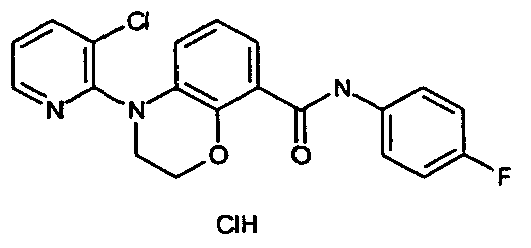
(400 MHz, DMSO-D6) 3.70 (m, 2 H) 4.34 (m, 2 H) 6.42 (dd, J=8.00, 1.51 Hz, 1 H) 6.71 (t, J=7.88 Hz, 1 H) 6.97 (dd, J=7.54, 1.51 Hz, 1 H) 7.06 - 7.16 (m, 2 H) 7.22 (dd, J=7.88, 4.64 Hz, 1 H) 7.68 (dd, J=9.04, 5.10 Hz, 2 H) 7.96 (dd, J=8.00, 1.51 Hz, 1 H) 8.34 (dd, J=4.64, 1.62 Hz, 1 H) 10.13 (s, 1H) 27 1-027 
(400 MHz, DMSO-D6) 3.78 (m, 2 H) 4.40 (m, 2 H) 6.50 (dd, J=8.12, 1.39 Hz, 1 H) 6.78 (t, J=7.88 Hz, 1 H) 7.04 (dd, J=7.65, 1.39 Hz, 1 H) 7.28 (dd, J=7.65, 4.64 Hz, 1 H) 7.42 (s, 1 H) 7.55 (t, J=7.88 Hz, 1 H) 7.92 (s, 1 H) 8.02 (dd, J=7.88, 1.62 Hz, 1 H) 8.23 (s, 1 H) 8.40 (dd, J=4.99, 1.51 Hz, 1 H) 10.47 (s, 1 H) 28 1-028 
(300 MHz, DMSO-D6) 3.81 (m, 2H) 4.47 (m, 2H) 6.59 (dd, J=8.10, 1.50 Hz, 1H) 6.84 (t, J=7.90 Hz, 1H) 7.15 (dd, J=7.30, 1.40 Hz, 1 H) 7.33 (dd, J=4.80, 8.10 Hz, 1 H) 8.02 (s, 1H) 8.06 (d, J=1.50 Hz, 1H) 8.45 (d, J=1.90 Hz, 1H) 12.42 (s, 1 H) 29 1-029 
(300 MHz, DMSO-D6) 3.85 (m, 2 H) 4.52 (m, 2 H) 6.60 (dd, J=7.89, 1.65 Hz, 1 H) 6.86 (t, J=8.07 Hz, 1 H) 7.30 - 7.35 (m, 2 H) 8.06 (dd, J=7.89, 1.65 Hz, 1 H) 8.26 (dd, J=8.99, 2.38 Hz, 1 H) 8.42 - 8.48 (m, 2 H) 8.76 (s, 1H) 10.87 (s, 1 H) 30 1-030 
(300 MHz, DMSO-D6) 3.82 (m, 2 H) 4.45 (m, 2 H) 6.55 (dd, J=7.89, 1.47 Hz, 1 H) 6.84 (t, J=7.89 Hz, 1 H) 7.12 (d, J=6.60 Hz, 1 H) 7.33 (dd, J=8.25, 4.95 Hz, 1 H) 7.92 (d, J=8.80 Hz, 1 H) 8.06 (d, J=7.70 Hz, 1 H) 8.45 (td, J=5.14, 1.83 Hz, 1 H) 8.50 (s, 1H) 9.04 (d, J=2.20 Hz, 1 H) 10.74 (s, 1H) 31 1-031 
(400 MHz, DMSO-D6) 1.16 (d, J=6.26 Hz, 6 H) 2.83 (m, 1 H) 3.77 (m, 2 H) 4.39 (m, 2 H) 6.46 (dd, J=8.12, 1.62 Hz, 1 H) 6.76 (dd, J=7.89, 1.47 Hz, 1 H) 7.04 (dd, J=7.65, 1.62 Hz, 1 H) 7.16 (d, J=8.58 Hz, 2 H) 7.27 (dd, J=7.88, 4.64 Hz, 1 H) 7.60 (m, 2 H) 8.01 (dd, J=7.88, 1.62 Hz, 1 H) 8.39 (dd, j=4.64. 1.62 Hz, 1 H) 10.03 (s, 1 H) 32 1-032 
(300 MHz, DMSO-D6) 3.81 - 3.85 (m, 2 H) 4.45 - 4.49 (m, 2 H) 6.55 (dd. J=8.07, 1.47 Hz, 1 H) 6.84 - 6.87 (m, 1 H) 7.13 (d, J=1.47 Hz, 1 H) 7.33 (dd, J=8.07, 4.77 Hz, 1 H) 7.42 - 7.47 (m, 1 H) 7.91 (d, J=1.83 Hz, 1 H) 7.94 - 7.98 (m, 1 H) 8.06 (dd, J=8.07, 1.47 Hz, 1 H) 8.31 (d, J=8.44 Hz, 1 H) 8.44 (dd, J=4.59, 1.65 Hz, 1 H) 8.60 (s, 1 H) 8.87 (dd, J=4.22, 1.65 Hz, 1 H) 10.54 (s, 1H) [Table 5] Ex. No. Chemical Compounds NMR 33 1-033 
(300 MHz, DMSO-D6)1.96 (m, 2H) 2.72 (m, 2 H) 2.92 (s, 3 H) 3.28 (m, 2 H) 3.81 (m, 2 H) 4.43 (m, 2 H) 6.51 (dd, J=8.07, 1.47 Hz, 1 H) 6.80 (t, J=7.89 Hz, 1 H) 6.99 (m, 1 H) 7.08 (dd, J=7.70, 1.47 Hz, 1 H) 7.19 (m, 1 H) 7.31 (dd, J=7,89, 4.59 Hz, 1 H) 7.40 (m, 1H) 8.05 (dd, J=7.89, 1.65 Hz, 1 H) 8.43 (dd, J=4.77, 1.83 Hz, 1 H) 10.04 (s, 1 H) 34 1-034 
(400 MHz, DMSO-D6) 3.72 - 3.83 (m, 2 H) 3.84 (s, 3 H) 4.36 - 4.46 (m, 2 H) 6.53 (dd, J=8.12, 1.62 Hz, 1 H) 6.76 - 6.84 (m, 1 H) 7.07 (dd, J=7.65, 1.62 Hz, 1 H) 7.32 (dd, J=8.00, 4.75 Hz, 1 H) 7.86 - 7.97 (m, 4 H) 8.05 (dd, J=8.12, 1.62 Hz, 1 H) 8.43 (dd, J=4,64, 1.62 Hz, 1 H) 10.53 (s, 1 H) 35 1-035 
(400 MHz, DMSO-D6) 3.76 - 3.87 (m, 2 H) 4.37 - 4.48 (m, 2 H) 6.53 (dd, J=8.12, 1.39 Hz, 1 H) 6.80 - 6.83 (m, 1 H) 7.07 (dd, J=7.65, 1.62 Hz, 1 H) 7.32 (dd, J=8.12, 4.64 Hz, 1 H) 7.85 - 7.95 (m, 4 H) 8.05 (dd, J=7.88, 1.62 Hz, 1 H) 8.43 (dd, J=4.64, 1.62 Hz, 1 H) 10.48 (s, 1H) 12.75 (brs, 1 H) 36 1-036 
(400 MHz, DMSO-D6) 3.75 - 3.85 (m, 2 H) 4.38 - 4.48 (m, 2 H) 6.52 (dd, J=8.00, 1.51 Hz, 1 H) 6.77 - 6.85 (m, 1 H) 7.08 (dd, J=7.65, 1.62 Hz, 1 H) 7.26 (brs, 2 H) 7.32 (dd, J=7.88, 4.64 Hz, 1 H) 7.79 - 7.90 (m, 4 H) 8.05 (dd, J=8.00, 1.74 Hz, 1 H) 8.43 (dd, J=4.64, 1.62 Hz, 1 H) 10.38 (s, 1 H) 37 1-037 
(400 MHz, DMSO-D6) 2.78 (d, J=4.64 Hz, 3 H) 3.76 3.86 (m, 2 H) 4.38 - 4.49 (m, 2 H) 6.52 (dd, J=8.00, 1.51 Hz, 1 H) 6.81 (t, J=7.88 Hz, 1 H) 7.08 (dd, J=7.54, 1.51 Hz, 1 H) 7.32 (dd, J=7.88, 4.64 Hz, 1 H) 7.82 (s, 4 H) 8.05 (dd, J=8.12, 1.62 Hz, 1 H) 8.31 - 8.37 (m, 1 H) 8.43 (dd, J=4.64. 1.62 Hz, 1 H) 10.38 (s, 1 H) 38 1-038 
(400 MHz, DMSO-D6) 2.97 (s, 6 H) 3.76 - 3.86 (m, 2 H) 4.39 - 4.50 (m, 2 H) 6.52 (dd, J=8.12, 1.62 Hz, 1 H) 6.79 - 6.83 (m, 1 H) 7.06 (dd, J=7.54, 1.51 Hz, 1 H) 7.32 (dd, J=8.12, 4.64 Hz, 1 H) 7.37 - 7.49 (m, 2 H) 7.78 - 7.85 (m, 2 H) 8.05 (dd, J=7.88, 1.62 Hz, 1 H) 8.43 (dd, J=4.64, 1.62 Hz, 1 H) 10.34 (s, 1 H) 39 1-039 
(400 MHz, DMSO-D6) 2.55 (s, 3 H) 3.74 - 3.85 (m, 2 H) 4.37 - 4.47 (m, 2 H) 6.53 (dd, J=8.12, 1.62 Hz, 1 H) 6.82 (t, J=7.77 Hz, 1 H) 7.08 (dd, J=7.65, 1.62 Hz, 1 H) 7.32 (dd, J=7.88, 4.64 Hz, 1 H) 7.83 - 7.93 (m, 2 H) 7.93 - 8.00 (m, 2 H) 8.05 (dd, J=7.88, 1.62 Hz, 1 H) 8.43 (dd, J=4.64, 1.62 Hz, 1 H) 10.51 (s, 1H) 40 1-040 
(400 MHz, DMSO-D6) 1.42 (s, 6 H) 3.76 - 3.86 (m, 2 H) 4.37 - 4.48 (m, 2 H) 4.96 (s, 1 H) 6.49 - 6.52 (m, 1 H) 6.78 - 6.82 (m, 1 H) 7.07 - 7.09 (m, 1 H) 7.30 - 7.33 (m, 1 H) 7.37 - 7.46 (m, 2H) 7.60-7.71 (m, 2H) 8.04 - 8.06 (m, 1 H) 8.42 - 8.44 (m, 1H) 10.08 (s, 1H) [Table 6] Ex. No. Chemical Compounds NMR 41 1-041 
(400 MHz, DMSO-D6) 0.68 (t, J=7.42 Hz, 3 H) 1.40 (s, 3H) 1.63 - 1.73 (m, 2 H) 3.75 - 3.85 (m, 2 H) 4.38 - 4.48 (m, 2 H) 4.76 (s, 1H) 6.50 (dd, J=8.12, 1.62 Hz, 1 H) 6.80 (t. J=7.88 Hz, 1 H) 7.07 (dd, J=7.65, 1.62 Hz, 1 H) 7.29 - 7.39 (m, 3 H) 7.62 - 7.68 (m, 2 H) 8.05 (dd, J=8.12, 1.62 Hz, 1 H) 8.42 - 8.44 (m, 1 H) 10.08(s, 1 H) 42 1-042 
(400 MHz, DMSO-D6) 0.94 - 1.03 (m, 6 H) 1.30 - 1.52 (m, 2 H) 1.77 - 1.93 (m, 2 H) 2.74 - 2.82 (m, 1 H) 2.84 - 2.93 (m, 1 H) 3.13 - 3.23 (m, 1 H) 3.72 - 3.82 (m, 2 H) 3.87 - 3.96 (m, 1 H) 3.97 - 4.08 (m, 1 H) 4.23 - 4.31 (m, 1 H) 4.33 - 4.44 (m, 2 H) 6.46 (dd, J=8.12, 1.62 Hz, 1 H) 6.88 (t, J=7.88 Hz, 1 H) 7.10 (dd, J=7.65, 1.39 Hz, 1 H) 7.29 (dd, J=8.12, 4.75 Hz, 1 H) 8.02 (dd, J=7.88, 1.62 Hz, 1 H) 8.07 (d, J=7.65 Hz, 1 H) 8.41 (dd, J=4.64, 1.62 Hz, 1 H) 43 1-043 
(400 MHz, DMSO-D6) 1.13 (s, 9 H) 1.21 - 1.44 (m, 4 H) 1.71 - 1.79 (m, 2 H) 1.82 - 1.90 (m, 2 H) 3.37 - 3.46 (m, 1 H) 3.62 - 3.73 (m, 1 H) 3.75 - 3.80 (m, 2 H) 4.33 - 4.44 (m, 2 H) 6.45 (dd, J=8.00, 1.51 Hz, 1 H) 6.74 (t, J=7.88 Hz, 1 H) 7.09 (dd, J=7.65, 1.62 Hz, 1 H) 7.28 (dd, J=7.88, 4.64 Hz, 1 H) 7.92 (d, J=7.65 Hz, 1 H) 8.02 (dd, J=8.12, 1.62 Hz, 1 H) 8.40 (dd, J=4.64, 1.62 Hz, 1 H) 44 1-044 
(400 MHz, DMSO-D6) 1.28 (d, J=6.03 Hz, 6 H) 3.76 - 3.86 (m, 2 H) 4.38 - 4.49 (m, 3 H) 4.56 (m, 1 H) 6.51 (dd, J=8.00, 1.51 Hz, 1 H) 6.62 - 6.71 (m, 1 H) 6.80 (t, J=7.77 Hz, 1 H) 7.06 (dd, J=7.54, 1.51 Hz, 1 H) 7.20 (t, J=8.12 Hz, 1 H) 7.25 - 7.35 (m, 2 H) 7.43 (t, J=2.20 Hz, 1 H) 8.05 (dd, J=7.88, 1.62 Hz, 1 H) 8.43 (dd, J=4.87, 1.62 Hz, 1 H) 10.11 (s, 1 H) 45 1-045 
(400 MHz, DMSO-D6) 0.99 (d, J=6.49 Hz, 6 H) 1.97 - 2.08 (m, 1 H) 3.73 (d, J=6.49 Hz, 2 H) 3.77 - 3.86 (m, 2 H) 4.38 - 4.49 (m, 2 H) 6.50 (dd, J=8.00, 1.51 Hz, 1 H) 6.63 - 6.68 (m, 1H) 6.80 (t, J=7.77 Hz, 1 H) 7.06 (dd, J=7,65, 1.62 Hz, 1 H) 7.21 (t, J=8.00 Hz, 1 H) 7.24 - 7.29 (m, 1 H) 7.31 (dd, J=8.00, 4.75 Hz, 1 H) 7.48 (t, J=2.09 Hz, 1 H) 8.05 (dd, J=7.88, 1.62 Hz, 1 H) 8.43 (dd, J=4.64, 1.62 Hz, 1 H) 10.12 (s, 1H) 46 1-046 
(400 MHz, DMSO-D6) 1.28 (s, 9 H) 3.82 - 3.92 (m, 2 H) 4.27 - 4.38 (m, 2 H) 6.88 - 6.98 (m, 1 H) 7.16 (dd, J=4.87, 1.62 Hz, 2 H) 7.24 (dd, J=7.65, 1.62 Hz, 1 H) 7.29 - 7.39 (m, 3 H) 7.56 - 7.67 (m, 2 H) 8.31 - 8.38 (m, 2 H) 10.06 (s, 1H) 47 1-047 
(400 MHz, DMSO-D6) 1.24 - 1.32 (s, 9 H) 2.13 (s, 3 H) 3.79 - 3.90 (m, 2 H) 4.46 - 4.56 (m, 2 H) 6.40 (dd, J=8.00, 1.51 Hz, 1 H) 6.80 (t, J=7.88 Hz, 1 H) 7.08 (dd, J=7.65, 1.39 Hz, 1 H) 7.33 - 7.45 (m, 3 H) 7.63 - 7.73 (m, 2 H) 7.98 (d, J=6.26 Hz, 1 H) 8.41 (dd, J=5.10, 1.62 Hz, 1 H) 10.08 (s, 1 H) [Table 7] Ex. No. Chemical Compounds NMR 48 1-048 
(400 MHz, DMSO-D6) 1.56 (m, 2 H) 1.88 (m, 2 H) 1.96 (m, 2 H) 3.44 (m, 2 H) 3.68 (m, 2 H) 3.75 - 3.79 (m, 2 H) 4.34 - 4.42 (m, 2 H) 6.49 (dd, J=8.12, 1.62 Hz, 1 H) 6.72 - 6.82 (m, 1 H) 7.03 (dd, J=7.65, 1.62 Hz, 1 H) 7.29 (dd, J=7.88, 4.64 Hz, 1 H) 7.66 (m, 2 H) 7.83 (m, 2 H) 8.02 (dd, J=7.88, 1.62 Hz, 1 H) 8.40 (dd, J=4.64, 1.62 Hz, 1 H) 10.34 (s. 1 H) 49 1-049 
(400 MHz, DMSO-D6) 3.08 (s, 6 H) 3.78 (m, 2 H) 4.40 (m, 2 H) 6.49 (dd, J=8.12, 1.39 Hz, 1 H) 6.79 (m, 1 H) 7.03 (dd, J=7.54, 1.51 Hz, 1 H) 7.28 (dd, J=7.88, 4.64 Hz, 1 H) 7.68 (m, 1H) 7.85 (d, J=8.81 Hz, 2 H) 8.02 (dd, J=7.88, 1.62 Hz, 1 H) 8.40 (dd, J=4.64, 1.62 Hz, 1 H) 10.35 (s, 1 H) 50 1-050 
(400 MHz, DMSO-D6) 2.97 - 3.07 (m, 4 H) 3.65 - 3.74 (m, 4 H) 3.74 - 3.82 (m, 2 H) 4.35 - 4.45 (m, 2 H) 6.46 (dd, J=8.12, 1.62 Hz, 1 H) 6.76 (t, J=7.77 Hz, 1 H) 6.89 (d, J=9.04 Hz, 2 H) 7.05 (dd, J=7.65, 1.62 Hz, 1 H) 7.28 (dd, J=7.88, 4.64 Hz, 1 H) 7.55 - 7.66 (m, 2 H) 8.01 (dd, J=7.88, 1.62 Hz, 1 H) 8.39 (dd, J=4.64, 1.62 Hz, 1 H) 9.92 (s, 1 H) 51 1-051 
(400 MHz, DMSO-D6) 1.26 (d, J=6.02 Hz, 6 H) 3.71 - 3.81 (m, 2 H) 4.35 - 4.42 (m, 2 H) 4.44 (dt, J=12.00, 6.02 Hz, 1 H) 6.47 (dd, J=8,12, 1.62 Hz, 1 H) 6.71 - 6.81 (m, 1 H) 7.02 (dd, J=7.65, 1.39 Hz, 1 H) 7.11 (t, J=9.39 Hz, 1 H) 7.28 (dd, J=7.88, 4.64 Hz, 1 H) 7.38 (ddd, J=8.99, 2.38, 1.39 Hz, 1 H) 7.70 (dd, J=13.57, 2.43 Hz, 1 H) 8.01 (dd, J=7.88, 1.62 Hz, 1 H) 8.39 (dd, J=4.64, 1.62 Hz, 1 H) 10.15 (s, 1H) 52 1-052 
(400 MHz, DMSO-D6) 1.26 (d, J=5.94 Hz, 6 H) 3.77 - 3.86 (m, 2 H) 4.43 - 4.52 (m, 2 H) 4.59 (dt, J=12.00, 5.94 Hz, 1 H) 6.53 (dd, J=8.00, 1.51 Hz, 1 H) 6.73 - 6.84 (m, 2 H) 6.89 (dd, J=12.75, 2.78 Hz, 1 H) 7.26 - 7.36 (m, 2 H) 7.79 (t, J=9.04 Hz, 1 H) 8.01 (dd, J=7.88, 1.62 Hz, 1 H) 8.39 (dd, J=4.64, 1.62 Hz, 1 H) 9.84 (s, 1 H) 53 1-053 
(300 MHz, DMSO-D6) 3.81 (m, 2H) 4.44 (m, 2H) 6.53 (dd, J=8.10, 1.50 Hz, 1H) 6.82 (t, J=7.90 Hz, 1H) 7.08 (dd, J=7.30, 1.40 Hz, 1H) 7.33 (dd, J=4.80, 8.10 Hz, 1H) 7.70 (d, J=8.80 Hz, 2H) 8.01 - 8.07 (m, 2H) 8.26 (m , 1H), 8.40 (m, 1H) 10.50 (s, 1H) 54 1-054 
(300 MHz, DMSO-D6) 2.62 (s, 6H) 3.81 (m, 2H) 4.43 (m, 2H) 6.53 (dd, J=8.10, 1.50 Hz, 1H) 6.82 (t, J=7.90 Hz, 1H) 7.08 (dd, J=7.30, 1.40 Hz, 1H) 7.33 (dd, J=4.80, 8.10 Hz, 1H) 7.94 - 8.14 (m, 3H) 8.40 (m, 1H) 10.34 (s, 1H) 55 1-055 
(300 MHz, DMSO-D6) 1.28 (d, J=5.86 Hz, 6 H) 3.81 (m, 2H) 4.43 (m, 2H) 4.78 (dt, J=12.00, 5.86 Hz, 1 H) 6.50 (dd, J=8.10, 1.50. Hz, 1H) 6.80 (t, J=7.90 Hz, 1H) 7.08 (dd, J=7.30, 1.40 Hz, 1H) 7.30 (dd, J=4.80, 8.10 Hz, 1H)7.88(d. J=8.80 Hz, 2H) 8.03 - 8.09 (m, 2H) 8.26 (m , 1H), 8.44 (m, 1H) 10.50 (s, 1H) [Table 8] Ex. No. Chemical Compounds NMR 56 1-056 
(300 MHz, DMSO-D6) 3.29 (s, 3 H) 3.81 (m, 2H) 4.43 (m, 2H) 4.78 (dt, J=12.00, 5.86 Hz, 1 H) 6.50 (dd, J=8.10, 1.50 Hz, 1H) 6.80 (t, J=7.90 Hz, 1H) 7.08 (dd, J=7.30, 1.40 Hz, 1H) 7.30 (dd, J=4.80, 8.10 Hz, 1H) 7.88 (d, J=8.80 Hz, 2H) 8.03 - 8.09 (m, 2H) 8.26 (m , 1H), 8.44 (m, 1H) 10.25 (s, 1H) 57 1-057 
(400 MHz, DMSO-D6) 0.93- 1.00 (d, J=6.82 Hz, 6 H) 2.01 (ddd, J=13.33, 6.61, 6.49 Hz, 1 H) 3.72 - 3.81 (m, 2H) 3.84 (d, J=6.26 Hz, 2 H) 4.34 - 4.45 (m, 2 H) 6.48 (dd, J=8.12, 1.39 Hz, 1 H) 6.77 (t, J=7.88 Hz, 1 H) 7.05 (dd, J=7.54, 1.51 Hz, 1 H) 7.20 (d, J=9.04 Hz, 1 H) 7.28 (dd, J=8.00, 4.75 Hz, 1 H) 7.88 (dd, J=9.04, 2.55 Hz, 1 H) 8.02 (dd, J=7.88, 1.62 Hz, 1H) 8.08 (d, J=2.78 Hz, 1 H) 8.40 (dd, J=4.64, 1.62 Hz, 1 H) 10.22 (s, 1H) 58 1-058 
(400 MHz, DMSO-D6) 1.20 (s, 9 H) 2.29 (s, 3 H) 3.96 - 4.08 (m, 2H) 4.29 - 4.38 (m, 2 H) 6.93 (t, J=7.88 Hz, 2 H) 7.13 (s, 1H) 7.21 - 7.28 (m, 1 H) 7.29 - 7.35 (m, 2 H) 7.46 (dd, J=8.12, 1.39 Hz, 1 H) 7.56 - 7.66 (m, 2 H) 8,16 (d, J=5.33 Hz, 1 H) 10.03 (s, 1 H) 59 1-059 
(400 MHz, DMSO-D6) 1.24 (s, 9H) 2.37 (s, 3 H) 3.97 - 4.07 (m, 2H) 4.24 - 4.34 (m, 2 H) 6.76 (d, J=7.42 Hz, 1 H) 6.87 - 6.93 (m, 1 H) 6.97 (d, J=8.35 Hz, 1 H) 7.17 (dd, J=7.42, 1.62 Hz, 1 H) 7.28 - 7.35 (m, 2 H) 7.43 (dd, J=8.12, 1.62 Hz, 1 H) 7.53 (dd, J=8.35, 7.42 Hz, 1 H) 7.58 - 7.65 (m, 2 H) 10.03 (s, 1 H) 60 1-060 
(300 MHz, DMSO-D6) 1.27 (s, 9 H) 2.22 (s, 3 H) 3.97 - 4.01 (m, 2 H) 4.30 - 4.34 (m, 2 H) 6.87 - 6.93 (m, 1 H) 7.11 - 7.20 (m, 2H) 7.34 (d, J=7.89 Hz, 2 H) 7.41 (dd, J=8.23, 1.47 Hz, 1 H) 7.52 (dd, J=8.79, 2.20 Hz, 1 H) 7.64 (d, J=8.79 Hz, 2 H) 8.15 (d, J=2.56 Hz, 1 H) 10.04 (s, 1H) 61 1-061 
(300 MHz, DMSO-d6) δ: 1.28 (s, 9H), 3.80 (t, J = 4.4 Hz, 2H), 4.39 (t, J = 4.4 Hz, 2H), 6.83 (t, J = 7.9 Hz, 1H), 6.93 (dd, J = 8.1, 1.5 Hz, 1H), 7.07 (dd, J = 7.5, 1.7 Hz, 1H), 7.35 (d, J = 4.2 Hz, 2H), 7.42 (dt, J = 9.8, 2.5 Hz, 1H), 7.63-7.71 (m, 3H), 8.32 (dd, J =4.8, 1.5 Hz, 1 H), 8.55 (d, J = 2.6 Hz, 1H), 10.04 (s, 1H). 62 1-062 
(400 MHz, DMSO-D6) 2.23 (s, 3 H), 3.97(t, J=4.4Hz, 2H), 4.31(t, J=4.4Hz, 2H), 6.92(t, J=8Hz,1H), 7.15(m, 2H) 7.44(dd, J=8, 1.4 Hz, 1 H), 7.53 (dd, J=8.8, 2.2 Hz, 1 H) 7.80 (d, J=8.8, 2 H) 7.92 (d, J=8.8 Hz, 2 H) 8.15 (d, J=2.56 Hz, 1 H) 10.58 (s, 1 H) [Table 9] Ex. No. Chemical Compounds NMR 63 1-063 
(300 MHz, DMSO-d6) δ: 2.25 (s, 3H), 3.99 (t, J = 4.6 Hz, 2H), 4.31 (t, J = 4.4 Hz, 2H), 5.34 (br s, 2H), 6.81-6.92 (m, 2H), 7.11-7.14 (m, 3H), 7.39 (td, J = 7.7, 1.7 Hz, 2H), 7.52 (dt, J = 9.5, 1.3 Hz, 1H), 8.15 (t, J = 1.1 Hz, 1H), 9.97 (s, 1 H). 64 1-064 
(300 MHz, DMSO-d6) δ: 2.08 (s, 3H), 2.23 (s, 3H), 3.98 (t, J = 4.4 Hz, 2H), 4.31 (t, J = 4.4 Hz, 2H), 6.90 (t, J = 7.7 Hz, 1H), 7.13-7.16 (m, 2H), 7.42 (dd, J = 8.3, 1.7 Hz, 2H), 7.53- 7.59 (m, 2H), 8.09-8.15 (m, 2H), 9.50 (s, 1H), 10.27 (s, 1H). 65 1-065 
(300 MHz, DMSO-d6) δ: 1.70-1.73 (m, 2H), 1.93-1.97 (m, 2H), 2.24 (s, 3H), 2.71-2.74 (m, 1H), 3.24-3.28 (m, 2H), 3.99 (t, J = 4.2 Hz, 2H), 4.33 (t, J = 4.4 Hz, 2H), 6.91 (t, J = 7.9 Hz, 1H), 7.04 (t, J = 10.0 Hz, 1H), 7.17-7.18 (m, 2H), 7.38- 7.44 (m, 2H), 7.57-7.69 (m, 2H), 8.16 (s, 1H), 10.14 (s, 1H). 66 1-066 
(300 MHz, DMSO-d6) δ: 1.75-1.78 (m, 4H), 2.22-2.25 (m, 4H), 2.58 (d, J = 4.4 Hz, 3H), 2.70-2.72 (m, 2H), 3.31-3.35 (m, 2H), 4.00 (t, J = 4.2 Hz, 2H), 4.34 (t, J = 4.2 Hz, 2H), 6.92 (t, J = 7.9 Hz, 1H), 7.07 (t, J = 9.2 Hz, 1H), 7.20 (d, J = 7.7 Hz, 2H), 7.39-7.44 (m, 2H), 7.63-7.72 (m, 3H), 8.14-8.18 (m, 1H), 10.15 (s, 1H). 67 1-067 
(300 MHz, DMSO-d6) δ: 1.73 (s, 6H), 2.24-2.25 (m, 3H), 2.80-2.83 (m, 4H), 3.04-3.05 (m, 3H), 3.35-3.45 (m, 2H), 4.01 (t, J = 3.7 Hz, 2H), 4.34 (t, J = 4.2 Hz, 2H), 6.93 (t, J = 7.9 Hz, 2H), 7.09-7.12 (m, 1H). 7.19-7.21 (m, 2H), 7.42-7.45 (m, 3H), 7.66 (t, J = 13.9 Hz, 1H). 8.15-8.17 (m, 1H). 10.18 (s, 1H). 68 1-068 
(300 MHz, DMSO-d6) δ: 1.13 (t, J = 7.0 Hz, 3H), 1.56-1.60 (m, 2H), 1.93-1.96 (m, 2H), 2.23 (s, 3H), 2.71-2.79 (m, 2H), 3.17-3.20 (m, 2H), 3.40-3.51 (m, 3H), 3.99 (t, J = 4.4 Hz, 2H), 4.32 (t, J = 4.2 Hz, 2H), 6.90 (t, J = 7.7 Hz, 1H), 7.00 (q, J = 8.4 Hz, 1H), 7.15 (dt, J = 10.1, 4.5 Hz, 2H), 7.40 (dt, J = 13.1, 4.8 Hz, 2H), 7.52 (dd, J = 8.6, 2.0 Hz, 1H). 7.65 (dd, J = 15.0, 2.2 Hz, 1H), 8.15 (d, J = 2.6 Hz, 1H). 10.12 (s, 1H). 69 1-069 
(300 MHz, DMSO-d6) δ: 1.09 (d, J = 6.2 Hz, 6H), 1.52-1.58 (m, 2H), 1.88-1.91 (m, 2H), 2.23 (s, 3H), 2.74-2.77 (m, 2H), 3.17-3.19 (m, 2H), 3.47-3.53 (m, 1H), 3.59-3.61 (m, 1H), 3.70-3.72 (m, 1H), 3.98 (t, J = 4.4 Hz, 2H), 4.32 (t, J = 4.4 Hz, 2H), 6.90 (t, J = 7.9 Hz, 1H). 7.01 (t, J = 9.5 Hz, 1H). 7.15 (dt, J 10.1. 4.5 Hz, 2H), 7.40 (dt.J= 13.6, 5.0 Hz, 2H), 7.52 (dd, J = 8.4, 1.8 Hz, 1H). 7.64 (dd, J = 14.9, 2.4 Hz, 1H), 8.15 (d, J = 2.2 Hz, 1H), 10.11 (s, 1H). [Table 10] Ex. No. Chemical Compounds NMR 70 1-070 
(300 MH, DMSO-d6) δ: 1.21-1.30 (m, 1H), 1.51-1.63 (m, 1H), 1.78-1.79 (m, 1H), 1.96-2.02 (m, 1H), 2.23 (s, 3H), 2.53-2.68 (m, 1H), 3.08-3.12 (m, 1H), 3.32-3.38 (m, 6H), 3.99 (t, J = 4.4 Hz, 2H), 4.32 (t, J = 4.2 Hz, 2H), 6.90 (t, J = 7.9 Hz, 1 H), 7.02 (t, J = 9.4 Hz, 1H), 7.15 (dt, J = 10.1, 4.5 Hz, 2H), 7.40 (dt, J = 12.3. 4.5 Hz, 2H), 7.52 (dd, J = 8.4, 2.6 Hz, 1H), 7.65 (dd, J = 15.0, 2.2 Hz, 1H), 8,15 (d, J = 2.6 Hz, 1H), 10.12 (s, 1H). 71 1-071 
(300 MHz, DMSO-d6) δ: 1.31-1.36 (m, 2H), 1.70-1.73 (m, 2H), 2.23 (s, 3H), 2.60-2.63 (m, 2H), 3.23-3.24 (m, 5H), 3.98 (t, J = 4.4 Hz, 2H), 4.32 (t, J = 4.2 Hz, 2H), 6.90 (t, J = 7.9 Hz, 1H), 7.01 (t, J = 9.2 Hz, 1H), 7.14 (t, J = 9.2 Hz, 2H), 7.40 (dd, J = 13.4, 5.0 Hz, 2H), 7.52 (dd, J = 8.6, 2.4 Hz, 1 H), 7.64 (dd, J = 15.0, 2.2 Hz, 1H), 8,14 (s, 1H), 10.11 (s, 1H). 72 1-072 
(400 MHz, DMSO-d6) δ: 1.93-2.04 (m, 2H), 2.24 (s, 3H), 3.24-3.31 (m, 5H), 3.51 (dq, J = 10.8. 2.6 Hz, 1H), 4.02 (dd, J = 7.7, 4.9 Hz, 2H), 4.36 (t, J = 4.4 Hz, 2H), 6.73 (t, J = 9.7 Hz, 1H), 6.93 (t, J = 7.9 Hz, 1H), 7.26-7.31 (m, 3H), 7.42 (dd, J = 8.1, 1.6 Hz, 1H). 7.60-7.62 (m, 1H). 7.74-7.75 (m, 1H), 8.17 (s, 1H), 10.03 (s, 1 H). 73 1-073 
(400 MHz, DMSO-d6) 1.00 (d, J = 7.0 Hz, 6H), 1.95-2.08 (m, 1H), 2.23 (s, 3H), 3.77-3.82 (m, 5H), 3.97-4.02 (m, 2H), 4.30-4.35 (m, 2H), 6.91 (t, J = 7.9 Hz, 1H), 7.09-7.20 (m, 3H), 7.42 (d, J = 7.9 Hz, 1H), 7.53 (d, J = 8.8 Hz, 1H), 7.80 - 7.84 (m, 1 H), 8.07-8.10 (m, 1H), 8.15 (brs, 1H), 10.13 (s, 1H). 74 1-074 
(400 MHz, DMSO-d6) 0.98 (t, J = 8.1 Hz, 6H), 1.98-2.05 (m, 1H), 2.23 (s, 3H), 3.79 (d, J = 6.5 Hz, 2H), 3.99 (t, J = 4.4 Hz, 2H), 4.33 (t, J = 4.4 Hz, 2H), 6.91 (t, J = 7.9 Hz, 1H), 7.08 (d, J = 9.3 Hz, 1 H), 7.14 (d, J = 8.3 Hz, 1H), 7.19 (dd, J = 7.9, 1.4 Hz, 1H), 7.42 (dd, J = 7.9, 1.4 Hz, 1H), 7.53 (dd, J = 8.3, 2.3 Hz, 1H), 7.81 (dd, J = 8.8, 2.8 Hz, 1H), 8.02 (d, J = 2.8 Hz, 1H), 8.15 (brs, 1H), 10.09 (s, 1H), 12.59 (s, 1H). 75 1-075 
(400 MHz, DMSO-d6) 1.01 (d, J = 6.6 Hz, 6H), 2.06-2.15 (m, 1H), 2.23 (s, 3H), 3.90 (d, J = 6.6 Hz, 2H), 3.99 (t, J = 4.4 Hz, 2H), 4.33 (t, J = 4.2 Hz, 2H), 6.91 (t, J = 7.9 Hz, 1H), 7.12-7.13 (m, 2H), 7.19 (dd, J = 7.7, 3.9 Hz, 1 H), 7.41 (dd, J = 8.3, 1.7 Hz, 1H), 7.52 (dd, J = 8.8, 2.2 Hz, 1H), 7.58 (br s, 1H), 7.60 (br s, 1H). 7.85 (dd, J = 9.0, 2.8 Hz, 1H), 8.13 (d, J = 2.9 Hz, 1H), 8.15 (br s, 1H), 10.08 (s, 1H). 76 1-076 
(300 MHz, DMSO-d6) 1.00 (d, J = 6.6 Hz, 6H), 2.06-2.14 (m, 1H), 2.23 (s, 3H), 2.82 (d, J = 4.8 Hz, 3H), 3.87 (d, J = 6.6 Hz, 2H), 3.99 (t, J = 4.2 Hz, 2H), 4.32 (t, J = 4.2 Hz, 2H), 6.90 (t, J = 7.9 Hz, 1H), 7.09-7.20 (m, 3H), 7.41 (d, J = 4.0 Hz, 1H), 7.52 (dd, J = 8.4, 2.6 Hz, 1H), 7.83 (dd, J = 9.0, 2.8 Hz, 1H), 8.00-8.07 (m, 2H), 8.15 (br s, 1H), 10.08 (s, 1H). 77 1-077 
(300 MHz, DMSO-d6) 0.95 (d, J = 6.6 Hz, 6H), 1.90-2.04 (m, 1H), 2.23 (s, 3H), 2.79 (s, 3H), 2.98 (s, 3H), 3.76 (d, J = 6.2 Hz, 2H), 3.99 (t, J = 4.2 Hz, 2H), 4.33 (t, J = 4.4 Hz, 2H), 6.90 (t, J = 7.7 Hz, 1 H), 7.03 (d, J = 8.8 Hz, 1 H), 7.13 (d, J = 8.8 Hz, 1H). 7.18 (dd, J = 7.3, 1.5 Hz, 1H), 7.41 (dd, J = 8.1, 1.5 Hz, 1H), 7.52 (dd, J = 8.6, 2.0 Hz, 1H), 7.57 (d, J = 2.6 Hz, 1H), 7.69 (dd, J = 9.0, 2.8 Hz, 1H), 8.15 (d, J = 2.6 Hz, 1H), 10.06 (s, 1H). [Table 11] Ex. No. Chemical Compounds NMR 78 1-078 
(400 MHZ, DMSO-d6) 2.23 (s, 3H), 2.55 (s, 3H), 3.99 (t, J = 4.4 Hz, 2H), 4.33 (t, J = 4.4 Hz, 2H), 6.92 (t, J = 7.9 Hz, 1H), 7.14 (d, J = 8.8 Hz, 1H), 7.18 (dd, J =7.9, 1.4 Hz, 1H), 7.44 (dd, J = 8.1, 1.6 Hz, 1H), 7.53 (dd, J = 8.6, 2.6 Hz, 1H), 7.87 (d, J = 8.8 Hz, 2H), 7.96 (d, J = 8.8 Hz, 2H), 8.15 (s, 1H), 10.48 (s, 1 H). 79 1-079 
(300 MHz, DMSO-d6) 1.42 (s, 6H), 2.23 (s, 3H), 4.00 (t, J = 4.4 Hz, 2H), 4.33 (t, J = 4.4 Hz, 2H), 4.93 (s, 1H), 6.91 (t, J = 7.9 Hz, 1H), 7.13 (d, J = 8.4 Hz, 1 H), 7.19 (dd, J = 7.7, 1.5 Hz, 1H), 7.39-7.43 (m, 3H), 7.52 (dd, J = 9.0, 2.4 Hz, 1H), 7.64 (d, J = 8.4 Hz, 2H), 8.15 (s, 1H), 10.04 (s, 1H). 80 1-080 
(400 MHz, DMSO-d6) 2.23 (s, 3H), 2.59 (s, 3H), 3.99 (t, J = 4.4 Hz, 2H), 4.32 (t, J = 4.4 Hz, 2H), 6.92 (t, J = 7.9 Hz, 1H), 7.14 (d, J = 8.3 Hz, 1H), 7.18 (dd, J = 7.7, 1.6 Hz, 1H), 7.44 (dd, J = 8.1, 1.6 Hz, 1H), 7.50-7.55 (m, 2H), 7.87 (dd, J = 8.8, 2.3 Hz, 1H), 8.07 (d, J = 2.3 Hz, 1 H), 8.15 (s, 1H), 10.42 (s, 1H). 81 1-081 
(400 MHz, DMSO-d6) 1.59 (s, 6H), 2.23 (s, 3H), 3.99 (t, J = 4.4 Hz, 2H), 4.31 (t, J = 4.4 Hz, 2H), 5.28 (s, 1H), 6.91 (t, J = 7.9 Hz, 1H), 7.11-7.17 (m, 2H), 7.32 (d, J = 8.3 Hz, 1H), 7.42 (dd, J = 8.3, 1.4 Hz, 1H), 7.53 (dd, J = 8.6, 2.6 Hz, 1H), 7.70 (dd, J = 8.8, 2.8 Hz, 1 H), 8.13-8.18 (m, 2H), 10.24 (s, 1H). 82 1-082 
(300 MHz, DMSO-d6) 1.44 (s, 6H), 2.23 (s, 3H), 2.96 (s, 3H), 3.99 (t, J = 4.4 Hz, 2H), 4.32 (t, J = 4.4 Hz, 2H), 6.91 (t, J = 7.9 Hz, 1H), 7.14 (d, J = 8.4 Hz, 1 H), 7.18 (dd, J = 7.7, 1.5 Hz, 1 H), 7.33 (d, J = 8.8-Hz, 2H), 7.42 (dd, J = 8.3, 1.7 Hz, 1H), 7.52 (dd, J = 8.8, 2.2 Hz, 1H), 7.70 (d, J = 8.8 Hz, 2H), 8.15 (d, J = 2.6 Hz, 1H), 10.11 (s, 1H). 83 1-083 
(300 MHz, CHLOROFORM-d) 2.28 (s, 3H), 3.97 (s, 3H), 4.17 (t, J = 4.4 Hz, 2H), 4.52 (t, J = 4.6 Hz, 2H), 6.84 (dd, J = 8.6, 2.4 Hz, 1 H), 6.99 (t, J = 8.1 Hz, 1H), 7.10 (d, J = 8.4 Hz, 1H), 7.29 (d, J = 8.8 Hz, 1H), 7.38 (dd, J = 8.4, 2.2 Hz, 1H), 7.44 (dd, J = 8.1, 1.5 Hz, 1H), 7.88 (dd, J = 5.9, 2.2 Hz, 2H), 8.17 (d, J = 1.8 Hz, 1H), 9.71 (s, 1H). 84 1-084 
(400 MHz, CHLOROFORM-d) 1.04 (t, J = 7.4 Hz, 3H), 1.79 - 1.83 (m, 2H), 2.27 (s, 3H), 3.92 (t, J = 6.7 Hz, 2H), 4.17 (t, J = 4.4 Hz, 2H), 4.49 (t, J = 4.4 Hz, 2H), 6.90 (d, J = 9.3 Hz, 2H), 6.97 (t, J = 8.1 Hz, 1H), 7.10 (d, J = 8.3 Hz, 1H), 7.37 (dd, J = 8.3, 2.3 Hz, 1H), 7.42 (dd, J = 8.1, 1.2 Hz, 1H), 7.57 (d, J = 8.8 Hz, 2H), 7.90 (dd, J = 7.9, 1.4 Hz, 1H), 8.16 (s, 1 H), 9.52 (s, 1 H). 85 1-085 
(400 MHz, CHLOROFORM-d) 1.04-1.06 (m, 3H), 1.82-1.86 (m, 2H), 2.28 (s, 3H), 3.99-4.00 (m, 2H), 4.16-4.17 (m, 2H), 4.50-4.51 (m, 2H), 6.92-7.00 (m, 2H), 7.10 (dd, J = 8.3, 2.3 Hz, 1H), 7.27-7.30 (m, 1H), 7.36-7.45 (m, 2H), 7.57-7.60 (m, 1H), 7.87-7.91 (m, 1H), 8.17 (s, 1H), 9.57 (s, 1 H). [Table 12] Ex. No. Chemical Compounds NMR 86 1-086 
(400 MHz, CHLOROFORM-d) 1.44-1.45 (m, 3H), 2.28 (d, J = 3.2 Hz, 3H), 4.10-4.17 (m, 4H), 4.50-4.51 (m, 2H), 6.93 - 6.98 (m, 2H), 7.09-7.11 (m, 1H), 7.27-7.29 (m, 1H), 7.36 - 7.45 (m, 2H), 7.57-7.60 (m, 1H), 7.88-7.90 (m, 1H), 8,17 (s, 1 H), 9.57 (s, 1 H). 87 1-087 
(400 MHz, CHLOROFORM-d) 1.44 (t, J = 7.0 Hz, 3H), 2.20 (s, 3H), 2.28 (s, 3H), 4.11 (q, J = 7.0 Hz, 2H), 4.17 (t, J = 4.4 Hz, 2H), 4.50 (t, J = 4.4 Hz, 2H), 6.82 (dd, J = 7.9, 1.9 Hz, 1H), 6.97 (t, J = 8.1 Hz, 1H), 7.09 (dd, J = 12.8, 8.1 Hz, 2H), 7.37 (dd, J = 8.3, 2.3 Hz, 2H), 7.42 (dd, J = 8.1, 1.6 Hz, 2H), 7.62 (d, J = 2.3 Hz, 1H), 7.89 (dd, J = 7.9, 1.4 Hz, 1H), 8.17 (s, 1 H), 9.60 (s, 1H). 88 1-088 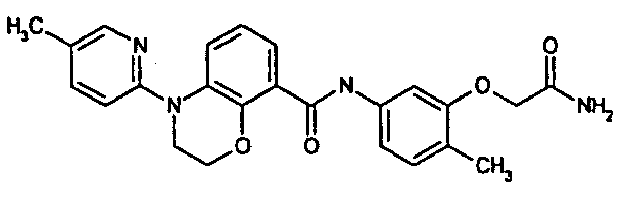
(400 MHz, DMSO-d6) 2.19 (s, 3H), 2.23 (s, 3H), 3.99 (t, J = 3.9 Hz, 2H), 4.32 (t, J = 4.6 Hz, 2H), 4.40 (s, 2H), 6.90 (t, J = 7.9 Hz, 1H), 7.08-7.17 (m, 3H), 7.24 (d, J = 7.9 Hz, 1H), 7.38-7.41 (m, 4H), 7.53 (dd, J=8.8, 2.3 Hz, 1H), 8.15 (s, 1H), 10.07 (s, 1H). 89 1-089 
(400 MHz, DMSO-d6) 2.12 (s, 3H), 2.28 (s, 3H), 3.70 (t, J = 4.6 Hz, 2H), 4.03-4.08 (m, 4H), 4.38 (t, J = 4.2 Hz, 2H), 6.95 (t, J = 7.9 Hz, 1H), 7.08 (d, J = 7.9 Hz, 1H), 7.20 (dd, J = 8.1, 1.6 Hz, 1H), 7.29 (dd, J = 14.8, 8.3 Hz, 2H), 7.44 (d, J = 11.1 Hz, 2H), 7.76 (d, J = 8.8 Hz, 1 H), 8.19 (s, 1 H), 10.06 (s, 1H). 90 1-090 
(400 MHz, DMSO-d6) 1.64 (br s, 1H), 1.79 (t, J = 10.0 Hz, 2H), 1.91 (s, 3H), 2.30 (s, 3H), 3.27 (d, J = 7.4 Hz, 1H), 3.45 (d, J = 10.0 Hz, 3H), 3.81-3.84 (m, 1H), 4.02-4.06 (m, 3H), 4.39 (br s, 2H), 6.98 (t, J = 7.7 Hz, 1H). 7.26-7.36 (m, 2H), 7.48 (d, J = 7.9 Hz, 1H). 7.58 (d, J = 7.4 Hz, 1H). 7.86-7.92 (m, 3H), 8.21 (s, 1H), 10.63 (s, 1H). 91 1-091 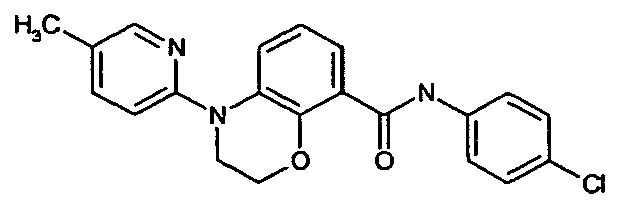
(300 MHz,DMSO-d6) 2.22 (s, 3H), 3.96 (q, J = 6.8 Hz, 2H), 4.29 (q, J = 6.6 Hz, 2H), 6.90 (t, J = 7.9 Hz, 1H). 7.12-7.15 (m, 2H), 7.35-7.43 (m, 3H), 7.52 (dd, J = 9.3, 2.3 Hz, 1H), 7.77 (d, J = 19.0 Hz, 2H), 8.14 (d, J = 2.3 Hz, 1H). 10.27 (s, 1H). 92 1-092 
(300 MHz,DMSO-d6) 2.20 (d, J = 1.1 Hz, 3H), 2.23 (s, 3H), 3.99 (t, J = 4.2 Hz, 2H), 4.32 (t, J = 4.4 Hz, 2H), 6.91 (t, J = 7.7 Hz, 1H), 7.17-7.20 (m, 3H), 7.38-7.42 (m, 2H), 7.53 (dd, J = 8.4, 2.2 Hz, 1H), 7.67 (dd, J = 12.1, 1.8 Hz, 1H), 8.15 (d, J = 2.2 Hz, 1H), 10.23 (s, 1H). 93 1-093 
(300 MHz,DMSO-d6) 2.23 (s, 3H), 3.99 (t, J = 4.4 Hz, 2H), 4.33 (t, J = 4.4 Hz, 2H), 6.92 (t, J = 7.9 Hz, 1H), 7.14-7.19 (m, 2H), 7.44-7.55 (m, 3H), 8.15 (q, J = 0.7 Hz, 1H), 8.23 (dd, J = 8.8, 2.6 Hz, 1H), 8.75 (d, J = 2.6 Hz, 1H), 10.48 (s, 1H). 94 1-094 
(400 MHz, DMSO-d6) 1.31 (t, J = 7.2 Hz, 3H), 3.79 (t, J = 4.4 Hz, 2H), 3.99 (q, J = 7.0 Hz, 2H), 4.42 (t, J = 4.4 Hz, 2H), 6.48 (dd, J = 8.1, 1.6 Hz, 1H), 6.78 (t, J = 7.9 Hz, 1H), 6.88 (d, J = 9.3 Hz, 2H), 7.07 (dd, J = 7.9, 1.4 Hz, 1H), 7.30 (dd, J = 7.6, 4.4 Hz, 1H), 7.64 (d, J = 8.8 Hz, 2H), 8.03 (dd, J = 7.9, 1.9 Hz, 1H), 8.41 (dd, J = 4.4, 1.6 Hz, 1H), 9.99 (s, 1H). [Table 13] Ex. No. Chemical Compounds NMR 95 1-095 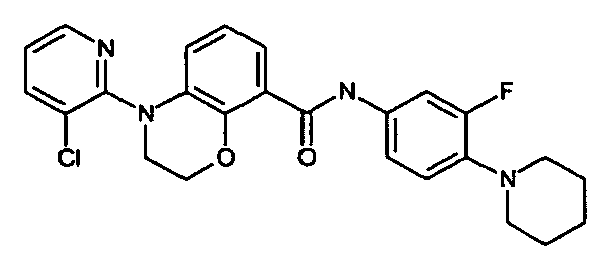
(400 MHz, DMSO-d6) 1.49-1.54 (m, 2H), 1.61-1.67 (m, 4H), 2.91 (t, J = 5.1 Hz, 4H), 3.79 (t, J = 4.4 Hz, 2H), 4.42 (t, J = 4.4 Hz, 2H), 6.49 (dd, J = 8.1, 1.6 Hz, 1H). 6.79 (t, J = 7.9 Hz, 1H). 6.99 (t, J = 9.3 Hz, 1H). 7.05 (dd, J = 7.4, 1.4 Hz, 1H). 7.30 (dd, J = 8.0, 4.4 Hz, 1H). 7.39 (dd, J = 8.6, 2.1 Hz, 1H). 7.64 (dd, J = 14.8, 2.3 Hz, 1H). 8.03 (dd, J = 7.9, 1.9 Hz, 1 H), 8.42 (dd, J = 4.6, 1.4 Hz, 1 H), 10.13 (s, 1 H). 96 1-096 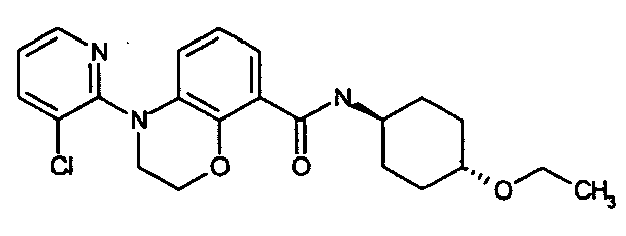
(400 MHz, DMSO-d6) 1.06 (t, J = 7.0 Hz, 3H), 1.18-1.37 (m, 4H), 1.85-1.98 (m, 4H), 3.17-3.24 (m, 1H), 3.43 (q, J = 7.0 Hz, 2H), 3.67-3.73 (m, 1 H), 3.76 (t, J = 4.4 Hz, 2H), 4.38 (t, J = 4.4 Hz, 2H), 6.44 (dd, J = 7.9, 1.4 Hz, 1H), 6.73 (t, J = 7.9 Hz, 1H), 7.07 (dd, J = 7.7, 1.6 Hz, 1H), 7.27 (dd, J = 8.0, 4.8 Hz, 1H), 7.92 (d, J = 7.4 Hz, 1 H), 8.01 (dd, J = 7.9, 1.9 Hz, 1 H), 8.39 (dd, J = 4.8, 2.0 Hz, 1 H). 97 1-097 
(400 MHz, DMSO-d6) 1.05 (d, J = 6.0 Hz, 6H), 1.15-1.38 (m, 4H), 1.85-1.90 (m, 4H), 3.27-3.31 (m, 1H), 3.63-3.73 (m, 2H), 3.76 (t, J = 4.6 Hz, 2H), 4.38 (t, J = 4.6 Hz, 2H), 6.44 (dd, J = 7.9, 1.4 Hz, 1H), 6.73 (t, J = 7.9 Hz, 1H), 7.07 (dd, J = 7.7, 1.6 Hz, 1H), 7.27 (dd, J = 8.0, 4.8 Hz, 1H), 7.91 (d, J = 7.9 Hz, 1H), 8.01 (dd, J = 7.9, 1.9 Hz, 1H), 8.39 (dd, J = 4.6, 1.4 Hz, 1H). 98 1-098 
(400 MHz, DMSO-d6) 1.17-1.70 (m, 12H), 1.84-1.94 (m, 4H), 3.20-3.25 (m, 1H), 3.66-3.72 (m, 1H), 3.76 (t, J = 4.4 Hz, 2H), 3.98-4.01 (m, 1H), 4.38 (t, J = 4.4 Hz, 2H), 6.44 (dd, J = 8.1, 1.6 Hz, 1H), 6.72 (t, J = 7.9 Hz, 1 H), 7.07 (dd, J = 7.4, 1.4 Hz, 1H), 7.27 (dd, J = 8.1, 4.9 Hz, 1H), 7.91 (d, J = 7.9 Hz, 1H), 8.01 (dd, J = 7.9, 1.4 Hz, 1H), 8.39 (dd, J = 4.9, 1.6 Hz, 1H). 99 1-099 
(400 MHz, DMSO-d6) 1.12-1.47 (m, 10H), 1.62-1.66 (m, 2H), 1.74-1.78 (m, 2H), 1.85-1.91 (m, 4H), 3.32-3.36 (m, 2H), 3.66-3.72 (m, 1H), 3.76 (t, J = 4.6 Hz, 2H), 4.38 (t, J = 4.4 Hz, 2H), 6.43 (dd, J = 8.1, 1.6 Hz, 1H), 6.72 (t, J = 7.9 Hz, 1H), 7.07 (dd, J = 7.9, 1.4 Hz, 1H), 7.27 (dd, J = 8.0, 4.8 Hz, 1H), 7.91 (d, J = 7.9 Hz, 1H), 8.01 (dd, J = 7.9, 1.9 Hz, 1 H), 8.39 (dd, J = 4.8, 2.0 Hz, 1 H). 100 1-100 
(300 MHz, DMSO-d6) δ: 3.81 (t, J = 4.4 Hz, 2H), 4.43 (t, J = 4.4 Hz, 2H), 6.53 (dd, J = 8.1, 1.5 Hz, 1H), 6.82 (t, J = 7.9 Hz, 1H), 7.07 (dd, J = 7.5, 1.7 Hz, 1H), 7.32 (dd, J = 7.9, 4.6 Hz, 1H), 7.71 (d, J = 8.8 Hz, 2H), 7.97 (d, J = 8.8 Hz, 2H), 8.05 (dd, J = 8.1, 1.5 Hz, 1H), 8.43 (dd, J = 2.1, 1.0 Hz, 1H), 10.52 (s, 1 H). 101 1-101 
(300 MHz, DMSO-d6) δ: 1.56-1.61 (m, 2H), 1.95-1.99 (m, 2H), 2.74-2.79 (m, 2H), 3.17-3.19 (m, 2H), 3.29-3.33 (m, 4H), 3.80 (t, J = 4.4 Hz, 2H), 4.43 (t, J = 4.4 Hz, 2H), 6.50 (dd, J = 8.1, 1.5 Hz, 1H), 6.80 (t, J = 7.9 Hz, 1H), 7.01-7.06 (m, 2H), 7.31 (dd, J = 7.7, 4.8 Hz, 1H), 7.40 (dd, J = 5.3, 2.7 Hz, 1H), 7.66 (dd, J = 15.0, 2.2 Hz, 1H), 8.04 (dd, J = 7.9, 1.7 Hz, 1 H), 8.43 (dd, J = 2.1, 1.0 Hz, 1 H), 10.13 (s, 1H). 102 1-102 
(300 MHz, DMSO-d6) δ: 1.13 (t, J = 7.0 Hz, 3H), 1.52-1.63 (m, 2H), 1.95-1.97 (m, 2H), 2.74-2.77 (m, 2H), 3.18-3.20 (m, 2H), 3.42-3.49 (m, 3H), 3.80 (t, J = 4.4 Hz, 2H), 4.43 (t, J = 4.4 Hz, 2H), 6.50 (dd, J = 8.1, 1.5 Hz, 1H), 6.80 (t, J = 7.9 Hz, 1H), 7.01-7.06 (m, 2H), 7.31 (dd, J = 7.9, 4.6 Hz, 1H), 7.40 (dd, J = 8.8, 1.5 Hz, 1H), 7.66 (dd, J = 14.9, 2.4 Hz, 1H), 8.04 (dd, J = 7.9, 1.7 Hz, 1H), 8.43 (dd, J = 2.2, 1.1 Hz, 1H), 10.13 (s, 1H). [Table 14] Ex. No. Chemical Compounds NMR 103 1-103 
(300 MHz, DMSO-d6) δ: 1.10 (d, J = 5.9 Hz, 6H), 1.64-1.67 (m, 2H), 1.95-2.04 (m, 2H), 2.92-2.95 (m, 2H), 3.26-3.30 (m, 2H), 3.55-3.59 (m, 1H), 3.72-3.79 (m, 3H), 4.43 (t, J = 4.4 Hz, 2H), 6.51 (dd, J = 8.1, 1.8 Hz, 1H), 6.80 (t, J = 7.7 Hz, 1H), 7.06 (dd, J = 7.7, 1.5 Hz, 1H), 7.30-7.33 (m, 2H), 7.45 (d, J = 8.4 Hz, 1H), 7.73 (d, J = 14.7 Hz, 1H), 8.04 (dd, J = 8.1, 1.8 Hz, 1 H), 8.43 (dd, J = 4.8, 1.5 Hz, 1H), 10.24 (s, 1H). 104 1-104 
(400 MHz, CHLOROFORM-d) 1.03 (s, 3H), 1.05 (s, 3H), 2.09-2.15 (m, 1H), 3.79 (d, J = 7.0 Hz, 2H), 3.95 (t, J = 4.4 Hz, 2H), 4.63 (t, J = 4.6 Hz, 2H), 6.67 (dd, J = 8.1, 1.6 Hz, 1H). 6.90-6.94 (m, 2H), 7.12 (q, J = 4.2 Hz, 1H). 7.30 (t, J = 5.3 Hz, 1H). 7.58 (dd, J = 13.0, 2.8 Hz, 1H), 7.79-7.80 (m, 2H), 8.38 (dd, J = 4.6, 1.4 Hz, 1H), 9.58 (s, 1H). 105 1-105 
(400 MHz, DMSO-d6) 1.08 (t, J = 6.8 Hz, 3H), 1.20-1.33 (m, 4H), 1.85-1.97 (m, 4H), 2.20 (s, 3H), 3.14-3.24 (m, 1H). 3.43 (q, J = 6.8 Hz, 2H), 3.66-3.76 (m, 1H), 3.95 (t, J = 4.4 Hz, 2H), 4.27 (t, J = 4.4 Hz, 2H), 6.84 (dd, J = 8.0, 7.6 Hz, 1H), 7.17 (d, J = 8.8 Hz, 1H), 7.17 (dd, J = 8.0, 2.0 Hz, 1H), 7.33 (dd, J = 8.0, 1.2 Hz, 1H). 7.48 (dd, J = 8.4, 2.4 Hz, 1H), 7.90 (d, J = 8.0 Hz, 1H), 8.11 (d.J=2.4Hz. 1H). 106 1-106 
(400 MHz, DMSO-d6) 1.04 (d, J = 6.0 Hz, 6H), 1.16-1.37 (m, 4H), 1.81-1.91 (m, 4H), 2.20 (s, 3H), 3.23-3.33 (m, 1H). 3.62-3.73 (m, 1H), 3.95 (t, J = 4.4 Hz, 2H), 4.27 (t, J = 4.4 Hz, 2H), 6.84 (dd, J = 8.4, 7.2 Hz, 1H). 7.07 (d, J = 8.4 Hz, 1H). 7.18 (dd, J = 8.0, 2.0 Hz, 1H). 7.33 (dd, J = 8.0, 2.0 Hz, 1H). 7.48 (dd, J = 8.0, 2.0 Hz, 1H), 7.89 (d, J = 8.0 Hz, 1H), 8.11 (d, J = 1.6 Hz, 1 H). 107 1-107 
(400 MHz, DMSO-d6) 1.05-1.36 (m, 9H), 1.40-1.92 (m, 9H), 2.20 (s, 3H), 3.26-3.36 (m, 1H), 3.64-3.74 (m, 1H). 3.95 (t, J = 4.4 Hz, 2H), 4.27 (t, J = 4.4 Hz, 2H), 6.84 (dd, J =8.0, 8.0 Hz, 1H), 7.07 (d, J = 8.5 Hz, 1H), 7.17 (dd, J = 7.4, 1.4 Hz, 1H), 7.33 (dd, J = 8.0, 1.4 Hz, 1H), 7.48 (dd, J = 8.5, 2.6 Hz, 1H), 7.90 (d, J = 8.0 Hz, 1H), 8.12 (d, J = 1.2 Hz, 1H). 108 1-108 
(400 MHz, DMSO-d6) 1.04-1.34 (m, 4H), 1.72-1.87 (m, 4H), 2.20 (s, 3H), 2.48-2.58 (m, 1H), 3.30 (brs, 3H), 3.59-3.71 (m, 1H), 3.95 (t, J = 4.4 Hz, 2H), 4.27 (t, J = 4.4 Hz, 2H), 6.84 (dd, J = 8.0, 8.0 Hz, 1H), 7.07 (d, J = 8.5 Hz, 1H). 7.19 (dd, J = 8.0, 1.5 Hz, 1H), 7.33 (dd, J = 8.0, 1.5 Hz, 1H), 7.48 (dd, J = 8.5, 2.6 Hz, 1H), 7.86 (d, J = 8.0 Hz, 1 H), 8.12 (d, J = 2.0 Hz, 1H). 109 1-109 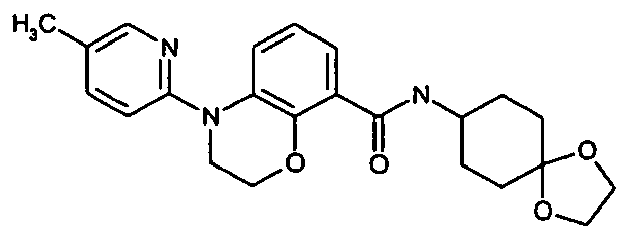
(400 MHz, DMSO-d6) 1.48-1.84 (m, 8H), 2.20 (s, 3H), 3.78 - 3.88 (m, 5H), 3.95 (t, J = 4.4 Hz, 2H), 4.28 (t, J = 4.4 Hz, 2H), 6.84 (dd, J = 8.0, 8.0 Hz, 1H), 7.08 (d, J = 8.5 Hz, 1H), 7.18 (dd, J = 8.0, 1.5 Hz, 1H), 7.34 (dd, J = 8.0, 1.5 Hz, 1H), 7.48 (dd, J = 8.5, 2.5 Hz, 1H), 7.97 (d, J = 8.0 Hz, 1H), 8.12 (d, J = 2.5 Hz, 1H). 110 1-110 
(400 MHz, DMSO-d6) 1.74-1.84 (m, 2H), 2.05-2.09 (m, 2H), 2.20 (s, 3H), 2.26-2.33 (m, 2H), 2.41-2.46 (m, 2H), 3.95 (t, J = 4.4 Hz, 2H), 4.21-4.28 (m, 3H), 6.85 (t, J = 7.9 Hz, 1H), 7.08 (d, J = 8.8 Hz, 1H), 7.18 (dd, J =7.7, 1.6 Hz, 1H), 7.35 (dd, J = 8.1, 1.6 Hz, 1H), 7.49 (dd, J =8.8, 2.3 Hz, 1H), 8.11-8.13 (m, 2H). [Table 15] Ex. No. Chemical Compounds NMR 111 1-111 
(400 MHz, DMSO-d6) 1.49-1.78 (m, 8H), 2.16-2.20 (m, 4H), 2.43-2.45 (m, 4H), 3.55 (t, J = 4.6 Hz, 4H), 3.98 (t, J = 4.4 Hz, 3H), 4.31 (t, J = 4.6 Hz, 2H), 6.86 (t, J = 7.9 Hz, 1H), 7.08 (d, J = 8.3 Hz, 1H), 7.25 (dd, J = 7.7, 1.6 Hz, 1H). 7.35 (dd, J = 8.1. 1.6 Hz, 1H). 7.49 (dd, J = 8.3, 2.3 Hz, 1H). 8.02 (d, J = 7.4 Hz, 1H), 8.12 (s, 1H), 112 1-112 
(400 MHz, DMSO-d6) 1.20-1.32 (m, 4H), 1.80 (brs, 2H), 1.90 (brs, 2H) 2.06-2.16 (m, 7H), 2.20 (s, 3H), 3.63-3.68 (m, 1H). 3.95 (brs, 2H), 4.27 (brs. 2H), 6.83 (t, J = 7.9 Hz, 1H), 7.07 (d, J = 8.8 Hz, 1H). 7.18 (d, J = 7.9 Hz, 1H). 7.33 (dd, J = 8.1, 1.6 Hz, 1H), 7.48 (dd, J = 8.6, 1.6 Hz, 1H), 7.88 (d, J = 7.9 Hz, 1H), 8.12 (s, 1 H). 113 1-113 
(400 MHz, DMSO-d6) 0.94 (t, J = 7.0 Hz, 6H), 1.26-1.32 (m, 4H), 1.70 (brs, 2H), 1.91 (brs, 2H), 2.20 (s, 3H), 2.43 - 2.46 (m, 5H), 3.63-3.68 (m, 1H), 3.95 (t, J = 4.4 Hz, 2H), 4.27 (t, J = 4.4 Hz, 2H), 6.84 (t, J = 7.9 Hz, 1 H), 7.07 (d, J = 8.3 Hz, 1H), 7.19 (dd, J = 7.7.1.6 Hz, 1H), 7.33 (dd, J = 8.1, 1.6 Hz, 1H), 7.48 (dd, J = 8.3, 2.3 Hz, 1H), 7.87 (d, J = 7.9 Hz, 1 H), 8.12 (d, J = 2.3 Hz, 1 H). 114 1-114 
(400 MHz, DMSO-d6) 1.55-1.69 (m, 12H), 2.17-2.24 (m, 4H), 2.45-2.53 (m, 4H), 3.88-3.90 (m, 1H), 3.97 (t, J = 4.4 Hz, 2H), 4.31 (t, J = 4.2 Hz, 2H), 6.85 (t, J = 7.9 Hz, 1H), 7.08 (d, J = 8.8 Hz, 1H), 7.24 (dd, J = 7.9, 1.4 Hz, 1H), 7.34 (d, J = 7.9 Hz, 1H), 7.48 (dd, J = 8.6, 2.1 Hz, 1H), 7.97 (d, J = 7.0 Hz, 1H), 8.12 (brs, 1H). 115 1-116 
(400 MHz, DMSO-d6) 1.18-1.34 (m, 4H), 1.64 (brs, 4H), 1.86-1.95 (m, 5H), 2.20 (s, 3H), 3.65-3.70 (m, 1H), 3.95 (t, J = 4.4 Hz, 2H), 4.27 (t, J = 4.4 Hz, 2H), 6.84 (t, J = 7.9 Hz, 1H), 7.07 (d, J = 8.8 Hz, 1H), 7.18 (dd, J =7.9, 1.4 Hz, 1H), 7.33 (dd, J = 7.9, 1.4 Hz, 1H), 7.48 (dd, J =8.8, 2.3 Hz, 1H), 7.89 (d, J = 7.9 Hz, 1H), 8.11 (s, 1 H). 116 1-116 
(400 MHz, DMSO-d6) 1.33-2.16 (m, 14H), 2.27 (s, 3H), 2.86-2.94 (m, 2H), 3.03-3.17 (m, 1H), 3.30-3.33 (m, 2H), 3.68-4.11 (m, 3H), 4.32-4.45 (m, 2H), 6.87-6.94 (m, 1H), 7.24-7.41 (m, 3H), 7.79 (d, J = 8.3 Hz, 1H), 7.99-8.12 (m, 1H), 8.17 (s, 1H), 10.43-10.53 (m, 1H). 117 1-117 
(400 MHz, DMSO-d6) 1.29-1.40 (m, 2H), 1.56-1.65 (m, 2H), 1.94-2.01 (m, 2H), 2.16-2.19 (m, 2H), 2.24 (s, 3H), 3.01 - 3.15 (m, 3H), 3.33-3.38 (m, 2H), 3.44-4.01 (m, 7H), 4.31 (t, J = 4.4 Hz, 2H), 6.88 (t, J = 7.9 Hz, 1H), 7.21 (d, J = 7.9 Hz, 2H), 7.36 (dd, J = 8.3, 1.4 Hz, 1H), 7.67 (d, J = 8.3 Hz, 1H), 8.00 (d, J = 7.9 Hz, 1H), 8.15 (s, 1H), 11.13 (s, 1H). 118 1-118 
(400 MHz, DMSO-d6) 1.21-1.38 (m, 4H), 1.76-1.88 (m, 7H), 2.20 (s, 3H), 3.44-3.49 (m, 1H), 3.66-3.72 (m, 1H), 3.95 (t, J = 4.2 Hz, 2H), 4.27 (t, J = 4.4 Hz, 2H), 6.84 (t, J = 7.9 Hz, 1H), 7.08 (d, J = 8.3 Hz, 1H), 7.18 (dd, J = 7.9, 1.4 Hz, 1H), 7.33 (dd, J = 8.3, 1.4 Hz, 1H), 7.48 (dd, J = 8.8, 2.3 Hz, 1H), 7.72 (d, J = 7.9 Hz, 1H), 7.92 (d, J = 7.9 Hz, 1H), 8.12 (d, J = 1.9 Hz, 1H). [Table 16] Ex. No. Chemical Compounds NMR 119 1-119 
(400 MHz, DMSO-d6) 0.83-0.92 (m, 2H), 1.09-1.47 (m, 8H), 1.59-1.69 (m, 5H), 1.84-1.95 (m, 4H), 2.20 (s, 3H), 3.13 - 3.33 (m, 3H), 3.69-3.74 (m, 1 H), 3.95 (t, J = 4.4 Hz, 2H), 4.27 (t, J = 4.4 Hz, 2H), 6.84 (t, J = 7.9 Hz, 1H), 7.07 (d, J = 8.3 Hz, 1H), 7.18 (dd, J = 7.7, 1.6 Hz, 1H), 7.33 (dd, J = 7.9, 1.4 Hz, 1H), 7.48 (dd, J = 8.3, 2.3 Hz, 1H), 7.90 (d, J = 7.9 Hz, 1H), 8.12 (d, J = 2.3 Hz, 1 H). 120 1-120 
(400 MHz, DMSO-d6) 1.30 (t, J = 7.0 Hz, 3H), 3.97 (q, J = 7.0 Hz, 2H), 4.02 (t, J = 4.6 Hz, 2H), 4.33 (t, J = 4.6 Hz, 2H), 6.88 (d, J = 9.3 Hz, 2H), 6.93 (t, J = 7.9 Hz, 1 H), 7.21-7.24 (m, 2H), 7.47 (dd, J = 8.1, 1.6 Hz, 1H), 7.61 (d, J = 9.3 Hz, 2H), 7.74 (dd, J = 9.0, 2.6 Hz, 1H), 8.30 (d, J = 2.8 Hz, 1H), 9.98 (s, 1H). 121 1-121 
(400 MHz, DMSO-d6) 4.02 (t, J = 4.5 Hz, 3H), 4.32 (t, J = 4.5 Hz, 2H), 6.94 (t, J = 7.9 Hz, 1 H), 7.21-7.23 (m, 2H), 7.38 (d, J = 8.8 Hz, 2H), 7.49 (dd, J = 7.9, 1.4 Hz, 1H), 7.73-7.77 (m, 4H), 8.30 (d, J = 2.8 Hz, 1H), 10.27 (s, 1H). 122 1-122 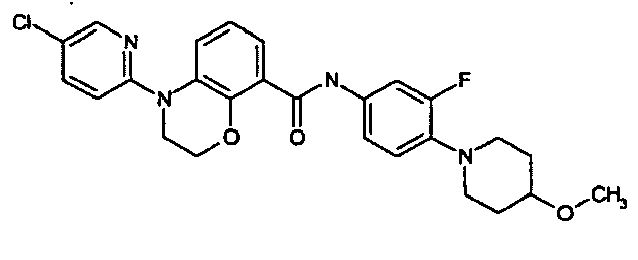
(300 MHz, DMSO-d6) δ: 1.54-1.63 (m, 2H), 1.96-2.01 (m, 2H), 2.74-2.77 (m, 2H), 3.16-3.18 (m, 2H), 3.29-3.33 (m, 4H), 4.03 (t, J = 4.2 Hz, 2H), 4.34 (t, J = 4.4 Hz, 2H), 6.95 - 7.02 (m, 2H), 7.23 (d, J = 9.2 Hz, 2H), 7.38 (d, J = 8.4 Hz, 1H), 7.50 (dd, J = 8.1, 0.7 Hz, 1 H), 7.64 (dd, J = 15.0, 2.2 Hz, 1H), 7.76 (dd, J = 9.0, 2.8 Hz, 1H), 8.32 (d, J = 2.6 Hz, 1H), 10.12 (s, 1H). 123 1-123 
(300 MHz, DMSO-d6) δ: 4.04 (t, J = 4.4 Hz, 2H), 4.35 (t, J = 4.4 Hz, 2H), 6.96 (t, J = 7.9 Hz, 1 H), 7.23-7.26 (m, 2H), 7.53 (dd, J = 8.3, 1.7 Hz, 1H), 7.71 (d, J = 8.8 Hz, 2H), 7.77 (dd, J = 9.0, 2.8 Hz, 1H), 7.95 (d, J = 8.4 Hz, 2H), 8.32 (d, J = 2.6 Hz, 1 H), 10.49 (s, 1 H). 124 1-124 
(400 MHz, DMSO-d6) 2.25 (s, 3H), 2.84 (t, J = 7.2 Hz, 2H), 3.50 (q, J = 6.6 Hz, 2H), 3.98 (t, J = 4.4 Hz, 2H), 4.28 (t, J = 4.6 Hz, 2H), 6.89 (t, J = 7.9 Hz, 1H), 7.24-7.35 (m, 8H), 7.65 (d, J = 8.8 Hz, 1H), 8.15-8.20 (m, 2H). 125 1-125 
(400 MHz, CHLOROFORM-d) 2.26 (s, 3H), 2.91 (t, J = 7.0 Hz, 2H), 3.73 (q, J = 6.5 Hz, 2H), 4.07 (t, J = 4.6 Hz, 2H), 4.21 (t, J =4.4 Hz, 2H), 6.92 (t, J = 7.9 Hz, 1H), 7.06 (d, J = 8.3 Hz, 1H), 7.20-7.21 (m, 2H), 7.27-7.30 (m, 2H), 7.36 (dd, J =7.9, 1.9 Hz, 2H), 7.74 (s, 1H), 7.82 (dd, J = 7.9, 1.4 Hz, 1 H), 8.14 (s, 1H). 126 1-126 
(400 MHz, CHLOROFORM-d) 2.26 (s, 3H), 2.91 (t, J = 6.7 Hz, 2H), 3.74 (q, J = 6.5 Hz, 2H), 4.08 (s, 2H), 4.24 (t, J = 4.4 Hz, 2H), 7.76 (s, 1H), 7.83 (d, J = 6.5 Hz, 1H), 8.14 (s, 1H). [Table 17] Ex. No. Chemical Compounds NMR 127 1-127 
(400 MHz, DMSO-d6) 2.26 (s, 3H), 2.98 (t, J = 7.2 Hz, 2H), 3.53 (q, J = 6.6 Hz, 2H), 3.99 (t, J = 4.4 Hz, 2H), 6.90 (t, J = 7.9 Hz, 1H), 7.23-7.33 (m, 4H), 7.38-7.40 (m, 2H), 7.44 (dd, J = 7.7, 1.6 Hz, 1H), 7.69 (d, J = 8.8 Hz, 1H), 8.16 (s, 1H), 8.23 (t, J = 5.3 Hz, 1 H). 128 1-128 
(300 MHz, DMSO-d6) δ: 4.16 (t, J = 4.4 Hz, 2H), 4.37 (t, J = 4.2 Hz, 2H), 6.99 (t, J = 7.9 Hz, 1H), 7.24-7.28 (m, 2H), 7.60 (dd, J = 8.3, 1.7 Hz, 1H), 7.71 (d, J = 8.8 Hz, 2H), 7.95 (d, J = 8.4 Hz, 2H), 8.08 (dd, J = 8.8, 2.2 Hz, 1H), 8.77 (d, J = 2.6 Hz, 1H), 10.51 (s, 1H). 129 1-129 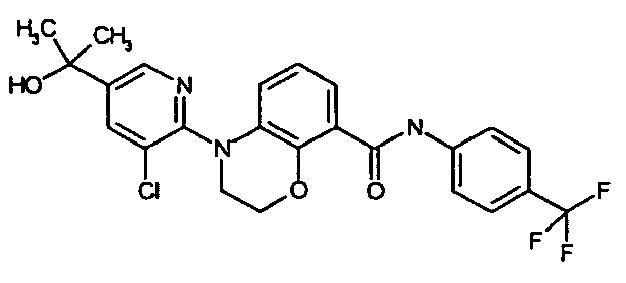
(300 MHz, DMSO-d6) δ: 1.51 (s, 6H), 3.78 (t, J = 4.2 Hz, 2H), 4.43 (t, J = 4.2 Hz, 2H), 5.33 (s, 1H), 6.46-6.52 (m, 1H), 6.83 (t, J = 16.7 Hz, 1H), 7.05 (dd, J = 7.7, 1.5 Hz, 1H), 7.68-7.71 (m, 2H), 7.94-7.97 (m, 2H), 8.04 (d, J = 2.2 Hz, 1H), 8.51 (d, J = 2.2 Hz, 1H), 10.50 (s, 1H). 130 1-130 
(300 MHz, DMSO-d6) δ: 1.40 (d, J = 6.6 Hz, 3H), 3.76-3.80 (m, 2H), 4.41-4.44 (m, 2H), 4.82-4.84 (m, 1H), 5.43 (d, J = 4.8 Hz, 1H), 6.47 (dd, J = 8.1, 1.5 Hz, 1H), 6.81 (t, J = 7.9 Hz, 1H), 7.05 (d, J = 3.9 Hz, 1H), 7.70 (d, J = 8.8 Hz, 2H), 7.95-7.96 (m, 4H), 8.40-8.40 (m, 1H), 10.50 (s, 1H). 131 1-131 
(300 MHz, DMSO-d6) δ: 3.90-3.92 (m, 2H), 4.42-4.43 (m, 2H), 6.77 (d, J =4.0 Hz, 1H), 6.87 (d, J = 7.7 Hz, 1H), 7.16 - 7.17 (m, 1H), 7.73 (d, J = 9.2 Hz, 2H), 7.96 (d, J = 14.3 Hz, 1H), 8.30 (d, J = 1.8 Hz, 1H), 8.83 (d, J = 1.8 Hz, 1H), 10.72 (s, 1H). 132 1-132 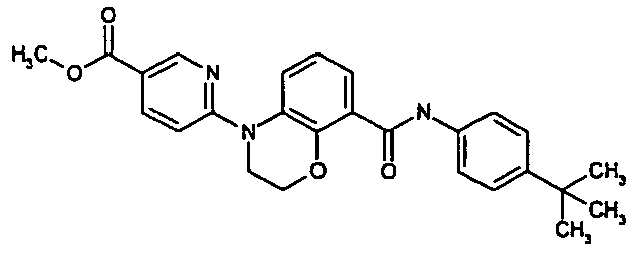
(400 MHz, CHLOROFORM-d) 1.33 (s, 9H), 3.92 (s, 3H), 4.36 (t, J = 4.6 Hz, 2H), 4.55 (t, J = 4.6 Hz, 2H), 7.06 (t, J = 7.9 Hz, 1H). 7.21 (d, J = 8.8 Hz, 1H), 7.38 (t, J = 4.4 Hz, 2H), 7.52 (dd, J = 8.1, 1.6 Hz, 3H), 7.58 (dd, J = 6.7, 4.9 Hz, 3H), 8.02 (dd, J = 7.9, 1.4 Hz, 2H), 8.08 (dd, J = 8.8, 2.3 Hz, 2H), 8.93 (d, J = 2.3 Hz, 1H), 9.48 (s, 1H). 133 1-133 
(400 MHz, CHLOROFORM-d) 1.28 (s, 9H), 4.16 (t, J = 4.2 Hz, 2H), 4.37 (t, J = 4.2 Hz, 2H), 6.98 (t, J = 7.9 Hz, 1H), 7.26 (dd, J = 20.4, 8.3 Hz, 2H), 7.35 (d, J = 8.8 Hz, 2H), 7.57 (d, J = 8.3 Hz, 1H), 7.64 (d, J = 8.8 Hz, 2H), 8.07 (dd, J = 8.8, 1.9 Hz, 1H), 8.77 (d, J = 2.3 Hz, 1H). 10.07 (s, 1H). [Table 18] Ex. No. Chemical Compounds NMR 134 1-134 
(300 MHz.DMSO-d6) 3.92 (t, J = 4.2 Hz, 2H), 4.43 (t, J = 4.4 Hz, 2H), 6.76 (dd, J = 8.1. 1.5 Hz, 1H), 6.86 (t, J = 7.9 Hz, 1H), 7.17 (dd. J = 7.5.1.7 Hz, 1H), 7.71 (d, J = 8.8 Hz, 2H), 7.97 (d, J = 8.4 Hz, 2H), 8.31 (d, J = 2.2 Hz, 1H). 8.83 (d, J = 2.2 Hz, 1H), 10.53 (s, 1 H). 135 1-135 
(300 MHz,DMSO-d6) 1.28 (s, 9H), 3.92 (t, J = 4.2 Hz, 2H), 4.44 (t, J = 4.2 Hz, 2H), 6.73 (dd, J = 8.1, 1.5 Hz, 1 H). 6.84 (t, J = 7.9 Hz, 1H), 7.18 (dd, J = 7.5,1.7 Hz, 1H), 7.35 (d, J = 8.8 Hz, 2H), 7.65 (d, J = 8.8 Hz, 2H), 8.30 (d, J = 2.2 Hz, 1 H), 8.83 (d, J = 2.2 Hz, 1H), 10.07 (s, 1H). 136 1-136 
(300 MHz, DMSO-d6) δ: 2.62 (s, 3H), 3.94 (t, J = 4.6 Hz, 2H), 4.44 (t, J = 4.4 Hz, 2H), 6.76 (dd, J = 8.1, 1.8 Hz, 1H), 6.87 (t, J = 7.9 Hz, 1H), 7.19 (dd, J = 7.3, 1.5 Hz, 1H), 7.71 (d, J = 8.4 Hz, 3H), 7.97 (d, J = 8.4 Hz, 3H), 8.38 (d, J = 2.2 Hz, 1H). 8.91 (d, J = 1.8 Hz, 1H), 10.52 (s, 1H). 137 1-137 
(400 MHz, DMSO-d6) 1.27 (s, 9H), 2.78 (d, J = 4.6 Hz, 3H), 4.14 (t, J = 4.2 Hz, 2H), 4.36 (t, J = 4.6 Hz, 2H), 6.98 (t, J = 7.9 Hz, 1H). 7.26 (q, J = 7.4 Hz, 2H), 7.35 (d, J = 8.8 Hz, 2H), 7.56 (d, J = 8.3 Hz, 1H), 7.64 (d, J = 8.8 Hz, 2H), 8.05 (dd, J = 8.8, 2.3 Hz, 1H). 8.39 (d, J = 5.6 Hz, 1H), 8.73 (d, J = 2.3 Hz, 1H), 10.06 (s, 1 H). 138 1-138 
(400 MHz, DMSO-d6) 1.28 (s, 9H), 4.15 (t, J = 4.4 Hz, 2H), 4.36 (t, J = 4.4 Hz, 2H), 6.98 (t, J = 7.9 Hz, 1H), 7.25-7.33 (m, 5H), 7.56 (d, J = 8.3 Hz, 1H), 7.64 (d, J = 8.8 Hz, 2H), 7.93 (s, 1H), 8.09 (dd, J = 8.8, 2.8 Hz, 1H), 8.78 (d, J = 2.3 Hz, 1H), 10.07 (s, 1H). 139 1-139 
(400 MHz, DMSO-d6) 1.08 (t, J = 7.0 Hz, 6H), 1.27 (s, 9H), 3.31-3.40 (m, 4H), 3.82 (t, J = 4.4 Hz, 2H), 4.34 (t, J = 4.4 Hz, 2H), 6.81 (t, J = 7.9 Hz, 1H), 7.02-7.16 (m, 4H), 7.34 (d, J = 8.8 Hz, 2H), 7.64 (d, J = 8.3 Hz, 2H), 7.85 (d, J = 3.2 Hz, 1 H), 10.02 (s, 1 H). 140 1-140 
(400 MHz, CHLOROFORM-d) 1.33 (s, 9H), 4.44 (dd, J = 6.0, 3.2 Hz, 2H), 4.59 (t, J = 4.9 Hz, 2H), 7.10-7.12 (m, 1H), 7.25-7.26 (m, 1H), 7.39 (dd, J = 8.6, 1.6 Hz, 2H), 7.52-7.54 (m, 1H), 7.58 (dd, J = 8.6, 1.6 Hz, 2H), 8.09-8.11 (m, 1H), 8.26-8.28 (m, 1H), 9.17 (t, J = 1.9 Hz, 1H), 9.40 (s, 1H). [Table 19] Ex. No. Chemical Compounds NMR 141 1-141 
(400 MHz, CHLOROFORM-d) 1.32 (s, 9H), 3.54 (s, 2H), 4.02 (t, J = 4.4 Hz, 2H), 4.49 (t, J = 4.4 Hz, 2H), 6.92 (t, J = 8.1 Hz, 1H), 7.00-7.03 (m, 2H), 7.22-7.26 (m, 1H), 7.37 (t, J = 4.4 Hz, 2H), 7.59 (d, J = 8.3 Hz, 2H), 7.80 (dd, J = 7.9, 1.4 Hz, 1H), 7.91 (d, J = 2.8 Hz, 1H), 9.59 (s, 1 H). 142 1-142 
(400 MHz, DMSO-d6) 1.28 (s, 9H), 2.05 (s, 3H), 3.98 (t, J = 4.2 Hz, 2H), 4.33 (t, J = 4.2 Hz, 2H), 6.91 (t, J = 7.9 Hz, 1H), 7.19 (dd, J = 13.0, 8.3 Hz, 2H), 7.33 (dd, J = 12.3, 6.7 Hz, 2H), 7.40 (d, J = 8.3 Hz, 1H), 7.64 (d, J = 8.3 Hz, 2H), 7.92 (t, J = 5.8 Hz, 1H), 8.49 (s, 1H), 10.05 (s, 2H). 143 1-143 
(400 MHz, DMSO-d6) 3.29 (s, 3H), 4.06 (t, J = 4.4 Hz, 2H), 4.34 (t, J = 4.6 Hz, 2H), 4.36 (s, 2H), 6.95 (t, J = 7.9 Hz, 1H), 7.22 (d, J = 8.3 Hz, 2H), 7.52 (dd, J = 8.1, 1.6 Hz, 1H), 7.65 (dd, J = 8.6, 2.6 Hz, 1H), 7.71 (d, J = 8.8 Hz, 2H), 7.95 (d, J = 8.8 Hz, 2H), 8.26 (d, J = 1.9 Hz, 1 H), 10.50 (s, 1H). 144 1-144 
(300 MHz, DMSO-d6) δ: 1.34 (t, J = 7.0 Hz, 3H), 3.91 (t, J = 4.4 Hz, 2H), 4.08 (q, J = 7.1 Hz, 2H), 4.33 (t, J = 4.2 Hz, 2H), 6.88 (t, J = 7.9 Hz, 1H), 7.12-7.17 (m, 2H), 7.28-7.41 (m, 4H), 7.85 (d, J = 9.2 Hz, 2H), 8.06 (d, J = 3.3 Hz, 1H), 10.31 (s, 1H). 145 1-145 
(400 MHz, DMSO-d6) 3.71 (t, J = 4.4 Hz, 2H), 3.90 (s, 3H), 4.44 (t, J = 4.4 Hz, 2H), 6.36 (dd, J = 7.9, 1.4 Hz, 1 H), 6.78 (t, J = 7.9 Hz, 1H), 6.99 (dd, J = 7.9, 1.4 Hz, 1H), 7.71 (d, J = 8.3 Hz, 2H), 7.77 (d, J = 2.8 Hz, 1H), 7.97 (d, J = 8.3 Hz, 2H), 8.22 (d, J = 2.8 Hz, 1H), 10.50 (s, 1H). 146 1-146 
(400 MHz, DMSO-d6) 3.86 (t, J = 4.4 Hz, 2H), 4.33 (t, J = 4.4 Hz, 2H), 6.86 (t, J = 7.9 Hz, 1H), 7.07-7.10 (m, 2H), 7.18-7.23 (m, 2H), 7.70 (d, J = 8.3 Hz, 2H), 7.94-7.95 (m, 3H), 9.72 (brs, 1H), 10.48 (s, 1H). 147 1-147 
(400 MHz, DMSO-d6) 3.81 (s, 3H), 3.92 (t, J = 4.4 Hz, 2H), 4.34 (t, J = 4.4 Hz, 2H), 6.89 (t, J = 7.9 Hz, 1H), 7.12 (dd, J = 7.9, 1.6 Hz, 1H), 7.20 (d, J = 9.3 Hz, 1H), 7.31 (dd, J = 7.9, 1.6 Hz, 1H), 7.41 (dd, J = 9.3, 3.2 Hz, 1H), 7.71 (d, J = 8.8 Hz, 2H), 7.96 (d, J = 8.8 Hz, 2H), 8.08 (d, J = 3.2 Hz, 1H), 10.50 (s, 1 H). 148 1-148 
(300MHz, DMSO-d6)1.28 (s, 9H), 4.08 (t, J = 4.4 Hz, 2H), 4.34 (t, J = 4.4 Hz, 2H), 6.97 (t, J = 7.9 Hz, 1H), 7.02 (dd, J = 5.3, 1.7 Hz, 1H), 7.20 (d, J = 1.5 Hz, 1H), 7.28 (dd, J = 7.7, 1.5 Hz, 1H), 7.35 (d, J = 8.8 Hz, 2H), 7.56 (dd, J = 8.4, 1.5 Hz, 1H), 7.64 (d, J = 8.8 Hz, 2H), 8.27 (d, J = 5.1 Hz, 1 H), 10.04 (s, 1 H). [Table 20] Ex. No. Chemical Compounds NMR 149 1-149 
(300MHz,DMSO-d6) 3.99 (t, J = 4.4 Hz, 2H), 4.35 (t, J = 4.2 Hz, 2H), 6.94 (t, J = 7.7 Hz, 1 H), 7.19-7.28 (m, 2H), 7.22 (s, 2H), 7.45 (d, J = 4.0 Hz, 1 H), 7.65 (dd, J = 8.6, 3.1 Hz, 1 H), 7.71 (d, J = 8.8 Hz, 2H), 7.96 (d, J = 8.8 Hz, 2H), 8.31 (d, J = 2.9 Hz, 1H), 10.49 (s, 1 H). 150 1-150 
(300MHz,DMSO-d6) 3.83 (t, J = 4.2 Hz, 2H), 4.43 (t, J = 4.4 Hz, 2H), 6.74-6.77 (m, 1 H), 6.85 (t, J = 7.9 Hz, 1 H), 7.09 (dd, J = 7.3, 1.5 Hz, 1H), 7.71 (d, J = 8.8 Hz, 2H), 7.96 (d, J = 8.4 Hz, 2H), 8.00-8.07 (m, 1 H), 8.35 (d, J = 2.2 Hz, 1H), 10.51 (s, 1 H). 151 1-151 
(300 MHz, CHLOROFORM-d) 1.32 (s, 9H), 3.82 (s, 3H), 3.93 (t, J = 4.4 Hz, 2H), 4.58 (t, J = 4.4 Hz, 2H), 6.68 (dd, J = 8.1, 1.5 Hz, 1 H), 6.85 (t, J = 7.9 Hz, 1H), 7.10 (dd, J = 8.1, 4.8 Hz, 1H), 7.24 (dd, J = 8.1, 1.1 Hz, 1H), 7.37 (d, J = 8.8 Hz, 2H), 7.60 (d, J = 8.4 Hz, 2H), 7.75 (dd, J = 7.9, 1.7 Hz, 1H), 8.03 (dd, J = 4.6, 1.3 Hz, 1 H), 9.63 (s, 1 H). 152 1-152 
(300 MHz,DMSO-d6) δ: 0.86 (s, 9H), 0.96-1.00 (m, 1H), 1.27-1.39 (m, 2H), 1.64 (d, J = 13.2 Hz, 2H), 2.22 (s, 3H), 2.58 (d, J =10.6 Hz, 2H), 3.07 (d, J = 10.3 Hz, 2H), 3.96 (t, J = 4.2 Hz, 2H), 4.27 (t, J = 4.4 Hz, 2H), 6.84 (t, J = 7.7 Hz, 1H), 7.05-7.10 (m, 2H), 7.34 (dd, J = 8.1, 1.5 Hz, 1H), 7.50 (dd, J = 8.6, 2.0 Hz, 1H), 8.13 (d, J = 2.2 Hz, 1 H), 8.88 (s, 1H). 153 1-153 
(400 MHz, DMSO-d6) 3.72 (q, J = 5.1 Hz, 2H), 3.92 (t, J = 4.2 Hz, 2H), 4.04 (t, J = 5.1 Hz, 2H), 4.34 (t, J = 4.2 Hz, 2H), 4.89 (t, J = 5.1 Hz, 1H), 6.89 (t, J = 7.9 Hz, 1H), 7.12-7.13 (m, 1H), 7.19 (d, J = 8.8 Hz, 1H), 7.31-7.32 (m, 1H), 7.42 (dd, J = 8.8, 3.2 Hz, 1H), 7.71 (d, J = 8.3 Hz, 2H), 7.96 (d, J = 8.3 Hz, 2H), 8.08 (d, J = 2.8 Hz, 1H). 10.49 (s, 1 H). 154 1-154 
(300 MHz, DMSO-d6) 2.77 (t, J = 6.4 Hz, 2H), 3.67 (q, J = 5.9 Hz, 2H), 3.77 (t, J = 4.4 Hz, 2H), 4.43 (t, J = 4.2 Hz, 2H), 4.72 (t, J 5.1 Hz, 1H), 6.47 (dd, J 8.1. 1.8 Hz, 1H), 6.80 (t, J = 7.9 Hz, 1H), 7.04 (dd, J = 7.7, 1.5 Hz, 1H), 7.69-7.72 (m, 3H), 7.96 (dd, J = 9.9, 5.1 Hz, 3H), 8.30 (d, J = 1.8 Hz, 1H), 10.50 (s, 1H). 155 1-155 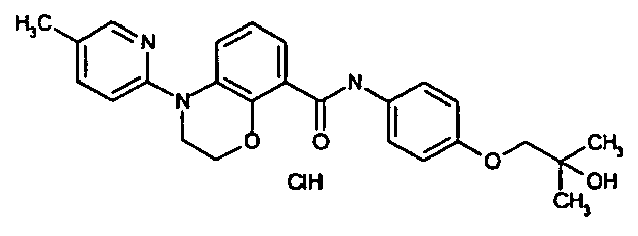
(400 MHz, DMSO-d6) δ: 1.20 (s, 6H), 2.318s, 3H), 3.65(s, 2H), 4.04 (t, J=4.4Hz, 2H), 4.37(t, J=4.4Hz, 2H), 6.72 (m, 3H), 7.28(m, 2H), 7.30 (dd, J = 8.1, 1.8 Hz, 1H), 7.63 (dd, J = 9.0, 2.4 Hz, 1H), 7.72 (dd, J = 9, 2.4 Hz, 2H), 8.18 (d, J = 2.6 Hz, 1H), 10.00 (s, 1H). 156 1-156 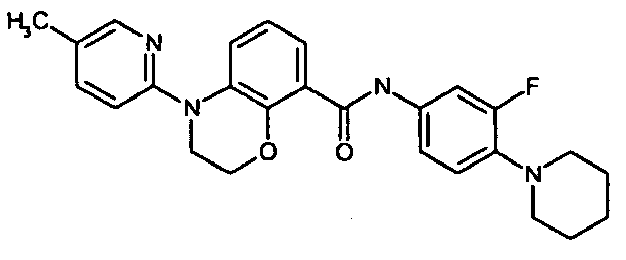
(400 MHz, DMSO-d6) δ: 1.50-1.51 (m, 2H), 1.60-1.66 (m, 4H), 2.21 (s, 3H), 2.89-2.90 (m, 4H), 3.97 (t, J = 4.4 Hz, 2H), 4.30 (t, J = 4.4 Hz, 2H), 6.89 (t, J = 7.9 Hz, 1 H), 6.99 (t, J = 9.5 Hz, 1H), 7.12-7.14 (m, 2H), 7.38 (ddd, J = 13.6, 8.2, 1.7 Hz, 2H), 7.51 (dd, J = 8.8, 2.3 Hz, 1H), 7.63 (dd, J = 14.8, 2.3 Hz, 1H), 8.13-8.14 (m, 1H), 10.11 (s, 1H). [Table 21] Ex. No. Chemical Compounds NMR 157 1-157 
(400 MHz, DMSO-d6) δ: 2.21 (s, 3H), 2.90-2.96 (m, 4H), 3.71-3.72 (m, 4H), 3.96 (t, J = 20.4 Hz, 2H), 4.30 (t, J = 4.2 Hz, 2H), 6.89 (dd, J = 5.3, 2.6 Hz, 1H), 7.00 (t, J = 9.5 Hz, 1H), 7.11-7.14 (m, 2H), 7.39-7.41 (m, 2H), 7.51 (td, J = 4.2, 2.0 Hz, 1H), 7.66 (dd, J = 15.1, 2.1 Hz, 1H), 8.13-8.14 (m, 1H), 10.15 (s, 1H). 158 1-158 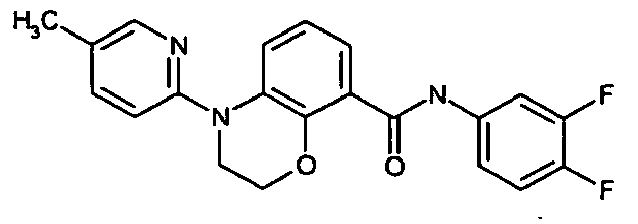
(400 MHz, DMSO-d6) δ: 2.21 (s, 3H), 3.97 (t, J = 4.4 Hz, 2H), 4.30 (t, J = 4.4 Hz, 2H), 6.90 (dd, J = 11.1, 4.6 Hz, 1H), 7.13 (td, J = 6.0, 4.3 Hz, 2H), 7.36-7.53 (m, 4H), 7.89-7.92 (m, 1H), 8.13-8.14 (m, 1H), 10.35 (s, 1H). 159 1-159 
(400 MHz, DMSO-d6) δ: 2.21 (s, 3H), 3.80 (s, 3H), 3.97 (t, J = 4.4 Hz, 2H), 4.30 (t, J = 4.4 Hz, 2H), 6.89 (t, J = 7.9 Hz, 1H), 7.11-7.16 (m, 3H), 7.41 (q, J = 4.6 Hz, 2H), 7.51 (dd, J = 8.3, 2.3 Hz, 1H), 7.70 (dd, J = 13.7, 2.6 Hz, 1H), 8.13 (s, 1H), 10.14 (s, 1H). 160 1-160 
(400 MHz, DMSO-d6) δ: 1.32 (t, J = 7.0 Hz, 3H), 2.25 (d, J = 10.6 Hz, 3H), 3.96-4.03 (m, 4H), 4.32 (t, J = 4.4 Hz, 2H), 6.88-6.93 (m, 3H), 7.16 (td, J = 9.4, 3.8 Hz, 2H), 7.41 (dd, J = 8.1, 1.8 Hz, 1H), 7.52 (dd, J = 9.0, 2.4 Hz, 1H), 7.63 (dt, J = 9.9, 2.8 Hz, 2H), 8.15 (d, J = 2.6 Hz, 1H), 9.98 (s, 1H). 161 1-161 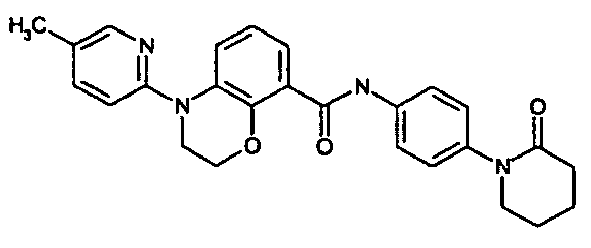
(300 MHz, DMSO-d6) δ: 1.83-1.86 (m, 4H), 2.23 (s, 3H), 2.36-2.39 (m, 1H), 3.56-3.60 (m, 2H), 3.98-4.01 (m, 2H), 4.31-4.34 (m, 2H), 6.91-6.94 (m, 1H), 7.12-7.23 (m, 4H), 7.47 (dd, J = 31.2. 7.7 Hz, 2H), 7.72 (d, J = 8.1 Hz, 2H), 8.15 (s.1H). 10.16 (s, 1 H). 162 1-162 
(300 MHz, DMSO-d6) δ: 1.83-1.91 (m, 2H), 2.23 (s, 3H), 2.63-2.65 (m, 2H), 2.80 (s, 3H), 3.16-3.18 (m, 2H), 3.99 (t, J = 4.4 Hz, 2H), 4.32 (t, J = 4.2 Hz, 2H), 6.81 (d, J = 8.1 Hz, 1H), 6.90 (dd, J = 9.2, 6.6 Hz, 2H), 7.02-7.06 (m, 1H), 7.14 - 7.17 (m, 2H), 7.40 (d, J = 8.4 Hz, 1H), 7.52 (d, J = 8.4 Hz, 1H), 8.14-8.15 (m, 1H), 9.83 (s, 1H). 163 1-163 
(300 MHz, DMSO-d6) δ: 2.23 (s, 3H), 2.73 (s, 6H), 3.99 (t, J = 4.2 Hz, 2H), 4.32 (t, J = 4.4 Hz, 2H), 6.90-6.95 (m, 2H), 7.13-7.17 (m, 2H), 7.36-7.43 (m, 2H), 7.52 (dd, J = 8.4. 2.2 Hz, 1H), 7.63 (dd, J = 15.4, 2.2 Hz, 1 H), 8.15 (d, J = 1.8 Hz, 1H), 10.08 (s, 1H), 164 1-164 
(300 MHz, DMSO-d6) δ: 1.09-1.18 (m, 7H), 2.28 (s, 3H), 3.11 (s, 3H), 3.38-3.41 (m, 2H), 3.56-3.59 (m, 1H), 4.01 - 4.05 (m, 2H), 4.37-4.38 (m, 2H), 6.96 (t, J = 7.9 Hz, 1H), 7.27 (dd, J =18.5, 7.9 Hz, 2H), 7.46 (d, J = 8.1 Hz, 1H). 7.54-7.58 (m, 1H), 7.75 (d, J = 8.8 Hz, 1H), 7.88 (d, J = 13.2 Hz, 1H), 8.17-8.21 (m, 1H). 10.52 (s, 1H). 165 1-165 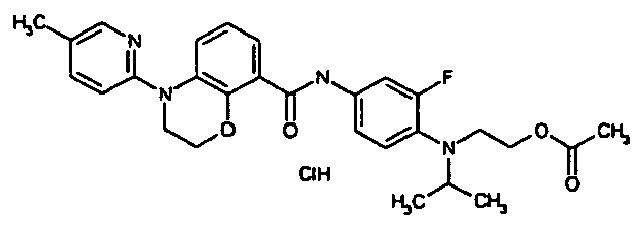
(300 MHz, DMSO-d6) δ: 1.05-1.07 (m, 6H), 2.26 (s, 3H), 2.26 (s, 3H), 3.31 (s, 1H), 3.95-4.00 (m, 3H), 4.27-4.42 (m, 2H), 6.93 (t, J = 7.9 Hz, 1H), 7.19-7.23 (m, 2H), 7.39-7.44 (m, 2H), 7.63-7.69 (m, 2H), 8.17-8.19 (m, 1H), 10.21 (s, 1H). [Table 22] Ex. No. Chemical Compounds NMR 166 1-166 
(300 MHz, DMSO-d6) δ: 1.17-1.20 (m, 6H), 2.26 (s, 3H), 3.45-3.50 (m, 4H), 3.77-3.80 (m, 1H). 3.99-4.04 (m, 2H), 4.35 (t, J = 4.4 Hz, 2H), 6.95 (t, J = 7.9 Hz, 1H), 7.22 (dt, J = 10.5. 4.7 Hz, 2H), 7.46 (dd. J = 8.1, 1.5 Hz, 1H). 7.57-7.66 (m, 3H), 7.89 (d, J = 13.9 Hz, 1H). 8.18 (d, J = 1.1 Hz, 1H). 10.52 (s, 1H), 167 1-167 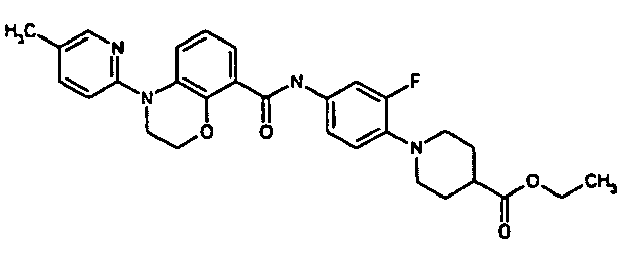
(400 MHz, DMSO-d6) δ: 1.20 (t, J = 5.1 Hz, 3H), 1.66-1.79 (m, 2H), 1.91-1.99 (m, 2H), 2.25 (s, 3H), 2.69-2.72 (m, 2H), 3.24-3.33 (m, 1H), 3.99 (t, J = 4.8 Hz, 2H), 4.09 (q, J = 26.4 Hz, 2H), 4.32 (t, J = 4.4 Hz, 2H), 6.90 (t, J = 7.9 Hz, 1H), 7.01 (t, J = 9.4 Hz, 1H), 7.13-7.16 (m, 2H), 7.40 (td, J = 8.1, 4.0 Hz, 2H), 7.52 (dt, J = 8.4, 1.3 Hz, 1H), 7.65 (dd, J = 14.9, 2.4 Hz, 1H), 8.15 (t. J = 1.3 Hz, 1H), 10.12 (s, 1H). 168 1-168 
(300 MHz, DMSO-d6) δ: 1.67-1.75 (m, 2H), 1.91-1.94 (m, 2H), 2.23 (s, 3H), 2.33-2.38 (m, 1H), 2.67-2.71 (m, 2H), 3.19-3.25 (m, 2H), 3.99 (t, J = 4.2 Hz, 2H), 4.32 (t, J = 4.4 Hz, 2H), 6.90 (t, J = 7.9 Hz, 1H), 7.01 (t, J = 9.5 Hz, 1H), 7.13-7.17 (m, 2H), 7.40 (td, J = 8.4, 1.7 Hz, 2H), 7.52 (dt, J = 9.5, 1.3 Hz, 1H), 7.65 (dd, J = 14.9, 2.4 Hz, 1H), 8.15 (t, J = 1.3 Hz, 1H), 10.12 (s, 1H). 169 1-169 
(400 MHz, DMSO-d6) δ: 1.55-1.58 (m, 2H), 1.93-1.95 (m, 1H), 2.20 (s, 3H), 2.74 (dt, J = 15.0, 5.4 Hz, 2H), 3.13-3.18 (m, 2H), 3.31 (s, 3H), 3.97 (t, J = 4.4 Hz, 2H), 4.30 (t, J = 4.4 Hz, 2H), 6.89 (t, J = 7.9 Hz, 1 H), 7.00 (t, J = 9.5 Hz, 1 H), 7.13 (dt, J = 11.3, 5.0 Hz, 2H), 7.38 (ddd, J = 13.9, 8.3,1.9 Hz, 2H), 7.51 (dd, J = 8.3, 2.3 Hz, 1H), 7.63 (dd, J = 14.8, 2.3 Hz, 1H), 8.14 (d, J = 2.3 Hz, 1H), 10.12 (s, 1H). 170 1-170 
(400 MHz, DMSO-d6) δ: 1.69-1.73 (m, 2H), 1.93-1.98 (m, 2H), 2.02 (s, 3H), 2.22 (s, 3H), 2.82-2.88 (m, 2H), 3.13-3.19 (m, 2H), 3.97 (t, J = 4.4 Hz, 2H), 4.30 (t, J = 4.4 Hz, 2H), 4.77-4.81 (m, 1H), 6.89 (t, J = 7.9 Hz, 1H), 7.03 (t, J = 9.3 Hz, 1H),7.13(dt, J= = 11.1, 4.9 Hz, 2H), 7.39 (dt, J = 13.0, 4.9 Hz, 2H), 7.51 (dd, J = 8.3, 2.3 Hz, 1H), 7.65 (dd, J = 14.8, 2.3 Hz, 1H), 8.14 (d, J = 1.2 Hz, 1H), 10.13 (s, 1H). 171 1-171 
(300 MHz, DMSO-d6) δ: 1.50-1.57 (m, 2H), 1.84-1.85 (m, 2H), 2.25 (s, 3H), 2.70-2.74 (m, 2H), 3.18-3.20 (m, 2H), 3.59-3.62 (m, 1H), 3.99 (t, J = 4.2 Hz, 2H), 4.32 (t, J = 4.4 Hz, 2H), 4.66 (d, J = 4.4 Hz, 1H), 6.90 (t, J = 7.9 Hz, 1H), 7.01 (t, J = 9.4 Hz, 1H), 7.13-7.16 (m, 2H), 7.36-7.43 (m, 2H), 7.52 (dd, J = 8.4, 2.6 Hz, 1H), 7.64 (dd, J = 15.0, 2.2 Hz, 1H), 8.15 (d, J = 2.6 Hz, 1H), 10.11 (s, 1H). 172 1-172 
(400 MHz, DMSO-d6) 2.11 (s, 3H), 2.23 (s, 3H), 3.99 (t, J = 4.2 Hz, 2H), 4.32 (t, J = 4.2 Hz, 2H), 6.91 (t, J = 7.9 Hz, 1H), 7.06 (d, J = 7.9 Hz, 1H), 7.14 (d, J = 8.3 Hz, 1H), 7.17-7.20 (m, 3H), 7.41 (d, J = 7.9 Hz, 1H), 7.48 (s, 1H), 7.53 (dd, J = 8.3, 2.3 Hz, 1H), 8.15 (s, 1H), 10.06 (s, 1H). 173 1-173 
(400 MHz, DMSO-d6) 2.13 (s, 3H), 2.23 (s, 3H), 3.75 (q, J = 5.3 Hz, 2H), 3.97 (dt, J = 15.3, 4.6 Hz, 4H), 4.33 (t, J = 4.4 Hz, 2H), 4.83 (t, J = 5.6 Hz, 1H), 6.91 (t, J = 7.9 Hz, 1H), 7.06 (d, J = 8.3 Hz, 1H), 7.16 (dd, J = 18.6, 7.9 Hz, 3H), 7.43 (t, J = 9.0 Hz, 2H), 7.53 (dd, J = 8.8. 1.9 Hz, 1H), 8.15 (s, 1H), 10.03 (s, 1H). [Table 23] Ex. No. Chemical Compounds NMR 174 1-174 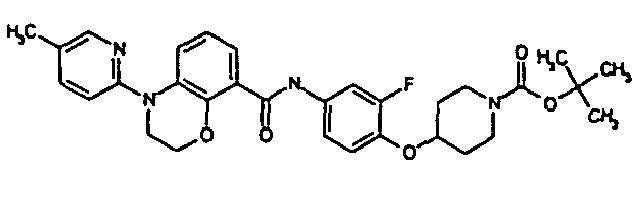
(400 MHz, DMSO-d6) 1.55 (br s. 2H), 1.87-1.90 (m, 2H), 2.23 (s, 3H), 2.54 (s, 6H), 3.17-3.19 (m, 2H), 3.63 (br s, 2H), 3.99 (t, J = 4.4 Hz, 2H), 4.31 (t, J = 4.4 Hz, 2H), 4.47 (s, 1H). 6.91 (t, J = 7.9 Hz, 1H), 7.15-7.21 (m. 3H), 7.40-7.43 (m, 2H), 7.51-7.54 (m, 1H), 7.73 (dd, J = 13.2, 2.1 Hz, 1H). 8.15 (d, J = 1.9 Hz, 1H), 10.18 (s, 1H). 175 1-175 
(400 MHz, DMSO-d6) 1.86-1.91 (m, 3H), 2.08-2.13 (m, 2H), 2.29 (s, 3H), 3.06 (br s, 2H), 3.20 (br s, 2H), 4.06 (t, J = 4.2 Hz, 2H), 4.38 (t, J = 4.2 Hz, 2H), 4.55-4.59 (m, 1H), 6.96 (t, J = 7.9 Hz, 1H), 7.25 (dd, J = 12.3, 5.8 Hz, 2H), 7.33 (d, J = 8.8 Hz, 1H), 7.45 (dd, J = 10.7, 3.7 Hz, 2H), 7.75-7.80 (m, 2H), 8.20 (s, 1H), 9.12 (d, J = 32.5 Hz, 2H), 10.25 (s, 1H), 176 1-176 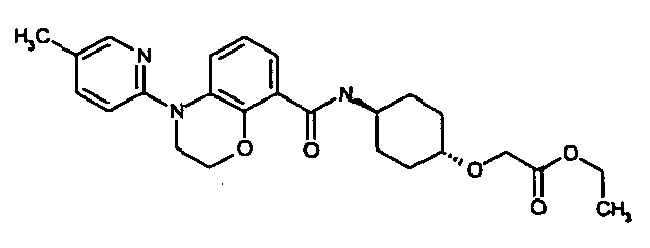
(400 MHz, DMSO-d6) 1.19 (t, J = 7.2 Hz, 3H), 1.25-1.31 (m, 4H), 1.85-1.99 (m, 4H), 2.20 (s, 3H), 3.28-3.34 (m, 1H), 3.70-3.73 (m, 1 H), 3.95 (t, J = 4.4 Hz, 2H), 4.07-4.13 (m, 4H), 4.27 (t, J = 4.4 Hz, 2H), 6.84 (t, J = 7.9 Hz, 1H), 7.07 (d, J = 8.3 Hz, 1 H), 7.17 (dd, J = 7.9, 1.4 Hz, 1H), 7.33 (dd, J = 8.1, 1.6 Hz, 1H), 7.48 (dd, J = 8.3, 1.9 Hz, 1 H), 7.90 (d, J = 7.9 Hz, 1H), 8.12 (d, J = 2.3 Hz, 1H). 177 1-177 
(400 MHz, DMSO-d6) 1.21-1.35 (m, 4H), 1.85-1.99 (m, 4H), 2.20 (s, 3H), 3.22-3.38 (m, 1H). 3.69-3.74 (m, 1H). 3.95 (t, J = 4.2 Hz, 2H), 4.00 (s, 2H), 4.27 (t, J = 4.2 Hz, 2H), 6.84 (t, J = 7.9 Hz, 1H), 7.07 (d, J = 8.3 Hz, 1H), 7.18 (d, J = 7.4 Hz, 1H), 7.33 (dd, J = 8.1. 1.6 Hz, 1 H), 7.48 (d, J = 8.8 Hz, 1H), 7.90 (d, J = 7.4 Hz, 1H), 8.12 (s, 1H), 12.46 (brs, 1H). 178 1-178 
(400 MHz, DMSO-d6) 1.26-1.36 (m, 4H), 1.88 (brs, 2H), 1.99 (brs, 2H), 2.20 (s, 3H), 3.26-3.30 (m, 1H), 3.70-3.74 (m, 1H), 3.79 (s, 2H), 3.95 (brs, 2H), 4.27 (brs, 2H), 6.84 (t, J = 7.9 Hz, 1H), 7.04 (brs, 1H), 7.07 (d, J = 8.3 Hz, 1H), 7.17 (d, J = 7.4 Hz, 1H), 7.22 (brs, 1H), 7.33 (d, J = 8.3 Hz, 1H), 7.48 (d, J = 8.3 Hz, 1H), 7.91 (d, J = 7.9 Hz, 1H), 8.12 (s, 1H). 179 1-179 
(400 MHz, DMSO-d6) 1.28-1.33 (m, 4H), 1.88 (brs, 2H), 1.99 (brs, 2H), 2.20 (s, 3H), 2.61 (d, J = 4.6 Hz, 3H), 3.26 - 3.29 (m, 1H), 3.71-3.74 (m, 1H), 3.84 (s, 2H), 3.95 (t, J = 4.4 Hz, 2H), 4.27 (t, J = 4.4 Hz, 2H), 6.84 (t, J = 7.9 Hz, 1H), 7.07 (d, J = 8.8 Hz, 1H), 7.17 (dd, J = 7.7, 1.6 Hz, 1H), 7.33 (dd, J = 8.1, 1.6 Hz, 1H), 7.48 (dd, J = 8.3, 2.3 Hz, 1H), 7.53 (brs, 1H), 7.92 (d, J = 7.9 Hz, 1H), 8.12 (d, J = 2.3 Hz, 1H). 180 1-180 
(400 MHz, DMSO-d6) 1.25-1.31 (m, 4H), 1.86-2.00 (m, 4H), 2.20 (s, 3H), 2.79 (s, 3H), 2.92 (s, 3H), 3.26-3.29 (m, 1H), 3.70-3.74 (m, 1H), 3.95 (t, J = 4.4 Hz, 2H), 4.10 (s, 2H), 4.27 (t, J = 4.4 Hz, 2H), 6.84 (t, J = 7.9 Hz, 1H), 7.07 (d, J = 8.3 Hz, 1H). 7.17 (dd, J = 7.4, 1.4 Hz, 1H), 7.33 (dd, J = 8.3, 1.4 Hz, 1H), 7.48 (dd, J = 8.8, 2.3 Hz, 1H), 7.91 (d, J = 7.4 Hz, 1H), 8.11 (s, 1H). 181 1-181 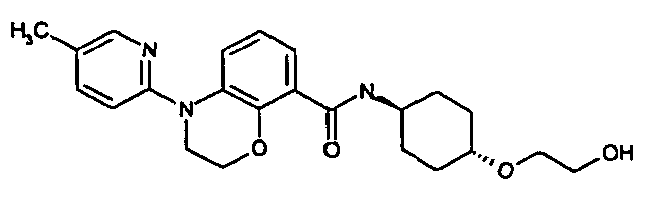
(400 MHz, DMSO-d6) 1.14-1.31 (m, 4H), 1.81-1.93 (m, 4H), 2.16 (s, 3H), 3.16-3.21 (m, 1H), 3.35-3.42 (m, 4H), 3.65 - 3.68 (m, 1H), 3.91 (t, J = 4.0 Hz, 2H), 4.23 (t, J = 4.0 Hz, 2H), 4.47 (t, J = 5.3 Hz, 1H), 6.79 (t, J = 7.9 Hz, 1H), 7.03 (d, J = 8.8 Hz, 1H), 7.13 (d, J = 7.9 Hz, 1H), 7.29 (d, J = 7.9 Hz, 1H), 7.44 (d, J = 8.3 Hz, 1H), 7.86 (d, J = 7.9 Hz, 1H), 8.07 (s, 1 H). [Table 24] Ex. No. Chemical Compounds NMR 182 1-182 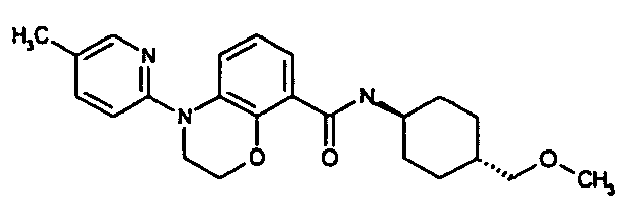
(400 MHz, DMSO-d6) 0.96-1.06 (m, 2H), 1.20-1.30 (m, 2H), 1.45-1.52 (m, 1H), 1.72-1.75 (m, 2H), 1.86-1.91 (m, 2H), 2.21 (s, 3H), 3.14 (d, J = 6.5 Hz, 2H), 3.21 (s, 3H), 3.63-3.71 (m, 1H), 3.96 (t, J = 4.4 Hz, 2H), 4.28 (t, J = 4.4 Hz, 2H), 6.84 (t, J = 7.9 Hz, 1H), 7.08 (d, J = 8.8 Hz, 1H), 7.19 (dd, J = 7.7, 1.6 Hz, 1H), 7.34 (dd, J = 7.9, 1.4 Hz, 1H), 7.49 (dd, J = 8.8, 2.3 Hz, 1 H), 7.90 (d, J = 7.9 Hz, 1H), 8.12 (d, J = 1.9 Hz, 1H). 183 1-183 
(400 MHz, DMSO-d6) 0.94-1.03 (m, 2H), 1.06 (d, J = 6.5 Hz, 6H), 1.19-1.30 (m, 2H), 1.38-1.43 (m, 1H), 1.75-1.78 (m, 2H), 1.86-1.91 (m, 2H), 2.21 (s, 3H), 3.16 (d, J = 6.5 Hz, 2H), 3.44-3.50 (m, 1H), 3.63-3.72 (m, 1H), 3.96 (t, J = 4.4 Hz, 2H), 4.28 (t, J = 4.4 Hz, 2H), 6.84 (t, J = 7.9 Hz, 1H), 7.08 (d, J = 8.3 Hz, 1H), 7.20 (dd, J = 7.7, 1.6 Hz, 1H), 7.34 (dd, J = 8.1, 1.6 Hz, 1H), 7.49 (dd, J = 8.3, 2.3 Hz, 1H), 7.88 (d, J = 7.9 Hz, 1H), 8.12 (d, J = 2.3 Hz, 1H). 184 1-184 
(400 MHz, DMSO-d6) 1.27-1.36 (m, 2H), 1.50-1.70 (m, 7H), 2.23 (s, 3H), 3.20 (d, J = 6.5 Hz, 2H), 3.22 (s, 3H), 3.99-4.04 (m, 3H), 4.35 (t, J = 4.4 Hz, 2H), 6.88 (t, J = 7.9 Hz, 1H), 7.16 (d, J = 8.8 Hz, 1H), 7.32 (dd, J = 7.7, 1.6 Hz, 1H), 7.37 (dd, J = 8.1, 1.6 Hz, 1H), 7.59 (d, J = 7.4 Hz, 1H). 8.01 (d, J = 7.9 Hz, 1 H), 8.14 (s, 1 H). 185 1-185 
(400 MHz, DMSO-d6) 1.06 (d, J = 6.0 Hz, 6H), 1.29-1.35 (m, 2H), 1.50-1.70 (m, 7H), 2.24 (s, 3H), 3.23 (d, J = 6.5 Hz, 2H), 3.45-3.51 (m, 1H). 4.01 (t, J = 4.2 Hz, 3H), 4.36 (t, J = 4.4 Hz, 2H), 6.89 (t, J = 7.9 Hz, 1H), 7.21 (d, J = 8.3 Hz, 1H). 7.34 (d, J = 7.4 Hz, 1H). 7.38 (d, J = 8.3 Hz, 1H), 7.65 (d, J = 8.3 Hz, 1 H), 8.01 (d, J = 7.4 Hz, 1H), 8.14 (s, 1 H). 186 1-186 
(400 MHz, DMSO-d6) 0.94-1.37 (m, 14H), 1.75-1.91 (m, 4H), 2.21 (s, 3H), 3.11 (d, J = 6.5 Hz, 2H), 3.63-3.72 (m, 1H), 3.96 (t, J = 4.4 Hz, 2H), 4.28 (t, J = 4.4 Hz, 2H), 6.84 (t, J = 7.9 Hz, 1H), 7.08 (d, J = 8.3 Hz, 1 H), 7.20 (dd, J = 7.7, 1.6 Hz, 1H), 7.34 (dd, J = 8.1, 1.6 Hz, 1H), 7.49 (dd, J = 8.3, 2.3 Hz, 1H), 7.88 (d, J = 7.9 Hz, 1H), 8.12 (d, J = 2.3 Hz, 1H). 187 1-187 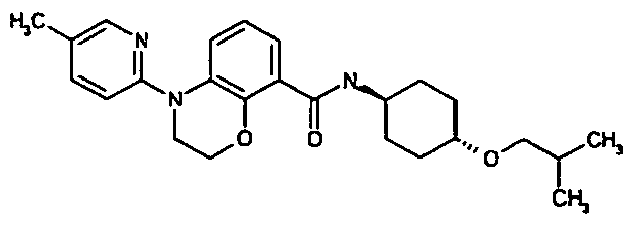
(400 MHz, DMSO-d6) 0.86(d, J=8.4Hz, 6H), 1.23-1.34(m, 4H), 1.86-1.97(m, 4H), 2.22(s, 3H), 3.16(m, 3H), 3.96(t, J=4.4Hz, 2H), 4.29(t, J=4.4Hz, 2H), 6.85(t, J=8Hz, 1H), 7.09(d, J=8.4Hz, 1H), 7.19(d, J=8Hz, 1H), 7.49(d, J=8.4Hz, 1H), 7.91(d, J=8Hz, 1H), 8.12(s, 1 H) 188 1-188 
(400 MHz, DMSO-d6) 0.92(s, 6H), 1.17-1.47(m, 6H), 1.62 - 1.72(m, 2H), 2.27(s, 3H), 3.73(m, 3H), 4.02(t, J=4.4Hz, 2H), 4.37(t, J=4.4Hz, 2H), 6.91(t, J=8Hz, 1H), 7.28(m, 2H), 7.38(d, J=8Hz, 1H), 7.76(d, J=8Hz, 1H), 7.94(d, J=8Hz. 1H), 8.17(s, 1H) 189 1-189 
(400 MHz, DMSO-d6) 0.83(d, J=8.4Hz, 6H), 1.2-1.4(m, 6H), 1.8-2.0(m, 4H), 2.20(s, 3H), 3.20(m, 1H), 3.41(d, J=8Hz, 2H), 3.72(m, 1H), 3.97(t, J=4.4Hz, 2H), 4.29(t, J=4.4Hz, 2H), 6.85(t, J=8Hz, 1 H), 7.09(d, J=8Hz, 1 H), 7.19(d, J=8Hz, 1H), 7.34(d, J=8Hz, 1H), 7.49(d, J=8Hz, 1H), 7.91(d, J=8Hz, 1 H), 8.12(s, 1 H) [Table 25] Ex. No. Chemical Compounds NMR 190 1-190 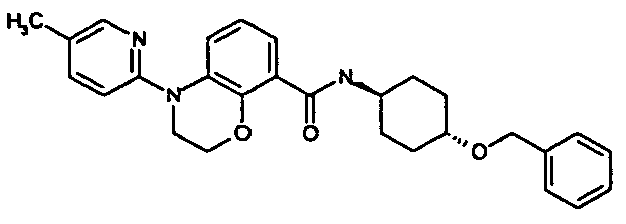
(400 MHz, DMSO-d6) 1.3-1.4(m, 4H), 1.85-1.95(m, 2H), 2.0-2.1 (m, 2H), 2.22(s, 3H), 3.34(m, 1H), 3.76(m, 1H), 3.96(t, J=4.6Hz, 2H), 4.29(t, J=4.6Hz, 2H), 4.55(s, 2H), 6.85(t, J=8Hz, 1H), 7.10(d, J=8Hz, 1H), 7.19(d, J=8Hz, 1H), 7.22-7.4(m, 6H), 7.50(d, J=8Hz, 1H), 7.94(d, J=8Hz, 1H), 8.13(s, 1H) 191 1-191 
(400 MHz, DMSO-d6) 0.85(d, J=6.4Hz, 6H), 1.0-1.15(m, 3H), 1.2-1.35(m, 2H), 1.35-1.5(m, 1H), 1.6-1.75(m, 2H), 1.85-1.95(m. 2H), 2.22(s, 3H), 3.66(m, 1H), 3.97(t, J=4Hz, 2H), 4.29(t, J=4Hz, 2H), 6.85(t, J=8Hz, 1H), 7.09(d, J=8Hz, 1 H), 7.20(d, J=8Hz, 1H), 7.34(d, J=8Hz, 1H), 7.49(d, J=8Hz, 1H), 7.88(d, J=8Hz, 1H), 8.13(s, 1 H) 192 1-192 
(400 MHz, DMSO-d6) 0.86(t, J=7.2Hz, 3H), 0.8-1.0(m, 2H), 1.1-1.35(m, 6H), 1.7-1.8(m, 2H), 1.8-1.9(m, 2H), 2.22(s, 3H), 3.7(m, 1H), 3.96(t, J=4.4Hz, 2H), 4.29(t, J=4.4Hz, 2H), 6.85(t, J=8Hz, 1H), 7.08(d, J=8Hz, 1H), 7.33(d, J=8Hz, 1H), 7.48(d, J=8Hz, 1H), 7.88(d, J=8Hz, 1H), 8.13(s, 1H) 193 1-193 
(400 MHz, DMSO-d6) 0.86(s. 9H), 1.2-1.4(m, 4H), 1.8 - 2.0(m, 4H), 2.22(s, 3H), 3.07(s, 2H), 3.17(m, 1H), 3.73(m, 1H), 3.96(t, J=4Hz, 2H), 4.29(t, J=4Hz, 2H), 6.85(t, J=8Hz, 1H), 7.09(d, J=8Hz, 1H), 7.18(d, J=8Hz, 1H), 7.36(dd, J=8, 2.4Hz, 1H), 7.50(dd, J=8, 2.4Hz), 7.92(d, J=8Hz, 1H), 8.13(s, 1H) 194 1-194 
(300 MHz, DMSO-d6) 1.28 (s, 9H), 3.29 (s, 3H), 4.06 (t, J = 4.4 Hz, 2H), 4.31-4.36 (m, 4H), 6.93 (t, J = 7.9 Hz, 1H), 7.18-7.25 (m, 2H), 7.34 (d, J = 8.8 Hz, 2H), 7.48 (dd, J = 8.1, 1.5 Hz, 1H), 7.60-7.68 (m, 3H), 8.25 (d, J = 2.2 Hz, 1H), 10.05 (s, 1 H). 195 1-195 
(400 MHz, DMSO-d6) 3.92 (t, J = 4.2 Hz, 2H), 4.43 (t, J = 4.4 Hz, 2H), 6.76 (dd, J = 8.3, 1.4 Hz, 1H), 6.86 (t, J = 7.9 Hz, 1H), 7.17 (dd, J = 7.4, 1.4 Hz, 1H), 7.56 (d, J = 7.9 Hz, 1H), 7.78 (dd, J = 9.0, 2.6 Hz, 1H), 8.14 (d, J = 2.8 Hz, 1H), 8.30 (d, J = 1.9 Hz, 1H), 8.83 (d, J = 1.9 Hz, 1H), 10.51 (s, 1H), 13.47 (br s, 1 H). 196 1-196 
(300 MHz,DMSO-d6) 3.92 (t, J = 4.2 Hz, 2H), 4.43 (t, J = 4.0 Hz, 2H), 6.74 (dd, J = 8.1, 1.5 Hz, 1 H), 6.85 (t, J = 7.9 Hz, 1H), 7.17 (dd, J = 7.7, 1.5 Hz, 1H), 7.35 (d, J = 8.8 Hz, 2H), 7.86 (d, J = 8.8 Hz, 2H), 8.30 (d, J = 2.2 Hz, 1H), 8.83 (d, J = 2.2 Hz, 1H), 10.35 (s, 1H), 13.46 (br s, 1H). 197 1-197 
(400 MHz, DMSO-d6) 2.70 (d, J = 5.1 Hz, 3H), 3.78 (t, J = 4.2 Hz, 2H), 4.33 (t, J = 4.4 Hz, 2H), 5.69 (q, J = 5.1 Hz, 1H). 6.80 (t, J = 7.9 Hz, 1H). 6.97-7.06 (m, 4H), 7.34 (d, J = 8.8 Hz, 2H), 7.75 (d, J = 2.8 Hz, 1H), 7.84 (d, J = 8.8 Hz, 2H), 10.30 (s, 1H). [Table 26] Ex. No. Chemical Compounds NMR 198 1-198 
(300 MHz, DMSO-d6) δ: 1.34 (t, J = 7.0 Hz, 3H), 3.91 (t, J = 4.4 Hz, 2H), 4.08 (q, J = 7.1 Hz, 2H), 4.33 (t, J = 4.2 Hz, 2H), 6.88 (t, J = 7.9 Hz, 1H), 7.12-7.17 (m, 2H), 7.28-7.41 (m, 4H), 7.85 (d, J = 9.2 Hz, 2H), 8.06 (d, J = 3.3 Hz, 1H), 10.31 (s, 1H). 199 1-199 
(400 MHz, DMSO-d6) 3.71 (t, J = 4.4 Hz, 2H), 3.89 (s, 3H), 4.43 (t, J = 4.4 Hz, 2H), 6.35 (dd, J = 7.9, 1.4 Hz, 1 H), 6.77 (t, J = 7.9 Hz, 1H), 6.98 (dd, J = 7.7, 1.6 Hz, 1H), 7.35 (d, J = 8.8 Hz, 2H), 7.77 (d, J = 3.2 Hz, 1H), 7.86 (d, J = 8.8 Hz, 2H), 8.22 (d, J = 2.8 Hz, 1 H), 10.33 (s, 1H). 200 1-200 
(400 MHz, DMSO-d6) 3.72 (q, J = 5.1 Hz, 2H), 3.91 (t, J = 4.4 Hz, 2H), 4.04 (t, J = 5.1 Hz, 2H), 4.33 (t, J = 4.4 Hz, 2H), 4.89 (t, J = 5.1 Hz, 1H), 6.88 (t, J = 7.9 Hz, 1H), 7.11 (dd, J = 7.9, 1.6 Hz, 1H), 7.18 (d, J = 8.8 Hz, 1H), 7.31 (dd, J = 7.9, 1.6 Hz, 1H), 7.35 (d, J = 8.8 Hz, 2H), 7.41 (dd, J = 8.8, 3.0 Hz, 1H), 7.85 (d, J = 8.8 Hz, 2H), 8.08 (d, J = 3.0 Hz, 1H), 10.32 (s, 1H). 201 1-201 
(300MHz,DMSO-d6) 3.86 (t, J = 4.2 Hz, 2H), 4.33 (t, J = 4.2 Hz, 2H), 6.85 (t, J = 7.9 Hz, 1H), 7.07-7.10 (m, 2H), 7.20 - 7.21 (m, 2H), 7.34 (d, J = 8.8 Hz, 2H), 7.85 (d, J = 9.2 Hz, 2H), 7.93 (d, J = 2.9 Hz, 1H), 10.30 (s, 1H). 202 1-202 
(300MHz, DMSO-d6) 3.81 (s, 3H), 3.91 (t, J = 4.0 Hz, 2H), 4.33 (t, J = 4.2 Hz, 2H), 6.88 (t, J = 7.9 Hz, 1H), 7.12 (dd, J = 7.7,1.5 Hz, 1H), 7.19 (d, J = 8.8 Hz, 1H), 7.28-7.43 (m, 4H), 7.85 (d, J = 9.2 Hz, 2H), 8.08 (d, J = 3.3 Hz, 1H), 10.31 (s, 1H). 203 1-203 
(400 MHz, DMSO-d6) 3.95 (t, J = 4.2 Hz, 2H), 4.39 (t, J = 4.4 Hz, 2H), 6.86 (t, J = 7.9 Hz, 1H), 7.05 (dd, J = 7.9, 1.4 Hz, 1H), 7.18 (dd, J = 7.7, 1.6 Hz, 1H), 7.27 (dd, J = 7.9, 5.1 Hz, 1 H), 7.34 (d, J = 8.8 Hz, 2H), 7.84 (d, J = 8.8 Hz, 2H), 8.29 (dd, J = 7.9, 1.9 Hz, 1H), 8.59 (dd, J = 4.4, 2.0 Hz, 1H), 10.34 (s, 1H). 204 1-204 
(400 MHz, DMSO-d6) 3.78 (t, J = 4.2 Hz, 2H), 4.43 (t, J = 4.2 Hz, 2H), 6.74 (t, J = 7.9 Hz, 1H), 6.81 (dd, J = 8.1, 1.6 Hz, 1H), 7.05 (dd, J = 7.4, 1.9 Hz, 1 H), 7.24 (dd, J = 7.7, 4.9 Hz, 1H), 7.34 (d, J = 8.8 Hz, 2H), 7.43 (s, 1H), 7.84 (t, J = 8.1 Hz, 3H), 7.92 (dd, J = 7.4, 1.9 Hz, 1H), 8.45 (dd, J = 4.4, 2.0 Hz, 1H), 10.30 (s, 1H). 205 1-205 
(400 MHz, DMSO-d6) 2.55 (d, J = 4.6 Hz, 3H), 3.78 (t, J = 4.2 Hz, 2H), 4.41 (t, J = 4.2 Hz, 2H), 6.74 (t, J = 7.9 Hz, 1H), 6.83 (dd, J = 8.1, 1.6 Hz, 1H), 7.09 (dd, J = 7.7, 1.6 Hz, 1 H), 7.20 (dd, J = 7.4, 4.6 Hz, 1 H), 7.34 (d, J = 8.8 Hz, 2H), 7.83 - 7.87 (m, 3H), 8.27-8.30 (m, 1H), 8.43 (dd, J = 4.8, 2.0 Hz, 1H), 10.27 (s, 1 H). [Table 27] Ex. No. Chemical Compounds NMR 206 1-206 
(400 MHz, DMSO-d6) 2.81 (s, 3H), 2.86 (s, 3H), 3.71 (s, 2H), 4.34 (s, 2H), 6.80 (t, J = 7.9 Hz, 1H), 6.91 (dd, J = 8.1, 1.6 Hz, 1H), 7.11 (dd, J = 7.4, 1.4 Hz, 1H), 7.21 (dd, J = 7.4, 4.6 Hz, 1H), 7.34 (d, J = 8.3 Hz, 2H), 7.76 (dd, J = 7.4, 1.9 Hz, 1H), 7.85 (d, J = 9.3 Hz, 2H), 8.41 (dd, J = 5.2, 2.0 Hz, 1H), 10.28 (s, 1H). 207 1-207 
(400 MHz, DMSO-d6) 3.84 (t, J = 4.2 Hz, 2H), 4.25 (t, J = 4.2 Hz, 2H), 4.93 (s, 2H), 6.77 (t, J = 7.9 Hz, 1H), 6.87 (dd, J=8.1, 1.6 Hz, 1 H), 7.16 (dd, J = 7.4, 1.4 Hz, 1H), 7.21 (dd, J = 8.0, 4.8 Hz, 1H), 7.28-7.37 (m, 7H), 7.86 (d, J = 8.8 Hz, 2H), 8.12 (dd, J = 7.9, 1.9 Hz, 1H), 8.53 (dd, J = 5.2, 2.4 Hz, 1H), 10.26 (s, 1 H). 208 1-208 
(400 MHz, DMSO-d6) 3.82 (t, J = 4.2 Hz, 2H), 4.39 (t, J = 4.2 Hz, 2H), 6.77 (t, J = 7.9 Hz, 1H), 6.87 (dd, J = 8.3, 1.4 Hz, 1H). 7.08 (dd, J = 7.7, 1.6 Hz, 1H), 7.20 (dd, J = 7.4, 4.6 Hz, 1 H), 7.34 (d, J = 8.3 Hz, 2H), 7.86 (d, J = 9.3 Hz, 2H), 8.10 (dd, J = 7.9, 1.9 Hz, 1 H), 8.49 (dd, J = 4.4, 2.0 Hz, 1 H), 10.29 (s, 1H), 13.28 (d, J = 155.4 Hz, 1 H). 209 1-209 
(400 MHz, DMSO-d6) 3.79 (t, J = 4.2 Hz, 2H), 4.38 (t, J = 4.4 Hz, 2H), 5.18 (s, 2H), 6.61 (dd, J = 8.3, 1.4 Hz, 1H), 6.78 (t, J = 7.9 Hz, 1H), 7.03 (dd, J = 7.4, 1.4 Hz, 1H), 7.21 (dd, J = 8.0. 4.8 Hz, 1H). 7.27-7.35 (m, 7H), 7.61 (dd, J = 7.9,1.4 Hz, 1H), 7.85 (d, J = 8.8 Hz, 2H), 8.00 (dd, J = 4.9, 1.6 Hz, 1H), 10.29 (s, 1H), 10.29 (s, 1 H). 210 1-210 
(400 MHz, DMSO-d6) 3.75 (t, J = 4.4 Hz, 2H), 4.41 (t, J = 4.2 Hz, 2H), 6.50 (t, J = 3.9 Hz, 1H), 6.76 (t, J = 7.9 Hz, 1H), 6.97 (d, J = 6.5 Hz, 1H), 7.10 (dd, J =8.0, 4.8 Hz, 1H), 7.29 (dd, J = 7.9, 1.4 Hz, 1H), 7.34 (d, J = 8.8 Hz, 2H), 7.85 (d, J = 8.8 Hz, 2H), 7.90 (dd, J = 4.4, 1.2 Hz 1H), 9.97 (s, 1H), 10.31 (s, 1H). 211 1-211 
(400 MHz, CHLOROFORM-d) 3.70 (brs, 2H), 4.15 (brs, 2H), 4.33 (brs, 2H), 4.65 (brs, 2H), 6.73 (d, J = 7.4 Hz, 1H), 6.94 (t, J = 7.4 Hz, 1H), 7.22 (d, J = 8.3 Hz, 2H), 7.34 (brs, 1H), 7.64 (d, J = 6.0 Hz, 1 H), 7.73 (d, J = 8.8 Hz, 2H), 7.87 (d, J = 7.4 Hz, 1H), 8.12 (brs, 1H), 9.56 (s, 1 H). 212 1-212 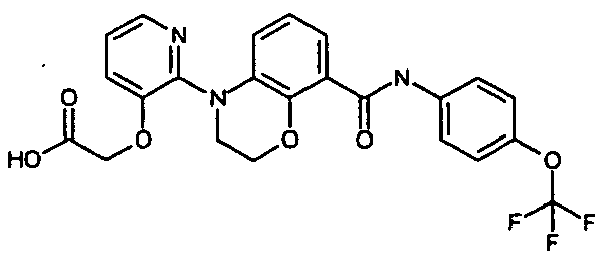
(400 MHz, DMSO-d6) 3.81 (t, J = 4.4 Hz, 2H), 4.39 (t, J = 4.2 Hz, 2H), 4.79 (s, 2H), 6.70-6.77 (m, 2H), 7.00 (dd, J = 7,2, 2.1 Hz, 1H), 7.18 (dd. J = 8.0, 4.8 Hz, 1H), 7.34 (d, J = 8.3 Hz, 2H), 7.42 (dd, J = 8.3, 1.4 Hz, 1H), 7.85 (d, J = 9.3 Hz, 2H), 7.99 (dd, J = 4.6,1.4 Hz, 1H), 10.32 (s, 1H), 13.12 (s, 1H). [Table 28] Ex. No. Chemical Compounds NMR 213 1-213 
(400 MHz, DMSO-d6) 3.82 (t, J = 4.2 Hz, 2H), 4.39 (t, J = 4.2 Hz, 2H), 4.54 (s, 2H), 6.68 (dd, J = 8.1, 1.6 Hz, 1H). 6.76 (t, J = 7.9 Hz, 1H), 7.02 (dd, J = 7.4, 1.4 Hz, 1H), 7.09 (s, 1 H), 7.18 (dd, J = 8.0, 4.8 Hz, 1H), 7.32-7.42 (m, 4H), 7.85 (d, J = 9.3 Hz, 2H), 7.99 (dd, J = 4.6, 1.4 Hz, 1 H), 10.29 (s, 1H). 214 1-214 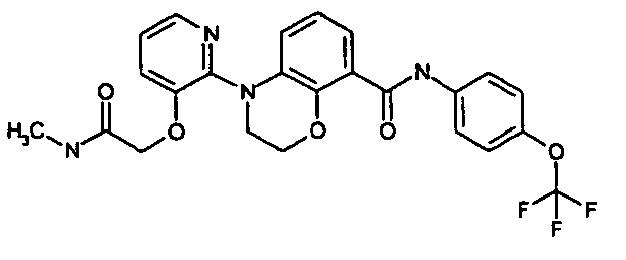
(400 MHz, DMSO-d6) 2.58 (d, J = 4.6 Hz, 3H), 3.83 (t, J = 4.2 Hz, 2H), 4.39 (t, J = 4.2 Hz, 2H), 4.56 (s, 2H). 6.69 (dd, J = 8.1, 1.6 Hz, 1H). 6.77 (t, J = 7.9 Hz, 1H). 7.03 (dd, J = 7.4, 1.4 Hz, 1 H), 7.17 (dd, J = 8.4, 4.8 Hz, 1H). 7.33 (d, J = 8.8 Hz, 2H), 7.40-7.46 (m, 2H), 7.85 (d, J = 9.3 Hz, 2H), 8.00 (dd, J = 4.6, 1.4 Hz, 1 H), 10.31 (s, 1H). 215 1-215 
(400 MHz, DMSO-d6) 2.82 (s, 3H), 2.95 (s, 3H), 3.83 (s, 2H), 4.36 (s, 2H), 4.96 (s, 2H), 6.71-6.79 (m, 2H), 6.97-7.00 (m, 1H), 7.12-7.16 (m, 1H), 7.32-7.37 (m, 3H), 7.84 (d, J = 8.8 Hz, 2H), 7.93-7.95 (m, 1H), 10.30 (s, 1H). 216 1-216 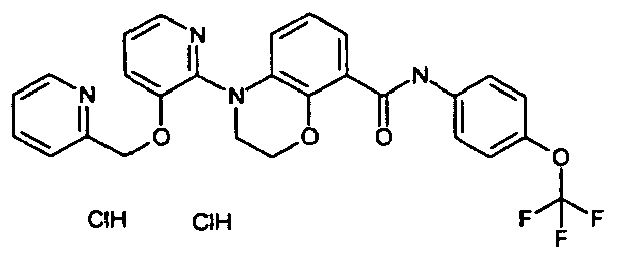
(400 MHz, DMSO-d6) 3.84 (t, J = 4.1 Hz, 2H), 4.40 (t, J = 4.1 Hz, 2H), 5.31 (s, 2H), 6.65 (dd, J = 8.1, 1.5 Hz, 1H), 6.75 (t, J = 7.7 Hz, 1H), 7.02 (dd, J = 7.4, 1.5 Hz, 1H), 7.22 (dd, J = 8.0, 4.8 Hz, 1 H), 7.33 (t, J = 8.3 Hz, 2H), 7.42-7.46 (m, 1H), 7.64 (dd, J = 8.0, 1.5 Hz, 1 H), 7.84-7.91 (m, 3H), 8.03 (dd, J = 4.6, 1.4 Hz, 1H), 8.60 (d, J = 5.1 Hz, 1H), 10.31 (s, 1H). 217 1-217 
(400 MHz, DMSO-d6) 3.78 (t, J = 4.3 Hz, 2H), 4.37 (t, J = 4.3 Hz, 2H), 5.23 (s, 2H), 6.60 (dd, J = 8.3,1.5 Hz, 1H), 6.77 (t, J = 7.9 Hz, 1H), 7.02 (dd, J = 7.7, 1.5 Hz, 1H), 7.23 (dd, J = 8.0, 4.8 Hz, 1H), 7.32-7.36 (m, 3H), 7.64-7.69 (m, 2H), 7.85 (d, J = 9.3 Hz, 2H), 8.02 (dd, J = 4.8, 1.2 Hz, 1H), 8.50 (dd, J = 4.8, 2.0 Hz, 1H), 8.54 (d, J = 2.0 Hz, 1 H), 10.28 (s, 1H). 218 1-218 
(400 MHz, DMSO-d6) H1-NMR (DMSO-d6) δ: 4.16 (t, J = 4.5 Hz, 2H), 4.37 (t, J = 4.5 Hz, 2H), 6.99 (t, J = 8.0 Hz, 1H), 7.28-7.35 (m, 4H), 7.61 (dd, J = 8.0,1.6 Hz, 1H), 7.82 (d, J = 9.3 Hz, 2H), 8.02 (dd, J = 8.8, 2.3 Hz, 1H), 8.69 (d, J = 2.3 Hz, 1 H), 10.33 (s, 1H). 219 1-219 
(300 MHz, DMSO-d6) δ: 1.85 (s, 3H), 4.02 (t, J = 4.4 Hz, 2H), 4.19 (d, J = 5.9 Hz, 2H), 4.32 (t, J = 4.6 Hz, 2H), 6.93 (t, J = 7.9 Hz, 1H), 7.17-7.21 (m, 2H), 7.34 (d, J = 8.4 Hz, 2H), 7.46 (dd, J = 8.3, 1,7 Hz, 1H), 7.58 (dd, J = 8.6, 2.4 Hz, 1 H), 7.84 (d, J = 9.2 Hz, 2H), 8.20 (d, J = 2.2 Hz, 1H), 8.30 (t, J = 6.1 Hz, 1H), 10.32 (s, 1 H). [Table 29] Ex. No. Chemical Compounds NMR 220 1-220 
(300 MHz, DMSO-d6) δ: 3.34 (s, 3H), 3.80 (t, J = 4.2 Hz, 2H), 4.42 (t, J = 4.2 Hz, 2H), 4.47 (s, 2H), 6.51 (dd, J = 8.1, 1.5 Hz, 1H), 6.80 (t, J = 7.7 Hz, 1H), 7.06 (dd, J = 7.7, 1.5 Hz, 1H), 7.35 (d, J = 8.4 Hz, 2H), 7.86 (d, J = 8.8 Hz, 2H), 7.98 (d, J = 1.8 Hz, 1H), 8.38 (d, J = 1.8 Hz, 1H), 10.33 (s, 1H). 221 1-221 
(300 MHz, DMSO-d6) δ: 2.05 (s, 2H, keto). 2.10 (s, 1H, enol), 2.78 (s, 1H, enol), 2.94 (s, 2H, keto), 4.03-4.04 (m, 2H), 4.32-4.35 (m, 2H), 4.43 (s, 1.3H, keto), 4.50 (s, 0.6H, enol), 6.91-6.94 (m, 1H), 7.18-7.25 (m, 2H), 7.34 (d, J = 8.8 Hz, 2H), 7.50-7.55 (m, 2H), 7.85 (d, J = 9.2 Hz, 2H), 8.18 - 8.22 (m, 1H), 10.32 (s, 1 H). 222 1-222 
(400 MHz, DMSO-d6) δ: 3.66 (s, 2H), 4.01 (t, J = 4.2 Hz, 2H), 4.32 (t, J = 4.4 Hz, 2H), 6.92 (t, J = 7.9 Hz, 1H), 7.17 (d, J = 8.8 Hz, 2H), 7.34 (d, J = 8.3 Hz, 2H), 7.44 (dd, J = 8.3, 1.4 Hz, 1H), 7.66 (dd, J = 8.3, 2.3 Hz, 1H), 7.84 (d, J = 9.3 Hz, 2H), 8.23 (d, J = 1.9 Hz, 1H), 10.33 (s, 1H). 223 1-223 
(300 MHz, DMSO-d6) δ: 2.13 (s, 6H), 3.33 (s, 2H), 4.03 (t, J = 4.4 Hz, 2H), 4.34 (t, J = 4.4 Hz, 2H), 6.91 (q, J = 8.7 Hz, 1H), 7.19 (d, J = 3.9 Hz, 2H), 7.35 (d, J = 8.4 Hz, 2H), 7.49 (dd, J = 8.1, 1.5 Hz, 1H), 7.60 (dd, J = 8.4, 2.2 Hz, 1H), 7.85 (d, J = 9.2 Hz, 2H), 8.18 (d, J = 1.8 Hz, 1H), 10.32 (s, 1H). 224 1-224 
(400 MHz, DMSO-d6) 2.65 (d, J = 4.6 Hz, 3H), 3.91-4.00 (m, 2H), 5.12 (t, J = 4.6 Hz, 1 H), 6.54 (dd, J = 8.1, 1.5 Hz, 1H), 6.89 (t, J = 7.9 Hz, 1H), 7.24 (dd, J = 7.7, 1.5 Hz, 1H), 7.30 (dd, J = 7.7, 4.6 Hz, 1H), 7.38 (d, J = 8.5 Hz, 2H), 7.88 (d, J = 8.5 Hz, 2H), 8.01 (dd, J = 7.9, 1.5 Hz, 1H), 8.15 (q, J = 4.6 Hz, 1H), 8.43 (dd, J = 4.6, 2.0 Hz, 1H), 10.66 (s, 1H), 225 1-225 
(400 MHz, DMSO-d6) 4.05 (t, J = 4.4 Hz, 2H), 4.33 (t, J = 4.4 Hz, 2H), 4.48 (d, J = 5.6 Hz, 2H), 5.33 (t, J = 5.6 Hz, 1H), 6.94 (t, J = 7.9 Hz, 1H), 7.02 (d, J = 7.9 Hz, 1H), 7.07 (d, J = 7.9 Hz, 1H), 7.21 (dd, J = 7.7, 1.6 Hz, 1H), 7.51 (dd, J = 7.7, 1.6 Hz, 1H), 7.67 (d, J = 7.7Hz, 1H), 7.71 (d, J = 8.3 Hz, 2H), 7.95 (d, J = 8.3 Hz, 2H), 10.51 (s, 1H). 226 1-226 
(400 MHz, DMSO-d6) 2.88 (s, 3H), 3.05 (s, 3H), 3.58 (dd, J = 13.0, 8.8 Hz, 1 H), 4.20 (dd, J = 13.0, 4.0 Hz, 1 H), 5.54 (dd, J = 8.8, 4.0 Hz, 1H), 6.56 (dd, J = 8.0, 1.4 Hz, 1H), 6.89 (t, J = 7.9 Hz, 1H), 7.24 (dd, J = 7.9, 1.4 Hz, 1H), 7.31 (dd, J = 8.0, 4.8 Hz, 1H), 7.37 (d, J = 8.3 Hz, 2H), 7.88 (d, J = 8.3 Hz, 2H), 8.03 (dd, J = 8.0, 1.4 Hz, 1 H), 8.44 (dd, J = 4.8, 1.4 Hz, 1H), 10.80 (s, 1H). 227 1-227 
(400 MHz, DMSO-d6) 3.88 (t, J = 4.2 Hz, 2H), 4.42 (t, J = 4.2 Hz, 2H), 6.68 (dd, J = 7.9, 1.6 Hz, 1H), 6.84 (t, J = 7.9 Hz, 1H), 7.13 (dd, J = 7.9, 1.6 Hz, 1H), 7.36 (d, J = 8.3 Hz, 2H), 7.66 (s, 1H), 7.87 (d, J = 8.3 Hz, 2H), 8.17 (s, 1H), 8.38 (d, J = 2.3 Hz, 1H), 8.82 (d, J = 2.3 Hz, 1H), 10.38 (s, 1 H) [Table 30] Ex. No. Chemical Compounds NMR 228 1-228 
(400 MHz, DMSO-d6) 1.80 (s, 3H), 3.23-3.29 (m, 1H), 3.45 - 3.51 (m, 1H), 4.06-4.09 (m, 1H), 4.17 (d, J = 10.5 Hz, 1H), 4.47 (d, J =10.5 Hz, 1H), 6.48 (dd, J = 8.0, 1.2 Hz, 1H), 6.84 (t, J = 7.7 Hz, 1H), 7.07 (dd, J = 7.7, 1.2 Hz, 1H), 7.36 (dd, J = 8.0, 4.8 Hz, 1H), 7.72 (d, J = 8.3 Hz, 2H), 8.00 (d, J = 8.3 Hz, 2H), 8.08 (dd, J = 8.0, 1.2 Hz, 1H), 8.16 (t, J = 5.6 Hz, 1H), 8.46 (dd, J = 4.8, 1.2 Hz, 1H), 10.46 (s, 1H). 229 1-229 
(400 MHz, DMSO-d6) 4.41 (dd, J = 10.7, 2.8 Hz, 1H), 4.68 - 4.75 (m, 2H), 6.58 (d, J = 7.9 Hz, 1H), 6.84 (t, J = 7.9 Hz, 1H), 7.05 (dd, J = 7.9, 1.5 Hz, 1H), 7.26 (dd, J = 8.0, 4.5 Hz, 1H), 7.69 (d, J = 8.0Hz, 2H), 7.95-8.00 (m, 3H), 8.38 (dd, J = 4.5, 1.5Hz, 1H). 10.53 (s, 1H), 13.04 (s, 1H). 230 1-230 
(400 MHz, DMSO-d6) 3.63 (s, 3H), 4.01 (d, J = 3.7 Hz, 2H), 5.45 (t, J = 3.7 Hz, 1H), 6.50 (dd, J = 7.9, 1.4 Hz, 1H). 6.87 (t, J = 7.9 Hz, 1H). 7.23 (dd, J = 7.9.1.4 Hz, 1H). 7.33 (dd, J = 8.0, 4.8 Hz, 1H), 7.38 (d, J = 8.5 Hz, 2H), 7.88 (d, J = 8.5 Hz, 2H), 8.04 (dd, J = 7.9, 1.4 Hz, 1H), 8.44 (dd, J = 4.6.1.4 Hz, 1H). 10.33 (s, 1H), 231 1-231 
(400 MHz, DMSO-d6) 3.67 (dd, J = 13.0, 7.4 Hz, 1H), 3.74 (t, J = 5.5 Hz, 2H), 3.92 (dd, J = 13.0, 2.8 Hz, 1H). 4.48-4.54 (m, 1H). 5.22 (t, J = 5.5 Hz, 1 H), 6.56 (dd, J = 7.9, 1.5 Hz, 1H), 6.85 (t, J = 7.9 Hz, 1H), 7.27 (dd, J = 7.9, 1.5 Hz, 1H), 7.32 (dd, J = 7.9, 4.5 Hz. 1H). 7.38 (d, J = 8.8 Hz, 2H), 7.89 (d, J = 8.8 Hz, 2H), 8.05 (dd, J = 7.9, 1.9 Hz, 1H). 8.44 (dd, J = 4.5, 1.4 Hz, 1H), 10.40 (s, 1 H). 232 1-232 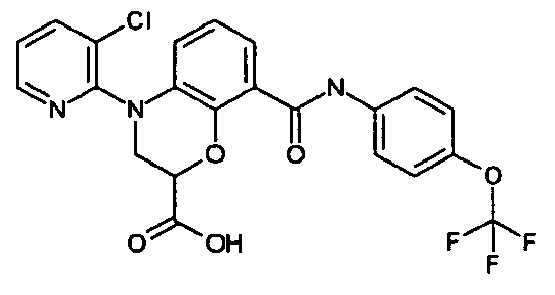
(400 MHz, DMSO-d6) 3.93-4.08 (m, 2H), 5.31 (t, J = 4.2 Hz, 1H), 6.53 (dd, J = 7.9, 1.4 Hz, 1H). 6.87 (t, J = 7.9 Hz, 1H). 7.27-7.34 (m, 2H), 7.38 (d, J = 8.3 Hz, 2H), 7.88 (d, J = 9.3 Hz, 2H), 8.03 (dd, J = 8.3, 1.4 Hz, 1H). 8.44 (dd, J = 4.8, 2.0 Hz, 1H), 10.45 (s, 1H), 13.59 (s, 1H). 233 1-233 
(400 MHz, DMSO-d6) 4.27 (dd, J = 10.7, 2.5 Hz, 1H). 4.58 - 4.60 (m, 1H), 4.74 (dd, J = 10.7. 2.5 Hz, 1H), 6.58 (dd, J = 7.9, 1.4 Hz, 1H). 6.85 (t, J = 7.9 Hz, 1H). 7.07 (dd, J = 7.4, 1.4 Hz, 1H), 7.33-7.37 (m, 2H), 7.52 (s, 1H), 7.70 (d, J = 8.8 Hz, 2H), 7.96 (d, J = 8.3 Hz, 2H), 8.06 (dd, J = 7.9, 1.4 Hz, 1 H), 8.42 (dd, J = 4.6,1.4 Hz, 1H), 10.53 (s. 1H). 234 1-234 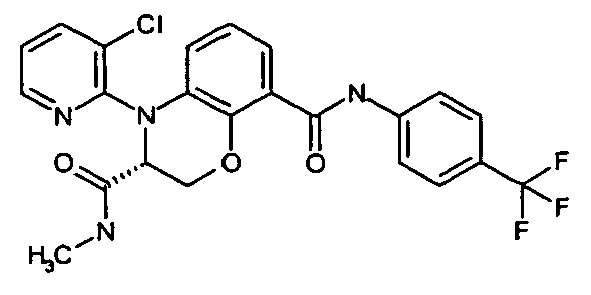
(400 MHz, DMSO-d6) 2.60 (d, J = 4.6 Hz, 3H), 4.26 (d, J = 8.5 Hz, 1H), 4.60 (s, 1H). 4.74 (d, J = 8.5 Hz, 1 H), 6.60 (d, J = 7.9 Hz, 1H), 6.86 (t, J = 7.9 Hz, 1H). 7.08 (d, J = 6.5 Hz, 1H), 7.33 (q, J = 4.2 Hz, 1H), 7.70 (d, J = 8.8 Hz, 2H), 7.95 - 8.06 (m, 4H), 8.42 (dd, J = 4.6, 1.4 Hz, 1H), 10.52 (s, 1H). [Table 31] Ex. No. Chemical Compounds NMR 235 1-235 
(400 MHz, DMSO-d6) 3.83 (dd, J =13, 6.5 Hz, 1H), 4.10 (dd, J = 13, 4.0 Hz, 1H), 5.07 (dd, J = 6.5, 4.0 Hz, 1H), 6.56 (dd, J = 8.0, 1.5 Hz, 1H), 6.89 (t, J = 8.0 Hz, 1H), 7.26 (dd, J = 7.7, 1.5 Hz, 1H), 7.31 (dd, J = 7.7. 4.0 Hz, 1H). 7.37 (d, J = 8.3 Hz, 2H), 7.71 (d, J = 6.5 Hz, 2H), 7.90 (d, J = 8.3 Hz, 2H), 8.03 (dd, J = 8.0. 1.5 Hz, 1H), 8.44 (dd, J = 4.0, 1.5 Hz, 1H), 10.77 (s, 1H). 236 1-236 
(400MHz,DMSO-d6) 2.27 (s, 3H), 3.34 (s, 3H), 4.10 (br s, 4H), 6.78 (t, J = 7.0 Hz, 1H), 6.96 (d, J = 6.5 Hz, 1H), 7.18 - 7.29 (m, 6H), 7.79 (d, J = 7.9 Hz, 1H), 8.16 (s, 1H). 237 2-01 
(400 MHz, DMSO-d6) 3.75(t, J=4.4Hz, 2H), 4.40(t, J=4.4Hz, 2H), 4.53(d, J=5.6Hz, 2H), 5.39(t, J=5.6Hz, 1H). 5.97(s, 2H), 6.42(dd, J=8.1, 1.6Hz, 1H), 6.75(dd, J=8.1, 7.6Hz, 1H), 6.85(d, J=8.4Hz, 1H), 7.02(dd, J=7.6, 1.6Hz, 1H), 7.13(dd, J=8.4, 2.1Hz. 1H), 7.42(d, J=2.1 Hz, 1H), 7.92(d, J= 2.0Hz, 1H), 8.34(d, J=2.0Hz, 1H), 10.01 (s, 1H) 238 2-02 
(400 MHz, DMSO-d6) 3.77(t, J=4.4Hz, 2H), 4.21-4.24(m, 4H), 4.42(t, J=4.4Hz, 2H), 4.56(d, J=5.6Hz, 2H), 5.43(t, J=5.6Hz, 1H), 6.45(dd, J=8.1, 1.6Hz, 1H), 6.78(dd, J=8.1, 1, 7.9Hz, 1H),6.80(d, J=8.8Hz, 1H), 7.04(dd, J=7.9, 1.6Hz, 1H), 7.15(dd, J=8.8, 2.6Hz, 1H), 7.38(d, J=2.6Hz, 1H), 7.95(d, J= 2.1Hz, 1H), 8.37(d, J=2.1 Hz, 1H), 9.96(s, 1 H) 239 2-03 
(400 MHz, DMSO-d6) 3.78 (t, J = 4.2 Hz, 2H), 4.42 (t, J = 4.4 Hz, 2H), 4.56 (d, J = 4.6 Hz, 2H), 5.44 (t, J = 5.1 Hz, 1 H), 6.47 (dd, J 8.3, 1.4 Hz, 1H), 6.80 (t, J = 7.9 Hz, 1H), 7.04 (dd, J = 7.4, 1.4 Hz, 1H), 7.35 (d, J = 8.8 Hz, 2H), 7.86 (d, J = 8.8 Hz, 2H), 7.95 (d, J = 2.3 Hz, 1H), 8.37 (d, J = 1.9 Hz, 1H), 10.35 (s, 1H). 240 2-04 
(400 MHz, DMSO-d6) 3.78 (t, J = 4.2 Hz, 2H), 4.43 (t, J = 4.2 Hz, 2H), 4.56 (d, J = 5.6 Hz, 2H), 5.44 (t, J = 5.6 Hz, 1H), 6.49 (dd, J = 7.9, 1.4 Hz, 1H), 6.81 (t, J = 7.7 Hz, 1H), 7.05 (dd, J = 7.7, 1.2 Hz, 1H), 7.56 (dd, J = 9.0, 1.2 Hz, 1H), 7.78 (dd, J = 8.8, 2.3 Hz, 1 H), 7.95 (d, J = 1.9 Hz, 1 H), 8.14 (d, J = 2.3 Hz, 1H), 8.37 (d, J = 1.4 Hz, 1H), 10.49 (s, 1H). 241 2-05 
(400 MHz, DMSO-d6) 3.79 (t, J = 4.4 Hz, 2H), 4.43 (t, J = 4.2 Hz, 2H), 4.56 (d, J = 4.2 Hz, 2H), 5.44 (br s, 1H), 6.49 (dd, J = 7.9, 1.4 Hz, 1 H), 6.81 (t, J = 7.9 Hz, 1H), 7.05 (dd, J = 7.7, 1.6 Hz, 1H), 7.71 (d, J = 8.8 Hz, 2H), 7.97 (t, J = 4.6 Hz, 3H), 8.37 (d, J = 2.3 Hz, 1H), 10.52 (s, 1 H). 242 2-06 
(300 MHz,DMSO-d6) 3.79 (t, J = 4.2 Hz, 2H), 4.43 (t, J = 4.2 Hz, 2H), 4.56 (d, J = 5.1 Hz, 2H), 5.42 (t, J = 5.3 Hz, 1H), 6.50 (dd, J = 8.1, 1.5 Hz, 1H), 6.82 (t, J = 7.7 Hz, 1H), 7.05 (dd, J = 7.3.1.5 Hz, 1H), 7.66-7.78 (m, 2H), 7.96-7.97 (m, 2H), 8.37 (d, J = 1.8 Hz, 1H), 10.69 (s, 1H). [Table 32] Ex. No. Chemical Compounds NMR 243 2-07 
(300 MHz,DMSO-d6) 4.08 (t, J = 4.4 Hz, 2H), 4.39 (t, J = 4.2 Hz, 2H), 4.50 (t, J = 13.2 Hz, 2H), 6.98 (t, J = 7.9 Hz, 1H), 7.28 (dd, J = 7.7, 1.5 Hz, 1H). 7.36 (d, J = 8.8 Hz, 1H), 7.50 (dt, J = 8.1, 1.5 Hz, 1H). 7.71 (d, J = 8.8 Hz, 2H), 7.85 (dd, J = 8.8, 2.2 Hz, 1H), 7.96 (d, J = 8.4 Hz, 2H), 8.25 (d, J = 1.8 Hz, 1H), 10.53 (s, 1H). 244 2-08 
(300 MHz,DMSO-d6) 0.98 (d, J = 6.6 Hz, 6H), 1.91-2.08 (m, 1 H), 3.72 (d, J = 6.6 Hz, 2H), 4.03 (t, J = 2.9 Hz, 2H), 4.33 (t, J = 4.4 Hz, 2H), 4.45 (s, 2H), 6.87-6.95 (m, 3H), 7.18 - 7.23 (m, 2H), 7.44 (dd, J = 8.1, 1.5 Hz, 1H), 7.63 (m, 3H), 8.24 (d, J = 1.8 Hz, 1H), 9.97 (s, 1H). 245 2-09 
(300 MHz, DMSO-d6) δ: 3.34 (s, 3H), 3.80 (t, J = 4.2 Hz, 2H), 4.43 (t, J = 4.0 Hz, 2H), 4.48 (s, 2H), 6.50-6.54 (m, 1H), 6.81 (t, J = 7.7 Hz, 1H), 7.07 (dd, J = 7.5, 1.3 Hz, 1H), 7.71 (d, J = 8.8 Hz, 2H), 7.97 (d, J = 8.4 Hz, 3H), 8.38 (d, J = 1.5 Hz, 1H), 10.51 (s, 1H). 246 2-10 
(400 MHz, DMSO-d6) 4.06 (t, J = 4.4 Hz, 2H), 4.33 (t, J = 4.4 Hz, 2H), 4.49 (d, J = 5.1 Hz, 2H), 5.37 (t, J = 5.6 Hz, 1 H), 6.86 (d, J = 5.1 Hz, 1H), 6.96 (t, J = 7.9 Hz, 1H), 7.21 - 7.23 (m, 2H), 7.50 (dd, J =8.1, 1.6 Hz, 1H), 7.71 (d, J = 8.8 Hz, 2H), 7.96 (d, J = 8.8 Hz, 2H), 8.23 (d, J = 5.1 Hz, 1H). 247 2-11 
(400 MHz, DMSO-d6) 3.71 (t, J = 4.4 Hz, 2H), 4.44-4.46(m, 2H), 5.33 (t, J = 5.3 Hz, 1H), 6.26 (dd, J = 8.0, 1.6 Hz, 1H), 6.74 (t, J = 8.0 Hz, 1H), 6.98 (dd, J = 8.0, 1.6 Hz, 1H), 7.32 - 7.36 (m, 3H), 7.85 (d, J = 9.0 Hz, 2H), 8.00 (dd, J = 8.0, 2.0 Hz, 1H), 8.38 (dd, J = 4.8, 2.2 Hz, 1H), 10.3 (s, 1H). 248 2-12 
(300 MHz, DMSO-d6) δ: 1.40 (d, J = 6.6 Hz, 3H), 3.77-3.78 (m, 2H), 4.41-4.44 (m, 2H), 4.82-4.84 (m, 1H), 5.43-5.46 (m, 1H), 6.47 (dd, J = 8.1, 1.5 Hz, 1 H), 6.81 (t, J = 7.9 Hz, 1H), 7.05 (dd, J = 7.3, 1.5 Hz, 1 H), 7.71 (d, J = 8.4 Hz, 2H), 7.96 (t, J = 3.1 Hz, 3H), 8.40 (d, J = 2.2 Hz, 1H), 10.51 (s, 1 H). 249 2-13 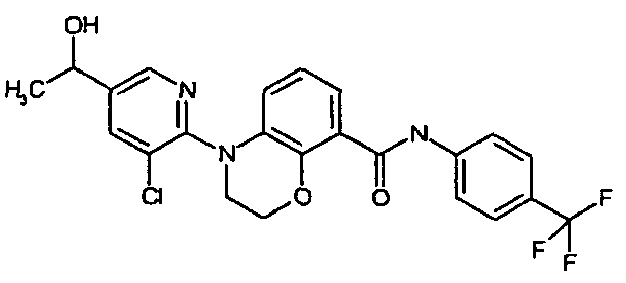
(300 MHz, DMSO-d6) δ: 1.40 (d, J = 6.6 Hz, 3H), 3.76-3.80 (m, 2H), 4.41-4.44 (m, 2H), 4.80-4.84 (m, 1H), 5.43-5.47 (m, 1H), 6.47 (d, J = 8.4 Hz, 1H), 6.81 (t, J = 7.9 Hz, 1H), 7.05 (t, J = 3.9 Hz, 1H), 7.71 (d, J = 8.8 Hz, 2H), 7.96 (t, J = 2.9 Hz, 4H), 8.40 (d, J = 1.8 Hz, 1H), 10.51 (s, 1H). [Table 33] Ex. No. Chemical Compounds NMR 250 2-14 
(400 MHz, DMSO-d6) 1.39 (d, J = 6.5 Hz, 3H), 3.77 (t, J = 4.4 Hz, 2H), 4.41 (t, J = 4.4 Hz, 2H), 4.79-4.85 (m, 1H), 5.44 (d, J = 4.4 Hz, 1H), 6.46 (dd, J = 8.0, 1.4 Hz, 1H), 6.79 (t, J = 8.0 Hz, 1H), 7.03 (dd, J = 8.0, 1.4 Hz, 1H), 7.34 (d, J = 8.8 Hz, 2H), 7.85 (d, J = 8.8 Hz, 2H), 7.96 (d, J = 1.9 Hz, 1H), 8.39 (d, J =1.9 Hz, 1H), 10.3 (s, 1 H). 251 2-15 
(400 MHz, DMSO-d6) 1.39 (d, J = 6.5 Hz, 3H), 3.77 (t, J = 4.4 Hz, 2H), 4.41 (t, J = 4.4 Hz, 2H), 4.79-4.86 (m, 1H), 5.44 (d, J = 4.4 Hz, 1H). 6.46 (dd, J = 8,0, 1,5 Hz, 1H). 6.79 (t, J = 8.0 Hz, 1H). 7.03 (dd, J = 8.0, 1.5 Hz, 1H), 7.34 (d, J = 9.0 Hz, 2H), 7.85 (d, J = 9.0 Hz, 2H), 7.96 (d, J = 1.9 Hz, 1H), 8.39 (d, J = 1.9 Hz, 1H), 10.3 (s, 1H). 252 2-16 
(300 MHz, DMSO-d6) δ: 3.80 (t, J = 4.4 Hz, 2H), 4.45 (t, J = 4.4 Hz, 2H), 4.57 (d, J = 4.8 Hz, 2H), 5.43 (t, J = 5.3 Hz, 1H), 6.51 (dd, J = 8.1, 1.5 Hz, 1H), 6.83 (t, J = 7.9 Hz, 1H), 7.09 (dd, J = 7.3, 1.5 Hz, 1H). 7.93 (dd, J = 14.3, 7.2 Hz, 2H), 8.38 (d, J = 1.8 Hz, 1H). 8.47 (d, J = 8.8 Hz, 1 H), 9.04 (d, J = 2.2 Hz, 1H), 10.73 (s, 1 H).. 253 2-17 
(400 MHz, DMSO-d6) 3.78(t, J=4.3Hz, 2H), 4.43(t, J=4.3Hz, 2H), 4.57(d, J=5.1Hz. 2H),5.43(t, J=5.1Hz, 1H). 6.48(dd, J=8.2, 1.5Hz, 1 H), 6.80(dd, J=8.2, 7.6Hz, 1H), 7.05(dd, J=7.6, 1.5Hz, 1 H), 7.63(dd, 8.6, 2.4Hz, 1H), 7.73(d, J=8.6Hz, 1H), 7.95(d, J=2.0Hz, 1H), 8.14(d, J=2.4Hz, 1H), 8.37(d, J=2.OHz, 1H), 10.43(s, 1H) 254 2-18 
(300 MHz, DMSO-d6) δ: 1.37 (s, 6H), 4.02 (t, J = 4.2 Hz, 2H), 4.33 (t, J = 4.2 Hz, 2H), 5.07 (s, 1H), 6.93 (t, J = 7.9 Hz, 1H), 7.15-7.20 (m, 2H), 7.48 (dd, J = 8.3, 1.7 Hz, 1H), 7.71-7.76 (m, 3H), 7.95 (d, J = 8.4 Hz, 2H), 8.40 (d, J = 1.8 Hz, 1H), 10.48 (s, 1 H). 255 2-19 
(400 MHz, DMSO-d6) δ: 1.27 (d, J = 6.0 Hz, 6H), 3.77 (t, J = 3.9 Hz, 2H), 4.42 (t, J = 4.2 Hz, 2H), 4.55 (d, J = 4.6 Hz, 2H), 4.71-4.77 (m, 1 H), 5.41-5.44 (m, 1H), 6.46 (dd, J = 7.9, 1.4 Hz, 1H), 6.79 (t, J = 7.9 Hz, 1H), 7.05 (dd, J = 7.4, 1.4 Hz, 1H), 7.29 (d, J = 9.3 Hz, 1H), 7.89 (d, J = 9.3 Hz, 1H), 7.94 (s, 1H), 8.08 (s, 1H), 8.36 (s, 1H), 10.22 (s, 1H). 256 2-20 
(400 MHz, DMSO-d6) 3.79 (t, J = 4.4 Hz, 2H), 4.44 (t, J = 4.4 Hz, 2H), 4.56 (d, J = 5.1 Hz, 2H), 5.44 (t, J = 5.1 Hz, 1H), 6.51 (dd, J = 7.9, 1.6 Hz, 1H), 6.82 (t, J = 7.9 Hz, 1 H), 7.09 (dd, J = 7.9, 1.6 Hz, 1H), 7.95 (d, J = 2.3 Hz, 1H), 8.37 (d, J = 1.9 Hz, 1H), 8.54 (d, J = 2.3 Hz, 1H), 8.73 (d, J = 2.3 Hz, 1H), 10.65 (s, 1 H). [Table 34] Ex. No. Chemical Compounds NMR 257 2-21 
(400 MHz, DMSO-d6) 3.79 (t, J = 4.2 Hz, 2H), 4.44 (t, J = 4.2 Hz, 2H), 4.56 (d, J = 5.1 Hz, 2H), 5.43 (t, J = 5.1 Hz, 1H), 6.50 (dd, J = 7.9, 1.4 Hz, 1H), 6.82 (t, J = 7.9 Hz, 1H), 7.06 (dd, J = 7.9,1.4 Hz, 1H), 7.95 (d, J = 1.9 Hz, 1H), 8.07 (s, 2H), 8.37 (d, J = 1.9 Hz, 1H), 10.53 (s, 1H). 258 2-22 
(400 MHz, DMSO-d6) 3.81 (t, J = 3.7 Hz, 2H), 4.49 (t, J = 3.7 Hz, 2H), 4.57 (d, J = 5.6 Hz, 2H), 5.44 (t, J = 5.6 Hz, 1H), 6.56 (d, J = 7.9 Hz, 1H), 6.85 (t, J = 7.9 Hz, 1H). 7.19 (d, J = 7.9 Hz, 1H). 7.31 (t, J = 9.3 Hz, 1H), 7.77-7.79 (m, 1H). 7.93-7.96 (m, 2H), 8.38 (s, 1H), 12.18 (s. 1H). 259 2-23 
(400 MHz, DMSO-d6) 3.79 (t, J = 3.9 Hz, 2H), 4.43 (t, J = 3.9 Hz, 2H), 4.57 (d, J = 5.6 Hz, 2H), 5.44 (t, J = 5.6 Hz, 1H). 6.49 (dd, J = 7.9, 1.4 Hz, 1H). 6.81 (t, J = 7.9 Hz, 1H), 7.06 (dd, J = 7.4, 1.4 Hz, 1H). 7.85 (d, J = 8.3 Hz, 1H). 7.95 (d, J = 7.4 Hz, 2H), 8.36 (d, J = 7.9 Hz, 2H), 10.57 (s, 1H). 260 2-24 
(400 MHz, DMSO-d6) 3.80 (t, J = 4.2 Hz, 2H), 4.46 (t, J = 4.2 Hz, 2H), 4.58 (s, 2H), 5.45 (br s, 1 H), 6.49 (dd, J = 7.9, 1.4 Hz, 1H). 6.82 (t, J = 7.9 Hz, 1H). 7.10 (dd, J = 7.4.1.4 Hz, 1 H), 7.59 (br s, 1 H), 7.71 (d, J = 8.3 Hz, 1H), 7.96 (d, J = 1.9 Hz, 1H), 8.38 (d, J = 1.9 Hz, 1 H), 8.40 (br s, 1 H), 10.35 (s, 1H), 13.82 (br s, 1 H). 261 2-25 
(400 MHz, DMSO-d6) 3.78 (t, J = 4.4 Hz, 2H), 4.43 (t, J = 4.4 Hz, 2H), 4.56 (s, 2H), 5.43 (s, 1H), 6.49 (dd, J = 8.1, 1.6 Hz, 1H), 6.81 (t, J = 7.9 Hz, 1H), 7.04 (dd, J = 7.9, 1.4 Hz, 1H), 7.69 (dd, J = 10.7, 6.5 Hz, 2H), 7.95 (d, J = 1.4 Hz, 1H), 8.37 (d, J = 1.4 Hz, 1H), 10.49 (s, 1 H). 262 2-26 
(400 MHz, DMSO-d6) 3.79 (t, J = 4.2 Hz, 2H), 4.44 (t, J = 4.2 Hz, 2H), 4.57 (d, J = 4.2 Hz, 2H), 5.44 (t, J = 4.9 Hz, 1H), 6.50 (dd, J = 8.1, 1.2 Hz, 1H), 6.82 (t, J = 7.9 Hz, 1H), 7.07 (d, J = 6.5 Hz, 1H), 7.59 (dd, J = 11.1, 9.3 Hz, 1H), 7.96 (d, J =1.9 Hz, 1H), 8.05-8.06 (m, 1H), 8.37 (d, J = 1.9 Hz, 1H), 8.70-8.71 (m, 1H), 10.61 (s, 1 H). 263 2-27 
(400 MHz, DMSO-d6) 3.78 (t, J = 4.4 Hz, 2H), 4.42 (t, J = 4.4 Hz, 2H), 4.56 (d, J = 5.6 Hz, 2H), 5.14 (s, 2H), 5.43 (t, J = 5.8 Hz, 1H), 6.45 (dd, J = 7.9, 1.4 Hz, 1H), 6.76-6.82 (m, 2H), 6.87-6.94 (m, 1H), 7.03 (dd, J =7.4, 1.4 Hz, 1H), 7.31 (dd, J = 8.3, 2.8 Hz, 1H), 7.95 (d, J = 1.9 Hz, 1H), 8.36 (d, J = 1.9 Hz, 1H), 9.91 (s, 1H). 264 2-28 
(300 MHz, DMSO-d6) 1.28 (s, 9H), 4.04 (t, J = 4.4 Hz, 2H), 4.33 (t, J = 4.4 Hz, 2H), 4.45 (d, J = 5.5 Hz, 2H), 5.16 (t, J = 5.7 Hz, 1H), 6.93 (t, J = 7.9 Hz, 1H), 7.18-7.22 (m, 2H), 7.34 (d, J = 8.4 Hz, 2H), 7.45 (dd, J = 8.1, 1.5 Hz, 1H), 7.64 (t, J = 4.4 Hz, 3H), 8.24 (d, J = 1.8 Hz, 1H), 10.05 (s, 1H). [Table 35] Ex. No. Chemical Compounds NMR 265 2-29 
(400 MHz, OMSO-d6) 3.78(t, J=4.4Hz, 2H), 4.44(t, J=4.4Hz, 2H), 4.56(d, J=5.6Hz, 2H), , 5.43(t, J=5.6Hz, 1H), 6.50(dd, J=8.2, 1.4Hz, 1H), 6.82(dd, J=8.2, 7.6Hz, 1H), 7.09(dd, J=7.6, 1.4Hz, 1H), 7.79(s, 1H), 7.95(d, J=2.1Hz, 1H), 8.37(d,J=2.1Hz, 1H)8.46(s, 2H), 10.78(s, 1H) 266 2-30 
(400 MHz, DMSO-d6) 3.75(t, J=4.6Hz, 2H), 4.40(t, J=4.6Hz, 2H), 4.53(d. J=5.1Hz, 2H), 4.80(q, J=8.8Hz, 2H), 5.40(t, J=5.1Hz, 1H), 6.44(dd, J=8.1, 1.4Hz, 1H), 6.76(dd, J=8.1, 7.7Hz, 1H). 7.03(dd, J=7.7, 1.4Hz, 1H), 7.25(d, J=9.0Hz, 1H), 7.63(dd, J=9.0, 2.6Hz, 1H), 7.91-7.94(m, 2H), 8.34(d. J=2.1 Hz, 1H), 10.19(s, 1H) 267 2-31 
(400 MHz, CHLOROFORM-d) 3.93(t, J=4.4Hz, 2H), 4.80(q, J=8.8Hz. 2H),4.62(t, J=4.4Hz, 2H), 4.75(s, 2H), 6.65(dd, J=8.1. 1.6Hz, 1H), 6.89(dd, J=8.1, 7,9Hz, 1H), 6.96(d, J=8.8Hz, 2H), 7.64, (d, J=8.8HZ, 2H), 7.80(dd, J=7.9, 1.6Hz, 1H), 7.85(d, J=1.9Hz, 1H), 9.34(d, J=1,9Hz, 1H), 9.59(s, 1H) 268 2-32 
(400 MHz, DMSO-d6) 3.75(t, J=4.4Hz. 2H), 4.39(t, J=4.4Hz, 2H), 4.52(d, J=4.6Hz, 2H), 5.40(t, J=4.6Hz, 1H), 6.45(dd, J=8.1, 1.7Hz, 1H), 6.77(dd, J=8.1, 7.7Hz, 1H), 7.01 (dd, J=7.7,1.7Hz, 1H), 7.66(d, J=8.5Hz, 1H), 7,88(d, J=8.5Hz, 2H), 7.92(d, J = 2.1 Hz, 1H), 8.34(d, J=2.1Hz, 1H), 10.45(s, 1H) 269 2-33 
(300 MHz, DMSO-d6) δ: 0.85 (s, 9H), 0.99-1.08 (m, 1H), 1.19-1.36 (m, 1H), 1.75-1.78 (m, 2H), 1.93-1.97 (m, 2H), 3.60-3.68 (m, 1H), 3.73-3.75 (m, 2H), 4.40 (t, J = 4.4 Hz, 2H), 4.55 (d, J = 5.5 Hz, 2H), 5.41 (t, J = 5.7 Hz, 1H), 6.40 (dd, J = 8.1, 1.5 Hz, 1 H), 6.73 (t, J = 7.7 Hz, 1H), 7.08 (dd, J = 7.7, 1.5 Hz, 1H), 7.88 (d, J = 8.1 Hz, 1H), 7.92 (d, J = 1.5 Hz, 1H), 8.34 (d, J = 1.5 Hz, 1H). 270 2-34 
(300 MHz, DMSO-d6) δ: 1.27 (d, J = 5.9 Hz, 6H), 3.78 (t, J = 4.2 Hz, 2H), 4.43 (t, J = 4.2 Hz, 2H), 4.50-4.57 (m, 3H), 5.43 (t, J = 5.7 Hz, 1H), 6.46 (dd, J = 8.1, 1.5 Hz, 1H), 6.62-6.87 (m, 1H), 7.04 (dd, J = 7.5, 1.3 Hz, 1H), 7.14 (t, J = 9.2 Hz, 1H), 7.41 (d, J = 9.5 Hz, 1H), 7.73 (dd, J = 13.6, 2.2 Hz, 1H), 7.95 (d, J = 1.8 Hz, 1H), 8.37 (d, J = 1.8 Hz, 1H), 10.16 (s, 1H). 271 2-35 
(300 MHz, DMSO-d6) δ: 1.53-1.64 (m, 6H), 2.92 (t, J = 5.1 Hz, 4H), 3.78 (t, J = 4.2 Hz, 2H), 4.43 (t, J = 4.4 Hz, 2H), 4.56 (d, J = 5.9 Hz, 2H), 5.42 (t, J = 5.7 Hz, 1H), 6.46 (dd, J = 8.1, 1.5 Hz, 1H), 6.79 (t, J = 7.9 Hz, 1H), 6.99-7.04 (m, 2H), 7.40 (dd, J = 8.6, 1.7 Hz, 1H), 7.65 (dd, J = 14.9, 2.4 Hz, 1H), 7.95 (d, J = 1.8 Hz, 1H), 8.36 (d, J = 1.8 Hz, 1H), 10.12 (s, 1H). [Table 36] Ex. No. Chemical Compounds NMR 272 2-36 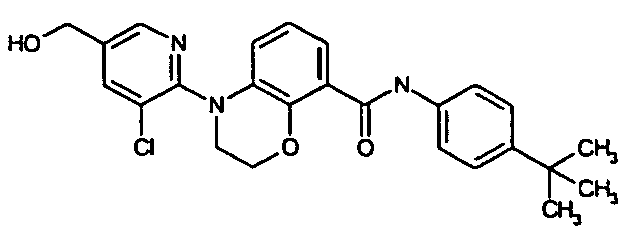
(300 MHz, DMSO-d6) 1.28 (s, 9H), 3.78 (t, J = 4.4 Hz, 2H), 4.43 (t, J = 4.4 Hz, 2H), 4.56 (d, J = 5.1 Hz, 2H), 5.42 (t, J = 5.7 Hz, 1H), 6.46 (dd, J = 8.1, 1.5 Hz, 1H), 6.79 (t, J = 7.9 Hz, 1H), 7.06 (dd, J = 7.7, 1.5 Hz, 1H), 7.35 (d, J = 8.8 Hz, 2H), 7.65 (d, J = 8.4 Hz, 2H), 7.95 (d, J = 1.8 Hz, 1H), 8.37 (d, J = 1.8 Hz, 1H), 10.05 (s, 1H). 273 2-37 
(400 MHz, DMSO-d6) 3.79 (t, J = 4.2 Hz, 2H), 4.43 (t, J = 4.2 Hz, 2H), 4.56 (d, J = 5.6 Hz, 2H), 5.43 (t, J = 5.6 Hz, 1H), 6.48 (dd, J = 7.9, 1.4 Hz, 1H), 6.81 (t, J = 7.9 Hz, 1H), 7.05 (dd, J = 7.9, 1.4 Hz, 1H), 7.64 (d, J = 8.8 Hz, 2H), 7.87 (d, J = 8.8 Hz, 2H), 7.95 (d, J = 1.9 Hz, 1H), 8.37 (d, J = 1.9 Hz, 1H), 8.62 (s, 1H), 10.37 (s, 1H). 274 2-38 
(400 MHz, DMSO-d6) 3.78 (t, J = 4.4 Hz, 2H), 4.43 (t, J = 4.4 Hz, 2H), 4.56 (d, J = 5.6 Hz, 2H), 5.44 (t, J = 5.6 Hz, 1 H), 6.48 (dd, J = 7.9, 1.4 Hz, 1H), 6.81 (t, J = 7.9 Hz, 1H), 7.05 (dd, J = 7.9, 1.4 Hz, 1H), 7.46 (d, J = 8.8 Hz, 1H), 7.61 (dd, J = 8.8, 2.3 Hz, 1H), 7.95-7.96 (m, 2H), 8.37 (d, J = 1.9 Hz, 1H), 10.47 (s, 1H). 275 2-39 
(400 MHz, DMSO-d6) 0.98 (d, J = 7.0 Hz, 6H), 1.97-2.04 (m, 1H), 3.72 (d, J = 6.5 Hz, 2H), 3.78 (t, J = 4.4 Hz, 2H), 4.43 (t, J = 4.4 Hz, 2H), 4.56 (s, 2H), 6.45 (dd, J = 8.1, 1.6 Hz, 1H), 6.78 (t, J = 7.9 Hz, 1H), 6.90 (d, J = 9.3 Hz, 2H), 7.06 (dd, J = 7.7, 1.6 Hz, 1H), 7.64 (d, J = 8.8 Hz, 2H), 7.95 (d, J = 2.3 Hz, 1 H), 8.37 (d, J = 1.9 Hz, 1 H), 9.99 (s, 1 H). 276 2-40 
(400 MHz, DMSO-d6) 3.78 (t, J = 4.2 Hz, 2H), 4.43 (t, J = 4.2 Hz, 2H), 4.56 (d, J = 5.1 Hz, 2H), 5.43 (t, J = 5.8 Hz, 1H). 6.48 (dd, J = 7.9. 1.4 Hz, 1H), 6.81 (t, J = 7.9 Hz, 1H), 7.05 (dd, J = 7.4, 1.4 Hz, 1H), 7.60 (d, J = 8.8 Hz, 1H), 7.70 (dd, J = 9.0, 2.6 Hz, 1H), 7.95 (d, J = 1.9 Hz, 1H), 8.14 (d, J = 2.3 Hz, 1H), 8.37 (d, J = 1.9 Hz, 1H), 10.43 (s, 1H). 277 2-41 
(400 MHz, DMSO-d6) 3.78 (t, J = 4.2 Hz, 2H), 4.43 (t, J = 4.4 Hz, 2H), 4.56 (d, J = 5.1 Hz, 2H), 5.43 (t, J = 5.8 Hz, 1H), 6.48 (dd, J = 7.9, 1.4 Hz, 1H), 6.80 (t, J = 7.9 Hz, 1H), 7.04 (dd, J = 7.7, 1.6 Hz, 1H), 7.49 (dd, J = 8.8, 1.9 Hz, 1 H), 7.66 (t, J = 8.3 Hz, 1 H), 7.90 (dd, J = 11.6, 2.3 Hz, 1 H), 7.95 (d, J = 1.9 Hz, 1H), 8.37 (d, J = 1.9 Hz, 1H), 10.47 (s, 1H). 278 2-42 
(400 MHz, DMSO-d6) 3.78 (t, J = 4.4 Hz, 2H), 4.42 (t, J = 4.2 Hz, 2H), 4.56 (s, 2H), 5.42 (s, 1H), 6.47 (dd, J = 8.3, 1.4 Hz, 1H), 6.79 (t, J = 7.9 Hz, 1H), 7.04 (dd, J = 7.7, 1.6 Hz, 1H), 7.52 (dd, J = 7.0, 1.9 Hz, 2H), 7.73 (d, J = 8.8 Hz, 2H), 7.95 (d, J = 1.9 Hz, 1H), 8.37 (d, J = 1.9 Hz, 1H), 10.28 (s, 1H). 279 2-43 
(400 MHz, DMSO-d6) 3.78 (t, J = 4.4 Hz, 2H), 4.43 (t, J = 4.2 Hz, 2H), 4.56 (d, J = 5.6 Hz, 2H), 5.43 (t, J = 5.8 Hz, 1H). 6.49 (dd, J = 8.3, 1.4 Hz, 1H). 6.81 (t, J = 7.7 Hz, 1H). 7.05 (dd, J = 7.9, 1.4 Hz, 1H). 7.31 (t, J = 1.9 Hz, 1H). 7.86 (d, J = 1.4 Hz, 2H), 7.97 (t, J = 5.8 Hz, 1H), 8.37 (d, J = 1.9 Hz, 1H). 10.47 (s, 1H). [Table 37] Ex. No. Chemical Compounds NMR 280 2-44 
(400 MHz, DMSO-d6) 3.78 (t, J = 4.4 Hz, 2H), 4.43 (t, J = 4.4 Hz, 2H), 4.56 (d, J = 5.6 Hz, 2H), 5.43 (t, J = 5.6 Hz, 1H), 6.47 (dd, J = 8.1, 1.6 Hz, 1H), 6.80 (t, J = 7.9 Hz, 1H), 7.05 (dd, J = 7.9, 1.4 Hz, 1 H), 7.16 (t, J = 74.4 Hz, 1H), 7.17 (d, J = 8.8 Hz, 2H), 7.79 (d, J = 8.8 Hz, 2H), 7.95 (d, J = 1.9 Hz, 1H), 8.37 (d, J = 2.3 Hz, 1H), 10.22 (s, 1H). 281 2-45 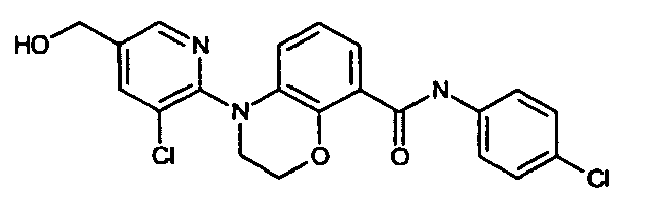
(300 MHz,DMSO-d6)3.78 (t, J = 4.2 Hz, 2H), 4.43 (t, J = 4.2 Hz, 2H), 4.56 (d, J = 5.1 Hz, 2H), 5.42 (t, J = 5.7 Hz, 1H), 6.47 (dd, J=8.1, 1.5 Hz, 1 H), 6.80 (t, J = 7.9 Hz, 1 H), 7.05 (dd, J = 7.7, 1.5 Hz, 1H), 7.39 (dt, J = 9.5, 2.6 Hz, 2H), 7.79 (d, J = 9.2 Hz, 2H), 7.95 (d, J = 2.2 Hz, 1H), 8.37 (d, J = 1.8 Hz, 1H), 10.28 (s, 1 H). 282 2-46 
(300 MHz,DMSO-d6) 1.20 (d, J = 7.0 Hz, 6H), 2.82-2.91 (m, 1H), 3.78 (t, J = 4.2 Hz, 2H), 4.43 (t, J = 4.2 Hz, 2H), 4.56 (d, J = 5.1 Hz, 2H), 5.42 (t, J = 5.5 Hz, 1 H), 6.46 (d, J = 8.1 Hz, 1H), 6.79 (t, J = 7.9 Hz, 1H), 7.06 (d, J = 7.7 Hz, 1H), 7.20 (d, J = 8.4 Hz, 2H), 7.65 (d, J = 8.4 Hz, 2H), 7.95 (d, J = 1.5 Hz, 1H), 8.37 (d, J = 1.1 Hz, 1H), 10.04 (s, 1H). 283 2-47 
(300 MHz,DMSO-d6)3.78 (t, J = 4.0 Hz, 2H), 4.43 (t, J = 4.2 Hz, 2H), 4.56 (d, J = 5.1 Hz, 2H), 5.42 (t, J = 5.5 Hz, 1H), 6.48 (dd, J = 8.1, 1.5 Hz, 1H), 6.80 (t, J = 7.9 Hz, 1H), 7.05 - 7.06 (m, 2H), 7.47 (t, J = 8.3 Hz, 1H), 7.67 (d, J = 7.3 Hz, 1H), 7.95 (d, J = 1.8 Hz, 2H), 8.37 (d, J = 1.8 Hz, 1H), 10.42 (s, 1H). 284 2-48 
(300 MHz, DMSO-d6) δ: 1.39 (d, J = 7.9 Hz, 3H), 3.78 (s, 2H), 4.41-4.42 (m, 2H), 4.82-4.84 (m, 1H), 6.46 (dd, J = 8. 1, 1.5 Hz, 1H), 6.80 (t, J = 7.9 Hz, 1H), 7.04-7.05 (m, 1H), 7.35 (d, J = 8.8 Hz, 2H), 7.86 (d, J = 9.2 Hz, 2H), 7.97 (d, J = 1.5 Hz, 1H), 8.40 (d, J = 1.8 Hz, 1H), 10.33 (s, 1H). 285 3 
(400 MHz, DMSO-d6) δ: 5.04 (2H, s), 6.40-6.42 (1H, m), 7.04 (1H, dd, J = 7.9, 3.9 Hz), 7.32 (1 H, dd, J = 7.9, 1.4 Hz), 7.38 (2H, d, J = 8.3 Hz), 7.71 (1H, q, J = 4.2 Hz), 7.86 (2H, dd, J = 12.3, 3.0 Hz), 8.32 (1H, dd, J = 7.9, 1.4 Hz), 8.69 (1 H, dd, J = 4.6, 1.4 Hz), 10.51 (1 H, s). 286 4-01 
(400 MHz, DMSO-d6) 3.50-3.55 (m, 1H), 3.69-3.77 (m, 1H), 3.96-4.00 (m, 1H). 4.17-4.19 (m, 1H), 4.60-4.67 (m, 1H), 5.08 (t, J = 5.3 Hz, 1H), 6.43 (dd, J = 8.9, 1.4 Hz, 1H), 6.81 (t, J = 7.9 Hz, 1H), 7.03 (dd, J = 7.9, 1.4 Hz, 1H). 7.33-7.40 (m, 3H), 7.88 (d, J = 8.8 Hz, 2H), 8.07 (dd, J = 7.9.1.9 Hz, 1H). 8.47 (dd, J = 4.6, 1.4 Hz, 1H), 10.39 (s, 1H). 287 4-02 
(400 MHz, DMSO-d6) 3.50-3.55 (m, 1H), 3.70-3.77 (m, 1H), 3.95-4.01 (m, 1H), 4.18-4.20 (m, 1H), 4.60-4.66 (m, 1H), 5.08 (t, J = 5.3 Hz, 1H), 6.44 (dd, J = 7.9, 1.6 Hz, 1H). 6.82 (t, J = 7.9 Hz, 1H), 7.04 (dd, J = 7.9,1.6 Hz, 1H), 7.37 (dd, J = 7.9,4.6 Hz, 1H), 7.72 (d, J = 8.8 Hz, 2H), 7.98 (d, J = 8.8 Hz, 2H), 8.08 (dd, J = 7.9, 1.4 Hz, 1H), 8.47 (dd, J = 4.6,1.4 Hz, 1 H), 10.56 (s, 1H), [Table 38] Ex. No. Chemical Compounds NMR 288 4-03 
(400 MHz, DMSO-d6) 3.47-3.56 (m, 1H), 3.69-3.75 (m, 1H), 3.95-4.02 (m, 1H), 4.16-4.19 (m, 1H), 4.61-4.64 (m, 1H), 5.07 (t, J = 5.5 Hz, 1H), 6.42 (dd, J = 8.1. 1.5 Hz, 1H), 6.81 (t, J = 7.7 Hz, 1 H). 7.03 (dd, J = 7.3, 1.5 Hz, 1 H), 7.34-7.38 (m, 3H), 7.87 (d, J = 9.2 Hz, 2H), 8.07 (dd, J = 7.9, 1.7 Hz, 1 H), 8.46 (dd, J = 4.6, 1.0 Hz, 1H), 10.37 (s, 1 H). 289 4-04 
(300 MHz, DMSO-d6) 3.49-3.54 (m, 1H), 3.71-3.75 (m, 1H), 3.95-4.00 (m, 1 H), 4.17-4.20 (m, 1 H), 4.60-4.64 (m, 1H), 5.07 (t, J = 5.3 Hz, 1 H), 6.43 (dd, J = 8.1, 1.5 Hz, 1 H), 6.82 (t, J = 7.9 Hz, 1 H), 7.04 (dd, J = 7.5, 1.7 Hz, 1H), 7.36 (dd, J = 8.1, 4.8 Hz, 1H), 7.72 (d, J = 8.8 Hz, 2H), 7.97 (d, J = 8.1 Hz, 2H), 8.07 (dd, J = 7.9, 1.7 Hz, 1H), 8.46 (dd, J = 4.6, 1.7 Hz, 1H), 10.54 (s, 1H). 290 4-05 
(400 MHz, DMSO-d6) 3.43-3.49 (m, 1H), 3.59-3.64 (m, 1H), 4.11 (dd, J = 11.1, 2.3 Hz, 1H), 4.48 (t, J = 7.0 Hz, 1H), 4.58 (d, J = 10.2 Hz, 1H), 5.14 (t, J = 5.6 Hz, 1H), 6.93 (t, J = 7.9 Hz, 1H), 7.17 (dd, J = 7.4, 1.4 Hz, 1H), 7.31 (d, J = 8.8 Hz, 1H), 7.36 (d, J = 8.3 Hz, 2H), 7.44 (dd, J = 8.3, 1.4 Hz, 1 H), 7.79 (dd, J = 9.0, 2.6 Hz, 1H), 7.85 (d, J = 9.3 Hz, 2H), 8.32 (d, J = 2.8 Hz, 1H), 10.38 (s, 1 H). 291 4-06 
(400 MHz, DMSO-d6) 3.42-3.50 (m, 1H), 3.59-3.65 (m, 1H), 4.12 (dd, J = 10.9, 2.6 Hz, 1H), 4.48 (t, J = 7.0 Hz, 1H), 4.58 (d, J = 10.7 Hz, 1H), 5.15 (t, J = 5.6Hz, 1H), 6.93 (t, J = 7.9 Hz, 1H). 7.18 (dd, J = 7.7, 1.6 Hz, 1H), 7.31 (d, J = 9.3 Hz, 1H), 7.45 (dd, J = 8.1, 1.6 Hz, 1H), 7.71 (d, J = 8.8 Hz, 2H), 7.79 (dd, J = 8.8, 2.8 Hz, 1H). 7.95 (d, J = 8.3 Hz, 2H), 8.33 (d, J = 2.8 Hz, 1H), 10.54 (s, 1H). 292 4-07 
(400 MHz, DMSO-d6) 3.42-3.49 (m, 1H), 3.62-3.67 (m, 1H), 4.08 (dd, J = 11.1, 2.3 Hz, 1H), 4.40 (t, J = 7.2 Hz, 1H), 4.59 (d, J = 10.2 Hz, 1H), 5.14 (t, J = 5.6 Hz, 1H), 6.89 (t, J = 7.9 Hz, 1H), 7.10 (dd, J = 7.9, 1.4 Hz, 1H), 7.21 (d, J = 8.3 Hz, 1H), 7.32-7.37 (m, 3H), 7.55 (dd, J = 8.8, 2.3 Hz, 1H), 7.86 (d, J = 9.3 Hz, 2H), 8.16 (d, J = 2.3 Hz, 1H), 10.37 (s, 1H). 293 4-08 
(400 MHz, DMSO-d6) 3.42-3.49 (m, 1H), 3.62-3.67 (m, 1H), 4.09 (dd, J = 10.7, 2.3 Hz, 1H), 4.40 (t, J = 7.2 Hz, 1H), 4.58 (d, J = 10.7 Hz, 1H), 5.15 (t, J = 5.6 Hz, 1H), 6.90 (t, J = 7.9 Hz, 1H), 7.11 (dd, J = 7.4, 1.4 Hz. 1H), 7.21 (d, J = 8.3 Hz, 1H), 7.35 (dd, J = 8.3, 1.4 Hz, 1 H), 7.56 (dd, J = 8.6, 2.6 Hz, 1H), 7.71 (d, J = 8.3 Hz, 2H), 7.96 (d, J = 8.3 Hz, 2H), 8.16 (d, J = 2.3 Hz, 1H), 10.54 (s, 1 H). 294 4-09 
(400 MHz, DMSO-d6) 1.27 (d, J = 6.0 Hz, 6H), 3.48-3.55 (m, 1H), 3.70-3.75 (m, 1H), 3.96-3.99 (m, 1H), 4.17 (dd, J = 10.7, 2.3 Hz, 1H), 4.50-4.59 (m, 1H), 4.63 (dd, J = 11.1, 1.9 Hz, 1H), 5.09 (t, J = 5.6 Hz, 1H), 6.41 (dd, J = 8.1, 1.6 Hz, 1H), 6.80 (t, J = 7.9 Hz, 1H), 7.02 (dd, J = 7.7, 1.6 Hz, 1H), 7.15 (t, J = 9.3 Hz, 1H), 7.36 (q, J = 4.2 Hz, 1H), 7.41-7.44 (m, 1H), 7.74 (dd, J = 13.7, 2.6 Hz, 1H), 8.07 (dd, J = 8.1, 1.6 Hz, 1H), 8.46 (dd, J = 4.6, 1.4 Hz, 1H), 10.21 (s, 1H). [Table 39] Ex. No. Chemical Compounds NMR 295 4-10 
(400 MHz, DMSO-d6) 1.52-1.68 (m, 6H), 2.92 (t, J = 5.1 Hz, 4H), 3.51 (td, J = 10.3, 6.2 Hz, 1H), 3.70-3.75 (m,1 1H), 3.95 - 3.99 (m, 1H), 4.17 (dd, J = 10.7, 2.3 Hz, 1H), 4.62 (dd, J = 10.7, 1.9 Hz, 1H), 5.09 (t, J = 5.6 Hz, 1H), 6.41 (dd, J = 7.9, 1.4 Hz, 1H), 6.80 (t, J = 7.9 Hz, 1H), 7.01 (dt, J = 11.3, 3.1 Hz, 2H), 7.36 (q, J = 4.2 Hz, 1H), 7.41 (dd, J = 8.6, 1.6 Hz, 1H), 7.66 (dd, J = 14.8, 2.8 Hz, 1H), 8.07 (dd, J = 6.1,1,6 Hz, 1H), 8.45-8.47 (m, 1H), 10.18 (s, 1H). 296 4-11 
(400 MHz, DMSO-d6) 3.47-3.55 (m, 1H), 3.70-3.76 (m, 1H), 3.96-4.00 (m, 1H). 4.15-4.20 (m, 1H), 4.63 (dd, J = 10.9, 1.6 Hz, 1H). 5.09 (t, J = 5.3 Hz, 1H). 6.44 (dd, J = 8.1, 1.6 Hz, 1 H), 6.82 (t, J = 7.9 Hz, 1H). 7.03 (dd, J = 7.4, 1.4 Hz, 1H), 7.36 (q, J = 4.2 Hz, 1H). 7.58 (dd, J = 9,0,1.2 Hz, 1H), 7.79 (dd, J = 8.8, 2.3 Hz, 1H). 8.08 (dd, J = 7.9, 1.9 Hz, 1H), 8.16 (d, J = 2.8 Hz, 1H), 8.46 (q, J = 2.2 Hz, 1H), 10.54 (s, 1H). 297 4-12 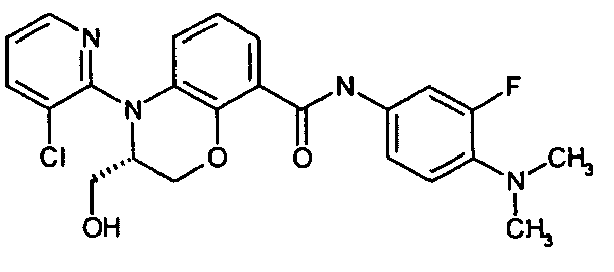
(400 MHz, DMSO-d6) 2.74 (s, 6H), 3.47-3.55 (m, 1H), 3.70 - 3.75 (m, 1H). 3.96-3.99 (m, 1H), 4.17 (dd, J = 10.9, 2.1 Hz, 1H), 4.63 (dd, J = 11.1, 1.9 Hz, 1H), 5.09 (t, J = 5.6 Hz, 1 H), 6.41 (dd, J = 8.1, 1.6 Hz, 1H), 6.80 (t, J = 7.7 Hz, 1H), 6.96 (dd, J = 10.0, 9.0 Hz, 1H), 7.02 (dd, J =7.4,1.4 Hz, 1H), 7.36 (q, J = 4.2 Hz, 1H), 7.40 (dd, J = 8.8, 1.9 Hz, 1H), 7.66 (dd, J = 15.5, 2.6 Hz, 1H), 8.07 (dd, J = 8.1, 1.6 Hz, 1H), 8.46 (dd, J =4.9, 1.6 Hz, 1 H), 10.15 (s, 1 H). 298 4-13 
(400 MHz, DMSO-d6) 2.20 (s, 3H), 3.48-3.54 (m, 1H), 3.70 - 3.74 (m, 1H), 3.95-3.99 (m, 1 H), 4.17 (dd, J = 10.7, 2.3 Hz, 1H), 4.62 (dd, J = 11.1, 1.9 Hz, 1H), 5.09 (t, J = 5.3 Hz, 1H), 6.42 (dd, J = 8.1, 1.6 Hz, 1H), 6.80 (t, J = 7.9 Hz, 1H), 7.02 (dd, J = 7.7, 1.6 Hz, 1H), 7.24 (t, J = 8.8 Hz, 1H), 7.36 (q, J = 4.2 Hz, 2H), 7.40 (dd, J = 8.1, 2.1 Hz, 2H), 7.70 (dd, J = 12.3, 2.1 Hz, 1 H), 8.07 (dd, J = 7.9, 1.9 Hz, 1 H), 8.46 (q, J = 2.2 Hz, 1H), 10.29 (s, 1H). 299 4-14 
(400 MHz, DMSO-d6) 0.85 (s, 9H), 0.95-1.12 (m, 3H), 1.26 (q, J = 12.2 Hz, 2H), 1.77 (d, J = 10.7 Hz, 2H), 1.96 (dd, J = 12.8, 3.0 Hz, 2H), 3.41-3.49 (m, 1H), 3.61-3.72 (m, 2H), 3.95-3.99 (m, 1H), 4.12 (dd, J = 10.9, 2.6 Hz, 1H). 4.61 (dd, J = 10.9, 1.6 Hz, 1H), 5.09 (dd, J = 6.0, 5.1 Hz, 1H), 6.34 (dd, J = 8.1, 1.6 Hz, 1H), 6.74 (t, J = 7.9 Hz, 1H), 7.04 (dd, J = 7.7, 1.6 Hz, 1H), 7.34 (q, J = 4.2 Hz, 1H), 7.93 (d, J = 7.9 Hz, 1H), 8.05 (dd, J = 7.9, 1.9 Hz, 1H), 8.44 (dd, J = 4.6, 1.4 Hz, 1H). 300 4-15 
(400 MHz, DMSO-d6) 0.87 (s, 8H), 1.23-1.40 (m, 4H), 1.89 - 1.99 (m, 4H), 3.08 (s, 2H), 3.16-3.21 (m, 1H), 3.43-3.49 (m, 1H), 3.66-3.77 (m, 2H), 3.95-3.99 (m, 1H), 4.12 (dd, J = 11.1, 2.3 Hz, 1H), 4.61 (dd, J = 11.1, 1.9 Hz, 1H), 5.09 (t, J = 5.6 Hz, 1H), 6.35 (dd, J = 8.1, 1.6 Hz, 1H), 6.74 (t, J = 7.9 Hz, 1H), 7.04 (dd, J = 7.7, 1.6 Hz, 1H), 7.34 (td, J = 5.1. 2.6 Hz, 1H), 7.97 (d, J = 7.9 Hz, 1H), 8.05 (dd, J = 8.1, 1.6 Hz, 1H). 8.44 (dd, J = 4.6, 1.4 Hz, 1H). 301 4-16 
(400 MHz, DMSO-d6) 3.48-3.55 (m, 1H), 3.70-3.75 (m, 1H), 3.96-3.99 (m, 1H), 4.17 (dd, J = 10.9, 2.1 Hz, 1H), 4.62 (dd, J = 10.9, 1.6 Hz, 1H), 5.09 (t, J = 5.6 Hz, 1H), 6.42 (dd, J = 8.3, 1.4 Hz, 1H), 6.81 (t, J = 7.9 Hz, 1H), 7.02 (dd, J = 7.4, 1.4 Hz, 1H), 7.36 (q, J = 4.2 Hz, 1H). 7.41 (dt, J = 9.6, 2.6 Hz, 2H), 7.80 (dd, J = 7.0, 1.9 Hz, 2H), 8.07 (dd, J = 7.9, 1.9 Hz, 1H), 8.46 (q, J = 2.2 Hz, 1H), 10.33 (s, 1H). [Table 40] Ex. No. Chemical Compounds NMR 302 4-17 
(400 MHz, DMSO-d6) 1.20 (d, J = 7.0 Hz, 6H), 2.83-2.90 (m, 1H), 3.48-3.55 (m, 1H), 3.70-3.75 (m, 1H), 3.95-4.00 (m, 1H), 4.18 (dd, J = 10.7, 2.3 Hz, 1H), 4.63 (dd, J = 10.7, 1.9 Hz, 1H), 5.09 (t, J = 5.6 Hz, 1H), 6.41 (dd, J = 8.1, 1.6 Hz, 1H), 6.80 (t, J = 7.9 Hz, 1 H), 7.03 (dd, J = 7.7, 1.6 Hz, 1H), 7.21 (d, J = 8.8 Hz, 2H), 7.36 (q, J = 4.2 Hz, 1H), 7.66 (d, J = 8.8 Hz, 2H), 8.07 (dd, J = 7.9, 1.4 Hz, 1H), 8.46 (dd, J = 4.6, 1.4 Hz, 1H), 10.10 (s, 1 H). 303 4-18 
(400 MHz, DMSO-d6) 3.48-3.54 (m, 1H), 3.70-3.76 (m, 1H), 3.96-4.00 (m, 1H), 4.17 (dd, J = 10.7, 2.3 Hz, 1H), 4.63 (dd, J = 10.9, 1.6 Hz, 1H), 5.09 (t, J = 5.6 Hz, 1H), 6.44 (dd, J = 8.1, 1.6 Hz, 1 H), 6.82 (t, J = 7.9 Hz, 1 H), 7.04 (dd, J = 7.4, 1.4 Hz, 1H), 7.36 (q, J = 4.2 Hz, 1H), 7.53 (t, J = 9.7 Hz, 1H), 8.01-8.05 (m, 1H), 8.07 (dd, J = 8.1, 1.6 Hz, 1H), 8.28 (dd, J = 6.5, 2.3 Hz, 1H), 8.46 (dd, J = 4.6,1.4 Hz, 1H), 10.54 (s, 1H). 304 4-19 
(400 MHz, DMSO-d6) 3.47-3.54 (m, 1 H), 3.70-3.75 (m, 1H). 3.96-3.99 (m, 1H), 4.17 (dd, J = 10.7, 2.3 Hz, 1H), 4.63 (dd, J = 10.9, 1.6 Hz, 1H), 5.09 (dd, J = 6.0, 5.1 Hz, 1 H), 6.43 (dd, J = 8.1, 1.6 Hz, 1 H), 6.82 (t, J = 7.9 Hz, 1H), 7.03 (dd, J = 7.7, 1.6 Hz, 1H), 7.36 (q, J = 4.2 Hz, 1H), 7.64 (dd, J = 8.8, 2.3 Hz, 1H), 7.74 (d, J = 8.8 Hz, 1H), 8.07 (dd, J = 7.9, 1.4 Hz, 1H), 8.14 (d, J = 2.3 Hz, 1H), 8.46 (dd, J = 4.6, 1.4 Hz, 1H), 10.47 (s, 1H), 305 4-20 
(400 MHz, DMSO-d6) 2.63 (s, 6H), 3.48-3.54 (m, 1H), 3.70 - 3.75 (m, 1H), 3.95-4.00 (m, 1H), 4.17 (dd, J = 10.9, 2.1 Hz, 1H), 4.62 (dd, J = 10.7, 1.9 Hz, 1H), 5.08 (t, J = 5.6 Hz, 1H), 6.42 (dd, J = 7.9, 1.4 Hz, 1H), 6.81 (t, J = 7.9 Hz, 1H), 7.03 (dd, J = 7.7, 1.6 Hz, 1 H), 7.36 (q, J = 4.2 Hz, 1H), 7.57 (d, J = 8.8 Hz, 1H), 7.95 (dd, J = 8.8, 2.3 Hz, 1H), 8.07 (dd, J = 7.9, 1.4 Hz, 1H), 8.14 (d, J = 2.3 Hz, 1H), 8.46 (q, J = 2.2 Hz, 1 H), 10.38 (s, 1 H). 306 4-21 
(400 MHz, DMSO-d6) 1.28 (d, J = 6.0 Hz, 6H), 3.48-3.55 (m, 1H), 3.70-3.75 (m, 1H), 3.96-4.00 (m, 1H), 4.17 (dd, J = 10.7, 2.3 Hz, 1H), 4.63 (dd, J = 11.1, 1.9 Hz, 1 H), 4.72-4.78 (m, 1H), 5.09 (t, J = 5.6 Hz, 1H), 6.42 (dd, J = 7.9, 1.4 Hz, 1 H), 6.81 (t, J = 7.9 Hz, 1 H), 7.03 (dd, J = 7.7, 1.6 Hz, 1 H), 7.31 (d, J = 8.8 Hz, 1H), 7.36 (q, J = 4.2 Hz, 1H), 7.90 (dd, J = 9.0, 2.6 Hz, 1H), 8.07 (dd, J = 7.9, 1.9 Hz, 1 H), 8.10 (d, J = 2.3 Hz, 1H), 8.46 (q, J = 2.2 Hz, 1H), 10.28 (s, 1H). 307 4-22 
(400 MHz, DMSO-d6) 1.50-1.55 (m, 2H), 1.59-1.66 (m, 4H), 2.79 (t, J = 5.1 Hz, 4H), 3.48-3.55 (m, 1H), 3.70-3.75 (m, 1H), 3.95-4.00 (m, 1H), 4.17 (dd, J = 10.9, 2.1 Hz, 1 H), 4.62 (dd, J = 10.9, 1.6 Hz, 1H), 5.08 (t, J = 5.3 Hz, 1H), 6.42 (dd, J = 8.1, 1.6 Hz, 1H), 6.81 (t, J = 7.7 Hz, 1H), 7.02 (dd, J = 7.9. 1.4 Hz, 1H), 7.36 (q, J = 4.2 Hz, 1H), 7.52 (d, J = 8.8 Hz, 1H), 7.95 (dd, J = 8.8, 2.3 Hz, 1H), 8.07 (dd, J = 7.9, 1.4 Hz, 1H), 8.14 (d, J = 2.3 Hz, 1H), 8.46 (dd, J = 4.6, 1.4 Hz, 1 H), 10.38 (s, 1 H). 308 4-23 
(400 MHz, DMSO-d6) 1.34 (t, J = 7.0 Hz, 3H), 3.48-3.54 (m, 1H), 3.70-3.75 (m, 1H), 3.96-3.99 (m, 1H), 4.08 (q, J = 7.0 Hz, 2H), 4.17 (dd, J = 10.7, 2.3 Hz, 1H), 4.63 (dd, J = 10.7, 1.9 Hz, 1H), 5.09 (t, J = 5.8 Hz, 1H), 6.41 (dd, J = 8.1, 1.6 Hz, 1H), 6.80 (t, J = 7.9 Hz, 1H), 7.02 (dd, J = 7.4, 1.4 Hz, 1H), 7,14 (t, J = 9.5 Hz, 1H), 7.36 (q, J = 4.2 Hz, 1H), 7.42 - 7.45 (m, 1H), 7.74 (dd, J = 13.7. 2.6 Hz, 1H), 8.07 (dd, J = 7.9, 1.4 Hz, 1H), 8.46 (q, J = 2.2 Hz, 1 H), 10.20 (s, 1H). [Table 41] Ex. No. Chemical Compounds NMR 309 4-24 
(400 MHz, DMSO-d6) 3.48-3.55 (m, 1H), 3.70-3.75 (m, 1H), 3.88 (s, 3H), 3.96-4.00 (m, 1H), 4.17 (dd, J = 10.7, 2.3 Hz, 1H), 4.63 (dd, J = 10.9, 1.6 Hz, 1H), 5.09 (t, J = 5.6 Hz, 1H), 6.42 (dd, J = 8.1, 1.6 Hz, 1H). 6.81 (t, J = 7.9 Hz, 1H), 7.04 (dd, J = 7.4, 1.4 Hz, 1H), 7.28 (d, J = 9.3 Hz, 1H), 7.36 (q, J = 4.2 Hz, 1H), 7.95 (dd, J = 9.0, 2.6 Hz, 1H), 8.07 (dd, J = 7.9, 1.4 Hz, 1H), 8.12 (d, J = 2.8 Hz, 1H), 8.46 (dd, J = 4.9, 1.6 Hz, 1 H), 10.29 (s, 1H). 310 4-25 
(400 MHz, DMSO-d6) δ: 3.49-3.52 (m, 1H), 3.57-3.59 (m, 1H), 3.80-3.85 (m, 1H), 3.89 (s, 3H), 4.17 (d, J = 9.3 Hz, 1H), 4.56 (d, J = 8.8 Hz, 1H), 4.96 (t, J = 5.6 Hz, 1H), 6.24 (dd, J = 8.1, 1.6 Hz, 1H), 6.77 (t, J = 7.9 Hz, 1H), 6.93 (dd, J = 7.9, 1.4 Hz, 1H), 7.70 (d, J = 8.8 Hz, 2H), 7.79 (d, J = 2.8 Hz, 1H), 7.96 (d, J = 8.3 Hz, 2H), 8.24 (d, J = 2.8 Hz, 1H), 10.53 (s, 1H). 311 4-26 
(400 MHz, DMSO-d6) δ: 3.48-3.50 (m, 1H), 3.56-3.59 (m, 1 H), 3.78-3.81 (m, 1H), 3.89 (s, 3H), 4.16 (d, J = 8.8 Hz, 1H), 4.56 (d, J = 8.3 Hz, 1H), 4.97 (t, J = 5.6 Hz, 1H), 6.23 (dd, J = 8.1, 1.6 Hz, 1H), 6.76 (t, J = 7.9 Hz, 1H), 6.91 (dd, J = 7.7, 1.6 Hz, 1H), 7.34 (d, J = 8.8 Hz, 2H), 7.79 (d, J = 2.8 Hz, 1H), 7.85 (d, J = 9.3 Hz, 2H), 8.24 (d, J = 2.8 Hz, 1H), 10.36 (s, 1H). 312 4-27 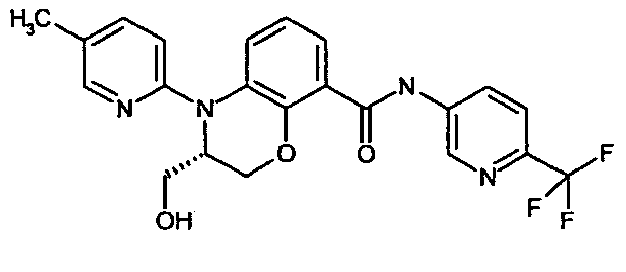
(400 MHz, DMSO-d6) δ: 2.24 (s, 3H), 3.43-3.45 (m, 1H), 3.57-3.78 (m, 1H), 4.08 (dd, J = 10.9, 2.6 Hz, 1 H), 4.38 (t, J = 7.4 Hz, 1H), 4.58 (d, J = 10.2 Hz, 1H), 5.14 (t, J = 5.6 Hz, 1H), 6.90 (t, J = 7.9 Hz, 1H), 7.13 (dd, J = 7.7, 1.6 Hz, 1H), 7.21 (d, J = 8.3 Hz, 1H), 7.36 (dd, J = 8.1, 1.6 Hz, 1H), 7.55 (dd, J = 8.3, 1.9 Hz, 1H), 7.91 (d, J = 8.8 Hz, 1H), 8.15 (t, J = 1.2 Hz, 1H), 8.45 (d, J = 6.5 Hz, 1 H), 9.02 (d, J = 2.3 Hz, 1H), 10.77 (s, 1 H). 313 4-28 
(400 MHz, DMSO-d6) δ: 2.23 (s, 3H), 3.42-3.45 (m, 1H), 3.61-3.67 (m, 1H), 3.87 (s, 3H), 4.06 (dd, J = 10.9, 2.6 Hz, 1H), 4.39 (t, J = 7.4 Hz, 1H), 4.58 (d, J = 9.7 Hz, 1 H), 5.14 (s, 1H), 6.88 (t, J = 7.9 Hz, 1H), 7.10 (dd, J = 7.7, 1.6 Hz, 1H), 7.20 (d, J = 8.3 Hz, 1H), 7.26 (d, J = 9.3 Hz, 1H), 7.32 (dd, J = 8.3, 1.4 Hz, 1H), 7.54 (dd, J = 9.0, 2.6 Hz, 1H), 7.92 (dd, J = 9.3, 2.3 Hz, 1H), 8.12 (dd, J = 21.6, 2.6 Hz, 2H), 10.29 (s, 1H). 314 4-29 
(400 MHz, DMSO-d6) δ: 2.23 (s, 3H), 2.82 (t, J = 4.4 Hz, 4H), 3.41-3.45 (m, 1H), 3.59-3.65 (m, 1H), 3.69 (t, J = 4.4 Hz, 4H), 3.99-4.07 (m, 1H), 4.38 (t, J = 7.4 Hz, 1H), 4.56 (d, J = 10.2 Hz, 1H), 5.13 (t, J = 5,3 Hz, 1H), 6.88 (t, J = 7,9 Hz, 1H), 7.08 (dd, J = 7.7, 1.6 Hz, 1H), 7.20 (d, J = 8.3 Hz, 1 H), 7.32 (dd, J = 8.1, 1.6 Hz, 1H), 7.55-7.58 (m, 2H), 7.94 (dd, J = 8.6, 2.6 Hz, 1H), 8.15 (d, J = 2.3 Hz, 2H), 10.40 (s, 1 H). 315 4-30 
(300 MHz, DMSO-d6) δ: 2.24 (s, 3H), 3.42-3.47 (m, 1H), 3.60-3.67 (m, 1H), 3.99-4.10 (m, 1 H), 4.36-4.38 (m, 1H), 4.58 (d, J = 9.9 Hz, 1H), 5.13 (t, J = 5.5 Hz, 1H), 6.90 (t, J = 7.9 Hz, 1H), 7.10 (dd, J = 7.7, 1.5 Hz, 1H), 7.21 (d, J = 8.4 Hz, 1H), 7.36 (dd, J = 8.3, 1.7 Hz, 1H), 7.56 (dd, J = 8.6, 2.4 Hz, 1H). 7.66 (d, J = 9.5 Hz, 1H). 7.76 (t. J = 8.4 Hz, 1H), 7.96 (d, J =13.9 Hz, 1H). 8.16 (d, J = 2.2 Hz, 1H). 10.73 (s, 1H). [Table 42] Ex. No. Chemical Compounds NMR 316 4-31 
(300 MHz, DMSO-d6) δ: 2.25 (s, 3H), 3.44 (t, J = 9.9 Hz, 1H), 3.62-3.65 (m, 1H), 4.07-4.09 (m, 1H), 4.39-4.41 (m, 1H), 4.58 (d, J = 9.9 Hz, 1 H), 6.90 (t, J = 7.9 Hz, 1 H), 7.10 (dd, J = 7.3, 1.5 Hz, 1H), 7.21 (d, J = 8.4 Hz, 1H), 7.35 (dd, J = 8.1, 1.5 Hz, 1H), 7.56 (dd, J = 9.0, 1.3 Hz, 2H), 7.77 (dd, J = 9.0, 2.4 Hz, 1H), 8.15 (dd, J = 8.3, 2.4 Hz, 2H), 10.51 (s, 1H). 317 4-32 
(300 MHz, DMSO-d6) δ: 2.24 (s, 3H), 3.44 (t, J = 9.9 Hz, 1H), 3.61-3.65 (m, 1H), 4.07 (d, J = 5.3 Hz, 1H), 4.39 (t, J = 6.8 Hz, 1H), 4.59 (d, J = 9.9 Hz, 1H), 6.89 (t, J = 7.9 Hz, 1H). 7.10 (dd, J = 7.7, 1.5 Hz, 1H), 7.21 (d, J = 8.4 Hz, 1H), 7.34 (dd, J 8.1, 1.5 Hz, 1H), 7.54-7.71 (m, 3H), 8,14 (dd, J = 10.3, 2.2 Hz, 2H), 10.45 (s. 1H). 318 4-33 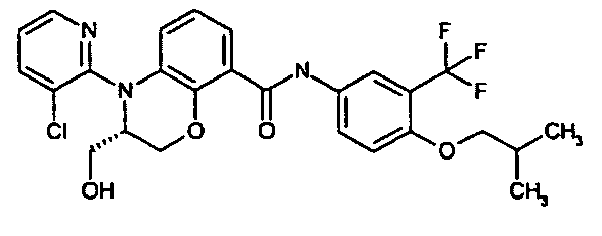
(400 MHz, DMSO-d6) 1.00 (d, J = 6.5 Hz, 6H), 2.00-2.09 (m, 1H). 3.48-3.55 (m, 1 H), 3.70-3.75 (m, 1H), 3.87 (d, J = 6.0 Hz, 2H), 3.96-4.00 (m, 1H), 4.17 (dd, J = 10.7, 2.3 Hz, 1H), 4.63 (dd, J = 11.1, 1.9 Hz, 1H), 5.09 (t, J = 5.3 Hz, 1H), 6.42 (dd, J = 8.1, 1.6 Hz, 1H), 6.81 (t, J = 7.9 Hz, 1H), 7.04 (dd, J = 7.7, 1.6 Hz, 1H). 7.24 (d, J = 8.8 Hz, 1H). 7.36 (q, J = 4.2 Hz, 1H). 7.92 (dd, J = 8.8, 2.3 Hz, 1H). 8.07 (dd, J = 8.1, 1.6 Hz, 1H), 8.12 (d, J = 2.8 Hz, 1H), 8.46 (dd, J = 4.9, 1.6 Hz, 1H), 10.28 (s, 1H). 319 4-34 
(400 MHz, DMSO-d6) 3.48-3.54 (m, 1H). 3.70-3.75 (m, 1 H), 3.95-4.00 (m, 1H). 4.17 (dd, J = 10.7, 2.3 Hz, 1H), 4.63 (dd, J = 10.9, 1.6 Hz, 1H), 5.09 (t, J = 5.6 Hz, 1H), 6.43 (dd, J = 7.9, 1.4 Hz, 1H), 6.82 (t, J = 7.9 Hz, 1H). 7.03 (dd, J = 7.7, 1.6 Hz, 1H), 7.36 (q, J = 4.3 Hz, 1H), 7.61 (d, J = 8.8 Hz, 1H), 7.71 (dd, J = 8.8, 2.3 Hz, 1H), 8.07 (dd, J = 7.9,1.4 Hz, 1H), 8.15 (d, J = 2.3 Hz, 1H). 8.46 (q, J = 2.2 Hz, 1H). 10.48 (s, 1H). 320 4-35 
(400 MHz, DMSO-d6) 3.47-3.55 (m, 1H), 3.70-3.76 (m, 1H), 3.96-4.00 (m, 1H), 4.17 (dd, J = 10.7, 2.3 Hz, 1H), 4.62 (dd, J = 11.1, 1.9 Hz, 1H), 5.09 (t, J = 5.6 Hz, 1H), 6.44 (dd, J = 7.9, 1.4 Hz, 1H), 6.82 (t, J = 7.7 Hz, 1H), 7.03 (dd, J = 7.4, 1.4 Hz, 1H), 7.36 (q, J = 4.2 Hz, 1H), 7.71 (d, J = 8.8 Hz, 1H), 8.03 (dd, J = 8.8, 2.3 Hz, 1H), 8.08 (dd, J = 7.9, 1.9 Hz, 1H), 8.37 (d, J = 2.3 Hz, 1 H), 8.46 (dd, J = 4.6, 1.4 Hz, 1H), 10.62 (s, 1H). 321 4-36 
(400 MHz, DMSO-d6) 3.47-3.55 (m, 1H), 3.70-3.75 (m, 1H), 3.96-3.99 (m, 1H), 4.17 (dd, J = 10.7, 2.3 Hz, 1H), 4.62 (dd, J = 10.9, 1.6 Hz, 1H), 5.09 (t, J = 5.6 Hz, 1H), 6.43 (dd, J = 8.1, 1.6 Hz, 1H), 6.82 (t, J = 7.9 Hz, 1H), 7.02 (dd, J = 7.4, 1.4 Hz, 1H), 7.36 (q, J = 4.2 Hz, 1H), 7.50 (dd, J = 8.8. 1.9 Hz, 1H), 7.67 (t, J = 8.3 Hz, 1H), 7.92 (dd, J = 11.6, 2.3 Hz, 1H), 8.07 (dd, J = 8.1, 1.6 Hz, 1H), 8.46 (dd, J = 4.6, 1.4 Hz, 1 H), 10.52 (s, 1H), 322 4-37 
(300 MHz, DMSO-d6) δ: 2.24 (s, 3H), 3.40-3.49 (m, 1H), 3.60-3.67 (m, 1H), 4.05-4.09 (m, 1H), 4.39 (t, J = 7.2 Hz, 1H), 4.58 (d, J = 10.3 Hz, 1H). 5.13 (t, J = 5.5 Hz, 1H), 6.90 (t, J = 7.9 Hz, 1 H), 7.11 (dd, J = 7.7, 1.5 Hz, 1H), 7.21 (d, J = 8.4 Hz, 1H), 7.35 (dd, J = 8.1. 1.5 Hz, 1H), 7.56 (dd, J = 8.4. 2.2 Hz, 1 H), 7.71 (d, J = 8.8 Hz, 1H), 8.00 (dd, J = 8.6, 2.4 Hz, 1H). 8.16 (d, J = 2.2 Hz, 1H), 8.35 (d, J = 2.6 Hz, 1H), 10.60 (s, 1H). [Table 43] Ex. No. Chemical Compounds NMR 323 4-38 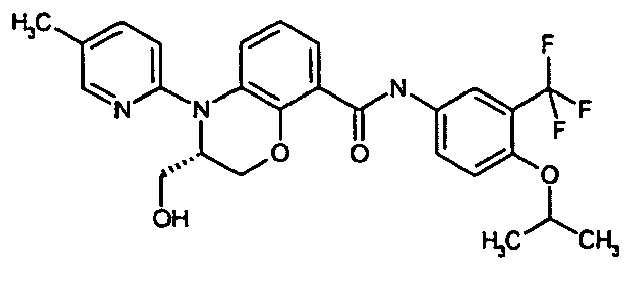
(300 MHz, DMSO-d6) δ: 1.28 (d, J = 3.1 Hz, 6H), 2.24 (s, 3H), 3.45 (t, J = 10.3 Hz, 1H), 3.62-3.65 (m, 1H), 4.07 (d, J = 10.3 Hz, 1H), 4.38-4.41 (m, 1H), 4.59 (d, J = 10.6 Hz, 1H), 4.74-4.76 (m, 1H), 6.88 (t, J = 7.3 Hz, 1H), 7.11 (d, J = 7.7 Hz, 1H), 7.21 (d, J = 8.1 Hz, 1H), 7.31 (t, J = 8.4 Hz, 2H), 7.55 (d, J = 8.4 Hz, 1 H), 7.88 (d, J = 9.2 Hz, 1 H), 8.12 (d, J = 22.7 Hz, 2H), 10.25 (s, 1H). 324 4-39 
(400 MHz, DMSO-d6) 2.84 (t, J = 4.4 Hz, 4H), 3.48-3.54 (m, 1H), 3.68-3.75 (m, 5H), 3.95-4.00 (m, 1H), 4.17 (dd, J = 10.9, 2.1 Hz, 1H), 4.62 (dd, J = 10.7, 1.9 Hz, 1H), 5.08 (t, J = 5.3 Hz, 1H), 6.43 (dd, J = 8.1, 1.6 Hz, 1H). 6.81 (t, J = 7.9 Hz, 1H). 7.02 (dd, J = 7.4, 1.4 Hz, 1H). 7.36 (q, J = 4.2 Hz, 1H), 7.60 (d, J = 8.8 Hz, 1H). 7.98 (dd, J = 8.8, 2.3 Hz, 1H). 8.07 (dd, J 7.9. 1.4 Hz, 1H),8.18(d,J=2.8Hz. 1 H), 8.46 (dd, J = 4.6, 1.4 Hz, 1 H), 10.42 (s, 1 H). 325 4-40 
(300 MHz, DMSO-d6) 6: 2.25 (s, 3H), 3.44-3.49 (m, 1H), 3.65-3.67 (m, 1H), 4.29-4.31 (m, 1H), 4.45-4.48 (m, 1H), 4.82 (d, J = 10.3 Hz, 1H), 5.19 (t, J = 5.3 Hz, 1H). 6.99 (t, J =7.9 Hz, 1H), 7.22(d,J = 8.4 Hz, 1H), 7.44(dd, J=8.1, 1.5 Hz, 1H), 7.55-7.62 (m, 2H), 7.80 (d, J = 8.8 Hz, 1H), 8.01 (d, J = 1.8 Hz, 1H), 8.17 (d, J = 2.2 Hz, 1H), 8.72 (d, J = 8.8 Hz, 1 H), 10.77 (s, 1H). 326 4-41 
(300 MHz,DMSO-d6) 2.16 (s, 3H), 3.37 (br s, 1H), 3.50 (t, J = 9.7 Hz, 1H), 3.65 (br s, 1H), 3.96 (d, J = 2.9 Hz, 1H), 4.24 (dd, J = 10.6, 2.2 Hz, 1H), 4.60 (dd, J = 11.0, 2.2 Hz, 1H), 6.18 (dd, J = 8.1, 1.5 Hz, 1H), 6.78 (t, J = 7.9 Hz, 1 H), 6.95 (dd, J = 7.7, 1.5 Hz, 1H), 7.29 (dd, J = 7.7, 4.8 Hz, 1H), 7.36 (d, J = 8.4 Hz, 2H), 7.79 (dd, J = 7.7, 1.1 Hz, 1H), 7.87 (d, J = 8.8 Hz, 2H), 8.38 (dd, J = 4.6, 1.7 Hz, 1H). 10.35 (s, 1 H). 327 4-42 
(300 MHz,DMSO-d6) 2.16 (s, 3H), 3.50 (t, J = 9.7 Hz, 1H), 3.65 (s, 1H), 3.96 (d, J = 2.9 Hz, 1H), 4.24 (dd, J = 10.6, 2.2 Hz, 1H), 4.60 (dd, J = 11.0, 2.2 Hz, 1H), 6.18 (dd, J = 8.1. 1.5 Hz, 1H), 6.78 (t, J = 7.9 Hz, 1H), 6.95 (dd, J = 7.7, 1.5 Hz, 1H), 7.29 (dd, J = 7.7, 4.8 Hz, 1H), 7.36 (d, J = 8.4 Hz, 2H), 7.79 (dd, J = 7.7, 1.1 Hz, 1H), 7.87 (d, J = 8.8 Hz, 2H), 8.38 (dd, J = 4.6, 1.7 Hz, 1H), 10.35 (s, 1H). 328 4-43 
(400 MHz, DMSO-d6) 1.30 (s, 9H), 3.47-3.55 (m, 1H), 3.69 - 3.75 (m, 1H), 3.95-4.00 (m, 1H), 4.16 (dd, J = 10.7, 2.3 Hz, 1H), 4.62 (dd, J =10.7, 1.9 Hz, 1 H), 5.08 (t, J = 5.3 Hz, 1H), 6.42 (dd, J = 8.3, 1.4 Hz, 1 H), 6.80 (t, J = 7.9 Hz, 1 H), 7.01 (dd, J = 7.7, 1.6 Hz, 1H), 7.12 (t, J = 9.0 Hz, 1H), 7.36 (q, J = 4.2 Hz, 1H), 7.41 (dt, J = 8.8, 1.2 Hz, 1H), 7.77 (dd, J = 13.0, 2.8 Hz. 1H). 8.07 (dd, J = 7.9,1.9 Hz, 1H). 8.46 (dd, J = 4.6, 1.4 Hz, 1H), 10.30 (s, 1H). 329 4-44 
(400 MHz, DMSO-d6) 0.99 (d, J = 6.5 Hz, 6H), 1.98-2.08 (m, 1H), 3.47-3.55 (m, 1H), 3.70-3.75 (m, 1H), 3.80 (d, J = 6.5 Hz, 2H), 3.96-3.99 (m, 1H), 4.17 (dd, J = 10.7, 2.3 Hz, 1H), 4.63 (dd, J = 10.7, 1.9 Hz, 1 H), 5.09 (t, J = 5.6 Hz, 1H), 6.41 (dd, J = 7.9, 1.4 Hz, 1H), 6.80 (t, J = 7.9 Hz, 1H), 7.02 (dd, J = 7.7, 1.6 Hz, 1H), 7.14 (t, J = 9.3 Hz, 1 H), 7.36 (q, J = 4.2 Hz, 1H), 7.44 (dd, J = 8.8. 1.4 Hz, 1H), 7.74 (dd, J = 13.7, 2.6 Hz, 1 H). 8.07 (dd, J = 7.9, 1.4 Hz, 1 H), 8.46 (dd. J = 4.6, 1.4 Hz, 1H), 10.20 (s, 1H). [Table 44] Ex. No. Chemical Compounds NMR 330 4-45 
(300 MHz, DMSO-d6) δ: 1.00 (d, J = 7.0 Hz, 6H), 2.00-2.09 (m, 1H), 2.24 (s, 3H), 3.45 (t, J = 9.9 Hz, 1 H), 3.61-3.65 (m, 1 H), 3.87 (d, J = 6.2 Hz, 2H), 4.07 (dd, J = 11.0, 2.2 Hz, 1H), 4.40 (t, J = 7.2 Hz, 1H), 4.59 (d, J = 10.6 Hz, 1 H), 6.88 (t, J = 7.9 Hz, 1 H), 7.12 (dd, J = 7.3, 1.5 Hz, 1H), 7.22 (t, J = 8.1 Hz, 2H), 7.33 (dd, J = 8.4, 1.5 Hz, 1H), 7.56 (dd, J = 8.4, 2.2 Hz, 1H), 7.89 (dd, J = 9.0, 2.4 Hz, 1H), 8.13 (dd, J = 19.4. 2.2 Hz, 2H), 10.25 (s, 1H). 331 4-46 
(300 MHz, DMSO-d6) δ: 1.27 (d, J = 5.9 Hz, 6H), 2.24 (s, 3H), 3.42-3.46 (m, 1 H), 3.60-3.64 (m, 1 H), 4.06 (d, J = 8.4 Hz, 1H), 4.38-4.41 (m, 1H), 4.53-4.58 (m, 2H), 5.11-5.14 (m, 1H), 6.88 (t, J = 7.9 Hz, 1H), 7.12-7.17 (m, 4H), 7.32-7.38 (m, 2H), 7.55 (dd, J = 8.4, 2.2 Hz, 1H), 7.72 (dd, J = 13.8, 2.4 Hz, 1H), 8.16 (s, 1H), 10.18 (s, 1H). 332 4-47 
(300 MHz, DMSO-d6) δ: 2.24 (s, 3H), 2.96 (t, J = 4.8 Hz, 4H), 3.43-3.47 (m, 1H), 3.63 (s, 1H), 3.74 (t, J = 4.6 Hz, 4H), 4.06 (dd, J = 10.5, 2.4 Hz, 1H), 4.37-4.39 (m, 1 H), 4.58 (d, J = 9.9 Hz, 1H), 5.11-5.15 (m, 1 H), 6.88 (t, J = 7.7 Hz, 1 H), 6.99-7.11 (m, 2H), 7.20 (d, J = 8.4 Hz, 1H), 7.32 (dd, J = 8.1, 1.5 Hz, 1H), 7.41 (dd, J = 8.6, 1.7 Hz, 1H), 7.55 (dd, J = 8.4, 2.2 Hz, 1H), 7.68 (dd, J = 15.0, 2.6 Hz, 1H), 8.16 (d, J = 2.2 Hz, 1H), 10.18 (s, 1H). 333 4-48 
(300 MHz, DMSO-d6) δ: 2.24 (s, 3H), 3.45-3.47 (m, 1H), 3.63-3.64 (m, 1H), 4.06 (d, J = 8.4 Hz, 1H), 4.37-4.41 (m, 1H), 4.58 (d, J = 10.6 Hz, 1H), 5.13 (t, J = 5.5 Hz, 1H), 6.88 (t, J = 7.9 Hz, 1H), 7.09 (dd, J = 7.7, 1.5 Hz, 1H), 7.20 (d, J = 8.4 Hz, 1H), 7.34-7.38 (m, 3H), 7.55 (dd, J = 9.0, 2.4 Hz, 1H), 7.77 (d, J = 8.8 Hz, 2H), 8.16 (d, J = 2.2 Hz, 1H), 10.30 (s, 1H). 334 4-49 
(300 MHz, DMSO-d6) δ: 2.25 (s, 3H), 2.90-2.91 (m, 4H), 3.42-3.51 (m, 1H), 3.67-3.74 (m, 1H), 3.81 (t, J = 4.4 Hz, 4H), 4.29 (t, J = 5.3 Hz, 1H), 4.50-4.52 (m, 1H), 4.87 (d, J = 10.3 Hz, 1H), 5.18 (t, J = 5.1 Hz, 1 H), 6.98 (t, J = 8.1 Hz, 1H), 7.23 (d, J = 8.4 Hz, 1H), 7.41 (dd, J = 8.1, 1.5 Hz, 1H), 7.55-7.62 (m, 4H), 8.18 (d, J = 1.8 Hz, 1H), 8.64 (d, J = 8.4 Hz, 1H), 10.57 (s, 1 H). 335 4-50 
(400 MHz, DMSO-d6) 1.29 (s, 9H), 2.24 (s, 3H), 3.41-3.47 (m, 1H), 3.60-3.65 (m, 1H), 4.06 (dd, J = 10.9, 2.6 Hz, 1H), 4.39 (t, J = 7.0 Hz, 1H), 4.58 (dd, J = 10.9, 1.2 Hz, 1H), 5.14 (t, J = 5.3 Hz, 1H), 6.88 (t, J = 7.9 Hz, 1H), 7.06-7.14 (m, 2H), 7.21 (d, J = 8.3 Hz, 1H), 7.32 (dd, J = 8.1, 1.6 Hz, 1H), 7.38 (dd, J = 8.8, 1.4 Hz, 1H), 7.55 (dd, J = 8.8, 2.3 Hz, 1H), 7.75 (dd, J = 13.2. 2.6 Hz, 1H), 8.16 (d, J = 2.3 Hz, 1 H), 10.28 (s, 1H). 336 4-51 
(400 MHz, DMSO-d6) 2.24 (s, 3H), 3.40-3.47 (m, 1H), 3.60 - 3.65 (m, 1 H), 4.06 (dd, J = 10.9, 2.6 Hz, 1H), 4.38 (t, J = 7.0 Hz, 1H), 4.58 (dd, J = 11.1, 0.9 Hz, 1H), 5.15 (t, J = 5.6 Hz, 1H), 6.89 (t, J = 7.9 Hz, 1H), 7.09 (dd, J = 7.4, 1.4 Hz, 1H), 7.20 (d, J = 8.3 Hz, 1H), 7.34 (dd, J = 8.1, 1.6 Hz, 1H), 7.47 (dd, J = 8.8, 1.9 Hz, 1H), 7.55 (dd, J = 8.3, 1.9 Hz, 1H), 7.66 (t, J = 8.3 Hz, 1H), 7.90 (dd, J = 11.1, 2.3 Hz, 1H), 8.16 (d, J = 2.3 Hz, 1H), 10.50 (s, 1H). [Table 45] Ex. No. Chemical Compounds NMR 337 4-52 
(300 MHz, DMSO-d6) δ: 3.48-3.52 (m, 1H), 3,71-3.73 (m, 1 H), 4.01-4.03 (m, 1 H), 4.18 (d, J = 10.3 Hz, 1H), 4.63 (d, J = 10.6 Hz, 1H), 6.42 (dd, J = 8.1, 1.5 Hz, 1H), 6.81 (t, J = 7.9 Hz, 1 H), 7.03 (d, J = 7.7 Hz, 1H), 7.35-7.37 (m, 3H), 7.88 (d, J = 9.2 Hz, 2H), 8.07 (dd, J = 7.9, 1.7 Hz, 1 H), 8.46 - 8.47 (m, 1H), 10.36 (s, 1H). 338 4-53 
(300 MHz, DMSO-d6) δ: 3.48-3.53 (m, 1H), 3.72-3.74 (m, 1H), 3.95-3.98 (m, 1H), 4.18 (d, J = 9.5 Hz, 1H), 4.62 (d, J = 9.9 Hz, 1H), 5.05-5.07 (m, 1 H), 6.44 (d, J = 7.0 Hz, 1H), 6.83 (t, J = 7.7 Hz, 1 H), 7.03 (d, J = 7.3 Hz, 1 H), 7.36 (dd, J = 7.9, 4.6 Hz, 1H), 7.67-7.79 (m, 2H), 7.98 (d, J = 14.7 Hz, 1H), 8.07 (d, J = 6.6 Hz, 1H), 8.46 (d, J = 3.3 Hz, 1H), 10.74 (s, 1H). 339 4-54 
(400 MHz, DMSO-d6) 0.98 (d, J = 7.0 Hz, 6H), 1.97-2.07 (m, 1H), 2.24 (s, 3H), 3.41-3.47 (m, 1H), 3.60-3.65 (m, 1H), 3.80 (d, J = 6.5 Hz, 2H), 4.06 (dd, J = 10.9, 2.6 Hz, 1H), 4.39 (t, J = 7.0 Hz, 1H), 4.59 (d, J = 10.2 Hz, 1H), 5.14 (t, J = 5.6 Hz, 1H), 6.88 (t, J = 7.7 Hz, 1H), 7.08-7.11 (m, 1H), 7.15 (d, J = 9.3 Hz, 1H), 7.20 (d, J = 8.3 Hz, 1H), 7.32 (dd, J = 8.3, 1.4 Hz, 1H), 7.41 (dd, J = 9.3, 1.4 Hz, 1H), 7.55 (dd, J = 8.8, 2.3 Hz, 1H), 7.72 (dd, J = 13.7, 2.6 Hz, 1H), 8.16 (d, J = 2.3 Hz, 1H), 10.18 (s, 1H). 340 4-55 
(300 MHz,DMSO-d6) 2.25 (s, 3H), 3.43-3.46 (m, 1H), 3.60 - 3.67 (m, 1 H), 4.07 (dd, J = 11.0, 2.6 Hz, 1H), 4.40 (t, J = 7.2 Hz, 1H), 4.59 (d, J = 10.3 Hz, 1H), 5.13 (t, J = 5.5 Hz, 1H), 6.90 (t, J = 7.9 Hz, 1H), 7.11 (dd, J = 7.3, 1.5 Hz, 1H), 7.21 (d, J = 8.4 Hz, 1H), 7.34 (dd, J = 8.1, 1.5 Hz, 1H), 7.51-7.55 (m, 2H), 7.97-8.03 (m, 1H), 8.16 (d, J = 2.2 Hz, 1H), 8.26 (dd, J = 6.6, 2.6 Hz, 1H), 10.52 (s, 1H). 341 4-56 
(300 MHz, DMSO-d6) δ: 1.14 (d, J = 6.2 Hz, 3H), 3.93-3.96 (m, 1H), 4.08-4.12 (m, 1H), 4.77 (d, J = 9.2 Hz, 1H), 4.95 (d, J = 5.5 Hz, 1H), 6.53 (t, J = 3.9 Hz, 1H), 6.82 (t, J = 7.9 Hz, 1H), 7.05 (d, J = 7.7 Hz, 1H), 7.32-7.37 (m, 4H), 7.87 (d, J = 9.2 Hz, 3H), 8.04 (dd, J = 7.9, 1.7 Hz, 1H), 8.48-8.48 (m, 1H), 10.33 (s, 1H). 342 4-57 
(300 MHz,DMSO-d6) 3.87 (br s, 1H), 4.24-4.35 (m, 3H), 4.51 (q, J = 5.3 Hz, 1H), 6.36 (d, J = 2.2 Hz, 1H), 6.79-6.83 (m, 3H), 7.06 (dd, J = 7.7, 4.8 Hz, 1H), 7.33 (d, J = 8.8 Hz, 2H), 7.84 (d, J = 9.2 Hz, 2H), 7.92 (dd, J = 7.7, 1.1 Hz, 1H), 8.13 (dd, J = 4.6, 1.3 Hz, 1H), 10.22 (s, 1H). 343 4-58 
(300 MHz, DMSO-d6) 3.83-3.92 (m, 1H), 4.24-4.35 (m, 3H), 4.51 (dd, J = 10.8, 5.4 Hz, 1H), 6.38 (d, J = 2.6 Hz, 1H), 6.77-6.86 (m, 3H), 7.06 (dd, J = 7.7, 4.8 Hz, 1H), 7.69 (d, J = 8.4 Hz, 2H), 7.90-7.96 (m, 3H), 8.13 (dd, J = 5.0, 1.7 Hz, 1H), 10.38 (s, 1H). [Table 46] Ex. No. Chemical Compounds NMR 344 4-59 
(400 MHz, DMSO-d6) 3.87 (m, 1H), 4.26-4.4 (m, 3H), 4.51 (m, 1H), 6.37 (d, J = 2.4 Hz, 1H), 6.7-6.86 (m, 3H), 7.06 (m, 1H), 7.33 (d, J = 8.4 Hz, 2H), 7.83(dd, J=6.8, 1.6Hz), 7.92(dd, J=7.2, 1.2Hz), 8.13 (dd, J = 4.4, 1,6Hz, 1H), 10.23 (s, 1H). 345 5-01 
(300 MHz, DMSO-d6) δ: 1.25 (s, 9H), 4.06 (t, J =4.2 Hz, 2H), 4.38 (t, J = 4.4 Hz, 2H), 6.96 (t, J = 7.9 Hz, 1H), 7.27 (dd, J = 7.7, 1.5 Hz, 1H), 7.35 (d, J = 8.8 Hz, 2H), 7.59-7.65 (m, 3H), 8.12 (d, J = 2.6 Hz, 1H), 8.30 (dd, J = 1.3, 0.7 Hz, 1H), 8.60 (d, J = 1.5 Hz, 1H), 10.06 (s, 1 H). 346 5-02 
(400 MHz, DMSO-d6) 1.18 (t, J = 7.4 Hz, 3H), 2.54 (q, J = 7.4 Hz, 2H), 4.22 (t, J = 4.2 Hz, 2H), 4.36 (t, J = 4.4 Hz, 2H), 6.96 (t, J = 7.9 Hz, 1H), 7.24 (dd, J = 7.4, 1.4 Hz, 1H), 7.39 (t, J = 4.4 Hz, 2H), 7.77 (d, J = 8.8 Hz, 2H), 8.04 (dd, J = 8.3, 1.4 Hz, 1H), 8.45 (s, 2H), 10.27 (s, 1H). 347 5-03 
(400 MHz, DMSO-d6) 1.18 (t, J = 7.7 Hz, 3H), 1.32 (t, J = 7.0 Hz, 3H), 2.54 (q, J = 7.7 Hz, 1H), 4.00 (q, J = 7.0 Hz, 2H), 4.22 (t, J = 4.4 Hz, 2H), 4.37 (t, J = 4.4 Hz, 2H), 6.89 (d, J = 8.8 Hz, 2H), 6.95 (t, J = 7.9 Hz, 1H), 7.25 (d, J = 7.4 Hz, 1H), 7.63 (d, J = 8.8 Hz, 2H), 8.01 (d, J = 8.3 Hz, 1H), 8.45 (s, 2H), 9.97 (s, 1 H). 348 5-04 
(400 MHz, DMSO-d6) 4.12(d, J=4.6Hz, 2H), 4.38(d, J=4.6HZ, 2H), 6.95(dd, J=8.1, 7.6Hz, 1H), 7.27(dd, J=7.6, 1.5Hz, 1H), 7.48(dd, J=8.1, 1.5Hz, 1H), 7.61(d, J=9.3HZ, 1H), 7.67(d, J=9.3Hz, 1H), 7.68(d, 8.8HZ, 2H), 7.92(d, 8.8Hz, 2H), 10.50(s, 1H) 349 5-05 
(400 MHz, DMSO-d6) 2.26 (s, 3H), 4.03 (t, J=4.4Hz, 2H), 4.37(t, J=4.4Hz, 2H), 6.65(d, J=1.6Hz, 1H), 7.04 (t, J = 8Hz, 1H). 7.25 (d, J = 8 Hz, 1H). 7.26 (d, J = 9.2 Hz, 2H), 7.83 (d, J=9.2Hz.2H), 8.19(d,J=8Hz. 1H), 10.36 (s, 1H). 350 5-06 
(300 MHz, DMSO-d6) 2.33 (s, 3H), 3.40 (t, J=4.4Hz, 2H), 4.36(t, J=4.4Hz, 2H), 6.9-7.1 (m, 2H), 7.23 (d, J = 1.8 Hz, 1H), 7.34 (d, J = 9.2 Hz, 2H), 7.84(d, J = 9.2 Hz, 2H), 8.10 (d, J = 8Hz, 1H), 10.34 (s, 1 H). 351 6-01 
(400 MHz, DMSO-d6) 2.34 (d, J = 1.4 Hz, 3H), 3.46-3.60 (m, 2H), 4.14 (dd, J =11.1, 2.8 Hz, 1H), 4.35-4.41 (m, 1H), 4.56 (d, J = 11.1Hz, 1H), 5.19 (t, J = 5.8 Hz, 1H), 7.00 (t, J= 7.9 Hz, 1H), 7.07 (d, J = 1.4 Hz, 1H), 7.19 (dd, J=7.9, 1.6 Hz, 1H), 7.36 (d, J = 8.3 Hz, 2H), 7.84 (d, J = 8.3 Hz, 2H), 8.00 (dd, J = 7.9, 1.6 Hz, 1 H), 10.39 (s, 1H). [Table 47] Ex. No. Chemical Compounds NMR 352 6-02 
(400 MHz, DMSO-d6) 2.34 (d, J = 1.4 Hz, 3H), 3.47-3.60 (m, 2H), 4.15 (dd, J=11.1, 2.3 Hz, 1H), 4.34-4.42 (m, 1H), 4.57 (d, J = 11.1 Hz, 1H), 5.20 (t, J = 5.8 Hz, 1H), 7.01 (t, J = 7.9 Hz, 1H), 7.07 (d, J = 1.4 Hz, 1H), 7.20 (dd, J = 7.9, 1.4 Hz, 1H), 7.72 (d, J = 8.3 Hz, 2H), 7.94 (d, J = 8.3 Hz, 2H), 8.02 (dd, J = 7.9, 1.4 Hz, 1H), 10.56 (s, 1 H). 353 6-03 
(400 MHz, DMSO-d6) 2.34 (d, J = 1.4 Hz, 3H), 3.48-3.59 (m, 2H), 4.16 (dd, J = 11.1, 2.3 Hz, 1H), 4.37-4.43 (m, 1H), 4.58 (d, J = 11.1 Hz, 1H), 6.51 (br, 2H), 7.01 (t, J = 7.9 Hz, 1H), 7.09 (d, J=1.4 Hz, 1 H), 7.21 (dd, J= 7.9, 1.4 Hz, 1H), 7.61 (d, J = 8.8 Hz, 1H). 7.68 (dd, J = 8.8. 2.3 Hz, 1 H), 8.01 (dd, J = 7.9, 1.4 Hz, 1H), 8.12 (d, J = 2.3 Hz, 1H), 10.51 (s, 1H). 354 6-04 
(400 MHz, DMSO-d6) 1.27 (d, J = 6.0 Hz, 7H), 2.34 (d, J = 1.4 Hz, 3H), 3.46-3.59 (m, 2H), 4.13 (dd, J = 11.1, 2.3 Hz, 1H), 4.35-4.41 (m, 1H), 4.49-4.60 (m, 2H), 5.19 (t, J = 5.6 Hz, 1H), 6.99 (t, J = 8.1 Hz, 1H), 7.07 (d, J = 1.4 Hz, 1H), 7.12-7.20 (m, 2H), 7.36-7.40 (m, 1H), 7.71 (dd, J = 13.7, 2.6 Hz, 1H), 7.99 (dd, J = 8.1, 1.4 Hz, 1H), 10.21 (s, 1 H). 355 6-05 
(400 MHz, DMSO-d6) 1.29 (s, 9H), 2.34 (d, J = 1.4 Hz, 3H), 3.45-3.60 (m, 2H), 4.13 (dd, J = 11.1, 2.8 Hz, 1H), 4.34-4.41 (m, 1H), 4.57 (d, J = 11. Hz, 1H), 5.19 (t, J = 5.8 Hz, 1 H), 7.00 (t, J =8.1 Hz, 1H), 7.07 (d, J = 1.4 Hz, 1H), 7.11 (t, J = 9.0 Hz, 1H), 7.17 (dd, =8.1, 1.6 Hz, 1H), 7.33-7.39 (m, 1H), 7.73 (dd, J=13.0, 2.3 Hz, 1H), 8.00 (dd, J = 8.1, 1.6 Hz, 1H), 10.30 (s, 1 H). 356 6-06 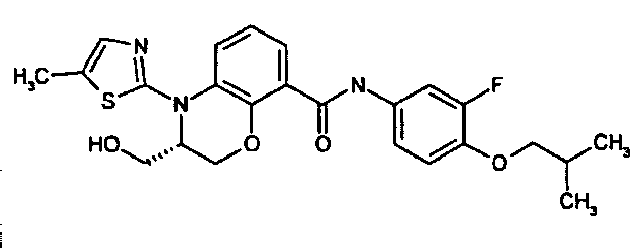
(400 MHz, DMSO-d6) 0.98 (d, J = 6.5 Hz, 6H), 1.99-2.05 (m, 1H), 2.34 (d, J = 1.4 Hz, 3H), 3.46-3.59 (m, 2H), 3.80 (d, J = 6.5 Hz, 2H), 4.13 (dd, J = 11.1, 2.8 Hz, 1 H), 4.35-4.41 (m, 1H), 4.57 (d, J = 11.1 Hz, 1H), 5.20 (t, J = 5.6 Hz, 1H), 6.99 (t, J = 7.9 Hz, 1 H), 7.07 (d, J = 1.4 Hz, 1 H), 7.13 (t, J = 9.3 Hz, 1H), 7.18 (dd, J = 7.9. 1.4 Hz, 1H), 7.37-7.41 (m, 1H), 7.70 (dd, J = 13.7, 2.6 Hz, 1H). 7.99 (dd, J = 8.9, 1.4 Hz, 1H). 10.19 (s, 1H). 357 6-07 
(400 MHz,DMSO-d6) 2.35 (d, J = 0.9 Hz, 3H), 3.49-3.61 (m, 2H), 4.15 (dd, J = 11.1, 2.8 Hz, 1H). 4.37 (t, J = 5.1 Hz, 1H). 4.58 (dd, J = 11. 1, 0.9 Hz, 1 H), 5.21 (t, J = 5.8 Hz, 1H), 7.02 (t, J = 7.9 Hz, 1H), 7.08 (d, J = 1.4 Hz, 1H). 7.20 (dd, J = 7.7, 1.6 Hz, 1H). 7.46 (dd, J = 8.8, 1.9 Hz, 1H). 7.68 (t, J = 8.3 Hz, 1H), 7.90 (dd, J = 11.6, 2.3 Hz, 1H). 8.03 (dd, J = 8.3, 1.4 Hz, 1 H), 10.53 (s, 1 H). 358 6-08 
(400 MHz, DMSO-d6) 2.34 (d, J = 0.9 Hz, 3H), 3.46-3.60 (m, 2H), 4.14 (dd, J = 11.4, 2.6 Hz, 1H), 4.38 (t, J = 7.0 Hz, 1H), 4.58 (dd, J = 11.4, 1.2 Hz, 1 H), 5.20 (t, J = 5.6 Hz, 1 H), 7.01 (t, J = 8.1 Hz, 1H), 7.07 (d, J = 1.4 Hz, 1H), 7.21 (dd, J = 7.4, 1.4 Hz, 1H), 7.52 (t, J = 9.7 Hz, 1H), 7.96-8.03 (m, 2H), 8.25 (q, J = 3.1 Hz, 1H), 10.55 (s, 1H). 359 6-09 
(400 MHz, DMSO-d6) 2.33 (d, J = 1.4 Hz, 3H), 2.96 (t, J = 4.6 Hz, 4H), 3.47-3.60 (m, 2H), 3.74 (t, J = 4.6 Hz, 4H), 4.13 (dd, J = 10.9, 2.6 Hz, 1H), 4.38 (t, J = 6.7 Hz, 1H), 4.57 (dd, J = 11.1, 1.4 Hz, 1H), 5.19 (t, J = 5.6 Hz, 1H), 6.97-7.05 (m, 2H), 7.07 (d, J = 1.4 Hz, 1H), 7.18 (dd, J = 7.7, 1.6 Hz, 1H), 7.39 (d, J = 8.8 Hz, 1H), 7.66 (dd, J = 14.6, 2.3 Hz, 1 H), 7.99 (dd, J = 8.1, 1.6 Hz, 1H), 10.21 (s, 1H). [Table 48] Ex. No. Chemical Compounds NMR 360 6-10 
(400 MHz, DMSO-d6) 2.34 (d, J = 1.4 Hz, 3H), 3.47-3.53 (m, 1H), 3.55-3.60 (m, 1H), 4.15 (dd. J = 11.1, 2.3 Hz, 1H), 4.38 (t, J = 7.2 Hz, 1H), 4.58 (dd, J = 11.1, 0.9 Hz, 1H). 5.21 (t, J = 5.3 Hz, 1H). 7.03 (t, J = 7.9 Hz, 1H). 7.08 (d, J = 1.4 Hz, 1H), 7.23 (dd, J = 7.7, 1.6 Hz, 1H), 7.92 (d, J = 8.8 Hz, 1H), 8.05 (dd, J = 8.3, 1.4 Hz, 1H). 8.44 (dd, J = 8.8, 1.9 Hz, 1H), 9.01 (d, J = 2.3 Hz, 1 H), 10.80 (s, 1H). 361 6-11 
(300MHz,DMSO-d6) 2.28 (d, J = 1.1 Hz, 3H), 3.51-3.57 (m, 2H), 4.16 (dd, J = 11.2, 2.4 Hz, 1H). 4.43 (t, J = 7.2 Hz, 1H). 4.59 (d, J = 10.3 Hz, 1H). 5.17 (t, J = 5.7 Hz, 1H). 6.69 (d, J =1.5 Hz, 1H), 7.01 (t, J = 8.1 Hz, 1H), 7.15 (dd, J = 7.7, 1.5 Hz, 1H), 7.35 (d, J = 8.4 Hz, 2H), 7.84 (d, J = 9.2 Hz, 2H), 8.22 (dd, J = 8.3, 1.7 Hz, 1H), 10.36 (s, 1H). 362 6-12 
(300 MHz, DMSO-d6) 2.28 (d, J = 1.5 Hz, 3H), 3.51-3.57 (m, 2H), 4.17 (dd, J =11.2, 2.4 Hz, 1H), 4.44 (t, J = 7.2 Hz, 1H), 4.59 (d, J = 9.9 Hz, 1H). 5.18 (t, J = 5.7 Hz, 1H). 6.69 (d, J = 1.5 Hz, 1H), 7.02 (t, J = 7.9 Hz, 1H), 7.16 (dd, J = 7.7, 1.5 Hz, 1H), 7.71 (d, J = 8.8 Hz, 2H), 7.94 (d, J = 8.4 Hz, 2H), 8.23 (dd, J = 8.3, 1.7 Hz, 1H), 10.53 (s, 1H). 363 6-13 
(400 MHz, DMSO-d6) 2.15 (s, 3H), 2.23 (s, 3H), 3.44-3.58 (m, 2H), 4.11 (dd, J = 11.1, 2.3 Hz, 1H), 4.37-4.43 (m, 1H), 4.56 (d, J = 11.1Hz, 1H), 5.18 (t, J = 5.8 Hz, 1H), 7.00 (t, J = 7.9 Hz, 1H), 7.18 (dd, J = 7.9, 1.4 Hz, 1H), 7.36 (d, J = 8.3 Hz, 2H), 7.83 (d, J = 8.3 Hz, 2H), 7.98 (dd, J = 7.9, 1.4 Hz, 1 H), 10.39 (s, 1 H). 364 6-14 
(400 MHz, DMSO-d6) 2.16 (s, 3H), 2.24 (s, 3H), 3.44-3.59 (m, 2H), 4.12 (dd, J = 11.1, 2.3 Hz, 1H), 4.37-4.43 (m, 1H), 4.56 (d, J = 11.1 Hz, 1H), 5.19 (t, J = 5.8 Hz, 1H), 7.01 (t, J = B.1 Hz, 1H), 7.20 (dd, J = 8.1, 1.6 Hz, 1H), 7.71 (d, J = 8.8 Hz, 2H), 7.94 (d, J = 8.8 Hz, 2H), 7.99 (dd, J = 8.1, 1.6 Hz, 1 H), 10.56 (s, 1 H). 365 6-15 
(400 MHz, DMSO-d6) 2.60 (d, J = 4.2 Hz, 3H), 3.51-3.64 (m, 2H), 4.22 (dd, J = 11.1, 2.8 Hz, 1H), 4.42 (t, J = 7.4 Hz, 1H), 4.56 (d, J = 10.2 Hz, 1 H), 5.24 (t, J = 5.8 Hz, 1H), 7.04 (t, J = 7.9 Hz, 1H), 7.24 (dd, J = 7.9, 1.4 Hz, 1H), 7.36 (d, J = 8.3 Hz, 2H), 7.83 (d, J = 8.8 Hz, 2H), 7.96 (dd, J = 8.3, 1.4 Hz, 1H), 10.41 (s, 1H). 366 6-16 
(400 MHz, DMSO-d6) 2.60 (d, J = 2.8 Hz, 3H), 3.52-3.64 (m, 2H), 4.23 (dd, J = 11.1, 2.8 Hz, 1H), 4.42 (t, J = 7.0 Hz, 1H), 4.56 (d, J = 10.2 Hz, 1H), 5.24 (t, J = 5.8 Hz, 1H), 7.05 (t, J = 7.9 Hz, 1H), 7.25 (dd, J = 7.7, 1.6 Hz, 1H), 7.72 (d, J = 8.8 Hz, 2H), 7.92-7.98 (m, 3H), 10.58 (s, 1H). 367 6-17 
(400MHz, DMSO-d6) 2.11 (s, 3H), 2.17 (s, 3H), 3.08 (t, J = 5.6 Hz, 2H), 4.05 (t, J = 5.6 Hz, 2H), 7.23 (t, J = 7.9 Hz, 1 H), 7.32-7.39 (m, 3H), 7.66 (dd, J = 7.9, 1.4 Hz, 1H), 7.83 (d, J = 9.3 Hz, 2H), 10.62 (s, 1H) [Table 49] Ex. No. Chemical Compounds NMR 368 6-18 
(400MHz, DMSO-d6) 2.19 (s, 3H), 2.28 (s, 3H), 2.90-3.01 (m, 1H), 3.41-3.48 (m, 1H), 3.96-4.06 (m, 1H), 4.23-4.31 (m, 1H), 7.28 (d, J = 7.4 Hz, 1H), 7.39 (d, J = 8.8 Hz, 2H), 7.59 (t, J = 7.9 Hz, 1H), 7.84-7.90 (m, 3H), 10.81 (s, 1 H) 369 7-01 
(400 MHz, CHLOROFORM-d) 1.33 (s, 9H), 3.75 (t, J = 4.2 Hz, 2H), 3.83 (s, 3H), 4.54 (t, J = 4.4 Hz, 2H), 6.76 (dd, J = 8.1, 1.2 Hz, 1 H), 6.82 (t, J = 8.1 Hz, 1 H), 6.94 (d, J = 8.8 Hz, 2H), 7.17 (d, J = 8.8 Hz, 2H), 7.38 (d, J = 8.8 Hz, 2H), 7.60 (d, J = 8.3 Hz, 2H), 7.64 (dd, J = 8.1, 1.6 Hz, 1H), 9.61 (s, 1H). 370 7-02 
(400 MHz, CHLOROFORM-d) 1.03 (d, J = 7.0 Hz, 6H), 2.05-2.12 (m, 1H). 3.73 (d, J = 6.5 Hz, 2H), 3.75 (t, J = 4.4 Hz, 2H), 3.83 (s, 3H), 4.54 (t, J = 4.4 Hz, 2H), 6.76 (dd, J = 7.9, 1.9 Hz, 1H), 6.82 (t, J = 7.9 Hz, 1H), 6.90 (d, J = 8.8 Hz, 2H), 6.94 (dd, J = 7.0, 2.3 Hz, 2H), 7.17 (dd, J = 6.5, 2.3 Hz, 2H), 7.58 (d, J = 8.8 Hz, 2H), 7.65 (dd, J = 7.7, 1.6 Hz, 1H), 9.57 (s, 1 H). 371 7-03 
(400 MHz, CHLOROFORM-d) 3.76 (br s, 2H), 3.84 (s, 3H), 4.56 (br s, 2H), 6.81 (d, J = 17.6 Hz, 2H), 6.96 (br s, 2H), 7.17 (br s, 2H), 7.33 (br s, 2H), 7.65 (br s, 3H), 9.73 (s, 1 H). 372 7-04 
(400 MHz, DMSO-d6) 3.46-3.79 (m, 3H), 4.23 (d, J = 10 Hz, 1H), 4.56 (d, J = 10 Hz, 1H), 4.96 (s, 1H), 6.10 (d, J = 7.0 Hz, 1H), 6.71-6.90 (m, 2H), 7.34-7.71 (m, 6H), 7.86 (d, J = 8.8 Hz, 2H), 10.36 (s, 1H). 373 7-05 
(400 MHz, DMSO-d6) 3.46-3.79 (m, 3H), 4.23 (d, J = 10 Hz, 1H), 4.56 (d, J = 10 Hz, 1H), 4.97 (s, 1H), 6.11 (d, J = 7.0 Hz, 1H), 6.74-6.91 (m, 2H), 7.39-7.72 (m, 6H), 7.96 (d, J = 8.3 Hz, 2H), 10.53 (s, 1H). 374 7-06 
(400 MHz, DMSO-d6) 3.45-3.80 (m, 3H), 4.23 (brd, J = 10 Hz, 1H). 4.56 (brd, J = 10 Hz, 1H). 4.97 (s, 1H). 6.12 (d, J = 7.9 Hz, 1H). 6.74-6.90 (m, 2H), 7.40-7.78 (m, 6H), 7.97 (d, J = 13.0Hz.1H). 10.73 (s, 1H). 375 7-07 
(300 MHz,DMSO-d6) 3.46-3.60 (m, 2H), 3.79 (t, J = 7.0 Hz, 1H), 4.08 (dd, J =10.8, 2.0 Hz, 1H), 4.49 (d, J =10.3 Hz, 1H), 5.09 (t, J = 5.3 Hz, 1H), 6.80-6.91 (m, 2H), 7.01 (dd, J = 7.3, 1.5 Hz, 1H), 7.35-7.44 (m, 6H), 7.85 (d, J = 8.8 Hz, 2H), 10.33 (s, 1H). [Table 50] Ex. No. Chemical Compounds NMR 376 7-08 
(400 MHz, DMSO-d6) 3.45-3.66 (m, 3H), 3.77 (s, 3H), 4.13 (dd, J = 10.9. 2.1 Hz, 1H), 4.49 (dd, J = 10.9, 2.1 Hz, 1H), 4.97 (t, J = 5.3 Hz, 1H), 6.51 (dd, J = 8.0, 1.5 Hz, 1H), 6.74 (t, J = 8.0 Hz, 1H), 6.86 (dd, J = 7.4, 1.5 Hz, 1H), 7.01 (d, J = 8.8 Hz, 2H), 7.24 (d, J = 8.8 Hz, 2H), 7.35 (d, J = 8.8 Hz, 2H), 7.85 (d, J = 8.8 Hz, 2H), 10.33 (s, 1H). 377 7-09 
(400 MHz, DMSO-d6) 3.43-3.66 (m, 3H), 3.77 (s, 3H), 4.14 (d, J = 8.8 Hz, 1H), 4.50 (t, J = 5.5 Hz, 1H), 4.98 (t, J = 5.5 Hz, 1H), 6.52 (dd, J = 7.9, 1.4 Hz, 1H), 6.75 (t, J = 7.9 Hz, 1H), 6.87 (dd, J = 7.9, 1.4 Hz, 1H), 7.01 (d, J = 8.8 Hz, 2H), 7.25 (d, J = 8.8 Hz, 2H), 7.71 (d, J = 8.3 Hz, 2H), 7.96 (d, J = 8.3 Hz, 2H), 10.50 (s, 1H). 378 7-10 
(300 MHz,DMSO-d6) 3.46-3.61 (m, 2H), 3.79 (t, J = 7.0 Hz, 1H), 4.09 (d, J = 8.8 Hz, 1H), 4.50 (d, J = 9.9 Hz, 1H), 5.10 (t, J = 5.5 Hz, 1H), 6.82-6.93 (m, 2H), 7.02 (dd, J = 7.3, 1.8 Hz, 1H), 7.40 (m, 4H), 7.71 (d, J = 8.8 Hz, 2H), 7.96 (d, J = 8.4 Hz, 2H), 10.50 (s, 1H). 379 7-11 
(300 MHz,DMSO-d6) 3.51-3.56 (m, 2H), 3.79 (t, J = 7.2 Hz, 1H), 4.08 (dd, J = 10.8, 2.4 Hz, 1H), 4.50 (d, J = 9.9 Hz, 1H), 5.10 (t, J = 5.3 Hz, 1 H), 6.80-6.91 (m, 2H), 7.01 (dd, J = 7.2, 1.7 Hz, 1H), 7.33-7.46 (m, 6H), 7.78 (d, J = 8.8 Hz, 2H), 10.28 (s, 1 H). - The assay for evaluation of VR1 inhibition by the inventive compounds will be described below. The assay was intended to evaluate in vitro inhibition of Ca2+ entry in cells caused by proton, one of the VR1 agonists.
- Rat glioma (C6BU1) cells stably expressing human VR1 were suspended in 20 mM MES buffer (at pH 6.8, contg. 20 mM 2-morpholinoethanesulfonate (referred to as MES hereinafter), 115 mM NaCl, 5 mM KC1, 1 mM MgCl2 and 14 mM D-glucose) to make a cell density of 1?106 cells/mL. A fluorescent dye, Fura 2-AM solution (DojindoCorporate, Cat. No. 343-05401) wasadded to the suspension to make a 5?M concentration thereof. Further, Pluronic F-127 (Wako Pure Chemical Industries, Ltd., Cat. No. P6866) was added to make a 0.1% content thereof. Then, the suspension was incubated at 37?C for 30 min. The cells were harvested and washed three times with 20 mM MES buffer. The cells were suspended again to make a cell density of 5?105 cells/mL. A 500-?L portion of the suspension was taken with a cuvette (MC MEDICAL, INC., Cat. No. SSR3121), to which 10 ?L of 20 mM MES buffer containing 250 mM CaCl2 was added to incorporate Ca2+ into the cells. At the same time, 5 ?L of a test compound solution (in a range of 100 ?M to 10 nM in DMSO) was also added to provide a final concentration thereof in a range of 1 ?M to 0.1 nM. Alternatively, 5?L of DMSO was added as control to provide a final concentration of 1% DMSO. The suspension was set in an intracellular ionometer (CAF-110; JASCO) 10 min after those additions. The cells were stimulated with protons by addition of 60?L of 20 mM MES buffer at pH 1.1 to the suspension to set its pH at 5.5. The activity of the test compound was determined as a difference between the minimum of fluorescence intensity before agonist stimulation and its maximum after the stimulation. The value of IC50 was derived from percentage of inhibition by the test compound compared with the control. The results are shown in Tables 51 to 56 below.
- In the tables, the symbol "??" indicates an IC50 value less than 100 nM and the symbol "?" indicates an IC50 value of 100 nM to 1,000 nM inclusive.
[Table 51] Ex. No. IC50 Ex. No. IC50 Ex. No. IC50 Ex. No. IC50 1-001 ++ 1-003 ++ 1-004 ++ 1-005 ++ 1-006 ++ 1-007 ++ 1-009 ++ 1-011 ++ 1-016 ++ 1-017 ++ 1-018 + 1-019 + 1-020 ++ 1-021 ++ 1-022 ++ 1-023 + 1-024 ++ 1-025 ++ 1-026 + 1-027 ++ 1-029 ++ 1-030 ++ 1-031 ++ 1-032 + 1-033 ++ 1-034 ++ 1-039 + 1-040 + 1-041 + 1-043 + 1-044 ++ 1-045 ++ 1-047 ++ 1-048 ++ 1-049 + 1-050 + 1-051 ++ 1-052 ++ 1-053 ++ 1-054 ++ 1-055 ++ 1-056 ++ 1-057 ++ 1-058 + 1-059 + 1-060 ++ 1-061 + 1-062 ++ 1-063 ++ 1-068 ++ 1-069 ++ 1-070 ++ 1-071 ++ 1-072 ++ 1-073 ++ 1-075 + 1-076 + 1-077 + 1-078 ++ 1-079 ++ 1-080 ++ 1-081 ++ 1-082 ++ 1-083 ++ 1-084 ++ 1-085 ++ 1-086 ++ 1-087 ++ 1-089 ++ 1-090 ++ 1-091 ++ 1-092 ++ 1-093 + 1-094 ++ 1-095 ++ 1-098 + 1-099 + 1-100 ++ 1-101 ++ 1-102 ++ 1-103 ++ 1-104 ++ 1-106 + 1-107 ++ 1-119 ++ 1-120 ++ 1-121 ++ 1-122 ++ 1-123 ++ 1-124 ++ 1-125 ++ 1-126 ++ 1-127 ++ 1-128 + 1-129 ++ 1-130 ++ 1-131 + 1-132 + 1-133 + 1-136 ++ 1-140 ++ 1-143 ++ 1-144 ++ 1-141 ++ 1-145 ++ 1-146 ++ 1-147 ++ 1-148 ++ 1-149 ++ 1-150 ++ 1-151 ++ 1-152 + 1-153 + 1-154 ++ 1-155 ++ 1-156 ++ 1-157 ++ 1-158 ++ 1-159 ++ 1-160 ++ 1-162 ++ 1-163 ++ 1-164 ++ 1-165 ++ 1-166 + 1-167 ++ 1-169 ++ 1-170 + 1-171 + 1-172 ++ 1-173 ++ 1-174 ++ 1-176 + 1-183 + 1-186 ++ 1-187 ++ 1-189 ++ 1-190 + 1-191 ++ 1-192 ++ 1-193 ++ 1-194 ++ 1-195 + 1-196 + 1-197 ++ 1-198 + 1-199 ++ 1-200 + 1-201 + 1-202 ++ 1-203 ++ 1-207 + 1-209 ++ 1-210 + 1-216 + 1-217 + 1-218 + 1-220 ++ 1-227 ++ 1-228 ++ 1-229 + 1-231 + 1-233 ++ 1-234 ++ [Table 52] Ex. No. IC50 Ex. No. IC50 Ex. No. IC50 Ex. No. IC50 2-01 + 2-03 ++ 2-04 ++ 2-05 ++ 2-06 ++ 2-07 ++ 2-08 ++ 2-09 ++ 2-11 + 2-12 ++ 2-13 ++ 2-14 ++ 2-15 ++ 2-16 ++ 2-17 ++ 2-19 ++ 2-20 ++ 2-21 ++ 2-22 ++ 2-23 ++ 2-25 ++ 2-26 + 2-28 ++ 2-29 ++ 2-30 ++ 2-31 ++ 2-32 ++ 2-33 ++ 2-34 ++ 2-35 ++ 2-36 ++ 2-37 ++ 2-38 ++ 2-39 ++ 2-40 ++ 2-41 ++ 2-42 ++ 2-43 ++ 2-44 ++ 2-45 ++ 2-46 ++ 2-47 ++ 2-48 ++ [Table 53] Ex. No. IC50 Ex. No. IC50 Ex. No. IC50 Ex. No. IC50 4-01 + 4-03 ++ 4-04 ++ 4-05 ++ 4-06 ++ 4-07 ++ 4-08 ++ 4-09 ++ 4-10 ++ 4-11 ++ 4-12 ++ 4-13 ++ 4-14 ++ 4-15 ++ 4-16 ++ 4-17 ++ 4-18 ++ 4-19 ++ 4-20 ++ 4-21 ++ 4-22 ++ 4-23 ++ 4-24 ++ 4-25 ++ 4-26 ++ 4-27 ++ 4-28 ++ 4-29 ++ 4-30 ++ 4-31 ++ 4-32 ++ 4-33 ++ 4-34 ++ 4-35 ++ 4-36 ++ 4-37 ++ 4-38 ++ 4-39 ++ 4-40 ++ 4-41 ++ 4-42 ++ 4-43 ++ 4-44 ++ 4-45 ++ 4-46 ++ 4-47 ++ 4-48 ++ 4-50 ++ 4-51 ++ 4-52 ++ 4-53 ++ 4-54 ++ 4-55 ++ 4-56 ++ [Table 54] Ex. No. IC50 Ex. No. IC50 Ex. No. IC50 Ex. No. IC50 5-1 + 5-2 + 5-4 ++ 5-5 + 5-6 ++ [Table 55] ex. No. IC50 Ex. No. IC50 Ex. No. IC50 Ex. No. IC50 6-1 ++ 6-2 ++ 6-3 ++ 6-4 ++ 6-5 ++ 6-6 ++ 6-7 ++ 6-8 ++ 6-9 ++ 6-10 ++ 6-11 ++ 6-12 ++ 6-13 ++ 6-14 ++ 6-15 ++ 6-16 + [Table 56] Ex. No. IC50 Ex. No. IC50 Ex. No. IC50 Ex. No. IC50 7-01 ++ 7-02 ++ 7-03 ++ 7-04 ++ 7-05 ++ 7-06 ++ 7-07 ++ 7-08 ++ 7-09 ++ 7-10 ++ 7-11 ++ - The condensed benzamide compound of the present invention effectively inhibits vanilloid receptor subtype 1 (VR1) activity, and therefore it is effective in the medical treatment and/or prevention of diseases such as pain, acute pain, chronic pain, neuropathic pain, rheumatoid arthritis pain, neuralgia, neuropathy, hyperalgesia, migraine, joint pain, acute herpetic pain, postherpetic neuralgia, chronic postherpetic neuralgia, postoperative pain, cancer pain, inflammatory pain, interstitial cystitis, posttraumatic neuralgia, diabetic neuropathy, neurodegenerative disease, cerebral apoplexy, ischemic symptom, nerve injury, neurogenic skin disorder, inflammatory disease, pruritus, allergic rhinitis, apoplexy, irritable bowel syndrome, asthma, chronic obstructive pulmonary disease, dermatitis, mucositis, stomach and duodenal ulcer and inflammatory bowel disease, bladder hypersensitivity, and overactive bladder type frequent urination and urinary incontinence.
Claims (29)
- A condensed benzamide compound represented by the following general formula [1] or apharmaceuticallyacceptable salt thereof:
 (1) -O-,(2) -NR5- (wherein R5 is a hydrogen atom or a C1-6 alkyl group),(3) -S-,(4) -SO- or(5) -SO2-;1 is 0, 1 or 2;m is 0, 1 or 2;R1 is(1) a hydrogen atom or(2) a C1-6 alkyl group which may be substituted with 1 to 5 substituents selected from the following Group A:R2 isGroup A:(a) a halogen atom,(b) a hydroxyl group,(c) a C1-6 alkoxy group,(d) a carboxyl group,(e) a C1-6 alkoxycarbonyl group,(f) -CONR6R7 (wherein R6 and R7 are the same or different and each represents a hydrogen atom, a C1-6 alkyl group or an acyl group and said alkyl group may be substituted with a hydroxyl group or an acyloxy group),(g) -NR6R7 (wherein R6 and R7 are the same as above),(h) -NR6COR7 (wherein R6 and R7 are the same as above),(i) -NR8CONR6R7 (wherein R6 and R7 are the same as above, and R8 is a hydrogen atom or a C1-6 alkyl group); and(j) -NR6SO2R9 (wherein R6 is the same as above, and R9 is a C1-6 alkyl group);(1) a hydrogen atom,(2) a hydroxyl group,(3) a C1-6 alkyl group which may be substituted with 1 to 5 substituents selected from the Group A (wherein the Group A is the same as above),(4) a carboxyl group,(5) a C1-6 alkoxycarbonyl group or(6) -CONR10R11 (wherein R10 and R11 are the same or different and each represents a hydrogen atom or a C1-6 alkyl group); or R2 together with R1 forms =0;R3(1) a hydrogen atom, or(2) a C1-6 alkyl group;R4 is(1) a hydrogen atom,(2) a halogen atom(3) a C1-6 alkyl group which may be substituted with 1 to 5 substituents selected from the following Group B,(4) a C1-6 alkoxy group which may be substituted with 1 to 5 substituents selected from the following Group B,(5) a cycloalkyl group which may be substituted with 1 to 5 substituents selected from the following Group B,(6) an aralkyl group which may be substituted with 1 to 5 substituents selected from the following Group B,(7) an aralkoxy group which may be substituted with 1 to 5 substituents selected from the following Group B, or(8) a cycloalkylalkoxy group which may be substituted with 1 to 5 substituents selected from the following Group B,
Group B:(a) a halogen atom,(b) a halo C1-6 alkyl group,(c) a hydroxyl group,(d) a halo C1-6 alkoxy group,(e) a C1-6 alkoxycarbonyl group,(f) a C1-6 alkoxy group,(g) a carboxyl group,(h) -CONR12R13 (wherein R12 and R13 are the same or different and each represents a hydrogen atom or a C1-6 alkyl group);(i) -NR12R13 (wherein R12 and R13 are the same as above),(j) -NR12COR13 (wherein R12 and R13 are the same as above),(k) -NR14CONR12R13 (wherein R12 and R13 are the same as above, and R14 is a hydrogen atom or a C1-6 alkyl group),(l) -SO2R15 (wherein R15 is a C1-6 alkyl group), and(m) -NR12SO2R15 (wherein R12 and R15 are the same as above);(9) a hydroxyl group,(10) -NR16R17 (wherein R16 and R17 are the same or different and each represents a hydrogen atom or a C1-6 alkyl group)(11) -COR18 (wherein R18 is a C1-6 alkyl group, a C1-6 alkoxy group, a cycloalkyl group, an aralkyl group, an aralkoxy group, a cycloalkylalkoxy group or a hydroxyl group),(12) -CONR16R17 (wherein R16 and R17 are the same as above),(13) -NR19CONR16R17 (wherein R16 and R17 are the same as above, and R19 is a hydrogen atom or a C1-6 alkyl group),(14) -NR16COOR20 (wherein R16 is the same as above, and R20 is a C1-6 alkyl group or a cycloalkyl group),(15) -SR20 (wherein R20 is the same as above),(16) -SOR20 (wherein R20 is the same as above),(17) -SO2R20 (wherein R20 is the same as above),(18) -SO2NR16R17 (wherein R16 and R17 are the same as above) or(19) -NR16COR18 (wherein R16 and R18 are the same as above);V is(1) a single bond or(2) -(CR21R22)n-(wherein R21 and R22 are the same or different and each represents a hydrogen atom or a C1-6 alkyl group, and n is 1 or 2);P1 and P2 rings are the same or different and each represents(1) a carbocyclic group which may be substituted with 1 to 5 substituents selected from the following group C or(2) a heterocyclic group which may be substituted with 1 to 5 substituents selected from the following groupGroup C:(a) a halogen atom,(b) a hydroxyl group,(c) a Cl-6 alkoxy group which may be substituted with 1 to 5 substituents selected from the Group A,(d) an C1-6 alkylthio group,(e) a C1-6 alkyl group which may be substituted with 1 to 5 substituents selected from the Group A,(f) -CONR23R24 (wherein R23 and R24 are the same or different and each represents a hydrogen atom or a C1-6 alkyl group which may be substituted with 1 to 5 substituents selected from the Group A),(g) -NR123R124 (wherein R123 and R124 are the same or different and each represents a hydrogen atom or a C1-6 alkyl group which may be substituted with 1 to 5 substituents selected from the Group A),(h) -NR223COR224 (wherein R223 and R224 are the same or different and each represents a hydrogen atom or a C1-6 alkyl group which may be substituted with 1 to 5 substituents selected from the Group A),(i)-NR25CONR323R324 (wherein R323 and R324 are the same or different and each represents a hydrogen atom or a C1-6 alkyl group which may be substituted with 1 to 5 substituents selected from the Group A),(j) -SR26 (wherein R26 is a C1-6 alkyl group),(k) -SOR126 (wherein R126 is a C1-6 alkyl group),(l) -SO2R226 (wherein R226 is a C1-6 alkyl group),(m) -NR423S02R326 (wherein R423 is a hydrogen atom or a C1-6 alkyl groupwhichmaybe substituted with 1 to 5 substituents selected from the Group A, and R326 is a C1-6 alkyl group),(n) -SO2NR523R524 (wherein R523 and R524 are the same or different and each represents a hydrogen atom or a C1-6 alkyl group which may be substituted with 1 to 5 substituents selected from the Group A),(o) -COR27 (wherein R27 is a C1-6 alkyl group, C1-6 alkoxy group, a cycloalkyl group, an aralkyl group, an aralkoxy group, a cycloalkylalkoxy group or a hydroxyl group),(p) a carbocyclic group which may be substituted with 1 to 5 substituents selected from (a) to (o) of the Group C,(q) a heterocyclic group which may be substituted with 1 to 5 substituents selected from (a) to (o) of the Group C,(r) -O-R28 (wherein R28 is an acyl group, a carbocyclic group which may be substituted with 1 to 5 substituents selected from (a) to (o) of the Group C or a heterocyclic group which may be substituted with 1 to 5 substituents selected from (a) to (o) of the Group C),(s) -O- (CR121R122)n-R128 (wherein R121 and R122 are the same or different and each represents a hydrogen atom or a C1-6 alkyl group, n is 1 or 2, and R128 is an acyl group, a carbocyclic group which may be substituted with 1 to 5 substituents selected from (a) to (i) of the Group C or a heterocyclic group which may be substituted with 1 to 5 substituents selected from (a) to (1) of the Group C),(t) a nitro group, and(u) a cyano group. - The condensed benzamide compound or pharmaceutically acceptable salt thereof according to claim 1 wherein Z is -0-, -NR5-, -S- or -SO-.
- The condensed benzamide compound or pharmaceutically acceptable salt thereof according to claim 1 or 2 wherein R3 is a hydrogen atom or a C1-4 alkyl group.
- The condensed benzamide compound or pharmaceutically acceptable salt thereof according to claims 1 to 3 wherein the P1 ring is a saturated or unsaturated 5-membered or 6-membered heterocyclic ring having 1 to 4 hetero atoms selected from a nitrogen atom, an oxygen atom and a sulfur atom, or a condensed ring of these heterocyclic rings, or a condensed heterocyclic ring of said heterocyclic ring and a carbocyclic ring selected from benzene, cyclopentane and cyclohexane, or a phenyl group (wherein said heterocyclic ring may be substituted with a halogen atom, a hydroxyl group, a C1-6 alkyl group which may be substituted with 1 to 5 substituents selected from the Group A, and a C1-6 alkoxy group which may be substituted with 1 to 5 substituents selected from the Group A).
- The condensed benzamide compound or pharmaceutically acceptable salt thereof according to claim 4 wherein the P1 ring is a saturated or unsaturated 5-membered or 6-membered heterocyclic ring having at least 1 to 3 nitrogen atoms or a phenyl group (wherein said heterocyclic ring may be substituted with a Cl-6 alkyl group which may be substituted with a hydroxyl group or a Cl-6 alkyl group, a halogen atom, a hydroxyl group, and a Cl-6 alkoxy group which may be substituted with 1 to 5 substituents selected from the Group A) .
- The condensed benzamide compound or a pharmaceutically acceptable salt thereof according to claim 5 wherein the P1 ring is a heterocyclic group selected from a pyridyl group, a pyrazinyl group and a thiazolyl group or a phenyl group (wherein these heterocyclic groups may be substituted with a C1-6 alkyl group which may be substituted with a hydroxyl group, a halogen atom, a hydroxyl group, and a C1-6 alkoxy group which may be substituted with 1 to 5 substituents selected from the Group A).
- The condensed benzamide compound or a pharmaceutically acceptable salt thereof according to claims 1 to 3 wherein the P2 ring is a carbocyclic group which may be substituted with a substituent group selected from- a halogen atom,- a hydroxyl group,- a C1-6 alkoxy group (wherein said alkoxy group may be substituted with a halogen atom, -CONR623R624 (wherein R623 and R624 are the same or different and each represents a hydrogen atom or a C1-6 alkyl group which may be substituted with 1 to 5 substituents selected from the Group A), a C3-8 cycloalkyl group, a C1-6 alkoxy group, a carboxyl group or a C1-6 alkoxycarbonyl group),- a C1-6 alkyl group (wherein said alkyl group may be substituted with a halogen atom, a hydroxyl group or a C1-6 alkoxy group),- -NR123R124 (wherein R123 and R124 are the same as above),- -NR223COR224 (wherein R223 and R224 are the same as above),- -COR27 (wherein R27 is a C1-6 alkyl group, C1-6 alkoxy group, a cycloalkyl group, an aralkyl group, an aralkoxy group, a cycloalkylalkoxy group or a hydroxyl group),- CONR23R24 (wherein R23 and R24 are the same as above),- a heterocyclic group as a saturated or unsaturated substituent group which has 1 to 3 nitrogen atoms as hetero atoms (wherein said heterocyclic group may be substituted with a substituent group selected from a hydroxyl group, -CONR723R724 (wherein R723 and R724 are the same or different and each represents a hydrogen atom or a C1-6 alkyl group which may be substituted with 1 to 5 substituents selected from the Group A), a C1-6 alkoxy group, a carboxyl group, a C1-6 alkyl group which may be substituted with a C1-6 alkoxy group, a C1-6 alkoxycarbonyl group and an acyloxy group),- -O-R28 (wherein R28 is an ac'yl group, a carbocyclic group which may be substituted with 1 to 5 substituents selected from (a) to (i) of the Group C or a heterocyclic group which may be substituted with 1 to 5 substituents selected from (a) to (1) of the Group C),- -O-(CR121R122)n-R128 (wherein R121 and R122 are the same or different and each represents a hydrogen atom or a C1-6 alkyl group, n is 1 or 2, and R128 is an acyl group, a carbocyclic groupwhichmaybe substituted with 1 to 5 substituents selected from (a) to (i) of the Group C or a heterocyclic group which may be substituted with 1 to 5 substituents selected from (a) to (1) of the Group C),- a nitro group and- a cyano group, ora heterocyclic group which may be substituted with a substituent as described for the carbocyclic group (wherein said heterocyclic group means a saturated or unsaturated 5-membered or 6-membered heterocyclic ring which has 1 to 4 hetero atoms selected from a nitrogen atom, an oxygen atom and a sulfur atom, or a condensed ring of these heterocyclic rings, or a condensed heterocyclic group of said heterocyclic ring anda carbocyclic ring selected frombenzene, cyclopentane and cyclohexane).
- The condensed benzamide compound or a pharmaceutically acceptable salt thereof according to claim 7 wherein a carbocyclic group as the P2 ring in claim 7 is a phenyl group or a cyclohexyl group, or a heterocyclic group as the P2 ring is a thiazolyl group, a pyridyl group, a piperidyl group, a piperidino group, a quinolyl group, a benzo[1,3]dioxo group, a 2,3-dihydrobenzo[1,4]dioxo group or a 1,2,3,4-tetrahydroquinolyl group.
- The condensed benzamide compound according to claim 1 selected from the following group or a pharmaceutically acceptable salt thereof:1)N-(4-tert-butylphenyl)-4-(3-chloropyridin-2-yl)-3,4-dihydro-2H-benzo[1,4]oxazine-8-carboxamide,2)8-(4-tert-butylphenyl)carbamoyl-4-(3-chloropyridin-2-yl)-3,4-dihydro-2H-benzo[1,4]oxazine-2-carboxylic acid,3)N-(4-tert-butylphenyl)-4-(3-chloropyridin-2-yl)-3-methyl-3,4-dihydro-2H-benzo[1,4]oxazine-8-carboxamide,4)N-(4-tert-butylphenyl)-1-(3-chloropyridin-2-yl)-4-methyl-1,2,3,4-tetrahydroquinoxaline-5-carboxamide,5)N-(4-tert-butylphenyl)-9-(3-chloropyridin-2-yl)-6,7,8,9-tetrahydro-5-oxa-9-aza-benzocycloheptene-4-carboxamide,6)N-(4-chlorophenyl)-4-(3-chloropyridin-2-yl)-3,4-dihydro-2H-benzo[1,4]oxazine-8-carboxamide,7)4-(3-chloropyridin-2-yl)-N-(4-isopropoxyphenyl)-3,4-dihydro-2H-benzo[1,4]oxazine-8-carboxamide,8)N-(1-tert-butylpiperidin-4-yl)-4-(3-chloropyridin-2-yl)-3,4-dihydro-2H-benzo[1,4]oxazine-8-carboxamide,9)4-(3-chloropyridin-2-yl)-N-(4-methylphenyl)-3,4-dihydro-2H-benzo[1,4]oxazine-8-carboxamide,10)4-(3-chloropyridin-2-yl)-N-(trans-4-methylcyclohexyl)-3,4-dihydro-2H-benzo[1,4]oxazine-8-carboxamide,11)4-(3-chloropyridin-2-yl)-N-(4-isobutyloxyphenyl)-3,4-dihydro-2H-benzo[1,4]oxazine-8-carboxamide,12)N-benzyl-4-(3-chloropyridin-2-yl)-3,4-dihydro-2H-benzo[1,4]oxazine-8-carboxamide,13)N-(4-chlorophenyl)methyl-4-(3-chloropyridin-2-yl)-3,4-dihydro-2H-benzo[1,4]oxazine-8-carboxamide,14)N-(4-tert-butylphenyl)methyl-4-(3-chloropyridin-2-yl)-3,4-dihydro-2H-benzo[1,4]oxazine-8-carboxamide,15)4-(3-chloropyridin-2-yl)-N-(4-trifluoromethylphenyl)methyl-3,4-dihydro-2H-benzo[1,4]oxazine-8-carboxamide,16)N-(4-tert-butylphenyl)-4-(pyridin-2-yl)-3,4-dihydro-2H-benzo[1,4]oxazine-8-carboxamide,17)N-(4-tert-butylphenyl)-4-(3-trifluoromethylpyridin-2-yl)-3,4-dihydro-2H-benzo[1,4]oxazine-8-carboxamide,18)N-(4-tert-butylphenyl)-4-(3-chloropyridin-2-yl)-2,2-dimethyl-3,4-dihydro-2H-benzo[1,4]oxazine-8-carboxamide,19)N-(4-tert-butylphenyl)-4-(3-chloropyridin-2-yl)-2-methyl-3,4-dihydro-2H-benzo[1,4]oxazine-8-carboxamide,20)N-(4-tert-butylphenyl)-6-chloro-4-(3-chloropyridin-2-yl)-3,4-dihydro-2H-benzo[1,4]oxazine-8-carboxamide,21)4-(3-chloropyridin-2-yl)-N-(4-trifluoromethylphenyl)-3,4-dihydro-2H-benzo[1,4]oxazine-8-carboxamide,22)4-(3-chloropyridin-2-yl)-N-(4-trifluoromethoxyphenyl)-3,4-dihydro-2H-benzo[1,4]oxazine-8-carboxamide,23)4-(3-chloropyridin-2-yl)-N-(4-methoxyphenyl)-3,4-dihydro-2H-benzo[1,4]oxazine-8-carboxamide,24)N-(trans-4-tert-butylcyclohexyl)-4-(3-chloropyridin-2-yl)-3,4-dihydro-2H-benzo[1,4]oxazine-8-carboxamide,25)4-(3-chloropyridin-2-yl)-N-(4-chloro-3-trifluoromethylphenyl)-3,4-dihydro-2H-benzo[1,4]oxazine-8-carboxamide,26)4-(3-chloropyridin-2-yl)-N-(4-fluorophenyl)-3,4-dihydro-2H-benzo[1,4]oxazine-8-carboxamide,27)4-(3-chloropyridin-2-yl)-N-(3-trifluoromethylphenyl)-3,4-dihydro-2H-benzo[1,4]oxazine-8-carboxamide,28)4-(3-chloropyridin-2-yl)-N-(4-trifluoromethylthiazol-2-yl)-3,4-dihydro-2H-benzo[1,4]oxazine-8-carboxamide,29)4-(3-chloropyridin-2-yl)-N-(5-trifluoromethylpyridin-2-yl)-3,4-dihydro-2H-benzo[1,4]oxazine-8-carboxamide,30)4-(3-chloropyridin-2-yl)-N-(2-trifluoromethylpyridin-5-yl)-3,4-dihydro-2H-benzo[1,4]oxazine-8-carboxamide,31)4-(3-chloropyridin-2-yl)-N-(4-isopropylphenyl)-3,4-dihydro-2H-benzo[1,4]oxazine-8-carboxamide,32)4-(3-chloropyridin-2-yl)-N-(quinolin-7-yl)-3,4-dihydro-2H-benzo[1,4]oxazine-8-carboxamide,33)4-(3-chloropyridin-2-yl)-N-(1-methyl-1,2,3,4-tetrahydroquinolin-7-yl)-3,4-dihydro-2H-benzo[1,4]oxazine-8-carboxamide,34)4-(3-chloropyridin-2-yl)-N-(4-methoxycarbonylphenyl)-3,4-dihydro-2H-benzo[1,4]oxazine-8-carboxamide,35)4-[4-(3-chloropyridin-2-yl)-3,4-dihydro-2H-benzo[1,4]oxazine-8-carbonyl]aminobenzoic acid,36)N-(4-carbamoylphenyl)-4-(3-chloropyridin-2-yl)-3,4-dihydro-2H-benzo[1,4]oxazine-8-carboxamide,37)4-(3-chloropyridin-2-yl)-N-(4-methylcarbamoylphenyl)-3,4-dihydro-2H-benzo[1,4]oxazine-8-carboxamide,38)4-(3-chloropyridin-2-yl)-N-(4-dimethylcarbamoylphenyl)-3,4-dihydro-2H-benzo[1,4]oxazine-8-carboxamide,39)N-(4-acetylphenyl)-4-(3-chloropyridin-2-yl)-3,4-dihydro-2H-benzo[1,4]oxazine-8-carboxamide,40)4-(3-chloropyridin-2-yl)-N-[4-(1-hydroxy-1-methyl)ethylphenyl]-3,4-dihydro-2H-benzo[1,4]oxazine-8-carboxamide,41)4-(3-chloropyridin-2-yl)-N-[4-(1-hydroxy-1-methyl)propylphenyl]-3,4-dihydro-2H-benzo[1,4]oxazine-8-carboxamide,42)4-(3-chloropyridin-2-yl)-N-(1-isobutyrylpiperidin-4-yl)phenyl-3,4-dihydro-2H-benzo[1,4]oxazine-8-carboxamide,43)N-(trans-4-tert-butoxycyclohexyl)-4-(3-chloropyridin-2-yl)-3,4-dihydro-2H-benzo[1,4]oxazine-8-carboxamide,44)4-(3-chloropyridin-2-yl)-N-(3-isopropoxyphenyl)-3,4-dihydro-2H-benzo[1,4]oxazine-8-carboxamide,45)4-(3-chloropyridin-2-yl)-N-(3-isobutyloxyphenyl)-3,4-dihydro-2H-benzo[1,4]oxazine-8-carboxamide,46) N-(4-tert-butylphenyl)-4-(pyridin-4-yl)-3,4-dihydro-2H-benzo[1,4]oxazine-8-carboxamide,47)N-(4-tert-butylphenyl)-4-(3-methylpyridin-2-yl)-3,4-dihydro-2H-benzo[1,4]oxazine-8-carboxamide,48)4-(3-chloropyridin-2-yl)-N-(4-piperidinophenyl)-3,4-dihydro-2H-benzo[1,4]oxazine-8-carboxamide,49)4-(3-chloropyridin-2-yl)-N-(4-dimethylaminophenyl)-3,4-dihydro-2H-benzo[1,4]oxazine-8-carboxamide,50)4-(3-chloropyridin-2-yl)-N-(4-morpholinophenyl)-3,4-dihydro-2H-benzo[1,4]oxazine-8-carboxamide,51)4-(3-chloropyridin-2-yl)-N-(3-fluoro-4-isopropoxyphenyl)-3,4-dihydro-2H-benzo[1,4]oxazine-8-carboxamide,52)4-(3-chloropyridin-2-yl)-N-(2-fluoro-4-isopropoxyphenyl)-3,4-dihydro-2H-benzo[1,4]oxazine-8-carboxamide,53)4-(3-chloropyridin-2-yl)-N-(4-fluoro-3-trifluoromethylphenyl)-3,4-dihydro-2H-benzo[1,4]oxazine-8-carboxamide,54)4-(3-chloropyridin-2-yl)-N-(4-dimethylamino-3-trifluoromethylphenyl)-3,4-dihydro-2H-benzo[1,4]oxazine-8-carboxamide,55)4-(3-chloropyridin-2-yl)-N-(4-isopropoxy-3-trifluoromethylphenyl)-3,4-dihydro-2H-benzo[1,4]oxazine-8-carboxamide,56)4-(3-chloropyridin-2-yl)-N-(4-methoxy-3-trifluoromethylphenyl)-3,4-dihydro-2H-benzo[1,4]oxazine-8-carboxamide,57)4-(3-chloropyridin-2-yl)-N-(4-isobutyloxy-3-trifluoromethylphenyl)-3,4-dihydro-2H-benzo[1,4]oxazine-8-carboxamide,58)N-(4-tert-butylphenyl)-4-(4-methylpyridin-2-yl)-3,4-dihydro-2H-benzo[1,4]oxazine-8-carboxamide,59)N-(4-tert-butylphenyl)-4-(6-methylpyridin-2-yl)-3,4-dihydro-2H-benzo[1,4]oxazine-8-carboxamide,60)N-(4-tert-butylphenyl)-4-(5-methylpyridin-2-yl)-3,4-dihydro-2H-benzo[1,4]oxazine-8-carboxamide,61)N-(4-tert-butylphenyl)-4-(pyridin-3-yl)-3,4-dihydro-2H-benzo[1,4]oxazine-8-carboxamide,62)N-(4-cyanophenyl)-4-(5-methylpyridin-2-yl)-3,4-dihydro-2H-benzo[1,4]oxazine-8-carboxamide,63)N-(3-amino-4-chlorophenyl)-4-(5-methylpyridin-2-yl)-3,4-dihydro-2H-benzo[1,4]oxazine-8-carboxamide,64)N-(3-acetamido-4-chlorophenyl)-4-(5-methylpyridin-2-yl)-3,4-dihydro-2H-benzo[1,4]oxazine-8-carboxamide,65)N-[4-(4-carbamoylpiperidin-1-yl)-3-fluorophenyl]=4-(5-methylpyridin-2-yl)-3,4-dihydro-2H-benzo[1,4]oxazine-8-carboxamide,66)N-[3-fluoro-4-(4-methylcarbamoylpiperidin-1-yl)phenyl]-4-(5-methylpyridin-2-yl)-3,4-dihydro-2H-benzo[1,4]oxazine-8-carboxamide,67)N-[4-(4-dimethylcarbamoylpiperidin-1-yl)-3-fluorophenyl]-4-(5-methylpyridin-2-yl)-3,4-dihydro-2H-benzo[1,4]oxazine-8-carboxamide,68)N-[4-(4-ethoxypiperidin-1-yl)-3-fluorophenyl]-4-(5-methylpyridin-2-yl)-3,4-dihydro-2H-benzo[1,4]oxazine-8-carboxamide,69)N-[3-fluoro-4-(4-isopropoxypiperidin-1-yl)phenyl]-4-(5-methylpyridin-2-yl)-3,4-dihydro-2H-benzo[1,4]oxazine-8-carboxamide,70)N-[3-fluoro-4-(3-methoxypiperidin-1-yl)phenyl]-4-(5-methylpyridin-2-yl)-3,4-dihydro-2H-benzo[1,4]oxazine-8-carboxamide,71)N-[3-fluoro-4-(4-methoxymethylpiperidin-1-yl)phenyl]-4-(5-methylpyridin-2-yl)-3,4-dihydro-2H-benzo[1,4]oxazine-8-carboxamide,72)N-[3-fluoro-4-(3-methoxypyrrolidin-1-yl)phenyl]-4-(5-methylpyridin-2-yl)-3,4-dihydro-2H-benzo[1,4]oxazine-8-carboxamide,73)N-(4-isobutyloxy-3-methoxycarbonylphenyl)-4-(5-methylpyridin-2-yl)-3,4-dihydro-2H-benzo[1,4]oxazine-8-carboxamide,74)2-isobutyloxy-{[4-(5-methylpyridin-2-yl)-3,4-dihydro-2H-benzo[1,4]oxazine-8-carbonyl]amino}benzoic acid,75)N-(3-carbamoyl-4-isobutyloxyphenyl)-4-(5-methylpyridin-2-yl)-3,4-dihydro-2H-benzo[1,4]oxazine-8-carboxamide,76)N-(4-isobutyloxy-3-methylcarbamoylphenyl)-4-(5-methylpyridin-2-yl)-3,4-dihydro-2H-benzo[1,4]oxazine-8-carboxamide,77)N-(3-dimethylcarbamoyl-4-isobutyloxyphenyl)-4-(5-methylpyridin-2-yl)-3,4-dihydro-2H-benzo[1,4]oxazine-8-carboxamide,78)N-(4-acetylphenyl)-4-(5-methylpyridin-2-yl)-3,4-dihydro-2H-benzo[1,4]oxazine-8-carboxamide,79)N-[4-(1-hydroxy-1-methyl)ethylphenyl]-4-(5-methylpyridin-2-yl)-3,4-dihydro-2H-benzo[1,4]oxazine-8-carboxamide,80)N-(3-acetyl-4-chlorophenyl)-4-(5-methylpyridin-2-yl)-3,4-dihydro-2H-benzo[1,4]oxazine-8-carboxamide,81)N-[4-chloro-3-(1-hydroxy-1-methyl)ethylphenyl]-4-(5-methylpyridin-2-yl)-3,4-dihydro-2H-benzo[1,4]oxazine-8-carboxamide,82)N-[4-(1-methoxy-1-methyl)ethylphenyl]-4-(5-methylpyridin-2-yl)-3,4-dihydro-2H-benzo[1,4]oxazine-8-carboxamide,83)N-(3-chloro-4-methoxyphenyl)-4-(5-methylpyridin-2-yl)-3,4-dihydro-2H-benzo[1,4]oxazine-8-carboxamide,84)4-(5-methylpyridin-2-yl)-N-(4-propoxyphenyl)-3,4-dihydro-2H-benzo[1,4]oxazine-8-carboxamide,85)N-(3-fluoro-4-propoxyphenyl)-4-(5-methylpyridin-2-yl)-3,4-dihydro-2H-benzo[1,4]oxazine-8-carboxamide,86)N-(4-ethoxy-3-fluorophenyl)-4-(5-methylpyridin-2-yl)-3,4-dihydro-2H-benzo[1,4]oxazine-8-carboxamide,87)N-(3-ethoxy-4-methylphenyl)-4-(5-methylpyridin-2-yl)-3,4-dihydro-2H-benzo[1,4]oxazine-8-carboxamide,88)N-(3-carbamoylmethyloxy-4-methylphenyl)-4-(5-methylpyridin-2-yl)-3,4-dihydro-2H-benzo[1,4]oxazine-8-carboxamide,89)N-(3-methoxyethyloxy-4-methylphenyl)-4-(5-methylpyridin-2-yl)-3,4-dihydro-2H-benzo[1,4]oxazine-8-carboxamide,90)N-[3-fluoro-4-(2-methoxymethylpiperidin-1-yl)phenyl]-4-(5-methylpyridin-2-yl)-3,4-dihydro-2H-benzo[1,4]oxazine-8-carboxamide,91)N-(4-chlorophenyl)-4-(5-methylpyridin-2-yl)-3,4-dihydro-2H-benzo[1,4]oxazine-8-carboxamide,92)N-(3-fluoro-4-methylphenyl)-4-(5-methylpyridin-2-yl)-3,4-dihydro-2H-benzo[1,4]oxazine-8-carboxamide,93)N-(2-chloropyridin-5-yl)-4-(5-methylpyridin-2-yl)-3,4-dihydro-2H-benzo[1,4]oxazine-8-carboxamide,94)4-(3-chloropyridin-2-yl)-N-(4-ethoxyphenyl)-3,4-dihydro-2H-benzo[1,4]oxazine-8-carboxamide,95)4-(3-chloropyridin-2-yl)-N-(3-fluoro-4-piperidinophenyl)-3,4-dihydro-2H-benzo[1,4]oxazine-8-carboxamide,96)4-(3-chloropyridin-2-yl)-N-(trans-4-ethoxycyclohexyl)-3,4-dihydro-2H-benzo[1,4]oxazine-8-carboxamide,97)4-(3-chloropyridin-2-yl)-N-(trans-4-isopropoxycyclohexyl)-3,4-dihydro-2H-benzo[1,4]oxazine-8-carboxamide,98)4-(3-chloropyridin-2-yl)-N-(trans-4-cyclopentyloxycyclohexyl)-3,4-dihydro-2H-benzo[1,4]oxazine-8-carboxamide,99)4-(3-chloropyridin-2-yl)-N-(trans-4-cyclohexyloxycyclohexyl)-3,4-dihydro-2H-benzo[1,4]oxazine-8-carboxamide,100)4-(3-chloropyridin-2-yl)-N-(4-trifluoromethylphenyl)-3,4-dihydro-2H-benzo[1,4]oxazine-8-carboxamide,101)4-(3-chloropyridin-2-yl)-N-[3-fluoro-4-(4-methoxypiperidin-1-yl)phenyl]-3,4-dihydro-2H-benzo[1,4]oxazine-8-carboxamide,102)4-(3-chloropyridin-2-yl)-N-[4-(4-ethoxypiperidin-1-yl)-3-fluorophenyl]-3,4-dihydro-2H-benzo[1,4]oxazine-8-carboxamide,103)4-(3-chloropyridin-2-yl)-N-[3-fluoro-4-(4-isopropoxypiperidin-1-yl)phenyl]-3,4-dihydro-2H-benzo[1,4]oxazine-8-carboxamide,104)4-(3-chloropyridin-2-yl)-N-(3-fluoro-4-isobutyloxyphenyl)-3,4-dihydro-2H-benzo[1,4]oxazine-8-carboxamide,105)N-(trans-4-ethoxycyclohexyl)-4-(5-methylpyridin-2-yl)-3,4-dihydro-2H-benzo[1,4]oxazine-8-carboxamide,106)N-(trans-4-isopropoxycyclohexyl)-4-(5-methylpyridin-2-yl)-3,4-dihydro-2H-benzo[1,4]oxazine-8-carboxamide,107)N-(trans-4-cyclohexyloxycyclohexyl)-4-(5-methylpyridin-2-yl)-3,4-dihydro-2H-benzo[1,4]oxazine-8-carboxamide,108)N-(trans-4-aminocyclohexyl)-4-(5-methylpyridin-2-yl)-3,4-dihydro-2H-benzo[1,4]oxazine-8-carboxamide,109)N-(1,4-dioxa-spiro[4,5]deca-8-yl)-4-(5-methylpyridin-2-yl)-3,4-dihydro-2H-benzo[1,4]oxazine-8-carboxamide,110)4-(5-methylpyridin-2-yl)-N-(4-oxocyclohexyl)-3,4-dihydro-2H-benzo[1,4]oxazine-8-carboxamide,111)4-(5-methylpyridin-2-yl)-N-(cis-4-morpholinocyclohexyl)-3,4-dihydro-2H-benzo[1,4]oxazine-8-carboxamide,112)N-(trans-4-dimethylaminocyclohexyl)-4-(5-methylpyridin-2-yl)-3,4-dihydro-2H-benzo[1,4]oxazine-8-carboxamide,113)N-(trans-4-diethylaminocyclohexyl)-4-(5-methylpyridin-2-yl)-3,4-dihydro-2H-benzo[1,4]oxazine-8-carboxamide,114)4-(5-methylpyridin-2-yl)-N-[cis-4-(pyrrolidin-1-yl)cyclohexyl]-3,4-dihydro-2H-benzo[1,4]oxazine-8-carboxamide,115)4-(5-methylpyridin-2-yl)-N-[trans-4-(pyrrolidin-1-yl)cyclohexyl]-3,4-dihydro-2H-benzo[1,4]oxazine-8-carboxamide,116)4-(5-methylpyridin-2-yl)-N-(4-piperidinocyclohexyl)-3,4-dihydro-2H-benzo[1,4]oxazine-8-carboxamide,117)4-(5-methylpyridin-2-yl)-N-(cis-4-morpholinocyclohexyl)-3,4-dihydro-2H-benzo[1,4]oxazine-8-carboxamide,118)N-(trans-4-acetamidocyclohexyl)-4-(5-methylpyridin-2-yl)-3,4-dihydro-2H-benzo[1,4]oxazine-8-carboxamide,119)N-(trans-4-cyclohexyloxycyclohexyl)-4-(5-methylpyridin-2-yl)-3,4-dihydro-2H-benzo[1,4]oxazine-8-carboxamide,120)4-(5-chloropyridin-2-yl)-N-(4-ethoxyphenyl)-3,4-dihydro-2H-benzo[1,4]oxazine-8-carboxamide,121)N-(4-chlorophenyl)-4-(5-chloropyridin-2-yl)-3,4-dihydro-2H-benzo[1,4]oxazine-8-carboxamide,122)4-(5-chloropyridin-2-yl)-N-[3-fluoro-4-(4-methoxypiperidin-1-yl)phenyl]-3,4-dihydro-2H-benzo[1,4]oxazine-8-carboxamide,123)4-(5-chloropyridin-2-yl)-N-(4-trifluoromethylphenyl)-3,4-dihydro-2H-benzo[1,4]oxazine-8-carboxamide,124)4-(5-methylpyridin-2-yl)-N-(2-phenylethyl)-3,4-dihydro-2H-benzo[1,4]oxazine-8-carboxamide,125)N-[2-(4-chlorophenyl)ethyl]-4-(5-methylpyridin-2-yl)-3,4-dihydro-2H-benzo[1,4]oxazine-8-carboxamide,126)N-[2-(3-chlorophenyl)ethyl]-4-(5-methylpyridin-2-yl)-3,4-dihydro-2H-benzo[1,4]oxazine-8-carboxamide,127)N-[2-(2-chlorophenyl)ethyl]-4-(5-methylpyridin-2-yl)-3,4-dihydro-2H-benzo[1,4]oxazine-8-carboxamide,128)6-[8-(4-trifluoromethylphenyl)carbamoyl-2,3-dihydro-benzo[1,4]oxazin-4-yl]nicotinic acid,129)4-[3-chloro-5-(1-hydroxy-1-methyl)ethylpyridin-2-yl]-N-(4-trifluoromethylphenyl)-3,4-dihydro-2H-benzo[1,4]oxazine-8-carboxamide,130)4-[3-chloro-5-(1-hydroxyethyl)pyridin-2-yl]-N-(4-trifluoromethylphenyl)-3,4-dihydro-2H-benzo[1,4]oxazine-8-carboxamide,131)5-chloro-6-[8-(3-fluoro-4-trifluoromethylphenyl)carbamoyl-2,3-dihydro-benzo[1,4]oxazin-4-yl]nicotinic acid,132)N-(4-tert-butylphenyl)-4-(5-methoxycarbonylpyridin-2-yl)-3,4-dihydro-2H-benzo[1,4]oxazine-8-carboxamide,133)6-[8-(4-tert-butylphenyl)carbamoyl-2,3-dihydro-benzo[1,4]oxazin-4-yl]nicotinic acid,134)5-chloro-6-[8-(4-trifluoromethylphenyl)carbamoyl-2,3-dihydro-benzo[1,4]oxazin-4-yl]nicotinic acid,135)5-chloro-6-[8-(4-tert-butylphenyl)carbamoyl-2,3-dihydro-benzo[1,4]oxazin-4-yl]nicotinic acid,136)4-(5-acetyl-3-chloropyridin-2-yl)-N-(4-trifluoromethylphenyl)-3,4-dihydro-2H-benzo[1,4]oxazine-8-carboxamide,137)N-(4-tert-butylphenyl)-4-(5-methylcarbamoylpyridin-2-yl)-3,4-dihydro-2H-benzo[1,4]oxazine-8-carboxamide,138)N-(4-tert-butylphenyl)-4-(5-carbamoylpyridin-2-yl)-3,4-dihydro-2H-benzo[1,4]oxazine-8-carboxamide,139)N-(4-tert-butylphenyl)-4-(5-diethylaminopyridin-2-yl)-3,4-dihydro-2H-benzo[1,4]oxazine-8-carboxamide,140)N-(4-tert-butylphenyl)-4-(5-nitropyridin-2-yl)-3,4-dihydro-2H-benzo[1,4]oxazine-8-carboxamide,141)4-(5-aminopyridin-2-yl)-N-(4-tert-butylphenyl)-3,4-dihydro-2H-benzo[1,4]oxazine-8-carboxamide,142)4-(5-acetamidopyridin-2-yl)-N-(4-tert-butylphenyl)-3,4-dihydro-2H-benzo[1,4]oxazine-8-carboxamide,143)4-(5-methoxymethylpyridin-2-yl)-N-(4-trifluoromethylphenyl)-3,4-dihydro-2H-benzo[1,4]oxazine-8-carboxamide,144)4-(5-ethoxypyridin-2-yl)-N-(4-trifluoromethylphenyl)-3,4-dihydro-2H-benzo[1,4]oxazine-8-carboxamide,145)4-(3-chloro-5-methoxypyridin-2-yl)-N-(4-trifluoromethylphenyl)-3,4-dihydro-2H-benzo[1,4]oxazine-8-carboxamide,146)4-(5-hydroxypyridin-2-yl)-N-(4-trifluoromethylphenyl)-3,4-dihydro-2H-benzo[1,4]oxazine-8-carboxamide,147)4-(5-methoxypyridin-2-yl)-N-(4-trifluoromethylphenyl)-3,4-dihydro-2H-benzo[1,4]oxazine-8-carboxamide,148)N-(4-tert-butylphenyl)-4-(4-chloropyridin-2-yl)-3,4-dihydro-2H-benzo[1,4]oxazine-8-carboxamide,149)4-(5-fluoropyridin-2-yl)-N-(4-trifluoromethylphenyl)-3,4-dihydro-2H-benzo[1,4]oxazine-8-carboxamide,150)4-(3,5-difluoropyridin-2-yl)-N-(4-trifluoromethylphenyl)-3,4-dihydro-2H-benzo[1,4]oxazine-8-carboxamide,151)N-(4-tert-butylphenyl)-4-(3-methoxypyridin-2-yl)-3,4-dihydro-2H-benzo[1,4]oxazine-8-carboxamide,152)N-(4-tert-butylpiperidin-1-yl)-4-(5-methylpyridin-2-yl)-3,4-dihydro-2H-benzo[1,4]oxazine-8-carboxamide,153)4-[5-(2-hydroxyethoxy)pyridin-2-yl]-N-(4-trifluoromethylphenyl)-3,4-dihydro-2H-benzo[1,4]oxazine-8-carboxamide154)4-[3-chloro-5-(2-hydroxyethyl)pyridin-2-yl]-N-(4-trifluoromethylphenyl)-3,4-dihydro-2H-benzo[1,4]oxazine-8-carboxamide,155)4-(5-methylpyridin-2-yl)-N-(4-neopentyloxyphenyl)-3,4-dihydro-2H-benzo[1,4]oxazine-8-carboxamide,156)N-(3-fluoro-4-piperidinophenyl)-4-(5-methylpyridin-2-yl)-3,4-dihydro-2H-benzo[1,4]oxazine-8-carboxamide,157)N-(3-fluoro-4-morpholinophenyl)-4-(5-methylpyridin-2-yl)-3,4-dihydro-2H-benzo[1,4]oxazine-8-carboxamide,158)N-(3,4-difluorophenyl)-4-(5-methylpyridin-2-yl)-3,4-dihydro-2H-benzo[1,4]oxazine-8-carboxamide,159)N-(3-fluoro-4-methoxyphenyl)-4-(5-methylpyridin-2-yl)-3,4-dihydro-2H-benzo[1,4]oxazine-8-carboxamide,160)N-(4-ethoxyphenyl)-4-(5-methylpyridin-2-yl)-3,4-dihydro-2H-benzo [1,4] oxazine-8-carboxamide,161)N-[4-(2-oxo-piperidin-1-yl)phenyl]-4-(5-methylpyridin-2-yl)-3,4-dihydro-2H-benzo[1,4]oxazine-8-carboxamide,162)4-(5-methylpyridin-2-yl)-N-(1-methyl-1,2,3,4-tetrahydroquinolin-7-yl)-3,4-dihydro-2H-benzo[1,4]oxazine-8-carboxamide,163)N-(4-dimethylamino-3-fluorophenyl)-4-(5-methylpyridin-2-yl)-3,4-dihydro-2H-benzo[1,4]oxazine-8-carboxamide,164) N-{3-fluoro-4-[N-(2-methoxyethyl)-isopropylamino]phenyl}-4-(5-methylpyridin-2-yl)-3,4-dihydro-2H-benzo[1,4]oxazine-8-carboxamide,165)N-{4-[N-(2-acetoxyethyl)-isopropylamino]-3-fluorophenyl}-4-(5-methylpyridin-2-yl)-3,4-dihydro-2H-benzo[1,4]oxazine-8-carboxamide,166)N-{3-fluoro-4-[N-(2-hydroxyethyl)-isopropylamino]phenyl}-4-(5-methylpyridin-2-yl)-3,4-dihydro-2H-benzo[1,4]oxazine-8-carboxamide,167)N-[4-(4-ethoxycarbonylpiperidin-1-yl)-3-fluorophenyl]-4-(5-methylpyridin-2-yl)-3,4-dihydro-2H-benzo[1,4]oxazine-8-carboxamide,168)1-(4-{[4-(5-methylpyridin-2-yl)-3,4-dihydro-2H-benzo[1,4]oxazine-8-carbonyl]amino}phenyl)piperidine-4-carboxylic acid,169)N-[3-fluoro-4-(4-methoxypiperidin-1-yl)phenyl]-4-(5-methylpyridin-2-yl)-3,4-dihydro-2H-benzo[1,4]oxazine-8-carboxamide,170)N-[4-(4-acetoxypiperidin-1-yl)-3-fluorophenyl]-4-(5-methylpyridin-2-yl)-3,4-dihydro-2H-benzo[1,4]oxazine-8-carboxamide,171)N-[3-fluoro-4-(4-hydroxypiperidin-1-yl)phenyl]-4-(5-methylpyridin-2-yl)-3,4-dihydro-2H-benzo[1,4]oxazine-8-carboxamide,172)N-(3-methoxy-4-methylphenyl)-4-(5-methylpyridin-2-yl)-3,4-dihydro-2H-benzo[1,4]oxazine-8-carboxamide,173)N-[3-(2-hydroxyethoxy)-4-methylphenyl]-4-(5-methylpyridin-2-yl)-3,4-dihydro-2H-benzo[1,4]oxazine-8-carboxamide174)N-[4-(1-tert-butoxycarbonylpiperidin-4-yl)oxy-3-fluorophenyl]-4-(5-methylpyridin-2-yl)-3,4-dihydro-2H-benzo[1,4]oxazine-8-carboxamide,175)N-[4-(piperidin-4-yl)oxy-3-fluorophenyl]-4-(5-methylpyridin-2-yl)-3,4-dihydro-2H-benzo[1,4]oxazine-8-carboxamide,176)N-(trans-4-ethoxycarbonylmethyloxycyclohexyl)-4-(5-methylpyridin-2-yl)-3,4-dihydro-2H-benzo[1,4]oxazine-8-carboxamide,177)(trans-4-{[4-(5-methylpyridin-2-yl)-3,4-dihydro-2H-benzo[1,4]oxazine-8-carbonyl]amino}cyclohexyloxy)aceticacid,178)N-(trans-4-carbamoylmethoxycyclohexyl)-4-(5-methylpyridin-2-yl)-3,4-dihydro-2H-benzo[1,4]oxazine-8-carboxamide179)N-(trans-4-methylcarbamoylmethoxycyclohexyl)-4-(5-methylpyridin-2-yl)-3,4-dihydro-2H-benzo[1,4]oxazine-8-carboxamide,180)N-(trans-4-dimethylcarbamoylmethoxycyclohexyl)-4-(5-methylpyridin-2-yl)-3,4-dihydro-2H-benzo[1,4]oxazine-8-carboxamide,181)N-[trans-4-(2-hydroxyethyloxy)cyclohexyl]-4-(5-methylpyridin-2-yl)-3,4-dihydro-2H-benzo[1,4]oxazine-8-carboxamide,182)N-(trans-4-methoxymethylcyclohexyl)-4-(5-methylpyridin-2-yl)-3,4-dihydro-2H-benzo[1,4]oxazine-8-carboxamide,183)N-(trans-4-isopropoxymethylcyclohexyl)-4-(5-methylpyridin-2-yl)-3,4-dihydro-2H-benzo[1,4]oxazine-8-carboxamide,184)N-(cis-4-methoxymethylcyclohexyl)-4-(5-methylpyridin-2-yl)-3,4-dihydro-2H-benzo[1,4]oxazine-8-carboxamide,185)N-(cis-4-isopropoxymethylcyclohexyl)-4-(5-methylpyridin-2-yl)-3,4-dihydro-2H-benzo[1,4]oxazine-8-carboxamide,186)N-(trans-4-tert-butoxymethylcyclohexyl)-4-(5-methylpyridin-2-yl)-3,4-dihydro-2H-benzo[1,4]oxazine-8-carboxamide,187)N-(trans-4-isobutyloxycyclohexyl)-4-(5-methylpyridin-2-yl)-3,4-dihydro-2H-benzo[1,4]oxazine-8-carboxamide,188)N-(4,4-dimethylcyclohexyl)-4-(5-methylpyridin-2-yl)-3,4-dihydro-2H-benzo[1,4]oxazine-8-carboxamide,189)N-[trans-4-(3-methylbutyloxy)cyclohexyl]-4-(5-methylpyridin-2-yl)-3,4-dihydro-2H-benzo[1,4]oxazine-8-carboxamide,190)N-(trans-4-benzyloxycyclohexyl)-4-(5-methylpyridin-2-yl)-3,4-dihydro-2H-benzo[1,4]oxazine-8-carboxamide,191)N-(trans-4-isopropylcyclohexyl)-4-(5-methylpyridin-2-yl)-3,4-dihydro-2H-benzo[1,4]oxazine-8-carboxamide,192)N-(trans-4-propylcyclohexyl)-4-(5-methylpyridin-2-yl)-3,4-dihydro-2H-benzo[1,4]oxazine-8-carboxamide,193)N-(trans-4-neopentyloxycyclohexyl)-4-(5-methylpyridin-2-yl)-3,4-dihydro-2H-benzo[1,4]oxazine-8-carboxamide,194)N-(4-tert-butylphenyl)-4-(5-methoxymethylpyridin-2-yl)-3,4-dihydro-2H-benzo[1,4]oxazine-8-carboxamide,195)5-chloro-6-[8-(3-chloro-4-trifluoromethoxyphenyl)carbamoyl-2,3-dihydro-benzo[1,4]oxazin-4-yl]nicotinic acid,196)5-chloro-6-[8-(4-trifluoromethoxyphenyl)carbamoyl-2,3-dihydro-benzo[1,4]oxazin-4-yl]nicotinic acid,197)4-(5-methylaminopyridin-2-yl)-N-(4-trifluoromethoxyphenyl)-3,4-dihydro-2H-benzo[1,4]oxazine-8-carboxamide,198)4-(5-ethoxypyridin-2-yl)-N-(4-trifluoromethoxyphenyl)-3,4-dihydro-2H-benzo[1,4]oxazine-8-carboxamide,199)4-(3-chloro-5-methoxypyridin-2-yl)-N-(4-trifluoromethoxyphenyl)-3,4-dihydro-2H-benzo[1,4]oxazine-8-carboxamide,200)4-[5-(2-hydroxyethoxy)pyridin-2-yl]-N-(4-trifluoromethoxyphenyl)-3,4-dihydro-2H-benzo[1,4]oxazine-8-carboxamide,201)4-(5-hydroxypyridin-2-yl)-N-(4-trifluoromethoxyphenyl)-3,4-dihydro-2H-benzo[1,4]oxazine-8-carboxamide,202)4-(5-methoxypyridin-2-yl)-N-(4-trifluoromethoxyphenyl)-3,4-dihydro-2H-benzo[1,4]oxazine-8-carboxamide,203)4-(3-cyanopyridin-2-yl)-N-(4-trifluoromethoxyphenyl)-3,4-dihydro-2H-benzo[1,4]oxazine-8-carboxamide,204)4-(3-carbamoylpyridin-2-yl)-N-(4-trifluoromethoxyphenyl)-3,4-dihydro-2H-benzo[1,4]oxazine-8-carboxamide,205)4-(3-methylcarbamoylpyridin-2-yl)-N-(4-trifluoromethoxyphenyl)-3,4-dihydro-2H-benzo[1,4]oxazine-8-carboxamide,206)4-(3-dimethylcarbamoylpyridin-2-yl)-N-(4-trifluoromethoxyphenyl)-3,4-dihydro-2H-benzo[1,4]oxazine-8-carboxamide,207)4-(3-benzyloxycarbonylpyridin-2-yl)-N-(4-trifluoromethoxyphenyl)-3,4-dihydro-2H-benzo[1,4]oxazine-8-carboxamide,208)2-[8-(4-trifluoromethoxyphenyl)carbamoyl-2,3-dihydro-benzo[1,4]oxazin-4-yl]nicotinic acid,209)4-(3-benzyloxypyridin-2-yl)-N-(4-trifluoromethoxyphenyl)-3,4-dihydro-2H-benzo[1,4]oxazine-8-carboxamide,210)4-(3-hydroxypyridin-2-yl)-N-(4-trifluoromethoxyphenyl)-3,4-dihydro-2H-benzo[1,4]oxazine-8-carboxamide,211)4-[3-(2-hydroxyethoxy)pyridin-2-yl]-N-(4-trifluoromethoxyphenyl)-3,4-dihydro-2H-benzo[1,4]oxazine-8-carboxamide,212){2-[8-(4-trifluoromethoxyphenylcarbamoyl)-2,3-dihydro-benzo[1,4]oxazin-4-yl]pyridin-3-yl}oxyacetic acid,213)4-(3-carbamoylmethoxypyridin-2-yl)-N-(4-trifluoromethoxyphenyl)-3,4-dihydro-2H-benzo[1,4]oxazine-8-carboxamide,214)4-(3-methylcarbamoylmethoxypyridin-2-yl)-N-(4-trifluoromethoxyphenyl)-3,4-dihydro-2H-benzo[1,4]oxazine-8-carboxamide,215)4-(3-dimethylcarbamoylmethoxypyridin-2-yl)-N-(4-trifluoromethoxyphenyl)-3,4-dihydro-2H-benzo[1,4]oxazine-8-carboxamide,216)4-[3-(pyridin-2-yl)methyloxypyridin-2-yl]-N-(4-trifluoromethoxyphenyl)-3,4-dihydro-2H-benzo[1,4]oxazine-8-carboxamide,217)4-[3-(pyridin-3-yl)methyloxypyridin-2-yl]-N-(4-trifluoromethoxyphenyl)-3,4-dihydro-2H-benzo[1,4]oxazine-8-carboxamide,218)4-(5-cyanopyridin-2-yl)-N-(4-trifluoromethoxyphenyl)-3,4-dihydro-2H-benzo[1,4]oxazine-8-carboxamide,219)4-(5-acetamidomethylpyridin-2-yl)-N-(4-trifluoromethoxyphenyl)-3,4-dihydro-2H-benzo[1,4]oxazine-8-carboxamide,220)4-(3-chloro-5-methoxymethylpyridin-2-yl)-N-(4-trifluoromethoxyphenyl)-3,4-dihydro-2H-benzo[1,4]oxazine-8-carboxamide,221)4-[5-(N-methylacetamido)methylpyridin-2-yl]-N-(4-trifluoromethoxyphenyl)-3,4-dihydro-2H-benzo[1,4]oxazine-8-carboxamide,222)4-(5-aminomethylpyridin-2-yl)-N-(4-trifluoromethoxyphenyl)-3,4-dihydro-2H-benzo[1,4]oxazine-8-carboxamide,223)4-(5-dimethylaminomethylpyridin-2-yl)-N-(4-trifluoromethoxyphenyl)-3,4-dihydro-2H-benzo[1,4]oxazine-8-carboxamide,224)4-(3-chloropyridin-2-yl)-2-methylcarbamoyl-N-(4-trifluoromethoxyphenyl)-3,4-dihydro-2H-benzo[1,4]oxazine-8-carboxamide,225)4-(6-hydroxymethylpyridin-2-yl)-N-(4-trifluoromethylphenyl)-3,4-dihydro-2H-benzo[1,4]oxazine-8-carboxamide,226)4-(3-chloropyridin-2-yl)-2-dimethylcarbamoyl-N-(4-trifluoromethoxyphenyl)-3,4-dihydro-2H-benzo[1,4]oxazine-8-carboxamide,227)4-(5-carbamoyl-3-chloropyridin-2-yl)-N-(4-trifluoromethoxyphenyl)-3,4-dihydro-2H-benzo[1,4]oxazine-8-carboxamide,228)(S)-3-acetamidomethyl-4-(3-chloropyridin-2-yl)-N-(4-trifluoromethylphenyl)-3,4-dihydro-2H-benzo[1,4]oxazine-8-carboxamide,229)(R)-4-(3-chloropyridin-2-yl)-8-(4-trifluoromethylphenylcarbamoyl)-3,4-dihydro-2H-benzo[1,4]oxazine-3-carboxylic acid,230)4-(3-chloropyridin-2-yl)-2-methoxycarbonyl-N-(4-trifluoromethoxyphenyl)-3,4-dihydro-2H-benzo[1,4]oxazine-8-carboxamide,231)4-(3-chloropyridin-2-yl)-2-hydroxymethyl-N-(4-trifluoromethoxyphenyl)-3,4-dihydro-2H-benzo[1,4]oxazine-8-carboxamide,232)4-(3-chloropyridin-2-yl)-8-(4-trifluoromethoxyphenylcarbamoyl)-3,4-dihydro-2H-benzo[1,4]oxazine-2-carboxylicacid,233)(S)-3-carbamoyl-4-(3-chloropyridin-2-yl)-N-(4-trifluoromethylphenyl)-3,4-dihydro-2H-benzo[1,4]oxazine-8-carboxamide,234)(S)-4-(3-chloropyridin-2-yl)-3-methylcarbamoyl-N-(4-trifluoromethylphenyl)-3,4-dihydro-2H-benzo[1,4]oxazine-8-carboxamide,235)2-carbamoyl-4-(3-chloropyridin-2-yl)-N-(4-trifluoromethoxyphenyl)-3,4-dihydro-2H-benzo[1,4]oxazine-8-carboxamide,236)N-(4-chlorophenyl)-N-methyl-4-(5-methylpyridin-2-yl)-3,4-dihydro-2H-benzo[1,4]oxazine-8-carmoxamide,237)N-(benzo[1,3]dioxol-5-yl)-4-(3-chloro-5-hydroxymethylpyridin-2-yl)-3,4-dihydro-2H-benzo[1,4]oxazine-8-carmoxamide,238)N-(2,3-dihydrobenzo[1,4]dioxin-6-yl)-4-(3-chloro-5-hydroxymethylpyridin-2-yl)-3,4-dihydro-2H-benzo[1,4]oxazine-8-carboxamide,239)4-(3-chloro-5-hydroxymethylpyridin-2-yl)-N-(4-trifluoromethoxyphenyl)-3,4-dihydro-2H-benzo[1,4]oxazine-8-carboxamide,240)4-(3-chloro-5-hydroxymethylpyridin-2-yl)-N-(3-chloro-4-trifluoromethoxyphenyl)-3,4-dihydro-2H-benzo[1,4]oxazine-8-carboxamide,241)4-(3-chloro-5-hydroxymethylpyridin-2-yl)-N-(4-trifluoromethylphenyl)-3,4-dihydro-2H-benzo[1,4]oxazine-8-carboxamide,242)4-(3-chloro-5-hydroxymethylpyridin-2-yl)-N-(3-fluoro-4-trifluoromethylphenyl)-3,4-dihydro-2H-benzo[1,4]oxazine-8-carboxamide,243)4-(5-hydroxymethylpyridin-2-yl)-N-(4-trifluoromethylphenyl)-3,4-dihydro-2H-benzo[1,4]oxazine-8-carboxamide,244)4-(5-hydroxymethylpyridin-2-yl)-N-(4-isobutyloxyphenyl)-3,4-dihydro-2H-benzo[1,4]oxazine-8-carboxamide,245)4-(3-chloro-5-methoxymethylpyridin-2-yl)-N-(4-trifluoromethylphenyl)-3,4-dihydro-2H-benzo[1,4]oxazine-8-carboxamide,246)4-(4-hydroxymethylpyridin-2-yl)-N-(4-trifluoromethylphenyl)-3,4-dihydro-2H-benzo[1,4]oxazine-8-carboxamide,247)4-(3-hydroxymethylpyridin-2-yl)-N-(4-trifluoromethoxyphenyl)-3,4-dihydro-2H-benzo[1,4]oxazine-8-carboxamide,248)(+)-4-{3-chloro-5-(1-hydroxyethyl)pyridin-2-yl}-N-(4-trifluoromethylphenyl)-3,4-dihydro-2H-benzo[1,4]oxazine-8-carboxamide,249)(-)-4-{3-chloro-5-(1-hydroxyethyl)pyridin-2-yl}-N-(4-trifluoromethylphenyl)-3,4-dihydro-2H-benzo[1,4]oxazine-8-carboxamide,250)(+)-4-{3-chloro-5-(1-hydroxyethyl)pyridin-2-yl}-N-(4-trifluoromethoxyphenyl)-3,4-dihydro-2H-benzo[1,4]oxazine-8-carboxamide,251)(-)-4-{3-chloro-5-(1-hydroxyethyl)pyridin-2-yl}-N-(4-trifluoromethoxyphenyl)-3,4-dihydro-2H-benzo[1,4]oxazine-8-carboxamide,252)4-(3-chloro-5-hydroxymethylpyridin-2-yl)-N-(2-trifluoromethylpyridin-5-yl)-3,4-dihydro-2H-benzo[1,4]oxazine-8-carboxamide,253)N-(4-bromo-3-chlorophenyl)-4-(3-chloro-5-hydroxymethylpyridin-2-yl)-3,4-dihydro-2H-benzo[1,4]oxazine-8-carboxamide,254)4-[5-(1-hydroxy-1-methyl)ethylpyridin-2-yl]-N-(4-trifluoromethylphenyl)-3,4-dihydro-2H-benzo[1,4]oxazine-8-carboxamide,255)4-(3-chloro-5-hydroxymethylpyridin-2-yl)-N-(4-isopropoxy-3-trifluoromethylphenyl)-3,4-dihydro-2H-benzo[1,4]oxazine-8-carboxamide,256)4-(3-chloro-5-hydroxymethylpyridin-2-yl)-N-(2,3-dichloropyridin-5-yl)-3,4-dihydro-2H-benzo[1,4]oxazine-8-carboxamide,257)4-(3-chloro-5-hydroxymethylpyridin-2-yl)-N-(3,4,5-trichlorophenyl)-3,4-dihydro-2H-benzo[1,4]oxazine-8-carboxamide,258)4-(3-chloro-5-hydroxymethylpyridin-2-yl)-N-(6-fluorobenzothiazol-2-yl)-3,4-dihydro-2H-benzo[1,4]oxazine-8-carboxamide,259)N-(4-bromo-3-trifluoromethylphenyl)-4-(3-chloro-5-hydroxymethylpyridin-2-yl)-3,4-dihydro-2H-benzo[1,4]oxazine-8-carboxamide,260)4-(3-chloro-5-hydroxymethylpyridin-2-yl)-N-(2-trifluoromethylbenzimidazol-5-yl)-3,4-dihydro-2H-benzo[1,4]oxazine-8-carboxamide,261)4-(3-chloro-5-hydroxymethylpyridin-2-yl)-N-(3,4,5-trifluorophenyl)-3,4-dihydro-2H-benzo[1,4]oxazine-8-carboxamide,262)4-(3-chloro-5-hydroxymethylpyridin-2-yl)-N-(4-fluoro-3-nitrophenyl)-3,4-dihydro-2H-benzo[1,4]oxazine-8-carboxamide,263)N-(3-amino-4-fluorophenyl)-4-(3-chloro-5-hydroxymethylpyridin-2-yl)-3,4-dihydro-2H-benzo[1,4]oxazine-8-carboxamide,264)N-(tert-butylphenyl)-4-(5-hydroxymethylpyridin-2-yl)-3,4-dihydro-2H-benzo[1,4]oxazine-8-carboxamide,265)N-(3,5-bistrifluoromethylphenyl)-4-(3-chloro-5-hydroxymethylpyridin-2-yl)-3,4-dihydro-2H-benzo[1,4]oxazine-8-carboxamide,266)4-(3-chloro-5-hydroxymethylpyridin-2-yl)-N-[(2,2,2-trifluoroethoxy)phenyl]-3,4-dihydro-2H-benzo[1,4]oxazine-8-carboxamide,267)4-(3-chloro-5-hydroxymethylpyridin-2-yl)-N-[3-chloro-(2,2,2-trifluoroethoxy)phenyl]-3,4-dihydro-2H-benzo[1,4]oxazine-8-carboxamide,268)4-(3-chloro-5-hydroxymethylpyridin-2-yl)-N-(4-trifluoromethylmercaptophenyl)-3,4-dihydro-2H-benzo[1,4]oxazine-8-carboxamide,269)N-(trans-4-tert-butylcyclohexyl)-4-(3-chloro-5-hydroxymethylpyridin-2-yl)-3,4-dihydro-2H-benzo[1,4]oxazine-8-carboxamide,270)4-(3-chloro-5-hydroxymethylpyridin-2-yl)-N-(3-fluoro-4-isopropoxyphenyl)-3,4-dihydro-2H-benzo[1,4]oxazine-8-carboxamide,271)4-(3-chloro-5-hydroxymethylpyridin-2-yl)-N-(3-fluoro-4-piperidinophenyl)-3,4-dihydro-2H-benzo[1,4]oxazine-8-carboxamide,272)N-(4-tert-butylphenyl)-4-(3-chloro-5-hydroxymethylpyr idin-2-yl)-3,4-dihydro-2H-benzo[1,4]oxazine-8-carboxamide273)4-(3-chloro-5-hydroxymethylpyridin-2-yl)-N-[4-(1-hydroxy-2,2,2-trifluoro-1-trifluoromethyl)ethylphenyl]-3,4-dihydro-2H-benzo[1,4]oxazine-8-carboxamide,274)4-(3-chloro-5-hydroxymethylpyridin-2-yl)-N-(2,2,3,3-tetrafluoro-2,3-dihydrobenzo[1,4]dioxin-6-yl)-3,4-dihydro-2H-benzo[1,4]oxazine-8-carboxamide,275)4-(3-chloro-5-hydroxymethylpyridin-2-yl)-N-(4-isobutyloxyphenyl)-3,4-dihydro-2H-benzo[1,4]oxazine-8-carboxamide,276)4-(3-chloro-5-hydroxymethylpyridin-2-yl)-N-(2,3-dichlorophenyl)-3,4-dihydro-2H-benzo[1,4]oxazine-8-carboxamide277)N-(4-bromo-3-fluorophenyl)-4-(3-chloro-5-hydroxymethylpyridin-2-yl)-3,4-dihydro-2H-benzo[1,4]oxazine-8-carboxamide,278)N-(4-bromophenyl)-4-(3-chloro-5-hydroxymethylpyridin-2-yl)-3,4-dihydro-2H-benzo[1,4]oxazine-8-carboxamide,279)4-(3-chloro-5-hydroxymethylpyridin-2-yl)-N-(3,5-dichlorophenyl)-3,4-dihydro-2H-benzo[1,4]oxazine-8-carboxamide280)4-(3-chloro-5-hydroxymethylpyridin-2-yl)-N-(4-difluoromethoxyphenyl)-3,4-dihydro-2H-benzo[1,4]oxazine-8-carboxamide,281)4-(3-chloro-5-hydroxymethylpyridin-2-yl)-N-(4-chlorophenyl)-3,4-dihydro-2H-benzo[1,4]oxazine-8-carboxamide,282)4-(3-chloro-5-hydroxymethylpyridin-2-yl)-N-(4-isopropylphenyl)-3,4-dihydro-2H-benzo[1,4]oxazine-8-carboxamide,283)4-(3-chloro-5-hydroxymethylpyridin-2-yl)-N-(3-trifluoromethoxyphenyl)-3,4-dihydro-2H-benzo[1,4]oxazine-8-carboxamide,284)4-[3-chloro-5-(1-hydroxyethyl)pyridin-2-yl]-N-(3-trifluoromethoxyphenyl)-3,4-dihydro-2H-benzo[1,4]oxazine-8-carboxamide,285)4-(3-chloro-pyridin-2-yl)-N-(4-trifluoromethoxyphenyl)-3,4-dihydro-3-oxo-2H-benzo[1,4]oxazine-8-carboxamide,286)(R)-4-(3-chloropyridin-2-yl)-3-hydroxymethyl-N-(4-trifluoromethoxyphenyl)-3,4-dihydro-2H-benzo[1,4]oxazine-8-carboxamide,287)(R)-4-(3-chloropyridin-2-yl)-3-hydroxymethyl-N-(4-trifluoromethylphenyl)-3,4-dihydro-2H-benzo[1,4]oxazine-8-carboxamide,288)(S)-4-(3-chloropyridin-2-yl)-3-hydroxymethyl-N-(4-trifluoromethoxyphenyl)-3,4-dihydro-2H-benzo[1,4]oxazine-8-carboxamide,289)(S)-4-(3-chloropyridin-2-yl)-3-hydroxymethyl-N-(4-trifluoromethylphenyl)-3,4-dihydro-2H-benzo[1,4]oxazine-8-carboxamide,290)(S)-4-(5-chloropyridin-2-yl)-3-hydroxymethyl-N-(4-trifluoromethoxyphenyl)-3,4-dihydro-2H-benzo[1,4]oxazine-8-carboxamide,291)(S)-4-(5-chloropyridin-2-yl)-3-hydroxymethyl-N-(4-trifluoromethylphenyl)-3,4-dihydro-2H-benzo[1,4]oxazine-8-carboxamide,292)(S)-3-hydroxymethyl-4-(5-methylpyridin-2-yl)-N-(4-trifluoromethoxyphenyl)-3,4-dihy.dro-2H-benzo[1,4]oxazine-8-carboxamide,293)(S)-3-hydroxymethyl-4-(5-methylpyridin-2-yl)-N-(4-trifluoromethylphenyl)-3,4-dihydro-2H-benzo[1,4]oxazine-8-carboxamide,294)(S)-4-(3-chloropyridin-2-yl)-N-(3-fluoro-4-isopropoxyphenyl)-3-hydroxymethyl-3,4-dihydro-2H-benzo[1,4]oxazine-8-carboxamide,295)(S)-4-(3-chloropyridin-2-yl)-N-(3-fluoro-4-trifluoromethoxyphenyl)-3-hydroxymethyl-3,4-dihydro-2H-benzo[1,4]oxazine-8-carboxamide,296)(S)-4-(3-chloropyridin-2-yl)-N-(3-chloro-4-piperidinophenyl)-3-hydroxymethyl-3,4-dihydro-2H-benzo[1,4]oxazine-8-carboxamide,297)(S)-4-(3-chloropyridin-2-yl)-N-(4-dimethylamino-3-fluorophenyl)-3-hydroxymethyl-3,4-dihydro-2H-benzo[1,4]oxazine-8-carboxamide,298)(S)-4-(3-chloropyridin-2-yl)-N-(3-fluoro-4-methylphenyl)-3-hydroxymethyl-3,4-dihydro-2H-benzo[1,4]oxazine-8-carboxamide,299)(S)-N-(trans-4-tert-butylcyclohexyl)-4-(3-chloropyridin-2-yl)-3-hydroxymethyl-3,4-dihydro-2H-benzo[1,4]oxazine-8-carboxamide,300)(S)-4-(3-chloropyridin-2-yl)-3-hydroxymethyl-N-(trans-4-neopentyloxycyclohexyl)-3,4-dihydro-2H-benzo[1,4]oxazine-8-carboxamide,301)(S)-N-(4-chlorophenyl)-4-(3-chloropyridin-2-yl)-3-hydroxymethyl-3,4-dihydro-2H-benzo[1,4]oxazine-8-carboxamide,302)(S)-4-(3-chloropyridin-2-yl)-3-hydroxymethyl-N-(4-isopropylphenyl)-3,4-dihydro-2H-benzo[1,4]oxazine-8-carboxamide,303)(S)-4-(3-chloropyridin-2-yl)-N-(4-fluoro-3-trifluoromethylphenyl)-3-hydroxymethyl-3,4-dihydro-2H-benzo[1,4]oxazine-8-carboxamide,304)(S)-N-(4-bromo-3-chlorophenyl)-4-(3-chloropyridin-2-yl)-3-hydroxymethyl-3,4-dihydro-2H-benzo[1,4]oxazine-8-carboxamide,305)(S)-4-(3-chloropyridin-2-yl)-N-(4-dimethylamino-3-trifluoromethylphenyl)-3-hydroxymethyl-3,4-dihydro-2H-benzo[1,4]oxazine-8-carboxamide,306)(S)-4-(3-chloropyridin-2-yl)-N-(4-isopropoxy-3-trifluoromethylphenyl)-3-hydroxymethyl-3,4-dihydro-2H-benzo[1,4]oxazine-8-carboxamide,307)(S)-4-(3-chloropyridin-2-yl)-3-hydroxymethyl-N-(4-piperidino-3-trifluoromethylphenyl)-3,4-dihydro-2H-benzo[1,4]oxazine-8-carboxamide,308)(S)-4-(3-chloropyridin-2-yl)-N-(4-ethoxy-3-fluorophenyl)-3-hydroxymethyl-3,4-dihydro-2H-benzo[1,4]oxazine-8-carboxamide,309)(S)-4-(3-chloropyridin-2-yl)-3-hydroxymethyl-N-(4-methoxy-3-trifluoromethylphenyl)-3,4-dihydro-2H-benzo[1,4]oxazine-8-carboxamide,310)(S)-4-(3-chloro-5-methoxypyridin-2-yl)-3-hydroxymethyl-N-(4-trifluoromethylphenyl)-3,4-dihydro-2H-benzo[1,4]oxazine-8-carboxamide,311)(S)-4-(3-chloro-5-methoxypyridin-2-yl)-3-hydroxymethyl-N-(4-trifluoromethoxyphenyl)-3,4-dihydro-2H-benzo[1,4]0xazine-8-carboxamide,312)(S)-3-hydroxymethyl-4-(5-methylpyridin-2-yl)-N-(2-trifluoromethylpyridin-5-yl)-3,4-dihydro-2H-benzo[1,4]oxazine-8-carboxamide,313)(S)-3-hydroxymethyl-N-(4-methoxy-3-trifluoromethylphenyl)-4-(5-methylpyridin-2-yl)-3,4-dihydro-2H-benzo[1,4]oxazine-8-carboxamide,314)(S)-3-hydroxymethyl-4-(5-methylpyridin-2-yl)-N-(4-piperidino-3-trifluoromethylphenyl)-3,4-dihydro-2H-benzo[1,4]oxazine-8-carboxamide,315)(S)-N-(3-fluoro-4-trifluoromethylphenyl)-3-hydroxymethyl-4-(5-methylpyridin-2-yl)-3,4-dihydro-2H-benzo[1,4]oxazine-8-carboxamide,316)(S)-N-(3-chloro-4-trifluoromethoxyphenyl)-3-hydroxymethyl-4-(5-methylpyridin-2-yl)-3,4-dihydro-2H-benzo[1,4]oxazine-8-carboxamide,317)(S)-N-(3,4-dichlorophenyl)-3-hydroxymethyl-4-(5-methylpyridin-2-yl)-3,4-dihydro-2H-benzo[1,4]oxazine-8-carboxamide,318)(S)-4-(3-chloropyridin-2-yl)-3-hydroxymethyl-N-(4-isobutyloxy-3-trifluoromethylphenyl)-3,4-dihydro-2H-benzo[1,4]oxazine-8-carboxamide,319)(S)-4-(3-chloropyridin-2-yl)-N-(3,4-dichlorophenyl)-3-hydroxymethyl-3,4-dihydro-2H-benzo[1,4]oxazine-8-carboxamide,320)(S)-4-(3-chloropyridin-2-yl)-N-(4-chloro-3-trifluoromethylphenyl)-3-hydroxymethyl-3,4-dihydro-2H-benzo[1,4]oxazine-8-carboxamide,321)(S)-N-(4-bromo-3-fluorophenyl)-4-(3-chloropyridin-2-yl)-3-hydroxymethyl-3,4-dihydro-2H-benzo[1,4]oxazine-8-carboxamide,322)(S)-N-(4-chloro-3-trifluoromethylphenyl)-3-hydroxymethyl-4-(5-methylpyridin-2-yl)-3,4-dihydro-2H-benzo[1,4]oxazine-8-carboxamide,323)(S)-3-hydroxymethyl-N-(4-isopropoxy-3-trifluoromethylphenyl)-4-(5-methylpyridin-2-yl)-3,4-dihydro-2H-benzo[1,4]oxazine-8-carboxamide,324)(S)-4-(3-chloropyridin-2-yl)-3-hydroxymethyl-N-(4-morpholino-3-trifluoromethylphenyl)-3,4-dihydro-2H-benzo[1,4]oxazine-8-carboxamide,325)(S)-N-(2-chloro-4-trifluoromethylphenyl)-3-hydroxymethyl-4-(5-methylpyridin-2-yl)-3,4-dihydro-2H-benzo[1,4]oxazine-8-carboxamide,326)(S)-3-hydroxymethyl-4-(3-methylpyridin-2-yl)-N-(4-trifluoromethoxyphenyl)-3,4-dihydro-2H-benzo[1,4]oxazine-8-carboxamide,327)(S)-3-hydroxymethyl-4-(3-methylpyridin-2-yl)-N-(4-trifluoromethylphenyl)-3,4-dihydro-2H-benzo[1,4]oxazine-8-carboxamide,328)(S)-N-(4-tert-butoxy-3-fluorophenyl)-4-(3-chloropyridin-2-yl)-3-hydroxymethyl-3,4-dihydro-2H-benzo[1,4]oxazine-8-carboxamide,329)(S)-4-(3-chloropyridin-2-yl)-N-(3-fluoro-4-isobutyloxyphenyl)-3-hydroxymethyl-3,4-dihydro-2H-benzo[1,4]oxazine-8-carboxamide,330)(S)-3-hydroxymethyl-N-(4-isobutyloxy-3-trifluoromethylphenyl)-4-(5-methylpyridin-2-yl)-3,4-dihydro-2H-benzo[1,4]oxazine-8-carboxamide,331)(S)-N-(3-fluoro-4-isopropoxyphenyl)-3-hydroxymethyl-4-(5-methylpyridin-2-yl)-3,4-dihydro-2H-benzo[1,4]oxazine-8-carboxamide,332)(S)-N-(3-fluoro-4-morpholinophenyl)-3-hydroxymethyl-4-(5-methylpyridin-2-yl)-3,4-dihydro-2H-benzo[1,4]oxazine-8-carboxamide,333)(S)-N-(4-chlorophenyl)-3-hydroxymethyl-4-(5-methylpyridin-2-yl)-3,4-dihydro-2H-benzo[1,4]oxazine-8-carboxamide,334)(S)-3-hydroxymethyl-4-(5-methylpyridin-2-yl)-N-(2-morpholino-4-trifluoromethylphenyl)-3,4-dihydro-2H-benzo[1,4]oxazine-8-carboxamide,335)(S)-N-(4-tert-butoxy-3-fluorophenyl)-3-hydroxymethyl-4-(5-methylpyridin-2-yl)-3,4-dihydro-2H-benzo[1,4]oxazine-8-carboxamide,336)(S)-N-(4-bromo-3-fluorophenyl)-3-hydroxymethyl-4-(5-methylpyridin-2-yl)-3,4-dihydro-2H-benzo[1,4]oxazine-8-carboxamide,337)4-(3-chloropyridin-2-yl)-3-hydroxymethyl-N-(4-trifluoromethoxyphenyl)-3,4-dihydro-2H-benzo[1,4]oxazine-8-carboxamide,338)(S)-4-(3-chloropyridin-2-yl)-N-(3-fluoro-4-trifluoromethylphenyl)-3-hydroxymethyl-3,4-dihydro-2H-benzo[1,4]oxazine-8-carboxamide,339)(S)-N-(3-fluoro-4-isobutyloxyphenyl)-3-hydroxymethyl-4-(5-methylpyridin-2-yl)-3,4-dihydro-2H-benzo[1,4]oxazine-8-carboxamide,340)(S)-N-(4-fluoro-3-trifluoromethylphenyl)-3-hydroxymethyl-4-(5-methylpyridin-2-yl)-3,4-dihydro-2H-benzo[1,4]oxazine-8-carboxamide,341)4-(3-chloropyridin-2-yl)-3-(1-hydroxyeth-yl)-N-(4-trifluoromethoxyphenyl)-3,4-dihydro-2H-benzo[1,4]oxazine-8-carboxamide,342)(R)-9-(3-chloropyridin-2-yl)-7-hydroxy-N-(4-trifluoromethoxyphenyl)-6,7,8,9-tetrahydro-5-oxa-9-azabenzocycloheptane-4-carboxamide,343)(R)-9-(3-chloropyridin-2-yl)-7-hydroxy-N-(4-trifluoromethylphenyl)-6,7,8,9-tetrahydro-5-oxa-9-azabenzocycloheptane-4-carboxamide,344)(S)-9-(3-chloropyridin-2-yl)-7-hydroxy-N-(4-trifluoromethoxyphenyl)-6,7,8,9-tetrahydro-5-oxa-9-azabenzocycloheptane-4-carboxamide,345) N-(4-tert-butylphenyl)-4-(pyrazin-2-yl)-3,4-dihydro-2H-benzo[1,4]oxazine-8-carboxamide,346)N-(4-chlorophenyl)-4-(5-ethylpyrimidin-2-yl)-3,4-dihydro-2H-benzo [1,4] oxazine-8-carboxamide,347)N-(4-ethoxyphenyl)-4-(5-ethylpyrimidin-2-yl)-3,4-dihydro-2H-benzo[1,4]oxazine-8-carboxamide,348)4-(6-chloropyridazin-3-yl)-N-(4-trifluoromethylphenyl)-3,4-dihydro-2H-benzo[1,4]oxazine-8-carboxamide,349)4-(4-methylthiazol-2-yl)-N-(4-trifluoromethoxyphenyl)-3,4-dihydro-2H-benzo[1,4]oxazine-8-carboxamide,350)4-(5-methylthiazol-2-yl)-N-(4-trifluoromethoxyphenyl)-3,4-dihydro-2H-benzo[1,4]oxazine-8-carboxamide,351) (S)-3-hydroxymethyl-4-(5-methylthiazol-2-yl)-N-(4-trifluoromethoxyphenyl)-3,4-dihydro-2H-benzo[1,4]oxazine-8-carboxamide,352)(S)-3-hydroxymethyl-4-(5-methylthiazol-2-yl)-N-(4-trifluoromethylphenyl)-3,4-dihydro-2H-benzo[1,4]oxazine-8-carboxamide,353)(S)-N-(3,4-dichlorophenyl)-3-hydroxymethyl-4-(5-methylthiazol-2-yl) -3,4-dihydro-2H-benzo [1,4] oxazine-8-carboxamide,354)(S)-N-(3-fluoro-4-isopropoxyphenyl)-3-hydroxymethyl-4-(5-methylthiazol-2-yl)-3,4-dihydro-2H-benzo[1,4]oxazine-8-carboxamide,355)(S)-N-(3-fluoro-4-tert-butoxyphenyl)-3-hydroxymethyl-4-(5-methylthiazol-2-yl)-3,4-dihydro-2H-benzo[1,4]oxazine-8-carboxamide,356)(S)-N-(3-fluoro-4-isobutyloxyphenyl)-3-hydroxymethyl-4-(5-methylthiazol-2-yl)-3,4-dihydro-2H-benzo[1,4]oxazine-8-carboxamide,357)(S)-N-(4-bromo-3-fluorophenyl)-3-hydroxymethyl-4-(5-methylthiazol-2-yl)-3,4-dihydro-2H-benzo[1,4]oxazine-8-carboxamide,358)(S)-N-(4-fluoro-3-trifluoromethylphenyl)-3-hydroxymethyl-4-(5-methylthiazol-2-yl)-3,4-dihydro-2H-benzo[1,4]oxazine-8-carboxamide,359)(S)-N-(3-fluoro-4-morpholinophenyl)-3-hydroxymethyl-4-(5-methylthiazol-2-yl)-3,4-dihydro-2H-benzo[1,4]oxazine-8-carboxamide,360)(S)-3-hydroxymethyl-4-(5-methylthiazol-2-yl)-N-(2-trifluoromethylpyridin-5-yl)-3,4-dihydro-2H-benzo[1,4]oxazine-8-carboxamide,361)(S)-3-hydroxymethyl-4-(5-methyloxazol-2-yl)-N-(4-trifluoromethoxyphenyl)-3,4-dihydro-2H-benzo[1,4]oxazine-8-carboxamide,362)(S)-3-hydroxymethyl-4-(5-methyloxazol-2-yl)-N-(4-trifluoromethylphenyl)-3,4-dihydro-2H-benzo[1,4]oxazine-8-carboxamide,363)(S)-4-(4,5-dimethylthiazol-2-yl)-3-hydroxymethyl-N-(4-trifluoromethoxyphenyl)-3,4-dihydro-2H-benzo[1,4]oxazine-8-carboxamide,364)(S)-4-(4,5-dimethylthiazol-2-yl)-3-hydroxymethyl-N-(4-trifluoromethylphenyl)-3,4-dihydro-2H-benzo[1,4]oxazine-8-carboxamide,365)(S)-3-hydroxymethyl-4-(5-methyl[1,3,4]thiadiazol-2-yl)-N-(4-trifluoromethoxyphenyl)-3,4-dihydro-2H-benzo[1,4]oxazine-8-carboxamide,366)(S)-3-hydroxymethyl-4-(5-methyl[1,3,4]thiadiazol-2-yl)-N-(4-trifluoromethylphenyl)-3,4-dihydro-2H-benzo[1,4]oxazine-8-carboxamide,367)4-(4,5-dimethylthiazol-2-yl)-N-(4-trifluoromethoxyphenyl)-3,4-dihydro-2H-benzo[1,4]thiazine-8-carboxamide,368)4-(4,5-dimethylthiazol-2-yl)-N-(4-trifluoromethoxyphenyl)-1-oxo-3,4-tetrahydro-benzo[1,4]thiazine-8-carboxamide,369)N-(4-tert-butylphenyl)-4-(4-methoxyphenyl)-3,4-dihydro-2H-benzo[1,4]oxazine-8-carboxamide,370)N-(4-isobutyloxyphenyl)-4-(4-methoxyphenyl)-3,4-dihydro-2H-benzo[1,4]oxazine-8-carboxamide,371)N-(4-chlorophenyl)-4-(4-methoxyphenyl)-3,4-dihydro-2H-benzo[1,4]oxazine-8-carboxamide,372)(S)-4-(2-chlorophenyl)-3-hydroxymethyl-N-(4-trifluoromethoxyphenyl)-3,4-dihydro-2H-benzo[1,4]oxazine-8-carboxamide,373)(S)-4-(2-chlorophenyl)-3-hydroxymethyl-N-(4-trifluoromethylphenyl)-3,4-dihydro-2H-benzo[1,4]oxazine-8-carboxamide,374)(S)-4-(2-chlorophenyl)-N-(3-fluoro-4-trifluoromethylphenyl)-3-hydroxymethyl-3,4-dihydro-2H-benzo[1,4]oxazine-8-carboxamide,375)(S)-4-(4-chlorophenyl)-3-hydroxymethyl-N-(4-trifluoromethoxyphenyl)-3,4-dihydro-2H-benzo[1,4]oxazine-8-carboxamide,376)(S)-3-hydroxymethyl-4-(4-methoxyphenyl)-N-(4-trifluoromethoxyphenyl)-3,4-dihydro-2H-benzo[1,4]oxazine-8-carboxamide,377)(S)-3-hydroxymethyl-4-(4-methoxyphenyl)-N-(4-trifluoromethylphenyl)-3,4-dihydro-2H-benzo[1,4]oxazine-8-carboxamide,378)(S)-4-(4-chlorophenyl)-3-hydroxymethyl-N-(4-trifluoromethylphenyl)-3,4-dihydro-2H-benzo[1,4]oxazine-8-carboxamide, and379)(S)-4-(4-chlorophenyl)-N-(4-chlorophenyl)-3-hydroxymethyl-3,4-dihydro-2H-benzo[1,4]oxazine-8-carboxamide.
- A pharmaceutical composition comprising a condensed benzamide compound or a pharmaceutically acceptable salt thereof according to any of claims 1 to 9 and a pharmaceutically acceptable carrier.
- A pharmaceutical composition comprising a condensed benzamide compound or a pharmaceutically acceptable salt thereof according to any of claims 1 to 9 and a pharmaceutically acceptable carrier for treating and/or preventing a disease selected from pain, acute pain, chronic pain, neuropathic pain, rheumatoid arthritis pain, neuralgia, neuropathy, hyperalgesia, migraine, joint pain, acute postherpetic neuralgia, postherpetic neuralgia, chronic postherpetic neuralgia, postoperative pain, cancer pain, inflammatory pain, interstitial cystitis, posttraumatic neuralgia, diabetic neuropathy, neurodegenerative disease, cerebral-apoplexy, ischemic symptom, nerve injury, neurogenic skin disorder, inflammatory disease, pruritus, allergic rhinitis, apoplexy, irritable bowel syndrome, asthma, chronic obstructive pulmonary disease, dermatitis, mucositis, stomach and duodenal ulcer and inflammatory bowel disease, bladder hypersensitivity, and overactive bladder type frequent urination and urinary incontinence.
- A pharmaceutical composition for treating and/or preventing pain comprising a condensed benzamide compound or a pharmaceutically acceptable salt thereof according to any of claims 1 to 9 and a pharmaceutically acceptable carrier.
- The pharmaceutical composition according to claim 12 wherein the pain is acute pain, chronic pain, neuropathic pain, rheumatoid arthritis pain, neuralgia, neuropathy, hyperalgesia, migraine, joint pain, acute postherpetic neuralgia, postherpetic neuralgia, chronic postherpetic neuralgia, postoperative pain, cancer pain, inflammatory pain, interstitial cystitis, posttraumatic neuralgia, diabetic neuropathy or neurodegenerative disease.
- An inhibitor of vanilloid receptor subtype 1 (VR1) activity comprising a condensed benzamide compound or a pharmaceutically acceptable salt thereof according to any of claims 1 to 9 and a pharmaceutically acceptable carrier.
- A method for treating and/or preventing a disease selected from pain, acute pain, chronic pain, neuropathic pain, rheumatoid arthritis pain, neuralgia, neuropathy, hyperalgesia, migraine, joint pain, acute postherpetic neuralgia, postherpetic neuralgia, chronic postherpetic neuralgia, postoperative pain, cancer pain, inflammatory pain, interstitial cystitis, posttraumatic neuralgia, diabetic neuropathy, neurodegenerative disease, cerebral apoplexy, ischemic symptom, nerve injury, neurogenic skin disorder, inflammatory disease, pruritus, allergic rhinitis, apoplexy, irritable bowel syndrome, asthma, chronic obstructive pulmonary disease, dermatitis, mucositis, stomach and duodenal ulcer and inflammatory bowel disease, bladder hypersensitivity, and overactive bladder type frequent urination and urinary incontinence characterized in that the method comprises administering a pharmacologically effective amount of a condensed benzamide compound or a pharmaceutically acceptable salt thereof according to any of claims 1 to 9.
- A method for treating and/or preventing pain characterized in that the method comprises administering a pharmacologically effective amount of a condensed benzamide compound or a pharmaceutically acceptable salt thereof according to any of claims 1 to 9.
- The treating and/or preventing method according to claim 16 wherein the pain is acute pain, chronic pain, neuropathic pain, rheumatoid arthritis pain, neuralgia, neuropathy, hyperalgesia, migraine, joint pain, acute postherpetic neuralgia, postherpetic neuralgia, chronic postherpetic neuralgia, postoperative pain, cancer pain, inflammatory pain, interstitial cystitis, posttraumatic neuralgia, diabetic neuropathy or neurodegenerative disease.
- A commercial package comprising a pharmaceutical composition according to any of claims 10 to 13 and written instructions concerning said pharmaceutical composition stating that said composition can be used or should be used for treating and/or preventing a disease selected from pain, acute pain, chronic pain, neuropathic pain, rheumatoid arthritis pain, neuralgia, neuropathy, hyperalgesia, migraine, joint pain, acute postherpetic neuralgia, postherpetic neuralgia, chronic postherpetic neuralgia, postoperative pain, cancer pain, inflammatory pain, interstitial cystitis, posttraumatic neuralgia, diabetic neuropathy, neurodegenerative disease, cerebral apoplexy, ischemic symptom, nerve injury, neurogenic skin disorder, inflammatory disease, pruritus, allergic rhinitis, apoplexy, irritable bowel syndrome, asthma, chronic obstructive pulmonary disease, dermatitis, mucositis, stomach and duodenal ulcer and inflammatory bowel disease, bladder hypersensitivity, and overactive bladder type frequent urination and urinary incontinence.
- Use of a condensed benzamide compound or a pharmaceutically acceptable salt thereof according t.o any of claims 1 to 9 for preparing a pharmaceutical composition according to claim 11 for treating and/or preventing a disease selected from pain, acute pain, chronic pain, neuropathic pain, rheumatoid arthritis pain, neuralgia, neuropathy, hyperalgesia, migraine, joint pain, acute postherpetic neuralgia, postherpetic neuralgia, chronic postherpetic neuralgia, postoperative pain,cancer pain, inflammatory pain, interstitial cystitis, posttraumatic neuralgia, diabetic neuropathy, neurodegenerative disease, cerebral apoplexy, ischemic symptom, nerve injury, neurogenic skin disorder, inflammatory disease, pruritus, allergic rhinitis, apoplexy, irritable bowel syndrome, asthma, chronic obstructive pulmonary disease, dermatitis, mucositis, stomach and duodenal ulcer and inflammatory bowel disease, bladder hypersensitivity, and overactive bladder type frequent urination and urinary incontinence.
- Use of a condensed benzamide compound or a pharmaceutically acceptable salt thereof according to any of claims 1 to 9 for preparing a pharmaceutical composition for treating and/or preventing pain according to claim 12.
- The use of a condensed benzamide compound or a pharmaceutically acceptable salt thereof according to claim 20 wherein the pain is acute pain, chronic pain, neuropathic pain, rheumatoid arthritis pain, neuralgia, neuropathy, hyperalgesia, migraine, joint pain, acute postherpetic neuralgia, postherpetic neuralgia, chronic postherpetic neuralgia, postoperative pain, cancer pain, inflammatory pain, interstitial cystitis, posttraumatic neuralgia, diabetic neuropathy or neurodegenerative disease.
- A drug comprising a combination of a pharmaceutical composition comprising a condensed benzamide compound or a pharmaceutically acceptable salt thereof according to any of claims 1 to 9 and a pharmaceutically acceptable carrier with one or more agents selected from the group which consists of an anti-virus agent, an antidepressant, an anticonvulsant, an antiarrhythmic, a local anesthetic, an anesthetic, an N-methyl-D-aspartate receptor antagonist, an adrenal cortical steroid, a nerve block, a nonsteroidal antiinflammatory analgesic, a narcotic, an antagonist analgesic, an ?2-adrenaline receptor agonist, a medicine for external application, a calcium channel antagonist, and a potassium channel opener.
- Use of a condensed benzamide compound or a pharmaceutically acceptable salt thereof according to any of claims 1 to 9 for preparing a drug according to claim 22.
- A method for treating and/or preventing a disease selected from pain, acute pain, chronic pain, neuropathic pain, rheumatoid arthritis pain, neuralgia, neuropathy, hyperalgesia, migraine, joint pain, acute postherpetic neuralgia, postherpetic neuralgia, chronic postherpetic neuralgia, postoperative pain, cancer pain, inflammatory pain, interstitial cystitis, posttraumatic neuralgia, diabetic neuropathy, neurodegenerative disease, cerebral apoplexy, ischemic symptom, nerve injury, neurogenic skin disorder, inflammatory disease, pruritus, allergic rhinitis, apoplexy, irritable bowel syndrome, asthma, chronic obstructive pulmonary disease, dermatitis, mucositis, stomach and duodenal ulcer and inflammatory bowel disease, bladder hypersensitivity, and overactive bladder type frequent urination and urinary incontinence characterized in that one or more agents selected from the group which consists of an anti-virus agent, an antidepressant, an anticonvulsant, an antiarrhythmic drug, a local anethetic, an anesthetic drug, an N-methyl-D-aspartate receptor antagonist, adrenal cortical steroid, a nerve block, a nonsteroidal antiinflammatory analgesic, narcotics, an antagonist analgesic, ?2-adrenaline receptor agonist, a medicine for external application, a calcium channel antagonist, and a potassium channel opener are used in combination with a pharmacologically effective amount of an inhibitor of vanilloid receptor subtype 1 (VR1) activity.
- The treating and/or preventing method according to claim 24 wherein the inhibitor of vanilloid receptor subtype 1 (VR1) activity is a condensed benzamide compound or a pharmaceutically acceptable salt thereof according to any of claims 1 to 9.
- A method for treating and/or preventing pain characterized in that the method uses administration of an inhibitor of vanilloid receptor subtype 1 (VR1) activity in combination with stimulation-produced analgesia selected from acupuncture, transcutaneous electroacupuncture stimulation therapy, transcutaneous electrical nerve stimulation therapy, silver spike point (SSP) therapy, peripheral nerve stimulation therapy, spinal cord electrical stimulation therapy, electroconvulsive therapy, laser therapy and low-frequency therapy.
- The treating and/or preventing method according to claim 26 wherein the inhibitor of vanilloid receptor subtype 1 (VR1) activity is a condensed benzamide compound or a pharmaceutically acceptable salt thereof according to any of claims 1 to 9.
- A method for treating and/or preventing postoperative neuralgia characterized in that an inhibitor of vanilloid receptor subtype 1 (VR1) activity is administered after performing a surgical operation selected from cicatrectomy, nerve freezing solidification, peripheral nerve excision, spinal cord dorsal root excision, sympathectomy, spinal cord dorsal root entry zone destruction, cordotomy, and frontal lobe excision.
- The treating and/or preventing method according to claim 28 wherein the inhibitor of vanilloid receptor subtype 1 (VR1) activity is a condensed benzamide compound or a pharmaceutically acceptable salt thereof according to any of claims 1 to 9.
Priority Applications (1)
| Application Number | Priority Date | Filing Date | Title |
|---|---|---|---|
| EP11000289A EP2314585B1 (en) | 2004-07-15 | 2005-07-14 | Condensed benzamide compounds as inhibitors of vanilloid receptor subtype 1 (VR1) activity |
Applications Claiming Priority (7)
| Application Number | Priority Date | Filing Date | Title |
|---|---|---|---|
| JP2004208334 | 2004-07-15 | ||
| US59018004P | 2004-07-22 | 2004-07-22 | |
| JP2004379551 | 2004-12-28 | ||
| US64187405P | 2005-01-06 | 2005-01-06 | |
| JP2005133724 | 2005-04-28 | ||
| US68007205P | 2005-05-12 | 2005-05-12 | |
| PCT/JP2005/013446 WO2006006741A1 (en) | 2004-07-15 | 2005-07-14 | Fused benzamide compound and vanilloid receptor 1 (vr1) activity inhibitor |
Related Child Applications (1)
| Application Number | Title | Priority Date | Filing Date |
|---|---|---|---|
| EP11000289A Division EP2314585B1 (en) | 2004-07-15 | 2005-07-14 | Condensed benzamide compounds as inhibitors of vanilloid receptor subtype 1 (VR1) activity |
Publications (2)
| Publication Number | Publication Date |
|---|---|
| EP1777225A1 true EP1777225A1 (en) | 2007-04-25 |
| EP1777225A4 EP1777225A4 (en) | 2009-06-24 |
Family
ID=43760043
Family Applications (2)
| Application Number | Title | Priority Date | Filing Date |
|---|---|---|---|
| EP05766173A Withdrawn EP1777225A4 (en) | 2004-07-15 | 2005-07-14 | Fused benzamide compound and vanilloid receptor 1 (vr1) activity inhibitor |
| EP11000289A Expired - Lifetime EP2314585B1 (en) | 2004-07-15 | 2005-07-14 | Condensed benzamide compounds as inhibitors of vanilloid receptor subtype 1 (VR1) activity |
Family Applications After (1)
| Application Number | Title | Priority Date | Filing Date |
|---|---|---|---|
| EP11000289A Expired - Lifetime EP2314585B1 (en) | 2004-07-15 | 2005-07-14 | Condensed benzamide compounds as inhibitors of vanilloid receptor subtype 1 (VR1) activity |
Country Status (14)
| Country | Link |
|---|---|
| US (1) | US8008292B2 (en) |
| EP (2) | EP1777225A4 (en) |
| JP (1) | JP4018739B2 (en) |
| KR (1) | KR101042490B1 (en) |
| CN (1) | CN1984906A (en) |
| AU (1) | AU2005260821B2 (en) |
| BR (1) | BRPI0513286A (en) |
| CA (1) | CA2571133C (en) |
| IL (1) | IL180112A0 (en) |
| MX (1) | MX2007000480A (en) |
| NO (1) | NO20070675L (en) |
| NZ (1) | NZ552086A (en) |
| RU (1) | RU2392278C2 (en) |
| WO (1) | WO2006006741A1 (en) |
Cited By (2)
| Publication number | Priority date | Publication date | Assignee | Title |
|---|---|---|---|---|
| WO2009133142A1 (en) * | 2008-04-29 | 2009-11-05 | Pharnext | New therapeutic approaches for treating alzheimer disease and related disorders through a modulation of cell stress response |
| US9539260B2 (en) | 2011-12-22 | 2017-01-10 | Novartis Ag | Dihydro-benzo-oxazine and dihydro-pyrido-oxazine derivatives |
Families Citing this family (38)
| Publication number | Priority date | Publication date | Assignee | Title |
|---|---|---|---|---|
| US7393652B2 (en) * | 2000-05-10 | 2008-07-01 | The Trustees Of Columbia University In The City Of New York | Methods for identifying a chemical compound that directly enhances binding of FKBP12.6 to PKA-phosphorylated type 2 ryanodine receptor (RyR2) |
| US6489125B1 (en) * | 2000-05-10 | 2002-12-03 | The Trustees Of Columbia University In The City Of New York | Methods for identifying chemical compounds that inhibit dissociation of FKBP12.6 binding protein from type 2 ryanodine receptor |
| US7312044B2 (en) | 2003-03-07 | 2007-12-25 | The Trustees Of Columbia University In The City Of New York | Type 1 ryanodine receptor-based methods |
| US7879840B2 (en) * | 2005-08-25 | 2011-02-01 | The Trustees Of Columbia University In The City Of New York | Agents for preventing and treating disorders involving modulation of the RyR receptors |
| US20040048780A1 (en) * | 2000-05-10 | 2004-03-11 | The Trustees Of Columbia University In The City Of New York | Method for treating and preventing cardiac arrhythmia |
| US7718644B2 (en) * | 2004-01-22 | 2010-05-18 | The Trustees Of Columbia University In The City Of New York | Anti-arrhythmic and heart failure drugs that target the leak in the ryanodine receptor (RyR2) and uses thereof |
| US20040229781A1 (en) * | 2000-05-10 | 2004-11-18 | Marks Andrew Robert | Compounds and methods for treating and preventing exercise-induced cardiac arrhythmias |
| US8022058B2 (en) | 2000-05-10 | 2011-09-20 | The Trustees Of Columbia University In The City Of New York | Agents for preventing and treating disorders involving modulation of the RyR receptors |
| US20060293266A1 (en) * | 2000-05-10 | 2006-12-28 | The Trustees Of Columbia | Phosphodiesterase 4D in the ryanodine receptor complex protects against heart failure |
| US7544678B2 (en) * | 2002-11-05 | 2009-06-09 | The Trustees Of Columbia University In The City Of New York | Anti-arrythmic and heart failure drugs that target the leak in the ryanodine receptor (RyR2) |
| US8710045B2 (en) * | 2004-01-22 | 2014-04-29 | The Trustees Of Columbia University In The City Of New York | Agents for preventing and treating disorders involving modulation of the ryanodine receptors |
| WO2006006740A1 (en) * | 2004-07-14 | 2006-01-19 | Japan Tobacco Inc. | 3-aminobenamide compound and vanilloid receptor 1 (vr1) activity inhibitor |
| KR101042490B1 (en) | 2004-07-15 | 2011-06-16 | 니뽄 다바코 산교 가부시키가이샤 | Condensed Benzamide Compounds and Vanilloid Receptor Type 1 (VR1) Inhibitors |
| AU2006225496A1 (en) * | 2005-03-19 | 2006-09-28 | Amorepacific Corporation | Novel compounds, isomer thereof, or pharmaceutically acceptable salts thereof as vanilloid receptor antagonist; and pharmaceutical compositions containing the same |
| MX2007012392A (en) * | 2005-04-04 | 2007-12-05 | Ab Science | Substituted oxazole derivatives and their use as tyrosine kinase inhibitors. |
| JP4754566B2 (en) | 2005-07-22 | 2011-08-24 | 持田製薬株式会社 | Novel heterocyclideneacetamide derivatives |
| US7704990B2 (en) * | 2005-08-25 | 2010-04-27 | The Trustees Of Columbia University In The City Of New York | Agents for preventing and treating disorders involving modulation of the RyR receptors |
| JP4086895B2 (en) | 2005-12-28 | 2008-05-14 | 日本たばこ産業株式会社 | 3,4-dihydrobenzoxazine compound and vanilloid receptor type 1 (VR1) activity inhibitor |
| US7906508B2 (en) * | 2005-12-28 | 2011-03-15 | Japan Tobacco Inc. | 3,4-dihydrobenzoxazine compounds and inhibitors of vanilloid receptor subtype 1 (VRI) activity |
| FR2897061B1 (en) * | 2006-02-03 | 2010-09-03 | Sanofi Aventis | TRICYCLIC N-HETEROARYL-CARBOXAMIDE DERIVATIVES CONTAINING A BENZIMIDAZOLE PATTERN, THEIR PREPARATION AND THEIR THERAPEUTIC USE. |
| TW200815426A (en) * | 2006-06-28 | 2008-04-01 | Astrazeneca Ab | New pyridine analogues II 333 |
| WO2008057300A2 (en) * | 2006-10-27 | 2008-05-15 | Redpoint Bio Corporation | Trpvi antagonists and uses thereof |
| US20100016285A1 (en) * | 2007-01-24 | 2010-01-21 | Mochida Pharmaceutical Co., Ltd. | Heterocyclidene-n-(aryl) acetamide derivative |
| PE20081692A1 (en) | 2007-01-24 | 2008-12-18 | Mochida Pharm Co Ltd | NEW DERIVATIVE OF HETEROCICLIDEN ACETAMIDA |
| US8367684B2 (en) * | 2007-06-13 | 2013-02-05 | Valeant Pharmaceuticals International | Derivatives of 4-(N-azacycloalkyl) anilides as potassium channel modulators |
| CN101983197B (en) * | 2008-04-18 | 2015-04-22 | 大熊制药株式会社 | A novel benzoxazine benzimidazole derivative, a pharmaceutical composition comprising the same, and a use thereof |
| JP5438103B2 (en) * | 2008-07-02 | 2014-03-12 | アモーレパシフィック コーポレイション | Novel compounds as vanilloid receptor antagonists, isomers or pharmaceutically acceptable salts thereof, and pharmaceutical compositions containing the same |
| US8349852B2 (en) | 2009-01-13 | 2013-01-08 | Novartis Ag | Quinazolinone derivatives useful as vanilloid antagonists |
| AR080056A1 (en) | 2010-02-01 | 2012-03-07 | Novartis Ag | CICLOHEXIL-AMIDA DERIVATIVES AS ANTAGONISTS OF CRF RECEIVERS |
| CN102762572A (en) | 2010-02-01 | 2012-10-31 | 诺瓦提斯公司 | Pyrazolo[5,1b]oxazole derivatives as crf-1 receptor antagonists |
| EP2531490B1 (en) | 2010-02-02 | 2014-10-15 | Novartis AG | Cyclohexyl amide derivatives as crf receptor antagonists |
| KR101293384B1 (en) * | 2010-10-13 | 2013-08-05 | 주식회사 대웅제약 | Novel pyridyl benzoxazine derivatives, pharmaceutical composition comprising the same, and use thereof |
| US9642859B2 (en) | 2012-12-03 | 2017-05-09 | The Board Of Regents Of The University Of Texas System | Use of capsazepine and analogs thereof to treat cancer |
| CN105764495A (en) * | 2013-10-07 | 2016-07-13 | 帝国制药美国公司 | Methods and compositions comprising dexmedetomidine transdermal compositions for managing pain |
| GB201401886D0 (en) | 2014-02-04 | 2014-03-19 | Lytix Biopharma As | Neurodegenerative therapies |
| US20160287835A1 (en) * | 2015-04-02 | 2016-10-06 | Nogina, LLC | Method for treating angina |
| WO2020228436A1 (en) * | 2019-05-10 | 2020-11-19 | 浙江海正药业股份有限公司 | Aromatic ring or heteroaromatic ring derivatives, preparation method therefor and use thereof |
| IL305807A (en) | 2021-03-12 | 2023-11-01 | Amber Therapeutics Ltd | Systems for incontinence control |
Family Cites Families (57)
| Publication number | Priority date | Publication date | Assignee | Title |
|---|---|---|---|---|
| US1893091A (en) | 1929-11-12 | 1933-01-03 | Gen Aniline Works Inc | Derivatives of the diphenylamine series and process of making same |
| US3773936A (en) | 1969-06-25 | 1973-11-20 | Merck & Co Inc | Method of treating inflammation with substituted anilino salicylic acids |
| US3678094A (en) | 1970-04-20 | 1972-07-18 | Merck & Co Inc | Substituted anilino carboxylic acids |
| JPS57141456A (en) | 1981-02-27 | 1982-09-01 | Toyo Ink Mfg Co Ltd | Pigment composition |
| EP0186310A1 (en) | 1984-11-28 | 1986-07-02 | Takeda Chemical Industries, Ltd. | 1,4-Benzothiazine Derivatives, their production and use |
| FR2702477B1 (en) * | 1993-03-08 | 1995-04-28 | Synthelabo | Benzoxazine derivatives, their preparation and their therapeutic application. |
| CZ290266B6 (en) | 1993-07-02 | 2002-06-12 | Byk Gulden Lomberg Chemische Fabrik Gmbh | Substituted benzamides, process of their preparation and pharmaceutical preparations in which they are comprised |
| GB9423172D0 (en) | 1994-11-17 | 1995-01-04 | Wellcom Foundation The Limited | Hypolipidemic benzothiazepines |
| JPH0959236A (en) | 1995-08-23 | 1997-03-04 | Dai Ichi Seiyaku Co Ltd | Benzamide |
| CA2258728C (en) | 1996-06-19 | 2011-09-27 | Rhone Poulenc Rorer Limited | Substituted azabicylic compounds and their use as inhibitors of the production of tnf and cyclic amp phosphodiesterase |
| US6268387B1 (en) | 1997-12-23 | 2001-07-31 | Warner-Lambert Company | Thiourea and benzamide compounds, compositions and methods of treating or preventing inflammatory diseases and atherosclerosis |
| EP0943683A1 (en) | 1998-03-10 | 1999-09-22 | Smithkline Beecham Plc | Human vanilloid receptor homologue Vanilrep1 |
| UA69420C2 (en) | 1998-10-06 | 2004-09-15 | Янссен Фармацевтика Н.В. | TRICYCLIC D3-PIPERIDINES AS a<sub>2-ANTAGONISTS |
| WO2000026197A1 (en) | 1998-10-29 | 2000-05-11 | Bristol-Myers Squibb Company | Novel inhibitors of impdh enzyme |
| US7063951B1 (en) | 1998-11-13 | 2006-06-20 | Millennium Pharmaceuticals, Inc. | Members of the capsaicin/vanilloid receptor family of proteins and uses thereof |
| JP2002531069A (en) | 1998-11-13 | 2002-09-24 | ミレニアム・フアーマシユーチカルズ・インコーポレーテツド | Novel members of the capsaicin / vanilloid receptor family of proteins and their uses |
| GB9826359D0 (en) | 1998-12-01 | 1999-01-27 | Glaxo Group Ltd | Novel receptors |
| TW546299B (en) | 1999-01-07 | 2003-08-11 | Wyeth Corp | 3,4-dihydro-2H-benzo[1,4]oxazinyl-methyl-[3-(1H-indol-3-yl)-alkyl]-amines |
| AU4237400A (en) | 1999-04-15 | 2000-11-02 | Ortho-Mcneil Pharmaceutical, Inc. | Dna encoding the human vanilloid receptor vr1 |
| IL153884A0 (en) | 2000-07-20 | 2003-07-31 | Neurogen Corp | Capsaicin receptor ligands |
| EP1311478B1 (en) | 2000-08-21 | 2006-06-07 | Pacific Corporation | Novel (thio)urea compounds and the pharmaceutical compositions containing the same |
| NZ523882A (en) | 2000-08-21 | 2004-11-26 | Pacific Corp | Novel thiourea derivatives and the pharmaceutical compositions containing the same |
| WO2002074726A2 (en) | 2001-01-22 | 2002-09-26 | Memory Pharmaceuticals Corporation | Aniline derivatives useful as phosphodiesterase 4 inhibitors |
| TWI243164B (en) | 2001-02-13 | 2005-11-11 | Aventis Pharma Gmbh | Acylated indanyl amines and their use as pharmaceuticals |
| EP1395257A1 (en) * | 2001-06-12 | 2004-03-10 | Elan Pharmaceuticals, Inc. | Macrocycles useful in the treatment of alzheimer's disease |
| US20040122089A1 (en) | 2001-06-20 | 2004-06-24 | Martin Billy R. | Novel eicosanoid analgesics |
| US7335668B2 (en) | 2001-07-10 | 2008-02-26 | Astellas Pharma Inc. | Pharmaceutical composition for therapy of interstitial cystitis |
| WO2003066593A2 (en) | 2001-11-29 | 2003-08-14 | Schering Corporation | Preparation of pharmaceutical salts of 4 ( (z) - (4-bromophenyl) (ethoxyimino) methyl )-1'-( (2,4-dimethyl-1-oxido-3-pyridinyl) carbonyl) -4'-methyl-1,4' bipiperidine as ccr5-antagonists for the treatment of aids and related hiv infections |
| MXPA04005427A (en) | 2001-12-10 | 2005-04-19 | Amgen Inc | Vanilloid receptor ligands and their use in treatments. |
| GB0130550D0 (en) | 2001-12-20 | 2002-02-06 | Smithkline Beecham Plc | Novel compounds |
| JP2003192673A (en) | 2001-12-27 | 2003-07-09 | Bayer Ag | Piperazinecarboxamide derivative |
| AU2003212882A1 (en) | 2002-02-01 | 2003-09-02 | Euro-Celtique S.A. | 2 - piperazine - pyridines useful for treating pain |
| ATE416168T1 (en) * | 2002-02-15 | 2008-12-15 | Glaxo Group Ltd | MODULATORS OF THE VANILLOID RECEPTOR |
| US7074805B2 (en) | 2002-02-20 | 2006-07-11 | Abbott Laboratories | Fused azabicyclic compounds that inhibit vanilloid receptor subtype 1 (VR1) receptor |
| DE60325834D1 (en) * | 2002-02-20 | 2009-03-05 | Abbott Lab | CONDENSED AZABICYCLIC COMPOUNDS AS INHIBITORS OF VANILLOID RECEPTOR 1 (VR1) |
| US20030158188A1 (en) | 2002-02-20 | 2003-08-21 | Chih-Hung Lee | Fused azabicyclic compounds that inhibit vanilloid receptor subtype 1 (VR1) receptor |
| GB0206876D0 (en) * | 2002-03-22 | 2002-05-01 | Merck Sharp & Dohme | Therapeutic agents |
| AU2003241453A1 (en) * | 2002-05-17 | 2003-12-02 | Janssen Pharmaceutica N.V. | Aminotetralin-derived urea modulators of vanilloid vr1 receptor |
| JP2005531574A (en) | 2002-05-22 | 2005-10-20 | アムジエン・インコーポレーテツド | Amino-pyridine, -pyridine and pyridazine derivatives for use as vanilloid receptor ligands in the treatment of pain |
| MXPA05000827A (en) | 2002-07-19 | 2005-08-29 | Memory Pharm Corp | Phosphodiesterase 4 inhibitors, including n-substituted aniline and diphenylamine analogs. |
| TW200410945A (en) | 2002-08-08 | 2004-07-01 | Amgen Inc | Vanilloid receptor ligands and their use in treatments" |
| JP2006500395A (en) | 2002-09-09 | 2006-01-05 | エンド ファーマシューティカルズ インコーポレーテッド | Combined immediate release and sustained release analgesic composition |
| CA2508618C (en) | 2002-12-06 | 2012-02-21 | Bayer Healthcare Ag | Tetrahydro-naphthalene derivatives |
| WO2004054582A1 (en) | 2002-12-13 | 2004-07-01 | Neurogen Corporation | Combination therapy for the treatment of pain |
| US20060100245A1 (en) | 2002-12-19 | 2006-05-11 | Neurogen Corporation | Substituted biphenyl-4-carboxylic acid arylamide analogues |
| GB0229808D0 (en) | 2002-12-20 | 2003-01-29 | Glaxo Group Ltd | Novel compositions |
| US6933311B2 (en) | 2003-02-11 | 2005-08-23 | Abbott Laboratories | Fused azabicyclic compounds that inhibit vanilloid receptor subtype 1 (VR1) receptor |
| US20050004133A1 (en) | 2003-06-05 | 2005-01-06 | Makings Lewis R. | Modulators of VR1 receptor |
| EP1678173A2 (en) | 2003-09-09 | 2006-07-12 | Neurogen Corporation | 4-heterobicyclylamino-substituted quinazolines and analogues thereof as capsaicin-antagonists |
| US7544803B2 (en) | 2004-01-23 | 2009-06-09 | Amgen Inc. | Vanilloid receptor ligands and their use in treatments |
| US7553848B2 (en) | 2004-01-23 | 2009-06-30 | Amgen Inc. | Vanilloid receptor ligands and their use in treatments |
| MY139645A (en) | 2004-02-11 | 2009-10-30 | Amgen Inc | Vanilloid receptor ligands and their use in treatments |
| JP2007522233A (en) | 2004-02-11 | 2007-08-09 | アムジエン・インコーポレーテツド | Vanilloid receptor ligands and their use in therapy |
| CA2563494A1 (en) | 2004-04-20 | 2005-11-03 | Bayer Healthcare Ag | Urea derivatives as antagonists of the vanilloid receptor (vr1) |
| WO2006006740A1 (en) | 2004-07-14 | 2006-01-19 | Japan Tobacco Inc. | 3-aminobenamide compound and vanilloid receptor 1 (vr1) activity inhibitor |
| KR101042490B1 (en) | 2004-07-15 | 2011-06-16 | 니뽄 다바코 산교 가부시키가이샤 | Condensed Benzamide Compounds and Vanilloid Receptor Type 1 (VR1) Inhibitors |
| US7906508B2 (en) | 2005-12-28 | 2011-03-15 | Japan Tobacco Inc. | 3,4-dihydrobenzoxazine compounds and inhibitors of vanilloid receptor subtype 1 (VRI) activity |
-
2005
- 2005-07-14 KR KR1020077000598A patent/KR101042490B1/en not_active Expired - Fee Related
- 2005-07-14 MX MX2007000480A patent/MX2007000480A/en active IP Right Grant
- 2005-07-14 BR BRPI0513286-0A patent/BRPI0513286A/en active Search and Examination
- 2005-07-14 JP JP2006529289A patent/JP4018739B2/en not_active Expired - Fee Related
- 2005-07-14 WO PCT/JP2005/013446 patent/WO2006006741A1/en not_active Ceased
- 2005-07-14 AU AU2005260821A patent/AU2005260821B2/en not_active Ceased
- 2005-07-14 NZ NZ552086A patent/NZ552086A/en not_active IP Right Cessation
- 2005-07-14 EP EP05766173A patent/EP1777225A4/en not_active Withdrawn
- 2005-07-14 EP EP11000289A patent/EP2314585B1/en not_active Expired - Lifetime
- 2005-07-14 RU RU2007105595/04A patent/RU2392278C2/en not_active IP Right Cessation
- 2005-07-14 CN CNA2005800234959A patent/CN1984906A/en active Pending
- 2005-07-14 CA CA2571133A patent/CA2571133C/en not_active Expired - Fee Related
- 2005-07-15 US US11/183,265 patent/US8008292B2/en not_active Expired - Fee Related
-
2006
- 2006-12-17 IL IL180112A patent/IL180112A0/en unknown
-
2007
- 2007-02-06 NO NO20070675A patent/NO20070675L/en not_active Application Discontinuation
Cited By (6)
| Publication number | Priority date | Publication date | Assignee | Title |
|---|---|---|---|---|
| WO2009133142A1 (en) * | 2008-04-29 | 2009-11-05 | Pharnext | New therapeutic approaches for treating alzheimer disease and related disorders through a modulation of cell stress response |
| US8552041B2 (en) | 2008-04-29 | 2013-10-08 | Pharnext | Therapeutic approaches for treating alzheimer disease and related disorders through a modulation of cell stress response |
| CN102065897B (en) * | 2008-04-29 | 2013-11-13 | 法奈科斯公司 | New therapeutic approaches for treating alzheimer disease and related disorders through a modulation of cell stress response |
| EA019571B1 (en) * | 2008-04-29 | 2014-04-30 | Фарнекст | Use of sulfisoxazole for treating alzheimer disease |
| US9539260B2 (en) | 2011-12-22 | 2017-01-10 | Novartis Ag | Dihydro-benzo-oxazine and dihydro-pyrido-oxazine derivatives |
| US9763952B2 (en) | 2011-12-22 | 2017-09-19 | Novartis Ag | Dihydro-benzo-oxazine and dihydro-pyrido-oxazine derivatives |
Also Published As
| Publication number | Publication date |
|---|---|
| CA2571133A1 (en) | 2006-01-19 |
| AU2005260821B2 (en) | 2010-02-18 |
| IL180112A0 (en) | 2007-06-03 |
| US20060035882A1 (en) | 2006-02-16 |
| EP2314585B1 (en) | 2012-09-12 |
| EP1777225A4 (en) | 2009-06-24 |
| NO20070675L (en) | 2007-03-26 |
| WO2006006741A1 (en) | 2006-01-19 |
| RU2392278C2 (en) | 2010-06-20 |
| BRPI0513286A (en) | 2008-05-06 |
| RU2007105595A (en) | 2008-08-20 |
| KR101042490B1 (en) | 2011-06-16 |
| NZ552086A (en) | 2009-12-24 |
| US8008292B2 (en) | 2011-08-30 |
| KR20070043777A (en) | 2007-04-25 |
| JPWO2006006741A1 (en) | 2008-05-01 |
| AU2005260821A1 (en) | 2006-01-19 |
| CN1984906A (en) | 2007-06-20 |
| MX2007000480A (en) | 2007-03-29 |
| CA2571133C (en) | 2011-04-19 |
| JP4018739B2 (en) | 2007-12-05 |
| EP2314585A1 (en) | 2011-04-27 |
Similar Documents
| Publication | Publication Date | Title |
|---|---|---|
| EP2314585B1 (en) | Condensed benzamide compounds as inhibitors of vanilloid receptor subtype 1 (VR1) activity | |
| AU2020343671C1 (en) | RIP1 inhibitory compounds and methods for making and using the same | |
| ES2548228T3 (en) | Benzimidazole and imidazopyridine derivatives as sodium channel modulators | |
| ES2605388T3 (en) | Trk inhibitor compound | |
| ES2731819T3 (en) | Substituted oxopyridine derivatives and their use in the treatment of cardiovascular diseases | |
| JP6204975B2 (en) | Benzamide derivatives for inhibiting the activity of ABL1, ABL2 and BCR-ABL1 | |
| JP6308504B2 (en) | Protein kinase inhibitors | |
| KR102498741B1 (en) | Di-substituted pyrazole compounds for the treatment of disease | |
| RU2687245C1 (en) | Pyrazole derivative or its pharmaceutically acceptable salt | |
| AU2014234909B2 (en) | Acyclic cyanoethylpyrazolo pyridones as Janus kinase inhibitors | |
| CA2825134A1 (en) | Indole derivative, and pharmacologically acceptable salt thereof | |
| CA2947987A1 (en) | Factor xia inhibitors | |
| JP2010540462A (en) | (3-Hydroxy-4-aminobutan-2-yl) -3- (2-thiazol-2-yl-pyrrolidin-1-carbonyl) benzamide derivatives and related compounds as beta-secretase inhibitors for therapy | |
| US20110212952A1 (en) | 3,4-dihydrobenzoxazine compounds and inhibitors of vanilloid receptor subtype 1 (vri) activity | |
| EP1775283A1 (en) | 3-aminobenamide compound and vanilloid receptor 1 (vr1) activity inhibitor | |
| TW200950781A (en) | Glucocorticoid receptor agonist consisting of derivatives of 2,2,4-trimethyl-6-phenyl-1,2-dihydroquinoline with substituted oxy group | |
| JP7048601B2 (en) | mGluR7 Modulators mGluR7 Agonist Compounds for Treating Diseases, Disorders, or Pathologies | |
| HK1099305A (en) | Fused benzamide compound and vanilloid receptor 1 (vr1) activity inhibitor | |
| HK1156602A (en) | Condensed benzamide compounds as inhibitors of vanilloid receptor subtype 1 (vr1) activity | |
| JP7677646B2 (en) | Replication protein A (RPA)-DNA interaction inhibitors | |
| BR112020016123A2 (en) | therapeutic compounds and compositions | |
| CA3201754A1 (en) | Preparation of tetrahydroindazole derivatives as novel diacylglyceride o-acyltransferase 2 inhibitors | |
| EP1967519B1 (en) | 3,4-dihydrobenzoxazine compound and inhibitor of vanilloid receptor type 1 (vr1) activity | |
| RU2772212C2 (en) | Two-substituted pyrazole compounds for disease treatment | |
| KR20250008123A (en) | Inhibitors of human respiratory syncytial virus and metapneumovirus |
Legal Events
| Date | Code | Title | Description |
|---|---|---|---|
| PUAI | Public reference made under article 153(3) epc to a published international application that has entered the european phase |
Free format text: ORIGINAL CODE: 0009012 |
|
| 17P | Request for examination filed |
Effective date: 20070108 |
|
| AK | Designated contracting states |
Kind code of ref document: A1 Designated state(s): AT BE BG CH CY CZ DE DK EE ES FI FR GB GR HU IE IS IT LI LT LU LV MC NL PL PT RO SE SI SK TR |
|
| AX | Request for extension of the european patent |
Extension state: AL BA HR MK YU |
|
| RIN1 | Information on inventor provided before grant (corrected) |
Inventor name: HORI, YOSHIKAZU,INSTITUTE OF JAPAN TOBACCO INC. Inventor name: OZEKI, HIDEKAZU,INSTITUTE OF JAPAN TOBACCO INC. Inventor name: KONDO, WATARUIPHARMACEUTICAL DIVISION OF JAPAN TOB Inventor name: SAKATA, MASAHIRO,INSTITUTE OF JAPAN TOBACCO INC. Inventor name: YAMASAKI, TAKAYUKI,INSTITUTE OF JAPAN TOBACCO INC Inventor name: MATSUO, TAKUYA,INSTITUTE OF JAPAN TOBACCO INC. Inventor name: WATANABE, TAKASHI,INSTITUTE OF JAPAN TOBACCO INC. Inventor name: YATA, SHINJI,INSTITUTE OF JAPAN TOBACCO INC. Inventor name: KOGA, YOSHIHISA,INSTITUTE OF JAPAN TOBACCO INC. |
|
| REG | Reference to a national code |
Ref country code: HK Ref legal event code: DE Ref document number: 1099305 Country of ref document: HK |
|
| A4 | Supplementary search report drawn up and despatched |
Effective date: 20090526 |
|
| RIC1 | Information provided on ipc code assigned before grant |
Ipc: C07D 413/14 20060101ALI20090518BHEP Ipc: C07D 417/14 20060101ALI20090518BHEP Ipc: C07D 417/04 20060101ALI20090518BHEP Ipc: C07D 401/04 20060101ALI20090518BHEP Ipc: A61P 43/00 20060101ALI20090518BHEP Ipc: A61P 37/08 20060101ALI20090518BHEP Ipc: A61P 29/00 20060101ALI20090518BHEP Ipc: A61P 25/04 20060101ALI20090518BHEP Ipc: A61P 9/00 20060101ALI20090518BHEP Ipc: A61K 45/00 20060101ALI20090518BHEP Ipc: A61K 31/553 20060101ALI20090518BHEP Ipc: A61K 31/538 20060101ALI20090518BHEP Ipc: A61K 31/498 20060101ALI20090518BHEP Ipc: C07D 413/04 20060101AFI20060627BHEP |
|
| 17Q | First examination report despatched |
Effective date: 20090827 |
|
| GRAP | Despatch of communication of intention to grant a patent |
Free format text: ORIGINAL CODE: EPIDOSNIGR1 |
|
| STAA | Information on the status of an ep patent application or granted ep patent |
Free format text: STATUS: THE APPLICATION IS DEEMED TO BE WITHDRAWN |
|
| RIN1 | Information on inventor provided before grant (corrected) |
Inventor name: HORI, YOSHIKAZU,INSTITUTE OF JAPAN TOBACCO INC. Inventor name: OZEKI, HIDEKAZU,INSTITUTE OF JAPAN TOBACCO INC. Inventor name: KONDO, WATARU,PHARMACEUTICAL DIVISION OF JAPAN TOB Inventor name: SAKATA, MASAHIRO,INSTITUTE OF JAPAN TOBACCO INC. Inventor name: YAMASAKI, TAKAYUKI,INSTITUTE OF JAPAN TOBACCO INC Inventor name: MATSUO, TAKUYA,INSTITUTE OF JAPAN TOBACCO INC. Inventor name: WATANABE, TAKASHI,INSTITUTE OF JAPAN TOBACCO INC. Inventor name: YATA, SHINJI,INSTITUTE OF JAPAN TOBACCO INC. Inventor name: KOGA, YOSHIHISA,INSTITUTE OF JAPAN TOBACCO INC. |
|
| 18D | Application deemed to be withdrawn |
Effective date: 20110121 |
|
| REG | Reference to a national code |
Ref country code: HK Ref legal event code: WD Ref document number: 1099305 Country of ref document: HK |