EP1775848A1 - Hybrid RF network with high precision ranging - Google Patents
Hybrid RF network with high precision ranging Download PDFInfo
- Publication number
- EP1775848A1 EP1775848A1 EP06021427A EP06021427A EP1775848A1 EP 1775848 A1 EP1775848 A1 EP 1775848A1 EP 06021427 A EP06021427 A EP 06021427A EP 06021427 A EP06021427 A EP 06021427A EP 1775848 A1 EP1775848 A1 EP 1775848A1
- Authority
- EP
- European Patent Office
- Prior art keywords
- ranging
- uwb
- nodes
- narrow
- band
- Prior art date
- Legal status (The legal status is an assumption and is not a legal conclusion. Google has not performed a legal analysis and makes no representation as to the accuracy of the status listed.)
- Withdrawn
Links
- 238000000034 method Methods 0.000 claims abstract description 50
- 230000005540 biological transmission Effects 0.000 claims description 16
- 238000004891 communication Methods 0.000 claims description 8
- 238000012545 processing Methods 0.000 description 10
- 230000006870 function Effects 0.000 description 6
- 238000001228 spectrum Methods 0.000 description 4
- 238000010586 diagram Methods 0.000 description 3
- 238000013480 data collection Methods 0.000 description 2
- 230000000694 effects Effects 0.000 description 2
- 230000006855 networking Effects 0.000 description 2
- 230000000644 propagated effect Effects 0.000 description 2
- 238000013459 approach Methods 0.000 description 1
- 238000005516 engineering process Methods 0.000 description 1
- 230000001902 propagating effect Effects 0.000 description 1
- 238000000926 separation method Methods 0.000 description 1
Images

Classifications
-
- H—ELECTRICITY
- H04—ELECTRIC COMMUNICATION TECHNIQUE
- H04W—WIRELESS COMMUNICATION NETWORKS
- H04W64/00—Locating users or terminals or network equipment for network management purposes, e.g. mobility management
-
- H—ELECTRICITY
- H04—ELECTRIC COMMUNICATION TECHNIQUE
- H04B—TRANSMISSION
- H04B1/00—Details of transmission systems, not covered by a single one of groups H04B3/00 - H04B13/00; Details of transmission systems not characterised by the medium used for transmission
- H04B1/69—Spread spectrum techniques
- H04B1/7163—Spread spectrum techniques using impulse radio
-
- H—ELECTRICITY
- H04—ELECTRIC COMMUNICATION TECHNIQUE
- H04W—WIRELESS COMMUNICATION NETWORKS
- H04W88/00—Devices specially adapted for wireless communication networks, e.g. terminals, base stations or access point devices
- H04W88/02—Terminal devices
- H04W88/06—Terminal devices adapted for operation in multiple networks or having at least two operational modes, e.g. multi-mode terminals
Definitions
- the inventive arrangements relate to ultra-wideband RF systems, and more particularly to command and control systems useful for integrating with such systems.
- Ultra-wideband (UWB) communication systems are generally defined as those that occupy more than 500 MHz of spectrum or that have a fractional bandwidth that exceeds 0.2.
- UWB communication systems have generally been implemented as impulse based systems.
- the pulse length can be of very short duration, e.g., 200 picoseconds and relatively low power.
- Modulation techniques for UWB are varied but can include pulse position modulation (PPM), pulse amplitude modulation (PAM), on-off keying (OOK), and bi-phase modulation (BPSK).
- UWB systems are increasingly of interest for use in connection with a broad range of applications. For example, it offers the potential for very high data rates at relative short distances, it is resistant to interference and multipath, and it is difficult to intercept using traditional techniques. At longer distances, UWB communication systems generally offer lower data rates, but the basic approach has been found to be well suited for location tracking and ranging applications. For example, U.S. Patent No. 6,133,876 to Fullerton, et al. discloses a ranging system. One significant advantage of UWB ranging technology is that it offers sub-meter ranging performance due to its inherently wide bandwidth.
- Time of arrival TOA
- OOA one way ranging
- TWR two way ranging
- TDOA time difference of arrival
- RSSI received signal strength indicator
- Very large processing gain can be achieved with UWB signals.
- processing gain can be in the range of about 50 dB.
- This substantial processing gain is very important in UWB systems because they typically operate at very low transmit power, and the processing gain is necessary to achieve reasonable coverage ranges.
- Processing gain provides great advantages in coverage range, but the drawback to such processing is the time it takes to perform acquisition and synchronization. Consequently, UWB packets need to be sent at a relatively low data rate.
- data rates can be on the order of 10 to 100 kbps in a UWB system that uses a few GHz of bandwidth.
- UWB networks have been used for both ranging and data purposes.
- the UWB ranging data that has been acquired typically needs to be communicated back through the network to a data collection node.
- control commands often need to be sent forward to mobile radio nodes.
- Combining these control and data communications with the UWB ranging functions can offer some advantages.
- using the same UWB network for both ranging activity and data communications tends to result in very slow network performance overall.
- Such slow network performance can typically result from the additional processing overhead associated with the ad-hoc networking techniques which must be employed to communicate the ranging data out of the network.
- the combined processing load can result in poor system performance.
- the invention concerns an apparatus and method for operating a wireless network.
- the wireless network can include two or more nodes.
- Each node can include a UWB transceiver that is configured for determining a range between nodes using ultra wideband (UWB) ranging technique.
- UWB generally refers to impulse based techniques that rely on very short pulses that have a bandwidth of at least about 500 MHz.
- Each node can also include a narrow-band RF transceiver for implementing a wireless local area network communicating data between the nodes using a network protocol.
- the term narrow-band can refer to RF transmissions having a bandwidth of less than about 200 MHz.
- the data transmitted over the plurality of nodes using the local area network can include command and control data for the nodes.
- the UWB transceivers can be used only for performing the ultra wideband ranging techniques.
- the narrow-band RF transceivers and the local area network can be used exclusively for communicating data among the plurality of nodes.
- the UWB ranging technique used with the wireless network can be selected from among a variety of known UWB ranging techniques without limitation.
- the ranging technique can include time of arrival (TOA) ranging, one way ranging (OWR), two-way ranging (TWR), time difference of arrival (TDOA), and received signal strength indicator (RSSI).
- TOA time of arrival
- OOA time of arrival
- TWR two-way ranging
- TDOA time difference of arrival
- RSSI received signal strength indicator
- the network protocol for the wireless local area network can be based on any of a variety of well known network protocols that are compatible with narrow-band transmissions.
- the network protocol can be based on the IEEE 802.11 set of standards or the IEEE 802.15 standards.
- the invention can also include a method for operating a wireless network.
- the method can include several steps, including determining at least one range as between a plurality of nodes using ultra wideband (UWB) ranging techniques.
- the method can also include communicating data between each of the plurality of nodes using the local area network and the narrow-band RF transceivers.
- the UWB transceivers respectively associated with each of the plurality of nodes can be used exclusively for performing the ultra wideband ranging techniques, whereas local area network and the narrow-band radio transceivers respectively associated with each of the nodes can be used exclusively for the step of communicating data.
- the data can include command and control communications.
- the method can make use of any of several well known UWB ranging techniques. These can include time of arrival (TOA) ranging, one way ranging (OWR), two-way ranging (TWR), time difference of arrival (TDOA), and received signal strength indicator (RSSI).
- TOA time of arrival
- OWA time of arrival
- WRR one way ranging
- TWR two-way ranging
- TDOA time difference of arrival
- RSSI received signal strength indicator
- the method can further include selecting the network protocol to be compatible with at least one standard protocol. For example the protocol can be based on the IEEE 802.11 standard or the IEEE 802.15 standard.
- Ultra wideband (UWB) networks can be used for both ranging and data purposes.
- UWB generally refers to impulse based RF transmission techniques that use very short pulses and have a bandwidth of at least about 500 MHz.
- UWB networks of this type are well known in the art.
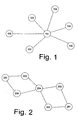
- Fig. 1 shows a UWB network 100 that has a star topology.
- Classic star network topologies are generally well suited for UWB applications where sensor nodes 102-107 are within range of a network end point 101.
- Fig. 2 shows a UWB network that has a mesh topology.
- Mesh topologies are commonly used for UWB applications where some sensor nodes 202-207 of the network 200 may not be within range of a network access point 201.
- a UWB network having a mesh topology permits the network 200 to be distributed over a wider area while still maintaining relatively short link ranges.
- the present invention can be used with networks having star topologies, mesh topologies, or any other topology.
- UWB ranging data that has been acquired in the UWB networks of Figs. 1 and 2 typically needs to be communicated back through the network to a data collection node.
- this collection node could be the network access point 101, 201 in Figs. 1 and 2.
- control commands often need to be sent forward to mobile radio nodes. Combining these control and data communications with the UWB ranging functions can result in very slow network performance overall. In fact, even with a relatively limited number of nodes, the combined processing load can result in poor system performance.
- each of the network nodes 101-107 and 201-207 can utilize conventional UWB ranging techniques to determine a range as between nodes.
- data transmissions between the nodes can be performed primarily using a narrow-band wireless local area network overlaid on the UWB ranging network.
- the wireless local area network can include a physical layer that communicates between the nodes using relatively narrow-band RF transmissions. Consequently, highly accurate UWB ranging can be provided while the overall data network performance can be greatly improved.
- the foregoing arrangement eliminates from the UWB portion of the system the additional processing overhead that typically is associated with ad hoc wireless data networks. It also allows the network to take advantage of carrier sense medium access control (MAC) algorithms that generally cannot be used with UWB.
- MAC carrier sense medium access control
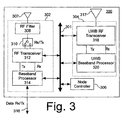
- Fig. 3 shows an example of a node 300 that can be used in a network such as those shown in Figs. 1 and 2.
- the node 300 is arranged so that it separates the ranging and data functions for improved overall network performance.
- Each node 300 can include a wireless LAN transceiver 302 and a UWB transceiver 304, each coupled to at least one suitable antenna 307, 317.
- Node 300 can be linked to a computer, weapon system, location device (GPS) and so on.
- the node 300 could also be connected to a separate wired or wireless network.
- Wireless LAN transceiver 302 can include conventional transceiver circuitry suitable necessary for implementing a relatively narrow-band wireless LAN network.
- the wireless LAN transceiver 302 can include an RF filter 308, a transmit/receive switch 310, an RF transceiver 312, and baseband processor 314.
- the baseband processor 314 can include suitable data interface circuitry for communicating with a network device using port 316.
- Baseband processor 314 can further include any necessary modulator, demodulator, analog to digital converter, digital to analog converter, clock, control circuitry (e.g. controller or microprocessor with suitable programming) and memory.
- the control circuitry can control the operation of the narrow-band wireless LAN transceiver 302, including controlling the RF transceiver 312 and managing media access control (MAC).
- MAC media access control
- Wireless LAN transceivers of the type shown in Fig. 3 are well known in the art.
- wireless LAN transceiver 302 can be configured as a device that is compatible with any of the IEEE family of standards designated as 802.11 or 802.15.
- the wireless LAN transceiver 302 can also be configure to be compatible with any other narrow-band wireless networking standard that is presently known or may become known in the future.
- narrow-band should be understood as referring to any wireless network that communicates between nodes using RF transmissions having a bandwidth that is substantially more narrow as compared to UWB type transmissions. More particularly, narrow-band transmissions can generally include wireless LAN devices that communicate using RF transmissions having a bandwidth of less than about 200 MHz.
- the IEE 802.11 operates using frequency hopping spread spectrum (FHSS) or direct sequence spread spectrum (DSSS) in the 2.4 GHz frequency band.
- FHSS frequency hopping spread spectrum
- DSSS direct sequence spread spectrum
- the 2.4GHz band is divided into 75 channels spaced 1-MHz apart.
- DSSS divides the 2.4GHz band into 11 channels for the FCC or North American domain (13 channels for the European or ETSI domain).
- UWB transceiver 304 can include an RF transceiver 318 and UWB baseband processor 320.
- the architecture of RF transceiver 318 and baseband processor 320, as well as any necessary programming can be arranged for determining a distance or range between nodes in the network using a conventional UWB ranging technique.
- the particular ranging technique selected is not critical.
- the ranging technique can include time of arrival (TOA) ranging, one way ranging (OWR), two-way ranging (TWR), time difference of arrival (TDOA), and received signal strength indicator (RSSI).
- TOA time of arrival
- OWR one way ranging
- TWR time difference of arrival
- RSSI received signal strength indicator
- the any suitable architecture of RF transceiver 318 and baseband processor 320 can be used, provided that it is capable of performing the required UWB ranging function as described herein.
- a node controller 306 can be provided for controlling the operation of the node 300.
- the node controller 306 can manage system resources, control the flow of range information from UWB baseband processor 320 to the narrow-band wireless LAN transceiver 302, handle interrupts, and perform any other necessary activities for coordinating the operation of the UWB transceiver with the wireless LAN transceiver.
- the UWB transceivers can be used only for performing the ultra wideband ranging.
- the narrow-band wireless LAN transceiver 302 and the local area network with which it communicates can be used exclusively for communicating data among the plurality of nodes.
- the data that is communicated can be any type of data.
- the data communicated on the narrow-band wireless LAN network can also include range data that has been determined by using the UWB ranging techniques. For example, ranging data determined using the UWB portion of the system can be propagated across the network to one or more nodes using the narrow-band wireless LAN portion of the network.
- the invention can also include a method for operating a wireless network.
- the method is illustrated in the flowchart of Fig. 4.
- the method can begin with step 402 by determining at least one range as between a plurality of nodes using ultra wideband (UWB) ranging techniques.
- the method can optionally include communicating the range data to a narrow-band wireless LAN transceiver in step 404.
- the method can include propagating the range data over a narrow-band wireless LAN network that includes a plurality of nodes. This step can be accomplished using narrow-band RF transceivers 302. Command and control data can also be propagated across the narrowband wireless LAN network using wireless LAN transceiver 302.
- the UWB transceivers respectively associated with each of the plurality of nodes can be used exclusively for performing the ultra wideband ranging techniques, whereas local area network and the narrow-band radio transceivers respectively associated with each of the nodes can be used exclusively for the step of communicating data.
- the invention is not limited in this regard. Accordingly, some ranging functions could be performed using the narrow-band wireless LAN network comprised of a plurality of narrow-band transceiver 302. Likewise, some amount of data could also be communicated using UWB transceiver 304.
- the method can make use of any of several well known UWB ranging techniques.
- the method can further include selecting the network protocol for the narrow-band wireless LAN network to be compatible with at least one standard protocol. For example the protocol can be based on the IEEE 802.11 standard or the IEEE 802.15 standard.
Landscapes
- Engineering & Computer Science (AREA)
- Computer Networks & Wireless Communication (AREA)
- Signal Processing (AREA)
- Mobile Radio Communication Systems (AREA)
Abstract
Description
- The inventive arrangements relate to ultra-wideband RF systems, and more particularly to command and control systems useful for integrating with such systems.
- Ultra-wideband (UWB) communication systems are generally defined as those that occupy more than 500 MHz of spectrum or that have a fractional bandwidth that exceeds 0.2. UWB communication systems have generally been implemented as impulse based systems. The pulse length can be of very short duration, e.g., 200 picoseconds and relatively low power. Modulation techniques for UWB are varied but can include pulse position modulation (PPM), pulse amplitude modulation (PAM), on-off keying (OOK), and bi-phase modulation (BPSK).
- UWB systems are increasingly of interest for use in connection with a broad range of applications. For example, it offers the potential for very high data rates at relative short distances, it is resistant to interference and multipath, and it is difficult to intercept using traditional techniques. At longer distances, UWB communication systems generally offer lower data rates, but the basic approach has been found to be well suited for location tracking and ranging applications. For example,
U.S. Patent No. 6,133,876 to Fullerton, et al. discloses a ranging system. One significant advantage of UWB ranging technology is that it offers sub-meter ranging performance due to its inherently wide bandwidth. Time of arrival (TOA), one way ranging (OWR), two way ranging (TWR), time difference of arrival (TDOA), and received signal strength indicator (RSSI) are all techniques that are known in the art for use in connection with UWB ranging systems. All of these systems having advantages and disadvantages that are well understood among those skilled in the UWB field. - Very large processing gain can be achieved with UWB signals. For example, such processing gain can be in the range of about 50 dB. This substantial processing gain is very important in UWB systems because they typically operate at very low transmit power, and the processing gain is necessary to achieve reasonable coverage ranges. Processing gain provides great advantages in coverage range, but the drawback to such processing is the time it takes to perform acquisition and synchronization. Consequently, UWB packets need to be sent at a relatively low data rate. For example, data rates can be on the order of 10 to 100 kbps in a UWB system that uses a few GHz of bandwidth.
- Traditionally, UWB networks have been used for both ranging and data purposes. Within such systems, the UWB ranging data that has been acquired typically needs to be communicated back through the network to a data collection node. In addition, control commands often need to be sent forward to mobile radio nodes. Combining these control and data communications with the UWB ranging functions can offer some advantages. However, using the same UWB network for both ranging activity and data communications tends to result in very slow network performance overall. Such slow network performance can typically result from the additional processing overhead associated with the ad-hoc networking techniques which must be employed to communicate the ranging data out of the network. In fact, even with a relatively limited number of nodes, the combined processing load can result in poor system performance.
- The invention concerns an apparatus and method for operating a wireless network. The wireless network can include two or more nodes. Each node can include a UWB transceiver that is configured for determining a range between nodes using ultra wideband (UWB) ranging technique. As used herein, the term UWB generally refers to impulse based techniques that rely on very short pulses that have a bandwidth of at least about 500 MHz. Each node can also include a narrow-band RF transceiver for implementing a wireless local area network communicating data between the nodes using a network protocol. As used herein, the term narrow-band can refer to RF transmissions having a bandwidth of less than about 200 MHz. The data transmitted over the plurality of nodes using the local area network can include command and control data for the nodes.
- According to one aspect of the invention, the UWB transceivers can be used only for performing the ultra wideband ranging techniques. Likewise, the narrow-band RF transceivers and the local area network can be used exclusively for communicating data among the plurality of nodes.
- The UWB ranging technique used with the wireless network can be selected from among a variety of known UWB ranging techniques without limitation. For example, the ranging technique can include time of arrival (TOA) ranging, one way ranging (OWR), two-way ranging (TWR), time difference of arrival (TDOA), and received signal strength indicator (RSSI). Such ranging techniques are well known in the art. Similarly, the network protocol for the wireless local area network can be based on any of a variety of well known network protocols that are compatible with narrow-band transmissions. For example, the network protocol can be based on the IEEE 802.11 set of standards or the IEEE 802.15 standards.
- The invention can also include a method for operating a wireless network. The method can include several steps, including determining at least one range as between a plurality of nodes using ultra wideband (UWB) ranging techniques. The method can also include communicating data between each of the plurality of nodes using the local area network and the narrow-band RF transceivers. For example, the UWB transceivers respectively associated with each of the plurality of nodes can be used exclusively for performing the ultra wideband ranging techniques, whereas local area network and the narrow-band radio transceivers respectively associated with each of the nodes can be used exclusively for the step of communicating data. The data can include command and control communications.
- As with the apparatus, the method can make use of any of several well known UWB ranging techniques. These can include time of arrival (TOA) ranging, one way ranging (OWR), two-way ranging (TWR), time difference of arrival (TDOA), and received signal strength indicator (RSSI). The method can further include selecting the network protocol to be compatible with at least one standard protocol. For example the protocol can be based on the IEEE 802.11 standard or the IEEE 802.15 standard.
-
- Fig. 1 is a network diagram showing a star topology that is useful for understanding the invention.
- Fig. 2 is a network diagram showing a mesh topology that is useful for understanding the invention.
- Fig. 3 is a block diagram of a hybrid network node that includes a narrow band LAN network transceiver and a UWB transceiver.
- Fig. 4 is a flowchart that is useful for understanding the invention.
- Ultra wideband (UWB) networks can be used for both ranging and data purposes. As used herein, the term UWB generally refers to impulse based RF transmission techniques that use very short pulses and have a bandwidth of at least about 500 MHz. UWB networks of this type are well known in the art.
- Fig. 1 shows a UWB network 100 that has a star topology. Classic star network topologies are generally well suited for UWB applications where sensor nodes 102-107 are within range of a
network end point 101. Fig. 2 shows a UWB network that has a mesh topology. Mesh topologies are commonly used for UWB applications where some sensor nodes 202-207 of the network 200 may not be within range of anetwork access point 201. A UWB network having a mesh topology permits the network 200 to be distributed over a wider area while still maintaining relatively short link ranges. The present invention can be used with networks having star topologies, mesh topologies, or any other topology. - UWB ranging data that has been acquired in the UWB networks of Figs. 1 and 2 typically needs to be communicated back through the network to a data collection node. For example, this collection node could be the
network access point - In order to overcome this limitation, the ranging and data transmission functions can be separated in the networks of Figs. 1 and 2. For example, in Figs. 1 and 2, each of the network nodes 101-107 and 201-207 can utilize conventional UWB ranging techniques to determine a range as between nodes. However, data transmissions between the nodes can be performed primarily using a narrow-band wireless local area network overlaid on the UWB ranging network. The wireless local area network can include a physical layer that communicates between the nodes using relatively narrow-band RF transmissions. Consequently, highly accurate UWB ranging can be provided while the overall data network performance can be greatly improved. The foregoing arrangement eliminates from the UWB portion of the system the additional processing overhead that typically is associated with ad hoc wireless data networks. It also allows the network to take advantage of carrier sense medium access control (MAC) algorithms that generally cannot be used with UWB.
- Fig. 3 shows an example of a
node 300 that can be used in a network such as those shown in Figs. 1 and 2. Thenode 300 is arranged so that it separates the ranging and data functions for improved overall network performance. Eachnode 300 can include awireless LAN transceiver 302 and aUWB transceiver 304, each coupled to at least onesuitable antenna Node 300 can be linked to a computer, weapon system, location device (GPS) and so on. Thenode 300 could also be connected to a separate wired or wireless network. -
Wireless LAN transceiver 302 can include conventional transceiver circuitry suitable necessary for implementing a relatively narrow-band wireless LAN network. For example, thewireless LAN transceiver 302 can include anRF filter 308, a transmit/receiveswitch 310, anRF transceiver 312, andbaseband processor 314. Thebaseband processor 314 can include suitable data interface circuitry for communicating with a networkdevice using port 316.Baseband processor 314 can further include any necessary modulator, demodulator, analog to digital converter, digital to analog converter, clock, control circuitry (e.g. controller or microprocessor with suitable programming) and memory. The control circuitry can control the operation of the narrow-bandwireless LAN transceiver 302, including controlling theRF transceiver 312 and managing media access control (MAC). - Wireless LAN transceivers of the type shown in Fig. 3 are well known in the art. For example,
wireless LAN transceiver 302 can be configured as a device that is compatible with any of the IEEE family of standards designated as 802.11 or 802.15. Thewireless LAN transceiver 302 can also be configure to be compatible with any other narrow-band wireless networking standard that is presently known or may become known in the future. - As used herein, the term narrow-band should be understood as referring to any wireless network that communicates between nodes using RF transmissions having a bandwidth that is substantially more narrow as compared to UWB type transmissions. More particularly, narrow-band transmissions can generally include wireless LAN devices that communicate using RF transmissions having a bandwidth of less than about 200 MHz. For example, the IEE 802.11 operates using frequency hopping spread spectrum (FHSS) or direct sequence spread spectrum (DSSS) in the 2.4 GHz frequency band. When FHSS is used, the 2.4GHz band is divided into 75 channels spaced 1-MHz apart. In contrast, DSSS divides the 2.4GHz band into 11 channels for the FCC or North American domain (13 channels for the European or ETSI domain). These channels have a specified center frequency separation of only 5 MHz and an overall channel bandwidth of 22 MHz. Notwithstanding the foregoing specifications, those skilled in the art will appreciate that the actual RF spectrum associated with the foregoing transmissions extends well beyond the 22-MHz bandwidth of the channel (+/- 11 MHz from fc). However, radiated energy must be 30 dB lower than the maximum signal level at 11 MHz from the center of the channel. At 22 MHz away, the energy must be 50 dB below the maximum level. Thus, the term narrow-band could also refer more particularly to wireless LAN networks that communicate using RF transmissions having a bandwidth of less than about 50 MHz.
-
UWB transceiver 304 can include anRF transceiver 318 andUWB baseband processor 320. The architecture ofRF transceiver 318 andbaseband processor 320, as well as any necessary programming can be arranged for determining a distance or range between nodes in the network using a conventional UWB ranging technique. The particular ranging technique selected is not critical. For example, the ranging technique can include time of arrival (TOA) ranging, one way ranging (OWR), two-way ranging (TWR), time difference of arrival (TDOA), and received signal strength indicator (RSSI). The methods and processes for implementing these techniques are well known in the art. Likewise, the any suitable architecture ofRF transceiver 318 andbaseband processor 320 can be used, provided that it is capable of performing the required UWB ranging function as described herein. - A
node controller 306 can be provided for controlling the operation of thenode 300. For example, thenode controller 306 can manage system resources, control the flow of range information fromUWB baseband processor 320 to the narrow-bandwireless LAN transceiver 302, handle interrupts, and perform any other necessary activities for coordinating the operation of the UWB transceiver with the wireless LAN transceiver. - According to one aspect of the invention, the UWB transceivers can be used only for performing the ultra wideband ranging. Likewise, the narrow-band
wireless LAN transceiver 302 and the local area network with which it communicates can be used exclusively for communicating data among the plurality of nodes. The data that is communicated can be any type of data. However, the data communicated on the narrow-band wireless LAN network can also include range data that has been determined by using the UWB ranging techniques. For example, ranging data determined using the UWB portion of the system can be propagated across the network to one or more nodes using the narrow-band wireless LAN portion of the network. - Those skilled in the art will appreciate that the invention can also include a method for operating a wireless network. The method is illustrated in the flowchart of Fig. 4. The method can begin with
step 402 by determining at least one range as between a plurality of nodes using ultra wideband (UWB) ranging techniques. The method can optionally include communicating the range data to a narrow-band wireless LAN transceiver instep 404. Further, the method can include propagating the range data over a narrow-band wireless LAN network that includes a plurality of nodes. This step can be accomplished using narrow-band RF transceivers 302. Command and control data can also be propagated across the narrowband wireless LAN network usingwireless LAN transceiver 302. - According to one embodiment of the invention, the UWB transceivers respectively associated with each of the plurality of nodes can be used exclusively for performing the ultra wideband ranging techniques, whereas local area network and the narrow-band radio transceivers respectively associated with each of the nodes can be used exclusively for the step of communicating data. However, the invention is not limited in this regard. Accordingly, some ranging functions could be performed using the narrow-band wireless LAN network comprised of a plurality of narrow-
band transceiver 302. Likewise, some amount of data could also be communicated usingUWB transceiver 304. As with the apparatus, the method can make use of any of several well known UWB ranging techniques. The method can further include selecting the network protocol for the narrow-band wireless LAN network to be compatible with at least one standard protocol. For example the protocol can be based on the IEEE 802.11 standard or the IEEE 802.15 standard.
Claims (11)
- A method for operating a wireless network comprising:determining at least one range as between a plurality of nodes using ultra wideband (UWB) ranging techniques;communicating data between each of said plurality of nodes using a wireless local area network that includes a physical layer that communicates between said nodes using narrow-band RF transmissions.
- The method according to claim 1, further comprising using a plurality of UWB transceivers respectively associated with each of said plurality of nodes exclusively for performing said ultra wideband ranging techniques.
- The method according to claim 2, further comprising using said narrow-band RF transmissions exclusively for said step of communicating data.
- The method according to claim 3, further comprising using said narrow-band RF transmission for command and control communications.
- The method according to claim 1, further comprising selecting said UWB ranging techniques from the group consisting of time of arrival (TOA) ranging, one way ranging (OWR), two-way ranging (TWR), time difference of arrival (TDOA), and received signal strength indicator (RSSI).
- A wireless network comprising:a plurality of nodes, each comprising (a) a UWB transceiver configured for determining at least one range as between said plurality of nodes using at least one ultra wideband (UWB) ranging technique, and (b) a narrow-band RF transceiver communicating data between each of said plurality of nodes, said narrow-band transceiver part of a wireless local area network that includes a physical layer that communicates between said nodes by using a narrow-bandwidth RF transmission.
- The wireless network according to claim 6, wherein said plurality of UWB transceivers exclusively performs said ultra wideband ranging techniques.
- The wireless network according to claim 7, wherein said plurality of narrow-band RF transceivers exclusively communicates data among said plurality of nodes.
- The wireless network according to claim 8, wherein said plurality of narrow-band RF transceivers further communicate command and control data.
- The wireless network according to claim 6, wherein said at least one UWB ranging technique is selected from the group consisting of time of arrival (TOA) ranging, one way ranging (OWR), two-way ranging (TWR), time difference of arrival (TDOA), and received signal strength indicator (RSSI).
- The wireless network according to claim 6, wherein said wireless local area network is based on a network protocol selected from the group consisting of an IEEE 802.11 standard and an IEEE 802.15 standard.
Applications Claiming Priority (1)
| Application Number | Priority Date | Filing Date | Title |
|---|---|---|---|
| US11/248,745 US20070081505A1 (en) | 2005-10-12 | 2005-10-12 | Hybrid RF network with high precision ranging |
Publications (1)
| Publication Number | Publication Date |
|---|---|
| EP1775848A1 true EP1775848A1 (en) | 2007-04-18 |
Family
ID=37684993
Family Applications (1)
| Application Number | Title | Priority Date | Filing Date |
|---|---|---|---|
| EP06021427A Withdrawn EP1775848A1 (en) | 2005-10-12 | 2006-10-12 | Hybrid RF network with high precision ranging |
Country Status (4)
| Country | Link |
|---|---|
| US (1) | US20070081505A1 (en) |
| EP (1) | EP1775848A1 (en) |
| JP (1) | JP2007110715A (en) |
| CA (1) | CA2563019A1 (en) |
Cited By (1)
| Publication number | Priority date | Publication date | Assignee | Title |
|---|---|---|---|---|
| EP2015103B1 (en) * | 2007-07-12 | 2019-06-19 | Qualcomm Incorporated | Method for determining line-of-sight (LOS) distance between remote communications devices |
Families Citing this family (36)
| Publication number | Priority date | Publication date | Assignee | Title |
|---|---|---|---|---|
| US8085830B2 (en) * | 2006-01-27 | 2011-12-27 | Leviton Manufacturing Co., Inc. | LAN by ultra-wideband system and method |
| US20070198748A1 (en) * | 2006-02-01 | 2007-08-23 | Leviton Manufacturing Co., Inc. | Power line communication hub system and method |
| EP1993437A4 (en) * | 2006-02-24 | 2014-05-14 | Hmicro Inc | MEDICAL SIGNAL PROCESSING SYSTEM WITH WIRELESS DISTRIBUTED SENSORS |
| US7903724B2 (en) * | 2007-01-31 | 2011-03-08 | Broadcom Corporation | RF transceiver device with RF bus |
| WO2009026289A2 (en) * | 2007-08-20 | 2009-02-26 | Hmicro, Inc. | Wearable user interface device, system, and method of use |
| US8926509B2 (en) * | 2007-08-24 | 2015-01-06 | Hmicro, Inc. | Wireless physiological sensor patches and systems |
| EP3300661B1 (en) | 2007-10-24 | 2024-12-04 | LifeSignals, Inc. | Method and apparatus to retrofit wired healthcare and fitness systems for wireless operation |
| US20110019824A1 (en) | 2007-10-24 | 2011-01-27 | Hmicro, Inc. | Low power radiofrequency (rf) communication systems for secure wireless patch initialization and methods of use |
| WO2009100401A2 (en) * | 2008-02-06 | 2009-08-13 | Hmicro, Inc. | Wireless communications systems using multiple radios |
| US8605091B2 (en) * | 2008-04-18 | 2013-12-10 | Leviton Manufacturing Co., Inc. | Enhanced power distribution unit with self-orienting display |
| US20100198535A1 (en) * | 2009-02-03 | 2010-08-05 | Leviton Manufacturing Co., Inc. | Power distribution unit monitoring network and components |
| US8463453B2 (en) * | 2009-11-13 | 2013-06-11 | Leviton Manufacturing Co., Inc. | Intelligent metering demand response |
| US8755944B2 (en) * | 2009-11-13 | 2014-06-17 | Leviton Manufacturing Co., Inc. | Electrical switching module |
| US8324761B2 (en) * | 2009-11-13 | 2012-12-04 | Leviton Manufacturing Co., Inc. | Electrical switching module |
| US8558504B2 (en) * | 2010-01-11 | 2013-10-15 | Leviton Manufacturing Co., Inc. | Electric vehicle supply equipment with timer |
| US20110169447A1 (en) | 2010-01-11 | 2011-07-14 | Leviton Manufacturing Co., Inc. | Electric vehicle supply equipment |
| CN103097905A (en) * | 2010-06-01 | 2013-05-08 | 艾德普顿斯公司 | Systems and methods for indoor positioning |
| US8633678B2 (en) | 2011-05-10 | 2014-01-21 | Leviton Manufacturing Co., Inc. | Electric vehicle supply equipment with over-current protection |
| US8736193B2 (en) | 2011-12-22 | 2014-05-27 | Leviton Manufacturing Company, Inc. | Threshold-based zero-crossing detection in an electrical dimmer |
| US8664886B2 (en) | 2011-12-22 | 2014-03-04 | Leviton Manufacturing Company, Inc. | Timer-based switching circuit synchronization in an electrical dimmer |
| US20140145829A1 (en) * | 2012-11-25 | 2014-05-29 | Amir Bassan-Eskenazi | Wirless tag based communication, system and applicaitons |
| US9681526B2 (en) | 2014-06-11 | 2017-06-13 | Leviton Manufacturing Co., Inc. | Power efficient line synchronized dimmer |
| US10182088B2 (en) * | 2014-08-19 | 2019-01-15 | Qualcomm Incorporated | Wideband ranging in cellular using unlicensed radio frequency spectrum band |
| CN108781233A (en) * | 2015-04-09 | 2018-11-09 | 康福斯技术公司 | Beacon for range-measurement system and associated component |
| US11184153B2 (en) * | 2018-07-05 | 2021-11-23 | Apple Inc. | Ultra wideband secure ranging |
| US10567035B1 (en) | 2019-03-06 | 2020-02-18 | Clairvoyant Networks, LLC | Methods, systems, and computer readable media for distribution of time synchronization information to ultra-wide-band devices |
| US10484833B1 (en) * | 2019-04-12 | 2019-11-19 | Clairvoyant Networks, LLC | Methods, systems and computer readable media for providing and using ultra wideband local area networks (LANs) |
| US11051244B2 (en) * | 2019-05-31 | 2021-06-29 | Nxp B.V. | Ultra-wideband (UWB) receiver device and method for operating a UWB device |
| EP4249954A3 (en) | 2020-02-07 | 2023-10-18 | Samsung Electronics Co., Ltd. | Electronic device for performing ranging by using ultra wide band communication and operating method thereof |
| US12015916B2 (en) | 2020-11-02 | 2024-06-18 | Apple Inc. | Signaling techniques using fragmented and multi-partitioned UWB packets |
| US11815616B2 (en) | 2020-11-02 | 2023-11-14 | Apple Inc. | Announcing UWB / NBA-UWB-MMS ranging rounds via narrowband-based advertisements |
| US11991107B2 (en) * | 2020-11-02 | 2024-05-21 | Apple Inc. | Techniques for hybridized ultra-wideband and narrowband signaling |
| US11729037B2 (en) | 2020-11-02 | 2023-08-15 | Apple Inc. | Sequences for ultra-wideband ranging |
| KR102793162B1 (en) * | 2021-08-04 | 2025-04-08 | 애플 인크. | Announcing uwb / nba-uwb-mms ranging rounds via narrowband-based advertisements |
| WO2024005651A1 (en) * | 2022-06-29 | 2024-01-04 | ONiO AS | Monolithic combined transceiver |
| EP4513219A4 (en) * | 2022-07-08 | 2025-06-18 | Huawei Technologies Co., Ltd. | TELEMETRY METHOD AND DEVICE |
Citations (8)
| Publication number | Priority date | Publication date | Assignee | Title |
|---|---|---|---|---|
| JPH089450A (en) * | 1994-06-22 | 1996-01-12 | Fujitsu Ltd | Position tracking service system for simplified mobile phone system |
| US6133876A (en) * | 1998-03-23 | 2000-10-17 | Time Domain Corporation | System and method for position determination by impulse radio |
| JP2003036493A (en) * | 2001-07-23 | 2003-02-07 | Matsushita Electric Ind Co Ltd | Theft tracking and emergency call device |
| JP2003179542A (en) * | 2001-12-11 | 2003-06-27 | Nef:Kk | Arrival station guide system |
| JP2003261028A (en) * | 2002-03-06 | 2003-09-16 | Toshiba Corp | Wireless application occlusion control system and method |
| US20040090353A1 (en) * | 2002-11-12 | 2004-05-13 | Moore Steven A. | Ultra-wideband pulse modulation system and method |
| US20050164643A1 (en) * | 2004-01-22 | 2005-07-28 | Mcewan Thomas E. | RF transceiver having a directly radiating transistor |
| US20050271150A1 (en) * | 2004-06-07 | 2005-12-08 | Steve Moore | Digital modulation system and method |
Family Cites Families (7)
| Publication number | Priority date | Publication date | Assignee | Title |
|---|---|---|---|---|
| US6334219B1 (en) * | 1994-09-26 | 2001-12-25 | Adc Telecommunications Inc. | Channel selection for a hybrid fiber coax network |
| US20040002346A1 (en) * | 2000-12-14 | 2004-01-01 | John Santhoff | Ultra-wideband geographic location system and method |
| US7221911B2 (en) * | 2002-08-16 | 2007-05-22 | Wisair Ltd. | Multi-band ultra-wide band communication method and system |
| US7668124B2 (en) * | 2003-05-21 | 2010-02-23 | Broadcom Corporation | Position based WPAN (Wireless Personal Area Network) management |
| US8208449B2 (en) * | 2004-01-05 | 2012-06-26 | Broadcom Corporation | Multi-mode WLAN/PAN MAC |
| US7239277B2 (en) * | 2004-04-12 | 2007-07-03 | Time Domain Corporation | Method and system for extensible position location |
| US20050238113A1 (en) * | 2004-04-26 | 2005-10-27 | John Santhoff | Hybrid communication method and apparatus |
-
2005
- 2005-10-12 US US11/248,745 patent/US20070081505A1/en not_active Abandoned
-
2006
- 2006-10-06 JP JP2006275360A patent/JP2007110715A/en active Pending
- 2006-10-10 CA CA002563019A patent/CA2563019A1/en not_active Abandoned
- 2006-10-12 EP EP06021427A patent/EP1775848A1/en not_active Withdrawn
Patent Citations (8)
| Publication number | Priority date | Publication date | Assignee | Title |
|---|---|---|---|---|
| JPH089450A (en) * | 1994-06-22 | 1996-01-12 | Fujitsu Ltd | Position tracking service system for simplified mobile phone system |
| US6133876A (en) * | 1998-03-23 | 2000-10-17 | Time Domain Corporation | System and method for position determination by impulse radio |
| JP2003036493A (en) * | 2001-07-23 | 2003-02-07 | Matsushita Electric Ind Co Ltd | Theft tracking and emergency call device |
| JP2003179542A (en) * | 2001-12-11 | 2003-06-27 | Nef:Kk | Arrival station guide system |
| JP2003261028A (en) * | 2002-03-06 | 2003-09-16 | Toshiba Corp | Wireless application occlusion control system and method |
| US20040090353A1 (en) * | 2002-11-12 | 2004-05-13 | Moore Steven A. | Ultra-wideband pulse modulation system and method |
| US20050164643A1 (en) * | 2004-01-22 | 2005-07-28 | Mcewan Thomas E. | RF transceiver having a directly radiating transistor |
| US20050271150A1 (en) * | 2004-06-07 | 2005-12-08 | Steve Moore | Digital modulation system and method |
Cited By (1)
| Publication number | Priority date | Publication date | Assignee | Title |
|---|---|---|---|---|
| EP2015103B1 (en) * | 2007-07-12 | 2019-06-19 | Qualcomm Incorporated | Method for determining line-of-sight (LOS) distance between remote communications devices |
Also Published As
| Publication number | Publication date |
|---|---|
| US20070081505A1 (en) | 2007-04-12 |
| CA2563019A1 (en) | 2007-04-12 |
| JP2007110715A (en) | 2007-04-26 |
Similar Documents
| Publication | Publication Date | Title |
|---|---|---|
| US20070081505A1 (en) | Hybrid RF network with high precision ranging | |
| US7339883B2 (en) | Ultra-wideband communication protocol | |
| CN102484500B (en) | Spectrum detector for cognitive wireless communication and cognitive wireless communication method | |
| US7027425B1 (en) | Impulse radio virtual wireless local area network system and method | |
| Yang et al. | Ultra-wideband communications: an idea whose time has come | |
| US7554965B2 (en) | UWB (Ultra Wide Band) waveform design to minimize narrowband interference | |
| US10846961B2 (en) | RF communication for secure access | |
| EP4131807A1 (en) | Sequences for ultra-wideband ranging | |
| JP4543846B2 (en) | Wireless communication device and transmission path measuring device | |
| WO2005086861A2 (en) | Dynamic differentiated link adaptation for ultra-wideband communication system | |
| EP1719277A1 (en) | Ultra-wideband communication protocol | |
| WO2005122512A2 (en) | Digital modulation system and method | |
| EP4181449A1 (en) | Radio frequency (rf) communication system providing channel selection based upon historical rf spectral data and related methods | |
| US8130817B2 (en) | Non-data-aided channel estimators for multipath and multiple antenna wireless systems | |
| August et al. | An efficient UWB radio architecture for busy signal MAC protocols | |
| JP4746496B2 (en) | Wireless communication device | |
| US7852949B2 (en) | Spectral distance optimizing multi-band transmission | |
| US20080019461A1 (en) | Receiving a Signal in a Communication System | |
| Li et al. | Evaluation of co-channel and adjacent channel interference for multiple Bluetooth piconets with dual channel transmission | |
| Sivalingam et al. | UWB networks and applications | |
| Schmidt et al. | Theoretical boundaries for combined information estimation and non data-aided channel estimation in UWB | |
| Oh et al. | Baseband transceiver chip for IR-UWB system | |
| Sumethnapis et al. | TR-UWB systems with pulse-position multi-pulse modulation for ECC's and Japan's radiation masks |
Legal Events
| Date | Code | Title | Description |
|---|---|---|---|
| PUAI | Public reference made under article 153(3) epc to a published international application that has entered the european phase |
Free format text: ORIGINAL CODE: 0009012 |
|
| 17P | Request for examination filed |
Effective date: 20061012 |
|
| AK | Designated contracting states |
Kind code of ref document: A1 Designated state(s): AT BE BG CH CY CZ DE DK EE ES FI FR GB GR HU IE IS IT LI LT LU LV MC NL PL PT RO SE SI SK TR |
|
| AX | Request for extension of the european patent |
Extension state: AL BA HR MK YU |
|
| AKX | Designation fees paid |
Designated state(s): DE FI FR GB SE |
|
| 17Q | First examination report despatched |
Effective date: 20080515 |
|
| GRAP | Despatch of communication of intention to grant a patent |
Free format text: ORIGINAL CODE: EPIDOSNIGR1 |
|
| RIC1 | Information provided on ipc code assigned before grant |
Ipc: H04L 27/00 20060101ALI20110328BHEP Ipc: H04L 12/56 20060101ALI20110328BHEP Ipc: H04B 1/69 20110101AFI20110328BHEP |
|
| STAA | Information on the status of an ep patent application or granted ep patent |
Free format text: STATUS: THE APPLICATION IS DEEMED TO BE WITHDRAWN |
|
| 18D | Application deemed to be withdrawn |
Effective date: 20110503 |