EP1775363A1 - Pile fabric - Google Patents
Pile fabric Download PDFInfo
- Publication number
- EP1775363A1 EP1775363A1 EP05765200A EP05765200A EP1775363A1 EP 1775363 A1 EP1775363 A1 EP 1775363A1 EP 05765200 A EP05765200 A EP 05765200A EP 05765200 A EP05765200 A EP 05765200A EP 1775363 A1 EP1775363 A1 EP 1775363A1
- Authority
- EP
- European Patent Office
- Prior art keywords
- pile
- fiber
- fibers
- fineness
- dtex
- Prior art date
- Legal status (The legal status is an assumption and is not a legal conclusion. Google has not performed a legal analysis and makes no representation as to the accuracy of the status listed.)
- Withdrawn
Links
- 239000004744 fabric Substances 0.000 title claims abstract description 79
- 239000000835 fiber Substances 0.000 claims abstract description 194
- 229920002821 Modacrylic Polymers 0.000 claims abstract description 69
- 229920001296 polysiloxane Polymers 0.000 claims description 12
- NLHHRLWOUZZQLW-UHFFFAOYSA-N Acrylonitrile Chemical compound C=CC#N NLHHRLWOUZZQLW-UHFFFAOYSA-N 0.000 claims description 8
- 229920000642 polymer Polymers 0.000 claims description 6
- 229920002678 cellulose Polymers 0.000 claims description 5
- 239000001913 cellulose Substances 0.000 claims description 4
- 210000004209 hair Anatomy 0.000 abstract description 43
- 230000002349 favourable effect Effects 0.000 abstract description 11
- 238000011084 recovery Methods 0.000 abstract description 7
- 238000004519 manufacturing process Methods 0.000 description 32
- CSCPPACGZOOCGX-UHFFFAOYSA-N Acetone Chemical compound CC(C)=O CSCPPACGZOOCGX-UHFFFAOYSA-N 0.000 description 20
- BZHJMEDXRYGGRV-UHFFFAOYSA-N Vinyl chloride Chemical compound ClC=C BZHJMEDXRYGGRV-UHFFFAOYSA-N 0.000 description 11
- 230000000694 effects Effects 0.000 description 11
- 239000000243 solution Substances 0.000 description 10
- 238000005259 measurement Methods 0.000 description 8
- 238000011282 treatment Methods 0.000 description 8
- 230000000052 comparative effect Effects 0.000 description 7
- 125000000391 vinyl group Chemical group [H]C([*])=C([H])[H] 0.000 description 7
- 206010016322 Feeling abnormal Diseases 0.000 description 6
- FXHOOIRPVKKKFG-UHFFFAOYSA-N N,N-Dimethylacetamide Chemical compound CN(C)C(C)=O FXHOOIRPVKKKFG-UHFFFAOYSA-N 0.000 description 6
- 229920002554 vinyl polymer Polymers 0.000 description 6
- 229920006243 acrylic copolymer Polymers 0.000 description 5
- 238000000034 method Methods 0.000 description 5
- 238000002156 mixing Methods 0.000 description 5
- 239000000203 mixture Substances 0.000 description 5
- 238000009987 spinning Methods 0.000 description 5
- 238000004043 dyeing Methods 0.000 description 4
- 238000005516 engineering process Methods 0.000 description 4
- 239000000178 monomer Substances 0.000 description 4
- 239000000523 sample Substances 0.000 description 4
- -1 vinyl halides Chemical class 0.000 description 4
- GWEVSGVZZGPLCZ-UHFFFAOYSA-N Titan oxide Chemical compound O=[Ti]=O GWEVSGVZZGPLCZ-UHFFFAOYSA-N 0.000 description 3
- XTXRWKRVRITETP-UHFFFAOYSA-N Vinyl acetate Chemical compound CC(=O)OC=C XTXRWKRVRITETP-UHFFFAOYSA-N 0.000 description 3
- 239000002253 acid Substances 0.000 description 3
- 239000007864 aqueous solution Substances 0.000 description 3
- 229920002301 cellulose acetate Polymers 0.000 description 3
- 239000000126 substance Substances 0.000 description 3
- 229920002994 synthetic fiber Polymers 0.000 description 3
- 239000012209 synthetic fiber Substances 0.000 description 3
- OGIDPMRJRNCKJF-UHFFFAOYSA-N titanium oxide Inorganic materials [Ti]=O OGIDPMRJRNCKJF-UHFFFAOYSA-N 0.000 description 3
- NIXOWILDQLNWCW-UHFFFAOYSA-N 2-Propenoic acid Natural products OC(=O)C=C NIXOWILDQLNWCW-UHFFFAOYSA-N 0.000 description 2
- 229920000742 Cotton Polymers 0.000 description 2
- 241000219146 Gossypium Species 0.000 description 2
- BAPJBEWLBFYGME-UHFFFAOYSA-N Methyl acrylate Chemical compound COC(=O)C=C BAPJBEWLBFYGME-UHFFFAOYSA-N 0.000 description 2
- 230000015271 coagulation Effects 0.000 description 2
- 238000005345 coagulation Methods 0.000 description 2
- 238000009826 distribution Methods 0.000 description 2
- 238000011156 evaluation Methods 0.000 description 2
- 238000010438 heat treatment Methods 0.000 description 2
- 239000003921 oil Substances 0.000 description 2
- 125000005375 organosiloxane group Chemical group 0.000 description 2
- 239000002245 particle Substances 0.000 description 2
- 238000005498 polishing Methods 0.000 description 2
- 150000003839 salts Chemical class 0.000 description 2
- 239000002904 solvent Substances 0.000 description 2
- 238000005406 washing Methods 0.000 description 2
- XLYOFNOQVPJJNP-UHFFFAOYSA-N water Substances O XLYOFNOQVPJJNP-UHFFFAOYSA-N 0.000 description 2
- 238000002166 wet spinning Methods 0.000 description 2
- SXZSFWHOSHAKMN-UHFFFAOYSA-N 2,3,4,4',5-Pentachlorobiphenyl Chemical compound C1=CC(Cl)=CC=C1C1=CC(Cl)=C(Cl)C(Cl)=C1Cl SXZSFWHOSHAKMN-UHFFFAOYSA-N 0.000 description 1
- SMZOUWXMTYCWNB-UHFFFAOYSA-N 2-(2-methoxy-5-methylphenyl)ethanamine Chemical compound COC1=CC=C(C)C=C1CCN SMZOUWXMTYCWNB-UHFFFAOYSA-N 0.000 description 1
- OEPOKWHJYJXUGD-UHFFFAOYSA-N 2-(3-phenylmethoxyphenyl)-1,3-thiazole-4-carbaldehyde Chemical compound O=CC1=CSC(C=2C=C(OCC=3C=CC=CC=3)C=CC=2)=N1 OEPOKWHJYJXUGD-UHFFFAOYSA-N 0.000 description 1
- XEEYSDHEOQHCDA-UHFFFAOYSA-N 2-methylprop-2-ene-1-sulfonic acid Chemical compound CC(=C)CS(O)(=O)=O XEEYSDHEOQHCDA-UHFFFAOYSA-N 0.000 description 1
- AGBXYHCHUYARJY-UHFFFAOYSA-N 2-phenylethenesulfonic acid Chemical compound OS(=O)(=O)C=CC1=CC=CC=C1 AGBXYHCHUYARJY-UHFFFAOYSA-N 0.000 description 1
- KGIGUEBEKRSTEW-UHFFFAOYSA-N 2-vinylpyridine Chemical class C=CC1=CC=CC=N1 KGIGUEBEKRSTEW-UHFFFAOYSA-N 0.000 description 1
- KFNGWPXYNSJXOP-UHFFFAOYSA-N 3-(2-methylprop-2-enoyloxy)propane-1-sulfonic acid Chemical compound CC(=C)C(=O)OCCCS(O)(=O)=O KFNGWPXYNSJXOP-UHFFFAOYSA-N 0.000 description 1
- HRPVXLWXLXDGHG-UHFFFAOYSA-N Acrylamide Chemical compound NC(=O)C=C HRPVXLWXLXDGHG-UHFFFAOYSA-N 0.000 description 1
- 229920002972 Acrylic fiber Polymers 0.000 description 1
- DQEFEBPAPFSJLV-UHFFFAOYSA-N Cellulose propionate Chemical compound CCC(=O)OCC1OC(OC(=O)CC)C(OC(=O)CC)C(OC(=O)CC)C1OC1C(OC(=O)CC)C(OC(=O)CC)C(OC(=O)CC)C(COC(=O)CC)O1 DQEFEBPAPFSJLV-UHFFFAOYSA-N 0.000 description 1
- 241001391944 Commicarpus scandens Species 0.000 description 1
- 239000004593 Epoxy Substances 0.000 description 1
- CERQOIWHTDAKMF-UHFFFAOYSA-N Methacrylic acid Chemical compound CC(=C)C(O)=O CERQOIWHTDAKMF-UHFFFAOYSA-N 0.000 description 1
- VVQNEPGJFQJSBK-UHFFFAOYSA-N Methyl methacrylate Chemical compound COC(=O)C(C)=C VVQNEPGJFQJSBK-UHFFFAOYSA-N 0.000 description 1
- GYCMBHHDWRMZGG-UHFFFAOYSA-N Methylacrylonitrile Chemical compound CC(=C)C#N GYCMBHHDWRMZGG-UHFFFAOYSA-N 0.000 description 1
- 235000014443 Pyrus communis Nutrition 0.000 description 1
- 229920000297 Rayon Polymers 0.000 description 1
- XUIMIQQOPSSXEZ-UHFFFAOYSA-N Silicon Chemical compound [Si] XUIMIQQOPSSXEZ-UHFFFAOYSA-N 0.000 description 1
- 150000007513 acids Chemical class 0.000 description 1
- 239000000654 additive Substances 0.000 description 1
- 239000000853 adhesive Substances 0.000 description 1
- 230000001070 adhesive effect Effects 0.000 description 1
- 150000001408 amides Chemical class 0.000 description 1
- 238000004458 analytical method Methods 0.000 description 1
- 238000009835 boiling Methods 0.000 description 1
- 210000000988 bone and bone Anatomy 0.000 description 1
- INLLPKCGLOXCIV-UHFFFAOYSA-N bromoethene Chemical compound BrC=C INLLPKCGLOXCIV-UHFFFAOYSA-N 0.000 description 1
- 125000003178 carboxy group Chemical group [H]OC(*)=O 0.000 description 1
- 150000001733 carboxylic acid esters Chemical class 0.000 description 1
- 150000001735 carboxylic acids Chemical class 0.000 description 1
- 238000009960 carding Methods 0.000 description 1
- 230000015556 catabolic process Effects 0.000 description 1
- 229920001727 cellulose butyrate Polymers 0.000 description 1
- 229920006218 cellulose propionate Polymers 0.000 description 1
- 238000012937 correction Methods 0.000 description 1
- 238000005520 cutting process Methods 0.000 description 1
- 238000006731 degradation reaction Methods 0.000 description 1
- 239000004205 dimethyl polysiloxane Substances 0.000 description 1
- 235000013870 dimethyl polysiloxane Nutrition 0.000 description 1
- 238000001035 drying Methods 0.000 description 1
- 239000000975 dye Substances 0.000 description 1
- 230000001804 emulsifying effect Effects 0.000 description 1
- MEGHWIAOTJPCHQ-UHFFFAOYSA-N ethenyl butanoate Chemical compound CCCC(=O)OC=C MEGHWIAOTJPCHQ-UHFFFAOYSA-N 0.000 description 1
- 230000003631 expected effect Effects 0.000 description 1
- 239000011521 glass Substances 0.000 description 1
- VOZRXNHHFUQHIL-UHFFFAOYSA-N glycidyl methacrylate Chemical compound CC(=C)C(=O)OCC1CO1 VOZRXNHHFUQHIL-UHFFFAOYSA-N 0.000 description 1
- 230000001771 impaired effect Effects 0.000 description 1
- 150000002500 ions Chemical class 0.000 description 1
- 239000000463 material Substances 0.000 description 1
- 238000000691 measurement method Methods 0.000 description 1
- 229910052751 metal Inorganic materials 0.000 description 1
- 239000002184 metal Substances 0.000 description 1
- FQPSGWSUVKBHSU-UHFFFAOYSA-N methacrylamide Chemical compound CC(=C)C(N)=O FQPSGWSUVKBHSU-UHFFFAOYSA-N 0.000 description 1
- 125000005395 methacrylic acid group Chemical group 0.000 description 1
- XJRBAMWJDBPFIM-UHFFFAOYSA-N methyl vinyl ether Chemical class COC=C XJRBAMWJDBPFIM-UHFFFAOYSA-N 0.000 description 1
- 238000011328 necessary treatment Methods 0.000 description 1
- 238000012856 packing Methods 0.000 description 1
- 229920000435 poly(dimethylsiloxane) Polymers 0.000 description 1
- 125000002924 primary amino group Chemical group [H]N([H])* 0.000 description 1
- UIIIBRHUICCMAI-UHFFFAOYSA-N prop-2-ene-1-sulfonic acid Chemical compound OS(=O)(=O)CC=C UIIIBRHUICCMAI-UHFFFAOYSA-N 0.000 description 1
- 230000001953 sensory effect Effects 0.000 description 1
- 229910052710 silicon Inorganic materials 0.000 description 1
- 239000010703 silicon Substances 0.000 description 1
- MNCGMVDMOKPCSQ-UHFFFAOYSA-M sodium;2-phenylethenesulfonate Chemical compound [Na+].[O-]S(=O)(=O)C=CC1=CC=CC=C1 MNCGMVDMOKPCSQ-UHFFFAOYSA-M 0.000 description 1
- 239000002344 surface layer Substances 0.000 description 1
- 239000004094 surface-active agent Substances 0.000 description 1
- 238000012360 testing method Methods 0.000 description 1
- 229920001567 vinyl ester resin Polymers 0.000 description 1
Classifications
-
- D—TEXTILES; PAPER
- D04—BRAIDING; LACE-MAKING; KNITTING; TRIMMINGS; NON-WOVEN FABRICS
- D04B—KNITTING
- D04B21/00—Warp knitting processes for the production of fabrics or articles not dependent on the use of particular machines; Fabrics or articles defined by such processes
- D04B21/02—Pile fabrics or articles having similar surface features
- D04B21/04—Pile fabrics or articles having similar surface features characterised by thread material
-
- D—TEXTILES; PAPER
- D06—TREATMENT OF TEXTILES OR THE LIKE; LAUNDERING; FLEXIBLE MATERIALS NOT OTHERWISE PROVIDED FOR
- D06M—TREATMENT, NOT PROVIDED FOR ELSEWHERE IN CLASS D06, OF FIBRES, THREADS, YARNS, FABRICS, FEATHERS OR FIBROUS GOODS MADE FROM SUCH MATERIALS
- D06M15/00—Treating fibres, threads, yarns, fabrics, or fibrous goods made from such materials, with macromolecular compounds; Such treatment combined with mechanical treatment
- D06M15/19—Treating fibres, threads, yarns, fabrics, or fibrous goods made from such materials, with macromolecular compounds; Such treatment combined with mechanical treatment with synthetic macromolecular compounds
- D06M15/37—Macromolecular compounds obtained otherwise than by reactions only involving carbon-to-carbon unsaturated bonds
- D06M15/643—Macromolecular compounds obtained otherwise than by reactions only involving carbon-to-carbon unsaturated bonds containing silicon in the main chain
-
- D—TEXTILES; PAPER
- D02—YARNS; MECHANICAL FINISHING OF YARNS OR ROPES; WARPING OR BEAMING
- D02G—CRIMPING OR CURLING FIBRES, FILAMENTS, THREADS, OR YARNS; YARNS OR THREADS
- D02G3/00—Yarns or threads, e.g. fancy yarns; Processes or apparatus for the production thereof, not otherwise provided for
- D02G3/02—Yarns or threads characterised by the material or by the materials from which they are made
- D02G3/04—Blended or other yarns or threads containing components made from different materials
-
- D—TEXTILES; PAPER
- D03—WEAVING
- D03D—WOVEN FABRICS; METHODS OF WEAVING; LOOMS
- D03D27/00—Woven pile fabrics
-
- D—TEXTILES; PAPER
- D04—BRAIDING; LACE-MAKING; KNITTING; TRIMMINGS; NON-WOVEN FABRICS
- D04B—KNITTING
- D04B1/00—Weft knitting processes for the production of fabrics or articles not dependent on the use of particular machines; Fabrics or articles defined by such processes
- D04B1/02—Pile fabrics or articles having similar surface features
- D04B1/04—Pile fabrics or articles having similar surface features characterised by thread material
-
- D—TEXTILES; PAPER
- D10—INDEXING SCHEME ASSOCIATED WITH SUBLASSES OF SECTION D, RELATING TO TEXTILES
- D10B—INDEXING SCHEME ASSOCIATED WITH SUBLASSES OF SECTION D, RELATING TO TEXTILES
- D10B2321/00—Fibres made from polymers obtained by reactions only involving carbon-to-carbon unsaturated bonds
- D10B2321/10—Fibres made from polymers obtained by reactions only involving carbon-to-carbon unsaturated bonds polymers of unsaturated nitriles, e.g. polyacrylonitrile, polyvinylidene cyanide
- D10B2321/101—Fibres made from polymers obtained by reactions only involving carbon-to-carbon unsaturated bonds polymers of unsaturated nitriles, e.g. polyacrylonitrile, polyvinylidene cyanide modacrylic
Definitions
- the present invention relates to a pile (standing hair) fabric product that has excellent hair handling and a touch equivalent to natural fur.
- standing fibers forming natural fur include relatively long guard hairs whose roots are thick and tips are thin and relatively short thin ground hairs, and are excellent in recovery while providing a soft hand.
- many pile fabric products made of synthetic fibers conventionally have been suggested and put on the market; however, because of the longitudinally uniform thickness of their material fibers, the use of synthetic fibers whose thickness is equal to the thickness of the roots of the natural fur causes a considerable degradation of the softness of the fibers, whereas the use of fibers whose thickness is equal to the thickness of the tips thereof brings about a hand lacking stiffness. For these reasons, it has not yet been possible to achieve a pile product having a touch equivalent to natural fur.
- Patent document 1 shows a technology in which, by forming a pile fabric from shrinkable fibers whose coefficient of friction between fibers is equal to or smaller than 0.230 and non-shrinkable fibers whose cross-section is flat or elliptical, it is possible to achieve all of soft feeling, blooming properties and standing hair.
- Patent document 2 mentions that modacrylic synthetic fibers with a rough surface that have a constant center line roughness along an outer periphery of its cross-section show a maximum effect of silicon treatment and consequently achieve an extremely favorable hand like animal fur.
- Patent document 4 shows that a pile product formed of fibers that have a specific monofilament fineness and whose cross-sections have different shapes represented by a dumbbell shape, a Y-shape and a cruciform in which this monofilament fineness and a geometrical moment of inertia are in a certain relationship shows a hand like natural fur.
- Patent document 5 shows technologies regarding a pile fabric having hair handling, bulkiness and a soft touch provided by using a raw cotton for pile that has specific flatness, fineness and the number and size of asperities on the fiber surface attributed to these cross-sectional shapes of the fibers.
- Patent document 8 mentions that fibers whose cross-sections have different shapes are provided, and these fibers with controlled cross-sectional shapes are used for guard hair portions, so that a pile fabric with an excellent touch showing specific thickness-compressive stress characteristics can be achieved.
- Patent document 1 JP 8(1996)-260289 A
- Patent document 2 JP 11(1999)-21769 A
- Patent document 3 JP 1(1989)-51564 A
- Patent document 4 JP 11(1999)-217725 A
- Patent document 5 JP 8(1996)-260234 A
- Patent document 6 JP 9(1997 )- 78375 A
- Patent document 7 JP 9(1997 )- 78378 A
- Patent document 8 JP 10(1998)-158959 A
- the object of the present invention is to achieve a pile (standing hair) fabric product that has an excellent hair handling and a touch equivalent to natural fur.
- the present invention relates to a pile fabric including 40 wt% to 80 wt% of a modacrylic fiber (A) having a flat cross-section whose flatness ranges from 9 to 15, a fineness of 6 to 10 dtex and 0.25 to 1.5 ⁇ m asperities on a fiber surface in a direction perpendicular to a fiber axis with respect to fibers forming an overall pile portion, and 20 wt% to 60 wt% of a modacrylic fiber (B) having a cross-section whose flatness ranges from 1 to 4 and a fineness of 2 to 8 dtex with respect to the overall pile portion.
- the pile fabric has an average pile length of 12 to 30 mm.
- the present invention relates to the pile fabric according to claim 2, including 5 wt% to 25 wt% of a modacrylic fiber (C) having a flat shape whose flatness ranges from 3 to 15 and a fineness of 12 to 33 dtex with respect to the fibers forming the overall pile portion.
- C modacrylic fiber
- the modacrylic fiber (B) is a non-shrinkable modacrylic fiber.
- the weight of acrylonitrile in a polymer forming the modacrylic fiber (A) is not particularly limited but more preferably is 30 wt% to 70 wt%.
- organopolysiloxane adheres to a fiber surface of the modacrylic fiber (B).
- the asperities on the fiber surface of the modacrylic fiber (A) in the direction perpendicular to the fiber axis are formed of a cellulose derivative, whereby the effect of the present invention becomes remarkable.
- the present invention relates to a pile fabric including 40 wt% to 80 wt% of a modacrylic fiber (A) having a flat cross-section whose flatness ranges from 9 to 15, a fineness of 6 to 10 dtex and 0.25 to 1.5 ⁇ m asperities on a fiber surface in a direction perpendicular to a fiber axis with respect to fibers forming an overall pile portion, and 20 wt% to 60 wt% of a modacrylic fiber (B) having a cross-section whose flatness ranges from 1 to 4 and a fineness of 2 to 8 dtex with respect to the overall pile portion.
- the pile fabric has an average pile length of 12 to 30 mm.
- the flatness refers to a ratio between the length of a major axis and that of a minor axis of the fiber cross-section and, more specifically is expressed by a value obtained by dividing the length of the major axis by that of the minor axis.
- the flat cross-section is a cross-section in a shape selected from the group consisting of an elliptical shape, a crossed circular shape, a cocoon shape, a pear shape, a dog bone shape and a bowknot shape.
- the fineness is smaller than 6 dtex, the relatively large flatness of the modacrylic fiber (A) results in lack of voluminousness and small resilience.
- the fineness exceeds 10 dtex, the pile fabric tends to have a slightly hard touch, which is not preferable.
- the asperities on the fiber surface of the modacrylic fiber (A) in the direction perpendicular to the fiber axis are less than 0.25 ⁇ m, even the fiber configuration described in the present invention cannot provide an excellent hair handling, for example, tackiness is generated in the pile fabric, and achieves no significant difference from conventional products.
- the asperities exceed 1.5 ⁇ m there is a tendency that the touch becomes rough and the fibers themselves become easy to break, resulting in lower workability such as spinning characteristics.
- the pile fabric When the ratio of such a modacrylic fiber (A) is smaller than 40 wt% with respect to the fibers forming the overall pile portion, the pile fabric does not exhibit the characteristics of the modacrylic fiber (A) defined by the cross-sectional shape of the fibers, the fineness and the surface asperities and thus does not achieve an excellent hair handling with no difference from the conventional products.
- the ratio equal to or larger than 80 wt% brings about a poor sliver strength, which results in lower workability such as that in carding, and the formed pile fabric lacks the voluminousness and resilience.
- a preferable mode includes 40 wt% to 80 wt%, more preferably 50 wt% to 75 wt%, of the modacrylic fiber (A) with respect to the fibers forming the overall pile portion, and 20 wt% to 60 wt%, more preferably 25 wt% to 50 wt%, of the modacrylic fiber (B) having a cross-section whose flatness ranges from 1 to 4, preferably 1.5 to 3.5, and a fineness of 2 to 8 dtex, more preferably 3 to 5.7 dtex, with respect to the overall pile portion.
- this modacrylic fiber (A) When the ratio of this modacrylic fiber (A) is smaller than 40 wt% with respect to the fibers forming the overall pile portion, an excellent hair handling is not achieved, while providing no difference from the conventional products for the above-described reasons. On the other hand, the ratio exceeding 80 wt% shows a small effect of blending the modacrylic fiber (B) when the file fabric is touched, and thus the pile fabric lacks the voluminousness and recovery.
- the flatness of the cross-section of the modacrylic fiber (B) exceeds 4
- the flatness of all the fibers forming the pile portion is large in the case where the modacrylic fiber (B) is blended with the modacrylic fiber (A), resulting in lack of voluminousness and small resilience.
- the large flatness of the modacrylic fiber (A) to be blended also results in lack of voluminousness and small resilience.
- the fineness exceeds 8 dtex, the modacrylic fiber (B) is blended with the modacrylic fiber (A), whereby the pile fabric tends to have a hard touch despite the large flatness of the modacrylic fiber (A).
- the blend ratio of the modacrylic fiber (B) smaller than 20 wt% with respect to the fibers forming the overall pile portion shows a small effect of blending the modacrylic fiber (B) when the file fabric is touched, and thus the pile fabric lacks the voluminousness and recovery.
- the ratio exceeding 60 wt% shows a small effect of blending the modacrylic fiber (A), and the fibers tend to be bound together and do not exhibit a favorable hair handling.
- the pile fabric includes 5 wt% to 25 wt%, preferably 10 wt% to 20 wt%, of a modacrylic fiber (C) having a cross-section whose flatness is 3 to 15, preferably 6 to 13, and a fineness of 12 to 33 dtex, preferably 15 to 25 dtex, with respect to the fibers forming the overall pile portion.
- C modacrylic fiber
- the purpose and effect of blending the modacrylic fiber (C) are to provide a feeling of guard hairs of natural fur.
- the flatness smaller than 3 leads to a touch harder than the guard hairs because of the large fineness of the modacrylic fiber (C).
- the flatness is equal to or larger than 15
- the relatively large fineness of the modacrylic fiber (C) leads to an incongruent appearance such that the fiber cross-section is noticeable.
- the above-noted feeling of guard hairs refers to the feeling of standing hairs that can be felt in the soft touch when touching the natural fur.
- the fineness smaller than 12 dtex cannot exhibit the feeling of guard hairs, which is an expected effect, whereas the fineness equal to or larger than 33 dtex brings about a hard touch due to the large fineness of the monofilament.
- the ratio of the modacrylic fiber (C) is smaller than 5 wt% with respect to the fibers forming the overall pile portion, the effect of blending the modacrylic fiber (C) is not sufficient.
- the ratio equal to or larger than 25 wt% is not preferable because the large fineness of the modacrylic fiber results in a touch far from the feeling of guard hairs, that is, a touch such that fingers get snagged as if foreign matters are present.
- the range of average pile length has a lower limit of a pile value of 12 mm, preferably 13 mm and more preferably 15 mm and an upper limit thereof of 30 mm, preferably 28 mm and more preferably 25 mm.
- the pile length smaller than 12 mm is not preferable because the touch becomes hard.
- the pile length of 12 mm does not impair considerably the characteristic of the present invention of achieving both of the soft feeling and the voluminousness, though the touch becomes slightly hard.
- the pile length of 13 mm is the lower limit at which both of the soft feeling and the voluminousness can be achieved.
- the pile length of 15 mm achieves the pile fabric that achieves both of the most appropriate soft feeling and the voluminousness.
- the pile length larger than 30 mm is not preferable because the resilience is poor.
- the pile length of 30 mm corresponds to a resilience limit, though an extremely soft touch is provided.
- the pile length of 28 mm achieves a favorable resilience, and that of 25 mm achieves the most appropriate resilience and soft feeling. Therefore, the most favorable mode of the pile fabric has a pile length ranging from 15 to 25 mm.
- the modacrylic fiber (B) is a non-shrinkable modacrylic fiber. If the modacrylic fiber (B) is a shrinkable fiber, shrinkage of this shrinkable fiber due to tentering in the pile manufacturing process involves the modacrylic fiber (A), so that the hair handling at the root of the pile portion tends to be impaired considerably.
- the non-shrinkable fiber refers to a fiber whose dry heat shrinkage is smaller than 5%.
- the dry heat shrinkage is calculated by the equation below, where Lb is a sample length of an unshrunken fiber measured first under a load of 8.83 ⁇ 10 -3 cN/dtex and La is a sample length of a shrunken fiber obtained by treating the unshrunken fiber sample subsequently under no load in a burning oven at 130°C for 20 minutes.
- the weight of acrylonitrile in the polymer forming the modacrylic fiber (A) in the present invention is not particularly limited but more preferably is 30 wt% to 70 wt%, and at this time, the polymer contains 65 wt% to 2 wt% of other vinyl-based monomers that are copolymerizable with acrylonitrile and 0 wt% to 10 wt% of vinyl-based monomers containing a sulfonic group that are copolymerizable with them.
- vinyl-based monomers that are copolymerizable with acrylonitrile may be known vinyl compounds such as vinyl halides and vinylidene halides represented by vinyl chloride, vinylidene chloride, vinyl bromide, vinylidene bromide, etc., unsaturated carboxylic acids represented by an acrylic acid and a methacrylic acid and salts thereof, acrylic esters and methacrylic esters represented by methyl acrylate and methyl methacrylate, unsaturated carboxylic esters represented by glycidyl methacrylate, etc., vinyl esters represented by vinyl acetate and vinyl butyrate, vinyl-based amides represented by acrylamide and methacrylamide, methallylsulfonic acids, vinylpyridines, methyl vinyl ethers and methacrylonitrile, and may be acrylic copolymers obtained by copolymerizing one kind or two or more kinds thereof.
- vinyl halides and vinylidene halides represented by vinyl chloride, vinylidene chloride, vinyl
- the above-noted vinyl-based monomers containing a sulfonic group can be a styrenesulfonic acid, a parastyrenesulfonic acid, an allylsulfonic acid, a methallylsulfonic acid, a paramethacryloyl oxybenzenesulfonic acid, and a methacryloyl oxypropylsulfonic acid, or metal salts thereof and amine salts thereof.
- organopolysiloxane is made to adhere to the surface of the modacrylic fiber (B) forming the pile fabric according to the present invention, whereby the effect of the present invention becomes remarkable. In this case, it does not matter whether or not the organosiloxane is made to adhere to the modacrylic fiber (A).
- the above-noted organosiloxane preferably is at least one selected from the group consisting of dimethylpolysiloxane, amino modified silicone, epoxy modified silicone and carboxy modified silicone.
- the above-noted organopolysiloxane is made to adhere to the fiber surface in the form of a treatment solution. A further softening effect can be produced by treating the fiber at 90°C or higher after the adhesion of the treatment solution, and this treatment is carried out more preferably at 100°C or higher.
- the treatment solution mainly containing the above-noted organopolysiloxane preferably is a solution prepared by emulsifying organopolysiloxane in water using a surfactant for its viscosity adjustment and stability over time.
- this emulsified treatment solution preferably has a viscosity of equal to or smaller than 500 cp (at room temperature) in order to increase an affinity for the fibers.
- the amount of the organopolysiloxane adhering to the fiber surface is 0.01 wt% to 0.7 wt%, preferably 0.03 wt% to 0.5 wt%, with respect to a fiber weight.
- the amount smaller than 0.01 wt% achieves small sliminess and cannot provide a hand like natural fur, whereas that larger than 0.7 wt% generates stickiness and may impair a hand.
- the asperities on the fiber surface of the modacrylic fiber (B) forming the pile fabric according to the present invention in a direction of the fiber axis are formed of a cellulose derivative, whereby the effect of the present invention becomes remarkable.
- the above-noted cellulose derivative more preferably is a cellulose ester such as cellulose acetate, cellulose propionate, cellulose butyrate, etc.
- a single fiber was fixed onto a slide glass with a double-sided sticky tape at no tension, and measurement was conducted at 10 points along directions perpendicular to a fiber axis using a laser microscope manufactured by KEYENCE CORPORATION.
- the asperities were measured as follows: the shape of the fiber surface was expressed as a waveform with a vertical axis showing the height of the asperities and a horizontal axis showing the length along a direction of an outer periphery of the fiber, and a difference between an average of five maximum heights and an average of five minimum heights was considered as the height difference.
- a measurement range at each point was 10 ⁇ m, and the average of the values at 10 points was indicated as the height difference.
- the measurement condition of a probe microscope was a 150X objective lens, a 20X built-in lens and a scan pitch of 0.05 ⁇ m.
- the resultant fibers were subjected to necessary treatments and operations such as providing an oil solution, providing mechanical crimps and cutting, etc.
- the mechanical crimps refer to crimps obtained by a known method such as a gear crimp method or a stuffing box method, without any particular limitation.
- the crimp shape was preferable if the percentage of crimp was 4% to 15%, preferably 5% to 10%, and it was appropriate that the number of crests of the crimps range from 6 to 15 per inch and preferably from 8 to 13 per inch.
- the above-noted percentage of crimp was obtained by a measurement method represented by JIS-L1074. Thereafter, these fibers were cut, and a pile fabric was woven using a sliver loom.
- a pre-polishing treatment and a pre-shirring treatment were conducted at 120°C so as to align the pile lengths, and then a back surface of the pile was coated with an acrylic ester-based adhesive. Subsequently, the pile was polished at 155°C and then brushed, followed by a combination of polishing and shirring at 135°C, 120°C and 90°C (twice for each process), thereby removing the crimps in a surface layer portion of standing hairs. In this manner, a pile fabric having a certain pile length was produced.
- the fibers forming the pile portion in the pile fabric were made to stand vertically such that the piles were aligned. Then, the length from a root to a tip of a long pile portion or a short pile portion of the fibers forming the pile portion (not the length from the back surface of the pile fabric) was measured using vernier calipers at 10 points, and an average of them was determined as the average pile length.
- An acrylic copolymer containing 49 parts by weight of acrylonitrile, 50 parts by weight of vinyl chloride and 1 part by weight of sodium styrenesulfonate was dissolved in acetone. Further, a spinning solution prepared by adding 2.3 parts by weight of highly dispersive titanium oxide having a particle size distribution of equal to or smaller than 0.8 ⁇ m (A-160; manufactured by Sakai Chemical Industry Co., Ltd.) and 2.5 parts by weight of cellulose acetate to 100 parts by weight of the acrylic copolymer was extruded through a spinneret whose hole diameter was 0.04 x 0.65 mm and whose number of holes was 7133 so as to carry out wet spinning into a coagulation bath containing an aqueous solution with an acetone concentration of 30% and then through two baths respectively containing aqueous solutions with an acetone concentration of 35% and 25%, followed by drawing by 2.0 times.
- a spinning solution similar to that in Manufacturing Example 1 was used and extruded through a spinneret whose hole diameter was 0.05 x 0.43 mm and whose number of holes was 8333 under a spinning condition similar to that in Manufacturing Example 1, thus obtaining 7.8 dtex fibers having a flatness of 7.6.
- An acrylic copolymer containing 93 parts by weight of acrylonitrile and 7 parts by weight of vinyl acetate was dissolved in dimethylacetamide (DMAc). Further, a spinning solution prepared by adding 2.0 parts by weight of highly dispersive titanium oxide having a particle size distribution of equal to or smaller than 0.8 ⁇ m (A-160; manufactured by Sakai Chemical Industry Co., Ltd.) to 100 parts by weight of the acrylic copolymer was extruded through a spinneret whose hole diameter was 0.04 x 0.65 mm and whose number of holes was 7133 so as to carry out wet spinning into a coagulation bath containing an aqueous solution with a DMAc concentration of 60%, followed by drawing by 1.6 times.
- DMAc dimethylacetamide
- these coagulated fibers were drawn by 5.0 times while washing the solvent off from the fibers in boiling water, followed by drying by heat rollers at 130°C. Thereafter, a mild heat treatment was carried out in a pressurized steam atmosphere at 2.5 Kg/cm 2 G, thus obtaining 7.8 dtex fibers. At this time, the fibers had a flatness of 13.
- Table 1 shows the compositions and characteristics of the fibers obtained in Manufacturing Examples 1 to 8.
- Kanekalon (registered trademark)” RCL and Fankle H 105 are modacrylic non-shrinkable fibers
- Kanekalon (registered trademark)” AH is a fiber obtained by making organopolysiloxane adhere to a modacrylic non-shrinkable fiber
- Kanekalon (registered trademark)” AHD is a fiber obtained by making organopolysiloxane adhere to a modacrylic shrinkable fiber.
- the fibers obtained in Manufacturing Example 1 were cut to 38 mm. Next, these fibers were packed in an Obermeyer dyeing machine at a packing density of 0.30 g/cm 3 , thus performing dyeing.
- a dyeing formula at this time was a blend of dyes of 0.0228 %omf Maxilon Yellow 2RL 200%, 0.0075 %omf Maxilon Red GRL 150% and 0.0063 %omf Maxilon Blue GRL 300% (all manufactured by Ciba Specialty Chemicals.) and dyeing assistants of 0.5 %omf Levenol WX (manufactured by Kao Corporation) and 0.5 g/L Ultra MT #100 (manufactured by Mitejima Chemical Co., Ltd.), and the fibers were heated from room temperature at 3°C/min.
- the fibers obtained in Manufacturing Examples 3 and 4 were provided with the crimps, cut and dyed similarly to Example 1. Furthermore, these fibers were blended with modacrylic fibers "Kanekalon (registered trademark)" AH having a fineness of 3.3 dtex and a length of 38 mm (manufactured by KANEKA CORPORATION) dyed under the same condition as above at the ratio of 50 wt% to 50 wt% so as to produce pile fabrics. At this time, the resultant pile fabrics had a final density of 650 g/m 2 , and the piles were cut to have an average pile length of 18 mm. The resultant pile fabrics all had a favorable hair handling and a touch similar to natural fur as shown in Table 2. Similarly, the "Kanekalon (registered trademark)" AH having a fineness of 3.3 dtex and a length of 38 mm had a fiber cross-section whose flatness was 3.
- the fibers obtained in Manufacturing Example 1 were provided with the crimps, cut and dyed similarly to Example 1. Furthermore, these fibers were blended with modacrylic fibers "Kanekalon (registered trademark)" AH having a fineness of 3.3 dtex and a length of 38 mm (manufactured by KANEKA CORPORATION) and modacrylic fibers "Kanekalon (registered trademark)” RCL having a fineness of 17 dtex and a length of 51 mm (manufactured by KANEKA CORPORATION) dyed under the same condition as above at the ratio of 60 wt% : 25 wt% : 15 wt% in this order so as to produce a pile fabric.
- modacrylic fibers "Kanekalon (registered trademark)” AH having a fineness of 3.3 dtex and a length of 38 mm
- the resultant pile fabric had a final density of 650 g/m 2 , and the pile was cut to have an average pile length of 18 mm.
- the resultant pile fabric had an excellent hair handling and a touch extremely similar to animal fur as shown in Table 2.
- the "Kanekalon (registered trademark)" AH having a fineness of 3.3 dtex and a length of 38 mm had a fiber cross-section whose flatness was 3
- the "Kanekalon (registered trademark)" RCL having a fineness of 17 dtex and a length of 51 mm had a fiber cross-section whose flatness was 7.5.
- the fibers obtained in Manufacturing Example 1 were provided with the crimps, cut and dyed similarly to Example 1. Furthermore, these fibers were blended with modacrylic fibers "Kanekalon (registered trademark)" AHD(10) having a fineness of 4.4 dtex and a length of 32 mm (manufactured by KANEKA CORPORATION) at the ratio of 50 wt% to 50 wt% so as to produce a pile fabric. At this time, the resultant pile fabric had a final density of 550 g/m2, and the pile was cut to have an average pile length of 15 mm. The resultant pile fabric had a favorable hair handling and a touch similar to natural fur as shown in Table 2. Incidentally, the "Kanekalon (registered trademark)" AHD having a fineness of 4.4 dtex and a length of 32 mm had a fiber cross-section whose flatness was 3 and a shrinkage of 32%.
- the fibers obtained in Manufacturing Example 8 were provided with the crimps, cut and dyed similarly to Example 1. Furthermore, these fibers were blended with modacrylic fibers "Kanekalon (registered trademark)" AH having a fineness of 3.3 dtex and a length of 38 mm (manufactured by KANEKA CORPORATION) dyed under the same condition as above at the ratio of 50 wt% to 50 wt% so as to produce a pile fabric. At this time, the resultant pile fabric had a final density of 650 g/m 2 , and the pile was cut to have an average pile length of 18 mm. The resultant pile fabric had a favorable hair handling and a touch similar to natural fur as shown in Table 2. Similarly, the "Kanekalon (registered trademark)" AH having a fineness of 3.3 dtex and a length of 38 mm had a fiber cross-section whose flatness was 3.
- the fibers obtained in Manufacturing Example 1 were provided with the crimps, cut and dyed similarly to Example 1. Furthermore, these fibers were blended with modacrylic fibers "Kanekalon (registered trademark)" AH having a fineness of 3.3 dtex and a length of 38 mm (manufactured by KANEKA CORPORATION) dyed under the same condition as above at the ratio of 70 wt% to 30 wt% so as to produce a pile fabric. At this time, the resultant pile fabric all had a final density of 650 g/m 2 , and the pile was cut to have an average pile length of 35 mm. The resultant pile fabric had an insufficient hair handling and was far from natural fur as shown in Table 2. Similarly, the "Kanekalon (registered trademark)" AH having a fineness of 3.3 dtex and a length of 38 mm had a fiber cross-section whose flatness was 3.
- the fibers obtained in Manufacturing Examples 2 and 5 to 7 were provided with the crimps, cut and dyed similarly to Example 1. Furthermore, these fibers were blended with modacrylic fibers "Kanekalon (registered trademark)" AH having a fineness of 3.3 dtex and a length of 38 mm (manufactured by KANEKA CORPORATION) dyed under the same condition as above at the ratio of 70 wt% to 30 wt% so as to produce pile fabrics. At this time, the resultant pile fabrics all had a final density of 650 g/m 2 , and the piles were cut to have an average pile length of 18 mm.
- modacrylic fibers "Kanekalon (registered trademark)" AH having a fineness of 3.3 dtex and a length of 38 mm (manufactured by KANEKA CORPORATION) dyed under the same condition as above at the ratio of 70 wt% to 30 wt% so as to produce pile fabrics.
- the resultant pile fabrics had a slightly poor hair handling compared with natural fur or an insufficient hair handling and were far from natural fur as shown in Table 2.
- the "Kanekalon (registered trademark)" AH having a fineness of 3.3 dtex and a length of 38 mm had a fiber cross-section whose flatness was 3.
- the fibers obtained in Manufacturing Example 1 were provided with the crimps, cut and dyed similarly to Example 1. Furthermore, these fibers were blended with modacrylic fibers "Kanekalon (registered trademark)" AH having a fineness of 3.3 dtex and a length of 38 mm (manufactured by KANEKA CORPORATION) dyed under the same condition as above at the ratio of 30 wt% to 70 wt% so as to produce a pile fabric. At this time, the resultant pile fabric had a final density of 650 g/m 2 , and the pile was cut to have an average pile length of 18 mm. The resultant pile fabric had a slightly poor hair handling compared with natural fur as shown in Table 2. Similarly, the "Kanekalon (registered trademark)" AH having a fineness of 3.3 dtex and a length of 38 mm had a fiber cross-section whose flatness was 3.
- the fibers obtained in Manufacturing Example 1 were provided with the crimps, cut and dyed similarly to Example 1. Furthermore, these fibers were blended with modacrylic fibers "Kanekalon (registered trademark)" RCL having a fineness of 7.8 dtex and a length of 38 mm (manufactured by KANEKA CORPORATION) dyed under the same condition as above at the ratio of 70 wt% to 30 wt% (Comparative Example 7) and with acrylic fibers "Fankle (registered trademark)” H105 having a fineness of 5.6 dtex and a length of 38 mm (manufactured by MITSUBISHI RAYON CO., LTD.) dyed under the same condition as above at the ratio of 70 wt% to 30 wt% (Comparative Example 8) so as to produce pile fabrics.
- modacrylic fibers "Kanekalon (registered trademark)” RCL having a fineness of 7.8 dtex and a length of 38 mm
- the resultant pile fabrics had a final density of 650 g/m 2 , and the piles were cut to have an average pile length of 20 mm.
- the resultant pile fabrics had an insufficient hair handling and were far from natural fur as shown in Table 2.
- the "Kanekalon (registered trademark)" RCL having a fineness of 7.8 dtex and a length of 38 mm had a flatness of 6.0
- the "Fankle (registered trademark)" H105 having a fineness of 5.6 dtex and a length of 38 mm had a flatness of 10.5.
- the pile fabric according to the present invention makes it possible to achieve a favorable hair handling provided in natural fur and is useful for a pile fabric product or the like that has a touch equivalent to natural fur.
Landscapes
- Engineering & Computer Science (AREA)
- Textile Engineering (AREA)
- Mechanical Engineering (AREA)
- Chemical & Material Sciences (AREA)
- Chemical Kinetics & Catalysis (AREA)
- Woven Fabrics (AREA)
- Knitting Of Fabric (AREA)
- Treatments For Attaching Organic Compounds To Fibrous Goods (AREA)
- Artificial Filaments (AREA)
Abstract
The object is to provide a pile fabric that is excellent in voluminousness and recovery while providing a soft hand and has a favorable hair handling and a touch extremely similar to natural fur. In other words, the present invention relates to a pile fabric including 40 wt% to 80 wt% of a modacrylic fiber (A) having a flat cross-section whose flatness ranges from 9 to 15, a fineness of 6 to 10 dtex and 0.25 to 1.5 µm asperities on a fiber surface in a direction perpendicular to a fiber axis with respect to fibers forming an overall pile portion, and 20 wt% to 60 wt% of a modacrylic fiber (B) having a cross-section whose flatness ranges from 1 to 4 and a fineness of 2 to 8 dtex with respect to the overall pile portion. The pile fabric has an average pile length of 12 to 30 mm.
Description
- The present invention relates to a pile (standing hair) fabric product that has excellent hair handling and a touch equivalent to natural fur.
- In general, standing fibers forming natural fur include relatively long guard hairs whose roots are thick and tips are thin and relatively short thin ground hairs, and are excellent in recovery while providing a soft hand. On the other hand, many pile fabric products made of synthetic fibers conventionally have been suggested and put on the market; however, because of the longitudinally uniform thickness of their material fibers, the use of synthetic fibers whose thickness is equal to the thickness of the roots of the natural fur causes a considerable degradation of the softness of the fibers, whereas the use of fibers whose thickness is equal to the thickness of the tips thereof brings about a hand lacking stiffness. For these reasons, it has not yet been possible to achieve a pile product having a touch equivalent to natural fur.
- In response, various technologies have been disclosed so far. For example, (Patent document 1) shows a technology in which, by forming a pile fabric from shrinkable fibers whose coefficient of friction between fibers is equal to or smaller than 0.230 and non-shrinkable fibers whose cross-section is flat or elliptical, it is possible to achieve all of soft feeling, blooming properties and standing hair.
- Also, (Patent document 2) mentions that modacrylic synthetic fibers with a rough surface that have a constant center line roughness along an outer periphery of its cross-section show a maximum effect of silicon treatment and consequently achieve an extremely favorable hand like animal fur.
- On the other hand, various methods such as the one using fibers whose cross-sections have different shapes and the one splitting the fiber tips have been suggested. For example, as shown in (Patent document 3), there is a technology in which, utilizing a fiber whose tip splits so as to achieve a Y-shaped cross-section, a force is applied to the cross-section of the fiber so that the tip splits, thereby achieving a unique hand with a soft touch despite the thickness of the root.
- Further, (Patent document 4) shows that a pile product formed of fibers that have a specific monofilament fineness and whose cross-sections have different shapes represented by a dumbbell shape, a Y-shape and a cruciform in which this monofilament fineness and a geometrical moment of inertia are in a certain relationship shows a hand like natural fur.
- (Patent document 5), (Patent document 6) and (Patent document 7) show technologies regarding a pile fabric having hair handling, bulkiness and a soft touch provided by using a raw cotton for pile that has specific flatness, fineness and the number and size of asperities on the fiber surface attributed to these cross-sectional shapes of the fibers.
- Moreover, (Patent document 8) mentions that fibers whose cross-sections have different shapes are provided, and these fibers with controlled cross-sectional shapes are used for guard hair portions, so that a pile fabric with an excellent touch showing specific thickness-compressive stress characteristics can be achieved.
- However, the pile fabrics obtained as above or the pile fabrics formed by using these raw cottons do not achieve all of soft feeling, voluminousness and recovery in a sufficient manner.
Patent document 1:JP 8(1996)-260289 A
Patent document 2:JP 11(1999)-21769 A
Patent document 3:JP 1(1989)-51564 A
Patent document 4:JP 11(1999)-217725 A
Patent document 5:JP 8(1996)-260234 A
Patent document 6:JP 9(1997 78375 A
Patent document 7:JP 9(1997 78378 A
Patent document 8:JP 10(1998)-158959 A - The object of the present invention is to achieve a pile (standing hair) fabric product that has an excellent hair handling and a touch equivalent to natural fur.
- The present invention relates to a pile fabric including 40 wt% to 80 wt% of a modacrylic fiber (A) having a flat cross-section whose flatness ranges from 9 to 15, a fineness of 6 to 10 dtex and 0.25 to 1.5 µm asperities on a fiber surface in a direction perpendicular to a fiber axis with respect to fibers forming an overall pile portion, and 20 wt% to 60 wt% of a modacrylic fiber (B) having a cross-section whose flatness ranges from 1 to 4 and a fineness of 2 to 8 dtex with respect to the overall pile portion. The pile fabric has an average pile length of 12 to 30 mm.
- As a preferable mode, the present invention relates to the pile fabric according to claim 2, including 5 wt% to 25 wt% of a modacrylic fiber (C) having a flat shape whose flatness ranges from 3 to 15 and a fineness of 12 to 33 dtex with respect to the fibers forming the overall pile portion.
- Also, at this time, it is preferable that the modacrylic fiber (B) is a non-shrinkable modacrylic fiber. Further, the weight of acrylonitrile in a polymer forming the modacrylic fiber (A) is not particularly limited but more preferably is 30 wt% to 70 wt%.
- It is preferable that organopolysiloxane adheres to a fiber surface of the modacrylic fiber (B). The asperities on the fiber surface of the modacrylic fiber (A) in the direction perpendicular to the fiber axis are formed of a cellulose derivative, whereby the effect of the present invention becomes remarkable.
- With the pile fabric according to the present invention, it is possible to achieve favorable hair handling provided in natural fur.
- The present invention relates to a pile fabric including 40 wt% to 80 wt% of a modacrylic fiber (A) having a flat cross-section whose flatness ranges from 9 to 15, a fineness of 6 to 10 dtex and 0.25 to 1.5 µm asperities on a fiber surface in a direction perpendicular to a fiber axis with respect to fibers forming an overall pile portion, and 20 wt% to 60 wt% of a modacrylic fiber (B) having a cross-section whose flatness ranges from 1 to 4 and a fineness of 2 to 8 dtex with respect to the overall pile portion. The pile fabric has an average pile length of 12 to 30 mm.
- Herein, the flatness refers to a ratio between the length of a major axis and that of a minor axis of the fiber cross-section and, more specifically is expressed by a value obtained by dividing the length of the major axis by that of the minor axis. Also, the flat cross-section is a cross-section in a shape selected from the group consisting of an elliptical shape, a crossed circular shape, a cocoon shape, a pear shape, a dog bone shape and a bowknot shape.
- When the flatness of the modacrylic fiber (A) is smaller than 9, fibers to be blended are bound together if they have a small fineness, so that the hair handling as the pile fabric tends to become poor. On the other hand, when the flatness exceeds 15, the pile fabric tends to lack the recovery due to the relatively small fineness of the modacrylic fiber (A).
- Lacking the recovery means that, even after applying a vertical load to the pile fabric from immediately above and then removing the load, the fibers forming the pile cannot recover their original state from the compressed state easily.
- Furthermore, when the fineness is smaller than 6 dtex, the relatively large flatness of the modacrylic fiber (A) results in lack of voluminousness and small resilience. On the other hand, when the fineness exceeds 10 dtex, the pile fabric tends to have a slightly hard touch, which is not preferable.
- Also, when the asperities on the fiber surface of the modacrylic fiber (A) in the direction perpendicular to the fiber axis are less than 0.25 µm, even the fiber configuration described in the present invention cannot provide an excellent hair handling, for example, tackiness is generated in the pile fabric, and achieves no significant difference from conventional products. On the other hand, when the asperities exceed 1.5 µm, there is a tendency that the touch becomes rough and the fibers themselves become easy to break, resulting in lower workability such as spinning characteristics.
- When the ratio of such a modacrylic fiber (A) is smaller than 40 wt% with respect to the fibers forming the overall pile portion, the pile fabric does not exhibit the characteristics of the modacrylic fiber (A) defined by the cross-sectional shape of the fibers, the fineness and the surface asperities and thus does not achieve an excellent hair handling with no difference from the conventional products. On the other hand, the ratio equal to or larger than 80 wt% brings about a poor sliver strength, which results in lower workability such as that in carding, and the formed pile fabric lacks the voluminousness and resilience.
- A preferable mode includes 40 wt% to 80 wt%, more preferably 50 wt% to 75 wt%, of the modacrylic fiber (A) with respect to the fibers forming the overall pile portion, and 20 wt% to 60 wt%, more preferably 25 wt% to 50 wt%, of the modacrylic fiber (B) having a cross-section whose flatness ranges from 1 to 4, preferably 1.5 to 3.5, and a fineness of 2 to 8 dtex, more preferably 3 to 5.7 dtex, with respect to the overall pile portion.
- When the ratio of this modacrylic fiber (A) is smaller than 40 wt% with respect to the fibers forming the overall pile portion, an excellent hair handling is not achieved, while providing no difference from the conventional products for the above-described reasons. On the other hand, the ratio exceeding 80 wt% shows a small effect of blending the modacrylic fiber (B) when the file fabric is touched, and thus the pile fabric lacks the voluminousness and recovery.
- Furthermore, when the flatness of the cross-section of the modacrylic fiber (B) exceeds 4, the flatness of all the fibers forming the pile portion is large in the case where the modacrylic fiber (B) is blended with the modacrylic fiber (A), resulting in lack of voluminousness and small resilience.
- When the fineness is smaller than 2 dtex, the large flatness of the modacrylic fiber (A) to be blended also results in lack of voluminousness and small resilience. On the other hand, when the fineness exceeds 8 dtex, the modacrylic fiber (B) is blended with the modacrylic fiber (A), whereby the pile fabric tends to have a hard touch despite the large flatness of the modacrylic fiber (A).
- The blend ratio of the modacrylic fiber (B) smaller than 20 wt% with respect to the fibers forming the overall pile portion shows a small effect of blending the modacrylic fiber (B) when the file fabric is touched, and thus the pile fabric lacks the voluminousness and recovery. On the other hand, the ratio exceeding 60 wt% shows a small effect of blending the modacrylic fiber (A), and the fibers tend to be bound together and do not exhibit a favorable hair handling.
- As a further preferable mode, the pile fabric includes 5 wt% to 25 wt%, preferably 10 wt% to 20 wt%, of a modacrylic fiber (C) having a cross-section whose flatness is 3 to 15, preferably 6 to 13, and a fineness of 12 to 33 dtex, preferably 15 to 25 dtex, with respect to the fibers forming the overall pile portion.
- The purpose and effect of blending the modacrylic fiber (C) are to provide a feeling of guard hairs of natural fur. In view of them, the flatness smaller than 3 leads to a touch harder than the guard hairs because of the large fineness of the modacrylic fiber (C). On the other hand, when the flatness is equal to or larger than 15, the relatively large fineness of the modacrylic fiber (C) leads to an incongruent appearance such that the fiber cross-section is noticeable. Here, the above-noted feeling of guard hairs refers to the feeling of standing hairs that can be felt in the soft touch when touching the natural fur.
- Also, the fineness smaller than 12 dtex cannot exhibit the feeling of guard hairs, which is an expected effect, whereas the fineness equal to or larger than 33 dtex brings about a hard touch due to the large fineness of the monofilament.
- At this time, when the ratio of the modacrylic fiber (C) is smaller than 5 wt% with respect to the fibers forming the overall pile portion, the effect of blending the modacrylic fiber (C) is not sufficient. On the other hand, the ratio equal to or larger than 25 wt% is not preferable because the large fineness of the modacrylic fiber results in a touch far from the feeling of guard hairs, that is, a touch such that fingers get snagged as if foreign matters are present.
- Also, as a preferable mode of the pile fabric according to the present invention, the range of average pile length has a lower limit of a pile value of 12 mm, preferably 13 mm and more preferably 15 mm and an upper limit thereof of 30 mm, preferably 28 mm and more preferably 25 mm. Regarding the lower limit of the average pile length, the pile length smaller than 12 mm is not preferable because the touch becomes hard. The pile length of 12 mm does not impair considerably the characteristic of the present invention of achieving both of the soft feeling and the voluminousness, though the touch becomes slightly hard. The pile length of 13 mm is the lower limit at which both of the soft feeling and the voluminousness can be achieved. Further, the pile length of 15 mm achieves the pile fabric that achieves both of the most appropriate soft feeling and the voluminousness. On the other hand, regarding the upper limit of the pile length, the pile length larger than 30 mm is not preferable because the resilience is poor. The pile length of 30 mm corresponds to a resilience limit, though an extremely soft touch is provided. The pile length of 28 mm achieves a favorable resilience, and that of 25 mm achieves the most appropriate resilience and soft feeling. Therefore, the most favorable mode of the pile fabric has a pile length ranging from 15 to 25 mm.
- Also, it is preferable that the modacrylic fiber (B) is a non-shrinkable modacrylic fiber. If the modacrylic fiber (B) is a shrinkable fiber, shrinkage of this shrinkable fiber due to tentering in the pile manufacturing process involves the modacrylic fiber (A), so that the hair handling at the root of the pile portion tends to be impaired considerably.
- At this time, the non-shrinkable fiber refers to a fiber whose dry heat shrinkage is smaller than 5%. The dry heat shrinkage is calculated by the equation below, where Lb is a sample length of an unshrunken fiber measured first under a load of 8.83 × 10⁻³ cN/dtex and La is a sample length of a shrunken fiber obtained by treating the unshrunken fiber sample subsequently under no load in a burning oven at 130°C for 20 minutes.
-

Further, the weight of acrylonitrile in the polymer forming the modacrylic fiber (A) in the present invention is not particularly limited but more preferably is 30 wt% to 70 wt%, and at this time, the polymer contains 65 wt% to 2 wt% of other vinyl-based monomers that are copolymerizable with acrylonitrile and 0 wt% to 10 wt% of vinyl-based monomers containing a sulfonic group that are copolymerizable with them. The above-noted vinyl-based monomers that are copolymerizable with acrylonitrile may be known vinyl compounds such as vinyl halides and vinylidene halides represented by vinyl chloride, vinylidene chloride, vinyl bromide, vinylidene bromide, etc., unsaturated carboxylic acids represented by an acrylic acid and a methacrylic acid and salts thereof, acrylic esters and methacrylic esters represented by methyl acrylate and methyl methacrylate, unsaturated carboxylic esters represented by glycidyl methacrylate, etc., vinyl esters represented by vinyl acetate and vinyl butyrate, vinyl-based amides represented by acrylamide and methacrylamide, methallylsulfonic acids, vinylpyridines, methyl vinyl ethers and methacrylonitrile, and may be acrylic copolymers obtained by copolymerizing one kind or two or more kinds thereof. - Also, the above-noted vinyl-based monomers containing a sulfonic group can be a styrenesulfonic acid, a parastyrenesulfonic acid, an allylsulfonic acid, a methallylsulfonic acid, a paramethacryloyl oxybenzenesulfonic acid, and a methacryloyl oxypropylsulfonic acid, or metal salts thereof and amine salts thereof.
- Moreover, organopolysiloxane is made to adhere to the surface of the modacrylic fiber (B) forming the pile fabric according to the present invention, whereby the effect of the present invention becomes remarkable. In this case, it does not matter whether or not the organosiloxane is made to adhere to the modacrylic fiber (A).
- The above-noted organosiloxane preferably is at least one selected from the group consisting of dimethylpolysiloxane, amino modified silicone, epoxy modified silicone and carboxy modified silicone. The above-noted organopolysiloxane is made to adhere to the fiber surface in the form of a treatment solution. A further softening effect can be produced by treating the fiber at 90°C or higher after the adhesion of the treatment solution, and this treatment is carried out more preferably at 100°C or higher. Also, the treatment solution mainly containing the above-noted organopolysiloxane preferably is a solution prepared by emulsifying organopolysiloxane in water using a surfactant for its viscosity adjustment and stability over time. Furthermore, this emulsified treatment solution preferably has a viscosity of equal to or smaller than 500 cp (at room temperature) in order to increase an affinity for the fibers. The amount of the organopolysiloxane adhering to the fiber surface is 0.01 wt% to 0.7 wt%, preferably 0.03 wt% to 0.5 wt%, with respect to a fiber weight. The amount smaller than 0.01 wt% achieves small sliminess and cannot provide a hand like natural fur, whereas that larger than 0.7 wt% generates stickiness and may impair a hand.
- The asperities on the fiber surface of the modacrylic fiber (B) forming the pile fabric according to the present invention in a direction of the fiber axis are formed of a cellulose derivative, whereby the effect of the present invention becomes remarkable. The above-noted cellulose derivative more preferably is a cellulose ester such as cellulose acetate, cellulose propionate, cellulose butyrate, etc.
- The following is a more specific description of the present invention by way of examples. However, it should be noted that the present invention is by no means limited to these examples. Before the description of the examples, an analysis measurement condition and an evaluation method will be described.
- The fineness was measured using an auto-vibronic fineness measuring instrument Denior Computer DC-11 (manufactured by Search Co., Ltd.), and an average of the samples (the number of samples n = 25) was used.
- Using S-3500N scanning electron microscope (manufactured by Hitachi, Ltd.), a cross-section of a fiber on which Au was deposited by Ion Coater IB-3 (manufactured by EIKO Engineering Co., Ltd.) was observed, thus measuring a major axis length and a minor axis length of the fiber cross-section. For the major axis length and the minor axis length, an average of the samples (n = 25) was used. From the major axis length and the minor axis length, Flatness = Major axis length / Minor axis length was calculated.
- A single fiber was fixed onto a slide glass with a double-sided sticky tape at no tension, and measurement was conducted at 10 points along directions perpendicular to a fiber axis using a laser microscope manufactured by KEYENCE CORPORATION. The asperities were measured as follows: the shape of the fiber surface was expressed as a waveform with a vertical axis showing the height of the asperities and a horizontal axis showing the length along a direction of an outer periphery of the fiber, and a difference between an average of five maximum heights and an average of five minimum heights was considered as the height difference. At this time, a measurement range at each point was 10 µm, and the average of the values at 10 points was indicated as the height difference. Also, these values were subjected to an automatic inclination correction with a cutoff value being set to 0.08 mm. The measurement condition of a probe microscope was a 150X objective lens, a 20X built-in lens and a scan pitch of 0.05 µm.
- The resultant fibers were subjected to necessary treatments and operations such as providing an oil solution, providing mechanical crimps and cutting, etc. At this time, the mechanical crimps refer to crimps obtained by a known method such as a gear crimp method or a stuffing box method, without any particular limitation. The crimp shape was preferable if the percentage of crimp was 4% to 15%, preferably 5% to 10%, and it was appropriate that the number of crests of the crimps range from 6 to 15 per inch and preferably from 8 to 13 per inch. The above-noted percentage of crimp was obtained by a measurement method represented by JIS-L1074. Thereafter, these fibers were cut, and a pile fabric was woven using a sliver loom. Then, a pre-polishing treatment and a pre-shirring treatment were conducted at 120°C so as to align the pile lengths, and then a back surface of the pile was coated with an acrylic ester-based adhesive. Subsequently, the pile was polished at 155°C and then brushed, followed by a combination of polishing and shirring at 135°C, 120°C and 90°C (twice for each process), thereby removing the crimps in a surface layer portion of standing hairs. In this manner, a pile fabric having a certain pile length was produced.
- The touch of the pile fabric produced as above was evaluated by a sensory test on a scale of A to D as follows in terms of hair handling.
- A: having an excellent hair handling and providing a touch extremely similar to natural fur
- B: having a favorable hair handling and providing a touch similar to natural fur
- C: having a slightly poor hair handling compared with natural fur
- D: having an insufficient hair handling and being far from natural fur
- The fibers forming the pile portion in the pile fabric were made to stand vertically such that the piles were aligned. Then, the length from a root to a tip of a long pile portion or a short pile portion of the fibers forming the pile portion (not the length from the back surface of the pile fabric) was measured using vernier calipers at 10 points, and an average of them was determined as the average pile length.
- An acrylic copolymer containing 49 parts by weight of acrylonitrile, 50 parts by weight of vinyl chloride and 1 part by weight of sodium styrenesulfonate was dissolved in acetone. Further, a spinning solution prepared by adding 2.3 parts by weight of highly dispersive titanium oxide having a particle size distribution of equal to or smaller than 0.8 µm (A-160; manufactured by Sakai Chemical Industry Co., Ltd.) and 2.5 parts by weight of cellulose acetate to 100 parts by weight of the acrylic copolymer was extruded through a spinneret whose hole diameter was 0.04 x 0.65 mm and whose number of holes was 7133 so as to carry out wet spinning into a coagulation bath containing an aqueous solution with an acetone concentration of 30% and then through two baths respectively containing aqueous solutions with an acetone concentration of 35% and 25%, followed by drawing by 2.0 times. Thereafter, in water-washing bath at 75°C, primary drawing to draw the fibers to 3.0 times their original length in combination with the above-mentioned drawing was carried out. Subsequently, after provided with the oil solution, the resultant fibers were dried in an atmosphere at 125°C, followed by further drawing at 125°C so as to obtain a final draft with a length 6.5 times its original length. Then, a mild heat treatment was carried out in a dry heat atmosphere at 145°C, thus obtaining 7.8 dtex fibers (Manufacturing Example 1), 5.6 dtex fibers (Manufacturing Example 2), 6.5 dtex fibers (Manufacturing Example 3), 9.5 dtex fibers (Manufacturing Example 4) or 11 dtex fibers (Manufacturing Example 5). At this time, all of them had a flatness of 12.
- A spinning solution similar to that in Manufacturing Example 1 was used and extruded through a spinneret whose hole diameter was 0.05 x 0.43 mm and whose number of holes was 8333 under a spinning condition similar to that in Manufacturing Example 1, thus obtaining 7.8 dtex fibers having a flatness of 7.6.
- Under a condition similar to that in Manufacturing Example 1 except that titanium oxide and cellulose acetate were not added as the additives, 7.8 dtex fibers having a flatness of 12 was manufactured.
- An acrylic copolymer containing 93 parts by weight of acrylonitrile and 7 parts by weight of vinyl acetate was dissolved in dimethylacetamide (DMAc). Further, a spinning solution prepared by adding 2.0 parts by weight of highly dispersive titanium oxide having a particle size distribution of equal to or smaller than 0.8 µm (A-160; manufactured by Sakai Chemical Industry Co., Ltd.) to 100 parts by weight of the acrylic copolymer was extruded through a spinneret whose hole diameter was 0.04 x 0.65 mm and whose number of holes was 7133 so as to carry out wet spinning into a coagulation bath containing an aqueous solution with a DMAc concentration of 60%, followed by drawing by 1.6 times. Subsequently, these coagulated fibers were drawn by 5.0 times while washing the solvent off from the fibers in boiling water, followed by drying by heat rollers at 130°C. Thereafter, a mild heat treatment was carried out in a pressurized steam atmosphere at 2.5 Kg/cm2G, thus obtaining 7.8 dtex fibers. At this time, the fibers had a flatness of 13.
- Table 1 shows the compositions and characteristics of the fibers obtained in Manufacturing Examples 1 to 8.
- [Table 1]
Table 1 Polymer composition wt% of AN Solvent Fineness (dtex) Flatness Height difference on fiber surface (µm) Manufacturing Ex. 1 AN/VCL 49 Acetone 7.8 12 0.73 Manufacturing Ex. 2 AN/VCL 49 Acetone 5.6 12 0.62 Manufacturing Ex. 3 AN/VCL 49 Acetone 6.5 12 0.69 Manufacturing Ex. 4 AN/VCL 49 Acetone 9.5 12 0.69 Manufacturing Ex. 5 AN/VCL 49 Acetone 11 12 0.81 Manufacturing Ex. 6 AN/VCL 49 Acetone 7.8 7.6 0.69 Manufacturing Ex. 7 AN/VCL 49 Acetone 7.8 12 0.19 Manufacturing Ex. 8 AN/VAc 93 DMAc 7.8 13 0.51 Note: in Polymer composition in the table above, AN indicates acrylonitrile, VCL indicates vinyl chloride, VAc indicates vinyl acetate, and DMAc indicates dimethylacetamide. - In fibers used in Examples and Comparative Examples below, "Kanekalon (registered trademark)" RCL and Fankle H 105 are modacrylic non-shrinkable fibers, "Kanekalon (registered trademark)" AH is a fiber obtained by making organopolysiloxane adhere to a modacrylic non-shrinkable fiber, and "Kanekalon (registered trademark)" AHD is a fiber obtained by making organopolysiloxane adhere to a modacrylic shrinkable fiber.
- After provided with the crimps, the fibers obtained in Manufacturing Example 1 were cut to 38 mm. Next, these fibers were packed in an Obermeyer dyeing machine at a packing density of 0.30 g/cm3, thus performing dyeing. A dyeing formula at this time was a blend of dyes of 0.0228 %omf Maxilon Yellow 2RL 200%, 0.0075 %omf Maxilon Red GRL 150% and 0.0063 %omf Maxilon Blue GRL 300% (all manufactured by Ciba Specialty Chemicals.) and dyeing assistants of 0.5 %omf Levenol WX (manufactured by Kao Corporation) and 0.5 g/L Ultra MT #100 (manufactured by Mitejima Chemical Co., Ltd.), and the fibers were heated from room temperature at 3°C/min. and, when reached at 98°C, dyed while kept at that temperature for 60 minutes. On the other hand, commercially available modacrylic fibers "Kanekalon (registered trademark)" AH (manufactured by KANEKA CORPORATION) were dyed under the same condition as above. These fibers were blended at the ratios of 70 wt% to 30 wt% (Example 1) and 50 wt% to 50 wt% (Example 2) so as to produce pile fabrics. At this time, both of these pile fabrics had a final density of 650 g/m2. The pile in Example 1 was cut to have an average pile length of 18 mm, and that in Example 2 was cut to have an average pile length of 22 mm. The resultant pile fabrics both had an excellent hair handling and a touch extremely similar to animal fur as shown in Table 2.
- [Table 2]
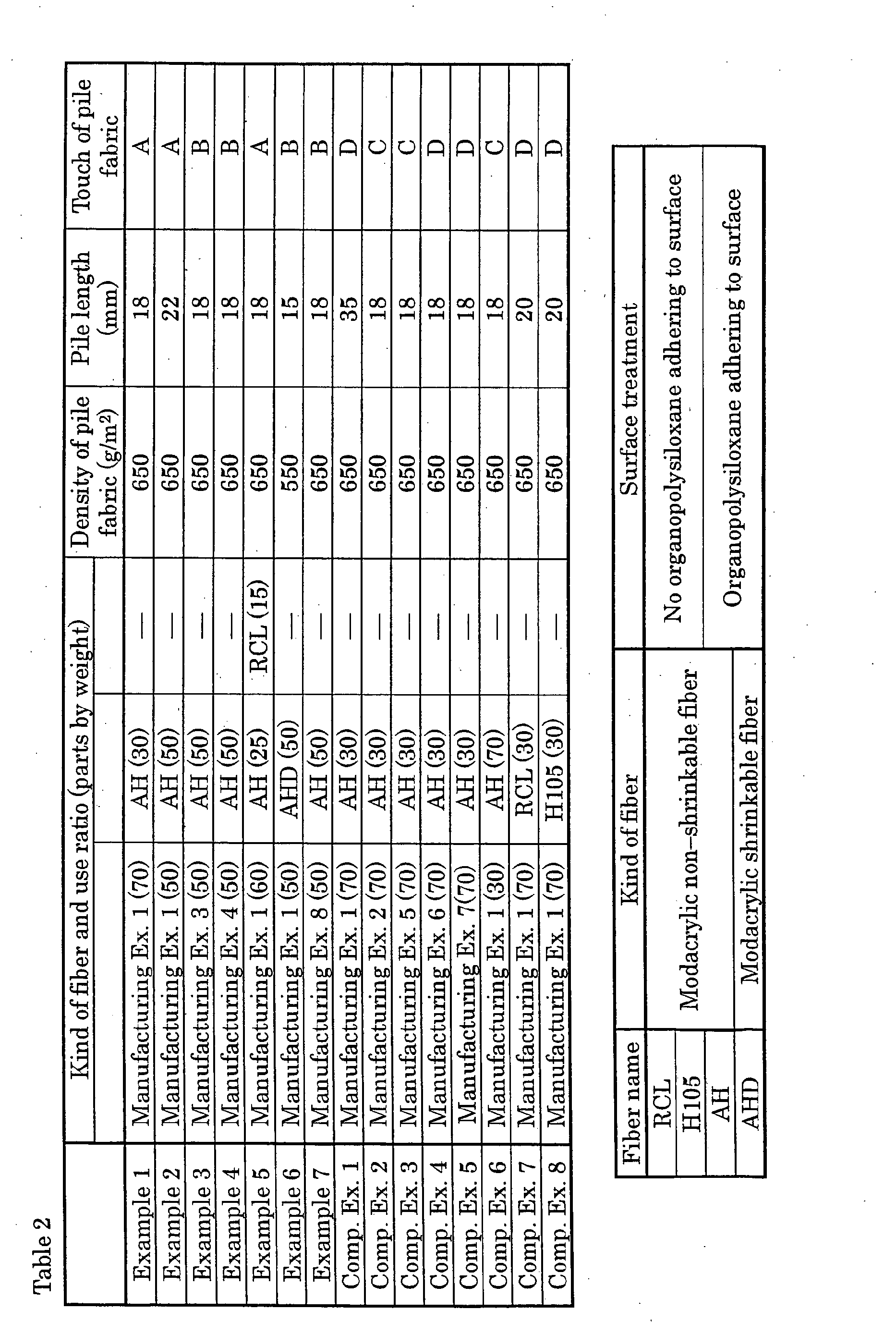
- Incidentally, "Kanekalon (registered trademark)" AH used in Example 1 having a fineness of 3.3 dtex and a length of 38 mm had a fiber cross-section whose flatness was 3, and "Kanekalon (registered trademark)" AH used in Example 2 having a fineness of 5.6 dtex and a length of 38 mm had a fiber cross-section whose flatness was 3.
- The fibers obtained in Manufacturing Examples 3 and 4 were provided with the crimps, cut and dyed similarly to Example 1. Furthermore, these fibers were blended with modacrylic fibers "Kanekalon (registered trademark)" AH having a fineness of 3.3 dtex and a length of 38 mm (manufactured by KANEKA CORPORATION) dyed under the same condition as above at the ratio of 50 wt% to 50 wt% so as to produce pile fabrics. At this time, the resultant pile fabrics had a final density of 650 g/m2, and the piles were cut to have an average pile length of 18 mm. The resultant pile fabrics all had a favorable hair handling and a touch similar to natural fur as shown in Table 2. Similarly, the "Kanekalon (registered trademark)" AH having a fineness of 3.3 dtex and a length of 38 mm had a fiber cross-section whose flatness was 3.
- The fibers obtained in Manufacturing Example 1 were provided with the crimps, cut and dyed similarly to Example 1. Furthermore, these fibers were blended with modacrylic fibers "Kanekalon (registered trademark)" AH having a fineness of 3.3 dtex and a length of 38 mm (manufactured by KANEKA CORPORATION) and modacrylic fibers "Kanekalon (registered trademark)" RCL having a fineness of 17 dtex and a length of 51 mm (manufactured by KANEKA CORPORATION) dyed under the same condition as above at the ratio of 60 wt% : 25 wt% : 15 wt% in this order so as to produce a pile fabric. At this time, the resultant pile fabric had a final density of 650 g/m2, and the pile was cut to have an average pile length of 18 mm. The resultant pile fabric had an excellent hair handling and a touch extremely similar to animal fur as shown in Table 2. Incidentally, the "Kanekalon (registered trademark)" AH having a fineness of 3.3 dtex and a length of 38 mm had a fiber cross-section whose flatness was 3, and the "Kanekalon (registered trademark)" RCL having a fineness of 17 dtex and a length of 51 mm had a fiber cross-section whose flatness was 7.5.
- The fibers obtained in Manufacturing Example 1 were provided with the crimps, cut and dyed similarly to Example 1. Furthermore, these fibers were blended with modacrylic fibers "Kanekalon (registered trademark)" AHD(10) having a fineness of 4.4 dtex and a length of 32 mm (manufactured by KANEKA CORPORATION) at the ratio of 50 wt% to 50 wt% so as to produce a pile fabric. At this time, the resultant pile fabric had a final density of 550 g/m2, and the pile was cut to have an average pile length of 15 mm. The resultant pile fabric had a favorable hair handling and a touch similar to natural fur as shown in Table 2. Incidentally, the "Kanekalon (registered trademark)" AHD having a fineness of 4.4 dtex and a length of 32 mm had a fiber cross-section whose flatness was 3 and a shrinkage of 32%.
- The fibers obtained in Manufacturing Example 8 were provided with the crimps, cut and dyed similarly to Example 1. Furthermore, these fibers were blended with modacrylic fibers "Kanekalon (registered trademark)" AH having a fineness of 3.3 dtex and a length of 38 mm (manufactured by KANEKA CORPORATION) dyed under the same condition as above at the ratio of 50 wt% to 50 wt% so as to produce a pile fabric. At this time, the resultant pile fabric had a final density of 650 g/m2, and the pile was cut to have an average pile length of 18 mm. The resultant pile fabric had a favorable hair handling and a touch similar to natural fur as shown in Table 2. Similarly, the "Kanekalon (registered trademark)" AH having a fineness of 3.3 dtex and a length of 38 mm had a fiber cross-section whose flatness was 3.
- The fibers obtained in Manufacturing Example 1 were provided with the crimps, cut and dyed similarly to Example 1. Furthermore, these fibers were blended with modacrylic fibers "Kanekalon (registered trademark)" AH having a fineness of 3.3 dtex and a length of 38 mm (manufactured by KANEKA CORPORATION) dyed under the same condition as above at the ratio of 70 wt% to 30 wt% so as to produce a pile fabric. At this time, the resultant pile fabric all had a final density of 650 g/m2, and the pile was cut to have an average pile length of 35 mm. The resultant pile fabric had an insufficient hair handling and was far from natural fur as shown in Table 2. Similarly, the "Kanekalon (registered trademark)" AH having a fineness of 3.3 dtex and a length of 38 mm had a fiber cross-section whose flatness was 3.
- The fibers obtained in Manufacturing Examples 2 and 5 to 7 were provided with the crimps, cut and dyed similarly to Example 1. Furthermore, these fibers were blended with modacrylic fibers "Kanekalon (registered trademark)" AH having a fineness of 3.3 dtex and a length of 38 mm (manufactured by KANEKA CORPORATION) dyed under the same condition as above at the ratio of 70 wt% to 30 wt% so as to produce pile fabrics. At this time, the resultant pile fabrics all had a final density of 650 g/m2, and the piles were cut to have an average pile length of 18 mm. The resultant pile fabrics had a slightly poor hair handling compared with natural fur or an insufficient hair handling and were far from natural fur as shown in Table 2. Similarly, the "Kanekalon (registered trademark)" AH having a fineness of 3.3 dtex and a length of 38 mm had a fiber cross-section whose flatness was 3.
- The fibers obtained in Manufacturing Example 1 were provided with the crimps, cut and dyed similarly to Example 1. Furthermore, these fibers were blended with modacrylic fibers "Kanekalon (registered trademark)" AH having a fineness of 3.3 dtex and a length of 38 mm (manufactured by KANEKA CORPORATION) dyed under the same condition as above at the ratio of 30 wt% to 70 wt% so as to produce a pile fabric. At this time, the resultant pile fabric had a final density of 650 g/m2, and the pile was cut to have an average pile length of 18 mm. The resultant pile fabric had a slightly poor hair handling compared with natural fur as shown in Table 2. Similarly, the "Kanekalon (registered trademark)" AH having a fineness of 3.3 dtex and a length of 38 mm had a fiber cross-section whose flatness was 3.
- The fibers obtained in Manufacturing Example 1 were provided with the crimps, cut and dyed similarly to Example 1. Furthermore, these fibers were blended with modacrylic fibers "Kanekalon (registered trademark)" RCL having a fineness of 7.8 dtex and a length of 38 mm (manufactured by KANEKA CORPORATION) dyed under the same condition as above at the ratio of 70 wt% to 30 wt% (Comparative Example 7) and with acrylic fibers "Fankle (registered trademark)" H105 having a fineness of 5.6 dtex and a length of 38 mm (manufactured by MITSUBISHI RAYON CO., LTD.) dyed under the same condition as above at the ratio of 70 wt% to 30 wt% (Comparative Example 8) so as to produce pile fabrics. At this time, the resultant pile fabrics had a final density of 650 g/m2, and the piles were cut to have an average pile length of 20 mm. The resultant pile fabrics had an insufficient hair handling and were far from natural fur as shown in Table 2. Incidentally, the "Kanekalon (registered trademark)" RCL having a fineness of 7.8 dtex and a length of 38 mm had a flatness of 6.0, and the "Fankle (registered trademark)" H105 having a fineness of 5.6 dtex and a length of 38 mm had a flatness of 10.5.
- The pile fabric according to the present invention makes it possible to achieve a favorable hair handling provided in natural fur and is useful for a pile fabric product or the like that has a touch equivalent to natural fur.
Claims (6)
- A pile fabric comprising:40 wt% to 80 wt% of a modacrylic fiber (A) having a flat cross-section whose flatness ranges from 9 to 15, a fineness of 6 to 10 dtex and 0.25 to 1.5 µm asperities on a fiber surface in a direction perpendicular to a fiber axis with respect to fibers forming an overall pile portion; and20 wt% to 60 wt% of a modacrylic fiber (B) having a cross-section whose flatness ranges from 1 to 4 and a fineness of 2 to 8 dtex with respect to the overall pile portion;wherein the pile fabric has an average pile length of 12 to 30 mm.
- The pile fabric according to claim 1, further comprising 5 wt% to 25 wt% of a modacrylic fiber (C) having a flat shape whose flatness ranges from 3 to 15 and a fineness of 12 to 33 dtex with respect to the fibers forming the overall pile portion.
- The pile fabric according to claim 1 or 2, wherein the modacrylic fiber (B) is a non-shrinkable modacrylic fiber.
- The pile fabric according to any one of claims 1 to 3, wherein a polymer forming the modacrylic fiber (A) comprises 30 wt% to 70 wt% of acrylonitrile.
- The pile fabric according to any one of claims 1 to 4, wherein organopolysiloxane adheres to a fiber surface of the modacrylic fiber (B).
- The pile fabric according to any one of claims 1 to 5, wherein the asperities on the fiber surface of the modacrylic fiber (A) in the direction perpendicular to the fiber axis are formed of a cellulose derivative.
Applications Claiming Priority (3)
| Application Number | Priority Date | Filing Date | Title |
|---|---|---|---|
| JP2004210521 | 2004-07-16 | ||
| JP2005132712 | 2005-04-28 | ||
| PCT/JP2005/012044 WO2006008933A1 (en) | 2004-07-16 | 2005-06-30 | Pile fabric |
Publications (1)
| Publication Number | Publication Date |
|---|---|
| EP1775363A1 true EP1775363A1 (en) | 2007-04-18 |
Family
ID=35785053
Family Applications (1)
| Application Number | Title | Priority Date | Filing Date |
|---|---|---|---|
| EP05765200A Withdrawn EP1775363A1 (en) | 2004-07-16 | 2005-06-30 | Pile fabric |
Country Status (4)
| Country | Link |
|---|---|
| EP (1) | EP1775363A1 (en) |
| JP (1) | JP4734246B2 (en) |
| KR (1) | KR20070051853A (en) |
| WO (1) | WO2006008933A1 (en) |
Cited By (1)
| Publication number | Priority date | Publication date | Assignee | Title |
|---|---|---|---|---|
| EP3330434A4 (en) * | 2015-07-31 | 2019-02-13 | Kaneka Corporation | Pile fabric and method for manufacturing same |
Families Citing this family (1)
| Publication number | Priority date | Publication date | Assignee | Title |
|---|---|---|---|---|
| JP2006138034A (en) * | 2004-11-12 | 2006-06-01 | Kaneka Corp | Plush pile fabric with pile handleability and soft touch compatible with each other |
Family Cites Families (6)
| Publication number | Priority date | Publication date | Assignee | Title |
|---|---|---|---|---|
| JPH0644022B2 (en) * | 1987-11-06 | 1994-06-08 | 科学技術庁防災科学技術研究所長 | Method and apparatus for measuring complex conductivity |
| JP3654678B2 (en) * | 1995-03-22 | 2005-06-02 | 三菱レイヨン株式会社 | Flat acrylic fiber |
| JP3565631B2 (en) * | 1995-09-14 | 2004-09-15 | 三菱レイヨン株式会社 | Raw cotton for pile |
| JP3565630B2 (en) * | 1995-09-11 | 2004-09-15 | 三菱レイヨン株式会社 | Raw cotton for pile |
| JP3879244B2 (en) * | 1997-05-08 | 2007-02-07 | 株式会社カネカ | Acrylic synthetic fiber with animal hair-like texture |
| JPH11217725A (en) * | 1998-01-28 | 1999-08-10 | Mitsubishi Rayon Co Ltd | Fibers with irregular cross-section and pile products |
-
2005
- 2005-06-30 EP EP05765200A patent/EP1775363A1/en not_active Withdrawn
- 2005-06-30 WO PCT/JP2005/012044 patent/WO2006008933A1/en not_active Ceased
- 2005-06-30 JP JP2006528789A patent/JP4734246B2/en not_active Expired - Fee Related
- 2005-06-30 KR KR1020077003325A patent/KR20070051853A/en not_active Withdrawn
Non-Patent Citations (1)
| Title |
|---|
| See references of WO2006008933A1 * |
Cited By (1)
| Publication number | Priority date | Publication date | Assignee | Title |
|---|---|---|---|---|
| EP3330434A4 (en) * | 2015-07-31 | 2019-02-13 | Kaneka Corporation | Pile fabric and method for manufacturing same |
Also Published As
| Publication number | Publication date |
|---|---|
| JP4734246B2 (en) | 2011-07-27 |
| JPWO2006008933A1 (en) | 2008-05-01 |
| WO2006008933A1 (en) | 2006-01-26 |
| KR20070051853A (en) | 2007-05-18 |
Similar Documents
| Publication | Publication Date | Title |
|---|---|---|
| JP5817942B2 (en) | Highly shrinkable acrylic fiber and spun yarn containing the same fiber and step pile fabric using the spun yarn | |
| EP1536047A1 (en) | Pile fabric | |
| EP0156102A2 (en) | Pile composition | |
| JP3865731B2 (en) | Highly shrinkable acrylic fiber, pile composition containing the fiber, and napped fabric using the pile composition | |
| WO2001027364A1 (en) | Porous acrylic fiber and fabric comprising the same, and method of producing the same | |
| KR20020015059A (en) | Acrylonitrile-based synthetic fiber and method for production thereof | |
| JP4545094B2 (en) | Stepped pile fabric and method for manufacturing the same | |
| EP3369850A1 (en) | Pile fabric | |
| JP4734246B2 (en) | Standing fabric | |
| JP3533827B2 (en) | Pile product, method for producing the same, and shrinkable fiber for pile and fiber composition for pile used therefor | |
| EP0761845B1 (en) | Flat filaments provided with ribs and raw fibres for pile fabrics | |
| JP3711668B2 (en) | Pile product and method for producing the same, shrinkable fiber for pile used therein, and fiber composition for pile | |
| JP5810486B2 (en) | Pile fabric | |
| JP6646269B1 (en) | Acrylonitrile fiber, pile fabric containing the fiber, and fiber product containing the fabric | |
| CN111492100B (en) | Pile fabric | |
| CN100535219C (en) | pile fabric | |
| JP2001181926A (en) | An acrylic synthetic fiber for napping fabric having excellent crimp-removability and a method for producing the same. | |
| JP5161455B2 (en) | Acrylic fiber with anti-pill performance | |
| JP4895286B2 (en) | Acrylic fiber and pile fabric | |
| WO2020045183A1 (en) | Acrylonitrile-based fiber, pile fabric containing said fiber, and fiber product containing said fabric | |
| JP2005194667A (en) | Thickness acrylic fiber and pile fabric using the fiber | |
| JP2001181927A (en) | An acrylic synthetic fiber for napping fabric having excellent crimp-removability, a method for producing the same, and a napping fabric made of the fiber. | |
| JP2005113282A (en) | Method for producing pile fabric | |
| JP2000273748A (en) | Flame-resistant acrylic composite fiber product |
Legal Events
| Date | Code | Title | Description |
|---|---|---|---|
| PUAI | Public reference made under article 153(3) epc to a published international application that has entered the european phase |
Free format text: ORIGINAL CODE: 0009012 |
|
| 17P | Request for examination filed |
Effective date: 20070212 |
|
| AK | Designated contracting states |
Kind code of ref document: A1 Designated state(s): AT BE BG CH CY CZ DE DK EE ES FI FR GB GR HU IE IS IT LI LT LU MC NL PL PT RO SE SI SK TR |
|
| DAX | Request for extension of the european patent (deleted) | ||
| STAA | Information on the status of an ep patent application or granted ep patent |
Free format text: STATUS: THE APPLICATION HAS BEEN WITHDRAWN |
|
| 18W | Application withdrawn |
Effective date: 20090513 |