EP1775290A1 - Pyridazine compound and use thereof - Google Patents
Pyridazine compound and use thereof Download PDFInfo
- Publication number
- EP1775290A1 EP1775290A1 EP05748513A EP05748513A EP1775290A1 EP 1775290 A1 EP1775290 A1 EP 1775290A1 EP 05748513 A EP05748513 A EP 05748513A EP 05748513 A EP05748513 A EP 05748513A EP 1775290 A1 EP1775290 A1 EP 1775290A1
- Authority
- EP
- European Patent Office
- Prior art keywords
- formula
- halogen atom
- group
- optionally substituted
- difluorophenyl
- Prior art date
- Legal status (The legal status is an assumption and is not a legal conclusion. Google has not performed a legal analysis and makes no representation as to the accuracy of the status listed.)
- Granted
Links
- RHSJWIQWZWZMRV-SDQBBNPISA-N C/C(/C(c(cc1)ccc1Cl)=O)=N/N Chemical compound C/C(/C(c(cc1)ccc1Cl)=O)=N/N RHSJWIQWZWZMRV-SDQBBNPISA-N 0.000 description 2
- VNIRVFQLJSKQFF-HDSGJDLKSA-N C/C(/Cc(cccc1)c1F)=N/N=C(/C)\C(c(cc1)ccc1Cl)=O Chemical compound C/C(/Cc(cccc1)c1F)=N/N=C(/C)\C(c(cc1)ccc1Cl)=O VNIRVFQLJSKQFF-HDSGJDLKSA-N 0.000 description 1
- MNMYUSBTOKZFLN-QBFSEMIESA-N C/C(/N1CCOCC1)=C/c1ccc(C)cc1 Chemical compound C/C(/N1CCOCC1)=C/c1ccc(C)cc1 MNMYUSBTOKZFLN-QBFSEMIESA-N 0.000 description 1
- GCYCYBLIKGJREB-UHFFFAOYSA-N CC(C(C(C(C)=O)c(cccc1)c1F)c(cccc1)c1F)=O Chemical compound CC(C(C(C(C)=O)c(cccc1)c1F)c(cccc1)c1F)=O GCYCYBLIKGJREB-UHFFFAOYSA-N 0.000 description 1
- HOZREFFNUJAHQP-UHFFFAOYSA-N CC(C(c(cc1)ccc1Cl)=O)=O Chemical compound CC(C(c(cc1)ccc1Cl)=O)=O HOZREFFNUJAHQP-UHFFFAOYSA-N 0.000 description 1
- HLPLFUDXBAYJTD-UHFFFAOYSA-N CC(Cc(c(F)ccc1)c1Cl)=O Chemical compound CC(Cc(c(F)ccc1)c1Cl)=O HLPLFUDXBAYJTD-UHFFFAOYSA-N 0.000 description 1
- BANVZEUCJHUPOI-UHFFFAOYSA-N CC(Cc(cccc1)c1F)=O Chemical compound CC(Cc(cccc1)c1F)=O BANVZEUCJHUPOI-UHFFFAOYSA-N 0.000 description 1
- NOXKUHSBIXPZBJ-UHFFFAOYSA-N CC(Cc1ccc(C)cc1)=O Chemical compound CC(Cc1ccc(C)cc1)=O NOXKUHSBIXPZBJ-UHFFFAOYSA-N 0.000 description 1
- WQCJDVIEROYQAO-UHFFFAOYSA-N Cc1c(-c(cc2)ccc2Cl)c(-c(cccc2)c2F)c(C)nn1 Chemical compound Cc1c(-c(cc2)ccc2Cl)c(-c(cccc2)c2F)c(C)nn1 WQCJDVIEROYQAO-UHFFFAOYSA-N 0.000 description 1
Classifications
-
- C—CHEMISTRY; METALLURGY
- C07—ORGANIC CHEMISTRY
- C07D—HETEROCYCLIC COMPOUNDS
- C07D237/00—Heterocyclic compounds containing 1,2-diazine or hydrogenated 1,2-diazine rings
- C07D237/02—Heterocyclic compounds containing 1,2-diazine or hydrogenated 1,2-diazine rings not condensed with other rings
- C07D237/06—Heterocyclic compounds containing 1,2-diazine or hydrogenated 1,2-diazine rings not condensed with other rings having three double bonds between ring members or between ring members and non-ring members
- C07D237/08—Heterocyclic compounds containing 1,2-diazine or hydrogenated 1,2-diazine rings not condensed with other rings having three double bonds between ring members or between ring members and non-ring members with only hydrogen atoms, hydrocarbon or substituted hydrocarbon radicals, directly attached to ring carbon atoms
-
- A—HUMAN NECESSITIES
- A01—AGRICULTURE; FORESTRY; ANIMAL HUSBANDRY; HUNTING; TRAPPING; FISHING
- A01N—PRESERVATION OF BODIES OF HUMANS OR ANIMALS OR PLANTS OR PARTS THEREOF; BIOCIDES, e.g. AS DISINFECTANTS, AS PESTICIDES OR AS HERBICIDES; PEST REPELLANTS OR ATTRACTANTS; PLANT GROWTH REGULATORS
- A01N43/00—Biocides, pest repellants or attractants, or plant growth regulators containing heterocyclic compounds
- A01N43/48—Biocides, pest repellants or attractants, or plant growth regulators containing heterocyclic compounds having rings with two nitrogen atoms as the only ring hetero atoms
- A01N43/58—1,2-Diazines; Hydrogenated 1,2-diazines
-
- A—HUMAN NECESSITIES
- A61—MEDICAL OR VETERINARY SCIENCE; HYGIENE
- A61P—SPECIFIC THERAPEUTIC ACTIVITY OF CHEMICAL COMPOUNDS OR MEDICINAL PREPARATIONS
- A61P31/00—Antiinfectives, i.e. antibiotics, antiseptics, chemotherapeutics
- A61P31/10—Antimycotics
-
- C—CHEMISTRY; METALLURGY
- C07—ORGANIC CHEMISTRY
- C07C—ACYCLIC OR CARBOCYCLIC COMPOUNDS
- C07C49/00—Ketones; Ketenes; Dimeric ketenes; Ketonic chelates
- C07C49/20—Unsaturated compounds containing keto groups bound to acyclic carbon atoms
- C07C49/227—Unsaturated compounds containing keto groups bound to acyclic carbon atoms containing halogen
- C07C49/233—Unsaturated compounds containing keto groups bound to acyclic carbon atoms containing halogen containing six-membered aromatic rings
Definitions
- the present invention relates to a pyridazine compound, use thereof and its production intermediate.
- the present inventors have intensively studied to find a compound having an excellent plant disease controlling effect, and resultantly found that a pyridazine compound represented by the following formula (1) has an excellent plant disease controlling activity, completing the present invention.
- the C1-C4 alkyl group represented by R 1 or R 2 includes, for example, a methyl group and an ethyl group.
- the C1-C4 alkyl group optionally substituted by at least one halogen atom represented by R 3 includes, for example, a methyl group, and an ethyl group, an isopropyl group, a tert-butyl group, a trifluoromethyl group, a difluoromethyl group and a fluoromethyl group;
- the C1-C4 alkoxy group optionally substituted by at least one halogen atom includes, for example, a methoxy group, an ethoxy group, an isopropoxy group, a trifluoromethoxy group, a difluoromethoxy group, a fluoromethoxy group, a chlorodifluoromethoxy group, a bromodifluoromethoxy group, a 1,1,2,2-tetrafluoroethoxy group and a 2,2,2-trifluoroethoxy group;
- the halogen atom represented by R 3 , R 4 and R 5 includes a fluorine atom, a chlorine atom, a bromine atom and an iodine atom.
- the C1-C4 alkyl group optionally substituted by at least one halogen atom represented by R 4 or R 5 includes, for example, a methyl group, an ethyl group, a trifluoromethyl group, a difluoromethyl group and a fluoromethyl group;
- the C1-C4 alkoxy group optionally substituted by at least one halogen atom includes, for example, a methoxy group, an ethoxy group, a trifluoromethoxy group, a difluoromethoxy group and a fluoromethoxy group.
- the phenyl group substituted by R 4 and (R 5 ) n includes, for example, groups in which n is 0, that is, a 2-chlorophenyl group, a 2-fluoromethyl group, a 2-nitrophenyl group, a 2-cyanophenyl group, a 2-methylphenyl group, a 2-(trifluoromethyl)phenyl group, a 2-methoxyphenyl group, a 2-(difluoromethoxy)phenyl group, a 2-(trifluoromethoxy)phenyl group; groups in which n is 1, that is, a 2,3-difluorophenyl group, a 2,3-dichlorophenyl group, a 2,4-difluorophenyl group, a 2-chloro-4-fluorophenyl group, a 4-chloro-2-fluorophenyl group, a 2,4-dichlorophenyl group, a 2,5-difluor
- the phenyl group substituted by (R 3 ) m includes, for example, a phenyl group; groups in which m is 1, that is, a 4-methylphenyl group, a 3-methylphenyl group, a 2-methylphenyl group, a 4-ethylphenyl group, a 4-isopropylphenyl group, a 4-tert-butylphenyl group, a 4-(trifluoromethyl)phenyl group, a 3-(trifluoromethyl)phenyl group, a 4-chlorophenyl group, a 3-chlorophenyl group, a 2-chlorophenyl group, a 4-fluorophenyl group, a 3-fluorophenyl group, a 2-fluorophenyl group, a 4-methoxyphenyl group, a 3-methoxyphenyl group, a4-ethoxyphenyl group, a 4- (trifluoromethoxy) phenyl group, a
- Embodiments of the compound of the present invention include, for example, the following compounds.
- Embodiments of the compound represented by the formula (2-1) and the compound represented by the formula (3), which are intermediate compound of the present invention include, for example, the following compounds.
- the compound of the present invention can be produced, for example, by the following (Production method 1), (Production method 2) and (Production method 3).
- the compound of the present invention can be produced from the compound represented by the formula (2) in the following route.
- R 1 and R 2 are the same or different and each is a C1-C4 alkyl group
- R 3 is a halogen atom, a nitro group, a cyano group, a C1-C4 alkyl group optionally substituted by at least one halogen atom, a C1-C4 alkoxy group optionally substituted by at least one halogen atom, or a C1-C4 alkylthio group optionally substituted by at least one halogen atom
- m is an integer of 0 to 5; provided that, when m is an integer of 2 or more, each of R 3 s is the same or different
- R 4 is a halogen atom, a nitro group, a cyano group, a C1-C4 alkyl group optionally substituted by at least one halogen atom, or a C1-C4 alkoxy group optionally
- Step (I-a) will be described.
- the compound represented by the formula (3) can be produced by reacting the compound represented by the formula (2) with a hydrazine.
- the reaction is usually carried out in a solvent.
- Examples of the solvent used in the reaction include alcohols such as methanol, ethanol, propanol and isopropanol; ethers such as tetrahydrofuran and 1,2-dimethoxyethane; and mixtures thereof.
- the amount of the hydrazine used in the reaction is usually a proportion of 1 to 5 per 1 mole of the compound represented by the formula (2). Hydrazine used in the reaction may be its hydrate.
- the reaction temperature is usually in a range of 0 to 80°C, and the reaction time is usually in a range of 1 to 24 hours.
- reaction mixture After completion of the reaction, the reaction mixture can be subjected to a post treatment operation such as concentration to isolate the compound represented by the formula (3). Also the reaction mixture may be used in the reaction of the next Step (I-b) as it is.
- Step (I-b) will be described.
- the compound of the present invention can be produced by reacting the compound represented by the formula (3) with an oxidizing agent.
- the reaction is usually carried out in a solvent.
- the oxidizing agent used in the reaction includes, for example, platinum oxide (PtO 2 ), lead dioxide (PbO 2 ) and the like.
- Examples of the solvent used in the reaction include alcohols such as methanol, ethanol, propanol and isopropanol, ethers such as tetrahydrofuran and 1,2-dimethoxyethane, water, and mixtures thereof.
- the amount of the oxidizing agent used in the reaction is usually a proportion of 1 to 5 mol per 1 mol of the compound represented by the formula (3).
- the reaction temperature is usually in a range of 40 to 80°C, and the reaction time is usually in a range of 1 to 48 hours.
- reaction mixture After completion of the reaction, the reaction mixture is subjected to a post treatment operation, for example, in which the reaction mixture is filtered, and the filtrate is concentrated; thus the present compound can be isolated.
- the compound isolated can also be further purified by chromatography, re-crystallization and the like.
- the compound of the present invention can be produced by reacting the compound represented by the formula (4) with a base.
- R 1 , R 2 , R 3 , m, R 4 , R 5 and n are the same meanings as defined above.
- the reaction is usually carried out in a solvent.
- Examples of the solvent used in the reaction include alcohols such as methanol, ethanol, propanol, isopropanol and tert-butanol, ethers such as tetrahydrofuran and 1,2-dimethoxyethane, and mixtures thereof.
- the base used in the reaction includes, for example, alkali metal hydroxides such as potassium hydroxide and sodium hydroxide.
- the amount of the base used in the reaction is usually 1 to 2 mole per 1 mol of the compound represented by the formula (4).
- the reaction temperature is usually in a range of 0 to 100°C, and the reaction time is usually in a range of 0.1 to 8 hours.
- the reaction mixture is subjected to a post treatment operation, for example, in which the reaction mixture is mixed with water, the mixture is extracted with an organic solvent, and the resulting organic layer is dried and concentrated, and the like; thus, the present compound can be isolated.
- the present compound isolated can also be further purified by chromatography, re-crystallization and the like.
- the compound represented by the formula (2) can be produced, for example, from the compound represented by the formula (6) and the compound represented by the formula (7), according to the following scheme. (wherein R 1 , R 2 , R 3 , m, R 4 , R 5 and n are the same meaning as defined above.)
- reaction is carried out in the absence or presence of a solvent.
- Examples of the solvent used in the reaction include hydrocarbons such as toluene and xylene.
- the amount of the compound represented by the formula (7) is usually a proportion of 0.8 to 1.3 mol per 1 mole of the compound represented by the formula (6).
- the reaction temperature is usually in a range of 0 to 50°C, and the reaction time is usually in a range of 1 to 48 hours.
- the reaction is carried out by mixing the reaction product in Step (II-a) with an acid.
- the reaction is usually carried out in the presence of water and an organic solvent.
- organic solvent used in the reaction examples include, for example, alcohols such as methanol and ethanol, ethers such as tetrahydrofuran and 1,4-dioxane, and mixtures thereof.
- the reaction is usually carried out at pH of around 2.
- the acid used in the reaction includes, for example, hydrochloric acid.
- the reaction temperature is usually in a range of 0 to 30°C, and the reaction time is usually in a range of 1 to 48 hours.
- reaction mixture can be concentrated to isolate the compound represented by the formula (2).
- the compound represented by the formula (2) isolated can also be further purified by re-crystallization, chromatography and the like.
- the compound represented by the formula (6) can be produced in the same manner as that described in, for example, J. Org. Chem.,32, pp.213-214 (1967) .
- the compound represented by the formula (7) can be produced in the same manner as that described in, for example, J. Med. Chem., 29, pp.924-939 (1986) .
- the compound represented by the formula (4) can be produced by reacting the compound represented by the formula (8) with the compound represented by the formula (9) in the presence of an acid. (wherein R 1 , R 2 , R 3 , m, R 4 , R 5 and n are the same meanings as defined above.)
- the reaction is usually carried out in the presence of a solvent.
- Examples of the solvent used in the reaction include hydrocarbons such as toluene and xylene.
- the acid used in the reaction includes, for example, organic sulfonic acids such as p-toluene sulfonic acid.
- the compound represented by the formula (9) is used in a proportion of 0.8 to 1.3 mol per 1 mol of the compound represented by the formula (8), and the acid is used in a proportion of 0.001 to 0.05 mol per 1 mol of the compound represented by the formula (8).
- the reaction temperature is usually in a range of 20 to 120°C, and the reaction time is usually in a range of 1 to 8 hours.
- the reaction is usually carried out while dehydrating with Dean-Stark trap.
- the reaction mixture is subjected to a post treatment operation, for example, in which (1) the reaction mixture is concentrated, (2) the reaction mixture is mixed with an aqueous sodium hydrogen carbonate solution, the mixture is extracted with an organic solvent, and the resulting organic layer is dried and concentrated, and the like; thus, the compound represented by the formula (4) can be isolated.
- the compound represented by the formula (4) isolated can also be further purified by chromatography, re-crystallization and the like.
- the compound represented by the formula (8) can be produced by reacting the compound represented by the formula (10) with a hydrazine. (wherein R 2 , R 3 and m are the same meaning as defined above.)
- the reaction is carried out in the presence of a solvent.
- Examples of the solvent used in the reaction include alcohols such as ethanol.
- the amount of the hydrazine used in the reaction is usually a proportion of 0.8 to 1.3 mole per 1 mole of the formula (10).
- Hydrazine used in the reaction may be its hydrate.
- the reaction temperature is usually in a range of 0 to 80°C, and the reaction time is usually in a range of 1 to 48 hours.
- the reaction mixture is subjected to a post treatment such as concentration, thus the compound represented by the formula (8) can be isolated.
- the compound represented by the formula (8) isolated can also be further purified by chromatography, re-crystillization and the like.
- the compound represented by the formula (10) may be used commercially available compounds; or compounds produced in the same manner as in, for example, J. Org. Chem., 43, pp.2933-2935 (1978) or Synthesis, pp.403-404, (1977 ) maybe used.
- the compound represented by the formula (9) may be commercially available compounds, or compound produced in the same manner as in, for example, J. Med. Chem., 29, pp.924-939 (1986) may be used.
- (R 3 ) m and Y represent one combination of substituents shown in Table 1.
- Table 1 (R 3 ) m Y 4-CH 3 2-(trifluoromethyl)phenyl 4-Cl 2-(trifluoromethyl)phenyl 4-CH 3 2-(difluoromethoxy)phenyl 4-Cl 2-(difluoromethoxy)phenyl 4-CH 3 2,4,6-trifluorophenyl 3-CH 3 2,4,6-trifluorophenyl 2-CH 3 2,4,6-trifluorophenyl 4-CF 3 2,4,6-trifluorophenyl 4-Cl 2,4,6-trifluorophenyl 3-Cl 2,4,6-trifluorophenyl 2-Cl 2,4,6-trifluorophenyl 4-F 2,4,6-trifluorophenyl 4-NO 2 2,4,6-trifluorophenyl 4-CN 2,4,6-trifluorophenyl 4-OCH 3 2,4,6-trifluorophenyl 4-OCF
- (R 3 ) m and Y represent one combination of substituents shown in Table 2.
- Table 2 (R 3 ) m Y 4-CH 3 2-(trifluoromethyl)phenyl 4-Cl 2-(trifluoromethyl)phenyl 4-CH 3 2-(difluoromethoxy)phenyl 4-Cl 2-(difluoromethoxy)phenyl 4-CH 3 2,4,6-trifluorophenyl 3-CH 3 2,4,6-trifluorophenyl 2-CH 3 2,4,6-trifluorophenyl 4-CF 3 2,4,6-trifluorophenyl 4-Cl 2,4,6-trifluorophenyl 3-Cl 2,4,6-trifluorophenyl 2-Cl 2,4,6-trifluorophenyl 4-F 2,4,6-trifluorophenyl 4-NO 2 2,4,6-trifluorophenyl 4-CN 2,4,6-trifluorophenyl 4-OC
- Y represents one of substituent shown in Table 3.
- Table 3 Y 2,4,6-trifluorophenyl 2-chloro-6-fluorophenyl 2,6-difluoro-4-methoxyphenyl 2,6-difluoro-4-ethoxyphenyl 2,6-difluorophenyl 2,4-difluorophenyl 2,3,4-trifluorophenyl 2,3,5-trifluorophenyl 2,3,6-trifluorophenyl 2,4,5-trifluorophenyl 2,3-difluorophenyl 2,5-difluorophenyl 2-chlorophenyl 2-fluorophenyl 2-nitrophenyl 2-cyanophenyl 2-methylphenyl 2-(trifluoromethyl)phenyl 2-(difluoromethoxy)phenyl 2-(trifluoromethoxy)phenyl 2-methoxyphenyl pentafluorophenyl 4-meth
- (R 3 ) m represents one of substituent shown in Table 4.
- Table 4 (R 3 ) m 4-CH 3 3-CH 3 2-CH 3 4 -CF 3 4-Cl 3-Cl 2-Cl 4-F 4-NO 2 4-CN 4-OCH 3 4-OCF3 4-OCHF 2 4-OCClF 2 4-OCBrF 2 4-SCH 3 4-SCF 3 - 2-Cl, 4-Cl 3-Cl, 4-Cl 2-CH 3 , 4-CH 3 3-CH3, 4-CH3 3-OCH 3 , 4-OCH 3 2-F,4-F 2-F, 4-Cl
- "-" means that m is 0.
- the plant diseases to be controlled by the present compound will be exemplified below. Pyricularia oryzae, Cochliobolus miyabeanus and Rhizoctonia solani of rice; Erysiphe graminis, Gibberella zeae, Puccinia striiformis, P. graminis, P. recondita, P. hordei, Typhula sp., Micronectriella ni valis, Ustilago tritici, U.
- pirina Alternaria kikuchiana and Gymnosporangium haraeanum of pear
- Sclerotinia cinerea Cladosporium carpophilum and Phomopsis sp. of peach
- Elsinoe ampelina Glomerella cingulata, Uncinula necator, Phakopsora ampelopsidis, Guignardia bidwellii and Plasmopara viticola , of grape
- Gloeosporium kaki Cercospora kaki and Mycosphaerella nawae of Japanese persimmon; .
- Fungicidal effect may be shown by treating the compound of the present invention as it is to plants or soils. But, usually, it is used by the form of composition comprising the compound of the present invention and a carrier.
- the fungicidal composition of the present invention is formulated to an emulsifiable concentrate, a wettable powder, a water dispersible granule, a flowable, a dust, a granule and the like by mixing the compound of the present invention and a solid carrier and/or a liquid carrier and, if necessary, adding other adjuvant for formulation such as surfactant.
- formulations usually contain 0.1 to 90 % by weight of the compound of the present invention.
- Solid carriers used for formulation include, for example, fine powders or granules of minerals such as kaolin clay, attapulgite clay, bentonite, montmorillonite, terra alba, pyrophyllite, talc, diatomaceous earth, calcite and the like; natural organic substancss such as corncob powder, walnut shell powder and the like; synthetic organic substances such as urea and the like; salts such as calcium carbonate, ammonium sulfate and the like; synthetic inorganic substances such as synthetic hydrous silicon oxide and the like.
- minerals such as kaolin clay, attapulgite clay, bentonite, montmorillonite, terra alba, pyrophyllite, talc, diatomaceous earth, calcite and the like
- natural organic substancss such as corncob powder, walnut shell powder and the like
- synthetic organic substances such as urea and the like
- salts such as calcium carbonate, ammonium sulfate and
- Liquid carriers include, for example, aromatic hydrocarbons such as xylene, alkylbenzene, methylnaphthalene and the like; alcohols such as 2-propanol, ethylene glycol, propylene glycol, cellosolve and the like; ketones such as acetone, cyclohexanone, isophorone and the like; vegetable oils such as soybean oil, cottonseed oil and the like; aliphatic hydrocarbons, esters, dimethylsulfoxide, acetonitrile and water.
- aromatic hydrocarbons such as xylene, alkylbenzene, methylnaphthalene and the like
- alcohols such as 2-propanol, ethylene glycol, propylene glycol, cellosolve and the like
- ketones such as acetone, cyclohexanone, isophorone and the like
- vegetable oils such as soybean oil, cottonseed oil and the like
- Surfactants include, for example, anionic surfactants such as alkylsulfuric acid ester salt, alkylarylsulfonic acid salt, dialkylsulfosuccinic acid salt, polyoxyethylenealkylaryletherphosphoric acid ester salt, lignin sulfonic acid salt, naphthalenesulfonate polycondensed with formaldehyde and the like; and nonionic surfactants such as polyoxyethylenealkylarylether, polyoxyethylenealkylpolyoxypropylene block copolymer, sorbitan fatty acid ester and the like.
- anionic surfactants such as alkylsulfuric acid ester salt, alkylarylsulfonic acid salt, dialkylsulfosuccinic acid salt, polyoxyethylenealkylaryletherphosphoric acid ester salt, lignin sulfonic acid salt, naphthalenesulfonate polycondensed with formaldehyde and the like
- Another adjuvant for formulation includes, for example, water-soluble polymers such as polyvinylalcohol, polyvinylpyrrolidone and the like; Arabian gum; alginic acid and its salt thereof; polysaccharides such as CMC (carboxymethylcellulose), xanthan gum and the like; inorganic substances such as aluminum magnesium silicate, alumina sol and the like; and preservatives, colorants, PAP(isopropyl acidic phosphate), stabilizing agents such as BHT and the like.
- water-soluble polymers such as polyvinylalcohol, polyvinylpyrrolidone and the like
- Arabian gum alginic acid and its salt thereof
- polysaccharides such as CMC (carboxymethylcellulose), xanthan gum and the like
- inorganic substances such as aluminum magnesium silicate, alumina sol and the like
- preservatives, colorants, PAP(isopropyl acidic phosphate), stabilizing agents such as BHT and the like
- the fungicidal composition of the present invention By applying the fungicidal composition of the present invention to foliage of plants, said plants can be protected from plant diseases; and by applying the fungicidal composition of the present invention to soils, the plants grown on said soils can be protected from plant diseases.
- the fungicidal composition of the present invention is usually used for a method for controlling plant diseases comprising a step applying an effective amount of the fungicidal composition of the present invention to plants or soils growing the plants.
- the application amount thereof which may be varied with a kind of control-object plants, a kind of control-object diseases, an infestation level of control-object diseases, formulation types, application timings, weather conditions and the like, is usually 1 to 5,000 g, preferably 5 to 1,000 g, of the compound of the present invention per 10,000 m 2 .
- Emulsifiable concentrate, wettable powder, flowable and the like are usually sprayed after diluted with water.
- concentration of the compound of the present invention is usually in the range of from 0.0001 to 3 % by weight, preferably from 0.0005 to 1 % by weight. Dust, granule and the like are usually directly applied without dilution.
- the fungicidal composition of the present invention can be also applied in treatment methods of seed disinfection.
- the methods include, for example, a method to soak seeds of a plant in the fungicidal composition of the present invention which prepared in 1 to 1,000 ppm in terms of concentration of the compound of the present invention, a method to spray or coat seeds of a plant with the fungicidal composition of the present invention which prepared in 1 to 1,000 ppm in terms of concentration of the compound of the present invention, and a method to coat seeds of a plant with the fungicidal composition of the present invention which is formulated to dust.
- the method for controlling plant diseases of the present invention is usually performed by applying effective amount of the fungicidal composition of the present invention to a plant or a soil growing the plant in which infection is predictable.
- the fungicidal composition of the present invention is usually used as a fungicide controlling plant diseases for agriculture or gardening, that is, as an agent controlling plant diseases to control plant diseases on plowed fields, paddy fields, orchards, tea fields, pastures, turf and the like.
- the fungicidal composition of the present invention may be used together with other fungicides, insecticides, acaricides, nematocides, herbicides, plant growth regulators and/or fertilizers.
- azole fungicidal compounds such as propiconazole, triadimenol, prochloraz, penconazole, tebuconazole, flusilazole, diniconazole, bromuconazole, epoxyconazole, difenoconazole, cyproconazole, metconazole, triflumizole, tetraconazole, myclobutanil, fenbuconazole, hexaconazole, fluquinconazole, triticonazole, bitertanol, imazalil, flutriafol and so on; cyclic amine fungicidal compounds such as fenpropimorph, tridemorph, fenpropidin and so on; benzimidazole fungicidal compounds such as carbendazim, benomyl, thiabendazole, thiophanate-methyl and so on; procymidone;
- Part means part by weight.
- a plastic pot was filled with sandy loam, cucumber (cultivar: Sagami Hanjiro) was sowed, and grown in a greenhouse for 10 days.
- Each of the compounds (i) to (x) of the present invention was formulated according to Formulation Example 6, then, diluted with water to a concentration of 500 ppm.
- Each of the resulting diluted solutions was sprayed on stem and leaves so as to sufficiently adhere to the surface of cucumber cotyledones. After spraying, the plant was air-dried, and a PDA medium containing spores of Botrytis cinerea was placed on the surface of cucumber cotyledons. Then, the cucumber was left under humid condition at 12°C for 5 days. Thereafter, the lesion area of the plant was visually observed. As a result, the lesion area of the cucumber treated with the compounds (i) to (x) of the present invention was 10% or less of the lesion area of non-treated cucumber.
- a plastic pot was filled with sandy loam, paddy (cultivar: NihonBare) was sowed, and grown in a greenhouse for 15 days.
- Each of the compounds (i) to (x) of the present invention was formulated according to Formulation Example 6, then, diluted with water to a concentration of 500 ppm.
- Each of the resulting diluted solutions was sprayed on stem and leaves so as to sufficiently adhere to the surface of the paddy leaves. After spraying, the plant was air-dried.
- Plastic pots containing planted paddy affected by Pyricularia oryzae were placed around the plastic pot of paddy, and this condition was left under humid condition at 22°C for 6 days. Thereafter, a controlling effect was checked. As a result, the lesion area of the paddy treated with the compounds (i) to (x) of the present invention was 10% or less of the lesion area of non-treated paddy.
- a plastic pot was filled with sandy loam, Japanese radish (cultivar: Wase 40 nichi) was sowed, and grown in a greenhouse for 5 days.
- Each of the compounds (i) to (x) of the present invention was formulated according to Formulation Example 6, then, diluted with water to a concentration of 500 ppm.
- Each of the resulting diluted solutions was sprayed on stem and leaves so as to sufficiently adhere to the radish. After spraying, the plant was air-dried, and inoculated with spores of Alternaria brassicicola. Then, this radish was left under humid condition at 23°C overnight, further, left in a greenhouse for 3 days. Thereafter, a controlling effect was checked.
- the lesion area of the radish treated with the compounds (i) to (x) of the present invention was 10% or less of the lesion area of non-treated radish.
- the plant diseases can be controlled by using the compound of the present invention.
Landscapes
- Organic Chemistry (AREA)
- Chemical & Material Sciences (AREA)
- Life Sciences & Earth Sciences (AREA)
- Health & Medical Sciences (AREA)
- General Health & Medical Sciences (AREA)
- Engineering & Computer Science (AREA)
- Zoology (AREA)
- Environmental Sciences (AREA)
- Wood Science & Technology (AREA)
- Dentistry (AREA)
- Plant Pathology (AREA)
- Pest Control & Pesticides (AREA)
- Agronomy & Crop Science (AREA)
- Pharmacology & Pharmacy (AREA)
- Veterinary Medicine (AREA)
- Oncology (AREA)
- Animal Behavior & Ethology (AREA)
- Chemical Kinetics & Catalysis (AREA)
- Communicable Diseases (AREA)
- Public Health (AREA)
- General Chemical & Material Sciences (AREA)
- Medicinal Chemistry (AREA)
- Nuclear Medicine, Radiotherapy & Molecular Imaging (AREA)
- Agricultural Chemicals And Associated Chemicals (AREA)
- Preparation Of Compounds By Using Micro-Organisms (AREA)
- Plural Heterocyclic Compounds (AREA)
Abstract
Description
- The present invention relates to a pyridazine compound, use thereof and its production intermediate.
- Conventionally, agricultural fungicides have been developed, and a lot of compounds having a fungicidal activity have been found. However, a plant disease controlling effect of these compound's is not necessarily sufficient, and novel compounds having a plant disease controlling effect are searched.
- The present inventors have intensively studied to find a compound having an excellent plant disease controlling effect, and resultantly found that a pyridazine compound represented by the following formula (1) has an excellent plant disease controlling activity, completing the present invention.
- That is, the present invention is as described in the following items 1 to 6.
- 1. A pyridazine compound represented by formula (1) (referred to as the compound of the present invention, hereinafter):

R1 and R2 are same or different and represent a C1-C4 alkyl group;
R3 represents a halogen atom, a nitro group, a cyano group, a C1-C4 alkyl group optionally substituted by at least one halogen atom, a C1-C4 alkoxy group optionally substituted by at least one halogen atomor a C1-C4 alkylthio group optionally substituted by at least one halogen atom;
m represents an integer of 0 to 5; provided that, when m represents an integer of 2 or more, each of R3s is same or different;
R4 represents a halogen atom, a nitro group, a cyano group, a C1-C4 alkyl group optionally substituted by at least one halogen atom or a C1-C4 alkoxy group optionally substituted by at least one halogen atom;
R5 represents a halogen atom, a nitro group, a cyano group, a C1-C4 alkyl group optionally substituted by at least one halogen atom or a C1-C4 alkoxy group optionally substituted by at least one halogen atom;
n represents an integer of 0 to 4; provided that, when n represents an integer of 2 or more, each of R5s is same or different. - 2. A fungicidal composition comprising the compound of the present invention as an active ingredient.
- 3. A method for controlling plant diseases comprising applying an effective amount of the compound of the present invention to plants or soils growing the plants.
- 4. Use of the compound of the present invention as an active ingredient of a fungicidal composition.
- 5. A compound represented by formula (3):

R1 and R2 are same or different and represent a C1-C4 alkyl group;
R3 represents a halogen atom, a nitro group, a cyano group, a C1-C4 alkyl group optionally substituted by at least one halogen atom, a C1-C4 alkoxy group optionally substituted by at least one halogen atom or a C1-C4 alkylthio group optionally substituted by at least one halogen atom;
m represents an integer of 0 to 5; provided that, when m represents an integer of 2 or more, each of R3s is same or different;
R4 represents a halogen atom, a nitro group, a cyano group, a C1-C4 alkyl group optionally substituted by at least one halogen atom or a C1-C4 alkoxy group optionally substituted by at least one halogen atom;
R5 represents a halogen atom, a nitro group, a cyano group, a C1-C4 alkyl group optionally substituted by at least one halogen atom or a C1-C4 alkoxy group optionally substituted by at least one halogen atom;
n represents an integer of 0 to 4; provided that, when n represents an integer of 2 or more, each of R5s is same or different. - 6. A compound represented by formula (2-1):

- Next, substituents on the compounds of the present invention and the like will be described.
- In the formula (1). the C1-C4 alkyl group represented by R1 or R2 includes, for example, a methyl group and an ethyl group.
- The C1-C4 alkyl group optionally substituted by at least one halogen atom represented by R3 includes, for example, a methyl group, and an ethyl group, an isopropyl group, a tert-butyl group, a trifluoromethyl group, a difluoromethyl group and a fluoromethyl group;
the C1-C4 alkoxy group optionally substituted by at least one halogen atom includes, for example, a methoxy group, an ethoxy group, an isopropoxy group, a trifluoromethoxy group, a difluoromethoxy group, a fluoromethoxy group, a chlorodifluoromethoxy group, a bromodifluoromethoxy group, a 1,1,2,2-tetrafluoroethoxy group and a 2,2,2-trifluoroethoxy group;
the C1-C4 alkylthio group optionally substituted by at least one halogen atom includes, for example, a methylthio group, an ethylthio group, a trifluoromethylthio group, and a 1,1,2,2-tetrafluoroethylthio group. - The halogen atom represented by R3, R4 and R5 includes a fluorine atom, a chlorine atom, a bromine atom and an iodine atom.
- The C1-C4 alkyl group optionally substituted by at least one halogen atom represented by R4 or R5 includes, for example, a methyl group, an ethyl group, a trifluoromethyl group, a difluoromethyl group and a fluoromethyl group;
the C1-C4 alkoxy group optionally substituted by at least one halogen atom includes, for example, a methoxy group, an ethoxy group, a trifluoromethoxy group, a difluoromethoxy group and a fluoromethoxy group. - In the formula (1), the phenyl group substituted by R4 and (R5)n includes, for example, groups in which n is 0, that is, a 2-chlorophenyl group, a 2-fluoromethyl group, a 2-nitrophenyl group, a 2-cyanophenyl group, a 2-methylphenyl group, a 2-(trifluoromethyl)phenyl group, a 2-methoxyphenyl group, a 2-(difluoromethoxy)phenyl group, a 2-(trifluoromethoxy)phenyl group; groups in which n is 1, that is, a 2,3-difluorophenyl group, a 2,3-dichlorophenyl group, a 2,4-difluorophenyl group, a 2-chloro-4-fluorophenyl group, a 4-chloro-2-fluorophenyl group, a 2,4-dichlorophenyl group, a 2,5-difluorophenyl group, a 2,6-difluorophenyl group, a 2-chloro-6-fluorophenyl group, a 2,6-dichlorophenyl group, a 2-fluoro-6-methylphenyl group, a 2-fluoro-6-nitrophenyl group, a 2-cyano-6-fluorophenyl group, a 2-fluoro-6-(trifluoromethyl)phenyl group, a 2-(difluoromethoxy)-6-fluorophenyl group, a 2-fluoro-6-(trifluoromethoxy)phenyl group, a 2-fluoro-6-methoxyphenyl group; groups in which n is 2, that is,a2,3,4-trifluorophenylgroup,a2,3,5-trifluorophenylgroup, 2,4,5-trifluorophenyl group, a 2,3,6-trifluorophenyl group, a 2,4,6-trifluorophenyl group, a 2-chloro-4,6-difluorophenyl group, a 4-chloro-2,6-difluorophenyl group, a 2,6-difluoro-4-ethoxyphenyl group, a 2,6-difluoro-4-methoxyphenyl group, a 2,4-dichloro-6-fluorophenyl group, a 2,6-dichloro-4-fluorophenyl group, a 2,4,6-trichlorophenyl group, a 2,6-difluoro-4-cyanophenyl group, a 2,6-difluoro-4-nitrophenyl group, a 2,6-difluoro-4-(trifluoromethyl)phenyl group, a 2,3-difluoro-6-(trifluoromethyl)phenyl group, a 2, 6-difluoro-3-chlorophenyl group; groups in which n is 3, that is, a 2,3,4,5-tetrafluorophenyl group, a 2,3,4,6-tetrafluorophenyl group, a 2,3,5,6-tetrafluorophenyl group; and groups in which n is 4, that is, a 2,3,4,5,6-pentafluorophenyl group, a 4-methoxy-2,3,5,6-tetrafluorophenyl group, a 4-ethoxy-2,3,5,6-tetrafluorophenyl group, a 4-cyano-2,3,5,6-tetrafluorophenyl group, a 4-nitro-2,3,5,6-tetrafluorophenyl group and a 4-chloro-2,3,5,6-tetrafluorophenyl group.
- The phenyl group substituted by (R3)m includes, for example, a phenyl group; groups in which m is 1, that is, a 4-methylphenyl group, a 3-methylphenyl group, a 2-methylphenyl group, a 4-ethylphenyl group, a 4-isopropylphenyl group, a 4-tert-butylphenyl group, a 4-(trifluoromethyl)phenyl group, a 3-(trifluoromethyl)phenyl group, a 4-chlorophenyl group, a 3-chlorophenyl group, a 2-chlorophenyl group, a 4-fluorophenyl group, a 3-fluorophenyl group, a 2-fluorophenyl group, a 4-methoxyphenyl group, a 3-methoxyphenyl group, a4-ethoxyphenyl group, a 4- (trifluoromethoxy) phenyl group, a 4-nitrophenyl group, a 4-cyanophenyl group, a 4-(methylthio)phenyl group, a 4-(trifluoromethythio)phenyl group; and groups in which m is 2, that is, a 2,4-dimethylphenyl group, a 2,5-dimethylphenyl group, a 3, 4-dimethylphenyl group, a 2, 4-dichlorophenyl group, a 2,5-dichlorophenyl group, a 3,4-dichlorophenyl group, a 2,3-difluorophenyl group, a 2,4-difluorophenyl group, a 2,5-difluorophenyl group, a 3,4-difluorophenyl group, a 3,5-difluorophenyl group, a 4-chloro-2-fluorophenyl group, a 2,4-dimethoxyphenyl group and a 3,4-dimethoxyphenyl group.
- Embodiments of the compound of the present invention include, for example, the following compounds.
- Pyridazine compounds of the formula (1) in which R1 is a methyl group;
pyridazine compounds of the formula (1) in which R2 is a methyl group;
pyridazine compounds of the formula (1) in which R1 and R2 are methyl groups;
pyridazine compounds of the formula (1) in which R3 is a C1-C4 alkyl group optionally substituted by at least one halogen atom, a C1-C4 alkoxy group optionally substituted by at least one halogen atom , or at least one halogen atom;
pyridazine compounds of the formula (1) in which R3 is a C1-C4 alkyl group or a halogen atom;
pyridazine compounds of the formula (1) in which R3 is a methyl group, a trifluoromethyl group, a chlorine atom, a fluorine atom or a methoxy group;
pyridazine compounds of the formula (1) in which R3 is a methyl group, a chlorine atom or a fluorine atom;
pyridazine compounds of the formula (1) in which m is 1 or 2;
pyridazine compounds of the formula (1) in which m is 1;
pyridazine compounds of the formula (1) in which m is 2;
pyridazine compounds of the formula (1) in which m is 1, and R3 is a substituent in the 4 position of benzene ring;
pyridazine compounds of the formula (1) in which m is 1, R3 is a halogen atom, a C1-C4 alkyl group optionally substituted by at least one halogen atom, or at least one C1-C4 alkoxy group optionally substituted by at least one halogen atom, and R3 is a substituent in the 4 position of benzene ring;
pyridazine compounds of the formula (1) in which m is 1, R3 is a halogen atom or a C1-C4 alkyl group optionally substituted by at least one halogen atom, and R3 is a substituent in the 4 position of benzene ring;
pyridazine compounds of the formula (1) in which m is 1, R3 is a halogen atom or a C1-C4 alkyl group, and R3 is a substituent in the 4 position of benzene ring;
pyridazine compounds of the formula (1) in which m is 1, R3 is a methyl group, a trifluoromethyl group, a chlorine atom, a fluorine atom, or a methoxy group, and R3 is a substituent in the 4 position of benzene ring;
pyridazine compounds of the formula (1) in which m is 1, R3 is a methyl group, a chlorine atom, or a fluorine atom, and R3 is a substituent in the 4 position of benzene ring;
pyridazine compounds of the formula (1) in which R4 is a halogen atom;
pyridazine compounds of the formula (1) in which R4 is a fluorine atom;
pyridazine compounds of the formula (1) in which R4 is a chlorine atom;
pyridazine compounds of the formula (1) in which R4 is a fluorine atom or a chlorine atom;
pyridazine compounds of the formula (1) in which n is 1 or 2;
pyridazine compounds of the formula (1) in which n is 1;
pyridazine compounds of the formula (1) in which n is 2;
pyridazine compounds of the formula (1) in which n is 1 or 2, and R5 is a halogen atom;
pyridazine compounds of the formula (1) in which n is 1, R5 is a halogen atom, and R5 is a substituent in the 4 position or the 6 position of benzene ring;
pyridazine compounds of the formula (1) in which n is 2, R5 is a halogen atom, and R5s are substituents in the 4 position and 6 position of benzene ring;
pyridazine compounds of the formula (1) in which n is 1, R5 is a fluorine atom, and R5 is a substituent in the 4 position or 6 position of benzene ring;
pyridazine compounds of the formula (1) in which n is 2, R5 is a fluorine atom, and R5s are substituents in the 4 position and 6 position of benzene ring;
pyridazine compounds of the formula (1) in which R4 is a halogen atom, n is 1 or 2, and each R5 is a halogen atom;
pyridazine compounds of the formula (1) in which n is 1, R4 is a halogen atom, R5 is a halogen atom, and R5 is a substituent in the 4 position or 6 position of benzene ring;
pyridazine compounds of the formula (1) in which n is 2, R4 is a halogen atom, R5 is a halogen atom, and R5s are substituents in the 4 position and 6 position of benzene ring;
pyridazine compounds of the formula (1) in which n is 1, R4 is a fluorine atom, R5 is a fluorine atom, and R5 is a substituent in the 4 position or 6 position of benzene ring;
pyridazine compounds of the formula (1) in which n is 2, R4 is a fluorine atom, R5 is a fluorine atom, and R5 is a substituent in the 4 position or 6 position of benzene ring;
pyridazine compounds of the formula (1) in which n is 0;
pyridazine compounds of the formula (1) in which n is 0, 1 or 2, m is 1 or 2;
pyridazine compounds of the formula (1) in which each of R1 and R3 is a methyl group, and R4 is a halogen atom; and
pyridazine compounds of the formula (1) in which n is 0, 1 or 2, m is 1 or 2, each of R1 and R3 is a methyl group, and R4 is a halogen atom. - Embodiments of the compound represented by the formula (2-1) and the compound represented by the formula (3), which are intermediate compound of the present invention, include, for example, the following compounds.
- Compounds of the formula (2-1) in which n is 0, 1 or 2, and m is 1 or 2;
compounds of the formula (2-1) in which each of R1 and R2 is a methyl group;
compounds of the formula (2-1) in which n is 0, 1 or 2, m is 1 or 2, and each of R1 and R2 is a methyl group;
compounds of the formula (3) in which n is 0, 1 or 2, and m is 1 or 2;
compounds of the formula (3) in which each of R1 and R2 is a methyl group, and R4 is a halogen atom; and
compounds of the formula (3) in which n is 0, 1 or 2, m is 1 or 2, each of R1 and R2 is a methyl group, and R4 is a halogen atom. - Next, the method of producing the compound of the present invention will be described.
- The compound of the present invention can be produced, for example, by the following (Production method 1), (Production method 2) and (Production method 3).
- The compound of the present invention can be produced from the compound represented by the formula (2) in the following route.

R1 and R2 are the same or different and each is a C1-C4 alkyl group;
R3 is a halogen atom, a nitro group, a cyano group, a C1-C4 alkyl group optionally substituted by at least one halogen atom, a C1-C4 alkoxy group optionally substituted by at least one halogen atom, or a C1-C4 alkylthio group optionally substituted by at least one halogen atom;
m is an integer of 0 to 5; provided that, when m is an integer of 2 or more, each of R3s is the same or different;
R4 is a halogen atom, a nitro group, a cyano group, a C1-C4 alkyl group optionally substituted by at least one halogen atom, or a C1-C4 alkoxy group optionally substituted by at least one halogen atom;
R5 is a halogen atom, a nitro group, a cyano group, a C1-C4 alkyl group optionally substituted by at least one halogen atom, or a C1-C4 alkoxy group optionally substituted by at least one halogen atom; and
n is an integer of 0 to 4; provided that, when n is an integer of 2 or more, each of R5s is the same or different.) - Step (I-a) will be described.
- The compound represented by the formula (3) can be produced by reacting the compound represented by the formula (2) with a hydrazine.
- The reaction is usually carried out in a solvent.
- Examples of the solvent used in the reaction include alcohols such as methanol, ethanol, propanol and isopropanol; ethers such as tetrahydrofuran and 1,2-dimethoxyethane; and mixtures thereof.
- The amount of the hydrazine used in the reaction is usually a proportion of 1 to 5 per 1 mole of the compound represented by the formula (2). Hydrazine used in the reaction may be its hydrate.
- The reaction temperature is usually in a range of 0 to 80°C, and the reaction time is usually in a range of 1 to 24 hours.
- After completion of the reaction, the reaction mixture can be subjected to a post treatment operation such as concentration to isolate the compound represented by the formula (3). Also the reaction mixture may be used in the reaction of the next Step (I-b) as it is.
- Next, Step (I-b) will be described.
- The compound of the present invention can be produced by reacting the compound represented by the formula (3) with an oxidizing agent.
- The reaction is usually carried out in a solvent.
- The oxidizing agent used in the reaction includes, for example, platinum oxide (PtO2), lead dioxide (PbO2) and the like.
- Examples of the solvent used in the reaction include alcohols such as methanol, ethanol, propanol and isopropanol, ethers such as tetrahydrofuran and 1,2-dimethoxyethane, water, and mixtures thereof.
- The amount of the oxidizing agent used in the reaction is usually a proportion of 1 to 5 mol per 1 mol of the compound represented by the formula (3).
- The reaction temperature is usually in a range of 40 to 80°C, and the reaction time is usually in a range of 1 to 48 hours.
- After completion of the reaction, the reaction mixture is subjected to a post treatment operation, for example, in which the reaction mixture is filtered, and the filtrate is concentrated; thus the present compound can be isolated. The compound isolated can also be further purified by chromatography, re-crystallization and the like.
- The compound of the present invention can be produced by reacting the compound represented by the formula (4) with a base.

- The reaction is usually carried out in a solvent.
- Examples of the solvent used in the reaction include alcohols such as methanol, ethanol, propanol, isopropanol and tert-butanol, ethers such as tetrahydrofuran and 1,2-dimethoxyethane, and mixtures thereof.
- The base used in the reaction includes, for example, alkali metal hydroxides such as potassium hydroxide and sodium hydroxide.
- The amount of the base used in the reaction is usually 1 to 2 mole per 1 mol of the compound represented by the formula (4).
- The reaction temperature is usually in a range of 0 to 100°C, and the reaction time is usually in a range of 0.1 to 8 hours.
- After completion of the reaction, the reaction mixture is subjected to a post treatment operation, for example, in which the reaction mixture is mixed with water, the mixture is extracted with an organic solvent, and the resulting organic layer is dried and concentrated, and the like; thus, the present compound can be isolated. The present compound isolated can also be further purified by chromatography, re-crystallization and the like.
- Next, the method for producing intermediate compounds of the present compound will be shown as Reference Production method.
- The compound represented by the formula (2) can be produced, for example, from the compound represented by the formula (6) and the compound represented by the formula (7), according to the following scheme.

- The reaction is carried out in the absence or presence of a solvent.
- Examples of the solvent used in the reaction include hydrocarbons such as toluene and xylene.
- The amount of the compound represented by the formula (7) is usually a proportion of 0.8 to 1.3 mol per 1 mole of the compound represented by the formula (6).
- The reaction temperature is usually in a range of 0 to 50°C, and the reaction time is usually in a range of 1 to 48 hours.
- After completion of the reaction, the reaction mixture is concentrated, and usually the residue is used in the reaction of Step (II-b).
- The reaction is carried out by mixing the reaction product in Step (II-a) with an acid.
- The reaction is usually carried out in the presence of water and an organic solvent.
- Examples of the organic solvent used in the reaction include, for example, alcohols such as methanol and ethanol, ethers such as tetrahydrofuran and 1,4-dioxane, and mixtures thereof.
- The reaction is usually carried out at pH of around 2. The acid used in the reaction includes, for example, hydrochloric acid.
- The reaction temperature is usually in a range of 0 to 30°C, and the reaction time is usually in a range of 1 to 48 hours.
- After completion of the reaction, the reaction mixture can be concentrated to isolate the compound represented by the formula (2). The compound represented by the formula (2) isolated can also be further purified by re-crystallization, chromatography and the like.
- The compound represented by the formula (6) can be produced in the same manner as that described in, for example, J. Org. Chem.,32, pp.213-214 (1967).
- The compound represented by the formula (7) can be produced in the same manner as that described in, for example, J. Med. Chem., 29, pp.924-939 (1986).
- The compound represented by the formula (4) can be produced by reacting the compound represented by the formula (8) with the compound represented by the formula (9) in the presence of an acid.

- The reaction is usually carried out in the presence of a solvent.
- Examples of the solvent used in the reaction include hydrocarbons such as toluene and xylene.
- The acid used in the reaction includes, for example, organic sulfonic acids such as p-toluene sulfonic acid.
- As to the amounts of the reagents used in the reaction, usually, the compound represented by the formula (9) is used in a proportion of 0.8 to 1.3 mol per 1 mol of the compound represented by the formula (8), and the acid is used in a proportion of 0.001 to 0.05 mol per 1 mol of the compound represented by the formula (8).
- The reaction temperature is usually in a range of 20 to 120°C, and the reaction time is usually in a range of 1 to 8 hours.
- The reaction is usually carried out while dehydrating with Dean-Stark trap.
- After completion of the reaction, the reaction mixture is subjected to a post treatment operation, for example, in which (1) the reaction mixture is concentrated, (2) the reaction mixture is mixed with an aqueous sodium hydrogen carbonate solution, the mixture is extracted with an organic solvent, and the resulting organic layer is dried and concentrated, and the like; thus, the compound represented by the formula (4) can be isolated. The compound represented by the formula (4) isolated can also be further purified by chromatography, re-crystallization and the like.
- The compound represented by the formula (8) can be produced by reacting the compound represented by the formula (10) with a hydrazine.

- The reaction is carried out in the presence of a solvent.
- Examples of the solvent used in the reaction include alcohols such as ethanol.
- The amount of the hydrazine used in the reaction is usually a proportion of 0.8 to 1.3 mole per 1 mole of the formula (10).
- Hydrazine used in the reaction may be its hydrate.
- The reaction temperature is usually in a range of 0 to 80°C, and the reaction time is usually in a range of 1 to 48 hours.
- After completion of the reaction the reaction mixture is subjected to a post treatment such as concentration, thus the compound represented by the formula (8) can be isolated. The compound represented by the formula (8) isolated can also be further purified by chromatography, re-crystillization and the like.
- As the compound represented by the formula (10) may be used commercially available compounds; or compounds produced in the same manner as in, for example, J. Org. Chem., 43, pp.2933-2935 (1978) or Synthesis, pp.403-404, (1977) maybe used. As the compound represented by the formula (9) may be commercially available compounds, or compound produced in the same manner as in, for example, J. Med. Chem., 29, pp.924-939 (1986) may be used.
- Next, specific examples of the compound of the present invention will be shown.
- Pyridazine compound represented by the formula (1-a):

- In the formula (1-a), (R3)m and Y represent one combination of substituents shown in Table 1.
Table 1 (R3)m Y 4-CH3 2-(trifluoromethyl)phenyl 4-Cl 2-(trifluoromethyl)phenyl 4-CH3 2-(difluoromethoxy)phenyl 4-Cl 2-(difluoromethoxy)phenyl 4-CH3 2,4,6-trifluorophenyl 3-CH3 2,4,6-trifluorophenyl 2-CH3 2,4,6-trifluorophenyl 4-CF3 2,4,6-trifluorophenyl 4-Cl 2,4,6-trifluorophenyl 3-Cl 2,4,6-trifluorophenyl 2-Cl 2,4,6-trifluorophenyl 4-F 2,4,6-trifluorophenyl 4-NO2 2,4,6-trifluorophenyl 4-CN 2,4,6-trifluorophenyl 4-OCH3 2,4,6-trifluorophenyl 4-OCF3 2,4,6-trifluorophenyl 4-OCHF2 2,4,6-trifluorophenyl 4-OCClF2 2,4,6-trifluorophenyl 4-OCBrF2 2,4,6-trifluorophenyl 4-SCH3 2,4,6-trifluorophenyl 4-SCF3 2,4,6-trifluorophenyl - 2,4,6-trifluorophenyl 2-Cl,4-Cl 2,4,6-trifluorophenyl 3-Cl,4-Cl 2,4,6-trifluorophenyl 2-CH3,4-CH3 2,4,6-trifluorophenyl 3-CH3,4-CH3 2,4,6-trifluorophenyl 3-OCH3,4-OCH3 2,4,6-trifluorophenyl 2-F,4-F 2,4,6-trifluorophenyl 2-F,4-Cl 2,4,6-trifluorophenyl 4-CH3 2-chlorophenyl 4-Cl 2-chlorophenyl 4-CH3 2-fluorophenyl 4-Cl 2-fluorophenyl 4-CH3 2-chloro-6-fluorophenyl 4-CF3 2-chloro-6-fluorophenyl 4-Cl 2-chloro-6-fluorophenyl 4-F 2-chloro-6-fluorophenyl 4-OCH3 2-chloro-6-fluorophenyl 2-Cl,4-Cl 2-chloro-6-fluorophenyl 3-Cl,4-Cl 2-chloro-6-fluorophenyl 2-CH3,4-CH3 2-chloro-6-fluorophenyl 3-CH3,4-CH3 2-chloro-6-fluorophenyl 2-F,4-F 2-chloro-6-fluorophenyl 2-F,4-Cl 2-chloro-6-fluorophenyl 4-CH3 2,6-difluoro-4-methoxyphenyl 4-CF3 2,6-difluoro-4-methoxyphenyl 4-Cl 2,6-difluoro-4-methoxyphenyl 4-F 2,6-difluoro-4-methoxyphenyl 4-OCH3 2,6-difluoro-4-methoxyphenyl 2-Cl, 4-Cl 2,6-difluoro-4-methoxyphenyl 3-Cl, 4-Cl 2,6-difluoro-4-methoxyphenyl 2-CH3, 4-CH3 2,6-difluoro-4-methoxyphenyl 3-CH3, 4-CH3 2,6-difluoro-4-methoxyphenyl 2-F,4-F 2,6-difluoro-4-methoxyphenyl 2-F, 4-Cl 2,6-difluoro-4-methoxyphenyl 4-CH3 2,6-difluoro-4-ethoxyphenyl 4-Cl 2,6-difluoro-4-ethoxyphenyl 4-CH3 2-nitrophenyl 4-Cl 2-nitrophenyl 4-CH3 2-cyanophenyl 4-Cl 2-cyanophenyl 4-CH3 2-methylphenyl 4-Cl 2-methylphenyl 4-CH3 2,6-difluorophenyl 3-CH3 2,6-difluorophenyl 2-CH3 2,6-difluorophenyl 4-CF3 2,6-difluorophenyl 4-Cl 2,6-difluorophenyl 3-Cl 2,6-difluorophenyl 2-Cl 2,6-difluorophenyl 4-F 2,6-difluorophenyl 4-NO2 2,6-difluorophenyl 4-CN 2,6-difluorophenyl 4-OCH3 2,6-difluorophenyl 4-OCF3 2,6-difluorophenyl 4-OCHF2 2,6-difluorophenyl 4-OCClF2 2,6-difluorophenyl 4-OCBrF2 2,6-difluorophenyl 4-SCH3 2,6-difluorophenyl 4-SCF3 2,6-difluorophenyl - 2,6-difluorophenyl 2-Cl,4-Cl 2,6-difluorophenyl 3-Cl,4-Cl 2,6-difluorophenyl 2-Cl,4-CH3 2,6-difluorophenyl 3-CH3,4-CH3 2,6-difluorophenyl 3-OCH3,4-OCH3 2,6-difluorophenyl 2-F,4-F 2,6-difluorophenyl 2-F, 4-Cl 2,6-difluorophenyl 4-CH3 2,4-difluorophenyl 4-CF3 2,4-difluorophenyl 4-Cl 2,4-difluorophenyl 4-F 2,4-difluorophenyl 4-OCH3 2,4-difluorophenyl 2-Cl,4-Cl 2,4-difluorophenyl 3-C1,4-C1 2,4-difluorophenyl 2-CH3,4-CH3 2,4-difluorophenyl 3-CH3, 4-CH3 2,4-difluorophenyl 2-F,4-F 2,4-difluorophenyl 2-F,4-Cl 2,4-difluorophenyl 4-CH3 2,3,4-trifluorophenyl 4-Cl 2,3,4-trifluorophenyl 4-CH3 2,3,5-trifluorophenyl 4-Cl 2,3,5-trifluorophenyl 4-CH3 2,3,6-trifluorophenyl 4-Cl 2,3,6-trifluorophenyl 4-CH3 2,4,5-trifluorophenyl 4-Cl 2,4,5-trifluorophenyl 4-CH3 2,3-difluorophenyl 4-Cl 2,3-difluorophenyl 4-CH3 2, 5-difluorophenyl 4-Cl 2,5-difluorophenyl 4-CH3 2-(trifluoromethoxy)phenyl 4-Cl 2-(trifluoromethoxy)phenyl 4-CH3 2-methoxyphenyl 4-Cl 2-methoxyphenyl 4-Cl pentafluorophenyl 4-Cl 4-methoxy-2,3,5,6-tetrafluorophenyl 4-Cl 4-ethoxy-2,3,5,6-tetrafluorophenyl 4-Cl 4-cyano-2,3,5,6-tetrafluorophenyl 4-Cl 4-nitro-2,3,5,6-tetrafluorophenyl 4-Cl 2,3,5,6-tetrafluorophenyl 4-Cl 2,6-difluoro-4-cyanophenyl 4-Cl 2,6-difluoro-4-nitrophenyl 4-Cl 2,6-difluoro-4-chlorophenyl 4-Cl 2,6-difluoro-4-(trifluoromethyl)phenyl 4-C1 2-fluoro-6-methylphenyl 4-Cl 2-fluoro-6-nitrophenyl 4-Cl 2-cyano-6-fluorophenyl 4-Cl 2-fluoro-6-(trifluoromethyl)phenyl. 4-Cl 2-(difluoromethoxy)-6-fluorophenyl 4-Cl 2-fluoro-6-(trifluoromethoxy)phenyl 4-Cl 2-fluoro-6-methoxyphenyl 4-Cl 2,3-difluoro-6-(trifluoromethyl)phenyl 4-Cl 2,6-difluoro-3-chlorophenyl 2-F 2-fluorophenyl 2-C1 2-chlorophenyl 2-F,6-F 2,6-difluorophenyl 2-F,3-F 2,3-difluorophenyl 2-F, 5-F 2,5-difluorophenyl In the table, "-" means that m is 0. - Next, specific examples of the intermediate of the compound of the present invention will be shown below:
- The compound represented by the formula (2-a);

- The compound represented by the formula (3-a);

- The compound represented by the formula (4-a);

- The compound represented by the formula (5-a);

- In the formula (2-a), formula (3-a), formula (4-a) and formula (5-a), (R3)m and Y represent one combination of substituents shown in Table 2.
Table 2 (R3)m Y 4-CH3 2-(trifluoromethyl)phenyl 4-Cl 2-(trifluoromethyl)phenyl 4-CH3 2-(difluoromethoxy)phenyl 4-Cl 2-(difluoromethoxy)phenyl 4-CH3 2,4,6-trifluorophenyl 3-CH3 2,4,6-trifluorophenyl 2-CH3 2,4,6-trifluorophenyl 4-CF3 2,4,6-trifluorophenyl 4-Cl 2,4,6-trifluorophenyl 3-Cl 2,4,6-trifluorophenyl 2-Cl 2,4,6-trifluorophenyl 4-F 2,4,6-trifluorophenyl 4-NO2 2,4,6-trifluorophenyl 4-CN 2,4,6-trifluorophenyl 4-OCH3 2,4,6-trifluorophenyl 4-OCF3 2,4,6-trifluorophenyl 4-OCHF2 2,4,6-trifluorophenyl 4-OCClF2 2,4,6-trifluorophenyl 4-OCBrF2 2,4,6-trifluorophenyl 4-SCH3 2,4,6-trifluorophenyl 4-SCF3 2,4,6-trifluorophenyl - 2,4,6-trifluorophenyl 2-Cl,4-Cl 2,4,6-trifluorophenyl 3-Cl,4-Cl 2,4,6-trifluorophenyl 2-CH3,4-CH3 2,4,6-trifluorophenyl 3-CH3,4-CH3 2,4,6-trifluorophenyl 3-OCH3,9-OCH3 2,4,6-trifluorophenyl 2-F,4-F 2,4,6-trifluorophenyl 2-F, 4-Cl 2,4,6-trifluorophenyl 4-CH3 2-chlorophenyl 4-Cl 2-chlorophenyl 4-CH3 2-fluorophenyl 4-Cl 2-fluorophenyl 4-CH3 2-chloro-6-fluorophenyl 4-CF3 2-chloro-6-fluorophenyl 4-Cl 2-chloro-6-fluorophenyl 4-F 2-chloro-6-fluorophenyl 4-OCH3 2-chloro-6-fluorophenyl 2-Cl,4-Cl 2-chloro-6-fluorophenyl 3-Cl,4-Cl 2-chloro-6-fluorophenyl 2-CH3,4-CH3 2-chloro-6-fluorophenyl 3-CH3,4-CH3 2-chloro-6-fluorophenyl 2-F,4-F 2-chloro-6-fluorophenyl 2-F,4-Cl 2-chloro-6-fluorophenyl 4-CH3 2,6-difluoro-4-methoxyphenyl 4-CF3 2,6-difluoro-4-methoxyphenyl 4-Cl 2,6-difluoro-4-methoxyphenyl 4-F 2,6-difluoro-4-methoxyphenyl 4-OCH3 2,6-difluoro-4-methoxyphenyl 2-Cl,4-Cl 2,6-difluoro-4-methoxyphenyl 3-Cl,4-Cl 2,6-difluoro-4-methoxyphenyl 2-CH3,4-CH3 2,6-difluoro-4-methoxyphenyl . 3-CH3,4-CH3 2,6-difluoro-4-methoxyphenyl 2-F,4-F 2,6-difluoro-4-methoxyphenyl 2-F,4-Cl 2,6-difluoro-4-methoxyphenyl 4-CH3 2,6-difluoro-4-ethoxyphenyl 4-Cl 2,6-difluoro-4-ethoxyphenyl 4-CH3 2-nitrophenyl 4-Cl 2-nitrophenyl 4-CH3 2-cyanophenyl 4-Cl 2-cyanophenyl 4-CH3 2-methylphenyl 4-Cl 2-methylphenyl 4-CH3 2,6-difluorophenyl 3-CH3 2,6-difluorophenyl 2-CH3 2,6-difluorophenyl 4-CF3 2,6-difluorophenyl 4-Cl 2,6-difluorophenyl 3-Cl 2,6-difluorophenyl 2-Cl 2,6-difluorophenyl 4-F 2,6-difluorophenyl 4-NO2 2,6-difluorophenyl 4-CN 2,6-difluorophenyl 4-OCH3 2,6-difluorophenyl 4-OCF3 2,6-difluorophenyl 4-OCHF2 2,6-difluorophenyl 4-OCClF2 2,6-difluorophenyl 4-OCBrF2 2,6-difluorophenyl 4-SCH3 2,6-difluorophenyl 4-SCF3 2,6-difluorophenyl - 2,6-difluorophenyl 2-Cl, 4-Cl 2,6-difluorophenyl 3-Cl,4-Cl 2,6-difluorophenyl 2-Cl, 4-CH3 2,6-difluorophenyl 3-CH3, 9-CH3 2,6-difluorophenyl 3-OCH3,4-OCH3 2,6-difluorophenyl 2-F,4-F 2,6-difluorophenyl 2-F,4-Cl 2,6-difluorophenyl 4-CH3 2,4-difluorophenyl 4-CF3 2,4-difluorophenyl 4-Cl 2,4-difluorophenyl 4-F 2,4-difluorophenyl 4-OCH3 2,4-difluorophenyl 2-Cl,4-Cl 2,4-difluorophenyl 3-Cl, 4-Cl 2,4-difluorophenyl 2-CH3, 4-CH3 2,4-difluorophenyl 3-CH3, 4-CH3 2,4-difluorophenyl 2-F,4-F 2,4-difluorophenyl 2-F, 4-Cl 2,4-difluorophenyl 4-CH3 2,3,4-trifluorophenyl 4-Cl 2,3,4-trifluorophenyl 4-CH3 2,3,5-trifluorophenyl 4-Cl 2,3,5-trifluorophenyl 4-CH3 2,3,6-trifluorophenyl 4-Cl 2,3,6-trifluorophenyl 4-CH3 2,4,5-trifluorophenyl 4-Cl 2,4,5-trifluorophenyl 4-CH3 2,3-difluorophenyl 4-Cl 2,3-difluorophenyl 4-CH3 2,5-difluorophenyl 4-Cl 2,5-difluorophenyl 4-CH3 2-(trifluoromethoxy)phenyl 4-Cl 2-(trifluoromethoxy)phenyl 4-CH3 2-methoxyphenyl 4-Cl 2-methoxyphenyl 4-Cl pentafluorophenyl 4-Cl 4-methoxy-2,3,5,6-tetrafluorophenyl 4-Cl 4-ethoxy-2,3,5,6-tetrafluorophenyl 4-Cl 4-cyano-2,3,5,6-tetrafluorophenyl 4-Cl 4-nitro-2,3,5,6-tetrafluorophenyl 4-Cl 2,3,5,6-tetrafluorophenyl 4-Cl 2,6-difluoro-4-cyanophenyl 4-Cl 2,6-difluoro-4-nitrophenyl 4-Cl 2,6-difluoro-4-chlorophenyl 4-Cl 2,6-difluoro-4-(trifluoromethyl)phenyl 4-Cl 2-fluoro-6-methylphenyl 4-Cl 2-fluoro-6-nitrophenyl 4-Cl 2-cyano-6-fluorophenyl 4-Cl 2-fluoro-6-(trifluoromethyl)phenyl 4-Cl 2-(difluoromethoxy)-6-fluorophenyl 4-Cl 2-fluoro-6-(trifluoromethoxy)phenyl 4-Cl 2-fluoro-6-methoxyphenyl 4-Cl 2,3-difluoro-6-(trifluoromethyl)phenyl 4-Cl 2,6-difluoro-3-chlorophenyl 2-F 2-fluorophenyl 2-Cl 2-chlorophenyl 2-F,6-F 2,6-difluorophenyl 2-F,3-F 2,3-difluorophenyl 2-F,5-F 2,5-difluorophenyl In the table, "-" means that m is 0. - The compound represented by the formula (7-a);

- The compound represented by the formula (9-a);

- In the formula (8-a) and formula (9-a), Y represents one of substituent shown in Table 3.
Table 3 Y 2,4,6-trifluorophenyl 2-chloro-6-fluorophenyl 2,6-difluoro-4-methoxyphenyl 2,6-difluoro-4-ethoxyphenyl 2,6-difluorophenyl 2,4-difluorophenyl 2,3,4-trifluorophenyl 2,3,5-trifluorophenyl 2,3,6-trifluorophenyl 2,4,5-trifluorophenyl 2,3-difluorophenyl 2,5-difluorophenyl 2-chlorophenyl 2-fluorophenyl 2-nitrophenyl 2-cyanophenyl 2-methylphenyl 2-(trifluoromethyl)phenyl 2-(difluoromethoxy)phenyl 2-(trifluoromethoxy)phenyl 2-methoxyphenyl pentafluorophenyl 4-methoxy-2,3,5,6-tetrafluorophenyl 4-ethoxy-2,3,5,6-tetrafluorophenyl 4-cyano-2,3,5,6-tetrafluorophenyl 4-nitro-2,3,5,6-tetrafluorophenyl 2,3,5,6-tetrafluorophenyl 2,6-difluoro-4-cyanophenyl 2,6-difluoro-4-nitrophenyl 2,6-difluoro-4-chlorophenyl 2,6-difluoro-4-(trifluoromethyl)phenyl 2-fluoro-6-methylphenyl 2-fluoro-6-nitrophenyl 2-cyano-6-fluorophenyl 2-fluoro-6-(trifluoromethyl)phenyl 2-(difluoromethoxy)-6-fluorophenyl 2-fluoro-6-(trifluoromethoxy)phenyl 2-fluoro-6-methoxyphenyl 2,3-difluoro-6-(trifluoromethyl)phenyl 2,6-difluoro-3-chlorophenyl - The compound represented by the formula (6-a);

- The compound represented by the formula (8-a);

- The compound represented by the formula (10-a);

- In the formula (6-a), formula (8-a) and formula (10-a), (R3)m represents one of substituent shown in Table 4.
Table 4 (R3)m 4-CH3 3-CH3 2-CH3 4 -CF3 4-Cl 3-Cl 2-Cl 4-F 4-NO2 4-CN 4-OCH3 4-OCF3 4-OCHF2 4-OCClF2 4-OCBrF2 4-SCH3 4-SCF3 - 2-Cl, 4-Cl 3-Cl, 4-Cl 2-CH3, 4-CH3 3-CH3, 4-CH3 3-OCH3, 4-OCH3 2-F,4-F 2-F, 4-Cl In the table, "-" means that m is 0. - The plant diseases to be controlled by the present compound will be exemplified below.
Pyricularia oryzae, Cochliobolus miyabeanus and Rhizoctonia solani of rice;
Erysiphe graminis, Gibberella zeae, Puccinia striiformis, P. graminis, P. recondita, P. hordei, Typhula sp., Micronectriella ni valis, Ustilago tritici, U. nuda, Tilletia caries, Pseudocercosporella herpotrichoides, Rhynchosporium secalis, Septoria tritici and Leptosphaeria nodorum, of wheat and barley; Diaporthe citri, Elsinoe fawcetti, Penicillium digitatum and P. italicum of citrus;
Sclerotinia mali, Valsa mali, Podosphaera leucotricha, Alternaria mali and Venturia inaequalis of apple;
Venturia nashicola, V. pirina, Alternaria kikuchiana and Gymnosporangium haraeanum of pear;
Sclerotinia cinerea, Cladosporium carpophilum and Phomopsis sp. of peach;
Elsinoe ampelina, Glomerella cingulata, Uncinula necator, Phakopsora ampelopsidis, Guignardia bidwellii and Plasmopara viticola, of grape;
Gloeosporium kaki, Cercospora kaki and Mycosphaerella nawae of Japanese persimmon; .
Colletotrichum lagenarium, Sphaerotheca fuliginea, Mycosphaerella melonis, Fusarium oxysporum, Pseudoperonospora cubensis Phytophthora sp. and Pythium sp. of cucurbit;
Alternaria solani, Cladosporium fulvum and Phytophthora infestans of tomato;
Phomopsis vexans and Erysiphe cichoracearum, of eggplant;
Alternaria japonica and Cercosporella brassicae of Cruciferae vegetables;
Puccinia allii of green onion; Cercospora kikuchii, Elsinoe glycines and Diaporthe phaseolorum var. sojae of soybean; Colletotrichum lindemthianum of kidney bean;
Cercospora personata and Cercospora arachidicola of peanut; Erysiphe pisi of pea;
Alternaria solani and Phytophthora infestans of potato; Sphaerotheca humuli of strawberry;
Exobasidium reticulatum and Elsinoe leucospila of tea; Alternaria longipes, Erysiphe cichoracearum, Colletotrichum tabacum, Peronospora tabacina and Phytophthora nicotianae of tobacco;
Cercospora beticola of sugar beet;
Diplocarpon rosae and Sphaerotheca pannosa of rose;
Septoria chrysanthemi-indici and Puccinia horiana of chrysanthemum;
Botrytis cinerea and Sclerotinia sclerotiorum of various crops; Alternaria brassicicola of radish;
and Sclerotinia homeocarpa and Rhizoctonia solani of turf. - Fungicidal effect may be shown by treating the compound of the present invention as it is to plants or soils. But, usually, it is used by the form of composition comprising the compound of the present invention and a carrier. Namely, the fungicidal composition of the present invention is formulated to an emulsifiable concentrate, a wettable powder, a water dispersible granule, a flowable, a dust, a granule and the like by mixing the compound of the present invention and a solid carrier and/or a liquid carrier and, if necessary, adding other adjuvant for formulation such as surfactant.
- These formulations usually contain 0.1 to 90 % by weight of the compound of the present invention.
- Solid carriers used for formulation include, for example, fine powders or granules of minerals such as kaolin clay, attapulgite clay, bentonite, montmorillonite, terra alba, pyrophyllite, talc, diatomaceous earth, calcite and the like; natural organic substancss such as corncob powder, walnut shell powder and the like; synthetic organic substances such as urea and the like; salts such as calcium carbonate, ammonium sulfate and the like; synthetic inorganic substances such as synthetic hydrous silicon oxide and the like. Liquid carriers include, for example, aromatic hydrocarbons such as xylene, alkylbenzene, methylnaphthalene and the like; alcohols such as 2-propanol, ethylene glycol, propylene glycol, cellosolve and the like; ketones such as acetone, cyclohexanone, isophorone and the like; vegetable oils such as soybean oil, cottonseed oil and the like; aliphatic hydrocarbons, esters, dimethylsulfoxide, acetonitrile and water.
- Surfactants include, for example, anionic surfactants such as alkylsulfuric acid ester salt, alkylarylsulfonic acid salt, dialkylsulfosuccinic acid salt, polyoxyethylenealkylaryletherphosphoric acid ester salt, lignin sulfonic acid salt, naphthalenesulfonate polycondensed with formaldehyde and the like; and nonionic surfactants such as polyoxyethylenealkylarylether, polyoxyethylenealkylpolyoxypropylene block copolymer, sorbitan fatty acid ester and the like.
- Another adjuvant for formulation includes, for example, water-soluble polymers such as polyvinylalcohol, polyvinylpyrrolidone and the like; Arabian gum; alginic acid and its salt thereof; polysaccharides such as CMC (carboxymethylcellulose), xanthan gum and the like; inorganic substances such as aluminum magnesium silicate, alumina sol and the like; and preservatives, colorants, PAP(isopropyl acidic phosphate), stabilizing agents such as BHT and the like.
- By applying the fungicidal composition of the present invention to foliage of plants, said plants can be protected from plant diseases; and by applying the fungicidal composition of the present invention to soils, the plants grown on said soils can be protected from plant diseases. Namely, the fungicidal composition of the present invention is usually used for a method for controlling plant diseases comprising a step applying an effective amount of the fungicidal composition of the present invention to plants or soils growing the plants.
- When the fungicidal composition of the present invention is applied to plants or when the fungicidal composition of the present invention is applied to soil, the application amount thereof, which may be varied with a kind of control-object plants, a kind of control-object diseases, an infestation level of control-object diseases, formulation types, application timings, weather conditions and the like, is usually 1 to 5,000 g, preferably 5 to 1,000 g, of the compound of the present invention per 10,000 m2.
- Emulsifiable concentrate, wettable powder, flowable and the like are usually sprayed after diluted with water. In this case, the concentration of the compound of the present invention is usually in the range of from 0.0001 to 3 % by weight, preferably from 0.0005 to 1 % by weight. Dust, granule and the like are usually directly applied without dilution.
- The fungicidal composition of the present invention can be also applied in treatment methods of seed disinfection. The methods include, for example, a method to soak seeds of a plant in the fungicidal composition of the present invention which prepared in 1 to 1,000 ppm in terms of concentration of the compound of the present invention, a method to spray or coat seeds of a plant with the fungicidal composition of the present invention which prepared in 1 to 1,000 ppm in terms of concentration of the compound of the present invention, and a method to coat seeds of a plant with the fungicidal composition of the present invention which is formulated to dust.
- The method for controlling plant diseases of the present invention is usually performed by applying effective amount of the fungicidal composition of the present invention to a plant or a soil growing the plant in which infection is predictable.
- The fungicidal composition of the present invention is usually used as a fungicide controlling plant diseases for agriculture or gardening, that is, as an agent controlling plant diseases to control plant diseases on plowed fields, paddy fields, orchards, tea fields, pastures, turf and the like.
- The fungicidal composition of the present invention may be used together with other fungicides, insecticides, acaricides, nematocides, herbicides, plant growth regulators and/or fertilizers.
- Examples of the active ingredient of the fungicides include azole fungicidal compounds such as propiconazole, triadimenol, prochloraz, penconazole, tebuconazole, flusilazole, diniconazole, bromuconazole, epoxyconazole, difenoconazole, cyproconazole, metconazole, triflumizole, tetraconazole, myclobutanil, fenbuconazole, hexaconazole, fluquinconazole, triticonazole, bitertanol, imazalil, flutriafol and so on; cyclic amine fungicidal compounds such as fenpropimorph, tridemorph, fenpropidin and so on; benzimidazole fungicidal compounds such as carbendazim, benomyl, thiabendazole, thiophanate-methyl and so on; procymidone; cyprodinil; pyrimethanil; diethofencarb; thiuram; fluazinam; mancozeb; iprodione; vinclozolin; chlorothalonil; captan; mepanipyrim; fenpiclonil; fludioxonil; dichlorfluanid; folpet; kresoxim-methyl; azoxystrobin; trifloxystrobin; picoxystrobin; pyraclostrobin; N-methyl-a-methoxyimino-2-[(2,5-dimethylphenoxy)methyl]phen ylacetamide; spiroxamine; quinixyfen; fenhexamide; famoxadone; fenamidone; iprovalicarb; benthiavalicarb; cyazofamid;boscalid; metrafenone and cyflufenamid.
- The present invention will be illustrated further in detail by production examples, formulation examples, test examples and the like below, but the present invention is not limited to these examples.
- First, production examples of the compound of the present invention will be described.
-

- 0.39 g of the compound represented by the formula (2-i), 56.0 mg of hydrazine monohydrate and 2 ml of ethanol were mixed and stirred at room temperature for 4 hours. To the reaction mixture was added 0.33 g of platinum oxide (PtO2), and the mixture was stirred at room temperature for one day, at 60°C overnight, and at heat-reflux for 4 hours. After that, the reaction mixture was allowed to cool to room temperature, and filtered through Celite. The filtrate was concentrated under reduced pressure. The residue is subjected to silica gel column chromatography to obtain 0.11 g of 4-(4-chlorophenyl)-2,6-dimethyl-5-(2,4,6-trifluorophenyl)py ridazine (hereinafter, referred to as compound (i) of the present invention).
1H-NMR(CDCl3,TMS)δ(ppm):2.51(6H,s),6.61(2H,t,J=7.0Hz),6.99( 2H,d,J=8.3Hz),7.28(2H,d,J=8.3Hz) -

- 1.09 g of the crude compound represented by the formula (3-i), 1.52 g of lead dioxide (PbO2) and 10 ml of ethanol were mixed and stirred at 60°C for 6 hours. After that, the reaction mixture was allowed to cool to room temperature, and filtered through Celite. The filtrate was concentrated under reduced pressure, and the residue was subjected to silica gel column chromatography to obtain 0.84 g of 2,6-dimethyl-4-(4-methylphenyl)-5-(2,4,6-trifluorophenyl)py ridazine (hereinafter, referred to as compound (ii) of the present invention).
1H-NMR(CDCl3,TMS)δ(ppm) :2.31(3H,s),2.50(3H,s),2.51(3H,s),6. 58(2H,t,J=7.0Hz),6.91(2H,d,J=8.0Hz),7.08(2H,d,J=8.0Hz) -

- In 30 ml of tert-butanol was dissolved 3.52 g of the crude compound represented by the formula (4-i), to which 0.67 g of powdery potassium hydroxide was added, and the mixture was stirred at heat-reflux under nitrogen atmosphere for 4 hours. The reaction mixture was allowed to cool to room temperature and poured into a mixture of brine and ice, which was extracted with ethyl acetate. The organic layer was washed with saturated brine, dried and concentrated under reduced pressure. The residue was subjected to silica gel column chromatography to obtain 0.54 g of 4-(4-chlorophenyl)-2,6-dimethyl-5-(2,4,6-trifluorophenyl)py ridazine (the compound (i) of the present invention).
-

- In 20 ml of tert-butanol was dissolved 2.75 g of the crude compound represented by the formula (4-ii), to which 0.56 g of powdery potassium hydroxide was added, and the mixture was stirred at heat-reflux under nitrogen atmosphere for 4 hours. The reaction mixture was allowed to cool to room temperature and poured into a mixture of brine and ice, which was extracted with ethylacetate. The organic layer was washed with saturated brine, dried and concentrated under reduced pressure. The residue was subjected to silica gel column chromatography to obtain 0.36 g of 2,6-dimethyl-4-phenyl-5-(2,4,6-trifluorophenyl)pyridazine (hereinafter, referred to as compound (iii) of the present invention).
1H-NMR(CDCl3,TMS)δ(ppm):2.51(6H,s),6.58(2H,t,J=8.4Hz),7.0-7 .1(2H,m),7.2-7.35(3H,m) -

- In 10 ml of ethanol was dissolved 1.34 g the crude compound represented by the formula (4-iii), to which 30 mg of powdery potassium hydroxide was added, and the mixture was stirred at heat-reflux under nitrogen atmosphere for 3 hours. After that, to the mixture was added 200 mg of powdery potassium hydroxide, which was stirred at heat-reflux under nitrogen atmosphere for 4 hours. The reaction mixture was allowed to cool to room temperature and poured into a mixture of brine and ice, which was extracted with ethyl acetate. The organic layer was washed with saturated brine, dried and concentrated under reduced pressure. The residue was subjected to silica gel column chromatography to obtain 0.18 g of 4-(2-chloro-6-fluorophenyl)-5-(4-chlorophenyl)-2,6-dimethyl pyridazine (hereinafter, referred to as compound (iv) of the present invention).
1H-NMR(CDCl3,TMS)δ(ppm):2.46(3H,s),2.51(3H,s),6.9-7.0(1H,m), 7.0-7.1(2H,m),7.1-7.3(4H,m) -

- In 6 ml of ethanol was dissolved 174 mg of compound (i) of the present invention, to which 1.70 g of sodium ethylate (20% ethanol solution), and the mixture was stirred at heat-reflux under nitrogen atmosphere for 2 hours. The reaction mixture was allowed to cool to room temperature and poured into a mixture of brine and ice, which was extracted with ethyl acetate. The organic layer was washed with saturated brine, dried and concentrated under reduced pressure. The residue was subjected to silica gel column chromatography to obtain 0.13 g of 4-(4-chlorophenyl)-5-(4-ethoxy-2,6-difluorophenyl)-2,6-dime thylpyridazine (hereinafter, referred to as compound (v) of the present invention).
1H-NMR(CDCl3,TMS)δ(ppm):1.39(3H,t,J=8Hz),2.49(3H,s),2.51(3H ,s),3.95(2H,q,J=8Hz),6.3-6.4(2H,m),7.00(2H,d,J=8Hz),7.27(2H ,d,J=8Hz) -

- In 25 ml of ethanol was dissolved 3.44 g of the crude compound represented by the formula (4-iv), to which 0.79 g of powdery potassium hydroxide was added, and the mixture was stirred at heat-reflux under nitrogen atmosphere for 3 hours. The reaction mixture was allowed to cool to room temperature and poured into a mixture of brine and ice, which was extracted with ethyl acetate. The organic layer was washed with saturated brine, dried and concentrated under reduced pressure. The residue was subjected to silica gel column chromatography to obtain 0.58 g of 4-(4-chlorophenyl)-5-(2,6-difluorophenyl)-2,6-dimethylpyrid azine (hereinafter, referred to as compound (vi) of the present invention).
1H-NMR(CDCl3,TMS)δ(ppm):2.51(6H,s),6.83(2H,t,J=7.6Hz),6.99( 2H,d,J=8.4Hz),7.2-7.4(3H) -

- In 25 ml of tert-butanol was dissolved 3.64 g of the crude compound represented by the formula (4-v), to which 0.79 g of powdery potassium hydroxide was added, and the mixture was stirred at heat-reflux under nitrogen atmosphere for 3 hours. The reaction mixture was allowed to cool to room temperature and poured into a mixture of brine and ice, which was extracted with ethyl acetate . The organic layer was washed with saturatedbrine, dried and concentrated under reduced pressure. The residue was subjected to silica gel column chromatography to obtain 0.72 g of 4-(4-chlorophenyl)-5-(2,4-difluorophenyl)-2,6-dimethylpyrid azine (hereinafter, referred to as compound (vii) of the present invention).
1H-NMR(CDCl3,TMS)δ(ppm):2.49(3H,s),2.50(3H,s),6.7-6.9(3H),6 .94(2H,d,J=8.0Hz),7.25(2H,d,J=8.0Hz) -
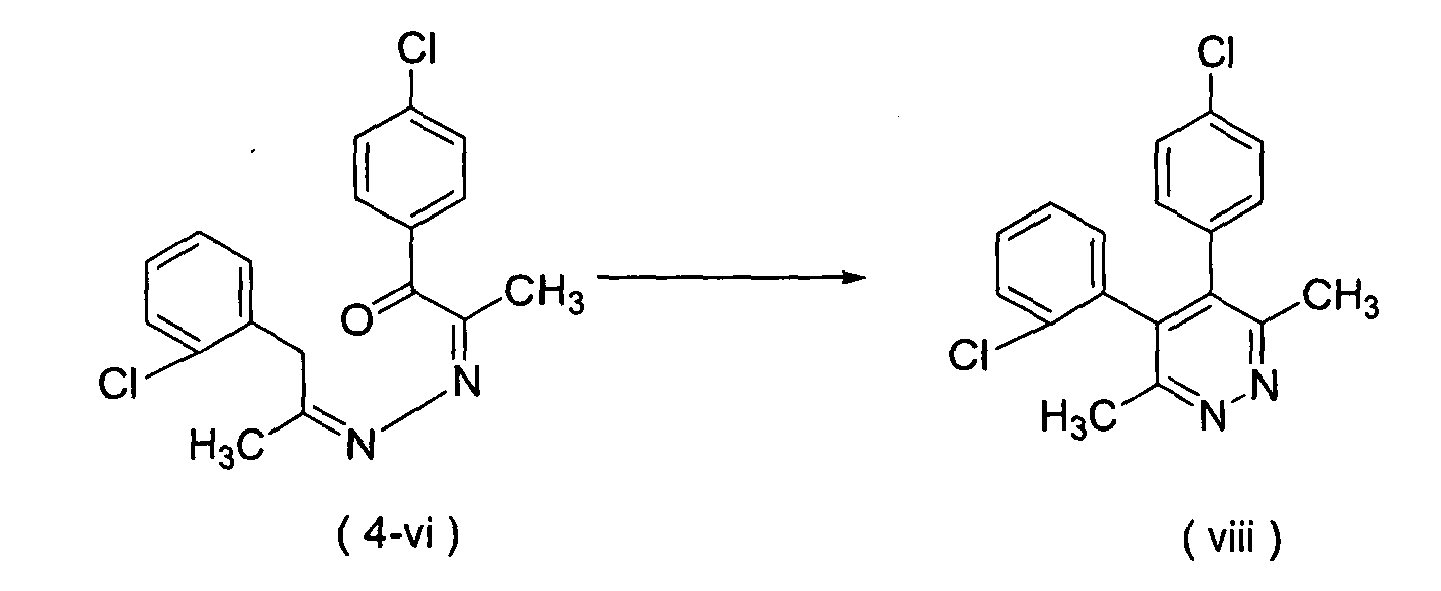
- In 25m1 of ethanol was dissolved 3.71 g of the crude compound represented by the formula (4-vi), to which 0.79 g of powdery potassium hydroxide was added, and the mixture was stirred at heat-reflux under nitrogen atmosphere for 3 hours. The reaction mixture was allowed to cool to room temperature and poured into a mixture of brine and ice, which was extracted with ethyl acetate. The organic layer was washed with saturated brine, dried and concentrated under reduced pressure. The residue was subjected to silica gel column chromatography to obtain 0.58 g of 4-(4-chlorophenyl)-5-(2-chlorophenyl)-2,6-dimethylpyridazin e (hereinafter, referred to as compound .(viii) of the present invention) .
1H-NMR(CDCl3,TMS)δ(ppm):2.44(3H,s),2.51(3H,s),6.90(1H,dd,J= 7.6Hz,J=1.6Hz),6.95-7.05(2H,br),7.15(2H,td,J=7.6Hz,J=1.6Hz) ,7.2-7.4(3H) -

- In 25 ml of ethanol was dissolved 3.30 g of the crude compound represented by the formula (4-vii), to which 0.79 g of powdery potassium hydroxide was added, and the mixture was stirred at heat-reflux under nitrogen atmosphere for 4 hours. The reaction mixture was allowed to cool to room temperature and poured into a mixture of brine and ice, which was extracted with ethyl acetate. The organic layer was washed with saturated brine, dried and concentrated under reduced pressure. The residue was subjected to silica gel column chromatography to obtain 0.42 g of 4-(4-chlorophenyl)-2,6-dimethyl-5-(2-fluorophenyl)pyridazin e (hereinafter, referred to as compound (ix) of the present invention).
1H-NMR(CDCl3,TMS)δ(ppm):2.49(3H,s),2.51(3H,s),6.85-7.05(5H), 7.2-7.3(3H) -

- In 6 ml methanol was dissolved 174 mg of compound (i) of the present invention, to which 0.96 g of sodium methylate (28% methanol solution) was added, and the mixture was stirred at heat-reflux under nitrogen atmosphere for 3 hours. To the mixture was added 0.96 g of sodium methylate (28% methanol solution), which was stirred at heat-reflux under nitrogen atmosphere for 8.5 hours. The reaction mixture was allowed to cool to room temperature and poured into a mixture of brine and ice, which was extracted with ethyl acetate. The organic layer was washed with saturated brine, dried and concentrated under reduced pressure to obtain 147 mg of 4-(4-chlorophenyl)-5-(2,6-difluoro-4-methoxyphenyl)-2,6-dim ethylpyridazine (hereinafter, referred to as compound (x) of the present invention).
1H-NMR(CDCl3,TMS)δ(ppm):2.50(3H,s),2.51(3H,s),3.76(3H,s),6. 35-6.4(2H,m),7.00(2H,d,J=8Hz),7.27(2H,d,J=8Hz) - Next, the production of intermediate compounds of the present compounds will be descried in the following Reference Production Examples.
-

- A mixture of 4.80 g of 2, 4, 6-trifluorobenzaldehyde, 0.72 g of ammonium acetate and 19.34 g of nitroethane was heated to reflux under nitrogen atmosphere for 7 hours. The reaction mixture was allowed to cool to room temperature and concentrated under reduced pressure. To the residue was added ethyl acetate, which was washed with saturated brine twice. After the organic layer was dried over anhydrous sodium sulfate, it was concentrated under reduced pressure, and the residue was subjected to silica gel column chromatography to obtain 4.80 g of the compound represented by the formula (7-i).
1H-NMR(CDCl3,TMS)δ(ppm):2.23(3H,s),6.7-6.8(2H,m),7.77(1H,s) -

- A mixture of 3.45 g of the compound represented by the formula (A-i), 6.24 g of morpholine dissolved in 20 ml of toluene and 100 ml of toluene was allowed to cool to 0°C under nitrogen atmosphere. To the mixture was added dropwise a mixed solution of 10 ml of toluene and 11.5 ml of titanium tetrachloride (1.0 M toluene solution) over 50 minutes, and the mixture was stirred at room temperature overnight. The reaction mixture was filtered through Celite. The filtrate was concentrated under reduced pressure. To the residue was added hexane, and generated solid was collected by filtration. The solid was washed with hexane twice and dried under reduced pressure to obtain 3.46 g of the compound represented by the formula (6-i).
1H-NMR(CDCl3,TMS)δ(ppm):1.95(3H,s),3.00(4H,t,J=4.8Hz),3.78( 4H,t,J=4.8Hz),5.48(1H,s),7.09(2H,d,J=8.5Hz),7.23(2H,d,J=8.5 Hz) -

- In 5ml of toluene was dissolved 3.34 g of the compound represented by the formula (6-i), and the mixture was allowed to cool to 0°C under nitrogen atmosphere. To the solution was added 3.05 g of the compound represented by the formula (7-i), and the mixture was stirred at the same temperature for 40 minutes and then at room temperature for overnight. After that, the reaction mixture was concentrated under reduced pressure. To the residue were added 15 ml of ethanol and 10 ml of 1 mol/L hydrochloric acid, and the mixture was stirred for overnight. The reaction mixture was concentrated under reduced pressure. The resulting solid residue was collected by filtration, and the solid was washed with a mixture of hexane and tert-butyl methyl ether. The resulting solid was dried under reduced pressure to obtain 1.82 g of the crude compound represented by the formula (5-i).
1H-NMR(CDCl3,TMS)δ(ppm):1.52(3H,s),1.93(3H,s),3.32(2H,d,J=1 1.7Hz),4.56(2H,d,J=11.7Hz),6.60(2H,br),7.18-7.28(4H,m) -

- In 20 ml of a mixed solvent of ethanol: dioxane (1:1) was dissolved 1.82 g of the crude compound represented by the formula (5-i), to which 10 ml of 1 mol/L hydrochloric acid was added, and the mixture was stirred at room temperature for 6 hours. After that, the reaction mixture was concentrated under reduced pressure. The residue was subjected to silica gel column chromatography to obtain 0.76 g of the compound represented by the formula (2-i) .
1H-NMR(CDCl3,TMS)δ(ppm):2.06(3H,s),2.22(3H,s),4.52(1H,d,J=1 1.0Hz),4.90(1H,d,J=11.0Hz),6.52(2H,t,J=8.5Hz),7.01(2H,d,J=8 .3Hz),7.13(2H,d,J=8.3Hz) -

- A mixture of 7.41 g of the compound represented by the formula (A-ii), 14.37g of morpholine dissolved in 30 ml of toluene, and 200 ml of toluene was cooled to 0°C under nitrogen atmosphere. To the mixture was added dropwise a mixed solution of 30 ml of toluene and 28 ml of titanium tetrachloride (1.0 M toluene solution) over 1 hour, and the mixture was stirred at room temperature for overnight. The reaction mixture was filtered through Celite. The filtrate was concentrated under reduced pressure. To the residue was added hexane, and the generated solid was collected by filtration. The solid was washed with hexane twice, and dried under reduced pressure to obtain 5.38 g of the compound represented by the formula (6-ii).
1H-NMR(CDCl3,TMS)δ(ppm):1.97(3H,s),2.32(3H,s),2.99(4H,t,J=4 .9Hz),3.79(4H,t,J=4.9Hz),5.54(1H,s),7.08(4H,m). -
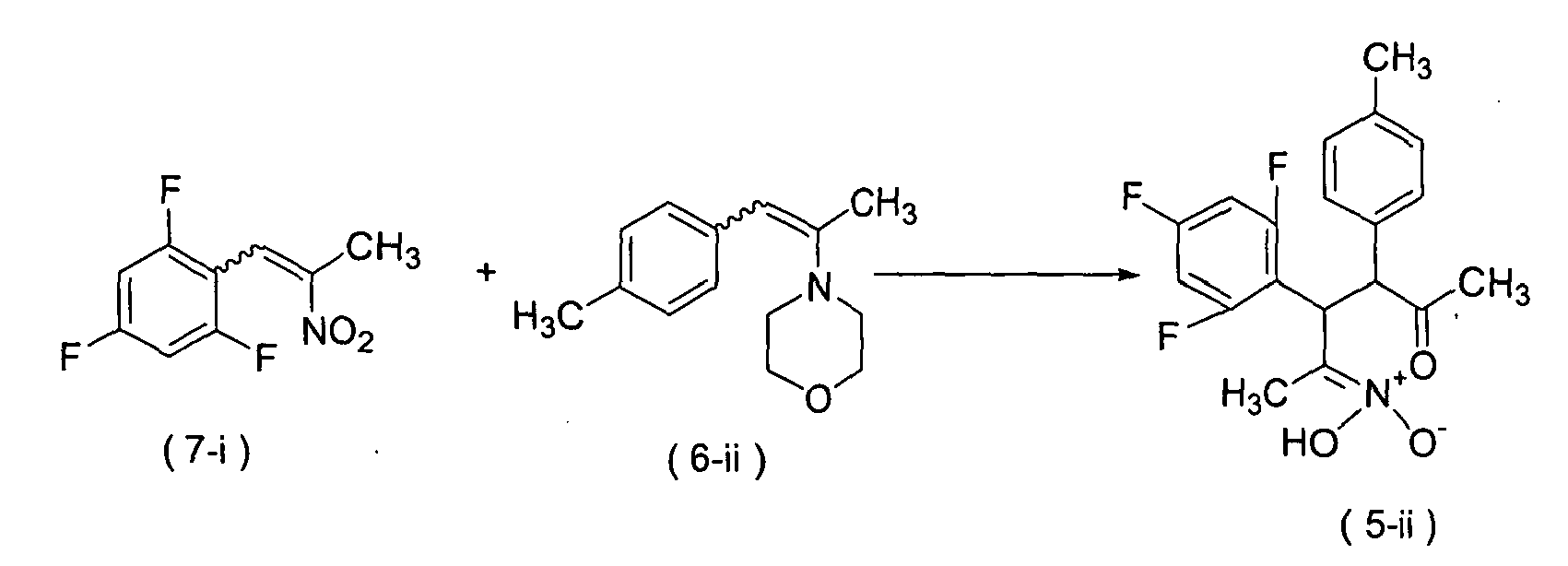
- In 6 ml of toluene was dissolved 5.38 g of the compound represented by the formula (6-ii), and the mixture was allowed to cool to 0°C under nitrogen atmosphere. To the solution was added 4.30 g of the compound represented by the formula (7-i), and the mixture was stirred at the same temperature for 40 minutes and then at room temperature for 3 hours. After that, the reaction mixture was concentrated under reduced pressure. To the residue were added 12 ml of ethanol and 5 ml of 1 mol/L hydrochloric acid, and the mixture was stirred for 3 hours. The reaction mixture was concentrated under reduced pressure. The resulting solid residue was collected by filtration, and the solid was washed with a mixture of hexane and tert-butyl methyl ether. The resulting solid was dried under reduced pressure to give 4.93 g of the crude compound represented by the formula (5-ii) .
1H-NMR(CDCl3,TMS)δ(ppm):1.54(3H,s),1.92(3H,s),2.27(3H,s),3. 28(1H,d,J=11.0Hz),4.56(1H,d,J=11.0Hz),6.54(2H,br),6.97(2H,d ,J=8.0Hz),7.12(2H,br) -

- In 60 ml of a mixed solution of ethanol, methanol and dioxane (mixing ratio: ethanol/methanol/dioxane = 1/1/1) was dissolved 4.93 g of the crude compound represented by the formula (5-ii), to which 20 ml of 1 mol/L hydrochloric acid was added, and the mixture was stirred at room temperature for 4 hours. The reaction mixture was concentrated under reduced pressure, and the residue was subjected to silica gel column chromatography to obtain 1.16 g of the compound represented by the formula (2-ii).
1H-NMR(CDCl3,TMS)δ(ppm):2.07(3H,s),2.20(3H,s),2.22(3H,s),4. 51(1H,d,J=11.0Hz),4.92(1H,d,J=11.0Hz),6.50(2H,t,J=8.5Hz),6. 94 (9H, s) -

- 1.05 g of the compound represented by the formula (2-ii), 0.16 g of hydrazine monohydrate, and 12 ml of ethanol were mixed and the mixture was stirred at room temperature for 3 hours. The reaction mixture was concentrated under reduced pressure to obtain 1.09 g of the crude compound represented by the formula (3-i).
1H-NMR(CDCl3,TMS)δ(ppm):1.95(3H,s),2.00(3H,s),2.29(3H,s),3. 62(1H,d,J=12.0Hz),3.93(1H,d,J=12.0Hz),6.59(2H,t,J=8.3Hz),6. 96(2H,d,J=8.0Hz),7.07(2H,d,J=8.0Hz) -

- In 100 ml of ethanol was dissolved 21.90 g of the compound represented by the formula (10-i), to which was added dropwise a mixture of 6.00 g of hydrazine monohydrate and 20 ml of ethanol under nitrogen atmosphere while cooling it with ice. After the mixture was stirred at the same temperature for 1 hour and then at room temperature for 2 hours, it was allowed to stand at room temperature overnight. To the reaction mixture was added 80 ml of chloroform, and the mixture was filtered. The filtrate was concentrated under reduced pressure to obtain 23.52 g of the compound represented by the formula (8-i).
1H-NMR(CDCl3,TMS)δ(ppm):2.05(3H,s),6.09(2H,br s),7.38(2H,d,J=8Hz),7.81(2H,d,J=8Hz) -

- A mixture of 29.08 g of 2, 4, 6-trifluorobenzaldehyde, 4.34 g of ammonium acetate and 112 ml of nitroethane was heated to reflux under nitrogen atmosphere for 5 hours. The reaction mixture was allowed to cool to room temperature and concentrated under reduced pressure. To the residue was added chloroform, which was washed with saturated brine twice. After the organic layer was dried over anhydrous sodium sulfate, it was concentrated under reduced pressure to obtain 38.53 g of the crude compound represented by the formula (7-i).
- To a mixture of 35.84 g of the crude compound represented by the formula (7-i), 35.58 g of 100-mesh iron powder, 1.09 g of ferric chloride (III) hexahydrate and 79 ml of water was added dropwise 64 ml of conc- hydrochloric acid in an oil bath having a temperature of 100°C over 3 hours while stirring it. The mixture was stirred at the same temperature for 4 hours. The reaction mixture was allowed to cool to room temperature, to which were added water and chloroform, which was filtered through Celite. The filtrate was separated to two layers. The aqueous layer was extracted with chloroform. The organic layers were collected, which was washed with saturated brine twice, dried over anhydrous sodium sulfate, and concentrated under reduced pressure. The residue was subjected to silica gel column chromatography to obtain 15.09 g of the compound represented by the formula (9-i).
1H-NMR(CDCl3,TMS)δ(ppm):2.27(3H,s),3.74(2H,s),6.6-6.7(2H,m) -

- In 50 ml of toluene were dissolved 1.92 g of the compound represented by the formula (8-i) and 1.88 g of the compound represented by the formula (9-i), to which 60 mg of p-toluenesulfonic acid monohydrate, which was stirred at heat-reflux for 1 hour while dehydrating it with a Dean-Stark trap. The reaction mixture was allowed to cool to room temperature and was diluted with ethyl acetate, which was washed with saturated aqueous sodium bicarbonate solution. The organic layer was washed with saturated brine, dried, and concentrated under reduced pressure to obtain 3.52 g of the crude compound represented by the formula (4-i).
-

- In 100 ml of ethanol was dissolved 29.63 g of the compound represented by the formula (10-ii), to which were added dropwise a mixture of 10.00 g of hydrazine monohydrate and 30 ml of ethanol under nitrogen atmosphere while ice-cooling. This mixed solution was stirred at the same temperature for 1.5 hours. The reaction mixture was filtered, and the filtrate was concentrated under reduced pressure to obtain 32.95 g of the compound represented by the formula (8-ii).
1H-NMR(CDCl3,TMS)δ(ppm):2.03(3H,s),6.09(2H,br s),7.35-7.50(3H,m),7.80-7.85.(2H,m) -

- In 50 ml toluene were dissolved 1.78 g of the compound represented by the formula (8-ii) and 1.88 g of the compound represented by the formula (9-i), to which 60 mg of p-toluenesulfonic acid monohydrate was added, and the mixture was stirred at heat-reflux for 1 hour while it was dehydrated with a Dean-Stark trap. The reaction mixture was allowed to cool to room temperature and diluted with ethyl acetate, which was washed with saturated aqueous sodium bicarbonate solution. The organic layer was washed with saturated brine, dried, and concentrated under reduced pressure. The residue was subjected to silica gel column chromatography to obtain 2.75 g of the crude compound represented by the formula (4-ii).
-
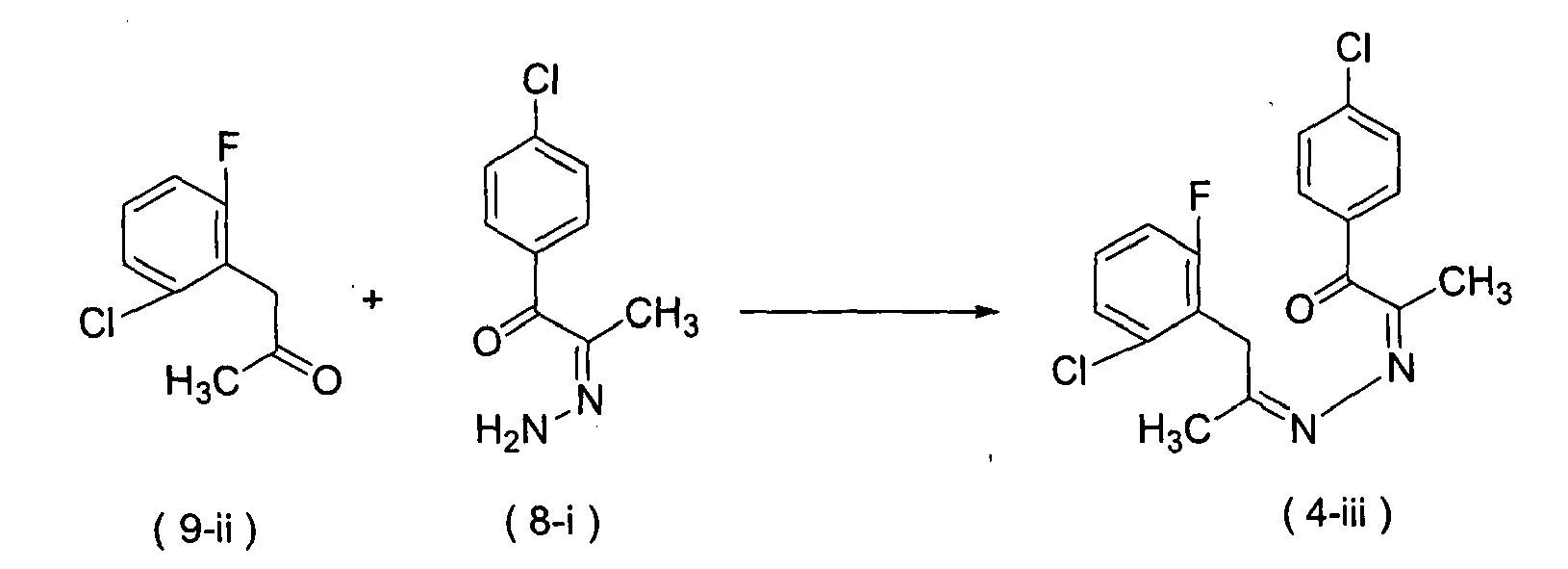
- In 20 ml of toluene were dissolved 0.68 g of the compound represented by the formula (8-i) and 0.65 g of the compound represented by the formula (9-ii), to which 20 mg of p-toluenesulfonic acid monohydrate was added, and the mixture was stirred at heat-reflux for 1 hour while it was dehydrated with a Dean-Stark trap. The reaction mixture was allowed to cool to room temperature and diluted with ethyl acetate, which was washed with saturated aqueous sodium bicarbonate solution. The organic layer was washed with saturated brine, dried and concentrated under reduced pressure to obtain 1.34 g of the compound represented by the formula (4-iii).
-

- In 50 ml of toluene were dissolved 1.97 g of the compound represented by the formula (8-i) and 1.70 g of the compound represented by the formula (9-iii), to which 10 mg of p-toluenesulfonic acid monohydrate was added, and the mixture was stirred at heat-reflux for 1.5 hours while it was dehydrated with a Dean-Stark trap. The reaction mixture was allowed to cool to room temperature and concentrated under reduced pressure to obtain 3.44 g of the crude compound represented by the formula (4-iv) .
-

- In 50 ml of toluene were dissolved 1.97 g of the compound (8-i) and 1. 70 g of the compound represented by the formula (9-iv), to which 10 mg of p-toluenesulfonic acid monohydrate was added, and the mixture was stirred at heat-reflux for 1.5 hour while it was dehydrated with a Dean-Stark trap. The reaction mixture was allowed to cool to room temperature and concentrated under reducedpressure to obtain 3.64 g of the crude compound represented by the formula (4-v).
-

- In 25 ml of toluene were dissolved 1.97 g of the compound represented by the formula (8-i) and 1.69 g of the compound represented by the formula (9-v), to which 10 mg of p-toluenesulfonic acid monohydrate, and the mixture was stirred at heat-reflux for 1.5 hours while it was dehydrated with a Dean-Stark trap. The reaction mixture was allowed to cool to room temperature and concentrated under reduced pressure to obtain 3.71 g of the crude compound represented by the formula (4-vi) .
-

- In 30 ml of toluene were dissolved 1.97 g of the compound represented by the formula (8-i) and 1.52 g of the compound represented by the formula (9-vi), to which 10 mg of p-toluenesulfonic acid monohydrate, and the mixture was stirred at heat-reflux 1.5 hours while it was dehydrated with a Dean-Stark trap. The reaction mixture was allowed to cool to room temperature and concentrated under reduced pressure to obtain 3.30 g of the compound represented by the formula (4-vii).
-

- In 20 ml of acetic acid was dissolved 4.99 g of the compound represented by the formula (9-vi), to which 1.70 g of activated manganese dioxide, and the mixture was heated to reflux under nitrogen atmosphere for 7 hours. The reactionmixturewas allowed to cool to room temperature and poured into a mixture of brine and ice, which was extracted with toluene. The organic layer was washed with saturated brine, dried, and concentrated under reduced pressure. The residue was subjected to silica gel column chromatography (eluent: hexane-ethyl acetate) to obtain 0.84 g of the compound represented by the formula (2-iii).
1H-NMR(CDCl3,TMS)δ(ppm):2.16(6H,s),4.92(2H,s),6.8-7.2(8H) - Next, Formulation examples are shown. Part means part by weight.
- Fifty parts of each of compounds (i) to (x) of the present invention, 3 parts of calcium ligninsulfonate, 2 parts of magnesium laurylsulfate and 45 parts of synthetic hydrated silica are pulverized and mixed well to give wettable powders of each compound.
- Twenty parts of each of compounds (i) to (x) of the present invention and 1.5 parts of sorbitan trioleate are mixed with 28.5 parts of an aqueous solution containing 2 parts of polyvinyl alcohol, and wet-pulverized finely. To the obtained mixture, 40 parts of an aqueous solution containing 0.05 part of xanthan gum and 0.1 part of aluminum magnesium silicate is added and further 10 parts of propylene glycol are added to give a flowable of each compound.
- Two parts of each of compounds (i) to (x) of the present invention, 88 parts of kaolin clay and 10 parts of talc are pulverized and mixed well to give a dust of each compound.
- Five parts of each of compounds (i) to (x) of the present invention, 14 parts of polyoxyethylenestyryl phenyl ether, 6 parts of calcium dodecylbenzenesulfonate and 75 parts of xylene are mixed well to give an emulsifiable concentrate of each compound.
- Two parts of each of compounds (i) to (x) of the present invention, 1 part of synthetic hydrated silica, 2 parts of calcium ligninsulfonate, 30 parts of bentonite and 65 parts of kaolin clay are pulverized and mixed well, and water is added thereto and kneeded, granulated and dried to give a granule of each compound.
- Ten parts of each of the compounds (i) to (x) of present invention, 35 parts of white carbon containing 50 parts of ammonium polyoxyethylenealkyl ether sulfate and 55 parts of water are mixed and wet pulverized finely to give a formulation of each compound.
- Next, a fact that the compound of the present invention is effective for controlling plant diseases is shown by test examples.
- A plastic pot was filled with sandy loam, cucumber (cultivar: Sagami Hanjiro) was sowed, and grown in a greenhouse for 10 days. Each of the compounds (i) to (x) of the present invention was formulated according to Formulation Example 6, then, diluted with water to a concentration of 500 ppm. Each of the resulting diluted solutions was sprayed on stem and leaves so as to sufficiently adhere to the surface of cucumber cotyledones. After spraying, the plant was air-dried, and a PDA medium containing spores of Botrytis cinerea was placed on the surface of cucumber cotyledons. Then, the cucumber was left under humid condition at 12°C for 5 days. Thereafter, the lesion area of the plant was visually observed. As a result, the lesion area of the cucumber treated with the compounds (i) to (x) of the present invention was 10% or less of the lesion area of non-treated cucumber.
- A plastic pot was filled with sandy loam, paddy (cultivar: NihonBare) was sowed, and grown in a greenhouse for 15 days. Each of the compounds (i) to (x) of the present invention was formulated according to Formulation Example 6, then, diluted with water to a concentration of 500 ppm. Each of the resulting diluted solutions was sprayed on stem and leaves so as to sufficiently adhere to the surface of the paddy leaves. After spraying, the plant was air-dried. Plastic pots containing planted paddy affected by Pyricularia oryzae were placed around the plastic pot of paddy, and this condition was left under humid condition at 22°C for 6 days. Thereafter, a controlling effect was checked. As a result, the lesion area of the paddy treated with the compounds (i) to (x) of the present invention was 10% or less of the lesion area of non-treated paddy.
- A plastic pot was filled with sandy loam, Japanese radish (cultivar: Wase 40 nichi) was sowed, and grown in a greenhouse for 5 days. Each of the compounds (i) to (x) of the present invention was formulated according to Formulation Example 6, then, diluted with water to a concentration of 500 ppm. Each of the resulting diluted solutions was sprayed on stem and leaves so as to sufficiently adhere to the radish. After spraying, the plant was air-dried, and inoculated with spores of Alternaria brassicicola. Then, this radish was left under humid condition at 23°C overnight, further, left in a greenhouse for 3 days. Thereafter, a controlling effect was checked. As a result, the lesion area of the radish treated with the compounds (i) to (x) of the present invention was 10% or less of the lesion area of non-treated radish.
- The plant diseases can be controlled by using the compound of the present invention.
R1 and R2 are same or different and represent a C1-C4 alkyl group;
R3 represents a halogen atom, a nitro group, a cyano group, a C1-C4 alkyl group optionally substituted by at least one halogen atom, a C1-C4 alkoxy group optionally substituted by at least one halogen atomor a C1-C4 alkylthio group optionally substituted by at least one halogen atom;
m represents an integer of 0 to 5; provided that, when m represents an integer of 2 or more, each of R3s is same or different;
R41 represents a halogen atom;
R5 represents a halogen atom, a nitro group, a cyano group, a C1-C4 alkyl group optionally substituted by at least one halogen atom or a C1-C4 alkoxy group optionally substituted by at least one halogen atom;
n represents an integer of 0 to 4; provided that, when n represents an integer of 2 or more, each of R5s is same or different.
Claims (8)
- A pyridazine compound represented by formula (1):

R1 and R2 are same or different and represent a C1-C4 alkyl group; R3 represents a halogen atom, a nitro group, a cyano group, a C1-C4 alkyl group optionally substituted by at least one halogen atom, a C1-C4 alkoxy group optionally substituted by at least one halogen atom or a C1-C4 alkylthio group optionally substituted by at least one halogen atom;
m represents an integer of 0 to 5; provided that, when m represents an integer of 2 or more, each of R3s is same or different;
R4 represents a halogen atom, a nitro group, a cyano group, a C1-C4 alkyl group optionally substituted by at least one halogen atom or a C1-C4 alkoxy group optionally substituted by at least one halogen atom;
R5 represents a halogen atom, a nitro group, a cyano group, a C1-C4 alkyl group optionally substituted by at least one halogen atom or a C1-C4 alkoxy group optionally substituted by at least one halogen atom;
n represents an integer of 0 to 4; provided that, when n represents an integer of 2 or more, each of R5s is same or different. - The pyridazine compound according to claim 1, wherein n is 0, 1 or 2 and m is 1 or 2 in the formula (1).
- The pyridazine compound according to claim 1 or 2, wherein each of R1 and R2 is a methyl group, and R4 is a halogen atom in the formula (1).
- A fungicidal composition comprising the pyridazine compound according to claim 1 as an active ingredient.
- A method for controlling plant diseases comprising a step applying an effective amount of the pyridazine compound according to claim 1 to plants or soils growing the plants.
- Use of the pyridazine compound according to claim 1 as an active ingredient of a fungicidal composition.
- A compound represented by formula (3):

R1 and R2 are same or different and represent a C1-C4 alkyl group;
R3 represents a halogen atom, a nitro group, a cyano group, a C1-C4 alkyl group optionally substituted by at least one halogen atom, a C1-C4 alkoxy group optionally substituted by at least one halogen atom or a C1-C4 alkylthio group optionally substituted by at least one halogen atom;
m represents an integer of 0 to 5; provided that, when m represents an integer of 2 or more, each of R3s is same or different;
R4 represents a halogen atom, a nitro group, a cyano group, a C1-C4 alkyl group optionally substituted by at least one halogen atom or a C1-C4 alkoxy group optionally substituted by at least one halogen atom; ,
R5 represents a halogen atom, a nitro group, a cyano group, a C1-C4 alkyl group optionally substituted by at least one halogen atom or a C1-C4 alkoxy group optionally substituted by at least one halogen atom;
n represents an integer of 0 to 4; provided that, when n represents an integer of 2 or more, each of R5s is same or different. - A compound represented by formula (2-1):

R1 and R2 are same or different and represent a C1-C4 alkyl group;
R3 represents a halogen atom, a nitro group, a cyano group, a C1-C4 alkyl group optionally substituted by at least one halogen atom, a C1-C4 alkoxy group optionally substituted by at least one halogen atom or a C1-C4 alkylthio group optionally substituted by at least one halogen atom;
m represents an integer of 0 to 5; provided that, when m represents an integer of 2 or more, each of R3s is same or different;
R41 represents a halogen atom;
R5 represents a halogen atom, a nitro group, a cyano group, a C1-C4 alkyl group optionally substituted by at least one halogen atom or a C1-C4 alkoxy group optionally substituted by at least one halogen atom;
n represents an integer of 0 to 4; provided that, when n represents an integer of 2 or more, each of R5s is same or different.
Priority Applications (1)
| Application Number | Priority Date | Filing Date | Title |
|---|---|---|---|
| PL05748513T PL1775290T3 (en) | 2004-06-28 | 2005-06-02 | Pyridazine compound and use thereof |
Applications Claiming Priority (2)
| Application Number | Priority Date | Filing Date | Title |
|---|---|---|---|
| JP2004189396 | 2004-06-28 | ||
| PCT/JP2005/010541 WO2006001175A1 (en) | 2004-06-28 | 2005-06-02 | Pyridazine compound and use thereof |
Publications (3)
| Publication Number | Publication Date |
|---|---|
| EP1775290A1 true EP1775290A1 (en) | 2007-04-18 |
| EP1775290A4 EP1775290A4 (en) | 2009-03-11 |
| EP1775290B1 EP1775290B1 (en) | 2010-11-17 |
Family
ID=35781692
Family Applications (1)
| Application Number | Title | Priority Date | Filing Date |
|---|---|---|---|
| EP05748513A Expired - Lifetime EP1775290B1 (en) | 2004-06-28 | 2005-06-02 | Pyridazine compound and use thereof |
Country Status (7)
| Country | Link |
|---|---|
| US (1) | US7795258B2 (en) |
| EP (1) | EP1775290B1 (en) |
| AT (1) | ATE488506T1 (en) |
| DE (1) | DE602005024814D1 (en) |
| ES (1) | ES2354219T3 (en) |
| PL (1) | PL1775290T3 (en) |
| WO (1) | WO2006001175A1 (en) |
Cited By (19)
| Publication number | Priority date | Publication date | Assignee | Title |
|---|---|---|---|---|
| WO2008014955A3 (en) * | 2006-07-31 | 2008-04-17 | Syngenta Participations Ag | Fungicidal compounds and compositions |
| EP2011396A1 (en) * | 2007-07-03 | 2009-01-07 | Bayer CropScience AG | Active compound combinations |
| EP2011395A1 (en) * | 2007-07-03 | 2009-01-07 | Bayer CropScience AG | Active compound combinations |
| EP2011397A1 (en) * | 2007-07-03 | 2009-01-07 | Bayer CropScience AG | Active compound combinations |
| EP2014165A1 (en) * | 2007-07-09 | 2009-01-14 | Bayer CropScience AG | Active compound combinations |
| EP2014166A1 (en) * | 2007-07-09 | 2009-01-14 | Bayer CropScience AG | Active compound combinations |
| EP2014167A1 (en) * | 2007-07-13 | 2009-01-14 | Bayer CropScience AG | Active compound combinations |
| WO2009090039A1 (en) | 2008-01-16 | 2009-07-23 | Syngenta Participations Ag | Pyridazine fungicides |
| US8258136B2 (en) | 2005-12-07 | 2012-09-04 | Sumitomo Chemical Company, Limited | Pyridazine compound and use thereof |
| CN103068240A (en) * | 2010-08-10 | 2013-04-24 | 住友化学株式会社 | Plant disease control composition and use thereof |
| CN103068239A (en) * | 2010-08-10 | 2013-04-24 | 住友化学株式会社 | Plant disease control composition and application for same |
| US20130131067A1 (en) * | 2010-08-10 | 2013-05-23 | Sumitomo Chemical Company, Limited | Plant disease controlling composition and use thereof |
| US20130137683A1 (en) * | 2010-08-10 | 2013-05-30 | Sumitomo Chemical Company, Limited | Plant disease controlling composition and use thereof |
| CN104470362A (en) * | 2012-07-20 | 2015-03-25 | 住友化学株式会社 | Plant disease control composition and use thereof |
| EP2803267A4 (en) * | 2012-01-10 | 2015-07-22 | Sumitomo Chemical Co | COMPOSITION FOR CONTROLLING PLANT DISEASE AND APPLICATION OF SAID COMPOSITION |
| EP2803270A4 (en) * | 2012-01-10 | 2015-07-29 | Sumitomo Chemical Co | COMPOSITION FOR CONTROLLING PLANT DISEASE AND APPLICATION OF SAID COMPOSITION |
| EP2803268A4 (en) * | 2012-01-10 | 2015-08-26 | Sumitomo Chemical Co | COMPOSITION FOR CONTROLLING PLANT DISEASE AND APPLICATION OF SAID COMPOSITION |
| FR3048333A1 (en) * | 2016-03-04 | 2017-09-08 | Sumitomo Chemical Co | LIQUID AGROCHEMICAL |
| FR3048332A1 (en) * | 2016-03-04 | 2017-09-08 | Sumitomo Chemical Co | LIQUID PESTICIDE AND METHOD FOR CONTROLLING PLANT DISEASES USING THE SAME |
Families Citing this family (20)
| Publication number | Priority date | Publication date | Assignee | Title |
|---|---|---|---|---|
| DK1958948T3 (en) | 2005-12-07 | 2011-10-31 | Sumitomo Chemical Co | Pyridazine compound and its use |
| GB0614153D0 (en) * | 2006-07-17 | 2006-08-23 | Syngenta Participations Ag | Novel pyridazine derivatives |
| BRPI0714872A2 (en) | 2006-07-17 | 2013-03-19 | Syngenta Participations Ag | pyridazine derivatives |
| EP1920654A1 (en) | 2006-09-13 | 2008-05-14 | Syngeta Participations AG | Novel pyridopyrazine N-oxides |
| CN101541763A (en) | 2006-10-25 | 2009-09-23 | 先正达参股股份有限公司 | Novel pyridazine derivatives |
| EP1916240A1 (en) * | 2006-10-25 | 2008-04-30 | Syngeta Participations AG | Pyridazine derivatives |
| EP1978023A1 (en) * | 2007-04-04 | 2008-10-08 | Bayer CropScience Aktiengesellschaft | Pyridazines as fungicides |
| WO2009048547A1 (en) * | 2007-10-10 | 2009-04-16 | Merck & Co., Inc. | Diphenyl substituted cycloalkanes |
| EP2053045A1 (en) | 2007-10-26 | 2009-04-29 | Syngenta Participations AG | Novel imidazole derivatives |
| EP2053046A1 (en) | 2007-10-26 | 2009-04-29 | Syngeta Participations AG | Novel imidazole derivatives |
| EP2053044A1 (en) | 2007-10-26 | 2009-04-29 | Syngenta Participations AG | Novel imidazole derivatives |
| BR112012002765A2 (en) | 2009-08-07 | 2017-06-13 | Du Pont | compost, fungicidal composition and method of controlling plant diseases caused by fungal plant pathogens |
| GB0922376D0 (en) | 2009-12-22 | 2010-02-03 | Syngenta Participations Ag | Novel compounds |
| IN2012DN06292A (en) | 2010-02-04 | 2015-09-25 | Syngenta Participations Ag | |
| WO2011095459A1 (en) | 2010-02-04 | 2011-08-11 | Syngenta Participations Ag | Pyridazine derivatives, process for their preparation and their use as fungicides |
| TWI510241B (en) | 2010-02-18 | 2015-12-01 | Vtv Therapeutice Llc | Phenyl-heteroaryl derivatives and methods of use thereof |
| TWI504350B (en) * | 2010-09-01 | 2015-10-21 | Du Pont | Fungicidal pyrazoles and their mixtures |
| JP2013142062A (en) | 2012-01-10 | 2013-07-22 | Sumitomo Chemical Co Ltd | Plant disease control composition and application of the same |
| JP2013142063A (en) | 2012-01-10 | 2013-07-22 | Sumitomo Chemical Co Ltd | Plant disease control composition and application of the same |
| JP2013142064A (en) | 2012-01-10 | 2013-07-22 | Sumitomo Chemical Co Ltd | Plant disease control composition and application of the same |
Family Cites Families (5)
| Publication number | Priority date | Publication date | Assignee | Title |
|---|---|---|---|---|
| JPS6054310B2 (en) * | 1979-02-21 | 1985-11-29 | 三井東圧化学株式会社 | Pyridazine derivatives and agricultural and horticultural fungicides |
| JPS56113767A (en) * | 1980-02-14 | 1981-09-07 | Mitsui Toatsu Chem Inc | Phenylpyridazine derivative, its salt, and agricultural and gardening fungicide |
| US5077142A (en) * | 1989-04-20 | 1991-12-31 | Ricoh Company, Ltd. | Electroluminescent devices |
| EP1007515A1 (en) | 1997-08-22 | 2000-06-14 | Abbott Laboratories | Arylpyridazinones as prostaglandin endoperoxide h synthase biosynthesis inhibitors |
| DE602005014359D1 (en) | 2004-06-09 | 2009-06-18 | Sumitomo Chemical Co | PYRIDAZINE COMPOUND AND ITS USE |
-
2005
- 2005-06-02 ES ES05748513T patent/ES2354219T3/en not_active Expired - Lifetime
- 2005-06-02 PL PL05748513T patent/PL1775290T3/en unknown
- 2005-06-02 US US11/630,345 patent/US7795258B2/en active Active
- 2005-06-02 WO PCT/JP2005/010541 patent/WO2006001175A1/en not_active Ceased
- 2005-06-02 DE DE602005024814T patent/DE602005024814D1/en not_active Expired - Lifetime
- 2005-06-02 EP EP05748513A patent/EP1775290B1/en not_active Expired - Lifetime
- 2005-06-02 AT AT05748513T patent/ATE488506T1/en not_active IP Right Cessation
Cited By (29)
| Publication number | Priority date | Publication date | Assignee | Title |
|---|---|---|---|---|
| US8598176B2 (en) | 2005-12-07 | 2013-12-03 | Sumitomo Chemical Company, Limited | Pyridazine compound and use thereof |
| US8258136B2 (en) | 2005-12-07 | 2012-09-04 | Sumitomo Chemical Company, Limited | Pyridazine compound and use thereof |
| WO2008014955A3 (en) * | 2006-07-31 | 2008-04-17 | Syngenta Participations Ag | Fungicidal compounds and compositions |
| EP2011396A1 (en) * | 2007-07-03 | 2009-01-07 | Bayer CropScience AG | Active compound combinations |
| EP2011395A1 (en) * | 2007-07-03 | 2009-01-07 | Bayer CropScience AG | Active compound combinations |
| EP2011397A1 (en) * | 2007-07-03 | 2009-01-07 | Bayer CropScience AG | Active compound combinations |
| EP2014165A1 (en) * | 2007-07-09 | 2009-01-14 | Bayer CropScience AG | Active compound combinations |
| EP2014166A1 (en) * | 2007-07-09 | 2009-01-14 | Bayer CropScience AG | Active compound combinations |
| EP2014167A1 (en) * | 2007-07-13 | 2009-01-14 | Bayer CropScience AG | Active compound combinations |
| WO2009090039A1 (en) | 2008-01-16 | 2009-07-23 | Syngenta Participations Ag | Pyridazine fungicides |
| US8410026B2 (en) | 2008-01-16 | 2013-04-02 | Syngenta Crop Protection Llc | Pyridazine fungicides |
| US9101139B2 (en) | 2010-08-10 | 2015-08-11 | Sumitomo Chemical Company, Limited | Plant disease controlling composition and use thereof |
| CN103068239A (en) * | 2010-08-10 | 2013-04-24 | 住友化学株式会社 | Plant disease control composition and application for same |
| US20130131067A1 (en) * | 2010-08-10 | 2013-05-23 | Sumitomo Chemical Company, Limited | Plant disease controlling composition and use thereof |
| US20130137683A1 (en) * | 2010-08-10 | 2013-05-30 | Sumitomo Chemical Company, Limited | Plant disease controlling composition and use thereof |
| EP2604115A4 (en) * | 2010-08-10 | 2014-06-18 | Sumitomo Chemical Co | COMPOSITION FOR CONTROLLING PLANT DISEASES AND USE THEREOF |
| US8765756B2 (en) * | 2010-08-10 | 2014-07-01 | Sumitomo Chemical Company, Limited | Plant disease controlling composition and use thereof |
| EP2604116A4 (en) * | 2010-08-10 | 2014-07-02 | Sumitomo Chemical Co | COMPOSITION FOR CONTROLLING PLANT DISEASES AND USE THEREOF |
| CN103068240A (en) * | 2010-08-10 | 2013-04-24 | 住友化学株式会社 | Plant disease control composition and use thereof |
| EP2803268A4 (en) * | 2012-01-10 | 2015-08-26 | Sumitomo Chemical Co | COMPOSITION FOR CONTROLLING PLANT DISEASE AND APPLICATION OF SAID COMPOSITION |
| EP2803270A4 (en) * | 2012-01-10 | 2015-07-29 | Sumitomo Chemical Co | COMPOSITION FOR CONTROLLING PLANT DISEASE AND APPLICATION OF SAID COMPOSITION |
| EP2803267A4 (en) * | 2012-01-10 | 2015-07-22 | Sumitomo Chemical Co | COMPOSITION FOR CONTROLLING PLANT DISEASE AND APPLICATION OF SAID COMPOSITION |
| CN104470362A (en) * | 2012-07-20 | 2015-03-25 | 住友化学株式会社 | Plant disease control composition and use thereof |
| EP2875731A4 (en) * | 2012-07-20 | 2015-12-30 | Sumitomo Chemical Co | Composition for controlling plant disease and application therefor |
| FR3048333A1 (en) * | 2016-03-04 | 2017-09-08 | Sumitomo Chemical Co | LIQUID AGROCHEMICAL |
| FR3048332A1 (en) * | 2016-03-04 | 2017-09-08 | Sumitomo Chemical Co | LIQUID PESTICIDE AND METHOD FOR CONTROLLING PLANT DISEASES USING THE SAME |
| BE1024292B1 (en) * | 2016-03-04 | 2018-01-23 | Sumitomo Chemical Company Limited | LIQUID AGROCHEMICAL |
| DK179289B1 (en) * | 2016-03-04 | 2018-04-03 | Sumitomo Chemical Co | Liquid agrochemical |
| AT518360A3 (en) * | 2016-03-04 | 2018-06-15 | Sumitomo Chemical Co | Liquid agrochemical composition |
Also Published As
| Publication number | Publication date |
|---|---|
| PL1775290T3 (en) | 2011-04-29 |
| EP1775290B1 (en) | 2010-11-17 |
| ES2354219T3 (en) | 2011-03-11 |
| US7795258B2 (en) | 2010-09-14 |
| ATE488506T1 (en) | 2010-12-15 |
| WO2006001175A1 (en) | 2006-01-05 |
| DE602005024814D1 (en) | 2010-12-30 |
| US20080275050A1 (en) | 2008-11-06 |
| EP1775290A4 (en) | 2009-03-11 |
Similar Documents
| Publication | Publication Date | Title |
|---|---|---|
| EP1775290B1 (en) | Pyridazine compound and use thereof | |
| EP1767529B1 (en) | Pyridazine compound and use thereof | |
| AU2006322707B2 (en) | Pyridazine compound and use thereof | |
| JP5152129B2 (en) | Pyrazolinone derivatives | |
| JP2000226374A (en) | Pyrazolinone derivatives | |
| JP4792816B2 (en) | Pyridazine compounds and uses thereof | |
| JP4747680B2 (en) | Pyridazine compounds and uses thereof | |
| JP4306206B2 (en) | Imidazo [1,2-a] pyrimidine, its use and production intermediate | |
| EP1958948B1 (en) | Pyridazine compound and use thereof | |
| JP4661163B2 (en) | 6-Arylpyrimidinone compounds and uses thereof | |
| JP3780541B2 (en) | Plant disease control agent | |
| JP2007145816A (en) | Amide compounds and uses thereof | |
| WO2000018727A1 (en) | Intermediates in the production of oxime ether compounds | |
| JP2005089362A (en) | Aryl pyrazoline compounds and uses thereof | |
| JP4529537B2 (en) | Imidazole compounds and uses thereof | |
| JP2005330258A (en) | Thiazoline compounds and their plant disease control applications | |
| JP2000001460A (en) | Acrylic acid derivatives and their uses | |
| WO2003089433A1 (en) | 5,6-DIPHENYLIMIDAZO[1,2-a]PYRIMIDINE AND BACTERICIDAL COMPOSITION CONTAINING THE SAME | |
| JP4529535B2 (en) | Bactericidal use of 4-amino [1,2,4] triazolo [4,3-a] quinoxaline compounds | |
| JP2001011053A (en) | 3-Pyrazolin-5-one compounds and uses thereof | |
| JP2004002315A (en) | 5,6-Diphenylimidazo [1,2-a] pyrimidine and use thereof | |
| JP2005314318A (en) | Uses of 4-amino [1,2,4] triazolo [4,3-a] quinoxaline compounds | |
| JPH0725840A (en) | Amide compound and plant disease control agent containing the same | |
| JP2000198785A (en) | Pyrazolopyrimidine derivatives and uses thereof | |
| JPWO1998027084A1 (en) | Pyrazoline compounds and their use as plant disease control agents |
Legal Events
| Date | Code | Title | Description |
|---|---|---|---|
| PUAI | Public reference made under article 153(3) epc to a published international application that has entered the european phase |
Free format text: ORIGINAL CODE: 0009012 |
|
| 17P | Request for examination filed |
Effective date: 20070125 |
|
| AK | Designated contracting states |
Kind code of ref document: A1 Designated state(s): AT BE BG CH CY CZ DE DK EE ES FI FR GB GR HU IE IS IT LI LT LU MC NL PL PT RO SE SI SK TR |
|
| DAX | Request for extension of the european patent (deleted) | ||
| A4 | Supplementary search report drawn up and despatched |
Effective date: 20090209 |
|
| 17Q | First examination report despatched |
Effective date: 20090914 |
|
| GRAP | Despatch of communication of intention to grant a patent |
Free format text: ORIGINAL CODE: EPIDOSNIGR1 |
|
| GRAS | Grant fee paid |
Free format text: ORIGINAL CODE: EPIDOSNIGR3 |
|
| GRAA | (expected) grant |
Free format text: ORIGINAL CODE: 0009210 |
|
| AK | Designated contracting states |
Kind code of ref document: B1 Designated state(s): AT BE BG CH CY CZ DE DK EE ES FI FR GB GR HU IE IS IT LI LT LU MC NL PL PT RO SE SI SK TR |
|
| REG | Reference to a national code |
Ref country code: GB Ref legal event code: FG4D |
|
| REG | Reference to a national code |
Ref country code: CH Ref legal event code: EP |
|
| REG | Reference to a national code |
Ref country code: IE Ref legal event code: FG4D |
|
| REF | Corresponds to: |
Ref document number: 602005024814 Country of ref document: DE Date of ref document: 20101230 Kind code of ref document: P |
|
| REG | Reference to a national code |
Ref country code: NL Ref legal event code: T3 |
|
| REG | Reference to a national code |
Ref country code: ES Ref legal event code: FG2A Effective date: 20110301 |
|
| LTIE | Lt: invalidation of european patent or patent extension |
Effective date: 20101117 |
|
| PG25 | Lapsed in a contracting state [announced via postgrant information from national office to epo] |
Ref country code: LT Free format text: LAPSE BECAUSE OF FAILURE TO SUBMIT A TRANSLATION OF THE DESCRIPTION OR TO PAY THE FEE WITHIN THE PRESCRIBED TIME-LIMIT Effective date: 20101117 |
|
| REG | Reference to a national code |
Ref country code: PL Ref legal event code: T3 |
|
| PG25 | Lapsed in a contracting state [announced via postgrant information from national office to epo] |
Ref country code: AT Free format text: LAPSE BECAUSE OF FAILURE TO SUBMIT A TRANSLATION OF THE DESCRIPTION OR TO PAY THE FEE WITHIN THE PRESCRIBED TIME-LIMIT Effective date: 20101117 Ref country code: PT Free format text: LAPSE BECAUSE OF FAILURE TO SUBMIT A TRANSLATION OF THE DESCRIPTION OR TO PAY THE FEE WITHIN THE PRESCRIBED TIME-LIMIT Effective date: 20110317 Ref country code: SI Free format text: LAPSE BECAUSE OF FAILURE TO SUBMIT A TRANSLATION OF THE DESCRIPTION OR TO PAY THE FEE WITHIN THE PRESCRIBED TIME-LIMIT Effective date: 20101117 Ref country code: FI Free format text: LAPSE BECAUSE OF FAILURE TO SUBMIT A TRANSLATION OF THE DESCRIPTION OR TO PAY THE FEE WITHIN THE PRESCRIBED TIME-LIMIT Effective date: 20101117 Ref country code: SE Free format text: LAPSE BECAUSE OF FAILURE TO SUBMIT A TRANSLATION OF THE DESCRIPTION OR TO PAY THE FEE WITHIN THE PRESCRIBED TIME-LIMIT Effective date: 20101117 Ref country code: BG Free format text: LAPSE BECAUSE OF FAILURE TO SUBMIT A TRANSLATION OF THE DESCRIPTION OR TO PAY THE FEE WITHIN THE PRESCRIBED TIME-LIMIT Effective date: 20110217 Ref country code: IS Free format text: LAPSE BECAUSE OF FAILURE TO SUBMIT A TRANSLATION OF THE DESCRIPTION OR TO PAY THE FEE WITHIN THE PRESCRIBED TIME-LIMIT Effective date: 20110317 Ref country code: CY Free format text: LAPSE BECAUSE OF FAILURE TO SUBMIT A TRANSLATION OF THE DESCRIPTION OR TO PAY THE FEE WITHIN THE PRESCRIBED TIME-LIMIT Effective date: 20101117 |
|
| REG | Reference to a national code |
Ref country code: HU Ref legal event code: AG4A Ref document number: E010300 Country of ref document: HU |
|
| PG25 | Lapsed in a contracting state [announced via postgrant information from national office to epo] |
Ref country code: GR Free format text: LAPSE BECAUSE OF FAILURE TO SUBMIT A TRANSLATION OF THE DESCRIPTION OR TO PAY THE FEE WITHIN THE PRESCRIBED TIME-LIMIT Effective date: 20110218 |
|
| PG25 | Lapsed in a contracting state [announced via postgrant information from national office to epo] |
Ref country code: BE Free format text: LAPSE BECAUSE OF FAILURE TO SUBMIT A TRANSLATION OF THE DESCRIPTION OR TO PAY THE FEE WITHIN THE PRESCRIBED TIME-LIMIT Effective date: 20101117 Ref country code: EE Free format text: LAPSE BECAUSE OF FAILURE TO SUBMIT A TRANSLATION OF THE DESCRIPTION OR TO PAY THE FEE WITHIN THE PRESCRIBED TIME-LIMIT Effective date: 20101117 |
|
| PG25 | Lapsed in a contracting state [announced via postgrant information from national office to epo] |
Ref country code: RO Free format text: LAPSE BECAUSE OF FAILURE TO SUBMIT A TRANSLATION OF THE DESCRIPTION OR TO PAY THE FEE WITHIN THE PRESCRIBED TIME-LIMIT Effective date: 20101117 Ref country code: SK Free format text: LAPSE BECAUSE OF FAILURE TO SUBMIT A TRANSLATION OF THE DESCRIPTION OR TO PAY THE FEE WITHIN THE PRESCRIBED TIME-LIMIT Effective date: 20101117 Ref country code: DK Free format text: LAPSE BECAUSE OF FAILURE TO SUBMIT A TRANSLATION OF THE DESCRIPTION OR TO PAY THE FEE WITHIN THE PRESCRIBED TIME-LIMIT Effective date: 20101117 |
|
| PLBE | No opposition filed within time limit |
Free format text: ORIGINAL CODE: 0009261 |
|
| STAA | Information on the status of an ep patent application or granted ep patent |
Free format text: STATUS: NO OPPOSITION FILED WITHIN TIME LIMIT |
|
| 26N | No opposition filed |
Effective date: 20110818 |
|
| REG | Reference to a national code |
Ref country code: DE Ref legal event code: R097 Ref document number: 602005024814 Country of ref document: DE Effective date: 20110818 |
|
| REG | Reference to a national code |
Ref country code: CH Ref legal event code: PL |
|
| REG | Reference to a national code |
Ref country code: IE Ref legal event code: MM4A |
|
| PG25 | Lapsed in a contracting state [announced via postgrant information from national office to epo] |
Ref country code: LI Free format text: LAPSE BECAUSE OF NON-PAYMENT OF DUE FEES Effective date: 20110630 Ref country code: IE Free format text: LAPSE BECAUSE OF NON-PAYMENT OF DUE FEES Effective date: 20110602 Ref country code: CH Free format text: LAPSE BECAUSE OF NON-PAYMENT OF DUE FEES Effective date: 20110630 |
|
| PGFP | Annual fee paid to national office [announced via postgrant information from national office to epo] |
Ref country code: HU Payment date: 20120515 Year of fee payment: 8 Ref country code: CZ Payment date: 20120528 Year of fee payment: 8 Ref country code: NL Payment date: 20120614 Year of fee payment: 8 |
|
| PG25 | Lapsed in a contracting state [announced via postgrant information from national office to epo] |
Ref country code: MC Free format text: LAPSE BECAUSE OF NON-PAYMENT OF DUE FEES Effective date: 20110630 |
|
| PG25 | Lapsed in a contracting state [announced via postgrant information from national office to epo] |
Ref country code: LU Free format text: LAPSE BECAUSE OF NON-PAYMENT OF DUE FEES Effective date: 20110602 |
|
| PGFP | Annual fee paid to national office [announced via postgrant information from national office to epo] |
Ref country code: PL Payment date: 20130412 Year of fee payment: 9 |
|
| PG25 | Lapsed in a contracting state [announced via postgrant information from national office to epo] |
Ref country code: TR Free format text: LAPSE BECAUSE OF FAILURE TO SUBMIT A TRANSLATION OF THE DESCRIPTION OR TO PAY THE FEE WITHIN THE PRESCRIBED TIME-LIMIT Effective date: 20101117 |
|
| REG | Reference to a national code |
Ref country code: NL Ref legal event code: V1 Effective date: 20140101 |
|
| PG25 | Lapsed in a contracting state [announced via postgrant information from national office to epo] |
Ref country code: CZ Free format text: LAPSE BECAUSE OF NON-PAYMENT OF DUE FEES Effective date: 20130602 |
|
| PG25 | Lapsed in a contracting state [announced via postgrant information from national office to epo] |
Ref country code: HU Free format text: LAPSE BECAUSE OF NON-PAYMENT OF DUE FEES Effective date: 20130603 Ref country code: NL Free format text: LAPSE BECAUSE OF NON-PAYMENT OF DUE FEES Effective date: 20140101 |
|
| REG | Reference to a national code |
Ref country code: PL Ref legal event code: LAPE |
|
| PG25 | Lapsed in a contracting state [announced via postgrant information from national office to epo] |
Ref country code: PL Free format text: LAPSE BECAUSE OF NON-PAYMENT OF DUE FEES Effective date: 20140602 |
|
| REG | Reference to a national code |
Ref country code: FR Ref legal event code: PLFP Year of fee payment: 12 |
|
| REG | Reference to a national code |
Ref country code: FR Ref legal event code: PLFP Year of fee payment: 13 |
|
| REG | Reference to a national code |
Ref country code: FR Ref legal event code: PLFP Year of fee payment: 14 |
|
| PGFP | Annual fee paid to national office [announced via postgrant information from national office to epo] |
Ref country code: FR Payment date: 20200414 Year of fee payment: 16 |
|
| PGFP | Annual fee paid to national office [announced via postgrant information from national office to epo] |
Ref country code: GB Payment date: 20200520 Year of fee payment: 16 Ref country code: IT Payment date: 20200512 Year of fee payment: 16 |
|
| PGFP | Annual fee paid to national office [announced via postgrant information from national office to epo] |
Ref country code: ES Payment date: 20200701 Year of fee payment: 16 |
|
| GBPC | Gb: european patent ceased through non-payment of renewal fee |
Effective date: 20210602 |
|
| PG25 | Lapsed in a contracting state [announced via postgrant information from national office to epo] |
Ref country code: GB Free format text: LAPSE BECAUSE OF NON-PAYMENT OF DUE FEES Effective date: 20210602 |
|
| PG25 | Lapsed in a contracting state [announced via postgrant information from national office to epo] |
Ref country code: FR Free format text: LAPSE BECAUSE OF NON-PAYMENT OF DUE FEES Effective date: 20210630 |
|
| PG25 | Lapsed in a contracting state [announced via postgrant information from national office to epo] |
Ref country code: IT Free format text: LAPSE BECAUSE OF NON-PAYMENT OF DUE FEES Effective date: 20210602 |
|
| REG | Reference to a national code |
Ref country code: ES Ref legal event code: FD2A Effective date: 20220801 |
|
| PG25 | Lapsed in a contracting state [announced via postgrant information from national office to epo] |
Ref country code: ES Free format text: LAPSE BECAUSE OF NON-PAYMENT OF DUE FEES Effective date: 20210603 |
|
| P01 | Opt-out of the competence of the unified patent court (upc) registered |
Effective date: 20230516 |
|
| PGFP | Annual fee paid to national office [announced via postgrant information from national office to epo] |
Ref country code: DE Payment date: 20240521 Year of fee payment: 20 |
|
| REG | Reference to a national code |
Ref country code: DE Ref legal event code: R071 Ref document number: 602005024814 Country of ref document: DE |