EP1773136B1 - Low flavor anti-microbials drived from smoke flavors - Google Patents
Low flavor anti-microbials drived from smoke flavors Download PDFInfo
- Publication number
- EP1773136B1 EP1773136B1 EP05705557.6A EP05705557A EP1773136B1 EP 1773136 B1 EP1773136 B1 EP 1773136B1 EP 05705557 A EP05705557 A EP 05705557A EP 1773136 B1 EP1773136 B1 EP 1773136B1
- Authority
- EP
- European Patent Office
- Prior art keywords
- liquid smoke
- smoke
- derivative
- food product
- per unit
- Prior art date
- Legal status (The legal status is an assumption and is not a legal conclusion. Google has not performed a legal analysis and makes no representation as to the accuracy of the status listed.)
- Expired - Lifetime
Links
Images






Classifications
-
- A—HUMAN NECESSITIES
- A23—FOODS OR FOODSTUFFS; TREATMENT THEREOF, NOT COVERED BY OTHER CLASSES
- A23L—FOODS, FOODSTUFFS OR NON-ALCOHOLIC BEVERAGES, NOT OTHERWISE PROVIDED FOR; PREPARATION OR TREATMENT THEREOF
- A23L13/00—Meat products; Meat meal; Preparation or treatment thereof
- A23L13/70—Tenderised or flavoured meat pieces; Macerating or marinating solutions specially adapted therefor
-
- A—HUMAN NECESSITIES
- A21—BAKING; EDIBLE DOUGHS
- A21D—TREATMENT OF FLOUR OR DOUGH FOR BAKING, e.g. BY ADDITION OF MATERIALS; BAKING; BAKERY PRODUCTS
- A21D15/00—Improving finished, partly finished or par-baked bakery products
-
- A—HUMAN NECESSITIES
- A23—FOODS OR FOODSTUFFS; TREATMENT THEREOF, NOT COVERED BY OTHER CLASSES
- A23B—PRESERVATION OF FOODS, FOODSTUFFS OR NON-ALCOHOLIC BEVERAGES; CHEMICAL RIPENING OF FRUIT OR VEGETABLES
- A23B2/00—Preservation of foods or foodstuffs, in general
- A23B2/70—Preservation of foods or foodstuffs, in general by treatment with chemicals
- A23B2/725—Preservation of foods or foodstuffs, in general by treatment with chemicals in the form of liquids or solids
- A23B2/729—Organic compounds; Microorganisms; Enzymes
-
- A—HUMAN NECESSITIES
- A23—FOODS OR FOODSTUFFS; TREATMENT THEREOF, NOT COVERED BY OTHER CLASSES
- A23B—PRESERVATION OF FOODS, FOODSTUFFS OR NON-ALCOHOLIC BEVERAGES; CHEMICAL RIPENING OF FRUIT OR VEGETABLES
- A23B2/00—Preservation of foods or foodstuffs, in general
- A23B2/70—Preservation of foods or foodstuffs, in general by treatment with chemicals
- A23B2/725—Preservation of foods or foodstuffs, in general by treatment with chemicals in the form of liquids or solids
- A23B2/729—Organic compounds; Microorganisms; Enzymes
- A23B2/7295—Antibiotics
-
- A—HUMAN NECESSITIES
- A23—FOODS OR FOODSTUFFS; TREATMENT THEREOF, NOT COVERED BY OTHER CLASSES
- A23B—PRESERVATION OF FOODS, FOODSTUFFS OR NON-ALCOHOLIC BEVERAGES; CHEMICAL RIPENING OF FRUIT OR VEGETABLES
- A23B4/00—Preservation of meat, sausages, fish or fish products
- A23B4/044—Smoking; Smoking devices
- A23B4/048—Smoking; Smoking devices with addition of chemicals other than natural smoke
-
- A—HUMAN NECESSITIES
- A23—FOODS OR FOODSTUFFS; TREATMENT THEREOF, NOT COVERED BY OTHER CLASSES
- A23B—PRESERVATION OF FOODS, FOODSTUFFS OR NON-ALCOHOLIC BEVERAGES; CHEMICAL RIPENING OF FRUIT OR VEGETABLES
- A23B4/00—Preservation of meat, sausages, fish or fish products
- A23B4/14—Preserving with chemicals not covered by groups A23B4/02 or A23B4/12
- A23B4/18—Preserving with chemicals not covered by groups A23B4/02 or A23B4/12 in the form of liquids or solids
- A23B4/20—Organic compounds; Microorganisms; Enzymes
-
- A—HUMAN NECESSITIES
- A23—FOODS OR FOODSTUFFS; TREATMENT THEREOF, NOT COVERED BY OTHER CLASSES
- A23B—PRESERVATION OF FOODS, FOODSTUFFS OR NON-ALCOHOLIC BEVERAGES; CHEMICAL RIPENING OF FRUIT OR VEGETABLES
- A23B7/00—Preservation of fruit or vegetables; Chemical ripening of fruit or vegetables
- A23B7/14—Preserving or ripening with chemicals not covered by group A23B7/08 or A23B7/10
- A23B7/153—Preserving or ripening with chemicals not covered by group A23B7/08 or A23B7/10 in the form of liquids or solids
- A23B7/154—Organic compounds; Microorganisms; Enzymes
-
- A—HUMAN NECESSITIES
- A23—FOODS OR FOODSTUFFS; TREATMENT THEREOF, NOT COVERED BY OTHER CLASSES
- A23L—FOODS, FOODSTUFFS OR NON-ALCOHOLIC BEVERAGES, NOT OTHERWISE PROVIDED FOR; PREPARATION OR TREATMENT THEREOF
- A23L13/00—Meat products; Meat meal; Preparation or treatment thereof
- A23L13/40—Meat products; Meat meal; Preparation or treatment thereof containing additives
- A23L13/42—Additives other than enzymes or microorganisms in meat products or meat meals
-
- A—HUMAN NECESSITIES
- A23—FOODS OR FOODSTUFFS; TREATMENT THEREOF, NOT COVERED BY OTHER CLASSES
- A23L—FOODS, FOODSTUFFS OR NON-ALCOHOLIC BEVERAGES, NOT OTHERWISE PROVIDED FOR; PREPARATION OR TREATMENT THEREOF
- A23L27/00—Spices; Flavouring agents or condiments; Artificial sweetening agents; Table salts; Dietetic salt substitutes; Preparation or treatment thereof
- A23L27/20—Synthetic spices, flavouring agents or condiments
- A23L27/24—Synthetic spices, flavouring agents or condiments prepared by fermentation
-
- A—HUMAN NECESSITIES
- A23—FOODS OR FOODSTUFFS; TREATMENT THEREOF, NOT COVERED BY OTHER CLASSES
- A23L—FOODS, FOODSTUFFS OR NON-ALCOHOLIC BEVERAGES, NOT OTHERWISE PROVIDED FOR; PREPARATION OR TREATMENT THEREOF
- A23L27/00—Spices; Flavouring agents or condiments; Artificial sweetening agents; Table salts; Dietetic salt substitutes; Preparation or treatment thereof
- A23L27/20—Synthetic spices, flavouring agents or condiments
- A23L27/27—Smoke flavours
Definitions
- the presently disclosed subject matter relates to methods and compositions for anti-microbial treatment of food products. More particularly, the presently disclosed subject matter relates to derivatives of liquid smoke and methods of treating food products with the derivatives to inhibit the growth of microorganisms without imparting smoky flavors to the food product.
- E. coli O157:H7 is a recognized food-borne pathogen that has been found to contaminate undercooked beef products, especially ground beef.
- Listeria monocytogenes Another such food-borne pathogen is Listeria monocytogenes, which can cause pneumonia, meningitis, and sepsis.
- the incidence of Listeria monocytogenes in the meat processing industry has caused great concern to packers, and it is believed to be a major current health threat.
- the presence of Listeria monocytogenes bacteria on processed meat products represents a danger to the public in that the bacteria can grow on food and increase to an infectious dose under refrigerated conditions.
- liquid smoke is a solution comprising liquid condensates capable of imparting smoky hue or coloration and smoky flavor to a meat exposed to a liquid or vapor phase of the solution.
- liquid smoke preparations that are applied in the manufacturing of meat products have antimicrobial activity against bacteria such as Listeria monocytogenes.
- WO 98/05216 A1 discloses a meat processing method for reducing and inhibiting host organism infestation of meat and providing protection to the meat against oxidation by application of a liquid smoke derivative to the meat.
- WO 2004/077965 A1 describes a preparation smoked products such as fish, meat, charcuterie and similar, wherein the method comprises at least one flavoring step consisting in providing the food product with a smoky flavor.
- US 4,657,765 A discloses a tar-depleted, concentrated liquid smoke that has superior flavoring and coloring abilities, low phenolic content and a low acid content.
- US 3,806,609 A relates to a method of producing liquid smoke comprising a distillation step of preneutralized aqueous smoke condensate with total acidity of 4.0-4.5% as calculated for acetic acid into two fractions and a treatment step of the first obtained fraction for recovery of curing components adsorbed and mixing them with the second fraction.
- liquid smoke imparts smoke flavor to meat, fish, and poultry or wherever a touch of smoke flavor is needed, and that liquid smokes function as antimicrobials, impart color, reduce warmed-over flavor and add texture.
- US 4,431,032 A discloses that a tar-containing aqueous liquid wood smoke is at least partially neutralized under controlled temperature to form a tar-enriched fraction and a tar-depleted liquid smoke fraction, and that the latter is used for food casing treatment to facilitate smoke coloring and flavoring of encased foodstuff during processing.
- WO 01/05255 A1 food products, such as precooked meats, raw meats, and poultry are treated with a decontaminant solution to remove surface microorganism contamination.
- US 5,637,339 A discloses a tar-depleted liquid smoke having total water miscibility.
- WO 90/12514 A1 further describes high browning, reduced phenol and basic constituent liquid smoke compositions that are useful for coloring and flavoring edible foodstuffs.
- US 6,541,053 B2 discloses a collagen processing method for thickening or hardening the collagen sufficiently by application of a liquid smoke fraction obtained from a liquid smoke derivative.
- US 5,043,174 relates to a liquid smoke derivative product containing a minimum of carbonyl and phenol and having no staining index and high acidity.
- the presently disclosed subject matter provides derivatives of liquid smoke and methods of treating food products with derivatives of liquid smoke to inhibit the growth of microorganisms without altering the flavor of the food product.
- the presently disclosed subject matter provides methods for inhibiting growth of a microorganism in a food product.
- the method comprises treating the food product with a derivative of liquid smoke that imparts no smoke flavoring to the food product according to claim 1, whereby growth of a microorganism is inhibited.
- the microorganism is selected from the group consisting of a bacterium, a yeast, and a fungus.
- the bacterium is selected from the group consisting of a strain of Streptococcus , Shigella , Hafnia , Enterobacter , Serratia , Staphylococcus , Pseudomonas , Citrobacter , Klebsiella , Escherichia coli , Listeria , and Salmonella .
- the yeast is a strain of Saccharomyces .
- the fungus is a strain of Aspergillus .
- the food product is a ready-to-eat (RTE) food product.
- RTE ready-to-eat
- the ready-to-eat food product comprises poultry, pork, or beef.
- RTE foods include deli meats (e.g. turkey, roast beef, ham, chicken, salami, bologna, etc.), and hot dogs.
- the food product is a ready-to-cook (RTC) food product.
- RTC ready-to-cook
- the ready-to-cook food product comprises poultry, pork, beef or a par-baked dough product.
- the ready-to-cook food product comprises ground beef, or par-baked dough products such as bread and rolls.
- the derivative of liquid smoke comprises: (a) titratable acidity in a concentration of 0 to about 6% weight per unit volume (w/v); (b) at least 10% weight per unit volume (w/v) carbonyl; (c) phenolics in a concentration of less than about 0.5% weight per unit volume (w/v); (d) water in a concentration of less than about 97% weight per unit volume (w/v); and has (e) a pH of at least 3.0.
- the derivative of liquid smoke comprises carbonyl in a concentration to about 12.0% weight per unit volume (w/v), and a pH of about 5.0 to about 6.0.
- the derivative of liquid smoke comprises carbonyl in a concentration of about 3.0 to about 8.0% weight per unit volume (w/v), phenol in a concentration of about 0.01 to 0.5% weight per unit volume (w/v), and a pH of about 5.0 to about 6.0.
- the derivative of liquid smoke has a pH of at least about 3.0. In some embodiments, the pH is between about 4.5 and 6.5.
- the derivative of liquid smoke comprises carbonyl of at least 10% weight per unit volume (w/v).
- one derivative of liquid smoke is produced by processing liquid smoke through an evaporator to separate and condense the low boiling elements thereof to produce the derivative of liquid smoke.
- the sawdust is delignified prior to pyrolysis to produce low flavor products.
- Various of these products and derivatives can be blended together to produce a range of carbonyl levels. They can be carbon treated to substantially reduce phenols. They can also be treated with neutralizing agents to adjust pH/acidity.
- the derivative of liquid smoke is sprayed onto the food product.
- the food product is dipped into a bath of the derivative of liquid smoke.
- the derivative of liquid smoke comprises an additional wetting agent.
- the additional wetting agent comprises polysorbate.
- the presently disclosed subject matter further comprises heating the food product to at least 73.9°C (165°F) for at least about 1 minute. In some embodiments, the heating step is performed after the treating step.
- the presently disclosed subject matter also provides antimicrobial derivatives of liquid smoke.
- the derivative of liquid smoke comprises (a) titratable acidity in a concentration of 0 to 6% weight per unit volume (w/v); (b) carbonyl of at least 10% weight per unit volume (w/v); (c) phenolics in a concentration of less than 0.5 % weight per unit volume (w/v); (d) water in a concentration of less than 97% weight per unit volume (w/v); and has (e) a pH of at least 3.0; (ii) imparts no liquid smoke flavor to a food product when the food product is treated with the derivative of liquid smoke; and (iii) inhibits growth on a food product of a microorganism selected from the group consisting of Streptococcus , Shigella , Hafnia , Enterobacter , Serratia , Staphylococcus , Pseudomonas , Citrobacter , Klebsiella ,
- the derivative of liquid smoke comprises: (a) titratable acidity in a concentration of 0 to about 6% weight per unit volume (w/v); (b) at least about 10% weight per unit volume (w/v) carbonyl; (c) phenol in a concentration of less than about 0.5% weight per unit volume (w/v); and (d) water in a concentration of less than about 97% weight per unit volume (w/v).
- the derivative of liquid smoke comprises carbonyl in a concentration to about 12.0% weight per unit volume (w/v) and a pH of about 5.0 to about 6.0.
- Also described is a derivative of liquid smoke comprising carbonyl in a concentration of about 5.0 to about 8.0% weight per unit volume (w/v), phenolics in a concentration of about 0.01 to 0.5% weight per unit volume (w/v), and a pH of about 5.0 to about 6.0.
- the food product is a ready-to-eat food product.
- the ready-to-eat food product comprises poultry, pork, beef, or a baked dough product.
- RTE foods include deli meats (e.g. turkey, roast beef, ham, chicken, salami, bologna, etc.) or hot dogs.
- the food product is a ready-to-cook food product.
- the ready-to-cook food product comprises poultry, pork, or beef.
- the ready-to-cook food product comprises ground beef.
- the RTC food comprises par-baked dough products such as bread and rolls.
- the derivative of liquid smoke comprises an additional wetting agent.
- the additional wetting agent comprises polysorbate.
- liquid smoke refers to a solution comprising liquid reagents capable of imparting a smoky hue or coloration and smoky flavor to a food product exposed to a liquid or vapor phase of the solution.
- liquid smoke provides many advantages in meat processing including the ability to use continuous processing when smoking meat as well as more uniform smoke taste and smoke coloration to the meat products treated therewith.
- the use of liquid smoke in lieu of wood smoke is now conventional in meat processing and can be more fully appreciated with reference to representative U.S. Patent Nos. 3,873,741 ; 4,250,199 ; 4,298,435 ; and 5,043,174 .
- LS has also been found to possess antimicrobial activity.
- U.S. Patent No. 5,043,174 discloses that treatment of hot dogs with LS (ZESTI-SMOKE (Code 10), available from Mastertaste of Crossville, Tennessee, United States of America) can prevent post-processing re-inoculation with Listeria monocytogenes.
- the LS used imparts significant smoky flavor on the treated food, which can be undesirable under certain circumstances.
- the phrase "antimicrobial activity” refers generally to an activity of a liquid smoke or derivative of liquid smoke that results in either the killing of a microorganism (including, but not limited to microbicidal and microbiolytic activities) or the inhibition of the growth of a microorganism (including, but not limited to a microbiostatic activity).
- the term “antimicrobial activity” is intended to encompass both total inhibition (i.e. the microorganism does not grow at all or at an undetectable rate in the presence of the DLS) and partial inhibition, the latter being characterized by either a delay in the initiation of growth of the microorganism or a reduction in the rate at which the microorganism grows, or both.
- a DLS derivative of liquid smoke
- a DLS is characterized by antimicrobial activity and does not impart smoky flavors to a food product when the food product is treated with the DLS.
- RTE ready-to-eat
- deli meats e.g. turkey, roast beef, ham, chicken, salami, bologna, etc.
- hot dogs e.g. turkey, roast beef, ham, chicken, salami, bologna, etc.
- RTE food products can be contrasted with ready-to-cook food products.
- Ready-to-cook food products typically include raw, uncooked foodstuffs such as poultry, pork, and beef, and partially cooked/baked foods such as par-baked dough products.
- Exemplary ready-to-cook food products are poultry, pork, and beef (e.g. ground beef) and par-baked dough products such as bread and rolls.
- RTC food products can also include seafood, vegetables, and other minimally processed foods.
- liquid smoke compositions obtained from pyrolysis of hardwood sawdust contain constituents primarily from the thermal degradation of cellulose, hemicellulose, and lignin. More particularly, the liquid smoke compositions contain a wide array of over 400 chemical compounds, and hence, liquid smoke compositions are characterized by their content of certain classes of compounds, namely, acids (% titratable acidity, determined using the method disclosed in U.S. Patent No. 6,214,395 ), phenolics, and carbonyls.
- the acids are preservatives and pH control agents.
- Commercial liquid smoke compositions typically have a pH under about 2.5, and more typically under about 2.3, and a % titratable acidity by volume from about 3% to about 18%.
- the phenolics give a smoky flavor, and also aroma, to liquid smoke compositions, which typically have a phenolics content from about 10 to about 45, and more typically, from about 14 to about 30 mg/ml.
- the carbonyl s impart the brown color-forming capacity to liquid smoke compositions.
- the phenolics and the carbonyls can be measured as described in U.S. Patent No. 4,431,032 , which describes techniques for the removal of an undesirable tar component from liquid smoke compositions. It is noted that the acids and carbonyls are secondary in contributing to the smoky flavor of liquid smoke compositions.
- ZESTI-SMOKE Code 1O ZESTI-SMOKE Code V.
- the specifications of these liquid smokes are as follows: Code 10 Code V Acidity (% w/v) 10.5-11.0 6.8-7.8 Staining Index 69-80 None Carbonyl level (g/100mL) 15-25 2.0-7.0 Phenolic level (mg/mL) 12-22 1.0-4.0 Specific gravity (25°C) 1.068-1.079 1.005-1.015 Density (lbs/gal) 8.90-8.99 8.37-8.46 pH 2-3 2.0-2.4 Color Amber Amber Amber Amber Amber Amber Amber Amber Amber Amber Amber Amber Amber Amber Amber Amber Amber Amber
- the ZESTI-SMOKE Code V fraction utilized as a starting material by the presently disclosed subject matter can be produced as a derivative or secondary product of ZESTI-SMOKE Code 10.
- the Code 10 can be processed through a separator (for example, an AVP evaporator) by feeding the Code 10 as a feed stock which is first heated to remove low boiling acids from the top of the evaporator and then is condensed into Code V as a secondary product.
- This process also yields a concentrated liquid smoke that has higher percent acid, staining index, carbonyl and phenolic levels, specific gravity, density, and darker color than conventional liquid smoke, and that is sold under the trademark SUPERSMOKETM by Mastertaste of Crossville, Tennessee for a variety of end uses.
- the Code V derivative is a low pH, low flavor, low or no stain product.
- Code V is then treated with a suitable pH adjustment agent, such as sodium bicarbonate, sodium carbonate, sodium hydroxide, or potassium hydroxide, in order to bring the pH up to at least about 5.0.
- a suitable pH adjustment agent such as sodium bicarbonate, sodium carbonate, sodium hydroxide, or potassium hydroxide, in order to bring the pH up to at least about 5.0.
- the pH can be brought up to as high as about 7.0.
- the pH ranges from about 5.0 to about 6.0.
- This pH-adjusted material can be further modified to produce a derivative of liquid smoke as disclosed herein.
- the Code V derivative is first treated with carbon in accordance with the method disclosed in U.S. Patent No. 5,637,339 to Moeller . This removes phenolics. The resultant is then treated with the suitable pH adjustment agent. Optionally, the pH adjustment can be performed prior to the carbon treatment. This carbon treated, pH adjusted material can also be used as a starting material for producing a derivative of liquid smoke as used herein.
- the sawdust is delignified prior to pyrolysis to produce low flavor products.
- Various of these products and derivatives can be blended together to produce a range of carbonyl levels. They can be carbon treated to substantially reduce phenolics. They can also be treated with neutralizing agents to adjust pH/acidity.
- Smokes 1, 2, and 5 were derived from primary condensates of smokes that had been substantially stripped of their phenolic content by various combinations of delignification and dephenolization as described herein.
- Smoke 3 was a standard version of a primary smoke condensate having the full complement of acids, carbonyls, and phenolics. Its strength was adjusted by dilution to have a titratable acidity similar to some of the other LS/DLS fractions for easier comparison.
- Smoke 4 (comparative) was an extract of the insoluble tar fraction that settled out of a typical primary smoke condensate. It was predominantly a high phenolic fraction with lesser amounts of titratable acidity and carbonyl compounds.
- Derivatives of liquid smoke 1-9 from Example 1 were used in broth or agar dilution methods against a cocktail of Gram-negative bacteria.
- the cocktail included Salmonella muenster , Salmonella seftenberg , Salmonella typhimurium , and E. coli 8677. 1000 cells of each bacterial species were used to inoculate various dilutions (dilutions are presented as v/v%) of the smoke fractions.
- Growth curves were constructed for DLSs 1, 2, 3, and 8 at 0.50%, and for DLS 1 at 0.25%, 0.5%, and 0.75%, for Saccharomyces cerevisiae .
- the growth curves presented in Figures 7-8 each represents the average of three replicates.
- Par-baked dinner rolls were purchased two days before the expiration date on the package. On the day before expiration, they were sprayed lightly with a 30% solution of Smoke 1, packaged, and held at room temperature. Pick-up level was 1.5% to 2% to ensure coverage. Rolls were observed beginning 24 hours after treatment (i.e. on the expiration date).
- RTE high end (whole breast parts formed to have no more than 40% binders and broth added) and low end (minced turkey breast parts that can have up to 60% binders and broth added before forming and cooking) turkey rolls and roast beef cuts from a commercial manufacturer were used to test the ability of smoke fractions to control L. innocua M1 infection over the course of 4 weeks.
- the turkey products ranged from 3.5 to 4.5 kg and were cooked in hot water in shrinkable cook-in bags to an internal temperature of 71°C followed by cooling in water to an internal temperature of 7°C.
- Each piece of the roast beef was about 1 kg and was in case-ready shrink film packages, and was used as a unit.
- the turkey rolls were each cut into 4 sections, with each section considered a unit.
- Viable L. innocua M1 were evaluated at 0, 2, and 4 weeks at 4°C.
- the marked area was aseptically excised and transferred to a stomacher bag.
- 100 mL of 0.1% sterile peptone water (PW) was added and the mixture was stomached for 2 minutes. Aliquots were removed and directly plated or dilutions made and enumerated.
- Enumeration of viable L. innocua M1 cells was done by direct spiral plating methods on an AUTOPLATE® 4000 (available from Spiral Biotech, Inc. of Norwood, Massachusetts, United States of America) using DIFCOTM TSA (available from Difco Laboratories, Inc.
- a bacterial composite containing equal numbers of three strains of Listeria monocytogenes (SLR10,1/2a; SLR31,1/2b; and SLR1234, 4b Scott A; available from Silliker, Inc. of South Holland, Illinois, United States of America) was employed to test the antimicrobial activity of DLSs Smoke 8 and Smoke 2 on food products. Approximately 1000-10,000 CFU were inoculated onto ham, roast beef, hot dogs, and turkey samples. The inoculum was spread over the surface of the food products using a sterile loop, and allowed to dry for 15 minutes. Individual pieces of each deli style meat product were dipped into Smoke 8 or Smoke 2 for 15 seconds and allowed to drip for 1 minute to remove excess liquid.
- SLR10,1/2a; SLR31,1/2b; and SLR1234, 4b Scott A available from Silliker, Inc. of South Holland, Illinois, United States of America
- both Smoke 8 and Smoke 2 inhibited the growth of Listeria on hot dogs, with the Smoke 2-treated samples showing no detectable Listeria after day 2 through and including day 90.
- the Listeria titer on the Smoke 8 treated hot dogs decreased though day 30.
- Smoke 8 and Smoke 2 also inhibited the growth of Listeria on ham. As shown in Figure 17 , for the Smoke 8-treated ham, the bacterial titer generally diminished through day 10. Smoke 2 treatment resulted in undetectable Listeria levels up to and including day 10.
- Figure 18 shows the results of treating turkey with Smoke 8 and Smoke 2. Here again, treatment with each product resulted in reduced or undetectable bacterial levels through day 10.
- Example 8 The experiments described in Example 8 were repeated, but this time the initial inoculation was between 10 5 and 10 7 CFU for each food product.
- the test products were inoculated with Listeria monocytogenes .
- the Listeria cocktail was made by combining equal portions of five USDA-recognized Listeria strains that were 12 to 18 hours old. To inoculate the test products, 0.1 ml of the Listeria cocktail was placed on the products with a micropipetor.
- the data presented in Figures 19-22 represent three replicates at each time point.
- Figure 19 shows the results of inoculating hot dogs with about 10 5 CFU of Listeria. Treatment with Smoke 8 resulted in an approximately 1 log decrease in bacterial titer by about day 10, which was maintained for about an additional 6 weeks. Smoke 2, on the other hand, resulted in undetectable bacteria by day 2, which remained below the level of detection through day 60.
- Figure 20 shows the results of treating roast beef that had been inoculated with about 10 6 CFU of Listeria with Smoke 8 and Smoke smoke 8 treatment resulted in an inhibition of growth through day 60.
- Smoke 2 treatment resulted in a greater than 1 log reduction in bacterial titer by day 1, and a greater than 2 log reduction by day 22, which persisted through day 60.
- Figure 21 shows the results of treating ham that had been inoculated with about 5 x 10 6 CFU of Listeria with Smoke 8 and Smoke 2.
- Smoke 8 treatment resulted in an inhibition of growth through day 5.
- Smoke 2 treatment resulted in a greater than 1 log reduction in bacterial titer by day 1, which persisted through day 45.
- Figure 22 shows the results of treating turkey that had been inoculated with about 10 6 CFU of Listeria with Smoke 8 and Smoke 2.
- Smoke 8 treatment resulted in an approximately 1 log reduction by day 2.
- Smoke treatment resulted in a greater than 2 log reduction in bacterial titer by day 1, which persisted through day 10.
- Hot dogs purchased from a commercial source were treated with 100% liquid smoke (Smoke 2; Mastertaste) and/or steam pasteurized (1 minute at 165°F). Hot dogs were dipped in Smoke 2 for 2 minutes and allowed to drip for 60 seconds to remove excess liquid. A second set of control hot dogs was set aside without treatment. Then they were inoculated with a four-strain cocktail of Listeria monocytogenes. Samples were vacuum-packaged in suitable plastic films. A portion of the hotdogs from each set (treated and untreated) was subjected to a heat pasteurization step (1 minute at 165°F). Trials were done in triplicate and samples were held at 50°F (abuse temperature).
- Inoculum Preparation A four-strain cocktail of Listeria monocytogenes (109, 108M, serotype 4c, serotype 3) was used for surface inoculation of restructured, skinless turkey breast. Inoculum was prepared from slants after two consecutive transfers to TSB bottles (available from Difco Laboratories, Inc.) in 5 mL tubes and subsequently to 100 mL TSB centrifugation bottles. Stationary phase cultures (20 hours) were centrifuged at 1 0,000g in a Beckman J2-21 M/E centrifuge using a JA-14 rotor (available from Beckman Coulter Inc.
- Inoculum levels were determined by direct plating on Modified Oxford Agar (MOX, available from Oxoid Ltd., of Basingstoke, Hampshire, England) using a Whitley spiral plater (available from Don Whitley Scientific Ltd., of Shipley, West Yorkshire, England) and incubated at 37°C for 24 hours. After incubation, typical black colonies were count and recorded as log 10 CFU/mL for inoculum level.
- MOX Modified Oxford Agar
- Whitley spiral plater available from Don Whitley Scientific Ltd., of Shipley, West Yorkshire, England
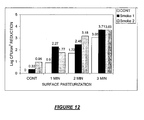
- Spray inoculation of restructured turkey breast products resulted in surface L. monocytogenes populations of 4.17 log 10 CFU/cm 2 ( Figures 10 and 11 ). Exposure to saturated steam for 1, 2, or 3 minutes in a Townsend post-process surface pasteurizer resulted in reductions of 1.08, 2.01, and 2.92 log 10 CFU/cm 2 , respectively. Spray treatment of inoculated turkey breast with DLS resulted in reductions of 0.94 and 0.41 log 10 CFU/cm 2 for Smoke 1 and Smoke 2 respectively, from control. Spray treatment of inoculated turkey breast product with Smoke 1 and subsequent exposure to saturated steam resulted in greater reductions of surface L.
Landscapes
- Life Sciences & Earth Sciences (AREA)
- Engineering & Computer Science (AREA)
- Chemical & Material Sciences (AREA)
- Food Science & Technology (AREA)
- Polymers & Plastics (AREA)
- Zoology (AREA)
- Wood Science & Technology (AREA)
- General Chemical & Material Sciences (AREA)
- Chemical Kinetics & Catalysis (AREA)
- Nutrition Science (AREA)
- Health & Medical Sciences (AREA)
- Microbiology (AREA)
- Biotechnology (AREA)
- Food Preservation Except Freezing, Refrigeration, And Drying (AREA)
- Meat, Egg Or Seafood Products (AREA)
- Bakery Products And Manufacturing Methods Therefor (AREA)
- Seeds, Soups, And Other Foods (AREA)
- General Preparation And Processing Of Foods (AREA)
- Seasonings (AREA)
Description
- This application claims the benefit of
U.S. Provisional Patent Application Serial No. 60/536,160, filed January 13, 2004 - The presently disclosed subject matter relates to methods and compositions for anti-microbial treatment of food products. More particularly, the presently disclosed subject matter relates to derivatives of liquid smoke and methods of treating food products with the derivatives to inhibit the growth of microorganisms without imparting smoky flavors to the food product.
-
CFU - colony-forming unit DLS - derivative of liquid smoke KSU - Kansas State University LS - liquid smoke MEB - malt extract broth MIC - minimum inhibitory concentration MOX - Modified Oxford Agar PDA - potato dextrose agar PW - peptone water RTE - ready-to-eat RTC - ready-to-cook TSA - Tryptic Soy agar TSB - Tryptic Soy broth - The presence of microorganisms on food products is a considerable public health concern. For example, outbreaks of food-borne illness and death associated with various strains of Escherichia coli are frequently reported. In fact, E. coli O157:H7 is a recognized food-borne pathogen that has been found to contaminate undercooked beef products, especially ground beef.
- Another such food-borne pathogen is Listeria monocytogenes, which can cause pneumonia, meningitis, and sepsis. The incidence of Listeria monocytogenes in the meat processing industry has caused great concern to packers, and it is believed to be a major current health threat. The presence of Listeria monocytogenes bacteria on processed meat products represents a danger to the public in that the bacteria can grow on food and increase to an infectious dose under refrigerated conditions.
- Given the importance of maintaining a safe food supply, various approaches have been taken in attempts to kill pathogens that might be present in or on food. One traditional approach is to smoke the food product in a smokehouse. This is, however, a time consuming process requiring large amounts of space, and thus more efficient approaches are desirable.
- Currently, the treatment of foods with wood smoke has been substantially replaced by the use of "liquid smoke", which is a solution comprising liquid condensates capable of imparting smoky hue or coloration and smoky flavor to a meat exposed to a liquid or vapor phase of the solution. In addition to these attributes of liquid smoke, it is also now known that liquid smoke preparations that are applied in the manufacturing of meat products have antimicrobial activity against bacteria such as Listeria monocytogenes.
- Unfortunately, although liquid smoke application is probably quite effective during meat processing to kill Listeria monocytogenes bacteria, it has recently become apparent that there is a danger that re-inoculation or recontamination by Listeria monocytogenes bacteria can occur at some point between cooking and final packaging during the meat processing sequence. Unfortunately, even very low levels of bacterial contamination due to re-inoculation can result in dangerously high levels of bacteria by the time the meat product has been on the store shelf for a period of time.
- In an effort to address this problem, research has been conducted by the meat processing industry into the use of an application of liquid smoke directly to the meat product prior to packaging in order to prevent re-inoculation and subsequent growth of Listeria monocytogenes bacteria on the packaged meat product. See
U.S. Patent No. 5.043,174 to Lindner . Thus, the bacteria is initially killed or minimized by the liquid smoke and heat treatment that takes place during the meat processing cycle, and prior to packaging, another treatment of liquid smoke is applied directly to the surface of the processed food product to control the re-inoculation of the meat product with bacteria or other microorganisms. - While simple and efficient, this approach is not always acceptable, however, since meat products having an application of liquid smoke applied thereto subsequent to the conventional meat packaging process are adversely affected with respect to taste. The additional liquid smoke results in an undesirable over-enhancement of the smoky flavor of the meat product and a generally commercially unsatisfactory product. More importantly, treatment of a food product with liquid smoke would be particularly undesirable with foods that are not intended to have a smoky flavor at all. Thus, the search has continued for a solution to the problem of growth on food products of dangerous pathogens that does not render the meat product substantially inedible and consequently unmarketable.
-
WO 98/05216 A1 -
WO 2004/077965 A1 describes a preparation smoked products such as fish, meat, charcuterie and similar, wherein the method comprises at least one flavoring step consisting in providing the food product with a smoky flavor. - The article of S. M. Vitt et al.: "Inhibition of Listeria innocua and L. monocytogenes in a laboratory medium and cold-smoked salmon containing liquid smoke", in Journal of Food Safety 21, 2001, pages 111 -125 relates to the testing of five commercial liquid smokes in treating chum salmon samples for reducing the growth of microorganisms.
- Furthermore, R. Estrada-Munoz et al. performed experiments to evaluate the antibacterial properties of liquid smoke in meat systems, which are presented in "Liquid smoke effects on Escherichia coli O157:H7, and its antioxidant properties in beef products", Journal of Food Science 63(1), 1998, pages 150 -153.
-
US 4,657,765 A discloses a tar-depleted, concentrated liquid smoke that has superior flavoring and coloring abilities, low phenolic content and a low acid content. - In addition,
US 6,214,395 B1 describes a liquid smoke browning agent solution having good browning but minimal or no flavor. -
US 3,806,609 A relates to a method of producing liquid smoke comprising a distillation step of preneutralized aqueous smoke condensate with total acidity of 4.0-4.5% as calculated for acetic acid into two fractions and a treatment step of the first obtained fraction for recovery of curing components adsorbed and mixing them with the second fraction. - H. Stankiewicz-Berger and P. Kitzman investigated the bacteriostatic activity of smoke flavoring in "Investigation of bacteriostatic activity of rafined liquid smoke", Acta Alimentaria Polonica Vol. V No. 4,1979, pages 391 - 398.
- L. A. Brandt describes in "Liquid smokes solve formulation problems", Prepared Foods 170 (2), 2001, page 59 that liquid smoke imparts smoke flavor to meat, fish, and poultry or wherever a touch of smoke flavor is needed, and that liquid smokes function as antimicrobials, impart color, reduce warmed-over flavor and add texture.
-
US 4,431,032 A discloses that a tar-containing aqueous liquid wood smoke is at least partially neutralized under controlled temperature to form a tar-enriched fraction and a tar-depleted liquid smoke fraction, and that the latter is used for food casing treatment to facilitate smoke coloring and flavoring of encased foodstuff during processing. - According to
WO 01/05255 A1 -
US 5,637,339 A discloses a tar-depleted liquid smoke having total water miscibility. -
WO 90/12514 A1 - J. N. Sofos et al. screened liquid smokes from 20 different woods for microbial activity, results of which they presented in "Effect of ether extracts from condensed wood smokes on the growth of Aeromonas hydrophila and Staphylococcus aureus", Journal of Food Science 53 (6), 1988, pages 1840 - 1843.
-
US 4,112,133 A describes improved liquid smoke compositions which do not form undesirable solids during use or storage. - Furthermore,
US 6,541,053 B2 discloses a collagen processing method for thickening or hardening the collagen sufficiently by application of a liquid smoke fraction obtained from a liquid smoke derivative. - Finally,
US 5,043,174 relates to a liquid smoke derivative product containing a minimum of carbonyl and phenol and having no staining index and high acidity. - What is needed, then, is a derivative of liquid smoke that retains anti-microbial activity but does not impart smoky flavors to the food product. To meet this need, the presently disclosed subject matter provides derivatives of liquid smoke and methods of treating food products with derivatives of liquid smoke to inhibit the growth of microorganisms without altering the flavor of the food product.
- The presently disclosed subject matter provides methods for inhibiting growth of a microorganism in a food product. In some embodiments, the method comprises treating the food product with a derivative of liquid smoke that imparts no smoke flavoring to the food product according to
claim 1, whereby growth of a microorganism is inhibited. In some embodiments, the microorganism is selected from the group consisting of a bacterium, a yeast, and a fungus. In some embodiments, the bacterium is selected from the group consisting of a strain of Streptococcus, Shigella, Hafnia, Enterobacter, Serratia, Staphylococcus, Pseudomonas, Citrobacter, Klebsiella, Escherichia coli, Listeria, and Salmonella. In some embodiments, the yeast is a strain of Saccharomyces. In some embodiments, the fungus is a strain of Aspergillus. - In some embodiments of the presently disclosed subject matter, the food product is a ready-to-eat (RTE) food product. In some embodiments, the ready-to-eat food product comprises poultry, pork, or beef. In some embodiments, RTE foods include deli meats (e.g. turkey, roast beef, ham, chicken, salami, bologna, etc.), and hot dogs.
- In some embodiments of the presently disclosed subject matter, the food product is a ready-to-cook (RTC) food product. In some embodiments, the ready-to-cook food product comprises poultry, pork, beef or a par-baked dough product. In some embodiments, the ready-to-cook food product comprises ground beef, or par-baked dough products such as bread and rolls.
- The derivative of liquid smoke comprises: (a) titratable acidity in a concentration of 0 to about 6% weight per unit volume (w/v); (b) at least 10% weight per unit volume (w/v) carbonyl; (c) phenolics in a concentration of less than about 0.5% weight per unit volume (w/v); (d) water in a concentration of less than about 97% weight per unit volume (w/v); and has (e) a pH of at least 3.0. In some embodiments, the derivative of liquid smoke comprises carbonyl in a concentration to about 12.0% weight per unit volume (w/v), and a pH of about 5.0 to about 6.0. Also described is that the derivative of liquid smoke comprises carbonyl in a concentration of about 3.0 to about 8.0% weight per unit volume (w/v), phenol in a concentration of about 0.01 to 0.5% weight per unit volume (w/v), and a pH of about 5.0 to about 6.0. The derivative of liquid smoke has a pH of at least about 3.0. In some embodiments, the pH is between about 4.5 and 6.5. The derivative of liquid smoke comprises carbonyl of at least 10% weight per unit volume (w/v).
- In some embodiments, one derivative of liquid smoke is produced by processing liquid smoke through an evaporator to separate and condense the low boiling elements thereof to produce the derivative of liquid smoke. In some embodiments, the sawdust is delignified prior to pyrolysis to produce low flavor products. Various of these products and derivatives can be blended together to produce a range of carbonyl levels. They can be carbon treated to substantially reduce phenols. They can also be treated with neutralizing agents to adjust pH/acidity. In some embodiments, the derivative of liquid smoke is sprayed onto the food product. In some embodiments, the food product is dipped into a bath of the derivative of liquid smoke. In some embodiments, the derivative of liquid smoke comprises an additional wetting agent. In some embodiments, the additional wetting agent comprises polysorbate.
- In some embodiments, the presently disclosed subject matter further comprises heating the food product to at least 73.9°C (165°F) for at least about 1 minute. In some embodiments, the heating step is performed after the treating step.
- The presently disclosed subject matter also provides antimicrobial derivatives of liquid smoke. The derivative of liquid smoke: (i) comprises (a) titratable acidity in a concentration of 0 to 6% weight per unit volume (w/v); (b) carbonyl of at least 10% weight per unit volume (w/v); (c) phenolics in a concentration of less than 0.5 % weight per unit volume (w/v); (d) water in a concentration of less than 97% weight per unit volume (w/v); and has (e) a pH of at least 3.0; (ii) imparts no liquid smoke flavor to a food product when the food product is treated with the derivative of liquid smoke; and (iii) inhibits growth on a food product of a microorganism selected from the group consisting of Streptococcus, Shigella, Hafnia, Enterobacter, Serratia, Staphylococcus, Pseudomonas, Citrobacter, Klebsiella, Escherichia coli, Listeria, Salmonella, Saccharomyces, and Aspergillus when the food product is treated with the derivative of liquid smoke. The derivative of liquid smoke has a pH of about 3.0 or more. In some embodiments, the pH is between about 4.5 and 6.5. The derivative of liquid smoke comprises carbonyl of at least 10% weight per unit volume (w/v).
- In some embodiments, the derivative of liquid smoke comprises: (a) titratable acidity in a concentration of 0 to about 6% weight per unit volume (w/v); (b) at least about 10% weight per unit volume (w/v) carbonyl; (c) phenol in a concentration of less than about 0.5% weight per unit volume (w/v); and (d) water in a concentration of less than about 97% weight per unit volume (w/v). In some embodiments, the derivative of liquid smoke comprises carbonyl in a concentration to about 12.0% weight per unit volume (w/v) and a pH of about 5.0 to about 6.0. Also described is a derivative of liquid smoke comprising carbonyl in a concentration of about 5.0 to about 8.0% weight per unit volume (w/v), phenolics in a concentration of about 0.01 to 0.5% weight per unit volume (w/v), and a pH of about 5.0 to about 6.0.
- In some embodiments of the presently disclosed subject matter, the food product is a ready-to-eat food product.
- In some embodiments, the ready-to-eat food product comprises poultry, pork, beef, or a baked dough product. In some embodiments, RTE foods include deli meats (e.g. turkey, roast beef, ham, chicken, salami, bologna, etc.) or hot dogs.
- In some embodiments, the food product is a ready-to-cook food product. In some embodiments, the ready-to-cook food product comprises poultry, pork, or beef. In some embodiments, the ready-to-cook food product comprises ground beef. In some embodiments, the RTC food comprises par-baked dough products such as bread and rolls.
- In some embodiments, the derivative of liquid smoke comprises an additional wetting agent. In some embodiments, the additional wetting agent comprises polysorbate.
- An object of the presently disclosed subject matter having been stated above, other objects and advantages of the presently disclosed subject matter will become apparent to those of ordinary skill in the art after a study of the following description and non-limiting Examples.
-
-
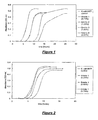
Figure 1 depicts growth curves of Escherichia coli 8677 in Tryptic Soy broth (TSB) supplemented with dilutions of Smokes 1 (0.75%), 2 (1.00%), 3 (1.00%), or 8 (2.00%). The dilutions were chosen to be below the Minimum Inhibitory Concentrations (MIC) for each individual derivative of liquid smoke (DLS). -
Figure 2 depicts growth curves of Escherichia coli 8677 in Tryptic Soy broth (TSB) supplemented with concentrations ofSmoke 1 between 0.00% and 0.75%. -
Figure 3 depicts growth curves of Salmonella seftenberg in Tryptic Soy broth (TSB) supplemented with dilutions of Smokes 1 (0.50%), 2 (1.00%), 3 (1.00%), and 8 (2.00%). -
Figure 4 depicts growth curves of Salmonella seftenberg in Tryptic Soy broth (TSB) supplemented with concentrations ofSmoke 1 between 0.00% and 0.50%. -
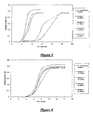
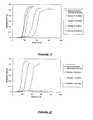
Figure 5 depicts growth curves of Listeria innocua M1 in Tryptic Soy broth (TSB) supplemented with dilutions of Smokes 1 (0.50%), 2 (0.40%), 3 (0.50%), and 8 (2.00%). -
Figure 6 depicts growth curves of Listeria innocua M1 in Tryptic Soy broth (TSB) supplemented with concentrations ofSmoke 1 between 0.00% and 0.75%. -
Figure 7 depicts growth curves of Saccharomyces cerevisiae in malt extract broth (MEB) supplemented with 0.50 % dilutions ofSmokes -
Figure 8 depicts growth curves of Saccharomyces cerevisiae in malt extract broth (MEB) supplemented with concentrations ofSmoke 1 between 0.00% and 0.75%. -
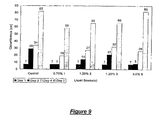
Figure 9 depicts the average circumference of Aspergillus niger spores grown on potato dextrose agar (PDA) in the presence of dilutions of Smokes 1 (0.75%), 2 (1.25%), 3 (1.25%), and 8 (5.00%) atdays -
Figure 10 depicts the effects of combined treatment of the surface of restructured turkey breast with derivatives of liquid smoke (Smoke 2 or Smoke 3) and surface saturated steam-based pasteurization (0, 1, 2, and 3 minutes) on the growth of Listeria monocytogenes enumerated on Tryptic Soy agar. Numbers of colonies are presented as log10 CFU/cm2. -
Figure 11 depicts the effects of combined treatment of the surface of restructured turkey breast with derivatives of liquid smoke (Smoke 2 or Smoke 3) and surface saturated steam-based pasteurization (0, 1, 2, and 3 minutes) on the growth of Listeria monocytogenes enumerated on Modified Oxford Agar (MOX). Numbers of colonies are presented as log10 CFU/cm2. -
Figure 12 depicts the reductions in the numbers of colonies (presented as log10 CFU/cm2) resulting from combined treatment of the surface of restructured turkey breast with derivatives of liquid smoke (Smoke 2 or Smoke 3) and surface saturated steam-based pasteurization (0, 1, 2, and 3 minutes) on the growth of Listeria monocytogenes enumerated on Tryptic Soy agar. -
Figure 13 depicts the reductions in the numbers of colonies (presented as log10 CFU/cm2) resulting from combined treatment of the surface of restructured turkey breast with derivatives of liquid smoke (Smoke 2 or Smoke 3) and surface saturated steam-based pasteurization (0, 1, 2, and 3 minutes) on the growth of Listeria monocytogenes enumerated on Modified Oxford Agar (MOX). -
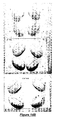
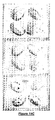
Figures 14A-14E depict the results of treating par-baked dinner rolls withSmoke 1. Commercial par baked dinner rolls were purchased 2 days before expiration date on the package. On the day before expiration, they were sprayed lightly with a 30% DLS solution, packaged, and held at room temperature. Pick-up level was 1.5 to 2.0% to insure coverage. Photos were taken beginning 24 hours later on the expiration date. -
Figure 14A depicts photographs of the par-baked dinner rolls 1 day after treatment with a DLS (top two panels). The bottom panel depicts an untreated negative control.Figure 14B depicts photographs of the par-baked dinner rolls 2 days after treatment with a DLS (top two panels). The bottom panel depicts an untreated negative control.Figure 14C depicts photographs of the par-baked dinner rolls 3 days after treatment with a DLS (top two panels). The bottom panel depicts an untreated negative control.Figure 14D depicts photographs of the par-baked dinner rolls 4 days after treatment with a DLS (top two panels). The bottom panel depicts an untreated negative control.Figure 14E depicts photographs of the par-baked dinner rolls 1 week after treatment with a DLS. All 12 rolls were from the same package as purchased. The 8 treated rolls (top two panels in each Figure) were all treated equally with the same DLS and packaged separately. The 4 control rolls (bottom panel inFigures 14A-14D ) were left untreated and placed in a closed plastic bag. -
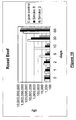
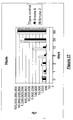
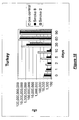
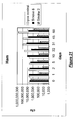
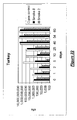
Figures 15-18 depict the results of low level (103-104 CFU) inoculation with Listeria monocytogenes.Figure 15 depicts the results of treating hot dogs that had been inoculated with about 3500 CFU of Listeria monocytogenes withSmoke 8 andSmoke 3.Figure 16 depicts the results of treating roast beef that had been inoculated with about 1700 CFU of Listeria monocytogenes withSmoke 8 andSmoke 3.Figure 17 depicts the results of treating ham that had been inoculated with about 1700 CFU of Listeria monocytogenes withSmoke 8 andSmoke 3.Figure 18 depicts the results of treating turkey that had been inoculated with about 7500 CFU of Listeria monocytogenes withSmoke 8 andSmoke 3. -
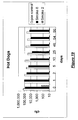
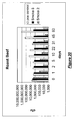
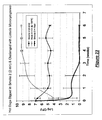
Figures 19-23 depict the results of high level (105-107 CFU) inoculation with Listeria monocytogenes.Figure 19 depicts the results of treating hot dogs that had been inoculated with about 1.6 x 10⁵ CFU of Listeria monocytogenes withSmoke 8 andSmoke 3.Figure 20 depicts the results of treating roast beef that had been inoculated with about 2.4 x 10⁶ CFU of Listeria monocytogenes withSmoke 8 andSmoke 3.Figure 21 depicts the results of treating ham that had been inoculated with about 3.8 x 10⁶ CFU of Listeria monocytogenes withSmoke 8 andSmoke 3.Figure 22 depicts the results of treating turkey that had been inoculated with about 1.2 x 10⁶ CFU of Listeria monocytogenes withSmoke 8 andSmoke 3.Figure 23 depicts the effect ofSmoke 2 and/or heat treatment (1 minute at 165°F) on Listeria monocytogenes growth during shelf-life storage of inoculated hot dogs. - All references cited in the specification, including patents, patent application publications, and non-patent literature, are incorporated herein by reference to the extent that they supplement, explain , provide a background for, or teach methodology, techniques, and/or compositions employed herein. Also included by reference are the following
U.S. Patents to Moeller and/or Moeller et al.: 5,637,339 ;6,214,395 ;6,261,623 ;6,541,053 . - All technical and scientific terms used herein, unless otherwise defined below, are intended to have the same meaning as commonly understood by one of ordinary skill in the art. References to techniques employed herein are intended to refer to the techniques as commonly understood in the art, including variations on those techniques or substitutions of equivalent techniques that would be apparent to one of skill in the art. While the following terms are believed to be well understood by one of ordinary skill in the art, the following definitions are set forth to facilitate explanation of the presently disclosed subject matter.
- Following long-standing patent law convention, the terms "a", "an", and "the" mean "one or more" when used in this application, including the claims.
- As used herein, unless specifically indicated otherwise, the word "or" is used in the "inclusive" sense of "and/or" and not the "exclusive" sense of "either/or".
- As used herein, the phrase "liquid smoke (LS)" refers to a solution comprising liquid reagents capable of imparting a smoky hue or coloration and smoky flavor to a food product exposed to a liquid or vapor phase of the solution. The use of liquid smoke provides many advantages in meat processing including the ability to use continuous processing when smoking meat as well as more uniform smoke taste and smoke coloration to the meat products treated therewith. The use of liquid smoke in lieu of wood smoke is now conventional in meat processing and can be more fully appreciated with reference to representative
U.S. Patent Nos. 3,873,741 ;4,250,199 ;4,298,435 ; and5,043,174 . - LS has also been found to possess antimicrobial activity. For example,
U.S. Patent No. 5,043,174 discloses that treatment of hot dogs with LS (ZESTI-SMOKE (Code 10), available from Mastertaste of Crossville, Tennessee, United States of America) can prevent post-processing re-inoculation with Listeria monocytogenes. However, the LS used imparts significant smoky flavor on the treated food, which can be undesirable under certain circumstances. Thus, it would be advantageous to generate derivatives of liquid smoke that retain antimicrobial activity yet impart no smoky flavor to food products during the treatment stage. That is the unexpected and surprising result of the methods and compositions discovered and described and claimed herein. - As used herein, the phrase "antimicrobial activity" refers generally to an activity of a liquid smoke or derivative of liquid smoke that results in either the killing of a microorganism (including, but not limited to microbicidal and microbiolytic activities) or the inhibition of the growth of a microorganism (including, but not limited to a microbiostatic activity). With respect to an inhibition of microbial growth, the term "antimicrobial activity" is intended to encompass both total inhibition (i.e. the microorganism does not grow at all or at an undetectable rate in the presence of the DLS) and partial inhibition, the latter being characterized by either a delay in the initiation of growth of the microorganism or a reduction in the rate at which the microorganism grows, or both.
- As used herein, the phrase "derivative of liquid smoke (DLS)" refers to a derivative of liquid smoke that has characteristics that are appropriate for a given use. DLSs are typically fractions of a liquid smoke that are prepared, for example, by processing a conventional liquid smoke through an evaporator, which separates and condenses the low boiling elements of the liquid smoke to produce the derivative of liquid smoke solution. Accordingly, the phrases "derivative of liquid smoke", "derivative", "liquid smoke fraction", and "fraction" are used interchangeably herein and refer to a component of a liquid smoke that has been isolated from the liquid smoke itself, either with or without subsequent additional preparation and/or modification steps. In some embodiments, a DLS is characterized by antimicrobial activity and does not impart smoky flavors to a food product when the food product is treated with the DLS.
- As used herein, the phrase "ready-to-eat (RTE)" refers to food products that are prepared such that they can be consumed either immediately or after re-heating. Exemplary RTE foods include deli meats (e.g. turkey, roast beef, ham, chicken, salami, bologna, etc.), and hot dogs.
- RTE food products can be contrasted with ready-to-cook food products. Ready-to-cook food products typically include raw, uncooked foodstuffs such as poultry, pork, and beef, and partially cooked/baked foods such as par-baked dough products. Exemplary ready-to-cook food products are poultry, pork, and beef (e.g. ground beef) and par-baked dough products such as bread and rolls. RTC food products can also include seafood, vegetables, and other minimally processed foods.
- As is well known to those skilled in the art, liquid smoke compositions obtained from pyrolysis of hardwood sawdust contain constituents primarily from the thermal degradation of cellulose, hemicellulose, and lignin. More particularly, the liquid smoke compositions contain a wide array of over 400 chemical compounds, and hence, liquid smoke compositions are characterized by their content of certain classes of compounds, namely, acids (% titratable acidity, determined using the method disclosed in
U.S. Patent No. 6,214,395 ), phenolics, and carbonyls. - The acids are preservatives and pH control agents. Commercial liquid smoke compositions typically have a pH under about 2.5, and more typically under about 2.3, and a % titratable acidity by volume from about 3% to about 18%. The phenolics give a smoky flavor, and also aroma, to liquid smoke compositions, which typically have a phenolics content from about 10 to about 45, and more typically, from about 14 to about 30 mg/ml. The carbonyl s impart the brown color-forming capacity to liquid smoke compositions. The phenolics and the carbonyls can be measured as described in
U.S. Patent No. 4,431,032 , which describes techniques for the removal of an undesirable tar component from liquid smoke compositions. It is noted that the acids and carbonyls are secondary in contributing to the smoky flavor of liquid smoke compositions. - Mastertaste of Crossville, Tennessee is a manufacturer of various liquid smokes. Exemplary liquid smokes include ZESTI-SMOKE Code 1O and ZESTI-SMOKE Code V. The specifications of these liquid smokes are as follows:
Code 10Code V Acidity (% w/v) 10.5-11.0 6.8-7.8 Staining Index 69-80 None Carbonyl level (g/100mL) 15-25 2.0-7.0 Phenolic level (mg/mL) 12-22 1.0-4.0 Specific gravity (25°C) 1.068-1.079 1.005-1.015 Density (lbs/gal) 8.90-8.99 8.37-8.46 pH 2-3 2.0-2.4 Color Amber Amber - The ZESTI-SMOKE Code V fraction utilized as a starting material by the presently disclosed subject matter can be produced as a derivative or secondary product of ZESTI-
SMOKE Code 10. TheCode 10 can be processed through a separator (for example, an AVP evaporator) by feeding theCode 10 as a feed stock which is first heated to remove low boiling acids from the top of the evaporator and then is condensed into Code V as a secondary product. This process also yields a concentrated liquid smoke that has higher percent acid, staining index, carbonyl and phenolic levels, specific gravity, density, and darker color than conventional liquid smoke, and that is sold under the trademark SUPERSMOKE™ by Mastertaste of Crossville, Tennessee for a variety of end uses. - The Code V derivative is a low pH, low flavor, low or no stain product. In some embodiments, Code V is then treated with a suitable pH adjustment agent, such as sodium bicarbonate, sodium carbonate, sodium hydroxide, or potassium hydroxide, in order to bring the pH up to at least about 5.0. The pH can be brought up to as high as about 7.0. In some embodiments, the pH ranges from about 5.0 to about 6.0. This pH-adjusted material can be further modified to produce a derivative of liquid smoke as disclosed herein.
- In some embodiments, the Code V derivative is first treated with carbon in accordance with the method disclosed in
U.S. Patent No. 5,637,339 to Moeller . This removes phenolics. The resultant is then treated with the suitable pH adjustment agent. Optionally, the pH adjustment can be performed prior to the carbon treatment. This carbon treated, pH adjusted material can also be used as a starting material for producing a derivative of liquid smoke as used herein. - In some embodiments, the sawdust is delignified prior to pyrolysis to produce low flavor products. Various of these products and derivatives can be blended together to produce a range of carbonyl levels. They can be carbon treated to substantially reduce phenolics. They can also be treated with neutralizing agents to adjust pH/acidity.
- In the Examples presented below, various derivatives of liquid smoke were used to test the antimicrobial activity of DLSs versus bacteria, yeast, and mold.
- The following Examples have been included to illustrate modes of the presently disclosed subject matter. Certain aspects of the following Examples are described in terms of techniques and procedures found or contemplated by the present inventors to work well in the practice of the presently disclosed subject matter. These Examples illustrate standard practices of the inventors. In light of the present disclosure and the general level of skill in the art, those of skill will appreciate that the following Examples are intended to be exemplary only and that numerous changes, modifications, and alterations can be employed without departing from the scope of the presently disclosed subject matter.
-
Smokes Smoke 3 was a standard version of a primary smoke condensate having the full complement of acids, carbonyls, and phenolics. Its strength was adjusted by dilution to have a titratable acidity similar to some of the other LS/DLS fractions for easier comparison. Smoke 4 (comparative) was an extract of the insoluble tar fraction that settled out of a typical primary smoke condensate. It was predominantly a high phenolic fraction with lesser amounts of titratable acidity and carbonyl compounds. It was rendered water-soluble by the addition ofPolysorbate 80. The preparation ofSmokes - A total of nine derivatives of liquid smoke were generated with the characteristics summarized in Table 1:
Table 1 Smoke No. Acidity* pH Phenolic content (mg/mL)** Carbonyl content (mg/mL)*** 1 4.5-5.9 2-3.0 0-5 151-200.9 2 0-1.4 6.1-7.0 0-5 101-150.9 3 6.0-7.4 2-3.0 0-5 101-150.9 4 3.0-4.4 4.1-5.0 20.1-25.0 0-50.9 5 6.0-7.4 2-3.0 0-5 101-150.9 6 6.0-7.4 2-3.0 0-5 51-100.9 7 1.5-2.9 5.1-6.0 0-5 51-100.9 8 0-1.4 6.1-7.0 0-5 101-150.9 9 0-1.4 6.1-7.0 0-5 51-100.9 * Quantified as acetic acid
** Quantified as 2,6-dimethoxy phenol
*** Quantified as 2-butanone - Derivatives of liquid smoke 1-9 from Example 1 were used in broth or agar dilution methods against a cocktail of Gram-negative bacteria. The cocktail included Salmonella muenster, Salmonella seftenberg, Salmonella typhimurium, and
E. coli 8677. 1000 cells of each bacterial species were used to inoculate various dilutions (dilutions are presented as v/v%) of the smoke fractions. - In order to determine the minimum inhibitory concentrations for each of the fractions, appropriate inoculations were then carried out to TSB containing different percentages of derivatives of liquid smoke in a test tube. The test tubes were incubated at 37°C for 24 and 48 hours and scored for growth/no growth. The MIC values were conducted in triplicate and repeated three times for each. The MIC values are presented in Table 2.
Table 2 MIC Values Against Gram-Neqative Cocktail Smoke Number MIC Value 1 1.5% 2 >2.00% 3 2.00% 4 3.00% 5 2.00% 6 2.00% 7 5.00% 8 >2.00% 9 9.00% - Growth curves were constructed below the predetermined MIC levels for selected derivatives of liquid smoke (DLS) for several bacterial strains individually. The growth curves presented in
Figures 1-4 each represents the average of three replicates. - Derivatives of liquid smoke 1-9 were also tested against a Gram-positive bacterium (Listeria innocua M1) using the techniques described in Example 2. The MIC values are presented in Table 3.
Table 3 MIC Values of Liquid Smokes Against Listeria innocua M1 1 1.50% 2 2.00% 3 >2.00% 4 2.00% 5 2.00% 6 2.00% 7 4.00% 8 2.00% 9 6.00% - Growth curves were constructed below the predetermined MIC levels for selected derivatives of liquid smoke (DLS) for Listeria innocua M1. The growth curves presented in
Figures 5-6 each represents the average of three replicates. - Derivatives of liquid smoke (DLSs) 1, 2, 3, and 8 were also tested against Saccharomyces cerevisiae using the techniques described in Example 2, except that malt extract broth (MEB) was used instead of TSB. The MIC values were 1.5% for each DLS.
- Growth curves were constructed for
DLSs DLS 1 at 0.25%, 0.5%, and 0.75%, for Saccharomyces cerevisiae. The growth curves presented inFigures 7-8 each represents the average of three replicates. - Derivatives of
liquid smoke Table 4 MIC Values of Liquid Smokes Against A. niger 1 1.50% 2 2.50% 3 2.50% 8 >5.00% - As a proxy for growth curves, the circumference of A. niger spores was measured at 37°C for
DLS 1 at 0.75%,DLS 2 at 1.25%,DLS 3 at 1.25%, andDLS 8 at 5.0%, atdays Figure 9 . - As is disclosed hereinabove and in the Figures, components of smoke possess antimicrobial properties. While different smoke condensates behave somewhat differently against different microorganisms, with some exceptions, the data presented suggest a general correlation between acidity and pH on MIC values. Interestingly, these data also suggest that carbonyls contribute to the antimicrobial efficacy against Gram-negative bacteria, Gram-positive bacteria, yeast, and fungi. MIC values may also be influenced by the compensation of one variable over another (e.g. carbonyls vs. phenolics, and vice versa).
- Par-baked dinner rolls were purchased two days before the expiration date on the package. On the day before expiration, they were sprayed lightly with a 30% solution of
Smoke 1, packaged, and held at room temperature. Pick-up level was 1.5% to 2% to ensure coverage. Rolls were observed beginning 24 hours after treatment (i.e. on the expiration date). - The results are depicted in
Figures 14A-14E . Dark spots show the growth of mold colonies. Treatment resulted in a one week incremental shelf life. - RTE high end (whole breast parts formed to have no more than 40% binders and broth added) and low end (minced turkey breast parts that can have up to 60% binders and broth added before forming and cooking) turkey rolls and roast beef cuts from a commercial manufacturer were used to test the ability of smoke fractions to control L. innocua M1 infection over the course of 4 weeks. The turkey products ranged from 3.5 to 4.5 kg and were cooked in hot water in shrinkable cook-in bags to an internal temperature of 71°C followed by cooling in water to an internal temperature of 7°C. Each piece of the roast beef was about 1 kg and was in case-ready shrink film packages, and was used as a unit. The turkey rolls were each cut into 4 sections, with each section considered a unit.
- Four different derivatives of liquid smoke (DLSs) were obtained from Mastertaste of Crossville, Tennessee, United States of America. Each meat was dipped in 100% DLS and remained submerged for at least 60 seconds. After removal, the meats were allowed to air dry over a screen at room temperature for no less than 5 minutes before they were inoculated with L. innocua M1 (obtained from Dr. P. M. Foegeding, North Carolina State University, Raleigh, North Carolina, United States of America).
- For each piece of meat, two 25 cm2 areas on the surface (marked with food grade ink using a sterile template) were inoculated with 100 CFU of L. innocua M1 in 50 µL from an actively growing (18 hour) culture to obtain a total inoculum of 100 CFU/25 cm2. Each piece was then placed in a CRYOVAC® barrier bag (available from CRYOVAC® Food Packaging of Duncan, South Carolina, United States of America), vacuum-sealed, and placed at 4°C.
- Viable L. innocua M1 were evaluated at 0, 2, and 4 weeks at 4°C. The marked area was aseptically excised and transferred to a stomacher bag. 100 mL of 0.1% sterile peptone water (PW) was added and the mixture was stomached for 2 minutes. Aliquots were removed and directly plated or dilutions made and enumerated. Enumeration of viable L. innocua M1 cells was done by direct spiral plating methods on an AUTOPLATE® 4000 (available from Spiral Biotech, Inc. of Norwood, Massachusetts, United States of America) using DIFCO™ TSA (available from Difco Laboratories, Inc. of Detroit, Michigan, United States of America) supplemented with 250 mg/L of streptomycin and 50 mg/mL rifampicin. There were three batches of each RTE product (high end and low end turkey, and roast beef cut) with 15 tests conducted on each batch. Three samples from each batch served as positive controls (no DLS treatment), one for each sampling time. Data are presented as an average of CFU from the two designated areas on each product and two samples of purge in Tables 5-7.
Table 5 Viable Cells on Low End Turkey Roll Treatment Purge (CFU/mL) Log10 (CFU/25 cm2) time = 0 weeks Control - 2.06 ± 0.13 DLS 1 - 2.06 ± 0.16 DLS 1 - 2.02 ± 0.12 DLS 2 - 2.18 ± 0.15 DLS 8 - 2.19 ± 0.08 time = 2 weeks Control 7.90 ± 0.65* 3.60 ± 0.32* DLS 1ND ND DLS 1 ND ND DLS 2 ND ND DLS 8 ND 1.65 ± 0.18* time = 4 weeks Control 7.80 ± 0.66* 4.71 ± 0.48* DLS 1ND ND DLS 1 ND ND DLS 2 ND ND DLS 8 ND* ND * Indicates a positive identification of Listeria innocua M1 after enrichment as per the United States Department of Agriculture's Section 36.512 enrichment procedure for isolation of L. monocytogenes. All other samples tested were negative after enrichment (tests not performed at time = 0 weeks). ND: not detectable (less than 10 CFU/mL). Table 6 Viable Cells on High End Turkey Roll Treatment Purge (CFU/mL) Log10 (CFU/25 cm2) time = 0 weeks Control - 2.13 ± 0.18 DLS 1 - 2.24 ± 0.15 DLS 1 - 2.13 ± 0.17 DLS 2 - 2.08 ± 0.12 DLS 8 - 2.22 ± 0.15 time = 2 weeks Control 5.54 ± 0.45* 3.81 ± 0.31* DLS 1ND ND DLS 1 ND ND DLS 2 ND ND DLS 8 ND ND* time = 4 weeks Control 6.26 ± 0.45* 4.57 ± 0.45* DLS 1ND ND DLS 1 ND ND DLS 2 ND ND DLS 8 ND ND* * Indicates a positive identification of Listeria innocua M1 after enrichment as per the United States Department of Agriculture's Section 36.512 enrichment procedure for isolation of L. monocytogenes. All other tests were negative after enrichment. -: not determined (no purge at day 0); ND: not detectable (less than 10 CFU/mL). Table 7 Viable Cells on Top Round Roast Beef Treatment Purge (CFU/mL) Log10 (CFU/25 cm2) time = 0 weeks Control - 2.07 ± 0.11 DLS 1 - 2.06 ± 0.11 DLS 1 - 2.08 ± 0.11 DLS 2 - 2.12 ± 0.16 DLS 8 - 2.10 ± 0.12 time = 2 weeks Control 6.99 ± 0.48* 4.33 ± 0.44* DLS 1ND ND DLS 1 ND ND DLS 2 ND ND DLS 8 ND* ND time = 4 weeks Control 7.96 ± 0.68* 4.49 ± 0.45* DLS 1ND ND DLS 1 ND ND DLS 2 ND ND DLS 8 ND* ND * Indicates a positive identification of Listeria innocua M1 after enrichment as per the United States Department of Agriculture's Section 36.512 enrichment procedure for isolation of L. monocytogenes. All other tests were negative after enrichment. ND: not detectable (less than 10 CFU/mL). - A bacterial composite containing equal numbers of three strains of Listeria monocytogenes (SLR10,1/2a; SLR31,1/2b; and SLR1234, 4b Scott A; available from Silliker, Inc. of South Holland, Illinois, United States of America) was employed to test the antimicrobial activity of
DLSs Smoke 8 andSmoke 2 on food products. Approximately 1000-10,000 CFU were inoculated onto ham, roast beef, hot dogs, and turkey samples. The inoculum was spread over the surface of the food products using a sterile loop, and allowed to dry for 15 minutes. Individual pieces of each deli style meat product were dipped intoSmoke 8 orSmoke 2 for 15 seconds and allowed to drip for 1 minute to remove excess liquid. The products were then packaged in a heat-sealed packaging, and stored at 4°C. Individual samples were analyzed atdays Figures 15-18 represent the average of three replicates at each time point. - As shown in
Figure 15 , bothSmoke 8 andSmoke 2 inhibited the growth of Listeria on hot dogs, with the Smoke 2-treated samples showing no detectable Listeria afterday 2 through and includingday 90. The Listeria titer on theSmoke 8 treated hot dogs decreased thoughday 30. - As shown in
Figure 16 , bothSmoke 8 andSmoke 2 resulted in inhibition of Listeria growth on roast beef up to and includingday 10. -
Smoke 8 andSmoke 2 also inhibited the growth of Listeria on ham. As shown inFigure 17 , for the Smoke 8-treated ham, the bacterial titer generally diminished throughday 10.Smoke 2 treatment resulted in undetectable Listeria levels up to and includingday 10. -
Figure 18 shows the results of treating turkey withSmoke 8 andSmoke 2. Here again, treatment with each product resulted in reduced or undetectable bacterial levels throughday 10. - Summarily, treatment of these RTE food products with
DLS fractions Smoke 8 andSmoke 2 resulted in an increased shelf life of at least 10 days. - The experiments described in Example 8 were repeated, but this time the initial inoculation was between 105 and 107 CFU for each food product. The test products were inoculated with Listeria monocytogenes. The Listeria cocktail was made by combining equal portions of five USDA-recognized Listeria strains that were 12 to 18 hours old. To inoculate the test products, 0.1 ml of the Listeria cocktail was placed on the products with a micropipetor. The data presented in
Figures 19-22 represent three replicates at each time point. -
Figure 19 shows the results of inoculating hot dogs with about 105 CFU of Listeria. Treatment withSmoke 8 resulted in an approximately 1 log decrease in bacterial titer by aboutday 10, which was maintained for about an additional 6 weeks.Smoke 2, on the other hand, resulted in undetectable bacteria byday 2, which remained below the level of detection throughday 60. -
Figure 20 shows the results of treating roast beef that had been inoculated with about 106 CFU of Listeria withSmoke 8 andSmoke smoke 8 treatment resulted in an inhibition of growth throughday 60.Smoke 2 treatment resulted in a greater than 1 log reduction in bacterial titer byday 1, and a greater than 2 log reduction byday 22, which persisted throughday 60. -
Figure 21 shows the results of treating ham that had been inoculated with about 5 x 10⁶ CFU of Listeria withSmoke 8 andSmoke 2.Smoke 8 treatment resulted in an inhibition of growth throughday 5.Smoke 2 treatment resulted in a greater than 1 log reduction in bacterial titer byday 1, which persisted throughday 45. -
Figure 22 shows the results of treating turkey that had been inoculated with about 106 CFU of Listeria withSmoke 8 andSmoke 2.Smoke 8 treatment resulted in an approximately 1 log reduction byday 2. Smoke treatment resulted in a greater than 2 log reduction in bacterial titer byday 1, which persisted throughday 10. - Hot dogs purchased from a commercial source were treated with 100% liquid smoke (
Smoke 2; Mastertaste) and/or steam pasteurized (1 minute at 165°F). Hot dogs were dipped inSmoke 2 for 2 minutes and allowed to drip for 60 seconds to remove excess liquid. A second set of control hot dogs was set aside without treatment. Then they were inoculated with a four-strain cocktail of Listeria monocytogenes. Samples were vacuum-packaged in suitable plastic films. A portion of the hotdogs from each set (treated and untreated) was subjected to a heat pasteurization step (1 minute at 165°F). Trials were done in triplicate and samples were held at 50°F (abuse temperature). The results presented inFigure 23 showed that heat alone resulted in a 2.8-log reduction of Listeria monocytogenes that recovered quickly to high levels. This was interesting, but not unexpected as the 50°F holding temperature was excessive abuse. However, it was most notable that despite the high hold temperature,Smoke 2 alone was able to render an approximately 2-log reduction of L. monocytogenes that held for the 6-week test period. - The combination treatment with both liquid smoke and heat had an initial effect that was similar to that seen with heat alone. However, the liquid smoke treatment prevented the rapid recovery of the bacterium seen with heat alone. Additionally, the bacterial titer continued to diminish through about 3 weeks, reaching a final reduction of about 7 logs and remained at that level for the duration of the test period.
- Inoculum Preparation. A four-strain cocktail of Listeria monocytogenes (109, 108M, serotype 4c, serotype 3) was used for surface inoculation of restructured, skinless turkey breast. Inoculum was prepared from slants after two consecutive transfers to TSB bottles (available from Difco Laboratories, Inc.) in 5 mL tubes and subsequently to 100 mL TSB centrifugation bottles. Stationary phase cultures (20 hours) were centrifuged at 1 0,000g in a Beckman J2-21 M/E centrifuge using a JA-14 rotor (available from Beckman Coulter Inc. of Fullerton, California, United States of America) at 4°C for 10 minutes, washed with sterile 0.1 % peptone water (PW), and the four strains (about 109 CFU/mL) were combined in equal volumes (50 mL each) and used for mist inoculation. Inoculum levels were determined by direct plating on Modified Oxford Agar (MOX, available from Oxoid Ltd., of Basingstoke, Hampshire, England) using a Whitley spiral plater (available from Don Whitley Scientific Ltd., of Shipley, West Yorkshire, England) and incubated at 37°C for 24 hours. After incubation, typical black colonies were count and recorded as log10 CFU/mL for inoculum level.
- Product Inoculation and Treatment. The product casings were removed aseptically, and the products were placed on a tray and mist inoculated with the four strain cocktail in a bio-containment chamber. The products were held for 15 minutes to allow attachment of the L. monocytogenes. Treatments requiring application of DLSs were sprayed with the DLSs (50 mL/turkey breast) using a garden sprayer. The inoculated, treated product was then vacuum packaged and pasteurized at the Kansas State University Aseptic Processing Laboratory (Manhattan, Kansas, United States of America) in a Townsend post-process pasteurizer (available from Townsend of Des Moines, Iowa, United States of America) at 96°C for either 1, 2, or 3 minutes. Pasteurized products were then chilled in an ice water bath for 15 minutes and sampled using a surface-coring device.
- Sampling for residual L. monocytogenes. After pasteurization and chilling, the inoculated product was sampled by aseptically removing the product from the package and coring both the top and the bottom surfaces (2 per side). The surface core samples were then mixed with 50 mL of 0.1 % PW in a stomacher bag and homogenized (Tekmar Co. of Cincinnati, Ohio, United States of America) for 2 minutes. The homogenized samples were then serially diluted in 0.1% PW and plated onto MOX and TSA. The plates were incubated at 37°C for 245 hours. Enumeration was performed by counting typical black colonies on MOX and TSA (used for recovery of heat injured cells). The counts were reported as log10 CFU/cm2.
- To evaluate the destruction of surface inoculated Listeria monocytogenes by DLS alone or in combination with saturated steam, a three-by-four experimental design was employed. Three DLS treatments (control,
Smoke 1, and Smoke 2) were used, and four heat treatments (0, 1, 2, and 3 minutes) as described in the section above entitled "Materials and Methods for Example 11 ". - Spray inoculation of restructured turkey breast products resulted in surface L. monocytogenes populations of 4.17 log10 CFU/cm2 (
Figures 10 and 11 ). Exposure to saturated steam for 1, 2, or 3 minutes in a Townsend post-process surface pasteurizer resulted in reductions of 1.08, 2.01, and 2.92 log10 CFU/cm2, respectively. Spray treatment of inoculated turkey breast with DLS resulted in reductions of 0.94 and 0.41 log10 CFU/cm2 forSmoke 1 andSmoke 2 respectively, from control. Spray treatment of inoculated turkey breast product withSmoke 1 and subsequent exposure to saturated steam resulted in greater reductions of surface L. monocytogenes populations with 2.17, 2.37, and 3.57 log10 CFU/cm2 reductions (1, 2, and 3 minutes steam exposure, respectively). Similar reductions (2.30, 3.11, and 3.54 log10 CFU/cm2) were observed withSmoke 2 plus steam treatments. - While surface spray treatment of processed turkey breast product resulted in reductions of L. monocytogenes, the combination of surface smoke application and surface heat treatment provided greater reductions than either treatment alone (
Figures 12 and13 ). While the combination treatments provided greater reductions, the mean reductions were greater for product treated with DLS and pasteurized for 1 minute. - It will be understood that various details of the presently disclosed subject matter can be changed without departing from the scope of the presently disclosed subject matter. Furthermore, the foregoing description is for the purpose of illustration only, and not for the purpose of limitation.
Claims (27)
- A method for inhibiting growth of a microorganism in a food product, the method comprising treating the food product with a derivative of liquid smoke that imparts no smoke flavoring to the food product, wherein the derivative of liquid smoke comprises:(a) titratable acidity in a concentration of 0 to 6% weight per unit volume (w/v);(b) at least 10% weight per unit volume (w/v) carbonyl;(c) phenolics in a concentration of less than 0.5 % weight per unit volume (w/v);(d) water in a concentration of less than 97% weight per unit volume (w/v); and has(e) a pH of at least 3.0,whereby growth of a microorganism is inhibited.
- The method of claim 1, wherein the microorganism is selected from the group consisting of a bacterium, a yeast, and a fungus.
- The method of claim 2, wherein the bacterium is a strain of Streptococcus, Shigella, Hafnia, Enterobacter, Serratia, Staphylococcus, Pseudomonas, Citrobacter, Klebsiella, Escherichia coli, Listeria, or Salmonella.
- The method of claim 2, wherein the yeast is a strain of Saccharomyces.
- The method of claim 2, wherein the fungus is a strain of Aspergillus.
- The method of claim 1, wherein the food product is a ready-to-eat food product.
- The method of claim 6, wherein the ready-to-eat food product comprises poultry, pork, beef, seafood, or a baked dough product.
- The method of claim 1, wherein the food product is a ready-to-cook food product.
- The method of claim 8, wherein the ready-to-cook food product comprises poultry, pork, beef, seafood, fresh vegetables, or a par-baked dough product.
- The method of claim 1, wherein the derivative of liquid smoke comprises carbonyl in a concentration to 12% weight per unit volume (w/v), and a pH of 5.0 to 6.0.
- The method of claim 1, wherein the pH is between 4.5 and 6.5.
- The method of claim 1, wherein the derivative of liquid smoke is produced by processing liquid smoke through an evaporator to separate and condense the low boiling elements thereof to produce the derivative of liquid smoke.
- The method of claim 1, wherein the derivative of liquid smoke is sprayed onto the food product.
- The method of claim 1, wherein the food product is dipped into a bath of the derivative of liquid smoke.
- The method of claim 1, further comprising heating the food product to at least 73.9°C (165°F) for at least 1 minute.
- The method of claim 15, wherein the heating step is performed after the treating step.
- The method of claim 1, wherein the derivative of liquid smoke further comprises an additional wetting agent.
- The method of claim 17, wherein the additional wetting agent comprises polysorbate.
- An antimicrobial derivative of liquid smoke, wherein the derivative of liquid smoke:(i) comprises(a) titratable acidity in a concentration of 0 to 6% weight per unit volume (w/v);(b) carbonyl of at least 10% weight per unit volume (w/v);(c) phenolics in a concentration of less than 0.5 % weight per unit volume (w/v);(d) water in a concentration of less than 97% weight per unit volume (w/v); and has(e) a pH of at least 3.0;(ii) imparts no smoke flavor to a food product when the food product is treated with the derivative of liquid smoke; and(iii) inhibits growth on a food product of a microorganism selected from the group consisting of Streptococcus, Shigella, Hafnia, Enterobacter, Serratia, Staphylococcus, Pseudomonas, Citrobacter, Klebsiella, Escherichia coli, Listeria, Salmonella, Saccharomyces, and Aspergillus when the food product is treated with the derivative of liquid smoke.
- The antimicrobial derivative of liquid smoke of claim 19, wherein the pH is between 4.5 and 6.5.
- The antimicrobial derivative of liquid smoke of claim 19, wherein the derivative of liquid smoke comprises carbonyl in a concentration to 12% weight per unit volume (w/v) and a pH of 5.0 to 6.0.
- The antimicrobial derivative of liquid smoke of claim 19, wherein the food product is a ready-to-eat food product.
- The antimicrobial derivative of liquid smoke of claim 22, wherein the ready-to-eat food product comprises poultry, pork, beef, seafood, or a baked dough product.
- The antimicrobial derivative of liquid smoke of claim 19, wherein the food product is a ready-to-cook food product.
- The antimicrobial derivative of liquid smoke of claim 24, wherein the ready-to-cook food product comprises poultry, pork, or beef, seafood, or a par-baked dough product.
- The antimicrobial derivative of liquid smoke of claim 19, wherein the derivative of liquid smoke comprises an additional wetting agent.
- The antimicrobial derivative of liquid smoke of claim 26, wherein the additional wetting agent comprises polysorbate.
Priority Applications (1)
| Application Number | Priority Date | Filing Date | Title |
|---|---|---|---|
| PL05705557T PL1773136T3 (en) | 2004-01-13 | 2005-01-12 | Slightly aromatic antimicrobials derived from smoke flavorings |
Applications Claiming Priority (2)
| Application Number | Priority Date | Filing Date | Title |
|---|---|---|---|
| US53616004P | 2004-01-13 | 2004-01-13 | |
| PCT/US2005/000956 WO2005070181A2 (en) | 2004-01-13 | 2005-01-12 | Low flavor anti-microbials drived from smoke flavors |
Publications (3)
| Publication Number | Publication Date |
|---|---|
| EP1773136A2 EP1773136A2 (en) | 2007-04-18 |
| EP1773136A4 EP1773136A4 (en) | 2011-04-06 |
| EP1773136B1 true EP1773136B1 (en) | 2013-07-03 |
Family
ID=34806992
Family Applications (1)
| Application Number | Title | Priority Date | Filing Date |
|---|---|---|---|
| EP05705557.6A Expired - Lifetime EP1773136B1 (en) | 2004-01-13 | 2005-01-12 | Low flavor anti-microbials drived from smoke flavors |
Country Status (15)
| Country | Link |
|---|---|
| US (2) | US20050175746A1 (en) |
| EP (1) | EP1773136B1 (en) |
| JP (4) | JP2007517526A (en) |
| KR (1) | KR101262895B1 (en) |
| CN (2) | CN1929753B (en) |
| AU (1) | AU2005206837B2 (en) |
| BR (1) | BRPI0506847B1 (en) |
| CA (1) | CA2553267C (en) |
| DK (1) | DK1773136T3 (en) |
| ES (1) | ES2425815T3 (en) |
| MX (1) | MXPA06008024A (en) |
| PL (1) | PL1773136T3 (en) |
| PT (1) | PT1773136E (en) |
| RU (1) | RU2390151C2 (en) |
| WO (1) | WO2005070181A2 (en) |
Families Citing this family (6)
| Publication number | Priority date | Publication date | Assignee | Title |
|---|---|---|---|---|
| FR2983490B1 (en) * | 2011-12-02 | 2015-02-06 | Amoeba | METHOD FOR BIOLOGICAL CONTROL OF LISTERIA |
| FR2984081A1 (en) * | 2011-12-20 | 2013-06-21 | Amoeba | METHOD FOR BIOLOGICAL CONTROL OF PSEUDOMONAS |
| RU2504204C1 (en) * | 2012-06-04 | 2014-01-20 | Государственное научное учреждение Всероссийский научно-исследовательский институт пищевых ароматизаторов, кислот и красителей Российской академии сельскохозяйственных наук (ГНУ ВНИИПАКК Россельхозакадемии) | Composition for poultry meat treatment |
| RU2648377C2 (en) * | 2012-09-25 | 2018-03-26 | Геа Фуд Сольюшнс Бакел Б.В. | Combination of boiling and smoking |
| US20170055558A1 (en) * | 2014-05-02 | 2017-03-02 | Kerry Ingredients & Flavours | Methods and compositions for transferring a coloring to a food product |
| US20190276905A1 (en) * | 2016-11-09 | 2019-09-12 | Danisco Us Inc. | Yeast with improved alcohol production |
Family Cites Families (30)
| Publication number | Priority date | Publication date | Assignee | Title |
|---|---|---|---|---|
| US3806609A (en) * | 1970-05-11 | 1974-04-23 | V Goblik | Method of producing liquid smoke |
| US3873741A (en) * | 1973-02-05 | 1975-03-25 | Griffith Laboratories | Air regulation in the pyrolysis of wood to produce liquid smoke for the treatment of food products |
| US4112133A (en) * | 1976-09-29 | 1978-09-05 | Far-Mar-Co, Inc. | Liquid smoke composition and method of making same |
| US4250199A (en) * | 1979-06-28 | 1981-02-10 | Red Arrow Products Company | Smoke flavored hydrophilic liquid concentrate and process of producing same |
| US4298435A (en) * | 1980-05-08 | 1981-11-03 | The Baltimore Spice Company | Liquid smoke and its production |
| US4431032A (en) * | 1981-10-16 | 1984-02-14 | Union Carbide Corporation | Tar-depleted liquid smoke treatment of food casings |
| JPS61265044A (en) * | 1982-10-15 | 1986-11-22 | ビスケイス・コ−ポレイション | Production of colored and flavored smoked food |
| US4657765A (en) * | 1983-02-14 | 1987-04-14 | Viskase Corporation | Method for imparting smoke color and flavor to food |
| JPS60500990A (en) * | 1983-04-08 | 1985-07-04 | ビスケイス・コ−ポレイション | Tar reduction solution and method |
| JPS61265042A (en) * | 1985-10-25 | 1986-11-22 | ビスケイス・コ−ポレイション | Tubular food casing treated with tar removing smoke liquid |
| US4959232A (en) * | 1989-04-26 | 1990-09-25 | Red Arrow Products Company, Inc. | Process for making liquid smoke compositions and resin treated liquid smoke compositions |
| US5397582A (en) * | 1989-05-26 | 1995-03-14 | Red Arrow Products Company Inc. | Flavoring and browning materials by pyrolysis of sugars and starches |
| US5292541A (en) * | 1989-05-26 | 1994-03-08 | Red Arrow Products Company Inc. | Browning materials derived from the pyrolysis of sugars and starches |
| US5043174A (en) * | 1990-11-08 | 1991-08-27 | Hickory Specialties, Inc. | Meat processing with Listeria monocytogene re-inoculation control stage |
| JPH0848608A (en) * | 1992-09-01 | 1996-02-20 | Rinjiro Saruno | Bactericide for laver culture |
| JP3032388B2 (en) * | 1992-09-26 | 2000-04-17 | 鐘紡株式会社 | Antibacterial agent |
| US5637339A (en) | 1995-04-27 | 1997-06-10 | Hickory Specialties, Inc. | Method of making a tar-depleted liquid smoke |
| JPH09249886A (en) * | 1996-03-14 | 1997-09-22 | Shikoku Tokuhin Hanbai Kk | Treatment of pyrolignous acid of bamboo and pyrolignous acid |
| AU3804797A (en) * | 1996-08-01 | 1998-02-25 | Hickory Specialties, Inc. | Meat processing method for reducing and inhibiting microbial infestation |
| US5756140A (en) * | 1997-04-21 | 1998-05-26 | Red Arrow Products Company Inc. | Browning composition and method of browning dough-based foodstuffs |
| DK1130978T3 (en) * | 1998-11-17 | 2005-05-23 | Hickory Specialties Inc | Process for coating a food product with collagen |
| RU2156071C1 (en) * | 1999-06-07 | 2000-09-20 | Калининградский государственный технический университет | Smoking liquid preparing method |
| WO2001005255A1 (en) * | 1999-07-14 | 2001-01-25 | Steris Inc. | Surface decontamination of frankfurters and other cooked sausage and processed meat and poultry products |
| JP2001097874A (en) * | 1999-09-29 | 2001-04-10 | Toshinobu Ishikawa | Method for producing antifungal solution |
| US6261623B1 (en) * | 1999-10-21 | 2001-07-17 | Hickory Specialties, Inc. | Method for making a liquid smoke coloring agent solution |
| US6214395B1 (en) * | 1999-10-21 | 2001-04-10 | Hickory Specialties, Inc. | Liquid smoke browning agent solution |
| JP3475174B2 (en) * | 2000-02-10 | 2003-12-08 | 東芝テック株式会社 | Electric pump |
| JP2002255718A (en) * | 2001-02-28 | 2002-09-11 | Shiono Koryo Kk | Pyroligneous acid whose smoke smell is reduced and method for producing the same |
| JP2003160502A (en) * | 2001-11-27 | 2003-06-03 | Kaihatsu Koji Kk | Method for producing effective fraction from wood vinegar and its use |
| FR2850248B1 (en) * | 2003-01-29 | 2006-07-28 | Sofral Soc Fr D Alimentation S | PROCESS FOR THE PREPARATION OF SMOKED FOODSTUFFS, MEANS FOR CARRYING OUT SAID METHOD AND FOODSTUFFS THUS OBTAINED |
-
2005
- 2005-01-12 PL PL05705557T patent/PL1773136T3/en unknown
- 2005-01-12 US US11/034,365 patent/US20050175746A1/en not_active Abandoned
- 2005-01-12 CN CN200580007220.6A patent/CN1929753B/en not_active Expired - Lifetime
- 2005-01-12 ES ES05705557T patent/ES2425815T3/en not_active Expired - Lifetime
- 2005-01-12 MX MXPA06008024A patent/MXPA06008024A/en active IP Right Grant
- 2005-01-12 EP EP05705557.6A patent/EP1773136B1/en not_active Expired - Lifetime
- 2005-01-12 RU RU2006129170/13A patent/RU2390151C2/en active
- 2005-01-12 AU AU2005206837A patent/AU2005206837B2/en not_active Expired
- 2005-01-12 JP JP2006549562A patent/JP2007517526A/en active Pending
- 2005-01-12 CN CN201410637621.0A patent/CN104664552A/en active Pending
- 2005-01-12 PT PT57055576T patent/PT1773136E/en unknown
- 2005-01-12 CA CA2553267A patent/CA2553267C/en not_active Expired - Lifetime
- 2005-01-12 BR BRPI0506847-9A patent/BRPI0506847B1/en active IP Right Grant
- 2005-01-12 WO PCT/US2005/000956 patent/WO2005070181A2/en not_active Ceased
- 2005-01-12 DK DK05705557.6T patent/DK1773136T3/en active
-
2006
- 2006-08-10 KR KR1020067016121A patent/KR101262895B1/en not_active Expired - Lifetime
-
2011
- 2011-11-16 JP JP2011250373A patent/JP2012065664A/en active Pending
-
2013
- 2013-12-09 US US14/100,628 patent/US20150181922A1/en not_active Abandoned
-
2014
- 2014-10-23 JP JP2014216059A patent/JP2015037420A/en active Pending
-
2016
- 2016-07-04 JP JP2016132182A patent/JP2016208982A/en active Pending
Also Published As
| Publication number | Publication date |
|---|---|
| US20150181922A1 (en) | 2015-07-02 |
| ES2425815T3 (en) | 2013-10-17 |
| RU2006129170A (en) | 2008-02-20 |
| JP2016208982A (en) | 2016-12-15 |
| AU2005206837A1 (en) | 2005-08-04 |
| MXPA06008024A (en) | 2007-03-07 |
| BRPI0506847B1 (en) | 2014-12-16 |
| JP2007517526A (en) | 2007-07-05 |
| JP2015037420A (en) | 2015-02-26 |
| CA2553267A1 (en) | 2005-08-04 |
| CN1929753A (en) | 2007-03-14 |
| JP2012065664A (en) | 2012-04-05 |
| CN1929753B (en) | 2015-04-08 |
| KR20060114004A (en) | 2006-11-03 |
| EP1773136A2 (en) | 2007-04-18 |
| PL1773136T3 (en) | 2013-12-31 |
| KR101262895B1 (en) | 2013-05-09 |
| RU2390151C2 (en) | 2010-05-27 |
| CN104664552A (en) | 2015-06-03 |
| EP1773136A4 (en) | 2011-04-06 |
| WO2005070181A2 (en) | 2005-08-04 |
| BRPI0506847A (en) | 2007-06-12 |
| US20050175746A1 (en) | 2005-08-11 |
| DK1773136T3 (en) | 2013-09-30 |
| WO2005070181A3 (en) | 2005-11-17 |
| PT1773136E (en) | 2013-08-27 |
| AU2005206837B2 (en) | 2011-06-16 |
| CA2553267C (en) | 2012-07-24 |
Similar Documents
| Publication | Publication Date | Title |
|---|---|---|
| Jay et al. | Modern food microbiology | |
| Lingbeck et al. | Functionality of liquid smoke as an all-natural antimicrobial in food preservation | |
| Farkas | Irradiation as a method for decontaminating food: a review | |
| Samelis et al. | Control of Listeria monocytogenes with combined antimicrobials after postprocess contamination and extended storage of frankfurters at 4 C in vacuum packages | |
| Doyle et al. | Heat resistance of Listeria monocytogenes | |
| EP1068808B1 (en) | Method for surface treatment of foodstuffs | |
| Chen et al. | Combining pediocin with postpackaging irradiation for control of Listeria monocytogenes on frankfurters | |
| US20150181922A1 (en) | Low flavor anti-microbials derived from smoke flavors | |
| Taylor et al. | Organic acids | |
| Kılınç et al. | Growth of Listeria monocytogenes as affected by thermal treatments of rainbow trout fillets prepared with liquid smoke | |
| US10602749B2 (en) | Foodstuff preserving composition and use thereof | |
| EP1799042B1 (en) | The combined use of glycine and/or glycine derivates and/or (di)acetate as antibacterial agent against listeria in foods and/or drinks | |
| US20170273323A1 (en) | Preservation of meat products | |
| WO1998005216A1 (en) | Meat processing method for reducing and inhibiting microbial infestation | |
| Devi et al. | Recent Innovations in Seafood Preservation Methods | |
| Han et al. | Effects of nisin treatment on the shelf life of ready-to-eat roasted shrimp (Penaeus vannamei) | |
| Wu et al. | Hurdle Technologies | |
| Popovski et al. | The effect of liquid smoke on foodborne pathogens in ready-to-eat meat products | |
| Foley | Irradiation of seafood with a particular emphasis on Listeria monocytogenes in ready-to-eat products | |
| US20060127547A1 (en) | Combined use of glycine and/or glycine derivatives and lactate and/or (di)acetate as antibacterial agent against Listeria in foods and/or drinks | |
| Paramithiotis et al. | Microbial Spoilage of Fermented Meat Products | |
| Chen et al. | EFFECTS OF PEDIOCIN AND POST-PACKAGING THERMAL PASTEURIZATION ON LISTERIA MONOCYTOGENES ON FRANKFURTERS | |
| Kalchayanand et al. | Shelf-Life and Safety Enhancement of Processed Meat by Hydrostatic Pressure in Combination with Moderate Temperature and Biopreservatives, Phase IV. | |
| Shen | Control of Escherichia coli O157: H7 and Listeria monocytogenes in meat and poultry products with chemicals and heating treatments |
Legal Events
| Date | Code | Title | Description |
|---|---|---|---|
| PUAI | Public reference made under article 153(3) epc to a published international application that has entered the european phase |
Free format text: ORIGINAL CODE: 0009012 |
|
| 17P | Request for examination filed |
Effective date: 20060720 |
|
| AK | Designated contracting states |
Kind code of ref document: A2 Designated state(s): AT BE BG CH CY CZ DE DK EE ES FI FR GB GR HU IE IS IT LI LT LU MC NL PL PT RO SE SI SK TR |
|
| AX | Request for extension of the european patent |
Extension state: AL BA HR LV MK YU |
|
| A4 | Supplementary search report drawn up and despatched |
Effective date: 20110308 |
|
| RIC1 | Information provided on ipc code assigned before grant |
Ipc: A23L 1/226 20060101ALI20110302BHEP Ipc: A23L 1/314 20060101ALI20110302BHEP Ipc: A23L 1/31 20060101AFI20060919BHEP |
|
| 17Q | First examination report despatched |
Effective date: 20110715 |
|
| GRAP | Despatch of communication of intention to grant a patent |
Free format text: ORIGINAL CODE: EPIDOSNIGR1 |
|
| GRAS | Grant fee paid |
Free format text: ORIGINAL CODE: EPIDOSNIGR3 |
|
| GRAA | (expected) grant |
Free format text: ORIGINAL CODE: 0009210 |
|
| AK | Designated contracting states |
Kind code of ref document: B1 Designated state(s): AT BE BG CH CY CZ DE DK EE ES FI FR GB GR HU IE IS IT LI LT LU MC NL PL PT RO SE SI SK TR |
|
| AX | Request for extension of the european patent |
Extension state: AL BA HR LV MK YU |
|
| REG | Reference to a national code |
Ref country code: GB Ref legal event code: FG4D |
|
| REG | Reference to a national code |
Ref country code: AT Ref legal event code: REF Ref document number: 619196 Country of ref document: AT Kind code of ref document: T Effective date: 20130715 Ref country code: CH Ref legal event code: EP |
|
| REG | Reference to a national code |
Ref country code: IE Ref legal event code: FG4D |
|
| REG | Reference to a national code |
Ref country code: PT Ref legal event code: SC4A Free format text: AVAILABILITY OF NATIONAL TRANSLATION Effective date: 20130809 |
|
| REG | Reference to a national code |
Ref country code: DE Ref legal event code: R096 Ref document number: 602005040236 Country of ref document: DE Effective date: 20130829 |
|
| REG | Reference to a national code |
Ref country code: SE Ref legal event code: TRGR |
|
| REG | Reference to a national code |
Ref country code: DK Ref legal event code: T3 Effective date: 20130923 Ref country code: DK Ref legal event code: T3 |
|
| REG | Reference to a national code |
Ref country code: NL Ref legal event code: T3 |
|
| REG | Reference to a national code |
Ref country code: CH Ref legal event code: NV Representative=s name: HEPP WENGER RYFFEL AG, CH |
|
| REG | Reference to a national code |
Ref country code: ES Ref legal event code: FG2A Ref document number: 2425815 Country of ref document: ES Kind code of ref document: T3 Effective date: 20131017 |
|
| PG25 | Lapsed in a contracting state [announced via postgrant information from national office to epo] |
Ref country code: SI Free format text: LAPSE BECAUSE OF FAILURE TO SUBMIT A TRANSLATION OF THE DESCRIPTION OR TO PAY THE FEE WITHIN THE PRESCRIBED TIME-LIMIT Effective date: 20130703 |
|
| REG | Reference to a national code |
Ref country code: LT Ref legal event code: MG4D |
|
| REG | Reference to a national code |
Ref country code: PL Ref legal event code: T3 |
|
| PG25 | Lapsed in a contracting state [announced via postgrant information from national office to epo] |
Ref country code: LT Free format text: LAPSE BECAUSE OF FAILURE TO SUBMIT A TRANSLATION OF THE DESCRIPTION OR TO PAY THE FEE WITHIN THE PRESCRIBED TIME-LIMIT Effective date: 20130703 Ref country code: IS Free format text: LAPSE BECAUSE OF FAILURE TO SUBMIT A TRANSLATION OF THE DESCRIPTION OR TO PAY THE FEE WITHIN THE PRESCRIBED TIME-LIMIT Effective date: 20131103 Ref country code: CY Free format text: LAPSE BECAUSE OF FAILURE TO SUBMIT A TRANSLATION OF THE DESCRIPTION OR TO PAY THE FEE WITHIN THE PRESCRIBED TIME-LIMIT Effective date: 20130717 |
|
| PG25 | Lapsed in a contracting state [announced via postgrant information from national office to epo] |
Ref country code: GR Free format text: LAPSE BECAUSE OF FAILURE TO SUBMIT A TRANSLATION OF THE DESCRIPTION OR TO PAY THE FEE WITHIN THE PRESCRIBED TIME-LIMIT Effective date: 20131004 |
|
| PG25 | Lapsed in a contracting state [announced via postgrant information from national office to epo] |
Ref country code: CY Free format text: LAPSE BECAUSE OF FAILURE TO SUBMIT A TRANSLATION OF THE DESCRIPTION OR TO PAY THE FEE WITHIN THE PRESCRIBED TIME-LIMIT Effective date: 20130703 |
|
| PG25 | Lapsed in a contracting state [announced via postgrant information from national office to epo] |
Ref country code: RO Free format text: LAPSE BECAUSE OF FAILURE TO SUBMIT A TRANSLATION OF THE DESCRIPTION OR TO PAY THE FEE WITHIN THE PRESCRIBED TIME-LIMIT Effective date: 20130703 Ref country code: EE Free format text: LAPSE BECAUSE OF FAILURE TO SUBMIT A TRANSLATION OF THE DESCRIPTION OR TO PAY THE FEE WITHIN THE PRESCRIBED TIME-LIMIT Effective date: 20130703 Ref country code: SK Free format text: LAPSE BECAUSE OF FAILURE TO SUBMIT A TRANSLATION OF THE DESCRIPTION OR TO PAY THE FEE WITHIN THE PRESCRIBED TIME-LIMIT Effective date: 20130703 |
|
| PLBE | No opposition filed within time limit |
Free format text: ORIGINAL CODE: 0009261 |
|
| STAA | Information on the status of an ep patent application or granted ep patent |
Free format text: STATUS: NO OPPOSITION FILED WITHIN TIME LIMIT |
|
| REG | Reference to a national code |
Ref country code: HU Ref legal event code: AG4A Ref document number: E019290 Country of ref document: HU |
|
| 26N | No opposition filed |
Effective date: 20140404 |
|
| REG | Reference to a national code |
Ref country code: DE Ref legal event code: R097 Ref document number: 602005040236 Country of ref document: DE Effective date: 20140404 |
|
| PG25 | Lapsed in a contracting state [announced via postgrant information from national office to epo] |
Ref country code: MC Free format text: LAPSE BECAUSE OF FAILURE TO SUBMIT A TRANSLATION OF THE DESCRIPTION OR TO PAY THE FEE WITHIN THE PRESCRIBED TIME-LIMIT Effective date: 20130703 |
|
| REG | Reference to a national code |
Ref country code: DE Ref legal event code: R079 Ref document number: 602005040236 Country of ref document: DE Free format text: PREVIOUS MAIN CLASS: A23L0001310000 Ipc: A23L0013000000 |
|
| REG | Reference to a national code |
Ref country code: FR Ref legal event code: PLFP Year of fee payment: 12 |
|
| PG25 | Lapsed in a contracting state [announced via postgrant information from national office to epo] |
Ref country code: BG Free format text: LAPSE BECAUSE OF FAILURE TO SUBMIT A TRANSLATION OF THE DESCRIPTION OR TO PAY THE FEE WITHIN THE PRESCRIBED TIME-LIMIT Effective date: 20130703 |
|
| PG25 | Lapsed in a contracting state [announced via postgrant information from national office to epo] |
Ref country code: TR Free format text: LAPSE BECAUSE OF FAILURE TO SUBMIT A TRANSLATION OF THE DESCRIPTION OR TO PAY THE FEE WITHIN THE PRESCRIBED TIME-LIMIT Effective date: 20130703 |
|
| REG | Reference to a national code |
Ref country code: FR Ref legal event code: PLFP Year of fee payment: 13 |
|
| REG | Reference to a national code |
Ref country code: FR Ref legal event code: PLFP Year of fee payment: 14 |
|
| PGFP | Annual fee paid to national office [announced via postgrant information from national office to epo] |
Ref country code: LU Payment date: 20230130 Year of fee payment: 19 Ref country code: IE Payment date: 20230124 Year of fee payment: 19 Ref country code: FI Payment date: 20230125 Year of fee payment: 19 Ref country code: ES Payment date: 20230330 Year of fee payment: 19 Ref country code: DK Payment date: 20230126 Year of fee payment: 19 Ref country code: CZ Payment date: 20230127 Year of fee payment: 19 Ref country code: CH Payment date: 20230221 Year of fee payment: 19 Ref country code: AT Payment date: 20230127 Year of fee payment: 19 |
|
| PGFP | Annual fee paid to national office [announced via postgrant information from national office to epo] |
Ref country code: SE Payment date: 20230130 Year of fee payment: 19 Ref country code: PT Payment date: 20230126 Year of fee payment: 19 Ref country code: PL Payment date: 20230210 Year of fee payment: 19 Ref country code: IT Payment date: 20230126 Year of fee payment: 19 Ref country code: HU Payment date: 20230220 Year of fee payment: 19 Ref country code: BE Payment date: 20230130 Year of fee payment: 19 |
|
| P01 | Opt-out of the competence of the unified patent court (upc) registered |
Effective date: 20230530 |
|
| PGFP | Annual fee paid to national office [announced via postgrant information from national office to epo] |
Ref country code: NL Payment date: 20240131 Year of fee payment: 20 |
|
| PGFP | Annual fee paid to national office [announced via postgrant information from national office to epo] |
Ref country code: DE Payment date: 20240219 Year of fee payment: 20 Ref country code: GB Payment date: 20240131 Year of fee payment: 20 |
|
| PGFP | Annual fee paid to national office [announced via postgrant information from national office to epo] |
Ref country code: FR Payment date: 20240130 Year of fee payment: 20 |
|
| REG | Reference to a national code |
Ref country code: DK Ref legal event code: EBP Effective date: 20240131 |
|
| REG | Reference to a national code |
Ref country code: CH Ref legal event code: PL |
|
| REG | Reference to a national code |
Ref country code: SE Ref legal event code: EUG |
|
| REG | Reference to a national code |
Ref country code: AT Ref legal event code: MM01 Ref document number: 619196 Country of ref document: AT Kind code of ref document: T Effective date: 20240112 |
|
| PG25 | Lapsed in a contracting state [announced via postgrant information from national office to epo] |
Ref country code: LU Free format text: LAPSE BECAUSE OF NON-PAYMENT OF DUE FEES Effective date: 20240112 |
|
| PG25 | Lapsed in a contracting state [announced via postgrant information from national office to epo] |
Ref country code: LU Free format text: LAPSE BECAUSE OF NON-PAYMENT OF DUE FEES Effective date: 20240112 |
|
| PG25 | Lapsed in a contracting state [announced via postgrant information from national office to epo] |
Ref country code: FI Free format text: LAPSE BECAUSE OF NON-PAYMENT OF DUE FEES Effective date: 20240112 |
|
| PG25 | Lapsed in a contracting state [announced via postgrant information from national office to epo] |
Ref country code: PT Free format text: LAPSE BECAUSE OF NON-PAYMENT OF DUE FEES Effective date: 20240712 |
|
| PG25 | Lapsed in a contracting state [announced via postgrant information from national office to epo] |
Ref country code: BE Free format text: LAPSE BECAUSE OF NON-PAYMENT OF DUE FEES Effective date: 20240131 |
|
| PG25 | Lapsed in a contracting state [announced via postgrant information from national office to epo] |
Ref country code: CH Free format text: LAPSE BECAUSE OF NON-PAYMENT OF DUE FEES Effective date: 20240131 |
|
| PG25 | Lapsed in a contracting state [announced via postgrant information from national office to epo] |
Ref country code: CZ Free format text: LAPSE BECAUSE OF NON-PAYMENT OF DUE FEES Effective date: 20240112 |
|
| PG25 | Lapsed in a contracting state [announced via postgrant information from national office to epo] |
Ref country code: AT Free format text: LAPSE BECAUSE OF NON-PAYMENT OF DUE FEES Effective date: 20240112 |
|
| PG25 | Lapsed in a contracting state [announced via postgrant information from national office to epo] |
Ref country code: HU Free format text: LAPSE BECAUSE OF NON-PAYMENT OF DUE FEES Effective date: 20240113 |
|
| PG25 | Lapsed in a contracting state [announced via postgrant information from national office to epo] |
Ref country code: PT Free format text: LAPSE BECAUSE OF NON-PAYMENT OF DUE FEES Effective date: 20240712 Ref country code: HU Free format text: LAPSE BECAUSE OF NON-PAYMENT OF DUE FEES Effective date: 20240113 Ref country code: FI Free format text: LAPSE BECAUSE OF NON-PAYMENT OF DUE FEES Effective date: 20240112 Ref country code: CZ Free format text: LAPSE BECAUSE OF NON-PAYMENT OF DUE FEES Effective date: 20240112 Ref country code: CH Free format text: LAPSE BECAUSE OF NON-PAYMENT OF DUE FEES Effective date: 20240131 Ref country code: BE Free format text: LAPSE BECAUSE OF NON-PAYMENT OF DUE FEES Effective date: 20240131 Ref country code: AT Free format text: LAPSE BECAUSE OF NON-PAYMENT OF DUE FEES Effective date: 20240112 |
|
| REG | Reference to a national code |
Ref country code: BE Ref legal event code: MM Effective date: 20240131 |
|
| REG | Reference to a national code |
Ref country code: DE Ref legal event code: R071 Ref document number: 602005040236 Country of ref document: DE |
|
| PG25 | Lapsed in a contracting state [announced via postgrant information from national office to epo] |
Ref country code: DK Free format text: LAPSE BECAUSE OF NON-PAYMENT OF DUE FEES Effective date: 20240131 |
|
| REG | Reference to a national code |
Ref country code: NL Ref legal event code: MK Effective date: 20250111 |
|
| PG25 | Lapsed in a contracting state [announced via postgrant information from national office to epo] |
Ref country code: IE Free format text: LAPSE BECAUSE OF NON-PAYMENT OF DUE FEES Effective date: 20240112 |
|
| PG25 | Lapsed in a contracting state [announced via postgrant information from national office to epo] |
Ref country code: IE Free format text: LAPSE BECAUSE OF NON-PAYMENT OF DUE FEES Effective date: 20240112 Ref country code: DK Free format text: LAPSE BECAUSE OF NON-PAYMENT OF DUE FEES Effective date: 20240131 |
|
| REG | Reference to a national code |
Ref country code: GB Ref legal event code: PE20 Expiry date: 20250111 |
|
| PG25 | Lapsed in a contracting state [announced via postgrant information from national office to epo] |
Ref country code: IT Free format text: LAPSE BECAUSE OF NON-PAYMENT OF DUE FEES Effective date: 20240112 |
|
| REG | Reference to a national code |
Ref country code: ES Ref legal event code: FD2A Effective date: 20250227 |
|
| PG25 | Lapsed in a contracting state [announced via postgrant information from national office to epo] |
Ref country code: PT Free format text: LAPSE BECAUSE OF EXPIRATION OF PROTECTION Effective date: 20250122 |
|
| PG25 | Lapsed in a contracting state [announced via postgrant information from national office to epo] |
Ref country code: ES Free format text: LAPSE BECAUSE OF NON-PAYMENT OF DUE FEES Effective date: 20240113 |
|
| PG25 | Lapsed in a contracting state [announced via postgrant information from national office to epo] |
Ref country code: PL Free format text: LAPSE BECAUSE OF NON-PAYMENT OF DUE FEES Effective date: 20240112 |
|
| PG25 | Lapsed in a contracting state [announced via postgrant information from national office to epo] |
Ref country code: GB Free format text: LAPSE BECAUSE OF EXPIRATION OF PROTECTION Effective date: 20250111 |
|
| PG25 | Lapsed in a contracting state [announced via postgrant information from national office to epo] |
Ref country code: PT Free format text: LAPSE BECAUSE OF NON-PAYMENT OF DUE FEES Effective date: 20240112 |
|
| PG25 | Lapsed in a contracting state [announced via postgrant information from national office to epo] |
Ref country code: SE Free format text: LAPSE BECAUSE OF NON-PAYMENT OF DUE FEES Effective date: 20240113 |