EP1767995A2 - Method of producing photosensitive planographic printing plate precursor - Google Patents
Method of producing photosensitive planographic printing plate precursor Download PDFInfo
- Publication number
- EP1767995A2 EP1767995A2 EP06016331A EP06016331A EP1767995A2 EP 1767995 A2 EP1767995 A2 EP 1767995A2 EP 06016331 A EP06016331 A EP 06016331A EP 06016331 A EP06016331 A EP 06016331A EP 1767995 A2 EP1767995 A2 EP 1767995A2
- Authority
- EP
- European Patent Office
- Prior art keywords
- coating liquid
- group
- printing plate
- plate precursor
- planographic printing
- Prior art date
- Legal status (The legal status is an assumption and is not a legal conclusion. Google has not performed a legal analysis and makes no representation as to the accuracy of the status listed.)
- Granted
Links
- 238000007639 printing Methods 0.000 title claims abstract description 80
- 238000000034 method Methods 0.000 title claims abstract description 67
- 239000002243 precursor Substances 0.000 title claims abstract description 63
- 239000007788 liquid Substances 0.000 claims abstract description 243
- 239000011248 coating agent Substances 0.000 claims abstract description 203
- 238000000576 coating method Methods 0.000 claims abstract description 203
- 150000001875 compounds Chemical class 0.000 claims abstract description 105
- QVGXLLKOCUKJST-UHFFFAOYSA-N atomic oxygen Chemical compound [O] QVGXLLKOCUKJST-UHFFFAOYSA-N 0.000 claims abstract description 74
- 229910052760 oxygen Inorganic materials 0.000 claims abstract description 74
- 239000001301 oxygen Substances 0.000 claims abstract description 74
- 238000002360 preparation method Methods 0.000 claims abstract description 54
- 239000003505 polymerization initiator Substances 0.000 claims abstract description 26
- 239000003960 organic solvent Substances 0.000 claims abstract description 15
- -1 ketone compounds Chemical class 0.000 claims description 176
- 238000003756 stirring Methods 0.000 claims description 19
- 230000001235 sensitizing effect Effects 0.000 claims description 17
- 239000007787 solid Substances 0.000 claims description 14
- 239000003999 initiator Substances 0.000 claims description 8
- 229910052736 halogen Inorganic materials 0.000 claims description 7
- 150000004010 onium ions Chemical class 0.000 claims description 6
- 150000008282 halocarbons Chemical class 0.000 claims description 4
- 150000001451 organic peroxides Chemical class 0.000 claims description 4
- 125000000446 sulfanediyl group Chemical group *S* 0.000 claims description 4
- 239000010410 layer Substances 0.000 description 87
- 125000001424 substituent group Chemical group 0.000 description 70
- 125000003118 aryl group Chemical group 0.000 description 43
- 125000000217 alkyl group Chemical group 0.000 description 39
- 239000011230 binding agent Substances 0.000 description 36
- 238000004132 cross linking Methods 0.000 description 34
- 229910052782 aluminium Inorganic materials 0.000 description 33
- XAGFODPZIPBFFR-UHFFFAOYSA-N aluminium Chemical compound [Al] XAGFODPZIPBFFR-UHFFFAOYSA-N 0.000 description 33
- 125000004432 carbon atom Chemical group C* 0.000 description 32
- 229920000642 polymer Polymers 0.000 description 31
- 239000000975 dye Substances 0.000 description 28
- 239000000203 mixture Substances 0.000 description 27
- 239000011241 protective layer Substances 0.000 description 25
- 238000011282 treatment Methods 0.000 description 25
- 125000003178 carboxy group Chemical group [H]OC(*)=O 0.000 description 24
- 230000035945 sensitivity Effects 0.000 description 23
- 125000004435 hydrogen atom Chemical group [H]* 0.000 description 22
- 238000011161 development Methods 0.000 description 20
- 125000005843 halogen group Chemical group 0.000 description 19
- 125000003545 alkoxy group Chemical group 0.000 description 18
- XLYOFNOQVPJJNP-UHFFFAOYSA-N water Substances O XLYOFNOQVPJJNP-UHFFFAOYSA-N 0.000 description 17
- 125000001931 aliphatic group Chemical group 0.000 description 16
- 150000002148 esters Chemical class 0.000 description 16
- 229920005749 polyurethane resin Polymers 0.000 description 16
- 238000006243 chemical reaction Methods 0.000 description 14
- 238000006116 polymerization reaction Methods 0.000 description 14
- GTDPSWPPOUPBNX-UHFFFAOYSA-N ac1mqpva Chemical compound CC12C(=O)OC(=O)C1(C)C1(C)C2(C)C(=O)OC1=O GTDPSWPPOUPBNX-UHFFFAOYSA-N 0.000 description 13
- OKKJLVBELUTLKV-UHFFFAOYSA-N Methanol Chemical compound OC OKKJLVBELUTLKV-UHFFFAOYSA-N 0.000 description 12
- 238000005259 measurement Methods 0.000 description 12
- 239000004372 Polyvinyl alcohol Substances 0.000 description 11
- 125000000524 functional group Chemical group 0.000 description 11
- 239000000123 paper Substances 0.000 description 11
- 229920002451 polyvinyl alcohol Polymers 0.000 description 11
- FBPFZTCFMRRESA-FSIIMWSLSA-N D-Glucitol Natural products OC[C@H](O)[C@H](O)[C@@H](O)[C@H](O)CO FBPFZTCFMRRESA-FSIIMWSLSA-N 0.000 description 10
- LFQSCWFLJHTTHZ-UHFFFAOYSA-N Ethanol Chemical compound CCO LFQSCWFLJHTTHZ-UHFFFAOYSA-N 0.000 description 10
- 125000003710 aryl alkyl group Chemical group 0.000 description 10
- 238000004519 manufacturing process Methods 0.000 description 10
- 239000000600 sorbitol Substances 0.000 description 10
- IAYPIBMASNFSPL-UHFFFAOYSA-N Ethylene oxide Chemical compound C1CO1 IAYPIBMASNFSPL-UHFFFAOYSA-N 0.000 description 9
- 125000004104 aryloxy group Chemical group 0.000 description 9
- 125000000623 heterocyclic group Chemical group 0.000 description 9
- 229910052755 nonmetal Inorganic materials 0.000 description 9
- 150000003254 radicals Chemical class 0.000 description 9
- 239000000243 solution Substances 0.000 description 9
- 239000002253 acid Substances 0.000 description 8
- 125000004453 alkoxycarbonyl group Chemical group 0.000 description 8
- 230000015572 biosynthetic process Effects 0.000 description 8
- 229920001577 copolymer Polymers 0.000 description 8
- 230000003247 decreasing effect Effects 0.000 description 8
- 238000007872 degassing Methods 0.000 description 8
- 238000005755 formation reaction Methods 0.000 description 8
- IQPQWNKOIGAROB-UHFFFAOYSA-N isocyanate group Chemical group [N-]=C=O IQPQWNKOIGAROB-UHFFFAOYSA-N 0.000 description 8
- AWJUIBRHMBBTKR-UHFFFAOYSA-N isoquinoline Chemical compound C1=NC=CC2=CC=CC=C21 AWJUIBRHMBBTKR-UHFFFAOYSA-N 0.000 description 8
- 125000002496 methyl group Chemical group [H]C([H])([H])* 0.000 description 8
- 239000000178 monomer Substances 0.000 description 8
- 125000000449 nitro group Chemical group [O-][N+](*)=O 0.000 description 8
- 239000002994 raw material Substances 0.000 description 8
- 238000007788 roughening Methods 0.000 description 8
- JOYRKODLDBILNP-UHFFFAOYSA-N Ethyl urethane Chemical compound CCOC(N)=O JOYRKODLDBILNP-UHFFFAOYSA-N 0.000 description 7
- 125000003368 amide group Chemical group 0.000 description 7
- 150000001408 amides Chemical class 0.000 description 7
- 125000003277 amino group Chemical group 0.000 description 7
- 125000002029 aromatic hydrocarbon group Chemical group 0.000 description 7
- 125000004093 cyano group Chemical group *C#N 0.000 description 7
- 125000005442 diisocyanate group Chemical group 0.000 description 7
- 238000010438 heat treatment Methods 0.000 description 7
- 125000002887 hydroxy group Chemical group [H]O* 0.000 description 7
- 239000003112 inhibitor Substances 0.000 description 7
- 239000000463 material Substances 0.000 description 7
- 125000001997 phenyl group Chemical group [H]C1=C([H])C([H])=C(*)C([H])=C1[H] 0.000 description 7
- 239000000049 pigment Substances 0.000 description 7
- 230000009257 reactivity Effects 0.000 description 7
- 239000000126 substance Substances 0.000 description 7
- 229910052717 sulfur Inorganic materials 0.000 description 7
- TZMSYXZUNZXBOL-UHFFFAOYSA-N 10H-phenoxazine Chemical compound C1=CC=C2NC3=CC=CC=C3OC2=C1 TZMSYXZUNZXBOL-UHFFFAOYSA-N 0.000 description 6
- ZWEHNKRNPOVVGH-UHFFFAOYSA-N 2-Butanone Chemical compound CCC(C)=O ZWEHNKRNPOVVGH-UHFFFAOYSA-N 0.000 description 6
- 125000003903 2-propenyl group Chemical group [H]C([*])([H])C([H])=C([H])[H] 0.000 description 6
- NBIIXXVUZAFLBC-UHFFFAOYSA-N Phosphoric acid Chemical compound OP(O)(O)=O NBIIXXVUZAFLBC-UHFFFAOYSA-N 0.000 description 6
- 239000004115 Sodium Silicate Substances 0.000 description 6
- HEMHJVSKTPXQMS-UHFFFAOYSA-M Sodium hydroxide Chemical compound [OH-].[Na+] HEMHJVSKTPXQMS-UHFFFAOYSA-M 0.000 description 6
- 125000001951 carbamoylamino group Chemical group C(N)(=O)N* 0.000 description 6
- 239000003795 chemical substances by application Substances 0.000 description 6
- 229920002635 polyurethane Polymers 0.000 description 6
- 239000004814 polyurethane Substances 0.000 description 6
- NTHWMYGWWRZVTN-UHFFFAOYSA-N sodium silicate Chemical compound [Na+].[Na+].[O-][Si]([O-])=O NTHWMYGWWRZVTN-UHFFFAOYSA-N 0.000 description 6
- 229910052911 sodium silicate Inorganic materials 0.000 description 6
- 125000004434 sulfur atom Chemical group 0.000 description 6
- 125000003396 thiol group Chemical group [H]S* 0.000 description 6
- LYCAIKOWRPUZTN-UHFFFAOYSA-N Ethylene glycol Chemical class OCCO LYCAIKOWRPUZTN-UHFFFAOYSA-N 0.000 description 5
- YLQBMQCUIZJEEH-UHFFFAOYSA-N Furan Chemical compound C=1C=COC=1 YLQBMQCUIZJEEH-UHFFFAOYSA-N 0.000 description 5
- JUJWROOIHBZHMG-UHFFFAOYSA-N Pyridine Chemical compound C1=CC=NC=C1 JUJWROOIHBZHMG-UHFFFAOYSA-N 0.000 description 5
- 235000010724 Wisteria floribunda Nutrition 0.000 description 5
- 230000002378 acidificating effect Effects 0.000 description 5
- 125000003647 acryloyl group Chemical group O=C([*])C([H])=C([H])[H] 0.000 description 5
- 125000004390 alkyl sulfonyl group Chemical group 0.000 description 5
- 238000002048 anodisation reaction Methods 0.000 description 5
- 125000004391 aryl sulfonyl group Chemical group 0.000 description 5
- IISBACLAFKSPIT-UHFFFAOYSA-N bisphenol A Chemical compound C=1C=C(O)C=CC=1C(C)(C)C1=CC=C(O)C=C1 IISBACLAFKSPIT-UHFFFAOYSA-N 0.000 description 5
- 125000002915 carbonyl group Chemical group [*:2]C([*:1])=O 0.000 description 5
- 150000001732 carboxylic acid derivatives Chemical class 0.000 description 5
- 238000004891 communication Methods 0.000 description 5
- 230000007547 defect Effects 0.000 description 5
- 125000004185 ester group Chemical group 0.000 description 5
- 125000001072 heteroaryl group Chemical group 0.000 description 5
- 238000007654 immersion Methods 0.000 description 5
- 125000001449 isopropyl group Chemical group [H]C([H])([H])C([H])(*)C([H])([H])[H] 0.000 description 5
- 229920005989 resin Polymers 0.000 description 5
- 239000011347 resin Substances 0.000 description 5
- 125000000020 sulfo group Chemical group O=S(=O)([*])O[H] 0.000 description 5
- 229920002554 vinyl polymer Polymers 0.000 description 5
- NIXOWILDQLNWCW-UHFFFAOYSA-N 2-Propenoic acid Natural products OC(=O)C=C NIXOWILDQLNWCW-UHFFFAOYSA-N 0.000 description 4
- KDYVCOSVYOSHOL-UHFFFAOYSA-N 7-methylquinoline Chemical compound C1=CC=NC2=CC(C)=CC=C21 KDYVCOSVYOSHOL-UHFFFAOYSA-N 0.000 description 4
- KDCGOANMDULRCW-UHFFFAOYSA-N 7H-purine Chemical compound N1=CNC2=NC=NC2=C1 KDCGOANMDULRCW-UHFFFAOYSA-N 0.000 description 4
- JRLTTZUODKEYDH-UHFFFAOYSA-N 8-methylquinoline Chemical compound C1=CN=C2C(C)=CC=CC2=C1 JRLTTZUODKEYDH-UHFFFAOYSA-N 0.000 description 4
- UJOBWOGCFQCDNV-UHFFFAOYSA-N 9H-carbazole Chemical compound C1=CC=C2C3=CC=CC=C3NC2=C1 UJOBWOGCFQCDNV-UHFFFAOYSA-N 0.000 description 4
- FBPFZTCFMRRESA-JGWLITMVSA-N D-glucitol Chemical compound OC[C@H](O)[C@@H](O)[C@H](O)[C@H](O)CO FBPFZTCFMRRESA-JGWLITMVSA-N 0.000 description 4
- RTZKZFJDLAIYFH-UHFFFAOYSA-N Diethyl ether Chemical compound CCOCC RTZKZFJDLAIYFH-UHFFFAOYSA-N 0.000 description 4
- QIGBRXMKCJKVMJ-UHFFFAOYSA-N Hydroquinone Chemical compound OC1=CC=C(O)C=C1 QIGBRXMKCJKVMJ-UHFFFAOYSA-N 0.000 description 4
- CERQOIWHTDAKMF-UHFFFAOYSA-N Methacrylic acid Chemical compound CC(=C)C(O)=O CERQOIWHTDAKMF-UHFFFAOYSA-N 0.000 description 4
- KYQCOXFCLRTKLS-UHFFFAOYSA-N Pyrazine Chemical compound C1=CN=CC=N1 KYQCOXFCLRTKLS-UHFFFAOYSA-N 0.000 description 4
- KAESVJOAVNADME-UHFFFAOYSA-N Pyrrole Chemical compound C=1C=CNC=1 KAESVJOAVNADME-UHFFFAOYSA-N 0.000 description 4
- SMWDFEZZVXVKRB-UHFFFAOYSA-N Quinoline Chemical compound N1=CC=CC2=CC=CC=C21 SMWDFEZZVXVKRB-UHFFFAOYSA-N 0.000 description 4
- 229920002125 Sokalan® Polymers 0.000 description 4
- QAOWNCQODCNURD-UHFFFAOYSA-N Sulfuric acid Chemical compound OS(O)(=O)=O QAOWNCQODCNURD-UHFFFAOYSA-N 0.000 description 4
- YTPLMLYBLZKORZ-UHFFFAOYSA-N Thiophene Chemical compound C=1C=CSC=1 YTPLMLYBLZKORZ-UHFFFAOYSA-N 0.000 description 4
- DZBUGLKDJFMEHC-UHFFFAOYSA-N acridine Chemical compound C1=CC=CC2=CC3=CC=CC=C3N=C21 DZBUGLKDJFMEHC-UHFFFAOYSA-N 0.000 description 4
- 238000007259 addition reaction Methods 0.000 description 4
- 239000000654 additive Substances 0.000 description 4
- 125000003282 alkyl amino group Chemical group 0.000 description 4
- 125000002947 alkylene group Chemical group 0.000 description 4
- 150000001412 amines Chemical class 0.000 description 4
- 239000007864 aqueous solution Substances 0.000 description 4
- 125000001769 aryl amino group Chemical group 0.000 description 4
- XSCHRSMBECNVNS-UHFFFAOYSA-N benzopyrazine Natural products N1=CC=NC2=CC=CC=C21 XSCHRSMBECNVNS-UHFFFAOYSA-N 0.000 description 4
- IOJUPLGTWVMSFF-UHFFFAOYSA-N benzothiazole Chemical class C1=CC=C2SC=NC2=C1 IOJUPLGTWVMSFF-UHFFFAOYSA-N 0.000 description 4
- 239000011247 coating layer Substances 0.000 description 4
- 230000000052 comparative effect Effects 0.000 description 4
- 230000000694 effects Effects 0.000 description 4
- 125000001495 ethyl group Chemical group [H]C([H])([H])C([H])([H])* 0.000 description 4
- 238000011156 evaluation Methods 0.000 description 4
- 239000000499 gel Substances 0.000 description 4
- 238000000227 grinding Methods 0.000 description 4
- 239000012948 isocyanate Substances 0.000 description 4
- 150000002513 isocyanates Chemical class 0.000 description 4
- 229910052751 metal Inorganic materials 0.000 description 4
- 239000002184 metal Substances 0.000 description 4
- 125000004430 oxygen atom Chemical group O* 0.000 description 4
- YNPNZTXNASCQKK-UHFFFAOYSA-N phenanthrene Chemical compound C1=CC=C2C3=CC=CC=C3C=CC2=C1 YNPNZTXNASCQKK-UHFFFAOYSA-N 0.000 description 4
- LFSXCDWNBUNEEM-UHFFFAOYSA-N phthalazine Chemical compound C1=NN=CC2=CC=CC=C21 LFSXCDWNBUNEEM-UHFFFAOYSA-N 0.000 description 4
- 239000004014 plasticizer Substances 0.000 description 4
- 239000000047 product Substances 0.000 description 4
- WQGWDDDVZFFDIG-UHFFFAOYSA-N pyrogallol Chemical compound OC1=CC=CC(O)=C1O WQGWDDDVZFFDIG-UHFFFAOYSA-N 0.000 description 4
- 238000007142 ring opening reaction Methods 0.000 description 4
- 150000003839 salts Chemical class 0.000 description 4
- 238000012719 thermal polymerization Methods 0.000 description 4
- TXBCBTDQIULDIA-UHFFFAOYSA-N 2-[[3-hydroxy-2,2-bis(hydroxymethyl)propoxy]methyl]-2-(hydroxymethyl)propane-1,3-diol Chemical compound OCC(CO)(CO)COCC(CO)(CO)CO TXBCBTDQIULDIA-UHFFFAOYSA-N 0.000 description 3
- CSCPPACGZOOCGX-UHFFFAOYSA-N Acetone Chemical compound CC(C)=O CSCPPACGZOOCGX-UHFFFAOYSA-N 0.000 description 3
- XEKOWRVHYACXOJ-UHFFFAOYSA-N Ethyl acetate Chemical compound CCOC(C)=O XEKOWRVHYACXOJ-UHFFFAOYSA-N 0.000 description 3
- WSFSSNUMVMOOMR-UHFFFAOYSA-N Formaldehyde Chemical compound O=C WSFSSNUMVMOOMR-UHFFFAOYSA-N 0.000 description 3
- WMFOQBRAJBCJND-UHFFFAOYSA-M Lithium hydroxide Chemical compound [Li+].[OH-] WMFOQBRAJBCJND-UHFFFAOYSA-M 0.000 description 3
- ZMXDDKWLCZADIW-UHFFFAOYSA-N N,N-Dimethylformamide Chemical compound CN(C)C=O ZMXDDKWLCZADIW-UHFFFAOYSA-N 0.000 description 3
- GRYLNZFGIOXLOG-UHFFFAOYSA-N Nitric acid Chemical compound O[N+]([O-])=O GRYLNZFGIOXLOG-UHFFFAOYSA-N 0.000 description 3
- MUBZPKHOEPUJKR-UHFFFAOYSA-N Oxalic acid Chemical compound OC(=O)C(O)=O MUBZPKHOEPUJKR-UHFFFAOYSA-N 0.000 description 3
- 229910019142 PO4 Inorganic materials 0.000 description 3
- KWYUFKZDYYNOTN-UHFFFAOYSA-M Potassium hydroxide Chemical compound [OH-].[K+] KWYUFKZDYYNOTN-UHFFFAOYSA-M 0.000 description 3
- OFOBLEOULBTSOW-UHFFFAOYSA-N Propanedioic acid Natural products OC(=O)CC(O)=O OFOBLEOULBTSOW-UHFFFAOYSA-N 0.000 description 3
- PPBRXRYQALVLMV-UHFFFAOYSA-N Styrene Chemical compound C=CC1=CC=CC=C1 PPBRXRYQALVLMV-UHFFFAOYSA-N 0.000 description 3
- BOTDANWDWHJENH-UHFFFAOYSA-N Tetraethyl orthosilicate Chemical compound CCO[Si](OCC)(OCC)OCC BOTDANWDWHJENH-UHFFFAOYSA-N 0.000 description 3
- YXFVVABEGXRONW-UHFFFAOYSA-N Toluene Chemical compound CC1=CC=CC=C1 YXFVVABEGXRONW-UHFFFAOYSA-N 0.000 description 3
- 125000003342 alkenyl group Chemical group 0.000 description 3
- 229910000147 aluminium phosphate Inorganic materials 0.000 description 3
- 239000012298 atmosphere Substances 0.000 description 3
- PXKLMJQFEQBVLD-UHFFFAOYSA-N bisphenol F Chemical compound C1=CC(O)=CC=C1CC1=CC=C(O)C=C1 PXKLMJQFEQBVLD-UHFFFAOYSA-N 0.000 description 3
- 150000001733 carboxylic acid esters Chemical class 0.000 description 3
- 150000001735 carboxylic acids Chemical class 0.000 description 3
- 239000003086 colorant Substances 0.000 description 3
- 150000002009 diols Chemical class 0.000 description 3
- 238000001035 drying Methods 0.000 description 3
- 229920001477 hydrophilic polymer Polymers 0.000 description 3
- 150000002500 ions Chemical class 0.000 description 3
- 239000011976 maleic acid Substances 0.000 description 3
- 125000005395 methacrylic acid group Chemical group 0.000 description 3
- 125000001624 naphthyl group Chemical group 0.000 description 3
- 229910017604 nitric acid Inorganic materials 0.000 description 3
- 125000000962 organic group Chemical group 0.000 description 3
- 230000036961 partial effect Effects 0.000 description 3
- 239000010452 phosphate Substances 0.000 description 3
- 239000002985 plastic film Substances 0.000 description 3
- 229920006255 plastic film Polymers 0.000 description 3
- 230000008569 process Effects 0.000 description 3
- 238000004381 surface treatment Methods 0.000 description 3
- 239000004094 surface-active agent Substances 0.000 description 3
- 150000000000 tetracarboxylic acids Chemical class 0.000 description 3
- DVKJHBMWWAPEIU-UHFFFAOYSA-N toluene 2,4-diisocyanate Chemical compound CC1=CC=C(N=C=O)C=C1N=C=O DVKJHBMWWAPEIU-UHFFFAOYSA-N 0.000 description 3
- VZCYOOQTPOCHFL-UHFFFAOYSA-N trans-butenedioic acid Natural products OC(=O)C=CC(O)=O VZCYOOQTPOCHFL-UHFFFAOYSA-N 0.000 description 3
- LDHQCZJRKDOVOX-UHFFFAOYSA-N trans-crotonic acid Natural products CC=CC(O)=O LDHQCZJRKDOVOX-UHFFFAOYSA-N 0.000 description 3
- 125000000391 vinyl group Chemical group [H]C([*])=C([H])[H] 0.000 description 3
- PUPZLCDOIYMWBV-UHFFFAOYSA-N (+/-)-1,3-Butanediol Chemical compound CC(O)CCO PUPZLCDOIYMWBV-UHFFFAOYSA-N 0.000 description 2
- ORTVZLZNOYNASJ-OWOJBTEDSA-N (e)-but-2-ene-1,4-diol Chemical compound OC\C=C\CO ORTVZLZNOYNASJ-OWOJBTEDSA-N 0.000 description 2
- AIGNCQCMONAWOL-UHFFFAOYSA-N 1,3-benzoselenazole Chemical class C1=CC=C2[se]C=NC2=C1 AIGNCQCMONAWOL-UHFFFAOYSA-N 0.000 description 2
- BAXOFTOLAUCFNW-UHFFFAOYSA-N 1H-indazole Chemical compound C1=CC=C2C=NNC2=C1 BAXOFTOLAUCFNW-UHFFFAOYSA-N 0.000 description 2
- AAQTWLBJPNLKHT-UHFFFAOYSA-N 1H-perimidine Chemical compound N1C=NC2=CC=CC3=CC=CC1=C32 AAQTWLBJPNLKHT-UHFFFAOYSA-N 0.000 description 2
- QFHQOCHIQSELJD-UHFFFAOYSA-N 1h-benzo[e][1,2]benzodithiole Chemical compound C1=CC=CC2=C3CSSC3=CC=C21 QFHQOCHIQSELJD-UHFFFAOYSA-N 0.000 description 2
- HNURKXXMYARGAY-UHFFFAOYSA-N 2,6-Di-tert-butyl-4-hydroxymethylphenol Chemical compound CC(C)(C)C1=CC(CO)=CC(C(C)(C)C)=C1O HNURKXXMYARGAY-UHFFFAOYSA-N 0.000 description 2
- YCCILVSKPBXVIP-UHFFFAOYSA-N 2-(4-hydroxyphenyl)ethanol Chemical compound OCCC1=CC=C(O)C=C1 YCCILVSKPBXVIP-UHFFFAOYSA-N 0.000 description 2
- INQDDHNZXOAFFD-UHFFFAOYSA-N 2-[2-(2-prop-2-enoyloxyethoxy)ethoxy]ethyl prop-2-enoate Chemical compound C=CC(=O)OCCOCCOCCOC(=O)C=C INQDDHNZXOAFFD-UHFFFAOYSA-N 0.000 description 2
- HCLJOFJIQIJXHS-UHFFFAOYSA-N 2-[2-[2-(2-prop-2-enoyloxyethoxy)ethoxy]ethoxy]ethyl prop-2-enoate Chemical compound C=CC(=O)OCCOCCOCCOCCOC(=O)C=C HCLJOFJIQIJXHS-UHFFFAOYSA-N 0.000 description 2
- UXGVMFHEKMGWMA-UHFFFAOYSA-N 2-benzofuran Chemical compound C1=CC=CC2=COC=C21 UXGVMFHEKMGWMA-UHFFFAOYSA-N 0.000 description 2
- GFHGEIJFEHZKHZ-UHFFFAOYSA-N 2-hydroxyethyl 4-hydroxybenzoate Chemical compound OCCOC(=O)C1=CC=C(O)C=C1 GFHGEIJFEHZKHZ-UHFFFAOYSA-N 0.000 description 2
- 125000003229 2-methylhexyl group Chemical group [H]C([H])([H])C([H])([H])C([H])([H])C([H])([H])C([H])(C([H])([H])[H])C([H])([H])* 0.000 description 2
- KUDUQBURMYMBIJ-UHFFFAOYSA-N 2-prop-2-enoyloxyethyl prop-2-enoate Chemical compound C=CC(=O)OCCOC(=O)C=C KUDUQBURMYMBIJ-UHFFFAOYSA-N 0.000 description 2
- MGADZUXDNSDTHW-UHFFFAOYSA-N 2H-pyran Chemical compound C1OC=CC=C1 MGADZUXDNSDTHW-UHFFFAOYSA-N 0.000 description 2
- UYEMGAFJOZZIFP-UHFFFAOYSA-N 3,5-dihydroxybenzoic acid Chemical compound OC(=O)C1=CC(O)=CC(O)=C1 UYEMGAFJOZZIFP-UHFFFAOYSA-N 0.000 description 2
- ITQTTZVARXURQS-UHFFFAOYSA-N 3-methylpyridine Chemical compound CC1=CC=CN=C1 ITQTTZVARXURQS-UHFFFAOYSA-N 0.000 description 2
- DTBDAFLSBDGPEA-UHFFFAOYSA-N 3-methylquinoline Chemical compound C1=CC=CC2=CC(C)=CN=C21 DTBDAFLSBDGPEA-UHFFFAOYSA-N 0.000 description 2
- WHGMHGPIJZTKTI-UHFFFAOYSA-N 3h-1,2-benzodithiole Chemical class C1=CC=C2CSSC2=C1 WHGMHGPIJZTKTI-UHFFFAOYSA-N 0.000 description 2
- YEJRWHAVMIAJKC-UHFFFAOYSA-N 4-Butyrolactone Chemical compound O=C1CCCO1 YEJRWHAVMIAJKC-UHFFFAOYSA-N 0.000 description 2
- QMHIMXFNBOYPND-UHFFFAOYSA-N 4-methylthiazole Chemical compound CC1=CSC=N1 QMHIMXFNBOYPND-UHFFFAOYSA-N 0.000 description 2
- GDRVFDDBLLKWRI-UHFFFAOYSA-N 4H-quinolizine Chemical compound C1=CC=CN2CC=CC=C21 GDRVFDDBLLKWRI-UHFFFAOYSA-N 0.000 description 2
- 125000002373 5 membered heterocyclic group Chemical group 0.000 description 2
- DGQOZCNCJKEVOA-UHFFFAOYSA-N 5-(2,5-dioxooxolan-3-yl)-7-methyl-3a,4,5,7a-tetrahydro-2-benzofuran-1,3-dione Chemical compound C1C(C(OC2=O)=O)C2C(C)=CC1C1CC(=O)OC1=O DGQOZCNCJKEVOA-UHFFFAOYSA-N 0.000 description 2
- VWMQXAYLHOSRKA-UHFFFAOYSA-N 5-chloro-1,3-benzoxazole Chemical compound ClC1=CC=C2OC=NC2=C1 VWMQXAYLHOSRKA-UHFFFAOYSA-N 0.000 description 2
- LMYVCXSKCQSIEQ-UHFFFAOYSA-N 5-methylquinoline Chemical compound C1=CC=C2C(C)=CC=CC2=N1 LMYVCXSKCQSIEQ-UHFFFAOYSA-N 0.000 description 2
- ZLLOWHFKKIOINR-UHFFFAOYSA-N 5-phenyl-1,3-thiazole Chemical compound S1C=NC=C1C1=CC=CC=C1 ZLLOWHFKKIOINR-UHFFFAOYSA-N 0.000 description 2
- 125000004070 6 membered heterocyclic group Chemical group 0.000 description 2
- FKYKJYSYSGEDCG-UHFFFAOYSA-N 6-methoxy-1,3-benzoxazole Chemical compound COC1=CC=C2N=COC2=C1 FKYKJYSYSGEDCG-UHFFFAOYSA-N 0.000 description 2
- HFDLDPJYCIEXJP-UHFFFAOYSA-N 6-methoxyquinoline Chemical compound N1=CC=CC2=CC(OC)=CC=C21 HFDLDPJYCIEXJP-UHFFFAOYSA-N 0.000 description 2
- GJCOSYZMQJWQCA-UHFFFAOYSA-N 9H-xanthene Chemical compound C1=CC=C2CC3=CC=CC=C3OC2=C1 GJCOSYZMQJWQCA-UHFFFAOYSA-N 0.000 description 2
- 244000215068 Acacia senegal Species 0.000 description 2
- 229920002126 Acrylic acid copolymer Polymers 0.000 description 2
- IJGRMHOSHXDMSA-UHFFFAOYSA-N Atomic nitrogen Chemical compound N#N IJGRMHOSHXDMSA-UHFFFAOYSA-N 0.000 description 2
- RYGMFSIKBFXOCR-UHFFFAOYSA-N Copper Chemical compound [Cu] RYGMFSIKBFXOCR-UHFFFAOYSA-N 0.000 description 2
- XDTMQSROBMDMFD-UHFFFAOYSA-N Cyclohexane Chemical compound C1CCCCC1 XDTMQSROBMDMFD-UHFFFAOYSA-N 0.000 description 2
- XTHFKEDIFFGKHM-UHFFFAOYSA-N Dimethoxyethane Chemical compound COCCOC XTHFKEDIFFGKHM-UHFFFAOYSA-N 0.000 description 2
- NIQCNGHVCWTJSM-UHFFFAOYSA-N Dimethyl phthalate Chemical compound COC(=O)C1=CC=CC=C1C(=O)OC NIQCNGHVCWTJSM-UHFFFAOYSA-N 0.000 description 2
- IAZDPXIOMUYVGZ-UHFFFAOYSA-N Dimethylsulphoxide Chemical compound CS(C)=O IAZDPXIOMUYVGZ-UHFFFAOYSA-N 0.000 description 2
- 239000004593 Epoxy Substances 0.000 description 2
- IMROMDMJAWUWLK-UHFFFAOYSA-N Ethenol Chemical group OC=C IMROMDMJAWUWLK-UHFFFAOYSA-N 0.000 description 2
- 229920000084 Gum arabic Polymers 0.000 description 2
- VEXZGXHMUGYJMC-UHFFFAOYSA-N Hydrochloric acid Chemical compound Cl VEXZGXHMUGYJMC-UHFFFAOYSA-N 0.000 description 2
- XEEYBQQBJWHFJM-UHFFFAOYSA-N Iron Chemical compound [Fe] XEEYBQQBJWHFJM-UHFFFAOYSA-N 0.000 description 2
- PXHVJJICTQNCMI-UHFFFAOYSA-N Nickel Chemical compound [Ni] PXHVJJICTQNCMI-UHFFFAOYSA-N 0.000 description 2
- 229910018830 PO3H Inorganic materials 0.000 description 2
- PCNDJXKNXGMECE-UHFFFAOYSA-N Phenazine Natural products C1=CC=CC2=NC3=CC=CC=C3N=C21 PCNDJXKNXGMECE-UHFFFAOYSA-N 0.000 description 2
- 239000004698 Polyethylene Substances 0.000 description 2
- 239000004743 Polypropylene Substances 0.000 description 2
- 239000004793 Polystyrene Substances 0.000 description 2
- WTKZEGDFNFYCGP-UHFFFAOYSA-N Pyrazole Chemical compound C=1C=NNC=1 WTKZEGDFNFYCGP-UHFFFAOYSA-N 0.000 description 2
- CZPWVGJYEJSRLH-UHFFFAOYSA-N Pyrimidine Chemical compound C1=CN=CN=C1 CZPWVGJYEJSRLH-UHFFFAOYSA-N 0.000 description 2
- UIIMBOGNXHQVGW-UHFFFAOYSA-M Sodium bicarbonate Chemical group [Na+].OC([O-])=O UIIMBOGNXHQVGW-UHFFFAOYSA-M 0.000 description 2
- NINIDFKCEFEMDL-UHFFFAOYSA-N Sulfur Chemical compound [S] NINIDFKCEFEMDL-UHFFFAOYSA-N 0.000 description 2
- WYURNTSHIVDZCO-UHFFFAOYSA-N Tetrahydrofuran Chemical compound C1CCOC1 WYURNTSHIVDZCO-UHFFFAOYSA-N 0.000 description 2
- GWEVSGVZZGPLCZ-UHFFFAOYSA-N Titan oxide Chemical compound O=[Ti]=O GWEVSGVZZGPLCZ-UHFFFAOYSA-N 0.000 description 2
- RTAQQCXQSZGOHL-UHFFFAOYSA-N Titanium Chemical compound [Ti] RTAQQCXQSZGOHL-UHFFFAOYSA-N 0.000 description 2
- HCHKCACWOHOZIP-UHFFFAOYSA-N Zinc Chemical compound [Zn] HCHKCACWOHOZIP-UHFFFAOYSA-N 0.000 description 2
- DGEZNRSVGBDHLK-UHFFFAOYSA-N [1,10]phenanthroline Chemical compound C1=CN=C2C3=NC=CC=C3C=CC2=C1 DGEZNRSVGBDHLK-UHFFFAOYSA-N 0.000 description 2
- 238000010521 absorption reaction Methods 0.000 description 2
- 239000000205 acacia gum Substances 0.000 description 2
- 235000010489 acacia gum Nutrition 0.000 description 2
- DHKHKXVYLBGOIT-UHFFFAOYSA-N acetaldehyde Diethyl Acetal Natural products CCOC(C)OCC DHKHKXVYLBGOIT-UHFFFAOYSA-N 0.000 description 2
- 150000001241 acetals Chemical class 0.000 description 2
- YRKCREAYFQTBPV-UHFFFAOYSA-N acetylacetone Chemical compound CC(=O)CC(C)=O YRKCREAYFQTBPV-UHFFFAOYSA-N 0.000 description 2
- 150000001252 acrylic acid derivatives Chemical class 0.000 description 2
- 230000009471 action Effects 0.000 description 2
- 125000002252 acyl group Chemical group 0.000 description 2
- 238000012644 addition polymerization Methods 0.000 description 2
- 239000003513 alkali Substances 0.000 description 2
- 239000012670 alkaline solution Substances 0.000 description 2
- 125000006193 alkinyl group Chemical group 0.000 description 2
- 125000004414 alkyl thio group Chemical group 0.000 description 2
- 125000001118 alkylidene group Chemical group 0.000 description 2
- 229910045601 alloy Inorganic materials 0.000 description 2
- 239000000956 alloy Substances 0.000 description 2
- 229940111121 antirheumatic drug quinolines Drugs 0.000 description 2
- 125000001204 arachidyl group Chemical group [H]C([*])([H])C([H])([H])C([H])([H])C([H])([H])C([H])([H])C([H])([H])C([H])([H])C([H])([H])C([H])([H])C([H])([H])C([H])([H])C([H])([H])C([H])([H])C([H])([H])C([H])([H])C([H])([H])C([H])([H])C([H])([H])C([H])([H])C([H])([H])[H] 0.000 description 2
- 150000008365 aromatic ketones Chemical class 0.000 description 2
- 125000000732 arylene group Chemical group 0.000 description 2
- GKRVGTLVYRYCFR-UHFFFAOYSA-N butane-1,4-diol;2-methylidenebutanedioic acid Chemical compound OCCCCO.OC(=O)CC(=C)C(O)=O.OC(=O)CC(=C)C(O)=O GKRVGTLVYRYCFR-UHFFFAOYSA-N 0.000 description 2
- 150000001721 carbon Chemical group 0.000 description 2
- 229910052799 carbon Inorganic materials 0.000 description 2
- YCIMNLLNPGFGHC-UHFFFAOYSA-N catechol Chemical compound OC1=CC=CC=C1O YCIMNLLNPGFGHC-UHFFFAOYSA-N 0.000 description 2
- 229920002678 cellulose Polymers 0.000 description 2
- 235000010980 cellulose Nutrition 0.000 description 2
- 230000008859 change Effects 0.000 description 2
- 239000012295 chemical reaction liquid Substances 0.000 description 2
- 239000007795 chemical reaction product Substances 0.000 description 2
- QZHPTGXQGDFGEN-UHFFFAOYSA-N chromene Chemical compound C1=CC=C2C=C[CH]OC2=C1 QZHPTGXQGDFGEN-UHFFFAOYSA-N 0.000 description 2
- 125000000490 cinnamyl group Chemical group C(C=CC1=CC=CC=C1)* 0.000 description 2
- WCZVZNOTHYJIEI-UHFFFAOYSA-N cinnoline Chemical compound N1=NC=CC2=CC=CC=C21 WCZVZNOTHYJIEI-UHFFFAOYSA-N 0.000 description 2
- 238000001816 cooling Methods 0.000 description 2
- 238000007334 copolymerization reaction Methods 0.000 description 2
- 229910052802 copper Inorganic materials 0.000 description 2
- 239000010949 copper Substances 0.000 description 2
- 125000006165 cyclic alkyl group Chemical group 0.000 description 2
- JHIVVAPYMSGYDF-UHFFFAOYSA-N cyclohexanone Chemical compound O=C1CCCCC1 JHIVVAPYMSGYDF-UHFFFAOYSA-N 0.000 description 2
- 125000000113 cyclohexyl group Chemical group [H]C1([H])C([H])([H])C([H])([H])C([H])(*)C([H])([H])C1([H])[H] 0.000 description 2
- PESYEWKSBIWTAK-UHFFFAOYSA-N cyclopenta-1,3-diene;titanium(2+) Chemical class [Ti+2].C=1C=C[CH-]C=1.C=1C=C[CH-]C=1 PESYEWKSBIWTAK-UHFFFAOYSA-N 0.000 description 2
- WOSVXXBNNCUXMT-UHFFFAOYSA-N cyclopentane-1,2,3,4-tetracarboxylic acid Chemical compound OC(=O)C1CC(C(O)=O)C(C(O)=O)C1C(O)=O WOSVXXBNNCUXMT-UHFFFAOYSA-N 0.000 description 2
- 125000001511 cyclopentyl group Chemical group [H]C1([H])C([H])([H])C([H])([H])C([H])(*)C1([H])[H] 0.000 description 2
- 125000002704 decyl group Chemical group [H]C([H])([H])C([H])([H])C([H])([H])C([H])([H])C([H])([H])C([H])([H])C([H])([H])C([H])([H])C([H])([H])C([H])([H])* 0.000 description 2
- 230000006866 deterioration Effects 0.000 description 2
- 125000004663 dialkyl amino group Chemical group 0.000 description 2
- IJGRMHOSHXDMSA-UHFFFAOYSA-O diazynium Chemical group [NH+]#N IJGRMHOSHXDMSA-UHFFFAOYSA-O 0.000 description 2
- 235000014113 dietary fatty acids Nutrition 0.000 description 2
- ZUOUZKKEUPVFJK-UHFFFAOYSA-N diphenyl Chemical compound C1=CC=CC=C1C1=CC=CC=C1 ZUOUZKKEUPVFJK-UHFFFAOYSA-N 0.000 description 2
- 150000004662 dithiols Chemical class 0.000 description 2
- UKMSUNONTOPOIO-UHFFFAOYSA-N docosanoic acid Chemical compound CCCCCCCCCCCCCCCCCCCCCC(O)=O UKMSUNONTOPOIO-UHFFFAOYSA-N 0.000 description 2
- 239000008151 electrolyte solution Substances 0.000 description 2
- 125000003700 epoxy group Chemical group 0.000 description 2
- 239000003822 epoxy resin Substances 0.000 description 2
- LZCLXQDLBQLTDK-UHFFFAOYSA-N ethyl 2-hydroxypropanoate Chemical compound CCOC(=O)C(C)O LZCLXQDLBQLTDK-UHFFFAOYSA-N 0.000 description 2
- XLLIQLLCWZCATF-UHFFFAOYSA-N ethylene glycol monomethyl ether acetate Natural products COCCOC(C)=O XLLIQLLCWZCATF-UHFFFAOYSA-N 0.000 description 2
- 239000000194 fatty acid Substances 0.000 description 2
- 229930195729 fatty acid Natural products 0.000 description 2
- 150000004665 fatty acids Chemical class 0.000 description 2
- 150000002244 furazanes Chemical class 0.000 description 2
- 230000020169 heat generation Effects 0.000 description 2
- 125000003187 heptyl group Chemical group [H]C([*])([H])C([H])([H])C([H])([H])C([H])([H])C([H])([H])C([H])([H])C([H])([H])[H] 0.000 description 2
- 125000004051 hexyl group Chemical group [H]C([H])([H])C([H])([H])C([H])([H])C([H])([H])C([H])([H])C([H])([H])* 0.000 description 2
- 229920006158 high molecular weight polymer Polymers 0.000 description 2
- 230000007062 hydrolysis Effects 0.000 description 2
- 238000006460 hydrolysis reaction Methods 0.000 description 2
- HOBCFUWDNJPFHB-UHFFFAOYSA-N indolizine Chemical compound C1=CC=CN2C=CC=C21 HOBCFUWDNJPFHB-UHFFFAOYSA-N 0.000 description 2
- 125000000959 isobutyl group Chemical group [H]C([H])([H])C([H])(C([H])([H])[H])C([H])([H])* 0.000 description 2
- 125000004491 isohexyl group Chemical group C(CCC(C)C)* 0.000 description 2
- 125000001972 isopentyl group Chemical group [H]C([H])([H])C([H])(C([H])([H])[H])C([H])([H])C([H])([H])* 0.000 description 2
- KFZMGEQAYNKOFK-UHFFFAOYSA-N isopropyl alcohol Natural products CC(C)O KFZMGEQAYNKOFK-UHFFFAOYSA-N 0.000 description 2
- ZLTPDFXIESTBQG-UHFFFAOYSA-N isothiazole Chemical compound C=1C=NSC=1 ZLTPDFXIESTBQG-UHFFFAOYSA-N 0.000 description 2
- CTAPFRYPJLPFDF-UHFFFAOYSA-N isoxazole Chemical compound C=1C=NOC=1 CTAPFRYPJLPFDF-UHFFFAOYSA-N 0.000 description 2
- 150000002605 large molecules Chemical class 0.000 description 2
- QDLAGTHXVHQKRE-UHFFFAOYSA-N lichenxanthone Natural products COC1=CC(O)=C2C(=O)C3=C(C)C=C(OC)C=C3OC2=C1 QDLAGTHXVHQKRE-UHFFFAOYSA-N 0.000 description 2
- DZVCFNFOPIZQKX-LTHRDKTGSA-M merocyanine Chemical compound [Na+].O=C1N(CCCC)C(=O)N(CCCC)C(=O)C1=C\C=C\C=C/1N(CCCS([O-])(=O)=O)C2=CC=CC=C2O\1 DZVCFNFOPIZQKX-LTHRDKTGSA-M 0.000 description 2
- 229910044991 metal oxide Inorganic materials 0.000 description 2
- 150000004706 metal oxides Chemical class 0.000 description 2
- 125000001570 methylene group Chemical group [H]C([H])([*:1])[*:2] 0.000 description 2
- LVHBHZANLOWSRM-UHFFFAOYSA-N methylenebutanedioic acid Natural products OC(=O)CC(=C)C(O)=O LVHBHZANLOWSRM-UHFFFAOYSA-N 0.000 description 2
- 238000012986 modification Methods 0.000 description 2
- 230000004048 modification Effects 0.000 description 2
- 125000001971 neopentyl group Chemical group [H]C([*])([H])C(C([H])([H])[H])(C([H])([H])[H])C([H])([H])[H] 0.000 description 2
- QJGQUHMNIGDVPM-UHFFFAOYSA-N nitrogen group Chemical group [N] QJGQUHMNIGDVPM-UHFFFAOYSA-N 0.000 description 2
- 239000002736 nonionic surfactant Substances 0.000 description 2
- 125000001400 nonyl group Chemical group [H]C([*])([H])C([H])([H])C([H])([H])C([H])([H])C([H])([H])C([H])([H])C([H])([H])C([H])([H])C([H])([H])[H] 0.000 description 2
- 125000002347 octyl group Chemical group [H]C([*])([H])C([H])([H])C([H])([H])C([H])([H])C([H])([H])C([H])([H])C([H])([H])C([H])([H])[H] 0.000 description 2
- OIPPWFOQEKKFEE-UHFFFAOYSA-N orcinol Chemical compound CC1=CC(O)=CC(O)=C1 OIPPWFOQEKKFEE-UHFFFAOYSA-N 0.000 description 2
- BVJSUAQZOZWCKN-UHFFFAOYSA-N p-hydroxybenzyl alcohol Chemical compound OCC1=CC=C(O)C=C1 BVJSUAQZOZWCKN-UHFFFAOYSA-N 0.000 description 2
- 125000000913 palmityl group Chemical group [H]C([*])([H])C([H])([H])C([H])([H])C([H])([H])C([H])([H])C([H])([H])C([H])([H])C([H])([H])C([H])([H])C([H])([H])C([H])([H])C([H])([H])C([H])([H])C([H])([H])C([H])([H])C([H])([H])[H] 0.000 description 2
- VLTRZXGMWDSKGL-UHFFFAOYSA-M perchlorate Chemical compound [O-]Cl(=O)(=O)=O VLTRZXGMWDSKGL-UHFFFAOYSA-M 0.000 description 2
- 125000002467 phosphate group Chemical group [H]OP(=O)(O[H])O[*] 0.000 description 2
- 150000003009 phosphonic acids Chemical class 0.000 description 2
- 125000001476 phosphono group Chemical group [H]OP(*)(=O)O[H] 0.000 description 2
- 229920000647 polyepoxide Polymers 0.000 description 2
- 229920000728 polyester Polymers 0.000 description 2
- 229920000573 polyethylene Polymers 0.000 description 2
- 229920000139 polyethylene terephthalate Polymers 0.000 description 2
- 239000005020 polyethylene terephthalate Substances 0.000 description 2
- 229920001155 polypropylene Polymers 0.000 description 2
- 229920002223 polystyrene Polymers 0.000 description 2
- 229920000036 polyvinylpyrrolidone Polymers 0.000 description 2
- 239000001267 polyvinylpyrrolidone Substances 0.000 description 2
- 235000013855 polyvinylpyrrolidone Nutrition 0.000 description 2
- 125000002924 primary amino group Chemical group [H]N([H])* 0.000 description 2
- 125000001436 propyl group Chemical group [H]C([*])([H])C([H])([H])C([H])([H])[H] 0.000 description 2
- LLHKCFNBLRBOGN-UHFFFAOYSA-N propylene glycol methyl ether acetate Chemical compound COCC(C)OC(C)=O LLHKCFNBLRBOGN-UHFFFAOYSA-N 0.000 description 2
- CPNGPNLZQNNVQM-UHFFFAOYSA-N pteridine Chemical compound N1=CN=CC2=NC=CN=C21 CPNGPNLZQNNVQM-UHFFFAOYSA-N 0.000 description 2
- PBMFSQRYOILNGV-UHFFFAOYSA-N pyridazine Chemical compound C1=CC=NN=C1 PBMFSQRYOILNGV-UHFFFAOYSA-N 0.000 description 2
- UMJSCPRVCHMLSP-UHFFFAOYSA-N pyridine Natural products COC1=CC=CN=C1 UMJSCPRVCHMLSP-UHFFFAOYSA-N 0.000 description 2
- 229940079877 pyrogallol Drugs 0.000 description 2
- JWVCLYRUEFBMGU-UHFFFAOYSA-N quinazoline Chemical compound N1=CN=CC2=CC=CC=C21 JWVCLYRUEFBMGU-UHFFFAOYSA-N 0.000 description 2
- GHMLBKRAJCXXBS-UHFFFAOYSA-N resorcinol Chemical compound OC1=CC=CC(O)=C1 GHMLBKRAJCXXBS-UHFFFAOYSA-N 0.000 description 2
- 229960001755 resorcinol Drugs 0.000 description 2
- CQRYARSYNCAZFO-UHFFFAOYSA-N salicyl alcohol Chemical compound OCC1=CC=CC=C1O CQRYARSYNCAZFO-UHFFFAOYSA-N 0.000 description 2
- 238000005070 sampling Methods 0.000 description 2
- 125000002914 sec-butyl group Chemical group [H]C([H])([H])C([H])([H])C([H])(*)C([H])([H])[H] 0.000 description 2
- 125000003548 sec-pentyl group Chemical group [H]C([H])([H])C([H])([H])C([H])([H])C([H])(*)C([H])([H])[H] 0.000 description 2
- 229910052710 silicon Inorganic materials 0.000 description 2
- 239000010703 silicon Substances 0.000 description 2
- 150000003384 small molecules Chemical class 0.000 description 2
- 125000004079 stearyl group Chemical group [H]C([*])([H])C([H])([H])C([H])([H])C([H])([H])C([H])([H])C([H])([H])C([H])([H])C([H])([H])C([H])([H])C([H])([H])C([H])([H])C([H])([H])C([H])([H])C([H])([H])C([H])([H])C([H])([H])C([H])([H])C([H])([H])[H] 0.000 description 2
- 238000003860 storage Methods 0.000 description 2
- 239000000758 substrate Substances 0.000 description 2
- 239000011593 sulfur Substances 0.000 description 2
- 239000002344 surface layer Substances 0.000 description 2
- 230000008961 swelling Effects 0.000 description 2
- 125000000999 tert-butyl group Chemical group [H]C([H])([H])C(*)(C([H])([H])[H])C([H])([H])[H] 0.000 description 2
- GVIJJXMXTUZIOD-UHFFFAOYSA-N thianthrene Chemical compound C1=CC=C2SC3=CC=CC=C3SC2=C1 GVIJJXMXTUZIOD-UHFFFAOYSA-N 0.000 description 2
- 229930192474 thiophene Natural products 0.000 description 2
- 239000010936 titanium Substances 0.000 description 2
- 229910052719 titanium Inorganic materials 0.000 description 2
- OGIDPMRJRNCKJF-UHFFFAOYSA-N titanium oxide Inorganic materials [Ti]=O OGIDPMRJRNCKJF-UHFFFAOYSA-N 0.000 description 2
- 238000012546 transfer Methods 0.000 description 2
- 125000004953 trihalomethyl group Chemical group 0.000 description 2
- SRPWOOOHEPICQU-UHFFFAOYSA-N trimellitic anhydride Chemical compound OC(=O)C1=CC=C2C(=O)OC(=O)C2=C1 SRPWOOOHEPICQU-UHFFFAOYSA-N 0.000 description 2
- 125000002948 undecyl group Chemical group [H]C([*])([H])C([H])([H])C([H])([H])C([H])([H])C([H])([H])C([H])([H])C([H])([H])C([H])([H])C([H])([H])C([H])([H])C([H])([H])[H] 0.000 description 2
- 150000003673 urethanes Chemical class 0.000 description 2
- 230000000007 visual effect Effects 0.000 description 2
- 229920003169 water-soluble polymer Polymers 0.000 description 2
- 239000011701 zinc Substances 0.000 description 2
- 229910052725 zinc Inorganic materials 0.000 description 2
- JHPBZFOKBAGZBL-UHFFFAOYSA-N (3-hydroxy-2,2,4-trimethylpentyl) 2-methylprop-2-enoate Chemical compound CC(C)C(O)C(C)(C)COC(=O)C(C)=C JHPBZFOKBAGZBL-UHFFFAOYSA-N 0.000 description 1
- AKOGNYJNGMLDOA-UHFFFAOYSA-N (4-acetyloxyphenyl) acetate Chemical compound CC(=O)OC1=CC=C(OC(C)=O)C=C1 AKOGNYJNGMLDOA-UHFFFAOYSA-N 0.000 description 1
- OAKFFVBGTSPYEG-UHFFFAOYSA-N (4-prop-2-enoyloxycyclohexyl) prop-2-enoate Chemical compound C=CC(=O)OC1CCC(OC(=O)C=C)CC1 OAKFFVBGTSPYEG-UHFFFAOYSA-N 0.000 description 1
- DNIAPMSPPWPWGF-GSVOUGTGSA-N (R)-(-)-Propylene glycol Chemical compound C[C@@H](O)CO DNIAPMSPPWPWGF-GSVOUGTGSA-N 0.000 description 1
- FGTUGLXGCCYKPJ-SPIKMXEPSA-N (Z)-but-2-enedioic acid 2-[2-(2-hydroxyethoxy)ethoxy]ethanol Chemical compound OC(=O)\C=C/C(O)=O.OC(=O)\C=C/C(O)=O.OCCOCCOCCO FGTUGLXGCCYKPJ-SPIKMXEPSA-N 0.000 description 1
- SORHAFXJCOXOIC-CCAGOZQPSA-N (z)-4-[2-[(z)-3-carboxyprop-2-enoyl]oxyethoxy]-4-oxobut-2-enoic acid Chemical compound OC(=O)\C=C/C(=O)OCCOC(=O)\C=C/C(O)=O SORHAFXJCOXOIC-CCAGOZQPSA-N 0.000 description 1
- ORTVZLZNOYNASJ-UPHRSURJSA-N (z)-but-2-ene-1,4-diol Chemical compound OC\C=C/CO ORTVZLZNOYNASJ-UPHRSURJSA-N 0.000 description 1
- MYWOJODOMFBVCB-UHFFFAOYSA-N 1,2,6-trimethylphenanthrene Chemical compound CC1=CC=C2C3=CC(C)=CC=C3C=CC2=C1C MYWOJODOMFBVCB-UHFFFAOYSA-N 0.000 description 1
- WSLDOOZREJYCGB-UHFFFAOYSA-N 1,2-Dichloroethane Chemical compound ClCCCl WSLDOOZREJYCGB-UHFFFAOYSA-N 0.000 description 1
- JIHQDMXYYFUGFV-UHFFFAOYSA-N 1,3,5-triazine Chemical class C1=NC=NC=N1 JIHQDMXYYFUGFV-UHFFFAOYSA-N 0.000 description 1
- VDYWHVQKENANGY-UHFFFAOYSA-N 1,3-Butyleneglycol dimethacrylate Chemical compound CC(=C)C(=O)OC(C)CCOC(=O)C(C)=C VDYWHVQKENANGY-UHFFFAOYSA-N 0.000 description 1
- UUJOCRCAIOAPFK-UHFFFAOYSA-N 1,3-benzoselenazol-5-ol Chemical compound OC1=CC=C2[se]C=NC2=C1 UUJOCRCAIOAPFK-UHFFFAOYSA-N 0.000 description 1
- BREUOIWLJRZAFF-UHFFFAOYSA-N 1,3-benzothiazol-5-ol Chemical compound OC1=CC=C2SC=NC2=C1 BREUOIWLJRZAFF-UHFFFAOYSA-N 0.000 description 1
- ORIIXCOYEOIFSN-UHFFFAOYSA-N 1,3-benzothiazol-6-ol Chemical compound OC1=CC=C2N=CSC2=C1 ORIIXCOYEOIFSN-UHFFFAOYSA-N 0.000 description 1
- UPPYOQWUJKAFSG-UHFFFAOYSA-N 1,3-benzoxazol-5-ol Chemical compound OC1=CC=C2OC=NC2=C1 UPPYOQWUJKAFSG-UHFFFAOYSA-N 0.000 description 1
- SAHAKBXWZLDNAA-UHFFFAOYSA-N 1,3-benzoxazol-6-ol Chemical compound OC1=CC=C2N=COC2=C1 SAHAKBXWZLDNAA-UHFFFAOYSA-N 0.000 description 1
- BCMCBBGGLRIHSE-UHFFFAOYSA-N 1,3-benzoxazole Chemical compound C1=CC=C2OC=NC2=C1 BCMCBBGGLRIHSE-UHFFFAOYSA-N 0.000 description 1
- 150000000183 1,3-benzoxazoles Chemical class 0.000 description 1
- RTTZISZSHSCFRH-UHFFFAOYSA-N 1,3-bis(isocyanatomethyl)benzene Chemical compound O=C=NCC1=CC=CC(CN=C=O)=C1 RTTZISZSHSCFRH-UHFFFAOYSA-N 0.000 description 1
- 229940058015 1,3-butylene glycol Drugs 0.000 description 1
- CYHVDCMBRUBZSS-UHFFFAOYSA-N 1,3-diethyl-2h-benzimidazole Chemical compound C1=CC=C2N(CC)CN(CC)C2=C1 CYHVDCMBRUBZSS-UHFFFAOYSA-N 0.000 description 1
- AZQWKYJCGOJGHM-UHFFFAOYSA-N 1,4-benzoquinone Chemical compound O=C1C=CC(=O)C=C1 AZQWKYJCGOJGHM-UHFFFAOYSA-N 0.000 description 1
- OHLKMGYGBHFODF-UHFFFAOYSA-N 1,4-bis(isocyanatomethyl)benzene Chemical compound O=C=NCC1=CC=C(CN=C=O)C=C1 OHLKMGYGBHFODF-UHFFFAOYSA-N 0.000 description 1
- FRASJONUBLZVQX-UHFFFAOYSA-N 1,4-dioxonaphthalene Natural products C1=CC=C2C(=O)C=CC(=O)C2=C1 FRASJONUBLZVQX-UHFFFAOYSA-N 0.000 description 1
- SBJCUZQNHOLYMD-UHFFFAOYSA-N 1,5-Naphthalene diisocyanate Chemical compound C1=CC=C2C(N=C=O)=CC=CC2=C1N=C=O SBJCUZQNHOLYMD-UHFFFAOYSA-N 0.000 description 1
- BOKGTLAJQHTOKE-UHFFFAOYSA-N 1,5-dihydroxynaphthalene Chemical compound C1=CC=C2C(O)=CC=CC2=C1O BOKGTLAJQHTOKE-UHFFFAOYSA-N 0.000 description 1
- VZXPHDGHQXLXJC-UHFFFAOYSA-N 1,6-diisocyanato-5,6-dimethylheptane Chemical compound O=C=NC(C)(C)C(C)CCCCN=C=O VZXPHDGHQXLXJC-UHFFFAOYSA-N 0.000 description 1
- PFJHBQCLWITYEN-UHFFFAOYSA-N 1-(2,5-dihydroxyphenyl)-3-methylurea Chemical compound CNC(=O)NC1=CC(O)=CC=C1O PFJHBQCLWITYEN-UHFFFAOYSA-N 0.000 description 1
- OGBWMWKMTUSNKE-UHFFFAOYSA-N 1-(2-methylprop-2-enoyloxy)hexyl 2-methylprop-2-enoate Chemical compound CCCCCC(OC(=O)C(C)=C)OC(=O)C(C)=C OGBWMWKMTUSNKE-UHFFFAOYSA-N 0.000 description 1
- RPUJTMFKJTXSHW-UHFFFAOYSA-N 1-(methoxymethoxy)ethanol Chemical compound COCOC(C)O RPUJTMFKJTXSHW-UHFFFAOYSA-N 0.000 description 1
- 125000004973 1-butenyl group Chemical group C(=CCC)* 0.000 description 1
- RRQYJINTUHWNHW-UHFFFAOYSA-N 1-ethoxy-2-(2-ethoxyethoxy)ethane Chemical compound CCOCCOCCOCC RRQYJINTUHWNHW-UHFFFAOYSA-N 0.000 description 1
- JOLQKTGDSGKSKJ-UHFFFAOYSA-N 1-ethoxypropan-2-ol Chemical compound CCOCC(C)O JOLQKTGDSGKSKJ-UHFFFAOYSA-N 0.000 description 1
- LIPRQQHINVWJCH-UHFFFAOYSA-N 1-ethoxypropan-2-yl acetate Chemical compound CCOCC(C)OC(C)=O LIPRQQHINVWJCH-UHFFFAOYSA-N 0.000 description 1
- HOUFOJVBRDZQAX-UHFFFAOYSA-N 1-ethyl-3-phenyl-2h-benzimidazole Chemical compound C12=CC=CC=C2N(CC)CN1C1=CC=CC=C1 HOUFOJVBRDZQAX-UHFFFAOYSA-N 0.000 description 1
- ARXJGSRGQADJSQ-UHFFFAOYSA-N 1-methoxypropan-2-ol Chemical compound COCC(C)O ARXJGSRGQADJSQ-UHFFFAOYSA-N 0.000 description 1
- VOBUAPTXJKMNCT-UHFFFAOYSA-N 1-prop-2-enoyloxyhexyl prop-2-enoate Chemical compound CCCCCC(OC(=O)C=C)OC(=O)C=C VOBUAPTXJKMNCT-UHFFFAOYSA-N 0.000 description 1
- 125000006017 1-propenyl group Chemical group 0.000 description 1
- YBYIRNPNPLQARY-UHFFFAOYSA-N 1H-indene Natural products C1=CC=C2CC=CC2=C1 YBYIRNPNPLQARY-UHFFFAOYSA-N 0.000 description 1
- HEJLFBLJYFSKCE-UHFFFAOYSA-N 2',3'-Dihydroxyacetophenone Chemical compound CC(=O)C1=CC=CC(O)=C1O HEJLFBLJYFSKCE-UHFFFAOYSA-N 0.000 description 1
- SULYEHHGGXARJS-UHFFFAOYSA-N 2',4'-dihydroxyacetophenone Chemical compound CC(=O)C1=CC=C(O)C=C1O SULYEHHGGXARJS-UHFFFAOYSA-N 0.000 description 1
- MQCPOLNSJCWPGT-UHFFFAOYSA-N 2,2'-Bisphenol F Chemical compound OC1=CC=CC=C1CC1=CC=CC=C1O MQCPOLNSJCWPGT-UHFFFAOYSA-N 0.000 description 1
- KGRVJHAUYBGFFP-UHFFFAOYSA-N 2,2'-Methylenebis(4-methyl-6-tert-butylphenol) Chemical compound CC(C)(C)C1=CC(C)=CC(CC=2C(=C(C=C(C)C=2)C(C)(C)C)O)=C1O KGRVJHAUYBGFFP-UHFFFAOYSA-N 0.000 description 1
- PTBDIHRZYDMNKB-UHFFFAOYSA-N 2,2-Bis(hydroxymethyl)propionic acid Chemical compound OCC(C)(CO)C(O)=O PTBDIHRZYDMNKB-UHFFFAOYSA-N 0.000 description 1
- JFVNXKHZDBWVJF-UHFFFAOYSA-N 2,2-bis(2-hydroxyphenyl)butanoic acid Chemical compound C=1C=CC=C(O)C=1C(C(O)=O)(CC)C1=CC=CC=C1O JFVNXKHZDBWVJF-UHFFFAOYSA-N 0.000 description 1
- SCBGJZIOPNAEMH-UHFFFAOYSA-N 2,2-bis(4-hydroxyphenyl)acetic acid Chemical compound C=1C=C(O)C=CC=1C(C(=O)O)C1=CC=C(O)C=C1 SCBGJZIOPNAEMH-UHFFFAOYSA-N 0.000 description 1
- QRINVLDPXAXANH-UHFFFAOYSA-N 2,3,3a,4-tetrahydro-1,3-benzoselenazole Chemical compound C1C=CC=C2[Se]CNC21 QRINVLDPXAXANH-UHFFFAOYSA-N 0.000 description 1
- ALUQMCBDQKDRAK-UHFFFAOYSA-N 2,3,3a,4-tetrahydro-1,3-benzothiazole Chemical compound C1C=CC=C2SCNC21 ALUQMCBDQKDRAK-UHFFFAOYSA-N 0.000 description 1
- RNIPJYFZGXJSDD-UHFFFAOYSA-N 2,4,5-triphenyl-1h-imidazole Chemical compound C1=CC=CC=C1C1=NC(C=2C=CC=CC=2)=C(C=2C=CC=CC=2)N1 RNIPJYFZGXJSDD-UHFFFAOYSA-N 0.000 description 1
- DXUMYHZTYVPBEZ-UHFFFAOYSA-N 2,4,6-tris(trichloromethyl)-1,3,5-triazine Chemical compound ClC(Cl)(Cl)C1=NC(C(Cl)(Cl)Cl)=NC(C(Cl)(Cl)Cl)=N1 DXUMYHZTYVPBEZ-UHFFFAOYSA-N 0.000 description 1
- JZODKRWQWUWGCD-UHFFFAOYSA-N 2,5-di-tert-butylbenzene-1,4-diol Chemical compound CC(C)(C)C1=CC(O)=C(C(C)(C)C)C=C1O JZODKRWQWUWGCD-UHFFFAOYSA-N 0.000 description 1
- BQDBORJXHYJUIV-UHFFFAOYSA-N 2-(2-bromophenyl)-2-[2-(2-bromophenyl)-4,5-diphenylimidazol-2-yl]-4,5-diphenylimidazole Chemical compound BrC1=CC=CC=C1C1(C2(N=C(C(=N2)C=2C=CC=CC=2)C=2C=CC=CC=2)C=2C(=CC=CC=2)Br)N=C(C=2C=CC=CC=2)C(C=2C=CC=CC=2)=N1 BQDBORJXHYJUIV-UHFFFAOYSA-N 0.000 description 1
- MYSSRTPFZFYMLM-UHFFFAOYSA-N 2-(2-chlorophenyl)-2-[2-(2-chlorophenyl)-4,5-bis(3-methoxyphenyl)imidazol-2-yl]-4,5-bis(3-methoxyphenyl)imidazole Chemical compound COC1=CC=CC(C=2C(=NC(N=2)(C=2C(=CC=CC=2)Cl)C2(N=C(C(=N2)C=2C=C(OC)C=CC=2)C=2C=C(OC)C=CC=2)C=2C(=CC=CC=2)Cl)C=2C=C(OC)C=CC=2)=C1 MYSSRTPFZFYMLM-UHFFFAOYSA-N 0.000 description 1
- GBOJZXLCJZDBKO-UHFFFAOYSA-N 2-(2-chlorophenyl)-2-[2-(2-chlorophenyl)-4,5-diphenylimidazol-2-yl]-4,5-diphenylimidazole Chemical compound ClC1=CC=CC=C1C1(C2(N=C(C(=N2)C=2C=CC=CC=2)C=2C=CC=CC=2)C=2C(=CC=CC=2)Cl)N=C(C=2C=CC=CC=2)C(C=2C=CC=CC=2)=N1 GBOJZXLCJZDBKO-UHFFFAOYSA-N 0.000 description 1
- SMZOUWXMTYCWNB-UHFFFAOYSA-N 2-(2-methoxy-5-methylphenyl)ethanamine Chemical compound COC1=CC=C(C)C=C1CCN SMZOUWXMTYCWNB-UHFFFAOYSA-N 0.000 description 1
- SBASXUCJHJRPEV-UHFFFAOYSA-N 2-(2-methoxyethoxy)ethanol Chemical compound COCCOCCO SBASXUCJHJRPEV-UHFFFAOYSA-N 0.000 description 1
- GYQVIILSLSOFDA-UHFFFAOYSA-N 2-(2-methylphenyl)-2-[2-(2-methylphenyl)-4,5-diphenylimidazol-2-yl]-4,5-diphenylimidazole Chemical compound CC1=CC=CC=C1C1(C2(N=C(C(=N2)C=2C=CC=CC=2)C=2C=CC=CC=2)C=2C(=CC=CC=2)C)N=C(C=2C=CC=CC=2)C(C=2C=CC=CC=2)=N1 GYQVIILSLSOFDA-UHFFFAOYSA-N 0.000 description 1
- FNHQLSVILKHZNI-UHFFFAOYSA-N 2-(2-nitrophenyl)-2-[2-(2-nitrophenyl)-4,5-diphenylimidazol-2-yl]-4,5-diphenylimidazole Chemical compound [O-][N+](=O)C1=CC=CC=C1C1(C2(N=C(C(=N2)C=2C=CC=CC=2)C=2C=CC=CC=2)C=2C(=CC=CC=2)[N+]([O-])=O)N=C(C=2C=CC=CC=2)C(C=2C=CC=CC=2)=N1 FNHQLSVILKHZNI-UHFFFAOYSA-N 0.000 description 1
- JAHNSTQSQJOJLO-UHFFFAOYSA-N 2-(3-fluorophenyl)-1h-imidazole Chemical compound FC1=CC=CC(C=2NC=CN=2)=C1 JAHNSTQSQJOJLO-UHFFFAOYSA-N 0.000 description 1
- SYTVDYOZWMSSKT-UHFFFAOYSA-N 2-(3h-dithiol-4-yl)acetic acid Chemical compound OC(=O)CC1=CSSC1 SYTVDYOZWMSSKT-UHFFFAOYSA-N 0.000 description 1
- LRPLPGGILHNNFA-UHFFFAOYSA-N 2-(4-methoxyphenyl)-1,3-thiazole Chemical compound C1=CC(OC)=CC=C1C1=NC=CS1 LRPLPGGILHNNFA-UHFFFAOYSA-N 0.000 description 1
- HZAXFHJVJLSVMW-UHFFFAOYSA-N 2-Aminoethan-1-ol Chemical compound NCCO HZAXFHJVJLSVMW-UHFFFAOYSA-N 0.000 description 1
- XNWFRZJHXBZDAG-UHFFFAOYSA-N 2-METHOXYETHANOL Chemical compound COCCO XNWFRZJHXBZDAG-UHFFFAOYSA-N 0.000 description 1
- APJRQJNSYFWQJD-GGWOSOGESA-N 2-[(e)-but-2-enoyl]oxyethyl (e)-but-2-enoate Chemical compound C\C=C\C(=O)OCCOC(=O)\C=C\C APJRQJNSYFWQJD-GGWOSOGESA-N 0.000 description 1
- APJRQJNSYFWQJD-GLIMQPGKSA-N 2-[(z)-but-2-enoyl]oxyethyl (z)-but-2-enoate Chemical compound C\C=C/C(=O)OCCOC(=O)\C=C/C APJRQJNSYFWQJD-GLIMQPGKSA-N 0.000 description 1
- NGNBDVOYPDDBFK-UHFFFAOYSA-N 2-[2,4-di(pentan-2-yl)phenoxy]acetyl chloride Chemical compound CCCC(C)C1=CC=C(OCC(Cl)=O)C(C(C)CCC)=C1 NGNBDVOYPDDBFK-UHFFFAOYSA-N 0.000 description 1
- YJGHMLJGPSVSLF-UHFFFAOYSA-N 2-[2-(2-octanoyloxyethoxy)ethoxy]ethyl octanoate Chemical compound CCCCCCCC(=O)OCCOCCOCCOC(=O)CCCCCCC YJGHMLJGPSVSLF-UHFFFAOYSA-N 0.000 description 1
- MCNPOZMLKGDJGP-UHFFFAOYSA-N 2-[2-(4-methoxyphenyl)ethenyl]-4,6-bis(trichloromethyl)-1,3,5-triazine Chemical compound C1=CC(OC)=CC=C1C=CC1=NC(C(Cl)(Cl)Cl)=NC(C(Cl)(Cl)Cl)=N1 MCNPOZMLKGDJGP-UHFFFAOYSA-N 0.000 description 1
- HWSSEYVMGDIFMH-UHFFFAOYSA-N 2-[2-[2-(2-methylprop-2-enoyloxy)ethoxy]ethoxy]ethyl 2-methylprop-2-enoate Chemical compound CC(=C)C(=O)OCCOCCOCCOC(=O)C(C)=C HWSSEYVMGDIFMH-UHFFFAOYSA-N 0.000 description 1
- VIYWVRIBDZTTMH-UHFFFAOYSA-N 2-[4-[2-[4-[2-(2-methylprop-2-enoyloxy)ethoxy]phenyl]propan-2-yl]phenoxy]ethyl 2-methylprop-2-enoate Chemical compound C1=CC(OCCOC(=O)C(=C)C)=CC=C1C(C)(C)C1=CC=C(OCCOC(=O)C(C)=C)C=C1 VIYWVRIBDZTTMH-UHFFFAOYSA-N 0.000 description 1
- 125000004974 2-butenyl group Chemical group C(C=CC)* 0.000 description 1
- POAOYUHQDCAZBD-UHFFFAOYSA-N 2-butoxyethanol Chemical compound CCCCOCCO POAOYUHQDCAZBD-UHFFFAOYSA-N 0.000 description 1
- NQBXSWAWVZHKBZ-UHFFFAOYSA-N 2-butoxyethyl acetate Chemical compound CCCCOCCOC(C)=O NQBXSWAWVZHKBZ-UHFFFAOYSA-N 0.000 description 1
- 125000001340 2-chloroethyl group Chemical group [H]C([H])(Cl)C([H])([H])* 0.000 description 1
- ZNQVEEAIQZEUHB-UHFFFAOYSA-N 2-ethoxyethanol Chemical compound CCOCCO ZNQVEEAIQZEUHB-UHFFFAOYSA-N 0.000 description 1
- SVONRAPFKPVNKG-UHFFFAOYSA-N 2-ethoxyethyl acetate Chemical compound CCOCCOC(C)=O SVONRAPFKPVNKG-UHFFFAOYSA-N 0.000 description 1
- LZDXRPVSAKWYDH-UHFFFAOYSA-N 2-ethyl-2-(prop-2-enoxymethyl)propane-1,3-diol Chemical compound CCC(CO)(CO)COCC=C LZDXRPVSAKWYDH-UHFFFAOYSA-N 0.000 description 1
- RLHGFJMGWQXPBW-UHFFFAOYSA-N 2-hydroxy-3-(1h-imidazol-5-ylmethyl)benzamide Chemical compound NC(=O)C1=CC=CC(CC=2NC=NC=2)=C1O RLHGFJMGWQXPBW-UHFFFAOYSA-N 0.000 description 1
- CWBWZRTUSSENGW-UHFFFAOYSA-N 2-methoxy-4,6-bis(trichloromethyl)-1,3,5-triazine Chemical compound COC1=NC(C(Cl)(Cl)Cl)=NC(C(Cl)(Cl)Cl)=N1 CWBWZRTUSSENGW-UHFFFAOYSA-N 0.000 description 1
- TURITJIWSQEMDB-UHFFFAOYSA-N 2-methyl-n-[(2-methylprop-2-enoylamino)methyl]prop-2-enamide Chemical compound CC(=C)C(=O)NCNC(=O)C(C)=C TURITJIWSQEMDB-UHFFFAOYSA-N 0.000 description 1
- YBKWKURHPIBUEM-UHFFFAOYSA-N 2-methyl-n-[6-(2-methylprop-2-enoylamino)hexyl]prop-2-enamide Chemical compound CC(=C)C(=O)NCCCCCCNC(=O)C(C)=C YBKWKURHPIBUEM-UHFFFAOYSA-N 0.000 description 1
- ZTMADXFOCUXMJE-UHFFFAOYSA-N 2-methylbenzene-1,3-diol Chemical compound CC1=C(O)C=CC=C1O ZTMADXFOCUXMJE-UHFFFAOYSA-N 0.000 description 1
- GDHSRTFITZTMMP-UHFFFAOYSA-N 2-methylidenebutanedioic acid;propane-1,2-diol Chemical compound CC(O)CO.OC(=O)CC(=C)C(O)=O.OC(=O)CC(=C)C(O)=O GDHSRTFITZTMMP-UHFFFAOYSA-N 0.000 description 1
- 125000004135 2-norbornyl group Chemical group [H]C1([H])C([H])([H])C2([H])C([H])([H])C1([H])C([H])([H])C2([H])* 0.000 description 1
- QCDWFXQBSFUVSP-UHFFFAOYSA-N 2-phenoxyethanol Chemical compound OCCOC1=CC=CC=C1 QCDWFXQBSFUVSP-UHFFFAOYSA-N 0.000 description 1
- 125000000094 2-phenylethyl group Chemical group [H]C1=C([H])C([H])=C(C([H])=C1[H])C([H])([H])C([H])([H])* 0.000 description 1
- VFZKVQVQOMDJEG-UHFFFAOYSA-N 2-prop-2-enoyloxypropyl prop-2-enoate Chemical compound C=CC(=O)OC(C)COC(=O)C=C VFZKVQVQOMDJEG-UHFFFAOYSA-N 0.000 description 1
- HCGFUIQPSOCUHI-UHFFFAOYSA-N 2-propan-2-yloxyethanol Chemical compound CC(C)OCCO HCGFUIQPSOCUHI-UHFFFAOYSA-N 0.000 description 1
- NKSZCPBUWGZONP-UHFFFAOYSA-N 3,4-dihydroisoquinoline Chemical compound C1=CC=C2C=NCCC2=C1 NKSZCPBUWGZONP-UHFFFAOYSA-N 0.000 description 1
- ULMZOZMSDIOZAF-UHFFFAOYSA-N 3-hydroxy-2-(hydroxymethyl)propanoic acid Chemical compound OCC(CO)C(O)=O ULMZOZMSDIOZAF-UHFFFAOYSA-N 0.000 description 1
- JDFDHBSESGTDAL-UHFFFAOYSA-N 3-methoxypropan-1-ol Chemical compound COCCCO JDFDHBSESGTDAL-UHFFFAOYSA-N 0.000 description 1
- CCTFMNIEFHGTDU-UHFFFAOYSA-N 3-methoxypropyl acetate Chemical compound COCCCOC(C)=O CCTFMNIEFHGTDU-UHFFFAOYSA-N 0.000 description 1
- GMLJPYJTJXEGAE-UHFFFAOYSA-N 3-methyl-4-sulfanylphenol Chemical compound CC1=CC(O)=CC=C1S GMLJPYJTJXEGAE-UHFFFAOYSA-N 0.000 description 1
- FQMIAEWUVYWVNB-UHFFFAOYSA-N 3-prop-2-enoyloxybutyl prop-2-enoate Chemical compound C=CC(=O)OC(C)CCOC(=O)C=C FQMIAEWUVYWVNB-UHFFFAOYSA-N 0.000 description 1
- JIGUICYYOYEXFS-UHFFFAOYSA-N 3-tert-butylbenzene-1,2-diol Chemical compound CC(C)(C)C1=CC=CC(O)=C1O JIGUICYYOYEXFS-UHFFFAOYSA-N 0.000 description 1
- XDLMVUHYZWKMMD-UHFFFAOYSA-N 3-trimethoxysilylpropyl 2-methylprop-2-enoate Chemical compound CO[Si](OC)(OC)CCCOC(=O)C(C)=C XDLMVUHYZWKMMD-UHFFFAOYSA-N 0.000 description 1
- HKQFXVINVHWEJC-UHFFFAOYSA-N 3h-dithiole-4,5-dicarbonitrile Chemical compound N#CC1=C(C#N)SSC1 HKQFXVINVHWEJC-UHFFFAOYSA-N 0.000 description 1
- RXNYJUSEXLAVNQ-UHFFFAOYSA-N 4,4'-Dihydroxybenzophenone Chemical compound C1=CC(O)=CC=C1C(=O)C1=CC=C(O)C=C1 RXNYJUSEXLAVNQ-UHFFFAOYSA-N 0.000 description 1
- UPMLOUAZCHDJJD-UHFFFAOYSA-N 4,4'-Diphenylmethane Diisocyanate Chemical compound C1=CC(N=C=O)=CC=C1CC1=CC=C(N=C=O)C=C1 UPMLOUAZCHDJJD-UHFFFAOYSA-N 0.000 description 1
- VPWNQTHUCYMVMZ-UHFFFAOYSA-N 4,4'-sulfonyldiphenol Chemical compound C1=CC(O)=CC=C1S(=O)(=O)C1=CC=C(O)C=C1 VPWNQTHUCYMVMZ-UHFFFAOYSA-N 0.000 description 1
- VWGKEVWFBOUAND-UHFFFAOYSA-N 4,4'-thiodiphenol Chemical compound C1=CC(O)=CC=C1SC1=CC=C(O)C=C1 VWGKEVWFBOUAND-UHFFFAOYSA-N 0.000 description 1
- YVORRVFKHZLJGZ-UHFFFAOYSA-N 4,5-Dimethyloxazole Chemical compound CC=1N=COC=1C YVORRVFKHZLJGZ-UHFFFAOYSA-N 0.000 description 1
- UWSONZCNXUSTKW-UHFFFAOYSA-N 4,5-Dimethylthiazole Chemical compound CC=1N=CSC=1C UWSONZCNXUSTKW-UHFFFAOYSA-N 0.000 description 1
- KKDMBXJVGJCOAA-UHFFFAOYSA-N 4,5-bis(trifluoromethyl)-3H-dithiole Chemical compound FC(C=1CSSC=1C(F)(F)F)(F)F KKDMBXJVGJCOAA-UHFFFAOYSA-N 0.000 description 1
- AAQUIEMNXHFBCF-UHFFFAOYSA-N 4,5-dimethyl-3h-dithiole Chemical class CC1=C(C)SSC1 AAQUIEMNXHFBCF-UHFFFAOYSA-N 0.000 description 1
- ODKHOKLXMBWVOQ-UHFFFAOYSA-N 4,5-diphenyl-1,3-oxazole Chemical compound O1C=NC(C=2C=CC=CC=2)=C1C1=CC=CC=C1 ODKHOKLXMBWVOQ-UHFFFAOYSA-N 0.000 description 1
- BGTVICKPWACXLR-UHFFFAOYSA-N 4,5-diphenyl-1,3-thiazole Chemical compound S1C=NC(C=2C=CC=CC=2)=C1C1=CC=CC=C1 BGTVICKPWACXLR-UHFFFAOYSA-N 0.000 description 1
- UQXORGNDTFKCJM-UHFFFAOYSA-N 4,6-bis(trichloromethyl)-1,3,5-triazin-2-amine Chemical compound NC1=NC(C(Cl)(Cl)Cl)=NC(C(Cl)(Cl)Cl)=N1 UQXORGNDTFKCJM-UHFFFAOYSA-N 0.000 description 1
- NDUHYERSZLRFNL-UHFFFAOYSA-N 4,6-dimethyl-1,3-benzoxazole Chemical compound CC1=CC(C)=C2N=COC2=C1 NDUHYERSZLRFNL-UHFFFAOYSA-N 0.000 description 1
- XOJWAAUYNWGQAU-UHFFFAOYSA-N 4-(2-methylprop-2-enoyloxy)butyl 2-methylprop-2-enoate Chemical compound CC(=C)C(=O)OCCCCOC(=O)C(C)=C XOJWAAUYNWGQAU-UHFFFAOYSA-N 0.000 description 1
- AVCOFPOLGHKJQB-UHFFFAOYSA-N 4-(3,4-dicarboxyphenyl)sulfonylphthalic acid Chemical compound C1=C(C(O)=O)C(C(=O)O)=CC=C1S(=O)(=O)C1=CC=C(C(O)=O)C(C(O)=O)=C1 AVCOFPOLGHKJQB-UHFFFAOYSA-N 0.000 description 1
- PBBGSZCBWVPOOL-HDICACEKSA-N 4-[(1r,2s)-1-ethyl-2-(4-hydroxyphenyl)butyl]phenol Chemical compound C1([C@H](CC)[C@H](CC)C=2C=CC(O)=CC=2)=CC=C(O)C=C1 PBBGSZCBWVPOOL-HDICACEKSA-N 0.000 description 1
- KTZOPXAHXBBDBX-FCXRPNKRSA-N 4-[(e)-but-2-enoyl]oxybutyl (e)-but-2-enoate Chemical compound C\C=C\C(=O)OCCCCOC(=O)\C=C\C KTZOPXAHXBBDBX-FCXRPNKRSA-N 0.000 description 1
- OKWDECPYZNNVPP-UHFFFAOYSA-N 4-[1-[4-[2-(4-hydroxyphenyl)propyl]phenyl]propan-2-yl]phenol Chemical compound C=1C=C(O)C=CC=1C(C)CC(C=C1)=CC=C1CC(C)C1=CC=C(O)C=C1 OKWDECPYZNNVPP-UHFFFAOYSA-N 0.000 description 1
- GEYAGBVEAJGCFB-UHFFFAOYSA-N 4-[2-(3,4-dicarboxyphenyl)propan-2-yl]phthalic acid Chemical compound C=1C=C(C(O)=O)C(C(O)=O)=CC=1C(C)(C)C1=CC=C(C(O)=O)C(C(O)=O)=C1 GEYAGBVEAJGCFB-UHFFFAOYSA-N 0.000 description 1
- GKNGLFRVMJPWIL-UHFFFAOYSA-N 4-[amino-(4-hydroxyphenyl)methyl]phenol Chemical compound C=1C=C(O)C=CC=1C(N)C1=CC=C(O)C=C1 GKNGLFRVMJPWIL-UHFFFAOYSA-N 0.000 description 1
- HMMIRWHBSMBXTH-UHFFFAOYSA-N 4-[bis(2-hydroxyethyl)amino]-4-oxobutanoic acid Chemical compound OCCN(CCO)C(=O)CCC(O)=O HMMIRWHBSMBXTH-UHFFFAOYSA-N 0.000 description 1
- QVFIWTNWKHFVEH-UHFFFAOYSA-N 4-benzylbenzene-1,3-diol Chemical compound OC1=CC(O)=CC=C1CC1=CC=CC=C1 QVFIWTNWKHFVEH-UHFFFAOYSA-N 0.000 description 1
- DBCAQXHNJOFNGC-UHFFFAOYSA-N 4-bromo-1,1,1-trifluorobutane Chemical compound FC(F)(F)CCCBr DBCAQXHNJOFNGC-UHFFFAOYSA-N 0.000 description 1
- IFEPGHPDQJOYGG-UHFFFAOYSA-N 4-chloro-1,3-benzothiazole Chemical compound ClC1=CC=CC2=C1N=CS2 IFEPGHPDQJOYGG-UHFFFAOYSA-N 0.000 description 1
- JQVAPEJNIZULEK-UHFFFAOYSA-N 4-chlorobenzene-1,3-diol Chemical compound OC1=CC=C(Cl)C(O)=C1 JQVAPEJNIZULEK-UHFFFAOYSA-N 0.000 description 1
- WQJKBLBBLUDZEW-UHFFFAOYSA-N 4-ethoxy-1,3-benzothiazole Chemical compound CCOC1=CC=CC2=C1N=CS2 WQJKBLBBLUDZEW-UHFFFAOYSA-N 0.000 description 1
- JNLMYHMSHBPTHD-UHFFFAOYSA-N 4-ethoxy-1,3-benzoxazole Chemical compound CCOC1=CC=CC2=C1N=CO2 JNLMYHMSHBPTHD-UHFFFAOYSA-N 0.000 description 1
- GQPBBURQQRLAKF-UHFFFAOYSA-N 4-ethyl-1,3-oxazole Chemical compound CCC1=COC=N1 GQPBBURQQRLAKF-UHFFFAOYSA-N 0.000 description 1
- VGMJYYDKPUPTID-UHFFFAOYSA-N 4-ethylbenzene-1,3-diol Chemical compound CCC1=CC=C(O)C=C1O VGMJYYDKPUPTID-UHFFFAOYSA-N 0.000 description 1
- WFJIVOKAWHGMBH-UHFFFAOYSA-N 4-hexylbenzene-1,3-diol Chemical compound CCCCCCC1=CC=C(O)C=C1O WFJIVOKAWHGMBH-UHFFFAOYSA-N 0.000 description 1
- DNFUJUFGVPNZMP-UHFFFAOYSA-N 4-hydroxy-2-(2-hydroxyethyl)-2-methylbutanoic acid Chemical compound OCCC(C)(CCO)C(O)=O DNFUJUFGVPNZMP-UHFFFAOYSA-N 0.000 description 1
- XQPAPBLJJLIQGV-UHFFFAOYSA-N 4-methoxy-1,3-benzothiazole Chemical compound COC1=CC=CC2=C1N=CS2 XQPAPBLJJLIQGV-UHFFFAOYSA-N 0.000 description 1
- PIUXNZAIHQAHBY-UHFFFAOYSA-N 4-methyl-1,3-benzothiazole Chemical compound CC1=CC=CC2=C1N=CS2 PIUXNZAIHQAHBY-UHFFFAOYSA-N 0.000 description 1
- PUMREIFKTMLCAF-UHFFFAOYSA-N 4-methyl-1,3-oxazole Chemical compound CC1=COC=N1 PUMREIFKTMLCAF-UHFFFAOYSA-N 0.000 description 1
- BJATXNRFAXUVCU-UHFFFAOYSA-N 4-methyl-1,3-selenazole Chemical compound CC1=C[se]C=N1 BJATXNRFAXUVCU-UHFFFAOYSA-N 0.000 description 1
- UQRONKZLYKUEMO-UHFFFAOYSA-N 4-methyl-1-(2,4,6-trimethylphenyl)pent-4-en-2-one Chemical group CC(=C)CC(=O)Cc1c(C)cc(C)cc1C UQRONKZLYKUEMO-UHFFFAOYSA-N 0.000 description 1
- SRGCYOMCADXFJA-UHFFFAOYSA-N 4-methyl-4,5-dihydro-1,3-thiazole Chemical compound CC1CSC=N1 SRGCYOMCADXFJA-UHFFFAOYSA-N 0.000 description 1
- FNYDIAAMUCQQDE-UHFFFAOYSA-N 4-methylbenzene-1,3-diol Chemical compound CC1=CC=C(O)C=C1O FNYDIAAMUCQQDE-UHFFFAOYSA-N 0.000 description 1
- ZBCATMYQYDCTIZ-UHFFFAOYSA-N 4-methylcatechol Chemical compound CC1=CC=C(O)C(O)=C1 ZBCATMYQYDCTIZ-UHFFFAOYSA-N 0.000 description 1
- RILRYAJSOCTFBV-UHFFFAOYSA-N 4-phenyl-1,3-benzothiazole Chemical compound C1=CC=C2SC=NC2=C1C1=CC=CC=C1 RILRYAJSOCTFBV-UHFFFAOYSA-N 0.000 description 1
- NTFMLYSGIKHECT-UHFFFAOYSA-N 4-phenyl-1,3-oxazole Chemical compound O1C=NC(C=2C=CC=CC=2)=C1 NTFMLYSGIKHECT-UHFFFAOYSA-N 0.000 description 1
- MLBGDGWUZBTFHT-UHFFFAOYSA-N 4-phenyl-1,3-selenazole Chemical compound [se]1C=NC(C=2C=CC=CC=2)=C1 MLBGDGWUZBTFHT-UHFFFAOYSA-N 0.000 description 1
- KXCQDIWJQBSUJF-UHFFFAOYSA-N 4-phenyl-1,3-thiazole Chemical compound S1C=NC(C=2C=CC=CC=2)=C1 KXCQDIWJQBSUJF-UHFFFAOYSA-N 0.000 description 1
- IQJSZNXSTUXHMV-UHFFFAOYSA-N 4-phenyl-3h-dithiole Chemical class C1SSC=C1C1=CC=CC=C1 IQJSZNXSTUXHMV-UHFFFAOYSA-N 0.000 description 1
- JHWGFJBTMHEZME-UHFFFAOYSA-N 4-prop-2-enoyloxybutyl prop-2-enoate Chemical compound C=CC(=O)OCCCCOC(=O)C=C JHWGFJBTMHEZME-UHFFFAOYSA-N 0.000 description 1
- YBKODUYVZRLSOK-UHFFFAOYSA-N 4-tert-butylbenzene-1,3-diol Chemical compound CC(C)(C)C1=CC=C(O)C=C1O YBKODUYVZRLSOK-UHFFFAOYSA-N 0.000 description 1
- YXGBCQGWEUFUID-UHFFFAOYSA-N 4-thiophen-2-yl-1,3-thiazole Chemical compound C1=CSC(C=2N=CSC=2)=C1 YXGBCQGWEUFUID-UHFFFAOYSA-N 0.000 description 1
- HYXKRZZFKJHDRT-UHFFFAOYSA-N 5,6-dimethoxy-1,3-benzothiazole Chemical compound C1=C(OC)C(OC)=CC2=C1SC=N2 HYXKRZZFKJHDRT-UHFFFAOYSA-N 0.000 description 1
- RWNMLYACWNIEIG-UHFFFAOYSA-N 5,6-dimethyl-1,3-benzoxazole Chemical compound C1=C(C)C(C)=CC2=C1OC=N2 RWNMLYACWNIEIG-UHFFFAOYSA-N 0.000 description 1
- VQVIHDPBMFABCQ-UHFFFAOYSA-N 5-(1,3-dioxo-2-benzofuran-5-carbonyl)-2-benzofuran-1,3-dione Chemical compound C1=C2C(=O)OC(=O)C2=CC(C(C=2C=C3C(=O)OC(=O)C3=CC=2)=O)=C1 VQVIHDPBMFABCQ-UHFFFAOYSA-N 0.000 description 1
- FVCSARBUZVPSQF-UHFFFAOYSA-N 5-(2,4-dioxooxolan-3-yl)-7-methyl-3a,4,5,7a-tetrahydro-2-benzofuran-1,3-dione Chemical compound C1C(C(OC2=O)=O)C2C(C)=CC1C1C(=O)COC1=O FVCSARBUZVPSQF-UHFFFAOYSA-N 0.000 description 1
- QQGYZOYWNCKGEK-UHFFFAOYSA-N 5-[(1,3-dioxo-2-benzofuran-5-yl)oxy]-2-benzofuran-1,3-dione Chemical compound C1=C2C(=O)OC(=O)C2=CC(OC=2C=C3C(=O)OC(C3=CC=2)=O)=C1 QQGYZOYWNCKGEK-UHFFFAOYSA-N 0.000 description 1
- KFDDRUWQFQJGNL-UHFFFAOYSA-N 5-bromo-1,3-benzothiazole Chemical compound BrC1=CC=C2SC=NC2=C1 KFDDRUWQFQJGNL-UHFFFAOYSA-N 0.000 description 1
- DUMYZVKQCMCQHJ-UHFFFAOYSA-N 5-chloro-1,3-benzoselenazole Chemical compound ClC1=CC=C2[se]C=NC2=C1 DUMYZVKQCMCQHJ-UHFFFAOYSA-N 0.000 description 1
- YTSFYTDPSSFCLU-UHFFFAOYSA-N 5-chloro-1,3-benzothiazole Chemical compound ClC1=CC=C2SC=NC2=C1 YTSFYTDPSSFCLU-UHFFFAOYSA-N 0.000 description 1
- GWKNDCJHRNOQAR-UHFFFAOYSA-N 5-ethoxy-1,3-benzothiazole Chemical compound CCOC1=CC=C2SC=NC2=C1 GWKNDCJHRNOQAR-UHFFFAOYSA-N 0.000 description 1
- NOOVEGWEWDKPBG-UHFFFAOYSA-N 5-ethoxybenzo[e][2,1]benzothiazole Chemical compound C1=CC=C2C(OCC)=CC3=NSC=C3C2=C1 NOOVEGWEWDKPBG-UHFFFAOYSA-N 0.000 description 1
- IDIMQYQWJLCKLC-UHFFFAOYSA-N 5-hydroxy-2-(3-hydroxypropyl)-2-methylpentanoic acid Chemical compound OCCCC(C)(CCCO)C(O)=O IDIMQYQWJLCKLC-UHFFFAOYSA-N 0.000 description 1
- GLKZKYSZPVHLDK-UHFFFAOYSA-N 5-iodo-1,3-benzothiazole Chemical compound IC1=CC=C2SC=NC2=C1 GLKZKYSZPVHLDK-UHFFFAOYSA-N 0.000 description 1
- AHIHYPVDBXEDMN-UHFFFAOYSA-N 5-methoxy-1,3-benzoselenazole Chemical compound COC1=CC=C2[se]C=NC2=C1 AHIHYPVDBXEDMN-UHFFFAOYSA-N 0.000 description 1
- PNJKZDLZKILFNF-UHFFFAOYSA-N 5-methoxy-1,3-benzothiazole Chemical compound COC1=CC=C2SC=NC2=C1 PNJKZDLZKILFNF-UHFFFAOYSA-N 0.000 description 1
- IQQKXTVYGHYXFX-UHFFFAOYSA-N 5-methoxy-1,3-benzoxazole Chemical compound COC1=CC=C2OC=NC2=C1 IQQKXTVYGHYXFX-UHFFFAOYSA-N 0.000 description 1
- BCRINXLZHIRZCG-UHFFFAOYSA-N 5-methoxybenzo[e][2,1]benzothiazole Chemical compound C1=CC=C2C(OC)=CC3=NSC=C3C2=C1 BCRINXLZHIRZCG-UHFFFAOYSA-N 0.000 description 1
- SEBIXVUYSFOUEL-UHFFFAOYSA-N 5-methyl-1,3-benzothiazole Chemical compound CC1=CC=C2SC=NC2=C1 SEBIXVUYSFOUEL-UHFFFAOYSA-N 0.000 description 1
- UBIAVBGIRDRQLD-UHFFFAOYSA-N 5-methyl-1,3-benzoxazole Chemical compound CC1=CC=C2OC=NC2=C1 UBIAVBGIRDRQLD-UHFFFAOYSA-N 0.000 description 1
- ZYMHCFYHVYGFMS-UHFFFAOYSA-N 5-methyl-1,3-oxazole Chemical compound CC1=CN=CO1 ZYMHCFYHVYGFMS-UHFFFAOYSA-N 0.000 description 1
- NIZCZQGZLIFMBD-UHFFFAOYSA-N 5-methyl-3h-1,2-benzodithiole Chemical compound CC1=CC=C2SSCC2=C1 NIZCZQGZLIFMBD-UHFFFAOYSA-N 0.000 description 1
- RLYUNPNLXMSXAX-UHFFFAOYSA-N 5-methylthiazole Chemical compound CC1=CN=CS1 RLYUNPNLXMSXAX-UHFFFAOYSA-N 0.000 description 1
- AAKPXIJKSNGOCO-UHFFFAOYSA-N 5-phenyl-1,3-benzothiazole Chemical compound C=1C=C2SC=NC2=CC=1C1=CC=CC=C1 AAKPXIJKSNGOCO-UHFFFAOYSA-N 0.000 description 1
- NIFNXGHHDAXUGO-UHFFFAOYSA-N 5-phenyl-1,3-benzoxazole Chemical compound C=1C=C2OC=NC2=CC=1C1=CC=CC=C1 NIFNXGHHDAXUGO-UHFFFAOYSA-N 0.000 description 1
- YPYPBEGIASEWKA-UHFFFAOYSA-N 5-phenyl-1,3-oxazole Chemical compound O1C=NC=C1C1=CC=CC=C1 YPYPBEGIASEWKA-UHFFFAOYSA-N 0.000 description 1
- MPYZPXREYOMGRA-UHFFFAOYSA-N 5-tert-butyl-3h-1,2-benzodithiole Chemical compound CC(C)(C)C1=CC=C2SSCC2=C1 MPYZPXREYOMGRA-UHFFFAOYSA-N 0.000 description 1
- AIBQGOMAISTKSR-UHFFFAOYSA-N 6-chloro-1,3-benzothiazole Chemical compound ClC1=CC=C2N=CSC2=C1 AIBQGOMAISTKSR-UHFFFAOYSA-N 0.000 description 1
- GKJSZXGYFJBYRQ-UHFFFAOYSA-N 6-chloroquinoline Chemical compound N1=CC=CC2=CC(Cl)=CC=C21 GKJSZXGYFJBYRQ-UHFFFAOYSA-N 0.000 description 1
- AJAKVPMSAABZRX-UHFFFAOYSA-N 6-ethoxyquinoline Chemical compound N1=CC=CC2=CC(OCC)=CC=C21 AJAKVPMSAABZRX-UHFFFAOYSA-N 0.000 description 1
- NICZKYFUJVAZLV-UHFFFAOYSA-N 6-iodo-1,3-benzothiazole Chemical compound IC1=CC=C2N=CSC2=C1 NICZKYFUJVAZLV-UHFFFAOYSA-N 0.000 description 1
- AHOIGFLSEXUWNV-UHFFFAOYSA-N 6-methoxy-1,3-benzothiazole Chemical compound COC1=CC=C2N=CSC2=C1 AHOIGFLSEXUWNV-UHFFFAOYSA-N 0.000 description 1
- IVKILQAPNDCUNJ-UHFFFAOYSA-N 6-methyl-1,3-benzothiazole Chemical compound CC1=CC=C2N=CSC2=C1 IVKILQAPNDCUNJ-UHFFFAOYSA-N 0.000 description 1
- SZWNDAUMBWLYOQ-UHFFFAOYSA-N 6-methylbenzoxazole Chemical compound CC1=CC=C2N=COC2=C1 SZWNDAUMBWLYOQ-UHFFFAOYSA-N 0.000 description 1
- 125000003341 7 membered heterocyclic group Chemical group 0.000 description 1
- RXEDQOMFMWCKFW-UHFFFAOYSA-N 7-chloro-1,3-benzothiazole Chemical compound ClC1=CC=CC2=C1SC=N2 RXEDQOMFMWCKFW-UHFFFAOYSA-N 0.000 description 1
- FKCXEFZYHDZZJJ-UHFFFAOYSA-N 7-methoxybenzo[e][1,2]benzothiazole Chemical compound C1=CC2=CC(OC)=CC=C2C2=C1SN=C2 FKCXEFZYHDZZJJ-UHFFFAOYSA-N 0.000 description 1
- 239000005725 8-Hydroxyquinoline Substances 0.000 description 1
- RUSMDMDNFUYZTM-UHFFFAOYSA-N 8-chloroquinoline Chemical compound C1=CN=C2C(Cl)=CC=CC2=C1 RUSMDMDNFUYZTM-UHFFFAOYSA-N 0.000 description 1
- FSPXGIGFANKNKG-UHFFFAOYSA-N 8-methoxybenzo[e][1,2]benzothiazole Chemical compound C12=CC(OC)=CC=C2C=CC2=C1C=NS2 FSPXGIGFANKNKG-UHFFFAOYSA-N 0.000 description 1
- LPEKGGXMPWTOCB-UHFFFAOYSA-N 8beta-(2,3-epoxy-2-methylbutyryloxy)-14-acetoxytithifolin Natural products COC(=O)C(C)O LPEKGGXMPWTOCB-UHFFFAOYSA-N 0.000 description 1
- NIXOWILDQLNWCW-UHFFFAOYSA-M Acrylate Chemical compound [O-]C(=O)C=C NIXOWILDQLNWCW-UHFFFAOYSA-M 0.000 description 1
- 229920000178 Acrylic resin Polymers 0.000 description 1
- 239000004925 Acrylic resin Substances 0.000 description 1
- 206010067484 Adverse reaction Diseases 0.000 description 1
- 229910000838 Al alloy Inorganic materials 0.000 description 1
- QGZKDVFQNNGYKY-UHFFFAOYSA-O Ammonium Chemical group [NH4+] QGZKDVFQNNGYKY-UHFFFAOYSA-O 0.000 description 1
- VHUUQVKOLVNVRT-UHFFFAOYSA-N Ammonium hydroxide Chemical group [NH4+].[OH-] VHUUQVKOLVNVRT-UHFFFAOYSA-N 0.000 description 1
- 235000021357 Behenic acid Nutrition 0.000 description 1
- NLZUEZXRPGMBCV-UHFFFAOYSA-N Butylhydroxytoluene Chemical compound CC1=CC(C(C)(C)C)=C(O)C(C(C)(C)C)=C1 NLZUEZXRPGMBCV-UHFFFAOYSA-N 0.000 description 1
- LAKGQRZUKPZJDH-GLIMQPGKSA-N C\C=C/C(=O)OCC(CO)(CO)COC(=O)\C=C/C Chemical compound C\C=C/C(=O)OCC(CO)(CO)COC(=O)\C=C/C LAKGQRZUKPZJDH-GLIMQPGKSA-N 0.000 description 1
- 229920001747 Cellulose diacetate Polymers 0.000 description 1
- DQEFEBPAPFSJLV-UHFFFAOYSA-N Cellulose propionate Chemical compound CCC(=O)OCC1OC(OC(=O)CC)C(OC(=O)CC)C(OC(=O)CC)C1OC1C(OC(=O)CC)C(OC(=O)CC)C(OC(=O)CC)C(COC(=O)CC)O1 DQEFEBPAPFSJLV-UHFFFAOYSA-N 0.000 description 1
- 229920002284 Cellulose triacetate Polymers 0.000 description 1
- VYZAMTAEIAYCRO-UHFFFAOYSA-N Chromium Chemical compound [Cr] VYZAMTAEIAYCRO-UHFFFAOYSA-N 0.000 description 1
- 229940126062 Compound A Drugs 0.000 description 1
- FEWJPZIEWOKRBE-JCYAYHJZSA-N Dextrotartaric acid Chemical compound OC(=O)[C@H](O)[C@@H](O)C(O)=O FEWJPZIEWOKRBE-JCYAYHJZSA-N 0.000 description 1
- MQIUGAXCHLFZKX-UHFFFAOYSA-N Di-n-octyl phthalate Natural products CCCCCCCCOC(=O)C1=CC=CC=C1C(=O)OCCCCCCCC MQIUGAXCHLFZKX-UHFFFAOYSA-N 0.000 description 1
- PYGXAGIECVVIOZ-UHFFFAOYSA-N Dibutyl decanedioate Chemical compound CCCCOC(=O)CCCCCCCCC(=O)OCCCC PYGXAGIECVVIOZ-UHFFFAOYSA-N 0.000 description 1
- VKOUCJUTMGHNOR-UHFFFAOYSA-N Diphenolic acid Chemical compound C=1C=C(O)C=CC=1C(CCC(O)=O)(C)C1=CC=C(O)C=C1 VKOUCJUTMGHNOR-UHFFFAOYSA-N 0.000 description 1
- ORAWFNKFUWGRJG-UHFFFAOYSA-N Docosanamide Chemical compound CCCCCCCCCCCCCCCCCCCCCC(N)=O ORAWFNKFUWGRJG-UHFFFAOYSA-N 0.000 description 1
- SNRUBQQJIBEYMU-UHFFFAOYSA-N Dodecane Natural products CCCCCCCCCCCC SNRUBQQJIBEYMU-UHFFFAOYSA-N 0.000 description 1
- 229920005682 EO-PO block copolymer Polymers 0.000 description 1
- YCKRFDGAMUMZLT-UHFFFAOYSA-N Fluorine atom Chemical compound [F] YCKRFDGAMUMZLT-UHFFFAOYSA-N 0.000 description 1
- 108010010803 Gelatin Proteins 0.000 description 1
- NLDMNSXOCDLTTB-UHFFFAOYSA-N Heterophylliin A Natural products O1C2COC(=O)C3=CC(O)=C(O)C(O)=C3C3=C(O)C(O)=C(O)C=C3C(=O)OC2C(OC(=O)C=2C=C(O)C(O)=C(O)C=2)C(O)C1OC(=O)C1=CC(O)=C(O)C(O)=C1 NLDMNSXOCDLTTB-UHFFFAOYSA-N 0.000 description 1
- 244000043261 Hevea brasiliensis Species 0.000 description 1
- 239000005057 Hexamethylene diisocyanate Substances 0.000 description 1
- DGAQECJNVWCQMB-PUAWFVPOSA-M Ilexoside XXIX Chemical compound C[C@@H]1CC[C@@]2(CC[C@@]3(C(=CC[C@H]4[C@]3(CC[C@@H]5[C@@]4(CC[C@@H](C5(C)C)OS(=O)(=O)[O-])C)C)[C@@H]2[C@]1(C)O)C)C(=O)O[C@H]6[C@@H]([C@H]([C@@H]([C@H](O6)CO)O)O)O.[Na+] DGAQECJNVWCQMB-PUAWFVPOSA-M 0.000 description 1
- 239000005058 Isophorone diisocyanate Substances 0.000 description 1
- FYYHWMGAXLPEAU-UHFFFAOYSA-N Magnesium Chemical compound [Mg] FYYHWMGAXLPEAU-UHFFFAOYSA-N 0.000 description 1
- 229920000881 Modified starch Polymers 0.000 description 1
- FSVCELGFZIQNCK-UHFFFAOYSA-N N,N-bis(2-hydroxyethyl)glycine Chemical compound OCCN(CCO)CC(O)=O FSVCELGFZIQNCK-UHFFFAOYSA-N 0.000 description 1
- 125000005118 N-alkylcarbamoyl group Chemical group 0.000 description 1
- LRYAPECLTRYCTR-UHFFFAOYSA-N NC(=O)C=C.NC(=O)C=C.NC(=O)C=C.NCCNCCN Chemical compound NC(=O)C=C.NC(=O)C=C.NC(=O)C=C.NCCNCCN LRYAPECLTRYCTR-UHFFFAOYSA-N 0.000 description 1
- 239000000020 Nitrocellulose Substances 0.000 description 1
- YDMUKYUKJKCOEE-SPIKMXEPSA-N OC(=O)\C=C/C(O)=O.OC(=O)\C=C/C(O)=O.OCC(CO)(CO)CO Chemical compound OC(=O)\C=C/C(O)=O.OC(=O)\C=C/C(O)=O.OCC(CO)(CO)CO YDMUKYUKJKCOEE-SPIKMXEPSA-N 0.000 description 1
- BEAWHIRRACSRDJ-UHFFFAOYSA-N OCC(CO)(CO)CO.OC(=O)CC(=C)C(O)=O.OC(=O)CC(=C)C(O)=O Chemical compound OCC(CO)(CO)CO.OC(=O)CC(=C)C(O)=O.OC(=O)CC(=C)C(O)=O BEAWHIRRACSRDJ-UHFFFAOYSA-N 0.000 description 1
- BPQQTUXANYXVAA-UHFFFAOYSA-N Orthosilicate Chemical compound [O-][Si]([O-])([O-])[O-] BPQQTUXANYXVAA-UHFFFAOYSA-N 0.000 description 1
- AMFGWXWBFGVCKG-UHFFFAOYSA-N Panavia opaque Chemical compound C1=CC(OCC(O)COC(=O)C(=C)C)=CC=C1C(C)(C)C1=CC=C(OCC(O)COC(=O)C(C)=C)C=C1 AMFGWXWBFGVCKG-UHFFFAOYSA-N 0.000 description 1
- ABLZXFCXXLZCGV-UHFFFAOYSA-N Phosphorous acid Chemical compound OP(O)=O ABLZXFCXXLZCGV-UHFFFAOYSA-N 0.000 description 1
- 206010034972 Photosensitivity reaction Diseases 0.000 description 1
- 229920002396 Polyurea Polymers 0.000 description 1
- 239000004111 Potassium silicate Substances 0.000 description 1
- 229910006069 SO3H Inorganic materials 0.000 description 1
- XUIMIQQOPSSXEZ-UHFFFAOYSA-N Silicon Chemical compound [Si] XUIMIQQOPSSXEZ-UHFFFAOYSA-N 0.000 description 1
- 229920002472 Starch Polymers 0.000 description 1
- YSMRWXYRXBRSND-UHFFFAOYSA-N TOTP Chemical compound CC1=CC=CC=C1OP(=O)(OC=1C(=CC=CC=1)C)OC1=CC=CC=C1C YSMRWXYRXBRSND-UHFFFAOYSA-N 0.000 description 1
- FEWJPZIEWOKRBE-UHFFFAOYSA-N Tartaric acid Natural products [H+].[H+].[O-]C(=O)C(O)C(O)C([O-])=O FEWJPZIEWOKRBE-UHFFFAOYSA-N 0.000 description 1
- BGNXCDMCOKJUMV-UHFFFAOYSA-N Tert-Butylhydroquinone Chemical compound CC(C)(C)C1=CC(O)=CC=C1O BGNXCDMCOKJUMV-UHFFFAOYSA-N 0.000 description 1
- FZWLAAWBMGSTSO-UHFFFAOYSA-N Thiazole Chemical compound C1=CSC=N1 FZWLAAWBMGSTSO-UHFFFAOYSA-N 0.000 description 1
- ZJCCRDAZUWHFQH-UHFFFAOYSA-N Trimethylolpropane Chemical compound CCC(CO)(CO)CO ZJCCRDAZUWHFQH-UHFFFAOYSA-N 0.000 description 1
- DAKWPKUUDNSNPN-UHFFFAOYSA-N Trimethylolpropane triacrylate Chemical compound C=CC(=O)OCC(CC)(COC(=O)C=C)COC(=O)C=C DAKWPKUUDNSNPN-UHFFFAOYSA-N 0.000 description 1
- OKKRPWIIYQTPQF-UHFFFAOYSA-N Trimethylolpropane trimethacrylate Chemical compound CC(=C)C(=O)OCC(CC)(COC(=O)C(C)=C)COC(=O)C(C)=C OKKRPWIIYQTPQF-UHFFFAOYSA-N 0.000 description 1
- QYKIQEUNHZKYBP-UHFFFAOYSA-N Vinyl ether Chemical compound C=COC=C QYKIQEUNHZKYBP-UHFFFAOYSA-N 0.000 description 1
- NNLVGZFZQQXQNW-ADJNRHBOSA-N [(2r,3r,4s,5r,6s)-4,5-diacetyloxy-3-[(2s,3r,4s,5r,6r)-3,4,5-triacetyloxy-6-(acetyloxymethyl)oxan-2-yl]oxy-6-[(2r,3r,4s,5r,6s)-4,5,6-triacetyloxy-2-(acetyloxymethyl)oxan-3-yl]oxyoxan-2-yl]methyl acetate Chemical compound O([C@@H]1O[C@@H]([C@H]([C@H](OC(C)=O)[C@H]1OC(C)=O)O[C@H]1[C@@H]([C@@H](OC(C)=O)[C@H](OC(C)=O)[C@@H](COC(C)=O)O1)OC(C)=O)COC(=O)C)[C@@H]1[C@@H](COC(C)=O)O[C@@H](OC(C)=O)[C@H](OC(C)=O)[C@H]1OC(C)=O NNLVGZFZQQXQNW-ADJNRHBOSA-N 0.000 description 1
- FJWGYAHXMCUOOM-QHOUIDNNSA-N [(2s,3r,4s,5r,6r)-2-[(2r,3r,4s,5r,6s)-4,5-dinitrooxy-2-(nitrooxymethyl)-6-[(2r,3r,4s,5r,6s)-4,5,6-trinitrooxy-2-(nitrooxymethyl)oxan-3-yl]oxyoxan-3-yl]oxy-3,5-dinitrooxy-6-(nitrooxymethyl)oxan-4-yl] nitrate Chemical compound O([C@@H]1O[C@@H]([C@H]([C@H](O[N+]([O-])=O)[C@H]1O[N+]([O-])=O)O[C@H]1[C@@H]([C@@H](O[N+]([O-])=O)[C@H](O[N+]([O-])=O)[C@@H](CO[N+]([O-])=O)O1)O[N+]([O-])=O)CO[N+](=O)[O-])[C@@H]1[C@@H](CO[N+]([O-])=O)O[C@@H](O[N+]([O-])=O)[C@H](O[N+]([O-])=O)[C@H]1O[N+]([O-])=O FJWGYAHXMCUOOM-QHOUIDNNSA-N 0.000 description 1
- GQPVFBDWIUVLHG-UHFFFAOYSA-N [2,2-bis(hydroxymethyl)-3-(2-methylprop-2-enoyloxy)propyl] 2-methylprop-2-enoate Chemical compound CC(=C)C(=O)OCC(CO)(CO)COC(=O)C(C)=C GQPVFBDWIUVLHG-UHFFFAOYSA-N 0.000 description 1
- CQHKDHVZYZUZMJ-UHFFFAOYSA-N [2,2-bis(hydroxymethyl)-3-prop-2-enoyloxypropyl] prop-2-enoate Chemical compound C=CC(=O)OCC(CO)(CO)COC(=O)C=C CQHKDHVZYZUZMJ-UHFFFAOYSA-N 0.000 description 1
- ULQMPOIOSDXIGC-UHFFFAOYSA-N [2,2-dimethyl-3-(2-methylprop-2-enoyloxy)propyl] 2-methylprop-2-enoate Chemical compound CC(=C)C(=O)OCC(C)(C)COC(=O)C(C)=C ULQMPOIOSDXIGC-UHFFFAOYSA-N 0.000 description 1
- JUDXBRVLWDGRBC-UHFFFAOYSA-N [2-(hydroxymethyl)-3-(2-methylprop-2-enoyloxy)-2-(2-methylprop-2-enoyloxymethyl)propyl] 2-methylprop-2-enoate Chemical compound CC(=C)C(=O)OCC(CO)(COC(=O)C(C)=C)COC(=O)C(C)=C JUDXBRVLWDGRBC-UHFFFAOYSA-N 0.000 description 1
- HVVWZTWDBSEWIH-UHFFFAOYSA-N [2-(hydroxymethyl)-3-prop-2-enoyloxy-2-(prop-2-enoyloxymethyl)propyl] prop-2-enoate Chemical compound C=CC(=O)OCC(CO)(COC(=O)C=C)COC(=O)C=C HVVWZTWDBSEWIH-UHFFFAOYSA-N 0.000 description 1
- LAKGQRZUKPZJDH-GGWOSOGESA-N [2-[[(e)-but-2-enoyl]oxymethyl]-3-hydroxy-2-(hydroxymethyl)propyl] (e)-but-2-enoate Chemical compound C\C=C\C(=O)OCC(CO)(CO)COC(=O)\C=C\C LAKGQRZUKPZJDH-GGWOSOGESA-N 0.000 description 1
- SWHLOXLFJPTYTL-UHFFFAOYSA-N [2-methyl-3-(2-methylprop-2-enoyloxy)-2-(2-methylprop-2-enoyloxymethyl)propyl] 2-methylprop-2-enoate Chemical compound CC(=C)C(=O)OCC(C)(COC(=O)C(C)=C)COC(=O)C(C)=C SWHLOXLFJPTYTL-UHFFFAOYSA-N 0.000 description 1
- HSZUHSXXAOWGQY-UHFFFAOYSA-N [2-methyl-3-prop-2-enoyloxy-2-(prop-2-enoyloxymethyl)propyl] prop-2-enoate Chemical compound C=CC(=O)OCC(C)(COC(=O)C=C)COC(=O)C=C HSZUHSXXAOWGQY-UHFFFAOYSA-N 0.000 description 1
- XOPYCQZSFRINGH-UHFFFAOYSA-N [4-hydroxy-2-(2-hydroxyethyl)phenyl] acetate Chemical compound CC(=O)OC1=CC=C(O)C=C1CCO XOPYCQZSFRINGH-UHFFFAOYSA-N 0.000 description 1
- 239000011354 acetal resin Substances 0.000 description 1
- 125000001539 acetonyl group Chemical group [H]C([H])([H])C(=O)C([H])([H])* 0.000 description 1
- 125000004442 acylamino group Chemical group 0.000 description 1
- 125000004423 acyloxy group Chemical group 0.000 description 1
- 125000005035 acylthio group Chemical group 0.000 description 1
- 230000006838 adverse reaction Effects 0.000 description 1
- 125000002723 alicyclic group Chemical group 0.000 description 1
- 229910052910 alkali metal silicate Inorganic materials 0.000 description 1
- 125000004466 alkoxycarbonylamino group Chemical group 0.000 description 1
- 125000005138 alkoxysulfonyl group Chemical group 0.000 description 1
- 150000001350 alkyl halides Chemical class 0.000 description 1
- 125000004644 alkyl sulfinyl group Chemical group 0.000 description 1
- 125000005332 alkyl sulfoxy group Chemical group 0.000 description 1
- DIZPMCHEQGEION-UHFFFAOYSA-H aluminium sulfate (anhydrous) Chemical compound [Al+3].[Al+3].[O-]S([O-])(=O)=O.[O-]S([O-])(=O)=O.[O-]S([O-])(=O)=O DIZPMCHEQGEION-UHFFFAOYSA-H 0.000 description 1
- 125000004397 aminosulfonyl group Chemical group NS(=O)(=O)* 0.000 description 1
- 235000011114 ammonium hydroxide Nutrition 0.000 description 1
- 150000001454 anthracenes Chemical class 0.000 description 1
- PYKYMHQGRFAEBM-UHFFFAOYSA-N anthraquinone Natural products CCC(=O)c1c(O)c2C(=O)C3C(C=CC=C3O)C(=O)c2cc1CC(=O)OC PYKYMHQGRFAEBM-UHFFFAOYSA-N 0.000 description 1
- 150000004056 anthraquinones Chemical class 0.000 description 1
- 125000005428 anthryl group Chemical group [H]C1=C([H])C([H])=C2C([H])=C3C(*)=C([H])C([H])=C([H])C3=C([H])C2=C1[H] 0.000 description 1
- 125000006615 aromatic heterocyclic group Chemical group 0.000 description 1
- 125000005162 aryl oxy carbonyl amino group Chemical group 0.000 description 1
- 125000005161 aryl oxy carbonyl group Chemical group 0.000 description 1
- 125000005142 aryl oxy sulfonyl group Chemical group 0.000 description 1
- 125000005135 aryl sulfinyl group Chemical group 0.000 description 1
- 125000005110 aryl thio group Chemical group 0.000 description 1
- 125000005235 azinium group Chemical group 0.000 description 1
- 229940116226 behenic acid Drugs 0.000 description 1
- 125000003785 benzimidazolyl group Chemical class N1=C(NC2=C1C=CC=C2)* 0.000 description 1
- JOCPPNOEKLUWCH-UHFFFAOYSA-N benzo[e][1,2]benzoselenazole Chemical compound C1=CC=CC2=C3C=N[se]C3=CC=C21 JOCPPNOEKLUWCH-UHFFFAOYSA-N 0.000 description 1
- XYKSABPYIZPLRX-UHFFFAOYSA-N benzo[e][1,2]benzothiazole Chemical compound C1=CC=CC2=C3C=NSC3=CC=C21 XYKSABPYIZPLRX-UHFFFAOYSA-N 0.000 description 1
- KZCMZPDROXCRGA-UHFFFAOYSA-N benzo[e][1,2]benzoxazole Chemical compound C1=CC=CC2=C3C=NOC3=CC=C21 KZCMZPDROXCRGA-UHFFFAOYSA-N 0.000 description 1
- AMTXUWGBSGZXCJ-UHFFFAOYSA-N benzo[e][1,3]benzoselenazole Chemical class C1=CC=C2C(N=C[se]3)=C3C=CC2=C1 AMTXUWGBSGZXCJ-UHFFFAOYSA-N 0.000 description 1
- KXNQKOAQSGJCQU-UHFFFAOYSA-N benzo[e][1,3]benzothiazole Chemical class C1=CC=C2C(N=CS3)=C3C=CC2=C1 KXNQKOAQSGJCQU-UHFFFAOYSA-N 0.000 description 1
- WMUIZUWOEIQJEH-UHFFFAOYSA-N benzo[e][1,3]benzoxazole Chemical class C1=CC=C2C(N=CO3)=C3C=CC2=C1 WMUIZUWOEIQJEH-UHFFFAOYSA-N 0.000 description 1
- VUBCPKXFERPHDI-UHFFFAOYSA-N benzo[e][2,1]benzoselenazole Chemical compound C1=CC=C2C3=C[se]N=C3C=CC2=C1 VUBCPKXFERPHDI-UHFFFAOYSA-N 0.000 description 1
- GDJSVWSYEXFOTJ-UHFFFAOYSA-N benzo[e][2,1]benzothiazole Chemical compound C1=CC=C2C3=CSN=C3C=CC2=C1 GDJSVWSYEXFOTJ-UHFFFAOYSA-N 0.000 description 1
- QJOFPHDURCNXSG-UHFFFAOYSA-N benzo[e][2,1]benzoxazole Chemical compound C1=CC=C2C3=CON=C3C=CC2=C1 QJOFPHDURCNXSG-UHFFFAOYSA-N 0.000 description 1
- 150000001562 benzopyrans Chemical class 0.000 description 1
- 125000001797 benzyl group Chemical group [H]C1=C([H])C([H])=C(C([H])=C1[H])C([H])([H])* 0.000 description 1
- 230000005540 biological transmission Effects 0.000 description 1
- 239000004305 biphenyl Substances 0.000 description 1
- 235000010290 biphenyl Nutrition 0.000 description 1
- VCCBEIPGXKNHFW-UHFFFAOYSA-N biphenyl-4,4'-diol Chemical group C1=CC(O)=CC=C1C1=CC=C(O)C=C1 VCCBEIPGXKNHFW-UHFFFAOYSA-N 0.000 description 1
- BJQHLKABXJIVAM-UHFFFAOYSA-N bis(2-ethylhexyl) phthalate Chemical compound CCCCC(CC)COC(=O)C1=CC=CC=C1C(=O)OCC(CC)CCCC BJQHLKABXJIVAM-UHFFFAOYSA-N 0.000 description 1
- HSUIVCLOAAJSRE-UHFFFAOYSA-N bis(2-methoxyethyl) benzene-1,2-dicarboxylate Chemical compound COCCOC(=O)C1=CC=CC=C1C(=O)OCCOC HSUIVCLOAAJSRE-UHFFFAOYSA-N 0.000 description 1
- ZFMQKOWCDKKBIF-UHFFFAOYSA-N bis(3,5-difluorophenyl)phosphane Chemical compound FC1=CC(F)=CC(PC=2C=C(F)C=C(F)C=2)=C1 ZFMQKOWCDKKBIF-UHFFFAOYSA-N 0.000 description 1
- 229910052797 bismuth Inorganic materials 0.000 description 1
- JCXGWMGPZLAOME-UHFFFAOYSA-N bismuth atom Chemical compound [Bi] JCXGWMGPZLAOME-UHFFFAOYSA-N 0.000 description 1
- KGBXLFKZBHKPEV-UHFFFAOYSA-N boric acid Chemical compound OB(O)O KGBXLFKZBHKPEV-UHFFFAOYSA-N 0.000 description 1
- 239000004327 boric acid Substances 0.000 description 1
- 150000001642 boronic acid derivatives Chemical class 0.000 description 1
- 125000005997 bromomethyl group Chemical group 0.000 description 1
- 125000004799 bromophenyl group Chemical group 0.000 description 1
- 238000012662 bulk polymerization Methods 0.000 description 1
- 235000019437 butane-1,3-diol Nutrition 0.000 description 1
- OZQCLFIWZYVKKK-UHFFFAOYSA-N butane-1,3-diol 2-methylidenebutanedioic acid Chemical compound CC(O)CCO.OC(=O)CC(=C)C(O)=O.OC(=O)CC(=C)C(O)=O OZQCLFIWZYVKKK-UHFFFAOYSA-N 0.000 description 1
- 125000000484 butyl group Chemical group [H]C([*])([H])C([H])([H])C([H])([H])C([H])([H])[H] 0.000 description 1
- 125000003917 carbamoyl group Chemical group [H]N([H])C(*)=O 0.000 description 1
- 239000006229 carbon black Substances 0.000 description 1
- 239000001913 cellulose Substances 0.000 description 1
- 229920006217 cellulose acetate butyrate Polymers 0.000 description 1
- 229920001727 cellulose butyrate Polymers 0.000 description 1
- 229920006218 cellulose propionate Polymers 0.000 description 1
- IGGNNTSKHNEHLL-UHFFFAOYSA-N cerium(3+);n-hydroxy-n-phenylnitrous amide Chemical compound [Ce+3].O=NN(O)C1=CC=CC=C1 IGGNNTSKHNEHLL-UHFFFAOYSA-N 0.000 description 1
- 239000012986 chain transfer agent Substances 0.000 description 1
- 238000003486 chemical etching Methods 0.000 description 1
- 125000004218 chloromethyl group Chemical group [H]C([H])(Cl)* 0.000 description 1
- 125000000068 chlorophenyl group Chemical group 0.000 description 1
- KRVSOGSZCMJSLX-UHFFFAOYSA-L chromic acid Substances O[Cr](O)(=O)=O KRVSOGSZCMJSLX-UHFFFAOYSA-L 0.000 description 1
- 229910052804 chromium Inorganic materials 0.000 description 1
- 239000011651 chromium Substances 0.000 description 1
- 239000002131 composite material Substances 0.000 description 1
- 238000009833 condensation Methods 0.000 description 1
- 230000005494 condensation Effects 0.000 description 1
- 239000007859 condensation product Substances 0.000 description 1
- 238000006482 condensation reaction Methods 0.000 description 1
- 230000021615 conjugation Effects 0.000 description 1
- 238000007796 conventional method Methods 0.000 description 1
- 239000003431 cross linking reagent Substances 0.000 description 1
- LDHQCZJRKDOVOX-NSCUHMNNSA-N crotonic acid Chemical compound C\C=C\C(O)=O LDHQCZJRKDOVOX-NSCUHMNNSA-N 0.000 description 1
- 239000013078 crystal Substances 0.000 description 1
- 238000002425 crystallisation Methods 0.000 description 1
- 230000008025 crystallization Effects 0.000 description 1
- 125000002592 cumenyl group Chemical group C1(=C(C=CC=C1)*)C(C)C 0.000 description 1
- 125000004802 cyanophenyl group Chemical group 0.000 description 1
- 125000004956 cyclohexylene group Chemical group 0.000 description 1
- 125000000058 cyclopentadienyl group Chemical group C1(=CC=CC1)* 0.000 description 1
- 238000000354 decomposition reaction Methods 0.000 description 1
- 238000005238 degreasing Methods 0.000 description 1
- 230000018044 dehydration Effects 0.000 description 1
- 238000006297 dehydration reaction Methods 0.000 description 1
- 238000013461 design Methods 0.000 description 1
- 238000001514 detection method Methods 0.000 description 1
- MNNHAPBLZZVQHP-UHFFFAOYSA-N diammonium hydrogen phosphate Chemical group [NH4+].[NH4+].OP([O-])([O-])=O MNNHAPBLZZVQHP-UHFFFAOYSA-N 0.000 description 1
- 229940116349 dibasic ammonium phosphate Drugs 0.000 description 1
- 229940061607 dibasic sodium phosphate Drugs 0.000 description 1
- KORSJDCBLAPZEQ-UHFFFAOYSA-N dicyclohexylmethane-4,4'-diisocyanate Chemical compound C1CC(N=C=O)CCC1CC1CCC(N=C=O)CC1 KORSJDCBLAPZEQ-UHFFFAOYSA-N 0.000 description 1
- PUFGCEQWYLJYNJ-UHFFFAOYSA-N didodecyl benzene-1,2-dicarboxylate Chemical compound CCCCCCCCCCCCOC(=O)C1=CC=CC=C1C(=O)OCCCCCCCCCCCC PUFGCEQWYLJYNJ-UHFFFAOYSA-N 0.000 description 1
- ZBCBWPMODOFKDW-UHFFFAOYSA-N diethanolamine Chemical compound OCCNCCO ZBCBWPMODOFKDW-UHFFFAOYSA-N 0.000 description 1
- 229940043237 diethanolamine Drugs 0.000 description 1
- MTHSVFCYNBDYFN-UHFFFAOYSA-N diethylene glycol Chemical compound OCCOCCO MTHSVFCYNBDYFN-UHFFFAOYSA-N 0.000 description 1
- 229940019778 diethylene glycol diethyl ether Drugs 0.000 description 1
- XXJWXESWEXIICW-UHFFFAOYSA-N diethylene glycol monoethyl ether Chemical compound CCOCCOCCO XXJWXESWEXIICW-UHFFFAOYSA-N 0.000 description 1
- 229940075557 diethylene glycol monoethyl ether Drugs 0.000 description 1
- SBZXBUIDTXKZTM-UHFFFAOYSA-N diglyme Chemical compound COCCOCCOC SBZXBUIDTXKZTM-UHFFFAOYSA-N 0.000 description 1
- 239000000539 dimer Substances 0.000 description 1
- OUAAXODNKMENGE-UHFFFAOYSA-N dimethyl 3h-1,2-benzodithiole-4,5-dicarboxylate Chemical class COC(=O)C1=CC=C2SSCC2=C1C(=O)OC OUAAXODNKMENGE-UHFFFAOYSA-N 0.000 description 1
- FBSAITBEAPNWJG-UHFFFAOYSA-N dimethyl phthalate Natural products CC(=O)OC1=CC=CC=C1OC(C)=O FBSAITBEAPNWJG-UHFFFAOYSA-N 0.000 description 1
- 229960001826 dimethylphthalate Drugs 0.000 description 1
- BJZIJOLEWHWTJO-UHFFFAOYSA-H dipotassium;hexafluorozirconium(2-) Chemical compound [F-].[F-].[F-].[F-].[F-].[F-].[K+].[K+].[Zr+4] BJZIJOLEWHWTJO-UHFFFAOYSA-H 0.000 description 1
- BNIILDVGGAEEIG-UHFFFAOYSA-L disodium hydrogen phosphate Chemical group [Na+].[Na+].OP([O-])([O-])=O BNIILDVGGAEEIG-UHFFFAOYSA-L 0.000 description 1
- 239000002270 dispersing agent Substances 0.000 description 1
- 239000006185 dispersion Substances 0.000 description 1
- 239000012153 distilled water Substances 0.000 description 1
- 125000003438 dodecyl group Chemical group [H]C([H])([H])C([H])([H])C([H])([H])C([H])([H])C([H])([H])C([H])([H])C([H])([H])C([H])([H])C([H])([H])C([H])([H])C([H])([H])C([H])([H])* 0.000 description 1
- ODQWQRRAPPTVAG-GZTJUZNOSA-N doxepin Chemical compound C1OC2=CC=CC=C2C(=C/CCN(C)C)/C2=CC=CC=C21 ODQWQRRAPPTVAG-GZTJUZNOSA-N 0.000 description 1
- SUNVJLYYDZCIIK-UHFFFAOYSA-N durohydroquinone Chemical compound CC1=C(C)C(O)=C(C)C(C)=C1O SUNVJLYYDZCIIK-UHFFFAOYSA-N 0.000 description 1
- 238000002848 electrochemical method Methods 0.000 description 1
- 238000004070 electrodeposition Methods 0.000 description 1
- 239000000839 emulsion Substances 0.000 description 1
- ZSWFCLXCOIISFI-UHFFFAOYSA-N endo-cyclopentadiene Natural products C1C=CC=C1 ZSWFCLXCOIISFI-UHFFFAOYSA-N 0.000 description 1
- 238000005530 etching Methods 0.000 description 1
- DAOJMFXILKTYRL-UHFFFAOYSA-N ethane-1,2-diol;2-methylidenebutanedioic acid Chemical compound OCCO.OC(=O)CC(=C)C(O)=O.OC(=O)CC(=C)C(O)=O DAOJMFXILKTYRL-UHFFFAOYSA-N 0.000 description 1
- CVDUUPMTIHXQKC-UHFFFAOYSA-N ethene 1,3,5-triazinane-2,4,6-trione Chemical group C=C.O=C1NC(=O)NC(=O)N1 CVDUUPMTIHXQKC-UHFFFAOYSA-N 0.000 description 1
- 125000001033 ether group Chemical group 0.000 description 1
- ZSBYCGYHRQGYNA-UHFFFAOYSA-N ethyl 1,3-benzothiazole-5-carboxylate Chemical compound CCOC(=O)C1=CC=C2SC=NC2=C1 ZSBYCGYHRQGYNA-UHFFFAOYSA-N 0.000 description 1
- UHESRSKEBRADOO-UHFFFAOYSA-N ethyl carbamate;prop-2-enoic acid Chemical class OC(=O)C=C.CCOC(N)=O UHESRSKEBRADOO-UHFFFAOYSA-N 0.000 description 1
- 229940116333 ethyl lactate Drugs 0.000 description 1
- JVICFMRAVNKDOE-UHFFFAOYSA-M ethyl violet Chemical compound [Cl-].C1=CC(N(CC)CC)=CC=C1C(C=1C=CC(=CC=1)N(CC)CC)=C1C=CC(=[N+](CC)CC)C=C1 JVICFMRAVNKDOE-UHFFFAOYSA-M 0.000 description 1
- STVZJERGLQHEKB-UHFFFAOYSA-N ethylene glycol dimethacrylate Substances CC(=C)C(=O)OCCOC(=O)C(C)=C STVZJERGLQHEKB-UHFFFAOYSA-N 0.000 description 1
- 125000002534 ethynyl group Chemical group [H]C#C* 0.000 description 1
- 239000003925 fat Substances 0.000 description 1
- 239000012467 final product Substances 0.000 description 1
- 125000003983 fluorenyl group Chemical group C1(=CC=CC=2C3=CC=CC=C3CC12)* 0.000 description 1
- 229910052731 fluorine Inorganic materials 0.000 description 1
- 239000011737 fluorine Substances 0.000 description 1
- 238000005187 foaming Methods 0.000 description 1
- 125000002485 formyl group Chemical group [H]C(*)=O 0.000 description 1
- FATAVLOOLIRUNA-UHFFFAOYSA-N formylmethyl Chemical group [CH2]C=O FATAVLOOLIRUNA-UHFFFAOYSA-N 0.000 description 1
- AWJWCTOOIBYHON-UHFFFAOYSA-N furo[3,4-b]pyrazine-5,7-dione Chemical compound C1=CN=C2C(=O)OC(=O)C2=N1 AWJWCTOOIBYHON-UHFFFAOYSA-N 0.000 description 1
- ANSXAPJVJOKRDJ-UHFFFAOYSA-N furo[3,4-f][2]benzofuran-1,3,5,7-tetrone Chemical compound C1=C2C(=O)OC(=O)C2=CC2=C1C(=O)OC2=O ANSXAPJVJOKRDJ-UHFFFAOYSA-N 0.000 description 1
- 239000008273 gelatin Substances 0.000 description 1
- 229920000159 gelatin Polymers 0.000 description 1
- 235000019322 gelatine Nutrition 0.000 description 1
- 235000011852 gelatine desserts Nutrition 0.000 description 1
- 238000007429 general method Methods 0.000 description 1
- 229920000591 gum Polymers 0.000 description 1
- 150000002367 halogens Chemical class 0.000 description 1
- LNEPOXFFQSENCJ-UHFFFAOYSA-N haloperidol Chemical compound C1CC(O)(C=2C=CC(Cl)=CC=2)CCN1CCCC(=O)C1=CC=C(F)C=C1 LNEPOXFFQSENCJ-UHFFFAOYSA-N 0.000 description 1
- RRAMGCGOFNQTLD-UHFFFAOYSA-N hexamethylene diisocyanate Chemical compound O=C=NCCCCCCN=C=O RRAMGCGOFNQTLD-UHFFFAOYSA-N 0.000 description 1
- 150000002430 hydrocarbons Chemical group 0.000 description 1
- 125000004464 hydroxyphenyl group Chemical group 0.000 description 1
- 125000001841 imino group Chemical group [H]N=* 0.000 description 1
- 230000006872 improvement Effects 0.000 description 1
- 125000003454 indenyl group Chemical group C1(C=CC2=CC=CC=C12)* 0.000 description 1
- 230000002401 inhibitory effect Effects 0.000 description 1
- 230000005764 inhibitory process Effects 0.000 description 1
- 239000011256 inorganic filler Substances 0.000 description 1
- 229910003475 inorganic filler Inorganic materials 0.000 description 1
- 239000001023 inorganic pigment Substances 0.000 description 1
- 238000011835 investigation Methods 0.000 description 1
- 229910052742 iron Inorganic materials 0.000 description 1
- LDHQCZJRKDOVOX-IHWYPQMZSA-N isocrotonic acid Chemical compound C\C=C/C(O)=O LDHQCZJRKDOVOX-IHWYPQMZSA-N 0.000 description 1
- ZFSLODLOARCGLH-UHFFFAOYSA-N isocyanuric acid Chemical compound OC1=NC(O)=NC(O)=N1 ZFSLODLOARCGLH-UHFFFAOYSA-N 0.000 description 1
- NIMLQBUJDJZYEJ-UHFFFAOYSA-N isophorone diisocyanate Chemical compound CC1(C)CC(N=C=O)CC(C)(CN=C=O)C1 NIMLQBUJDJZYEJ-UHFFFAOYSA-N 0.000 description 1
- 239000002655 kraft paper Substances 0.000 description 1
- CDOSHBSSFJOMGT-UHFFFAOYSA-N linalool Chemical compound CC(C)=CCCC(C)(O)C=C CDOSHBSSFJOMGT-UHFFFAOYSA-N 0.000 description 1
- 229910052749 magnesium Inorganic materials 0.000 description 1
- 239000011777 magnesium Substances 0.000 description 1
- VZCYOOQTPOCHFL-UPHRSURJSA-N maleic acid Chemical compound OC(=O)\C=C/C(O)=O VZCYOOQTPOCHFL-UPHRSURJSA-N 0.000 description 1
- WPBNNNQJVZRUHP-UHFFFAOYSA-L manganese(2+);methyl n-[[2-(methoxycarbonylcarbamothioylamino)phenyl]carbamothioyl]carbamate;n-[2-(sulfidocarbothioylamino)ethyl]carbamodithioate Chemical compound [Mn+2].[S-]C(=S)NCCNC([S-])=S.COC(=O)NC(=S)NC1=CC=CC=C1NC(=S)NC(=O)OC WPBNNNQJVZRUHP-UHFFFAOYSA-L 0.000 description 1
- 238000010297 mechanical methods and process Methods 0.000 description 1
- 150000002734 metacrylic acid derivatives Chemical class 0.000 description 1
- 150000002736 metal compounds Chemical class 0.000 description 1
- 229920003145 methacrylic acid copolymer Polymers 0.000 description 1
- 229940117841 methacrylic acid copolymer Drugs 0.000 description 1
- 125000005394 methallyl group Chemical group 0.000 description 1
- HRDXJKGNWSUIBT-UHFFFAOYSA-N methoxybenzene Chemical group [CH2]OC1=CC=CC=C1 HRDXJKGNWSUIBT-UHFFFAOYSA-N 0.000 description 1
- 125000004184 methoxymethyl group Chemical group [H]C([H])([H])OC([H])([H])* 0.000 description 1
- AYLRODJJLADBOB-QMMMGPOBSA-N methyl (2s)-2,6-diisocyanatohexanoate Chemical compound COC(=O)[C@@H](N=C=O)CCCCN=C=O AYLRODJJLADBOB-QMMMGPOBSA-N 0.000 description 1
- YDKNBNOOCSNPNS-UHFFFAOYSA-N methyl 1,3-benzoxazole-2-carboxylate Chemical compound C1=CC=C2OC(C(=O)OC)=NC2=C1 YDKNBNOOCSNPNS-UHFFFAOYSA-N 0.000 description 1
- IIFCLXHRIYTHPV-UHFFFAOYSA-N methyl 2,4-dihydroxybenzoate Chemical compound COC(=O)C1=CC=C(O)C=C1O IIFCLXHRIYTHPV-UHFFFAOYSA-N 0.000 description 1
- ISTWZXBTFWOVSC-UHFFFAOYSA-N methyl 2-(3h-dithiol-4-yl)acetate Chemical compound COC(=O)CC1=CSSC1 ISTWZXBTFWOVSC-UHFFFAOYSA-N 0.000 description 1
- HZTBGFPVGXHWGF-UHFFFAOYSA-N methyl 3h-dithiole-4-carboxylate Chemical class COC(=O)C1=CSSC1 HZTBGFPVGXHWGF-UHFFFAOYSA-N 0.000 description 1
- 229940057867 methyl lactate Drugs 0.000 description 1
- SNVLJLYUUXKWOJ-UHFFFAOYSA-N methylidenecarbene Chemical compound C=[C] SNVLJLYUUXKWOJ-UHFFFAOYSA-N 0.000 description 1
- 125000004092 methylthiomethyl group Chemical group [H]C([H])([H])SC([H])([H])* 0.000 description 1
- 150000007522 mineralic acids Chemical class 0.000 description 1
- 235000019426 modified starch Nutrition 0.000 description 1
- 125000002950 monocyclic group Chemical group 0.000 description 1
- LNOPIUAQISRISI-UHFFFAOYSA-N n'-hydroxy-2-propan-2-ylsulfonylethanimidamide Chemical compound CC(C)S(=O)(=O)CC(N)=NO LNOPIUAQISRISI-UHFFFAOYSA-N 0.000 description 1
- ZIUHHBKFKCYYJD-UHFFFAOYSA-N n,n'-methylenebisacrylamide Chemical compound C=CC(=O)NCNC(=O)C=C ZIUHHBKFKCYYJD-UHFFFAOYSA-N 0.000 description 1
- KYIDWERKVBGXBC-UHFFFAOYSA-N n,n-dimethyl-1,3-benzothiazol-6-amine Chemical compound CN(C)C1=CC=C2N=CSC2=C1 KYIDWERKVBGXBC-UHFFFAOYSA-N 0.000 description 1
- AJDUTMFFZHIJEM-UHFFFAOYSA-N n-(9,10-dioxoanthracen-1-yl)-4-[4-[[4-[4-[(9,10-dioxoanthracen-1-yl)carbamoyl]phenyl]phenyl]diazenyl]phenyl]benzamide Chemical compound O=C1C2=CC=CC=C2C(=O)C2=C1C=CC=C2NC(=O)C(C=C1)=CC=C1C(C=C1)=CC=C1N=NC(C=C1)=CC=C1C(C=C1)=CC=C1C(=O)NC1=CC=CC2=C1C(=O)C1=CC=CC=C1C2=O AJDUTMFFZHIJEM-UHFFFAOYSA-N 0.000 description 1
- YQCFXPARMSSRRK-UHFFFAOYSA-N n-[6-(prop-2-enoylamino)hexyl]prop-2-enamide Chemical compound C=CC(=O)NCCCCCCNC(=O)C=C YQCFXPARMSSRRK-UHFFFAOYSA-N 0.000 description 1
- KYAHXDQYSVFOOV-UHFFFAOYSA-N naphthalene-1,2-dithiol Chemical class C1=CC=CC2=C(S)C(S)=CC=C21 KYAHXDQYSVFOOV-UHFFFAOYSA-N 0.000 description 1
- XOOMNEFVDUTJPP-UHFFFAOYSA-N naphthalene-1,3-diol Chemical compound C1=CC=CC2=CC(O)=CC(O)=C21 XOOMNEFVDUTJPP-UHFFFAOYSA-N 0.000 description 1
- PCILLCXFKWDRMK-UHFFFAOYSA-N naphthalene-1,4-diol Chemical compound C1=CC=C2C(O)=CC=C(O)C2=C1 PCILLCXFKWDRMK-UHFFFAOYSA-N 0.000 description 1
- DOBFTMLCEYUAQC-UHFFFAOYSA-N naphthalene-2,3,6,7-tetracarboxylic acid Chemical compound OC(=O)C1=C(C(O)=O)C=C2C=C(C(O)=O)C(C(=O)O)=CC2=C1 DOBFTMLCEYUAQC-UHFFFAOYSA-N 0.000 description 1
- MNZMMCVIXORAQL-UHFFFAOYSA-N naphthalene-2,6-diol Chemical compound C1=C(O)C=CC2=CC(O)=CC=C21 MNZMMCVIXORAQL-UHFFFAOYSA-N 0.000 description 1
- YTVNOVQHSGMMOV-UHFFFAOYSA-N naphthalenetetracarboxylic dianhydride Chemical compound C1=CC(C(=O)OC2=O)=C3C2=CC=C2C(=O)OC(=O)C1=C32 YTVNOVQHSGMMOV-UHFFFAOYSA-N 0.000 description 1
- 229920003052 natural elastomer Polymers 0.000 description 1
- 229920001194 natural rubber Polymers 0.000 description 1
- 229910052759 nickel Inorganic materials 0.000 description 1
- 229920001220 nitrocellulos Polymers 0.000 description 1
- 229910052757 nitrogen Inorganic materials 0.000 description 1
- 239000012457 nonaqueous media Substances 0.000 description 1
- 229920003986 novolac Polymers 0.000 description 1
- 230000000269 nucleophilic effect Effects 0.000 description 1
- 239000003921 oil Substances 0.000 description 1
- 230000003287 optical effect Effects 0.000 description 1
- 150000007524 organic acids Chemical class 0.000 description 1
- 229920000620 organic polymer Polymers 0.000 description 1
- 235000006408 oxalic acid Nutrition 0.000 description 1
- 150000002916 oxazoles Chemical class 0.000 description 1
- 229960003540 oxyquinoline Drugs 0.000 description 1
- NWVVVBRKAWDGAB-UHFFFAOYSA-N p-methoxyphenol Chemical compound COC1=CC=C(O)C=C1 NWVVVBRKAWDGAB-UHFFFAOYSA-N 0.000 description 1
- 125000001147 pentyl group Chemical group C(CCCC)* 0.000 description 1
- 125000005010 perfluoroalkyl group Chemical group 0.000 description 1
- 125000005561 phenanthryl group Chemical group 0.000 description 1
- 229960005323 phenoxyethanol Drugs 0.000 description 1
- WVDDGKGOMKODPV-ZQBYOMGUSA-N phenyl(114C)methanol Chemical compound O[14CH2]C1=CC=CC=C1 WVDDGKGOMKODPV-ZQBYOMGUSA-N 0.000 description 1
- 125000000843 phenylene group Chemical group C1(=C(C=CC=C1)*)* 0.000 description 1
- NBIIXXVUZAFLBC-UHFFFAOYSA-K phosphate Chemical compound [O-]P([O-])([O-])=O NBIIXXVUZAFLBC-UHFFFAOYSA-K 0.000 description 1
- 125000000394 phosphonato group Chemical group [O-]P([O-])(*)=O 0.000 description 1
- 230000036211 photosensitivity Effects 0.000 description 1
- 208000017983 photosensitivity disease Diseases 0.000 description 1
- 231100000434 photosensitization Toxicity 0.000 description 1
- IEQIEDJGQAUEQZ-UHFFFAOYSA-N phthalocyanine Chemical compound N1C(N=C2C3=CC=CC=C3C(N=C3C4=CC=CC=C4C(=N4)N3)=N2)=C(C=CC=C2)C2=C1N=C1C2=CC=CC=C2C4=N1 IEQIEDJGQAUEQZ-UHFFFAOYSA-N 0.000 description 1
- 230000000704 physical effect Effects 0.000 description 1
- 229920003023 plastic Polymers 0.000 description 1
- 239000004033 plastic Substances 0.000 description 1
- 239000004584 polyacrylic acid Substances 0.000 description 1
- 229920006122 polyamide resin Polymers 0.000 description 1
- 229920000515 polycarbonate Polymers 0.000 description 1
- 239000004417 polycarbonate Substances 0.000 description 1
- 238000012643 polycondensation polymerization Methods 0.000 description 1
- 229920006267 polyester film Polymers 0.000 description 1
- 229920001225 polyester resin Polymers 0.000 description 1
- 239000004645 polyester resin Substances 0.000 description 1
- 229920001721 polyimide Polymers 0.000 description 1
- 239000009719 polyimide resin Substances 0.000 description 1
- 239000005056 polyisocyanate Substances 0.000 description 1
- 229920001228 polyisocyanate Polymers 0.000 description 1
- 229920005596 polymer binder Polymers 0.000 description 1
- 229920006324 polyoxymethylene Polymers 0.000 description 1
- 229920005990 polystyrene resin Polymers 0.000 description 1
- NNHHDJVEYQHLHG-UHFFFAOYSA-N potassium silicate Chemical compound [K+].[K+].[O-][Si]([O-])=O NNHHDJVEYQHLHG-UHFFFAOYSA-N 0.000 description 1
- 229910052913 potassium silicate Inorganic materials 0.000 description 1
- 235000019353 potassium silicate Nutrition 0.000 description 1
- 238000010424 printmaking Methods 0.000 description 1
- FBCQUCJYYPMKRO-UHFFFAOYSA-N prop-2-enyl 2-methylprop-2-enoate Chemical compound CC(=C)C(=O)OCC=C FBCQUCJYYPMKRO-UHFFFAOYSA-N 0.000 description 1
- OVYWMEWYEJLIER-UHFFFAOYSA-N quinolin-6-ol Chemical compound N1=CC=CC2=CC(O)=CC=C21 OVYWMEWYEJLIER-UHFFFAOYSA-N 0.000 description 1
- MCJGNVYPOGVAJF-UHFFFAOYSA-N quinolin-8-ol Chemical compound C1=CN=C2C(O)=CC=CC2=C1 MCJGNVYPOGVAJF-UHFFFAOYSA-N 0.000 description 1
- 230000005855 radiation Effects 0.000 description 1
- 238000010526 radical polymerization reaction Methods 0.000 description 1
- 229920005604 random copolymer Polymers 0.000 description 1
- 238000007670 refining Methods 0.000 description 1
- 239000012744 reinforcing agent Substances 0.000 description 1
- 239000012487 rinsing solution Substances 0.000 description 1
- 230000000630 rising effect Effects 0.000 description 1
- 239000010731 rolling oil Substances 0.000 description 1
- 238000007127 saponification reaction Methods 0.000 description 1
- 239000004065 semiconductor Substances 0.000 description 1
- 150000004760 silicates Chemical class 0.000 description 1
- 238000004513 sizing Methods 0.000 description 1
- 239000011734 sodium Substances 0.000 description 1
- 229910052708 sodium Inorganic materials 0.000 description 1
- 229910000030 sodium bicarbonate Inorganic materials 0.000 description 1
- 235000017557 sodium bicarbonate Nutrition 0.000 description 1
- 235000019795 sodium metasilicate Nutrition 0.000 description 1
- 230000006641 stabilisation Effects 0.000 description 1
- 238000011105 stabilization Methods 0.000 description 1
- 238000010186 staining Methods 0.000 description 1
- 239000008107 starch Substances 0.000 description 1
- 235000019698 starch Nutrition 0.000 description 1
- 238000005728 strengthening Methods 0.000 description 1
- 238000006467 substitution reaction Methods 0.000 description 1
- 150000005846 sugar alcohols Polymers 0.000 description 1
- 125000001273 sulfonato group Chemical group [O-]S(*)(=O)=O 0.000 description 1
- 125000000542 sulfonic acid group Chemical group 0.000 description 1
- 230000003746 surface roughness Effects 0.000 description 1
- 230000002522 swelling effect Effects 0.000 description 1
- 238000003786 synthesis reaction Methods 0.000 description 1
- 230000002194 synthesizing effect Effects 0.000 description 1
- 229920003051 synthetic elastomer Polymers 0.000 description 1
- 239000005061 synthetic rubber Substances 0.000 description 1
- 239000011975 tartaric acid Substances 0.000 description 1
- 235000002906 tartaric acid Nutrition 0.000 description 1
- 239000004250 tert-Butylhydroquinone Substances 0.000 description 1
- 235000019281 tert-butylhydroquinone Nutrition 0.000 description 1
- STOSPPMGXZPHKP-UHFFFAOYSA-N tetrachlorohydroquinone Chemical compound OC1=C(Cl)C(Cl)=C(O)C(Cl)=C1Cl STOSPPMGXZPHKP-UHFFFAOYSA-N 0.000 description 1
- UJJLJRQIPMGXEZ-UHFFFAOYSA-N tetrahydro-2-furoic acid Chemical compound OC(=O)C1CCCO1 UJJLJRQIPMGXEZ-UHFFFAOYSA-N 0.000 description 1
- LFQCEHFDDXELDD-UHFFFAOYSA-N tetramethyl orthosilicate Chemical compound CO[Si](OC)(OC)OC LFQCEHFDDXELDD-UHFFFAOYSA-N 0.000 description 1
- 238000005979 thermal decomposition reaction Methods 0.000 description 1
- 150000003557 thiazoles Chemical class 0.000 description 1
- CBDKQYKMCICBOF-UHFFFAOYSA-N thiazoline Chemical compound C1CN=CS1 CBDKQYKMCICBOF-UHFFFAOYSA-N 0.000 description 1
- 150000003549 thiazolines Chemical class 0.000 description 1
- 230000008719 thickening Effects 0.000 description 1
- 125000002813 thiocarbonyl group Chemical group *C(*)=S 0.000 description 1
- 125000000101 thioether group Chemical group 0.000 description 1
- ANRHNWWPFJCPAZ-UHFFFAOYSA-M thionine Chemical compound [Cl-].C1=CC(N)=CC2=[S+]C3=CC(N)=CC=C3N=C21 ANRHNWWPFJCPAZ-UHFFFAOYSA-M 0.000 description 1
- RUELTTOHQODFPA-UHFFFAOYSA-N toluene 2,6-diisocyanate Chemical compound CC1=C(N=C=O)C=CC=C1N=C=O RUELTTOHQODFPA-UHFFFAOYSA-N 0.000 description 1
- 125000003944 tolyl group Chemical group 0.000 description 1
- 125000005424 tosyloxy group Chemical group S(=O)(=O)(C1=CC=C(C)C=C1)O* 0.000 description 1
- IAQRGUVFOMOMEM-ONEGZZNKSA-N trans-but-2-ene Chemical compound C\C=C\C IAQRGUVFOMOMEM-ONEGZZNKSA-N 0.000 description 1
- URAYPUMNDPQOKB-UHFFFAOYSA-N triacetin Chemical compound CC(=O)OCC(OC(C)=O)COC(C)=O URAYPUMNDPQOKB-UHFFFAOYSA-N 0.000 description 1
- 229960002622 triacetin Drugs 0.000 description 1
- 125000002889 tridecyl group Chemical group [H]C([*])([H])C([H])([H])C([H])([H])C([H])([H])C([H])([H])C([H])([H])C([H])([H])C([H])([H])C([H])([H])C([H])([H])C([H])([H])C([H])([H])C([H])([H])[H] 0.000 description 1
- 125000002023 trifluoromethyl group Chemical group FC(F)(F)* 0.000 description 1
- 239000013638 trimer Substances 0.000 description 1
- 229940096522 trimethylolpropane triacrylate Drugs 0.000 description 1
- BIKXLKXABVUSMH-UHFFFAOYSA-N trizinc;diborate Chemical compound [Zn+2].[Zn+2].[Zn+2].[O-]B([O-])[O-].[O-]B([O-])[O-] BIKXLKXABVUSMH-UHFFFAOYSA-N 0.000 description 1
- ZTWTYVWXUKTLCP-UHFFFAOYSA-N vinylphosphonic acid Chemical class OP(O)(=O)C=C ZTWTYVWXUKTLCP-UHFFFAOYSA-N 0.000 description 1
- 238000005406 washing Methods 0.000 description 1
- 125000005023 xylyl group Chemical group 0.000 description 1
- 125000006839 xylylene group Chemical group 0.000 description 1
- 239000001043 yellow dye Substances 0.000 description 1
Images

Classifications
-
- G—PHYSICS
- G03—PHOTOGRAPHY; CINEMATOGRAPHY; ANALOGOUS TECHNIQUES USING WAVES OTHER THAN OPTICAL WAVES; ELECTROGRAPHY; HOLOGRAPHY
- G03F—PHOTOMECHANICAL PRODUCTION OF TEXTURED OR PATTERNED SURFACES, e.g. FOR PRINTING, FOR PROCESSING OF SEMICONDUCTOR DEVICES; MATERIALS THEREFOR; ORIGINALS THEREFOR; APPARATUS SPECIALLY ADAPTED THEREFOR
- G03F7/00—Photomechanical, e.g. photolithographic, production of textured or patterned surfaces, e.g. printing surfaces; Materials therefor, e.g. comprising photoresists; Apparatus specially adapted therefor
- G03F7/16—Coating processes; Apparatus therefor
-
- G—PHYSICS
- G03—PHOTOGRAPHY; CINEMATOGRAPHY; ANALOGOUS TECHNIQUES USING WAVES OTHER THAN OPTICAL WAVES; ELECTROGRAPHY; HOLOGRAPHY
- G03F—PHOTOMECHANICAL PRODUCTION OF TEXTURED OR PATTERNED SURFACES, e.g. FOR PRINTING, FOR PROCESSING OF SEMICONDUCTOR DEVICES; MATERIALS THEREFOR; ORIGINALS THEREFOR; APPARATUS SPECIALLY ADAPTED THEREFOR
- G03F7/00—Photomechanical, e.g. photolithographic, production of textured or patterned surfaces, e.g. printing surfaces; Materials therefor, e.g. comprising photoresists; Apparatus specially adapted therefor
- G03F7/004—Photosensitive materials
- G03F7/027—Non-macromolecular photopolymerisable compounds having carbon-to-carbon double bonds, e.g. ethylenic compounds
-
- G—PHYSICS
- G03—PHOTOGRAPHY; CINEMATOGRAPHY; ANALOGOUS TECHNIQUES USING WAVES OTHER THAN OPTICAL WAVES; ELECTROGRAPHY; HOLOGRAPHY
- G03F—PHOTOMECHANICAL PRODUCTION OF TEXTURED OR PATTERNED SURFACES, e.g. FOR PRINTING, FOR PROCESSING OF SEMICONDUCTOR DEVICES; MATERIALS THEREFOR; ORIGINALS THEREFOR; APPARATUS SPECIALLY ADAPTED THEREFOR
- G03F7/00—Photomechanical, e.g. photolithographic, production of textured or patterned surfaces, e.g. printing surfaces; Materials therefor, e.g. comprising photoresists; Apparatus specially adapted therefor
- G03F7/004—Photosensitive materials
- G03F7/038—Macromolecular compounds which are rendered insoluble or differentially wettable
- G03F7/0388—Macromolecular compounds which are rendered insoluble or differentially wettable with ethylenic or acetylenic bands in the side chains of the photopolymer
Definitions
- the invention relates to a method of producing a photosensitive planographic printing plate precursor. Specifically, the invention relates to a method of producing a photopolymerizable photosensitive planographic printing plate precursor having stable sensitivity and thus being excellent in halftone dot reproducibility, and having excellent developability and excellent stain resistance.
- a photopolymerizable planographic printing plate precursor suitable for AR+laser, YAG-SHG laser, and violet LD laser, and a polymerizable planographic printing plate precursor suitable for infrared laser have been known. They generally include a polymerizable photosensitive layer on a support and may be produced by preparing a liquid of a photosensitive composition containing a compound having an addition polymerizable ethylenic double bond and a polymerization initiator by using an organic solvent, using the liquid as a coating liquid, and applying the liquid to the support (see, for example, Japanese Patent Application Laid-Open ( JP-A) Nos. 11-352691 , 10-237118 , and 2004-117669 ).
- JP-A Japanese Patent Application Laid-Open
- the invention has been made and provides a method of producing a photosensitive planographic printing plate precursor.
- the inventor of the invention made various investigations and consequently focused on controlling the environment from the preparation of a coating liquid containing a photosensitive composition to the application of the liquid, and accordingly has accomplished the invention.
- a method of producing a photosensitive planographic printing plate precursor including preparing a coating liquid by dissolving at least a compound having an addition polymerizable ethylenic double bond and a polymerization initiator in an organic solvent, and applying the coating liquid to a support, wherein a dissolved oxygen content in the coating liquid from the preparation of the coating liquid to the application of the coating liquid to the support is kept at a prescribed amount or higher.
- the prescribed amount is preferably 8.0 mg/l.
- the polymerization initiator In the coating liquid of the polymerizable photosensitive composition, the polymerization initiator is decomposed due to heat or change with the lapse of time and the polymerization inhibiting effect is made ineffective because of bonding with dissolved oxygen, and dissolved oxygen is thus decreased. Consequently, due to decomposition of the polymerization initiator caused not only in the coating liquid but also during application and drying of the coating liquid by heat and change with the lapse of time even after a product is produced, dark polymerization reaction is caused and halftone dots are thickened because of excessive sensitivity.
- film-remnant defects in which the polymerizable photosensitive layer remains without being completely developed at the time of development, and color-remnant defect in which the polymerizable photosensitive layer is adsorbed and remains on the support tend to occur easily, and thus non-image formation parts are easily stained at the time of printing.
- the method of producing a photosensitive planographic printing plate precursor of the invention includes preparing a coating liquid by dissolving at least a compound having an addition polymerizable ethylenic double bond (addition polymerizable compound) and a polymerization initiator in an organic solvent, and applying the coating liquid to a support, and the dissolved oxygen content in the coating liquid from the preparation of the coating liquid to the application of the coating liquid to the support is kept at a prescribed amount or higher.
- "from the preparation of the coating liquid to the application of the coating liquid to the support” means from the time all of an addition polymerizable compound, a polymerization initiator, and other optional components have been fed to an organic solvent and starting stirring of the mixture up to the time of applying the obtained coating liquid to a support.
- a degassing apparatus is installed for degassing the coating liquid before application of the coating liquid in order to prevent a foaming and cissing problem due to dissolved oxygen in the coating liquid, it means from the time of feeding all of an addition polymerizable compound, a polymerization initiator, and other optional components to an organic solvent and starting stirring of the mixture to the time immediately before the degassing by the degassing apparatus.
- the dissolved oxygen content of the coating liquid is lower than 8.0 mg/l, polymerization reaction may proceed and sensitivity may increase to possibly thicken the halftone dots, cause problems of film-remnant defects and color-remnant defects at the time of development, or stain the non-image formation parts at the time of printing. Accordingly, the dissolved oxygen content of the coating liquid is preferably 8.0 mg/l or higher as a prescribed amount.
- a coating liquid having a dissolved oxygen content of 8.0 mg/l or higher means a coating liquid having a dissolved oxygen content of 8.0 mg/l or higher in a case where the dissolved oxygen content is measured by sampling 500 ml of the coating liquid during the time from the preparation of the coating liquid to the application of the coating liquid and carrying out the measurement by a dissolved oxygen measurement apparatus (Portable DO meter DO-21P: manufactured by Toa Denpa Kogyo Co., Ltd.) immediately after the sampling, and specifically means the indicated value after two-minute immersion of a detection part of the above-mentioned dissolved oxygen measurement apparatus in the coating liquid is employed as the dissolved oxygen content.
- a dissolved oxygen measurement apparatus Portable DO meter DO-21P: manufactured by Toa Denpa Kogyo Co., Ltd.
- Examples of methods for controlling the dissolved oxygen content include a method for controlling the time from the preparation of the coating liquid to the application of the coating liquid to a support so as to finish the coating before the dissolved oxygen is decreased to an amount lower than a prescribed amount; a method for supplying oxygen to the coating liquid by stirring the coating liquid (polymerizable photosensitive composition), and a method for supplying oxygen by circulating the coating liquid (polymerizable photosensitive composition) (details will be described later).
- Fig. 1 is a schematic drawing explaining one example of the process from a step of preparing a coating liquid to a step of applying the coating liquid in the invention.
- the invention is not limited to this example.
- a coating system 11 includes a liquid preparation tank 10, a stock tank 12, a reservoir 14, a coating apparatus 16, and a control part 22.
- the liquid preparation tank 10 stores a coating liquid prepared by dissolving indispensable components (an addition polymerizable compound and a polymerization initiator), and optional components employed based on necessity, in an organic solvent.
- a variety of raw material tanks (not illustrated) are communicated with the liquid preparation tank 10 through pipes (not illustrated), and the coating system has a structure capable of supplying desired amounts of raw materials to the liquid preparation tank 10 from the raw material tanks through the pipes.
- the liquid preparation tank 10 is provided with a closable inlet for manually supplying a solid raw material or a raw material whose addition amount is low.
- a liquid transportation pipe 18 is formed at the bottom wall of the liquid preparation tank 10 so as to penetrate the outer wall of the liquid preparation tank 10, and the coating liquid stored in the liquid preparation tank 10 is sent to the stock tank 12 through the liquid transportation pipe 18.
- An opening or closing valve 20 connected to a control part 22 in a signal receivable manner is installed in the liquid transportation pipe 18, so that the communication state of the liquid transportation pipe 18 is made changeable to communication state or non-communication state between the liquid preparation tank 10 and the stock tank 12 by the control part 22, and the liquid supply from the liquid preparation tank 10 to the stock tank 12 is controlled.
- a dissolved oxygen meter 24 for measuring the dissolved oxygen content in the coating liquid stored in the liquid preparation tank 10 is installed at the inner wall of the liquid preparation tank 10. Also a propeller type stirring member 26 for stirring the coating liquid stored in the liquid preparation tank 10 is installed in the liquid preparation tank 10 and supported by a motor 30 via a supporting shaft 28.
- the dissolved oxygen meter 24 and the motor 30 are connected to the control part 22 in a signal receivable manner.
- a temperature adjustment member such as a heater, a cooling apparatus, or the like which is not illustrated is installed in the liquid preparation tank 10.
- the temperature adjustment member is connected to the control part 22 in a signal receivable manner, so that the temperature of the coating liquid stored in the liquid preparation tank 10 can be adjusted to be a prescribed temperature.
- the coating liquid sent from the liquid preparation tank 10 to the stock tank 12 is stored in the stock tank 12.
- a circulation pipe 32 and a liquid transportation pipe 34 are formed at the bottom wall of the stock tank 12 so as to penetrate the outer wall of the stock tank 12.
- the circulation pipe 32 is a pipe for circulating the coating liquid stored in the stock tank 12, and one end of the pipe is communicated with the bottom wall of the stock tank 12 and the other end is communicated with the ceiling part of the stock tank 12. Additionally, the end part of the circulation pipe 32 communicated with the ceiling part of the stock tank 12 is formed so as to penetrate the outer wall of the stock tank 12 and so as to be positioned at a prescribed distance or more from the surface of the coating liquid stored in the stock tank 12 .
- the coating liquid stored in the stock tank 12 is circulated through the circulation pipe 32 by a circulation pump 36 connected to the control part 22 in a signal receivable manner, and turned back to the coating liquid in the stock tank 12 via air existing in the space from the coating liquid surface to the ceiling.
- a dissolved oxygen meter 25 for measuring the dissolved oxygen content in the coating liquid stored in the stock tank 12 is installed at the inner wall of the stock tank 12.
- the dissolved oxygen meter 25 and the circulation pump 36 are connected to the control part in a signal receivable manner.
- the stock tank 12 is communicated to the reservoir 14 through the liquid transportation pipe 34.
- the liquid transportation pipe 34 is equipped with an opening or closing valve 38 for changing the communication state or the non-communication state between the stock tank 12 and the reservoir 14, and a liquid sending pump 40 for sending the coating liquid in the stock tank 12 to the reservoir 14 through the liquid transportation pipe 34.
- the opening or closing valve 38 and the liquid sending pump 40 are connected to the control part 22, and the liquid transportation from the stock tank 12 to the reservoir 14 is controlled by the control part 22.
- a temperature adjustment member such as a heater, a cooling apparatus, or the like which is not illustrated may also be installed each in the stock tank 12 and the reservoir 14, and each temperature adjustment member may be connected to the control part 22 in a signal receivable manner, so that the temperature of the coating liquid stored in the stock tank 12 and the reservoir 14 may be made adjustable to be a prescribed temperature.
- the reservoir 14 is communicated with the coating apparatus 16 through a liquid transportation pipe 44.
- the liquid transportation pipe 44 is equipped with a liquid sending pump 46 connected to the control part 22 in a signal receivable manner. Further, the liquid transportation pipe 44 may be equipped with a degassing apparatus 47.
- the coating liquid stored in the reservoir 14 is supplied to the coating apparatus 16 through the liquid transportation pipe 44 by control with the control part 22, and application of the coating liquid to a support is started.
- the coating liquid prepared in the liquid preparation tank 10 is stored so as to keep the dissolved oxygen content at a prescribed amount or higher (preferably dissolved oxygen content of 8.0 mg/l or higher) until the time of starting the application by the coating apparatus 16.
- the dissolved oxygen content is kept at the prescribed amount or higher (preferably dissolved oxygen content of 8.0 mg/l or higher) from the time of starting the preparation of the coating liquid in the liquid preparation tank 10 to the time of receiving the coating liquid by the degassing apparatus 47 after transportation.
- a method for supplying oxygen to the coating liquid by stirring the coating liquid may be a method as follows. That is, for adjusting the dissolved oxygen content of the coating liquid from the preparation of the coating liquid to the application of the coating liquid to a support, the control part 22 obtains the measurement result of the dissolved oxygen meter 24 at every prescribed period, and determines whether the measurement result is lower than an alarming level which is equal to or higher than the prescribed amount (in the case where the prescribed amount is 8.0 mg/l, the alarming level may be 8.2 mg/l).
- the motor 30 is controlled by the control part 22 so as to start the stirring of the coating liquid stored in the liquid preparation tank 10 by the stirring member 26 when the result is judged to be lower than the alarming level. Accordingly, the dissolved oxygen content in the coating liquid can be kept at the prescribed amount or higher (preferably 8.0 mg/l or higher).
- the dissolved oxygen content can be adjusted without decreasing the dissolved oxygen content in the coating liquid to an amount lower than a prescribed amount.
- a conventionally employed stirring facility for preparing a coating liquid can be used as the stirring member 26, and the dissolved oxygen content can easily be adjusted with no need of reformation of the facility.
- a bubble generation member for injecting bubbles of air into the coating liquid may be installed in the liquid preparation tank 10.
- a method for supplying oxygen by circulating the coating liquid may be a method as follows. That is, for adjusting the dissolved oxygen content of the coating liquid from the preparation of the coating liquid to the application of the coating liquid to a support, the control part 22 obtains the measurement result of the dissolved oxygen meter 25 at every prescribed period, and determines whether the measurement result is lower than an alarming level which is equal to or higher than the prescribed amount (in the case where the prescribed amount is 8.0 mg/l, the alarming level may be 8.2 mg/l).
- the pump 36 is controlled by the control part 22 so as to operate when the result is judged to be lower than the alarming level.
- the coating liquid stored in the stock tank 12 is circulated through the circulation pipe 32 by the circulation pump 36.
- the coating liquid is foamed and thus the dissolved oxygen content in the coating liquid can be kept at the prescribed amount or higher without decreasing the dissolved oxygen content to an amount lower than the prescribed amount.
- the already existing pipe and pump may be employed to actualize the method and thus the dissolved oxygen content can easily be adjusted with no need of large-scale reformation of the facility.
- the opening or closing valve 20, the opening or closing valve 38, the liquid sending pump 40, and the liquid sending pump 46 are controlled by the control part 22, so that the time from the preparation of the coating liquid to the application of the coating liquid to a support can be controlled.
- the coating liquid to be used in the invention indispensably contains an addition polymerizable compound and a polymerization initiator.
- an addition polymerizable compound and a polymerization initiator.
- the addition-polymerizable compound for use in the invention is an addition-polymerizable compound having at least one ethylenic unsaturated double bond, and is selected from compounds having at least one, and preferably two or more terminal ethylenic unsaturated bonds. These compounds are well known in the art, and any thereof may be used in the invention without restriction. These compounds are present in various chemical forms of monomers, prepolymers such as dimer, trimer and oligomer, and mixtures thereof, and copolymers thereof.
- Examples of the monomer and copolymer thereof include unsaturated carboxylic acids (e.g., acrylic acid, methacrylic acid, itaconic acid, crotonic acid, isocrotonic acid, and maleic acid) and esters and amides thereof.
- unsaturated carboxylic acids e.g., acrylic acid, methacrylic acid, itaconic acid, crotonic acid, isocrotonic acid, and maleic acid
- esters and amides thereof include esters of unsaturated carboxylic acids and aliphatic polyhydric alcohol compounds, and amides of unsaturated carboxylic acids and aliphatic polyvalent amine compounds.
- An adduct of an unsaturated carboxylic acid ester or amide having a nucleophilic substituent such as a hydroxyl group, an amino group, or a mercapto group, and a monofuctional or multifunctional isocyanate or an epoxy compound, and/or a dehydration condensation product from a monofuctional or multifunctional carboxylic acid and a monofuctional or multifunctional isocyanate or an epoxy compound is also preferably used.
- an unsaturated carboxylic acid ester or amide having an electrophilic substituent such as an isocyanate group, or an epoxy group and a monofuctional or multifunctional alcohol, amine, or thiol
- a substitution product from an unsaturated carboxylic acid ester or amide having a leaving substituent such as a halogen atom, or a tosyloxy group
- a monofuctional or multifunctional alcohol, amine, or thiol it
- Typical examples of the monomers for the esters of an aliphatic polyvalent alcohol compound and an unsaturated carboxylic acid include acrylic esters, methacrylic esters, itaconic esters, crtonic esters, isocrtonic ester and maleic esters.
- acrylic esters examples include ethylene glycol diacrylate, triethylene glycol diacrylate, 1,3-butanediol diacrylate, tetramethylene glycol diacrylate, propylene glycol diacrylate, neopentyl glycol diacrylate, trimethylol propane triacrylate, trimethylol propane tri(acrlyloyloxypropyl)ether, trimethylol ethane triacrylate, hexanediol diacrylate, 1,4-cyclohexanediol diacrylate, tetraethylene glycol diacrylate, pentaerythritol diacrylate, pentaerythritol triacrylate, pentaerythritol tetraacrylate, dipentaerythritol diacrylate, dipentaerythritol haxaacrylate, sorbitol triacrylate, sorbitol tetraacrylate, sorbitol pentaacrylate
- methacrylic esters examples include tetramethylene glycol dimethacrylate, triethylene glycol dimethacrylate, neopentyl glycol dimethacrylate, trimethylol propane trimethacrylate, trimethylol ethane trimethacrylate, ethylene glycol dimethacrylate, 1,3-butanediol dimethacrylate, hexanediol dimethacrylate, pentaerythritol dimethacrylate, pentaerythritol trimethacrylate, pentaerythritol tetramethacrylate, dipentaerythritol dimethacrylate, dipentaerythritol hexamethacrylate, sorbitol trimethacrylate, sorbitol tetramethacrylate, bis(p-(3-methacryloxy-2-hydroxypropoxy)phenyl)dimethyl methane, and bis-(p-(
- examples of the itaconic esters include ethylene glycol diitaconate, propylene glycol diitaconate, 1,3-butanediol diitaconate, 1,4-butanediol diitaconate, tetramethylene glycol diitaconate, pentaerythritol diitaconate, and sorbitol tetraitaconate.
- crotonic esters examples include ethylene glycol dicrotonate, tetramethylene glycol dicrotonate, pentaerythritol dicrotonate, and sorbitol tetradicrotonate.
- isocrotonic esters examples include ethylene glycol diisocrotonate, pentaerythritol diisocrotonate, and sorbitol tetraisocrotonate.
- maleic esters examples include ethylene glycol dimaleate, triethylene glycol dimaleate, pentaerythritol dimaleate, and sorbitol tetramaleate.
- esters include esters derived from aliphatic alcohol described in JP-B No. 51-47334 , and JP-A No. 57-196231 ; compounds having an aromatic skeleton described in JP-A Nos. 59-5240 , 59-5241 , and 2-226149 ; and compounds having an amino group described in JP-ANo. 1-165613 . Further, the above ester monomers may also be used as a mixture.
- Typical examples of the monomers for the amides of an aliphatic polyvalent amine compound and an unsaturated carboxylic acid include methylene bis-acrylamide, methylene bis-methacrylamide, 1,6-hexamethylene bis-acrylamide, 1,6-hexamethylene bis-methacrylamide, diethylenetriamine trisacrylamide, xylylene bisacrylamide, and xylylene bismethacrylamide.
- Examples of other preferable amide monomers include compounds having a cyclohexylene structure described in JP-B No. 54-21726 .
- urethane addition-polymerizable compounds produced in accordance with addition reaction of an isocyanate and a hydroxyl group-containing compound are also preferable, and typical examples thereof include urethane compounds containing two or more polymerizable vinyl groups described in JP-B No. 48-41708 , which are prepared by addition-reacting a vinyl monomer containing a hydroxyl group and represented by the following Formula (a) with a polyisocyanate compound having two or more isocyanate groups in the molecule.
- CH 2 C(R)COOCH 2 CH(R')OH
- R and R' each independently represent H or CH 3 .
- urethane acrylates described in JP-ANo. 51-37193 , and JP-B Nos. 2-32293 and 2-16765 ; and urethane compounds having an ethylene oxide main chain described in JP-B Nos. 58-49860 , 56-17654 , 62-39417 , and 62-39418 are also preferable.
- the addition-polymerizable compounds having an amino structure or a sulfide structure in the molecule and described in JP-ANos. 63-277653 , 63-260909 , and 1-105238 is contained in a photopolymerizable composition, the composition becomes extremely superior in photosensitization speed.
- polyester acrylates described in JP-A No. 48-64183 , and JP-B Nos. 49-43191 and 52-30490 multifunctional acrylates and methacrylates obtained by reacting an epoxy resin with a (meth)acrylic acid.
- Still other examples include particular unsaturated compound described in JP-B Nos. 46-43946 , 1-40337 , and 1-40336 , and vinyl phosphonic acid compounds described in JP-A No. 2-25493 .
- compounds having a perfluoroalkyl group and described in JP-A No. 61-22048 are preferably used.
- a photo-curable monomer or oligomer described in J. Adhesion Soc. Jpn, vol. 20, No. 7, pp. 300 to 308 (1984) may also be used.
- the detail of the structure of the addition-polymerizable compound and a method of using the same may be determined arbitrarily according to desired performance of the planographic printing plate precursor finally obtained.
- the compounds are selected as follows.
- the compound preferably has many unsaturated groups per molecule, and thus bivalent or higher-valent compounds are preferable from the viewpoint of sensitivity.
- trivalent or higher-valent compounds are preferable to increase strength of image portions, i.e., a cured film.
- compatibility between the addition-polymerizable compound and other components e.g., a binder polymer, a polymerization initiator, or a coloring agent
- dispersibility thereof in a photosensitive layer are also important factors in selecting or using the addition-polymerizable compound.
- use of a low-purity compound or a mixture of two or more addition-polymerizable compounds may increase the compatibility.
- a compound having a specific structure may be selected for use in the planographic printing plate precursor for the purpose of increasing adhesiveness between the photosensitive layer, and the support or the protective layer which will be described later.
- the content of the addition-polymerizable compound in the photosensitive layer composition is preferably in the range of 20 to 80% and more preferably in the range of 25 to 75% by mass with respect to the total solid contents in the photosensitive layer composition from the viewpoints described above.
- One addition-polymerizable compound may be used, or two or more addition-polymerizable compounds may be used together.
- polymerization initiators As a polymerization initiator in the invention, conventionally known polymerization initiators may be used and specific examples include (a) aromatic ketones; (b) onium compounds; (c) organic peroxides; (d) thio compounds; (e) hexaaryl biimidazole compounds; (f) ketoxime ester compounds; (g) borate compounds; (h) azinium compounds; (i) active ester compounds; (j) compounds having a carbon-halogen bond; and (k) metallocene compounds.
- hexaaryl biimidazole compounds (e) hexaaryl biimidazole compounds; (j) compounds having a carbon-halogen bond; (b) onium compounds; and (k) metallocene compounds are preferable and (e) hexaaryl biimidazole compounds are more preferable.
- Examples of the (e) hexaaryl biimidazole compounds include lophine dimmers described in Japanese Patent Application Publication ( JP-B) Nos.45-37377 and 44-86516 such as 2,2'-bis(o-chlorophenyl)-4,4',5,5'-tetraphenylbiimidazole, 2,2'-bis(o-bromophenyl)-4,4',5,5'-tetraphenylbiimidazole, 2,2'-bis(o,p-dichlorophenyl)-4,4',5,5'-tetraphenylbiimidazole, 2,2'-bis(o-chlorophenyl)-4,4',5,5'-tetra(m-methoxyphenyl)biimidazole, 2,2'-bis(o,o'-dichlorophenyl)-4,4',5,5'-tetraphenylbiimidazole, 2,2'-
- trihalomethyl compounds are preferable.
- the trihalomethyl compounds are preferably trihalomethyl-s-triazines and specific examples include s-triazine derivatives having a trihalogen-substituted methyl group described in JP-A No. 58-29803 such as 2,4,6-tris(trichloromethyl)-s-triazine, 2-methoxy-4,6-bis(trichloromethyl)-s-triazine, 2-amino-4,6-bis(trichloromethyl)-s-triazine, and 2-(p-methoxystyryl)-4,6-bis(trichloromethyl)-s-triazine.
- Examples of the (b) onium compounds include onium compounds represented by the following formula (i).
- R 11 , R 12 , and R 13 may be the same or different and each independently represent an hydrocarbon group having 20 or less carbon atoms which may have a substituent.
- substituents include a halogen atom, a nitro group, an alkyl group having 12 or less carbon atoms, an alkoxy group having 12 or less carbon atoms, and an aryloxy group having 12 or less carbon atoms.
- Z - represents a counter ion selected from the group consisting of a halogen ion, a perchlorate ion, a tetrafluoroborate ion, a hexafluorophosphate ion, a carboxylate ion, and a sulfonic acid ion, and Z - is preferably a perchlorate ion, a hexafluorophosphate ion, a carboxylate ion, or an arylsulfonic acid ion.
- Examples of the (k) metallocene compounds include titanocene compounds.
- titanocene compounds those properly selected from conventionally known compounds such as those described in JP-A Nos. 59-152396 and 61-151197 may be used. Specific examples include di-cyclopentadienyl-Ti-dichloride, di-cyclopentadienyl-Ti-bisphenyl, di-cyclopentadienyl-Ti-bis-2,3,4,5,6-pentafluorophen-1-yl, di-cyclopentadienyl-Ti-bis-2,3,5,6-tetrafluorophen-1-yl, di-cyclopentadienyl-Ti-bis-2,4,6-trifluorophen-1-yl, di-cyclopentadienyl-Ti-bis-2,6-difluorophen-1-yl, di-cyclopentadienyl-Ti-bis-2,4-difluoroph
- These polymerization initiators may be used alone or two or more kinds of them may be used in combination.
- the content of the polymerization initiator in the invention may be preferably 0.01 to 1.0% by mass and more preferably 0.05 to 0.5% by mass in the total solid content in the coating liquid.
- sensitizing dye together with the above-mentioned polymerization initiator in the coating liquid of the invention.
- the sensitizing dye may properly be selected in accordance with the light source to be employed at the time of exposure of the planographic printing plate precursor to be produced.
- sensitizing dye having an absorption maximum at a wavelength ranging from 300 nm to 500 nm.
- examples of the above-mentioned sensitizing dye include merocyanine dyes represented by the following formula (I); benzopyranes and cumarins represented by the following formula (II); aromatic ketones represented by the following formula (III); and anthracenes represented by the following formula (IV).
- A represents a sulfur atom or NR 6 and R 6 represents a monovalent non-metal atomic group
- Y represents a non-metal atomic group for forming a basic nucleus of a dye in cooperation with the adjacent A and the adjacent carbon atom
- X 1 and X 2 each independently represent a monovalent non-metal atomic group
- X 1 and X 2 may bonded to each other to form an acidic nucleus of a dye.
- formula (II) Z represents a carbonyl, a thiocarbonyl, an imino group, or an alkylidene group represented by partial structural formula (1');
- X 1 and X 2 each are the same as those in formula (I); and
- R 7 to R 12 each independently represent a monovalent non-metal atomic group.
- Ar 3 represents an aromatic group which may have a substituent or a hetero aromatic group which may have a substituent; and R 13 represents a monovalent non-metal atomic group.
- R 13 preferably represents an aromatic group or a hetero aromatic group and Ar 3 and R 13 may be bonded to each other to form a ring.
- X 3 , X 4 , and R 14 to R 21 each independently represent a monovalent non-metal atomic group.
- X 3 and X 4 each preferably represent an electron donating group having a negative Hammett's substituent constant.
- Preferable examples of the monovalent non-metal atomic group represented by X 1 to X 4 and R 6 to R 21 in formulae (I) to (IV) are a hydrogen atom, an alkyl group (e.g. methyl, ethyl, propyl, butyl pentyl, hexyl, heptyl, octyl, nonyl, decyl, undecyl, dodecyl tridecyl, hexadecyl, octadecyl, eicosyl, isopropyl, isobutyl, sec-butyl, tert-butyl, isopentyl, neopentyl, 1-methylbutyl, isohexyl, 2-ethylhexyl, 2-methylhexyl, cyclohexyl, cyclopentyl, 2-norbornyl, chloromethyl, bromomethyl, 2-chloroeth
- phenyl biphenyl, naphthyl, tolyl, xylyl, mesityl, cumenyl, chlorophenyl, bromophenyl, chloromethylphenyl, hydroxyphenyl, methoxyphenyl, ethoxyphenyl, phenoxyphenyl, acetoxyphenyl, benzoyloxyphenyl, methylthiophenyl, phenylthiophenyl, methylaminophenyl, dimethylaminophenyl, acetylaminophenyl, carboxyphenyl, methoxycarbonylphenyl, ethoxyphenylcarbonyl, phenoxycarbonylphenyl, N-phenylcarbamoylphenyl, phenyl, cyanophenyl, sulfophenyl, sulfonatophenyl, phosphonophenyl, and phosphonatophenyl), a heteroaryl
- an alkinyl group e.g. ethinyl, 1-propinyl, 1-butinyl, and trimethylsilylethinyl
- a halogen atom -F, -Br, -Cl, and -I
- a hydroxyl an alkoxy, an aryloxy, a mercapto, an alkylthio, an arylthio, an alkyldithio, an aryldithio, an amino, an N-alkylamino, an N,N-dialkylamino, an N-arylamino, an N,N-diarylamino, a N,N-diarylamino, an N-alkyl-N-arylamino, an acyloxy, a carbamoyloxy, an N-alkylcarbamoyloxy,
- the basic nucleus of a dye which Y of formula (I) forms in cooperation with the adjacent A and the adjacent carbon atom may be a nitrogen-containing or sulfur-containing 5-, 6-, or 7-membered heterocyclic ring and preferably a 5- or 6-membered heterocyclic ring.
- nitrogen-containing heterocyclic ring for example, those of basic nuclei in merocyanine dyes described in L. G. Brooker et al., J. Am. Chem. Soc., 73, 5326-5358 (1951) and the reference documents may be preferably used.
- Specific examples include thiazoles (e.g. thiazole, 4-methylthiazole, 4-phenylthiazole, 5-methylthiazole, 5-phenylthiazole, 4,5-dimethylthiazole, 4,5-diphenylthiazole, 4,5-di(p-methoxyphenylthiazole), and 4-(2-thienyl)thiazole); benzothiazoles (e.g.
- benzothiazole 4-chlorobenzothiazole, 5-chlorobenzothiazole, 6-chlorobenzothiazole, 7-chlorobenzothiazole, 4-methylbenzothiazole, 5-methylbenzothiazole, 6-methylbenzothiazole, 5-bromobenzothiazole, 4-phenylbenzothiazole, 5-phenylbenzothiazole, 4-methoxybenzothiazole, 5-methoxybenzothiazole, 6-methoxybenzothiazole, 5-iodobenzothiazole, 6-iodobenzothiazole, 4-ethoxybenzothiazole, 5-ethoxybenzothiazole, tetrahydrobenzothiazole, 5,6-dimethoxybenzothiazole, 5,6-dioxymethylenebenzothiazole, 5-hydroxybenzothiazole, 6-hydroxybenzothiazole, 6-dimethylaminobenzothiazole, and 5-ethoxycarbonylbenzothiazole);
- naphtho[1,2]thiazole naphtho[2,1]thiazole, 5-methoxynaphtho[2,1]thiazole, 5-ethoxynaphtho[2,1]thiazole, 8-methoxynaphtho[1,2]thiazole, and 7-methoxynaphtho[1,2]thiazole); thianaphtheno-7',6',4,5-thiazoles (4'-methoxythianaphtheno-7',6',4,5-thiazole); oxazoles (e.g.
- naphtho[1,2]oxazole, and naphtho[2,1]oxazole selenazoles (e.g. 4-methylselenazole, and 4-phenylselenazole); benzoselenazoles (e.g. benzoselenazole, 5-chlorobenzoselenazole, 5-methoxybenzoselenazole, 5-hydroxybenzoselenazole, and tetrahydrobenzoselenazole); naphthoselenazoles (e.g. naphtho[1,2] selenazole, and naphtho[2,1] selenazole); thiazolines (e.g.
- 2-quinolines e.g. quinoline, 3-methylquinoline, 5-methylquinoline, 7-methylquinoline, 8-methylquinoline, 6-chloroquinoline, 8-chloroquinoline, 6-methoxyquinoline, 6-ethoxyquinoline, 6-hydroxyquinoline, and 8-hydroxyquinoline
- 4-quinolines e.g. quinoline, 6-methoxyquinoline, 7-methylquinoline, and 8-methylquinoline
- 1-isoquinolines e.g. isoquinoline and 3,4-dihydroisoquinoline
- 3-isoquinolines e.g. isoquinoline
- benzimidazoles e.g.
- 3,3-dialkylindolenines e.g. 3,3-dimethylindolenine, 3,3,5-trimethylindolenine, and 3,3,7-trimethylindolenine
- 2-pyridines e.g. pyridine and 5-methylpyridine
- 4-pyridine e.g. pyridine
- dithiol partial structures of dyes described in JP-A No. 3-296759 may be preferably used.
- Specific examples include benzodithiols (e.g. benzodithiol, 5-tert-butylbenzodithiol, and 5-methylbenzodithiol); naphthodithiols (e.g. naphtho[1,2]dithiol, and naphtho[2,1]dithiol); and dithiols (e.g.
- 4,5-dimethyldithiols 4-phenyldithiols, 4-methoxycarbonyldithiols, 4,5-dimethoxycarbonylbenzodithiols, 4,5-ditrifluoromethyldithiol, 4,5-dicyanodithiol, 4-methoxycarbonylmethyldithiol, and 4-carboxymethyldithiol).
- the names of the heterocyclic ring mother skeletons are employed in the above description for explaining the heterocyclic rings and in the case of forming a basic skeleton partial structure of a sensitizing dye, it may be introduced in form of an alkylidene-based substituent further decreased by one unsaturation degree just like 3-substituted-2(3H)-benzothiazolylidene group, for example, in a case of a benzothiazole skeleton.
- A represents an aromatic ring which may have a substituent or a heterocyclic ring which may have a substituent;
- X represents an oxygen atom, a sulfur atom, or N-(R 3 );
- R 1 , R 2 , and R 3 each independently represent a hydrogen atom or a monovalent non-metal atomic group; and A and R 1 may be bonded to each other for forming an aliphatic or aromatic ring, and R 2 and R 3 may be bonded to each other for forming an aliphatic or aromatic ring.
- R 1 , R 2 , and R 3 each independently represent a hydrogen atom or a monovalent non-metal atomic group and preferably a substituted or unsubstituted alkyl group, a substituted or unsubstituted alkenyl group, a substituted or unsubstituted aryl group, a substituted or unsubstituted aromatic heterocyclic ring residue, a substituted or unsubstituted alkoxy group, a substituted or unsubstituted alkylthio group, a hydroxyl group, or a halogen atom.
- Preferable examples of the groups represented by R 1 , R 2 , and R 3 will be described below.
- Preferable examples of the alkyl group include linear alkyl groups having 1 to 20 carbon atoms, branched alkyl groups having 1 to 20 carbon atoms and cyclic alkyl groups having 1 to 20 carbon atoms.
- linear alkyl groups having 1 to 12 carbon atoms branched alkyl groups having 3 to 12 carbon atoms, and cyclic alkyl groups having 5 to 10 carbon atoms are preferable.
- heteroaryl groups for R 1 , R 2 , and R 3 include monocyclic or aromatic polycyclic rings containing at least one of nitrogen, oxygen, and sulfur atoms.
- Particularly preferable examples of the heteroaryl group include thiophene, thianthrene, furan, pyran, isobenzofuran, chromene, xanthene, phenoxazine, pyrrole, pyrazole, isothiazole, isoxazole, pyrazine, pyrimidine, pyridazine, indolizine, isoindolizine, indoyl, indazole, purine, quinolizine, isoquinoline, phthalazine, naphthylidine, quinazoline, cinnoline, pteridine, carbazole, carboline, phenanthrene, acridine, perimidine, phenanthroline, phthalazine, phenarsazine
- an aryl group for R 1 , R 2 , and R 3 include condensed rings of 1 to 3 benzene rings and condensed rings of a benzene ring and a 5-membered unsaturated ring. Specific examples thereof include phenyl, naphthyl, anthryl, phenanthryl, indenyl, acenaphtenyl, and fluorenyl, and among them phenyl and naphthyl are more preferable.
- a in formula (V) represents an aromatic ring which may have a substituent or a heterocyclic ring which may have a substituent.
- Specific examples of the aromatic ring which may have a substituent or the heterocyclic ring which may have a substituent include those described for R 1 , R 2 , and R 3 in formula (V).
- the sensitizing dyes represented by formula (V) can be obtained by condensation reaction of the above-mentioned acidic nucleus or active methylene group-containing acidic nucleus with a substituted or unsubstituted aromatic ring or heterocyclic ring and they may be synthesized with reference to JP-B No. 59-28329 .
- the sensitizing dyes may be preferably used alone or two or more kinds of the sensitizing dyes may be preferably used in combination in the invention.
- the amount of the sensitizing dye in the invention is preferably 0.05 to 30 parts by mass, more preferably 0.1 to 20 parts by mass, and even more preferably 0.2 to 10 parts by mass, relative to 100 parts by mass of the total solid content in the coating liquid.
- the coating liquid of the invention may contain a co-initiator in order to improve the sensitivity.
- a co-initiator examples include halogenated hydrocarbon compounds (halogenated hydrocarbon derivatives), ketone compounds, ketoxime compounds, organic peroxides, thio compounds, hexaaryl biimidazoles, aromatic onium salts, and oxime ethers.
- These co-initiators may be used alone or two or more kinds of them may be used in combination.
- the amount of the co-initiator to be used is preferably 0.1 to 50% by mass and more preferably 0.5 to 30% by mass relative to the total solid content of the coating liquid.
- a small amount of a polymerization inhibitor may be added to the coating liquid of the invention in order to inhibit unnecessary thermal polymerization of the addition polymerizable compound during the preparation of the coating liquid or the storage of the coating liquid.
- polymerization inhibitors which may be preferably used in the invention include hydroquinone, p-methoxyphenol, di-tert-butyl-p-cresol, pyrogallol, tert-butylcatechol, benzoquinone, 4,4'-thiobis(3-methyl-6-tert-buylphenol), 2,2'-methylenebis(4-methyl-6-tert-butylphenol), N-nitrosophenylhydroxyamine aluminum salt, N-nitrosophenylhydroxyamine cerium (III) salt.
- These polymerization inhibitors may be used alone or two or more kinds of them may be used in combination.
- the unnecessary thermal polymerization of the addition polymerizable compound can be inhibited by dissolved oxygen and the polymerization inhibitor in the coating liquid. Therefore, unnecessary thermal polymerization can be prevented during the time from the preparation of the coating liquid to the application of the coating liquid to the support by adjusting the amount of the dissolved oxygen and the amount of the polymerization inhibitor in good balance in the coating liquid.
- the addition amount of the polymerization initiator is preferably about 0.01% by mass to about 5% by mass relative to the total solid content of the coating liquid.
- a binder polymer to the coating liquid of the invention to improve the film property of the photosensitive layer.
- binder polymer conventionally known binders can be used without limitation and linear organic polymers having film formability are preferable.
- binder polymers include acrylic resins, polyvinyl acetal resins, polyurethane resins, polyurea resins polyimide resins, polyamide resins, epoxy resins, methacrylic resins, polystyrene resins, novolak-based phenyl resins, polyester resins, synthetic rubber, and natural rubber.
- the binder polymer preferably has cross-linking capability in order to improve the coating strength of image parts.
- a cross-linking functional group such as ethylenic unsaturated bond may be introduced into the main chain or side chains of the polymer.
- the cross-linking functional group may be introduced by copolymerization or by polymer reaction.
- the cross-linking group is a group for cross-linking the binder polymer during the radical polymerization reaction caused in the photosensitive layer when the planographic printing plate precursor is exposed.
- Any group having such function can be used without limitation and examples of functional groups reactive in the addition polymerization reaction include an ethylenic unsaturated bond group, an amino group, and an epoxy group.
- the cross-linking group may be a functional group to be radical by light radiation and examples of such cross-linking groups include a thiol group, a halogen group, and an onium salt structure.
- the ethylenic unsaturated bond group is preferable and functional groups represented by the following formulae (1) to (3) are particularly preferable.
- R 1 to R 3 each independently represent a monovalent organic group.
- R 1 is preferably a hydrogen atom, an alkyl group which may have a substituent, or the like. Among them, R 1 is more preferably a hydrogen atom or a methyl group, due to high radical reactivity.
- R 2 and R 3 each independently represent a hydrogen atom, a halogen atom, an amino group, a carboxyl group, an alkoxycarbonyl group, a sulfo group, a nitro group, a cyano group, an alkyl group which may have a substituted, an aryl group which may have a substituent, an alkoxy group which may have a substituent, an aryloxy group which may have a substituent, an alkylamino group which may have a substituent, an arylamino group which may have a substituent, an alkylsulfonyl group which may have a substituent, or arylsulfonyl group which may have a substituent.
- a hydrogen atom, a carboxyl group, an alkoxycarbonyl group, an alkyl group which may have a substituent, and aryl group which may have a substituent are particularly preferable due to high radical reactivity.
- R 12 represents a hydrogen atom or a monovalent organic group.
- R 12 may be, for example, an alkyl group which may have a substituent, or the like, and particularly preferably a hydrogen atom, a methyl group, an ethyl group, or an isopropyl group due to high radical reactivity.
- examples of the substituent to be introduced into include an alkyl group, an alkenyl group, an alkinyl group, an aryl group, an alkoxy group, an aryloxy group, a halogen atom, an amino group, an alkylamino group, an arylamino group, a carboxyl group, an alkoxycarbonyl group, a sulfo group, a nitro group, a cyano group, an amido group, an alkylsulfonyl group, and an arylsulfonyl group.
- R 4 to R 8 each independently represent a monovalent organic group.
- R 4 to R 8 each preferably represent a hydrogen atom, a halogen atom, an amino group, a dialkylamino group, a carboxyl group, an alkoxycarbonyl group, a sulfo group, a nitro group, a cyano group, an alkyl group which may have a substituent, an aryl group which may have a substituent, an alkoxy gruop which may have a substituent, an aryloxy group which may have a substituent, an alkylamino group which may have a substituent, an arylamino group which may have a substituent, an alkylsulfonyl group which may have a substituent, or an arylsulfonyl group which may have a substituent, and among them, a hydrogen atom, a carboxyl group, an alkoxycarbonyl group, an alkyl
- Y represents an oxygen atom, a sulfur atom, or -N(R 12 )-
- R 12 represents the same as described for R 12 in formula (1) and preferable examples are also same.
- R 9 preferably represents a hydrogen atom, or an alkyl group which may have a substituent, or the like, and more preferably a hydrogen atom and a methyl due to high radical reactivity.
- R 10 and R 11 each independently represent a hydrogen atom, a halogen atom, an amino group, a dialkylamino group, a carboxyl group, an alkoxycarbonyl group, a sulfo group, a nitro group, a cyano group, an alkyl group which may have a substituent, an aryl group which may have a substituent, an alkoxy group which may have a substituent, an aryloxy group which may have a substituent, an alkylamino group which may have a substituent, an arylamino group which may have a substituent, an alkylsulfonyl group which may have a substituent, or an arylsulfonyl group which may have a substitua substitu
- Z represents an oxygen atom, a sulfur atom, and -N(R 13 )- or a phenylene group which may have a substituent.
- R 13 represents, for example, an alkyl group which may have a substituent or the like, and preferably a methyl group, an ethyl group, or an isopropyl group due to high radical reactivity.
- the binder polymer having the above-mentioned cross-linking group in the side chains of the invention preferably has a function as a coating forming agent for the photosensitive layer and is preferably soluble in a developer, preferably an alkaline developer
- the binder polymer is preferably an organic high molecular weight polymer which is soluble in an alkaline water or has swelling property. Therefore, the binder polymer of the invention preferably has an alkali-soluble group, e.g. a carboxyl group, other than the cross-linking group in the side chains.
- the binder polymer has the cross-linking group in the side chains is a water-soluble organic high molecular weight polymer, development with water is made possible.
- binder polymer in the invention examples include those described in JP-A Nos. 59-53836 and 59-71048 , such as (meth)acrylic acid copolymers having a cross-linking group such as an allyl group, a (meth)acryloyl group or the like in the side chains, itaconic acid copolymers having a cross-linking group such as an allyl group, a (meth)acryloyl group or the like in side chains, crotonic acid copolymers having a cross-linking group such as an allyl group, a (meth)acryloyl group or the like in the side chains, maleic acid copolymers having a cross-linking group such as an allyl group, a (meth)acryloyl group or the like in the side chains, and partially esterified maleic acid copolymers having a cross-linking group such as an allyl group, a (meth)acryloyl group or the like in the side
- binder polymer in the invention further include polyurethanes having the above-mentioned cross-linking group and a carboxyl group in the side chains, cellulose derivatives having the above-mentioned cross-linking group and a carboxyl group, and compounds having the above-mentioned cross-linking group obtained by adding cyclic acid anhydrides to an addition polymer having a hydroxyl are preferable.
- (meth)acrylic acid copolymers and polyurethanes are more preferable.
- polyurethane resins are preferable since they can suppress development damages of the exposed parts and provide good stain resistance without decreasing the developability of non-exposure parts even if the acid value of the photosensitive layer is low.
- the polyurethane resins having a cross-linking group in the side chains which may be preferably used in the invention are produced by addition polymerization reaction of (i) a diisocyanate compound, (ii) a diol compound having a carboxyl group, (iii) a diisocyanate compound having a cross-linking group, and if necessary (iv) a diol compound having no carboxyl group.
- diisocyanate compound examples include diisocyanate compounds represented by the following formula (4). OCN-L-NCO (4)
- L represents a divalent aliphatic or aromatic hydrocarbon group which may have a substituent. If necessary, the groups represented by L may have other functional groups not reactive with an isocyanate group, such as a carbonyl group, an ester group, an urethane group, an amido group, and an ureido group. More specifically, L represents a single bond or a divalent aliphatic or aromatic hydrocarbon group which may have a substituent (for example, an alkyl group, an aralkyl group, an aryl group, an alkoxy group, and a halogeno group).
- L represents preferably an alkylene group having 1 to 20 carbon atoms and an arylene group having 6 to 15 carbon atoms; and more preferably an alkylene group having 1 to 8 carbon atoms. If necessary, the groups represented by L may have other functional groups not reactive with an isocyanate group, such as a carbonyl group, an ester group, an urethane group, an amido group, an ureido group, and an ether group.
- aromatic diisocyanate compounds such as 2,4-tolylene diisocyanate, 2,4-tolylene diisocyanate dimer, 2,6-tolylene diisocyanate, p-xylylene diisocyanate, m-xylylene diisocyanate, 4,4'-diphenylmethane diisocyanate, 1,5-naphthylene diisocyanate, and 3,3'-diemethylbiphenyl-4,4'-diisocyanate; aliphatic diisocyanate compounds such as hexamethylene diisocyanate, trimethylhexamethylene diisocyanate, lysine diisocyanate, and dimmer acid diisocyanate; alicyclic diisocyanate compounds such as isophorone diisocyanate, 4,4'-methylenebis(cyclohexyl isocyanate), methylcyclohexane-2,4 (or 2,6)-diisocyanate, and 1,3
- the diisocyanate compounds may be used alone or two or more kinds may be used in combination. From the viewpoint of stain resistance, two or more kinds of the diisocyanate compounds are preferably used in combination, and it is particularly preferable to use each one kind of aromatic diisocyanate compounds (L is an aromatic group) and aliphatic diisocyanate compounds (L is an aliphatic group) in combination.
- the amount of the diisocyanate compound to be used is preferably 0.8 to 1.2 and more preferably 0.9 to 1.1 by mole ratio relative to the diol compound.
- diol compound having at least one carboxyl group examples include diol compounds represented by the following formulae (5), (6), and (7) and/or compounds obtained ring-opening reaction of tetracarboxylic acid dianhydrides with diol compounds.
- Diol compounds to be used for ring-opening reaction of carboxylic acid dianhydrides may also be used as the diol compounds having at least one carboxylic group.
- R 1 represents a hydrogen atom or an alkyl, aralkyl, aryl, alkoxy, or aryloxy group which may have a substituent (examples of the substituent include a cyano group, a nitro group, a halogen (-F, -Cl, -Br, and -I), -CONH 2 , -COOR 113 , -OR 113 , -NHCONHR 113 , -NHCOOR 113 , -NHCOR 113 , -OCONHR 113 (wherein R 113 represents an alkyl group having 1 to 10 carbon atoms or an aralkyl group having 7 to 15 carbon atoms)), and preferably represents a hydrogen atom, an alkyl group having 1 to 8 carbon atoms, or an aryl group having 6 to 15 carbon atoms.
- L 10 , L 11 , and L 12 may be the same or different one another and independently represent a single bond or a divalent aliphatic or aromatic hydrocarbon group which may have a substituent (preferable examples of the substituents include an alkyl group, an aralkyl group, an aryl group, an alkoxy group, and a halogeno groups); preferably represent an alkylene group having 1 to 20 carbon atoms or an arylene group having 6 to 15 carbon atoms; and more preferably represents an alkylene group having 1 to 8 carbon atoms.
- the groups represented by L 10 , L 11 , and L 12 may have other functional groups not reactive with an isocyanate group, such as carbonyl, ester, urethane, amido, and ureido. Additionally, two or three among R 1 , L 10 , L 11 , and L 12 may form a ring.
- Ar represents ad trivalent aromatic hydrocarbon group which may have a substituent and preferably represents an aromatic group having 6 to 15 carbon atoms.
- carboxyl-containing diol compounds represented by formulae (5), (6), and (7) include following compounds,
- 3,5-dihydroxybenzoic acid 2,2-bis(hydroxymethyl)propionic acid, 2,2-bis(2-hydroxyethyl)propionic acid, 2,2-bis(3-hydroxypropyl)propionic acid, bis(hydroxymethyl)acetic acid, bis(4-hydroxyphenyl)acetic acid, 2,2-bis(hydroxyphenyl)butyric acid, 4,4-bis(4-hydroxyphenyl)pentanoic acid, tartaric acid, N,N-dihydroxyethylglycine, and N,N-bis(2-hydroxyethyl)-3-carboxy-propionamide.
- examples of the tetracarboxylic acid dianhydride preferably used in production of at least one kind of diol compounds having at least one carboxyl group include those represented by the following formulae (8), (9), and (10).
- L 21 represents a single bond, a divalent aliphatic or aromatic hydrocarbon group which may have a substituent (preferable examples of the substituents include an alkyl group, an aralkyl group, an aryl group, an alkoxy group, a halogeno group, an ester group, an amide group), -CO-, -SO-, -SO 2 -, -O-, or -S-; and preferably represents a single bond, a divalent aliphatic hydrocarbon group having 1 to 15 carbon atoms, -CO-, -SO 2 -, -O-, or -S-.
- R 2 and R 3 may be the same or different and each independently represent a hydrogen atom, an alkyl, an aralkyl, an aryl, an alkoxy, or a halogeno group and preferably represent a hydrogen atom, an alkyl group having 1 to 8 carbon atoms, an aryl group having 6 to 15 carbon atoms, an alkoxy group having 1 to 8 carbon atoms, or a halogeno group.
- Two of L 21 , R 2 , and R 3 may be bonded with each other to form a ring.
- R 4 and R 5 may be the same or different and each independently represent a hydrogen atom, an alkyl group, an aralkyl group, an aryl group, or a halogeno group, and preferably represent a hydrogen atom, an alkyl group having 1 to 8 carbon atoms, or an aryl group having 6 to 15 carbon atoms.
- Two of L 21 , R 4 , and R 5 may be bonded with each other to form a ring.
- L 22 and L 23 may be same or different and independently represent a single bond, a double bond, or a divalent aliphatic hydrocarbon group, and preferably represent a single bond, a double bond or a methylene group.
- A represents a single nucleus or polynucleus aromatic ring, and preferably represents an aromatic ring having 6 to 18 carbon atoms.
- aromatic tetracarboxylic acid dianhydride such as pyromellitic acid dianhydride, 3,3',4,4'-benzophenonetetracarboxylic acid dianhydride, 3,3',4,4'-diphenyltetracarboxylic acid dianhydride, 2,3,6,7-naphthalenetetracarboxylic acid dianhydride, 1,4,5,8-naphthalenetetracarboxylic acid dianhydride, 4,4'-sulfonyldiphthalic acid dianhydride, 2,2-bis(3,4-dicarboxyphenyl)propane dianhydride, bis(3,4-dicarboxyphenyl) ether dianhydride, 4,4'-[3,3'-(alkylphosphoryldiphenylene)-bis(iminocarbonyl)]diphthalic acid dianhydride, adduct of hydroquinone diacetate and trimellitic acid anhydride, and adduct of hydro
- At least one kind of the diol compounds having at least one carboxyl can be synthesized by ring-opening these tetracarboxylic acid dianhydride with diol compounds.
- polyurethane resin of the invention by at first carrying out reaction of a diol compound and (i) a diisocyanate compound and successively carrying out reaction of the reaction product and a tetracarboxylic acid dianhydride exemplified above and this method also within a scope of the invention. That is, there are the following methods of introducing a structure unit derived from a tetracarboxylic acid dianhydride and a diol compound into a polyurethane resin:
- a compound represented by formula (5) is more preferable among the above-mentioned diol compounds having at least one carboxyl group since it has a high solvent-solubility and is easy to be synthesized.
- the diol compounds having at least one carboxyl group are introduced into the polyurethane resin binder in an amount to satisfy the ratio of carboxyl group per 1 g of polyurethane reins binder in a range of 0.2 to 4.0 meq/g, preferably 0.3 to 3.0 meq/g, more preferably 0.4 to 2.0 meq/g, furthermore preferably 0.5 to 1.5 meq/g, and even more preferably 0.6 to 1.2 meq/g.
- the content of the structure derived from at least one kind of diol compounds having at least one carboxyl group in the polyurethane resin binder is in a range of 5 to 45% by mole, preferably 10 to 40% by mole, and even more preferably 15 to 35% by mole.
- diisocyanate compound having a cross-linking group examples include a product obtained by addition reaction of a triisocyanate compound with an equimolecular amount of a monofunctional alcohol or amine compound having cross-linking group.
- triisocyanate compound examples include the following compounds, however it should not be limited to these compounds.
- Examples of the monofunctional alcohol or amine compound having a cross-linking group include the following compounds, however it should not be limited to these compounds.
- n an integer from 2 to 10
- a method of introducing the cross-linking group into the side chains of the polyurethane resin is preferably a method of using a diisocyanate compound having a cross-linking group in the side chain as a raw material for polyurethane resin production.
- a diisocyanate compound having a cross-linking group in the side chain obtained by addition reaction of a triisocyanate compound with an equimolecular amount of a monofunctional alcohol or amine compound having a cross-linking group include the following compounds, however it should not be limited to these compounds.
- a method of using a diol compound having an unsaturated group in the side chain as a raw material of the polyurethane resin production is also preferable for the method of introducing the unsaturated group into the side chains of the polyurethane resin.
- diol compounds include commercially available ones such as trimethylolpropane monoallyl ether and compounds easily produced by reaction of a halogenated diol compound, triol compound, or aminodiol compound with a carboxylic acid having an unsaturated group, an acid chloride, an isocyanate, an alcohol, an amine, a thiol, or an alkyl halide.
- Specific examples of these diol compounds include the following compounds, however they should not be limited to them.
- ethylene glycol compounds represented by the following formula (A') may be used. HO-(CH 2 CH 2 O) n -H (A')
- n represents an integer of 1 or higher.
- random copolymers and block copolymers of ethylene oxide and propylene oxide having hydroxyl at terminals may also be used.
- ethylene oxide adducts of bisphenol A (the addition number of ethylene oxide is from 27 to 100)
- ethylene oxide adducts of bisphenol F the addition number of ethylene oxide is from 22 to 100
- ethylene oxide adducts of hydrogenated bisphenol A (the addition number of ethylene oxide is from 23 to 100)
- ethylene oxide adducts of hydrogenated bisphenol F (the addition number of ethylene oxide is from 18 to 100)
- ethylene glycol compounds represented by formula (A') are preferable from the viewpoint of the stain resistance and ethylene glycol compounds with n in a range of 2 to 50 are preferable, ethylene glycol compounds with n in a range of 3 to 30 are more preferable, and ethylene glycol compounds with n in a range of 4 to 10 is even more preferable.
- Diol compounds represented by the following formula (16), (17), or (18) may be preferably used.
- HO-CH 2 -CH CH-CH 2 -OH (18)
- R 7 and R 8 may be the same or different and each independently represent an alkyl group which may have a substituent, and preferably an alkyl group having 1 to 10 carbon atoms which may have a substituent such as a cyano group, a nitro group, a halogen atom (-F, -Cl, -Br, -I), -CONH 2 -, -COOR, -OR (wherein, R may be the same or different and represents an alkyl group having 1 to 10 carbon atoms, an aryl group having 7 to 15 carbon atoms, and an aralkyl group).
- diol compounds represented by formula (16) include the following compound.
- Examples of the diol compounds represented by formula (17) include 2-butene-1,4-diol, and examples of the diol compound represented by formula (18) include cis-2-butene-1,4-diol and trans-2-butene-1,4-diol.
- Diol compounds represented by the following formulae (19) and (20) may be preferably used.
- L 8 and L 9 may be the same or different and independently represent a divalent aliphatic hydrocarbon group, aromatic hydrocarbon group, or a heterocyclic group which may have a substituent, and examples of the substituent include an alkyl, an aralkyl, an aryl, an alkoxy, an aryloxy, and a halogen atom (-F, -Cl, -Br, -I).
- L 8 and L 9 may include another functional group not reactive with the isocyanate group, such as a carbonyl group, an ester group, an urethane group, an amido group, or an ureido group.
- L 8 and L 9 may be bonded to each other to form a ring.
- Diol compounds represented by the following formulae (21) and (22) may be preferably used.
- L 16 represents a divalent aliphatic hydrocarbon group which may have a substituent (examples of the substituent include an alkyl group, an aralkyl group, an aryl group, an alkoxy group, an aryloxy group, and a halogeno group). If necessary, L 16 may include another functional group not reactive with the isocyanate group, such as an ester group, an urethane group, an amido group, or an ureido group.
- Ar 2 and Ar 3 may be the same or different and each independently represent a divalent aromatic hydrocarbon group which may have a substituent, and preferably an aromatic group having 6 to 15 carbon atoms.
- the reference character n represents an integer from 0 to 10.
- diol compounds represented by formula (21) or (22) include the following compounds.
- polyurethane resins obtained by introducing the cross-linking group into the side chains at the time of synthesizing polyurethanes as the binder polymer in the invention, polyurethane resins obtained by introducing the cross-linking group into a polyurethane having a carboxyl group by polymer reaction as described in JP-A No. 2003-270775 , may be used.
- the molecular weight of the binder polymer to be used in the invention may properly be determined taking into account the image formability and stain resistance.
- the molecular weight is preferably in a range from 2,000 to 1,000,000, more preferably in a range from 5,000 to 500,000, and even more preferably in a range from 10,000 and 200,000.
- the binder polymer to be used in the invention may be used alone or two or more kinds of binder polymers may be used in combination.
- the binder polymer may be used in form of a mixture of one or more kinds of binder polymers having a cross-linking group and one or more kinds of binder polymers having no cross-linking group in combination.
- binder polymers to be used in combination conventionally known alkali-soluble or swelling binders may be used without particular limitation, and specifically binders having the acryl-based main chain and urethane binders commonly used in this field are preferable.
- the content of the binder polymer is generally 20 to 80% by mass and preferably 25 to 75% by mass relative to the total solid content in the coating liquid.
- the ratio of the addition polymerizable compound and the binder polymer is preferably (1/9) to (7/3) and more preferably (3/7) to (5/5) as a ratio by weight.
- Other Components are preferably (1/9) to (7/3) and more preferably (3/7) to (5/5) as a ratio by weight.
- the coating liquid in the invention may contain a dye or a pigment in order to color the photosensitive layer.
- coloring agents to be used include pigments such as phthalocyanine-based pigments, azo-based pigments, carbon black, and titanium oxide; Ethyl Violet, Crystal Violet, azo-based dyes, anthraquinone-based dyes, and cyanine-based dyes.
- the addition amount of the dye and the pigment is preferably about 0.5% by mass to about 5% by mass relative to the total composition.
- an inorganic filler as well as conventionally known additives such as a plasticizer may be added to improve the physical properties of a cured film of the photosensitive layer.
- the plasticizer may be, for example, dioctyl phthalate, didodecyl phthalate, triethylene glycol dicaprylate, dimethyl glycol phthalate, tricresyl phosphate, dioctyl adipate, dibutyl sebacate, and triacetyl glycerin.
- the plasticizer may be added in an amount of 10% by mass or less relative total mass of the ethylenic compound, the binder and the plasticizer.
- a higher fatty acid derivative such as behenic acid or behenic acid amide may be added to the coating liquid to prevent polymerization inhibition by oxygen and accordingly is allowed to remain in the surface of the photosensitive layer during the drying step after application.
- the addition amount of the higher fatty acid derivative is preferably about 0.5% by mass to about 10% by mass relative to the total composition.
- the coating liquid in the invention may further contain an UV initiator and a thermal cross-linking agent for emphasizing the effect of heating and exposure after development in order to improve the film strength (stain resistance), which will be described later.
- the coating liquid may contain other additives for improving adhesiveness between the photosensitive layer and a support and the developer removable property of the unexposed photosensitive layer.
- these additives includes compounds having a diazonium structure and compounds having relatively strong mutual action with the support such as phosphonic acid compounds.
- hydrophilic polymers such as poly(acrylic acid) and polysulfonic acid may be added to improve the developability of the non-image parts and stain resistance.
- An organic solvent is used for dissolving the above-mentioned respective components for the coating liquid of the invention.
- the organic solvent to be used in the invention include acetone, methyl ethyl ketone, cyclohexane, ethyl acetate, ethylene dichloride, tetrahydrofuran, toluene, ethylene glycol monomethyl ether, ethylene glycol monoethyl ether, ethylene glycol dimethyl ether, propylene glycol monomethyl ether, propylene glycol monoethyl ether, acetylacetone, cyclohexane, dieacetone alcohol, ethylene glycol monomethyl ether acetate, ethylene glycol ethyl ether acetate, ethylene glycol monoisopropyl ether, ethylene glycol monobutyl ether acetate, 3-methoxypropanol, methoxymethoxyethanol, diethylene glycol monomethyl ether, diethylene glycol monoethyl
- organic solvents may be used alone or in form of a mixture.
- the concentration of the solid content in the coating liquid is properly in a range of 2 to 50% by weight.
- a photosensitive layer can be formed by applying the coating liquid containing the above-mentioned components to a support.
- the coating amount of the photosensitive layer on the support is preferably adjusted properly depending on the use since it affects mainly on the sensitivity and the developability of the photosensitive layer, and the strength and the stain resistance of the exposed film. In the case where the coating amount is too small, the stain resistance becomes insufficient. On the other hand, it is too much, the sensitivity is decreased and it takes a long time for exposure and also for development treatment and therefore, it is not preferable.
- the coating amount by weight of the planographic printing plate precursor to be obtained in the invention is preferably in a range of about 0.1 g/m 2 to about 10 g/m 2 and more preferably from 0.5 to 5 g/m 2 after drying.
- the support to be used in the invention is preferably those having a hydrophilic face on which the above-mentioned photosensitive layer is to be formed.
- hydrophilic support conventionally known hydrophilic supports to be used for planographic printing plates can be used without limitation.
- the support to be used is preferably a plate-shaped material having good dimension stability and examples thereof include paper, paper on which plastics (e.g. polyethylene, polypropylene, and polystyrene) are laminated, metal plates (e.g. of aluminum, zinc, and copper), plastic films (e.g.
- the support include paper, a polyester film, and an aluminum plate, and among them, an aluminum plate is more preferable since it is excellent in dimension stability, relatively economical, and may have a surface with good hydrophilicity and strength by surface treatment carried out based on necessity. Also, a composite sheet obtained by bonding an aluminum sheet on a poly(ethylene terephthalate) film as described in JP-B No. 48-18327 is preferable.
- Examples of preferable aluminum plate include a pure aluminum plate and an alloy plate containing mainly aluminum and a trace amount of different elements.
- a plastic film on which aluminum is laminated or vapor deposited is also preferable.
- the different elements contained in the aluminum alloy may be silicon, iron, manganese, copper, magnesium, chromium, zinc, bismuth, nickel, and titanium.
- the content of the different elements in the alloy is at highest 10% by mass or less.
- pure aluminum is particularly preferably as the aluminum plate, however it is difficult to produce completely pure aluminum in terms of refining technique, and therefore aluminum may contain a trace amount of different elements.
- the aluminum plate to be used in the invention is not particularly limited in the composition and conventionally known and employed aluminum plate may properly be used.
- the thickness of the aluminum plate to be used in the invention is about 0.1 mm to 0.6 mm, preferably 0.15 mm to 0.4 mm, and more preferably 0.2 mm to 0.3 mm.
- the support has a surface of a metal, particularly, aluminum
- surface treatment e.g. surface roughening (graining) treatment, immersion treatment in an aqueous solution of sodium silicate, potassium fluorozirconate, or a phosphate, or anodization treatment.
- the surface roughening treatment of the aluminum plate may be carried out by a variety of methods and for example, it may be carried out by a method for mechanical surface-roughening, an electrochemical method for dissolving and roughening the surface, and a method for chemically selectively dissolving the surface.
- a method for mechanical surface-roughening any conventional method such as a ball grinding method, a brush grinding method, a blast grinding method, a buff grinding method or the like may be uised.
- the electrochemical surface-roughening method a method carried out by applying a.c. or d.c. voltage in an electrolytic solution such as hydrochloric acid, nitric acid, or the like may be used. Also, as disclosed in JP-A No.
- a method involving both methods in combination may also be employed. Further, prior to the surface-roughening the aluminum plate, if desired, to remove the rolling oil on the surface, degreasing treatment by a surfactant, an organic solvent, or an aqueous alkaline solution may be carried out.
- an aluminum plate which has been subjected to immersion treatment in an aqueous sodium silicate solution after surface roughening may preferably be used.
- an aluminum plate which has been subjected to immersion treatment in an aqueous alkali metal silicate solution after anodization treatment may preferably be used.
- the anodization treatment is carried out by using an aluminum plate as an anode and applying electric current in an electrolytic solution containing one or more kinds of aqueous or non-aqueous solutions containing an inorganic acid such as phosphoric acid, chromic acid, sulfuric acid, or boric acid; an organic acid such as oxalic acid or sulfamic acid; or their salts.
- Silicate electrodeposition as described in US Patent No. 3,658,662 is also effective.
- a water-soluble resin such as polyvinyl phosphonic acid and polymers and copolymers having a sulfonic acid group in the side chains, poly(acrylic acid), a water-soluble metal salt (e.g. zinc borate), yellow dye, or an amine salt are also preferable.
- a water-soluble resin such as polyvinyl phosphonic acid and polymers and copolymers having a sulfonic acid group in the side chains, poly(acrylic acid), a water-soluble metal salt (e.g. zinc borate), yellow dye, or an amine salt are also preferable.
- a substrate which has been subjected to sol-gel treatment of forming conjugation bond of a functional group capable of causing addition reaction by radical as described in JP-A No. 5-304358 is also preferably used.
- a support obtained by forming a water-proof hydrophilic layer as a surface layer on any support can be exemplified as a preferable example.
- a surface layer may be layers containing inorganic pigments and binders as described in US Patent No. 3,055,295 and JP-A No. 56-13168 ; hydrophilic swelling layers as described in JP-A No. 9-80744 ; and sol-gel films containing titanium oxide, polyvinyl alcohol, and silicates as described in JP-A No. 8-507727 .
- hydrophilic treatments carried out to make the surface of the support hydrophilic are carried out also to prevent an adverse reaction of the photosensitive layer to be formed thereon and to improve the adhesion strength of the photosensitive layer.
- a back coat may be formed on the rear face of the support.
- a coating layer containing an organic high molecular weight compound described in JP-A No. 5-45885 or a coating layer containing a metal oxide obtained by hydrolysis or condensation polymerization of organic or inorganic metal compound described in JP-A No. 6-35174 is preferably used.
- alkoxy compounds of silicon such as Si(OCH 3 ) 4 , Si(OC 2 H 5 ) 4 , Si(OC 3 H 7 ) 4 , and Si(OC 4 H 9 ) 4 are economical and easily available
- coating layers containing metal oxides derived from these alkoxy compounds are excellent in development resistance and therefore particularly preferable among these coating layers.
- An embodiment of the invention may be a scanning a planographic plate precursor, and it is preferable to provide a protective layer on the photosensitive layer in the scanning planographic plate precursor to enable exposure of the precursor in an atmosphere.
- the protective layer prevents low molecular-weight compounds which inhibit image forming reaction caused by exposure of the photosensitive layer, such as oxygen and basic substances existing in an atmosphere, from entering the photosensitive layer, which makes it possible to conduct exposure in an atmosphere. Accordingly, a property which the protective layer is required to have is that the permeating property of the low molecular weight compounds such as oxygen in the protective layer is low.
- the protective layer does not substantially inhibit light used to expose the planographic printing plate precursor from passing through the protective layer, has strong adhesion between the protective layer and the photosensitive layer, and can be easy to remove in the development step of an exposed printing plate.
- Devices relating to a protective layer satisfying the above demands have been conventionally implemented, as detailed in U.S. Patent No. 3,458,311 and JP-B No. 55-49729 .
- the material of the protective layer is preferably a relatively good crystalline, water-soluble and high molecular weight compound.
- water-soluble polymers such as polyvinyl alcohol, polyvinyl pyrrolidone, acidic celluloses, gelatin, gum arabic and polyacrylic acid are known as such.
- polyvinyl alcohol used in the protective layer is effective in obtaining best basic characteristics such as an oxygen-blocking property and removability during development.
- Polyvinyl alcohol used in the protective layer may be partly substituted with ester, ether and/or acetal, insofar as it contains an unsubstituted vinyl alcohol unit for achieving an oxygen-blocking property and water-solubility, which are essential to the protective layer.
- a part thereof may have other copolymerizing component.
- the polyvinyl alcohol can be one which have been hydrolyzed in a proportion of 71 to 100% and which have a molecular weight in the range of 300 to 2,400.
- Specific examples of such polyvinyl alcohol include PVA-105, PVA-110, PVA-117, PVA-117H, PVA-120, PVA-124, PVA-124H, PVA-CS, PVA-CST, PVA-HC, PVA-203, PVA-204, PVA-205, PVA-210, PVA-217, PVA-220, PVA-224, PVA-217EE, PVA-217E, PVA-220E, PVA-224E, PVA-405, PVA-420, PVA-613, and L-8 manufactured by Kuraray Co., Ltd.
- the components of the protective layer are determined according to a desired oxygen-blocking property, removability during development, fogging property, adhesiveness, and scratch resistance of the protective layer.
- a desired oxygen-blocking property Generally, the higher the hydrolysis rate of the PVA (the higher the content of unsubstituted vinyl alcohol units in the protective layer), the better the oxygen-blocking property of the protective layer and the sensitivity of the printing plate precursor.
- the thicker the protective layer the better the oxygen-blocking property of the protective layer and the sensitivity of the printing plate precursor.
- extreme rising of the oxygen-blocking property may lead to undesirable polymerization reaction during production and storage, and fogging, which is undesired, and thickening of image lines during image exposure.
- Adhesion between the protective layer and the image portions and scratch resistance of the protective layer are also very important in handling printing plates.
- a printing plate has a hydrophilic layer made of a water-soluble polymer and laminated on a photosensitive layer, which is oleophilic, these layers insufficiently adhere to each other, which causes the hydrophilic layer to often and undesirably separate from the printing plate.
- Portions of the printing plate having no protective layer are exposed to air, and oxygen included in the air inhibits polymerization in the photosensitive layer, generating defects such as insufficient hardening of the photosensitive layer.
- various methods for improving adhesion between the two layers have been proposed. For example, certain U.S.
- Patents disclose that a hydrophilic layer having strong adhesion between a photosensitive layer and the hydrophilic layer can be obtained by adding 20 to 60 % by mass of an acrylic emulsion or a water-insoluble vinylpyrrolidone-vinyl acetate copolymer to a hydrophilic polymer mainly containing polyvinyl alcohol and applying the resulting composition onto a photosensitive layer.
- the protection layer may have another function.
- a coloring agent e.g. a water-soluble dye
- a coloring agent e.g. a water-soluble dye
- the planographic printing plate precursor obtained by the invention may have an undercoat layer between the photosensitive layer and the support to improve adhesiveness between the photosensitive layer and the support and increase the developer removable property in the unexposed region of the photosensitive layer.
- a compound capable of causing mutual action with the support may be used for the undercoat layer and specific examples thereof include compounds having a diazonium structure and phosphonic compounds.
- hydrophilic polymers such as poly(acrylic acid) and poly(sulfonic acid) for the undercoat layer.
- planographic printing plate precursor obtained by the method of producing a planographic printing plate precursor of the invention The plate making method using the planographic printing plate precursor obtained by the method of producing a planographic printing plate precursor of the invention will be described.
- planographic printing plate precursor obtained in the above-mentioned manner shows excellent properties for plate making, particularly by scanning exposure.
- a general method of scanning exposure is described in Yoshisuke TAKEKIDA, Optical Printer Design, Triceps (1985 ). That is, using light in form of beam (normally having a radius from several micron to several tens micron) as a light source, main scanning of a printing plate precursor is carried out in a certain direction and simultaneously auxiliary scanning (laser scanning) is carried out perpendicularly to the direction to expose the entire plate precursor and at the time, corresponding to the image information, on/off of the exposure is controlled to carry out image-wise exposure.
- auxiliary scanning laser scanning
- the exposure time at respective points on the printing plate precursor is generally as short as micro second or shorter. Therefore, it is required to use a continuously oscillating high power light source for supplying a sufficient exposure energy amount to the sensitive material for the printing plate precursor.
- various laser beams capable of continuously oscillating in visible light region to infrared ray region e.g. Ar, FD-YAG, He-Ne, LD, and YAG
- Ar e.g. Ar, FD-YAG, He-Ne, LD, and YAG
- a visible light source of Ar ion laser (488 nm) and FD-YAG (532 nm) with an output power of about several ten to several hundred W can be selected.
- the type and the wavelength of the light source may properly be selected depending on the type of the photosensitive composition forming the photosensitive layer and for example, it is possible to carry out scanning exposure by using a light source with shorter wavelength (blue and/or ultraviolet laser), a light source with longer wavelength (red, and infrared laser), or other light sources.
- a light source with shorter wavelength blue and/or ultraviolet laser
- a light source with longer wavelength red, and infrared laser
- the planographic printing plate precursor of the invention may be preferably used for scanning exposure with such laser.
- planographic printing plate precursor obtained in the invention is image-wise exposed, unexposed parts in the photosensitive layer are removed by a developer to obtain an image.
- JP-B No. 57-7427 may preferably used, and specific examples include aqueous solutions of inorganic alkali agents such as sodium silicate, potassium silicate, sodium hydroxide, potassium hydroxide, lithium hydroxide, sodium tertiary phosphate, dibasic sodium phosphate, ammonium tertiary phosphate, dibasic ammonium phosphate, sodium metasilicate, sodium hydrogen carbonate, and ammonia water; and organic alkaline agents such as monoethanol amine and diethanol amine.
- the alkali agents are preferably added in a concentration of 0.1 to 10% by mass and preferably 0.5 to 5% by mass.
- Such aqueous alkaline solutions may contain a small amount of a surfactant and an organic solvent such as a benzyl alcohol, 2-phenoxyethanol, and 2-butoxyethanol based on the necessity. Examples thereof include those described in US Patent Nos. 3,375,171 and 3,615,480 . Further, developers described in JP-A Nos. 50-26601 and 58-54341 and JP-B Nos. 56-39464 and 56-42860 are also excellent.
- planographic printing plate which has been subjected to the development in the above-mentioned manner is preferably subjected to post-treatment with washing water, a rinsing solution containing a surfactant, or a solution insensible to fats and oils containing gum arabic or a starch derivative.
- the print making process may include heating the entire surface before exposure, during exposure, or during the time from exposure to development. Heating promotes the image formation reaction in the photosensitive layer and causes advantageous effects such as improvement of sensitivity and stain resistance and stabilization of the sensitivity. Further, it is also effective to carry out post-heating of the entire surface or entire surface exposure to the image after development in order to improve the image strength and stain resistance.
- heating before development is preferably carried out in a moderate condition at 150°C or lower. If the temperature is too high, it may results in a problem of fogging in the non-image parts. Heating after development may be carried out under very strong condition. It is generally at a temperature in a range of 200 to 500°C. If the temperature is too low, no sufficient image strengthening effect can be caused and if it is too high, a problem such as deterioration of the support or thermal decomposition of the image parts may possible be caused.
- planographic printing plate obtained by the above-mentioned treatment is employed in an off-set printer to carry out printing in a large number of printing sheets.
- a 1 S web-shaped aluminum plate with a thickness of 0.30 mm was etched by immersing it in 10% sodium hydroxide at 70°C for 60 seconds, the plate was washed with flowing water, rinsed and neutralized with 20% HNO 3 , and washed with water.
- the surface roughness was measured to find it was 0.45 ⁇ m (based on Ra).
- the plate was anodized at a current density of 5A/dm 2 for 50 seconds in an aqueous 20% H 2 SO 4 solution at 33°C by setting a cathode in the grained face to form an anodized film with a thickness of 2.7 g/m 2 .
- the anodized film in the rear face was about 0.2 g/m 2 in the center part and about 0.5 g/m 2 in the edge part of the aluminum plate.
- the rear face of the substrate treated in the above-mentioned manner was coated with the following coating liquid for a back coat layer formation using sol-gel reaction liquid and dried until the temperature of the aluminum plate reached 60°C, and after that, a support having a back coat layer of the coating liquid in an amount of 50 mg/m 2 was produced.
- An undercoat layer was formed on the aluminum plate treated in the above-mentioned manner and having the back coat layer by the following method.
- the following liquid composition for the undercoat was mixed and stirred at 30°C. After about 5 minutes, heat generation occurred and the composition was reacted for 60 minutes and successively, the content was transferred to another container and 10000 parts by mass of methanol was added to prepare a coating liquid for the undercoat layer.
- n represents an integer from 4 to 20.
- a coating liquid for a photosensitive layer with the following composition was prepared as a coating liquid in the method of producing the photosensitive planographic printing plate precursor of the invention.
- the coating liquid for the photosensitive layer in the liquid preparation tank 10 was controlled by the control part 22 to be at 23.0°C to 27.9°C and the dissolved oxygen amount in the coating liquid was controlled by the control part 22 to be 8.0 mg/l or higher, that is the dissolved oxygen amount was controlled not to be less than 8.0 mg/l.
- control part 22 obtains the measurement result measured at every prescribed period by the dissolved oxygen meter 24 and determines whether the measurement result is less than an alarming amount, 8.2 mg/l, or not.
- the motor 30 is controlled by the control part 22 so as to start stirring of the coating liquid stored in the liquid preparation tank 10 by the stirring member 26 when the result is found less than the alarming amount.
- the dissolved oxygen amount was kept equal to or higher than 8.0 mg/l in the coating liquid in the liquid preparation tank 10.
- the coating liquid in the liquid preparation tank 10 was transferred to the stock tank 12 and circulated in the stock tank 12 to keep the dissolved oxygen amount equal to 8.0 mg/l or higher.
- control part 22 obtains the measurement result measured at every prescribed period by the dissolved oxygen meter 25, and determines whether the measurement result is less than an alarming amount, 8.2 mg/l, or not.
- the circulation pump 36 is controlled by the control part 22 so as to operate when the result was found less than the alarming amount.
- the dissolved oxygen amount was kept equal to or higher than 8.0 mg/l in the coating liquid in the stock tank 12.
- the coating liquid stored in the stock tank 12 was supplied to a coating apparatus 16 via a reservoir 14.
- the coating liquid was applied to the undercoat layer formed as described in a proper amount to control the dried coating amount to be 1.4 g/m 2 and dried until the temperature of the aluminum plate reached 100°C, and after that, the aluminum plate was cooled to 50°C and thus the photosensitive layer was formed.
- the coating liquid for the photosensitive layer in the Example 1 was kept at 26°C for 120 hours from the time of preparation to the time of application.
- a coating liquid for an overcoat layer with the following composition was applied to the obtained photosensitive layer in a proper amount to control the dried coating amount to be 2.2 g/m 2 and dried until the crystallization degree of the polyvinyl alcohol to be 0.45 and after that, the aluminum plate was cooled to 50°C or lower.
- ⁇ Coating liquid for overcoat layer > polyvinyl alcohol (PVA-105 manufactured by Kuraray Co., Ltd.; saponification degree 98% by mole; polymerization degree 500) 20 parts by mass polyvinylpyrrolidone (trade name: K 30, manufactured by Wako Pure Chemical Industries, Ltd.) 2 parts by mass nonionic surfactant (trade name: EMAREX NP-10, manufactured by Nihon Emulsion Co., Ltd.) 0.5 parts by mass distilled water 360 parts by mass
- the water content in the overcoat layer was adjusted to be 4.0% and successively the resultant plate was once rolled in form of a web roll. While the following interleaf paper was attached to the web roll, the plate was cut in a sheet to obtain a photosensitive planographic printing plate precursor.
- Bleached kraft pulp was beaten and distilled to 4% concentration.
- the paper material was mixed with 0.4% by mass of a synthesized sizing agent, and further, aluminum sulfate was added thereto until pH reached 5.0.
- a paper reinforcing agent mainly containing starch was applied in an amount of 3.0% by mass to the resulting paper material and paper making was carried out to obtain paper of 38 g/m 2 with a density 0.75 g/m 2 , smoothness of 25 seconds, a water content of 6.0% by mass.
- a photopolymerizable planographic printing plate precursor was produced in the same manner as in Example 1, except that after the preparation of the coating liquid for the photosensitive layer, only the stirring was carried out in the liquid preparation tank 10 and after the transfer to the stock tank 12, the circulating of the coating liquid in the stock tank 12 was not carried out and the dissolved oxygen concentration was kept at 8.0 mg/l or higher.
- a photopolymerizable planographic printing plate precursor was produced in the same manner as in Example 1, except that after the preparation of the coating liquid for the photosensitive layer, the stirring was not carried out in the liquid preparation tank 10 and after the transfer to the stock tank 12, only the circulating of the coating liquid in the stock tank 12 was carried out and the dissolved oxygen concentration was kept at 8.0 mg/l or higher.
- a photopolymerizable photosensitive planographic printing plate precursor was produced in the same manner as in Example 1, except that after the preparation of the coating liquid for the photosensitive layer, neither stirring in the liquid preparation tank 10 nor circulating of the coating liquid in the stock tank 12 was carried out, and the coating liquid was applied before the dissolved oxygen concentration was lowered to less than 8.0 mg/l.
- the duration from the preparation to the application was determined based on the time when the dissolved oxygen concentration became lower than 8.0 mg/l calculated previously from the dissolved oxygen decreasing speed after the coating liquid preparation. Also, it was confirmed that the dissolved oxygen concentration in the coating liquid immediately before coating was 8.0 mg/l by a dissolved oxygen meter.
- the coating liquid for the photosensitive layer in Example 4 was kept at 26°C for 24 hours from the time of preparation to the time of application.
- a photopolymerizable planographic printing plate precursor was produced in the same manner as in Example 1, except that after the preparation of the coating liquid for the photosensitive layer, air was injected into the coating liquid for the photosensitive layer to control the dissolved oxygen concentration to be 8.0 mg/l or higher and lower than 10.0 mg/l.
- a photopolymerizable planographic printing plate precursor was produced in the same manner as in Example 1, except that after the preparation of the coating liquid for the photosensitive layer, the coating liquid was applied to the support after the dissolved oxygen concentration to be lower than 8.0 mg/l.
- Each of the photopolymerizable planographic printing plate precursors produced in Examples 1 to 5 and Comparative Example 1 was image-wise exposed at 909 dpi under the condition of 100 line/inch while the exposure dose on the photopolymerizable photosensitive planographic printing plate precursor was controlled to be 0.05 mJ/cm 2 by using Vx 9600 CTP (light source wavelength: 405 nm; manufactured by Fuji Photo Film Co., Ltd).
- the developer temperature was 25°C and the immersion duration in the developer was about 22 seconds.
- a printing apparatus trade name: Lithron, manufactured by KOMORI Corporation
- black ink DIC-GEOS N
- an etching solution EU-3/water/isopropyl alcohol 1/89/10 (by volume) manufactured by Fuji Photo Film Co., Ltd.
- photosensitive planographic printing plate precursors of Examples 1 to 5 produced by the production method of the invention were found excellent in all of sensitivity, developability, and stain resistance as compared with the photosensitive planographic printing plate precursor of Comparative Example 1 in which the coating liquid was applied after the dissolved oxygen concentration became less than 8.0 mg/l.
- a method of producing a planograpnic printing plate precursor having uniform developability and excellent staining resistance can be provided.
- a method of producing a photosensitive planographic printing plate precursor comprising:
- the prescribed amount may be 8.0 mg/l.
- the compound having an addition polymerizable ethylenic double bond may be a compound having two or more terminal polymerizable ethylenic double bonds.
- the compound having the addition polymerizable ethylenic double bond may be contained in the coating liquid in an amount of 20 to 80% by mass relative to the total solid content of the coating liquid.
- the polymerization initiator may be a hexaaryl biimidazole compound, a compound having a carbon-halogen bond, an onium compound, or a metallocene compound.
- the polymerization initiator may be contained in the coating liquid in an amount of 0.01 to 1.0% by mass relative to the total solid content of the coating liquid.
- the coating liquid may further contain a sensitizing dye.
- the sensitizing dye may be contained in the coating liquid in an amount of 0.05 to 30% by mass relative to the total solid content of the coating liquid.
- the coating liquid may further contain co-initiator selected from the group consisting of halogenated hydrocarbon compounds, ketone compounds, ketoxime compounds, organic peroxides, thio compounds, hexaaryl biimidazoles, aromatic onium compounds, and oxime ethers.
- co-initiator selected from the group consisting of halogenated hydrocarbon compounds, ketone compounds, ketoxime compounds, organic peroxides, thio compounds, hexaaryl biimidazoles, aromatic onium compounds, and oxime ethers.
- the production method of a photosensitive planographic printing plate precursor may further comprise supplying oxygen to the coating liquid by stirring the coating liquid.
- the production method of a photosensitive planographic printing plate precursor may further comprise supplying oxygen to the coating liquid by circulating the coating liquid.
- the production method of a photosensitive planographic printing plate precursor may further comprise supplying oxygen to the coating liquid by injecting air into the coating liquid.
Landscapes
- Physics & Mathematics (AREA)
- General Physics & Mathematics (AREA)
- Spectroscopy & Molecular Physics (AREA)
- Photosensitive Polymer And Photoresist Processing (AREA)
- Materials For Photolithography (AREA)
Abstract
Description
- The invention relates to a method of producing a photosensitive planographic printing plate precursor. Specifically, the invention relates to a method of producing a photopolymerizable photosensitive planographic printing plate precursor having stable sensitivity and thus being excellent in halftone dot reproducibility, and having excellent developability and excellent stain resistance.
- Conventionally, a photopolymerizable planographic printing plate precursor suitable for AR+laser, YAG-SHG laser, and violet LD laser, and a polymerizable planographic printing plate precursor suitable for infrared laser have been known. They generally include a polymerizable photosensitive layer on a support and may be produced by preparing a liquid of a photosensitive composition containing a compound having an addition polymerizable ethylenic double bond and a polymerization initiator by using an organic solvent, using the liquid as a coating liquid, and applying the liquid to the support (see, for example, Japanese Patent Application Laid-Open (
JP-A) Nos. 11-352691 10-237118 2004-117669 - Depending on the environment from the time the liquid is prepared to the time the liquid is applied, in such a coating liquid, polymerization reaction may proceed due to the contained components, making the quality unstable in some cases. Particularly, in recent years, a polymerizable photosensitive layer with higher sensitivity has been required for a planographic printing plate precursor, and along with the higher sensitivity of the photosensitive layer, dark reaction tends to occur in the coating liquid. Therefore, sensitivity, developability, and stain-resistance of printing tend to become uneven. As a result, there is a problem in that halftone dots are thickened due to excessive sensitivity, development failure such as remaining of a film or a color on the printing plate occurs, or a printing is stained.
- In view of the above circumstances, the invention has been made and provides a method of producing a photosensitive planographic printing plate precursor.
- The inventor of the invention made various investigations and consequently focused on controlling the environment from the preparation of a coating liquid containing a photosensitive composition to the application of the liquid, and accordingly has accomplished the invention.
- That is, according to an aspect of the invention, there is provided a method of producing a photosensitive planographic printing plate precursor including preparing a coating liquid by dissolving at least a compound having an addition polymerizable ethylenic double bond and a polymerization initiator in an organic solvent, and applying the coating liquid to a support, wherein a dissolved oxygen content in the coating liquid from the preparation of the coating liquid to the application of the coating liquid to the support is kept at a prescribed amount or higher.
- In the above-mentioned method of producing the photosensitive planographic printing plate precursor, the prescribed amount is preferably 8.0 mg/l.
- The reason for the effect of the invention is uncertain, but the following is presumed.
- In the coating liquid of the polymerizable photosensitive composition, the polymerization initiator is decomposed due to heat or change with the lapse of time and the polymerization inhibiting effect is made ineffective because of bonding with dissolved oxygen, and dissolved oxygen is thus decreased. Consequently, due to decomposition of the polymerization initiator caused not only in the coating liquid but also during application and drying of the coating liquid by heat and change with the lapse of time even after a product is produced, dark polymerization reaction is caused and halftone dots are thickened because of excessive sensitivity. At the time of development, film-remnant defects in which the polymerizable photosensitive layer remains without being completely developed at the time of development, and color-remnant defect in which the polymerizable photosensitive layer is adsorbed and remains on the support tend to occur easily, and thus non-image formation parts are easily stained at the time of printing.
-
- Fig. 1 is a schematic drawing explaining one example of the process from preparing a coating liquid to applying the coating liquid in the invention.
- A method of producing a photosensitive planographic printing plate precursor of the invention will be described.
- The method of producing a photosensitive planographic printing plate precursor of the invention includes preparing a coating liquid by dissolving at least a compound having an addition polymerizable ethylenic double bond (addition polymerizable compound) and a polymerization initiator in an organic solvent, and applying the coating liquid to a support, and the dissolved oxygen content in the coating liquid from the preparation of the coating liquid to the application of the coating liquid to the support is kept at a prescribed amount or higher.
- In the invention, "from the preparation of the coating liquid to the application of the coating liquid to the support" means from the time all of an addition polymerizable compound, a polymerization initiator, and other optional components have been fed to an organic solvent and starting stirring of the mixture up to the time of applying the obtained coating liquid to a support. However, in a case where a degassing apparatus is installed for degassing the coating liquid before application of the coating liquid in order to prevent a foaming and cissing problem due to dissolved oxygen in the coating liquid, it means from the time of feeding all of an addition polymerizable compound, a polymerization initiator, and other optional components to an organic solvent and starting stirring of the mixture to the time immediately before the degassing by the degassing apparatus.
- In the invention, if the dissolved oxygen content of the coating liquid is lower than 8.0 mg/l, polymerization reaction may proceed and sensitivity may increase to possibly thicken the halftone dots, cause problems of film-remnant defects and color-remnant defects at the time of development, or stain the non-image formation parts at the time of printing. Accordingly, the dissolved oxygen content of the coating liquid is preferably 8.0 mg/l or higher as a prescribed amount.
- Herein, "a coating liquid having a dissolved oxygen content of 8.0 mg/l or higher" means a coating liquid having a dissolved oxygen content of 8.0 mg/l or higher in a case where the dissolved oxygen content is measured by sampling 500 ml of the coating liquid during the time from the preparation of the coating liquid to the application of the coating liquid and carrying out the measurement by a dissolved oxygen measurement apparatus (Portable DO meter DO-21P: manufactured by Toa Denpa Kogyo Co., Ltd.) immediately after the sampling, and specifically means the indicated value after two-minute immersion of a detection part of the above-mentioned dissolved oxygen measurement apparatus in the coating liquid is employed as the dissolved oxygen content.
- Examples of methods for controlling the dissolved oxygen content include a method for controlling the time from the preparation of the coating liquid to the application of the coating liquid to a support so as to finish the coating before the dissolved oxygen is decreased to an amount lower than a prescribed amount; a method for supplying oxygen to the coating liquid by stirring the coating liquid (polymerizable photosensitive composition), and a method for supplying oxygen by circulating the coating liquid (polymerizable photosensitive composition) (details will be described later).
- Hereinafter, the method of producing a planographic printing plate precursor of the invention will be described in detail with reference to Fig. 1. Fig. 1 is a schematic drawing explaining one example of the process from a step of preparing a coating liquid to a step of applying the coating liquid in the invention. However, the invention is not limited to this example.
- As shown in Fig. 1, a coating system 11 includes a
liquid preparation tank 10, astock tank 12, areservoir 14, acoating apparatus 16, and acontrol part 22. - The
liquid preparation tank 10 stores a coating liquid prepared by dissolving indispensable components (an addition polymerizable compound and a polymerization initiator), and optional components employed based on necessity, in an organic solvent. A variety of raw material tanks (not illustrated) are communicated with theliquid preparation tank 10 through pipes (not illustrated), and the coating system has a structure capable of supplying desired amounts of raw materials to theliquid preparation tank 10 from the raw material tanks through the pipes. Theliquid preparation tank 10 is provided with a closable inlet for manually supplying a solid raw material or a raw material whose addition amount is low. - A
liquid transportation pipe 18 is formed at the bottom wall of theliquid preparation tank 10 so as to penetrate the outer wall of theliquid preparation tank 10, and the coating liquid stored in theliquid preparation tank 10 is sent to thestock tank 12 through theliquid transportation pipe 18. An opening or closing valve 20 connected to acontrol part 22 in a signal receivable manner is installed in theliquid transportation pipe 18, so that the communication state of theliquid transportation pipe 18 is made changeable to communication state or non-communication state between theliquid preparation tank 10 and thestock tank 12 by thecontrol part 22, and the liquid supply from theliquid preparation tank 10 to thestock tank 12 is controlled. - A dissolved
oxygen meter 24 for measuring the dissolved oxygen content in the coating liquid stored in theliquid preparation tank 10 is installed at the inner wall of theliquid preparation tank 10. Also a propellertype stirring member 26 for stirring the coating liquid stored in theliquid preparation tank 10 is installed in theliquid preparation tank 10 and supported by amotor 30 via a supportingshaft 28. - The dissolved
oxygen meter 24 and themotor 30 are connected to thecontrol part 22 in a signal receivable manner. - Also, a temperature adjustment member such as a heater, a cooling apparatus, or the like which is not illustrated is installed in the
liquid preparation tank 10. The temperature adjustment member is connected to thecontrol part 22 in a signal receivable manner, so that the temperature of the coating liquid stored in theliquid preparation tank 10 can be adjusted to be a prescribed temperature. - The coating liquid sent from the
liquid preparation tank 10 to thestock tank 12 is stored in thestock tank 12. Acirculation pipe 32 and aliquid transportation pipe 34 are formed at the bottom wall of thestock tank 12 so as to penetrate the outer wall of thestock tank 12. Thecirculation pipe 32 is a pipe for circulating the coating liquid stored in thestock tank 12, and one end of the pipe is communicated with the bottom wall of thestock tank 12 and the other end is communicated with the ceiling part of thestock tank 12. Additionally, the end part of thecirculation pipe 32 communicated with the ceiling part of thestock tank 12 is formed so as to penetrate the outer wall of thestock tank 12 and so as to be positioned at a prescribed distance or more from the surface of the coating liquid stored in thestock tank 12 . The coating liquid stored in thestock tank 12 is circulated through thecirculation pipe 32 by acirculation pump 36 connected to thecontrol part 22 in a signal receivable manner, and turned back to the coating liquid in thestock tank 12 via air existing in the space from the coating liquid surface to the ceiling. - A dissolved
oxygen meter 25 for measuring the dissolved oxygen content in the coating liquid stored in thestock tank 12 is installed at the inner wall of thestock tank 12. The dissolvedoxygen meter 25 and thecirculation pump 36 are connected to the control part in a signal receivable manner. - The
stock tank 12 is communicated to thereservoir 14 through theliquid transportation pipe 34. Theliquid transportation pipe 34 is equipped with an opening orclosing valve 38 for changing the communication state or the non-communication state between thestock tank 12 and thereservoir 14, and aliquid sending pump 40 for sending the coating liquid in thestock tank 12 to thereservoir 14 through theliquid transportation pipe 34. - The opening or
closing valve 38 and theliquid sending pump 40 are connected to thecontrol part 22, and the liquid transportation from thestock tank 12 to thereservoir 14 is controlled by thecontrol part 22. - A temperature adjustment member such as a heater, a cooling apparatus, or the like which is not illustrated may also be installed each in the
stock tank 12 and thereservoir 14, and each temperature adjustment member may be connected to thecontrol part 22 in a signal receivable manner, so that the temperature of the coating liquid stored in thestock tank 12 and thereservoir 14 may be made adjustable to be a prescribed temperature. - Further, the
reservoir 14 is communicated with thecoating apparatus 16 through aliquid transportation pipe 44. Theliquid transportation pipe 44 is equipped with aliquid sending pump 46 connected to thecontrol part 22 in a signal receivable manner. Further, theliquid transportation pipe 44 may be equipped with a degassingapparatus 47. - The coating liquid stored in the
reservoir 14 is supplied to thecoating apparatus 16 through theliquid transportation pipe 44 by control with thecontrol part 22, and application of the coating liquid to a support is started. - In the invention, the coating liquid prepared in the
liquid preparation tank 10 is stored so as to keep the dissolved oxygen content at a prescribed amount or higher (preferably dissolved oxygen content of 8.0 mg/l or higher) until the time of starting the application by thecoating apparatus 16. - In a case where the
degassing apparatus 47 for degassing the coating liquid before application by thecoating apparatus 16 is installed, the dissolved oxygen content is kept at the prescribed amount or higher (preferably dissolved oxygen content of 8.0 mg/l or higher) from the time of starting the preparation of the coating liquid in theliquid preparation tank 10 to the time of receiving the coating liquid by thedegassing apparatus 47 after transportation. - A method for supplying oxygen to the coating liquid by stirring the coating liquid may be a method as follows. That is, for adjusting the dissolved oxygen content of the coating liquid from the preparation of the coating liquid to the application of the coating liquid to a support, the
control part 22 obtains the measurement result of the dissolvedoxygen meter 24 at every prescribed period, and determines whether the measurement result is lower than an alarming level which is equal to or higher than the prescribed amount (in the case where the prescribed amount is 8.0 mg/l, the alarming level may be 8.2 mg/l). Themotor 30 is controlled by thecontrol part 22 so as to start the stirring of the coating liquid stored in theliquid preparation tank 10 by the stirringmember 26 when the result is judged to be lower than the alarming level. Accordingly, the dissolved oxygen content in the coating liquid can be kept at the prescribed amount or higher (preferably 8.0 mg/l or higher). - In the case where the method of stirring the coating liquid as described above is employed, the dissolved oxygen content can be adjusted without decreasing the dissolved oxygen content in the coating liquid to an amount lower than a prescribed amount. Further, a conventionally employed stirring facility for preparing a coating liquid can be used as the stirring
member 26, and the dissolved oxygen content can easily be adjusted with no need of reformation of the facility. - In this connection, in place of the stirring
member 26, a bubble generation member for injecting bubbles of air into the coating liquid may be installed in theliquid preparation tank 10. - A method for supplying oxygen by circulating the coating liquid may be a method as follows. That is, for adjusting the dissolved oxygen content of the coating liquid from the preparation of the coating liquid to the application of the coating liquid to a support, the
control part 22 obtains the measurement result of the dissolvedoxygen meter 25 at every prescribed period, and determines whether the measurement result is lower than an alarming level which is equal to or higher than the prescribed amount (in the case where the prescribed amount is 8.0 mg/l, the alarming level may be 8.2 mg/l). Thepump 36 is controlled by thecontrol part 22 so as to operate when the result is judged to be lower than the alarming level. - If such control is carried out, the coating liquid stored in the
stock tank 12 is circulated through thecirculation pipe 32 by thecirculation pump 36. When the coating liquid is circulated in such a manner, the coating liquid is foamed and thus the dissolved oxygen content in the coating liquid can be kept at the prescribed amount or higher without decreasing the dissolved oxygen content to an amount lower than the prescribed amount. Also in the method for adjusting the dissolved oxygen content by circulation, the already existing pipe and pump may be employed to actualize the method and thus the dissolved oxygen content can easily be adjusted with no need of large-scale reformation of the facility. - In a case where the time from the preparation of the coating liquid to the application of the coating liquid to a support is controlled, the opening or closing valve 20, the opening or closing
valve 38, theliquid sending pump 40, and theliquid sending pump 46 are controlled by thecontrol part 22, so that the time from the preparation of the coating liquid to the application of the coating liquid to a support can be controlled. - Next, the coating liquid to be used in the invention will be described.
- The coating liquid to be used in the invention indispensably contains an addition polymerizable compound and a polymerization initiator. Hereinafter, these indispensable components and other optional components will be described in detail. Addition-Polymerizable Compound
- The addition-polymerizable compound for use in the invention is an addition-polymerizable compound having at least one ethylenic unsaturated double bond, and is selected from compounds having at least one, and preferably two or more terminal ethylenic unsaturated bonds. These compounds are well known in the art, and any thereof may be used in the invention without restriction. These compounds are present in various chemical forms of monomers, prepolymers such as dimer, trimer and oligomer, and mixtures thereof, and copolymers thereof. Examples of the monomer and copolymer thereof include unsaturated carboxylic acids (e.g., acrylic acid, methacrylic acid, itaconic acid, crotonic acid, isocrotonic acid, and maleic acid) and esters and amides thereof. Preferable examples thereof include esters of unsaturated carboxylic acids and aliphatic polyhydric alcohol compounds, and amides of unsaturated carboxylic acids and aliphatic polyvalent amine compounds. An adduct of an unsaturated carboxylic acid ester or amide having a nucleophilic substituent such as a hydroxyl group, an amino group, or a mercapto group, and a monofuctional or multifunctional isocyanate or an epoxy compound, and/or a dehydration condensation product from a monofuctional or multifunctional carboxylic acid and a monofuctional or multifunctional isocyanate or an epoxy compound is also preferably used. In addition, preferable are an adduct of an unsaturated carboxylic acid ester or amide having an electrophilic substituent such as an isocyanate group, or an epoxy group, and a monofuctional or multifunctional alcohol, amine, or thiol, and/or a substitution product from an unsaturated carboxylic acid ester or amide having a leaving substituent such as a halogen atom, or a tosyloxy group, and a monofuctional or multifunctional alcohol, amine, or thiol. Further, it is possible to use a compound which is obtained in the same manner as those of the above compounds except that the unsaturated carboxylic acid is replaced with an unsaturated phosphonic acid, styrene, or vinyl ether.
- Typical examples of the monomers for the esters of an aliphatic polyvalent alcohol compound and an unsaturated carboxylic acid include acrylic esters, methacrylic esters, itaconic esters, crtonic esters, isocrtonic ester and maleic esters. Examples of the acrylic esters include ethylene glycol diacrylate, triethylene glycol diacrylate, 1,3-butanediol diacrylate, tetramethylene glycol diacrylate, propylene glycol diacrylate, neopentyl glycol diacrylate, trimethylol propane triacrylate, trimethylol propane tri(acrlyloyloxypropyl)ether, trimethylol ethane triacrylate, hexanediol diacrylate, 1,4-cyclohexanediol diacrylate, tetraethylene glycol diacrylate, pentaerythritol diacrylate, pentaerythritol triacrylate, pentaerythritol tetraacrylate, dipentaerythritol diacrylate, dipentaerythritol haxaacrylate, sorbitol triacrylate, sorbitol tetraacrylate, sorbitol pentaacrylate, sorbitol haxaacrylate, tri(acrlyloyloxyethyl)isocyanurate, isocyanuric acid ethylene oxide-modified triacrylate and polyester acrylate oligomers.
- Examples of the methacrylic esters include tetramethylene glycol dimethacrylate, triethylene glycol dimethacrylate, neopentyl glycol dimethacrylate, trimethylol propane trimethacrylate, trimethylol ethane trimethacrylate, ethylene glycol dimethacrylate, 1,3-butanediol dimethacrylate, hexanediol dimethacrylate, pentaerythritol dimethacrylate, pentaerythritol trimethacrylate, pentaerythritol tetramethacrylate, dipentaerythritol dimethacrylate, dipentaerythritol hexamethacrylate, sorbitol trimethacrylate, sorbitol tetramethacrylate, bis(p-(3-methacryloxy-2-hydroxypropoxy)phenyl)dimethyl methane, and bis-(p-(methacryloxyethoxy)phenyl)dimethyl methane.
- Examples of the itaconic esters include ethylene glycol diitaconate, propylene glycol diitaconate, 1,3-butanediol diitaconate, 1,4-butanediol diitaconate, tetramethylene glycol diitaconate, pentaerythritol diitaconate, and sorbitol tetraitaconate.
- Examples of the crotonic esters include ethylene glycol dicrotonate, tetramethylene glycol dicrotonate, pentaerythritol dicrotonate, and sorbitol tetradicrotonate.
- Examples of the isocrotonic esters include ethylene glycol diisocrotonate, pentaerythritol diisocrotonate, and sorbitol tetraisocrotonate.
- Examples of the maleic esters include ethylene glycol dimaleate, triethylene glycol dimaleate, pentaerythritol dimaleate, and sorbitol tetramaleate.
- Other examples of the esters include esters derived from aliphatic alcohol described in
JP-B No. 51-47334 JP-A No. 57-196231 JP-A Nos. 59-5240 59-5241 2-226149 JP-ANo. 1-165613 - Typical examples of the monomers for the amides of an aliphatic polyvalent amine compound and an unsaturated carboxylic acid include methylene bis-acrylamide, methylene bis-methacrylamide, 1,6-hexamethylene bis-acrylamide, 1,6-hexamethylene bis-methacrylamide, diethylenetriamine trisacrylamide, xylylene bisacrylamide, and xylylene bismethacrylamide. Examples of other preferable amide monomers include compounds having a cyclohexylene structure described in
JP-B No. 54-21726 - In addition, urethane addition-polymerizable compounds produced in accordance with addition reaction of an isocyanate and a hydroxyl group-containing compound are also preferable, and typical examples thereof include urethane compounds containing two or more polymerizable vinyl groups described in
JP-B No. 48-41708
CH2=C(R)COOCH2CH(R')OH Formula (a)
- In the formula, R and R' each independently represent H or CH3.
- Additionally, urethane acrylates described in
JP-ANo. 51-37193 JP-B Nos. 2-32293 2-16765 JP-B Nos. 58-49860 56-17654 62-39417 62-39418 JP-ANos. 63-277653 63-260909 1-105238 - Other examples thereof include polyester acrylates described in
JP-A No. 48-64183 JP-B Nos. 49-43191 52-30490 JP-B Nos. 46-43946 1-40337 1-40336 JP-A No. 2-25493 JP-A No. 61-22048 - The detail of the structure of the addition-polymerizable compound and a method of using the same, for example, the number of types of such compounds used, and the use amount, may be determined arbitrarily according to desired performance of the planographic printing plate precursor finally obtained.
- For example, the compounds are selected as follows. The compound preferably has many unsaturated groups per molecule, and thus bivalent or higher-valent compounds are preferable from the viewpoint of sensitivity. In addition, trivalent or higher-valent compounds are preferable to increase strength of image portions, i.e., a cured film. Further, it is effective to use compounds having different valencies and polymerizable groups (e.g., acrylic ester, methacrylic ester, a styrene compound, and/or a vinyl ether compound) to adjust both photosensitivity and strength of the resulting image portions.
- Further, compatibility between the addition-polymerizable compound and other components (e.g., a binder polymer, a polymerization initiator, or a coloring agent) and dispersibility thereof in a photosensitive layer are also important factors in selecting or using the addition-polymerizable compound. For example, use of a low-purity compound or a mixture of two or more addition-polymerizable compounds may increase the compatibility.
- In addition, a compound having a specific structure may be selected for use in the planographic printing plate precursor for the purpose of increasing adhesiveness between the photosensitive layer, and the support or the protective layer which will be described later.
- The content of the addition-polymerizable compound in the photosensitive layer composition is preferably in the range of 20 to 80% and more preferably in the range of 25 to 75% by mass with respect to the total solid contents in the photosensitive layer composition from the viewpoints described above.
- One addition-polymerizable compound may be used, or two or more addition-polymerizable compounds may be used together.
- As a polymerization initiator in the invention, conventionally known polymerization initiators may be used and specific examples include (a) aromatic ketones; (b) onium compounds; (c) organic peroxides; (d) thio compounds; (e) hexaaryl biimidazole compounds; (f) ketoxime ester compounds; (g) borate compounds; (h) azinium compounds; (i) active ester compounds; (j) compounds having a carbon-halogen bond; and (k) metallocene compounds.
- Among them (e) hexaaryl biimidazole compounds; (j) compounds having a carbon-halogen bond; (b) onium compounds; and (k) metallocene compounds are preferable and (e) hexaaryl biimidazole compounds are more preferable.
- Examples of the (e) hexaaryl biimidazole compounds include lophine dimmers described in Japanese Patent Application Publication (
JP-B) Nos.45-37377 44-86516 - As the (j) compounds having a carbon-halogen bond, trihalomethyl compounds are preferable. The trihalomethyl compounds are preferably trihalomethyl-s-triazines and specific examples include s-triazine derivatives having a trihalogen-substituted methyl group described in
JP-A No. 58-29803 - Examples of the (b) onium compounds include onium compounds represented by the following formula (i).

- In formula (i), R11, R12, and R13 may be the same or different and each independently represent an hydrocarbon group having 20 or less carbon atoms which may have a substituent. Preferable examples of the substituents include a halogen atom, a nitro group, an alkyl group having 12 or less carbon atoms, an alkoxy group having 12 or less carbon atoms, and an aryloxy group having 12 or less carbon atoms. Z- represents a counter ion selected from the group consisting of a halogen ion, a perchlorate ion, a tetrafluoroborate ion, a hexafluorophosphate ion, a carboxylate ion, and a sulfonic acid ion, and Z- is preferably a perchlorate ion, a hexafluorophosphate ion, a carboxylate ion, or an arylsulfonic acid ion.
- Examples of the (k) metallocene compounds include titanocene compounds. As the titanocene compounds, those properly selected from conventionally known compounds such as those described in
JP-A Nos. 59-152396 61-151197 - These polymerization initiators may be used alone or two or more kinds of them may be used in combination.
- The content of the polymerization initiator in the invention may be preferably 0.01 to 1.0% by mass and more preferably 0.05 to 0.5% by mass in the total solid content in the coating liquid. Sensitizing Dye
- It is preferable to use a sensitizing dye together with the above-mentioned polymerization initiator in the coating liquid of the invention. The sensitizing dye may properly be selected in accordance with the light source to be employed at the time of exposure of the planographic printing plate precursor to be produced.
- At first, a sensitizing dye having an absorption maximum at a wavelength ranging from 300 nm to 500 nm will be described. Examples of the above-mentioned sensitizing dye include merocyanine dyes represented by the following formula (I); benzopyranes and cumarins represented by the following formula (II); aromatic ketones represented by the following formula (III); and anthracenes represented by the following formula (IV).

- In formula (I), A represents a sulfur atom or NR6 and R6 represents a monovalent non-metal atomic group; Y represents a non-metal atomic group for forming a basic nucleus of a dye in cooperation with the adjacent A and the adjacent carbon atom; X1 and X2 each independently represent a monovalent non-metal atomic group; and X1 and X2 may bonded to each other to form an acidic nucleus of a dye.

- In formula (II), =Z represents a carbonyl, a thiocarbonyl, an imino group, or an alkylidene group represented by partial structural formula (1'); X1 and X2 each are the same as those in formula (I); and R7 to R12 each independently represent a monovalent non-metal atomic group.

- In formula (III), Ar3 represents an aromatic group which may have a substituent or a hetero aromatic group which may have a substituent; and R13 represents a monovalent non-metal atomic group. R13 preferably represents an aromatic group or a hetero aromatic group and Ar3 and R13 may be bonded to each other to form a ring.

- In formula (IV), X3, X4, and R14 to R21 each independently represent a monovalent non-metal atomic group. X3 and X4 each preferably represent an electron donating group having a negative Hammett's substituent constant.
- Preferable examples of the monovalent non-metal atomic group represented by X1 to X4 and R6 to R21 in formulae (I) to (IV) are a hydrogen atom, an alkyl group (e.g. methyl, ethyl, propyl, butyl pentyl, hexyl, heptyl, octyl, nonyl, decyl, undecyl, dodecyl tridecyl, hexadecyl, octadecyl, eicosyl, isopropyl, isobutyl, sec-butyl, tert-butyl, isopentyl, neopentyl, 1-methylbutyl, isohexyl, 2-ethylhexyl, 2-methylhexyl, cyclohexyl, cyclopentyl, 2-norbornyl, chloromethyl, bromomethyl, 2-chloroethyl, trifluoromethyl, methoxymethyl, methoxyethoxyethyl, allyloxymethyl, phenoxymethyl, methylthiomethyl, tolylthiomethyl, ethylaminoethyl, diethylaminopropyl, morpholinopropyl, acetyloxymethyl, benzoyloxymethyl, N-cyclohexylcarbamoyloxyethyl, N-phenylcarbamoyloxyethyl, acetylaminoethyl, N-methylbenzoylaminopropyl, 2-oxoethyl, 2-oxopropyl, carboxypropyl, methoxycarbonylethyl, allyloxycarbonylbutyl, chlorophenoxycarbonylmethyl, carbamoylmethyl, N-methylcarbamoylethyl, N,N-dipropylcarbamoylmethyl, N-(methoxphenyl)carbamoylethyl, N-methyl-N-(sulfophenyl)carbamoylmethyl, sulfobutyl, sulfonatobutyl, sulfamoylbutyl, N-ethylsulfamoylmethyl, N,N-dipropylsulfamoylpropyl, N-tolylsulfamoylpropyl, N-methyl-N-(phosphonophenyl)sulfamoyloctyl, phosphonobutyl, phosphonatohexyl, diethylphosphonobutyl, diphenylphosphonopropyl, methylphosphonobutyl, methylphosphonatobutyl, tolylphosphonohexyl, tolylphosphonatohexyl, phosphonoxypropyl, phosphonatoxybutyl, benzyl, phenethyl, α-methylbenzyl, 1-methyl-1-phenylethyl, p-methylbenzyl, cinnamyl, allyl, 1-propenylmethyl, 2-butenyl, 2-methylallyl, 2-methylpropenylmethyl, 2-propinyl, 2-butinyl, and 3-butinyl), an aryl group (e.g. phenyl, biphenyl, naphthyl, tolyl, xylyl, mesityl, cumenyl, chlorophenyl, bromophenyl, chloromethylphenyl, hydroxyphenyl, methoxyphenyl, ethoxyphenyl, phenoxyphenyl, acetoxyphenyl, benzoyloxyphenyl, methylthiophenyl, phenylthiophenyl, methylaminophenyl, dimethylaminophenyl, acetylaminophenyl, carboxyphenyl, methoxycarbonylphenyl, ethoxyphenylcarbonyl, phenoxycarbonylphenyl, N-phenylcarbamoylphenyl, phenyl, cyanophenyl, sulfophenyl, sulfonatophenyl, phosphonophenyl, and phosphonatophenyl), a heteroaryl group (e.g. thiophene, thianthrene, furan, pyran, isobenzofuran, chromene, xanthene, phenoxazine, pyrrole, pyrazole, isothiazole, isoxazole, pyrazine, pyrimidine, pyridazine, indolizine, isoindolizine, indoyl, indazole, purine, quinolizine, isoquinoline, phthalazine, naphthylidine, quinazoline, cinnoline, pteridine, carbazole, carboline, phenanthrene, acridine, perimidine, phenanthroline, phthalazine, phenarsazine, phenoxazine, furazane, and phenoxazine), an alkenyl group (e.g. vinyl, 1-propenyl, 1-butenyl, cinnamyl, and 2-chloro-1-ethenyl), an alkinyl group (e.g. ethinyl, 1-propinyl, 1-butinyl, and trimethylsilylethinyl), a halogen atom (-F, -Br, -Cl, and -I), a hydroxyl, an alkoxy, an aryloxy, a mercapto, an alkylthio, an arylthio, an alkyldithio, an aryldithio, an amino, an N-alkylamino, an N,N-dialkylamino, an N-arylamino, an N,N-diarylamino, a N,N-diarylamino, an N-alkyl-N-arylamino, an acyloxy, a carbamoyloxy, an N-alkylcarbamoyloxy, an N-arylcarbamoyloxy, a N,N-dialkylcarbamoyloxy, a N,N-diarylcarbamoyloxy, an N-alkyl-N-arylcarbamoyloxy, an alkylsulfoxy, an arylsulfoxy, an acylthio, an acylamino, an N-alkylacylamino, an N-arylacylamino, an ureido, an N'-alkylureido, an N',N'-dialkylureido, an N'-arylureido, an N',N'-diarylureido, an N'-alkyl-N'-arylureido, an N-alkylureido, an N-arylureido, an N'-alkyl-N-alkylureido, an N'-alkyl-N-arylureido, an N',N'-dialkyl-N-alkylureido, an N',N'-dialkyl-N-arylureido, an N'-diaryl-N-alkylureido, an N'-aryl-N-arylureido, an N',N'-diaryl-N-alkylureido, an N',N'-diaryl-N-arylureido, an N'-alkyl-N'-aryl-N-alkylureido, an N'-alkyl-N'-aryl-N-arylureido, an alkoxycarbonylamino, an aryloxycarbonylamino, an N-alkyl-N-alkoxycarbonylamino, an N-alkyl-N-aryloxycarbonylamino, an N-aryl-N-alkoxycarbonylamino, an N-aryl-N-aryloxycarbonylamino, a formyl, an acyl, a carboxyl, an alkoxycarbonyl, an aryloxycarbonyl, a carbamoyl, an N-alkylcarbamoyl, an N,N-dialkylcarbamoyl, an N-arylcarbamoyl, an N,N-diarylcarbamoyl, an N-alkyl-N-arylcarbamoyl, an alkylsulfinyl, an aryl sulfinyl, an alkylsulfonyl, an arylsulfonyl, a sulfo (-SO3H) and its conjugated basic group (hereinafter, referred to as sulfonato group), an alkoxysulfonyl, an aryloxysulfonyl, a sulfinamoyl, an N-alkylsulfinamoyl, an N,N-dialkylsulfinamoyl, an N-arylsulfinamoyl, an N,N-diarylsulfinamoyl, an N-alkyl-N-arylsulfinamoyl, a sulfamoyl, an N-alkylsulfamoyl, an N,N-dialkylsulfamoyl, an N-arylsulfamoyl, an N,N-diarylsulfamoyl, an N-alkyl-N-arylsulfamoyl, a phosphono (-PO3H2) and its conjugated basic group (hereinafter, referred to as phosphonato group), a dialkylphosphono (-PO3(alkyl)2), a diarylphosphono (-PO3(aryl)2), an alkylarylphosphono (-PO3(alkyl)(aryl)), a monoalkylphosphono (-PO3H(alkyl)) and its conjugated basic group (hereinafter, referred to as an alkylphosphonato group), a monoarylphosphono (-PO3H(aryl) and its conjugated basic group (hereinafter, referred to as an arylphosphonato group), a phosphonoxy (-OPO3H2) and its conjugated basic group (hereinafter, referred to as a phosphonatoxy), a dialkylphosphonoxy (-OPO3(alkyl)2), a diarylphosphonoxy (-OPO3(aryl)2), an alkylarylphosphonoxy (-OPO3(alkyl)(aryl)), a monoalkylphosphonoxy (-OPO3H(alkyl)) and its conjugated basic group (hereinafter, referred to as alkylphosphonatoxy group), a monoarylphosphonoxy (-OPO3H(aryl)) and its conjugated basic group (hereinafter, referred to as arylphosphonatoxy group), a cyano, and a nitro group. Among the above-exemplified substituents, a hydrogen atom, an alkyl group, an aryl group, a halogen atom, an alkoxy group, and an acyl group are preferable.
- The basic nucleus of a dye which Y of formula (I) forms in cooperation with the adjacent A and the adjacent carbon atom may be a nitrogen-containing or sulfur-containing 5-, 6-, or 7-membered heterocyclic ring and preferably a 5- or 6-membered heterocyclic ring.
- As the above-mentioned nitrogen-containing heterocyclic ring, for example, those of basic nuclei in merocyanine dyes described in L. G. Brooker et al., J. Am. Chem. Soc., 73, 5326-5358 (1951) and the reference documents may be preferably used. Specific examples include thiazoles (e.g. thiazole, 4-methylthiazole, 4-phenylthiazole, 5-methylthiazole, 5-phenylthiazole, 4,5-dimethylthiazole, 4,5-diphenylthiazole, 4,5-di(p-methoxyphenylthiazole), and 4-(2-thienyl)thiazole); benzothiazoles (e.g. benzothiazole, 4-chlorobenzothiazole, 5-chlorobenzothiazole, 6-chlorobenzothiazole, 7-chlorobenzothiazole, 4-methylbenzothiazole, 5-methylbenzothiazole, 6-methylbenzothiazole, 5-bromobenzothiazole, 4-phenylbenzothiazole, 5-phenylbenzothiazole, 4-methoxybenzothiazole, 5-methoxybenzothiazole, 6-methoxybenzothiazole, 5-iodobenzothiazole, 6-iodobenzothiazole, 4-ethoxybenzothiazole, 5-ethoxybenzothiazole, tetrahydrobenzothiazole, 5,6-dimethoxybenzothiazole, 5,6-dioxymethylenebenzothiazole, 5-hydroxybenzothiazole, 6-hydroxybenzothiazole, 6-dimethylaminobenzothiazole, and 5-ethoxycarbonylbenzothiazole); naphthothiazoles (e.g. naphtho[1,2]thiazole, naphtho[2,1]thiazole, 5-methoxynaphtho[2,1]thiazole, 5-ethoxynaphtho[2,1]thiazole, 8-methoxynaphtho[1,2]thiazole, and 7-methoxynaphtho[1,2]thiazole); thianaphtheno-7',6',4,5-thiazoles (4'-methoxythianaphtheno-7',6',4,5-thiazole); oxazoles (e.g. 4-methyloxazole, 5-methyloxazole, 4-phenyloxazole, 4,5-diphenyloxazole, 4-ethyloxazole, 4,5-dimethyloxazole, and 5-phenyloxazole); benzoxazoles (benzoxazole, 5-chlorobenzoxazole, 5-methylbenzoxazole, 5-phenylbenzoxazole, 6-methylbenzoxazole, 5,6-dimethylbenzoxazole, 4,6-dimethylbenzoxazole, 6-methoxybenzoxazole, 5-methoxybenzoxazole, 4-ethoxybenzoxazole, 5-chlorobenzoxazole, 6-methoxybenzoxazole, 5-hydroxybenzoxazole, and 6-hydroxybenzoxazole); naphthoxazoles (e.g. naphtho[1,2]oxazole, and naphtho[2,1]oxazole); selenazoles (e.g. 4-methylselenazole, and 4-phenylselenazole); benzoselenazoles (e.g. benzoselenazole, 5-chlorobenzoselenazole, 5-methoxybenzoselenazole, 5-hydroxybenzoselenazole, and tetrahydrobenzoselenazole); naphthoselenazoles (e.g. naphtho[1,2] selenazole, and naphtho[2,1] selenazole); thiazolines (e.g. thiazoline, and 4-methylthiazoline); 2-quinolines (e.g. quinoline, 3-methylquinoline, 5-methylquinoline, 7-methylquinoline, 8-methylquinoline, 6-chloroquinoline, 8-chloroquinoline, 6-methoxyquinoline, 6-ethoxyquinoline, 6-hydroxyquinoline, and 8-hydroxyquinoline); 4-quinolines (e.g. quinoline, 6-methoxyquinoline, 7-methylquinoline, and 8-methylquinoline); 1-isoquinolines (e.g. isoquinoline and 3,4-dihydroisoquinoline); 3-isoquinolines (e.g. isoquinoline); benzimidazoles (e.g. 1,3-diethylbenzimidazole, and 1-ethyl-3-phenylbenzimidazole); 3,3-dialkylindolenines (e.g. 3,3-dimethylindolenine, 3,3,5-trimethylindolenine, and 3,3,7-trimethylindolenine); 2-pyridines (e.g. pyridine and 5-methylpyridine); and 4-pyridine (e.g. pyridine).
- As the above-mentioned sulfur-containing heterocyclic ring, for example, dithiol partial structures of dyes described in
JP-A No. 3-296759 - For convenience and convention, the names of the heterocyclic ring mother skeletons are employed in the above description for explaining the heterocyclic rings and in the case of forming a basic skeleton partial structure of a sensitizing dye, it may be introduced in form of an alkylidene-based substituent further decreased by one unsaturation degree just like 3-substituted-2(3H)-benzothiazolylidene group, for example, in a case of a benzothiazole skeleton.
- From the viewpoint of high sensitivity, among the sensitizing dyes having an absorption maximum at a wavelength ranging from 360 nm to 450 nm, dyes represented by the following formula (V) are more preferable.

- In formula (V), A represents an aromatic ring which may have a substituent or a heterocyclic ring which may have a substituent; X represents an oxygen atom, a sulfur atom, or N-(R3); R1, R2, and R3 each independently represent a hydrogen atom or a monovalent non-metal atomic group; and A and R1 may be bonded to each other for forming an aliphatic or aromatic ring, and R2 and R3 may be bonded to each other for forming an aliphatic or aromatic ring.
- Formula (V) will be described more in detail. R1, R2, and R3 each independently represent a hydrogen atom or a monovalent non-metal atomic group and preferably a substituted or unsubstituted alkyl group, a substituted or unsubstituted alkenyl group, a substituted or unsubstituted aryl group, a substituted or unsubstituted aromatic heterocyclic ring residue, a substituted or unsubstituted alkoxy group, a substituted or unsubstituted alkylthio group, a hydroxyl group, or a halogen atom.
- Preferable examples of the groups represented by R1, R2, and R3 will be described below. Preferable examples of the alkyl group include linear alkyl groups having 1 to 20 carbon atoms, branched alkyl groups having 1 to 20 carbon atoms and cyclic alkyl groups having 1 to 20 carbon atoms. Specific examples include methyl, ethyl, propyl, butyl, pentyl, hexyl, heptyl, octyl, nonyl, decyl, undecyl, dodecyl, tridecyl, hexadecyl, octadecyl, eicosyl, isopropyl, isobutyl, sec-butyl, tert-butyl, isopentyl, neopentyl, 1-methylbutyl, isohexyl, 2-ethylhexyl, 2-methylhexyl, cyclohexyl, cyclopentyl, and 2-norbomyl groups. Among them linear alkyl groups having 1 to 12 carbon atoms, branched alkyl groups having 3 to 12 carbon atoms, and cyclic alkyl groups having 5 to 10 carbon atoms are preferable.
- Preferable examples of heteroaryl groups for R1, R2, and R3 include monocyclic or aromatic polycyclic rings containing at least one of nitrogen, oxygen, and sulfur atoms. Particularly preferable examples of the heteroaryl group include thiophene, thianthrene, furan, pyran, isobenzofuran, chromene, xanthene, phenoxazine, pyrrole, pyrazole, isothiazole, isoxazole, pyrazine, pyrimidine, pyridazine, indolizine, isoindolizine, indoyl, indazole, purine, quinolizine, isoquinoline, phthalazine, naphthylidine, quinazoline, cinnoline, pteridine, carbazole, carboline, phenanthrene, acridine, perimidine, phenanthroline, phthalazine, phenarsazine, phenoxazine, furazane, and phenoxazine. These may be further benzo-condensed, and these may further have a substituent.
- Preferable examples of an aryl group for R1, R2, and R3 include condensed rings of 1 to 3 benzene rings and condensed rings of a benzene ring and a 5-membered unsaturated ring. Specific examples thereof include phenyl, naphthyl, anthryl, phenanthryl, indenyl, acenaphtenyl, and fluorenyl, and among them phenyl and naphthyl are more preferable.
- Next, A in formula (V) will be described. A represents an aromatic ring which may have a substituent or a heterocyclic ring which may have a substituent. Specific examples of the aromatic ring which may have a substituent or the heterocyclic ring which may have a substituent include those described for R1, R2, and R3 in formula (V).
- The sensitizing dyes represented by formula (V) can be obtained by condensation reaction of the above-mentioned acidic nucleus or active methylene group-containing acidic nucleus with a substituted or unsubstituted aromatic ring or heterocyclic ring and they may be synthesized with reference to
JP-B No. 59-28329 - Specific examples of preferable compounds represented by formula (V) are shown below. With respect to the isomers depending on the double bonds bonding the acidic nucleus and the basic nucleus, any isomer may be used without particular restriction.


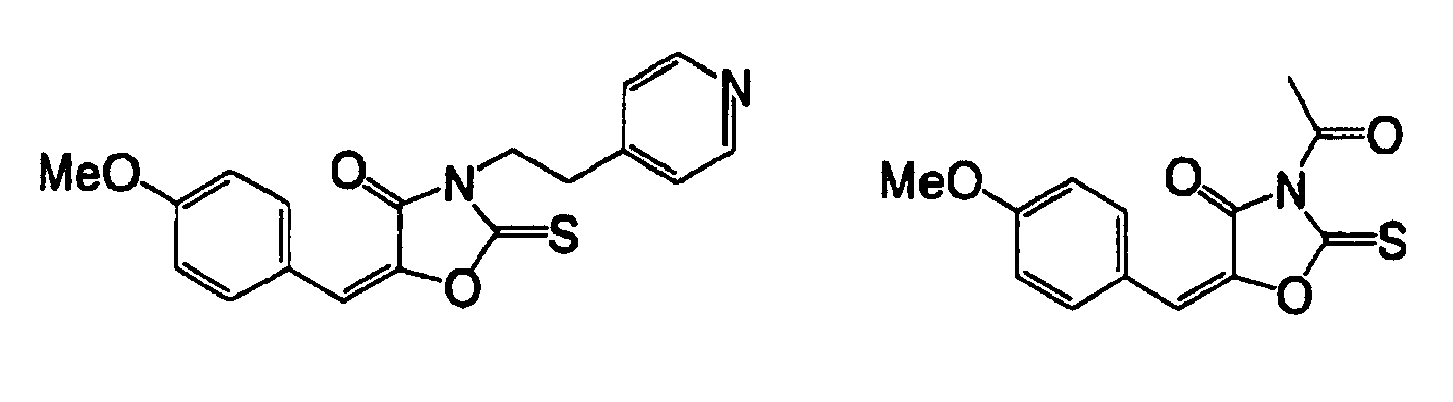


- The sensitizing dyes may be preferably used alone or two or more kinds of the sensitizing dyes may be preferably used in combination in the invention.
- In general, the amount of the sensitizing dye in the invention is preferably 0.05 to 30 parts by mass, more preferably 0.1 to 20 parts by mass, and even more preferably 0.2 to 10 parts by mass, relative to 100 parts by mass of the total solid content in the coating liquid. Co-initiator
- The coating liquid of the invention may contain a co-initiator in order to improve the sensitivity. Examples to be used for the co-initiator include halogenated hydrocarbon compounds (halogenated hydrocarbon derivatives), ketone compounds, ketoxime compounds, organic peroxides, thio compounds, hexaaryl biimidazoles, aromatic onium salts, and oxime ethers.
- These co-initiators may be used alone or two or more kinds of them may be used in combination.
- The amount of the co-initiator to be used is preferably 0.1 to 50% by mass and more preferably 0.5 to 30% by mass relative to the total solid content of the coating liquid. Polymerization Inhibitor
- A small amount of a polymerization inhibitor may be added to the coating liquid of the invention in order to inhibit unnecessary thermal polymerization of the addition polymerizable compound during the preparation of the coating liquid or the storage of the coating liquid.
- Examples of polymerization inhibitors which may be preferably used in the invention include hydroquinone, p-methoxyphenol, di-tert-butyl-p-cresol, pyrogallol, tert-butylcatechol, benzoquinone, 4,4'-thiobis(3-methyl-6-tert-buylphenol), 2,2'-methylenebis(4-methyl-6-tert-butylphenol), N-nitrosophenylhydroxyamine aluminum salt, N-nitrosophenylhydroxyamine cerium (III) salt.
- These polymerization inhibitors may be used alone or two or more kinds of them may be used in combination.
- The unnecessary thermal polymerization of the addition polymerizable compound can be inhibited by dissolved oxygen and the polymerization inhibitor in the coating liquid. Therefore, unnecessary thermal polymerization can be prevented during the time from the preparation of the coating liquid to the application of the coating liquid to the support by adjusting the amount of the dissolved oxygen and the amount of the polymerization inhibitor in good balance in the coating liquid.
- In the invention, the addition amount of the polymerization initiator is preferably about 0.01% by mass to about 5% by mass relative to the total solid content of the coating liquid. Binder Polymer
- It is preferable to add a binder polymer to the coating liquid of the invention to improve the film property of the photosensitive layer.
- As the binder polymer, conventionally known binders can be used without limitation and linear organic polymers having film formability are preferable. Examples such binder polymers include acrylic resins, polyvinyl acetal resins, polyurethane resins, polyurea resins polyimide resins, polyamide resins, epoxy resins, methacrylic resins, polystyrene resins, novolak-based phenyl resins, polyester resins, synthetic rubber, and natural rubber.
- The binder polymer preferably has cross-linking capability in order to improve the coating strength of image parts. To provide the binder polymer with the cross-linking capability, a cross-linking functional group such as ethylenic unsaturated bond may be introduced into the main chain or side chains of the polymer. The cross-linking functional group may be introduced by copolymerization or by polymer reaction.
- Herein, the cross-linking group is a group for cross-linking the binder polymer during the radical polymerization reaction caused in the photosensitive layer when the planographic printing plate precursor is exposed. Any group having such function can be used without limitation and examples of functional groups reactive in the addition polymerization reaction include an ethylenic unsaturated bond group, an amino group, and an epoxy group. The cross-linking group may be a functional group to be radical by light radiation and examples of such cross-linking groups include a thiol group, a halogen group, and an onium salt structure. Among them, the ethylenic unsaturated bond group is preferable and functional groups represented by the following formulae (1) to (3) are particularly preferable.

- In formula (1), R1 to R3 each independently represent a monovalent organic group.
- R1 is preferably a hydrogen atom, an alkyl group which may have a substituent, or the like. Among them, R1 is more preferably a hydrogen atom or a methyl group, due to high radical reactivity.
- R2 and R3 each independently represent a hydrogen atom, a halogen atom, an amino group, a carboxyl group, an alkoxycarbonyl group, a sulfo group, a nitro group, a cyano group, an alkyl group which may have a substituted, an aryl group which may have a substituent, an alkoxy group which may have a substituent, an aryloxy group which may have a substituent, an alkylamino group which may have a substituent, an arylamino group which may have a substituent, an alkylsulfonyl group which may have a substituent, or arylsulfonyl group which may have a substituent. Among them, a hydrogen atom, a carboxyl group, an alkoxycarbonyl group, an alkyl group which may have a substituent, and aryl group which may have a substituent are particularly preferable due to high radical reactivity.
- X represents an oxygen atom, a sulfur atom, or -N(R12)-, and R12 represents a hydrogen atom or a monovalent organic group. Herein, R12 may be, for example, an alkyl group which may have a substituent, or the like, and particularly preferably a hydrogen atom, a methyl group, an ethyl group, or an isopropyl group due to high radical reactivity.
- Herein, examples of the substituent to be introduced into include an alkyl group, an alkenyl group, an alkinyl group, an aryl group, an alkoxy group, an aryloxy group, a halogen atom, an amino group, an alkylamino group, an arylamino group, a carboxyl group, an alkoxycarbonyl group, a sulfo group, a nitro group, a cyano group, an amido group, an alkylsulfonyl group, and an arylsulfonyl group.
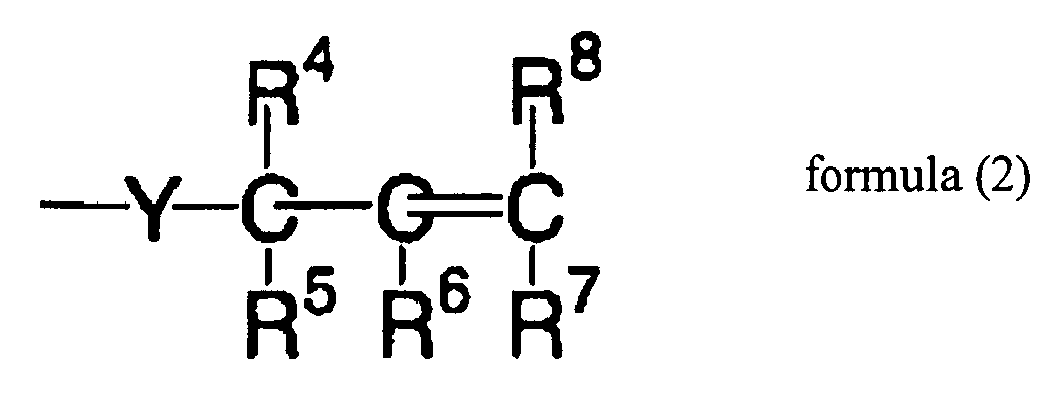
- In the above-mentioned formula (2), R4 to R8 each independently represent a monovalent organic group. R4 to R8 each preferably represent a hydrogen atom, a halogen atom, an amino group, a dialkylamino group, a carboxyl group, an alkoxycarbonyl group, a sulfo group, a nitro group, a cyano group, an alkyl group which may have a substituent, an aryl group which may have a substituent, an alkoxy gruop which may have a substituent, an aryloxy group which may have a substituent, an alkylamino group which may have a substituent, an arylamino group which may have a substituent, an alkylsulfonyl group which may have a substituent, or an arylsulfonyl group which may have a substituent, and among them, a hydrogen atom, a carboxyl group, an alkoxycarbonyl group, an alkyl group which may have a substituent, and aryl group which may have a substituent are particularly preferable due to high radical reactivity.
- The substituent to be introduced thereinto may be same as those exemplified in formula (1). Y represents an oxygen atom, a sulfur atom, or -N(R12)-, and R12 represents the same as described for R12 in formula (1) and preferable examples are also same.

- In the above-mentioned formula (3), R9 preferably represents a hydrogen atom, or an alkyl group which may have a substituent, or the like, and more preferably a hydrogen atom and a methyl due to high radical reactivity. R10 and R11 each independently represent a hydrogen atom, a halogen atom, an amino group, a dialkylamino group, a carboxyl group, an alkoxycarbonyl group, a sulfo group, a nitro group, a cyano group, an alkyl group which may have a substituent, an aryl group which may have a substituent, an alkoxy group which may have a substituent, an aryloxy group which may have a substituent, an alkylamino group which may have a substituent, an arylamino group which may have a substituent, an alkylsulfonyl group which may have a substituent, or an arylsulfonyl group which may have a substituent, and among them, a hydrogen atom, a carboxyl group, an alkoxycarbonyl group, an alkyl group which may have a substituent, and an aryl group which may have a substituent are preferable due to high radical reactivity.
- The substituent to be introduced into may be same as those exemplified in formula (1). Z represents an oxygen atom, a sulfur atom, and -N(R13)- or a phenylene group which may have a substituent. R13 represents, for example, an alkyl group which may have a substituent or the like, and preferably a methyl group, an ethyl group, or an isopropyl group due to high radical reactivity.
- Since the binder polymer having the above-mentioned cross-linking group in the side chains of the invention preferably has a function as a coating forming agent for the photosensitive layer and is preferably soluble in a developer, preferably an alkaline developer, the binder polymer is preferably an organic high molecular weight polymer which is soluble in an alkaline water or has swelling property. Therefore, the binder polymer of the invention preferably has an alkali-soluble group, e.g. a carboxyl group, other than the cross-linking group in the side chains.
- In the case where the binder polymer has the cross-linking group in the side chains is a water-soluble organic high molecular weight polymer, development with water is made possible.
- Examples of the binder polymer in the invention include those described in
JP-A Nos. 59-53836 59-71048 - Examples of the binder polymer in the invention further include polyurethanes having the above-mentioned cross-linking group and a carboxyl group in the side chains, cellulose derivatives having the above-mentioned cross-linking group and a carboxyl group, and compounds having the above-mentioned cross-linking group obtained by adding cyclic acid anhydrides to an addition polymer having a hydroxyl are preferable.
- Among them, (meth)acrylic acid copolymers and polyurethanes are more preferable. Particularly, polyurethane resins are preferable since they can suppress development damages of the exposed parts and provide good stain resistance without decreasing the developability of non-exposure parts even if the acid value of the photosensitive layer is low.
- Hereinafter, the polyurethane resins having a cross-linking group in the side chains will be described more in detail.
- The polyurethane resins having a cross-linking group in the side chains which may be preferably used in the invention are produced by addition polymerization reaction of (i) a diisocyanate compound, (ii) a diol compound having a carboxyl group, (iii) a diisocyanate compound having a cross-linking group, and if necessary (iv) a diol compound having no carboxyl group.
- Hereinafter, the diisocyanate compound and the diol compound, which are raw materials for the polyurethane resins will be described.
- Examples of the diisocyanate compound include diisocyanate compounds represented by the following formula (4).
OCN-L-NCO (4)
- In formula (4), L represents a divalent aliphatic or aromatic hydrocarbon group which may have a substituent. If necessary, the groups represented by L may have other functional groups not reactive with an isocyanate group, such as a carbonyl group, an ester group, an urethane group, an amido group, and an ureido group. More specifically, L represents a single bond or a divalent aliphatic or aromatic hydrocarbon group which may have a substituent (for example, an alkyl group, an aralkyl group, an aryl group, an alkoxy group, and a halogeno group). L represents preferably an alkylene group having 1 to 20 carbon atoms and an arylene group having 6 to 15 carbon atoms; and more preferably an alkylene group having 1 to 8 carbon atoms. If necessary, the groups represented by L may have other functional groups not reactive with an isocyanate group, such as a carbonyl group, an ester group, an urethane group, an amido group, an ureido group, and an ether group.
- Specific examples include aromatic diisocyanate compounds such as 2,4-tolylene diisocyanate, 2,4-tolylene diisocyanate dimer, 2,6-tolylene diisocyanate, p-xylylene diisocyanate, m-xylylene diisocyanate, 4,4'-diphenylmethane diisocyanate, 1,5-naphthylene diisocyanate, and 3,3'-diemethylbiphenyl-4,4'-diisocyanate; aliphatic diisocyanate compounds such as hexamethylene diisocyanate, trimethylhexamethylene diisocyanate, lysine diisocyanate, and dimmer acid diisocyanate; alicyclic diisocyanate compounds such as isophorone diisocyanate, 4,4'-methylenebis(cyclohexyl isocyanate), methylcyclohexane-2,4 (or 2,6)-diisocyanate, and 1,3-(isocyanatomethyl)cyclohexane; and diisocyanate compounds which are reaction products of diols and diisocyanates such as adducts of 1 mole of 1,3-butylene glycol and 2 mole of tolylene diisocyanate.
- The diisocyanate compounds may be used alone or two or more kinds may be used in combination. From the viewpoint of stain resistance, two or more kinds of the diisocyanate compounds are preferably used in combination, and it is particularly preferable to use each one kind of aromatic diisocyanate compounds (L is an aromatic group) and aliphatic diisocyanate compounds (L is an aliphatic group) in combination.
- The amount of the diisocyanate compound to be used is preferably 0.8 to 1.2 and more preferably 0.9 to 1.1 by mole ratio relative to the diol compound. In the case the diisocyanate compound is used in an excessive amount to the diol compound, and isocyanate group remains in the polymer terminals, it is preferable to treat the product obtained after polyurethane reaction with an alcohol or amine so as to carry out synthesis of the final product without a remaining diisocyanate group.
- Examples of the diol compound having at least one carboxyl group include diol compounds represented by the following formulae (5), (6), and (7) and/or compounds obtained ring-opening reaction of tetracarboxylic acid dianhydrides with diol compounds. Diol compounds to be used for ring-opening reaction of carboxylic acid dianhydrides may also be used as the diol compounds having at least one carboxylic group.


- In the formulae, R1 represents a hydrogen atom or an alkyl, aralkyl, aryl, alkoxy, or aryloxy group which may have a substituent (examples of the substituent include a cyano group, a nitro group, a halogen (-F, -Cl, -Br, and -I), -CONH2, -COOR113, -OR113, -NHCONHR113, -NHCOOR113, -NHCOR113, -OCONHR113 (wherein R113 represents an alkyl group having 1 to 10 carbon atoms or an aralkyl group having 7 to 15 carbon atoms)), and preferably represents a hydrogen atom, an alkyl group having 1 to 8 carbon atoms, or an aryl group having 6 to 15 carbon atoms. L10, L11, and L12 may be the same or different one another and independently represent a single bond or a divalent aliphatic or aromatic hydrocarbon group which may have a substituent (preferable examples of the substituents include an alkyl group, an aralkyl group, an aryl group, an alkoxy group, and a halogeno groups); preferably represent an alkylene group having 1 to 20 carbon atoms or an arylene group having 6 to 15 carbon atoms; and more preferably represents an alkylene group having 1 to 8 carbon atoms. Further, if necessary, the groups represented by L10, L11, and L12 may have other functional groups not reactive with an isocyanate group, such as carbonyl, ester, urethane, amido, and ureido. Additionally, two or three among R1, L10, L11, and L12 may form a ring. Ar represents ad trivalent aromatic hydrocarbon group which may have a substituent and preferably represents an aromatic group having 6 to 15 carbon atoms.
- Specific examples of the carboxyl-containing diol compounds represented by formulae (5), (6), and (7) include following compounds,
- That is, 3,5-dihydroxybenzoic acid, 2,2-bis(hydroxymethyl)propionic acid, 2,2-bis(2-hydroxyethyl)propionic acid, 2,2-bis(3-hydroxypropyl)propionic acid, bis(hydroxymethyl)acetic acid, bis(4-hydroxyphenyl)acetic acid, 2,2-bis(hydroxyphenyl)butyric acid, 4,4-bis(4-hydroxyphenyl)pentanoic acid, tartaric acid, N,N-dihydroxyethylglycine, and N,N-bis(2-hydroxyethyl)-3-carboxy-propionamide.
- Further, examples of the tetracarboxylic acid dianhydride preferably used in production of at least one kind of diol compounds having at least one carboxyl group include those represented by the following formulae (8), (9), and (10).


- In the formulae, L21 represents a single bond, a divalent aliphatic or aromatic hydrocarbon group which may have a substituent (preferable examples of the substituents include an alkyl group, an aralkyl group, an aryl group, an alkoxy group, a halogeno group, an ester group, an amide group), -CO-, -SO-, -SO2-, -O-, or -S-; and preferably represents a single bond, a divalent aliphatic hydrocarbon group having 1 to 15 carbon atoms, -CO-, -SO2-, -O-, or -S-. R2 and R3 may be the same or different and each independently represent a hydrogen atom, an alkyl, an aralkyl, an aryl, an alkoxy, or a halogeno group and preferably represent a hydrogen atom, an alkyl group having 1 to 8 carbon atoms, an aryl group having 6 to 15 carbon atoms, an alkoxy group having 1 to 8 carbon atoms, or a halogeno group. Two of L21, R2, and R3 may be bonded with each other to form a ring. R4 and R5 may be the same or different and each independently represent a hydrogen atom, an alkyl group, an aralkyl group, an aryl group, or a halogeno group, and preferably represent a hydrogen atom, an alkyl group having 1 to 8 carbon atoms, or an aryl group having 6 to 15 carbon atoms. Two of L21, R4, and R5 may be bonded with each other to form a ring. L22 and L23 may be same or different and independently represent a single bond, a double bond, or a divalent aliphatic hydrocarbon group, and preferably represent a single bond, a double bond or a methylene group. A represents a single nucleus or polynucleus aromatic ring, and preferably represents an aromatic ring having 6 to 18 carbon atoms.
- Specific examples of the compounds represented by formulae (8), (9), and (10) include the following compounds.
- That is, aromatic tetracarboxylic acid dianhydride such as pyromellitic acid dianhydride, 3,3',4,4'-benzophenonetetracarboxylic acid dianhydride, 3,3',4,4'-diphenyltetracarboxylic acid dianhydride, 2,3,6,7-naphthalenetetracarboxylic acid dianhydride, 1,4,5,8-naphthalenetetracarboxylic acid dianhydride, 4,4'-sulfonyldiphthalic acid dianhydride, 2,2-bis(3,4-dicarboxyphenyl)propane dianhydride, bis(3,4-dicarboxyphenyl) ether dianhydride, 4,4'-[3,3'-(alkylphosphoryldiphenylene)-bis(iminocarbonyl)]diphthalic acid dianhydride, adduct of hydroquinone diacetate and trimellitic acid anhydride, and adduct of diacetyldiamine and trimellitic acid anhydride; alicyclic tetracarboxylic acid dianhydride such as 5-(2,5-dioxotetrahydrofuryl)-3-methyl-3-cyclohexene-1,2-dicarboxylic acid anhydride (EPICLON B-4400, manufactured by Dainippon Ink and Chemicals, Inc.), 1,2,3,4-cyclopentanetetracarboxylic acid dianhydride, 1,2,4,5-cyclopentanetetracarboxylic acid dianhydride, and tetrahydrofurancarboxylic acid dianhydride; and aliphatic tetracarboxylic acid dianhydride such as 1,2,3,4-butanetetracarboxylic acid dianhydride, and 1,2,4,5-pentatetracarboxylic acid dianhydride.
- (ii) At least one kind of the diol compounds having at least one carboxyl can be synthesized by ring-opening these tetracarboxylic acid dianhydride with diol compounds. However, it is also possible to synthesize polyurethane resin of the invention by at first carrying out reaction of a diol compound and (i) a diisocyanate compound and successively carrying out reaction of the reaction product and a tetracarboxylic acid dianhydride exemplified above and this method also within a scope of the invention. That is, there are the following methods of introducing a structure unit derived from a tetracarboxylic acid dianhydride and a diol compound into a polyurethane resin:
- a) a method of causing a reaction of a compound having alcohol terminal, which is obtained by ring-opening a tetracarboxylic acid dianhydride with a diol compound, and a diisocyanate compound: and
- b) a method of causing a reaction of an urethane compound having alcohol terminal, which is obtained by reaction of a diisocyanate compound and an excessive amount of a diol compound, and a tetracarboxylic acid dianhydride.
- A compound represented by formula (5) is more preferable among the above-mentioned diol compounds having at least one carboxyl group since it has a high solvent-solubility and is easy to be synthesized.
- The diol compounds having at least one carboxyl group are introduced into the polyurethane resin binder in an amount to satisfy the ratio of carboxyl group per 1 g of polyurethane reins binder in a range of 0.2 to 4.0 meq/g, preferably 0.3 to 3.0 meq/g, more preferably 0.4 to 2.0 meq/g, furthermore preferably 0.5 to 1.5 meq/g, and even more preferably 0.6 to 1.2 meq/g. Accordingly, although it depends on the number of carboxyl groups, what kind diol is used as other diol components, the acid value and molecular weight of the polyurethane resin binder to be obtained, the composition and the pH of a developer, the content of the structure derived from at least one kind of diol compounds having at least one carboxyl group in the polyurethane resin binder is in a range of 5 to 45% by mole, preferably 10 to 40% by mole, and even more preferably 15 to 35% by mole.
- Examples of the diisocyanate compound having a cross-linking group include a product obtained by addition reaction of a triisocyanate compound with an equimolecular amount of a monofunctional alcohol or amine compound having cross-linking group.
- Specific examples of the triisocyanate compound include the following compounds, however it should not be limited to these compounds.


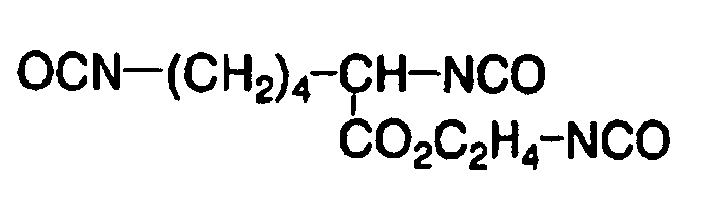

- Examples of the monofunctional alcohol or amine compound having a cross-linking group include the following compounds, however it should not be limited to these compounds.
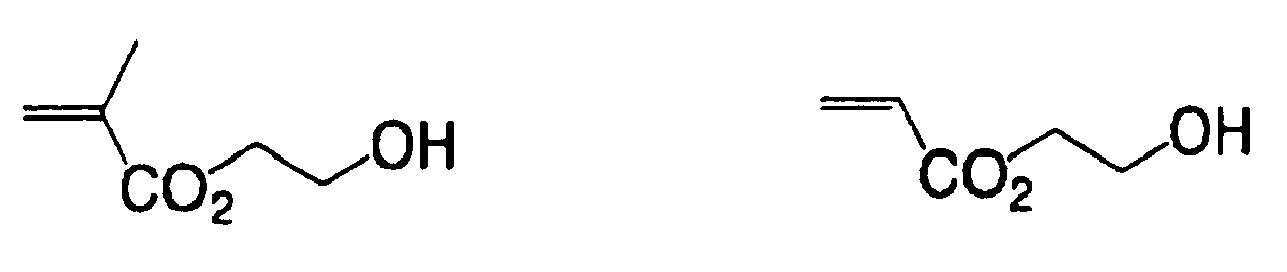


- n represents an integer from 2 to 10


- Herein, a method of introducing the cross-linking group into the side chains of the polyurethane resin is preferably a method of using a diisocyanate compound having a cross-linking group in the side chain as a raw material for polyurethane resin production. Examples of the diisocyanate compound having a cross-linking group in the side chain obtained by addition reaction of a triisocyanate compound with an equimolecular amount of a monofunctional alcohol or amine compound having a cross-linking group include the following compounds, however it should not be limited to these compounds.


- Beside the above-mentioned methods, a method of using a diol compound having an unsaturated group in the side chain as a raw material of the polyurethane resin production is also preferable for the method of introducing the unsaturated group into the side chains of the polyurethane resin. Examples of such diol compounds include commercially available ones such as trimethylolpropane monoallyl ether and compounds easily produced by reaction of a halogenated diol compound, triol compound, or aminodiol compound with a carboxylic acid having an unsaturated group, an acid chloride, an isocyanate, an alcohol, an amine, a thiol, or an alkyl halide. Specific examples of these diol compounds include the following compounds, however they should not be limited to them.


- Further, as other diol compounds, ethylene glycol compounds represented by the following formula (A') may be used.
HO-(CH2CH2O)n-H (A')
- In formula (A'), n represents an integer of 1 or higher.
- As other diol compounds, random copolymers and block copolymers of ethylene oxide and propylene oxide having hydroxyl at terminals may also be used.
- Further, ethylene oxide adducts of bisphenol A (the addition number of ethylene oxide is from 27 to 100), ethylene oxide adducts of bisphenol F (the addition number of ethylene oxide is from 22 to 100), ethylene oxide adducts of hydrogenated bisphenol A (the addition number of ethylene oxide is from 23 to 100), and ethylene oxide adducts of hydrogenated bisphenol F (the addition number of ethylene oxide is from 18 to 100) may also be used. More specifically, ethylene glycol compounds represented by formula (A') are preferable from the viewpoint of the stain resistance and ethylene glycol compounds with n in a range of 2 to 50 are preferable, ethylene glycol compounds with n in a range of 3 to 30 are more preferable, and ethylene glycol compounds with n in a range of 4 to 10 is even more preferable.
- Diol compounds represented by the following formula (16), (17), or (18) may be preferably used.

HO-CH2-C≡C-CH2-OH (17)
HO-CH2-CH=CH-CH2-OH (18)
- In the formula, R7 and R8 may be the same or different and each independently represent an alkyl group which may have a substituent, and preferably an alkyl group having 1 to 10 carbon atoms which may have a substituent such as a cyano group, a nitro group, a halogen atom (-F, -Cl, -Br, -I), -CONH2-, -COOR, -OR (wherein, R may be the same or different and represents an alkyl group having 1 to 10 carbon atoms, an aryl group having 7 to 15 carbon atoms, and an aralkyl group).
- Specific examples of the diol compounds represented by formula (16) include the following compound.


- Examples of the diol compounds represented by formula (17) include 2-butene-1,4-diol, and examples of the diol compound represented by formula (18) include cis-2-butene-1,4-diol and trans-2-butene-1,4-diol.
- Diol compounds represented by the following formulae (19) and (20) may be preferably used.
HO-L8-NH-CO-L9-CO-NH-L8-OH (19)
HO-L9-CO-NH-L8-OH (20)
- In the formulae, L8 and L9 may be the same or different and independently represent a divalent aliphatic hydrocarbon group, aromatic hydrocarbon group, or a heterocyclic group which may have a substituent, and examples of the substituent include an alkyl, an aralkyl, an aryl, an alkoxy, an aryloxy, and a halogen atom (-F, -Cl, -Br, -I). If necessary, L8 and L9 may include another functional group not reactive with the isocyanate group, such as a carbonyl group, an ester group, an urethane group, an amido group, or an ureido group. L8 and L9 may be bonded to each other to form a ring.
- Diol compounds represented by the following formulae (21) and (22) may be preferably used.
HO-Ar2-(L16-Ar3)n-OH (21)
HO-Ar2-L16-OH (22)
- In the formulae, L16 represents a divalent aliphatic hydrocarbon group which may have a substituent (examples of the substituent include an alkyl group, an aralkyl group, an aryl group, an alkoxy group, an aryloxy group, and a halogeno group). If necessary, L16 may include another functional group not reactive with the isocyanate group, such as an ester group, an urethane group, an amido group, or an ureido group.
- Ar2 and Ar3 may be the same or different and each independently represent a divalent aromatic hydrocarbon group which may have a substituent, and preferably an aromatic group having 6 to 15 carbon atoms. The reference character n represents an integer from 0 to 10.
- Specific examples of the diol compounds represented by formula (21) or (22) include the following compounds.
- That is, catechol, resorcin, hydroquinone, 4-methylcatechol, 4-tert-butylcetechol, acetylcatechol, 3-methoxycetechol, 4-phenylcetechol, 4-methylresorcin, 4-ethylresorcin, 4-tert-butylresorcin, 4-hexylresorcin, 4-chlororesorcin, 4-benzylresorcin, 4-acetylresorcin, 4-carbomethoxyresorcin, 2-methylresorcin, 5-methylresorcin, tert-butylhydroquinone, 2,5-di-tert-butylhydroquinone, 2,5-di-tert-amylhdyroquinone, tetramethylhydroquinone, tetrachlorohydroquinone, methylcarboaminohydroquinone, methylureidohydroquinone, methylthiohydroquinone, bezonorbornene-3,6-diol, bisphenol A, bisphenol S, 3,3'-dichlorobisphenol S, 4,4'-dihydroxybenzophenone, 4,4'-dihydroxybiphenyl, 4,4'-thiodiphenol, 2,2'-dihydroxydiphenylmethane, 3,4-bis(p-hydroxyphenyl)hexane, 1,4-bis(2-(p-hydroxyphenyl)propyl)benzene, bis(4-hydroxyphenyl)methylamine, 1,3-dihydroxynaphthalene, 1,4-dihydroxynaphthalene, 1,5-dihydroxynaphthalene, 2,6-dihydroxynaphthalene, 1,5-dehydroxyanthraquinone, 2-hydroxybenzyl alcohol, 4-hydroxybenzyl alcohol, 2-hydroxy-3,5-di-tert-butylbenzyl alcohol, 4-hydroxy-3,5-di-tert-butylbenzyl alcohol, 4-hydroxyphenethyl alcohol, 2-hydroxyethyl-4-hydroxybenzoate, 2-hydroxyethyl-4-hydroxyphenyl acetate, resorcin mono-2-hydroxyethyl ether, and the like.
- Besides the above-mentioned polyurethane resins obtained by introducing the cross-linking group into the side chains at the time of synthesizing polyurethanes, as the binder polymer in the invention, polyurethane resins obtained by introducing the cross-linking group into a polyurethane having a carboxyl group by polymer reaction as described in
JP-A No. 2003-270775 - The molecular weight of the binder polymer to be used in the invention may properly be determined taking into account the image formability and stain resistance. The molecular weight is preferably in a range from 2,000 to 1,000,000, more preferably in a range from 5,000 to 500,000, and even more preferably in a range from 10,000 and 200,000.
- The binder polymer to be used in the invention may be used alone or two or more kinds of binder polymers may be used in combination. The binder polymer may be used in form of a mixture of one or more kinds of binder polymers having a cross-linking group and one or more kinds of binder polymers having no cross-linking group in combination. As binder polymers to be used in combination, conventionally known alkali-soluble or swelling binders may be used without particular limitation, and specifically binders having the acryl-based main chain and urethane binders commonly used in this field are preferable.
- The content of the binder polymer is generally 20 to 80% by mass and preferably 25 to 75% by mass relative to the total solid content in the coating liquid.
- The ratio of the addition polymerizable compound and the binder polymer is preferably (1/9) to (7/3) and more preferably (3/7) to (5/5) as a ratio by weight. Other Components
- The coating liquid in the invention may contain a dye or a pigment in order to color the photosensitive layer.
- Examples of coloring agents to be used include pigments such as phthalocyanine-based pigments, azo-based pigments, carbon black, and titanium oxide; Ethyl Violet, Crystal Violet, azo-based dyes, anthraquinone-based dyes, and cyanine-based dyes. The addition amount of the dye and the pigment is preferably about 0.5% by mass to about 5% by mass relative to the total composition.
- In the coating liquid in the invention, an inorganic filler as well as conventionally known additives such as a plasticizer may be added to improve the physical properties of a cured film of the photosensitive layer.
- The plasticizer may be, for example, dioctyl phthalate, didodecyl phthalate, triethylene glycol dicaprylate, dimethyl glycol phthalate, tricresyl phosphate, dioctyl adipate, dibutyl sebacate, and triacetyl glycerin. In the case of using a binder, the plasticizer may be added in an amount of 10% by mass or less relative total mass of the ethylenic compound, the binder and the plasticizer.
- In the invention, if necessary, a higher fatty acid derivative such as behenic acid or behenic acid amide may be added to the coating liquid to prevent polymerization inhibition by oxygen and accordingly is allowed to remain in the surface of the photosensitive layer during the drying step after application. The addition amount of the higher fatty acid derivative is preferably about 0.5% by mass to about 10% by mass relative to the total composition.
- The coating liquid in the invention may further contain an UV initiator and a thermal cross-linking agent for emphasizing the effect of heating and exposure after development in order to improve the film strength (stain resistance), which will be described later.
- Besides, the coating liquid may contain other additives for improving adhesiveness between the photosensitive layer and a support and the developer removable property of the unexposed photosensitive layer. Examples of these additives includes compounds having a diazonium structure and compounds having relatively strong mutual action with the support such as phosphonic acid compounds. Further, hydrophilic polymers such as poly(acrylic acid) and polysulfonic acid may be added to improve the developability of the non-image parts and stain resistance. Organic Solvent
- An organic solvent is used for dissolving the above-mentioned respective components for the coating liquid of the invention. Examples of the organic solvent to be used in the invention include acetone, methyl ethyl ketone, cyclohexane, ethyl acetate, ethylene dichloride, tetrahydrofuran, toluene, ethylene glycol monomethyl ether, ethylene glycol monoethyl ether, ethylene glycol dimethyl ether, propylene glycol monomethyl ether, propylene glycol monoethyl ether, acetylacetone, cyclohexane, dieacetone alcohol, ethylene glycol monomethyl ether acetate, ethylene glycol ethyl ether acetate, ethylene glycol monoisopropyl ether, ethylene glycol monobutyl ether acetate, 3-methoxypropanol, methoxymethoxyethanol, diethylene glycol monomethyl ether, diethylene glycol monoethyl ether, diethylene glycol dimethyl ether, diethylene glycol diethyl ether, propylene glycol monomethyl ether acetate, propylene glycol monoethyl ether acetate, 3-methoxypropyl acetate, N,N-dimethylformamide, dimethyl sulfoxide, γ-butyrolactone, methyl lactate, and ethyl lactate.
- These organic solvents may be used alone or in form of a mixture.
- The concentration of the solid content in the coating liquid is properly in a range of 2 to 50% by weight.
- In the invention, a photosensitive layer can be formed by applying the coating liquid containing the above-mentioned components to a support. The coating amount of the photosensitive layer on the support is preferably adjusted properly depending on the use since it affects mainly on the sensitivity and the developability of the photosensitive layer, and the strength and the stain resistance of the exposed film. In the case where the coating amount is too small, the stain resistance becomes insufficient. On the other hand, it is too much, the sensitivity is decreased and it takes a long time for exposure and also for development treatment and therefore, it is not preferable.
- The coating amount by weight of the planographic printing plate precursor to be obtained in the invention is preferably in a range of about 0.1 g/m2 to about 10 g/m2 and more preferably from 0.5 to 5 g/m2 after drying.
- The support to be used in the invention is preferably those having a hydrophilic face on which the above-mentioned photosensitive layer is to be formed. As the hydrophilic support, conventionally known hydrophilic supports to be used for planographic printing plates can be used without limitation. The support to be used is preferably a plate-shaped material having good dimension stability and examples thereof include paper, paper on which plastics (e.g. polyethylene, polypropylene, and polystyrene) are laminated, metal plates (e.g. of aluminum, zinc, and copper), plastic films (e.g. of cellulose diacetate, cellulose triacetate, cellulose propionate, cellulose butyrate, cellulose acetate butyrate, cellulose nitrate poly(ethylene terephthalate), polyethylene, polystyrene, polypropylene, polycarbonate, and polyvinyl acetal), paper or plastic films on which a metal is laminated or vapor deposited; and the surfaces of these materials may be subjected to conventionally known proper physical and chemical treatment to provide hydrophilicity, improve the strength or the like if necessary.
- Preferable examples of the support include paper, a polyester film, and an aluminum plate, and among them, an aluminum plate is more preferable since it is excellent in dimension stability, relatively economical, and may have a surface with good hydrophilicity and strength by surface treatment carried out based on necessity. Also, a composite sheet obtained by bonding an aluminum sheet on a poly(ethylene terephthalate) film as described in
JP-B No. 48-18327 - Examples of preferable aluminum plate include a pure aluminum plate and an alloy plate containing mainly aluminum and a trace amount of different elements. A plastic film on which aluminum is laminated or vapor deposited is also preferable. The different elements contained in the aluminum alloy may be silicon, iron, manganese, copper, magnesium, chromium, zinc, bismuth, nickel, and titanium. The content of the different elements in the alloy is at highest 10% by mass or less. In the invention, pure aluminum is particularly preferably as the aluminum plate, however it is difficult to produce completely pure aluminum in terms of refining technique, and therefore aluminum may contain a trace amount of different elements. As described, the aluminum plate to be used in the invention is not particularly limited in the composition and conventionally known and employed aluminum plate may properly be used.
- The thickness of the aluminum plate to be used in the invention is about 0.1 mm to 0.6 mm, preferably 0.15 mm to 0.4 mm, and more preferably 0.2 mm to 0.3 mm.
- In the case where the support has a surface of a metal, particularly, aluminum, it is preferable to carry out surface treatment, e.g. surface roughening (graining) treatment, immersion treatment in an aqueous solution of sodium silicate, potassium fluorozirconate, or a phosphate, or anodization treatment.
- The surface roughening treatment of the aluminum plate may be carried out by a variety of methods and for example, it may be carried out by a method for mechanical surface-roughening, an electrochemical method for dissolving and roughening the surface, and a method for chemically selectively dissolving the surface. As the mechanical methods any conventional method such as a ball grinding method, a brush grinding method, a blast grinding method, a buff grinding method or the like may be uised. As the electrochemical surface-roughening method, a method carried out by applying a.c. or d.c. voltage in an electrolytic solution such as hydrochloric acid, nitric acid, or the like may be used. Also, as disclosed in
JP-A No. 54-63902 - Further, an aluminum plate which has been subjected to immersion treatment in an aqueous sodium silicate solution after surface roughening may preferably be used. Also, as described in
JP-B No. 47-5125 US Patent No. 3,658,662 is also effective. - Further, use of a support subjected to electrolytic grain treatment disclosed in
JP-B No. 46-27481 JP-A Nos. 52-58602 52-30503 - Those subjected successively to mechanical surface-roughening, chemical etching, electrolytic grain treatment, anodization, and sodium silicate treatment as disclosed in
JP-A No. 56-28893 - Further, after being subjected to these treatments, those which are under-coated with a water-soluble resin such as polyvinyl phosphonic acid and polymers and copolymers having a sulfonic acid group in the side chains, poly(acrylic acid), a water-soluble metal salt (e.g. zinc borate), yellow dye, or an amine salt are also preferable.
- Further, a substrate which has been subjected to sol-gel treatment of forming conjugation bond of a functional group capable of causing addition reaction by radical as described in
JP-A No. 5-304358 - Additionally, a support obtained by forming a water-proof hydrophilic layer as a surface layer on any support can be exemplified as a preferable example. Such a surface layer may be layers containing inorganic pigments and binders as described in
US Patent No. 3,055,295 andJP-A No. 56-13168 JP-A No. 9-80744 JP-A No. 8-507727 - These hydrophilic treatments carried out to make the surface of the support hydrophilic, and are carried out also to prevent an adverse reaction of the photosensitive layer to be formed thereon and to improve the adhesion strength of the photosensitive layer.
- If necessary, a back coat may be formed on the rear face of the support.
- As the back coat, a coating layer containing an organic high molecular weight compound described in
JP-A No. 5-45885 JP-A No. 6-35174 - Since alkoxy compounds of silicon such as Si(OCH3)4, Si(OC2H5)4, Si(OC3H7)4, and Si(OC4H9)4 are economical and easily available, coating layers containing metal oxides derived from these alkoxy compounds are excellent in development resistance and therefore particularly preferable among these coating layers. Protective Layer
- An embodiment of the invention may be a scanning a planographic plate precursor, and it is preferable to provide a protective layer on the photosensitive layer in the scanning planographic plate precursor to enable exposure of the precursor in an atmosphere. The protective layer prevents low molecular-weight compounds which inhibit image forming reaction caused by exposure of the photosensitive layer, such as oxygen and basic substances existing in an atmosphere, from entering the photosensitive layer, which makes it possible to conduct exposure in an atmosphere. Accordingly, a property which the protective layer is required to have is that the permeating property of the low molecular weight compounds such as oxygen in the protective layer is low. Moreover, it is preferable that the protective layer does not substantially inhibit light used to expose the planographic printing plate precursor from passing through the protective layer, has strong adhesion between the protective layer and the photosensitive layer, and can be easy to remove in the development step of an exposed printing plate. Devices relating to a protective layer satisfying the above demands have been conventionally implemented, as detailed in
U.S. Patent No. 3,458,311 andJP-B No. 55-49729 - The material of the protective layer is preferably a relatively good crystalline, water-soluble and high molecular weight compound. Specifically, water-soluble polymers such as polyvinyl alcohol, polyvinyl pyrrolidone, acidic celluloses, gelatin, gum arabic and polyacrylic acid are known as such. However, use of polyvinyl alcohol as the main component of the protective layer is effective in obtaining best basic characteristics such as an oxygen-blocking property and removability during development. Polyvinyl alcohol used in the protective layer may be partly substituted with ester, ether and/or acetal, insofar as it contains an unsubstituted vinyl alcohol unit for achieving an oxygen-blocking property and water-solubility, which are essential to the protective layer. In addition, a part thereof may have other copolymerizing component.
- The polyvinyl alcohol can be one which have been hydrolyzed in a proportion of 71 to 100% and which have a molecular weight in the range of 300 to 2,400. Specific examples of such polyvinyl alcohol include PVA-105, PVA-110, PVA-117, PVA-117H, PVA-120, PVA-124, PVA-124H, PVA-CS, PVA-CST, PVA-HC, PVA-203, PVA-204, PVA-205, PVA-210, PVA-217, PVA-220, PVA-224, PVA-217EE, PVA-217E, PVA-220E, PVA-224E, PVA-405, PVA-420, PVA-613, and L-8 manufactured by Kuraray Co., Ltd.
- The components of the protective layer (kind of PVA, and use of other additives) and the amounts thereof are determined according to a desired oxygen-blocking property, removability during development, fogging property, adhesiveness, and scratch resistance of the protective layer. Generally, the higher the hydrolysis rate of the PVA (the higher the content of unsubstituted vinyl alcohol units in the protective layer), the better the oxygen-blocking property of the protective layer and the sensitivity of the printing plate precursor. Moreover, the thicker the protective layer, the better the oxygen-blocking property of the protective layer and the sensitivity of the printing plate precursor. However, extreme rising of the oxygen-blocking property may lead to undesirable polymerization reaction during production and storage, and fogging, which is undesired, and thickening of image lines during image exposure. Adhesion between the protective layer and the image portions and scratch resistance of the protective layer are also very important in handling printing plates. When a printing plate has a hydrophilic layer made of a water-soluble polymer and laminated on a photosensitive layer, which is oleophilic, these layers insufficiently adhere to each other, which causes the hydrophilic layer to often and undesirably separate from the printing plate. Portions of the printing plate having no protective layer are exposed to air, and oxygen included in the air inhibits polymerization in the photosensitive layer, generating defects such as insufficient hardening of the photosensitive layer. In order to solve this problem, various methods for improving adhesion between the two layers have been proposed. For example, certain U.S. Patents disclose that a hydrophilic layer having strong adhesion between a photosensitive layer and the hydrophilic layer can be obtained by adding 20 to 60 % by mass of an acrylic emulsion or a water-insoluble vinylpyrrolidone-vinyl acetate copolymer to a hydrophilic polymer mainly containing polyvinyl alcohol and applying the resulting composition onto a photosensitive layer.
- These conventionally known techniques may be applied to the protective layer used in the invention. Methods of forming such a protective layer are detailed in, for example,
U.S. Patent No. 3,458,311 andJP-B No. 55-49729 - Further, the protection layer may have another function. For example, addition of a coloring agent (e.g. a water-soluble dye) excellent in transmission of light at wavelength in a range of 350 nm to 450 nm which is used for exposure, and capable of efficiently absorbing light at wavelength of 500 nm or longer increases the safe light suitability without deterioration of the sensitivity.
- The planographic printing plate precursor obtained by the invention may have an undercoat layer between the photosensitive layer and the support to improve adhesiveness between the photosensitive layer and the support and increase the developer removable property in the unexposed region of the photosensitive layer.
- A compound capable of causing mutual action with the support may be used for the undercoat layer and specific examples thereof include compounds having a diazonium structure and phosphonic compounds. To improve the property to remove the non-image part region, it is preferable to use hydrophilic polymers such as poly(acrylic acid) and poly(sulfonic acid) for the undercoat layer.
- The plate making method using the planographic printing plate precursor obtained by the method of producing a planographic printing plate precursor of the invention will be described.
- The planographic printing plate precursor obtained in the above-mentioned manner shows excellent properties for plate making, particularly by scanning exposure.
- A general method of scanning exposure is described in Yoshisuke TAKEKIDA, Optical Printer Design, Triceps (1985). That is, using light in form of beam (normally having a radius from several micron to several tens micron) as a light source, main scanning of a printing plate precursor is carried out in a certain direction and simultaneously auxiliary scanning (laser scanning) is carried out perpendicularly to the direction to expose the entire plate precursor and at the time, corresponding to the image information, on/off of the exposure is controlled to carry out image-wise exposure. To carry out image exposure with higher resolution, it is required to use beam with a smaller radius and in that case, to draw an image in the entire plate with a large surface area within a short time, it is required to increase the scanning speed and/or to increase the number of beams. In the case where specific exposure duration is to be guaranteed in a scanning exposure system, the exposure time at respective points on the printing plate precursor is generally as short as micro second or shorter. Therefore, it is required to use a continuously oscillating high power light source for supplying a sufficient exposure energy amount to the sensitive material for the printing plate precursor.
- Presently, various laser beams capable of continuously oscillating in visible light region to infrared ray region (e.g. Ar, FD-YAG, He-Ne, LD, and YAG) are used as such a light source and in terms of the balance between the sensitivity and the power of economical and easily available laser, a visible light source of Ar ion laser (488 nm) and FD-YAG (532 nm) with an output power of about several ten to several hundred W can be selected.
- With respect to the planographic printing plate precursor obtained by the invention, the type and the wavelength of the light source may properly be selected depending on the type of the photosensitive composition forming the photosensitive layer and for example, it is possible to carry out scanning exposure by using a light source with shorter wavelength (blue and/or ultraviolet laser), a light source with longer wavelength (red, and infrared laser), or other light sources. Particularly, in these years, short wavelength semiconductor laser (blue and/or ultraviolet laser) using a GaN-based material has actively been developed. The planographic printing plate precursor of the invention may be preferably used for scanning exposure with such laser.
- After the planographic printing plate precursor obtained in the invention is image-wise exposed, unexposed parts in the photosensitive layer are removed by a developer to obtain an image.
- As a preferable developer, those described in
JP-B No. 57-7427 - Such aqueous alkaline solutions may contain a small amount of a surfactant and an organic solvent such as a benzyl alcohol, 2-phenoxyethanol, and 2-butoxyethanol based on the necessity. Examples thereof include those described in
US Patent Nos. 3,375,171 and3,615,480 . Further, developers described inJP-A Nos. 50-26601 58-54341 JP-B Nos. 56-39464 56-42860 - The planographic printing plate which has been subjected to the development in the above-mentioned manner is preferably subjected to post-treatment with washing water, a rinsing solution containing a surfactant, or a solution insensible to fats and oils containing gum arabic or a starch derivative.
- If necessary, the print making process may include heating the entire surface before exposure, during exposure, or during the time from exposure to development. Heating promotes the image formation reaction in the photosensitive layer and causes advantageous effects such as improvement of sensitivity and stain resistance and stabilization of the sensitivity. Further, it is also effective to carry out post-heating of the entire surface or entire surface exposure to the image after development in order to improve the image strength and stain resistance. In general, heating before development is preferably carried out in a moderate condition at 150°C or lower. If the temperature is too high, it may results in a problem of fogging in the non-image parts. Heating after development may be carried out under very strong condition. It is generally at a temperature in a range of 200 to 500°C. If the temperature is too low, no sufficient image strengthening effect can be caused and if it is too high, a problem such as deterioration of the support or thermal decomposition of the image parts may possible be caused.
- The planographic printing plate obtained by the above-mentioned treatment is employed in an off-set printer to carry out printing in a large number of printing sheets.
- The invention will be described more in detail along with examples. However, it is not intended that the invention be limited to the described examples.
- After a 1 S web-shaped aluminum plate with a thickness of 0.30 mm was etched by immersing it in 10% sodium hydroxide at 70°C for 60 seconds, the plate was washed with flowing water, rinsed and neutralized with 20% HNO3, and washed with water. The plate was electrolytically surface-roughened by applying alternating current in sinusoidal waveform at VA = 12.7 V in an aqueous 1% nitric acid solution and an electric quantity when the aluminum plate served as an anode was 300 C/dm2. The surface roughness was measured to find it was 0.45 µm (based on Ra).
- Successively, after the plate was immersed in an aqueous 30% H2SO4 solution and subjected to desmutting treatment at 55°C for 2 minutes, the plate was anodized at a current density of 5A/dm2 for 50 seconds in an aqueous 20% H2SO4 solution at 33°C by setting a cathode in the grained face to form an anodized film with a thickness of 2.7 g/m2. The anodized film in the rear face was about 0.2 g/m2 in the center part and about 0.5 g/m2 in the edge part of the aluminum plate.
- The rear face of the substrate treated in the above-mentioned manner was coated with the following coating liquid for a back coat layer formation using sol-gel reaction liquid and dried until the temperature of the aluminum plate reached 60°C, and after that, a support having a back coat layer of the coating liquid in an amount of 50 mg/m2 was produced.
<Sol-gel reaction liquid> tetraethylsilicate 50 parts by mass water 20 parts by mass methanol 10 parts by mass phosphoric acid 0.07 parts by mass - When the above-mentioned components were stirred, heat generation began in about 5 minutes. After 30-minute reaction, the following liquid was added to prepare the coating liquid for the back coat.
pyrogallol formaldehyde condensation resin (molecular weight (Mw) 2000) 4 parts by mass dimethyl phthalate 5 parts by mass methanol 1000 parts by mass - An undercoat layer was formed on the aluminum plate treated in the above-mentioned manner and having the back coat layer by the following method.
- At first, the following liquid composition for the undercoat was mixed and stirred at 30°C. After about 5 minutes, heat generation occurred and the composition was reacted for 60 minutes and successively, the content was transferred to another container and 10000 parts by mass of methanol was added to prepare a coating liquid for the undercoat layer.
- Thereafter, the obtained coating liquid for the undercoat layer was applied to the above-mentioned aluminum plate while the coating amount was adjusted to be 0.1 g/m2 and the aluminum plate was dried until the temperature of the aluminum plate reached 70°C and then the aluminum plate was cooled to 50°C or lower to form the undercoat layer.
<Liquid composition for undercoat> compound of the following structure (formula (E2)) 96 parts by mass methanol 100 parts by mass water 14 parts by mass phosphoric acid (85% aqueous solution) 11 parts by mass tetraethoxysilane 36 parts by mass 3-methacryloxypropyltrimethoxysilane 50 parts by mass 
- In formula (E2), n represents an integer from 4 to 20.
- A coating liquid for a photosensitive layer with the following composition was prepared as a coating liquid in the method of producing the photosensitive planographic printing plate precursor of the invention. In the
liquid preparation tank 10 as shown in Fig. 1, the coating liquid for the photosensitive layer in theliquid preparation tank 10 was controlled by thecontrol part 22 to be at 23.0°C to 27.9°C and the dissolved oxygen amount in the coating liquid was controlled by thecontrol part 22 to be 8.0 mg/l or higher, that is the dissolved oxygen amount was controlled not to be less than 8.0 mg/l. - More specifically, the
control part 22 obtains the measurement result measured at every prescribed period by the dissolvedoxygen meter 24 and determines whether the measurement result is less than an alarming amount, 8.2 mg/l, or not. Themotor 30 is controlled by thecontrol part 22 so as to start stirring of the coating liquid stored in theliquid preparation tank 10 by the stirringmember 26 when the result is found less than the alarming amount. By controlling in the above-mentioned manner, the dissolved oxygen amount was kept equal to or higher than 8.0 mg/l in the coating liquid in theliquid preparation tank 10. - After that, the coating liquid in the
liquid preparation tank 10 was transferred to thestock tank 12 and circulated in thestock tank 12 to keep the dissolved oxygen amount equal to 8.0 mg/l or higher. - More specifically, the
control part 22 obtains the measurement result measured at every prescribed period by the dissolvedoxygen meter 25, and determines whether the measurement result is less than an alarming amount, 8.2 mg/l, or not. Thecirculation pump 36 is controlled by thecontrol part 22 so as to operate when the result was found less than the alarming amount. By controlling in the above-mentioned manner, the dissolved oxygen amount was kept equal to or higher than 8.0 mg/l in the coating liquid in thestock tank 12. - The coating liquid stored in the
stock tank 12 was supplied to acoating apparatus 16 via areservoir 14. - The coating liquid was applied to the undercoat layer formed as described in a proper amount to control the dried coating amount to be 1.4 g/m2 and dried until the temperature of the aluminum plate reached 100°C, and after that, the aluminum plate was cooled to 50°C and thus the photosensitive layer was formed.
- The coating liquid for the photosensitive layer in the Example 1 was kept at 26°C for 120 hours from the time of preparation to the time of application.
<Coating liquid for photosensitive layer> polymerizable compound (polymerizable compound A shown below) 4.5 parts by mass binder polymer (binder polymer B shown below) 5.3 parts by mass sensitizing dye (sensitizing dye C shown below) 0.4 parts by mass polymerization initiator (polymerization initiator D shown below) 0.9 parts by mass chain transferring agent (chain transfer agent E shown below) 0.5 parts by mass ε-phthalocyanine pigment dispersion (pigment: 15 parts by mass; allyl methacrylate/methacrylic acid copolymer dispersant (copolymerization ratio by mole 83/18): 10 parts by mass; cyclohexanone: 15 parts by mass) 0.9 parts by mass fluorine-based nonionic surfactant (trade name: MEGAFACE F 780, manufactured by Dainippon Ink and Chemicals, Inc.) 0.02 parts by mass thermal polymerization inhibitor: N-nitrosophenylhydroxylamine aluminum salt 0.03 parts by mass methyl ethyl ketone 58 parts by mass propylene glycol monomethyl ether acetate 53 parts by weight - The structures of the respective components of the coating liquid for the photosensitive layer are shown as follows.


- A coating liquid for an overcoat layer with the following composition was applied to the obtained photosensitive layer in a proper amount to control the dried coating amount to be 2.2 g/m2 and dried until the crystallization degree of the polyvinyl alcohol to be 0.45 and after that, the aluminum plate was cooled to 50°C or lower.
<Coating liquid for overcoat layer> polyvinyl alcohol (PVA-105 manufactured by Kuraray Co., Ltd.; saponification degree 98% by mole; polymerization degree 500) 20 parts by mass polyvinylpyrrolidone (trade name: K 30, manufactured by Wako Pure Chemical Industries, Ltd.)2 parts by mass nonionic surfactant (trade name: EMAREX NP-10, manufactured by Nihon Emulsion Co., Ltd.) 0.5 parts by mass distilled water 360 parts by mass - After that, the water content in the overcoat layer was adjusted to be 4.0% and successively the resultant plate was once rolled in form of a web roll. While the following interleaf paper was attached to the web roll, the plate was cut in a sheet to obtain a photosensitive planographic printing plate precursor.
- While the water content in the overcoat layer was measured by an infrared component measurement meter (IRM-V, manufactured by Chino Co., Ltd.), the production was carried out and when the water content was out of the prescribed range, the moisture was adjusted so as to keep water content at 4.0% by a temperature and humidity control apparatus (not illustrated).
- Bleached kraft pulp was beaten and distilled to 4% concentration. The paper material was mixed with 0.4% by mass of a synthesized sizing agent, and further, aluminum sulfate was added thereto until pH reached 5.0. A paper reinforcing agent mainly containing starch was applied in an amount of 3.0% by mass to the resulting paper material and paper making was carried out to obtain paper of 38 g/m2 with a density 0.75 g/m2, smoothness of 25 seconds, a water content of 6.0% by mass.
- A photopolymerizable planographic printing plate precursor was produced in the same manner as in Example 1, except that after the preparation of the coating liquid for the photosensitive layer, only the stirring was carried out in the
liquid preparation tank 10 and after the transfer to thestock tank 12, the circulating of the coating liquid in thestock tank 12 was not carried out and the dissolved oxygen concentration was kept at 8.0 mg/l or higher. - A photopolymerizable planographic printing plate precursor was produced in the same manner as in Example 1, except that after the preparation of the coating liquid for the photosensitive layer, the stirring was not carried out in the
liquid preparation tank 10 and after the transfer to thestock tank 12, only the circulating of the coating liquid in thestock tank 12 was carried out and the dissolved oxygen concentration was kept at 8.0 mg/l or higher. - A photopolymerizable photosensitive planographic printing plate precursor was produced in the same manner as in Example 1, except that after the preparation of the coating liquid for the photosensitive layer, neither stirring in the
liquid preparation tank 10 nor circulating of the coating liquid in thestock tank 12 was carried out, and the coating liquid was applied before the dissolved oxygen concentration was lowered to less than 8.0 mg/l. The duration from the preparation to the application was determined based on the time when the dissolved oxygen concentration became lower than 8.0 mg/l calculated previously from the dissolved oxygen decreasing speed after the coating liquid preparation. Also, it was confirmed that the dissolved oxygen concentration in the coating liquid immediately before coating was 8.0 mg/l by a dissolved oxygen meter. - The coating liquid for the photosensitive layer in Example 4 was kept at 26°C for 24 hours from the time of preparation to the time of application.
- A photopolymerizable planographic printing plate precursor was produced in the same manner as in Example 1, except that after the preparation of the coating liquid for the photosensitive layer, air was injected into the coating liquid for the photosensitive layer to control the dissolved oxygen concentration to be 8.0 mg/l or higher and lower than 10.0 mg/l.
- A photopolymerizable planographic printing plate precursor was produced in the same manner as in Example 1, except that after the preparation of the coating liquid for the photosensitive layer, the coating liquid was applied to the support after the dissolved oxygen concentration to be lower than 8.0 mg/l.
- Each of the photopolymerizable planographic printing plate precursors produced in Examples 1 to 5 and Comparative Example 1 was image-wise exposed at 909 dpi under the condition of 100 line/inch while the exposure dose on the photopolymerizable photosensitive planographic printing plate precursor was controlled to be 0.05 mJ/cm2 by using Vx 9600 CTP (light source wavelength: 405 nm; manufactured by Fuji Photo Film Co., Ltd).
- After the exposure, the resulting plate was subjected to post-heating treatment, and then, washed with water. After that the plate was subjected to standard development treatment with a developer DV-2 diluted solution (DV-2 : water = 1 : 4, manufactured by Fuji Photo Film Co., Ltd.) and finishing gum solution FN-6 (FN-6 : water = 1 : 3, manufactured by Fuji Photo Film Co., Ltd.) by an automated developing machine FLP 125NFS manufactured by Fuji Photo Film Co., Ltd.. The developer temperature was 25°C and the immersion duration in the developer was about 22 seconds.
- For measuring the sensitivity, 50% halftone dot surface area was measured by using Macbeth densitometer RD 920. The closer the result to 50%, the higher the sensitivity and the better the halftone dot reproducibility. The results are shown in the following Table 1. Evaluation of Developability
- The developability in the non-image parts of each planographic printing plate obtained by the above-mentioned exposure and development treatments was observed. Developability means whether the unexposed parts in the photosensitive layer are removed or not. "A" shows the unexposed parts were found not being colored with the remaining photosensitive layer with visual observation. "B" shows the unexposed parts were found being colored because of the remaining photosensitive layer with visual observation. The results are shown in the following Table 1.
- Stain resistance was evaluated after printing was carried out on 1000 sheets by using each planographic printing plate obtained by the above-mentioned exposure and development treatments, a printing apparatus (trade name: Lithron, manufactured by KOMORI Corporation), black ink DIC-GEOS (N) manufactured by Dainippon Ink and Chemicals, Inc., and an etching solution EU-3/water/isopropyl alcohol = 1/89/10 (by volume) manufactured by Fuji Photo Film Co., Ltd.
- In the case where the ink was deposited on an originally blank portion at the time of printing, "B" was marked, and in the case where stain-free and excellent printing was obtained, "A" was marked.
Table 1 50% Halftone Dot Sensitivity Developability Stain Resistance Example 1 50% A A Example 2 50% A A Example 3 50% A A Example 4 50% A A Example 5 50% A A Comparative Example 1 60% B B - According to Table 1, photosensitive planographic printing plate precursors of Examples 1 to 5 produced by the production method of the invention were found excellent in all of sensitivity, developability, and stain resistance as compared with the photosensitive planographic printing plate precursor of Comparative Example 1 in which the coating liquid was applied after the dissolved oxygen concentration became less than 8.0 mg/l.
- According an aspect of the invention, a method of producing a planograpnic printing plate precursor having uniform developability and excellent staining resistance can be provided.
- Hereinafter, embodiments of the present invention will be described. However, the invention is not limited to the following embodiments.
- According to an aspect of the invention, there is provided a method of producing a photosensitive planographic printing plate precursor comprising:
- preparing a coating liquid by dissolving at least a compound having an addition polymerizable ethylenic double bond and a polymerization initiator in an organic solvent; and
- applying the coating liquid to a support,
- In an embodiment, the prescribed amount may be 8.0 mg/l.
- In an embodiment, the compound having an addition polymerizable ethylenic double bond may be a compound having two or more terminal polymerizable ethylenic double bonds.
- In an embodiment, the compound having the addition polymerizable ethylenic double bond may be contained in the coating liquid in an amount of 20 to 80% by mass relative to the total solid content of the coating liquid.
- In an embodiment, the polymerization initiator may be a hexaaryl biimidazole compound, a compound having a carbon-halogen bond, an onium compound, or a metallocene compound.
- In an embodiment, the polymerization initiator may be contained in the coating liquid in an amount of 0.01 to 1.0% by mass relative to the total solid content of the coating liquid.
- In an embodiment, the coating liquid may further contain a sensitizing dye.
- In an embodiment, the sensitizing dye may be contained in the coating liquid in an amount of 0.05 to 30% by mass relative to the total solid content of the coating liquid.
- In an embodiment, the coating liquid may further contain co-initiator selected from the group consisting of halogenated hydrocarbon compounds, ketone compounds, ketoxime compounds, organic peroxides, thio compounds, hexaaryl biimidazoles, aromatic onium compounds, and oxime ethers.
- In an embodiment, the production method of a photosensitive planographic printing plate precursor may further comprise supplying oxygen to the coating liquid by stirring the coating liquid.
- In an embodiment, the production method of a photosensitive planographic printing plate precursor may further comprise supplying oxygen to the coating liquid by circulating the coating liquid.
- In an embodiment, the production method of a photosensitive planographic printing plate precursor may further comprise supplying oxygen to the coating liquid by injecting air into the coating liquid.
- The foregoing description of the embodiments of the present invention has been provided for the purposes of illustration and description. It is not intended to be exhaustive or to limit the invention to the precise forms disclosed. Obviously, many modifications and variations will be apparent to practitioners skilled in the art. The embodiments were chosen and described in order to best explain the principles of the invention and its practical applications, thereby enabling others skilled in the art to understand the invention for various embodiments and with the various modifications as are suited to the particular use contemplated. It is intended that the scope of the invention be defined by the following claims and their equivalents.
- All publications, patent applications, and technical standards mentioned in this specification are herein incorporated by reference to the same extent as if each individual publication, patent application, or technical standard was specifically and individually indicated to be incorporated by reference.
Claims (12)
- A method of producing a photosensitive planographic printing plate precursor comprising:preparing a coating liquid by dissolving at least a compound having an addition polymerizable ethylenic double bond and a polymerization initiator in an organic solvent; andapplying the coating liquid to a support,wherein a dissolved oxygen content in the coating liquid from the preparation of the coating liquid to the application of the coating liquid to the support is kept at a prescribed amount or higher.
- The method of producing a photosensitive planographic printing plate precursor of claim 1, wherein the prescribed amount is 8.0 mg/l.
- The method of producing a photosensitive planographic printing plate precursor of claim 1, wherein the compound having an addition polymerizable ethylenic double bond is a compound having two or more terminal polymerizable ethylenic double bonds.
- The method of producing a photosensitive planographic printing plate precursor of claim 1, wherein the compound having the addition polymerizable ethylenic double bond is contained in the coating liquid in an amount of 20 to 80% by mass relative to the total solid content of the coating liquid.
- The method of producing a photosensitive planographic printing plate precursor of claim 1, wherein the polymerization initiator is a hexaaryl biimidazole compound, a compound having a carbon-halogen bond, an onium compound, or a metallocene compound.
- The method of producing a photosensitive planographic printing plate precursor of claim 1, wherein the polymerization initiator is contained in the coating liquid in an amount of 0.01 to 1.0% by mass relative to the total solid content of the coating liquid.
- The method of producing a photosensitive planographic printing plate precursor of claim 1, wherein the coating liquid further contains a sensitizing dye.
- The method of producing a photosensitive planographic printing plate precursor of claim 7, wherein the sensitizing dye is contained in the coating liquid in an amount of 0.05 to 30% by mass relative to the total solid content of the coating liquid.
- The method of producing a photosensitive planographic printing plate precursor of claim 1, wherein the coating liquid further contains a co-initiator selected from the group consisting of halogenated hydrocarbon compounds, ketone compounds, ketoxime compounds, organic peroxides, thio compounds, hexaaryl biimidazoles, aromatic onium compounds, and oxime ethers.
- The method of producing a photosensitive planographic printing plate precursor of claim 1, further comprising supplying oxygen to the coating liquid by stirring the coating liquid.
- The method of producing a photosensitive planographic printing plate precursor of claim 1, further comprising supplying oxygen to the coating liquid by circulating the coating liquid.
- The method of producing a photosensitive planographic printing plate precursor of claim 1, further comprising supplying oxygen to the coating liquid by injecting air into the coating liquid.
Applications Claiming Priority (1)
| Application Number | Priority Date | Filing Date | Title |
|---|---|---|---|
| JP2005278766A JP4694330B2 (en) | 2005-09-26 | 2005-09-26 | Method for producing photosensitive lithographic printing plate |
Publications (3)
| Publication Number | Publication Date |
|---|---|
| EP1767995A2 true EP1767995A2 (en) | 2007-03-28 |
| EP1767995A3 EP1767995A3 (en) | 2007-04-04 |
| EP1767995B1 EP1767995B1 (en) | 2014-01-22 |
Family
ID=37714541
Family Applications (1)
| Application Number | Title | Priority Date | Filing Date |
|---|---|---|---|
| EP06016331.8A Not-in-force EP1767995B1 (en) | 2005-09-26 | 2006-08-04 | Method of producing photosensitive planographic printing plate precursor |
Country Status (3)
| Country | Link |
|---|---|
| US (1) | US20070072126A1 (en) |
| EP (1) | EP1767995B1 (en) |
| JP (1) | JP4694330B2 (en) |
Cited By (2)
| Publication number | Priority date | Publication date | Assignee | Title |
|---|---|---|---|---|
| CN108089411A (en) * | 2018-01-26 | 2018-05-29 | 江西鼎峰电子科技股份有限公司 | Automatic adjustment detection plus the anti-closure plate developing machine of alarm |
| US11897725B2 (en) | 2014-11-24 | 2024-02-13 | Otis Elevator Company | Adjustment of drop rate of elevator car with electromagnetic brake system |
Families Citing this family (3)
| Publication number | Priority date | Publication date | Assignee | Title |
|---|---|---|---|---|
| JP5485604B2 (en) * | 2008-07-16 | 2014-05-07 | 株式会社日本触媒 | Methylene lactone monomer and storage method thereof |
| US9817315B2 (en) * | 2014-03-13 | 2017-11-14 | Taiwan Semiconductor Manufacturing Co., Ltd. | System and method for supplying and dispensing bubble-free photolithography chemical solutions |
| GB2641573A (en) * | 2024-06-07 | 2025-12-10 | Thermo Fisher Scient Bremen Gmbh | Liquid separation mass spectrometer system |
Family Cites Families (7)
| Publication number | Priority date | Publication date | Assignee | Title |
|---|---|---|---|---|
| DE19944073A1 (en) * | 1999-09-14 | 2001-03-15 | Agfa Gevaert Ag | Radiation sensitive recording material with top layer |
| JP2003107726A (en) * | 2001-09-27 | 2003-04-09 | Fuji Photo Film Co Ltd | Photopolymerization type planographic printing plate manufacturing device and manufacturing method for photopolymerization type planographic printing plate using the same |
| JP4049701B2 (en) * | 2003-04-23 | 2008-02-20 | 三菱レイヨン株式会社 | Method for producing dope |
| US7455954B2 (en) * | 2003-07-31 | 2008-11-25 | Fujifilm Corporation | Lithographic printing plate precursor and polymerizable composition |
| JP2005171093A (en) * | 2003-12-11 | 2005-06-30 | Maruzen Petrochem Co Ltd | Method for producing copolymer for semiconductor lithography and copolymer for semiconductor lithography obtained by the method |
| JP4401262B2 (en) * | 2004-02-02 | 2010-01-20 | 富士フイルム株式会社 | Planographic printing plate precursor |
| JP2006171019A (en) * | 2004-12-10 | 2006-06-29 | Fuji Photo Film Co Ltd | Method for producing pattern forming material, and pattern forming material |
-
2005
- 2005-09-26 JP JP2005278766A patent/JP4694330B2/en not_active Expired - Fee Related
-
2006
- 2006-08-04 EP EP06016331.8A patent/EP1767995B1/en not_active Not-in-force
- 2006-09-13 US US11/519,859 patent/US20070072126A1/en not_active Abandoned
Non-Patent Citations (1)
| Title |
|---|
| None |
Cited By (3)
| Publication number | Priority date | Publication date | Assignee | Title |
|---|---|---|---|---|
| US11897725B2 (en) | 2014-11-24 | 2024-02-13 | Otis Elevator Company | Adjustment of drop rate of elevator car with electromagnetic brake system |
| CN108089411A (en) * | 2018-01-26 | 2018-05-29 | 江西鼎峰电子科技股份有限公司 | Automatic adjustment detection plus the anti-closure plate developing machine of alarm |
| CN108089411B (en) * | 2018-01-26 | 2023-08-25 | 江西尼罗电器有限责任公司 | Automatic adjusting, detecting, alarming and anti-blocking plate developing machine |
Also Published As
| Publication number | Publication date |
|---|---|
| JP4694330B2 (en) | 2011-06-08 |
| EP1767995B1 (en) | 2014-01-22 |
| JP2007086691A (en) | 2007-04-05 |
| EP1767995A3 (en) | 2007-04-04 |
| US20070072126A1 (en) | 2007-03-29 |
Similar Documents
| Publication | Publication Date | Title |
|---|---|---|
| JP4460986B2 (en) | Preparation method of lithographic printing plate | |
| JP4469734B2 (en) | Planographic printing plate precursor | |
| AU2009230020B2 (en) | Process for producing lithographic printing plate | |
| JP2001033961A (en) | Photosensitive composition and method for forming lithographic printing plate | |
| JP4418725B2 (en) | Planographic printing plate precursor | |
| WO2010021364A1 (en) | Process for producing lithographic printing plate | |
| JP5228631B2 (en) | Lithographic printing plate developing treatment solution and method for preparing a lithographic printing plate | |
| JP4457034B2 (en) | Photosensitive planographic printing plate | |
| JP2009075426A (en) | Photosensitive planographic printing plate | |
| EP1767995B1 (en) | Method of producing photosensitive planographic printing plate precursor | |
| EP1630604A2 (en) | Photosensitive lithographic printing plate | |
| JP5422134B2 (en) | Automatic development method for immersion lithographic printing plates | |
| JP4461045B2 (en) | Photosensitive planographic printing plate | |
| JP4505354B2 (en) | Plate making method of negative planographic printing plate precursor | |
| EP2128704B1 (en) | Processing Liquid for Lithographic Printing Plate Development and Method of Producing Lithographic Printing Plates | |
| JP4694324B2 (en) | Method for producing photosensitive lithographic printing plate | |
| JP4418766B2 (en) | Method for making a photosensitive lithographic printing plate | |
| JP2006215272A (en) | Lithographic printing original plate | |
| JP2005084303A (en) | Plate making method for photopolymerizable photosensitive planographic printing plate | |
| EP1975708B1 (en) | Lithographic printing plate precursor | |
| JP2013152486A (en) | Processing liquid for developing planographic printing plate and method for producing planographic printing plate | |
| JP2006276231A (en) | Photosensitive lithographic printing plate | |
| JP2008058384A (en) | Developer for photosensitive lithographic printing plate and method for producing photosensitive lithographic printing plate using the same |
Legal Events
| Date | Code | Title | Description |
|---|---|---|---|
| PUAI | Public reference made under article 153(3) epc to a published international application that has entered the european phase |
Free format text: ORIGINAL CODE: 0009012 |
|
| PUAL | Search report despatched |
Free format text: ORIGINAL CODE: 0009013 |
|
| AK | Designated contracting states |
Kind code of ref document: A2 Designated state(s): AT BE BG CH CY CZ DE DK EE ES FI FR GB GR HU IE IS IT LI LT LU LV MC NL PL PT RO SE SI SK TR |
|
| AX | Request for extension of the european patent |
Extension state: AL BA HR MK YU |
|
| AK | Designated contracting states |
Kind code of ref document: A3 Designated state(s): AT BE BG CH CY CZ DE DK EE ES FI FR GB GR HU IE IS IT LI LT LU LV MC NL PL PT RO SE SI SK TR |
|
| AX | Request for extension of the european patent |
Extension state: AL BA HR MK YU |
|
| 17P | Request for examination filed |
Effective date: 20071004 |
|
| AKX | Designation fees paid |
Designated state(s): AT BE BG CH CY CZ DE DK EE ES FI FR GB GR HU IE IS IT LI LT LU LV MC NL PL PT RO SE SI SK TR |
|
| 17Q | First examination report despatched |
Effective date: 20120828 |
|
| GRAP | Despatch of communication of intention to grant a patent |
Free format text: ORIGINAL CODE: EPIDOSNIGR1 |
|
| INTG | Intention to grant announced |
Effective date: 20130823 |
|
| RIN1 | Information on inventor provided before grant (corrected) |
Inventor name: KUWABARA, KATSUSHI |
|
| GRAS | Grant fee paid |
Free format text: ORIGINAL CODE: EPIDOSNIGR3 |
|
| GRAA | (expected) grant |
Free format text: ORIGINAL CODE: 0009210 |
|
| AK | Designated contracting states |
Kind code of ref document: B1 Designated state(s): AT BE BG CH CY CZ DE DK EE ES FI FR GB GR HU IE IS IT LI LT LU LV MC NL PL PT RO SE SI SK TR |
|
| REG | Reference to a national code |
Ref country code: GB Ref legal event code: FG4D |
|
| REG | Reference to a national code |
Ref country code: CH Ref legal event code: EP |
|
| REG | Reference to a national code |
Ref country code: AT Ref legal event code: REF Ref document number: 651058 Country of ref document: AT Kind code of ref document: T Effective date: 20140215 |
|
| REG | Reference to a national code |
Ref country code: IE Ref legal event code: FG4D |
|
| REG | Reference to a national code |
Ref country code: DE Ref legal event code: R096 Ref document number: 602006040142 Country of ref document: DE Effective date: 20140306 |
|
| REG | Reference to a national code |
Ref country code: NL Ref legal event code: VDEP Effective date: 20140122 |
|
| REG | Reference to a national code |
Ref country code: AT Ref legal event code: MK05 Ref document number: 651058 Country of ref document: AT Kind code of ref document: T Effective date: 20140122 |
|
| REG | Reference to a national code |
Ref country code: LT Ref legal event code: MG4D |
|
| PG25 | Lapsed in a contracting state [announced via postgrant information from national office to epo] |
Ref country code: LT Free format text: LAPSE BECAUSE OF FAILURE TO SUBMIT A TRANSLATION OF THE DESCRIPTION OR TO PAY THE FEE WITHIN THE PRESCRIBED TIME-LIMIT Effective date: 20140122 Ref country code: IS Free format text: LAPSE BECAUSE OF FAILURE TO SUBMIT A TRANSLATION OF THE DESCRIPTION OR TO PAY THE FEE WITHIN THE PRESCRIBED TIME-LIMIT Effective date: 20140522 |
|
| PG25 | Lapsed in a contracting state [announced via postgrant information from national office to epo] |
Ref country code: PT Free format text: LAPSE BECAUSE OF FAILURE TO SUBMIT A TRANSLATION OF THE DESCRIPTION OR TO PAY THE FEE WITHIN THE PRESCRIBED TIME-LIMIT Effective date: 20140522 Ref country code: AT Free format text: LAPSE BECAUSE OF FAILURE TO SUBMIT A TRANSLATION OF THE DESCRIPTION OR TO PAY THE FEE WITHIN THE PRESCRIBED TIME-LIMIT Effective date: 20140122 Ref country code: CY Free format text: LAPSE BECAUSE OF FAILURE TO SUBMIT A TRANSLATION OF THE DESCRIPTION OR TO PAY THE FEE WITHIN THE PRESCRIBED TIME-LIMIT Effective date: 20140122 Ref country code: SE Free format text: LAPSE BECAUSE OF FAILURE TO SUBMIT A TRANSLATION OF THE DESCRIPTION OR TO PAY THE FEE WITHIN THE PRESCRIBED TIME-LIMIT Effective date: 20140122 Ref country code: FI Free format text: LAPSE BECAUSE OF FAILURE TO SUBMIT A TRANSLATION OF THE DESCRIPTION OR TO PAY THE FEE WITHIN THE PRESCRIBED TIME-LIMIT Effective date: 20140122 Ref country code: NL Free format text: LAPSE BECAUSE OF FAILURE TO SUBMIT A TRANSLATION OF THE DESCRIPTION OR TO PAY THE FEE WITHIN THE PRESCRIBED TIME-LIMIT Effective date: 20140122 Ref country code: ES Free format text: LAPSE BECAUSE OF FAILURE TO SUBMIT A TRANSLATION OF THE DESCRIPTION OR TO PAY THE FEE WITHIN THE PRESCRIBED TIME-LIMIT Effective date: 20140122 |
|
| PG25 | Lapsed in a contracting state [announced via postgrant information from national office to epo] |
Ref country code: BE Free format text: LAPSE BECAUSE OF FAILURE TO SUBMIT A TRANSLATION OF THE DESCRIPTION OR TO PAY THE FEE WITHIN THE PRESCRIBED TIME-LIMIT Effective date: 20140122 Ref country code: LV Free format text: LAPSE BECAUSE OF FAILURE TO SUBMIT A TRANSLATION OF THE DESCRIPTION OR TO PAY THE FEE WITHIN THE PRESCRIBED TIME-LIMIT Effective date: 20140122 |
|
| REG | Reference to a national code |
Ref country code: DE Ref legal event code: R097 Ref document number: 602006040142 Country of ref document: DE |
|
| PG25 | Lapsed in a contracting state [announced via postgrant information from national office to epo] |
Ref country code: EE Free format text: LAPSE BECAUSE OF FAILURE TO SUBMIT A TRANSLATION OF THE DESCRIPTION OR TO PAY THE FEE WITHIN THE PRESCRIBED TIME-LIMIT Effective date: 20140122 Ref country code: DK Free format text: LAPSE BECAUSE OF FAILURE TO SUBMIT A TRANSLATION OF THE DESCRIPTION OR TO PAY THE FEE WITHIN THE PRESCRIBED TIME-LIMIT Effective date: 20140122 Ref country code: CZ Free format text: LAPSE BECAUSE OF FAILURE TO SUBMIT A TRANSLATION OF THE DESCRIPTION OR TO PAY THE FEE WITHIN THE PRESCRIBED TIME-LIMIT Effective date: 20140122 Ref country code: RO Free format text: LAPSE BECAUSE OF FAILURE TO SUBMIT A TRANSLATION OF THE DESCRIPTION OR TO PAY THE FEE WITHIN THE PRESCRIBED TIME-LIMIT Effective date: 20140122 |
|
| PG25 | Lapsed in a contracting state [announced via postgrant information from national office to epo] |
Ref country code: PL Free format text: LAPSE BECAUSE OF FAILURE TO SUBMIT A TRANSLATION OF THE DESCRIPTION OR TO PAY THE FEE WITHIN THE PRESCRIBED TIME-LIMIT Effective date: 20140122 Ref country code: SK Free format text: LAPSE BECAUSE OF FAILURE TO SUBMIT A TRANSLATION OF THE DESCRIPTION OR TO PAY THE FEE WITHIN THE PRESCRIBED TIME-LIMIT Effective date: 20140122 |
|
| PLBE | No opposition filed within time limit |
Free format text: ORIGINAL CODE: 0009261 |
|
| STAA | Information on the status of an ep patent application or granted ep patent |
Free format text: STATUS: NO OPPOSITION FILED WITHIN TIME LIMIT |
|
| 26N | No opposition filed |
Effective date: 20141023 |
|
| REG | Reference to a national code |
Ref country code: DE Ref legal event code: R097 Ref document number: 602006040142 Country of ref document: DE Effective date: 20141023 |
|
| PG25 | Lapsed in a contracting state [announced via postgrant information from national office to epo] |
Ref country code: LU Free format text: LAPSE BECAUSE OF FAILURE TO SUBMIT A TRANSLATION OF THE DESCRIPTION OR TO PAY THE FEE WITHIN THE PRESCRIBED TIME-LIMIT Effective date: 20140804 Ref country code: MC Free format text: LAPSE BECAUSE OF FAILURE TO SUBMIT A TRANSLATION OF THE DESCRIPTION OR TO PAY THE FEE WITHIN THE PRESCRIBED TIME-LIMIT Effective date: 20140122 |
|
| REG | Reference to a national code |
Ref country code: CH Ref legal event code: PL |
|
| PG25 | Lapsed in a contracting state [announced via postgrant information from national office to epo] |
Ref country code: CH Free format text: LAPSE BECAUSE OF NON-PAYMENT OF DUE FEES Effective date: 20140831 Ref country code: LI Free format text: LAPSE BECAUSE OF NON-PAYMENT OF DUE FEES Effective date: 20140831 |
|
| REG | Reference to a national code |
Ref country code: IE Ref legal event code: MM4A |
|
| PG25 | Lapsed in a contracting state [announced via postgrant information from national office to epo] |
Ref country code: SI Free format text: LAPSE BECAUSE OF FAILURE TO SUBMIT A TRANSLATION OF THE DESCRIPTION OR TO PAY THE FEE WITHIN THE PRESCRIBED TIME-LIMIT Effective date: 20140122 |
|
| REG | Reference to a national code |
Ref country code: FR Ref legal event code: ST Effective date: 20150430 |
|
| PG25 | Lapsed in a contracting state [announced via postgrant information from national office to epo] |
Ref country code: FR Free format text: LAPSE BECAUSE OF NON-PAYMENT OF DUE FEES Effective date: 20140901 Ref country code: IE Free format text: LAPSE BECAUSE OF NON-PAYMENT OF DUE FEES Effective date: 20140804 |
|
| PG25 | Lapsed in a contracting state [announced via postgrant information from national office to epo] |
Ref country code: BG Free format text: LAPSE BECAUSE OF FAILURE TO SUBMIT A TRANSLATION OF THE DESCRIPTION OR TO PAY THE FEE WITHIN THE PRESCRIBED TIME-LIMIT Effective date: 20140122 |
|
| PG25 | Lapsed in a contracting state [announced via postgrant information from national office to epo] |
Ref country code: IT Free format text: LAPSE BECAUSE OF FAILURE TO SUBMIT A TRANSLATION OF THE DESCRIPTION OR TO PAY THE FEE WITHIN THE PRESCRIBED TIME-LIMIT Effective date: 20140122 Ref country code: GR Free format text: LAPSE BECAUSE OF FAILURE TO SUBMIT A TRANSLATION OF THE DESCRIPTION OR TO PAY THE FEE WITHIN THE PRESCRIBED TIME-LIMIT Effective date: 20140423 |
|
| PG25 | Lapsed in a contracting state [announced via postgrant information from national office to epo] |
Ref country code: HU Free format text: LAPSE BECAUSE OF FAILURE TO SUBMIT A TRANSLATION OF THE DESCRIPTION OR TO PAY THE FEE WITHIN THE PRESCRIBED TIME-LIMIT; INVALID AB INITIO Effective date: 20060804 Ref country code: TR Free format text: LAPSE BECAUSE OF FAILURE TO SUBMIT A TRANSLATION OF THE DESCRIPTION OR TO PAY THE FEE WITHIN THE PRESCRIBED TIME-LIMIT Effective date: 20140122 |
|
| PGFP | Annual fee paid to national office [announced via postgrant information from national office to epo] |
Ref country code: DE Payment date: 20200722 Year of fee payment: 15 Ref country code: GB Payment date: 20200722 Year of fee payment: 15 |
|
| REG | Reference to a national code |
Ref country code: DE Ref legal event code: R119 Ref document number: 602006040142 Country of ref document: DE |
|
| GBPC | Gb: european patent ceased through non-payment of renewal fee |
Effective date: 20210804 |
|
| PG25 | Lapsed in a contracting state [announced via postgrant information from national office to epo] |
Ref country code: GB Free format text: LAPSE BECAUSE OF NON-PAYMENT OF DUE FEES Effective date: 20210804 Ref country code: DE Free format text: LAPSE BECAUSE OF NON-PAYMENT OF DUE FEES Effective date: 20220301 |