EP1767493A1 - Hydrogen permeation alloy and a method of manufacturing the same - Google Patents
Hydrogen permeation alloy and a method of manufacturing the same Download PDFInfo
- Publication number
- EP1767493A1 EP1767493A1 EP06018702A EP06018702A EP1767493A1 EP 1767493 A1 EP1767493 A1 EP 1767493A1 EP 06018702 A EP06018702 A EP 06018702A EP 06018702 A EP06018702 A EP 06018702A EP 1767493 A1 EP1767493 A1 EP 1767493A1
- Authority
- EP
- European Patent Office
- Prior art keywords
- hydrogen
- phase
- charge
- permeation
- alloy
- Prior art date
- Legal status (The legal status is an assumption and is not a legal conclusion. Google has not performed a legal analysis and makes no representation as to the accuracy of the status listed.)
- Granted
Links
Images

Classifications
-
- C—CHEMISTRY; METALLURGY
- C01—INORGANIC CHEMISTRY
- C01B—NON-METALLIC ELEMENTS; COMPOUNDS THEREOF; METALLOIDS OR COMPOUNDS THEREOF NOT COVERED BY SUBCLASS C01C
- C01B3/00—Hydrogen; Gaseous mixtures containing hydrogen; Separation of hydrogen from mixtures containing it; Purification of hydrogen; Reversible storage of hydrogen
- C01B3/50—Separation of hydrogen or hydrogen-containing gases from gaseous mixtures, e.g. purification
- C01B3/501—Separation of hydrogen or hydrogen-containing gases from gaseous mixtures, e.g. purification by diffusion
- C01B3/503—Separation of hydrogen or hydrogen-containing gases from gaseous mixtures, e.g. purification by diffusion characterised by membranes
-
- C—CHEMISTRY; METALLURGY
- C22—METALLURGY; FERROUS OR NON-FERROUS ALLOYS; TREATMENT OF ALLOYS OR NON-FERROUS METALS
- C22C—ALLOYS
- C22C27/00—Alloys based on rhenium or a refractory metal not mentioned in groups C22C14/00 or C22C16/00
- C22C27/02—Alloys based on vanadium, niobium, or tantalum
-
- B—PERFORMING OPERATIONS; TRANSPORTING
- B01—PHYSICAL OR CHEMICAL PROCESSES OR APPARATUS IN GENERAL
- B01D—SEPARATION
- B01D53/00—Separation of gases or vapours; Recovering vapours of volatile solvents from gases; Chemical or biological purification of waste gases, e.g. engine exhaust gases, smoke, fumes, flue gases, aerosols
- B01D53/22—Separation of gases or vapours; Recovering vapours of volatile solvents from gases; Chemical or biological purification of waste gases, e.g. engine exhaust gases, smoke, fumes, flue gases, aerosols by diffusion
- B01D53/228—Separation of gases or vapours; Recovering vapours of volatile solvents from gases; Chemical or biological purification of waste gases, e.g. engine exhaust gases, smoke, fumes, flue gases, aerosols by diffusion characterised by specific membranes
-
- B—PERFORMING OPERATIONS; TRANSPORTING
- B01—PHYSICAL OR CHEMICAL PROCESSES OR APPARATUS IN GENERAL
- B01D—SEPARATION
- B01D67/00—Processes specially adapted for manufacturing semi-permeable membranes for separation processes or apparatus
- B01D67/0039—Inorganic membrane manufacture
- B01D67/0072—Inorganic membrane manufacture by deposition from the gaseous phase, e.g. sputtering, CVD, PVD
-
- B—PERFORMING OPERATIONS; TRANSPORTING
- B01—PHYSICAL OR CHEMICAL PROCESSES OR APPARATUS IN GENERAL
- B01D—SEPARATION
- B01D71/00—Semi-permeable membranes for separation processes or apparatus characterised by the material; Manufacturing processes specially adapted therefor
- B01D71/02—Inorganic material
- B01D71/022—Metals
- B01D71/0221—Group 4 or 5 metals
-
- C—CHEMISTRY; METALLURGY
- C22—METALLURGY; FERROUS OR NON-FERROUS ALLOYS; TREATMENT OF ALLOYS OR NON-FERROUS METALS
- C22C—ALLOYS
- C22C30/00—Alloys containing less than 50% by weight of each constituent
-
- B—PERFORMING OPERATIONS; TRANSPORTING
- B01—PHYSICAL OR CHEMICAL PROCESSES OR APPARATUS IN GENERAL
- B01D—SEPARATION
- B01D2325/00—Details relating to properties of membranes
- B01D2325/20—Specific permeability or cut-off range
-
- Y—GENERAL TAGGING OF NEW TECHNOLOGICAL DEVELOPMENTS; GENERAL TAGGING OF CROSS-SECTIONAL TECHNOLOGIES SPANNING OVER SEVERAL SECTIONS OF THE IPC; TECHNICAL SUBJECTS COVERED BY FORMER USPC CROSS-REFERENCE ART COLLECTIONS [XRACs] AND DIGESTS
- Y10—TECHNICAL SUBJECTS COVERED BY FORMER USPC
- Y10S—TECHNICAL SUBJECTS COVERED BY FORMER USPC CROSS-REFERENCE ART COLLECTIONS [XRACs] AND DIGESTS
- Y10S55/00—Gas separation
- Y10S55/05—Methods of making filter
Definitions
- the present invention relates to a hydrogen permeation alloy used for hydrogen permeation membranes adopted for hydrogen separation and purification, and a method of manufacturing the same.
- High-purity hydrogen is in use for the production of semi-conductors, optical fibers and pharmaceuticals, and the use amount thereof is increasing annually. Further, hydrogen is attracting social attention as the fuel for fuel cells recently. If fuel cells are to be used in a large scale towards the future, a huge amount of high-purity hydrogen is required. Accordingly, development of the manufacturing method capable of producing a large amount of high-purity hydrogen at a low cost is desired.
- the method for mass production of hydrogen includes (1) first method based on electrolysis of water using non-fossil resources and (2) second method based on stream reforming using fossil resources.
- first method (1) based on electrolysis electrolysis of water conducted by the electricity obtained by solar power generation as the electric power source is under study, but this process is difficult to put into practice with the current technical level. Accordingly, for the time being, production of hydrogen via the second method (2), i.e., steam reforming of hydrocarbon is more realistic.
- the reaction system contains, in addition to a huge amount of hydrogen, impurities such as CO, CO 2 , H 2 O and CH 4 .
- impurities such as CO, CO 2 , H 2 O and CH 4 .
- hydrogen must be separated and purified from these impurities. Further, if the CO content in purified hydrogen is not lower than 10 ppm, damaging of the Pt electrode of the fuel cell occurs. In other words, for the utilization of hydrogen for fuel cells, purification to an extremelyhighpurity is an essential condition.
- the purification method for hydrogen includes, an absorption method, a cryogenic distillation method, an adsorption method and a membrane separation method. From the viewpoint of efficient production of high-purity hydrogen, the membrane separation method using a metal membrane is attracting attention.
- the permeation mechanism in a metal membrane is as follows.
- hydrogen molecules (H 2 ) are dissociated at the metal surface to atoms (H) in the high-pressure side whereby the atoms dissolve, diffuse in the metal.
- H atoms
- These hydrogen atoms permeate the metal membrane to the low-pressure side.
- the atoms recombine to H 2 .
- the hydrogen is purified.
- Purification of hydrogen using a metal membrane is characterized by quite large selectivity and permiability. It is possible, for example, to purify hydrogen with roughly 99% purity to an order of 99.99999%. Accordingly, for purification of high-purity hydrogen for fuel cells, the membrane separation using a metal membrane is regarded as well suited.
- V, Nb and Ta are known to have hydrogen permeation property superior to that of Pd alloys.
- hydrogen dissolves in these elements in high concentration, and thus cracking accompanied by hydrogen embrittlement readily proceeds when these elements are used in single-metal. Accordingly, it is necessary to decrease the hydrogen dissolution amount by alloying.
- incorporation of an element that enhances crack resistance causes hydrogen permeation property to deteriorate. Since no definite description is given on the kind as well as the amount of the element to be added in the JP-A-11-276866 , it is impossible to attain a practical hydrogen permeation alloy provided with excellent hydrogen permeability and crack resistance.
- Nb-based hydrogen permeation alloys are described. Though these alloys assume to be composed of a single phase, it is difficult to thrust two properties of hydrogen permeation and hydrogen embrittlement resistance, which conflict with each other, on a single phase. When one tries to suppress hydrogen embrittlement with these alloys, the hydrogen dissolution amount inevitably reduces, causing hydrogen permeability to deteriorate.
- JP-A-2004-42017 disclosesa hydrogen permeation membrane in which an alloy structure is made amorphous.
- an amorphous material tends to crystallize with the elevation of temperature, limitation on the use temperature generates.
- crystallization proceeds at lower temperatures in hydrogen than in other atmospheres since it contains an element having a strong bonding force to hydrogen.
- the Nb-Ti-Co alloy mentioned above is not provided with sufficient hydrogen permeation property, which thus must be improved.
- the (Nb, Ti) phase which forms the hydrogen permeation pass, constitutes a granular and lamellar structure.
- the portions where the (Nb, Ti) phase is disconnected acts as barriers for hydrogen permeation to lower the hydrogen permeation rate.
- the hydrogen permeation pass connecting these (Nb, Ti) phase becomes extremely long, which fact acts as a cause to lower hydrogen permeability.
- the invention which has been devised under the situations described heretofore, has objects to provide a hydrogen permeation alloy having enhanced hydrogen permeation capability by virtue of structure control and a method of manufacturing the same.
- a hydrogen permeation alloy comprises a phase in charge of hydrogen permeability, and a phase in charge of hydrogen embrittlement resistance, wherein the phase in charge of hydrogen permeability has a continuously interconnected structure.
- a growth direction of the phase in charge of hydrogen permeability lies aligned in the thickness direction of the permeation membrane.
- the hydrogen permeation alloy comprises anNb-Ti-Co alloy
- the phase in charge of hydrogen permeability comprises an (Nb, Ti) phase
- the phase in charge of hydrogen embrittlement resistance comprises a CoTi phase.
- a method of manufacturing a hydrogen permeation alloy comprising a phase in charge of hydrogen permeability and a phase in charge of hydrogen embrittlement resistance, the method comprises growing the phase in charge of hydrogen permeation at a growth rate of 50 mm/h or less to make the phase in charge of hydrogen permeation assume a continuously interconnected structure.
- the hydrogen permeation alloy of the invention excellent hydrogen permeation properties and excellent hydrogen embrittlement resistance are demonstrated in a multiphase hydrogen permeation alloy by virtue of allotting hydrogen permeability and hydrogen embrittlement resistance to different phases.
- the hydrogen permeation pass has no disconnection. Accordingly, good hydrogen permeation property can be obtained.
- the direction of such interconnection is preferably that of hydrogen permeation, in particular. Further, by aligning the growth direction of the phase in charge of hydrogen permeability in the thickness direction (which is usually the direction of hydrogen permeation) of the permeation membrane, the hydrogen permeation pass becomes short. Accordingly, good hydrogen permeation property can be obtained.
- the hydrogen permeation alloy of the present invention which is of multiphase provided with both of hydrogen permeability and hydrogen embrittlement resistance, excellent hydrogen permeability is achieved since the phase in charge of hydrogen permeation is configured in a continuously interconnected structure free of any disconnection in the hydrogen permeation pass.
- a structure in which the phase in charge of hydrogen permeation is in a continuously interconnected structure means that each phase does not exist in a granular form or in segments, whereby preferably each phase is substantially interconnected in a specified direction.
- the alloy being a multiphase hydrogen permeation alloy comprising a phase in charge of hydrogen permeability and a phase in charge of hydrogen embrittlement resistance
- the phase in charge of hydrogen permeability is grown at a growth rate of 50 mm/hr or less to form a continuously interconnected structure, thereby enabling the above-mentioned hydrogen permeation alloy to be obtained with certainty and achieving the aforementioned various advantages.
- the hydrogen permeation alloy of the invention is a multiphase hydrogen permeation alloy comprising a phase in charge of hydrogen permeability and a phase in charge of hydrogen embrittlement resistance.
- the types of these phases are not particularly restricted, but typically, in Nb-Ti-Co-based alloys, those in which the phase in charge of hydrogen permeability is an (Nb, Ti) phase and the phase in charge of hydrogen embrittlement resistanceisa CoTiphase.
- alloys represented by the general formula, Nb x Ti (100-x-y) Co y (where x ⁇ 70, 20 ⁇ y ⁇ 50, x + y ⁇ 100 (mol%)) can be mentioned as representative examples.
- the Nb content when the Nb content exceeds the range defined above, hydrogen enbrittlement is liable to occur. Thus, the Nb content preferably needs to fall under the above-mentioned range. Moreover, for the same reason, the upper limit is preferably set at 60 mol%. On the other hand, since low Nb contents fail in exhibiting sufficient hydrogen permeation property, the lower limit is preferably set at 10 mol%, and more preferably set at 21 mol%.
- Co contents not less than 20 mol% are preferred.
- contents exceeding 50 mol% increase the Co-containing phases such as CoTi, which does not contribute to hydrogen permeation, to an undesirably high degree to deteriorate hydrogen permeation properties
- the Co content preferably needs to fall under the above-mentioned range.
- the lower limit for the Co content is preferably set at 25 mol% and the higher limit at 45 mol%.
- the hydrogen permeation alloy of the invention can make the phase in charge of hydrogen permeability in a continuously interconnected structure by growing the aforementioned phase in charge of hydrogen permeability (for example, an (Nb, Ti) phase) at a growth rate of 50 mm/hr or less.
- the phase in charge of hydrogen permeation is grown at a growth rate exceeding 50 mm/hr, the phase grows not continuously but segmentally.
- the growth rate is preferably 50 mm/hr or less. For the same reason, a growth rate of 30 mm/hr or less is more preferable.
- the hydrogen permeation alloy of the invention can be manufactured according to ordinary processes; for example, such an alloy is manufactured by controlling elements such as Nb, Ti and Co to appropriate quantitative ratios.
- the quantitative ratios are set so as to be represented by general formula Nb x Ti (100-x-y) Co y (x ⁇ 70, 20 ⁇ y ⁇ 50).
- the uni-directional solidification process such as the floating zone method and the Bridgeman method can be readily applied.
- membrane-forming methods such as sputtering, CVD or plating, or powder sintering methods can be applied.
- membrane formation is not limited to those by uni-directional solidification method, but methods such as sputtering, CVD or plating can also be applied. Furthermore, the powder sintering method can be applied by adopting such a production method that enables the (Nb, Ti) phase to be continuously interconnected in the thickness direction.
- the hydrogen permeation alloy obtained by any of the aforementioned methods is fabricated into the state of a permeation membrane 1 as shown in Fig. 1A, wherein the membrane comprises a phase 2 in charge of hydrogen permeation and a phase 3 in charge of hydrogen embrittlement resistance, and the phase 2 in charge of hydrogen permeation is substantially continuously interconnected, and, at the same time, the growth direction thereof lies aligned in the thickness direction of the permeation membrane 1.
- a related permeation membrane 10 which falls outside the scope of the invention and has a structure like one resulting from cutting out a piece of a hydrogen permeation alloy in the form of ingot produced by an ordinary melting process, certainly comprises a phase in charge of hydrogen permeation 11 and a phase in charge of hydrogen embrittlement resistance 12 as shown in Fig.1B.
- the phase 11 in charge of hydrogen permeation not only the (Nb, Ti) phase is not grown in parallel to the thickness direction, but also the (Nb, Ti) phase has partly a granular structure.
- the hydrogen permeation efficiency in the thickness direction is deteriorated.
- the hydrogen permeation alloy of the invention can be used as one that exhibits desirable hydrogen permeation property in a number of applications.
- This type of hydrogen permeation material not only exhibits excellent hydrogen permeability but also is provided with excellent resistance against the embrittlement due to hydrogen permeation.
- an alloy ingot having a composition of Nb 30 Ti 35 Co 35 was produced by arc melting.
- the alloy ingot thus produced was processed to a cylindrical form with a diameter of about 12 mm and a length of 100 mm by means of a wire discharge machine. This piece was then subjected to unidirectional solidification under an Ar atmosphere by the floating zonemethod. The solidification rate for this operation was 20 mm/hr.
- a circular plate with a thickness of 1 mm was sampled.
- a test piece was obtained by polishing both of the circular plate to mirror surfaces, and then forming, on both surfaces, a Pd film with about 100 nm thickness by sputtering for the purposes of oxidation prevention and provision of a catalytic activity for hydrogen absorption as well as dissociation.
- the test piece thus prepared was mounted in a hydrogen permeation testing apparatus, and was heated to 400°C under vacuum evacuation of the surface of the test piece on which the Pd film was formed.
- the hydrogen permeability ( ⁇ ) and the hydrogen flux (J) have the relationship expressed by the following equation (1).
- ⁇ J ⁇ L / A / P 1 0.5 - P 2 0.5
- L sample thickness
- A permeation area
- P 1 hydrogen pressure at the primary side
- P 2 hydrogen pressure at the secondary side.
- Example 2A and Comparative Example 2B Structural micrographs for Example and Comparative Example are shown in Fig.2A and Fig.2B, respectively.
- Example the individual (Nb, Ti) phase is grown continuously without any disconnection, and at the same time, the growth direction is in parallel to the direction of the sample thickness.
- Comparative Example the (Nb, Ti) phase is not grown in parallel to the thickness direction.
- each length is small and segmental, and further there exist portions having a granular structure whereby the individual (Nb, Ti) phase is not in contact with each other but exists independently isolated.
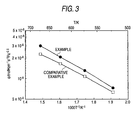
- Fig. 3 shows the hydrogen permeation coefficient. In each sample piece, no cracking took place even when hydrogen was introduced, showing good hydrogen embrittlement resistance. It is seen that Example is superior in permeation coefficient to Comparative Example in any temperature to a large extent, indicating that the invention can provide an excellent hydrogen permeation alloy.
Landscapes
- Chemical & Material Sciences (AREA)
- Engineering & Computer Science (AREA)
- Inorganic Chemistry (AREA)
- Chemical Kinetics & Catalysis (AREA)
- Organic Chemistry (AREA)
- Metallurgy (AREA)
- Mechanical Engineering (AREA)
- Materials Engineering (AREA)
- Manufacturing & Machinery (AREA)
- Analytical Chemistry (AREA)
- General Chemical & Material Sciences (AREA)
- Oil, Petroleum & Natural Gas (AREA)
- Combustion & Propulsion (AREA)
- Separation Using Semi-Permeable Membranes (AREA)
- Hydrogen, Water And Hydrids (AREA)
Abstract
Description
- The present invention relates to a hydrogen permeation alloy used for hydrogen permeation membranes adopted for hydrogen separation and purification, and a method of manufacturing the same.
- High-purity hydrogen is in use for the production of semi-conductors, optical fibers and pharmaceuticals, and the use amount thereof is increasing annually. Further, hydrogen is attracting social attention as the fuel for fuel cells recently. If fuel cells are to be used in a large scale towards the future, a huge amount of high-purity hydrogen is required. Accordingly, development of the manufacturing method capable of producing a large amount of high-purity hydrogen at a low cost is desired.
- The method for mass production of hydrogen includes (1) first method based on electrolysis of water using non-fossil resources and (2) second method based on stream reforming using fossil resources. In the first method (1) based on electrolysis, electrolysis of water conducted by the electricity obtained by solar power generation as the electric power source is under study, but this process is difficult to put into practice with the current technical level. Accordingly, for the time being, production of hydrogen via the second method (2), i.e., steam reforming of hydrocarbon is more realistic.
- In the case of producing hydrogen by steam reforming of hydrocarbon, the reaction system contains, in addition to a huge amount of hydrogen, impurities such as CO, CO2, H2O and CH4. For the utilization of hydrogen as the supply source for fuel cells, hydrogen must be separated and purified from these impurities. Further, if the CO content in purified hydrogen is not lower than 10 ppm, damaging of the Pt electrode of the fuel cell occurs. In other words, for the utilization of hydrogen for fuel cells, purification to an extremelyhighpurity is an essential condition.
- The purification method for hydrogen includes, an absorption method, a cryogenic distillation method, an adsorption method and a membrane separation method. From the viewpoint of efficient production of high-purity hydrogen, the membrane separation method using a metal membrane is attracting attention.
- The permeation mechanism in a metal membrane is as follows. When a hydrogen pressure difference exists via a metal membrane, hydrogen molecules (H2) are dissociated at the metal surface to atoms (H) in the high-pressure side whereby the atoms dissolve, diffuse in the metal. These hydrogen atoms permeate the metal membrane to the low-pressure side. At the surface of the low-pressure side, the atoms recombine to H2. As a result, the hydrogen is purified. Purification of hydrogen using a metal membrane is characterized by quite large selectivity and permiability. It is possible, for example, to purify hydrogen with roughly 99% purity to an order of 99.99999%. Accordingly, for purification of high-purity hydrogen for fuel cells, the membrane separation using a metal membrane is regarded as well suited.
- As the current hydrogen permeation membrane, those made of Pd alloys are mainly in practical use. However, in the case where fuel cells are used widely as a mainstream requiring a huge amount of hydrogen, the demand for Pd-Ag alloys as the hydrogen permeation metal membrane will increase correspondingly. Then, Pd, which is expensive and scarce as resources, will become a bottleneck whereby it is assumed that Pd alloys cannot then meet such demand. Hence, development of materials for the metal membrane replacing Pd alloys is an urgent need.
- For example, in
JP-A-11-276866 JP-A-11-276866 - Also in
JP-A-2000-159503 - In addition, for the suppression of hydrogen embrittlement,
JP-A-2004-42017 - In order to make a hydrogen permeation alloy provided with hydrogen permeability and hydrogen embrittlement resistance, there is an idea of using a multiphase alloy in which each of hydrogen permeability and hydrogen embrittlement resistance is charged to a different phase, respectively. Some of the inventors for the present application have proposed Nb-Ti-Co-based alloys from such a viewpoint. In this type of alloy, it is alleged that hydrogen permeation property and hydrogen embrittlement resistance equivalent to or better than those of Pd alloys are exhibited by virtue of allotting hydrogen permeability to the (Nb, Ti) phase and hydrogen embrittlement resistance to the CoTi phase.
- However, the Nb-Ti-Co alloy mentioned above is not provided with sufficient hydrogen permeation property, which thus must be improved. In this type of Nb-Ti-Co alloy, the (Nb, Ti) phase, which forms the hydrogen permeation pass, constitutes a granular and lamellar structure. In a granular structure, the portions where the (Nb, Ti) phase is disconnected acts as barriers for hydrogen permeation to lower the hydrogen permeation rate. In a lamellar structure, in which the growing direction of each (Nb, Ti) phase is not consistent, the hydrogen permeation pass connecting these (Nb, Ti) phase becomes extremely long, which fact acts as a cause to lower hydrogen permeability.
- The invention, which has been devised under the situations described heretofore, has objects to provide a hydrogen permeation alloy having enhanced hydrogen permeation capability by virtue of structure control and a method of manufacturing the same.
- Namely, according to a first aspect of the invention, a hydrogen permeation alloy comprises a phase in charge of hydrogen permeability, and a phase in charge of hydrogen embrittlement resistance, wherein the phase in charge of hydrogen permeability has a continuously interconnected structure.
- According to a second aspect of the invention, a growth direction of the phase in charge of hydrogen permeability lies aligned in the thickness direction of the permeation membrane.
- According to a third aspect of the invention, the hydrogen permeation alloy comprises anNb-Ti-Co alloy, the phase in charge of hydrogen permeability comprises an (Nb, Ti) phase, and the phase in charge of hydrogen embrittlement resistance comprises a CoTi phase.
- According to a fourth aspect of the invention, a method of manufacturing a hydrogen permeation alloy, the hydrogen permeation alloy comprising a phase in charge of hydrogen permeability and a phase in charge of hydrogen embrittlement resistance, the method comprises growing the phase in charge of hydrogen permeation at a growth rate of 50 mm/h or less to make the phase in charge of hydrogen permeation assume a continuously interconnected structure.
- According to the hydrogen permeation alloy of the invention, excellent hydrogen permeation properties and excellent hydrogen embrittlement resistance are demonstrated in a multiphase hydrogen permeation alloy by virtue of allotting hydrogen permeability and hydrogen embrittlement resistance to different phases. By growing the phase in charge of hydrogen permeation in these two phases so as to be continuously interconnected without forming a granular structure, the hydrogen permeation pass has no disconnection. Accordingly, good hydrogen permeation property can be obtained. The direction of such interconnection is preferably that of hydrogen permeation, in particular. Further, by aligning the growth direction of the phase in charge of hydrogen permeability in the thickness direction (which is usually the direction of hydrogen permeation) of the permeation membrane, the hydrogen permeation pass becomes short. Accordingly, good hydrogen permeation property can be obtained.
- As has been explained heretofore, according to the hydrogen permeation alloy of the present invention, which is of multiphase provided with both of hydrogen permeability and hydrogen embrittlement resistance, excellent hydrogen permeability is achieved since the phase in charge of hydrogen permeation is configured in a continuously interconnected structure free of any disconnection in the hydrogen permeation pass.
- A structure in which the phase in charge of hydrogen permeation is in a continuously interconnected structure means that each phase does not exist in a granular form or in segments, whereby preferably each phase is substantially interconnected in a specified direction.
- In addition, still more excellent hydrogen permeation property can be achieved by aligning the growth direction of the phase in charge of hydrogen permeation in the thickness direction in the hydrogen permeation membrane whereby the hydrogen permeation pass length is curtailed.
- According to the method of manufacturing the hydrogen permeation alloy of the invention, the alloy being a multiphase hydrogen permeation alloy comprising a phase in charge of hydrogen permeability and a phase in charge of hydrogen embrittlement resistance, the phase in charge of hydrogen permeability is grown at a growth rate of 50 mm/hr or less to form a continuously interconnected structure, thereby enabling the above-mentioned hydrogen permeation alloy to be obtained with certainty and achieving the aforementioned various advantages.
-
- Fig. 1 shows schematic drawings illustrating the structures of hydrogen permeation alloys according to the invention and related art;
- Fig. 2 shows photographs, as substitutes for drawing, each showing the structure of the sampled material in Example or in Comparative Example; and
- Fig. 3 shows the hydrogen permeability of the sampled material in Example and in Comparative Example at various temperatures.
- The hydrogen permeation alloy of the invention is a multiphase hydrogen permeation alloy comprising a phase in charge of hydrogen permeability and a phase in charge of hydrogen embrittlement resistance. The types of these phases are not particularly restricted, but typically, in Nb-Ti-Co-based alloys, those in which the phase in charge of hydrogen permeability is an (Nb, Ti) phase and the phase in charge of hydrogen embrittlement resistanceisa CoTiphase. With respect to the quantitative ratios of the Nb-Ti-Co alloy, which is not specifically restricted for the invention, alloys represented by the general formula, NbxTi(100-x-y)Coy (where x ≤ 70, 20 ≤ y ≤ 50, x + y < 100 (mol%)) can be mentioned as representative examples.
- Relations between the above-mentioned quantitative ratios and the physical properties are describedbriefly. First of all, when the Nb content exceeds the range defined above, hydrogen enbrittlement is liable to occur. Thus, the Nb content preferably needs to fall under the above-mentioned range. Moreover, for the same reason, the upper limit is preferably set at 60 mol%. On the other hand, since low Nb contents fail in exhibiting sufficient hydrogen permeation property, the lower limit is preferably set at 10 mol%, and more preferably set at 21 mol%.
- Further, low Co contents cause the CoTi phase, which contributes to hydrogen embrittlement resistance, to be deficient whereby sufficient hydrogen embrittlement resistance cannot be demonstrated. Thus, Co contents not less than 20 mol% are preferred. In addition, since contents exceeding 50 mol% increase the Co-containing phases such as CoTi, which does not contribute to hydrogen permeation, to an undesirably high degree to deteriorate hydrogen permeation properties, the Co content preferably needs to fall under the above-mentioned range. For the same reason, the lower limit for the Co content is preferably set at 25 mol% and the higher limit at 45 mol%.
- The hydrogen permeation alloy of the invention can make the phase in charge of hydrogen permeability in a continuously interconnected structure by growing the aforementioned phase in charge of hydrogen permeability (for example, an (Nb, Ti) phase) at a growth rate of 50 mm/hr or less. When the phase in charge of hydrogen permeation is grown at a growth rate exceeding 50 mm/hr, the phase grows not continuously but segmentally. Thus, the growth rate is preferably 50 mm/hr or less. For the same reason, a growth rate of 30 mm/hr or less is more preferable.
- The hydrogen permeation alloy of the invention can be manufactured according to ordinary processes; for example, such an alloy is manufactured by controlling elements such as Nb, Ti and Co to appropriate quantitative ratios. Preferably, the quantitative ratios are set so as to be represented by general formula NbxTi(100-x-y)Coy (x ≤ 70, 20 ≤ y ≤ 50).
- And, for such an alloy, as the method of growing the phase in charge of hydrogen permeation continuously and in the direction parallel to the thickness direction of the permeation membrane, the uni-directional solidification process such as the floating zone method and the Bridgeman method can be readily applied. In addition, membrane-forming methods such as sputtering, CVD or plating, or powder sintering methods can be applied.
- So long as the condition that the growth rate of the (Nb, Ti) phase does not exceed 50 mm/hr is satisfied, membrane formation is not limited to those by uni-directional solidification method, but methods such as sputtering, CVD or plating can also be applied. Furthermore, the powder sintering method can be applied by adopting such a production method that enables the (Nb, Ti) phase to be continuously interconnected in the thickness direction.
- The hydrogen permeation alloy obtained by any of the aforementioned methods is fabricated into the state of a
permeation membrane 1 as shown in Fig. 1A, wherein the membrane comprises aphase 2 in charge of hydrogen permeation and aphase 3 in charge of hydrogen embrittlement resistance, and thephase 2 in charge of hydrogen permeation is substantially continuously interconnected, and, at the same time, the growth direction thereof lies aligned in the thickness direction of thepermeation membrane 1. With such a structure, good hydrogen permeation performance can be demonstrated in the thickness direction of thepermeation membrane 1. - On the other hand, a
related permeation membrane 10, which falls outside the scope of the invention and has a structure like one resulting from cutting out a piece of a hydrogen permeation alloy in the form of ingot produced by an ordinary melting process, certainly comprises a phase in charge ofhydrogen permeation 11 and a phase in charge ofhydrogen embrittlement resistance 12 as shown in Fig.1B. But, in thephase 11 in charge of hydrogen permeation, not only the (Nb, Ti) phase is not grown in parallel to the thickness direction, but also the (Nb, Ti) phase has partly a granular structure. Thus, the hydrogen permeation efficiency in the thickness direction is deteriorated. - Namely, the hydrogen permeation alloy of the invention can be used as one that exhibits desirable hydrogen permeation property in a number of applications. This type of hydrogen permeation material not only exhibits excellent hydrogen permeability but also is provided with excellent resistance against the embrittlement due to hydrogen permeation.
- As an Nb-Ti-Co alloy, an alloy ingot having a composition of Nb30Ti35Co35 was produced by arc melting. The alloy ingot thus producedwas processed to a cylindrical form with a diameter of about 12 mm and a length of 100 mm by means of a wire discharge machine. This piece was then subjected to unidirectional solidification under an Ar atmosphere by the floating zonemethod. The solidification rate for this operation was 20 mm/hr.
- From the cylinder subjected to unidirectional solidification, a circular plate with a thickness of 1 mm was sampled. A test piece was obtained by polishing both of the circular plate to mirror surfaces, and then forming, on both surfaces, a Pd film with about 100 nm thickness by sputtering for the purposes of oxidation prevention and provision of a catalytic activity for hydrogen absorption as well as dissociation. The test piece thus prepared was mounted in a hydrogen permeation testing apparatus, and was heated to 400°C under vacuum evacuation of the surface of the test piece on which the Pd film was formed. After the temperature reached 400°C, hydrogen was fed to the surface of the test piece on which the Pd film was formed to measure the hydrogen flux under the condition of a secondary side pressure of 0.1 MPa and a primary side pressure of 0.2 MPa. By raising the primary side pressure stepwise to 0.6 MPa, the hydrogen flux was measured for each step of pressure changing. After the measurement at 400°C, the hydrogen flux was also measured in the same manner at 350°C, 300°C and 250°C, respectively.
- The hydrogen permeability (φ) and the hydrogen flux (J) have the relationship expressed by the following equation (1).

wherein L represents sample thickness, A represents permeation area, P1 represents hydrogen pressure at the primary side, and P2 represents hydrogen pressure at the secondary side. - Accordingly, plotting the value of A × (P1 0.5 - P2 0.5) on the abscissa, and the value of J × L on the ordinate for the data obtained by changing the primary side pressure, a linear relation is obtained for each temperature whereby the slope of the line represents φ. By making use of this relationship, the hydrogen permeability (φ) is obtained at each temperature. Hydrogen permeation property was compared in terms of the hydrogen permeability. By way of precaution, in the hydrogen permeation test, tests were also conducted on test pieces sampled from arc-melted ingot of the Nb-Ti-Co alloy having the same composition as a comparative material.
- Structural micrographs for Example and Comparative Example are shown in Fig.2A and Fig.2B, respectively. In Example, the individual (Nb, Ti) phase is grown continuously without any disconnection, and at the same time, the growth direction is in parallel to the direction of the sample thickness. In contrast thereto, in Comparative Example the (Nb, Ti) phase is not grown in parallel to the thickness direction. Moreover, in the (Nb, Ti) phase of the Comparative Example, each length is small and segmental, and further there exist portions having a granular structure whereby the individual (Nb, Ti) phase is not in contact with each other but exists independently isolated.
- Fig. 3 shows the hydrogen permeation coefficient. In each sample piece, no cracking took place even when hydrogen was introduced, showing good hydrogen embrittlement resistance. It is seen that Example is superior in permeation coefficient to Comparative Example in any temperature to a large extent, indicating that the invention can provide an excellent hydrogen permeation alloy.
Claims (4)
- A hydrogen permeation alloy comprising:a phase in charge of hydrogen permeability; anda phase in charge of hydrogen embrittlement resistance,wherein the phase in charge of hydrogen permeability has a continuously connected structure.
- The hydrogen permeation alloy according to claim 1, wherein a growth direction of the phase in charge of hydrogen permeability lies aligned in the thickness direction of the permeation membrane.
- The hydrogen permeation alloy according to claim 1,
wherein the hydrogen permeation alloy comprises an Nb-Ti-Co alloy,
wherein the phase in charge of hydrogen permeability comprises an (Nb, Ti) phase, and
wherein the phase in charge of hydrogen embrittlement resistance comprises a CoTi phase. - A method of manufacturing a hydrogen permeation alloy, the hydrogen permeation alloy comprising a phase in charge of hydrogen permeability and a phase in charge of hydrogen embrittlement resistance, the method comprising:growing the phase in charge of hydrogen permeability at a growth rate of 50 mm/hr or less to make the phase in charge of hydrogen permeability in a continuously interconnected structure.
Applications Claiming Priority (1)
| Application Number | Priority Date | Filing Date | Title |
|---|---|---|---|
| JP2005277343A JP5000115B2 (en) | 2005-09-26 | 2005-09-26 | Hydrogen permeable alloy |
Publications (2)
| Publication Number | Publication Date |
|---|---|
| EP1767493A1 true EP1767493A1 (en) | 2007-03-28 |
| EP1767493B1 EP1767493B1 (en) | 2008-05-07 |
Family
ID=37547520
Family Applications (1)
| Application Number | Title | Priority Date | Filing Date |
|---|---|---|---|
| EP06018702A Not-in-force EP1767493B1 (en) | 2005-09-26 | 2006-09-06 | Hydrogen permeation alloy and a method of manufacturing the same |
Country Status (6)
| Country | Link |
|---|---|
| US (1) | US7390348B2 (en) |
| EP (1) | EP1767493B1 (en) |
| JP (1) | JP5000115B2 (en) |
| KR (1) | KR101048320B1 (en) |
| CN (1) | CN100455341C (en) |
| DE (1) | DE602006001090D1 (en) |
Families Citing this family (8)
| Publication number | Priority date | Publication date | Assignee | Title |
|---|---|---|---|---|
| JP4363633B2 (en) * | 2004-02-17 | 2009-11-11 | 株式会社アルバック | Double phase alloy for hydrogen separation / purification and production method thereof, metal membrane for hydrogen separation / purification and production method thereof |
| US7524361B2 (en) * | 2006-01-12 | 2009-04-28 | Korea Institute Of Energy Research | Porous hydrogen separation membrane and method for preparing the same |
| JP5463557B2 (en) * | 2006-09-08 | 2014-04-09 | 国立大学法人北見工業大学 | Dual-phase hydrogen permeable alloy and method for producing the same |
| KR20110106920A (en) * | 2009-05-28 | 2011-09-29 | 가부시키가이샤 아루박 | Sputtering Target and Processing Method of Sputtering Target |
| CN106834854B (en) * | 2017-02-21 | 2019-02-05 | 山东科技大学 | High-performance Nb-based hydrogen permeable alloy using rare earth doping and preparation method |
| CN109910396A (en) * | 2019-01-21 | 2019-06-21 | 西安交通大学 | A kind of metallic composite spontaneously forming gas passage |
| CN111778437A (en) * | 2020-07-15 | 2020-10-16 | 桂林电子科技大学 | A kind of thin ribbon crystalline Nb-Ti-Co hydrogen separation material and its preparation method and application |
| CN114182205B (en) * | 2021-12-10 | 2023-05-16 | 中国工程物理研究院材料研究所 | Metal hydrogen absorption film with nano multilayer structure and preparation method and application thereof |
Citations (1)
| Publication number | Priority date | Publication date | Assignee | Title |
|---|---|---|---|---|
| EP1566457A1 (en) * | 2004-02-17 | 2005-08-24 | Ulvac, Inc. | Multiple phase alloys and membranes thereof for hydrogen separation-purification and their method of preparation. |
Family Cites Families (10)
| Publication number | Priority date | Publication date | Assignee | Title |
|---|---|---|---|---|
| JPH11276866A (en) | 1998-03-31 | 1999-10-12 | Tokyo Gas Co Ltd | Hydrogen permeable membrane and method for producing the same |
| JP2000159503A (en) | 1998-11-20 | 2000-06-13 | Mitsubishi Heavy Ind Ltd | Hydrogen separating film of niobium alloy |
| DE10039596C2 (en) * | 2000-08-12 | 2003-03-27 | Omg Ag & Co Kg | Supported metal membrane, process for its manufacture and use |
| US7001446B2 (en) * | 2002-03-05 | 2006-02-21 | Eltron Research, Inc. | Dense, layered membranes for hydrogen separation |
| JP3935851B2 (en) | 2002-05-20 | 2007-06-27 | 福田金属箔粉工業株式会社 | Hydrogen separation membrane and method for producing the same |
| CN1327942C (en) * | 2004-01-09 | 2007-07-25 | 中国科学院大连化学物理研究所 | Composite metal palladium membrane or alloy palladium membrane and its preparing method |
| JP2006000722A (en) * | 2004-06-16 | 2006-01-05 | Sumitomo Metal Mining Co Ltd | Hydrogen permeable alloy membrane and method for producing the same |
| JP3749952B1 (en) * | 2004-09-22 | 2006-03-01 | 国立大学法人北見工業大学 | Crystalline double-phase hydrogen permeable alloy membrane and crystalline double-phase hydrogen permeable alloy membrane |
| JP3749953B1 (en) * | 2005-03-24 | 2006-03-01 | 国立大学法人北見工業大学 | Double phase hydrogen permeable alloy and hydrogen permeable alloy membrane |
| JP4860969B2 (en) * | 2005-09-14 | 2012-01-25 | 株式会社日本製鋼所 | Hydrogen permeable alloy and method for producing the same |
-
2005
- 2005-09-26 JP JP2005277343A patent/JP5000115B2/en not_active Expired - Fee Related
-
2006
- 2006-09-06 DE DE602006001090T patent/DE602006001090D1/en active Active
- 2006-09-06 EP EP06018702A patent/EP1767493B1/en not_active Not-in-force
- 2006-09-22 KR KR1020060092113A patent/KR101048320B1/en not_active Expired - Fee Related
- 2006-09-26 CN CNB2006101592882A patent/CN100455341C/en not_active Expired - Fee Related
- 2006-09-26 US US11/526,829 patent/US7390348B2/en not_active Expired - Fee Related
Patent Citations (1)
| Publication number | Priority date | Publication date | Assignee | Title |
|---|---|---|---|---|
| EP1566457A1 (en) * | 2004-02-17 | 2005-08-24 | Ulvac, Inc. | Multiple phase alloys and membranes thereof for hydrogen separation-purification and their method of preparation. |
Also Published As
| Publication number | Publication date |
|---|---|
| US20070068383A1 (en) | 2007-03-29 |
| KR20070034941A (en) | 2007-03-29 |
| JP2007083198A (en) | 2007-04-05 |
| DE602006001090D1 (en) | 2008-06-19 |
| KR101048320B1 (en) | 2011-07-15 |
| EP1767493B1 (en) | 2008-05-07 |
| US7390348B2 (en) | 2008-06-24 |
| JP5000115B2 (en) | 2012-08-15 |
| CN1939576A (en) | 2007-04-04 |
| CN100455341C (en) | 2009-01-28 |
Similar Documents
| Publication | Publication Date | Title |
|---|---|---|
| CN100420624C (en) | Multiphase alloy for hydrogen separation and purification and method for producing same, metal film for hydrogen separation and purification and method for producing same | |
| EP1767493B1 (en) | Hydrogen permeation alloy and a method of manufacturing the same | |
| KR101493473B1 (en) | Vanadium-based hydrogen permeation alloy used for a membrane, method for manufacturing the same and method for using the membrane | |
| JP3749952B1 (en) | Crystalline double-phase hydrogen permeable alloy membrane and crystalline double-phase hydrogen permeable alloy membrane | |
| JP4860969B2 (en) | Hydrogen permeable alloy and method for producing the same | |
| JP3749953B1 (en) | Double phase hydrogen permeable alloy and hydrogen permeable alloy membrane | |
| WO2015005649A1 (en) | Separation membrane, hydrogen separation membrane including separation membrane, and device including hydrogen separation membrane | |
| JP4860961B2 (en) | Hydrogen permeable alloy | |
| JP5039968B2 (en) | Crystalline double phase hydrogen permeable alloy and hydrogen permeable alloy membrane | |
| KR100865656B1 (en) | Hydrogen permeable alloy member, preparation method thereof and hydrogen purification method using same | |
| KR100865660B1 (en) | Hydrogen permeable alloy member, preparation method thereof and hydrogen purification method using same | |
| JP3882089B1 (en) | Crystalline double phase hydrogen permeable alloy and hydrogen permeable alloy membrane | |
| JP2006274297A (en) | Double phase alloy for hydrogen separation and purification | |
| KR100865659B1 (en) | Hydrogen permeable alloy member, preparation method thereof and hydrogen purification method using same | |
| KR101104909B1 (en) | Hydrogen permeable alloy member, preparation method thereof and hydrogen purification method using same | |
| WO2007078278A2 (en) | Durable pd-based alloy and hydrogen generation membrane thereof | |
| JP2008063628A (en) | Dual-phase hydrogen permeable alloy and method for producing the same | |
| Geiller et al. | Hydrogen permeation properties of in-situ Ti-based bulk metallic glass matrix composite membranes | |
| Kita et al. | Amorphous Zr-Ni based alloy membranes for hydrogen purification from a gas mixture |
Legal Events
| Date | Code | Title | Description |
|---|---|---|---|
| PUAI | Public reference made under article 153(3) epc to a published international application that has entered the european phase |
Free format text: ORIGINAL CODE: 0009012 |
|
| AK | Designated contracting states |
Kind code of ref document: A1 Designated state(s): AT BE BG CH CY CZ DE DK EE ES FI FR GB GR HU IE IS IT LI LT LU LV MC NL PL PT RO SE SI SK TR |
|
| AX | Request for extension of the european patent |
Extension state: AL BA HR MK YU |
|
| 17P | Request for examination filed |
Effective date: 20070503 |
|
| GRAP | Despatch of communication of intention to grant a patent |
Free format text: ORIGINAL CODE: EPIDOSNIGR1 |
|
| AKX | Designation fees paid |
Designated state(s): DE FR GB IT |
|
| GRAS | Grant fee paid |
Free format text: ORIGINAL CODE: EPIDOSNIGR3 |
|
| GRAA | (expected) grant |
Free format text: ORIGINAL CODE: 0009210 |
|
| AK | Designated contracting states |
Kind code of ref document: B1 Designated state(s): DE FR GB IT |
|
| REG | Reference to a national code |
Ref country code: GB Ref legal event code: FG4D |
|
| REF | Corresponds to: |
Ref document number: 602006001090 Country of ref document: DE Date of ref document: 20080619 Kind code of ref document: P |
|
| PLBE | No opposition filed within time limit |
Free format text: ORIGINAL CODE: 0009261 |
|
| STAA | Information on the status of an ep patent application or granted ep patent |
Free format text: STATUS: NO OPPOSITION FILED WITHIN TIME LIMIT |
|
| 26N | No opposition filed |
Effective date: 20090210 |
|
| REG | Reference to a national code |
Ref country code: FR Ref legal event code: PLFP Year of fee payment: 10 |
|
| PGFP | Annual fee paid to national office [announced via postgrant information from national office to epo] |
Ref country code: DE Payment date: 20150902 Year of fee payment: 10 Ref country code: GB Payment date: 20150902 Year of fee payment: 10 |
|
| PGFP | Annual fee paid to national office [announced via postgrant information from national office to epo] |
Ref country code: FR Payment date: 20150811 Year of fee payment: 10 |
|
| PGFP | Annual fee paid to national office [announced via postgrant information from national office to epo] |
Ref country code: IT Payment date: 20150925 Year of fee payment: 10 |
|
| REG | Reference to a national code |
Ref country code: DE Ref legal event code: R119 Ref document number: 602006001090 Country of ref document: DE |
|
| GBPC | Gb: european patent ceased through non-payment of renewal fee |
Effective date: 20160906 |
|
| REG | Reference to a national code |
Ref country code: FR Ref legal event code: ST Effective date: 20170531 |
|
| PG25 | Lapsed in a contracting state [announced via postgrant information from national office to epo] |
Ref country code: DE Free format text: LAPSE BECAUSE OF NON-PAYMENT OF DUE FEES Effective date: 20170401 Ref country code: GB Free format text: LAPSE BECAUSE OF NON-PAYMENT OF DUE FEES Effective date: 20160906 Ref country code: FR Free format text: LAPSE BECAUSE OF NON-PAYMENT OF DUE FEES Effective date: 20160930 |
|
| PG25 | Lapsed in a contracting state [announced via postgrant information from national office to epo] |
Ref country code: IT Free format text: LAPSE BECAUSE OF NON-PAYMENT OF DUE FEES Effective date: 20160906 |