EP1762566A1 - Branched surfactant having fluoroalkyl group and hydrocarbon group - Google Patents
Branched surfactant having fluoroalkyl group and hydrocarbon group Download PDFInfo
- Publication number
- EP1762566A1 EP1762566A1 EP05739356A EP05739356A EP1762566A1 EP 1762566 A1 EP1762566 A1 EP 1762566A1 EP 05739356 A EP05739356 A EP 05739356A EP 05739356 A EP05739356 A EP 05739356A EP 1762566 A1 EP1762566 A1 EP 1762566A1
- Authority
- EP
- European Patent Office
- Prior art keywords
- surfactant
- group
- compound
- butyl
- formula
- Prior art date
- Legal status (The legal status is an assumption and is not a legal conclusion. Google has not performed a legal analysis and makes no representation as to the accuracy of the status listed.)
- Granted
Links
Images

Classifications
-
- C—CHEMISTRY; METALLURGY
- C09—DYES; PAINTS; POLISHES; NATURAL RESINS; ADHESIVES; COMPOSITIONS NOT OTHERWISE PROVIDED FOR; APPLICATIONS OF MATERIALS NOT OTHERWISE PROVIDED FOR
- C09K—MATERIALS FOR MISCELLANEOUS APPLICATIONS, NOT PROVIDED FOR ELSEWHERE
- C09K23/00—Use of substances as emulsifying, wetting, dispersing, or foam-producing agents
- C09K23/02—Alkyl sulfonates or sulfuric acid ester salts derived from monohydric alcohols
-
- C—CHEMISTRY; METALLURGY
- C07—ORGANIC CHEMISTRY
- C07C—ACYCLIC OR CARBOCYCLIC COMPOUNDS
- C07C305/00—Esters of sulfuric acids
- C07C305/02—Esters of sulfuric acids having oxygen atoms of sulfate groups bound to acyclic carbon atoms of a carbon skeleton
- C07C305/04—Esters of sulfuric acids having oxygen atoms of sulfate groups bound to acyclic carbon atoms of a carbon skeleton being acyclic and saturated
- C07C305/06—Hydrogenosulfates
-
- C—CHEMISTRY; METALLURGY
- C07—ORGANIC CHEMISTRY
- C07C—ACYCLIC OR CARBOCYCLIC COMPOUNDS
- C07C307/00—Amides of sulfuric acids, i.e. compounds having singly-bound oxygen atoms of sulfate groups replaced by nitrogen atoms, not being part of nitro or nitroso groups
- C07C307/04—Diamides of sulfuric acids
- C07C307/10—Diamides of sulfuric acids having nitrogen atoms of the sulfamide groups bound to carbon atoms of six-membered aromatic rings
-
- C—CHEMISTRY; METALLURGY
- C07—ORGANIC CHEMISTRY
- C07C—ACYCLIC OR CARBOCYCLIC COMPOUNDS
- C07C309/00—Sulfonic acids; Halides, esters, or anhydrides thereof
- C07C309/01—Sulfonic acids
- C07C309/02—Sulfonic acids having sulfo groups bound to acyclic carbon atoms
- C07C309/03—Sulfonic acids having sulfo groups bound to acyclic carbon atoms of an acyclic saturated carbon skeleton
- C07C309/17—Sulfonic acids having sulfo groups bound to acyclic carbon atoms of an acyclic saturated carbon skeleton containing carboxyl groups bound to the carbon skeleton
-
- C—CHEMISTRY; METALLURGY
- C09—DYES; PAINTS; POLISHES; NATURAL RESINS; ADHESIVES; COMPOSITIONS NOT OTHERWISE PROVIDED FOR; APPLICATIONS OF MATERIALS NOT OTHERWISE PROVIDED FOR
- C09K—MATERIALS FOR MISCELLANEOUS APPLICATIONS, NOT PROVIDED FOR ELSEWHERE
- C09K23/00—Use of substances as emulsifying, wetting, dispersing, or foam-producing agents
-
- C—CHEMISTRY; METALLURGY
- C11—ANIMAL OR VEGETABLE OILS, FATS, FATTY SUBSTANCES OR WAXES; FATTY ACIDS THEREFROM; DETERGENTS; CANDLES
- C11D—DETERGENT COMPOSITIONS; USE OF SINGLE SUBSTANCES AS DETERGENTS; SOAP OR SOAP-MAKING; RESIN SOAPS; RECOVERY OF GLYCEROL
- C11D1/00—Detergent compositions based essentially on surface-active compounds; Use of these compounds as a detergent
- C11D1/004—Surface-active compounds containing F
Definitions
- the present invention relates to a branched surfactant having a fluoroalkyl group and a hydrocarbon group.
- the surfactant of the invention when used in combination with liquid, subcritical, or supercritical carbon dioxide, can improve the function of carbon dioxide as a solvent for chemical reactions, washing, extraction, dyeing, etc.
- Such applications need surfactants to mix carbon dioxide with polar compounds.
- Patent Document 1 discloses H (CF 2 CF 2 ) n (CH 2 CH 2 O) n OOCCH (OSO 3 Na)CH 2 COOR as an additive for improving the application properties of a light-sensitive material
- Patent Document 2 discloses H(CF 2 CF 2 ) n CH 2 OCH 2 CH(OSO 3 Na)R as an additive for improving the application properties of a light-sensitive material
- Patent Document 3 discloses H(CF 2 CF 2 ) n CH 2 OCH 2 CH (OSO 3 Na)CH 2 OR as an antistatic material for a light-sensitive material.
- Non-patent Documents 1 to 3 reports that C 7 F 15 CH(OSO 3 Na)C 7 H 15 has a high ability to incorporate water into carbon dioxide.
- this compound has not been put into practical use.
- a test performed by the present inventors confirmed that the water-uptake ability of this compound is insufficient.
- Non-patent Documents 5 to 8 the synthesis of a hybrid surfactant with stability and an advanced function has been reported in recent years.
- these known hybrid surfactants do not fulfill their functions in carbon dioxide (Non-patent Document 3).
- Non-patent Document 9 Although phosphates as reported in Non-patent Document 9 function well in carbon dioxide, phosphates have problems with stability during long-term use due to the possibility of hydrolysis. A test performed by the present inventors confirmed that phosphates also do not fulfill their functions satisfactorily.
- An object of the invention is to provide a surfactant usable in a carbon dioxide-water system.
- the invention provides the following surfactants.
- the present invention provides a surfactant with a high ability to incorporate water into carbon dioxide despite water having a low compatibility with carbon dioxide.
- the use of the surfactant of the invention in a carbon dioxide-polar compound system achieves a well-mixed state of water and carbon dioxide.
- the invention can provide a surfactant having a sufficiently high water-uptake value and a sufficient ability to form micelles in a mixed system of CO 2 /water and a polar compound (e.g., inorganic salt, polar organic compound, etc.).
- a polar compound e.g., inorganic salt, polar organic compound, etc.
- the surfactants of the invention make it possible to mix CO 2 (supercritical, subcritical, or liquid) with polar compounds, such as water. Moreover, the surfactants of the invention can improve, using CO 2 as a solvent, the efficiency of electrochemical reactions, and also washing, dyeing, extraction, etc.
- the electrochemical reactions refer to organic/inorganic chemical reactions, plating, etc., in which a polar compound, such as water and the like, is treated.
- the surfactants of the invention have stability enough to withstand repeated use in CO 2 -water systems.
- surfactants Preferable as such surfactants are hybrid surfactants having a sulfate group or a sulfonic acid group, and also one fluoroalkyl group and one alkyl group.
- Examples of polar compounds to be mixed with a CO 2 solvent include water; organic solvents miscible with water such as alcohols (e.g., methanol, ethanol, propanol, butanol, etc.), water-containing alcohols, DMF, DMSO, formamide, glycols (e.g., ethylene glycol, propylene glycol, etc.), acetonitrile, THF, etc.; or mixtures of water and these organic solvents. Among these, water is preferable. Furthermore, metal particles, inorganic salts, organic salts, bio-compounds (e.g., phospholipids, saccharides, proteins, carbohydrates, etc.), etc. can be mentioned.
- alcohols e.g., methanol, ethanol, propanol, butanol, etc.
- water-containing alcohols e.g., DMF, DMSO, formamide, glycols (e.g., ethylene glycol, propylene glycol, etc.), aceton
- Rf represents a linear or branched fluoroalkyl group which may have an ether bond. Specific examples thereof include (per)fluoroalkyl groups, (per)fluoroether groups, and (per)fluoropolyether groups.
- Rf has 4 to 50 carbon atoms. The number of carbons of a fluoroalkyl group in which Rf has no ether bond is 4 to 20, preferably 5 to 18, and more preferably 5 to 12. The number of carbons of a fluoroalkyl group in which Rf has an ether bond is 4 to 50, preferably 5 to 40, and more preferably 5 to 35.
- fluoroalkyl groups having no ether bond include:
- fluoroalkyl groups having an ether bond include:
- Examples of (per)fluoroalkyl groups include:
- Examples of (per)fluoroether groups include Rf1-O-Rf2, such as C 3 F 7 OCF(CF 3 )- and the like, wherein Rf1 is a C 1-6 linear or branched (per)fluoroalkyl group and Rf2 is a C 1-4 linear or branched (per)fluoroalkylene group.
- Rf1-(O-Rf2) r examples of (per)fluoropolyether groups indlude Rf1-(O-Rf2) r , such as C 3 F 7 OCF(CF 3 )CF 2 OCF(CF 3 )- and the like, wherein (Rf1 and Rf2 are as defined above and r represents an integer of 2 to 4).
- Rh is a linear or branched alkyl group having 3 to 18 carbon atoms, preferably 4 to 12, and more preferably 4 to 10.
- Specific preferable examples of Rh include (n-, sec-, iso-, tert-) butyl, pentyl, hexyl, heptyl, octyl, nonyl, and decyl.
- the value obtained by dividing the number of carbon atoms of Rf by the number of carbon atoms of Rh is preferably in the range of 1/2 to 2/1, and more preferably in the range of 2/3 to 3/2.
- M represents a hydrogen atom, alkali metal (Na, K, Li, Cs) , 1/2 alkaline earth metal (Ca, Mg, Ba), ammonium (NH 4 ), or quaternary ammonium (NR 4 ; R represents a C 1-4 linear or branched alkyl group).
- Z 1 and Z 2 represent (CH 2 ) n1 -(X 1 ) p1 - and -(X 2 ) q1 -, respectively.
- X 1 and/or X 2 and CH(SO 3 M) may be positioned a linear or branched alkylene group which may be fluorinated (e.g., (CH 2 ) m , (CF 2 ) n , CF (CF 3 ), (CF 2 ) n (CH 2 ), etc., m and n are integers of 1 to 3).
- the surfactants of the invention are commercially available or can be easily produced by a person skilled in the art according to known methods (e.g., Patent Documents 1 to 3).
- the amount of surfactant is about 0.001 to about 2000 wt%, preferably about 0.01 to about 1000 wt%, more preferably about 0.01 to about 500 wt%, and particularly preferably about 0.1 to about 100 wt% based on the amount of polar compound to be dissolved in an aqueous solution or carbon dioxide.
- an organic solvent (co-solvent) described below can be added to a CO 2 -water system.
- alcohols such as methanol, ethanol, propanol, butanol, pentanol, etc.; ketones such as acetone and the like; acetonitrile; esters such as ethyl acetate, etc.; ethers such as ethyl ether; halogenated compounds such as frons, methylene chloride, chloroform, etc.
- organic solvents with low toxicity and low molecular weight are preferable.
- the weight of the surfactant for use in the invention may be higher than that of a polar compound depending on the kind of the polar compound.
- the amount of surfactant sometimes exceeds 100 wt%.
- the surfactant of the invention is preferably used in a two-phase system between CO 2 (liquid, subcritical, or supercritical state) and water or a polar compound.
- Compounds (6A to 8A) having two fluoroalkyl groups were synthesized according to Bull. Chem. Soc. Jpn., 1991, vol. 64, page 3262 .
- compound 10A was synthesized according to Langmuir 1994, 10, 3536 .
- a branched hybrid sulfonate which has, in the molecule, both a fluoroalkyl group whose carbon number of one carbon chain is at least four and a hydrocarbon chain whose carbon chain length is nearly equal to that of the fluoroalkyl group, function well when a polar compound, such as water, is dissolved in carbon dioxide.
- Tridecafluoro propylene oxide (5.0 g, 13.3 mmol) and hexanol (8.35 ml, 66.5 mmol) were reacted in the presence of sulfuric acid, giving an alcohol compound (3.5 g, 55 %).
- a SO 3 -Py complex (2.3 g, 14.6 mmol) was reacted with this alcohol compound in pyridine (12 ml).
- Example 1B In the same manner as in Example 1B, an alcohol compound was synthesized from hexadecafluoroheptyl glycidyl ether (8.06 g, 16.5 mmol) and octanol (13 ml, 82.3 mmol) , and sulfonate compound 4B (5.0 g, two steps, 42%) was then synthesized from the alcohol compound.
- Example 1B In the same manner as in Example 1B, an alcohol compound was synthesized from dodecafluoroheptyl glycidyl ether (5.92 g, 15.2 mmol) and octanol (12 ml, 76 mmol), and compound 5B (4.2 g, two steps, 45%) was then synthesized from a SO 3 -Py complex via the alcohol compound.
- Example 1B In the same manner as in Example 1B, an aqueous sodium hydroxide solution (1.3g of NaOH and 6. 3 ml of water) was added dropwise at 90°C under stirring to a mixture of 2-ethylhexyl glycidyl ether (6.55 ml, 31.6 mmol) and 2-hepta fluoro-propoxy-2,3,3,3-tetrafluoro propanol (10.0 g, 32 mmol), and the mixture was reacted for 6 hours. The reaction liquid was extracted with ethyl acetate, the organic phase was dried, and the solvent was distilled off, giving an alcohol compound.
- 2-ethylhexyl glycidyl ether 6.55 ml, 31.6 mmol
- 2-hepta fluoro-propoxy-2,3,3,3-tetrafluoro propanol 10.0 g, 32 mmol
- the present inventors synthesized and evaluated compounds 8B and 9B under the same conditions as the compounds of the invention.
- the evaluation results show that although compound 8B fulfilled its function at relatively low pressure, the water uptake of compound 8B was notably lower than that of the reported data.
- compound 9B did not fulfill its function at all, probably because the test was performed at 50°C. After the test, samples were collected so as to determine the cause by instrumental analysis (NMR). The analysis confirmed that small but complicated peaks were observed (decomposition possibly progressed even at 50°C) in addition to the fact that the sulfate was hydrolyzed, which possibly forms a serious obstacle to practical use of compound 9B.
- the compounds of the invention are surfactants that demonstrate excellent properties in dissolving polar compounds, such as water, in a medium comprising carbon dioxide as a solvent.
Landscapes
- Chemical & Material Sciences (AREA)
- Organic Chemistry (AREA)
- Engineering & Computer Science (AREA)
- Materials Engineering (AREA)
- Life Sciences & Earth Sciences (AREA)
- Chemical Kinetics & Catalysis (AREA)
- Oil, Petroleum & Natural Gas (AREA)
- Wood Science & Technology (AREA)
- Organic Low-Molecular-Weight Compounds And Preparation Thereof (AREA)
- Emulsifying, Dispersing, Foam-Producing Or Wetting Agents (AREA)
- Developing Agents For Electrophotography (AREA)
Abstract

Rh represents an alkyl group;
r represents 1 or 0;
when r = 0, Z1 and Z2 represent (CH2)n1-(X1)p1- and - (X2)q1-, respectively; and
when r = 1, Z1 and Z2 represent (CH2Y)p2-CH2- and -(CH2Y)q2-, respectively,
wherein X1 and X2 may be the same or different and each represents a divalent linking group,
p1 represents 0 or 1,
q1 represents 0 or 1,
n1 represents an integer of 1-10;
Y represents O, S or NR, wherein R represents a hydrogen atom, methyl, ethyl, n-propyl, isopropyl, n-butyl, isobutyl, sec-butyl, or t-butyl;
p2 and q2 each represent 0 or 1 but are not 0 at the same time; and
M represents a hydrogen atom, alkali metal, 1/2 alkaline earth metal or ammonium.
Description
- The present invention relates to a branched surfactant having a fluoroalkyl group and a hydrocarbon group.
- The surfactant of the invention, when used in combination with liquid, subcritical, or supercritical carbon dioxide, can improve the function of carbon dioxide as a solvent for chemical reactions, washing, extraction, dyeing, etc.
- Due to increasing awareness of environmental problems, attention has been drawn to techniques using CO2 as a solvent in place of highly toxic organic solvents. If it makes it possible to dissolve a compound in CO2, the cost of wastewater treatment may be sharply reduced. Therefore, attention has been drawn particularly to the application of such techniques to industrial fields which require expensive waste water treatments, such as dyeing, plating, organic synthesis, chemical reaction, washing, extraction, etc.
- Such applications need surfactants to mix carbon dioxide with polar compounds.
- Examples of hybrid fluorine-based compounds having both a hydrocarbon group and a fluoroalkyl group in the molecule are mentioned as follows: Patent Document 1 discloses H (CF2CF2)n(CH2CH2O)nOOCCH (OSO3Na)CH2COOR as an additive for improving the application properties of a light-sensitive material; Patent Document 2 discloses H(CF2CF2)nCH2OCH2CH(OSO3Na)R as an additive for improving the application properties of a light-sensitive material; and Patent Document 3 discloses H(CF2CF2) nCH2OCH2CH (OSO3Na)CH2OR as an antistatic material for a light-sensitive material.
- Surfactants that function well in carbon dioxide are extremely limited. For example, only sulfosuccinic acid esters having fluorine groups, which require two hydrophobic chains or branched hydrophobic group, are reported in Non-patent Documents 1 to 3. Non-patent Document 4 reports that C7F15CH(OSO3Na)C7H15 has a high ability to incorporate water into carbon dioxide. However, due to low stability, this compound has not been put into practical use. Moreover, a test performed by the present inventors confirmed that the water-uptake ability of this compound is insufficient.
- In view of the above, the synthesis of a hybrid surfactant with stability and an advanced function has been reported in recent years (Non-patent Documents 5 to 8). However, these known hybrid surfactants do not fulfill their functions in carbon dioxide (Non-patent Document 3).
- Although phosphates as reported in Non-patent Document 9 function well in carbon dioxide, phosphates have problems with stability during long-term use due to the possibility of hydrolysis. A test performed by the present inventors confirmed that phosphates also do not fulfill their functions satisfactorily.
- Patent Document 1:
Japanese Unexamined Patent Publication No. 1976-32322 - Patent Document 2:
Japanese Examined Patent Publication No. 1977-25087 - Patent Document 3:
Japanese Examined Patent Publication No. 1977-26687 - Non-patent Document 1: Progr, Colloid Polym, Sci., 2000, vol. 115, page 214
- Non-patent Document 2: Langmuir, 2001, vol. 17, page 274
- Non-patent Document 3: Langmuir, 2003, vol. 19, page 220
- Non-patent Document 4: Langmuir, 1994, vol. 10, page 3536
- Non-patent Document 5: Langmuir, 1995, vol. 11, page 466
- Non-patent Document 6: Proceeding of Yukagaku Toronkai, 2000 (Abstract, pages 305 and 306)
- Non-patent Document 7: Proceeding of Yukagaku Toronkai, 2002 (Abstract, page 101)
- Non-patent Document 8: J. Am. Chem. Soc., 2002, vol. 124, page 6516
- Non-patent Document 9: J. Am. Chem. Soc., 2002, vol. 124, page 1834
- An object of the invention is to provide a surfactant usable in a carbon dioxide-water system.
- The invention provides the following surfactants.
- Item 1. A surfactant represented by Formula (I):
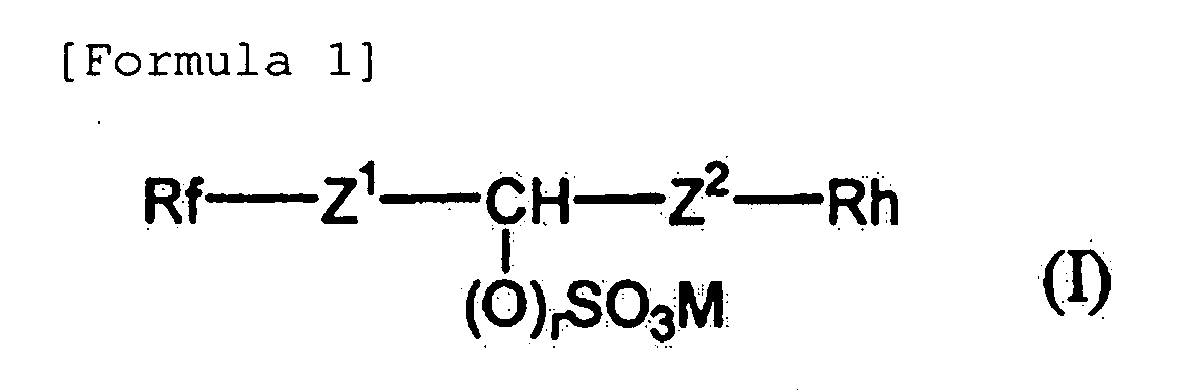
Rh represents an alkyl group;
r represents 1 or 0;
when r = 0, Z1 and Z2 represent (CH2)n1-(X1)p1- and -(X2)q1-, respectively; and
when r = 1, Z1 and Z2 represent (CH2Y)p2-CH2- and -(CH2Y)q2-, respectively,
wherein X1 and X2 may be the same or different and each represents a divalent linking group,
p1 represents 0 or 1,
q1 represents 0 or 1,
n1 represents an integer of 1-10;
Y represents O, S or NR, wherein R represents a hydrogen atom, methyl, ethyl, n-propyl, isopropyl, n-butyl, isobutyl, sec-butyl, or t-butyl;
p2 and q2 each represent 0 or 1 but are not 0 at the same time; and
M represents a hydrogen atom, alkali metal, 1/2 alkaline earth metal or ammonium. - Item 2. A surfactant represented by Formula (IA) according to item 1:

Rh represents an alkyl group;
X1 and X2 may be the same or different and each represents a divalent linking group,
p1 represents 0 or 1,
q1 represents 0 or 1,
n1 represents an integer of 1-10; and
M represents a hydrogen atom, alkali metal, 1/2 alkaline earth metal or ammonium. - Item 3. A surfactant represented by Formula (IB) according to item 1:

Rh represents an alkyl group;
Y represents O, S, or NR, wherein R represents a hydrogen atom, methyl, ethyl, n-propyl, isopropyl, n-butyl, isobutyl, sec-butyl, or t-butyl;
p2 and q2 each represent 0 or 1 but are not 0 at the same time; and
M represents a hydrogen atom, alkali metal, 1/2 alkaline earth metal or ammonium. - Item 4. A surfactant according to claim 1, wherein Rf has 5 to 12 carbon atoms.
- Item 5. A surfactant according to item 2 represented by Formula: Rf(CH2)n1OOCCH (SO3M) CH2COORh,
wherein Rf, Rh, n1, and M are as defined above. - Item 6. A surfactant according to item 2 represented by Formula: Rf(CH2) n1OCCH (SO3M) Rh,
wherein Rf, Rh, n, and M are as defined above. - Item 7. A surfactant according to item 3 represented by Formula: RfCH2OCH2CH (OSO3M) CH2ORh,
wherein Rf, Rh, and M are as defined above. - Item 8. Use of a surfactant according to item 1 for adding to a system comprising carbon dioxide and a polar compound.
- Item 9. Use of a surfactant according to item 8, wherein the polar compound is water.
- Item 10. Use of a surfactant according to item 1 for improving solubility of a polar compound in supercritical, subcritical, or liquid carbon dioxide.
- The present invention provides a surfactant with a high ability to incorporate water into carbon dioxide despite water having a low compatibility with carbon dioxide. Thus, the use of the surfactant of the invention in a carbon dioxide-polar compound system achieves a well-mixed state of water and carbon dioxide.
- Moreover, the invention can provide a surfactant having a sufficiently high water-uptake value and a sufficient ability to form micelles in a mixed system of CO2/water and a polar compound (e.g., inorganic salt, polar organic compound, etc.).
-
- Fig. 1(A) is a view schematically showing a device for determining W values.
- Fig. 1(B) is a view showing a view cell in detail, in which a sample is placed in portion "a".
- The surfactants of the invention make it possible to mix CO2 (supercritical, subcritical, or liquid) with polar compounds, such as water. Moreover, the surfactants of the invention can improve, using CO2 as a solvent, the efficiency of electrochemical reactions, and also washing, dyeing, extraction, etc. The electrochemical reactions refer to organic/inorganic chemical reactions, plating, etc., in which a polar compound, such as water and the like, is treated. In addition, the surfactants of the invention have stability enough to withstand repeated use in CO2-water systems.
- Preferable as such surfactants are hybrid surfactants having a sulfate group or a sulfonic acid group, and also one fluoroalkyl group and one alkyl group.
- Examples of polar compounds to be mixed with a CO2 solvent include water; organic solvents miscible with water such as alcohols (e.g., methanol, ethanol, propanol, butanol, etc.), water-containing alcohols, DMF, DMSO, formamide, glycols (e.g., ethylene glycol, propylene glycol, etc.), acetonitrile, THF, etc.; or mixtures of water and these organic solvents. Among these, water is preferable. Furthermore, metal particles, inorganic salts, organic salts, bio-compounds (e.g., phospholipids, saccharides, proteins, carbohydrates, etc.), etc. can be mentioned.
- In the surfactants represented by Formula (I), Rf represents a linear or branched fluoroalkyl group which may have an ether bond. Specific examples thereof include (per)fluoroalkyl groups, (per)fluoroether groups, and (per)fluoropolyether groups. Rf has 4 to 50 carbon atoms. The number of carbons of a fluoroalkyl group in which Rf has no ether bond is 4 to 20, preferably 5 to 18, and more preferably 5 to 12. The number of carbons of a fluoroalkyl group in which Rf has an ether bond is 4 to 50, preferably 5 to 40, and more preferably 5 to 35.
- When r= 0, preferable examples of Rf are as follows. Preferable examples of fluoroalkyl groups having no ether bond include:
- Cmf2m+1- (n represents an integer of 4 to 20 and m represents an integer of 1 to 10); and
- HCmF2m- (n represents an integer of 4 to 20 and m represents an integer of 1 to 10).
- Preferable examples of fluoroalkyl groups having an ether bond include:
- CF3CF(CF3) (CF2)m-(m represents an integer of 4 to 20) ;
- CF3CF (CF3) (CF2)mCF(CF3)CF2- (m represents an integer of 4 to 20);
- CmF2m+1O (CF2CF2O) rCF2- (m represents an integer of 1 to 10 and r represents an integer of 1 to 15);
- CmF2m+1O (CF (CF3) CF2O)rCF(CF3) - (m represents an integer of 1-10 and r represents an integer of 1 to 15);
- HCmF2mO(CF2CF2O)rCF2-(m represents an integer of 1 to 10 and r represents an integer of 1 to 15); and
- HCmF2mO(CF(CF3)CF2O)rCF(CF3)-(m represents an integer of 1 to 10 and r represents an integer of 1 to 15).
- Preferable examples of Rf among the compounds represented by Formula (I) in which r = 1 are as follows.
- Examples of (per)fluoroalkyl groups include:
- CnF2n+1 (CH2)m-(n represents an integer of 5 to 12 and m represents an integer of 1 to 10); and
- HCnF2n(CH2)m-(n represents an integer of 5 to 12 and m represents an integer of 1 to 10).
- Examples of (per)fluoroether groups include Rf1-O-Rf2, such as C3F7OCF(CF3)- and the like, wherein Rf1 is a C1-6 linear or branched (per)fluoroalkyl group and Rf2 is a C1-4 linear or branched (per)fluoroalkylene group.
- Examples of (per)fluoropolyether groups indlude Rf1-(O-Rf2)r, such as C3F7OCF(CF3)CF2OCF(CF3)- and the like, wherein (Rf1 and Rf2 are as defined above and r represents an integer of 2 to 4).
- Rh is a linear or branched alkyl group having 3 to 18 carbon atoms, preferably 4 to 12, and more preferably 4 to 10. Specific preferable examples of Rh include (n-, sec-, iso-, tert-) butyl, pentyl, hexyl, heptyl, octyl, nonyl, and decyl.
- In order to achieve a balance between a portion that has affinity with CO2 (Rf) and a hydrophilic group (Rh), the value obtained by dividing the number of carbon atoms of Rf by the number of carbon atoms of Rh is preferably in the range of 1/2 to 2/1, and more preferably in the range of 2/3 to 3/2.
- M represents a hydrogen atom, alkali metal (Na, K, Li, Cs) , 1/2 alkaline earth metal (Ca, Mg, Ba), ammonium (NH4), or quaternary ammonium (NR4; R represents a C1-4 linear or branched alkyl group).
- When r= 0, Z1 and Z2 represent (CH2)n1-(X1)p1- and -(X2)q1-, respectively. Examples of divalent linking groups represented by X1 and X2 include O, S, NH, NR, C=O, C(O)O, OC(O), C(O)S, SC(O), C(O)NH, C(O)NR, NH(O)C, NR(O)C (wherein R is a C1-4 linear or branched alkyl group). Between X1 and/or X2 and CH(SO3M) may be positioned a linear or branched alkylene group which may be fluorinated (e.g., (CH2)m, (CF2)n, CF (CF3), (CF2)n(CH2), etc., m and n are integers of 1 to 3).
- Preferable divalent linking groups represented by X1 and X2 are mentioned as follows:
- -(CH2)nCOO-(n is an integer of 0 to 4, preferably 0 or 1) and
- -(CH2)nO-(n is an integer of 0 to 4, preferably 0 or 1), wherein p1 is 0 or 1; q1 is 0 or 1; n1 is an integer of 1 to 10, preferably 1 to 5; when r= 1, Z1 and Z2 represent (CH2Y)p2-CH2- and -(CH2Y)q2-, respectively; Y is O, S, or NR (R represents a hydrogen atom, methyl, ethyl, n-propyl, isopropyl, n-butyl, isobutyl, sec-butyl, or t-butyl), preferably O or NR, and more preferably O ; and p2 and q2 represent 0 or 1 but are not 0 at the same time.
- The surfactants of the invention are commercially available or can be easily produced by a person skilled in the art according to known methods (e.g., Patent Documents 1 to 3).
- In the invention, the amount of surfactant is about 0.001 to about 2000 wt%, preferably about 0.01 to about 1000 wt%, more preferably about 0.01 to about 500 wt%, and particularly preferably about 0.1 to about 100 wt% based on the amount of polar compound to be dissolved in an aqueous solution or carbon dioxide.
- In addition, an organic solvent (co-solvent) described below can be added to a CO2-water system. For example, alcohols such as methanol, ethanol, propanol, butanol, pentanol, etc.; ketones such as acetone and the like; acetonitrile; esters such as ethyl acetate, etc.; ethers such as ethyl ether; halogenated compounds such as frons, methylene chloride, chloroform, etc. Among these, organic solvents with low toxicity and low molecular weight are preferable.
- Unlike the case where surfactants are used in normal two-phase systems, the weight of the surfactant for use in the invention may be higher than that of a polar compound depending on the kind of the polar compound. For example, in the case of chemical reaction using a metal salt or the like as a catalyst in CO2, the amount of surfactant sometimes exceeds 100 wt%.
- The surfactant of the invention is preferably used in a two-phase system between CO2 (liquid, subcritical, or supercritical state) and water or a polar compound.
- Hereinafter, the present invention will be described with reference to Examples and Reference Examples in detail, but is not limited thereto.
- Following the description of
Japanese Unexamined Patent Publication No. 1976-32322 - The physical properties of the obtained compounds are as follows:
- 1A: C6F13CH2CH2OOCCH(SO3Na)CH2COOC6H13
Colorless and amorphous:
1H-NMR (CD3OD) : δ 0. 90 (t, J = 6. 9 Hz, 3H) , 1.19-1.50 (m, 6H) , 1.50-1.75 (m, 2H), 2.45-2.79 (m, 2H), 2.93-3.27 (m, 2H), 4.00-4.22(m, 3H), 4.34-4.50(m, 2H).
IR (KBr, cm-1) : 2968, 1740, 1241, 1209, 1146, 1033. - 2A: C6F13CH2CH2OOCCH(SO3Na)CH2COOC8H17
Colorless and amorphous:
1H-NMR (CD3OD): δ 0.94 (t, J = 7.3 Hz, 3H), 1.27-1.50 (m, 10H), 1.50-1.73 (m, 2H), 2.45-2.80(m, 2H), 2.94-3.38(m, 2H), 4.00-4.20(m, 3H), 4.33-4.50(m, 2H).
IR (KBr, cm-1) : 2969, 1737, 1241, 1146, 1054. - 3A: C8F17CH2CH2OOCCH(SO3Na) CH2COOC10H21
Colorless and amorphous:
1H-NMR(CD3OD) : δ 0.89 (t, J = 6.8 Hz, 3H), 1.15-1.45 (m, 14H), 1.50-1.75 (m, 2H), 2.45-2.79 (m, 2H), 2.94-3.27 (m, 2H), 4.02-4.22 (m, 3H), 4.36-4.51 (m, 2H).
IR (KBr, cm-1): 2930, 1741, 1245, 1220, 1153, 1055. - 4A: C8F17CH2CH2OOCCH (SO3Na) CH2COOC6H13
Colorless and amorphous:
1H-NMR(CD3OD): δ 0.91 (t, J = 6.9 Hz, 3H), 1.20-1.50 (m, 6H), 1.50-1.76 (m, 2H), 2.44-2.80 (m, 2H), 2.94-3.47 (m, 2H), 4:02-4.20(m, 3H), 4.33-4.52(m, 2H).
IR(KBr, cm-1): 2967, 1740, 1244, 1210, 1152, 1054. - 5A: C4F9CH2CH2OOCCH (SO3Na) CH2COOC4H9
Colorless and amorphous:
1H-NMR (CD3OD) : δ 0.94 (t, J = 7.3Hz, 3H), 1.25-1.50 (m, 2H), 1. 50-1. 73 (m, 2H), 2.45-2.80 (m, 2H) , 2.94-3.37 (m, 2H) , 4.02-4.22 (m, 3H), 4.33-4.50(m, 2H).
IR (KBr, cm-1) : 2967, 1739, 1229, 1135, 1054. - Compounds (6A to 8A) having two fluoroalkyl groups were synthesized according to Bull. Chem. Soc. Jpn., 1991, vol. 64, page 3262. Compound 9A was synthesized in the same manner as described above using an alcohol compound C4F9CH2CH2CH2CH2OH obtained by reducing, with lithium aluminum hydride, a product obtained by radical addition reaction between C4F9I with CH2=CHCH2CH2OH. Furthermore, compound 10A was synthesized according to Langmuir 1994, 10, 3536.
- The structures and compound numbers are shown below.
- 6A: H(CF2) 4CH2OOCCH (SO3Na)CH2COOCH2(CF2)4H
- 7A: H(CF2)6CH2OOCCH(SO3Na)CH2COOCH2(CF2)6H
- 8A: F (CF2)8CH2CH2OOCCH(SO3Na)CH2COOCH2CH2(CF2)8F
- 9A : F (CF2)4(CH2)4OOCCH(SO3Na)CH2COO(CH2)4(CF2)4F
- 10A: C7F15CH(OSO3Na)C7H15
- Colorless and amorphous:
1H-NMR(CD3OD): δ 1.56-1.90 (m, 8H), 2.05-2.38 (m, 4H), 2.95-3.28 (m, 2H), 4.02-4.30(m, 5H).
IR (KBr, cm-1): 2968, 1738, 1224, 1134, 1051. - A functional test was performed on the compounds obtained in Examples and Comparative Examples.
- (1) Method for determining a W value and amount of water uptake
Using an experimental apparatus shown in Fig. 1, the W value and amount of water uptake were determined according to the following processes 1 to 4.- 1) A surfactant was placed in a proportion of 2 wt% based on the proportion of carbon dioxide in portion "a" of a pressure-proof device with an observation window (i.e., view cell).
- 2) After carbon dioxide was introduced and the pressure and temperature were adjusted as specified in Table 1A, water was introduced into portion "a" from a hexagonal valve.
- 3) When the visual observation of the contents through the observation window (sapphire window) showed that the mixture was transparent single phase, it was judged that water dissolved in carbon dioxide.
- 4) The W value and amount of water uptake were calculated from the highest amount of water uptake possible for maintaining a colorless state, and from the weight of the surfactant used for measurement.
The adjusted measurement pressures and temperatures of item 2) above are shown in Table 1A, in which surfactant effects were evaluated based on the ability of each surfactant to incorporate water into carbon dioxide: the W value = (the number of water molecules / the number of surfactant molecules) in a micelle; and water uptake = the weight of water dissolved in carbon dioxide, per gram of surfactant.
- Compound 10A has been reported to be unstable but have advanced function (Langmuir 1994, 10, 3536). However, a test performed by the present inventors showed that compound 10A did not fulfill its function at all. This is probably because the test was performed at 50°C under the same conditions as in other compounds. After the test, the samples were collected so as to determine the cause by instrumental analysis (NMR). The analysis showed that, small but complicated peaks were observed (decomposition possibly progressed even at 50°C) in addition to the fact that the sulfate was hydrolyzed, which possibly forms a serious obstacle to the practical use of compound 10A.
- Although compounds 7A to 8A have been reported to be stable and function best (Langmuir, 2001, vol. 17, page 274; Langmuir, 1997, vol. 13, page 6980), compounds 1A to 4A of the invention function better than compounds 7A to 8A.
- The evaluation results show that compound 9A does not have high ability of water uptake, even if two carbon chains each have a fluoroalkyl chain and a hydrocarbon chain, and thus the number of carbon atoms in each of fluoroalkyl and hydrocarbon chains is eight in total, respectively.
- Next, a mixture of compound 6A and AOT:C8H17OOCCH(SO3Na)CH2COOC8H17, which is sulfosuccinic acid ester having only a hydrocarbon group in the molecule, in a molar ratio of 1:1 was examined.
- As shown below, the results of the examination of the mixture are the same as those obtained with only compound 6A, whose number of molecules is half that of the mixture. This shows that the desired function cannot be achieved by mixing a compound having two hydrocarbon groups with a compound having two fluoroalkyl groups, and that unless the compound has both a fluoroalkyl group and a hydrocarbon group in the molecule, such compound cannot exhibit the advanced function of the invention.
Table 2A Compound Number W value Water uptake Compound 6A and AOT (molar ratio of 1:1) 7 (31 MPa, 50°C) 0.2 g (based on the amount of Compound 6A) Compound 6A 7 (31 MPa, 50°C) 0.2 g - The above results reveal that a branched hybrid sulfonate, which has, in the molecule, both a fluoroalkyl group whose carbon number of one carbon chain is at least four and a hydrocarbon chain whose carbon chain length is nearly equal to that of the fluoroalkyl group, function well when a polar compound, such as water, is dissolved in carbon dioxide.
- A mixture of heptadecafluoropropylene oxide (1.09 g, 2.3 mmol), octanol (1.02 g, 7.8 mmol), and one drop of sulfuric acid was heated at 100°C for 48 hours under stirring. The result was extracted with ethyl acetate, and the organic layer was washed with saturated aqueous sodium bicarbonate and brine. The washed matter was dried with magnesium sulfate, and the solvent was then distilled off under reduced pressure. The reactant obtained was isolated by silica gel column chromatography (n-hexane : EtOAc = 30:1), yielding an alcohol compound (830 mg, 60%). To the alcohol compound obtained was added a SO3-Py complex (416 mg, 2.6 mmol). The mixture was stirred in 5 ml of pyridine at 40°C for 24 hours. The reactant was placed in saturated aqueous sodium bicarbonate, and heated to dryness. Inorganic salt was removed from the remaining reactant by extraction with acetone using a Soxhlet extractor, yielding compound 1B (730 mg, two steps, 45%) .
Colorless and amorphous:
1H-NMR (CDCl3) : δ 0.88 (t, J = 6.5 Hz, 3H), 1.15-1.47 (m, 10H) 1.47-1.65 (m, 2H), 2.47-2.87 (m, 2H) , 3.35-3.62 (m, 2H), 3.62-3.78 (m, 2H), 4.74-4.90.(m, 1H).
IR: (KBr, cm-1) : 2934, 1243, 1213, 1152, 951. - Tridecafluoro propylene oxide (5.0 g, 13.3 mmol) and hexanol (8.35 ml, 66.5 mmol) were reacted in the presence of sulfuric acid, giving an alcohol compound (3.5 g, 55 %). A SO3-Py complex (2.3 g, 14.6 mmol) was reacted with this alcohol compound in pyridine (12 ml). Inorganic salt was removed from the rough product by extraction with acetone using a Soxhlet extractor, yielding compound 2B (3.1 g, two steps, 40%).
Colorless and amorphous:
1H-NMR (CDCl3) : δ 0.89 (t, J = 6.8 Hz, 3H) , 1. 15-1. 44 (m, 7H) , 1.44-1.68 (m, 2H), 2.40-2.86 (m, 2H), 3.32-3.76 (m, 4H), 4.70-5.0 (m, 1H) .
IR (KBr, cm-1): 2936, 1244, 1214, 1150. - In the same manner as in Example 1B, compound 3B (3.1 g, two steps, 52%) was synthesized from dodecafluoroheptyl glycidyl ether (3.88 g, 10 mmol) and hexanol (2.94 g, 30 mmol).
Colorless and amorphous:
1H-NMR (CDCl3) : δ 0.89 (t, J = 7 . 0 Hz, 3H), 1.22-1.40 (m, 6H), 1.49-1.60 (m, 2H), 3. 43-3. 52 (m, 2H), 3.60-3.69 (m, 2H), 3.85 (d-d, J = 10.9, 4.4 Hz, 1H) , 3.92 (d-d, J = 10.9, 4.4 Hz, 1H) , 4.13 (t, J = 14.1 Hz, 2H), 4.45-4.52 (m, 1H) , 6.61 (t-t, J = 50.8, 4.9 Hz, 1H) .
IR (KBr, cm-1): 2938, 1240, 1202, 1142, 1045, 797. - In the same manner as in Example 1B, an alcohol compound was synthesized from hexadecafluoroheptyl glycidyl ether (8.06 g, 16.5 mmol) and octanol (13 ml, 82.3 mmol) , and sulfonate compound 4B (5.0 g, two steps, 42%) was then synthesized from the alcohol compound.
Colorless and amorphous:
1H-NMR (CD3OH) : δ 0.89 (t, J = 6.9 Hz, 3H), 1.15-1.46 (m, 10H) 1.46-1.65 (m, 2H), 3.48 (t, J = 6.4 Hz, 2H), 3.60-3.75 (m, 2H), 3.80-4.00 (m, 2H), 4.16 (t, J = 14.1 Hz, 2H), 4.43-4.55 (m, 1H), 6.69 (t-t, J = 51.1 Hz, 5.1 Hz, 1H).
IR (KBr, cm-1) : 2936, 1214, 1149, 1043, 806. - In the same manner as in Example 1B, an alcohol compound was synthesized from dodecafluoroheptyl glycidyl ether (5.92 g, 15.2 mmol) and octanol (12 ml, 76 mmol), and compound 5B (4.2 g, two steps, 45%) was then synthesized from a SO3-Py complex via the alcohol compound.
Colorless and amorphous:
1H-NMR(CD3OH): δ 0.89 (t, J = 6.9 Hz, 3H), 1.17-1.47 (m, 10H), 1.47-1.66 (m, 2H), 3.45 (t, J = 6.4 Hz, 2H), 3.60-3.74 (m, 2H), 3.80-4.00 (m, 2H), 4.15 (t, J= 14.1 Hz, 2H), 4.43-4.55 (m, 1H), 6.65 (t-t, J = 51.1, 5.1 Hz, 1H).
IR (KBr, cm-1) : 2936, 1202, 1142, 1043, 796. - In the same manner as in Example 1B, an aqueous sodium hydroxide solution (1.3g of NaOH and 6. 3 ml of water) was added dropwise at 90°C under stirring to a mixture of 2-ethylhexyl glycidyl ether (6.55 ml, 31.6 mmol) and 2-hepta fluoro-propoxy-2,3,3,3-tetrafluoro propanol (10.0 g, 32 mmol), and the mixture was reacted for 6 hours. The reaction liquid was extracted with ethyl acetate, the organic phase was dried, and the solvent was distilled off, giving an alcohol compound. Compound 6B (6.76 g, two processes, 35 %) was synthesized from this alcohol compound using a SO3-Py complex.
Colorless liquid:
1H-NMR (CD3OH) : δ 0.80-1.00 (m, 6H), 1.15-1.65 (m, 9H), 3.34 (d, J = 5.6 Hz, 2H), 3.42 (d-d, J = 5.1, 1.5 Hz, 2H), 3.50-3.76 (m, 2H), 3.76-3.91(m, 1H), 4.19 (d, J = 11.9 Hz, 2H).
IR (KBr, cm-1) : 2933, 1239, 1150, 998. - In the same manner as in compound 5B, an alcohol compound was synthesized from 1,2-epoxyoctane (4.83 ml, 31.6 mmol) and 2-heptafluoro-propoxy-2,3,3,3-tetrafluoropropanol (10.0 g, 32 mmol), and compound 7B (9.8 g, two steps, 56%) was then synthesized via the alcohol compound using a SO3-Py complex.
Colorless and amorphous:
1H-NMR (CD3OH) : δ 0.87 (t, J = 7.0 Hz, 3H), 1. 15-1. 55 (m, 8H) 1. 55-1. 77 (m, 2H), 3.75-3.89 (m, 2H), 4.08-4.30 (m, 2H), 4.30-4.46 (m, 1H).
IR (KBr, cm-1) : 2936, 1336, 1236, 1151, 997, 936. - Compound 8B was synthesized according to J. Am. Chem. Soc., 2002, vol. 124, page 1834.
- Compound 9B was synthesized according to J. Phys. Chem., 1992, vol. 96, page 6738.
- A functional test was performed on the compounds obtained in Examples and Comparative Examples.
- (1) Method for determining a W value and amount of water uptake
Using a measuring device shown in Fig. 1, the W value and water uptake were determined according to the following processes 1 to 4.- 1) A surfactant was placed in a proportion of 2 wt% based on the proportion of carbon dioxide in portion "a" of a pressure-proof device with an observation window (i.e., view cell).
- 2) After carbon dioxide was introduced and the pressure and temperature were adjusted as specified in Table 1B, water was introduced into portion "a" from a hexagonal valve.
- 3) When the visual observation of the contents through the observation window (sapphire window) showed that the mixture was colorless and homogeneous, it was judged that water dissolved in carbon dioxide.
- 4) The W value and amount of water uptake were calculated from the highest amount of water uptake possible for maintaining a colorless state, and from the weight of the surfactant used for measurement.
The adjusted measurement pressures and temperatures of item 2) above are shown in Table 1B, in which surfactant effects were evaluated based on the ability of each surfactant to incorporate water into carbon dioxide: the W value = (the number of water molecules / the number of surfactant molecules) in a micelle; and water uptake = weight of water dissolved in carbon dioxide, per gram of surfactant.
- Compounds 8B and 9B have been reported to function best (J. Am. Chem. Soc., 2002, vol. 124, page 1834; Langmuir, 1994, vol. 10, page 3536), and these publications describe that the amount of water uptake of these compounds reaches one gram per gram of surfactant, which is the highest water uptake value reported until now. However, the amount of water uptake of each of compounds 2B, 3B, 5B, and 6B of the present invention is larger than that of compound 8B or 9B.
- The present inventors synthesized and evaluated compounds 8B and 9B under the same conditions as the compounds of the invention. The evaluation results show that although compound 8B fulfilled its function at relatively low pressure, the water uptake of compound 8B was notably lower than that of the reported data.
- On the other hand, compound 9B did not fulfill its function at all, probably because the test was performed at 50°C. After the test, samples were collected so as to determine the cause by instrumental analysis (NMR). The analysis confirmed that small but complicated peaks were observed (decomposition possibly progressed even at 50°C) in addition to the fact that the sulfate was hydrolyzed, which possibly forms a serious obstacle to practical use of compound 9B.
- In contrast, it was confirmed that the compounds of the invention fulfill their functions stably under the conditions of the evaluation test (after the evaluation test, samples were collected and confirmed by an instrumental analysis).
- As is clear from the above, the compounds of the invention are surfactants that demonstrate excellent properties in dissolving polar compounds, such as water, in a medium comprising carbon dioxide as a solvent.
| Compound Number | W value (measurement pressure and temperature) | Water uptake |
| 1A | 30(33MPa, 50°C) | 0.9 g |
| 2A | 30 (33 MPa, 50°C) | 0.9 g |
| 4A | 30 (24 MPa, 50°C) | 0.7 g |
| 6A | 7 (31 MPa, 50°C) | 0.2 g |
| 7A | 15 (26 MPa, 56°C) | 0.3 g |
| 8A | 30 (34 MPa, 50°C) | 0.5 g |
| 9A | 9 (17 MPa, 50°C) | 0.2 g |
| 10A | 0 (33 MPa, 50°C) | 0 g |
| Water uptake = the weight of water dissolved in carbon dioxide per gram of surfactant | ||
| Compound Number | W value (measurement conditions) | Water uptake |
| 2B (Example 2B) | 41 (33 MPa, 33°C) | 1.3 g |
| 3B (Example 3B) | 40 (33 MPa, 33°C) | 1.3 g |
| 5B (Example 5B) | 40 (25MPa, 50°C) | 1.2 g |
| 6B (Example 6B) | 37 (24MPa, 50°C) | 1.1 g |
| 8B (Comparative Example 1B) | 14(19MPa, 50°C) | 0.3 g |
| 9B (Comparative Example 2B) | 0 (33MPa, 50°C) | 0 g |
Claims (10)
- A surfactant represented by Formula (I):

Rh represents an alkyl group;
r represents 1 or 0;
when r = 0, Z1 and Z2 represent (CH2)n1-(X1)p1- and -(X2)q1-, respectively; and
when r = 1, Z1 and Z2 represent (CH2Y)p2-CH2- and -(CH2Y)q2-, respectively,
wherein X1 and X2 may be the same or different and each represents a divalent linking group,
p1 represents 0 or 1,
q1 represents 0 or 1,
n1 represents an integer of 1-10;
Y represents O, S or NR, wherein R represents a hydrogen atom, methyl, ethyl, n-propyl, isopropyl, n-butyl, isobutyl, sec-butyl, or t-butyl;
p2 and q2 each represent 0 or 1 but are not 0 at the same time; and
M represents a hydrogen atom, alkali metal, 1/2 alkaline earth metal or ammonium. - A surfactant represented by Formula (IA) according to claim 1 :


Rh represents an alkyl group;
X1 and X2 may be the same or different and each represents a divalent linking group,
p1 represents 0 or 1,
q1 represents 0 or 1,
n1 represents an integer of 1-10; and
M represents a hydrogen atom, alkali metal, 1/2 alkaline earth metal or ammonium. - A surfactant represented by Formula (IB) according to claim 1:

Rh represents an alkyl group;
Y represents O, S, or NR, wherein R represents a hydrogen atom, methyl, ethyl, n-propyl, isopropyl, n-butyl, isobutyl, sec-butyl, or t-butyl;
p2 and q2 each represent 0 or 1 but are not 0 at the same time; and
M represents a hydrogen atom, alkali metal, 1/2 alkaline earth metal or ammonium. - A surfactant according to claim 1, wherein Rf has 5 to 12 carbon atoms.
- A surfactant according to claim 2 represented by Formula: Rf (CH2) n1OOCCH (SO3M) CH2COORh,
wherein Rf, Rh, n1, and M are as defined above. - A surfactant according to claim 2 represented by Formula: Rf (CH2)n1OCCH (SO3M) Rh,
wherein Rf, Rh, n, and M are as defined above. - A surfactant according to claim 3 represented by Formula: RfCH2OCH2CH (OSO3M) CH2ORh,
wherein Rf, Rh, and M are as defined above. - Use of a surfactant according to claim 1 for adding to a solvent system comprising carbon dioxide and a polar compound.
- Use of a surfactant according to claim 8, wherein the polar compound is water.
- Use of a surfactant according to claim 1 for improving solubility of a polar compound in supercritical, subcritical, or liquid carbon dioxide.
Applications Claiming Priority (3)
| Application Number | Priority Date | Filing Date | Title |
|---|---|---|---|
| JP2004149934A JP4497292B2 (en) | 2004-05-20 | 2004-05-20 | Branched surfactant having fluoroalkyl group and hydrocarbon group |
| JP2004183077A JP4497297B2 (en) | 2004-06-21 | 2004-06-21 | Branched surfactant having fluoroalkyl group and hydrocarbon group |
| PCT/JP2005/008893 WO2005113488A1 (en) | 2004-05-20 | 2005-05-16 | Branched surfactant having fluoroalkyl group and hydrocarbon group |
Publications (3)
| Publication Number | Publication Date |
|---|---|
| EP1762566A1 true EP1762566A1 (en) | 2007-03-14 |
| EP1762566A4 EP1762566A4 (en) | 2008-07-02 |
| EP1762566B1 EP1762566B1 (en) | 2011-03-23 |
Family
ID=35428361
Family Applications (1)
| Application Number | Title | Priority Date | Filing Date |
|---|---|---|---|
| EP05739356A Expired - Lifetime EP1762566B1 (en) | 2004-05-20 | 2005-05-16 | Branched surfactant having fluoroalkyl group and hydrocarbon group |
Country Status (5)
| Country | Link |
|---|---|
| US (2) | US7811473B2 (en) |
| EP (1) | EP1762566B1 (en) |
| AT (1) | ATE502915T1 (en) |
| DE (1) | DE602005027070D1 (en) |
| WO (1) | WO2005113488A1 (en) |
Cited By (3)
| Publication number | Priority date | Publication date | Assignee | Title |
|---|---|---|---|---|
| WO2010002625A1 (en) * | 2008-07-01 | 2010-01-07 | E. I. Du Pont De Nemours And Company | Fluorinated esters |
| US8212064B2 (en) | 2008-05-14 | 2012-07-03 | E.I. Du Pont De Nemours And Company | Ethylene tetrafluoroethylene intermediates |
| WO2014012661A1 (en) * | 2012-07-18 | 2014-01-23 | Merck Patent Gmbh | Fluorosurfactants |
Families Citing this family (20)
| Publication number | Priority date | Publication date | Assignee | Title |
|---|---|---|---|---|
| JP2007305676A (en) * | 2006-05-09 | 2007-11-22 | Sony Corp | Substrate processing method and processing apparatus |
| US7638650B2 (en) | 2007-08-06 | 2009-12-29 | E.I. Du Pont De Nemours And Company | Fluoroalkyl surfactants |
| US7728163B2 (en) | 2007-08-06 | 2010-06-01 | E.I. Du Pont De Nemours And Company | Mixed fluoroalkyl-alkyl surfactants |
| US8173848B2 (en) * | 2008-07-01 | 2012-05-08 | E.I. Du Pont De Nemours And Company | Fluorinated alcohols |
| US8263800B2 (en) | 2008-07-01 | 2012-09-11 | E. I. Du Pont De Nemours And Company | Partially fluorinated sulfonated surfactants |
| US7977426B2 (en) * | 2008-11-13 | 2011-07-12 | E. I. Du Pont De Nemours And Company | Fluoroalkyl ether sulfonate surfactants |
| US8022238B2 (en) * | 2009-03-20 | 2011-09-20 | E. I. Du Pont De Nemours And Company | Phosphate surfactants |
| US8039677B2 (en) | 2009-04-30 | 2011-10-18 | E.I. Du Pont De Nemours And Company | Fluoroalkylalkoxylates |
| US8053606B2 (en) * | 2009-04-30 | 2011-11-08 | E.I. Du Pont De Nemours And Company | Alkoxylation of fluorinated alcohols |
| US20110091408A1 (en) * | 2009-10-20 | 2011-04-21 | E. I. Du Pont De Nemours And Company | Methods of using fluoroalkyl phosphate compositions |
| US20110092410A1 (en) * | 2009-10-20 | 2011-04-21 | E.I. Du Pont De Nemours And Company | Fluoroalkyl phosphate compositions |
| WO2011108538A1 (en) * | 2010-03-04 | 2011-09-09 | 日産化学工業株式会社 | Surfactant for stabilizing water/supercritical carbon dioxide microemulsion |
| TWI551803B (en) * | 2010-06-15 | 2016-10-01 | 拜歐菲樂Ip有限責任公司 | Cryo-thermodynamic valve device, systems containing the cryo-thermodynamic valve device and methods using the cryo-thermodynamic valve device |
| TWI471693B (en) * | 2011-11-10 | 2015-02-01 | Canon Kk | Photo-curable composition and patterning method using the same |
| MX2016003270A (en) | 2013-09-13 | 2016-10-26 | Biofilm Ip Llc | Magneto-cryogenic valves, systems and methods for modulating flow in a conduit. |
| US10464874B2 (en) | 2014-02-21 | 2019-11-05 | Merck Patent Gmbh | Fluorinated tensides |
| US10315989B2 (en) | 2014-02-21 | 2019-06-11 | Merck Patent Gmbh | Fluorinated tensides |
| RU2017106261A (en) | 2014-07-28 | 2018-08-28 | Мерк Патент Гмбх | FLUORTHENSIDES |
| EP3858871A1 (en) | 2017-03-31 | 2021-08-04 | Daikin Industries, Ltd. | Composition comprising a fluoropolymer |
| WO2018181906A1 (en) | 2017-03-31 | 2018-10-04 | ダイキン工業株式会社 | Alkyl sulfate ester or salt of same |
Family Cites Families (35)
| Publication number | Priority date | Publication date | Assignee | Title |
|---|---|---|---|---|
| US3137713A (en) * | 1962-05-03 | 1964-06-16 | Petrolite Corp | Fluorine-containing alpha-sulfocarboxylic esters |
| JPS5225087B2 (en) | 1972-05-27 | 1977-07-05 | ||
| JPS5226687B2 (en) | 1973-06-11 | 1977-07-15 | ||
| JPS532777B2 (en) | 1974-06-17 | 1978-01-31 | ||
| JPS5132322A (en) * | 1974-09-11 | 1976-03-18 | Konishiroku Photo Ind | Shashinkankozairyonoseizohoho |
| JPS58184151A (en) | 1982-04-21 | 1983-10-27 | Konishiroku Photo Ind Co Ltd | Lithographic printing material |
| JPS61159636A (en) * | 1984-12-30 | 1986-07-19 | Konishiroku Photo Ind Co Ltd | Photosensitive material |
| JPS62265651A (en) | 1986-05-13 | 1987-11-18 | Konika Corp | Spectrally sensitized silver halide photographic sensitive material |
| JPH0830864B2 (en) * | 1987-05-22 | 1996-03-27 | コニカ株式会社 | Silver halide photographic light-sensitive material for plate making having improved reducing power and method for reducing the same |
| JPH07311450A (en) * | 1994-05-16 | 1995-11-28 | Fuji Photo Film Co Ltd | Silver halide color photographic sensitive material |
| JPH0930114A (en) | 1995-05-12 | 1997-02-04 | Konica Corp | Ink jet recording sheet and recording method using the same |
| US5877796A (en) | 1995-05-12 | 1999-03-02 | Konica Corporation | Recording sheet for ink-jet recording and recording method employing the same |
| JP2002255921A (en) | 2001-02-26 | 2002-09-11 | Fuji Photo Film Co Ltd | Fluorine compound, surfactant, water-borne coating composition using the same and silver halide photographic photosensitive material |
| US20020194571A1 (en) * | 2001-06-13 | 2002-12-19 | Michael Parr | System and method of coding cyclic redundancy check bits to enhance frequency reuse in a communications network |
| US20030072716A1 (en) * | 2001-06-22 | 2003-04-17 | Raveendran Poovathinthodiyil | Renewable, carbohydrate based CO2-philes |
| JP2003029368A (en) | 2001-07-16 | 2003-01-29 | Fuji Photo Film Co Ltd | Silver halide photographic sensitive material |
| US7258970B2 (en) * | 2001-08-09 | 2007-08-21 | Fujifilm Corporation | Photothermographic material |
| JP4015448B2 (en) | 2001-08-31 | 2007-11-28 | 富士フイルム株式会社 | Photothermographic material |
| JP2003057780A (en) | 2001-08-09 | 2003-02-26 | Fuji Photo Film Co Ltd | Thermally developable photosensitive material |
| JP2003107617A (en) * | 2001-09-28 | 2003-04-09 | Fuji Photo Film Co Ltd | Silver halide color photographic sensitive material |
| JP2003107647A (en) * | 2001-09-28 | 2003-04-09 | Fuji Photo Film Co Ltd | Color diffusion transfer photographic film unit |
| JP2003114502A (en) | 2001-10-04 | 2003-04-18 | Fuji Photo Film Co Ltd | Silver halide photographic sensitive material |
| JP3893035B2 (en) | 2001-10-04 | 2007-03-14 | 則夫 好野 | Sulfate ester salt having fluorocarbon chain and hydrocarbon chain, hybrid surfactant, and method for producing the same |
| JP2003149774A (en) * | 2001-11-14 | 2003-05-21 | Fuji Photo Film Co Ltd | Silver halide color photographic sensitive material |
| ATE386962T1 (en) * | 2002-03-13 | 2008-03-15 | Fujifilm Corp | SILVER HALOGENIDE LIGHT SENSITIVE PHOTOGRAPHIC MATERIAL CONTAINING A HYDROCARBON AND A FLUORINATED SURFACTANT |
| JP4079675B2 (en) * | 2002-04-16 | 2008-04-23 | 富士フイルム株式会社 | Photothermographic material |
| JP2003322927A (en) * | 2002-04-30 | 2003-11-14 | Fuji Photo Film Co Ltd | Image forming method |
| JP2004018394A (en) * | 2002-06-12 | 2004-01-22 | Daikin Ind Ltd | Fluorine-containing amphiphilic compound |
| JP2004125995A (en) * | 2002-09-30 | 2004-04-22 | Fuji Photo Film Co Ltd | Heat developable image recording material |
| JP4048093B2 (en) * | 2002-10-03 | 2008-02-13 | 富士フイルム株式会社 | Photothermographic material |
| JP2004157468A (en) * | 2002-11-08 | 2004-06-03 | Fuji Photo Film Co Ltd | Silver halide photographic sensitive material |
| JP2004287133A (en) * | 2003-03-24 | 2004-10-14 | Fuji Photo Film Co Ltd | Heat developable photosensitive material |
| US7144688B2 (en) * | 2003-05-22 | 2006-12-05 | Fuji Photo Film Co., Ltd. | Photothermographic material and image forming method |
| JP4363085B2 (en) * | 2003-05-27 | 2009-11-11 | コニカミノルタエムジー株式会社 | Photothermographic material and image forming method |
| JP2005043475A (en) * | 2003-07-23 | 2005-02-17 | Fuji Photo Film Co Ltd | Image receiving sheet and image forming method |
-
2005
- 2005-05-16 WO PCT/JP2005/008893 patent/WO2005113488A1/en not_active Ceased
- 2005-05-16 DE DE602005027070T patent/DE602005027070D1/en not_active Expired - Lifetime
- 2005-05-16 US US11/596,672 patent/US7811473B2/en not_active Expired - Fee Related
- 2005-05-16 EP EP05739356A patent/EP1762566B1/en not_active Expired - Lifetime
- 2005-05-16 AT AT05739356T patent/ATE502915T1/en not_active IP Right Cessation
-
2010
- 2010-01-29 US US12/696,694 patent/US7906042B2/en not_active Expired - Fee Related
Cited By (5)
| Publication number | Priority date | Publication date | Assignee | Title |
|---|---|---|---|---|
| US8212064B2 (en) | 2008-05-14 | 2012-07-03 | E.I. Du Pont De Nemours And Company | Ethylene tetrafluoroethylene intermediates |
| WO2010002625A1 (en) * | 2008-07-01 | 2010-01-07 | E. I. Du Pont De Nemours And Company | Fluorinated esters |
| US7692035B2 (en) | 2008-07-01 | 2010-04-06 | E. I. Du Pont De Nemours And Company | Fluorinated esters |
| WO2014012661A1 (en) * | 2012-07-18 | 2014-01-23 | Merck Patent Gmbh | Fluorosurfactants |
| US9481643B2 (en) | 2012-07-18 | 2016-11-01 | Merck Patent Gmbh | Fluorosurfactants |
Also Published As
| Publication number | Publication date |
|---|---|
| EP1762566A4 (en) | 2008-07-02 |
| DE602005027070D1 (en) | 2011-05-05 |
| US20100176345A1 (en) | 2010-07-15 |
| US20080093582A1 (en) | 2008-04-24 |
| US7811473B2 (en) | 2010-10-12 |
| WO2005113488A1 (en) | 2005-12-01 |
| EP1762566B1 (en) | 2011-03-23 |
| US7906042B2 (en) | 2011-03-15 |
| ATE502915T1 (en) | 2011-04-15 |
Similar Documents
| Publication | Publication Date | Title |
|---|---|---|
| US7906042B2 (en) | Branched surfactant having fluoroalkyl group and hydrocarbon group | |
| Hoefling et al. | Microemulsions in near-critical and supercritical carbon dioxide | |
| EP1833786B1 (en) | Fluorosurfactants | |
| US20130087072A1 (en) | Reversibly Switchable Surfactants and Methods of Use Thereof | |
| Schuster et al. | Branched fluorinated amphiphiles based on carbohydrates | |
| WO2008003445A1 (en) | Fluorosurfactants | |
| EP0804279A1 (en) | Amphiphilic compounds with at least two hydrophilic and at least two hydrophobic groups based on amides | |
| EP2521709A2 (en) | Fluorinated tensides | |
| EP2874737B1 (en) | Fluorosurfactants | |
| US5952290A (en) | Anionic gemini surfactants and methods for their preparation | |
| JP4497297B2 (en) | Branched surfactant having fluoroalkyl group and hydrocarbon group | |
| CN106831900A (en) | A kind of glucoside compound | |
| JP2012050933A (en) | Surfactant | |
| BR112015022723B1 (en) | surfactant composition, water soluble herbicide, hard surface cleaner, mixture and process | |
| EP2768924B1 (en) | Use of tris(2-hydroxyphenyl)methane derivatives for tertiary petroleum production | |
| Holmberg et al. | Microemulsions as reaction medium for a substitution reaction | |
| Sun et al. | Synthesis and aqueous solution properties of homologous gemini surfactants with different head groups | |
| JP4497292B2 (en) | Branched surfactant having fluoroalkyl group and hydrocarbon group | |
| US6121222A (en) | Anionic surfactants having multiple hydrophobic and hydrophilic groups | |
| JPH04124165A (en) | Compound having two or three chains and two hydrophilic groups | |
| JP2020055783A (en) | Perfluoroether-containing compounds and nonionic fluorinated surfactants | |
| Lee et al. | Synthesis and characterization of a simple chiral surfactant, sodium S-(−)-β-citronellyl sulfate | |
| EP2782666B1 (en) | Derivatives of tris(2-hydroxyphenyl)methanes, the production thereof and use thereof for oil production | |
| RU2056410C1 (en) | Sulfoacid derivatives as surface active agent for recovery of oil in chemical flooding of oil well with sea water | |
| KR100628915B1 (en) | A metal extraction composition comprising a liquid or a supercritical fluid and a novel chelating agent and a metal extraction method using the metal extraction composition |
Legal Events
| Date | Code | Title | Description |
|---|---|---|---|
| PUAI | Public reference made under article 153(3) epc to a published international application that has entered the european phase |
Free format text: ORIGINAL CODE: 0009012 |
|
| 17P | Request for examination filed |
Effective date: 20061216 |
|
| AK | Designated contracting states |
Kind code of ref document: A1 Designated state(s): AT BE BG CH CY CZ DE DK EE ES FI FR GB GR HU IE IS IT LI LT LU MC NL PL PT RO SE SI SK TR |
|
| DAX | Request for extension of the european patent (deleted) | ||
| A4 | Supplementary search report drawn up and despatched |
Effective date: 20080603 |
|
| 17Q | First examination report despatched |
Effective date: 20090311 |
|
| GRAP | Despatch of communication of intention to grant a patent |
Free format text: ORIGINAL CODE: EPIDOSNIGR1 |
|
| RIC1 | Information provided on ipc code assigned before grant |
Ipc: C07C 307/10 20060101ALI20101101BHEP Ipc: C07C 305/06 20060101AFI20101101BHEP Ipc: C11D 1/00 20060101ALI20101101BHEP |
|
| GRAS | Grant fee paid |
Free format text: ORIGINAL CODE: EPIDOSNIGR3 |
|
| GRAA | (expected) grant |
Free format text: ORIGINAL CODE: 0009210 |
|
| AK | Designated contracting states |
Kind code of ref document: B1 Designated state(s): AT BE BG CH CY CZ DE DK EE ES FI FR GB GR HU IE IS IT LI LT LU MC NL PL PT RO SE SI SK TR |
|
| REG | Reference to a national code |
Ref country code: GB Ref legal event code: FG4D |
|
| REG | Reference to a national code |
Ref country code: CH Ref legal event code: EP |
|
| REG | Reference to a national code |
Ref country code: IE Ref legal event code: FG4D |
|
| REF | Corresponds to: |
Ref document number: 602005027070 Country of ref document: DE Date of ref document: 20110505 Kind code of ref document: P |
|
| REG | Reference to a national code |
Ref country code: DE Ref legal event code: R096 Ref document number: 602005027070 Country of ref document: DE Effective date: 20110505 |
|
| REG | Reference to a national code |
Ref country code: NL Ref legal event code: VDEP Effective date: 20110323 |
|
| PG25 | Lapsed in a contracting state [announced via postgrant information from national office to epo] |
Ref country code: SE Free format text: LAPSE BECAUSE OF FAILURE TO SUBMIT A TRANSLATION OF THE DESCRIPTION OR TO PAY THE FEE WITHIN THE PRESCRIBED TIME-LIMIT Effective date: 20110323 Ref country code: LT Free format text: LAPSE BECAUSE OF FAILURE TO SUBMIT A TRANSLATION OF THE DESCRIPTION OR TO PAY THE FEE WITHIN THE PRESCRIBED TIME-LIMIT Effective date: 20110323 Ref country code: GR Free format text: LAPSE BECAUSE OF FAILURE TO SUBMIT A TRANSLATION OF THE DESCRIPTION OR TO PAY THE FEE WITHIN THE PRESCRIBED TIME-LIMIT Effective date: 20110624 |
|
| LTIE | Lt: invalidation of european patent or patent extension |
Effective date: 20110323 |
|
| PG25 | Lapsed in a contracting state [announced via postgrant information from national office to epo] |
Ref country code: CY Free format text: LAPSE BECAUSE OF FAILURE TO SUBMIT A TRANSLATION OF THE DESCRIPTION OR TO PAY THE FEE WITHIN THE PRESCRIBED TIME-LIMIT Effective date: 20110323 Ref country code: BG Free format text: LAPSE BECAUSE OF FAILURE TO SUBMIT A TRANSLATION OF THE DESCRIPTION OR TO PAY THE FEE WITHIN THE PRESCRIBED TIME-LIMIT Effective date: 20110623 Ref country code: SI Free format text: LAPSE BECAUSE OF FAILURE TO SUBMIT A TRANSLATION OF THE DESCRIPTION OR TO PAY THE FEE WITHIN THE PRESCRIBED TIME-LIMIT Effective date: 20110323 Ref country code: AT Free format text: LAPSE BECAUSE OF FAILURE TO SUBMIT A TRANSLATION OF THE DESCRIPTION OR TO PAY THE FEE WITHIN THE PRESCRIBED TIME-LIMIT Effective date: 20110323 Ref country code: FI Free format text: LAPSE BECAUSE OF FAILURE TO SUBMIT A TRANSLATION OF THE DESCRIPTION OR TO PAY THE FEE WITHIN THE PRESCRIBED TIME-LIMIT Effective date: 20110323 |
|
| PG25 | Lapsed in a contracting state [announced via postgrant information from national office to epo] |
Ref country code: BE Free format text: LAPSE BECAUSE OF FAILURE TO SUBMIT A TRANSLATION OF THE DESCRIPTION OR TO PAY THE FEE WITHIN THE PRESCRIBED TIME-LIMIT Effective date: 20110323 |
|
| PG25 | Lapsed in a contracting state [announced via postgrant information from national office to epo] |
Ref country code: PT Free format text: LAPSE BECAUSE OF FAILURE TO SUBMIT A TRANSLATION OF THE DESCRIPTION OR TO PAY THE FEE WITHIN THE PRESCRIBED TIME-LIMIT Effective date: 20110725 Ref country code: EE Free format text: LAPSE BECAUSE OF FAILURE TO SUBMIT A TRANSLATION OF THE DESCRIPTION OR TO PAY THE FEE WITHIN THE PRESCRIBED TIME-LIMIT Effective date: 20110323 |
|
| PG25 | Lapsed in a contracting state [announced via postgrant information from national office to epo] |
Ref country code: SK Free format text: LAPSE BECAUSE OF FAILURE TO SUBMIT A TRANSLATION OF THE DESCRIPTION OR TO PAY THE FEE WITHIN THE PRESCRIBED TIME-LIMIT Effective date: 20110323 Ref country code: IS Free format text: LAPSE BECAUSE OF FAILURE TO SUBMIT A TRANSLATION OF THE DESCRIPTION OR TO PAY THE FEE WITHIN THE PRESCRIBED TIME-LIMIT Effective date: 20110723 Ref country code: CZ Free format text: LAPSE BECAUSE OF FAILURE TO SUBMIT A TRANSLATION OF THE DESCRIPTION OR TO PAY THE FEE WITHIN THE PRESCRIBED TIME-LIMIT Effective date: 20110323 Ref country code: RO Free format text: LAPSE BECAUSE OF FAILURE TO SUBMIT A TRANSLATION OF THE DESCRIPTION OR TO PAY THE FEE WITHIN THE PRESCRIBED TIME-LIMIT Effective date: 20110323 Ref country code: ES Free format text: LAPSE BECAUSE OF FAILURE TO SUBMIT A TRANSLATION OF THE DESCRIPTION OR TO PAY THE FEE WITHIN THE PRESCRIBED TIME-LIMIT Effective date: 20110704 |
|
| PG25 | Lapsed in a contracting state [announced via postgrant information from national office to epo] |
Ref country code: NL Free format text: LAPSE BECAUSE OF FAILURE TO SUBMIT A TRANSLATION OF THE DESCRIPTION OR TO PAY THE FEE WITHIN THE PRESCRIBED TIME-LIMIT Effective date: 20110323 Ref country code: MC Free format text: LAPSE BECAUSE OF NON-PAYMENT OF DUE FEES Effective date: 20110531 |
|
| REG | Reference to a national code |
Ref country code: CH Ref legal event code: PL |
|
| PLBE | No opposition filed within time limit |
Free format text: ORIGINAL CODE: 0009261 |
|
| STAA | Information on the status of an ep patent application or granted ep patent |
Free format text: STATUS: NO OPPOSITION FILED WITHIN TIME LIMIT |
|
| PG25 | Lapsed in a contracting state [announced via postgrant information from national office to epo] |
Ref country code: CH Free format text: LAPSE BECAUSE OF NON-PAYMENT OF DUE FEES Effective date: 20110531 Ref country code: LI Free format text: LAPSE BECAUSE OF NON-PAYMENT OF DUE FEES Effective date: 20110531 |
|
| 26N | No opposition filed |
Effective date: 20111227 |
|
| PG25 | Lapsed in a contracting state [announced via postgrant information from national office to epo] |
Ref country code: DK Free format text: LAPSE BECAUSE OF FAILURE TO SUBMIT A TRANSLATION OF THE DESCRIPTION OR TO PAY THE FEE WITHIN THE PRESCRIBED TIME-LIMIT Effective date: 20110323 Ref country code: PL Free format text: LAPSE BECAUSE OF FAILURE TO SUBMIT A TRANSLATION OF THE DESCRIPTION OR TO PAY THE FEE WITHIN THE PRESCRIBED TIME-LIMIT Effective date: 20110323 |
|
| REG | Reference to a national code |
Ref country code: IE Ref legal event code: MM4A |
|
| REG | Reference to a national code |
Ref country code: DE Ref legal event code: R097 Ref document number: 602005027070 Country of ref document: DE Effective date: 20111227 |
|
| PG25 | Lapsed in a contracting state [announced via postgrant information from national office to epo] |
Ref country code: IE Free format text: LAPSE BECAUSE OF NON-PAYMENT OF DUE FEES Effective date: 20110516 |
|
| REG | Reference to a national code |
Ref country code: DE Ref legal event code: R082 Ref document number: 602005027070 Country of ref document: DE Representative=s name: MAI DOERR BESIER PATENTANWAELTE, DE |
|
| PG25 | Lapsed in a contracting state [announced via postgrant information from national office to epo] |
Ref country code: IT Free format text: LAPSE BECAUSE OF FAILURE TO SUBMIT A TRANSLATION OF THE DESCRIPTION OR TO PAY THE FEE WITHIN THE PRESCRIBED TIME-LIMIT Effective date: 20110323 |
|
| PG25 | Lapsed in a contracting state [announced via postgrant information from national office to epo] |
Ref country code: LU Free format text: LAPSE BECAUSE OF NON-PAYMENT OF DUE FEES Effective date: 20110516 |
|
| PG25 | Lapsed in a contracting state [announced via postgrant information from national office to epo] |
Ref country code: TR Free format text: LAPSE BECAUSE OF FAILURE TO SUBMIT A TRANSLATION OF THE DESCRIPTION OR TO PAY THE FEE WITHIN THE PRESCRIBED TIME-LIMIT Effective date: 20110323 |
|
| PG25 | Lapsed in a contracting state [announced via postgrant information from national office to epo] |
Ref country code: HU Free format text: LAPSE BECAUSE OF FAILURE TO SUBMIT A TRANSLATION OF THE DESCRIPTION OR TO PAY THE FEE WITHIN THE PRESCRIBED TIME-LIMIT Effective date: 20110323 |
|
| PGFP | Annual fee paid to national office [announced via postgrant information from national office to epo] |
Ref country code: GB Payment date: 20140514 Year of fee payment: 10 |
|
| PGFP | Annual fee paid to national office [announced via postgrant information from national office to epo] |
Ref country code: DE Payment date: 20140515 Year of fee payment: 10 Ref country code: FR Payment date: 20140509 Year of fee payment: 10 |
|
| REG | Reference to a national code |
Ref country code: DE Ref legal event code: R119 Ref document number: 602005027070 Country of ref document: DE |
|
| GBPC | Gb: european patent ceased through non-payment of renewal fee |
Effective date: 20150516 |
|
| REG | Reference to a national code |
Ref country code: FR Ref legal event code: ST Effective date: 20160129 |
|
| PG25 | Lapsed in a contracting state [announced via postgrant information from national office to epo] |
Ref country code: DE Free format text: LAPSE BECAUSE OF NON-PAYMENT OF DUE FEES Effective date: 20151201 Ref country code: GB Free format text: LAPSE BECAUSE OF NON-PAYMENT OF DUE FEES Effective date: 20150516 |
|
| PG25 | Lapsed in a contracting state [announced via postgrant information from national office to epo] |
Ref country code: FR Free format text: LAPSE BECAUSE OF NON-PAYMENT OF DUE FEES Effective date: 20150601 |