EP1760113A2 - Câble d'énergie et/ou de télécommunication avec gaine en polyuréthane thermoplastique réticule - Google Patents
Câble d'énergie et/ou de télécommunication avec gaine en polyuréthane thermoplastique réticule Download PDFInfo
- Publication number
- EP1760113A2 EP1760113A2 EP06300884A EP06300884A EP1760113A2 EP 1760113 A2 EP1760113 A2 EP 1760113A2 EP 06300884 A EP06300884 A EP 06300884A EP 06300884 A EP06300884 A EP 06300884A EP 1760113 A2 EP1760113 A2 EP 1760113A2
- Authority
- EP
- European Patent Office
- Prior art keywords
- composition
- cable according
- thermoplastic polyurethane
- crosslinking
- catalyst
- Prior art date
- Legal status (The legal status is an assumption and is not a legal conclusion. Google has not performed a legal analysis and makes no representation as to the accuracy of the status listed.)
- Granted
Links
Classifications
-
- C—CHEMISTRY; METALLURGY
- C08—ORGANIC MACROMOLECULAR COMPOUNDS; THEIR PREPARATION OR CHEMICAL WORKING-UP; COMPOSITIONS BASED THEREON
- C08G—MACROMOLECULAR COMPOUNDS OBTAINED OTHERWISE THAN BY REACTIONS ONLY INVOLVING UNSATURATED CARBON-TO-CARBON BONDS
- C08G18/00—Polymeric products of isocyanates or isothiocyanates
- C08G18/06—Polymeric products of isocyanates or isothiocyanates with compounds having active hydrogen
- C08G18/70—Polymeric products of isocyanates or isothiocyanates with compounds having active hydrogen characterised by the isocyanates or isothiocyanates used
- C08G18/72—Polyisocyanates or polyisothiocyanates
- C08G18/77—Polyisocyanates or polyisothiocyanates having heteroatoms in addition to the isocyanate or isothiocyanate nitrogen and oxygen or sulfur
- C08G18/78—Nitrogen
- C08G18/79—Nitrogen characterised by the polyisocyanates used, these having groups formed by oligomerisation of isocyanates or isothiocyanates
- C08G18/791—Nitrogen characterised by the polyisocyanates used, these having groups formed by oligomerisation of isocyanates or isothiocyanates containing isocyanurate groups
- C08G18/792—Nitrogen characterised by the polyisocyanates used, these having groups formed by oligomerisation of isocyanates or isothiocyanates containing isocyanurate groups formed by oligomerisation of aliphatic and/or cycloaliphatic isocyanates or isothiocyanates
-
- H—ELECTRICITY
- H01—ELECTRIC ELEMENTS
- H01B—CABLES; CONDUCTORS; INSULATORS; SELECTION OF MATERIALS FOR THEIR CONDUCTIVE, INSULATING OR DIELECTRIC PROPERTIES
- H01B11/00—Communication cables or conductors
-
- C—CHEMISTRY; METALLURGY
- C08—ORGANIC MACROMOLECULAR COMPOUNDS; THEIR PREPARATION OR CHEMICAL WORKING-UP; COMPOSITIONS BASED THEREON
- C08G—MACROMOLECULAR COMPOUNDS OBTAINED OTHERWISE THAN BY REACTIONS ONLY INVOLVING UNSATURATED CARBON-TO-CARBON BONDS
- C08G18/00—Polymeric products of isocyanates or isothiocyanates
- C08G18/06—Polymeric products of isocyanates or isothiocyanates with compounds having active hydrogen
- C08G18/28—Polymeric products of isocyanates or isothiocyanates with compounds having active hydrogen characterised by the compounds used containing active hydrogen
- C08G18/67—Unsaturated compounds having active hydrogen
- C08G18/671—Unsaturated compounds having only one group containing active hydrogen
- C08G18/672—Esters of acrylic or alkyl acrylic acid having only one group containing active hydrogen
-
- C—CHEMISTRY; METALLURGY
- C08—ORGANIC MACROMOLECULAR COMPOUNDS; THEIR PREPARATION OR CHEMICAL WORKING-UP; COMPOSITIONS BASED THEREON
- C08G—MACROMOLECULAR COMPOUNDS OBTAINED OTHERWISE THAN BY REACTIONS ONLY INVOLVING UNSATURATED CARBON-TO-CARBON BONDS
- C08G18/00—Polymeric products of isocyanates or isothiocyanates
- C08G18/06—Polymeric products of isocyanates or isothiocyanates with compounds having active hydrogen
- C08G18/70—Polymeric products of isocyanates or isothiocyanates with compounds having active hydrogen characterised by the isocyanates or isothiocyanates used
- C08G18/72—Polyisocyanates or polyisothiocyanates
- C08G18/721—Two or more polyisocyanates not provided for in one single group C08G18/73 - C08G18/80
- C08G18/725—Combination of polyisocyanates of C08G18/78 with other polyisocyanates
-
- C—CHEMISTRY; METALLURGY
- C08—ORGANIC MACROMOLECULAR COMPOUNDS; THEIR PREPARATION OR CHEMICAL WORKING-UP; COMPOSITIONS BASED THEREON
- C08L—COMPOSITIONS OF MACROMOLECULAR COMPOUNDS
- C08L75/00—Compositions of polyureas or polyurethanes; Compositions of derivatives of such polymers
- C08L75/04—Polyurethanes
-
- H—ELECTRICITY
- H01—ELECTRIC ELEMENTS
- H01B—CABLES; CONDUCTORS; INSULATORS; SELECTION OF MATERIALS FOR THEIR CONDUCTIVE, INSULATING OR DIELECTRIC PROPERTIES
- H01B3/00—Insulators or insulating bodies characterised by the insulating materials; Selection of materials for their insulating or dielectric properties
- H01B3/18—Insulators or insulating bodies characterised by the insulating materials; Selection of materials for their insulating or dielectric properties mainly consisting of organic substances
- H01B3/30—Insulators or insulating bodies characterised by the insulating materials; Selection of materials for their insulating or dielectric properties mainly consisting of organic substances plastics; resins; waxes
- H01B3/302—Polyurethanes or polythiourethanes; Polyurea or polythiourea
Definitions
- the present invention relates to an energy and / or telecommunication cable provided with at least one sheath based on crosslinked thermoplastic polyurethane.
- the invention finds a particularly advantageous, but not exclusive, application in the field of transport vehicles that use a large amount of energy and / or telecommunication cables operating under severe thermal conditions.
- thermoplastic polyurethanes are known to offer excellent mechanical properties, good chemical resistance, and quite satisfactory aging resistance. However, because of the reversible nature of the urethane bond, there is a significant drop in the mechanical properties of these polymers when the temperature rises. Thermoplastic polyurethanes then tend to flow, even simply under the action of their own weight.
- thermoplastic polyurethanes that is to say to create chemical bonds between the macromolecular chains to enhance the overall cohesion of the network. It is known that increasing the crosslinking density of a polymer almost always leads to an improvement in the thermal properties, as well as to a decrease in the permeability with respect to fluids and gases, and consequently to a reduced sensitivity to possible chemical attacks.
- thermoplastic polyurethane In the field of cabling, the crosslinking of a thermoplastic polyurethane is generally carried out either by chemical self-crosslinking or by electron irradiation.
- thermoplastic polyurethanes thus crosslinked remain today insufficient for a certain number of very demanding fields of application in terms of heat resistance under mechanical stress, as it is the case for example in the automobile.
- the fact is that at present, the high-temperature mechanical strength of such crosslinked thermoplastic polyurethanes can be guaranteed only up to temperatures close to 175 ° C.
- the physical crosslinking pathway by irradiation is commonly carried out by exposing the thermoplastic polyurethane to an accelerated and therefore highly energetic electron beam.
- the electron bombardment is advantageously calibrated so that the transmitted energy is able to induce the internal crosslinking of the polymer, via breaks and recombinations of chemical bonds.
- the technical problem to be solved, by the object of the present invention is to propose an energy and / or telecommunication cable which would make it possible to avoid the problems of the state of the art by notably offering a mechanical strength substantially improved at high temperatures, while maintaining a reasonable cost.
- the cable comprises at least one sheath made by crosslinking a composition comprising a thermoplastic polyurethane, a polyisocyanate, and a reactive compound having at least one hydroxyl function and at least one acrylate function.
- the principle used for producing a cable sheath according to the invention consists firstly in grafting an acrylic resin onto a polyurethane chain, according to the following scheme:
- the isocyanate-grafted thermoplastic polyurethane thus obtained is then able to react with a reactive compound having at least one OH function through a standard addition reaction according to the second part of the chemical equation. If the reactive compound in question also has at least one ultraviolet-reactive group, in particular of the acrylate type, it then becomes possible to trigger a photocrosslinking reaction to reinforce the cohesion of the polymer network.
- the principle used for producing a cable sheath according to the invention provides in a second time to irradiate the thermoplastic polyurethane grafted with ultraviolet radiation.
- This operation which is preferably carried out in the presence of a suitable photoinitiator, then makes it possible to obtain a crosslinked thermoplastic polyurethane with thermomechanical performances significantly increased compared to its counterparts in the state of the art.
- sheath very generally concerns any enveloping coating, whatever its shape and whatever its destination. It can thus be indistinctly an insulating sheath and / or a protective sheath.
- acrylate function denotes indifferently an acrylate group in the strict sense of the term, or a methacrylate group.
- each cross-linked thermoplastic polyurethane sheath has high temperature performance perfectly compatible with the most stringent standards in the automotive, aeronautical, railway or robotics fields.
- a sheath according to the invention is indeed particularly resistant to deformation under mechanical stress, and up to high temperatures of about 200 ° C.
- thermoplastic polyurethane sheath This operation is indeed effected instantly, by crosslinking under the simple action of ultraviolet radiation.
- the sunlight is perfectly sufficient to trigger the photocrosslinking reaction. Note that in this case, the reaction is not instantaneous.
- the concentration of the reactive compound in the composition is between 0.1 and 20% by weight, and preferably between 1 and 10%.
- the composition may also be provided with a photoinitiator of the crosslinking reaction of the grafted thermoplastic polyurethane.
- a photoinitiator of the crosslinking reaction of the grafted thermoplastic polyurethane The role of the photoinitiator of course, it is conventional to generate free radicals under the effect of exposure to actinic radiation such as ultraviolet radiation.
- the photoinitiator may in particular be chosen from alpha-hydroxy ketones, alkyl benzoyl ethers, ketal alkyl benzil, acylphosphine oxides, aryl phosphine oxides, benzophenone and its derivatives. , xanthones and their derivatives.
- the concentration of the photoinitiator in the composition is between 0.01 and 10% by weight, and preferably between 1 and 5%.
- the composition may further be provided with a catalyst for the addition reaction between the polyisocyanate and the reactive compound.
- the catalyst is a derivative of tin, titanium, a base, an acid, or any mixture of these compounds.
- the catalyst is dibutyltin dilaurate, more commonly referred to by the abbreviation DBTL.
- the concentration of the catalyst in the composition is between 0.001 and 1% by weight.
- the manufacturing method further comprises an additional step which consists in extruding the mixture in the form of a sheath, said extrusion step being carried out between the mixing step and the crosslinking step.
- the objective is to determine and compare the thermomechanical performance of various thermoplastic polyurethanes that can be used for the manufacture of insulating sleeves and / or protection of energy cables and / or telecommunication.
- five mixtures E, F, G, H, E ' are prepared from five initial formulations A, B, C, D, A' which differ from each other essentially from the nature of the epoxy resin acrylate used to graft the thermoplastic base polyurethane.
- Table 1 details precisely the differences in compositions between the five basic formulations A, B, C, D, A '.
- the amounts mentioned in the various tables shown below are conventionally expressed in parts by weight per hundred parts by weight of thermoplastic polyurethane.
- Table 1 ⁇ / u> formulations AT B VS D AT' Estane 58888 100 100 100 100 100 CN133 6 - - - 6 CN152 - 12 - - SR399 - - 10 - Lucirin TPO 2 2 2 - 2 DBTL (ppm of tin) 40 48 45 45 0
- Estane 58888 is a thermoplastic polyurethane polyether type, which is distributed by the company Noveon. It is common to the five samples, and serves here in particular matrix for the various mixtures E, F, G, H, E '.
- the crosslinking taking place in all cases under ultraviolet radiation, priming is systematically provided by a photoinitiator which is constituted here by a triphenylphosphine oxide marketed under the trade name Lucirin TPO by the company BASF.
- the catalyst function is provided by DBTL, that is to say dibutyltin dilaurate. It should be noted that its proportions are here expressed exceptionally in ppm, because of the extreme weakness of the quantities involved.
- Table 2 details the compositions of the five ultimate mixtures E, F, G, H, E 'which incorporate all the constituents intended for the formation of the final materials.
- E, F, G, H, E ' which incorporate all the constituents intended for the formation of the final materials.
- Table 2 details the compositions of the five ultimate mixtures E, F, G, H, E 'which incorporate all the constituents intended for the formation of the final materials.
- E, F, G, H, E ' which incorporate all the constituents intended for the formation of the final materials.
- the grafted Estane 58888 is an isocyanate grafted derivative of the thermoplastic polyurethane Estane 58888 previously described. Its characteristic is that it incorporates 3 parts by weight of diphenyl methane diisocyanate (MDI), as well as 3 parts of isophorone diisocyanate trimer (t-IPDI) per 100 parts of polymer.
- MDI diphenyl methane diisocyanate
- t-IPDI isophorone diisocyanate trimer
- the Estane 58888 graft is intended to react with each type of resin chosen, and that is why it is integrated in a second time during the preparation of the various mixtures E, F, G, H, E '.
- sample H contains neither resin nor photoinitiator. As such, it constitutes the reference sample of the comparative example.
- thermoplastic polyurethane in an internal mixer maintained at 180 ° C.
- Mixing is then carried out for 10 minutes, the temperature stabilizing at 185 ° C.
- the resin is then added slowly because of its low viscosity so as not to lubricate the mixer.
- the photoinitiator is incorporated in the mixture at the same time as the catalyst, in order to take into account that said catalyst is used in a small amount and that its viscosity is low.
- Mixing then continues for 15 minutes, before the mixture is finally removed from the mixer.
- each mixture A, B, C, D, E 'previously obtained is reintroduced into the internal mixer maintained at 180 ° C, where it is kneaded for 10 minutes.
- Estane 58888 grafted is then incorporated. It is then considered that 2 minutes are necessary to obtain a perfect melting of the isocyanate-grafted thermoplastic polyurethane, and that another 2 minutes are essential to obtain a good reaction between the isocyanate groups of the thermoplastic polyurethane and the hydroxyl groups of the resin.
- Plates of samples 1 mm thick are made by putting the various mixtures E, F, G, H, E 'in press for 7 minutes at a temperature of 200 ° C and a pressure of 100 bar. These plates are then irradiated with ultraviolet radiation in 1, 5, 10 and 20 passes and at a speed of 5 m / min, at means of a conveyor equipped with a 200W / cm type "D" power lamp sold by the company Fusion UV Systems.
- This type of test is governed by standard NF EN 60811-2-1. It concretely consists in ballasting one end of a dumbbell type test tube H2 with a mass corresponding to the application of a stress equivalent to 0.2 MPa, and placing the assembly in an oven heated to a set temperature given to +/- 1 ° C for a period of 15 minutes. At the end of this time, the heat stress elongation of the test piece, expressed in%, is recorded. The suspended mass is then removed, and the test piece is kept in the oven for another 5 minutes. The remaining permanent elongation, also called remanence, is then measured before being expressed in%.
- a second series of Hot Set Test is performed at a temperature which is fixed this time at 200 ° C.
- the results of hot creep tests hot set test at 200 ° C, samples irradiated by 20 passes under the UV lamp, are shown in Table 5 below: ⁇ u> Table 5 ⁇ / u> Sample E F BOY WUT H Hot stretching (%) 40 Test tube rupture 50 Test tube rupture Remanence (%) 27 30
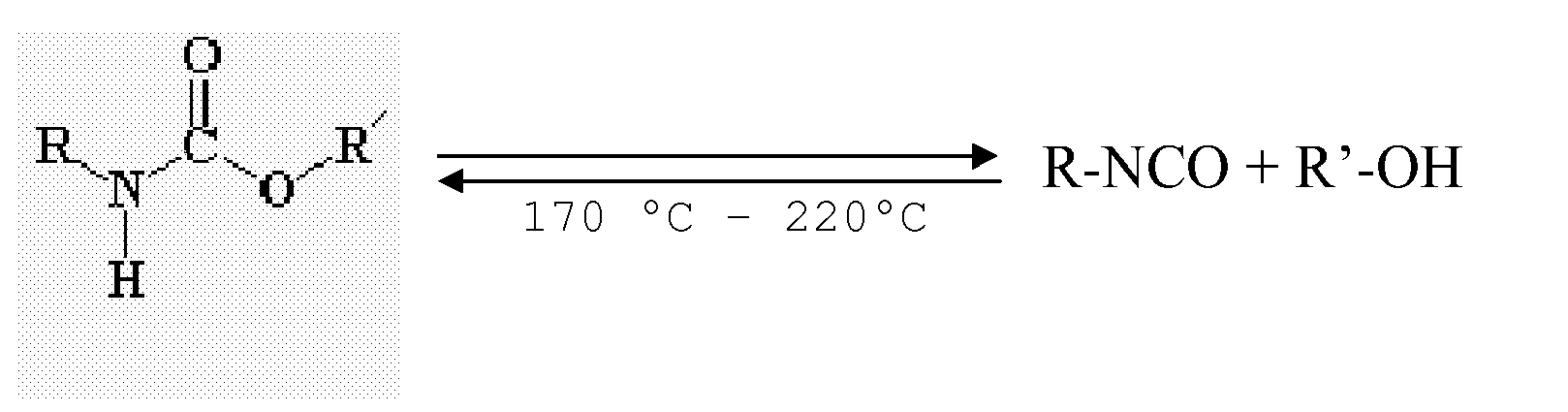
- samples E and G pass the HST perfectly at 200 ° C. This is quite surprising for polyurethanes given the fragility of the urethane bond already mentioned above, which materializes in a strong tendency to open in the following manner from 170 ° C:
- the samples E, G, H are heated to a temperature of about 120 ° C, before being irradiated only 5 times, directly at the exit of the oven.
- a third series of Hot Set Test is then conducted, always at a temperature of 200 ° C in order to make an objective comparison with the previous test.
- the level of insoluble or gel content expresses the proportion of insoluble material within a material.
- knowledge of this rate makes it possible to quantify the level of crosslinking of the polymer corresponding, knowing that the more a material is crosslinked, the higher its insoluble content is high and close to 100%.
- the procedure is identical for each measurement. Specifically, 1g (M1) of each material is placed in an Erlenmeyer flask containing 100g of tetrahydrofuran (THF), and the whole is refluxed at a temperature of 55 ° C, with magnetic stirring for a period of 24 hours. The contents of the Erlenmeyer flask are then hot-filtered on a metal grid whose mesh size is 120 ⁇ m ⁇ 120 ⁇ m. The solid residue obtained is then dried in an oven at 80 ° C for 3 hours and weighed (M2). The level of insolubles expressed in% is then calculated by making the mass ratio M2x100 / M1.
- THF tetrahydrofuran
Landscapes
- Chemical & Material Sciences (AREA)
- Health & Medical Sciences (AREA)
- Chemical Kinetics & Catalysis (AREA)
- Medicinal Chemistry (AREA)
- Polymers & Plastics (AREA)
- Organic Chemistry (AREA)
- Physics & Mathematics (AREA)
- Spectroscopy & Molecular Physics (AREA)
- Polyurethanes Or Polyureas (AREA)
- Organic Insulating Materials (AREA)
- Insulated Conductors (AREA)
- Compositions Of Macromolecular Compounds (AREA)
Abstract
Description
- La présente invention concerne un câble d'énergie et/ou de télécommunication doté d'au moins une gaine à base de polyuréthane thermoplastique réticulé.
- L'invention trouve une application particulièrement avantageuse, mais non exclusive, dans le domaine des véhicules de transport qui utilisent quantité de câbles d'énergie et/ou de télécommunication fonctionnant dans des conditions thermiques sévères.
- Certains polyuréthanes thermoplastiques sont connus pour offrir d'excellentes propriétés mécaniques, une bonne tenue chimique, ainsi qu'une résistance au vieillissement tout à fait satisfaisante. Cependant, en raison du caractère réversible de la liaison uréthane, on observe une chute significative des propriétés mécaniques de ces polymères dès lors que la température s'élève. Les polyuréthanes thermoplastiques ont alors tendance à fluer, et ce même simplement sous l'action de leur propre poids.
- Pour remédier à cette difficulté, il est bien entendu possible de réticuler les polyuréthanes thermoplastiques, c'est-à-dire de créer des liaisons chimiques entre les chaînes macromoléculaires afin de renforcer la cohésion globale du réseau. On sait en effet qu'augmenter la densité de réticulation d'un polymère conduit quasi systématiquement à une amélioration des propriétés thermiques, ainsi qu'à une diminution de la perméabilité vis-à-vis des fluides et des gaz, et par conséquent à une réduction de la sensibilité à l'égard d'éventuelles agressions chimiques.
- Dans le domaine de la câblerie, la réticulation d'un polyuréthane thermoplastique s'effectue généralement soit par auto-réticulation chimique, soit par irradiation électronique.
- Dans le premier cas de figure, c'est-à-dire la voie purement chimique, il convient de modifier chimiquement le polymère afin qu'il puisse réticuler de lui même en quelques jours, à l'air libre et à température ambiante. Deux méthodes sont actuellement disponibles pour opérer une telle transformation, l'une consistant à greffer le polyuréthane thermoplastique avec des composés portant des fonctions isocyanates, l'autre impliquant un greffage de molécules de type silane.
- Mais quelle que soit la technique employée, les propriétés thermiques atteintes par les polyuréthanes thermoplastiques ainsi réticulés demeurent aujourd'hui insuffisantes pour un certain nombre de domaines d'application très exigeants en terme de résistance à la chaleur sous contrainte mécanique, comme c'est le cas par exemple dans l'automobile. Le fait est qu'à l'heure actuelle, la tenue mécanique à haute température de tels polyuréthanes thermoplastiques réticulés ne peut être garantie que jusqu'à des températures voisines des 175°C.
- La voie de réticulation physique par irradiation est quant à elle communément mise en oeuvre en exposant le polyuréthane thermoplastique à un faisceau d'électrons accélérés, et donc hautement énergétiques. Le bombardement électronique est avantageusement calibré de manière à ce que l'énergie transmise soit à même d'induire la réticulation interne du polymère, via des ruptures puis des recombinaisons de liaisons chimiques.
- Ce type de réticulation présente toutefois l'inconvénient de nécessiter un équipement d'irradiation extrêmement encombrant, ce qui implique d'importantes contraintes d'installation, mais aussi un certain manque de flexibilité au niveau industriel. Un tel équipement s'avère par ailleurs particulièrement onéreux, ce qui au final rend cette solution technique tout à fait prohibitive pour de nombreuses applications.
- Aussi le problème technique à résoudre, par l'objet de la présente invention, est de proposer un câble d'énergie et/ou de télécommunication qui permettrait d'éviter les problèmes de l'état de la technique en offrant notamment une tenue mécanique sensiblement améliorée à hautes températures, tout en conservant un prix de revient raisonnable.
- La solution au problème technique posé consiste, selon la présente invention, en ce que le câble comporte au moins une gaine réalisée par réticulation d'une composition comprenant un polyuréthane thermoplastique, un polyisocyanate, ainsi qu'un composé réactif doté d'au moins une fonction hydroxyle et d'au moins une fonction acrylate.
- Le principe utilisé pour la réalisation d'une gaine de câble conforme à l'invention consiste dans un premier temps à greffer une résine acrylique sur une chaîne polyuréthane, selon le schéma suivant:

- Concrètement, cela revient à greffer sélectivement un polyisocyanate le long des chaînes uréthanes, comme indiqué dans la première partie de l'équation chimique précédente. Le polyuréthane thermoplastique greffé isocyanate ainsi obtenu est alors en mesure de réagir avec un composé réactif doté d'au moins une fonction OH par l'intermédiaire d'une réaction d'addition standard, conformément à la seconde partie de l'équation chimique. Si le composé réactif en question dispose par ailleurs d'au moins un groupement réactif aux ultraviolets, notamment de type acrylate, il devient alors possible de déclencher une réaction de photoréticulation pour renforcer la cohésion du réseau polymère.
- C'est ainsi que le principe utilisé pour la réalisation d'une gaine de câble conforme à l'invention, prévoit dans un second temps d'irradier le polyuréthane thermoplastique greffé avec un rayonnement ultraviolet. Cette opération, qui s'effectue de préférence en présence d'un photo-initiateur approprié, permet alors d'obtenir un polyuréthane thermoplastique réticulé aux performances thermomécaniques significativement accrues par rapport à ses homologues de l'état de la technique.
- Quoi qu'il en soit, il est à noter ici que la notion de gaine concerne très généralement tout revêtement enveloppant, quelle que soit sa forme et quelle que soit sa destination. Il peut ainsi s'agir indistinctement d'une gaine isolante et/ou d'une gaine de protection.
- On précise par ailleurs que de manière tout à fait classique, la locution "fonction acrylate" désigne indifféremment un groupement acrylate au sens strict du terme, ou un groupement méthacrylate.
- L'invention telle qu'ainsi définie présente l'avantage de pouvoir disposer d'un câble dont chaque gaine en polyuréthane thermoplastique réticulé présente des performances à hautes températures parfaitement compatibles avec les normes les plus sévères des domaines automobile, aéronautique, ferroviaire ou robotique. Une gaine conforme à l'invention s'avère en effet particulièrement résistante à la déformation sous contrainte mécanique, et ce jusqu'à des températures élevées voisines des 200°C.
- La solution proposée est par ailleurs aisée à mettre en oeuvre étant donné qu'elle ne requiert pas d'équipement lourd, notamment pour générer la réticulation de chaque gaine de polyuréthane thermoplastique. Cette opération s'effectue en effet instantanément, par réticulation sous la simple action d'un rayonnement ultraviolet. A cet égard, il faut remarquer que la lumière solaire s'avère parfaitement suffisante pour déclencher la réaction de photoréticulation. A noter que dans ce cas précis, la réaction n'est pas instantanée.
- Selon une particularité de l'invention, la concentration du composé réactif dans la composition est comprise entre 0,1 et 20% en poids, et de préférence entre 1 et 10%.
- Selon une autre particularité de l'invention, la composition peut également être dotée d'un photo-initiateur de la réaction de réticulation du polyuréthane thermoplastique greffé. Le rôle du photo-initiateur est bien entendu classiquement de générer des radicaux libres sous l'effet d'une exposition à un rayonnement actinique tel qu'un rayonnement ultraviolet.
- De manière particulièrement avantageuse, le photo-initiateur peut notamment être choisi parmi les alpha-hydroxy cétones, les éthers d'alkyl benzoine, les ketal alkyl benzil, les oxydes d'acylphosphines, les oxydes d'aryl phosphines, la benzophénone et ses dérivés, les xanthones et leurs dérivés.
- Conformément à une autre caractéristique avantageuse, la concentration du photo-initiateur dans la composition est comprise entre 0,01 et 10% en poids, et de préférence entre 1 et 5%.
- Selon une autre particularité de l'invention, la composition peut en outre être pourvue d'un catalyseur de la réaction d'addition entre le polyisocyanate et le composé réactif.
- De manière particulièrement avantageuse, le catalyseur est un dérivé de l'étain, du titane, une base, un acide, ou un mélange quelconque de ces composés.
- De préférence, le catalyseur est du dilaurate de dibutyle étain, plus communément désigné par l'abréviation DBTL.
- Conformément à une autre caractéristique avantageuse, la concentration du catalyseur dans la composition est comprise entre 0,001 et 1% en poids.
- L'invention concerne également un procédé de fabrication d'une gaine de câble d'énergie et/ou de télécommunication, procédé remarquable en ce qu'il comporte les étapes consistant à:
- mélanger un polyuréthane thermoplastique, un polyisocyanate, ainsi qu'un composé réactif doté d'au moins une fonction hydroxyle et d'au moins une fonction acrylate,
- réticuler la composition préalablement mélangée par rayonnement ultraviolet.
- De manière particulièrement avantageuse, le procédé de fabrication comporte en outre une étape supplémentaire qui consiste à extruder le mélange sous forme de gaine, ladite étape d'extrusion étant mise en oeuvre entre l'étape de mélange et l'étape de réticulation.
- D'autres caractéristiques et avantages de la présente invention apparaîtront au cours de la description de l'exemple comparatif qui va suivre, ledit exemple étant donné à titre illustratif et nullement limitatif.
- L'objectif est de déterminer puis de comparer les performances thermomécaniques de différents polyuréthanes thermoplastiques à même d'être utilisés pour la fabrication de gaines isolantes et/ou de protection de câbles d'énergie et/ou de télécommunication.
- Concrètement, cinq mélanges E, F, G, H, E' sont préparés à partir de cinq formulations initiales A, B, C, D, A' qui diffèrent les unes des autres essentiellement de part la nature de la résine époxy acrylate utilisée pour greffer le polyuréthane thermoplastique de base.
- Afin d'éviter toute réticulation intempestive, la réalisation des mélanges E, F, G, H, E' s'effectue en deux temps, avec préparation préalable des formulations A, B, C, D, A' intégrant chaque résine époxy acrylate, puis incorporation d'un même polyuréthane thermoplastique greffé isocyanate.
- Le tableau 1 détaille précisément les différences de compositions entre les cinq formulations de base A, B, C, D, A'. A cet égard, il est à noter que les quantités mentionnées dans les différents tableaux figurés ci-après sont classiquement exprimées en parties en poids pour cent parties en poids de polyuréthane thermoplastique.
Tableau 1 Formulations A B C D A' Estane 58888 100 100 100 100 100 CN133 6 - - - 6 CN152 - 12 - - SR399 - - 10 - Lucirin TPO 2 2 2 - 2 DBTL (ppm d'étain) 40 48 45 45 0 - L'Estane 58888 est un polyuréthane thermoplastique de type polyéther, qui est distribué par la société Noveon. Il est commun aux cinq échantillons, et sert notamment ici de matrice aux différents mélanges E, F, G, H, E'.
- Trois types de résines rentrent dans ces compostions. Il s'agit tout d'abord du CN152, c'est-à-dire d'un époxy acrylate mono-fonctionnel commercialisé par la société Cray Valley. On trouve ensuite un époxy acrylate tri-fonctionnel, distribué sous la marque CN133 également par la société Cray Valley. On dispose enfin de SR399, en d'autres termes du dipentaérythritol penta acrylate commercialisé toujours par la société Cray Valley.
- La réticulation s'opérant dans tous les cas de figure sous rayonnement ultraviolet, l'amorçage est assuré systématiquement par un photo-initiateur qui est constitué ici par un oxyde de triphénylphosphine commercialisé sous la marque Lucirin TPO par la société BASF.
- La fonction catalyseur est quant à elle assurée par du DBTL, c'est-à-dire du dilaurate de dibutyle étain. Il est à noter que ses proportions sont ici exprimées exceptionnellement en ppm, en raison de l'extrême faiblesse des quantités mise en jeu.
- Le tableau 2 détaille quant à lui les compositions des cinq mélanges ultimes E, F, G, H, E' qui intègrent la totalité des constituants destinés à la formation des matériaux finaux.
Tableau 2 Mélanges E F G H E' Estane 58888 greffé 50 50 50 50 50 A 50 - - - B - 50 - - C - - 50 - D - - - 50 A' 50 - Comme son nom le suggère, l'Estane 58888 greffé est un dérivé greffé isocyanate du polyuréthane thermoplastique Estane 58888 précédemment décrit. Sa caractéristique est qu'il intègre 3 parties en poids de diisocyanate de diphényle méthane (MDI), ainsi que 3 parties de trimère d'isophorone diisocyanate (t-IPDI) pour 100 parties de polymère.
- L'Estane 58888 greffé est destiné à réagir avec chaque type de résine choisi, et c'est pour cela qu'il est intégré dans un second temps lors de la préparation des différentes mélanges E, F, G, H, E'.
- On note que l'échantillon H ne contient ni résine, ni photo-initiateur. A ce titre, il constitue l'échantillon référence de l'exemple comparatif.
- Concrètement, les différents mélanges E, F, G, H, E' étudiés dans le cadre de l'exemple comparatif sont tous préparés en suivant le même mode opératoire.
- Dans chaque cas, cela débute par l'introduction du polyuréthane thermoplastique dans un mélangeur interne maintenu à 180°C. Un malaxage est alors effectué pendant 10 minutes, la température se stabilisant à 185°C. La résine est ensuite ajoutée lentement du fait de sa faible viscosité, afin de ne pas lubrifier le mélangeur. A la fin de cette opération, le photo-initiateur est incorporé dans le mélange en même temps que le catalyseur, ceci afin de tenir compte du fait que ledit catalyseur est utilisé en petite quantité et que sa viscosité est faible. Le malaxage se poursuit alors durant 15 minutes, avant que le mélange ne soit finalement retiré du mélangeur.
- Dans un second temps, chaque mélange A, B, C, D, E' précédemment obtenu est réintroduit dans le mélangeur interne maintenu à 180°C, où il est malaxé durant 10 minutes. L'Estane 58888 greffé est ensuite incorporé. On considère alors que 2 minutes sont nécessaires pour obtenir une parfaite fusion du polyuréthane thermoplastique greffé isocyanate, et que 2 autres minutes sont indispensables pour parvenir à une bonne réaction entre les groupements isocyanates du polyuréthane thermoplastique et les groupements hydroxyles de la résine.
- Des plaques d'échantillons d'1 mm d'épaisseur sont réalisées en mettant les différents mélanges E, F, G, H, E' sous presse pendant 7 minutes, à une température 200°C et sous une pression de 100 bars. Ces plaques sont ensuite irradiées sous rayonnement ultraviolet en 1, 5, 10 et 20 passes et à une vitesse de 5 m/min, au moyen d'un convoyeur équipé d'une lampe de puissance 200W/cm de type « D » commercialisé par la société Fusion UV Systems.
- Afin de vérifier qu'une véritable réticulation a bien eu lieu, il apparaît pertinent de procéder à une série de tests de fluage à chaud sous contrainte mécanique, tests qui sont communément désignés par l'anglicisme "Hot set Test" et par l'abréviation HST.
- Ce type de test est régi par la norme NF EN 60811-2-1. Il consiste concrètement à lester une extrémité d'une éprouvette de type haltère H2 avec une masse correspondant à l'application d'une contrainte équivalente à 0,2MPa, et à placer l'ensemble dans une étuve chauffée à une température de consigne donnée à +/-1°C pendant une durée de 15 minutes. Au terme de ce délai, on relève l'allongement à chaud sous contrainte de l'éprouvette, exprimé en %. La masse suspendue est alors retirée, et l'éprouvette est maintenue dans l'étuve pendant 5 nouvelles minutes. L'allongement permanent restant, également appelé rémanence, est alors mesuré avant d'être exprimé en %.
- On rappelle que plus un matériau est réticulé, plus les valeurs d'allongement et de rémanence seront faibles. On précise par ailleurs que dans le cas où une éprouvette viendrait à se rompre en cours d'essai ou que son allongement serait supérieur à 100%, sous l'action conjuguée de la contrainte mécanique et de la température, le résultat au test serait alors logiquement considéré comme un échec.
- Les résultats des essais de fluage à chaud hot set test à 175°C, des échantillons irradiés par 10 passages sous la lampe UV, sont consignés dans le tableau 3 ci-dessous:
Tableau 3 Echantillon E F H Allongement à chaud (%) 21 20 Rupture éprouvette Rémanence (%) 8 12 - Les résultats des essais de fluage à chaud hot set test à 175°C, des échantillons irradiés par 20 passages sous la lampe UV, sont consignés dans le tableau 4 ci-dessous:
Tableau 4 Echantillon E F G H E' Allongement à chaud (%) 7 19 11 Rupture éprouvette 25 Rémanence (%) 2 11 5 14 - On observe tout d'abord que contrairement à l'échantillon témoin H, les trois échantillons E, F, G à base de résine passent avec succès le Hot Set Test à 175°C. A cet égard, il est à noter que ces bons résultats sont obtenus indépendamment du fait que l'irradiation s'opère en 10 ou 20 passes.
- On remarque par ailleurs que pour un échantillon donné, plus l'irradiation est importante, plus l'allongement et la rémanence sont faibles, ce qui signifie qu'il y a vraisemblablement eu une densification du réseau réticulé.
- On voit également que le catalyseur a bien joué son rôle puisque les valeurs d'allongement après test, ainsi que la rémanence, sont inférieures pour l'échantillon E à celles obtenues pour l'échantillon E'. La réaction d'addition des groupements -OH sur les groupements -NCO est donc optimisée en présence du catalyseur.Fluage à chaud sous contrainte mécanique à 200°C
- Une seconde série de Hot Set Test est réalisée à une température qui est fixée cette fois à 200°C. Les résultats des essais de fluage à chaud hot set test à 200°C ,des échantillons irradiés par 20 passages sous la lampe UV, sont consignés dans le tableau 5 ci-dessous:
Tableau 5 Echantillon E F G H Allongement à chaud (%) 40 Rupture éprouvette 50 Rupture éprouvette Rémanence (%) 27 30 - Les résultats des essais de fluage à chaud hot set test à 200°C des échantillons irradiés par 10 passages sous la lampe UV sont consignés dans le tableau 6 ci-dessous:
Tableau 6 Echantillon E F G H Allongement à chaud (%) 52 Rupture éprouvette 70 Rupture éprouvette Rémanence (%) 32 30 - Contrairement aux échantillons F et H, les échantillons E et G passent parfaitement le HST à 200°C. Cela s'avère assez surprenant pour des polyuréthanes étant donné la fragilité de la liaison uréthane déjà évoquée précédemment, qui se matérialise par une forte tendance à s'ouvrir de la manière suivante à partir des 170°C:
- Afin de se placer dans des conditions plus proche de celles de l'industrie, il apparaît important de diminuer le nombre d'irradiations. Réaliser les irradiations ultraviolet à chaud permet d'atteindre cet objectif. On sait en effet que d'un point de vue thermodynamique, la réaction de réticulation est favorisée par la chaleur.
- Concrètement, les échantillons E, G, H sont donc portés à une température d'environ 120°C, avant d'être irradiés uniquement 5 fois, directement en sortie d'étuve. Une troisième série de Hot Set Test est alors conduite, toujours à une température de 200°C afin de pouvoir effectuer une comparaison objective avec le test précédent.
- Les résultats des essais de fluage à chaud hot set test à 200°C, des échantillons portés à 120°C puis irradiés par 5 passages sous la lampe UV, sont consignés dans le tableau 7 ci-dessous:
Tableau 7 Echantillon E G H Allongement à chaud (%) 95 50 Rupture éprouvette Rémanence (%) 70 35 - Ces résultats s'avèrent particulièrement intéressants dans la mesure où ils montrent que les échantillons E et G sont capables de réussir un Hot Set Test à 200°C avec un faible niveau d'irradiations, même si cela implique en contrepartie une certaine dégradation de l'allongement et de la rémanence.
- Le taux d'insolubles ou taux de gel exprime la proportion de matière insoluble au sein d'un matériau. Dans le cas présent, la connaissance de ce taux permet de quantifier le niveau de réticulation du polymère correspondant, sachant que plus un matériau est réticulé, plus son taux d'insolubles est élevé et proche de 100%.
- Dans la pratique, le mode opératoire est identique pour chaque mesure. Concrètement, 1g (M1) de chaque matériau est placé dans un erlenmeyer contenant 100g de tétrahydrofurane (THF), et l'ensemble est porté à reflux à une température de 55°C, sous agitation magnétique pendant une durée de 24h. Le contenu de l'erlenmeyer est ensuite filtré à chaud sur une grille métallique dont la taille des mailles est de 120µm x 120µm. Le résidu solide obtenu est alors séché dans une étuve à 80°C pendant 3 heures, puis pesé (M2). Le taux d'insolubles exprimé en % est ensuite calculé en faisant le rapport de masses M2x100/M1.
- Sont testés dans le cadre de l'exemple comparatif, uniquement les matériaux ayant passé avec succès le Hot Set Test à 200°C, qu'il s'agisse des échantillons E et G irradiés 20 fois ou ceux ayant subi 5 irradiations à chaud. Le tableau 3 regroupe les résultats des différentes mesures.
Tableau 8 Irradiation Ech. masse initiale
M1 (g)masse après test
M2 (g)taux de gel (%) 20 passes E 1.010 0.936 93 G 1.017 0.954 94 5 passes à chaud E 0.990 0.860 86 G 1.000 0.960 96 - Dans le cas des échantillons E et G irradiés 20 fois, le taux d'insolubles élevé illustre une réticulation très poussée pour les deux polyuréthanes thermoplastiques.
- Les conclusions sont identiques en ce qui concerne les échantillons irradiés 5 fois à chaud, avec notamment un taux d'insolubles particulièrement élevé pour l'échantillon G, qui confirme pleinement les résultats obtenus par ce matériau lors du Hot Set Test à 200°C.
Claims (11)
- Câble d'énergie et/ou de télécommunication, caractérisé en ce qu'il comporte au moins une gaine réalisée par réticulation d'une composition comprenant un polyuréthane thermoplastique, un polyisocyanate, ainsi qu'un composé réactif doté d'au moins une fonction hydroxyle et d'au moins une fonction acrylate.
- Câble selon la revendication 1, caractérisé en ce que la concentration du composé réactif dans la composition est comprise entre 0,1 et 20% en poids, et de préférence entre 1 et 10%.
- Câble selon l'une des revendications 1 ou 2, caractérisé en ce que la composition comporte un photo-initiateur de la réaction de réticulation du polyuréthane thermoplastique greffé.
- Câble selon la revendication 3, caractérisé en ce que le photo-initiateur est choisi parmi les alpha-hydroxy cétones, les éthers d'alkyl benzoine, les ketal alkyl benzil, les oxydes d'acylphosphines, les oxydes d'aryl phosphines, la benzophénone et ses dérivés, les xanthones et leurs dérivés.
- Câble selon l'une des revendications 3 ou 4, caractérisé en ce que la concentration du photo-initiateur dans la composition est comprise entre 0,01 et 10% en poids, et de préférence entre 1 et 5%.
- Câble selon l'une quelconque des revendications 1 à 5, caractérisé en ce que la composition comporte un catalyseur de la réaction d'addition entre le polyisocyanate et le composé réactif.
- Câble selon la revendication 6, caractérisé en ce que le catalyseur est un dérivé de l'étain, du titane, une base, un acide, ou un mélange quelconque de ces composés.
- Câble selon l'une des revendications 6 ou 7, caractérisé en ce que le catalyseur est du dilaurate de dibutyle étain.
- Câble selon l'une quelconque des revendications 6 à 8, caractérisé en ce que la concentration du catalyseur dans la composition est comprise entre 0,001 et 1% en poids.
- Procédé de fabrication d'une gaine de câble d'énergie et/ou de télécommunication, caractérisé en ce qu'il comporte les étapes consistant à:- mélanger un polyuréthane thermoplastique, un polyisocyanate, ainsi qu'un composé réactif doté d'au moins une fonction hydroxyle et d'au moins une fonction acrylate,- réticuler la composition préalablement mélangée par rayonnement ultraviolet.
- Procédé de fabrication selon la revendication 10, caractérisé en ce qu'il comporte en outre une étape d'extrusion du mélange sous forme de gaine, ladite étape d'extrusion étant mise en oeuvre entre l'étape de mélange et l'étape de réticulation.
Applications Claiming Priority (1)
| Application Number | Priority Date | Filing Date | Title |
|---|---|---|---|
| FR0552573A FR2890226B1 (fr) | 2005-08-26 | 2005-08-26 | Cable d'energie et/ou de telecommunication avec gaine en polyurethane thermoplastique reticule |
Publications (3)
| Publication Number | Publication Date |
|---|---|
| EP1760113A2 true EP1760113A2 (fr) | 2007-03-07 |
| EP1760113A3 EP1760113A3 (fr) | 2009-07-22 |
| EP1760113B1 EP1760113B1 (fr) | 2010-06-02 |
Family
ID=36283900
Family Applications (1)
| Application Number | Title | Priority Date | Filing Date |
|---|---|---|---|
| EP06300884A Expired - Lifetime EP1760113B1 (fr) | 2005-08-26 | 2006-08-22 | Câble d'énergie et/ou de télécommunication avec gaine en polyuréthane thermoplastique réticule |
Country Status (7)
| Country | Link |
|---|---|
| US (1) | US20070051530A1 (fr) |
| EP (1) | EP1760113B1 (fr) |
| KR (1) | KR101313133B1 (fr) |
| CN (1) | CN1941221B (fr) |
| AT (1) | ATE470224T1 (fr) |
| DE (1) | DE602006014626D1 (fr) |
| FR (1) | FR2890226B1 (fr) |
Families Citing this family (1)
| Publication number | Priority date | Publication date | Assignee | Title |
|---|---|---|---|---|
| CN104017350A (zh) * | 2014-05-19 | 2014-09-03 | 安徽省康利亚实业有限公司 | 一种汽车电缆用热塑性聚氨酯护套料缘料及其制备方法 |
Family Cites Families (11)
| Publication number | Priority date | Publication date | Assignee | Title |
|---|---|---|---|---|
| US4065587A (en) * | 1976-05-11 | 1977-12-27 | Scm Corporation | U.V. Curable poly(ether-urethane) polyacrylates and wet-look polymers prepared therefrom |
| JPS582063B2 (ja) * | 1980-05-29 | 1983-01-13 | 大日精化工業株式会社 | 熱硬化性ポリウレタン成形品の製造法 |
| US4474830A (en) * | 1982-12-29 | 1984-10-02 | At&T Bell Laboratories | Multiple coating of fibers |
| FR2565024B1 (fr) * | 1984-05-24 | 1987-05-29 | Kabelmetal Electro Gmbh | Cable electrique ou optique difficilement inflammable |
| US5949940A (en) * | 1997-05-27 | 1999-09-07 | Corning Incorporated | Enhanced ribbon strippability using coating additives |
| US5767220A (en) * | 1997-08-25 | 1998-06-16 | Bayer Corporation | Low viscosity, ethylenically unsaturated polyurethanes containing allophanate groups |
| FR2794759B1 (fr) * | 1999-06-08 | 2002-07-12 | Gemoplast | Procede de fabrication d'un polyurethanne thermodurcissable apres transformation a partir d'un polyurethanne thermoplastique, et polyurethanne thermodurci apres transformation susceptible d'etre obtenu par ledit procede |
| US7276543B2 (en) * | 2001-10-09 | 2007-10-02 | Dsm Ip Assets B.V. | Radiation curable resin composition |
| FR2831542B1 (fr) * | 2001-10-26 | 2005-02-25 | Gemoplast | Polyurethanne thermoplastique thermodurcissable greffe, pur ou en melange, et polyurethanne thermodurci obtenu apres reticulation |
| FR2831452A1 (fr) * | 2001-10-30 | 2003-05-02 | Fabrice Jean Claude Autissier | Planche d'apprentissage et de perfectionnement de sauts et figures sur trampoline |
| JP4401262B2 (ja) * | 2004-02-02 | 2010-01-20 | 富士フイルム株式会社 | 平版印刷版原版 |
-
2005
- 2005-08-26 FR FR0552573A patent/FR2890226B1/fr not_active Expired - Fee Related
-
2006
- 2006-08-22 EP EP06300884A patent/EP1760113B1/fr not_active Expired - Lifetime
- 2006-08-22 DE DE602006014626T patent/DE602006014626D1/de not_active Expired - Lifetime
- 2006-08-22 AT AT06300884T patent/ATE470224T1/de not_active IP Right Cessation
- 2006-08-23 US US11/509,090 patent/US20070051530A1/en not_active Abandoned
- 2006-08-28 KR KR1020060081914A patent/KR101313133B1/ko not_active Expired - Fee Related
- 2006-08-28 CN CN2006101495219A patent/CN1941221B/zh not_active Expired - Fee Related
Also Published As
| Publication number | Publication date |
|---|---|
| DE602006014626D1 (de) | 2010-07-15 |
| FR2890226A1 (fr) | 2007-03-02 |
| EP1760113B1 (fr) | 2010-06-02 |
| CN1941221B (zh) | 2011-09-07 |
| ATE470224T1 (de) | 2010-06-15 |
| KR20070024441A (ko) | 2007-03-02 |
| FR2890226B1 (fr) | 2007-09-28 |
| US20070051530A1 (en) | 2007-03-08 |
| CN1941221A (zh) | 2007-04-04 |
| KR101313133B1 (ko) | 2013-09-30 |
| EP1760113A3 (fr) | 2009-07-22 |
Similar Documents
| Publication | Publication Date | Title |
|---|---|---|
| EP2960298B1 (fr) | Rayonnement actinique et composition durcissable à l'humidité | |
| US4720529A (en) | UV-ray curable polyurethane composition and coated optical fiber | |
| DE69810287T2 (de) | Flüssige härtbare harzzusammensetzung | |
| EP2731996B2 (fr) | Utilisation d'un composé extenseur de chaine du polyamide en tant qu'agent stabilisant | |
| EP2591037B1 (fr) | Polyuréthanes thermoplastiques réticulables | |
| CN117106405B (zh) | 一种高Tg值、耐光的水性聚氨酯胶粘剂及其制备方法和应用 | |
| FR2751763A1 (fr) | Article photochromique, sa fabrication et composition pour sa fabrication | |
| CN117757024A (zh) | 一种基于聚氨酯的光伏边框材料及其制备工艺 | |
| EP1297023B1 (fr) | Procede de production de substances auto-adhesives d'acrylate reticulables | |
| US4562115A (en) | Composites and size coated glass fibers used therein | |
| EP1760113B1 (fr) | Câble d'énergie et/ou de télécommunication avec gaine en polyuréthane thermoplastique réticule | |
| Akbaş et al. | Effects of thermal ageing on the properties and lifetime prediction of hydroxyl-terminated polybutadiene | |
| EP0603046A1 (fr) | Polymères polyuréthanes-acryliques prégélifiables par la température et post-durcissables par l'humidité, et compositions adhésives monocomposantes les contenant | |
| EP0347610A2 (fr) | Rêvetements durcissables par UV pour des articles en polycarbonate | |
| EP1348000A1 (fr) | Procede pour recouvrir des substrats | |
| WO2019154676A1 (fr) | Masse pouvant être fixée par rayonnement actinique et son utilisation | |
| EP0447309A1 (fr) | Plaques coulées â haute résistance au choc, leur procédé de fabrication | |
| EP0272975A2 (fr) | Plaques coulées à haute résistance au choc, leur procédé de fabrication et articles façonnés obtenus | |
| EP1806379B1 (fr) | Procédé de réticulation d'un polymère chargé et à base de polyéthylène | |
| CN118085794A (zh) | 一种热塑性聚氨酯热熔胶及其制备方法 | |
| EP0659860B1 (fr) | Matrice élastomère adhésive et utilisations | |
| Bolon et al. | Effect of humidity and elevated temperatures on physical properties of UV‐cured polymers | |
| DE112021004440B4 (de) | Beschichtungsmittel für harzglas und harzglas | |
| EP1722378A2 (fr) | Cable de manutention pour l'alimentation électrique et/ou la transmission de signal | |
| CH652383A5 (fr) | Procede de preparation de liant reticule pour propergols a simple et a double base et compositions propulsives reticulees contenant un tel liant. |
Legal Events
| Date | Code | Title | Description |
|---|---|---|---|
| PUAI | Public reference made under article 153(3) epc to a published international application that has entered the european phase |
Free format text: ORIGINAL CODE: 0009012 |
|
| AK | Designated contracting states |
Kind code of ref document: A2 Designated state(s): AT BE BG CH CY CZ DE DK EE ES FI FR GB GR HU IE IS IT LI LT LU LV MC NL PL PT RO SE SI SK TR |
|
| AX | Request for extension of the european patent |
Extension state: AL BA HR MK YU |
|
| PUAL | Search report despatched |
Free format text: ORIGINAL CODE: 0009013 |
|
| AK | Designated contracting states |
Kind code of ref document: A3 Designated state(s): AT BE BG CH CY CZ DE DK EE ES FI FR GB GR HU IE IS IT LI LT LU LV MC NL PL PT RO SE SI SK TR |
|
| AX | Request for extension of the european patent |
Extension state: AL BA HR MK RS |
|
| RIC1 | Information provided on ipc code assigned before grant |
Ipc: H01B 3/30 20060101AFI20090618BHEP Ipc: C08L 75/04 20060101ALI20090618BHEP |
|
| 17P | Request for examination filed |
Effective date: 20090709 |
|
| GRAP | Despatch of communication of intention to grant a patent |
Free format text: ORIGINAL CODE: EPIDOSNIGR1 |
|
| AKX | Designation fees paid |
Designated state(s): AT BE BG CH CY CZ DE DK EE ES FI FR GB GR HU IE IS IT LI LT LU LV MC NL PL PT RO SE SI SK TR |
|
| GRAS | Grant fee paid |
Free format text: ORIGINAL CODE: EPIDOSNIGR3 |
|
| GRAA | (expected) grant |
Free format text: ORIGINAL CODE: 0009210 |
|
| AK | Designated contracting states |
Kind code of ref document: B1 Designated state(s): AT BE BG CH CY CZ DE DK EE ES FI FR GB GR HU IE IS IT LI LT LU LV MC NL PL PT RO SE SI SK TR |
|
| REG | Reference to a national code |
Ref country code: GB Ref legal event code: FG4D Free format text: NOT ENGLISH |
|
| REG | Reference to a national code |
Ref country code: CH Ref legal event code: EP |
|
| REG | Reference to a national code |
Ref country code: IE Ref legal event code: FG4D Free format text: LANGUAGE OF EP DOCUMENT: FRENCH |
|
| REF | Corresponds to: |
Ref document number: 602006014626 Country of ref document: DE Date of ref document: 20100715 Kind code of ref document: P |
|
| REG | Reference to a national code |
Ref country code: SE Ref legal event code: TRGR |
|
| REG | Reference to a national code |
Ref country code: NL Ref legal event code: VDEP Effective date: 20100602 |
|
| REG | Reference to a national code |
Ref country code: GR Ref legal event code: EP Ref document number: 20100402033 Country of ref document: GR |
|
| PG25 | Lapsed in a contracting state [announced via postgrant information from national office to epo] |
Ref country code: LT Free format text: LAPSE BECAUSE OF FAILURE TO SUBMIT A TRANSLATION OF THE DESCRIPTION OR TO PAY THE FEE WITHIN THE PRESCRIBED TIME-LIMIT Effective date: 20100602 |
|
| LTIE | Lt: invalidation of european patent or patent extension |
Effective date: 20100602 |
|
| PG25 | Lapsed in a contracting state [announced via postgrant information from national office to epo] |
Ref country code: SI Free format text: LAPSE BECAUSE OF FAILURE TO SUBMIT A TRANSLATION OF THE DESCRIPTION OR TO PAY THE FEE WITHIN THE PRESCRIBED TIME-LIMIT Effective date: 20100602 Ref country code: AT Free format text: LAPSE BECAUSE OF FAILURE TO SUBMIT A TRANSLATION OF THE DESCRIPTION OR TO PAY THE FEE WITHIN THE PRESCRIBED TIME-LIMIT Effective date: 20100602 Ref country code: LV Free format text: LAPSE BECAUSE OF FAILURE TO SUBMIT A TRANSLATION OF THE DESCRIPTION OR TO PAY THE FEE WITHIN THE PRESCRIBED TIME-LIMIT Effective date: 20100602 Ref country code: FI Free format text: LAPSE BECAUSE OF FAILURE TO SUBMIT A TRANSLATION OF THE DESCRIPTION OR TO PAY THE FEE WITHIN THE PRESCRIBED TIME-LIMIT Effective date: 20100602 |
|
| PG25 | Lapsed in a contracting state [announced via postgrant information from national office to epo] |
Ref country code: PL Free format text: LAPSE BECAUSE OF FAILURE TO SUBMIT A TRANSLATION OF THE DESCRIPTION OR TO PAY THE FEE WITHIN THE PRESCRIBED TIME-LIMIT Effective date: 20100602 Ref country code: CY Free format text: LAPSE BECAUSE OF FAILURE TO SUBMIT A TRANSLATION OF THE DESCRIPTION OR TO PAY THE FEE WITHIN THE PRESCRIBED TIME-LIMIT Effective date: 20100602 |
|
| REG | Reference to a national code |
Ref country code: IE Ref legal event code: FD4D |
|
| PG25 | Lapsed in a contracting state [announced via postgrant information from national office to epo] |
Ref country code: NL Free format text: LAPSE BECAUSE OF FAILURE TO SUBMIT A TRANSLATION OF THE DESCRIPTION OR TO PAY THE FEE WITHIN THE PRESCRIBED TIME-LIMIT Effective date: 20100602 Ref country code: IE Free format text: LAPSE BECAUSE OF FAILURE TO SUBMIT A TRANSLATION OF THE DESCRIPTION OR TO PAY THE FEE WITHIN THE PRESCRIBED TIME-LIMIT Effective date: 20100602 Ref country code: EE Free format text: LAPSE BECAUSE OF FAILURE TO SUBMIT A TRANSLATION OF THE DESCRIPTION OR TO PAY THE FEE WITHIN THE PRESCRIBED TIME-LIMIT Effective date: 20100602 |
|
| PG25 | Lapsed in a contracting state [announced via postgrant information from national office to epo] |
Ref country code: SK Free format text: LAPSE BECAUSE OF FAILURE TO SUBMIT A TRANSLATION OF THE DESCRIPTION OR TO PAY THE FEE WITHIN THE PRESCRIBED TIME-LIMIT Effective date: 20100602 Ref country code: CZ Free format text: LAPSE BECAUSE OF FAILURE TO SUBMIT A TRANSLATION OF THE DESCRIPTION OR TO PAY THE FEE WITHIN THE PRESCRIBED TIME-LIMIT Effective date: 20100602 Ref country code: IS Free format text: LAPSE BECAUSE OF FAILURE TO SUBMIT A TRANSLATION OF THE DESCRIPTION OR TO PAY THE FEE WITHIN THE PRESCRIBED TIME-LIMIT Effective date: 20101002 Ref country code: PT Free format text: LAPSE BECAUSE OF FAILURE TO SUBMIT A TRANSLATION OF THE DESCRIPTION OR TO PAY THE FEE WITHIN THE PRESCRIBED TIME-LIMIT Effective date: 20101004 Ref country code: RO Free format text: LAPSE BECAUSE OF FAILURE TO SUBMIT A TRANSLATION OF THE DESCRIPTION OR TO PAY THE FEE WITHIN THE PRESCRIBED TIME-LIMIT Effective date: 20100602 |
|
| RAP2 | Party data changed (patent owner data changed or rights of a patent transferred) |
Owner name: NEXANS |
|
| PG25 | Lapsed in a contracting state [announced via postgrant information from national office to epo] |
Ref country code: MC Free format text: LAPSE BECAUSE OF NON-PAYMENT OF DUE FEES Effective date: 20100831 |
|
| PLBE | No opposition filed within time limit |
Free format text: ORIGINAL CODE: 0009261 |
|
| STAA | Information on the status of an ep patent application or granted ep patent |
Free format text: STATUS: NO OPPOSITION FILED WITHIN TIME LIMIT |
|
| PG25 | Lapsed in a contracting state [announced via postgrant information from national office to epo] |
Ref country code: DK Free format text: LAPSE BECAUSE OF FAILURE TO SUBMIT A TRANSLATION OF THE DESCRIPTION OR TO PAY THE FEE WITHIN THE PRESCRIBED TIME-LIMIT Effective date: 20100602 |
|
| 26N | No opposition filed |
Effective date: 20110303 |
|
| GBPC | Gb: european patent ceased through non-payment of renewal fee |
Effective date: 20100902 |
|
| REG | Reference to a national code |
Ref country code: DE Ref legal event code: R097 Ref document number: 602006014626 Country of ref document: DE Effective date: 20110302 |
|
| PG25 | Lapsed in a contracting state [announced via postgrant information from national office to epo] |
Ref country code: GB Free format text: LAPSE BECAUSE OF NON-PAYMENT OF DUE FEES Effective date: 20100902 |
|
| PG25 | Lapsed in a contracting state [announced via postgrant information from national office to epo] |
Ref country code: LU Free format text: LAPSE BECAUSE OF NON-PAYMENT OF DUE FEES Effective date: 20100822 Ref country code: HU Free format text: LAPSE BECAUSE OF FAILURE TO SUBMIT A TRANSLATION OF THE DESCRIPTION OR TO PAY THE FEE WITHIN THE PRESCRIBED TIME-LIMIT Effective date: 20101203 Ref country code: BG Free format text: LAPSE BECAUSE OF FAILURE TO SUBMIT A TRANSLATION OF THE DESCRIPTION OR TO PAY THE FEE WITHIN THE PRESCRIBED TIME-LIMIT Effective date: 20100602 |
|
| PG25 | Lapsed in a contracting state [announced via postgrant information from national office to epo] |
Ref country code: TR Free format text: LAPSE BECAUSE OF FAILURE TO SUBMIT A TRANSLATION OF THE DESCRIPTION OR TO PAY THE FEE WITHIN THE PRESCRIBED TIME-LIMIT Effective date: 20100602 |
|
| PG25 | Lapsed in a contracting state [announced via postgrant information from national office to epo] |
Ref country code: BG Free format text: LAPSE BECAUSE OF FAILURE TO SUBMIT A TRANSLATION OF THE DESCRIPTION OR TO PAY THE FEE WITHIN THE PRESCRIBED TIME-LIMIT Effective date: 20100902 |
|
| PG25 | Lapsed in a contracting state [announced via postgrant information from national office to epo] |
Ref country code: ES Free format text: LAPSE BECAUSE OF FAILURE TO SUBMIT A TRANSLATION OF THE DESCRIPTION OR TO PAY THE FEE WITHIN THE PRESCRIBED TIME-LIMIT Effective date: 20100913 |
|
| PGFP | Annual fee paid to national office [announced via postgrant information from national office to epo] |
Ref country code: DE Payment date: 20130821 Year of fee payment: 8 Ref country code: CH Payment date: 20130821 Year of fee payment: 8 Ref country code: SE Payment date: 20130821 Year of fee payment: 8 Ref country code: GR Payment date: 20130822 Year of fee payment: 8 |
|
| PGFP | Annual fee paid to national office [announced via postgrant information from national office to epo] |
Ref country code: FR Payment date: 20130823 Year of fee payment: 8 |
|
| PGFP | Annual fee paid to national office [announced via postgrant information from national office to epo] |
Ref country code: IT Payment date: 20130829 Year of fee payment: 8 |
|
| PGFP | Annual fee paid to national office [announced via postgrant information from national office to epo] |
Ref country code: BE Payment date: 20130823 Year of fee payment: 8 |
|
| REG | Reference to a national code |
Ref country code: DE Ref legal event code: R119 Ref document number: 602006014626 Country of ref document: DE |
|
| REG | Reference to a national code |
Ref country code: SE Ref legal event code: EUG Ref country code: CH Ref legal event code: PL |
|
| REG | Reference to a national code |
Ref country code: GR Ref legal event code: ML Ref document number: 20100402033 Country of ref document: GR Effective date: 20150304 |
|
| PG25 | Lapsed in a contracting state [announced via postgrant information from national office to epo] |
Ref country code: IT Free format text: LAPSE BECAUSE OF NON-PAYMENT OF DUE FEES Effective date: 20140822 Ref country code: CH Free format text: LAPSE BECAUSE OF NON-PAYMENT OF DUE FEES Effective date: 20140831 Ref country code: LI Free format text: LAPSE BECAUSE OF NON-PAYMENT OF DUE FEES Effective date: 20140831 Ref country code: BE Free format text: LAPSE BECAUSE OF NON-PAYMENT OF DUE FEES Effective date: 20140831 |
|
| REG | Reference to a national code |
Ref country code: DE Ref legal event code: R119 Ref document number: 602006014626 Country of ref document: DE Effective date: 20150303 |
|
| PG25 | Lapsed in a contracting state [announced via postgrant information from national office to epo] |
Ref country code: GR Free format text: LAPSE BECAUSE OF NON-PAYMENT OF DUE FEES Effective date: 20150304 Ref country code: SE Free format text: LAPSE BECAUSE OF NON-PAYMENT OF DUE FEES Effective date: 20140823 |
|
| REG | Reference to a national code |
Ref country code: FR Ref legal event code: ST Effective date: 20150430 |
|
| PG25 | Lapsed in a contracting state [announced via postgrant information from national office to epo] |
Ref country code: DE Free format text: LAPSE BECAUSE OF NON-PAYMENT OF DUE FEES Effective date: 20150303 |
|
| PG25 | Lapsed in a contracting state [announced via postgrant information from national office to epo] |
Ref country code: FR Free format text: LAPSE BECAUSE OF NON-PAYMENT OF DUE FEES Effective date: 20140901 |