EP1758452B1 - Metabolically stable analgesics and pain medications - Google Patents
Metabolically stable analgesics and pain medications Download PDFInfo
- Publication number
- EP1758452B1 EP1758452B1 EP05754845.5A EP05754845A EP1758452B1 EP 1758452 B1 EP1758452 B1 EP 1758452B1 EP 05754845 A EP05754845 A EP 05754845A EP 1758452 B1 EP1758452 B1 EP 1758452B1
- Authority
- EP
- European Patent Office
- Prior art keywords
- mmol
- compounds
- compound
- meoh
- receptor
- Prior art date
- Legal status (The legal status is an assumption and is not a legal conclusion. Google has not performed a legal analysis and makes no representation as to the accuracy of the status listed.)
- Expired - Lifetime
Links
- 0 CCCC(C1)C1C1[C@](CC2)C2C*1 Chemical compound CCCC(C1)C1C1[C@](CC2)C2C*1 0.000 description 9
- GYEXUBXXVJILSY-UHFFFAOYSA-N CC(C(C1(C(C)C(C2)N(C)CC1)c1c2cc2)Oc1c2O)O Chemical compound CC(C(C1(C(C)C(C2)N(C)CC1)c1c2cc2)Oc1c2O)O GYEXUBXXVJILSY-UHFFFAOYSA-N 0.000 description 1
- NKTPRHXKQUFILL-NVWGVKTJSA-N CC(C(C1(C(C)C(C2)N(C)CC1)c1c2cc2)Oc1c2O)S[C@@H](C([C@H](C1OC(C)=O)OC(C)=O)OC(C)=O)O[C@@H]1C(OC)=O Chemical compound CC(C(C1(C(C)C(C2)N(C)CC1)c1c2cc2)Oc1c2O)S[C@@H](C([C@H](C1OC(C)=O)OC(C)=O)OC(C)=O)O[C@@H]1C(OC)=O NKTPRHXKQUFILL-NVWGVKTJSA-N 0.000 description 1
- KOEOTFAHFUMFAM-UHFFFAOYSA-N CC(C(C1(C2C)C3(C4)C2N(C)C3)Oc2c1c4ccc2O)NC(Cc1ccc[s]1)=O Chemical compound CC(C(C1(C2C)C3(C4)C2N(C)C3)Oc2c1c4ccc2O)NC(Cc1ccc[s]1)=O KOEOTFAHFUMFAM-UHFFFAOYSA-N 0.000 description 1
- IEOSXIRYYIACRO-UHFFFAOYSA-N CC(C(C1OC23)=CC(C(C4)N(C)CC5)C15C2=C4C=CC3O)NC(Cc(cc1)ccc1OC)=O Chemical compound CC(C(C1OC23)=CC(C(C4)N(C)CC5)C15C2=C4C=CC3O)NC(Cc(cc1)ccc1OC)=O IEOSXIRYYIACRO-UHFFFAOYSA-N 0.000 description 1
Images








Classifications
-
- C—CHEMISTRY; METALLURGY
- C07—ORGANIC CHEMISTRY
- C07H—SUGARS; DERIVATIVES THEREOF; NUCLEOSIDES; NUCLEOTIDES; NUCLEIC ACIDS
- C07H17/00—Compounds containing heterocyclic radicals directly attached to hetero atoms of saccharide radicals
-
- A—HUMAN NECESSITIES
- A61—MEDICAL OR VETERINARY SCIENCE; HYGIENE
- A61P—SPECIFIC THERAPEUTIC ACTIVITY OF CHEMICAL COMPOUNDS OR MEDICINAL PREPARATIONS
- A61P25/00—Drugs for disorders of the nervous system
- A61P25/04—Centrally acting analgesics, e.g. opioids
-
- A—HUMAN NECESSITIES
- A61—MEDICAL OR VETERINARY SCIENCE; HYGIENE
- A61P—SPECIFIC THERAPEUTIC ACTIVITY OF CHEMICAL COMPOUNDS OR MEDICINAL PREPARATIONS
- A61P25/00—Drugs for disorders of the nervous system
- A61P25/30—Drugs for disorders of the nervous system for treating abuse or dependence
-
- A—HUMAN NECESSITIES
- A61—MEDICAL OR VETERINARY SCIENCE; HYGIENE
- A61P—SPECIFIC THERAPEUTIC ACTIVITY OF CHEMICAL COMPOUNDS OR MEDICINAL PREPARATIONS
- A61P25/00—Drugs for disorders of the nervous system
- A61P25/30—Drugs for disorders of the nervous system for treating abuse or dependence
- A61P25/32—Alcohol-abuse
-
- A—HUMAN NECESSITIES
- A61—MEDICAL OR VETERINARY SCIENCE; HYGIENE
- A61P—SPECIFIC THERAPEUTIC ACTIVITY OF CHEMICAL COMPOUNDS OR MEDICINAL PREPARATIONS
- A61P25/00—Drugs for disorders of the nervous system
- A61P25/30—Drugs for disorders of the nervous system for treating abuse or dependence
- A61P25/34—Tobacco-abuse
-
- A—HUMAN NECESSITIES
- A61—MEDICAL OR VETERINARY SCIENCE; HYGIENE
- A61P—SPECIFIC THERAPEUTIC ACTIVITY OF CHEMICAL COMPOUNDS OR MEDICINAL PREPARATIONS
- A61P25/00—Drugs for disorders of the nervous system
- A61P25/30—Drugs for disorders of the nervous system for treating abuse or dependence
- A61P25/36—Opioid-abuse
-
- A—HUMAN NECESSITIES
- A61—MEDICAL OR VETERINARY SCIENCE; HYGIENE
- A61P—SPECIFIC THERAPEUTIC ACTIVITY OF CHEMICAL COMPOUNDS OR MEDICINAL PREPARATIONS
- A61P29/00—Non-central analgesic, antipyretic or antiinflammatory agents, e.g. antirheumatic agents; Non-steroidal antiinflammatory drugs [NSAID]
-
- A—HUMAN NECESSITIES
- A61—MEDICAL OR VETERINARY SCIENCE; HYGIENE
- A61P—SPECIFIC THERAPEUTIC ACTIVITY OF CHEMICAL COMPOUNDS OR MEDICINAL PREPARATIONS
- A61P43/00—Drugs for specific purposes, not provided for in groups A61P1/00-A61P41/00
-
- C—CHEMISTRY; METALLURGY
- C07—ORGANIC CHEMISTRY
- C07D—HETEROCYCLIC COMPOUNDS
- C07D489/00—Heterocyclic compounds containing 4aH-8, 9 c- Iminoethano-phenanthro [4, 5-b, c, d] furan ring systems, e.g. derivatives of [4, 5-epoxy]-morphinan of the formula:
-
- C—CHEMISTRY; METALLURGY
- C07—ORGANIC CHEMISTRY
- C07D—HETEROCYCLIC COMPOUNDS
- C07D489/00—Heterocyclic compounds containing 4aH-8, 9 c- Iminoethano-phenanthro [4, 5-b, c, d] furan ring systems, e.g. derivatives of [4, 5-epoxy]-morphinan of the formula:
- C07D489/02—Heterocyclic compounds containing 4aH-8, 9 c- Iminoethano-phenanthro [4, 5-b, c, d] furan ring systems, e.g. derivatives of [4, 5-epoxy]-morphinan of the formula: with oxygen atoms attached in positions 3 and 6, e.g. morphine, morphinone
-
- C—CHEMISTRY; METALLURGY
- C07—ORGANIC CHEMISTRY
- C07H—SUGARS; DERIVATIVES THEREOF; NUCLEOSIDES; NUCLEOTIDES; NUCLEIC ACIDS
- C07H7/00—Compounds containing non-saccharide radicals linked to saccharide radicals by a carbon-to-carbon bond
- C07H7/02—Acyclic radicals
Definitions
- the present disclosure pertains to pharmaceutical agents that interact with analgesic receptors, methods of preparing these agents, and their use for analgesia, pain, addictions, and other conditions.
- Morphine and other opiates act as powerful analgesics [ Foye, W.O. in “Principles of Medicinal Chemistry,” Third Edition, Lea & Febiger, Philadelphia, 1989 ].
- Morphine elicits a number of pharmacological activities mediated by mu opioid receptors, including analgesia, respiratory depression, and inhibition of gastrointestinal transit. [See O. Ray, “Drugs, Society and Human Behavior,” Third Edition, The C.V. Mosby Co., St. Louis (1983 )].
- adverse side effects and the abuse potential have limited morphine availability and optimal use.
- Solubility and potency issues limit the amount of injectable morphine as well.
- agents that do not need to be administered by expensive i.v. or epidural routes of administration There is also a need for medications that do not cause respiratory depression, tolerance, urinary retention, constipation, physical dependence, and/or addiction.
- some of the existing pain conditions are resistant to the analgesic action of currently available opiates.
- effective analgesics that only work in the periphery and do not enter the brain.
- Tolerance is defined as a reduced sensitivity to the effect of an opiate and generally indicates an attenuation in analgesic efficacy causing dependence revealed by the physical manifestations of withdrawal. [ See B. L. Kieffer et al., Cell, 108:87-90 (2002 ).] Tolerance is almost exclusively associated with analgesia. It has been long thought that tolerance is caused by a reduction in surface receptors and opioid receptor signaling. However, morphine does not promote efficient mu receptor internalization, [ see J. L. Whistler et al., Neuron, 23:737-46 (1999 )] whereas other opioids such as the mu-selective peptide DAMGO and the alkaloid fentanyl do promote such internalization.
- a major pathway for removing morphine and related opiates from the body is through the formation of water soluble glucuronide conjugates in the liver and subsequent excretion in the urine.
- morphine three glucuronides are formed: morphine-6- ⁇ -D-glucuronide, morphine-3- ⁇ -D-glucuronide and morphine-3,6-di- ⁇ -D-glucuronide.
- Morphine-6- ⁇ -D-glucuronide (M6G) is an analgesic with a potency 100-fold greater than morphine itself. [See G. W.
- Glucuronides as a rule are thought to be highly polar metabolites and unable to cross the blood brain barrier (BBB). [See G. W. Pasternak, Clin. Neuropharmacol., 16:1-18 (1993 ).] However, M6G is apparently much more lipophilic than predicted. [ See P. A. Carrupt et al., J. Med. Chem., 34:1272-1275 (1991 ).] Polar surface area (PSA) calculations suggest molecules above 90 ⁇ 2 do not get into the brain. [ See K. Palm et al., J. Pharm.
- EP 0 632 041 Al discloses morphine derivatives which are substituted at the 6- or 8-position, for example by a monosaccharide moiety.
- the present disclosure provides analgesic-related agents having pharmacological activity against analgesic receptors.
- the agents comprise an analgesic or derivative thereof linked to an optionally substituted aryl, optionally substituted heteroaryl, or a saccharide.
- the analgesic or derivative thereof is an opiate or an opiate derivative.
- the analgesic-related agent can be an agonist or an antagonist of a corresponding analgesic receptor to which the agent specifically binds.
- the agents of the present disclosure are useful, for example, for reducing pain in a subject, or for the treatment or prophylaxis of a disease or disorder amenable to such treatment or prevention by modulation ( e . g ., inhibition or stimulation) of analgesic receptors.
- the present disclosure provides pharmaceutical compositions comprising an analgesic-related agent as set forth herein. Also provided are methods for reducing pain, or for treating or preventing a disease or disorder amenable to such treatment or prevention by modulation of analgesic receptor activity, by administration of an effective amount of an analgesic-related agent to a subject.
- compositions and methods provided herein include, for example, addictions or other disorders of the CNS that are mediated, at least in part, directly or indirectly, by analgesic receptors.
- analgesic-related agent is an analgesic receptor agonist.
- the agent is typically an analgesic receptor antagonist.
- the agent For modulation of analgesic receptors in the periphery, without significant effect on such receptors in the brain, the agent is typically has a constant charge at physiological pH.
- agents can include, for example, quaternary amines, quanidines, and the like, and are particularly suitable for use as, e.g., peripheral analgesics.
- the present invention relates to a part of the present disclosure, namely to compounds as defined in claim 1 and pharmaceutical compositions as defined in claim 4.
- alkyl refers to saturated aliphatic groups including straight chain and branched chain groups. Suitable alkyl groups include methyl, ethyl and the like.
- alkenyl refers to unsaturated groups which contain at least one carbon-carbon double bond and includes straight chain and branched chain groups.
- alkynyl refers to unsaturated groups which contain at least one carbon-carbon triple bond and includes straight chain and branched chain groups.
- Suitable alkynyl groups include ethynyl, propynyl, butynyl and the like.
- aryl refers to aromatic groups which have at least one ring having conjugated "pi" electron system and includes carbocyclic aryl, biaryl, both of which may be optionally substituted.
- aralkyl refers to an alkyl group substituted with an aryl group. Suitable aralkyl groups include benzyl, and the like, and may be optionally substituted.
- heteroaryl refers to carbon containing 5-14 membered cyclic unsaturated radicals containing one, two, three, or four O, N, P, or S atoms and having 6, 10 or 14 ⁇ electrons delocalized in one or more than one rings.
- pharmaceutically acceptable derivative refers to any derivative of a compound as described herein that is suitable for pharmacological use, including, e.g., pharmaceutically acceptable esters, amides, or salts.
- pharmaceutically acceptable esters, amides, or salts refers to esters, amides, or salts derived from the combination of a compound of this invention and an organic or inorganic acid.
- analgesic refers to a compound capable of producing analgesia, i.e., reducing or inhibiting pain by altering perception of nociceptive stimuli without producing anesthesia or loss of consciousness.
- an analgesic is an opiate.
- opioid refers to any agent, natural or synthetic, capable of specifically binding to an opioid receptor, including opium or any of its derivatives (e.g., morphine), as well as synthetic or semi-synthetic narcotics.
- analgesic-related agent refers to a metabolite, analog, or derivative of an analgesic.
- opioid-related agent refers to a metabolite, analog, or derivative of an opiate, such as further described herein.
- analgesic-related agents including opiate-related agents, can have agonist or antagonist activity with respect to one or more analgesic receptors to which the agent specifically binds.
- inhibitor means to reduce by a measurable amount, or to prevent entirely.
- promote efficient receptor internalization means that an agent is capable of promoting cellular internalization of a receptor to which the agent specifically binds such that, as compared to control cells not contacted with the agent, cells contacted with the agent display no more that 80%, typically no more than 70% or 60%, and more typically no more than 50% or 40%, of surface staining for the corresponding receptor by FACS.
- Treating,” “treatment,” or “therapy” of a disease or disorder means slowing, stopping, or reversing progression of the disease or disorder, as evidenced by a reduction or elimination of either clinical or diagnostic symptoms, using the compositions and methods of the present disclosure as described herein.
- Preventing means prevention of the occurrence or onset of a disease or disorder or some or all of its symptoms.
- Addiction refers to a disease or disorder characterized by a habitual psychological and physiologic dependence on a substance or practice that is substantially beyond voluntary control. Addictions amenable to treatment using the compounds and methods described herein include substance addictions such as, e.g., addictions to narcotics (e.g., morphine, heroin), alcohol, and nicotine, as well as behavioral addictions such as, e.g., addiction to gambling.
- substance addictions such as, e.g., addictions to narcotics (e.g., morphine, heroin), alcohol, and nicotine, as well as behavioral addictions such as, e.g., addiction to gambling.
- subject means any mammalian patient to which the compositions of the present invention may be administered according to the methods described herein.
- Subjects specifically intended for treatment or prophylaxis using the methods of the present disclosure include humans.
- terapéuticaally effective regime means that a pharmaceutical composition or combination thereof is administered in sufficient amount and frequency and by an appropriate route to reduce pain, or to at least detectably prevent, delay, inhibit, or reverse development of at least one symptom or biochemical marker of a disease or disorder amenable to treatment by modulation of an analgesic receptor.
- terapéuticaally effective amount refers to an amount of an agent of the present invention, or a combination of an agent of the present invention with other agent(s), that is present to achieve a desired result, e . g ., reducing pain, or preventing, delaying, inhibiting, or reversing a symptom or biochemical marker of a disease or disorder amenable to treatment by modulation of an analgesic receptor, when administered in an appropriate regime.
- the present disclosure pertains to analgesics and analgesic derivatives, particularly opiate-related compounds.
- the structure, synthesis, and biological evaluation of these compounds are described herein, as well as pharmaceutical compositions comprising these compounds and their pharmacological use such as, e.g., for treatment of pain and substance addiction.
- the compounds described herein are related to the morphine metabolite M6G.
- analogues unrelated to M6G possessed more favorable pharmacological properties than M6G in several functional in vitro and in vivo tests.
- in vitro pharmacological and metabolic studies and animal models of different components of analgesic receptor signaling and substance addiction can predict medications development that will be effective in different components of a human model in the treatment of pain and substance addiction.
- compounds useful for, e . g ., treatment of pain and/or addiction have been identified.
- Pharmacological activity of these compounds in one or more components of the addiction cycle provides, inter alia, a basis for combination therapies such that multiple components of the addiction cycle can be covered by a given pharmacological agent.
- the present invention relates to compounds as defined in claim 1.
- compounds having pharmacological activity against analgesic receptors and which are useful for, e.g., the treatment of pain or diseases or disorders amenable to treatment via modulation of such receptors, including addictions.
- Compounds of the present disclosure generally have the following Formula I: A-B-C (I) where A is an analgesic or derivative thereof, B is a linking group, and C is selected from the group consisting of optionally substituted aryl, optionally substituted heteroaryl, and a saccharide; and all pharmaceutically acceptable derivatives thereof.
- the analgesic A is an opiate.
- Opiates particularly suitable for use in accordance with the present disclosure include, for example, naltrexones, phenyl piperidines, piperidinols, prodines, piperidyl propionanilides, isoprodines, prodilidines, benzomorphans, morphans, azabicyclanes, morphinans, prodines, diphenylaminoethylpropionates, methadones, isomethadones, propoxyphenes, dextromethorphans, benzazocin-8-ols, norbinaltrophines, naltrindoles, and guanidinenaltrindoles.
- the linking group B can be, for example, -S- or -NH(CO)(CH 2 ) n -, where the subscript n is an integer of from 0 to 5.
- C is aryl or heteroaryl, optionally substituted with halogen, (C 1 -C 5 )alkoxy, nitro, or CO 2 R, where R is H or (C 1 -C 5 )alkyl.
- C is, e.g., phenyl, thiophene, or a saccharide.
- Particularly suitable saccharides are those having the following Formula II: where each R 8 is independently H, (C 1 -C 8 )alkylC(O)-, (C 7 -C 10 )aralkylC(O)-, (C 7 -C 10 )aralkyl, (C 1 -C 5 )alkyl, (C 6 -C 12 )aryl, or (C 6 -C 12 )aryl(CO)-; R 9 is CH 2 OH, CH 2 O(C 1 -C 5 )alkyl, CH 2 O 2 C(C 1 -C 5 )alkyl, CH 2 O(C 7 -C 10 )aralkyl, CH 2 O(C 6 -C 12 )aryl, CO 2 H, CO 2 (C 1 -C 5 )alkyl, CO 2 (C 6 -C 12 )aryl, or CO 2 (C 7 -C 10 )aralkyl; and the wavy line indicates the point of attachment to the rest of
- the compound has the following Formula III: where the dashed line indicates a single, double, or normalized bond;
- R 1 is H, (C 1 -C 5 )alkylC(O)-, (C 7 -C 10 )aralkylC(O)-, (C 7 -C 10 )aralkyl, (C 1 -C 5 )alkyl, (C 6 -C 12 )aryl, (C 6 -C 12 )aryl(CO)-, or silyl;
- R 2 is (C 1 -C 5 )alkyl, (C 3 -C 6 )cycloalkyl, (C 3 -C 6 )cycloalkyl-alkyl, (C 5 -C 7 )cycloalkenyl-alkyl, (C 6 -C 12 )aryl, (C 7 -C 12 )aralkyl, (C 6 -C 12 )heteroaryl, (C 7 -C 12 )heter
- the compound has the following Formula IVa or IVb: where R 1 is H, (C 1 -C 8 )alkylC(O)-, (C 7 -C 10 )aralyl, or (C 1 -C 5 )alkyl; R 2 is (C 1 -C 5 )alkyl, C 3 -C 6 (cycloalkyl)alkyl, C 5 -C 7 (cycloalkenyl)alkyl, (C 6 -C 12 )aryl (C 7 -C 12 )aralkyl, trans(C 4 -C 5 )alkenyl, allyl, or furan-2-ylalkyl; each R 8 is independently H, (C 1 -C 5 )alkylC(O), (C 7 -C 10 )aralylC(O), (C 7 -C 10 )aralyl, or (C 1 -C 5 )alkyl; and R 9 is CH 2 OH, CH 2 O 2 C
- the compound has the following Formula Va or Vb: where R 1 is H, (C 1 -C 8 )alkylC(O)-, (C 7 -C 10 )aralyl or (C 1 -C 5 )alkyl; R 2 is (C 1 -C 5 )alkyl, C 3 -C 6 (cycloalkyl)alkyl, C 5 -C 7 (cycloalkenyl)alkyl, (C 6 -C 12 )aryl (C 7 -C 12 )aralkyl, trans(C 4 -C 5 )alkenyl, allyl or furan-2-ylalkyl; R 8 is independently H, (C 1 -C 5 )alkylC(O), (C 7 -C 10 )aralylC(O), (C 7 -C 10 )aralyl, or (C 1 -C 5 )alkyl, R 9 is CH 2 OH, CH 2 O 2 C(C 1 -C
- the compound has the following Formular VIa or VIb: where R 1 is H, (C 1 -C 5 )alkylC(O)-, (C 7 -C 10 )aralyl, or (C 1 -C 5 )alkyl; R 2 is (C 1 -C 5 )alkyl, C 3 -C 6 (cycloalkyl)alkyl, C 5 -C 7 (cycloalkenyl)alkyl, (C 6 -C 12 )aryl (C 7 -C 12 )aralkyl, trans(C 4 -C 5 )alkenyl, allyl, or furan-2-ylalkyl; and the subscript n is an integer of from 0 to 5.
- the compound of the present disclosure has any one of the following Formulas VII through XXX:
- compounds of the present disclosure include morphine, dihydromorphine-6-glucuronide, codeine, and dihydrocodeine-6-glucuronide sulfur analogues having the following Formula IV: wherein A is OR, OH, or OC(O)R; B is OC(O)R, OH, or OR; C is CO 2 R, CO 2 H, CH 2 OR, or CH 2 OH; D is alkyl, cycloalkyl, alkenyl, alkynyl, optionally substituted aryl, or optionally substituted aralkyl; and R in the substituents A, B, C, D is an alkyl or aryl group.
- A is OR, OH, or OC(O)R
- B is OC(O)R, OH, or OR
- C is CO 2 R, CO 2 H, CH 2 OR, or CH 2 OH
- D is alkyl, cycloalkyl, alkenyl, alkynyl, optionally substituted aryl
- compounds of the present disclosure include the codeine, dihydrocodeine, morphine, and dihydromorphine analogues having the following Formula V: where A is RO, OH, or OC(O)R; B is OC(O)R, OH, or OR; C is CO 2 R, CO 2 H, CH 2 OR, or CH 2 OH; D is alkyl, cycloalkyl, alkenyl, alkynyl, optionally substituted aryl, or optionally substituted aralkyl; and R in the substituents A, B, C, D is an alkyl or aryl group.
- A is RO, OH, or OC(O)R
- B is OC(O)R, OH, or OR
- C is CO 2 R, CO 2 H, CH 2 OR, or CH 2 OH
- D is alkyl, cycloalkyl, alkenyl, alkynyl, optionally substituted aryl, or optionally substituted aralkyl
- compounds of the present disclosure include the morphine, dihydromorphine, codeine, and dihydrocodeine amides of the following Formula VI: where A is RO, OH, or OC(O)R, where n is an integer from 0-5; aryl is phenyl, 3,4-dichlorophenyl, 3-methoxyphenyl, 4-methoxyphenyl, 3-nitrophenyl, 3-carbomethoxyphenyl, 3-carboxyphenyl or thiophen-2-yl, or an optionally substituted aryl or heteroaryl derivative; D is alkyl, cycloalkyl, alkenyl, alkynyl, optionally substituted aryl, or optionally substituted aralkyl; and R in the substituents A and D is each independently an alkyl or aryl group.
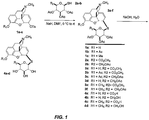
- the compounds of Formula IV can be synthesized by the S N 2 reaction of the 6 ⁇ -tosylates of morphine, 3- O -acetylmorphine and codeine 1a-c with the sodium salts of the thiosaccharides 2a-b in dimethylformamide ( see Figure 1 ) giving 3a-f.
- the starting tosylates [ see L. H. Welsh, J. Org. Chem., 19:1409 (1954 ); G. Stork and F. Clarke, J. Am. Chem. Soc., 78:4619-4624 (1956 )].
- the ester protecting groups are subsequently removed by stirring overnight in aqueous sodium hydroxide to provide additional compounds which are the S- ⁇ -D-glucuronides or S- ⁇ -D-glucose conjugates of morphine, codeine and their congeners 4a-d.
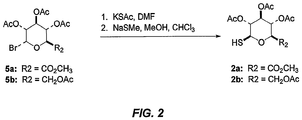
- the thiosaccharides 2a-b used in these preparations were made by the reaction of the corresponding glycosyl bromides with potassium thioacetate followed by selective S -deacetylation with sodium thiomethoxide ( see Figure 2 ). [See G. N. Bollenback et al., J. Org. Chem., 77:3310-3315 (1955 )] for the preparation of the starting glycosyl bromides.
- the compounds of Formula V can be synthesized from the 6 ⁇ -phthalimides of morphine, dihydromorphine, codeine, dihydrocodeine and their N -alkyl and cycloalkyl derivatives 6 ( see Figure 3 ). [ See S. Makleit et al., Synthetic Common., 21:407-412 (1991 ).] For compounds in the morphine series the phenolic hydroxyl group is protected as a silyl ether by the reaction with tert -butyldimethylsilylchloride or triisopropylsilylchloride and imidazole in room temperature dimethylformamide. The phthalimide group is then removed by heating with hydrazine hydrate in EtOH to give the amines 7.
- the amines 7 are reacted with the acid chloride of C -glycosides 8 giving the amides 9.
- R 1 in 9 is a silyl ether it can be removed by treatment with TBAF to give the phenols 10.
- the sugar protecting groups in 9 or 10 are removed by treatment with aqueous NaOH or by hydrogenation giving compounds 11.
- the C-glycosides 8 used in these syntheses were prepared by known methods [ M. Lewis et al., J. Am. Chem. Soc., 104:4976-4978 (1982 )]. This synthetic sequence provides a general route for the attachment of saccharides to morphine and their N-17 derivatives at the C-6 position via an amide bridge and is applicable to the preparation of the dihydromorphine and dihydrocodeine derivatives of these compounds.
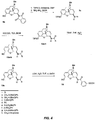
- the compounds of Formula VI can be synthesized from the 6 ⁇ -aminomorphine 7c ( see Figure 4 ) used in the preparation of compounds of Formula V.
- the amine 7c is treated with aryl and heteroaryl acid chlorides to give the amides 12a-h.
- the treatment of 12a-h with TBAF in aqueous THF provides the 6 ⁇ -amidomorphines 13a-h.
- Treatment of the methyl ester 13e with aqueous sodium hydroxide provide the carboxylic acids 14.
- This synthetic sequence provides a general route for the attachment of aryl and heteroaryl substituents to morphine, codeine and their N-17 alkyl derivatives at the C-6 position via an amide bridge and is applicable to the preparation of the dihydromorphine and dihydrocodeine derivatives of these compounds.
- This synthetic methodology also provides for the preparation of the C-6a derivatives of all of the above compounds by starting with the C-6 epimer of the amine 7c. Replacement of the N-methyl substituent of the bridgehead N for the compounds described herein with cyclopropyl methyl or cyclobutyl methyl or similar substituents will typically afford antagonists of the receptors for the activity described below.
- Such antagonists are useful for antagonizing drug addiction, gambling addiction, alcoholism, or other diseases of the CNS.
- application of the synthetic methodology described herein (attachment of metabolically stable saccharides or their chemical homologues or isosteric equivalents) to other analgesics including naltrexone, phenyl piperidines, piperidinols, prodines, piperidyl propionanilides, isoprodines, prodilidines, benzomorphans, morphans, azabicyclanes, morphinans, prodines, diphenylaminoethylpropionates, methadones, isomethadones, propoxyphenes, dextromethorphans, benzazocin-8-ols, and all related stereoisomers and N-substituted derivatives (cyclopropyl methyl, cyclobutymethyl, allyl, and the like) will lead to pharmacologically active CNS agents useful for reducing
- the analgesic-related agent of the present invention has a constant charge (i.e., is ionized 100% or substantially 100% of the time) at physiological pH.
- Such variations can be synthesized by, for example, putting a quaternary amine or quanidino moiety off the aromatic or saccharide group. Such modifications will typically yield derivatives that do not get into the brain and are therefore useful for peripheral indications (e.g., as peripheral analgesics for reducing pain in the periphery without significant effect on brain receptors).
- the analgesic-related agents of the present invention and further disclosure are useful in a variety of applications relating to modulation of analgesic receptor signaling within the nervous system.
- the agents of the present invention are useful as analgesics for the treatment of pain (e.g., for easing pain associated with surgical procedures or terminal illnesses such as cancer).
- the agents are also useful for the treatment of diseases or disorders amenable to amelioration via modulation analgesic (e . g ., opioid) receptor signaling, particularly, for example, diseases or disorders of the CNS.
- diseases or disorders include, e . g ., various addictions.
- Addictions amenable to treatment using the agents described herein include, for example, addictions to drugs such as narcotics ( e . g ., morphine, heroin, and other opiates), nicotine, and alcohol, as well as behavioral addictions ( e . g ., gambling addiction).
- the present disclosure further provides pharmaceutical compositions and methods for the treatment of pain as well as for the treatment of addictions and other CNS-related disorders.
- the analgesic-related agents of the present disclosure can be delivered or administered to a mammal, e . g ., human subject, alone, in the form of a pharmaceutically acceptable salt or hydrolysable precursor thereof, or in the form of a pharmaceutical composition wherein the compound is mixed with suitable carriers or excipient(s) in a therapeutically effective amount.
- a sufficient amount of the analgesic-related agent is present to inhibit analgesic receptors in vivo so as to predispose the subject to ingest lower amounts of a drug.
- compositions comprising the agent together with one or more other pharmaceutically acceptable components.
- Pharmaceutical compositions can be in the form of solids (such as, e . g ., powders, granules, dragees, tablets, or pills), semi-solids (such as, e.g., gels, slurries, or ointments), liquids, or gases (such as, e.g., aerosols or inhalants).
- Suitable formulations for use in the present disclosure are found in, for example, [ Remington's Pharmaceutical Sciences, Mack Publishing Company, Philadelphia, PA, 17th ed. (1985 ) and Langer, Science, 249:1527-1533 (1990 )].
- the pharmaceutical compositions described herein can be manufactured in a conventional manner, e.g., mixing, dissolving, granulating, dragee-making, levigating, emulsifying, encapsulating, entrapping, or lyophilizing processes.
- pharmaceutically recognized equivalents of each of the compounds can be alternatively used.
- These pharmaceutically recognized equivalents can be pharmaceutically acceptable esters, amides, or salts or pharmaceutically acceptable acid addition salts.
- a pharmaceutically acceptable salt is a non-toxic metal, alkaline earth metal, or an ammonium salt commonly used in the pharmaceutical industry including, for example, a sodium, potassium, lithium, calcium, magnesium, barium, ammonium, and protamine zinc salt, which is prepared by methods well-known in the art.
- the term also includes a non-toxic acid addition salt, which is generally prepared by reacting the compounds of the present disclosure with a suitable organic or inorganic acid.
- Representative salts include, e.g., hydrochloride, hydrobromide, sulfate, bisulfate, acetate, oxalate, valerate, oleate, laurate, borate, benzoate, lactate, phosphate, tosylate, citrate, maleate, fumarate, succinate, tartrate, and napsylate.
- a pharmaceutically acceptable acid addition salt is a salt that retains the biological effectiveness and properties of the free bases and that is not biologically or otherwise undesirable, formed with inorganic acids such as, e . g ., hydrochloric acid, hydrobromic acid, sulfuric acid, nitric acid, phosphoric acid, and the like, and organic acids such as, e .
- the analgesic-related agents can be formulated with common excipients, diluents or carriers, and compressed into tablets, for formulated as elixirs or solutions for convenient oral administration.
- the agents can also be formulated as sustained release dosage forms and the like.
- the analgesic-related agents of the present disclosure In order to exert the desired therapeutic effects associated with binding of analgesic receptors in the brain, the analgesic-related agents of the present disclosure must reach brain cells and brain tissue, requiring their passage from the blood to the brain by crossing the blood brain barrier, comprising the microcapillary membranes of the cerebrovascular endothelium.
- the present disclosure provides methods for administering a therapeutically effective dosage regime of the analgesic-related agent to a peripheral tissue in a patient (i.e ., tissues other than central nervous system tissues). This can be achieved in various ways, including oral, buccal, rectal, parenteral, intraperitoneal, intradermal, transdermal, subcutaneous, intratracheal, and intramuscular administration.
- the agents can be administered in a local rather than systemic manner, in a depot or sustained release formulation (e . g ., patient controlled analgesia).
- the agents can be administered in a vesicle, in particular a liposome [ see, e.g., Langer, supra; Treat, In Liposomes in the Therapy of Infectious Disease and Cancer, Lopez-Berestein and Fidler eds., Liss, New York, pp. 353-365 (1989 )].
- the analgesic-related agents of the present disclosure can be formulated into preparations by dissolving, suspending, or emulsifying them in an aqueous or nonaqueous solvent such as, e . g ., vegetable or other similar oils, synthetic aliphatic acid glycerides, esters of higher aliphatic acids, or propylene glycol; and, if desired, with conventional additives such as, e . g ., solubilizers, isotonic agents, suspending agents, emulsifying agents, stabilizers, and preservatives.
- an aqueous or nonaqueous solvent such as, e . g ., vegetable or other similar oils, synthetic aliphatic acid glycerides, esters of higher aliphatic acids, or propylene glycol
- conventional additives such as, e . g ., solubilizers, isotonic agents, suspending agents, emulsifying agents, stabilizers, and preserv
- the compounds of the present disclosure can be formulated in aqueous solutions, preferably in physiologically compatible buffers such as Hank's solution, Ringer's solution, or physiological saline buffer.
- physiologically compatible buffers such as Hank's solution, Ringer's solution, or physiological saline buffer.
- penetrants appropriate to the barrier to be permeated are used in the formulation. Such penetrants are generally known in the art.
- the analgesic-related agent can be formulated readily by combining with pharmaceutically acceptable carriers that are well-known in the art.
- Such carriers enable the compounds to be formulated as tablets, pills, dragees, capsules, emulsions, lipophilic and hydrophilic suspensions, liquids, gels, syrups, slurries, suspensions, and the like, for oral ingestion by a subject to be treated.
- Pharmaceutical preparations for oral use can be obtained by mixing the compounds with a solid excipient, optionally grinding a resulting mixture, and processing the mixture of granules, after adding suitable auxiliaries, if desired, to obtain tablets or dragee cores.
- excipients include fillers such as, for example, sugars (e.g., lactose, sucrose, mannitol, or sorbitol), cellulose preparations (e.g., maize starch, wheat starch, rice starch, potato starch, gelatin, gum tragacanth, methyl cellulose, hydroxypropylmethyl-cellulose, sodium carboxymethylcellulose, and/or polyvinyl pyrrolidone (PVP).
- disintegrating agents can be added, such as the cross-linked polyvinyl pyrrolidone, agar, or alginic acid or a salt thereof such as, e.g., sodium alginate.
- Dragee cores are provided with suitable coatings.
- suitable coatings can be used, which can optionally contain gum arabic, talc, polyvinyl pyrrolidone, carbopol gel, polyethylene glycol, titanium dioxide, lacquer solutions, and/or suitable organic solvents or solvent mixtures.
- Dyestuffs or pigments can be added to the tablets or dragee coatings for identification or to characterize different combinations of active compound doses.
- compositions that can be used orally include, for example, push-fit capsules made of gelatin, as well as soft, sealed capsules made of gelatin and a plasticizer, such as, e.g., glycerol or sorbitol.
- the push-fit capsules can contain the active ingredients in admixture with filler such as, for example, lactose, binders ( e . g ., starches), and/or lubricants (e.g., talc or magnesium stearate) and, optionally, stabilizers.
- the active compounds can be dissolved or suspended in suitable liquids, such as, e . g ., fatty oils, liquid paraffin, or liquid polyethylene glycol.
- compositions can take the form of tablets or lozenges formulated in a conventional manner.
- the compounds for use in accordance with the present disclosure are conveniently delivered in the form of an aerosol spray preparation from pressurized packs or a nebulizer, with the use of a suitable propellant, e . g ., dichlorodifluoromethane, trichlorofluoromethane, dichlorotetraflouroethane, carbon dioxide or other suitable gas, or from propellant-free, dry-powder inhalers.
- a suitable propellant e . g ., dichlorodifluoromethane, trichlorofluoromethane, dichlorotetraflouroethane, carbon dioxide or other suitable gas, or from propellant-free, dry-powder inhalers.
- a suitable propellant e . g ., dichlorodifluoromethane, trichlorofluoromethane, dichlorotetraflouroethane, carbon dioxide or other suitable gas
- Analgesic-related agents of the present disclosure can be formulated for parenteral administration by injection, e . g ., by bolus injection or continuous infusion.
- Formulations for injection can be presented in unit dosage form, e.g., in ampules or in multidose containers, with an added preservative.
- the compositions can take such forms as, e . g ., suspensions, solutions, or emulsions in oil-based or aqueous vehicles, and can contain formulator agents such as, for example, suspending, stabilizing, and/or dispersing agents.
- compositions for parenteral administration include aqueous solutions of the active compounds in water-soluble form.
- suspensions of the active compounds can be prepared as appropriate oily injection suspensions.
- suitable lipophilic solvents or vehicles include fatty oils (e.g., sesame oil), synthetic fatty acid esters (e.g., ethyl oleate or triglycerides), or liposomes.
- Aqueous injection suspensions can contain substances that increase the viscosity of the suspension, such as, for example, sodium carboxymethyl cellulose, sorbitol, or dextran.
- the suspension can also contain suitable stabilizers or agents that increase the solubility of the compounds to allow for the preparation of highly concentrated solutions.
- the active ingredient can be in powder form for constitution with a suitable vehicle, e . g ., sterile pyrogen-free water, before use.
- Analgesic-related agents can also be formulated in rectal compositions such as suppositories or retention enemas, e . g ., containing conventional suppository bases such as, for example, cocoa butter, carbowaxes, polyethylene glycols, or other glycerides, all of which melt at body temperature, yet are solidified at room temperature.
- rectal compositions such as suppositories or retention enemas, e . g ., containing conventional suppository bases such as, for example, cocoa butter, carbowaxes, polyethylene glycols, or other glycerides, all of which melt at body temperature, yet are solidified at room temperature.
- the compounds can also be formulated as a depot preparation.
- Such long-acting formulations can be administered by implantation (for example, subcutaneously or intramuscularly) or by intramuscular injection.
- the compounds can be formulated with suitable polymeric or hydrophobic materials (e . g ., as an emulsion in an acceptable oil) or ion exchange resins, or as sparingly soluble derivatives ( e . g ., a sparingly soluble salt).
- liposomes and emulsions are well-known examples of delivery vehicles or carriers for hydrophobic drugs.
- long-circulating, e . g ., stealth, liposomes can be employed.
- Such liposomes are generally described in U.S. Patent No. 5,013,556 to Woodle et al.
- the compounds of the present disclosure can also be administered by controlled release means and/or delivery devices.
- a pump is used [ see, e.g., Langer, supra; Sefton, CRC Crit. Ref. Biomed. Eng., 14:201 (1987 ); Buchwald et al., Surgery, 88:507 (1980 ); Saudek et al., N. Engl. J. Med., 321:574 (1989 )].
- polymeric materials are used [ see, e.g., Medical Applications of Controlled Release, Langer and Wise eds., CRC Pres., Boca Raton, Florida (1974 ); Controlled Drug Bioavailability, Drug Product Design and Performance, Smolen and Bull eds., Wiley, New York (1984 ); Ranger and Peppas, J. Macromol. Sci. Rev. Macromol. Chem., 23:61 (1983 ); see also Levy et al., Science, 228:190 (1985 ); During et al., Ann. Neurol., 25:351 (1989 ); Howard et al., J. Neurosung., 71:105 (1989 )].
- Controlled release means and delivery devices are also described in, e . g ., U.S. Patent Nos. 3,845,770 ; 3,916,899 ; 3,536,809 ; 3,598,123 ; and 4,008,719 .
- Certain organic solvents such as, e . g ., dimethylsulfoxide (DMSO) also can be employed, although usually at the cost of greater toxicity.
- DMSO dimethylsulfoxide
- the compounds can be delivered using a sustained-release system such as, for example, semipermeable matrices of solid hydrophobic polymers containing the therapeutic agent.
- sustained-release materials have been established. Sustained-release capsules can, depending on their chemical nature, release the compounds for a few hours up to over 100 days.
- compositions can also comprise suitable solid or gel phase carriers or excipients.
- suitable solid or gel phase carriers or excipients include, but are not limited to, calcium carbonate, calcium phosphate, various sugars, starches, cellulose derivatives, gelatin, and polymers such as, e . g ., polyethylene glycols.
- compounds of the present disclosure may also be administered by incorporating the agent into a drug-containing product (for example, in the case of nicotine ingestion, a tobacco product such as, e.g., a cigarette).
- a drug-containing product for example, in the case of nicotine ingestion, a tobacco product such as, e.g., a cigarette.
- a compound of the present disclosure is sprayed or otherwise applied onto the drug-containing product prior to ingestion.
- compositions suitable for use in accordance with the present disclosure include compositions wherein the active ingredients are contained in a therapeutically effective amount.
- the therapeutically effective amounts for the methods of the present disclosure can depend on a variety of factors, including, e . g ., age, body weight, general health, sex, diet, time and manner of administration, rate of excretion, drug combination, the judgment of the treating physician, and the severity of the particular affliction being treated.
- the amount of active agent will also depend upon the specific activity of the opiate-related agent and whether that agent is co-administered with any other therapeutic or prophylactic ingredients.
- a subject treated in accordance with the methods provided herein has been identified as suffering from pain; has been diagnosed with a disease or disorder amenable to treatment or prophylaxis via modulation of analgesic (e . g ., opioid) receptors; or has otherwise been identified as a subject that will obtain a physiological benefit using the compound.
- analgesic e . g ., opioid
- the subject is monitored during treatment for a physiological and/or clinical effect.
- a subject for treatment of pain, a subject can be monitored for relative severity of pain over the course of treatment; or, for the treatment of a disease or disorder amenable to amelioration via modulation of analgesic receptor signaling, a subject can be monitored for one or more symptoms associated with the disease or disorder.
- type I refer generally to compounds of Formulas IV, V, and VI, respectively, described supra.
- Example 1 6 ⁇ -S-(Methyl-2',3',4'-tri- O -acetyl- ⁇ -D-glucopyranosyluronate)morphine 3a
- Example 6 6- S -(2',3',4',5'-Tetra- O -acetyl- ⁇ -D-glucopyranosyl)6 ⁇ -thiocodeine, 3f
- the thiol 2b (440 mg, 1.21 mmol), NaH (47 mg, 1.16 mmol) and 1c (203 mg, 0.448 mmol) provided 3f as an off-white foam (237 mg, 82%).
- the single uv active band was removed from the SiO 2 and the SiO 2 was washed with 4:1 CHCl 3 /MeOH (100 mL). The filtrate was concentrated and the residue was refiltered through a cotton plug using 9:1 CHCl 3 /lMeOH (10 mL).
- the ester 3f (120mg, 0.186 mmol) was dissolved in MeOH (4 mL) and 5% aqueous NaOH (0.6 mL) was added. The mixture was stirred at rt for 18 h and then treated with saturated aqueous NH 4 Cl (1 mL). The mixture was concentrated and the residue was purified by preparative TLC (SiO 2 ) using CH 2 Cl 2 /MeOH/water/13% concentrated NH 4 OH (200:40:5:0.050) as the eluant. A single uv active band was removed from the SiO 2 with a razor blade and this SiO 2 was washed with 4:1 CHCl 3 /MeOH (100 mL).
- Example 12 6 ⁇ -(Methyl 2',3',4'-tri-O-acetyl- ⁇ -D-glucopyranosyluronate)acetamido-morphine, 10a
- Example 16 6 ⁇ -( 2',3 ', 4 ', 5 '- Tetra - O - benzyl - ⁇ - D - glucopyranosyl ) acetamidomorphine 10b
- Binding to cell membranes was conducted in a 96-well format. [ See, N. Zaveri et al., Eur. J. Pharmacol., 428:29-36 (2001 )]. Cells were removed from the plates by scraping with a rubber policeman, homogenized in Tris buffer using a Polytron homogenizer, then centrifuged once and washed by an additional centrifugation at 27,000 x g for 15 min. The pellet was resuspended in 50 mM Tris, pH 7.5, and the suspension incubated with [ 3 H]DAMGO, [ 3 H]DPDPE, or [ 3 H]U69593, for binding to u, d or k opioid receptors, respectively.
- the total volume of incubation was 1.0 mL and samples were incubated for 60-120 min at 25 °C.
- the amount of protein in the binding reaction varied from approximately 15 ⁇ g to 30 ⁇ g.
- the reaction was terminated by filtration using a Tomtec 96 harvester (Orange, CT) with glass fiber filters. Bound radioactivity was counted on a Pharmacia Biotech beta-plate liquid scintillation counter (Piscataway, NJ) and expressed in counts per minute.
- IC 50 values were determined using at least six concentrations of test compound, and calculated using Graphpad/Prism (ISI, San Diego, CA). K i values were determined by the method of Cheng and Prusoff. [ See Y. Cheng, and W. H. Prusoff, Biochem. Pharmacol., 22:3099-3108 (1973 ).]
- K i is the parameter that measures the inhibition of radioligand binding to the receptor by the test compound.
- each ligand tested was mu selective.
- Each of these compounds possessed a free phenolic hydroxyl group. Compared to M6G their affinities were increased 1.5 to 2.4-fold at mu, 2.9 to 10.3 at delta and 1.4 to 369-fold at the kappa receptor.
- the morphine analogue 10 (2.80 nM) possessing a free phenolic hydroxyl group and a fully esterified glucuronic acid moiety had the highest affinity. This observation is consistent with those results observed for the type I analogue 3a.
- the codeine derivative 9b (7.43 nM) showed significantly higher affinity than any type I codeine compound.
- Compound 11a (14.6 nM) and 11b (41.5 nM) showed reduced affinity.
- compound 10 showed a 4.5-fold higher affinity for the mu receptor and compound 9b showed a 1.7-fold higher affinity.
- the type II compounds were significantly more selective than the type I compounds.
- the K i values for type III compounds at the mu receptor were between 0.21 and 0.59 nM. These compounds were between 20-fold and 64-fold higher affinity for the mu receptor than M6G. Type III compounds were at least 9-fold higher affinity than the highest affinity type I compound and at least 4.7-fold higher affinity than the highest affinity type II compound. These results suggest that the C-6 substituent in these ligands was interacting with a hydrophobic region of the mu binding pocket. This observation is further supported by the decrease in affinity observed in compound 14 (19.92 nM). In most instances, type II compounds showed an increased mu versus delta selectivity and a reduced mu versus kappa selectivity.
- Radiolabelled S binding was conducted basically as described by [ J. R. Traynor and S. R. Nahorski., Mol. Pharmacol., 47:848-854 (1995 )].
- Cells were scraped from tissue culture dishes into 20 mM Hepes, 1 mM EDTA, then centrifuged at 500 x g for 10 min. Cells were resuspended in this buffer and homogenized using a Polytron homogenizer. The homogenate was centrifuged at 27,000 x g for 15 min and the pellet resuspended in Buffer A, containing 20 mM Hepes, 10 mM MgCl 2 , 100 mM NaCl, pH 7.4.
- the suspension was recentrifuged at 27,000 x g and suspended once more in Buffer A.
- membranes (8-15 ⁇ g protein) were incubated with [ 35 S]GTP ⁇ -S (50 pM), GDP (10 ⁇ M), and the appropriate compound, in a total volume of 1.0 mL, for 60 min at 25 °C. Samples were filtered over glass fiber filters and counted as described for the binding assays. Statistical analysis was conducted using the program Prism.
- Table 2 gives the E max and EC 50 values for stimulation of [ 35 S]GTP ⁇ S binding at human mu, delta and kappa opioid receptors. With the exception of compound 6c all of the compounds stimulated [ 35 S]GTP ⁇ S binding at the mu and delta receptors. The compounds were much less efficacious at the kappa receptor. This trend was also observed for M6G. The most efficacious compounds at the mu receptor were compounds 3b (88.0%), 3d (76.0%), 4b (64.5%), and 4a (46.6%) (see Table 2). Each of these compounds possessed a free phenolic hydroxyl group. These compounds were all more efficacious than M6G.
- ligands 10 and 9b produced maximum stimulation of [ 35 S]GTPgammaS binding by the mu receptor and reduced stimulation of [ 35 S]GTPgammaS binding at the delta and kappa receptors.
- type III compounds 13a-h and 14 each of the compounds stimulated [ 35 S]GTP ⁇ S binding at the mu, delta and kappa receptors. The compounds were generally more efficacious at the mu and kappa receptors as opposed to the delta receptor.
- Compounds that effected maximal stimulation may be viewed as agonists at a given receptor. Those ligands that elicited less than maximal binding may be viewed as partial agonists or antagonists if no stimulation was observed.
- Mu receptor internalization was evaluated according to the method of [ D. E. Keith et al., Mol. Pharm., 53:377-384 (1998 )]. In general terms, this phenomenon was studied using flow cytometric analysis in which surface receptors can be quantified by staining with FITC-labeled FLAG M1 and measuring fluorescence. Drugs that were effective at causing internalization caused reduced staining relative to the control.
- Assay buffer contains 3.2 mg/mL HLS9 or 1.2 mg/mL MLM, 0.1 M potassium phosphate buffer (pH 7.4), 0.1 mM compounds, 0.5 mM NADP+, 0.5 mM glucose-6-phosphate, 5U/mL glucose-6-phosphate dehydrogenase, 1 mg/mL DETAPAC, 7 mM MgCl 2 for a final incubation volume of 0.25 mL. After 0, 10, 25, 40 or 60 min the reactions were stopped by the addition of 1 mL CH 2 Cl 2 /IPA (3:1 v:v).
- Type III compounds were significantly more stable than type I compounds under all conditions tested.
- the presence of the methyl ester group in compound 13e reduced the stability of this compound to HLS9 and at pH 7.4 when compared to other type III compounds.
- Sufficient amounts of type II compounds could not be obtained for evaluation.
- the presence of ester protecting groups in type II compounds should render them less stable than type III compounds.
- the amide linkage is expected to impart improved stability over the S-glycosidic linkage. Table 4. Stability analysis of selected ligands.
- Example 31 Determination of Analgesic Activity of Morphine Analogs 3a and 13e A. Methods.
- the minipump was in the gated-on position for a duration of 12 hours during the dark period which is the active phase (6 PM on 6 PM off). After 2 days, the minipump was removed and replaced with another minipump containing a different dose of the test compound (i . e ., naloxone or M6G analog) in a Latin Square design. This cycle is repeated so that 3 doses and vehicle control are tested.
- the large number of drugs and doses required may force a between-subjects design of dose for naloxone and M6G analogs.
- the particular behaviors to be examined were determined from the results from tests of long term heroin exposure via self-administration that may reflect the transition from self-administration in a non-dependent pattern to self administration in a dependent pattern. Sophisticated statistical modeling was done by using a Hiearchical Linear Modeling approach where individual acquisition trajectories were fitted with a polynomial function while accounting for within-subject and between-subject variables.
- M6G analogs 3a, 13e, 13g and 13h were effective at reducing heroin self-administration.
- the most effective compound was 13h which reduced heroin intake by 1000 ug/kg at a dose of 0.01 mg/kg.
- Example 33 Synthesis and biological evaluation of a C-glycoside analog of MG6
- Morphine-6-glucuronide is a phase II metabolic conjugate of morphine with approximately 100-fold the analgesic potency of morphine itself when injected intracerebroventricularly into rats.
- M6G is currently in late stage clinical trials for the treatment of postoperative pain.
- Gutman et al., U. S. Patent 6,737,518 (2004 ) The oral bioavailability of M6G is only 11% [ Penson et al., Br. J. Clin. Pharmacol., 53:347-354 (2002 )] and improvement of the metabolic stability of M6G could possibly increase its effectiveness as a potential pain medication.
- a general strategy for improving the in vivo metabolic stability of glycoconjugates involves the replacement of the glycosidic oxygen atom with carbon, nitrogen or sulfur atoms.
- This strategy in designing a library of glucosyl and glucuronosyl analogues of M6G, in which the glycosidic oxygen atom was replaced with a sulfur atom, was previously employed.
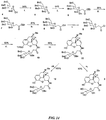
- the C- ⁇ -glycopyranosyl acyl chloride 9 was prepared by a five step procedure from commercially available 2,3,4,6-tetrabenzylglucopyranose 4.
- Compound 4 was oxidized with DMSO/Ac 2 O to provide the corresponding lactone 5 (94%).
- Addition of 5 to a -78°C THF solution of lithium ethyl acetate [ Rathke, M. W., J. Am. Chem.
- the IC 50 values obtained from competition binding assays with. ⁇ , ⁇ and ⁇ opioid receptors for compounds 3 and 11 were converted into K i values as described in the Experimental section.
- the K i values for the test compounds and reference materials are listed in Table 5.
- the following radioligands were used: [ 3 H]DAMGO ( ⁇ opioid receptor agonist); [ 3 H]U69593 ( ⁇ opioid receptor agonist); [ 3 H]DPDPE ( ⁇ opioid receptor agonist).
- K i values were determined from measuring the inhibition of binding of these radioligands to the receptor by the test compounds 3 and 11.
- the [ 35 S]GTP ⁇ S assay measures the ability of the test compound to activate the G protein associated with either the ⁇ , ⁇ or ⁇ opioid receptor. Based on the E max values for stimulating [ 35 S]GTP- ⁇ -S binding, compound 3 was determined to be a full agonist at the ⁇ and ⁇ receptors and a partial agonist at the ⁇ receptor. Compound 11 was determined to be a full agonist at the ⁇ receptor and a partial agonist at the ⁇ and ⁇ receptors. The efficacy (E max ) of compound 3 at the ⁇ receptor (75%) was substantially higher than M6G (45%) and the thiosaccharide analogues 2a (46.6%) and 2b (36.0%), respectively.
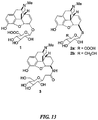
- the C-glycoside 3 was prepared by a 14-step convergent synthesis from 2,3,4,6-tetra- O -benzyl-D-glucose 4 and morphine sulfate.
- Compound 3 showed a 3.7-fold greater affinity for the ⁇ opioid receptor compared to M6G.
- the selectivity ratios of compound 3 for the ⁇ versus ⁇ and ⁇ versus receptors were 76.7 and 166, respectively.
- the ⁇ / ⁇ selectivity for compound 3 was significantly improved relative to the value for M6G which was 12.5. Further work is currently in progress to fully delineate the in vivo biological properties of these compounds. Increasing metabolic stability of M6G may provide a new class of longer-lived, potent opioids agonists.
- Binding to membranes from cells transfected with human ⁇ , ⁇ and ⁇ opioid receptor was done in a 96-well format, as described previously (New compounds 10, 11, 12 and 3 were characterized by 1 H NMR, 13 C NMR and MS. The purity of test compounds 3 and 11 was determined by HPLC and was found to be > 98%) Cells were removed from the plates by scraping with a rubber policeman, homogenized in Tris buffer using a Polytron homogenizer, then centrifuged once and washed by an additional centrifugation at 27,000 x g for 15 min.
- the pellet was resuspended in 50 mM Tris, pH 7.5, and the suspension incubated with [ 3 H]DAMGO, [ 3 H]DPDPE, or [ 3 H]U69593, for binding to ⁇ , ⁇ or ⁇ opioid receptors, respectively.
- the total incubation volume was 1.0 mL and samples were incubated for 60-120 min at 25 °C.
- the amount of protein in the binding reaction varied from approximately 15 ⁇ g to 30 ⁇ g.
- the reaction was terminated by filtration using a Tomtec 96 harvester (Orange, CT) with glass fiber filters. Bound radioactivity was determined by counting with a Pharmacia Biotech beta-plate liquid scintillation counter (Piscataway, NJ) and data expressed in counts per minute.
- IC 50 values were determined using at least six concentrations of test compound, and calculated using Graphpad/Prism (ISI, San Diego, CA). K i values were determined by the method of Cheng and Prusoff [ Traynor, J. R. Mol. Pharmacol., 47:848-854 (1995 )].
- [ 35 S]GTP ⁇ -S binding was done essentially as described by Traynor and Nahorski [ Zaveri, N. et al., Eur. J. Pharmacol., 428:29-36 2001 ].
- Cells transfected with ⁇ , ⁇ and ⁇ opiate receptors were scraped from tissue culture dishes into 20 mM Hepes, 1 mM EDTA, then centrifuged at 500 x g for 10 min. Cells were resuspended in this buffer and homogenized using a Polytron homogenizer.
- the homogenate was centrifuged at 27,000 x g for 15 min and the pellet resuspended in Buffer A, containing 20 mM Hepes, 10 mM MgCl 2 , 100 mM NaCl, pH 7.4. The suspension was recentrifuged at 27,000 x g and suspended once more in Buffer A.
- membranes (8-15 ⁇ g protein) were incubated with [ 35 S]GTP ⁇ -S (50 pM), GDP (10 ⁇ M), and the test compound, in a total volume of 1.0 mL, for 60 min at 25 °C. Samples were filtered over glass fiber filters and counted as described for the binding assays. Statistical analysis was done using the program GraphPad Prism.
- a compound's potency or affinity for the receptor was defined by its EC 50 for stimulating [ 35 S]GTP ⁇ S binding.
- Agonist efficacy was defined as the degree to which the compound maximally stimulated [ 35 S]GTP ⁇ S binding relative to control.
- the EC 50 value represents the concentration of a compound that produced 50% maximal stimulation of [ 35 S]GTP ⁇ S binding.
- medications attempt to decrease alcohol intake by reducing the reinforcing effects of alcohol or by reducing the urge or craving to ingest alcohol.
- Pharmacological agents appear to influence several neurotransmitter systems that underlie reinforcing or discrimination stimulus effects of ethanol or nicotine including endogenous opioids, catecholamines (especially dopamine, serotonin) and excitatory amino acids such as glutamate [ Kranzler, Am. J. Psychiat., 152:391-397 (1995 )].
- endogenous opioids especially dopamine, serotonin
- excitatory amino acids such as glutamate
- naltrexone was approved by the US FDA for treatment of alcoholism.
- Naltrexone is a pure opioid mu receptor antagonist with no agonist activity and no abuse potential.
- naltrexone was found to decrease the reinforcing (i.e., stimulant) effects and increase the unpleasant ( i.e., sedative) properties of initial alcohol consumption [ Swift et al., Am. J. Psychiat., 151:1463-1467 (1994 )].
- naloxone and naltrexone reduce the voluntary consumption and stress-induced increase in alcohol consumption, suggesting that these agents may prevent the reinforcing effects of alcohol consumption [ O'Brian et al., Alcohol, 13:35-39 (1996 )].
- Naltrexone may be most beneficial among alcoholics with higher levels of craving and poorer cognitive functioning [ Jaffe et al., J. Consult. Clin. Psychol., 64:1044-1053 (1996 )].
- 15% ofpatients undergoing treatment terminated treatment early due to adverse effects including intolerable nausea [ Croop et al., Arch. Gen. Psychiat., 54:1130-1135 (1997 )].
- Naltrexone is also associated with dose-dependent hepatotoxic side effects that complicate use and confound treatment of alcoholic patients with liver disease [ Mason et al., Arch. Gen. Psychiat., 56:719-724 (1999 )]. Additional shortcomings include less than desirable duration of action and relatively low bioavailability [ Wall et al., Drug Metab. Dispos., 9:369-375 (1981 )] and possibly, a relatively low affinity for delta and kappa receptors thought to be involved in diminishing the reinforcing effects of drinking alcohol. Beneficial effects of naltrexone diminish gradually over time.
- naltrexone appears to produce a modest effect on drinking behavior among alcoholics. In some cases, the effects of naltrexone have been quite robust but evidence of its efficacy has been less consistent. However, nalmefene, an opioid antagonist with superior pharmaceutical properties to naltrexone, may hold more promise as an alcohol treatment medication. Naltrexone has been reported to be useful for smoking cessation [ O'Malley et al., US Patent No. 6,541,478 ].
- Opioid receptor antagonists apparently have direct effects on alcohol-seeking behavior. For example, direct perfusion of naloxone via microdialysis into the nucleus accumbens neurons inhibited alcohol-mediated dopamine release [ Benjamin et al., Brain Res., 621:137-140 (1993 )]. The decrease in alcohol consumption by blockade of opioid receptors suggests direct effects of naloxone in this reinforcement system. Animal studies have provided evidence that ⁇ -, ⁇ - and ⁇ -opioid receptors contribute to alcohol-induced reinforcement [Herz (1997); Ulm et al., J. Clin. Psychiat., 56:5-14 (1995 ].
- norBNI norbinaltorphimine
- Figure 1 The SAR of norBNI has been extensively investigated and is a bivalent ligand containing two naltrexone-derived pharmacophores. It is believed that only one of the norBNI pharmacophores is required for kappa antagonist activity and the basic group (at N -17') in the second pharmacophore of the receptor-bound ligand acts as an "address" to confer selectivity.
- NTI naltrindole
- nalmefene 1 and naltrexone 2 are shown in Figure 17 . These compounds are used for the treatment of opioid overdose, addiction and alcoholism.
- the medicinal chemistry objective of the present study was to develop metabolically stable analogues of these compounds by replacing the metabolically labile 6-methylene or 6-keto groups in 1 and 2, respectively, with an amide moiety.
- Various substitution patterns in the aromatic ring of the amide group were explored in order to increase mu and kappa opioid receptor selectivity and potency.
- a novel four step synthesis of either 6- ⁇ - or 6- ⁇ -naltrexamides was developed in order to meet this objective.
- the amines 4 were coupled with carboxylic acids (RCOOH) in the presence of benzotriazol-1-yl-oxy-tris-(dimethylamino)phosphonium hexa-fluorophosphate (BOP) and diisopropylethylamine in CH 2 Cl 2 .
- the amides could be formed by the reaction of an acid chloride, triethylamine and 4 in CH 2 Cl 2 . In both cases, the product was treated with K 2 CO 3 in methanol to deesterify the side-product resulting from esterification of the 3-position hydroxyl group.
- Compound 6a had high affinity for mu and moderate affinity for delta and kappa receptors. 6a is a strong antagonist at mu and kappa and a partial agonist at delta receptors. In summary, the data shows potent leads are present with the functional consequences of antagonizing mu- alone or mu- and kappa-receptors. Table 8. Stimulation of 35 S-GTP-gamma-S binding by HBRI Compounds.
- Naltrexone oxime, 3 was prepared according to the following method. Naltrexone (6.2 g, 1.46 mmol), NH 2 OH-HCl (1.5 g) and NaOAc (2.9 g) were dissolved in absolute EtOH (80 mL) and water (5 mL). The mixture was heated at reflux for 2.5 h and then concentrated. Water (20 mL) was added and the mixture was made basic with K 2 CO 3 and extracted with CHCl 3 .
- 6- ⁇ -Naltrexamine and 6- ⁇ -naltrexamine, 4b, 4a were prepared according to the following method.
- Naltrexone oxime (5.83 g, 16.3 mmol) was dissolved in THF (40 mL) and transferred by cannula to a 10 °C solution of BH 3 :THF (300 mL, 300 mmol, 1 M solution in THF) over 10 min.
- a white precipitate formed and then slowly dissolved as the reaction was heated at reflux for 2 d.
- the solution was cooled to rt and water (10 mL) and 1 N KOH (200 mL) were added slowly with caution.
- the solution was heated at reflux for 2 h.
- 6-Naltrexamine 100 mg, 0.292 mmol
- carboxylic acid RCOOH, Scheme 1
- BOP 142 mg, 0.321 mmol
- CH 2 Cl 2 3 mL
- NPr 2 Et 0.16 mL, 0.92 mmol
- the colorless solution was stirred at rt for 90 min and concentrated.
- the residue was filtered through SiO 2 (20:1 EtOAc/MeOH) providing a white solid.
- This material 240 mg was dissolved in MeOH (10 mL) and K 2 CO 3 (36 mg, 0.26 mmol) was added. The mixture was stirred for 115 min and saturated NH 4 Cl (10 drops) was added.
- Example 36 14-Hydroxy-17-(cyclopropylmethyl)nordesmorphine-6-acetamidoglucose, 6a
- Example 37 General procedure for the amidation of 6-naltrexamines with an acid chloride. 6-(Pyridine-3'-yl)carboxamido-14-hydroxy-17-(cyclopropylmethyl)nordes-morphine, 6b
- Example 38 General procedure for the amidation of 6-naltrexamines with the BOP reagent and a carboxylic acid. 6-(3'-dimethylamino)benzamido-14-hydroxy-17-(cyclopropylmethyl)nordesmorphine, 6c
- the metabolic stability of a compound in an in vitro study can provide significant information about the potential for metabolic stability in an in vivo experiment. Because a prominent route of metabolism in the opioid class of compound is for metabolism at the C-6 position, metabolic stability was designed into the compounds to increase half life, to increase bioavailability, and to improve the pharmacokinetic profile and the side effect profile of the synthetic compounds. By overcoming ADMET liabilities in the early stage of drug design and development, more drug-like compounds were produced.
- the assay buffer contained 3.2 mg/mL human liver pooled S9 or 1.2 mg/mL rat or mouse liver microsomes, 0.1 M potassium phosphate buffer (pH 7.4), 0.1 mM compounds, 0.5 mM NADP+, 0.5 mM glucose-6-phosphate, 5 IU/mL glucose-6-phosphate dehydrogenase, 1 mg/mL DETAPAC, 7 mM MgCl 2 for a final incubation volume of 0.25 mL. After 0, 10, 25, 45 or 60 min the reactions were stopped by the addition of 1 mL CH 2 Cl 2 /IPA (3:1 v:v) and mixed thoroughly.
- naltrexone and nalmefene possessed considerable metabolic instability in the presence of the liver preparations examined.
- compound 6d was not detectably metabolized.
- rat liver microsomes a minor amount of metabolism was observed, but it was 6- or 22-fold more stable than naltrexone or nalmefene, respectively.
- considerable metabolic stability was observed for compound 6d and the prediction is that the bioavailability of compound 6d and congeners will be considerable.
- Table 9 Metabolic stability of C-6-substituted Opiate Antagonists.
- the scale consists of graded signs of weight loss, number of escape attempts, rearings, number of wet dog shakes, instances of abdominal constrictions, and checked signs (present or absent) including diarrhea, facial fasciculations/teeth chattering, swallowing-movements, profuse salivation, chromodacryorrhea, ptosis, abnormal posture, penile grooming/erection/ejaculation and irritability upon handling.
- the Global somatic sign (SS) rating included all the above individual signs based on the weighted scale of Gellert and Holtzman (1978).
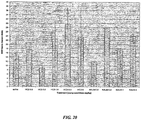
- compounds 6a and 6d administered by subcutaneous route of administration precipitated somatic signs of withdrawal in adult male rats 4 hr after administration of 5.0 mg/kg of morphine.
- Compound 6d caused a dose-dependent increase in somatic signs of withdrawal that peaked at 0.3 mg/kg.
- An approximate EC 50 value of less than 0.1 mg/kg was observed.
- the effect was decreased.
- an approximate EC 50 of approximately 1 mg/kg was observed for precipitation of somatic signs of withdrawal.
- nalmefene caused a dose-dependent (albeit noisy) increase in somatic signs of withdrawal that gave an approximate EC 50 value of 0.6-1 mg/kg.
- the minimum effective dose of naloxone to precipitate somatic signs of withdrawal was calculated to be 0.1-0.3 mg/kg [Schulteis et al., Psychopharmacology, 129 :56-65 (1997)].
- the data supports the in vivo efficacy of compounds 6a, 6d and congeners as potent antagonists of the opiate receptor.
- the compounds get into the central nervous system relatively rapidly (within 10 minutes) and exert a potent effect on the opiate receptor. Because this receptor system is prominent in controlling addiction susceptibility to alcohol and nicotine, opiate antagonists such as 6 should be effective at decreasing nicotine and alcohol addiction.
Landscapes
- Health & Medical Sciences (AREA)
- Chemical & Material Sciences (AREA)
- Organic Chemistry (AREA)
- General Health & Medical Sciences (AREA)
- Life Sciences & Earth Sciences (AREA)
- Engineering & Computer Science (AREA)
- Veterinary Medicine (AREA)
- Nuclear Medicine, Radiotherapy & Molecular Imaging (AREA)
- Medicinal Chemistry (AREA)
- Pharmacology & Pharmacy (AREA)
- General Chemical & Material Sciences (AREA)
- Animal Behavior & Ethology (AREA)
- Chemical Kinetics & Catalysis (AREA)
- Public Health (AREA)
- Addiction (AREA)
- Bioinformatics & Cheminformatics (AREA)
- Biomedical Technology (AREA)
- Neurology (AREA)
- Neurosurgery (AREA)
- Psychiatry (AREA)
- Biochemistry (AREA)
- Biotechnology (AREA)
- Genetics & Genomics (AREA)
- Molecular Biology (AREA)
- Pain & Pain Management (AREA)
- Rheumatology (AREA)
- Pharmaceuticals Containing Other Organic And Inorganic Compounds (AREA)
- Saccharide Compounds (AREA)
Applications Claiming Priority (2)
| Application Number | Priority Date | Filing Date | Title |
|---|---|---|---|
| US57545104P | 2004-05-28 | 2004-05-28 | |
| PCT/US2005/019000 WO2005117589A1 (en) | 2004-05-28 | 2005-05-31 | Synthesis of metabolically stable analgesics, pain medications and other agents |
Publications (3)
| Publication Number | Publication Date |
|---|---|
| EP1758452A1 EP1758452A1 (en) | 2007-03-07 |
| EP1758452A4 EP1758452A4 (en) | 2009-08-05 |
| EP1758452B1 true EP1758452B1 (en) | 2017-01-25 |
Family
ID=35462669
Family Applications (1)
| Application Number | Title | Priority Date | Filing Date |
|---|---|---|---|
| EP05754845.5A Expired - Lifetime EP1758452B1 (en) | 2004-05-28 | 2005-05-31 | Metabolically stable analgesics and pain medications |
Country Status (8)
| Country | Link |
|---|---|
| US (1) | US8481501B2 (enExample) |
| EP (1) | EP1758452B1 (enExample) |
| JP (2) | JP5266492B2 (enExample) |
| AU (1) | AU2005249508A1 (enExample) |
| CA (1) | CA2568249C (enExample) |
| DK (1) | DK1758452T3 (enExample) |
| ES (1) | ES2623362T3 (enExample) |
| WO (1) | WO2005117589A1 (enExample) |
Families Citing this family (17)
| Publication number | Priority date | Publication date | Assignee | Title |
|---|---|---|---|---|
| WO2006126529A1 (ja) | 2005-05-25 | 2006-11-30 | Shionogi & Co., Ltd. | 6,7-不飽和-7-カルバモイル置換モルヒナン誘導体 |
| EP2313400A4 (en) * | 2008-07-10 | 2011-12-28 | Human Biomolecular Res Inst | SYNTHESIS OF METABOLIC STRENGTHS FOR ALCOHOL AND DRUG ABUSE |
| WO2010006299A1 (en) * | 2008-07-11 | 2010-01-14 | Regents Of The University Of Minnesota | Analgesic agents |
| EP3699172A3 (en) | 2008-11-10 | 2020-11-18 | Arbutus Biopharma Corporation | Novel lipids and compositions for the delivery of therapeutics |
| FR2939437B1 (fr) * | 2008-12-10 | 2010-12-17 | Sanofi Aventis | Derives de morphine-6-glucuronide, leur preparation et leur application en therapeutique |
| FR2939796B1 (fr) * | 2008-12-11 | 2010-12-17 | Sanofi Aventis | Derives bicycliques de morphine-6-glucuronide, leur preparation et leur application en therapeutique |
| EP2387577A4 (en) * | 2009-01-16 | 2012-10-17 | Univ Virginia Commonwealth | NON-PEPTIDE, POWERFUL AND SELECTIVE ANTAGONISTS OF MU OPIOID RECEPTORS |
| WO2011041470A2 (en) * | 2009-09-30 | 2011-04-07 | Mallinckrodt Inc. | Sustained-release opiate and opiate derivative compositions |
| BR112013009505B1 (pt) * | 2010-10-19 | 2022-06-21 | Memorial Sloan-Kettering Cancer Center | Composto, composição farmacêutica, métodos para ensaio quanto a um receptor, e, usos de um composto |
| WO2013119954A1 (en) * | 2012-02-08 | 2013-08-15 | Walter Reed Army Institute Of Research Department Of The Army | Induction of highly specific antibodies to a hapten but not to a carrier peptide by immunization |
| CN103450291A (zh) * | 2013-08-13 | 2013-12-18 | 张家港威胜生物医药有限公司 | 一种制备2,3,4,6-四-O-乙酰基-β-D-1-硫代吡喃葡萄糖的方法 |
| EP4212532A3 (en) | 2015-04-30 | 2023-09-27 | Memorial Sloan Kettering Cancer Center | Mitragynine analogs and uses thereof |
| WO2017165558A1 (en) | 2016-03-22 | 2017-09-28 | Regents Of The University Of Minnesota | Combination for treating pain |
| US20180092839A1 (en) * | 2016-10-03 | 2018-04-05 | Lance L. Gooberman | Medicated spray for treatment of substance abuse, overdose, addiction and impulse control disorders |
| US20220117916A1 (en) * | 2020-10-19 | 2022-04-21 | SafeRx Pharmaceuticals, LLC | Combination Products to Mitigate the Risk of Non-Benzodiazepine Benzodiazepine Agonist Adverse Reaction and Overdose |
| EP4482840A4 (en) * | 2022-02-22 | 2026-02-25 | Univ Virginia Commonwealth | Naltrexamine derivatives bearing 5-chain heterocyclic cyclic systems used as opioid receptor modulators |
| EP4577667A2 (en) * | 2022-08-25 | 2025-07-02 | Biosynth GmbH | Procedure for production of opioid-antagonist-releasing compounds and their use as a medicine |
Citations (1)
| Publication number | Priority date | Publication date | Assignee | Title |
|---|---|---|---|---|
| US20040053854A1 (en) * | 1998-05-13 | 2004-03-18 | Cenes Limited | Process for preparation of 4,5-Epoxymorphinan-6-oxyglucuronides |
Family Cites Families (12)
| Publication number | Priority date | Publication date | Assignee | Title |
|---|---|---|---|---|
| US3536809A (en) * | 1969-02-17 | 1970-10-27 | Alza Corp | Medication method |
| US3598123A (en) * | 1969-04-01 | 1971-08-10 | Alza Corp | Bandage for administering drugs |
| US3845770A (en) * | 1972-06-05 | 1974-11-05 | Alza Corp | Osmatic dispensing device for releasing beneficial agent |
| US3916899A (en) * | 1973-04-25 | 1975-11-04 | Alza Corp | Osmotic dispensing device with maximum and minimum sizes for the passageway |
| US4008719A (en) * | 1976-02-02 | 1977-02-22 | Alza Corporation | Osmotic system having laminar arrangement for programming delivery of active agent |
| US5013556A (en) * | 1989-10-20 | 1991-05-07 | Liposome Technology, Inc. | Liposomes with enhanced circulation time |
| JPH03218379A (ja) * | 1989-11-13 | 1991-09-25 | Chugai Pharmaceut Co Ltd | 新規なモルヒネ誘導体 |
| JP2525552B2 (ja) * | 1992-01-23 | 1996-08-21 | 東レ株式会社 | モルヒナン誘導体および医薬用途 |
| EP0632041A1 (en) * | 1993-07-01 | 1995-01-04 | Katholieke Universiteit Nijmegen | New morphine derivatives having improved analgesic and narcotic properties |
| JPH11505547A (ja) * | 1996-03-13 | 1999-05-21 | エール ユニバーシティ | ナルトレキソン及び関連化合物を用いる禁煙処置 |
| US5780479A (en) * | 1997-04-04 | 1998-07-14 | Regents Of The University Of Minnesota | Use of opioid antagonists to treat impulse-control disorders |
| WO2002080918A1 (en) * | 2001-04-02 | 2002-10-17 | Toray Industries, Inc. | Remedial or prophylactic agent for frequent urination or urinary incontinence |
-
2005
- 2005-05-31 DK DK05754845.5T patent/DK1758452T3/en active
- 2005-05-31 EP EP05754845.5A patent/EP1758452B1/en not_active Expired - Lifetime
- 2005-05-31 CA CA2568249A patent/CA2568249C/en not_active Expired - Lifetime
- 2005-05-31 JP JP2007515474A patent/JP5266492B2/ja not_active Expired - Fee Related
- 2005-05-31 ES ES05754845.5T patent/ES2623362T3/es not_active Expired - Lifetime
- 2005-05-31 WO PCT/US2005/019000 patent/WO2005117589A1/en not_active Ceased
- 2005-05-31 US US11/628,132 patent/US8481501B2/en not_active Expired - Fee Related
- 2005-05-31 AU AU2005249508A patent/AU2005249508A1/en not_active Abandoned
-
2012
- 2012-06-21 JP JP2012139959A patent/JP2012254984A/ja active Pending
Patent Citations (1)
| Publication number | Priority date | Publication date | Assignee | Title |
|---|---|---|---|---|
| US20040053854A1 (en) * | 1998-05-13 | 2004-03-18 | Cenes Limited | Process for preparation of 4,5-Epoxymorphinan-6-oxyglucuronides |
Non-Patent Citations (3)
| Title |
|---|
| FUJII I ET AL: "SYNTHESIS AND PHARMACOLOGICAL PROPERTIES OF MORPHINE CONGENERS HAVING PENDANT CROWN ETHER AS AN OPIOID RECEPTOR PROBE", CHEMICAL AND PHARMACEUTICAL BULLETIN, PHARMACEUTICAL SOCIETY OF JAPAN, TOKYO, JP, vol. 34, no. 10, 1 January 1986 (1986-01-01), pages 4439 - 4442, XP001146403, ISSN: 0009-2363 * |
| MILTON J KIEFEL ET AL: "synthesis of carbohydrates with an anomeric thiol moiety for elaboration into metabolically stable thioglycosides", JOURNAL OF CARBOHYDRATE CHEMISTRY, TAYLOR & FRANCIS INC, US, vol. 18, no. 8, 1 January 1999 (1999-01-01), pages 937 - 959, XP008129788, ISSN: 0732-8303 * |
| S. KNAPP, D. S. MYERS: "alpha-GlcNAc Thioconjugates", J. ORG. CHEM., vol. 66, 26 April 2001 (2001-04-26), pages 3636 - 3638 * |
Also Published As
| Publication number | Publication date |
|---|---|
| EP1758452A4 (en) | 2009-08-05 |
| JP2008501036A (ja) | 2008-01-17 |
| JP2012254984A (ja) | 2012-12-27 |
| CA2568249A1 (en) | 2005-12-15 |
| EP1758452A1 (en) | 2007-03-07 |
| US8481501B2 (en) | 2013-07-09 |
| US20100190728A1 (en) | 2010-07-29 |
| CA2568249C (en) | 2014-12-09 |
| JP5266492B2 (ja) | 2013-08-21 |
| DK1758452T3 (en) | 2017-05-01 |
| WO2005117589A1 (en) | 2005-12-15 |
| ES2623362T3 (es) | 2017-07-11 |
| AU2005249508A1 (en) | 2005-12-15 |
Similar Documents
| Publication | Publication Date | Title |
|---|---|---|
| US8481501B2 (en) | Synthesis of metabolically stable analgesics, pain medications and other agents | |
| US11731979B2 (en) | Opioid ketal compounds and uses thereof | |
| US8362007B1 (en) | Substituted noribogaine | |
| US4722928A (en) | N-oxide prodrug derivatives of 3-hydroxy morphinans and partial morphinans having improved oral bioavailability, pharmaceutical compositions, and processes | |
| US20150361080A1 (en) | Substituted noribogaine | |
| EP1053238B1 (en) | Therapeutic compounds | |
| EP2934541A1 (en) | Substituted noribogaine | |
| ZA200402733B (en) | New oripavine derivatives and their uses as medicines | |
| US4990617A (en) | N-oxide prodrug derivatives of 3-hydroxy morphinans and partial morphinans and derivatives | |
| CN107033154B (zh) | 阿片受体拮抗剂缀合物及其应用 | |
| US20250195504A1 (en) | Naltrexamine derivatives bearing 5-member heterocyclic ring systems and opioid receptor modulators | |
| AU2011224079A1 (en) | Synthesis of metabolically stable analgesics, pain medications and other agents | |
| AU2006239813A1 (en) | Opioid receptor agonist compounds and their use in treatment of pain | |
| AU757975B2 (en) | Therapeutic compounds | |
| EP0638081A1 (en) | Delta opioid receptor-selective benzylidene-substituted morphinans for the treatment of alcohol abuse | |
| Lo | Synthesis of N-phenethylnorhydromorphone: a hydromorphone analogue | |
| Hedrick | Studies Toward the Development of an Improved Countermeasure for Synthetic Opioid Overdose |
Legal Events
| Date | Code | Title | Description |
|---|---|---|---|
| PUAI | Public reference made under article 153(3) epc to a published international application that has entered the european phase |
Free format text: ORIGINAL CODE: 0009012 |
|
| 17P | Request for examination filed |
Effective date: 20061222 |
|
| AK | Designated contracting states |
Kind code of ref document: A1 Designated state(s): AT BE BG CH CY CZ DE DK EE ES FI FR GB GR HU IE IS IT LI LT LU MC NL PL PT RO SE SI SK TR |
|
| AX | Request for extension of the european patent |
Extension state: AL BA HR LV MK YU |
|
| REG | Reference to a national code |
Ref country code: HK Ref legal event code: DE Ref document number: 1101958 Country of ref document: HK |
|
| RIC1 | Information provided on ipc code assigned before grant |
Ipc: C07D 489/00 20060101AFI20071214BHEP |
|
| A4 | Supplementary search report drawn up and despatched |
Effective date: 20090706 |
|
| 17Q | First examination report despatched |
Effective date: 20101214 |
|
| REG | Reference to a national code |
Ref country code: HK Ref legal event code: WD Ref document number: 1101958 Country of ref document: HK |
|
| REG | Reference to a national code |
Ref country code: DE Ref legal event code: R079 Ref document number: 602005051226 Country of ref document: DE Free format text: PREVIOUS MAIN CLASS: A01N0043040000 Ipc: C07D0489000000 |
|
| GRAP | Despatch of communication of intention to grant a patent |
Free format text: ORIGINAL CODE: EPIDOSNIGR1 |
|
| RIC1 | Information provided on ipc code assigned before grant |
Ipc: C07H 17/00 20060101ALI20160705BHEP Ipc: C07D 489/02 20060101ALI20160705BHEP Ipc: C07D 489/00 20060101AFI20160705BHEP Ipc: C07H 7/02 20060101ALI20160705BHEP |
|
| INTG | Intention to grant announced |
Effective date: 20160719 |
|
| GRAS | Grant fee paid |
Free format text: ORIGINAL CODE: EPIDOSNIGR3 |
|
| STAA | Information on the status of an ep patent application or granted ep patent |
Free format text: STATUS: GRANT OF PATENT IS INTENDED |
|
| GRAJ | Information related to disapproval of communication of intention to grant by the applicant or resumption of examination proceedings by the epo deleted |
Free format text: ORIGINAL CODE: EPIDOSDIGR1 |
|
| GRAL | Information related to payment of fee for publishing/printing deleted |
Free format text: ORIGINAL CODE: EPIDOSDIGR3 |
|
| STAA | Information on the status of an ep patent application or granted ep patent |
Free format text: STATUS: EXAMINATION IS IN PROGRESS |
|
| GRAR | Information related to intention to grant a patent recorded |
Free format text: ORIGINAL CODE: EPIDOSNIGR71 |
|
| STAA | Information on the status of an ep patent application or granted ep patent |
Free format text: STATUS: GRANT OF PATENT IS INTENDED |
|
| GRAA | (expected) grant |
Free format text: ORIGINAL CODE: 0009210 |
|
| STAA | Information on the status of an ep patent application or granted ep patent |
Free format text: STATUS: THE PATENT HAS BEEN GRANTED |
|
| INTC | Intention to grant announced (deleted) | ||
| AK | Designated contracting states |
Kind code of ref document: B1 Designated state(s): AT BE BG CH CY CZ DE DK EE ES FI FR GB GR HU IE IS IT LI LT LU MC NL PL PT RO SE SI SK TR |
|
| AX | Request for extension of the european patent |
Extension state: AL BA HR LV MK YU |
|
| INTG | Intention to grant announced |
Effective date: 20161216 |
|
| REG | Reference to a national code |
Ref country code: GB Ref legal event code: FG4D |
|
| REG | Reference to a national code |
Ref country code: CH Ref legal event code: EP |
|
| REG | Reference to a national code |
Ref country code: AT Ref legal event code: REF Ref document number: 864046 Country of ref document: AT Kind code of ref document: T Effective date: 20170215 |
|
| REG | Reference to a national code |
Ref country code: IE Ref legal event code: FG4D |
|
| REG | Reference to a national code |
Ref country code: DE Ref legal event code: R096 Ref document number: 602005051226 Country of ref document: DE |
|
| REG | Reference to a national code |
Ref country code: NL Ref legal event code: FP |
|
| REG | Reference to a national code |
Ref country code: DK Ref legal event code: T3 Effective date: 20170427 |
|
| REG | Reference to a national code |
Ref country code: LT Ref legal event code: MG4D |
|
| REG | Reference to a national code |
Ref country code: AT Ref legal event code: MK05 Ref document number: 864046 Country of ref document: AT Kind code of ref document: T Effective date: 20170125 |
|
| REG | Reference to a national code |
Ref country code: ES Ref legal event code: FG2A Ref document number: 2623362 Country of ref document: ES Kind code of ref document: T3 Effective date: 20170711 |
|
| REG | Reference to a national code |
Ref country code: FR Ref legal event code: PLFP Year of fee payment: 13 |
|
| PG25 | Lapsed in a contracting state [announced via postgrant information from national office to epo] |
Ref country code: IS Free format text: LAPSE BECAUSE OF FAILURE TO SUBMIT A TRANSLATION OF THE DESCRIPTION OR TO PAY THE FEE WITHIN THE PRESCRIBED TIME-LIMIT Effective date: 20170525 Ref country code: LT Free format text: LAPSE BECAUSE OF FAILURE TO SUBMIT A TRANSLATION OF THE DESCRIPTION OR TO PAY THE FEE WITHIN THE PRESCRIBED TIME-LIMIT Effective date: 20170125 Ref country code: FI Free format text: LAPSE BECAUSE OF FAILURE TO SUBMIT A TRANSLATION OF THE DESCRIPTION OR TO PAY THE FEE WITHIN THE PRESCRIBED TIME-LIMIT Effective date: 20170125 Ref country code: GR Free format text: LAPSE BECAUSE OF FAILURE TO SUBMIT A TRANSLATION OF THE DESCRIPTION OR TO PAY THE FEE WITHIN THE PRESCRIBED TIME-LIMIT Effective date: 20170426 |
|
| PG25 | Lapsed in a contracting state [announced via postgrant information from national office to epo] |
Ref country code: BG Free format text: LAPSE BECAUSE OF FAILURE TO SUBMIT A TRANSLATION OF THE DESCRIPTION OR TO PAY THE FEE WITHIN THE PRESCRIBED TIME-LIMIT Effective date: 20170425 Ref country code: AT Free format text: LAPSE BECAUSE OF FAILURE TO SUBMIT A TRANSLATION OF THE DESCRIPTION OR TO PAY THE FEE WITHIN THE PRESCRIBED TIME-LIMIT Effective date: 20170125 Ref country code: PL Free format text: LAPSE BECAUSE OF FAILURE TO SUBMIT A TRANSLATION OF THE DESCRIPTION OR TO PAY THE FEE WITHIN THE PRESCRIBED TIME-LIMIT Effective date: 20170125 Ref country code: LU Free format text: LAPSE BECAUSE OF NON-PAYMENT OF DUE FEES Effective date: 20170531 Ref country code: PT Free format text: LAPSE BECAUSE OF FAILURE TO SUBMIT A TRANSLATION OF THE DESCRIPTION OR TO PAY THE FEE WITHIN THE PRESCRIBED TIME-LIMIT Effective date: 20170525 Ref country code: SE Free format text: LAPSE BECAUSE OF FAILURE TO SUBMIT A TRANSLATION OF THE DESCRIPTION OR TO PAY THE FEE WITHIN THE PRESCRIBED TIME-LIMIT Effective date: 20170125 |
|
| REG | Reference to a national code |
Ref country code: DE Ref legal event code: R097 Ref document number: 602005051226 Country of ref document: DE |
|
| PG25 | Lapsed in a contracting state [announced via postgrant information from national office to epo] |
Ref country code: EE Free format text: LAPSE BECAUSE OF FAILURE TO SUBMIT A TRANSLATION OF THE DESCRIPTION OR TO PAY THE FEE WITHIN THE PRESCRIBED TIME-LIMIT Effective date: 20170125 Ref country code: SK Free format text: LAPSE BECAUSE OF FAILURE TO SUBMIT A TRANSLATION OF THE DESCRIPTION OR TO PAY THE FEE WITHIN THE PRESCRIBED TIME-LIMIT Effective date: 20170125 Ref country code: CZ Free format text: LAPSE BECAUSE OF FAILURE TO SUBMIT A TRANSLATION OF THE DESCRIPTION OR TO PAY THE FEE WITHIN THE PRESCRIBED TIME-LIMIT Effective date: 20170125 Ref country code: RO Free format text: LAPSE BECAUSE OF FAILURE TO SUBMIT A TRANSLATION OF THE DESCRIPTION OR TO PAY THE FEE WITHIN THE PRESCRIBED TIME-LIMIT Effective date: 20170125 |
|
| PLBE | No opposition filed within time limit |
Free format text: ORIGINAL CODE: 0009261 |
|
| STAA | Information on the status of an ep patent application or granted ep patent |
Free format text: STATUS: NO OPPOSITION FILED WITHIN TIME LIMIT |
|
| 26N | No opposition filed |
Effective date: 20171026 |
|
| REG | Reference to a national code |
Ref country code: HU Ref legal event code: AG4A Ref document number: E033887 Country of ref document: HU |
|
| PG25 | Lapsed in a contracting state [announced via postgrant information from national office to epo] |
Ref country code: MC Free format text: LAPSE BECAUSE OF FAILURE TO SUBMIT A TRANSLATION OF THE DESCRIPTION OR TO PAY THE FEE WITHIN THE PRESCRIBED TIME-LIMIT Effective date: 20170125 |
|
| PG25 | Lapsed in a contracting state [announced via postgrant information from national office to epo] |
Ref country code: SI Free format text: LAPSE BECAUSE OF FAILURE TO SUBMIT A TRANSLATION OF THE DESCRIPTION OR TO PAY THE FEE WITHIN THE PRESCRIBED TIME-LIMIT Effective date: 20170125 |
|
| REG | Reference to a national code |
Ref country code: BE Ref legal event code: MM Effective date: 20170531 |
|
| REG | Reference to a national code |
Ref country code: FR Ref legal event code: PLFP Year of fee payment: 14 |
|
| PG25 | Lapsed in a contracting state [announced via postgrant information from national office to epo] |
Ref country code: BE Free format text: LAPSE BECAUSE OF NON-PAYMENT OF DUE FEES Effective date: 20170531 |
|
| PG25 | Lapsed in a contracting state [announced via postgrant information from national office to epo] |
Ref country code: CY Free format text: LAPSE BECAUSE OF NON-PAYMENT OF DUE FEES Effective date: 20170125 |
|
| PG25 | Lapsed in a contracting state [announced via postgrant information from national office to epo] |
Ref country code: TR Free format text: LAPSE BECAUSE OF FAILURE TO SUBMIT A TRANSLATION OF THE DESCRIPTION OR TO PAY THE FEE WITHIN THE PRESCRIBED TIME-LIMIT Effective date: 20170125 |
|
| PGFP | Annual fee paid to national office [announced via postgrant information from national office to epo] |
Ref country code: DK Payment date: 20210415 Year of fee payment: 17 Ref country code: HU Payment date: 20210327 Year of fee payment: 17 |
|
| REG | Reference to a national code |
Ref country code: DK Ref legal event code: EBP Effective date: 20220531 |
|
| PG25 | Lapsed in a contracting state [announced via postgrant information from national office to epo] |
Ref country code: HU Free format text: LAPSE BECAUSE OF NON-PAYMENT OF DUE FEES Effective date: 20220601 |
|
| PGFP | Annual fee paid to national office [announced via postgrant information from national office to epo] |
Ref country code: NL Payment date: 20221121 Year of fee payment: 18 Ref country code: IT Payment date: 20221117 Year of fee payment: 18 Ref country code: IE Payment date: 20221121 Year of fee payment: 18 Ref country code: GB Payment date: 20221123 Year of fee payment: 18 Ref country code: FR Payment date: 20221121 Year of fee payment: 18 Ref country code: ES Payment date: 20221118 Year of fee payment: 18 Ref country code: DE Payment date: 20221121 Year of fee payment: 18 |
|
| PGFP | Annual fee paid to national office [announced via postgrant information from national office to epo] |
Ref country code: CH Payment date: 20221123 Year of fee payment: 18 |
|
| PG25 | Lapsed in a contracting state [announced via postgrant information from national office to epo] |
Ref country code: DK Free format text: LAPSE BECAUSE OF NON-PAYMENT OF DUE FEES Effective date: 20220531 |
|
| REG | Reference to a national code |
Ref country code: DE Ref legal event code: R119 Ref document number: 602005051226 Country of ref document: DE |
|
| REG | Reference to a national code |
Ref country code: CH Ref legal event code: PL |
|
| REG | Reference to a national code |
Ref country code: NL Ref legal event code: MM Effective date: 20230601 |
|
| GBPC | Gb: european patent ceased through non-payment of renewal fee |
Effective date: 20230531 |
|
| PG25 | Lapsed in a contracting state [announced via postgrant information from national office to epo] |
Ref country code: LI Free format text: LAPSE BECAUSE OF NON-PAYMENT OF DUE FEES Effective date: 20230531 Ref country code: CH Free format text: LAPSE BECAUSE OF NON-PAYMENT OF DUE FEES Effective date: 20230531 |
|
| REG | Reference to a national code |
Ref country code: IE Ref legal event code: MM4A |
|
| PG25 | Lapsed in a contracting state [announced via postgrant information from national office to epo] |
Ref country code: NL Free format text: LAPSE BECAUSE OF NON-PAYMENT OF DUE FEES Effective date: 20230601 |
|
| PG25 | Lapsed in a contracting state [announced via postgrant information from national office to epo] |
Ref country code: IE Free format text: LAPSE BECAUSE OF NON-PAYMENT OF DUE FEES Effective date: 20230531 |
|
| PG25 | Lapsed in a contracting state [announced via postgrant information from national office to epo] |
Ref country code: IT Free format text: LAPSE BECAUSE OF NON-PAYMENT OF DUE FEES Effective date: 20230531 Ref country code: IE Free format text: LAPSE BECAUSE OF NON-PAYMENT OF DUE FEES Effective date: 20230531 Ref country code: DE Free format text: LAPSE BECAUSE OF NON-PAYMENT OF DUE FEES Effective date: 20231201 Ref country code: GB Free format text: LAPSE BECAUSE OF NON-PAYMENT OF DUE FEES Effective date: 20230531 |
|
| PG25 | Lapsed in a contracting state [announced via postgrant information from national office to epo] |
Ref country code: FR Free format text: LAPSE BECAUSE OF NON-PAYMENT OF DUE FEES Effective date: 20230531 |
|
| REG | Reference to a national code |
Ref country code: ES Ref legal event code: FD2A Effective date: 20240702 |
|
| PG25 | Lapsed in a contracting state [announced via postgrant information from national office to epo] |
Ref country code: ES Free format text: LAPSE BECAUSE OF NON-PAYMENT OF DUE FEES Effective date: 20230601 |
|
| PG25 | Lapsed in a contracting state [announced via postgrant information from national office to epo] |
Ref country code: ES Free format text: LAPSE BECAUSE OF NON-PAYMENT OF DUE FEES Effective date: 20230601 |