EP1754781A1 - A solid laundry detergent composition comprising anionic detersive surfactant and a calcium-augmented technology - Google Patents
A solid laundry detergent composition comprising anionic detersive surfactant and a calcium-augmented technology Download PDFInfo
- Publication number
- EP1754781A1 EP1754781A1 EP05018033A EP05018033A EP1754781A1 EP 1754781 A1 EP1754781 A1 EP 1754781A1 EP 05018033 A EP05018033 A EP 05018033A EP 05018033 A EP05018033 A EP 05018033A EP 1754781 A1 EP1754781 A1 EP 1754781A1
- Authority
- EP
- European Patent Office
- Prior art keywords
- composition
- composition according
- detersive surfactant
- composition comprises
- alkyl
- Prior art date
- Legal status (The legal status is an assumption and is not a legal conclusion. Google has not performed a legal analysis and makes no representation as to the accuracy of the status listed.)
- Granted
Links
Classifications
-
- C—CHEMISTRY; METALLURGY
- C11—ANIMAL OR VEGETABLE OILS, FATS, FATTY SUBSTANCES OR WAXES; FATTY ACIDS THEREFROM; DETERGENTS; CANDLES
- C11D—DETERGENT COMPOSITIONS; USE OF SINGLE SUBSTANCES AS DETERGENTS; SOAP OR SOAP-MAKING; RESIN SOAPS; RECOVERY OF GLYCEROL
- C11D1/00—Detergent compositions based essentially on surface-active compounds; Use of these compounds as a detergent
- C11D1/66—Non-ionic compounds
- C11D1/83—Mixtures of non-ionic with anionic compounds
-
- C—CHEMISTRY; METALLURGY
- C11—ANIMAL OR VEGETABLE OILS, FATS, FATTY SUBSTANCES OR WAXES; FATTY ACIDS THEREFROM; DETERGENTS; CANDLES
- C11D—DETERGENT COMPOSITIONS; USE OF SINGLE SUBSTANCES AS DETERGENTS; SOAP OR SOAP-MAKING; RESIN SOAPS; RECOVERY OF GLYCEROL
- C11D1/00—Detergent compositions based essentially on surface-active compounds; Use of these compounds as a detergent
- C11D1/02—Anionic compounds
- C11D1/12—Sulfonic acids or sulfuric acid esters; Salts thereof
- C11D1/22—Sulfonic acids or sulfuric acid esters; Salts thereof derived from aromatic compounds
-
- C—CHEMISTRY; METALLURGY
- C11—ANIMAL OR VEGETABLE OILS, FATS, FATTY SUBSTANCES OR WAXES; FATTY ACIDS THEREFROM; DETERGENTS; CANDLES
- C11D—DETERGENT COMPOSITIONS; USE OF SINGLE SUBSTANCES AS DETERGENTS; SOAP OR SOAP-MAKING; RESIN SOAPS; RECOVERY OF GLYCEROL
- C11D11/00—Special methods for preparing compositions containing mixtures of detergents
- C11D11/02—Preparation in the form of powder by spray drying
-
- C—CHEMISTRY; METALLURGY
- C11—ANIMAL OR VEGETABLE OILS, FATS, FATTY SUBSTANCES OR WAXES; FATTY ACIDS THEREFROM; DETERGENTS; CANDLES
- C11D—DETERGENT COMPOSITIONS; USE OF SINGLE SUBSTANCES AS DETERGENTS; SOAP OR SOAP-MAKING; RESIN SOAPS; RECOVERY OF GLYCEROL
- C11D17/00—Detergent materials or soaps characterised by their shape or physical properties
- C11D17/06—Powder; Flakes; Free-flowing mixtures; Sheets
-
- C—CHEMISTRY; METALLURGY
- C11—ANIMAL OR VEGETABLE OILS, FATS, FATTY SUBSTANCES OR WAXES; FATTY ACIDS THEREFROM; DETERGENTS; CANDLES
- C11D—DETERGENT COMPOSITIONS; USE OF SINGLE SUBSTANCES AS DETERGENTS; SOAP OR SOAP-MAKING; RESIN SOAPS; RECOVERY OF GLYCEROL
- C11D3/00—Other compounding ingredients of detergent compositions covered in group C11D1/00
- C11D3/02—Inorganic compounds ; Elemental compounds
- C11D3/04—Water-soluble compounds
- C11D3/10—Carbonates ; Bicarbonates
-
- C—CHEMISTRY; METALLURGY
- C11—ANIMAL OR VEGETABLE OILS, FATS, FATTY SUBSTANCES OR WAXES; FATTY ACIDS THEREFROM; DETERGENTS; CANDLES
- C11D—DETERGENT COMPOSITIONS; USE OF SINGLE SUBSTANCES AS DETERGENTS; SOAP OR SOAP-MAKING; RESIN SOAPS; RECOVERY OF GLYCEROL
- C11D3/00—Other compounding ingredients of detergent compositions covered in group C11D1/00
- C11D3/02—Inorganic compounds ; Elemental compounds
- C11D3/12—Water-insoluble compounds
- C11D3/1226—Phosphorus containing
-
- C—CHEMISTRY; METALLURGY
- C11—ANIMAL OR VEGETABLE OILS, FATS, FATTY SUBSTANCES OR WAXES; FATTY ACIDS THEREFROM; DETERGENTS; CANDLES
- C11D—DETERGENT COMPOSITIONS; USE OF SINGLE SUBSTANCES AS DETERGENTS; SOAP OR SOAP-MAKING; RESIN SOAPS; RECOVERY OF GLYCEROL
- C11D3/00—Other compounding ingredients of detergent compositions covered in group C11D1/00
- C11D3/02—Inorganic compounds ; Elemental compounds
- C11D3/12—Water-insoluble compounds
- C11D3/124—Silicon containing, e.g. silica, silex, quartz or glass beads
- C11D3/1246—Silicates, e.g. diatomaceous earth
- C11D3/128—Aluminium silicates, e.g. zeolites
-
- C—CHEMISTRY; METALLURGY
- C11—ANIMAL OR VEGETABLE OILS, FATS, FATTY SUBSTANCES OR WAXES; FATTY ACIDS THEREFROM; DETERGENTS; CANDLES
- C11D—DETERGENT COMPOSITIONS; USE OF SINGLE SUBSTANCES AS DETERGENTS; SOAP OR SOAP-MAKING; RESIN SOAPS; RECOVERY OF GLYCEROL
- C11D3/00—Other compounding ingredients of detergent compositions covered in group C11D1/00
- C11D3/16—Organic compounds
- C11D3/37—Polymers
Definitions
- the present invention relates to solid laundry detergent compositions comprising anionic detersive surfactant and a calcium augmented technology.
- the compositions of the present invention have good dispensing and dissolution profiles and an excellent cleaning performance.
- the Inventors have found that the cleaning performance of under-built detergent compositions is improved by using an anionic detersive surfactant in combination with a calcium-augmented technology.
- US 5,552,078 by Carr et al relates to a powdered laundry detergent composition comprising an active surfactant. It is alleged that compositions of US 5,552,078 exhibit excellent cleaning and whitening of fabrics whilst avoiding the problem of eutrophication which occurs when a substantial amount of phosphate-builder is present in the composition, and while minimizing the problem of fabric-encrustation often present when the composition contains a large amount of carbonate builder.
- US 6,274,545 B1 by Mazzola , Church & Dwight Co. Inc., relates to a high-carbonate low-phosphate powder laundry detergent formulation which can allegedly be utilized in cold water fabric laundering with a minimized remainder of undissolved detergent residue in the wash liquor.
- the detergent composition of US 6,274,545 B1 comprises an anionic/nonionic surfactant blend that is a partially sulphated and neutralized ethoxylated alcohol surfactant, and a polyethylene glycol ingredient, which allegedly increases the solubility of the laundry detergent solids in the wash liquor.
- WO97/43366 by Askew et al , The Procter & Gamble Company, relates to a detergent composition that comprises an effervescence system.
- WO97/43366 exemplifies a carbonate built bleach-free detergent composition.
- WO00/18873 by Hartshorn et al , The Procter & Gamble Company, relates to detergent compositions having allegedly good dispensing performance and allegedly do not leave residues on the fabric after the laundering process.
- WO00/18859 by Hartshorn et al , The Procter & Gamble Company, relates to detergent compositions allegedly having an improved delivery of ingredients into the wash liquor during the laundering process.
- the compositions of WO00/18859 allegedly do not as readily gel upon contact with water and allegedly do not leave water-insoluble residues on clothes after the laundering process.
- the compositions of WO00/18859 comprise a predominantly water-soluble builder system that is intimately mixed with a surfactant system.
- WO02/053691 by Van der Hoeven et al , Malawistain Lever Limited, relates to a laundry detergent composition comprising greater than 10wt% of a calcium tolerant surfactant, from 0.1wt% to 10wt% of a strong builder system selected from phosphate builders and/or zeolite builders, and less than 35wt% of non-functional non-alkaline water-soluble inorganic salts.
- the present invention provides a solid laundry detergent composition in particulate form, comprising: (a) anionic detersive surfactant; (b) a calcium-augmented technology; (c) from 0% to less than 5%, by weight of the composition, of zeolite builder; (d) from 0% to less than 5%, by weight of the composition, of phosphate builder and (e) optionally, from 0% to less than 5%, by weight of the composition, of silicate salt.
- the composition comprises anionic detersive surfactant, a calcium augmented technology, from 0 to less than 5%, by weight of the composition, of zeolite builder, from 0% to less than 5%, by weight of the composition, of phosphate builder, and optionally from 0% to less than 5%, by weight of the composition, of silicate salt.
- the composition may comprise other adjunct components. Whilst the composition may comprise silicate salt at levels of 5wt% or greater, preferably the composition comprises from 0% to less than 5%, by weight of the composition, of silicate salt.
- the composition is in particulate form, such as an agglomerate, a spray-dried power, an extrudate, a flake, a needle, a noodle, a bead, or any combination thereof.
- the composition may be in compacted-particulate form, such as in the form of a tablet.
- the composition may be in some other unit dose form, such as a pouch, typically being at least partially, preferably completely, enclosed by a water-soluble film such as polyvinyl alcohol.
- the composition is in free-flowing particulate form; by free-flowing particulate form, it is typically meant that the composition is in the form of separate discrete particles.
- the composition may be made by any suitable method including agglomeration, spray-drying, extrusion, mixing, dry-mixing, liquid spray-on, roller compaction, spheronisation or any combination thereof.
- the composition typically has a bulk density of from 450g/l to 1,000g/l, preferred low bulk density detergent compositions have a bulk density of from 550g/l to 650g/l and preferred high bulk density detergent compositions have a bulk density of from 750g/l to 900g/l.
- the composition is typically contacted with water to form a wash liquor having a pH of from above 7 to less than 13, preferably from above 7 to less than 10.5. This is the optimal pH to provide good cleaning whilst also ensuring a good fabric care profile.
- the composition typically has an equilibrium relative humidity of from 0% to less than 30%, preferably from 0% to 20%, when measured at a temperature of 35°C.
- the equilibrium relative humidity is determined as follows: 300g of composition is placed in a 1 litre container made of a water-impermeable material and fitted with a lid capable of sealing the container.
- the lid is provided with a sealable hole adapted to allow insertion of a probe into the interior of the container.
- the container and its contents are maintained at a temperature of 35°C for 24 hours to allow temperature equilibration.
- a solid state hygrometer (Hygrotest 6100 sold by Testoterm Ltd, Hapshire, UK) is used to measure the water vapour pressure.
- the composition upon contact with water at a concentration of 9.2g/l and at a temperature of 20°C forms a transparent wash liquor having (i) a turbidity of less than 500 nephelometric turbidity units; and (ii) a pH in the range of from 8 to 12.
- the resultant wash liquor has a turbidity of less than 400, or less than 300, or from 10 to 300 nephelometric turbidity units.
- the turbidity of the wash liquor is typically measured using a H1 93703 microprocessor turbidity meter.
- a typical method for measuring the turbidity of the wash liquor is as follows: 9.2g of composition is added to 1 litre of water in a beaker to form a solution. The solution is stirred for 5 minutes at 600rpm at 20°C. The turbidity of the solution is then measured using a H1 93703 microprocessor turbidity meter following the manufacturer's instructions.
- the detergent composition comprises anionic detersive surfactant.
- the composition comprises from 5% to 25%, by weight of the composition, of anionic detersive surfactant.
- the composition comprises from 6% to 20%, or from 7% to 18%, or from 8% to 15%, or from 8% to 11 % or even from 9% to 10%, by weight of the composition, of anionic detersive surfactant.
- the anionic detersive surfactant is preferably selected from the group consisting of: linear or branched, substituted or unsubstituted C 8-18 alkyl sulphates; linear or branched, substituted or unsubstituted C 8-18 linear alkylbenzene sulphonates; linear or branched, substituted or unsubstituted C 8-18 alkyl alkoxylated sulphates having an average degree of alkoxylation of from I to 20; linear or branched, substituted or unsubstituted C 12-18 alkyl carboxylates; and mixtures thereof.
- the anionic detersive surfactant can be an alkyl sulphate, an alkyl sulphonate, an alkyl phosphate, an alkyl phosphonate, an alkyl carboxylate or any mixture thereof.
- the anionic surfactant can be selected from the group consisting of: C 10 -C 18 alkyl benzene sulphonates (LAS), preferably linear C 10 -C 13 alkyl benzene sulphonates; C 10 -C 20 primary, branched-chain, linear-chain and random-chain alkyl sulphates (AS), preferred are linear alkyl sulphates, typically having the following formula: CH 3 (CH 2 ) x CH 2 -OSO 3 - M + , wherein, M is hydrogen or a cation which provides charge neutrality, preferred cations include sodium and ammonium cations, wherein x is an integer of at least 7, preferably at least 9; C 10 -C 18 secondary (2,3) alkyl s
- Preferred anionic detersive surfactants are selected from the group consisting of: linear or branched, substituted or unsubstituted, C 12-18 alkyl sulphates; linear or branched, substituted or unsubstituted, C 10-18 alkylbenzene sulphonates, preferably linear C 10-13 alkylbenzene sulphonates; linear or branched, substituted or unsubstituted alkyl alkoxylated sulphates having an average degree of alkoxylation of from I to 20, preferably linear C 10-18 alkyl ethoxylated sulphates having an average degree of ethoxylation of from 3 to 7; and mixtures thereof.
- C 10-13 linear alkylbenzene sulphonates are highly preferred.
- linear C 10-13 alkylbenzene sulphonates that are obtained by sulphonating commercially available linear alkyl benzenes (LAB);
- suitable LAB include low 2-phenyl LAB, such as those supplied by Sasol under the tradename Isochem ® or those supplied by Petresa under the tradename Petrelab ® , other suitable LAB include high 2-phenyl LAB, such as those supplied by Sasol under the tradename Hyblene ® .
- the anionic detersive surfactant may be structurally modified in such a manner as to cause the anionic detersive surfactant to be more calcium tolerant and less likely to precipitate out of the wash liquor in the presence of free calcium ions.
- This structural modification could be the introduction of a methyl or ethyl moiety in the vicinity of the anionic detersive surfactant's head group, as this can lead to a more calcium tolerant anionic detersive surfactant due to steric hindrance of the head group, which may reduce the anionic detersive surfactant's affinity for complexing with free calcium cations in such a manner as to cause precipitation out of solution.
- the composition preferably comprises from 0.1% to 10%, by weight of the composition, of alkoxylated anionic detersive surfactant. This is the optimal level of alkoxylated anionic detersive surfactant to provide good greasy soil cleaning performance, to give a good sudsing profile, and to improve the hardness tolerancy of the overall detersive surfactant system. It may be preferred for the composition to comprise from 3% to 5%, by weight of the composition, of alkoxylated anionic detersive surfactant, or it may be preferred for the composition to comprise from 1% to 3%, by weight of the composition, of alkoxylated anionic detersive surfactant.
- the alkoxylated anionic detersive surfactant is a linear or branched, substituted or unsubstituted C 12-18 alkyl alkoxylated sulphate having an average degree of alkoxylation of from 1 to 30, preferably from 1 to 10.
- the alkoxylated anionic detersive surfactant is a linear or branched, substituted or unsubstituted C 12-18 alkyl ethoxylated sulphate having an average degree of ethoxylation of from 1 to 10.
- the alkoxylated anionic detersive surfactant is a linear unsubstituted C 12-18 alkyl ethoxylated sulphate having an average degree of ethoxylation of from 3 to 7.
- the alkoxylated anionic detersive surfactant is in the form of a non-spray-dried powder such as an extrudate, agglomerate, preferably an agglomerate. This is especially preferred when it is desirable to incorporate high levels of alkoxylated anionic detersive surfactant in the composition.
- the alkoxylated anionic detersive surfactant may also increase the non-alkoxylated anionic detersive surfactant activity by making the non-alkoxylated anionic detersive surfactant less likely to precipitate out of solution in the presence of free calcium cations.
- the weight ratio of non-alkoxylated anionic detersive surfactant to alkoxylated anionic detersive surfactant present in the composition is less than 5:1, or less than 3:1, or less than 1.7:1, or even less than 1.5:1. This ratio gives optimal whiteness maintenance performance combined with a good hardness tolerancy profile and a good sudsing profile.
- the weight ratio of non-alkoxylated anionic detersive surfactant to alkoxylated anionic detersive surfactant is greater than 5:1, or greater than 6:1, or greater than 7:1, or even greater than 10:1. This ratio gives optimal greasy soil cleaning performance combined with a good hardness tolerency profile, and a good sudsing profile.
- Suitable alkoxylated anionic detersive surfactants are: Texapan LEST TM by Cognis; Cosmacol AES TM by Sasol; BES151 TM by Stephan; Empicol ESC70/U TM ; and mixtures thereof.
- the composition may preferably comprise mid-chain branched alkyl sulfates, such as those discussed in US 6,020,303 and US 6,060,443 .
- the composition may preferably comprise mid-chain branched alkyl alkoxy sulfates, such as those discussed in US 6,008,181 and US 6,020,303 .
- the composition may preferably comprise methyl ester sulfonate (MES).
- the composition may preferably comprise alpha-olefin sulfonate (AOS).
- composition may preferably comprise modified alky benzene sulphomate (MLAS), such as those discussed in WO99/05241 , WO99/05242 , WO99/05243 , WO99/05244 , WO99/05082 , WO99/05084 , WO99/07656 , WO00/23548 and WO00/23549 .
- MLAS modified alky benzene sulphomate
- the composition comprises a calcium augmented technology.
- the calcium augmented technology is typically a technology, such as an ingredient, that is incorporated into the composition and whose performance is augmented by the presence of calcium cations, especially high concentrations of calcium cations.
- Preferred calcium augmented technologies are selected from: transition metal ion-based bleach catalysts; bleach boosting ingredients such as imine-based bleach boosting compounds and including oxaziridinium-forming bleach boosting compounds; quaternary nitrile bleach boosting ingredients; enzymes, such as lipase and glucanase.
- the bleach boosting ingredient typically has a structure corresponding to Formula 1 above wherein: R 1 is a aryl or heteroaryl group that can be substituted or unsubstituted; R 2 is a substituted or unsubstituted alkyl; R 1 and R 2 when taken together with the iminium form a six membered ring; R 3 is a substituted C 2 alkyl; R 4 is OSO 3 - ; R 5 is the moiety -CH 2 -O-R 8 wherein R 8 is independently selected from the group consisting of alkyl, aryl and heteroaryl, said R 8 moiety being substituted or unsubstituted, and whether substituted or unsubsituted said R 8 moiety having less than 21 carbons; and R 6 is H, or an alkyl, aryl or heteroaryl moiety; said moieties being substituted or unsubstituted.
- the bleach boosting ingredient typically has a structure corresponding to Formula 2 above, wherein: R 1 is a aryl or heteroaryl group that can be substituted or unsubstituted; R 2 is a substituted or unsubstituted alkyl; R 1 and R 2 when taken together with the carbon and the nitrogen of the oxaziridinium form a six member ring; R 3 is a substituted C 2 alkyl; R 4 is OSO 3 - ; R 5 is the moiety -CH 2 -O-R 8 wherein R 8 is independently selected from the group consisting of alkyl, aryl and heteroaryl, said R 8 moiety being substituted or unsubstituted, and whether substituted or unsubsituted said R 8 moiety having less than 21 carbons; and R 6 is H, or an alkyl, aryl or heteroaryl moiety; said moieties being substituted or unsubstituted.
- R 1 is a aryl or heteroaryl group that can be
- the composition may comprise a transition metal-ion based bleach catalyst.
- Suitable transition metal ions include cations of copper, iron, titanium, ruthenium, tungsten, molybdenum, or manganese.
- the transition metal-ion based bleach catalyst may be a manganese-based bleach catalyst, such as those disclosed in U.S. 5,576,282 by Miracle et al.
- bleach catalysts include Mn IV 2 (u-O) 3 (1,4,7-trimethyl-1,4,7-triazacyclononane) 2 (PF 6 ) 2 , Mn III 2 (u-O) 1 (u-OAc) 2 (1,4,7-trimethyl-1,4,7-triazacyclononane) 2 (ClO 4 ) 2 , Mn IV 4 (u-O) 6 (1,4,7-triazacyclononane) 4 (ClO 4 ) 4 , Mn III- Mn IV 4 (u-O) 1 (u-OAc) 2 -(1,4,7-trimethyl-1,4,7-triazacyclononane) 2 (ClO 4 ) 3 , Mn IV (1,4,7-trimethyl-1,4,7-triazacyclononane)- (OCH 3 ) 3 (PF 6 ), and mixtures thereof.
- the transition metal-ion based bleach catalyst may be a cobalt-based bleach catalyst, such as those described in U.S. 5,597,936 by Perkins et al. and U.S. 5,595,967 by Miracle et al. .
- the most preferred cobalt-based bleach catalyst include cobalt pentaamine acetate salts having the formula [Co(NH 3 ) 5 OAc] T y , wherein "OAc” represents an acetate moiety and “Ty” is an anion, and especially cobalt pentaamine acetate chloride, [Co(NH 3 ) 5 OAc]Cl 2 ; as well as [Co(NH 3 ) 5 OAc](OAc) 2 ; [Co(NH 3 ) 5 OAc](PF 6 ) 2 ; [Co(NH 3 ) 5 OAc](SO 4 ); [Co(NH 3 ) 5 OAc](BF 4 ) 2 ; and [Co(NH 3 ) 5 OAc](NO 3 ) 2 (herein "PAC").
- Such cobalt-based bleach catalysts are readily prepared by known procedures, such as taught for example in U.S. 5,597,936 , and U.S. 5,595,967 .
- the transition metal-ion based bleach catalyst may also comprise a macropolycyclic rigid ligand - abreviated as "MRL".
- MRL macropolycyclic rigid ligand - abreviated as "MRL”.
- the compositions and cleaning processes herein can be adjusted to provide on the order of at least one part per hundred million of the MRL in the wash liquor, and will preferably provide from about 0.005 ppm to about 25 ppm, more preferably from about 0.05 ppm to about 10 ppm, and most preferably from about 0.1 ppm to about 5 ppm, of the MRL in the wash liquor.
- These bleach catalysts include manganese, iron and chromium-based bleach catalysts.
- Preferred MRL's are a type of ultra-rigid ligand that is cross-bridged, such as the ligand shown below: When each R 8 is ethyl, this ligand is named, 5,12-diethyl-1,5,8,12-tetraazabicyclo[6.6.2]hexadecane.
- MRLs include: dichloro-5,12-diethyl-1,5,8,12-tetraazabicyclo[6.6.2]hexadecane manganese(II); diaquo-5,12-diethyl-1,5,8,12-tetraazabicyclo[6.6.2]hexadecane manganese(II); hexafluorophosphate; aquo-hydroxy-5,12-diethyl-1,5,8,12-tetraazabicyclo[6.6.2]hexadecane manganese(III); hexafluorophosphate diaquo-5,12-diethyl-1,5,8,12-tetraazabicyclo[6.6.2]hexadecane manganese(II); tetrafluoroborate dichloro-5,12-dicthyl-1,5,8,12-tetraazabicyclo[6.6.2]hexadecane manganese(III); hexafluorophosphate; dichlor
- Suitable transition metal MRLs are readily prepared by known procedures, such as taught for example in WO 00/332601 , and U.S. 6,225,464 .
- the composition may comprise a highly ethoxylated non-ionic surfactant, preferably from 1 to 20%, or from 2% to 6%, or from 3% to 5%, by weight of the composition, of highly ethoxylated non-ionic surfactant.
- Preferred highly ethoxylated non-ionic surfactants have a hydrophilic/lipophilic balance (HLB) value of from 13 to 25, preferably from 15 to 22, more preferably from 16 to 22, 10 most preferably from 14 to 19.5.
- HLB values can be calculated according to the method given in Griffin, J. Soc. Cosmetic Chemists, 5 (1954) 249-256 .
- the weight ratio of the anionic detersive surfactant to the highly ethoxylated non-ionic surfactant is within the range of from 0.25:1 to 40:1, preferably from 1:1 to 15:1, or from 1:1 to 10:1 and more preferably from 2:1 to 6:1, and most preferably from 2.
- suitable highly ethoxylated non-ionic surfactants include the condensation products of aliphatic C 8-20 , preferably C 10-16 primary or secondary linear or branched chain alcohols or phenols with alkylene oxides, preferably ethylene oxide or propylene oxide, most preferably ethylene oxide, and generally having from 15 to 80, preferably 16 to 80, more preferably up to 20 or from 20 to 80, and most preferably 20 to 50 alkylene oxide groups; typically, the alkylene oxide group is the hydrophilic repeating unit.
- the nonionic surfactant is an ethoxylated aliphatic alcohol of the formula: R-(-O-CH2-CH2) n -OH wherein: R is a hydrocarbyl chain having from 8 to 16 carbon atoms, and the average degree of ethoxylation n is from 15 to 50, preferably 20 to 50.
- R is a hydrocarbyl chain having from 8 to 16 carbon atoms, and the average degree of ethoxylation n is from 15 to 50, preferably 20 to 50.
- the hydrocarbyl chain which is preferably saturated, preferably contains from 10 to 16 carbon atoms, more preferably from 12 to 15 carbon atoms. In commercial materials containing a spread of chain lengths, these figures represent an average.
- the hydrocarbyl chain may be linear or branched.
- the alcohol may be derived from natural or synthetic feedstock.
- Preferred alcohol feedstocks are coconut, predominantly C 12-14 , and oxo C 12 alcohols.
- the average degree of ethoxylation ranges from 15 to 5 0, preferably from 16 to 5 0, more preferably from 2 0 to 5 0, and most preferably from 2 5 to 4 0.
- Preferred materials have an average alkyl chain length of C 12-16 and an average degree of ethoxylation of from 15 to 50, more preferably from 25 to 40.
- An example of a suitable commercially available material is Lutensol AO30, ex BASF, which is a C 13-15 alcohol having an average degree of ethoxylation of 30.
- Another example of a suitably commercially available material is a non-ionic ethoxylated alcohol 20EO Genapol C200 ex Clariant, and also the nonionic ethoxylated alcohol 20EO Lutensol T020 ex BASF.
- the composition may comprise from 0.01% to 20%, preferably from 0.01% to 10%, more preferably from 0.01% to 8%, by weight of the composition, of a polyaminoamide, preferably a modified polyamidoamine.
- Suitable modified polyaminoamides have, depending on their degree of alkoxylation, a number average molecular weight of from 1,000Da to 1,000,000Da, preferably from 2,000Da to 1,000,000Da and more preferably from 2,000Da to 50,00ODa.
- polyaminoamides are polymers whose backbone chain contains both amine functionalities (*-NH-*) and amide functionalities (*-NH-C(O)-*); the asterisks indicate the polymer backbone.
- Polyaminoamides typically also contain primary amino groups (-NH 2 ) and/or carboxyl groups (-COOH) at the termini of the polymer chain.
- amino comprises both the secondary amine functionalities of the polymer backbone and the primary amine functionalities at the termini of the polymer chain.
- polyaminoamides are linear.
- Suitable modified polyaminoamide of have a structure corresponding to formula 3 below: wherein: n is an integer from 1 to 500, preferably from 1 to 100, more preferred from 1 to 20, more preferred from 1 to 10 and most preferred 1, 2 or 3; R 3 is selected from C 2 -C 8 -alkanediyl, preferably C 2 -C 8 -alkanediyl and more preferred 1,2-ethanediyl or 1,3-propane diyl; R 4 is selected from a chemical bond, C 1 -C 20 -alkanediyl, C 1 -C 20 -alkanediyl comprising 1 to 6 heteroatoms selected from the group consisting of oxygen, sulfur, and nitrogen (itnino), C 1 -C 20 -alkanediyl comprising 1 to 6 heteroatoms selected from the group consisting of oxygen, sulfur, and nitrogen (imino) further comprising one or more hydroxyl groups, a substituted or unsubstituted divalent aromatic
- the C 1 -C 20 -alkanediyl comprising 1 to 6 heteroatoms selected from the group consisting of oxygen, sulfur, and nitrogen (imino) may contain 1 or 2 carbon-carbon-double bonds.
- the C 1 -C 20 -alkanediyl comprising 1 to 6 heteroatoms selected from the group consisting of oxygen, sulfur, and nitrogen (imino) may, completely or partially, be a constituent of one or more saturated or unsaturated carbocyclic 5- to 8-membered rings.
- R 4 is C 2 -C 6 -alkanediyl.
- the detergent composition comprises a modified polyaminoamide having a structure corresponding to the formula below: wherein: x is from 10 to 200, preferably from about 15 to about 150, most preferably from about 21 to about 10k0; and EO represents ethoxy moieties.
- the composition may comprise a quaternary nitrile bleach boosting ingredient, such as nitrile bleach boosting compounds having a structure corresponding to the formula: (R 1 )(R 2 )(R 3 )N + -(CR 4 R 5 )-CN X - wherein: R 1 is H, CH 3 , a C 2-24 -alkyl or alkenyl radical, a substituted C 2-24 -alkyl or -alkenyl radical having at least one substituent from the group consisting of Cl, Br, OH.
- a quaternary nitrile bleach boosting ingredient such as nitrile bleach boosting compounds having a structure corresponding to the formula: (R 1 )(R 2 )(R 3 )N + -(CR 4 R 5 )-CN X - wherein: R 1 is H, CH 3 , a C 2-24 -alkyl or alkenyl radical, a substituted C 2-24 -alkyl or -alkeny
- Preferred compounds are those according to the above formula, wherein R 1 , R 2 and R 3 are identical, preferably R 1 , R 2 and R 3 are methyl groups.
- Other preferred compounds are those according to the above formula, wherein at least one or two of R 1 , R 2 and R 3 are methyl groups and the others being a C2-24 alkyl group.
- the composition may comprise burkeite, or some other suitable carrier material.
- suitable and preferred carrier materials are crystal growth modified sodium sesquicarbonate (Na 2 CO 3 .NaHCO 3 .2H 2 O), sodium carbonate (Na 2 CO 3 .H 2 O), sodium carbonate/sodium sulphate double salt (Na 2 CO 3 .(Na 2 SO 4 ) 2 burkcite) and mixtures thereof.
- Such carrier materials may be prepared by preparing a solution or slurry of the salt and a crystal growth modifier followed by drying such solution or slurry by any suitable means known in the art, such as spray drying.
- Suitable crystal growth modifiers are polycarboxylate compounds. These may be salts of monomeric polycarboxylic acids such as EDTA, NTA and citrate.
- crystal growth modifiers are polymeric polycarboxylates such as homo-polymers and co-polymers of acrylic acid and/or maleic acid. Crystal growth modified sodium carbonate, burkeite and mixtures thereof and their preparation have been fully described in EP0221776A2 . The crystal growth modifiers and the procedure described therein are also applicable to the preparation of sodium sesquicarbonate.
- Preferred carrier materials are crystal modified burkeite and mixtures of crystal modified burkeite and crystal modified sodium carbonate. A slurry or solution comprising sodium sulphate as well as sodium carbonate and crystal growth modifier will on drying crystallize as much as possible in the form of crystal modified burkeite in which the carbonate to sulphate weight ratio is 0.37:1.
- the slurry or solution of sodium carbonate and sodium sulphate should have a carbonate to sulphate weight ratio of at least 0.03:1. preferably at least 0.1:1 and most preferably between 0.3:1 and 0.45:1.
- the composition may comprise from 0.1% to 20%. or from 0.2% to 10%, by weight of the composition, of polymeric carboxylates.
- the composition may comprise from 0.2% to 10%, by weight of the composition, of sesquicarbonate, carbonate salt and/or sulphate salt.
- the composition may comprise glucanase, such as ⁇ -Glucanases, which are enzymes from the class of endo-1,3-1,4- ⁇ -D-glucan-4-glucanohydrolases (EC 3.2.1.73; lichenases).
- ⁇ -Glucanases in the context of the invention also include endv-1,3- ⁇ -D-glucosidases (EC 3.2.1.39; laminarinases).
- Suitable ⁇ -Glucanases are obtainable from microorganisms, for example Achromobacter lunatus, Athrobacter luteus, Aspergillus aculeatus, Aspergillus niger, Bacillus subtilis, Disporotrichum dimorphosporum, Humicola insolens, Penicillium emersonii, Penicillium funiculosum or Trichoderna reesei.
- a commercial product is marketed, for example, under the name of Cereflo® (manufacturer: Novo Nordisk A/S).
- Preferred ⁇ -Glucanases include an enzyme obtainable from Bacillus alkalophilus (DSM 9956) which is the subject of German patent application DE 197 32 751 .
- ⁇ -Glucanase is preferably incorporated in the composition in such quantities that the composition has a glucanolytic activity in the range of from 0.05U/g to 1.00U/g and more preferably in the range from 0.06U/g to 0.25U/g.
- the determination of glucanolytic activity is based on modifications of the process described by M. Lever in Anal. Biochem. 47 (1972), 273-279 and Anal Biochem. 81 (1977), 21-27 .
- a 0.5% by weight solution of ⁇ -glucan (Sigma No. G6513) in 50mM glycine buffer (pH 9.0) is used for this purpose.
- 250 ⁇ l of this solution are added to 250 ⁇ l of a solution containing the agent to be tested for glucanolytic activity and incubated for 30 minutes at 40°C.
- 1.5ml of a 1% by weight solution of p-hydroxybenzoic acid hydrazide (PAHBAH) in 0.5M NaOH, which contains 1mM bismuth nitrate and 1mM potassium sodium tartrate, are then added, after which the solution is heated for 10 minutes to 70°C. After cooling (2 minutes/0°C.), the absorption at 410nm is determined against a blank value at room temperature (for example with a Uvikon® 930 photometer) using a glucose calibration curve.
- the blank value is a solution which is prepared in the same way as the measuring solution except that the glucan solution is added after the PAHBAH solution. 1.00U corresponds to the quantity of enzyme which produces 1 ⁇ mole of glucose per minute under these conditions.
- Glucanolytic activities in the washn liquor of from 0.2 U/l to 4 U/l and, more particularly, 0.25 U/l to 1 U/l in the aqueous cleaning solution are preferred.
- the glucanolytic activities mentioned do not have to be maintained over the entire washing cycle to achieve the required washing result providing it is guaranteed that a glucanolytic activity in the range mentioned prevails for at least a short time, for example for about 5 to 20 minutes.
- ⁇ -Glucanase may be adsorbed onto supports and/or encapsulated in shell-forming substances to protect it against premature inactivation, particularly where it is used in particulate detergents as described, for example, in European patent EP 0 564 476 or in International patent applications WO 94/23005 for other enzymes.
- the composition may comprise a lipase, preferably selected from the group consisting of Lipolase, Lipolase ultra, 10 LipoPrime, Lipomax, Liposam, Lipex and lipase from Rhizomucor miehei (e.g. as described in EP- A-238 023 (Novo Nordisk ).
- a lipase preferably selected from the group consisting of Lipolase, Lipolase ultra, 10 LipoPrime, Lipomax, Liposam, Lipex and lipase from Rhizomucor miehei (e.g. as described in EP- A-238 023 (Novo Nordisk ).
- compositions may comprise a lipase in an amount such that the composition has a lipase activity in the range of from 10 to 20,000LU/g, and preferably from 50 to 2,000LU/g.
- LU Lipase units
- the lipase can be a fungal lipase, such as those from Humicola lanuginosa and Rhizomucor miehei.
- Particularly suitable lipases are from the Humicola lanuginosa strain DSM 4109, which is described in EP-A-305 216 (Novo Nordisk), and which is commercially available as Lipolase (TM).
- lipases are described in more detail in WO-A-92/05249 , WO-A- 94/25577 , WO-A-95/22615 , WO-A-97/04079 , WO-A-97/07202 , WO-A-99/42566 , WO-A-00/60063 .
- Especially preferred lipases are the lipase variant D96L which is commercially available from Novozymes as Lipolase ultra, the lipase variant which is sold by Novozymes under the trade name LipoPrime, and the lipase variant which is sold by Novozymes under the tradename Lipex. Lipex is described in more detail in WO-A-00/60063 .
- Lipex is a lipase which is a polypeptide having an amino acid sequence which: (a) has at least 90% identity with the wide-type lipase derived from Humicola Ianuginosa strain DSM 4109; (b) compared to said wild-type lipase, comprises a substitution of an electrically neutral or negatively charged amino acid at the surface of the three dimensional structure within 15 A° of E1 or Q249 with a positively charged amino acid; (c) comprises a peptide addition at the C- terminal; and/or (d) meets the following limitations: (i) comprises a negative amino acid in position E210 of said wild-type lipase; (ii) comprises a negatively charged amino acid in the region corresponding to positions 9-101 of said wild-type lipase; and (iii) comprises a neutral or negative amino acid at a position corresponding to N94 of said wild-type lipase and/or has a negative or neutral net electric charge in the region corresponding to positions 90-101 of said wild-type lip
- the composition may comprise a polyvinyl pyrrolidone, preferably having a molecular weight in the range of from 1,000 to 200,000 g/mol and more particularly in the range from 1,000 to 100,000 g/mol.
- Suitable polyvinyl pyrrolidones are typically water-soluble and are typically formed by the polymerization of substituted or unsubstituted vinyl pyrrolidone monomers. They may be both homo-polymers and co-polymers where at least one of the monomers is a vinyl pyrrolidone and the vinyl pyrrolidone content of the copolymer is at least 50 mol%; suitable co-monomers including, for example, acrylonitrile or maleic anhydride.
- the composition may comprise carboxymethyl cellulose.
- the composition may comprise other cellulosic-based ingredients: such as non-ionic cellulose ethers, including methyl cellulose and methyl hydroxypropyl cellulose typically comprising from 15wt% to 30wt% of methoxyl groups and 1wt% to 15wt% of hydroxy-propoxyl groups, based on the non-ionic cellulose ether, and the polymers of phthalic acid and/or terephthalic acid or derivatives thereof, more particularly polymers of ethylene terephthalates and/or polyethylene glycol terephthalates or anionically and/or non-ionically modified derivatives thereof, Of these, the sulphonated derivatives of phthalic acid and terephthalic acid polymers are particularly preferred.
- the composition may comprise a fluorescent-whitening agent.
- the fluorescent-whitening agent can be incorporated at levels typically from about 0.05% to about 1.2%, by weight, into detergent composition.
- Commercial fluorescent-whitening agents that may be suitable can be classified into sub-groups, which include, but are not necessarily limited to, derivatives of stilbene, pyrazoline, cournarin, carboxylic acid, methinecyanines, dibenzothiphene-5,5-dioxide, azoles, and 5- and 6-membered-ring heterocycles.
- Suitable fluorescent-whitening agents include diaminostilbene disulfonic acid or alkali metal salts thereof, preferably salts of 4,4'-bis-(2-anilino-4-morpholino-1,3,5-triazinyl-6-amino)-stilbene-2,2'-disulfonic acid or compounds of similar structure which contain a diethanolamino group, a methylamino group and anilino group or a 2-methoxyethylamino group instead of the morpholino group- fluorcscent-whitening agents of the substituted diphenyl styryl type, for example alkali metal salts of 4,4'-bis-(2-sulfostyryl)-diphenyl, 4,4'-bis-(4-chloro-3-sulfostyryl)-diphenyl or 4-(4-chlorostyryl)-4'-(2-sulfostyryl)-diphenyl, may also be suitable. Mixtures of the fluorescent-whitening agents mentioned above
- the composition may comprise magnesium sulphate.
- the composition may comprise any dehydrating agent that can absorb water such that, when fully hydrated, at least 25% of its weight is water and it has an equilibrium relative humidity at 25°C of less than 60%. In this way it can absorb significant amounts of moisture but keep the moisture 'locked away' so that it does not readily evaporate and create powder flow problems.
- the dehydrating agent such as magnesium sulphate, is stable with respect to moisture loss up to 50°C. This means that the water absorbed within remains in a stable state up to 50°C.
- Suitable dehydrating agents are preferably selected from the group consisting of magnesium sulphate, sodium pyrophosphate, sodium acetate and mixtures thereof. Of these, magnesium sulphate is preferred due to its higher efficacy.
- the composition may comprise an effervescence system, typically any effervescence system that is capable of releasing a gas upon contact with water.
- Preferred effervescence systems comprise a source of carbonate, such as sodium carbonate and/or sodium bicarbonate, in combination with a source of acid, such as citric acid, sulphamic acid, maleic acid, acrylic acid, or polymers thereof.
- the source of carbonate and source of acid may be present in the composition in the form of a co-particulate admix, typically being present in the composition in the same particles, or they may be in separate particle admixes from each other.
- Another suitable effervescence system comprises a percarbonate that is capable of releasing a gas upon contact with water.
- the composition may comprise a non-ionic detersive surfactant.
- the composition may comprise from 0.5% to 10%, by weight of the composition, of non-ionic detersive surfactant.
- Preferably the composition comprises from 1% to 7% or from 2% to 4%, by weight of the composition, of non-ionic detersive surfactant.
- the nonionic detersive surfactant can be a carbonate ester salt, typically with alkaline and alkaline earth metals.
- the non-ionic detersive surfactant could be an alkyl polyglucoside and/or an alkyl alkoxylated alcohol.
- the non-ionic detersive surfactant is a linear or branched, substituted or unsubstituted C 8-18 alkyl ethoxylated alcohol having an average degree of ethoxylation of from 1 to 10.
- the non-ionic detersive surfactant not only provides additional greasy soil cleaning performance but may also increase the activity of the anionic detersive surfactant by making the anionic detersive surfactant less likely to precipitate out of solution in the presence of free calcium cations.
- the weight ratio of anionic detersive surfactant to non-ionic detersive surfactant is in the range of less than 8:1, or less than 7:1, or less than 6:1 or less than 5:1, preferably from 1:1 to 5:1, or from 2:1 to 5:1, or even from 3:1 to 4:1.
- the non-ionic detersive surfactant, or at least part thereof can be incorporated into the composition in the form of a liquid spray-on, wherein the non-ionic detersive surfactant, or at least part thereof, in liquid form (e.g. in the form of a hot-melt) is sprayed onto the remainder of the composition.
- the non-ionic detersive surfactant, or at least part thereof may be in particulate form, and the non-ionic detersive surfactant, or at least part thereof, may be dry-added to the remainder of the composition.
- the non-ionic surfactant, or at least part thereof may be in the form of a co-particulate admixture with a solid carrier material such as carbonate salt, sulphate salt, burkeite, silica or any mixture thereof.
- the non-ionic detersive surfactant, or at least part thereof may be in a co-particulate admixture with either an anionic detersive surfactant or a cationic detersive surfactant.
- the non-ionic detersive surfactant, or at least part thereof is preferably not in a co-particulate admixture with both an anionic detersive surfactant and a cationic detersive surfactant.
- the non-ionic detersive surfactant, or at least part thereof may be agglomerated or extruded with either an anionic detersive surfactant or a cationic detersive surfactant.
- the non-ionic detersive surfactant may be in solid form at 25°C, such as a polyglucoside or a carbonate ester.
- the composition may comprise silica and optionally a hydrotrope such as sodium cumene sulphonate, sodium toluene sulphonate, sodium xylene sulphonate, or any mixture thereof.
- the non-ionic detersive surfactant may be in the form of a co-particulate admix with the silica and optionally the hydrotrope.
- the composition comprises non-ionic detersive surfactant
- the composition is typically prepared by a process wherein the non-ionic detersive surfactant is subjected to a super-heated steam spray-drying process.
- the steam is at a temperature of at least 200°C, preferably at least 250°C, or at least 300°C, or at least 350°C, or at least 400°C.
- the mean drying duration period is typically less than 60 seconds, or less than 40 seconds, or even less than 20 seconds.
- the process typically comprises the steps of (i) preparing a aqueous mixture comprising a detergent ingredient, such as an anionic detersive surfactant; (ii) contacting the non-ionic detersive surfactant to the aqueous mixture; and (iii) subjecting the mixture obtained from step (ii) to a drying step, wherein step (iii) is initiated within 300 seconds, preferably within 200 seconds, or within 100 seconds, or within 50 seconds, or within 25 seconds, or within 10 seconds, or within 5 seconds, of the nonionic surfactant being contacted to the aqueous mixture in step (ii).
- step (iii) is a spray-drying step.
- composition may also be prepared by a process comprising the steps of: (i) subjecting a detergent ingredient, such as an anionic detersive surfactant, to a super-heated steam spray-drying step; and (ii) contacting the non-ionic surfactant with the product formed during step (i).
- a detergent ingredient such as an anionic detersive surfactant
- the composition comprises from 0wt% to less than 5%, or to 4%, or to 3%, or to 2%, or to 1%, by weight of the composition, of zeolite builder. It may even be preferred for the composition to be essentially free from zeolite builder. By essentially free from zeolite builder it is typically meant that the composition comprises no deliberately added zeolite builder. This is especially preferred if it is desirable for the composition to be very highly soluble, to minimise the amount of water-insoluble residues (for example, which may deposit on fabric surfaces), and also when it is highly desirable to have transparent wash liquor.
- Zeolite builders include zeolite A, zeolite X, zeolite P and zeolite MAP.
- the composition comprises from 0wt% to less than 5wt%, or to 4%, or to 3%, or to 2%, or to 1%, by weight of the composition, of phosphate builder. It may even be preferred for the composition to be essentially free from phosphate builder. By essentially free from phosphate builder it is typically meant that the composition comprises no deliberately added phosphate builder. This is especially preferred if it is desirable for the composition to have a very good environmental profile.
- Phosphate builders include sodium tripolyphosphate.
- the composition optionally comprises from 0wt% to less than 5%, or to 4%,or to 3%, or to 2%, or to 1%, by weight of the composition, of a silicate salt. It may even be preferred for the composition to be essentially free from silicate salt. By essentially free from silicate salt it is meant that the composition comprises no deliberately added silicate. This is especially preferred in order to ensure that the composition has a very good dispensing and dissolution profiles and to ensure that the composition provides a clear wash liquor upon dissolution in water.
- Silicate salts include water-insoluble silicates.
- Silicate salts include amorphous silicates and crystalline layered silicates (e.g. SKS-6).
- a preferred silicate salt is sodium silicate.
- the composition typically comprises adjunct ingredients.
- adjunct ingredients include: detersive surfactants such as cationic detersive surfactants, zwitterionic detersive surfactants, amphoteric detersive surfactants; preferred cationic detersive surfactants are mono-C 6-18 alkyl mono-hydroxyethyl di-methyl quaternary ammonium chlorides, more preferred are mono-C 8-10 alkyl mono-hydroxyethyl di-methyl quaternary ammonium chloride, mono-C 10-12 alkyl mono-hydroxyethyl di-methyl quaternary ammonium chloride and mono-C 10 alkyl mono-hydroxyethyl di-methyl quaternary ammonium chloride; source of peroxygen such as percarbonate salts and/or perborate salts, preferred is sodium percarbonate, the source of peroxygen is preferably at least partially coated, preferably completely coated, by a coating ingredient such as a carbonate salt, a sulphate salt, a silicate salt,
- the composition comprises less than 1wt% chlorine bleach and less than 1wt% bromine bleach.
- the composition is essentially free from bromine bleach and chlorine bleach. By “essentially free from” it is typically meant “comprises no deliberately added”.
- a B C D E F Spray-dried particles C 10-13 linear alkyl benzene sulfonate 7.50 7.50 7.50 7.50 7.50 7.50 C 12-16 alkyl ethoxylated sulphate having an average ethoxylation degree of 3 1.00 1.00 Hydroxyethane di(methylene phosphonic-acid) 0.20 0.20 0.20 0.20 0.20 0.20 Ethylenediamine disuccinic acid 0.25 0.25 0.25 0.25 0.25 0.25 0.25 Acrylate/maleate copolymer 2.50 2.50 2.50 2.50 2.50 2.50 2.50 2.50 Sodium carbonate 22.50 22.50 22.50 22.50 22.50 22.50 22.50 Fluorescent-whitening agent 0.15 0.15 0.15 0.15 0.15 0.15 0.15 0.15 Magnesium sulphate 0.45 0.45 0.45 0.45 0.45 Sodium sulphate 16.15 17.65 17.65 16.15 16.15 16.15 Miscellaneous and water 4.00 4.00 4.00 4.00 4.00 4.00 4.00
Landscapes
- Chemical & Material Sciences (AREA)
- Life Sciences & Earth Sciences (AREA)
- Engineering & Computer Science (AREA)
- Chemical Kinetics & Catalysis (AREA)
- Oil, Petroleum & Natural Gas (AREA)
- Wood Science & Technology (AREA)
- Organic Chemistry (AREA)
- Inorganic Chemistry (AREA)
- Detergent Compositions (AREA)
Abstract
Description
- The present invention relates to solid laundry detergent compositions comprising anionic detersive surfactant and a calcium augmented technology. The compositions of the present invention have good dispensing and dissolution profiles and an excellent cleaning performance.
- There have been relatively recent attempts by many detergent manufacturers to significantly improve the dissolution and dispensing performance of their granular laundry detergents. The approach many detergent manufacturers have focused on is the significant reduction in the level of, or even the complete removal of, water-insoluble builder, such as zeolite builder, in/from their granular laundry detergent formulations. However, due to the phosphate-usage avoidance legislation in many countries which prevents the detergent manufacturers from incorporating a sufficient amount of phosphate-based water-soluble builders, such as sodium tripolyphosphate, in their granular laundry detergents, and due to the lack of feasible alternative non-phosphate based water-soluble builders available to the detergent manufacturers, the approach many detergent manufacturers have focused on is to not completely replace the zeolite-based builder system with a water-soluble builder system having an equivalent degree of builder capability, but instead to formulate an under-built granular laundry detergent composition.
- Whilst this under-built approach does significantly improve the dissolution and dispensing performance of the granular laundry detergent, problems do exist due to the significant amount of cations, such as calcium, that are not removed from the wash liquor by the builder-system of the granular laundry detergent composition during the laundering process. These cations interfere with the anionic detersive surfactant system of the granular laundry detergent composition in such a manner as to cause the anionic detersive surfactant to precipitate out of solution, which leads to a reduction in the anionic detersive surfactant activity and cleaning performance. In extreme cases, these water-insoluble complexes may deposit onto the fabric resulting in poor whiteness maintenance and poor fabric integrity benefits. This is especially problematic when the laundry detergent is used in hard-water washing conditions when there is a high concentration of calcium cations.
- The Inventors have found that the cleaning performance of under-built detergent compositions is improved by using an anionic detersive surfactant in combination with a calcium-augmented technology.
-
US 5,552,078 by Carr et al , Church & Dwight Co. Inc., relates to a powdered laundry detergent composition comprising an active surfactant. It is alleged that compositions ofUS 5,552,078 exhibit excellent cleaning and whitening of fabrics whilst avoiding the problem of eutrophication which occurs when a substantial amount of phosphate-builder is present in the composition, and while minimizing the problem of fabric-encrustation often present when the composition contains a large amount of carbonate builder. -
US 6,274,545 B1 by Mazzola , Church & Dwight Co. Inc., relates to a high-carbonate low-phosphate powder laundry detergent formulation which can allegedly be utilized in cold water fabric laundering with a minimized remainder of undissolved detergent residue in the wash liquor. The detergent composition ofUS 6,274,545 B1 comprises an anionic/nonionic surfactant blend that is a partially sulphated and neutralized ethoxylated alcohol surfactant, and a polyethylene glycol ingredient, which allegedly increases the solubility of the laundry detergent solids in the wash liquor. -
WO97/43366 by Askew et al WO97/43366 -
WO00/18873 by Hartshorn et al -
WO00/18859 by Hartshorn et al WO00/18859 WO00/18859 -
WO02/053691 by Van der Hoeven et al - The present invention provides a solid laundry detergent composition in particulate form, comprising: (a) anionic detersive surfactant; (b) a calcium-augmented technology; (c) from 0% to less than 5%, by weight of the composition, of zeolite builder; (d) from 0% to less than 5%, by weight of the composition, of phosphate builder and (e) optionally, from 0% to less than 5%, by weight of the composition, of silicate salt.
- The composition comprises anionic detersive surfactant, a calcium augmented technology, from 0 to less than 5%, by weight of the composition, of zeolite builder, from 0% to less than 5%, by weight of the composition, of phosphate builder, and optionally from 0% to less than 5%, by weight of the composition, of silicate salt. The composition may comprise other adjunct components. Whilst the composition may comprise silicate salt at levels of 5wt% or greater, preferably the composition comprises from 0% to less than 5%, by weight of the composition, of silicate salt.
- The composition is in particulate form, such as an agglomerate, a spray-dried power, an extrudate, a flake, a needle, a noodle, a bead, or any combination thereof. The composition may be in compacted-particulate form, such as in the form of a tablet. The composition may be in some other unit dose form, such as a pouch, typically being at least partially, preferably completely, enclosed by a water-soluble film such as polyvinyl alcohol. Preferably, the composition is in free-flowing particulate form; by free-flowing particulate form, it is typically meant that the composition is in the form of separate discrete particles. The composition may be made by any suitable method including agglomeration, spray-drying, extrusion, mixing, dry-mixing, liquid spray-on, roller compaction, spheronisation or any combination thereof.
- The composition typically has a bulk density of from 450g/l to 1,000g/l, preferred low bulk density detergent compositions have a bulk density of from 550g/l to 650g/l and preferred high bulk density detergent compositions have a bulk density of from 750g/l to 900g/l.
- During the laundering process, the composition is typically contacted with water to form a wash liquor having a pH of from above 7 to less than 13, preferably from above 7 to less than 10.5. This is the optimal pH to provide good cleaning whilst also ensuring a good fabric care profile.
- The composition typically has an equilibrium relative humidity of from 0% to less than 30%, preferably from 0% to 20%, when measured at a temperature of 35°C. Typically, the equilibrium relative humidity is determined as follows: 300g of composition is placed in a 1 litre container made of a water-impermeable material and fitted with a lid capable of sealing the container. The lid is provided with a sealable hole adapted to allow insertion of a probe into the interior of the container. The container and its contents are maintained at a temperature of 35°C for 24 hours to allow temperature equilibration. A solid state hygrometer (Hygrotest 6100 sold by Testoterm Ltd, Hapshire, UK) is used to measure the water vapour pressure. This is done by inserting the probe into the interior of the container via the sealable hole in the container's lid and measuring the water vapour pressure of the head space. These measurements are made at 10 minute intervals until the water vapour pressure has equilibrated. The probe then automatically converts the water vapour pressure reading into an equilibrium relative humidity value.
- Preferably, the composition upon contact with water at a concentration of 9.2g/l and at a temperature of 20°C forms a transparent wash liquor having (i) a turbidity of less than 500 nephelometric turbidity units; and (ii) a pH in the range of from 8 to 12. Preferably, the resultant wash liquor has a turbidity of less than 400, or less than 300, or from 10 to 300 nephelometric turbidity units. The turbidity of the wash liquor is typically measured using a H1 93703 microprocessor turbidity meter. A typical method for measuring the turbidity of the wash liquor is as follows: 9.2g of composition is added to 1 litre of water in a beaker to form a solution. The solution is stirred for 5 minutes at 600rpm at 20°C. The turbidity of the solution is then measured using a H1 93703 microprocessor turbidity meter following the manufacturer's instructions.
- The detergent composition comprises anionic detersive surfactant. Preferably, the composition comprises from 5% to 25%, by weight of the composition, of anionic detersive surfactant. Preferably, the composition comprises from 6% to 20%, or from 7% to 18%, or from 8% to 15%, or from 8% to 11 % or even from 9% to 10%, by weight of the composition, of anionic detersive surfactant. The anionic detersive surfactant is preferably selected from the group consisting of: linear or branched, substituted or unsubstituted C8-18 alkyl sulphates; linear or branched, substituted or unsubstituted C8-18 linear alkylbenzene sulphonates; linear or branched, substituted or unsubstituted C8-18 alkyl alkoxylated sulphates having an average degree of alkoxylation of from I to 20; linear or branched, substituted or unsubstituted C12-18 alkyl carboxylates; and mixtures thereof. The anionic detersive surfactant can be an alkyl sulphate, an alkyl sulphonate, an alkyl phosphate, an alkyl phosphonate, an alkyl carboxylate or any mixture thereof. The anionic surfactant can be selected from the group consisting of: C10-C18 alkyl benzene sulphonates (LAS), preferably linear C10-C13 alkyl benzene sulphonates; C10-C20 primary, branched-chain, linear-chain and random-chain alkyl sulphates (AS), preferred are linear alkyl sulphates, typically having the following formula:
CH3(CH2)xCH2-OSO3 -M+,
wherein, M is hydrogen or a cation which provides charge neutrality, preferred cations include sodium and ammonium cations, wherein x is an integer of at least 7, preferably at least 9; C10-C18 secondary (2,3) alkyl sulphates having the following formulae:
US 6,020,303 andUS 6,060,443 ; modified alkylbenzene sulphonate (MLAS) as described in more detail inWO 99/05243 WO 99/05242 WO 99/05244 WO 99/05082 WO 99/05084 WO 99/05241 WO 99/07656 WO 00/23549 WO 00/23548 - Preferred anionic detersive surfactants are selected from the group consisting of: linear or branched, substituted or unsubstituted, C12-18 alkyl sulphates; linear or branched, substituted or unsubstituted, C10-18 alkylbenzene sulphonates, preferably linear C10-13 alkylbenzene sulphonates; linear or branched, substituted or unsubstituted alkyl alkoxylated sulphates having an average degree of alkoxylation of from I to 20, preferably linear C10-18 alkyl ethoxylated sulphates having an average degree of ethoxylation of from 3 to 7; and mixtures thereof. Highly preferred are commercially available C10-13 linear alkylbenzene sulphonates. Highly preferred are linear C10-13 alkylbenzene sulphonates that are obtained by sulphonating commercially available linear alkyl benzenes (LAB); suitable LAB include low 2-phenyl LAB, such as those supplied by Sasol under the tradename Isochem® or those supplied by Petresa under the tradename Petrelab®, other suitable LAB include high 2-phenyl LAB, such as those supplied by Sasol under the tradename Hyblene®.
- It may be preferred for the anionic detersive surfactant to be structurally modified in such a manner as to cause the anionic detersive surfactant to be more calcium tolerant and less likely to precipitate out of the wash liquor in the presence of free calcium ions. This structural modification could be the introduction of a methyl or ethyl moiety in the vicinity of the anionic detersive surfactant's head group, as this can lead to a more calcium tolerant anionic detersive surfactant due to steric hindrance of the head group, which may reduce the anionic detersive surfactant's affinity for complexing with free calcium cations in such a manner as to cause precipitation out of solution. Other structural modifications include the introduction of functional moieties, such as an amine moiety, in the alkyl chain of the anionic detersive surfactant; this can lead to a more calcium tolerant anionic detersive surfactant because the presence of a functional group in the alkyl chain of an anionic detersive surfactant may minimise the undesirable physicochemical property of the anionic detersive surfactant to form a smooth crystal structure in the presence of free calcium ions in the wash liquor. This may reduce the tendency of the anionic detersive surfactant to precipitate out of solution.
- The composition preferably comprises from 0.1% to 10%, by weight of the composition, of alkoxylated anionic detersive surfactant. This is the optimal level of alkoxylated anionic detersive surfactant to provide good greasy soil cleaning performance, to give a good sudsing profile, and to improve the hardness tolerancy of the overall detersive surfactant system. It may be preferred for the composition to comprise from 3% to 5%, by weight of the composition, of alkoxylated anionic detersive surfactant, or it may be preferred for the composition to comprise from 1% to 3%, by weight of the composition, of alkoxylated anionic detersive surfactant.
- Preferably, the alkoxylated anionic detersive surfactant is a linear or branched, substituted or unsubstituted C12-18 alkyl alkoxylated sulphate having an average degree of alkoxylation of from 1 to 30, preferably from 1 to 10. Preferably, the alkoxylated anionic detersive surfactant is a linear or branched, substituted or unsubstituted C12-18 alkyl ethoxylated sulphate having an average degree of ethoxylation of from 1 to 10. Most preferably, the alkoxylated anionic detersive surfactant is a linear unsubstituted C12-18 alkyl ethoxylated sulphate having an average degree of ethoxylation of from 3 to 7.
- Preferably, at least part of, more preferably all of, the alkoxylated anionic detersive surfactant is in the form of a non-spray-dried powder such as an extrudate, agglomerate, preferably an agglomerate. This is especially preferred when it is desirable to incorporate high levels of alkoxylated anionic detersive surfactant in the composition.
- The alkoxylated anionic detersive surfactant may also increase the non-alkoxylated anionic detersive surfactant activity by making the non-alkoxylated anionic detersive surfactant less likely to precipitate out of solution in the presence of free calcium cations. Preferably, the weight ratio of non-alkoxylated anionic detersive surfactant to alkoxylated anionic detersive surfactant present in the composition is less than 5:1, or less than 3:1, or less than 1.7:1, or even less than 1.5:1. This ratio gives optimal whiteness maintenance performance combined with a good hardness tolerancy profile and a good sudsing profile. However, it may be preferred that the weight ratio of non-alkoxylated anionic detersive surfactant to alkoxylated anionic detersive surfactant is greater than 5:1, or greater than 6:1, or greater than 7:1, or even greater than 10:1. This ratio gives optimal greasy soil cleaning performance combined with a good hardness tolerency profile, and a good sudsing profile.
- Suitable alkoxylated anionic detersive surfactants are: Texapan LEST™ by Cognis; Cosmacol AES™ by Sasol; BES151™ by Stephan; Empicol ESC70/U™; and mixtures thereof.
- The composition may preferably comprise mid-chain branched alkyl sulfates, such as those discussed in
US 6,020,303 andUS 6,060,443 . The composition may preferably comprise mid-chain branched alkyl alkoxy sulfates, such as those discussed inUS 6,008,181 andUS 6,020,303 . The composition may preferably comprise methyl ester sulfonate (MES). The composition may preferably comprise alpha-olefin sulfonate (AOS). The composition may preferably comprise modified alky benzene sulphomate (MLAS), such as those discussed inWO99/05241 WO99/05242 WO99/05243 WO99/05244 WO99/05082 WO99/05084 WO99/07656 WO00/23548 WO00/23549 - The composition comprises a calcium augmented technology. The calcium augmented technology is typically a technology, such as an ingredient, that is incorporated into the composition and whose performance is augmented by the presence of calcium cations, especially high concentrations of calcium cations. Preferred calcium augmented technologies are selected from: transition metal ion-based bleach catalysts; bleach boosting ingredients such as imine-based bleach boosting compounds and including oxaziridinium-forming bleach boosting compounds; quaternary nitrile bleach boosting ingredients; enzymes, such as lipase and glucanase.
- In one embodiment of the present invention, the bleach boosting ingredient typically has a structure corresponding to Formula 1 below:

- In one embodiment of the present invention, the bleach boosting ingredient typically has a structure corresponding to Formula 1 above wherein: R1 is a aryl or heteroaryl group that can be substituted or unsubstituted; R2 is a substituted or unsubstituted alkyl; R1 and R2 when taken together with the iminium form a ring; R3 is a C1 to C12 substituted alkyl; R4 is the moiety Qt-A, wherein: Q is a C1 to C3 alkyl, t = 0 or 1 and A is an anionic group selected from the group consisting of OSO3 -, SO3 -, CO2 -, and OCO2 -; R5 is the moiety - CR11R12-X-Gb-Xc-R8, wherein: each X is independently selected from the group consisting of O, S, N-H, or N-R8; and each R8 is independently selected from the group consisting of alkyl, aryl and heteroaryl, said R8 moieties being substituted or unsubstituted, and whether substituted or unsubstituted said R8 moieties having less than 21 carbons; each G is independently selected from the group consisting of CO, SO2, SO, PO and PO2; R11 and R12 are independently selected from the group consisting of H and alkyl; b = 0 or 1; c can = 0 or 1, but c must = 0 if b = 1; and R6 is H, or an alkyl, aryl or heteroaryl moiety; said moieties being substituted or unsubstituted.
- In one embodiment of the present invention, the bleach boosting ingredient typically has a structure corresponding to Formula 1 above wherein: R1 is a aryl or heteroaryl group that can be substituted or unsubstituted; R2 is a substituted or unsubstituted alkyl; R1 and R2 when taken together with the iminium form a six membered ring; R3 is a substituted C2 alkyl; R4 is OSO3 -; R5 is the moiety -CH2-O-R8 wherein R8 is independently selected from the group consisting of alkyl, aryl and heteroaryl, said R8 moiety being substituted or unsubstituted, and whether substituted or unsubsituted said R8 moiety having less than 21 carbons; and R6 is H, or an alkyl, aryl or heteroaryl moiety; said moieties being substituted or unsubstituted.
- In another embodiment of the invention, the bleach boosting ingredient typically has a structure corresponding to Formula 2 below:

- In one embodiment of the present invention, the bleach boosting ingredient typically has a structure corresponding to Formula 2 above, wherein: R1 is a aryl or heteroaryl group that can be substituted or unsubstituted; R2 is a substituted or unsubstituted alkyl; R1 and R2 when taken together with the carbon and the nitrogen of the oxaziridinium form a ring; R3 is a C1 to C12 substituted alkyl; R4 is the moiety Qt-A,
wherein Q is a C1 to C3 alkyl; t = 0 or 1 and A is an anionic group selected from the group consisting of OSO3 -,SO3-,CO2 -, and OCO2 -; R5 is the moiety -CR11R12-X-Gb-Xc-R8,
wherein: each X is independently selected from the group consisting of O, S, N-H, or N-R8; and each R8 is independently selected from the group consisting of alkyl, aryl and heteroaryl, said R8 moieties being substituted or unsubstituted, and whether substituted or unsubsituted said R8 moieties having less than 21 carbons; each G is independently selected from the group consisting of CO, SO2, SO, PO and PO2; R11 and R12 are independently selected from the group consisting of H and alkyl; b = 0 or 1; c can = 0 or 1, but c must = 0 if b =1; and R6 is H, or an alkyl, aryl or heteroaryl moiety; said moieties being substituted or unsubstituted. - In one embodiment of the present invention, the bleach boosting ingredient typically has a structure corresponding to Formula 2 above, wherein: R1 is a aryl or heteroaryl group that can be substituted or unsubstituted; R2 is a substituted or unsubstituted alkyl; R1 and R2 when taken together with the carbon and the nitrogen of the oxaziridinium form a six member ring; R3 is a substituted C2 alkyl; R4 is OSO3 -; R5 is the moiety -CH2-O-R8 wherein R8 is independently selected from the group consisting of alkyl, aryl and heteroaryl, said R8 moiety being substituted or unsubstituted, and whether substituted or unsubsituted said R8 moiety having less than 21 carbons; and R6 is H, or an alkyl, aryl or heteroaryl moiety; said moieties being substituted or unsubstituted.
- The composition may comprise a transition metal-ion based bleach catalyst. Suitable transition metal ions include cations of copper, iron, titanium, ruthenium, tungsten, molybdenum, or manganese. The transition metal-ion based bleach catalyst may be a manganese-based bleach catalyst, such as those disclosed in
U.S. 5,576,282 by Miracle et al. Preferred examples of these bleach catalysts include MnIV 2(u-O)3(1,4,7-trimethyl-1,4,7-triazacyclononane)2(PF6)2, MnIII 2(u-O)1(u-OAc)2(1,4,7-trimethyl-1,4,7-triazacyclononane)2(ClO4)2, MnIV 4(u-O)6(1,4,7-triazacyclononane)4(ClO4)4, MnIII- MnIV 4(u-O)1(u-OAc)2-(1,4,7-trimethyl-1,4,7-triazacyclononane)2(ClO4)3, MnIV(1,4,7-trimethyl-1,4,7-triazacyclononane)- (OCH3)3(PF6), and mixtures thereof. - The transition metal-ion based bleach catalyst may be a cobalt-based bleach catalyst, such as those described in
U.S. 5,597,936 by Perkins et al. andU.S. 5,595,967 by Miracle et al. . The most preferred cobalt-based bleach catalyst include cobalt pentaamine acetate salts having the formula [Co(NH3)5OAc] Ty, wherein "OAc" represents an acetate moiety and "Ty" is an anion, and especially cobalt pentaamine acetate chloride, [Co(NH3)5OAc]Cl2; as well as [Co(NH3)5OAc](OAc)2; [Co(NH3)5OAc](PF6)2; [Co(NH3)5OAc](SO4); [Co(NH3)5OAc](BF4)2; and [Co(NH3)5OAc](NO3)2 (herein "PAC"). Such cobalt-based bleach catalysts are readily prepared by known procedures, such as taught for example inU.S. 5,597,936 , andU.S. 5,595,967 . - The transition metal-ion based bleach catalyst may also comprise a macropolycyclic rigid ligand - abreviated as "MRL". As a practical matter, and not by way of limitation, the compositions and cleaning processes herein can be adjusted to provide on the order of at least one part per hundred million of the MRL in the wash liquor, and will preferably provide from about 0.005 ppm to about 25 ppm, more preferably from about 0.05 ppm to about 10 ppm, and most preferably from about 0.1 ppm to about 5 ppm, of the MRL in the wash liquor. These bleach catalysts include manganese, iron and chromium-based bleach catalysts.
- Preferred MRL's are a type of ultra-rigid ligand that is cross-bridged, such as the ligand shown below:
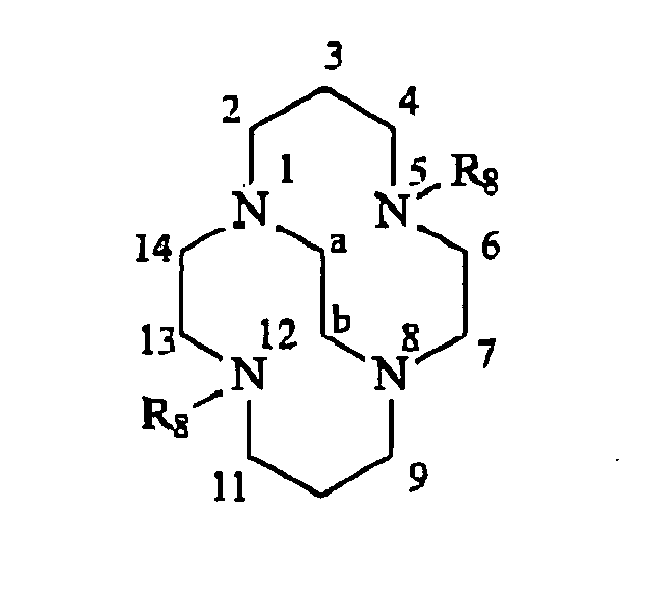
- Other suitable MRLs include: dichloro-5,12-diethyl-1,5,8,12-tetraazabicyclo[6.6.2]hexadecane manganese(II); diaquo-5,12-diethyl-1,5,8,12-tetraazabicyclo[6.6.2]hexadecane manganese(II); hexafluorophosphate; aquo-hydroxy-5,12-diethyl-1,5,8,12-tetraazabicyclo[6.6.2]hexadecane manganese(III); hexafluorophosphate diaquo-5,12-diethyl-1,5,8,12-tetraazabicyclo[6.6.2]hexadecane manganese(II); tetrafluoroborate dichloro-5,12-dicthyl-1,5,8,12-tetraazabicyclo[6.6.2]hexadecane manganese(III); hexafluorophosphate; dichloro-5,12-din-butyl-1,5,8,12-tetraaza bicyclo[6.6.2]hexadecane manganese(II); dichloro-5,12-diburizyl-1,5,8,12-tetraazabicyclo[6.6.2]hcxadecane manganese(II); dichloro-5-n-butyl-12-methyl-1,5,8,12-tetraaza-bicyclo[6.6.2]hexadecane Manganese(II); dichloro-5-n-octyl-12-methyl-1,5,8,12-tetraaza-bicyclo[6.6.2]hexadecane Manganese(II); dichloro-5-n-butyl-12-methyl-1,5,8,12-tetraaza- bicyclo[6.6.2]hexadecane Manganese(II).
- Suitable transition metal MRLs are readily prepared by known procedures, such as taught for example in
WO 00/332601 U.S. 6,225,464 . - The composition may comprise a highly ethoxylated non-ionic surfactant, preferably from 1 to 20%, or from 2% to 6%, or from 3% to 5%, by weight of the composition, of highly ethoxylated non-ionic surfactant. Preferred highly ethoxylated non-ionic surfactants have a hydrophilic/lipophilic balance (HLB) value of from 13 to 25, preferably from 15 to 22, more preferably from 16 to 22, 10 most preferably from 14 to 19.5. HLB values can be calculated according to the method given in Griffin, J. Soc. Cosmetic Chemists, 5 (1954) 249-256.
- In a preferred embodiment, the weight ratio of the anionic detersive surfactant to the highly ethoxylated non-ionic surfactant is within the range of from 0.25:1 to 40:1, preferably from 1:1 to 15:1, or from 1:1 to 10:1 and more preferably from 2:1 to 6:1, and most preferably from 2. 5:1 to 5:1.Examples of suitable highly ethoxylated non-ionic surfactants include the condensation products of aliphatic C8-20, preferably C10-16 primary or secondary linear or branched chain alcohols or phenols with alkylene oxides, preferably ethylene oxide or propylene oxide, most preferably ethylene oxide, and generally having from 15 to 80, preferably 16 to 80, more preferably up to 20 or from 20 to 80, and most preferably 20 to 50 alkylene oxide groups; typically, the alkylene oxide group is the hydrophilic repeating unit.
- According to an especially preferred embodiment of the invention, the nonionic surfactant is an ethoxylated aliphatic alcohol of the formula:
R-(-O-CH2-CH2)n-OH
wherein: R is a hydrocarbyl chain having from 8 to 16 carbon atoms, and the average degree of ethoxylation n is from 15 to 50, preferably 20 to 50. The hydrocarbyl chain, which is preferably saturated, preferably contains from 10 to 16 carbon atoms, more preferably from 12 to 15 carbon atoms. In commercial materials containing a spread of chain lengths, these figures represent an average. The hydrocarbyl chain may be linear or branched. The alcohol may be derived from natural or synthetic feedstock. Preferred alcohol feedstocks are coconut, predominantly C12-14, and oxo C12 alcohols. The average degree of ethoxylation ranges from 15 to 5 0, preferably from 16 to 5 0, more preferably from 2 0 to 5 0, and most preferably from 2 5 to 4 0. Preferred materials have an average alkyl chain length of C12-16 and an average degree of ethoxylation of from 15 to 50, more preferably from 25 to 40. An example of a suitable commercially available material is Lutensol AO30, ex BASF, which is a C13-15 alcohol having an average degree of ethoxylation of 30. Another example of a suitably commercially available material is a non-ionic ethoxylated alcohol 20EO Genapol C200 ex Clariant, and also the nonionic ethoxylated alcohol 20EO Lutensol T020 ex BASF. - The composition may comprise from 0.01% to 20%, preferably from 0.01% to 10%, more preferably from 0.01% to 8%, by weight of the composition, of a polyaminoamide, preferably a modified polyamidoamine.
- Suitable modified polyaminoamides have, depending on their degree of alkoxylation, a number average molecular weight of from 1,000Da to 1,000,000Da, preferably from 2,000Da to 1,000,000Da and more preferably from 2,000Da to 50,00ODa.
- In general, polyaminoamides are polymers whose backbone chain contains both amine functionalities (*-NH-*) and amide functionalities (*-NH-C(O)-*); the asterisks indicate the polymer backbone. Polyaminoamides typically also contain primary amino groups (-NH2) and/or carboxyl groups (-COOH) at the termini of the polymer chain. As used herein, the term "amino" comprises both the secondary amine functionalities of the polymer backbone and the primary amine functionalities at the termini of the polymer chain. In general polyaminoamides are linear.
- Suitable modified polyaminoamide of have a structure corresponding to formula 3 below:

- In a preferred embodiment, the detergent composition comprises a modified polyaminoamide having a structure corresponding to the formula below:

- The composition may comprise a quaternary nitrile bleach boosting ingredient, such as nitrile bleach boosting compounds having a structure corresponding to the formula:
(R1)(R2)(R3)N+-(CR4R5)-CN X-
wherein: R1 is H, CH3, a C2-24-alkyl or alkenyl radical, a substituted C2-24-alkyl or -alkenyl radical having at least one substituent from the group consisting of Cl, Br, OH. NH2, CN, an alkyl radical or an alkenylaryl radical having a C1-24-alkyl group, or a substituted alkyl or alkenylaryl radical having a C1-24-alkyl group and at least one further substituent on the aromatic ring; R2 and R3 independently of one another are selected from ―CH2―CN, ― CH3, ―CH2―CH3, ―CH2―CH2―CH3, ―CH(CH3)―CH3, ―CH2―OH, ―CH2― CH2―OH, ―CH(OH)―CH3, ―CH2-CH2―CH2―OH, ―CH2―CH(OH)―CH3, ― CH(OH)―CH2―CH3, ―(CH2―CH2―O)nH, where n = 1, 2, 3, 4, 5 or 6; R4 and R5 independently of one another have a meaning specified above for R1, R2 or R3; and X- is any suitable counter-ion such as halides, including chloride, fluoride, iodide and bromide, nitrate, hydroxide, phosphate, hydrogenphosphate, dihydrogenphosphate, pyrophosphate, metaphosphate, hexafluorophosphate, carbonate, hydrogencarbonate, sulfate, hydrogensulfate, C1-20-alkyl sulfate, C1-20-alkyl sulfonate, unsubstituted or C1-18-alkyl substituted arylsulfonate, chlorate, perchlorate and/or the anions of C1-24-carboxylic acids, such as formate, acetate, laurate, benzoate or citrate, alone or in any mixtures. - Preferred compounds are those according to the above formula, wherein R1, R2 and R3 are identical, preferably R1, R2 and R3 are methyl groups. Other preferred compounds are those according to the above formula, wherein at least one or two of R1, R2 and R3 are methyl groups and the others being a C2-24 alkyl group.
- The composition may comprise burkeite, or some other suitable carrier material. Suitable and preferred carrier materials are crystal growth modified sodium sesquicarbonate (Na2CO3.NaHCO3.2H2O), sodium carbonate (Na2CO3.H2O), sodium carbonate/sodium sulphate double salt (Na2CO3.(Na2SO4)2 burkcite) and mixtures thereof. Such carrier materials may be prepared by preparing a solution or slurry of the salt and a crystal growth modifier followed by drying such solution or slurry by any suitable means known in the art, such as spray drying. Suitable crystal growth modifiers are polycarboxylate compounds. These may be salts of monomeric polycarboxylic acids such as EDTA, NTA and citrate. However, preferred crystal growth modifiers are polymeric polycarboxylates such as homo-polymers and co-polymers of acrylic acid and/or maleic acid. Crystal growth modified sodium carbonate, burkeite and mixtures thereof and their preparation have been fully described in
EP0221776A2 . The crystal growth modifiers and the procedure described therein are also applicable to the preparation of sodium sesquicarbonate. Preferred carrier materials are crystal modified burkeite and mixtures of crystal modified burkeite and crystal modified sodium carbonate. A slurry or solution comprising sodium sulphate as well as sodium carbonate and crystal growth modifier will on drying crystallize as much as possible in the form of crystal modified burkeite in which the carbonate to sulphate weight ratio is 0.37:1. Any excess sulphate will crystallize as sulphate; any excess carbonate will crystallize as crystal modified carbonate. To obtain sufficient porosity in the crystal mass the slurry or solution of sodium carbonate and sodium sulphate should have a carbonate to sulphate weight ratio of at least 0.03:1. preferably at least 0.1:1 and most preferably between 0.3:1 and 0.45:1. The composition may comprise from 0.1% to 20%. or from 0.2% to 10%, by weight of the composition, of polymeric carboxylates. The composition may comprise from 0.2% to 10%, by weight of the composition, of sesquicarbonate, carbonate salt and/or sulphate salt. - The composition may comprise glucanase, such as β-Glucanases, which are enzymes from the class of endo-1,3-1,4-β-D-glucan-4-glucanohydrolases (EC 3.2.1.73; lichenases). β-Glucanases in the context of the invention also include endv-1,3-β-D-glucosidases (EC 3.2.1.39; laminarinases). Suitable β-Glucanases are obtainable from microorganisms, for example Achromobacter lunatus, Athrobacter luteus, Aspergillus aculeatus, Aspergillus niger, Bacillus subtilis, Disporotrichum dimorphosporum, Humicola insolens, Penicillium emersonii, Penicillium funiculosum or Trichoderna reesei. A commercial product is marketed, for example, under the name of Cereflo® (manufacturer: Novo Nordisk A/S). Preferred β-Glucanases include an enzyme obtainable from Bacillus alkalophilus (DSM 9956) which is the subject of
German patent application DE 197 32 751 . - β-Glucanase is preferably incorporated in the composition in such quantities that the composition has a glucanolytic activity in the range of from 0.05U/g to 1.00U/g and more preferably in the range from 0.06U/g to 0.25U/g. The determination of glucanolytic activity is based on modifications of the process described by M. Lever in Anal. Biochem. 47 (1972), 273-279 and Anal Biochem. 81 (1977), 21-27. A 0.5% by weight solution of β-glucan (Sigma No. G6513) in 50mM glycine buffer (pH 9.0) is used for this purpose. 250µl of this solution are added to 250µl of a solution containing the agent to be tested for glucanolytic activity and incubated for 30 minutes at 40°C. 1.5ml of a 1% by weight solution of p-hydroxybenzoic acid hydrazide (PAHBAH) in 0.5M NaOH, which contains 1mM bismuth nitrate and 1mM potassium sodium tartrate, are then added, after which the solution is heated for 10 minutes to 70°C. After cooling (2 minutes/0°C.), the absorption at 410nm is determined against a blank value at room temperature (for example with a Uvikon® 930 photometer) using a glucose calibration curve. The blank value is a solution which is prepared in the same way as the measuring solution except that the glucan solution is added after the PAHBAH solution. 1.00U corresponds to the quantity of enzyme which produces 1µmole of glucose per minute under these conditions.
- Glucanolytic activities in the washn liquor of from 0.2 U/l to 4 U/l and, more particularly, 0.25 U/l to 1 U/l in the aqueous cleaning solution are preferred. In machine washing processes, for example in the routine washing of domestic laundry in washing machines, the glucanolytic activities mentioned do not have to be maintained over the entire washing cycle to achieve the required washing result providing it is guaranteed that a glucanolytic activity in the range mentioned prevails for at least a short time, for example for about 5 to 20 minutes.
- β-Glucanase may be adsorbed onto supports and/or encapsulated in shell-forming substances to protect it against premature inactivation, particularly where it is used in particulate detergents as described, for example, in
European patent EP 0 564 476 or inInternational patent applications WO 94/23005 - The composition may comprise a lipase, preferably selected from the group consisting of Lipolase, Lipolase ultra, 10 LipoPrime, Lipomax, Liposam, Lipex and lipase from Rhizomucor miehei (e.g. as described in
EP- A-238 023 (Novo Nordisk - The compositions may comprise a lipase in an amount such that the composition has a lipase activity in the range of from 10 to 20,000LU/g, and preferably from 50 to 2,000LU/g. LU (Lipase units) are typically defined in
EP-A-258 068 (Novo Nordisk EP-A-305 216 WO-A-92/05249 WO-A- 94/25577 WO-A-95/22615 WO-A-97/04079 WO-A-97/07202 WO-A-99/42566 WO-A-00/60063 WO-A-00/60063 - The composition may comprise a polyvinyl pyrrolidone, preferably having a molecular weight in the range of from 1,000 to 200,000 g/mol and more particularly in the range from 1,000 to 100,000 g/mol. Suitable polyvinyl pyrrolidones are typically water-soluble and are typically formed by the polymerization of substituted or unsubstituted vinyl pyrrolidone monomers. They may be both homo-polymers and co-polymers where at least one of the monomers is a vinyl pyrrolidone and the vinyl pyrrolidone content of the copolymer is at least 50 mol%; suitable co-monomers including, for example, acrylonitrile or maleic anhydride.
- The composition may comprise carboxymethyl cellulose. The composition may comprise other cellulosic-based ingredients: such as non-ionic cellulose ethers, including methyl cellulose and methyl hydroxypropyl cellulose typically comprising from 15wt% to 30wt% of methoxyl groups and 1wt% to 15wt% of hydroxy-propoxyl groups, based on the non-ionic cellulose ether, and the polymers of phthalic acid and/or terephthalic acid or derivatives thereof, more particularly polymers of ethylene terephthalates and/or polyethylene glycol terephthalates or anionically and/or non-ionically modified derivatives thereof, Of these, the sulphonated derivatives of phthalic acid and terephthalic acid polymers are particularly preferred.
- The composition may comprise a fluorescent-whitening agent. The fluorescent-whitening agent can be incorporated at levels typically from about 0.05% to about 1.2%, by weight, into detergent composition. Commercial fluorescent-whitening agents that may be suitable can be classified into sub-groups, which include, but are not necessarily limited to, derivatives of stilbene, pyrazoline, cournarin, carboxylic acid, methinecyanines, dibenzothiphene-5,5-dioxide, azoles, and 5- and 6-membered-ring heterocycles.
- Suitable fluorescent-whitening agents include diaminostilbene disulfonic acid or alkali metal salts thereof, preferably salts of 4,4'-bis-(2-anilino-4-morpholino-1,3,5-triazinyl-6-amino)-stilbene-2,2'-disulfonic acid or compounds of similar structure which contain a diethanolamino group, a methylamino group and anilino group or a 2-methoxyethylamino group instead of the morpholino group- fluorcscent-whitening agents of the substituted diphenyl styryl type, for example alkali metal salts of 4,4'-bis-(2-sulfostyryl)-diphenyl, 4,4'-bis-(4-chloro-3-sulfostyryl)-diphenyl or 4-(4-chlorostyryl)-4'-(2-sulfostyryl)-diphenyl, may also be suitable. Mixtures of the fluorescent-whitening agents mentioned above may also be used.
- The composition may comprise magnesium sulphate. The composition may comprise any dehydrating agent that can absorb water such that, when fully hydrated, at least 25% of its weight is water and it has an equilibrium relative humidity at 25°C of less than 60%. In this way it can absorb significant amounts of moisture but keep the moisture 'locked away' so that it does not readily evaporate and create powder flow problems. It is also highly preferred that the dehydrating agent, such as magnesium sulphate, is stable with respect to moisture loss up to 50°C. This means that the water absorbed within remains in a stable state up to 50°C.
- Suitable dehydrating agents are preferably selected from the group consisting of magnesium sulphate, sodium pyrophosphate, sodium acetate and mixtures thereof. Of these, magnesium sulphate is preferred due to its higher efficacy.
- The composition may comprise an effervescence system, typically any effervescence system that is capable of releasing a gas upon contact with water. Preferred effervescence systems comprise a source of carbonate, such as sodium carbonate and/or sodium bicarbonate, in combination with a source of acid, such as citric acid, sulphamic acid, maleic acid, acrylic acid, or polymers thereof. The source of carbonate and source of acid may be present in the composition in the form of a co-particulate admix, typically being present in the composition in the same particles, or they may be in separate particle admixes from each other.
- Another suitable effervescence system comprises a percarbonate that is capable of releasing a gas upon contact with water.
- The composition may comprise a non-ionic detersive surfactant. The composition may comprise from 0.5% to 10%, by weight of the composition, of non-ionic detersive surfactant. Preferably the composition comprises from 1% to 7% or from 2% to 4%, by weight of the composition, of non-ionic detersive surfactant. The non-ionic detersive surfactant can be selected from the group consisting of: C12-C18 alkyl cthoxylates, such as, NEODOL® non-ionic surfactants from Shell; C6-C12 alkyl phenol alkoxylates wherein the alkoxylate units are ethyleneoxy units, propyleneoxy units or a mixture thereof; C12-C18 alcohol and C6-C12 alkyl phenol condensates with ethylene oxide/propylene oxide block polymers such as Fluronic® from BASF; C14-C22 mid-chain branched alcohols, BA, as described in more detail in
US 6,150,322 ; C14-C22 mid-chain branched alkyl alkoxylates, BAEx, wherein x = from 1 to 30, as described in more detail inUS 6,153,577 ,US 6,020,303 andUS 6,093,856 ; alkylpolysaccharides as described in more detail inUS 4,565,647 , specifically alkylpolyglycosides as described in more detail inUS 4,483,780 andUS 4,483,779 ; polyhydroxy fatty acid amides as described in more detail inUS 5,332,528 ,WO 92/06162 WO 93/19146 WO 93/19038 WO 94/09099 US 6,482,994 andWO 01/42408 - The nonionic detersive surfactant can be a carbonate ester salt, typically with alkaline and alkaline earth metals. Suitable carbonate ester salts have a structure corresponding to the formula:
R-O-C(O)-O-X+
wherein: X = any suitable counterion-such as-Na+, and R = any substituted or unsubstituted linear or branched alkyl, preferably an alkoxylated alkyl, preferably an ethoxylated alkyl comprising from 1 to 20 ethoxy moieties. - The non-ionic detersive surfactant could be an alkyl polyglucoside and/or an alkyl alkoxylated alcohol. Preferably the non-ionic detersive surfactant is a linear or branched, substituted or unsubstituted C8-18 alkyl ethoxylated alcohol having an average degree of ethoxylation of from 1 to 10.
- The non-ionic detersive surfactant not only provides additional greasy soil cleaning performance but may also increase the activity of the anionic detersive surfactant by making the anionic detersive surfactant less likely to precipitate out of solution in the presence of free calcium cations. Preferably, the weight ratio of anionic detersive surfactant to non-ionic detersive surfactant, if present, is in the range of less than 8:1, or less than 7:1, or less than 6:1 or less than 5:1, preferably from 1:1 to 5:1, or from 2:1 to 5:1, or even from 3:1 to 4:1.
- The non-ionic detersive surfactant, or at least part thereof, can be incorporated into the composition in the form of a liquid spray-on, wherein the non-ionic detersive surfactant, or at least part thereof, in liquid form (e.g. in the form of a hot-melt) is sprayed onto the remainder of the composition. The non-ionic detersive surfactant, or at least part thereof, may be in particulate form, and the non-ionic detersive surfactant, or at least part thereof, may be dry-added to the remainder of the composition. The non-ionic surfactant, or at least part thereof, may be in the form of a co-particulate admixture with a solid carrier material such as carbonate salt, sulphate salt, burkeite, silica or any mixture thereof.
- The non-ionic detersive surfactant, or at least part thereof, may be in a co-particulate admixture with either an anionic detersive surfactant or a cationic detersive surfactant. However the non-ionic detersive surfactant, or at least part thereof, is preferably not in a co-particulate admixture with both an anionic detersive surfactant and a cationic detersive surfactant. The non-ionic detersive surfactant, or at least part thereof, may be agglomerated or extruded with either an anionic detersive surfactant or a cationic detersive surfactant.
- The non-ionic detersive surfactant may be in solid form at 25°C, such as a polyglucoside or a carbonate ester. The composition may comprise silica and optionally a hydrotrope such as sodium cumene sulphonate, sodium toluene sulphonate, sodium xylene sulphonate, or any mixture thereof. The non-ionic detersive surfactant may be in the form of a co-particulate admix with the silica and optionally the hydrotrope.
- If the composition comprises non-ionic detersive surfactant, then the composition is typically prepared by a process wherein the non-ionic detersive surfactant is subjected to a super-heated steam spray-drying process. Typically the steam is at a temperature of at least 200°C, preferably at least 250°C, or at least 300°C, or at least 350°C, or at least 400°C. The mean drying duration period is typically less than 60 seconds, or less than 40 seconds, or even less than 20 seconds. The process typically comprises the steps of (i) preparing a aqueous mixture comprising a detergent ingredient, such as an anionic detersive surfactant; (ii) contacting the non-ionic detersive surfactant to the aqueous mixture; and (iii) subjecting the mixture obtained from step (ii) to a drying step, wherein step (iii) is initiated within 300 seconds, preferably within 200 seconds, or within 100 seconds, or within 50 seconds, or within 25 seconds, or within 10 seconds, or within 5 seconds, of the nonionic surfactant being contacted to the aqueous mixture in step (ii). Preferably step (iii) is a spray-drying step.
- The composition may also be prepared by a process comprising the steps of: (i) subjecting a detergent ingredient, such as an anionic detersive surfactant, to a super-heated steam spray-drying step; and (ii) contacting the non-ionic surfactant with the product formed during step (i).
- The composition comprises from 0wt% to less than 5%, or to 4%, or to 3%, or to 2%, or to 1%, by weight of the composition, of zeolite builder. It may even be preferred for the composition to be essentially free from zeolite builder. By essentially free from zeolite builder it is typically meant that the composition comprises no deliberately added zeolite builder. This is especially preferred if it is desirable for the composition to be very highly soluble, to minimise the amount of water-insoluble residues (for example, which may deposit on fabric surfaces), and also when it is highly desirable to have transparent wash liquor. Zeolite builders include zeolite A, zeolite X, zeolite P and zeolite MAP.
- The composition comprises from 0wt% to less than 5wt%, or to 4%, or to 3%, or to 2%, or to 1%, by weight of the composition, of phosphate builder. It may even be preferred for the composition to be essentially free from phosphate builder. By essentially free from phosphate builder it is typically meant that the composition comprises no deliberately added phosphate builder. This is especially preferred if it is desirable for the composition to have a very good environmental profile. Phosphate builders include sodium tripolyphosphate.
- The composition optionally comprises from 0wt% to less than 5%, or to 4%,or to 3%, or to 2%, or to 1%, by weight of the composition, of a silicate salt. It may even be preferred for the composition to be essentially free from silicate salt. By essentially free from silicate salt it is meant that the composition comprises no deliberately added silicate. This is especially preferred in order to ensure that the composition has a very good dispensing and dissolution profiles and to ensure that the composition provides a clear wash liquor upon dissolution in water. Silicate salts include water-insoluble silicates. Silicate salts include amorphous silicates and crystalline layered silicates (e.g. SKS-6). A preferred silicate salt is sodium silicate.
- The composition typically comprises adjunct ingredients. These adjunct ingredients include: detersive surfactants such as cationic detersive surfactants, zwitterionic detersive surfactants, amphoteric detersive surfactants; preferred cationic detersive surfactants are mono-C6-18 alkyl mono-hydroxyethyl di-methyl quaternary ammonium chlorides, more preferred are mono-C8-10 alkyl mono-hydroxyethyl di-methyl quaternary ammonium chloride, mono-C10-12 alkyl mono-hydroxyethyl di-methyl quaternary ammonium chloride and mono-C10 alkyl mono-hydroxyethyl di-methyl quaternary ammonium chloride; source of peroxygen such as percarbonate salts and/or perborate salts, preferred is sodium percarbonate, the source of peroxygen is preferably at least partially coated, preferably completely coated, by a coating ingredient such as a carbonate salt, a sulphate salt, a silicate salt, borosilicate, or mixtures, including mixed salts, thereof; bleach activator such as tetraacetyl ethylene diamine, oxybenzene sulphonate bleach activators such as nonanoyl oxybenzene sulphonate, caprolactam bleach activators, imide bleach activators such as N-nonanoyl-N-methyl acetamide, preformed peracids such as N,N-pthaloylamino peroxycaproic acid, nonylamido peroxyadipic acid or dibenzoyl peroxide; enzymes such as amylases, carbohydrases, cellulases, laccases, oxidases, peroxidases, proteases, pectate lyases and mannanases; suds suppressing systems such as silicone based suds suppressors; photobleach; filler salts such as sulphate salts, preferably sodium sulphate; fabric-softening agents such as clay, silicone and/or quaternary ammonium compounds; flocculants such as polyethylene oxide; dye transfer inhibitors such as polyvinylpyrrolidone, poly 4-vinylpyridine N-oxide and/or co-polymer of vinylpyrrolidone and vinylimidazole; fabric integrity components such as hydrophobically modified cellulose and oligomers produced by the condensation of imidazole and epichlorhydrin; soil dispersants and soil anti-redeposition aids such as alkoxylated polyamines and ethoxylated ethyleneimine polymers; auti-redeposition components such as polyesters; perfumes; sulphamic acid or salts thereof; citric acid or salts thereof; dyes such as orange dye, blue dye, green dye, purple dye, pink dye, or any mixture thereof; carbonate salt such as sodium carbonate and/or sodium bicarbonate; carboxylate polymers such as co-polymers of maleic acid and acrylic acid.
- Preferably, the composition comprises less than 1wt% chlorine bleach and less than 1wt% bromine bleach. Preferably, the composition is essentially free from bromine bleach and chlorine bleach. By "essentially free from" it is typically meant "comprises no deliberately added".
- The following solid laundry detergent compositions are in accordance with the present invention:
A B C D E F Spray-dried particles C10-13 linear alkyl benzene sulfonate 7.50 7.50 7.50 7.50 7.50 7.50 C12-16 alkyl ethoxylated sulphate having an average ethoxylation degree of 3 1.00 1.00 Hydroxyethane di(methylene phosphonic-acid) 0.20 0.20 0.20 0.20 0.20 0.20 Ethylenediamine disuccinic acid 0.25 0.25 0.25 0.25 0.25 0.25 Acrylate/maleate copolymer 2.50 2.50 2.50 2.50 2.50 2.50 Sodium carbonate 22.50 22.50 22.50 22.50 22.50 22.50 Fluorescent-whitening agent 0.15 0.15 0.15 0.15 0.15 0.15 Magnesium sulphate 0.45 0.45 0.45 0.45 0.45 0.45 Sodium sulphate 16.15 17.65 17.65 16.15 16.15 16.15 Miscellaneous and water 4.00 4.00 4.00 4.00 4.00 4.00 Total spray-dried particles 53.70 56.20 56.20 53.70 53.70 53.70 Surfactant agglomerate C12-16 alkyl ethoxylated sulphate having an average ethoxylation degree of 3 6.00 6.00 6.00 6.00 5.00 C10-13 linear alkyl benzene sulfonate 5.00 1.00 Sodium carbonate 17.00 17.00 15.00 17.00 17.00 15.00 Acrylate/maleate copolymer 1.50 1.50 Miscellaneous and water 1.00 1.00 1.00 1.00 1.00 1.50 Total surfactant agglomerat 24.00 24.00 22.50 24.00 24.00 24.00 Dry-added ingredients Ingredient* 1.00 1.00 1.00 1.00 1.00 1.00 Sodium percarbonate having an AvOx of 14wt% 9.00 9.00 9.00 10.00 Sodium carbonate 2.50 Sodium sulphate 11.50 11.00 Acrylate/maleate copolymer 1.50 1.50 1.50 1.50 Enzymes 0.50 0.50 0.50 0.50 0.50 Tetraacetylethylenediamine 2.50 2.00 1.50 3.00 Citric acid 3.00 1.00 2.00 3.00 4.00 3.00 Suds suppressor 0.80 0.80 0.80 0.80 0.80 0.80 Miscellaneous and water to 100% to 100% to 100% to 100% to 100% to 100% - * The ingredient is selected from the group consisting of: a transition metal ion-based bleach catalyst, a bleach boosting ingredient, a highly ethoxylated non-ionic surfactant, a polyamidoamine, a quaternary nitrile bleach boosting ingredient, a hardness tolerant surfactant, burkeite, glucanase, lipase, polyvinyl pyrrolidone, carboxymethyl cellulose, fluorescent-whitening agents, and a non-ionic detersive surfactant.
Claims (24)
- A solid laundry detergent composition in particulate form, comprising:(a) anionic detersive surfactant;(b) a calcium-augmented technology,(c) from 0% to less than 5%, by weight of the composition, of zeolite builder;(d) from 0% to less than 5%, by weight of the composition, of phosphate builder and(e) optionally, from 0% to less than 5%, by weight of the composition, of silicate salt.
- A composition according to Claim 1, wherein the composition comprises a bleach boosting ingredient.
- A composition according to any preceding Claim, wherein the composition comprises a transition metal ion-based bleach catalyst.
- A composition according to any preceding Claim, wherein composition comprises a highly ethoxylated non-ionic surfactant.
- A composition according to any preceding Claim, wherein the composition comprises a polyamidoamine.
- A composition according to any preceding Claim, wherein the composition comprises a quaternary nitrile bleach boosting ingredient.
- A composition according to any preceding Claim, wherein the composition comprises a hardness tolerant surfactant system.
- A composition according to any preceding Claim, wherein the composition comprises burkeite.
- A composition according to any preceding Claim, wherein the composition comprises a glucanase.
- A composition according to any preceding Claim, wherein the composition comprises a lipase.
- A composition according to any preceding Claim, wherein the composition comprises a polyvinyl pyrrolidone.
- A composition according to any preceding Claim, wherein the composition comprises a carboxymethyl cellulose.
- A composition according to any preceding Claim, wherein the composition comprises a fluorescent-whitening agent.
- A composition according to any preceding Claim, wherein the composition comprises magnesium sulphate.
- A composition according to any preceding Claim, wherein the composition comprises an effervescence system.
- A composition according to any preceding Claim, wherein the composition comprises a non-ionic detersive surfactant.
- A composition according to Claim 16, wherein the non-ionic detersive surfactant is in solid form.
- A composition according to Claim 16, wherein the non-ionic detersive surfactant is a carbonate ester salt.
- A composition according to Claim 16, wherein the non-ionic detersive surfactant is an alkyl polyglucoside.
- A composition according to Claim 16, wherein the composition comprises silica and optionally a hydrotrope, and wherein the non-ionic detersive surfactant is in the form of a co-particulate with silica and optionally a hydrotrope.
- A process for preparing a composition according to Claim 16, wherein the non-ionic detersive surfactant is subjected to a super-heated steam spray-drying process.
- A process for preparing a composition according to Claim 16, comprising the steps of:(i) preparing a aqueous mixture comprising an anionic detersive surfactant;(ii) contacting the non-ionic detersive surfactant to the aqueous mixture; and(iii) subjecting the mixture obtained from step (ii) to a drying step,wherein step (iii) is initiated within 300 seconds of step (ii) finishing.
- A process according to Claim 22, wherein step (iii) is a spray-drying step.
- A process for preparing a composition according to Claim 16, the process comprising the steps of:(i) subjecting the anionic detersive surfactant to a super-heated steam spray-drying step; and(ii) contacting the non-ionic surfactant with the product formed during step (i).
Priority Applications (12)
| Application Number | Priority Date | Filing Date | Title |
|---|---|---|---|
| ES05018033T ES2415872T3 (en) | 2005-08-19 | 2005-08-19 | Solid laundry detergent composition comprising an anionic detersive surfactant and calcium enhancement technology |
| PL05018033T PL1754781T3 (en) | 2005-08-19 | 2005-08-19 | A solid laundry detergent composition comprising anionic detersive surfactant and a calcium-augmented technology |
| EP05018033A EP1754781B1 (en) | 2005-08-19 | 2005-08-19 | A solid laundry detergent composition comprising anionic detersive surfactant and a calcium-augmented technology |
| US11/504,918 US7910533B2 (en) | 2005-08-19 | 2006-08-15 | Solid laundry detergent composition comprising anionic detersive surfactant and calcium-augmented technology |
| PCT/IB2006/052856 WO2007020609A1 (en) | 2005-08-19 | 2006-08-17 | A solid laundry detergent composition comprising anionic detersive surfactant and a calcium-augmented technology |
| MX2008002310A MX2008002310A (en) | 2005-08-19 | 2006-08-17 | A solid laundry detergent composition comprising anionic detersive surfactant and a calcium-augmented technology. |
| BRPI0615173-6A BRPI0615173A2 (en) | 2005-08-19 | 2006-08-17 | solid laundry detergent composition comprising anionic detersive surfactant and a calcium powered technology |
| CA2616692A CA2616692C (en) | 2005-08-19 | 2006-08-17 | A solid laundry detergent composition comprising anionic detersive surfactant and a calcium-augmented technology |
| CNA2006800302077A CN101243172A (en) | 2005-08-19 | 2006-08-17 | Solid laundry detergent composition comprising anionic detersive surfactant and calcium-enhanced process |
| JP2008526604A JP2009504871A (en) | 2005-08-19 | 2006-08-17 | Solid laundry detergent composition comprising an anionic detersive surfactant and calcium augmentation technology |
| ARP060103625A AR054933A1 (en) | 2005-08-19 | 2006-08-18 | A SOLID DETERGENT COMPOSITION FOR LAUNDRY THAT INCLUDES ANIONIC DETERGENT SURFACTANT AND A CALCIUM ENRICHMENT TECHNOLOGY |
| ZA200800750A ZA200800750B (en) | 2005-08-19 | 2008-01-24 | A solid laundry detergent composition comprising anionic detersive surfactant and a calcium-augmented technology |
Applications Claiming Priority (1)
| Application Number | Priority Date | Filing Date | Title |
|---|---|---|---|
| EP05018033A EP1754781B1 (en) | 2005-08-19 | 2005-08-19 | A solid laundry detergent composition comprising anionic detersive surfactant and a calcium-augmented technology |
Publications (2)
| Publication Number | Publication Date |
|---|---|
| EP1754781A1 true EP1754781A1 (en) | 2007-02-21 |
| EP1754781B1 EP1754781B1 (en) | 2013-04-03 |
Family
ID=35431491
Family Applications (1)
| Application Number | Title | Priority Date | Filing Date |
|---|---|---|---|
| EP05018033A Expired - Lifetime EP1754781B1 (en) | 2005-08-19 | 2005-08-19 | A solid laundry detergent composition comprising anionic detersive surfactant and a calcium-augmented technology |
Country Status (12)
| Country | Link |
|---|---|
| US (1) | US7910533B2 (en) |
| EP (1) | EP1754781B1 (en) |
| JP (1) | JP2009504871A (en) |
| CN (1) | CN101243172A (en) |
| AR (1) | AR054933A1 (en) |
| BR (1) | BRPI0615173A2 (en) |
| CA (1) | CA2616692C (en) |
| ES (1) | ES2415872T3 (en) |
| MX (1) | MX2008002310A (en) |
| PL (1) | PL1754781T3 (en) |
| WO (1) | WO2007020609A1 (en) |
| ZA (1) | ZA200800750B (en) |
Cited By (1)
| Publication number | Priority date | Publication date | Assignee | Title |
|---|---|---|---|---|
| WO2023025685A1 (en) | 2021-08-27 | 2023-03-02 | Unilever Ip Holdings B.V. | Detergent composition |
Families Citing this family (17)
| Publication number | Priority date | Publication date | Assignee | Title |
|---|---|---|---|---|
| EP1918362A1 (en) * | 2006-10-16 | 2008-05-07 | The Procter & Gamble Company | Low builder, highly water-soluble, low-density solid laundry detergent composition |
| DE602006020586D1 (en) * | 2006-10-16 | 2011-04-21 | Procter & Gamble | A spray-drying process for the preparation of low-density, low-build, spray-dried, highly water-soluble detergents. |
| EP2380959A1 (en) * | 2010-04-19 | 2011-10-26 | The Procter & Gamble Company | Solid detergent composition comprising beta cyclodextrin |
| US20120101018A1 (en) | 2010-10-22 | 2012-04-26 | Gregory Scot Miracle | Bis-azo colorants for use as bluing agents |
| EP2537918A1 (en) * | 2011-06-20 | 2012-12-26 | The Procter & Gamble Company | Consumer products with lipase comprising coated particles |
| CN107475235B (en) * | 2011-06-20 | 2022-09-13 | 诺维信公司 | Particulate composition |
| JP5700469B2 (en) * | 2012-12-28 | 2015-04-15 | 花王株式会社 | Powder detergent composition for clothing |
| HUE052331T2 (en) * | 2013-02-19 | 2021-04-28 | Procter & Gamble | Method of laundering a fabric |
| EP2767582A1 (en) | 2013-02-19 | 2014-08-20 | The Procter and Gamble Company | Method of laundering a fabric |
| EP2767579B1 (en) * | 2013-02-19 | 2018-07-18 | The Procter and Gamble Company | Method of laundering a fabric |
| US20160122690A1 (en) * | 2013-05-30 | 2016-05-05 | Novozymes A/S | Particulate Enzyme Composition |
| CN103408118A (en) * | 2013-08-05 | 2013-11-27 | 东华大学 | Method of treating printing and dyeing wastewater through flocculation oxidation |
| JP6407682B2 (en) * | 2014-11-27 | 2018-10-17 | 花王株式会社 | Method for producing powder detergent composition for clothing |
| CA3127167A1 (en) * | 2019-03-14 | 2020-09-17 | The Procter & Gamble Company | Cleaning compositions comprising enzymes |
| CN113597469A (en) * | 2019-03-14 | 2021-11-02 | 宝洁公司 | Cleaning compositions comprising enzymes |
| MX2021011106A (en) * | 2019-03-14 | 2021-10-22 | Procter & Gamble | Method for treating cotton. |
| CN110721633A (en) * | 2019-10-15 | 2020-01-24 | 江苏科技大学 | A kind of compound dispersant and its preparation method and application |
Citations (57)
| Publication number | Priority date | Publication date | Assignee | Title |
|---|---|---|---|---|
| US4483779A (en) | 1982-04-26 | 1984-11-20 | The Procter & Gamble Company | Detergent compositions comprising polyglycoside and polyethoxylate surfactants and anionic fluorescer |
| US4483780A (en) | 1982-04-26 | 1984-11-20 | The Procter & Gamble Company | Detergent compositions containing polyglycoside and polyethoxylate detergent surfactants |
| US4565647A (en) | 1982-04-26 | 1986-01-21 | The Procter & Gamble Company | Foaming surfactant compositions |
| EP0221776A2 (en) | 1985-11-01 | 1987-05-13 | Unilever Plc | Detergent compositions, components therefor, and processes for their preparation |
| US4687592A (en) * | 1985-02-19 | 1987-08-18 | The Procter & Gamble Company | Detergency builder system |
| EP0238023A2 (en) | 1986-03-17 | 1987-09-23 | Novo Nordisk A/S | Process for the production of protein products in Aspergillus oryzae and a promoter for use in Aspergillus |
| US4713193A (en) * | 1983-11-09 | 1987-12-15 | Lever Brothers Company | Stable, free-flowing particulate adjuncts for use in detergent compositions |
| EP0258068A2 (en) | 1986-08-29 | 1988-03-02 | Novo Nordisk A/S | Enzymatic detergent additive |
| EP0305216A1 (en) | 1987-08-28 | 1989-03-01 | Novo Nordisk A/S | Recombinant Humicola lipase and process for the production of recombinant humicola lipases |
| WO1992005249A1 (en) | 1990-09-13 | 1992-04-02 | Novo Nordisk A/S | Lipase variants |
| WO1992006162A1 (en) | 1990-09-28 | 1992-04-16 | The Procter & Gamble Company | Detergent containing alkyl sulfate and polyhydroxy fatty acid amide surfactants |
| WO1993019146A1 (en) | 1992-03-16 | 1993-09-30 | The Procter & Gamble Company | Fluid compositions containing polyhydroxy fatty acid amides |
| WO1993019038A1 (en) | 1992-03-26 | 1993-09-30 | The Procter & Gamble Company | Process for reducing the levels of fatty acid contaminants in polyhydroxy fatty acid amide surfactants |
| EP0564476A1 (en) | 1990-12-24 | 1993-10-13 | Henkel Kgaa | Enzyme preparation for washing and cleansing agents. |
| WO1994009099A1 (en) | 1992-10-13 | 1994-04-28 | The Procter & Gamble Company | Fluid compositions containing polyhydroxy fatty acid amides |
| US5332528A (en) | 1990-09-28 | 1994-07-26 | The Procter & Gamble Company | Polyhydroxy fatty acid amides in soil release agent-containing detergent compositions |
| WO1994023005A1 (en) | 1993-03-31 | 1994-10-13 | Cognis Gesellschaft Für Biotechnologie Mbh | Enzyme composition for washing and cleaning agents |
| WO1994025577A1 (en) | 1993-04-23 | 1994-11-10 | Novo Nordisk A/S | Lipase variants |
| WO1995022615A1 (en) | 1994-02-22 | 1995-08-24 | Novo Nordisk A/S | A method of preparing a variant of a lipolytic enzyme |
| US5552078A (en) | 1993-06-29 | 1996-09-03 | Church & Dwight Co., Inc. | Carbonate built laundry detergent composition |
| US5576282A (en) | 1995-09-11 | 1996-11-19 | The Procter & Gamble Company | Color-safe bleach boosters, compositions and laundry methods employing same |
| US5591707A (en) * | 1992-10-12 | 1997-01-07 | Henkel Kommanditgesellschaft Auf Aktien | Process for producing free-flowing granules with superheated steam |
| US5595967A (en) | 1995-02-03 | 1997-01-21 | The Procter & Gamble Company | Detergent compositions comprising multiperacid-forming bleach activators |
| US5597936A (en) | 1995-06-16 | 1997-01-28 | The Procter & Gamble Company | Method for manufacturing cobalt catalysts |
| WO1997004079A1 (en) | 1995-07-14 | 1997-02-06 | Novo Nordisk A/S | A modified enzyme with lipolytic activity |
| WO1997007202A1 (en) | 1995-08-11 | 1997-02-27 | Novo Nordisk A/S | Novel lipolytic enzymes |
| WO1997043366A1 (en) | 1996-05-17 | 1997-11-20 | The Procter & Gamble Company | Detergent composition |
| WO1999005241A1 (en) | 1997-07-21 | 1999-02-04 | The Procter & Gamble Company | Cleaning products comprising improved alkylarylsulfonate surfactants prepared via vinylidene olefins and processes for preparation thereof |
| DE19732751A1 (en) | 1997-07-30 | 1999-02-04 | Henkel Kgaa | New Bacillus beta glucanase |
| WO1999005242A1 (en) | 1997-07-21 | 1999-02-04 | The Procter & Gamble Company | Improved alkylbenzenesulfonate surfactants |
| WO1999005244A1 (en) | 1997-07-21 | 1999-02-04 | The Procter & Gamble Company | Improved alkyl aryl sulfonate surfactants |
| WO1999005084A1 (en) | 1997-07-21 | 1999-02-04 | The Procter & Gamble Company | Process for making alkylbenzenesulfonate surfactants from alcohols and products thereof |
| WO1999005243A1 (en) | 1997-07-21 | 1999-02-04 | The Procter & Gamble Company | Detergent compositions containing mixtures of crystallinity-disrupted surfactants |
| WO1999005082A1 (en) | 1997-07-21 | 1999-02-04 | The Procter & Gamble Company | Improved processes for making alkylbenzenesulfonate surfactants and products thereof |
| WO1999007656A2 (en) | 1997-08-08 | 1999-02-18 | The Procter & Gamble Company | Improved processes for making surfactants via adsorptive separation and products thereof |
| WO1999042566A1 (en) | 1998-02-17 | 1999-08-26 | Novo Nordisk A/S | Lipase variant |
| US6008181A (en) | 1996-04-16 | 1999-12-28 | The Procter & Gamble Company | Mid-Chain branched Alkoxylated Sulfate Surfactants |
| US6020303A (en) | 1996-04-16 | 2000-02-01 | The Procter & Gamble Company | Mid-chain branched surfactants |
| WO2000018873A1 (en) | 1998-09-25 | 2000-04-06 | The Procter & Gamble Company | Detergent compositions |
| WO2000018859A1 (en) | 1998-09-25 | 2000-04-06 | The Procter & Gamble Company | Solid detergent compositions |
| WO2000023548A1 (en) | 1998-10-20 | 2000-04-27 | The Procter & Gamble Company | Laundry detergents comprising modified alkylbenzene sulfonates |
| WO2000023549A1 (en) | 1998-10-20 | 2000-04-27 | The Procter & Gamble Company | Laundry detergents comprising modified alkylbenzene sulfonates |
| US6060443A (en) | 1996-04-16 | 2000-05-09 | The Procter & Gamble Company | Mid-chain branched alkyl sulfate surfactants |
| WO2000032601A2 (en) | 1998-11-30 | 2000-06-08 | The Procter & Gamble Company | Process for preparing cross-bridged tetraaza macrocycles |
| US6093856A (en) | 1996-11-26 | 2000-07-25 | The Procter & Gamble Company | Polyoxyalkylene surfactants |
| WO2000060063A1 (en) | 1999-03-31 | 2000-10-12 | Novozymes A/S | Lipase variant |
| US6150322A (en) | 1998-08-12 | 2000-11-21 | Shell Oil Company | Highly branched primary alcohol compositions and biodegradable detergents made therefrom |
| GB2351500A (en) * | 1999-06-28 | 2001-01-03 | Procter & Gamble | Detergent compositions |
| US6225464B1 (en) | 1997-03-07 | 2001-05-01 | The Procter & Gamble Company | Methods of making cross-bridged macropolycycles |
| WO2001042408A2 (en) | 1999-12-08 | 2001-06-14 | The Procter & Gamble Company | Ether-capped poly(oxyalkylated) alcohol surfactants |
| EP1111034A1 (en) * | 1999-12-22 | 2001-06-27 | The Procter & Gamble Company | Laundry and cleaning and/or fabric care compositions |
| US6274545B1 (en) | 1995-06-07 | 2001-08-14 | Church & Dwight Co., Inc. | Laundry detergent product with improved cold water residue properties |
| WO2002053691A1 (en) | 2000-12-29 | 2002-07-11 | Unilever Plc | Detergent compositions |
| US6482994B2 (en) | 1997-08-02 | 2002-11-19 | The Procter & Gamble Company | Ether-capped poly(oxyalkylated) alcohol surfactants |
| WO2003038028A2 (en) * | 2001-10-30 | 2003-05-08 | Henkel Kommanditgesellschaft Auf Aktien | Detergent or cleanser that can be dispersed in an essentially sediment-free manner |
| WO2005052105A1 (en) * | 2003-11-21 | 2005-06-09 | Henkel Kommanditgesellschaft Auf Aktien | Soluble builder system |
| WO2005083046A1 (en) * | 2004-02-23 | 2005-09-09 | The Procter & Gamble Company | A granular laundry detergent composition comprising an anionic detersive surfactant, and low levels of, or no, zeolite builders and phosphate builders |
Family Cites Families (42)
| Publication number | Priority date | Publication date | Assignee | Title |
|---|---|---|---|---|
| US3629955A (en) | 1970-07-31 | 1971-12-28 | Procter & Gamble | Multilevel spray-drying apparatus |
| US3629951A (en) | 1970-07-31 | 1971-12-28 | Procter & Gamble | Multilevel spray-drying method |
| US3703772A (en) | 1971-07-27 | 1972-11-28 | Colgate Palmolive Co | Drying of detergents |
| ATE5896T1 (en) * | 1979-11-03 | 1984-02-15 | The Procter & Gamble Company | GRANULAR DETERGENT COMPOSITIONS. |
| US4353834A (en) * | 1981-01-28 | 1982-10-12 | Basf Wyandotte Corporation | Carbonate and carboxylic acid ester group-containing non-ionic surface-active agents |
| CA1253769A (en) * | 1985-02-19 | 1989-05-09 | Jerome H. Collins | Detergency builder system |
| EP0349199B1 (en) | 1988-06-29 | 1995-03-08 | The Procter & Gamble Company | Two stage drying of detergent compositions |
| US5712242A (en) | 1993-03-30 | 1998-01-27 | The Procter & Gamble Company | High active granular detergents comprising chelants and polymers, and processes for their preparation |
| US5370826A (en) * | 1993-11-12 | 1994-12-06 | Lever Brothers Company, Division Of Conopco, Inc. | Quaternay oxaziridinium salts as bleaching compounds |
| US5496487A (en) | 1994-08-26 | 1996-03-05 | The Procter & Gamble Company | Agglomeration process for making a detergent composition utilizing existing spray drying towers for conditioning detergent agglomerates |
| DE19532718A1 (en) * | 1995-09-05 | 1997-03-06 | Basf Ag | Powdered, porous, N-vinylimidazole units containing polymers, processes for their preparation and their use |
| US5962389A (en) | 1995-11-17 | 1999-10-05 | The Dial Corporation | Detergent having improved color retention properties |
| CZ43199A3 (en) * | 1996-08-09 | 1999-07-14 | The Procter & Gamble Company | Cleaning agent containing pectinesterase enzyme, detergent additive and its use |
| US5756444A (en) * | 1996-11-01 | 1998-05-26 | The Procter & Gamble Company | Granular laundry detergent compositions which are substantially free of phosphate and aluminosilicate builders |
| HUP0002906A3 (en) * | 1997-05-30 | 2003-02-28 | Unilever Nv | Free-flowing particulate detergent composition |
| JP2001508493A (en) | 1998-01-13 | 2001-06-26 | ザ、プロクター、エンド、ギャンブル、カンパニー | Detergent granules with improved solubility |
| US6610645B2 (en) * | 1998-03-06 | 2003-08-26 | Eugene Joseph Pancheri | Selected crystalline calcium carbonate builder for use in detergent compositions |
| EP0971024A1 (en) * | 1998-07-10 | 2000-01-12 | The Procter & Gamble Company | Laundry and cleaning compositions |
| CA2344997C (en) * | 1998-09-25 | 2003-11-11 | The Procter & Gamble Company | Detergent granules |
| WO2000078915A1 (en) * | 1999-06-21 | 2000-12-28 | The Procter & Gamble Company | Detergent composition |
| US6825160B1 (en) * | 1999-08-27 | 2004-11-30 | Procter & Gamble Company | Color safe laundry methods employing cationic formulation components |
| DE60024463T2 (en) * | 1999-08-27 | 2006-08-17 | The Procter & Gamble Company, Cincinnati | STABLE SUBSTANCES, COMPOSITIONS AND WASHING PROCESSES FOR THEIR USE |
| DE19960744A1 (en) * | 1999-12-16 | 2001-07-05 | Clariant Gmbh | Granular alkali layer silicate compound |
| US6995125B2 (en) * | 2000-02-17 | 2006-02-07 | The Procter & Gamble Company | Detergent product |
| EP1127840A1 (en) | 2000-02-21 | 2001-08-29 | SOLVAY & Cie (Société Anonyme) | Process for preparing coated alkali metal percarbonate, coated alkaki metal percarbonate obtainable by this process, its use in detergent compositions, and detergent compositions containing it |
| US6509310B1 (en) | 2000-06-01 | 2003-01-21 | Huish Detergents, Inc. | Compositions containing α-sulfofatty acid esters and method of making the same |
| AU2001256359A1 (en) | 2000-06-15 | 2001-12-24 | Van Dijk, Willem Robert | Liquid detergent composition |
| DE10160993A1 (en) | 2001-12-12 | 2003-06-18 | Basf Ag | Detergent compositions comprising nitrogen-containing polymers |
| BR0315968A (en) | 2002-11-04 | 2005-09-20 | Unilever Nv | Laundry detergent composition, process for washing machine fabrics or by hand, and use of a nonionic surfactant |
| US20050187131A1 (en) | 2004-02-23 | 2005-08-25 | The Procter & Gamble Company | Granular laundry detergent composition comprising a ternary detersive surfactant system and low levels of, or no, zeolite builders and phosphate builders |
| CN100584876C (en) | 2004-03-19 | 2010-01-27 | 巴斯福股份公司 | Modified polyaminoamide |
| CA2559785C (en) | 2004-03-19 | 2011-01-04 | The Procter & Gamble Company | Detergent compositions comprising a modified polyaminoamide |
| DE602005021502D1 (en) * | 2004-08-11 | 2010-07-08 | Procter & Gamble | STRONG WATER SOLUBLE SOLID DETERGENT COMPOSITION, WHICH MAKES A CLEAN WASHING LIQUID AFTER SOLVING IN THE WATER |
| EP1693440A1 (en) * | 2005-02-22 | 2006-08-23 | The Procter & Gamble Company | Detergent compositions |
| US20070037726A1 (en) * | 2005-08-11 | 2007-02-15 | Brooker Alan T | Solid detergent comprising A C1-C3 alkyl carbonate salt |
| EP1754776A1 (en) | 2005-08-19 | 2007-02-21 | The Procter and Gamble Company | A process for preparing a solid laundry detergent composition, comprising at least two drying steps |
| EP1754779B1 (en) | 2005-08-19 | 2012-10-17 | The Procter and Gamble Company | A solid laundry detergent composition comprising anionic detersive surfactant and a highly porous carrier material |
| EP1754778A1 (en) | 2005-08-19 | 2007-02-21 | The Procter and Gamble Company | A solid laundry detergent composition comprising an alkyl benzene sulphonate-based anionic detersive surfactant system and a chelant system |
| DE602005024264D1 (en) | 2005-08-19 | 2010-12-02 | Procter & Gamble | Solid detergent composition containing alkylbenzenesulphonate, carbonate salt and carboxylate polymer |
| DE602005020776D1 (en) | 2005-08-19 | 2010-06-02 | Procter & Gamble | A solid detergent composition containing alkylbenzenesulphonate and a hydratable material |
| JP2009523900A (en) * | 2006-01-23 | 2009-06-25 | ザ プロクター アンド ギャンブル カンパニー | Composition comprising lipase and bleach catalyst |
| EP1979457A2 (en) * | 2006-01-23 | 2008-10-15 | The Procter and Gamble Company | A composition comprising a lipase and a bleach catalyst |
-
2005
- 2005-08-19 EP EP05018033A patent/EP1754781B1/en not_active Expired - Lifetime
- 2005-08-19 ES ES05018033T patent/ES2415872T3/en not_active Expired - Lifetime
- 2005-08-19 PL PL05018033T patent/PL1754781T3/en unknown
-
2006
- 2006-08-15 US US11/504,918 patent/US7910533B2/en not_active Expired - Fee Related
- 2006-08-17 JP JP2008526604A patent/JP2009504871A/en active Pending
- 2006-08-17 WO PCT/IB2006/052856 patent/WO2007020609A1/en not_active Ceased
- 2006-08-17 CA CA2616692A patent/CA2616692C/en not_active Expired - Fee Related
- 2006-08-17 CN CNA2006800302077A patent/CN101243172A/en active Pending
- 2006-08-17 BR BRPI0615173-6A patent/BRPI0615173A2/en not_active Application Discontinuation
- 2006-08-17 MX MX2008002310A patent/MX2008002310A/en active IP Right Grant
- 2006-08-18 AR ARP060103625A patent/AR054933A1/en unknown
-
2008
- 2008-01-24 ZA ZA200800750A patent/ZA200800750B/en unknown
Patent Citations (59)
| Publication number | Priority date | Publication date | Assignee | Title |
|---|---|---|---|---|
| US4565647B1 (en) | 1982-04-26 | 1994-04-05 | Procter & Gamble | Foaming surfactant compositions |
| US4483780A (en) | 1982-04-26 | 1984-11-20 | The Procter & Gamble Company | Detergent compositions containing polyglycoside and polyethoxylate detergent surfactants |
| US4565647A (en) | 1982-04-26 | 1986-01-21 | The Procter & Gamble Company | Foaming surfactant compositions |
| US4483779A (en) | 1982-04-26 | 1984-11-20 | The Procter & Gamble Company | Detergent compositions comprising polyglycoside and polyethoxylate surfactants and anionic fluorescer |
| US4713193A (en) * | 1983-11-09 | 1987-12-15 | Lever Brothers Company | Stable, free-flowing particulate adjuncts for use in detergent compositions |
| US4687592A (en) * | 1985-02-19 | 1987-08-18 | The Procter & Gamble Company | Detergency builder system |
| EP0221776A2 (en) | 1985-11-01 | 1987-05-13 | Unilever Plc | Detergent compositions, components therefor, and processes for their preparation |
| EP0238023A2 (en) | 1986-03-17 | 1987-09-23 | Novo Nordisk A/S | Process for the production of protein products in Aspergillus oryzae and a promoter for use in Aspergillus |
| EP0258068A2 (en) | 1986-08-29 | 1988-03-02 | Novo Nordisk A/S | Enzymatic detergent additive |
| EP0305216A1 (en) | 1987-08-28 | 1989-03-01 | Novo Nordisk A/S | Recombinant Humicola lipase and process for the production of recombinant humicola lipases |
| WO1992005249A1 (en) | 1990-09-13 | 1992-04-02 | Novo Nordisk A/S | Lipase variants |
| US5332528A (en) | 1990-09-28 | 1994-07-26 | The Procter & Gamble Company | Polyhydroxy fatty acid amides in soil release agent-containing detergent compositions |
| WO1992006162A1 (en) | 1990-09-28 | 1992-04-16 | The Procter & Gamble Company | Detergent containing alkyl sulfate and polyhydroxy fatty acid amide surfactants |
| EP0564476A1 (en) | 1990-12-24 | 1993-10-13 | Henkel Kgaa | Enzyme preparation for washing and cleansing agents. |
| WO1993019146A1 (en) | 1992-03-16 | 1993-09-30 | The Procter & Gamble Company | Fluid compositions containing polyhydroxy fatty acid amides |
| WO1993019038A1 (en) | 1992-03-26 | 1993-09-30 | The Procter & Gamble Company | Process for reducing the levels of fatty acid contaminants in polyhydroxy fatty acid amide surfactants |
| US5591707A (en) * | 1992-10-12 | 1997-01-07 | Henkel Kommanditgesellschaft Auf Aktien | Process for producing free-flowing granules with superheated steam |
| WO1994009099A1 (en) | 1992-10-13 | 1994-04-28 | The Procter & Gamble Company | Fluid compositions containing polyhydroxy fatty acid amides |
| WO1994023005A1 (en) | 1993-03-31 | 1994-10-13 | Cognis Gesellschaft Für Biotechnologie Mbh | Enzyme composition for washing and cleaning agents |
| WO1994025577A1 (en) | 1993-04-23 | 1994-11-10 | Novo Nordisk A/S | Lipase variants |
| US5552078A (en) | 1993-06-29 | 1996-09-03 | Church & Dwight Co., Inc. | Carbonate built laundry detergent composition |
| WO1995022615A1 (en) | 1994-02-22 | 1995-08-24 | Novo Nordisk A/S | A method of preparing a variant of a lipolytic enzyme |
| US5595967A (en) | 1995-02-03 | 1997-01-21 | The Procter & Gamble Company | Detergent compositions comprising multiperacid-forming bleach activators |
| US6274545B1 (en) | 1995-06-07 | 2001-08-14 | Church & Dwight Co., Inc. | Laundry detergent product with improved cold water residue properties |
| US5597936A (en) | 1995-06-16 | 1997-01-28 | The Procter & Gamble Company | Method for manufacturing cobalt catalysts |
| WO1997004079A1 (en) | 1995-07-14 | 1997-02-06 | Novo Nordisk A/S | A modified enzyme with lipolytic activity |
| WO1997007202A1 (en) | 1995-08-11 | 1997-02-27 | Novo Nordisk A/S | Novel lipolytic enzymes |
| US5576282A (en) | 1995-09-11 | 1996-11-19 | The Procter & Gamble Company | Color-safe bleach boosters, compositions and laundry methods employing same |
| US6060443A (en) | 1996-04-16 | 2000-05-09 | The Procter & Gamble Company | Mid-chain branched alkyl sulfate surfactants |
| US6008181A (en) | 1996-04-16 | 1999-12-28 | The Procter & Gamble Company | Mid-Chain branched Alkoxylated Sulfate Surfactants |
| US6020303A (en) | 1996-04-16 | 2000-02-01 | The Procter & Gamble Company | Mid-chain branched surfactants |
| WO1997043366A1 (en) | 1996-05-17 | 1997-11-20 | The Procter & Gamble Company | Detergent composition |
| US6093856A (en) | 1996-11-26 | 2000-07-25 | The Procter & Gamble Company | Polyoxyalkylene surfactants |
| US6153577A (en) | 1996-11-26 | 2000-11-28 | The Procter & Gamble Company | Polyoxyalkylene surfactants |
| US6225464B1 (en) | 1997-03-07 | 2001-05-01 | The Procter & Gamble Company | Methods of making cross-bridged macropolycycles |
| WO1999005241A1 (en) | 1997-07-21 | 1999-02-04 | The Procter & Gamble Company | Cleaning products comprising improved alkylarylsulfonate surfactants prepared via vinylidene olefins and processes for preparation thereof |
| WO1999005082A1 (en) | 1997-07-21 | 1999-02-04 | The Procter & Gamble Company | Improved processes for making alkylbenzenesulfonate surfactants and products thereof |
| WO1999005242A1 (en) | 1997-07-21 | 1999-02-04 | The Procter & Gamble Company | Improved alkylbenzenesulfonate surfactants |
| WO1999005244A1 (en) | 1997-07-21 | 1999-02-04 | The Procter & Gamble Company | Improved alkyl aryl sulfonate surfactants |
| WO1999005243A1 (en) | 1997-07-21 | 1999-02-04 | The Procter & Gamble Company | Detergent compositions containing mixtures of crystallinity-disrupted surfactants |
| WO1999005084A1 (en) | 1997-07-21 | 1999-02-04 | The Procter & Gamble Company | Process for making alkylbenzenesulfonate surfactants from alcohols and products thereof |
| DE19732751A1 (en) | 1997-07-30 | 1999-02-04 | Henkel Kgaa | New Bacillus beta glucanase |
| US6482994B2 (en) | 1997-08-02 | 2002-11-19 | The Procter & Gamble Company | Ether-capped poly(oxyalkylated) alcohol surfactants |
| WO1999007656A2 (en) | 1997-08-08 | 1999-02-18 | The Procter & Gamble Company | Improved processes for making surfactants via adsorptive separation and products thereof |
| WO1999042566A1 (en) | 1998-02-17 | 1999-08-26 | Novo Nordisk A/S | Lipase variant |
| US6150322A (en) | 1998-08-12 | 2000-11-21 | Shell Oil Company | Highly branched primary alcohol compositions and biodegradable detergents made therefrom |
| WO2000018873A1 (en) | 1998-09-25 | 2000-04-06 | The Procter & Gamble Company | Detergent compositions |
| WO2000018859A1 (en) | 1998-09-25 | 2000-04-06 | The Procter & Gamble Company | Solid detergent compositions |
| WO2000023549A1 (en) | 1998-10-20 | 2000-04-27 | The Procter & Gamble Company | Laundry detergents comprising modified alkylbenzene sulfonates |
| WO2000023548A1 (en) | 1998-10-20 | 2000-04-27 | The Procter & Gamble Company | Laundry detergents comprising modified alkylbenzene sulfonates |
| WO2000032601A2 (en) | 1998-11-30 | 2000-06-08 | The Procter & Gamble Company | Process for preparing cross-bridged tetraaza macrocycles |
| WO2000060063A1 (en) | 1999-03-31 | 2000-10-12 | Novozymes A/S | Lipase variant |
| GB2351500A (en) * | 1999-06-28 | 2001-01-03 | Procter & Gamble | Detergent compositions |
| WO2001042408A2 (en) | 1999-12-08 | 2001-06-14 | The Procter & Gamble Company | Ether-capped poly(oxyalkylated) alcohol surfactants |
| EP1111034A1 (en) * | 1999-12-22 | 2001-06-27 | The Procter & Gamble Company | Laundry and cleaning and/or fabric care compositions |
| WO2002053691A1 (en) | 2000-12-29 | 2002-07-11 | Unilever Plc | Detergent compositions |
| WO2003038028A2 (en) * | 2001-10-30 | 2003-05-08 | Henkel Kommanditgesellschaft Auf Aktien | Detergent or cleanser that can be dispersed in an essentially sediment-free manner |
| WO2005052105A1 (en) * | 2003-11-21 | 2005-06-09 | Henkel Kommanditgesellschaft Auf Aktien | Soluble builder system |
| WO2005083046A1 (en) * | 2004-02-23 | 2005-09-09 | The Procter & Gamble Company | A granular laundry detergent composition comprising an anionic detersive surfactant, and low levels of, or no, zeolite builders and phosphate builders |
Non-Patent Citations (3)
| Title |
|---|
| ANAL BIOCHEM., vol. 81, 1977, pages 21 - 27 |
| GRIFFIN, J. SOC. COSMETIC CHEMISTS, vol. 5, 1954, pages 249 - 256 |
| M. LEVER, ANAL. BIOCHEM., vol. 47, 1972, pages 273 - 279 |
Cited By (1)
| Publication number | Priority date | Publication date | Assignee | Title |
|---|---|---|---|---|
| WO2023025685A1 (en) | 2021-08-27 | 2023-03-02 | Unilever Ip Holdings B.V. | Detergent composition |
Also Published As
| Publication number | Publication date |
|---|---|
| US7910533B2 (en) | 2011-03-22 |
| JP2009504871A (en) | 2009-02-05 |
| BRPI0615173A2 (en) | 2011-05-03 |
| PL1754781T3 (en) | 2013-09-30 |
| CN101243172A (en) | 2008-08-13 |
| ES2415872T3 (en) | 2013-07-29 |
| EP1754781B1 (en) | 2013-04-03 |
| MX2008002310A (en) | 2008-03-14 |
| CA2616692A1 (en) | 2007-02-22 |
| CA2616692C (en) | 2011-05-31 |
| WO2007020609A1 (en) | 2007-02-22 |
| AR054933A1 (en) | 2007-07-25 |
| US20080045435A1 (en) | 2008-02-21 |
| ZA200800750B (en) | 2009-01-28 |
Similar Documents
| Publication | Publication Date | Title |
|---|---|---|
| EP1754781B1 (en) | A solid laundry detergent composition comprising anionic detersive surfactant and a calcium-augmented technology | |
| EP1776442B1 (en) | A highly water-soluble solid laundry detergent composition that forms a clear wash liquor upon dissolution in water | |
| US20050187130A1 (en) | Granular laundry detergent composition comprising an anionic detersive surfactant, and low levels of, or no, zeolite builders and phosphate builders | |
| US20090325847A1 (en) | Process for Preparing a Powder | |
| CN101189323B (en) | Detergent composition | |
| EP1754777B1 (en) | A solid laundry detergent composition comprising alkyl benzene sulphonate, carbonate salt and carboxylate polymer | |
| US20070042926A1 (en) | Process for preparing a solid laundry detergent composition, comprising at least two drying steps | |
| EP1754780B1 (en) | A solid laundry detergent composition comprising alkyl benzene sulphonate and a hydratable material | |
| US20060189506A1 (en) | Particulate laundry detergent composition comprising a detersive surfactant, carbonate and a cellulosic polymer | |
| EP1754778A1 (en) | A solid laundry detergent composition comprising an alkyl benzene sulphonate-based anionic detersive surfactant system and a chelant system | |
| EP1754779B1 (en) | A solid laundry detergent composition comprising anionic detersive surfactant and a highly porous carrier material | |
| JP5331550B2 (en) | High bulk density granular detergent composition and production method thereof | |
| EP1693441B2 (en) | A particulate laundry detergent composition comprising a detersive surfactant, carbonate and a fluorescent whitening component |
Legal Events
| Date | Code | Title | Description |
|---|---|---|---|
| PUAI | Public reference made under article 153(3) epc to a published international application that has entered the european phase |
Free format text: ORIGINAL CODE: 0009012 |
|
| AK | Designated contracting states |
Kind code of ref document: A1 Designated state(s): AT BE BG CH CY CZ DE DK EE ES FI FR GB GR HU IE IS IT LI LT LU LV MC NL PL PT RO SE SI SK TR |
|
| AX | Request for extension of the european patent |
Extension state: AL BA HR MK YU |
|
| 17P | Request for examination filed |
Effective date: 20070807 |
|
| AKX | Designation fees paid |
Designated state(s): AT BE BG CH CY CZ DE DK EE ES FI FR GB GR HU IE IS IT LI LT LU LV MC NL PL PT RO SE SI SK TR |
|
| 17Q | First examination report despatched |
Effective date: 20071108 |
|
| APBK | Appeal reference recorded |
Free format text: ORIGINAL CODE: EPIDOSNREFNE |
|
| APBN | Date of receipt of notice of appeal recorded |
Free format text: ORIGINAL CODE: EPIDOSNNOA2E |
|
| APBR | Date of receipt of statement of grounds of appeal recorded |
Free format text: ORIGINAL CODE: EPIDOSNNOA3E |
|
| APBV | Interlocutory revision of appeal recorded |
Free format text: ORIGINAL CODE: EPIDOSNIRAPE |
|
| GRAP | Despatch of communication of intention to grant a patent |
Free format text: ORIGINAL CODE: EPIDOSNIGR1 |
|
| RIN1 | Information on inventor provided before grant (corrected) |
Inventor name: KHOUDARY, ARIF ALAN, Inventor name: REID, VICTOR STUART, Inventor name: RAMIREZ HERNANDEZ, LOURDES MARINA, Inventor name: BENNIE, BRENDA FRANCES, Inventor name: LANT, NEIL JOSEPH, Inventor name: SOMMERVILLE ROBERTS, NIGEL PATRICK, Inventor name: APPLEBY, DORIS, Inventor name: DODD, MALCOLM MCCLAREN, Inventor name: MULLER, JOHN PETER ERIC, Inventor name: GREENER, SIMON JOHN, |
|
| GRAS | Grant fee paid |
Free format text: ORIGINAL CODE: EPIDOSNIGR3 |
|
| GRAA | (expected) grant |
Free format text: ORIGINAL CODE: 0009210 |
|
| AK | Designated contracting states |
Kind code of ref document: B1 Designated state(s): AT BE BG CH CY CZ DE DK EE ES FI FR GB GR HU IE IS IT LI LT LU LV MC NL PL PT RO SE SI SK TR |
|
| REG | Reference to a national code |
Ref country code: GB Ref legal event code: FG4D |
|
| REG | Reference to a national code |
Ref country code: AT Ref legal event code: REF Ref document number: 604772 Country of ref document: AT Kind code of ref document: T Effective date: 20130415 Ref country code: CH Ref legal event code: EP |
|
| REG | Reference to a national code |
Ref country code: IE Ref legal event code: FG4D |
|
| REG | Reference to a national code |
Ref country code: DE Ref legal event code: R096 Ref document number: 602005038853 Country of ref document: DE Effective date: 20130529 |
|
| REG | Reference to a national code |
Ref country code: ES Ref legal event code: FG2A Ref document number: 2415872 Country of ref document: ES Kind code of ref document: T3 Effective date: 20130729 |
|
| REG | Reference to a national code |
Ref country code: AT Ref legal event code: MK05 Ref document number: 604772 Country of ref document: AT Kind code of ref document: T Effective date: 20130403 |
|
| PG25 | Lapsed in a contracting state [announced via postgrant information from national office to epo] |
Ref country code: SI Free format text: LAPSE BECAUSE OF FAILURE TO SUBMIT A TRANSLATION OF THE DESCRIPTION OR TO PAY THE FEE WITHIN THE PRESCRIBED TIME-LIMIT Effective date: 20130403 |
|
| REG | Reference to a national code |
Ref country code: NL Ref legal event code: VDEP Effective date: 20130403 |
|
| REG | Reference to a national code |
Ref country code: LT Ref legal event code: MG4D |
|
| REG | Reference to a national code |
Ref country code: PL Ref legal event code: T3 |
|
| PG25 | Lapsed in a contracting state [announced via postgrant information from national office to epo] |
Ref country code: SE Free format text: LAPSE BECAUSE OF FAILURE TO SUBMIT A TRANSLATION OF THE DESCRIPTION OR TO PAY THE FEE WITHIN THE PRESCRIBED TIME-LIMIT Effective date: 20130403 Ref country code: FI Free format text: LAPSE BECAUSE OF FAILURE TO SUBMIT A TRANSLATION OF THE DESCRIPTION OR TO PAY THE FEE WITHIN THE PRESCRIBED TIME-LIMIT Effective date: 20130403 Ref country code: NL Free format text: LAPSE BECAUSE OF FAILURE TO SUBMIT A TRANSLATION OF THE DESCRIPTION OR TO PAY THE FEE WITHIN THE PRESCRIBED TIME-LIMIT Effective date: 20130403 Ref country code: LT Free format text: LAPSE BECAUSE OF FAILURE TO SUBMIT A TRANSLATION OF THE DESCRIPTION OR TO PAY THE FEE WITHIN THE PRESCRIBED TIME-LIMIT Effective date: 20130403 Ref country code: IS Free format text: LAPSE BECAUSE OF FAILURE TO SUBMIT A TRANSLATION OF THE DESCRIPTION OR TO PAY THE FEE WITHIN THE PRESCRIBED TIME-LIMIT Effective date: 20130803 Ref country code: PT Free format text: LAPSE BECAUSE OF FAILURE TO SUBMIT A TRANSLATION OF THE DESCRIPTION OR TO PAY THE FEE WITHIN THE PRESCRIBED TIME-LIMIT Effective date: 20130805 Ref country code: AT Free format text: LAPSE BECAUSE OF FAILURE TO SUBMIT A TRANSLATION OF THE DESCRIPTION OR TO PAY THE FEE WITHIN THE PRESCRIBED TIME-LIMIT Effective date: 20130403 Ref country code: BE Free format text: LAPSE BECAUSE OF FAILURE TO SUBMIT A TRANSLATION OF THE DESCRIPTION OR TO PAY THE FEE WITHIN THE PRESCRIBED TIME-LIMIT Effective date: 20130403 Ref country code: GR Free format text: LAPSE BECAUSE OF FAILURE TO SUBMIT A TRANSLATION OF THE DESCRIPTION OR TO PAY THE FEE WITHIN THE PRESCRIBED TIME-LIMIT Effective date: 20130704 |
|
| PG25 | Lapsed in a contracting state [announced via postgrant information from national office to epo] |
Ref country code: BG Free format text: LAPSE BECAUSE OF FAILURE TO SUBMIT A TRANSLATION OF THE DESCRIPTION OR TO PAY THE FEE WITHIN THE PRESCRIBED TIME-LIMIT Effective date: 20130703 Ref country code: CY Free format text: LAPSE BECAUSE OF FAILURE TO SUBMIT A TRANSLATION OF THE DESCRIPTION OR TO PAY THE FEE WITHIN THE PRESCRIBED TIME-LIMIT Effective date: 20130403 Ref country code: LV Free format text: LAPSE BECAUSE OF FAILURE TO SUBMIT A TRANSLATION OF THE DESCRIPTION OR TO PAY THE FEE WITHIN THE PRESCRIBED TIME-LIMIT Effective date: 20130403 |
|
| PG25 | Lapsed in a contracting state [announced via postgrant information from national office to epo] |
Ref country code: DK Free format text: LAPSE BECAUSE OF FAILURE TO SUBMIT A TRANSLATION OF THE DESCRIPTION OR TO PAY THE FEE WITHIN THE PRESCRIBED TIME-LIMIT Effective date: 20130403 Ref country code: SK Free format text: LAPSE BECAUSE OF FAILURE TO SUBMIT A TRANSLATION OF THE DESCRIPTION OR TO PAY THE FEE WITHIN THE PRESCRIBED TIME-LIMIT Effective date: 20130403 Ref country code: CZ Free format text: LAPSE BECAUSE OF FAILURE TO SUBMIT A TRANSLATION OF THE DESCRIPTION OR TO PAY THE FEE WITHIN THE PRESCRIBED TIME-LIMIT Effective date: 20130403 Ref country code: EE Free format text: LAPSE BECAUSE OF FAILURE TO SUBMIT A TRANSLATION OF THE DESCRIPTION OR TO PAY THE FEE WITHIN THE PRESCRIBED TIME-LIMIT Effective date: 20130403 |
|
| PLBE | No opposition filed within time limit |
Free format text: ORIGINAL CODE: 0009261 |
|
| STAA | Information on the status of an ep patent application or granted ep patent |
Free format text: STATUS: NO OPPOSITION FILED WITHIN TIME LIMIT |
|
| PG25 | Lapsed in a contracting state [announced via postgrant information from national office to epo] |
Ref country code: RO Free format text: LAPSE BECAUSE OF FAILURE TO SUBMIT A TRANSLATION OF THE DESCRIPTION OR TO PAY THE FEE WITHIN THE PRESCRIBED TIME-LIMIT Effective date: 20130403 Ref country code: IT Free format text: LAPSE BECAUSE OF FAILURE TO SUBMIT A TRANSLATION OF THE DESCRIPTION OR TO PAY THE FEE WITHIN THE PRESCRIBED TIME-LIMIT Effective date: 20130403 |
|
| 26N | No opposition filed |
Effective date: 20140106 |
|
| REG | Reference to a national code |
Ref country code: CH Ref legal event code: PL |
|
| REG | Reference to a national code |
Ref country code: DE Ref legal event code: R097 Ref document number: 602005038853 Country of ref document: DE Effective date: 20140106 |
|
| PG25 | Lapsed in a contracting state [announced via postgrant information from national office to epo] |
Ref country code: MC Free format text: LAPSE BECAUSE OF FAILURE TO SUBMIT A TRANSLATION OF THE DESCRIPTION OR TO PAY THE FEE WITHIN THE PRESCRIBED TIME-LIMIT Effective date: 20130403 Ref country code: CH Free format text: LAPSE BECAUSE OF NON-PAYMENT OF DUE FEES Effective date: 20130831 Ref country code: LI Free format text: LAPSE BECAUSE OF NON-PAYMENT OF DUE FEES Effective date: 20130831 |
|
| REG | Reference to a national code |
Ref country code: IE Ref legal event code: MM4A |
|
| PG25 | Lapsed in a contracting state [announced via postgrant information from national office to epo] |
Ref country code: IE Free format text: LAPSE BECAUSE OF NON-PAYMENT OF DUE FEES Effective date: 20130819 |
|
| PG25 | Lapsed in a contracting state [announced via postgrant information from national office to epo] |
Ref country code: TR Free format text: LAPSE BECAUSE OF FAILURE TO SUBMIT A TRANSLATION OF THE DESCRIPTION OR TO PAY THE FEE WITHIN THE PRESCRIBED TIME-LIMIT Effective date: 20130403 |
|
| PG25 | Lapsed in a contracting state [announced via postgrant information from national office to epo] |
Ref country code: HU Free format text: LAPSE BECAUSE OF FAILURE TO SUBMIT A TRANSLATION OF THE DESCRIPTION OR TO PAY THE FEE WITHIN THE PRESCRIBED TIME-LIMIT; INVALID AB INITIO Effective date: 20050819 Ref country code: LU Free format text: LAPSE BECAUSE OF NON-PAYMENT OF DUE FEES Effective date: 20130819 |
|
| REG | Reference to a national code |
Ref country code: FR Ref legal event code: PLFP Year of fee payment: 12 |
|
| REG | Reference to a national code |
Ref country code: FR Ref legal event code: PLFP Year of fee payment: 13 |
|
| PGFP | Annual fee paid to national office [announced via postgrant information from national office to epo] |
Ref country code: IT Payment date: 20170925 Year of fee payment: 13 Ref country code: ES Payment date: 20170901 Year of fee payment: 13 |
|
| PGFP | Annual fee paid to national office [announced via postgrant information from national office to epo] |
Ref country code: PL Payment date: 20170802 Year of fee payment: 13 |
|
| PG25 | Lapsed in a contracting state [announced via postgrant information from national office to epo] |
Ref country code: FR Free format text: LAPSE BECAUSE OF NON-PAYMENT OF DUE FEES Effective date: 20180831 |
|
| REG | Reference to a national code |
Ref country code: ES Ref legal event code: FD2A Effective date: 20190918 |
|
| PG25 | Lapsed in a contracting state [announced via postgrant information from national office to epo] |
Ref country code: ES Free format text: LAPSE BECAUSE OF NON-PAYMENT OF DUE FEES Effective date: 20180820 |
|
| PG25 | Lapsed in a contracting state [announced via postgrant information from national office to epo] |
Ref country code: PL Free format text: LAPSE BECAUSE OF NON-PAYMENT OF DUE FEES Effective date: 20180819 |
|
| P01 | Opt-out of the competence of the unified patent court (upc) registered |
Effective date: 20230429 |
|
| PGFP | Annual fee paid to national office [announced via postgrant information from national office to epo] |
Ref country code: DE Payment date: 20240702 Year of fee payment: 20 |
|
| PGFP | Annual fee paid to national office [announced via postgrant information from national office to epo] |
Ref country code: GB Payment date: 20240701 Year of fee payment: 20 |
|
| REG | Reference to a national code |
Ref country code: DE Ref legal event code: R071 Ref document number: 602005038853 Country of ref document: DE |
|
| REG | Reference to a national code |
Ref country code: GB Ref legal event code: PE20 Expiry date: 20250818 |