EP1754314B1 - Method and system for modulating sequence of bits in wireless communications network - Google Patents
Method and system for modulating sequence of bits in wireless communications network Download PDFInfo
- Publication number
- EP1754314B1 EP1754314B1 EP05795329A EP05795329A EP1754314B1 EP 1754314 B1 EP1754314 B1 EP 1754314B1 EP 05795329 A EP05795329 A EP 05795329A EP 05795329 A EP05795329 A EP 05795329A EP 1754314 B1 EP1754314 B1 EP 1754314B1
- Authority
- EP
- European Patent Office
- Prior art keywords
- waveform
- bit
- phase
- data
- current bit
- Prior art date
- Legal status (The legal status is an assumption and is not a legal conclusion. Google has not performed a legal analysis and makes no representation as to the accuracy of the status listed.)
- Expired - Lifetime
Links
Images



Classifications
-
- H—ELECTRICITY
- H04—ELECTRIC COMMUNICATION TECHNIQUE
- H04B—TRANSMISSION
- H04B1/00—Details of transmission systems, not covered by a single one of groups H04B3/00 - H04B13/00; Details of transmission systems not characterised by the medium used for transmission
- H04B1/69—Spread spectrum techniques
- H04B1/7163—Spread spectrum techniques using impulse radio
- H04B1/7176—Data mapping, e.g. modulation
-
- H—ELECTRICITY
- H04—ELECTRIC COMMUNICATION TECHNIQUE
- H04L—TRANSMISSION OF DIGITAL INFORMATION, e.g. TELEGRAPHIC COMMUNICATION
- H04L27/00—Modulated-carrier systems
- H04L27/18—Phase-modulated carrier systems, i.e. using phase-shift keying
-
- H—ELECTRICITY
- H04—ELECTRIC COMMUNICATION TECHNIQUE
- H04B—TRANSMISSION
- H04B1/00—Details of transmission systems, not covered by a single one of groups H04B3/00 - H04B13/00; Details of transmission systems not characterised by the medium used for transmission
- H04B1/69—Spread spectrum techniques
- H04B1/7163—Spread spectrum techniques using impulse radio
- H04B1/719—Interference-related aspects
Definitions
- the invention relates generally to communication systems, and more particularly to modulation fonnats used in wireless communication systems.
- UWB ultra-wide bandwidth
- the FCC order also limits the power spectral density and peak emissions power of UWB signals, e.g. less than -43.1 dBm/MHz.
- One modulation method for UWB uses extremely short time pulses to generate signals with bandwidths greater than 500 MHz, e.g., 1/1,000,000,000 of a second of less, which corresponds to a wavelength of about 300 mm.
- Systems that use short pulses are commonly referred to as impulse radio (IR) systems.
- PPM pulse position modulation
- PAM pulse amplitude modulation
- OOK on-off keying
- BPSK bi-phase shift keying
- UWB systems can achieve high data rates, and are resistant to multi-path impairments due to the large processing gains. Additionally, the use of IR based UWB technology allows for the implementation of low cost, low duty cycle, low power transceivers that do not require local oscillators for heterodyning. Because UWB radios are primarily digital circuits, they can easily be integrated in a semiconductor chip. In UWB systems, multiple users can simultaneously share the same spectrum with no interference to one another, and are ideal for high-speed home and business networking devices, as well as sensor networks.
- the IEEE 802.15.4a standard defines a physical-layer for communications with scalable data rates from 1 Kbs to 1 Mbps, "IEEE P802.15.4a WPAN Alternate PHY - PAR," 2003, for low power, low data rate network.
- IR systems are either time-hopped (TH-IR), or transmitted-reference (TR-IR). Both systems use sequences of short duration pulses, p(t).
- TH-IR time-hopped
- TR-IR transmitted-reference
- modulation and demodulation for TH-IR and TR-IR differ significantly, making TH-IR and TR-IR incompatible in the same network.
- TH-IR system are described by M. Win and R. A. Scholtz, "Ultra-Wide Band Width Time-Hopping Spread-Spectrum Impulse Radio for Wireless Multiple-Access Communications, " in IEEE Trans. On Communications, Vol. 48, No. 4 April 2000, pp. 679- 691 .
- N f pulses where N f is a positive integer.
- the time taken to transmit the bit is T s . This is called the symbol duration.
- the time T s is further partitioned into frames T f , and the frames are partitioned into chips T c corresponding typically to a pulse duration.
- Figure 1B shows the relationship the symbol time T s 101, the frame time T f 102, and the chip time t c 103 for pulses 104 for an example prior art TH-IR waveform 110 for a '0' bit, and a waveform 120 for a '1' bit.
- the pulses are spaced pseudo-randomly among the available chips in a frame according to a "time-hopping" code to minimize the effect of multi user interference.
- the modulation can be binary phase shift keying.
- each bit b is represented as either a positive or negative one b ⁇ ⁇ -1,1 ⁇ .
- an optional sequence denoted as h i,j can be applied to each pulse in the transmitted signal so as to shape the spectrum of the transmitted signal and to reduce spectral lines.
- the sequence, h i,j is called a polarity scrambling sequence with values of either +1 or -1. Different amplitudes are possible to give further degrees of freedom in the shaping of the spectrum.
- FIG. 2 shows a conventional coherent TH-IR receiver 200.
- the receiver includes an automatic gain control (AGC) unit 210 coupled to an amplifier 220 that is connected to the receive antenna 230.
- the receiver also includes synchronization 240, timing control 250, channel estimation 260, MMSE equalizer 270, and decoder 280 units.
- Rake receiver fingers 290 input to an adder 295.
- Each rake finger includes a pulse sequence generator, correlator and weight combiner. The rake fingers reduce multipath interference. Due to the density of the multipaths in UWB signals, the number of required RAKE fingers can be large to obtain reasonable performance.
- the output of the adder is equalized and decoded.
- the typical TH-IR receiver has a significant complexity.
- TR-IR systems eliminate the need for a RAKE receiver, R. Hoctor and H. Tomlinson, "Delay-Hopped Transmitted-Reference RF Communications," IEEE Conference on Ultra Wide Band Width Systems and Technologies, 2002, pp. 265-269 .”
- the information is encoded as phase differences of successive pulses in the sequence.
- Each symbol in a TR-IR system is a sequence of time-hopped 'doublets' or pair of two consecutive pulses.
- the first pulse in the pair is referred to as a reference pulse and the second pulse is referred to as a data pulse.
- the two pulses in each pair are separated by a fixed unit of time T d . Multiple pairs can be transmitted for one information bit.
- Figure 3 shows the relationship the symbol time T s 301, the frame time T f 302, and the chip time T c 303 for pulses 304 for an example TH-IR waveform 310 for a '0' bit, and waveform 320 for a '1' bit.
- Figure 4 shows a conventional TR-IR receiver 400, which is significantly simpler than the TH-IR receiver of Figure 2 .
- the receiver includes delay 401, multiplier 402, integrator 403, sampler 407 and decision 404 units.
- the receiver essentially correlates the received signal 405 with a delayed version 406.
- the TR-IR 400 receiver is less complex than the TH-IR receiver 200.
- the reduced complexity is at the cost of requiring twice the number of pulses, and the additional energy required for the reference pulses, nominally 3dB or more.
- WITRISAL K ET AL "Multiuser interference and interframe interference in UWB transmitted reference systems" ULTRA WIDEBAND SYSTEMS, 2004.
- the invention is defined by a method comprising the features of claim 1 and a system comprising the features of claim 13, respectively. Preferred embodiments of this method and of this system are represented in the respective subclaims.
- the invention provides a system and method for incorporating TH-IR and TR-IR transceivers in the same wireless network.
- the invention also provides a modulation fonnat that encodes information bits is such a way to enable both TH-IR and TR-IR receivers to demodulate the same signals.
- the modulation format does not suffer from the inherent 3dB loss when the TH-IR receiver is used.
- the invention can be applied to narrow band, wide band, and ultra-wide band radio systems.
- a method modulates a sequence of bits in a wireless communications network by generating a reference waveform, e.g., a pulse, and a data waveform, e.g., another pulse, of a waveform pair for each current bit.
- the phase of the reference waveform depends on a previously modulated bit, and a difference in phase (polarity) between the reference waveform and the data waveform pair depend on the current bit.
- Our invention provides a system and method that enables both TH-IR and TR-IR transceivers to co-exist in the same wireless network.
- Our idea is based on our observation that TR-IR systems encode an information bit as a phase difference between a reference pulse and a data pulse. Furthermore, the polarity of the reference pulse is inconsequential for the correct operation of the TR-IR system.
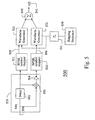
- FIG. 5 show a H-IR transmitter 500 according to the invention.
- the transmitter includes a pre-processor 510 for input bits 501.
- the pre-processor includes a delay 502 and an adder 503.
- the adder sums each input bit 501 to a delayed version of the bit, the sum is inverted 504.
- the pre-processing generates a pair of modulating bits from two successive information bits. It should be noted that more than one pair of modulation bits can be used for each information bit.
- the symbols are modulated 511-512.
- Reference wavefonns, e.g., pulses 505, in the sequence are BPSK modulated 511 according to the input bits 501, and data waveforms, e.g., pulses 506, are BSPK modulated according to the inverted sum.
- Waveform generators 521-522 are applied, according to a hopping sequence 530 and delay T d 531 and the results are combined 540.
- the modulation according to equation (4) shows that a phase difference between the reference pulse and data pulse is identical to a conventional TR-IR system.
- Table A shows the four possible combination of a previous and a current bit, the corresponding values of the reference and data waveforms, and their phase differences or polarities.
- Table A Previous bit Current bit Reference pulse modulation symbol b [2 j / N ⁇ ]-1 Data pulse modulation symbol b ⁇ 2 ⁇ j / N f ⁇ - 1 ⁇ b ⁇ 2 ⁇ j / N f ⁇ ) Phase difference between reference pulse and modulated pulse 0 0 -1 1 180° 0 1 -1 -1 0° 1 0 1 -1 180° 1 1 1 1 0°
- the phase difference between the reference pulse and the data pulse is always 180° regardless of the value of the previous bit. If the current bit is 1, then the phase difference is 0°.
- a TR-IR receiver can demodulate the signal according to the invention.
- the signal can also be demodulated by a TH-IR receiver with improved performance.
- the gain in performance is based on the fact that information is encoded in both the reference pulses and the data pulses.
- the TH-IR receiver can use the energy in the reference pulses to make decisions on the values of the transmitted bits, see Table A.
- a sequence of N f / 2 pairs is transmitted.
- the pair in each frame is described as a sequence of pulses, each with a polarity of the pulses depending on the current and previous bit that are transmitted. There are four possible combinations of pairs.
- the transmitted signal can be described as follows.
- the transmitter transmits a sequence of N f l2 pairs.
- the four possible pairs are given by equation (7).
- the pairs are optionally time hopped and scrambled with a polarity code.
- the invention provides a modulation format with memory. Modulation formats that have memory can be represented by a trellis diagram. Additionally, the transmitted signal is now a two-dimensional signal because two basis signals ⁇ 0 (t) and ⁇ 1 (t) are used to represent the pairs.
- Figure 6 shows a diagram 600 for a Viterbi decoder using a trellis.
- a coherent TH-IR receiver can be used to demodulate the signal.
- Our TH-IR receiver is adapted to accommodate the two-dimensional description of the symbol wavefonn and the memory between consecutive symbols according to the invention.
- FIG. 7 shows the TH-IR receiver 700 according to the invention.
- the RAKE fingers correlate the incoming signal with sequences of the two basis pulses, ⁇ 0 (t) and ⁇ 1 (t).
- the output of each finger is now a 2-D vector 701.
- the outputs of the finger are summed 710 to produce a soft input observations 702 for a conventional maximum likelihood sequence detector (MLSD) 720.
- MLSD maximum likelihood sequence detector
- the MLSD detector determines a most probable path through the trellis 600 for a given sequence of observations 702. Methods that approximate the MSLD detector, such as Viterbi decoding can also be used.
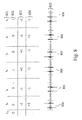
- Figure 8 shows the relationship between symbols, bits and modulated waveforms.
- the six symbols of the sequence 801 to be modulated are labeled b 0 to b 5 , with a previous encoded symbol '0'.
- the symbols in the example sequence are 0 1 1 0 0 1 802 , which correspond to reference bits - 1 , - 1 , + 1 , + 1 , - 1 , - 1 ⁇ 803 , and data bits + 1 , - 1 , + 1 , - 1 , + 1 , - 1 ⁇ 804 , and a waveform 805 with reference and data pulse pairs 806, where a "down" pulse encodes '-1' and an 'up' pulse encodes '+1'.
- the waveform 805 has the properties described earlier. Specifically, the phase difference between the reference pulse and the data pulse in each pair 806 contains the information about the current bit being transmitted. For each pair the phase difference is 180° when a '0' bit is transmitted, and a 0° phase difference when a '1' bit is transmitted.
- the sequence of pairs also contains the information about the previous bit in the polarity of the reference pulse. Again, this is seen in Figure 8 , where the reference pulse in each pair has a +/- polarity that indicates the value of the previously encoded bit. That is, a positive polarity if the previous bit was a '1', and a negative polarity when the previous bit was a '0'. It should be understood, that the polarities can all be reversed to achieve the same result.
- This wavefonn therefore, enables the use of both coherent and differentially coherent receivers, as depicted in Figures 4 and 7 respectively, in the same network.
- the choice of receiver can be based on considerations such as required performance, cost of implementation, or desired transmission distance.
- Generalization, to the case when multiple pairs are used to transmit a symbol, is straightforward. In this case each pair is repeated a number of times, and a polarity scrambling code can be used to improve the spectral characteristics of the wavefonn.
- the modulation fonnat according to the invention can be demodulated by coherent, RAKE TH-IR and a differentially coherent TR-IR receiver.
- the TH-IR receiver according to the invention has improved performance over prior art TH-IR receivers because information is also encoded in reference waveforms.
- the example signals are for a UWB system, it should be understood that the invention can also be used for narrow band width wireless communication systems, and UWB systems that use wavefonns other than pulses, CDMA, FSK, and PSK modulation.
Landscapes
- Engineering & Computer Science (AREA)
- Computer Networks & Wireless Communication (AREA)
- Signal Processing (AREA)
- Digital Transmission Methods That Use Modulated Carrier Waves (AREA)
- Transmitters (AREA)
- Dc Digital Transmission (AREA)
Description
- The invention relates generally to communication systems, and more particularly to modulation fonnats used in wireless communication systems.
- In the United States, the Federal Communications Commission (FCC) allows a restricted unlicensed use of ultra-wide bandwidth (UWB) signals for wireless communication systems, "First Report and Order," February 14, 2002. The UWB signals must be in the frequency range from 3.1 to 10.6 GHz, and have a minimum bandwidth of 500 MHz. The FCC order also limits the power spectral density and peak emissions power of UWB signals, e.g. less than -43.1 dBm/MHz.
- One modulation method for UWB uses extremely short time pulses to generate signals with bandwidths greater than 500 MHz, e.g., 1/1,000,000,000 of a second of less, which corresponds to a wavelength of about 300 mm. Systems that use short pulses are commonly referred to as impulse radio (IR) systems.
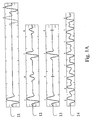
- As shown in
Figure 1A , four different modulation techniques can be used for wireless communication systems, pulse position modulation (PPM) 11, pulse amplitude modulation (PAM) 12, on-off keying (OOK) 13, and bi-phase shift keying (BPSK) 14. - As an advantage, UWB systems can achieve high data rates, and are resistant to multi-path impairments due to the large processing gains. Additionally, the use of IR based UWB technology allows for the implementation of low cost, low duty cycle, low power transceivers that do not require local oscillators for heterodyning. Because UWB radios are primarily digital circuits, they can easily be integrated in a semiconductor chip. In UWB systems, multiple users can simultaneously share the same spectrum with no interference to one another, and are ideal for high-speed home and business networking devices, as well as sensor networks.
- In a sensor network, it is desirable to enable the direct communication among multiple inexpensive sensing devices. The IEEE 802.15.4a standard defines a physical-layer for communications with scalable data rates from 1 Kbs to 1 Mbps, "IEEE P802.15.4a WPAN Alternate PHY - PAR," 2003, for low power, low data rate network.
- Generally, IR systems are either time-hopped (TH-IR), or transmitted-reference (TR-IR). Both systems use sequences of short duration pulses, p(t). However, the modulation and demodulation for TH-IR and TR-IR differ significantly, making TH-IR and TR-IR incompatible in the same network.
- TH-IR system are described by M. Win and R. A. Scholtz, "Ultra-Wide Band Width Time-Hopping Spread-Spectrum Impulse Radio for Wireless Multiple-Access Communications, " in IEEE Trans. On Communications, Vol. 48, No. 4 April 2000, pp. 679- 691. In a TH-IR system, each bit or symbol is represented by Nf pulses, where Nf is a positive integer. The time taken to transmit the bit is Ts. This is called the symbol duration. The time Ts is further partitioned into frames Tf, and the frames are partitioned into chips Tc corresponding typically to a pulse duration. If Nc represents the number of chips in a frame and Nf represents the number of frames in a symbol, then Ts , Tf, and Tc are related as follows

-
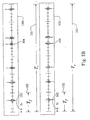
Figure 1B shows the relationship thesymbol time T s 101, theframe time T f 102, and thechip time t c 103 forpulses 104 for an example prior art TH-IR waveform 110 for a '0' bit, and awaveform 120 for a '1' bit. Typically, the pulses are spaced pseudo-randomly among the available chips in a frame according to a "time-hopping" code to minimize the effect of multi user interference. - As stated above, the modulation can be binary phase shift keying. With BPSK, each bit b is represented as either a positive or negative one b ∈ {-1,1}. The transmitted signal has the form

-
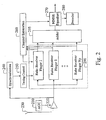
Figure 2 shows a conventional coherent TH-IR receiver 200. The receiver includes an automatic gain control (AGC)unit 210 coupled to anamplifier 220 that is connected to the receiveantenna 230. The receiver also includessynchronization 240,timing control 250,channel estimation 260,MMSE equalizer 270, anddecoder 280 units. Rake receiver fingers 290 input to anadder 295. Each rake finger includes a pulse sequence generator, correlator and weight combiner. The rake fingers reduce multipath interference. Due to the density of the multipaths in UWB signals, the number of required RAKE fingers can be large to obtain reasonable performance. The output of the adder is equalized and decoded. The typical TH-IR receiver has a significant complexity. - TR-IR systems eliminate the need for a RAKE receiver, R. Hoctor and H. Tomlinson, "Delay-Hopped Transmitted-Reference RF Communications," IEEE Conference on Ultra Wide Band Width Systems and Technologies, 2002, pp. 265-269." In a TR-IR system, the information is encoded as phase differences of successive pulses in the sequence. Each symbol in a TR-IR system is a sequence of time-hopped 'doublets' or pair of two consecutive pulses. Typically, the first pulse in the pair is referred to as a reference pulse and the second pulse is referred to as a data pulse. The two pulses in each pair are separated by a fixed unit of time Td. Multiple pairs can be transmitted for one information bit. The transmitted waveform has the form

-
Figure 3 shows the relationship thesymbol time T s 301, theframe time T f 302, and thechip time T c 303 forpulses 304 for an example TH-IR waveform 310 for a '0' bit, andwaveform 320 for a '1' bit. -
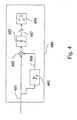
Figure 4 shows a conventional TR-IR receiver 400, which is significantly simpler than the TH-IR receiver ofFigure 2 . The receiver includesdelay 401,multiplier 402,integrator 403,sampler 407 anddecision 404 units. The receiver essentially correlates the receivedsignal 405 with adelayed version 406. Obviously, the TR-IR 400 receiver is less complex than the TH-IR receiver 200. However, the reduced complexity is at the cost of requiring twice the number of pulses, and the additional energy required for the reference pulses, nominally 3dB or more. - It is clear that the decision to use either TH-IR or .TR-IR modulation leads to incompatible system structures. Therefore, it is desired to provide a system structure that works with both TH-IR and TR-IR transceivers, to enable cost, complexity and performance trade-offs within a common wireless network.
- WITRISAL K ET AL: "Multiuser interference and interframe interference in UWB transmitted reference systems" ULTRA WIDEBAND SYSTEMS, 2004. JOINT WITH CONFERENCE ON ULTRAWIDEBAND SYSTEMS AND TECHNOLOGIES. JOINT UWBST & IWUWBS. 2004 INTERNATIONAL WORKSHOP ON KYOTO, JAPAN MAY 18-21, 2004, PISCATAWAY, NJ, USA, IEEE, 18 May 2004 (2004-05-18), pages 96-100, XP010716229 ISBN: 0-7803-8373-7, describe a method for modulating a sequence of bits in a wireless communications network, comprising the steps of generating a reference waveform for each current bit, wherein a phase of the reference waveform of a symbol depends on a previous bit and generating a data waveform for the current bit, wherein a difference in phase between the reference waveform and the data waveform depends on the current bit. The reference waveforms and the data waveforms corresponding to the sequence of bits can be received and correctly decoded by a time-hopped impulse radio receiver and a transmitted-reference impulse radio receiver in the wireless communications network.
- The invention is defined by a method comprising the features of
claim 1 and a system comprising the features ofclaim 13, respectively. Preferred embodiments of this method and of this system are represented in the respective subclaims. - The invention provides a system and method for incorporating TH-IR and TR-IR transceivers in the same wireless network. The invention also provides a modulation fonnat that encodes information bits is such a way to enable both TH-IR and TR-IR receivers to demodulate the same signals. In addition, the modulation format does not suffer from the inherent 3dB loss when the TH-IR receiver is used. The invention can be applied to narrow band, wide band, and ultra-wide band radio systems.
- More specifically, a method modulates a sequence of bits in a wireless communications network by generating a reference waveform, e.g., a pulse, and a data waveform, e.g., another pulse, of a waveform pair for each current bit. The phase of the reference waveform depends on a previously modulated bit, and a difference in phase (polarity) between the reference waveform and the data waveform pair depend on the current bit.
-
-
Figure 1A is a timing diagram of prior art modulation techniques; -
Figure 1B is a timing diagram of prior art TH-IR modulation; -
Figure 2 is a block diagram of a prior art TH-IR receiver; -
Figure 3 is a timing diagram of prior art TR-IR modulation; -
Figure 4 is a block diagram of a prior art TR-IR receiver; -
Figure 5 is a block diagram of a hybrid-IR transmitter according to the invention; -
Figure 6 is a trellis diagram of Viterbi decoder according to the invention; -
Figure 7 is a block diagram of a hybrid-IR receiver according to the invention; and -
Figure 8 is a diagram of hybrid-IR modulation according to the invention. - Our invention provides a system and method that enables both TH-IR and TR-IR transceivers to co-exist in the same wireless network. Our idea is based on our observation that TR-IR systems encode an information bit as a phase difference between a reference pulse and a data pulse. Furthermore, the polarity of the reference pulse is inconsequential for the correct operation of the TR-IR system.
- Therefore, we encode redundant information in the reference pulses so that a TH-IR receiver can decode the information with improved performance, while maintaining the required phase difference or polarity so that a TR-IR can also decode the information. We call this modulation 'hybrid-IR' (H-IR).
-
Figure 5 show a H-IR transmitter 500 according to the invention. The transmitter includes a pre-processor 510 forinput bits 501. The pre-processor includes adelay 502 and anadder 503. The adder sums eachinput bit 501 to a delayed version of the bit, the sum is inverted 504. - The pre-processing generates a pair of modulating bits from two successive information bits. It should be noted that more than one pair of modulation bits can be used for each information bit. During each symbol period, the symbols are modulated 511-512. Reference wavefonns, e.g.,
pulses 505, in the sequence are BPSK modulated 511 according to theinput bits 501, and data waveforms, e.g.,pulses 506, are BSPK modulated according to the inverted sum. Waveform generators 521-522 are applied, according to ahopping sequence 530 and delayT d 531 and the results are combined 540. - The transmitted signal, s(t) 541, can be expressed as

- The modulation according to equation (4) shows that a phase difference between the reference pulse and data pulse is identical to a conventional TR-IR system. Table A shows the four possible combination of a previous and a current bit, the corresponding values of the reference and data waveforms, and their phase differences or polarities.
Table A Previous bit Current bit Reference pulse modulation symbol b [2j/Nƒ]-1 Data pulse modulation symbol 
Phase difference between reference pulse and modulated pulse 0 0 -1 1 180° 0 1 -1 -1 0° 1 0 1 -1 180° 1 1 1 1 0° - If the current bit is 0, then the phase difference between the reference pulse and the data pulse is always 180° regardless of the value of the previous bit. If the current bit is 1, then the phase difference is 0°.
- It should be clear that a TR-IR receiver can demodulate the signal according to the invention. However, the signal can also be demodulated by a TH-IR receiver with improved performance. The gain in performance is based on the fact that information is encoded in both the reference pulses and the data pulses. Thus, the TH-IR receiver can use the energy in the reference pulses to make decisions on the values of the transmitted bits, see Table A. During each symbol period, a sequence of Nf /2 pairs is transmitted. The pair in each frame is described as a sequence of pulses, each with a polarity of the pulses depending on the current and previous bit that are transmitted. There are four possible combinations of pairs.

- The coefficient


- We can also represent the signals as a
vector 
- Therefore, the transmitted signal can be described as follows. During each symbol period, the transmitter transmits a sequence of Nfl2 pairs. The four possible pairs are given by equation (7). The pairs are optionally time hopped and scrambled with a polarity code.
- As an advantage, the invention provides a modulation format with memory. Modulation formats that have memory can be represented by a trellis diagram. Additionally, the transmitted signal is now a two-dimensional signal because two basis signals ψ0 (t) and ψ1 (t) are used to represent the pairs.
-
Figure 6 shows a diagram 600 for a Viterbi decoder using a trellis. The trellis has two states, where astate 0 601 is a value of a previous 0 bit, andstate 1 602 is a value of a previous 1 bit. Branches of the trellis indicate possible transitions. The branches are labeled with the value of current bit, , and the vector representation of the transmitted pair. For example, if the current state is 0 and a '1' bit is to be transmitted, then a transition tostate 1 occurs, and pair s 1 = [-1 -1] is transmitted. - With this interpretation of the hybrid-IR modulation, we see that a coherent TH-IR receiver can be used to demodulate the signal. Our TH-IR receiver is adapted to accommodate the two-dimensional description of the symbol wavefonn and the memory between consecutive symbols according to the invention.
-
Figure 7 shows the TH-IR receiver 700 according to the invention. As before, we use aRAKE structure 790. However, now the RAKE fingers correlate the incoming signal with sequences of the two basis pulses, ψ0 (t) and ψ1 (t). The output of each finger is now a 2-D vector 701. The outputs of the finger are summed 710 to produce asoft input observations 702 for a conventional maximum likelihood sequence detector (MLSD) 720. - The MLSD detector determines a most probable path through the
trellis 600 for a given sequence ofobservations 702. Methods that approximate the MSLD detector, such as Viterbi decoding can also be used. -
Figure 8 shows the relationship between symbols, bits and modulated waveforms. The six symbols of thesequence 801 to be modulated are labeled b 0 to b 5, with a previous encoded symbol '0'. The symbols in the example sequence are


waveform 805 with reference and data pulse pairs 806, where a "down" pulse encodes '-1' and an 'up' pulse encodes '+1'. - From
Figure 8 , we see that thewaveform 805 has the properties described earlier. Specifically, the phase difference between the reference pulse and the data pulse in eachpair 806 contains the information about the current bit being transmitted. For each pair the phase difference is 180° when a '0' bit is transmitted, and a 0° phase difference when a '1' bit is transmitted. - Additionally, the sequence of pairs also contains the information about the previous bit in the polarity of the reference pulse. Again, this is seen in
Figure 8 , where the reference pulse in each pair has a +/- polarity that indicates the value of the previously encoded bit. That is, a positive polarity if the previous bit was a '1', and a negative polarity when the previous bit was a '0'. It should be understood, that the polarities can all be reversed to achieve the same result. - This wavefonn, therefore, enables the use of both coherent and differentially coherent receivers, as depicted in
Figures 4 and7 respectively, in the same network. The choice of receiver can be based on considerations such as required performance, cost of implementation, or desired transmission distance. Generalization, to the case when multiple pairs are used to transmit a symbol, is straightforward. In this case each pair is repeated a number of times, and a polarity scrambling code can be used to improve the spectral characteristics of the wavefonn. - The modulation fonnat according to the invention can be demodulated by coherent, RAKE TH-IR and a differentially coherent TR-IR receiver. The TH-IR receiver according to the invention has improved performance over prior art TH-IR receivers because information is also encoded in reference waveforms.
- Although the example signals are for a UWB system, it should be understood that the invention can also be used for narrow band width wireless communication systems, and UWB systems that use wavefonns other than pulses, CDMA, FSK, and PSK modulation.
- Although the invention has been described by way of examples of preferred embodiments, it is to be understood that various other adaptations and modifications may be made within the scope of the invention.
Claims (17)
- A method for modulating a sequence of bits in a wireless communications network, comprising:generating a reference waveform of a waveform pair for each current bit, wherein a phase of the reference waveform depends on a previous bit; andgenerating a data waveform of the waveform pair for the current bit, wherein a difference in phase between the reference waveform and the data waveform in the waveform pair depend on the current bit;characterized in thata transmitted signal s(t) corresponding to the waveform pair for bit bi is expressed as

- The method of claim 1, further comprising:if the previous bit is 0 and the current bit is 0, then a polarity of the reference waveform is -1 and the phase of the data waveform is -1;if the previous bit is 0 and the current bit is 1, then the polarity of the reference waveform is -1, and the phase of the data waveform is -1;if the previous bit is 1 and the current bit is 0, then the polarity of the reference waveform is 1, and the phase of the data waveform is -1; andif the previous bit is 1 and the current bit is 1, then the polarity of the reference waveform is 1, and the phase of the data waveform is 1.
- The method of claim 1, in which the reference waveform and the data waveform of the waveform pairs corresponding to the sequence of bits are received and correctly decoded by a time-hopped impulse radio receiver (700) and a transmitted-reference impulse radio receiver (700) in the wireless communications network.
- The method of claim 1, in which the waveforms are generated by bi-phase shift keying.
- The method of claim 1, in which multiple waveform pairs are generated for each bit.
- The method of claim 1, in which the reference waveform and the data waveform are subject to a polarity scrambling sequence with values of +1 and -1.
- The method of claim 1, further comprising:if the current bit is 0, then the difference in phase between the reference waveform and the data waveform is always 180° regardless of a value of the previous bit; andif the current bit is 1, then the difference in phase is 0° .
- The method of claim 3, in which the received waveform pair is decoded using a coherent receiver /90) and sequence detector (720).
- The method of claim 8, in which the sequence detector is Viterbi decoder.
- The method of claim 8, in which the sequence decoder is a maximum likelihood sequence detector (720) .
- The method of claim 1, in which each waveform is a pulse.
- The method of claim 11, in which the wireless communications network uses ultra-wide bandwidth waveforms.
- A system for modulating a sequence of bits in a wireless communications network, comprising:means (521) for generating a reference waveform of a waveform pair for each current bit, wherein a phase of the reference waveform depends on a previous modulated bit; andmeans (522) for generating a data waveform of the waveform pair for the current bit, wherein a difference in phase between the reference waveform and the data waveform in the waveform pair depend on the current bit,characterized bya transmitter (500) for generating the waveforms, the transmitter (500) further comprising:a delay (502) configured to receive the sequence of bits;an adder (503) configured to receive each current bit and each previous bit, and generating a sum;an inverter (504) configured to invert the sum;a first modulator (511) and waveform generator (521) connected to the delay (502); anda second modulator (512) and waveform generator (522) connected to the inverter (504).
- The system of claim 13, further comprising:if the previous bit is 0 and the current bit is 0, then a polarity of the reference waveform is -1 and the phase of the data waveform is -1;if the previous bit is 0 and the current bit is 1, then the polarity of the reference waveform is -1, and the phase of the data waveform is -1;if the previous bit is 1 and the current bit is 0, then the polarity of the reference waveform is 1, and the phase of the data waveform is -1; andif the previous bit is 1 and the current bit is 1, then the polarity of the reference waveform is 1, and the phase of the data waveform is 1.
- The system of claim 13, further comprising:a time-hopped impulse radio receiver (700) configured to receive the reference waveform and the data waveform of the waveform pairs; anda transmitted-reference impulse radio receiver (700) configured to receive the reference waveform and the data waveform of the waveform pairs.
- The system of claim 13, in which the waveforms are generated by bi-phase shift keying.
- The system of claim 13, in which the wireless communications network uses ultra wide bandwidth signaling.
Applications Claiming Priority (2)
| Application Number | Priority Date | Filing Date | Title |
|---|---|---|---|
| US10/964,918 US7496153B2 (en) | 2004-10-14 | 2004-10-14 | Modulating signals for coherent and differentially coherent receivers |
| PCT/JP2005/019351 WO2006041220A1 (en) | 2004-10-14 | 2005-10-14 | Method and system for modulating sequence of bits in wireless communications network |
Publications (2)
| Publication Number | Publication Date |
|---|---|
| EP1754314A1 EP1754314A1 (en) | 2007-02-21 |
| EP1754314B1 true EP1754314B1 (en) | 2009-07-29 |
Family
ID=35976526
Family Applications (1)
| Application Number | Title | Priority Date | Filing Date |
|---|---|---|---|
| EP05795329A Expired - Lifetime EP1754314B1 (en) | 2004-10-14 | 2005-10-14 | Method and system for modulating sequence of bits in wireless communications network |
Country Status (6)
| Country | Link |
|---|---|
| US (1) | US7496153B2 (en) |
| EP (1) | EP1754314B1 (en) |
| JP (1) | JP4837559B2 (en) |
| CN (1) | CN1969467B (en) |
| DE (1) | DE602005015702D1 (en) |
| WO (1) | WO2006041220A1 (en) |
Cited By (1)
| Publication number | Priority date | Publication date | Assignee | Title |
|---|---|---|---|---|
| JP2008533755A (en) * | 2005-03-14 | 2008-08-21 | ミツビシ・エレクトリック・リサーチ・ラボラトリーズ・インコーポレイテッド | Method for M-ary modulating a sequence of bits in a wireless communication network |
Families Citing this family (6)
| Publication number | Priority date | Publication date | Assignee | Title |
|---|---|---|---|---|
| US7573933B2 (en) * | 2005-01-04 | 2009-08-11 | Mitsubishi Electric Research Laboratories, Inc. | Adaptive delay adjustment for transmitted reference impulse radio systems |
| US20060233233A1 (en) * | 2005-03-11 | 2006-10-19 | Welborn Matthew L | Method and device for receiving or transmitting a signal with encoded data |
| US20070025420A1 (en) * | 2005-05-16 | 2007-02-01 | University Of Victoria Innovation And Development Corporation | Transmission and detection in ultrawide band communications |
| US7830952B2 (en) * | 2006-02-13 | 2010-11-09 | Telefonaktiebolaget L M Ericsson (Publ) | Reduced complexity interference suppression for wireless communications |
| JP5005622B2 (en) * | 2008-06-30 | 2012-08-22 | シャープ株式会社 | Receiving device, tuner, and television receiver |
| WO2015065064A1 (en) | 2013-10-30 | 2015-05-07 | 삼성전자주식회사 | Method and device for transmitting preamble sequence |
Family Cites Families (9)
| Publication number | Priority date | Publication date | Assignee | Title |
|---|---|---|---|---|
| US5706313A (en) * | 1994-11-01 | 1998-01-06 | Motorola, Inc. | Soft decision digital communication method and apparatus |
| US7359426B2 (en) * | 1998-10-09 | 2008-04-15 | Broadcom Corporation | Method and system for modulating and demodulating signals in ultra-wide band (UWB) communication systems |
| KR100472524B1 (en) * | 1999-06-30 | 2005-03-09 | 시게이트 테크놀로지 엘엘씨 | Partial response channel having combined mtr and parity constraints |
| US6810087B2 (en) * | 2000-01-04 | 2004-10-26 | General Electric Company | Ultra-wideband communications system |
| US20030108133A1 (en) * | 2001-10-11 | 2003-06-12 | Richards James L. | Apparatus and method for increasing received signal-to-noise ratio in a transmit reference ultra-wideband system |
| EP1408620B8 (en) * | 2002-10-11 | 2008-07-16 | Mitsubishi Electric Information Technology Centre Europe B.V. | Transmission method and transmitter for an ultra-wide bandwidth telecommunication system |
| US7317748B2 (en) * | 2003-02-25 | 2008-01-08 | Matsushita Electric Industrial Co., Ltd. | Methods and apparatus for transmitting and receiving randomly inverted wideband signals |
| KR100553884B1 (en) * | 2003-03-11 | 2006-02-24 | 삼성전자주식회사 | A pulse string generating apparatus and method, a wireless data transmitting and receiving system using the pulse string, a wireless data receiving apparatus and a transmitting and receiving method, and a recording medium recording the method |
| US20050271120A1 (en) * | 2004-06-02 | 2005-12-08 | Lockheed Martin Corporation | Detector for time-hopped impulse radio |
-
2004
- 2004-10-14 US US10/964,918 patent/US7496153B2/en not_active Expired - Fee Related
-
2005
- 2005-10-14 WO PCT/JP2005/019351 patent/WO2006041220A1/en not_active Ceased
- 2005-10-14 JP JP2006520479A patent/JP4837559B2/en not_active Expired - Fee Related
- 2005-10-14 EP EP05795329A patent/EP1754314B1/en not_active Expired - Lifetime
- 2005-10-14 CN CN2005800203096A patent/CN1969467B/en not_active Expired - Fee Related
- 2005-10-14 DE DE602005015702T patent/DE602005015702D1/en not_active Expired - Lifetime
Cited By (1)
| Publication number | Priority date | Publication date | Assignee | Title |
|---|---|---|---|---|
| JP2008533755A (en) * | 2005-03-14 | 2008-08-21 | ミツビシ・エレクトリック・リサーチ・ラボラトリーズ・インコーポレイテッド | Method for M-ary modulating a sequence of bits in a wireless communication network |
Also Published As
| Publication number | Publication date |
|---|---|
| JP2008516466A (en) | 2008-05-15 |
| JP4837559B2 (en) | 2011-12-14 |
| CN1969467B (en) | 2012-03-07 |
| CN1969467A (en) | 2007-05-23 |
| DE602005015702D1 (en) | 2009-09-10 |
| WO2006041220A1 (en) | 2006-04-20 |
| EP1754314A1 (en) | 2007-02-21 |
| US7496153B2 (en) | 2009-02-24 |
| US20060083333A1 (en) | 2006-04-20 |
Similar Documents
| Publication | Publication Date | Title |
|---|---|---|
| US7187715B2 (en) | Systems and methods for providing adaptive pulse position modulated code division multiple access for ultra-wideband communication links | |
| US20080247442A1 (en) | Method, Apparatus, and System for Modulating and Demodulating Signals Compatible with Multiple Receiver Types and Designed for Improved Receiver Performance | |
| JPH11331041A (en) | Information bit modulation method, digital modulation system, digital demodulation system | |
| EP1523107B1 (en) | Method and system for modulating and demodulating signals in ultra-wide band (UWB) communication systems | |
| IL186550A (en) | System and method for communicating data using constant amplitude waveform with hybrid orthogonal and msk or gmsk modulation | |
| US20090091400A1 (en) | Method and Apparatus for Generating Dynamically Varying Time Hopping Sequences for UWB Signals | |
| EP1859535B1 (en) | Methods for UWB modulating M-ary sequences | |
| EP1787403B1 (en) | Method and modulator for modulating sequence of bits in wireless communications network | |
| US7496153B2 (en) | Modulating signals for coherent and differentially coherent receivers | |
| EP1774666A1 (en) | Method for determining a duration of a frame in a time-hopping, impulse radio system, and time-hopped, impulse radio system | |
| JP4869709B2 (en) | Transmission reference, method for determining a delay time between a reference pulse and a data pulse in a time hopping impulse radio system, and a time hopping impulse radio system | |
| Majhi et al. | M-ary signaling for ultra wideband communication systems based on pulse position and orthogonal pulse shape modulation | |
| Mitchell et al. | Orthogonalized and coded modulation for combined pulse position and pulse shape modulation | |
| Chao et al. | Novel UWB transmitted reference schemes | |
| Nekoogar et al. | Multiple access in ultra-wideband communications using multiple pulses | |
| Cheng et al. | M-ary modulation schemes of UWB communication system based on orthogonal hermite pulses | |
| Bai et al. | Performance analysis of a novel m-ary code selected DS-BPAM UWB communication system |
Legal Events
| Date | Code | Title | Description |
|---|---|---|---|
| PUAI | Public reference made under article 153(3) epc to a published international application that has entered the european phase |
Free format text: ORIGINAL CODE: 0009012 |
|
| 17P | Request for examination filed |
Effective date: 20061128 |
|
| AK | Designated contracting states |
Kind code of ref document: A1 Designated state(s): DE FR GB |
|
| RIN1 | Information on inventor provided before grant (corrected) |
Inventor name: ORLIK, PHILIP Inventor name: MOLISCH, ANDREAS, F. Inventor name: AEDUDODLA, SANDEEP |
|
| DAX | Request for extension of the european patent (deleted) | ||
| RBV | Designated contracting states (corrected) |
Designated state(s): DE FR GB |
|
| 17Q | First examination report despatched |
Effective date: 20080904 |
|
| GRAP | Despatch of communication of intention to grant a patent |
Free format text: ORIGINAL CODE: EPIDOSNIGR1 |
|
| RTI1 | Title (correction) |
Free format text: METHOD AND SYSTEM FOR MODULATING SEQUENCE OF BITS IN WIRELESS COMMUNICATIONS NETWORK |
|
| GRAS | Grant fee paid |
Free format text: ORIGINAL CODE: EPIDOSNIGR3 |
|
| GRAA | (expected) grant |
Free format text: ORIGINAL CODE: 0009210 |
|
| AK | Designated contracting states |
Kind code of ref document: B1 Designated state(s): DE FR GB |
|
| REG | Reference to a national code |
Ref country code: GB Ref legal event code: FG4D |
|
| REF | Corresponds to: |
Ref document number: 602005015702 Country of ref document: DE Date of ref document: 20090910 Kind code of ref document: P |
|
| PLBE | No opposition filed within time limit |
Free format text: ORIGINAL CODE: 0009261 |
|
| STAA | Information on the status of an ep patent application or granted ep patent |
Free format text: STATUS: NO OPPOSITION FILED WITHIN TIME LIMIT |
|
| 26N | No opposition filed |
Effective date: 20100503 |
|
| REG | Reference to a national code |
Ref country code: FR Ref legal event code: PLFP Year of fee payment: 11 |
|
| PGFP | Annual fee paid to national office [announced via postgrant information from national office to epo] |
Ref country code: FR Payment date: 20150908 Year of fee payment: 11 |
|
| PGFP | Annual fee paid to national office [announced via postgrant information from national office to epo] |
Ref country code: GB Payment date: 20151014 Year of fee payment: 11 Ref country code: DE Payment date: 20151006 Year of fee payment: 11 |
|
| REG | Reference to a national code |
Ref country code: DE Ref legal event code: R119 Ref document number: 602005015702 Country of ref document: DE |
|
| GBPC | Gb: european patent ceased through non-payment of renewal fee |
Effective date: 20161014 |
|
| REG | Reference to a national code |
Ref country code: FR Ref legal event code: ST Effective date: 20170630 |
|
| PG25 | Lapsed in a contracting state [announced via postgrant information from national office to epo] |
Ref country code: DE Free format text: LAPSE BECAUSE OF NON-PAYMENT OF DUE FEES Effective date: 20170503 Ref country code: GB Free format text: LAPSE BECAUSE OF NON-PAYMENT OF DUE FEES Effective date: 20161014 Ref country code: FR Free format text: LAPSE BECAUSE OF NON-PAYMENT OF DUE FEES Effective date: 20161102 |