EP1752734A2 - Semiconductor device - Google Patents
Semiconductor device Download PDFInfo
- Publication number
- EP1752734A2 EP1752734A2 EP06254161A EP06254161A EP1752734A2 EP 1752734 A2 EP1752734 A2 EP 1752734A2 EP 06254161 A EP06254161 A EP 06254161A EP 06254161 A EP06254161 A EP 06254161A EP 1752734 A2 EP1752734 A2 EP 1752734A2
- Authority
- EP
- European Patent Office
- Prior art keywords
- semiconductor layer
- base semiconductor
- chip
- electrodes
- semiconductor device
- Prior art date
- Legal status (The legal status is an assumption and is not a legal conclusion. Google has not performed a legal analysis and makes no representation as to the accuracy of the status listed.)
- Withdrawn
Links
Images





Classifications
-
- G—PHYSICS
- G01—MEASURING; TESTING
- G01C—MEASURING DISTANCES, LEVELS OR BEARINGS; SURVEYING; NAVIGATION; GYROSCOPIC INSTRUMENTS; PHOTOGRAMMETRY OR VIDEOGRAMMETRY
- G01C19/00—Gyroscopes; Turn-sensitive devices using vibrating masses; Turn-sensitive devices without moving masses; Measuring angular rate using gyroscopic effects
- G01C19/56—Turn-sensitive devices using vibrating masses, e.g. vibratory angular rate sensors based on Coriolis forces
- G01C19/5719—Turn-sensitive devices using vibrating masses, e.g. vibratory angular rate sensors based on Coriolis forces using planar vibrating masses driven in a translation vibration along an axis
-
- B—PERFORMING OPERATIONS; TRANSPORTING
- B81—MICROSTRUCTURAL TECHNOLOGY
- B81C—PROCESSES OR APPARATUS SPECIALLY ADAPTED FOR THE MANUFACTURE OR TREATMENT OF MICROSTRUCTURAL DEVICES OR SYSTEMS
- B81C1/00—Manufacture or treatment of devices or systems in or on a substrate
- B81C1/00015—Manufacture or treatment of devices or systems in or on a substrate for manufacturing microsystems
- B81C1/00261—Processes for packaging MEMS devices
- B81C1/00301—Connecting electric signal lines from the MEMS device with external electrical signal lines, e.g. through vias
-
- B—PERFORMING OPERATIONS; TRANSPORTING
- B81—MICROSTRUCTURAL TECHNOLOGY
- B81B—MICROSTRUCTURAL DEVICES OR SYSTEMS, e.g. MICROMECHANICAL DEVICES
- B81B2201/00—Specific applications of microelectromechanical systems
- B81B2201/02—Sensors
- B81B2201/0228—Inertial sensors
- B81B2201/0242—Gyroscopes
-
- B—PERFORMING OPERATIONS; TRANSPORTING
- B81—MICROSTRUCTURAL TECHNOLOGY
- B81B—MICROSTRUCTURAL DEVICES OR SYSTEMS, e.g. MICROMECHANICAL DEVICES
- B81B2201/00—Specific applications of microelectromechanical systems
- B81B2201/04—Optical MEMS
- B81B2201/042—Micromirrors, not used as optical switches
-
- B—PERFORMING OPERATIONS; TRANSPORTING
- B81—MICROSTRUCTURAL TECHNOLOGY
- B81B—MICROSTRUCTURAL DEVICES OR SYSTEMS, e.g. MICROMECHANICAL DEVICES
- B81B2207/00—Microstructural systems or auxiliary parts thereof
- B81B2207/09—Packages
- B81B2207/091—Arrangements for connecting external electrical signals to mechanical structures inside the package
- B81B2207/097—Interconnects arranged on the substrate or the lid, and covered by the package seal
-
- H—ELECTRICITY
- H10—SEMICONDUCTOR DEVICES; ELECTRIC SOLID-STATE DEVICES NOT OTHERWISE PROVIDED FOR
- H10W—GENERIC PACKAGES, INTERCONNECTIONS, CONNECTORS OR OTHER CONSTRUCTIONAL DETAILS OF DEVICES COVERED BY CLASS H10
- H10W72/00—Interconnections or connectors in packages
- H10W72/851—Dispositions of multiple connectors or interconnections
- H10W72/874—On different surfaces
- H10W72/884—Die-attach connectors and bond wires
-
- H—ELECTRICITY
- H10—SEMICONDUCTOR DEVICES; ELECTRIC SOLID-STATE DEVICES NOT OTHERWISE PROVIDED FOR
- H10W—GENERIC PACKAGES, INTERCONNECTIONS, CONNECTORS OR OTHER CONSTRUCTIONAL DETAILS OF DEVICES COVERED BY CLASS H10
- H10W90/00—Package configurations
- H10W90/701—Package configurations characterised by the relative positions of pads or connectors relative to package parts
- H10W90/751—Package configurations characterised by the relative positions of pads or connectors relative to package parts of bond wires
- H10W90/753—Package configurations characterised by the relative positions of pads or connectors relative to package parts of bond wires between laterally-adjacent chips
Definitions
- This invention generally relates to semiconductor devices, and more particularly, to a semiconductor device having a SOI structure and including a minute driving portion that mechanically drives.
- an angular velocity sensor used to detect a rotational angular velocity of an object in Japanese Patent Publication No. 07-3337 , as a semiconductor device that employs a SOI substrate.
- a micro mirror device used as an optical switch in Japanese Patent Application Publication No. 2003-15064 .
- the above-described semiconductor devices have double gimbal portions.
- the angular velocity is detected by vibrating one gimbal portion to detect the other.
- the micro mirror device the mirror portion is driven by driving one gimbal portion around x-axis and driving the other around y-axis. In this manner, in each of the above-described semiconductor devices, there is provided a driving portion that mechanically drives the gimbal portion.
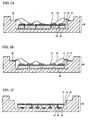
- FIG. 1A is a cross-sectional view of the semiconductor device of conventional example 1.
- a chip of SOI structure is die bonded to a stacked package 30 by a bonding material 24.
- the chip has a SOI structure in which a base semiconductor layer 10, an insulation layer 12, and an upper semiconductor layer 14 are stacked. Electrodes 18 are formed on the upper semiconductor layer 14, and are connected to pads 32 of the stacked package 30 by wires 22.
- connecting holes 16 are provided in the insulation layer 12 and a metal is provided in the connecting holes 16, so the base semiconductor layer 10 is coupled to the upper semiconductor layer 14 and further coupled to the electrodes 18.
- the chip is die bonded to the stacked package 30 and the electrodes 18 on the upper semiconductor layer 14 are wire bonded to the stacked package 30, so the upper semiconductor layer 14 and the base semiconductor layer 10 are electrically coupled to the stacked package 30.
- FIG. 1B is a cross-sectional view of the semiconductor device of conventional example 2. This is an example in which the base semiconductor layer 10 is not electrically coupled. Except that the connecting holes 16 are not provided, the same components and configurations of FIG. 1A are employed.
- the chip is die bonded to the stacked package 30 and the electrodes 18 on the upper semiconductor layer 14 are wire bonded to the stacked package 30, so the upper semiconductor layer 14 is electrically coupled to the outside.
- FIG. 1C is a cross-sectional view of the semiconductor device of conventional example 3.
- the electrodes 20 are provided on the backside of the base semiconductor layer 10, bumps 26 are provided at the electrodes 20, and the chip is mounted on the stacked package 30.
- the connecting holes 16 are provided in the insulation layer 12 and a metal is provided in the connecting holes 16, so the upper semiconductor layer 14 and the base semiconductor layer 10 are electrically coupled to the stacked package 30.
- FIG. 2A is a cross-sectional view of the semiconductor device of conventional example 4.
- the electrodes 20 are provided on the backside of the base semiconductor layer 10, and the chip is mounted on the stacked package 30 by the bumps 26.
- the electrodes 18 are provided on the upper semiconductor layer 14, so the electrodes 18 and the pads 32 are connected by the wires 22.
- the upper semiconductor layer 14 and the base semiconductor layer 10 are coupled by providing a metal in the connecting holes 16.
- the upper semiconductor layer 14 and the base semiconductor layer 10 are electrically coupled to the stacked package 30 by the bumps 26 and the wires 22.
- FIG. 2B is a cross-sectional view of the semiconductor device of conventional example 5.
- the electrodes 20 are provided on the backside of the base semiconductor layer 10, and the chip is mounted on the stacked package 30 by using the bumps 26.
- the electrodes 18 are provided on the upper semiconductor layer 14, so the electrodes 18 and the pads 32 are connected by the wires 22.
- the base semiconductor layer 10 and the stacked package 30 are electrically coupled by the bumps 26, and the upper semiconductor layer 14 is electrically coupled to the stacked package 30 by the wires 22.
- the base semiconductor layer 10 is connected to the stacked package 30 by the bumps 26.
- ultrasonic waves are applied or thermal compression bonding is performed to connect the bumps and the stacked package 30.
- the chip is damaged during the formation process.
- it is likely to damage the gimbal portion, the driving portion that drives the gimbal portion, or a torsion bar that retains the gimbal portion.
- the mounting surface cannot be inspected after the chip is mounted.
- the base semiconductor layer 10 is coupled to the stacked package 30 via the connecting holes 16, thereby increasing the chip area and the inductance.
- the base semiconductor layer 10 cannot be coupled to the stacked package 30.
- the present invention has been made in view of the above circumstances and provides a semiconductor device in which it is easy to electrically couple a chip to the outside (an example is a package) and the chip can be prevented from being damaged.
- a semiconductor device including: a chip having a base semiconductor layer, an insulation layer provided on the base semiconductor layer, and an upper semiconductor layer provided on the insulation layer; a mounting substrate on which the chip is mounted at the base semiconductor layer; and a connecting portion that electrically couples first terminals provided on the mounting substrate and a surface or second terminals provided thereon of the base semiconductor layer.
- the base semiconductor layer can be wire bonded, thereby making it easy to electrically couple the base semiconductor layer to the outside.
- the chip can be prevented from being damaged, since there is no bump used for mounting the chip.
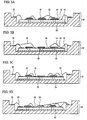
- FIG. 3A is a cross-sectional view of a semiconductor device in accordance with a first exemplary embodiment of the present invention.
- a chip has a SOI structure including: a base semiconductor layer 10; an insulation layer 12 provided on the base semiconductor layer 10; and an upper semiconductor layer 14 provided on the insulation layer 12.
- the chip is mounted on a stacked package 30 by die bonding the stacked package 30 with the use of a bonding material 24 provided at the base semiconductor layer 10.
- the base semiconductor layer 10 and the upper semiconductor layer 14 are N-type silicon semiconductors in which arsenic or the like is doped.
- the insulation layer 12 is a silicon oxide film.
- the chip is an angular velocity sensor having double gimbal portions.
- the upper semiconductor layer 14 and the insulation layer 12 are removed to the base semiconductor layer 10 to expose the surface of the base semiconductor layer 10.
- the afore-described surface is connected to pads 32 of the stacked package 30 by wires. That is to say, the base semiconductor layer 10 is electrically coupled from the surface thereof to the stacked package 30 by wires 22 by way of openings formed in the upper semiconductor layer 14 and in the insulation layer 12.
- Electrodes 18 are formed on the upper semiconductor layer 14, and the base semiconductor layer 10 and the electrodes 18 are connected by the wires 22.
- the electrodes 18 are made of aluminum, and the wires 22 mainly include aluminum.
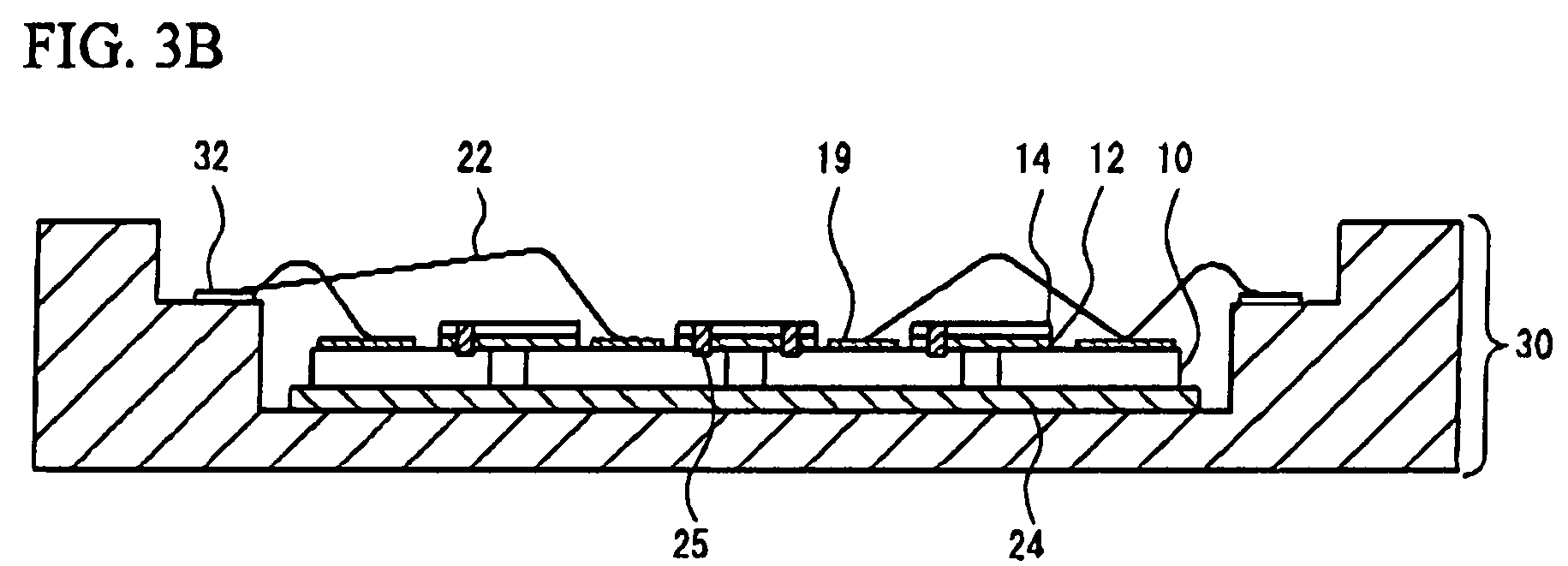
- FIG. 3B is a cross-sectional view of a semiconductor device in accordance with a second exemplary embodiment of the present invention.
- electrodes 19 are provided on the base semiconductor layer 10, so wires 22 are bonded onto the electrodes 19. This can decrease the connection resistance between the base semiconductor layer 10 and the wires 22.
- connecting holes 25 that extend through the insulation layer 12 are provided to electrically couple the upper semiconductor layer 14 to the base semiconductor layer 10, instead of forming the electrodes 18 on the upper semiconductor layer 14.
- the upper semiconductor layer 14 is coupled to the stacked package 30 via the base semiconductor layer 10. This makes it possible to reduce the number of the wires and decrease the wire length.
- FIG. 3C is a cross-sectional view of a semiconductor device in accordance with a third exemplary embodiment of the present invention.
- the electrodes 18 are provided on the upper semiconductor layer 14.
- the upper semiconductor layer 7.4 is coupled to the base semiconductor layer 10 by the connecting holes 25 and by wires, which connect the electrodes 18 and the electrodes 19.
- FIG. 3D is a cross-sectional view of a semiconductor device in accordance with a fourth exemplary embodiment of the present invention.
- the electrodes 18 provided on the upper semiconductor layer 14 and the electrodes 19 provided on the base semiconductor layer 10 are coupled to the stacked package 30 by the wires 22, instead of providing the connecting holes 25 employed in the third exemplary embodiment. This makes it possible to eliminate the fabrication process of forming the connecting holes 25.
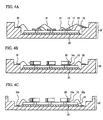
- FIG. 4A is a cross-sectional view of a semiconductor device in accordance with a fifth exemplary embodiment of the present invention.
- the electrodes 18 and the electrodes 19 employed in the fourth exemplary embodiment are not provided.
- the wires 22 directly connect the upper semiconductor layer 14 and the base semiconductor layer 10. This makes it possible to eliminate the fabrication process of forming the electrodes.
- FIG. 48 is a cross-sectional view of a semiconductor device in accordance with a sixth exemplary embodiment of the present invention.
- An upper semiconductor layer 14a has a thickness t, which is thicker than those of the upper semiconductor layers 14 employed in the first through fifth exemplary embodiments.
- the connecting holes 25 are provided in the insulation layer 12 to electrically couple the upper semiconductor layer 14a to the base semiconductor layer 10.
- the wires 22 are directly connected to the base semiconductor layer 10.
- the upper semiconductor layer 14a is coupled to the outside via the base semiconductor layer 10. In a case where the upper semiconductor layer 14a has a greater thickness as employed in the sixth exemplary embodiment and the wire 22 is connected to the upper semiconductor layer 14a, the length of the wire 22 becomes greater and the inductance is added.
- the height of the wire 22 becomes greater, thereby making it difficult to reduce the thickness of the package. Therefore, as described in the sixth exemplary embodiment, the aforementioned problems can be addressed by electrically coupling the upper semiconductor layer 14a to the stacked package 30 via the base semiconductor layer 10.
- FIG. 4C is a cross-sectional view of a semiconductor device in accordance with a seventh exemplary embodiment of the present invention.
- Pads 32a of the stacked package 30 are provided on the die attach surface of the stacked package 30. This can lower the height of wires 22a, thereby reducing the thickness of the package.
- the pads 32 or 32a (first terminals) provided on the stacked package 30 are coupled to the surface of the base semiconductor layer 10 by way of openings formed in the upper semiconductor layer 14 and in the insulation layer 12, or are directly connected to the electrodes 19 (second terminals) provided on the surface of the base semiconductor layer 10 with the use of the wires 22 or 22a (connecting portion). Therefore, the base semiconductor layer 10 and the stacked package 30 do not have to be connected, whereas the base semiconductor layer 10 and the stacked package 30 are directly connected in the conventional example 1. This prevents the inductance from being added, and eliminates the area for the connecting holes. In this manner, it becomes easy to electrically couple to the outside.
- the bumps 26 do not have to be formed to connect the base semiconductor layer 10 and the stacked package 30, whereas the bumps 26 are provided in the conventional examples 3 through 5. Accordingly, it is possible to prevent, for example, the driving portion included in the chip from being damaged during the bump-forming process. This can prevent the chip from being damaged. Furthermore, the mounting surface can be inspected, after the chip is mounted.
- the wires 22 are directly connected to the upper semiconductor layer 14 and the surface of the base semiconductor layer 10, or are electrically coupled to the upper semiconductor layer 14 and the surface of the base semiconductor layer 10 by way of the electrodes 18 and 19. This eliminates the necessity of electrical coupling through the base semiconductor layer 10, when the upper semiconductor layer 14 is connected with the stacked package 30. This prevents the inductance from being added, and eliminates the area for the connecting holes.
- the connecting holes 25 that connect the upper semiconductor layer 14 and the base semiconductor layer 10 are provided, and the wires 22 are electrically coupled to the upper semiconductor layer 14 via the base semiconductor layer 10. This makes it possible to reduce the number of the wires 22. This also reduces the fabrication process of forming the electrodes 18. Additionally, the heights of the wires 22 can be reduced, thereby reducing the thickness of the package.
- FIG. 5 is a top view of the angular velocity sensor chip.
- a first gimbal portion 80 is mechanically connected to a second gimbal portion 86 by first torsion bars 82 formed at a pair of side surfaces thereof that oppose each other.
- Comb-teeth electrodes 84 are arranged at the other pair of the side surfaces that oppose each other.
- Each one of the comb-teeth electrodes 84 is fixed to the first gimbal portion 80, and each of the other comb-teeth electrodes 84 is fixed to the second gimbal portion 86.
- the second gimbal portion 86 is mechanically connected to a frame portion 92 by second torsion bars 88 formed at a pair of side surfaces thereof that oppose each other.
- Parallel plane plate electrodes 90 are arranged at the other pair of the side surfaces that oppose each other. Each one of the parallel plane plate electrodes 90 is fixed at the second gimbal portion 86, and each of the other parallel plane plate electrodes 90 is fixed at the frame portion 92.
- the first gimbal portion 80 is vibrated by applying a voltage alternatively to the left and right comb-teeth electrodes 84. Then, the angular velocity is detected. Subsequently, the parallel plane plate electrodes 90 detect the vibration of the second gimbal portion 90. As stated, the parallel plane plate electrodes 90 serving as a detection portion that detects the vibration and the comb-teeth electrodes 84 serving as the driving portion that excites the vibration are respectively arranged at the first gimbal portion 80 and the second gimbal portion 86.
- the torsion bars 82 and 88 that retain the afore-described driving portions and the gimbal portions 80 and 86 have a minute structure, and are easily damaged during the bump-forming process.
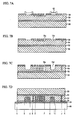
- FIG. 6A through FIG. 6E, FIG. 7A through FIG. 7D, and FIG. 8A through FIG. 8D are cross-sectional views of the angular velocity sensor, taken along lines A through K shown in FIG. 5.
- A-B corresponds to the frame portion 92
- B-C corresponds to the second torsion bar 88
- C-D corresponds to the second gimbal portion 86
- D-E and E-F correspond to the comb-teeth electrodes 84
- F-G corresponds to the first gimbal portion 80
- G-H corresponds to the first torsion bar 82
- H-I corresponds to a portion of the second gimbal portion 86
- I-J corresponds to the parallel plane plate electrode 90
- J-K corresponds to the frame portion 92.
- silicon oxide films 52 and 56 are formed to have a thickness of 500 nm by thermally oxidizing the surfaces of the silicon substrates 50 and 54, into which arsenic or the like is doped to have a low resistivity of approximately 0.01 ⁇ cm to 0.1 ⁇ cm.
- the silicon oxide films 52 and 56 are sealed together and the thermal treatment is performed at approximately 110 °C. This bonds the silicon oxide films 52 and 56 to form an integrally formed silicon oxide film 52.
- the silicon substrates 50 and 54 are polished, so that each has a thickness of approximately 100 ⁇ m.
- an SOI substrate of a structure includes: the silicon substrate 54 (hereinafter, referred to as base semiconductor layer 54); the silicon oxide film 52 (hereinafter, referred to as the insulation film 52); and the silicon substrate 50 (hereinafter, referred to as upper semiconductor layer 50), with respective thicknesses of 100 ⁇ m / 1 ⁇ m / 100 ⁇ m.
- a silicon oxide film having a thickness of approximately 100 nm to 1000 nm is formed on the base semiconductor layer 54, as an etch mask layer 58.
- openings 70a and 70b are formed in regions to be etched (the regions that become the torsion bars, the comb-teeth electrodes, and the parallel plane plate electrodes) of the base semiconductor layer 54 with the use of the etch mask layer 58.
- a photoresist 62 is formed in the opening 70a (the region that becomes the torsion bar).
- the semiconductor layer 54 is etched by approximately 30 ⁇ m to 40 ⁇ m by using the mask layer 58 and the photoresist 62 as masks. Wet etching is performed with the use of a hydrofluoric acid (HF)-based solution or RIE etching with the use of SF 6 and C 4 F 8 .
- HF hydrofluoric acid
- FIG. 7B the photoresist 62 is removed.
- FIG. 7C the base semiconductor layer 54 is etched with the mask later 58 as a mask. RIE etching is performed with the use of SF 6 and C 4 F 8 .
- RIE etching is performed with the use of SF 6 and C 4 F 8 .
- a recess 70d is formed in the region that becomes the torsion bar, with leaving the base semiconductor layer 54 by approximately 30 ⁇ m.
- a photoresist 64 is embedded in the recesses 70d and 70e formed in the base semiconductor layer 54, and is bonded to a substrate 66 for handling.
- a silicon oxide film is formed on the upper semiconductor layer 50 as a mask layer 60, in a similar manner as shown in FIG. 6C through FIG. 6E.
- An opening 72b is formed in a given region of the mask layer 60.
- a photoresist 68 is formed in the region that becomes the torsion bar.
- the upper semiconductor layer 50 is etched by approximately 30 ⁇ m to 40 ⁇ m by using the mask layer 60 and the photoresist 68 as masks, in a similar manner as shown in FIG. 7B and FIG. 7C.
- the photoresist 68 is removed and the upper semiconductor layer 50 is etched with the use of the mask layer 60 as a mask.
- a recess 72e that reaches the insulation layer 52 is formed in the upper semiconductor layer 50.
- a recess 72d is formed in the region that becomes the torsion bar, with leaving the base semiconductor layer 54 by approximately 30 ⁇ m.
- a given region of the insulation film 52 and the mask layer 60 are removed by the hydrofluoric acid (HF)-based solution.
- the substrate 66 for handling is peeled off, and the photoresist 64 and the mask layer 58 are removed. In this manner, the angular velocity sensor chip is fabricated.
- the base semiconductor layer 54, the insulation layer 52, and the upper semiconductor layer 50 respectively correspond to the base semiconductor layer 10, the insulation layer 12, and the upper semiconductor layer 14 shown in FIG. 3A through FIG. 4C.
- the angular velocity sensor chip is mounted on the die attach portion of the stacked package 30 at the base semiconductor layer 10 with the use of the bonding material 24 such as silver paste, for example.
- the electrodes 18, the electrodes 19, the base semiconductor layer 10, or the upper semiconductor layer 14 are wire bonded to the pads 32 or 32a and connected to the pads 32 or 32a of the stacked package 30.
- a cap is attached to the stacked package 30, so a semiconductor device on which the angular velocity sensor is mounted is completed.
- FIG. 9A is a cross-sectional view of the semiconductor device in accordance with an eighth exemplary embodiment of the present invention.
- FIG. 9B is a top view of a connecting portion of FPC and the chip (the electrodes 19 are not shown).
- the chip to be mounted is same as that employed in the fourth exemplary embodiment, and the same components and configurations as those of the fourth exemplary embodiment have the same reference numerals and a detailed explanation will be omitted.
- the above-described chip is die bonded and mounted on a FPC 100 with the use of the bonding material 24.
- Copper wirings 102 are formed in the surface of the FPC 100, and are provided to reach the base semiconductor layer 10.
- the electrodes 19 and the copper wirings 102 are connected by solder pastes 104.
- the copper wirings 102 are coupled to the external terminals 106 by connecting holes (not shown) provided in the FPC 100. With such configuration, the external terminals 106 (first terminals) provided at the FPC 100 (mounting substrate) are electrically coupled to the electrodes 19 (second terminals) provided on the surface of the base semiconductor layer 10 by the copper wirings (connecting portion).
- the connecting portion another portion may be employed, if it couples the base semiconductor layer 10 and the mounting substrate.
- the mounting substrate that mounts the chip a description has been given of the cases of the stacked package and the flexible printed circuit board. However, if the substrate mounts the chip, a stacked ceramic substrate, a printed board, or the like may be employed.
- the driving portion a description has been given of the example of the sensor having the gimbal portion and the like.
- the driving portion drive mechanically, such as an actuator, for example.
- the driving portion it is possible to prevent the driving portion from being damaged during the bump-forming process, by applying the present invention.
- a minute mechanical structure such as the torsion bar from being damaged in a similar manner.
- a semiconductor device including: a chip having a base semiconductor layer, an insulation layer provided on the base semiconductor layer, and an upper semiconductor layer provided on the insulation layer; a mounting substrate on which the chip is mounted at the base semiconductor layer; and a connecting portion that electrically couples first terminals provided on the mounting substrate and a surface or second terminals provided thereon of the base semiconductor layer.
- the chip may include a driving portion.
- the chip In the above-described semiconductor device, the chip may include a driving portion.
- the chip In the semiconductor device having a driving portion that is easily damaged by mounting with the use of the bumps, the chip can be prevented from being damaged.
- the connecting portion may be a metal wire or a wiring of a flexible printed circuit board.
- the connecting portion may electrically couple the upper semiconductor layer and the surface of the base semiconductor layer. It is not necessary to electrically couple the upper semiconductor layer to the outside through the base semiconductor layer.
- the above-described semiconductor device may further include an electrically coupling portion that electrically couples the upper semiconductor layer and the base semiconductor layer, and the connecting portion may electrically couple the chip and the upper semiconductor layer through the base semiconductor layer. It is possible to reduce the fabrication process, thereby reducing the thickness of the package.
- the present invention is based on Japanese Patent Application No. 2005-231363 filed on August 09, 2005 , the entire disclosure of which is hereby incorporated by reference.
Landscapes
- Engineering & Computer Science (AREA)
- Microelectronics & Electronic Packaging (AREA)
- Manufacturing & Machinery (AREA)
- Physics & Mathematics (AREA)
- General Physics & Mathematics (AREA)
- Radar, Positioning & Navigation (AREA)
- Remote Sensing (AREA)
- Gyroscopes (AREA)
Abstract
A semiconductor device includes a chip having a base semiconductor layer (10), an insulation layer (12) provided on the base semiconductor layer, and an upper semiconductor layer (14) provided on the insulation layer; a mounting substrate (30) on which the chip is mounted at the base semiconductor layer; and a connecting portion (22) that electrically couples first terminals (32) provided on the mounting substrate and a surface or second terminals (19) provided thereon of the base semiconductor layer.


Description
- This invention generally relates to semiconductor devices, and more particularly, to a semiconductor device having a SOI structure and including a minute driving portion that mechanically drives.
- There is disclosed an angular velocity sensor used to detect a rotational angular velocity of an object in
Japanese Patent Publication No. 07-3337 Japanese Patent Application Publication No. 2003-15064 - Referring to FIG. 1A through FIG. 2B, a description will be given of a semiconductor device that employs a conventional SOI substrate. FIG. 1A is a cross-sectional view of the semiconductor device of conventional example 1. A chip of SOI structure is die bonded to a stacked
package 30 by abonding material 24. The chip has a SOI structure in which abase semiconductor layer 10, aninsulation layer 12, and anupper semiconductor layer 14 are stacked.Electrodes 18 are formed on theupper semiconductor layer 14, and are connected topads 32 of the stackedpackage 30 bywires 22. In addition, connectingholes 16 are provided in theinsulation layer 12 and a metal is provided in the connectingholes 16, so thebase semiconductor layer 10 is coupled to theupper semiconductor layer 14 and further coupled to theelectrodes 18. As stated, in the conventional example 1, the chip is die bonded to the stackedpackage 30 and theelectrodes 18 on theupper semiconductor layer 14 are wire bonded to the stackedpackage 30, so theupper semiconductor layer 14 and thebase semiconductor layer 10 are electrically coupled to the stackedpackage 30. - FIG. 1B is a cross-sectional view of the semiconductor device of conventional example 2. This is an example in which the
base semiconductor layer 10 is not electrically coupled. Except that the connectingholes 16 are not provided, the same components and configurations of FIG. 1A are employed. In the conventional example 2, the chip is die bonded to thestacked package 30 and theelectrodes 18 on theupper semiconductor layer 14 are wire bonded to thestacked package 30, so theupper semiconductor layer 14 is electrically coupled to the outside. - FIG. 1C is a cross-sectional view of the semiconductor device of conventional example 3. The
electrodes 20 are provided on the backside of thebase semiconductor layer 10,bumps 26 are provided at theelectrodes 20, and the chip is mounted on the stackedpackage 30. In addition, the connectingholes 16 are provided in theinsulation layer 12 and a metal is provided in the connectingholes 16, so theupper semiconductor layer 14 and thebase semiconductor layer 10 are electrically coupled to the stackedpackage 30. - FIG. 2A is a cross-sectional view of the semiconductor device of conventional example 4. The
electrodes 20 are provided on the backside of thebase semiconductor layer 10, and the chip is mounted on the stackedpackage 30 by thebumps 26. In addition, theelectrodes 18 are provided on theupper semiconductor layer 14, so theelectrodes 18 and thepads 32 are connected by thewires 22. Theupper semiconductor layer 14 and thebase semiconductor layer 10 are coupled by providing a metal in the connectingholes 16. In the conventional example 4, theupper semiconductor layer 14 and thebase semiconductor layer 10 are electrically coupled to the stackedpackage 30 by thebumps 26 and thewires 22. - FIG. 2B is a cross-sectional view of the semiconductor device of conventional example 5. The
electrodes 20 are provided on the backside of thebase semiconductor layer 10, and the chip is mounted on the stackedpackage 30 by using thebumps 26. In addition, theelectrodes 18 are provided on theupper semiconductor layer 14, so theelectrodes 18 and thepads 32 are connected by thewires 22. In the conventional example 5, thebase semiconductor layer 10 and the stackedpackage 30 are electrically coupled by thebumps 26, and theupper semiconductor layer 14 is electrically coupled to the stackedpackage 30 by thewires 22. - In the conventional examples 3 through 5, the
base semiconductor layer 10 is connected to the stackedpackage 30 by thebumps 26. However, during the formation process of thebumps 26, ultrasonic waves are applied or thermal compression bonding is performed to connect the bumps and the stackedpackage 30. There is a drawback that the chip is damaged during the formation process. For example, in the above-described angular velocity sensor or the micro mirror device, it is likely to damage the gimbal portion, the driving portion that drives the gimbal portion, or a torsion bar that retains the gimbal portion. There is another drawback that the mounting surface cannot be inspected after the chip is mounted. Meanwhile, in the conventional examples 1 and 2, it is possible to avoid the drawback that the chip is damaged during the formation process of thebumps 26 and the drawback that the mounting surface cannot be inspected after the chip is mounted, since thebumps 26 are not provided. Nevertheless, in the conventional example 1, thebase semiconductor layer 10 is coupled to the stackedpackage 30 via the connectingholes 16, thereby increasing the chip area and the inductance. In the conventional example 2, thebase semiconductor layer 10 cannot be coupled to the stackedpackage 30. - The present invention has been made in view of the above circumstances and provides a semiconductor device in which it is easy to electrically couple a chip to the outside (an example is a package) and the chip can be prevented from being damaged.
- According to one aspect of the present invention, preferably, there is provided a semiconductor device including: a chip having a base semiconductor layer, an insulation layer provided on the base semiconductor layer, and an upper semiconductor layer provided on the insulation layer; a mounting substrate on which the chip is mounted at the base semiconductor layer; and a connecting portion that electrically couples first terminals provided on the mounting substrate and a surface or second terminals provided thereon of the base semiconductor layer. The base semiconductor layer can be wire bonded, thereby making it easy to electrically couple the base semiconductor layer to the outside. The chip can be prevented from being damaged, since there is no bump used for mounting the chip.
- Preferred exemplary embodiments of the present invention will be described in detail with reference to the following drawings, wherein:
- FIG. 1A is a cross-sectional view of the semiconductor device of conventional example 1;
- FIG. 1B is a cross-sectional view of the semiconductor device of conventional example 2;
- FIG. 1C is a cross-sectional view of the semiconductor device of conventional example 3;
- FIG. 2A is a cross-sectional view of the semiconductor device of conventional example 4;
- FIG. 2B is a cross-sectional view of the semiconductor device of conventional example 5;
- FIG. 3A is a cross-sectional view of a semiconductor device in accordance with a first exemplary embodiment of the present invention;
- FIG. 3B is a cross-sectional view of a semiconductor device in accordance with a second exemplary embodiment of the present invention;
- FIG. 3C is a cross-sectional view of a semiconductor device in accordance with a third exemplary embodiment of the present invention;
- FIG. 3D is a cross-sectional view of a semiconductor device in accordance with a fourth exemplary embodiment of the present invention;
- FIG. 4A is a cross-sectional view of a semiconductor device in accordance with a fifth exemplary embodiment of the present invention;
- FIG. 4B is a cross-sectional view of a semiconductor device in accordance with a sixth exemplary embodiment of the present invention;
- FIG. 4C is a cross-sectional view of a semiconductor device in accordance with a seventh exemplary embodiment of the present invention;
- FIG. 5 is a top view of an angular velocity sensor chip;
- FIG. 6A through FIG. 6E, FIG. 7A through FIG. 7D, and FIG. 8A through FIG. 8D are cross-sectional views of the angular velocity sensor, taken along lines A through K shown in FIG. 5;
- FIG. 9A is a cross-sectional view of the semiconductor device in accordance with an eighth exemplary embodiment of the present invention; and
- FIG. 9B is a top view of a connecting portion of FPC and the chip.
- A description will now be given, with reference to the accompanying drawings, of exemplary embodiments of the present invention.
- FIG. 3A is a cross-sectional view of a semiconductor device in accordance with a first exemplary embodiment of the present invention. A chip has a SOI structure including: a
base semiconductor layer 10; aninsulation layer 12 provided on thebase semiconductor layer 10; and anupper semiconductor layer 14 provided on theinsulation layer 12. The chip is mounted on astacked package 30 by die bonding the stackedpackage 30 with the use of abonding material 24 provided at thebase semiconductor layer 10. Thebase semiconductor layer 10 and theupper semiconductor layer 14 are N-type silicon semiconductors in which arsenic or the like is doped. Theinsulation layer 12 is a silicon oxide film. The chip is an angular velocity sensor having double gimbal portions. Theupper semiconductor layer 14 and theinsulation layer 12 are removed to thebase semiconductor layer 10 to expose the surface of thebase semiconductor layer 10. The afore-described surface is connected topads 32 of the stackedpackage 30 by wires. That is to say, thebase semiconductor layer 10 is electrically coupled from the surface thereof to the stackedpackage 30 bywires 22 by way of openings formed in theupper semiconductor layer 14 and in theinsulation layer 12.Electrodes 18 are formed on theupper semiconductor layer 14, and thebase semiconductor layer 10 and theelectrodes 18 are connected by thewires 22. Theelectrodes 18 are made of aluminum, and thewires 22 mainly include aluminum. - FIG. 3B is a cross-sectional view of a semiconductor device in accordance with a second exemplary embodiment of the present invention. In addition to the configuration employed in the first exemplary embodiment,
electrodes 19 are provided on thebase semiconductor layer 10, sowires 22 are bonded onto theelectrodes 19. This can decrease the connection resistance between thebase semiconductor layer 10 and thewires 22. In addition, connectingholes 25 that extend through theinsulation layer 12 are provided to electrically couple theupper semiconductor layer 14 to thebase semiconductor layer 10, instead of forming theelectrodes 18 on theupper semiconductor layer 14. Theupper semiconductor layer 14 is coupled to the stackedpackage 30 via thebase semiconductor layer 10. This makes it possible to reduce the number of the wires and decrease the wire length. - FIG. 3C is a cross-sectional view of a semiconductor device in accordance with a third exemplary embodiment of the present invention. In addition to the configuration employed in the second exemplary embodiment, the
electrodes 18 are provided on theupper semiconductor layer 14. The upper semiconductor layer 7.4 is coupled to thebase semiconductor layer 10 by the connectingholes 25 and by wires, which connect theelectrodes 18 and theelectrodes 19. - FIG. 3D is a cross-sectional view of a semiconductor device in accordance with a fourth exemplary embodiment of the present invention. The
electrodes 18 provided on theupper semiconductor layer 14 and theelectrodes 19 provided on thebase semiconductor layer 10 are coupled to the stackedpackage 30 by thewires 22, instead of providing the connectingholes 25 employed in the third exemplary embodiment. This makes it possible to eliminate the fabrication process of forming the connecting holes 25. - FIG. 4A is a cross-sectional view of a semiconductor device in accordance with a fifth exemplary embodiment of the present invention. The
electrodes 18 and theelectrodes 19 employed in the fourth exemplary embodiment are not provided. Thewires 22 directly connect theupper semiconductor layer 14 and thebase semiconductor layer 10. This makes it possible to eliminate the fabrication process of forming the electrodes. - FIG. 48 is a cross-sectional view of a semiconductor device in accordance with a sixth exemplary embodiment of the present invention. An
upper semiconductor layer 14a has a thickness t, which is thicker than those of the upper semiconductor layers 14 employed in the first through fifth exemplary embodiments. The connectingholes 25 are provided in theinsulation layer 12 to electrically couple theupper semiconductor layer 14a to thebase semiconductor layer 10. Thewires 22 are directly connected to thebase semiconductor layer 10. Theupper semiconductor layer 14a is coupled to the outside via thebase semiconductor layer 10. In a case where theupper semiconductor layer 14a has a greater thickness as employed in the sixth exemplary embodiment and thewire 22 is connected to theupper semiconductor layer 14a, the length of thewire 22 becomes greater and the inductance is added. Besides, the height of thewire 22 becomes greater, thereby making it difficult to reduce the thickness of the package. Therefore, as described in the sixth exemplary embodiment, the aforementioned problems can be addressed by electrically coupling theupper semiconductor layer 14a to the stackedpackage 30 via thebase semiconductor layer 10. - FIG. 4C is a cross-sectional view of a semiconductor device in accordance with a seventh exemplary embodiment of the present invention.
Pads 32a of the stackedpackage 30 are provided on the die attach surface of the stackedpackage 30. This can lower the height ofwires 22a, thereby reducing the thickness of the package. - According to the first through seventh exemplary embodiments, the
pads base semiconductor layer 10 by way of openings formed in theupper semiconductor layer 14 and in theinsulation layer 12, or are directly connected to the electrodes 19 (second terminals) provided on the surface of thebase semiconductor layer 10 with the use of thewires base semiconductor layer 10 and the stackedpackage 30 do not have to be connected, whereas thebase semiconductor layer 10 and the stackedpackage 30 are directly connected in the conventional example 1. This prevents the inductance from being added, and eliminates the area for the connecting holes. In this manner, it becomes easy to electrically couple to the outside. In addition, thebumps 26 do not have to be formed to connect thebase semiconductor layer 10 and the stackedpackage 30, whereas thebumps 26 are provided in the conventional examples 3 through 5. Accordingly, it is possible to prevent, for example, the driving portion included in the chip from being damaged during the bump-forming process. This can prevent the chip from being damaged. Furthermore, the mounting surface can be inspected, after the chip is mounted. - In addition, according to the fourth and fifth exemplary embodiments, the
wires 22 are directly connected to theupper semiconductor layer 14 and the surface of thebase semiconductor layer 10, or are electrically coupled to theupper semiconductor layer 14 and the surface of thebase semiconductor layer 10 by way of theelectrodes base semiconductor layer 10, when theupper semiconductor layer 14 is connected with the stackedpackage 30. This prevents the inductance from being added, and eliminates the area for the connecting holes. - Furthermore, according to the second, sixth, and seventh exemplary embodiments, the connecting holes 25 (electrically coupling portion) that connect the
upper semiconductor layer 14 and thebase semiconductor layer 10 are provided, and thewires 22 are electrically coupled to theupper semiconductor layer 14 via thebase semiconductor layer 10. This makes it possible to reduce the number of thewires 22. This also reduces the fabrication process of forming theelectrodes 18. Additionally, the heights of thewires 22 can be reduced, thereby reducing the thickness of the package. - Next, a description will be given of an angular velocity sensor chip employed in the first through seventh exemplary embodiments and a fabrication method thereof. FIG. 5 is a top view of the angular velocity sensor chip. Referring to FIG. 5, a
first gimbal portion 80 is mechanically connected to asecond gimbal portion 86 byfirst torsion bars 82 formed at a pair of side surfaces thereof that oppose each other. Comb-teeth electrodes 84 are arranged at the other pair of the side surfaces that oppose each other. Each one of the comb-teeth electrodes 84 is fixed to thefirst gimbal portion 80, and each of the other comb-teeth electrodes 84 is fixed to thesecond gimbal portion 86. Thesecond gimbal portion 86 is mechanically connected to aframe portion 92 by second torsion bars 88 formed at a pair of side surfaces thereof that oppose each other. Parallelplane plate electrodes 90 are arranged at the other pair of the side surfaces that oppose each other. Each one of the parallelplane plate electrodes 90 is fixed at thesecond gimbal portion 86, and each of the other parallelplane plate electrodes 90 is fixed at theframe portion 92. - The
first gimbal portion 80 is vibrated by applying a voltage alternatively to the left and right comb-teeth electrodes 84. Then, the angular velocity is detected. Subsequently, the parallelplane plate electrodes 90 detect the vibration of thesecond gimbal portion 90. As stated, the parallelplane plate electrodes 90 serving as a detection portion that detects the vibration and the comb-teeth electrodes 84 serving as the driving portion that excites the vibration are respectively arranged at thefirst gimbal portion 80 and thesecond gimbal portion 86. The torsion bars 82 and 88 that retain the afore-described driving portions and thegimbal portions - Next, a description will be given of a fabrication process of the angular velocity sensor, with reference to FIG. 6A through FIG. 6E, FIG. 7A through FIG. 7D, and FIG. 8A through FIG. 8D. FIG. 6A through FIG. 6E, FIG. 7A through FIG. 7D, and FIG. 8A through FIG. 8D are cross-sectional views of the angular velocity sensor, taken along lines A through K shown in FIG. 5. A-B corresponds to the
frame portion 92, B-C corresponds to thesecond torsion bar 88, C-D corresponds to thesecond gimbal portion 86, D-E and E-F correspond to the comb-teeth electrodes 84, F-G corresponds to thefirst gimbal portion 80, G-H corresponds to thefirst torsion bar 82, H-I corresponds to a portion of thesecond gimbal portion 86, I-J corresponds to the parallelplane plate electrode 90, and J-K corresponds to theframe portion 92. - Referring to FIG. 6A,
silicon oxide films silicon substrates silicon oxide films silicon oxide films silicon oxide film 52. The silicon substrates 50 and 54 are polished, so that each has a thickness of approximately 100 µm. Thus, an SOI substrate of a structure includes: the silicon substrate 54 (hereinafter, referred to as base semiconductor layer 54); the silicon oxide film 52 (hereinafter, referred to as the insulation film 52); and the silicon substrate 50 (hereinafter, referred to as upper semiconductor layer 50), with respective thicknesses of 100 µm / 1 µm / 100 µm. - Referring now to FIG. 6C, a silicon oxide film having a thickness of approximately 100 nm to 1000 nm is formed on the
base semiconductor layer 54, as anetch mask layer 58. Referring to FIG. 6D,openings base semiconductor layer 54 with the use of theetch mask layer 58. Referring to FIG. 6E, aphotoresist 62 is formed in theopening 70a (the region that becomes the torsion bar). - Referring to FIG. 7A, the
semiconductor layer 54 is etched by approximately 30 µm to 40 µm by using themask layer 58 and thephotoresist 62 as masks. Wet etching is performed with the use of a hydrofluoric acid (HF)-based solution or RIE etching with the use of SF6 and C4F8. Referring to FIG. 7B, thephotoresist 62 is removed. Referring to FIG. 7C, thebase semiconductor layer 54 is etched with the mask later 58 as a mask. RIE etching is performed with the use of SF6 and C4F8. Thus, arecess 70e that reaches theinsulation layer 52 is formed in thebase semiconductor layer 54. Arecess 70d is formed in the region that becomes the torsion bar, with leaving thebase semiconductor layer 54 by approximately 30 µm. Referring to FIG. 7D, aphotoresist 64 is embedded in therecesses base semiconductor layer 54, and is bonded to asubstrate 66 for handling. - Referring to FIG. 8A, a silicon oxide film is formed on the
upper semiconductor layer 50 as amask layer 60, in a similar manner as shown in FIG. 6C through FIG. 6E. Anopening 72b is formed in a given region of themask layer 60. Aphotoresist 68 is formed in the region that becomes the torsion bar. Theupper semiconductor layer 50 is etched by approximately 30 µm to 40 µm by using themask layer 60 and thephotoresist 68 as masks, in a similar manner as shown in FIG. 7B and FIG. 7C. Thephotoresist 68 is removed and theupper semiconductor layer 50 is etched with the use of themask layer 60 as a mask. Thus, arecess 72e that reaches theinsulation layer 52 is formed in theupper semiconductor layer 50. Arecess 72d is formed in the region that becomes the torsion bar, with leaving thebase semiconductor layer 54 by approximately 30 µm. - Referring to FIG. 8C, a given region of the
insulation film 52 and themask layer 60 are removed by the hydrofluoric acid (HF)-based solution. Referring to FIG. 8D, thesubstrate 66 for handling is peeled off, and thephotoresist 64 and themask layer 58 are removed. In this manner, the angular velocity sensor chip is fabricated. - The
base semiconductor layer 54, theinsulation layer 52, and theupper semiconductor layer 50 respectively correspond to thebase semiconductor layer 10, theinsulation layer 12, and theupper semiconductor layer 14 shown in FIG. 3A through FIG. 4C. The angular velocity sensor chip is mounted on the die attach portion of the stackedpackage 30 at thebase semiconductor layer 10 with the use of thebonding material 24 such as silver paste, for example. Theelectrodes 18, theelectrodes 19, thebase semiconductor layer 10, or theupper semiconductor layer 14 are wire bonded to thepads pads package 30. A cap is attached to the stackedpackage 30, so a semiconductor device on which the angular velocity sensor is mounted is completed. - An eighth exemplary embodiment is an example of a semiconductor device mounted on a flexible printed circuit board (FPC). FIG. 9A is a cross-sectional view of the semiconductor device in accordance with an eighth exemplary embodiment of the present invention. FIG. 9B is a top view of a connecting portion of FPC and the chip (the
electrodes 19 are not shown). In the eighth exemplary embodiment, the chip to be mounted is same as that employed in the fourth exemplary embodiment, and the same components and configurations as those of the fourth exemplary embodiment have the same reference numerals and a detailed explanation will be omitted. The above-described chip is die bonded and mounted on aFPC 100 with the use of thebonding material 24.Copper wirings 102 are formed in the surface of theFPC 100, and are provided to reach thebase semiconductor layer 10. Theelectrodes 19 and thecopper wirings 102 are connected bysolder pastes 104. There are providedexternal terminals 106 on the backside of theFPC 100. Thecopper wirings 102 are coupled to theexternal terminals 106 by connecting holes (not shown) provided in theFPC 100. With such configuration, the external terminals 106 (first terminals) provided at the FPC 100 (mounting substrate) are electrically coupled to the electrodes 19 (second terminals) provided on the surface of thebase semiconductor layer 10 by the copper wirings (connecting portion). - In the first through eighth exemplary embodiments, a description has been given of the case where the
metal wires 22 and the wiring of the flexible printed circuit board that serve as the connecting portion electrically coupling the surface of thebase semiconductor layer 10 or theelectrodes 19 on the surface of thebase semiconductor layer 10 to the stackedpackage 30. As the connecting portion, another portion may be employed, if it couples thebase semiconductor layer 10 and the mounting substrate. As the mounting substrate that mounts the chip, a description has been given of the cases of the stacked package and the flexible printed circuit board. However, if the substrate mounts the chip, a stacked ceramic substrate, a printed board, or the like may be employed. As the driving portion, a description has been given of the example of the sensor having the gimbal portion and the like. It is only necessary that the driving portion drive mechanically, such as an actuator, for example. In the semiconductor device having the above-described driving portion, it is possible to prevent the driving portion from being damaged during the bump-forming process, by applying the present invention. In addition, it is possible to prevent a minute mechanical structure such as the torsion bar from being damaged in a similar manner. - Finally, various aspects of the present invention are summarized in the following.
- According to one aspect of the present invention, there is provided a semiconductor device including: a chip having a base semiconductor layer, an insulation layer provided on the base semiconductor layer, and an upper semiconductor layer provided on the insulation layer; a mounting substrate on which the chip is mounted at the base semiconductor layer; and a connecting portion that electrically couples first terminals provided on the mounting substrate and a surface or second terminals provided thereon of the base semiconductor layer.
- In the above-described semiconductor device, the chip may include a driving portion. In the semiconductor device having a driving portion that is easily damaged by mounting with the use of the bumps, the chip can be prevented from being damaged.
- In the above-described semiconductor device, the connecting portion may be a metal wire or a wiring of a flexible printed circuit board.
- In the above-described semiconductor device, the connecting portion may electrically couple the upper semiconductor layer and the surface of the base semiconductor layer. It is not necessary to electrically couple the upper semiconductor layer to the outside through the base semiconductor layer.
- The above-described semiconductor device may further include an electrically coupling portion that electrically couples the upper semiconductor layer and the base semiconductor layer, and the connecting portion may electrically couple the chip and the upper semiconductor layer through the base semiconductor layer. It is possible to reduce the fabrication process, thereby reducing the thickness of the package.
- The present invention is not limited to the above-mentioned exemplary embodiments, and other exemplary embodiments, variations and modifications may be made without departing from the scope of the present invention.
- The present invention is based on
Japanese Patent Application No. 2005-231363 filed on August 09, 2005
Claims (5)
- A semiconductor device comprising:a chip having a base semiconductor layer, an insulation layer provided on the base semiconductor layer, and an upper semiconductor layer provided on the insulation layer;a mounting substrate on which the chip is mounted at the base semiconductor layer; anda connecting portion that electrically couples first terminals provided on the mounting substrate and a surface or second terminals provided thereon of the base semiconductor layer.
- The semiconductor device as claimed in claim 1, wherein the chip includes a driving portion.
- The semiconductor device as claimed in claim 1, wherein the connecting portion is a metal wire or a wiring of a flexible printed circuit board.
- The semiconductor device as claimed in claim 1, wherein the connecting portion electrically couples the upper semiconductor layer and the surface of the base semiconductor layer.
- The semiconductor device as claimed in claim 1, further comprising an electrically coupling portion that electrically couples the upper semiconductor layer and the base semiconductor layer,
wherein the connecting portion electrically couples the chip and the upper semiconductor layer through the base semiconductor layer.
Applications Claiming Priority (1)
| Application Number | Priority Date | Filing Date | Title |
|---|---|---|---|
| JP2005231363A JP2007048915A (en) | 2005-08-09 | 2005-08-09 | Semiconductor device |
Publications (1)
| Publication Number | Publication Date |
|---|---|
| EP1752734A2 true EP1752734A2 (en) | 2007-02-14 |
Family
ID=37341289
Family Applications (1)
| Application Number | Title | Priority Date | Filing Date |
|---|---|---|---|
| EP06254161A Withdrawn EP1752734A2 (en) | 2005-08-09 | 2006-08-08 | Semiconductor device |
Country Status (4)
| Country | Link |
|---|---|
| US (1) | US20070035016A1 (en) |
| EP (1) | EP1752734A2 (en) |
| JP (1) | JP2007048915A (en) |
| CN (1) | CN1913143A (en) |
Cited By (1)
| Publication number | Priority date | Publication date | Assignee | Title |
|---|---|---|---|---|
| WO2010006122A1 (en) * | 2008-07-09 | 2010-01-14 | The Charles Stark Draper Laboratory, Inc. | High-performance sensors and methods for forming the same |
Families Citing this family (1)
| Publication number | Priority date | Publication date | Assignee | Title |
|---|---|---|---|---|
| JP5779946B2 (en) * | 2011-04-07 | 2015-09-16 | セイコーエプソン株式会社 | Manufacturing method of sensor device |
Family Cites Families (4)
| Publication number | Priority date | Publication date | Assignee | Title |
|---|---|---|---|---|
| US4598585A (en) * | 1984-03-19 | 1986-07-08 | The Charles Stark Draper Laboratory, Inc. | Planar inertial sensor |
| KR20010064907A (en) * | 1999-12-20 | 2001-07-11 | 마이클 디. 오브라이언 | wire bonding method and semiconductor package using it |
| US7049670B2 (en) * | 2001-07-30 | 2006-05-23 | Glimmerglass Networks, Inc. | Electro ceramic components |
| JP2005195574A (en) * | 2003-10-20 | 2005-07-21 | Sony Corp | Angular velocity detection device, angular velocity detection method using angular velocity detection device, and method of manufacturing angular velocity detection device |
-
2005
- 2005-08-09 JP JP2005231363A patent/JP2007048915A/en not_active Withdrawn
-
2006
- 2006-08-08 EP EP06254161A patent/EP1752734A2/en not_active Withdrawn
- 2006-08-08 US US11/500,427 patent/US20070035016A1/en not_active Abandoned
- 2006-08-08 CN CNA2006101154125A patent/CN1913143A/en active Pending
Cited By (2)
| Publication number | Priority date | Publication date | Assignee | Title |
|---|---|---|---|---|
| WO2010006122A1 (en) * | 2008-07-09 | 2010-01-14 | The Charles Stark Draper Laboratory, Inc. | High-performance sensors and methods for forming the same |
| US8187902B2 (en) | 2008-07-09 | 2012-05-29 | The Charles Stark Draper Laboratory, Inc. | High performance sensors and methods for forming the same |
Also Published As
| Publication number | Publication date |
|---|---|
| JP2007048915A (en) | 2007-02-22 |
| US20070035016A1 (en) | 2007-02-15 |
| CN1913143A (en) | 2007-02-14 |
Similar Documents
| Publication | Publication Date | Title |
|---|---|---|
| US11987495B2 (en) | MEMS resonator system | |
| JP5258567B2 (en) | Semiconductor device and manufacturing method thereof | |
| JP3644205B2 (en) | Semiconductor device and manufacturing method thereof | |
| CN100459137C (en) | Manufacturing method of back-illuminated photodetection device | |
| US7312521B2 (en) | Semiconductor device with holding member | |
| EP1478021A1 (en) | Semiconductor device and manufacturing method thereof | |
| JP2007036060A (en) | Semiconductor device and manufacturing method thereof | |
| KR101868760B1 (en) | Hall sensor manufacturing method, hall sensor, and lens module | |
| EP1752734A2 (en) | Semiconductor device | |
| JP2005228863A (en) | Semiconductor device manufacturing method, semiconductor device and sensor | |
| JP2004006835A5 (en) | ||
| JP4371719B2 (en) | Semiconductor device and manufacturing method thereof | |
| KR20070018709A (en) | Semiconductor devices | |
| JP4371679B2 (en) | Semiconductor integrated device and manufacturing method thereof | |
| JP3580240B2 (en) | Semiconductor device and method of manufacturing semiconductor device | |
| JP3580244B2 (en) | Semiconductor device and method of manufacturing semiconductor device | |
| JP4043720B2 (en) | Semiconductor device and manufacturing method of semiconductor device | |
| JP5215032B2 (en) | Manufacturing method of semiconductor device | |
| JP2004340730A (en) | Semiconductor device and manufacturing method thereof | |
| JP2003234371A (en) | Semiconductor device mounting structure | |
| JP2004006820A (en) | Semiconductor device and manufacturing method thereof | |
| WO2024145728A1 (en) | Pressure sensor, manufacturing method therefor and pressure measuring device | |
| JP2004119917A (en) | Semiconductor device and manufacturing method thereof | |
| JP2005244040A (en) | Semiconductor device, mounting structure, wafer, wafer manufacturing method, and semiconductor device manufacturing method | |
| JP2004327748A (en) | Semiconductor device and manufacturing method thereof |
Legal Events
| Date | Code | Title | Description |
|---|---|---|---|
| PUAI | Public reference made under article 153(3) epc to a published international application that has entered the european phase |
Free format text: ORIGINAL CODE: 0009012 |
|
| AK | Designated contracting states |
Kind code of ref document: A2 Designated state(s): AT BE BG CH CY CZ DE DK EE ES FI FR GB GR HU IE IS IT LI LT LU LV MC NL PL PT RO SE SI SK TR |
|
| AX | Request for extension of the european patent |
Extension state: AL BA HR MK YU |
|
| STAA | Information on the status of an ep patent application or granted ep patent |
Free format text: STATUS: THE APPLICATION IS DEEMED TO BE WITHDRAWN |
|
| 18D | Application deemed to be withdrawn |
Effective date: 20090303 |