EP1752140A1 - Method for banding hard capsules using hydroxypropylmethyl cellulose (HPMC) as a base - Google Patents
Method for banding hard capsules using hydroxypropylmethyl cellulose (HPMC) as a base Download PDFInfo
- Publication number
- EP1752140A1 EP1752140A1 EP05291729A EP05291729A EP1752140A1 EP 1752140 A1 EP1752140 A1 EP 1752140A1 EP 05291729 A EP05291729 A EP 05291729A EP 05291729 A EP05291729 A EP 05291729A EP 1752140 A1 EP1752140 A1 EP 1752140A1
- Authority
- EP
- European Patent Office
- Prior art keywords
- banding
- hpmc
- capsule
- cap
- banding composition
- Prior art date
- Legal status (The legal status is an assumption and is not a legal conclusion. Google has not performed a legal analysis and makes no representation as to the accuracy of the status listed.)
- Withdrawn
Links
- UFVKGYZPFZQRLF-UHFFFAOYSA-N hydroxypropyl methyl cellulose Chemical compound OC1C(O)C(OC)OC(CO)C1OC1C(O)C(O)C(OC2C(C(O)C(OC3C(C(O)C(O)C(CO)O3)O)C(CO)O2)O)C(CO)O1 UFVKGYZPFZQRLF-UHFFFAOYSA-N 0.000 title claims abstract description 48
- 239000001866 hydroxypropyl methyl cellulose Substances 0.000 title claims abstract description 45
- 235000010979 hydroxypropyl methyl cellulose Nutrition 0.000 title claims abstract description 45
- 229920003088 hydroxypropyl methyl cellulose Polymers 0.000 title claims abstract description 45
- 238000000034 method Methods 0.000 title claims abstract description 18
- 239000007902 hard capsule Substances 0.000 title claims abstract description 8
- 239000000203 mixture Substances 0.000 claims abstract description 52
- LFQSCWFLJHTTHZ-UHFFFAOYSA-N Ethanol Chemical compound CCO LFQSCWFLJHTTHZ-UHFFFAOYSA-N 0.000 claims abstract description 32
- CSCPPACGZOOCGX-UHFFFAOYSA-N Acetone Chemical compound CC(C)=O CSCPPACGZOOCGX-UHFFFAOYSA-N 0.000 claims abstract description 24
- OKKJLVBELUTLKV-UHFFFAOYSA-N Methanol Chemical compound OC OKKJLVBELUTLKV-UHFFFAOYSA-N 0.000 claims abstract description 21
- BDERNNFJNOPAEC-UHFFFAOYSA-N propan-1-ol Chemical compound CCCO BDERNNFJNOPAEC-UHFFFAOYSA-N 0.000 claims abstract description 21
- XLYOFNOQVPJJNP-UHFFFAOYSA-N water Substances O XLYOFNOQVPJJNP-UHFFFAOYSA-N 0.000 claims abstract description 21
- 239000004094 surface-active agent Substances 0.000 claims abstract description 19
- KFZMGEQAYNKOFK-UHFFFAOYSA-N Isopropanol Chemical compound CC(C)O KFZMGEQAYNKOFK-UHFFFAOYSA-N 0.000 claims abstract description 14
- 239000002775 capsule Substances 0.000 claims description 64
- -1 sorbitan fatty acid esters Chemical class 0.000 claims description 26
- 235000014113 dietary fatty acids Nutrition 0.000 claims description 17
- 239000000194 fatty acid Substances 0.000 claims description 17
- 229930195729 fatty acid Natural products 0.000 claims description 17
- 239000007864 aqueous solution Substances 0.000 claims description 3
- 229920003171 Poly (ethylene oxide) Polymers 0.000 claims description 2
- DBMJMQXJHONAFJ-UHFFFAOYSA-M Sodium laurylsulphate Chemical compound [Na+].CCCCCCCCCCCCOS([O-])(=O)=O DBMJMQXJHONAFJ-UHFFFAOYSA-M 0.000 claims description 2
- 229930006000 Sucrose Natural products 0.000 claims description 2
- 235000019333 sodium laurylsulphate Nutrition 0.000 claims description 2
- 239000005720 sucrose Substances 0.000 claims description 2
- XEKOWRVHYACXOJ-UHFFFAOYSA-N Ethyl acetate Chemical compound CCOC(C)=O XEKOWRVHYACXOJ-UHFFFAOYSA-N 0.000 abstract description 15
- 229940093499 ethyl acetate Drugs 0.000 abstract description 5
- 235000019439 ethyl acetate Nutrition 0.000 abstract description 5
- 238000007789 sealing Methods 0.000 description 19
- 239000000243 solution Substances 0.000 description 14
- RTZKZFJDLAIYFH-UHFFFAOYSA-N ether Substances CCOCC RTZKZFJDLAIYFH-UHFFFAOYSA-N 0.000 description 12
- 230000000052 comparative effect Effects 0.000 description 8
- 150000004665 fatty acids Chemical class 0.000 description 8
- 239000007788 liquid Substances 0.000 description 8
- 239000012530 fluid Substances 0.000 description 6
- 125000000217 alkyl group Chemical group 0.000 description 5
- 239000003945 anionic surfactant Substances 0.000 description 5
- 125000004432 carbon atom Chemical group C* 0.000 description 5
- 150000001875 compounds Chemical class 0.000 description 5
- 238000001035 drying Methods 0.000 description 5
- 150000002170 ethers Chemical class 0.000 description 5
- 239000002736 nonionic surfactant Substances 0.000 description 5
- 229920000151 polyglycol Polymers 0.000 description 5
- 239000010695 polyglycol Substances 0.000 description 5
- 150000003839 salts Chemical class 0.000 description 5
- QGZKDVFQNNGYKY-UHFFFAOYSA-O Ammonium Chemical compound [NH4+] QGZKDVFQNNGYKY-UHFFFAOYSA-O 0.000 description 4
- 239000001828 Gelatine Substances 0.000 description 4
- 239000002585 base Substances 0.000 description 4
- 239000003795 chemical substances by application Substances 0.000 description 4
- 229920000159 gelatin Polymers 0.000 description 4
- 235000019322 gelatine Nutrition 0.000 description 4
- 239000002888 zwitterionic surfactant Substances 0.000 description 4
- 229910019142 PO4 Inorganic materials 0.000 description 3
- QAOWNCQODCNURD-UHFFFAOYSA-L Sulfate Chemical compound [O-]S([O-])(=O)=O QAOWNCQODCNURD-UHFFFAOYSA-L 0.000 description 3
- 150000001340 alkali metals Chemical class 0.000 description 3
- 239000002280 amphoteric surfactant Substances 0.000 description 3
- 125000000129 anionic group Chemical group 0.000 description 3
- 238000012669 compression test Methods 0.000 description 3
- 230000001788 irregular Effects 0.000 description 3
- 235000021317 phosphate Nutrition 0.000 description 3
- 150000003467 sulfuric acid derivatives Chemical class 0.000 description 3
- DGAQECJNVWCQMB-PUAWFVPOSA-M Ilexoside XXIX Chemical compound C[C@@H]1CC[C@@]2(CC[C@@]3(C(=CC[C@H]4[C@]3(CC[C@@H]5[C@@]4(CC[C@@H](C5(C)C)OS(=O)(=O)[O-])C)C)[C@@H]2[C@]1(C)O)C)C(=O)O[C@H]6[C@@H]([C@H]([C@@H]([C@H](O6)CO)O)O)O.[Na+] DGAQECJNVWCQMB-PUAWFVPOSA-M 0.000 description 2
- XEEYBQQBJWHFJM-UHFFFAOYSA-N Iron Chemical compound [Fe] XEEYBQQBJWHFJM-UHFFFAOYSA-N 0.000 description 2
- ZLMJMSJWJFRBEC-UHFFFAOYSA-N Potassium Chemical compound [K] ZLMJMSJWJFRBEC-UHFFFAOYSA-N 0.000 description 2
- QAOWNCQODCNURD-UHFFFAOYSA-N Sulfuric acid Chemical compound OS(O)(=O)=O QAOWNCQODCNURD-UHFFFAOYSA-N 0.000 description 2
- 241000209140 Triticum Species 0.000 description 2
- 235000021307 Triticum Nutrition 0.000 description 2
- 239000002253 acid Substances 0.000 description 2
- 150000007513 acids Chemical class 0.000 description 2
- 239000000654 additive Substances 0.000 description 2
- 238000007605 air drying Methods 0.000 description 2
- 125000001931 aliphatic group Chemical group 0.000 description 2
- 229910052783 alkali metal Inorganic materials 0.000 description 2
- 150000001408 amides Chemical class 0.000 description 2
- 150000001412 amines Chemical class 0.000 description 2
- 239000003093 cationic surfactant Substances 0.000 description 2
- 239000003086 colorant Substances 0.000 description 2
- 238000007598 dipping method Methods 0.000 description 2
- 238000009826 distribution Methods 0.000 description 2
- 239000000975 dye Substances 0.000 description 2
- 150000002148 esters Chemical class 0.000 description 2
- 238000011049 filling Methods 0.000 description 2
- 239000000796 flavoring agent Substances 0.000 description 2
- 235000019634 flavors Nutrition 0.000 description 2
- 238000009472 formulation Methods 0.000 description 2
- 239000007903 gelatin capsule Substances 0.000 description 2
- 239000003349 gelling agent Substances 0.000 description 2
- 238000011068 loading method Methods 0.000 description 2
- 238000004519 manufacturing process Methods 0.000 description 2
- NBIIXXVUZAFLBC-UHFFFAOYSA-K phosphate Chemical compound [O-]P([O-])([O-])=O NBIIXXVUZAFLBC-UHFFFAOYSA-K 0.000 description 2
- 239000010452 phosphate Substances 0.000 description 2
- 239000000049 pigment Substances 0.000 description 2
- 229910052700 potassium Inorganic materials 0.000 description 2
- 239000011591 potassium Substances 0.000 description 2
- 239000000047 product Substances 0.000 description 2
- 150000003856 quaternary ammonium compounds Chemical class 0.000 description 2
- 150000003242 quaternary ammonium salts Chemical class 0.000 description 2
- 239000000344 soap Substances 0.000 description 2
- 229910052708 sodium Inorganic materials 0.000 description 2
- 239000011734 sodium Substances 0.000 description 2
- 239000002904 solvent Substances 0.000 description 2
- BDHFUVZGWQCTTF-UHFFFAOYSA-M sulfonate Chemical compound [O-]S(=O)=O BDHFUVZGWQCTTF-UHFFFAOYSA-M 0.000 description 2
- 150000003871 sulfonates Chemical class 0.000 description 2
- JNYAEWCLZODPBN-JGWLITMVSA-N (2r,3r,4s)-2-[(1r)-1,2-dihydroxyethyl]oxolane-3,4-diol Chemical class OC[C@@H](O)[C@H]1OC[C@H](O)[C@H]1O JNYAEWCLZODPBN-JGWLITMVSA-N 0.000 description 1
- LDVVTQMJQSCDMK-UHFFFAOYSA-N 1,3-dihydroxypropan-2-yl formate Chemical compound OCC(CO)OC=O LDVVTQMJQSCDMK-UHFFFAOYSA-N 0.000 description 1
- UAZLASMTBCLJKO-UHFFFAOYSA-N 2-decylbenzenesulfonic acid Chemical compound CCCCCCCCCCC1=CC=CC=C1S(O)(=O)=O UAZLASMTBCLJKO-UHFFFAOYSA-N 0.000 description 1
- BCFOOQRXUXKJCL-UHFFFAOYSA-N 4-amino-4-oxo-2-sulfobutanoic acid Chemical class NC(=O)CC(C(O)=O)S(O)(=O)=O BCFOOQRXUXKJCL-UHFFFAOYSA-N 0.000 description 1
- RTMBGDBBDQKNNZ-UHFFFAOYSA-L C.I. Acid Blue 3 Chemical compound [Ca+2].C1=CC(N(CC)CC)=CC=C1C(C=1C(=CC(=C(O)C=1)S([O-])(=O)=O)S([O-])(=O)=O)=C1C=CC(=[N+](CC)CC)C=C1.C1=CC(N(CC)CC)=CC=C1C(C=1C(=CC(=C(O)C=1)S([O-])(=O)=O)S([O-])(=O)=O)=C1C=CC(=[N+](CC)CC)C=C1 RTMBGDBBDQKNNZ-UHFFFAOYSA-L 0.000 description 1
- OYPRJOBELJOOCE-UHFFFAOYSA-N Calcium Chemical compound [Ca] OYPRJOBELJOOCE-UHFFFAOYSA-N 0.000 description 1
- 239000004215 Carbon black (E152) Substances 0.000 description 1
- LZZYPRNAOMGNLH-UHFFFAOYSA-M Cetrimonium bromide Chemical compound [Br-].CCCCCCCCCCCCCCCC[N+](C)(C)C LZZYPRNAOMGNLH-UHFFFAOYSA-M 0.000 description 1
- 229920002148 Gellan gum Polymers 0.000 description 1
- FYYHWMGAXLPEAU-UHFFFAOYSA-N Magnesium Chemical compound [Mg] FYYHWMGAXLPEAU-UHFFFAOYSA-N 0.000 description 1
- NPYPAHLBTDXSSS-UHFFFAOYSA-N Potassium ion Chemical compound [K+] NPYPAHLBTDXSSS-UHFFFAOYSA-N 0.000 description 1
- ULUAUXLGCMPNKK-UHFFFAOYSA-N Sulfobutanedioic acid Chemical class OC(=O)CC(C(O)=O)S(O)(=O)=O ULUAUXLGCMPNKK-UHFFFAOYSA-N 0.000 description 1
- 235000019486 Sunflower oil Nutrition 0.000 description 1
- 239000011149 active material Substances 0.000 description 1
- 125000002252 acyl group Chemical group 0.000 description 1
- IAJILQKETJEXLJ-QTBDOELSSA-N aldehydo-D-glucuronic acid Chemical class O=C[C@H](O)[C@@H](O)[C@H](O)[C@H](O)C(O)=O IAJILQKETJEXLJ-QTBDOELSSA-N 0.000 description 1
- 235000010443 alginic acid Nutrition 0.000 description 1
- 229920000615 alginic acid Polymers 0.000 description 1
- 229910001413 alkali metal ion Inorganic materials 0.000 description 1
- 229910052784 alkaline earth metal Inorganic materials 0.000 description 1
- 229910001420 alkaline earth metal ion Inorganic materials 0.000 description 1
- 150000001342 alkaline earth metals Chemical class 0.000 description 1
- 125000002877 alkyl aryl group Chemical group 0.000 description 1
- 150000004996 alkyl benzenes Chemical class 0.000 description 1
- 150000008051 alkyl sulfates Chemical class 0.000 description 1
- 150000003863 ammonium salts Chemical class 0.000 description 1
- 125000003118 aryl group Chemical group 0.000 description 1
- WXQWKYFPCLREEY-UHFFFAOYSA-N azane;ethanol Chemical class N.CCO.CCO.CCO WXQWKYFPCLREEY-UHFFFAOYSA-N 0.000 description 1
- 229910052788 barium Inorganic materials 0.000 description 1
- DSAJWYNOEDNPEQ-UHFFFAOYSA-N barium atom Chemical compound [Ba] DSAJWYNOEDNPEQ-UHFFFAOYSA-N 0.000 description 1
- VZWMKHUMEIECPK-UHFFFAOYSA-M benzyl-dimethyl-octadecylazanium;bromide Chemical compound [Br-].CCCCCCCCCCCCCCCCCC[N+](C)(C)CC1=CC=CC=C1 VZWMKHUMEIECPK-UHFFFAOYSA-M 0.000 description 1
- XIWFQDBQMCDYJT-UHFFFAOYSA-M benzyl-dimethyl-tridecylazanium;chloride Chemical class [Cl-].CCCCCCCCCCCCC[N+](C)(C)CC1=CC=CC=C1 XIWFQDBQMCDYJT-UHFFFAOYSA-M 0.000 description 1
- 230000015572 biosynthetic process Effects 0.000 description 1
- 239000006227 byproduct Substances 0.000 description 1
- 229910052791 calcium Inorganic materials 0.000 description 1
- 239000011575 calcium Substances 0.000 description 1
- 150000007942 carboxylates Chemical class 0.000 description 1
- 235000010418 carrageenan Nutrition 0.000 description 1
- 239000000679 carrageenan Substances 0.000 description 1
- 229920001525 carrageenan Polymers 0.000 description 1
- 229940113118 carrageenan Drugs 0.000 description 1
- 125000002091 cationic group Chemical group 0.000 description 1
- 229920002678 cellulose Polymers 0.000 description 1
- 239000001913 cellulose Substances 0.000 description 1
- DVBJBNKEBPCGSY-UHFFFAOYSA-M cetylpyridinium bromide Chemical compound [Br-].CCCCCCCCCCCCCCCC[N+]1=CC=CC=C1 DVBJBNKEBPCGSY-UHFFFAOYSA-M 0.000 description 1
- 239000007795 chemical reaction product Substances 0.000 description 1
- 239000011248 coating agent Substances 0.000 description 1
- 238000000576 coating method Methods 0.000 description 1
- 230000001419 dependent effect Effects 0.000 description 1
- 239000006185 dispersion Substances 0.000 description 1
- LHGPSNLCXCBBLU-UHFFFAOYSA-M dodecoxymethyl-dimethyl-phenylazanium;chloride Chemical compound [Cl-].CCCCCCCCCCCCOC[N+](C)(C)C1=CC=CC=C1 LHGPSNLCXCBBLU-UHFFFAOYSA-M 0.000 description 1
- YRIUSKIDOIARQF-UHFFFAOYSA-N dodecyl benzenesulfonate Chemical compound CCCCCCCCCCCCOS(=O)(=O)C1=CC=CC=C1 YRIUSKIDOIARQF-UHFFFAOYSA-N 0.000 description 1
- MOTZDAYCYVMXPC-UHFFFAOYSA-N dodecyl hydrogen sulfate Chemical compound CCCCCCCCCCCCOS(O)(=O)=O MOTZDAYCYVMXPC-UHFFFAOYSA-N 0.000 description 1
- 229940043264 dodecyl sulfate Drugs 0.000 description 1
- 229940071161 dodecylbenzenesulfonate Drugs 0.000 description 1
- 239000003814 drug Substances 0.000 description 1
- 229940079593 drug Drugs 0.000 description 1
- 239000002702 enteric coating Substances 0.000 description 1
- 238000009505 enteric coating Methods 0.000 description 1
- IDGUHHHQCWSQLU-UHFFFAOYSA-N ethanol;hydrate Chemical compound O.CCO IDGUHHHQCWSQLU-UHFFFAOYSA-N 0.000 description 1
- 125000001033 ether group Chemical group 0.000 description 1
- 238000002474 experimental method Methods 0.000 description 1
- 150000002191 fatty alcohols Chemical class 0.000 description 1
- 235000013305 food Nutrition 0.000 description 1
- 235000013373 food additive Nutrition 0.000 description 1
- 239000002778 food additive Substances 0.000 description 1
- 229940083124 ganglion-blocking antiadrenergic secondary and tertiary amines Drugs 0.000 description 1
- 239000000216 gellan gum Substances 0.000 description 1
- 235000010492 gellan gum Nutrition 0.000 description 1
- JEGUKCSWCFPDGT-UHFFFAOYSA-N h2o hydrate Chemical compound O.O JEGUKCSWCFPDGT-UHFFFAOYSA-N 0.000 description 1
- 125000000623 heterocyclic group Chemical group 0.000 description 1
- 229930195733 hydrocarbon Natural products 0.000 description 1
- 239000000416 hydrocolloid Substances 0.000 description 1
- 230000002209 hydrophobic effect Effects 0.000 description 1
- 125000004356 hydroxy functional group Chemical group O* 0.000 description 1
- 238000007654 immersion Methods 0.000 description 1
- 238000011065 in-situ storage Methods 0.000 description 1
- 239000004615 ingredient Substances 0.000 description 1
- 229910052742 iron Inorganic materials 0.000 description 1
- 229910052749 magnesium Inorganic materials 0.000 description 1
- 239000011777 magnesium Substances 0.000 description 1
- 238000000465 moulding Methods 0.000 description 1
- 239000005445 natural material Substances 0.000 description 1
- JRZJOMJEPLMPRA-UHFFFAOYSA-N olefin Natural products CCCCCCCC=C JRZJOMJEPLMPRA-UHFFFAOYSA-N 0.000 description 1
- 239000003960 organic solvent Substances 0.000 description 1
- 239000004177 patent blue V Substances 0.000 description 1
- 235000012736 patent blue V Nutrition 0.000 description 1
- 230000000149 penetrating effect Effects 0.000 description 1
- 239000000546 pharmaceutical excipient Substances 0.000 description 1
- 229940124531 pharmaceutical excipient Drugs 0.000 description 1
- 125000002467 phosphate group Chemical group [H]OP(=O)(O[H])O[*] 0.000 description 1
- UEZVMMHDMIWARA-UHFFFAOYSA-M phosphonate Chemical compound [O-]P(=O)=O UEZVMMHDMIWARA-UHFFFAOYSA-M 0.000 description 1
- 125000005496 phosphonium group Chemical group 0.000 description 1
- ZJAOAACCNHFJAH-UHFFFAOYSA-N phosphonoformic acid Chemical compound OC(=O)P(O)(O)=O ZJAOAACCNHFJAH-UHFFFAOYSA-N 0.000 description 1
- 150000003013 phosphoric acid derivatives Chemical class 0.000 description 1
- 229920001522 polyglycol ester Polymers 0.000 description 1
- 229920000642 polymer Polymers 0.000 description 1
- 229920005862 polyol Polymers 0.000 description 1
- 229920000136 polysorbate Polymers 0.000 description 1
- 229940068965 polysorbates Drugs 0.000 description 1
- 229910001414 potassium ion Inorganic materials 0.000 description 1
- 238000002360 preparation method Methods 0.000 description 1
- 238000003825 pressing Methods 0.000 description 1
- 230000001737 promoting effect Effects 0.000 description 1
- 239000003531 protein hydrolysate Substances 0.000 description 1
- 108090000623 proteins and genes Proteins 0.000 description 1
- 102000004169 proteins and genes Human genes 0.000 description 1
- AOJFQRQNPXYVLM-UHFFFAOYSA-N pyridin-1-ium;chloride Chemical compound [Cl-].C1=CC=[NH+]C=C1 AOJFQRQNPXYVLM-UHFFFAOYSA-N 0.000 description 1
- 125000001453 quaternary ammonium group Chemical group 0.000 description 1
- 238000000926 separation method Methods 0.000 description 1
- 239000007787 solid Substances 0.000 description 1
- 239000011343 solid material Substances 0.000 description 1
- 239000001590 sorbitan monolaureate Substances 0.000 description 1
- 235000011067 sorbitan monolaureate Nutrition 0.000 description 1
- 150000005846 sugar alcohols Polymers 0.000 description 1
- DIORMHZUUKOISG-UHFFFAOYSA-N sulfoformic acid Chemical compound OC(=O)S(O)(=O)=O DIORMHZUUKOISG-UHFFFAOYSA-N 0.000 description 1
- RWSOTUBLDIXVET-UHFFFAOYSA-O sulfonium group Chemical group [SH3+] RWSOTUBLDIXVET-UHFFFAOYSA-O 0.000 description 1
- 239000002600 sunflower oil Substances 0.000 description 1
- 230000008961 swelling Effects 0.000 description 1
- 150000003626 triacylglycerols Chemical class 0.000 description 1
- KRTNITDCKAVIFI-UHFFFAOYSA-N tridecyl benzenesulfonate Chemical compound CCCCCCCCCCCCCOS(=O)(=O)C1=CC=CC=C1 KRTNITDCKAVIFI-UHFFFAOYSA-N 0.000 description 1
- XQXWVKQIQQTRDJ-UHFFFAOYSA-N undecyl benzenesulfonate Chemical compound CCCCCCCCCCCOS(=O)(=O)C1=CC=CC=C1 XQXWVKQIQQTRDJ-UHFFFAOYSA-N 0.000 description 1
- 235000013311 vegetables Nutrition 0.000 description 1
- 239000011782 vitamin Substances 0.000 description 1
- 229940088594 vitamin Drugs 0.000 description 1
- 229930003231 vitamin Natural products 0.000 description 1
- 235000013343 vitamin Nutrition 0.000 description 1
- 150000003722 vitamin derivatives Chemical class 0.000 description 1
- UHVMMEOXYDMDKI-JKYCWFKZSA-L zinc;1-(5-cyanopyridin-2-yl)-3-[(1s,2s)-2-(6-fluoro-2-hydroxy-3-propanoylphenyl)cyclopropyl]urea;diacetate Chemical compound [Zn+2].CC([O-])=O.CC([O-])=O.CCC(=O)C1=CC=C(F)C([C@H]2[C@H](C2)NC(=O)NC=2N=CC(=CC=2)C#N)=C1O UHVMMEOXYDMDKI-JKYCWFKZSA-L 0.000 description 1
Images

Classifications
-
- A—HUMAN NECESSITIES
- A61—MEDICAL OR VETERINARY SCIENCE; HYGIENE
- A61K—PREPARATIONS FOR MEDICAL, DENTAL OR TOILETRY PURPOSES
- A61K9/00—Medicinal preparations characterised by special physical form
- A61K9/48—Preparations in capsules, e.g. of gelatin, of chocolate
- A61K9/4808—Preparations in capsules, e.g. of gelatin, of chocolate characterised by the form of the capsule or the structure of the filling; Capsules containing small tablets; Capsules with outer layer for immediate drug release
-
- A—HUMAN NECESSITIES
- A61—MEDICAL OR VETERINARY SCIENCE; HYGIENE
- A61J—CONTAINERS SPECIALLY ADAPTED FOR MEDICAL OR PHARMACEUTICAL PURPOSES; DEVICES OR METHODS SPECIALLY ADAPTED FOR BRINGING PHARMACEUTICAL PRODUCTS INTO PARTICULAR PHYSICAL OR ADMINISTERING FORMS; DEVICES FOR ADMINISTERING FOOD OR MEDICINES ORALLY; BABY COMFORTERS; DEVICES FOR RECEIVING SPITTLE
- A61J3/00—Devices or methods specially adapted for bringing pharmaceutical products into particular physical or administering forms
- A61J3/07—Devices or methods specially adapted for bringing pharmaceutical products into particular physical or administering forms into the form of capsules or similar small containers for oral use
- A61J3/071—Devices or methods specially adapted for bringing pharmaceutical products into particular physical or administering forms into the form of capsules or similar small containers for oral use into the form of telescopically engaged two-piece capsules
- A61J3/072—Sealing capsules, e.g. rendering them tamper-proof
-
- A—HUMAN NECESSITIES
- A61—MEDICAL OR VETERINARY SCIENCE; HYGIENE
- A61K—PREPARATIONS FOR MEDICAL, DENTAL OR TOILETRY PURPOSES
- A61K9/00—Medicinal preparations characterised by special physical form
- A61K9/48—Preparations in capsules, e.g. of gelatin, of chocolate
- A61K9/4816—Wall or shell material
Definitions
- the present invention relates to hard capsules containing edible ingredients that usually comprise telescopically engaged capsule parts and more particularly to a method for banding such capsules which provides a tamper-resistant seal between the capsule parts and is also useful for liquid filled capsules by making the capsules liquid tight.
- capsules to which the present method relates are well known and have been in broad use for many years.
- Such capsules are generally prepared from an edible natural substance such as gelatine or hydroxypropylmethyl cellulose and are telescopically joined so that they have a partial overlap of the cap-side wall with the body-side wall.
- Such capsules are utilized in the pharmaceutical and food industries to hold edible and pharmaceutically active materials such as medicines, vitamin preparations and other edibles both solid and liquid.
- One of the main targets when preparing capsules comprised of a body and cap is to avoid the propensity for leakage of the formulation through the gap between the cap and body of the capsule.
- leakage can be minimised by product formulation and eliminated by sealing the two capsule parts together by sealing the junction between the cap and body by using a sealing liquid and/or by coating said junction with a layered solid material often termed banding.
- Hydroxypropylmethyl cellulose capsules are now well accepted as a non-animal alternative to the gelatin capsule. Its use is now very similar to the gelatin capsule; there are needs for tamper resistance as well as to tighten the capsules when filled with liquid formulas.
- hard capsules using hydroxypropylmethyl cellulose as a base are treated on the external surface during their production with a gliding enhance agent to assure a good functioning performance on the high-speed filling equipment. Due to the presence of this agent, the sealing/banding edge often is irregular.
- the inventors of the present invention therefore carried out several experiments to overcome the drawbacks mentioned above.
- the inventors of the present invention found that by using a specific banding composition comprising (1) low viscosity hydroxypropylmethyl cellulose (HPMC), (2) a component selected from methanol, ethanol, isopropanol, 1-propanol, acetone and/or ethylacetate, (3) a surfactant and (4) water, an improved banding of hard HPMC capsules can be achieved.
- HPMC low viscosity hydroxypropylmethyl cellulose
- a surfactant and (4) water an improved banding of hard HPMC capsules can be achieved.
- the present invention is based on said finding.
- the present invention provides in a first aspect a banding composition for hard capsules using hydroxypropylmethyl cellulose (HPMC) as a base comprising the following components:
- the present invention provides a method for banding a hydroxypropylmethyl cellulose capsule having a body and a cap with the inner circumference of said cap at its edge being greater than the outer circumference of the capsule body, said method comprising: contacting the juncture of the cap and body edge with a banding composition comprising low viscosity HPMC, a component selected from the group consisting of methanol, ethanol, isopropanol, 1-propanol, acetone and/or ethylacetate, a surfactant and water to form a continuous band or seal at least at the juncture of the cap and body edge of the capsule.
- a banding composition comprising low viscosity HPMC, a component selected from the group consisting of methanol, ethanol, isopropanol, 1-propanol, acetone and/or ethylacetate, a surfactant and water to form a continuous band or seal at least at the juncture of the cap and body edge of the capsule
- the banding composition comprises as one of its components a low viscosity hydroxypropylmethyl cellulose (HPMC).
- HPMC low viscosity hydroxypropylmethyl cellulose
- the viscosity of HPMC is not the viscosity of HPMC itself, but the viscosity of a 2 % aqueous solution of HPMC throughout the specification and the claims.
- the low viscosity HPMC (1) is present in the banding composition claimed in a concentration of more than 15 % by weight, preferably in an amount of more than 20 % by weight based on the entire weight of the banding composition.
- Component (2) to be used in the banding composition of the present invention is selected from the group consisting of methanol, ethanol, isopropanol, 1-propanol, acetone and/or ethylacetate.
- component (b) is selected from acetone and/or ethanol.
- component (2) used according to the present invention primarily acts in reducing the amount of water used in the banding solution and accordingly minimizing the risk for softening the capsule shell and therewith avoiding capsule deformation or shrinkage. A further action of component (2) can be seen in lowenng the surface tension of the banding composition.
- the second component (2) is present in the banding composition claimed in a concentration of more than 20 % by weight and less than 80 % by weight, preferably in an amount of more than 30 % by weight and less than 60 % by weight based on the entire weight of the banding composition.
- water is used as a fourth component in the banding composition claimed according to the present invention.
- demineralized water is used according to the present invention.
- Water primarily acts in the banding composition claimed according to the present invention in promoting the sealing.
- the molten HPMC surface in the overlapping section of the capsule cap and body parts gives raise to a continuous seal without giving any shell deformation or shrinkage.
- the water (4) is present in the banding composition claimed in a concentration of more than 20 % by weight and less than 80 % by weight, preferably in an amount of more than 30 % by weight and less than 60 % by weight based on the entire weight of the banding composition.
- the proportion of component (2) and water (4) usually is in a range of from 10:90 to 80:20 % by weight, preferably in a range of from 40:60 to 60:40 % by weight.
- a surfactant As a third component of the banding composition claimed according to the present invention, a surfactant is used.
- the surfactant (3) to be used according to the present invention includes amphoteric/zwitterionic surfactants, anionic surfactants, non-ionic surfactants and cationic surfactants.
- those surfactants approved as food additive and/or pharmaceutical excipient are used according to the present invention.
- Amphoteric surfactants useful according to the present invention can be described as a surface-active agent containing at least one anionic and one cationic group and can act as either acids or bases depending on pH.
- Some of these compounds are aliphatic derivatives of heterocyclic secondary and tertiary amines in which the aliphatic radical may be straight or branched and wherein one of the aliphatic substituent contains from 6 to 20, preferably from 8 to 18, carbon atoms and at least one contains an anionic water-solubilizing group, e.g. carboxy, phosphonate, phosphate, sulfate and sulfonate.
- Zwitterionic surfactants can be described as surface-active agents having a positive and negative charge in the same molecule at all pHs. Zwitterionic surfactants can be best illustrated by betains and sultains.
- the zwitterionic compounds generally contain a quaternary ammonium, quaternary phosphonium or a tertiary sulfonium moiety.
- the cationic atom in the quaternary compound can be part of a heterocyclic ring. In all of these compounds there is at least one aliphatic group, straight chain or branched, containing from 6 to 20, preferably 8 to 18, carbon atoms and at least one aliphatic substituent containing an anionic water-solubilizing group, e.g. carboxy, sulfonate, sulfate, phosphate or phosphonate.
- amphoteric or zwitterionic surfactants include the alkali metal, alkaline earth metal, ammonium or substituted ammonium salts of alkylamphocarboxyglycinates and alkylamphocarboxypropionates, alkylamphodipropionates, alkylmonoacetate, alkyldiacetates, alkylamphoglycinates, and alkylamphopropionates, wherein alkyl represents and alkyl group having from 6 to 20 carbon atoms.
- Suitable surfactants include alkyliminomonoacetates, alkyliminodiacetates, alkyliminopropionates, alkyliminodipropionates, and alkylamphopropyl sulfonates having between 12 and 18 carbon atoms, alkylbetains and alkylamidoalkylene betains and alkylsultains and alkylamidoalkylene hydroxysulfonate.
- Anionic surfactants which may be used according to the present invention are those surfactant compounds which contain a long chain hydrocarbon hydrophobic group in their molecule structure and a hydrophilic group, including salts such as carboxylate, sulfonate, sulfate or phosphate groups.
- the salts may be sodium, potassium, calcium, magnesium, barium, iron, ammonium and amin salts of such surfactants.
- Anionic surfactants include the alkali metal, ammonium and alkanolammonium salts of organosulfuric reaction products having in their molecular structure an alkyl or alkaryl group usually containing from 8 to 22 carbon atoms and a sulfonic, sulfuric acid ester group.
- anionic surfactant examples include soaps, alkyl benzenesulfonates, alkanesulfonates, olefin sulfonates, alkylether sulfonates, glycerol ether sulfonates, ⁇ -methyl ester sulfonates, sulfofatty acids, alkyl sulfates, fatty alcohol ether sulfates, glycerol ether sulfates, fatty acid ether sulfates, hydroxy mixed ether sulfates, monoglyceride (ether) sulfates, fatty acid amide (ether) sulfates, mono- and dialkyl sulfosuccinates, mono- and dialkyl sulfosuccinamates, sulfotriglycerides, amide soaps, ether carboxylic acids and salts thereof, fatty acid isethionates, fatty acid sarcosinates thereof
- anionic surfactants which may be selected include linear alkylbenzene and alkane sulfates or sulfonates, such as decylbenzenesulfonate, undecylbenzenesulfonate, dodecylbenzenesulfonate, tridecylbenzenesulfonate, nonylbenzenesulfate, lauryl sulfate and the sodium, potassium, ammonium, and triethanol ammonium salts thereof.
- linear alkylbenzene and alkane sulfates or sulfonates such as decylbenzenesulfonate, undecylbenzenesulfonate, dodecylbenzenesulfonate, tridecylbenzenesulfonate, nonylbenzenesulfate, lauryl sulfate and the sodium, potassium, ammonium, and triethanol ammonium salts thereof.
- the non-ionic surfactant(s) is (are) not critical and may be any of the non-ionic surfactants which are generally selected on the basis of compatibility, effectiveness and acceptability.
- non-ionic surfactants examples include fatty alcohol polyglycol ethers, alkylphenol polyglycol ethers, fatty acid polyglycol esters, fatty acid amide polyglycol ethers, fatty amine polyglycol ethers, alkoxylated triglycerides, mixed ethers and mixed formals, optionally partly oxidized alk(en)yl oligoglycosides or glucuronic acid derivatives, fatty acid-N-alkyl glucamides, protein hydrolyzates (particularly wheat-based vegtable products), polyol fatty acid esters, sugar esters, sorbitan esters, polysorbates and amine oxides. If the non-ionic surfactants contain polyglycol ether chains, they may have a conventional homolog distribution, although they preferably have a narrow-range homolog distribution.
- Preferred cationic surfactant to be used according to the present invention are the quaternary ammonium compounds and esterquats, more particularly quaternized fatty acid trialkanolamine ester salts.
- Exemplary quaternary ammonium salts to be used according to the present invention include the alkylammoniumhalides such as cetyltrimethylammoniumbromide, alkylarylammoniumhalides such as octadecyldimethylbenzylammoniumbromide, N-alkylpyridiniumhalides such as N-cetylpyridiniumbromide and the like.
- alkylammoniumhalides such as cetyltrimethylammoniumbromide
- alkylarylammoniumhalides such as octadecyldimethylbenzylammoniumbromide
- N-alkylpyridiniumhalides such as N-cetylpyridiniumbromide and the like.
- Other suitable types of quaternary ammonium salts include those in which the molecule contains either amide, ether or ester linkages such as octylphenoxyethoxyethyldimethylbenzylammoniumchloride, N
- the hydrophobic radical is characterized by a substituted aromatic nucleus as in the case of lauryloxyphenyltrimethylammoniumchloride, cetylaminophenyltrimethylammoniummethosulfate, dodecylphenyltrimethylammoniummethosulfate, dodecybenzyltrimethylammoniumchloride, chlorinated dodecylbenzyltrimethylammoniumchloride and the like.
- the surfactant(s) to be used according to the present invention is selected from the group consisting of sorbitan fatty acid esters, sucrose fatty acid esters, polyoxyethylene fatty acid esters and sodium lauryl sulfate.
- the surfactant(s) (3) is (are) present in a concentration in the banding composition of from 0.001 to 1 % by weight, more preferable in an amount of from 0.01 to 0.1 % by weight based on the weight of the entire banding composition.
- banding composition can comprise various additives such as a coloring agents (e.g. dyes and pigments), opaque agents and/or flavours in conventional amounts.
- the preferred process for banding claimed according to the present invention usually involves the use of a sealing/banding machine to provide the liquid banding and in a particularly preferred aspect a label band can be positioned over the liquid-sealed area as a second seal.
- a capsule-sealing machine employing a turntable with radially aligned, capsule-engaging slots can be used.
- the application of the banding composition to the capsule will be carried out at room temperature. Thereafter the sealed capsules are subjected to a drying step usually at room conditions for example by forced air-drying for at least 12 hours.
- the banding composition usually is essentially evenly distributed between the overlapping sections of the cap and body parts of the HPMC capsule.
- the method comprises a further step of aligning the cap edge to surround the body edge of the capsule to be sealed prior to said contacting step.
- the capsule body and cap are simultaneously spun.
- a subsequent banding step can be carried out the success of which of course is dependent on the dryness of the capsule in the area where the band is to be applied.
- This area which is at the time of banding a part of a continuous capsule surface, is where the previous sealing occurred.
- a postive drying step can be performed for example by passing the capsules through a low humidity forced air tunnel when banding is also carried out.
- the capsule surface still must be dry but this can occur by subjecting the capsules as mentioned above to a drying step.
- the capsule shell composition usually comprises hydroxypropylmethyl cellulose (HPMC) as a water-soluble cellulose derivative base, optionally a gelling agent which usually is a hydrocolloid like carrageenan, gellan gum, alginates, locust been gum, etc. and optionally a co-gelling agent which usually is an alkali metal or alkaline earth metal ion like a potassium ion.
- HPMC hydroxypropylmethyl cellulose
- the capsule shell composition can comprise various additives such as a coloring agents (e.g. dyes and pigments), opaque agents and flavours in conventional amounts.
- HPMC capsule parts to be used according to the present invention usually are prepared by a well-known dipping technique as used in the manufacture of conventional gelatine capsule shells. More particularly, HPMC capsules usually are prepared by immersing moulding pins into an immersion solution comprising HPMC, withdrawing the pins from the solution with the solution adhering to the periphery of the pins, drying the adhering solution to form capsule shells (body or cap), and removing these shells from the pins. The shells are cut to a suitable size, if necessary. A pair of body and cap shells thereafter are made to form a capsule.
- Comparative banding compositions 1 and 2 serve to illustrate the benefits of the present patent composition. In order to facilitate the observation on the banding quality, a small quantity of patent blue V was added to the banding composition.
- the banding operations of HPMC capsules of size 0 filled with sunflower oil were performed on a capsule banding equipment MG2 by using these three banding compositions at room temperature. After drying at room conditions, the sealed capsules were equilibrated at 22 °C/45 % RH for 21 hours. Then the leaking level was checked and the sealed capsules were evaluated by a compression test.
- the compression test consists of pressing the banded capsules one by one on an Instron until to its breaking or leaking. The maximum loading force (average of 10 capsules tested) is reported.
Landscapes
- Health & Medical Sciences (AREA)
- Animal Behavior & Ethology (AREA)
- Veterinary Medicine (AREA)
- Chemical & Material Sciences (AREA)
- Medicinal Chemistry (AREA)
- Pharmacology & Pharmacy (AREA)
- Epidemiology (AREA)
- Bioinformatics & Cheminformatics (AREA)
- General Health & Medical Sciences (AREA)
- Life Sciences & Earth Sciences (AREA)
- Public Health (AREA)
- Engineering & Computer Science (AREA)
- Medicinal Preparation (AREA)
- Medical Preparation Storing Or Oral Administration Devices (AREA)
- General Preparation And Processing Of Foods (AREA)
- Jellies, Jams, And Syrups (AREA)
Abstract
Description
- The present invention relates to hard capsules containing edible ingredients that usually comprise telescopically engaged capsule parts and more particularly to a method for banding such capsules which provides a tamper-resistant seal between the capsule parts and is also useful for liquid filled capsules by making the capsules liquid tight.
- The capsules to which the present method relates are well known and have been in broad use for many years. Such capsules are generally prepared from an edible natural substance such as gelatine or hydroxypropylmethyl cellulose and are telescopically joined so that they have a partial overlap of the cap-side wall with the body-side wall. Generally, such capsules are utilized in the pharmaceutical and food industries to hold edible and pharmaceutically active materials such as medicines, vitamin preparations and other edibles both solid and liquid.
- One of the main targets when preparing capsules comprised of a body and cap is to avoid the propensity for leakage of the formulation through the gap between the cap and body of the capsule. In general, leakage can be minimised by product formulation and eliminated by sealing the two capsule parts together by sealing the junction between the cap and body by using a sealing liquid and/or by coating said junction with a layered solid material often termed banding.
- While banding is successful against attempts at physical separation of the cap and body of the capsule, it is susceptible to disruption in the same way that the unmodified shell capsule components are.
- Therefore, in the respective field of the art various attempts have been made to seal the cap and the body of the capsule directly to each other by means of a so-called "sealing fluid".
- Prior art for capsule-sealing or banding is contained in the following patents:
-
US-A-3 071 513 discloses a sealing fluid comprising a dispersion of an air-drying hydrophilic, film-forming polymer in an organic solvent. The application of the sealing fluid is by dipping the capsules. -
US-A-2 924 920 discloses a three-components mixture containing a polyhydric alcohol, a monohydric alcohol and water. This composition is used to seal capsules by a swelling technique. The process is designed to avoid solvent penetrating the overlap between capsule body and cap. -
FR-A-2 118 883 -
EP-A-0 152 517 discloses the use of thermal energy in conjunction with a mixture of alcohol and water to provide a seal between the cap and capsule body, wherein the fluid is positioned by capillary forces between the cap and the capsule body and subsequently heated in situ. -
US-A-4 756 902 discloses a method for sealing a gelatine capsule having a body and a cap comprising the steps of contacting the juncture of the cap and the body edge with a sealing fluid containing an alcohol-water solution maintained at a temperature of from 40 to 100 °C to form a liquid seal and continuous surfaced capsule: and applying a gelatine band to gird the capsule in the area of the liquid seal. - However, all the methods for banding hard capsules by using solutions suffer from several drawbacks. Thus, often capsule shells loose their strength when they are wetted by the water contained in the sealing solution leading to shell deformation, leaking and shell shrinkage at the sealing/banding area.
- Hydroxypropylmethyl cellulose capsules are now well accepted as a non-animal alternative to the gelatin capsule. Its use is now very similar to the gelatin capsule; there are needs for tamper resistance as well as to tighten the capsules when filled with liquid formulas.
- Furthermore, in general hard capsules using hydroxypropylmethyl cellulose as a base are treated on the external surface during their production with a gliding enhance agent to assure a good functioning performance on the high-speed filling equipment. Due to the presence of this agent, the sealing/banding edge often is irregular.
- The inventors of the present invention therefore carried out several experiments to overcome the drawbacks mentioned above. As a result thereof the inventors of the present invention found that by using a specific banding composition comprising (1) low viscosity hydroxypropylmethyl cellulose (HPMC), (2) a component selected from methanol, ethanol, isopropanol, 1-propanol, acetone and/or ethylacetate, (3) a surfactant and (4) water, an improved banding of hard HPMC capsules can be achieved. The present invention is based on said finding.
- The present invention provides in a first aspect a banding composition for hard capsules using hydroxypropylmethyl cellulose (HPMC) as a base comprising the following components:
- (1) low viscosity HPMC;
- (2) a component selected from the group consisting of methanol, ethanol, isopropanol, 1-propanol, acetone and/or ethylacetate;
- (3) a surfactant; and
- (4) water.
- In a further embodiment the present invention provides a method for banding a hydroxypropylmethyl cellulose capsule having a body and a cap with the inner circumference of said cap at its edge being greater than the outer circumference of the capsule body, said method comprising: contacting the juncture of the cap and body edge with a banding composition comprising low viscosity HPMC, a component selected from the group consisting of methanol, ethanol, isopropanol, 1-propanol, acetone and/or ethylacetate, a surfactant and water to form a continuous band or seal at least at the juncture of the cap and body edge of the capsule.
- According to the present invention it has been found that by locally applying small amounts of a banding composition at the juncture between the body and the cap, an excellent seal without the leakage of the capsule filling can be obtained. At the same time the shell shrinkage at the juncture region and the formation of irregular edges of the banding can be avoided.
- In the following, the banding composition according to the present invention is described in more detail.
- The banding composition comprises as one of its components a low viscosity hydroxypropylmethyl cellulose (HPMC). According to the present Invention the low viscosity HPMC to be used should be one such that a 2 % aqueous solution of HPMC has a viscosity of usually not more than 15 centipoise (cP: 1 cP = 1 x 10⁻³Pa.s = mPa.s) at 20 °C, preferably of not more than 6 cP at 20 °C and more preferably of not more than 4.5 cP at 20 °C.
- As defined herein the viscosity of HPMC is not the viscosity of HPMC itself, but the viscosity of a 2 % aqueous solution of HPMC throughout the specification and the claims.
- Usually the low viscosity HPMC (1) is present in the banding composition claimed in a concentration of more than 15 % by weight, preferably in an amount of more than 20 % by weight based on the entire weight of the banding composition.
- Component (2) to be used in the banding composition of the present invention is selected from the group consisting of methanol, ethanol, isopropanol, 1-propanol, acetone and/or ethylacetate. In a preferred embodiment the component (b) is selected from acetone and/or ethanol.
- Without being bound to any theory, at present the inventors of the present invention are of the opinion that component (2) used according to the present invention primarily acts in reducing the amount of water used in the banding solution and accordingly minimizing the risk for softening the capsule shell and therewith avoiding capsule deformation or shrinkage. A further action of component (2) can be seen in lowenng the surface tension of the banding composition.
- Usually the second component (2) is present in the banding composition claimed in a concentration of more than 20 % by weight and less than 80 % by weight, preferably in an amount of more than 30 % by weight and less than 60 % by weight based on the entire weight of the banding composition.
- As a fourth component in the banding composition claimed according to the present invention water is used. Usually, demineralized water is used according to the present invention.
- Water primarily acts in the banding composition claimed according to the present invention in promoting the sealing. The molten HPMC surface in the overlapping section of the capsule cap and body parts gives raise to a continuous seal without giving any shell deformation or shrinkage.
- Usually the water (4) is present in the banding composition claimed in a concentration of more than 20 % by weight and less than 80 % by weight, preferably in an amount of more than 30 % by weight and less than 60 % by weight based on the entire weight of the banding composition.
- The proportion of component (2) and water (4) usually is in a range of from 10:90 to 80:20 % by weight, preferably in a range of from 40:60 to 60:40 % by weight.
- As a third component of the banding composition claimed according to the present invention, a surfactant is used. The surfactant (3) to be used according to the present invention includes amphoteric/zwitterionic surfactants, anionic surfactants, non-ionic surfactants and cationic surfactants. Preferably, those surfactants approved as food additive and/or pharmaceutical excipient are used according to the present invention.
- Amphoteric surfactants useful according to the present invention can be described as a surface-active agent containing at least one anionic and one cationic group and can act as either acids or bases depending on pH. Some of these compounds are aliphatic derivatives of heterocyclic secondary and tertiary amines in which the aliphatic radical may be straight or branched and wherein one of the aliphatic substituent contains from 6 to 20, preferably from 8 to 18, carbon atoms and at least one contains an anionic water-solubilizing group, e.g. carboxy, phosphonate, phosphate, sulfate and sulfonate.
- Zwitterionic surfactants can be described as surface-active agents having a positive and negative charge in the same molecule at all pHs. Zwitterionic surfactants can be best illustrated by betains and sultains. The zwitterionic compounds generally contain a quaternary ammonium, quaternary phosphonium or a tertiary sulfonium moiety. The cationic atom in the quaternary compound can be part of a heterocyclic ring. In all of these compounds there is at least one aliphatic group, straight chain or branched, containing from 6 to 20, preferably 8 to 18, carbon atoms and at least one aliphatic substituent containing an anionic water-solubilizing group, e.g. carboxy, sulfonate, sulfate, phosphate or phosphonate.
- Examples of suitable amphoteric or zwitterionic surfactants include the alkali metal, alkaline earth metal, ammonium or substituted ammonium salts of alkylamphocarboxyglycinates and alkylamphocarboxypropionates, alkylamphodipropionates, alkylmonoacetate, alkyldiacetates, alkylamphoglycinates, and alkylamphopropionates, wherein alkyl represents and alkyl group having from 6 to 20 carbon atoms. Other suitable surfactants include alkyliminomonoacetates, alkyliminodiacetates, alkyliminopropionates, alkyliminodipropionates, and alkylamphopropyl sulfonates having between 12 and 18 carbon atoms, alkylbetains and alkylamidoalkylene betains and alkylsultains and alkylamidoalkylene hydroxysulfonate.
- Anionic surfactants which may be used according to the present invention are those surfactant compounds which contain a long chain hydrocarbon hydrophobic group in their molecule structure and a hydrophilic group, including salts such as carboxylate, sulfonate, sulfate or phosphate groups. The salts may be sodium, potassium, calcium, magnesium, barium, iron, ammonium and amin salts of such surfactants.
- Anionic surfactants include the alkali metal, ammonium and alkanolammonium salts of organosulfuric reaction products having in their molecular structure an alkyl or alkaryl group usually containing from 8 to 22 carbon atoms and a sulfonic, sulfuric acid ester group.
- Examples of such anionic surfactant include soaps, alkyl benzenesulfonates, alkanesulfonates, olefin sulfonates, alkylether sulfonates, glycerol ether sulfonates, α-methyl ester sulfonates, sulfofatty acids, alkyl sulfates, fatty alcohol ether sulfates, glycerol ether sulfates, fatty acid ether sulfates, hydroxy mixed ether sulfates, monoglyceride (ether) sulfates, fatty acid amide (ether) sulfates, mono- and dialkyl sulfosuccinates, mono- and dialkyl sulfosuccinamates, sulfotriglycerides, amide soaps, ether carboxylic acids and salts thereof, fatty acid isethionates, fatty acid sarcosinates, fatty acid taurides, N-acylamino acids, such as for example fatty acid taurides, N-acylamino acids such as for example acyl lactylates, acyl tartrates, acyl glutamates, acyl aspartates, alkyl oligoglucoside sulfates, protein fatty acid condensates (particularly wheat-based vegetable products) and alkyl(ether) phosphates.
- Specific anionic surfactants which may be selected include linear alkylbenzene and alkane sulfates or sulfonates, such as decylbenzenesulfonate, undecylbenzenesulfonate, dodecylbenzenesulfonate, tridecylbenzenesulfonate, nonylbenzenesulfate, lauryl sulfate and the sodium, potassium, ammonium, and triethanol ammonium salts thereof.
- The non-ionic surfactant(s) is (are) not critical and may be any of the non-ionic surfactants which are generally selected on the basis of compatibility, effectiveness and acceptability.
- Examples of useful non-ionic surfactants include fatty alcohol polyglycol ethers, alkylphenol polyglycol ethers, fatty acid polyglycol esters, fatty acid amide polyglycol ethers, fatty amine polyglycol ethers, alkoxylated triglycerides, mixed ethers and mixed formals, optionally partly oxidized alk(en)yl oligoglycosides or glucuronic acid derivatives, fatty acid-N-alkyl glucamides, protein hydrolyzates (particularly wheat-based vegtable products), polyol fatty acid esters, sugar esters, sorbitan esters, polysorbates and amine oxides. If the non-ionic surfactants contain polyglycol ether chains, they may have a conventional homolog distribution, although they preferably have a narrow-range homolog distribution.
- Preferred cationic surfactant to be used according to the present invention are the quaternary ammonium compounds and esterquats, more particularly quaternized fatty acid trialkanolamine ester salts.
- Exemplary quaternary ammonium salts to be used according to the present invention include the alkylammoniumhalides such as cetyltrimethylammoniumbromide, alkylarylammoniumhalides such as octadecyldimethylbenzylammoniumbromide, N-alkylpyridiniumhalides such as N-cetylpyridiniumbromide and the like. Other suitable types of quaternary ammonium salts include those in which the molecule contains either amide, ether or ester linkages such as octylphenoxyethoxyethyldimethylbenzylammoniumchloride, N-(laurylcocoamidoformylmethyl)pyridiniumchloride and the like.
- Other very effective types of quaternary ammonium compounds which are useful according to the present invention include those In which the hydrophobic radical is characterized by a substituted aromatic nucleus as in the case of lauryloxyphenyltrimethylammoniumchloride, cetylaminophenyltrimethylammoniummethosulfate, dodecylphenyltrimethylammoniummethosulfate, dodecybenzyltrimethylammoniumchloride, chlorinated dodecylbenzyltrimethylammoniumchloride and the like.
- In a preferred embodiment the surfactant(s) to be used according to the present invention is selected from the group consisting of sorbitan fatty acid esters, sucrose fatty acid esters, polyoxyethylene fatty acid esters and sodium lauryl sulfate.
- Usually the surfactant(s) (3) is (are) present in a concentration in the banding composition of from 0.001 to 1 % by weight, more preferable in an amount of from 0.01 to 0.1 % by weight based on the weight of the entire banding composition.
- Furthermore the banding composition can comprise various additives such as a coloring agents (e.g. dyes and pigments), opaque agents and/or flavours in conventional amounts.
- In the following, the banding process according to the present invention is described in more detail.
- Usually the time needed for banding is in a range from 1 seconds to 5 minutes. It should be noted that precise times for sealing are extremely difficult to define because sealing is not an instantaneous process but rather a continuous one and as will be seen from the following description the time of exposure to a banding composition claimed according to the present invention is only an approximation.
- The preferred process for banding claimed according to the present invention usually involves the use of a sealing/banding machine to provide the liquid banding and in a particularly preferred aspect a label band can be positioned over the liquid-sealed area as a second seal.
- For example a capsule-sealing machine employing a turntable with radially aligned, capsule-engaging slots can be used.
- Usually the application of the banding composition to the capsule will be carried out at room temperature. Thereafter the sealed capsules are subjected to a drying step usually at room conditions for example by forced air-drying for at least 12 hours.
- The banding composition usually is essentially evenly distributed between the overlapping sections of the cap and body parts of the HPMC capsule.
- In a preferred embodiment of the second aspect the method comprises a further step of aligning the cap edge to surround the body edge of the capsule to be sealed prior to said contacting step.
- Furthermore, preferably during the application of the banding composition at the juncture between the body and the cap, the capsule body and cap are simultaneously spun.
- As mentioned previously a subsequent banding step can be carried out the success of which of course is dependent on the dryness of the capsule in the area where the band is to be applied. This area, which is at the time of banding a part of a continuous capsule surface, is where the previous sealing occurred.
- While virtually no fluid after sealing is present on the HPMC capsule, a postive drying step can be performed for example by passing the capsules through a low humidity forced air tunnel when banding is also carried out.
- If subsequent banding is not performed, the capsule surface still must be dry but this can occur by subjecting the capsules as mentioned above to a drying step.
- With respect to the capsule shell composition of the HPMC capsules to be banded according to the present invention, the capsule shell composition usually comprises hydroxypropylmethyl cellulose (HPMC) as a water-soluble cellulose derivative base, optionally a gelling agent which usually is a hydrocolloid like carrageenan, gellan gum, alginates, locust been gum, etc. and optionally a co-gelling agent which usually is an alkali metal or alkaline earth metal ion like a potassium ion.
- Furthermore the capsule shell composition can comprise various additives such as a coloring agents (e.g. dyes and pigments), opaque agents and flavours in conventional amounts.
- The HPMC capsule parts to be used according to the present invention usually are prepared by a well-known dipping technique as used in the manufacture of conventional gelatine capsule shells. More particularly, HPMC capsules usually are prepared by immersing moulding pins into an immersion solution comprising HPMC, withdrawing the pins from the solution with the solution adhering to the periphery of the pins, drying the adhering solution to form capsule shells (body or cap), and removing these shells from the pins. The shells are cut to a suitable size, if necessary. A pair of body and cap shells thereafter are made to form a capsule.
- Examples of the invention are given below by way of illustration and not by way of limitation. All percents are by weight. Furthermore with the examples the three key elements of the invention are exemplified:
- 1. Use of low viscosity hydroxypropylmethyl cellulose,
- 2. Use of a blend water and component (2) to minimize the risk for softening the cap shell and avoiding the capsule deformation and/or shrinkage,
- 3. Addition of one or more surfactants to improve the compatibility between the banding solution and the capsule surface to obtain a better banding edge.
- The examples are also supported by the drawings:
- Fig. 1 shows the result of banding with the solution of comparative example 1.
- Fig. 2 shows the result of banding with the solution of comparative example 2.
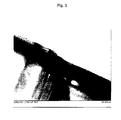
- Fig. 3 shows the result of banding with the solution of example 1 of the instant invention.
- Three handing compositions with the compositions listed in the table below are prepared. Comparative banding compositions 1 and 2 serve to illustrate the benefits of the present patent composition. In order to facilitate the observation on the banding quality, a small quantity of patent blue V was added to the banding composition.
Banding Solution Comparative Example 1 Comparative Example 2 Example 1 HPMC with viscosity of 3 cps 24% 24% 24% Surfactant: sorbitan monolaureate No No 0.024 % Solvent Water Ethanol/Water = 50/50 Ethanol/water = 50/50 - The banding operations of HPMC capsules of size 0 filled with sunflower oil were performed on a capsule banding equipment MG2 by using these three banding compositions at room temperature. After drying at room conditions, the sealed capsules were equilibrated at 22 °C/45 % RH for 21 hours. Then the leaking level was checked and the sealed capsules were evaluated by a compression test. The compression test consists of pressing the banded capsules one by one on an Instron until to its breaking or leaking. The maximum loading force (average of 10 capsules tested) is reported.
- The results regrouped in the table below and in the pictures of Fig. 1, Fig. 2, and Fig. 3 reveal that only the banding composition according to the present invention allows a banding of quality.
Banding Solution Comparative Example 1 Comparative Example 2 Example 1 Leaking level 14 % 0 % 0 % Compression test: maximum loading (N) 45 253 234 Observation Shrinkage at banding area Irregular Banding edge Good banding: regular banding edge, no shrinkage
Claims (7)
- Banding composition for hard capsules using hydroxypropylmethyl cellulose (HPMC) as a base comprising the following components:(1) low viscosity HPMC;(2) a component selected from the group consisting of methanol, ethanol, isopropanol, 1-propanol, and or acetone;(3) a surfactant; and(4) water.
- Banding composition according to claim 1, wherein the low viscosity HPMC is a HPMC having a viscosity in form of a 2% aqueous solution of not more than 15 centipoise at 20°C.
- Banding composition according to claim 1 or 2, wherein the low viscosity HPMC is present in the banding composition in an amount of more than 15 % by weight based on the entire weight of the banding composition.
- Banding composition according to any one of claims 1 to 3, wherein the component (2) is selected from acetone and/or ethanol.
- Banding composition according to any one of claims 1 to 4, wherein the proportion of component (2) and water (4) is in a range of from 10:90 to 80:20 % by weight.
- Banding composition according to any one of claims 1 to 5, wherein the surfactant is selected from the group consisting of sorbitan fatty acid esters, sucrose fatty acid esters, polyoxyethylene fatty acid esters and sodium lauryl sulfate
- Method for banding a hydroxypropylmethyl cellulose capsule having a body and a cap with the inner circumference of said cap at its edge being greater than the outer circumference of the capsule body, said method comprising: contacting the juncture of the cap and body edge with a banding composition comprising (1) low viscosity HPMC, (2) a component selected from the group consisting of methanol, ethanol, isopropanol, 1-propanol, and/or acetone, (3) a surfactant and (4) water to form a continuous band at least at the juncture of the cap and body edge of the capsule.
Priority Applications (5)
| Application Number | Priority Date | Filing Date | Title |
|---|---|---|---|
| EP05291729A EP1752140A1 (en) | 2005-08-12 | 2005-08-12 | Method for banding hard capsules using hydroxypropylmethyl cellulose (HPMC) as a base |
| US11/500,235 US9579290B2 (en) | 2005-08-12 | 2006-08-06 | Method for banding hard capsules using hydroxypropylmethyl cellulose (HPMC) as a base |
| JP2008525660A JP5522937B2 (en) | 2005-08-12 | 2006-08-08 | Band processing method of hard capsules using hydroxypropyl methylcellulose (HPMC) as a base. |
| EP06795283.8A EP1942878B1 (en) | 2005-08-12 | 2006-08-08 | Method for banding hard capsules using hydroxypropylmethyl cellulose (hpmc) as a base |
| PCT/IB2006/002257 WO2007020529A2 (en) | 2005-08-12 | 2006-08-08 | Method for banding hard capsules using hydroxypropylmethyl cellulose (hpmc) as a base |
Applications Claiming Priority (1)
| Application Number | Priority Date | Filing Date | Title |
|---|---|---|---|
| EP05291729A EP1752140A1 (en) | 2005-08-12 | 2005-08-12 | Method for banding hard capsules using hydroxypropylmethyl cellulose (HPMC) as a base |
Publications (1)
| Publication Number | Publication Date |
|---|---|
| EP1752140A1 true EP1752140A1 (en) | 2007-02-14 |
Family
ID=35169939
Family Applications (2)
| Application Number | Title | Priority Date | Filing Date |
|---|---|---|---|
| EP05291729A Withdrawn EP1752140A1 (en) | 2005-08-12 | 2005-08-12 | Method for banding hard capsules using hydroxypropylmethyl cellulose (HPMC) as a base |
| EP06795283.8A Expired - Lifetime EP1942878B1 (en) | 2005-08-12 | 2006-08-08 | Method for banding hard capsules using hydroxypropylmethyl cellulose (hpmc) as a base |
Family Applications After (1)
| Application Number | Title | Priority Date | Filing Date |
|---|---|---|---|
| EP06795283.8A Expired - Lifetime EP1942878B1 (en) | 2005-08-12 | 2006-08-08 | Method for banding hard capsules using hydroxypropylmethyl cellulose (hpmc) as a base |
Country Status (4)
| Country | Link |
|---|---|
| US (1) | US9579290B2 (en) |
| EP (2) | EP1752140A1 (en) |
| JP (1) | JP5522937B2 (en) |
| WO (1) | WO2007020529A2 (en) |
Cited By (3)
| Publication number | Priority date | Publication date | Assignee | Title |
|---|---|---|---|---|
| US9603933B2 (en) | 2010-10-21 | 2017-03-28 | Lotte Fine Chemical Co., Ltd. | Composition for enteric hard capsules, and enteric hard capsule prepared using the composition |
| EP4285896A1 (en) * | 2022-06-03 | 2023-12-06 | Suheung Co., Ltd. | Banding solution for manufacturing enteric hard capsules and enteric hard capsule manufactured using the same |
| US12383504B2 (en) | 2012-05-21 | 2025-08-12 | Capsugel Belgium Nv | Acid resistant banding solution for two piece hard capsules |
Families Citing this family (13)
| Publication number | Priority date | Publication date | Assignee | Title |
|---|---|---|---|---|
| EP2776016B1 (en) * | 2011-11-09 | 2019-02-20 | Capsugel Belgium NV | Acid resistant banding solution for acid resistant two piece hard capsules |
| KR102199595B1 (en) * | 2013-12-31 | 2021-01-07 | 롯데정밀화학 주식회사 | Aqueous composition for hard capsule and hard capsule prepared thereof |
| KR102161001B1 (en) * | 2013-12-31 | 2020-09-29 | 롯데정밀화학 주식회사 | Aqueous composition for hard capsuleand hard capsule prepared thereof |
| KR102199596B1 (en) * | 2013-12-31 | 2021-01-07 | 롯데정밀화학 주식회사 | Aqueous composition for hard capsule and hard capsule prepared thereof |
| EP3028694B1 (en) | 2014-12-02 | 2017-07-12 | Capsugel Belgium NV | Dosage form articles for delayed release |
| EP3167880B1 (en) | 2015-11-10 | 2019-06-19 | Capsugel Belgium NV | Acid resistant banding or sealing solution for acid resistant two piece hard capsules |
| WO2018008660A1 (en) | 2016-07-06 | 2018-01-11 | クオリカプス株式会社 | Hard capsule having improved hardness, and method for manufacturing same |
| BR112019011253A2 (en) | 2016-12-07 | 2019-10-08 | Qualicaps Co Ltd | hard capsule showing improved deposition of gelling aid and method for its preparation |
| EP4480495A3 (en) * | 2017-07-10 | 2025-06-18 | Gel Cap Technologies, LLC | Dual release dosage form capsule and methods, devices and systems for making same |
| JPWO2020071395A1 (en) | 2018-10-02 | 2021-09-02 | クオリカプス株式会社 | Hard capsules with improved strength and their manufacturing methods |
| WO2020071393A1 (en) | 2018-10-02 | 2020-04-09 | クオリカプス株式会社 | Improved-strength hard capsule and production method for same |
| US12544339B2 (en) * | 2020-12-14 | 2026-02-10 | Capsugel Belgium Nv | Sealing fluid for sealing capsules |
| US20260217925A1 (en) | 2022-12-27 | 2026-07-30 | Qualicaps Co., Ltd. | Hard capsule comprising shell containing light-shielding agent, hard capsule preparation solution, and hard capsule preparation method |
Citations (7)
| Publication number | Priority date | Publication date | Assignee | Title |
|---|---|---|---|---|
| US3071513A (en) * | 1959-11-23 | 1963-01-01 | Upjohn Co | Process for sealing capsules |
| US3198708A (en) * | 1960-06-14 | 1965-08-03 | Colgate Paimolive Company | Antiperspirant-deodorant composition |
| US5302373A (en) * | 1993-06-10 | 1994-04-12 | Church & Dwight Co., Inc. | Liquid mouthwash containing a particulate bicarbonate suspension |
| EP0974345A2 (en) * | 1998-07-03 | 2000-01-26 | MW Encap Ltd. | Capsule sealing system |
| FR2788778A1 (en) * | 1999-01-25 | 2000-07-28 | Su Heung Capsule Co Ltd | COMPOSITION FOR THE PRODUCTION OF BOTANICAL HARD ENVELOPE CAPSULES, PROCESS FOR PRODUCING THEM AND CAPSULES THUS OBTAINED |
| EP1072245A1 (en) * | 1999-07-30 | 2001-01-31 | Warner-Lambert Company | Method and apparatus for sealing capsules and capsules suitable for use in said method and apparatus |
| WO2004103338A1 (en) * | 2003-05-19 | 2004-12-02 | Bioprogress Plc | Adhesives and film modifying compositions |
Family Cites Families (13)
| Publication number | Priority date | Publication date | Assignee | Title |
|---|---|---|---|---|
| GB1144225A (en) * | 1965-09-07 | 1969-03-05 | Dow Chemical Co | Preparation of medicinal capsule shells from hydroxyalkyl-alkyl cellulose ethers |
| BR8205225A (en) | 1981-09-08 | 1983-08-16 | Fmc Corp | POLYPHENYLENE-STYRENE ETER RESIN COMPOSITION |
| US4478658A (en) * | 1982-12-20 | 1984-10-23 | Warner-Lambert Company | Method for sealing non-enteric capsules |
| US4756902A (en) | 1986-06-02 | 1988-07-12 | Warner-Lambert Company | Capsule sealing process and product |
| US5054258A (en) | 1988-01-15 | 1991-10-08 | Warner-Lambert Company | Capsule transport tray |
| US4922682A (en) | 1988-01-15 | 1990-05-08 | Warner-Lambert Company | Apparatus and method for sealing and banding capsules |
| JP3185206B2 (en) * | 1995-07-20 | 2001-07-09 | 田辺製薬株式会社 | Lower digestive tract release coated capsule formulation |
| JPH09216818A (en) * | 1995-12-04 | 1997-08-19 | Kyowa Hakko Kogyo Co Ltd | Hard capsule |
| US5674513A (en) * | 1996-02-20 | 1997-10-07 | Viro-Kote, Inc. | Anti-bacterial/anti-viral coatings, coating process and parameters thereof |
| US20020000176A1 (en) * | 1998-07-03 | 2002-01-03 | Young Victor Morrison | Capsule sealing system |
| CN1252154C (en) * | 1999-07-22 | 2006-04-19 | 沃纳-兰伯特公司 | Pullulan film compositions |
| WO2005000279A1 (en) * | 2003-06-27 | 2005-01-06 | Wakunaga Pharmaceutical Co., Ltd. | Hard capsule |
| JP4471647B2 (en) * | 2003-12-26 | 2010-06-02 | クオリカプス株式会社 | Method for producing hard capsule |
-
2005
- 2005-08-12 EP EP05291729A patent/EP1752140A1/en not_active Withdrawn
-
2006
- 2006-08-06 US US11/500,235 patent/US9579290B2/en not_active Expired - Fee Related
- 2006-08-08 JP JP2008525660A patent/JP5522937B2/en not_active Expired - Fee Related
- 2006-08-08 WO PCT/IB2006/002257 patent/WO2007020529A2/en not_active Ceased
- 2006-08-08 EP EP06795283.8A patent/EP1942878B1/en not_active Expired - Lifetime
Patent Citations (7)
| Publication number | Priority date | Publication date | Assignee | Title |
|---|---|---|---|---|
| US3071513A (en) * | 1959-11-23 | 1963-01-01 | Upjohn Co | Process for sealing capsules |
| US3198708A (en) * | 1960-06-14 | 1965-08-03 | Colgate Paimolive Company | Antiperspirant-deodorant composition |
| US5302373A (en) * | 1993-06-10 | 1994-04-12 | Church & Dwight Co., Inc. | Liquid mouthwash containing a particulate bicarbonate suspension |
| EP0974345A2 (en) * | 1998-07-03 | 2000-01-26 | MW Encap Ltd. | Capsule sealing system |
| FR2788778A1 (en) * | 1999-01-25 | 2000-07-28 | Su Heung Capsule Co Ltd | COMPOSITION FOR THE PRODUCTION OF BOTANICAL HARD ENVELOPE CAPSULES, PROCESS FOR PRODUCING THEM AND CAPSULES THUS OBTAINED |
| EP1072245A1 (en) * | 1999-07-30 | 2001-01-31 | Warner-Lambert Company | Method and apparatus for sealing capsules and capsules suitable for use in said method and apparatus |
| WO2004103338A1 (en) * | 2003-05-19 | 2004-12-02 | Bioprogress Plc | Adhesives and film modifying compositions |
Cited By (3)
| Publication number | Priority date | Publication date | Assignee | Title |
|---|---|---|---|---|
| US9603933B2 (en) | 2010-10-21 | 2017-03-28 | Lotte Fine Chemical Co., Ltd. | Composition for enteric hard capsules, and enteric hard capsule prepared using the composition |
| US12383504B2 (en) | 2012-05-21 | 2025-08-12 | Capsugel Belgium Nv | Acid resistant banding solution for two piece hard capsules |
| EP4285896A1 (en) * | 2022-06-03 | 2023-12-06 | Suheung Co., Ltd. | Banding solution for manufacturing enteric hard capsules and enteric hard capsule manufactured using the same |
Also Published As
| Publication number | Publication date |
|---|---|
| EP1942878A2 (en) | 2008-07-16 |
| JP5522937B2 (en) | 2014-06-18 |
| JP2009504630A (en) | 2009-02-05 |
| US9579290B2 (en) | 2017-02-28 |
| WO2007020529A2 (en) | 2007-02-22 |
| WO2007020529A3 (en) | 2007-04-26 |
| EP1942878B1 (en) | 2014-04-23 |
| US20070065501A1 (en) | 2007-03-22 |
Similar Documents
| Publication | Publication Date | Title |
|---|---|---|
| US9579290B2 (en) | Method for banding hard capsules using hydroxypropylmethyl cellulose (HPMC) as a base | |
| US10874619B2 (en) | Acid resistant capsules | |
| US8685445B2 (en) | Enteric composition for the manufacture of soft capsule wall | |
| EP2844296B1 (en) | Aqueous dispersions of hydroxypropyl methylcellulose acetate succinate (hpmcas) | |
| EP0056825B1 (en) | A process for producing a pharmaceutical capsule having enteric properties | |
| EP2283830A1 (en) | Aqueous enteric capsule coating | |
| CA2769046A1 (en) | Coating agent for the dip coating of capsule halves | |
| CH649216A5 (en) | METHOD FOR APPLYING AN ACID-RESISTANT FILM TO A MEDICINAL CORE AND SOLID UNIT DOSAGE FORM WITH ACID-ACID RESISTANT FILM. | |
| EP3937909B1 (en) | Capsule shell comprising a core-shell polymer and a cellulose | |
| US9254270B2 (en) | Enteric soft capsules | |
| ES2470337T3 (en) | Procedure for bonding hard capsules using hydroxypropyl methylcellulose (HPMC) as a base | |
| JPS63117761A (en) | Method for coating gelatin hard capsule with film | |
| EP3272341A1 (en) | Enteric elastic films for the production of capsules | |
| CA1316824C (en) | Process for coating gelatin capsules | |
| HK40062974A (en) | Capsule shell comprising a core-shell polymer and a cellulose | |
| HK40062974B (en) | Capsule shell comprising a core-shell polymer and a cellulose | |
| EP1172104A1 (en) | Seam soft capsule preparations containing dihydrobenzofuran derivative | |
| HK1164726B (en) | Coating agent for the dip coating of capsule halves |
Legal Events
| Date | Code | Title | Description |
|---|---|---|---|
| PUAI | Public reference made under article 153(3) epc to a published international application that has entered the european phase |
Free format text: ORIGINAL CODE: 0009012 |
|
| AK | Designated contracting states |
Kind code of ref document: A1 Designated state(s): AT BE BG CH CY CZ DE DK EE ES FI FR GB GR HU IE IS IT LI LT LU LV MC NL PL PT RO SE SI SK TR |
|
| AX | Request for extension of the european patent |
Extension state: AL BA HR MK YU |
|
| RAP1 | Party data changed (applicant data changed or rights of an application transferred) |
Owner name: WARNER-LAMBERT COMPANY LLC |
|
| 17P | Request for examination filed |
Effective date: 20070814 |
|
| AKX | Designation fees paid |
Designated state(s): FR |
|
| REG | Reference to a national code |
Ref country code: DE Ref legal event code: 8566 |
|
| 17Q | First examination report despatched |
Effective date: 20071107 |
|
| STAA | Information on the status of an ep patent application or granted ep patent |
Free format text: STATUS: THE APPLICATION IS DEEMED TO BE WITHDRAWN |
|
| 18D | Application deemed to be withdrawn |
Effective date: 20080520 |