EP1751694B1 - Verfahren zur charakterisierung eines digitalen bildes und anwendungen dafür - Google Patents
Verfahren zur charakterisierung eines digitalen bildes und anwendungen dafür Download PDFInfo
- Publication number
- EP1751694B1 EP1751694B1 EP04742819A EP04742819A EP1751694B1 EP 1751694 B1 EP1751694 B1 EP 1751694B1 EP 04742819 A EP04742819 A EP 04742819A EP 04742819 A EP04742819 A EP 04742819A EP 1751694 B1 EP1751694 B1 EP 1751694B1
- Authority
- EP
- European Patent Office
- Prior art keywords
- foveal
- image
- signature
- digital image
- characterizing method
- Prior art date
- Legal status (The legal status is an assumption and is not a legal conclusion. Google has not performed a legal analysis and makes no representation as to the accuracy of the status listed.)
- Expired - Lifetime
Links
Images


Classifications
-
- G—PHYSICS
- G06—COMPUTING OR CALCULATING; COUNTING
- G06F—ELECTRIC DIGITAL DATA PROCESSING
- G06F16/00—Information retrieval; Database structures therefor; File system structures therefor
- G06F16/50—Information retrieval; Database structures therefor; File system structures therefor of still image data
- G06F16/58—Retrieval characterised by using metadata, e.g. metadata not derived from the content or metadata generated manually
- G06F16/583—Retrieval characterised by using metadata, e.g. metadata not derived from the content or metadata generated manually using metadata automatically derived from the content
-
- G—PHYSICS
- G06—COMPUTING OR CALCULATING; COUNTING
- G06V—IMAGE OR VIDEO RECOGNITION OR UNDERSTANDING
- G06V10/00—Arrangements for image or video recognition or understanding
- G06V10/40—Extraction of image or video features
- G06V10/42—Global feature extraction by analysis of the whole pattern, e.g. using frequency domain transformations or autocorrelation
- G06V10/431—Frequency domain transformation; Autocorrelation
-
- G—PHYSICS
- G06—COMPUTING OR CALCULATING; COUNTING
- G06V—IMAGE OR VIDEO RECOGNITION OR UNDERSTANDING
- G06V30/00—Character recognition; Recognising digital ink; Document-oriented image-based pattern recognition
- G06V30/10—Character recognition
- G06V30/24—Character recognition characterised by the processing or recognition method
- G06V30/248—Character recognition characterised by the processing or recognition method involving plural approaches, e.g. verification by template match; Resolving confusion among similar patterns, e.g. "O" versus "Q"
- G06V30/2504—Coarse or fine approaches, e.g. resolution of ambiguities or multiscale approaches
Definitions
- the invention relates to a method for characterizing a digital image and applications thereof.
- Such points of interest are points containing a significant portion of the information and may be located for example on the contours of the shapes present in the image. These points of interest can be defined as points corresponding to the high frequency areas of the image.
- a first category of techniques characterize the color by using for example an autocorrelogram or a color histogram, such as references [7], [8], [9] mentioned below.
- the texture is characterized using Gabor filters.
- the shape is characterized by means of a histogram of the distribution of the orientations in the image.
- An approach of this type is used in the MPEG7 standard.
- the invention aims to overcome the drawbacks inherent in the state of the art and to obtain a method of characterizing a digital image using its points of interest, in order to make the characterization carried out more discriminating.
- the invention thus makes it possible to calculate a signature for the local environment of the point of interest, located in the working region, and to characterize this point of interest.
- a second object of the invention is the application of the method of characterization to digital images for comparison purposes, in which the foveal signatures calculated for the digital images are compared with each other.
- a foveal reference signature is computed for a reference image and, for the comparison of the foveal signatures, a distance of the foveal signatures computed for the other images is calculated with respect to the reference signature, the nearest image of the reference image being the one having the smallest distance with respect thereto.
- a prescribed number of images closest to the reference image is selected.
- a third object of the invention is the application of the characterization method to pattern recognition in the digital image, wherein the foveal signature is used to characterize a shape located in the working region.
- this application relates to face recognition, in which the foveal signature is used to characterize a facial feature, located in the working area.
- a fourth object of the invention is the application of the characterization method to the indexing of digital images by partial requests, from which a digital image database is extracted, the digital images containing an object specified by the request, a digital image being determined to contain said object when a distance of the foveal signature calculated for that image with respect to the foveal signature calculated for the object located at least partially in the working region is less than a prescribed threshold.
- a fifth object of the invention is the application of the method of characterization to the classification of digital images by comparison of their foveal signature.
- a digital image 1 consisting of N columns x M lines of points or pixels P, in color or in black and white.
- one or more points of interest P1 are detected among the points P of the digital image 1.
- a two-dimensional RPI region of work around the point of interest PI is selected in the image I.
- This working RPI region has for example a rectangular or square size along the sides of the image 1 and has a size significantly smaller than this.
- the RPI region is for example centered on the point of interest PI, having for example odd numbers of pixels in its rows and in its columns.
- the RPI region consists of a square of 7 x 7 pixels, the central pixel of which is occupied by the point PI of interest.
- the working RPI region could have a non-rectangular shape, while containing the PI point.
- I 8 orientations ⁇ are provided respectively - 3 ⁇ ⁇ 8 , - ⁇ 4 , - ⁇ 8 , 0 ⁇ 8 , ⁇ 4 , 3 ⁇ ⁇ 8 , ⁇ 2 .
- the lines of points are for example drawn according to the Bresenham algorithm according to reference [12] mentioned below, which allows the drawing of lines on an image of discrete points.
- This algorithm is used in particular for displaying inclined line segments on a computer screen.
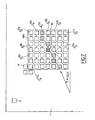
- K lines f ⁇ (k) (n) of the RPI working region are extracted for each orientation ⁇ , which represent K parallel lines following this orientation ⁇ , passing through the RPI region and each offset by one pixel on the abscissa and / or on the ordinate.
- K is a natural integer dependent on each orientation ⁇ or constant for the I orientations ⁇ .
- the extraction is performed so as to cover for each orientation ⁇ all the points of the RPI region. Consequently, for each orientation ⁇ , each point of the working region RPI belongs to a single line f ⁇ (k) (n) thus extracted.
- At least the line containing the point of interest PI following the orientation ⁇ is extracted from the working region RPI (f ⁇ (5) at the figure 7 ) and in addition at least one other line containing another point of the RPI working region, which is for example second and third lines located on either side of the line containing the point PI of interest, such as the line f ⁇ (7) and f ⁇ (3) in the previous example of the figure 7 .
- the family ⁇ f ⁇ (k) (n) ⁇ 1 k k K k of lines f ⁇ (k) (n) is determined in the working region RPI for each of the I orientations ⁇ chosen.
- the lines f ⁇ (k) (n) are thus discrete monodimensional signals having as argument n indicating the number of the point in the line and having as value the value of the point n of this line in the working region RPI, for example its gray level in image I.
- a signal E ⁇ , s (k) (n) of foveal energy is calculated, s indicating a level of sub-sampling among J prescribed subsampling levels for which this signal is calculated, -s indicating a level of resolution.
- the foveal wavelets consist of all the dyadic dilatations of a symmetric wavelet or pair ⁇ (2) is of an antisymmetric or odd wavelet ⁇ (1) , these wavelets being constructed from a mother function ⁇ .
- E ⁇ , s k not ⁇ m f ⁇ k m . ⁇ s 1 ⁇ not - m 2 + ⁇ m f ⁇ k m . ⁇ s 2 ⁇ not - m 2 .
- a foveal signature SI is computed from the foveal energy signals E ⁇ , s (k) (n), to characterize the working region RPI and the digital image 1.
- This foveal signature SI the variables k representing the different lines extracted for the same orientation ⁇ in the working region RPI and the argument n are eliminated from the foveal energy signals E ⁇ , s (k) (n), so that that the foveal signature IF depends only on the selected orientations ⁇ and the prescribed levels of subsamples.
- ⁇ IJ , ⁇ IJ , with ⁇ is (1 / NM) .
- ⁇ k ⁇ n E i, s (k) (n) corresponding to the average of the foveal energy signal E i, s (k) (n) according to the orientation i and the downsampling level s on the RPI work area
- ⁇ (1 / NM).
- m, n, k, K, s, j, 1, J, i are natural numbers.
- NM N 2 .
- the SI foveal signature can be used in different ways, as described below.
- the foveal signature SI is for example associated with the digital image I and is stored in memory in association therewith.
- the foveal signatures are compared for example by means of a conventional distance L 2 .
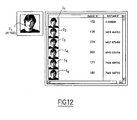
- the reference image is for example the big picture 11 from left to right figure 12 .
- This image represents a person.
- the foveal signature of the reference image 11 is computed and compared to the foveal signatures of the other images stored in the base, to extract those having the smallest distances from the foveal signature of the reference image 11.
- this extraction again provides the image 11 having the distance 0 and images 12, 13, 14, 15, 16 of the smallest and increasing distances with respect to the reference image 11, which correspond to the images No. 102, 139, 274, 303, 171 and 181 of the base of 700 images.
- the images 12, 13, 14, 15, 16 are those of the same person as in the image 11 but with other facial expressions than in the image 11, these images being taken successively when the nobody speaks.
- an image of another person would have a signature having a distance much greater than that of the images 12 to 16 compared to the reference image 11.
- a second application is the recognition of shapes in an image.
- the point of interest will be detected as part of contour of the shape to recognize.
- the working region will then contain, in all or in part, the form to be recognized and the foveal signature of all or part of this form to be recognized.
- This shape may be for example a facial line, such as an eye, the mouth, the nose, which are areas where contours are marked.
- This application will allow the search for people in images or the search for images containing a person.
- a third application concerns the indexing of digital images by partial requests which makes it possible to extract from an image database all the images containing an object similar to a request object specified by the user.
- a fourth application is the classification of images, which makes it possible to group the images of a database into a restricted set of groups, each group representing a particular theme (landscape, sport, etc.). This application can help navigation within image databases, for example in databases created by users from their digital camera.
- the method according to the invention applies to the characterization of any digital object, which may be a two-dimensional image as described above, but also a three-dimensional image, the lines then being considered as plans, and the process steps then being adapted correspondingly.
- An object of the invention is therefore the detection of the salient points of an image I. These points correspond to the pixels of I belonging to high frequency regions. To do this, we rely on the wavelet theory [1] [2] [3], [6]
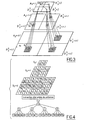
- the wavelet transform is a multi-resolution representation of the image that expresses the image at different resolutions 1 2 , 1 4 , , etc.
- the wavelet transform is a multi-resolution representation of the image that expresses the image at different resolutions 1 2 , 1 4 , , etc.
- Each of these images is of size 2 k + j ⁇ 2 l + j .
- the figure 1 illustrates this type of representation.
- the invention consists in choosing, firstly, a wavelet basis and a minimum resolution level 2 r (r ⁇ -1 ) .
- a wavelet basis we propose to go through each of the three detail images D 2 r 1 ⁇ I , D 2 r 2 ⁇ I and D 2 r 3 ⁇ I to build a tree of wavelet coefficients.
- This tree is based on the Zerotree approach [4], initially proposed for image coding. It allows to set up a saliency map of size 2 k + r ⁇ 2 / + r reflecting the importance of each wavelet coefficient at the resolution 2 r ( r ⁇ -1).
- a coefficient having a high saliency corresponds to a region of 1 having high frequencies.
- an important modulus wavelet coefficient at the resolution 2 r (r ⁇ -1 ) corresponds to a contour of the image A 2 r +1 I in a particular direction (horizontal, vertical or oblique).
- the Zerotree approach tells us that each of the wavelet coefficients at resolution 2 r corresponds to a spatial area of size 2 -r ⁇ 2 -r in image I.
- the invention proposes a method making it possible to choose among the 2- r ⁇ 2 -r pixels of I , the most representative pixel of this zone.
- the wavelet transformation is a powerful mathematical tool allowing the multi-resolution analysis of a function [1] [2] [3].
- the functions considered are digital images, that is to say discrete two-dimensional functions.
- the processed images are sampled on a discrete grid of n lines and m columns and valued in a luminance space sampled at 256 values.
- the wavelet transformation of I allows a multi-resolution representation of I.
- the representation of I is given by a coarse image A 2 j I and three images of details D 2 j 1 ⁇ I , D 2 j 2 ⁇ I and D 2 j 3 ⁇ I .
- Each of these images is of size 2 k + j ⁇ 2 l + j . This process is illustrated on the figure 2 .
- each wavelet coefficient favors a direction (horizontal, vertical or oblique) according to the image of details to which it belongs. However, we chose not to favor any particular direction, so we merged the information contained in the three wavelet coefficients ⁇ 2 j 1 x ⁇ there , ⁇ 2 j 2 x ⁇ there , ⁇ 2 j 3 x ⁇ there whatever the level of resolution 2 j and whatever the location (x, y) with 0 ⁇ x ⁇ 2 k + j and 0 ⁇ y ⁇ 2 l + j .
- Each saliency map S 2 j is of size 2 k + j ⁇ 2 l + j .
- the salience of each coefficient at the resolution 2 j must take into account the salience of its descendants in the tree of the coefficients.
- Equation 1 the saliency of a coefficient is a linear relationship of the wavelet coefficients. Indeed, as we mentioned, we consider the highlights as pixels of the image belonging to high frequency regions.
- each contour of A 2 j +1 I generates a high wavelet coefficient in one of the detail images at the resolution 2 j and corresponding to the orientation of the contour.
- Equation 1 the formulation of the salience of a given coefficient in Equation 1 is justified.
- the pixel of I chosen to be the most representative of the branch is located at (2x -r , 2y -r ).
- the pixel of I chosen to be the most representative of the branch is located at (2x -r , 2y -r ).
- a space V 0 ⁇ L 2 ( R ) is a foveal space centered at 0 if there exists a finite generating family ⁇ m ⁇ 1 ⁇ m ⁇ M belonging to L 2 (R) such that ⁇ j m ⁇ 1 ⁇ m ⁇ M j ⁇ Z is a base of Riesz of V 0 and such that: f ⁇ V 0 ⁇ f . 1 0 , + ⁇ ⁇ V 0 (R denotes the set of real numbers and Z the set of positive or negative natural integers).
- V u is a foveal space centered in u if it satisfies f ⁇ V u ⁇ f ' ⁇ V 0
- the projection of a function f on V u is then a function whose resolution decreases with the distance from the u fovea, hence the analogy to the foveal vision of the human.
- these bases are not necessarily orthogonal. However, a Gram-Schmidt orthogonalization procedure can also be applied.
- the mother functions ⁇ are for example chosen from spline functions.
- Spline functions are widely used for interpolation. Indeed, these allow to interpolate a series of points by piecewise polynomial functions.
- the order of the interpolating polynomials corresponds to the order of the interpolation spline function.
- foveal wavelet bases can then be used to construct foveal wavelet bases.
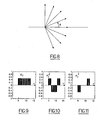
- a basic example of foveal wavelets obtained from splines of order 0 is presented to Figures 9, 10, 11 respectively representing ⁇ 2 ( n ) , ⁇ 2 2 not and ⁇ 2 1 not . Since the foveal wavelet bases obtained from splines of order greater than 0 are not orthogonal by default, a Gram-Schmidt orthogonalization procedure must be applied.
Landscapes
- Engineering & Computer Science (AREA)
- Theoretical Computer Science (AREA)
- Physics & Mathematics (AREA)
- General Physics & Mathematics (AREA)
- Library & Information Science (AREA)
- Multimedia (AREA)
- Computer Vision & Pattern Recognition (AREA)
- Data Mining & Analysis (AREA)
- Databases & Information Systems (AREA)
- General Engineering & Computer Science (AREA)
- Image Analysis (AREA)
- Image Processing (AREA)
- Character Discrimination (AREA)
- Crystals, And After-Treatments Of Crystals (AREA)
Claims (19)
- Verfahren zur Charakterisierung eines digitalen Bilds, bei dem mindestens ein interessanter Punkt (PI) im digitalen Bild erfasst wird, der einem hohe Frequenzen aufweisenden Bereich des Bilds zugeordnet ist,
dadurch gekennzeichnet, dass für einen Punkt (PI)- ein erster bestimmter zweidimensionaler Arbeitsbereich (RPI) des digitalen Bilds ausgewählt wird, der kleiner ist als dieses und den erfassten Punkt (PI) enthält,- für jede (θ) von mehreren (I) unterschiedlichen Ausrichtungen, die im digitalen Bild vorgeschrieben sind:
aus dem ersten zweidimensionalen Arbeitsbereich (RPI) gemäß Geraden (K) mit der Ausrichtung (θ) eine Familie ({fθ (k)(n) }1≤k≤K) von eindimensionalen Zeilen (fθ (k)(n)) von Punkten extrahiert wird, für jede eindimensionale Zeile (fθ (k)(n)) von Punkten der extrahierten Familie und für jede Unterabtastungsebene (s) von vorgeschriebenen Unterabtastungsebenen ein Signal (Eθ,s (k)(n)) fovealer Energie berechnet wird, das foveale Wavelets verwendet,- die Signale Eθ,s (k)(n)) fovealer Energie in den Zeilen und in ihrem Argument kombiniert werden, um eine foveale Signatur (SI) zu berechnen, die von den Ausrichtungen (θ) und von den Unterabtastungsebenen (s) abhängt und den Arbeitsbereich charakterisiert. - Charakterisierungsverfahren nach Anspruch 1,
dadurch gekennzeichnet, dass
das Signal Eθ,s (k)(n) fovealer Energie gleich
ist, wobei
θ jede der mehreren I Ausrichtungen bezeichnet,
{fθ (k)(n)}1≤k≤K die Familie der K eindimensionalen Zeilen fθ (k)(n) von Punkten bezeichnet, die für jede Ausrichtung θ extrahiert wird,
K eine vorgeschriebene natürliche ganze Zahl für jede Ausrichtung θ ist,
s jede Unterabtastungsebene unter den J vorgeschriebenen Unterabtastungsebenen bezeichnet,
n das Argument der Signale Eθ,s (k)(n) fovealer Energie bezeichnet,
{ψj (1)ψj (2)}1≤j≤s eine Basis der fovealen Wavelets, die bis zur Unterabtastungsebene s geht, des fovealen Raums Vs von diskreten eindimensionalen Signalen ist, wobei {ψj (1)}1≤j≤s eine Basis von ungeraden fovealen Wavelets ist und {ψj (2)}1≤j≤s eine Basis von geraden fovealen Wavelets ist. - Charakterisierungsverfahren nach Anspruch 2,
dadurch gekennzeichnet, dass
die Basis von ungeraden fovealen Wavelets {ψj (1)}1≤j≤s definiert wird durch
die Basis von geraden fovealen Wavelets {ψj (2)}1≤j≤s definiert wird durch
wobei
sign(t) die Vorzeichenfunktion der realen Variablen t gleich +1 für t größer als 0 und gleich -1 für t kleiner als 0 ist;
Φj(t) eine gerade Funktion der realen Variablen t ist, die erfüllt:
- Charakterisierungsverfahren nach Anspruch 3, dadurch gekennzeichnet, dass die Basen von fovealen Wavelets {ψj (1), ψj (2)}1≤j≤s ausgehend von Spline-Funktionen Φj(t) konstruiert werden, die definiert sind durch:

und
- Charakterisierungsverfahren nach einem der vorhergehenden Ansprüche, dadurch gekennzeichnet, dass die foveale Signatur (SI) durch statistische Analyse der Signale (Eθ,s (k)(n)) fovealer Energie in den Zeilen und in ihrem Argument (n) berechnet wird.
- Charakterisierungsverfahren nach einem der Ansprüche 2 bis 5, dadurch gekennzeichnet, dass die foveale Signatur SI gleich

mit
µis = (1/NM)·ΣkΣnEi,s (k) (n) entsprechend dem Mittelwert des Signale Ei,s (k) (n) fovealer Energie gemäß der Ausrichtung i und der Unterabtastungsebene s im Arbeitsbereich (RPI),
σis = (1/NM)·[LkΣn(Ei,s (k)(n)-µis)2]1/2 entsprechend der typischen Abweichung des Signals Ei,s (k) (n) fovealer Energie gemäß der Ausrichtung i und der Unterabtastungsebene s im Arbeitsbereich (RPI),
NM entsprechend der Größe des Arbeitsbereichs (RPI). - Charakterisierungsverfahren nach einem der vorhergehenden Ansprüche, dadurch gekennzeichnet, dass das Extrahieren der Familie ({fθ (k)(n)}1≤k≤K) von eindimensionalen Zeilen (fθ (k)(n)) von Punkten gemäß den Geraden ausgehend vom ersten zweidimensionalen Arbeitsbereich (RPI) nach dem Bresenham-Algorithmus durchgeführt wird, der das Rastern von geneigten Geraden auf einem diskreten Gitter erlaubt.
- Charakterisierungsverfahren nach einem der vorhergehenden Ansprüche, dadurch gekennzeichnet, dass der erste zweidimensionale Arbeitsbereich (RPI) den erfassten Punkt (PI) umgibt und eine Größe (NM) hat, die geringer als ein Zehntel der Größe des digitalen Bilds ist.
- Charakterisierungsverfahren nach einem der vorhergehenden Ansprüche, dadurch gekennzeichnet, dass der erste zweidimensionale Arbeitsbereich (RPI) den erfassten Punkt (PI) umgibt und eine Größe (NM) kleiner als oder gleich 15 Pixel x 15 Pixel hat.
- Charakterisierungsverfahren nach einem der vorhergehenden Ansprüche, dadurch gekennzeichnet, dass die mehreren (I) vorgeschriebenen unterschiedlichen Ausrichtungen im digitalen Bild den Winkelsektor von -90° bis +90° bezüglich der Waagrechten in gleiche Winkel teilen.
- Charakterisierungsverfahren nach einem der vorhergehenden Ansprüche, dadurch gekennzeichnet, dass die Anzahl (I) der Ausrichtungen acht ist.
- Charakterisierungsverfahren nach einem der vorhergehenden Ansprüche, dadurch gekennzeichnet, dass die foveale Signatur dem digitalen Bild zugeordnet und in Verbindung mit diesem digitalen Bild gespeichert wird.
- Anwendung des Charakterisierungsverfahrens nach einem der vorhergehenden Ansprüche auf digitale Bilder für ihren Vergleich, bei der die für die digitalen Bilder berechneten fovealen Signaturen miteinander verglichen werden.
- Anwendung nach Anspruch 13, dadurch gekennzeichnet, dass eine foveale Bezugssignatur für ein Bezugsbild berechnet wird, und für den Vergleich der fovealen Signaturen ein Abstand der für die anderen Bilder berechneten fovealen Signaturen bezüglich der Bezugssignatur berechnet wird, wobei das dem Bezugsbild am nächsten liegende Bild dasjenige ist, das den geringsten Abstand bezüglich dieses Bezugsbilds hat.
- Anwendung nach Anspruch 14, dadurch gekennzeichnet, dass eine vorgeschriebene Anzahl von Bildern ausgewählt wird, die dem Bezugsbild am nächsten sind.
- Anwendung des Charakterisierungsverfahrens nach einem der Ansprüche 1 bis 12 auf die Erkennung von Formen im digitalen Bild, bei der die foveale Signatur verwendet wird, um eine Form zu charakterisieren, die sich im Arbeitsbereich befindet.
- Anwendung nach Anspruch 16 auf die Erkennung von Gesichtern, bei der die foveale Signatur verwendet wird, um einen Gesichtszug zu charakterisieren, der sich im Arbeitsbereich befindet.
- Anwendung des Charakterisierungsverfahrens nach einem der Ansprüche 1 bis 12 auf die Indexierung digitaler Bilder durch Teilanforderungen, bei der aus einer Basis von digitalen Bildern die digitalen Bilder extrahiert werden, die einen von der Anforderung spezifizierten Gegenstand enthalten,
wobei ein digitales Bild als den Gegenstand enthaltend bestimmt wird, wenn ein Abstand der für dieses Bild berechneten fovealen Signatur bezüglich der für den Gegenstand, der sich zumindest zum Teil im Arbeitsbereich befindet, berechneten fovealen Signatur unter einer vorgeschriebenen Schwelle liegt. - Anwendung des Charakterisierungsverfahrens nach einem der Ansprüche 1 bis 12 auf die Klassifizierung digitaler Bilder durch Vergleich ihrer fovealen Signatur.
Applications Claiming Priority (1)
| Application Number | Priority Date | Filing Date | Title |
|---|---|---|---|
| PCT/FR2004/001280 WO2006000651A1 (fr) | 2004-05-24 | 2004-05-24 | Procede de caracterisation d'une image numerique et ses applications |
Publications (2)
| Publication Number | Publication Date |
|---|---|
| EP1751694A1 EP1751694A1 (de) | 2007-02-14 |
| EP1751694B1 true EP1751694B1 (de) | 2008-10-29 |
Family
ID=34958282
Family Applications (1)
| Application Number | Title | Priority Date | Filing Date |
|---|---|---|---|
| EP04742819A Expired - Lifetime EP1751694B1 (de) | 2004-05-24 | 2004-05-24 | Verfahren zur charakterisierung eines digitalen bildes und anwendungen dafür |
Country Status (5)
| Country | Link |
|---|---|
| US (1) | US7876832B2 (de) |
| EP (1) | EP1751694B1 (de) |
| AT (1) | ATE412947T1 (de) |
| DE (1) | DE602004017515D1 (de) |
| WO (1) | WO2006000651A1 (de) |
Families Citing this family (4)
| Publication number | Priority date | Publication date | Assignee | Title |
|---|---|---|---|---|
| EP1751694B1 (de) * | 2004-05-24 | 2008-10-29 | France Telecom | Verfahren zur charakterisierung eines digitalen bildes und anwendungen dafür |
| JP5218109B2 (ja) * | 2009-01-30 | 2013-06-26 | 富士通株式会社 | 可視化データ処理装置、可視化データ処理装置の制御方法、及び可視化データ処理装置の制御プログラム |
| FR2954986B1 (fr) * | 2010-01-05 | 2012-02-10 | St Microelectronics Grenoble 2 | Procede de detection d'orientation de contours. |
| RU2523944C2 (ru) * | 2012-10-15 | 2014-07-27 | Федеральное государственное бюджетное образовательное учреждение высшего профессионального образования "Юго-Западный государственный университет" (ЮЗГУ) | Способ выделения протяженных линейных объектов на аэрокосмических изображениях |
Family Cites Families (4)
| Publication number | Priority date | Publication date | Assignee | Title |
|---|---|---|---|---|
| FR2693580B1 (fr) * | 1992-04-27 | 1996-01-05 | Pierre Robert | Procede perfectionne de creation/verification de la signature d'un objet represente sur une image numerique, a l'aide d'histogrammes calcules dans des fenetres positionnees dans l'image. |
| IT1268059B1 (it) * | 1994-05-20 | 1997-02-20 | Mini Ricerca Scient Tecnolog | Procedimento di estrazione caratteristiche di un'immagine digitale binaria. |
| US6836569B2 (en) * | 2001-04-13 | 2004-12-28 | Erwan Le Pennec | Method and apparatus for processing or compressing n-dimensional signals by foveal filtering along trajectories |
| EP1751694B1 (de) * | 2004-05-24 | 2008-10-29 | France Telecom | Verfahren zur charakterisierung eines digitalen bildes und anwendungen dafür |
-
2004
- 2004-05-24 EP EP04742819A patent/EP1751694B1/de not_active Expired - Lifetime
- 2004-05-24 DE DE602004017515T patent/DE602004017515D1/de not_active Expired - Lifetime
- 2004-05-24 US US11/597,482 patent/US7876832B2/en not_active Expired - Fee Related
- 2004-05-24 WO PCT/FR2004/001280 patent/WO2006000651A1/fr not_active Ceased
- 2004-05-24 AT AT04742819T patent/ATE412947T1/de not_active IP Right Cessation
Also Published As
| Publication number | Publication date |
|---|---|
| EP1751694A1 (de) | 2007-02-14 |
| ATE412947T1 (de) | 2008-11-15 |
| US7876832B2 (en) | 2011-01-25 |
| US20080317352A1 (en) | 2008-12-25 |
| WO2006000651A1 (fr) | 2006-01-05 |
| DE602004017515D1 (de) | 2008-12-11 |
Similar Documents
| Publication | Publication Date | Title |
|---|---|---|
| du Buf et al. | Texture feature performance for image segmentation | |
| Nishiyama et al. | Facial deblur inference using subspace analysis for recognition of blurred faces | |
| Allili et al. | Texture modeling using contourlets and finite mixtures of generalized Gaussian distributions and applications | |
| Huynh et al. | A survey on image forgery detection techniques | |
| Dash et al. | Multi-resolution Laws’ Masks based texture classification | |
| EP2360640A1 (de) | Verfahren zur Detektion von Kantenorientierung | |
| KR102486083B1 (ko) | 확장 합성곱 신경망을 이용한 군중 장면 이미지 실시간 분석 장치 및 방법 | |
| Elaskily et al. | Comparative study of copy-move forgery detection techniques | |
| Haering et al. | Features and classification methods to locate deciduous trees in images | |
| Bulbul et al. | Human action recognition based on dmms, hogs and contourlet transform | |
| Mukherjee et al. | Saliency map based improved segmentation | |
| Fountain et al. | A Comparative Study of Rotation Invariant Classification and Retrieval of Texture Images. | |
| EP1751694A1 (de) | Verfahren zur charakterisierung eines digitalen bildes und anwendungen dafür | |
| EP1579386A1 (de) | Verfahren, anordnung, computerprogramm und ein entsprechender datenträger zur detektion von wesentlichen punkten in einem numerischen quellbild | |
| Favorskaya et al. | Semantic segmentation of multispectral satellite images for land use analysis based on embedded information | |
| Sun et al. | Unsupervised object extraction by contour delineation and texture discrimination based on oriented edge features | |
| Acharyya et al. | Extraction of noise tolerant, gray-scale transform and rotation invariant features for texture segmentation using wavelet frames | |
| Patil et al. | Performance improvement of face recognition system by decomposition of local features using discrete wavelet transforms | |
| Kumar et al. | A Novel Framework for Denoised High Resolution Generative Adversarial Network–DHRGAN | |
| FR3054708B1 (fr) | Procede de comparaison d'objets et dispositif associe | |
| Miclea et al. | SPATIAL-SPECTRAL CLASSIFICATION OF HYPERSPECTRAL DATA WITH CONTROLLED DATA SEPARATION | |
| FR2910674A1 (fr) | Procede d'analyse d'une image structuree, procede de modelisation d'une image structuree, systeme et dispositif correspondants | |
| Chellappa et al. | Texture classification and segmentation: tribulations, triumphs and tributes | |
| Malathy et al. | Transforming Images with GANs: Dehazing and Edge Detection for Enhanced Features | |
| Ma et al. | Texture image retrieval system based on non-subsampled contourlet and generalized Gaussian density model |
Legal Events
| Date | Code | Title | Description |
|---|---|---|---|
| PUAI | Public reference made under article 153(3) epc to a published international application that has entered the european phase |
Free format text: ORIGINAL CODE: 0009012 |
|
| 17P | Request for examination filed |
Effective date: 20061219 |
|
| AK | Designated contracting states |
Kind code of ref document: A1 Designated state(s): AT BE BG CH CY CZ DE DK EE ES FI FR GB GR HU IE IT LI LU MC NL PL PT RO SE SI SK TR |
|
| DAX | Request for extension of the european patent (deleted) | ||
| GRAP | Despatch of communication of intention to grant a patent |
Free format text: ORIGINAL CODE: EPIDOSNIGR1 |
|
| GRAS | Grant fee paid |
Free format text: ORIGINAL CODE: EPIDOSNIGR3 |
|
| GRAA | (expected) grant |
Free format text: ORIGINAL CODE: 0009210 |
|
| AK | Designated contracting states |
Kind code of ref document: B1 Designated state(s): AT BE BG CH CY CZ DE DK EE ES FI FR GB GR HU IE IT LI LU MC NL PL PT RO SE SI SK TR |
|
| REG | Reference to a national code |
Ref country code: GB Ref legal event code: FG4D Free format text: NOT ENGLISH |
|
| REG | Reference to a national code |
Ref country code: CH Ref legal event code: EP |
|
| REG | Reference to a national code |
Ref country code: IE Ref legal event code: FG4D Free format text: LANGUAGE OF EP DOCUMENT: FRENCH |
|
| REF | Corresponds to: |
Ref document number: 602004017515 Country of ref document: DE Date of ref document: 20081211 Kind code of ref document: P |
|
| NLV1 | Nl: lapsed or annulled due to failure to fulfill the requirements of art. 29p and 29m of the patents act | ||
| PG25 | Lapsed in a contracting state [announced via postgrant information from national office to epo] |
Ref country code: BG Free format text: LAPSE BECAUSE OF FAILURE TO SUBMIT A TRANSLATION OF THE DESCRIPTION OR TO PAY THE FEE WITHIN THE PRESCRIBED TIME-LIMIT Effective date: 20090129 Ref country code: ES Free format text: LAPSE BECAUSE OF FAILURE TO SUBMIT A TRANSLATION OF THE DESCRIPTION OR TO PAY THE FEE WITHIN THE PRESCRIBED TIME-LIMIT Effective date: 20090209 Ref country code: AT Free format text: LAPSE BECAUSE OF FAILURE TO SUBMIT A TRANSLATION OF THE DESCRIPTION OR TO PAY THE FEE WITHIN THE PRESCRIBED TIME-LIMIT Effective date: 20081029 |
|
| PG25 | Lapsed in a contracting state [announced via postgrant information from national office to epo] |
Ref country code: PT Free format text: LAPSE BECAUSE OF FAILURE TO SUBMIT A TRANSLATION OF THE DESCRIPTION OR TO PAY THE FEE WITHIN THE PRESCRIBED TIME-LIMIT Effective date: 20090330 Ref country code: SI Free format text: LAPSE BECAUSE OF FAILURE TO SUBMIT A TRANSLATION OF THE DESCRIPTION OR TO PAY THE FEE WITHIN THE PRESCRIBED TIME-LIMIT Effective date: 20081029 Ref country code: NL Free format text: LAPSE BECAUSE OF FAILURE TO SUBMIT A TRANSLATION OF THE DESCRIPTION OR TO PAY THE FEE WITHIN THE PRESCRIBED TIME-LIMIT Effective date: 20081029 Ref country code: PL Free format text: LAPSE BECAUSE OF FAILURE TO SUBMIT A TRANSLATION OF THE DESCRIPTION OR TO PAY THE FEE WITHIN THE PRESCRIBED TIME-LIMIT Effective date: 20081029 Ref country code: FI Free format text: LAPSE BECAUSE OF FAILURE TO SUBMIT A TRANSLATION OF THE DESCRIPTION OR TO PAY THE FEE WITHIN THE PRESCRIBED TIME-LIMIT Effective date: 20081029 |
|
| REG | Reference to a national code |
Ref country code: IE Ref legal event code: FD4D |
|
| PG25 | Lapsed in a contracting state [announced via postgrant information from national office to epo] |
Ref country code: IE Free format text: LAPSE BECAUSE OF FAILURE TO SUBMIT A TRANSLATION OF THE DESCRIPTION OR TO PAY THE FEE WITHIN THE PRESCRIBED TIME-LIMIT Effective date: 20081029 Ref country code: EE Free format text: LAPSE BECAUSE OF FAILURE TO SUBMIT A TRANSLATION OF THE DESCRIPTION OR TO PAY THE FEE WITHIN THE PRESCRIBED TIME-LIMIT Effective date: 20081029 Ref country code: RO Free format text: LAPSE BECAUSE OF FAILURE TO SUBMIT A TRANSLATION OF THE DESCRIPTION OR TO PAY THE FEE WITHIN THE PRESCRIBED TIME-LIMIT Effective date: 20081029 Ref country code: DK Free format text: LAPSE BECAUSE OF FAILURE TO SUBMIT A TRANSLATION OF THE DESCRIPTION OR TO PAY THE FEE WITHIN THE PRESCRIBED TIME-LIMIT Effective date: 20081029 |
|
| PG25 | Lapsed in a contracting state [announced via postgrant information from national office to epo] |
Ref country code: SE Free format text: LAPSE BECAUSE OF FAILURE TO SUBMIT A TRANSLATION OF THE DESCRIPTION OR TO PAY THE FEE WITHIN THE PRESCRIBED TIME-LIMIT Effective date: 20090129 Ref country code: CZ Free format text: LAPSE BECAUSE OF FAILURE TO SUBMIT A TRANSLATION OF THE DESCRIPTION OR TO PAY THE FEE WITHIN THE PRESCRIBED TIME-LIMIT Effective date: 20081029 Ref country code: IT Free format text: LAPSE BECAUSE OF FAILURE TO SUBMIT A TRANSLATION OF THE DESCRIPTION OR TO PAY THE FEE WITHIN THE PRESCRIBED TIME-LIMIT Effective date: 20081029 |
|
| PLBE | No opposition filed within time limit |
Free format text: ORIGINAL CODE: 0009261 |
|
| STAA | Information on the status of an ep patent application or granted ep patent |
Free format text: STATUS: NO OPPOSITION FILED WITHIN TIME LIMIT |
|
| PG25 | Lapsed in a contracting state [announced via postgrant information from national office to epo] |
Ref country code: SK Free format text: LAPSE BECAUSE OF FAILURE TO SUBMIT A TRANSLATION OF THE DESCRIPTION OR TO PAY THE FEE WITHIN THE PRESCRIBED TIME-LIMIT Effective date: 20081029 |
|
| 26N | No opposition filed |
Effective date: 20090730 |
|
| BERE | Be: lapsed |
Owner name: FRANCE TELECOM Effective date: 20090531 |
|
| PG25 | Lapsed in a contracting state [announced via postgrant information from national office to epo] |
Ref country code: MC Free format text: LAPSE BECAUSE OF NON-PAYMENT OF DUE FEES Effective date: 20090531 |
|
| REG | Reference to a national code |
Ref country code: CH Ref legal event code: PL |
|
| PG25 | Lapsed in a contracting state [announced via postgrant information from national office to epo] |
Ref country code: LI Free format text: LAPSE BECAUSE OF NON-PAYMENT OF DUE FEES Effective date: 20090531 Ref country code: CH Free format text: LAPSE BECAUSE OF NON-PAYMENT OF DUE FEES Effective date: 20090531 |
|
| PG25 | Lapsed in a contracting state [announced via postgrant information from national office to epo] |
Ref country code: BE Free format text: LAPSE BECAUSE OF NON-PAYMENT OF DUE FEES Effective date: 20090531 |
|
| PG25 | Lapsed in a contracting state [announced via postgrant information from national office to epo] |
Ref country code: GR Free format text: LAPSE BECAUSE OF FAILURE TO SUBMIT A TRANSLATION OF THE DESCRIPTION OR TO PAY THE FEE WITHIN THE PRESCRIBED TIME-LIMIT Effective date: 20090130 |
|
| PG25 | Lapsed in a contracting state [announced via postgrant information from national office to epo] |
Ref country code: LU Free format text: LAPSE BECAUSE OF NON-PAYMENT OF DUE FEES Effective date: 20090524 |
|
| PG25 | Lapsed in a contracting state [announced via postgrant information from national office to epo] |
Ref country code: HU Free format text: LAPSE BECAUSE OF FAILURE TO SUBMIT A TRANSLATION OF THE DESCRIPTION OR TO PAY THE FEE WITHIN THE PRESCRIBED TIME-LIMIT Effective date: 20090430 |
|
| PG25 | Lapsed in a contracting state [announced via postgrant information from national office to epo] |
Ref country code: TR Free format text: LAPSE BECAUSE OF FAILURE TO SUBMIT A TRANSLATION OF THE DESCRIPTION OR TO PAY THE FEE WITHIN THE PRESCRIBED TIME-LIMIT Effective date: 20081029 |
|
| PG25 | Lapsed in a contracting state [announced via postgrant information from national office to epo] |
Ref country code: CY Free format text: LAPSE BECAUSE OF FAILURE TO SUBMIT A TRANSLATION OF THE DESCRIPTION OR TO PAY THE FEE WITHIN THE PRESCRIBED TIME-LIMIT Effective date: 20081029 |
|
| REG | Reference to a national code |
Ref country code: FR Ref legal event code: PLFP Year of fee payment: 13 |
|
| PGFP | Annual fee paid to national office [announced via postgrant information from national office to epo] |
Ref country code: DE Payment date: 20160421 Year of fee payment: 13 Ref country code: GB Payment date: 20160426 Year of fee payment: 13 |
|
| PGFP | Annual fee paid to national office [announced via postgrant information from national office to epo] |
Ref country code: FR Payment date: 20160422 Year of fee payment: 13 |
|
| REG | Reference to a national code |
Ref country code: DE Ref legal event code: R119 Ref document number: 602004017515 Country of ref document: DE |
|
| GBPC | Gb: european patent ceased through non-payment of renewal fee |
Effective date: 20170524 |
|
| REG | Reference to a national code |
Ref country code: FR Ref legal event code: ST Effective date: 20180131 |
|
| PG25 | Lapsed in a contracting state [announced via postgrant information from national office to epo] |
Ref country code: DE Free format text: LAPSE BECAUSE OF NON-PAYMENT OF DUE FEES Effective date: 20171201 Ref country code: GB Free format text: LAPSE BECAUSE OF NON-PAYMENT OF DUE FEES Effective date: 20170524 |
|
| PG25 | Lapsed in a contracting state [announced via postgrant information from national office to epo] |
Ref country code: FR Free format text: LAPSE BECAUSE OF NON-PAYMENT OF DUE FEES Effective date: 20170531 |