EP1751069B1 - Method enabling the complete combustion and oxidation of the mineral fraction of waste treated in a direct combustion-vitrification device - Google Patents
Method enabling the complete combustion and oxidation of the mineral fraction of waste treated in a direct combustion-vitrification device Download PDFInfo
- Publication number
- EP1751069B1 EP1751069B1 EP05766648A EP05766648A EP1751069B1 EP 1751069 B1 EP1751069 B1 EP 1751069B1 EP 05766648 A EP05766648 A EP 05766648A EP 05766648 A EP05766648 A EP 05766648A EP 1751069 B1 EP1751069 B1 EP 1751069B1
- Authority
- EP
- European Patent Office
- Prior art keywords
- waste
- temporary protective
- glass bath
- combustion
- protective layer
- Prior art date
- Legal status (The legal status is an assumption and is not a legal conclusion. Google has not performed a legal analysis and makes no representation as to the accuracy of the status listed.)
- Expired - Lifetime
Links
- 239000002699 waste material Substances 0.000 title claims abstract description 93
- 238000000034 method Methods 0.000 title claims abstract description 42
- 238000002485 combustion reaction Methods 0.000 title claims abstract description 40
- 238000007254 oxidation reaction Methods 0.000 title claims abstract description 33
- 230000003647 oxidation Effects 0.000 title claims abstract description 29
- 238000004017 vitrification Methods 0.000 title claims abstract description 19
- 229910052500 inorganic mineral Inorganic materials 0.000 title claims abstract description 18
- 239000011707 mineral Substances 0.000 title claims abstract description 18
- 239000011521 glass Substances 0.000 claims abstract description 79
- 230000008569 process Effects 0.000 claims abstract description 32
- 239000011159 matrix material Substances 0.000 claims abstract description 23
- 239000007800 oxidant agent Substances 0.000 claims abstract description 14
- 239000007789 gas Substances 0.000 claims abstract description 12
- 238000010348 incorporation Methods 0.000 claims abstract description 11
- 239000006060 molten glass Substances 0.000 claims abstract description 11
- 239000007788 liquid Substances 0.000 claims abstract description 10
- 239000010849 combustible waste Substances 0.000 claims abstract description 7
- 239000000654 additive Substances 0.000 claims abstract description 4
- 238000000151 deposition Methods 0.000 claims abstract description 3
- 239000011241 protective layer Substances 0.000 claims description 46
- 239000010410 layer Substances 0.000 claims description 27
- 230000001681 protective effect Effects 0.000 claims description 22
- 239000000126 substance Substances 0.000 claims description 18
- 239000000203 mixture Substances 0.000 claims description 15
- 239000000463 material Substances 0.000 claims description 12
- 239000000047 product Substances 0.000 claims description 11
- 230000009471 action Effects 0.000 claims description 4
- 239000010815 organic waste Substances 0.000 claims description 4
- 230000035515 penetration Effects 0.000 claims description 4
- 239000002344 surface layer Substances 0.000 claims description 4
- 239000000470 constituent Substances 0.000 claims description 3
- 239000002245 particle Substances 0.000 claims description 3
- 239000000843 powder Substances 0.000 claims description 3
- 230000005587 bubbling Effects 0.000 claims description 2
- 238000009826 distribution Methods 0.000 claims description 2
- 230000000694 effects Effects 0.000 claims description 2
- 230000033001 locomotion Effects 0.000 claims description 2
- 238000010297 mechanical methods and process Methods 0.000 claims description 2
- 239000010811 mineral waste Substances 0.000 claims description 2
- 235000011837 pasties Nutrition 0.000 claims description 2
- 239000012467 final product Substances 0.000 claims 1
- 230000009979 protective mechanism Effects 0.000 claims 1
- 230000001590 oxidative effect Effects 0.000 abstract description 8
- 238000004056 waste incineration Methods 0.000 abstract 1
- 241001639412 Verres Species 0.000 description 12
- QVGXLLKOCUKJST-UHFFFAOYSA-N atomic oxygen Chemical compound [O] QVGXLLKOCUKJST-UHFFFAOYSA-N 0.000 description 11
- 239000001301 oxygen Substances 0.000 description 11
- 229910052760 oxygen Inorganic materials 0.000 description 11
- 229910052751 metal Inorganic materials 0.000 description 10
- 239000002184 metal Substances 0.000 description 10
- VYPSYNLAJGMNEJ-UHFFFAOYSA-N Silicium dioxide Chemical compound O=[Si]=O VYPSYNLAJGMNEJ-UHFFFAOYSA-N 0.000 description 9
- 210000002381 plasma Anatomy 0.000 description 8
- 238000007792 addition Methods 0.000 description 6
- 239000007787 solid Substances 0.000 description 6
- XEEYBQQBJWHFJM-UHFFFAOYSA-N iron Substances [Fe] XEEYBQQBJWHFJM-UHFFFAOYSA-N 0.000 description 5
- 239000012071 phase Substances 0.000 description 5
- PXHVJJICTQNCMI-UHFFFAOYSA-N Nickel Chemical compound [Ni] PXHVJJICTQNCMI-UHFFFAOYSA-N 0.000 description 4
- TZCXTZWJZNENPQ-UHFFFAOYSA-L barium sulfate Chemical compound [Ba+2].[O-]S([O-])(=O)=O TZCXTZWJZNENPQ-UHFFFAOYSA-L 0.000 description 4
- 230000008901 benefit Effects 0.000 description 4
- 239000006227 byproduct Substances 0.000 description 4
- 230000006378 damage Effects 0.000 description 4
- 238000005516 engineering process Methods 0.000 description 4
- 238000012423 maintenance Methods 0.000 description 4
- 239000000377 silicon dioxide Substances 0.000 description 4
- 239000011324 bead Substances 0.000 description 3
- 239000005388 borosilicate glass Substances 0.000 description 3
- 238000002474 experimental method Methods 0.000 description 3
- 229910052742 iron Inorganic materials 0.000 description 3
- 230000002829 reductive effect Effects 0.000 description 3
- 241000894007 species Species 0.000 description 3
- 229910001018 Cast iron Inorganic materials 0.000 description 2
- RYGMFSIKBFXOCR-UHFFFAOYSA-N Copper Chemical compound [Cu] RYGMFSIKBFXOCR-UHFFFAOYSA-N 0.000 description 2
- QAOWNCQODCNURD-UHFFFAOYSA-N Sulfuric acid Chemical compound OS(O)(=O)=O QAOWNCQODCNURD-UHFFFAOYSA-N 0.000 description 2
- UCKMPCXJQFINFW-UHFFFAOYSA-N Sulphide Chemical compound [S-2] UCKMPCXJQFINFW-UHFFFAOYSA-N 0.000 description 2
- 239000003638 chemical reducing agent Substances 0.000 description 2
- 229910052802 copper Inorganic materials 0.000 description 2
- 239000010949 copper Substances 0.000 description 2
- 230000004927 fusion Effects 0.000 description 2
- 238000010438 heat treatment Methods 0.000 description 2
- 230000006698 induction Effects 0.000 description 2
- 230000003993 interaction Effects 0.000 description 2
- 239000004579 marble Substances 0.000 description 2
- 238000002844 melting Methods 0.000 description 2
- 230000008018 melting Effects 0.000 description 2
- 229910052759 nickel Inorganic materials 0.000 description 2
- 239000002901 radioactive waste Substances 0.000 description 2
- 238000006722 reduction reaction Methods 0.000 description 2
- 239000013049 sediment Substances 0.000 description 2
- 239000011734 sodium Substances 0.000 description 2
- VWDWKYIASSYTQR-UHFFFAOYSA-N sodium nitrate Chemical compound [Na+].[O-][N+]([O-])=O VWDWKYIASSYTQR-UHFFFAOYSA-N 0.000 description 2
- 150000004763 sulfides Chemical class 0.000 description 2
- 229910018072 Al 2 O 3 Inorganic materials 0.000 description 1
- MBMLMWLHJBBADN-UHFFFAOYSA-N Ferrous sulfide Chemical class [Fe]=S MBMLMWLHJBBADN-UHFFFAOYSA-N 0.000 description 1
- GRYLNZFGIOXLOG-UHFFFAOYSA-N Nitric acid Chemical compound O[N+]([O-])=O GRYLNZFGIOXLOG-UHFFFAOYSA-N 0.000 description 1
- 229910004298 SiO 2 Inorganic materials 0.000 description 1
- NINIDFKCEFEMDL-UHFFFAOYSA-N Sulfur Chemical compound [S] NINIDFKCEFEMDL-UHFFFAOYSA-N 0.000 description 1
- 238000009825 accumulation Methods 0.000 description 1
- 239000002671 adjuvant Substances 0.000 description 1
- PNEYBMLMFCGWSK-UHFFFAOYSA-N aluminium oxide Inorganic materials [O-2].[O-2].[O-2].[Al+3].[Al+3] PNEYBMLMFCGWSK-UHFFFAOYSA-N 0.000 description 1
- 230000015572 biosynthetic process Effects 0.000 description 1
- 150000004649 carbonic acid derivatives Chemical class 0.000 description 1
- 239000000919 ceramic Substances 0.000 description 1
- 229910052729 chemical element Inorganic materials 0.000 description 1
- 238000006243 chemical reaction Methods 0.000 description 1
- 239000003153 chemical reaction reagent Substances 0.000 description 1
- 239000013626 chemical specie Substances 0.000 description 1
- 238000004140 cleaning Methods 0.000 description 1
- 239000000571 coke Substances 0.000 description 1
- 230000007797 corrosion Effects 0.000 description 1
- 238000005260 corrosion Methods 0.000 description 1
- 238000000354 decomposition reaction Methods 0.000 description 1
- 230000001627 detrimental effect Effects 0.000 description 1
- 238000011161 development Methods 0.000 description 1
- 238000010586 diagram Methods 0.000 description 1
- JKWMSGQKBLHBQQ-UHFFFAOYSA-N diboron trioxide Chemical compound O=BOB=O JKWMSGQKBLHBQQ-UHFFFAOYSA-N 0.000 description 1
- 230000008030 elimination Effects 0.000 description 1
- 238000003379 elimination reaction Methods 0.000 description 1
- 230000001815 facial effect Effects 0.000 description 1
- 239000000835 fiber Substances 0.000 description 1
- 239000000446 fuel Substances 0.000 description 1
- 239000007792 gaseous phase Substances 0.000 description 1
- 239000002241 glass-ceramic Substances 0.000 description 1
- 239000002920 hazardous waste Substances 0.000 description 1
- 229910001385 heavy metal Inorganic materials 0.000 description 1
- 230000003100 immobilizing effect Effects 0.000 description 1
- 239000002440 industrial waste Substances 0.000 description 1
- 239000003456 ion exchange resin Substances 0.000 description 1
- 229920003303 ion-exchange polymer Polymers 0.000 description 1
- 230000000670 limiting effect Effects 0.000 description 1
- 238000004519 manufacturing process Methods 0.000 description 1
- 239000010812 mixed waste Substances 0.000 description 1
- 238000002156 mixing Methods 0.000 description 1
- 229910000480 nickel oxide Inorganic materials 0.000 description 1
- 150000002823 nitrates Chemical class 0.000 description 1
- 229910017604 nitric acid Inorganic materials 0.000 description 1
- GNRSAWUEBMWBQH-UHFFFAOYSA-N oxonickel Chemical class [Ni]=O GNRSAWUEBMWBQH-UHFFFAOYSA-N 0.000 description 1
- 230000036961 partial effect Effects 0.000 description 1
- 230000037361 pathway Effects 0.000 description 1
- 230000002285 radioactive effect Effects 0.000 description 1
- 238000004064 recycling Methods 0.000 description 1
- 230000009467 reduction Effects 0.000 description 1
- 238000007670 refining Methods 0.000 description 1
- 238000012827 research and development Methods 0.000 description 1
- 150000003839 salts Chemical class 0.000 description 1
- 238000004062 sedimentation Methods 0.000 description 1
- 239000010802 sludge Substances 0.000 description 1
- 229910052708 sodium Inorganic materials 0.000 description 1
- 235000010344 sodium nitrate Nutrition 0.000 description 1
- 239000004317 sodium nitrate Substances 0.000 description 1
- KKCBUQHMOMHUOY-UHFFFAOYSA-N sodium oxide Chemical compound [O-2].[Na+].[Na+] KKCBUQHMOMHUOY-UHFFFAOYSA-N 0.000 description 1
- 229910001948 sodium oxide Inorganic materials 0.000 description 1
- 238000003892 spreading Methods 0.000 description 1
- 230000007480 spreading Effects 0.000 description 1
- 238000003860 storage Methods 0.000 description 1
- 229910052717 sulfur Inorganic materials 0.000 description 1
- 239000011593 sulfur Substances 0.000 description 1
- 150000003467 sulfuric acid derivatives Chemical class 0.000 description 1
- 231100000331 toxic Toxicity 0.000 description 1
- 230000002588 toxic effect Effects 0.000 description 1
- 231100000701 toxic element Toxicity 0.000 description 1
- 231100000419 toxicity Toxicity 0.000 description 1
- 230000001988 toxicity Effects 0.000 description 1
Images
Classifications
-
- C—CHEMISTRY; METALLURGY
- C03—GLASS; MINERAL OR SLAG WOOL
- C03B—MANUFACTURE, SHAPING, OR SUPPLEMENTARY PROCESSES
- C03B5/00—Melting in furnaces; Furnaces so far as specially adapted for glass manufacture
- C03B5/005—Melting in furnaces; Furnaces so far as specially adapted for glass manufacture of glass-forming waste materials
-
- C—CHEMISTRY; METALLURGY
- C03—GLASS; MINERAL OR SLAG WOOL
- C03B—MANUFACTURE, SHAPING, OR SUPPLEMENTARY PROCESSES
- C03B3/00—Charging the melting furnaces
- C03B3/02—Charging the melting furnaces combined with preheating, premelting or pretreating the glass-making ingredients, pellets or cullet
-
- C—CHEMISTRY; METALLURGY
- C03—GLASS; MINERAL OR SLAG WOOL
- C03B—MANUFACTURE, SHAPING, OR SUPPLEMENTARY PROCESSES
- C03B5/00—Melting in furnaces; Furnaces so far as specially adapted for glass manufacture
-
- Y—GENERAL TAGGING OF NEW TECHNOLOGICAL DEVELOPMENTS; GENERAL TAGGING OF CROSS-SECTIONAL TECHNOLOGIES SPANNING OVER SEVERAL SECTIONS OF THE IPC; TECHNICAL SUBJECTS COVERED BY FORMER USPC CROSS-REFERENCE ART COLLECTIONS [XRACs] AND DIGESTS
- Y02—TECHNOLOGIES OR APPLICATIONS FOR MITIGATION OR ADAPTATION AGAINST CLIMATE CHANGE
- Y02P—CLIMATE CHANGE MITIGATION TECHNOLOGIES IN THE PRODUCTION OR PROCESSING OF GOODS
- Y02P40/00—Technologies relating to the processing of minerals
- Y02P40/50—Glass production, e.g. reusing waste heat during processing or shaping
- Y02P40/57—Improving the yield, e-g- reduction of reject rates
Definitions
- the invention relates to a method for carrying out the complete combustion and oxidation of the mineral fraction of a treated waste in a direct combustion-vitrification apparatus.
- One of the solutions of the known art proposes an industrial process which makes it possible to perform both the combustion of the waste and the vitrification of the mineral fraction of the waste in a single apparatus.
- Different technologies implemented consist in melt a glass bath or molten matrix and introduce on its surface the waste to be treated.
- the organic fraction of the waste decomposes or burns according to the nature of the atmosphere inside the apparatus, while the mineral fraction, with the volatility, is incorporated more or less homogeneously in the matrix. fusion.
- the waste combustion-vitrification process uses a device which comprises a crucible, which may be in refractory form or in a cooled metal structure, fixed or mobile in rotation about its axis, heating means and melting of the vitreous or glass-ceramic matrix of waste confinement which is obtained either by immersed electrodes, or by induction in a susceptor or directly in the conductive confinement matrix, or again by plasma.
- a crucible which may be in refractory form or in a cooled metal structure, fixed or mobile in rotation about its axis
- heating means and melting of the vitreous or glass-ceramic matrix of waste confinement which is obtained either by immersed electrodes, or by induction in a susceptor or directly in the conductive confinement matrix, or again by plasma.
- Several heating modes can be combined to obtain the temperature homogeneity of the confinement matrix, as well as the increase in the efficiency of the incineration.
- Each of these configurations has of course its advantages and disadvantages, but all are focused on
- the objective of waste combustion-vitrification processes is to ensure high-performance and durable containment within a glass matrix of the toxic elements contained in the initial waste.
- the confinement properties of the waste within the matrix ie the quality and homogeneity of the final confinement matrix obtained, strongly depend on the nature of the atmosphere and the treatment conditions. surface of the glass bath (temperature, accumulation of materials, mixing ).
- a highly heterogeneous confinement matrix including metal demixed phases of large sizes, or even strata of different natures, is therefore detrimental in terms of storage of waste, in particular hazardous waste.
- US-B-6576807 discloses such a method of treating organic waste, implemented in a reactor containing a molten glass bath surmounted by a gaseous phase, the method comprising the incineration, in the presence of oxygen, of the waste on the surface of said bath of molten glass, and the vitrification of said waste incinerated in the molten glass bath.
- the purpose of the combustion-vitrification process described below is therefore to overcome these disadvantages by allowing the waste and their decomposition by-products to oxidize sufficiently on the surface of the glass bath so that the minerals can be incorporated. by glass without generating sedimented phases at the bottom of the melting crucible.
- the temporary protection layer of the glass bath is a layer for holding the combustion products above the surface of the glass bath for a determined period of time.
- the temporary surface protection layer thus has physico-chemical properties which enable it to ensure, for a sufficient duration, the maintenance of the surface of the glass bath of the products to be treated and by-products during oxidation.
- At least the temporary protective layer or the temporary protective overcoat layer (s) are removed, before the incorporation step, by chemical action. It can be the chemical action of the elements around it, that is to say other layers, or elements added specifically for this purpose.
- At least the temporary protective layer or the temporary protective overcoat layer (s) are removed, before the incorporation step, by means chosen from a rise in the temperature of the glass bath. bubbling of the surface of the glass bath, a mechanical method or method using the thermohydraulic motions of the glass bath.
- the temporary protective layer and the temporary protective overcoat layer (s) have a chemical composition that is compatible with the composition of the glass bath. So, the constituents of these protective layers can ultimately be incorporated in the glass bath.
- the temporary protective layer and the temporary protective overcoat layer (s) are produced by dispersing, on the surface of the glass bath, the divided material chosen from powders, frits, and flakes. or fibers.
- the temporary protective layer and the temporary protective overlay or layers are made by dispersing, on the surface of the glass bath or on the surface of a layer already deposited, the material under gel form.
- the gel has the advantage of spreading more easily than the divided material and makes it possible to cover more easily the entire surface to be protected.
- the temporary protective layer and the temporary protective overlay or layers are prefabricated and deposited directly on the surface of the glass bath or on the surface of a layer already deposited.
- the holding means further comprise a rigid support making it possible to maintain the waste, for a determined period of time, under oxidizing vapors emanating from gases introduced into the apparatus, during the step of introducing the waste into the apparatus.
- the process further comprises a step of adding oxidants to the waste, during from the waste introduction stage and during the combustion and oxidation step of the waste to the surface of the glass bath.
- the oxidizing agents used may be, in addition to oxygen-containing gases, liquids or solids added to the waste or combustion products being treated above the glass bath.
- This process allows the complete incineration of the combustible materials and the sufficient oxidation of the minerals prior to their incorporation into the vitreous matrix, thus avoiding obtaining a confinement matrix whose qualities would be denatured by the inclusion of reduced phases related to a lack of oxidation during the process.
- the combustible waste is a mixed organic and mineral waste.
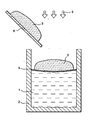
- a crucible 2 having a molten glass bath 1 on the surface of which can be formed a protective layer 4.
- waste is poured to the surface of the glass bath.
- This feed system 6 can also serve as a support or waste holding system 3, which allows to carry out, during the waste incorporation step in the crucible 2, part of the waste combustion 3.
- the reference 5 designates gases, solids or liquids added to the crucible to act on the oxidation and combustion of the waste 3.
- It may be a flow of gaseous oxygen and / or a plasma of oxygen applied to waste 3 (also referred to as reactive load), and / or solid or liquid oxidants, and / or additives of vitrifications (glass frit, silica, carbonates, various oxides ).
- Gaseous, liquid or solid oxidants may be added to the reactive charge one after the other or at the same time. Their choice depends on the waste considered, the constraints related to the process, the compatibility of the chemical elements provided by the oxidants used with the composition of the final glass.
- the main function of the protective layer 4 is to increase the coefficient of surface tension on the surface of the glass bath 1.
- the layer Temporary protection has a higher surface tension coefficient than molten glass at its working temperature (corresponding to a viscosity of about 100 dPa.s). This layer makes it possible to prevent, by the "development of inter-facial forces, with the particles in contact with it, the penetration of undesirable materials into the glass bath.
- the maintenance of the waste above the glass bath provided by a rigid support 6 during the step of incorporating the waste into the apparatus or the protective layer 4 on the surface of the glass bath are by temporary definition. It is useful during the period of combustion and oxidation of waste.
- the protective layer is to be destroyed to enter the final composition of the elaborate vitreous matrix.
- the destruction of the protective layer can be carried out naturally, that is to say that the layer is removed by corrosion. It can result either from the effect of the technology used to carry out the combustion-vitrification treatment (for example, an increase in the temperature of the glass bath, in particular by using a plasma torch), or the addition of within these protective layers, reagents that will dissolve the layer after a residence time corresponding to the desired life of said layer.
- a chemical attack by elements added at the end of the combustion period can be particularly interesting, if these elements enter the composition of the glass final.
- the chemical composition of the protective layer or layers must therefore preferably be compatible with the composition of said matrix.
- the elements used in the composition of the vitreous matrix may also, depending on their chemical introduction form (oxidant, reducing agent, etc.), and prior to the destruction of the protective layer or the overcoat, participate in reactions with products derived from waste 3.
- a borosilicate glass type consisting mainly of 41.5% SiO 2 (silica), 18.5% B 2 O 3 (boric anhydride), 10% Al 2 O 3 (alumina), 20% Na 2 O is used ( sodium oxide), 5% Fe 2 O 3 .
- This glass cast has a viscosity of about 40 dPa.s at 1200 ° C.
- the mass of the glass roof used for the experiments is 300 g and has a surface area of 7.3 ⁇ 10 -3 m 2 .
- the waste 3 brought to the surface of the glass bath formed from this glazed cast iron is a mixture of 25 g of powders containing coke (simulating the organic fraction of a waste incinerable), barium sulfate, nickel oxides , iron and copper. To this are added two sulphide beads of diameter 5 mm.
- the total combustion of 300 g of organic waste containing 120 g of minerals, including barium sulfate, oxides of iron, nickel and copper is obtained after holding under a plasma torch for a period of less than 7 minutes.
- the combustion-vitrification furnace is preferably designed in multizones.
- part of the crucible is intended for the actual incineration of the waste (including the device for introducing and maintaining the waste, the establishment of the protective layer and the addition of oxidants), another part is intended for refining glass (and at the same time for recycling gas cleaning dusts).
Landscapes
- Chemical & Material Sciences (AREA)
- Engineering & Computer Science (AREA)
- Materials Engineering (AREA)
- Organic Chemistry (AREA)
- Processing Of Solid Wastes (AREA)
- Incineration Of Waste (AREA)
- Gasification And Melting Of Waste (AREA)
Abstract
Description
L'invention concerne un procédé permettant de réaliser la combustion et l'oxydation complète de la fraction minérale d'un déchet traité dans un appareil de combustion-vitrification directe.The invention relates to a method for carrying out the complete combustion and oxidation of the mineral fraction of a treated waste in a direct combustion-vitrification apparatus.
Depuis plusieurs années, de nombreux travaux de recherche et développement s'intéressent au problème de l'immobilisation de la fraction toxique des déchets combustibles ou des déchets mixtes (organiques et inorganiques) dans une matrice de type vitreuse ou vitro-céramique (appelée matrice de confinement), la toxicité des déchets pouvant être de nature chimique (métaux lourds) ou radioactive.For a number of years, many research and development projects have focused on the problem of immobilizing the toxic fraction of combustible waste or mixed waste (organic and inorganic) in a vitreous or vitro-ceramic matrix containment), the toxicity of the waste being of a chemical nature (heavy metals) or radioactive.
Ce type de travaux est mené par de multiples équipes de par le monde car les intérêts desdits travaux sont multiples : stabiliser le déchet à traiter, aboutir à une matrice de confinement éprouvée et durable, réduire le volume initial des déchets...This type of work is conducted by multiple teams around the world because the interests of this work are multiple: stabilize the waste to be treated, lead to a proven and sustainable containment matrix, reduce the initial volume of waste ...
Une des solutions de l'art connu propose un procédé industriel qui permet de réaliser à la fois la combustion du déchet et la vitrification de la fraction minérale des déchets dans un appareil unique. Différentes technologies mises en oeuvre consistent à constituer par fusion un bain de verre ou matrice en fusion et à introduire à sa surface le déchet à traiter. Ainsi, la fraction organique du déchet se décompose ou brûle suivant la nature de l'atmosphère à l'intérieur de l'appareil, tandis que la fraction minérale, à la volatilité près, est incorporée de façon plus ou moins homogène dans la matrice en fusion.One of the solutions of the known art proposes an industrial process which makes it possible to perform both the combustion of the waste and the vitrification of the mineral fraction of the waste in a single apparatus. Different technologies implemented consist in melt a glass bath or molten matrix and introduce on its surface the waste to be treated. Thus, the organic fraction of the waste decomposes or burns according to the nature of the atmosphere inside the apparatus, while the mineral fraction, with the volatility, is incorporated more or less homogeneously in the matrix. fusion.
Plusieurs voies technologiques ont été explorées, au niveau des laboratoires ou à des échelles industrielles, pour obtenir ces résultats.Several technological pathways have been explored, at the level of laboratories or at industrial scales, to obtain these results.
Dans les variantes les plus souvent rencontrées, le procédé de combustion-vitrification des déchets utilise un dispositif qui comprend un creuset, qui peut être en réfractaire ou en structure métallique refroidie, fixe ou mobile en rotation autour de son axe, un moyen de chauffage et de mise en fusion de la matrice vitreuse ou vitro-céramique de confinement des déchets qui est obtenue soit par des électrodes immergées, soit par induction dans un suscepteur ou directement dans la matrice de confinement rendue conductrice, soit encore par plasma. Plusieurs modes de chauffage peuvent être associés pour obtenir l'homogénéité en température de la matrice de confinement, ainsi que l'augmentation du rendement de l'incinération. Chacune de ces configurations possède bien sûr ses avantages et ses inconvénients, mais toutes sont focalisées sur l'efficacité, la fiabilité et la simplification du procédé de combustion-vitrification.In the most frequently encountered variants, the waste combustion-vitrification process uses a device which comprises a crucible, which may be in refractory form or in a cooled metal structure, fixed or mobile in rotation about its axis, heating means and melting of the vitreous or glass-ceramic matrix of waste confinement which is obtained either by immersed electrodes, or by induction in a susceptor or directly in the conductive confinement matrix, or again by plasma. Several heating modes can be combined to obtain the temperature homogeneity of the confinement matrix, as well as the increase in the efficiency of the incineration. Each of these configurations has of course its advantages and disadvantages, but all are focused on the efficiency, reliability and simplification of the combustion-vitrification process.
L'objectif des procédés de combustion-vitrification des déchets est de garantir un confinement performant et durable au sein d'une matrice de type verre des éléments toxiques contenus dans le déchet initial. Or, les propriétés de confinement des déchets au sein de la matrice, c'est-à-dire la qualité et l'homogénéité de la matrice de confinement finale obtenue, dépendent fortement de la nature de l'atmosphère et des conditions de traitement en surface du bain de verre (température, accumulation de matières, brassage...). Une matrice de confinement fortement hétérogène incluant des phases démixées métalliques de tailles importantes, voire des strates de différentes natures, est donc préjudiciable en terme de stockage de déchets, en particulier de déchets dangereux.The objective of waste combustion-vitrification processes is to ensure high-performance and durable containment within a glass matrix of the toxic elements contained in the initial waste. However, the confinement properties of the waste within the matrix, ie the quality and homogeneity of the final confinement matrix obtained, strongly depend on the nature of the atmosphere and the treatment conditions. surface of the glass bath (temperature, accumulation of materials, mixing ...). A highly heterogeneous confinement matrix including metal demixed phases of large sizes, or even strata of different natures, is therefore detrimental in terms of storage of waste, in particular hazardous waste.
Les phénomènes chimiques en cours d'incinération ou d'interaction entre le déchet à traiter et la matrice en fusion peuvent conduire à de telles hétérogénéités.Chemical phenomena during incineration or interaction between the waste to be treated and the molten matrix can lead to such heterogeneities.
Par exemple, lors de l'incinération de déchets riches en minéraux, ceux-ci peuvent rapidement former des espèces métalliques ou des sulfures, longs à oxyder, et qui par différence de densité vont quasi irrémédiablement traverser la surface du bain et sédimenter. C'est le cas, par exemple, des sulfures de nickel ou de fer qui s'accumulent au fond du bain de verre, entraînant éventuellement avec eux des radioéléments dans le cas de déchets radioactifs.For example, during the incineration of waste rich in minerals, they can quickly form metal species or sulphides, long to oxidize, and which by difference in density will almost irremediably cross the surface of the bath and sediment. This is the case, for example, of nickel or iron sulphides which accumulate at the bottom of the glass bath, possibly resulting with them radioelements in the case of radioactive waste.
Plus simplement, les phénomènes de réduction chimique seuls peuvent conduire à la réduction d'espèces à l'état de métal en surface du bain si leur temps de séjour à cet endroit, sensé être oxydant, est trop faible pour permettre leur oxydation.More simply, the chemical reduction phenomena alone can lead to the reduction of species in the metal state at the surface of the bath if their residence time at this place, supposed to be oxidizing, is too low to allow their oxidation.
A titre d'exemple,
Les différentes technologies de l'art connu mises en oeuvre ne sont pas toutes égales devant ces phénomènes chimiques et d'interactions. Celles créant des atmosphères réductrices en surface du bain de verre sont les plus productrices de ces phases hétérogènes. Par ailleurs, si les technologies utilisant des plasmas d'oxygène permettent de diminuer sensiblement ces phénomènes, elles ne parviennent cependant pas à les éviter totalement. Les études visant à terminer l'oxydation de ces phases au sein de la matrice vitreuse ne permettent pas à ce jour de supprimer quantitativement ces phénomènes.The various technologies of the known art used are not all equal before these chemical phenomena and interactions. Those creating reducing atmospheres on the surface of the glass bath are the most productive of these heterogeneous phases. Moreover, although technologies using oxygen plasmas can significantly reduce these phenomena, they do not manage to avoid them altogether. Studies aiming to complete the oxidation of these phases within the vitreous matrix do not make it possible today to suppress these phenomena quantitatively.
Le but du procédé de combustion-vitrification décrit ci après est donc de remédier à ces inconvénients en permettant aux déchets et à leurs sous-produits de décomposition de s'oxyder suffisamment à la surface du bain de verre pour que les minéraux puissent s'incorporer au verre sans générer de phases sédimentées au fond du creuset de fusion.The purpose of the combustion-vitrification process described below is therefore to overcome these disadvantages by allowing the waste and their decomposition by-products to oxidize sufficiently on the surface of the glass bath so that the minerals can be incorporated. by glass without generating sedimented phases at the bottom of the melting crucible.
Ce but est atteint par un procédé permettant la combustion et l'oxydation complète de la fraction minérale d'un déchet combustible contenu dans un appareil destiné au traitement par combustion-vitrification directe de déchets, ledit procédé comprenant les étapes suivantes :
- une étape d'introduction dudit déchet dans l'appareil pour le déposer sur la surface d'un bain de verre en fusion contenu dans l'appareil,
- une étape de combustion et d'oxydation du déchet à la surface du bain de verre,
- une étape d'incorporation des produits de combustion dans le verre pendant laquelle le bain de verre, les produits de combustion, et d'éventuels adjuvants de vitrification ajoutés au bain de verre sont chauffés jusqu'à obtenir une masse liquide pâteuse,
- une étape pendant laquelle ladite masse est enlevée de l'appareil et laissée à refroidir pour obtenir au final ce qu'on appelle une matrice de confinement,
- a step of introducing said waste into the apparatus for depositing it on the surface of a bath of molten glass contained in the apparatus,
- a step of combustion and oxidation of the waste on the surface of the glass bath,
- a step of incorporating the combustion products in the glass during which the glass bath, the products of combustion, and any vitrification additives added to the glass bath are heated until a pasty liquid mass is obtained,
- a step during which said mass is removed from the apparatus and allowed to cool to finally obtain what is called a confinement matrix,
La couche de protection temporaire du bain de verre est une couche permettant le maintien des produits de combustion au-dessus de la surface du bain de verre pendant une durée déterminée. La couche de protection temporaire de surface possède ainsi des propriétés physico-chimiques qui lui permettent d'assurer, sur une durée suffisante, le maintien en surface du bain de verre des produits à traiter et des sous-produits en cours d'oxydation.The temporary protection layer of the glass bath is a layer for holding the combustion products above the surface of the glass bath for a determined period of time. The temporary surface protection layer thus has physico-chemical properties which enable it to ensure, for a sufficient duration, the maintenance of the surface of the glass bath of the products to be treated and by-products during oxidation.
Avantageusement, la couche de protection temporaire est réalisée selon l'une au moins des étapes suivantes :
- abaissement de la température de la surface du bain de verre,
- ajout de matière au-dessus de la surface du bain de verre.
- lowering the temperature of the surface of the glass bath,
- adding material above the surface of the glass bath.
Selon un mode de réalisation particulier, la couche de protection temporaire est complétée par l'ajout d'au moins une autre couche de surface, appelée sur-couche de protection temporaire, ladite au moins une sur-couche de protection temporaire ayant au moins l'une des fonctions suivantes :
- développer, sous l'effet du poids des déchets qui lui sont superposés, des forces inter faciales avec la couche de protection temporaire améliorant la non pénétration dans le bain de verre des particules issues desdits déchets,
- améliorer la répartition des contraintes mécaniques sur l'ensemble de la surface de la couche de protection temporaire grâce à un enchevêtrement des constituants de ladite sur-couche de protection temporaire ou à des liaisons chimiques qui solidarisent ladite sur-couche de protection temporaire,
- protéger la couche de protection temporaire d'une attaque chimique par les déchets.
- developing, as a result of the weight of the waste which is superimposed on it, inter-facial forces with the temporary protective layer improving the non-penetration into the glass bath of particles from said waste,
- improving the distribution of the mechanical stresses over the entire surface of the temporary protection layer by entangling the constituents of said temporary over-protective layer or by chemical bonds which solidify said temporary over-protective layer,
- protect the temporary protective layer from chemical attack by the waste.
Selon un cas particulier, au moins la couche de protection temporaire ou la ou les sur-couches de protection temporaires sont éliminées, avant l'étape d'incorporation, par action chimique. Il peut s'agir de l'action chimique des éléments qui l'entourent, c'est-à-dire des autres sur-couches, ou d'éléments ajoutés spécialement dans ce but.According to one particular case, at least the temporary protective layer or the temporary protective overcoat layer (s) are removed, before the incorporation step, by chemical action. It can be the chemical action of the elements around it, that is to say other layers, or elements added specifically for this purpose.
Selon un autre cas particulier, au moins la couche de protection temporaire ou la ou les sur-couches de protection temporaires sont éliminées, avant l'étape d'incorporation, par un moyen choisi parmi une élévation de la température du bain de verre, le bullage de la surface du bain de verre, une méthode mécanique ou une méthode utilisant les mouvements thermohydrauliques du bain de verre.According to another particular case, at least the temporary protective layer or the temporary protective overcoat layer (s) are removed, before the incorporation step, by means chosen from a rise in the temperature of the glass bath. bubbling of the surface of the glass bath, a mechanical method or method using the thermohydraulic motions of the glass bath.
Avantageusement, la couche de protection temporaire et la ou les sur-couches de protection temporaires ont une composition chimique qui est compatible avec la composition du bain de verre. Ainsi, les constituants de ces couches de protection peuvent au final être incorporés dans le bain de verre.Advantageously, the temporary protective layer and the temporary protective overcoat layer (s) have a chemical composition that is compatible with the composition of the glass bath. So, the constituents of these protective layers can ultimately be incorporated in the glass bath.
Selon un premier mode de réalisation particulier, la couche de protection temporaire et la ou les sur-couches de protection temporaires sont réalisées en dispersant, à la surface du bain de verre, de la matière divisée choisie parmi des poudres, des frittes, des paillettes ou des fibres.According to a first particular embodiment, the temporary protective layer and the temporary protective overcoat layer (s) are produced by dispersing, on the surface of the glass bath, the divided material chosen from powders, frits, and flakes. or fibers.
Selon un deuxième mode de réalisation particulier, la couche de protection temporaire et la ou les sur-couches de protection temporaires sont réalisées en dispersant, à la surface du bain de verre ou à la surface d'une couche déjà déposée, de la matière sous forme de gel. Le gel a l'avantage de s'étendre plus facilement que la matière divisée et permet de recouvrir plus facilement la totalité de la surface à protéger.According to a second particular embodiment, the temporary protective layer and the temporary protective overlay or layers are made by dispersing, on the surface of the glass bath or on the surface of a layer already deposited, the material under gel form. The gel has the advantage of spreading more easily than the divided material and makes it possible to cover more easily the entire surface to be protected.
Selon un troisième mode de réalisation particulier, la couche de protection temporaire et la ou les sur-couches de protection temporaires sont préfabriquées et déposées directement à la surface du bain de verre ou à la surface d'une couche déjà déposée.According to a third particular embodiment, the temporary protective layer and the temporary protective overlay or layers are prefabricated and deposited directly on the surface of the glass bath or on the surface of a layer already deposited.
Avantageusement, les moyens de maintien comprennent en outre un support rigide permettant de maintenir le déchet, pendant une durée déterminée, sous des vapeurs oxydantes émanant de gaz introduits dans l'appareil, au cours de l'étape d'introduction du déchet dans l'appareil.Advantageously, the holding means further comprise a rigid support making it possible to maintain the waste, for a determined period of time, under oxidizing vapors emanating from gases introduced into the apparatus, during the step of introducing the waste into the apparatus.
Avantageusement, le procédé comprend en outre une étape d'ajout d'oxydants au déchet, au cours de l'étape d'introduction du déchet et au cours de l'étape de combustion et d'oxydation du déchet à la surface du bain de verre. Les agents oxydants utilisés peuvent être, outre des gaz contenant de l'oxygène, des liquides ou des solides ajoutés au déchet ou aux produits de combustion en cours de traitement au-dessus du bain de verre. Ainsi, le support permettant de maintenir le déchet permet de retarder la pénétration du déchet dans le bain de verre avant que l'étape de combustion dudit déchet, ainsi que l'oxydation des sous produits de combustion de ce déchet, ne soit achevée : le déchet brûle à l'oxygène des gaz envoyés à la surface du bain de verre et l'on ajoute éventuellement des oxydants liquides ou solides pour achever ou accélérer la réaction d'oxydation des sous-produits de combustion du déchet. Ce procédé permet l'incinération complète des matières combustibles et l'oxydation suffisante des minéraux préalablement à leur incorporation dans la matrice vitreuse, évitant ainsi l'obtention d'une matrice de confinement dont les qualités seraient dénaturées par l'inclusion de phases réduites liées à un défaut d'oxydation au cours du procédé.Advantageously, the process further comprises a step of adding oxidants to the waste, during from the waste introduction stage and during the combustion and oxidation step of the waste to the surface of the glass bath. The oxidizing agents used may be, in addition to oxygen-containing gases, liquids or solids added to the waste or combustion products being treated above the glass bath. Thus, the support for maintaining the waste makes it possible to delay the penetration of the waste into the glass bath before the combustion step of said waste, as well as the oxidation of the combustion by-products of this waste, is completed: waste oxidizes the gas to the surface of the glass bath with oxygen, and liquid or solid oxidants are optionally added to complete or accelerate the oxidation reaction of the combustion by-products of the waste. This process allows the complete incineration of the combustible materials and the sufficient oxidation of the minerals prior to their incorporation into the vitreous matrix, thus avoiding obtaining a confinement matrix whose qualities would be denatured by the inclusion of reduced phases related to a lack of oxidation during the process.
Avantageusement, le déchet combustible est un déchet mixte organique et minéral.Advantageously, the combustible waste is a mixed organic and mineral waste.
L'un des avantages de ce procédé d'oxydation complète des fractions minérales du déchet combustible est qu'il est simple de mise en oeuvre et facilement adaptable à chaque problème posé grâce à la variation possible de la nature du support supportant le déchet au cours de son introduction dans le procédé, de la nature physico-chimique de la couche protectrice, de la nature chimique des oxydants employés et du mode de destruction de la couche protectrice. Ce procédé peut majoritairement trouver des applications dans le domaine du traitement des déchets radioactifs combustibles que l'on souhaite vitrifier. On peut citer comme exemple le traitement de matières riches en soufre, risquant de réagir avec le bain de verre ou de créer des sulfures au cours de leur incinération, des résines échangeuses d' ions, des sels enrobés dans une matrice organique, des boues...One of the advantages of this complete oxidation process of the mineral fractions of the combustible waste is that it is simple to implement and easily adaptable to each problem posed by the possible variation of the nature of the supporting support. the waste during its introduction into the process, the physico-chemical nature of the protective layer, the chemical nature of the oxidants employed and the mode of destruction of the protective layer. This process can mainly find applications in the field of the treatment of combustible radioactive waste that it is desired to vitrify. An example is the treatment of materials rich in sulfur, which may react with the glass bath or create sulphides during their incineration, ion exchange resins, salts embedded in an organic matrix, sludge. ..
Par extension, des applications pour déchets industriels spéciaux peuvent également être envisagées.By extension, applications for special industrial waste can also be considered.
L'invention sera mieux comprise et d'autres avantages et particularités apparaîtront à la lecture de la description qui va suivre, donnée à titre d'exemple non limitatif, accompagnée du dessin annexé de la figure qui est un schéma illustrant une vue en coupe du dispositif utilisé pour la mise en oeuvre du procédé de l'invention.The invention will be better understood and other advantages and particularities will appear on reading the following description, given by way of non-limiting example, accompanied by the appended drawing of the figure which is a diagram illustrating a sectional view of the device used for the implementation of the method of the invention.
Sur la figuré, on peut voir un creuset 2 comportant un bain de verre en fusion 1 à la surface duquel peut être formée une couche de protection 4. A l'aide d'un système d'alimentation 6, on verse des déchets à la surface du bain de verre. Ce système d'alimentation 6 peut également servir de support ou système de maintien des déchets 3, ce qui permet de réaliser, au cours de l'étape d'incorporation des déchets dans le creuset 2, une partie de la combustion des déchets 3. La référence 5 désigne des gaz, des solides ou des liquides ajoutés dans le creuset pour agir sur l'oxydation et la combustion des déchets 3. Il peut s'agir d'un flux d'oxygène gazeux et/ou d'un plasma d'oxygène appliqué au déchet 3 (également dénommé sous le terme de charge réactive), et/ou d'oxydants solides ou liquides, et/ou d'adjuvants de vitrifications (fritte de verre, silice, carbonates, oxydes divers...).On the figure, we can see a
Pour atteindre l'objectif visé, à savoir éviter la non incorporation au verre d'espèces réduites de type métal ou sulfure, par exemple, et éviter ultérieurement des phénomènes de sédimentation, il convient d'assurer au-dessus du bain de verre la combustion du déchet jusqu'à l'oxydation complète des minéraux qu'il contient. Le support du déchet par une pièce mécanique au cours de l'étape d'incorporation ou d'alimentation des déchets dans l'appareil ou le maintien des produits de combustion grâce à une couche de protection 4 permet en particulier l'incinération complète des matières combustibles et l'oxydation suffisante des matières minérales pour leur incorporation dans une matrice de confinement. Ces deux modes de maintien permettent de faire réagir au-dessus de la surface du bain de verre les déchets à traiter soit avec des gaz contenant de l'oxygène, soit avec des oxydants solides ou liquides (nitrates, sulfates, acide nitrique, acide sulfurique...). Les oxydants gazeux, liquides ou solides peuvent être ajoutés à la charge réactive l'un après l'autre ou en même temps. Leurs choix dépend du déchet considéré, des contraintes liées au procédé, de la compatibilité des éléments chimiques apportés par les oxydants utilisés avec la composition du verre final.In order to achieve the objective of avoiding the non-incorporation of reduced species such as metal or sulphide, for example, and subsequently avoiding sedimentation phenomena, it is advisable to ensure above the glass bath the combustion from waste to the complete oxidation of the minerals it contains. The support of the waste by a mechanical part during the step of incorporating or feeding the waste into the device or maintaining the combustion products with a
On a vu plus haut que la fonctionnalité principale de la couche de protection 4 est d'augmenter le coefficient de tension superficielle à la surface du bain de verre 1. Pour assurer cette fonction, la couche de protection temporaire a un coefficient de tension superficielle plus élevé que celui du verre fondu à sa température d'élaboration (correspondant à une viscosité d'environ 100 dPa.s). Cette couche permet d'empêcher, par le "développement de forces inter faciales, avec les particules à son contact, la pénétration de matières indésirables à l'intérieur du bain de verre.It has been seen above that the main function of the
Par ailleurs, le maintien du déchet au-dessus du bain de verre assuré par un support rigide 6 au cours de l'étape d'incorporation des déchets dans l'appareil ou la couche de protection 4 à la surface du bain de verre sont par définition temporaires. Il est utile durant la période de combustion et d'oxydation des déchets. La couche de protection est appelée à être détruite pour entrer dans la composition finale de la matrice vitreuse élaborée. La destruction de la couche de protection peut être réalisée naturellement, c'est à dire que la couche est éliminée par corrosion. Elle peut résulter soit de l'effet de la technologie mise en oeuvre pour réaliser le traitement de combustion-vitrification (par exemple, une élévation de la température du bain de verre, notamment en utilisant une torche à plasma), soit de l'ajout, au sein de ces couches de protection, de réactifs qui vont dissoudre la couche après un temps de séjour correspondant à la durée de vie souhaitée de ladite couche. Une attaque chimique par des éléments ajoutés en fin de période de combustion peut être particulièrement intéressante, si ces éléments entrent dans la composition du verre final. La composition chimique de la ou les couches de protection doit donc être de préférence compatible avec la composition de ladite matrice. On choisit donc, de préférence, pour la composition des couches et sur-couches de protection des éléments entrant dans la composition de la matrice vitreuse. Ces éléments ajoutés peuvent aussi, en fonction de leur forme chimique d'introduction (oxydant, réducteur...), et préalablement à la destruction de la couche de protection ou de la sur-couche, participer à des réactions avec des produits issus des déchets 3.Furthermore, the maintenance of the waste above the glass bath provided by a
On utilise une fonte verrière de type borosilicaté principalement constituée de 41,5% SiO2 (silice), 18,5% B2O3 (anhydride borique), 10% Al2O3 (alumine), 20% Na2O (oxyde de sodium), 5% de Fe2O3. Cette fonte verrière a une viscosité de 40 dPa.s environ à 1200°C. La masse de la fonte verrière utilisée pour les expériences est de 300 g et offre une surface de 7,3.10-3 m2. Les déchets 3 portés à la surface du bain de verre formé à partir de cette fonte verrière sont un mélange de 25 g de poudres contenant du coke (simulant la fraction organique d'un déchet incinérable), du sulfate de baryum, des oxydes de nickel, fer et cuivre. A cela sont ajoutées deux billes de sulfures de diamètre 5 mm.A borosilicate glass type consisting mainly of 41.5% SiO 2 (silica), 18.5% B 2 O 3 (boric anhydride), 10% Al 2 O 3 (alumina), 20% Na 2 O is used ( sodium oxide), 5% Fe 2 O 3 . This glass cast has a viscosity of about 40 dPa.s at 1200 ° C. The mass of the glass roof used for the experiments is 300 g and has a surface area of 7.3 × 10 -3 m 2 . The
Après un traitement d'une heure à 1200°C sous air et en l'absence d'une couche de protection 4, de nombreuses billes d'aspect métallique sont retrouvées au fond du creuset, mettant en évidence les phénomènes dont on souhaite éviter l'apparition.After treatment for one hour at 1200 ° C. under air and in the absence of a
On reproduit cette expérience en plaçant cette fois-ci sur le bain de verre 1 une couche de protection 4 riche en silice et ayant une épaisseur d'environ 2mm. La couche de protection forme ainsi avec la fonte verrière, remontée par capillarité, un mélange visqueux contenant des fines particules de silice partiellement dissoutes. Après un traitement d'une heure à 1200°C sous air, on remarque qu'aucune bille n'a traversé la surface du bain de verre. En fait, les déchets 3 ont pour une bonne part brûlé et de nombreuses billes métalliques ont été formées qui, grâce à la couche de protection temporaire de surface 4, sont restées au-dessus de la surface du bain de verre. La présence de ces billes s'explique par le fait que l'apport en oxygène est insuffisant en quantité pour terminer l'oxydation des déchets.This experiment is reproduced by placing this time on the glass bath 1 a
Notons que dans le cas exposé ci-dessus, on n'a pas besoin d'ajouter de sur-couches à la couche de protection 4 pour maintenir le déchet et les produits de combustion en surface.Note that in the case discussed above, there is no need to add overcoats to the
L'élimination de cette couche de protection est obtenue dans les mêmes conditions de température par l'ajout de Na2B4O7. Notons que ces espèces chimiques de destruction de la couche de protection ont été choisies pour entrer dans la composition du verre final.The elimination of this protective layer is obtained under the same temperature conditions by the addition of Na 2 B 4 O 7 . Note that these chemical species of destruction of the protective layer were chosen to enter the composition of the final glass.
La même expérience est reproduite à l'échelle industrielle : 30 kg de fonte verrière sont chauffés par induction directe dans un creuset en métal refroidi et surplombé par un dispositif de génération d'un plasma d'arc d'oxygène transféré entre deux torches métalliques, on traite 3 kg de déchets du même type que précédemment sur une couche protectrice. A la fin du procédé de combustion-vitrification, on aboutit aux mêmes conclusions que celles obtenues précédemment : les nombreuses billes métalliques formées au cours du procédé sont restées au-dessus de la surface du bain de verre grâce à l'établissement d'une couche de quelques millimètres riche en grains de silice.The same experiment is reproduced on an industrial scale: 30 kg of cast iron are heated by direct induction in a cooled metal crucible and overhung by a device for generating an oxygen arc plasma transferred between two metal torches, 3 kg of waste of the same type as above is treated on a protective layer. At the end of the combustion-vitrification process, one reaches the same conclusions as those obtained previously: the many metal balls formed during the process remained above the surface of the glass bath thanks to the establishment of a layer a few millimeters rich in silica grains.
La présence des nombreuses billes métalliques est le signe d'une oxydation partielle des minéraux. Cela est dû au fait que l'atmosphère est insuffisamment oxydante.The presence of many metal balls is a sign of partial oxidation of minerals. This is due to the fact that the atmosphere is insufficiently oxidizing.
Dans un autre exemple, la combustion totale de 300 g de déchet organique contenant 120 g de minéraux, dont du sulfate de baryum, des oxydes de fer, de nickel et de cuivre est obtenue après maintien sous une torche à plasma pendant une durée de moins de 7 minutes.In another example, the total combustion of 300 g of organic waste containing 120 g of minerals, including barium sulfate, oxides of iron, nickel and copper is obtained after holding under a plasma torch for a period of less than 7 minutes.
Dans un creuset réfractaire, 22,45 g des produits de combustion prélevés sont ensuite déposés sur 200 g de verre borosilicaté et sont ensuite recouverts de 60 g de verre borosilicaté et de 107 g de nitrate de sodium. Le mélange est introduit à 1200°C dans un four. Les minéraux sont incorporés au verre en totalité et on observe qu'aucune bille ne sédimente au fond du creuset. Le temps de séjour prolongé sous l'oxygène de la torche à plasma et l'ajout d'un oxydant a permis d'empêcher la formation d'espèces réduites sédimentées. L'absence, d'ajouts d'oxydants liquides ou gazeux, un temps de séjour trop court sous le plasma d'oxygène, un maintien insuffisant du déchet au-dessus du bain de verre ne permettent pas d'aboutir à ce résultat.In a refractory crucible, 22.45 g of the combustion products removed are then deposited on 200 g of borosilicate glass and are then covered with 60 g of borosilicate glass and 107 g of sodium nitrate. The mixture is introduced at 1200 ° C in an oven. The minerals are incorporated into the glass all and we observe that no marble sediments at the bottom of the crucible. The extended residence time under the oxygen of the plasma torch and the addition of an oxidant prevented the formation of reduced sedimented species. The absence of additions of liquid or gaseous oxidants, a residence time which is too short under the oxygen plasma, and an insufficient maintenance of the waste above the glass bath do not make it possible to achieve this result.
Dans une application pratique du procédé selon l'invention consistant à réaliser une ou plusieurs couches protectrices sur un bain de verre en fusion, le four de combustion-vitrification est de préférence conçu en multizones. En particulier, une partie du creuset est destinée à l'incinération proprement dite des déchets (comportant le dispositif d'introduction et de maintien du déchet, l'établissement de la couche de protection et l'ajout d'oxydants), une autre partie est destinée à l'affinage du verre (et par la même occasion au recyclage des poussières d'épuration des gaz).In a practical application of the process according to the invention consisting in producing one or more protective layers on a molten glass bath, the combustion-vitrification furnace is preferably designed in multizones. In particular, part of the crucible is intended for the actual incineration of the waste (including the device for introducing and maintaining the waste, the establishment of the protective layer and the addition of oxidants), another part is intended for refining glass (and at the same time for recycling gas cleaning dusts).
Claims (12)
- A process for combustion and complete oxidation of the mineral fraction of combustible waste contained in an apparatus (2) designed for direct combustion-vitrification treatment of waste (3), said process comprising the following steps:- an introduction step of said waste into the apparatus for depositing it onto the surface of a molten glass bath (1) contained in the apparatus (2),- a combustion and oxidation step of the waste on the surface of the glass bath (1),- an incorporation step of combustion products into the glass during which the glass bath (1), the combustion products, and optional vitrification additives added to the glass bath (1) are heated to obtain a pasty liquid mass,- a step during which said mass is removed from the apparatus (2) and left to cool to produce the final product called a confinement matrix,said process being characterised in that combustion and complete oxidation of the mineral fraction of the waste are carried out for one part during the introduction step of the waste and for another part during the combustion and oxidation step of the waste on the surface of the glass bath, due to the presence of holding means for holding the waste, during a determined period, in oxidising vapours emanating from gases introduced into the apparatus, said holding means of the waste comprising a surface layer, called a temporary protective layer (4), present at the surface of the glass bath (1), which holds the waste on the surface of the glass bath (1), for a predetermined period, in said oxidising vapours emanating from the gases introduced into the apparatus (2), said layer having a higher surface tension coefficient than that of the molten glass bath (1).
- The process as claimed in the preceding claim, characterised in that the temporary protective layer (4) is formed according to at least one of the following steps:- lowering of the temperature of the surface of the glass bath (1),- addition of material above the surface of the glass bath.
- The process as claimed in claim 1, characterised in that the temporary protective layer (4) is completed by addition of at least one other surface layer, called a temporary protective overlayer, said at least one temporary protective overlayer having at least one of the following functions:- to develop, under the effect of the weight of the waste superposed thereon, inter-facial forces with the temporary protective layer improving non-penetration of the particles originating from said waste into the glass bath,- to improve distribution of the mechanical stresses on the entire surface of the temporary protective layer due to interlocking of the constituents of said temporary protective overlayer or to chemical bonds which solidify said temporary protective overlayer,- to protect the temporary protective layer of chemical attack by the waste.
- The process as claimed in any one of claims 1 or 3, characterised in that at least the temporary protective layer or the temporary protective overlayer or the temporary protective overlayers are eliminated, prior to the incorporation step, by chemical action.
- The process as claimed in any one of claims 1 or 3, characterised in that at least the temporary protective layer or the temporary protective overlayer or the temporary protective overlayers are eliminated, prior to the incorporation step, by way of means selected from elevation of the temperature of the glass bath (1), the bubbling of the surface of the glass bath (1), a mechanical method or a method using the thermohydraulic movements of the glass bath.
- The process as claimed in any one of claims 1 to 5, characterised in that the temporary protective layer and the temporary protective overlayer or the temporary protective overlayers have a chemical composition which is compatible with the composition of the glass bath (1).
- The process as claimed in any one of claims 1 to 6, characterised in that the temporary protective layer and the temporary protective overlayer or the temporary protective overlayers are made by dispersing, on the surface of the glass bath, divided material selected from powders, frits, chips or fibres.
- The process als claimed in any one of claims 1 to 6, characterised in that the temporary protective layer and the temporary protective overlayer or the temporary protective overlayers are made by dispersing, on the surface of the glass bath or on the surface of a layer already deposited, of material in gel form.
- The protective process as claimed in any one of claims 1 to 6, characterised in that the temporary protective layer and the temporary protective overlayer or the temporary protective overlayers are prefabricated and deposited directly onto the surface of the glass bath (1) or onto the surface of a layer already deposited.
- The process as claimed in any one of the preceding claims, characterised in that the holding means further comprise a rigid support for holding the waste, for a determined period, in oxidising vapours emanating from gases introduced into the apparatus, during the introduction step of the waste into the apparatus.
- The process as claimed in any one of the preceding claims, characterised in that the process further comprises an addition step of oxidants to the waste, during the introduction step of the waste and during the combustion and oxidation step of the waste to the surface of the glass bath.
- The process as claimed in any one of the preceding claims, characterised in that the combustible waste is mixed organic and mineral waste.
Applications Claiming Priority (2)
| Application Number | Priority Date | Filing Date | Title |
|---|---|---|---|
| FR0451035A FR2870758B1 (en) | 2004-05-26 | 2004-05-26 | METHOD FOR COMBUSTION AND COMPLETE OXIDATION OF THE MINERAL FRACTION OF A TREATED WASTE IN A DIRECT COMBUSTION-VITRIFICATION APPARATUS |
| PCT/FR2005/050365 WO2005118492A1 (en) | 2004-05-26 | 2005-05-25 | Method enabling the complete combustion and oxidation of the mineral fraction of waste treated in a direct combustion-vitrification device |
Publications (2)
| Publication Number | Publication Date |
|---|---|
| EP1751069A1 EP1751069A1 (en) | 2007-02-14 |
| EP1751069B1 true EP1751069B1 (en) | 2011-10-12 |
Family
ID=34946564
Family Applications (1)
| Application Number | Title | Priority Date | Filing Date |
|---|---|---|---|
| EP05766648A Expired - Lifetime EP1751069B1 (en) | 2004-05-26 | 2005-05-25 | Method enabling the complete combustion and oxidation of the mineral fraction of waste treated in a direct combustion-vitrification device |
Country Status (10)
| Country | Link |
|---|---|
| US (1) | US8003845B2 (en) |
| EP (1) | EP1751069B1 (en) |
| JP (2) | JP5090157B2 (en) |
| KR (1) | KR101243642B1 (en) |
| CN (1) | CN1997604B (en) |
| AT (1) | ATE528263T1 (en) |
| ES (1) | ES2374295T3 (en) |
| FR (1) | FR2870758B1 (en) |
| RU (1) | RU2401810C2 (en) |
| WO (1) | WO2005118492A1 (en) |
Families Citing this family (5)
| Publication number | Priority date | Publication date | Assignee | Title |
|---|---|---|---|---|
| FR2870758B1 (en) * | 2004-05-26 | 2006-08-04 | Commissariat Energie Atomique | METHOD FOR COMBUSTION AND COMPLETE OXIDATION OF THE MINERAL FRACTION OF A TREATED WASTE IN A DIRECT COMBUSTION-VITRIFICATION APPARATUS |
| US10210340B2 (en) | 2007-07-05 | 2019-02-19 | Blackberry Limited | File sharing with a hostile system |
| FR2934183B1 (en) * | 2008-07-28 | 2011-02-11 | Commissariat Energie Atomique | PROCESS FOR CONTAINING WASTE BY VITRIFICATION IN METAL POTS. |
| US9368241B2 (en) | 2012-06-29 | 2016-06-14 | Ge-Hitachi Nuclear Energy Americas Llc | System and method for processing and storing post-accident coolant |
| FR3008222B1 (en) * | 2013-07-08 | 2015-07-31 | Commissariat Energie Atomique | PROCESS FOR TREATING AN ABSORBENT NEEDLE CONTAINING CONTAMINATED BORON CARBIDE AND SODIUM |
Family Cites Families (7)
| Publication number | Priority date | Publication date | Assignee | Title |
|---|---|---|---|---|
| ES2047074T3 (en) * | 1988-09-10 | 1994-02-16 | Sorg Gmbh & Co Kg | PROCEDURE FOR THE TRANSFORMATION INTO GLASS OF SOLID MATERIALS OF WASTE, IN LARGE PART WITHOUT WATER, AS WELL AS A DEVICE FOR CARRYING OUT THE PROCEDURE. |
| ATE119308T1 (en) * | 1988-12-13 | 1995-03-15 | Sorg Gmbh & Co Kg | METHOD FOR OPERATING A GLASS MELTING FURNACE. |
| US5186112A (en) * | 1989-02-23 | 1993-02-16 | Isover Saint-Gobain | Method and apparatus for melting materials containing inorganic material fibers by the supply of oxygen rich gas |
| US5100453A (en) * | 1991-03-07 | 1992-03-31 | Glasstech, Inc. | Method for recycling scrap mineral fibers |
| FR2746037B1 (en) * | 1996-03-13 | 1998-05-15 | PROCESS FOR THE VITRIFICATION TREATMENT OF ASBESTOSED WASTE, PARTICULARLY FROM THE BUILDING, AND INSTALLATION FOR CARRYING OUT SAID METHOD | |
| US6576807B1 (en) * | 1998-12-01 | 2003-06-10 | Société Générale pour les Techniques Nouvelles-SGN | Method and apparatus for incinerating and vitrifying of waste, in particular radioactive waste |
| FR2870758B1 (en) * | 2004-05-26 | 2006-08-04 | Commissariat Energie Atomique | METHOD FOR COMBUSTION AND COMPLETE OXIDATION OF THE MINERAL FRACTION OF A TREATED WASTE IN A DIRECT COMBUSTION-VITRIFICATION APPARATUS |
-
2004
- 2004-05-26 FR FR0451035A patent/FR2870758B1/en not_active Expired - Fee Related
-
2005
- 2005-05-25 ES ES05766648T patent/ES2374295T3/en not_active Expired - Lifetime
- 2005-05-25 EP EP05766648A patent/EP1751069B1/en not_active Expired - Lifetime
- 2005-05-25 WO PCT/FR2005/050365 patent/WO2005118492A1/en not_active Ceased
- 2005-05-25 AT AT05766648T patent/ATE528263T1/en not_active IP Right Cessation
- 2005-05-25 KR KR1020067024504A patent/KR101243642B1/en not_active Expired - Fee Related
- 2005-05-25 RU RU2006146059/03A patent/RU2401810C2/en active
- 2005-05-25 JP JP2007514040A patent/JP5090157B2/en not_active Expired - Fee Related
- 2005-05-25 CN CN200580016804XA patent/CN1997604B/en not_active Expired - Fee Related
- 2005-05-25 US US11/597,537 patent/US8003845B2/en not_active Expired - Fee Related
-
2012
- 2012-05-16 JP JP2012112288A patent/JP2012196672A/en not_active Withdrawn
Also Published As
| Publication number | Publication date |
|---|---|
| KR20070026519A (en) | 2007-03-08 |
| JP2008500162A (en) | 2008-01-10 |
| ES2374295T3 (en) | 2012-02-15 |
| US8003845B2 (en) | 2011-08-23 |
| EP1751069A1 (en) | 2007-02-14 |
| FR2870758A1 (en) | 2005-12-02 |
| JP2012196672A (en) | 2012-10-18 |
| JP5090157B2 (en) | 2012-12-05 |
| RU2006146059A (en) | 2008-07-10 |
| US20080264311A1 (en) | 2008-10-30 |
| RU2401810C2 (en) | 2010-10-20 |
| WO2005118492A1 (en) | 2005-12-15 |
| KR101243642B1 (en) | 2013-03-14 |
| CN1997604B (en) | 2013-11-13 |
| ATE528263T1 (en) | 2011-10-15 |
| FR2870758B1 (en) | 2006-08-04 |
| CN1997604A (en) | 2007-07-11 |
Similar Documents
| Publication | Publication Date | Title |
|---|---|---|
| EP2303786B1 (en) | Method for confining waste by vitrification in metal pots | |
| EP1904411B1 (en) | Method for confining a substance by vitrification | |
| EP1609766A1 (en) | Method for making glass raw materials | |
| EP2415055B1 (en) | Process for packaging radioactive wastes in the form of synthetic rock | |
| WO2003084883A1 (en) | Vitrification furnace and method with dual heating means | |
| EP3856688A1 (en) | Submerged burner furnace | |
| EP1751069A1 (en) | Method enabling the complete combustion and oxidation of the mineral fraction of waste treated in a direct combustion-vitrification device | |
| CH640884A5 (en) | PROCESS FOR THE MANUFACTURE OF A PLATINOID COMPRISING A DISPERSE PHASE OF A REFRACTORY OXIDE AND PRODUCT. | |
| Wang et al. | Effect of Fe/SiO2 ratio and cooling regime on As stability in copper smelting slag | |
| WO2022112723A1 (en) | Method for treating glass waste | |
| Liu et al. | Combustion behavior and mechanism of TC25 alloy | |
| EP1383137A1 (en) | Process of immobilising metallic sodium in glass | |
| EP4121574B1 (en) | Method for recovering metals contained in spent catalysts from ferro-alloys | |
| EP0975816B1 (en) | Method for recycling brass foundry waste | |
| FR2479540A1 (en) | PROCESS FOR PROCESSING MAGNESIUM ELEMENTS, MADE RADIOACTIVE | |
| EP2252712A1 (en) | Novel additive for treating resulphurized steel | |
| EP1678337B1 (en) | Method of decontaminating refractory material containing hexavalent chrome | |
| EP0596774B1 (en) | Process for vitrifying solid residues obtained by burning household and/or industrial refuse, and product obtained by this process | |
| WO2008040773A1 (en) | Process for vitrifying fission products | |
| WO1997015355A1 (en) | Method for processing waste containing metal contaminants using a reducing agent | |
| WO1999048332A1 (en) | Electric melting of a mixture capable of being vitrified with cooled immersed electrode(s); cooled immersed electrode | |
| EP1582508A2 (en) | Method for treating residues resulting from the puriication of garbage incineration fumes and produt obtained |
Legal Events
| Date | Code | Title | Description |
|---|---|---|---|
| PUAI | Public reference made under article 153(3) epc to a published international application that has entered the european phase |
Free format text: ORIGINAL CODE: 0009012 |
|
| 17P | Request for examination filed |
Effective date: 20061115 |
|
| AK | Designated contracting states |
Kind code of ref document: A1 Designated state(s): AT BE BG CH CY CZ DE DK EE ES FI FR GB GR HU IE IS IT LI LT LU MC NL PL PT RO SE SI SK TR |
|
| DAX | Request for extension of the european patent (deleted) | ||
| 17Q | First examination report despatched |
Effective date: 20080702 |
|
| RAP1 | Party data changed (applicant data changed or rights of an application transferred) |
Owner name: COMMISSARIAT A L'ENERGIE ATOMIQUE ET AUX ENERGIES Owner name: COMPAGNIE GENERALE DES MATIERES NUCLEAIRES |
|
| GRAP | Despatch of communication of intention to grant a patent |
Free format text: ORIGINAL CODE: EPIDOSNIGR1 |
|
| GRAS | Grant fee paid |
Free format text: ORIGINAL CODE: EPIDOSNIGR3 |
|
| GRAA | (expected) grant |
Free format text: ORIGINAL CODE: 0009210 |
|
| AK | Designated contracting states |
Kind code of ref document: B1 Designated state(s): AT BE BG CH CY CZ DE DK EE ES FI FR GB GR HU IE IS IT LI LT LU MC NL PL PT RO SE SI SK TR |
|
| REG | Reference to a national code |
Ref country code: GB Ref legal event code: FG4D Free format text: NOT ENGLISH |
|
| REG | Reference to a national code |
Ref country code: CH Ref legal event code: EP |
|
| REG | Reference to a national code |
Ref country code: IE Ref legal event code: FG4D |
|
| REG | Reference to a national code |
Ref country code: DE Ref legal event code: R096 Ref document number: 602005030593 Country of ref document: DE Effective date: 20111215 |
|
| RAP2 | Party data changed (patent owner data changed or rights of a patent transferred) |
Owner name: AREVA NC Owner name: COMMISSARIAT A L'ENERGIE ATOMIQUE ET AUX ENERGIES |
|
| REG | Reference to a national code |
Ref country code: NL Ref legal event code: VDEP Effective date: 20111012 |
|
| REG | Reference to a national code |
Ref country code: ES Ref legal event code: FG2A Ref document number: 2374295 Country of ref document: ES Kind code of ref document: T3 Effective date: 20120215 |
|
| LTIE | Lt: invalidation of european patent or patent extension |
Effective date: 20111012 |
|
| REG | Reference to a national code |
Ref country code: DE Ref legal event code: R082 Ref document number: 602005030593 Country of ref document: DE Representative=s name: GROSSE, SCHUMACHER, KNAUER VON HIRSCHHAUSEN, DE |
|
| REG | Reference to a national code |
Ref country code: AT Ref legal event code: MK05 Ref document number: 528263 Country of ref document: AT Kind code of ref document: T Effective date: 20111012 |
|
| PG25 | Lapsed in a contracting state [announced via postgrant information from national office to epo] |
Ref country code: IS Free format text: LAPSE BECAUSE OF FAILURE TO SUBMIT A TRANSLATION OF THE DESCRIPTION OR TO PAY THE FEE WITHIN THE PRESCRIBED TIME-LIMIT Effective date: 20120212 Ref country code: LT Free format text: LAPSE BECAUSE OF FAILURE TO SUBMIT A TRANSLATION OF THE DESCRIPTION OR TO PAY THE FEE WITHIN THE PRESCRIBED TIME-LIMIT Effective date: 20111012 |
|
| REG | Reference to a national code |
Ref country code: IE Ref legal event code: FD4D |
|
| REG | Reference to a national code |
Ref country code: DE Ref legal event code: R082 Ref document number: 602005030593 Country of ref document: DE Representative=s name: GROSSE, SCHUMACHER, KNAUER VON HIRSCHHAUSEN, DE Effective date: 20120403 Ref country code: DE Ref legal event code: R082 Ref document number: 602005030593 Country of ref document: DE Representative=s name: GROSSE, SCHUMACHER, KNAUER, VON HIRSCHHAUSEN, DE Effective date: 20120403 Ref country code: DE Ref legal event code: R081 Ref document number: 602005030593 Country of ref document: DE Owner name: COMMISSARIAT A L'ENERGIE ATOMIQUE ET AUX ENERG, FR Free format text: FORMER OWNER: COMMISSARIAT A L'ENERGIE ATOMIQ, COMPAGNIE GENERALE DES MATIERES, , FR Effective date: 20120403 Ref country code: DE Ref legal event code: R081 Ref document number: 602005030593 Country of ref document: DE Owner name: AREVA NC, FR Free format text: FORMER OWNER: COMMISSARIAT A L'ENERGIE ATOMIQ, COMPAGNIE GENERALE DES MATIERES, , FR Effective date: 20120403 Ref country code: DE Ref legal event code: R081 Ref document number: 602005030593 Country of ref document: DE Owner name: COMMISSARIAT A L'ENERGIE ATOMIQUE ET AUX ENERG, FR Free format text: FORMER OWNER: COMMISSARIAT A L'ENERGIE ATOMIQ, COMPAGNIE GENERALE DES MATIERES, , FR Effective date: 20111024 Ref country code: DE Ref legal event code: R081 Ref document number: 602005030593 Country of ref document: DE Owner name: AREVA NC, FR Free format text: FORMER OWNER: COMMISSARIAT A L'ENERGIE ATOMIQ, COMPAGNIE GENERALE DES MATIERES, , FR Effective date: 20111024 Ref country code: DE Ref legal event code: R081 Ref document number: 602005030593 Country of ref document: DE Owner name: COMMISSARIAT A L'ENERGIE ATOMIQUE ET AUX ENERG, FR Free format text: FORMER OWNERS: COMMISSARIAT A L'ENERGIE ATOMIQUE ET AUX ENERGIES ALTERNATIVES, PARIS, FR; COMPAGNIE GENERALE DES MATIERES NUCLEAIRES, VELIZY VILLACOUBLAY, FR Effective date: 20120403 Ref country code: DE Ref legal event code: R081 Ref document number: 602005030593 Country of ref document: DE Owner name: AREVA NC, FR Free format text: FORMER OWNERS: COMMISSARIAT A L'ENERGIE ATOMIQUE ET AUX ENERGIES ALTERNATIVES, PARIS, FR; COMPAGNIE GENERALE DES MATIERES NUCLEAIRES, VELIZY VILLACOUBLAY, FR Effective date: 20120403 Ref country code: DE Ref legal event code: R081 Ref document number: 602005030593 Country of ref document: DE Owner name: AREVA NC, FR Free format text: FORMER OWNERS: COMMISSARIAT A L'ENERGIE ATOMIQUE, PARIS, FR; COMPAGNIE GENERALE DES MATIERES NUCLEAIRES, VELIZY-VILLACOUBLAY, FR Effective date: 20111024 Ref country code: DE Ref legal event code: R081 Ref document number: 602005030593 Country of ref document: DE Owner name: COMMISSARIAT A L'ENERGIE ATOMIQUE ET AUX ENERG, FR Free format text: FORMER OWNERS: COMMISSARIAT A L'ENERGIE ATOMIQUE, PARIS, FR; COMPAGNIE GENERALE DES MATIERES NUCLEAIRES, VELIZY-VILLACOUBLAY, FR Effective date: 20111024 |
|
| PG25 | Lapsed in a contracting state [announced via postgrant information from national office to epo] |
Ref country code: NL Free format text: LAPSE BECAUSE OF FAILURE TO SUBMIT A TRANSLATION OF THE DESCRIPTION OR TO PAY THE FEE WITHIN THE PRESCRIBED TIME-LIMIT Effective date: 20111012 Ref country code: SI Free format text: LAPSE BECAUSE OF FAILURE TO SUBMIT A TRANSLATION OF THE DESCRIPTION OR TO PAY THE FEE WITHIN THE PRESCRIBED TIME-LIMIT Effective date: 20111012 Ref country code: PT Free format text: LAPSE BECAUSE OF FAILURE TO SUBMIT A TRANSLATION OF THE DESCRIPTION OR TO PAY THE FEE WITHIN THE PRESCRIBED TIME-LIMIT Effective date: 20120213 Ref country code: SE Free format text: LAPSE BECAUSE OF FAILURE TO SUBMIT A TRANSLATION OF THE DESCRIPTION OR TO PAY THE FEE WITHIN THE PRESCRIBED TIME-LIMIT Effective date: 20111012 Ref country code: GR Free format text: LAPSE BECAUSE OF FAILURE TO SUBMIT A TRANSLATION OF THE DESCRIPTION OR TO PAY THE FEE WITHIN THE PRESCRIBED TIME-LIMIT Effective date: 20120113 |
|
| PG25 | Lapsed in a contracting state [announced via postgrant information from national office to epo] |
Ref country code: CY Free format text: LAPSE BECAUSE OF FAILURE TO SUBMIT A TRANSLATION OF THE DESCRIPTION OR TO PAY THE FEE WITHIN THE PRESCRIBED TIME-LIMIT Effective date: 20111012 |
|
| PG25 | Lapsed in a contracting state [announced via postgrant information from national office to epo] |
Ref country code: BG Free format text: LAPSE BECAUSE OF FAILURE TO SUBMIT A TRANSLATION OF THE DESCRIPTION OR TO PAY THE FEE WITHIN THE PRESCRIBED TIME-LIMIT Effective date: 20120112 Ref country code: CZ Free format text: LAPSE BECAUSE OF FAILURE TO SUBMIT A TRANSLATION OF THE DESCRIPTION OR TO PAY THE FEE WITHIN THE PRESCRIBED TIME-LIMIT Effective date: 20111012 Ref country code: DK Free format text: LAPSE BECAUSE OF FAILURE TO SUBMIT A TRANSLATION OF THE DESCRIPTION OR TO PAY THE FEE WITHIN THE PRESCRIBED TIME-LIMIT Effective date: 20111012 Ref country code: SK Free format text: LAPSE BECAUSE OF FAILURE TO SUBMIT A TRANSLATION OF THE DESCRIPTION OR TO PAY THE FEE WITHIN THE PRESCRIBED TIME-LIMIT Effective date: 20111012 Ref country code: EE Free format text: LAPSE BECAUSE OF FAILURE TO SUBMIT A TRANSLATION OF THE DESCRIPTION OR TO PAY THE FEE WITHIN THE PRESCRIBED TIME-LIMIT Effective date: 20111012 Ref country code: IE Free format text: LAPSE BECAUSE OF FAILURE TO SUBMIT A TRANSLATION OF THE DESCRIPTION OR TO PAY THE FEE WITHIN THE PRESCRIBED TIME-LIMIT Effective date: 20111012 |
|
| PLBE | No opposition filed within time limit |
Free format text: ORIGINAL CODE: 0009261 |
|
| STAA | Information on the status of an ep patent application or granted ep patent |
Free format text: STATUS: NO OPPOSITION FILED WITHIN TIME LIMIT |
|
| PG25 | Lapsed in a contracting state [announced via postgrant information from national office to epo] |
Ref country code: RO Free format text: LAPSE BECAUSE OF FAILURE TO SUBMIT A TRANSLATION OF THE DESCRIPTION OR TO PAY THE FEE WITHIN THE PRESCRIBED TIME-LIMIT Effective date: 20111012 Ref country code: PL Free format text: LAPSE BECAUSE OF FAILURE TO SUBMIT A TRANSLATION OF THE DESCRIPTION OR TO PAY THE FEE WITHIN THE PRESCRIBED TIME-LIMIT Effective date: 20111012 |
|
| 26N | No opposition filed |
Effective date: 20120713 |
|
| REG | Reference to a national code |
Ref country code: DE Ref legal event code: R097 Ref document number: 602005030593 Country of ref document: DE Effective date: 20120713 |
|
| PG25 | Lapsed in a contracting state [announced via postgrant information from national office to epo] |
Ref country code: MC Free format text: LAPSE BECAUSE OF NON-PAYMENT OF DUE FEES Effective date: 20120531 |
|
| PG25 | Lapsed in a contracting state [announced via postgrant information from national office to epo] |
Ref country code: AT Free format text: LAPSE BECAUSE OF FAILURE TO SUBMIT A TRANSLATION OF THE DESCRIPTION OR TO PAY THE FEE WITHIN THE PRESCRIBED TIME-LIMIT Effective date: 20111012 |
|
| PG25 | Lapsed in a contracting state [announced via postgrant information from national office to epo] |
Ref country code: FI Free format text: LAPSE BECAUSE OF FAILURE TO SUBMIT A TRANSLATION OF THE DESCRIPTION OR TO PAY THE FEE WITHIN THE PRESCRIBED TIME-LIMIT Effective date: 20111012 |
|
| PG25 | Lapsed in a contracting state [announced via postgrant information from national office to epo] |
Ref country code: TR Free format text: LAPSE BECAUSE OF FAILURE TO SUBMIT A TRANSLATION OF THE DESCRIPTION OR TO PAY THE FEE WITHIN THE PRESCRIBED TIME-LIMIT Effective date: 20111012 |
|
| PG25 | Lapsed in a contracting state [announced via postgrant information from national office to epo] |
Ref country code: LU Free format text: LAPSE BECAUSE OF NON-PAYMENT OF DUE FEES Effective date: 20120525 |
|
| PG25 | Lapsed in a contracting state [announced via postgrant information from national office to epo] |
Ref country code: HU Free format text: LAPSE BECAUSE OF FAILURE TO SUBMIT A TRANSLATION OF THE DESCRIPTION OR TO PAY THE FEE WITHIN THE PRESCRIBED TIME-LIMIT Effective date: 20050525 |
|
| REG | Reference to a national code |
Ref country code: FR Ref legal event code: PLFP Year of fee payment: 12 |
|
| REG | Reference to a national code |
Ref country code: FR Ref legal event code: PLFP Year of fee payment: 13 |
|
| REG | Reference to a national code |
Ref country code: FR Ref legal event code: PLFP Year of fee payment: 14 |
|
| REG | Reference to a national code |
Ref country code: CH Ref legal event code: PK Free format text: RECTIFICATIONS |
|
| REG | Reference to a national code |
Ref country code: DE Ref legal event code: R081 Ref document number: 602005030593 Country of ref document: DE Owner name: ORANO RECYCLAGE, FR Free format text: FORMER OWNERS: AREVA NC, PARIS, FR; COMMISSARIAT A L'ENERGIE ATOMIQUE ET AUX ENERGIES ALTERNATIVES, PARIS, FR Ref country code: DE Ref legal event code: R081 Ref document number: 602005030593 Country of ref document: DE Owner name: COMMISSARIAT A L'ENERGIE ATOMIQUE ET AUX ENERG, FR Free format text: FORMER OWNERS: AREVA NC, PARIS, FR; COMMISSARIAT A L'ENERGIE ATOMIQUE ET AUX ENERGIES ALTERNATIVES, PARIS, FR |
|
| REG | Reference to a national code |
Ref country code: BE Ref legal event code: PD Owner name: COMMISSARIAT A L'ENERGIE ATOMIQUE ET AUX ENERGIES ALTERNATIVES; FR Free format text: DETAILS ASSIGNMENT: CHANGE OF OWNER(S), OTHER; FORMER OWNER NAME: ORANO CYCLE Effective date: 20220211 Ref country code: BE Ref legal event code: HC Owner name: COMMISSARIAT A L'ENERGIE ATOMIQUE ET AUX ENERGIES ALTERNATIVES; FR Free format text: DETAILS ASSIGNMENT: CHANGE OF OWNER(S), CHANGE OF OWNER(S) NAME; FORMER OWNER NAME: AREVA NC Effective date: 20220211 |
|
| REG | Reference to a national code |
Ref country code: ES Ref legal event code: PC2A Owner name: ORANO RECYCLAGE Effective date: 20220511 |
|
| REG | Reference to a national code |
Ref country code: BE Ref legal event code: PD Owner name: COMMISSARIAT A L'ENERGIE ATOMIQUE ET AUX ENERGIES ALTERNATIVES; FR Free format text: DETAILS ASSIGNMENT: CHANGE OF OWNER(S), ASSIGNMENT; FORMER OWNER NAME: ORANO CYCLE Effective date: 20220426 Ref country code: BE Ref legal event code: HC Owner name: COMMISSARIAT A L'ENERGIE ATOMIQUE ET AUX ENERGIES ALTERNATIVES; FR Free format text: DETAILS ASSIGNMENT: CHANGE OF OWNER(S), CHANGE OF OWNER(S) NAME; FORMER OWNER NAME: ORANO CYCLE Effective date: 20220426 |
|
| REG | Reference to a national code |
Ref country code: GB Ref legal event code: 732E Free format text: REGISTERED BETWEEN 20220616 AND 20220622 |
|
| PGFP | Annual fee paid to national office [announced via postgrant information from national office to epo] |
Ref country code: IT Payment date: 20220526 Year of fee payment: 18 Ref country code: GB Payment date: 20220530 Year of fee payment: 18 Ref country code: DE Payment date: 20220526 Year of fee payment: 18 |
|
| PGFP | Annual fee paid to national office [announced via postgrant information from national office to epo] |
Ref country code: CH Payment date: 20220609 Year of fee payment: 18 Ref country code: BE Payment date: 20220530 Year of fee payment: 18 |
|
| PGFP | Annual fee paid to national office [announced via postgrant information from national office to epo] |
Ref country code: ES Payment date: 20220929 Year of fee payment: 18 |
|
| PGFP | Annual fee paid to national office [announced via postgrant information from national office to epo] |
Ref country code: FR Payment date: 20230523 Year of fee payment: 19 |
|
| REG | Reference to a national code |
Ref country code: DE Ref legal event code: R119 Ref document number: 602005030593 Country of ref document: DE |
|
| REG | Reference to a national code |
Ref country code: CH Ref legal event code: PL |
|
| GBPC | Gb: european patent ceased through non-payment of renewal fee |
Effective date: 20230525 |
|
| REG | Reference to a national code |
Ref country code: BE Ref legal event code: MM Effective date: 20230531 |
|
| PG25 | Lapsed in a contracting state [announced via postgrant information from national office to epo] |
Ref country code: LI Free format text: LAPSE BECAUSE OF NON-PAYMENT OF DUE FEES Effective date: 20230531 Ref country code: CH Free format text: LAPSE BECAUSE OF NON-PAYMENT OF DUE FEES Effective date: 20230531 |
|
| PG25 | Lapsed in a contracting state [announced via postgrant information from national office to epo] |
Ref country code: IT Free format text: LAPSE BECAUSE OF NON-PAYMENT OF DUE FEES Effective date: 20230525 Ref country code: DE Free format text: LAPSE BECAUSE OF NON-PAYMENT OF DUE FEES Effective date: 20231201 Ref country code: GB Free format text: LAPSE BECAUSE OF NON-PAYMENT OF DUE FEES Effective date: 20230525 |
|
| PG25 | Lapsed in a contracting state [announced via postgrant information from national office to epo] |
Ref country code: BE Free format text: LAPSE BECAUSE OF NON-PAYMENT OF DUE FEES Effective date: 20230531 |
|
| REG | Reference to a national code |
Ref country code: ES Ref legal event code: FD2A Effective date: 20240701 |
|
| PG25 | Lapsed in a contracting state [announced via postgrant information from national office to epo] |
Ref country code: ES Free format text: LAPSE BECAUSE OF NON-PAYMENT OF DUE FEES Effective date: 20230526 |
|
| PG25 | Lapsed in a contracting state [announced via postgrant information from national office to epo] |
Ref country code: ES Free format text: LAPSE BECAUSE OF NON-PAYMENT OF DUE FEES Effective date: 20230526 |
|
| PG25 | Lapsed in a contracting state [announced via postgrant information from national office to epo] |
Ref country code: FR Free format text: LAPSE BECAUSE OF NON-PAYMENT OF DUE FEES Effective date: 20240531 |