EP1749984A1 - Lubricating device for a power tool four-stroke engine - Google Patents
Lubricating device for a power tool four-stroke engine Download PDFInfo
- Publication number
- EP1749984A1 EP1749984A1 EP06253926A EP06253926A EP1749984A1 EP 1749984 A1 EP1749984 A1 EP 1749984A1 EP 06253926 A EP06253926 A EP 06253926A EP 06253926 A EP06253926 A EP 06253926A EP 1749984 A1 EP1749984 A1 EP 1749984A1
- Authority
- EP
- European Patent Office
- Prior art keywords
- oil
- engine
- valve
- wall
- crankshaft
- Prior art date
- Legal status (The legal status is an assumption and is not a legal conclusion. Google has not performed a legal analysis and makes no representation as to the accuracy of the status listed.)
- Granted
Links
- 230000001050 lubricating effect Effects 0.000 title claims abstract description 7
- 238000002485 combustion reaction Methods 0.000 claims abstract description 13
- 238000005461 lubrication Methods 0.000 claims description 17
- 239000003595 mist Substances 0.000 claims description 11
- 239000000446 fuel Substances 0.000 claims description 5
- 230000029058 respiratory gaseous exchange Effects 0.000 claims description 2
- 230000013011 mating Effects 0.000 claims 1
- 239000000203 mixture Substances 0.000 claims 1
- 229910000838 Al alloy Inorganic materials 0.000 abstract 1
- 239000003921 oil Substances 0.000 description 50
- 238000001816 cooling Methods 0.000 description 6
- 239000002828 fuel tank Substances 0.000 description 3
- 239000010687 lubricating oil Substances 0.000 description 3
- 238000000034 method Methods 0.000 description 3
- 238000004804 winding Methods 0.000 description 2
- 238000003915 air pollution Methods 0.000 description 1
- XAGFODPZIPBFFR-UHFFFAOYSA-N aluminium Chemical compound [Al] XAGFODPZIPBFFR-UHFFFAOYSA-N 0.000 description 1
- 229910052782 aluminium Inorganic materials 0.000 description 1
- 238000005056 compaction Methods 0.000 description 1
- 238000010276 construction Methods 0.000 description 1
- 230000007423 decrease Effects 0.000 description 1
- 239000000428 dust Substances 0.000 description 1
- 238000002347 injection Methods 0.000 description 1
- 239000007924 injection Substances 0.000 description 1
- 239000012212 insulator Substances 0.000 description 1
- 239000000314 lubricant Substances 0.000 description 1
- 238000003754 machining Methods 0.000 description 1
- 238000000465 moulding Methods 0.000 description 1
- 238000013021 overheating Methods 0.000 description 1
- 239000000843 powder Substances 0.000 description 1
- 230000000630 rising effect Effects 0.000 description 1
- 239000007858 starting material Substances 0.000 description 1
Images


Classifications
-
- F—MECHANICAL ENGINEERING; LIGHTING; HEATING; WEAPONS; BLASTING
- F02—COMBUSTION ENGINES; HOT-GAS OR COMBUSTION-PRODUCT ENGINE PLANTS
- F02B—INTERNAL-COMBUSTION PISTON ENGINES; COMBUSTION ENGINES IN GENERAL
- F02B63/00—Adaptations of engines for driving pumps, hand-held tools or electric generators; Portable combinations of engines with engine-driven devices
- F02B63/02—Adaptations of engines for driving pumps, hand-held tools or electric generators; Portable combinations of engines with engine-driven devices for hand-held tools
-
- F—MECHANICAL ENGINEERING; LIGHTING; HEATING; WEAPONS; BLASTING
- F01—MACHINES OR ENGINES IN GENERAL; ENGINE PLANTS IN GENERAL; STEAM ENGINES
- F01M—LUBRICATING OF MACHINES OR ENGINES IN GENERAL; LUBRICATING INTERNAL COMBUSTION ENGINES; CRANKCASE VENTILATING
- F01M1/00—Pressure lubrication
- F01M1/04—Pressure lubrication using pressure in working cylinder or crankcase to operate lubricant feeding devices
-
- F—MECHANICAL ENGINEERING; LIGHTING; HEATING; WEAPONS; BLASTING
- F01—MACHINES OR ENGINES IN GENERAL; ENGINE PLANTS IN GENERAL; STEAM ENGINES
- F01M—LUBRICATING OF MACHINES OR ENGINES IN GENERAL; LUBRICATING INTERNAL COMBUSTION ENGINES; CRANKCASE VENTILATING
- F01M1/00—Pressure lubrication
- F01M1/12—Closed-circuit lubricating systems not provided for in groups F01M1/02 - F01M1/10
-
- F—MECHANICAL ENGINEERING; LIGHTING; HEATING; WEAPONS; BLASTING
- F01—MACHINES OR ENGINES IN GENERAL; ENGINE PLANTS IN GENERAL; STEAM ENGINES
- F01M—LUBRICATING OF MACHINES OR ENGINES IN GENERAL; LUBRICATING INTERNAL COMBUSTION ENGINES; CRANKCASE VENTILATING
- F01M9/00—Lubrication means having pertinent characteristics not provided for in, or of interest apart from, groups F01M1/00 - F01M7/00
- F01M9/06—Dip or splash lubrication
-
- F—MECHANICAL ENGINEERING; LIGHTING; HEATING; WEAPONS; BLASTING
- F01—MACHINES OR ENGINES IN GENERAL; ENGINE PLANTS IN GENERAL; STEAM ENGINES
- F01M—LUBRICATING OF MACHINES OR ENGINES IN GENERAL; LUBRICATING INTERNAL COMBUSTION ENGINES; CRANKCASE VENTILATING
- F01M1/00—Pressure lubrication
- F01M1/12—Closed-circuit lubricating systems not provided for in groups F01M1/02 - F01M1/10
- F01M2001/126—Dry-sumps
-
- F—MECHANICAL ENGINEERING; LIGHTING; HEATING; WEAPONS; BLASTING
- F02—COMBUSTION ENGINES; HOT-GAS OR COMBUSTION-PRODUCT ENGINE PLANTS
- F02B—INTERNAL-COMBUSTION PISTON ENGINES; COMBUSTION ENGINES IN GENERAL
- F02B2275/00—Other engines, components or details, not provided for in other groups of this subclass
- F02B2275/34—Lateral camshaft position
Definitions
- This invention relates to an engine, and more particularly, an engine lubrication method for a small four-cycle internal combustion engine which is particularly suitable for the use with portable or transportable power tools.
- Portable power tools such as line trimmers, blower/vacuums, chain saws are mostly powered by two-cycle internal combustion engines or electric motors.
- Some transportable power tools such as tiller/cultivators, generators are currently powered by two-cycle or four-cycle internal combustion engines.
- Electric motors Unfortunately have limited applications due to power availability for corded products, and battery life and power availability for cordless devices. In instances where weight is not an overriding factor such as lawn mowers, emissions can be dramatically reduced by utilizing heavier four-cycle engines.
- power tools such as line trimmers, chain saws and blower/vacuums, four-cycle engines pose a very difficult problem.
- a four-cycle, internal combustion engine which is suitable for the use with portable or transportable power tools.
- the four-cycle engine is provided with an engine block having at least one cylindrical bore oriented in a normally upright orientation having an enclosed oil reservoir located therebelow.
- a crankshaft is pivotably mounted within the engine block.
- the enclosed oil reservoir when properly filled, enables the engine to rotate at least 30 degrees about the crankshaft axis in either direction without oil within the reservoir rising above the level of the crankshaft counter weight.
- An pump is connected drivably to said cam gear-cam assembly, said pump inhales lubrication oil from the oil reservoir and splashes oil into the cylinder.
- FIG. land Fig.2 respectively illustrate a cross-sectional side elevation view of a four-cycle engine.
- the four-cycle engine is made up of a lightweight aluminum housing including a cylinder block 1 having a cylindrical bore 2 formed therein.
- a crankshaft 3 is pivotably mounted within the engine block 1 in a conventional manner.
- a piston 4 slides within the cylindrical bore 2 and is connected to the crankshaft by a connecting rod 5.
- a cylinder head 6 is affixed to the engine block 1 to define an enclosed combustion chamber 7.
- the cylinder head 6 is provided with an intake port 8 coupled to an insulator 9 and carburetor 100 and selectively connected to the combustion chamber 7 by an intake valve10.
- 101 is a filter element of air cleaner, which eliminates dust from the intake air into the engine.
- the cylinder head 6 is also provided with an exhaust port 11 connected to a muffler 12 and selectively connected to the combustion chamber 7 by an exhaust valve 13.
- the cylinder axis 14 of four-cycle engine is generally upright when in normal use.
- the cylinder block 1 is connected to a crankcase-A 15 and crankcase-B 16 that provide an enclosed oil reservoir 17.
- the crankcase-A 15 and crankcase-B 16 mate with each other at the interface including cylinder axis 14.
- the oil reservoir 17 is relatively deep so that there is ample clearance between the crankshaft 3 and the level of the oil within the oil reservoir during normal use.
- the crankshaft 3 is provided with an axial shaft member 18 having an output end 19 adapted to be coupled to a flywheel 20 which has an implement input member 21.
- An input end 22 of axial shaft member 18 is coupled to a counterweight web 23.
- a crankpin 24 is affixed to counterweight webs 23, 25 and is parallel to and radially offset from the axial shaft 18.
- the crankpin 24 pivotally cooperates with a roller bearing 26 mounted in connecting rod 5.
- the axial shaft 18 and 27 of crankshaft 3 are pivotably attached to a set of crankcase-A 15 and crankcase-B 16 by a pair of bearings 28 and 29. At the side of bearing 29 is a crank gear 30.
- the camshaft drive and valve lifter mechanism is best illustrated in FIGS. 1 and 3.
- the crank gear 30 is mounted on the crankshaft, which in turn drives a cam gear 31 with twice the number of teeth as the crank gear 30 resulting in the camshaft 32 rotating in one-half engine speed.
- the cam gear 31 is affixed to a camshaft 32 which is journaled to the cylinder block 1 and includes a rotary cam lobe 33. In the embodiment illustrated, a single cam lobe is utilized for driving both the intake and exhaust valve.
- followers 34 and 35 are pivotably connected to the cylinder block 1 by a pivot pin 36.
- Push rods 37 and 38 extend between camshaft followers 34 and 35 and rocker arms 39 and 40 located within the cylinder head 6.
- the cam, push rods 37, 38 and rocker arms 39, 40 are part of a valve train assembly.
- Affixed to the cylinder head 6 is a valve cover 41 which defines therebetween an enclosed valve chamber 42.
- a wall 43 surrounds the intake and exhaust push rods 37 and 38 in a conventional manner in order to prevent the entry of dirt into the engine.
- a pump 44 such as a trochoid pump is placed at the side of cam gear 31.
- 45 is the inner rotor and 46 is the outer rotor of the pump 44.
- a gear pump or plunger pump may be used.
- the inner rotor 45 is driven by the cam gear 31 and the outer rotor 46 is rotated following the rotation of the inner rotor 45.
- Lubrication oil is inhaled from the passage 47.
- An end of the passage 47 leads to the oil entrance of the pump.
- the other end of passage 47 is connected to a flexible tube 48.
- the other end of flexible tube is connected to a filter with weight 49. By the weight 49, the entrance of the flexible tube is dipped in the oil in the oil reservoir 17 at any orientation of the engine.
- the oil pushed out by the pump is lead to the cylinder bore through an inner hole 50 of the cam shaft 32 and a hole 51 at the cylinder wall as illustrated in Fig. 1.
- the other hole 52 at the wall of the cam shaft 32 leads oil to the valve actuating train through a passage 53 on the cam gear 31. Accordingly, the engine parts inside the cylinder and the valve train room are then mist lubricated by the oil splashed by means of the rotation of and/or the centrifugal force generated by the rotating parts such as web 23, 25 and the cam gear 31.
- a first wall or a circular arc wall 54 surrounding the counterweight web 23,25 of the crank shaft 3 is extended from the wall of crankcase-A 15 and crankcase-B 16.
- the arc wall 54 is co-axial with the axis of the counterweight web 23 or 25. The distance between the web 23 or 25 and the inner face of the arc wall is made narrow for the reason as set forth below.
- the end 55 of arc wall 54, which is down stream of the rotation of web 23 or 25, is connected to the inner wall of crankcase-A 15 or crankcase-B 16, while an oil entrance 56 is provided between arc wall 54 and the wall of crankcase-A and crankcase B as illustrated in Figure 2.
- scrolled wall 57 Around the entrance 56, a second wall or a scrolled wall 57 is provided. As illustrated in Fig. 2, scrolled wall 57 has a distance from the arc wall 54. The distance increases as the rotation of crank web. The end of wall 57 located at the upper stream of rotation of counterweight web 23 or 25 is connected to the inner wall of crankcase-A 15 or crankcase-B 16. The other side of the space between the wall 54 and the wall 57 has an outlet 58, which is located at the top of the oil reservoir 17.
- the arc wall 54 and the scrolled wall 57 are overlapped as illustrated in Fig. 2.
- an extended wall 59 is provided to the oil reservoir 17.
- a breather pipe 61 is opened through the valve cover 41 and is connected to an air cleaner case 62 through a breather pipe 63.
- oil separating deflector 102 is provided in the air cleaner case 62. The breathing oil mist through a tube is separated into oil lean gas and oil rich gas by the deflector 102.
- a return tube 64 interconnects the air cleaner case 62 and the cylinder wall in which a return hole 65 is provided so as to open and close with reciprocating motion of piston 4 and the oil rich mist returns into the crankcase only when the pressure in the crankcase is negative.
- the oil lean mist is inhaled to the carburetor through filter element 101.
- a spark plug 66 is installed in a spark plug hole formed in the cylinder head.
- 67 is an ignition coil.
- a re-coil starter 68 having a re-winding rope 69 is provided at a side of crank shaft 3.
- cooling air entrance 70 is provided which inhales cooling air of engine generated by rotation of blade 71 on the flywheel 20.
- a fuel tank 72 is provided below the oil reservoir 17, adequately spaced apart therefrom.
- a fuel filter 73 and a fuel pipe 74 are provided through which fuel is inhaled into the carburetor 100.
- the four-cycle engine is provided with a very compact combustion chamber 7.
- lubricating oil is immediately inhaled to oil pump 44 by rotation of rotors 45, 46 through flexible tube 48.
- Lubricating oil is splashed into the cylinder bore through the holes 50 and 51 and into the valve mechanism room through the hole 52 and the passage 53.
- the weight supported by and connected to the flexible tube 48 oil is inhaled at any posture of the engine.
- the oil mist in the room in which the valve actuating parts are installed lubricates the valve train and then flows into the air cleaner box through the passages 61 and 63.
- the circular arc wall 54 surrounds around the counterweight webs 23, 25 with a slight distance from the web.
- the scroll shaped wall 57 has gradually increased distance from said wall to the direction of the web and has partial overlap with the circular arc wall 54.
- the crankshaft webs 23 and 25 splash the oil to mist lubricate the internal engine parts.
- the oil is forced to return into the oil reservoir 17 guided by the scroll shaped wall 57 at any posture of engine due to the viscosity of the oil situated between the webs (23, 25) and the circular arc wall (54) as well as the centrifugal force generated by the webs (23, 25).
- lubrication oil is kept in oil reservoir 17 helped by the extended wall 59 and oil is prevented from flowing into the cylinder head part.
- small light weight four cycle engines made in accordance with the present invention will be particularly suitable for the use with hand-held or transportable power tool having low emissions and is sufficiently light to be carried and/or transported by an operator.
- various kinds of lubricating method for hand-held or transportable power tool have been presented. However, most of them require complicated check valve systems to control flow of lubricating oil in the engines and to prevent oil from flowing into cylinder head part when engine is inclined to be upside down. In the present invention, however, no additional parts are required to form the check valve mechanism, thereby making the engine structure simpler and decreases weight and cost.
- the pump in the present invention is very low cost because it can be made easily by machining and/or injection mold process, powder compaction molding.
- Another advantage of this invention is better cooling performance.
- the present invention looks like dry sump but differs in the following points. First, a lot of lubrication oil is sent by oil pump. Second, there is a space between arc and scrolled walls. This space allows to prevent heat flow between crankcase and oil reservoir and consequently oil temperature of oil in reservoir is lower than the current dry sump engines. Further, as illustrated in Fug.
- cooling air is inhaled around the fuel tank, wherein, since temperature of oil reservoir is lower, the cooling air is not heated so much as the current dry sump engines and, as the results, engine can be cooled effectively.
- the improved cooling may improve emission by reducing energy to cool engine.
Landscapes
- Engineering & Computer Science (AREA)
- Mechanical Engineering (AREA)
- General Engineering & Computer Science (AREA)
- Chemical & Material Sciences (AREA)
- Combustion & Propulsion (AREA)
- Lubrication Of Internal Combustion Engines (AREA)
- Lubrication Details And Ventilation Of Internal Combustion Engines (AREA)
Abstract
Description
- This invention relates to an engine, and more particularly, an engine lubrication method for a small four-cycle internal combustion engine which is particularly suitable for the use with portable or transportable power tools.
-
U.S. Patent No. 5,950,590 to Everts et al. andU.S. Patent No. 6,213,079 to Watanabe disclose a prior art small four-cycle engine construction, which are incorporated herein by reference. - Portable power tools such as line trimmers, blower/vacuums, chain saws are mostly powered by two-cycle internal combustion engines or electric motors. Some transportable power tools such as tiller/cultivators, generators are currently powered by two-cycle or four-cycle internal combustion engines. With the growing concern regarding air pollution, there is increasing pressure to reduce the emissions of both portable and transportable power equipment. Electric motors unfortunately have limited applications due to power availability for corded products, and battery life and power availability for cordless devices. In instances where weight is not an overriding factor such as lawn mowers, emissions can be dramatically reduced by utilizing heavier four-cycle engines. When it comes to power tools such as line trimmers, chain saws and blower/vacuums, four-cycle engines pose a very difficult problem. Four-cycle engines tend to be too heavy for a given horsepower output and lubrication becomes a very serious problem since portable or transportable power tools must be able to run in a very wide range of orientations except generators or tiller/cultivators. For some tiller/cultivators powered by four-cycle engines with vertical power shaft, lubrication also becomes a serious problem since it is difficult to use same lubrication system as engines with horizontal power shaft.
- Therefore, it is an object of the present invention to provide a small four-cycle internal combustion engine having low emissions and is sufficiently light weight to be carried and/or transported by an operator, which is especially suitable for a hand-held or transportable power tool.
- It is a further object of the present invention to provide a small four-cycle internal combustion engine having an internal lubrication system enabling the engine to be run at a wide variety of orientations typically encountered during normal operation, which is especially suitable for a portable or transportable power tool.
- It is a further object of the present invention to provide a small lightweight four-cycle engine having an engine block, an overhead valve train and a lubrication system to splash oil mist to lubricate the crank case throughout the normal range of operating positions, which is especially suitable for a portable or transportable power tool.
- It is yet a further object of the invention to provide a return system of lubricant to return lubrication oil into oil reservoir after lubricating parts in the crankcase and the overhead valve chamber.
- These and other objects, features, and advantages of the present invention will become apparent upon further review of the remainder of the specification and the accompanying drawings.
- Accordingly, a four-cycle, internal combustion engine is provided which is suitable for the use with portable or transportable power tools. The four-cycle engine is provided with an engine block having at least one cylindrical bore oriented in a normally upright orientation having an enclosed oil reservoir located therebelow. A crankshaft is pivotably mounted within the engine block. The enclosed oil reservoir when properly filled, enables the engine to rotate at least 30 degrees about the crankshaft axis in either direction without oil within the reservoir rising above the level of the crankshaft counter weight. An pump is connected drivably to said cam gear-cam assembly, said pump inhales lubrication oil from the oil reservoir and splashes oil into the cylinder.
-
- FIG. 1 is a cross-sectional side elevation of the engine taken along the rotating axis of the crankshaft and axis of cylinder bore.
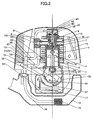
- FIG. 2 is a cross-sectional side elevation view of the engine taken along line II-II in Fig. 1;
- FIG. 3 is an enlarged schematic illustration of the camshaft and the follower mechanism;
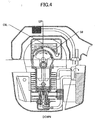
- Fig. 4 is a cross-sectional side elevation view of the engine of Fig. 2 when it is oriented to be upside down.
- FIG. land Fig.2 respectively illustrate a cross-sectional side elevation view of a four-cycle engine. The four-cycle engine is made up of a lightweight aluminum housing including a
cylinder block 1 having acylindrical bore 2 formed therein. Acrankshaft 3 is pivotably mounted within theengine block 1 in a conventional manner. Apiston 4 slides within thecylindrical bore 2 and is connected to the crankshaft by a connectingrod 5. Acylinder head 6 is affixed to theengine block 1 to define an enclosedcombustion chamber 7. Thecylinder head 6 is provided with an intake port 8 coupled to aninsulator 9 andcarburetor 100 and selectively connected to thecombustion chamber 7 by an intake valve10. 101 is a filter element of air cleaner, which eliminates dust from the intake air into the engine. Thecylinder head 6 is also provided with anexhaust port 11 connected to amuffler 12 and selectively connected to thecombustion chamber 7 by anexhaust valve 13. - As illustrated in FIGS. 1 and 2, the
cylinder axis 14 of four-cycle engine is generally upright when in normal use. Thecylinder block 1 is connected to a crankcase-A 15 and crankcase-B 16 that provide an enclosedoil reservoir 17. The crankcase-A 15 and crankcase-B 16 mate with each other at the interface includingcylinder axis 14. Theoil reservoir 17 is relatively deep so that there is ample clearance between thecrankshaft 3 and the level of the oil within the oil reservoir during normal use. - The
crankshaft 3 is provided with anaxial shaft member 18 having anoutput end 19 adapted to be coupled to aflywheel 20 which has animplement input member 21. Aninput end 22 ofaxial shaft member 18 is coupled to acounterweight web 23. Acrankpin 24 is affixed tocounterweight webs axial shaft 18. Thecrankpin 24 pivotally cooperates with a roller bearing 26 mounted in connectingrod 5. Theaxial shaft crankshaft 3 are pivotably attached to a set of crankcase-A 15 and crankcase-B 16 by a pair ofbearings crank gear 30. - The camshaft drive and valve lifter mechanism is best illustrated in FIGS. 1 and 3. The
crank gear 30 is mounted on the crankshaft, which in turn drives acam gear 31 with twice the number of teeth as thecrank gear 30 resulting in thecamshaft 32 rotating in one-half engine speed. Thecam gear 31 is affixed to acamshaft 32 which is journaled to thecylinder block 1 and includes arotary cam lobe 33. In the embodiment illustrated, a single cam lobe is utilized for driving both the intake and exhaust valve.Followers cylinder block 1 by apivot pin 36. -
Push rods followers rocker arms cylinder head 6. The cam,push rods rocker arms cylinder head 6 is avalve cover 41 which defines therebetween an enclosedvalve chamber 42. - A
wall 43 surrounds the intake andexhaust push rods - In order to lubricate the engine, a
pump 44 such as a trochoid pump is placed at the side ofcam gear 31. 45 is the inner rotor and 46 is the outer rotor of thepump 44. In other embodiments of the present application, a gear pump or plunger pump may be used. - The
inner rotor 45 is driven by thecam gear 31 and theouter rotor 46 is rotated following the rotation of theinner rotor 45. Lubrication oil is inhaled from thepassage 47. An end of thepassage 47 leads to the oil entrance of the pump. The other end ofpassage 47 is connected to aflexible tube 48. The other end of flexible tube is connected to a filter withweight 49. By theweight 49, the entrance of the flexible tube is dipped in the oil in theoil reservoir 17 at any orientation of the engine. - The oil pushed out by the pump is lead to the cylinder bore through an
inner hole 50 of thecam shaft 32 and ahole 51 at the cylinder wall as illustrated in Fig. 1. Theother hole 52 at the wall of thecam shaft 32 leads oil to the valve actuating train through apassage 53 on thecam gear 31. Accordingly, the engine parts inside the cylinder and the valve train room are then mist lubricated by the oil splashed by means of the rotation of and/or the centrifugal force generated by the rotating parts such asweb cam gear 31. - As illustrated in Fig. 1 and 2, a first wall or a
circular arc wall 54 surrounding thecounterweight web crank shaft 3 is extended from the wall of crankcase-A 15 and crankcase-B 16. Thearc wall 54 is co-axial with the axis of thecounterweight web web end 55 ofarc wall 54, which is down stream of the rotation ofweb A 15 or crankcase-B 16, while anoil entrance 56 is provided betweenarc wall 54 and the wall of crankcase-A and crankcase B as illustrated in Figure 2. - Around the
entrance 56, a second wall or a scrolledwall 57 is provided. As illustrated in Fig. 2, scrolledwall 57 has a distance from thearc wall 54. The distance increases as the rotation of crank web. The end ofwall 57 located at the upper stream of rotation ofcounterweight web A 15 or crankcase-B 16. The other side of the space between thewall 54 and thewall 57 has anoutlet 58, which is located at the top of theoil reservoir 17. - The
arc wall 54 and the scrolledwall 57 are overlapped as illustrated in Fig. 2. At the corner of the scrolledwall 57 proximate theoutlet 58, anextended wall 59 is provided to theoil reservoir 17. - In the
valve chamber 42, abreather pipe 61 is opened through thevalve cover 41 and is connected to an aircleaner case 62 through abreather pipe 63. In theair cleaner case 62,oil separating deflector 102 is provided. The breathing oil mist through a tube is separated into oil lean gas and oil rich gas by thedeflector 102. - A
return tube 64 interconnects theair cleaner case 62 and the cylinder wall in which areturn hole 65 is provided so as to open and close with reciprocating motion ofpiston 4 and the oil rich mist returns into the crankcase only when the pressure in the crankcase is negative. The oil lean mist is inhaled to the carburetor throughfilter element 101. - The other parts not being specified in the above relate to conventional four-cycle engines. A
spark plug 66 is installed in a spark plug hole formed in the cylinder head. 67 is an ignition coil. Are-coil starter 68 having are-winding rope 69 is provided at a side ofcrank shaft 3. At the lower corner of the crankcase-B 16, coolingair entrance 70 is provided which inhales cooling air of engine generated by rotation ofblade 71 on theflywheel 20. - A
fuel tank 72 is provided below theoil reservoir 17, adequately spaced apart therefrom. In thefuel tank 72, afuel filter 73 and afuel pipe 74 are provided through which fuel is inhaled into thecarburetor 100. - In order to achieve high power output and relatively low exhaust emissions, the four-cycle engine is provided with a very
compact combustion chamber 7. When the engine is started by pulling the windingrope 69 as illustrated in Fig. 1, lubricating oil is immediately inhaled tooil pump 44 by rotation ofrotors flexible tube 48. Lubricating oil is splashed into the cylinder bore through theholes hole 52 and thepassage 53. By the weight supported by and connected to theflexible tube 48, oil is inhaled at any posture of the engine. The oil mist in the room in which the valve actuating parts are installed lubricates the valve train and then flows into the air cleaner box through thepassages port 65 at the wall of cylinder bore opens and the mist return from the air cleaner box into the cylinder bore throughpassage 64. The excess oil after lubricating valve mechanism returns intooil reservoir 17 throughhole 60, which is provided to connect the valve train room to the space between thearc wall 54 and the scrolledwall 57. - As illustrated above, the
circular arc wall 54 surrounds around thecounterweight webs wall 57 has gradually increased distance from said wall to the direction of the web and has partial overlap with thecircular arc wall 54. Thecrankshaft webs oil reservoir 17 guided by the scroll shapedwall 57 at any posture of engine due to the viscosity of the oil situated between the webs (23, 25) and the circular arc wall (54) as well as the centrifugal force generated by the webs (23, 25). Further, as illustrated in Fig. 4, even when the engine is inclined to be upside down, lubrication oil is kept inoil reservoir 17 helped by theextended wall 59 and oil is prevented from flowing into the cylinder head part. - It is believed that small light weight four cycle engines made in accordance with the present invention will be particularly suitable for the use with hand-held or transportable power tool having low emissions and is sufficiently light to be carried and/or transported by an operator. In the prior arts, various kinds of lubricating method for hand-held or transportable power tool have been presented. However, most of them require complicated check valve systems to control flow of lubricating oil in the engines and to prevent oil from flowing into cylinder head part when engine is inclined to be upside down. In the present invention, however, no additional parts are required to form the check valve mechanism, thereby making the engine structure simpler and decreases weight and cost.
- Further, the pump in the present invention is very low cost because it can be made easily by machining and/or injection mold process, powder compaction molding.
- Another advantage of this invention is better cooling performance. In the prior arts, some engines using, so to speak, dry sump lubrication. In dry sump lubrication, over heating of oil might ruin lubrication performance. As illustrated in Fig.2, the present invention looks like dry sump but differs in the following points. First, a lot of lubrication oil is sent by oil pump. Second, there is a space between arc and scrolled walls. This space allows to prevent heat flow between crankcase and oil reservoir and consequently oil temperature of oil in reservoir is lower than the current dry sump engines. Further, as illustrated in Fug. 1, cooling air is inhaled around the fuel tank, wherein, since temperature of oil reservoir is lower, the cooling air is not heated so much as the current dry sump engines and, as the results, engine can be cooled effectively. The improved cooling may improve emission by reducing energy to cool engine.
- While the present invention is discussed in relation to the engine to be used with portable or transportable power tools, a person having ordinary skill in the art will readily realize that it can be also used with stationary power tools or equipments.
Claims (9)
- A single-cylinder, four-stroke cycle, spark ignition internal combustion engine for mounting on a power tool comprising:a cylinder block having a cylinder, a cylinder head, a piston mounted for reciprocation in said cylinder, said cylinder head defining an air-fuel combustion chamber;an air-fuel mixture intake port and an exhaust gas port in said cylinder head;a valve cover on said cylinder head defining a valve chamber;an intake valve and an exhaust valve mounted in said intake and exhaust port, respectively, for reciprocation between port-open and port-closed positions;a valve-actuating valve train, said valve train including at least one rocker arm and at least one valve train push rod assembly extending at one end thereof within said valve chamber and engaging said rocker arm;a crankshaft rotatably mounted in a crankcase, said crankshaft includes a crank portion and at least one counterweight web;a connecting rod having articulated connections at one end thereof to said piston and at the opposite end thereof to said crank portion thereby forming a piston-connecting rod crankshaft assembly;a cam rotatably mounted in a cam housing, said cam being drivably connected to said crankshaft having a cam gear, said cam driven at one-half crankshaft speed, the opposite end of said push rod assembly being drivably connected to said cam whereby said push rod assembly is actuated with a reciprocating motion upon rotation of said cam;a lubrication oil reservoir formed below the crankcase; andan oil pump connected drivably to said cam gear-cam assembly, said pump inhales lubrication oil from said oil reservoir and splashes the oil into the cylinder and the valve chamber to lubricate the engine parts inside the cylinder and the valve chamber;characterized in that said engine further comprising:a first wall at least partially surrounding around said web with a slight distance therefrom; anda second wall at least partially surrounding around said first wall with a distance gradually increasing toward the downstream of the direction of the rotation of said web;
wherein said web splashes the oil to lubricate the internal engine parts and, after lubricating the internal engine parts, the oil is forced to return into said oil reservoir guided by said second wall as the web rotates due to the viscosity of the oil between said web and the first wall. - The engine set forth in claim 1 further comprising an air cleaner box connected to said valve chamber via a first passage through which breathing oil mist gas flows, a second passage connecting the air cleaner box to the crankcase or cylinder block, and a valve being provided at the entrance of said passage into the crankcase, wherein the opening of the valve is controlled by reciprocating motion of said piston, and wherein said valve opens when pressure in the crankcase is negative and closes when the pressure in the crankcase is positive, thereby the oil mist flow control valve structure establishing a lubrication oil mist flow circuit from said valve chamber to said crankcase or said cylinder block through said air cleaner box.
- The engine set forth in claim 1 wherein said oil pump is integrally attached with cam or cam gear.
- The engine set forth in claim 1 wherein said oil pump is a trochoid pump.
- The engine set forth in claim 1 wherein said oil pump is a gear pump.
- The engine set forth in claim 1 wherein said oil pump is a plunger pump.
- A hand-held, transportable, or stationary power tools driven by the engine set forth in claim 1, wherein said power tools are driven by horizontal or vertical or inclined power shaft.
- The engine set forth in claim 1, wherein said second wall has an extended wall which prevents the oil in the oil reservoir from flowing out when engine is inclined at any position.
- The engine set forth in claim 1 to 8, wherein said first and second walls are formed by mating a set of crankcase.
Applications Claiming Priority (1)
| Application Number | Priority Date | Filing Date | Title |
|---|---|---|---|
| US70570805P | 2005-08-03 | 2005-08-03 |
Publications (2)
| Publication Number | Publication Date |
|---|---|
| EP1749984A1 true EP1749984A1 (en) | 2007-02-07 |
| EP1749984B1 EP1749984B1 (en) | 2008-08-27 |
Family
ID=37102102
Family Applications (1)
| Application Number | Title | Priority Date | Filing Date |
|---|---|---|---|
| EP06253926A Not-in-force EP1749984B1 (en) | 2005-08-03 | 2006-07-27 | Lubricating device for a power tool four-stroke engine |
Country Status (4)
| Country | Link |
|---|---|
| US (1) | US7287508B2 (en) |
| EP (1) | EP1749984B1 (en) |
| CN (1) | CN1908389B (en) |
| DE (1) | DE602006002450D1 (en) |
Cited By (5)
| Publication number | Priority date | Publication date | Assignee | Title |
|---|---|---|---|---|
| JP2011074877A (en) * | 2009-09-30 | 2011-04-14 | Hitachi Koki Co Ltd | Four-cycle engine, bush cutter having the same, and engine tool |
| JP2011074879A (en) * | 2009-09-30 | 2011-04-14 | Hitachi Koki Co Ltd | Four-cycle engine, bush cutter having the same, and engine tool |
| US8701621B2 (en) | 2009-09-30 | 2014-04-22 | Hitachi Koki Co., Ltd. | Four-cycle engine, bush cutter and engine-driven tool having same |
| WO2015182510A1 (en) * | 2014-05-30 | 2015-12-03 | 日立工機株式会社 | Engine and engine work machine |
| EP3059404A1 (en) * | 2015-02-05 | 2016-08-24 | Makita Corporation | Lubricating device for engine |
Families Citing this family (30)
| Publication number | Priority date | Publication date | Assignee | Title |
|---|---|---|---|---|
| US7624714B2 (en) * | 2005-08-03 | 2009-12-01 | Etg Limited | Engine lubrication method |
| JP2007309234A (en) * | 2006-05-19 | 2007-11-29 | Honda Motor Co Ltd | Lubricating device for internal combustion engine |
| TW200905065A (en) * | 2007-07-17 | 2009-02-01 | Si-Liang Lin | Engine lubrication loop device |
| US9187083B2 (en) | 2009-09-16 | 2015-11-17 | Polaris Industries Inc. | System and method for charging an on-board battery of an electric vehicle |
| EP2308708B1 (en) * | 2009-09-16 | 2016-08-17 | swissauto powersport llc | Electric vehicle with range extension |
| US8695563B2 (en) * | 2009-09-24 | 2014-04-15 | Makita Corporation | Lubrication system for four-stroke engine |
| JP5463111B2 (en) * | 2009-09-24 | 2014-04-09 | 株式会社マキタ | Lubricating device for portable 4-cycle engine |
| JP5608452B2 (en) * | 2010-07-14 | 2014-10-15 | 株式会社マキタ | Work machine engine and work machine using the same |
| US8490597B2 (en) * | 2010-11-29 | 2013-07-23 | Etg Limited | Vertical and horizontal engine |
| US8490596B2 (en) | 2010-11-29 | 2013-07-23 | Etg Limited | Vertical and horizontal engine |
| JP5873636B2 (en) * | 2011-02-14 | 2016-03-01 | 株式会社マキタ | engine |
| US8627809B2 (en) | 2011-09-22 | 2014-01-14 | Etg Limited | Engine lubrication method |
| US20150020760A1 (en) * | 2011-09-22 | 2015-01-22 | Etg Limited | Four-cycle Internal Combustion Engine |
| JP5803578B2 (en) * | 2011-10-31 | 2015-11-04 | スズキ株式会社 | Single cylinder engine lubrication structure |
| CN103511115B (en) * | 2012-06-15 | 2017-12-29 | 苏州科瓴精密机械科技有限公司 | Engine Fuel Injection System |
| CN103206283B (en) * | 2013-01-30 | 2015-11-25 | 祥天控股(集团)有限公司 | The jerk fuel injection pump of miniature air power engine |
| US10300786B2 (en) | 2014-12-19 | 2019-05-28 | Polaris Industries Inc. | Utility vehicle |
| MX2017014403A (en) | 2015-05-15 | 2018-04-11 | Polaris Inc | UTILITY VEHICLE. |
| US10118477B2 (en) | 2016-06-14 | 2018-11-06 | Polaris Industries Inc. | Hybrid utility vehicle |
| CN106855091A (en) * | 2017-03-15 | 2017-06-16 | 乐山职业技术学院 | A kind of seat and vehicle |
| CN106931062A (en) * | 2017-03-15 | 2017-07-07 | 乐山职业技术学院 | damping device and vehicle |
| US10780770B2 (en) | 2018-10-05 | 2020-09-22 | Polaris Industries Inc. | Hybrid utility vehicle |
| FR3090518B1 (en) | 2018-12-19 | 2022-02-25 | Martur France Automotive Seating And Interiors Sarl | Vehicle seat element provided with a cover and method of manufacturing this vehicle seat element |
| CA3299413A1 (en) | 2019-04-30 | 2026-03-02 | Polaris Industries Inc. | Vehicle with removable final drive |
| US11370266B2 (en) | 2019-05-16 | 2022-06-28 | Polaris Industries Inc. | Hybrid utility vehicle |
| US12187127B2 (en) | 2020-05-15 | 2025-01-07 | Polaris Industries Inc. | Off-road vehicle |
| US11691674B2 (en) | 2020-05-15 | 2023-07-04 | Polaris Industries Inc. | Off-road vehicle |
| US12485981B2 (en) | 2021-03-24 | 2025-12-02 | Polaris Industries Inc. | Electric recreational vehicle |
| CA3156559A1 (en) | 2021-05-05 | 2022-11-05 | Polaris Industries Inc. | Exhaust assembly for a utility vehicle |
| MX2023006716A (en) | 2022-06-13 | 2023-12-14 | Polaris Inc | POWER TRAIN FOR UTILITY VEHICLE. |
Citations (6)
| Publication number | Priority date | Publication date | Assignee | Title |
|---|---|---|---|---|
| FR618367A (en) * | 1926-06-23 | 1927-03-08 | Lubricating device for engines | |
| DE1948186A1 (en) * | 1969-09-24 | 1971-04-01 | Daimler Benz Ag | Piston internal combustion engine |
| EP0779412A2 (en) * | 1995-12-15 | 1997-06-18 | Honda Giken Kogyo Kabushiki Kaisha | Lubricating system in a 4-cycle engine |
| EP0887520A1 (en) * | 1997-06-26 | 1998-12-30 | Ishikawajima-Shibaura Machinery Co., Ltd. | Oil supply apparatus of a four-stroke-cycle engine |
| US5950590A (en) | 1991-12-02 | 1999-09-14 | Ryobi Outdoor Products, Inc. | Operator carried power tool having a four-cycle engine and an engine lubrication method |
| EP0962630A2 (en) * | 1998-06-03 | 1999-12-08 | Fuji Robin Kabushiki Kaisha | Lubricating apparatus in a four-stroke engines |
Family Cites Families (2)
| Publication number | Priority date | Publication date | Assignee | Title |
|---|---|---|---|---|
| US2111242A (en) * | 1936-05-16 | 1938-03-15 | Harley Davidson Motor Co Inc | Lubricating system for internal combustion engines |
| JP3244477B2 (en) * | 1998-12-28 | 2002-01-07 | 富士ロビン株式会社 | Lubrication structure for 4-cycle engine |
-
2006
- 2006-07-27 DE DE602006002450T patent/DE602006002450D1/en active Active
- 2006-07-27 EP EP06253926A patent/EP1749984B1/en not_active Not-in-force
- 2006-08-02 US US11/498,608 patent/US7287508B2/en not_active Expired - Fee Related
- 2006-08-03 CN CN2006101092542A patent/CN1908389B/en not_active Expired - Fee Related
Patent Citations (7)
| Publication number | Priority date | Publication date | Assignee | Title |
|---|---|---|---|---|
| FR618367A (en) * | 1926-06-23 | 1927-03-08 | Lubricating device for engines | |
| DE1948186A1 (en) * | 1969-09-24 | 1971-04-01 | Daimler Benz Ag | Piston internal combustion engine |
| US5950590A (en) | 1991-12-02 | 1999-09-14 | Ryobi Outdoor Products, Inc. | Operator carried power tool having a four-cycle engine and an engine lubrication method |
| EP0779412A2 (en) * | 1995-12-15 | 1997-06-18 | Honda Giken Kogyo Kabushiki Kaisha | Lubricating system in a 4-cycle engine |
| EP0887520A1 (en) * | 1997-06-26 | 1998-12-30 | Ishikawajima-Shibaura Machinery Co., Ltd. | Oil supply apparatus of a four-stroke-cycle engine |
| EP0962630A2 (en) * | 1998-06-03 | 1999-12-08 | Fuji Robin Kabushiki Kaisha | Lubricating apparatus in a four-stroke engines |
| US6213079B1 (en) | 1998-06-03 | 2001-04-10 | Fuji Robin Kabushiki Kaisha | Lubricating apparatus for four-cycle engines |
Cited By (5)
| Publication number | Priority date | Publication date | Assignee | Title |
|---|---|---|---|---|
| JP2011074877A (en) * | 2009-09-30 | 2011-04-14 | Hitachi Koki Co Ltd | Four-cycle engine, bush cutter having the same, and engine tool |
| JP2011074879A (en) * | 2009-09-30 | 2011-04-14 | Hitachi Koki Co Ltd | Four-cycle engine, bush cutter having the same, and engine tool |
| US8701621B2 (en) | 2009-09-30 | 2014-04-22 | Hitachi Koki Co., Ltd. | Four-cycle engine, bush cutter and engine-driven tool having same |
| WO2015182510A1 (en) * | 2014-05-30 | 2015-12-03 | 日立工機株式会社 | Engine and engine work machine |
| EP3059404A1 (en) * | 2015-02-05 | 2016-08-24 | Makita Corporation | Lubricating device for engine |
Also Published As
| Publication number | Publication date |
|---|---|
| US20070028887A1 (en) | 2007-02-08 |
| CN1908389A (en) | 2007-02-07 |
| EP1749984B1 (en) | 2008-08-27 |
| US7287508B2 (en) | 2007-10-30 |
| CN1908389B (en) | 2010-04-07 |
| DE602006002450D1 (en) | 2008-10-09 |
Similar Documents
| Publication | Publication Date | Title |
|---|---|---|
| US7287508B2 (en) | Engine lubrication method | |
| US7624714B2 (en) | Engine lubrication method | |
| US8281758B2 (en) | Engine lubrication method | |
| EP0884455B1 (en) | Internal combustion engine | |
| KR100216246B1 (en) | Lubricator for 4-cycle engine | |
| US6363904B1 (en) | Multi-position, operator-carried, four-cycle engine | |
| US8490597B2 (en) | Vertical and horizontal engine | |
| JP2000192849A (en) | Portable operation equipment for four cycle engine | |
| US8627809B2 (en) | Engine lubrication method | |
| US8490596B2 (en) | Vertical and horizontal engine | |
| US20150000633A1 (en) | Vertical and Horizontal Engine | |
| US20150020760A1 (en) | Four-cycle Internal Combustion Engine | |
| US20130074792A1 (en) | Engine Lubrication Method | |
| HK1006635B (en) | Operator carried power tool having a four-cycle engine |
Legal Events
| Date | Code | Title | Description |
|---|---|---|---|
| PUAI | Public reference made under article 153(3) epc to a published international application that has entered the european phase |
Free format text: ORIGINAL CODE: 0009012 |
|
| 17P | Request for examination filed |
Effective date: 20060807 |
|
| AK | Designated contracting states |
Kind code of ref document: A1 Designated state(s): AT BE BG CH CY CZ DE DK EE ES FI FR GB GR HU IE IS IT LI LT LU LV MC NL PL PT RO SE SI SK TR |
|
| AX | Request for extension of the european patent |
Extension state: AL BA HR MK YU |
|
| AKX | Designation fees paid |
Designated state(s): DE FR IT |
|
| GRAP | Despatch of communication of intention to grant a patent |
Free format text: ORIGINAL CODE: EPIDOSNIGR1 |
|
| GRAS | Grant fee paid |
Free format text: ORIGINAL CODE: EPIDOSNIGR3 |
|
| GRAA | (expected) grant |
Free format text: ORIGINAL CODE: 0009210 |
|
| AK | Designated contracting states |
Kind code of ref document: B1 Designated state(s): DE FR IT |
|
| REF | Corresponds to: |
Ref document number: 602006002450 Country of ref document: DE Date of ref document: 20081009 Kind code of ref document: P |
|
| PLBE | No opposition filed within time limit |
Free format text: ORIGINAL CODE: 0009261 |
|
| STAA | Information on the status of an ep patent application or granted ep patent |
Free format text: STATUS: NO OPPOSITION FILED WITHIN TIME LIMIT |
|
| 26N | No opposition filed |
Effective date: 20090528 |
|
| PGFP | Annual fee paid to national office [announced via postgrant information from national office to epo] |
Ref country code: FR Payment date: 20110729 Year of fee payment: 6 |
|
| PGFP | Annual fee paid to national office [announced via postgrant information from national office to epo] |
Ref country code: DE Payment date: 20110722 Year of fee payment: 6 |
|
| PGFP | Annual fee paid to national office [announced via postgrant information from national office to epo] |
Ref country code: IT Payment date: 20110728 Year of fee payment: 6 |
|
| REG | Reference to a national code |
Ref country code: FR Ref legal event code: ST Effective date: 20130329 |
|
| PG25 | Lapsed in a contracting state [announced via postgrant information from national office to epo] |
Ref country code: FR Free format text: LAPSE BECAUSE OF NON-PAYMENT OF DUE FEES Effective date: 20120731 Ref country code: DE Free format text: LAPSE BECAUSE OF NON-PAYMENT OF DUE FEES Effective date: 20130201 |
|
| REG | Reference to a national code |
Ref country code: DE Ref legal event code: R119 Ref document number: 602006002450 Country of ref document: DE Effective date: 20130201 |
|
| PG25 | Lapsed in a contracting state [announced via postgrant information from national office to epo] |
Ref country code: IT Free format text: LAPSE BECAUSE OF NON-PAYMENT OF DUE FEES Effective date: 20120727 |