EP1746969B1 - Cross-linked nail varnish film - Google Patents
Cross-linked nail varnish film Download PDFInfo
- Publication number
- EP1746969B1 EP1746969B1 EP05762561A EP05762561A EP1746969B1 EP 1746969 B1 EP1746969 B1 EP 1746969B1 EP 05762561 A EP05762561 A EP 05762561A EP 05762561 A EP05762561 A EP 05762561A EP 1746969 B1 EP1746969 B1 EP 1746969B1
- Authority
- EP
- European Patent Office
- Prior art keywords
- article
- article according
- functions
- film
- les
- Prior art date
- Legal status (The legal status is an assumption and is not a legal conclusion. Google has not performed a legal analysis and makes no representation as to the accuracy of the status listed.)
- Expired - Lifetime
Links
Classifications
-
- A—HUMAN NECESSITIES
- A61—MEDICAL OR VETERINARY SCIENCE; HYGIENE
- A61Q—SPECIFIC USE OF COSMETICS OR SIMILAR TOILETRY PREPARATIONS
- A61Q3/00—Manicure or pedicure preparations
- A61Q3/02—Nail coatings
-
- A—HUMAN NECESSITIES
- A45—HAND OR TRAVELLING ARTICLES
- A45D—HAIRDRESSING OR SHAVING EQUIPMENT; EQUIPMENT FOR COSMETICS OR COSMETIC TREATMENTS, e.g. FOR MANICURING OR PEDICURING
- A45D29/00—Manicuring or pedicuring implements
- A45D29/001—Self adhesive nail coating blanks
-
- A—HUMAN NECESSITIES
- A61—MEDICAL OR VETERINARY SCIENCE; HYGIENE
- A61K—PREPARATIONS FOR MEDICAL, DENTAL OR TOILETRY PURPOSES
- A61K8/00—Cosmetics or similar toiletry preparations
- A61K8/02—Cosmetics or similar toiletry preparations characterised by special physical form
- A61K8/0208—Tissues; Wipes; Patches
-
- A—HUMAN NECESSITIES
- A61—MEDICAL OR VETERINARY SCIENCE; HYGIENE
- A61K—PREPARATIONS FOR MEDICAL, DENTAL OR TOILETRY PURPOSES
- A61K8/00—Cosmetics or similar toiletry preparations
- A61K8/18—Cosmetics or similar toiletry preparations characterised by the composition
- A61K8/72—Cosmetics or similar toiletry preparations characterised by the composition containing organic macromolecular compounds
- A61K8/84—Cosmetics or similar toiletry preparations characterised by the composition containing organic macromolecular compounds obtained by reactions otherwise than those involving only carbon-carbon unsaturated bonds
- A61K8/87—Polyurethanes
Definitions
- liquid makeup compositions still commonly called nail polish.
- This nail polish is generally applied in the form of layers superimposed on the surface of the nail makeup, respecting an intermediate drying step between each layer of varnish applied. In fact, this mode of makeup is not completely satisfactory.
- the article may further comprise between the adhesive layer and the crosslinked film at least one colored lacquer film.
- a film may derive from the evaporation of the organic or aqueous solvent phase of a solution or dispersion, generally colored, of at least one film-forming polymer.
- This film-forming polymer may in particular be chosen from nitrocellulose or cellulose esters.
- the crosslinked film is preferably transparent.
- Viscoelasticimetry tests were performed with a TA Instruments Polymer DMTA (model DMA2980) on a sample of the article.
- the test pieces are cut (for example by punching). These typically have a thickness of about 150 ⁇ m, a width of 5 to 10 mm and a useful length of about 10 to 15 mm.
- the compounds (A) and (B) brought together have, respectively, at least two so-called reactive functions and in particular of the epoxide and / or isocyanate type and at least two functional groups with labile hydrogen (s), in particular of the type amine or aminoalcohol and may in particular be chosen from the compounds mentioned above.
- Particular examples of compounds carrying labile hydrogen functional groups are: C 1-4 alkylene glycols, glycerol, trimethylolpropane, pentaerythritol, poly (C 1-4 alkylene glycols) such as polyethylene glycol or polyproylene glycol or copolymers of these, the condensation product of propylene glycol and trimethylolpropane, castor oil, phytantriol, sugars and carbohydrates such as sucrose or cellulose, ethylenediamine, 1,3-diaminopropane, lysine, amino-2-methyl-2-propanol-1, poly (alkyleneoxy) diamines such as Jeffamine ® products marketed by the TEXACO company, nitrocellulose, cellulose esters, especially those having a degree of substitution less than 3 , such as cellulose acetate butyrate and cellulose acetate propionate, cellulose ethers such as hydroxyethyl cellulose, carboxymethyl cellulose, hydroxypropyl cellulose or
- compounds (A) or (B) compounds with "self-blocking" isocyanate functional groups, such as urethane diones obtained by dimerization of 2 molecules of diisocyanates, or else tris ((C 1-4 alkoxy) 6 ) -carbonylamino) triazines such as the condensation product melanin, dimethyl carbonate and butanol.
- compounds with "self-blocking" isocyanate functional groups such as urethane diones obtained by dimerization of 2 molecules of diisocyanates, or else tris ((C 1-4 alkoxy) 6 ) -carbonylamino) triazines such as the condensation product melanin, dimethyl carbonate and butanol.
- Such compounds are especially sold under the name of Cylink ® 2000 by the CYTECK society.
- Adhesive materials useful in the present invention exhibit viscoelastic properties which are measured at a reference temperature of 35 ° C and within a certain frequency range.
- the makeup thus obtained can be removed using the usual makeup removers in the field of nail polish.
Landscapes
- Health & Medical Sciences (AREA)
- Life Sciences & Earth Sciences (AREA)
- Animal Behavior & Ethology (AREA)
- General Health & Medical Sciences (AREA)
- Public Health (AREA)
- Veterinary Medicine (AREA)
- Birds (AREA)
- Epidemiology (AREA)
- Engineering & Computer Science (AREA)
- Biomedical Technology (AREA)
- Cosmetics (AREA)
- Paints Or Removers (AREA)
- Adhesive Tapes (AREA)
- Polishing Bodies And Polishing Tools (AREA)
- Medicinal Preparation (AREA)
- Materials For Medical Uses (AREA)
Abstract
Description
La présente invention concerne un article souple destiné à être appliqué sur les ongles pour leur maquillage et/ou leur soin.The present invention relates to a flexible article intended to be applied to the nails for their makeup and / or care.
Classiquement, le maquillage des ongles ou des faux ongles est réalisé à l'aide de compositions liquides de maquillage, encore communément appelées vernis à ongles. Ce vernis à ongles est appliqué généralement sous la forme de couches superposées à la surface de l'ongle à maquiller, en respectant une étape de séchage intermédiaire entre chaque couche de vernis appliquée. En fait, ce mode de maquillage ne s'avère pas totalement satisfaisant.Conventionally, the makeup of nails or false nails is made using liquid makeup compositions, still commonly called nail polish. This nail polish is generally applied in the form of layers superimposed on the surface of the nail makeup, respecting an intermediate drying step between each layer of varnish applied. In fact, this mode of makeup is not completely satisfactory.
Tout d'abord, son application nécessite un certain temps.First, its application requires a certain amount of time.
Par ailleurs, ce type de maquillage implique d'être répété à bref délai à cause de sa tenue insuffisante. En effet, très rapidement, généralement au terme de trois à cinq jours, le vernis appliqué s'écaille et sa brillance diminue. Il est alors nécessaire de procéder à une étape de démaquillage et de répéter une nouvelle opération de maquillage.Moreover, this type of makeup involves being repeated at short notice because of its insufficient performance. Indeed, very quickly, usually after three to five days, the applied varnish peels and its brightness decreases. It is then necessary to proceed with a make-up removal step and to repeat a new make-up operation.
Enfin, les formules de vernis à ongles classiques impliquent généralement la mise en oeuvre de solvants volatils qui génèrent, lors de l'application, une odeur inconfortable.Finally, conventional nail polish formulas generally involve the use of volatile solvents which generate, during application, an uncomfortable odor.
Plusieurs alternatives ont déjà été proposées pour tenter de surmonter, au moins en partie, les inconvénients précités. Ainsi, des produits de maquillage des ongles ont été proposés sous forme de kit de deux compositions liquides de vernis à ongles. Toutefois, l'amélioration de tenue est, dans ce cas, acquise au détriment des conditions d'application qui multiplient par deux le nombre de couches à appliquer.Several alternatives have already been proposed to try to overcome, at least in part, the aforementioned drawbacks. Thus, nail makeup products have been proposed in the form of a kit of two liquid compositions of nail polish. However, in this case, the improvement in performance is achieved to the detriment of the conditions of application which multiply by two the number of layers to be applied.
Une autre alternative a consisté à développer des compositions de vernis à ongles à base de dispersion de polymères en phase aqueuse, et donc satisfaisantes sur le plan olfactif. Malheureusement, les vernis correspondants s'avèrent présenter une tenue insuffisante dans le temps.Another alternative has been to develop nail polish compositions based on dispersion of polymers in the aqueous phase, and therefore satisfactory on the olfactory plane. Unfortunately, the corresponding varnishes have proved to be insufficiently durable over time.
La présente invention vise précisément à proposer un mode de maquillage et/ou de soin des ongles ou des faux ongles qui soit précisément, par opposition aux formulations liquides classiques de type vernis à ongles, facile et aisé en terme d'application, doté d'une tenue dans le temps significativement améliorée et d'une teneur nettement réduite en solvant(s) organique(s).The present invention aims precisely to provide a method of makeup and / or care of the nails or false nails which is precisely, as opposed to conventional liquid formulations such as nail polish, easy and easy in terms of application, provided with a significantly improved behavior over time and a significantly reduced content of organic solvent (s).
Plus précisément, la présente invention concerne selon un premier de ses aspects, un article souple destiné à être appliqué sur des ongles et/ou faux ongles pour leur maquillage et/ou leur soin comportant :
- au moins une couche adhésive permettant la fixation de l'article sur l'ongle et
- au moins un film réticulé, notamment coloré ou transparent, comme décrit à la revendication 1 et la revendication 2.
- at least one adhesive layer for fixing the article on the nail and
- at least one crosslinked film, especially colored or transparent, as described in claim 1 and claim 2.
Dans une variante, l'article peut comprendre une superposition d'au moins deux voire plus de films réticulés différents.Alternatively, the article may include an overlay of at least two or more different crosslinked films.
En particulier, l'un d'entre eux, généralement celui en contact avec la couche adhésive, peut être coloré et l'autre transparent.In particular, one of them, generally the one in contact with the adhesive layer, can be colored and the other transparent.
Selon une autre variante de l'invention, l'article peut comprendre en outre entre la couche adhésive et le film réticulé au moins un film de vernis coloré. Un tel film peut dériver de l'évaporation de la phase solvant organique ou aqueuse d'une solution ou dispersion, généralement colorée, d'au moins un polymère filmogène. Ce polymère filmogène peut notamment être choisi parmi la nitrocellulose ou des esters de cellulose.According to another variant of the invention, the article may further comprise between the adhesive layer and the crosslinked film at least one colored lacquer film. Such a film may derive from the evaporation of the organic or aqueous solvent phase of a solution or dispersion, generally colored, of at least one film-forming polymer. This film-forming polymer may in particular be chosen from nitrocellulose or cellulose esters.
Selon cette variante de l'invention, le film réticulé est de préférence transparent.According to this variant of the invention, the crosslinked film is preferably transparent.
Tel qu'utilisé ici, le terme « transparent » signifie que le revêtement réticulé a un index HAZEBYK de moins de 5 tel que mesuré avec un brillancemètre de type KYKHAZEGLOSS.As used herein, the term "transparent" means that the crosslinked coating has a HAZEBYK index of less than 5 as measured with a KYKHAZEGLOSS type gloss meter.
Selon un deuxième aspect, la présente invention concerne un procédé de préparation d'un article souple de maquillage et/ou de soin des ongles comprenant au moins les étapes consistant à superposer sur un support amovible :
- a) au moins une couche d'une composition à base d'au moins un matériau adhésif, et
- b) au moins une couche d'une composition réticulable, la réticulation de ladite composition étant réalisée consécutivement au dépôt de celle-ci de manière à obtenir un film réticulé.
- a) at least one layer of a composition based on at least one adhesive material, and
- b) at least one layer of a crosslinkable composition, the crosslinking of said composition being performed subsequent to the deposition thereof so as to obtain a crosslinked film.
Selon une première variante de l'invention le procédé comprend au moins les étapes consistant à :
- a) déposer sur un support amovible au moins une couche d'une composition contenant au moins un matériau adhésif,
- b) déposer sur ladite couche adhésive au moins une couche d'une composition réticulable,
- c) réticuler ladite composition de manière à obtenir un film réticulé, et
- d) si nécessaire sécher au moins partiellement ledit article.
- a) depositing on a removable support at least one layer of a composition containing at least one adhesive material,
- b) depositing on said adhesive layer at least one layer of a crosslinkable composition,
- c) crosslinking said composition so as to obtain a crosslinked film, and
- d) if necessary, dry the article at least partially.
Selon une seconde variante de l'invention, le procédé comprend au moins les étapes consistant à :
- a) déposer sur un support amovible au moins une couche d'une composition réticulable,
- b) réticuler ladite composition de manière à obtenir un film réticulé,
- c) si nécessaire sécher au moins partiellement ledit film,
- d) déposer sur ledit film obtenu en c) au moins une couche d'une composition contenant au moins un matériau adhésif,
- e) si nécessaire sécher au moins partiellement ledit article,
- f) recouvrir la couche adhésive obtenue en e) par un support amovible, et, le cas échéant,
- g) récupérer ledit article par pelage du film réticulé du support en a).
- a) depositing on a removable support at least one layer of a crosslinkable composition,
- b) crosslinking said composition so as to obtain a crosslinked film,
- c) if necessary, at least partially drying said film,
- d) depositing on said film obtained in c) at least one layer of a composition containing at least one adhesive material,
- e) if necessary, to dry the article at least partially,
- f) covering the adhesive layer obtained in e) with a removable support, and, where appropriate,
- g) recovering said article by peeling the crosslinked film of the support in a).
Selon une autre variante de l'invention, ledit procédé comprend en outre au moins une étape consistant à former entre la couche adhésive et le film réticulé, un film de vernis coloré.According to another variant of the invention, said method further comprises at least one step of forming between the adhesive layer and the crosslinked film, a colored lacquer film.
Selon un troisième aspect, la présente invention concerne un produit de maquillage et/ou de soin des ongles et/ou des faux ongles comprenant dans un conditionnement, sensiblement étanche à l'air, au moins un article conforme à l'invention, le conditionnement étant tel que l'article s'y trouve conservé sous une forme partiellement sèche.According to a third aspect, the present invention relates to a product for makeup and / or care of nails and / or false nails comprising in a packaging, substantially airtight, at least one article according to the invention, the packaging being such that the article is kept in a partially dry form.
Au sens de la présente invention, le terme partiellement sec entend qualifier le fait que l'article obtenu après formation du film réticulé n'est pas totalement exempt du solvant résiduel. En particulier, il possède une teneur en matière sèche inférieure à 80 %, en particulier inférieure à 75 % et plus particulièrement inférieure à 70 % en poids par rapport à son poids total.For the purpose of the present invention, the partially dry term means to qualify the fact that the article obtained after formation of the crosslinked film is not completely free of the residual solvent. In particular, it has a solids content of less than 80%, in particular less than 75% and more particularly less than 70% by weight relative to its total weight.
Selon un mode de réalisation particulier, ce conditionnement comporte un réservoir, comme par exemple une poche, souple ou non, apte à contenir de manière étanche un produit pour préserver ledit article d'un séchage total et prématuré avant son utilisation. Plus précisément, le conditionnement est étanche à l'air et/ou aux solvants.According to a particular embodiment, this packaging comprises a reservoir, such as a pocket, flexible or not, able to contain sealing a product to preserve said article from complete and premature drying prior to use. More specifically, the packaging is airtight and / or solvent-proof.
Selon un quatrième aspect, la présente invention concerne un procédé de préparation d'un produit tel que défini ci-dessus comprenant les étapes consistant à superposer sur un support amovible :
- au moins une couche d'une composition à base d'au moins un matériau adhésif,
- au moins une couche d'une composition réticulable, la réticulation étant réalisée consécutivement au dépôt de ladite composition,
- si nécessaire le séchage partiel dudit article ainsi obtenu, et
- le conditionnement dudit article à un état partiellement sec au sein d'un conditionnement sensiblement étanche à l'air.
Selon ce mode de réalisation, l'article n'acquiert un aspect totalement sec, et donc sa forme définitive qu'après application sur l'ongle, par simple exposition à l'air ambiant.
Selon un cinquième aspect, la présente invention concerne un procédé de maquillage et/ou de soin des ongles comprenant le fait d'appliquer sur un ongle la face adhésive d'un article selon l'invention.
D'une manière générale, l'article selon la présente invention se présente sous la forme d'un film.
Au sens de la présente invention, le terme « souple » qualifie une flexibilité suffisante de ce film, c'est-à-dire propice à des déformations mécaniques de type étirement pour l'ajuster à la surface d'un ongle. Cette déformabilité est notamment caractérisée par le paramètre de déformation à la rupture εr discuté ci-après.
L'article selon l'invention se différencie notamment à ce titre d'un article de type faux ongle qui se caractérise par une rigidité incompatible avec une telle déformation mécanique.
Une autre différence entre l'article conforme à l'invention et un faux ongle, réside dans la sensibilité de cet article vis-à-vis des solvants organiques polaires du type acétone, ester et/ou alcool court. En effet, le film réticulé figurant sur la face externe de l'article selon l'invention, c'est-à-dire non adhérente à l'ongle, possède une aptitude à augmenter de volume et donc de poids lorsqu'il est mis en contact avec l'un de ces solvants. Un faux ongle est totalement dénué d'une telle sensibilité. Cette aptitude à gonfler, manifestée par l'article selon l'invention, est précisément avantageuse pour son élimination lorsque celui-ci est appliqué en surface d'un ongle ou d'un faux ongle. En effet, l'article selon l'invention peut être aisément éliminé par simple démaquillage à l'aide d'un dissolvant classique, par opposition à un faux ongle qui se retire. Ainsi, l'article selon l'invention est avantageusement démaquillable par des solvants organiques et notamment par les acétates d'alkyles et leurs mélanges.
L'article conforme à l'invention présente en outre une tenue dans le temps significative et notamment à l'échelle d'au moins une semaine. Il s'avère ainsi résistant à l'eau, aux frottements et aux chocs, et ne présente pas d'usure ni d'écaillage significatifs dans ce délai.
L'article selon l'invention peut être utilisé soit à des fins de maquillage, auquel cas il comprend généralement au moins un film réticulé coloré ou à des fins de protection vis-à-vis d'un film de vernis. Dans cette alternative, il comprend généralement un film réticulé transparent.
- at least one layer of a composition based on at least one adhesive material,
- at least one layer of a crosslinkable composition, the crosslinking being carried out following the deposition of said composition,
- if necessary the partial drying of said article thus obtained, and
- conditioning said article to a partially dry state within a substantially airtight package.
According to this embodiment, the article acquires a completely dry appearance, and therefore its final shape after application on the nail, by simple exposure to ambient air.
According to a fifth aspect, the present invention relates to a nail makeup and / or care method comprising applying to a nail the adhesive side of an article according to the invention.
In general, the article according to the present invention is in the form of a film.
For the purposes of the present invention, the term "flexible" qualifies a sufficient flexibility of this film, that is to say, conducive to stretch-like mechanical deformations to adjust it to the surface of a fingernail. This deformability is notably characterized by the parameter of deformation at break ε r discussed below.
The article according to the invention differs in this respect from a false nail type article which is characterized by rigidity incompatible with such a mechanical deformation.
Another difference between the article according to the invention and a false nail lies in the sensitivity of this article vis-à-vis polar organic solvents such as acetone, ester and / or short alcohol. Indeed, the crosslinked film on the outer face of the article according to the invention, that is to say non-adherent to the nail, has an ability to increase in volume and therefore weight when put in contact with one of these solvents. A fake nail is totally devoid of such sensitivity. This ability to swell, manifested by the article according to the invention is precisely advantageous for its removal when it is applied to the surface of a nail or a false nail. Indeed, the article of the invention can be easily removed by simple makeup removal using a conventional solvent, as opposed to a false nail that withdraws. Thus, the article according to the invention is advantageously removable from organic solvents and in particular by alkyl acetates and mixtures thereof.
The article according to the invention also has a significant behavior over time and especially at the scale of at least one week. It is thus resistant to water, friction and shock, and shows no significant wear or peeling within this time.
The article according to the invention can be used either for makeup purposes, in which case it generally comprises at least one colored cross-linked film or for protection purposes vis-à-vis a lacquer film. In this alternative, it generally comprises a transparent crosslinked film.
L'article selon l'invention peut se caractériser par un extrait sec élevé. En effet, la quantité de matière sèche est supérieure à 80%, et en particulier supérieure à 85 % et en particulier supérieur à 90 % en poids par rapport au poids total de l'article. Autrement dit la quantité de solvant volatil est inférieure à 20 %, en particulier inférieure à 15 % et plus particulièrement inférieure à 10 % en poids par rapport au poids total de l'article.The article according to the invention can be characterized by a high solids content. Indeed, the amount of dry matter is greater than 80%, and in particular greater than 85% and in particular greater than 90% by weight relative to the total weight of the article. In other words, the amount of volatile solvent is less than 20%, in particular less than 15% and more particularly less than 10% by weight relative to the total weight of the article.
Toutefois, selon un autre mode de réalisation privilégié, l'article selon l'invention peut avantageusement se présenter sous une forme partiellement sèche. Dans ce cas particulier, l'article est conditionné dans un réservoir comme par exemple une poche, souple ou non, suffisamment étanche pour lui préserver cet aspect partiellement sec. Ce n'est qu'au moment de son utilisation et par conséquent lors de sa mise en contact avec l'air, que l'article sèche totalement pour acquérir la teneur en matière sèche décrite précédemment.However, according to another preferred embodiment, the article according to the invention may advantageously be in a partially dry form. In this particular case, the article is packaged in a reservoir such as a pocket, flexible or not, sufficiently sealed to preserve this aspect partially dry. It is only at the time of its use and therefore when it comes into contact with the air, that the article completely dries to acquire the dry matter content described above.
Dans un produit selon l'invention, l'article selon l'invention possède avantageusement une teneur en matière sèche inférieure à 80 %, notamment inférieure à 75 % et plus particulièrement inférieure à 70 % en poids par rapport à son poids total. Ledit article peut par ailleurs posséder une teneur en matière sèche supérieure à 60 %, notamment supérieure à 65 % en poids par rapport à son poids total. Un tel article, lorsqu'il est extrait du conditionnement d'un produit conforme à l'invention et exposé à l'air ambiant, acquiert un état sec tel que défini ci-dessus au terme de 24 h.In a product according to the invention, the article according to the invention advantageously has a solids content of less than 80%, especially less than 75%. % and more particularly less than 70% by weight relative to its total weight. Said article may also have a solids content greater than 60%, especially greater than 65% by weight relative to its total weight. Such an article, when extracted from the packaging of a product according to the invention and exposed to ambient air, acquires a dry state as defined above after 24 hours.
De préférence, la quantité de matière sèche, communément appelée « extrait sec » des articles selon l'invention, est mesurée par échauffement de l'échantillon par des rayons infrarouges de 2 µm à 3,5 µm de longueur d'onde. Les substances contenues dans lesdits films qui possèdent une pression de vapeur élevée, s'évaporent sous l'effet de ce rayonnement. La mesure de la perte de poids de l'échantillon permet de déterminer « l'extrait sec » de l'article. Ces mesures sont réalisées au moyen d'un dessiccateur à infrarouges commercial LP16 de chez Mettler. Cette technique est parfaitement décrite dans la documentation de l'appareil fournie par Mettler.Preferably, the amount of dry matter, commonly called "dry extract" articles according to the invention, is measured by heating the sample with infrared radiation of 2 microns to 3.5 microns wavelength. Substances contained in said films which have a high vapor pressure, evaporate under the effect of this radiation. The measurement of the weight loss of the sample makes it possible to determine the "dry extract" of the article. These measurements are carried out using a Mettler LP16 commercial infrared desiccator. This technique is perfectly described in the documentation of the device supplied by Mettler.
Le protocole de mesure est le suivant.The measurement protocol is as follows.
On dépose environ 10 g d'échantillon d'un article sur une coupelle métallique. Celle-ci, après introduction dans le dessiccateur, est soumise à une consigne de température de 120 °C pendant une heure. La masse humide de l'échantillon, correspondant à la masse initiale et la masse sèche de l'échantillon, correspondant à la masse après exposition au rayonnement, sont mesurées au moyen d'une balance de précision.About 10 g of sample of an article is deposited on a metal cup. This, after introduction into the desiccator, is subjected to a temperature of 120 ° C for one hour. The wet mass of the sample, corresponding to the initial mass and the dry mass of the sample, corresponding to the mass after exposure to radiation, are measured using a precision balance.
La teneur en matière sèche est calculée de la manière suivante : 
L'article selon l'invention peut être caractérisé à l'état sec par une reprise à l'eau portée à 25 °C inférieure ou égale à 20 %, notamment inférieure ou égale à 16 %, et en particulier inférieure à 10 %.The article according to the invention can be characterized in the dry state by a water recovery brought to 25 ° C less than or equal to 20%, especially less than or equal to 16%, and in particular less than 10%.
Selon la présente demande, on entend par "reprise à l'eau", le pourcentage d'eau absorbé par l'article après 60 minutes d'immersion dans l'eau, à 25 °C (température ambiante). La reprise à l'eau est mesurée pour des morceaux d'environ 1 cm2 découpés dans l'article sec. Ils sont pesés (mesure de la masse M1) puis immergés dans l'eau pendant 60 minutes ; après immersion, le morceau de film est essuyé pour éliminer l'excédent d'eau en surface puis pesé (mesure de la masse M2). La différence M2 - M1 correspond à la quantité d'eau absorbée par le film.According to the present application, the term "water absorption" means the percentage of water absorbed by the article after 60 minutes of immersion in water at 25 ° C. (room temperature). The water recovery is measured for pieces of about 1 cm 2 cut in the dry article. They are weighed (measurement of mass M1) and then immersed in water for 60 minutes; after immersion, the piece of film is wiped to eliminate the excess surface water then weighed (measurement of mass M2). The difference M2 - M1 corresponds to the amount of water absorbed by the film.
La reprise à l'eau est égale à [(M2 - M1) / M1] x 100 et est exprimée en pourcentage de poids par rapport au poids du film.The water absorption is equal to [(M2 - M1) / M1] × 100 and is expressed as a percentage by weight relative to the weight of the film.
Par ailleurs, l'article selon l'invention est avantageusement un film ayant un module de conservation E' supérieur ou égal à 1 MPa, notamment allant de 1 MPa à 5000 MPa, en particulier supérieur ou égal à 5 MPa, notamment allant de 5 à 1000 MPa, et plus particulièrement supérieur ou égal à 10 MPa par exemple allant de 10 à 500 MPa à une température de 30 °C et une fréquence de 0,1 Hz.Furthermore, the article according to the invention is advantageously a film having a conservation modulus E 'greater than or equal to 1 MPa, in particular ranging from 1 MPa to 5000 MPa, in particular greater than or equal to 5 MPa, in particular ranging from at 1000 MPa, and more particularly greater than or equal to 10 MPa for example ranging from 10 to 500 MPa at a temperature of 30 ° C and a frequency of 0.1 Hz.
La mesure du module de conservation est effectuée par DMTA (Dynamical and Mechanical Temperature Analysis ou Analyse dynamique et mécanique en température).The conservation module is measured by DMTA (Dynamical and Mechanical Temperature Analysis).
On effectue des essais de viscoélasticimétrie avec un appareil DMTA de Polymer TA Instruments (modèle DMA2980), sur un échantillon d'article. On découpe (par exemple à l'emporte-pièce) les éprouvettes. Celles-ci ont typiquement une épaisseur d'environ 150 µm, une largeur de 5 à 10 mm et une longueur utile d'environ 10 à 15 mm.Viscoelasticimetry tests were performed with a TA Instruments Polymer DMTA (model DMA2980) on a sample of the article. The test pieces are cut (for example by punching). These typically have a thickness of about 150 μm, a width of 5 to 10 mm and a useful length of about 10 to 15 mm.
Les mesures sont effectuées à une température constante de 30°C.The measurements are made at a constant temperature of 30 ° C.
L'échantillon est sollicité en traction et en petites déformations (on lui impose par exemple un déplacement sinusoïdal de ± 8 µm) lors d'un balayage en fréquence, la fréquence allant de 0,1 à 20 Hz. On travaille ainsi dans le domaine linéaire, sous de faibles niveaux de déformation.The sample is biased in tension and in small deformations (it imposes for example a sinusoidal displacement of ± 8 microns) during a sweep in frequency, the frequency ranging from 0.1 to 20 Hz. One thus works in the field linear, under low levels of deformation.
Ces mesures permettent de déterminer le module complexe E* = E' + iE" du film de composition testé, E' étant le module de conservation et E" le module dit de perte.These measurements make it possible to determine the complex module E * = E '+ iE "of the composition film tested, E' being the conservation module and E" the so-called loss module.
Avantageusement, les articles selon l'invention, possèdent une déformation à la rupture εr supérieure ou égale à 5 %, notamment allant de 5 à 500 %, de préférence supérieure ou égale à 15 %, notamment allant de 15 à 400 % et/ou une énergie à rupture par unité de volume Wr supérieure ou égale à 0,2 J/cm3, notamment allant de 0,2 à 100 J/cm3, de préférence supérieure à 1 J/cm3, notamment allant de 1 à 50 J/cm3.Advantageously, the articles according to the invention have a deformation at break ε r greater than or equal to 5%, especially ranging from 5 to 500%, preferably greater than or equal to 15%, in particular ranging from 15 to 400% and / or a rupture energy per unit volume W r greater than or equal to 0.2 J / cm 3 , in particular ranging from 0.2 to 100 J / cm 3 , preferably greater than 1 J / cm 3 , in particular ranging from 1 at 50 J / cm 3 .
La déformation à la rupture et l'énergie à rupture par unité de volume sont déterminées par des essais de traction effectués sur un film réticulé d'environ 200 µm d'épaisseur.The breaking strain and the rupture energy per unit volume are determined by tensile tests carried out on a crosslinked film approximately 200 μm thick.
Pour effectuer ces essais, l'article est découpé en éprouvettes haltères de longueur utile 33 ± 1 mm et de largeur utile 6 mm. La section (S) de l'éprouvette est alors définie comme : S = largeur x épaisseur (cm2) ; cette section sera utilisée pour le calcul de la contrainte.To perform these tests, the article is cut into dumbbells with a useful length of 33 ± 1 mm and a useful width of 6 mm. The section (S) of the test piece is then defined as: S = width x thickness (cm 2 ); this section will be used for the calculation of the constraint.
Les essais sont réalisés, par exemple, sur un appareil de traction commercialisé sous l'appellation Lloyd® LR5K. Les mesures sont réalisées à température ambiante (20 °C).The tests are performed, for example, a traction device sold under the name Lloyd ® LR5K. The measurements are carried out at ambient temperature (20 ° C.).
Les éprouvettes sont étirées à une vitesse de déplacement de 33 mm/min, correspondant à une vitesse de 100 % d'allongement par minute.The specimens are stretched at a movement speed of 33 mm / min, corresponding to a speed of 100% elongation per minute.
On impose donc une vitesse de déplacement et on mesure simultanément l'allongement ΔL de l'éprouvette et la force F nécessaire pour imposer cet allongement. C'est à partir de ces données ΔL et F que l'on détermine les paramètres contraintes σ et déformation ε.Therefore, a displacement velocity is imposed and the elongation ΔL of the specimen and the force F necessary to impose this elongation are measured simultaneously. It is from these data ΔL and F that the stress parameters σ and strain ε are determined.
Il est ainsi obtenu une courbe contrainte σ = (F/S) en fonction de la déformation ε = (ΔL/Lo) x 100, l'essai étant conduit jusqu'à rupture de l'éprouvette, Lo étant la longueur initiale de l'éprouvette.A stress curve σ = (F / S) is thus obtained as a function of the strain ε = (ΔL / L o ) x 100, the test being conducted until the test piece is broken, L o being the initial length of the test piece.
La déformation à la rupture εr est la déformation maximale de l'échantillon avant le point de rupture (en %).The deformation at break ε r is the maximum deformation of the sample before the breaking point (in%).
L'énergie à rupture par unité de volume Wr en J/cm3 est définie comme la surface sous cette courbe contrainte/déformation telle que : 
Comme précisé précédemment, le film selon l'invention dérive d'une réticulation.As specified above, the film according to the invention derives from a crosslinking.
Au sens de la présente invention, un film qualifié de réticulé peut être totalement ou partiellement réticulé.For the purpose of the present invention, a film qualified as crosslinked may be totally or partially crosslinked.
Dans le cas d'une réticulation partielle, celle-ci est bien entendu suffisante pour former le film attendu.In the case of partial crosslinking, this is of course sufficient to form the expected film.
Cette réticulation peut ainsi être réalisée par voie thermique, photochimique et/ou chimique, en présence ou non d'un catalyseur. La réalisation de cette réticulation relève des compétences de l'homme de l'art.This crosslinking can thus be carried out thermally, photochemically and / or chemically, in the presence or absence of a catalyst. The achievement of this crosslinking is within the skill of those skilled in the art.
Bien entendu, les composés mis en présence pour la réticulation sont choisis, notamment selon la nature des fonctions réactives qu'ils possèdent respectivement, pour être capable d'interagir dans les conditions de la réaction de réticulation considérée.
- Selon une première variante, la réaction de réticulation s'apparente à une réaction de polyaddition ou polycondensation réalisée en présence ou en absence de catalyseur.
- According to a first variant, the crosslinking reaction is similar to a polyaddition or polycondensation reaction carried out in the presence or absence of catalyst.
Dans ce cas particulier, la composition réticulable contient un au moins un système réactif formé par :
- au moins un premier composé (A) comprenant au moins deux fonctions X, et
- au moins un deuxième composé (B) comprenant au moins deux fonctions Y, réactives vis-à-vis des fonctions X.
- at least one first compound (A) comprising at least two X functions, and
- at least one second compound (B) comprising at least two functions Y, reactive with respect to the X functions.
Avantageusement, le système réactif possède une fonctionnalité moyenne (nombre total des fonctions X et Y/nombre total des molécules de composés (A) et (B)) supérieure à 2 de manière à procurer un réseau tridimensionnel.Advantageously, the reagent system has an average functionality (total number of X and Y functions / total number of compound molecules (A) and (B)) greater than 2 so as to provide a three-dimensional network.
Plus particulièrement, pour l'obtention d'un effet de réticulation satisfaisant, la fonctionnalité moyenne du système réactif peut être au moins égale à 2,2 et plus particulièrement varier de 2,5 à 100.More particularly, to obtain a satisfactory crosslinking effect, the average functionality of the reagent system may be at least 2.2 and more particularly vary from 2.5 to 100.
Les composés (A) et (B) peuvent être d'origine organique et notamment de type oligomère, polymère et/ou copolymère ou de nature inorganique à l'image par exemple d'une particule minérale, en quel cas ils possèdent en surface les deux fonctions X ou Y requises.The compounds (A) and (B) may be of organic origin and in particular of the oligomeric, polymer and / or copolymer type or of inorganic nature, for example in the image of a mineral particle, in which case they possess on the surface the two X or Y functions required.
Les fonctions X et Y réactives les unes vis-à-vis des autres sont choisies parmi des fonctions dites réactives et des fonctions comportant au moins un hydrogène labile.The X and Y functions that react with each other are chosen from reactive functions and functions comprising at least one labile hydrogen.
Plus précisément, les fonctions réactives sont choisies parmi les fonctions isocyanates, époxydes et les doubles liaisons éthyléniques et les fonctions à hydrogène(s) labile(s) sont du type carboxylique, alcool notamment phénolique, amine primaire ou secondaire, amide, aminoalcool et/ou thiol.More specifically, the reactive functions are chosen from isocyanate functions, epoxides and ethylenic double bonds and hydrogen functions. labile (s) are of the carboxylic type, especially phenolic alcohol, primary or secondary amine, amide, aminoalcohol and / or thiol.
Plus particulièrement, les composés (A) et (B) mis en présence, possèdent respectivement au moins deux fonctions dites réactives et notamment de type époxyde et/ou isocyanate et au moins deux fonctions à hydrogène(s) labile(s) notamment de type amine ou aminoalcool et peuvent notamment être choisis parmi les composés cités précédemment.More particularly, the compounds (A) and (B) brought together have, respectively, at least two so-called reactive functions and in particular of the epoxide and / or isocyanate type and at least two functional groups with labile hydrogen (s), in particular of the type amine or aminoalcohol and may in particular be chosen from the compounds mentioned above.
Par exemple, X peut être une fonction époxyde et/ou isocyanate et Y peut être choisi parmi une fonction acide carboxylique et/ou une fonction anhydride et/ou une fonction amine et/ou une fonction thiol et/ou une fonction hydroxyle, en particulier phénolique.For example, X may be an epoxide and / or isocyanate functional group and Y may be selected from a carboxylic acid function and / or an anhydride function and / or an amine function and / or a thiol function and / or a hydroxyl function, in particular phenolic.
Les composés comportant au moins deux fonctions isocyanate libres sont connus dans la technique. Il peut s'agir de polyisocyanates, y compris des diisocyanates ou triisocyanates, pouvant avoir une masse moléculaire inférieure à 500 000, notamment inférieure à 10 000. Ces polyisocyanates sont généralement obtenus par polyaddition, polycondensation et/ou greffage, portant au moins deux fonctions isocyanates, soit aux extrémités de chaîne soit sur des groupes latéraux.Compounds having at least two free isocyanate functions are known in the art. It may be polyisocyanates, including diisocyanates or triisocyanates, which may have a molecular weight of less than 500,000, especially less than 10,000. These polyisocyanates are generally obtained by polyaddition, polycondensation and / or grafting, carrying at least two functions. isocyanates, either at the chain ends or on side groups.
Les polyisocyanates peuvent être linéaires, ramifiés, aliphatiques, cycloaliphatiques ou aromatiques.The polyisocyanates may be linear, branched, aliphatic, cycloaliphatic or aromatic.
Parmi les composés de ce type utilisables, on peut citer :
- a) Les diisocyanates comportant de 4 à 50 atomes de carbone, notamment de 4 à 30, tels que le 1,4-tétraméthylène diisocyanate, le 1,6-hexaméthylènediisocyanate, le 2,6- et le 2,4-toluènedüsocyanate, le diphénylméthanediisocyanate, et l'isophoronediisocyanate,
- b) les triisocyanates de formule :

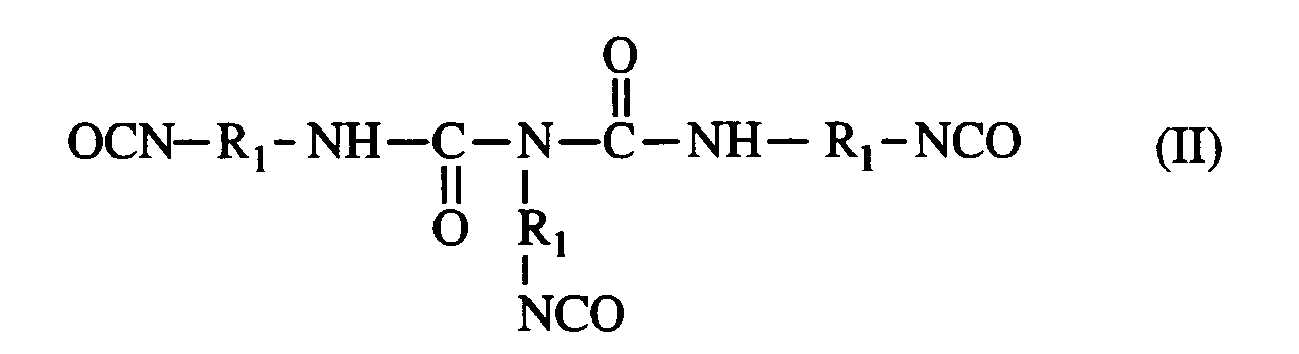

- c) les polycondensats à groupes isocyanate terminaux ou latéraux notamment tels que les polyuréthannes et/ou polyurées (y compris les copolymères séquencés comportant au moins une séquence polyuréthanne et/ou polyurée et au moins une séquence polyéther, polyester, polysiloxane, alkyde ou polyacrylate), ainsi que les polyesters, polyamides, polyépoxy, polyéthers, perfluoropolyéthers, et
- d) les polymères résultant de la copolymérisation de monomères vinyliques, allyliques et/ou (méth)acryliques et de comonomères à insaturation éthylénique comportant une fonction isocyanate libre comme le méthacrylate de 2-isocyanato éthyle.
- a) diisocyanates containing from 4 to 50 carbon atoms, especially from 4 to 30, such as 1,4-tetramethylene diisocyanate, 1,6-hexamethylene diisocyanate, 2,6- and 2,4-toluene diisocyanate, diphenylmethane diisocyanate, and isophorone diisocyanate,
- b) triisocyanates of formula:
- c) polycondensates with terminal or terminal isocyanate groups, such as polyurethanes and / or polyureas (including block copolymers comprising at least one polyurethane and / or polyurea block and at least one polyether, polyester, polysiloxane, alkyd or polyacrylate block) as well as polyesters, polyamides, polyepoxy, polyethers, perfluoropolyethers, and
- d) the polymers resulting from the copolymerization of vinyl, allylic and / or (meth) acrylic monomers and of ethylenically unsaturated comonomers comprising a free isocyanate function such as 2-isocyanatoethyl methacrylate.
Comme polyisocyanate, on peut en particulier utiliser le DESMODUR® N de la société BAYER, le TOLONATE® HDB-LV de la société RHODIA.As polyisocyanate, there may in particular use the DESMODUR ® N of Bayer, Tolonate ® HDB-LV from Rhodia.
Les composés comportant au moins deux fonctions époxydes sont également connus de l'état de la technique. Ils peuvent être de toute nature chimique. Il peut s'agir de diépoxydes ou de polyépoxydes de faibles masses (inférieures ou égales à 5000), ou bien d'oligomères ou de polymères de toute nature chimique, obtenus par polyaddition, polycondensation et/ou greffage, portant au moins deux fonctions époxydes libres, soit aux extrémités de chaînes, soit en groupes latéraux.Compounds having at least two epoxide functions are also known from the state of the art. They can be of any chemical nature. They may be diepoxides or polyepoxides of small masses (less than or equal to 5000), or oligomers or polymers of any chemical nature, obtained by polyaddition, polycondensation and / or grafting, carrying at least two epoxide functions. free, either at the chain ends or in lateral groups.
On peut citer à titre d'exemples de tels composés :
- a) le diglycidyl éther de bisphénol A résultant de la condensation entre le bisphénol A et l'épichlorhydrine, de structure

- b) les résines diépoxy notamment résultant de la condensation supérieure entre l'éther diglycidique de bisphénol A et l'épichlorhydrine,
- c) les résines époxyester à extrémités α,ω-diépoxy notamment résultant de la condensation d'un diacide carboxylique ayant notamment de 2 à 60 atomes de carbone avec un excès stoechiométrique des composés a) ou b),
- d) les résines époxyéthers à extrémités α,ω-diépoxy notamment résultant de la condensation d'un diol ayant notamment de 2 à 60 atomes de carbone avec un excès stoechiométrique des composés a) ou b),
- e) les huiles naturelles ou synthétiques portant au moins deux groupes époxydes, comme par exemple l'huile de soja époxydée, l'huile de lin époxydée, l'huile de vernonia, notamment décrites dans la demande
EP-A-645134 - f) les oligomères ou polymères résultant de la copolymérisation de monomères insaturés ou vinyliques, allyliques et/ou (méth)acryliques, et de comonomères à insaturation éthylénique comportant une fonction époxyde libre (comme le méthacrylate de glycidyle), et
- g) les autres polycondensats à groupes époxy terminaux et/ou latéraux tels que les polyesters, polyesteramides, polyamides, alkydes, polyuréthanes et/ou polyurées, polyéthers et perfluoroplyéthers ou silicones.
- a) Bisphenol A diglycidyl ether resulting from the condensation between bisphenol A and epichlorohydrin, of structural
- b) diepoxy resins, especially resulting from the higher condensation between the diglycidyl ether of bisphenol A and epichlorohydrin,
- c) epoxyester resins with α, ω-diepoxy ends, especially resulting from the condensation of a dicarboxylic acid having in particular from 2 to 60 carbon atoms with a stoichiometric excess of compounds a) or b),
- d) epoxy ether resins with α, ω-diepoxy ends, especially resulting from the condensation of a diol having in particular from 2 to 60 carbon atoms with a stoichiometric excess of compounds a) or b),
- e) natural or synthetic oils bearing at least two epoxide groups, for example epoxidized soybean oil, epoxidized linseed oil or vernonia oil, described in particular in the application
EP-A-645134 - f) oligomers or polymers resulting from the copolymerization of unsaturated or vinyl, allylic and / or (meth) acrylic monomers and of ethylenically unsaturated comonomers having a free epoxide function (such as glycidyl methacrylate), and
- g) other polycondensates with terminal and / or side epoxy groups such as polyesters, polyesteramides, polyamides, alkyds, polyurethanes and / or polyureas, polyethers and perfluoroplyethers or silicones.
Des polymères à fonctions époxy sont commercialisés sous les dénominations CYRACURE® UVR-6110, CYRACURE® UVR-6105 , CYRACURE® ERL-4221E, CYRACURE® ERL-4206, CYRACURE® UVR 6128, CYRACURE® UVR 6216 par la société UNION CARBIDE, DER® 439 par la société DOW CHEMICAL, les EPIKATES® 828,1001,1004,1007 de la société SHELL, l'ARALDITE® ECN1299 de la société CIBA-GEIGY, les EPOXYNOVOLACS® de la société DOW CHEMICAL.Epoxy functional groups in the polymers are sold under the CYRACURE denominations ® UVR-6110, CYRACURE ® UVR-6105, CYRACURE ® ERL-4221E, CYRACURE ® ERL-4206, CYRACURE ® UVR 6128, CYRACURE ® UVR 6216 by the company Union Carbide, DER ® 439 by DOW CHEMICAL, EPIKATES ® 828,1001,1004,1007 from SHELL, ARALDITE ® ECN1299 from CIBA-GEIGY, EPOXYNOVOLACS ® from DOW CHEMICAL.
Les composés portant des doubles liaisons éthyléniques peuvent être de toute nature chimique. Ils peuvent notamment être choisis parmi :
- a) les polyesters à insaturation(s) éthylénique(s).
Il s'agit d'un groupe de polymères de type polyester présentant une ou plusieurs doubles liaisons éthyléniques, réparties de manière aléatoire dans la chaîne principale du polymère.
Ces polyesters insaturés sont obtenus par polycondensation d'un mélange :- de diacides carboxyliques aliphatiques linéaires ou ramifiés ou cycloaliphatiques comportant notamment de 3 à 50 atomes de carbone, de préférence de 3 à 20 atomes de carbone, tels que l'acide adipique ou l'acide sébacique, de diacides carboxyliques aromatiques ayant notamment de 8 à 50 atomes de carbone, de préférence de 8 à 20 atomes de carbone, tels que les acides phtaliques, notamment l'acide téréphtalique, et/ou de diacides carboxyliques issus de dimères d'acides gras à insaturations éthyléniques tels que les dimères des acides oléique ou linoléique décrits dans la demande
EP-A-959 066 - de diols aliphatiques linéaires ou ramifiés ou cycloaliphatiques comportant notamment de 2 à 50 atomes de carbone, de préférence de 2 à 20 atomes de carbone, tels que l'éthylèneglycol, le diéthylèneglycol, le propylèneglycol, le 1,4-butanediol ou le cyclohexanediméthanol, de diols aromatiques ayant de 6 à 50 atomes de carbone, de préférence de 6 à 20 atomes de carbone tel que le bisphénol A, le bisphénol B, et/ou de dimères diols issus de la réduction des dimères d'acides gras tels que définis précédemment, et
- d'un ou de plusieurs diacides carboxyliques ou leurs anhydrides comportant au moins une double liaison éthylénique polymérisable et ayant de 3 à 50 atomes de carbone, de préférence de 3 à 20 atomes de carbone, tels que l'acide maléique, l'acide fumarique ou l'acide itaconique.
- de diacides carboxyliques aliphatiques linéaires ou ramifiés ou cycloaliphatiques comportant notamment de 3 à 50 atomes de carbone, de préférence de 3 à 20 atomes de carbone, tels que l'acide adipique ou l'acide sébacique, de diacides carboxyliques aromatiques ayant notamment de 8 à 50 atomes de carbone, de préférence de 8 à 20 atomes de carbone, tels que les acides phtaliques, notamment l'acide téréphtalique, et/ou de diacides carboxyliques issus de dimères d'acides gras à insaturations éthyléniques tels que les dimères des acides oléique ou linoléique décrits dans la demande
- b) les polyesters à groupes (méth)acrylate latéraux et/ou terminaux :
Il s'agit d'un groupe de polymères de type polyester obtenus par polycondensation d'un mélange :- de diacides carboxyliques aliphatiques linéaires ou ramifiés ou cycloaliphatiques comportant notamment de 3 à 50 atomes de carbone, de préférence de 3 à 20 atomes de carbone, tels que l'acide adipique ou l'acide sébacique, de diacides carboxyliques aromatiques ayant notamment de 8 à 50 atomes de carbone, de préférence de 8 à 20 atomes de carbone, tels que les acides phtaliques, notamment l'acide téréphtalique, et/ou de diacides carboxyliques issus de dimères d'acides gras à insaturation éthyléniques tels que les dimères des acides oléique ou linoléique décrits dans la demande
EP-A-959 066 - de diols aliphatiques linéaires ou ramifiés ou cycloaliphatiques comportant notamment de 2 à 50 atomes de carbone, de préférence de 2 à 20 atomes de carbone, tels que l'éthylèneglycol, le diéthylèneglycol, le propylèneglycol, le 1,4-butanediol ou le cyclohexanediméthanol, de diols aromatiques ayant de 6 à 50 atomes de carbone, de préférence de 6 à 20 atomes de carbone tel que le bisphénol A, le bisphénol B, et
- d'au moins un monoester d'acide (méth)acrylique et d'un diol ou polyol ayant de 2 à 20 atomes de carbone, de préférence de 2 à 6 atomes de carbone, tels que le (méth)acrylate de 2-hydroxyéthyle, le (méth)acrylate de 2-hydroxypropyle et le méthacrylate de glycérol.
Ces polyesters différent de ceux décrits ci-dessus sous le point a) par le fait que les doubles liaisons éthyléniques ne sont pas situées dans la chaîne principale mais sur des groupes latéraux ou à l'extrémité des chaînes. Ces doubles liaisons éthyléniques sont celles des groupes (méth)acrylate présents dans le polymère.
De tels polyesters sont commercialisés par exemple par la société UCB sous les dénominations EBECRYL® (EBECRYL® 450 : masse molaire 1600, en moyenne 6 fonctions acrylate par molécule, EBECRYL® 652 : masse molaire 1500, en moyenne 6 fonctions acrylate par molécule, EBECRYL® 800 : masse molaire 780, en moyenne 4 fonctions acrylate par molécule, EBECRYL® 810 : masse molaire 1000, en moyenne 4 fonctions acrylate par molécule, EBECRYL® 50 000 : masse molaire 1500, en moyenne 6 fonctions acrylate par molécule).
- de diacides carboxyliques aliphatiques linéaires ou ramifiés ou cycloaliphatiques comportant notamment de 3 à 50 atomes de carbone, de préférence de 3 à 20 atomes de carbone, tels que l'acide adipique ou l'acide sébacique, de diacides carboxyliques aromatiques ayant notamment de 8 à 50 atomes de carbone, de préférence de 8 à 20 atomes de carbone, tels que les acides phtaliques, notamment l'acide téréphtalique, et/ou de diacides carboxyliques issus de dimères d'acides gras à insaturation éthyléniques tels que les dimères des acides oléique ou linoléique décrits dans la demande
- c) les polyuréthannes et/ou polyurées à groupes (méth)acrylate notamment obtenus par polycondensation :
- de diisocyanates, triisocyanates et/ou polyisocyanates aliphatiques cycloaliphatiques et/ou aromatiques ayant notamment de 4 à 50, de préférence de 4 à 30 atomes de carbone, tels que l'hexaméthylènediisocyanate, l'isophoronediisocyanate, le toluènediisocyanate, le diphénylméthanediisocyanate ou les isocyanurates de formule :

- de polyols, notamment de diols, exempts d'insaturations éthyléniques polymérisables, tels que le 1,4-butanediol, l'éthylèneglycol ou le triméthylolpropane, et/ou de polyamines, notamment de diamines, aliphatiques, cycloaliphatiques et/ou aromatiques ayant notamment de 3 à 50 atomes de carbone, telles que l'éthylènediamine ou l'hexaméthylènediamine, et
- d'au moins un monoester d'acide (méth)acrylique et d'un diol ou polyol ayant de 2 à 20 atomes de carbone, de préférence de 2 à 6 atomes de carbone, tels que le (méth)acrylate de 2-hydroxyéthyle, le (méth)acrylate de 2-hydroxypropyle et le méthacrylate de glycérol.
De tels polyuréthannes/polyurées à groupes acrylates sont commercialisés par exemple sous la dénomination SR 368 (tris(2-hydroxyéthyl)isocyanurate-triacrylate) ou CRAYNOR® 435 par la société CRAY VALLEY, ou sous la dénomination EBECRYL® par la société UCB (EBECRYL® 210 : masse molaire 1500, 2 fonctions acrylate par molécule, EBECRYL® 230 : masse molaire 5000, 2 fonctions acrylate par molécule, EBECRYL® 270 : masse molaire 1500, 2 fonctions acrylate par molécule, EBECRYL® 8402 : masse molaire 1000, 2 fonctions acrylate par molécule, EBECRYL® 8804 : masse molaire 1300, 2 fonctions acrylate par molécule, EBECRYL® 220 : masse molaire 1000, 6 fonctions acrylate par molécule, EBECRYL® 2220 : masse molaire 1200, 6 fonctions acrylate par molécule, EBECRYL® 1290 : masse molaire 1000, 6 fonctions acrylate par molécule, EBECRYL® 800 : masse molaire 800, 6 fonctions acrylate par molécule).
On peut également citer les polyuréthannes aliphatiques diacrylate hydrosolubles commercialisés sous les dénominations EBECRYL® 2000, EBECRYL® 2001 et EBECRYL® 2002, et les polyuréthannes diacrylate en dispersion aqueuse commercialisés sous les dénominations commerciales IRR® 390, IRR® 400, IRR® 422 IRR® 424 par la société UCB. - de diisocyanates, triisocyanates et/ou polyisocyanates aliphatiques cycloaliphatiques et/ou aromatiques ayant notamment de 4 à 50, de préférence de 4 à 30 atomes de carbone, tels que l'hexaméthylènediisocyanate, l'isophoronediisocyanate, le toluènediisocyanate, le diphénylméthanediisocyanate ou les isocyanurates de formule :
- d) les polyéthers à groupes (méth)acrylate obtenus par estérification, par l'acide (méth)acrylique, des groupes hydroxyle terminaux d'homopolymères ou de copolymères d'alkylèneglycols en C1-4, tels que le polyéthylèneglycol, le polypropylèneglycol, les copolymères d'oxyde d'éthylène et d'oxyde de propylène ayant de préférence une masse moléculaire moyenne en poids inférieure à 10 000, le triméthylolpropane polyéthoxylé ou polypropoxylé.
Des polyoxyéthylènes-di(méth)acrylate de masse molaire appropriée sont commercialisés par exemple sous les dénominations SR 259, SR 344, SR 610, SR 210, SR 603 et SR 252 par la société CRAY VALLEY ou sous la dénomination EBECRYL® 11 par UCB. Des triacrylates de triméthylolpropane polyéthoxylé sont commercialisés par exemple sous les dénominations SR 454, SR 498, SR 502, SR 9035, SR 415 par la société CRAY VALLEY ou sous la dénomination EBECRYL® 160 par la société UCB. Des triacrylates de triméthylolpropane polypropoxylé sont commercialisés par exemple sous les dénominations SR 492 et SR 501 par la société CRAY VALLEY. - e) les époxyacrylates obtenus par réaction entre :
- au moins un diépoxyde choisi par exemple parmi :
- 1) l'éther diglycidylique de bisphénol A,
- 2) une résine diépoxy résultant de la réaction entre l'éther diglycidylique de bisphénol A et l'épichlorhydrine,
- 3) une résine époxyester à extrémités α,ω-diépoxy résultant de la condensation d'un diacide carboxylique ayant de 3 à 50 atomes de carbone avec un excès stoechiométrique de 1) et/ou 2), et
- 4) une résine époxyéther à extrémités α,ω-diépoxy résultant de la condensation d'un diol ayant de 3 à 50 atomes de carbone avec un excès stoechiométrique de 1) et/ou 2),
- 5) les huiles naturelles ou synthétiques portant au moins 2 groupes époxyde, telles que l'huile de soja époxydée, l'huile de lin époxydée et l'huile de vernonia époxydée,
- 6) un polycondensat phénol-formaldéhyde (résine Novolac®), dont les extrémités et/ou les groupes latéraux ont été époxydés,
et
- un ou plusieurs acides carboxyliques ou polyacides carboxyliques comportant au moins une double liaison éthylénique en alpha du groupe carboxylique comme l'acide (méth)acrylique, l'acide crotonique ou les monoesters d'acide (méth)acrylique et d'un diol ou polyol ayant de 2 à 20 atomes de carbone, de préférence de 2 à 6 atomes de carbone tels que le (méth)acrylate de 2-hydroxyéthyle.
De tels polymères sont commercialisés par exemple sous les dénominations SR 349, SR 601, CD 541, SR 602, SR 9036, SR 348, CD 540, SR 480, CD 9038 par le société CRAY VALLEY, sous les dénominations EBECRYL® 600 et EBECRYL® 609, EBECRYL® 150, EBECRYL® 860, EBECRYL® 3702 par la société UCB et sous les dénominations PHOTOMER® 3005 et PHOTOMER® 3082 par la société HENKEL.
- au moins un diépoxyde choisi par exemple parmi :
- f) les poly(méth)acrylates d'(alkyle en C1-50) comportant au moins deux fonctions à double liaison éthylénique portées par les chaînes hydrocarbonées latérales et/ou terminales.
De tels copolymères sont commercialisés par exemple sous les dénominations IRR® 375, OTA® 480 et EBECRYL® 2047 par la société UCB. - g) les polyorganosiloxanes à groupes (méth)acrylate ou (méth)acrylamide notamment obtenus respectivement
- par estérification, par exemple d'acide (méth)acrylique et de polyorganosiloxanes, notamment de polydiméthylsiloxanes (PDMS), portant des groupes hydroxyle terminaux et/ou latéraux,
- par amidification, par exemple d'acide (méth)acrylique et de polyorganosiloxanes porteurs de groupes amine primaire ou secondaire latéraux et/ou terminaux.
Parmi les PDMS hydroxylés on peut citer les PDMS comportant au moins deux groupes hydroxyalkyle en C1-6 et les diméthicone-copolyols avec des groupes hydroxyle latéraux ou terminaux.
Des polydiméthylsiloxanes α,ω-dihydroxylés estérifiables sont commercialisés sous les dénominations TEGOMER® H-Si 2111 et TEGOMER® H-Si 2311 par la société GOLDSCHMIDT. Des polydiméthylsiloxanes α,ω-diacrylate sont disponibles à la société SHIN-ETSU sous les références X-22-164 B et X-22-164C.
Comme PDMS aminés, on peut citer en particulier des PDMS comportant au moins 2 groupes aminoalkyle en C1-10, par exemple la silicone aminée commercialisée sous la dénomination Q2-8220 par la société DOW CORNING.
Avantageusement, les polymères siliconés de ce groupe sont utilisés en mélange avec un ou plusieurs polymères des autres groupes a) à f) décrits ci-dessus, notamment pour modifier le caractère hydrophobe de la composition finale.
- h) les perfluoropolyéthers à groupes acrylate notamment obtenus par estérification, par exemple par l'acide (méth)acrylique, de perfluoropolyéthers portant des groupes hydroxyle latéraux et/ou terminaux.
De tels perfluoropolyéthers α,ω-diols sont décrits notamment dansEP-A-1057849 - i) les dendrimères et polymères hyperramifiés portant des groupes terminaux (méth)acrylate ou (méth)acrylamide notamment obtenus respectivement par estérification ou amidification de dendrimères et de polymères hyperramifiés à fonctions terminales hydroxyle ou amino, par de l'acide (méth)acrylique.
- a) polyesters with ethylenic unsaturation (s).
It is a group of polyester polymers having one or more ethylenic double bonds, randomly distributed in the main chain of the polymer.
These unsaturated polyesters are obtained by polycondensation of a mixture:- of linear or branched or cycloaliphatic aliphatic dicarboxylic acids containing in particular from 3 to 50 carbon atoms, preferably from 3 to 20 carbon atoms, such as adipic acid or sebacic acid, of aromatic dicarboxylic acids having in particular from 8 to 50 carbon atoms, preferably 8 to 20 carbon atoms, such as phthalic acids, especially terephthalic acid, and / or dicarboxylic acids derived from ethylenically unsaturated fatty acid dimers such as the dimers of the oleic or linoleic acids described in the application
EP-A-959 066 - linear or branched or cycloaliphatic aliphatic diols comprising in particular from 2 to 50 carbon atoms, preferably from 2 to 20 carbon atoms, such as ethylene glycol, diethylene glycol, propylene glycol, 1,4-butanediol or cyclohexanedimethanol, aromatic diols having 6 to 50 carbon atoms, preferably 6 to 20 carbon atoms such as bisphenol A, bisphenol B, and / or diol dimers derived from the reduction of fatty acid dimers as defined previously, and
- one or more dicarboxylic acids or their anhydrides containing at least one polymerizable ethylenic double bond and having from 3 to 50 carbon atoms, preferably from 3 to 20 carbon atoms, such as maleic acid, fumaric acid or itaconic acid.
- of linear or branched or cycloaliphatic aliphatic dicarboxylic acids containing in particular from 3 to 50 carbon atoms, preferably from 3 to 20 carbon atoms, such as adipic acid or sebacic acid, of aromatic dicarboxylic acids having in particular from 8 to 50 carbon atoms, preferably 8 to 20 carbon atoms, such as phthalic acids, especially terephthalic acid, and / or dicarboxylic acids derived from ethylenically unsaturated fatty acid dimers such as the dimers of the oleic or linoleic acids described in the application
- b) polyesters with (meth) acrylate groups and / or terminal:
It is a group of polymers of polyester type obtained by polycondensation of a mixture:- of linear or branched or cycloaliphatic aliphatic dicarboxylic acids containing in particular from 3 to 50 carbon atoms, preferably from 3 to 20 carbon atoms, such as adipic acid or sebacic acid, of aromatic dicarboxylic acids having in particular from 8 to 50 carbon atoms, preferably 8 to 20 carbon atoms, such as phthalic acids, especially terephthalic acid, and / or dicarboxylic acids derived from dimers of ethylenically unsaturated fatty acids such as oleic acid dimers or linoleic described in the application
EP-A-959 066 - linear or branched or cycloaliphatic aliphatic diols comprising in particular from 2 to 50 carbon atoms, preferably from 2 to 20 carbon atoms, such as ethylene glycol, diethylene glycol, propylene glycol, 1,4-butanediol or cyclohexanedimethanol, aromatic diols having from 6 to 50 carbon atoms, preferably from 6 to 20 carbon atoms such as bisphenol A, bisphenol B, and
- at least one (meth) acrylic acid monoester and a diol or polyol having 2 to 20 carbon atoms, preferably 2 to 6 carbon atoms, such as 2-hydroxyethyl (meth) acrylate , 2-hydroxypropyl (meth) acrylate and glycerol methacrylate.
These polyesters differ from those described above under point a) in that the ethylenic double bonds are not located in the main chain but on side groups or at the end of the chains. These ethylenic double bonds are those of (meth) acrylate groups present in the polymer.
Such polyesters are sold for example by UCB under the designations EBECRYL ® (EBECRYL ® 450: molecular weight 1600, an average of 6 acrylate functions per molecule, EBECRYL ® 652: molecular weight 1500, an average of 6 acrylate functions per molecule, EBECRYL ® 800: molar mass 780, on average 4 acrylate functions per molecule, EBECRYL ® 810: molar mass 1000, on average 4 acrylate functions per molecule, EBECRYL ® 50 000: molar mass 1500, on average 6 acrylate functions per molecule).
- of linear or branched or cycloaliphatic aliphatic dicarboxylic acids containing in particular from 3 to 50 carbon atoms, preferably from 3 to 20 carbon atoms, such as adipic acid or sebacic acid, of aromatic dicarboxylic acids having in particular from 8 to 50 carbon atoms, preferably 8 to 20 carbon atoms, such as phthalic acids, especially terephthalic acid, and / or dicarboxylic acids derived from dimers of ethylenically unsaturated fatty acids such as oleic acid dimers or linoleic described in the application
- c) polyurethanes and / or polyureas containing (meth) acrylate groups, in particular obtained by polycondensation:
- cycloaliphatic and / or aromatic aliphatic diisocyanates, triisocyanates and / or polyisocyanates having especially from 4 to 50, preferably from 4 to 30 carbon atoms, such as hexamethylene diisocyanate, isophorone diisocyanate, toluene diisocyanate, diphenylmethane diisocyanate or isocyanurates of formula :
- polyols, especially diols, free of polymerizable ethylenic unsaturations, such as 1,4-butanediol, ethylene glycol or trimethylolpropane, and / or polyamines, especially diamines, aliphatic, cycloaliphatic and / or aromatic having especially 3 to 50 carbon atoms, such as ethylenediamine or hexamethylenediamine, and
- at least one (meth) acrylic acid monoester and a diol or polyol having 2 to 20 carbon atoms, preferably 2 to 6 carbon atoms, such as 2-hydroxyethyl (meth) acrylate , 2-hydroxypropyl (meth) acrylate and glycerol methacrylate.
Such polyurethanes / polyureas with acrylate groups are marketed for example under the designation SR 368 (tris (2-hydroxyethyl) isocyanurate triacrylate) or Craynor ® 435 by Cray Valley or under the name EBECRYL ® by the company UCB (EBECRYL ® 210: 1500 molar mass, 2 acrylate functions per molecule, EBECRYL ® 230: 5000 molar mass, 2 acrylate functions per molecule, EBECRYL ® 270: 1500 molar mass, 2 acrylate functions per molecule, EBECRYL ® 8402: 1000 molar mass, 2 Acrylate function per molecule, EBECRYL ® 8804: Molar mass 1300, 2 acrylate functions per molecule, EBECRYL ® 220: Molar mass 1000, 6 acrylate functions per molecule, EBECRYL ® 2220: Molar mass 1200, 6 acrylate functions per molecule, EBECRYL ® 1290 : molecular weight 1000, 6 acrylate functions per molecule, EBECRYL ® 800: molecular weight 800, 6 acrylate functional groups per molecule).
It can also be made of aliphatic water-soluble diacrylate polyurethanes sold under the EBECRYL denominations ® 2000 EBECRYL ® 2001 and EBECRYL ® 2002 and the diacrylate polyurethanes in aqueous dispersion marketed under the trade names IRR ® 390, IRR ® 400, IRR ® 422 IRR ® 424 by the company UCB. - cycloaliphatic and / or aromatic aliphatic diisocyanates, triisocyanates and / or polyisocyanates having especially from 4 to 50, preferably from 4 to 30 carbon atoms, such as hexamethylene diisocyanate, isophorone diisocyanate, toluene diisocyanate, diphenylmethane diisocyanate or isocyanurates of formula :
- d) polyethers with (meth) acrylate groups obtained by esterification, with (meth) acrylic acid, of terminal hydroxyl groups of homopolymers or copolymers of C 1-4 alkylene glycols, such as polyethylene glycol, polypropylene glycol, the copolymers of ethylene oxide and propylene oxide preferably having a weight average molecular weight of less than 10,000, polyethoxylated or polypropoxylated trimethylolpropane.
Polyoxyethylene di (meth) acrylate of suitable molar mass are commercially available for example under the names SR 259, SR 344, SR 610, SR 210, SR 603 and SR 252 by the company CRAY VALLEY or under the name EBECRYL ® 11 by UCB. . Triacrylates trimethylolpropane polyethoxylate are marketed for example under the names SR 454, SR 498, SR 502, SR 9035, SR 415 by the company Cray Valley or under the name EBECRYL ® 160 by the company UCB. Polypropoxylated trimethylolpropane triacrylates are sold, for example, under the names SR 492 and SR 501 by the company Cray Valley. - e) epoxyacrylates obtained by reaction between:
- at least one diepoxide chosen for example from:
- 1) diglycidyl ether of bisphenol A,
- 2) a diepoxy resin resulting from the reaction between bisphenol A diglycidyl ether and epichlorohydrin,
- 3) an epoxy ester resin with α, ω-diepoxy ends resulting from the condensation of a dicarboxylic acid having from 3 to 50 carbon atoms with a stoichiometric excess of 1) and / or 2), and
- 4) an epoxy ether resin having α, ω-diepoxy ends resulting from the condensation of a diol having from 3 to 50 carbon atoms with a stoichiometric excess of 1) and / or 2),
- 5) natural or synthetic oils bearing at least 2 epoxide groups, such as epoxidized soybean oil, epoxidized linseed oil and epoxidized vernonia oil,
- 6) a phenol-formaldehyde polycondensate (Novolac ® resin), the ends and / or side groups have been epoxidized,
and
- one or more carboxylic acids or polycarboxylic acids containing at least one ethylenic double bond alpha to the carboxylic group such as (meth) acrylic acid, crotonic acid or acid monoesters (meth) acrylic acid and a diol or polyol having 2 to 20 carbon atoms, preferably 2 to 6 carbon atoms such as 2-hydroxyethyl (meth) acrylate.
Such polymers are sold, for example under the names SR 349, SR 601, CD 541, SR 602, SR 9036, SR 348, CD 540, SR 480, 9038 CD by the company Cray Valley, under the names EBECRYL ® 600 and EBECRYL ® 609, EBECRYL ® 150, EBECRYL ® 860, EBECRYL ® 3702 by the company UCB and under the names PHOTOMER ® 3005 and PHOTOMER ® 3082 by the company HENKEL.
- at least one diepoxide chosen for example from:
- f) poly (meth) acrylates of C 1-50 alkyl having at least two functions with ethylenic double bond carried by the side and / or terminal hydrocarbon chains.
Such copolymers are marketed for example under the names IRR ® 375 ATO ® 480 and EBECRYL ® 2047 by UCB. - g) polyorganosiloxanes containing (meth) acrylate or (meth) acrylamide groups respectively obtained respectively
- by esterification, for example of (meth) acrylic acid and polyorganosiloxanes, in particular polydimethylsiloxanes (PDMS), bearing terminal and / or lateral hydroxyl groups,
- by amidification, for example of (meth) acrylic acid and polyorganosiloxanes bearing primary or secondary amine groups lateral and / or terminal.
Among the hydroxylated PDMSs, mention may be made of PDMSs comprising at least two C 1-6 hydroxyalkyl groups and dimethicone copolyols with lateral or terminal hydroxyl groups.
Polydimethylsiloxane α, ω-dihydroxylated esterifiable are sold under the names TEGOMER ® H-Si 2111 and TEGOMER ® H-Si 2311 by Goldschmidt. Α, ω-Diacrylate polydimethylsiloxanes are available from SHIN-ETSU under the references X-22-164 B and X-22-164C.
As PDMS amines, mention may in particular be made of PDMSs comprising at least 2 C 1-10 aminoalkyl groups, for example the aminosilicone sold under the name Q2-8220 by the company Dow Corning.
Advantageously, the silicone polymers of this group are used in admixture with one or more polymers of the other groups a) to f) described above, in particular to modify the hydrophobicity of the final composition.
- h) perfluoropolyethers containing acrylate groups, especially obtained by esterification, for example with (meth) acrylic acid, of perfluoropolyethers bearing lateral and / or terminal hydroxyl groups.
Such perfluoropolyethers α, ω-diols are described in particular inEP-A-1057849 - i) hyperbranched dendrimers and polymers bearing terminal (meth) acrylate or (meth) acrylamide groups, in particular obtained respectively by esterification or amidification of dendrimers and hyperbranched polymers with hydroxyl or amino terminal functions, with (meth) acrylic acid.
Les dendrimères (du grec dendron = arbre) sont des molécules polymères "arborescentes", c'est-à-dire très ramifiées inventées par D. A. Tomalia et son équipe au début des années 90 (
Les polymères hyperramifiés sont des polycondensats, généralement de type polyester, polyamide ou polyéthylèneamine, obtenus à partir de monomères multifonctionnels, qui ont une structure arborescente similaire à celle des dendrimères mais beaucoup moins régulière que celle-ci (voir par exemple
La société PERSTORP commercialise sous la dénomination BOLTORN® des polyesters hyperramifiés. On trouvera sous la dénomination COMBURST® de la société DENDRITECH des polyéthylèneamines hyperramifiées. Des poly(esteramide) hyperramifiés à extrémités hydroxyle sont commercialisés par la société DSM sous la dénomination HYBRANE®.The company PERSTORP markets under the name BOLTORN ® hyperbranched polyesters. It will be found under the name COMBURST ® of the company DENDRITECH hyperbranched polyethyleneamines. Poly (esteramide) hyperbranched hydroxyl end groups are marketed by the company DSM under the name HYBRANE ®.
Ces dendrimères et polymères hyperramifiés estérifiés ou amidifiés par l'acide acrylique et/ou méthacrylique se distinguent des polymères décrits sous les points a) à h) ci-dessus par le très grand nombre de doubles liaisons éthyléniques présentes.These dendrimers and hyperbranched polymers esterified or amidified with acrylic and / or methacrylic acid are distinguished from the polymers described under points a) to h) above by the very large number of ethylenic double bonds present.
Cette fonctionnalité élevée, le plus souvent supérieure à 5, les rend particulièrement utiles en leur permettant de jouer un rôle de "noeud de réticulation", c'est-à-dire de site de réticulation multiple.This high functionality, most often greater than 5, makes them particularly useful by allowing them to play a role of "crosslinking node", that is to say of multiple crosslinking site.
Les composés portant au moins deux fonctions à hydrogène labile utilisés dans la présente invention sont également connus. Il peut s'agir de composés organiques de faible masse moléculaire ou bien d'oligomères ou de polymères synthétiques, obtenus par polyaddition, polycondensation et/ou greffage, ou de polymères naturels modifiés chimiquement.Compounds bearing at least two labile hydrogen functions used in the present invention are also known. It can be organic compounds of low molecular weight or oligomers or synthetic polymers, obtained by polyaddition, polycondensation and / or grafting, or chemically modified natural polymers.
Selon la présente invention, les fonctions à hydrogène labile sont choisies de préférence parmi les fonctions amine primaire (-NH2), amine secondaire (>NH), hydroxyle (-OH), acide carboxylique (-COOH) ou thiol (-SH).
- Lorsque la fonction à hydrogène labile est une fonction hydroxyle, on peut citer comme familles de composés, les diols et polyols, choisis de préférence parmi :
- 1) les diols aliphatiques contenant un groupement hydroxyle tels que 1,2-propanediol, 1,3-propanediol, 1,2-butanediol, 1,3-butanediol, 1,2-pentanediol, 1,4-pentanediol ...
- 2) les polyols tels les polyalkylène éthers polyols dont la structure serait décrite par la formule :
H-(O(CH2-CHR)n)mOH
- R étant un atome d'hydrogène ou un groupement alkyle contenant de 1 à 5 carbone,
- n étant un nombre entier de 1 à 6, et
- m etant un nombre entier 1 à 100.
- When the function with a labile hydrogen is a hydroxyl function, there may be mentioned as families of compounds, diols and polyols, preferably chosen from:
- 1) Aliphatic diols containing a hydroxyl group such as 1,2-propanediol, 1,3-propanediol, 1,2-butanediol, 1,3-butanediol, 1,2-pentanediol, 1,4-pentanediol ...
- 2) polyols such as polyalkylene ether polyols whose structure would be described by the formula:
H- (O (CH 2 -CHR) n ) m OH
- R being a hydrogen atom or an alkyl group containing 1 to 5 carbon,
- n being an integer from 1 to 6, and
- m being an integer 1 to 100.
On peut en particulier citer les poly(oxytétraetéhylène) glycol, poly (oxy-1,2 propylène) glycol, poly (oxy-1,2 butylène) glycol...
- Lorsque la fonction à hydrogène labile est une fonction amine (NH2), il peut s'agir d'une diamine, une polyamine, un aminoalcool, un oligomère, ou un polymère à groupes amines, choisis notamment parmi :
- 1) les diamines aliphatiques, cycloaliphatiques ou aromatiques ayant notamment de 2 à 60 atomes de carbone, tel que l'éthylènediamine, le 1,2 diaminopropane, le 1,3 diaminopropane, le 1,4 diaminobutane, le 1,2 diamino-2-méthylpropane, le 1,6 diaminohexane, le 1,10 diaminodécane, l'isophoronediamine, l'adamantane diamine, la 2,6 diaminopyridine, ou les diamines obtenues par modification des extrémités d'acides gras dimères,
- 2) les amines multifonctionnelles ayant plus de deux groupes amines telles que la mélanine, la 2,4,6 triaminopyrimidine, la 3,3' diaminobenzidine ou la 2,4,5,6 tétraaminopyrimidine,
- 3) les oligomères porteurs d'au moins deux groupes amines tels que les diamines de polyalkylèneoxydes JEFFAMINE® de TEXACO (polyétherdiamines),
- 4) les dendrimères ou polymères hyperbranchés dont les extrémités de chaînes sont des amines primaires, en particulier les polyamidoamines tels que ceux vendus sous la dénomination STARBUST® par la société DENDRITECH. Les polymères hyperramifiés sont des polycondensats généralement de type polyéthylèneamine obtenus à partir de monomères multifonctionnels, qui ont une structure arborescente similaire à celle des dendrimères mais beaucoup moins régulière que celle-ci.
- Lorsque le composé est un oligomère ou polymère (homopolymère ou copolymère) porteur de fonctions à hydrogène labiles, celles-ci peuvent être situées aux extrémités et/ou latéralement aux chaînes. On peut citer comme familles de composés des copolymères, blocs ou non, acrylique résultant de la polymérisation de monomère comportant des fonctions éthyléniques insaturées telles que l'acide (meth)acrylique avec un monomère alkyl ester de l'acide (méth)acrylique ( méthacrylate de méthyl, méthacrylate d'éthyl...) , des monomères vyniliques tels que le styrene, l'alpha méthyl styrène, le vynil toluène..., les polyuréthanes, les polyesters, les polycondensats de toutes nature porteurs de groupes hydoxyles et en particulier les polyamides obtenus par condensation d'un excès de diamine ou de diacide ou de diol.
- When the labile hydrogen function is an amine function (NH 2 ), it may be a diamine, a polyamine, an aminoalcohol, an oligomer, or a polymer with amine groups, chosen in particular from:
- 1) aliphatic, cycloaliphatic or aromatic diamines having especially from 2 to 60 carbon atoms, such as ethylenediamine, 1,2 diaminopropane, 1,3 diaminopropane, 1,4 diaminobutane, 1,2 diamino-2 1,2-diaminohexane, 1,10 diaminodecane, isophoronediamine, adamantane diamine, 2,6 diaminopyridine, or diamines obtained by modifying the ends of dimeric fatty acids,
- 2) multifunctional amines having more than two amine groups such as melanin, 2,4,6-triaminopyrimidine, 3,3'-diaminobenzidine or 2,4,5,6-tetraaminopyrimidine,
- 3) the oligomers bearing at least two amine groups such as diamines of polyalkylene oxides of JEFFAMINE ® TEXACO (polyetherdiamines)
- 4) dendrimers or hyperbranched polymers whose chain ends are primary amines, in particular polyamidoamines such as those sold under the trade name Starburst ® by Dendritech. Hyperramified polymers are generally polyethyleneamine polycondensates obtained from multifunctional monomers, which have a tree structure similar to that of dendrimers but much less regular than this one.
- When the compound is an oligomer or polymer (homopolymer or copolymer) carrying labile hydrogen functions, these may be located at the ends and / or laterally to the chains. As families of compounds, acrylic or non-block copolymers resulting from the polymerization of monomers containing unsaturated ethylenic functions such as (meth) acrylic acid with a (meth) acrylic acid (methacrylate) alkyl ester monomer may be mentioned as families of compounds. methyl, ethyl methacrylate, etc.), vinyl monomers such as styrene, alpha-methyl styrene, vinyl toluene, polyurethanes, polyesters and polycondensates of all types. carriers of hydoxyl groups and in particular polyamides obtained by condensation of an excess of diamine or diacid or diol.
Des exemples particuliers de composés porteur de fonctions à hydrogènes labiles sont : les alkylèneglycols en C1-4, le glycérol, le triméthylolpropane, le pentaérythritol, les poly(alkylène en C1-4)glycols tels que le polyéthylèneglycol ou polyproylèneglycol ou des copolymères de ceux-ci, le produit de condensation de propylèneglycol et de triméthylolpropane, l'huile de ricin, le phytantriol, les sucres et carbohydrates tels que le saccharose ou la cellulose, l'éthylènediamine, le 1,3-diaminopropane, la lysine, l'amino-2-méthyl-2-propanol-1, les poly(alkylèneoxy)diamines telles que les produits JEFFAMINE® commercialisés par la société TEXACO, la nitrocellulose, les esters de cellulose, notamment ceux ayant un degré de substitution inférieur à 3, tels que l'acétobutyrate de cellulose et l'acétopropionate de cellulose, les éthers de cellulose tels que l'hydroxyéthylcellulose, la carboxyméthylcellulose, l'hydroxypropylcellulose ou l'éthylcellulose, les résines polyesters, silicones, perfluoropolyéthers, alkydes et polycétones à extrémités hydroxylées, le poly(alcool vinylique) et les copolymères à base d'alcool vinylique, les copolymères d'alcool allylique, les copolymères à base de (méth)acrylate d'hydroxyalkyle en C2-10, comme le (méth)acrylate de 2-hydroxyéthyle ou de 2-hydroxypropyle, vendus notamment sous la dénomination JONCRYL® SCX 910 par la société JOHNSON POLYMER ou sous la dénomination CRODOPLAST® AC 5725 par la société CRODA, les copolymères à base de vinylamine ou d'allylamine, les silicones et les perfluoroéthers à extrémités amine primaire ou secondaire, les dendrimères ou polymères hyperramifiés à extrémités hydroxyle ou amine primaire tels que les polyesters hyperramifiés à extrémités hydroxyle commercialisés par la société PERSTORP sous les dénominations BOLTORN® H40 TMP CORE et HBP POLYOL® 3G (décrits dans les demandes internationales
Conviennent également à l'invention, des composés portant au moins deux fonctions de natures distinctes à l'image, par exemple des résines. Il peut notamment s'agir :
- des résines alkydes, et en particulier des oligomères issues de la condensation de composés qui portent des fonctions hydroxyles (alcool, diol, ...) avec des composés qui portent des fonctions acides carboxyliques.
Ainsi les résines alkydes comportent des fonctions à hydrogènes labiles tels des fonctions hydroxyles et/ou des fonctions amides et/ou des fonctions acides carboxyliques et/ou des fonctions réactives telles que des fonctions éthyléniques insaturées (issus d'un alcool ou un acide gras ayant une chaîne alkyle comportant une fonction ethylènique insaturée). Ces résines peuvent être utilisées comme composé A ou B pour être réticulé en présence d'un composé comportant une fonction réactive telle qu'un isocyanate, une fonction époxyde ou co-réticulée sous UV avec un autre composé comportant des fonctions éthyléniques insaturées. - Des résines aminoplast qui résultent de la condensation d'un composé ayant une fonction aldéhyde avec un composé ayant une fonction amine ou amide.
On peut citer par exemple les réactions de condensation du formadéhyde, acétaldéhyde, benzaldéhyde avec une urée, une mélamine. Les résines aminoplast préférées sont issues de la condensation d'une fonction alcool et formadéhyde avec une fonction urée, mélamine. - Selon une seconde variante de l'invention la réticulation est réalisée par voie photochimique et met en oeuvre au moins deux composés (A) et (B) possédant des fonctions de type doubles liaisons insaturées, en présence d'un photoamorceur.
- alkyd resins, and in particular oligomers resulting from the condensation of compounds which carry hydroxyl functional groups (alcohol, diol, etc.) with compounds which carry carboxylic acid functions.
Thus, the alkyd resins comprise functions with labile hydrogels such as hydroxyl functions and / or amide functions and / or carboxylic acid functions and / or reactive functions such as unsaturated ethylenic functions (derived from an alcohol or a fatty acid having an alkyl chain having an unsaturated ethylenic function). These resins can be used as compound A or B to be crosslinked in the presence of a compound having a reactive functional group such as an isocyanate, an epoxide function or co-crosslinked under UV with another compound having unsaturated ethylenic functions. - Aminoplast resins which result from the condensation of a compound having an aldehyde function with a compound having an amine or amide function.
Examples that may be mentioned are the condensation reactions of formaldehyde, acetaldehyde, benzaldehyde with a urea, a melamine. The preferred aminoplast resins result from the condensation of an alcohol and formaldehyde function with a urea function, melamine. - According to a second variant of the invention, the crosslinking is carried out photochemically and uses at least two compounds (A) and (B) having unsaturated double bond type functions, in the presence of a photoinitiator.
Selon cette variante, les composés (A) et (B) sont choisis de manière à former un système réactif dont la valence moyenne du système est supérieure à 2.According to this variant, the compounds (A) and (B) are chosen so as to form a reactive system whose average valence of the system is greater than 2.
On appelle valence d'un composé le nombre de liaisons covalentes qu'il peut établir avec ces les composés qui lui sont associés. On défini la valence moyenne comme étant égale au rapport de la somme des valences de tous les composés (A) et (B) divisé par le nombre total de composés (A) et (B) 
Selon cette variante de l'invention, les composés (A) ou (B) peuvent être un composé comportant une fonction de type double liaison insaturée et notamment tels que définis précédemment, et/ou un monomère à insaturation éthylénique.According to this variant of the invention, the compounds (A) or (B) may be a compound comprising an unsaturated double bond type function and in particular as defined above, and / or an ethylenically unsaturated monomer.
Comme monomères à insaturation éthylénique ayant au moins un groupement acide ou monomère porteur de groupement acide, on peut utiliser des acides carboxyliques insaturés α,β-éthyléniques tels que l'acide acrylique, l'acide méthacrylique, l'acide crotonique, l'acide maléique, l'acide itaconique. On utilise en particulier l'acide (méth)acrylique et l'acide crotonique, et plus particulièrement l'acide (méth)acrylique.As ethylenically unsaturated monomers having at least one acidic group or monomer bearing an acid group, it is possible to use α, β-ethylenic unsaturated carboxylic acids such as acrylic acid, methacrylic acid, crotonic acid, and acid. maleic, itaconic acid. In particular, (meth) acrylic acid and crotonic acid are used, and more particularly (meth) acrylic acid.
Les esters de monomères acides sont avantageusement choisis parmi les esters de l'acide (méth)acrylique (encore appelé les (méth)acrylates), notamment des (méth)acrylates d'alkyle, en particulier d'alkyle en C1-C20, plus particulièrement en C1-C8, des (méth)acrylates d'aryle, en particulier d'aryle en C6-C10, des (méth)acrylates d'hydroxyalkyle, en particulier d'hydroxyalkyle en C2-C6.The acidic monomer esters are advantageously chosen from esters of (meth) acrylic acid (also called (meth) acrylates), in particular alkyl (meth) acrylates, in particular C 1 -C 20 alkyl (meth) acrylates. , more particularly C 1 -C 8 , (meth) acrylates of aryl, in particular of C 6 -C 10 aryl, hydroxyalkyl (meth) acrylates, in particular hydroxyalkyl C 2 -C 6 .
Parmi les (méth)acrylates d'alkyle, on peut citer le méthacrylate de méthyle, le méthacrylate d'éthyle, le méthacrylate de butyle, le méthacrylate d'isobutyle, le méthacrylate d'éthyl-2 hexyle, le méthacrylate de lauryle.Among the alkyl (meth) acrylates, mention may be made of methyl methacrylate, ethyl methacrylate, butyl methacrylate, isobutyl methacrylate, 2-ethylhexyl methacrylate and lauryl methacrylate.
Parmi les (méth)acrylates d'hydroxyalkyle, on peut citer l'acrylate d'hydroxyéthyle, l'acrylate de 2-hydroxypropyle, le méthacrylate d'hydroxyéthyle, le méthacrylate de 2-hydroxypropyle.Among the hydroxyalkyl (meth) acrylates, mention may be made of hydroxyethyl acrylate, 2-hydroxypropyl acrylate, hydroxyethyl methacrylate and 2-hydroxypropyl methacrylate.
Parmi les (méth)acrylates d'aryle, on peut citer l'acrylate de benzyle et l'acrylate de phényle.Among the aryl (meth) acrylates, mention may be made of benzyl acrylate and phenyl acrylate.
Les esters de l'acide (méth)acrylique sont en particulier des (méth)acrylates d'alkyle.The esters of (meth) acrylic acid are in particular alkyl (meth) acrylates.
Selon la présente invention, le groupement alkyle des esters peut être soit fluoré, soit perfluoré, c'est-à-dire qu'une partie ou la totalité des atomes d'hydrogène du groupement alkyle sont substitués par des atomes de fluor.According to the present invention, the alkyl group of the esters can be either fluorinated or perfluorinated, ie some or all of the hydrogen atoms of the alkyl group are substituted by fluorine atoms.
Comme amides des monomères acide, on peut par exemple citer les (méth)acrylamides, et notamment les N-alkyl (méth)acrylamides, en particulier d'alkyle en C2-C12. Parmi les N-alkyl (méth)acrylamides, on peut citer le N-éthyl acrylamide, le N-t-butyl acrylamide et le N-t-octyl acrylamide.Amides of the acidic monomers include, for example, (meth) acrylamides, and especially N-alkyl (meth) acrylamides, in particular C 2 -C 12 alkyl. Among the N-alkyl (meth) acrylamides, mention may be made of N-ethyl acrylamide, Nt-butyl acrylamide and Nt-octyl acrylamide.
Comme exemple d'esters vinyliques, on peut citer l'acétate de vinyle, le néodécanoate de vinyle, le pivalate de vinyle, le benzoate de vinyle et le t-butyl benzoate de vinyle.Examples of vinyl esters include vinyl acetate, vinyl neodecanoate, vinyl pivalate, vinyl benzoate and vinyl t-butyl benzoate.
Comme monomères styrèniques, on peut citer le styrène de l'alpha-méthyl styrène.As styrene monomers, mention may be made of styrene of alpha-methyl styrene.
La liste des monomères donnée n'est pas limitative et il est possible d'utiliser tout monomère connu de l'homme du métier entrant dans les catégories de monomères acryliques et vinyliques (y compris les monomères modifiés par une chaîne siliconée).The list of monomers given is not limiting and it is possible to use any monomer known to those skilled in the art falling into the categories of acrylic and vinyl monomers (including monomers modified with a silicone chain).
Les photoamorceurs utilisables dans les compositions cosmétiques de la présente invention sont également connus dans la technique et sont décrits, par exemple dans les articles suivants dont le contenu fait partie intégrante du présent texte : "
Ces photoamorceurs englobent :
- les α-hydroxycétones, commercialisées par exemple sous les dénominations IRGACURE® 184, 1173, 2959, 149, 1000, 500 et 4265 par la société CIBA,
- les α-aminocétones, commercialisés par exemple sous les dénominations IRGACURE® 907 et 369 par la société CIBA,
- les chloroacétophénones commercialisées par exemple sous les dénominations TRIGONAL® P par la société AKZO et SANDORAY® 1000 par la société SANDOZ,
- les cétones aromatiques commercialisées par exemple sous les dénominations DAITOCURE® par DAINIPPON, UVECRYL® P 36 par UCB, ESACURE® TZT par LAMBERTI, et QUANTACURE® ITX par WARD BLENKINSOP. On peut également citer les thioxanthones (par exemple ULTRACURE® DXT de SHERWIN WILLIAMS) et les quinones (2-éthylanthraquinone de BASF). Ces cétones aromatiques nécessitent le plus souvent la présence d'un composé donneur d'hydrogène tel que les amines tertiaires et plus particulièrement les alcanolamines,
- les éthers de benzine commercialisés par exemple sous la dénomination ESACURE® EB-3 par la société LAMBERTI et sous la dénomination TRIGONAL® 14 par AKZO,
- les dérivés α-dicarbonyles dont le représentant le plus courant est le benzyldiméthylcétal commercialisé sous la dénomination IRGACURE® 651 par CIBA. D'autres produits commerciaux sont commercialisés par la société LAMBERTI sous la dénomination ESACURE® KBO et par la société WARD BENKINSOP sous la dénomination QUANTACURE® PDO.
- les oxydes d'acylphosphine, tels que par exemple les oxydes de bis-acylphosphine (BAPO) commercialisés par exemple sous la dénomination IRGACURE® 819, 1700, 1800 et 1850 et DAROCUR® 4265 par la société CIBA.
- the α-hydroxyketones, marketed for example under the designations IRGACURE ® 184, 1173, 2959, 149, 1000, 500 and 4265 by the company Ciba,
- the α-amino ketones, for example marketed under the names IRGACURE ® 907 and 369 by the company Ciba,
- the chloroacétophénones marketed for example under the designations P TRIGONAL ® by the company AKZO and SANDORAY ® 1000 by Sandoz,
- aromatic ketones marketed for example under the names DAITOCURE ® by DAINIPPON, UVECRYL ® P 36 by UCB, ESACURE ® TZT by LAMBERTI, and QUANTACURE ® ITX by WARD BLENKINSOP. Mention may also be made of thioxanthones (for example ULTRACURE ® DXT from SHERWIN WILLIAMS) and quinones (2-ethylanthraquinone from BASF). These ketones aromatic compounds most often require the presence of a hydrogen donor compound such as tertiary amines and more particularly alkanolamines,
- the benzene ethers marketed for example under the name ESACURE ® EB-3 by the company Lamberti and under the name TRIGONAL ® 14 by AKZO,
- the α-dicarbonyl derivatives most common of which is representative benzyldimethylketal sold under the name IRGACURE ® 651 by Ciba. Other commercial products are marketed by the company Lamberti under the name ESACURE ® KBO and by the company under the name WARD BENKINSOP Quantacure ® PDO.
- acylphosphine oxides such as for example bis-acylphosphine oxides (BAPO) marketed for example under the name IRGACURE ® 819, 1700, 1800 and 1850 and DAROCUR 4265 ® by Ciba.
Un groupe particulier de photoamorceurs avantageux selon l'invention est celui des photoamorceurs copolymérisables. Il s'agit de molécules comportant à la fois un groupe photoamorceur capable d'une scission radicalaire photoinduite et au moins une double liaison éthylénique. Les photoamorceurs de ce groupe présentent l'avantage par rapport aux photoamorceurs classiques énumérés ci-dessus de pouvoir être intégrés, par l'intermédiaire de la double liaison, dans le système macromoléculaire. Cette possibilité diminue la concentration de photoamorceurs résiduels libres n'ayant pas subi de coupure radicalaire photoinduite et améliore par conséquent l'innocuité de l'article selon l'invention.A particular group of photoinitiators advantageous according to the invention is that of copolymerizable photoinitiators. These are molecules comprising both a photoinitiator group capable of photoinduced radical scission and at least one ethylenic double bond. The photoinitiators of this group have the advantage over the conventional photoinitiators listed above that they can be integrated, via the double bond, in the macromolecular system. This possibility decreases the concentration of free residual photoinitiators that have not undergone a photoinduced radical cutoff and consequently improves the safety of the article according to the invention.
On peut citer à titre d'exemples de tels photoamorceurs copolymérisables les dérivés acrylés de benzophénone commercialisés par la société UCB sous les dénominations EBECRYL® P36 et EBECRYL® P37.There may be mentioned as examples of such copolymerizable photoinitiators acrylated benzophenone derivatives marketed by UCB under the names EBECRYL ® P36 and P37 EBECRYL ®.
On utilise de préférence dans le système réactif de la présente invention un mélange de photoamorceurs absorbant la lumière à différentes longueurs d'ondes. Il est ainsi possible d'adapter le spectre d'absorption des compositions réticulables au spectre d'émission des sources de lumière utilisées.In the reactive system of the present invention, a mixture of light-absorbing photoinitiators at different wavelengths is preferably used. It is thus possible to adapt the absorption spectrum of the crosslinkable compositions to the emission spectrum of the light sources used.
La concentration du ou des photoamorceurs utilisée dépend d'un grand nombre de facteurs comme par exemple de la réactivité des différents composants du mélange, de la présence de pigments ou de colorants, de la densité de réticulation recherchée, de l'intensité de la source lumineuse ou du temps d'exposition.The concentration of the photoinitiator (s) used depends on a large number of factors such as, for example, the reactivity of the various components of the mixture, the presence of pigments or dyes, the desired crosslinking density, the intensity of the light source or the exposure time.
Pour obtenir des propriétés de tenue satisfaisantes, on utilisera généralement une quantité totale de photoamorceur(s) au moins égale à 0,1 % en poids et au plus égale à 10 % en poids, et de préférence comprise entre 0,2 % et 5 % en poids, rapportée au poids total de composés (A) et (B) comportant des doubles liaisons éthyléniques.To obtain satisfactory endurance properties, a total amount of photoinitiator (s) of at least 0.1% by weight and at most equal to 10% by weight, and preferably between 0.2% and 5%, will generally be used. % by weight, based on the total weight of compounds (A) and (B) having ethylenic double bonds.
Dans une autre variante de l'invention, la réticulation peut être réalisée en mettant en présence des composés (A) et/ou (B) possédant des fonctions (X) et/ou (Y) sous une forme bloquée et susceptible d'être débloquée préalablement ou dans les conditions réactionnelles retenues pour la réticulation.In another variant of the invention, the crosslinking may be carried out by bringing into the presence of compounds (A) and / or (B) having functions (X) and / or (Y) in a blocked form and capable of being previously unblocked or in the reaction conditions selected for the crosslinking.
Ce débloquage peut par exemple être réalisé sous l'action de l'eau en présence ou en absence de catalyseur, notamment lorsque Y est choisi parmi des fonctions amines bloquées et que X est une fonction réactive telle qu'un isocyanate ou une fonction époxyde.This unlocking can for example be performed under the action of water in the presence or absence of catalyst, especially when Y is selected from blocked amine functions and X is a reactive function such as an isocyanate or an epoxide function.
Il peut également être réalisé sous l'action de la chaleur en présence ou non de catalyseur, notamment lorsque X est choisi parmi des fonctions isocyanates bloquées et que Y est une fonction comportant des hydrogènes labiles comme une fonction amine, hydroxyle.It can also be carried out under the action of heat in the presence or absence of catalyst, especially when X is selected from blocked isocyanate functions and Y is a function comprising labile hydrogens such as an amine or hydroxyl function.
De même, ce déblocage peut être effectué sous l'action d'un rayonnement (par exemple UV, RX, Laser...) éventuellement en présence d'un photoamorceur, lorsque X et Y sont choisis parmi des fonctions réactives tels que des doubles liaisons éthyléniques insaturées.Likewise, this release can be carried out under the action of a radiation (for example UV, RX, Laser, etc.) optionally in the presence of a photoinitiator, when X and Y are chosen from reactive functions such as duplicates. unsaturated ethylenic bonds.
Les fonctions isocyanate bloquées susceptibles de réagir, après activation thermique, avec les fonctions à hydrogène labile, peuvent répondre à la formule suivante :
-NH-C(=O)-M
dans laquelle M représente un radical dérivé d'un agent de blocage MH choisi parmi les composés organiques comportant un ou plusieurs, et en particulier un seul atome d'hydrogène labile.The blocked isocyanate functions capable of reacting, after thermal activation, with the functions with a labile hydrogen can satisfy the following formula:
-NH-C (= O) -M
in which M represents a radical derived from a blocking agent MH chosen from organic compounds comprising one or more, and in particular a single labile hydrogen atom.
Les agents de blocage doivent être capables d'empêcher la réaction ultérieure des groupes isocyanates à température ambiante, ou plus généralement à une température inférieure à 45 °C, avec toute autre molécule contenant des atomes d'hydrogène labiles, mais doivent permettre cette réaction à une température plus élevée, c'est-à-dire généralement supérieure ou égale à 50 °C, après déblocage thermique de la fonction isocyanate.The blocking agents must be able to prevent the subsequent reaction of the isocyanate groups at room temperature, or more generally at a temperature less than 45 ° C, with any other molecule containing labile hydrogen atoms, but must allow this reaction to a higher temperature, that is to say generally greater than or equal to 50 ° C, after thermal unblocking of the isocyanate function.
Parmi les composés à groupements isocyanate bloqués commercialisés, on peut citer ceux portant les dénominations VESTANAT® B1358A, VESTANAT® B1370, VESTANAT® B1358/100 commercialisés par la société CREANOVA, les dénominations TOLONATE® D2 ou D2R565 commercialisés par la société RHODIA, la dénomination DESMODUR® Z4470 commercialisée par la société BAYER et sous les dénominations TRIXENE® B1 7951 et TRIXENE® B1 7982 commercialisées par la société BAXENDEN.Among the blocked isocyanate groups marketed compounds include those bearing the names VESTANAT ® B1358A, VESTANAT ® B1370, VESTANAT ® B1358 / 100 marketed by CREANOVA society, Tolonate denominations ® D2 or D2R565 marketed by Rhodia, the name DESMODUR ® Z4470 marketed by the company Bayer and under the names TRIXENE ® B1 7951 and TRIXENE ® B1 7982 sold by the company BAXENDEN.
On peut également utiliser, comme composés (A) ou (B), des composés à fonctions isocyanates "autobloquées", tels que les uréthanne-diones obtenues par dimérisation de 2 molécules de diisocyanates, ou encore les tris((alcoxy en C1-6)-carbonylamino)triazines telles que le produit de condensation de mélanine, de carbonate de diméthyle et de butanol. De tels composés sont notamment vendus sous le nom de CYLINK® 2000 par la société CYTECK.It is also possible to use, as compounds (A) or (B), compounds with "self-blocking" isocyanate functional groups, such as urethane diones obtained by dimerization of 2 molecules of diisocyanates, or else tris ((C 1-4 alkoxy) 6 ) -carbonylamino) triazines such as the condensation product melanin, dimethyl carbonate and butanol. Such compounds are especially sold under the name of Cylink ® 2000 by the CYTECK society.
Les fonctions à hydrogènes labiles bloquées sont choisies notamment parmi les fonctions amines bloquées sous forme cétimine et aldimine, et les fonctions aminoalcool bloquées sous forme oxazolidine.The blocked labile hydrogen functional groups are chosen in particular from blocked amine functions in the form of ketimine and aldimine, and the blocked aminoalcohol functions in oxazolidine form.
Les composés portant les fonctions amines bloquées peuvent notamment être choisis parmi :
- a) les polyamines bloquées de formule générale :

- y varie de 2 à 100,
- R2 est égal ou différent de R3 et choisi parmi un atome d'hydrogène et les groupes alkyle ayant de un à quatre atomes de carbone.
Des composés à fonctions amines bloquées sous forme cétimine sont notamment vendus sous la dénomination Epikure® H3, Epikure® 3505 par la société SHELL, VESTAMIN® A139 par la société CREANOVA.
Selon un mode particulier de réalisation de l'invention, le système réactif peut comprendre au moins un composé comportant à la fois des fonctions réactives non bloquées X et des fonctions réactives bloquées Y.
Des composés à fonctions aminoalcools bloquées sous forme oxazolidine sont notamment décrits dans les documentsWO-A-99/07763 JP-A-09-241501 WO-A-96/20231 WO-A-95/14528 US-A-5126421 US-A-4381388 US-A-4504647
Les fonctions à hydrogènes labiles bloquées peuvent également être figurées par :- des groupements cycliques qui sont susceptibles de réagir par ouverture de cycles comme par exemple :
- ➢ les fonctions anhydrides qui sont susceptibles de générer une fonction carboxylique pour réagir a son tour avec une fonction réactive ou une fonction à hydrogène labiles, les anydrides préférentiellement utilisées sont choisi parmi les anhydrides aliphatique, cycloaliphatique ou aromatiques. Des exemples d'anydride tels que l'anhydride succinique, l'anhydride méthyl succinique, l'anhydride dodecenyl méthyl succinique, l'anhydride phtalique, l'anhydride maléique, l'anhydride itaconique,
- ➢ les fonctions lactone et lactame comme epsilon caprolactone, epsilon caprolactame, et
- des fonctions acétoacétates : R-O-C=O-CH2-C=O-CH3 qui sont suceptibles de réagir en présence de formaldéhyde (ou de résines mélamine/formaldéhyde, urée/formaldéhyde, alcoxylés), de fonctions isocyanates, de fonctions époxydes, de doubles liaisons éthyléniques insaturées (réaction de michael) ou de fonctions amines.
Les systèmes réactifs de la présente invention peuvent contenir un ou plusieurs catalyseurs capables d'accélérer la réaction de réticulation.
Ces catalyseurs sont choisis notamment parmi les amines tertiaires telles que le diazabicyclo[2,2,2]octane, la quinuclidine et le 3,3,6,9,9-pentaméthyl-2,10-diazabicyclo[4,4,0]déc-1-ène, le chlorure d'étain, les composés organométalliques tels que les acétonylacétates métallliques, les composés organométalliques de l'étain, l'hexanoate de calcium, le 2-éthylhexanoate de calcium, l'octanoate de calcium et le linoléate de calcium, le dibutyldilaurate d'étain, le tris(2-éthylhexanoate) de bismuth et le bis(2-éthylhexanoate) de zinc.
Selon la présente invention, la concentration des catalyseurs est de préférence comprise entre 0,1 et 5 % en poids, et plus particulièrement entre 0,2 et 3 % en poids, rapportée au poids total du composé porteur des groupes isocyanates bloqués.
La composition réticulable selon la présente invention peut contenir un ou plusieurs solvants choisis parmi l'eau et les solvants organiques parmi lesquels on peut citer : - b) les cétones liquides à température ambiante telles que la méthyléthylcétone, la méthylisobutylcétone, la diisobutylcétone, l'isophorone, la cyclohexanone et l'acétone,
- c) les alcools liquides à température ambiante tels que l'éthanol, l'isopropanol, le diacétone-alcool, le 2-butoxyéthanol ou le cyclohexanol,
- d) les glycols liquides à température ambiante tels que l'éthylèneglycol, le propylèneglycol, le pentylèneglycol et le glycérol,
- e) les éthers de propylèneglycol liquides à température ambiante tels que le monométhyléther de propylèneglycol, l'acétate de l'éther monométhylique de propylèneglycol, le mono-n-butyléther de dipropylèneglycol,
- f) les esters à courte chaîne (comportant au total de 3 à 8 atomes de carbone) tels que l'acétate d'éthyle, l'acétate de méthyle, l'acétate de propyle, l'acétate de n-butyle et l'acétate d'isopentyle,
- g) les alcanes liquides à température ambiante tels que le décane, l'heptane, le dodécane, le cyclohexane,
- h) les hydrocarbures aromatiques liquides à température ambiante tels que le toluène et le xylène,
- i) les silicones liquides à température ambiante et
- j) des mélanges de ceux-ci.
- a) blocked polyamines of general formula:
- y varies from 2 to 100,
- R 2 is equal to or different from R 3 and selected from a hydrogen atom and alkyl groups having from one to four carbon atoms.
Amine function compounds blocked in ketimine form are especially sold under the name Epikure ® H3, Epikure ® 3505 by the company Shell, Vestamine ® A139 by the company Creanova.
According to a particular embodiment of the invention, the reagent system may comprise at least one compound comprising both unblocked reactive functions X and blocked reactive functions Y.
Functional amino alcohols compounds blocked in oxazolidine form are described in particular in the documentsWO-A-99/07763 JP-A-09-241501 WO-A-96/20231 WO-A-95/14528 US Patent 5126421 US Patent 4381388 US Patent 4504647
The blocked labile hydrogen functions can also be represented by:- cyclic groups which are capable of reacting by ring opening, for example:
- The anhydride functions which are capable of generating a carboxylic function to react in turn with a reactive function or a function with labile hydrogen, the anhydrides preferably used are chosen from aliphatic, cycloaliphatic or aromatic anhydrides. Examples of anhydride such as succinic anhydride, methyl succinic anhydride, dodecenyl methyl succinic anhydride, phthalic anhydride, maleic anhydride, itaconic anhydride,
- Lactone and lactam functions such as epsilon caprolactone, epsilon caprolactam, and
- acetoacetate functions: ROC = O-CH 2-C = O-CH 3 which are likely to react in the presence of formaldehyde (or melamine / formaldehyde resins, urea / formaldehyde, alkoxylated), isocyanate functions, epoxide functions, unsaturated ethylenic double bonds (michael reaction) or amine functions.
The reactive systems of the present invention may contain one or more catalysts capable of accelerating the crosslinking reaction.
These catalysts are chosen in particular from tertiary amines such as diazabicyclo [2,2,2] octane, quinuclidine and 3,3,6,9,9-pentamethyl-2,10-diazabicyclo [4,4,0] dec-1-ene, tin chloride, organometallic compounds such as metallocene acetonylacetates, organometallic tin compounds, calcium hexanoate, calcium 2-ethylhexanoate, calcium octanoate and linoleate of calcium, tin dibutyldilaurate, bismuth tris (2-ethylhexanoate) and zinc bis (2-ethylhexanoate).
According to the present invention, the concentration of the catalysts is preferably between 0.1 and 5% by weight, and more particularly between 0.2 and 3% by weight, based on the total weight of the compound bearing the blocked isocyanate groups.
The crosslinkable composition according to the present invention may contain one or more solvents chosen from water and organic solvents, among which may be mentioned: - b) ketones which are liquid at ambient temperature, such as methyl ethyl ketone, methyl isobutyl ketone, diisobutyl ketone, isophorone, cyclohexanone and acetone,
- c) alcohols which are liquid at room temperature, such as ethanol, isopropanol, diacetone alcohol, 2-butoxyethanol or cyclohexanol,
- d) glycols which are liquid at room temperature, such as ethylene glycol, propylene glycol, pentylene glycol and glycerol,
- e) propylene glycol ethers which are liquid at ambient temperature, such as propylene glycol monomethyl ether, propylene glycol monomethyl ether acetate or dipropylene glycol mono-n-butyl ether,
- f) short chain esters (comprising in total from 3 to 8 carbon atoms) such as ethyl acetate, methyl acetate, propyl acetate, n-butyl acetate and isopentyl acetate,
- g) alkanes that are liquid at room temperature, such as decane, heptane, dodecane or cyclohexane;
- h) aromatic hydrocarbons that are liquid at room temperature, such as toluene and xylene,
- i) silicones that are liquid at room temperature and
- j) mixtures thereof.
La teneur en solvant dans la composition peut aller de 0,1 % à 80 % en poids, par rapport au poids total de la composition initiale avant réticulation, et de préférence de 1 à 60 % en poids.The content of the solvent in the composition can range from 0.1% to 80% by weight, relative to the total weight of the initial composition before crosslinking, and preferably from 1 to 60% by weight.
Selon un mode particulier, la composition réticulable peut être exempte de solvant.In a particular embodiment, the crosslinkable composition may be free of solvent.
Les compositions réticulables utilisées dans l'invention peuvent en outre comprendre différents additifs sous réserve que ceux-ci ne soient pas susceptibles d'interférer avec la réaction de réticulation.The crosslinkable compositions used in the invention may further comprise various additives provided that they are not likely to interfere with the crosslinking reaction.
En particulier, la réticulation peut être effectuée en présence d'au moins un agent filmogène et notamment de la nitrocellulose et/ou des esters de cellulose.In particular, the crosslinking can be carried out in the presence of at least one film-forming agent and in particular nitrocellulose and / or cellulose esters.
Les articles selon l'invention peuvent en outre contenir, et notamment au sein du ou des film(s) réticulé(s), des particules solides notamment en une quantité efficace pour améliorer leur tenue et en particulier leur résistance à l'usure de l'article. Ces particules peuvent être formées à partir de matériaux choisis parmi des matériaux minéraux polymères ou non polymères, des matériaux organiques polymères ou non polymères qui peuvent être métalliques, des matériaux composites et leurs mélanges.The articles according to the invention may further contain, and especially within the crosslinked film (s), solid particles in particular in an amount effective to improve their resistance and in particular their resistance to wear and tear. Article. These particles may be formed from materials selected from polymeric or non-polymeric mineral materials, polymeric or non-polymeric organic materials that may be metallic, composite materials, and mixtures thereof.
En particulier, les particules pouvant être utilisées dans les articles selon l'invention peuvent comprendre des éléments minéraux ou des composés connus dans le domaine. Des particules appropriées peuvent être formées à partir de matériaux céramiques, de matériaux métalliques ou de leurs mélanges. Des matériaux céramiques appropriés comprennent des oxydes métalliques, des nitrures de métaux, des carbures de métaux, des sulfures de métaux, des silicates de métaux, des nitrures de métaux, des carbonates de métaux et leurs mélanges.In particular, the particles that may be used in the articles according to the invention may comprise mineral elements or compounds known in the art. Suitable particles may be formed from ceramic materials, metallic materials, or mixtures thereof. Suitable ceramic materials include metal oxides, metal nitrides, metal carbides, metal sulfides, metal silicates, metal nitrides, metal carbonates, and mixtures thereof.
Des matériaux minéraux non polymères peuvent être choisis parmi le graphite, des métaux, des oxydes, des carbures, des nitrures, des porures, des sulfures, des silicates, des carbonates, des sulfates, et des hydroxydes. A titre illustratif, on peut citer comme exemple d'oxyde minéral de l'oxyde de zinc. A titre illustratif, on peut citer comme exemple de sulfure inorganique, le disulfure de molybdène, le disulfure de tentane, le disulfure de tungstène et le disulfure de zinc. Comme exemple non limitatif de silicates minéraux, on peut citer par exemple les silicates d'aluminium et de magnésium tels que la vermiculite. Comme exemples de métaux appropriés, on peut citer le molybdène, le platine, le palladium, le nickel, l'aluminium, l'or, le fer, l'argent et leurs alliages et mélanges.Non-polymeric mineral materials may be selected from graphite, metals, oxides, carbides, nitrides, porides, sulfides, silicates, carbonates, sulfates, and hydroxides. By way of illustration, an example of a mineral oxide of zinc oxide may be mentioned. Illustrative examples include inorganic sulfide, molybdenum disulfide, tentane disulfide, tungsten disulfide, and zinc disulfide. As a nonlimiting example of mineral silicates, mention may be made, for example, of aluminum and magnesium silicates such as vermiculite. Examples of suitable metals include molybdenum, platinum, palladium, nickel, aluminum, gold, iron, silver and their alloys and mixtures.
Selon un mode de réalisation particulier, il peut s'agir de particules choisies parmi de la silice pyrogénée notamment la famille dénommée Aérosil® de Degussa, de la silice amorphe, de la silice colloïdale, de l'alumine, de l'alumine colloïdale, du dioxyde de titane, de l'oxyde d'atrium, du zirconium colloïdale, des argiles et leurs mélanges.According to a particular embodiment, it may be particles selected from fumed silica include Aerosil ® family referred Degussa amorphous silica, colloidal silica, alumina, colloidal alumina, titanium dioxide, atrium oxide, colloidal zirconium, clays and mixtures thereof.
Conviennent tout particulièrement à titre d'argiles, les phyllosilicates intercalés voire exfoliés. Le terme « intercalé », signifie que ces phyllosilicates ont été traités avec des composés organiques ou inorganiques en vue d'introduire des molécules de ces composés dans les espaces interfoliaires. Les phyllosilicates exfoliés désignent les plaquettes séparées obtenues généralement par cisaillement des phyllosilicates intercalés. De tels matériaux sont notamment décrits dans les documents
Les particules peuvent également être formées à partir de matériau polymère minéral. Comme matériau polymère minéral, on peut citer notamment les polyphosphasènes, polysilanes, polysiloxane, les sulfures polymériques, les silinium polymériques, les silicones et leurs mélanges. Un exemple particulier de particules formées à partir d'un matériau polymère minéral sont les particules commercialisées sous la dénomination de Tospearl par la Société Toshiba Silicone Company qui sont des particules de siloxane réticulées.The particles may also be formed from inorganic polymer material. As mineral polymeric material, there may be mentioned polyphosphadenes, polysilanes, polysiloxane, polymeric sulfides, polymeric siliniums, silicones and mixtures thereof. A particular example of particles formed from a mineral polymer material are the particles sold under the name Tospearl by the company Toshiba Silicone Company which are crosslinked siloxane particles.
Les particules peuvent également être formées de matériaux organiques non polymériques. Comme matériau organique non polymérique, on peut citer notamment des stéarates, tels que le stéarate de zinc et le stéarate d'aluminium, le diamant, le charbon noir et le stéaramide.The particles may also be formed of non-polymeric organic materials. Non-polymeric organic materials that may be mentioned include stearates, such as zinc stearate and aluminum stearate, diamond, black carbon and stearamide.
Les particules peuvent également être des particules creuses formées à partir de matériaux polymères choisis parmi des matériaux minéraux polymères ou non polymères, des matériaux organiques polymères ou non polymères ou des matériaux composites et leurs mélanges. Comme exemple de matériaux appropriés formant des particules creuses, on peut citer notamment des particules creuses de verre.The particles may also be hollow particles formed from polymeric materials selected from polymeric or non-polymeric mineral materials, polymeric or non-polymeric organic materials or composite materials and mixtures thereof. Examples of suitable materials forming hollow particles include hollow glass particles.
Comme autre exemple de particules incluant des silices colloïdales, on peut citer notamment les particules commercialisées par la société Nissan Chemical Company sous la dénomination « Organosilicasol® » tel que l'Organosilicasol MT-ST et par la société Clariant Corporation sous la dénomination « High link® », des alumines colloïdales telles que celles commercialisées par la société Nalco Chemical sous la dénomination « Nalco 8667® » et des zirconia colloïdales telles que celles commercialisées par la société Nissan Chemical Company sous la dénomination « HIT-32M® ».As another example of particles including colloidal silicas include including particles sold by Nissan Chemical Company under the name "ORGANOSILICASOL ®" as the ORGANOSILICASOL MT-ST and Clariant Corporation under the name "High link ® ", colloidal clays such as those sold by Nalco Chemical under the name" Nalco 8667 ® "and colloidal zirconia such as those sold by Nissan Chemical company under the name" HIT ® 32M. "
Plus particulièrement, ces particules peuvent être choisies parmi le talc, le stéarate de zinc, le mica, le kaolin, les poudres de polyamide (Nylon®) (Orgasol® de chez Atochem), les poudres de polyéthylène, les poudres de polymères de tétrafluoroéthylène (Téflon®), l'amidon, le nitrure de bore, des microsphères polymériques telles que celles de chlorure de polyvinylidène/acrylonitrile comme l'Expancel® (Nobel Industrie), de copolymères d'acide acrylique (Polytrap® de la société Dow Corning) et les microbilles de résine de silicone (Tospearls® de Toshiba, par exemple), les organopolysiloxanes élastomères, et leurs mélanges.More particularly, these particles may be chosen from talc, zinc stearate, mica, kaolin, polyamide powders (Nylon ® ) (Orgasol ® from Atochem), polyethylene powders, tetrafluoroethylene polymer powders (Teflon ®), starch, boron nitride, polymer microspheres such as those of polyvinylidene chloride / acrylonitrile, for instance Expancel ® (Nobel Industrie), acrylic acid copolymers (Polytrap ® from Dow Corning ) and silicone resin microbeads (Tospearls ® from Toshiba, for example), organopolysiloxane elastomers, and mixtures thereof.
En particulier, la teneur en particules, dans les articles selon l'invention est inférieure à 40 % en poids, notamment inférieure à 25 %, plus particulièrement inférieure à 15 % et voire inférieure à 10 % en poids par rapport au poids total de l'article.In particular, the content of particles in the articles according to the invention is less than 40% by weight, especially less than 25%, more particularly less than 15% and even less than 10% by weight relative to the total weight of the product. Article.
L'article selon l'invention possède une face externe adhésive. Une telle face adhésive est obtenue de façon générale grâce à la présence d'au moins une couche d'au moins un matériau adhésif.The article according to the invention has an adhesive outer face. Such an adhesive face is generally obtained by virtue of the presence of at least one layer of at least one adhesive material.
Par « matériau », on entend au sens de la présente invention un polymère ou un système polymérique pouvant comprendre un ou plusieurs polymères de natures différentes. Ce matériau adhésif peut se présenter sous forme d'une solution de polymère ou d'une dispersion de particules de polymères dans un solvant. Ce matériau adhésif peut en outre contenir un plastifiant. Ce matériau adhésif doit présenter un certain pouvoir collant défini par ses propriétés viscoélastiques.For the purposes of the present invention, the term "material" means a polymer or a polymeric system that may comprise one or more polymers of different natures. This adhesive material may be in the form of a polymer solution or a dispersion of polymer particles in a solvent. This adhesive material may further contain a plasticizer. This adhesive material must have a certain tackiness defined by its viscoelastic properties.
Les propriétés viscoélastiques d'un matériau sont classiquement définies par deux valeurs caractéristiques qui sont les suivantes :
- le module élastique qui représente le comportement élastique du matériau pour une fréquence donnée et qui est classiquement noté G',
- le module visqueux qui représente le comportement visqueux du matériau pour une fréquence donnée et qui est classiquement noté G".
- the elastic modulus which represents the elastic behavior of the material for a given frequency and which is classically denoted G ',
- the viscous modulus which represents the viscous behavior of the material for a given frequency and which is classically denoted G ".
Ces grandeurs sont notamment définies dans le "
Les matériaux adhésifs utilisables selon la présente invention présentent des propriétés viscoélastiques qui sont mesurées à une température de référence de 35 °C et dans un certain intervalle de fréquences.Adhesive materials useful in the present invention exhibit viscoelastic properties which are measured at a reference temperature of 35 ° C and within a certain frequency range.
Dans le cas de matériaux adhésifs sous forme de solution ou de dispersion de polymère dans un solvant volatil (tel que l'eau, un ester court, un alcool court, de l'acétone ...), on mesure les propriétés viscoélastiques de ce matériau dans des conditions dans lesquelles il présente une teneur en solvant volatil inférieure à 30 %, et en particulier une teneur en solvant volatil inférieure à 20 %.In the case of adhesive materials in the form of a solution or dispersion of polymer in a volatile solvent (such as water, a short ester, a short alcohol, acetone, etc.), the viscoelastic properties of this material are measured. material under conditions in which it has a volatile solvent content of less than 30%, and in particular a volatile solvent content of less than 20%.
On mesure en particulier le module élastique du matériau à trois fréquences différentes :
- à faible fréquence, soit à 2.10-2 Hz,
- à une fréquence intermédiaire, soit à 0,2 Hz,
- à haute fréquence, soit à 2 Hz,
et le module visqueux à la fréquence de 0,2 Hz.
- at low frequency, ie at 2.10 -2 Hz,
- at an intermediate frequency, ie at 0.2 Hz,
- at high frequency, ie at 2 Hz,
and the viscous modulus at the frequency of 0.2 Hz.
Ces mesures permettent d'évaluer l'évolution du pouvoir collant du matériau adhésif au cours du temps.These measurements make it possible to evaluate the evolution of the adhesive power of the adhesive material over time.
Ces propriétés viscoélastiques sont mesurées lors d'essais dynamiques sous sollicitations sinusoïdales de faible amplitude (petites déformations) réalisés à 35 °C sur une plage de fréquence allant de 2.10-2 à 20 Hz sur un rhéomètre de type "Haake RS50®" sous une sollicitation de torsion/cisaillement, par exemple en géométrie cône-plan (par exemple avec un angle du cône de 1°).These viscoelastic properties are measured during dynamic tests under sinusoidal stresses of low amplitude (small strains) made at 35 ° C over a frequency range of 2.10 -2 to 20 Hz on a type rheometer "Haake RS50 ®" under torsion / shear stress, for example in cone-plane geometry (for example with a cone angle of 1 °).
Avantageusement, ledit matériau adhésif répond aux conditions suivantes :
- G'(2 Hz, 35 °C) ≥ 103 Pa, et
- G'(35 °C) ≤ 108 Pa, en particulier G'(35 °C) ≤ 107 Pa,
- G' (2.10-2 Hz, 35°C) ≤ 3.105 Pa,
- G'(2 Hz, 35 °C) est le module élastique de cisaillement dudit matériau adhésif, mesuré à la fréquence de 2 Hz et à la température de 35 °C,
- G'(35 °C) est le module élastique de cisaillement dudit matériau adhésif, mesuré à la température de 35 °C, pour toute fréquence comprise entre 2.10-2 et 2 Hz,
- G'(2.10-2 Hz, 35 °C) est le module élastique de cisaillement dudit matériau adhésif, mesuré à la fréquence de 2.10-2 Hz et à la température de 35 °C.
- G '(2 Hz, 35 ° C) ≥ 10 3 Pa, and
- G '(35 ° C) ≤ 10 8 Pa, in particular G' (35 ° C) ≤ 10 7 Pa,
- G '(2.10 -2 Hz, 35 ° C) ≤ 3.10 5 Pa,
- G '(2 Hz, 35 ° C) is the elastic shear modulus of said adhesive material, measured at a frequency of 2 Hz and at a temperature of 35 ° C,
- G '(35 ° C) is the elastic modulus of shear of said adhesive material, measured at a temperature of 35 ° C, for any frequency between 2.10 -2 and 2 Hz,
- G '(2.10 -2 Hz, 35 ° C) is the elastic shear modulus of said adhesive material, measured at a frequency of 2.10 -2 Hz and at a temperature of 35 ° C.
Dans une forme particulière de l'invention, le matériau adhésif répond également à la condition suivante :
- G"/G' (0,2 Hz, 35 °C) ≥ 0,35.
- G"(0,2 Hz, 35 °C) est le module visqueux de cisaillement dudit matériau adhésif, mesuré à la fréquence de 0,2 Hz et à la température de 35 °C,
- G'(0,2 Hz, 35 °C) est le module élastique de cisaillement dudit matériau adhésif, mesuré à la fréquence de 0,2 Hz et à la température de 35°C.
- G "/ G '(0.2 Hz, 35 ° C) ≥ 0.35.
- G "(0.2 Hz, 35 ° C) is the viscous shear modulus of said adhesive material, measured at a frequency of 0.2 Hz and at a temperature of 35 ° C,
- G '(0.2 Hz, 35 ° C) is the elastic shear modulus of said adhesive material, measured at a frequency of 0.2 Hz and at a temperature of 35 ° C.
Dans une forme particulière de l'invention, on a :
- G'(2 Hz, 35 °C) ≥ 5.103 Pa, et en particulier, G'(2 Hz, 35 °C) ≥ 104 Pa.
- G '(2 Hz, 35 ° C) ≥ 5.10 3 Pa, and in particular, G' (2 Hz, 35 ° C) ≥ 10 4 Pa.
Dans une autre forme particulière de l'invention, on a :
- G'(2.10-2 Hz, 35°C) ≤ 5.104 Pa.
- G '(2.10 -2 Hz, 35 ° C) ≤ 5.10 4 Pa.
En particulier, les matériaux adhésifs selon l'invention répondent aux quatre conditions suivantes :
- G'(2 Hz, 35 °C) ≥ 104 Pa, et
- G'(35 DC) ≤ 108 Pa, en particulier G'(35 °C) ≤ 107 Pa,
- G'(2.10-2 Hz, 35 °C) ≤ 5.104 Pa, et
- G"/G'(0,2 Hz, 35 °C) ≥ 0,35.
- G '(2 Hz, 35 ° C) ≥ 10 4 Pa, and
- G '(35 DC) ≤ 10 8 Pa, in particular G' (35 ° C) ≤ 10 7 Pa,
- G '(2.10 -2 Hz, 35 ° C) ≤ 5.10 4 Pa, and
- G "/ G '(0.2 Hz, 35 ° C) ≥ 0.35.
D'une manière générale, l'adhésif est tel que ledit article ne peut être ôté par pelage lorsqu'il est appliqué à la surface d'un ongle synthétique ou naturel après au moins 24 heures de pose.In general, the adhesive is such that said article can not be removed by peeling when it is applied to the surface of a synthetic or natural nail after at least 24 hours of laying.
Plus particulièrement, les matériaux adhésifs selon l'invention peuvent être choisis parmi les adhésifs de type "Pressure Sensitive Adhesives" (adhésifs sensibles à la pression) par exemple, comme ceux cités dans le "Handbook of Pressure Sensitive Adhesive Technology" 3rd édition, D. Satas.More particularly, the adhesive materials according to the invention may be chosen from "Pressure Sensitive Adhesive" type adhesives (for example, those mentioned in the "Handbook of Pressure Sensitive Adhesive Technology" 3 rd Edition, D. Satas.
Les matériaux adhésifs selon l'invention sont notamment des polymères choisis parmi les copolymères blocs ou statistiques comprenant au moins un monomère ou une association de monomères dont le polymère résultant à une température de transition vitreuse inférieure à la température ambiante (25 °C), ces monomères ou associations de monomères pouvant être choisis parmi le butadiène, l'éthylène, le propylène, l'isoprène, l'isobutylène, une silicone, et leurs mélanges. Des exemples de tels matériaux sont les polymères blocs de type styrène-butadiène-styrène, styrène-(éthylène-butylène)-styrène, styrène-isoprène-styrène comme ceux vendus sous les dénominations commerciales "Kraton®" de SHELL CHEMICAL Co. ou de "Vector®" d'EXXON.The adhesive materials according to the invention are, in particular, polymers chosen from block or random copolymers comprising at least one monomer or a combination of monomers whose resulting polymer has a glass transition temperature below room temperature (25 ° C.). monomers or combinations of monomers that may be selected from butadiene, ethylene, propylene, isoprene, isobutylene, silicone, and mixtures thereof. Examples of such materials are the block polymers of styrene-butadiene-styrene, styrene- (ethylene-butylene) -styrene, styrene-isoprene-styrene such as those sold under the trade names "Kraton ®" from Shell Chemical Co. or "Vector ® " of EXXON.
Les matériaux adhésifs selon l'invention sont en particulier des polymères adhésifs choisis parmi :
- les polyuréthannes,
- les polymères acryliques,
- les silicones,
- les gommes butyliques, notamment parmi les polyisobutylènes,
- les polymères éthylène-acétate de vinyle,
- les polyamides éventuellement modifiés par des chaînes grasses,
- les gommes naturelles,
- et leur mélanges.
- polyurethanes,
- acrylic polymers,
- silicones,
- butyl gums, in particular from polyisobutylenes,
- ethylene-vinyl acetate polymers,
- polyamides optionally modified with fatty chains,
- natural gums,
- and their mixtures.
Il peut en particulier s'agir de copolymères adhésifs dérivant de la copolymérisation de monomères vinyliques avec des entités polymériques comme par exemple ceux décrits dans le brevet
Les matériaux adhésifs sont par exemple choisis parmi les polyisobutylènes présentant une masse molaire relative Mv supérieure ou égale à 10 000 et inférieure ou égale à 150 000. En particulier, cette masse molaire relative est supérieure ou égale à 18 000 et inférieure ou égale à 150 000.Adhesive materials are for example chosen from polyisobutylenes having a relative molar mass Mv greater than or equal to 10,000 and less than or equal to 150,000. In particular, this relative molar mass is greater than or equal to 18,000 and less than or equal to 150 000.
Comme produits commerciaux convenant particulièrement bien à la présente invention, on peut citer les polyisobutylènes de masses molaires relatives Mv respectives 40 000, 55 000 et 85 000 vendus sous les dénominations commerciales respectives "Oppanol B 10®", "Oppanol B 12®" et "Oppanol B 15®" par la société BASF, et leurs mélanges.Commercial products particularly well suited to the present invention include polyisobutylenes of relative molar masses respective Mv 40,000, 55,000 and 85,000 sold under the respective trade names "Oppanol B 10 ®", "Oppanol B 12 ®" and "Oppanol B ® 15" by BASF, and mixtures thereof.
Le matériau adhésif dans l'article conforme à l'invention est généralement sous la forme d'une couche ayant une épaisseur de 1 micron à 100 microns et en particulier de 1 micron à 50 microns, de préférence de 1 micron à 25 microns.The adhesive material in the article according to the invention is generally in the form of a layer having a thickness of 1 micron to 100 microns and in particular 1 micron to 50 microns, preferably 1 micron to 25 microns.
Selon un mode de réalisation particulier de l'invention, la couche formée par le matériau adhésif est directement en contact avec le film réticulé.According to a particular embodiment of the invention, the layer formed by the adhesive material is directly in contact with the crosslinked film.
Avantageusement le matériau adhésif et le film présentent une compatibilité grâce à leur nature chimique. En effet, comme précisé précédemment, le solvant de l'adhésif est susceptible de conduire à une augmentation de masse du film réticulé mis à son contact, notamment d'au moins 10 % en poids par rapport au poids initial du film réticulé. Cette augmentation se traduit plus précisément par une reprise en masse du film.Advantageously, the adhesive material and the film have a compatibility due to their chemical nature. Indeed, as specified above, the solvent of the adhesive is likely to lead to an increase in mass of the crosslinked film placed in contact with it, especially at least 10% by weight relative to the initial weight of the crosslinked film. This increase is reflected more precisely by a mass recovery of the film.
Toutefois, comme précisé précédemment, l'article peut également posséder un film de vernis entre la couche adhésive et le film réticulé. Cette couche intermédiaire entre la couche de matériau adhésif et le film peut être obtenue par évaporation de la phase aqueuse de la dispersion aqueuse ou organique d'un dispersion ou solution d'au moins un polymère filmogène. Une telle couche peut être en particulier constituée d'un film de vernis notamment coloré. Une telle architecture est particulièrement avantageuse en terme de durée dans le temps. Le film réticulée protège efficacement le film de vernis vis-à-vis des chocs et donc en prolonge significativement la tenue dans le temps.However, as previously stated, the article may also have a lacquer film between the adhesive layer and the crosslinked film. This intermediate layer between the layer of adhesive material and the film may be obtained by evaporation of the aqueous phase of the aqueous or organic dispersion of a dispersion or solution of at least one film-forming polymer. Such a layer may in particular consist of a particularly colored varnish film. Such an architecture is particularly advantageous in terms of duration in time. The crosslinked film effectively protects the varnish film against shocks and thus significantly prolongs the behavior over time.
L'article peut en outre comprendre notamment au sein de son film réticulé, au moins une matière colorante, notamment tel qu'un pigment et/ou au moins une nacre et/ou au moins des paillettes classiquement utilisés dans les compositions cosmétiques. Bien entendu, certains de ces composés sont susceptibles d'être également illustrés par les particules solides discutées précédemment.The article may further comprise, in particular within its crosslinked film, at least one dyestuff, in particular such as a pigment and / or at least one nacre and / or at least flakes conventionally used in cosmetic compositions. Of course, some of these compounds are likely to be also illustrated by the solid particles discussed above.
Par pigments, il faut comprendre des particules blanches ou colorées, minérales ou organiques, insolubles dans une solution aqueuse, destinées à colorer et/ou opacifier le film résultant. Par nacres, il faut comprendre des particules irisées, notamment produites par certains mollusques dans leur coquille ou bien synthétisées. Ces nacres servent notamment à modifier la texture du film attendu.The term "pigments" is intended to mean white or colored particles, mineral or organic, insoluble in an aqueous solution, intended to color and / or opacify the resulting film. By nacres, it is necessary to understand iridescent particles, in particular produced by some shellfish in their shell or else synthesized. These nacres are used to change the texture of the expected film.
Les pigments peuvent être présents à raison de 0,01 à 15 % en poids, notamment de 0,01 à 10 % en poids, et en particulier de 0,02 à 5 % en poids, par rapport au poids total de l'article. Comme pigments minéraux utilisables dans l'invention, on peut citer les oxydes de titane, de zirconium ou de cérium ainsi que les oxydes de zinc, de fer ou de chrome, le bleu ferrique, le violet de manganèse, le bleu outremer et l'hydrate de chrome.The pigments may be present in a proportion of from 0.01 to 15% by weight, in particular from 0.01 to 10% by weight, and in particular from 0.02 to 5% by weight, relative to the total weight of the article. . As inorganic pigments that can be used in the invention, mention may be made of titanium oxide, zirconium oxide or cerium oxide, as well as zinc, iron or chromium oxides, ferric blue, manganese violet, ultramarine blue and the like. chromium hydrate.
Parmi les pigments organiques utilisables dans l'invention, on peut citer le noir de carbone, les pigments de type D & C, les laques à base de carmin de cochenille, de baryum, strontium, calcium, aluminium ou encore les dicéto pyrrolopyrrole (DPP) décrits dans les documents
Les nacres peuvent être présentes à raison de 0,01 à 15 % en poids, de préférence de 0,01 à 10 % en poids, et mieux de 0,02 à 5 % en poids par rapport au poids total de l'article. Les pigments nacrés peuvent être choisis parmi les pigments nacrés blancs tels que le mica recouvert de titane, ou d'oxychlorure de bismuth, les pigments nacrés colorés tels que le mica titane avec des oxydes de fer, le mica titane avec notamment du bleu ferrique ou de l'oxyde de chrome, le mica titane avec un pigment organique du type précité ainsi que les pigments nacrés à base d'oxychlorure de bismuth.The nacres may be present in a proportion of 0.01 to 15% by weight, preferably 0.01 to 10% by weight, and more preferably 0.02 to 5% by weight relative to the total weight of the article. The pearlescent pigments may be chosen from white pearlescent pigments such as mica coated with titanium, or bismuth oxychloride, colored pearlescent pigments such as titanium mica with iron oxides, titanium mica with in particular ferric blue or chromium oxide, titanium mica with an organic pigment of the aforementioned type as well as pearlescent pigments based on bismuth oxychloride.
Ces nacres, de même que les paillettes ou autres composés à effets réfléchissants, sont particulièrement intéressantes pour exacerber la brillance naturelle du film réticulé.These nacres, as well as flakes or other compounds with reflective effects, are particularly interesting for exacerbating the natural shine of the crosslinked film.
L'article selon l'invention peut comprendre également des colorants hydrosolubles ou liposolubles en une teneur allant de 0,01 à 10 % en poids, notamment allant de 0,01 à 5 % en poids par rapport au poids total de du film Les colorants liposolubles sont par exemple le rouge Soudan, le DC Red 17, le DC Green 6, le β-carotène, l'huile de soja, le brun Soudan, le DC Yellow 11, le DC Violet 2, le DC orange 5, le jaune quinoléine Les colorants hydrosolubles sont par exemple le jus de betterave, le bleu de méthylène.The article according to the invention may also comprise water-soluble or fat-soluble dyes in a content ranging from 0.01% to 10% by weight, in particular ranging from 0.01% to 5% by weight relative to the total weight of the film. liposoluble are, for example, Sudan red, DC Red 17, DC Green 6, β-carotene, soybean oil, Sudan brown, DC Yellow 11, DC Violet 2, DC orange 5, yellow quinoline Water-soluble dyes are, for example, beet juice, methylene blue.
Il peut également contenir des ingrédients couramment utilisés en cosmétique et plus spécialement dans le domaine cosmétique et/ou soin des ongles. Ils peuvent notamment être choisis parmi les vitamines, les oligo-éléments, les adoucissants, les séquestrants, les agents alcalinisants ou acidifiants, les polymères filmogènes, les agents d'étalement, les agents mouillants, les agents épaississants, les agents dispersants, les anti-mousses, les conservateurs, les filtres UV, les actifs, les agents hydratants, les parfums, les neutralisants, les stabilisants, les antioxydants et leurs mélanges.It may also contain ingredients commonly used in cosmetics and more specifically in the field of cosmetics and / or nail care. They may especially be chosen from vitamins, trace elements, softeners, sequestering agents, basifying or acidifying agents, film-forming polymers, spreading agents, wetting agents, thickening agents, dispersing agents, anti-oxidants, - foams, preservatives, UV filters, actives, moisturizers, fragrances, neutralizers, stabilizers, antioxidants and their mixtures.
Ainsi, lorsque les articles selon l'invention sont plus particulièrement destinés au soin des ongles naturels, elles peuvent notamment incorporer, à titre d'actifs, des agents durcissants pour matières kératiniques, des actifs agissant sur la croissance de l'ongle comme par exemple le méthyl sulfonyle méthane, et/ou des actifs pour traiter des affections diverses localisées au niveau de l'ongle, comme par exemple l'onichomycose.Thus, when the articles according to the invention are more particularly intended for the care of natural nails, they may in particular incorporate, as active agents, hardeners for keratin materials, active agents acting on the growth of the nail, for example methyl sulfonyl methane, and / or active agents for treating various conditions localized at the level of the nail, such as for example onichomycosis.
Les quantités de ces différents ingrédients sont celles classiquement utilisées dans ce domaine et par exemple de 0,01 à 20 % et notamment de 0,01 à 10 % en poids, par rapport au poids total de l'article.The amounts of these various ingredients are those conventionally used in this field and for example from 0.01 to 20% and in particular from 0.01 to 10% by weight, relative to the total weight of the article.
L'article conforme à l'invention présente généralement une épaisseur de 1 micron à 500 microns, notamment de 1 micron à 300 microns et en particulier de 1 micron à 200 microns.The article according to the invention generally has a thickness of 1 micron to 500 microns, especially from 1 micron to 300 microns and in particular from 1 micron to 200 microns.
Comme mentionné précédemment, l'article conforme à l'invention est revêtu au moins sur sa face externe adhésive par un support amovible.As mentioned above, the article according to the invention is coated at least on its external adhesive face by a removable support.
Un tel support peut être de toute nature compatible avec le fait que bien qu'il soit en contact avec un matériau adhésif, il peut néanmoins en être séparé.Such a support can be of any kind compatible with the fact that although it is in contact with an adhesive material, it can nevertheless be separated from it.
Le support amovible défini précédemment peut notamment se présenter sous la forme d'une couche protectrice consistant par exemple en un film, en particulier en un film plastique ou un papier ou une structure textile de type feuille.The removable medium defined above may in particular be in the form of a protective layer consisting for example of a film, in particular a plastic film or a paper or sheet-like textile structure.
Avantageusement, ce support est constitué d'un matériau transparent afin de prévenir toute erreur dans le choix de la couleur. Il peut être constitué d'une ou plusieurs couches pouvant être de nature différente. Par exemple, il peut s'agir d'une feuille de papier revêtue avec l'un des plastiques mentionnés ci-après.Advantageously, this support is made of a transparent material to prevent any error in the choice of color. It may consist of one or more layers that may be of different nature. For example, it may be a sheet of paper coated with one of the plastics mentioned below.
Comme film plastique approprié pouvant être par exemple utilisé dans l'article conforme à l'invention, on peut citer des films faits de polyesters, par exemple des téréphtalates de polyéthylène, des téréphtalates de polybutylène ou sébaçates de polyéthylène ou faits de polyéthylène, polypropylène ou polyamides tels que de l'adipate de polyhexaméthylène, du polycaprolactame ou poly(acide oméga-ω-undécanoïque amide). En raison de leurs caractéristiques de surface, ces plastiques ne sont bien entendu pas amovibles en tant que tels. Afin de leur conférer cette caractéristique, il est nécessaire de procéder à un traitement de surface à l'aide de substances appropriées telles qu'un traitement par silicones ou, de façon particulièrement avantageuse, par un traitement avec des sels d'acides gras à longues chaînes tels que par exemple en C12 à C22, ces acides étant saturés ou pouvant contenir jusqu'à trois liaisons oléfines, et au moins des métaux divalents, en particulier des sels de métaux lourds de transition de ce type et en particulier des sels de chrome.Suitable plastic films which may for example be used in the article according to the invention include films made of polyesters, for example polyethylene terephthalates, polybutylene terephthalates or polyethylene sebacates or made of polyethylene, polypropylene or polyamides such as polyhexamethylene adipate, polycaprolactam or poly (omega-ω-undecanoic acid amide). Because of their surface characteristics, these plastics are of course not removable as such. In order to give them this characteristic, it is necessary to carry out a surface treatment using appropriate substances such as silicone treatment or, particularly advantageously, treatment with long-chain fatty acid salts. chains such as, for example, C 12 to C 22 , these acids being saturated or capable of containing up to three olefin bonds, and at least divalent metals, in particular transition-type heavy metal salts of this type, and in particular salts of chromium.
La structure textile de type de feuille peut être un tissé ou un non tissé.The sheet type textile structure may be a woven or a nonwoven.
Selon un mode de réalisation particulier, l'article conforme à l'invention est revêtu sur ses deux faces avec un support amovible, identique ou différent.According to a particular embodiment, the article according to the invention is coated on both sides with a removable support, identical or different.
L'article conforme à la présente invention peut se présenter sous diverses formes telles qu'une étoile, un carré, un rond, etc....The article according to the present invention can be in various forms such as a star, a square, a round, etc.
La présente invention concerne également comme indiqué précédemment un procédé de préparation d'un article souple de maquillage et/ou de soin des ongles. Un tel article peut notamment être obtenu avec le dispositif décrit dans le brevet
Plus précisément, ce procédé comprend une étape de réticulation d'au moins deux composés (A) et (B) tels que définis ci-dessus de façon à obtenir un film. Cette réticulation peut être réalisée selon des méthodes conventionnelles bien connues de l'homme du métier.More specifically, this process comprises a step of crosslinking at least two compounds (A) and (B) as defined above so as to obtain a film. This crosslinking can be carried out according to conventional methods well known to those skilled in the art.
Le matériau adhésif est généralement déposé sous la forme d'une couche de matériau présentant une épaisseur pouvant aller de 0,5 microns à 200 microns, et en particulier de 1 micron à 100 microns.The adhesive material is generally deposited in the form of a layer of material having a thickness ranging from 0.5 microns to 200 microns, and in particular from 1 micron to 100 microns.
L'article obtenu, et en particulier l'excès de film, est ensuite généralement découpé, avant ou après son application, selon la taille et la forme désirée avec de petits ciseaux, un coupe ongles ou en grattant le film.The article obtained, and in particular the excess film, is then generally cut, before or after its application, according to the desired size and shape with small scissors, a nail cut or scratching the film.
La présente invention concerne également un procédé de maquillage des ongles dans lequel on applique l'article tel que défini précédemment.The present invention also relates to a nail makeup process in which the article as defined above is applied.
Le maquillage ainsi obtenu peut être éliminé à l'aide des démaquillants usuels dans le domaine des vernis à ongles.The makeup thus obtained can be removed using the usual makeup removers in the field of nail polish.
Claims (47)
- Flexible article intended to be applied to the nails and/or false nails for making them up and/or caring for them, comprising:- at least one adhesive layer for fixing the article to the nail, and- at least one crosslinked film,characterized in that it has a solids content of greater than 80% relative to its total weight and in that it can be removed using an alkyl acetate solvent.
- Flexible article intended to be applied to the nails and/or false nails for making them up and/or caring for them, comprising:- at least one adhesive layer for fixing the article to the nail, and- at least one crosslinked film,characterized in that it has a solids content of greater than 80% relative to its total weight and in that it has an ultimate strain εr of greater than or equal to 5%.
- Article according to Claim 1 or 2,
characterized in that it also comprises, between the adhesive layer and the crosslinked film, at least one film of colored varnish. - Article according to any one of Claims 1 to 3, characterized in that said crosslinked film is transparent.
- Article according to Claim 3 or 4,
characterized in that the film of varnish is obtained by crosslinking or evaporation of the organic or aqueous solvent phase of a solution or dispersion of at least one film-forming polymer. - Article according to Claim 5, characterized in that the film-forming polymer is chosen from nitrocellulose and cellulose esters.
- Article according to any one of the preceding claims, characterized in that it has a solids content of greater than 85% by weight relative to its total weight.
- Article according to any one of the preceding claims, characterized in that it has an uptake of water brought to 25°C of less than or equal to 20%, especially less than or equal to 16% and in particular less than or equal to 10%.
- Article according to any one of the preceding claims, characterized in that it has a storage modulus E' of greater than or equal to 1 MPa, especially ranging from 1 MPa to 5000 MPa, in particular greater than or equal to 5 MPa, especially ranging from 5 to 1000 MPa, and more particularly greater than or equal to 10 MPa, for example ranging from 10 to 500 MPa, at a temperature of 30°C and a frequency of 0.1 Hz.
- Article according to any one of the preceding claims, characterized in that it has an ultimate strain εr ranging from 5% to 500% and/or an energy at break per unit volume Wr of greater than or equal to 0.2 J/cm3, especially ranging from 0.2 to 100 J/cm3.
- Article according to any one of the preceding claims, characterized in that the crosslinking is performed thermally, photochemically and/or chemically, in the presence or absence of a catalyst.
- Article according to any one of the preceding claims, characterized in that said crosslinking is of polyaddition and/or polycondensation type.
- Article according to Claim 11 or 12,
characterized in that the crosslinked film is derived from the crosslinking of a reactive system formed by:- at least one first compound (A) comprising at least two functions X,- at least one second compound (B) comprising at least two functions Y that are reactive with the functions X. - Article according to Claim 13,
characterized in that said reactive system has a mean functionality (total number of functions X and Y/total number of molecules of compounds (A) and (B)) of greater than 2, in particular greater than or equal to 2.2 and especially ranging from 2.5 to 100. - Article according to Claim 13 or 14,
characterized in that said compound (A) and/or compound (B) is organic and is especially an oligomer, polymer or copolymer. - Article according to Claim 13, 14 or 15,
characterized in that said compound (A) and/or compound (B) is inorganic and bears at the surface said functions X or Y. - Article according to any one of Claims 13 to 16, characterized in that said functions X and Y are chosen from "reactive" functions and functions comprising at least one labile hydrogen.
- Article according to any one of Claims 13 to 17, characterized in that the reactive functions are chosen from isocyanate, epoxide and ethylenic double bond functions.
- Article according to Claim 17 or 18,
characterized in that the functions containing labile hydrogen(s) are of the carboxylic, alcohol, especially phenol, primary or secondary amine, amide, amino alcohol and/or thiol type. - Article according to either of Claims 12 and 13, characterized in that said crosslinking uses at least one first type of compound comprising reactive functions and a second type of compound comprising functions containing labile hydrogen(s).
- Article according to Claim 20,
characterized in that the reactive functions are epoxide and/or isocyanate functions. - Article according to any one of Claims 18 to 21, characterized in that the compounds bearing reactive functions of isocyanate type are chosen from aliphatic, cycloaliphatic and aromatic diisocyanates, triisocyanates and polyisocyanates with a molecular mass of less than 10 000.
- Article according to Claim 22,
characterized in that said compounds are chosen from:- 1,4-tetramethylene diisocyanate, 1,6-hexamethylene diisocyanate, 2,6- and 2,4-toluene diisocyanate, diphenylmethane diisocyanate and isophorone diisocyanate,- the triisocyanates of formulae:

 - polycondensates containing isocyanate end or side groups, such as polyurethanes, polyureas, polyesters, polyamides, polyepoxy, polyethers and/or perfluoropolyethers, and- polymers resulting from the copolymerization of vinyl, allylic and/or (meth)acrylic monomers and of ethylenically unsaturated comonomers comprising a free isocyanate function.
 - Article according to any one of Claims 18 to 23, characterized in that the compounds bearing reactive functions of epoxide type are chosen from:- bisphenol A diglycidyl ether,- diepoxy resins,- epoxy ester resins containing α,ω-diepoxy end groups,- epoxy ether resins containing α,ω-diépoxy end groups,- natural or synthetic oils bearing at least two epoxide groups,- oligomers or polymers resulting from the copolymerization of unsaturated or vinyl, allylic and/or (meth)acrylic monomers, and of ethylenically unsaturated comonomers comprising a free epoxide function, and- polycondensates containing epoxy end and/or side groups.
- Article according to any one of Claims 18 to 24, characterized in that the compounds bearing functions containing labile hydrogen(s) are chosen from:- aliphatic diols,- polyols,- aliphatic, cycloaliphatic or aromatic diamines,- multifunctional amines containing more than two amine groups,- oligomers bearing at least two amine groups,- alkyd resins, and- dendrimers or hyperbranched polymers whose chain end groups are primary amines.
- Article according to any one of Claims 1 to 11, characterized in that said crosslinking is performed photochemically and involves at least two compounds (A) and (B) bearing functions of unsaturated double bond type in the presence of a photoinitiator.
- Article according to Claim 26,
characterized in that (A) and (B) are chosen so as to form a reactive system whose mean valency is greater than 2. - Article according to Claim 27,
characterized in that compounds (A) and (B) are chosen from:a) ethylenically unsaturated polyesters,b) polyesters containing (meth)acrylate side and/or end groups,c) polyurethanes and/or polyureas containing (meth)acrylate groups,d) poly (C1-50 alkyl) (meth) acrylates comprising at least two ethylenic double bond functions borne by the hydrocarbon-based side and/or end chains,e) polyorganosiloxanes containing (meth)acrylate or (meth)acrylamide groups,f) dendrimers and hyperbranched polymers bearing (meth)acrylate or (meth)acrylamide end groups, andg) ethylenically unsaturated monomers. - Article according to any one of the preceding claims, characterized in that said film also comprises a catalyst.
- Article according to any one of Claims 1 to 29, characterized in that it also comprises at least one dyestuff, especially pigments, nacres and/or flakes.
- Article according to any one of the preceding claims, characterized in that it also comprises organic or inorganic solid particles.
- Article according to any one of the preceding claims, characterized in that said adhesive layer comprises at least one adhesive material.
- Article according to any one of the preceding claims, characterized in that said adhesive material is such that said article cannot be removed by peeling when it is applied to the surface of a synthetic or natural nail after an application time of at least 24 hours.
- Article according to Claim 32 or 33,
characterized in that said adhesive material is chosen from copolymers derived from the copolymerization of vinyl monomers with polymeric species, copolymers bearing a polymer backbone, with a Tg ranging from 0°C to 45°C, grafted with chains derived from acrylic and/or methacrylic monomers and having, in contrast, a Tg ranging from 50°C to 200°C and polyisobutylenes with a relative molar mass Mv of greater than or equal to 10 000 and less than or equal to 150 000. - Article according to any one of the preceding claims, characterized in that said adhesive layer is layered at the surface with a removable support.
- Article according to the preceding claim,
characterized in that said removable support consists of a plastic film modified by means of a surface treatment with silicone or with salts of C12 to C22 fatty acids. - Product for making up and/or caring for the nails and/or false nails, comprising, in substantially airtight packaging, at least one flexible article intended to be applied to the nails and/or false nails for making them up and/or caring for them, comprising:- at least one adhesive layer for fixing the article to the nail, and- at least one crosslinked film, which can be removed using a solvent, the said crosslinked film possibly being in accordance with any one of Claims 4 to 6 and 11 to 29 and the said article also possibly comprising the characteristics according to Claims 30 to 36, the packaging being such that the said article is conserved therein in a partially dry form.
- Product according to Claim 37,
characterized in that said article has a solids content of less than 80%, in particular less than 75% and more particularly less than 70% by weight relative to the total weight of said article. - Product according to Claim 37 or 38,
characterized in that the packaging comprises a reservoir capable of containing said article in a leaktight manner. - Process for preparing a flexible article for making up and/or caring for the nails, comprising at least the steps consisting in superposing on a removable support:a) at least one layer of a composition based on at least one adhesive material, andb) at least one layer of a crosslinkable composition, the crosslinking of said composition being performed consecutively to its deposition so as to obtain a crosslinked film.
- Process according to Claim 40,
characterized in that a film of colored varnish is also formed between the adhesive layer and the crosslinked film. - Process according to Claim 41,
characterized in that the film of varnish is obtained by crosslinking and/or evaporation of the organic or aqueous solvent phase of a solution or dispersion of at least one film-forming polymer. - Process according to any one of Claims 40 to 42, characterized in that the crosslinking is of polyaddition and/or polycondensation type as defined in Claims 12 to 25.
- Process according to any one of Claims 40 to 42, characterized in that the crosslinking is performed photochemically as defined in Claims 25 to 27.
- Process according to any one of Claims 40 to 44, characterized in that the adhesive material is as defined in Claim 33 or 34.
- Process for preparing a product according to either of Claims 37 and 38, comprising the steps consisting in superposing on a removable support:a) at least one layer of a composition based on at least one adhesive material,b) at least one layer of a crosslinkable composition, the crosslinking of said film being performed consecutively to the deposition of said composition,c) if necessary, partial drying of the article thus obtained, andd) packaging of said article in a partially dry form in substantially airtight packaging.
- Process for making up the nails using an article as defined in Claims 1 to 36, comprising the fact that the adhesive face of said article is applied to a natural or synthetic nail.
Applications Claiming Priority (3)
| Application Number | Priority Date | Filing Date | Title |
|---|---|---|---|
| FR0451005A FR2870453B1 (en) | 2004-05-19 | 2004-05-19 | NAIL POLISH FILM RETICULE |
| US58348604P | 2004-06-29 | 2004-06-29 | |
| PCT/FR2005/050336 WO2005112874A1 (en) | 2004-05-19 | 2005-05-17 | Cross-linked nail varnish film |
Publications (2)
| Publication Number | Publication Date |
|---|---|
| EP1746969A1 EP1746969A1 (en) | 2007-01-31 |
| EP1746969B1 true EP1746969B1 (en) | 2009-03-11 |
Family
ID=34946757
Family Applications (1)
| Application Number | Title | Priority Date | Filing Date |
|---|---|---|---|
| EP05762561A Expired - Lifetime EP1746969B1 (en) | 2004-05-19 | 2005-05-17 | Cross-linked nail varnish film |
Country Status (7)
| Country | Link |
|---|---|
| US (2) | US20080031836A1 (en) |
| EP (1) | EP1746969B1 (en) |
| AT (1) | ATE424800T1 (en) |
| DE (1) | DE602005013209D1 (en) |
| ES (1) | ES2323012T3 (en) |
| FR (1) | FR2870453B1 (en) |
| WO (1) | WO2005112874A1 (en) |
Families Citing this family (27)
| Publication number | Priority date | Publication date | Assignee | Title |
|---|---|---|---|---|
| WO2006071768A1 (en) * | 2004-12-29 | 2006-07-06 | Avon Products Inc. | Nail strips having a crosslinked polymer top coat |
| US9925396B2 (en) | 2008-01-30 | 2018-03-27 | L'oreal | Adhesive article containing colorant and/or active agent |
| US20100056661A1 (en) * | 2008-09-03 | 2010-03-04 | Pingyong Xu | Radiation Curable Compositions Useful in Image Projection Systems |
| FR2947434B1 (en) | 2009-07-03 | 2011-08-26 | Oreal | COSMETIC ARTICLE INCLUDING AN ELECTROCHROMIC MULTILAYER STRUCTURE. |
| FR2947435B1 (en) | 2009-07-03 | 2011-08-26 | Oreal | COSMETIC ARTICLE INCLUDING AN ELECTROCHROMIC MULTILAYER STRUCTURE. |
| FR2947436B1 (en) | 2009-07-03 | 2011-08-26 | Oreal | COSMETIC ARTICLE INCLUDING AN ELECTROCHROMIC MULTILAYER STRUCTURE. |
| FR2947427B1 (en) | 2009-07-03 | 2011-08-26 | Oreal | COSMETIC ARTICLE INCLUDING AN ELECTROCHROMIC MULTILAYER STRUCTURE. |
| DE102009060803A1 (en) * | 2009-12-31 | 2011-07-07 | BASF Coatings GmbH, 48165 | Anhydrous composition as a coating agent for functional layers of a multicoat paint system |
| FR2959918B1 (en) | 2010-05-11 | 2015-04-03 | Oreal | SOFT ARTICLE FOR NAILS WITH IMPROVED ADHESIVE LAYER |
| FR2962886B1 (en) * | 2010-07-21 | 2012-09-28 | Oreal | ARTICLE FOR MAKE-UP OF NAILS WITH GEOMETRIC PATTERNS |
| EP2854754B1 (en) * | 2012-06-04 | 2019-04-24 | L'oreal | Fast curing cosmetic compositions for tack free surface photocuring of radically polymerizable resins with uv-led |
| GB201317635D0 (en) * | 2013-10-04 | 2013-11-20 | Verdex Ltd | Cationically UV curable nail coating compositions and methods of using same |
| FR3015889B1 (en) | 2013-12-27 | 2016-02-05 | Oreal | DEVICE FOR MAKE-UP BY TRANSFERRING KERATINIC MATERIALS |
| FR3015887B1 (en) | 2013-12-27 | 2017-03-24 | Oreal | DEVICE AND METHOD FOR MAKE-UP BY TRANSFERRING KERATINIC MATERIALS |
| FR3015888B1 (en) | 2013-12-27 | 2017-03-31 | Oreal | DEVICE FOR MAKE-UP BY TRANSFERRING KERATINIC MATERIALS |
| FR3015890B1 (en) * | 2013-12-27 | 2016-02-05 | Oreal | DEVICE FOR MAKE-UP BY TRANSFERRING KERATINIC MATERIALS |
| USD827925S1 (en) | 2014-04-02 | 2018-09-04 | Paolo Marchica | Set of peel away eyeliner stencils |
| USD814698S1 (en) | 2014-04-02 | 2018-04-03 | Paolo Marchica | Eyeliner stencil |
| USD811655S1 (en) | 2014-04-02 | 2018-02-27 | Paolo Marchica | Set of peel away eyeliner stencils |
| USD814697S1 (en) | 2014-04-02 | 2018-04-03 | Paolo Marchica | Eyeliner stencil |
| USD800963S1 (en) | 2014-04-02 | 2017-10-24 | Paolo Marchica | Set of peel away eyeliner stencils |
| USD809199S1 (en) | 2014-04-02 | 2018-01-30 | Paolo Marchica | Set of peel away eyeliner stencils |
| USD787116S1 (en) | 2014-04-02 | 2017-05-16 | Paolo Marchica | Set of peel away eyeliner stencils |
| US20190177506A1 (en) * | 2016-06-08 | 2019-06-13 | Polyone Corporation | Use of epoxidized fatty acid ester to plasticize nitrocellulose |
| US10623846B2 (en) * | 2016-12-06 | 2020-04-14 | Bose Corporation | Earpieces employing viscoelastic materials |
| ES2671909B1 (en) * | 2016-12-09 | 2019-04-10 | Bardina Manuel Enrique Toral | False nail |
| CN115584293B (en) * | 2021-07-06 | 2023-09-15 | 中国石油化工股份有限公司 | Lubricating oil friction improver and preparation method and application thereof |
Citations (2)
| Publication number | Priority date | Publication date | Assignee | Title |
|---|---|---|---|---|
| US20040000317A1 (en) * | 2002-06-28 | 2004-01-01 | Yumi Takahashi | Artificial nail |
| WO2006071768A1 (en) * | 2004-12-29 | 2006-07-06 | Avon Products Inc. | Nail strips having a crosslinked polymer top coat |
Family Cites Families (23)
| Publication number | Priority date | Publication date | Assignee | Title |
|---|---|---|---|---|
| GB1280631A (en) * | 1968-07-09 | 1972-07-05 | Smith & Nephew | Adhesive materials |
| DE3019356A1 (en) * | 1980-05-21 | 1981-11-26 | Sika AG, vorm. Kaspar Winkler & Co., 8048 Zürich | NEW COMPOUNDS HAVING ADIMINE AND OXAZOLIDINE GROUPS, PROCESSES FOR THEIR PREPARATION AND THEIR USE AS HARDENERS FOR POLYISOCYANATES |
| US4381388A (en) * | 1981-11-23 | 1983-04-26 | Textron Inc. | Storage stable one component urethanes and method for using same |
| JPS63122771A (en) * | 1986-11-12 | 1988-05-26 | Sunstar Inc | Bonding assistant composition for artificial nail |
| KR880013498A (en) * | 1987-05-29 | 1988-12-21 | 소대섭 | Molding apparatus for film for manicure |
| US4943462A (en) * | 1989-01-17 | 1990-07-24 | Semex Medical, Inc. | Nail treatment device |
| US5126421A (en) * | 1990-04-27 | 1992-06-30 | 501 Tremco Ltd. | Curing system for isocyanate prepolymers |
| US5525389A (en) * | 1990-07-30 | 1996-06-11 | Lts Lohmann Therapie-Systeme Gmbh & Co. Kg | Self-adhesive laminate for nails |
| DE4024125A1 (en) * | 1990-07-30 | 1992-02-06 | Lohmann Therapie Syst Lts | SELF-ADHESIVE LAMINATE FOR NAILS |
| US5747018A (en) * | 1993-08-31 | 1998-05-05 | Vb Cosmetics Inc. | Nitrocellulose-free aqueous nail polish compositions |
| FR2710524B1 (en) * | 1993-09-28 | 1995-11-17 | Oreal | Composition of nail polish containing an epoxidized oil as a plasticizer. |
| FR2718350B1 (en) * | 1994-04-08 | 1996-12-27 | Oreal | Cosmetic compositions to be applied to the nail. |
| US5662891A (en) * | 1995-12-28 | 1997-09-02 | Almell, Ltd. | Nail coating compositon free of aromatic and ketone solvents and formaldehyde resins |
| US6136296A (en) * | 1997-04-25 | 2000-10-24 | The Procter & Gamble Company | Personal care compositions |
| US5929173A (en) * | 1997-05-12 | 1999-07-27 | The Procter & Gamble Company | Toughened grafted polymers |
| US6277358B1 (en) * | 1997-12-15 | 2001-08-21 | Revlon Consumer Products Corporation | Cosmetic compositions containing crosslinkable polymers |
| DE19822791A1 (en) * | 1998-05-20 | 1999-11-25 | Basf Ag | Use of amides of polymerized fatty acids as thickeners |
| FR2803743B1 (en) * | 2000-01-14 | 2005-04-15 | Atofina | COSMETIC COMPOSITIONS CONTAINING AQUEOUS DISPERSIONS OF POLYMERS, FILMOGENES IN THE ABSENCE OF ORGANIC SOLVENT |
| JP4137639B2 (en) * | 2001-02-05 | 2008-08-20 | アンコル インターナショナル コーポレイション | MULTIFUNCTIONAL PARTICLE ADDITIVE FOR PERSONAL CARE AND COSMETIC COMPOSITION AND PROCESS FOR PRODUCING THE SAME |
| FR2823107A1 (en) * | 2001-04-06 | 2002-10-11 | Oreal | THERMORETICULABLE COSMETIC COMPOSITION |
| FR2823105B1 (en) * | 2001-04-06 | 2004-03-12 | Oreal | PHOTORETICULATING NAIL VARNISH FREE OF UNSATURATED MONOMERS |
| EP1371693A3 (en) * | 2002-06-14 | 2004-01-07 | Rohm And Haas Company | Damage resistant coatings, films and articles of manufacture containing crosslinked nanoparticles |
| US20060037624A1 (en) * | 2004-08-20 | 2006-02-23 | Philippe Ilekti | Makeup or care kit for nails |
-
2004
- 2004-05-19 FR FR0451005A patent/FR2870453B1/en not_active Expired - Lifetime
-
2005
- 2005-05-17 ES ES05762561T patent/ES2323012T3/en not_active Expired - Lifetime
- 2005-05-17 US US11/596,812 patent/US20080031836A1/en not_active Abandoned
- 2005-05-17 AT AT05762561T patent/ATE424800T1/en not_active IP Right Cessation
- 2005-05-17 WO PCT/FR2005/050336 patent/WO2005112874A1/en not_active Ceased
- 2005-05-17 EP EP05762561A patent/EP1746969B1/en not_active Expired - Lifetime
- 2005-05-17 DE DE602005013209T patent/DE602005013209D1/en not_active Expired - Lifetime
-
2010
- 2010-06-03 US US12/801,333 patent/US20100236564A1/en not_active Abandoned
Patent Citations (2)
| Publication number | Priority date | Publication date | Assignee | Title |
|---|---|---|---|---|
| US20040000317A1 (en) * | 2002-06-28 | 2004-01-01 | Yumi Takahashi | Artificial nail |
| WO2006071768A1 (en) * | 2004-12-29 | 2006-07-06 | Avon Products Inc. | Nail strips having a crosslinked polymer top coat |
Also Published As
| Publication number | Publication date |
|---|---|
| WO2005112874A1 (en) | 2005-12-01 |
| FR2870453A1 (en) | 2005-11-25 |
| EP1746969A1 (en) | 2007-01-31 |
| ATE424800T1 (en) | 2009-03-15 |
| US20080031836A1 (en) | 2008-02-07 |
| DE602005013209D1 (en) | 2009-04-23 |
| US20100236564A1 (en) | 2010-09-23 |
| ES2323012T3 (en) | 2009-07-03 |
| FR2870453B1 (en) | 2006-08-25 |
Similar Documents
| Publication | Publication Date | Title |
|---|---|---|
| EP1746969A1 (en) | Cross-linked nail varnish film | |
| EP1082952B1 (en) | Composition and make-up method for keratin fibers | |
| FR2743297A1 (en) | COSMETIC COMPOSITION BASED ON POLYSILOXANE / POLYURETHANE AND / OR POLYURED POLYURETHANE IONIZABLE POLYCONDENSATES IN SOLUTION AND USE THEREOF | |
| EP0687462A1 (en) | Cosmetic or pharmaceutical composition comprising an aqueous polymer dispersion | |
| FR2857257A1 (en) | USE OF MODIFIED CELLULOSIC DERIVATIVES AS AN ORGANIC PHASE-ENHANCING AGENT OF AN NAIL VARNISH COMPOSITION. | |
| EP1392222A1 (en) | Cosmetic composition forming after application a supramolecular polymer | |
| JP6689834B2 (en) | Latex nail composition with small amount of photoinitiator | |
| FR2875503A1 (en) | CATIONIC OR CATIONABLE POLYURETHANE WITH ELASTIC CHARACTER. | |
| EP1746970B1 (en) | Aqueous nail varnish film | |
| FR2870452A1 (en) | Flexible article with optical-, render- and/or olfactory- effect, useful for e.g. nail make-up, comprises adhesive layer for fixing the article, organic film and material with optical, rendering and/or olfactory effect | |
| BRPI0617963A2 (en) | methods for makeup and / or nail care, articles for makeup and / or nail care, and makeup and / or nail care kit | |
| FR3137295A1 (en) | Hair coloring process comprising the application of a (poly)carbodiimide compound, a compound having at least one carboxylic acid group and a pigment having a particular particle size | |
| FR3120529A1 (en) | Hair coloring composition comprising at least one (poly)carbodiimide compound and at least one compound comprising at least one hydroxy function | |
| FR3143987A1 (en) | Hair coloring process comprising the application of a (poly)carbodiimide compound, a compound having at least one carboxylic acid group, an amino silicone and a coloring agent | |
| EP1247517A2 (en) | Moisture-curing cosmetic composition | |
| FR3075625A1 (en) | COMPOSITION COMPRISING AN AQUEOUS DISPERSION OF POLYURETHANE PARTICLES AND A CATIONIC SURFACTANT | |
| EP1844756A1 (en) | Cosmetic product comprising at least one cyanoacrylate monomer and at least one non-ionic polyurethane. | |
| EP1380281A1 (en) | Nail varnish | |
| WO2003039445A2 (en) | Nail varnish composition comprising a polyurethane | |
| FR3075626A1 (en) | COMPOSITION COMPRISING AN AQUEOUS DISPERSION OF POLYURETHANE PARTICLES AND A PARTICULAR SILICONE COMPOUND | |
| FR3143994A1 (en) | A process for coloring hair comprising the application of a treatment with an alkaline agent and a composition comprising a (poly)carbodiimide compound and a coloring agent | |
| FR3083237A1 (en) | POLYURETHANES FUNCTIONALIZED BY AN ORGANOSILANE GROUP AND COLORING COMPOSITION COMPRISING THE SAME | |
| FR3143996A1 (en) | Process for coloring hair comprising the application of a treatment with a reducing agent and a composition comprising a (poly)carbodiimide compound and a coloring agent | |
| FR3143363A1 (en) | NAIL COMPOSITION CONTAINING A DISPERSION OF ACRYLIC POLYMER PARTICLES | |
| EP1634621A1 (en) | Kit for make-up or for care of the nails |
Legal Events
| Date | Code | Title | Description |
|---|---|---|---|
| PUAI | Public reference made under article 153(3) epc to a published international application that has entered the european phase |
Free format text: ORIGINAL CODE: 0009012 |
|
| 17P | Request for examination filed |
Effective date: 20061117 |
|
| AK | Designated contracting states |
Kind code of ref document: A1 Designated state(s): AT BE BG CH CY CZ DE DK EE ES FI FR GB GR HU IE IS IT LI LT LU MC NL PL PT RO SE SI SK TR |
|
| DAX | Request for extension of the european patent (deleted) | ||
| 17Q | First examination report despatched |
Effective date: 20070322 |
|
| GRAP | Despatch of communication of intention to grant a patent |
Free format text: ORIGINAL CODE: EPIDOSNIGR1 |
|
| RIC1 | Information provided on ipc code assigned before grant |
Ipc: A61Q 3/02 20060101ALI20080905BHEP Ipc: A61K 8/18 20060101AFI20080905BHEP |
|
| GRAS | Grant fee paid |
Free format text: ORIGINAL CODE: EPIDOSNIGR3 |
|
| GRAA | (expected) grant |
Free format text: ORIGINAL CODE: 0009210 |
|
| AK | Designated contracting states |
Kind code of ref document: B1 Designated state(s): AT BE BG CH CY CZ DE DK EE ES FI FR GB GR HU IE IS IT LI LT LU MC NL PL PT RO SE SI SK TR |
|
| REG | Reference to a national code |
Ref country code: GB Ref legal event code: FG4D Free format text: NOT ENGLISH |
|
| REG | Reference to a national code |
Ref country code: CH Ref legal event code: EP |
|
| REG | Reference to a national code |
Ref country code: IE Ref legal event code: FG4D Free format text: LANGUAGE OF EP DOCUMENT: FRENCH |
|
| REF | Corresponds to: |
Ref document number: 602005013209 Country of ref document: DE Date of ref document: 20090423 Kind code of ref document: P |
|
| REG | Reference to a national code |
Ref country code: ES Ref legal event code: FG2A Ref document number: 2323012 Country of ref document: ES Kind code of ref document: T3 |
|
| PG25 | Lapsed in a contracting state [announced via postgrant information from national office to epo] |
Ref country code: FI Free format text: LAPSE BECAUSE OF FAILURE TO SUBMIT A TRANSLATION OF THE DESCRIPTION OR TO PAY THE FEE WITHIN THE PRESCRIBED TIME-LIMIT Effective date: 20090311 Ref country code: SI Free format text: LAPSE BECAUSE OF FAILURE TO SUBMIT A TRANSLATION OF THE DESCRIPTION OR TO PAY THE FEE WITHIN THE PRESCRIBED TIME-LIMIT Effective date: 20090311 Ref country code: LT Free format text: LAPSE BECAUSE OF FAILURE TO SUBMIT A TRANSLATION OF THE DESCRIPTION OR TO PAY THE FEE WITHIN THE PRESCRIBED TIME-LIMIT Effective date: 20090311 Ref country code: NL Free format text: LAPSE BECAUSE OF FAILURE TO SUBMIT A TRANSLATION OF THE DESCRIPTION OR TO PAY THE FEE WITHIN THE PRESCRIBED TIME-LIMIT Effective date: 20090311 |
|
| NLV1 | Nl: lapsed or annulled due to failure to fulfill the requirements of art. 29p and 29m of the patents act | ||
| PG25 | Lapsed in a contracting state [announced via postgrant information from national office to epo] |
Ref country code: AT Free format text: LAPSE BECAUSE OF FAILURE TO SUBMIT A TRANSLATION OF THE DESCRIPTION OR TO PAY THE FEE WITHIN THE PRESCRIBED TIME-LIMIT Effective date: 20090311 Ref country code: PL Free format text: LAPSE BECAUSE OF FAILURE TO SUBMIT A TRANSLATION OF THE DESCRIPTION OR TO PAY THE FEE WITHIN THE PRESCRIBED TIME-LIMIT Effective date: 20090311 Ref country code: SE Free format text: LAPSE BECAUSE OF FAILURE TO SUBMIT A TRANSLATION OF THE DESCRIPTION OR TO PAY THE FEE WITHIN THE PRESCRIBED TIME-LIMIT Effective date: 20090611 |
|
| REG | Reference to a national code |
Ref country code: IE Ref legal event code: FD4D |
|
| PG25 | Lapsed in a contracting state [announced via postgrant information from national office to epo] |
Ref country code: IE Free format text: LAPSE BECAUSE OF FAILURE TO SUBMIT A TRANSLATION OF THE DESCRIPTION OR TO PAY THE FEE WITHIN THE PRESCRIBED TIME-LIMIT Effective date: 20090311 Ref country code: EE Free format text: LAPSE BECAUSE OF FAILURE TO SUBMIT A TRANSLATION OF THE DESCRIPTION OR TO PAY THE FEE WITHIN THE PRESCRIBED TIME-LIMIT Effective date: 20090311 Ref country code: CZ Free format text: LAPSE BECAUSE OF FAILURE TO SUBMIT A TRANSLATION OF THE DESCRIPTION OR TO PAY THE FEE WITHIN THE PRESCRIBED TIME-LIMIT Effective date: 20090311 Ref country code: PT Free format text: LAPSE BECAUSE OF FAILURE TO SUBMIT A TRANSLATION OF THE DESCRIPTION OR TO PAY THE FEE WITHIN THE PRESCRIBED TIME-LIMIT Effective date: 20090824 |
|
| BERE | Be: lapsed |
Owner name: L'OREAL Effective date: 20090531 |
|
| PG25 | Lapsed in a contracting state [announced via postgrant information from national office to epo] |
Ref country code: RO Free format text: LAPSE BECAUSE OF FAILURE TO SUBMIT A TRANSLATION OF THE DESCRIPTION OR TO PAY THE FEE WITHIN THE PRESCRIBED TIME-LIMIT Effective date: 20090311 Ref country code: IS Free format text: LAPSE BECAUSE OF FAILURE TO SUBMIT A TRANSLATION OF THE DESCRIPTION OR TO PAY THE FEE WITHIN THE PRESCRIBED TIME-LIMIT Effective date: 20090711 Ref country code: SK Free format text: LAPSE BECAUSE OF FAILURE TO SUBMIT A TRANSLATION OF THE DESCRIPTION OR TO PAY THE FEE WITHIN THE PRESCRIBED TIME-LIMIT Effective date: 20090311 |
|
| PG25 | Lapsed in a contracting state [announced via postgrant information from national office to epo] |
Ref country code: MC Free format text: LAPSE BECAUSE OF NON-PAYMENT OF DUE FEES Effective date: 20090531 |
|
| REG | Reference to a national code |
Ref country code: CH Ref legal event code: PL |
|
| PLBE | No opposition filed within time limit |
Free format text: ORIGINAL CODE: 0009261 |
|
| STAA | Information on the status of an ep patent application or granted ep patent |
Free format text: STATUS: NO OPPOSITION FILED WITHIN TIME LIMIT |
|
| PG25 | Lapsed in a contracting state [announced via postgrant information from national office to epo] |
Ref country code: DK Free format text: LAPSE BECAUSE OF FAILURE TO SUBMIT A TRANSLATION OF THE DESCRIPTION OR TO PAY THE FEE WITHIN THE PRESCRIBED TIME-LIMIT Effective date: 20090311 Ref country code: LI Free format text: LAPSE BECAUSE OF NON-PAYMENT OF DUE FEES Effective date: 20090531 Ref country code: BG Free format text: LAPSE BECAUSE OF FAILURE TO SUBMIT A TRANSLATION OF THE DESCRIPTION OR TO PAY THE FEE WITHIN THE PRESCRIBED TIME-LIMIT Effective date: 20090611 Ref country code: CH Free format text: LAPSE BECAUSE OF NON-PAYMENT OF DUE FEES Effective date: 20090531 |
|
| 26N | No opposition filed |
Effective date: 20091214 |
|
| PG25 | Lapsed in a contracting state [announced via postgrant information from national office to epo] |
Ref country code: BE Free format text: LAPSE BECAUSE OF NON-PAYMENT OF DUE FEES Effective date: 20090531 |
|
| PG25 | Lapsed in a contracting state [announced via postgrant information from national office to epo] |
Ref country code: GR Free format text: LAPSE BECAUSE OF FAILURE TO SUBMIT A TRANSLATION OF THE DESCRIPTION OR TO PAY THE FEE WITHIN THE PRESCRIBED TIME-LIMIT Effective date: 20090612 |
|
| PG25 | Lapsed in a contracting state [announced via postgrant information from national office to epo] |
Ref country code: LU Free format text: LAPSE BECAUSE OF NON-PAYMENT OF DUE FEES Effective date: 20090517 |
|
| PG25 | Lapsed in a contracting state [announced via postgrant information from national office to epo] |
Ref country code: HU Free format text: LAPSE BECAUSE OF FAILURE TO SUBMIT A TRANSLATION OF THE DESCRIPTION OR TO PAY THE FEE WITHIN THE PRESCRIBED TIME-LIMIT Effective date: 20090912 |
|
| PG25 | Lapsed in a contracting state [announced via postgrant information from national office to epo] |
Ref country code: TR Free format text: LAPSE BECAUSE OF FAILURE TO SUBMIT A TRANSLATION OF THE DESCRIPTION OR TO PAY THE FEE WITHIN THE PRESCRIBED TIME-LIMIT Effective date: 20090311 |
|
| PG25 | Lapsed in a contracting state [announced via postgrant information from national office to epo] |
Ref country code: CY Free format text: LAPSE BECAUSE OF FAILURE TO SUBMIT A TRANSLATION OF THE DESCRIPTION OR TO PAY THE FEE WITHIN THE PRESCRIBED TIME-LIMIT Effective date: 20090311 |
|
| REG | Reference to a national code |
Ref country code: FR Ref legal event code: PLFP Year of fee payment: 12 |
|
| REG | Reference to a national code |
Ref country code: FR Ref legal event code: PLFP Year of fee payment: 13 |
|
| PGFP | Annual fee paid to national office [announced via postgrant information from national office to epo] |
Ref country code: DE Payment date: 20170509 Year of fee payment: 13 Ref country code: FR Payment date: 20170413 Year of fee payment: 13 Ref country code: GB Payment date: 20170517 Year of fee payment: 13 |
|
| PGFP | Annual fee paid to national office [announced via postgrant information from national office to epo] |
Ref country code: IT Payment date: 20170522 Year of fee payment: 13 Ref country code: ES Payment date: 20170602 Year of fee payment: 13 |
|
| REG | Reference to a national code |
Ref country code: DE Ref legal event code: R119 Ref document number: 602005013209 Country of ref document: DE |
|
| GBPC | Gb: european patent ceased through non-payment of renewal fee |
Effective date: 20180517 |
|
| PG25 | Lapsed in a contracting state [announced via postgrant information from national office to epo] |
Ref country code: DE Free format text: LAPSE BECAUSE OF NON-PAYMENT OF DUE FEES Effective date: 20181201 Ref country code: FR Free format text: LAPSE BECAUSE OF NON-PAYMENT OF DUE FEES Effective date: 20180531 Ref country code: GB Free format text: LAPSE BECAUSE OF NON-PAYMENT OF DUE FEES Effective date: 20180517 Ref country code: IT Free format text: LAPSE BECAUSE OF NON-PAYMENT OF DUE FEES Effective date: 20180517 |
|
| REG | Reference to a national code |
Ref country code: ES Ref legal event code: FD2A Effective date: 20190913 |
|
| PG25 | Lapsed in a contracting state [announced via postgrant information from national office to epo] |
Ref country code: ES Free format text: LAPSE BECAUSE OF NON-PAYMENT OF DUE FEES Effective date: 20180518 |