EP1746845A2 - Videofehlerverschleierungsverfahren - Google Patents
Videofehlerverschleierungsverfahren Download PDFInfo
- Publication number
- EP1746845A2 EP1746845A2 EP06014460A EP06014460A EP1746845A2 EP 1746845 A2 EP1746845 A2 EP 1746845A2 EP 06014460 A EP06014460 A EP 06014460A EP 06014460 A EP06014460 A EP 06014460A EP 1746845 A2 EP1746845 A2 EP 1746845A2
- Authority
- EP
- European Patent Office
- Prior art keywords
- macroblock
- inter
- lost
- video bitstream
- coded
- Prior art date
- Legal status (The legal status is an assumption and is not a legal conclusion. Google has not performed a legal analysis and makes no representation as to the accuracy of the status listed.)
- Withdrawn
Links
Images
Classifications
-
- H—ELECTRICITY
- H04—ELECTRIC COMMUNICATION TECHNIQUE
- H04N—PICTORIAL COMMUNICATION, e.g. TELEVISION
- H04N19/00—Methods or arrangements for coding, decoding, compressing or decompressing digital video signals
- H04N19/85—Methods or arrangements for coding, decoding, compressing or decompressing digital video signals using pre-processing or post-processing specially adapted for video compression
- H04N19/89—Methods or arrangements for coding, decoding, compressing or decompressing digital video signals using pre-processing or post-processing specially adapted for video compression involving methods or arrangements for detection of transmission errors at the decoder
-
- H—ELECTRICITY
- H04—ELECTRIC COMMUNICATION TECHNIQUE
- H04N—PICTORIAL COMMUNICATION, e.g. TELEVISION
- H04N21/00—Selective content distribution, e.g. interactive television or video on demand [VOD]
- H04N21/40—Client devices specifically adapted for the reception of or interaction with content, e.g. set-top-box [STB]; Operations thereof
- H04N21/43—Processing of content or additional data, e.g. demultiplexing additional data from a digital video stream; Elementary client operations, e.g. monitoring of home network or synchronising decoder's clock; Client middleware
- H04N21/438—Interfacing the downstream path of the transmission network originating from a server, e.g. retrieving encoded video stream packets from an IP network
- H04N21/4382—Demodulation or channel decoding, e.g. QPSK demodulation
-
- H—ELECTRICITY
- H04—ELECTRIC COMMUNICATION TECHNIQUE
- H04N—PICTORIAL COMMUNICATION, e.g. TELEVISION
- H04N19/00—Methods or arrangements for coding, decoding, compressing or decompressing digital video signals
- H04N19/10—Methods or arrangements for coding, decoding, compressing or decompressing digital video signals using adaptive coding
- H04N19/102—Methods or arrangements for coding, decoding, compressing or decompressing digital video signals using adaptive coding characterised by the element, parameter or selection affected or controlled by the adaptive coding
- H04N19/103—Selection of coding mode or of prediction mode
- H04N19/107—Selection of coding mode or of prediction mode between spatial and temporal predictive coding, e.g. picture refresh
-
- H—ELECTRICITY
- H04—ELECTRIC COMMUNICATION TECHNIQUE
- H04N—PICTORIAL COMMUNICATION, e.g. TELEVISION
- H04N19/00—Methods or arrangements for coding, decoding, compressing or decompressing digital video signals
- H04N19/10—Methods or arrangements for coding, decoding, compressing or decompressing digital video signals using adaptive coding
- H04N19/102—Methods or arrangements for coding, decoding, compressing or decompressing digital video signals using adaptive coding characterised by the element, parameter or selection affected or controlled by the adaptive coding
- H04N19/115—Selection of the code volume for a coding unit prior to coding
-
- H—ELECTRICITY
- H04—ELECTRIC COMMUNICATION TECHNIQUE
- H04N—PICTORIAL COMMUNICATION, e.g. TELEVISION
- H04N19/00—Methods or arrangements for coding, decoding, compressing or decompressing digital video signals
- H04N19/10—Methods or arrangements for coding, decoding, compressing or decompressing digital video signals using adaptive coding
- H04N19/134—Methods or arrangements for coding, decoding, compressing or decompressing digital video signals using adaptive coding characterised by the element, parameter or criterion affecting or controlling the adaptive coding
- H04N19/164—Feedback from the receiver or from the transmission channel
- H04N19/166—Feedback from the receiver or from the transmission channel concerning the amount of transmission errors, e.g. bit error rate [BER]
-
- H—ELECTRICITY
- H04—ELECTRIC COMMUNICATION TECHNIQUE
- H04N—PICTORIAL COMMUNICATION, e.g. TELEVISION
- H04N19/00—Methods or arrangements for coding, decoding, compressing or decompressing digital video signals
- H04N19/10—Methods or arrangements for coding, decoding, compressing or decompressing digital video signals using adaptive coding
- H04N19/169—Methods or arrangements for coding, decoding, compressing or decompressing digital video signals using adaptive coding characterised by the coding unit, i.e. the structural portion or semantic portion of the video signal being the object or the subject of the adaptive coding
-
- H—ELECTRICITY
- H04—ELECTRIC COMMUNICATION TECHNIQUE
- H04N—PICTORIAL COMMUNICATION, e.g. TELEVISION
- H04N19/00—Methods or arrangements for coding, decoding, compressing or decompressing digital video signals
- H04N19/10—Methods or arrangements for coding, decoding, compressing or decompressing digital video signals using adaptive coding
- H04N19/169—Methods or arrangements for coding, decoding, compressing or decompressing digital video signals using adaptive coding characterised by the coding unit, i.e. the structural portion or semantic portion of the video signal being the object or the subject of the adaptive coding
- H04N19/17—Methods or arrangements for coding, decoding, compressing or decompressing digital video signals using adaptive coding characterised by the coding unit, i.e. the structural portion or semantic portion of the video signal being the object or the subject of the adaptive coding the unit being an image region, e.g. an object
- H04N19/176—Methods or arrangements for coding, decoding, compressing or decompressing digital video signals using adaptive coding characterised by the coding unit, i.e. the structural portion or semantic portion of the video signal being the object or the subject of the adaptive coding the unit being an image region, e.g. an object the region being a block, e.g. a macroblock
-
- H—ELECTRICITY
- H04—ELECTRIC COMMUNICATION TECHNIQUE
- H04N—PICTORIAL COMMUNICATION, e.g. TELEVISION
- H04N19/00—Methods or arrangements for coding, decoding, compressing or decompressing digital video signals
- H04N19/10—Methods or arrangements for coding, decoding, compressing or decompressing digital video signals using adaptive coding
- H04N19/169—Methods or arrangements for coding, decoding, compressing or decompressing digital video signals using adaptive coding characterised by the coding unit, i.e. the structural portion or semantic portion of the video signal being the object or the subject of the adaptive coding
- H04N19/188—Methods or arrangements for coding, decoding, compressing or decompressing digital video signals using adaptive coding characterised by the coding unit, i.e. the structural portion or semantic portion of the video signal being the object or the subject of the adaptive coding the unit being a video data packet, e.g. a network abstraction layer [NAL] unit
-
- H—ELECTRICITY
- H04—ELECTRIC COMMUNICATION TECHNIQUE
- H04N—PICTORIAL COMMUNICATION, e.g. TELEVISION
- H04N19/00—Methods or arrangements for coding, decoding, compressing or decompressing digital video signals
- H04N19/50—Methods or arrangements for coding, decoding, compressing or decompressing digital video signals using predictive coding
- H04N19/503—Methods or arrangements for coding, decoding, compressing or decompressing digital video signals using predictive coding involving temporal prediction
- H04N19/51—Motion estimation or motion compensation
-
- H—ELECTRICITY
- H04—ELECTRIC COMMUNICATION TECHNIQUE
- H04N—PICTORIAL COMMUNICATION, e.g. TELEVISION
- H04N19/00—Methods or arrangements for coding, decoding, compressing or decompressing digital video signals
- H04N19/50—Methods or arrangements for coding, decoding, compressing or decompressing digital video signals using predictive coding
- H04N19/503—Methods or arrangements for coding, decoding, compressing or decompressing digital video signals using predictive coding involving temporal prediction
- H04N19/51—Motion estimation or motion compensation
- H04N19/513—Processing of motion vectors
-
- H—ELECTRICITY
- H04—ELECTRIC COMMUNICATION TECHNIQUE
- H04N—PICTORIAL COMMUNICATION, e.g. TELEVISION
- H04N19/00—Methods or arrangements for coding, decoding, compressing or decompressing digital video signals
- H04N19/50—Methods or arrangements for coding, decoding, compressing or decompressing digital video signals using predictive coding
- H04N19/503—Methods or arrangements for coding, decoding, compressing or decompressing digital video signals using predictive coding involving temporal prediction
- H04N19/51—Motion estimation or motion compensation
- H04N19/553—Motion estimation dealing with occlusions
-
- H—ELECTRICITY
- H04—ELECTRIC COMMUNICATION TECHNIQUE
- H04N—PICTORIAL COMMUNICATION, e.g. TELEVISION
- H04N19/00—Methods or arrangements for coding, decoding, compressing or decompressing digital video signals
- H04N19/60—Methods or arrangements for coding, decoding, compressing or decompressing digital video signals using transform coding
- H04N19/61—Methods or arrangements for coding, decoding, compressing or decompressing digital video signals using transform coding in combination with predictive coding
-
- H—ELECTRICITY
- H04—ELECTRIC COMMUNICATION TECHNIQUE
- H04N—PICTORIAL COMMUNICATION, e.g. TELEVISION
- H04N19/00—Methods or arrangements for coding, decoding, compressing or decompressing digital video signals
- H04N19/65—Methods or arrangements for coding, decoding, compressing or decompressing digital video signals using error resilience
-
- H—ELECTRICITY
- H04—ELECTRIC COMMUNICATION TECHNIQUE
- H04N—PICTORIAL COMMUNICATION, e.g. TELEVISION
- H04N19/00—Methods or arrangements for coding, decoding, compressing or decompressing digital video signals
- H04N19/65—Methods or arrangements for coding, decoding, compressing or decompressing digital video signals using error resilience
- H04N19/66—Methods or arrangements for coding, decoding, compressing or decompressing digital video signals using error resilience involving data partitioning, i.e. separation of data into packets or partitions according to importance
-
- H—ELECTRICITY
- H04—ELECTRIC COMMUNICATION TECHNIQUE
- H04N—PICTORIAL COMMUNICATION, e.g. TELEVISION
- H04N19/00—Methods or arrangements for coding, decoding, compressing or decompressing digital video signals
- H04N19/85—Methods or arrangements for coding, decoding, compressing or decompressing digital video signals using pre-processing or post-processing specially adapted for video compression
- H04N19/89—Methods or arrangements for coding, decoding, compressing or decompressing digital video signals using pre-processing or post-processing specially adapted for video compression involving methods or arrangements for detection of transmission errors at the decoder
- H04N19/895—Methods or arrangements for coding, decoding, compressing or decompressing digital video signals using pre-processing or post-processing specially adapted for video compression involving methods or arrangements for detection of transmission errors at the decoder in combination with error concealment
-
- H—ELECTRICITY
- H04—ELECTRIC COMMUNICATION TECHNIQUE
- H04N—PICTORIAL COMMUNICATION, e.g. TELEVISION
- H04N21/00—Selective content distribution, e.g. interactive television or video on demand [VOD]
- H04N21/20—Servers specifically adapted for the distribution of content, e.g. VOD servers; Operations thereof
- H04N21/23—Processing of content or additional data; Elementary server operations; Server middleware
- H04N21/238—Interfacing the downstream path of the transmission network, e.g. adapting the transmission rate of a video stream to network bandwidth; Processing of multiplex streams
- H04N21/2383—Channel coding or modulation of digital bit-stream, e.g. QPSK modulation
-
- H—ELECTRICITY
- H04—ELECTRIC COMMUNICATION TECHNIQUE
- H04N—PICTORIAL COMMUNICATION, e.g. TELEVISION
- H04N21/00—Selective content distribution, e.g. interactive television or video on demand [VOD]
- H04N21/60—Network structure or processes for video distribution between server and client or between remote clients; Control signalling between clients, server and network components; Transmission of management data between server and client, e.g. sending from server to client commands for recording incoming content stream; Communication details between server and client
- H04N21/63—Control signaling related to video distribution between client, server and network components; Network processes for video distribution between server and clients or between remote clients, e.g. transmitting basic layer and enhancement layers over different transmission paths, setting up a peer-to-peer communication via Internet between remote STB's; Communication protocols; Addressing
- H04N21/647—Control signaling between network components and server or clients; Network processes for video distribution between server and clients, e.g. controlling the quality of the video stream, by dropping packets, protecting content from unauthorised alteration within the network, monitoring of network load, bridging between two different networks, e.g. between IP and wireless
- H04N21/64723—Monitoring of network processes or resources, e.g. monitoring of network load
- H04N21/64738—Monitoring network characteristics, e.g. bandwidth, congestion level
-
- H—ELECTRICITY
- H04—ELECTRIC COMMUNICATION TECHNIQUE
- H04N—PICTORIAL COMMUNICATION, e.g. TELEVISION
- H04N21/00—Selective content distribution, e.g. interactive television or video on demand [VOD]
- H04N21/60—Network structure or processes for video distribution between server and client or between remote clients; Control signalling between clients, server and network components; Transmission of management data between server and client, e.g. sending from server to client commands for recording incoming content stream; Communication details between server and client
- H04N21/63—Control signaling related to video distribution between client, server and network components; Network processes for video distribution between server and clients or between remote clients, e.g. transmitting basic layer and enhancement layers over different transmission paths, setting up a peer-to-peer communication via Internet between remote STB's; Communication protocols; Addressing
- H04N21/647—Control signaling between network components and server or clients; Network processes for video distribution between server and clients, e.g. controlling the quality of the video stream, by dropping packets, protecting content from unauthorised alteration within the network, monitoring of network load, bridging between two different networks, e.g. between IP and wireless
- H04N21/64746—Control signals issued by the network directed to the server or the client
- H04N21/64761—Control signals issued by the network directed to the server or the client directed to the server
- H04N21/64769—Control signals issued by the network directed to the server or the client directed to the server for rate control
-
- H—ELECTRICITY
- H04—ELECTRIC COMMUNICATION TECHNIQUE
- H04N—PICTORIAL COMMUNICATION, e.g. TELEVISION
- H04N21/00—Selective content distribution, e.g. interactive television or video on demand [VOD]
- H04N21/60—Network structure or processes for video distribution between server and client or between remote clients; Control signalling between clients, server and network components; Transmission of management data between server and client, e.g. sending from server to client commands for recording incoming content stream; Communication details between server and client
- H04N21/63—Control signaling related to video distribution between client, server and network components; Network processes for video distribution between server and clients or between remote clients, e.g. transmitting basic layer and enhancement layers over different transmission paths, setting up a peer-to-peer communication via Internet between remote STB's; Communication protocols; Addressing
- H04N21/647—Control signaling between network components and server or clients; Network processes for video distribution between server and clients, e.g. controlling the quality of the video stream, by dropping packets, protecting content from unauthorised alteration within the network, monitoring of network load, bridging between two different networks, e.g. between IP and wireless
- H04N21/64784—Data processing by the network
-
- H—ELECTRICITY
- H04—ELECTRIC COMMUNICATION TECHNIQUE
- H04N—PICTORIAL COMMUNICATION, e.g. TELEVISION
- H04N7/00—Television systems
- H04N7/08—Systems for the simultaneous or sequential transmission of more than one television signal, e.g. additional information signals, the signals occupying wholly or partially the same frequency band, e.g. by time division
-
- H—ELECTRICITY
- H04—ELECTRIC COMMUNICATION TECHNIQUE
- H04N—PICTORIAL COMMUNICATION, e.g. TELEVISION
- H04N7/00—Television systems
- H04N7/12—Systems in which the television signal is transmitted via one channel or a plurality of parallel channels, the bandwidth of each channel being less than the bandwidth of the television signal
Definitions
- the present invention relates generally to video communication and more particularly to a method of detecting and concealing errors in a video bitstream.
- the invention is described in the context of, and has particular applicability to, videoconferencing, although the concepts herein are generally applicable to any digitally encoded video stream.
- Digitization of video images has become increasingly important.
- digitization of video images for digital video recording has also become increasingly common.
- video information is transmitted across telecommunication links such as telephone lines, ISDN, DSL, and radio frequencies, or stored on various media devices such as DVDs and SVCDs.
- the transmission and/or storage is susceptible to introducing errors into the video bitstream.
- Efficient transmission, reception, and/or storage of video data typically requires encoding and compressing the video data.
- a digital image is comprised of a rectangular array of individual pixels.
- the whole image is not processed at one time, but is divided into blocks that are individually processed.
- Each block comprises a rectangular grid of a predetermined number of luminance or luma pixels (which generally specify the brightness of a pixel) and a predetermined number of chrominance or chroma pixels (which generally specify the color of a pixel).
- a predetermined number of blocks are combined into a macroblock, which forms the basic unit of processing in most compression methods.
- the macroblocks of image data may be encoded in a variation of one of two basic techniques.
- "intra" coding may be used, in which the original macroblock is encoded without reference to historical data, such as a corresponding macroblock from a previous frame.
- "inter" coding may be used, in which the macroblock of image data is encoded in terms of the differences between the macroblock and a reference macroblock of data, such as a corresponding macroblock from a previous frame.
- intra coding may be used, in which the macroblock of image data is encoded in terms of the differences between the macroblock and a reference macroblock of data, such as a corresponding macroblock from a previous frame.
- intra coding typically requires many more bits to represent the block, and therefore inter coding is generally preferred.
- Videoconferencing "calls" are typically placed using one of two technologies. Traditionally circuit switched networks (e.g. , ISDN telephone lines) have been used. Typically these calls are placed according to International Telecommunications Union (ITU) Recommendation H.320, "Narrow-Band Visual Telephone Systems And Terminal Equipment.” More recently, packet switched networks such as the Internet have become more widely used for videoconferencing. A variety of packet switched multimedia communication protocols exist, one example of which is ITU Recommendation H.323, "Packet-based Multimedia Communications Systems.” Each of these recommendations is hereby incorporated by reference in its entirety. Although the description herein is in the context of one of these two protocols, it is noted that the invention is not limited to only these protocols.
- H.320/H.323 gateways can be used to allow video calls to span two local area networks.
- Another common example is a multipoint call, where some connections to the MCU might use H.323, while others use H.320.
- a video transcoder is optionally deployed in the H.323/H.320 protocol conversion.
- video transcoders are expensive, and add delay to the call. So it is advantageous to convert the protocol without such transcoding.
- Video calls transmitted using either technology are in many cases subject to errors in transmission.
- packet switched networks When packet switched networks are used for transmission, a transmission error results in one or more lost packets.
- Packet switched network protocols (such as RTP) allow the receiver to detect that one or more packets have been lost.
- circuit switched networks such as ISDN are used for transmission of H.320, a transmission error results in one or more error bits in the bitstream.
- BCH codes are used to provide some error correction, however error bursts frequently have too many errors to be corrected.
- the transmission error causes the decoder to lose synchronization.
- bits immediately following the error must be discarded until synchronization is re-established. For instance, if a packet is lost with an H.263 video bitstream packetized using RFC 2429, subsequent received packets are discarded until a GOB (group of blocks) header or a PSC (picture start code) is found.
- GOB group of blocks
- PSC picture start code
- the decoder detects bit stream errors, it has two options.
- the first option is to freeze the display and request a fast update from the transmitter.
- the transmitter sends an intra frame upon such a request.
- the receiver's display remains frozen until the intra frame is received (or until a timeout period expires). These seconds of frozen video compromise the user experience.
- the second option is to request a fast update but continue displaying the frames that had errors.
- artifacts like bright color blocks, black blocks, or scrambled images, etc. Such artifacts are typically more disruptive to the user experience than a frozen display, so common practice in the videoconferencing arts has been to hide the errors by choosing option one, i.e. , freezing the display.
- the invention is defined in claims 1, 9, 16, 24, 25 and 26, respectively. Particular embodiments of the invention are set out in the dependent claims.
- a system and method for reconstruction video information lost as a result of transmission errors have four aspects, including: (1) changing the bit and/or packet rate; (2) inserting redundant information into the video bitstream; (3) providing automatic refresh of certain regions of the video on a periodic basis; and (4) interleaving coded macroblocks into diversity groups for transmission to spatially spread the effect of lost packets.
- the image reconstruction may then take advantage of these three aspects to provide an enhanced result in the presence of transmission losses.
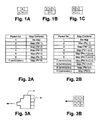
- FIG. 1A-C depict a technique estimating motion vectors of a lost macroblock by reference to surrounding macroblocks.
- Fig. 2A-B depict the contents of packets containing non-overlapped inter maps (Fig. 2A) and overlapped inter maps (Fig. 2B).
- Fig. 3A-3B depict a motion wake and a motion wake identification algorithm.
- the present invention relates to error correction techniques that include one or more of the following elements:
- the receiver monitors the network quality and requests the sender to provide a specific combination of elements.
- the sender may take other factors into account (for instance, requests from other devices that are receiving the same stream, or (in the case of an intermediate gateway or MCU) the capabilities of the actual sender in its response. As is well known in the art, other methods can be used. For instance, a sender may be provided a priori or out-of-band information on the appropriate concealment mode. Or a sender may receive network quality statistics (for instance from RTCP), which it uses to select an appropriate mode.
- Another aspect of the present invention relates to the minimization of the extent of the error.
- bits transmitted between the transmission error and the following synchronization header e.g. , the GOB header or PSC
- each transmitted packet begins with a synchronization header. This eliminates the need to discard correctly received packets due to resynchronization.
- the gateway or MCU aligns each packet to start with a received synchronization header. Ideally each packet does not include other embedded synchronization headers (beyond the initial one at the packet start). Aligning the packets with the synchronization headers minimizes the extent of the error propagation, and can be implemented in protocol conversion devices without the need for video transcoding.
- a first approach to dealing with transmission errors, particularly those caused by lost packets or lost bits is to reduce the bit rate and/or the packet rate.
- the lost packets may be due in part to sending packets faster than a given network element can receive them.
- the packet overhead might be exacerbating network congestion.
- reducing the packet rate might reduce the error rate.
- the output packet rate partly depends on frame rate, particularly at lower bit rates.
- the redundant information inserted in the bitstream includes a "map" of how each macroblock in the video frame was coded (i.e. , whether inter or intra) and the motion vector field (i.e., the motion vectors for each inter coded block).
- This information may generally be encoded in the video bitstream in a variety of ways apparent to one skilled in the art. This redundant information, however encoded, is sufficient for the receiver to reconstruct missing data as a result of packet loss according to the following procedures.
- the redundant information can be inserted or removed by a gateway or an MCU without requiring full video encoding or decoding.
- the information is placed near the synchronization headers so that removal can be accomplished by decoding only some of the bitstream symbols.
- the information is byte-aligned, to simplify its removal.
- To insert the redundant information most of the symbols in the bitstream do need to be decoded to extract the redundant information. However, the pixels in the images do not need to decoded, which saves considerable computational resources and reduces delay.
- the techniques disclosed herein allow an MCU (or gateway) to add redundant information selectively, e.g. , for instance, to add this information only on network links where errors are occurring.
- the MCU uses the redundant information to reconstruct lost information in the bitstream.
- redundant motion vectors can be used to re-insert lost inter-coded blocks into the standards-compliant portion of the bitstream. As noted above, this repair can be accomplished without transcoding.
- endpoints that are only capable of receiving a standard bitstream can be included in a conference that employs one or more of the various error concealment techniques described herein.
- a standard bitstream such as H.263
- all other endpoints benefit from the invention because the MCU is repairing bitstream errors received from the endpoints that do transmit the redundant supplementary information.
- the decoder i.e. , receiver, either an endpoint, gateway, or MCU reconstructs the lost macroblock as a motion compensated inter block with no coded coefficients. Both the rendered picture and the decoder reference frame are updated using this reconstructed block. If an extended inter map (i.e., one that includes motion vectors) is received, then the redundant motion vector data from the map is used for the reconstructed block. Alternatively, if the inter map was lost, or if it does not include the redundant motion vector information, then an estimate of its motion vectors for the reconstructed block is computed by examining the motion vectors of neighboring blocks.
- the estimated motion vectors may be computed as the median of the motion vectors of 3 neighboring macroblocks (denoted a, b, and c).
- y median(a y , b y , c y ) where a y , b y , c y are the y components of the motion vectors of macroblocks a, b, and c.
- Fig. 1A-1C Various arrangements of the reconstructed macroblock and the neighboring macroblocks used to compute motion vectors for the reconstructed macroblocks.
- Fig. 1A-1C For example, for most macroblocks, the arrangement of Fig. 1A will be suitable. If a block is on the top picture edge, a reflection of Fig. 1A is used, as illustrated in Fig. 1B. If a reconstructed block is in the corner of the image, the only three adjacent blocks are used, as illustrated in Fig. 1C. Additionally, the following boundary conditions apply for reconstructing motion vectors at the picture edges:
- the lost macroblock is an intra coded macroblock, it is reconstructed only if interleaving (discussed below) is turned on. However, it should be noted that if a lost intra macroblock is at the edge of the picture, it is not reconstructed, whether interleaving is on or not. If interleaving is not turned on, the missing macroblock is treated as though it were not coded according to whatever video encoding algorithm is in use. If a block is reconstructed, both the rendered picture and the decoder reference frame are updated using this reconstructed block.
- an estimate of the lost intra macroblock's contents is generated from a spatial interpolation of the adjacent macroblocks.
- the preferred interpolation method is bi-linear interpolation, although a variety of interpolations could be used.
- 8 pixels from the last row of pixels of the macroblock immediately above and 8 pixels from the right-most column of the macroblock to the left are 2 dimensionally bi-linearly interpolated to create the pixel values associated with the lost macroblock.
- 8 pixels from the last row of pixels of the macroblock immediately above and 8 pixels from the leftmost column of the macroblock to the right are 2 dimensionally bi-linearly interpolated.
- the remaining blocks are processed in a similar fashion. For each chroma block, 8 pixels from the last row of the macroblock immediately above and 8 pixels from the right-most column of the macroblock to the left are 2 dimensionally bi-linearly interpolated.
- the first packet in each frame holds no inter map or motion vector information.
- Each subsequent packet in the frame holds the inter map and motion vector information for the previous packet.
- a map termination packet is sent, which holds the map information from the final video packet. For example, consider a CIF frame with a diversity number of 6. Each frame will have at least 7 packets, with the map elements as shown in Fig 2A.
- each map entry is sent multiple times. For an overlap of n, each packet holds the map information for the previous n + 1 packets. If fewer than n + 1 packets have been sent, the entire map (starting from macroblock 0) is sent. After the final video packet is sent, multiple map termination entries are transmitted to achieve the desired redundancy for all packets in the frame. If the overlap is set to 3, each frame will require 10 packets to transmit, with the map elements as shown in Fig. 2B.
- the motion vectors are sent three times for each macroblock (in addition to the macroblock itself). These transmissions are in distinct packets. Thus the motion vectors for a macroblock will be sent in each of the next three packets following the packet containing the macroblock.
- the odds of losing both the map and the macroblock are reduced to 1/1296, or approximately every 40 seconds.
- overlap is most advantageous at higher bit rates. If the interleave (described below) is being used, the overlap cannot exceed the number of diversity groups. If interleave is not being used, the overlap cannot exceed the number of GOBs in the image.
- a second key element of the error concealment techniques described herein is a refresh mechanism and/or wake detection algorithm.
- a refresh mechanism should be used to clean up residual encoder/decoder reference frame mismatches that result from packet loss.
- the refresh mechanism intra-codes macroblocks in the image in a deterministic pattern. This limits the propagation of errors, especially in moving areas. Any refresh pattern can be used, as long as it systematically refreshes each macroblock in the image at the specified rate.
- One suitable refresh mechanism is a walk around refresh, which operates as follows.
- a walk-around interval w specifies the spacing between intra-coded blocks. Thus, every w th macroblock is coded as intra (starting from a starting block s ).
- the starting block s is reset for the next picture as ( l + w ) mod b , where l is the last block refreshed in this picture, and b is the number of blocks in the picture.
- Mod is, of course, the modulo or modulus function.
- w should not be a multiple of the diversity number (discussed below), so as to spread the intra-coded blocks in a frame evenly across the diversity groups.
- a simple method of ensuring that w meets these constraints is to make w a prime number that is not a factor of the diversity number.
- a wake detection algorithm may also be included.
- motion prediction errors that occur in the motion wake tend to be persistent, causing distracting visual artifacts.
- Encoding the macroblocks in the motion wake as intra reduces these artifacts. It is also desirable to reduce the coding threshold and quantization parameter in the wake, to keep the background sharp around the moving areas of the picture.
- One technique for detecting the motion wake is as follows: For a given macroblock showing no motion, the motion vectors of adjacent macroblocks are checked. Four tests are performed, each checking for one of left, right, up, or down motion. If any of these tests are true, the macroblock is identified as being in the motion wake, and should be intra coded.
- Figure 3B illustrates the test for left (the tests for other directions are similar, and thus are not described in detail). If the three left neighbors of macroblock m (labeled "a" in Fig. 3B) show motion to the left and the macroblock "m" has little or no associated motion then macroblock m is said to be in the motion wake. More specifically, the condition specifying little of no motion may be written,
- a third element of the error correction techniques described herein is the use of interleaved macroblocks, aka diversity groups.
- the macroblocks are sent in raster-scan order. For instance, in a CIF picture, there are 396 macroblocks with a transmission index that ranges from 0 (upper left) to 395 (lower right).
- the macroblocks are organized into Groups of Blocks (GOBs), which are spatially adjacent in the picture.
- GOBs Groups of Blocks
- an additional technique that can be used for error recovery is macroblock interleaving. If macroblock interleaving is in use, the macroblock transmission number is altered as follows: First each macroblock is assigned to a diversity group, by taking the transmission index mod diversity number.
- a diversity group is essentially a GOB that comprises non-spatially adjacent blocks. This spatially spreads the error from lost packets, allowing use of various interpolative methods for error concealment. Note that when the H.264 baseline profile is used for encoding, FMO (flexible macroblock ordering) can be used to created diversity groups.
- the bitstream can include GOB headers, using the diversity group index as the GOB number.
- the macroblocks are (re-)ordered by diversity group (with group 0 first). Within a diversity group, macroblocks are sent such that their addresses increase monotonically.
- the far end has requested macroblock interleaving, it specifies the diversity number.
- the diversity number (a) need not be a divisor of the number of macroblocks in the image; (b) shall not be a divisor of the macroblocks per row (otherwise the reconstruction techniques described above will not operate correctly); (c) shall be in the range 2-30; and (d) shall not exceed the number of GOBs in the image.
- the macroblocks are grouped into three diversity groups (DG0, DG1, and DG2), and the macroblocks are sent in the following order: DG0 : 0, 3, 6, 9,12,15,18,21,24,27,30,33,36,39,42,45, 48,51,54,57,60,63,66,69,72,75,78,81,84,87,90,93,96 DG1 : 1, 4, 7,10,13,16,19,22,25,28,31,33,37,40,43,46, 49,52,55,58,61,64,67,70,73,76,79,82,85,88,91,94,97 DG2 : 2, 5, 8,11,14,17,20,23,26,29,32,35,38,41,44,47, 50,53,56,59,62,65,68,71,74,77,80,83,86,89,92,95,98 It should be noted that each of the three diversity groups
- Each of the elements of an error correction algorithm described herein may be implemented individually or together to accomplish a desired level of error correction within a given computational capacity or other capability framework. Additionally, the techniques may be implemented in various combinations of hardware, software, and firmware and may be implemented in video encoders, decoders, gateways, MCUs, etc., as appropriate. For example, although certain elements of the system described herein require a particular action by an encoder, a decoder capable of receiving such a stream may request that the encoder transmit the bitstream using one or more of these features in response to the loss of one or more video packets. Various details necessary for implementation of such systems, for example, particular bitstream modifications required to carry the supplemental information or construction of computation algorithms to determine items described herein, would be apparent to one skilled in the art having the benefit of this disclosure, and thus are not reproduced here.
Landscapes
- Engineering & Computer Science (AREA)
- Multimedia (AREA)
- Signal Processing (AREA)
- Computer Networks & Wireless Communication (AREA)
- Computer Security & Cryptography (AREA)
- Compression Or Coding Systems Of Tv Signals (AREA)
- Detection And Prevention Of Errors In Transmission (AREA)
Applications Claiming Priority (1)
| Application Number | Priority Date | Filing Date | Title |
|---|---|---|---|
| US11/180,899 US9661376B2 (en) | 2005-07-13 | 2005-07-13 | Video error concealment method |
Publications (2)
| Publication Number | Publication Date |
|---|---|
| EP1746845A2 true EP1746845A2 (de) | 2007-01-24 |
| EP1746845A3 EP1746845A3 (de) | 2011-01-12 |
Family
ID=37395758
Family Applications (1)
| Application Number | Title | Priority Date | Filing Date |
|---|---|---|---|
| EP06014460A Withdrawn EP1746845A3 (de) | 2005-07-13 | 2006-07-12 | Videofehlerverschleierungsverfahren |
Country Status (5)
| Country | Link |
|---|---|
| US (1) | US9661376B2 (de) |
| EP (1) | EP1746845A3 (de) |
| JP (2) | JP5081408B2 (de) |
| KR (1) | KR100762812B1 (de) |
| CN (1) | CN1897711A (de) |
Cited By (1)
| Publication number | Priority date | Publication date | Assignee | Title |
|---|---|---|---|---|
| WO2013071948A1 (en) * | 2011-11-14 | 2013-05-23 | Telefonaktiebolaget L M Ericsson (Publ) | Method of and apparatus for compression encoding a picture in a picture sequence |
Families Citing this family (31)
| Publication number | Priority date | Publication date | Assignee | Title |
|---|---|---|---|---|
| US9661376B2 (en) * | 2005-07-13 | 2017-05-23 | Polycom, Inc. | Video error concealment method |
| US7916796B2 (en) * | 2005-10-19 | 2011-03-29 | Freescale Semiconductor, Inc. | Region clustering based error concealment for video data |
| US8605797B2 (en) * | 2006-02-15 | 2013-12-10 | Samsung Electronics Co., Ltd. | Method and system for partitioning and encoding of uncompressed video for transmission over wireless medium |
| JP4787100B2 (ja) * | 2006-07-27 | 2011-10-05 | パナソニック株式会社 | 画像符号化装置 |
| US9872045B2 (en) | 2006-10-16 | 2018-01-16 | Conversant Wireless Licensing S.A R.L. | Method, electronic device, system, computer program product and circuit assembly for reducing error in video coding |
| KR101125846B1 (ko) * | 2007-03-23 | 2012-03-28 | 삼성전자주식회사 | 패킷 기반의 영상 프레임 전송 방법 및 장치 |
| US8842739B2 (en) * | 2007-07-20 | 2014-09-23 | Samsung Electronics Co., Ltd. | Method and system for communication of uncompressed video information in wireless systems |
| US8243823B2 (en) | 2007-08-29 | 2012-08-14 | Samsung Electronics Co., Ltd. | Method and system for wireless communication of uncompressed video information |
| US8572758B1 (en) | 2009-03-30 | 2013-10-29 | Symantec Corporation | DLP-enforced loss scanning, sequestering, and content indexing |
| US8438630B1 (en) | 2009-03-30 | 2013-05-07 | Symantec Corporation | Data loss prevention system employing encryption detection |
| US8812874B1 (en) | 2009-03-31 | 2014-08-19 | Symantec Corporation | Content deduplication in enterprise rights management |
| US9369759B2 (en) * | 2009-04-15 | 2016-06-14 | Samsung Electronics Co., Ltd. | Method and system for progressive rate adaptation for uncompressed video communication in wireless systems |
| KR101828096B1 (ko) * | 2010-01-29 | 2018-02-09 | 톰슨 라이센싱 | 블록 기반 인터리빙 |
| JP5570846B2 (ja) * | 2010-03-04 | 2014-08-13 | 株式会社メガチップス | 画像符号化装置 |
| US20110249127A1 (en) * | 2010-04-07 | 2011-10-13 | Cisco Technology, Inc. | Estimating Video Quality Corruption in Lossy Networks |
| US9525884B2 (en) * | 2010-11-02 | 2016-12-20 | Hfi Innovation Inc. | Method and apparatus of slice boundary filtering for high efficiency video coding |
| KR101209890B1 (ko) * | 2010-12-30 | 2012-12-10 | 연세대학교 산학협력단 | 오류 은닉을 위한 디지털 방송 송신 장치 및 방법, 디지털 방송 수신 장치 및 방법 |
| US8995306B2 (en) | 2011-04-06 | 2015-03-31 | Cisco Technology, Inc. | Video conferencing with multipoint conferencing units and multimedia transformation units |
| RU2600936C2 (ru) | 2011-04-12 | 2016-10-27 | Сан Пэтент Траст | Способ кодирования движущихся изображений, устройство кодирования движущихся изображений, способ декодирования движущихся изображений, устройство декодирования движущихся изображений и устройство кодирования и декодирования движущихся изображений |
| US9025672B2 (en) * | 2011-05-04 | 2015-05-05 | Cavium, Inc. | On-demand intra-refresh for end-to end coded video transmission systems |
| HUE037619T2 (hu) | 2011-05-24 | 2018-09-28 | Velos Media Int Ltd | Képkódoló eljárás, képkódoló berendezés, képdekódoló eljárás, képdekódoló berendezés és képkódoló/dekódoló berendezés |
| ES2959039T3 (es) | 2011-05-27 | 2024-02-19 | Sun Patent Trust | Aparato, procedimiento y programa para codificar imágenes en movimiento |
| US9485518B2 (en) | 2011-05-27 | 2016-11-01 | Sun Patent Trust | Decoding method and apparatus with candidate motion vectors |
| EP4270953A3 (de) | 2011-05-31 | 2023-11-22 | Sun Patent Trust | Vorrichtung und verfahren zur dekodierung von bewegten bildern |
| SG194746A1 (en) | 2011-05-31 | 2013-12-30 | Kaba Gmbh | Image encoding method, image encoding device, image decoding method, image decoding device, and image encoding/decoding device |
| JP5937594B2 (ja) | 2011-06-30 | 2016-06-22 | パナソニック インテレクチュアル プロパティ コーポレーション オブ アメリカPanasonic Intellectual Property Corporation of America | 画像復号方法及び画像復号装置 |
| WO2013018369A1 (ja) | 2011-08-03 | 2013-02-07 | パナソニック株式会社 | 動画像符号化方法、動画像符号化装置、動画像復号化方法、動画像復号化装置、および、動画像符号化復号化装置 |
| MY180182A (en) | 2011-10-19 | 2020-11-24 | Sun Patent Trust | Picture coding method,picture coding apparatus,picture decoding method,and picture decoding apparatus |
| EP3435676A1 (de) * | 2017-07-25 | 2019-01-30 | Thomson Licensing | Verfahren und vorrichtung zur codierung und decodierung eines omnidirektionalen videos |
| CN108235150A (zh) * | 2018-01-03 | 2018-06-29 | 厦门亿联网络技术股份有限公司 | 一种网络传输特性友好的实时图像自适应恢复系统及方法 |
| CN111338840B (zh) * | 2020-03-07 | 2021-09-28 | 西安电子科技大学 | 航天数据保护方法、存储介质、计算机程序、系统、终端 |
Family Cites Families (40)
| Publication number | Priority date | Publication date | Assignee | Title |
|---|---|---|---|---|
| JPH04117882A (ja) * | 1990-09-07 | 1992-04-17 | Matsushita Electric Ind Co Ltd | 動画像符号化装置 |
| US5442400A (en) * | 1993-04-29 | 1995-08-15 | Rca Thomson Licensing Corporation | Error concealment apparatus for MPEG-like video data |
| US5537338A (en) * | 1993-11-24 | 1996-07-16 | Intel Corporation | Process and apparatus for bitwise tracking in a byte-based computer system |
| JP3474005B2 (ja) * | 1994-10-13 | 2003-12-08 | 沖電気工業株式会社 | 動画像符号化方法及び動画像復号方法 |
| JPH08256333A (ja) | 1995-03-16 | 1996-10-01 | Matsushita Electric Ind Co Ltd | 画像符号化復号方法及び装置 |
| SE515535C2 (sv) * | 1996-10-25 | 2001-08-27 | Ericsson Telefon Ab L M | En transkoder |
| EP1042736B1 (de) | 1996-12-30 | 2003-09-24 | Sharp Kabushiki Kaisha | Sprite-gestütztes videocodiersystem |
| US6025888A (en) * | 1997-11-03 | 2000-02-15 | Lucent Technologies Inc. | Method and apparatus for improved error recovery in video transmission over wireless channels |
| JP3905969B2 (ja) | 1998-01-30 | 2007-04-18 | 株式会社東芝 | 動画像符号化装置および動画像符号化方法 |
| EP0935396A3 (de) * | 1998-02-09 | 2004-08-11 | Matsushita Electric Industrial Co., Ltd. | Videokodierungsverfahren und -vorrichtung |
| JP3523481B2 (ja) | 1998-02-23 | 2004-04-26 | シャープ株式会社 | 映像符号化装置及び映像復号化装置並びに映像符号化方法及び映像復号化方法 |
| GB9817292D0 (en) * | 1998-08-07 | 1998-10-07 | Nokia Mobile Phones Ltd | Digital video coding |
| US6304295B1 (en) * | 1998-09-18 | 2001-10-16 | Sarnoff Corporation | Region-based refresh strategy for video compression |
| GB2347038A (en) * | 1999-02-18 | 2000-08-23 | Nokia Mobile Phones Ltd | A video codec using re-transmission |
| JP2000253403A (ja) | 1999-02-25 | 2000-09-14 | Mitsubishi Electric Corp | 画像符号化方式変換装置及び画像通信システム |
| US6115076A (en) * | 1999-04-20 | 2000-09-05 | C-Cube Semiconductor Ii, Inc. | Compressed video recording device with non-destructive effects addition |
| KR100580158B1 (ko) | 1999-06-12 | 2006-05-15 | 삼성전자주식회사 | 화상 패킷 전송을 위한 무선통신 시스템 |
| EP1067719A1 (de) | 1999-07-05 | 2001-01-10 | Sony International (Europe) GmbH | Verfahren zum Überwachen ob derselbe Dienst auf einer Alternativfrequenz zur Empfangfrequenz ubertragt wird |
| JP2005051816A (ja) | 1999-09-30 | 2005-02-24 | Matsushita Electric Ind Co Ltd | 動画像復号化方法、動画像復号化装置、及びプログラム記録媒体 |
| US6999673B1 (en) * | 1999-09-30 | 2006-02-14 | Matsushita Electric Industrial Co., Ltd. | Moving picture decoding method, moving picture decoding apparatus and program recording medium |
| JP3840020B2 (ja) * | 1999-12-14 | 2006-11-01 | 株式会社東芝 | 動画像符号化装置 |
| US6993074B2 (en) * | 2000-03-24 | 2006-01-31 | Microsoft Corporation | Methods and arrangements for handling concentric mosaic image data |
| CN100385944C (zh) | 2000-07-10 | 2008-04-30 | 株式会社日立制作所 | 多媒体接收终端以及多媒体发送终端 |
| JP2002152181A (ja) | 2000-11-16 | 2002-05-24 | Matsushita Electric Ind Co Ltd | マルチメディアデータ通信方法およびマルチメディアデータ通信装置 |
| US20020122491A1 (en) * | 2001-01-03 | 2002-09-05 | Marta Karczewicz | Video decoder architecture and method for using same |
| US6876705B2 (en) | 2001-03-05 | 2005-04-05 | Intervideo, Inc. | Systems and methods for decoding of partially corrupted reversible variable length code (RVLC) intra-coded macroblocks and partial block decoding of corrupted macroblocks in a video decoder |
| KR100691307B1 (ko) | 2001-08-23 | 2007-03-12 | 폴리콤 인코포레이티드 | 비디오 에러 은닉을 위한 시스템 및 방법 |
| US6910175B2 (en) | 2001-09-14 | 2005-06-21 | Koninklijke Philips Electronics N.V. | Encoder redundancy selection system and method |
| US7272110B2 (en) * | 2001-09-29 | 2007-09-18 | Lg Electronics Inc. | Method of allocating walsh code resource |
| US6956902B2 (en) * | 2001-10-11 | 2005-10-18 | Hewlett-Packard Development Company, L.P. | Method and apparatus for a multi-user video navigation system |
| US7020203B1 (en) | 2001-12-21 | 2006-03-28 | Polycom, Inc. | Dynamic intra-coded macroblock refresh interval for video error concealment |
| WO2003061284A1 (en) | 2001-12-21 | 2003-07-24 | Polycom, Inc. | Motion wake identification and control mechanism |
| JP2003219385A (ja) | 2002-01-07 | 2003-07-31 | Leadtek Research Inc | テレビ会議システム |
| KR100481732B1 (ko) * | 2002-04-20 | 2005-04-11 | 전자부품연구원 | 다 시점 동영상 부호화 장치 |
| EP1395061A1 (de) * | 2002-08-27 | 2004-03-03 | Mitsubishi Electric Information Technology Centre Europe B.V. | Verfahren und Vorrichtung zur Kompensation von falschen Bewegunsvektoren in Videodaten |
| JP2004096572A (ja) * | 2002-09-02 | 2004-03-25 | Uniden Corp | 屋内移動通信装置 |
| KR20040031949A (ko) * | 2002-10-08 | 2004-04-14 | 엘지전자 주식회사 | 동영상 인코딩 및 디코딩 방법 |
| MXPA05007449A (es) | 2003-01-10 | 2005-09-12 | Thomson Licensing Sa | Definicion de filtros de interpolacion para ocultamiento de error en una imagen codificada. |
| US7394855B2 (en) * | 2003-11-20 | 2008-07-01 | Mitsubishi Electric Research Laboratories, Inc. | Error concealing decoding method of intra-frames of compressed videos |
| US9661376B2 (en) * | 2005-07-13 | 2017-05-23 | Polycom, Inc. | Video error concealment method |
-
2005
- 2005-07-13 US US11/180,899 patent/US9661376B2/en not_active Expired - Fee Related
-
2006
- 2006-07-12 JP JP2006191931A patent/JP5081408B2/ja not_active Expired - Fee Related
- 2006-07-12 EP EP06014460A patent/EP1746845A3/de not_active Withdrawn
- 2006-07-12 KR KR1020060065443A patent/KR100762812B1/ko not_active Expired - Fee Related
- 2006-07-13 CN CNA2006101064186A patent/CN1897711A/zh active Pending
-
2012
- 2012-07-23 JP JP2012162934A patent/JP5456106B2/ja not_active Expired - Fee Related
Cited By (1)
| Publication number | Priority date | Publication date | Assignee | Title |
|---|---|---|---|---|
| WO2013071948A1 (en) * | 2011-11-14 | 2013-05-23 | Telefonaktiebolaget L M Ericsson (Publ) | Method of and apparatus for compression encoding a picture in a picture sequence |
Also Published As
| Publication number | Publication date |
|---|---|
| KR20070008449A (ko) | 2007-01-17 |
| EP1746845A3 (de) | 2011-01-12 |
| JP5081408B2 (ja) | 2012-11-28 |
| US20070014360A1 (en) | 2007-01-18 |
| US9661376B2 (en) | 2017-05-23 |
| JP2012231532A (ja) | 2012-11-22 |
| CN1897711A (zh) | 2007-01-17 |
| JP5456106B2 (ja) | 2014-03-26 |
| JP2007028617A (ja) | 2007-02-01 |
| KR100762812B1 (ko) | 2007-10-02 |
Similar Documents
| Publication | Publication Date | Title |
|---|---|---|
| US9661376B2 (en) | Video error concealment method | |
| CA2457882C (en) | System and method for video error concealment | |
| US7020203B1 (en) | Dynamic intra-coded macroblock refresh interval for video error concealment | |
| US6744924B1 (en) | Error concealment in a video signal | |
| US8064527B2 (en) | Error concealment in a video decoder | |
| AU2002326713A1 (en) | System and method for video error concealment | |
| US20110026592A1 (en) | Intra block walk around refresh for h.264 | |
| Katsaggelos et al. | Error resilience and concealment in video coding | |
| HK1095463A (en) | Video error concealment method | |
| HK1064241A (en) | Dynamic intra-coded macroblock refresh interval for video error concealment | |
| HK1075160A (en) | Intra block walk around refresh for h.264 | |
| HK1075780A (en) | System and method for video error concealment |
Legal Events
| Date | Code | Title | Description |
|---|---|---|---|
| PUAI | Public reference made under article 153(3) epc to a published international application that has entered the european phase |
Free format text: ORIGINAL CODE: 0009012 |
|
| 17P | Request for examination filed |
Effective date: 20060811 |
|
| AK | Designated contracting states |
Kind code of ref document: A2 Designated state(s): AT BE BG CH CY CZ DE DK EE ES FI FR GB GR HU IE IS IT LI LT LU LV MC NL PL PT RO SE SI SK TR |
|
| AX | Request for extension of the european patent |
Extension state: AL BA HR MK YU |
|
| REG | Reference to a national code |
Ref country code: HK Ref legal event code: DE Ref document number: 1095463 Country of ref document: HK |
|
| PUAL | Search report despatched |
Free format text: ORIGINAL CODE: 0009013 |
|
| AK | Designated contracting states |
Kind code of ref document: A3 Designated state(s): AT BE BG CH CY CZ DE DK EE ES FI FR GB GR HU IE IS IT LI LT LU LV MC NL PL PT RO SE SI SK TR |
|
| AX | Request for extension of the european patent |
Extension state: AL BA HR MK RS |
|
| AKX | Designation fees paid |
Designated state(s): DE GB NL |
|
| RAP1 | Party data changed (applicant data changed or rights of an application transferred) |
Owner name: POLYCOM, INC. |
|
| REG | Reference to a national code |
Ref country code: HK Ref legal event code: WD Ref document number: 1095463 Country of ref document: HK |
|
| STAA | Information on the status of an ep patent application or granted ep patent |
Free format text: STATUS: THE APPLICATION IS DEEMED TO BE WITHDRAWN |
|
| 18D | Application deemed to be withdrawn |
Effective date: 20150203 |