EP1745414B1 - Method for combining boosted classifiers for efficient multi-class object detection - Google Patents
Method for combining boosted classifiers for efficient multi-class object detection Download PDFInfo
- Publication number
- EP1745414B1 EP1745414B1 EP05745708.7A EP05745708A EP1745414B1 EP 1745414 B1 EP1745414 B1 EP 1745414B1 EP 05745708 A EP05745708 A EP 05745708A EP 1745414 B1 EP1745414 B1 EP 1745414B1
- Authority
- EP
- European Patent Office
- Prior art keywords
- class
- weak classifiers
- detection
- training
- objects
- Prior art date
- Legal status (The legal status is an assumption and is not a legal conclusion. Google has not performed a legal analysis and makes no representation as to the accuracy of the status listed.)
- Expired - Lifetime
Links
Images

Classifications
-
- G—PHYSICS
- G06—COMPUTING OR CALCULATING; COUNTING
- G06V—IMAGE OR VIDEO RECOGNITION OR UNDERSTANDING
- G06V10/00—Arrangements for image or video recognition or understanding
- G06V10/70—Arrangements for image or video recognition or understanding using pattern recognition or machine learning
- G06V10/77—Processing image or video features in feature spaces; using data integration or data reduction, e.g. principal component analysis [PCA] or independent component analysis [ICA] or self-organising maps [SOM]; Blind source separation
- G06V10/771—Feature selection, e.g. selecting representative features from a multi-dimensional feature space
-
- G—PHYSICS
- G06—COMPUTING OR CALCULATING; COUNTING
- G06F—ELECTRIC DIGITAL DATA PROCESSING
- G06F18/00—Pattern recognition
- G06F18/20—Analysing
- G06F18/21—Design or setup of recognition systems or techniques; Extraction of features in feature space; Blind source separation
- G06F18/211—Selection of the most significant subset of features
-
- G—PHYSICS
- G06—COMPUTING OR CALCULATING; COUNTING
- G06F—ELECTRIC DIGITAL DATA PROCESSING
- G06F18/00—Pattern recognition
- G06F18/20—Analysing
- G06F18/21—Design or setup of recognition systems or techniques; Extraction of features in feature space; Blind source separation
- G06F18/214—Generating training patterns; Bootstrap methods, e.g. bagging or boosting
-
- G—PHYSICS
- G06—COMPUTING OR CALCULATING; COUNTING
- G06V—IMAGE OR VIDEO RECOGNITION OR UNDERSTANDING
- G06V10/00—Arrangements for image or video recognition or understanding
- G06V10/70—Arrangements for image or video recognition or understanding using pattern recognition or machine learning
- G06V10/77—Processing image or video features in feature spaces; using data integration or data reduction, e.g. principal component analysis [PCA] or independent component analysis [ICA] or self-organising maps [SOM]; Blind source separation
- G06V10/774—Generating sets of training patterns; Bootstrap methods, e.g. bagging or boosting
- G06V10/7747—Organisation of the process, e.g. bagging or boosting
Definitions
- the present invention is directed to a method for combining boosted classifiers for efficient multi-class object detection, and more particularly, to a system and method for training a detection system that identifies multi-class objects using boosted classifiers.
- Image object detection is becoming increasing more popular and can be used in a number of different detection scenarios. Examples of such applications include face detection, pedestrian detection, traffic sign detection, and vehicle detection.
- Boosting techniques are particularly effective for detecting a single object class.
- vehicle detection where separate object classes may be defined for vehicles, trucks, pedestrians and traffic signs.
- people detection is another example of a detection application that requires multiple object classes.
- people detection Particularly, if the people are in motion, it is more effective to define people sub-classes based on the difference poses or actions of the people. For example, such sub-classes could include sitting, standing and walking.
- H h 1 , ... , h T of simple or weak classifiers h t : X ⁇ ⁇ +1,-1 ⁇ , each of it taken from a large set of classifier candidates to form a final or strong classifier.
- X is the set of all image patches
- the class +1 corresponds to an object and the class -1 to a non-object.
- the object detection is solved by evaluating the strong classifier h on candidate image patches x e X .
- An optimal selection of the weak classifiers h t and a proper weighting ⁇ t is obtained from an AdaBoost training algorithm.
- the memory and computational complexity for the detection task of this approach scales linearly with L and in many cases circumvents a real-time detection system. Such a computationally extensive approach is not feasible in time, cost or efficiency to be considered as a reasonable solution. There is a need for a detection system that is capable of real-time multi-class detection and which can perform in an efficient manner.
- Rapid Object Detection using a Boosted Cascade of Simple Features discloses a machine learning approach for visual object detection in which images are classified based on the value of simple features.
- a more efficient multi-class detection method and system is devised by a joint design of key components including feature and classifier design of individual detectors.
- a method for training a system for detecting multi-class objects in an image or a video sequence is described.
- the most appropriate weak classifier samples for each object class is collected, each weak classifier is individually learned from a single object class.
- Individual sets of weak classifier samples are selected.
- the individual sets of weak classifier samples are then combined by a mathematical union or a mathematical intersection or a subset determined by voting.
- the ensemble of weak classifiers is the combination of weak classifier samples.
- a separate weighting scheme is adapted for the ensemble of weak classifiers.
- the present invention is also directed to a method for detecting objects of multiple classes in an image or a video sequence.
- Each class is assigned a detector that is implemented by a weighted combination of weak classifiers such that all of the detectors are based on a common ensemble of weak classifiers. Then weights are individually set for each class.
- the present invention is directed to a system and method for combining boosted classifiers for efficient multi-class object detection.
- the present invention is also directed to a method for training classifiers for multi-class object detection.
- the present invention can be used in a multitude of applications that require the detection of different objects.
- Such a system may, for example, be used for surveillance applications, such as for detecting and tracking a person or facial features.
- the present invention could also be used to detect and track objects on an assembly line. Other applications could be created for detecting and tracking human organs for medical applications. It is to be understood by those skilled in the art that the present invention may be used in other environments as well. Another environment in which the present invention would be useful is in the detection and tracking of vehicles. In addition to detecting different types of vehicles, there is also sometimes a need for detecting pedestrians, traffic signs and other vehicle-environment related objects. For purposes of describing the present invention, it will be described in the on-road obstacle detection environment.
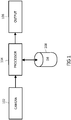
- FIG. 1 illustrates a block diagram of a system for implementing the present invention.
- One or more cameras 102 are used to capture images of a road and its surroundings. As would be expected with a typical road image, the image includes background images, such as buildings, trees, and houses, and vehicles driving on the road.
- the images are communicated to a processor 104 which computes confidence scores using the component classifiers in a database 106.
- the images are analyzed in accordance with the present invention to identify different classes of objects. Examples of such objects include cars, trucks, pedestrians and traffic signs.
- Once an object is identified at a sufficient confidence level, the object is identified via an output device 108.
- the output device 108 provides an output signal which communicates to the user the presence of one or more objects.
- the output signal may be an audible signal or other type of warning signal.
- the output device 308 may also include a display for viewing the detected objects. The display provides a view of the images taken by the cameras 302 which may then be enhanced to indicate objects that have been detected and which are being tracked.
- the present invention is directed to a number of training techniques which are used to identify and select a number of weak classifiers which are then stored in database 106 and used to detect the various objects.
- a premise of the present invention is an underlying principle that all L detectors share a common set of features or weak classifiers.
- each individual strong classifier is adapted to its individual set of weights a (1) posterior to the weak classifier selection.
- individual weighting there is only a minimal increase in the computation complexity compared to single class detection. The majority of the complexity derived in the computations of Equation (3) and (4) of the prior art arise from the evaluation of the weak classifiers and not the weighting.
- FIG. 2 illustrates a multi-class object detection framework in accordance with the present invention.
- Training of the system refers to the selection of a common set of weak classifiers H and the adaptation of individual weights a (1) .
- the following technique can be used to train the weak classifiers:
- the first technique which does not form part of the present invention, assumes that one distinguished class l o exists.
- the distinguished class can be, for instance, a class with a high occurrence of objects in the scene.
- the individual class weights ⁇ a (1) ,..., a (L) are re-adapted using AdaBoost, where the candidate weak classifiers are taken solely from H.
- AdaBoost AdaBoost
- An example of an application where this technique might be used is a manufacturing application. Since the predominant object being detected might be an item on an assembly line the weak classifiers associated with that object would be used as the training set.
- a second technique, which does not form part of the present invention, for creating a training set is used when the assignment of one distinguished class is not reasonable. In such an instance, a more symmetric procedure would be appropriate.
- a common classifier H is trained based on the union of all training samples.
- each individual classifier l is fine-tuned by adjusting a (1) with respect of H and the positive training samples solely from class l.
- H is optimized in order to discriminate all positive objects from the negatives.
- the individual detection problem can be specialized by adapting the respective impact of the individual weak classifiers.
- facial detection uses classes that are made up of different facial poses. However, many of the classifiers for the poses are similar (e.g., eyes, nose, and mouth).
- vehicle detection uses classes that are made up of different vehicles. In each case, normally certain features such as the edges and corners of the vehicle are looked at.
- a third technique obtains H by collecting the most appropriate weak classifiers for each object class l .
- individual sets of weak classifiers ⁇ H (1) ,...,H (L) ⁇ are selected in a first training step.
- the final set H is obtained from a combination of ⁇ H (1) ,...,H (L) ⁇ .
- This technique is best used for applications that require a distribution of data resources.
- the application may also detect, traffic signs and pedestrians. Additional objects that may be detected include road lanes, guard rails and background objects like trees, houses and other buildings.
- each of the classes uses weak classifiers that are distinct from the other classes. However, there still may be some common weak classifiers among all of the classes.
- the framework shown in FIG. 2 can be extended to be applicable for multi-class classification.
- the classifier assigns the most probable class label l ⁇ to x.
- the present invention uses a set of boosted weak classifiers that is common within all individual class detectors and thus has be to computed only once. A possible major loss in detection accuracy by this restriction is prevented by a posterior re-training of the weak classifier weights, individually to each object class to reduce its misclassification error.
- the training complexity of the present invention does not increase significantly compared to the prior art approaches since re-adjustment of the individual class weights with AdaBoost is based only on H and thus on a much small set of weak classifier candidates.
Landscapes
- Engineering & Computer Science (AREA)
- Theoretical Computer Science (AREA)
- Computer Vision & Pattern Recognition (AREA)
- Artificial Intelligence (AREA)
- Data Mining & Analysis (AREA)
- General Physics & Mathematics (AREA)
- Evolutionary Computation (AREA)
- Physics & Mathematics (AREA)
- Databases & Information Systems (AREA)
- Software Systems (AREA)
- Medical Informatics (AREA)
- General Health & Medical Sciences (AREA)
- Health & Medical Sciences (AREA)
- Multimedia (AREA)
- Computing Systems (AREA)
- Life Sciences & Earth Sciences (AREA)
- Bioinformatics & Cheminformatics (AREA)
- Bioinformatics & Computational Biology (AREA)
- Evolutionary Biology (AREA)
- General Engineering & Computer Science (AREA)
- Image Analysis (AREA)
Applications Claiming Priority (3)
| Application Number | Priority Date | Filing Date | Title |
|---|---|---|---|
| US56955204P | 2004-05-10 | 2004-05-10 | |
| US11/111,640 US7769228B2 (en) | 2004-05-10 | 2005-04-21 | Method for combining boosted classifiers for efficient multi-class object detection |
| PCT/US2005/015854 WO2005111918A1 (en) | 2004-05-10 | 2005-05-05 | Method for combining boosted classifiers for efficient multi-class object detection |
Publications (2)
| Publication Number | Publication Date |
|---|---|
| EP1745414A1 EP1745414A1 (en) | 2007-01-24 |
| EP1745414B1 true EP1745414B1 (en) | 2018-10-17 |
Family
ID=34968880
Family Applications (1)
| Application Number | Title | Priority Date | Filing Date |
|---|---|---|---|
| EP05745708.7A Expired - Lifetime EP1745414B1 (en) | 2004-05-10 | 2005-05-05 | Method for combining boosted classifiers for efficient multi-class object detection |
Country Status (4)
| Country | Link |
|---|---|
| US (1) | US7769228B2 (enExample) |
| EP (1) | EP1745414B1 (enExample) |
| JP (1) | JP4999101B2 (enExample) |
| WO (1) | WO2005111918A1 (enExample) |
Families Citing this family (32)
| Publication number | Priority date | Publication date | Assignee | Title |
|---|---|---|---|---|
| US7899243B2 (en) | 2000-11-06 | 2011-03-01 | Evryx Technologies, Inc. | Image capture and identification system and process |
| US8224078B2 (en) | 2000-11-06 | 2012-07-17 | Nant Holdings Ip, Llc | Image capture and identification system and process |
| US7565008B2 (en) | 2000-11-06 | 2009-07-21 | Evryx Technologies, Inc. | Data capture and identification system and process |
| US9310892B2 (en) | 2000-11-06 | 2016-04-12 | Nant Holdings Ip, Llc | Object information derived from object images |
| US7680324B2 (en) | 2000-11-06 | 2010-03-16 | Evryx Technologies, Inc. | Use of image-derived information as search criteria for internet and other search engines |
| US7508979B2 (en) * | 2003-11-21 | 2009-03-24 | Siemens Corporate Research, Inc. | System and method for detecting an occupant and head pose using stereo detectors |
| WO2007107315A1 (de) * | 2006-03-22 | 2007-09-27 | Daimler Ag | Multisensorieller hypothesen-basierter objektdetektor und objektverfolger |
| EP2674323B1 (en) | 2007-04-30 | 2018-07-11 | Mobileye Vision Technologies Ltd. | Rear obstruction detection |
| JP4891197B2 (ja) * | 2007-11-01 | 2012-03-07 | キヤノン株式会社 | 画像処理装置および画像処理方法 |
| US8433669B2 (en) * | 2007-11-14 | 2013-04-30 | International Business Machines Corporation | Configuring individual classifiers with multiple operating points for cascaded classifier topologies under resource constraints |
| US8306940B2 (en) * | 2009-03-20 | 2012-11-06 | Microsoft Corporation | Interactive visualization for generating ensemble classifiers |
| CN101853389A (zh) * | 2009-04-01 | 2010-10-06 | 索尼株式会社 | 多类目标的检测装置及检测方法 |
| US8666988B2 (en) * | 2009-05-14 | 2014-03-04 | International Business Machines Corporation | Configuring classifier trees and classifying data |
| WO2011092865A1 (ja) * | 2010-02-01 | 2011-08-04 | 株式会社モルフォ | 物体検出装置及び物体検出方法 |
| EP2681693B1 (en) * | 2011-03-04 | 2018-08-01 | LBT Innovations Limited | Method for improving classification results of a classifier |
| EP2574958B1 (en) * | 2011-09-28 | 2017-02-22 | Honda Research Institute Europe GmbH | Road-terrain detection method and system for driver assistance systems |
| US9208404B2 (en) * | 2013-11-15 | 2015-12-08 | Adobe Systems Incorporated | Object detection with boosted exemplars |
| US9269017B2 (en) | 2013-11-15 | 2016-02-23 | Adobe Systems Incorporated | Cascaded object detection |
| US9710729B2 (en) * | 2014-09-04 | 2017-07-18 | Xerox Corporation | Domain adaptation for image classification with class priors |
| CN105718937B (zh) * | 2014-12-03 | 2019-04-05 | 财团法人资讯工业策进会 | 多类别对象分类方法及系统 |
| WO2016178243A1 (en) * | 2015-05-05 | 2016-11-10 | Bhavin Manharlal Shah | Multi class classifier from single class dataset |
| CN106295666B (zh) * | 2015-05-14 | 2020-03-03 | 佳能株式会社 | 获取分类器、检测对象的方法和装置及图像处理设备 |
| WO2017044550A1 (en) * | 2015-09-11 | 2017-03-16 | Intel Corporation | A real-time multiple vehicle detection and tracking |
| CN106327527B (zh) * | 2016-08-11 | 2019-05-14 | 电子科技大学 | 基于Online Boosting的目标轮廓跟踪方法 |
| US10482594B2 (en) * | 2016-09-23 | 2019-11-19 | Apple Inc. | Multi-perspective imaging system and method |
| CN108021940B (zh) * | 2017-11-30 | 2023-04-18 | 中国银联股份有限公司 | 基于机器学习的数据分类方法及系统 |
| US10552299B1 (en) | 2019-08-14 | 2020-02-04 | Appvance Inc. | Method and apparatus for AI-driven automatic test script generation |
| US10628630B1 (en) | 2019-08-14 | 2020-04-21 | Appvance Inc. | Method and apparatus for generating a state machine model of an application using models of GUI objects and scanning modes |
| US11636385B2 (en) * | 2019-11-04 | 2023-04-25 | International Business Machines Corporation | Training an object detector using raw and unlabeled videos and extracted speech |
| CN111881764B (zh) * | 2020-07-01 | 2023-11-03 | 深圳力维智联技术有限公司 | 一种目标检测方法、装置、电子设备及存储介质 |
| US12657870B2 (en) * | 2021-02-05 | 2026-06-16 | Home Depot Product Authority, Llc | Product image classification |
| CN116720108B (zh) * | 2023-07-04 | 2026-06-02 | 哈尔滨工业大学(深圳) | 基于并行强化学习的ffc自学习装配方法 |
Family Cites Families (7)
| Publication number | Priority date | Publication date | Assignee | Title |
|---|---|---|---|---|
| CA2167748A1 (en) * | 1995-02-09 | 1996-08-10 | Yoav Freund | Apparatus and methods for machine learning hypotheses |
| US6453307B1 (en) * | 1998-03-03 | 2002-09-17 | At&T Corp. | Method and apparatus for multi-class, multi-label information categorization |
| US6456993B1 (en) * | 1999-02-09 | 2002-09-24 | At&T Corp. | Alternating tree-based classifiers and methods for learning them |
| US6546379B1 (en) * | 1999-10-26 | 2003-04-08 | International Business Machines Corporation | Cascade boosting of predictive models |
| US7076473B2 (en) * | 2002-04-19 | 2006-07-11 | Mitsubishi Electric Research Labs, Inc. | Classification with boosted dyadic kernel discriminants |
| US7362919B2 (en) * | 2002-12-12 | 2008-04-22 | Eastman Kodak Company | Method for generating customized photo album pages and prints based on people and gender profiles |
| JP5025893B2 (ja) * | 2004-03-29 | 2012-09-12 | ソニー株式会社 | 情報処理装置および方法、記録媒体、並びにプログラム |
-
2005
- 2005-04-21 US US11/111,640 patent/US7769228B2/en not_active Expired - Lifetime
- 2005-05-05 WO PCT/US2005/015854 patent/WO2005111918A1/en not_active Ceased
- 2005-05-05 JP JP2007513229A patent/JP4999101B2/ja not_active Expired - Fee Related
- 2005-05-05 EP EP05745708.7A patent/EP1745414B1/en not_active Expired - Lifetime
Non-Patent Citations (1)
| Title |
|---|
| TORRALBA A ET AL: "Sharing Visual Features for Multiclass and Multiview Object Detection", AI MEMO MIT, MASSACHUSETTS INSTITUTE OF TECHNOLOGY, US, no. 2004-008, 1 April 2004 (2004-04-01), pages 1 - 18, XP002337421 * |
Also Published As
| Publication number | Publication date |
|---|---|
| EP1745414A1 (en) | 2007-01-24 |
| US7769228B2 (en) | 2010-08-03 |
| WO2005111918A1 (en) | 2005-11-24 |
| US20050249401A1 (en) | 2005-11-10 |
| JP2007537542A (ja) | 2007-12-20 |
| JP4999101B2 (ja) | 2012-08-15 |
Similar Documents
| Publication | Publication Date | Title |
|---|---|---|
| US7769228B2 (en) | Method for combining boosted classifiers for efficient multi-class object detection | |
| EP1782335B1 (en) | Method for traffic sign detection | |
| US8195598B2 (en) | Method of and system for hierarchical human/crowd behavior detection | |
| EP1606769B1 (en) | System and method for vehicle detection and tracking | |
| Levin et al. | Unsupervised improvement of visual detectors using cotraining | |
| US8320643B2 (en) | Face authentication device | |
| US20050256820A1 (en) | Cognitive arbitration system | |
| US10699192B1 (en) | Method for optimizing hyperparameters of auto-labeling device which auto-labels training images for use in deep learning network to analyze images with high precision, and optimizing device using the same | |
| US8750614B2 (en) | Method and system for classifying features in a video sequence | |
| US20040017930A1 (en) | System and method for detecting and tracking a plurality of faces in real time by integrating visual ques | |
| US8515126B1 (en) | Multi-stage method for object detection using cognitive swarms and system for automated response to detected objects | |
| KR20060133563A (ko) | 온라인 학습을 통한 지속적인 얼굴 인식 | |
| Meuter et al. | A decision fusion and reasoning module for a traffic sign recognition system | |
| KR20060080284A (ko) | 영상의 얼굴검출장치 및 방법 | |
| EP2259221A1 (en) | Computer system and method for tracking objects in video data | |
| US20060110030A1 (en) | Method, medium, and apparatus for eye detection | |
| Zhao et al. | Video based estimation of pedestrian walking direction for pedestrian protection system | |
| Qian et al. | Intelligent surveillance systems | |
| US20050286738A1 (en) | Graphical object models for detection and tracking | |
| US20070189611A1 (en) | Bayesian Competitive Model Integrated With a Generative Classifier for Unspecific Person Verification | |
| Wang et al. | A two-layer night-time vehicle detector | |
| Baumann et al. | Cascaded random forest for fast object detection | |
| Paul et al. | Application of the SNoW machine learning paradigm to a set of transportation imaging problems | |
| Gabb et al. | Efficient monocular vehicle orientation estimation using a tree-based classifier | |
| Snidaro et al. | Fusion of heterogeneous features via cascaded on-line boosting |
Legal Events
| Date | Code | Title | Description |
|---|---|---|---|
| PUAI | Public reference made under article 153(3) epc to a published international application that has entered the european phase |
Free format text: ORIGINAL CODE: 0009012 |
|
| 17P | Request for examination filed |
Effective date: 20061204 |
|
| AK | Designated contracting states |
Kind code of ref document: A1 Designated state(s): DE FR |
|
| 17Q | First examination report despatched |
Effective date: 20070404 |
|
| RIN1 | Information on inventor provided before grant (corrected) |
Inventor name: COMANICIU, DORIN Inventor name: KOEHLER, THORSTEN Inventor name: ZHU, YING Inventor name: BAHLMANN, CLAUS Inventor name: PELLKOFER, MARTIN |
|
| DAX | Request for extension of the european patent (deleted) | ||
| RBV | Designated contracting states (corrected) |
Designated state(s): DE FR |
|
| RAP1 | Party data changed (applicant data changed or rights of an application transferred) |
Owner name: SIEMENS CORPORATE RESEARCH, INC. Owner name: CONTINENTAL AUTOMOTIVE GMBH |
|
| RAP1 | Party data changed (applicant data changed or rights of an application transferred) |
Owner name: CONTINENTAL AUTOMOTIVE GMBH Owner name: SIEMENS CORPORATION |
|
| STAA | Information on the status of an ep patent application or granted ep patent |
Free format text: STATUS: EXAMINATION IS IN PROGRESS |
|
| GRAP | Despatch of communication of intention to grant a patent |
Free format text: ORIGINAL CODE: EPIDOSNIGR1 |
|
| STAA | Information on the status of an ep patent application or granted ep patent |
Free format text: STATUS: GRANT OF PATENT IS INTENDED |
|
| INTG | Intention to grant announced |
Effective date: 20180702 |
|
| GRAS | Grant fee paid |
Free format text: ORIGINAL CODE: EPIDOSNIGR3 |
|
| GRAA | (expected) grant |
Free format text: ORIGINAL CODE: 0009210 |
|
| STAA | Information on the status of an ep patent application or granted ep patent |
Free format text: STATUS: THE PATENT HAS BEEN GRANTED |
|
| AK | Designated contracting states |
Kind code of ref document: B1 Designated state(s): DE FR |
|
| REG | Reference to a national code |
Ref country code: DE Ref legal event code: R096 Ref document number: 602005054800 Country of ref document: DE |
|
| REG | Reference to a national code |
Ref country code: DE Ref legal event code: R097 Ref document number: 602005054800 Country of ref document: DE |
|
| PLBE | No opposition filed within time limit |
Free format text: ORIGINAL CODE: 0009261 |
|
| STAA | Information on the status of an ep patent application or granted ep patent |
Free format text: STATUS: NO OPPOSITION FILED WITHIN TIME LIMIT |
|
| 26N | No opposition filed |
Effective date: 20190718 |
|
| REG | Reference to a national code |
Ref country code: DE Ref legal event code: R119 Ref document number: 602005054800 Country of ref document: DE |
|
| PG25 | Lapsed in a contracting state [announced via postgrant information from national office to epo] |
Ref country code: DE Free format text: LAPSE BECAUSE OF NON-PAYMENT OF DUE FEES Effective date: 20191203 |
|
| PG25 | Lapsed in a contracting state [announced via postgrant information from national office to epo] |
Ref country code: FR Free format text: LAPSE BECAUSE OF NON-PAYMENT OF DUE FEES Effective date: 20190531 |