EP1744412A2 - Metal-graphite brush - Google Patents
Metal-graphite brush Download PDFInfo
- Publication number
- EP1744412A2 EP1744412A2 EP06116723A EP06116723A EP1744412A2 EP 1744412 A2 EP1744412 A2 EP 1744412A2 EP 06116723 A EP06116723 A EP 06116723A EP 06116723 A EP06116723 A EP 06116723A EP 1744412 A2 EP1744412 A2 EP 1744412A2
- Authority
- EP
- European Patent Office
- Prior art keywords
- metal
- sliding surface
- liquid
- brush
- commutator
- Prior art date
- Legal status (The legal status is an assumption and is not a legal conclusion. Google has not performed a legal analysis and makes no representation as to the accuracy of the status listed.)
- Withdrawn
Links
- 229910002804 graphite Inorganic materials 0.000 title claims abstract description 154
- 239000010439 graphite Substances 0.000 title claims abstract description 154
- 239000007788 liquid Substances 0.000 claims abstract description 118
- 239000000839 emulsion Substances 0.000 claims abstract description 54
- 239000002245 particle Substances 0.000 claims abstract description 49
- 239000011148 porous material Substances 0.000 claims abstract description 47
- 239000002904 solvent Substances 0.000 claims abstract description 39
- 239000000463 material Substances 0.000 claims abstract description 34
- 238000009835 boiling Methods 0.000 claims abstract description 25
- 230000005611 electricity Effects 0.000 claims abstract description 22
- LFQSCWFLJHTTHZ-UHFFFAOYSA-N Ethanol Chemical compound CCO LFQSCWFLJHTTHZ-UHFFFAOYSA-N 0.000 claims description 55
- 239000002608 ionic liquid Substances 0.000 claims description 30
- -1 polyol ester Chemical class 0.000 claims description 24
- 229920013639 polyalphaolefin Polymers 0.000 claims description 11
- 229920005862 polyol Polymers 0.000 claims description 9
- 239000004094 surface-active agent Substances 0.000 claims description 9
- 229920001515 polyalkylene glycol Polymers 0.000 claims description 3
- 150000003839 salts Chemical class 0.000 claims description 3
- 239000000344 soap Substances 0.000 claims description 3
- 239000003921 oil Substances 0.000 description 96
- 239000000126 substance Substances 0.000 description 38
- OKTJSMMVPCPJKN-UHFFFAOYSA-N Carbon Chemical compound [C] OKTJSMMVPCPJKN-UHFFFAOYSA-N 0.000 description 23
- OKKJLVBELUTLKV-UHFFFAOYSA-N Methanol Chemical compound OC OKKJLVBELUTLKV-UHFFFAOYSA-N 0.000 description 18
- 239000005011 phenolic resin Substances 0.000 description 16
- 230000002829 reductive effect Effects 0.000 description 16
- 239000003792 electrolyte Substances 0.000 description 13
- 238000005461 lubrication Methods 0.000 description 13
- LRHPLDYGYMQRHN-UHFFFAOYSA-N N-Butanol Chemical compound CCCCO LRHPLDYGYMQRHN-UHFFFAOYSA-N 0.000 description 12
- 239000000853 adhesive Substances 0.000 description 11
- 230000001070 adhesive effect Effects 0.000 description 11
- 238000000034 method Methods 0.000 description 10
- RYGMFSIKBFXOCR-UHFFFAOYSA-N Copper Chemical compound [Cu] RYGMFSIKBFXOCR-UHFFFAOYSA-N 0.000 description 9
- 150000001298 alcohols Chemical class 0.000 description 9
- 230000003647 oxidation Effects 0.000 description 9
- 238000007254 oxidation reaction Methods 0.000 description 9
- BDERNNFJNOPAEC-UHFFFAOYSA-N propan-1-ol Chemical compound CCCO BDERNNFJNOPAEC-UHFFFAOYSA-N 0.000 description 9
- 239000002199 base oil Substances 0.000 description 8
- 150000001450 anions Chemical class 0.000 description 7
- 239000003795 chemical substances by application Substances 0.000 description 7
- 230000008569 process Effects 0.000 description 7
- 230000009467 reduction Effects 0.000 description 7
- XLYOFNOQVPJJNP-UHFFFAOYSA-N water Chemical compound O XLYOFNOQVPJJNP-UHFFFAOYSA-N 0.000 description 7
- 229910003481 amorphous carbon Inorganic materials 0.000 description 6
- 239000000314 lubricant Substances 0.000 description 6
- 239000011859 microparticle Substances 0.000 description 6
- 229910021382 natural graphite Inorganic materials 0.000 description 6
- CSCPPACGZOOCGX-UHFFFAOYSA-N Acetone Chemical compound CC(C)=O CSCPPACGZOOCGX-UHFFFAOYSA-N 0.000 description 5
- 230000009471 action Effects 0.000 description 5
- 150000001768 cations Chemical class 0.000 description 5
- 230000006378 damage Effects 0.000 description 5
- 238000010304 firing Methods 0.000 description 5
- 150000002500 ions Chemical class 0.000 description 5
- 239000011347 resin Substances 0.000 description 5
- 229920005989 resin Polymers 0.000 description 5
- 239000007787 solid Substances 0.000 description 5
- CURLTUGMZLYLDI-UHFFFAOYSA-N Carbon dioxide Chemical compound O=C=O CURLTUGMZLYLDI-UHFFFAOYSA-N 0.000 description 4
- 230000015572 biosynthetic process Effects 0.000 description 4
- 235000014113 dietary fatty acids Nutrition 0.000 description 4
- 229930195729 fatty acid Natural products 0.000 description 4
- 239000000194 fatty acid Substances 0.000 description 4
- PHTQWCKDNZKARW-UHFFFAOYSA-N isoamylol Chemical compound CC(C)CCO PHTQWCKDNZKARW-UHFFFAOYSA-N 0.000 description 4
- 229910052751 metal Inorganic materials 0.000 description 4
- 239000002184 metal Substances 0.000 description 4
- 239000000843 powder Substances 0.000 description 4
- IJGRMHOSHXDMSA-UHFFFAOYSA-N Atomic nitrogen Chemical compound N#N IJGRMHOSHXDMSA-UHFFFAOYSA-N 0.000 description 3
- XEKOWRVHYACXOJ-UHFFFAOYSA-N Ethyl acetate Chemical compound CCOC(C)=O XEKOWRVHYACXOJ-UHFFFAOYSA-N 0.000 description 3
- ZMXDDKWLCZADIW-UHFFFAOYSA-N N,N-Dimethylformamide Chemical compound CN(C)C=O ZMXDDKWLCZADIW-UHFFFAOYSA-N 0.000 description 3
- 238000010521 absorption reaction Methods 0.000 description 3
- 239000000654 additive Substances 0.000 description 3
- 239000011230 binding agent Substances 0.000 description 3
- 230000015556 catabolic process Effects 0.000 description 3
- 238000006731 degradation reaction Methods 0.000 description 3
- 238000010586 diagram Methods 0.000 description 3
- 230000000694 effects Effects 0.000 description 3
- 239000011344 liquid material Substances 0.000 description 3
- 239000000203 mixture Substances 0.000 description 3
- CWQXQMHSOZUFJS-UHFFFAOYSA-N molybdenum disulfide Chemical compound S=[Mo]=S CWQXQMHSOZUFJS-UHFFFAOYSA-N 0.000 description 3
- 229910052982 molybdenum disulfide Inorganic materials 0.000 description 3
- 230000002093 peripheral effect Effects 0.000 description 3
- 238000005979 thermal decomposition reaction Methods 0.000 description 3
- ZXMGHDIOOHOAAE-UHFFFAOYSA-N 1,1,1-trifluoro-n-(trifluoromethylsulfonyl)methanesulfonamide Chemical compound FC(F)(F)S(=O)(=O)NS(=O)(=O)C(F)(F)F ZXMGHDIOOHOAAE-UHFFFAOYSA-N 0.000 description 2
- HEDRZPFGACZZDS-UHFFFAOYSA-N Chloroform Chemical compound ClC(Cl)Cl HEDRZPFGACZZDS-UHFFFAOYSA-N 0.000 description 2
- 229910019142 PO4 Inorganic materials 0.000 description 2
- WYURNTSHIVDZCO-UHFFFAOYSA-N Tetrahydrofuran Chemical compound C1CCOC1 WYURNTSHIVDZCO-UHFFFAOYSA-N 0.000 description 2
- VSCWAEJMTAWNJL-UHFFFAOYSA-K aluminium trichloride Chemical compound Cl[Al](Cl)Cl VSCWAEJMTAWNJL-UHFFFAOYSA-K 0.000 description 2
- 239000003945 anionic surfactant Substances 0.000 description 2
- 239000002518 antifoaming agent Substances 0.000 description 2
- 239000012298 atmosphere Substances 0.000 description 2
- 239000002585 base Substances 0.000 description 2
- QRUDEWIWKLJBPS-UHFFFAOYSA-N benzotriazole Chemical compound C1=CC=C2N[N][N]C2=C1 QRUDEWIWKLJBPS-UHFFFAOYSA-N 0.000 description 2
- 239000012964 benzotriazole Substances 0.000 description 2
- 239000001569 carbon dioxide Substances 0.000 description 2
- 229910002092 carbon dioxide Inorganic materials 0.000 description 2
- 239000003093 cationic surfactant Substances 0.000 description 2
- 230000008859 change Effects 0.000 description 2
- 238000007796 conventional method Methods 0.000 description 2
- 238000001816 cooling Methods 0.000 description 2
- 239000010949 copper Substances 0.000 description 2
- 229910052802 copper Inorganic materials 0.000 description 2
- BXHHZLMBMOBPEH-UHFFFAOYSA-N diethyl-(2-methoxyethyl)-methylazanium Chemical compound CC[N+](C)(CC)CCOC BXHHZLMBMOBPEH-UHFFFAOYSA-N 0.000 description 2
- 230000005684 electric field Effects 0.000 description 2
- 230000002708 enhancing effect Effects 0.000 description 2
- 230000005284 excitation Effects 0.000 description 2
- 238000001125 extrusion Methods 0.000 description 2
- 230000007062 hydrolysis Effects 0.000 description 2
- 238000006460 hydrolysis reaction Methods 0.000 description 2
- 230000002209 hydrophobic effect Effects 0.000 description 2
- 230000002401 inhibitory effect Effects 0.000 description 2
- 238000004898 kneading Methods 0.000 description 2
- 239000004922 lacquer Substances 0.000 description 2
- 239000010687 lubricating oil Substances 0.000 description 2
- 238000004519 manufacturing process Methods 0.000 description 2
- 238000002156 mixing Methods 0.000 description 2
- 239000010452 phosphate Substances 0.000 description 2
- 229920000058 polyacrylate Polymers 0.000 description 2
- 229920000642 polymer Polymers 0.000 description 2
- QDIGBJJRWUZARS-UHFFFAOYSA-M potassium;decanoate Chemical compound [K+].CCCCCCCCCC([O-])=O QDIGBJJRWUZARS-UHFFFAOYSA-M 0.000 description 2
- 238000003825 pressing Methods 0.000 description 2
- 229920003987 resole Polymers 0.000 description 2
- 238000005245 sintering Methods 0.000 description 2
- 239000010802 sludge Substances 0.000 description 2
- CPELXLSAUQHCOX-UHFFFAOYSA-M Bromide Chemical compound [Br-] CPELXLSAUQHCOX-UHFFFAOYSA-M 0.000 description 1
- UGFAIRIUMAVXCW-UHFFFAOYSA-N Carbon monoxide Chemical compound [O+]#[C-] UGFAIRIUMAVXCW-UHFFFAOYSA-N 0.000 description 1
- VEXZGXHMUGYJMC-UHFFFAOYSA-M Chloride anion Chemical compound [Cl-] VEXZGXHMUGYJMC-UHFFFAOYSA-M 0.000 description 1
- UFHFLCQGNIYNRP-UHFFFAOYSA-N Hydrogen Chemical compound [H][H] UFHFLCQGNIYNRP-UHFFFAOYSA-N 0.000 description 1
- RAXXELZNTBOGNW-UHFFFAOYSA-O Imidazolium Chemical compound C1=C[NH+]=CN1 RAXXELZNTBOGNW-UHFFFAOYSA-O 0.000 description 1
- WHXSMMKQMYFTQS-UHFFFAOYSA-N Lithium Chemical compound [Li] WHXSMMKQMYFTQS-UHFFFAOYSA-N 0.000 description 1
- GSBKRFGXEJLVMI-UHFFFAOYSA-N Nervonyl carnitine Chemical compound CCC[N+](C)(C)C GSBKRFGXEJLVMI-UHFFFAOYSA-N 0.000 description 1
- NHNBFGGVMKEFGY-UHFFFAOYSA-N Nitrate Chemical compound [O-][N+]([O-])=O NHNBFGGVMKEFGY-UHFFFAOYSA-N 0.000 description 1
- 230000000996 additive effect Effects 0.000 description 1
- 230000001476 alcoholic effect Effects 0.000 description 1
- 150000004996 alkyl benzenes Chemical class 0.000 description 1
- 150000003863 ammonium salts Chemical class 0.000 description 1
- 239000013556 antirust agent Substances 0.000 description 1
- 229940077388 benzenesulfonate Drugs 0.000 description 1
- WPYMKLBDIGXBTP-UHFFFAOYSA-N benzoic acid Chemical compound OC(=O)C1=CC=CC=C1 WPYMKLBDIGXBTP-UHFFFAOYSA-N 0.000 description 1
- INDFXCHYORWHLQ-UHFFFAOYSA-N bis(trifluoromethylsulfonyl)azanide;1-butyl-3-methylimidazol-3-ium Chemical compound CCCCN1C=C[N+](C)=C1.FC(F)(F)S(=O)(=O)[N-]S(=O)(=O)C(F)(F)F INDFXCHYORWHLQ-UHFFFAOYSA-N 0.000 description 1
- LRESCJAINPKJTO-UHFFFAOYSA-N bis(trifluoromethylsulfonyl)azanide;1-ethyl-3-methylimidazol-3-ium Chemical compound CCN1C=C[N+](C)=C1.FC(F)(F)S(=O)(=O)[N-]S(=O)(=O)C(F)(F)F LRESCJAINPKJTO-UHFFFAOYSA-N 0.000 description 1
- IEFUHGXOQSVRDQ-UHFFFAOYSA-N bis(trifluoromethylsulfonyl)azanide;1-methyl-1-propylpiperidin-1-ium Chemical compound CCC[N+]1(C)CCCCC1.FC(F)(F)S(=O)(=O)[N-]S(=O)(=O)C(F)(F)F IEFUHGXOQSVRDQ-UHFFFAOYSA-N 0.000 description 1
- 229940006460 bromide ion Drugs 0.000 description 1
- 229910002091 carbon monoxide Inorganic materials 0.000 description 1
- 239000000460 chlorine Substances 0.000 description 1
- 239000004020 conductor Substances 0.000 description 1
- 238000011109 contamination Methods 0.000 description 1
- 238000005260 corrosion Methods 0.000 description 1
- 230000007797 corrosion Effects 0.000 description 1
- 230000003247 decreasing effect Effects 0.000 description 1
- PLMFYJJFUUUCRZ-UHFFFAOYSA-M decyltrimethylammonium bromide Chemical compound [Br-].CCCCCCCCCC[N+](C)(C)C PLMFYJJFUUUCRZ-UHFFFAOYSA-M 0.000 description 1
- 230000000994 depressogenic effect Effects 0.000 description 1
- 238000009792 diffusion process Methods 0.000 description 1
- 229910001873 dinitrogen Inorganic materials 0.000 description 1
- YRIUSKIDOIARQF-UHFFFAOYSA-N dodecyl benzenesulfonate Chemical compound CCCCCCCCCCCCOS(=O)(=O)C1=CC=CC=C1 YRIUSKIDOIARQF-UHFFFAOYSA-N 0.000 description 1
- 229940071161 dodecylbenzenesulfonate Drugs 0.000 description 1
- 230000003628 erosive effect Effects 0.000 description 1
- 238000011049 filling Methods 0.000 description 1
- 239000006260 foam Substances 0.000 description 1
- 239000007789 gas Substances 0.000 description 1
- 238000005469 granulation Methods 0.000 description 1
- 230000003179 granulation Effects 0.000 description 1
- 239000001257 hydrogen Substances 0.000 description 1
- 150000002431 hydrogen Chemical class 0.000 description 1
- 229910052739 hydrogen Inorganic materials 0.000 description 1
- 238000005470 impregnation Methods 0.000 description 1
- 230000006872 improvement Effects 0.000 description 1
- XMBWDFGMSWQBCA-UHFFFAOYSA-M iodide Chemical compound [I-] XMBWDFGMSWQBCA-UHFFFAOYSA-M 0.000 description 1
- 229940006461 iodide ion Drugs 0.000 description 1
- 150000002576 ketones Chemical class 0.000 description 1
- 229910052744 lithium Inorganic materials 0.000 description 1
- 238000002844 melting Methods 0.000 description 1
- 230000008018 melting Effects 0.000 description 1
- 229910052757 nitrogen Inorganic materials 0.000 description 1
- 239000008188 pellet Substances 0.000 description 1
- 239000002798 polar solvent Substances 0.000 description 1
- 238000001556 precipitation Methods 0.000 description 1
- JUJWROOIHBZHMG-UHFFFAOYSA-O pyridinium Chemical compound C1=CC=[NH+]C=C1 JUJWROOIHBZHMG-UHFFFAOYSA-O 0.000 description 1
- 230000008707 rearrangement Effects 0.000 description 1
- 230000000717 retained effect Effects 0.000 description 1
- FIWQZURFGYXCEO-UHFFFAOYSA-M sodium;decanoate Chemical compound [Na+].CCCCCCCCCC([O-])=O FIWQZURFGYXCEO-UHFFFAOYSA-M 0.000 description 1
- WFRKJMRGXGWHBM-UHFFFAOYSA-M sodium;octyl sulfate Chemical compound [Na+].CCCCCCCCOS([O-])(=O)=O WFRKJMRGXGWHBM-UHFFFAOYSA-M 0.000 description 1
- 238000007711 solidification Methods 0.000 description 1
- 230000008023 solidification Effects 0.000 description 1
- 230000003595 spectral effect Effects 0.000 description 1
- 238000005507 spraying Methods 0.000 description 1
- 230000000087 stabilizing effect Effects 0.000 description 1
- BDHFUVZGWQCTTF-UHFFFAOYSA-M sulfonate Chemical compound [O-]S(=O)=O BDHFUVZGWQCTTF-UHFFFAOYSA-M 0.000 description 1
- 230000002195 synergetic effect Effects 0.000 description 1
- YLQBMQCUIZJEEH-UHFFFAOYSA-N tetrahydrofuran Natural products C=1C=COC=1 YLQBMQCUIZJEEH-UHFFFAOYSA-N 0.000 description 1
- 125000001889 triflyl group Chemical group FC(F)(F)S(*)(=O)=O 0.000 description 1
- ITRNXVSDJBHYNJ-UHFFFAOYSA-N tungsten disulfide Chemical compound S=[W]=S ITRNXVSDJBHYNJ-UHFFFAOYSA-N 0.000 description 1
Images


Classifications
-
- H—ELECTRICITY
- H01—ELECTRIC ELEMENTS
- H01R—ELECTRICALLY-CONDUCTIVE CONNECTIONS; STRUCTURAL ASSOCIATIONS OF A PLURALITY OF MUTUALLY-INSULATED ELECTRICAL CONNECTING ELEMENTS; COUPLING DEVICES; CURRENT COLLECTORS
- H01R39/00—Rotary current collectors, distributors or interrupters
- H01R39/02—Details for dynamo electric machines
- H01R39/18—Contacts for co-operation with commutator or slip-ring, e.g. contact brush
- H01R39/20—Contacts for co-operation with commutator or slip-ring, e.g. contact brush characterised by the material thereof
- H01R39/22—Contacts for co-operation with commutator or slip-ring, e.g. contact brush characterised by the material thereof incorporating lubricating or polishing ingredient
-
- H—ELECTRICITY
- H01—ELECTRIC ELEMENTS
- H01R—ELECTRICALLY-CONDUCTIVE CONNECTIONS; STRUCTURAL ASSOCIATIONS OF A PLURALITY OF MUTUALLY-INSULATED ELECTRICAL CONNECTING ELEMENTS; COUPLING DEVICES; CURRENT COLLECTORS
- H01R39/00—Rotary current collectors, distributors or interrupters
- H01R39/02—Details for dynamo electric machines
- H01R39/18—Contacts for co-operation with commutator or slip-ring, e.g. contact brush
- H01R39/26—Solid sliding contacts, e.g. carbon brush
-
- H—ELECTRICITY
- H01—ELECTRIC ELEMENTS
- H01R—ELECTRICALLY-CONDUCTIVE CONNECTIONS; STRUCTURAL ASSOCIATIONS OF A PLURALITY OF MUTUALLY-INSULATED ELECTRICAL CONNECTING ELEMENTS; COUPLING DEVICES; CURRENT COLLECTORS
- H01R43/00—Apparatus or processes specially adapted for manufacturing, assembling, maintaining, or repairing of line connectors or current collectors or for joining electric conductors
- H01R43/12—Manufacture of brushes
Definitions
- This invention generally relates to a metal-graphite brush. More specifically, this invention pertains to a metal-graphite brush for supplying electricity to a coil wound around a core provided at a rotor of a motor.
- a brush motor For a brush motor, electricity is supplied through a brush slidably contacting with a commutator.
- a coil wound around a core of a rotor is connected to the commutator.
- the rotor starts to rotate by virtue of forces of attraction and repulsion applied from a permanent magnet provided in a housing so as to face the rotor.
- a conventional metal-graphite brush which is applied to a brush motor for a vehicle, is known (for example, refer to JP2001-298913A ).
- motors applied to a vehicle need to have higher electric current density than other kinds of brushes.
- the brush motor described in JP2001-298913A is made by mixing graphite particles and copper particles with use of a binder solvent, and by reduction firing the mixture, and as a result forming a metal-graphite brush.
- An example of a conventional method for manufacturing a metal-graphite brush is as follows.
- natural graphite particles are utilized as a base material.
- a dissolved phenol resin, as a binder, is added to the natural graphite particles.
- the natural graphite particles are kneaded and extruded as a cluster of surface coated graphite particles.
- electrolytic copper powder is added to the clusters with an amount proportional to the electric current density of the metal- graphite brush.
- a solid lubricant a small amount of molybdenum disulfide powder or tungsten disulfide powder is added to the clusters, in order for obtaining improvement in lubricity between sliding surfaces from such a solid substance.
- an aggregate are formed into a brush shape by press-formation with electrolytic copper powders and solid lubricant powders and the formed aggregate is sintered in a reducing atmosphere, in which hydrogen gas is contained, and in which nitrogen gas is richly contained, and of which a temperature is from 700°C to 800°C.
- a film of the dissolved phenol resin is formed on a surface of the graphite particles.
- the dissolved phenol resin is thermally decomposed and carbonized to amorphous carbon at the sintering temperature.
- the amorphous carbon remains in the brush.
- the amorphous carbon binds, as a binder, the graphite particles.
- a motor having a metal-graphite brush in a situation where a motor having a metal-graphite brush is applied to a vehicle, the smaller the motor is, the higher the mountability of the motor on the vehicle becomes. Accordingly, if a level of output from the motors is identical, smaller motors have higher value as products. Therefore, a size of the metal-graphite brush is restricted from a point of view of mountability. Accordingly, a brush, of which a sliding area with a commutator is smaller, and of which a length in a diametrical direction is shorter than a rotor, is better. On the other hand, a higher current density is desired for the metal-graphite brush utilized in a motor for a vehicle in order for applying large amount of current to the motor and in order for operating electronic equipment mounted on the vehicle.
- the present invention has been made in view of the above circumstances and provides such a metal-graphite brush.
- a metal-graphite brush (1) for supplying electricity to a coil (17) wound around a core (9) provided at a rotor (2) of a motor (10) includes a sintered material (22) having pores at the surface or the inside of the sintered material, the surface of the sintered material serving as a sliding surface (32) sliding along a sliding surface of a commutator (8) to which the coil is electrically connected for supplying electricity.
- the metal-graphite brush further includes an emulsion (34) containing a liquid (35), which vaporizes corresponding to a temperature rise of the sliding surface while the sliding surface is sliding along the sliding surface of the commutator during an operation of the motor, and a solvent, which has a boiling point higher than that of the liquid, and into which the liquid is dispersed as liquid particles, in the pores.
- a liquid 35
- a solvent which has a boiling point higher than that of the liquid, and into which the liquid is dispersed as liquid particles, in the pores.
- a temperature of the metal-graphite brush rises while the motor is in operation because of a sliding friction between the metal-graphite brush and the commutator. Then, the liquid dispersed in the solvent in the pores vaporizes before the solvent vaporizes. Accordingly, the liquid forms a balloon.
- the balloon moves to the sliding surface, which is atmospheric pressure, with the solvent, and with other components which do not vaporize, after an inner pressure of the balloon becomes atmospheric pressure or higher.
- the sliding surface of the metal-graphite brush may come in contact with the sliding surface of the commutator through liquid substance, which serves as a medium, because the liquid substance, such as the solvent and the other components, which do not vaporize, can be locally interposed between the sliding surfaces. Accordingly, the metal-graphite brush contacts the commutator through the surfaces. Therefore, contact resistance between the metal-graphite brush and the commutator can be reduced. As a result, generation of spark discharges can be restricted. Further, because a film of the liquid substance is formed on the sliding surfaces, frictional coefficient between the sliding surfaces can be reduced. Accordingly, adhesive wear and fatigue wear of graphite, which configures the metal-graphite brush, can be restricted.
- the liquid vaporizes only when the temperature of the sliding surface reaches a predetermined or higher temperature. At this time, balloons, closer to the sliding surface, move to the sliding surface by order of priority. Because the liquid, which is present in the pores, moves by itself, a limited amount of the liquid substance, which contains the emulsion, and which is present in the pores of the metal-graphite brush, can be efficiently utilized between the sliding surfaces. Accordingly, in comparison with a brush, which is merely impregnated with the liquid substance in the pores of the brush, a period for using the liquid substance can be extended.
- liquid having a different boiling point temperature at which the liquid substance seeps out to the sliding surface can be appropriately set. Further, if plural kinds of liquids, which vaporize at various temperatures, are dispersed in the solvent, the liquid substances can be present at the sliding surface within a wide temperature range.
- a metal-graphite brush is made of a sintered material which has pores on the surface or the inside of the sintered material.
- the metal-graphite brush supplies electricity to the coil by sliding along a commutator, to which the coil, which is wound around a core, which is provided at a rotor of a motor, is electrically connected, through sliding surfaces.
- the metal-graphite brush has an emulsion, which contains a liquid, which vaporizes corresponding to a temperature rise caused by a frictional heat generated when the metal-graphite brush slides along the commutator while the motor is in operation, and a solvent, which has a boiling point higher than that of the liquid, and into which the liquid is dispersed as liquid particles, in the pores.
- temperature of the metal-graphite brush rises while the motor is in operation because the frictional heat is generated while the metal-graphite brush slides along the commutator. Based on the temperature rise, temperature of the pores, which are present at the sliding surface of the metal-graphite brush and which are present in the metal-graphite brush, also rises.
- the liquid which is dispersed as liquid particles in the solvent, and which is present in the pores, vaporizes before the solvent vaporizes because the liquid has a boiling point lower than that of the solvent.
- the liquid forms a balloon while the liquid vaporizes.
- Thermal expansion of the balloon formed is restricted by the solvent surrounding the balloon. Accordingly, as the temperature of the balloon rises, the inner pressure of the balloon rises. Then, after the inner pressure of the balloon has achieved atmospheric pressure or higher, the balloon moves from an opening portion of the pores of the metal-graphite brush to the sliding surface of the metal-graphite brush. At this time, the solvent, and components, which are not vaporized, move to the sliding surface with the balloon.
- liquid substance such as the solvent, and such as other components which are not vaporized, can be locally interposed between the sliding surface of the metal-graphite brush and the sliding surface of the commutator. Accordingly, a conventional sliding state, in which the sliding surface of the metal-graphite brush slides along the sliding surface of the commutator through a medium including extremely small number of contacting points and almost atmospheric air, can be turned into a new sliding state, in which the sliding surface of the metal-graphite brush slides along the sliding surface of the commutator through a medium including, in addition to extremely small number of contacting points and atmospheric air, the newly formed liquid substance.
- the metal-graphite brush Because the sliding surface of the metal-graphite brush slides along the sliding surface of the commutator through the medium including the liquid substance, the metal-graphite brush contacts the commutator through the surfaces of the liquid substance. Accordingly, comparing with contact resistance in a situation where the sliding surface of the metal-graphite brush slides along the sliding surface of the commutator through atmospheric air, contact resistance can be lowered. Therefore, generation of spark discharges can be restricted. Further, because a film of the liquid substance is formed on the sliding surfaces, a coefficient of sliding friction between the sliding surfaces can be lowered. Therefore, it is possible to restrict an adhesive wear or a fatigue wear of the graphite, which configures the metal-graphite brush.
- the liquid which is present as liquid particles, vaporizes only when the temperature of the sliding surface rises to a predetermined temperature or higher. Then, the balloons, which are present closer to the sliding surface, start to move to the sliding surface by order of priority. Therefore, a limited amount of the liquid substance containing the emulsion, which is present in the pores, can be efficiently utilized at the sliding surface. Comparing with a metal-graphite brush, which has merely an impregnated liquid substance in pores, a period for using the liquid substance can be extended.
- a temperature, at which the liquid substance seeps out to the sliding surface can be appropriately set by appropriately selecting, as a liquid which configures liquid particles, a liquid having a different boiling point. Further, the liquid substance can be present at the sliding surface in a wide temperature region by dispersing plural kinds of liquids in the solvent, the liquid that vaporizes at a different temperature.
- the emulsion may contain lubrication oil in the metal-graphite brush.
- Conventional lubrication oil such as natural oil, a synthetic oil, or the like, can be applied to the lubrication oil.
- a kind of lubrication oil is not particularly limited. From a point of view that it is preferable if the lubrication oil has a high thermal decomposition temperature and the lubrication oil is difficult to be oxidized, it is preferable to use a synthetic oil. In other words, if the synthetic oil is not deteriorated by the sliding frictional heat, lubricity of the synthetic oil can be maintained.
- the sliding surface of the metal-graphite brush and the sliding surface of the commutator can be locally filled with the liquid substance containing the synthetic oil. Accordingly, the metal-graphite brush can slide along the commutator while the synthetic oil, which contributes to lubrication action, is interposed between the metal-graphite brush and the commutator.
- the synthetic oil which contributes to lubrication action
- the liquid lubrication action can be obtained from the synthetic oil, which serves as the medium. Accordingly, mechanical wear of the metal-graphite brush can be reduced.
- the synthetic oil is interposed between the sliding surface of the metal-graphite brush and the sliding surface of the commutator, formation of a water vapor film therebetween, which causes increase in contact resistance therebetween, can be inhibited. Accordingly, loss of electricity can be reduced between the metal-graphite brush and the commutator.
- the emulsion in the metal-graphite brush, can have conductivity.
- electric resistance between the sliding surface of the metal-graphite brush and the sliding surface of the commutator can be smaller than that of atmospheric air as a medium. Therefore, in cooperation with effects from increase in area of the sliding surfaces in contact, contact electric resistance between the metal-graphite brush and the commutator can be lowered. Then, by doing so, intensity of electric field, which is induced at the metal-graphite brush when an electric potential is applied to the metal-graphite brush, can be lowered. Therefore, excitation of ⁇ electrons included in the graphite particles becomes difficult. Accordingly, generation of spark discharges can become difficult.
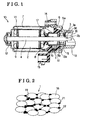
- Fig. 1 represents a cross-sectional view illustrating a configuration of a motor 10, in which a metal-graphite brush 1 (simply referred hereinafter as a brush) for supplying electricity to a rotor 2 is utilized.
- a configuration of the motor 10 will be briefly explained with reference to Fig. 1.
- the motor 10, illustrated in Fig. 1, is configured so that the rotor 2 rotates within a housing 7.
- the rotor 2 is rotatably accommodated in the housing 7 that has a cylindrical shape and that is made of metal.
- the housing 7, which accommodates the rotor 2 is fixed to a housing 13 by means of a fastening member 14 such as a bolt, and thus integrated into a unit with the housing 13.
- the rotor 2 is supported by a shaft 4.
- the shaft 4 has two parallel planes provided at one end of the shaft 4 (right side in Fig. 1).
- a driven shaft 16 of a driven apparatus is inserted to and connected with the two parallel planes from an axial direction.
- rotation of the motor 10 can be externally transmitted from the driven shaft 16.
- a core 9 of the rotor 2 is formed by layering plural metal plates in an axial direction.
- the shaft 4 is inserted through a center of the core by means of press fit and integrated into a unit with the core 9.
- the other end of the shaft 4 is inserted into an inner ring of a bearing (a first bearing) 12, pressed and fitted into one end of the housing 7, and thus rotatably supported in the housing 7 by means of the bearing 12.
- plural arc-shape magnets 11 are attached to the housing 7 by means of an adhesive, or the like, in a peripheral direction.
- the housing 13, to which the housing 7 is attached includes a recessed portion 13a provided at a motor-attachment surface of the housing 13 for attaching the rotor 2.
- An outer ring 5a of the bearing 5 is attached to the recessed portion 13a by means of press fit.
- the shaft 4 is supported by the bearing 5.
- the shaft 4 for supporting the rotor 2 is rotatably supported by the two bearings 5 and 12 by double support.
- the opposite end of the shaft 4, opposite to the position into which the bearing 12 is pressed is pressed into an inner ring 5b of the bearing 5.
- the outer ring 5a of the bearing 5 is pressed into the inner side of the recessed portion 13a of the housing 13 so as to be provided along the inner periphery of the recessed portion 13a.
- a spring 3 is provided between the housing 13 of the motor 10 and the bearing 5.
- the spring 3 is made from a disc-shaped flat metal plate having strong elasticity (a high spring constant).
- the spring 3 has a hole 3d, through which the shaft 4 penetrates, at the center thereof.
- the disc-shaped plate has three slits in a radial direction positioned at distances of 120°. Each slit has an extending slit portion extending clockwise (or counter clockwise) along a peripheral direction of the disc-shaped plate.
- the disc-shaped plate is bended in an axial direction into a three-dimensional form so as to form biasing portions 3b contiguous with a supporting portion 3a.
- the supporting portion 3a of the spring 3 make contact with a peripheral stepped portion of the recessed portion 13a so as to engage with the same.
- the biasing portions 3b of the spring 3 make contact with a side surface of the outer ring 5a of the bearing 5 so as to bias the bearing 5 in an axial direction (left direction in Fig. 1).
- a holder 6 is provided near the bearing 5 so as to face the rotor 2.
- the holder 6 is made of resin, and is provided so as to have the same axis as the housing 7.
- the holder 6 includes two brushes 1 (only one of the brushes is illustrated in Fig. 1) for supplying electricity from the commutator 8 to a coil 17, wound around the core 9 provided at the rotor 2, by making contact with the commutator 8.
- a connector 15 for supplying electricity from the exterior to the rotor 2 through the brush 1 is provided at the holder 6 so as to form an integral unit with the holder 6.
- the brush 1 is made of a sintered material 22 having a base of natural graphite particles 18, as illustrated in Fig. 2.
- the sintered material 22 includes a number of pores 19 on both the surface and the inside of the sintered material 22.
- a thickness of a film of the phenol resin, the film formed on the surface of the graphite particles varies commensurately with the viscosity of the dissolved phenol resin added to the graphite particles 18.
- the dissolved resin in which the phenol resin is dissolved in the alcohol, is sprayed over the natural graphite particles 18 (S3).
- the spraying step (S3) the dissolved resin is sprayed so as to form a uniform film of the dissolved resin on the surface of the graphite particles 18.
- the graphite particles 18 are kneaded, with the dissolved resin that has been sprayed onto the surface (S4).
- the graphite particles 18 are kneaded by use of a kneading apparatus for a predetermined period of time (for example, from approximately 3 to 5 hours) so as to homogenize the graphite particles 18.
- the graphite particles 18 that have been homogenized are left in atmospheric air conditions for 30 minutes so as to be dried.
- the graphite particles 18 which have been dried are formed into a predetermined shape, for example, of which a diameter is approximately 0.5mm, and of which a length is approximately 2mm, by means of extrusion (S5).
- the graphite clusters (a granulation of graphite particles), which have been formed into the predetermined shape by means of extrusion, are mixed with copper powder, corresponding to the level of electric current that is intended to apply to the brush 1, in order to make the brush 1 so as to have a predetermined current density during the operation of the motor 10 (S6).
- copper powder corresponding to the level of electric current that is intended to apply to the brush 1
- molybdenum disulfide which serves as a solid lubricant
- a brush 1 of a desired shape can be press-formed by use of a pressing apparatus (S8).
- a product obtained by the process is processed by reduction firing, for 2 to 3 hours (S9), in a nitrogen-rich atmosphere, which contains hydrogen, and of which a temperature is from 700 °C to 800 °C (S9).
- the phenol resin is processed by the reduction firing.
- the phenol resin is turned into carbon monoxide, carbon dioxide, water vapor, and amorphous carbon.
- the amorphous carbon remains as a solid in a product obtained by the process of the reduction firing.
- the amorphous carbon which is generated by the reduction firing, binds the graphite particles one another, and a brush-shaped sintered material 22 is made up.
- a number of pores 19 are formed, on the surface of the sintered material 22 and the inside of the sintered material 22, between adjacent graphite particles 18, as illustrated in Fig. 2.
- the pores 19 are formed by gases, which are generated while the phenol resin thermally decomposes.
- the metal-graphite brush For impregnating an impregnant 21 into the pores 19 formed at the sintered material 22, which has been made up by the process illustrated in Fig. 3, for example, the metal-graphite brush is put into a container, in which the impregnant 21 is put in, the metal-graphite brush is left in a low pressure state (0.1 atm or lower) for a predetermined time (for example, 30 minutes), and the metal-graphite brush is pulled out from the container.
- a low pressure state 0.1 atm or lower
- a predetermined time for example, 30 minutes
- an emulsion 34 (illustrated in Fig. 4) is utilized as the impregnant 21, with which the inside of the pores 19 of the brush 1 is impregnated.
- the emulsion 34 contains a liquid 35 (illustrated in Fig. 4) and a solvent 33 (illustrated in Fig. 4) to which the liquid 35 is dissolved as liquid particles.
- the liquid 35 vaporizes corresponding to a temperature rise caused by a frictional heat generated while the brush 1 slides along the commutator during the operation of the motor.
- the solvent 33 has a boiling point higher than that of the liquid 35.
- an emulsion 34 utilized for the metal-graphite brush 1 is not particularly limited.
- Various kinds of liquids, which configure liquid particles, and solvents, into which the liquid particles are dispersed, can be selected.
- a synthetic oil 33 illustrated in Fig. 4
- a synthetic oil 33 utilized is not thermally decomposed and is not oxidized even at a temperature of the sliding surface 32 of the brush 1 and at a temperature of the sliding surface of the commutator 8.
- the synthetic oil 33 has, for example, a high viscosity index, good fluidity at low temperatures, ability for retaining an oil film at high temperatures, good thermal stability, good stability against oxidation, and good absorption ability to the surface of the commutator. These lubrication characteristics are preferable for a liquid lubricant. From this point of view, at least one of poly-alpha-olefin, polyalkylene glycol, polyol ester, polyol diester, and polyol triester can be selected as the synthetic oil 33. Such a synthetic oil 33 should preferably be utilized as a lubricant. However, any synthetic oil 33 utilized should not be particularly limited.
- additives can be added to the synthetic oil 33.
- a base oil configuring the synthetic oil 33 following additives can be added:
- a kinetic viscosity of the synthetic oil 33 is not limited to a particular value. However, it is preferable that the kinetic viscosity of the synthetic oil 33 is equal to or lower than 20cSt at 40°C. It is preferable that the kinetic viscosity of the synthetic oil 33 is equal to or lower than 4cSt at 100°C.
- Electric resistance of a gap between the brush 1 and the commutator 8 can be considered as serial resistance including electric resistance formed by a layer of atmospheric air and electric resistance formed by a layer of the synthetic oil 33. When the synthetic oil 33 seeps out into the gap, and when the layer of the synthetic oil 33 is formed in the gap, electric resistance formed by the layer of the atmospheric air becomes lower, and electric resistance formed by the layer of the synthetic oil 33 increases. If a specific resistance of the synthetic oil 33 is lower than a specific resistance of the atmospheric air, electric resistance of the gap becomes lower as time elapses. When a continuous layer of the synthetic oil 33 is formed across the gap, electric resistance of the gap becomes a constant value
- a part of the spark discharges achieves the commutator 8, a part of the commutator 8 sublimates caused by this, and thus a surface of the commutator 8 is made rough.
- the sliding surface of the commutator the sliding surface sliding along the brush 1 induces abrasive wear at the brush 1.
- the sliding surface of the commutator 8 is made rough, a possibility of generation of adhesive wear of the brush 1 to the sliding surface of the commutator 8 increases.
- the surface of the commutator 8 is further made rough, which increases a possibility of generation of the spark discharges.
- the synthetic oil 33 which is present near a portion at which the adhesive wear occurs, is deteriorated by frictional heat. Liquid lubrication action of the synthetic oil 33 deteriorated by the frictional heat becomes low. Thus, electric wear of the brush 1 increases, and a frequency of generation of electric noise becomes high.
- a film of the synthetic oil 33 is formed near a contacting point of the brush 1 with the commutator 8. Electric resistance becomes smaller as a thickness of the film becomes smaller. If the film becomes a monomolecular film, the film has almost zero electric resistance. Further, the film formed on the sliding surfaces is formed, not as points, but as surfaces. Many contacting surfaces are formed on the sliding surfaces. Accordingly, electric resistance between the brush 1 and the commutator 8 can be decreased by large extent. If the viscosity of the synthetic oil 33 is low, a thickness of the film of the synthetic oil 33 near the contacting point can be small. Thus, low viscosity of the synthetic oil 33 can contribute to decrease in the electric resistance. As a result, generation of the spark discharges can be difficult.
- a liquid 35 which is utilized for making the emulsion 34, and which configures liquid particles
- a liquid 35 which vaporizes corresponding to a temperature rise caused by a frictional heat generated while the brush 1 slides along the commutator 8 during the operation of the motor, and which has a boiling point lower than a boiling point of the synthetic oil 33, and which can be emulsified with the synthetic oil 33
- the synthetic oil 33 is a non-polar liquid
- a polar liquid is selected as a liquid 35, which is dispersed in the synthetic oil 33, and which configures liquid particles.
- the polar liquid for example, water, alcohol, or the like, can be employed.
- each kind of alcohol has a different boiling point from that of others. Accordingly, if a certain kind of alcohol is selected corresponding to a circumstance in which the brush 1 is utilized, the synthetic oil 33 can seep out to the sliding surface 32 at a desired temperature. In other words, for example, if an average temperature of the sliding surface 32 of the brush 1 is approximately 150°C, an alcohol, which has a boiling point approximately at 130°C, can be selected. If an average temperature of the sliding surface 32 rises from 25°C (exterior air temperature) by 50°C while the motor 10 is continuously operated, an alcohol, which has a boiling point approximately at 60°C, can be utilized.
- the average temperature of the sliding surface 32 has a certain temperature width, and a certain temperature region is formed with a certain frequency
- plural kinds of alcohols can be selected corresponding to the certain temperature width respectively, and the plural kinds of alcohols can be mixed at a ratio corresponding to the frequency of the temperature region.
- Table 1 represents kinds of alcohols, which have a boiling point in a temperature range of 60°C to 140°C. These kinds of alcohols can be separately utilized corresponding to a temperature at the sliding surface 32 and the frequency of the temperature.
- the emulsion 34 is made of the synthetic oil 33 and the alcohol described above, if the alcohol is merely mixed with the synthetic oil 33 by a centrifugal separator to emulsify the alcohol in the synthetic oil 33, as time elapses, the alcohol emulsified in the synthetic oil 33 gathers again.
- hydrophobic surfactant by weight ratio of approximately 2% to the alcohol being 100%, is mixed in the alcohol. By doing so, micro-particles of the alcohol can be stably dispersed in the synthetic oil 33.
- the surfactant is highly hydrophobic, and the surfactant is not thermally decomposed at 150°C, which is a maximum temperature at the sliding surfaces.
- a surfactant having special characteristics is not required.
- the balloon 31 coming out to the sliding surface 32 is larger than the opening portion of the pores 19, the balloon 31 comes out to the sliding surface 32 with smaller amount of the synthetic oil 33.
- a size of the opening portion of the pores 19 of the sintered material 22 of a practical brush 1 varies within a range from 1 to 30 micron. Accordingly, if the size of the balloon 31 is 30 micron or larger, the amount of the synthetic oil 33, which seeps out, becomes small. Further, if the size of the balloon 31 is controlled to have a predetermined value within a range from 1 micron to 30 micron, the amount of the synthetic oil 33, which seeps out to the sliding surface 32, can be controlled according to the size of the balloon 31.
- the amount of the synthetic oil 33, which seeps out to the sliding surface 32 can be freely designed corresponding to the temperature range and the temperature frequency of the sliding surface 32.
- the size of the micro-particles of the alcohol in the emulsion 34 and a kind of alcohol are determined corresponding to the temperature range and the temperature frequency of the sliding surface 32 of the brush 1.
- the temperature range and the temperature frequency of the sliding surface 32 of the brush 1 are determined according to a usage of the motor 10.
- the alcohol can be emulsified so that the micro-particles of the alcohol in the emulsion 34 becomes 30 micron or smaller by means of a centrifugal separator with a predetermined rotational speed and a rotating time.
- the emulsion 34 can have conductivity.
- electrolyte can be dissolved into the liquid 35, which configures liquid particles, or into the solvent, into which the liquid particles are dispersed, or a conductive liquid material, can be mixed to the emulsion 34.
- method to make the emulsion 34 to have conductivity is not particularly limited.
- a kind of the electrolyte is not particularly limited.
- the electrolyte a metallic salt, a metallic soap, a surfactant, or the like, may serve as examples.
- the electrolyte has higher solubility because the electrolyte, which has higher solubility, has higher ionic conductivity.
- an anionic surfactant such as sulfuric ester salt, sulfonate, alkyl benzene sulfonate, carboxylate, or the like
- a cationic surfactant such as ammonium salt, or the like
- sodium octylsulphate, potassium decanoate, sodium decanoate, lithium (linear) dodecylbenzenesulfonate, or the like may serve as examples.
- decyltrimethylammoniumbromide may serve as examples. If such an electrolyte is dissolved, a solution having ionic conductivity of approximately 1 miliSiemens/cm or higher can be obtained.
- an ionic liquid can be utilized as the conductive liquid material.
- an ionic liquid as a cation, pyridinium cation, imidazolium cation, aliphatic amine cation, alicyclic amine cation, or the like, may serve as examples.
- halide ion such as chlorine ion, bromide ion, and iodide ion, or the like
- nitrate ion, tetrafluoroborate (BF 4 - ), hexafluorophosphate (PF 6 - ), trifluoromethane sulfonyl (TFSI) [(CF 3 SO 2 ) 2 N - , (CF 3 SO 2 ) 3 C - ], aluminum chloride [AlCl 4 - , Al 2 Cl 7 - ], or the like, may serve as examples.
- the ionic liquid can reduce a coefficient of sliding friction between the sliding surface 32 of the brush 1 and the sliding surface of the commutator 8. Accordingly, mechanical wear of the brush 1 can be reduced.
- the ionic liquid is difficult to thermally decompose even at 250°C, and that the ionic liquid has resistance against hydrolysis.
- an anion including TFSI may serve as an example.
- the ionic liquid has ionic conductivity of approximately 1 miliSiemens/cm or higher.
- the ionic liquid has ionic conductivity of approximately 3 miliSiemens/cm.
- the ionic liquid which has TFSI as an anion, for example, 5 kinds of the ionic liquid, of which chemical formulas are described below, may serve as examples, including:
- Conductivity of such an ionic liquid at the sliding surfaces is based on a transfer of ions.
- cations and anions transfer by electric potential applied between the brush 1 and the commutator 8.
- arrangement of cations and anions at the sliding surface 32 of the brush 1 and at the sliding surface of the commutator 8 changes with time.
- the sliding surface 32 of the brush 1 does not slide along the sliding surface of the commutator 8, or when the motor is not in operation, the arrangement is released.
- the sliding state of the brush 1 with the commutator 8 changes, arrangement of the cations and anions at the sliding surfaces changes with time. Accordingly, ionic conductivity based on transfer of the cations and anions can be retained. Further, on the basis of release of the arrangement and rearrangement of ions, ionic conductivity based on the transfer of the ions can be maintained.
- the ionic liquid can be directly dispersed in the synthetic oil 33 as liquid particles. It is also possible that the ionic liquid is dissolved in, for example, an alcohol, which vaporizes at a predetermined temperature, and after that, the alcohol containing the ionic liquid is dispersed in the synthetic oil 33. It is also possible that the ionic liquid is dissolved in, for example, at least one of alcohols, which have various boiling points, and after that, the alcohol, which contains the ionic liquid, and other alcohols are dispersed in the synthetic oil 33. By doing so, the synthetic oil 33 and the ionic liquid can seep out to the sliding surface 32 corresponding to the boiling points of the alcohols.
- the emulsion 34 described above can be further dissolved in another solvent as liquid particles.
- a double-structured emulsion which has double emulsion structure, can be made.
- the solvent, into which the emulsion 34 described above is dissolved as liquid particles is selected so that the solvent has a boiling point higher than that of the synthetic oil 33, and so that the solvent can be emulsified with the synthetic oil 33, and so that the solvent is not thermally decomposed even at a maximum temperature of the sliding surface 32 of the brush 1, for example, at 150°C.
- liquid particles of the emulsion 34 are formed so that the non-polar synthetic oil 33 surrounds the polar liquid, for example, hydrophilic fatty acid ester, which is a polar solvent, and which has a resistance against thermal decomposition, can be utilized.
- polar liquid for example, hydrophilic fatty acid ester, which is a polar solvent, and which has a resistance against thermal decomposition
- Such an emulsion 34 can have ionic conductivity if the ionic liquid or the alcohol solution, in which the electrolyte is dissolved, or the like, is mixed with the synthetic oil 33.
- the conductive liquid material is emulsified with the synthetic oil 33.
- the liquid as liquid particles can have new plural characteristics, such as lubricity, or the like.
- the emulsion 34 which is made up by preliminary dispersing the alcohol solution in the synthetic oil 33 by the method described above, hydrophilic fatty acid ester, and a hydrophilic surfactant in an amount approximately 2% by weight in terms of the emulsion 34 of the synthetic oil 33 being 100%, are homogenized by means of a centrifugal separator. By doing so, micro-particles of the emulsion 34 of the synthetic oil 33 can be stably dispersed in the fatty acid ester. A rotational speed and a rotating time, for homogenizing the solution, can be determined so that a size of the micro-particles of the synthetic oil 33 becomes approximately 5 times to 10 times that of a size of the alcohol.
- the metal-graphite brush 1 was impregnated with the impregnant 21 in the pores 19 formed at the surface thereof and the inside thereof. The impregnation was conducted under a low-pressure condition. The brush 1 was installed to the motor 10. Then, action of the motor 10 in operation was tested. Meanwhile, the test was conducted with use of the metal-graphite brush 1, which had a dimension of 4.5mm ⁇ 9.0mm. Load applied to the commutator 8 from the brush 1 was set to 78.5kPa. Rotational speed (periphery) of the motor 10 was set to 3.6m/s. A level of current flowing between the brush 1 and the commutator 8 was set to 10A. Under the conditions described above, the motor 10 was rotated. The motor 10 was continuously rotated under a condition that an atmospheric temperature was 100°C.
- N, N-diethyl-N-methyl-N-(2-methoxyethyl) ammonium bis (trifluoromethanesulfonyl) imide was utilized as the ionic liquid.
- the ionic liquid can be dissolved in a various solvent, such as chloroform, methanol, ethanol, acetone, tetrahydrofuran, ethyl acetate, dimethylformamide, 1-propanol, 1-butanol, and isopentyl alcohol, at a volume ratio of 1:1.
- ionic conductivity of the ionic liquid is approximately 3 ⁇ 10 -3 Siemens/cm.
- the motor 10 according to the second example could continuously operate for 1000 hours at minimum under this load condition. Accordingly, the brush 1 according to the second example can be applied to various kinds of in-vehicle motors 10. In the third example, large effects from conductivity between the sliding surfaces could be obtained. The brush 1 could have practical performance after continuous operation for 3000 hours under this load condition. Further, it was found that the degree of wear of the brush 1 could be reduced from that of a conventional brush in every example.
- Example 2 Conventional example The degree of wear after 100 hours 0.2mm 0.1mm 0.3mm The degree of wear after 200 hours 0.3mm 0.2mm 0.5mm The degree of wear after 500 hours 0.7mm 0.4mm 2.5mm The degree of wear after 1000 hours 1.5mm 0.8mm - The degree of wear after 2000 hours - 1.5mm - The degree of wear after 3000 hours - 2.5mm -
- a metal-graphite brush for supplying electricity to a coil wound around a core provided at a rotor of a motor includes a sintered material having pores at a surface of the sintered material and in the sintered material, the surface of the sintered material serving as a sliding surface sliding along a sliding surface of a commutator to which the coil is electrically connected for supplying electricity.
- the metal-graphite brush further includes an emulsion containing a liquid, which vaporizes corresponding to a temperature rise of the sliding surface caused by frictional heat generated while the sliding surface is sliding along the sliding surface of the commutator during an operation of the motor, and a solvent, which has a boiling point higher than that of the liquid, and into which the liquid is dispersed as liquid particles, in the pores.
- a temperature of the metal-graphite brush rises while the motor is in operation caused by a sliding friction between the metal-graphite brush and the commutator. Then, the liquid dispersed in the solvent in the pores vaporizes before the solvent vaporizes. Accordingly, the liquid forms a balloon.
- the balloon moves to the sliding surface, which is atmospheric pressure, with the solvent, and with other components which do not vaporize, after an inner pressure of the balloon becomes atmospheric pressure or higher.
- the sliding surface of the metal-graphite brush may come in contact with the sliding surface of the commutator through liquid substance, which serves as a medium, because the liquid substance, such as the solvent and the other components, which do not vaporize, can be locally interposed between the sliding surfaces. Accordingly, the metal-graphite brush contacts the commutator through the surfaces. Therefore, contact resistance between the metal-graphite brush and the commutator can be reduced. As a result, generation of spark discharges can be restricted. Further, because a film of the liquid substance is formed on the sliding surfaces, frictional coefficient between the sliding surfaces can be reduced. Accordingly, adhesive wear and fatigue wear of graphite, which configures the metal-graphite brush, can be restricted.
- the liquid vaporizes only when the temperature of the sliding surface reaches a predetermined or higher temperature. At this time, balloons, closer to the sliding surface, move to the sliding surface by order of priority. Because the liquid, which is present in the pores, moves by itself; a limited amount of the liquid substance, which contains the emulsion, and which is present in the pores of the metal-graphite brush, can be efficiently utilized between the sliding surfaces. Accordingly, in comparison with a brush, which is merely impregnated with the liquid substance in the pores of the brush, a period for using the liquid substance can be extended.
- liquid having a different boiling point temperature at which the liquid substance seeps out to the sliding surface can be appropriately set. Further, if plural kinds of liquids, which vaporize at various temperatures, are dispersed in the solvent, the liquid substances can be present at the sliding surface within a wide temperature range.
- the emulsion contains a synthetic oil.
- the metal-graphite brush contacts with the commutator through the liquid substance, which contains the synthetic oil as a medium, liquid lubrication action can be obtained from the synthetic oil as the medium. Accordingly, mechanical wear of the metal-graphite brush can be reduced. Further, because the synthetic oil is interposed between the sliding surfaces, formation of a water vapor film on the sliding surfaces, which causes increase in contact resistance between the sliding surfaces, can be inhibited. Accordingly, electric loss between the metal-graphite brush and the commutator can be reduced.
- the synthetic oil includes at least one of poly-alpha-olefin, polyalkylene glycol, polyol ester, polyol diester, and polyol triester.
- the synthetic oil has lubrication characteristics, such as high viscosity index, good fluidity at low temperatures, good ability for retaining an oil film at high temperatures, preferable thermal stability, good stability against oxidation, and good absorption ability to a surface of the commutator, or the like, which are preferable characteristics for liquid lubricants. Accordingly, the synthetic oil can be applied as a good lubricant for the sliding surfaces.
- the emulsion has conductivity.
- electric resistance between the sliding surfaces can be smaller than that of atmospheric air as a medium. Accordingly, contact (electric) resistance between the metal-graphite brush and the commutator can be reduced. Therefore, intensity of electric field, which is induced at the metal-graphite brush when electric potential is applied to the metal-graphite brush, can be reduced. As a result, excitation of ⁇ electrons in the graphite particles becomes difficult, and generation of spark discharges can be difficult. Accordingly, electric wear of the metal-graphite brush and generation of electric noise from the metal-graphite brush can be restricted. Further, electric loss, which is on the basis of contact electric resistance between the metal-graphite brush and the commutator, can be reduced.
- the emulsion contains at least one of a metallic salt, a metallic soap, a surfactant, and an ionic liquid.
- the emulsion can have conductivity.
- the liquid is an alcohol which has a boiling point within a range from 60°C to 140°C.
- the liquid close to the sliding surface can reliably vaporize corresponding to the temperature rise caused by frictional heat of sliding during the operation of the motor.
- the alcohol vaporizes and forms a balloon during the operation of the motor, and the balloon moves to the sliding surface of the metal-graphite brush when an inner pressure of the balloon rises.
- the alcohol vaporizes, and the balloon close to the sliding surface of the metal-graphite brush moves to the sliding surface of the metal-graphite brush by order of priority. Accordingly, the liquid substance, which contains a limited amount of the emulsion in the pores, can be efficiently utilized between the sliding surfaces. In comparison with a brush, which is merely impregnated with the liquid substance in the pores, a period for using the liquid substance can be extended.
- a motor having a metal-graphite brush according to the embodiment of the present invention can be applied for a vehicle use, such as a motor for actuating a water pump for purposes of cooling an engine of a vehicle, a motor for actuating a cooling fan, and a motor for actuating an oil pump of an engine.
- a motor for actuating a water pump for purposes of cooling an engine of a vehicle such as a motor for actuating a cooling fan, and a motor for actuating an oil pump of an engine.
- the present invention is not limited thereto, and can be applied for a variety of applications.
- a metal-graphite brush (1) for supplying electricity to a coil (17) wound around a core (9) provided at a rotor (2) of a motor (10) includes a sintered material (22) having pores (19) at a surface of the sintered material and in the sintered material.
- the surface of the sintered material serves as a sliding surface (32) sliding along a sliding surface of a commutator (8) to which the coil is electrically connected for supplying electricity.
- the metal-graphite brush further includes an emulsion (34) containing a liquid (35), which vaporizes corresponding to a temperature rise of the sliding surface while the sliding surface is sliding along the sliding surface of the commutator during an operation of the motor, and a solvent, which has a boiling point higher than that of the liquid, and into which the liquid is dispersed as liquid particles, in the pores.
- a liquid 35
- a solvent which has a boiling point higher than that of the liquid, and into which the liquid is dispersed as liquid particles, in the pores.
Landscapes
- Motor Or Generator Current Collectors (AREA)
Abstract
Description
- This invention generally relates to a metal-graphite brush. More specifically, this invention pertains to a metal-graphite brush for supplying electricity to a coil wound around a core provided at a rotor of a motor.
- For a brush motor, electricity is supplied through a brush slidably contacting with a commutator. A coil wound around a core of a rotor is connected to the commutator. When electricity is supplied to the coil, the rotor starts to rotate by virtue of forces of attraction and repulsion applied from a permanent magnet provided in a housing so as to face the rotor.
- In the motor having the configuration described above, when the motor is in operation, the brush slides along the commutator. In such a situation, a surface of the brush, which slides along the commutator, tends to wear. Conventionally, for purposes of restricting the brush from being worn while the motor is in operation, materials used for making a brush have been varied, or the hardness of a brush has been controlled so as to restrict electrical/mechanical wear of the brush, or so as to restrict discharge of sparks occurring at the sliding surface of the brush while the motor is in operation.
- A conventional metal-graphite brush, which is applied to a brush motor for a vehicle, is known (for example, refer to
JP2001-298913A JP2001-298913A - An example of a conventional method for manufacturing a metal-graphite brush is as follows. As a base material, natural graphite particles are utilized. A dissolved phenol resin, as a binder, is added to the natural graphite particles. Then, the natural graphite particles are kneaded and extruded as a cluster of surface coated graphite particles. Further, electrolytic copper powder is added to the clusters with an amount proportional to the electric current density of the metal- graphite brush. Further, as a solid lubricant, a small amount of molybdenum disulfide powder or tungsten disulfide powder is added to the clusters, in order for obtaining improvement in lubricity between sliding surfaces from such a solid substance. Then, an aggregate are formed into a brush shape by press-formation with electrolytic copper powders and solid lubricant powders and the formed aggregate is sintered in a reducing atmosphere, in which hydrogen gas is contained, and in which nitrogen gas is richly contained, and of which a temperature is from 700°C to 800°C. In this conventional method, a film of the dissolved phenol resin is formed on a surface of the graphite particles. The dissolved phenol resin is thermally decomposed and carbonized to amorphous carbon at the sintering temperature. The amorphous carbon remains in the brush. The amorphous carbon binds, as a binder, the graphite particles. Then, at the process of sintering, organic substances, which are decomposed from the dissolved phenol resin, turn into carbon dioxide or vapor, and sublimate. At this time, many pores are formed on the surface of the metal-graphite brush and the inside of the metal-graphite brush. Meanwhile, a current density of current flowing in the metal graphite brush made by the method described above is determined from a mixing ratio of the copper powder.
- Generally, in a situation where a motor having a metal-graphite brush is applied to a vehicle, the smaller the motor is, the higher the mountability of the motor on the vehicle becomes. Accordingly, if a level of output from the motors is identical, smaller motors have higher value as products. Therefore, a size of the metal-graphite brush is restricted from a point of view of mountability. Accordingly, a brush, of which a sliding area with a commutator is smaller, and of which a length in a diametrical direction is shorter than a rotor, is better. On the other hand, a higher current density is desired for the metal-graphite brush utilized in a motor for a vehicle in order for applying large amount of current to the motor and in order for operating electronic equipment mounted on the vehicle.
- However, when the conventional metal-graphite brush is installed to the motor, sparks are discharged from the metal-graphite brush toward the commutator while the metal-graphite brush is in operation. There can be a situation where a temperature at a core of the discharge exceeds 3000°C, this can be recognized from a spectral wavelength of the emitted spark discharge. In such a situation, copper powder configuring the metal-graphite brush sublimate by order of priority, and a part of copper powder is lost from the metal-graphite brush. As a result, the inside of the metal-graphite brush is gradually broken, and therefore wear of the metal-graphite brush occurs.
- Further, the higher a volume ratio of copper powder gets, the easier the spark discharge occurs in the metal-graphite brush. Therefore, wear of the metal-graphite brush increases. Because of this, a use of a motor, which has a metal-graphite brush, for a vehicle is sometimes restricted from a point of view of requirement for the motor regarding mountability of the metal-graphite brush and a longevity of the metal-graphite brush against wear.
- Further, electric noise occurs in the motor, which has the metal-graphite brush, when sparks discharge from the metal-graphite brush. When such a motor, which has the metal-graphite brush, is utilized in a vehicle, because the motor is installed near other in-vehicle electronic equipment, a condenser or a coil needs to be provided for absorbing the electric noise caused by the spark discharge. In a case where a frequency range of the electric noise signals caused by the spark discharge is wide, plural condensers or coils need to be provided at the motor for absorbing the electric noise. Accordingly, a level of mountability of the motor for the vehicle is further lowered, and excessive cost for countermeasures against the electric noise is required. As described above, the conventional motor, which has the metal-graphite brush, has some drawbacks mainly caused by the sparks, which are discharged from the metal-graphite brush.
- A need thus exists for a metal-graphite brush, in which a spark discharge does not occur or is difficult to occur. The present invention has been made in view of the above circumstances and provides such a metal-graphite brush.
- According to an aspect of the present invention, a metal-graphite brush (1) for supplying electricity to a coil (17) wound around a core (9) provided at a rotor (2) of a motor (10) includes a sintered material (22) having pores at the surface or the inside of the sintered material, the surface of the sintered material serving as a sliding surface (32) sliding along a sliding surface of a commutator (8) to which the coil is electrically connected for supplying electricity. The metal-graphite brush further includes an emulsion (34) containing a liquid (35), which vaporizes corresponding to a temperature rise of the sliding surface while the sliding surface is sliding along the sliding surface of the commutator during an operation of the motor, and a solvent, which has a boiling point higher than that of the liquid, and into which the liquid is dispersed as liquid particles, in the pores.
- According to the aspect of the present invention, a temperature of the metal-graphite brush rises while the motor is in operation because of a sliding friction between the metal-graphite brush and the commutator. Then, the liquid dispersed in the solvent in the pores vaporizes before the solvent vaporizes. Accordingly, the liquid forms a balloon. The balloon moves to the sliding surface, which is atmospheric pressure, with the solvent, and with other components which do not vaporize, after an inner pressure of the balloon becomes atmospheric pressure or higher. Then, the sliding surface of the metal-graphite brush may come in contact with the sliding surface of the commutator through liquid substance, which serves as a medium, because the liquid substance, such as the solvent and the other components, which do not vaporize, can be locally interposed between the sliding surfaces. Accordingly, the metal-graphite brush contacts the commutator through the surfaces. Therefore, contact resistance between the metal-graphite brush and the commutator can be reduced. As a result, generation of spark discharges can be restricted. Further, because a film of the liquid substance is formed on the sliding surfaces, frictional coefficient between the sliding surfaces can be reduced. Accordingly, adhesive wear and fatigue wear of graphite, which configures the metal-graphite brush, can be restricted.
- Thus, because the emulsion is present in the pores of the metal-graphite brush, the liquid vaporizes only when the temperature of the sliding surface reaches a predetermined or higher temperature. At this time, balloons, closer to the sliding surface, move to the sliding surface by order of priority. Because the liquid, which is present in the pores, moves by itself, a limited amount of the liquid substance, which contains the emulsion, and which is present in the pores of the metal-graphite brush, can be efficiently utilized between the sliding surfaces. Accordingly, in comparison with a brush, which is merely impregnated with the liquid substance in the pores of the brush, a period for using the liquid substance can be extended. Further, if a liquid having a different boiling point is selected, temperature at which the liquid substance seeps out to the sliding surface can be appropriately set. Further, if plural kinds of liquids, which vaporize at various temperatures, are dispersed in the solvent, the liquid substances can be present at the sliding surface within a wide temperature range.
- The foregoing and additional features and characteristics of the present invention will become more apparent from the following detailed description considered with reference to the accompanying drawings, wherein:
- Fig. 1 represents a cross-sectional view illustrating a configuration of a motor, in which a metal-graphite brush according to an embodiment of the present invention is utilized;
- Fig. 2 represents a model diagram illustrating a composition of the metal-graphite brush;
- Fig. 3 represents a process diagram illustrating a making process of the metal-graphite brush; and
- Fig. 4 represents a diagram illustrating a concept of emulsion behavior near at a sliding surface of the metal-graphite brush.
- According to an embodiment of the present invention, a metal-graphite brush is made of a sintered material which has pores on the surface or the inside of the sintered material. The metal-graphite brush supplies electricity to the coil by sliding along a commutator, to which the coil, which is wound around a core, which is provided at a rotor of a motor, is electrically connected, through sliding surfaces. The metal-graphite brush has an emulsion, which contains a liquid, which vaporizes corresponding to a temperature rise caused by a frictional heat generated when the metal-graphite brush slides along the commutator while the motor is in operation, and a solvent, which has a boiling point higher than that of the liquid, and into which the liquid is dispersed as liquid particles, in the pores. In other words, temperature of the metal-graphite brush rises while the motor is in operation because the frictional heat is generated while the metal-graphite brush slides along the commutator. Based on the temperature rise, temperature of the pores, which are present at the sliding surface of the metal-graphite brush and which are present in the metal-graphite brush, also rises. In particular, the closer the pores are present to the sliding surface, which slides along the commutator, the more the temperature of the pores rises to a larger extent. The liquid, which is dispersed as liquid particles in the solvent, and which is present in the pores, vaporizes before the solvent vaporizes because the liquid has a boiling point lower than that of the solvent. Hereby, the liquid forms a balloon while the liquid vaporizes. Thermal expansion of the balloon formed is restricted by the solvent surrounding the balloon. Accordingly, as the temperature of the balloon rises, the inner pressure of the balloon rises. Then, after the inner pressure of the balloon has achieved atmospheric pressure or higher, the balloon moves from an opening portion of the pores of the metal-graphite brush to the sliding surface of the metal-graphite brush. At this time, the solvent, and components, which are not vaporized, move to the sliding surface with the balloon.
- Then, by doing so, liquid substance, such as the solvent, and such as other components which are not vaporized, can be locally interposed between the sliding surface of the metal-graphite brush and the sliding surface of the commutator. Accordingly, a conventional sliding state, in which the sliding surface of the metal-graphite brush slides along the sliding surface of the commutator through a medium including extremely small number of contacting points and almost atmospheric air, can be turned into a new sliding state, in which the sliding surface of the metal-graphite brush slides along the sliding surface of the commutator through a medium including, in addition to extremely small number of contacting points and atmospheric air, the newly formed liquid substance. Because the sliding surface of the metal-graphite brush slides along the sliding surface of the commutator through the medium including the liquid substance, the metal-graphite brush contacts the commutator through the surfaces of the liquid substance. Accordingly, comparing with contact resistance in a situation where the sliding surface of the metal-graphite brush slides along the sliding surface of the commutator through atmospheric air, contact resistance can be lowered. Therefore, generation of spark discharges can be restricted. Further, because a film of the liquid substance is formed on the sliding surfaces, a coefficient of sliding friction between the sliding surfaces can be lowered. Therefore, it is possible to restrict an adhesive wear or a fatigue wear of the graphite, which configures the metal-graphite brush.
- As described above, because the emulsion is present in the pores, the liquid, which is present as liquid particles, vaporizes only when the temperature of the sliding surface rises to a predetermined temperature or higher. Then, the balloons, which are present closer to the sliding surface, start to move to the sliding surface by order of priority. Therefore, a limited amount of the liquid substance containing the emulsion, which is present in the pores, can be efficiently utilized at the sliding surface. Comparing with a metal-graphite brush, which has merely an impregnated liquid substance in pores, a period for using the liquid substance can be extended. Further, a temperature, at which the liquid substance seeps out to the sliding surface, can be appropriately set by appropriately selecting, as a liquid which configures liquid particles, a liquid having a different boiling point. Further, the liquid substance can be present at the sliding surface in a wide temperature region by dispersing plural kinds of liquids in the solvent, the liquid that vaporizes at a different temperature.
- Further, according to the embodiment of the present invention, the emulsion may contain lubrication oil in the metal-graphite brush. Conventional lubrication oil, such as natural oil, a synthetic oil, or the like, can be applied to the lubrication oil. A kind of lubrication oil is not particularly limited. From a point of view that it is preferable if the lubrication oil has a high thermal decomposition temperature and the lubrication oil is difficult to be oxidized, it is preferable to use a synthetic oil. In other words, if the synthetic oil is not deteriorated by the sliding frictional heat, lubricity of the synthetic oil can be maintained. Then, if such a synthetic oil is utilized, the sliding surface of the metal-graphite brush and the sliding surface of the commutator can be locally filled with the liquid substance containing the synthetic oil. Accordingly, the metal-graphite brush can slide along the commutator while the synthetic oil, which contributes to lubrication action, is interposed between the metal-graphite brush and the commutator. In this case, because the surface of the metal-graphite brush and the surface of the commutator contacts through the synthetic oil, which serves as the medium, the liquid lubrication action can be obtained from the synthetic oil, which serves as the medium. Accordingly, mechanical wear of the metal-graphite brush can be reduced. Further, because the synthetic oil is interposed between the sliding surface of the metal-graphite brush and the sliding surface of the commutator, formation of a water vapor film therebetween, which causes increase in contact resistance therebetween, can be inhibited. Accordingly, loss of electricity can be reduced between the metal-graphite brush and the commutator.
- According to the embodiment of the present invention, in the metal-graphite brush, the emulsion can have conductivity. By doing so, electric resistance between the sliding surface of the metal-graphite brush and the sliding surface of the commutator can be smaller than that of atmospheric air as a medium. Therefore, in cooperation with effects from increase in area of the sliding surfaces in contact, contact electric resistance between the metal-graphite brush and the commutator can be lowered. Then, by doing so, intensity of electric field, which is induced at the metal-graphite brush when an electric potential is applied to the metal-graphite brush, can be lowered. Therefore, excitation of π electrons included in the graphite particles becomes difficult. Accordingly, generation of spark discharges can become difficult. As a result, generation of electric wear of the metal-graphite brush, and generation of electric noise from the metal-graphite brush, can be restricted. Further, loss of electricity between the metal-graphite brush and the commutator, caused by a level of contact resistance therebetween, can be small. Accordingly, electric current can efficiently flow in the commutator. Further, Joule heat generated between the sliding surfaces can be substantially reduced. Therefore, oxidation of the commutator at the sliding surface thereof can be restricted. As a result, loss of electricity, which is caused by formation of an oxide film on the commutator at the sliding surface thereof, can be eliminated. Further, destruction of the surface of the commutator, which is caused by a volume expansion because of the oxidation, can be eliminated. As a result, abrasive wear of the metal-graphite brush, which is caused by degradation of flatness of the sliding surfaces because of the destruction of the sliding surface of the commutator, can be eliminated.
- An embodiment of the present invention will be explained with reference to drawing figures. Fig. 1 represents a cross-sectional view illustrating a configuration of a
motor 10, in which a metal-graphite brush 1 (simply referred hereinafter as a brush) for supplying electricity to arotor 2 is utilized. A configuration of themotor 10 will be briefly explained with reference to Fig. 1. - The
motor 10, illustrated in Fig. 1, is configured so that therotor 2 rotates within a housing 7. Therotor 2 is rotatably accommodated in the housing 7 that has a cylindrical shape and that is made of metal. The housing 7, which accommodates therotor 2, is fixed to ahousing 13 by means of afastening member 14 such as a bolt, and thus integrated into a unit with thehousing 13. Therotor 2 is supported by ashaft 4. Theshaft 4 has two parallel planes provided at one end of the shaft 4 (right side in Fig. 1). A driven shaft 16 of a driven apparatus is inserted to and connected with the two parallel planes from an axial direction. Thus, rotation of themotor 10 can be externally transmitted from the driven shaft 16. - A
core 9 of therotor 2 is formed by layering plural metal plates in an axial direction. Theshaft 4 is inserted through a center of the core by means of press fit and integrated into a unit with thecore 9. Thus, therotor 2 and theshaft 4 rotate together as a unit. The other end of theshaft 4 is inserted into an inner ring of a bearing (a first bearing) 12, pressed and fitted into one end of the housing 7, and thus rotatably supported in the housing 7 by means of thebearing 12. On the other hand, along an inner surface of the cylindrical housing 7, plural arc-shape magnets 11 are attached to the housing 7 by means of an adhesive, or the like, in a peripheral direction. - Further, the
housing 13, to which the housing 7 is attached, includes a recessedportion 13a provided at a motor-attachment surface of thehousing 13 for attaching therotor 2. Anouter ring 5a of thebearing 5 is attached to the recessedportion 13a by means of press fit. Theshaft 4 is supported by thebearing 5. Thus, theshaft 4 for supporting therotor 2 is rotatably supported by the twobearings shaft 4, opposite to the position into which thebearing 12 is pressed, is pressed into aninner ring 5b of thebearing 5. Theouter ring 5a of thebearing 5 is pressed into the inner side of the recessedportion 13a of thehousing 13 so as to be provided along the inner periphery of the recessedportion 13a. In addition, in thehousing 13, aspring 3 is provided between thehousing 13 of themotor 10 and thebearing 5. - The
spring 3 is made from a disc-shaped flat metal plate having strong elasticity (a high spring constant). Thespring 3 has ahole 3d, through which theshaft 4 penetrates, at the center thereof. The disc-shaped plate has three slits in a radial direction positioned at distances of 120°. Each slit has an extending slit portion extending clockwise (or counter clockwise) along a peripheral direction of the disc-shaped plate. The disc-shaped plate is bended in an axial direction into a three-dimensional form so as to form biasingportions 3b contiguous with a supportingportion 3a. The supportingportion 3a of thespring 3 make contact with a peripheral stepped portion of the recessedportion 13a so as to engage with the same. The biasingportions 3b of thespring 3 make contact with a side surface of theouter ring 5a of thebearing 5 so as to bias thebearing 5 in an axial direction (left direction in Fig. 1). - On the other hand, a
holder 6 is provided near thebearing 5 so as to face therotor 2. Theholder 6 is made of resin, and is provided so as to have the same axis as the housing 7. In addition, theholder 6 includes two brushes 1 (only one of the brushes is illustrated in Fig. 1) for supplying electricity from thecommutator 8 to acoil 17, wound around thecore 9 provided at therotor 2, by making contact with thecommutator 8. In addition, aconnector 15 for supplying electricity from the exterior to therotor 2 through thebrush 1 is provided at theholder 6 so as to form an integral unit with theholder 6. When an external connector (not illustrated) is connected to theconnector 15, electricity can be supplied, through thebrush 1, to thecoil 17 wound around thecore 9 of therotor 2. When electricity is supplied to thecoil 17, electromagnetic force of attraction and repulsion is generated between therotor 2 and the magnets 11, and therotor 2 starts to rotate. - The
brush 1, employed in themotor 10 configured and operated as above, will be explained in detail below. According to the embodiment of the present invention, thebrush 1 is made of asintered material 22 having a base ofnatural graphite particles 18, as illustrated in Fig. 2. Thesintered material 22 includes a number ofpores 19 on both the surface and the inside of thesintered material 22. Firstly, an example of a manufacturing method of thesintered material 22, which can be made into thebrush 1, will be explained with reference to Fig. 3. - For making the
brush 1, natural graphite particles (particle diameter: approximately from 5µm to 150µm), and novolac-type (or resol-type) phenol resin of granular pellets, 2-3% by weight, as expressed in terms of the graphite particles being 100%, are prepared (S1). Then, the novolac-type (or resol type) phenol resin is dissolved in an alcohol so as to make a phenol resin solution (S2). As the alcoholic solvent, methanol, or the like, can be utilized in this step. Meanwhile, a solvent, into which the novolac-type (or resol type) phenol resin is dissolved, is not limited only to alcohols. For solving the phenol resin, ketones, such as acetone, can also be utilized. Meanwhile, in the step of solving the phenol resin (S2), a thickness of a film of the phenol resin, the film formed on the surface of the graphite particles, varies commensurately with the viscosity of the dissolved phenol resin added to thegraphite particles 18. After that, the dissolved resin, in which the phenol resin is dissolved in the alcohol, is sprayed over the natural graphite particles 18 (S3). In the spraying step (S3), the dissolved resin is sprayed so as to form a uniform film of the dissolved resin on the surface of thegraphite particles 18. - Next, the
graphite particles 18 are kneaded, with the dissolved resin that has been sprayed onto the surface (S4). In this step of kneading, thegraphite particles 18 are kneaded by use of a kneading apparatus for a predetermined period of time (for example, from approximately 3 to 5 hours) so as to homogenize thegraphite particles 18. After that, thegraphite particles 18 that have been homogenized are left in atmospheric air conditions for 30 minutes so as to be dried. Then, thegraphite particles 18 which have been dried are formed into a predetermined shape, for example, of which a diameter is approximately 0.5mm, and of which a length is approximately 2mm, by means of extrusion (S5). - Next, the graphite clusters (a granulation of graphite particles), which have been formed into the predetermined shape by means of extrusion, are mixed with copper powder, corresponding to the level of electric current that is intended to apply to the
brush 1, in order to make thebrush 1 so as to have a predetermined current density during the operation of the motor 10 (S6). At the same time, in order to improve a sliding condition with thecommutator 8, it is preferable that molybdenum disulfide, which serves as a solid lubricant, also be mixed (S6). By making these processes, the copper powder and the molybdenum disulfide are mixed, and thus homogenized (S7). After that, by means of pressing, or the like, abrush 1 of a desired shape can be press-formed by use of a pressing apparatus (S8). Then, a product obtained by the process is processed by reduction firing, for 2 to 3 hours (S9), in a nitrogen-rich atmosphere, which contains hydrogen, and of which a temperature is from 700 °C to 800 °C (S9). Thus, the phenol resin is processed by the reduction firing. At this time, the phenol resin is turned into carbon monoxide, carbon dioxide, water vapor, and amorphous carbon. The amorphous carbon remains as a solid in a product obtained by the process of the reduction firing. The amorphous carbon, which is generated by the reduction firing, binds the graphite particles one another, and a brush-shapedsintered material 22 is made up. In thesintered material 22, which has been made up as described above, a number ofpores 19 are formed, on the surface of thesintered material 22 and the inside of thesintered material 22, betweenadjacent graphite particles 18, as illustrated in Fig. 2. Thepores 19 are formed by gases, which are generated while the phenol resin thermally decomposes. - For impregnating an impregnant 21 into the
pores 19 formed at thesintered material 22, which has been made up by the process illustrated in Fig. 3, for example, the metal-graphite brush is put into a container, in which the impregnant 21 is put in, the metal-graphite brush is left in a low pressure state (0.1 atm or lower) for a predetermined time (for example, 30 minutes), and the metal-graphite brush is pulled out from the container. Thus, the inside of thepores 19 of thesintered material 22 of the metal-graphite brush can be filled up with the impregnant 21. - As the impregnant 21, with which the inside of the
pores 19 of thebrush 1 is impregnated, an emulsion 34 (illustrated in Fig. 4) is utilized. Theemulsion 34 contains a liquid 35 (illustrated in Fig. 4) and a solvent 33 (illustrated in Fig. 4) to which the liquid 35 is dissolved as liquid particles. The liquid 35 vaporizes corresponding to a temperature rise caused by a frictional heat generated while thebrush 1 slides along the commutator during the operation of the motor. The solvent 33 has a boiling point higher than that of the liquid 35. By doing so, liquid substance, with which thebrush 1 is impregnated, can reliably seep out to the sliding surface 32 (illustrated in Fig. 1) of thebrush 1 and the sliding surface of thecommutator 8. At this time, the liquid substance can seep out by order of priority to the slidingsurface 32 of thebrush 1 and the sliding surface of thecommutator 8. - According to the embodiment of the present invention, an
emulsion 34 utilized for the metal-graphite brush 1 is not particularly limited. Various kinds of liquids, which configure liquid particles, and solvents, into which the liquid particles are dispersed, can be selected. For example, as a solvent, a synthetic oil 33 (illustrated in Fig. 4) can be utilized. In a situation where asynthetic oil 33 is utilized as the solvent, it is preferable that asynthetic oil 33 utilized is not thermally decomposed and is not oxidized even at a temperature of the slidingsurface 32 of thebrush 1 and at a temperature of the sliding surface of thecommutator 8. Further, it is preferable that thesynthetic oil 33 has, for example, a high viscosity index, good fluidity at low temperatures, ability for retaining an oil film at high temperatures, good thermal stability, good stability against oxidation, and good absorption ability to the surface of the commutator. These lubrication characteristics are preferable for a liquid lubricant. From this point of view, at least one of poly-alpha-olefin, polyalkylene glycol, polyol ester, polyol diester, and polyol triester can be selected as thesynthetic oil 33. Such asynthetic oil 33 should preferably be utilized as a lubricant. However, anysynthetic oil 33 utilized should not be particularly limited. - Further, various kinds of additive can be added to the
synthetic oil 33. For example, to a base oil configuring thesynthetic oil 33, following additives can be added: - (1) benzotriazole as an oxidation-inhibiting agent;
- (2) benzotriazole as an antirust agent;
- (3) polyacrylate as a defoaming agent;
- (4) phosphate ester as an extreme pressure agent;
- (5) phosphate ester as a wear-resisting agent;
- (6) higher alcohol ester as an oiliness agent;
- (7) star polymer as an agent for enhancing viscosity index;
- (8) polyalkylacrylate as a pour-point depressant; and
- (9) polyoxyethylene-type surfactant as a demulsification agent.
- From the additives described above, following functions can be given to the
synthetic oil 33 respectively. - (1) Function for restricting generation of sludge and lacquer caused by oxidation of the base oil to inhibit chemical absorption of such sludge and lacquer to the surface of the commutator and to inhibit corrosion of the commutator.
- (2) Function for inhibiting erosion of the commutator by being chemically absorbed by the surface of the commutator.
- (3) Function for breaking a film of bubbles by lowering a surface tension of the bubbles while the base oil foams. Polyacrylate as a defoaming agent is dispersed in the base oil.
- (4) Function for restricting adhesive wear by forming a film on the surface of the commutator while the sliding surface is in a critical state.
- (5) Function for forming a protection film against adhesion, which has a low melting point, on the surface of the commutator to restrict destruction of the surface of the commutator caused by oxidation.
- (6) Function for forming a film which is adhered on the surface of the commutator at low temperatures to reduce a coefficient of sliding friction and to restrict adhesive wear and fatigue wear caused by the slide of the metal-graphite brush along the commutator.
- (7) At high temperatures, molecular bond of the star polymer as an agent for enhancing viscosity index is opened and binds with the base oil. As a result of this, reduction of viscosity is restricted, and a film pressure of the base oil can be ensured. Accordingly, adhesive wear and fatigue wear can be inhibited.
- (8) Function for restricting precipitation of wax in the base oil at low temperatures to inhibit reduction of fluidity caused by crystalline solidification.
- (9) Function for breaking an emulsion made by contamination of water to separate the base oil and water.
- A kinetic viscosity of the
synthetic oil 33 is not limited to a particular value. However, it is preferable that the kinetic viscosity of thesynthetic oil 33 is equal to or lower than 20cSt at 40°C. It is preferable that the kinetic viscosity of thesynthetic oil 33 is equal to or lower than 4cSt at 100°C. Electric resistance of a gap between thebrush 1 and thecommutator 8 can be considered as serial resistance including electric resistance formed by a layer of atmospheric air and electric resistance formed by a layer of thesynthetic oil 33. When thesynthetic oil 33 seeps out into the gap, and when the layer of thesynthetic oil 33 is formed in the gap, electric resistance formed by the layer of the atmospheric air becomes lower, and electric resistance formed by the layer of thesynthetic oil 33 increases. If a specific resistance of thesynthetic oil 33 is lower than a specific resistance of the atmospheric air, electric resistance of the gap becomes lower as time elapses. When a continuous layer of thesynthetic oil 33 is formed across the gap, electric resistance of the gap becomes a constant value. - On the other hand, if a viscosity of the
synthetic oil 33 becomes too high, thesynthetic oil 33 which seeps out into the gap between thebrush 1 and thecommutator 8 adheres to the slidingsurface 32 of thebrush 1 and the sliding surface of thecommutator 8 with an adhesive force which becomes larger as the viscosity increases. Further, the adhesive force in thesynthetic oil 33 also becomes high. Accordingly, a diffusion state of the highly viscoussynthetic oil 33, which has seeped out, is more difficult to change than in a situation of thesynthetic oil 33 which has a lower viscosity. Therefore, time taken for filling the entire gap with the highly viscoussynthetic oil 33 becomes longer than the time in a situation of thesynthetic oil 33 which has a lower viscosity. On the other hand, generation of spark discharges becomes more difficult as the electric resistance of the gap becomes lower. Accordingly, if thesynthetic oil 33, which has a lower kinetic viscosity, is utilized, a period of time, from the time when thesynthetic oil 33 seeps out to the slidingsurface 32, to the time when thesynthetic oil 33 becomes to a state in which the generation of the spark discharges is difficult, can be shorter. - If spark discharges occur, a part of the spark discharges achieves the
commutator 8, a part of thecommutator 8 sublimates caused by this, and thus a surface of thecommutator 8 is made rough. As a result, the sliding surface of the commutator, the sliding surface sliding along thebrush 1, induces abrasive wear at thebrush 1. Further, because the sliding surface of thecommutator 8 is made rough, a possibility of generation of adhesive wear of thebrush 1 to the sliding surface of thecommutator 8 increases. Thus, the surface of thecommutator 8 is further made rough, which increases a possibility of generation of the spark discharges. Thesynthetic oil 33, which is present near a portion at which the adhesive wear occurs, is deteriorated by frictional heat. Liquid lubrication action of thesynthetic oil 33 deteriorated by the frictional heat becomes low. Thus, electric wear of thebrush 1 increases, and a frequency of generation of electric noise becomes high. - In addition, a film of the
synthetic oil 33 is formed near a contacting point of thebrush 1 with thecommutator 8. Electric resistance becomes smaller as a thickness of the film becomes smaller. If the film becomes a monomolecular film, the film has almost zero electric resistance. Further, the film formed on the sliding surfaces is formed, not as points, but as surfaces. Many contacting surfaces are formed on the sliding surfaces. Accordingly, electric resistance between thebrush 1 and thecommutator 8 can be decreased by large extent. If the viscosity of thesynthetic oil 33 is low, a thickness of the film of thesynthetic oil 33 near the contacting point can be small. Thus, low viscosity of thesynthetic oil 33 can contribute to decrease in the electric resistance. As a result, generation of the spark discharges can be difficult. - As a liquid 35, which is utilized for making the
emulsion 34, and which configures liquid particles, a liquid 35, which vaporizes corresponding to a temperature rise caused by a frictional heat generated while thebrush 1 slides along thecommutator 8 during the operation of the motor, and which has a boiling point lower than a boiling point of thesynthetic oil 33, and which can be emulsified with thesynthetic oil 33, can be selected. In this case, because thesynthetic oil 33 is a non-polar liquid, it is preferable that a polar liquid is selected as a liquid 35, which is dispersed in thesynthetic oil 33, and which configures liquid particles. As the polar liquid, for example, water, alcohol, or the like, can be employed. - There are various kinds of alcohols. Each kind of alcohol has a different boiling point from that of others. Accordingly, if a certain kind of alcohol is selected corresponding to a circumstance in which the
brush 1 is utilized, thesynthetic oil 33 can seep out to the slidingsurface 32 at a desired temperature. In other words, for example, if an average temperature of the slidingsurface 32 of thebrush 1 is approximately 150°C, an alcohol, which has a boiling point approximately at 130°C, can be selected. If an average temperature of the slidingsurface 32 rises from 25°C (exterior air temperature) by 50°C while themotor 10 is continuously operated, an alcohol, which has a boiling point approximately at 60°C, can be utilized. Further, if the average temperature of the slidingsurface 32 has a certain temperature width, and a certain temperature region is formed with a certain frequency, plural kinds of alcohols can be selected corresponding to the certain temperature width respectively, and the plural kinds of alcohols can be mixed at a ratio corresponding to the frequency of the temperature region. Table 1 represents kinds of alcohols, which have a boiling point in a temperature range of 60°C to 140°C. These kinds of alcohols can be separately utilized corresponding to a temperature at the slidingsurface 32 and the frequency of the temperature. For example, in a situation where the temperature of the slidingsurface 32 reaches a range within 90°C to 130°C, if three kinds, in other words, ethanol, 1-propanol, and 1-butanol are selected, at least one kind of alcohol vaporizes in this temperature range. Accordingly, thesynthetic oil 33 can seep out to the slidingsurface 32. Meanwhile, normally, a temperature of the slidingsurface 32 of thebrush 1 and the sliding surface of thecommutator 8 rises to approximately 160°C during the operation of the motor. Accordingly, if an alcohol, which has a boiling point in the range described above, is selected, the alcohol can vaporize reliably corresponding to the temperature rise caused by the sliding motion during the operation of the motor.(Table 1) Name of substance Boiling point methanol 64.7°C ethanol 78.5°C 1-propanol 97.4°C 1-butanol 117.6°C isopentyl alcohol 131.2°C - In a situation where the
emulsion 34 is made of thesynthetic oil 33 and the alcohol described above, if the alcohol is merely mixed with thesynthetic oil 33 by a centrifugal separator to emulsify the alcohol in thesynthetic oil 33, as time elapses, the alcohol emulsified in thesynthetic oil 33 gathers again. For stabilizing the emulsified solution of the alcohol, hydrophobic surfactant, by weight ratio of approximately 2% to the alcohol being 100%, is mixed in the alcohol. By doing so, micro-particles of the alcohol can be stably dispersed in thesynthetic oil 33. It is preferable that the surfactant is highly hydrophobic, and the surfactant is not thermally decomposed at 150°C, which is a maximum temperature at the sliding surfaces. Here, a surfactant having special characteristics is not required. - Next, behavior of the
emulsion 34, which is obtained as described above, at an opening portion of thepores 19, will be explained with reference to Fig. 4. Because a temperature of theemulsion 34 becomes highest at the opening portion of thepores 19, a pressure of aballoon 31, which is made by the alcohol contained in theemulsion 34, can be at its highest. Theballoon 31 comes out to the slidingsurface 32. When the balloon comes out to the slidingsurface 32 from the opening of thepores 19, because theballoon 31 is present in thesynthetic oil 33, thesynthetic oil 33 seeps out to the slidingsurface 32 with theballoon 31. If theballoon 31 coming out to the slidingsurface 32 is smaller than the opening portion of thepores 19, theballoon 31 comes out to the slidingsurface 32 with larger amount of thesynthetic oil 33. - On the other hand, if the
balloon 31 coming out to the slidingsurface 32 is larger than the opening portion of thepores 19, theballoon 31 comes out to the slidingsurface 32 with smaller amount of thesynthetic oil 33. A size of the opening portion of thepores 19 of thesintered material 22 of apractical brush 1 varies within a range from 1 to 30 micron. Accordingly, if the size of theballoon 31 is 30 micron or larger, the amount of thesynthetic oil 33, which seeps out, becomes small. Further, if the size of theballoon 31 is controlled to have a predetermined value within a range from 1 micron to 30 micron, the amount of thesynthetic oil 33, which seeps out to the slidingsurface 32, can be controlled according to the size of theballoon 31. Further, if a kind of alcohol is changed, temperature characteristics of theballoon 31 coming out to the slidingsurface 32 can be changed. If these phenomena are combined, in other words, if a size variation of the micro-particles of the alcohol in theemulsion 34 and a variation of a kind of alcohol are combined, the amount of thesynthetic oil 33, which seeps out to the slidingsurface 32, can be freely designed corresponding to the temperature range and the temperature frequency of the slidingsurface 32. Thus, the size of the micro-particles of the alcohol in theemulsion 34 and a kind of alcohol are determined corresponding to the temperature range and the temperature frequency of the slidingsurface 32 of thebrush 1. Here, the temperature range and the temperature frequency of the slidingsurface 32 of thebrush 1 are determined according to a usage of themotor 10. For example, the alcohol can be emulsified so that the micro-particles of the alcohol in theemulsion 34 becomes 30 micron or smaller by means of a centrifugal separator with a predetermined rotational speed and a rotating time. - In the meantime, the
emulsion 34 can have conductivity. For making theemulsion 34 to have conductivity, electrolyte can be dissolved into the liquid 35, which configures liquid particles, or into the solvent, into which the liquid particles are dispersed, or a conductive liquid material, can be mixed to theemulsion 34. Accordingly, method to make theemulsion 34 to have conductivity is not particularly limited. For a situation where the electrolyte is dissolved, a kind of the electrolyte is not particularly limited. As the electrolyte, a metallic salt, a metallic soap, a surfactant, or the like, may serve as examples. It is preferable that the electrolyte has higher solubility because the electrolyte, which has higher solubility, has higher ionic conductivity. For example, an anionic surfactant, such as sulfuric ester salt, sulfonate, alkyl benzene sulfonate, carboxylate, or the like, and a cationic surfactant, such as ammonium salt, or the like, can be selected. More particularly, as the anionic surfactant, sodium octylsulphate, potassium decanoate, sodium decanoate, lithium (linear) dodecylbenzenesulfonate, or the like, may serve as examples. As the cationic surfactant, decyltrimethylammoniumbromide, or the like, may serve as examples. If such an electrolyte is dissolved, a solution having ionic conductivity of approximately 1 miliSiemens/cm or higher can be obtained. - As the conductive liquid material, for example, an ionic liquid can be utilized. For the ionic liquid, as a cation, pyridinium cation, imidazolium cation, aliphatic amine cation, alicyclic amine cation, or the like, may serve as examples. For an anion, halide ion such as chlorine ion, bromide ion, and iodide ion, or the like, nitrate ion, tetrafluoroborate (BF4 -), hexafluorophosphate (PF6 -), trifluoromethane sulfonyl (TFSI) [(CF3SO2)2N-, (CF3SO2)3C-], aluminum chloride [AlCl4 -, Al2Cl7 -], or the like, may serve as examples. If the ionic liquid is utilized as the conductive material, because the ionic liquid itself can function also as a lubricant for the sliding surfaces, the ionic liquid can reduce a coefficient of sliding friction between the sliding
surface 32 of thebrush 1 and the sliding surface of thecommutator 8. Accordingly, mechanical wear of thebrush 1 can be reduced. For retaining conductivity and lubricity between the sliding surfaces for a long period of time, it is preferable that the ionic liquid is difficult to thermally decompose even at 250°C, and that the ionic liquid has resistance against hydrolysis. For example, an anion including TFSI may serve as an example. Further, it is preferable that the ionic liquid has ionic conductivity of approximately 1 miliSiemens/cm or higher. It is further preferable that the ionic liquid has ionic conductivity of approximately 3 miliSiemens/cm. As the ionic liquid, which has TFSI as an anion, for example, 5 kinds of the ionic liquid, of which chemical formulas are described below, may serve as examples, including: - N, N-diethyl-N-methyl-N-(2-methoxyethyl) ammonium bis (trifluoromethanesulfonyl) imide; N, N, N-trimethyl-N-propylammonium bis (trifluoromethanesulfonyl) imide;
- N-methyl-N-propylpiperidinium bis (trifluoromethanesulfonyl) imide;
- 1-ethyl-3-methylimidazolium bis (trifluoromethanesulfonyl) imide; and
- 1-butyl-3-methylimidazolium bis (trifluoromethanesulfonyl) imide.


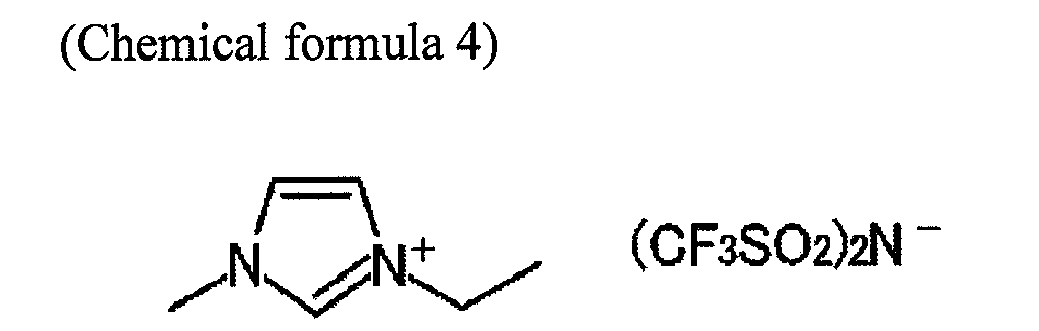

- Conductivity of such an ionic liquid at the sliding surfaces is based on a transfer of ions. When the
motor 10 is in operation, cations and anions transfer by electric potential applied between thebrush 1 and thecommutator 8. Then, because a sliding state is always changing, arrangement of cations and anions at the slidingsurface 32 of thebrush 1 and at the sliding surface of thecommutator 8 changes with time. Further, when the slidingsurface 32 of thebrush 1 does not slide along the sliding surface of thecommutator 8, or when the motor is not in operation, the arrangement is released. Thus, because the sliding state of thebrush 1 with thecommutator 8 changes, arrangement of the cations and anions at the sliding surfaces changes with time. Accordingly, ionic conductivity based on transfer of the cations and anions can be retained. Further, on the basis of release of the arrangement and rearrangement of ions, ionic conductivity based on the transfer of the ions can be maintained. - In the meantime, the ionic liquid can be directly dispersed in the
synthetic oil 33 as liquid particles. It is also possible that the ionic liquid is dissolved in, for example, an alcohol, which vaporizes at a predetermined temperature, and after that, the alcohol containing the ionic liquid is dispersed in thesynthetic oil 33. It is also possible that the ionic liquid is dissolved in, for example, at least one of alcohols, which have various boiling points, and after that, the alcohol, which contains the ionic liquid, and other alcohols are dispersed in thesynthetic oil 33. By doing so, thesynthetic oil 33 and the ionic liquid can seep out to the slidingsurface 32 corresponding to the boiling points of the alcohols. Further, in a situation where an electrolyte is utilized, if the electrolyte is dissolved in an alcohol, or the like, similar effects can be obtained. In particular, because ions are generated when the electrolyte mentioned above is dissolved in the alcohol, and because the electrolyte has high solubility in the alcohol, ion conductivity of the alcohol solution can be high. Accordingly, the electrolytes mentioned above are preferable. - In the meantime, the
emulsion 34 described above can be further dissolved in another solvent as liquid particles. By doing so, a double-structured emulsion, which has double emulsion structure, can be made. It is preferable that the solvent, into which theemulsion 34 described above is dissolved as liquid particles, is selected so that the solvent has a boiling point higher than that of thesynthetic oil 33, and so that the solvent can be emulsified with thesynthetic oil 33, and so that the solvent is not thermally decomposed even at a maximum temperature of the slidingsurface 32 of thebrush 1, for example, at 150°C. From this point of view, and from a point of view that liquid particles of theemulsion 34 are formed so that the non-polarsynthetic oil 33 surrounds the polar liquid, for example, hydrophilic fatty acid ester, which is a polar solvent, and which has a resistance against thermal decomposition, can be utilized. Such anemulsion 34 can have ionic conductivity if the ionic liquid or the alcohol solution, in which the electrolyte is dissolved, or the like, is mixed with thesynthetic oil 33. In this case, the conductive liquid material is emulsified with thesynthetic oil 33. Thus, if the emulsifiedsynthetic oil 33 is utilized as the liquid, which configures liquid particles, to make the double-structured emulsion, in which the liquid particles are dispersed in another solvent, the liquid as liquid particles can have new plural characteristics, such as lubricity, or the like. - For making the double-structured emulsion, the
emulsion 34, which is made up by preliminary dispersing the alcohol solution in thesynthetic oil 33 by the method described above, hydrophilic fatty acid ester, and a hydrophilic surfactant in an amount approximately 2% by weight in terms of theemulsion 34 of thesynthetic oil 33 being 100%, are homogenized by means of a centrifugal separator. By doing so, micro-particles of theemulsion 34 of thesynthetic oil 33 can be stably dispersed in the fatty acid ester. A rotational speed and a rotating time, for homogenizing the solution, can be determined so that a size of the micro-particles of thesynthetic oil 33 becomes approximately 5 times to 10 times that of a size of the alcohol. - Examples will be explained below. In those examples, the metal-
graphite brush 1 was impregnated with the impregnant 21 in thepores 19 formed at the surface thereof and the inside thereof. The impregnation was conducted under a low-pressure condition. Thebrush 1 was installed to themotor 10. Then, action of themotor 10 in operation was tested. Meanwhile, the test was conducted with use of the metal-graphite brush 1, which had a dimension of 4.5mm×9.0mm. Load applied to thecommutator 8 from thebrush 1 was set to 78.5kPa. Rotational speed (periphery) of themotor 10 was set to 3.6m/s. A level of current flowing between thebrush 1 and thecommutator 8 was set to 10A. Under the conditions described above, themotor 10 was rotated. Themotor 10 was continuously rotated under a condition that an atmospheric temperature was 100°C. - A first example will be explained. In the first example, as the ionic liquid, N, N-diethyl-N-methyl-N-(2-methoxyethyl) ammonium bis (trifluoromethanesulfonyl) imide was utilized. The ionic liquid can be dissolved in a various solvent, such as chloroform, methanol, ethanol, acetone, tetrahydrofuran, ethyl acetate, dimethylformamide, 1-propanol, 1-butanol, and isopentyl alcohol, at a volume ratio of 1:1. Further, ionic conductivity of the ionic liquid is approximately 3×10⁻³ Siemens/cm. In the first example, 0.2 by volume of methanol and 0.4 by volume of 1-butanol were mixed with the ionic liquid being 1 by volume. Thus, alcohol solution of the ionic liquid was made. Then, as the
synthetic oil 33, into which the alcohol solution of the ionic liquid was dispersed, poly-alpha-olefin was utilized. Thermal decomposition ratio of the poly-alpha-olefin at 250°C is 2 to 3%. Hydrolysis ratio of the poly-alpha-olefin is 2 to 3%. Kinetic viscosity of the poly-alpha-olefin is 4cSt at 100°C, 17cSt at 40°C, and 2500cSt at -40°C. Pour point of the poly-alpha-olefin is -70°C. Viscosity index of the poly-alpha-olefin is 122. The alcohol solution of the ionic liquid, 0.4 by volume, was mixed with the poly-alpha-olefin, one by volume. Then, the mixture was homogenized by using a centrifugal separator. Thus, the alcohol solution of the ionic liquid was emulsified so that the alcohol solution of the ionic liquid becomes 1µm or smaller. Next, theemulsion 34 described above was put into a container. Then, the metal-graphite brush 1 was put into the container so that the metal-graphite brush 1 was impregnated with theemulsion 34. After that, a pressure in the container was lowered to 0.1 atm by means of a vacuum pump. The pressure in the container was maintained at 0.1 atm for thirty minutes. Thus, thebrush 1, which was impregnated with theemulsion 34, which serves as the impregnant 21, in theporosities 19 of thebrush 1, was obtained. As a result of a test with use of the metal-graphite brush 1, it was found that thebrush 1 could have a practical performance after thebrush 1 had been continuously operated for 3000 hours. - Next, a second and a third example will be explained. In the second example, methanol was emulsified with the poly-alpha-olefin, and the
emulsion 34 was dispersed in a fatty acid ester. The resulting product was utilized as theimpregnant 21. In the third example, potassium decanoate was dissolved in the methanol in the second example at a solubility limit at 25°C. As a result, as described in Table 2, in the second example, speed of increase in degree of wear of thebrush 1 did not change by large amounts during a continuous 1000 hours operation of themotor 10. However, the degree of wear of thebrush 1 increased before themotor 10 completed a continuous 2000 hours operation, and the brush holder broke. From this result, it was found that themotor 10 according to the second example could continuously operate for 1000 hours at minimum under this load condition. Accordingly, thebrush 1 according to the second example can be applied to various kinds of in-vehicle motors 10. In the third example, large effects from conductivity between the sliding surfaces could be obtained. Thebrush 1 could have practical performance after continuous operation for 3000 hours under this load condition. Further, it was found that the degree of wear of thebrush 1 could be reduced from that of a conventional brush in every example.(Table 2) Example 2 Example 3 Conventional example The degree of wear after 100 hours 0.2mm 0.1mm 0.3mm The degree of wear after 200 hours 0.3mm 0.2mm 0.5mm The degree of wear after 500 hours 0.7mm 0.4mm 2.5mm The degree of wear after 1000 hours 1.5mm 0.8mm - The degree of wear after 2000 hours - 1.5mm - The degree of wear after 3000 hours - 2.5mm - - As described above, according to the embodiment of the present invention, entire
inner pores 19 of the metal-graphite brush are impregnated with the impregnant 21, which contains thesynthetic oil 33 and the conductive liquid. Accordingly, in addition to liquid lubrication function, restriction of spark discharges at the time of sliding can be obtained. This synergetic effect can reduce the degree of wear of the metal-graphite brush 1. Further, because contact resistance between thebrush 1 and thecommutator 8 can be reduced, output of themotor 10 can increase. - According to a first aspect of the present invention, a metal-graphite brush for supplying electricity to a coil wound around a core provided at a rotor of a motor includes a sintered material having pores at a surface of the sintered material and in the sintered material, the surface of the sintered material serving as a sliding surface sliding along a sliding surface of a commutator to which the coil is electrically connected for supplying electricity. The metal-graphite brush further includes an emulsion containing a liquid, which vaporizes corresponding to a temperature rise of the sliding surface caused by frictional heat generated while the sliding surface is sliding along the sliding surface of the commutator during an operation of the motor, and a solvent, which has a boiling point higher than that of the liquid, and into which the liquid is dispersed as liquid particles, in the pores.
- According to the aspect of the present invention, a temperature of the metal-graphite brush rises while the motor is in operation caused by a sliding friction between the metal-graphite brush and the commutator. Then, the liquid dispersed in the solvent in the pores vaporizes before the solvent vaporizes. Accordingly, the liquid forms a balloon. The balloon moves to the sliding surface, which is atmospheric pressure, with the solvent, and with other components which do not vaporize, after an inner pressure of the balloon becomes atmospheric pressure or higher. Then, the sliding surface of the metal-graphite brush may come in contact with the sliding surface of the commutator through liquid substance, which serves as a medium, because the liquid substance, such as the solvent and the other components, which do not vaporize, can be locally interposed between the sliding surfaces. Accordingly, the metal-graphite brush contacts the commutator through the surfaces. Therefore, contact resistance between the metal-graphite brush and the commutator can be reduced. As a result, generation of spark discharges can be restricted. Further, because a film of the liquid substance is formed on the sliding surfaces, frictional coefficient between the sliding surfaces can be reduced. Accordingly, adhesive wear and fatigue wear of graphite, which configures the metal-graphite brush, can be restricted.
- Thus, because the emulsion is present in the pores of the metal-graphite brush, the liquid vaporizes only when the temperature of the sliding surface reaches a predetermined or higher temperature. At this time, balloons, closer to the sliding surface, move to the sliding surface by order of priority. Because the liquid, which is present in the pores, moves by itself; a limited amount of the liquid substance, which contains the emulsion, and which is present in the pores of the metal-graphite brush, can be efficiently utilized between the sliding surfaces. Accordingly, in comparison with a brush, which is merely impregnated with the liquid substance in the pores of the brush, a period for using the liquid substance can be extended. Further, if a liquid having a different boiling point is selected, temperature at which the liquid substance seeps out to the sliding surface can be appropriately set. Further, if plural kinds of liquids, which vaporize at various temperatures, are dispersed in the solvent, the liquid substances can be present at the sliding surface within a wide temperature range.
- According to a second aspect of the present invention, the emulsion contains a synthetic oil.
- According to the aspect of the present invention, because the metal-graphite brush contacts with the commutator through the liquid substance, which contains the synthetic oil as a medium, liquid lubrication action can be obtained from the synthetic oil as the medium. Accordingly, mechanical wear of the metal-graphite brush can be reduced. Further, because the synthetic oil is interposed between the sliding surfaces, formation of a water vapor film on the sliding surfaces, which causes increase in contact resistance between the sliding surfaces, can be inhibited. Accordingly, electric loss between the metal-graphite brush and the commutator can be reduced.
- According to a third aspect of the present invention, the synthetic oil includes at least one of poly-alpha-olefin, polyalkylene glycol, polyol ester, polyol diester, and polyol triester.
- According to the aspect of the present invention, the synthetic oil has lubrication characteristics, such as high viscosity index, good fluidity at low temperatures, good ability for retaining an oil film at high temperatures, preferable thermal stability, good stability against oxidation, and good absorption ability to a surface of the commutator, or the like, which are preferable characteristics for liquid lubricants. Accordingly, the synthetic oil can be applied as a good lubricant for the sliding surfaces.
- According to a fourth aspect of the present invention, the emulsion has conductivity.
- According to the aspect of the present invention, electric resistance between the sliding surfaces can be smaller than that of atmospheric air as a medium. Accordingly, contact (electric) resistance between the metal-graphite brush and the commutator can be reduced. Therefore, intensity of electric field, which is induced at the metal-graphite brush when electric potential is applied to the metal-graphite brush, can be reduced. As a result, excitation of π electrons in the graphite particles becomes difficult, and generation of spark discharges can be difficult. Accordingly, electric wear of the metal-graphite brush and generation of electric noise from the metal-graphite brush can be restricted. Further, electric loss, which is on the basis of contact electric resistance between the metal-graphite brush and the commutator, can be reduced. Accordingly, electric current can flow efficiently in the commutator. Further, Joule heat generated by the sliding surfaces can be reduced by a large amount. Accordingly, oxidation phenomena of the sliding surface of the commutator can be restricted. Therefore, electric loss, which is caused by formation of an oxide film on the commutator, can be eliminated. At the same time, possibility of destruction of the commutator caused by volume expansion induced by oxidation of the surface of the commutator can be lowered. As a result, abrasive wear of the metal-graphite brush, which is caused by degradation of planarity of the sliding surface of the commutator, the degradation which is induced by the destruction of the sliding surface of the commutator, can be eliminated.
- According to a fifth aspect of the present invention, the emulsion contains at least one of a metallic salt, a metallic soap, a surfactant, and an ionic liquid.
- According to the aspect of the present invention, the emulsion can have conductivity.
- According to a sixth aspect of the present invention, the liquid is an alcohol which has a boiling point within a range from 60°C to 140°C.
- According to the aspect of the present invention, because a boiling point of alcohol is lower than a maximum temperature of the sliding surface of the metal-graphite brush and the sliding surface of the commutator during the operation of the motor, the liquid close to the sliding surface can reliably vaporize corresponding to the temperature rise caused by frictional heat of sliding during the operation of the motor.
- According to a seventh aspect of the present invention, the alcohol vaporizes and forms a balloon during the operation of the motor, and the balloon moves to the sliding surface of the metal-graphite brush when an inner pressure of the balloon rises.
- According to the aspect of the present invention, only when a temperature of the sliding surface of the metal-graphite brush becomes a predetermined temperature or higher, the alcohol vaporizes, and the balloon close to the sliding surface of the metal-graphite brush moves to the sliding surface of the metal-graphite brush by order of priority. Accordingly, the liquid substance, which contains a limited amount of the emulsion in the pores, can be efficiently utilized between the sliding surfaces. In comparison with a brush, which is merely impregnated with the liquid substance in the pores, a period for using the liquid substance can be extended.
- A motor having a metal-graphite brush according to the embodiment of the present invention can be applied for a vehicle use, such as a motor for actuating a water pump for purposes of cooling an engine of a vehicle, a motor for actuating a cooling fan, and a motor for actuating an oil pump of an engine. However, the present invention is not limited thereto, and can be applied for a variety of applications.
- A metal-graphite brush (1) for supplying electricity to a coil (17) wound around a core (9) provided at a rotor (2) of a motor (10) includes a sintered material (22) having pores (19) at a surface of the sintered material and in the sintered material. The surface of the sintered material serves as a sliding surface (32) sliding along a sliding surface of a commutator (8) to which the coil is electrically connected for supplying electricity. The metal-graphite brush further includes an emulsion (34) containing a liquid (35), which vaporizes corresponding to a temperature rise of the sliding surface while the sliding surface is sliding along the sliding surface of the commutator during an operation of the motor, and a solvent, which has a boiling point higher than that of the liquid, and into which the liquid is dispersed as liquid particles, in the pores.
Claims (7)
- A metal-graphite brush (1) for supplying electricity to a coil (17) wound around a core (9) provided at a rotor (2) of a motor (10), comprising: a sintered material (22) having pores (19) at a surface of the sintered material and in the sintered material, the surface of the sintered material serving as a sliding surface (32) sliding along a sliding surface of a commutator (8) to which the coil is electrically connected for supplying electricity,
characterized in that
the metal-graphite brush further comprises an emulsion (34) containing a liquid (35), which vaporizes corresponding to a temperature rise of the sliding surface while the sliding surface is sliding along the sliding surface of the commutator during an operation of the motor, and a solvent, which has a boiling point higher than that of the liquid, and into which the liquid is dispersed as liquid particles, in the pores. - The metal-graphite brush according to claim 1, wherein
the emulsion contains a synthetic oil (33). - The metal-graphite brush according to claim 2, wherein
the synthetic oil includes at least one of poly-alpha-olefin, polyalkylene glycol, polyol ester, polyol diester, and polyol triester. - The metal-graphite brush according to any one of claims 1 to 3, wherein
the emulsion has conductivity. - The metal-graphite brush according to claim 4, wherein
the emulsion contains at least one of a metallic salt, a metallic soap, a surfactant, and an ionic liquid. - The metal-graphite brush according to claim 1, wherein
the liquid is an alcohol which has a boiling point within a range from 60°C to 140°C. - The metal-graphite brush according to claim 6, wherein
the alcohol vaporizes and forms a balloon (31) during the operation of the motor, and the balloon moves to the sliding surface when an inner pressure of the balloon rises.
Applications Claiming Priority (1)
| Application Number | Priority Date | Filing Date | Title |
|---|---|---|---|
| JP2005206773 | 2005-07-15 |
Publications (2)
| Publication Number | Publication Date |
|---|---|
| EP1744412A2 true EP1744412A2 (en) | 2007-01-17 |
| EP1744412A3 EP1744412A3 (en) | 2011-03-23 |
Family
ID=37075937
Family Applications (1)
| Application Number | Title | Priority Date | Filing Date |
|---|---|---|---|
| EP06116723A Withdrawn EP1744412A3 (en) | 2005-07-15 | 2006-07-06 | Metal-graphite brush |
Country Status (3)
| Country | Link |
|---|---|
| US (1) | US20070013258A1 (en) |
| EP (1) | EP1744412A3 (en) |
| CN (1) | CN1897418A (en) |
Cited By (1)
| Publication number | Priority date | Publication date | Assignee | Title |
|---|---|---|---|---|
| DE102016216909A1 (en) | 2016-09-06 | 2018-03-08 | Bayerische Motoren Werke Aktiengesellschaft | Drive device for a motor vehicle, in particular a motor vehicle, and motor vehicle with such a drive device |
Families Citing this family (20)
| Publication number | Priority date | Publication date | Assignee | Title |
|---|---|---|---|---|
| JP4618485B2 (en) * | 2004-08-27 | 2011-01-26 | アイシン精機株式会社 | Manufacturing method of brush material for motor |
| JP6267912B2 (en) | 2013-10-02 | 2018-01-24 | 東洋炭素株式会社 | Metal-carbon brush and method for producing the same |
| JP6051342B1 (en) * | 2015-02-24 | 2016-12-27 | オーパック株式会社 | Rotary connector |
| CN107634422A (en) * | 2016-07-19 | 2018-01-26 | 苏州东翔碳素有限公司 | A kind of suspension for being used to be impregnated on brush contact susface |
| CN107634417A (en) * | 2016-07-19 | 2018-01-26 | 苏州东翔碳素有限公司 | A kind of suspension for being used to be impregnated on brush contact susface |
| CN107634426A (en) * | 2016-07-19 | 2018-01-26 | 苏州东翔碳素有限公司 | A kind of method by suspension impregnation to brush contact susface |
| CN107634421A (en) * | 2016-07-19 | 2018-01-26 | 苏州东翔碳素有限公司 | A kind of brush with abrasive structure |
| CN107634428A (en) * | 2016-07-19 | 2018-01-26 | 苏州东翔碳素有限公司 | A kind of method by suspension impregnation to brush contact susface |
| CN107634423A (en) * | 2016-07-19 | 2018-01-26 | 苏州东翔碳素有限公司 | A kind of method by suspension impregnation to brush contact susface |
| CN107634425A (en) * | 2016-07-19 | 2018-01-26 | 苏州东翔碳素有限公司 | A kind of method by suspension impregnation to brush contact susface |
| CN107634416A (en) * | 2016-07-19 | 2018-01-26 | 苏州东翔碳素有限公司 | A kind of brush with abrasive structure |
| CN107634427A (en) * | 2016-07-19 | 2018-01-26 | 苏州东翔碳素有限公司 | A kind of suspension for being used to be impregnated on brush contact susface |
| CN107634419A (en) * | 2016-07-19 | 2018-01-26 | 苏州东翔碳素有限公司 | A kind of brush with abrasive structure |
| CN107634415A (en) * | 2016-07-19 | 2018-01-26 | 苏州东翔碳素有限公司 | A kind of brush with abrasive structure |
| CN107634420A (en) * | 2016-07-19 | 2018-01-26 | 苏州东翔碳素有限公司 | A kind of suspension for being used to be impregnated on brush contact susface |
| CN107634418A (en) * | 2016-07-19 | 2018-01-26 | 苏州东翔碳素有限公司 | A kind of suspension for being used to be impregnated on brush contact susface |
| CN107634424A (en) * | 2016-07-19 | 2018-01-26 | 苏州东翔碳素有限公司 | A kind of brush with abrasive structure |
| CN107634429A (en) * | 2016-07-19 | 2018-01-26 | 苏州东翔碳素有限公司 | A kind of method by suspension impregnation to brush contact susface |
| US10886682B2 (en) * | 2018-06-22 | 2021-01-05 | Denso Corporation | DC motor for starter |
| WO2025029878A1 (en) * | 2023-07-31 | 2025-02-06 | Generational Systems, Llc | Rigid electrical power transmission system for linear movement |
Family Cites Families (10)
| Publication number | Priority date | Publication date | Assignee | Title |
|---|---|---|---|---|
| US2393816A (en) * | 1943-01-01 | 1946-01-29 | Gen Electric | Electrical contact element |
| US2425046A (en) * | 1943-05-12 | 1947-08-05 | Nat Carbon Co Inc | Electrical contact brush |
| GB823964A (en) * | 1956-07-02 | 1959-11-18 | British Thomson Houston Co Ltd | Improvements relating to electric contact brushes |
| US4060509A (en) * | 1975-05-01 | 1977-11-29 | The Dow Chemical Company | Solid, rapid-setting, rigid polyurethanes |
| DE4330548C2 (en) * | 1993-09-09 | 1998-07-23 | Schunk Kohlenstofftechnik Gmbh | Carbon brush and method for impregnating one |
| JP2001298913A (en) * | 2000-04-12 | 2001-10-26 | Asmo Co Ltd | Brush |
| US6893360B2 (en) * | 2003-05-07 | 2005-05-17 | Acushnet Company | Golf ball |
| JP4123068B2 (en) * | 2003-06-20 | 2008-07-23 | アイシン精機株式会社 | Metallic graphite material and method for producing the same |
| JP4477934B2 (en) * | 2004-04-27 | 2010-06-09 | アイシン精機株式会社 | Graphite brush and motor equipped with graphite brush |
| JP4618484B2 (en) * | 2004-08-26 | 2011-01-26 | アイシン精機株式会社 | Metal graphite brush and motor equipped with metal graphite brush |
-
2006
- 2006-06-30 US US11/477,455 patent/US20070013258A1/en not_active Abandoned
- 2006-07-06 EP EP06116723A patent/EP1744412A3/en not_active Withdrawn
- 2006-07-12 CN CNA2006101015565A patent/CN1897418A/en active Pending
Cited By (2)
| Publication number | Priority date | Publication date | Assignee | Title |
|---|---|---|---|---|
| DE102016216909A1 (en) | 2016-09-06 | 2018-03-08 | Bayerische Motoren Werke Aktiengesellschaft | Drive device for a motor vehicle, in particular a motor vehicle, and motor vehicle with such a drive device |
| US10840779B2 (en) | 2016-09-06 | 2020-11-17 | Bayerische Motoren Werke Aktiengesellschaft | Drive device for a motor vehicle |
Also Published As
| Publication number | Publication date |
|---|---|
| US20070013258A1 (en) | 2007-01-18 |
| CN1897418A (en) | 2007-01-17 |
| EP1744412A3 (en) | 2011-03-23 |
Similar Documents
| Publication | Publication Date | Title |
|---|---|---|
| US20070013258A1 (en) | Metal-graphite brush | |
| US5980819A (en) | Sintered oil-impregnated bearing, manufacturing method thereof, and motor comprising same | |
| CN102725546B (en) | Electrical machine having a roller bearing, which is protected against electrical breakdowns, and a geared motor having such a roller bearing | |
| Zhou et al. | Ionic liquid lubricants: designed chemistry for engineering applications | |
| KR101093503B1 (en) | Fluid bearing device | |
| JP4618484B2 (en) | Metal graphite brush and motor equipped with metal graphite brush | |
| CN115704422A (en) | Bearing assemblies for electric motors and electric motors | |
| US11572921B2 (en) | Sintered bearing and method for manufacturing sintered bearing | |
| JP2007049894A (en) | Metal graphite brush | |
| JP3719517B2 (en) | Graphite brush and motor equipped with graphite brush | |
| JP4987264B2 (en) | Fluid bearing unit and lubricating oil composition for bearing | |
| US7038351B2 (en) | Metal-graphite brush and motor including a metal-graphite brush | |
| WO2005101619A1 (en) | Graphitic brush, and motor having graphitic brush | |
| US20050062350A1 (en) | Conductive greases and methods for using conductive greases in motors | |
| JP3734981B2 (en) | Sintered oil-impregnated bearing for spindle motor | |
| CN107112868B (en) | Commutator, motor and method of manufacturing the commutator | |
| US9140256B2 (en) | Electric motor | |
| CN104895926B (en) | Sintered bearing | |
| JPS6227591A (en) | Aluminum bearing containing oil | |
| KR20070001920A (en) | Motor with graphite brush and graphite brush | |
| KR102137424B1 (en) | Sintered bearing | |
| JPH04311695A (en) | Compressor sliding material and compressor | |
| CN119585392A (en) | Highly efficient and environmentally friendly coolant for direct battery cooling | |
| JP2004124954A (en) | Ball-and-roller bearing, motor using the same, blower motor for vehicle and method of coating the bearing with lubricant | |
| JP2003138286A (en) | Lubricating oil composition, hydrodynamic bearing and motor |
Legal Events
| Date | Code | Title | Description |
|---|---|---|---|
| PUAI | Public reference made under article 153(3) epc to a published international application that has entered the european phase |
Free format text: ORIGINAL CODE: 0009012 |
|
| AK | Designated contracting states |
Kind code of ref document: A2 Designated state(s): AT BE BG CH CY CZ DE DK EE ES FI FR GB GR HU IE IS IT LI LT LU LV MC NL PL PT RO SE SI SK TR |
|
| AX | Request for extension of the european patent |
Extension state: AL BA HR MK YU |
|
| PUAL | Search report despatched |
Free format text: ORIGINAL CODE: 0009013 |
|
| AK | Designated contracting states |
Kind code of ref document: A3 Designated state(s): AT BE BG CH CY CZ DE DK EE ES FI FR GB GR HU IE IS IT LI LT LU LV MC NL PL PT RO SE SI SK TR |
|
| AX | Request for extension of the european patent |
Extension state: AL BA HR MK RS |
|
| AKY | No designation fees paid | ||
| REG | Reference to a national code |
Ref country code: DE Ref legal event code: R108 |
|
| REG | Reference to a national code |
Ref country code: DE Ref legal event code: R108 Effective date: 20111130 |
|
| STAA | Information on the status of an ep patent application or granted ep patent |
Free format text: STATUS: THE APPLICATION IS DEEMED TO BE WITHDRAWN |
|
| 18D | Application deemed to be withdrawn |
Effective date: 20110924 |