EP1743898A1 - Process for the preparation of monoalkyl tin trihalides and dialkyl tin dihalides - Google Patents
Process for the preparation of monoalkyl tin trihalides and dialkyl tin dihalides Download PDFInfo
- Publication number
- EP1743898A1 EP1743898A1 EP05076591A EP05076591A EP1743898A1 EP 1743898 A1 EP1743898 A1 EP 1743898A1 EP 05076591 A EP05076591 A EP 05076591A EP 05076591 A EP05076591 A EP 05076591A EP 1743898 A1 EP1743898 A1 EP 1743898A1
- Authority
- EP
- European Patent Office
- Prior art keywords
- process according
- anyone
- reaction
- monoalkyltin
- trihalides
- Prior art date
- Legal status (The legal status is an assumption and is not a legal conclusion. Google has not performed a legal analysis and makes no representation as to the accuracy of the status listed.)
- Withdrawn
Links
Classifications
-
- C—CHEMISTRY; METALLURGY
- C07—ORGANIC CHEMISTRY
- C07F—ACYCLIC, CARBOCYCLIC OR HETEROCYCLIC COMPOUNDS CONTAINING ELEMENTS OTHER THAN CARBON, HYDROGEN, HALOGEN, OXYGEN, NITROGEN, SULFUR, SELENIUM OR TELLURIUM
- C07F7/00—Compounds containing elements of Groups 4 or 14 of the Periodic Table
- C07F7/22—Tin compounds
-
- C—CHEMISTRY; METALLURGY
- C07—ORGANIC CHEMISTRY
- C07F—ACYCLIC, CARBOCYCLIC OR HETEROCYCLIC COMPOUNDS CONTAINING ELEMENTS OTHER THAN CARBON, HYDROGEN, HALOGEN, OXYGEN, NITROGEN, SULFUR, SELENIUM OR TELLURIUM
- C07F7/00—Compounds containing elements of Groups 4 or 14 of the Periodic Table
- C07F7/22—Tin compounds
- C07F7/2208—Compounds having tin linked only to carbon, hydrogen and/or halogen
Definitions
- Monoalkyltin trihalides by way of example, monoalkyltin trichlorides RSnCl 3 (R being C n H 2n+1 ), particularly methyl-, butyl- and octyltin trichloride, are industrially important as intermediates for PVC stabilisers, glass coating chemicals and catalysts.
- R being C n H 2n+1
- octyltin trichloride are industrially important as intermediates for PVC stabilisers, glass coating chemicals and catalysts.
- a new route to produce monoalkyltin trihalides with n ⁇ 2 has been discovered.
- the method utilizes the corresponding alkene, tin dihalide and hydrogen halide as raw materials and a transition metal complex as the catalyst.
- the reaction proceeds smoothly and selectively under mild conditions.
- the monoalkyltin trihalides either isolated from the reaction medium either coming from another source are reacted with tin metal to get a mixture of tin dihal
- Monoalkyltin trichlorides and dialkyltin dichlorides are currently prepared through multistep processes. In these processes, the monoalkyltin trichlorides and dialkyltin dichlorides are formed as a mixture by disproportionation of the corresponding tetraalkyltin compound R 4 Sn with SnCl 4 .
- the tetraalkyltin compound is prepared by reacting trialkylaluminium or alkyl-Grignard reagents with SnCl 4 . This route suffers from rather high raw material costs.
- dialkyltin dichlorides include the selective dialkylation of tin tetrahalide using alkylaluminium reagents (see GB Pat 923179 , DE 1157617 ), or reaction of organic chloride with metallic tin.
- the latter reaction usually requires a catalyst, for example magnesium, copper (see US 3,085,102 ) or hexamethylphosphoric triamide (HMPT, see US 4,049,689 , 4,044,035 ).
- HMPT hexamethylphosphoric triamide
- An alternative route to monoalkyltin trichlorides is the reaction of the corresponding alkylhalide with SnCl 2 using a catalyst.
- Useful catalysts are phosphonium halides, amines or phosphines, disulfides, Se(II) or metal salts of group 1-3, (e.g. LiCl or MgCl 2 ), or Mg metal with I 2 These reactions generally require high temperatures. This is described in the following patents US 3,519,667 , US 3,340,283 , CA 1069129 , GB 1,146,435 , US 4,046,791 .
- Trialkylantimony compounds were found to be effective as catalysts in the case of alkyltin tribromides, but the lack of reactivity for the alkyltin trichlorides and the toxicity of the trialkylantimony catalysts renders this route less useful ( E. J. Bulten, J. Organomet. Chem. 1975, 97, 167 ).
- a novel process for the direct and selective preparation of monoalkyltin trihalides from the corresponding unactivated alkene (e.g. 1-octene), stannous halide (e.g. SnCl 2 ) and hydrogen halide (e.g. HCl) in one single reaction step in the presence of a transition metal complex as a catalyst has been found.
- the reaction proceeds selectively, the only significant side product being isomerised alkene.
- Dialkyltin dihalides are then produced from monoalkyltin trihalides.
- said complex comprises at least one transition metal M, at least one monodentate ligand or bidentate ligand, L or L', and optionally one or more anions, X, being defined as (i) the conjugate base of an organic or inorganic acid, (ii) a hydride or (iii) a hydrocarbyl fragment.
- said complex is a transition metal salt consisting of transition metal M, and optionally one or more anions, X, being defined as the conjugate base of an organic or inorganic acid, and optionally one or more alkalimetal cations.
- M is selected from Group VIII of the periodic Table of elements.
- the reaction can be carried out with or without a solvent.
- the reaction proceeds selectively, the only significant side product being alkene isomers resulting from isomerisation of the starting alkene.
- the alkene is currently applied in excess to the other reactants.
- the hydrogen halide acid may be employed as gas or in solution.
- the reaction proceeds smoothly at room temperature or above.
- a multitude of organic solvents can be used, in particular, solvents like alcohols, ethers and apolar aromatic and aliphatic solvents and mixtures thereof. Small amounts of water do not disturb the strig.
- the invention also comprises a process to make dialkyltin dihalides.
- the monoalkyltin trihalides (i) either isolated from the above reaction medium (ii) either coming from another source are reacted with tin metal to get a mixture of tin dihalide and dialkyltin dihalides.
- the tin metal can be added during the reaction to monoalkyltin trihalide. In that way the tin dihalide formed can be consumed to produce monoalkyltin trihalide.
- the invention also relates to the use of these monoalkyltin trihalides, dialkyltin dihalides and mixtures thereof made according to the process hereabove as intermediates for PVC stabilisers, glass coating chemicals and catalysts.
- the invention also relates to the PVC stabilisers, glass coating chemicals and catalysts having been made from the monoalkyltin trihalides and dialkyltin dihalides made by the process of the present invention.
- Hal is chloride.
- the stannous halide is SnCl 2 and hydrogen halide is HCl.
- the group R is preferably defined as an alkyl (linear or branched) or cycloalkyl having from 2 to 20 carbon atoms.
- n -butyl, butyl, n -hexyl, hexyl, n -octyl and octyl are used.
- alkene sometimes called olefin
- R 1 is H or is defined as an alkyl (linear or branched or substituted), having from 1 to 18 carbon atoms.
- the alkene has advantageously from 2 to 20 carbon atoms.
- the olefin can contain functions and/or substituents.
- this hydrocarbon has 4 to 8 carbon atoms.
- 1-butene and 1-octene are relevant to produce industrially important organotins.
- stannous halide it can be SnHal 2 or any precursor. Mention may be made, by way of examples, of Sn / SnHal 4 blends and HHal /Sn. The precursor also relates to SnHal 2 / Sn / SnHal 4 blends.
- the stannous halide is preferably anhydrous but also their aqua complexes can be used.
- the stannous halide can be produced in situ. According to a specific embodiment SnHal 2 can be partly or totally replaced by a Sn / SnHal 4 blend (1/1 ratio) producing SnHal 2 in situ.
- the hydrogen halide can be the hydrogen halide itself as gas or solution in a solvent or any precursor or any blend thereof.
- the precursor can be [HN(alkyl)3]Hal, another ammonium salt or other Lewis base adduct of hydrogen halide.
- the hydrogen halide may be diluted with another gas.
- the hydrogen halide can be HCl or [HN(C 2 H 5 ) 3 ]Cl.
- the catalyst in its broadest form is a transition metal complex.
- the catalyst is based on the use of a complex having the formula L'MX 2 (I) wherein L' is a bidentate ligand, or L 2 MX 2 (II) or [LMX 2 ] 2 (III) or L 4 M (IV) wherein L is a monodentate ligand.
- the catalyst can be a transition metal salt consisting of transition metal M, and optionally one or more anions, X, being defined as the conjugate base of an organic or inorganic acid, and optionally one or more alkalimetal cations.
- metal salts such as MX 2 , or K 2 MX 4 can be employed.
- the metal M to be used is advantageously a Group VIII metal (also called columns 8-10), and preferred metals are Pt, Pd and/or Ni.
- the groups X may be anions of organic and/or inorganic nature, hydrogen or a hydrocarbyl fragment.
- the catalyst species containing two X's by way of example like L 2 M(R)Cl
- the two X's can be mutually different. It is preferred to use CI, Br, I, acetate, triflate, tosylate, hydride or alkyl.
- L in formula (II) or (III) is selected from phosphine, alkene, amine, pyridine, organic sulfide, nitrile and imidazoline-2- ylidene.
- solvent in general organic, aprotic or even protic solvents are preferred, especially aromatic solvents, chloroaromatic solvents, alkanes, ethers and alcohols.
- aromatic solvents especially tetrahydrofuran (THF), ethanol and 1,2-dimethoxyethane (DME) were found to be appropriate solvents.
- DME 1,2-dimethoxyethane
- the reaction is made continuously or in batch.
- the batch process is preferred. Temperature can be, by way of example, from ambient to 200°C. A range from 20 to 130°C is advantageous.
- the pressure no pressure is necessary except to maintain the alkene, when it has a low boiling point, and hydrogen halide in the reaction medium. However, to speed up the reaction higher pressures may be advantageous.
- Preferred reaction times range from a few seconds to 48 hours.
- the molar ratio of olefin to SnHal 2 falls within the range 0.1/1 to 200/1, more advantageously 1/1 to 100/1.
- the molar ratio of HHal to SnHal 2 falls within the range 0.01/1 to 100/1.
- the catalyst loading (molar percentage of M) based on the number of moles of SnHal 2 can be 0.001 to 5 %, more preferred 0.1 to 1.5%. Should a solvent be used, any proportion is convenient.
- the reaction is carried out in any usual apparatus. The reaction can be checked by taking samples and conventional analysis.
- the monoalkyltin trihalides can be separated from the reaction medium by any means such as, by way of examples, distillation, solvent extraction, crystallisation.
- the two reactions of eq 1 and eq 2 can also be carried out as two consecutive reactions.
- the monoalkyltin trihalide RSnHal 3 is first produced.
- the next step is then performed by adding Sn metal to the reaction mixture.
- the stannous halide that is left after isolation of the RSnHal 3 and R 2 SnHal 2 products can be recycled to the first step.
- By chosing the Sn/RSnHal 3 stoichiometry any R 2 SnHal 2 /RSnHal 3 ratio in the product mixture can be chosen.
- the monoalkyltin trihalides (i) either isolated from the above reaction medium (ii) either coming from another source are reacted with tin metal to get a mixture of tin dihalide and dialkyltin dihalides.
- the reaction proceeds typically in the temperature range of 20 to 150°C with or without a catalyst and can be run with or without solvent. If solvent is applied, preferred solvents are organic apolar aliphatic or aromatic solvents or protic solvents or mixtures thereof. Water has a beneficiary effect on the reaction.
- the SnCl 2 formed may be isolated and recycled, for example by extraction with water followed by drying, and applied as the starting material for the monoalkyltin trihalide production process as described above.
- the Sn/RSnHal 3 stoichiometry any R 2 SnHal 2 /RSnHal 3 ratio in the product mixture can be chosen.
- a reaction vessel equipped with magnetic stirring was inertised and charged with 62 mg of Pt(0)(PPh 3 ) 4 (0.05 mmol) and 138 mg of HNEt 3 Cl (1.0 mmol). This mixture was then suspended by adding 0.5 mL of THF, followed by 1.0 mL of 1-octene and 0.5 mL of a 0.4 M solution of anhydrous SnCl 2 in THF (0.20 mmol). The vessel was placed in an oil bath and heated to 80°C and stirred for 16 hours.
- a reaction vessel equipped with magnetic stirring was inertised and charged with 5.0 mg of Pd(PPh 3 ) 4 (4.3 ⁇ mol).
- 1.0 mL of a 0.8 M solution of anhydrous SnCl 2 in THF (0.80 mmol) was added, followed by 2.0 mL of 1-octene (12.5 mmol).
- the vessel was placed in an oil bath and heated to 60°C.
- 1.5 mL of a 0.25 M HCl solution in THF (0.375 mmol) was slowly added and the resulting pale yellow solution was stirred for 1 hr. at 60°C.
- the solvent and excess 1-octene were removed in vacuo to yield an orange/red residu.
Landscapes
- Chemical & Material Sciences (AREA)
- Organic Chemistry (AREA)
- Organic Low-Molecular-Weight Compounds And Preparation Thereof (AREA)
- Catalysts (AREA)
- Low-Molecular Organic Synthesis Reactions Using Catalysts (AREA)
Abstract
The invention also comprises a process to make dialkyltin dihalides. The monoalkyltin trihalides (i) either isolated from the above reaction medium (ii) either coming from another source are reacted with tin metal to get a mixture of tin dihalide and dialkyltin dihalides. Optionally in option (i) the tin metal can be added during the reaction to monoalkyltin trihalide. In that way the tin dihalide formed can be consumed to produce monoalkyltin trihalide.
The invention also relates to the use of these monoalkyltin trihalides, dialkyltin dihalides and mixtures thereof made according to the process hereabove as intermediates for PVC stabilisers, glass coating Chemicals and catalysts.
Description
- Monoalkyltin trihalides, by way of example, monoalkyltin trichlorides RSnCl3 (R being CnH2n+1), particularly methyl-, butyl- and octyltin trichloride, are industrially important as intermediates for PVC stabilisers, glass coating chemicals and catalysts. A new route to produce monoalkyltin trihalides with n ≥ 2 has been discovered. The method utilizes the corresponding alkene, tin dihalide and hydrogen halide as raw materials and a transition metal complex as the catalyst. The reaction proceeds smoothly and selectively under mild conditions. The monoalkyltin trihalides either isolated from the reaction medium either coming from another source are reacted with tin metal to get a mixture of tin dihalide and dialkyltin dihalides.
- Monoalkyltin trichlorides and dialkyltin dichlorides are currently prepared through multistep processes. In these processes, the monoalkyltin trichlorides and dialkyltin dichlorides are formed as a mixture by disproportionation of the corresponding tetraalkyltin compound R4Sn with SnCl4. The tetraalkyltin compound is prepared by reacting trialkylaluminium or alkyl-Grignard reagents with SnCl4. This route suffers from rather high raw material costs. Moreover, the product composition depends on the length of the alkyl chain and reaction conditions, and is therefore hardly adjustable to the actual demand. Fractionation by distillation may be required but becomes practically impossible for higher alkylchains (n = 8 or longer). Therefore, alternative methods for the selective production of monoalkyltin trichlorides and dialkyltin dichlorides are highly desirable.
- Alternative methods to prepare dialkyltin dichlorides include the selective dialkylation of tin tetrahalide using alkylaluminium reagents (see
GB Pat 923179 DE 1157617 ), or reaction of organic chloride with metallic tin. The latter reaction usually requires a catalyst, for example magnesium, copper (seeUS 3,085,102 ) or hexamethylphosphoric triamide (HMPT, seeUS 4,049,689 ,4,044,035 ). The low yields for higher alkyl chlorides and large amounts of catalyst needed make these methods generally unattractive from a commercial point of view. - It is known that the reaction of SnCl4 with trialkylaluminum etherate R3Al(OR'2) / amide R3Al(NR'3) compounds or alcoholates R2Al(OR') allows the formation of RSnCl3. Similarly, mixtures of monoalkyltin trichlorides and dialkyltin dichorides have been prepared in one step from SnCl4 using R3Al and an excess of ether. This is described in the following patents
US 3,894,066 ,US 3,994,944 , and patent applicationUS 2004/0133022A1 . Drawback of these procedures is the excess of alkylaluminiums often required to achieve good yields. -
EP 1 225 177 describes a process for the production of monoalkyltin trihalides of the formula RSnX3, wherein R = alkyl or cycloalkyl and X = Cl, Br or I, involving a redistribution reaction between tetraorganotins, triorganotin halides or diorganotin halides and tin tetrahalides, said process comprising contacting tetra- (R4Sn), tri- (R3SnX) or diorganotin halides (R 2SnX2) with SnX4 to afford said monoorganotin trihalides in the presence of at least one transition metal complex, said complex comprising at least one transition metal, M, selected from Group VIII of the periodic Table of elements, at least one monodentate ligand or bidentate ligand, L, L' or L", and optionally one or more anions, X, of an organic or inorganic acid, as a catalyst or catalyst precursor. This reaction still requires the production of the initial tetraorganotins, triorganotin halides or diorganotin halides from tin tetrahalide and suffers from the formation of tin dihalide as byproduct. - An alternative route to monoalkyltin trichlorides is the reaction of the corresponding alkylhalide with SnCl2 using a catalyst. Useful catalysts are phosphonium halides, amines or phosphines, disulfides, Se(II) or metal salts of group 1-3, (e.g. LiCl or MgCl2), or Mg metal with I2 These reactions generally require high temperatures. This is described in the following patents
US 3,519,667 ,US 3,340,283 ,CA 1069129 ,GB 1,146,435 US 4,046,791 . Trialkylantimony compounds were found to be effective as catalysts in the case of alkyltin tribromides, but the lack of reactivity for the alkyltin trichlorides and the toxicity of the trialkylantimony catalysts renders this route less useful (E. J. Bulten, J. Organomet. Chem. 1975, 97, 167). - Reaction of α-olefins with stannane SnH4 has been reported using a free radical catalyst (e.g. alkyl peroxides and cobalt naphthenate). The cryogenic conditions and low yields make this procedure unattractive from an industrial point of view. It has been described in
GB 1,255,859 US 3,607,893 . Hydrostannylations are known to occur when trialkyltin hydrides are reacted with substrates containing multiple bonds under radical conditions. Examples also exist where complexes of rhodium and palladium are successfully applied to catalyse the addition of trialkyltin hydrides to alkynes and alkenes to give mixed tetraorganotin compounds (M. Lautens, W. Klute, Angew. Chem. Int. Ed. Engl. 1996, 35, 442 and references therein). - The preparation of organotin compounds directly from SnCl2 (or, alternatively, Sn metal), HCl and the corresponding alkene represents an attractive alternative route to monoalkyltin trichlorides. Its main advantages stem from the low raw material costs and ability to produce the desired alkyltin chloride selectively in one step. This reaction has been reported before for α,β-unsaturated carbonyl-containing substrates where it occurs without a catalyst under mild conditions. The carbonyl functionality acts as an activating group for the conversion in these substrates. Both monoorganotin trihalides and diorganotin dihalides or mixtures thereof have been produced. It has been described in
US 4,105,684 ,EP 0,011,280 ,US 4,080,362 ,US 4,130,573 , J. W. Burley, P. Hope, R. E. Hutton, C. J. Groenenboom, J. Organomet. Chem. 1979, 170, 21,US Pat 4,202,830 , J. W. Burley, P. Hope, A. G. Mack, J. Organomet. Chem. 1984. However, unactivated alkenes are not reactive under these conditions. Reaction of 1-octene with HSnCl3(Et2O)2 reportedly only results in trace amounts (< 1 %) of sec-octyltin trichloride (277, 37, R. E. Hutton, J. W. Burley, J. Organomet. Chem. 1978, 156, 369). n-Octyltin trichloride was formed in up to 81 % yield when [(η5-C5H5)2Zr(H)Cl] and a stoichiometric amount of 1-octene were reacted with 0.5 equivalent of SnCl4 at room temperature. Obviously, the need for large amounts of zirconium reagent makes this route industrially less attractive (V. G. Kumar Das, O. Ghee Chee, J. Organomet. Chem. 1987, 321, 335). - A novel process for the direct and selective preparation of monoalkyltin trihalides from the corresponding unactivated alkene (e.g. 1-octene), stannous halide (e.g. SnCl2) and hydrogen halide (e.g. HCl) in one single reaction step in the presence of a transition metal complex as a catalyst has been found. The reaction proceeds selectively, the only significant side product being isomerised alkene. Dialkyltin dihalides are then produced from monoalkyltin trihalides.
- The present invention comprises a process for the production of monoalkyltin trihalides of the formula RSnHal3, in which R = alkyl or cycloalkyl and Hal = Cl, Br or I, said process comprising contacting alkene, stannous halide and hydrogen halide in the presence of at least one transition metal complex as a catalyst or catalyst precursor; optionally thereafter isolating the monoalkyltin trihalides from the medium. In a preferred embodiment of the invention said complex comprises at least one transition metal M, at least one monodentate ligand or bidentate ligand, L or L', and optionally one or more anions, X, being defined as (i) the conjugate base of an organic or inorganic acid, (ii) a hydride or (iii) a hydrocarbyl fragment. In another preferred embodiment of the invention said complex is a transition metal salt consisting of transition metal M, and optionally one or more anions, X, being defined as the conjugate base of an organic or inorganic acid, and optionally one or more alkalimetal cations.
- Advantageously M is selected from Group VIII of the periodic Table of elements. The reaction can be carried out with or without a solvent.
- The reaction proceeds selectively, the only significant side product being alkene isomers resulting from isomerisation of the starting alkene. The alkene is currently applied in excess to the other reactants. The hydrogen halide acid may be employed as gas or in solution. The reaction proceeds smoothly at room temperature or above. A multitude of organic solvents can be used, in particular, solvents like alcohols, ethers and apolar aromatic and aliphatic solvents and mixtures thereof. Small amounts of water do not disturb the réaction.
- The invention also comprises a process to make dialkyltin dihalides. The monoalkyltin trihalides (i) either isolated from the above reaction medium (ii) either coming from another source are reacted with tin metal to get a mixture of tin dihalide and dialkyltin dihalides. Optionally in option (i) the tin metal can be added during the reaction to monoalkyltin trihalide. In that way the tin dihalide formed can be consumed to produce monoalkyltin trihalide.
- The invention also relates to the use of these monoalkyltin trihalides, dialkyltin dihalides and mixtures thereof made according to the process hereabove as intermediates for PVC stabilisers, glass coating chemicals and catalysts. The invention also relates to the PVC stabilisers, glass coating chemicals and catalysts having been made from the monoalkyltin trihalides and dialkyltin dihalides made by the process of the present invention.
- As regards the monoalkyltin trihalides, in a specific embodiment Hal is chloride. This means that the stannous halide is SnCl2 and hydrogen halide is HCl. In the formula RSnHal3 the group R is preferably defined as an alkyl (linear or branched) or cycloalkyl having from 2 to 20 carbon atoms. Preferably n-butyl, butyl, n-hexyl, hexyl, n-octyl and octyl are used.
- As regards the alkene (sometimes called olefin), it can be described, by way of example, as the following formula :
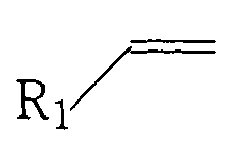

- The alkene has advantageously from 2 to 20 carbon atoms. In a specific embodiment the alkene also can be described as R1(R2)C=C(R3)(R4) with R1-R4 being any alkyl group (branched or lineair or substituted) or hydrogen, R2 or R3 being optionally linked to R3 or R4 and the number of carbon atoms in R1-R4 ranging from 0 to 18.
- The olefin can contain functions and/or substituents. Advantageously this hydrocarbon has 4 to 8 carbon atoms. Especially 1-butene and 1-octene are relevant to produce industrially important organotins.
- As regards stannous halide, it can be SnHal2 or any precursor. Mention may be made, by way of examples, of Sn / SnHal4 blends and HHal /Sn. The precursor also relates to SnHal2 / Sn / SnHal4 blends. The stannous halide is preferably anhydrous but also their aqua complexes can be used. The stannous halide can be produced in situ. According to a specific embodiment SnHal2 can be partly or totally replaced by a Sn / SnHal4 blend (1/1 ratio) producing SnHal2 in situ.
- As regards the hydrogen halide, it can be the hydrogen halide itself as gas or solution in a solvent or any precursor or any blend thereof. The precursor can be [HN(alkyl)3]Hal, another ammonium salt or other Lewis base adduct of hydrogen halide. When used as gas the hydrogen halide may be diluted with another gas. In a preferred embodiment of the invention the hydrogen halide can be HCl or [HN(C2H5)3]Cl.
- As regards the catalyst, in its broadest form the catalyst is a transition metal complex.
- According to one embodiment of the invention, the catalyst is based on the use of a complex having the formula
L'MX2 (I)
wherein L' is a bidentate ligand, or
L2MX2 (II)
or
[LMX2]2 (III)
or
L4M (IV)
wherein L is a monodentate ligand. - According to another embodiment of the invention the catalyst can be a transition metal salt consisting of transition metal M, and optionally one or more anions, X, being defined as the conjugate base of an organic or inorganic acid, and optionally one or more alkalimetal cations. Advantageously, metal salts such as MX2, or K2MX4 can be employed.
- The metal M to be used is advantageously a Group VIII metal (also called columns 8-10), and preferred metals are Pt, Pd and/or Ni. The groups X may be anions of organic and/or inorganic nature, hydrogen or a hydrocarbyl fragment. In the catalyst species containing two X's (by way of example like L2M(R)Cl) the two X's can be mutually different. It is preferred to use CI, Br, I, acetate, triflate, tosylate, hydride or alkyl. In a preferred embodiment of the invention L in formula (II) or (III) is selected from phosphine, alkene, amine, pyridine, organic sulfide, nitrile and imidazoline-2- ylidene. L' is selected from phosphine containing ligand with aditionnal O or N, diphosphine, dialkene, diamine and bis(imidazoline-2-ylidene) ligands. More in particular L is triphenylphosphine or L' = N,N, N',N'- tetramethylethylenediamine (TMEDA), or bypridine (optionally substituted), M is Pd or Pt and for catalyst (I), X is Cl. In a specific embodiment catalysts are choosen among Pd(PPh3)4 and Pt(PPh3)4.
- As regards the solvent, in general organic, aprotic or even protic solvents are preferred, especially aromatic solvents, chloroaromatic solvents, alkanes, ethers and alcohols. In particular tetrahydrofuran (THF), ethanol and 1,2-dimethoxyethane (DME) were found to be appropriate solvents.
- As regards the operating conditions and the proportions, the reaction is made continuously or in batch. The batch process is preferred. Temperature can be, by way of example, from ambient to 200°C. A range from 20 to 130°C is advantageous. As regards the pressure, no pressure is necessary except to maintain the alkene, when it has a low boiling point, and hydrogen halide in the reaction medium. However, to speed up the reaction higher pressures may be advantageous. Preferred reaction times range from a few seconds to 48 hours. The molar ratio of olefin to SnHal2 falls within the range 0.1/1 to 200/1, more advantageously 1/1 to 100/1. The molar ratio of HHal to SnHal2 falls within the range 0.01/1 to 100/1. The catalyst loading (molar percentage of M) based on the number of moles of SnHal2 can be 0.001 to 5 %, more preferred 0.1 to 1.5%. Should a solvent be used, any proportion is convenient. The reaction is carried out in any usual apparatus. The reaction can be checked by taking samples and conventional analysis. The monoalkyltin trihalides can be separated from the reaction medium by any means such as, by way of examples, distillation, solvent extraction, crystallisation.
- About the yield based on olefin:
- a1 is the number of moles of olefin originally present at the beginning of the reaction,
- a2 is the number of moles of olefin converted,
- a3 is the number of moles of olefin converted to monoalkyltin trihalide,
- the yield based on olefin is defined as the ratio a3/a1 and typically is in the range 1-80%. The selectivity based on olefin is defined as a3/a2 and is typically in the range 10-80%.
- About the Sn yield:
- b1 is the number of moles of Sn (present as Sn, SnHal2 or SnHal4) at the
- beginning of the reaction,
- b2 is the total number of moles of Sn (present as Sn, SnHal2 and SnHal4) converted,
- b3 is the number of moles of monoalkyltin trihalide produced.
The Sn selectivity is defined as the ratio b3/b2 and is in the range 95-100%.
The Sn yield is defined as b3/b1. The conversion is defined as b2/b1.
Also ratios Sn / SnHal4 > 1 can be used. Optionally Sn can be added to the reaction mixture in the course of reaction. In this case the excess Sn metal gives rise to dialkyltin dihalide and SnHal2 according to the following overall reaction stoichiometry: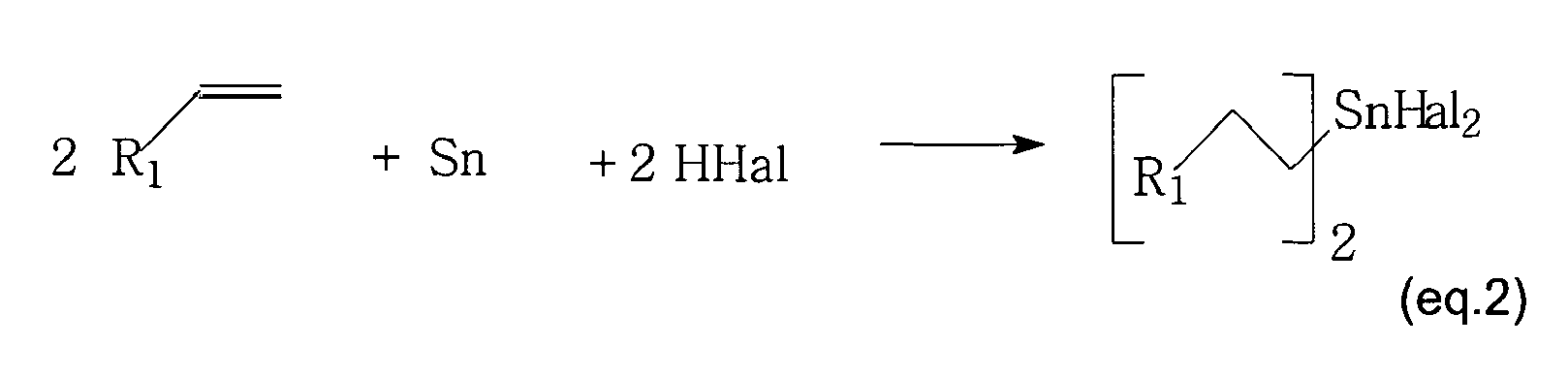
2RSnHal3 + Sn → R2SnHal2 + 2SnHal2 (eq.3)
- The SnHal2 is entering the reaction of eq. 1 affording another equivalent of RSnHal3.
- As regards the conversion, yields and selectivities :
- a4 is the amount of olefin in moles converted to dialkyltin dihalide,
- b4 is the number of moles of dialkyltin dihalide produced.
The conversion, yields and selectivities are now defined as follows :
The olefin yield is defined as (a3+a4)/a1.
The olefin selectivity is defined as (a3+a4)/a2
The Sn yield is defined as (b3+b4)/b1. The conversion is defined as above.
The Sn selectivity is defined as the ratio (b3+b4)/b2. - Finally the two reactions of eq 1 and eq 2 can also be carried out as two consecutive reactions. In this case the monoalkyltin trihalide RSnHal3 is first produced. The next step is then performed by adding Sn metal to the reaction mixture. The stannous halide that is left after isolation of the RSnHal3 and R2SnHal2 products can be recycled to the first step. By chosing the Sn/RSnHal3 stoichiometry any R2SnHal2/RSnHal3 ratio in the product mixture can be chosen.
- As regards the process to make dialkyltin dihalides from tin and monoalkyltin trihalides, the monoalkyltin trihalides (i) either isolated from the above reaction medium (ii) either coming from another source are reacted with tin metal to get a mixture of tin dihalide and dialkyltin dihalides. The reaction proceeds typically in the temperature range of 20 to 150°C with or without a catalyst and can be run with or without solvent. If solvent is applied, preferred solvents are organic apolar aliphatic or aromatic solvents or protic solvents or mixtures thereof. Water has a beneficiary effect on the reaction. Advantageously, the SnCl2 formed may be isolated and recycled, for example by extraction with water followed by drying, and applied as the starting material for the monoalkyltin trihalide production process as described above. By chosing the Sn/RSnHal3 stoichiometry any R2SnHal2/RSnHal3 ratio in the product mixture can be chosen.
- A reaction vessel equipped with magnetic stirring was inertised and charged with 62 mg of Pt(0)(PPh3)4 (0.05 mmol) and 138 mg of HNEt3Cl (1.0 mmol). This mixture was then suspended by adding 0.5 mL of THF, followed by 1.0 mL of 1-octene and 0.5 mL of a 0.4 M solution of anhydrous SnCl2 in THF (0.20 mmol). The vessel was placed in an oil bath and heated to 80°C and stirred for 16 hours.
- After cooling down to room temperature, the liquid phase was ethylated with excess EtMgCl, and analysed by GLC using an internal standard. The yield is 10.5 mg (0.031 mmol ; b3/b1 = 16%) of monooctyltin trichloride
- A reaction vessel equipped with magnetic stirring was inertised and charged with 5.0 mg of Pd(PPh3)4 (4.3 µmol). Next, 1.0 mL of a 0.8 M solution of anhydrous SnCl2 in THF (0.80 mmol) was added, followed by 2.0 mL of 1-octene (12.5 mmol). The vessel was placed in an oil bath and heated to 60°C. Subsequently, 1.5 mL of a 0.25 M HCl solution in THF (0.375 mmol) was slowly added and the resulting pale yellow solution was stirred for 1 hr. at 60°C. After the reaction, the solvent and excess 1-octene were removed in vacuo to yield an orange/red residu. This residu was suspended in 3.0 mL of toluene and the resulting suspension stirred vigorously for several minutes. The liquid phase was analysed by GLC after ethylation with excess EtMgCl. The yield is 112 mg (0.33 mmol ; b3/b1 = 41 %) of monooctyltin trichloride.
- A reaction vessel equipped with magnetic stirring was charged with 1.00 g. Sn powder (8.42 mmol) and inertised. Next, 5.0 mL of toluene was added, followed by 2.55 g of monobutyltin trichloride (9.04 mmol). This mixture was stirred at 105 °C for 24 hrs.
After the reaction, the resulting light-grey suspension was cooled to room temperature and filtered. The remaining solids were extracted with 3 times 5 mL of toluene, and the combined organic fractions were evaporated to dryness. This resulted in 1.31 g white crystalline material as the product. Identification by 1 H and 119Sn NMR, GLC (after ethylation with EtMgCl) and mp confirm the product to be > 98% pure dibutyltin dichloride (4.31 mmol).
Claims (20)
- Process for the production of monoalkyltin trihalides of the formula RSnHal3, in which R = alkyl or cycloalkyl and Hal = Cl, Br or I, said process comprising contacting alkene, stannous halide and hydrogen halide in the presence of at least one transition metal complex as a catalyst or catalyst precursor; optionally thereafter isolating the monoalkyltin trihalides from the medium.
- Process according to claim 1 wherein Hal is chloride, the stannous halide is SnCl2 and hydrogen halide is HCl.
- Process according to anyone of the preceding claims wherein the stannous halide can be produced in situ.
- Process according to claim 3 wherein SnHal2 is partly or totally replaced by a Sn / SnHal4 blend (1/1 ratio) producing SnHal2 in situ.
- Process according to anyone of the preceding claims wherein R is an alkyl in the range C2-C20.
- Process according to claim 5 wherein R is selected among ethyl, n-propyl, propyl, n-butyl, butyl, n-hexyl, hexyl, n-heptyl, heptyl, n-octyl and octyl.
- Process according to anyone of the preceding claims wherein said complex comprises at least one transition metal M, at least one monodentate ligand or bidentate ligand, L or L', and optionally one or more anions, X, being defined as (i) the conjugate base of an organic or inorganic acid, (ii) a hydride or (iii) a hydrocarbyl fragment.
- Process according to anyone of claims 1 to 6 wherein said complex is a transition metal salt consisting of transition metal M, and optionally one or more anions, X, being defined as the conjugate base of an organic or inorganic acid, and optionally one or more alkalimetal cations.
- Process according to anyone of the preceding claims wherein in the catalyst or catalyst precursor the metal to be used is a Group VIII metal.
- Process according to claim 9 wherein the metals are selected among Pt, Pd and Ni.
- Process according to claim 10 wherein the catalysts or catalyst precursors are choosen among M(PPh3)4 and M(Hal)2 (M = Pd, Pt).
- Process according to anyone of the preceding claims wherein the reaction is carried out in a solvent.
- Process according to claim 9 wherein the solvent is choosen among the organic, aprotic or protic solvents.
- Process according to claim 13 wherein the solvent is chosen among the aromatic solvents, chloroaromatics, alkanes, ethers and alcohols.
- Process according to claim 14 wherein the solvent is chosen among tetrahydrofuran (THF), ethanol and 1,2-dimethoxyethane (DME).
- Process for the production of dialkyltin dihalides of the formula R2SnHal2, in which R = alkyl or cycloalkyl and Hal = Cl, Br or I, said process comprising contacting RSnHal3 and tin metal; optionally thereafter isolating the dialkyltin dihalides from the medium.
- The process of claim 16 wherein RSnHal3 is made by the process of anyone of claims 1 to 15.
- Process for the production of mixtures of monoalkyltin trihalides and dialkyltin dihalides or dialkyltin dihalides of the formula RSnHal3 and R2SnHal2, respectively, in which R = alkyl or cycloalkyl and Hal = Cl, Br or I, said process comprising addition of Sn metal to the process according to anyone of the claims 1-15; optionally thereafter isolating the monalkyltin trihalide and/or dialkyltin dihalide from the medium.
- Use of the monoalkyltin trihalides, dialkyltin dihalides and mixtures thereof made according to the process according to anyone of the preceding claims as intermediates for PVC stabilisers, glass coating chemicals and catalysts.
- PVC stabilisers, glass coating chemicals and catalysts having been made from the monoalkyltin trihalides, dialkyltin dihalides and mixtures thereof made by the process according to anyone of the preceding claims.
Priority Applications (17)
| Application Number | Priority Date | Filing Date | Title |
|---|---|---|---|
| EP05076591A EP1743898A1 (en) | 2005-07-12 | 2005-07-12 | Process for the preparation of monoalkyl tin trihalides and dialkyl tin dihalides |
| CN2006800335437A CN101263149B (en) | 2005-07-12 | 2006-07-11 | Preparation method of monoalkyltin trihalide and dialkyltin dihalide |
| KR1020087000931A KR101365881B1 (en) | 2005-07-12 | 2006-07-11 | Process for the preparation of monoalkyltin trihalides and dialkyltin dihalides |
| EP11154994.5A EP2325192B1 (en) | 2005-07-12 | 2006-07-11 | Process for the preparation of dialkyltin dihalides |
| ES11154994.5T ES2440090T3 (en) | 2005-07-12 | 2006-07-11 | Process for the preparation of dialkyltin dihalides |
| AT06777698T ATE521615T1 (en) | 2005-07-12 | 2006-07-11 | METHOD FOR PRODUCING MONOALKYLTIN TRIHALOGENES AND DIALKYLTIN DIHALOGENES |
| US11/995,259 US7592472B2 (en) | 2005-07-12 | 2006-07-11 | Process for the preparation of monoalkyltin trihalides and dialkyltin dihalides |
| CN201210129713.9A CN102838630B (en) | 2005-07-12 | 2006-07-11 | Process for preparing monoalkyltin trihalides and dialkyltin dihalides |
| CA2614858A CA2614858C (en) | 2005-07-12 | 2006-07-11 | Process for the preparation of monoalkyl tin trihalides and dialyl tin dihalides |
| PL11154994T PL2325192T3 (en) | 2005-07-12 | 2006-07-11 | Process for the preparation of dialkyltin dihalides |
| PCT/EP2006/064098 WO2007006783A1 (en) | 2005-07-12 | 2006-07-11 | Process for the preparation of monoalkyltin trihalides and dialkyltin dihalides |
| PT111549945T PT2325192E (en) | 2005-07-12 | 2006-07-11 | Process for the preparation of dialkyltin dihalides |
| JP2008520867A JP5107243B2 (en) | 2005-07-12 | 2006-07-11 | Process for the preparation of monoalkyltin trihalides and dialkyltin dihalides |
| BRPI0613481A BRPI0613481B1 (en) | 2005-07-12 | 2006-07-11 | processes for the production of monoalkyl tin trihalides and dialkyl tin dihalides |
| EP06777698A EP1924586B1 (en) | 2005-07-12 | 2006-07-11 | Process for the preparation of monoalkyltin trihalides and dialkyltin dihalides |
| TW095125487A TWI310037B (en) | 2005-07-12 | 2006-07-12 | Process to make monoalkyltin trihalides and dialkyltin dihalides |
| ZA200800454A ZA200800454B (en) | 2005-07-12 | 2008-01-15 | Process for the preparation of monoalkyltin trihalides and dialkyltin dihalides |
Applications Claiming Priority (1)
| Application Number | Priority Date | Filing Date | Title |
|---|---|---|---|
| EP05076591A EP1743898A1 (en) | 2005-07-12 | 2005-07-12 | Process for the preparation of monoalkyl tin trihalides and dialkyl tin dihalides |
Publications (1)
| Publication Number | Publication Date |
|---|---|
| EP1743898A1 true EP1743898A1 (en) | 2007-01-17 |
Family
ID=35478749
Family Applications (3)
| Application Number | Title | Priority Date | Filing Date |
|---|---|---|---|
| EP05076591A Withdrawn EP1743898A1 (en) | 2005-07-12 | 2005-07-12 | Process for the preparation of monoalkyl tin trihalides and dialkyl tin dihalides |
| EP06777698A Active EP1924586B1 (en) | 2005-07-12 | 2006-07-11 | Process for the preparation of monoalkyltin trihalides and dialkyltin dihalides |
| EP11154994.5A Active EP2325192B1 (en) | 2005-07-12 | 2006-07-11 | Process for the preparation of dialkyltin dihalides |
Family Applications After (2)
| Application Number | Title | Priority Date | Filing Date |
|---|---|---|---|
| EP06777698A Active EP1924586B1 (en) | 2005-07-12 | 2006-07-11 | Process for the preparation of monoalkyltin trihalides and dialkyltin dihalides |
| EP11154994.5A Active EP2325192B1 (en) | 2005-07-12 | 2006-07-11 | Process for the preparation of dialkyltin dihalides |
Country Status (14)
| Country | Link |
|---|---|
| US (1) | US7592472B2 (en) |
| EP (3) | EP1743898A1 (en) |
| JP (1) | JP5107243B2 (en) |
| KR (1) | KR101365881B1 (en) |
| CN (2) | CN101263149B (en) |
| AT (1) | ATE521615T1 (en) |
| BR (1) | BRPI0613481B1 (en) |
| CA (1) | CA2614858C (en) |
| ES (1) | ES2440090T3 (en) |
| PL (1) | PL2325192T3 (en) |
| PT (1) | PT2325192E (en) |
| TW (1) | TWI310037B (en) |
| WO (1) | WO2007006783A1 (en) |
| ZA (1) | ZA200800454B (en) |
Cited By (5)
| Publication number | Priority date | Publication date | Assignee | Title |
|---|---|---|---|---|
| WO2009138474A1 (en) * | 2008-05-15 | 2009-11-19 | Arkema France | High purity monoalkyltin compounds and uses thereof |
| WO2016195807A1 (en) | 2015-06-05 | 2016-12-08 | Galata Chemicals Llc | Stabilizers containing high purity mond-octytin compounds |
| US9587088B2 (en) | 2013-08-08 | 2017-03-07 | Galata Chemicals Llc | Heat stabilizer for halogen-containing polymers |
| EP3184532A1 (en) | 2015-12-22 | 2017-06-28 | Arkema B.V. | Process for making alkyltin trihalides and their use |
| EP4074717A1 (en) | 2021-04-13 | 2022-10-19 | BNT Chemicals GmbH | Method for cleaving alkyl tin halides |
Families Citing this family (6)
| Publication number | Priority date | Publication date | Assignee | Title |
|---|---|---|---|---|
| CN101838283B (en) * | 2009-12-29 | 2012-05-23 | 衢州建华东旭助剂有限公司 | Production method of high-purity dimethyltin dichloride crystal |
| ES2562988T3 (en) | 2010-07-01 | 2016-03-09 | Pmc Organometallix, Inc. | Preparation process of monoalkyltin trihalides and dialkyltin dihalides |
| CN103282399B (en) | 2010-12-27 | 2015-08-19 | 三菱瓦斯化学株式会社 | Composition for optical material |
| EP3037425B1 (en) | 2014-12-23 | 2019-02-20 | LANXESS Organometallics GmbH | A process for purifying monooctyltin trichloride |
| CA3080934C (en) * | 2018-04-11 | 2024-01-02 | Inpria Corporation | Monoalkyl tin compounds with low polyalkyl contamination, their compositions and methods |
| EP4204426A4 (en) | 2020-08-25 | 2025-03-12 | Inpria Corporation | METHODS FOR PRODUCING ORGANOTIN COMPOSITIONS USING CONVENIENT LIGAND-PROVIDING REAGENTS |
Citations (20)
| Publication number | Priority date | Publication date | Assignee | Title |
|---|---|---|---|---|
| US3085102A (en) | 1959-04-15 | 1963-04-09 | Nippon Catalytic Chem Ind | Process for producing alkyl tin halide compounds |
| GB923179A (en) | 1959-04-30 | 1963-04-10 | Ziegler Karl | Process for the production of alkyl tin compounds |
| US3340283A (en) | 1964-05-20 | 1967-09-05 | M & T Chemicals Inc | Preparation of organotin-trihalides |
| GB1146435A (en) | 1965-10-11 | 1969-03-26 | Albright & Wilson Mfg Ltd | Method for preparing organotin compounds |
| US3519667A (en) | 1968-03-29 | 1970-07-07 | Carlisle Chemical Works | Process for preparing mono-methyl or ethyltin trichloride |
| US3607893A (en) | 1968-12-18 | 1971-09-21 | M & T Chemicals Inc | Addition of trihalostannous acid to olefins |
| GB1255859A (en) | 1968-07-03 | 1971-12-01 | M & T Internat N V | Manufacture of organotin compounds |
| US3894066A (en) | 1973-01-31 | 1975-07-08 | Schering Ag | Method for making higher alkyl tin thichlorides |
| US3994944A (en) | 1974-09-19 | 1976-11-30 | Schering Aktiengesellschaft | Method for making alkyl tin trichlorides |
| US4044035A (en) | 1975-04-04 | 1977-08-23 | Commer S.R.L. | Method for the preparation of alkyl tin halides |
| US4046791A (en) | 1975-03-20 | 1977-09-06 | Chugoku Marine Paints, Ltd. | Method for producing monoalkyl-tin-trihalides |
| US4049689A (en) | 1974-11-22 | 1977-09-20 | Commer S.R.L. | Method for the preparation of alkyl tin halides |
| US4080362A (en) | 1974-09-16 | 1978-03-21 | Akzo N.V. | Organotin stabilizers |
| US4105684A (en) | 1974-09-16 | 1978-08-08 | Akzo N.V. | Process for the preparation of organotin trihalides |
| US4130573A (en) | 1975-03-17 | 1978-12-19 | Akzo N.V. | Process for making organotin dihalides and trihalides |
| CA1069129A (en) | 1975-05-06 | 1980-01-01 | Myron Linfield | Method for preparing alkyltin trihalides |
| US4202830A (en) | 1977-08-09 | 1980-05-13 | Hoechst Aktiengesellschaft | Organotin halides |
| EP0011280A1 (en) | 1978-11-18 | 1980-05-28 | Hoechst Aktiengesellschaft | Process for the preparation of organotin trihalides and their application |
| EP1225177A1 (en) | 2001-01-19 | 2002-07-24 | Atofina Vlissingen B.V. | Process for the production of monoalkyltin trihalides |
| US20040133022A1 (en) | 2002-08-08 | 2004-07-08 | Oliver Schumacher | Process for preparing monoalkyltin halides and dialkyltin halides and their use |
Family Cites Families (12)
| Publication number | Priority date | Publication date | Assignee | Title |
|---|---|---|---|---|
| US3287386A (en) * | 1959-04-30 | 1966-11-22 | Ziegler Karl | Process for the production of tin alkyl compounds |
| NL126400C (en) * | 1960-02-23 | 1900-01-01 | ||
| NL285484A (en) * | 1961-11-15 | |||
| US3342365A (en) | 1966-09-23 | 1967-09-19 | Haveg Industries Inc | Welded containers |
| NL154742B (en) * | 1967-07-18 | 1977-10-17 | Billiton Research Bv | PROCEDURE FOR PREPARING ALKYL OR CYCLOALKYL TIN HALOGENIDES. |
| US3519665A (en) * | 1968-01-25 | 1970-07-07 | Carlisle Chemical Works | Direct synthesis of dialkyltin dichloride |
| US4269782A (en) * | 1979-07-19 | 1981-05-26 | Argus Chemical Corporation | Preparation of mixtures of methyltin trichloride and dimethyltin dichloride from stannic chloride and dimethyltin dichloride |
| US4434102A (en) * | 1979-07-19 | 1984-02-28 | Witco Chemical Corporation | Preparation of mixtures of methyltin trichloride and dimethyltin dichloride from stanic chloride and dimethyltin dichloride without catalyst and conversion to mixed methyltin mercaptide stabilizers |
| US4510095A (en) * | 1982-01-07 | 1985-04-09 | Manchem Limited | Production of organotin halides |
| DE4007745C1 (en) * | 1990-03-12 | 1991-05-02 | Th. Goldschmidt Ag, 4300 Essen, De | |
| CN1030318C (en) * | 1992-08-13 | 1995-11-22 | 北京科技协作中心精细化学分部 | Preparation of a mixture of dimethyltin dichloride and methyltrichlorotin |
| DE10237695A1 (en) * | 2002-08-15 | 2004-03-11 | Infineon Technologies Ag | Laser module for optical transmission systems and method for stabilizing an output wavelength of a laser module |
-
2005
- 2005-07-12 EP EP05076591A patent/EP1743898A1/en not_active Withdrawn
-
2006
- 2006-07-11 CA CA2614858A patent/CA2614858C/en active Active
- 2006-07-11 PL PL11154994T patent/PL2325192T3/en unknown
- 2006-07-11 EP EP06777698A patent/EP1924586B1/en active Active
- 2006-07-11 JP JP2008520867A patent/JP5107243B2/en active Active
- 2006-07-11 PT PT111549945T patent/PT2325192E/en unknown
- 2006-07-11 EP EP11154994.5A patent/EP2325192B1/en active Active
- 2006-07-11 CN CN2006800335437A patent/CN101263149B/en active Active
- 2006-07-11 CN CN201210129713.9A patent/CN102838630B/en active Active
- 2006-07-11 BR BRPI0613481A patent/BRPI0613481B1/en active IP Right Grant
- 2006-07-11 US US11/995,259 patent/US7592472B2/en active Active
- 2006-07-11 WO PCT/EP2006/064098 patent/WO2007006783A1/en not_active Ceased
- 2006-07-11 KR KR1020087000931A patent/KR101365881B1/en active Active
- 2006-07-11 AT AT06777698T patent/ATE521615T1/en not_active IP Right Cessation
- 2006-07-11 ES ES11154994.5T patent/ES2440090T3/en active Active
- 2006-07-12 TW TW095125487A patent/TWI310037B/en not_active IP Right Cessation
-
2008
- 2008-01-15 ZA ZA200800454A patent/ZA200800454B/en unknown
Patent Citations (21)
| Publication number | Priority date | Publication date | Assignee | Title |
|---|---|---|---|---|
| US3085102A (en) | 1959-04-15 | 1963-04-09 | Nippon Catalytic Chem Ind | Process for producing alkyl tin halide compounds |
| GB923179A (en) | 1959-04-30 | 1963-04-10 | Ziegler Karl | Process for the production of alkyl tin compounds |
| DE1157617B (en) | 1959-04-30 | 1963-11-21 | E H Karl Ziegler Dr Dr | Process for the preparation of uniform tin alkyl compounds |
| US3340283A (en) | 1964-05-20 | 1967-09-05 | M & T Chemicals Inc | Preparation of organotin-trihalides |
| GB1146435A (en) | 1965-10-11 | 1969-03-26 | Albright & Wilson Mfg Ltd | Method for preparing organotin compounds |
| US3519667A (en) | 1968-03-29 | 1970-07-07 | Carlisle Chemical Works | Process for preparing mono-methyl or ethyltin trichloride |
| GB1255859A (en) | 1968-07-03 | 1971-12-01 | M & T Internat N V | Manufacture of organotin compounds |
| US3607893A (en) | 1968-12-18 | 1971-09-21 | M & T Chemicals Inc | Addition of trihalostannous acid to olefins |
| US3894066A (en) | 1973-01-31 | 1975-07-08 | Schering Ag | Method for making higher alkyl tin thichlorides |
| US4080362A (en) | 1974-09-16 | 1978-03-21 | Akzo N.V. | Organotin stabilizers |
| US4105684A (en) | 1974-09-16 | 1978-08-08 | Akzo N.V. | Process for the preparation of organotin trihalides |
| US3994944A (en) | 1974-09-19 | 1976-11-30 | Schering Aktiengesellschaft | Method for making alkyl tin trichlorides |
| US4049689A (en) | 1974-11-22 | 1977-09-20 | Commer S.R.L. | Method for the preparation of alkyl tin halides |
| US4130573A (en) | 1975-03-17 | 1978-12-19 | Akzo N.V. | Process for making organotin dihalides and trihalides |
| US4046791A (en) | 1975-03-20 | 1977-09-06 | Chugoku Marine Paints, Ltd. | Method for producing monoalkyl-tin-trihalides |
| US4044035A (en) | 1975-04-04 | 1977-08-23 | Commer S.R.L. | Method for the preparation of alkyl tin halides |
| CA1069129A (en) | 1975-05-06 | 1980-01-01 | Myron Linfield | Method for preparing alkyltin trihalides |
| US4202830A (en) | 1977-08-09 | 1980-05-13 | Hoechst Aktiengesellschaft | Organotin halides |
| EP0011280A1 (en) | 1978-11-18 | 1980-05-28 | Hoechst Aktiengesellschaft | Process for the preparation of organotin trihalides and their application |
| EP1225177A1 (en) | 2001-01-19 | 2002-07-24 | Atofina Vlissingen B.V. | Process for the production of monoalkyltin trihalides |
| US20040133022A1 (en) | 2002-08-08 | 2004-07-08 | Oliver Schumacher | Process for preparing monoalkyltin halides and dialkyltin halides and their use |
Non-Patent Citations (6)
| Title |
|---|
| E. J. BULTEN, J. ORGANOMET. CHEM., vol. 97, 1975, pages 167 |
| J. W. BURLEY ET AL., J. ORGANOMET. CHEM., vol. 170, 1979, pages 21 |
| J. W. BURLEY; P. HOPE; A. G. MACK, J. ORGANOMET. CHEM., 1984 |
| M. LAUTENS; W. KLUTE, ANGEW. CHEM. INT. ED. ENGL., vol. 35, 1996, pages 442 |
| R. E. HUTTON; J. W. BURLEY, J. ORGANOMET. CHEM., vol. 156, 1978, pages 369 |
| V. G. KUMAR DAS; O. GHEE CHEE, J. ORGANOMET. CHEM., vol. 321, 1987, pages 335 |
Cited By (10)
| Publication number | Priority date | Publication date | Assignee | Title |
|---|---|---|---|---|
| WO2009138474A1 (en) * | 2008-05-15 | 2009-11-19 | Arkema France | High purity monoalkyltin compounds and uses thereof |
| EP2123659A1 (en) | 2008-05-15 | 2009-11-25 | Arkema France | High purity monoalkyltin compounds and uses thereof |
| US8198352B2 (en) | 2008-05-15 | 2012-06-12 | Arkema France | High purity monoalkyltin compounds and uses thereof |
| EP3498720A1 (en) | 2008-05-15 | 2019-06-19 | PMC Organometallix, Inc. | High purity monoalkyltin compounds and uses thereof |
| US9587088B2 (en) | 2013-08-08 | 2017-03-07 | Galata Chemicals Llc | Heat stabilizer for halogen-containing polymers |
| WO2016195807A1 (en) | 2015-06-05 | 2016-12-08 | Galata Chemicals Llc | Stabilizers containing high purity mond-octytin compounds |
| US9745450B2 (en) | 2015-06-05 | 2017-08-29 | Galata Chemicals Llc | Stabilizers containing high purity mono-octyltin compounds |
| EP3184532A1 (en) | 2015-12-22 | 2017-06-28 | Arkema B.V. | Process for making alkyltin trihalides and their use |
| EP4074717A1 (en) | 2021-04-13 | 2022-10-19 | BNT Chemicals GmbH | Method for cleaving alkyl tin halides |
| US11912732B2 (en) | 2021-04-13 | 2024-02-27 | Bnt Chemicals Gmbh | Method for cleaving alkyl tin halides |
Also Published As
| Publication number | Publication date |
|---|---|
| ZA200800454B (en) | 2009-06-24 |
| CA2614858A1 (en) | 2007-01-18 |
| US20090131704A1 (en) | 2009-05-21 |
| EP1924586A1 (en) | 2008-05-28 |
| WO2007006783A1 (en) | 2007-01-18 |
| TW200722431A (en) | 2007-06-16 |
| BRPI0613481A2 (en) | 2011-07-12 |
| JP5107243B2 (en) | 2012-12-26 |
| KR20080034884A (en) | 2008-04-22 |
| EP2325192B1 (en) | 2013-09-04 |
| CN101263149A (en) | 2008-09-10 |
| CA2614858C (en) | 2015-09-22 |
| TWI310037B (en) | 2009-05-21 |
| CN101263149B (en) | 2012-06-27 |
| CN102838630B (en) | 2015-06-24 |
| ES2440090T3 (en) | 2014-01-27 |
| CN102838630A (en) | 2012-12-26 |
| PT2325192E (en) | 2013-12-11 |
| US7592472B2 (en) | 2009-09-22 |
| ATE521615T1 (en) | 2011-09-15 |
| BRPI0613481B1 (en) | 2015-12-01 |
| EP2325192A1 (en) | 2011-05-25 |
| PL2325192T3 (en) | 2014-12-31 |
| EP1924586B1 (en) | 2011-08-24 |
| JP2009501190A (en) | 2009-01-15 |
| KR101365881B1 (en) | 2014-02-21 |
Similar Documents
| Publication | Publication Date | Title |
|---|---|---|
| EP2325192B1 (en) | Process for the preparation of dialkyltin dihalides | |
| EP2588485B1 (en) | Process for preparing monoalkyltin trihalides and dialkyltin dihalides | |
| US3414595A (en) | Preparation of alkyl tin compounds | |
| CA2435358C (en) | Process for the production of monoalkyltin trihalides | |
| EP3184532B1 (en) | Process for making alkyltin trihalides and their use | |
| US3067226A (en) | Preparation of organotin compounds | |
| RU2139876C1 (en) | Method of obtaining of 1-(dialkylamine)-3-alkylalumacyclopentanes | |
| IE904548A1 (en) | A process for the direct synthesis of organotin compounds¹and their use | |
| JP2014005214A (en) | Aryldichlorophosphine production method | |
| Des Tombe et al. | The reaction of organotin halides with zinc. The occurrence of 1, 2-intermetallic shifts | |
| Brunet et al. | Novel route to the unsymmetrical dialkyl complex CpW (NO)(CH2SiMe3)(CH2CPh3) and formation of metallacycles by thermolysis of CpW (NO)(CH2SiMe3)(CH2CR2Ph)(R= Me, Ph) | |
| JP3345094B2 (en) | Aryl phosphinite | |
| US5698743A (en) | Preparation of methylene-bridged hetero compounds and novel bis (diorganophosphino) methanes | |
| JPS62230793A (en) | Method for producing aryl dihalosilane | |
| GB1602894A (en) | Preparation of dimethyltin dichloride | |
| JPS5936996B2 (en) | Method for producing symmetrical and asymmetrical triorganotin halides |
Legal Events
| Date | Code | Title | Description |
|---|---|---|---|
| PUAI | Public reference made under article 153(3) epc to a published international application that has entered the european phase |
Free format text: ORIGINAL CODE: 0009012 |
|
| AK | Designated contracting states |
Kind code of ref document: A1 Designated state(s): AT BE BG CH CY CZ DE DK EE ES FI FR GB GR HU IE IS IT LI LT LU LV MC NL PL PT RO SE SI SK TR |
|
| AX | Request for extension of the european patent |
Extension state: AL BA HR MK YU |
|
| 17P | Request for examination filed |
Effective date: 20070227 |
|
| 17Q | First examination report despatched |
Effective date: 20070402 |
|
| AKX | Designation fees paid |
Designated state(s): NL |
|
| REG | Reference to a national code |
Ref country code: DE Ref legal event code: 8566 |
|
| STAA | Information on the status of an ep patent application or granted ep patent |
Free format text: STATUS: THE APPLICATION IS DEEMED TO BE WITHDRAWN |
|
| 18D | Application deemed to be withdrawn |
Effective date: 20071013 |