EP1742214A1 - Record reproducing device, simultaneous record reproduction control method and simultaneous record reproduction control program - Google Patents
Record reproducing device, simultaneous record reproduction control method and simultaneous record reproduction control program Download PDFInfo
- Publication number
- EP1742214A1 EP1742214A1 EP05730687A EP05730687A EP1742214A1 EP 1742214 A1 EP1742214 A1 EP 1742214A1 EP 05730687 A EP05730687 A EP 05730687A EP 05730687 A EP05730687 A EP 05730687A EP 1742214 A1 EP1742214 A1 EP 1742214A1
- Authority
- EP
- European Patent Office
- Prior art keywords
- recording
- record
- data
- data size
- recording medium
- Prior art date
- Legal status (The legal status is an assumption and is not a legal conclusion. Google has not performed a legal analysis and makes no representation as to the accuracy of the status listed.)
- Withdrawn
Links
- 238000000034 method Methods 0.000 title claims abstract description 48
- 239000000872 buffer Substances 0.000 description 27
- 230000006870 function Effects 0.000 description 16
- 238000012546 transfer Methods 0.000 description 8
- 238000004891 communication Methods 0.000 description 6
- 238000010586 diagram Methods 0.000 description 4
- 238000007906 compression Methods 0.000 description 3
- 238000007796 conventional method Methods 0.000 description 2
- 238000013144 data compression Methods 0.000 description 2
- 230000003247 decreasing effect Effects 0.000 description 2
- 238000012545 processing Methods 0.000 description 2
- 206010022998 Irritability Diseases 0.000 description 1
- 230000005540 biological transmission Effects 0.000 description 1
- 230000001413 cellular effect Effects 0.000 description 1
- 230000006835 compression Effects 0.000 description 1
- 230000003111 delayed effect Effects 0.000 description 1
- 230000000694 effects Effects 0.000 description 1
- 239000000284 extract Substances 0.000 description 1
- 239000004973 liquid crystal related substance Substances 0.000 description 1
- 230000004044 response Effects 0.000 description 1
- 230000005236 sound signal Effects 0.000 description 1
- 238000013519 translation Methods 0.000 description 1
Images



Classifications
-
- G—PHYSICS
- G11—INFORMATION STORAGE
- G11B—INFORMATION STORAGE BASED ON RELATIVE MOVEMENT BETWEEN RECORD CARRIER AND TRANSDUCER
- G11B20/00—Signal processing not specific to the method of recording or reproducing; Circuits therefor
- G11B20/10—Digital recording or reproducing
- G11B20/10527—Audio or video recording; Data buffering arrangements
-
- G—PHYSICS
- G11—INFORMATION STORAGE
- G11B—INFORMATION STORAGE BASED ON RELATIVE MOVEMENT BETWEEN RECORD CARRIER AND TRANSDUCER
- G11B27/00—Editing; Indexing; Addressing; Timing or synchronising; Monitoring; Measuring tape travel
- G11B27/10—Indexing; Addressing; Timing or synchronising; Measuring tape travel
- G11B27/102—Programmed access in sequence to addressed parts of tracks of operating record carriers
- G11B27/105—Programmed access in sequence to addressed parts of tracks of operating record carriers of operating discs
-
- H—ELECTRICITY
- H04—ELECTRIC COMMUNICATION TECHNIQUE
- H04N—PICTORIAL COMMUNICATION, e.g. TELEVISION
- H04N9/00—Details of colour television systems
- H04N9/79—Processing of colour television signals in connection with recording
- H04N9/80—Transformation of the television signal for recording, e.g. modulation, frequency changing; Inverse transformation for playback
- H04N9/804—Transformation of the television signal for recording, e.g. modulation, frequency changing; Inverse transformation for playback involving pulse code modulation of the colour picture signal components
- H04N9/806—Transformation of the television signal for recording, e.g. modulation, frequency changing; Inverse transformation for playback involving pulse code modulation of the colour picture signal components with processing of the sound signal
- H04N9/8063—Transformation of the television signal for recording, e.g. modulation, frequency changing; Inverse transformation for playback involving pulse code modulation of the colour picture signal components with processing of the sound signal using time division multiplex of the PCM audio and PCM video signals
-
- G—PHYSICS
- G11—INFORMATION STORAGE
- G11B—INFORMATION STORAGE BASED ON RELATIVE MOVEMENT BETWEEN RECORD CARRIER AND TRANSDUCER
- G11B20/00—Signal processing not specific to the method of recording or reproducing; Circuits therefor
- G11B20/10—Digital recording or reproducing
- G11B2020/10935—Digital recording or reproducing wherein a time constraint must be met
- G11B2020/10953—Concurrent recording or playback of different streams or files
- G11B2020/10962—Concurrent recording or playback of different streams or files wherein both recording and playback take place simultaneously
-
- H—ELECTRICITY
- H04—ELECTRIC COMMUNICATION TECHNIQUE
- H04N—PICTORIAL COMMUNICATION, e.g. TELEVISION
- H04N5/00—Details of television systems
- H04N5/76—Television signal recording
- H04N5/84—Television signal recording using optical recording
- H04N5/85—Television signal recording using optical recording on discs or drums
Definitions
- the present invention relates to a record/play device, a simultaneous record/play control method, and a simultaneous record/play control program.
- use of the invention is not limited to the record/play device, the simultaneous record/play control method, and the simultaneous record/play control program.
- the record/play device capable of increasing the degree of multiplexing data without losing audio data and reducing the response time when starting playback are disclosed.
- the record/play device is capable of transferring audio packets to a hard disk to store the audio packets, and of receiving the audio packets stored in the hard disk to playback an original analog audio signal.
- the record/play device includes a file transfer buffer with two buffer areas, each having a capacity capable of accumulating the predetermined number of audio packets, and a managing unit that controls writing/reading of audio packets to/from the file transfer buffer.
- the managing unit switches the operation of each buffer area between writing and reading based on the number of audio packets stored in one of the buffer areas (see, for example, Patent Document 1 below).
- Patent Document 1 Japanese Patent Laid-Open Publication No. 2003-308643
- the conventional technique has a problem, for example, in that because of the amount of data kept for starting the playback in the simultaneous record and play, a time delay occurs between the start of recording and the start of playback during recording, and the user has to wait certain delay time before the playback is started.
- a record/play device includes a recording processor that records, on a recording medium, a series of content data sequentially input; a changing unit that changes, during a record process by the recording processor, a data size of content data that is to be recorded on the recording medium to a data size different from a data size at time of recording of content data that has been recorded on the recording medium; and a playback processor that plays back, during the recording process by the recording processor, the content data recorded on the recording medium.
- a simultaneous record/play control method is for a record/play device that plays back content data recorded on a recording medium during recording, on the recording medium, a series of content data sequentially input, and includes a detecting step of detecting number of records of content data recorded on the recording medium at a predetermined data size; a changing step of changing a data size to record content data to a data size different from the predetermined data size when the number of records detected at the detecting step has reached a predetermined number.
- a simultaneous record/play control program according to the invention of claim 9 causes a computer to execute a simultaneous record/play control method according to any one of claims 6 to 8.
- the record/play device, the simultaneous record/play control method, and the simultaneous record/play control program realize simultaneous record and play of a series of content data.
- the content data is electronic data of image or audio, and examples thereof include commercially available image content such as movies, live music footage, and documentaries, image information such as television program recordings, images shot by a video camera, and map data to be displayed in a navigation apparatus, image content in JPG and BMP, image representations of data content for a component analysis, song information representing a song and other audio information such as conversational content and sound effects.
- image content such as movies, live music footage, and documentaries
- image information such as television program recordings, images shot by a video camera, and map data to be displayed in a navigation apparatus
- image content in JPG and BMP image representations of data content for a component analysis
- song information representing a song and other audio information such as conversational content and sound effects.
- Fig. 1 is a block diagram of the hardware configuration of the record/play device according to the embodiment of the present invention.
- the record/play device includes a CPU 101, a ROM 102, a RAM 103, an HDD (hard disk drive) 104, an HD (hard disk) 105, a CD/DVD drive 106, a CD/DVD 107 as an example of a removable recording medium, an image/audio I/F (interface) 108, a display 109, speaker 110, an input I/F (interface) 111, a remote control 112, input keys (including a keyboard and a mouse) 113, a communication I/F (interface) 114, and a FIFO memory 115.
- the components 101 to 115 are connected to one another via a bus 100.
- the CPU 101 is responsible for controlling the entire record/play device.
- the ROM 102 has stored therein a program such as a boot program.
- the RAM 103 is used as a work area of the CPU 101.
- the HDD 104 controls reading/writing of data to/from the HD 105 under control of the CPU 101.
- the HD 105 stores data written under control of the HDD 104.
- the CD/DVD drive 106 controls reading/writing of data to/from the CD/DVD 107 under control of the CPU 101.
- the CD/DVD 107 is a removable recording medium from which recorded data is read under control of the CD/DVD drive 106.
- a writable recording medium can be used as the CD/DVD 107.
- a CD-ROM (a CD-R or a CD-RW), an MO, and a memory card may be used as the removable recording medium.
- the image/audio I/F (interface) 108 is connected to the display 109 for image display and the speaker 110 (or headphones) for audio output.
- the display 109 displays a cursor, icons, a menu, windows, and a toolbox as well as various data such as characters and images.
- a CRT, a TFT liquid crystal display, and a plasma display can be employed as the display 109.
- the speaker 110 output audio.
- the input I/F 111 inputs data transmitted from the remote control 112, which is provided with a plurality of keys for inputting characters, numerical values, various commands, etc., and the input keys (including a keyboard and a mouse) 113.
- the input keys (including a keyboard and a mouse) 113 include keys for inputting characters, numbers, various commands, etc., and input data according to the user's operation.
- the communication I/F 114 is connected to a network 120, such as the Internet, by radio or by a communication line, and to other apparatuses via the network 120.
- the communication I/F 114 serves as an interface between the network 120 and the CPU 101, and controls input/output of data to/from external devices.
- Examples of the network 120 include a LAN, a WAN, a public line network, and a cellular phone network.
- the FIFO memory 115 stores data read from the CD/DVD 107 by the CD/DVD drive 106 in an order of reading, and when the stored data is to be retrieved to be used, the FIFO memory 115 outputs the data from the oldest piece of data in an order of storing. Moreover, the FIFO memory 115 stores data received through the communication I/F 114 in an order of receiving, and when the stored data is to be retrieved to be used, the FIFO memory 115 outputs the data from the oldest piece of data in order of storing.
- the FIFO memory 115 stores data read from the HD 105 by the HDD 104 in an order of reading, and when the stored data is to be retrieved to be used, the FIFO memory 115 outputs the data to the image/audio I/F 108 from the oldest piece of data in order of storing.
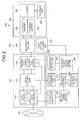
- Fig. 2 is a block diagram of the functional configuration of the record/play device according to the embodiment of the present invention.
- the record/play device 200 includes a recording processor 201, a recorder 202, a playback processor 203, and a controller 204.
- the recording processor 201 includes a data input unit 210, a data compressor 213, and recording buffers 214 and 215.
- the data input unit 210 sequentially inputs content data from the exterior.
- the data input unit 210 includes a data reader 211 and a data receiver 212.
- the data reader 211 reads content data from the CD/DVD 107 having content data recorded therein, and inputs the content data into the record/play device 200.
- the data receiver 212 receives content data from the network 120, and inputs the content data into the record/play device 200.
- the data reader 211 has a function implemented by the CD/DVD drive 106 shown in Fig. 1.
- the data receiver 212 has a function implemented by the communication I/F 114 shown in Fig. 1.
- the data compressor 213 compresses content data, which is sequentially input from the data input unit 210, at a preset default bit rate.
- the data compression method is in conformity with a well-known standard such as MPEG.
- the function of the data compressor 213 is implemented by the CPU 101 executing a program stored in a recording medium, e.g., the ROM 102, the RAM 103, the HD 105, or the CD/DVD 107 shown in Fig. 1.
- the recording buffers 214 and 215 hold pieces of compressed data compressed by the data compressor 213, and transfer them to a recording medium 220 in order of holding. Concretely, the recording buffers 214 and 215 record the compressed data in a time-division manner. When compressed data accumulated in the recording buffer 214 (or 215) is being written to the recording medium 220, the other recording buffer 215 (or 214) in available state accumulates compressed data.
- the recording buffers 214 and 215 transfer the compressed data to the recording medium 220 in a predetermined transfer data amount (data size).
- the transfer data amount is changed by a data size changing unit 247, which will be described later, the compressed data is transferred to the recording medium 220 in a transfer data amount (data size) sufficient not to cause an audio break during playback.
- the function of the recording buffers 214 and 215 is implemented by, for example, the FIFO memory 115 shown in Fig. 1.
- the recorder 202 includes the recording medium 220, and a data writing/reading unit 221.
- the recording medium 220 records compressed data transferred from the recording buffers.
- the function of the recording medium 220 is implemented by, for example, the RAM 103 or the HD 105 shown in Fig. 1.
- the data writing/reading unit 221 writes the compressed data transferred from the recording buffers 214 and 215 to the recording medium 220.
- a playback start signal is received from a playback start signal transmitter 246, which will be described later, it starts reading the compressed data recorded on the recording medium 220, and writes to a playback buffer 230 and 231.
- the function of the data writing/reading unit 221 is implemented by, for example, the HDD 104 shown in Fig. 1.
- the playback processor 203 includes the playback buffers 230 and 231, a decoder 232, and a playback unit 233.
- the compressed data recorded on the recording medium 220 is written to the playback buffers from which the data is transferred to the decoder 232 in order of recording.
- the playback buffers 230 and 231 transfer the compressed data in a time-division manner.
- compressed data accumulated in the playback buffer 230 (or 231) is being transferred to the decoder 232
- compressed data from the recording medium 220 is written to the other playback buffer 231 (or 230) in available state.
- the function of the playback buffers 230 and 231 is implemented by, for example, the FIFO memory 115 shown in Fig. 1.
- the decoder 232 decodes the compressed data transferred from the playback buffers 230 and 231.
- the decoding method is in conformity with a well-known standard such as MPEG.
- the decoder 232 has a function implemented by the CPU 101 executing a program stored in a recording medium, e.g., the ROM 102, the RAM 103, the HD 105, or the CD/DVD 107 shown in Fig. 1.
- the playback unit 233 plays back content data decoded by the decoder 232.
- the content data is audio content data
- a song therein is output.
- the content data is video content data
- the playback unit 233 has a function implemented by, for example, the image/audio I/F 108, the display 109, or the speaker 110 shown in Fig. 1.
- the controller 204 controls simultaneous recording and playback of content data recorded on the recording medium 220 during recording of a series of content data sequentially input on the recording medium 220.
- the controller 204 includes the operation input unit 240, a bit rate transmitter 241, a data size setting unit 243, a data size extracting unit 244, a frequency detector 245, the playback start signal transmitter 246, and the data size changing unit 247.
- the operation input unit 240 receives an input of a signal to start simultaneous record and play and an input to change the bit rate that are made by a user operating the remote control 112 or the input key 113 shown in Fig. 1.
- the function of the operation input unit 240 is implemented by the input I/F 111 shown in Fig. 1.
- the bit rate transmitter 241 transmits to the data size extracting unit 244 a preset default bit rate or a bit rate obtained by the operation input unit 240 accepting the input to change.
- the function of the bit rate transmitter 241 is implemented by the CPU 101 executing a program stored in a recording medium, e.g., the ROM 102, the RAM 103, the HD 105, or the CD/DVD 107 shown in Fig. 1.
- the data size setting unit 243 contains a data size corresponding to the bit rate transmitted from the bit rate transmitter 241.
- the data size setting unit 243 is described specifically.
- the size of data compressed at a default bit rate A is taken as a data size B.
- the data compression requires a compression time C.
- the time taken for writing the compressed data to the recording medium 220 and the time taken for reading the written compressed data are both taken as a time D.
- the time D is a roughly constant value, which does not depend on the amount of compressed data.
- the time taken for decoding and reproducing compressed data having the data size B is taken as a playback time F. If the next compressed data (the second time) is prepared, no audio breaks occur. Accordingly, if a conditional equation below is satisfied, the data size B is a minimum possible data size that causes no audio breaks at the time of playback.
- the data size setting unit 243 is set so as to satisfy the following conditional equation (1). F - 2 ⁇ C - D > 0
- the function of the data size setting unit 243 is implemented by a recording medium, e.g., the ROM 102, the RAM 103, the HD 105, or the CD/DVD 107 shown in Fig. 1.
- the data size extracting unit 244 extracts from the data size setting unit 243 the data size corresponding to the bit rate transmitted from the bit rate transmitter 241.
- the data size extracting unit 244 has a function implemented by the CPU 101 executing a program stored in a recording medium, e.g., the ROM 102, the RAM 103, the HD 105, or the CD/DVD 107 shown in Fig. 1.
- the frequency detector 245 counts the number of writes of compressed data compressed by the data compressor 213, and detects whether the counted number of writes has reached a predetermined number n.
- the predetermined number n is set such that a data amount obtained by multiplying the predetermined number n by the data size is a data amount sufficient to cause no breaks in playback in the playback processor 203.
- the function of the frequency detector 245 is implemented by the CPU 101 executing a program stored in a recording medium, e.g., the ROM 102, the RAM 103, the HD 105, or the CD/DVD 107 shown in Fig. 1.
- the playback start signal transmitter 246 transmits a playback start signal to the data writing/reading unit 221.
- the function of the playback start signal transmitter 246 is implemented by the CPU 101 executing a program stored in a recording medium, e.g., the ROM 102, the RAM 103, the HD 105, or the CD/DVD 107 shown in Fig. 1.
- the data size changing unit 247 changes the data size of the compressed data that is to be written from the recording buffer 214, 215 to the recording medium 220 to the data size extracted by the data size extracting unit 244.
- the function of the data size changing unit 247 is implemented by the CPU 101 executing a program stored in a recording medium, e.g., the ROM 102, the RAM 103, the HD 105, or the CD/DVD 107 shown in Fig. 1.
- Fig. 3 is a flowchart of the recording process according to the examples.
- a series of content data is sequentially input (step S302).
- step S303: NO When no input to instruct a change of the bit rate is received (step S303: NO), a compression process is performed at a default bit rate (step S304).
- step S303: YES when an input to instruct a change of the bit rate is received (step S303: YES), the compression process is performed at the changed bit rate (step S305).
- step S306 compressed data is written to the recording buffer 214, 215 (step S306), and then transferred and recorded to the recording medium 220 (step S307).
- step S308: YES When content data is present (step S308: YES), the process proceeds to step S302. On the other hand, if no content data is present (step S308: NO), the recording process ends.
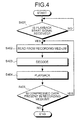
- Fig. 4 is a flowchart of the playback process according to the examples.
- step S401 when a playback start signal is received (step S401: YES), compressed data is read from the recording medium 220, and written to the playback buffer 230, 231 (step S402). Then, compressed data sequentially transferred from the playback buffer 230, 231 is decoded (step S403).
- step S404 The decoded content data is reproduced (step S404).
- step S405: YES When compressed data is present in the recording medium 220 (step S405: YES), the procedure proceeds to step S402. On the other hand, when no compressed data is present in the recording medium 220 (step S405: NO), the playback process ends.
- Fig. 5 is a flowchart of the simultaneous recording/play control process according to the examples.
- step S501 when an input to instruct start of simultaneous record and play is received (step S501: YES), a default bit rate is transmitted (step S502).
- step S501 is the same as the processing at step S301 shown in Fig. 3.
- a data size corresponding to the bit rate is extracted from the data size setting unit 243 (step S503), and the data size of compressed data that is to be recorded to the recording medium 220 is changed to the extracted data size (step S504). As a result, the amount of data that is to be transferred from the recording buffer 214, 215 is changed.
- step S505 When the number of writes to the recording medium 220 has reached n (step S505: YES), the number of writes is reset to "0" (step S506).
- a playback start signal is transmitted to the data writing/reading unit 221 (step S507), and the data size of the compressed data that is to be recorded on the recording medium 220 is changed to the default data size (step S508).
- step S509: YES When an input to change the bit rate occurs (step S509: YES), the changed bit rate is transmitted (step S510), and the procedure proceeds to step S503.
- step S509: NO when no input to instruct change of the bit rate is received (step S509: NO), if the recording process is not completed (step S511: NO), the process proceeds to step S509.
- step S511: YES When the recording process is completed (step S511: YES), the simultaneous record/play control process ends.
- the data size of data that is to be written on the recording medium 220 is reduced to a smaller size than the default data size and accumulating a reproducible amount of data in the recording medium 220, and the playback processor 203 starts the playback after enough amount of data to enable the playback is accumulated in the recording medium 220, thereby quickly starting the playback process without causing breaks in playback.
- the data size is reset to the default after starting the playback process, thereby decreasing frequency of writing. As a result, the performance of the record/play device 200 is improved.
- the frequency of writing content data to the recording medium is increased by reducing the data size before starting the playback, so that it is possible to speedily accumulate a reproducible amount of data, thereby achieving quick start of playback during the simultaneous record and play.
- the user can view content data reproduced simultaneously with recording of the content data, and therefore, it is possible to prevent misunderstanding that that he/she has performed an erroneous operation or that the apparatus is malfunctioning. Accordingly, it is possible to view the content data without feeling irritated, while waiting for playback to start.
- the frequency of writing is decreased by increasing the data size, thereby improving simultaneous record and play performance of the record/play device.
- the simultaneous record/play control method described in the embodiments can be realized by executing a program prepared in advance on a computer such as a personal computer and a workstation.
- the program is recorded on a computer-readable recording medium 220, such as a hard disk, a flexible disk, a CD-ROM, an MO, or a DVD, and executed when read from the recording medium 220 by the computer.
- the program may be a transmission medium that can be distributed through a network such as the Internet.
- the record/play device 200 is applicable to, for example, CD players, MD players, MD recorders, DVD players, DVD recorders, players using data compressed in MP3 or WMA, and car navigation apparatuses.
- the record/play device 200 can also be used as, for example, audio-visual equipment (for household, business, automobile, or portable use).
- audio-visual equipment for household, business, automobile, or portable use.
- Other applicable examples include network-type audio-visual distributors/receivers (server-client systems), real-time analytical result output devices, TTS (Text To Speech) audio synthesizers, automatic translation devices, and component analytical result display devices.
Landscapes
- Engineering & Computer Science (AREA)
- Multimedia (AREA)
- Signal Processing (AREA)
- Signal Processing For Digital Recording And Reproducing (AREA)
- Television Signal Processing For Recording (AREA)
Abstract
Description
- The present invention relates to a record/play device, a simultaneous record/play control method, and a simultaneous record/play control program. However, use of the invention is not limited to the record/play device, the simultaneous record/play control method, and the simultaneous record/play control program.
- Conventionally record/play device capable of increasing the degree of multiplexing data without losing audio data and reducing the response time when starting playback are disclosed. The record/play device is capable of transferring audio packets to a hard disk to store the audio packets, and of receiving the audio packets stored in the hard disk to playback an original analog audio signal. The record/play device includes a file transfer buffer with two buffer areas, each having a capacity capable of accumulating the predetermined number of audio packets, and a managing unit that controls writing/reading of audio packets to/from the file transfer buffer. The managing unit switches the operation of each buffer area between writing and reading based on the number of audio packets stored in one of the buffer areas (see, for example, Patent Document 1 below).
- Patent Document 1:
Japanese Patent Laid-Open Publication No. 2003-308643 - However, when performing so-called simultaneous record and play in which playback is performed while recording audio data, it is necessary to keep a certain amount of data in the hard disk before starting playback, so as not to cause breaks in playback.
- Therefore, the conventional technique has a problem, for example, in that because of the amount of data kept for starting the playback in the simultaneous record and play, a time delay occurs between the start of recording and the start of playback during recording, and the user has to wait certain delay time before the playback is started.
- Moreover, in the conventional technique, it is necessary to monitor whether a sufficient amount of data enabling the simultaneous record and play is stored, and therefore, the load on the record/play device is increased, resulting in a delay in starting the playback in the simultaneous record and play.
- As describe, when performing the simultaneous record and play, if the start of playback is delayed, the user is misunderstand that he/she has performed an erroneous operation or that the device is malfunctioning, and the user has to redo the operation for the simultaneous record and play. Thus, the operation becomes burdensome.
- A record/play device according to the invention of claim 1 includes a recording processor that records, on a recording medium, a series of content data sequentially input; a changing unit that changes, during a record process by the recording processor, a data size of content data that is to be recorded on the recording medium to a data size different from a data size at time of recording of content data that has been recorded on the recording medium; and a playback processor that plays back, during the recording process by the recording processor, the content data recorded on the recording medium.
- Moreover, a simultaneous record/play control method according to the invention of claim 6 is for a record/play device that plays back content data recorded on a recording medium during recording, on the recording medium, a series of content data sequentially input, and includes a detecting step of detecting number of records of content data recorded on the recording medium at a predetermined data size; a changing step of changing a data size to record content data to a data size different from the predetermined data size when the number of records detected at the detecting step has reached a predetermined number.
- A simultaneous record/play control program according to the invention of claim 9 causes a computer to execute a simultaneous record/play control method according to any one of claims 6 to 8.
-
- Fig. 1 is a block diagram of a hardware configuration of a record/play device according to an embodiment of the present invention;
- Fig. 2 is a block diagram of a functional configuration of the record/play device according to the embodiment of the present invention;
- Fig. 3 is a flowchart of a recording process according to examples;
- Fig. 4 is a flowchart of a playback process according to examples; and
- Fig. 5 is a flowchart of a simultaneous record/play control process according to examples.
-
- 200
- record/play device
- 201
- recording processor
- 202
- recorder
- 203
- playback processor
- 204
- controller
- 220
- recording medium
- 240
- operation input unit
- 241
- bit rate transmitter
- 243
- data size setting unit
- 245
- frequency detector
- 246
- playback start signal transmitter
- 247
- data size changing unit
- Exemplary embodiments of the record/play device, the simultaneous record/play control method, and the simultaneous record/play control program according to the present invention will be described in detail with reference to the accompanying drawings. The record/play device, the simultaneous record/play control method, and the simultaneous record/play control program realize simultaneous record and play of a series of content data.
- Here, the content data is electronic data of image or audio, and examples thereof include commercially available image content such as movies, live music footage, and documentaries, image information such as television program recordings, images shot by a video camera, and map data to be displayed in a navigation apparatus, image content in JPG and BMP, image representations of data content for a component analysis, song information representing a song and other audio information such as conversational content and sound effects.
- First, a hardware configuration of a record/play device according to an embodiment of the present invention is described. Fig. 1 is a block diagram of the hardware configuration of the record/play device according to the embodiment of the present invention. As shown in Fig. 1, the record/play device includes a
CPU 101, aROM 102, aRAM 103, an HDD (hard disk drive) 104, an HD (hard disk) 105, a CD/DVD drive 106, a CD/DVD 107 as an example of a removable recording medium, an image/audio I/F (interface) 108, adisplay 109,speaker 110, an input I/F (interface) 111, aremote control 112, input keys (including a keyboard and a mouse) 113, a communication I/F (interface) 114, and aFIFO memory 115. Thecomponents 101 to 115 are connected to one another via abus 100. - The
CPU 101 is responsible for controlling the entire record/play device. TheROM 102 has stored therein a program such as a boot program. TheRAM 103 is used as a work area of theCPU 101. TheHDD 104 controls reading/writing of data to/from theHD 105 under control of theCPU 101. TheHD 105 stores data written under control of theHDD 104. - The CD/
DVD drive 106 controls reading/writing of data to/from the CD/DVD 107 under control of theCPU 101. The CD/DVD 107 is a removable recording medium from which recorded data is read under control of the CD/DVD drive 106. A writable recording medium can be used as the CD/DVD 107. In addition to the CD/DVD 107, a CD-ROM (a CD-R or a CD-RW), an MO, and a memory card may be used as the removable recording medium. - The image/audio I/F (interface) 108 is connected to the
display 109 for image display and the speaker 110 (or headphones) for audio output. Thedisplay 109 displays a cursor, icons, a menu, windows, and a toolbox as well as various data such as characters and images. For example, a CRT, a TFT liquid crystal display, and a plasma display can be employed as thedisplay 109. Thespeaker 110 output audio. - The input I/
F 111 inputs data transmitted from theremote control 112, which is provided with a plurality of keys for inputting characters, numerical values, various commands, etc., and the input keys (including a keyboard and a mouse) 113. The input keys (including a keyboard and a mouse) 113 include keys for inputting characters, numbers, various commands, etc., and input data according to the user's operation. - The communication I/
F 114 is connected to anetwork 120, such as the Internet, by radio or by a communication line, and to other apparatuses via thenetwork 120. The communication I/F 114 serves as an interface between thenetwork 120 and theCPU 101, and controls input/output of data to/from external devices. Examples of thenetwork 120 include a LAN, a WAN, a public line network, and a cellular phone network. - The
FIFO memory 115 stores data read from the CD/DVD 107 by the CD/DVD drive 106 in an order of reading, and when the stored data is to be retrieved to be used, theFIFO memory 115 outputs the data from the oldest piece of data in an order of storing. Moreover, theFIFO memory 115 stores data received through the communication I/F 114 in an order of receiving, and when the stored data is to be retrieved to be used, theFIFO memory 115 outputs the data from the oldest piece of data in order of storing. Furthermore, theFIFO memory 115 stores data read from theHD 105 by theHDD 104 in an order of reading, and when the stored data is to be retrieved to be used, theFIFO memory 115 outputs the data to the image/audio I/F 108 from the oldest piece of data in order of storing. - Next, the functional configuration of the record/play device according to the embodiment of the present invention is explained. Fig. 2 is a block diagram of the functional configuration of the record/play device according to the embodiment of the present invention. As shown in Fig. 2, the record/
play device 200 includes arecording processor 201, arecorder 202, aplayback processor 203, and acontroller 204. - The
recording processor 201 includes adata input unit 210, adata compressor 213, andrecording buffers operation input unit 240, which will be described later, thedata input unit 210 sequentially inputs content data from the exterior. Thedata input unit 210 includes adata reader 211 and adata receiver 212. Thedata reader 211 reads content data from the CD/DVD 107 having content data recorded therein, and inputs the content data into the record/play device 200. - The
data receiver 212 receives content data from thenetwork 120, and inputs the content data into the record/play device 200. Thedata reader 211 has a function implemented by the CD/DVD drive 106 shown in Fig. 1. Thedata receiver 212 has a function implemented by the communication I/F 114 shown in Fig. 1. - The
data compressor 213 compresses content data, which is sequentially input from thedata input unit 210, at a preset default bit rate. The data compression method is in conformity with a well-known standard such as MPEG. Specifically, the function of thedata compressor 213 is implemented by theCPU 101 executing a program stored in a recording medium, e.g., theROM 102, theRAM 103, theHD 105, or the CD/DVD 107 shown in Fig. 1. - The recording buffers 214 and 215 hold pieces of compressed data compressed by the
data compressor 213, and transfer them to arecording medium 220 in order of holding. Concretely, the recording buffers 214 and 215 record the compressed data in a time-division manner. When compressed data accumulated in the recording buffer 214 (or 215) is being written to therecording medium 220, the other recording buffer 215 (or 214) in available state accumulates compressed data. - In normal state, the recording buffers 214 and 215 transfer the compressed data to the
recording medium 220 in a predetermined transfer data amount (data size). When the transfer data amount is changed by a datasize changing unit 247, which will be described later, the compressed data is transferred to therecording medium 220 in a transfer data amount (data size) sufficient not to cause an audio break during playback. Specifically, the function of the recording buffers 214 and 215 is implemented by, for example, theFIFO memory 115 shown in Fig. 1. - The
recorder 202 includes therecording medium 220, and a data writing/reading unit 221. Therecording medium 220 records compressed data transferred from the recording buffers. Specifically, the function of therecording medium 220 is implemented by, for example, theRAM 103 or theHD 105 shown in Fig. 1. - The data writing/
reading unit 221 writes the compressed data transferred from the recording buffers 214 and 215 to therecording medium 220. When a playback start signal is received from a playbackstart signal transmitter 246, which will be described later, it starts reading the compressed data recorded on therecording medium 220, and writes to aplayback buffer reading unit 221 is implemented by, for example, theHDD 104 shown in Fig. 1. - The
playback processor 203 includes the playback buffers 230 and 231, adecoder 232, and aplayback unit 233. The compressed data recorded on therecording medium 220 is written to the playback buffers from which the data is transferred to thedecoder 232 in order of recording. Specifically, the playback buffers 230 and 231 transfer the compressed data in a time-division manner. When compressed data accumulated in the playback buffer 230 (or 231) is being transferred to thedecoder 232, compressed data from therecording medium 220 is written to the other playback buffer 231 (or 230) in available state. Specifically, the function of the playback buffers 230 and 231 is implemented by, for example, theFIFO memory 115 shown in Fig. 1. - The
decoder 232 decodes the compressed data transferred from the playback buffers 230 and 231. The decoding method is in conformity with a well-known standard such as MPEG. Concretely, thedecoder 232 has a function implemented by theCPU 101 executing a program stored in a recording medium, e.g., theROM 102, theRAM 103, theHD 105, or the CD/DVD 107 shown in Fig. 1. - The
playback unit 233 plays back content data decoded by thedecoder 232. Concretely, when the content data is audio content data, a song therein is output. In addition, when the content data is video content data, video is displayed. Concretely, theplayback unit 233 has a function implemented by, for example, the image/audio I/F 108, thedisplay 109, or thespeaker 110 shown in Fig. 1. - The
controller 204 controls simultaneous recording and playback of content data recorded on therecording medium 220 during recording of a series of content data sequentially input on therecording medium 220. Thecontroller 204 includes theoperation input unit 240, abit rate transmitter 241, a datasize setting unit 243, a datasize extracting unit 244, afrequency detector 245, the playbackstart signal transmitter 246, and the datasize changing unit 247. - The
operation input unit 240 receives an input of a signal to start simultaneous record and play and an input to change the bit rate that are made by a user operating theremote control 112 or theinput key 113 shown in Fig. 1. The function of theoperation input unit 240 is implemented by the input I/F 111 shown in Fig. 1. - The
bit rate transmitter 241 transmits to the data size extracting unit 244 a preset default bit rate or a bit rate obtained by theoperation input unit 240 accepting the input to change. Specifically, the function of thebit rate transmitter 241 is implemented by theCPU 101 executing a program stored in a recording medium, e.g., theROM 102, theRAM 103, theHD 105, or the CD/DVD 107 shown in Fig. 1. - The data
size setting unit 243 contains a data size corresponding to the bit rate transmitted from thebit rate transmitter 241. Here, the datasize setting unit 243 is described specifically. - The size of data compressed at a default bit rate A is taken as a data size B. The data compression requires a compression time C. The time taken for writing the compressed data to the
recording medium 220 and the time taken for reading the written compressed data are both taken as a time D. The time D is a roughly constant value, which does not depend on the amount of compressed data. - The time taken for decoding and reproducing compressed data having the data size B is taken as a playback time F. If the next compressed data (the second time) is prepared, no audio breaks occur. Accordingly, if a conditional equation below is satisfied, the data size B is a minimum possible data size that causes no audio breaks at the time of playback. The data
size setting unit 243 is set so as to satisfy the following conditional equation (1).
- Specifically, the function of the data
size setting unit 243 is implemented by a recording medium, e.g., theROM 102, theRAM 103, theHD 105, or the CD/DVD 107 shown in Fig. 1. - The data
size extracting unit 244 extracts from the datasize setting unit 243 the data size corresponding to the bit rate transmitted from thebit rate transmitter 241. Concretely, the datasize extracting unit 244 has a function implemented by theCPU 101 executing a program stored in a recording medium, e.g., theROM 102, theRAM 103, theHD 105, or the CD/DVD 107 shown in Fig. 1. - The
frequency detector 245 counts the number of writes of compressed data compressed by thedata compressor 213, and detects whether the counted number of writes has reached a predetermined number n. Concretely, the predetermined number n is set such that a data amount obtained by multiplying the predetermined number n by the data size is a data amount sufficient to cause no breaks in playback in theplayback processor 203. Specifically, the function of thefrequency detector 245 is implemented by theCPU 101 executing a program stored in a recording medium, e.g., theROM 102, theRAM 103, theHD 105, or the CD/DVD 107 shown in Fig. 1. - When the
frequency detector 245 detects that the counted number of writes has reached the predetermined number n, the playbackstart signal transmitter 246 transmits a playback start signal to the data writing/reading unit 221. Specifically, the function of the playbackstart signal transmitter 246 is implemented by theCPU 101 executing a program stored in a recording medium, e.g., theROM 102, theRAM 103, theHD 105, or the CD/DVD 107 shown in Fig. 1. - When the
frequency detector 245 detects that the counted number of writes has reached the predetermined number n, the datasize changing unit 247 changes the data size of the compressed data that is to be written from therecording buffer recording medium 220 to the data size extracted by the datasize extracting unit 244. Specifically, the function of the datasize changing unit 247 is implemented by theCPU 101 executing a program stored in a recording medium, e.g., theROM 102, theRAM 103, theHD 105, or the CD/DVD 107 shown in Fig. 1. - Next, a recording process procedure according to examples is explained. Fig. 3 is a flowchart of the recording process according to the examples. As shown in Fig. 3, when an input to instruct start if simultaneous record and play is received (step S301: YES), a series of content data is sequentially input (step S302). When no input to instruct a change of the bit rate is received (step S303: NO), a compression process is performed at a default bit rate (step S304). On the other hand, when an input to instruct a change of the bit rate is received (step S303: YES), the compression process is performed at the changed bit rate (step S305).
- Thereafter, compressed data is written to the
recording buffer 214, 215 (step S306), and then transferred and recorded to the recording medium 220 (step S307). When content data is present (step S308: YES), the process proceeds to step S302. On the other hand, if no content data is present (step S308: NO), the recording process ends. - Next, a playback process according to the examples is explained. Fig. 4 is a flowchart of the playback process according to the examples. First, when a playback start signal is received (step S401: YES), compressed data is read from the
recording medium 220, and written to theplayback buffer 230, 231 (step S402). Then, compressed data sequentially transferred from theplayback buffer - The decoded content data is reproduced (step S404). When compressed data is present in the recording medium 220 (step S405: YES), the procedure proceeds to step S402. On the other hand, when no compressed data is present in the recording medium 220 (step S405: NO), the playback process ends.
- Next, a simultaneous recording/play control process according to the examples is explained. Fig. 5 is a flowchart of the simultaneous recording/play control process according to the examples. First, when an input to instruct start of simultaneous record and play is received (step S501: YES), a default bit rate is transmitted (step S502). The processing in step S501 is the same as the processing at step S301 shown in Fig. 3.
- A data size corresponding to the bit rate is extracted from the data size setting unit 243 (step S503), and the data size of compressed data that is to be recorded to the
recording medium 220 is changed to the extracted data size (step S504). As a result, the amount of data that is to be transferred from therecording buffer - When the number of writes to the
recording medium 220 has reached n (step S505: YES), the number of writes is reset to "0" (step S506). A playback start signal is transmitted to the data writing/reading unit 221 (step S507), and the data size of the compressed data that is to be recorded on therecording medium 220 is changed to the default data size (step S508). - When an input to change the bit rate occurs (step S509: YES), the changed bit rate is transmitted (step S510), and the procedure proceeds to step S503. On the other hand, when no input to instruct change of the bit rate is received (step S509: NO), if the recording process is not completed (step S511: NO), the process proceeds to step S509. When the recording process is completed (step S511: YES), the simultaneous record/play control process ends.
- As such, at the start of playback, the data size of data that is to be written on the
recording medium 220 is reduced to a smaller size than the default data size and accumulating a reproducible amount of data in therecording medium 220, and theplayback processor 203 starts the playback after enough amount of data to enable the playback is accumulated in therecording medium 220, thereby quickly starting the playback process without causing breaks in playback. In addition, the data size is reset to the default after starting the playback process, thereby decreasing frequency of writing. As a result, the performance of the record/play device 200 is improved. - In addition, during the recording and playback, when the user inputs a change of the bit rate, data that is to be written to the
recording medium 220 is written after reducing the data size to a less size than the default data size in accordance with the changed bit rate, thereby quickly starting the playback process without causing breaks in playback. - As described above, with to the record/play device, the simultaneous record/play control method, and the simultaneous record/play control program according to the embodiment, the frequency of writing content data to the recording medium is increased by reducing the data size before starting the playback, so that it is possible to speedily accumulate a reproducible amount of data, thereby achieving quick start of playback during the simultaneous record and play.
- As a result, the user can view content data reproduced simultaneously with recording of the content data, and therefore, it is possible to prevent misunderstanding that that he/she has performed an erroneous operation or that the apparatus is malfunctioning. Accordingly, it is possible to view the content data without feeling irritated, while waiting for playback to start. In addition, after the start of playback, the frequency of writing is decreased by increasing the data size, thereby improving simultaneous record and play performance of the record/play device.
- The simultaneous record/play control method described in the embodiments can be realized by executing a program prepared in advance on a computer such as a personal computer and a workstation. The program is recorded on a computer-
readable recording medium 220, such as a hard disk, a flexible disk, a CD-ROM, an MO, or a DVD, and executed when read from therecording medium 220 by the computer. The program may be a transmission medium that can be distributed through a network such as the Internet. - The record/
play device 200 according to the embodiments is applicable to, for example, CD players, MD players, MD recorders, DVD players, DVD recorders, players using data compressed in MP3 or WMA, and car navigation apparatuses. The record/play device 200 can also be used as, for example, audio-visual equipment (for household, business, automobile, or portable use). Other applicable examples include network-type audio-visual distributors/receivers (server-client systems), real-time analytical result output devices, TTS (Text To Speech) audio synthesizers, automatic translation devices, and component analytical result display devices.
Claims (9)
- A record/play device comprising:a record processor that records, on a recording medium, a series of content data sequentially input;a changing unit that changes, during a record process by the record processor, a data size of content data that is to be recorded on the recording medium to a data size different from a data size at time of recording of content data that has been recorded on the recording medium; anda playback processor that plays back, during the recording process by the recording processor, the content data recorded on the recording medium.
- The record/play device according to claim 1, wherein during the recording process by the recording processor, the changing unit changes the data size of the content data that is to be recorded on the recording medium to a data size larger than the data size at the time of recording of the content data that has been recorded on the recording medium.
- The record/play device according to claim 1, wherein during the recording process by the recording processor, the changing unit changes the data size of the content data that is to be recorded on the recording medium to a data size smaller than the data size at the time of recording of the content data that has been recorded on the recording medium.
- The record/play device according to claim 1, comprising:a recording start input unit that accepts an input to start recording by the recording processor;a setting unit that sets, when the recording start input unit accepts the input to start recording, the data size of the content data that is to be recorded on the recording medium to a predetermined data size; anda detecting unit that detects number of records of content data recorded on the recording medium at the predetermined data size set by the setting unit, whereinwhen the number of records detected by the detector has reached a predetermined number, the playback processor starts playback of the content data recorded on the recording medium during the recording process by the recording processor, andwhen playback is started by the playback processor, the changing unit changes the data size of the content data that is to be recorded on the recording medium to a data size larger than the predetermined data size set by the setting unit.
- The record/play device according to claim 4, comprising a change input unit that accepts, during the recording process by the recording processor, an input to change the data size of the content data that is to be recorded on the recording medium, wherein
when the change input unit accepts the input to change, the changing unit changes the data size of the content data that is to be recorded on the recording medium to a data size associated with the input to change. - A simultaneous record/play control method for a record/play device that plays back content data recorded on a recording medium during recording, on the recording medium, a series of content data sequentially input, the simultaneous record/play control method comprising:a detecting step of detecting number of records of content data recorded on the recording medium at a predetermined data size;a changing step of changing a data size to record content data to a data size different from the predetermined data size when the number of records detected at the detecting step has reached a predetermined number.
- The simultaneous record/play control method according to claim 6, further comprising:a recording start inputting step of inputting a start to record the series of content data;a setting step of setting, prior to the detecting step, the data size to record content data to the predetermined data size when the start to record is input at the recording start input step; anda playback start instructing step of instructing to start playing back the content data recorded on the recording medium, whereinat the changing step, the data size to record content data is changed to a data size larger than the data size set at the setting step.
- The simultaneous record/play control method according to claim 7, further comprising a second changing step of changing the data size to record content data is changed to a data size smaller than the data size changed at the changing step.
- A simultaneous record/play control program causing a computer to execute a simultaneous record/play control method according to any one of claims 6 to 8.
Applications Claiming Priority (2)
| Application Number | Priority Date | Filing Date | Title |
|---|---|---|---|
| JP2004130263 | 2004-04-26 | ||
| PCT/JP2005/007414 WO2005104125A1 (en) | 2004-04-26 | 2005-04-18 | Record reproducing device, simultaneous record reproduction control method and simultaneous record reproduction control program |
Publications (2)
| Publication Number | Publication Date |
|---|---|
| EP1742214A1 true EP1742214A1 (en) | 2007-01-10 |
| EP1742214A4 EP1742214A4 (en) | 2009-07-22 |
Family
ID=35197237
Family Applications (1)
| Application Number | Title | Priority Date | Filing Date |
|---|---|---|---|
| EP05730687A Withdrawn EP1742214A4 (en) | 2004-04-26 | 2005-04-18 | Record reproducing device, simultaneous record reproduction control method and simultaneous record reproduction control program |
Country Status (5)
| Country | Link |
|---|---|
| US (1) | US7974518B2 (en) |
| EP (1) | EP1742214A4 (en) |
| JP (1) | JP4191221B2 (en) |
| CN (1) | CN1947196A (en) |
| WO (1) | WO2005104125A1 (en) |
Families Citing this family (3)
| Publication number | Priority date | Publication date | Assignee | Title |
|---|---|---|---|---|
| JP2008052817A (en) * | 2006-08-24 | 2008-03-06 | Matsushita Electric Ind Co Ltd | Recording / reproducing apparatus and companion system |
| JP2008054208A (en) * | 2006-08-28 | 2008-03-06 | Funai Electric Co Ltd | Playback device |
| JP5971550B2 (en) * | 2011-03-28 | 2016-08-17 | ヤマハ株式会社 | Audio data input device and output device |
Family Cites Families (7)
| Publication number | Priority date | Publication date | Assignee | Title |
|---|---|---|---|---|
| WO1999017289A1 (en) * | 1997-09-29 | 1999-04-08 | Sony Corporation | Intermittent data recorder, intermittent data recording controller, intermittent data recording method, and intermittent data recording control method |
| JP2000322828A (en) * | 1999-05-12 | 2000-11-24 | Toshiba Corp | Information recording / reproducing device and information recording / reproducing device |
| WO2001035409A2 (en) * | 1999-11-10 | 2001-05-17 | Thomson Licensing S.A. | Commercial skip and chapter delineation feature on recordable media |
| KR100521937B1 (en) * | 2000-02-11 | 2005-10-13 | 엘지전자 주식회사 | Method for recording audio data on rewritable medium |
| JP2003022604A (en) | 2001-07-06 | 2003-01-24 | Toshiba Corp | Digital recording and playback device |
| JP2003308643A (en) * | 2002-04-09 | 2003-10-31 | Toa Corp | Sound recording and reproducing device using writable and readable storage medium |
| JP4228271B2 (en) * | 2002-07-09 | 2009-02-25 | 日本電気株式会社 | Video data compression apparatus and video data compression method |
-
2005
- 2005-04-18 CN CNA2005800132599A patent/CN1947196A/en active Pending
- 2005-04-18 JP JP2006512536A patent/JP4191221B2/en not_active Expired - Fee Related
- 2005-04-18 US US11/587,343 patent/US7974518B2/en not_active Expired - Fee Related
- 2005-04-18 WO PCT/JP2005/007414 patent/WO2005104125A1/en not_active Ceased
- 2005-04-18 EP EP05730687A patent/EP1742214A4/en not_active Withdrawn
Also Published As
| Publication number | Publication date |
|---|---|
| JP4191221B2 (en) | 2008-12-03 |
| CN1947196A (en) | 2007-04-11 |
| JPWO2005104125A1 (en) | 2008-07-31 |
| EP1742214A4 (en) | 2009-07-22 |
| US7974518B2 (en) | 2011-07-05 |
| WO2005104125A1 (en) | 2005-11-03 |
| US20070160348A1 (en) | 2007-07-12 |
Similar Documents
| Publication | Publication Date | Title |
|---|---|---|
| US7467088B2 (en) | Closed caption control apparatus and method therefor | |
| US8345122B2 (en) | Image playback method, music processing method, image playback apparatus, and computer program product | |
| US20080066104A1 (en) | Program providing method, program for program providing method, recording medium which records program for program providing method and program providing apparatus | |
| US20100275164A1 (en) | Authoring apparatus | |
| JP4848756B2 (en) | Information processing apparatus and method, and program | |
| EP1517270A2 (en) | Apparatus, method, program and program storage medium for data editing and recording | |
| US7974518B2 (en) | Record reproducing device, simultaneous record reproduction control method and simultaneous record reproduction control program | |
| JP5039020B2 (en) | Electronic device and video content information display method | |
| JP2007067595A (en) | Program information notification method | |
| US20060002255A1 (en) | Optimized audio / video recording and playing system and method | |
| JP4851909B2 (en) | Video recording apparatus and program | |
| JP2009094966A (en) | Playback apparatus, playback method, and playback control program | |
| US20050232598A1 (en) | Method, apparatus, and program for extracting thumbnail picture | |
| KR100735251B1 (en) | Video output method with audio in portable terminal | |
| KR20050054937A (en) | Method of storing a stream of audiovisual data in a memory | |
| US7965587B2 (en) | Record reproducing system, record reproducing method and record reproducing program | |
| CN100574409C (en) | The reproducting method and the relevant reproducer that comprise the impaired sequences file | |
| WO2009084110A1 (en) | Broadcast displaying device, broadcast displaying method, and computer program | |
| JP2001333370A (en) | Image and sound processing device | |
| JP4332131B2 (en) | Program playback device and program playback program | |
| JP4168996B2 (en) | Content data recording / reproducing system and content data recording / reproducing method | |
| KR100698274B1 (en) | Demonstration Method of Image Display Equipment and Image Display Equipment | |
| JP4312167B2 (en) | Content playback device | |
| KR20040103160A (en) | Apparatus for storing/playing voice signal of television | |
| JP2005136688A (en) | Television receiver |
Legal Events
| Date | Code | Title | Description |
|---|---|---|---|
| PUAI | Public reference made under article 153(3) epc to a published international application that has entered the european phase |
Free format text: ORIGINAL CODE: 0009012 |
|
| 17P | Request for examination filed |
Effective date: 20061113 |
|
| AK | Designated contracting states |
Kind code of ref document: A1 Designated state(s): DE FR GB |
|
| RBV | Designated contracting states (corrected) |
Designated state(s): DE FR GB |
|
| DAX | Request for extension of the european patent (deleted) | ||
| A4 | Supplementary search report drawn up and despatched |
Effective date: 20090622 |
|
| RIC1 | Information provided on ipc code assigned before grant |
Ipc: H04N 5/76 20060101ALI20090616BHEP Ipc: G11B 20/10 20060101AFI20051109BHEP Ipc: G11B 27/10 20060101ALI20090616BHEP |
|
| STAA | Information on the status of an ep patent application or granted ep patent |
Free format text: STATUS: THE APPLICATION IS DEEMED TO BE WITHDRAWN |
|
| 18D | Application deemed to be withdrawn |
Effective date: 20090922 |