EP1741800A1 - Steel sheet for can and method for production thereof - Google Patents
Steel sheet for can and method for production thereof Download PDFInfo
- Publication number
- EP1741800A1 EP1741800A1 EP05736903A EP05736903A EP1741800A1 EP 1741800 A1 EP1741800 A1 EP 1741800A1 EP 05736903 A EP05736903 A EP 05736903A EP 05736903 A EP05736903 A EP 05736903A EP 1741800 A1 EP1741800 A1 EP 1741800A1
- Authority
- EP
- European Patent Office
- Prior art keywords
- weight
- steel sheet
- steel
- less
- strength
- Prior art date
- Legal status (The legal status is an assumption and is not a legal conclusion. Google has not performed a legal analysis and makes no representation as to the accuracy of the status listed.)
- Withdrawn
Links
Images
Classifications
-
- C—CHEMISTRY; METALLURGY
- C22—METALLURGY; FERROUS OR NON-FERROUS ALLOYS; TREATMENT OF ALLOYS OR NON-FERROUS METALS
- C22C—ALLOYS
- C22C38/00—Ferrous alloys, e.g. steel alloys
- C22C38/04—Ferrous alloys, e.g. steel alloys containing manganese
-
- C—CHEMISTRY; METALLURGY
- C21—METALLURGY OF IRON
- C21D—MODIFYING THE PHYSICAL STRUCTURE OF FERROUS METALS; GENERAL DEVICES FOR HEAT TREATMENT OF FERROUS OR NON-FERROUS METALS OR ALLOYS; MAKING METAL MALLEABLE, e.g. BY DECARBURISATION OR TEMPERING
- C21D8/00—Modifying the physical properties of ferrous metals or ferrous alloys by deformation combined with, or followed by, heat treatment
- C21D8/02—Modifying the physical properties of ferrous metals or ferrous alloys by deformation combined with, or followed by, heat treatment during manufacturing of plates or strips
- C21D8/0221—Modifying the physical properties of ferrous metals or ferrous alloys by deformation combined with, or followed by, heat treatment during manufacturing of plates or strips characterised by the working steps
- C21D8/0236—Cold rolling
-
- C—CHEMISTRY; METALLURGY
- C21—METALLURGY OF IRON
- C21D—MODIFYING THE PHYSICAL STRUCTURE OF FERROUS METALS; GENERAL DEVICES FOR HEAT TREATMENT OF FERROUS OR NON-FERROUS METALS OR ALLOYS; MAKING METAL MALLEABLE, e.g. BY DECARBURISATION OR TEMPERING
- C21D2211/00—Microstructure comprising significant phases
- C21D2211/005—Ferrite
-
- C—CHEMISTRY; METALLURGY
- C21—METALLURGY OF IRON
- C21D—MODIFYING THE PHYSICAL STRUCTURE OF FERROUS METALS; GENERAL DEVICES FOR HEAT TREATMENT OF FERROUS OR NON-FERROUS METALS OR ALLOYS; MAKING METAL MALLEABLE, e.g. BY DECARBURISATION OR TEMPERING
- C21D8/00—Modifying the physical properties of ferrous metals or ferrous alloys by deformation combined with, or followed by, heat treatment
- C21D8/02—Modifying the physical properties of ferrous metals or ferrous alloys by deformation combined with, or followed by, heat treatment during manufacturing of plates or strips
- C21D8/0221—Modifying the physical properties of ferrous metals or ferrous alloys by deformation combined with, or followed by, heat treatment during manufacturing of plates or strips characterised by the working steps
- C21D8/0226—Hot rolling
-
- C—CHEMISTRY; METALLURGY
- C21—METALLURGY OF IRON
- C21D—MODIFYING THE PHYSICAL STRUCTURE OF FERROUS METALS; GENERAL DEVICES FOR HEAT TREATMENT OF FERROUS OR NON-FERROUS METALS OR ALLOYS; MAKING METAL MALLEABLE, e.g. BY DECARBURISATION OR TEMPERING
- C21D8/00—Modifying the physical properties of ferrous metals or ferrous alloys by deformation combined with, or followed by, heat treatment
- C21D8/02—Modifying the physical properties of ferrous metals or ferrous alloys by deformation combined with, or followed by, heat treatment during manufacturing of plates or strips
- C21D8/0247—Modifying the physical properties of ferrous metals or ferrous alloys by deformation combined with, or followed by, heat treatment during manufacturing of plates or strips characterised by the heat treatment
- C21D8/0273—Final recrystallisation annealing
-
- C—CHEMISTRY; METALLURGY
- C21—METALLURGY OF IRON
- C21D—MODIFYING THE PHYSICAL STRUCTURE OF FERROUS METALS; GENERAL DEVICES FOR HEAT TREATMENT OF FERROUS OR NON-FERROUS METALS OR ALLOYS; MAKING METAL MALLEABLE, e.g. BY DECARBURISATION OR TEMPERING
- C21D8/00—Modifying the physical properties of ferrous metals or ferrous alloys by deformation combined with, or followed by, heat treatment
- C21D8/02—Modifying the physical properties of ferrous metals or ferrous alloys by deformation combined with, or followed by, heat treatment during manufacturing of plates or strips
- C21D8/0278—Modifying the physical properties of ferrous metals or ferrous alloys by deformation combined with, or followed by, heat treatment during manufacturing of plates or strips involving a particular surface treatment
Definitions
- the present invention relates to thin steel sheets (hereinafter also referred to as can steel sheets) suitable for surface-treated steel sheets for can manufacture, such as tinplates and electrically chromium-coated steel sheets, and also to methods for manufacturing the steel sheets.
- can steel sheets thin steel sheets (hereinafter also referred to as can steel sheets) suitable for surface-treated steel sheets for can manufacture, such as tinplates and electrically chromium-coated steel sheets, and also to methods for manufacturing the steel sheets.
- can steel sheets are therefore difficult to apply to portions requiring strength, such as bodies of draw-redraw cans (hereinafter also referred to as DRD cans) and welded cans. Accordingly, can steel sheets have been desired to have a smaller thickness with sufficient strength.
- DR double reduction
- second cold rolling follows annealing.
- a steel sheet manufactured by this method has an elongation of only several percent and poor formability.
- the steel sheet chronically causes, for example, surface flaws and surface dirt which are extremely difficult to completely avoid.
- Japanese Unexamined Patent Application Publication No. 2001-107186 discloses that large amounts of C and N are added and hardened by baking to achieve can steel sheets having high strength equivalent to that of a steel sheet manufactured by DR.
- the steel sheet has high yield stress after the baking of coating, namely 550 MPa, and the hardness thereof is adjustable according to the amount of N added and heat-treatment conditions. This method is effective for achieving higher strength, though it may cause yield elongation due to strain aging even after temper rolling, and thus may cause stretcher strains during forming.
- Japanese Unexamined Patent Application Publication No. 8-325670 proposes a method for manufacturing a steel sheet having a good balance between strength and elongation by a combination of precipitation strengthening with niobium carbide and crystal grain refinement strengthening with the carbonitrides of Nb, Ti, and B.
- the present inventors produced a steel sheet containing 0.025% by weight of Nb according to this method.
- the resultant steel sheet however, had low tensile strength, namely 510 MPa, and thus could not reach the strength of a steel sheet manufactured by the currently available method, namely DR.
- Japanese Unexamined Patent Application Publication No. 5-345926 proposes a method for manufacturing a steel sheet reaching a strength level of 60 to 75 in terms of Rockwell hardness (HR30T) (see JIS G 3303) by solid solution strengthening with P and crystal grain refinement strengthening with the carbonitrides of Nb, Ti, and B.
- HR30T Rockwell hardness
- Japanese Unexamined Patent Application Publication No. 2000-119802 proposes a method for manufacturing a high-strength steel sheet having a tensile strength of 540 MPa or more by precipitation strengthening through the addition of alloy elements such as Nb.and Ti. Either method, however, depends on temper rolling at a high reduction rate, namely about 10% to 30%, to achieve high strength, and thus has difficulty in providing strength equivalent to that of a steel sheet manufactured by DR (hereinafter also referred to as DR steel sheets).
- Japanese Unexamined Patent Application Publication No. 2003-34825 proposes a method in which low-carbon steel is subjected to hot rolling in the ⁇ + ⁇ region, rapid cooling, and annealing at a specified heating temperature.
- This method can provide a steel sheet having a tensile strength of 600 MPa and a total elongation of 30% or more. Such strengthening by rapid cooling, however, leads to high operating cost.
- An object of the present invention is to provide a can steel sheet having strength equivalent to that of a DR steel sheet and elongation superior to that of a DR steel sheet, and also to provide a method for manufacturing the can steel sheet.
- the present invention provides a can steel sheet containing 0.04% to 0.1% by weight of C, 0.002% to 0.012% by weight of N, 0.5% to 1.5% by weight of Mn, 0.01% to 0.15% by weight of P, 0.01% to 0.5% by weight of Si, more than 0.025% to 0.1% by weight of Nb, 0.01% or less by weight of Al, and 0.01% or less by weight of S, and the balance is Fe and incidental impurities.
- This can steel sheet substantially has a single-phase ferrite structure having an average crystal grain size of 7 ⁇ m or less.
- the present invention further provides a method for manufacturing a can steel sheet.
- This method includes hot-rolling a steel at a finish temperature of an Ar 3 transformation point or more, coiling the steel at a coiling temperature of 560°C to 600°C, pickling the steel, cold-rolling the steel at a reduction rate of 80% or more, and annealing the steel at 700°C to 820°C.
- the steel used contains 0.04% to 0.1% by weight of C, 0.002% to 0.012% by weight of N, 0.5% to 1.5% by weight of Mn, 0.01% to 0.15% by weight of P, 0.01% to 0.5% by weight of Si, more than 0.025% to 0.1% by weight of Nb, 0.01% or less by weight of Al, and 0.01% or less by weight of S, and the balance is Fe and incidental impurities.
- the present invention further provides a can steel sheet having high strength and high elongation.
- This can steel sheet contains 0.04% to 0.1% by weight of C, 0.002% to 0.012% by weight of N, 0.5% to 1.5% by weight of Mn, 0.010% to 0.15% by weight of P, 0.01% to 0.5% by weight of Si, 0.025% to 0.1% by weight of Nb, 0.01% or less by weight of Al, and 0.01% or less by weight of S, and the balance is Fe and incidental impurities.
- the can steel sheet substantially has a single-phase ferrite structure, and has an average ferrite crystal grain size of 7 ⁇ m or less and a thickness of 0.2 mm or less.
- the present inventors have focused on a combination of solid solution strengthening, precipitation strengthening, and grain refinement strengthening to strengthen a steel sheet. As a result, the inventors have found that higher strength can be achieved with no decrease in elongation by reducing the size of crystal grains through the addition of proper amounts of P and Mn, as solid solution strengthening elements, and a proper amount of Nb, as a precipitation strengthening element and a grain refinement strengthening element. The inventors have further found that the strength and the elongation can be balanced at high levels with a substantial single-phase ferrite structure having a specified average ferrite crystal grain size.
- a high-strength can steel sheet is a thin steel sheet suitable as, for example, a raw plate for a surface-treated steel sheet such as a tinplate (electrically tin-coated steel sheets) and an electrically chromium-coated steel sheet.
- a can steel sheet having high strength and high elongation according to the present invention contains specified amounts of elements described below as a solid solution strengthening element, a precipitation strengthening element, and/or a grain refinement strengthening element.
- the can steel sheet substantially has a single-phase ferrite structure having an average crystal grain size of 7 ⁇ m or less. These conditions are the most important requirements for the present invention which allow the manufacture of a can steel sheet having a tensile strength of 550 MPa or more and an elongation exceeding 10%.
- Such a high-strength, high-elongation steel sheet may be manufactured by hot rolling at a finish temperature of an Ar 3 transformation point or more, coiling at a coiling temperature of 560°C to 600°C, pickling, cold rolling at a reduction rate of 80% or more, and annealing at 700°C to 820°C.
- the chemical composition of the steel is specified for the following reasons. In the present application, all percentages for the composition of the steel are expressed in terms of weight. C: 0.04% to 0.1%
- the steel sheet requires a crystal grain size of 7 ⁇ m or less to achieve a tensile strength of 550 MPa or more and an elongation exceeding 10% after annealing.
- the amount of C added is important to achieve such properties; C is one of the main requirements for the present invention. In particular, a required amount of carbon must be assigned to precipitation because the strength and the grain size depend largely on the amount and density of carbide. In addition, the amount of C added is 0.04% or more in consideration of strengthening by the solid solution of C. If, on the other hand, the amount of C added exceeds 0.1%, a pearlite phase precipitates in the second phase and decreases the elongation. Accordingly, the content of C is 0.04% to 0.1%.
- Si 0.01% to 0.5%
- Si is an element for strengthening the steel sheet by solid solution strengthening, though an excessive amount of Si added significantly impairs corrosion resistance. Accordingly, the content of Si is 0.01% to 0.5%.
- the content of Si is preferably 0.01% to 0.3% to further inhibit impairment in the corrosion resistance.
- Mn 0.5% to 1.5%
- Mn is an element for increasing the strength of the steel sheet by solid solution strengthening, reducing the size of crystal grains, and further increasing the strength of the steel sheet by grain refinement strengthening. Mn is one of the main requirements for the present invention. The above effects appear significantly by adding 0.5% or more of Mn. An excessive amount of Mn added, however, impairs the corrosion resistance. Accordingly, the content of Mn is 0.5% to 1.5%.
- the content of Mn is preferably 0.5% to 1.0% to inhibit a large increase in recrystallization temperature.
- P 0.01% to 0.15%
- P is an element having a high solid solution strengthening ability, and is therefore one of the main requirements for the present invention. This effect appears significantly by adding 0.01% or more of P. An excessive amount of P added, however, impairs the corrosion resistance of the steel sheet. Accordingly, the content of P is 0.01% to 0.15%.
- the content of P is preferably 0.01% to 0.1% to further inhibit impairment in the corrosion resistance.
- S 0.01% or less The content of S is preferably minimized because the element occurs in the steel as an inclusion which is disadvantageous in view of the elongation and corrosion resistance of the steel sheet.
- the content of S is 0.01% or less, usually about 0.0001% to 0.01%.
- Al 0.01% or less
- An increase in the content of Al raises the recrystallization temperature, and the annealing temperature must be raised accordingly.
- a rise in annealing temperature increases the amount of A1N formed and decreases the amount of solid solution of N, thus decreasing the strength of the steel sheet.
- the annealing temperature must be raised because the recrystallization temperature rises due to other elements added to increase the strength of the steel sheet.
- the rise in recrystallization temperature due to Al is preferably minimized.
- the content of Al is 0.01% or less, usually about 0.003% to 0.01%.
- N 0.002% to 0.012% N is deliberately added because the element has a high solid solution strengthening ability to increase the strength of the steel sheet.
- the effective amount of N required for increasing the strength is 0.002% or more.
- An excessive amount of N added causes the problem of strain aging of the steel sheet. Accordingly, the content of N is 0.002% to 0.012% Nb: more than 0.025% to 0.1% Nb is one of the main requirements for the present invention.
- This element which has a high carbide-forming ability, precipitates fine carbide grains to increase the strength of the steel sheet. In addition, the element refines the carbide grains to increase the strength of the steel sheet.
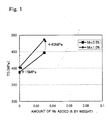
- Fig. 1 illustrates the relationship between the amount of Nb added and the strength of the can steel sheet when Nb is added together with Mn as a solid solution element.
- Fig. 1 shows that the addition of Nb together with Mn as a solid solution element provides a larger increase in the strength of the steel sheet than the intrinsic effect of solid solution strengthening. The possible cause is described below.
- the addition of the solid solution element (Mn in this example) together with Nb precipitates Nb-C which suppresses the diffusion of the solid solution element (Mn in this example) and thus inhibits the growth of recrystallized grains in annealing. That is, the solid solution element itself achieves the effect of grain refinement strengthening which adds to the effect of solid solution strengthening. This effect starts to appear significantly when the amount of Nb added exceeds 0.025%.
- Nb raises the recrystallization temperature. If the amount of Nb added exceeds 0.1%, the steel sheet hardens significantly in hot rolling and thus deteriorates in formability in cold rolling.
- the content of Nb is more than 0.025% to 0.1%.
- the content of Nb is preferably more than 0.025% to 0.05% in view of formability in cold rolling.
- the steel sheet according to the present invention substantially has a single-phase ferrite structure. Even a steel sheet containing, for example, about 1% of cementite is determined to substantially have a single-phase ferrite structure as long as the sheet provides the operation and effects of the present invention.
- the present inventors have studied the balance between the strength and elongation of steel sheets having single-phase ferrite structures with varying average ferrite crystal grain sizes. This study has found that a high-strength steel can be achieved with no decrease in elongation if the average ferrite crystal grain size is 7 ⁇ m or less. The study has also found that an average crystal grain size exceeding 7 ⁇ m results in a poor surface appearance after can manufacture. Such phenomena are associated with extreme variations in surface roughness which occurred particularly on two-piece cans, though the positions and degrees thereof varied. Accordingly, the average ferrite crystal grain size is 7 ⁇ m or less. The average ferrite crystal grain size is measured by, for example, an intercept method according to ASTM.
- the can steel sheet according to the present invention preferably has a thickness of 0.2 mm or less to achieve a higher cold rolling rate and a tensile strength of 550 MPa or more.
- a molten steel with the above chemical composition is prepared with, for example, a converter, and is cast into a rolling stock by, for example, continuous casting.
- the resultant rolling stock is subjected to hot rolling.
- the finish temperature must be set to an Ar 3 transformation point or more to provide a steel sheet in the single-phase ⁇ region.
- the rolling stock preferably has a low temperature before the hot rolling to refine crystal grains more readily, though the finish rolling temperature must be set in the single-phase ⁇ region. Accordingly, the temperature of the rolling stock is preferably 1,150°C to 1,300°C at the beginning of the rolling.
- the coiling temperature must be set to 560°C to 600°C to achieve a crystal grain size of 7 ⁇ m or less and thus enhance the strength of the steel sheet after annealing. If the coiling temperature is more than 600°C, coarse crystal grains are produced. If, on the other hand, the coiling temperature in the hot rolling is less than 560°C, the solid solution of N and C remain in the hot-rolled steel sheet and thus impair the formation of a desired aggregate structure in recrystallization annealing after cold rolling.
- the steel sheet After subsequent pickling, the steel sheet is subjected to cold rolling at a reduction rate of 80% or more to develop an aggregation texture after annealing and significantly refine crystal grains. Simultaneously, the steel sheet can achieve a more uniform ferrite structure. A tensile strength of 550 MPa or more is difficult to achieve at reduction rates below 80%.
- the thickness of the steel sheet after the cold rolling is preferably 0.2 mm or less to provide a reduction rate of 80% or more.
- the steel sheet is then subjected to annealing in the soaking area of 700°C to 820°C.
- the annealing must be performed at the recrystallization temperature or more of the steel sheet to provide good formability, and must be performed at 700°C or more to provide a more uniform structure.
- temper rolling is preferably performed to adjust the surface shape of the steel sheet.
- the temper rolling rate is preferably 1.5% or less, more preferably 0.5% to 1.5%, to prevent a decrease in elongation by excessive work hardening.
- the tensile strength may be controlled to a target value according to the composition, the coiling temperature in the hot rolling, the annealing temperature, and the cold rolling rate.
- the steel slabs were reheated at 1,200°C and were subjected to hot rolling at finish rolling temperatures and coiling temperatures shown in Table 2. After subsequent pickling, cold rolling was performed at reduction rates shown in Table 2 to produce thin steel sheets having a thickness of 0.2 mm.
- the resultant thin steel sheets were subjected to annealing in a continuous annealing furnace for 30 seconds at heating temperatures and soaking temperatures shown in Table 2. The steel sheets were then cooled at about 10°C/s to 15°C/s by a common method to produce can steel sheets.
- the can steel sheets were subjected to temper rolling at a reduction rate of about 1.5% and were continuously subjected to normal chromium plating to produce electrically chromium-coated steel sheets.
- the annealing temperatures which were adjusted according to the amount of Nb added, were kept at the values shown in Table 2.
- test and test method are as follows.
- the tensile test was performed with JIS No. 5 tensile test pieces to measure the yield points, tensile strength, and elongation thereof. Also, the Rockwell hardness was measured.
- the crystal structures were examined by polishing samples, corroding the crystal grain boundaries thereof with nital, and observing them by optical microscopy.
- the average crystal grain sizes of the above crystal structures observed were measured by an intercept method according to ASTM.
- Table 3 shows that the steels of Examples 1 to 9 had a single-phase ferrite structure with an average crystal grain size of 7 ⁇ m or less, and thus excelled in both strength and elongation.
- the type of steel used was limited to the steel a of Example 1 shown in Table 1 to examine the effect of differences in production conditions.
- Example 1 Electrically chromium-coated steel sheets were produced with the steel a under the production conditions of Examples 1, 10, and 11 and Comparative Example 9 shown in Table 2. Other conditions followed the description of Example 1. The same tests as in Example 1 were made on the resultant electrically chromium-coated steel sheets. The results are listed in Table 3.
- Table 3 shows that a single-phase ferrite structure with an average crystal grain size of 7 ⁇ m or less can be achieved under the production conditions of Invention Examples 1, 10, and 11 to provide a steel sheet having a tensile strength of 550 MPa or more with no decrease in elongation.
- the steel sheet produced under the conditions of Comparative Example 9 had an average ferrite crystal grain size exceeding 10 ⁇ m. This steel sheet had high elongation, but exhibited lower strength.
- the steel sheet of Comparative Example 7 had high strength, but requires rapid heating and rapid cooling before and after annealing. This steel sheet is therefore difficult to manufacture with conventional equipment.
- Example 1 Type of steel C Si Mn P S N Nb Al
- Example 1 a 0.05 0.01 0.5 0.04 0.01 0.006 0.03 0.01
- Example 2 b 0.05 0.01 1.0 0.04 0.01 0.006 0.03 0.01
- Example 3 c 0.05 0.01 0.5 0.075 0.01 0.006 0.03 0.01
- Example 4 d 0.05 0.01 0.5 0.04 0.01 0.006 0.05 0.01
- Example 5 e 0.05 0.2 0.5 0.04 0.01 0.006 0.03 0.01
- Example 6 f 0.04 0.01 1.0 0.075 0.01 0.006 0.03 0.01
- Example 7 g 0.04 0.01 1.0 0.075 0.01 0.01 0.03 0.01
- Example 8 h 0.04 0.01 1.0 0.01 0.01 0.006 0.03 0.01
- Example 9 i 0.04 0.01 1.0 0.075 0.01 0.002 0.05 0.01 Comparative example 1 j 0.05 0.
- the present invention can provide a can steel sheet having a tensile strength of 550 MPa or more and an elongation exceeding 10% and a method for manufacturing the can steel sheet.
- This steel sheet can be applied to parts such as bodies of, for example, DRD cans and welded cans.
- the strength of the steel sheet is enhanced by a combination of solid solution strengthening with many elements and precipitation strengthening with Nb and grain refinement strengthening with Nb.
- a target tensile strength can therefore be reliably achieved at a reduction rate of 1.5% or less in temper rolling after annealing.
- the steel sheet which contains low amounts of C and N, causes no yield elongation due to strain aging. Accordingly, the steel sheet can make a significant social contribution as a thin steel sheet suitable for a surface-treated steel sheet such as a tinplate and an electrically chromium-coated steel sheet.
Landscapes
- Chemical & Material Sciences (AREA)
- Engineering & Computer Science (AREA)
- Mechanical Engineering (AREA)
- Materials Engineering (AREA)
- Metallurgy (AREA)
- Organic Chemistry (AREA)
- Physics & Mathematics (AREA)
- Thermal Sciences (AREA)
- Crystallography & Structural Chemistry (AREA)
- Heat Treatment Of Sheet Steel (AREA)
Abstract
A can steel sheet contains 0.04% to 0.1% by weight of C, 0.002% to 0.012% by weight of N, 0.5% to 1.5% by weight of Mn, 0.01% to 0.15% by weight of P, 0.01% to 0.5% by weight of Si, more than 0.025% to 0.1% by weight of Nb, 0.01% or less by weight of Al, and 0.01% or less by weight of S, and the balance is Fe and incidental impurities. This can steel sheet substantially has a single-phase ferrite structure having an average crystal grain size of 7 µm or less. The can steel sheet is manufactured by hot-rolling a steel having the above composition at a finish temperature of an Ar3 transformation point or more, coiling the steel at a coiling temperature of 560°C to 600°C, pickling the steel, cold-rolling the steel at a reduction rate of 80% or more, and annealing the steel at 700°C to 820°C. The resultant steel sheet has strength equivalent to that of a DR steel sheet and elongation superior to that of a DR steel sheet by a combination of solid solution strengthening, precipitation strengthening, and grain refinement strengthening.
Description
- The present invention relates to thin steel sheets (hereinafter also referred to as can steel sheets) suitable for surface-treated steel sheets for can manufacture, such as tinplates and electrically chromium-coated steel sheets, and also to methods for manufacturing the steel sheets.
- In recent years, cost reduction has been demanded on the materials for can manufacture, including thin steel sheets and cold-rolled steel sheets, to reduce can manufacturing cost. In the industry, accordingly, thinner can steel sheets have been demanded for two-piece cans, which are manufactured by drawing, and three-piece cans, which include a simple cylinder as a main body.
- A simple reduction in the thickness of currently available can steel sheets, however, results in a decrease in the strength thereof. Such can steel sheets are therefore difficult to apply to portions requiring strength, such as bodies of draw-redraw cans (hereinafter also referred to as DRD cans) and welded cans. Accordingly, can steel sheets have been desired to have a smaller thickness with sufficient strength.
- The currently most frequently used method for manufacturing a thinner steel sheet with sufficient strength is double reduction (hereinafter also referred to as DR), in which second cold rolling follows annealing. DR, however, involves higher cost by the cost of the second cold rolling in addition to normal steps including hot rolling, cold rolling, and annealing. Moreover, a steel sheet manufactured by this method has an elongation of only several percent and poor formability. Furthermore, the steel sheet chronically causes, for example, surface flaws and surface dirt which are extremely difficult to completely avoid.
- Various methods for strengthening a thin steel sheet have been proposed as alternatives to DR.
Japanese Unexamined Patent Application Publication No. 2001-107186 -
Japanese Unexamined Patent Application Publication No. 8-325670 -
Japanese Unexamined Patent Application Publication No. 5-345926 Japanese Unexamined Patent Application Publication No. 2000-119802 -
Japanese Unexamined Patent Application Publication No. 2003-34825 - The present invention has been created to solve the above problems. An object of the present invention is to provide a can steel sheet having strength equivalent to that of a DR steel sheet and elongation superior to that of a DR steel sheet, and also to provide a method for manufacturing the can steel sheet.
- The present invention provides a can steel sheet containing 0.04% to 0.1% by weight of C, 0.002% to 0.012% by weight of N, 0.5% to 1.5% by weight of Mn, 0.01% to 0.15% by weight of P, 0.01% to 0.5% by weight of Si, more than 0.025% to 0.1% by weight of Nb, 0.01% or less by weight of Al, and 0.01% or less by weight of S, and the balance is Fe and incidental impurities. This can steel sheet substantially has a single-phase ferrite structure having an average crystal grain size of 7 µm or less.
- The present invention further provides a method for manufacturing a can steel sheet. This method includes hot-rolling a steel at a finish temperature of an Ar3 transformation point or more, coiling the steel at a coiling temperature of 560°C to 600°C, pickling the steel, cold-rolling the steel at a reduction rate of 80% or more, and annealing the steel at 700°C to 820°C. The steel used contains 0.04% to 0.1% by weight of C, 0.002% to 0.012% by weight of N, 0.5% to 1.5% by weight of Mn, 0.01% to 0.15% by weight of P, 0.01% to 0.5% by weight of Si, more than 0.025% to 0.1% by weight of Nb, 0.01% or less by weight of Al, and 0.01% or less by weight of S, and the balance is Fe and incidental impurities.
- The present invention further provides a can steel sheet having high strength and high elongation. This can steel sheet contains 0.04% to 0.1% by weight of C, 0.002% to 0.012% by weight of N, 0.5% to 1.5% by weight of Mn, 0.010% to 0.15% by weight of P, 0.01% to 0.5% by weight of Si, 0.025% to 0.1% by weight of Nb, 0.01% or less by weight of Al, and 0.01% or less by weight of S, and the balance is Fe and incidental impurities. The can steel sheet substantially has a single-phase ferrite structure, and has an average ferrite crystal grain size of 7 µm or less and a thickness of 0.2 mm or less.
-
- Fig. 1 illustrates the relationship between the amount of Nb added and the strength of a can steel sheet when Nb is added together with Mn as a solid solution element.
- The present inventors have focused on a combination of solid solution strengthening, precipitation strengthening, and grain refinement strengthening to strengthen a steel sheet. As a result, the inventors have found that higher strength can be achieved with no decrease in elongation by reducing the size of crystal grains through the addition of proper amounts of P and Mn, as solid solution strengthening elements, and a proper amount of Nb, as a precipitation strengthening element and a grain refinement strengthening element. The inventors have further found that the strength and the elongation can be balanced at high levels with a substantial single-phase ferrite structure having a specified average ferrite crystal grain size.
- In the present invention, a high-strength can steel sheet is a thin steel sheet suitable as, for example, a raw plate for a surface-treated steel sheet such as a tinplate (electrically tin-coated steel sheets) and an electrically chromium-coated steel sheet.
- A can steel sheet having high strength and high elongation according to the present invention contains specified amounts of elements described below as a solid solution strengthening element, a precipitation strengthening element, and/or a grain refinement strengthening element. In addition, the can steel sheet substantially has a single-phase ferrite structure having an average crystal grain size of 7 µm or less. These conditions are the most important requirements for the present invention which allow the manufacture of a can steel sheet having a tensile strength of 550 MPa or more and an elongation exceeding 10%. Such a high-strength, high-elongation steel sheet may be manufactured by hot rolling at a finish temperature of an Ar3 transformation point or more, coiling at a coiling temperature of 560°C to 600°C, pickling, cold rolling at a reduction rate of 80% or more, and annealing at 700°C to 820°C.
- The present invention will now be described in detail.
- In the present invention, the chemical composition of the steel is specified for the following reasons. In the present application, all percentages for the composition of the steel are expressed in terms of weight.
C: 0.04% to 0.1% - The steel sheet requires a crystal grain size of 7 µm or less to achieve a tensile strength of 550 MPa or more and an elongation exceeding 10% after annealing. The amount of C added is important to achieve such properties; C is one of the main requirements for the present invention. In particular, a required amount of carbon must be assigned to precipitation because the strength and the grain size depend largely on the amount and density of carbide. In addition, the amount of C added is 0.04% or more in consideration of strengthening by the solid solution of C. If, on the other hand, the amount of C added exceeds 0.1%, a pearlite phase precipitates in the second phase and decreases the elongation. Accordingly, the content of C is 0.04% to 0.1%.
Si: 0.01% to 0.5%
Si is an element for strengthening the steel sheet by solid solution strengthening, though an excessive amount of Si added significantly impairs corrosion resistance. Accordingly, the content of Si is 0.01% to 0.5%. The content of Si is preferably 0.01% to 0.3% to further inhibit impairment in the corrosion resistance.
Mn: 0.5% to 1.5%
Mn is an element for increasing the strength of the steel sheet by solid solution strengthening, reducing the size of crystal grains, and further increasing the strength of the steel sheet by grain refinement strengthening. Mn is one of the main requirements for the present invention. The above effects appear significantly by adding 0.5% or more of Mn. An excessive amount of Mn added, however, impairs the corrosion resistance. Accordingly, the content of Mn is 0.5% to 1.5%. The content of Mn is preferably 0.5% to 1.0% to inhibit a large increase in recrystallization temperature.
P: 0.01% to 0.15%
P is an element having a high solid solution strengthening ability, and is therefore one of the main requirements for the present invention. This effect appears significantly by adding 0.01% or more of P. An excessive amount of P added, however, impairs the corrosion resistance of the steel sheet. Accordingly, the content of P is 0.01% to 0.15%. The content of P is preferably 0.01% to 0.1% to further inhibit impairment in the corrosion resistance.
S: 0.01% or less
The content of S is preferably minimized because the element occurs in the steel as an inclusion which is disadvantageous in view of the elongation and corrosion resistance of the steel sheet. Accordingly, the content of S is 0.01% or less, usually about 0.0001% to 0.01%.
Al: 0.01% or less
An increase in the content of Al raises the recrystallization temperature, and the annealing temperature must be raised accordingly. A rise in annealing temperature increases the amount of A1N formed and decreases the amount of solid solution of N, thus decreasing the strength of the steel sheet. In the present invention, particularly, the annealing temperature must be raised because the recrystallization temperature rises due to other elements added to increase the strength of the steel sheet. Hence the rise in recrystallization temperature due to Al is preferably minimized. Accordingly, the content of Al is 0.01% or less, usually about 0.003% to 0.01%.
N: 0.002% to 0.012%
N is deliberately added because the element has a high solid solution strengthening ability to increase the strength of the steel sheet. The effective amount of N required for increasing the strength is 0.002% or more. An excessive amount of N added, however, causes the problem of strain aging of the steel sheet. Accordingly, the content of N is 0.002% to 0.012%
Nb: more than 0.025% to 0.1%
Nb is one of the main requirements for the present invention. This element, which has a high carbide-forming ability, precipitates fine carbide grains to increase the strength of the steel sheet. In addition, the element refines the carbide grains to increase the strength of the steel sheet. - Fig. 1 illustrates the relationship between the amount of Nb added and the strength of the can steel sheet when Nb is added together with Mn as a solid solution element. Fig. 1 shows that the addition of Nb together with Mn as a solid solution element provides a larger increase in the strength of the steel sheet than the intrinsic effect of solid solution strengthening. The possible cause is described below. In comparison with the addition of a solid solution element (Mn in this example) alone, the addition of the solid solution element (Mn in this example) together with Nb precipitates Nb-C which suppresses the diffusion of the solid solution element (Mn in this example) and thus inhibits the growth of recrystallized grains in annealing. That is, the solid solution element itself achieves the effect of grain refinement strengthening which adds to the effect of solid solution strengthening. This effect starts to appear significantly when the amount of Nb added exceeds 0.025%.
- Nb, however, raises the recrystallization temperature. If the amount of Nb added exceeds 0.1%, the steel sheet hardens significantly in hot rolling and thus deteriorates in formability in cold rolling.
- Accordingly, the content of Nb is more than 0.025% to 0.1%. The content of Nb is preferably more than 0.025% to 0.05% in view of formability in cold rolling.
- The reason for the specified structure is then described below.
- Single-Phase Ferrite Structure with Average Crystal Grain Size of 7 µm or Less
- The steel sheet according to the present invention substantially has a single-phase ferrite structure. Even a steel sheet containing, for example, about 1% of cementite is determined to substantially have a single-phase ferrite structure as long as the sheet provides the operation and effects of the present invention.
- The present inventors have studied the balance between the strength and elongation of steel sheets having single-phase ferrite structures with varying average ferrite crystal grain sizes. This study has found that a high-strength steel can be achieved with no decrease in elongation if the average ferrite crystal grain size is 7 µm or less. The study has also found that an average crystal grain size exceeding 7 µm results in a poor surface appearance after can manufacture. Such phenomena are associated with extreme variations in surface roughness which occurred particularly on two-piece cans, though the positions and degrees thereof varied. Accordingly, the average ferrite crystal grain size is 7 µm or less. The average ferrite crystal grain size is measured by, for example, an intercept method according to ASTM.
- The can steel sheet according to the present invention preferably has a thickness of 0.2 mm or less to achieve a higher cold rolling rate and a tensile strength of 550 MPa or more.
- A method for manufacturing a can steel sheet having high strength and high elongation according to the present invention will now be described.
- According to a normal process, a molten steel with the above chemical composition is prepared with, for example, a converter, and is cast into a rolling stock by, for example, continuous casting. The resultant rolling stock is subjected to hot rolling. The finish temperature must be set to an Ar3 transformation point or more to provide a steel sheet in the single-phase γ region. The rolling stock preferably has a low temperature before the hot rolling to refine crystal grains more readily, though the finish rolling temperature must be set in the single-phase γ region. Accordingly, the temperature of the rolling stock is preferably 1,150°C to 1,300°C at the beginning of the rolling. In addition, the coiling temperature must be set to 560°C to 600°C to achieve a crystal grain size of 7 µm or less and thus enhance the strength of the steel sheet after annealing. If the coiling temperature is more than 600°C, coarse crystal grains are produced. If, on the other hand, the coiling temperature in the hot rolling is less than 560°C, the solid solution of N and C remain in the hot-rolled steel sheet and thus impair the formation of a desired aggregate structure in recrystallization annealing after cold rolling.
- After subsequent pickling, the steel sheet is subjected to cold rolling at a reduction rate of 80% or more to develop an aggregation texture after annealing and significantly refine crystal grains. Simultaneously, the steel sheet can achieve a more uniform ferrite structure. A tensile strength of 550 MPa or more is difficult to achieve at reduction rates below 80%. The thickness of the steel sheet after the cold rolling is preferably 0.2 mm or less to provide a reduction rate of 80% or more.
- The steel sheet is then subjected to annealing in the soaking area of 700°C to 820°C. The annealing must be performed at the recrystallization temperature or more of the steel sheet to provide good formability, and must be performed at 700°C or more to provide a more uniform structure. An annealing temperature exceeding 820°C, however, may cause problems in the annealing step.
- Subsequently, temper rolling is preferably performed to adjust the surface shape of the steel sheet. The temper rolling rate is preferably 1.5% or less, more preferably 0.5% to 1.5%, to prevent a decrease in elongation by excessive work hardening.
- The tensile strength may be controlled to a target value according to the composition, the coiling temperature in the hot rolling, the annealing temperature, and the cold rolling rate.
- Steels having varying compositions, as shown in Table 1 (the balance is Fe and incidental impurities), were produced with an actual converter and were cast into steel slabs. Can steel sheets were produced under the conditions of Invention Examples 1 to 9 and Comparative Examples 1 to 8 shown in Table 2., as described below.
- The steel slabs were reheated at 1,200°C and were subjected to hot rolling at finish rolling temperatures and coiling temperatures shown in Table 2. After subsequent pickling, cold rolling was performed at reduction rates shown in Table 2 to produce thin steel sheets having a thickness of 0.2 mm. The resultant thin steel sheets were subjected to annealing in a continuous annealing furnace for 30 seconds at heating temperatures and soaking temperatures shown in Table 2. The steel sheets were then cooled at about 10°C/s to 15°C/s by a common method to produce can steel sheets.
- The can steel sheets were subjected to temper rolling at a reduction rate of about 1.5% and were continuously subjected to normal chromium plating to produce electrically chromium-coated steel sheets. The annealing temperatures, which were adjusted according to the amount of Nb added, were kept at the values shown in Table 2.
- After the crystal structures and average crystal grain sizes of the resultant electrically chromium-coated steel sheets were examined, the strength and elongation thereof was evaluated by a tensile test. The test results are shown in Table 3.
- Each test and test method are as follows.
- The tensile test was performed with JIS No. 5 tensile test pieces to measure the yield points, tensile strength, and elongation thereof. Also, the Rockwell hardness was measured.
- The crystal structures were examined by polishing samples, corroding the crystal grain boundaries thereof with nital, and observing them by optical microscopy.
- The average crystal grain sizes of the above crystal structures observed were measured by an intercept method according to ASTM.
- Table 3 shows that the steels of Examples 1 to 9 had a single-phase ferrite structure with an average crystal grain size of 7 µm or less, and thus excelled in both strength and elongation.
- On the other hand, the steel j of Comparative Example 1 and the steel n of Comparative Example 5, which had low amounts of P added, had elongation equivalent to those of the invention examples, but exhibited lower strength. The steel k of Comparative Example 2, which had a low amount of Nb added, had elongation equivalent to those of the examples, but exhibited lower strength. The steel 1 of Comparative Example 3, which had a mixed structure of ferrite and pearlite with an average crystal grain size exceeding 7 µm, had high strength, but exhibited lower elongation. Comparative Examples 4 and 6, in which the temper rolling was performed at high reduction rates, namely 20% and 33%, respectively, achieved high strength, though they are equivalent to a known method, namely DR. In Comparative Example 8, the tensile strength is only 500 MPa even after the baking of coating at 210°C for 20 minutes.
- The type of steel used was limited to the steel a of Example 1 shown in Table 1 to examine the effect of differences in production conditions.
- Electrically chromium-coated steel sheets were produced with the steel a under the production conditions of Examples 1, 10, and 11 and Comparative Example 9 shown in Table 2. Other conditions followed the description of Example 1. The same tests as in Example 1 were made on the resultant electrically chromium-coated steel sheets. The results are listed in Table 3.
- Table 3 shows that a single-phase ferrite structure with an average crystal grain size of 7 µm or less can be achieved under the production conditions of Invention Examples 1, 10, and 11 to provide a steel sheet having a tensile strength of 550 MPa or more with no decrease in elongation.
- On the other hand, the steel sheet produced under the conditions of Comparative Example 9 had an average ferrite crystal grain size exceeding 10 µm. This steel sheet had high elongation, but exhibited lower strength. The steel sheet of Comparative Example 7 had high strength, but requires rapid heating and rapid cooling before and after annealing. This steel sheet is therefore difficult to manufacture with conventional equipment.
- In addition, when the steel sheets according to the present invention were drawn, they had excellent surfaces with no roughness. When, on the other hand, the steel sheets of the comparative examples with an average ferrite crystal grain size exceeding 10 µm are drawn, they had rough surfaces.
- The examples also show that a target tensile strength can be reliably achieved at a reduction rate of 1.5% or less in temper rolling after annealing.
[Table 1] Type of steel C Si Mn P S N Nb Al Example 1 a 0.05 0.01 0.5 0.04 0.01 0.006 0.03 0.01 Example 2 b 0.05 0.01 1.0 0.04 0.01 0.006 0.03 0.01 Example 3 c 0.05 0.01 0.5 0.075 0.01 0.006 0.03 0.01 Example 4 d 0.05 0.01 0.5 0.04 0.01 0.006 0.05 0.01 Example 5 e 0.05 0.2 0.5 0.04 0.01 0.006 0.03 0.01 Example 6 f 0.04 0.01 1.0 0.075 0.01 0.006 0.03 0.01 Example 7 g 0.04 0.01 1.0 0.075 0.01 0.01 0.03 0.01 Example 8 h 0.04 0.01 1.0 0.01 0.01 0.006 0.03 0.01 Example 9 i 0.04 0.01 1.0 0.075 0.01 0.002 0.05 0.01 Comparative example 1 j 0.05 0.01 0.5 0.008 0.01 0.006 0.03 0.01 Comparative example 2 k 0.05 0.01 0.5 0.04 0.01 0.006 0 0.01 Comparative example 3 l 0.15 0.01 0.5 0.01 0.01 0.002 0.03 0.01 Comparative example 4 m 0.005 - 0.5 0.01 - 0.006 0 0.002 Comparative example 5 n 0.11 0.01 0.55 0.005 0.005 0.0015 0.025 0.055 Comparative example 6 o 0.05 0.005 0.25 0.01 0.009 0.0035 - 0.001 Comparative example 7 p 0.1 0.01 0.5 0.01 0.01 0.003 - 0.03 Comparative example 8 q 0.0095 0.02 0.25 0.009 0.007 0.0095 0.007 0.002 [Table 2] Type of steel Ar3 transformation point (°C) Finish rolling temperature (°C) Coiling temperature (°C) Cold rolling reduction rate (%) Heating temperature (°C/s) Soaking temperature (°C) Example 1 a 820 890 560 95 15 710 Example 2 b 820 920 590 90 15 720 Example 3 c 820 920 560 90 15 710 Example 4 d 820 920 590 90 15 730 Example 5 e 820 920 590 90 15 710 Example 6 f 830 920 590 90 15 710 Example 7 g 830 920 590 90 15 710 Example 8 h 830 920 590 90 15 710 Example 9 i 830 920 590 90 15 710 Example 10 a 820 920 560 90 15 710 Example 11 a 820 920 590 92 15 710 Comparative example 1 j 820 920 590 90 15 710 Comparative example 2 k 820 920 590 90 15 710 Comparative example 3 l 780 920 590 90 15 710 Comparative example 4 * m 870 880 500 - - 700 Comparative example 5 n 790 880 to 910 to 500 85 15 730 Comparative example 6** o 820 880 650 90 - 690 Comparative example 7 p 790 830 600 - 150 760*** Comparative example 8 q 890 925 540 92 - 750 Comparative example 9 a 820 890 680 90 15 750 *: Reduction rate in temper rolling = 20%
**: Reduction rate in temper rolling = 33%
***: Cooling rate after annealing = 1,000°C/s[Table 3] Type of steel Yield point (MPa) Tensile strength (MPa) Rockwell hardness HR30T Elongation (%) Crystal structure Average crystal grain size (µm) Example 1 a 510 550 - 23 F* 5 Example 2 b 500 570 - 20 F 5 Example 3 c 520 570 - 20 F 5 Example 4 d 500 550 - 21 F 4 Example 5 e 490 560 - 21 F 5 Example 6 f 550 600 - 19 F 5 Example 7 g 490 560 - 17 F 5.5 Example 8 h 500 560 - 13 F 5 Example 9 i 490 550 - 13 F 3.5 Example 10 a 500 570 - 20 F 4.0 Example 11 a 480 550 - 23 F 5.0 Comparative example 1 j 450 500 - 26 F 5.5 Comparative example 2 k 430 390 - 17 F 10 Comparative example 3 l 500 600 - 10 F+P** 10 Comparative example 4 m - - 73 - - - Comparative example 5 n 480 510 - 32 F 3.5 Comparative example 6 o - 590 73 - - 7 Comparative example 7 p 360 610 - 33 - - Comparative example 8 q - 500*** 70 - - - Comparative example 9 a 420 500 - 32 F 12.0 *: ferrite phase; **: pearlite phase; ***: tensile strength after baking of coating at 210°C for 20 minutes - The present invention can provide a can steel sheet having a tensile strength of 550 MPa or more and an elongation exceeding 10% and a method for manufacturing the can steel sheet. This steel sheet can be applied to parts such as bodies of, for example, DRD cans and welded cans. The strength of the steel sheet is enhanced by a combination of solid solution strengthening with many elements and precipitation strengthening with Nb and grain refinement strengthening with Nb. A target tensile strength can therefore be reliably achieved at a reduction rate of 1.5% or less in temper rolling after annealing. In addition, the steel sheet, which contains low amounts of C and N, causes no yield elongation due to strain aging. Accordingly, the steel sheet can make a significant social contribution as a thin steel sheet suitable for a surface-treated steel sheet such as a tinplate and an electrically chromium-coated steel sheet.
Claims (3)
- A can steel sheet comprising 0.04% to 0.1% by weight of C, 0.002% to 0.012% by weight of N, 0.5% to 1.5% by weight of Mn, 0.01% to 0.15% by weight of P, 0.01% to 0.5% by weight of Si, more than 0.025% to 0.1% by weight of Nb, 0.01% or less by weight of Al, and 0.01% or less by weight of S, the balance being Fe and incidental impurities, the can steel sheet substantially having a single-phase ferrite structure having an average crystal grain size of 7 µm or less.
- A method for manufacturing a can steel sheet, comprising hot-rolling a steel at a finish temperature of an Ar3 transformation point or more, coiling the steel at a coiling temperature of 560°C to 600°C, pickling the steel, cold-rolling the steel at a reduction rate of 80% or more, and annealing the steel at 700°C to 820°C, the steel comprising 0.04% to 0.1% by weight of C, 0.002% to 0.012% by weight of N, 0.5% to 1.5% by weight of Mn, 0.01% to 0.15% by weight of P, 0.01% to 0.5% by weight of Si, more than 0.025% to 0.1% by weight of Nb, 0.01% or less by weight of Al, and 0.01% or less by weight of S, the balance being Fe and incidental impurities.
- A can steel sheet having high strength and high elongation, comprising 0.04% to 0.1% by weight of C, 0.002% to 0.012% by weight of N, 0.5% to 1.5% by weight of Mn, 0.010% to 0.15% by weight of P, 0.01% to 0.5% by weight of Si, 0.025% to 0.1% by weight of Nb, 0.01% or less by weight of Al, and 0.01% or less by weight of S, the balance being Fe and incidental impurities, the can steel sheet substantially having a single-phase ferrite structure, the can steel sheet having an average ferrite crystal grain size of 7 µm or less and a thickness of 0.2 mm or less.
Applications Claiming Priority (2)
| Application Number | Priority Date | Filing Date | Title |
|---|---|---|---|
| JP2004131537 | 2004-04-27 | ||
| PCT/JP2005/008399 WO2005103316A1 (en) | 2004-04-27 | 2005-04-26 | Steel sheet for can and method for production thereof |
Publications (1)
| Publication Number | Publication Date |
|---|---|
| EP1741800A1 true EP1741800A1 (en) | 2007-01-10 |
Family
ID=35197009
Family Applications (1)
| Application Number | Title | Priority Date | Filing Date |
|---|---|---|---|
| EP05736903A Withdrawn EP1741800A1 (en) | 2004-04-27 | 2005-04-26 | Steel sheet for can and method for production thereof |
Country Status (5)
| Country | Link |
|---|---|
| EP (1) | EP1741800A1 (en) |
| CN (1) | CN1946866A (en) |
| MX (1) | MXPA06012304A (en) |
| TW (1) | TW200540284A (en) |
| WO (1) | WO2005103316A1 (en) |
Cited By (10)
| Publication number | Priority date | Publication date | Assignee | Title |
|---|---|---|---|---|
| EP2253729A4 (en) * | 2008-03-19 | 2014-01-01 | Jfe Steel Corp | HIGH RESISTANCE METAL SHEET FOR USE IN CANISTER BOXES, AND METHOD FOR MANUFACTURING THE SAME |
| EP2650396A4 (en) * | 2010-12-06 | 2014-07-23 | Nippon Steel & Sumitomo Metal Corp | STEEL SHEET FOR LOWER AEROSOL BOMB COVERINGS AND METHOD FOR MANUFACTURING THE SAME |
| EP2138596B1 (en) | 2007-04-26 | 2015-07-29 | JFE Steel Corporation | Steel sheet for use in can, and method for production thereof |
| EP2128289B1 (en) | 2007-02-28 | 2016-08-10 | JFE Steel Corporation | Steel sheet for cans, hot-rolled steel sheet to be used as the base metal and processes for production of both |
| US9908566B2 (en) | 2012-05-08 | 2018-03-06 | Tata Steel Ijmuiden B.V. | Automotive chassis part made from high strength formable hot rolled steel sheet |
| EP3255168B1 (en) | 2015-03-25 | 2020-08-19 | JFE Steel Corporation | High-strength steel sheet and method for manufacturing same |
| US10941456B2 (en) | 2016-02-29 | 2021-03-09 | Jfe Steel Corporation | Steel sheet for can and method for manufacturing the same |
| EP3845678A4 (en) * | 2018-08-30 | 2022-01-19 | JFE Steel Corporation | CAN STEEL SHEET AND PRODUCTION METHOD THEREOF |
| US11965224B2 (en) | 2020-02-17 | 2024-04-23 | Nippon Steel Corporation | Steel sheet for can and manufacturing method thereof |
| US12129535B2 (en) | 2018-12-20 | 2024-10-29 | Jfe Steel Corporation | Steel sheet for cans and method of producing same |
Families Citing this family (7)
| Publication number | Priority date | Publication date | Assignee | Title |
|---|---|---|---|---|
| JP5262242B2 (en) * | 2008-03-31 | 2013-08-14 | Jfeスチール株式会社 | Manufacturing method of steel plate for can manufacturing |
| CN102766800A (en) * | 2011-05-05 | 2012-11-07 | 上海梅山钢铁股份有限公司 | Steel for hard tinplate bottle caps and production method thereof |
| JP5794004B2 (en) * | 2011-07-12 | 2015-10-14 | Jfeスチール株式会社 | Steel sheet for high strength can excellent in flange workability and manufacturing method thereof |
| WO2016031234A1 (en) * | 2014-08-29 | 2016-03-03 | Jfeスチール株式会社 | Steel sheet for cans and method for producing same |
| CN105112776A (en) * | 2015-08-25 | 2015-12-02 | 上海梅山钢铁股份有限公司 | Phosphorus-containing low-carbon cold-rolled hard tin-plated steel plate and production method thereof |
| KR101899681B1 (en) * | 2016-12-22 | 2018-09-17 | 주식회사 포스코 | Ultra high strength cold rolled steel sheet having high yield ratio and method for manufacturing the same |
| KR102549938B1 (en) * | 2019-03-29 | 2023-06-30 | 제이에프이 스틸 가부시키가이샤 | Steel sheet for cans and its manufacturing method |
Family Cites Families (2)
| Publication number | Priority date | Publication date | Assignee | Title |
|---|---|---|---|---|
| JPH04337049A (en) * | 1991-05-13 | 1992-11-25 | Kawasaki Steel Corp | Cold rolled steel sheet for can manufacturing having high strength and superior workability and its production |
| JPH08325670A (en) * | 1995-03-29 | 1996-12-10 | Kawasaki Steel Corp | Steel plate for can making having excellent deep drawability and flange formability during can making, and surface properties after can making, and sufficient can strength, and method for producing the same |
-
2005
- 2005-04-26 MX MXPA06012304A patent/MXPA06012304A/en unknown
- 2005-04-26 CN CNA2005800128150A patent/CN1946866A/en active Pending
- 2005-04-26 EP EP05736903A patent/EP1741800A1/en not_active Withdrawn
- 2005-04-26 WO PCT/JP2005/008399 patent/WO2005103316A1/en not_active Ceased
- 2005-04-27 TW TW94113405A patent/TW200540284A/en unknown
Non-Patent Citations (1)
| Title |
|---|
| See references of WO2005103316A1 * |
Cited By (13)
| Publication number | Priority date | Publication date | Assignee | Title |
|---|---|---|---|---|
| EP2128289B1 (en) | 2007-02-28 | 2016-08-10 | JFE Steel Corporation | Steel sheet for cans, hot-rolled steel sheet to be used as the base metal and processes for production of both |
| EP2138596B1 (en) | 2007-04-26 | 2015-07-29 | JFE Steel Corporation | Steel sheet for use in can, and method for production thereof |
| US9879332B2 (en) | 2008-03-19 | 2018-01-30 | Jfe Steel Corporation | Method of manufacturing high-strength steel sheet for a can |
| EP2253729B1 (en) | 2008-03-19 | 2015-07-29 | JFE Steel Corporation | High-strength metal sheet for use in cans, and manufacturing method therefor |
| EP2253729A4 (en) * | 2008-03-19 | 2014-01-01 | Jfe Steel Corp | HIGH RESISTANCE METAL SHEET FOR USE IN CANISTER BOXES, AND METHOD FOR MANUFACTURING THE SAME |
| US9315877B2 (en) | 2010-12-06 | 2016-04-19 | Nippon Steel & Sumitomo Metal Corporation | Steel sheet for bottom covers of aerosol cans and method for producing same |
| EP2650396A4 (en) * | 2010-12-06 | 2014-07-23 | Nippon Steel & Sumitomo Metal Corp | STEEL SHEET FOR LOWER AEROSOL BOMB COVERINGS AND METHOD FOR MANUFACTURING THE SAME |
| US9908566B2 (en) | 2012-05-08 | 2018-03-06 | Tata Steel Ijmuiden B.V. | Automotive chassis part made from high strength formable hot rolled steel sheet |
| EP3255168B1 (en) | 2015-03-25 | 2020-08-19 | JFE Steel Corporation | High-strength steel sheet and method for manufacturing same |
| US10941456B2 (en) | 2016-02-29 | 2021-03-09 | Jfe Steel Corporation | Steel sheet for can and method for manufacturing the same |
| EP3845678A4 (en) * | 2018-08-30 | 2022-01-19 | JFE Steel Corporation | CAN STEEL SHEET AND PRODUCTION METHOD THEREOF |
| US12129535B2 (en) | 2018-12-20 | 2024-10-29 | Jfe Steel Corporation | Steel sheet for cans and method of producing same |
| US11965224B2 (en) | 2020-02-17 | 2024-04-23 | Nippon Steel Corporation | Steel sheet for can and manufacturing method thereof |
Also Published As
| Publication number | Publication date |
|---|---|
| MXPA06012304A (en) | 2007-01-17 |
| CN1946866A (en) | 2007-04-11 |
| TW200540284A (en) | 2005-12-16 |
| WO2005103316A1 (en) | 2005-11-03 |
Similar Documents
| Publication | Publication Date | Title |
|---|---|---|
| EP2138596B1 (en) | Steel sheet for use in can, and method for production thereof | |
| EP2415893B1 (en) | Steel sheet excellent in workability and method for producing the same | |
| EP3859041A1 (en) | High-strength cold rolled steel sheet having high hole expansion ratio, high-strength hot-dip galvanized steel sheet, and manufacturing methods therefor | |
| EP4092151A1 (en) | High corrosion-resistance strip steel and manufacturing method therefor | |
| EP1264911B1 (en) | High-ductility steel sheet excellent in press formability and strain age hardenability, and method for manufacturing the same | |
| EP2128289B2 (en) | Steel sheet for cans, hot-rolled steel sheet to be used as the base metal and processes for production of both | |
| EP2258887B1 (en) | High-strength steel sheet and process for production thereof | |
| EP2003221B1 (en) | Hard extra-thin steel sheet and method for manufacturing the same | |
| EP2554699B1 (en) | Steel sheet with high tensile strength and superior ductility and method for producing same | |
| EP3901315A1 (en) | Plated steel sheet for hot press forming having excellent impact properties after hot press forming, hot press formed member, and manufacturing methods thereof | |
| EP2000554B1 (en) | High-strength steel sheet having excellent workability | |
| EP4159886A1 (en) | Ultrahigh-strength dual-phase steel and manufacturing method therefor | |
| EP3885462B1 (en) | High-yield-ratio cold-rolled dual-phase steel plate and manufacturing method therefor | |
| EP1616971B1 (en) | High strength cold rolled steel sheet and method for production thereof | |
| EP2623625B1 (en) | Steel plate for pipe line, having excellent hydrogen induced crack resistance, and preparation method thereof | |
| EP0556834B1 (en) | Method of producing high-strength steel sheet used for can | |
| KR101439613B1 (en) | The high strength high manganese steel sheet having excellent bendability and elongation and manufacturing method for the same | |
| MXPA06012304A (en) | Steel sheet for can and method for production thereof. | |
| JP4525450B2 (en) | High strength and high ductility steel sheet for cans and method for producing the same | |
| KR20200076788A (en) | High strength cold rolled steel sheet and manufacturing method for the same | |
| JP3578435B2 (en) | Hot-rolled steel sheet for structural use excellent in press formability and surface properties and method for producing the same | |
| JPH03277741A (en) | Dual-phase cold roller steel sheet excellent in workability, cold nonaging properties and baking hardenability and its manufacture | |
| KR102403849B1 (en) | High strength austenitic stainless steel with excellent productivity and cost saving effect, and method for manufacturing the same | |
| JP2002003985A (en) | High tensile steel excellent in high temperature strength and method for producing the same | |
| JPH04337049A (en) | Cold rolled steel sheet for can manufacturing having high strength and superior workability and its production |
Legal Events
| Date | Code | Title | Description |
|---|---|---|---|
| PUAI | Public reference made under article 153(3) epc to a published international application that has entered the european phase |
Free format text: ORIGINAL CODE: 0009012 |
|
| 17P | Request for examination filed |
Effective date: 20061018 |
|
| AK | Designated contracting states |
Kind code of ref document: A1 Designated state(s): DE FR GB NL |
|
| STAA | Information on the status of an ep patent application or granted ep patent |
Free format text: STATUS: THE APPLICATION HAS BEEN WITHDRAWN |
|
| 18W | Application withdrawn |
Effective date: 20070307 |