EP1739857A2 - Antenna switching system - Google Patents
Antenna switching system Download PDFInfo
- Publication number
- EP1739857A2 EP1739857A2 EP06116249A EP06116249A EP1739857A2 EP 1739857 A2 EP1739857 A2 EP 1739857A2 EP 06116249 A EP06116249 A EP 06116249A EP 06116249 A EP06116249 A EP 06116249A EP 1739857 A2 EP1739857 A2 EP 1739857A2
- Authority
- EP
- European Patent Office
- Prior art keywords
- antenna
- frequency band
- signal
- switching
- feeder line
- Prior art date
- Legal status (The legal status is an assumption and is not a legal conclusion. Google has not performed a legal analysis and makes no representation as to the accuracy of the status listed.)
- Pending
Links
- 230000005540 biological transmission Effects 0.000 claims description 15
- 238000012545 processing Methods 0.000 claims description 6
- 230000001413 cellular effect Effects 0.000 description 14
- 239000003990 capacitor Substances 0.000 description 7
- 238000005520 cutting process Methods 0.000 description 6
- 238000010586 diagram Methods 0.000 description 6
- 238000004891 communication Methods 0.000 description 3
- 238000002955 isolation Methods 0.000 description 3
- 238000000034 method Methods 0.000 description 3
- 230000035945 sensitivity Effects 0.000 description 3
- 230000000694 effects Effects 0.000 description 2
- 230000000712 assembly Effects 0.000 description 1
- 238000000429 assembly Methods 0.000 description 1
- 230000015556 catabolic process Effects 0.000 description 1
- 230000007423 decrease Effects 0.000 description 1
- 238000006731 degradation reaction Methods 0.000 description 1
- 238000012217 deletion Methods 0.000 description 1
- 230000037430 deletion Effects 0.000 description 1
- 238000009826 distribution Methods 0.000 description 1
- 230000005669 field effect Effects 0.000 description 1
- 238000004519 manufacturing process Methods 0.000 description 1
- 238000012986 modification Methods 0.000 description 1
- 230000004048 modification Effects 0.000 description 1
Images


Classifications
-
- H—ELECTRICITY
- H04—ELECTRIC COMMUNICATION TECHNIQUE
- H04B—TRANSMISSION
- H04B7/00—Radio transmission systems, i.e. using radiation field
- H04B7/02—Diversity systems; Multi-antenna system, i.e. transmission or reception using multiple antennas
- H04B7/04—Diversity systems; Multi-antenna system, i.e. transmission or reception using multiple antennas using two or more spaced independent antennas
- H04B7/08—Diversity systems; Multi-antenna system, i.e. transmission or reception using multiple antennas using two or more spaced independent antennas at the receiving station
- H04B7/0802—Diversity systems; Multi-antenna system, i.e. transmission or reception using multiple antennas using two or more spaced independent antennas at the receiving station using antenna selection
- H04B7/0805—Diversity systems; Multi-antenna system, i.e. transmission or reception using multiple antennas using two or more spaced independent antennas at the receiving station using antenna selection with single receiver and antenna switching
-
- H—ELECTRICITY
- H04—ELECTRIC COMMUNICATION TECHNIQUE
- H04B—TRANSMISSION
- H04B7/00—Radio transmission systems, i.e. using radiation field
- H04B7/02—Diversity systems; Multi-antenna system, i.e. transmission or reception using multiple antennas
- H04B7/12—Frequency diversity
-
- H—ELECTRICITY
- H04—ELECTRIC COMMUNICATION TECHNIQUE
- H04B—TRANSMISSION
- H04B7/00—Radio transmission systems, i.e. using radiation field
- H04B7/02—Diversity systems; Multi-antenna system, i.e. transmission or reception using multiple antennas
- H04B7/04—Diversity systems; Multi-antenna system, i.e. transmission or reception using multiple antennas using two or more spaced independent antennas
- H04B7/08—Diversity systems; Multi-antenna system, i.e. transmission or reception using multiple antennas using two or more spaced independent antennas at the receiving station
- H04B7/0802—Diversity systems; Multi-antenna system, i.e. transmission or reception using multiple antennas using two or more spaced independent antennas at the receiving station using antenna selection
- H04B7/0831—Compensation of the diversity switching process for non-uniform properties or faulty operations of the switches used in the diversity switching process
Definitions
- One embodiment of the invention relates to a TV broadcasting receiving antenna switching system (circuit module unit) built in an apparatus such as a portable terminal, a cellular phone, a personal computer, a PC card, and a high frequency module.
- a TV broadcasting receiving antenna switching system circuit module unit
- An apparatus such as a portable terminal or a cellular phone, or such as a PC card or the like for use in a personal computer, having a capability of receiving TV broadcasting has been widely used.
- the frequency band used for TV broadcasting has a wide bandwidth due to its characteristic. It is therefore difficult to cover the whole bandwidth with a single antenna.
- the radio waves used on the portable terminal might interfere with a TV tuner.
- JP-A-7-297749 a communication apparatus with a plurality of antennas, in which one of the antennas can be selected while interference by the other antennas is prevented.
- the document JP-A-7-297749 discloses a configuration in which a switch is provided for each antenna so that a position of the switch having a maximum voltage distribution of a standing wave can be grounded, and impendence of any other antenna, that is not selected, is broken.
- Fig. 1 is an exemplary schematic diagram for explaining an example of an antenna switching system according to an embodiment.
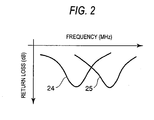
- Fig. 2 is an exemplary schematic diagram showing a receiving characteristic of the antenna switching system in Fig. 1.
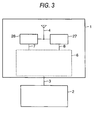
- Fig. 3 is an exemplary schematic diagram for explaining another embodiment of the antenna switching system shown in Fig. 1.
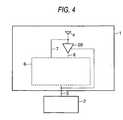
- Fig. 4 is an exemplary schematic diagram for explaining further another embodiment of the antenna switching system shown in Fig. 1.
- Fig. 5 is an exemplary schematic diagram for explaining further another embodiment of the antenna switching system shown in Fig. 1.
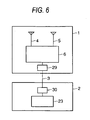
- Fig. 6 is an exemplary schematic diagram for explaining further another embodiment of the antenna switching system shown in Fig. 1.
- An antenna switching system (circuit module unit) according to a first embodiment includes an antenna unit 1, a receiving unit 2 and a feeder line 3 as shown in Fig. 1.
- the feeder line 3 is, for example, a coaxial cable, which connects the antenna unit 1 and the receiving unit 2 with each other.
- the antenna unit 1 includes: first and second antennas 4 and 5; and a switching circuit 6 for switching the antennas.
- the antennas 4 and 5 are provided for the following reason. That is, when a band to be received is, for example, a UHF band (470-770 MHz), it is difficult to obtain a desired characteristic only by a single antenna. Particularly, assume that an antenna is built in a small-sized mobile apparatus such as a cellular phone. Since the antenna is requested to be miniaturized, the miniaturized antenna cannot cover the whole band. It is therefore useful to switch two antennas by means of a switching circuit.
- a feed terminal 7 of the antenna 4 is connected to an input terminal 12(in) of an SPDT (Single Pole Double Throw) IC 12 through a DC-cutting capacitor 9.
- the SPDT IC 12 includes an FET (Field Effect Transistor).
- a feed terminal 8 of the antenna 5 is connected to the cathode side of a switching diode 11 and a resistor 22 through a DC-cutting capacitor 10. The other end of the resistor 22 is grounded.
- the anode side of the switching diode 11 is connected to an output terminal 13 of the SPDT IC 12 through a DC-cutting capacitor 16. The same anode side is also connected to a control terminal 14 of the SPDT IC 12 through a resistor 17. The other control terminal 15 of the SPDT IC is grounded.
- the receiving unit 2 has a receiving circuit 23.
- An input terminal 18 connected to the receiving circuit 23 through a DC-cutting capacitor 19 is connected to the feeder line 3 connected among the anode side of the switching diode 11, the DC-cutting capacitor 16 connected to the output terminal 13 of the SPDT IC 12, and the resistor 17.
- the receiving circuit 23 includes a control output terminal (output terminal) 21 capable of sending a control signal for switching the switching circuit 6.
- the receiving circuit 23 can perform switching control upon the SPDT IC 12 and the switching diode 11 (switch the both) in accordance with a control signal output from the output terminal 21.
- a characteristic 24 designates a return loss characteristic in view from the feed terminal 7 of the antenna 4
- a characteristic 25 designates a return loss characteristic in view from the feed terminal 8 of the antenna 5.
- the characteristic 24 corresponds to a frequency of a first frequency band of the whole receivable band
- the characteristic 25 corresponds to a frequency of a second frequency band at least a part of which does not overlap the first frequency band.
- the receiving circuit 23 Upon reception of a selection signal from the outside, the receiving circuit 23 acts as a unit for receiving the band of the characteristic 24. In this event, a control signal of "Low level (e.g. 0 V)" is output from the control output terminal 21. As a result, the control terminal 14 of the SPDT IC 12 is brought into “Low level” through the feeder line 3 so that the SPDT IC 12 is switched ON. Thus, electric continuity is established between the input and output (12 (in)-13) of the SPDT IC 12.
- Low level e.g. 0 V
- the control signal of "Low level” is also applied to the switching diode 11.
- the switching diode 11 is turned OFF, and released. That is, when the reception frequency is in the band of the characteristic 24, the SPDT IC 12 is turned ON and the switching diode 11 is turned OFF so that a reception signal input to the antenna 4 is sent to the receiving unit 2 without leaking to the antenna 5.
- the receiving circuit 23 Upon reception of a selection signal from the outside, the receiving circuit 23 acts as a unit for receiving the band of the characteristic 25. In this event, a control signal of "High level (e.g. 2.5 V)" is output from the control output terminal 21. As a result, the control terminal 14 of the SPDT IC 12 is brought into “High level” through the feeder line 3 so that the SPDT IC 12 is switched ON. Thus, electric discontinuity is established between the input and output (12 (in) -13) of the SPDT IC 12.
- High level e.g. 2.5 V
- the control signal of "High level” is also applied to the anode side of the switching diode 11 but the cathode side of the switching diode 11 is grounded through the resistor (high resistance) 22 so that the switching diode 11 is biased forward.
- a current flows into the switching diode 11 so that the switching diode 11 is turned ON, and electric continuity is established therein.
- the resistance value of the resistor 22 is 1 k ⁇ when the current flowing in the switching diode 11 is 1 mA. That is, when the reception frequency is in the band of the characteristic 25, the SPDT IC 12 is turned OFF and the switching diode 11 is turned ON so that a reception signal input to the antenna 5 is sent to the receiving unit 2 without leaking to the antenna 4.
- the DC-cutting capacitor 19 is inserted between the node 18 between the feeder line 3 and the control output terminal 21 and the receiving circuit 23, and an inductor 20 is inserted between the node 18 and the control output terminal 21 so that the reception signal is prevented from leaking to the control output terminal 21.
- the switching diode 11 is short of isolation in OFF time in comparison with the SPDT IC 12.
- a PIN diode may be used instead.
- attenuation in ON time increases so that the input sensitivity characteristic deteriorates.
- isolation in OFF time also increases so that leakage to the antenna 5 can be reduced more greatly.
- the SPDT IC 12 is replaced by a circuit consisting of an SPST (Single Pole Single Throw) IC or an FET.
- SPST Single Pole Single Throw
- An antenna unit 1 shown in Fig. 3 includes one antenna 4, first and second matching circuits 26 and 27, and a switching circuit 6.
- Each matching circuit 26, 27 includes, for example, an inductor and a capacitor.
- the matching circuits 26 and 27 give the antenna 4 a characteristic to allow the antenna 4 to receive the frequency of the first characteristic 24 of the predetermined band shown in Fig. 2 and a characteristic to allow the antenna 4 to receive the frequency of the second characteristic 25 of the same, respectively.
- the two matching circuits can be switched only by the feeder line 3. Not to say, there will be no problem if such a matching circuit is provided for only one of the antennas.
- An antenna unit 1 shown in Fig. 4 includes one antenna 4, a low noise switch 28 and a switching circuit 6.
- the antenna 4 is used for transmission and reception.
- the low noise amplifier 28 is required.
- the transmission level is reduced by passing through the low noise amplifier 28.
- the antenna 4 and a feed terminal 7 are connected as the transmitter side (TX), while the antenna 4 and a feed terminal 8 are connected through the low noise amplifier 28 as the receiver side (RX).
- switching can be made only by one feeder line 3 so that the feeder line 3 with the feed terminal 7 is turned ON (the feeder line 3 with the feed terminal 8 is turned OFF) at the time of transmission, and the feeder line 3 with the feed terminal 8 is turned ON (the feeder line 3 with the feed terminal 7 is turned OFF) at the time of reception.
- a control signal of "High level (e.g. 2.5 V)" is output from a control output terminal (21) at the time of reception. That is, the low noise amplifier 28 is turned ON (operable).
- a control signal of "Low level (e.g. 0 V)” is output so that the low noise amplifier 28 is turned OFF.
- Fig. 5 shows an antenna switching system according to a fourth embodiment.
- parts the same as those in Fig. 1 are referenced correspondingly, and description thereof will be simplified.
- An antenna unit 1 shown in Fig. 4 includes one antenna 4, first and second matching circuits 26 and 27, low noise amplifiers 31 and 32 connected to the matching circuits respectively, and a switching circuit 6.
- a band to be received is, for example, a UHF band (470-770 MHz)
- an antenna is built in a small-sized mobile apparatus such as a cellular phone.
- the antenna is requested to be miniaturized.
- a method for switching the first and second matching circuits 26 and 27 by a switch is useful to cover the whole band with one miniaturized antenna.
- the antenna 4 is used for transmission and reception. In order to gain sensitivity at the time of reception, the low noise amplifiers 31 and 32 are required. However, at the time of transmission, the transmission level is reduced due to the low noise amplifiers 31 and 32. Therefore, the antenna 4 and the switching circuit 6 are connected through a signal line 33 as the transmitter side (TX).
- the antenna 4 and a feed terminal 7 are connected through the first matching circuit 26 and the first low noise amplifier 31, and the antenna 4 and a feed terminal 8 are connected through a second matching circuit 27 and a second low noise amplifier 32.
- switching can be made only by one feeder line 3 so that the influence of the low noise amplifiers 31 and 32 can be eliminated at the time of transmission while the feeder line 3 with the feed terminal 7 is turned ON (the feeder line 3 with the feed terminal 8 is turned OFF) at the time of reception, and the feeder line 3 with the feed terminal 8 is turned ON (the feeder line 3 with the feed terminal 7 is turned OFF) at the time of reception.
- each low noise amplifier 31 and 32 is turned ON (operable) selectively correspondingly to each selected antenna 4, 5.
- the switch 34 may be changed over in sync with a selection signal supplied to the receiving circuit 23 from the outside.
- a communication signal serves as a jamming signal for the TV tuner whenever the cellular phone has communication.
- a cellular phone using a frequency band called a 800 MHz band is apt to suffer interfere because the frequency is very close to the frequency of a highest-frequency RF signal (770 MHz) of TV broadcasting waves, thereby causing degradation in TV image quality.
- signal processing circuits for eliminating jamming signals for example, filters (low pass filters, high pass filters, or band pass filters) or traps 29 and 30 having resonance points at jamming signal frequencies have to be provided on the lines of reception signals in the antenna unit 1 and the receiving unit 2.
- the transmission wave level of the cellular phone is up to +24 dBm and so high that filters or traps having attenuation of about 60 dB are required in consideration of isolation between the antenna of the TV tuner and the antenna of the cellular phone, the performance of the TV tuner, and so on.
- the circuit scale needs to be increased.
- the filters or traps are mounted on the tuner built in the cellular phone, they cannot be implemented by one chip, but at least two chips are required.
- the distance between input and output is so short that attenuation of the two chips theoretically expected to have a value 2 times as high as that of one chip decreases to about 1.7 times.
- the filters or traps 29 and 30 when the chips of the filters or traps 29 and 30 are disposed on the switching circuit 6 side and the receiving circuit 23 side respectively one by one through the feeder line 3, the filters or traps can be operated in cooperation with each other.
- the filters or traps 29 and 30 are not limited to chip forms. Similar effect can be obtained even if they are assemblies of a plurality of chip devices such as LCRs.
- the antenna switching system (circuit module unit) described above with reference to the embodiments is not limited to an appliance to a portable terminal, a cellular phone, a personal computer, a PC card, a high frequency module.
- the antenna switching system can be applied to any apparatus that is portable and provided with a TV tuner (TV receiving function) .
- an antenna switching system capable of switching signals received from two antennas having different characteristics for different bands respectively by use of a single feeder line so that the cost can be reduced and the space can be saved.
- circuit module unit capable of switching signals received from two antennas having different characteristics for different bands respectively by use of a single feeder line so that the cost can be reduced and the space can be saved.
- two chips of filters and traps for eliminating jamming signals are mounted on the antenna unit and the receiving unit respectively one by one, the jamming signals can be eliminated efficiently.
- the present invention is not limited to any one of the aforementioned embodiments. Various modifications or changes can be made on the invention without departing from the gist thereof when it is carried out.
- the embodiments may be combined with one another suitably if possible, or each embodiment may be partially deleted when it is carried out. On those occasions, various effects caused by the combination or deletion can be obtained.
Landscapes
- Engineering & Computer Science (AREA)
- Computer Networks & Wireless Communication (AREA)
- Signal Processing (AREA)
- Input Circuits Of Receivers And Coupling Of Receivers And Audio Equipment (AREA)
- Transceivers (AREA)
- Variable-Direction Aerials And Aerial Arrays (AREA)
Applications Claiming Priority (1)
| Application Number | Priority Date | Filing Date | Title |
|---|---|---|---|
| JP2005192984A JP2007013715A (ja) | 2005-06-30 | 2005-06-30 | アンテナスイッチシステム |
Publications (1)
| Publication Number | Publication Date |
|---|---|
| EP1739857A2 true EP1739857A2 (en) | 2007-01-03 |
Family
ID=37052591
Family Applications (1)
| Application Number | Title | Priority Date | Filing Date |
|---|---|---|---|
| EP06116249A Pending EP1739857A2 (en) | 2005-06-30 | 2006-06-28 | Antenna switching system |
Country Status (3)
| Country | Link |
|---|---|
| US (1) | US20070004345A1 (enExample) |
| EP (1) | EP1739857A2 (enExample) |
| JP (1) | JP2007013715A (enExample) |
Cited By (1)
| Publication number | Priority date | Publication date | Assignee | Title |
|---|---|---|---|---|
| RU226570U1 (ru) * | 2024-04-16 | 2024-06-11 | Акционерное общество "Информтехника и Связь" (АО "Информтехника и Связь") | Устройство коммутации системы оповещения |
Families Citing this family (8)
| Publication number | Priority date | Publication date | Assignee | Title |
|---|---|---|---|---|
| TWI352450B (en) * | 2007-12-12 | 2011-11-11 | Wistron Neweb Corp | Transceiver device of wireless signals and related |
| JP2010252161A (ja) * | 2009-04-17 | 2010-11-04 | Hitachi Kokusai Electric Inc | ダイオードスイッチ回路 |
| US20130002516A1 (en) * | 2010-03-26 | 2013-01-03 | Pioneer Corporation | Receiving apparatus |
| US9072107B2 (en) * | 2012-01-11 | 2015-06-30 | Interdigital Patent Holdings, Inc. | Adaptive control channel |
| JP5974944B2 (ja) * | 2013-03-21 | 2016-08-23 | ソニー株式会社 | 携帯端末 |
| US9885787B2 (en) * | 2014-07-28 | 2018-02-06 | Echostar Technologies L.L.C. | Electronic satellite feed switcher |
| US11063622B2 (en) | 2018-08-08 | 2021-07-13 | Avx Antenna, Inc. | VHF-UHF antenna system with feedback |
| US11196449B2 (en) | 2018-08-08 | 2021-12-07 | Avx Antenna, Inc. | Methods for configuring a multi-mode antenna system for multi-channel communication systems |
-
2005
- 2005-06-30 JP JP2005192984A patent/JP2007013715A/ja not_active Withdrawn
-
2006
- 2006-06-28 US US11/475,981 patent/US20070004345A1/en not_active Abandoned
- 2006-06-28 EP EP06116249A patent/EP1739857A2/en active Pending
Cited By (1)
| Publication number | Priority date | Publication date | Assignee | Title |
|---|---|---|---|---|
| RU226570U1 (ru) * | 2024-04-16 | 2024-06-11 | Акционерное общество "Информтехника и Связь" (АО "Информтехника и Связь") | Устройство коммутации системы оповещения |
Also Published As
| Publication number | Publication date |
|---|---|
| US20070004345A1 (en) | 2007-01-04 |
| JP2007013715A (ja) | 2007-01-18 |
Similar Documents
| Publication | Publication Date | Title |
|---|---|---|
| US8774067B2 (en) | Antenna impedance stabilization with stabilization load in second antenna circuitry | |
| US7511681B2 (en) | Switchable antenna arrangement | |
| KR100698971B1 (ko) | 수신 및 송신 전용 안테나를 구비하는 이중 대역 무선 전화기 및 관련 방법 | |
| AU724641B2 (en) | Dual-band antenna coupler for a portable radiotelephone | |
| KR100989064B1 (ko) | 다중 공진 안테나 | |
| US6154177A (en) | Antenna device and radio receiver using the same | |
| US6653697B2 (en) | High frequency switch circuit and communications terminal using the same | |
| US20120050122A1 (en) | Antenna module and impedance matching method thereof | |
| US6510310B1 (en) | Dual mode phone architecture utilizing a single transmit-receive switch | |
| US20060229035A1 (en) | High-frequency circuit and communications apparatus comprising same | |
| KR20010043766A (ko) | 이중 대역 이동 전화에서 고조파 억제 장치 및 방법 | |
| US7340274B2 (en) | Cellular phone capable of receiving a plurality of broadcast waves | |
| US12348192B2 (en) | Radio-frequency amplifier circuitry with improved transmit and receive performance | |
| US20060009164A1 (en) | Radio frequency switching circuit | |
| US20160126640A1 (en) | Diversity antenna apparatus of mobile terminal and implementation method thereof | |
| US20070004345A1 (en) | Antenna switching system | |
| EP2134000B1 (en) | Multi-band mobile communication device | |
| US6718157B1 (en) | Apparatus for commonly using antenna for call signal and television broadcasting signal in radio communication terminal | |
| US9819077B1 (en) | Multi-feed antenna optimized for non-50 Ohm operation | |
| EP1916774A1 (en) | Antenna device and portable radio communication device comprising such antenna device | |
| US7602346B2 (en) | Antenna module, radio device and mobile radio terminal | |
| US8665171B2 (en) | Diversity antenna apparatus including rectifier device | |
| US20230223690A1 (en) | Antenna module and communication device incorporating the same | |
| US11949437B2 (en) | Wideband antenna system | |
| KR100318916B1 (ko) | 다중밴드 단말기의 전력 증폭 장치 |
Legal Events
| Date | Code | Title | Description |
|---|---|---|---|
| PUAI | Public reference made under article 153(3) epc to a published international application that has entered the european phase |
Free format text: ORIGINAL CODE: 0009012 |
|
| AK | Designated contracting states |
Kind code of ref document: A2 Designated state(s): AT BE BG CH CY CZ DE DK EE ES FI FR GB GR HU IE IS IT LI LT LU LV MC NL PL PT RO SE SI SK TR |
|
| AX | Request for extension of the european patent |
Extension state: AL BA HR MK YU |
|
| STAA | Information on the status of an ep patent application or granted ep patent |
Free format text: STATUS: THE APPLICATION HAS BEEN WITHDRAWN |
|
| 18W | Application withdrawn |
Effective date: 20090226 |
|
| D18W | Application withdrawn (deleted) | ||
| R18W | Application withdrawn (corrected) |
Effective date: 20090226 |