EP1739179A1 - Serum-free stable transfection and production of recombinant human proteins in human cell lines - Google Patents
Serum-free stable transfection and production of recombinant human proteins in human cell lines Download PDFInfo
- Publication number
- EP1739179A1 EP1739179A1 EP05105965A EP05105965A EP1739179A1 EP 1739179 A1 EP1739179 A1 EP 1739179A1 EP 05105965 A EP05105965 A EP 05105965A EP 05105965 A EP05105965 A EP 05105965A EP 1739179 A1 EP1739179 A1 EP 1739179A1
- Authority
- EP
- European Patent Office
- Prior art keywords
- human
- cells
- vector
- seq
- protein
- Prior art date
- Legal status (The legal status is an assumption and is not a legal conclusion. Google has not performed a legal analysis and makes no representation as to the accuracy of the status listed.)
- Withdrawn
Links
- 238000004519 manufacturing process Methods 0.000 title claims abstract description 35
- 108090000144 Human Proteins Proteins 0.000 title claims abstract description 29
- 102000003839 Human Proteins Human genes 0.000 title claims abstract description 29
- 210000005260 human cell Anatomy 0.000 title claims description 24
- 238000003153 stable transfection Methods 0.000 title description 7
- 108090000623 proteins and genes Proteins 0.000 claims abstract description 111
- 239000013598 vector Substances 0.000 claims abstract description 106
- 238000000034 method Methods 0.000 claims abstract description 47
- 102000004169 proteins and genes Human genes 0.000 claims abstract description 47
- 102000004506 Blood Proteins Human genes 0.000 claims abstract description 14
- 108010017384 Blood Proteins Proteins 0.000 claims abstract description 14
- 210000004027 cell Anatomy 0.000 claims description 172
- 238000001890 transfection Methods 0.000 claims description 47
- 229960004222 factor ix Drugs 0.000 claims description 31
- 229960000301 factor viii Drugs 0.000 claims description 28
- 108010076282 Factor IX Proteins 0.000 claims description 26
- 102100022641 Coagulation factor IX Human genes 0.000 claims description 25
- 108010054218 Factor VIII Proteins 0.000 claims description 24
- 102000001690 Factor VIII Human genes 0.000 claims description 24
- 239000003114 blood coagulation factor Substances 0.000 claims description 21
- 101000911390 Homo sapiens Coagulation factor VIII Proteins 0.000 claims description 19
- YQYJSBFKSSDGFO-UHFFFAOYSA-N Epihygromycin Natural products OC1C(O)C(C(=O)C)OC1OC(C(=C1)O)=CC=C1C=C(C)C(=O)NC1C(O)C(O)C2OCOC2C1O YQYJSBFKSSDGFO-UHFFFAOYSA-N 0.000 claims description 12
- 239000013612 plasmid Substances 0.000 claims description 12
- 108091028043 Nucleic acid sequence Proteins 0.000 claims description 11
- 108010006025 bovine growth hormone Proteins 0.000 claims description 11
- 210000003292 kidney cell Anatomy 0.000 claims description 11
- 210000002966 serum Anatomy 0.000 claims description 11
- 108010047303 von Willebrand Factor Proteins 0.000 claims description 11
- 102100036537 von Willebrand factor Human genes 0.000 claims description 11
- 229960001134 von willebrand factor Drugs 0.000 claims description 11
- 150000007523 nucleic acids Chemical group 0.000 claims description 9
- 230000010076 replication Effects 0.000 claims description 9
- 230000001105 regulatory effect Effects 0.000 claims description 8
- 102100023804 Coagulation factor VII Human genes 0.000 claims description 7
- 108010023321 Factor VII Proteins 0.000 claims description 7
- 108010054265 Factor VIIa Proteins 0.000 claims description 7
- 239000001506 calcium phosphate Substances 0.000 claims description 7
- 229910000389 calcium phosphate Inorganic materials 0.000 claims description 7
- 235000011010 calcium phosphates Nutrition 0.000 claims description 7
- 239000003795 chemical substances by application Substances 0.000 claims description 7
- 238000012258 culturing Methods 0.000 claims description 7
- 229940012413 factor vii Drugs 0.000 claims description 7
- 229940012414 factor viia Drugs 0.000 claims description 7
- 102000057593 human F8 Human genes 0.000 claims description 7
- 239000003550 marker Substances 0.000 claims description 7
- QORWJWZARLRLPR-UHFFFAOYSA-H tricalcium bis(phosphate) Chemical compound [Ca+2].[Ca+2].[Ca+2].[O-]P([O-])([O-])=O.[O-]P([O-])([O-])=O QORWJWZARLRLPR-UHFFFAOYSA-H 0.000 claims description 7
- 239000003153 chemical reaction reagent Substances 0.000 claims description 6
- 229960000900 human factor viii Drugs 0.000 claims description 6
- 210000003734 kidney Anatomy 0.000 claims description 6
- 238000004114 suspension culture Methods 0.000 claims description 6
- 102000029797 Prion Human genes 0.000 claims description 5
- 108091000054 Prion Proteins 0.000 claims description 5
- 239000000137 peptide hydrolase inhibitor Substances 0.000 claims description 5
- 230000008488 polyadenylation Effects 0.000 claims description 5
- 230000003612 virological effect Effects 0.000 claims description 5
- 108010071942 Colony-Stimulating Factors Proteins 0.000 claims description 4
- 102000007644 Colony-Stimulating Factors Human genes 0.000 claims description 4
- OYVAGSVQBOHSSS-UAPAGMARSA-O bleomycin A2 Chemical compound N([C@H](C(=O)N[C@H](C)[C@@H](O)[C@H](C)C(=O)N[C@@H]([C@H](O)C)C(=O)NCCC=1SC=C(N=1)C=1SC=C(N=1)C(=O)NCCC[S+](C)C)[C@@H](O[C@H]1[C@H]([C@@H](O)[C@H](O)[C@H](CO)O1)O[C@@H]1[C@H]([C@@H](OC(N)=O)[C@H](O)[C@@H](CO)O1)O)C=1N=CNC=1)C(=O)C1=NC([C@H](CC(N)=O)NC[C@H](N)C(N)=O)=NC(N)=C1C OYVAGSVQBOHSSS-UAPAGMARSA-O 0.000 claims description 4
- 229940047120 colony stimulating factors Drugs 0.000 claims description 4
- 229940042399 direct acting antivirals protease inhibitors Drugs 0.000 claims description 4
- 239000003623 enhancer Substances 0.000 claims description 4
- 108010089996 B-domain-deleted factor VIII Proteins 0.000 claims description 3
- 229930193140 Neomycin Natural products 0.000 claims description 3
- 108010084455 Zeocin Proteins 0.000 claims description 3
- 125000002091 cationic group Chemical group 0.000 claims description 3
- BRZYSWJRSDMWLG-CAXSIQPQSA-N geneticin Natural products O1C[C@@](O)(C)[C@H](NC)[C@@H](O)[C@H]1O[C@@H]1[C@@H](O)[C@H](O[C@@H]2[C@@H]([C@@H](O)[C@H](O)[C@@H](C(C)O)O2)N)[C@@H](N)C[C@H]1N BRZYSWJRSDMWLG-CAXSIQPQSA-N 0.000 claims description 3
- 239000003102 growth factor Substances 0.000 claims description 3
- 230000002401 inhibitory effect Effects 0.000 claims description 3
- 229960004927 neomycin Drugs 0.000 claims description 3
- CWCMIVBLVUHDHK-ZSNHEYEWSA-N phleomycin D1 Chemical compound N([C@H](C(=O)N[C@H](C)[C@@H](O)[C@H](C)C(=O)N[C@@H]([C@H](O)C)C(=O)NCCC=1SC[C@@H](N=1)C=1SC=C(N=1)C(=O)NCCCCNC(N)=N)[C@@H](O[C@H]1[C@H]([C@@H](O)[C@H](O)[C@H](CO)O1)O[C@@H]1[C@H]([C@@H](OC(N)=O)[C@H](O)[C@@H](CO)O1)O)C=1N=CNC=1)C(=O)C1=NC([C@H](CC(N)=O)NC[C@H](N)C(N)=O)=NC(N)=C1C CWCMIVBLVUHDHK-ZSNHEYEWSA-N 0.000 claims description 3
- 108010006654 Bleomycin Proteins 0.000 claims description 2
- 102000014914 Carrier Proteins Human genes 0.000 claims description 2
- 108010078791 Carrier Proteins Proteins 0.000 claims description 2
- 108090000317 Chymotrypsin Proteins 0.000 claims description 2
- 102000004127 Cytokines Human genes 0.000 claims description 2
- 108090000695 Cytokines Proteins 0.000 claims description 2
- 102000003951 Erythropoietin Human genes 0.000 claims description 2
- 108090000394 Erythropoietin Proteins 0.000 claims description 2
- 108700039887 Essential Genes Proteins 0.000 claims description 2
- 102000015696 Interleukins Human genes 0.000 claims description 2
- 108010063738 Interleukins Proteins 0.000 claims description 2
- 108010025815 Kanamycin Kinase Proteins 0.000 claims description 2
- 239000012097 Lipofectamine 2000 Substances 0.000 claims description 2
- 102000010292 Peptide Elongation Factor 1 Human genes 0.000 claims description 2
- 108010077524 Peptide Elongation Factor 1 Proteins 0.000 claims description 2
- 244000146510 Pereskia bleo Species 0.000 claims description 2
- 108010027570 Xanthine phosphoribosyltransferase Proteins 0.000 claims description 2
- 101710146079 Xanthine-guanine phosphoribosyltransferase Proteins 0.000 claims description 2
- 102000006646 aminoglycoside phosphotransferase Human genes 0.000 claims description 2
- 229960001561 bleomycin Drugs 0.000 claims description 2
- 229960002376 chymotrypsin Drugs 0.000 claims description 2
- 229940105423 erythropoietin Drugs 0.000 claims description 2
- 230000002496 gastric effect Effects 0.000 claims description 2
- 210000003714 granulocyte Anatomy 0.000 claims description 2
- 239000005556 hormone Substances 0.000 claims description 2
- 229940088597 hormone Drugs 0.000 claims description 2
- 229940047122 interleukins Drugs 0.000 claims description 2
- 210000004185 liver Anatomy 0.000 claims description 2
- 210000004072 lung Anatomy 0.000 claims description 2
- 210000002540 macrophage Anatomy 0.000 claims description 2
- 210000004165 myocardium Anatomy 0.000 claims description 2
- 210000001672 ovary Anatomy 0.000 claims description 2
- OXCMYAYHXIHQOA-UHFFFAOYSA-N potassium;[2-butyl-5-chloro-3-[[4-[2-(1,2,4-triaza-3-azanidacyclopenta-1,4-dien-5-yl)phenyl]phenyl]methyl]imidazol-4-yl]methanol Chemical compound [K+].CCCCC1=NC(Cl)=C(CO)N1CC1=CC=C(C=2C(=CC=CC=2)C2=N[N-]N=N2)C=C1 OXCMYAYHXIHQOA-UHFFFAOYSA-N 0.000 claims description 2
- 230000006798 recombination Effects 0.000 claims description 2
- 238000005215 recombination Methods 0.000 claims description 2
- 210000002460 smooth muscle Anatomy 0.000 claims description 2
- 230000004936 stimulating effect Effects 0.000 claims description 2
- 210000001519 tissue Anatomy 0.000 claims description 2
- 210000003932 urinary bladder Anatomy 0.000 claims description 2
- 108700026220 vif Genes Proteins 0.000 claims description 2
- 241000894006 Bacteria Species 0.000 claims 1
- 102100039619 Granulocyte colony-stimulating factor Human genes 0.000 claims 1
- 101000746367 Homo sapiens Granulocyte colony-stimulating factor Proteins 0.000 claims 1
- 230000003321 amplification Effects 0.000 claims 1
- 229940065638 intron a Drugs 0.000 claims 1
- 238000003199 nucleic acid amplification method Methods 0.000 claims 1
- 239000002753 trypsin inhibitor Substances 0.000 claims 1
- 108010050122 alpha 1-Antitrypsin Proteins 0.000 description 61
- 102000015395 alpha 1-Antitrypsin Human genes 0.000 description 58
- 229940024142 alpha 1-antitrypsin Drugs 0.000 description 58
- 235000018102 proteins Nutrition 0.000 description 39
- 230000014509 gene expression Effects 0.000 description 29
- 239000002609 medium Substances 0.000 description 26
- 102000007056 Recombinant Fusion Proteins Human genes 0.000 description 20
- 108010008281 Recombinant Fusion Proteins Proteins 0.000 description 20
- 230000000694 effects Effects 0.000 description 18
- 239000002299 complementary DNA Substances 0.000 description 17
- 102100026735 Coagulation factor VIII Human genes 0.000 description 13
- 238000000746 purification Methods 0.000 description 12
- 108020004414 DNA Proteins 0.000 description 11
- 229960000027 human factor ix Drugs 0.000 description 11
- 230000002779 inactivation Effects 0.000 description 10
- 210000002381 plasma Anatomy 0.000 description 10
- 238000003146 transient transfection Methods 0.000 description 10
- 102000015081 Blood Coagulation Factors Human genes 0.000 description 9
- 108010039209 Blood Coagulation Factors Proteins 0.000 description 9
- 238000002965 ELISA Methods 0.000 description 9
- 241000700605 Viruses Species 0.000 description 9
- 238000010367 cloning Methods 0.000 description 9
- 108020004999 messenger RNA Proteins 0.000 description 9
- 238000012360 testing method Methods 0.000 description 9
- 108020004638 Circular DNA Proteins 0.000 description 8
- 238000003556 assay Methods 0.000 description 8
- 239000012634 fragment Substances 0.000 description 8
- 150000001413 amino acids Chemical class 0.000 description 7
- 238000002474 experimental method Methods 0.000 description 7
- 108090000765 processed proteins & peptides Proteins 0.000 description 7
- 239000006228 supernatant Substances 0.000 description 7
- 108010067372 Pancreatic elastase Proteins 0.000 description 6
- 102000016387 Pancreatic elastase Human genes 0.000 description 6
- 229960001714 calcium phosphate Drugs 0.000 description 6
- 230000000295 complement effect Effects 0.000 description 6
- 239000012228 culture supernatant Substances 0.000 description 6
- 230000012010 growth Effects 0.000 description 6
- 238000012986 modification Methods 0.000 description 6
- 108020004707 nucleic acids Proteins 0.000 description 6
- 102000039446 nucleic acids Human genes 0.000 description 6
- 239000000126 substance Substances 0.000 description 6
- 239000000758 substrate Substances 0.000 description 6
- 230000014616 translation Effects 0.000 description 6
- 238000006243 chemical reaction Methods 0.000 description 5
- 230000015271 coagulation Effects 0.000 description 5
- 238000005345 coagulation Methods 0.000 description 5
- 230000013595 glycosylation Effects 0.000 description 5
- 238000006206 glycosylation reaction Methods 0.000 description 5
- 238000011534 incubation Methods 0.000 description 5
- 230000004048 modification Effects 0.000 description 5
- 230000035772 mutation Effects 0.000 description 5
- 102000004196 processed proteins & peptides Human genes 0.000 description 5
- 239000000047 product Substances 0.000 description 5
- 230000006490 viral transcription Effects 0.000 description 5
- 229930003448 Vitamin K Natural products 0.000 description 4
- 230000009102 absorption Effects 0.000 description 4
- 238000010521 absorption reaction Methods 0.000 description 4
- 108091006088 activator proteins Proteins 0.000 description 4
- 238000001042 affinity chromatography Methods 0.000 description 4
- 239000000427 antigen Substances 0.000 description 4
- 108091007433 antigens Proteins 0.000 description 4
- 102000036639 antigens Human genes 0.000 description 4
- 238000004113 cell culture Methods 0.000 description 4
- 238000010790 dilution Methods 0.000 description 4
- 239000012895 dilution Substances 0.000 description 4
- 239000013604 expression vector Substances 0.000 description 4
- 239000001963 growth medium Substances 0.000 description 4
- 208000015181 infectious disease Diseases 0.000 description 4
- 210000004962 mammalian cell Anatomy 0.000 description 4
- SHUZOJHMOBOZST-UHFFFAOYSA-N phylloquinone Natural products CC(C)CCCCC(C)CCC(C)CCCC(=CCC1=C(C)C(=O)c2ccccc2C1=O)C SHUZOJHMOBOZST-UHFFFAOYSA-N 0.000 description 4
- 229920001184 polypeptide Polymers 0.000 description 4
- 239000012679 serum free medium Substances 0.000 description 4
- 238000002415 sodium dodecyl sulfate polyacrylamide gel electrophoresis Methods 0.000 description 4
- 239000013589 supplement Substances 0.000 description 4
- 238000013518 transcription Methods 0.000 description 4
- 230000035897 transcription Effects 0.000 description 4
- 235000019168 vitamin K Nutrition 0.000 description 4
- 239000011712 vitamin K Substances 0.000 description 4
- 150000003721 vitamin K derivatives Chemical class 0.000 description 4
- 229940046010 vitamin k Drugs 0.000 description 4
- 238000001262 western blot Methods 0.000 description 4
- QTBSBXVTEAMEQO-UHFFFAOYSA-N Acetic acid Chemical compound CC(O)=O QTBSBXVTEAMEQO-UHFFFAOYSA-N 0.000 description 3
- LFQSCWFLJHTTHZ-UHFFFAOYSA-N Ethanol Chemical compound CCO LFQSCWFLJHTTHZ-UHFFFAOYSA-N 0.000 description 3
- 108700039691 Genetic Promoter Regions Proteins 0.000 description 3
- 102000006601 Thymidine Kinase Human genes 0.000 description 3
- 108020004440 Thymidine kinase Proteins 0.000 description 3
- 230000001464 adherent effect Effects 0.000 description 3
- 229960000723 ampicillin Drugs 0.000 description 3
- AVKUERGKIZMTKX-NJBDSQKTSA-N ampicillin Chemical compound C1([C@@H](N)C(=O)N[C@H]2[C@H]3SC([C@@H](N3C2=O)C(O)=O)(C)C)=CC=CC=C1 AVKUERGKIZMTKX-NJBDSQKTSA-N 0.000 description 3
- 229960000074 biopharmaceutical Drugs 0.000 description 3
- 238000005119 centrifugation Methods 0.000 description 3
- 238000011109 contamination Methods 0.000 description 3
- 239000003599 detergent Substances 0.000 description 3
- 238000001914 filtration Methods 0.000 description 3
- 238000010438 heat treatment Methods 0.000 description 3
- 230000002209 hydrophobic effect Effects 0.000 description 3
- 230000002458 infectious effect Effects 0.000 description 3
- 150000002632 lipids Chemical class 0.000 description 3
- 239000000203 mixture Substances 0.000 description 3
- 239000002773 nucleotide Substances 0.000 description 3
- 125000003729 nucleotide group Chemical group 0.000 description 3
- 230000006920 protein precipitation Effects 0.000 description 3
- 239000000725 suspension Substances 0.000 description 3
- PGOHTUIFYSHAQG-LJSDBVFPSA-N (2S)-6-amino-2-[[(2S)-5-amino-2-[[(2S)-2-[[(2S)-2-[[(2S)-2-[[(2S)-4-amino-2-[[(2S)-2-[[(2S)-2-[[(2S)-2-[[(2S)-2-[[(2S)-5-amino-2-[[(2S)-5-amino-2-[[(2S)-2-[[(2S)-2-[[(2S)-2-[[(2S,3R)-2-[[(2S)-5-amino-2-[[(2S)-2-[[(2S)-2-[[(2S,3R)-2-[[(2S)-2-[[(2S)-2-[[(2S)-2-[[(2S)-2-[[(2S)-5-amino-2-[[(2S)-1-[(2S,3R)-2-[[(2S)-2-[[(2S)-2-[[(2R)-2-[[(2S)-2-[[(2S)-2-[[2-[[(2S)-2-[[(2S)-2-[[(2S)-2-[[(2S)-1-[(2S)-2-[[(2S)-2-[[(2S)-2-[[(2S)-2-amino-4-methylsulfanylbutanoyl]amino]-3-(1H-indol-3-yl)propanoyl]amino]-5-carbamimidamidopentanoyl]amino]propanoyl]pyrrolidine-2-carbonyl]amino]-3-methylbutanoyl]amino]-4-methylpentanoyl]amino]-4-methylpentanoyl]amino]acetyl]amino]-3-hydroxypropanoyl]amino]-4-methylpentanoyl]amino]-3-sulfanylpropanoyl]amino]-4-methylsulfanylbutanoyl]amino]-5-carbamimidamidopentanoyl]amino]-3-hydroxybutanoyl]pyrrolidine-2-carbonyl]amino]-5-oxopentanoyl]amino]-3-hydroxypropanoyl]amino]-3-hydroxypropanoyl]amino]-3-(1H-imidazol-5-yl)propanoyl]amino]-4-methylpentanoyl]amino]-3-hydroxybutanoyl]amino]-3-(1H-indol-3-yl)propanoyl]amino]-5-carbamimidamidopentanoyl]amino]-5-oxopentanoyl]amino]-3-hydroxybutanoyl]amino]-3-hydroxypropanoyl]amino]-3-carboxypropanoyl]amino]-3-hydroxypropanoyl]amino]-5-oxopentanoyl]amino]-5-oxopentanoyl]amino]-3-phenylpropanoyl]amino]-5-carbamimidamidopentanoyl]amino]-3-methylbutanoyl]amino]-4-methylpentanoyl]amino]-4-oxobutanoyl]amino]-5-carbamimidamidopentanoyl]amino]-3-(1H-indol-3-yl)propanoyl]amino]-4-carboxybutanoyl]amino]-5-oxopentanoyl]amino]hexanoic acid Chemical compound CSCC[C@H](N)C(=O)N[C@@H](Cc1c[nH]c2ccccc12)C(=O)N[C@@H](CCCNC(N)=N)C(=O)N[C@@H](C)C(=O)N1CCC[C@H]1C(=O)N[C@@H](C(C)C)C(=O)N[C@@H](CC(C)C)C(=O)N[C@@H](CC(C)C)C(=O)NCC(=O)N[C@@H](CO)C(=O)N[C@@H](CC(C)C)C(=O)N[C@@H](CS)C(=O)N[C@@H](CCSC)C(=O)N[C@@H](CCCNC(N)=N)C(=O)N[C@@H]([C@@H](C)O)C(=O)N1CCC[C@H]1C(=O)N[C@@H](CCC(N)=O)C(=O)N[C@@H](CO)C(=O)N[C@@H](CO)C(=O)N[C@@H](Cc1cnc[nH]1)C(=O)N[C@@H](CC(C)C)C(=O)N[C@@H]([C@@H](C)O)C(=O)N[C@@H](Cc1c[nH]c2ccccc12)C(=O)N[C@@H](CCCNC(N)=N)C(=O)N[C@@H](CCC(N)=O)C(=O)N[C@@H]([C@@H](C)O)C(=O)N[C@@H](CO)C(=O)N[C@@H](CC(O)=O)C(=O)N[C@@H](CO)C(=O)N[C@@H](CCC(N)=O)C(=O)N[C@@H](CCC(N)=O)C(=O)N[C@@H](Cc1ccccc1)C(=O)N[C@@H](CCCNC(N)=N)C(=O)N[C@@H](C(C)C)C(=O)N[C@@H](CC(C)C)C(=O)N[C@@H](CC(N)=O)C(=O)N[C@@H](CCCNC(N)=N)C(=O)N[C@@H](Cc1c[nH]c2ccccc12)C(=O)N[C@@H](CCC(O)=O)C(=O)N[C@@H](CCC(N)=O)C(=O)N[C@@H](CCCCN)C(O)=O PGOHTUIFYSHAQG-LJSDBVFPSA-N 0.000 description 2
- 108091032973 (ribonucleotides)n+m Proteins 0.000 description 2
- 101710169336 5'-deoxyadenosine deaminase Proteins 0.000 description 2
- 102000055025 Adenosine deaminases Human genes 0.000 description 2
- 239000005995 Aluminium silicate Substances 0.000 description 2
- UXVMQQNJUSDDNG-UHFFFAOYSA-L Calcium chloride Chemical compound [Cl-].[Cl-].[Ca+2] UXVMQQNJUSDDNG-UHFFFAOYSA-L 0.000 description 2
- 241000283707 Capra Species 0.000 description 2
- 102000000311 Cytosine Deaminase Human genes 0.000 description 2
- 108010080611 Cytosine Deaminase Proteins 0.000 description 2
- 239000006144 Dulbecco’s modified Eagle's medium Substances 0.000 description 2
- 101001091269 Escherichia coli Hygromycin-B 4-O-kinase Proteins 0.000 description 2
- 101000823116 Homo sapiens Alpha-1-antitrypsin Proteins 0.000 description 2
- 101100114967 Homo sapiens CSF3 gene Proteins 0.000 description 2
- 241001135569 Human adenovirus 5 Species 0.000 description 2
- 101150001806 NTS gene Proteins 0.000 description 2
- 108700026244 Open Reading Frames Proteins 0.000 description 2
- 239000012124 Opti-MEM Substances 0.000 description 2
- RJKFOVLPORLFTN-LEKSSAKUSA-N Progesterone Chemical compound C1CC2=CC(=O)CC[C@]2(C)[C@@H]2[C@@H]1[C@@H]1CC[C@H](C(=O)C)[C@@]1(C)CC2 RJKFOVLPORLFTN-LEKSSAKUSA-N 0.000 description 2
- 101001091268 Streptomyces hygroscopicus Hygromycin-B 7''-O-kinase Proteins 0.000 description 2
- 108010022394 Threonine synthase Proteins 0.000 description 2
- 108010000499 Thromboplastin Proteins 0.000 description 2
- 102000002262 Thromboplastin Human genes 0.000 description 2
- 230000004913 activation Effects 0.000 description 2
- OJYGBLRPYBAHRT-UHFFFAOYSA-N alphachloralose Chemical compound O1C(C(Cl)(Cl)Cl)OC2C(O)C(C(O)CO)OC21 OJYGBLRPYBAHRT-UHFFFAOYSA-N 0.000 description 2
- 235000012211 aluminium silicate Nutrition 0.000 description 2
- 125000000539 amino acid group Chemical group 0.000 description 2
- 238000004458 analytical method Methods 0.000 description 2
- 235000021120 animal protein Nutrition 0.000 description 2
- 238000005571 anion exchange chromatography Methods 0.000 description 2
- 230000000890 antigenic effect Effects 0.000 description 2
- 230000008901 benefit Effects 0.000 description 2
- 229940031422 benefix Drugs 0.000 description 2
- 239000000872 buffer Substances 0.000 description 2
- 239000001110 calcium chloride Substances 0.000 description 2
- 229910001628 calcium chloride Inorganic materials 0.000 description 2
- 230000015556 catabolic process Effects 0.000 description 2
- 238000011210 chromatographic step Methods 0.000 description 2
- 238000004587 chromatography analysis Methods 0.000 description 2
- 230000035602 clotting Effects 0.000 description 2
- 210000000805 cytoplasm Anatomy 0.000 description 2
- 230000002950 deficient Effects 0.000 description 2
- 238000006731 degradation reaction Methods 0.000 description 2
- 102000004419 dihydrofolate reductase Human genes 0.000 description 2
- 230000002708 enhancing effect Effects 0.000 description 2
- -1 etc.) Proteins 0.000 description 2
- 102000037865 fusion proteins Human genes 0.000 description 2
- 108020001507 fusion proteins Proteins 0.000 description 2
- 102000051631 human SERPINA1 Human genes 0.000 description 2
- 244000052637 human pathogen Species 0.000 description 2
- 238000000338 in vitro Methods 0.000 description 2
- 239000012678 infectious agent Substances 0.000 description 2
- 238000003780 insertion Methods 0.000 description 2
- 230000037431 insertion Effects 0.000 description 2
- 230000010354 integration Effects 0.000 description 2
- 238000002955 isolation Methods 0.000 description 2
- NLYAJNPCOHFWQQ-UHFFFAOYSA-N kaolin Chemical compound O.O.O=[Al]O[Si](=O)O[Si](=O)O[Al]=O NLYAJNPCOHFWQQ-UHFFFAOYSA-N 0.000 description 2
- 239000007788 liquid Substances 0.000 description 2
- 125000001483 monosaccharide substituent group Chemical group 0.000 description 2
- 239000013642 negative control Substances 0.000 description 2
- 230000036961 partial effect Effects 0.000 description 2
- 238000001556 precipitation Methods 0.000 description 2
- 238000002360 preparation method Methods 0.000 description 2
- RXWNCPJZOCPEPQ-NVWDDTSBSA-N puromycin Chemical compound C1=CC(OC)=CC=C1C[C@H](N)C(=O)N[C@H]1[C@@H](O)[C@H](N2C3=NC=NC(=C3N=C2)N(C)C)O[C@@H]1CO RXWNCPJZOCPEPQ-NVWDDTSBSA-N 0.000 description 2
- 238000011084 recovery Methods 0.000 description 2
- 238000003757 reverse transcription PCR Methods 0.000 description 2
- 239000004017 serum-free culture medium Substances 0.000 description 2
- 125000005629 sialic acid group Chemical group 0.000 description 2
- 238000001542 size-exclusion chromatography Methods 0.000 description 2
- 230000001225 therapeutic effect Effects 0.000 description 2
- 239000011573 trace mineral Substances 0.000 description 2
- 235000013619 trace mineral Nutrition 0.000 description 2
- 238000003151 transfection method Methods 0.000 description 2
- 238000012546 transfer Methods 0.000 description 2
- 238000013519 translation Methods 0.000 description 2
- 241001430294 unidentified retrovirus Species 0.000 description 2
- 230000035899 viability Effects 0.000 description 2
- 229940088594 vitamin Drugs 0.000 description 2
- 229930003231 vitamin Natural products 0.000 description 2
- 239000011782 vitamin Substances 0.000 description 2
- 235000013343 vitamin Nutrition 0.000 description 2
- XLYOFNOQVPJJNP-UHFFFAOYSA-N water Substances O XLYOFNOQVPJJNP-UHFFFAOYSA-N 0.000 description 2
- 239000012224 working solution Substances 0.000 description 2
- OPCHFPHZPIURNA-MFERNQICSA-N (2s)-2,5-bis(3-aminopropylamino)-n-[2-(dioctadecylamino)acetyl]pentanamide Chemical compound CCCCCCCCCCCCCCCCCCN(CC(=O)NC(=O)[C@H](CCCNCCCN)NCCCN)CCCCCCCCCCCCCCCCCC OPCHFPHZPIURNA-MFERNQICSA-N 0.000 description 1
- KSXTUUUQYQYKCR-LQDDAWAPSA-M 2,3-bis[[(z)-octadec-9-enoyl]oxy]propyl-trimethylazanium;chloride Chemical compound [Cl-].CCCCCCCC\C=C/CCCCCCCC(=O)OCC(C[N+](C)(C)C)OC(=O)CCCCCCC\C=C/CCCCCCCC KSXTUUUQYQYKCR-LQDDAWAPSA-M 0.000 description 1
- BFSVOASYOCHEOV-UHFFFAOYSA-N 2-diethylaminoethanol Chemical compound CCN(CC)CCO BFSVOASYOCHEOV-UHFFFAOYSA-N 0.000 description 1
- 108020005345 3' Untranslated Regions Proteins 0.000 description 1
- 108020003589 5' Untranslated Regions Proteins 0.000 description 1
- 102100036512 7-dehydrocholesterol reductase Human genes 0.000 description 1
- 101150008391 A1 gene Proteins 0.000 description 1
- 101150109698 A2 gene Proteins 0.000 description 1
- 101800001401 Activation peptide Proteins 0.000 description 1
- 102400000069 Activation peptide Human genes 0.000 description 1
- 241000713838 Avian myeloblastosis virus Species 0.000 description 1
- 206010006187 Breast cancer Diseases 0.000 description 1
- 208000026310 Breast neoplasm Diseases 0.000 description 1
- 241000282693 Cercopithecidae Species 0.000 description 1
- 108091026890 Coding region Proteins 0.000 description 1
- 241000701022 Cytomegalovirus Species 0.000 description 1
- KDXKERNSBIXSRK-RXMQYKEDSA-N D-lysine Chemical compound NCCCC[C@@H](N)C(O)=O KDXKERNSBIXSRK-RXMQYKEDSA-N 0.000 description 1
- 102000004163 DNA-directed RNA polymerases Human genes 0.000 description 1
- 108090000626 DNA-directed RNA polymerases Proteins 0.000 description 1
- 229920002307 Dextran Polymers 0.000 description 1
- 108010014172 Factor V Proteins 0.000 description 1
- 201000003542 Factor VIII deficiency Diseases 0.000 description 1
- 108010074864 Factor XI Proteins 0.000 description 1
- 239000012739 FreeStyle 293 Expression medium Substances 0.000 description 1
- 102000003886 Glycoproteins Human genes 0.000 description 1
- 108090000288 Glycoproteins Proteins 0.000 description 1
- 208000009292 Hemophilia A Diseases 0.000 description 1
- 241000282412 Homo Species 0.000 description 1
- 101000928720 Homo sapiens 7-dehydrocholesterol reductase Proteins 0.000 description 1
- 101001002657 Homo sapiens Interleukin-2 Proteins 0.000 description 1
- 101000608653 Homo sapiens UbiA prenyltransferase domain-containing protein 1 Proteins 0.000 description 1
- GRRNUXAQVGOGFE-UHFFFAOYSA-N Hygromycin-B Natural products OC1C(NC)CC(N)C(O)C1OC1C2OC3(C(C(O)C(O)C(C(N)CO)O3)O)OC2C(O)C(CO)O1 GRRNUXAQVGOGFE-UHFFFAOYSA-N 0.000 description 1
- 102100034343 Integrase Human genes 0.000 description 1
- 102000000588 Interleukin-2 Human genes 0.000 description 1
- 108010002350 Interleukin-2 Proteins 0.000 description 1
- 102000000646 Interleukin-3 Human genes 0.000 description 1
- 108010002386 Interleukin-3 Proteins 0.000 description 1
- 102000008109 Mixed Function Oxygenases Human genes 0.000 description 1
- 108010074633 Mixed Function Oxygenases Proteins 0.000 description 1
- 230000004988 N-glycosylation Effects 0.000 description 1
- 108700020796 Oncogene Proteins 0.000 description 1
- 229910019142 PO4 Inorganic materials 0.000 description 1
- 102000003992 Peroxidases Human genes 0.000 description 1
- 101100124346 Photorhabdus laumondii subsp. laumondii (strain DSM 15139 / CIP 105565 / TT01) hisCD gene Proteins 0.000 description 1
- WDVSHHCDHLJJJR-UHFFFAOYSA-N Proflavine Chemical compound C1=CC(N)=CC2=NC3=CC(N)=CC=C3C=C21 WDVSHHCDHLJJJR-UHFFFAOYSA-N 0.000 description 1
- 229940124158 Protease/peptidase inhibitor Drugs 0.000 description 1
- 108010076504 Protein Sorting Signals Proteins 0.000 description 1
- 108010092799 RNA-directed DNA polymerase Proteins 0.000 description 1
- 210000001744 T-lymphocyte Anatomy 0.000 description 1
- 108091023040 Transcription factor Proteins 0.000 description 1
- 102000040945 Transcription factor Human genes 0.000 description 1
- 239000007984 Tris EDTA buffer Substances 0.000 description 1
- 229930003316 Vitamin D Natural products 0.000 description 1
- QYSXJUFSXHHAJI-XFEUOLMDSA-N Vitamin D3 Natural products C1(/[C@@H]2CC[C@@H]([C@]2(CCC1)C)[C@H](C)CCCC(C)C)=C/C=C1\C[C@@H](O)CCC1=C QYSXJUFSXHHAJI-XFEUOLMDSA-N 0.000 description 1
- 238000002835 absorbance Methods 0.000 description 1
- 238000009825 accumulation Methods 0.000 description 1
- GFFGJBXGBJISGV-UHFFFAOYSA-N adenyl group Chemical group N1=CN=C2N=CNC2=C1N GFFGJBXGBJISGV-UHFFFAOYSA-N 0.000 description 1
- 239000011543 agarose gel Substances 0.000 description 1
- 230000002776 aggregation Effects 0.000 description 1
- 238000004220 aggregation Methods 0.000 description 1
- 230000000692 anti-sense effect Effects 0.000 description 1
- 238000009175 antibody therapy Methods 0.000 description 1
- 238000003149 assay kit Methods 0.000 description 1
- 239000012298 atmosphere Substances 0.000 description 1
- OHDRQQURAXLVGJ-HLVWOLMTSA-N azane;(2e)-3-ethyl-2-[(e)-(3-ethyl-6-sulfo-1,3-benzothiazol-2-ylidene)hydrazinylidene]-1,3-benzothiazole-6-sulfonic acid Chemical compound [NH4+].[NH4+].S/1C2=CC(S([O-])(=O)=O)=CC=C2N(CC)C\1=N/N=C1/SC2=CC(S([O-])(=O)=O)=CC=C2N1CC OHDRQQURAXLVGJ-HLVWOLMTSA-N 0.000 description 1
- 239000011324 bead Substances 0.000 description 1
- 230000004071 biological effect Effects 0.000 description 1
- 239000012620 biological material Substances 0.000 description 1
- 206010005084 bladder transitional cell carcinoma Diseases 0.000 description 1
- 201000001528 bladder urothelial carcinoma Diseases 0.000 description 1
- 239000010836 blood and blood product Substances 0.000 description 1
- 229940125691 blood product Drugs 0.000 description 1
- 239000006227 byproduct Substances 0.000 description 1
- 230000003197 catalytic effect Effects 0.000 description 1
- 239000006143 cell culture medium Substances 0.000 description 1
- 230000010261 cell growth Effects 0.000 description 1
- 230000001413 cellular effect Effects 0.000 description 1
- 238000012512 characterization method Methods 0.000 description 1
- 210000004978 chinese hamster ovary cell Anatomy 0.000 description 1
- 238000003776 cleavage reaction Methods 0.000 description 1
- 238000007819 clotting time assay Methods 0.000 description 1
- 239000000701 coagulant Substances 0.000 description 1
- 230000000536 complexating effect Effects 0.000 description 1
- 239000000356 contaminant Substances 0.000 description 1
- 230000001461 cytolytic effect Effects 0.000 description 1
- 238000012217 deletion Methods 0.000 description 1
- 230000037430 deletion Effects 0.000 description 1
- 238000001514 detection method Methods 0.000 description 1
- 238000011161 development Methods 0.000 description 1
- 230000029087 digestion Effects 0.000 description 1
- 239000013024 dilution buffer Substances 0.000 description 1
- 238000009826 distribution Methods 0.000 description 1
- 238000001962 electrophoresis Methods 0.000 description 1
- 238000004520 electroporation Methods 0.000 description 1
- 238000005516 engineering process Methods 0.000 description 1
- 238000000605 extraction Methods 0.000 description 1
- 238000007667 floating Methods 0.000 description 1
- 238000005194 fractionation Methods 0.000 description 1
- 239000012737 fresh medium Substances 0.000 description 1
- 125000000524 functional group Chemical group 0.000 description 1
- 239000000499 gel Substances 0.000 description 1
- 238000007429 general method Methods 0.000 description 1
- 230000002068 genetic effect Effects 0.000 description 1
- ZDXPYRJPNDTMRX-UHFFFAOYSA-N glutamine Natural products OC(=O)C(N)CCC(N)=O ZDXPYRJPNDTMRX-UHFFFAOYSA-N 0.000 description 1
- 230000010005 growth-factor like effect Effects 0.000 description 1
- 208000009429 hemophilia B Diseases 0.000 description 1
- 101150113423 hisD gene Proteins 0.000 description 1
- 102000055277 human IL2 Human genes 0.000 description 1
- 238000004191 hydrophobic interaction chromatography Methods 0.000 description 1
- GRRNUXAQVGOGFE-NZSRVPFOSA-N hygromycin B Chemical compound O[C@@H]1[C@@H](NC)C[C@@H](N)[C@H](O)[C@H]1O[C@H]1[C@H]2O[C@@]3([C@@H]([C@@H](O)[C@@H](O)[C@@H](C(N)CO)O3)O)O[C@H]2[C@@H](O)[C@@H](CO)O1 GRRNUXAQVGOGFE-NZSRVPFOSA-N 0.000 description 1
- 229940097277 hygromycin b Drugs 0.000 description 1
- 230000003308 immunostimulating effect Effects 0.000 description 1
- 238000001727 in vivo Methods 0.000 description 1
- 230000000977 initiatory effect Effects 0.000 description 1
- 229940076264 interleukin-3 Drugs 0.000 description 1
- 230000006662 intracellular pathway Effects 0.000 description 1
- 230000000670 limiting effect Effects 0.000 description 1
- 238000012417 linear regression Methods 0.000 description 1
- 230000007774 longterm Effects 0.000 description 1
- 238000013411 master cell bank Methods 0.000 description 1
- 239000000463 material Substances 0.000 description 1
- 238000005259 measurement Methods 0.000 description 1
- 239000012913 medium supplement Substances 0.000 description 1
- 238000000520 microinjection Methods 0.000 description 1
- 230000002438 mitochondrial effect Effects 0.000 description 1
- 230000002018 overexpression Effects 0.000 description 1
- 239000002245 particle Substances 0.000 description 1
- 230000002093 peripheral effect Effects 0.000 description 1
- 108040007629 peroxidase activity proteins Proteins 0.000 description 1
- 239000008194 pharmaceutical composition Substances 0.000 description 1
- 235000021317 phosphate Nutrition 0.000 description 1
- 108010085336 phosphoribosyl-AMP cyclohydrolase Proteins 0.000 description 1
- 150000003013 phosphoric acid derivatives Chemical class 0.000 description 1
- 229920000515 polycarbonate Polymers 0.000 description 1
- 239000004417 polycarbonate Substances 0.000 description 1
- 230000003389 potentiating effect Effects 0.000 description 1
- 230000001566 pro-viral effect Effects 0.000 description 1
- 230000008569 process Effects 0.000 description 1
- 239000000186 progesterone Substances 0.000 description 1
- 229960003387 progesterone Drugs 0.000 description 1
- 230000035755 proliferation Effects 0.000 description 1
- 230000009145 protein modification Effects 0.000 description 1
- 238000001742 protein purification Methods 0.000 description 1
- 230000002797 proteolythic effect Effects 0.000 description 1
- 230000006337 proteolytic cleavage Effects 0.000 description 1
- 229950010131 puromycin Drugs 0.000 description 1
- 108010045647 puromycin N-acetyltransferase Proteins 0.000 description 1
- 238000003259 recombinant expression Methods 0.000 description 1
- 230000002829 reductive effect Effects 0.000 description 1
- 230000000717 retained effect Effects 0.000 description 1
- 230000001177 retroviral effect Effects 0.000 description 1
- 239000012898 sample dilution Substances 0.000 description 1
- 230000007017 scission Effects 0.000 description 1
- 238000012216 screening Methods 0.000 description 1
- 230000028327 secretion Effects 0.000 description 1
- 238000004062 sedimentation Methods 0.000 description 1
- 238000010187 selection method Methods 0.000 description 1
- 239000000243 solution Substances 0.000 description 1
- 239000002904 solvent Substances 0.000 description 1
- 238000000638 solvent extraction Methods 0.000 description 1
- 230000000087 stabilizing effect Effects 0.000 description 1
- 238000010561 standard procedure Methods 0.000 description 1
- 238000006467 substitution reaction Methods 0.000 description 1
- 230000004083 survival effect Effects 0.000 description 1
- 230000005030 transcription termination Effects 0.000 description 1
- 230000001052 transient effect Effects 0.000 description 1
- 230000010474 transient expression Effects 0.000 description 1
- 238000000108 ultra-filtration Methods 0.000 description 1
- 238000011144 upstream manufacturing Methods 0.000 description 1
- 239000013603 viral vector Substances 0.000 description 1
- 235000019166 vitamin D Nutrition 0.000 description 1
- 239000011710 vitamin D Substances 0.000 description 1
- 150000003710 vitamin D derivatives Chemical class 0.000 description 1
- 229940046008 vitamin d Drugs 0.000 description 1
Images


Classifications
-
- C—CHEMISTRY; METALLURGY
- C07—ORGANIC CHEMISTRY
- C07K—PEPTIDES
- C07K14/00—Peptides having more than 20 amino acids; Gastrins; Somatostatins; Melanotropins; Derivatives thereof
- C07K14/435—Peptides having more than 20 amino acids; Gastrins; Somatostatins; Melanotropins; Derivatives thereof from animals; from humans
- C07K14/46—Peptides having more than 20 amino acids; Gastrins; Somatostatins; Melanotropins; Derivatives thereof from animals; from humans from vertebrates
- C07K14/47—Peptides having more than 20 amino acids; Gastrins; Somatostatins; Melanotropins; Derivatives thereof from animals; from humans from vertebrates from mammals
-
- C—CHEMISTRY; METALLURGY
- C07—ORGANIC CHEMISTRY
- C07K—PEPTIDES
- C07K14/00—Peptides having more than 20 amino acids; Gastrins; Somatostatins; Melanotropins; Derivatives thereof
- C07K14/435—Peptides having more than 20 amino acids; Gastrins; Somatostatins; Melanotropins; Derivatives thereof from animals; from humans
- C07K14/475—Growth factors; Growth regulators
- C07K14/505—Erythropoietin [EPO]
-
- C—CHEMISTRY; METALLURGY
- C12—BIOCHEMISTRY; BEER; SPIRITS; WINE; VINEGAR; MICROBIOLOGY; ENZYMOLOGY; MUTATION OR GENETIC ENGINEERING
- C12N—MICROORGANISMS OR ENZYMES; COMPOSITIONS THEREOF; PROPAGATING, PRESERVING, OR MAINTAINING MICROORGANISMS; MUTATION OR GENETIC ENGINEERING; CULTURE MEDIA
- C12N5/00—Undifferentiated human, animal or plant cells, e.g. cell lines; Tissues; Cultivation or maintenance thereof; Culture media therefor
- C12N5/10—Cells modified by introduction of foreign genetic material
-
- C—CHEMISTRY; METALLURGY
- C12—BIOCHEMISTRY; BEER; SPIRITS; WINE; VINEGAR; MICROBIOLOGY; ENZYMOLOGY; MUTATION OR GENETIC ENGINEERING
- C12N—MICROORGANISMS OR ENZYMES; COMPOSITIONS THEREOF; PROPAGATING, PRESERVING, OR MAINTAINING MICROORGANISMS; MUTATION OR GENETIC ENGINEERING; CULTURE MEDIA
- C12N15/00—Mutation or genetic engineering; DNA or RNA concerning genetic engineering, vectors, e.g. plasmids, or their isolation, preparation or purification; Use of hosts therefor
- C12N15/09—Recombinant DNA-technology
- C12N15/63—Introduction of foreign genetic material using vectors; Vectors; Use of hosts therefor; Regulation of expression
- C12N15/79—Vectors or expression systems specially adapted for eukaryotic hosts
-
- C—CHEMISTRY; METALLURGY
- C07—ORGANIC CHEMISTRY
- C07K—PEPTIDES
- C07K14/00—Peptides having more than 20 amino acids; Gastrins; Somatostatins; Melanotropins; Derivatives thereof
- C07K14/435—Peptides having more than 20 amino acids; Gastrins; Somatostatins; Melanotropins; Derivatives thereof from animals; from humans
- C07K14/52—Cytokines; Lymphokines; Interferons
- C07K14/53—Colony-stimulating factor [CSF]
- C07K14/535—Granulocyte CSF; Granulocyte-macrophage CSF
-
- C—CHEMISTRY; METALLURGY
- C07—ORGANIC CHEMISTRY
- C07K—PEPTIDES
- C07K14/00—Peptides having more than 20 amino acids; Gastrins; Somatostatins; Melanotropins; Derivatives thereof
- C07K14/435—Peptides having more than 20 amino acids; Gastrins; Somatostatins; Melanotropins; Derivatives thereof from animals; from humans
- C07K14/52—Cytokines; Lymphokines; Interferons
- C07K14/54—Interleukins [IL]
-
- C—CHEMISTRY; METALLURGY
- C07—ORGANIC CHEMISTRY
- C07K—PEPTIDES
- C07K14/00—Peptides having more than 20 amino acids; Gastrins; Somatostatins; Melanotropins; Derivatives thereof
- C07K14/435—Peptides having more than 20 amino acids; Gastrins; Somatostatins; Melanotropins; Derivatives thereof from animals; from humans
- C07K14/745—Blood coagulation or fibrinolysis factors
- C07K14/755—Factors VIII, e.g. factor VIII C (AHF), factor VIII Ag (VWF)
-
- C—CHEMISTRY; METALLURGY
- C07—ORGANIC CHEMISTRY
- C07K—PEPTIDES
- C07K14/00—Peptides having more than 20 amino acids; Gastrins; Somatostatins; Melanotropins; Derivatives thereof
- C07K14/81—Protease inhibitors
- C07K14/8107—Endopeptidase (E.C. 3.4.21-99) inhibitors
- C07K14/811—Serine protease (E.C. 3.4.21) inhibitors
- C07K14/8121—Serpins
- C07K14/8125—Alpha-1-antitrypsin
-
- C—CHEMISTRY; METALLURGY
- C12—BIOCHEMISTRY; BEER; SPIRITS; WINE; VINEGAR; MICROBIOLOGY; ENZYMOLOGY; MUTATION OR GENETIC ENGINEERING
- C12N—MICROORGANISMS OR ENZYMES; COMPOSITIONS THEREOF; PROPAGATING, PRESERVING, OR MAINTAINING MICROORGANISMS; MUTATION OR GENETIC ENGINEERING; CULTURE MEDIA
- C12N15/00—Mutation or genetic engineering; DNA or RNA concerning genetic engineering, vectors, e.g. plasmids, or their isolation, preparation or purification; Use of hosts therefor
- C12N15/09—Recombinant DNA-technology
- C12N15/63—Introduction of foreign genetic material using vectors; Vectors; Use of hosts therefor; Regulation of expression
- C12N15/67—General methods for enhancing the expression
-
- C—CHEMISTRY; METALLURGY
- C12—BIOCHEMISTRY; BEER; SPIRITS; WINE; VINEGAR; MICROBIOLOGY; ENZYMOLOGY; MUTATION OR GENETIC ENGINEERING
- C12N—MICROORGANISMS OR ENZYMES; COMPOSITIONS THEREOF; PROPAGATING, PRESERVING, OR MAINTAINING MICROORGANISMS; MUTATION OR GENETIC ENGINEERING; CULTURE MEDIA
- C12N15/00—Mutation or genetic engineering; DNA or RNA concerning genetic engineering, vectors, e.g. plasmids, or their isolation, preparation or purification; Use of hosts therefor
- C12N15/09—Recombinant DNA-technology
- C12N15/63—Introduction of foreign genetic material using vectors; Vectors; Use of hosts therefor; Regulation of expression
- C12N15/79—Vectors or expression systems specially adapted for eukaryotic hosts
- C12N15/85—Vectors or expression systems specially adapted for eukaryotic hosts for animal cells
-
- C—CHEMISTRY; METALLURGY
- C12—BIOCHEMISTRY; BEER; SPIRITS; WINE; VINEGAR; MICROBIOLOGY; ENZYMOLOGY; MUTATION OR GENETIC ENGINEERING
- C12N—MICROORGANISMS OR ENZYMES; COMPOSITIONS THEREOF; PROPAGATING, PRESERVING, OR MAINTAINING MICROORGANISMS; MUTATION OR GENETIC ENGINEERING; CULTURE MEDIA
- C12N5/00—Undifferentiated human, animal or plant cells, e.g. cell lines; Tissues; Cultivation or maintenance thereof; Culture media therefor
- C12N5/06—Animal cells or tissues; Human cells or tissues
-
- C—CHEMISTRY; METALLURGY
- C12—BIOCHEMISTRY; BEER; SPIRITS; WINE; VINEGAR; MICROBIOLOGY; ENZYMOLOGY; MUTATION OR GENETIC ENGINEERING
- C12N—MICROORGANISMS OR ENZYMES; COMPOSITIONS THEREOF; PROPAGATING, PRESERVING, OR MAINTAINING MICROORGANISMS; MUTATION OR GENETIC ENGINEERING; CULTURE MEDIA
- C12N9/00—Enzymes; Proenzymes; Compositions thereof; Processes for preparing, activating, inhibiting, separating or purifying enzymes
- C12N9/14—Hydrolases (3)
- C12N9/48—Hydrolases (3) acting on peptide bonds (3.4)
- C12N9/50—Proteinases, e.g. Endopeptidases (3.4.21-3.4.25)
- C12N9/64—Proteinases, e.g. Endopeptidases (3.4.21-3.4.25) derived from animal tissue
- C12N9/6421—Proteinases, e.g. Endopeptidases (3.4.21-3.4.25) derived from animal tissue from mammals
- C12N9/6424—Serine endopeptidases (3.4.21)
- C12N9/6427—Chymotrypsins (3.4.21.1; 3.4.21.2); Trypsin (3.4.21.4)
-
- C—CHEMISTRY; METALLURGY
- C12—BIOCHEMISTRY; BEER; SPIRITS; WINE; VINEGAR; MICROBIOLOGY; ENZYMOLOGY; MUTATION OR GENETIC ENGINEERING
- C12N—MICROORGANISMS OR ENZYMES; COMPOSITIONS THEREOF; PROPAGATING, PRESERVING, OR MAINTAINING MICROORGANISMS; MUTATION OR GENETIC ENGINEERING; CULTURE MEDIA
- C12N9/00—Enzymes; Proenzymes; Compositions thereof; Processes for preparing, activating, inhibiting, separating or purifying enzymes
- C12N9/14—Hydrolases (3)
- C12N9/48—Hydrolases (3) acting on peptide bonds (3.4)
- C12N9/50—Proteinases, e.g. Endopeptidases (3.4.21-3.4.25)
- C12N9/64—Proteinases, e.g. Endopeptidases (3.4.21-3.4.25) derived from animal tissue
- C12N9/6421—Proteinases, e.g. Endopeptidases (3.4.21-3.4.25) derived from animal tissue from mammals
- C12N9/6424—Serine endopeptidases (3.4.21)
- C12N9/6437—Coagulation factor VIIa (3.4.21.21)
-
- C—CHEMISTRY; METALLURGY
- C12—BIOCHEMISTRY; BEER; SPIRITS; WINE; VINEGAR; MICROBIOLOGY; ENZYMOLOGY; MUTATION OR GENETIC ENGINEERING
- C12N—MICROORGANISMS OR ENZYMES; COMPOSITIONS THEREOF; PROPAGATING, PRESERVING, OR MAINTAINING MICROORGANISMS; MUTATION OR GENETIC ENGINEERING; CULTURE MEDIA
- C12N9/00—Enzymes; Proenzymes; Compositions thereof; Processes for preparing, activating, inhibiting, separating or purifying enzymes
- C12N9/14—Hydrolases (3)
- C12N9/48—Hydrolases (3) acting on peptide bonds (3.4)
- C12N9/50—Proteinases, e.g. Endopeptidases (3.4.21-3.4.25)
- C12N9/64—Proteinases, e.g. Endopeptidases (3.4.21-3.4.25) derived from animal tissue
- C12N9/6421—Proteinases, e.g. Endopeptidases (3.4.21-3.4.25) derived from animal tissue from mammals
- C12N9/6424—Serine endopeptidases (3.4.21)
- C12N9/644—Coagulation factor IXa (3.4.21.22)
-
- C—CHEMISTRY; METALLURGY
- C12—BIOCHEMISTRY; BEER; SPIRITS; WINE; VINEGAR; MICROBIOLOGY; ENZYMOLOGY; MUTATION OR GENETIC ENGINEERING
- C12P—FERMENTATION OR ENZYME-USING PROCESSES TO SYNTHESISE A DESIRED CHEMICAL COMPOUND OR COMPOSITION OR TO SEPARATE OPTICAL ISOMERS FROM A RACEMIC MIXTURE
- C12P21/00—Preparation of peptides or proteins
-
- C—CHEMISTRY; METALLURGY
- C12—BIOCHEMISTRY; BEER; SPIRITS; WINE; VINEGAR; MICROBIOLOGY; ENZYMOLOGY; MUTATION OR GENETIC ENGINEERING
- C12P—FERMENTATION OR ENZYME-USING PROCESSES TO SYNTHESISE A DESIRED CHEMICAL COMPOUND OR COMPOSITION OR TO SEPARATE OPTICAL ISOMERS FROM A RACEMIC MIXTURE
- C12P21/00—Preparation of peptides or proteins
- C12P21/02—Preparation of peptides or proteins having a known sequence of two or more amino acids, e.g. glutathione
-
- C—CHEMISTRY; METALLURGY
- C12—BIOCHEMISTRY; BEER; SPIRITS; WINE; VINEGAR; MICROBIOLOGY; ENZYMOLOGY; MUTATION OR GENETIC ENGINEERING
- C12Y—ENZYMES
- C12Y304/00—Hydrolases acting on peptide bonds, i.e. peptidases (3.4)
- C12Y304/21—Serine endopeptidases (3.4.21)
- C12Y304/21001—Chymotrypsin (3.4.21.1)
-
- C—CHEMISTRY; METALLURGY
- C12—BIOCHEMISTRY; BEER; SPIRITS; WINE; VINEGAR; MICROBIOLOGY; ENZYMOLOGY; MUTATION OR GENETIC ENGINEERING
- C12Y—ENZYMES
- C12Y304/00—Hydrolases acting on peptide bonds, i.e. peptidases (3.4)
- C12Y304/21—Serine endopeptidases (3.4.21)
- C12Y304/21021—Coagulation factor VIIa (3.4.21.21)
-
- C—CHEMISTRY; METALLURGY
- C12—BIOCHEMISTRY; BEER; SPIRITS; WINE; VINEGAR; MICROBIOLOGY; ENZYMOLOGY; MUTATION OR GENETIC ENGINEERING
- C12Y—ENZYMES
- C12Y304/00—Hydrolases acting on peptide bonds, i.e. peptidases (3.4)
- C12Y304/21—Serine endopeptidases (3.4.21)
- C12Y304/21022—Coagulation factor IXa (3.4.21.22)
-
- C—CHEMISTRY; METALLURGY
- C12—BIOCHEMISTRY; BEER; SPIRITS; WINE; VINEGAR; MICROBIOLOGY; ENZYMOLOGY; MUTATION OR GENETIC ENGINEERING
- C12N—MICROORGANISMS OR ENZYMES; COMPOSITIONS THEREOF; PROPAGATING, PRESERVING, OR MAINTAINING MICROORGANISMS; MUTATION OR GENETIC ENGINEERING; CULTURE MEDIA
- C12N2500/00—Specific components of cell culture medium
- C12N2500/90—Serum-free medium, which may still contain naturally-sourced components
-
- C—CHEMISTRY; METALLURGY
- C12—BIOCHEMISTRY; BEER; SPIRITS; WINE; VINEGAR; MICROBIOLOGY; ENZYMOLOGY; MUTATION OR GENETIC ENGINEERING
- C12N—MICROORGANISMS OR ENZYMES; COMPOSITIONS THEREOF; PROPAGATING, PRESERVING, OR MAINTAINING MICROORGANISMS; MUTATION OR GENETIC ENGINEERING; CULTURE MEDIA
- C12N2510/00—Genetically modified cells
- C12N2510/04—Immortalised cells
-
- C—CHEMISTRY; METALLURGY
- C12—BIOCHEMISTRY; BEER; SPIRITS; WINE; VINEGAR; MICROBIOLOGY; ENZYMOLOGY; MUTATION OR GENETIC ENGINEERING
- C12N—MICROORGANISMS OR ENZYMES; COMPOSITIONS THEREOF; PROPAGATING, PRESERVING, OR MAINTAINING MICROORGANISMS; MUTATION OR GENETIC ENGINEERING; CULTURE MEDIA
- C12N2800/00—Nucleic acids vectors
- C12N2800/10—Plasmid DNA
- C12N2800/106—Plasmid DNA for vertebrates
- C12N2800/107—Plasmid DNA for vertebrates for mammalian
-
- C—CHEMISTRY; METALLURGY
- C12—BIOCHEMISTRY; BEER; SPIRITS; WINE; VINEGAR; MICROBIOLOGY; ENZYMOLOGY; MUTATION OR GENETIC ENGINEERING
- C12N—MICROORGANISMS OR ENZYMES; COMPOSITIONS THEREOF; PROPAGATING, PRESERVING, OR MAINTAINING MICROORGANISMS; MUTATION OR GENETIC ENGINEERING; CULTURE MEDIA
- C12N2820/00—Vectors comprising a special origin of replication system
- C12N2820/007—Vectors comprising a special origin of replication system tissue or cell-specific
-
- C—CHEMISTRY; METALLURGY
- C12—BIOCHEMISTRY; BEER; SPIRITS; WINE; VINEGAR; MICROBIOLOGY; ENZYMOLOGY; MUTATION OR GENETIC ENGINEERING
- C12N—MICROORGANISMS OR ENZYMES; COMPOSITIONS THEREOF; PROPAGATING, PRESERVING, OR MAINTAINING MICROORGANISMS; MUTATION OR GENETIC ENGINEERING; CULTURE MEDIA
- C12N2820/00—Vectors comprising a special origin of replication system
- C12N2820/60—Vectors comprising a special origin of replication system from viruses
Definitions
- the present invention relates to an improved method for the serum-free production of recombinant human proteins utilizing specific production cell lines stably transfected under serum-free conditions with a specific vector carrying the gene coding for the protein of interest. Furthermore the invention relates to a production cell line stably transfected with said vector under serum-free conditions, a method for producing said production cell line, and the vector carrying the gene of interest itself.
- the recombinant production of human proteins is generally performed by cultivation of stably transfected eukaryotic and preferably mammalian cell lines and isolation of the protein from the culture broth.
- the recombinant proteins are intended for pharmaceutical applications, it was for a long time general practice to employ non-human cell lines in order to exclude the risk of copurifying infectious agents which may be harbored and expressed by human cells.
- non-human cell lines In the production of some human proteins, such as human blood clotting factor VIII, the use of non-human cell lines were found to entail certain disadvantages, e.g. unsatisfactory secretion levels of the expressed protein into the medium. It is believed that this may be due to slight differences within different types of mammalian cells concerning intracellular pathways for protein translation and modification, which also might have an effect on the biological activity of the expressed polypeptide. Apart from this, there were concerns that therapeutic proteins purified from non-human expression systems are contaminated with cellular components which can give rise to antigenic reactions in the patients. Also a concern was the non-human glycosylation pattern found on human proteins recombinantly produced in non-human expression systems. It is thought that this increases the likelihood of antigenic reactions in the patient.
- biological stability and efficacy of blood proteins such as clotting factors is substantially influenced by their N-glycosylation pattern.
- peripheral and terminal monosaccharides are important, because they are detected by specific receptors from cells which are responsible for their degradation.
- Clotting factors for example, carry sialic acid residues as terminal monosaccharides. Modification on the composition of sialic acids in the antennae of glycoproteins can result in heterogenous glycosylation patterns. Thus, biological stability and efficacy is crucially involved when modification occurs.
- the vector used for the introduction of the recombinant gene into an immobilized production cell line As important as the cell line is the vector used for the introduction of the recombinant gene into an immobilized production cell line.
- a wide variety of vectors were utilized for translation of mammalian proteins, (for example, Witsch-Baumgartner, M et al. Am. J. Genet (2000). 66, 402-412 cloned DHCR7 cDNA into pCI-neo mammalian expression vector and expressed in the HEK 293 cells; McGarvey, T. W. et. al. Oncogene (2001) 20, 1041-1051 cloned TERE1 gene into the pTARGET mammalian expression vector and expressed in the human bladder transitional cell carcinomas; and Lin Lin et. al.
- Thioredoxin overexpression prevents NO-induced reduction of NO synthase activity in lung endothelial cells.
- Zhang J. et al., Am J Physiol. 1998 Aug; 275(2 Pt 1): L288-93 disclose the overexpression of thioredoxin gene in cultured porcine pulmonary artery endothelial cells by transient transfection of these cells with pcDNA 3.1 vector. The transfected cells were cultured in medium supplemented with serum. Shinki T. et al., Proc Natl. Acad. Sci.
- Zhang et al., Acta Biochimica et Biophysica Sinica 2004, 36(10): 707-712 disclose the transfection of human embryonic kidney 293 cells with pcDNA containing a gene coding for the humanized 520C9 single chain Fv antibody/human interleukin-2 fusion protein. Supernatant was taken after having cultured the cells for three days in serum-free SFM II media. The resultant fusion protein possessed binding specificity against p185 (promising target for antibody therapy in breast cancer) and retained the important immuno-stimulatory activities of IL-2. Chen, J.Z. et al., Int J Biochem Cell Biol. 2004 Aug; 36(8): 1554-61 over-expressed Bim proteins, which are essential factors for apoptosis, using HEK 293 cells transfected with pcDNA-Bim alpha3.
- a further measure for increasing the safety of recombinant proteins for pharmaceutical applications is the use of serum-free medium in the culturing process, as the use of serum represents a safety hazard as well as a source of unwanted contaminations.
- serum-free cultivation has the drawback that the yields of the production process are generally significantly reduced.
- a further safety concern is the use of serum when transfecting the host cells as a regular way in the practice, as the use of serum in the transfection procedure may cause unwanted biological material to be integrated into the cells which later on contaminated the product expressed by the cells in the production process. While some of the available methods for the production of recombinant proteins (including those mentioned above) do allow serum-free cultivation, serum-free stable transfection of human cells is not known. In the 19 th ESACT Meeting, Harrogate, 5 th _8 th June 2005 the serum free transfection of CHO cells was suggested by Kuchenbecker et al.
- a non-contaminated human protein i.e. a protein preparation free of unwanted protein by-products
- a protein preparation free of unwanted protein by-products can be obtained in good yield from immortalized human cell lines stably transfected, under serum-free conditions, with the gene encoding the protein of interest.
- the present invention provides:
- the present invention provides an improved method for the transfection and production of human recombinant proteins in human immortalized cell lines completely under serum- and protein-free conditions. It allows the serum-free production and transfection of human proteins.
- the method may include a purification step including viral inactivation procedures, which reduces the risk for contamination of the recombinant protein with human pathogens. Since human recombinant proteins produced in human cell lines carry a human glycosylation pattern, they are also less susceptible to degradation in comparison to human proteins lacking their natural glycosylation pattern.
- the method of the invention offers various advantages over the prior art.
- the method of embodiment (1) of the invention provides an effective system to produce safe and highly active human recombinant blood clotting factors, for example factors IX and FVIII for therapeutic application for Hemophilia B and A in humans.
- the method is suitable for expression of those wild-type proteins, but can also be used for mutants of those proteins, for example of factor VIII, which are exceptionally stable against proteolytic inactivation and thus allow to be subjected to vigorous virus inactivation protocols.
- a preferred mode the method of embodiment (1) of the invention comprises serum-free culturing an immortalized cell line carrying a vector having a promoter linked to the 5' end of a DNA sequence encoding said human blood protein.
- the 3' end of the DNA sequence encoding said human blood protein is functionally linked to a bovine growth hormone polyA signal.
- the immortalized human cell line is stably transfected with the vector.
- the vector may further comprise, in addition to the gene for the human blood protein, at least one gene for a selection marker system which is functionally linked to a promoter.
- Suitable promoters include viral promoters, housekeeping gene promoters, tissue specific promoters, etc.
- the promoter is a viral promoter
- the cell line does not comprise the matching viral transcription activator protein for said promoter.
- the cell may comprise a viral transcription activator protein such as the T antigen which complements another viral promoter which is not functionally linked to the gene encoding the human blood protein.
- the promoter is a SV40 promoter, CMV promoter, EF-1alpha promoter, HSV TK promoter etc.
- the promoter is a CMV promoter, i.e. the constitutive, major intermediate early promoter of cytomegalovirus.
- transfection refers to the introduction of a nucleic acid into a cell under conditions allowing expression of the protein.
- the nucleic acid is a DNA sequence, in particular a vector or a plasmid carrying a gene of interest under a suitable promoter, whose expression is controlled by said promoter.
- transfection also comprises RNA transfection.
- Transiently transfected of "transient transfection” refer to the transient, i.e. non-permanent expression of the gene of interest due to the episomal nature of the introduced nucleic acid.
- RNA transfection or cytolytic viruses can only be used for transient expression.
- Episomal nucleic acids, including DNA (plasmids or vectors) is degraded by the cells after two to four days, and hence the expression of the gene of interest ceases then.
- “Stably transfected” or “stable transfection” refers to the permanent expression of the gene of interest due to the integration of the transfected DNA into the genome of the cell. Most if not all cells have the potential to incorporate episomal DNA into their genome albeit at a very low rate. However, sophisticated selection strategies are employed to expand those cells that have integrated the transfected DNA. For that the vector must contain at least one gene for a selection marker such as e.g. hygromycin.
- stable transfection or "stably transfected” is here also used to refer to cells carrying plasmids that can autonomously replicate and thus can be used for long-term expression of foreign genes.
- One particularly gene transfer system applicable for "stably transfecting" cells is based on recombinant retroviruses. Since integration of the proviral DNA is an obligatory step during the retroviral replication cycle, infection of cells with a recombinant retrovirus will give rise to a very high proportion of cells that have integrated the gene of interest and are thus stably transfected.
- the term “culturing” refers to the maintaince of cells/cell lines in vitro in containers with medium supporting their proliferation and gene expression. Thus the culturing causes accumulation of the expressed secretable proteins in the culture medium.
- the medium normally contains supplements stabilizing the pH, as well as amino acids, lipids, trace elements, vitamins and other growth enhancing components.
- the "serum-free”, “serum-free transfection” or “serum-free cultivation” refers to the transfection and culturing of cells in medium containing suitable supplements except any kind of serum. Supplements are selected from amino acids, lipids, trace elements, vitamins and other growth enhancing components. Often the "serum-free" culture conditions are even more stringent and, if no exogeneous protein is added, or already included in the medium, the medium is called “protein-free”.
- immortalized human cell line refers to human cells that are not primary cells taken directly from an organism. In particular it refers to permanently established cell culture that will proliferate indefinitely given appropriate fresh medium and space, and thus have escaped the Hayflick limit.
- concentration refers to the concentration of the produced recombinant protein from the culture medium. Inherently it also results in a concentration of the protein.
- concentration techniques such as filtration, including ultra filtration, centrifugation, precipitation, etc.
- concentration does not necessarily result in a pure protein, and the isolated protein may still comprise non-protein and protein contaminants. Additional purification steps are often required.
- purification refers to steps applied to the isolated protein is subjected to in order to obtain a substantially pure (at least 60% pure, more preferably at least 75% pure, most preferably over 90% pure) human recombinant protein. Purity can be measured by an appropriate method.
- the person skilled in the art is familiar with techniques employable for the purification of a recombinant protein such as immuno-affinity chromatography, affinity chromatography, protein precipitation, buffer exchanges, ionic exchange chromatography, hydrophobic interaction chromatography, size-exclusion chromatography, electrophoresis.
- the purification may comprise a virus inactivation step such as heat treatment and/or solvent detergent (SD)-treatment, at either dry or liquid state, in the presence or without chemical substances including protease inhibitors.
- a virus inactivation step such as heat treatment and/or solvent detergent (SD)-treatment, at either dry or liquid state, in the presence or without chemical substances including protease inhibitors.
- the purification may include one or more steps for prion removal, such as protein precipitation, filtration, chromatography steps, in particular affinity chromatography steps (see e.g. " Partitioning of TSE infectivity during ethanol fractionation of human plasma", Gregori, L. et al., Biologicals 32 1-10; 2 (2004 ); and " Removal of TSE agents from blood products", Foster, P.R., Vax Sanguinis 87 (Suppl. 2), S7-S10 (2004 )).
- a further purification step selected from anyone of the above listed ones may be necessary for removal of the chemical substances used for virus
- vector refers to any genetic construct, such as a plasmid, phage, cosmid, etc., which is capable of replication when associated with the proper control elements, into which fragments of DNA may be inserted or cloned.
- a vector comprises unique restriction sites and may be capable of autonomous replication in a host cell.
- the term includes cloning and expression vehicles.
- the "vector” may further carry one or more further regulatory elements, said regulatory elements preferably being selected from splice sites, recombination sites, polyA sites, enhancers, multicloning site and prokaryotic plasmid sequences.
- the term “functionally linked” refers to the configuration of the vector where the promoter is located within the vector in such a manner that it can stimulate transcription of the DNA sequence coding for the protein of interest, in particular for the human blood protein.
- mature refers to the molecular structure of a given protein of the processed protein, i.e. a protein which lacks the N-terminal export signal.
- promoter refers to a region of a regulatory DNA sequence bound by RNA polymerase and transcription factors during the initiation of transcription.
- the term “enhancer” refers to a cis-acting sequence that increases the utilization of an eukaryotic promoter, and can function in either orientation and in any location (upstream or downstream) relative to the promoter.
- polyadenylation (polyA) signal refers to a specialized termination sequence. It signals the addition of a "tail” of adenines to the end of the mRNA that enables export of the mRNA to the cytoplasm. Upon reaching the cytoplasm, the polyA tail of the mRNA is maintained during protein translation and stabilizes the mRNA during protein expression.
- encodes or “encoding” refers to a property of the nucleic acid sequence to be transcribed (in case of DNA) or translated (in case of mRNA) into a polypeptide (protein) in vitro or in vivo when placed under the control of an appropriate regulatory sequence.
- the term “express”, “expressing” or “expression” refers to the transcription and translation of a gene encoding a protein.
- human proteins include, but are not limited to human proteins, polypeptides, mutations and modifications thereof.
- the human proteins include recombinant plasma proteins, e.g. blood clotting factors (such as factor VIII, Factor VII/VIIa, Factor V, factor IX, Factor XI, von Willebrand factor, etc.), growth factors (such as erythropoietin, etc.), colony-stimulating factors (CSFs) (such as granulocyte stimulating factor (G-CSF), macrophage CSF (M-CSF), granulocyte-macrophage CSF (GM-CSF), cytokines (such as interleukins including interleukin 3, etc.), protease inhibitors (such as alpha-1-antitrypsin (A1AT), chymotrypsin, etc.), transport proteins (such as hormones, etc.), inhibitory or regulatory acting proteins, and the like.
- blood clotting factors such as factor VIII, Factor VII/VIIa,
- proteins or polypeptides are included, specifically mutations or modifications providing for a better stability of the recombinant protein, an elongated half-life, or a better recovery and include deletion, substitution or insertion mutants and chemical mutations of functional groups, respectively.
- Particularly preferred proteins which can be produced by the method of the invention of the application are human factor VIII (including B-domain deleted or wild-type), factor IX, factor VII/VIIa, von Willebrand factor, G-CSF and human A1AT.
- a particular factor VIII mutant in which the B-domain between positions Arg740 and Glu1649 has been replaced by an Arg-rich linker peptide having at least 3 Arg residues and comprising 10 to 25 amino acid residues is disclosed in WO 01/70968 which is herewith incorporated in its entirety.
- the Arg-rich linker peptide has 14 to 20 amino acid residues, while a linker comprising:
- a particular A1AT cDNA sequence suitable with the invention of the present application is given in bps 973 to 2259 of SEQ ID NO:2.
- Particular factor VII/VIIa cDNA sequences are given in SEQ ID NOs:13 and 14 corresponding to the a and b form thereof.
- Particular G-CSF cDNA sequences are given in SEQ ID NOs:15 and 16 corresponding to the a and b form thereof.
- a particular vWF cDNA is given in SEQ ID NO:17.
- the selection marker system includes hygromycin resistance, puromycin resistance, neomycin resistance, adenosine deaminase (ADA) resistance, aminoglycoside phosphotransferase (neo, G418, APH) resistance, bleomycin (phleo, bleo, zeocin) resistance, cytosine deaminase (CDA, CD) resistance, cytosine deaminase (CDA, CD) resistance, dihydrofolate reductase (DHFR) resistance, histidinol dehydrogenase (hisD) resistance, hygromycin-B-phosphotransferase (HPH) resistance, puromycin-N-acetyl transferase (PAC, puro) resistance, thymidine kinase (TK) resistance, and Xanthine-guanine phosphoribosyltransferase (XGPRT, gpt) resistance. Particularly preferred is the
- the transfected cells are constantly exposed in their culture medium to the protein o the selection marker system, such as hygromycin during the selection phase, resulting in the survival of only those cells carrying the vector.
- the selection marker system such as hygromycin
- a person skilled in the art is familiar with alternative selection markers suitable for the establishment of stably transfected cells, as well with the concentrations of the chosen selective agents which needs to be applied.
- a particularly preferred vector of the invention carries a CMV promoter, a hygromycin gene, a polyA sequence and the gene of interest and preferably is the pcDNA3.1 vector of Invitrogen having the sequence of SEQ ID NO:4 wherein resequencing said vector it was found that it in fact has the sequence shown in SEQ ID NO:5.
- the immortalized cell lines suitable for the method of the invention are selected from the group of kidney, bladder, liver, lung, cardiac muscle, smooth muscle, ovary or gastrointestinal cells. Those cells may carry in their genome adenoviral DNA sequences, in particular the first 4344 nucleotides of Ad5 sequences.
- Preferred are human foetal kidney cells (HEK) selected from the group consisting of 293 cells (ATCC CRL-1573; DSM ACC 305; ECACC ref.: 85120602), 293T cells (DSM ACC 2494; ECACC: tsa201, ref. 96121229), and FreeStyle 293 cells (293F cells; Invitrogen R79007). Most preferred are 293F cells.
- Those immortalized cell lines carrying said vector are cultured under conditions allowing expression of the recombinant gene. Essentially those are standard culturing conditions known to the person skilled in the art, however in case of cells carrying the gene for human factor IX, vitamin K should be included in the medium.
- a particular embodiment of the present invention is the serum-free production of the recombinant protein in serum-free culture of the stably immortalized cells, which are also transfected under serum-free conditions.
- the 293F cell line is transfected and cultured under serum-free conditions.
- the cells are stably transfected in suspension culture in the absence of serum and then adapted to adherent cell growth for selection of single cell clones. Once individual clones are obtained, they are expanded adherently. After selection of best producing clones the cells are transferred to suspension culture. During the whole stable cell line procedure and in further up-scaling for production, cells are grown in serum-free medium and are never in touch with serum or human or animal proteins.
- the recombinant blood protein such as anyone of the blood clotting factors or a protease inhibitor such as A1AT or growth factors (such as G-CSF and GM-CSF) are isolated from the culture broth, and standard purification steps do follow.
- A1AT a protease inhibitor
- growth factors such as G-CSF and GM-CSF
- serum-free production of the recombinant human blood protein comprises the following steps:
- the method of the present invention works particularly well if the vector is pcDNA3.1-hygro(+)-zz. It is preferred that the gene encoding the human protein, in particular human FIX, FVIII or A1AT is inserted in such a way that it is under the control of the CMV promoter as it is shown in figures 2, 3 and 7, respectively. Preferably the wild-type sequences of said genes are inserted, such that the recombinantly expressed protein is without any mutation and is structurally identical to the wild-type protein isolated from blood plasma. A schematic drawing of the wild-type human factor IX is shown in (Fig. 1).
- SEQ ID NOs:1, 2 and 3 provide the nucleic acid sequence for pcDNA3.1-FIX, pcDNA3.1-A1AT and pcDNA 3.1-F.VIII, respectively.
- the respective proteins are encoded by nucleotides 939 to 2224, 913 to 2259 and 679 to 5055, respectively.
- the present invention thus provides a method for the recombinant production of human factor IX, A1AT and Factor VIII cloned into pcDNA3.1TM giving rise to pcDNA3.1-FIX, pcDNA3.1-A1AT and pcDNA3.1-FVIII, respectively, which are integrated into the genome of immortalized human cells, preferably human embryonic kidney cells such as 293 cells (ATCC CRL-1573; DSM ACC 305; ECACC ref.: 85120602), 293T cells (DSM ACC 2494; ECACC: tsa201, ref. 96121229), and FreeStyle 293 cells (293F cells; Invitrogen R79007).
- Those cells carrying either pcDNA3.1-FIX or pcDNA3.1-A1AT or pcDNA 3.1 FVIII are cultured in medium under standard conditions enabling gene expression or alternatively they are cultured under serum-free conditions to minimize the risk of contamination with human pathogens.
- One or more prion removal steps may be included, such as protein precipitation, filtration, chromatography steps, in particular affinity chromatography steps.
- a prion knock-out cell can be used as expression cell. This can be obtained by complete genomic knock-out or antisense technology.
- the cells are preferably cultured in the presence vitamin K.
- the human blood protein is isolated from the culture supernatant and subjected to subsequent purification steps known in the art to maximize the yield of a pure, stable and highly active product and are selected from immunoaffinity chromatography, anion exchange chromatography, size exclusion chromatography, etc., and combinations thereof. They can easily be adapted to the specific requirements needed to isolate recombinant factor IX or A1AT. Quantity and activity of the purified protein during and after the purification procedure may be monitored by ELISA and One-stage FIX coagulation time assays (aPTT).
- the culture supernatant might be treated with procedures for virus inactivation including heat treatment and/or SD-treatment (dry or in liquid state, with or without the addition of chemical substances including protease inhibitors).
- procedures for virus inactivation including heat treatment and/or SD-treatment (dry or in liquid state, with or without the addition of chemical substances including protease inhibitors).
- a person skilled in the art is familiar with purification procedures. For example, the isolation and purification and recovery of high purity virus-inactivated factor VIII from blood plasma by anion exchange chromatography was described I ( WO93/15105 ). In addition several processes for the production of high-purity, non-infectious coagulation factors from blood plasma or other biological sources have been reported.
- Lipid coated viruses are effectively inactivated by treating the potentially infectious material with a hydrophobic phase forming a two-phase system from which the water insoluble part is subsequently removed.
- a further advantage has been proven to complement the hydrophobic phase treatment simultaneously or sequentially with a treatment with a non-ionic biocompatible detergents and dialkyl or trialkyl phosphates ( WO 96/36369 , EP 0131740 , US 6, 007,979 ).
- Non-lipid coated viruses require inactivation protocols consisting in treatment with non-ionic detergents followed by a heating step (60-65 °C) for several hours ( WO 94/17834 ). After virus inactivation, a further purifying step for removing the chemical substances may be necessary.
- the present invention provides an effective protein production method based on a human cell line linked to approved methods of protein purification and for inactivation of potentially dangerous infectious agents.
- a safe and easy to use-system for production of recombinant proteins for example the blood clotting factor IX or A1AT has been established.
- the activity of the recombinantly produced proteins can be examined with standard tests.
- the human factor IX for example with an activated partial thromboplastin time assay using Dapptin TC (Kaolin/Sulfatid-Phospholipid Cat. No. 5035090, Technoclone GmbH) activation with a manual coagulation instrument.
- the recombinant blood protein in particular the human factor IX may be used in a pharmaceutical composition.
- Cloning of human factor IX From the vector pTG36 as disclosed in WO01/70968 , a 1.4 kb fragment containing the open reading frame of the human clotting factor IX was cut out by double-digestion with Hind III and NotI. This fragment was ligated to the 5.6 kb fragment of the HindIII and NotI double-digested vector pcDNA3.1Hygro(+)-zz (derived from V870-20, Invitrogen) resulting in the vector pcDNA3.1-FIX shown in Fig. 2. The DNA sequence of pcDNA3.1-FIX is shown in SEQ ID NO.1.
- the vector pcDNA3.1-FIX contains a cassette hygromycin-resistance gene to enable a selection method for a stably transfected cell clone (see Figs. 2, 3 and 7).
- the vector allows the establishment of stably expressing cell lines by calcium phosphate transfection or others, and subsequent selection for hygromycine resistants.
- a 4380 bp FVIIIcDNA containing the open reading frame of a B-domain deleted human clotting factor VIII was isolated from the vector pTGF8-2hyg-s (SEQ ID NO:7; the production of which being disclosed in WO01/70968 ) with NotI+XhoI digestion and ligated with pcDNA3.1Hygro(+)-zz, which was linearized with XhoI+PspOMI resulting in the vector pcDNA3.1-FVIII shown in Fig. 7.
- A1AT mRNA was isolated directly from the HepG-2 cells (DSMZ# ACC 180) using mRNA Miniprep Kit (Sigma, Cat# MRN-10). In the following step mRNA was captured on oligo (dT) beads. Afterwards, mRNA will be transcribed into double-stranded cDNA with Avian Myeloblastosis Virus Reverse Transcriptase (AMV RT, Promega, Cat# M5101) following RT-PCR (reverse Transcription- Polymerase Chain Reaction). A1AT cDNA was amplified with PCR reaction. The PCR product was loaded on agarose gel.
- AMV RT Avian Myeloblastosis Virus Reverse Transcriptase
- TOPO-A1AT was digested with EcoRI, the A1AT 1370 bp fragment was ligated with pCI-neo linearized with EcoRI.
- TOPO-A1AT was digested with HindIII and NotI.
- the A1AT 1370 bp fragment was ligated with pTG1 (no PRE), linearized with HindIII and NotI.
- the resulting vector is shown in Fig. 10.
- Human cell lines for protein expression Preferred cell lines are HEK293 (ECACC Ref. 85120602) and 293T (tsA201, ECACC Ref. 96121229) which is a transformed embryonic human kidney cell line stably expressing an SV40 temperature-sensitive T antigen.
- HEK293 ECACC Ref. 85120602
- 293T tsA201, ECACC Ref. 96121229
- These epithelial-like cell lines have been used in a variety of functional expression assays and been reported to produce high levels of recombinant proteins. They can be cultivated in DMEM supplemented with 2mM glutamine and 10% FCS. For efficient production of human factor IX, the medium can be modified by addition of vitamin K.
- These cell lines are capable of being cultivated in serum-free and/or protein-free medium containing suitable supplements.
- ELISA Human recombinant factor IX levels in the supernatant were determined by ELISA using a goat anti-human FIX (GAFIX-AP, Affinity Biologicals) as capture antibody according to standard procedure. All incubations were performed in a humid chamber at RT. Both standards, Octanyne (plasma-derived FIX, Octapharma) and BeneFIX (recombinant FIX, Genetics Institute) were used. The detecting antibody was a peroxidase conjugated goat anti-human FIX (GAFIX-APHRP, Affinity Biologicals). ABTS (Cat.No. 1682008, Roche Diagnostics) was added to each well as substrate, colorimetric reaction was detected at 405 nm in 15 minutes. Results were calculated by linear regression of standard concentration versus standard absorbance.
- the clotting activity of human recombinant factor IX in supernatants was determined as follows: The clotting activity was assayed based on an activated partial thromboplastin time assay using Dapptin TC (Kaolin/Sulfatid-Phospholipid, Cat.No. 5035090, Technoclone GmbH) activation with a manual coagulation instrument (Amelung KC 4A micro, Amelung GmbH). For the study, 50 ⁇ l supernatant from transfected cells, 50 ⁇ l FIX-deficient plasma (Progen) and 50 ⁇ l Dapptin TC were incubated for 2 minutes at 37°C. Coagulation was started by adding 50 ⁇ l CaCl 2 (Cat.No. 84687-22F, Instumentation Laboratory). Sample coagulation time was compared to both Octanyne or/and BeneFIX.
- Transient transfection of cell lines Confluent cells were plated at low density (about 5 x 10 5 cells/well) in 6-well plates in 2 ml DMEM/10% FCS/vitamin K the day prior to transfection. Transient transfection was performed roughly according to Chen and Okayama (Calcium phosphate method, Mol. Cell Biol. 1987, 7:2745 ) or others. For the transfection the plasmid pcDNA3.1-FIX was used. Six hours after transfection the medium was replaced by fresh one and the supernatant was harvested 1 or 2 days post transfection and further analyzed by ELISA or coagulometry.
- Reagent Volume Incubation (37°C) Diluted standards and samples 50 ⁇ l 4 min Factor reagent (37°C) 50 ⁇ l place into 96-well photometric device, incubate 2 min at 37°C in incubator S-2765 + I-2581 (37°C) 50 ⁇ l place into 96-well photometric device, incubate 2 min at 37°C in incubator 20% acetic acid 50 ⁇ l place into 96-well photometric device, shake 15 sec in 96-well photometer Determine absorptions at 405nm immediately
- A1AT activity was determined by its inhibitory effect upon elastase.
- Elastase cleaves pNA from the substrate N-succinyl-(Ala) 3 -pNA.
- pNA release is measured photometrically at 405 nm.
- Method 50 ⁇ l of each standard dilution and sample dilution, respectively was pipetted into a well of the 96-well micro titer plate. After adding 150 ⁇ l of Elastase working solution to each well, the 96-well plate was shaken for 1 minute on the ELISA reader and incubated for 30 minutes at 37 °C. 100 ⁇ l of substrate working solution was added to each well with the multipette. Absorption at 405 nm was measured immediately after addition of substrate solution and after 7 minutes incubation at 37 °C in the dark.
- the first value represents the basis absorption without elastase-catalised reaction and is substacted from the second one which represents the absorption after elastase cleaved pNA from the substrate.
- the A1AT activities of the samples are calculated according to the standard curve.
- the medium was tested (a) by clotting time assay and ELISA for the presence of FIX; (b) by ELISA and elastase activity tests for A1AT or (c) by COAMATIC:FVIII assay for FVIII. Positive clones were isolated and transferred to a 24-well plate. After screening by ELISA and activity determination positive clones were subjected to two further rounds of subcloning then expanded and aliquots of them frozen for further use and characterization.
- A1AT expression of A1AT in different cell lines and different vectors: When optimizing the present method for recombinant protein production the ability for high levels of expression of different cell lines- all carrying a vector comprising the recombinant gene for Alpha-1-antitrypsin (A1AT) - was tested. CHO, BHK and other cell lines were found to produce less recombinant protein in transient transfection assays compared to the 293T cell line. Therefore other human embryonic kidney cell line derivates were examined.
- 293F cells which are derived from the 293 cell line were used.
- the parental cell line 293 is a permanent line established from primary embryonal human kidney transformed with sheared human adenovirus type 5 DNA (Graham et al., 1977; Harrison et al., 1977).
- the 293F cell line is a variant of the 293 cell line that has been adapted to suspension growth in FreeStyleTM 293 (293F) Expression Medium.
- the 293F cell line was obtained from Robert Horlick at Pharmacopeia.
- the 293F cell line was originally prepared from low passage Master Cell Bank cultures derived from the parental 293F cells that were re-cloned by limiting dilution. Cells have been constantly grown in serum-free FreeStyle medium with good viability and good morphology for more than one year during the development of the present invention.
- transfected 293F cells were incubated at 37°C/humidified atmosphere of 8% CO 2 in air on an orbital shaker rotating at 125rpm for 72 h.
- the expression level of A1AT from pcDNA3.1-A1AT was set as 100%. None of the other vectors came close to the high expression observed with pcDNATM3.1-A1AT. It was found that pcDNA 3.1- A1AT produced the greatest amount of A1AT as detected with ELISA (see figure 5). The in-house vector expressed only an amount of 20% and the other commercial vectors revealed a range of 15-30% compared to the amount of A1AT expressed from pcDNA 3.1. Therefore pcDNA 3.1 was chosen for all further experiments.
- the results of transient transfection experiments are shown in figure 6.
- the top panel (A) shows the SDS-PAGE analysis of the supernatant of 6 different transfection trials using different transfection vectors. Derived from analytical figures it can be concluded that the ⁇ 1-antitrypsin present in the analysed cell culture supernatants is of good quality as can be deduced from the ratio of activity to antigen being 1 (data not shown). Validity of the test results can be deduced from the fact that the negative control does not show ⁇ 1-antitrypsin activity nor antigen.
- the molecular weight distribution analysed by SDS-PAGE shows well comparable pictures for the three ⁇ 1-antitrypsin containing samples.
- an additional band at a molecular weight of 27 kD is visible as expected.
- the protein By analysis using western blotting (using an anti human ⁇ 1-antitrypsin primary antibody) the protein can be identified in the expected molecular weight region under reducing conditions. Split products are not visible.
- the black arrow points to the prominent band which corresponds to the 52 kDa recombinant protein alpha-1-antitrypsin. Also visible is a band corresponding to the 27 kDa GFP protein in lanes 4 and 8, which was transiently expressed as control in cell line freestyle 293 F cells. The additional bands in lane 1,2,3 and 5,6 and 7 are host cell proteins (from freestyle 293 F cells).
- the lower panel (B) shows the Western Blot analysis. The results are identical except that due to the higher stringency of the assay, the results appear cleaner, and only the band corresponding to the A1AT is visible.
- FIGS 8 and 9 the average amount of factor VIII of the best three stably transfected clones is shown.
- the average amount of factor VIII of the three best clones expressed with pcDNA-FVIII vector is set as 100% productivity.
- a comparison with the in-house vector reveals almost 3-fold higher productivity of factor VIII with pcDNA3.1-FVIII vector in 293F cells (see fig. 9).
- the combination of pcDNA3.1-FVIII in stably transfected 293 cells show lower productivities compared to the in-house vector (see fig. 8).
- SEQ ID NO:1 pcDNA3.1-FIX, Molecule: 6960 bps DNA, circular Type Start End Name/Description REGION 209 863 CMV promoter REGION 895 911 MCS" GENE 939 2324 hFIX GENE 2328 2339 SV40'/SV40 polya + intron REGION 2340 2370 'MCS REGION 2381 2595 BGH pA REGION 2658 3071 f1 origin REGION 3136 3460 SV40 promoter GENE 3478 4501 HygR REGION 4514 4886 SV40 pA REGION 5819 5146 C PUC origin GENE 6824 5964 C AmpR(complementary strand) SEQ ID NO:2: pcDNA3.1-A1AT Molecule: 6914 bps DNA, circular Type Start End Name/Description REGION 209 863 CMV promoter GENE 913 2259 A1AT GENE 2328 2339 SV40'/SV40 polya + in
Landscapes
- Health & Medical Sciences (AREA)
- Chemical & Material Sciences (AREA)
- Life Sciences & Earth Sciences (AREA)
- Organic Chemistry (AREA)
- Genetics & Genomics (AREA)
- Engineering & Computer Science (AREA)
- Zoology (AREA)
- Wood Science & Technology (AREA)
- General Health & Medical Sciences (AREA)
- Biochemistry (AREA)
- Bioinformatics & Cheminformatics (AREA)
- Molecular Biology (AREA)
- General Engineering & Computer Science (AREA)
- Biomedical Technology (AREA)
- Biotechnology (AREA)
- Medicinal Chemistry (AREA)
- Microbiology (AREA)
- Biophysics (AREA)
- Proteomics, Peptides & Aminoacids (AREA)
- Gastroenterology & Hepatology (AREA)
- Toxicology (AREA)
- Chemical Kinetics & Catalysis (AREA)
- General Chemical & Material Sciences (AREA)
- Physics & Mathematics (AREA)
- Plant Pathology (AREA)
- Immunology (AREA)
- Hematology (AREA)
- Cell Biology (AREA)
- Micro-Organisms Or Cultivation Processes Thereof (AREA)
- Preparation Of Compounds By Using Micro-Organisms (AREA)
- Peptides Or Proteins (AREA)
Abstract
The present invention relates to an improved method for the serum-free production of recombinant human proteins, in particular blood proteins, utilizing specific cell lines stably transfected under serum-free conditions with a specific vector carrying the gene coding for the protein of interest. Furthermore the invention relates to a production cell line stably transfected with said vector under serum-free conditions, a method for producing said production cell line, and the vector carrying the gene of interest itself.
Description
- The present invention relates to an improved method for the serum-free production of recombinant human proteins utilizing specific production cell lines stably transfected under serum-free conditions with a specific vector carrying the gene coding for the protein of interest. Furthermore the invention relates to a production cell line stably transfected with said vector under serum-free conditions, a method for producing said production cell line, and the vector carrying the gene of interest itself.
- The recombinant production of human proteins is generally performed by cultivation of stably transfected eukaryotic and preferably mammalian cell lines and isolation of the protein from the culture broth. In case the recombinant proteins are intended for pharmaceutical applications, it was for a long time general practice to employ non-human cell lines in order to exclude the risk of copurifying infectious agents which may be harbored and expressed by human cells.
- In the production of some human proteins, such as human blood clotting factor VIII, the use of non-human cell lines were found to entail certain disadvantages, e.g. unsatisfactory secretion levels of the expressed protein into the medium. It is believed that this may be due to slight differences within different types of mammalian cells concerning intracellular pathways for protein translation and modification, which also might have an effect on the biological activity of the expressed polypeptide. Apart from this, there were concerns that therapeutic proteins purified from non-human expression systems are contaminated with cellular components which can give rise to antigenic reactions in the patients. Also a concern was the non-human glycosylation pattern found on human proteins recombinantly produced in non-human expression systems. It is thought that this increases the likelihood of antigenic reactions in the patient. Furthermore, biological stability and efficacy of blood proteins such as clotting factors is substantially influenced by their N-glycosylation pattern. Especially peripheral and terminal monosaccharides are important, because they are detected by specific receptors from cells which are responsible for their degradation. Clotting factors, for example, carry sialic acid residues as terminal monosaccharides. Modification on the composition of sialic acids in the antennae of glycoproteins can result in heterogenous glycosylation patterns. Thus, biological stability and efficacy is crucially involved when modification occurs. Hence, it is an important consideration in the production of recombinant clotting factors to evaluate the influence of glycosylation from non-human production cell lines versus human cell lines.
- On the other hand, general methods for high level protein expression of a desired gene comprising immortalized, stably transfected mammalian cell lines expressing viral transcription activator proteins were made available (e.g.
U.S. Patent 5,712,119 ). These cell lines can be transformed with a vector construct where a suitable viral transcription promoter is operatively associated with a DNA sequence defining a gene of interest, the transcription activator proteins provided by the cell lines activate the viral transcription promoter and hence initiate the expression of the gene of interest. - As important as the cell line is the vector used for the introduction of the recombinant gene into an immobilized production cell line. A wide variety of vectors were utilized for translation of mammalian proteins, (for example, Witsch-Baumgartner, M et al. Am. J. Genet (2000). 66, 402-412 cloned DHCR7 cDNA into pCI-neo mammalian expression vector and expressed in the
HEK 293 cells; McGarvey, T. W. et. al. Oncogene (2001) 20, 1041-1051 cloned TERE1 gene into the pTARGET mammalian expression vector and expressed in the human bladder transitional cell carcinomas; and Lin Lin et. al. J Biol Chem (2002) 277 (44) 41872-8 cloned the AchR gene into mammalian cell expression vector pEF6/myc-His vector and expressed it in 293 cells). A recently developed very potent vector which has proven to be capable of over-expression of recombinant proteins is the so-called pcDNA™3.1 vector of Invitrogen. Li J. et al., Life Sci. 2004 Apr 16; 74(22):2693-705 have successfully over-expressed histone deacetylases using pcDNA 3.1 inHEK 293 cells. The cells were stably transfected and cultured in the presence of serum. Yuan-Gen Fu. et al., World J Gastroenterol 2003 have produced recombinant Caspase-3 using a pcDNA 3.1(+) based eukaryotic vector on gastric cancer cell line SGC7901 transiently transfected with said vector and cultured in the presence of serum. Ma H. et al., Invest Ophthalmol Vis Sci. 2000 Dec;41(13):4232-9 examined the lack of stable protein and loss of enzymatic activity expressing Lp82 and Lp82-related proteins subcloned into pcDNA3.1 vector using COS-7 as cell line. The cells were transiently transfected and cultured in the presence of serum in the medium. Thioredoxin overexpression prevents NO-induced reduction of NO synthase activity in lung endothelial cells. Zhang J. et al., Am J Physiol. 1998 Aug; 275(2 Pt 1): L288-93 disclose the overexpression of thioredoxin gene in cultured porcine pulmonary artery endothelial cells by transient transfection of these cells with pcDNA 3.1 vector. The transfected cells were cultured in medium supplemented with serum. Shinki T. et al., Proc Natl. Acad. Sci. USA 1997 Nov 25; 94(24):12920-5 compared a full length cDNA for the rat kidney mitochondrial cytrochrome P450 mixed function oxidase, 25-hydroxyvitamin D3-lalpha-hydroxylase with vitamin D-deficient rat kidney cDNA and subcloned it into mammalian expression vector pcDNA 3.1 (+) and transiently transfected the vector into COS-7 transformed monkey kidney cells. The transfected cells were cultured in medium supplemented with serum. Zhang et al., Acta Biochimica et Biophysica Sinica 2004, 36(10): 707-712 disclose the transfection of humanembryonic kidney 293 cells with pcDNA containing a gene coding for the humanized 520C9 single chain Fv antibody/human interleukin-2 fusion protein. Supernatant was taken after having cultured the cells for three days in serum-free SFM II media. The resultant fusion protein possessed binding specificity against p185 (promising target for antibody therapy in breast cancer) and retained the important immuno-stimulatory activities of IL-2. Chen, J.Z. et al., Int J Biochem Cell Biol. 2004 Aug; 36(8): 1554-61 over-expressed Bim proteins, which are essential factors for apoptosis, usingHEK 293 cells transfected with pcDNA-Bim alpha3. - A further measure for increasing the safety of recombinant proteins for pharmaceutical applications is the use of serum-free medium in the culturing process, as the use of serum represents a safety hazard as well as a source of unwanted contaminations. Such serum-free cultivation has the drawback that the yields of the production process are generally significantly reduced. A further safety concern is the use of serum when transfecting the host cells as a regular way in the practice, as the use of serum in the transfection procedure may cause unwanted biological material to be integrated into the cells which later on contaminated the product expressed by the cells in the production process. While some of the available methods for the production of recombinant proteins (including those mentioned above) do allow serum-free cultivation, serum-free stable transfection of human cells is not known. In the 19th ESACT Meeting, Harrogate, 5th_8th June 2005 the serum free transfection of CHO cells was suggested by Kuchenbecker et al.
- Thus, it is desirable to develop an effective and safe method to produce human recombinant proteins.
- Surprisingly, it was found that a non-contaminated human protein (i.e. a protein preparation free of unwanted protein by-products) can be obtained in good yield from immortalized human cell lines stably transfected, under serum-free conditions, with the gene encoding the protein of interest. In more detail, the present invention provides:
- (1) a method for recombinant production of a human protein or a derivative or mutant thereof which comprises culturing an immortalized human cell line being stably transfected under serum-free conditions with a transfection vector comprising an origin of replication, and a gene encoding said human protein, whereby the gene for the human protein is linked at its 5' end with a promoter and at its 3' end with a (polyA) signal such as e.g. a bovine growth hormone polyadenylation polyA signal;
- (2) the method of (1) above wherein the transfection vector is derived from pcDNA 3.1 vector having the sequence of SEQ ID NOs:4 or 5;
- (3) the method of (1) or (2) above, wherein the human cell line is a human embryonic kidney cells selected from 293 cells (ATCC CRL-1573; DSM ACC 305), 293T cells (ATCC CRL 11268; DSM ACC 2494), and FreeStyle 293 cells (hereinafter "293F" cells; Invitrogen R79007);
- (4) the method of (1) to (3) above, wherein the human protein is blood clotting factor IX, (e.g. as encoded by in bps 939 to 2324 of SEQ ID NO:1), alpha-1-antitrypsin (A1AT; e.g. as encoded by bps 913 to 2259 of SEQ ID NO:2), blood clotting factor VIII (including wt factor VIII as shown in SEQ ID NO:8 or a B-domain deleted factor VIII mutant as encoded by bps 783 to 5162 of SEQ ID NO:3), factor VII/VIIa, G-CSF or von Willebrand factor (vWF);
- (5) transfection vector comprising an origin of replication and a gene encoding a human protein as defined in (1) and (2) above, preferably said transfection vector being a pcDNA3.1 vector comprising the gene for a human protein as defined in (4) above;
- (6) an immortalized human cell line stably transfected under serum-free conditions with the vector according to (5) above, preferably said human cell line being as defined in (3) or (4) above; and
- (7) a method for preparing the human cell line of (6) above, which comprises transfecting an immortalized human host cell line under serum-free conditions with the transfection vector of (5) above.
-
- Figure 1: The wild-type human clotting factor IX (FIX) protein. A schematic drawing of the FIX gene with its 5' untranslated (5' UTR) region and its 3' UTR region. The eight domains of the unprocessed 461 amino acid protein are indicated: S: signal peptide; P: propeptide; Gla domain: Y-carboxyglutamyl domain; H domain: hydrophobic sequence; EGF domain: epidermal growth factor-like domain; L: linking sequence; AP: activation peptide; Catalytic domain. The FIX mature protein has a length of 415 amino acids and an approximate molecular weight of 55 kDa.
- Figure 2: The vector pcDNA3.1-FIX. The circular DNA vector comprises 6,960 base pairs, the exact sequence thereof being given in SEQ ID NO:1. In the schematic drawing the CMV promoter (CMV), the human FIX gene (hFIX) , the f1 origin (f1), the hygromycin (Hyg) gene under control of the SV40 promoter (SV40), a poly A region (SV40 poly A), the pUC origin and the ampicillin (Amp) resistance gene are indicated, as well as numerous restriction sites. This vector is derived from the resequenced pcDNA 3.1 vector pcDNA3.1Hygro(+)-zz of SEQ ID NO:5.
- Figure 3: The vector pcDNA3.1-A1AT. The circular DNA vector comprises 6,914 bps, the exact sequence thereof being given in SEQ ID NO:2. In the schematic drawing the CMV enhancer promoter, the A1AT cDNA, bovine growth hormone polyadenylation (polyA) signal including a transcription termination sequence for enhanced mRNA stability, the f1 origin (f1), the hygromycin (Hyg) gene under control of the SV40 promoter (SV40), the SV40 poly A region (SV40 poly A), the pUC origin and the ampicillin (Amp) resistance gene are indicated, as well as numerous restriction sites. This vector is derived from vector pcDNA3.1Hygro(+)-zz of SEQ ID NO:5.
- Figure 4: Transient transfection of different human embryonic kidney cells with vectors coding for alpha-1-antitrypsin. A cell line comparison in transient transfection studies is shown. The amount (%) of alpha-1-antitrypsin (A1AT) expressed per 106 cells is shown for 293, 293T and 293F cells. The A1AT amount expressed in 293F cells transiently transfected with pcDNA3.1-A1AT has been set as 100%.
- Figure 5: Transient transfection of 293F cell line with different vectors coding for alpha-1-antitrypsin. A comparison of A1AT concentrations expressed from different vectors using transiently transfected
freestyle 293F cell line is shown. The expression level of A1AT pcDNA3.1-A1AT has been set as 100%. Various other vectors carrying the A1AT gene were also tested: An in-house vector pTG1-A1AT (an in-house vector for producing human recombinant A1AT as shown in Fig. 10), the pCMV Script® A1AT (Stratagene) and pcl neo-A1AT (Promega) were compared against the pcDNA3.1-A1AT (pcDNA3.1). None of the other vectors came close to the high expression levels observed with pcDNA3.1-A1AT. - Figure 6: SDS-PAGE and Western blot of cell culture supernatant. Aliquots of the supernatant of
freestyle 293F cells transiently transfected with pcDNA3.1-A1AT (lanes 1-3 and 6-8) or with a GFP-expressing control plasmid (lanes 4 and 8) were analysed both by SDS-PAGE and Western blot.Lane 1 contains a size marker, andlane 5 is empty. The band for A1AT is marked with an arrow. Also visible is the 27 kDa band corresponding to GFP inlanes - Figure 7 shows the vector pcDNA 3.1-F.VIII. The vector comprises 9,975 bps, the exact sequence thereof being shown in SEQ ID NO:3. The factor VIII protein encoded by bps 783 to 5162 is a B-domain deleted factor VIII mutant as disclosed in
WO 01/70968 - Figures 8 and 9: Comparison of the average amount of produced factor VIII of the best three stably transfected clones, transfecting 293 and 293F cells with pcDNA3.1-PVIII and the in-house vector pTGF8-2hyg-s, the exact sequence thereof being given in SEQ ID NO:7.
- Figure 10 shows the vector pTG1-A1AT. The vector comprises 5,610 bps, the exact sequence thereof being shown in SEQ ID NO:6.
- The present invention provides an improved method for the transfection and production of human recombinant proteins in human immortalized cell lines completely under serum- and protein-free conditions. It allows the serum-free production and transfection of human proteins. The method may include a purification step including viral inactivation procedures, which reduces the risk for contamination of the recombinant protein with human pathogens. Since human recombinant proteins produced in human cell lines carry a human glycosylation pattern, they are also less susceptible to degradation in comparison to human proteins lacking their natural glycosylation pattern. In summary the method of the invention offers various advantages over the prior art.
- In particular, the method of embodiment (1) of the invention provides an effective system to produce safe and highly active human recombinant blood clotting factors, for example factors IX and FVIII for therapeutic application for Hemophilia B and A in humans. The method is suitable for expression of those wild-type proteins, but can also be used for mutants of those proteins, for example of factor VIII, which are exceptionally stable against proteolytic inactivation and thus allow to be subjected to vigorous virus inactivation protocols.
- A preferred mode the method of embodiment (1) of the invention comprises serum-free culturing an immortalized cell line carrying a vector having a promoter linked to the 5' end of a DNA sequence encoding said human blood protein. The 3' end of the DNA sequence encoding said human blood protein is functionally linked to a bovine growth hormone polyA signal. According to the invention the immortalized human cell line is stably transfected with the vector. To detect stable transfection, the vector may further comprise, in addition to the gene for the human blood protein, at least one gene for a selection marker system which is functionally linked to a promoter.
- Suitable promoters include viral promoters, housekeeping gene promoters, tissue specific promoters, etc. In case the promoter is a viral promoter, the cell line does not comprise the matching viral transcription activator protein for said promoter. However, the cell may comprise a viral transcription activator protein such as the T antigen which complements another viral promoter which is not functionally linked to the gene encoding the human blood protein. Preferably the promoter is a SV40 promoter, CMV promoter, EF-1alpha promoter, HSV TK promoter etc., most preferably the promoter is a CMV promoter, i.e. the constitutive, major intermediate early promoter of cytomegalovirus.
- The expressions "transfection" or "transfected" refers to the introduction of a nucleic acid into a cell under conditions allowing expression of the protein. In general the nucleic acid is a DNA sequence, in particular a vector or a plasmid carrying a gene of interest under a suitable promoter, whose expression is controlled by said promoter. However, the term transfection also comprises RNA transfection. The skilled artisan is familiar with the various transfection methods such those using carrier molecules like cationic lipids such as DOTAP (Roche), DOSPER (Roche), Fugene (Roche), Transfectam® (Promega), TransFast™ (Promega) and Tfx™ (Promega), Lipofectamine (Invitrogene) and 293fectin™ (Invitrogene), or calcium phosphate and DEAE dextran. He is also familiar with brute-force transfection techniques. These include electroporation, bombardment with nucleic-acid-coated carrier particles (gene gun), and microinjection. Finally the skilled artisan is also familiar with nucleic acid transfection using viral vectors.
- "Transiently transfected" of "transient transfection" refer to the transient, i.e. non-permanent expression of the gene of interest due to the episomal nature of the introduced nucleic acid. By its very nature, RNA transfection or cytolytic viruses can only be used for transient expression. Episomal nucleic acids, including DNA (plasmids or vectors), is degraded by the cells after two to four days, and hence the expression of the gene of interest ceases then.
- "Stably transfected" or "stable transfection" refers to the permanent expression of the gene of interest due to the integration of the transfected DNA into the genome of the cell. Most if not all cells have the potential to incorporate episomal DNA into their genome albeit at a very low rate. However, sophisticated selection strategies are employed to expand those cells that have integrated the transfected DNA. For that the vector must contain at least one gene for a selection marker such as e.g. hygromycin.
- The term "stable transfection" or "stably transfected" is here also used to refer to cells carrying plasmids that can autonomously replicate and thus can be used for long-term expression of foreign genes. One particularly gene transfer system applicable for "stably transfecting" cells is based on recombinant retroviruses. Since integration of the proviral DNA is an obligatory step during the retroviral replication cycle, infection of cells with a recombinant retrovirus will give rise to a very high proportion of cells that have integrated the gene of interest and are thus stably transfected.
- The term "culturing" refers to the maintaince of cells/cell lines in vitro in containers with medium supporting their proliferation and gene expression. Thus the culturing causes accumulation of the expressed secretable proteins in the culture medium. The medium normally contains supplements stabilizing the pH, as well as amino acids, lipids, trace elements, vitamins and other growth enhancing components.
- The "serum-free", "serum-free transfection" or "serum-free cultivation" refers to the transfection and culturing of cells in medium containing suitable supplements except any kind of serum. Supplements are selected from amino acids, lipids, trace elements, vitamins and other growth enhancing components. Often the "serum-free" culture conditions are even more stringent and, if no exogeneous protein is added, or already included in the medium, the medium is called "protein-free".
- The term "immortalized human cell line" refers to human cells that are not primary cells taken directly from an organism. In particular it refers to permanently established cell culture that will proliferate indefinitely given appropriate fresh medium and space, and thus have escaped the Hayflick limit.
- The term "concentration" refers to the concentration of the produced recombinant protein from the culture medium. Inherently it also results in a concentration of the protein. The person skilled in the art is familiar with concentration techniques such as filtration, including ultra filtration, centrifugation, precipitation, etc. The concentration does not necessarily result in a pure protein, and the isolated protein may still comprise non-protein and protein contaminants. Additional purification steps are often required.
- The term "purification" refers to steps applied to the isolated protein is subjected to in order to obtain a substantially pure (at least 60% pure, more preferably at least 75% pure, most preferably over 90% pure) human recombinant protein. Purity can be measured by an appropriate method. The person skilled in the art is familiar with techniques employable for the purification of a recombinant protein such as immuno-affinity chromatography, affinity chromatography, protein precipitation, buffer exchanges, ionic exchange chromatography, hydrophobic interaction chromatography, size-exclusion chromatography, electrophoresis. In addition, the purification may comprise a virus inactivation step such as heat treatment and/or solvent detergent (SD)-treatment, at either dry or liquid state, in the presence or without chemical substances including protease inhibitors. Further, the purification may include one or more steps for prion removal, such as protein precipitation, filtration, chromatography steps, in particular affinity chromatography steps (see e.g. "Partitioning of TSE infectivity during ethanol fractionation of human plasma", Gregori, L. et al., Biologicals 32 1-10; 2 (2004); and "Removal of TSE agents from blood products", Foster, P.R., Vax Sanguinis 87 (Suppl. 2), S7-S10 (2004)). After virus inactivation a further purification step selected from anyone of the above listed ones may be necessary for removal of the chemical substances used for virus inactivation.
- The term "vector" refers to any genetic construct, such as a plasmid, phage, cosmid, etc., which is capable of replication when associated with the proper control elements, into which fragments of DNA may be inserted or cloned. A vector comprises unique restriction sites and may be capable of autonomous replication in a host cell. The term includes cloning and expression vehicles. The "vector" may further carry one or more further regulatory elements, said regulatory elements preferably being selected from splice sites, recombination sites, polyA sites, enhancers, multicloning site and prokaryotic plasmid sequences.
- The term "functionally linked" refers to the configuration of the vector where the promoter is located within the vector in such a manner that it can stimulate transcription of the DNA sequence coding for the protein of interest, in particular for the human blood protein.
- The term "mature" refers to the molecular structure of a given protein of the processed protein, i.e. a protein which lacks the N-terminal export signal.
- The term "promoter" refers to a region of a regulatory DNA sequence bound by RNA polymerase and transcription factors during the initiation of transcription.
- The term "enhancer" refers to a cis-acting sequence that increases the utilization of an eukaryotic promoter, and can function in either orientation and in any location (upstream or downstream) relative to the promoter.
- The term "polyadenylation (polyA) signal" refers to a specialized termination sequence. It signals the addition of a "tail" of adenines to the end of the mRNA that enables export of the mRNA to the cytoplasm. Upon reaching the cytoplasm, the polyA tail of the mRNA is maintained during protein translation and stabilizes the mRNA during protein expression.
- The term "encodes" or "encoding" refers to a property of the nucleic acid sequence to be transcribed (in case of DNA) or translated (in case of mRNA) into a polypeptide (protein) in vitro or in vivo when placed under the control of an appropriate regulatory sequence.
- For the purpose of the present application the term "express", "expressing" or "expression" refers to the transcription and translation of a gene encoding a protein.
- The "human proteins" of the invention include, but are not limited to human proteins, polypeptides, mutations and modifications thereof. In particular the human proteins include recombinant plasma proteins, e.g. blood clotting factors (such as factor VIII, Factor VII/VIIa, Factor V, factor IX, Factor XI, von Willebrand factor, etc.), growth factors (such as erythropoietin, etc.), colony-stimulating factors (CSFs) (such as granulocyte stimulating factor (G-CSF), macrophage CSF (M-CSF), granulocyte-macrophage CSF (GM-CSF), cytokines (such as
interleukins including interleukin 3, etc.), protease inhibitors (such as alpha-1-antitrypsin (A1AT), chymotrypsin, etc.), transport proteins (such as hormones, etc.), inhibitory or regulatory acting proteins, and the like. Furthermore mutations and modifications of these proteins or polypeptides are included, specifically mutations or modifications providing for a better stability of the recombinant protein, an elongated half-life, or a better recovery and include deletion, substitution or insertion mutants and chemical mutations of functional groups, respectively. Particularly preferred proteins which can be produced by the method of the invention of the application are human factor VIII (including B-domain deleted or wild-type), factor IX, factor VII/VIIa, von Willebrand factor, G-CSF and human A1AT. - The recombinant production of the factor VIII and IX is known in the art (
EP-A-160457 WO-A-86/01961 U.S. Patents 4,770,999 ,5,521,070 and5,521,070 ). - In the case of factor VIII recombinant expression of subunits for the production of complexes showing coagulant activity is known in the art (e.g., from
EP-A-150735 EP-A-232112 EP-A-0500734 ,WO-91/07490 WO-95/13300 U.S. Patents 5,045,455 and5,789,203 ). Moreover, the expression of truncated cDNA-versions partially or entirely lacking the sequence coding for the highly glycosylated B-domain have been described (e.g. inWO-86/06101 WO-87/04187 WO-87/07144 WO-88/00381 EP-A-251843 EP-A-253455 EP-A-254076 U.S. Patents 4,868,112 and4,980,456 ,EP-A-294910 EP-A-265778 EP-A-303540 WO-91/09122 WO 01/70968 - the amino acid sequence SFSQNSRH (SEQ ID NO:10), and/or
- the amino acid sequence QAYRYRRG (SEQ ID NO:11), and/or
- the amino acid sequence SFSQNSRHQAYRYRRG (SEQ ID NO:12)
- A particular A1AT cDNA sequence suitable with the invention of the present application is given in bps 973 to 2259 of SEQ ID NO:2. Particular factor VII/VIIa cDNA sequences are given in SEQ ID NOs:13 and 14 corresponding to the a and b form thereof. Particular G-CSF cDNA sequences are given in SEQ ID NOs:15 and 16 corresponding to the a and b form thereof. A particular vWF cDNA is given in SEQ ID NO:17.
- The selection marker system includes hygromycin resistance, puromycin resistance, neomycin resistance, adenosine deaminase (ADA) resistance, aminoglycoside phosphotransferase (neo, G418, APH) resistance, bleomycin (phleo, bleo, zeocin) resistance, cytosine deaminase (CDA, CD) resistance, cytosine deaminase (CDA, CD) resistance, dihydrofolate reductase (DHFR) resistance, histidinol dehydrogenase (hisD) resistance, hygromycin-B-phosphotransferase (HPH) resistance, puromycin-N-acetyl transferase (PAC, puro) resistance, thymidine kinase (TK) resistance, and Xanthine-guanine phosphoribosyltransferase (XGPRT, gpt) resistance. Particularly preferred is the hygromycin resistance gene. Also the gene for the selection marker may be functionally linked with a polyA signal such as the one derived from the bovine growth hormone (BGH) or the SV40 polyadenylation signal.
- The transfected cells are constantly exposed in their culture medium to the protein o the selection marker system, such as hygromycin during the selection phase, resulting in the survival of only those cells carrying the vector. A person skilled in the art is familiar with alternative selection markers suitable for the establishment of stably transfected cells, as well with the concentrations of the chosen selective agents which needs to be applied.
- A particularly preferred vector of the invention carries a CMV promoter, a hygromycin gene, a polyA sequence and the gene of interest and preferably is the pcDNA3.1 vector of Invitrogen having the sequence of SEQ ID NO:4 wherein resequencing said vector it was found that it in fact has the sequence shown in SEQ ID NO:5.
- The immortalized cell lines suitable for the method of the invention are selected from the group of kidney, bladder, liver, lung, cardiac muscle, smooth muscle, ovary or gastrointestinal cells. Those cells may carry in their genome adenoviral DNA sequences, in particular the first 4344 nucleotides of Ad5 sequences. Preferred are human foetal kidney cells (HEK) selected from the group consisting of 293 cells (ATCC CRL-1573; DSM ACC 305; ECACC ref.: 85120602), 293T cells (DSM ACC 2494; ECACC: tsa201, ref. 96121229), and
FreeStyle 293 cells (293F cells; Invitrogen R79007). Most preferred are 293F cells. Those immortalized cell lines carrying said vector are cultured under conditions allowing expression of the recombinant gene. Essentially those are standard culturing conditions known to the person skilled in the art, however in case of cells carrying the gene for human factor IX, vitamin K should be included in the medium. - A particular embodiment of the present invention is the serum-free production of the recombinant protein in serum-free culture of the stably immortalized cells, which are also transfected under serum-free conditions. For that anyone of the above described immortalized human cell lines, preferably the 293F cell line is transfected and cultured under serum-free conditions. The cells are stably transfected in suspension culture in the absence of serum and then adapted to adherent cell growth for selection of single cell clones. Once individual clones are obtained, they are expanded adherently. After selection of best producing clones the cells are transferred to suspension culture. During the whole stable cell line procedure and in further up-scaling for production, cells are grown in serum-free medium and are never in touch with serum or human or animal proteins. The recombinant blood protein such as anyone of the blood clotting factors or a protease inhibitor such as A1AT or growth factors (such as G-CSF and GM-CSF) are isolated from the culture broth, and standard purification steps do follow. In more detail, the particular embodiment of serum-free production of the recombinant human blood protein , in particular human factor VIII or factor IX or A1AT comprises the following steps:
- (1) Transfection of human immortalized cells, preferably 293F cells in suspension culture without serum. Cells are cultured in disposable, sterile polycarbonate Erlenmeyer flasks. Cells are transfected with a density of e.g. 1 x 10⁶ viable cells per ml with a transfection agent, preferably a cationic transfection agent, more
preferred lipofectamine 2000 CD reagent (Invitrogen) or a reagent for the calcium phosphate transfection method); a vector is transfected encoding the human blood protein, preferably the vector is pcDNA3.1-FIX, pcDNA3.1-FVIII or pcDNA3.1-A1AT; - (2) 24 to 120 h, preferably 36-96, more preferably 48 h post-transfection a suitable number of cells (103 to 1010; preferably 105 to 108, most preferably 106cells) are transferred into a flat culture dish for sedimentation to establish adherent growth. Preferably the culture dish is a 10 cm-dish and cells are cultured in serum- and protein-free media, preferably
FreeStyle 293 Expression medium (12338-018, Invitrogen) or the serum-free in-house medium (Octapharma Stockholm). - (3) Selection pressure is started at 2 to 50 h, preferably 48 h post transfer into the flat culture dish. The medium is supplemented with a suitable selective agent selected from the group consisting of selection markers, e.g. hygromycin, neomycin, G418 and Zeocin. The preferred selective agent is hygromicin with a concentration of 10 to 300 µg/ml, preferably 50 to 200 µg/ml, most preferably 50 µg/ml. The pressure is maintained for at least 10 to 20 days, preferably for 14 days, whereby the hygromycin supplemented medium is exchanged every other day. Only stably transfected cells survive these selection conditions and form adherent cell clones which can be individually picked. Additionally an attachment factor can be used in order to stick cells on the dish and prevent cells floating from one clone to an other cell clone. This attachment factors could be f. e. poly-D-Lysine, synthetic medium supplements without human or animal proteins, or other substances. Alternatively, cloning rings could be used for picking of clones.
- (4) Individual cell clones are picked and transferred into separate culture containers for serum-free expansion of cells (scaling up) while the selective pressure is omitted. Any culture container is suitably, but preferably the individual clones are first transferred into 48 well plates with a sufficient amount of medium, and then to 24- to 12- and to 6-well plates. At the six-well stage, the cells are cultured in serum-free medium softly shaking in order to bring cells back into suspension growth. Once the cells have reached the 6-cell well plate, it is optional to select the best cell clones according to some selection criteria, i.e. the growth rate of the cells, faster growing cells are preferred, and the amount of the recombinant protein they do produce. However, said selection can also be performed at any later stage.
- (5) Cells obtained from the six well culture were seeded into Erienmeyer culture vessels with a sufficient amount of serum free medium. Additional selection criteria for up-scaled, in suspension growing serum- and protein-free cell clones are as follows: viability, cell morphology, no aggregation, robustness concerning centrifugation and no cell debris.
- The method of the present invention works particularly well if the vector is pcDNA3.1-hygro(+)-zz. It is preferred that the gene encoding the human protein, in particular human FIX, FVIII or A1AT is inserted in such a way that it is under the control of the CMV promoter as it is shown in figures 2, 3 and 7, respectively. Preferably the wild-type sequences of said genes are inserted, such that the recombinantly expressed protein is without any mutation and is structurally identical to the wild-type protein isolated from blood plasma. A schematic drawing of the wild-type human factor IX is shown in (Fig. 1). SEQ ID NOs:1, 2 and 3 provide the nucleic acid sequence for pcDNA3.1-FIX, pcDNA3.1-A1AT and pcDNA 3.1-F.VIII, respectively. The respective proteins are encoded by nucleotides 939 to 2224, 913 to 2259 and 679 to 5055, respectively.
- The present invention thus provides a method for the recombinant production of human factor IX, A1AT and Factor VIII cloned into pcDNA3.1™ giving rise to pcDNA3.1-FIX, pcDNA3.1-A1AT and pcDNA3.1-FVIII, respectively, which are integrated into the genome of immortalized human cells, preferably human embryonic kidney cells such as 293 cells (ATCC CRL-1573; DSM ACC 305; ECACC ref.: 85120602), 293T cells (DSM ACC 2494; ECACC: tsa201, ref. 96121229), and
FreeStyle 293 cells (293F cells; Invitrogen R79007). - Those cells carrying either pcDNA3.1-FIX or pcDNA3.1-A1AT or pcDNA 3.1 FVIII are cultured in medium under standard conditions enabling gene expression or alternatively they are cultured under serum-free conditions to minimize the risk of contamination with human pathogens. One or more prion removal steps may be included, such as protein precipitation, filtration, chromatography steps, in particular affinity chromatography steps. Alternatively/additionally a prion knock-out cell can be used as expression cell. This can be obtained by complete genomic knock-out or antisense technology. In case of the production for human factor IX the cells are preferably cultured in the presence vitamin K. The human blood protein is isolated from the culture supernatant and subjected to subsequent purification steps known in the art to maximize the yield of a pure, stable and highly active product and are selected from immunoaffinity chromatography, anion exchange chromatography, size exclusion chromatography, etc., and combinations thereof. They can easily be adapted to the specific requirements needed to isolate recombinant factor IX or A1AT. Quantity and activity of the purified protein during and after the purification procedure may be monitored by ELISA and One-stage FIX coagulation time assays (aPTT).
- To overcome the problems of possible infectious contaminations in the purified protein samples or in the product directly obtained from the cell culture supernatant containing the secreted recombinant protein of choice, the culture supernatant might be treated with procedures for virus inactivation including heat treatment and/or SD-treatment (dry or in liquid state, with or without the addition of chemical substances including protease inhibitors). A person skilled in the art is familiar with purification procedures. For example, the isolation and purification and recovery of high purity virus-inactivated factor VIII from blood plasma by anion exchange chromatography was described I (
WO93/15105 WO 96/36369 EP 0131740 ,US 6, 007,979WO 94/17834 - The invention is further described in the following examples. Said examples are however not to be construed as to limit the invention.
- Cloning of human factor IX: From the vector pTG36 as disclosed in
WO01/70968 - Cloning of human factor VIII: A 4380 bp FVIIIcDNA containing the open reading frame of a B-domain deleted human clotting factor VIII was isolated from the vector pTGF8-2hyg-s (SEQ ID NO:7; the production of which being disclosed in
WO01/70968 - Cloning of human A1AT: A1AT mRNA was isolated directly from the HepG-2 cells (DSMZ# ACC 180) using mRNA Miniprep Kit (Sigma, Cat# MRN-10). In the following step mRNA was captured on oligo (dT) beads. Afterwards, mRNA will be transcribed into double-stranded cDNA with Avian Myeloblastosis Virus Reverse Transcriptase (AMV RT, Promega, Cat# M5101) following RT-PCR (reverse Transcription- Polymerase Chain Reaction). A1AT cDNA was amplified with PCR reaction. The PCR product was loaded on agarose gel. The appropriate DNA-band was isolated and afterwards purified with the Qiaquik Gel Extraction Kit (Qiagen, Cat# 28704). Then A1AT fragment was subcloned into a commercial Vector (TOPO® Invitrogen, Cat# K4650-01). For cloning of pCMV-Script: PCR II TOPO-A1AT was digested with EcoRI, the A1AT 1370 bp fragment was ligated with pCMV-Script linearized with EcoRI.
- For cloning of pCI-neo-A1AT PCR II TOPO-A1AT was digested with EcoRI, the A1AT 1370 bp fragment was ligated with pCI-neo linearized with EcoRI.
- For cloning of pcDNA3.1-FVIII 1370 bp A1AT was isolated with PCR II TOPO-A1AT digested with XhoI+HindIII and ligated with pcDNA3.1 linearized by XhoI+HindIII. The resulting vector is shown in Fig. 3.
- For cloning of pTG1-A1AT PCR II TOPO-A1AT was digested with HindIII and NotI. The A1AT 1370 bp fragment was ligated with pTG1 (no PRE), linearized with HindIII and NotI. The resulting vector is shown in Fig. 10.
- Human cell lines for protein expression: Preferred cell lines are HEK293 (ECACC Ref. 85120602) and 293T (tsA201, ECACC Ref. 96121229) which is a transformed embryonic human kidney cell line stably expressing an SV40 temperature-sensitive T antigen. These epithelial-like cell lines have been used in a variety of functional expression assays and been reported to produce high levels of recombinant proteins. They can be cultivated in DMEM supplemented with 2mM glutamine and 10% FCS. For efficient production of human factor IX, the medium can be modified by addition of vitamin K. These cell lines are capable of being cultivated in serum-free and/or protein-free medium containing suitable supplements.
- Determination of human factor IX concentration by ELISA: Human recombinant factor IX levels in the supernatant were determined by ELISA using a goat anti-human FIX (GAFIX-AP, Affinity Biologicals) as capture antibody according to standard procedure. All incubations were performed in a humid chamber at RT. Both standards, Octanyne (plasma-derived FIX, Octapharma) and BeneFIX (recombinant FIX, Genetics Institute) were used. The detecting antibody was a peroxidase conjugated goat anti-human FIX (GAFIX-APHRP, Affinity Biologicals). ABTS (Cat.No. 1682008, Roche Diagnostics) was added to each well as substrate, colorimetric reaction was detected at 405 nm in 15 minutes. Results were calculated by linear regression of standard concentration versus standard absorbance.
- Detection of Human Clotting factor IX Activity: The clotting activity of human recombinant factor IX in supernatants was determined as follows: The clotting activity was assayed based on an activated partial thromboplastin time assay using Dapptin TC (Kaolin/Sulfatid-Phospholipid, Cat.No. 5035090, Technoclone GmbH) activation with a manual coagulation instrument (Amelung KC 4A micro, Amelung GmbH). For the study, 50 µl supernatant from transfected cells, 50 µl FIX-deficient plasma (Progen) and 50 µl Dapptin TC were incubated for 2 minutes at 37°C. Coagulation was started by adding 50 µl CaCl2 (Cat.No. 84687-22F, Instumentation Laboratory). Sample coagulation time was compared to both Octanyne or/and BeneFIX.
- Transient transfection of cell lines: Confluent cells were plated at low density (about 5 x 10⁵ cells/well) in 6-well plates in 2 ml DMEM/10% FCS/vitamin K the day prior to transfection. Transient transfection was performed roughly according to Chen and Okayama (Calcium phosphate method, Mol. Cell Biol. 1987, 7:2745) or others. For the transfection the plasmid pcDNA3.1-FIX was used. Six hours after transfection the medium was replaced by fresh one and the supernatant was harvested 1 or 2 days post transfection and further analyzed by ELISA or coagulometry.
- Determination of BDDrhFVIII with COAMATIC:FVIII assay (Chromogenix): The commercial chromogenic assay kit COAMATIC:FVIII (Chromogenix, cat. No. 82 25 85) contains FIX , FX and a chromogen which is turned into a yellow water soluble dye by FXa cleavage. FVIII containing samples complete this system:
- FVIII activates FIX by complexing, this complex activates FX by proteolytic cleavage to become FXa. FXa turns the chromogen into a dye which subsequently is determined photometrically at 405 nm. This test is designed for determination of FVIII from patient plasmas. The following procedure was set up in order to make this test applicable for the factor VIII measurement in diluted culture media. As control standards, full length recombinant human clotting factor VIII (NIBSC, order no. 57814F) and normal control plasma (Instrumentation Laboratory Company) was used.
- Sample preparation: Samples were diluted with dilution buffer delivered with COAMATIC reagents to a prospective final FVIII activity between 2 and 20 mIU/ml and are compared to the WHO No. 6 standard curve.
- Method: On a 96-well array placed on the thermobloc, both standards and samples are measured in triple.
-
Reagent Volume Incubation (37°C) Diluted standards and samples 50 µl 4 min Factor reagent (37°C) 50 µl place into 96-well photometric device, incubate 2 min at 37°C in incubator S-2765 + I-2581 (37°C) 50 µl place into 96-well photometric device, incubate 2 min at 37°C in incubator 20% acetic acid 50 µl place into 96-well photometric device, shake 15 sec in 96-well photometer Determine absorptions at 405nm immediately - Determination of A1AT activity with elastase activity test: After transfection of A1AT cDNA, A1AT was expressed and secreted into cell culture medium. After removal of cells by centrifugation (5 minutes, 1000 rpm), A1AT activity was measured in culture supernatant. In this activity test, A1AT activity was determined by its inhibitory effect upon elastase. Elastase cleaves pNA from the substrate N-succinyl-(Ala)3-pNA. pNA release is measured photometrically at 405 nm. By comparison with standard samples with defined A1AT activity, the activity of the respective samples is determined. As proven in other experiments, the test is valid in serum-free Freestyle medium. To confirm the fact that Freestyle medium has no influence on the test, two standard curves were prepared: standard human plasma was diluted in T+ buffer or in Freestyle medium.
- Dilution of samples: All samples were tested undiluted, 1: 10 and 1:50 diluted in Freestyle medium and are compared with standard dilutions of human plasma.
- Method: 50 µl of each standard dilution and sample dilution, respectively was pipetted into a well of the 96-well micro titer plate. After adding 150 µl of Elastase working solution to each well, the 96-well plate was shaken for 1 minute on the ELISA reader and incubated for 30 minutes at 37 °C. 100 µl of substrate working solution was added to each well with the multipette. Absorption at 405 nm was measured immediately after addition of substrate solution and after 7 minutes incubation at 37 °C in the dark. The first value represents the basis absorption without elastase-catalised reaction and is substacted from the second one which represents the absorption after elastase cleaved pNA from the substrate. Using the result after the substraction, the A1AT activities of the samples are calculated according to the standard curve.
- Establishing 293 and 293T cell lines stably expressing human factor IX, A1AT and mutant factor VIII: A typical transfection was performed in 10cm dishes. Placing of cells was performed one day before transfection. Using the calciumphosphate precipitation method (Biotechniques 1988 6:7 632-638) 20 µg plasmid per dish were transfected and one day later the medium was replaced with fresh one containing 100 µg/ml hygromycin B for 293 cells and 200 µg/ml for 293T cells. After 2-3 weeks of selection the medium was tested (a) by clotting time assay and ELISA for the presence of FIX; (b) by ELISA and elastase activity tests for A1AT or (c) by COAMATIC:FVIII assay for FVIII. Positive clones were isolated and transferred to a 24-well plate. After screening by ELISA and activity determination positive clones were subjected to two further rounds of subcloning then expanded and aliquots of them frozen for further use and characterization.
- Expression of A1AT in different cell lines and different vectors: When optimizing the present method for recombinant protein production the ability for high levels of expression of different cell lines- all carrying a vector comprising the recombinant gene for Alpha-1-antitrypsin (A1AT) - was tested. CHO, BHK and other cell lines were found to produce less recombinant protein in transient transfection assays compared to the 293T cell line. Therefore other human embryonic kidney cell line derivates were examined.
- In particular 293F cells (Invitrogen), which are derived from the 293 cell line were used. The
parental cell line 293 is a permanent line established from primary embryonal human kidney transformed with shearedhuman adenovirus type 5 DNA (Graham et al., 1977; Harrison et al., 1977). The 293F cell line is a variant of the 293 cell line that has been adapted to suspension growth in FreeStyle™ 293 (293F) Expression Medium. The 293F cell line was obtained from Robert Horlick at Pharmacopeia. The 293F cell line was originally prepared from low passage Master Cell Bank cultures derived from the parental 293F cells that were re-cloned by limiting dilution. Cells have been constantly grown in serum-free FreeStyle medium with good viability and good morphology for more than one year during the development of the present invention. - Transient Transfection of 293T and 293 cells in serum containing medium: 0.1 - 0.2 x 10⁶ viable cells of 293T or 293 cells were plated into 6-well. On the next day cells were transfected using Calcium phosphate method (Biotechniques 6:7 632-638 (1988)): 4µg of plasmid DNA were diluted in 0.1 x TE buffer (
ad 200 µl transfection mix), mixed gently, 20 µl 2.5 M CaCl2 and 100µl 2x HBS were added to the transfection sample. The transfection sample was incubated for 20 min at room temperature. After 6 h incubation medium was exchanged and cells were then incubated for 48 h. - Transient Transfection of 293F Cells in serum-free medium: 28ml suspension culture have been prepared with a cell density of 106 viable 293F cells (on the same day of the transfection experiment). A lipid-DNA complex has been prepared. 30 µg of plasmid DNA was diluted in Opti-MEM® I (Invitrogen. 40 µl of 293fectin® have been diluted in Opti-MEM® I to a total volume of 1ml. After the 5min incubation at room temperature, diluted DNA was added to 293fectin® to obtain a total volume of 2 ml. The transfected samples have been incubated for 20 min at room temperature in the dark. 2 ml of the transfection mix was added to the 28
ml 293F suspension culture (final cell density is 1x10⁶ cells/ml). The transfected 293F cells were incubated at 37°C/humidified atmosphere of 8% CO2 in air on an orbital shaker rotating at 125rpm for 72 h. - The results of those experiments comparing 293F with 293 and 293T cells are shown in figure 4. In all experiments a defined quantity of cells (106 cells) were transfected with pcDNA3.1-A1AT. The amount of A1AT expressed in these different cell lines was compared. The expressed amount of A1AT in 293 F cells was set as 100 %. As can be seen from figure 4, 293 and 293 T cells produced only 12 - 13 % of the amount of A1AT than 293F cells.
- Moreover, it was tested whether different vector backbones influence the amount of recombinant protein produced in 293F cells. The coding sequence for human Alpha-1-antitrypsin (A1AT) was inserted into pTG (in-house vectors), pCMV Script® (Stratagene), pcl neo (Promega) as well as into the pcDNA3.1™ vector.
- The expression level of A1AT from pcDNA3.1-A1AT was set as 100%. None of the other vectors came close to the high expression observed with pcDNA™3.1-A1AT. It was found that pcDNA 3.1- A1AT produced the greatest amount of A1AT as detected with ELISA (see figure 5). The in-house vector expressed only an amount of 20% and the other commercial vectors revealed a range of 15-30% compared to the amount of A1AT expressed from pcDNA 3.1. Therefore pcDNA 3.1 was chosen for all further experiments.
- In summary, different cell lines had been transiently transfected with pcDNA3.1™ carrying the A1AT gene. It was shown that the serum-free 293F cell line expresses 7-times more A1AT per 106 cells than 293T and 293 cells. Therefore
freestyle 293 F cell line were chosen for stable transfection experiments. - The results of transient transfection experiments are shown in figure 6. The top panel (A) shows the SDS-PAGE analysis of the supernatant of 6 different transfection trials using different transfection vectors. Derived from analytical figures it can be concluded that the α1-antitrypsin present in the analysed cell culture supernatants is of good quality as can be deduced from the ratio of activity to antigen being 1 (data not shown). Validity of the test results can be deduced from the fact that the negative control does not show α1-antitrypsin activity nor antigen.
- The molecular weight distribution analysed by SDS-PAGE shows well comparable pictures for the three α1-antitrypsin containing samples. In the negative control, besides the lack in the α1-antitrypsin representing band, an additional band at a molecular weight of 27 kD is visible as expected.
- By analysis using western blotting (using an anti human α1-antitrypsin primary antibody) the protein can be identified in the expected molecular weight region under reducing conditions. Split products are not visible.
- The black arrow points to the prominent band which corresponds to the 52 kDa recombinant protein alpha-1-antitrypsin. Also visible is a band corresponding to the 27 kDa GFP protein in
lanes cell line freestyle 293 F cells. The additional bands inlane freestyle 293 F cells). The lower panel (B) shows the Western Blot analysis. The results are identical except that due to the higher stringency of the assay, the results appear cleaner, and only the band corresponding to the A1AT is visible. - In figures 8 and 9 the average amount of factor VIII of the best three stably transfected clones is shown. The average amount of factor VIII of the three best clones expressed with pcDNA-FVIII vector is set as 100% productivity. A comparison with the in-house vector reveals almost 3-fold higher productivity of factor VIII with pcDNA3.1-FVIII vector in 293F cells (see fig. 9). The combination of pcDNA3.1-FVIII in stably transfected 293 cells show lower productivities compared to the in-house vector (see fig. 8).
- In stably transfected 293F cells using pcDNA3.1-FIX and a pUC 19/X based vector pTGF36 (see
WO 01/70968 Table 1: FIX productivity in 293 and 293F cells after stable transfection with pcDNA3.1 and pTG2 vector FIX productivity in % [mIU/106 cells,day] Substrate cell line/ vector pcDNA3.1-FIX pTG2-FIX 293 (+serum) 100% - 293F (-serum) 100% 60% -
SEQ ID NO:1: pcDNA3.1-FIX, Molecule: 6960 bps DNA, circular Type Start End Name/Description REGION 209 863 CMV promoter REGION 895 911 MCS" GENE 939 2324 hFIX GENE 2328 2339 SV40'/SV40 polya + intron REGION 2340 2370 'MCS REGION 2381 2595 BGH pA REGION 2658 3071 f1 origin REGION 3136 3460 SV40 promoter GENE 3478 4501 HygR REGION 4514 4886 SV40 pA REGION 5819 5146 C PUC origin GENE 6824 5964 C AmpR(complementary strand) SEQ ID NO:2: pcDNA3.1-A1AT Molecule: 6914 bps DNA, circular Type Start End Name/Description REGION 209 863 CMV promoter GENE 913 2259 A1AT GENE 2328 2339 SV40'/SV40 polya + intron REGION 2335 2549 BGH pA REGION 2612 3025 f1 origin REGION 3090 3414 SV40 promoter GENE 3432 4455 HygR REGION 4468 4840 SV40 pA REGION 5773 5100 C PUC origin GENE 6778 5918 C AmpR(complementary strand) SEQ ID NO:3: pcDNA3.1-FVIII Molecule: 9975 bps DNA, circular Type Start End Name/ Description REGION 1 655 CMV promoter GENE 783 3082 human FVIII domains A1 and A2 GENE 3083 3104 remainder of B-domain and add. nts GENE 3105 5162 human factor FVIII domains A3, C1, C2 REGION 5188 5402 BGH pA REGION 5465 5878 f1 origin REGION 5943 6267 SV40 promoter GENE 6285 7308 HygR REGION 7321 7693 SV40 pA REGION 8626 7953 C PUC origin GENE 9631 8771 C AmpR(complementary strand) SEQ ID NO:4: pcDNA 3.1 sequence published by Invitrogen Molecule: 5597 bps DNA, circular Type Start End Name/Description REGION 209 863 CMV promoter REGION 895 1010 MCS REGION 1021 1235 BGH pA REGION 1298 1711 f1 origin REGION 1776 2100 SV40 promoter GENE 2118 3141 HygR REGION 3154 3526 SV40 pA REGION 4456 3786 C PUC origin GENE 5461 4601 C AmpR(complementary strand) SEQ ID NO:5: pcDNA3.1Hygro(+)-zz, having 3 additonal nt "GGT" at position 4380 compared to SEQ ID NO:4 Molecule: 5600 bps DNA, circular Type Start End Name/Description REGION 209 863 CMV promoter REGION 895 1010 MCS REGION 1021 1235 BGH pA REGION 1298 1711 f1 origin REGION 1776 2100 SV40 promoter GENE 2118 3141 HygR REGION 3154 3526 SV40 pA REGION 4459 3786 C PUC origin GENE 5464 4604 C AmpR(complementary strand) SEQ ID NO:6: vector pTG1-A1AT SEQ ID NO:7: vector pFGF8-hyg-s Molecule: 10705 bps DNA, circular Type Start End Name/Description REGION 1 586 CMV promoter GENE 676 2975 hFVIII domain A1 and A2 Gene 2976 2997 hinge remaining of B-domain and add. nts Gene 2998 5055 hFVIII domains A3, C1, C2 Region 5067 5916 polyA intron and polyA site from SV40 Gene 5928 7910 Hygromycin resistance Region 8346 8423 progesterone responsive element Gene 8681 9469 ampicillin resistance SEQ ID NO:8: human wild-type factor VIII cDNA SEQ ID NO:9: human wild-type factor VIII SEQ ID NOs:10-12: linker peptides SEQ ID NO:13: cDNA of hFVII a-form SEQ ID NO:14: cDNA of hFVII b-form SEQ ID NO:15: cDNA of human GCSF b-form SEQ ID NO:16: cDNA of human GCSF a-form SEQ ID NO:17: cDNA of hvWF 


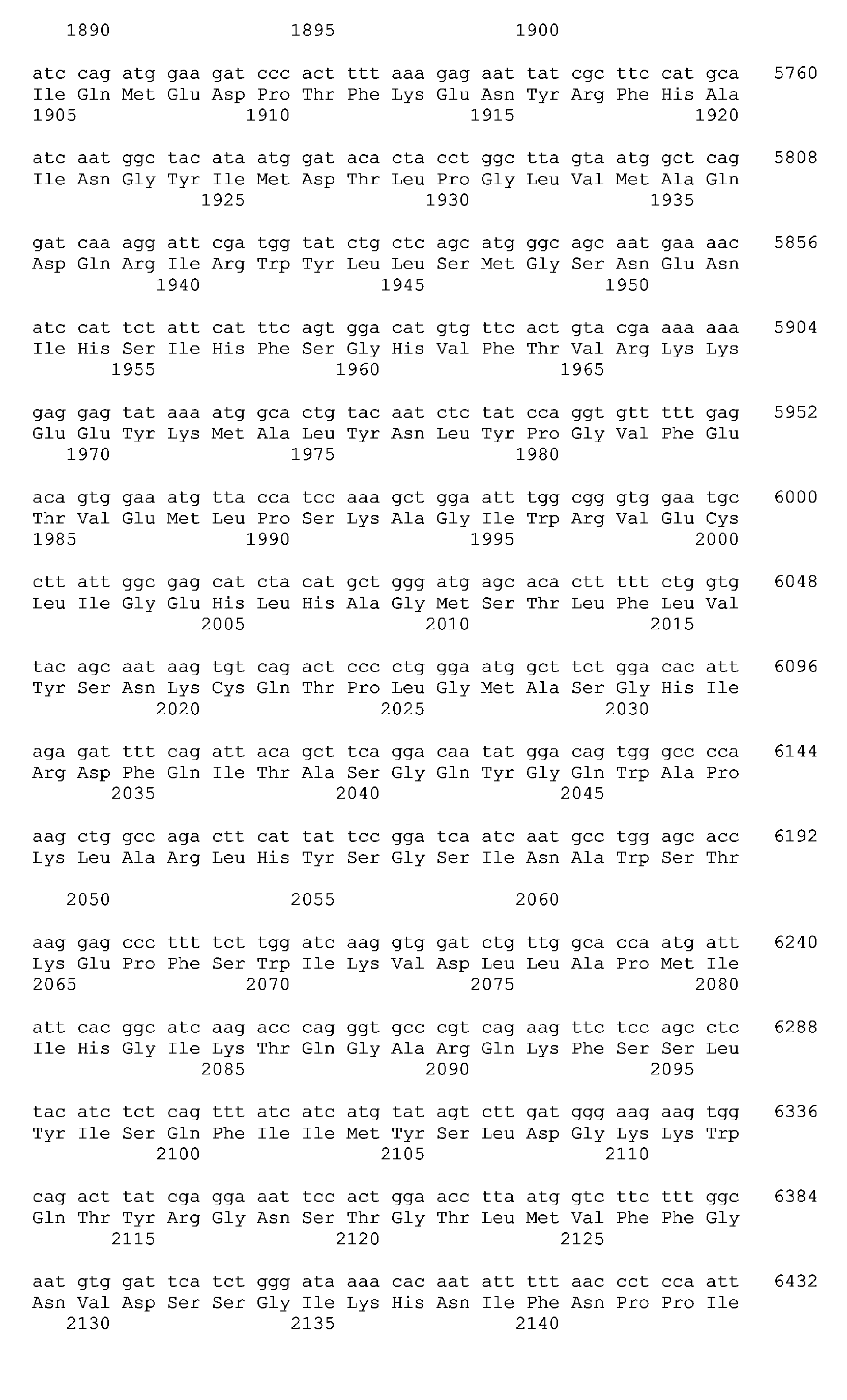


Claims (13)
- A method for recombinant production of a human protein or a derivative or mutant thereof which comprises culturing an immortalized human cell line being stably transfected under serum-free conditions with a transfection vector comprising an origin of replication, and a gene encoding said human protein, whereby the gene for the human protein is linked at its 5' end with a promoter and at its 3' end with a bovine growth hormone polyadenylation (polyA) signal.
- The method of claim 1, wherein the human protein is a human plasma protein selected from blood clotting factors such as factor IX, factor VIII (wild-type and B-domain deleted), Factor VII/VIIa, and von Willebrand factor (vWF), growth factors such as erythropoietin, colony-stimulating factors (CSFs) such as granulocyte stimulating factor (G-CSF), macrophage CSF (M-CSF) and granulocyte-macrophage CSF (GM-CSF), cytokines such as interleukins, protease inhibitors such as aipha-1-antitrypsin (A1AT) and chymotrypsin, transport proteins such as hormones, inhibitory or regulatory acting proteins, and derivatives and mutants thereof, preferably the human protein is selected from factor IX, factor VIII including wild-type factor VIII and B-domain deleted factor VIII, factor VII/VIIa, vWF A1AT and G-CSF, most preferably the human protein is blood clotting factor IX as encoded by bps 939 to 2324 of SEQ ID NO:1, human A1AT as encoded by bps 973 to 2259 of SEQ ID NO:2, wt factor VIII as shown in SEQ ID NO:9, B-domain deleted human factor VIII as encoded by bps 783 to 5162 of SEQ ID NO:3, factor VII/VIIa as encoded by SEQ ID NOs:13 and 14, GCSF as encoded by SEQ ID NOs:15 and 16, or vWF as encoded by SEQ ID NO:17.
- The method of claim 1 or 2, wherein in the transfection vector(i) the promoter is selected from viral promoters, housekeeping gene promoters and tissue specific promoters, preferably the promoter is a CMV promoter with or without intron A, SV40 promoter, EF-1alpha promoter, HSV TK promoter, etc., most preferably the promoter is a CMV promoter; and/or(ii) the origin of replication allows the replication and amplification of the plasmid in bacteria;(iii) the vector further carries at least one gene for a selection marker, preferably selected from hygromycin resistance, neomycin resistance, aminoglycoside phosphotransferase (neo, G418, APH) resistance, bleomycin (phleo, bleo, zeocin) resistance, and Xanthine-guanine phosphoribosyltransferase (XGPRT, gpt) resistance, and/or being under control of a promoter as defined in (i) above; and/or(iv) the vector further carries one or more further regulatory elements, said regulatory elements preferably being selected from splice sites, recombination sites, polyA sites, enhancers, multicloning sites and prokaryotic plasmid sequences.
- The method of claim 3 wherein the transfection vector carries a CMV promoter, a hygromycin gene, a polyA sequence and the gene of interest and preferably is derived from the pcDNA3.1 vector having the sequence of SEQ ID NO:4 or 5.
- The method according to anyone of claims 1 to 4 wherein the immortalized human cell line(i) is capable of being transfected and being cultured under serum-free conditions; and/or(ii) has integrated adenoviral sequences into its genome; and/or(iii) is selected from the group of kidney, bladder, liver, lung, cardiac muscle, smooth muscle, ovary and gastrointestinal cells, preferably is a human kidney cell line; and/or(iv) is unable to express human prion protein.
- The method according to claim 5 wherein the kidney cells are human foetal kidney cells, preferably the foetal human kidney cells selected from 293 cells (ATCC CRL-1573; DSM ACC 305), 293T cells (DSM ACC 2494), FreeStyle 293 cells (293F cells; Invitrogen R79007), preferably are 293F cells (Invitrogen R79007).
- The method of claim 6, wherein the cell line is 293F and the transfection vector is derived from pcDNA3.1, the vector preferably encodes human blood clotting factor IX as shown by bps 939 to 2324 of SEQ ID NO:1, human A1AT as encoded by bps 973 to 2259 of SEQ ID NO:2, wt human factor VIII as shown in SEQ ID NO:9, or B-domain deleted human factor VIII as shown in SEQ ID NO:3, FVII/FVIIa, G-CSF or von Willebrand factor.
- The method according to any one of claims 1 to 7, wherein the serum-free transfection is effected in suspension culture without serum with a cationic transfection agent or calcium phosphate, preferably lipofectamine 2000 CD reagent (Invitrogen).
- The method according to anyone of claims 1 to 8, wherein the production of the human protein is performed under serum-free conditions.
- The method according to anyone of the claims 1 to 9, which further comprises the steps concentrating the recombinant human protein from the culture broth and/or purifying the protein, and/or prion removal.
- A transfection vector comprising an origin of replication and a gene encoding a human protein as defined in claims 1 to 4, preferably said transfection vector being pcDNA3.1 comprising the gene for the human protein blood clotting factor IX, for human A1AT, for human blood clotting factor VIII including wild-type and B-domain deleted mutants thereof, or G-CSF including the a and b form thereof, FVII/VIIa including the a and b form thereof, or for vWF, most preferably said transfection vector having the nucleic acid sequence shown in SEQ ID NO:1, 2 or 3.
- An immortalized human cell line stably transfected under serum-free conditions with the vector of claim 11, preferably said human cell line being as defined in claims 5 to 7.
- A method for preparing the cell line of claim 12, which comprises transfecting an immortalized human host cell line under serum-free conditions with the transfection vector of claim 11, preferably as defined in claim 8.
Priority Applications (29)
| Application Number | Priority Date | Filing Date | Title |
|---|---|---|---|
| EP05105965A EP1739179A1 (en) | 2005-06-30 | 2005-06-30 | Serum-free stable transfection and production of recombinant human proteins in human cell lines |
| PCT/EP2006/063705 WO2007003582A2 (en) | 2005-06-30 | 2006-06-29 | Serum-free stable transfection and production of recombinant human proteins in human cell lines |
| CNA2006800232801A CN101233238A (en) | 2005-06-30 | 2006-06-29 | Serum-free stable transfection and production of recombinant human proteins in human cell lines |
| CN201610127579.7A CN105755041A (en) | 2005-06-30 | 2006-06-29 | Serum-free stable transfection and production of recombinant human proteins in human cell lines |
| IL266122A IL266122B2 (en) | 2005-06-30 | 2006-06-29 | Serum-free stable transfection and production of recombinant human proteins in human cell lines |
| MX2007015370A MX2007015370A (en) | 2005-06-30 | 2006-06-29 | STABLE FREE TRANSFECTION OF SERUM AND PRODUCTION OF RECOMBINANT HUMAN PROTEINS IN HUMAN CELL LINES. |
| ES06777525.4T ES2574584T3 (en) | 2005-06-30 | 2006-06-29 | Stable serum-free transfection and production of recombinant human proteins in human cell lines |
| AU2006265173A AU2006265173B2 (en) | 2005-06-30 | 2006-06-29 | Serum-free stable transfection and production of recombinant human proteins in human cell lines |
| BRPI0613721-0A BRPI0613721B1 (en) | 2005-06-30 | 2006-06-29 | Method for preparing an immortalized human cell line and method for recombinant production of a human target protein |
| HUE06777525A HUE028028T2 (en) | 2005-06-30 | 2006-06-29 | Serum-free stable transfection and production of recombinant human proteins in human cell lines |
| JP2008518853A JP5925407B2 (en) | 2005-06-30 | 2006-06-29 | Serum-free stable transfection and production of recombinant human proteins in human cell lines |
| SI200632064A SI1896590T1 (en) | 2005-06-30 | 2006-06-29 | Serum-free stable transfection and production of recombinant human proteins in human cell lines |
| CA2611708A CA2611708C (en) | 2005-06-30 | 2006-06-29 | Serum-free stable transfection and production of recombinant human proteins in human cell lines |
| DK06777525.4T DK1896590T3 (en) | 2005-06-30 | 2006-06-29 | Serum-free stable transfection and production of recombinant human proteins in human cell lines |
| KR1020077030563A KR101320489B1 (en) | 2005-06-30 | 2006-06-29 | Serum-free stable transfection and production of recombinant human proteins in human cell lines |
| RU2008103319/10A RU2453597C2 (en) | 2005-06-30 | 2006-06-29 | Method for producing immortalised human cell, stable transfected immortalised human cell, method for recombinant production of target human protein, application of transfection vector |
| PL06777525.4T PL1896590T3 (en) | 2005-06-30 | 2006-06-29 | Serum-free stable transfection and production of recombinant human proteins in human cell lines |
| EP06777525.4A EP1896590B1 (en) | 2005-06-30 | 2006-06-29 | Serum-free stable transfection and production of recombinant human proteins in human cell lines |
| UAA200801065A UA99700C2 (en) | 2005-06-30 | 2006-06-29 | A METHOD OF PREPARING AN IMMORTALIZED HUMAN CELL LINE |
| US11/993,604 US8871439B2 (en) | 2005-06-30 | 2006-06-29 | Serum-free stable transfection and production of recombinant human proteins in human cell lines |
| IL187676A IL187676A (en) | 2005-06-30 | 2007-11-27 | Serum-free stable transfection and production of recombinant human proteins in human cell lines |
| NO20076087A NO343221B1 (en) | 2005-06-30 | 2007-11-27 | Serum-free stable transfection and production of recombinant human proteins in human cell lines |
| ZA200711013A ZA200711013B (en) | 2005-06-30 | 2007-12-19 | Serum-free stable transfection and production of recombinant human proteins in human cell lines |
| US14/506,107 US9273325B2 (en) | 2005-06-30 | 2014-10-03 | Serum-free stable transfection and production of recombinant human proteins in human cell lines |
| US15/011,760 US9512457B2 (en) | 2005-06-30 | 2016-02-01 | Serum-free stable transfection and production of recombinant human proteins in human cell lines |
| JP2016023728A JP2016154537A (en) | 2005-06-30 | 2016-02-10 | Serum-free stable transfection and production of recombinant human proteins in human cell lines |
| US15/369,068 US9796986B2 (en) | 2005-06-30 | 2016-12-05 | Serum-free stable transfection and production of recombinant human proteins in human cell lines |
| IL250575A IL250575A0 (en) | 2005-06-30 | 2017-02-13 | Serum-free stable transfection and production of recombinant human proteins in human cell lines |
| JP2018211223A JP6754414B2 (en) | 2005-06-30 | 2018-11-09 | Serum-free stable transfection and production of recombinant human proteins in human cell lines |
Applications Claiming Priority (1)
| Application Number | Priority Date | Filing Date | Title |
|---|---|---|---|
| EP05105965A EP1739179A1 (en) | 2005-06-30 | 2005-06-30 | Serum-free stable transfection and production of recombinant human proteins in human cell lines |
Publications (1)
| Publication Number | Publication Date |
|---|---|
| EP1739179A1 true EP1739179A1 (en) | 2007-01-03 |
Family
ID=35427852
Family Applications (2)
| Application Number | Title | Priority Date | Filing Date |
|---|---|---|---|
| EP05105965A Withdrawn EP1739179A1 (en) | 2005-06-30 | 2005-06-30 | Serum-free stable transfection and production of recombinant human proteins in human cell lines |
| EP06777525.4A Expired - Lifetime EP1896590B1 (en) | 2005-06-30 | 2006-06-29 | Serum-free stable transfection and production of recombinant human proteins in human cell lines |
Family Applications After (1)
| Application Number | Title | Priority Date | Filing Date |
|---|---|---|---|
| EP06777525.4A Expired - Lifetime EP1896590B1 (en) | 2005-06-30 | 2006-06-29 | Serum-free stable transfection and production of recombinant human proteins in human cell lines |
Country Status (20)
| Country | Link |
|---|---|
| US (4) | US8871439B2 (en) |
| EP (2) | EP1739179A1 (en) |
| JP (3) | JP5925407B2 (en) |
| KR (1) | KR101320489B1 (en) |
| CN (2) | CN101233238A (en) |
| AU (1) | AU2006265173B2 (en) |
| BR (1) | BRPI0613721B1 (en) |
| CA (1) | CA2611708C (en) |
| DK (1) | DK1896590T3 (en) |
| ES (1) | ES2574584T3 (en) |
| HU (1) | HUE028028T2 (en) |
| IL (3) | IL266122B2 (en) |
| MX (1) | MX2007015370A (en) |
| NO (1) | NO343221B1 (en) |
| PL (1) | PL1896590T3 (en) |
| RU (1) | RU2453597C2 (en) |
| SI (1) | SI1896590T1 (en) |
| UA (1) | UA99700C2 (en) |
| WO (1) | WO2007003582A2 (en) |
| ZA (1) | ZA200711013B (en) |
Cited By (7)
| Publication number | Priority date | Publication date | Assignee | Title |
|---|---|---|---|---|
| CN102119172A (en) * | 2008-08-21 | 2011-07-06 | 奥克塔法马股份有限公司 | Recombinantly produced human factor VIII and IX |
| WO2011121031A1 (en) | 2010-03-30 | 2011-10-06 | Octapharma Ag | Process for the purification of a growth factor protein |
| WO2011121020A1 (en) | 2010-03-30 | 2011-10-06 | Octapharma Ag | A process for purifying vitamin k dependent proteins such as coagulation factor ix |
| WO2011131720A1 (en) | 2010-04-20 | 2011-10-27 | Octapharma Ag | New stabilizing agent for pharmaceutical proteins |
| CN102277379A (en) * | 2011-08-18 | 2011-12-14 | 中国科学院遗传与发育生物学研究所 | Expression vector for expressing coagulation factor VIII and application thereof |
| EP2537862A1 (en) | 2008-06-24 | 2012-12-26 | Octapharma AG | A process of purifying coagulation factor VIII |
| US10822393B2 (en) | 2014-01-20 | 2020-11-03 | Octapharma Ag | Process for manufacturing factor VIII having an improved ratio of FVIII:C/FVIII/AG |
Families Citing this family (16)
| Publication number | Priority date | Publication date | Assignee | Title |
|---|---|---|---|---|
| KR101229418B1 (en) * | 2007-06-15 | 2013-02-05 | 재단법인 목암생명공학연구소 | Method for manufacturing active recombinant blood coagulation factor ix |
| JP5592080B2 (en) * | 2009-05-08 | 2014-09-17 | 株式会社日立製作所 | Cell culture method and cell culture system |
| CN101906438B (en) * | 2009-06-05 | 2013-04-24 | 苏州泽璟生物制药有限公司 | Method for expressing and producing recombinant human blood coagulation factors VII in animal cells |
| RU2579977C2 (en) | 2009-11-13 | 2016-04-10 | Грифольс Терапьютикс Инк. | PREPARATIONS CONTAINING VON WILLEBRAND FACTOR (vWF) AND METHODS, KITS AND APPLICATIONS RELATED TO THEM |
| RU2600886C2 (en) * | 2011-05-13 | 2016-10-27 | Октафарма Аг | Method of increasing productivity of eucaryotic cells in production of recombinant fviii |
| CN103031277B (en) * | 2011-09-29 | 2015-07-15 | 重庆大学 | Application of mechano-growth factor in preparation of serum-free cultured tolerant type mammal engineering cell |
| CN103305540B (en) * | 2012-03-14 | 2015-03-25 | 齐鲁制药有限公司 | Plasmid for determination of biological activity and preparation method thereof |
| CN104364369B (en) | 2012-05-02 | 2018-09-07 | 生命技术公司 | High-yield transient expression in mammalian cells using a unique pair of high-density growth and transfection media and expression enhancers |
| US9873891B2 (en) * | 2013-05-03 | 2018-01-23 | Fujifilm Diosynth Biotechnologies Uk Limited | Expression process |
| ES2813698T3 (en) | 2013-09-12 | 2021-03-24 | Biomarin Pharm Inc | AAV vectors comprising a gene encoding factor VIII |
| WO2016070166A2 (en) * | 2014-11-02 | 2016-05-06 | Arcturus Therapeutics, Inc. | Messenger una molecules and uses thereof |
| EP3625329A1 (en) | 2017-05-17 | 2020-03-25 | Octapharma AG | Method for the production of a recombinant target protein |
| US12099106B2 (en) | 2018-05-04 | 2024-09-24 | Fraunhofer-Gesellschaft zur Foerderung der angewandten Forschung eingetragener Verein | Arterial spin labeling with evaluation of inversion state of magnetization |
| JP7497356B2 (en) * | 2018-12-06 | 2024-06-10 | ビーエーエスエフ ソシエタス・ヨーロピア | Aqueous suspensions containing zeolite materials and zirconium chelate complexes - Patent Application 20070229933 |
| CN110438066B (en) * | 2019-08-19 | 2021-01-12 | 杭州百凌生物科技有限公司 | Mammalian cell line 293C18P capable of being stably passaged and capable of being cultured in suspension, and preparation method and application thereof |
| CN117529557A (en) * | 2021-05-24 | 2024-02-06 | Atgc 股份有限公司 | Botulinum toxin-sensitive cells inserted with specific genes via lentivirus |
Citations (2)
| Publication number | Priority date | Publication date | Assignee | Title |
|---|---|---|---|---|
| WO2002008221A2 (en) * | 2000-07-20 | 2002-01-31 | Neurogen Corporation | Capsaicin receptor ligands |
| EP1533380A2 (en) * | 1999-04-15 | 2005-05-25 | Crucell Holland B.V. | Recombinant protein production in a human cell comprising at least one E1 protein of adenovirus |
Family Cites Families (45)
| Publication number | Priority date | Publication date | Assignee | Title |
|---|---|---|---|---|
| AU577259B2 (en) | 1982-08-13 | 1988-09-22 | Zymogenetics Inc. | Glycolytic promters for regulated protein expression protease inhibitor |
| US4540573A (en) | 1983-07-14 | 1985-09-10 | New York Blood Center, Inc. | Undenatured virus-free biologically active protein derivatives |
| DE10399009I1 (en) | 1984-01-12 | 2003-10-23 | Chiron Corp | DNA sequences encoding factor VIIIc and related DNA constructions |
| IL74909A (en) | 1984-04-20 | 1992-01-15 | Genentech Inc | Preparation of functional human factor viii and dna sequences,expression vectors,transformed microorganisms and cell lines used therein |
| JPS6171774A (en) | 1984-09-14 | 1986-04-12 | Sony Corp | Beam current controller of television camera device |
| MX9203440A (en) | 1985-04-12 | 1992-07-01 | Genetics Inst | NOVEL PROCOAGULANT PROTEINS. |
| US4810643A (en) | 1985-08-23 | 1989-03-07 | Kirin- Amgen Inc. | Production of pluripotent granulocyte colony-stimulating factor |
| JPS63500636A (en) * | 1985-08-23 | 1988-03-10 | 麒麟麦酒株式会社 | DNA encoding multipotent granulocyte colony stimulating factor |
| ATE87663T1 (en) | 1986-01-03 | 1993-04-15 | Genetics Inst | METHODS FOR PRODUCTION OF FACTOR VIII:C TYPE PROTEINS. |
| FI98829C (en) | 1986-01-27 | 1997-08-25 | Chiron Corp | Process for Preparation of Recombinant Protein Complex with Human Factor VIII: C Activity |
| US5451521A (en) | 1986-05-29 | 1995-09-19 | Genetics Institute, Inc. | Procoagulant proteins |
| EP0251843A1 (en) | 1986-06-06 | 1988-01-07 | Transgene S.A. | Process for the preparation of factor VIII from mammalian cells |
| DK155388C (en) | 1986-07-08 | 1989-10-23 | Palle Pedersen | LOCK |
| DE3769872D1 (en) | 1986-07-11 | 1991-06-13 | Miles Inc | PRODUCTION OF RECOMBINANT PROTEIN. |
| IL83192A (en) | 1986-07-18 | 1992-11-15 | Gist Brocades Nv | Method for the preparation of proteins with factor viii activity by microbial host cells;expression vectors,host cells,antibodies |
| IL84168A0 (en) | 1986-10-15 | 1988-03-31 | Rorer Int Overseas | Human factor viii-c analogs,process for the preparation thereof and pharmaceutical compositions containing the same |
| EP0294910B1 (en) | 1987-06-12 | 1996-09-11 | Immuno Ag | Novel proteins with factor VIII activity, process for their preparation using genetically engineered cells and pharmaceutical compositions containing them |
| FR2619314B1 (en) | 1987-08-11 | 1990-06-15 | Transgene Sa | FACTOR VIII ANALOG, PREPARATION METHOD AND PHARMACEUTICAL COMPOSITION CONTAINING THE SAME |
| JPH084495B2 (en) * | 1988-08-19 | 1996-01-24 | 帝人株式会社 | Method for culturing adherent animal cells |
| DE69032043T2 (en) | 1989-11-17 | 1998-06-04 | Chiron Corp | PROTEIN COMPLEXES WITH FACTOR VIII: C ACTIVITY AND THEIR PRODUCTION |
| SE465222C5 (en) | 1989-12-15 | 1998-02-10 | Pharmacia & Upjohn Ab | A recombinant human factor VIII derivative and process for its preparation |
| DE4204694C3 (en) | 1992-02-01 | 1995-10-12 | Octapharma Ag | Method for obtaining highly pure, virus-inactivated factor VIII by means of anion exchange chromatography |
| ES2118386T3 (en) | 1993-02-09 | 1998-09-16 | Octapharma Ag | PROCEDURE FOR THE INACTIVATION OF VIRUSES THAT ARE NOT PROVIDED WITH LIPID ENVELOPES. |
| US5585237A (en) | 1993-10-25 | 1996-12-17 | Creative Biomolecules, Inc. | Methods and compositions for high protein production from recombinant DNA |
| DK128093D0 (en) | 1993-11-12 | 1993-11-12 | Novo Nordisk As | HIS UNKNOWN RELATIONSHIPS |
| US6136865A (en) | 1995-05-20 | 2000-10-24 | Octapharma Ag | Method for reduction of the infectiousness of potentially infectious material |
| JP2002517180A (en) * | 1997-12-05 | 2002-06-18 | ジ・イミユーン・リスポンス・コーポレーシヨン | Novel vectors and genes exhibiting increased expression |
| CZ20003842A3 (en) * | 1998-04-17 | 2001-08-15 | Société des Produits Nestlé S. A. | Cellular line of human keratinocytes |
| US6210924B1 (en) * | 1998-08-11 | 2001-04-03 | Amgen Inc. | Overexpressing cyclin D 1 in a eukaryotic cell line |
| CA2252972C (en) * | 1998-11-26 | 2012-09-18 | National Research Council Of Canada | Serum-free production of recombinant proteins and adenoviral vectors |
| EP1010762A1 (en) * | 1998-12-02 | 2000-06-21 | Aventis Behring Gesellschaft mit beschränkter Haftung | DNA constructs of blood clotting factors and P-Selectin |
| PL351499A1 (en) * | 1999-04-29 | 2003-04-22 | Leukotech As | Expression of heparin-binding protein in recombinant mammalian cells |
| NZ529329A (en) * | 1999-08-25 | 2005-06-24 | Immunex Corp | Compositions and methods for improved cell culture |
| DK1266006T3 (en) | 2000-03-22 | 2006-01-16 | Octagene Gmbh | Preparation of Recombinant Muteins of Blood Coagulation Factor VIII in Human Cell Lines |
| WO2002099070A2 (en) * | 2001-06-04 | 2002-12-12 | Corixa Corporation | Compositions and methods for high-level, large-scale production of recombinant proteins |
| US20040180438A1 (en) * | 2002-04-26 | 2004-09-16 | Pachuk Catherine J. | Methods and compositions for silencing genes without inducing toxicity |
| DE50308030D1 (en) | 2002-11-29 | 2007-10-04 | Boehringer Ingelheim Pharma | NEW NEOMYCIN PHOSPHOTRANSFERASE GENES AND METHOD FOR SELECTION OF HIGHLY PRODUCTIVE RECOMBINANT CELLS |
| US7217566B2 (en) | 2003-03-24 | 2007-05-15 | Invitrogen Corporation | Attached cell lines |
| US7763430B2 (en) * | 2003-04-22 | 2010-07-27 | Baxter International Inc. | Diagnostic assay for anti-von Willebrand Factor cleaving protease (ADAMTS13) antibodies |
| MXPA05014155A (en) * | 2003-06-27 | 2006-05-25 | Abgenix Inc | Antibodies directed to the deletion mutants of epidermal growth factor receptor and uses thereof. |
| JP2005073509A (en) * | 2003-08-28 | 2005-03-24 | Nihon Pharmaceutical Co Ltd | Method for producing human antithrombin |
| BRPI0414961A (en) * | 2003-10-03 | 2006-11-07 | Keiichi Fukuda | Stem cell differentiation induction process in myocardial cells |
| JP4705473B2 (en) * | 2003-11-06 | 2011-06-22 | 株式会社リプロセル | Stem cell cryopreservation method and system |
| EP1680505A1 (en) * | 2003-11-06 | 2006-07-19 | Exonhit Therapeutics S.A. | Bace455, an alternative splice variant of the human beta-secretase |
| BRPI0908886A2 (en) | 2008-02-15 | 2015-09-15 | Koninkl Philips Electronics Nv | device, method and computer program for segmenting an object, and, object model |
-
2005
- 2005-06-30 EP EP05105965A patent/EP1739179A1/en not_active Withdrawn
-
2006
- 2006-06-29 WO PCT/EP2006/063705 patent/WO2007003582A2/en not_active Ceased
- 2006-06-29 IL IL266122A patent/IL266122B2/en unknown
- 2006-06-29 ES ES06777525.4T patent/ES2574584T3/en not_active Expired - Lifetime
- 2006-06-29 RU RU2008103319/10A patent/RU2453597C2/en active
- 2006-06-29 HU HUE06777525A patent/HUE028028T2/en unknown
- 2006-06-29 UA UAA200801065A patent/UA99700C2/en unknown
- 2006-06-29 KR KR1020077030563A patent/KR101320489B1/en not_active Expired - Lifetime
- 2006-06-29 PL PL06777525.4T patent/PL1896590T3/en unknown
- 2006-06-29 AU AU2006265173A patent/AU2006265173B2/en not_active Expired
- 2006-06-29 SI SI200632064A patent/SI1896590T1/en unknown
- 2006-06-29 BR BRPI0613721-0A patent/BRPI0613721B1/en active IP Right Grant
- 2006-06-29 JP JP2008518853A patent/JP5925407B2/en not_active Expired - Lifetime
- 2006-06-29 US US11/993,604 patent/US8871439B2/en active Active
- 2006-06-29 EP EP06777525.4A patent/EP1896590B1/en not_active Expired - Lifetime
- 2006-06-29 MX MX2007015370A patent/MX2007015370A/en active IP Right Grant
- 2006-06-29 CN CNA2006800232801A patent/CN101233238A/en active Pending
- 2006-06-29 DK DK06777525.4T patent/DK1896590T3/en active
- 2006-06-29 CA CA2611708A patent/CA2611708C/en not_active Expired - Lifetime
- 2006-06-29 CN CN201610127579.7A patent/CN105755041A/en active Pending
-
2007
- 2007-11-27 NO NO20076087A patent/NO343221B1/en unknown
- 2007-11-27 IL IL187676A patent/IL187676A/en active IP Right Grant
- 2007-12-19 ZA ZA200711013A patent/ZA200711013B/en unknown
-
2014
- 2014-10-03 US US14/506,107 patent/US9273325B2/en not_active Expired - Lifetime
-
2016
- 2016-02-01 US US15/011,760 patent/US9512457B2/en not_active Expired - Lifetime
- 2016-02-10 JP JP2016023728A patent/JP2016154537A/en not_active Withdrawn
- 2016-12-05 US US15/369,068 patent/US9796986B2/en not_active Expired - Lifetime
-
2017
- 2017-02-13 IL IL250575A patent/IL250575A0/en unknown
-
2018
- 2018-11-09 JP JP2018211223A patent/JP6754414B2/en not_active Expired - Lifetime
Patent Citations (2)
| Publication number | Priority date | Publication date | Assignee | Title |
|---|---|---|---|---|
| EP1533380A2 (en) * | 1999-04-15 | 2005-05-25 | Crucell Holland B.V. | Recombinant protein production in a human cell comprising at least one E1 protein of adenovirus |
| WO2002008221A2 (en) * | 2000-07-20 | 2002-01-31 | Neurogen Corporation | Capsaicin receptor ligands |
Non-Patent Citations (2)
| Title |
|---|
| BERG D T ET AL: "HIGH-LEVEL EXPRESSION OF SECRETED PROTEINS FROM CELLS ADAPTED TO SERUM-FREE SUSPENSION CULTURE", BIOTECHNIQUES, INFORMA LIFE SCIENCES PUBLISHING, WESTBOROUGH, MA, US, vol. 14, no. 6, June 1993 (1993-06-01), pages 972 - 978, XP002059902, ISSN: 0736-6205 * |
| GOODWIN E C ET AL: "THE 3'-FLANKING SEQUENCE OF THE BOVINE GROWTH HORMONE GENE CONTAINS NOVEL ELEMENTS REQUIRED FOR EFFICIENT AND ACCURATE POLYADENYLATION", JOURNAL OF BIOLOGICAL CHEMISTRY, vol. 267, no. 23, 1992, pages 16330 - 16334, XP002357739, ISSN: 0021-9258 * |
Cited By (17)
| Publication number | Priority date | Publication date | Assignee | Title |
|---|---|---|---|---|
| EP2537862A1 (en) | 2008-06-24 | 2012-12-26 | Octapharma AG | A process of purifying coagulation factor VIII |
| CN102119172A (en) * | 2008-08-21 | 2011-07-06 | 奥克塔法马股份有限公司 | Recombinantly produced human factor VIII and IX |
| US9120873B2 (en) | 2008-08-21 | 2015-09-01 | Octapharma Ag | Recombinantly produced human factor VIII and IX |
| EP3040346A1 (en) | 2010-03-30 | 2016-07-06 | Octapharma AG | Process for the purification of granulocyte colony stimulating factor, g-csf |
| WO2011121031A1 (en) | 2010-03-30 | 2011-10-06 | Octapharma Ag | Process for the purification of a growth factor protein |
| WO2011121020A1 (en) | 2010-03-30 | 2011-10-06 | Octapharma Ag | A process for purifying vitamin k dependent proteins such as coagulation factor ix |
| US10214575B2 (en) | 2010-03-30 | 2019-02-26 | Octapharma Ag | Process for the purification of a growth factor protein |
| EP3133157A1 (en) | 2010-03-30 | 2017-02-22 | Octapharma AG | A process for purifying vitamin k dependent proteins |
| US9453045B2 (en) | 2010-03-30 | 2016-09-27 | Octapharma Ag | Process for the purification of a growth factor protein |
| EP3269805A1 (en) | 2010-04-20 | 2018-01-17 | Octapharma AG | New stabilizing agent for pharmaceutical proteins |
| EP2947148A1 (en) | 2010-04-20 | 2015-11-25 | Octapharma AG | New stabilizing agent for pharmaceutical proteins |
| US9943600B2 (en) | 2010-04-20 | 2018-04-17 | Octapharma Ag | Stabilizing agent for pharmaceutical proteins |
| US10098956B2 (en) | 2010-04-20 | 2018-10-16 | Octapharma Ag | Stabilizing agent for pharmaceutical proteins |
| WO2011131720A1 (en) | 2010-04-20 | 2011-10-27 | Octapharma Ag | New stabilizing agent for pharmaceutical proteins |
| CN102277379B (en) * | 2011-08-18 | 2013-07-24 | 中国科学院遗传与发育生物学研究所 | Expression vector for expressing coagulation factor VIII and application thereof |
| CN102277379A (en) * | 2011-08-18 | 2011-12-14 | 中国科学院遗传与发育生物学研究所 | Expression vector for expressing coagulation factor VIII and application thereof |
| US10822393B2 (en) | 2014-01-20 | 2020-11-03 | Octapharma Ag | Process for manufacturing factor VIII having an improved ratio of FVIII:C/FVIII/AG |
Also Published As
Similar Documents
| Publication | Publication Date | Title |
|---|---|---|
| US9796986B2 (en) | Serum-free stable transfection and production of recombinant human proteins in human cell lines | |
| EP0534383A2 (en) | Process for preparing human coagulation factor VIII protein complex | |
| US6413737B1 (en) | Ecarin prothrombin protease and methods | |
| MXPA04005189A (en) | Chromatographic purification of recombinant human erythropoietin. | |
| Kovnir et al. | A highly productive CHO cell line secreting human blood clotting factor IX | |
| RU2500816C1 (en) | RECOMBINANT PLASMID DNA pAK380 CODING POLYPEPTIDE OF RECOMBINANT FACTOR IX OF HUMAN BLOOD COAGULABILITY, LINE OF CELLS Cricetulus griseus CHO, 1E6-PRODUCER OF RECOMBINANT FACTOR IX OF HUMAN BLOOD COAGULABILITY, AND METHOD FOR OBTAINING POLYPEPTIDE HAVING ACTIVITY OF RECOMBINANT FACTOR IX | |
| US6933136B2 (en) | Method for making recombinant proteins | |
| EP3040419B1 (en) | Method for mass producing human blood coagulation factor vii derivative | |
| EP2633058B1 (en) | Method for mass production of factor vii/viia | |
| RU2585532C2 (en) | Plasmid for expression of human recombinant blood clotting factor ix, cho cell producing human recombinant blood clotting factor ix and method of producing said factor | |
| WO2004027072A2 (en) | Method for making recombinant proteins | |
| EP1136553A1 (en) | Production of recombinant blood clotting factors in human cell lines | |
| EP1939283A1 (en) | Process for producing recombinant human thrombin by cultured cell |
Legal Events
| Date | Code | Title | Description |
|---|---|---|---|
| PUAI | Public reference made under article 153(3) epc to a published international application that has entered the european phase |
Free format text: ORIGINAL CODE: 0009012 |
|
| AK | Designated contracting states |
Kind code of ref document: A1 Designated state(s): AT BE BG CH CY CZ DE DK EE ES FI FR GB GR HU IE IS IT LI LT LU MC NL PL PT RO SE SI SK TR |
|
| AX | Request for extension of the european patent |
Extension state: AL BA HR LV MK YU |
|
| STAA | Information on the status of an ep patent application or granted ep patent |
Free format text: STATUS: THE APPLICATION HAS BEEN WITHDRAWN |
|
| 18W | Application withdrawn |
Effective date: 20070309 |