EP1739157A1 - Grease composition and grease filled bearing - Google Patents
Grease composition and grease filled bearing Download PDFInfo
- Publication number
- EP1739157A1 EP1739157A1 EP05721455A EP05721455A EP1739157A1 EP 1739157 A1 EP1739157 A1 EP 1739157A1 EP 05721455 A EP05721455 A EP 05721455A EP 05721455 A EP05721455 A EP 05721455A EP 1739157 A1 EP1739157 A1 EP 1739157A1
- Authority
- EP
- European Patent Office
- Prior art keywords
- oil
- grease composition
- grease
- thickener
- bearing
- Prior art date
- Legal status (The legal status is an assumption and is not a legal conclusion. Google has not performed a legal analysis and makes no representation as to the accuracy of the status listed.)
- Withdrawn
Links
Images
Classifications
-
- C—CHEMISTRY; METALLURGY
- C10—PETROLEUM, GAS OR COKE INDUSTRIES; TECHNICAL GASES CONTAINING CARBON MONOXIDE; FUELS; LUBRICANTS; PEAT
- C10M—LUBRICATING COMPOSITIONS; USE OF CHEMICAL SUBSTANCES EITHER ALONE OR AS LUBRICATING INGREDIENTS IN A LUBRICATING COMPOSITION
- C10M169/00—Lubricating compositions characterised by containing as components a mixture of at least two types of ingredient selected from base-materials, thickeners or additives, covered by the preceding groups, each of these compounds being essential
- C10M169/02—Mixtures of base-materials and thickeners
-
- F—MECHANICAL ENGINEERING; LIGHTING; HEATING; WEAPONS; BLASTING
- F16—ENGINEERING ELEMENTS AND UNITS; GENERAL MEASURES FOR PRODUCING AND MAINTAINING EFFECTIVE FUNCTIONING OF MACHINES OR INSTALLATIONS; THERMAL INSULATION IN GENERAL
- F16C—SHAFTS; FLEXIBLE SHAFTS; ELEMENTS OR CRANKSHAFT MECHANISMS; ROTARY BODIES OTHER THAN GEARING ELEMENTS; BEARINGS
- F16C33/00—Parts of bearings; Special methods for making bearings or parts thereof
- F16C33/30—Parts of ball or roller bearings
- F16C33/66—Special parts or details in view of lubrication
- F16C33/6603—Special parts or details in view of lubrication with grease as lubricant
- F16C33/6607—Retaining the grease in or near the bearing
-
- F—MECHANICAL ENGINEERING; LIGHTING; HEATING; WEAPONS; BLASTING
- F16—ENGINEERING ELEMENTS AND UNITS; GENERAL MEASURES FOR PRODUCING AND MAINTAINING EFFECTIVE FUNCTIONING OF MACHINES OR INSTALLATIONS; THERMAL INSULATION IN GENERAL
- F16C—SHAFTS; FLEXIBLE SHAFTS; ELEMENTS OR CRANKSHAFT MECHANISMS; ROTARY BODIES OTHER THAN GEARING ELEMENTS; BEARINGS
- F16C33/00—Parts of bearings; Special methods for making bearings or parts thereof
- F16C33/30—Parts of ball or roller bearings
- F16C33/66—Special parts or details in view of lubrication
- F16C33/6603—Special parts or details in view of lubrication with grease as lubricant
- F16C33/6633—Grease properties or compositions, e.g. rheological properties
-
- C—CHEMISTRY; METALLURGY
- C10—PETROLEUM, GAS OR COKE INDUSTRIES; TECHNICAL GASES CONTAINING CARBON MONOXIDE; FUELS; LUBRICANTS; PEAT
- C10M—LUBRICATING COMPOSITIONS; USE OF CHEMICAL SUBSTANCES EITHER ALONE OR AS LUBRICATING INGREDIENTS IN A LUBRICATING COMPOSITION
- C10M2205/00—Organic macromolecular hydrocarbon compounds or fractions, whether or not modified by oxidation as ingredients in lubricant compositions
- C10M2205/02—Organic macromolecular hydrocarbon compounds or fractions, whether or not modified by oxidation as ingredients in lubricant compositions containing acyclic monomers
- C10M2205/0206—Organic macromolecular hydrocarbon compounds or fractions, whether or not modified by oxidation as ingredients in lubricant compositions containing acyclic monomers used as base material
-
- C—CHEMISTRY; METALLURGY
- C10—PETROLEUM, GAS OR COKE INDUSTRIES; TECHNICAL GASES CONTAINING CARBON MONOXIDE; FUELS; LUBRICANTS; PEAT
- C10M—LUBRICATING COMPOSITIONS; USE OF CHEMICAL SUBSTANCES EITHER ALONE OR AS LUBRICATING INGREDIENTS IN A LUBRICATING COMPOSITION
- C10M2205/00—Organic macromolecular hydrocarbon compounds or fractions, whether or not modified by oxidation as ingredients in lubricant compositions
- C10M2205/02—Organic macromolecular hydrocarbon compounds or fractions, whether or not modified by oxidation as ingredients in lubricant compositions containing acyclic monomers
- C10M2205/028—Organic macromolecular hydrocarbon compounds or fractions, whether or not modified by oxidation as ingredients in lubricant compositions containing acyclic monomers containing aliphatic monomers having more than four carbon atoms
- C10M2205/0285—Organic macromolecular hydrocarbon compounds or fractions, whether or not modified by oxidation as ingredients in lubricant compositions containing acyclic monomers containing aliphatic monomers having more than four carbon atoms used as base material
-
- C—CHEMISTRY; METALLURGY
- C10—PETROLEUM, GAS OR COKE INDUSTRIES; TECHNICAL GASES CONTAINING CARBON MONOXIDE; FUELS; LUBRICANTS; PEAT
- C10M—LUBRICATING COMPOSITIONS; USE OF CHEMICAL SUBSTANCES EITHER ALONE OR AS LUBRICATING INGREDIENTS IN A LUBRICATING COMPOSITION
- C10M2207/00—Organic non-macromolecular hydrocarbon compounds containing hydrogen, carbon and oxygen as ingredients in lubricant compositions
- C10M2207/04—Ethers; Acetals; Ortho-esters; Ortho-carbonates
- C10M2207/0406—Ethers; Acetals; Ortho-esters; Ortho-carbonates used as base material
-
- C—CHEMISTRY; METALLURGY
- C10—PETROLEUM, GAS OR COKE INDUSTRIES; TECHNICAL GASES CONTAINING CARBON MONOXIDE; FUELS; LUBRICANTS; PEAT
- C10M—LUBRICATING COMPOSITIONS; USE OF CHEMICAL SUBSTANCES EITHER ALONE OR AS LUBRICATING INGREDIENTS IN A LUBRICATING COMPOSITION
- C10M2207/00—Organic non-macromolecular hydrocarbon compounds containing hydrogen, carbon and oxygen as ingredients in lubricant compositions
- C10M2207/28—Esters
- C10M2207/2805—Esters used as base material
-
- C—CHEMISTRY; METALLURGY
- C10—PETROLEUM, GAS OR COKE INDUSTRIES; TECHNICAL GASES CONTAINING CARBON MONOXIDE; FUELS; LUBRICANTS; PEAT
- C10M—LUBRICATING COMPOSITIONS; USE OF CHEMICAL SUBSTANCES EITHER ALONE OR AS LUBRICATING INGREDIENTS IN A LUBRICATING COMPOSITION
- C10M2211/00—Organic non-macromolecular compounds containing halogen as ingredients in lubricant compositions
- C10M2211/006—Organic non-macromolecular compounds containing halogen as ingredients in lubricant compositions used as thickening agents
-
- C—CHEMISTRY; METALLURGY
- C10—PETROLEUM, GAS OR COKE INDUSTRIES; TECHNICAL GASES CONTAINING CARBON MONOXIDE; FUELS; LUBRICANTS; PEAT
- C10M—LUBRICATING COMPOSITIONS; USE OF CHEMICAL SUBSTANCES EITHER ALONE OR AS LUBRICATING INGREDIENTS IN A LUBRICATING COMPOSITION
- C10M2211/00—Organic non-macromolecular compounds containing halogen as ingredients in lubricant compositions
- C10M2211/06—Perfluorinated compounds
- C10M2211/063—Perfluorinated compounds used as base material
-
- C—CHEMISTRY; METALLURGY
- C10—PETROLEUM, GAS OR COKE INDUSTRIES; TECHNICAL GASES CONTAINING CARBON MONOXIDE; FUELS; LUBRICANTS; PEAT
- C10M—LUBRICATING COMPOSITIONS; USE OF CHEMICAL SUBSTANCES EITHER ALONE OR AS LUBRICATING INGREDIENTS IN A LUBRICATING COMPOSITION
- C10M2211/00—Organic non-macromolecular compounds containing halogen as ingredients in lubricant compositions
- C10M2211/06—Perfluorinated compounds
- C10M2211/066—Perfluorinated compounds used as thickening agents
-
- C—CHEMISTRY; METALLURGY
- C10—PETROLEUM, GAS OR COKE INDUSTRIES; TECHNICAL GASES CONTAINING CARBON MONOXIDE; FUELS; LUBRICANTS; PEAT
- C10M—LUBRICATING COMPOSITIONS; USE OF CHEMICAL SUBSTANCES EITHER ALONE OR AS LUBRICATING INGREDIENTS IN A LUBRICATING COMPOSITION
- C10M2215/00—Organic non-macromolecular compounds containing nitrogen as ingredients in lubricant Compositions
- C10M2215/10—Amides of carbonic or haloformic acids
- C10M2215/102—Ureas; Semicarbazides; Allophanates
- C10M2215/1026—Ureas; Semicarbazides; Allophanates used as thickening material
-
- C—CHEMISTRY; METALLURGY
- C10—PETROLEUM, GAS OR COKE INDUSTRIES; TECHNICAL GASES CONTAINING CARBON MONOXIDE; FUELS; LUBRICANTS; PEAT
- C10N—INDEXING SCHEME ASSOCIATED WITH SUBCLASS C10M RELATING TO LUBRICATING COMPOSITIONS
- C10N2020/00—Specified physical or chemical properties or characteristics, i.e. function, of component of lubricating compositions
- C10N2020/01—Physico-chemical properties
- C10N2020/011—Cloud point
-
- C—CHEMISTRY; METALLURGY
- C10—PETROLEUM, GAS OR COKE INDUSTRIES; TECHNICAL GASES CONTAINING CARBON MONOXIDE; FUELS; LUBRICANTS; PEAT
- C10N—INDEXING SCHEME ASSOCIATED WITH SUBCLASS C10M RELATING TO LUBRICATING COMPOSITIONS
- C10N2020/00—Specified physical or chemical properties or characteristics, i.e. function, of component of lubricating compositions
- C10N2020/01—Physico-chemical properties
- C10N2020/02—Viscosity; Viscosity index
-
- C—CHEMISTRY; METALLURGY
- C10—PETROLEUM, GAS OR COKE INDUSTRIES; TECHNICAL GASES CONTAINING CARBON MONOXIDE; FUELS; LUBRICANTS; PEAT
- C10N—INDEXING SCHEME ASSOCIATED WITH SUBCLASS C10M RELATING TO LUBRICATING COMPOSITIONS
- C10N2040/00—Specified use or application for which the lubricating composition is intended
- C10N2040/02—Bearings
Definitions
- the present invention relates to a grease composition enclosed in a bearing incorporated in various industrial machines, vehicles, and the like and more particularly, to a grease composition preferable for a bearing used at a high rotational speed in a wide temperature range from a high temperature to an ultra-low temperature at which a low-temperature abnormal noise is generated.
- a grease composition is enclosed in a bearing incorporated in various industrial machines and vehicles to impart lubricity to the bearing.
- the grease composition is prepared by kneading a base oil and a thickener.
- a base oil synthetic oils such as a mineral oil, an ester oil, a silicone oil, an ether oil, a fluorine oil, and the like are generally used.
- the thickener metal soap such as lithium soap, urea compounds, fluororesin are generally used.
- the grease composition is demanded to have durability at a high temperature.
- the metal soap is used as the thickener, oxidation of the base oil is accelerated at the high temperature and thus lubricating action deteriorates.
- the base oil the grease composition containing the mineral oil as the base oil thereof is oxidized more readily than the grease composition containing the synthetic oil as the base oil thereof and thus has a short lubricating life at the high temperature.
- the grease composition containing the synthetic oil as the base oil thereof and the urea compound or the fluororesin as the thickener thereof is mainly used for the rolling bearing which is used at the high temperature and speed.
- the oily film causes the coefficient of friction between the rolling element and the raceway surface to make a slight periodical change.
- the rolling element generates the self-excited vibration.
- the pulley and the like resonate with the bearing.
- the outer ring vibrates (translational motion) axially to generate a low-temperature abnormal noise.
- grease containing mixed oil of synthetic hydrocarbon oil and ester synthetic oil in which not less than eight ester groups are disposed like the teeth of a comb at one side of not less than eight carbon atoms constituting chain-shaped molecules of oil; an urea compound mixed with the base oil as a thickener; and dithiophosphate added to the base oil thereof as an extreme-pressure agent is known (see patent document 1).
- a bearing for use in a pulley of a car in which a grease composition containing a base oil composed of a mixed oil of poly- ⁇ -olefin (hereinafter abbreviated as PAO) oil and an ester oil; an alicyclic diurea compound mixed with the base oil as a thickener; and zinc dithiocarbamate as an additive added to the base oil is known.
- PAO poly- ⁇ -olefin
- an ester oil an alicyclic diurea compound mixed with the base oil as a thickener
- zinc dithiocarbamate as an additive added to the base oil
- Patent document 1 Japanese Patent Application Laid-Open No.9-208982
- Patent document 2 Japanese Patent Application Laid-Open No.11-270566
- a grease composition of the present invention comprises a base oil and a thickener, wherein the base oil has a pour point not more than -50°C and a kinematic viscosity not less than 15 mm 2 /s at 40°C.
- the thickener comprises at least one substance selected from among a urea compound and a fluororesin.
- the mixing consistency of the grease composition is in the range of 250 to 350.
- the base oil is at least one oil selected from among a PAO oil and a perfluoro ether oil.
- the pour point is a value measured by using the method specified in JIS K2269
- the mixing consistency is a value of 60-times mixing consistency measured by using the method specified in JIS K2220.
- a grease-enclosed bearing of the present invention includes an inner ring, an outer ring, rolling elements interposed between the inner ring and the outer ring, and a grease composition enclosed on the periphery of the rolling elements.
- the grease-enclosed bearing is used for an automotive electric auxiliary machine.
- the grease composition of the present invention contains the base oil and the thickener.
- the base oil has the pour point not more than -50°C and the kinematic viscosity not less than 15 mm 2 /s at 40°C.
- the thickener is at least one substance selected from among the urea compound and the fluororesin. Therefore the grease composition to be enclosed in a bearing displays a preferable lubricity in a wide temperature range from a low temperature to a high temperature, is capable of preventing the generation of the low-temperature abnormal noise immediately after the bearing starts to operate at the low temperature, and is capable of maintaining a property excellent in durability at the high temperature for a long time and thus allows the bearing to have a long life.
- the grease composition displays a preferable lubricity in the wide temperature range from the low temperature to the high temperature and is capable of preventing the generation of the low-temperature abnormal noise immediately after the bearing starts to operate at the low temperature.
- the grease composition maintains the lubricating performance at the high temperature and is securely preventing the generation of the low-temperature abnormal noise when it is cold.
- the grease-enclosed bearing has the inner ring, the outer ring, the rolling elements interposed between the inner ring and the outer ring, and the grease composition enclosed on the periphery of the rolling elements. Therefore the grease composition displays a preferable lubricity in the wide temperature range from the low temperature to the high temperature and is capable of preventing the generation of the low-temperature abnormal noise immediately after the bearing starts to operate at the low temperature. Further the grease composition is capable of maintaining the property excellent in durability at the high temperature for a long time and thus allows the bearing to have a long life.
- the grease composition maintains the lubricating performance at the high temperature and is securely preventing the generation of the low-temperature abnormal noise in the car when it is cold.
- a grease composition containing a base oil having a pour point not more than -50°C and a kinematic viscosity not less than 15 mm 2 /s at 40°C has a constant durability at a high temperature and an improved performance of preventing the generation of a low-temperature abnormal noise. It is considered that owing to the use of the base oil, the effect of preventing the generation of the low-temperature abnormal noise is increased by preventing a rise of the viscosity of the grease composition when it is cold and an oily film of a raceway surface of a bearing from becoming nonuniform.
- the present invention is based on the above-described finding.
- a mineral oil, a synthetic oil, and a mixture of the mineral oil and the synthetic oil which are normally used for grease can be used when they have a pour point not more than -50°C and a kinematic viscosity not less than 15 mm 2 /s at 40°C.
- a pour point depressant such as polymethacrylate may be added to the base oil to set the pour point of the base oil to not more than -50°C.
- the base oil is required to have a kinematic viscosity not less than 15 mm 2 /s at 40°C and favorably a high viscosity not less than 30 mm 2 /s at 40°C.
- mineral oil it is possible to list a paraffin mineral oil and a naphthene mineral oil.
- synthetic oil it is possible to list a synthetic hydrocarbon oil, an ether oil, an ester oil, and a fluorine oil.
- a PAO oil and the like can be listed.
- a dialkyl diphenyl ether oil, an alkyl triphenyl ether oil, and an alkyl tetraphenyl ether oil can be listed.
- the ester oil a diester oil, a polyol ester oil, a complex ester oil of these oils, and an aromatic ester oil can be listed.
- fluorine oil a perfluoro polyether oil can be used.
- the grease composition contains a synthetic oil of a synthetic hydrocarbon oil, an alkyl diphenyl ether oil, an ester oil, and the fluorine oil. It is especially preferable that the grease composition contains at least one oil selected from among the PAO oil which is the synthetic hydrocarbon oil and a perfluoro ether oil which is the fluorine oil.
- the above-described PAO oil is an oligomer of ⁇ -olefin or isomerized ⁇ -olefin or mixtures of polymers.
- the ⁇ -olefin it is possible to list 1-octene, 1-nonene, 1-decene, 1-dodecene, 1-tridecene, 1-tetradecene, 1-pentadecene, 1-hexadecene, 1-heptadecene, 1-octadecene, 1-nonadecene, 1-eicosene, 1-docosene, and 1-tetracosene. Normally, mixtures of these substances are used.
- perfluoro polyether oil it is possible to use a compound formed by replacing hydrogen atoms of an aliphatic hydrocarbon polyether with fluorine atoms.
- perfluoro polyether oil perfluoro polyether having a side chain shown by the following chemical formulas 1 and 2 and a straight-chainperfluoro polyether shown by the following chemical formulas 3 through 5 are used.
- These oils can be used singly or as a mixture thereof.
- Reference symbols m and n denote integers.
- the thickener that can be used in the present invention is a urea compound, fluororesin powder, and a mixture of the urea compound and the fluororesin powder. It is preferable to use the urea compound as the thickener for the above-described synthetic oil and the fluororesin powder as the thickener for the above-described perfluoro polyether oil.
- urea compound diurea having two urea bonds in its molecules is preferable and is shown by the following chemical formula 6.
- R 1 and R 3 indicate any one of an aromatic hydrocarbon group having 6 to 12 carbon atoms, an aliphatic hydrocarbon group having 6 to 20 carbon atoms, or an alicyclic hydrocarbon group having 6 to 20 carbon atoms.
- R 1 and R 3 may be identical to or different from each other.
- R 2 indicates an aromatic hydrocarbon group having 6 to 12 carbon atoms.
- a diisocyanate compound and an amine compound are prepared to react with each other by using the isocyanate group and the amino group in an equivalent.
- the diurea polyurea or the like can be used.
- Powder which has an affinity for the perfluoro polyether oil and is stable at a high temperature can be used for the fluororesin which can be used to thicken the perfluoro polyether oil.
- perfluororesins such as polytetrafluoroethylene (PTFE), a tetrafluoroethylene-perfluoroalkylvinyl ether copolymer (PFA), a tetrafluoroethylene-hexafluoropropylene copolymer (FEP) are preferable.
- PTFE polytetrafluoroethylene
- PFA tetrafluoroethylene-perfluoroalkylvinyl ether copolymer
- FEP tetrafluoroethylene-hexafluoropropylene copolymer
- the polytetrafluoroethylene is especially preferable because it is stable at a high temperature.
- the content of the thickener is in the range of 5 to 50 parts by weight based on 100 parts by weight of the total amount of said base oil and said thickener. If the content of the thickener is less than 5 parts by weight, the grease composition becomes liquid and has a low viscosity and is thus liable to leak. Thus it is difficult to enclose the grease composition in a bearing. If the content of the thickener is more than 50 parts by weight, the grease composition becomes solid and the consistency thereof becomes less than 100. Therefore the grease composition cannot be practically used as grease to be enclosed in the bearing.
- the mixing consistency of the grease composition which can be used in the present invention is in the range of 250 to 350. If the mixing consistency of the grease composition is less than 250, the grease composition has an inferior lubricating performance at a low temperature. It is not preferable that the mixing consistency of the grease composition is more than 350 because the grease composition is liable to leak.
- the grease composition of the present invention contains the base oil and the thickener as its essential components.
- the grease composition may further contain conventional additives for use in grease such as an extreme-pressure agent, an antioxidant, a rust resisting agent, a metal-inactivating agent, an oily agent, and the like. These additives are shown below.
- the withstand load and extreme pressure resistance of the grease composition can be improved.
- organometallic compounds organic molybdenum compounds such as molybdenum dithiocarbamate and molybdenum dithiophosphate; organic zinc compounds such as zinc dithiocarbamate, zinc dithiophosphate, and zinc phenate; organic antimony compounds such as antimony dithiocarbamate and antimony dithiophosphate; organic selenium compounds such as selenium dithiocarbamate; organic bismuth compounds such as bismuth naphthenate and bismuth dithiocarbamate; organic iron compounds such as ferric dithiocarbamate and ferric octynoate; organic copper compounds such as copper dithiocarbamate and copper naphthenate; organic lead compounds such as lead naphthene and lead dithiocarbamate; organic tin compounds such as tin maleate and dibutyltin s
- sulfur-based compounds it is possible to use a sulfide compound such as dibenzyl disulfide or a polysulfide compound, sulfurized fats and oils, compounds of ash-free carbamic acid, thiourea compounds, and thiocarbonates.
- a phosphoric acid-based extreme-pressure agent it is possible to use phosphate such as trioctyl phosphate and tricresyl phosphate; and phosphate compounds such as acidic phosphate, phosphite, and acidic phosphite.
- halogen-based extreme-pressure agent such as chlorinated paraffin or solid lubricants such as molybdenum disulfide, tungsten disulfide, graphite, polytetrafluoroethylene, antimony sulfide, and boron compounds such as boron nitride.
- chlorinated paraffin or solid lubricants
- tungsten disulfide tungsten disulfide
- graphite polytetrafluoroethylene
- antimony sulfide and boron compounds
- boron compounds such as boron nitride.
- compounds of dithiocarbamic acid and those of dithiophosphoric acid can be preferably used.
- an age resistor, an ozone deterioration preventive agent, and an antioxidant to be added to rubber, plastics, lubricant, and the like can be selectively used.
- the following compounds can be used: amine compounds such as phenyl-1-naphtylamine, phenyl-2-naphtylamine, diphenyl-p-phenylenediamine, dipyridylamine, phenothiazine, N-methylphenothiazine, N-ethylphenothiazine, 3,7-dioctylphenothiazine, p,p'-dioctyldiphenylamine, N,N'-diisopropyl-p-phenylenediamine, and N,N'-di-sec-butyl-p-phenylenediamine.
- Phenol antioxidants can be also used.
- phenol antioxidants 2,6-di-t-dibutylphenol, n-octadecyl-3-(3',5'-di-tert-butyl-4-hydroxyphenyl)propionate, tetrakis-(methylene-3-(3',5'-di-t-butyl-4-hydroxyphenyl)propio nate)methane, 2,2'-methylenebis-(4-methyl-6-t-butylphenol), and 4,4'-butylidenebis-(3-methyl-6-t-butylphenol) are listed.
- the following compounds can be used: That is, ammonium salts of organic sulfonic acid; organic sulfonates of alkali metal and alkali earth metal such as magnesium barium and calcium; organic sulfonates of zinc; organic carboxylate; phenate, phosphonate, derivatives of alkyl and alkenyl succinic acid such as alkyl and alkenyl succinates; partial ester of polyvalent alcohol such as sorbitan monooleate; hydroxy fatty acids such as oleoyl sarcosine; mercapto fatty acids such as 1-mercapto stearate or metal salts thereof; higher fatty acids such as stearate; higher alcohols such as isostearyl alcohol; esters of higher alcohols and higher fatty acids; thiazoles such as 2,5-dimercapto-1,3,4-thiaziazole, 2-mercaptothiaziazole, and the like; imidazole compounds such as 2-(
- triazole compounds such as benzotriazole and tolyltriazole can be used.
- the oily agents the following compounds can be used: fatty acids such as oleic acid, stearic acid, and the like; fatty alcohols such as oleyl alcohol, and the like; fatty esters such as polyoxyethylene stearate, polyglyceryl oleate, and the like; phosphoric acid; and phosphates such as tricresylphosphate, laurate, polyoxyethylene oleyl ether phosphate, and the like.
- fatty acids such as oleic acid, stearic acid, and the like
- fatty alcohols such as oleyl alcohol, and the like
- fatty esters such as polyoxyethylene stearate, polyglyceryl oleate, and the like
- phosphoric acid and phosphates such as tricresylphosphate, laurate, polyoxyethylene oleyl ether phosphate, and the like.
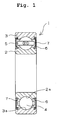
- Fig. 1 is a sectional view of a deep groove ball bearing.
- an inner ring 2 having an inner ring rolling surface 2a on its peripheral surface and an outer ring 3 having an outer ring rolling surface 3a on its inner peripheral surface are concentrically disposed, and a plurality of rolling elements 4 is disposed between the inner ring rolling surface 2a and the outer ring rolling surface 3a.
- the grease-enclosed bearing 1 further includes a cage 5 holding the rolling elements 4 and a seal member 6 fixed to the outer ring 3.
- Grease composition 7 is applied to at least the peripheries of rolling elements 4.
- the base oil and the thickener were mixed with each other at ratios shown in table 1 to obtain a grease composition of each of the examples.
- Reference symbol MDI in tables 1 and 2 denotes 4,4'-diphenylmethane diisocyanate.
- the generation of a low-temperature abnormal noise was measured and a life test of the grease compositions at a high temperature were conducted on the obtained grease compositions.
- the test method and the test condition are shown below.
- the base oil and the thickener were mixed with each other at ratios shown in table 2 to obtain a grease composition of each of the comparison examples.
- the generation of the low-temperature abnormal noise was measured and a life test of the grease compositions at the high temperature were conducted on the obtained grease compositions.
- each rolling bearing was placed in a cryostat having a temperature of -50°C for a certain period of time and taken out therefrom. Thereafter each rolling bearing was mounted on a bearing rotating apparatus set to a room temperature. When the temperature of the rolling bearing became -20°C, the bearing rotating apparatus was rotated at 2700 rpm under a radial load of 127 N to aurally check whether the low-temperature abnormal noise was generated. The generation of the low-temperature abnormal noise was evaluated by the ratio of the number of the rolling bearings which generated the low-temperature abnormal noise to the total of the number of the rolling bearings. Table 1 shows the evaluated results of the examples. Table 2 shows the evaluated results of the comparison examples.
- SHINFIELD 801 Synthetic hydrocarbon oil B -50 °C 63 mm 2 /s Mitsui Chemicals, Inc. LUCANT HC10 Ester oil B -52 °C 33 mm 2 /s Kao Corporation KAOLUBE 268 Alkyl diphenyl ether oil -50 °C 31.1 mm 2 /s Matsumura oil Presearch Corp.
- the grease composition of the present invention displays a preferable lubricity in a wide temperature range from a low temperature to a high temperature and is capable of preventing the generation of the low-temperature abnormal noise immediately after a bearing starts to operate at the low temperature. Therefore the bearing in which the grease composition of the present invention is enclosed can be preferably used for a vehicle such as a car when it is cold.
Landscapes
- Engineering & Computer Science (AREA)
- General Engineering & Computer Science (AREA)
- Chemical & Material Sciences (AREA)
- Mechanical Engineering (AREA)
- Chemical Kinetics & Catalysis (AREA)
- General Chemical & Material Sciences (AREA)
- Oil, Petroleum & Natural Gas (AREA)
- Organic Chemistry (AREA)
- Rolling Contact Bearings (AREA)
- Lubricants (AREA)
Abstract
Description
- The present invention relates to a grease composition enclosed in a bearing incorporated in various industrial machines, vehicles, and the like and more particularly, to a grease composition preferable for a bearing used at a high rotational speed in a wide temperature range from a high temperature to an ultra-low temperature at which a low-temperature abnormal noise is generated.
- A grease composition is enclosed in a bearing incorporated in various industrial machines and vehicles to impart lubricity to the bearing. The grease composition is prepared by kneading a base oil and a thickener. As the base oil, synthetic oils such as a mineral oil, an ester oil, a silicone oil, an ether oil, a fluorine oil, and the like are generally used. As the thickener, metal soap such as lithium soap, urea compounds, fluororesin are generally used.
- In recent years, a rolling bearing tends to be used at a high rotational speed. Thus the grease composition is demanded to have durability at a high temperature. When the metal soap is used as the thickener, oxidation of the base oil is accelerated at the high temperature and thus lubricating action deteriorates. Regarding the base oil, the grease composition containing the mineral oil as the base oil thereof is oxidized more readily than the grease composition containing the synthetic oil as the base oil thereof and thus has a short lubricating life at the high temperature. Thus in recent years, the grease composition containing the synthetic oil as the base oil thereof and the urea compound or the fluororesin as the thickener thereof is mainly used for the rolling bearing which is used at the high temperature and speed.
- As various industrial mechanical members become compact and have high performance, use conditions tend to be strict. Consequently the grease composition is demanded to have a higher lubricating performance and a longer lubricating life. In compliance with the demand for the longer lubricating life, the addition of an antioxidant and an antiseptic agent to the grease composition containing a synthetic oil having a high viscosity as its base oil and an urea compound as its thickener is investigated. This grease composition is liable to generate the low-temperature abnormal noise when it is cold.
- When a pulley and the like to be driven by an engine of a car is operated when it is cold, there is a case in which an abnormal noise (hoot noise) is generated when it is cold, namely, a low-temperature abnormal noise is generated. Although the reason of the generation of the low-temperature abnormal noise has not been clarified, it is supposed that the low-temperature abnormal noise is generated owing to a self-excited vibration of a rolling element caused by nonuniformity of an oily film of grease. That is, when it is cold, the oily film of the raceway surface is liable to be nonuniform owing to a rise of the viscosity of the base oil of the grease. The oily film causes the coefficient of friction between the rolling element and the raceway surface to make a slight periodical change. Thereby the rolling element generates the self-excited vibration. Owing to the self-excited vibration of the rolling element, the pulley and the like resonate with the bearing. As a result, the outer ring vibrates (translational motion) axially to generate a low-temperature abnormal noise.
- As the grease excellent in the durability at the high temperature and preventing the generation of the low-temperature abnormal noise, grease containing mixed oil of synthetic hydrocarbon oil and ester synthetic oil in which not less than eight ester groups are disposed like the teeth of a comb at one side of not less than eight carbon atoms constituting chain-shaped molecules of oil; an urea compound mixed with the base oil as a thickener; and dithiophosphate added to the base oil thereof as an extreme-pressure agent is known (see patent document 1).
- A bearing for use in a pulley of a car in which a grease composition containing a base oil composed of a mixed oil of poly-α-olefin (hereinafter abbreviated as PAO) oil and an ester oil; an alicyclic diurea compound mixed with the base oil as a thickener; and zinc dithiocarbamate as an additive added to the base oil is known. In the bearing, a contact angle is formed by bringing each of a plurality of balls interposed between an inner ring and an outer ring both constituting the bearing into contact with the inner ring or with at least the outer ring at two points (see patent document 2).
- These attempts are aimed at the stability of the oily film when it is cold to prevent the generation of the low-temperature abnormal noise and at a long life of the grease composition at the high temperature. But these attempts are incapable of obtaining a sufficient effect in preventing the generation of the low-temperature abnormal noise.
- Patent document 1:
Japanese Patent Application Laid-Open No.9-208982 - Patent document 2:
Japanese Patent Application Laid-Open No.11-270566 - It is an object of the present invention to provide a grease composition capable of securely preventing the generation of a low-temperature abnormal noise when it is cold and a grease-enclosed bearing.
- A grease composition of the present invention comprises a base oil and a thickener, wherein the base oil has a pour point not more than -50°C and a kinematic viscosity not less than 15 mm2/s at 40°C. The thickener comprises at least one substance selected from among a urea compound and a fluororesin.
- The mixing consistency of the grease composition is in the range of 250 to 350. The base oil is at least one oil selected from among a PAO oil and a perfluoro ether oil.
- In the present invention, the pour point is a value measured by using the method specified in JIS K2269, and the mixing consistency is a value of 60-times mixing consistency measured by using the method specified in JIS K2220.
- A grease-enclosed bearing of the present invention includes an inner ring, an outer ring, rolling elements interposed between the inner ring and the outer ring, and a grease composition enclosed on the periphery of the rolling elements. The grease-enclosed bearing is used for an automotive electric auxiliary machine.
- The grease composition of the present invention contains the base oil and the thickener. The base oil has the pour point not more than -50°C and the kinematic viscosity not less than 15 mm2/s at 40°C. The thickener is at least one substance selected from among the urea compound and the fluororesin. Therefore the grease composition to be enclosed in a bearing displays a preferable lubricity in a wide temperature range from a low temperature to a high temperature, is capable of preventing the generation of the low-temperature abnormal noise immediately after the bearing starts to operate at the low temperature, and is capable of maintaining a property excellent in durability at the high temperature for a long time and thus allows the bearing to have a long life.
- Because the mixing consistency of the grease composition is in the range of 250 to 350, the grease composition displays a preferable lubricity in the wide temperature range from the low temperature to the high temperature and is capable of preventing the generation of the low-temperature abnormal noise immediately after the bearing starts to operate at the low temperature.
- Because the base oil is at least one oil selected from among the PAO oil and the perfluoro ether oil, the grease composition maintains the lubricating performance at the high temperature and is securely preventing the generation of the low-temperature abnormal noise when it is cold.
- The grease-enclosed bearing has the inner ring, the outer ring, the rolling elements interposed between the inner ring and the outer ring, and the grease composition enclosed on the periphery of the rolling elements. Therefore the grease composition displays a preferable lubricity in the wide temperature range from the low temperature to the high temperature and is capable of preventing the generation of the low-temperature abnormal noise immediately after the bearing starts to operate at the low temperature. Further the grease composition is capable of maintaining the property excellent in durability at the high temperature for a long time and thus allows the bearing to have a long life.
- Because the grease-enclosed bearing is used for an automotive electric auxiliary machine, the grease composition maintains the lubricating performance at the high temperature and is securely preventing the generation of the low-temperature abnormal noise in the car when it is cold.
-
- Fig. 1 is a sectional view of a deep groove ball bearing.
-
- 1: deep groove ball bearing
- 2: inner ring
- 3: outer ring
- 4: rolling element
- 5: cage
- 6: seal member
- 7: grease composition
- It has been found that a grease composition containing a base oil having a pour point not more than -50°C and a kinematic viscosity not less than 15 mm2/s at 40°C has a constant durability at a high temperature and an improved performance of preventing the generation of a low-temperature abnormal noise. It is considered that owing to the use of the base oil, the effect of preventing the generation of the low-temperature abnormal noise is increased by preventing a rise of the viscosity of the grease composition when it is cold and an oily film of a raceway surface of a bearing from becoming nonuniform. The present invention is based on the above-described finding.
- As the base oil which can be used in the present invention, a mineral oil, a synthetic oil, and a mixture of the mineral oil and the synthetic oil which are normally used for grease can be used when they have a pour point not more than -50°C and a kinematic viscosity not less than 15 mm2/s at 40°C.
- A pour point depressant such as polymethacrylate may be added to the base oil to set the pour point of the base oil to not more than -50°C. To prevent deterioration of the lubricating performance and a decrease of the lubricating life of the grease composition at a high temperature and speed, the base oil is required to have a kinematic viscosity not less than 15 mm2/s at 40°C and favorably a high viscosity not less than 30 mm2/s at 40°C.
- As the mineral oil, it is possible to list a paraffin mineral oil and a naphthene mineral oil. As the synthetic oil, it is possible to list a synthetic hydrocarbon oil, an ether oil, an ester oil, and a fluorine oil.
- As the synthetic hydrocarbon oil, a PAO oil and the like can be listed. As the ether oil, a dialkyl diphenyl ether oil, an alkyl triphenyl ether oil, and an alkyl tetraphenyl ether oil can be listed. As the ester oil, a diester oil, a polyol ester oil, a complex ester oil of these oils, and an aromatic ester oil can be listed.
- As the fluorine oil, a perfluoro polyether oil can be used.
- In consideration of the lubricating performance and lubricating life of the grease composition at high temperature and speed, it is preferable that the grease composition contains a synthetic oil of a synthetic hydrocarbon oil, an alkyl diphenyl ether oil, an ester oil, and the fluorine oil. It is especially preferable that the grease composition contains at least one oil selected from among the PAO oil which is the synthetic hydrocarbon oil and a perfluoro ether oil which is the fluorine oil.
- As the above-described PAO oil, normally the above-described PAO oil is an oligomer of α-olefin or isomerized α-olefin or mixtures of polymers. As examples of the α-olefin, it is possible to list 1-octene, 1-nonene, 1-decene, 1-dodecene, 1-tridecene, 1-tetradecene, 1-pentadecene, 1-hexadecene, 1-heptadecene, 1-octadecene, 1-nonadecene, 1-eicosene, 1-docosene, and 1-tetracosene. Normally, mixtures of these substances are used.
- As the perfluoro polyether oil, it is possible to use a compound formed by replacing hydrogen atoms of an aliphatic hydrocarbon polyether with fluorine atoms. Exemplifying the perfluoro polyether oil, perfluoro polyether having a side chain shown by the following
chemical formulas chemical formulas 3 through 5 are used. These oils can be used singly or as a mixture thereof. Reference symbols m and n denote integers. - It is possible to exemplify "FOMBRIN Y" (commercial name, produced by Montedison Inc.) as a commercially available product shown by the
chemical formula 1, "Krytox" (commercial name, produced by DuPont Inc.) and "BARRIERTA J" oil (commercial name, produced by Kluber Inc.) as commercially available products shown by thechemical formula 2, "FOMBRIN Z" (commercial name, produced by Montedison Inc.) as a commercially available product shown by thechemical formula 3, "FOMBRIN M" (commercial name, produced by Montedison Inc.) as a commercially available product shown by thechemical formula 4, and "DEMNUM" (commercial name, produced by DAIKIN INDUSTRIES. LTD) as a commercially available product shown by thechemical formula 5.

[Chemical formula 3] CF3O-(CF2CF2O)m-(CF2O)n-CF3 m/n < 1
[Chemical formula 4] CF3O-(CF2CF2O)m-(CF2O)n-CF3 m/n > 1
[Chemical formula 5] F-(CF2CF2CF2O)n-CF2CF3
- The thickener that can be used in the present invention is a urea compound, fluororesin powder, and a mixture of the urea compound and the fluororesin powder. It is preferable to use the urea compound as the thickener for the above-described synthetic oil and the fluororesin powder as the thickener for the above-described perfluoro polyether oil.
- As the urea compound, diurea having two urea bonds in its molecules is preferable and is shown by the following
chemical formula 6.
- As an example of a method of producing the urea compound, a diisocyanate compound and an amine compound are prepared to react with each other by using the isocyanate group and the amino group in an equivalent. Besides the diurea, polyurea or the like can be used.
- Powder which has an affinity for the perfluoro polyether oil and is stable at a high temperature can be used for the fluororesin which can be used to thicken the perfluoro polyether oil. Exemplifying the fluororesin, perfluororesins such as polytetrafluoroethylene (PTFE), a tetrafluoroethylene-perfluoroalkylvinyl ether copolymer (PFA), a tetrafluoroethylene-hexafluoropropylene copolymer (FEP) are preferable. The polytetrafluoroethylene is especially preferable because it is stable at a high temperature.
- It is preferable that the content of the thickener is in the range of 5 to 50 parts by weight based on 100 parts by weight of the total amount of said base oil and said thickener. If the content of the thickener is less than 5 parts by weight, the grease composition becomes liquid and has a low viscosity and is thus liable to leak. Thus it is difficult to enclose the grease composition in a bearing. If the content of the thickener is more than 50 parts by weight, the grease composition becomes solid and the consistency thereof becomes less than 100. Therefore the grease composition cannot be practically used as grease to be enclosed in the bearing.
- It is preferable that the mixing consistency of the grease composition which can be used in the present invention is in the range of 250 to 350. If the mixing consistency of the grease composition is less than 250, the grease composition has an inferior lubricating performance at a low temperature. It is not preferable that the mixing consistency of the grease composition is more than 350 because the grease composition is liable to leak.
- The grease composition of the present invention contains the base oil and the thickener as its essential components. The grease composition may further contain conventional additives for use in grease such as an extreme-pressure agent, an antioxidant, a rust resisting agent, a metal-inactivating agent, an oily agent, and the like. These additives are shown below.
- By using the extreme-pressure agent, the withstand load and extreme pressure resistance of the grease composition can be improved. For example, it is possible to use the following compounds as necessary: As organometallic compounds, organic molybdenum compounds such as molybdenum dithiocarbamate and molybdenum dithiophosphate; organic zinc compounds such as zinc dithiocarbamate, zinc dithiophosphate, and zinc phenate; organic antimony compounds such as antimony dithiocarbamate and antimony dithiophosphate; organic selenium compounds such as selenium dithiocarbamate; organic bismuth compounds such as bismuth naphthenate and bismuth dithiocarbamate; organic iron compounds such as ferric dithiocarbamate and ferric octynoate; organic copper compounds such as copper dithiocarbamate and copper naphthenate; organic lead compounds such as lead naphthene and lead dithiocarbamate; organic tin compounds such as tin maleate and dibutyltin sulfide; organic sulfonate, phenate, phosphonate of alkali metal and alkali earth metal; and organometallic compounds containing gold, silver, titanium, and the like. As sulfur-based compounds, it is possible to use a sulfide compound such as dibenzyl disulfide or a polysulfide compound, sulfurized fats and oils, compounds of ash-free carbamic acid, thiourea compounds, and thiocarbonates. As a phosphoric acid-based extreme-pressure agent, it is possible to use phosphate such as trioctyl phosphate and tricresyl phosphate; and phosphate compounds such as acidic phosphate, phosphite, and acidic phosphite. In addition, it is possible to use a halogen-based extreme-pressure agent such as chlorinated paraffin or solid lubricants such as molybdenum disulfide, tungsten disulfide, graphite, polytetrafluoroethylene, antimony sulfide, and boron compounds such as boron nitride. Of these extreme-pressure agents, compounds of dithiocarbamic acid and those of dithiophosphoric acid can be preferably used.
- As the antioxidant, an age resistor, an ozone deterioration preventive agent, and an antioxidant to be added to rubber, plastics, lubricant, and the like can be selectively used. For example, the following compounds can be used: amine compounds such as phenyl-1-naphtylamine, phenyl-2-naphtylamine, diphenyl-p-phenylenediamine, dipyridylamine, phenothiazine, N-methylphenothiazine, N-ethylphenothiazine, 3,7-dioctylphenothiazine, p,p'-dioctyldiphenylamine, N,N'-diisopropyl-p-phenylenediamine, and N,N'-di-sec-butyl-p-phenylenediamine.
- Phenol antioxidants can be also used. As the phenol antioxidants, 2,6-di-t-dibutylphenol, n-octadecyl-3-(3',5'-di-tert-butyl-4-hydroxyphenyl)propionate, tetrakis-(methylene-3-(3',5'-di-t-butyl-4-hydroxyphenyl)propio nate)methane, 2,2'-methylenebis-(4-methyl-6-t-butylphenol), and 4,4'-butylidenebis-(3-methyl-6-t-butylphenol) are listed.
- As the rust resisting agent, the following compounds can be used: That is, ammonium salts of organic sulfonic acid; organic sulfonates of alkali metal and alkali earth metal such as magnesium barium and calcium; organic sulfonates of zinc; organic carboxylate; phenate, phosphonate, derivatives of alkyl and alkenyl succinic acid such as alkyl and alkenyl succinates; partial ester of polyvalent alcohol such as sorbitan monooleate; hydroxy fatty acids such as oleoyl sarcosine; mercapto fatty acids such as 1-mercapto stearate or metal salts thereof; higher fatty acids such as stearate; higher alcohols such as isostearyl alcohol; esters of higher alcohols and higher fatty acids; thiazoles such as 2,5-dimercapto-1,3,4-thiaziazole, 2-mercaptothiaziazole, and the like; imidazole compounds such as 2-(decyldithio)-benzimidazole, benzimidazole, and the like; disulfide compounds such as 2,5-bis(dodecyldithio)-benzimidazole, and the like; phosphate such as tris (nonylphenyl) phosphite; and thiocarboxylate such as dilauryl thiopropionate and the like. It is also possible to use corrosion inhibitors such as nitrite, nitrate, chromate, phosphate, molybdate, and tungstate all having a function of passivating the surface of metal.
- As the metal-inactivating agent, triazole compounds such as benzotriazole and tolyltriazole can be used.
- As the oily agents, the following compounds can be used: fatty acids such as oleic acid, stearic acid, and the like; fatty alcohols such as oleyl alcohol, and the like; fatty esters such as polyoxyethylene stearate, polyglyceryl oleate, and the like; phosphoric acid; and phosphates such as tricresylphosphate, laurate, polyoxyethylene oleyl ether phosphate, and the like.
- An example of the grease-enclosed bearing of the present invention is shown in Fig. 1. Fig. 1 is a sectional view of a deep groove ball bearing.
- In a grease-enclosed
bearing 1, aninner ring 2 having an inner ring rolling surface 2a on its peripheral surface and anouter ring 3 having an outer ring rolling surface 3a on its inner peripheral surface are concentrically disposed, and a plurality of rollingelements 4 is disposed between the inner ring rolling surface 2a and the outer ring rolling surface 3a. The grease-enclosedbearing 1 further includes acage 5 holding the rollingelements 4 and aseal member 6 fixed to theouter ring 3.Grease composition 7 is applied to at least the peripheries of rollingelements 4. - The base oil and the thickener were mixed with each other at ratios shown in table 1 to obtain a grease composition of each of the examples. Reference symbol MDI in tables 1 and 2
denotes 4,4'-diphenylmethane diisocyanate. The generation of a low-temperature abnormal noise was measured and a life test of the grease compositions at a high temperature were conducted on the obtained grease compositions. The test method and the test condition are shown below. - The base oil and the thickener were mixed with each other at ratios shown in table 2 to obtain a grease composition of each of the comparison examples. In a manner similar to that of the examples, the generation of the low-temperature abnormal noise was measured and a life test of the grease compositions at the high temperature were conducted on the obtained grease compositions.
- 0.9 g of the grease composition of each of the examples and the comparison examples was enclosed in rolling bearings (6203) respectively. Each rolling bearing was placed in a cryostat having a temperature of -50°C for a certain period of time and taken out therefrom. Thereafter each rolling bearing was mounted on a bearing rotating apparatus set to a room temperature. When the temperature of the rolling bearing became -20°C, the bearing rotating apparatus was rotated at 2700 rpm under a radial load of 127 N to aurally check whether the low-temperature abnormal noise was generated. The generation of the low-temperature abnormal noise was evaluated by the ratio of the number of the rolling bearings which generated the low-temperature abnormal noise to the total of the number of the rolling bearings. Table 1 shows the evaluated results of the examples. Table 2 shows the evaluated results of the comparison examples.
- 1.8 g of the grease composition of each of the examples and the comparison examples was enclosed in rolling bearings (6204) respectively. The bearing rotating apparatus was rotated at 10000 rpm under an axial load of 67 N and a radial load of 67 N. The time required for seizing to occur was measured. The temperature of the bearing was evaluated at 200°C in the case of the fluorine grease and at 150°C in the case of other greases. Table 1 shows the evaluated results of the examples. Table 2 shows the evaluated results of the comparison examples.
Table 1 Example 1 2 3 4 5 6 7 8 9 10 11 12 13 Mixing (part by weight) Base oil Synthetic hydrocarbon oil A 85 73 70 85 77 - - - - - - - - Synthetic hydrocarbon oil B - - - - - 85 85 - - - - - - Ester oil B - - - - - - - 85 85 - - - - Alkyl diphenyl ether oil - - - - - - - - - 85 85 - - Perfluoro polyether oil A - - - - - - - - - - - 75 - Perfluoro polyether oil B - - - - - - - - - - - - 75 Thickener Urea compound Octylamine 7.6 13.7 15.2 - - 7.6 - 7.6 - 7.6 - - - Cyclohexylamine - - - 6.6 - - 6.6 - 6.6 - 6.6 - - p-toluidine - - - - 10.7 - - - - - - - - MDI 7.4 13.3 14.8 8.4 12.3 7.4 8.4 7.4 8.4 7.4 8.4 - - Fluororesin (PTFE) - - - - - - - - - - - 25 25 Properties 60-times mixing consistency (JIS K2220) 284 240 219 279 318 276 291 251 255 293 286 285 275 Low-temperature abnormal noise 0/10 2/10 3/10 0/10 0/10 0/10 0/10 3/10 2/10 2/10 2/10 0/10 0/10 Life at high temperature (hour) 3800 3100 2700 4200 3900 4100 3700 3500 3600 2300 2800 5100 6800 Pour point Kinematic viscosity (40°C) Maker Commercial name Synthetic hydrocarbon oil A -57 °C 47 mm2/s Nippon Steel Chemical Co., Ltd. SHINFIELD 801 Synthetic hydrocarbon oil B -50 °C 63 mm2/s Mitsui Chemicals, Inc. LUCANT HC10 Ester oil B -52 °C 33 mm2/s Kao Corporation KAOLUBE 268 Alkyl diphenyl ether oil -50 °C 31.1 mm2/s Matsumura oil Presearch Corp. MORESCO HILUBE LB32 Perfluoro polyether oil A -67 °C 65 mm2/s DuPont L-65 Perfluoro polyether oil B -67 °C 100 mm2/s DuPont L-100 Table 2 Comparison Example 1 2 3 4 5 6 7 8 9 10 Mixing (part by weight) Base oil Synthetic hydrocarbon oil 85 85 - - - - - - - - Ester oil A - - 85 85 - - - - - - Ester oil B - - - - - - - - 89 - Alkyl diphenyl ether oil - - - - 85 85 77 - - - Mineral oil - - - - - - - 85 - - Perfluoro polyether oil - - - - - - - - - 76 Thickener Lithium 12-hidroxystearate - - - - - - - - 11 - Urea compound Octylamine 7.6 - 7.6 - 7.6 - - 7.6 - - Cyclohexylamine - 6.6 - 6.6 - 6.6 - - - - p-toluidine - - - - - - 10.7 - - - MDI 7.4 8.4 7.4 8.4 7.4 8.4 12.3 7.4 - - Fluororesin (PTFE) - - - - - - - - - 24 Properties 60-times mixing consistency (JIS K2220) 273 271 260 264 287 277 302 257 251 287 Low-temperature abnormal noise 7/10 6/10 6/10 7/10 7/10 8/10 8/10 2/10 0/10 7/10 Life at high temperature (hour) 3100 3700 1800 1400 4100 4300 4600 370 740 3800 Pour point Kinematic viscosity (40 °C) Maker Commercial name Synthetic hydrocarbon oil -47.5°C 162 mm2/s Nippon Steel Chemical Co.,Ltd. LUCANT HC20 Ester oil A -42 °C 27 mm2/s AKZONOBEL KL305 Ester oil B -52 °C 33 mm2/s Kao Corporation KAOLUBE 268 Alkyl diphenyl ether oil -40 °C 97 mm2/s Matsumura Oil Presearch Corp. MORESCO HILUBE LB100 Mineral oil -50 °C 8.5 mm2/s NIPPON OIL CORPORATION KRISEF F8 Perfluoro polyether oil -36 °C 160 mm2/s DuPont GPL-105 - It is understood from tables 1 and 2 that the bearings in which the grease compositions of the examples each containing the base oil having the pour point not more than -50°C were enclosed generated much less low-temperature abnormal noise than the bearings in which the grease compositions of the comparison examples were enclosed. This is because owing to the use of the base oil, a rise of the viscosity of the grease composition when it is cold is prevented, and the oily film of the raceway surface of the bearing is prevented from becoming nonuniform. Thereby the effect of preventing the generation of the low-temperature abnormal noise increased. Therefore the grease composition can be preferably used for a bearing to be used when it is cold and particularly for a bearing for use in an electric auxiliary machine.
- The grease composition of the present invention displays a preferable lubricity in a wide temperature range from a low temperature to a high temperature and is capable of preventing the generation of the low-temperature abnormal noise immediately after a bearing starts to operate at the low temperature. Therefore the bearing in which the grease composition of the present invention is enclosed can be preferably used for a vehicle such as a car when it is cold.
Claims (8)
- A grease composition comprising a base oil and a thickener,
wherein said base oil has a pour point not more than -50°C and a kinematic viscosity not less than 15 mm2/s at 40°C; and said thickener comprises at least one substance selected from among a urea compound and a fluororesin. - The grease composition according to claim 1, wherein a mixing consistency of said grease composition is in the range of 250 to 350.
- The grease composition according to claim 1, wherein a content of said thickener is in the range of 5 to 50 parts by weight based on 100 parts by weight of the total amount of said base oil and said thickener.
- The grease composition according to claim 1, wherein said base oil comprises at least one oil selected from among a synthetic hydrocarbon oil and a fluorine oil.
- The grease composition according to claim 4, wherein said synthetic hydrocarbon oil is a poly-α-olefin oil.
- The grease composition according to claim 4, wherein said fluorine oil is a perfluoro ether oil.
- A grease-enclosed bearing comprising an inner ring, an outer ring, rolling elements interposed between said inner ring and said outer ring, and a grease composition which is enclosed on a periphery of said rolling elements,
wherein said grease composition is the grease composition according to claim 1. - The grease-enclosed bearing, according to claim 7, which is used for an automotive electric auxiliary machine.
Applications Claiming Priority (2)
| Application Number | Priority Date | Filing Date | Title |
|---|---|---|---|
| JP2004109558A JP4832724B2 (en) | 2004-04-02 | 2004-04-02 | Grease composition and grease-filled bearing |
| PCT/JP2005/005478 WO2005097955A1 (en) | 2004-04-02 | 2005-03-25 | Grease composition and grease filled bearing |
Publications (2)
| Publication Number | Publication Date |
|---|---|
| EP1739157A1 true EP1739157A1 (en) | 2007-01-03 |
| EP1739157A4 EP1739157A4 (en) | 2010-02-10 |
Family
ID=35125059
Family Applications (1)
| Application Number | Title | Priority Date | Filing Date |
|---|---|---|---|
| EP05721455A Withdrawn EP1739157A4 (en) | 2004-04-02 | 2005-03-25 | Grease composition and grease filled bearing |
Country Status (5)
| Country | Link |
|---|---|
| US (1) | US8048835B2 (en) |
| EP (1) | EP1739157A4 (en) |
| JP (1) | JP4832724B2 (en) |
| CN (1) | CN1938409A (en) |
| WO (1) | WO2005097955A1 (en) |
Cited By (1)
| Publication number | Priority date | Publication date | Assignee | Title |
|---|---|---|---|---|
| EP2631284A4 (en) * | 2010-10-20 | 2015-07-08 | Kyodo Yushi | FAT COMPOSITION |
Families Citing this family (12)
| Publication number | Priority date | Publication date | Assignee | Title |
|---|---|---|---|---|
| JP5227526B2 (en) * | 2007-03-26 | 2013-07-03 | Jx日鉱日石エネルギー株式会社 | Vehicle bearing lubricant |
| JP5101950B2 (en) * | 2007-08-20 | 2012-12-19 | Ntn株式会社 | Ball bearing |
| JP5244537B2 (en) * | 2008-10-17 | 2013-07-24 | Ntn株式会社 | Wheel bearing device |
| US20110218128A1 (en) * | 2008-10-17 | 2011-09-08 | Nok Kluber Co., Ltd. | Lubricating grease composition and method for producing the same |
| JP5664890B2 (en) * | 2009-10-15 | 2015-02-04 | 協同油脂株式会社 | Grease composition for wind power generator bearings |
| US9581943B2 (en) * | 2014-04-30 | 2017-02-28 | Canon Kabushiki Kaisha | Heat fixing apparatus and grease composition for the heat fixing apparatus |
| CN104119985A (en) * | 2014-07-01 | 2014-10-29 | 上海亚杜润滑材料股份有限公司 | Novel mechanical lubricant |
| CN108699477B (en) | 2015-12-04 | 2019-08-30 | Nok克鲁伯有限公司 | Lubricant composition |
| JP6753699B2 (en) * | 2016-05-27 | 2020-09-09 | ミネベアミツミ株式会社 | Rolling bearing |
| CN110317667A (en) * | 2019-07-15 | 2019-10-11 | 浙江摩路新材料有限公司 | A kind of high-temperature long life bearing grease and preparation method thereof |
| JP2022155415A (en) * | 2021-03-30 | 2022-10-13 | Ntn株式会社 | Sealed rolling bearing |
| US12428607B2 (en) * | 2021-04-20 | 2025-09-30 | Idemitsu Kosan Co., Ltd. | Lubricant composition |
Family Cites Families (24)
| Publication number | Priority date | Publication date | Assignee | Title |
|---|---|---|---|---|
| CA1329586C (en) * | 1988-05-06 | 1994-05-17 | Takashi Tohzuka | Fluorine-containing grease and its preparation |
| JP2977624B2 (en) * | 1991-01-18 | 1999-11-15 | 協同油脂株式会社 | Grease composition |
| JP3514574B2 (en) | 1996-01-30 | 2004-03-31 | Ntn株式会社 | Grease for sealing bearing |
| JPH1180766A (en) * | 1997-09-02 | 1999-03-26 | Kao Corp | Grease base oil |
| JPH11270566A (en) | 1998-03-19 | 1999-10-05 | Ntn Corp | Automotive pulley bearings |
| JP5042401B2 (en) * | 1998-10-14 | 2012-10-03 | 日本精工株式会社 | Rolling bearing for automobile fuel injection control |
| JP3572987B2 (en) * | 1999-03-24 | 2004-10-06 | 日本精工株式会社 | Rolling bearing |
| JP2001003070A (en) * | 1999-06-18 | 2001-01-09 | Kyodo Yushi Co Ltd | Grease composition |
| JP4427195B2 (en) * | 2001-01-26 | 2010-03-03 | Ntn株式会社 | Grease filled bearings for automobiles |
| JP2002250351A (en) * | 2001-02-20 | 2002-09-06 | Nsk Ltd | Rolling bearing |
| JP4064073B2 (en) * | 2001-05-07 | 2008-03-19 | Ntn株式会社 | Rolling bearing |
| US6673750B2 (en) * | 2001-02-22 | 2004-01-06 | Ntn Corporation | Lubricating composition |
| JP4532799B2 (en) * | 2001-09-27 | 2010-08-25 | Ntn株式会社 | Grease composition and grease-filled bearing |
| JP4239514B2 (en) * | 2001-10-04 | 2009-03-18 | 日本精工株式会社 | Rolling bearing |
| JP2003269469A (en) * | 2002-03-15 | 2003-09-25 | Nsk Ltd | Rolling device |
| JP4386632B2 (en) * | 2002-04-02 | 2009-12-16 | Ntn株式会社 | Rolling bearing |
| JP2003293797A (en) * | 2002-04-08 | 2003-10-15 | Minebea Co Ltd | Bearings for electronically controlled throttle motors |
| JP4401642B2 (en) * | 2002-04-15 | 2010-01-20 | 日本精工株式会社 | Rolling bearings for automotive cooling fans |
| JP4262448B2 (en) * | 2002-06-24 | 2009-05-13 | Ntn株式会社 | Lubricating grease and rolling bearings |
| JP2005105238A (en) | 2003-01-06 | 2005-04-21 | Nsk Ltd | Grease composition for automotive electrical accessory and rolling bearing enclosing the grease composition |
| JP4515775B2 (en) * | 2003-04-30 | 2010-08-04 | Ntn株式会社 | Low-temperature lubrication grease and rolling bearings |
| JP2004352786A (en) * | 2003-05-27 | 2004-12-16 | Nsk Ltd | Grease composition and rolling apparatus |
| JP4425605B2 (en) * | 2003-10-28 | 2010-03-03 | 昭和シェル石油株式会社 | Urea-based lubricating grease composition and electric power steering device |
| US7029181B2 (en) * | 2004-03-04 | 2006-04-18 | Nsk Ltd. | Rolling bearing and fan motor using the same |
-
2004
- 2004-04-02 JP JP2004109558A patent/JP4832724B2/en not_active Expired - Lifetime
-
2005
- 2005-03-25 US US11/547,427 patent/US8048835B2/en not_active Expired - Fee Related
- 2005-03-25 EP EP05721455A patent/EP1739157A4/en not_active Withdrawn
- 2005-03-25 CN CNA2005800101463A patent/CN1938409A/en active Pending
- 2005-03-25 WO PCT/JP2005/005478 patent/WO2005097955A1/en not_active Ceased
Cited By (1)
| Publication number | Priority date | Publication date | Assignee | Title |
|---|---|---|---|---|
| EP2631284A4 (en) * | 2010-10-20 | 2015-07-08 | Kyodo Yushi | FAT COMPOSITION |
Also Published As
| Publication number | Publication date |
|---|---|
| CN1938409A (en) | 2007-03-28 |
| JP2005290279A (en) | 2005-10-20 |
| JP4832724B2 (en) | 2011-12-07 |
| US8048835B2 (en) | 2011-11-01 |
| EP1739157A4 (en) | 2010-02-10 |
| WO2005097955A1 (en) | 2005-10-20 |
| US20070287646A1 (en) | 2007-12-13 |
Similar Documents
| Publication | Publication Date | Title |
|---|---|---|
| EP1837391B1 (en) | Grease composition and grease-sealed roller bearing | |
| JP7297731B2 (en) | Rolling bearing using grease composition | |
| US8048835B2 (en) | Grease composition and grease-enclosed bearing | |
| JP2003105366A (en) | Grease composition and grease filled bearing | |
| EP2687584B1 (en) | Grease composition | |
| EP2913385A1 (en) | Grease composition | |
| EP2518132B1 (en) | Rust resisting grease composition, grease-enclosed bearing, and rust resisting agent for use in grease composition | |
| EP2264132A1 (en) | Grease composition and bearings | |
| EP2829597B1 (en) | Grease composition and rolling device | |
| US10041540B2 (en) | Grease composition and rolling device | |
| JP2004346298A (en) | Lubricating grease and rolling bearing for low and high temperatures | |
| JP2022022772A (en) | Grease composition and rolling bearing | |
| EP3165590A1 (en) | Lubricant composition and lubricant composition-sealed bearing | |
| US10145417B2 (en) | Grease composition-filled ball bearing, pivot assembly bearing including the ball bearing, and hard disk drive including the pivot assembly bearing | |
| JP4814513B2 (en) | Grease-filled rolling bearing | |
| JP2009019128A (en) | Grease composition and grease-sealed rolling bearing | |
| CN116113683B (en) | Grease composition and rolling bearing | |
| JP2021143289A (en) | Lubricant composition and rolling bearing | |
| EP4407015B1 (en) | Grease composition and grease-sealed bearing | |
| JP5267074B2 (en) | Rolling bearing unit for forward / reverse rotation motor | |
| JP2006225519A (en) | Heat resistant and at-cold abnormal noise preventive grease composition and grease-sealed roller bearing | |
| JP2004332768A (en) | Rolling device for vehicle and electric motor | |
| CN112126491A (en) | Grease composition and rolling bearing | |
| JP2000205281A (en) | Rolling bearing | |
| JP2008138706A (en) | Grease-filled roller bearing |
Legal Events
| Date | Code | Title | Description |
|---|---|---|---|
| PUAI | Public reference made under article 153(3) epc to a published international application that has entered the european phase |
Free format text: ORIGINAL CODE: 0009012 |
|
| 17P | Request for examination filed |
Effective date: 20061013 |
|
| AK | Designated contracting states |
Kind code of ref document: A1 Designated state(s): DE FR |
|
| DAX | Request for extension of the european patent (deleted) | ||
| RBV | Designated contracting states (corrected) |
Designated state(s): DE FR |
|
| A4 | Supplementary search report drawn up and despatched |
Effective date: 20100111 |
|
| RIC1 | Information provided on ipc code assigned before grant |
Ipc: C10N 30/00 20060101ALI20100104BHEP Ipc: C10N 30/06 20060101ALI20100104BHEP Ipc: C10N 20/00 20060101ALI20100104BHEP Ipc: C10N 40/02 20060101ALI20100104BHEP Ipc: C10M 105/18 20060101ALI20100104BHEP Ipc: C10M 107/38 20060101ALI20100104BHEP Ipc: C10N 20/02 20060101ALI20100104BHEP Ipc: C10M 119/22 20060101ALI20100104BHEP Ipc: C10M 115/08 20060101ALI20100104BHEP Ipc: C10M 169/02 20060101AFI20051026BHEP Ipc: F16C 33/66 20060101ALI20100104BHEP Ipc: C10N 50/10 20060101ALI20100104BHEP Ipc: C10M 105/32 20060101ALI20100104BHEP Ipc: C10M 107/02 20060101ALI20100104BHEP Ipc: C10N 30/08 20060101ALI20100104BHEP |
|
| 17Q | First examination report despatched |
Effective date: 20100618 |
|
| RIC1 | Information provided on ipc code assigned before grant |
Ipc: C10N 40/02 20060101ALI20130107BHEP Ipc: C10M 119/22 20060101ALI20130107BHEP Ipc: C10M 105/32 20060101ALI20130107BHEP Ipc: C10M 107/38 20060101ALI20130107BHEP Ipc: C10M 115/08 20060101ALI20130107BHEP Ipc: C10M 169/02 20060101AFI20130107BHEP Ipc: C10M 107/02 20060101ALI20130107BHEP Ipc: C10N 30/00 20060101ALI20130107BHEP Ipc: C10N 50/10 20060101ALI20130107BHEP Ipc: C10N 20/00 20060101ALI20130107BHEP Ipc: C10N 30/06 20060101ALI20130107BHEP Ipc: C10M 105/18 20060101ALI20130107BHEP Ipc: C10N 30/08 20060101ALI20130107BHEP Ipc: F16C 33/66 20060101ALI20130107BHEP Ipc: C10N 20/02 20060101ALI20130107BHEP |
|
| GRAP | Despatch of communication of intention to grant a patent |
Free format text: ORIGINAL CODE: EPIDOSNIGR1 |
|
| STAA | Information on the status of an ep patent application or granted ep patent |
Free format text: STATUS: THE APPLICATION IS DEEMED TO BE WITHDRAWN |
|
| 18D | Application deemed to be withdrawn |
Effective date: 20130704 |