EP1738647A1 - Process for producing mallotus philippensis colorant composition and the composition - Google Patents
Process for producing mallotus philippensis colorant composition and the composition Download PDFInfo
- Publication number
- EP1738647A1 EP1738647A1 EP05720596A EP05720596A EP1738647A1 EP 1738647 A1 EP1738647 A1 EP 1738647A1 EP 05720596 A EP05720596 A EP 05720596A EP 05720596 A EP05720596 A EP 05720596A EP 1738647 A1 EP1738647 A1 EP 1738647A1
- Authority
- EP
- European Patent Office
- Prior art keywords
- extraction
- production method
- solvent
- mallotus philippinensis
- rottlerin
- Prior art date
- Legal status (The legal status is an assumption and is not a legal conclusion. Google has not performed a legal analysis and makes no representation as to the accuracy of the status listed.)
- Withdrawn
Links
- 240000003450 Mallotus philippensis Species 0.000 title claims abstract description 48
- 239000000203 mixture Substances 0.000 title claims description 34
- 239000003086 colorant Substances 0.000 title claims description 3
- 238000000034 method Methods 0.000 title description 20
- LFQSCWFLJHTTHZ-UHFFFAOYSA-N Ethanol Chemical compound CCO LFQSCWFLJHTTHZ-UHFFFAOYSA-N 0.000 claims abstract description 101
- 238000000605 extraction Methods 0.000 claims abstract description 89
- LHHQTXPEHJNOCX-UHFFFAOYSA-N Rottlerin Natural products CC(=O)c1c(O)c(C)c(O)c(Oc2c(O)c3C=CC(C)(C)Cc3c(C(=O)C=Cc4ccccc4)c2O)c1O LHHQTXPEHJNOCX-UHFFFAOYSA-N 0.000 claims abstract description 45
- DEZFNHCVIZBHBI-ZHACJKMWSA-N rottlerin Chemical compound CC(=O)C1=C(O)C(C)=C(O)C(CC=2C(=C(C(=O)\C=C\C=3C=CC=CC=3)C=3OC(C)(C)C=CC=3C=2O)O)=C1O DEZFNHCVIZBHBI-ZHACJKMWSA-N 0.000 claims abstract description 45
- 238000004519 manufacturing process Methods 0.000 claims abstract description 30
- 239000002904 solvent Substances 0.000 claims description 26
- CDBYLPFSWZWCQE-UHFFFAOYSA-L Sodium Carbonate Chemical compound [Na+].[Na+].[O-]C([O-])=O CDBYLPFSWZWCQE-UHFFFAOYSA-L 0.000 claims description 23
- HEMHJVSKTPXQMS-UHFFFAOYSA-M Sodium hydroxide Chemical compound [OH-].[Na+] HEMHJVSKTPXQMS-UHFFFAOYSA-M 0.000 claims description 15
- 229910000029 sodium carbonate Inorganic materials 0.000 claims description 11
- KWYUFKZDYYNOTN-UHFFFAOYSA-M Potassium hydroxide Chemical compound [OH-].[K+] KWYUFKZDYYNOTN-UHFFFAOYSA-M 0.000 claims description 6
- 239000003125 aqueous solvent Substances 0.000 claims description 6
- 235000013305 food Nutrition 0.000 claims description 6
- 239000009355 kamala Substances 0.000 claims description 5
- 239000001488 sodium phosphate Substances 0.000 claims description 5
- LWIHDJKSTIGBAC-UHFFFAOYSA-K tripotassium phosphate Chemical compound [K+].[K+].[K+].[O-]P([O-])([O-])=O LWIHDJKSTIGBAC-UHFFFAOYSA-K 0.000 claims description 5
- RYFMWSXOAZQYPI-UHFFFAOYSA-K trisodium phosphate Chemical compound [Na+].[Na+].[Na+].[O-]P([O-])([O-])=O RYFMWSXOAZQYPI-UHFFFAOYSA-K 0.000 claims description 5
- 229910000406 trisodium phosphate Inorganic materials 0.000 claims description 5
- 235000019801 trisodium phosphate Nutrition 0.000 claims description 5
- 241000196324 Embryophyta Species 0.000 claims description 4
- 239000002537 cosmetic Substances 0.000 claims description 4
- BNIILDVGGAEEIG-UHFFFAOYSA-L disodium hydrogen phosphate Chemical compound [Na+].[Na+].OP([O-])([O-])=O BNIILDVGGAEEIG-UHFFFAOYSA-L 0.000 claims description 4
- BWHMMNNQKKPAPP-UHFFFAOYSA-L potassium carbonate Chemical compound [K+].[K+].[O-]C([O-])=O BWHMMNNQKKPAPP-UHFFFAOYSA-L 0.000 claims description 4
- 239000003755 preservative agent Substances 0.000 claims description 4
- UIIMBOGNXHQVGW-DEQYMQKBSA-M Sodium bicarbonate-14C Chemical compound [Na+].O[14C]([O-])=O UIIMBOGNXHQVGW-DEQYMQKBSA-M 0.000 claims description 3
- 235000017550 sodium carbonate Nutrition 0.000 claims description 3
- ATRRKUHOCOJYRX-UHFFFAOYSA-N Ammonium bicarbonate Chemical compound [NH4+].OC([O-])=O ATRRKUHOCOJYRX-UHFFFAOYSA-N 0.000 claims description 2
- 239000001099 ammonium carbonate Substances 0.000 claims description 2
- 235000012501 ammonium carbonate Nutrition 0.000 claims description 2
- MNNHAPBLZZVQHP-UHFFFAOYSA-N diammonium hydrogen phosphate Chemical compound [NH4+].[NH4+].OP([O-])([O-])=O MNNHAPBLZZVQHP-UHFFFAOYSA-N 0.000 claims description 2
- 229910000388 diammonium phosphate Inorganic materials 0.000 claims description 2
- 235000019838 diammonium phosphate Nutrition 0.000 claims description 2
- ZPWVASYFFYYZEW-UHFFFAOYSA-L dipotassium hydrogen phosphate Chemical compound [K+].[K+].OP([O-])([O-])=O ZPWVASYFFYYZEW-UHFFFAOYSA-L 0.000 claims description 2
- 229910000027 potassium carbonate Inorganic materials 0.000 claims description 2
- 238000010992 reflux Methods 0.000 claims description 2
- 229910000404 tripotassium phosphate Inorganic materials 0.000 claims description 2
- 235000019798 tripotassium phosphate Nutrition 0.000 claims description 2
- 230000000507 anthelmentic effect Effects 0.000 claims 1
- 235000011181 potassium carbonates Nutrition 0.000 claims 1
- XLYOFNOQVPJJNP-UHFFFAOYSA-N water Substances O XLYOFNOQVPJJNP-UHFFFAOYSA-N 0.000 abstract description 31
- 239000000284 extract Substances 0.000 abstract description 15
- 238000005406 washing Methods 0.000 abstract description 10
- 238000004108 freeze drying Methods 0.000 abstract description 5
- 238000001914 filtration Methods 0.000 abstract description 4
- 238000010298 pulverizing process Methods 0.000 abstract description 3
- 238000010186 staining Methods 0.000 abstract description 3
- UIIMBOGNXHQVGW-UHFFFAOYSA-M Sodium bicarbonate Chemical compound [Na+].OC([O-])=O UIIMBOGNXHQVGW-UHFFFAOYSA-M 0.000 description 68
- 235000019441 ethanol Nutrition 0.000 description 46
- 239000000975 dye Substances 0.000 description 39
- 229910000030 sodium bicarbonate Inorganic materials 0.000 description 34
- 235000017557 sodium bicarbonate Nutrition 0.000 description 31
- 239000000243 solution Substances 0.000 description 22
- 239000002994 raw material Substances 0.000 description 15
- 239000000843 powder Substances 0.000 description 12
- 238000011282 treatment Methods 0.000 description 11
- DGAQECJNVWCQMB-PUAWFVPOSA-M Ilexoside XXIX Chemical compound C[C@@H]1CC[C@@]2(CC[C@@]3(C(=CC[C@H]4[C@]3(CC[C@@H]5[C@@]4(CC[C@@H](C5(C)C)OS(=O)(=O)[O-])C)C)[C@@H]2[C@]1(C)O)C)C(=O)O[C@H]6[C@@H]([C@H]([C@@H]([C@H](O6)CO)O)O)O.[Na+] DGAQECJNVWCQMB-PUAWFVPOSA-M 0.000 description 10
- VLKZOEOYAKHREP-UHFFFAOYSA-N n-Hexane Chemical compound CCCCCC VLKZOEOYAKHREP-UHFFFAOYSA-N 0.000 description 10
- 229910052708 sodium Inorganic materials 0.000 description 10
- 239000011734 sodium Substances 0.000 description 10
- 238000002156 mixing Methods 0.000 description 7
- WCUXLLCKKVVCTQ-UHFFFAOYSA-M Potassium chloride Chemical compound [Cl-].[K+] WCUXLLCKKVVCTQ-UHFFFAOYSA-M 0.000 description 6
- KGBXLFKZBHKPEV-UHFFFAOYSA-N boric acid Chemical compound OB(O)O KGBXLFKZBHKPEV-UHFFFAOYSA-N 0.000 description 6
- 239000004327 boric acid Substances 0.000 description 6
- 239000000469 ethanolic extract Substances 0.000 description 6
- 239000007853 buffer solution Substances 0.000 description 5
- 238000001035 drying Methods 0.000 description 5
- 210000004209 hair Anatomy 0.000 description 5
- 238000004128 high performance liquid chromatography Methods 0.000 description 5
- 235000012149 noodles Nutrition 0.000 description 5
- 239000006228 supernatant Substances 0.000 description 5
- WEVYAHXRMPXWCK-UHFFFAOYSA-N Acetonitrile Chemical compound CC#N WEVYAHXRMPXWCK-UHFFFAOYSA-N 0.000 description 4
- 241000251468 Actinopterygii Species 0.000 description 4
- DTQVDTLACAAQTR-UHFFFAOYSA-N Trifluoroacetic acid Chemical compound OC(=O)C(F)(F)F DTQVDTLACAAQTR-UHFFFAOYSA-N 0.000 description 4
- 239000012153 distilled water Substances 0.000 description 4
- 235000013399 edible fruits Nutrition 0.000 description 4
- 238000002481 ethanol extraction Methods 0.000 description 4
- 150000003000 phloroglucinols Chemical class 0.000 description 4
- 239000000047 product Substances 0.000 description 4
- 230000000052 comparative effect Effects 0.000 description 3
- 235000009508 confectionery Nutrition 0.000 description 3
- 230000000694 effects Effects 0.000 description 3
- 230000000762 glandular Effects 0.000 description 3
- 239000003921 oil Substances 0.000 description 3
- 235000019198 oils Nutrition 0.000 description 3
- 239000001103 potassium chloride Substances 0.000 description 3
- 235000011164 potassium chloride Nutrition 0.000 description 3
- 235000014214 soft drink Nutrition 0.000 description 3
- DHMQDGOQFOQNFH-UHFFFAOYSA-N Glycine Chemical compound NCC(O)=O DHMQDGOQFOQNFH-UHFFFAOYSA-N 0.000 description 2
- 241000209140 Triticum Species 0.000 description 2
- 235000021307 Triticum Nutrition 0.000 description 2
- 238000010521 absorption reaction Methods 0.000 description 2
- 239000004480 active ingredient Substances 0.000 description 2
- 239000007864 aqueous solution Substances 0.000 description 2
- 235000013361 beverage Nutrition 0.000 description 2
- 239000000872 buffer Substances 0.000 description 2
- 235000014171 carbonated beverage Nutrition 0.000 description 2
- 239000006071 cream Substances 0.000 description 2
- 235000011850 desserts Nutrition 0.000 description 2
- 238000001514 detection method Methods 0.000 description 2
- 238000010586 diagram Methods 0.000 description 2
- 235000015897 energy drink Nutrition 0.000 description 2
- 239000003925 fat Substances 0.000 description 2
- 235000019197 fats Nutrition 0.000 description 2
- 238000010438 heat treatment Methods 0.000 description 2
- 235000015243 ice cream Nutrition 0.000 description 2
- 150000002632 lipids Chemical class 0.000 description 2
- 239000007788 liquid Substances 0.000 description 2
- 229930014626 natural product Natural products 0.000 description 2
- 239000003960 organic solvent Substances 0.000 description 2
- 238000002360 preparation method Methods 0.000 description 2
- 230000002335 preservative effect Effects 0.000 description 2
- 235000013580 sausages Nutrition 0.000 description 2
- 238000003756 stirring Methods 0.000 description 2
- 244000063299 Bacillus subtilis Species 0.000 description 1
- 235000014469 Bacillus subtilis Nutrition 0.000 description 1
- 241000546193 Clusiaceae Species 0.000 description 1
- 239000004278 EU approved seasoning Substances 0.000 description 1
- 240000008620 Fagopyrum esculentum Species 0.000 description 1
- 235000009419 Fagopyrum esculentum Nutrition 0.000 description 1
- 239000004471 Glycine Substances 0.000 description 1
- 241000942503 Hypericum drummondii Species 0.000 description 1
- 240000008415 Lactuca sativa Species 0.000 description 1
- 240000007594 Oryza sativa Species 0.000 description 1
- 235000007164 Oryza sativa Nutrition 0.000 description 1
- 241000191967 Staphylococcus aureus Species 0.000 description 1
- 229920002472 Starch Polymers 0.000 description 1
- 244000269722 Thea sinensis Species 0.000 description 1
- 244000299461 Theobroma cacao Species 0.000 description 1
- 244000273928 Zingiber officinale Species 0.000 description 1
- 235000006886 Zingiber officinale Nutrition 0.000 description 1
- -1 addition rate: 0%) Chemical compound 0.000 description 1
- 230000000845 anti-microbial effect Effects 0.000 description 1
- 235000015895 biscuits Nutrition 0.000 description 1
- 235000019658 bitter taste Nutrition 0.000 description 1
- 238000009835 boiling Methods 0.000 description 1
- 229910021538 borax Inorganic materials 0.000 description 1
- 238000011088 calibration curve Methods 0.000 description 1
- 238000005119 centrifugation Methods 0.000 description 1
- 239000003795 chemical substances by application Substances 0.000 description 1
- 235000015218 chewing gum Nutrition 0.000 description 1
- 235000019219 chocolate Nutrition 0.000 description 1
- 238000004440 column chromatography Methods 0.000 description 1
- 239000008162 cooking oil Substances 0.000 description 1
- 238000001816 cooling Methods 0.000 description 1
- 235000015140 cultured milk Nutrition 0.000 description 1
- 235000011950 custard Nutrition 0.000 description 1
- 235000013365 dairy product Nutrition 0.000 description 1
- 230000003247 decreasing effect Effects 0.000 description 1
- 239000008367 deionised water Substances 0.000 description 1
- 229910021641 deionized water Inorganic materials 0.000 description 1
- 239000000551 dentifrice Substances 0.000 description 1
- 235000021186 dishes Nutrition 0.000 description 1
- UQGFMSUEHSUPRD-UHFFFAOYSA-N disodium;3,7-dioxido-2,4,6,8,9-pentaoxa-1,3,5,7-tetraborabicyclo[3.3.1]nonane Chemical compound [Na+].[Na+].O1B([O-])OB2OB([O-])OB1O2 UQGFMSUEHSUPRD-UHFFFAOYSA-N 0.000 description 1
- 229930190872 drummondin Natural products 0.000 description 1
- 239000003480 eluent Substances 0.000 description 1
- 238000010828 elution Methods 0.000 description 1
- 239000003995 emulsifying agent Substances 0.000 description 1
- 230000002708 enhancing effect Effects 0.000 description 1
- 238000002474 experimental method Methods 0.000 description 1
- 239000000706 filtrate Substances 0.000 description 1
- 239000000796 flavoring agent Substances 0.000 description 1
- 235000019634 flavors Nutrition 0.000 description 1
- 235000013373 food additive Nutrition 0.000 description 1
- 239000002778 food additive Substances 0.000 description 1
- 235000011194 food seasoning agent Nutrition 0.000 description 1
- 239000003205 fragrance Substances 0.000 description 1
- 230000002070 germicidal effect Effects 0.000 description 1
- 235000008397 ginger Nutrition 0.000 description 1
- 210000004907 gland Anatomy 0.000 description 1
- 239000002035 hexane extract Substances 0.000 description 1
- XLYOFNOQVPJJNP-UHFFFAOYSA-M hydroxide Chemical compound [OH-] XLYOFNOQVPJJNP-UHFFFAOYSA-M 0.000 description 1
- 239000012535 impurity Substances 0.000 description 1
- 238000002347 injection Methods 0.000 description 1
- 239000007924 injection Substances 0.000 description 1
- 235000008446 instant noodles Nutrition 0.000 description 1
- 150000002500 ions Chemical class 0.000 description 1
- 235000015094 jam Nutrition 0.000 description 1
- 235000015110 jellies Nutrition 0.000 description 1
- 239000008274 jelly Substances 0.000 description 1
- 244000144972 livestock Species 0.000 description 1
- 235000011475 lollipops Nutrition 0.000 description 1
- 230000014759 maintenance of location Effects 0.000 description 1
- 239000003264 margarine Substances 0.000 description 1
- 235000013310 margarine Nutrition 0.000 description 1
- 239000000463 material Substances 0.000 description 1
- 239000008268 mayonnaise Substances 0.000 description 1
- 235000010746 mayonnaise Nutrition 0.000 description 1
- XELZGAJCZANUQH-UHFFFAOYSA-N methyl 1-acetylthieno[3,2-c]pyrazole-5-carboxylate Chemical compound CC(=O)N1N=CC2=C1C=C(C(=O)OC)S2 XELZGAJCZANUQH-UHFFFAOYSA-N 0.000 description 1
- 235000013336 milk Nutrition 0.000 description 1
- 239000008267 milk Substances 0.000 description 1
- 210000004080 milk Anatomy 0.000 description 1
- 239000002324 mouth wash Substances 0.000 description 1
- 239000013588 oral product Substances 0.000 description 1
- 239000002304 perfume Substances 0.000 description 1
- 235000021573 pickled cucumbers Nutrition 0.000 description 1
- 235000021110 pickles Nutrition 0.000 description 1
- 235000021018 plums Nutrition 0.000 description 1
- 239000002244 precipitate Substances 0.000 description 1
- 235000011962 puddings Nutrition 0.000 description 1
- 235000021067 refined food Nutrition 0.000 description 1
- 235000009566 rice Nutrition 0.000 description 1
- 235000012045 salad Nutrition 0.000 description 1
- 235000015067 sauces Nutrition 0.000 description 1
- 238000004904 shortening Methods 0.000 description 1
- 238000010898 silica gel chromatography Methods 0.000 description 1
- 230000035943 smell Effects 0.000 description 1
- 235000011888 snacks Nutrition 0.000 description 1
- 239000004328 sodium tetraborate Substances 0.000 description 1
- 235000010339 sodium tetraborate Nutrition 0.000 description 1
- 239000007787 solid Substances 0.000 description 1
- 238000000638 solvent extraction Methods 0.000 description 1
- 238000001179 sorption measurement Methods 0.000 description 1
- 235000014347 soups Nutrition 0.000 description 1
- 235000013555 soy sauce Nutrition 0.000 description 1
- 239000008107 starch Substances 0.000 description 1
- 235000013547 stew Nutrition 0.000 description 1
- 239000000126 substance Substances 0.000 description 1
- WROMPOXWARCANT-UHFFFAOYSA-N tfa trifluoroacetic acid Chemical compound OC(=O)C(F)(F)F.OC(=O)C(F)(F)F WROMPOXWARCANT-UHFFFAOYSA-N 0.000 description 1
- ASTWEMOBIXQPPV-UHFFFAOYSA-K trisodium;phosphate;dodecahydrate Chemical compound O.O.O.O.O.O.O.O.O.O.O.O.[Na+].[Na+].[Na+].[O-]P([O-])([O-])=O ASTWEMOBIXQPPV-UHFFFAOYSA-K 0.000 description 1
- 238000001291 vacuum drying Methods 0.000 description 1
- 235000013311 vegetables Nutrition 0.000 description 1
- 235000013618 yogurt Nutrition 0.000 description 1
Images
Classifications
-
- C—CHEMISTRY; METALLURGY
- C09—DYES; PAINTS; POLISHES; NATURAL RESINS; ADHESIVES; COMPOSITIONS NOT OTHERWISE PROVIDED FOR; APPLICATIONS OF MATERIALS NOT OTHERWISE PROVIDED FOR
- C09B—ORGANIC DYES OR CLOSELY-RELATED COMPOUNDS FOR PRODUCING DYES, e.g. PIGMENTS; MORDANTS; LAKES
- C09B61/00—Dyes of natural origin prepared from natural sources, e.g. vegetable sources
-
- A—HUMAN NECESSITIES
- A01—AGRICULTURE; FORESTRY; ANIMAL HUSBANDRY; HUNTING; TRAPPING; FISHING
- A01N—PRESERVATION OF BODIES OF HUMANS OR ANIMALS OR PLANTS OR PARTS THEREOF; BIOCIDES, e.g. AS DISINFECTANTS, AS PESTICIDES OR AS HERBICIDES; PEST REPELLANTS OR ATTRACTANTS; PLANT GROWTH REGULATORS
- A01N43/00—Biocides, pest repellants or attractants, or plant growth regulators containing heterocyclic compounds
- A01N43/02—Biocides, pest repellants or attractants, or plant growth regulators containing heterocyclic compounds having rings with one or more oxygen or sulfur atoms as the only ring hetero atoms
- A01N43/04—Biocides, pest repellants or attractants, or plant growth regulators containing heterocyclic compounds having rings with one or more oxygen or sulfur atoms as the only ring hetero atoms with one hetero atom
- A01N43/14—Biocides, pest repellants or attractants, or plant growth regulators containing heterocyclic compounds having rings with one or more oxygen or sulfur atoms as the only ring hetero atoms with one hetero atom six-membered rings
- A01N43/16—Biocides, pest repellants or attractants, or plant growth regulators containing heterocyclic compounds having rings with one or more oxygen or sulfur atoms as the only ring hetero atoms with one hetero atom six-membered rings with oxygen as the ring hetero atom
-
- A—HUMAN NECESSITIES
- A01—AGRICULTURE; FORESTRY; ANIMAL HUSBANDRY; HUNTING; TRAPPING; FISHING
- A01N—PRESERVATION OF BODIES OF HUMANS OR ANIMALS OR PLANTS OR PARTS THEREOF; BIOCIDES, e.g. AS DISINFECTANTS, AS PESTICIDES OR AS HERBICIDES; PEST REPELLANTS OR ATTRACTANTS; PLANT GROWTH REGULATORS
- A01N65/00—Biocides, pest repellants or attractants, or plant growth regulators containing material from algae, lichens, bryophyta, multi-cellular fungi or plants, or extracts thereof
- A01N65/08—Magnoliopsida [dicotyledons]
- A01N65/18—Euphorbiaceae [Spurge family], e.g. ricinus [castorbean]
-
- A—HUMAN NECESSITIES
- A23—FOODS OR FOODSTUFFS; TREATMENT THEREOF, NOT COVERED BY OTHER CLASSES
- A23B—PRESERVATION OF FOODS, FOODSTUFFS OR NON-ALCOHOLIC BEVERAGES; CHEMICAL RIPENING OF FRUIT OR VEGETABLES
- A23B2/00—Preservation of foods or foodstuffs, in general
- A23B2/90—Preservation of foods or foodstuffs, in general by drying or kilning; Subsequent reconstitution
- A23B2/92—Freeze drying
-
- A—HUMAN NECESSITIES
- A23—FOODS OR FOODSTUFFS; TREATMENT THEREOF, NOT COVERED BY OTHER CLASSES
- A23L—FOODS, FOODSTUFFS OR NON-ALCOHOLIC BEVERAGES, NOT OTHERWISE PROVIDED FOR; PREPARATION OR TREATMENT THEREOF
- A23L5/00—Preparation or treatment of foods or foodstuffs, in general; Food or foodstuffs obtained thereby; Materials therefor
- A23L5/40—Colouring or decolouring of foods
- A23L5/42—Addition of dyes or pigments, e.g. in combination with optical brighteners
- A23L5/43—Addition of dyes or pigments, e.g. in combination with optical brighteners using naturally occurring organic dyes or pigments, their artificial duplicates or their derivatives
-
- A—HUMAN NECESSITIES
- A61—MEDICAL OR VETERINARY SCIENCE; HYGIENE
- A61K—PREPARATIONS FOR MEDICAL, DENTAL OR TOILETRY PURPOSES
- A61K36/00—Medicinal preparations of undetermined constitution containing material from algae, lichens, fungi or plants, or derivatives thereof, e.g. traditional herbal medicines
- A61K36/18—Magnoliophyta (angiosperms)
- A61K36/185—Magnoliopsida (dicotyledons)
- A61K36/47—Euphorbiaceae (Spurge family), e.g. Ricinus (castorbean)
-
- A—HUMAN NECESSITIES
- A61—MEDICAL OR VETERINARY SCIENCE; HYGIENE
- A61K—PREPARATIONS FOR MEDICAL, DENTAL OR TOILETRY PURPOSES
- A61K8/00—Cosmetics or similar toiletry preparations
- A61K8/18—Cosmetics or similar toiletry preparations characterised by the composition
- A61K8/30—Cosmetics or similar toiletry preparations characterised by the composition containing organic compounds
- A61K8/49—Cosmetics or similar toiletry preparations characterised by the composition containing organic compounds containing heterocyclic compounds
- A61K8/4973—Cosmetics or similar toiletry preparations characterised by the composition containing organic compounds containing heterocyclic compounds with oxygen as the only hetero atom
- A61K8/498—Cosmetics or similar toiletry preparations characterised by the composition containing organic compounds containing heterocyclic compounds with oxygen as the only hetero atom having 6-membered rings or their condensed derivatives, e.g. coumarin
-
- A—HUMAN NECESSITIES
- A61—MEDICAL OR VETERINARY SCIENCE; HYGIENE
- A61K—PREPARATIONS FOR MEDICAL, DENTAL OR TOILETRY PURPOSES
- A61K8/00—Cosmetics or similar toiletry preparations
- A61K8/18—Cosmetics or similar toiletry preparations characterised by the composition
- A61K8/96—Cosmetics or similar toiletry preparations characterised by the composition containing materials, or derivatives thereof of undetermined constitution
- A61K8/97—Cosmetics or similar toiletry preparations characterised by the composition containing materials, or derivatives thereof of undetermined constitution from algae, fungi, lichens or plants; from derivatives thereof
- A61K8/9783—Angiosperms [Magnoliophyta]
- A61K8/9789—Magnoliopsida [dicotyledons]
-
- A—HUMAN NECESSITIES
- A61—MEDICAL OR VETERINARY SCIENCE; HYGIENE
- A61P—SPECIFIC THERAPEUTIC ACTIVITY OF CHEMICAL COMPOUNDS OR MEDICINAL PREPARATIONS
- A61P33/00—Antiparasitic agents
- A61P33/10—Anthelmintics
-
- A—HUMAN NECESSITIES
- A61—MEDICAL OR VETERINARY SCIENCE; HYGIENE
- A61Q—SPECIFIC USE OF COSMETICS OR SIMILAR TOILETRY PREPARATIONS
- A61Q1/00—Make-up preparations; Body powders; Preparations for removing make-up
- A61Q1/02—Preparations containing skin colorants, e.g. pigments
-
- C—CHEMISTRY; METALLURGY
- C09—DYES; PAINTS; POLISHES; NATURAL RESINS; ADHESIVES; COMPOSITIONS NOT OTHERWISE PROVIDED FOR; APPLICATIONS OF MATERIALS NOT OTHERWISE PROVIDED FOR
- C09B—ORGANIC DYES OR CLOSELY-RELATED COMPOUNDS FOR PRODUCING DYES, e.g. PIGMENTS; MORDANTS; LAKES
- C09B67/00—Influencing the physical, e.g. the dyeing or printing properties of dyestuffs without chemical reactions, e.g. by treating with solvents grinding or grinding assistants, coating of pigments or dyes; Process features in the making of dyestuff preparations; Dyestuff preparations of a special physical nature, e.g. tablets, films
- C09B67/0096—Purification; Precipitation; Filtration
-
- A—HUMAN NECESSITIES
- A61—MEDICAL OR VETERINARY SCIENCE; HYGIENE
- A61K—PREPARATIONS FOR MEDICAL, DENTAL OR TOILETRY PURPOSES
- A61K2800/00—Properties of cosmetic compositions or active ingredients thereof or formulation aids used therein and process related aspects
- A61K2800/40—Chemical, physico-chemical or functional or structural properties of particular ingredients
- A61K2800/42—Colour properties
- A61K2800/43—Pigments; Dyes
Definitions
- the present invention relates to a method for extracting a Mallotus philippinensis dye, particularly a dye derived from its pericarp, which is typified by rottlerin.
- Red powders called kamala which are obtained from minute glands and hairs on the skins of fruits of Mallotus philippinensis produced in India, Philippines, Southeast Asia, and Australia, are used as a taeniafuge or dyestuff and said to contain rottlerin, which is a phloroglucinol derivative, as an active ingredient ( Pharmacognosy, Nankodo, 1966 ).
- Japanese Patent Laid-Open No. S47-43268 a method of extraction by heating with 100% ethyl alcohol is disclosed in Japanese Patent Laid-Open No. S47-43268 , and a method of extraction with water, a hydrophilic organic solvent or a mixture solution thereof at room temperature or at a solvent boiling point or lower is disclosed in Japanese Patent Laid-Open No. 2003-146837 . Further, Japanese Patent Laid-Open No. 2003-55369 discloses that a phloroglucinol derivative was purified by performing water and/or organic solvent extraction and further performing n-hexane extraction, Sephadex LH-20 column chromatography and silica gel chromatography.
- Drummondins which are phloroglucinol derivatives having antimicrobial activity to Gram-positive bacteria Staphylococcus aureus and Bacillus subtilis , have been isolated from Hypericum drummondii belonging to the family of Guttiferae ( Journal of Natural Products, Vol. 52, No. 2, p.325-331, 1989 ). These substances have also been purified from hexane extracts of the leaves and stems of the plant.
- kamala dyes or phloroglucinol derivatives are extracted with 100% ethyl alcohol or with n-hexane, a low-polarity solvent.
- a dye component rottlerin is rich in lipid solubility, and was difficult to apply to drinks since an emulsifier or the like needs to be used to disperse the dye in the drinks.
- the component causes the staining of pipes therewith, the adsorption thereof into filters, and so on, due to its high lipid solubility; and therefore requires undue labor for washing.
- Patent Document 1 Japanese Patent Laid-Open No.
- Patent Document 2 Japanese Patent Laid-Open No. 2003-146837
- Patent Document 3 Japanese Patent Laid-Open No. 2003-55369
- Non-Patent Document 1 " Pharmacognosy", Nankodo, p. 169, 1966
- Non-Patent Document 2 Journal of Natural Products, Vol. 52, No. 2, p. 325-331, 1989
- the first object of the present invention is to provide a Mallotus philippinensis dye composition containing rottlerin enhanced in water solubility as a main dye component, and a method for producing the same.
- the second object of the present invention is to improve convenience at production steps in the production of the Mallotus philippinensis dye composition containing rottlerin as a main dye component, by avoiding the staining of filters or pipes during the extraction and filtration of Mallotus philippinensis to reduce washing costs, and/or by enhancing the water solubility of the extracted component of Mallotus philippinensis to facilitate the introduction of freeze drying instead of vacuum drying.
- the present inventors have completed the present invention by finding that when a dye extract is extracted with an aqueous alcohol solvent from a Mallotus philippinensis plant body, the presence of a base component drastically improves the solubility of Mallotus philippinensis dye components in the solvent and facilitates the washing of equipment used in the production and the pulverization of the extract, and by finding that the dye, particularly rottlerin, contained in the extract is easily dissolved in water.
- the present invention relates to a method for producing a Mallotus philippinensis dye composition characterized by extracting a dye component from a Mallotus philippinensis plant body in the presence of a base component.
- a solvent used in the extraction is preferably an alcohol-containing aqueous solvent.
- the present invention relates to a method for producing a substantially water-soluble Mallotus philippinensis dye composition comprising the following steps of:
- Mallotus philippinensis plant body refers to, but not limited to, leaves, flowers, roots, bark, branches, fruits, pericarp, and glandular hairs constituting Mallotus philippinensis.
- the Mallotus philippinensis plant body is preferably kamala, which is obtained by drying the glandular hairs.
- Mallotus philippinensis dye composition in the present invention refers to a composition which is obtained from the Mallotus philippinensis plant body, and comprises rottlerin.
- the solvent used in extraction in the method of the present invention comprises water and alcohol.
- Water which is available in the present invention may be water used in the production of foods and drinks, for example deionized water and distilled water.
- Alcohol which is available in the present invention is C 1 to C 3 alcohol, preferably ethyl alcohol.
- An alcohol concentration in the solvent is preferably 30 to 90% by volume, more preferably 30 to 70% by volume, even more preferably 50% by volume.
- the base component used in extraction of a dye component from the Mallotus philippinensis plant is, in the view of situations where the extract is added to foods, preferably, but is not particularly limited to, ammonium carbonate, potassium carbonate, sodium carbonate (sal soda), sodium bicarbonate (baking soda), tripotassium phosphate (potassium phosphate, tribasic), diammonium hydrogen phosphate, dipotassium hydrogen phosphate, disodium hydrogen phosphate, trisodium phosphate, potassium hydroxide, or sodium hydroxide, which is described in the list of food additives. Two or more of them may be mixed for use.
- the base component is mixed with the Mallotus philippinensis plant body and the alcohol-containing aqueous solvent in any order.
- the base component may be mixed with the solvent and then with the Mallotus philippinensis plant body, or may be mixed with in advance with the plant body and then with the solvent.
- the base component may also be mixed with a mixture obtained by mixing the plant body and the solvent.
- the amount of the base used may appropriately be determined by those skilled in the art.
- the pH of the solvent is controlled to 7.0 or higher, preferably 7.0 to 11.0, particularly preferably 7.0 to 9.0 (normal temperature (15 to 25°C) or ambient temperature), before, during and after extraction.
- 7.0 to 11.0 normal temperature (15 to 25°C) or ambient temperature
- sodium bicarbonate, sodium carbonate, or trisodium phosphate is conveniently used.
- the amount of the base component used is 10 to 300% by weight, particularly preferably 10 to 30% by weight, with respect to the amount of the raw material.
- an appropriate buffer may further be added in addition to the base component, or alternatively, an additional base may be added during extraction to control the pH.
- the buffer used includes, but not limited to, Atkins & Pantin's sodium carbonate/boric acid mixture solutions, sodium tetraborate/sodium hydroxide buffer solutions, boric acid/potassium chloride/sodium hydroxide buffer solutions, and glycine/sodium'hydroxide buffer solutions.
- Concrete extraction treatment procedures and apparatuses for performing the steps i) to v) are not particularly limited as long as they allow for the elution of a soluble dye component contained in Mallotus philippinensis into the extraction solvent.
- the steps iii) and iv) are performed by uniformly mixing the Mallotus philippinensis plant body and the base component in advance, charging the mixture into a treatment bath filled with an extraction solvent, and letting it stand for usually 1 to 3 hours, if necessary with occasional stirring, to elute a soluble component.
- the amount of the solvent used in extraction is usually 5 to 40 times by weight, preferably 5 to 20 times by weight, larger than that of the raw material for the extraction.
- the temperature of the solvent in extraction is normal temperature to heating reflux temperature (15 to 90°C), preferably 50 to 80°C. If necessary, solid matter is removed from the obtained extracted solution. For this purpose, a known method such as filtration may be used.
- the extracted solution thus obtained may directly be used as the composition of the present invention or, if necessary, is concentrated and/or dried according to the step v) to obtain the composition of the present invention.
- the concentration can be performed under a normal pressure or a reduced pressure.
- Conditions such as temperature and time in this concentration procedure are appropriately selected so as not to degrade the dye component.
- the exsiccation or drying is performed by ordinary means, for example freeze drying, drying under reduced pressure, or circulation drying. Conditions such as temperature and time in this procedure are also appropriately selected so as not to degrade the dye component.
- the Mallotus philippinensis dye composition thus obtained possibly has unique bitter tastes and smells and may therefore by purified, for example by washing the extracted solution thereof or the concentrated or dried product of the extracted solution thereof, with hexane:
- the Mallotus philippinensis plant body may be washed in advance with hexane or steamed in water vapor before the extraction procedures.
- the composition produced by the method of the present invention is advantageous in that it is substantially water-soluble and is easily pulverized.
- the phrase "substantially water-soluble” used in the present invention means being water-soluble at a practical level.
- the water solubility of rottlerin is 250 ⁇ g/mL or higher, preferably 1,500 ⁇ g/mL or higher, more preferably 5,500 ⁇ g/mL or higher, even more preferably 12,000 ⁇ g/mL or higher.
- Water solubility may be measured by any method routinely used, and may be measured, for example as described in Example 4 below, by adding a sample to water (preferably at room temperature (1 to 30°C)) and stirring the mixture to measure a rottlerin concentration in the supernatant.
- the dye composition of the present invention can be mixed as a dyestuff, a coloring agent, a preservative agent (e.g., a preservative, a germicide, and a keeping quality-improving agent), a taeniafuge, a flavor, and so on, in foods and drinks or cosmetics.
- a preservative agent e.g., a preservative, a germicide, and a keeping quality-improving agent
- a taeniafuge e.g., a taeniafuge, a flavor, and so on
- the types of the foods and drinks in which the Mallotus philippinensis dye composition of the present invention can be mixed are not particularly limited, and concrete examples thereof include: drinks such as soft drinks, carbonated drinks, energy drinks, fruit drinks, lactic fermenting beverages, and soups (including concentrated undiluted liquids and powders for preparation of these drinks); frozen desserts such as ice lollies, ice creams, soft serve ice creams, ice sherbets, ice shavings, and water ice; confectionery such as gums, chocolates, wheat-gluten, chewing gums, gummy candies, candies, tablets, snacks, biscuits, jam, creams, and bakegoods; desserts such as jelly, yogurt, custard pudding and bavarois; noodles such as Japanese wheat noodles, buckwheat noodles, Japanese vermicelli, cold wheat noodles (hiyamugi), spaghetti, macaroni, rice vermicelli, bean-starch vermicelli, jiao-zi skins, Shao-mais skins, won-ton
- the dye composition of the present invention can be used as a preservative in soft drinks such as tea.
- examples of the types of cosmetics in which the Mallotus philippinensis dye composition can be mixed include cosmetics for face, skin, and head hair, fragrance products such as perfumes and colognes, and oral products such as mouth washes and dentifrices.
- a dye composition containing an easily water soluble Mallotus philippinensis dye, particularly rottlerin, as an active ingredient is provided.
- the dye composition of the present invention is useful for the applications to foods and drinks that encompass drinks such as soft drinks, carbonated drinks, energy drinks, fruit drinks, and lactic fermenting beverages (including concentrated undiluted liquids and powders for preparation of these drinks).
- a high dye extraction rate is achieved by use of an aqueous alcohol system having an alcohol concentration lower than ever before.
- An extracted solution obtained by the present invention has the Mallotus philippinensis dye, particularly rottlerin, enhanced in water solubility, and therefore facilitates the introduction of freeze drying.
- the production method of the present invention improves the convenience of work in the method for producing an extract.
- the production method of the present invention facilitates the washing of manufacturing lines and containers, reduces the amount of the solvent required for the washing, and reduces washing time required for the washing, by virtue of the enhanced solubility of the dye component in the solvent. Furthermore, the method of the present invention facilitates the pulverization of the obtained dye. Therefore, the present invention is useful for reducing costs in the dye production. '
- ethanol concentration is indicated in % by volume, and the amount of a base component such as sodium bicarbonate is indicated in % by weight with respect to that of a raw material, unless otherwise specified.
- kamala powders which are glandular hairs of Mallotus philippinensis
- 10 mL (20 times by volume) of 50 or 90% ethanol was added and heated at 80°C for 1 hour to perform extraction.
- the extracted solutions were centrifuged to obtain their respective supernatants, and the supernatants were brought up to 20 mL with 90% ethanol, and a portion thereof was further diluted with 90% ethanol to perform HPLC analysis according to Example 1.
- a rottlerin concentration in the sample extracted with 90% ethanol was calculated to be 4.846 mg/mL.
- powder A a powder obtained by natural filtration was concentrated under a reduced pressure at 40°C or lower to remove the alcohol, followed by freeze drying to obtain 24 g of a powder (hereinafter, referred to as powder A).
- powder B a powder obtained by 90% ethanol without the addition of sodium bicarbonate was obtained 15.8 g of a powder (hereinafter, referred to as powder B).
- Water solubility was examined by the following method: an extracted solution obtained by extraction of the raw material with 50% or 90% ethanol supplemented with 10% or 30% sodium bicarbonate was dried to obtain a dried product, approximately 0.2 g each of which was added 4 mL (i.e., 20 times by volume) of distilled water, then stirred with a vortex mixer, and sonicated for 1 minute, followed by centrifugation to collect supernatants. Millipore filter unit MILLEX (registered trademark)-HV (0.45 ⁇ m) was used to obtain microfiltrates. A rottlerin concentration therein was, determined by the method of Example 1. As a control, 90% ethanol free of sodium bicarbonate was used to perform the same procedures. The results are shown in Table 1.
- the types of the base components, the amounts of the base components added, the pH of the solvent used in extraction, the pH of a solution after extraction treatment, and rottlerin extraction rates are shown in Table 4.
- the Atkins & Pantin's sodium carbonate/boric acid mixture solution is a solution of an M/10 sodium carbonate aqueous solution (containing 10.6 g/L sodium carbonate) mixed with an M/10 boric acid/potassium chloride aqueous solution (containing 6.2 g/L boric acid and 7.45 g/L potassium chloride), and its pH can be adjusted to 8 by mixing them at a 1.12:8.80 ratio by capacity, to 9 by mixing them at a 3.70:6.30 ratio by capacity, to 10 by mixing them at a 7.09:2.91 ratio by capacity, and to 11 by mixing them at a 9.65:0.35 ratio by capacity.
- This mixture solution was simply shown as "buffer solution” in the table below.
- the extraction rate obtained by the sodium bicarbonate-free 90% ethanol extraction was 19.4%, as shown in Example 2.
- a rottlerin extraction rate comparative to 80% or more of the value was achieved in the range from pH 7.0 to 9.0, while a rottlerin extraction rate corresponding to 70% or more thereof was achieved in the range from pH 7.0 to 11.0, demonstrating that the extraction rate is high at pH 7.0 or higher.
Landscapes
- Health & Medical Sciences (AREA)
- Life Sciences & Earth Sciences (AREA)
- Engineering & Computer Science (AREA)
- General Health & Medical Sciences (AREA)
- Chemical & Material Sciences (AREA)
- Natural Medicines & Medicinal Plants (AREA)
- Veterinary Medicine (AREA)
- Animal Behavior & Ethology (AREA)
- Public Health (AREA)
- Wood Science & Technology (AREA)
- Zoology (AREA)
- Mycology (AREA)
- Microbiology (AREA)
- Biotechnology (AREA)
- Epidemiology (AREA)
- Plant Pathology (AREA)
- Environmental Sciences (AREA)
- Organic Chemistry (AREA)
- Agronomy & Crop Science (AREA)
- Dentistry (AREA)
- Birds (AREA)
- Food Science & Technology (AREA)
- Polymers & Plastics (AREA)
- Botany (AREA)
- Pest Control & Pesticides (AREA)
- Medicinal Chemistry (AREA)
- Pharmacology & Pharmacy (AREA)
- Alternative & Traditional Medicine (AREA)
- Chemical Kinetics & Catalysis (AREA)
- Medical Informatics (AREA)
- Nutrition Science (AREA)
- Tropical Medicine & Parasitology (AREA)
- General Chemical & Material Sciences (AREA)
- Nuclear Medicine, Radiotherapy & Molecular Imaging (AREA)
- Coloring Foods And Improving Nutritive Qualities (AREA)
- Pharmaceuticals Containing Other Organic And Inorganic Compounds (AREA)
- Cosmetics (AREA)
- Medicinal Preparation (AREA)
- Medicines Containing Plant Substances (AREA)
- Compounds Of Unknown Constitution (AREA)
Abstract
An object of the present invention is to provide a Mallotus philippinensis extract containing readily water soluble rottlerin. A further object of the present invention is to improve convenience at production steps in a method for producing such an extract, by avoiding the staining of filters and/or pipes during extraction and filtration to reduce washing costs, or by facilitating the introduction of freeze drying and so on. When a dye extract is extracted with water and alcohol from a Mallotus philippinensis plant body, the addition of a base component drastically improves the water solubility of the Mallotus philippinensis extract. This improves extraction rates of rottlerin, facilitates washing in the production and the pulverization of the extract, and also improves the water solubility of the obtained extract.
Description
- The present invention relates to a method for extracting a Mallotus philippinensis dye, particularly a dye derived from its pericarp, which is typified by rottlerin.
- Red powders called kamala, which are obtained from minute glands and hairs on the skins of fruits of Mallotus philippinensis produced in India, Philippines, Southeast Asia, and Australia, are used as a taeniafuge or dyestuff and said to contain rottlerin, which is a phloroglucinol derivative, as an active ingredient (Pharmacognosy, Nankodo, 1966).
- As to the extraction of a dye from Mallotus philippinensis, a method of extraction by heating with 100% ethyl alcohol is disclosed in
Japanese Patent Laid-Open No. S47-43268 Japanese Patent Laid-Open No. 2003-146837 Japanese Patent Laid-Open No. 2003-55369 - According to these disclosed results, kamala dyes or phloroglucinol derivatives are extracted with 100% ethyl alcohol or with n-hexane, a low-polarity solvent. Thus, a dye component rottlerin is rich in lipid solubility, and was difficult to apply to drinks since an emulsifier or the like needs to be used to disperse the dye in the drinks. At the site of producing the dye component, the component causes the staining of pipes therewith, the adsorption thereof into filters, and so on, due to its high lipid solubility; and therefore requires undue labor for washing.
[Patent Document 1]:Japanese Patent Laid-Open No. S47-43268
[Patent Document 2]:Japanese Patent Laid-Open No. 2003-146837
[Patent Document 3]:Japanese Patent Laid-Open No. 2003-55369
[Non-Patent Document 1]: "Pharmacognosy", Nankodo, p. 169, 1966
[Non-Patent Document 2]: Journal of Natural Products, Vol. 52, No. 2, p. 325-331, 1989 - The first object of the present invention is to provide a Mallotus philippinensis dye composition containing rottlerin enhanced in water solubility as a main dye component, and a method for producing the same.
- The second object of the present invention is to improve convenience at production steps in the production of the Mallotus philippinensis dye composition containing rottlerin as a main dye component, by avoiding the staining of filters or pipes during the extraction and filtration of Mallotus philippinensis to reduce washing costs, and/or by enhancing the water solubility of the extracted component of Mallotus philippinensis to facilitate the introduction of freeze drying instead of vacuum drying.
- The present inventors have completed the present invention by finding that when a dye extract is extracted with an aqueous alcohol solvent from a Mallotus philippinensis plant body, the presence of a base component drastically improves the solubility of Mallotus philippinensis dye components in the solvent and facilitates the washing of equipment used in the production and the pulverization of the extract, and by finding that the dye, particularly rottlerin, contained in the extract is easily dissolved in water.
- Hereinafter, the present invention will be described in detail.
- The present invention relates to a method for producing a Mallotus philippinensis dye composition characterized by extracting a dye component from a Mallotus philippinensis plant body in the presence of a base component. A solvent used in the extraction is preferably an alcohol-containing aqueous solvent.
- To be more specific, the present invention relates to a method for producing a substantially water-soluble Mallotus philippinensis dye composition comprising the following steps of:
- i) preparing a Mallotus philippinensis plant body;
- ii) preparing an aqueous solvent containing C1 to C3 alcohol, preferably C2 alcohol;
- iii) mixing a base component, the Mallotus philippinensis plant body, and the alcohol-containing aqueous solvent in any order to obtain a mixture thereof;
- iv) for the mixture obtained in the step iii), extracting a dye component with the alcohol-containing aqueous solvent from the Mallotus philippinensis plant body to obtain an extracted solution; and
- v) if necessary, concentrating and/or drying the extracted solution obtained in the step iv) to obtain a concentrated or dried extract.
- The term "Mallotus philippinensis plant body" used herein refers to, but not limited to, leaves, flowers, roots, bark, branches, fruits, pericarp, and glandular hairs constituting Mallotus philippinensis. The Mallotus philippinensis plant body is preferably kamala, which is obtained by drying the glandular hairs.
- The "Mallotus philippinensis dye composition" in the present invention refers to a composition which is obtained from the Mallotus philippinensis plant body, and comprises rottlerin.
- The solvent used in extraction in the method of the present invention comprises water and alcohol. Water which is available in the present invention may be water used in the production of foods and drinks, for example deionized water and distilled water. Alcohol which is available in the present invention is C1 to C3 alcohol, preferably ethyl alcohol. An alcohol concentration in the solvent is preferably 30 to 90% by volume, more preferably 30 to 70% by volume, even more preferably 50% by volume.
- In the method of the present invention, the base component used in extraction of a dye component from the Mallotus philippinensis plant is, in the view of situations where the extract is added to foods, preferably, but is not particularly limited to, ammonium carbonate, potassium carbonate, sodium carbonate (sal soda), sodium bicarbonate (baking soda), tripotassium phosphate (potassium phosphate, tribasic), diammonium hydrogen phosphate, dipotassium hydrogen phosphate, disodium hydrogen phosphate, trisodium phosphate, potassium hydroxide, or sodium hydroxide, which is described in the list of food additives. Two or more of them may be mixed for use.
- In the production method of the present invention, the base component is mixed with the Mallotus philippinensis plant body and the alcohol-containing aqueous solvent in any order. For example, the base component may be mixed with the solvent and then with the Mallotus philippinensis plant body, or may be mixed with in advance with the plant body and then with the solvent. Alternatively, the base component may also be mixed with a mixture obtained by mixing the plant body and the solvent.
- The amount of the base used may appropriately be determined by those skilled in the art. As a guideline, the pH of the solvent is controlled to 7.0 or higher, preferably 7.0 to 11.0, particularly preferably 7.0 to 9.0 (normal temperature (15 to 25°C) or ambient temperature), before, during and after extraction. For this purpose, for example sodium bicarbonate, sodium carbonate, or trisodium phosphate is conveniently used. In this context, the amount of the base component used is 10 to 300% by weight, particularly preferably 10 to 30% by weight, with respect to the amount of the raw material. To control the pH exhibited before and after extraction, an appropriate buffer may further be added in addition to the base component, or alternatively, an additional base may be added during extraction to control the pH. The buffer used includes, but not limited to, Atkins & Pantin's sodium carbonate/boric acid mixture solutions, sodium tetraborate/sodium hydroxide buffer solutions, boric acid/potassium chloride/sodium hydroxide buffer solutions, and glycine/sodium'hydroxide buffer solutions.
- Concrete extraction treatment procedures and apparatuses for performing the steps i) to v) are not particularly limited as long as they allow for the elution of a soluble dye component contained in Mallotus philippinensis into the extraction solvent. For example, the steps iii) and iv) are performed by uniformly mixing the Mallotus philippinensis plant body and the base component in advance, charging the mixture into a treatment bath filled with an extraction solvent, and letting it stand for usually 1 to 3 hours, if necessary with occasional stirring, to elute a soluble component. The amount of the solvent used in extraction, for example the amount of the solvent present in the extraction system at the step iv), is usually 5 to 40 times by weight, preferably 5 to 20 times by weight, larger than that of the raw material for the extraction. The temperature of the solvent in extraction is normal temperature to heating reflux temperature (15 to 90°C), preferably 50 to 80°C. If necessary, solid matter is removed from the obtained extracted solution. For this purpose, a known method such as filtration may be used. The extracted solution thus obtained may directly be used as the composition of the present invention or, if necessary, is concentrated and/or dried according to the step v) to obtain the composition of the present invention. The concentration can be performed under a normal pressure or a reduced pressure. Conditions such as temperature and time in this concentration procedure are appropriately selected so as not to degrade the dye component. The exsiccation or drying is performed by ordinary means, for example freeze drying, drying under reduced pressure, or circulation drying. Conditions such as temperature and time in this procedure are also appropriately selected so as not to degrade the dye component.
- The Mallotus philippinensis dye composition thus obtained possibly has unique bitter tastes and smells and may therefore by purified, for example by washing the extracted solution thereof or the concentrated or dried product of the extracted solution thereof, with hexane: Alternatively, for this purpose, the Mallotus philippinensis plant body may be washed in advance with hexane or steamed in water vapor before the extraction procedures.
- The composition produced by the method of the present invention is advantageous in that it is substantially water-soluble and is easily pulverized. The phrase "substantially water-soluble" used in the present invention means being water-soluble at a practical level. For example, when rottlerin is "substantially water-soluble", the water solubility of rottlerin is 250 µg/mL or higher, preferably 1,500 µg/mL or higher, more preferably 5,500 µg/mL or higher, even more preferably 12,000 µg/mL or higher. Water solubility may be measured by any method routinely used, and may be measured, for example as described in Example 4 below, by adding a sample to water (preferably at room temperature (1 to 30°C)) and stirring the mixture to measure a rottlerin concentration in the supernatant.
- The dye composition of the present invention can be mixed as a dyestuff, a coloring agent, a preservative agent (e.g., a preservative, a germicide, and a keeping quality-improving agent), a taeniafuge, a flavor, and so on, in foods and drinks or cosmetics. The types of the foods and drinks in which the Mallotus philippinensis dye composition of the present invention can be mixed are not particularly limited, and concrete examples thereof include: drinks such as soft drinks, carbonated drinks, energy drinks, fruit drinks, lactic fermenting beverages, and soups (including concentrated undiluted liquids and powders for preparation of these drinks); frozen desserts such as ice lollies, ice creams, soft serve ice creams, ice sherbets, ice shavings, and water ice; confectionery such as gums, chocolates, wheat-gluten, chewing gums, gummy candies, candies, tablets, snacks, biscuits, jam, creams, and bakegoods; desserts such as jelly, yogurt, custard pudding and bavarois; noodles such as Japanese wheat noodles, buckwheat noodles, Japanese vermicelli, cold wheat noodles (hiyamugi), spaghetti, macaroni, rice vermicelli, bean-starch vermicelli, jiao-zi skins, Shao-mais skins, won-ton, Chinese noodles, and instant noodles; marine or livestock processed products such as hams, sausages, fish sausages (chikuwa), steamed fish pastes (kamaboko), fish minced and steamed (Hanppen), and fried fish balls (Satsuma-age); dairy products such as processed milk and fermented milk; fat and oil and fat and oil processed foods such as cooking oils, frying oils, margarine, mayonnaise, shortening, whipped creams, and dressings; seasonings such as sauce and baste; pickles such as pickled gingers, pickled plums, "Fukujin-zuke" (vegetables pickled in soy sauce), and "Shiba-zuke" (pickled cucumber); and stews, salads, and daily dishes. For example, the dye composition of the present invention can be used as a preservative in soft drinks such as tea. Moreover, examples of the types of cosmetics in which the Mallotus philippinensis dye composition can be mixed include cosmetics for face, skin, and head hair, fragrance products such as perfumes and colognes, and oral products such as mouth washes and dentifrices.
- According to the present invention, a dye composition containing an easily water soluble Mallotus philippinensis dye, particularly rottlerin, as an active ingredient is provided. The dye composition of the present invention is useful for the applications to foods and drinks that encompass drinks such as soft drinks, carbonated drinks, energy drinks, fruit drinks, and lactic fermenting beverages (including concentrated undiluted liquids and powders for preparation of these drinks).
- According to the production method of the present invention, a high dye extraction rate is achieved by use of an aqueous alcohol system having an alcohol concentration lower than ever before.
- An extracted solution obtained by the present invention has the Mallotus philippinensis dye, particularly rottlerin, enhanced in water solubility, and therefore facilitates the introduction of freeze drying. Thus, the production method of the present invention improves the convenience of work in the method for producing an extract.
- Moreover, the production method of the present invention facilitates the washing of manufacturing lines and containers, reduces the amount of the solvent required for the washing, and reduces washing time required for the washing, by virtue of the enhanced solubility of the dye component in the solvent. Furthermore, the method of the present invention facilitates the pulverization of the obtained dye. Therefore, the present invention is useful for reducing costs in the dye production. '
-
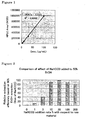
- [Figure 1] Figure 1 is a scatter diagram showing the relationship between a chromatogram peak area and a rottlerin concentration;
- [Figure 2] Figure 2 is a comparative bar graph showing an effect of NaHCO3 added to 50% EtOH;
- [Figure 3] Figure 3 is a comparative bar graph showing an effect of NaHCO3 added to 90% EtOH; and
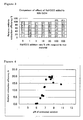
- [Figure 4] Figure 4 is a scatter diagram showing the relationship between the pH of a solution after extraction treatment and a rottlerin extraction rate.
- Hereinafter, the present invention will be described more fully with reference to Examples. However, the scope of the present invention is not intended to be limited to these Examples by any means.
- In each of the Examples below, ethanol concentration is indicated in % by volume, and the amount of a base component such as sodium bicarbonate is indicated in % by weight with respect to that of a raw material, unless otherwise specified.
- When rottlerin (manufactured by Sigma) was purchased and measured for its absorption maximum wavelengths in a solution of 100% acetonitrile (CH3CN)-0.05% trifluoroacetic acid (TFA) (100% CH3CN containing 0.05% of TFA), which is an HPLC mobile phase, the maximum wavelengths were 288.0 and 350.0 nm. The wavelength of 350 nm, which was distinguished better from the absorption wavelengths of impurities, was used as a detection wavelength, to set HPLC conditions as follows:
- HPLC system: LC-10Ai (manufactured by Shimadzu Corporation) Column: Develosil C30-UG-5 (3.0x150 mm, manufactured by Nomura Chemical Co., Ltd)
- Column temperature: 40°C
- Mobile phase: 80% CH3CN-0.05% TFA
- Flow rate: 0.4 mL/min
- Detection wavelength: 350 nm
- Injection amount: 5 µL
- Retention time: 12.7 min
- To 500 mg of kamala powders (hereinafter, referred to as the raw material), which are glandular hairs of Mallotus philippinensis, 10 mL (20 times by volume) of 50 or 90% ethanol was added and heated at 80°C for 1 hour to perform extraction. The extracted solutions were centrifuged to obtain their respective supernatants, and the supernatants were brought up to 20 mL with 90% ethanol, and a portion thereof was further diluted with 90% ethanol to perform HPLC analysis according to Example 1. As a result, a rottlerin concentration in the sample extracted with 90% ethanol was calculated to be 4.846 mg/mL. When the value was converted to the amount of rottlerin extracted from 500 mg of the raw material, the converted value was 96.9 mg (extraction rate: 19.4%). By contrast, the 50% ethanol extraction yielded 5.0 mg of rottlerin (extraction rate: 1%), which was approximately one twentieth of the 90% ethanol extract.
- Next, during the extraction with 50% ethanol (20 volumes of the law material), 1% (i.e., 5 mg), 3% (i.e., 15 mg), 10% (i.e., 50 mg), 30% (i.e., 150 mg), 100% (i.e., 500 mg), or 300% (i.e., 1500 mg) of sodium bicarbonate was added to the eluent, followed by the same treatment as that described above. The amount and extraction rate of rottlerin in the obtained extracted samples were calculated. This extraction rate was compared with the rottlerin extraction rate described above (19.4%) which was accomplished when extracting with 90% ethanol free of sodium bicarbonate. In this Example, this 90% extraction with ethanol free of sodium bicarbonate was called a control (see Figure 3 below), and its extraction rate was used as a reference to determine relative extraction efficiencies of each of the other extraction experiments. The results are shown in Figure 2.
- When the extraction procedures were performed with the alcohol concentration of 50% without the addition of sodium bicarbonate (i.e., addition rate: 0%), the relative extraction efficiency thereof was as few as 5.2%. By contrast, when sodium bicarbonate (NaHCO3) was added at a concentration of 10% or higher with respect to that of the raw material, the extraction efficiency thereof was drastically improved. Specifically, the addition of 10% sodium bicarbonate improved the extraction efficiency by 21.2 times, the addition of 30% sodium bicarbonate improved the extraction efficiency by 22.7 times, the addition of 100% sodium bicarbonate improved the extraction efficiency by 21.2 times, and the addition of 300% sodium bicarbonate improved the extraction efficiency by 18.8 times. The relative extraction efficiency for the 300% sodium bicarbonate addition was 96.9% and was shown to be almost the same as the extraction rate of the control section. On the other hand, when the sodium bicarbonate addition rate exceeds 30%, white precipitates that seemed to be undissolved sodium bicarbonate coexisted in residues of extracted raw material.
- Similarly, during the 90% ethanol extraction, 1%, 3%, 10%, 30%, 100%, or 300% sodium bicarbonate was added to the ethanol, and the extraction rate thereof was compared with that of the control. The results are shown in Figure 3. High relative extraction efficiencies were observed in all the sodium bicarbonate addition rates.
- As a result, conventional extraction methods, which did not use a base component, significantly reduced extraction efficiencies when decreasing an alcohol concentration from 90% to 50%, whereas the present invention, wherein a base was added, was shown to improve extraction efficiencies.
- To 50 g of the raw material, 5 g (10% with respect to the raw material) of sodium bicarbonate was added and made uniform. The mixture was supplemented with 1L of 50% ethanol and heated at 80°C for 1 hour. After cooling to room temperature, a filtrate obtained by natural filtration was concentrated under a reduced pressure at 40°C or lower to remove the alcohol, followed by freeze drying to obtain 24 g of a powder (hereinafter, referred to as powder A). By contrast, the same treatment was performed with 90% ethanol without the addition of sodium bicarbonate to obtain 15.8 g of a powder (hereinafter, referred to as powder B). When a rottlerin content in the extracted powder A and B was calculated according to Example 1, it was 23.5% in the powder A and 29.5% in the powder B. In consideration of the weight of powder and the rottlerin contents together, the extraction with the 10% sodium bicarbonate-supplemented 50% ethanol yielded 5.64 g of rottlerin, whereas the extraction with the sodium bicarbonate-free 90% ethanol yielded only 4.66 g of rottlerin. As a result, the extraction with the addition of sodium bicarbonate increased the amount of rottlerin collected to 1.2 times higher than that of the sodium bicarbonate-free extraction.
- Water solubility was examined by the following method: an extracted solution obtained by extraction of the raw material with 50% or 90% ethanol supplemented with 10% or 30% sodium bicarbonate was dried to obtain a dried product, approximately 0.2 g each of which was added 4 mL (i.e., 20 times by volume) of distilled water, then stirred with a vortex mixer, and sonicated for 1 minute, followed by centrifugation to collect supernatants. Millipore filter unit MILLEX (registered trademark)-HV (0.45 µm) was used to obtain microfiltrates. A rottlerin concentration therein was, determined by the method of Example 1. As a control, 90% ethanol free of sodium bicarbonate was used to perform the same procedures. The results are shown in Table 1.
-
[Table 1] Amount of sodium bicarbonate added with respect to raw material (% by weight) Ethanol concentration (% by volume) Rottlerin concentration in supernatant (µg/ML) Relative solubility ratio 10 50 12,750 196 30 50 5,681 89 10 90 1,576 25 30 90 274 4 0 (Control) 90 64 1 - Explanations for Table 1: when the solubility of rottlerin contained in the sodium bicarbonate-free 90% ethanol extract (control) was defined as 1, relative solubility ratio based on the control was increased to 25 for the 10% sodium bicarbonate-supplemented 90% ethanol extract, and 196 for the 10% sodium bicarbonate-supplemented 50% ethanol extract. Specifically, the sodium bicarbonate-supplemented extract was significantly improved in water solubility as compared with the sodium bicarbonate-free extract. The 50% ethanol extract had much more excellent solubility than that of the 90% ethanol extract.
- To the raw material, sodium bicarbonate was added at a concentration of 10% with respect to the raw material, and an extraction temperature was set to 26°C to measure the amount of rottlerin extracted after 3 days or 7 days according to the method of Example 2. An ethanol concentration was adjusted to 50% or 90%. As a result, 15.5% or higher extraction rates were obtained in all the cases. Considering that the extraction rates in the extraction treatments at 80°C for 1 hour with addition of 10% sodium bicarbonate were approximately 19% for all the alcohol concentrations as shown in Example 2, 80% or more of the extract rate was collected at normal temperature for 3 days.
-
[Table 2] Ethanol concentration (% by volume) Extraction term (days) Rottlerin extraction rate % 50 3 15.6 50 7 15.5 90 3 19.2 90 7 17.6 - To the raw material, 10% or 100% sodium bicarbonate was added, and an ethanol concentration was set to 0% (i.e., distilled water), 30%, or 50% to measure the amount of rottlerin extracted by treatments at 80°C for 1 hour, according to the method of Example 2. The results are shown in Table 3.
-
[Table 3] Ethanol concentration (% by volume) Amount of sodium bicarbonate added (% by weight) Rottlerin extraction rate % Relative ratio of extraction rate 0 10 1.1 0.06 0 100 1.2 0.07 30 10 13.3 0.72 30 100 12.1 0.66 50 10 18.4 1.00 50 100 14.6 0.79 - Explanations for Table 3: the extraction rate was only approximately 1% for the distilled water with an alcohol concentration of 0%. On the other hand, the relatively high extraction rate of 12.1 or 13.3% was achieved at the alcohol concentration of 30%. These correspond to approximately 70% of the extraction rate at the alcohol concentration of 50%.
- The influence of pH on rottlerin extraction efficiency was studied by performing extraction procedures at 80°C for 1 hour with 50% ethanol at varying pH values according to the method of Example 2. Base components which are to be simultaneously added to change pH were, apart from sodium bicarbonate used in the Examples described above, sodium carbonate, disodium hydrogen phosphate (anhydrous), trisodium phosphate dodecahydrate (in Table 4, indicated by % calculated on the basis of the weight of its anhydrous form), and Atkins & Pantin's sodium carbonate/boric acid mixture solution (
pH -
[Table 4] Type Amount added (% corresponds to % by weight with respect to raw material) pH of 50% ethanol extraction solvent pH of solution after extraction treatment Rottlerin extraction rate % Sodium bicarbonate 0% 6.6 5.2 0.4 10% 9.6 7.9 19.6 30% 9.6 8.2 19.4 Sodium carbonate 10% 12.6 8.6 19.0 30% 12.7 10.6 14.3 Disodium hydrogen phosphate 10% 10.0 6.6 5.9 30% 10.1 6.8 12.2 Trisodium phosphate 10% 12.3 6.9 12.5 30% 12.5 8.6 20.0 Buffer solution pH 8.1, 50mM 9.8 5.9 4.2 pH 9.2, 50mM 10.7 7.2 17.7 pH 10.3, 50mM 11.6 8.3 18.0 pH 11.3, 50mM 12.3 8.9 15.5 Sodium hydroxide Adjusted to pH shown in the right 11.5 4.9 0.3 12.4 5.2 0.5 13.3 6.3 6.1 14 6.3 6.5 - Explanations for Table 4: the solution after extraction treatment exhibited a high rottlerin extraction rate at pH 7.0 to 11.0, particularly 7.0 to 9.0 (underlined boldfaces).
- The relationship between the pH of the solution after extraction treatment and the rottlerin extraction rate can clearly be read off from the accompanying drawing (Figure 4).
- The extraction rate obtained by the sodium bicarbonate-free 90% ethanol extraction was 19.4%, as shown in Example 2. A rottlerin extraction rate comparative to 80% or more of the value was achieved in the range from pH 7.0 to 9.0, while a rottlerin extraction rate corresponding to 70% or more thereof was achieved in the range from pH 7.0 to 11.0, demonstrating that the extraction rate is high at pH 7.0 or higher.
Claims (14)
- A method for producing a Mallotus philippinensis dye composition comprising extracting a Mallotus philippinensis plant body with an alcohol-containing aqueous solvent in the presence of a base component.
- The production method according to claim 1, wherein the Mallotus philippinensis plant body is preferably a powdered kamala.
- The production method according to claim 1 or 2, wherein the dye composition contains rottlerin as a main dye component.
- The production method according to any one of claims 1 to 3, wherein the solvent has an alcohol concentration of 30 to 90% by volume.
- The production method according to claim 4, wherein the solvent has an alcohol concentration of 30 to 70% by volume, preferably 50% by volume.
- The production method according to any one of claims 1 to 5, wherein the base component is at least one base selected from the group consisting of ammonium carbonate, potassium carbonate, sodium carbonate, sodium bicarbonate, tripotassium phosphate, diammonium hydrogen phosphate, dipotassium hydrogen phosphate, disodium hydrogen phosphate, trisodium phosphate, potassium hydroxide, and sodium hydroxide.
- The production method according to claim 6, wherein the base component is at least one base selected from the group consisting of sodium bicarbonate, sodium carbonate, and trisodium phosphate.
- The production method according to claim 7, wherein the amount of the base component used is 10 to 300% by weight, preferably 10 to 30% by weight, with respect to the amount of the Mallotus philippinensis plant body.
- The production method according to any one of claims 1 to 8, wherein the amount of the solvent used in the extraction is 5 to 20 times by weight larger than that of the Mallotus philippinensis plant body.
- The production method according to any one of claims 1 to 9, wherein the extraction is performed under conditions where the solvent in contact with the plant body has a pH of 7.0 or higher, preferably 7.0 to 11.0, more preferably 7.0 to 9.0.
- The production method according to any one of claims 1 to 10, wherein the temperature of the solvent during the extraction is room temperature to reflux temperature.
- The production method according to claim 11, wherein the temperature of the solvent during the extraction is 50 to 80°C.
- A substantially water-soluble Mallotus philippinensis dye composition produced by a production method according to any one of claims 1 to 12.
- The dye composition according to claim 13, wherein the dye composition is used as a coloring agent and/or a preservative agent in foods and drinks or cosmetics or as an anthelmintic.
Applications Claiming Priority (2)
| Application Number | Priority Date | Filing Date | Title |
|---|---|---|---|
| JP2004070796 | 2004-03-12 | ||
| PCT/JP2005/004325 WO2005087871A1 (en) | 2004-03-12 | 2005-03-11 | Process for producing mallotus philippensis colorant composition and the composition |
Publications (2)
| Publication Number | Publication Date |
|---|---|
| EP1738647A1 true EP1738647A1 (en) | 2007-01-03 |
| EP1738647A4 EP1738647A4 (en) | 2009-12-16 |
Family
ID=34975560
Family Applications (1)
| Application Number | Title | Priority Date | Filing Date |
|---|---|---|---|
| EP05720596A Withdrawn EP1738647A4 (en) | 2004-03-12 | 2005-03-11 | METHOD FOR OBTAINING A COLORING AGENT FROM MALLOTUS PHILIPPENSIS AND COLORING AGENTS |
Country Status (7)
| Country | Link |
|---|---|
| US (1) | US7556829B2 (en) |
| EP (1) | EP1738647A4 (en) |
| JP (1) | JP4750693B2 (en) |
| KR (1) | KR20070015541A (en) |
| CN (1) | CN1930247A (en) |
| TW (1) | TW200604295A (en) |
| WO (1) | WO2005087871A1 (en) |
Families Citing this family (1)
| Publication number | Priority date | Publication date | Assignee | Title |
|---|---|---|---|---|
| US20090223000A1 (en) * | 2008-03-05 | 2009-09-10 | Eber Lopes Ferreira | Manufacturing process of vegetable colorant extracts from residues generated in the extraction and processing of wood from tropical forest of colorful heartwood |
Family Cites Families (6)
| Publication number | Priority date | Publication date | Assignee | Title |
|---|---|---|---|---|
| JPS632913A (en) * | 1986-06-20 | 1988-01-07 | Sansho Seiyaku Kk | Drug for external use |
| JPH01132505A (en) | 1987-11-17 | 1989-05-25 | Mikasa Kagaku Kogyo Kk | Insect pest expellent |
| WO2002043779A2 (en) * | 2000-12-01 | 2002-06-06 | Auburn University | Use of acacia gum (arabic gum) to isolate and preserve biological material |
| JP2003055369A (en) | 2001-08-06 | 2003-02-26 | Univ Nihon | Novel phloroglucinol derivatives, compositions and antiallergic agents using the same |
| JP3709369B2 (en) * | 2001-11-13 | 2005-10-26 | 丸善製薬株式会社 | Skin cosmetics and beauty food and drink |
| US20050158435A1 (en) | 2002-03-11 | 2005-07-21 | Suntory Limited | Process for producing sdg and foods and drinks containing the same |
-
2005
- 2005-03-11 EP EP05720596A patent/EP1738647A4/en not_active Withdrawn
- 2005-03-11 JP JP2006511003A patent/JP4750693B2/en not_active Expired - Fee Related
- 2005-03-11 WO PCT/JP2005/004325 patent/WO2005087871A1/en not_active Ceased
- 2005-03-11 US US10/592,426 patent/US7556829B2/en not_active Expired - Fee Related
- 2005-03-11 KR KR1020067021222A patent/KR20070015541A/en not_active Abandoned
- 2005-03-11 TW TW094107550A patent/TW200604295A/en unknown
- 2005-03-11 CN CNA2005800076546A patent/CN1930247A/en active Pending
Non-Patent Citations (2)
| Title |
|---|
| L. GMELIN: "Handbook of Chemistry" 1866, HARRISON, 59, PALL MALL , LONDON , XP002553561 * page 378 * * |
| See also references of WO2005087871A1 * |
Also Published As
| Publication number | Publication date |
|---|---|
| JP4750693B2 (en) | 2011-08-17 |
| KR20070015541A (en) | 2007-02-05 |
| US20070207219A1 (en) | 2007-09-06 |
| WO2005087871A1 (en) | 2005-09-22 |
| US7556829B2 (en) | 2009-07-07 |
| JPWO2005087871A1 (en) | 2008-01-24 |
| EP1738647A4 (en) | 2009-12-16 |
| CN1930247A (en) | 2007-03-14 |
| TW200604295A (en) | 2006-02-01 |
Similar Documents
| Publication | Publication Date | Title |
|---|---|---|
| JP5646815B2 (en) | Rutin derivative composition, method for producing the same, and use thereof | |
| JP2001270881A (en) | Proanthocyanidin-containing composition | |
| JP2008247901A (en) | Antioxidant compounds, antioxidant algal extracts, and methods for producing them | |
| CN102224131A (en) | Novel compound ramalin, and use thereof | |
| JP6029637B2 (en) | Rutin derivative composition, method for producing the same, and use thereof | |
| JP5686328B2 (en) | Anti-glycation composition | |
| KR102269270B1 (en) | Method for producing extracts of sweet potato with enhanced antioxidative activity | |
| JP4837816B2 (en) | Free radical scavenger | |
| KR102666051B1 (en) | Orthosiphon Aristatus fermented product and uses thereof | |
| JP2015127339A (en) | Anti-glycation composition | |
| US7556829B2 (en) | Method for producing Mallotus philippinensis dye composition and the composition | |
| KR102453568B1 (en) | Composition for moisturizing and anti-inflammation comprising fermented Codium fragile extract fermented by inoculating Bacillus safensis strain | |
| EP1600453A1 (en) | Compound, process for producing the same and use thereof | |
| KR101685829B1 (en) | Method for prepareing fermented extract of mistletoe having enhanced antioxidative effect | |
| KR20250006389A (en) | Composition for anti-oxidant and anti-inflammation comprising lava seawater extract of carrot leaf as effective component | |
| JP2015025008A (en) | Anti-glycation composition | |
| JP6607418B2 (en) | Anti-glycation composition | |
| KR20220074380A (en) | Nypa fruticans fruit fermented product applicable as halal cosmetic and cosmetic composition containing the same | |
| KR102313083B1 (en) | An anti-oxidative composition comprising an extract of Hydrangea petiolaris or a fraction thereof as an active ingredient | |
| JP2010530412A (en) | Use of xanthorizole for skin wrinkle improvement | |
| KR102959893B1 (en) | Antioxidant and anti-inflammatory composition containing fermented grape skin extract fermented with Lactobacillus platarum and Lactobacillus rhamnosus as an active ingredient | |
| JP4025511B2 (en) | Anti-fading agent | |
| US20030024440A1 (en) | Color fading/discoloration preventive agent | |
| JP2017052806A (en) | Anti-glycation composition | |
| KR20260050055A (en) | Composition for Antioxidant, Skin whitening, Pore Tightening and Skin Moisturizing Comprising Complex Fermentation of Vitamin C and Asparagus as Active Ingredient |
Legal Events
| Date | Code | Title | Description |
|---|---|---|---|
| PUAI | Public reference made under article 153(3) epc to a published international application that has entered the european phase |
Free format text: ORIGINAL CODE: 0009012 |
|
| 17P | Request for examination filed |
Effective date: 20060927 |
|
| AK | Designated contracting states |
Kind code of ref document: A1 Designated state(s): AT BE BG CH CY CZ DE DK EE ES FI FR GB GR HU IE IS IT LI LT LU MC NL PL PT RO SE SI SK TR |
|
| DAX | Request for extension of the european patent (deleted) | ||
| RAP1 | Party data changed (applicant data changed or rights of an application transferred) |
Owner name: SUNTORY HOLDINGS LIMITED |
|
| A4 | Supplementary search report drawn up and despatched |
Effective date: 20091113 |
|
| STAA | Information on the status of an ep patent application or granted ep patent |
Free format text: STATUS: THE APPLICATION IS DEEMED TO BE WITHDRAWN |
|
| 18D | Application deemed to be withdrawn |
Effective date: 20121001 |