EP1737809B1 - Compounds, pharmaceutical compositions and methods for use in treating metabolic disorders - Google Patents
Compounds, pharmaceutical compositions and methods for use in treating metabolic disorders Download PDFInfo
- Publication number
- EP1737809B1 EP1737809B1 EP05723623.4A EP05723623A EP1737809B1 EP 1737809 B1 EP1737809 B1 EP 1737809B1 EP 05723623 A EP05723623 A EP 05723623A EP 1737809 B1 EP1737809 B1 EP 1737809B1
- Authority
- EP
- European Patent Office
- Prior art keywords
- compound
- mmol
- phenyl
- methyl
- esi
- Prior art date
- Legal status (The legal status is an assumption and is not a legal conclusion. Google has not performed a legal analysis and makes no representation as to the accuracy of the status listed.)
- Expired - Lifetime
Links
- 150000001875 compounds Chemical class 0.000 title claims description 252
- 239000008194 pharmaceutical composition Substances 0.000 title claims description 17
- 238000000034 method Methods 0.000 title description 65
- 208000030159 metabolic disease Diseases 0.000 title description 3
- 239000000203 mixture Substances 0.000 claims description 107
- -1 methoxyphenyl Chemical group 0.000 claims description 95
- 208000037265 diseases, disorders, signs and symptoms Diseases 0.000 claims description 41
- 238000002360 preparation method Methods 0.000 claims description 40
- 101000912510 Homo sapiens Free fatty acid receptor 1 Proteins 0.000 claims description 37
- 102100026148 Free fatty acid receptor 1 Human genes 0.000 claims description 35
- 125000000217 alkyl group Chemical group 0.000 claims description 28
- NOESYZHRGYRDHS-UHFFFAOYSA-N insulin Chemical compound N1C(=O)C(NC(=O)C(CCC(N)=O)NC(=O)C(CCC(O)=O)NC(=O)C(C(C)C)NC(=O)C(NC(=O)CN)C(C)CC)CSSCC(C(NC(CO)C(=O)NC(CC(C)C)C(=O)NC(CC=2C=CC(O)=CC=2)C(=O)NC(CCC(N)=O)C(=O)NC(CC(C)C)C(=O)NC(CCC(O)=O)C(=O)NC(CC(N)=O)C(=O)NC(CC=2C=CC(O)=CC=2)C(=O)NC(CSSCC(NC(=O)C(C(C)C)NC(=O)C(CC(C)C)NC(=O)C(CC=2C=CC(O)=CC=2)NC(=O)C(CC(C)C)NC(=O)C(C)NC(=O)C(CCC(O)=O)NC(=O)C(C(C)C)NC(=O)C(CC(C)C)NC(=O)C(CC=2NC=NC=2)NC(=O)C(CO)NC(=O)CNC2=O)C(=O)NCC(=O)NC(CCC(O)=O)C(=O)NC(CCCNC(N)=N)C(=O)NCC(=O)NC(CC=3C=CC=CC=3)C(=O)NC(CC=3C=CC=CC=3)C(=O)NC(CC=3C=CC(O)=CC=3)C(=O)NC(C(C)O)C(=O)N3C(CCC3)C(=O)NC(CCCCN)C(=O)NC(C)C(O)=O)C(=O)NC(CC(N)=O)C(O)=O)=O)NC(=O)C(C(C)CC)NC(=O)C(CO)NC(=O)C(C(C)O)NC(=O)C1CSSCC2NC(=O)C(CC(C)C)NC(=O)C(NC(=O)C(CCC(N)=O)NC(=O)C(CC(N)=O)NC(=O)C(NC(=O)C(N)CC=1C=CC=CC=1)C(C)C)CC1=CN=CN1 NOESYZHRGYRDHS-UHFFFAOYSA-N 0.000 claims description 28
- 201000010099 disease Diseases 0.000 claims description 26
- 125000002496 methyl group Chemical group [H]C([H])([H])* 0.000 claims description 26
- 208000001072 type 2 diabetes mellitus Diseases 0.000 claims description 26
- 150000003839 salts Chemical class 0.000 claims description 24
- 125000003118 aryl group Chemical group 0.000 claims description 21
- 208000031226 Hyperlipidaemia Diseases 0.000 claims description 20
- 208000017169 kidney disease Diseases 0.000 claims description 20
- 239000003814 drug Substances 0.000 claims description 17
- 102000004877 Insulin Human genes 0.000 claims description 14
- 108090001061 Insulin Proteins 0.000 claims description 14
- 208000008589 Obesity Diseases 0.000 claims description 14
- 229940125396 insulin Drugs 0.000 claims description 14
- 235000020824 obesity Nutrition 0.000 claims description 14
- 125000001072 heteroaryl group Chemical group 0.000 claims description 13
- 208000024172 Cardiovascular disease Diseases 0.000 claims description 12
- 208000032928 Dyslipidaemia Diseases 0.000 claims description 12
- 206010020772 Hypertension Diseases 0.000 claims description 12
- 208000017170 Lipid metabolism disease Diseases 0.000 claims description 12
- 208000002705 Glucose Intolerance Diseases 0.000 claims description 11
- 206010018429 Glucose tolerance impaired Diseases 0.000 claims description 11
- 208000035150 Hypercholesterolemia Diseases 0.000 claims description 11
- 206010023379 Ketoacidosis Diseases 0.000 claims description 11
- 208000007976 Ketosis Diseases 0.000 claims description 11
- 208000001145 Metabolic Syndrome Diseases 0.000 claims description 11
- 201000006549 dyspepsia Diseases 0.000 claims description 11
- 201000001320 Atherosclerosis Diseases 0.000 claims description 10
- 208000032131 Diabetic Neuropathies Diseases 0.000 claims description 10
- 206010012689 Diabetic retinopathy Diseases 0.000 claims description 10
- 206010060378 Hyperinsulinaemia Diseases 0.000 claims description 10
- 208000013016 Hypoglycemia Diseases 0.000 claims description 10
- 206010022489 Insulin Resistance Diseases 0.000 claims description 10
- 206010028980 Neoplasm Diseases 0.000 claims description 10
- 206010030113 Oedema Diseases 0.000 claims description 10
- 201000001880 Sexual dysfunction Diseases 0.000 claims description 10
- 208000007536 Thrombosis Diseases 0.000 claims description 10
- 201000000690 abdominal obesity-metabolic syndrome Diseases 0.000 claims description 10
- 201000011510 cancer Diseases 0.000 claims description 10
- 201000001421 hyperglycemia Diseases 0.000 claims description 10
- 230000003451 hyperinsulinaemic effect Effects 0.000 claims description 10
- 201000008980 hyperinsulinism Diseases 0.000 claims description 10
- 208000020346 hyperlipoproteinemia Diseases 0.000 claims description 10
- 230000002218 hypoglycaemic effect Effects 0.000 claims description 10
- 231100000872 sexual dysfunction Toxicity 0.000 claims description 10
- 239000000546 pharmaceutical excipient Substances 0.000 claims description 9
- 208000011580 syndromic disease Diseases 0.000 claims description 9
- 229940124597 therapeutic agent Drugs 0.000 claims description 9
- 125000001997 phenyl group Chemical group [H]C1=C([H])C([H])=C(*)C([H])=C1[H] 0.000 claims description 7
- 125000001797 benzyl group Chemical group [H]C1=C([H])C([H])=C(C([H])=C1[H])C([H])([H])* 0.000 claims description 4
- 239000003085 diluting agent Substances 0.000 claims description 4
- XZWYZXLIPXDOLR-UHFFFAOYSA-N metformin Chemical group CN(C)C(=N)NC(N)=N XZWYZXLIPXDOLR-UHFFFAOYSA-N 0.000 claims description 4
- 125000005429 oxyalkyl group Chemical group 0.000 claims description 4
- 230000007423 decrease Effects 0.000 claims description 3
- 239000003937 drug carrier Substances 0.000 claims description 3
- 229960003105 metformin Drugs 0.000 claims description 3
- 125000004076 pyridyl group Chemical group 0.000 claims description 3
- ZOBPZXTWZATXDG-UHFFFAOYSA-N 1,3-thiazolidine-2,4-dione Chemical compound O=C1CSC(=O)N1 ZOBPZXTWZATXDG-UHFFFAOYSA-N 0.000 claims description 2
- 229940123464 Thiazolidinedione Drugs 0.000 claims description 2
- 125000004802 cyanophenyl group Chemical group 0.000 claims description 2
- 125000006277 halobenzyl group Chemical group 0.000 claims description 2
- 125000005059 halophenyl group Chemical group 0.000 claims description 2
- 125000001725 pyrenyl group Chemical group 0.000 claims description 2
- 125000003944 tolyl group Chemical group 0.000 claims description 2
- XEKOWRVHYACXOJ-UHFFFAOYSA-N Ethyl acetate Chemical compound CCOC(C)=O XEKOWRVHYACXOJ-UHFFFAOYSA-N 0.000 description 331
- YMWUJEATGCHHMB-UHFFFAOYSA-N Dichloromethane Chemical compound ClCCl YMWUJEATGCHHMB-UHFFFAOYSA-N 0.000 description 133
- 235000019439 ethyl acetate Nutrition 0.000 description 112
- 239000000243 solution Substances 0.000 description 105
- VLKZOEOYAKHREP-UHFFFAOYSA-N n-Hexane Chemical class CCCCCC VLKZOEOYAKHREP-UHFFFAOYSA-N 0.000 description 104
- XLYOFNOQVPJJNP-UHFFFAOYSA-N water Substances O XLYOFNOQVPJJNP-UHFFFAOYSA-N 0.000 description 102
- 229910001868 water Inorganic materials 0.000 description 99
- OKKJLVBELUTLKV-UHFFFAOYSA-N Methanol Chemical compound OC OKKJLVBELUTLKV-UHFFFAOYSA-N 0.000 description 93
- 238000005160 1H NMR spectroscopy Methods 0.000 description 77
- 239000011541 reaction mixture Substances 0.000 description 69
- CSNNHWWHGAXBCP-UHFFFAOYSA-L Magnesium sulfate Chemical compound [Mg+2].[O-][S+2]([O-])([O-])[O-] CSNNHWWHGAXBCP-UHFFFAOYSA-L 0.000 description 64
- HEDRZPFGACZZDS-MICDWDOJSA-N Trichloro(2H)methane Chemical compound [2H]C(Cl)(Cl)Cl HEDRZPFGACZZDS-MICDWDOJSA-N 0.000 description 58
- CSCPPACGZOOCGX-UHFFFAOYSA-N Acetone Chemical compound CC(C)=O CSCPPACGZOOCGX-UHFFFAOYSA-N 0.000 description 57
- 238000006243 chemical reaction Methods 0.000 description 53
- RTZKZFJDLAIYFH-UHFFFAOYSA-N Diethyl ether Chemical compound CCOCC RTZKZFJDLAIYFH-UHFFFAOYSA-N 0.000 description 52
- WYURNTSHIVDZCO-UHFFFAOYSA-N tetrahydrofuran Substances C1CCOC1 WYURNTSHIVDZCO-UHFFFAOYSA-N 0.000 description 49
- LFQSCWFLJHTTHZ-UHFFFAOYSA-N Ethanol Chemical compound CCO LFQSCWFLJHTTHZ-UHFFFAOYSA-N 0.000 description 45
- 239000012044 organic layer Substances 0.000 description 45
- 230000002829 reductive effect Effects 0.000 description 43
- HPALAKNZSZLMCH-UHFFFAOYSA-M sodium;chloride;hydrate Chemical class O.[Na+].[Cl-] HPALAKNZSZLMCH-UHFFFAOYSA-M 0.000 description 40
- ISWSIDIOOBJBQZ-UHFFFAOYSA-N Phenol Chemical compound OC1=CC=CC=C1 ISWSIDIOOBJBQZ-UHFFFAOYSA-N 0.000 description 36
- IJGRMHOSHXDMSA-UHFFFAOYSA-N Atomic nitrogen Chemical compound N#N IJGRMHOSHXDMSA-UHFFFAOYSA-N 0.000 description 34
- 239000007832 Na2SO4 Substances 0.000 description 34
- PMZURENOXWZQFD-UHFFFAOYSA-L Sodium Sulfate Chemical compound [Na+].[Na+].[O-]S([O-])(=O)=O PMZURENOXWZQFD-UHFFFAOYSA-L 0.000 description 34
- 229910052938 sodium sulfate Inorganic materials 0.000 description 34
- 239000002904 solvent Substances 0.000 description 33
- 229910052943 magnesium sulfate Inorganic materials 0.000 description 32
- 239000007787 solid Substances 0.000 description 31
- IAZDPXIOMUYVGZ-WFGJKAKNSA-N Dimethyl sulfoxide Chemical compound [2H]C([2H])([2H])S(=O)C([2H])([2H])[2H] IAZDPXIOMUYVGZ-WFGJKAKNSA-N 0.000 description 30
- KFZMGEQAYNKOFK-UHFFFAOYSA-N Isopropanol Chemical compound CC(C)O KFZMGEQAYNKOFK-UHFFFAOYSA-N 0.000 description 27
- 238000003818 flash chromatography Methods 0.000 description 27
- QTBSBXVTEAMEQO-UHFFFAOYSA-N Acetic acid Chemical compound CC(O)=O QTBSBXVTEAMEQO-UHFFFAOYSA-N 0.000 description 26
- 239000012267 brine Substances 0.000 description 26
- FJDQFPXHSGXQBY-UHFFFAOYSA-L caesium carbonate Chemical compound [Cs+].[Cs+].[O-]C([O-])=O FJDQFPXHSGXQBY-UHFFFAOYSA-L 0.000 description 26
- 239000010410 layer Substances 0.000 description 26
- VEXZGXHMUGYJMC-UHFFFAOYSA-N Hydrochloric acid Chemical compound Cl VEXZGXHMUGYJMC-UHFFFAOYSA-N 0.000 description 24
- 239000003921 oil Substances 0.000 description 24
- 235000019198 oils Nutrition 0.000 description 24
- 239000000047 product Substances 0.000 description 24
- 229910052757 nitrogen Inorganic materials 0.000 description 23
- 125000001424 substituent group Chemical group 0.000 description 23
- 239000011734 sodium Substances 0.000 description 19
- 239000000284 extract Substances 0.000 description 17
- 239000012074 organic phase Substances 0.000 description 17
- 239000000725 suspension Substances 0.000 description 17
- VYPSYNLAJGMNEJ-UHFFFAOYSA-N Silicium dioxide Chemical compound O=[Si]=O VYPSYNLAJGMNEJ-UHFFFAOYSA-N 0.000 description 16
- CSCPPACGZOOCGX-WFGJKAKNSA-N acetone d6 Chemical compound [2H]C([2H])([2H])C(=O)C([2H])([2H])[2H] CSCPPACGZOOCGX-WFGJKAKNSA-N 0.000 description 16
- 239000004480 active ingredient Substances 0.000 description 16
- 229910000024 caesium carbonate Inorganic materials 0.000 description 16
- 238000004587 chromatography analysis Methods 0.000 description 16
- CDBYLPFSWZWCQE-UHFFFAOYSA-L Sodium Carbonate Chemical compound [Na+].[Na+].[O-]C([O-])=O CDBYLPFSWZWCQE-UHFFFAOYSA-L 0.000 description 15
- HEMHJVSKTPXQMS-UHFFFAOYSA-M Sodium hydroxide Chemical compound [OH-].[Na+] HEMHJVSKTPXQMS-UHFFFAOYSA-M 0.000 description 15
- 239000002253 acid Substances 0.000 description 15
- 125000004432 carbon atom Chemical group C* 0.000 description 15
- 208000035475 disorder Diseases 0.000 description 15
- UIIMBOGNXHQVGW-UHFFFAOYSA-M Sodium bicarbonate Chemical compound [Na+].OC([O-])=O UIIMBOGNXHQVGW-UHFFFAOYSA-M 0.000 description 14
- 150000002148 esters Chemical class 0.000 description 14
- KWYUFKZDYYNOTN-UHFFFAOYSA-M potassium hydroxide Substances [OH-].[K+] KWYUFKZDYYNOTN-UHFFFAOYSA-M 0.000 description 14
- 239000000843 powder Substances 0.000 description 14
- 239000000741 silica gel Substances 0.000 description 14
- 229910002027 silica gel Inorganic materials 0.000 description 14
- 238000003756 stirring Methods 0.000 description 14
- WMFOQBRAJBCJND-UHFFFAOYSA-M Lithium hydroxide Chemical compound [Li+].[OH-] WMFOQBRAJBCJND-UHFFFAOYSA-M 0.000 description 13
- 235000019441 ethanol Nutrition 0.000 description 13
- 125000002023 trifluoromethyl group Chemical group FC(F)(F)* 0.000 description 13
- 238000001914 filtration Methods 0.000 description 12
- 125000004404 heteroalkyl group Chemical group 0.000 description 12
- 125000005842 heteroatom Chemical group 0.000 description 12
- NLXLAEXVIDQMFP-UHFFFAOYSA-N Ammonia chloride Chemical compound [NH4+].[Cl-] NLXLAEXVIDQMFP-UHFFFAOYSA-N 0.000 description 11
- 239000000460 chlorine Substances 0.000 description 11
- 238000004440 column chromatography Methods 0.000 description 11
- 238000001035 drying Methods 0.000 description 11
- 125000000956 methoxy group Chemical group [H]C([H])([H])O* 0.000 description 11
- 229920006395 saturated elastomer Polymers 0.000 description 11
- 238000004895 liquid chromatography mass spectrometry Methods 0.000 description 10
- BWHMMNNQKKPAPP-UHFFFAOYSA-L potassium carbonate Chemical compound [K+].[K+].[O-]C([O-])=O BWHMMNNQKKPAPP-UHFFFAOYSA-L 0.000 description 10
- YXFVVABEGXRONW-UHFFFAOYSA-N Toluene Chemical compound CC1=CC=CC=C1 YXFVVABEGXRONW-UHFFFAOYSA-N 0.000 description 9
- 125000002947 alkylene group Chemical group 0.000 description 9
- 150000001732 carboxylic acid derivatives Chemical class 0.000 description 9
- 210000004027 cell Anatomy 0.000 description 9
- 150000004702 methyl esters Chemical class 0.000 description 9
- 238000000746 purification Methods 0.000 description 9
- ZMANZCXQSJIPKH-UHFFFAOYSA-N Triethylamine Chemical compound CCN(CC)CC ZMANZCXQSJIPKH-UHFFFAOYSA-N 0.000 description 8
- 239000008346 aqueous phase Substances 0.000 description 8
- 229910002092 carbon dioxide Inorganic materials 0.000 description 8
- 239000003795 chemical substances by application Substances 0.000 description 8
- 235000014113 dietary fatty acids Nutrition 0.000 description 8
- 239000000194 fatty acid Substances 0.000 description 8
- 229930195729 fatty acid Natural products 0.000 description 8
- 150000004665 fatty acids Chemical class 0.000 description 8
- 125000005843 halogen group Chemical group 0.000 description 8
- 230000001404 mediated effect Effects 0.000 description 8
- 238000010992 reflux Methods 0.000 description 8
- 125000004178 (C1-C4) alkyl group Chemical group 0.000 description 7
- HBAQYPYDRFILMT-UHFFFAOYSA-N 8-[3-(1-cyclopropylpyrazol-4-yl)-1H-pyrazolo[4,3-d]pyrimidin-5-yl]-3-methyl-3,8-diazabicyclo[3.2.1]octan-2-one Chemical class C1(CC1)N1N=CC(=C1)C1=NNC2=C1N=C(N=C2)N1C2C(N(CC1CC2)C)=O HBAQYPYDRFILMT-UHFFFAOYSA-N 0.000 description 7
- 229960000583 acetic acid Drugs 0.000 description 7
- 125000004429 atom Chemical group 0.000 description 7
- 230000000694 effects Effects 0.000 description 7
- 238000009472 formulation Methods 0.000 description 7
- 229910000029 sodium carbonate Inorganic materials 0.000 description 7
- 238000011282 treatment Methods 0.000 description 7
- UZFNGMVJGQBCRJ-UHFFFAOYSA-N 5-[2-[4-[(2-methylphenyl)methoxy]phenyl]pent-3-ynyl]-2h-tetrazole Chemical compound C=1C=C(OCC=2C(=CC=CC=2)C)C=CC=1C(C#CC)CC1=NN=NN1 UZFNGMVJGQBCRJ-UHFFFAOYSA-N 0.000 description 6
- LYCAIKOWRPUZTN-UHFFFAOYSA-N Ethylene glycol Chemical compound OCCO LYCAIKOWRPUZTN-UHFFFAOYSA-N 0.000 description 6
- 239000007864 aqueous solution Substances 0.000 description 6
- 238000004296 chiral HPLC Methods 0.000 description 6
- 239000012230 colorless oil Substances 0.000 description 6
- XBDQKXXYIPTUBI-UHFFFAOYSA-N dimethylselenoniopropionate Natural products CCC(O)=O XBDQKXXYIPTUBI-UHFFFAOYSA-N 0.000 description 6
- 229940079593 drug Drugs 0.000 description 6
- 239000000796 flavoring agent Substances 0.000 description 6
- 229910052736 halogen Inorganic materials 0.000 description 6
- 125000004474 heteroalkylene group Chemical group 0.000 description 6
- 229910052739 hydrogen Inorganic materials 0.000 description 6
- 229910052760 oxygen Inorganic materials 0.000 description 6
- 238000004007 reversed phase HPLC Methods 0.000 description 6
- 229910000030 sodium bicarbonate Inorganic materials 0.000 description 6
- 239000003765 sweetening agent Substances 0.000 description 6
- 239000003826 tablet Substances 0.000 description 6
- GAJHECKARCOQDF-UHFFFAOYSA-N 3-[2-methyl-4-[(2-methylphenyl)methoxy]phenyl]hex-4-enoic acid Chemical compound C1=C(C)C(C(CC(O)=O)C=CC)=CC=C1OCC1=CC=CC=C1C GAJHECKARCOQDF-UHFFFAOYSA-N 0.000 description 5
- LPSZERAYCVJBKK-UHFFFAOYSA-N 3-[4-[(2-methylphenyl)methylsulfanyl]phenyl]hex-4-ynoic acid Chemical compound C1=CC(C(CC(O)=O)C#CC)=CC=C1SCC1=CC=CC=C1C LPSZERAYCVJBKK-UHFFFAOYSA-N 0.000 description 5
- XVICDYNKDIVGPX-UHFFFAOYSA-N 3-[4-[(4-methoxyphenyl)methoxy]phenyl]-n-(1,3-thiazol-2-yl)hex-4-ynamide Chemical compound C1=CC(OC)=CC=C1COC1=CC=C(C(CC(=O)NC=2SC=CN=2)C#CC)C=C1 XVICDYNKDIVGPX-UHFFFAOYSA-N 0.000 description 5
- 108091003079 Bovine Serum Albumin Proteins 0.000 description 5
- IAZDPXIOMUYVGZ-UHFFFAOYSA-N Dimethylsulphoxide Chemical compound CS(C)=O IAZDPXIOMUYVGZ-UHFFFAOYSA-N 0.000 description 5
- 150000001408 amides Chemical class 0.000 description 5
- 239000007859 condensation product Substances 0.000 description 5
- 235000003599 food sweetener Nutrition 0.000 description 5
- 150000002367 halogens Chemical class 0.000 description 5
- 125000000592 heterocycloalkyl group Chemical group 0.000 description 5
- 239000001257 hydrogen Substances 0.000 description 5
- 239000005457 ice water Substances 0.000 description 5
- 239000004615 ingredient Substances 0.000 description 5
- 239000003112 inhibitor Substances 0.000 description 5
- 239000000463 material Substances 0.000 description 5
- GXHFUVWIGNLZSC-UHFFFAOYSA-N meldrum's acid Chemical compound CC1(C)OC(=O)CC(=O)O1 GXHFUVWIGNLZSC-UHFFFAOYSA-N 0.000 description 5
- 125000000449 nitro group Chemical group [O-][N+](*)=O 0.000 description 5
- 231100000252 nontoxic Toxicity 0.000 description 5
- 230000003000 nontoxic effect Effects 0.000 description 5
- AICOOMRHRUFYCM-ZRRPKQBOSA-N oxazine, 1 Chemical compound C([C@@H]1[C@H](C(C[C@]2(C)[C@@H]([C@H](C)N(C)C)[C@H](O)C[C@]21C)=O)CC1=CC2)C[C@H]1[C@@]1(C)[C@H]2N=C(C(C)C)OC1 AICOOMRHRUFYCM-ZRRPKQBOSA-N 0.000 description 5
- 229910000027 potassium carbonate Inorganic materials 0.000 description 5
- 239000002244 precipitate Substances 0.000 description 5
- 150000003254 radicals Chemical class 0.000 description 5
- 159000000000 sodium salts Chemical class 0.000 description 5
- 229910052717 sulfur Inorganic materials 0.000 description 5
- XSENCILAFHXASI-UHFFFAOYSA-N 2,2-dimethyl-5-[1-[4-[(2-methylphenyl)methylsulfanyl]phenyl]but-2-ynyl]-1,3-dioxane-4,6-dione Chemical compound C=1C=C(SCC=2C(=CC=CC=2)C)C=CC=1C(C#CC)C1C(=O)OC(C)(C)OC1=O XSENCILAFHXASI-UHFFFAOYSA-N 0.000 description 4
- SMVXKNYHKYPEDJ-UHFFFAOYSA-N 2,2-dimethyl-5-[[4-[(2-methylphenyl)methylsulfanyl]phenyl]methylidene]-1,3-dioxane-4,6-dione Chemical compound CC1=CC=CC=C1CSC(C=C1)=CC=C1C=C1C(=O)OC(C)(C)OC1=O SMVXKNYHKYPEDJ-UHFFFAOYSA-N 0.000 description 4
- MQPMYEIBYXKZMG-UHFFFAOYSA-N 3-[4-[(2-methylphenyl)methylsulfinyl]phenyl]hex-4-ynoic acid Chemical compound C1=CC(C(CC(O)=O)C#CC)=CC=C1S(=O)CC1=CC=CC=C1C MQPMYEIBYXKZMG-UHFFFAOYSA-N 0.000 description 4
- RGHHSNMVTDWUBI-UHFFFAOYSA-N 4-hydroxybenzaldehyde Chemical compound OC1=CC=C(C=O)C=C1 RGHHSNMVTDWUBI-UHFFFAOYSA-N 0.000 description 4
- VTYYLEPIZMXCLO-UHFFFAOYSA-L Calcium carbonate Chemical compound [Ca+2].[O-]C([O-])=O VTYYLEPIZMXCLO-UHFFFAOYSA-L 0.000 description 4
- XTHFKEDIFFGKHM-UHFFFAOYSA-N Dimethoxyethane Chemical compound COCCOC XTHFKEDIFFGKHM-UHFFFAOYSA-N 0.000 description 4
- IAYPIBMASNFSPL-UHFFFAOYSA-N Ethylene oxide Chemical compound C1CO1 IAYPIBMASNFSPL-UHFFFAOYSA-N 0.000 description 4
- WQZGKKKJIJFFOK-GASJEMHNSA-N Glucose Natural products OC[C@H]1OC(O)[C@H](O)[C@@H](O)[C@@H]1O WQZGKKKJIJFFOK-GASJEMHNSA-N 0.000 description 4
- 239000012981 Hank's balanced salt solution Substances 0.000 description 4
- UFHFLCQGNIYNRP-UHFFFAOYSA-N Hydrogen Chemical compound [H][H] UFHFLCQGNIYNRP-UHFFFAOYSA-N 0.000 description 4
- PVNIIMVLHYAWGP-UHFFFAOYSA-N Niacin Chemical compound OC(=O)C1=CC=CN=C1 PVNIIMVLHYAWGP-UHFFFAOYSA-N 0.000 description 4
- JUJWROOIHBZHMG-UHFFFAOYSA-N Pyridine Chemical compound C1=CC=NC=C1 JUJWROOIHBZHMG-UHFFFAOYSA-N 0.000 description 4
- 230000004913 activation Effects 0.000 description 4
- 239000007900 aqueous suspension Substances 0.000 description 4
- 238000003556 assay Methods 0.000 description 4
- 229940098773 bovine serum albumin Drugs 0.000 description 4
- 229910052799 carbon Inorganic materials 0.000 description 4
- PFKFTWBEEFSNDU-UHFFFAOYSA-N carbonyldiimidazole Chemical compound C1=CN=CN1C(=O)N1C=CN=C1 PFKFTWBEEFSNDU-UHFFFAOYSA-N 0.000 description 4
- 239000003086 colorant Substances 0.000 description 4
- 125000000753 cycloalkyl group Chemical group 0.000 description 4
- 125000002993 cycloalkylene group Chemical group 0.000 description 4
- 206010012601 diabetes mellitus Diseases 0.000 description 4
- 239000002270 dispersing agent Substances 0.000 description 4
- 125000001495 ethyl group Chemical group [H]C([H])([H])C([H])([H])* 0.000 description 4
- 239000000706 filtrate Substances 0.000 description 4
- 235000013355 food flavoring agent Nutrition 0.000 description 4
- 239000008103 glucose Substances 0.000 description 4
- 125000006588 heterocycloalkylene group Chemical group 0.000 description 4
- 238000004128 high performance liquid chromatography Methods 0.000 description 4
- 235000011167 hydrochloric acid Nutrition 0.000 description 4
- 230000003914 insulin secretion Effects 0.000 description 4
- QBNOPZJAURRQCE-UHFFFAOYSA-M magnesium;prop-1-yne;bromide Chemical compound [Mg+2].[Br-].CC#[C-] QBNOPZJAURRQCE-UHFFFAOYSA-M 0.000 description 4
- 230000014759 maintenance of location Effects 0.000 description 4
- 238000004519 manufacturing process Methods 0.000 description 4
- 230000036961 partial effect Effects 0.000 description 4
- 239000003755 preservative agent Substances 0.000 description 4
- 230000002265 prevention Effects 0.000 description 4
- 238000010926 purge Methods 0.000 description 4
- 230000004044 response Effects 0.000 description 4
- 238000010898 silica gel chromatography Methods 0.000 description 4
- 239000000375 suspending agent Substances 0.000 description 4
- VZGDMQKNWNREIO-UHFFFAOYSA-N tetrachloromethane Chemical compound ClC(Cl)(Cl)Cl VZGDMQKNWNREIO-UHFFFAOYSA-N 0.000 description 4
- FYSNRJHAOHDILO-UHFFFAOYSA-N thionyl chloride Chemical compound ClS(Cl)=O FYSNRJHAOHDILO-UHFFFAOYSA-N 0.000 description 4
- RIOQSEWOXXDEQQ-UHFFFAOYSA-N triphenylphosphine Chemical compound C1=CC=CC=C1P(C=1C=CC=CC=1)C1=CC=CC=C1 RIOQSEWOXXDEQQ-UHFFFAOYSA-N 0.000 description 4
- 239000000080 wetting agent Substances 0.000 description 4
- GHYOCDFICYLMRF-UTIIJYGPSA-N (2S,3R)-N-[(2S)-3-(cyclopenten-1-yl)-1-[(2R)-2-methyloxiran-2-yl]-1-oxopropan-2-yl]-3-hydroxy-3-(4-methoxyphenyl)-2-[[(2S)-2-[(2-morpholin-4-ylacetyl)amino]propanoyl]amino]propanamide Chemical compound C1(=CCCC1)C[C@@H](C(=O)[C@@]1(OC1)C)NC([C@H]([C@@H](C1=CC=C(C=C1)OC)O)NC([C@H](C)NC(CN1CCOCC1)=O)=O)=O GHYOCDFICYLMRF-UTIIJYGPSA-N 0.000 description 3
- 0 *COc1ccccc1 Chemical compound *COc1ccccc1 0.000 description 3
- WGVYCXYGPNNUQA-UHFFFAOYSA-N 1-(bromomethyl)-2-methylbenzene Chemical compound CC1=CC=CC=C1CBr WGVYCXYGPNNUQA-UHFFFAOYSA-N 0.000 description 3
- ASOKPJOREAFHNY-UHFFFAOYSA-N 1-Hydroxybenzotriazole Chemical compound C1=CC=C2N(O)N=NC2=C1 ASOKPJOREAFHNY-UHFFFAOYSA-N 0.000 description 3
- LMDZBCPBFSXMTL-UHFFFAOYSA-N 1-ethyl-3-(3-dimethylaminopropyl)carbodiimide Chemical compound CCN=C=NCCCN(C)C LMDZBCPBFSXMTL-UHFFFAOYSA-N 0.000 description 3
- JOUVYHGZWQZGDK-UHFFFAOYSA-N 1-methyl-2-[(2-methylphenoxy)methyl]benzene Chemical compound CC1=CC=CC=C1COC1=CC=CC=C1C JOUVYHGZWQZGDK-UHFFFAOYSA-N 0.000 description 3
- 125000000530 1-propynyl group Chemical group [H]C([H])([H])C#C* 0.000 description 3
- HPRSMRLYDFHKQO-UHFFFAOYSA-N 2,2-dimethyl-5-[1-[4-[(2-methylphenyl)methylsulfinyl]phenyl]but-2-ynyl]-1,3-dioxane-4,6-dione Chemical compound C=1C=C(S(=O)CC=2C(=CC=CC=2)C)C=CC=1C(C#CC)C1C(=O)OC(C)(C)OC1=O HPRSMRLYDFHKQO-UHFFFAOYSA-N 0.000 description 3
- ZAQYXPDXQMAHRG-UHFFFAOYSA-N 2-methyl-4-[(2-methylphenyl)methoxy]benzaldehyde Chemical compound CC1=CC=CC=C1COC1=CC=C(C=O)C(C)=C1 ZAQYXPDXQMAHRG-UHFFFAOYSA-N 0.000 description 3
- QPULLHNNTBZNCP-UHFFFAOYSA-N 3-[4-[(2-methylphenyl)methoxy]phenyl]hex-4-ynenitrile Chemical compound C1=CC(C(CC#N)C#CC)=CC=C1OCC1=CC=CC=C1C QPULLHNNTBZNCP-UHFFFAOYSA-N 0.000 description 3
- YJXKDGJZIMKYQY-UHFFFAOYSA-N 3-[4-[(2-methylphenyl)methylsulfonyl]phenyl]hex-4-ynoic acid Chemical compound C1=CC(C(CC(O)=O)C#CC)=CC=C1S(=O)(=O)CC1=CC=CC=C1C YJXKDGJZIMKYQY-UHFFFAOYSA-N 0.000 description 3
- LOUPCFSEHFAQRU-UHFFFAOYSA-N 3-[4-[(3-methoxyphenyl)methoxy]phenyl]-5-methylhex-4-enoic acid Chemical compound COC1=CC=CC(COC=2C=CC(=CC=2)C(CC(O)=O)C=C(C)C)=C1 LOUPCFSEHFAQRU-UHFFFAOYSA-N 0.000 description 3
- HNRQETSUMRHHBI-UHFFFAOYSA-N 4-[(2-methylphenyl)methylsulfanyl]benzaldehyde Chemical compound CC1=CC=CC=C1CSC1=CC=C(C=O)C=C1 HNRQETSUMRHHBI-UHFFFAOYSA-N 0.000 description 3
- JSDLDTIRCCLJJE-UHFFFAOYSA-N 4-[2-methyl-4-[(2-methylphenyl)methoxy]phenyl]but-3-en-2-ol Chemical compound C1=C(C)C(C=CC(O)C)=CC=C1OCC1=CC=CC=C1C JSDLDTIRCCLJJE-UHFFFAOYSA-N 0.000 description 3
- VVGFLWSLNWGGQK-UHFFFAOYSA-N 4-[2-methyl-4-[(2-methylphenyl)methoxy]phenyl]but-3-en-2-one Chemical compound C1=C(C)C(C=CC(=O)C)=CC=C1OCC1=CC=CC=C1C VVGFLWSLNWGGQK-UHFFFAOYSA-N 0.000 description 3
- FNVFKLIWOAKPRJ-UHFFFAOYSA-N 4-bromo-2-methyl-1-[(2-methylphenyl)methoxy]benzene Chemical compound CC1=CC=CC=C1COC1=CC=C(Br)C=C1C FNVFKLIWOAKPRJ-UHFFFAOYSA-N 0.000 description 3
- 210000002237 B-cell of pancreatic islet Anatomy 0.000 description 3
- UHOVQNZJYSORNB-UHFFFAOYSA-N Benzene Chemical compound C1=CC=CC=C1 UHOVQNZJYSORNB-UHFFFAOYSA-N 0.000 description 3
- VEXZGXHMUGYJMC-UHFFFAOYSA-M Chloride anion Chemical compound [Cl-] VEXZGXHMUGYJMC-UHFFFAOYSA-M 0.000 description 3
- WSFSSNUMVMOOMR-UHFFFAOYSA-N Formaldehyde Chemical compound O=C WSFSSNUMVMOOMR-UHFFFAOYSA-N 0.000 description 3
- 102000003688 G-Protein-Coupled Receptors Human genes 0.000 description 3
- 108090000045 G-Protein-Coupled Receptors Proteins 0.000 description 3
- PEDCQBHIVMGVHV-UHFFFAOYSA-N Glycerine Chemical compound OCC(O)CO PEDCQBHIVMGVHV-UHFFFAOYSA-N 0.000 description 3
- 108091006905 Human Serum Albumin Proteins 0.000 description 3
- 102000008100 Human Serum Albumin Human genes 0.000 description 3
- SJRJJKPEHAURKC-UHFFFAOYSA-N N-Methylmorpholine Chemical compound CN1CCOCC1 SJRJJKPEHAURKC-UHFFFAOYSA-N 0.000 description 3
- KDLHZDBZIXYQEI-UHFFFAOYSA-N Palladium on carbon Substances [Pd] KDLHZDBZIXYQEI-UHFFFAOYSA-N 0.000 description 3
- DNIAPMSPPWPWGF-UHFFFAOYSA-N Propylene glycol Chemical compound CC(O)CO DNIAPMSPPWPWGF-UHFFFAOYSA-N 0.000 description 3
- RWRDLPDLKQPQOW-UHFFFAOYSA-N Pyrrolidine Chemical compound C1CCNC1 RWRDLPDLKQPQOW-UHFFFAOYSA-N 0.000 description 3
- FAPWRFPIFSIZLT-UHFFFAOYSA-M Sodium chloride Chemical compound [Na+].[Cl-] FAPWRFPIFSIZLT-UHFFFAOYSA-M 0.000 description 3
- QAOWNCQODCNURD-UHFFFAOYSA-N Sulfuric acid Chemical compound OS(O)(=O)=O QAOWNCQODCNURD-UHFFFAOYSA-N 0.000 description 3
- 125000003342 alkenyl group Chemical group 0.000 description 3
- 125000000304 alkynyl group Chemical group 0.000 description 3
- 150000001412 amines Chemical class 0.000 description 3
- 239000012298 atmosphere Substances 0.000 description 3
- QVGXLLKOCUKJST-UHFFFAOYSA-N atomic oxygen Chemical group [O] QVGXLLKOCUKJST-UHFFFAOYSA-N 0.000 description 3
- KCXMKQUNVWSEMD-UHFFFAOYSA-N benzyl chloride Chemical compound ClCC1=CC=CC=C1 KCXMKQUNVWSEMD-UHFFFAOYSA-N 0.000 description 3
- 229940073608 benzyl chloride Drugs 0.000 description 3
- 230000015572 biosynthetic process Effects 0.000 description 3
- 239000003153 chemical reaction reagent Substances 0.000 description 3
- KRKNYBCHXYNGOX-UHFFFAOYSA-N citric acid Chemical compound OC(=O)CC(O)(C(O)=O)CC(O)=O KRKNYBCHXYNGOX-UHFFFAOYSA-N 0.000 description 3
- 229940125797 compound 12 Drugs 0.000 description 3
- 238000001816 cooling Methods 0.000 description 3
- 239000012043 crude product Substances 0.000 description 3
- 239000013078 crystal Substances 0.000 description 3
- 238000010828 elution Methods 0.000 description 3
- 239000000839 emulsion Substances 0.000 description 3
- NYFQZWAMQVWWFE-UHFFFAOYSA-N ethyl 3-[2-methyl-4-[(2-methylphenyl)methoxy]phenyl]hex-4-enoate Chemical compound C1=C(C)C(C(C=CC)CC(=O)OCC)=CC=C1OCC1=CC=CC=C1C NYFQZWAMQVWWFE-UHFFFAOYSA-N 0.000 description 3
- 230000006870 function Effects 0.000 description 3
- 239000007789 gas Substances 0.000 description 3
- 239000012362 glacial acetic acid Substances 0.000 description 3
- 238000010438 heat treatment Methods 0.000 description 3
- 238000002347 injection Methods 0.000 description 3
- 239000007924 injection Substances 0.000 description 3
- 229940057995 liquid paraffin Drugs 0.000 description 3
- 235000019341 magnesium sulphate Nutrition 0.000 description 3
- 239000002609 medium Substances 0.000 description 3
- RJRSBVOJXMHGPE-VWLOTQADSA-N methyl (3s)-3-[4-[[3-(4-fluorophenoxy)phenyl]methoxy]phenyl]-3-[(2-methylpropan-2-yl)oxycarbonylamino]propanoate Chemical compound C1=CC([C@@H](NC(=O)OC(C)(C)C)CC(=O)OC)=CC=C1OCC1=CC=CC(OC=2C=CC(F)=CC=2)=C1 RJRSBVOJXMHGPE-VWLOTQADSA-N 0.000 description 3
- 238000002156 mixing Methods 0.000 description 3
- WHQSYGRFZMUQGQ-UHFFFAOYSA-N n,n-dimethylformamide;hydrate Chemical compound O.CN(C)C=O WHQSYGRFZMUQGQ-UHFFFAOYSA-N 0.000 description 3
- MZRVEZGGRBJDDB-UHFFFAOYSA-N n-Butyllithium Substances [Li]CCCC MZRVEZGGRBJDDB-UHFFFAOYSA-N 0.000 description 3
- 230000007935 neutral effect Effects 0.000 description 3
- 125000004433 nitrogen atom Chemical group N* 0.000 description 3
- 239000004006 olive oil Substances 0.000 description 3
- 235000008390 olive oil Nutrition 0.000 description 3
- 230000003287 optical effect Effects 0.000 description 3
- 239000001301 oxygen Substances 0.000 description 3
- HYAFETHFCAUJAY-UHFFFAOYSA-N pioglitazone Chemical compound N1=CC(CC)=CC=C1CCOC(C=C1)=CC=C1CC1C(=O)NC(=O)S1 HYAFETHFCAUJAY-UHFFFAOYSA-N 0.000 description 3
- 239000002002 slurry Substances 0.000 description 3
- 239000007858 starting material Substances 0.000 description 3
- 125000004434 sulfur atom Chemical group 0.000 description 3
- 208000024891 symptom Diseases 0.000 description 3
- 238000003786 synthesis reaction Methods 0.000 description 3
- 230000000699 topical effect Effects 0.000 description 3
- ONDSBJMLAHVLMI-UHFFFAOYSA-N trimethylsilyldiazomethane Chemical compound C[Si](C)(C)[CH-][N+]#N ONDSBJMLAHVLMI-UHFFFAOYSA-N 0.000 description 3
- 238000010792 warming Methods 0.000 description 3
- PUPZLCDOIYMWBV-UHFFFAOYSA-N (+/-)-1,3-Butanediol Chemical compound CC(O)CCO PUPZLCDOIYMWBV-UHFFFAOYSA-N 0.000 description 2
- HITFMDBGIYLZHH-KRWDZBQOSA-N (3s)-3-[4-[(2-methylphenyl)methoxy]phenyl]hex-4-ynoic acid Chemical compound C1=CC([C@H](CC(O)=O)C#CC)=CC=C1OCC1=CC=CC=C1C HITFMDBGIYLZHH-KRWDZBQOSA-N 0.000 description 2
- 125000004209 (C1-C8) alkyl group Chemical group 0.000 description 2
- ZORQXIQZAOLNGE-UHFFFAOYSA-N 1,1-difluorocyclohexane Chemical compound FC1(F)CCCCC1 ZORQXIQZAOLNGE-UHFFFAOYSA-N 0.000 description 2
- RAIPHJJURHTUIC-UHFFFAOYSA-N 1,3-thiazol-2-amine Chemical compound NC1=NC=CS1 RAIPHJJURHTUIC-UHFFFAOYSA-N 0.000 description 2
- MOHYOXXOKFQHDC-UHFFFAOYSA-N 1-(chloromethyl)-4-methoxybenzene Chemical compound COC1=CC=C(CCl)C=C1 MOHYOXXOKFQHDC-UHFFFAOYSA-N 0.000 description 2
- KLRREISWEKMHEV-UHFFFAOYSA-N 1-[bromo(phenyl)methoxy]-4-fluorobenzene Chemical compound C1=CC(F)=CC=C1OC(Br)C1=CC=CC=C1 KLRREISWEKMHEV-UHFFFAOYSA-N 0.000 description 2
- VBICKXHEKHSIBG-UHFFFAOYSA-N 1-monostearoylglycerol Chemical compound CCCCCCCCCCCCCCCCCC(=O)OCC(O)CO VBICKXHEKHSIBG-UHFFFAOYSA-N 0.000 description 2
- IIZPXYDJLKNOIY-JXPKJXOSSA-N 1-palmitoyl-2-arachidonoyl-sn-glycero-3-phosphocholine Chemical compound CCCCCCCCCCCCCCCC(=O)OC[C@H](COP([O-])(=O)OCC[N+](C)(C)C)OC(=O)CCC\C=C/C\C=C/C\C=C/C\C=C/CCCCC IIZPXYDJLKNOIY-JXPKJXOSSA-N 0.000 description 2
- IZHVBANLECCAGF-UHFFFAOYSA-N 2-hydroxy-3-(octadecanoyloxy)propyl octadecanoate Chemical compound CCCCCCCCCCCCCCCCCC(=O)OCC(O)COC(=O)CCCCCCCCCCCCCCCCC IZHVBANLECCAGF-UHFFFAOYSA-N 0.000 description 2
- 125000004105 2-pyridyl group Chemical group N1=C([*])C([H])=C([H])C([H])=C1[H] 0.000 description 2
- QOFHEDPRZNXGRF-UHFFFAOYSA-N 3-(1,3-thiazol-2-yl)-3-[4-[[3-[4-(trifluoromethyl)phenyl]phenyl]methoxy]phenyl]propanoic acid Chemical compound C=1C=C(OCC=2C=C(C=CC=2)C=2C=CC(=CC=2)C(F)(F)F)C=CC=1C(CC(=O)O)C1=NC=CS1 QOFHEDPRZNXGRF-UHFFFAOYSA-N 0.000 description 2
- CMCBADDXNATTJW-UHFFFAOYSA-N 3-(4-fluorophenyl)-3-[4-[[4-methyl-2-(4-methylphenyl)-1,3-thiazol-5-yl]methoxy]phenyl]propanoic acid Chemical compound CC=1N=C(C=2C=CC(C)=CC=2)SC=1COC(C=C1)=CC=C1C(CC(O)=O)C1=CC=C(F)C=C1 CMCBADDXNATTJW-UHFFFAOYSA-N 0.000 description 2
- QFYGPUAIMQUIOO-UHFFFAOYSA-N 3-(4-hydroxyphenyl)hex-4-ynoic acid Chemical compound CC#CC(CC(O)=O)C1=CC=C(O)C=C1 QFYGPUAIMQUIOO-UHFFFAOYSA-N 0.000 description 2
- GPVVAPDEJMXNNO-UHFFFAOYSA-N 3-[4-[(2-methyl-5-phenylfuran-3-yl)methoxy]phenyl]hex-4-ynoic acid Chemical compound C1=CC(C(CC(O)=O)C#CC)=CC=C1OCC1=C(C)OC(C=2C=CC=CC=2)=C1 GPVVAPDEJMXNNO-UHFFFAOYSA-N 0.000 description 2
- WSRBRGBKZCYBNA-UHFFFAOYSA-N 3-[4-[(2-methylphenyl)methoxy]phenyl]hex-4-ynamide Chemical compound C1=CC(C(CC(N)=O)C#CC)=CC=C1OCC1=CC=CC=C1C WSRBRGBKZCYBNA-UHFFFAOYSA-N 0.000 description 2
- KISGSUDVRXNOMS-UHFFFAOYSA-N 3-[4-[(5-methyl-2-phenyltriazol-4-yl)methoxy]phenyl]hex-4-ynoic acid Chemical compound C1=CC(C(CC(O)=O)C#CC)=CC=C1OCC1=NN(C=2C=CC=CC=2)N=C1C KISGSUDVRXNOMS-UHFFFAOYSA-N 0.000 description 2
- SQFIFTRDUOCYBP-UHFFFAOYSA-N 3-[4-[[2-[(2,6-dichlorophenyl)methyl]-1,3-thiazol-4-yl]methoxy]phenyl]hex-4-ynoic acid Chemical compound C1=CC(C(CC(O)=O)C#CC)=CC=C1OCC1=CSC(CC=2C(=CC=CC=2Cl)Cl)=N1 SQFIFTRDUOCYBP-UHFFFAOYSA-N 0.000 description 2
- PNAAIKVXTJXTGQ-UHFFFAOYSA-N 3-[4-[[4-(2-butoxy-5-methylphenyl)phenyl]methoxy]phenyl]-3-(4-fluorophenyl)propanoic acid Chemical compound CCCCOC1=CC=C(C)C=C1C(C=C1)=CC=C1COC1=CC=C(C(CC(O)=O)C=2C=CC(F)=CC=2)C=C1 PNAAIKVXTJXTGQ-UHFFFAOYSA-N 0.000 description 2
- AZRLANIWKSHARI-UHFFFAOYSA-N 3-[4-[[4-(2-butoxy-5-methylphenyl)phenyl]methoxy]phenyl]-3-pyridin-4-ylpropanoic acid Chemical compound CCCCOC1=CC=C(C)C=C1C(C=C1)=CC=C1COC1=CC=C(C(CC(O)=O)C=2C=CN=CC=2)C=C1 AZRLANIWKSHARI-UHFFFAOYSA-N 0.000 description 2
- XVNCMCXOVQYMNF-UHFFFAOYSA-N 3-[4-[[4-(2-cyanophenyl)phenyl]methoxy]phenyl]-3-phenylpropanoic acid Chemical compound C=1C=C(OCC=2C=CC(=CC=2)C=2C(=CC=CC=2)C#N)C=CC=1C(CC(=O)O)C1=CC=CC=C1 XVNCMCXOVQYMNF-UHFFFAOYSA-N 0.000 description 2
- TZFYOJAJBKFSBB-UHFFFAOYSA-N 3-cyano-3-[4-[(4-methoxyphenyl)methoxy]phenyl]propanoic acid Chemical compound C1=CC(OC)=CC=C1COC1=CC=C(C(CC(O)=O)C#N)C=C1 TZFYOJAJBKFSBB-UHFFFAOYSA-N 0.000 description 2
- UWKSFZMISAANMN-UHFFFAOYSA-N 4-(chloromethyl)-5-methyl-2-[4-(trifluoromethyl)phenyl]-1,3-oxazole Chemical compound ClCC1=C(C)OC(C=2C=CC(=CC=2)C(F)(F)F)=N1 UWKSFZMISAANMN-UHFFFAOYSA-N 0.000 description 2
- VHYFNPMBLIVWCW-UHFFFAOYSA-N 4-Dimethylaminopyridine Chemical compound CN(C)C1=CC=NC=C1 VHYFNPMBLIVWCW-UHFFFAOYSA-N 0.000 description 2
- NPFYZDNDJHZQKY-UHFFFAOYSA-N 4-Hydroxybenzophenone Chemical compound C1=CC(O)=CC=C1C(=O)C1=CC=CC=C1 NPFYZDNDJHZQKY-UHFFFAOYSA-N 0.000 description 2
- XBKVHHOPQUFAMG-UHFFFAOYSA-N 5-[[4-[(4-methoxyphenyl)methoxy]phenyl]methylidene]-2,2-dimethyl-1,3-dioxane-4,6-dione Chemical compound C1=CC(OC)=CC=C1COC(C=C1)=CC=C1C=C1C(=O)OC(C)(C)OC1=O XBKVHHOPQUFAMG-UHFFFAOYSA-N 0.000 description 2
- XFJBGINZIMNZBW-CRAIPNDOSA-N 5-chloro-2-[4-[(1r,2s)-2-[2-(5-methylsulfonylpyridin-2-yl)oxyethyl]cyclopropyl]piperidin-1-yl]pyrimidine Chemical compound N1=CC(S(=O)(=O)C)=CC=C1OCC[C@H]1[C@@H](C2CCN(CC2)C=2N=CC(Cl)=CN=2)C1 XFJBGINZIMNZBW-CRAIPNDOSA-N 0.000 description 2
- 244000215068 Acacia senegal Species 0.000 description 2
- 235000006491 Acacia senegal Nutrition 0.000 description 2
- 108010000239 Aequorin Proteins 0.000 description 2
- VVJKKWFAADXIJK-UHFFFAOYSA-N Allylamine Chemical compound NCC=C VVJKKWFAADXIJK-UHFFFAOYSA-N 0.000 description 2
- VHUUQVKOLVNVRT-UHFFFAOYSA-N Ammonium hydroxide Chemical compound [NH4+].[OH-] VHUUQVKOLVNVRT-UHFFFAOYSA-N 0.000 description 2
- 235000003911 Arachis Nutrition 0.000 description 2
- 244000105624 Arachis hypogaea Species 0.000 description 2
- CIWBSHSKHKDKBQ-JLAZNSOCSA-N Ascorbic acid Chemical compound OC[C@H](O)[C@H]1OC(=O)C(O)=C1O CIWBSHSKHKDKBQ-JLAZNSOCSA-N 0.000 description 2
- 241000416162 Astragalus gummifer Species 0.000 description 2
- QFGYLGQRPTXLPX-UHFFFAOYSA-N CC(C)(C)OC(CC(C(O)=O)c(cc1)ccc1OCc1cc(-c2ccc(C)cc2)ccc1)=O Chemical compound CC(C)(C)OC(CC(C(O)=O)c(cc1)ccc1OCc1cc(-c2ccc(C)cc2)ccc1)=O QFGYLGQRPTXLPX-UHFFFAOYSA-N 0.000 description 2
- OYPRJOBELJOOCE-UHFFFAOYSA-N Calcium Chemical compound [Ca] OYPRJOBELJOOCE-UHFFFAOYSA-N 0.000 description 2
- CURLTUGMZLYLDI-UHFFFAOYSA-N Carbon dioxide Chemical compound O=C=O CURLTUGMZLYLDI-UHFFFAOYSA-N 0.000 description 2
- 102000029816 Collagenase Human genes 0.000 description 2
- 108060005980 Collagenase Proteins 0.000 description 2
- OKKJLVBELUTLKV-MZCSYVLQSA-N Deuterated methanol Chemical compound [2H]OC([2H])([2H])[2H] OKKJLVBELUTLKV-MZCSYVLQSA-N 0.000 description 2
- BUDQDWGNQVEFAC-UHFFFAOYSA-N Dihydropyran Chemical compound C1COC=CC1 BUDQDWGNQVEFAC-UHFFFAOYSA-N 0.000 description 2
- ROSDSFDQCJNGOL-UHFFFAOYSA-N Dimethylamine Chemical compound CNC ROSDSFDQCJNGOL-UHFFFAOYSA-N 0.000 description 2
- 229920000084 Gum arabic Polymers 0.000 description 2
- 229940121710 HMGCoA reductase inhibitor Drugs 0.000 description 2
- MHAJPDPJQMAIIY-UHFFFAOYSA-N Hydrogen peroxide Chemical compound OO MHAJPDPJQMAIIY-UHFFFAOYSA-N 0.000 description 2
- WTDHULULXKLSOZ-UHFFFAOYSA-N Hydroxylamine hydrochloride Chemical compound Cl.ON WTDHULULXKLSOZ-UHFFFAOYSA-N 0.000 description 2
- 241000699670 Mus sp. Species 0.000 description 2
- LVDRREOUMKACNJ-BKMJKUGQSA-N N-[(2R,3S)-2-(4-chlorophenyl)-1-(1,4-dimethyl-2-oxoquinolin-7-yl)-6-oxopiperidin-3-yl]-2-methylpropane-1-sulfonamide Chemical compound CC(C)CS(=O)(=O)N[C@H]1CCC(=O)N([C@@H]1c1ccc(Cl)cc1)c1ccc2c(C)cc(=O)n(C)c2c1 LVDRREOUMKACNJ-BKMJKUGQSA-N 0.000 description 2
- SNIOPGDIGTZGOP-UHFFFAOYSA-N Nitroglycerin Chemical compound [O-][N+](=O)OCC(O[N+]([O-])=O)CO[N+]([O-])=O SNIOPGDIGTZGOP-UHFFFAOYSA-N 0.000 description 2
- 239000000006 Nitroglycerin Substances 0.000 description 2
- NFHFRUOZVGFOOS-UHFFFAOYSA-N Pd(PPh3)4 Substances [Pd].C1=CC=CC=C1P(C=1C=CC=CC=1)C1=CC=CC=C1.C1=CC=CC=C1P(C=1C=CC=CC=1)C1=CC=CC=C1.C1=CC=CC=C1P(C=1C=CC=CC=1)C1=CC=CC=C1.C1=CC=CC=C1P(C=1C=CC=CC=1)C1=CC=CC=C1 NFHFRUOZVGFOOS-UHFFFAOYSA-N 0.000 description 2
- NQRYJNQNLNOLGT-UHFFFAOYSA-N Piperidine Chemical compound C1CCNCC1 NQRYJNQNLNOLGT-UHFFFAOYSA-N 0.000 description 2
- YASAKCUCGLMORW-UHFFFAOYSA-N Rosiglitazone Chemical compound C=1C=CC=NC=1N(C)CCOC(C=C1)=CC=C1CC1SC(=O)NC1=O YASAKCUCGLMORW-UHFFFAOYSA-N 0.000 description 2
- PXIPVTKHYLBLMZ-UHFFFAOYSA-N Sodium azide Chemical compound [Na+].[N-]=[N+]=[N-] PXIPVTKHYLBLMZ-UHFFFAOYSA-N 0.000 description 2
- 102000001494 Sterol O-Acyltransferase Human genes 0.000 description 2
- 108010054082 Sterol O-acyltransferase Proteins 0.000 description 2
- CZMRCDWAGMRECN-UGDNZRGBSA-N Sucrose Chemical compound O[C@H]1[C@H](O)[C@@H](CO)O[C@@]1(CO)O[C@@H]1[C@H](O)[C@@H](O)[C@H](O)[C@@H](CO)O1 CZMRCDWAGMRECN-UGDNZRGBSA-N 0.000 description 2
- 229930006000 Sucrose Natural products 0.000 description 2
- 229920001615 Tragacanth Polymers 0.000 description 2
- 235000010489 acacia gum Nutrition 0.000 description 2
- 230000002378 acidificating effect Effects 0.000 description 2
- 150000007513 acids Chemical class 0.000 description 2
- 230000009471 action Effects 0.000 description 2
- 150000001299 aldehydes Chemical class 0.000 description 2
- 125000003545 alkoxy group Chemical group 0.000 description 2
- 125000003277 amino group Chemical group 0.000 description 2
- 235000019270 ammonium chloride Nutrition 0.000 description 2
- 125000003710 aryl alkyl group Chemical group 0.000 description 2
- 230000037396 body weight Effects 0.000 description 2
- GDTBXPJZTBHREO-UHFFFAOYSA-N bromine Chemical compound BrBr GDTBXPJZTBHREO-UHFFFAOYSA-N 0.000 description 2
- 229910052794 bromium Inorganic materials 0.000 description 2
- BTANRVKWQNVYAZ-UHFFFAOYSA-N butan-2-ol Chemical compound CCC(C)O BTANRVKWQNVYAZ-UHFFFAOYSA-N 0.000 description 2
- 239000011575 calcium Substances 0.000 description 2
- 229910052791 calcium Inorganic materials 0.000 description 2
- 229910000019 calcium carbonate Inorganic materials 0.000 description 2
- 235000010216 calcium carbonate Nutrition 0.000 description 2
- 239000001506 calcium phosphate Substances 0.000 description 2
- 229910000389 calcium phosphate Inorganic materials 0.000 description 2
- 235000011010 calcium phosphates Nutrition 0.000 description 2
- 230000003197 catalytic effect Effects 0.000 description 2
- 229910052801 chlorine Inorganic materials 0.000 description 2
- 229960002424 collagenase Drugs 0.000 description 2
- 238000009833 condensation Methods 0.000 description 2
- 230000005494 condensation Effects 0.000 description 2
- RMRCNWBMXRMIRW-BYFNXCQMSA-M cyanocobalamin Chemical compound N#C[Co+]N([C@]1([H])[C@H](CC(N)=O)[C@]\2(CCC(=O)NC[C@H](C)OP(O)(=O)OC3[C@H]([C@H](O[C@@H]3CO)N3C4=CC(C)=C(C)C=C4N=C3)O)C)C/2=C(C)\C([C@H](C/2(C)C)CCC(N)=O)=N\C\2=C\C([C@H]([C@@]/2(CC(N)=O)C)CCC(N)=O)=N\C\2=C(C)/C2=N[C@]1(C)[C@@](C)(CC(N)=O)[C@@H]2CCC(N)=O RMRCNWBMXRMIRW-BYFNXCQMSA-M 0.000 description 2
- 125000004122 cyclic group Chemical group 0.000 description 2
- 125000000113 cyclohexyl group Chemical group [H]C1([H])C([H])([H])C([H])([H])C([H])(*)C([H])([H])C1([H])[H] 0.000 description 2
- 238000006114 decarboxylation reaction Methods 0.000 description 2
- 238000011161 development Methods 0.000 description 2
- FAEXUPZBOSSZAM-UHFFFAOYSA-N dimethyl 2-[1-(4-aminophenyl)but-2-ynyl]propanedioate Chemical compound COC(=O)C(C(=O)OC)C(C#CC)C1=CC=C(N)C=C1 FAEXUPZBOSSZAM-UHFFFAOYSA-N 0.000 description 2
- WQIMKKCAAZRTIX-UHFFFAOYSA-N dimethyl 2-[1-[4-[(3-phenylphenyl)methylamino]phenyl]but-2-ynyl]propanedioate Chemical compound C1=CC(C(C#CC)C(C(=O)OC)C(=O)OC)=CC=C1NCC1=CC=CC(C=2C=CC=CC=2)=C1 WQIMKKCAAZRTIX-UHFFFAOYSA-N 0.000 description 2
- 231100000673 dose–response relationship Toxicity 0.000 description 2
- JWIANDCYYARXKA-UHFFFAOYSA-N ethyl 3-[4-[(5-methyl-2-phenyltriazol-4-yl)methoxy]phenyl]hex-4-ynoate Chemical compound C1=CC(C(C#CC)CC(=O)OCC)=CC=C1OCC1=NN(C=2C=CC=CC=2)N=C1C JWIANDCYYARXKA-UHFFFAOYSA-N 0.000 description 2
- QWCHFAMWBUNEAD-UHFFFAOYSA-N ethyl 3-[4-[[5-methyl-2-[4-(trifluoromethyl)phenyl]-1,3-oxazol-4-yl]methoxy]phenyl]hex-4-ynoate Chemical compound C1=CC(C(C#CC)CC(=O)OCC)=CC=C1OCC1=C(C)OC(C=2C=CC(=CC=2)C(F)(F)F)=N1 QWCHFAMWBUNEAD-UHFFFAOYSA-N 0.000 description 2
- 125000004494 ethyl ester group Chemical group 0.000 description 2
- 238000000605 extraction Methods 0.000 description 2
- 239000007903 gelatin capsule Substances 0.000 description 2
- 239000011521 glass Substances 0.000 description 2
- 229960003711 glyceryl trinitrate Drugs 0.000 description 2
- 239000008187 granular material Substances 0.000 description 2
- 229940093915 gynecological organic acid Drugs 0.000 description 2
- 125000001188 haloalkyl group Chemical group 0.000 description 2
- 125000000623 heterocyclic group Chemical group 0.000 description 2
- BXWNKGSJHAJOGX-UHFFFAOYSA-N hexadecan-1-ol Chemical compound CCCCCCCCCCCCCCCCO BXWNKGSJHAJOGX-UHFFFAOYSA-N 0.000 description 2
- 102000052080 human FFAR1 Human genes 0.000 description 2
- 230000007062 hydrolysis Effects 0.000 description 2
- 238000006460 hydrolysis reaction Methods 0.000 description 2
- 239000002471 hydroxymethylglutaryl coenzyme A reductase inhibitor Substances 0.000 description 2
- 239000012442 inert solvent Substances 0.000 description 2
- INQOMBQAUSQDDS-UHFFFAOYSA-N iodomethane Chemical compound IC INQOMBQAUSQDDS-UHFFFAOYSA-N 0.000 description 2
- 235000010445 lecithin Nutrition 0.000 description 2
- 239000000787 lecithin Substances 0.000 description 2
- 229940067606 lecithin Drugs 0.000 description 2
- 239000003446 ligand Substances 0.000 description 2
- 125000005647 linker group Chemical group 0.000 description 2
- 230000037356 lipid metabolism Effects 0.000 description 2
- 239000007788 liquid Substances 0.000 description 2
- HQKMJHAJHXVSDF-UHFFFAOYSA-L magnesium stearate Chemical compound [Mg+2].CCCCCCCCCCCCCCCCCC([O-])=O.CCCCCCCCCCCCCCCCCC([O-])=O HQKMJHAJHXVSDF-UHFFFAOYSA-L 0.000 description 2
- NUJOXMJBOLGQSY-UHFFFAOYSA-N manganese dioxide Chemical compound O=[Mn]=O NUJOXMJBOLGQSY-UHFFFAOYSA-N 0.000 description 2
- BENPHURJTUUUSX-NSHDSACASA-N methyl (3s)-3-(4-hydroxyphenyl)hex-4-ynoate Chemical compound COC(=O)C[C@H](C#CC)C1=CC=C(O)C=C1 BENPHURJTUUUSX-NSHDSACASA-N 0.000 description 2
- OJURWUUOVGOHJZ-UHFFFAOYSA-N methyl 2-[(2-acetyloxyphenyl)methyl-[2-[(2-acetyloxyphenyl)methyl-(2-methoxy-2-oxoethyl)amino]ethyl]amino]acetate Chemical compound C=1C=CC=C(OC(C)=O)C=1CN(CC(=O)OC)CCN(CC(=O)OC)CC1=CC=CC=C1OC(C)=O OJURWUUOVGOHJZ-UHFFFAOYSA-N 0.000 description 2
- AOHXQPRCLROIRL-UHFFFAOYSA-N methyl 3-(3-amino-4-hydroxyphenyl)hex-4-ynoate Chemical compound COC(=O)CC(C#CC)C1=CC=C(O)C(N)=C1 AOHXQPRCLROIRL-UHFFFAOYSA-N 0.000 description 2
- 239000002480 mineral oil Substances 0.000 description 2
- 235000010446 mineral oil Nutrition 0.000 description 2
- 239000001788 mono and diglycerides of fatty acids Substances 0.000 description 2
- 125000004573 morpholin-4-yl group Chemical group N1(CCOCC1)* 0.000 description 2
- 125000004123 n-propyl group Chemical group [H]C([H])([H])C([H])([H])C([H])([H])* 0.000 description 2
- 229960003512 nicotinic acid Drugs 0.000 description 2
- 235000001968 nicotinic acid Nutrition 0.000 description 2
- 239000011664 nicotinic acid Substances 0.000 description 2
- 239000012299 nitrogen atmosphere Substances 0.000 description 2
- 239000000346 nonvolatile oil Substances 0.000 description 2
- 150000007523 nucleic acids Chemical class 0.000 description 2
- 102000039446 nucleic acids Human genes 0.000 description 2
- 108020004707 nucleic acids Proteins 0.000 description 2
- QWVGKYWNOKOFNN-UHFFFAOYSA-N o-cresol Chemical compound CC1=CC=CC=C1O QWVGKYWNOKOFNN-UHFFFAOYSA-N 0.000 description 2
- 150000007524 organic acids Chemical class 0.000 description 2
- 235000005985 organic acids Nutrition 0.000 description 2
- 239000003960 organic solvent Substances 0.000 description 2
- CTSLXHKWHWQRSH-UHFFFAOYSA-N oxalyl chloride Chemical compound ClC(=O)C(Cl)=O CTSLXHKWHWQRSH-UHFFFAOYSA-N 0.000 description 2
- 125000004430 oxygen atom Chemical group O* 0.000 description 2
- 210000000496 pancreas Anatomy 0.000 description 2
- FDPIMTJIUBPUKL-UHFFFAOYSA-N pentan-3-one Chemical compound CCC(=O)CC FDPIMTJIUBPUKL-UHFFFAOYSA-N 0.000 description 2
- 239000012071 phase Substances 0.000 description 2
- CHKVPAROMQMJNQ-UHFFFAOYSA-M potassium bisulfate Chemical compound [K+].OS([O-])(=O)=O CHKVPAROMQMJNQ-UHFFFAOYSA-M 0.000 description 2
- 229910000343 potassium bisulfate Inorganic materials 0.000 description 2
- 235000019260 propionic acid Nutrition 0.000 description 2
- 125000006239 protecting group Chemical group 0.000 description 2
- 125000000561 purinyl group Chemical group N1=C(N=C2N=CNC2=C1)* 0.000 description 2
- 125000003373 pyrazinyl group Chemical group 0.000 description 2
- UMJSCPRVCHMLSP-UHFFFAOYSA-N pyridine Natural products COC1=CC=CN=C1 UMJSCPRVCHMLSP-UHFFFAOYSA-N 0.000 description 2
- OENLEHTYJXMVBG-UHFFFAOYSA-N pyridine;hydrate Chemical compound [OH-].C1=CC=[NH+]C=C1 OENLEHTYJXMVBG-UHFFFAOYSA-N 0.000 description 2
- LXNHXLLTXMVWPM-UHFFFAOYSA-N pyridoxine Chemical compound CC1=NC=C(CO)C(CO)=C1O LXNHXLLTXMVWPM-UHFFFAOYSA-N 0.000 description 2
- 125000000246 pyrimidin-2-yl group Chemical group [H]C1=NC(*)=NC([H])=C1[H] 0.000 description 2
- IUVKMZGDUIUOCP-BTNSXGMBSA-N quinbolone Chemical compound O([C@H]1CC[C@H]2[C@H]3[C@@H]([C@]4(C=CC(=O)C=C4CC3)C)CC[C@@]21C)C1=CCCC1 IUVKMZGDUIUOCP-BTNSXGMBSA-N 0.000 description 2
- 230000002285 radioactive effect Effects 0.000 description 2
- 230000026313 regulation of carbohydrate metabolic process Effects 0.000 description 2
- 239000011369 resultant mixture Substances 0.000 description 2
- 230000019491 signal transduction Effects 0.000 description 2
- 235000017557 sodium bicarbonate Nutrition 0.000 description 2
- 239000012279 sodium borohydride Substances 0.000 description 2
- 229910000033 sodium borohydride Inorganic materials 0.000 description 2
- 239000011780 sodium chloride Substances 0.000 description 2
- XOHQFLNOTRBGLN-LMOVPXPDSA-M sodium;(3s)-3-[4-[(2-methylphenyl)methoxy]phenyl]hex-4-ynoate Chemical compound [Na+].C1=CC([C@H](CC([O-])=O)C#CC)=CC=C1OCC1=CC=CC=C1C XOHQFLNOTRBGLN-LMOVPXPDSA-M 0.000 description 2
- CRTDAZVPDCRYKT-BOXHHOBZSA-M sodium;(3s)-3-[4-[[3-[4-(trifluoromethyl)phenyl]phenyl]methoxy]phenyl]hex-4-ynoate Chemical compound [Na+].C1=CC([C@H](CC([O-])=O)C#CC)=CC=C1OCC1=CC=CC(C=2C=CC(=CC=2)C(F)(F)F)=C1 CRTDAZVPDCRYKT-BOXHHOBZSA-M 0.000 description 2
- 239000012453 solvate Substances 0.000 description 2
- 235000011069 sorbitan monooleate Nutrition 0.000 description 2
- 239000001593 sorbitan monooleate Substances 0.000 description 2
- 229940035049 sorbitan monooleate Drugs 0.000 description 2
- KZNICNPSHKQLFF-UHFFFAOYSA-N succinimide Chemical compound O=C1CCC(=O)N1 KZNICNPSHKQLFF-UHFFFAOYSA-N 0.000 description 2
- 239000005720 sucrose Substances 0.000 description 2
- 239000006188 syrup Substances 0.000 description 2
- 235000020357 syrup Nutrition 0.000 description 2
- 238000012360 testing method Methods 0.000 description 2
- 230000001225 therapeutic effect Effects 0.000 description 2
- 238000002560 therapeutic procedure Methods 0.000 description 2
- 125000005309 thioalkoxy group Chemical group 0.000 description 2
- JOXIMZWYDAKGHI-UHFFFAOYSA-N toluene-4-sulfonic acid Chemical compound CC1=CC=C(S(O)(=O)=O)C=C1 JOXIMZWYDAKGHI-UHFFFAOYSA-N 0.000 description 2
- QORWJWZARLRLPR-UHFFFAOYSA-H tricalcium bis(phosphate) Chemical compound [Ca+2].[Ca+2].[Ca+2].[O-]P([O-])([O-])=O.[O-]P([O-])([O-])=O QORWJWZARLRLPR-UHFFFAOYSA-H 0.000 description 2
- GXPHKUHSUJUWKP-UHFFFAOYSA-N troglitazone Chemical compound C1CC=2C(C)=C(O)C(C)=C(C)C=2OC1(C)COC(C=C1)=CC=C1CC1SC(=O)NC1=O GXPHKUHSUJUWKP-UHFFFAOYSA-N 0.000 description 2
- 229960001641 troglitazone Drugs 0.000 description 2
- 235000015112 vegetable and seed oil Nutrition 0.000 description 2
- 239000008158 vegetable oil Substances 0.000 description 2
- 239000003981 vehicle Substances 0.000 description 2
- 229920002554 vinyl polymer Polymers 0.000 description 2
- JWZZKOKVBUJMES-UHFFFAOYSA-N (+-)-Isoprenaline Chemical compound CC(C)NCC(O)C1=CC=C(O)C(O)=C1 JWZZKOKVBUJMES-UHFFFAOYSA-N 0.000 description 1
- ABJSOROVZZKJGI-OCYUSGCXSA-N (1r,2r,4r)-2-(4-bromophenyl)-n-[(4-chlorophenyl)-(2-fluoropyridin-4-yl)methyl]-4-morpholin-4-ylcyclohexane-1-carboxamide Chemical compound C1=NC(F)=CC(C(NC(=O)[C@H]2[C@@H](C[C@@H](CC2)N2CCOCC2)C=2C=CC(Br)=CC=2)C=2C=CC(Cl)=CC=2)=C1 ABJSOROVZZKJGI-OCYUSGCXSA-N 0.000 description 1
- LOPKSXMQWBYUOI-BDAKNGLRSA-N (1s,2r)-1-amino-2,3-dihydro-1h-inden-2-ol Chemical compound C1=CC=C2[C@H](N)[C@H](O)CC2=C1 LOPKSXMQWBYUOI-BDAKNGLRSA-N 0.000 description 1
- CLGIPVVEERQWSQ-UHFFFAOYSA-N (2,3,4-trifluorophenyl)boronic acid Chemical compound OB(O)C1=CC=C(F)C(F)=C1F CLGIPVVEERQWSQ-UHFFFAOYSA-N 0.000 description 1
- PJUDFYDAJBQPEA-UHFFFAOYSA-N (2-methylphenyl)methanethiol Chemical compound CC1=CC=CC=C1CS PJUDFYDAJBQPEA-UHFFFAOYSA-N 0.000 description 1
- XUFXOAAUWZOOIT-SXARVLRPSA-N (2R,3R,4R,5S,6R)-5-[[(2R,3R,4R,5S,6R)-5-[[(2R,3R,4S,5S,6R)-3,4-dihydroxy-6-methyl-5-[[(1S,4R,5S,6S)-4,5,6-trihydroxy-3-(hydroxymethyl)-1-cyclohex-2-enyl]amino]-2-oxanyl]oxy]-3,4-dihydroxy-6-(hydroxymethyl)-2-oxanyl]oxy]-6-(hydroxymethyl)oxane-2,3,4-triol Chemical compound O([C@H]1O[C@H](CO)[C@H]([C@@H]([C@H]1O)O)O[C@H]1O[C@@H]([C@H]([C@H](O)[C@H]1O)N[C@@H]1[C@@H]([C@@H](O)[C@H](O)C(CO)=C1)O)C)[C@@H]1[C@@H](CO)O[C@@H](O)[C@H](O)[C@H]1O XUFXOAAUWZOOIT-SXARVLRPSA-N 0.000 description 1
- IUSARDYWEPUTPN-OZBXUNDUSA-N (2r)-n-[(2s,3r)-4-[[(4s)-6-(2,2-dimethylpropyl)spiro[3,4-dihydropyrano[2,3-b]pyridine-2,1'-cyclobutane]-4-yl]amino]-3-hydroxy-1-[3-(1,3-thiazol-2-yl)phenyl]butan-2-yl]-2-methoxypropanamide Chemical compound C([C@H](NC(=O)[C@@H](C)OC)[C@H](O)CN[C@@H]1C2=CC(CC(C)(C)C)=CN=C2OC2(CCC2)C1)C(C=1)=CC=CC=1C1=NC=CS1 IUSARDYWEPUTPN-OZBXUNDUSA-N 0.000 description 1
- LNAZSHAWQACDHT-XIYTZBAFSA-N (2r,3r,4s,5r,6s)-4,5-dimethoxy-2-(methoxymethyl)-3-[(2s,3r,4s,5r,6r)-3,4,5-trimethoxy-6-(methoxymethyl)oxan-2-yl]oxy-6-[(2r,3r,4s,5r,6r)-4,5,6-trimethoxy-2-(methoxymethyl)oxan-3-yl]oxyoxane Chemical compound CO[C@@H]1[C@@H](OC)[C@H](OC)[C@@H](COC)O[C@H]1O[C@H]1[C@H](OC)[C@@H](OC)[C@H](O[C@H]2[C@@H]([C@@H](OC)[C@H](OC)O[C@@H]2COC)OC)O[C@@H]1COC LNAZSHAWQACDHT-XIYTZBAFSA-N 0.000 description 1
- VIJSPAIQWVPKQZ-BLECARSGSA-N (2s)-2-[[(2s)-2-[[(2s)-2-[[(2s)-2-[[(2s)-2-[[(2s)-2-acetamido-5-(diaminomethylideneamino)pentanoyl]amino]-4-methylpentanoyl]amino]-4,4-dimethylpentanoyl]amino]-4-methylpentanoyl]amino]propanoyl]amino]-5-(diaminomethylideneamino)pentanoic acid Chemical compound NC(=N)NCCC[C@@H](C(O)=O)NC(=O)[C@H](C)NC(=O)[C@H](CC(C)C)NC(=O)[C@H](CC(C)(C)C)NC(=O)[C@H](CC(C)C)NC(=O)[C@H](CCCNC(N)=N)NC(C)=O VIJSPAIQWVPKQZ-BLECARSGSA-N 0.000 description 1
- ZGGHKIMDNBDHJB-NRFPMOEYSA-M (3R,5S)-fluvastatin sodium Chemical compound [Na+].C12=CC=CC=C2N(C(C)C)C(\C=C\[C@@H](O)C[C@@H](O)CC([O-])=O)=C1C1=CC=C(F)C=C1 ZGGHKIMDNBDHJB-NRFPMOEYSA-M 0.000 description 1
- HITFMDBGIYLZHH-QGZVFWFLSA-N (3r)-3-[4-[(2-methylphenyl)methoxy]phenyl]hex-4-ynoic acid Chemical compound C1=CC([C@@H](CC(O)=O)C#CC)=CC=C1OCC1=CC=CC=C1C HITFMDBGIYLZHH-QGZVFWFLSA-N 0.000 description 1
- IUJKNWXDGSMBEU-JOCHJYFZSA-N (3r)-3-[4-[[4-(2-cyanophenyl)phenyl]methoxy]phenyl]hex-4-ynoic acid Chemical compound C1=CC([C@@H](CC(O)=O)C#CC)=CC=C1OCC1=CC=C(C=2C(=CC=CC=2)C#N)C=C1 IUJKNWXDGSMBEU-JOCHJYFZSA-N 0.000 description 1
- QFYGPUAIMQUIOO-JTQLQIEISA-N (3s)-3-(4-hydroxyphenyl)hex-4-ynoic acid Chemical compound CC#C[C@@H](CC(O)=O)C1=CC=C(O)C=C1 QFYGPUAIMQUIOO-JTQLQIEISA-N 0.000 description 1
- FWTJXJWWMCKQDD-INIZCTEOSA-N (3s)-3-[4-[(3-chlorophenyl)methoxy]phenyl]hex-4-ynoic acid Chemical compound C1=CC([C@H](CC(O)=O)C#CC)=CC=C1OCC1=CC=CC(Cl)=C1 FWTJXJWWMCKQDD-INIZCTEOSA-N 0.000 description 1
- PKAWSKZSFFJHJF-SFHVURJKSA-N (3s)-3-[4-[(3-methylphenyl)methoxy]phenyl]hex-4-ynoic acid Chemical compound C1=CC([C@H](CC(O)=O)C#CC)=CC=C1OCC1=CC=CC(C)=C1 PKAWSKZSFFJHJF-SFHVURJKSA-N 0.000 description 1
- CSJOJEITHSXXJA-INIZCTEOSA-N (3s)-3-[4-[[3-(trifluoromethoxy)phenyl]methoxy]phenyl]hex-4-ynoic acid Chemical compound C1=CC([C@H](CC(O)=O)C#CC)=CC=C1OCC1=CC=CC(OC(F)(F)F)=C1 CSJOJEITHSXXJA-INIZCTEOSA-N 0.000 description 1
- IUJKNWXDGSMBEU-QFIPXVFZSA-N (3s)-3-[4-[[4-(2-cyanophenyl)phenyl]methoxy]phenyl]hex-4-ynoic acid Chemical compound C1=CC([C@H](CC(O)=O)C#CC)=CC=C1OCC1=CC=C(C=2C(=CC=CC=2)C#N)C=C1 IUJKNWXDGSMBEU-QFIPXVFZSA-N 0.000 description 1
- DCLPZRGBPDOUFB-FQEVSTJZSA-N (3s)-3-[4-[[4-methyl-2-(4-methylphenyl)-1,3-thiazol-5-yl]methoxy]phenyl]hex-4-ynoic acid Chemical compound C1=CC([C@H](CC(O)=O)C#CC)=CC=C1OCC1=C(C)N=C(C=2C=CC(C)=CC=2)S1 DCLPZRGBPDOUFB-FQEVSTJZSA-N 0.000 description 1
- FSEUPUDHEBLWJY-HYXAFXHYSA-N (3z)-3-hydroxyiminobutan-2-one Chemical compound CC(=O)C(\C)=N/O FSEUPUDHEBLWJY-HYXAFXHYSA-N 0.000 description 1
- SRXXSLUUAWHGBZ-UHFFFAOYSA-N (4-chloro-2-methylphenyl)boronic acid Chemical compound CC1=CC(Cl)=CC=C1B(O)O SRXXSLUUAWHGBZ-UHFFFAOYSA-N 0.000 description 1
- LLLTWNAZYHQOLL-UHFFFAOYSA-N (4-hydroxyphenyl)-pyridin-4-ylmethanone Chemical compound C1=CC(O)=CC=C1C(=O)C1=CC=NC=C1 LLLTWNAZYHQOLL-UHFFFAOYSA-N 0.000 description 1
- RWIUTHWKQHRQNP-ZDVGBALWSA-N (9e,12e)-n-(1-phenylethyl)octadeca-9,12-dienamide Chemical compound CCCCC\C=C\C\C=C\CCCCCCCC(=O)NC(C)C1=CC=CC=C1 RWIUTHWKQHRQNP-ZDVGBALWSA-N 0.000 description 1
- 125000000229 (C1-C4)alkoxy group Chemical group 0.000 description 1
- 125000004169 (C1-C6) alkyl group Chemical group 0.000 description 1
- WRIDQFICGBMAFQ-UHFFFAOYSA-N (E)-8-Octadecenoic acid Natural products CCCCCCCCCC=CCCCCCCC(O)=O WRIDQFICGBMAFQ-UHFFFAOYSA-N 0.000 description 1
- METKIMKYRPQLGS-GFCCVEGCSA-N (R)-atenolol Chemical compound CC(C)NC[C@@H](O)COC1=CC=C(CC(N)=O)C=C1 METKIMKYRPQLGS-GFCCVEGCSA-N 0.000 description 1
- NDQXKKFRNOPRDW-UHFFFAOYSA-N 1,1,1-triethoxyethane Chemical compound CCOC(C)(OCC)OCC NDQXKKFRNOPRDW-UHFFFAOYSA-N 0.000 description 1
- KKHFRAFPESRGGD-UHFFFAOYSA-N 1,3-dimethyl-7-[3-(n-methylanilino)propyl]purine-2,6-dione Chemical compound C1=NC=2N(C)C(=O)N(C)C(=O)C=2N1CCCN(C)C1=CC=CC=C1 KKHFRAFPESRGGD-UHFFFAOYSA-N 0.000 description 1
- ORECNKBJIMKZNX-UHFFFAOYSA-N 1,3-thiazol-3-ium;chloride Chemical compound Cl.C1=CSC=N1 ORECNKBJIMKZNX-UHFFFAOYSA-N 0.000 description 1
- RYHBNJHYFVUHQT-UHFFFAOYSA-N 1,4-Dioxane Chemical compound C1COCCO1 RYHBNJHYFVUHQT-UHFFFAOYSA-N 0.000 description 1
- BACZSVQZBSCWIG-UHFFFAOYSA-N 1-(bromomethyl)-3-iodobenzene Chemical compound BrCC1=CC=CC(I)=C1 BACZSVQZBSCWIG-UHFFFAOYSA-N 0.000 description 1
- RTFPTPXBTIUISM-UHFFFAOYSA-N 1-(bromomethyl)-3-phenylbenzene Chemical group BrCC1=CC=CC(C=2C=CC=CC=2)=C1 RTFPTPXBTIUISM-UHFFFAOYSA-N 0.000 description 1
- SOWUIXJDGINAKM-UHFFFAOYSA-N 1-(chloromethyl)-3-[4-(trifluoromethyl)phenyl]benzene Chemical compound C1=CC(C(F)(F)F)=CC=C1C1=CC=CC(CCl)=C1 SOWUIXJDGINAKM-UHFFFAOYSA-N 0.000 description 1
- UYQPSKUPEXAQRJ-UHFFFAOYSA-N 1-(chloromethyl)-4-phenylmethoxybenzene Chemical compound C1=CC(CCl)=CC=C1OCC1=CC=CC=C1 UYQPSKUPEXAQRJ-UHFFFAOYSA-N 0.000 description 1
- IXPNQXFRVYWDDI-UHFFFAOYSA-N 1-methyl-2,4-dioxo-1,3-diazinane-5-carboximidamide Chemical compound CN1CC(C(N)=N)C(=O)NC1=O IXPNQXFRVYWDDI-UHFFFAOYSA-N 0.000 description 1
- 125000001637 1-naphthyl group Chemical group [H]C1=C([H])C([H])=C2C(*)=C([H])C([H])=C([H])C2=C1[H] 0.000 description 1
- FGOJCPKOOGIRPA-UHFFFAOYSA-N 1-o-tert-butyl 4-o-ethyl 5-oxoazepane-1,4-dicarboxylate Chemical compound CCOC(=O)C1CCN(C(=O)OC(C)(C)C)CCC1=O FGOJCPKOOGIRPA-UHFFFAOYSA-N 0.000 description 1
- 125000004214 1-pyrrolidinyl group Chemical group [H]C1([H])N(*)C([H])([H])C([H])([H])C1([H])[H] 0.000 description 1
- 125000001462 1-pyrrolyl group Chemical group [*]N1C([H])=C([H])C([H])=C1[H] 0.000 description 1
- 125000005955 1H-indazolyl group Chemical group 0.000 description 1
- 125000004206 2,2,2-trifluoroethyl group Chemical group [H]C([H])(*)C(F)(F)F 0.000 description 1
- QAJSKDBXPNWXCH-UHFFFAOYSA-N 2,2-dimethyl-5-[[4-(oxan-2-yloxy)phenyl]methylidene]-1,3-dioxane-4,6-dione Chemical compound O=C1OC(C)(C)OC(=O)C1=CC(C=C1)=CC=C1OC1OCCCC1 QAJSKDBXPNWXCH-UHFFFAOYSA-N 0.000 description 1
- GFISDBXSWQMOND-UHFFFAOYSA-N 2,5-dimethoxyoxolane Chemical compound COC1CCC(OC)O1 GFISDBXSWQMOND-UHFFFAOYSA-N 0.000 description 1
- SVPBZBGXYSVZLL-UHFFFAOYSA-N 2-(2,5-dimethylanilino)acetohydrazide Chemical compound CC1=CC=C(C)C(NCC(=O)NN)=C1 SVPBZBGXYSVZLL-UHFFFAOYSA-N 0.000 description 1
- UHLBDLUFQMVKKM-UHFFFAOYSA-N 2-(4-hydroxyphenyl)-n-prop-2-enylpropanamide Chemical compound C=CCNC(=O)C(C)C1=CC=C(O)C=C1 UHLBDLUFQMVKKM-UHFFFAOYSA-N 0.000 description 1
- XJHGAJLIKDAOPE-UHFFFAOYSA-N 2-(4-phenylmethoxyphenyl)acetic acid Chemical compound C1=CC(CC(=O)O)=CC=C1OCC1=CC=CC=C1 XJHGAJLIKDAOPE-UHFFFAOYSA-N 0.000 description 1
- ISZCCJREBMIZSA-UHFFFAOYSA-N 2-[1-[4-[(3-methoxyphenyl)methoxy]phenyl]-3-methylbut-2-enyl]propanedioic acid Chemical compound COC1=CC=CC(COC=2C=CC(=CC=2)C(C=C(C)C)C(C(O)=O)C(O)=O)=C1 ISZCCJREBMIZSA-UHFFFAOYSA-N 0.000 description 1
- JKMHFZQWWAIEOD-UHFFFAOYSA-N 2-[4-(2-hydroxyethyl)piperazin-1-yl]ethanesulfonic acid Chemical compound OCC[NH+]1CCN(CCS([O-])(=O)=O)CC1 JKMHFZQWWAIEOD-UHFFFAOYSA-N 0.000 description 1
- FBMVQNKPSGSNTD-UHFFFAOYSA-N 2-[4-(bromomethyl)phenyl]-1-butoxy-4-methylbenzene Chemical group CCCCOC1=CC=C(C)C=C1C1=CC=C(CBr)C=C1 FBMVQNKPSGSNTD-UHFFFAOYSA-N 0.000 description 1
- QJEJLARVLKHYFW-UHFFFAOYSA-N 2-[4-[(4-methoxyphenyl)methoxy]phenyl]acetonitrile Chemical compound C1=CC(OC)=CC=C1COC1=CC=C(CC#N)C=C1 QJEJLARVLKHYFW-UHFFFAOYSA-N 0.000 description 1
- KJXQZVOOUWXGHZ-UHFFFAOYSA-N 2-amino-3-(4-hydroxyphenyl)-4-[(2-methylpropan-2-yl)oxy]-4-oxobutanoic acid Chemical compound CC(C)(C)OC(=O)C(C(N)C(O)=O)C1=CC=C(O)C=C1 KJXQZVOOUWXGHZ-UHFFFAOYSA-N 0.000 description 1
- YSUIQYOGTINQIN-UZFYAQMZSA-N 2-amino-9-[(1S,6R,8R,9S,10R,15R,17R,18R)-8-(6-aminopurin-9-yl)-9,18-difluoro-3,12-dihydroxy-3,12-bis(sulfanylidene)-2,4,7,11,13,16-hexaoxa-3lambda5,12lambda5-diphosphatricyclo[13.2.1.06,10]octadecan-17-yl]-1H-purin-6-one Chemical compound NC1=NC2=C(N=CN2[C@@H]2O[C@@H]3COP(S)(=O)O[C@@H]4[C@@H](COP(S)(=O)O[C@@H]2[C@@H]3F)O[C@H]([C@H]4F)N2C=NC3=C2N=CN=C3N)C(=O)N1 YSUIQYOGTINQIN-UZFYAQMZSA-N 0.000 description 1
- 125000004174 2-benzimidazolyl group Chemical group [H]N1C(*)=NC2=C([H])C([H])=C([H])C([H])=C12 0.000 description 1
- 125000002941 2-furyl group Chemical group O1C([*])=C([H])C([H])=C1[H] 0.000 description 1
- OVHCKAMPXKZMTL-UHFFFAOYSA-N 2-methyl-2-[4-[[3-[4-(trifluoromethyl)phenyl]phenyl]methoxy]phenyl]pent-4-enenitrile Chemical compound C1=CC(C(CC=C)(C#N)C)=CC=C1OCC1=CC=CC(C=2C=CC(=CC=2)C(F)(F)F)=C1 OVHCKAMPXKZMTL-UHFFFAOYSA-N 0.000 description 1
- FAFQJUVUFJZWSB-UHFFFAOYSA-N 2-methyl-2-[4-[[3-[4-(trifluoromethyl)phenyl]phenyl]methoxy]phenyl]pent-4-enoic acid Chemical compound C1=CC(C(CC=C)(C(O)=O)C)=CC=C1OCC1=CC=CC(C=2C=CC(=CC=2)C(F)(F)F)=C1 FAFQJUVUFJZWSB-UHFFFAOYSA-N 0.000 description 1
- ILPUOPPYSQEBNJ-UHFFFAOYSA-N 2-methyl-2-phenoxypropanoic acid Chemical class OC(=O)C(C)(C)OC1=CC=CC=C1 ILPUOPPYSQEBNJ-UHFFFAOYSA-N 0.000 description 1
- 125000001622 2-naphthyl group Chemical group [H]C1=C([H])C([H])=C2C([H])=C(*)C([H])=C([H])C2=C1[H] 0.000 description 1
- 125000000094 2-phenylethyl group Chemical group [H]C1=C([H])C([H])=C(C([H])=C1[H])C([H])([H])C([H])([H])* 0.000 description 1
- 125000003903 2-propenyl group Chemical group [H]C([*])([H])C([H])=C([H])[H] 0.000 description 1
- 125000000389 2-pyrrolyl group Chemical group [H]N1C([*])=C([H])C([H])=C1[H] 0.000 description 1
- 125000000175 2-thienyl group Chemical group S1C([*])=C([H])C([H])=C1[H] 0.000 description 1
- LQJBNNIYVWPHFW-UHFFFAOYSA-N 20:1omega9c fatty acid Natural products CCCCCCCCCCC=CCCCCCCCC(O)=O LQJBNNIYVWPHFW-UHFFFAOYSA-N 0.000 description 1
- RGUXEWWHSQGVRZ-UHFFFAOYSA-N 3,3-diethoxyprop-1-yne Chemical compound CCOC(C#C)OCC RGUXEWWHSQGVRZ-UHFFFAOYSA-N 0.000 description 1
- RFCGJDFFPMCZFL-UHFFFAOYSA-N 3-(1,2-oxazol-5-yl)-3-[4-[[3-[4-(trifluoromethyl)phenyl]phenyl]methoxy]phenyl]propanoic acid Chemical compound C=1C=C(OCC=2C=C(C=CC=2)C=2C=CC(=CC=2)C(F)(F)F)C=CC=1C(CC(=O)O)C1=CC=NO1 RFCGJDFFPMCZFL-UHFFFAOYSA-N 0.000 description 1
- KVWRFHFOQHBYBY-UHFFFAOYSA-N 3-(3-methylthiophen-2-yl)-3-[4-[[3-[4-(trifluoromethyl)phenyl]phenyl]methoxy]phenyl]propanoic acid Chemical compound C1=CSC(C(CC(O)=O)C=2C=CC(OCC=3C=C(C=CC=3)C=3C=CC(=CC=3)C(F)(F)F)=CC=2)=C1C KVWRFHFOQHBYBY-UHFFFAOYSA-N 0.000 description 1
- DHPZVYQOJQIGDN-UHFFFAOYSA-N 3-(4-fluorophenyl)-3-[4-[2-[3-(trifluoromethyl)phenoxy]ethoxy]phenyl]propanoic acid Chemical compound C=1C=C(OCCOC=2C=C(C=CC=2)C(F)(F)F)C=CC=1C(CC(=O)O)C1=CC=C(F)C=C1 DHPZVYQOJQIGDN-UHFFFAOYSA-N 0.000 description 1
- FCPZERGGWXUTNA-UHFFFAOYSA-N 3-(4-fluorophenyl)-3-[4-[[3-[4-(trifluoromethyl)phenyl]phenyl]methoxy]phenyl]propanoic acid Chemical compound C=1C=C(OCC=2C=C(C=CC=2)C=2C=CC(=CC=2)C(F)(F)F)C=CC=1C(CC(=O)O)C1=CC=C(F)C=C1 FCPZERGGWXUTNA-UHFFFAOYSA-N 0.000 description 1
- QVSPVNHPGWZBOK-UHFFFAOYSA-N 3-(4-hydroxyphenyl)-3-pyrrol-1-ylpropanoic acid Chemical compound C1=CC=CN1C(CC(=O)O)C1=CC=C(O)C=C1 QVSPVNHPGWZBOK-UHFFFAOYSA-N 0.000 description 1
- GUHPAARVGLSVGB-UHFFFAOYSA-N 3-(4-methyl-1,3-thiazol-2-yl)-3-[4-[[3-[4-(trifluoromethyl)phenyl]phenyl]methoxy]phenyl]propanoic acid Chemical compound CC1=CSC(C(CC(O)=O)C=2C=CC(OCC=3C=C(C=CC=3)C=3C=CC(=CC=3)C(F)(F)F)=CC=2)=N1 GUHPAARVGLSVGB-UHFFFAOYSA-N 0.000 description 1
- WUOUXJRMFMJPHL-UHFFFAOYSA-N 3-(4-phenylmethoxyphenyl)-3-pyrazol-1-ylpropanoic acid Chemical compound C1=CC=NN1C(CC(=O)O)C(C=C1)=CC=C1OCC1=CC=CC=C1 WUOUXJRMFMJPHL-UHFFFAOYSA-N 0.000 description 1
- FPQQSJJWHUJYPU-UHFFFAOYSA-N 3-(dimethylamino)propyliminomethylidene-ethylazanium;chloride Chemical compound Cl.CCN=C=NCCCN(C)C FPQQSJJWHUJYPU-UHFFFAOYSA-N 0.000 description 1
- DVSRXBQZEWYHHB-UHFFFAOYSA-N 3-[2-[3-[4-(trifluoromethyl)phenyl]phenyl]-1,3-benzoxazol-5-yl]hex-4-ynoic acid Chemical compound N=1C2=CC(C(CC(O)=O)C#CC)=CC=C2OC=1C(C=1)=CC=CC=1C1=CC=C(C(F)(F)F)C=C1 DVSRXBQZEWYHHB-UHFFFAOYSA-N 0.000 description 1
- TXXKSXTXLGQOEZ-UHFFFAOYSA-N 3-[4-(4-phenoxyphenoxy)phenyl]hex-4-ynoic acid Chemical compound C1=CC(C(CC(O)=O)C#CC)=CC=C1OC(C=C1)=CC=C1OC1=CC=CC=C1 TXXKSXTXLGQOEZ-UHFFFAOYSA-N 0.000 description 1
- BBZPSMXRCJTTBY-UHFFFAOYSA-N 3-[4-(4-phenylphenoxy)phenyl]hex-4-ynoic acid Chemical compound C1=CC(C(CC(O)=O)C#CC)=CC=C1OC1=CC=C(C=2C=CC=CC=2)C=C1 BBZPSMXRCJTTBY-UHFFFAOYSA-N 0.000 description 1
- BJKGBAVGLRYCTK-UHFFFAOYSA-N 3-[4-(trifluoromethyl)phenyl]benzoic acid Chemical compound OC(=O)C1=CC=CC(C=2C=CC(=CC=2)C(F)(F)F)=C1 BJKGBAVGLRYCTK-UHFFFAOYSA-N 0.000 description 1
- NLZJXKYKCIBBAC-UHFFFAOYSA-N 3-[4-[(2-methylphenyl)methoxy]phenyl]-3-phenylpropanoic acid Chemical compound CC1=CC=CC=C1COC1=CC=C(C(CC(O)=O)C=2C=CC=CC=2)C=C1 NLZJXKYKCIBBAC-UHFFFAOYSA-N 0.000 description 1
- HITFMDBGIYLZHH-UHFFFAOYSA-N 3-[4-[(2-methylphenyl)methoxy]phenyl]hex-4-ynoic acid Chemical compound C1=CC(C(CC(O)=O)C#CC)=CC=C1OCC1=CC=CC=C1C HITFMDBGIYLZHH-UHFFFAOYSA-N 0.000 description 1
- IKEHFNOEDRBSBK-UHFFFAOYSA-N 3-[4-[(4-methoxyphenyl)methoxy]phenyl]hex-4-ynoic acid Chemical compound C1=CC(OC)=CC=C1COC1=CC=C(C(CC(O)=O)C#CC)C=C1 IKEHFNOEDRBSBK-UHFFFAOYSA-N 0.000 description 1
- QXHJAIWJXTWLDT-UHFFFAOYSA-N 3-[4-[(4-methoxyphenyl)methoxy]phenyl]propanoic acid Chemical compound C1=CC(OC)=CC=C1COC1=CC=C(CCC(O)=O)C=C1 QXHJAIWJXTWLDT-UHFFFAOYSA-N 0.000 description 1
- LKWCFRGQUOAKBV-UHFFFAOYSA-N 3-[4-[[3-(4-chloro-2-methylphenyl)phenyl]methoxy]phenyl]-3-(4-fluorophenyl)propanoic acid Chemical compound CC1=CC(Cl)=CC=C1C1=CC=CC(COC=2C=CC(=CC=2)C(CC(O)=O)C=2C=CC(F)=CC=2)=C1 LKWCFRGQUOAKBV-UHFFFAOYSA-N 0.000 description 1
- QWNLCNQIYLBQFV-UHFFFAOYSA-N 3-[4-[[3-[4-(1,1-difluoroethyl)phenyl]phenyl]methoxy]phenyl]-4-(dimethylamino)-4-oxobutanoic acid Chemical compound C1=CC(C(CC(O)=O)C(=O)N(C)C)=CC=C1OCC1=CC=CC(C=2C=CC(=CC=2)C(C)(F)F)=C1 QWNLCNQIYLBQFV-UHFFFAOYSA-N 0.000 description 1
- JVYXMYNQORAXHF-UHFFFAOYSA-N 3-[4-[[4-(2-butoxy-5-methylphenyl)phenyl]methoxy]phenyl]-3-(1-methylpyrazol-3-yl)propanoic acid Chemical compound CCCCOC1=CC=C(C)C=C1C(C=C1)=CC=C1COC1=CC=C(C(CC(O)=O)C2=NN(C)C=C2)C=C1 JVYXMYNQORAXHF-UHFFFAOYSA-N 0.000 description 1
- GVRCZIJLYVRAAU-UHFFFAOYSA-N 3-[4-[[4-(2-butoxy-5-methylphenyl)phenyl]methoxy]phenyl]-3-(2-methylpyrazol-3-yl)propanoic acid Chemical compound CCCCOC1=CC=C(C)C=C1C(C=C1)=CC=C1COC1=CC=C(C(CC(O)=O)C=2N(N=CC=2)C)C=C1 GVRCZIJLYVRAAU-UHFFFAOYSA-N 0.000 description 1
- GLQXRYBSFJJQHA-UHFFFAOYSA-N 3-[4-[[4-(2-butoxy-5-methylphenyl)phenyl]methoxy]phenyl]-3-phenylpropanoic acid Chemical compound CCCCOC1=CC=C(C)C=C1C(C=C1)=CC=C1COC1=CC=C(C(CC(O)=O)C=2C=CC=CC=2)C=C1 GLQXRYBSFJJQHA-UHFFFAOYSA-N 0.000 description 1
- YYFCFQMYWGFEPH-UHFFFAOYSA-N 3-[4-[[4-ethoxy-2-(trifluoromethyl)quinolin-6-yl]methoxy]phenyl]hex-4-ynoic acid Chemical compound C1=C2C(OCC)=CC(C(F)(F)F)=NC2=CC=C1COC1=CC=C(C(CC(O)=O)C#CC)C=C1 YYFCFQMYWGFEPH-UHFFFAOYSA-N 0.000 description 1
- ZZMDUVRMZONKRO-UHFFFAOYSA-N 3-[4-[[4-methyl-2-(4-methylphenyl)-1,3-thiazol-5-yl]methoxy]phenyl]-3-phenylpropanoic acid Chemical compound CC=1N=C(C=2C=CC(C)=CC=2)SC=1COC(C=C1)=CC=C1C(CC(O)=O)C1=CC=CC=C1 ZZMDUVRMZONKRO-UHFFFAOYSA-N 0.000 description 1
- JNDKEBGLRMZAQJ-UHFFFAOYSA-N 3-[4-[[5-methyl-2-[4-(trifluoromethyl)phenyl]-1,3-oxazol-4-yl]methoxy]phenyl]hex-4-ynoic acid Chemical compound C1=CC(C(CC(O)=O)C#CC)=CC=C1OCC1=C(C)OC(C=2C=CC(=CC=2)C(F)(F)F)=N1 JNDKEBGLRMZAQJ-UHFFFAOYSA-N 0.000 description 1
- JYPHNHPXFNEZBR-UHFFFAOYSA-N 3-amino-3-(4-hydroxyphenyl)propanoic acid Chemical compound [O-]C(=O)CC([NH3+])C1=CC=C(O)C=C1 JYPHNHPXFNEZBR-UHFFFAOYSA-N 0.000 description 1
- SUISZCALMBHJQX-UHFFFAOYSA-N 3-bromobenzaldehyde Chemical compound BrC1=CC=CC(C=O)=C1 SUISZCALMBHJQX-UHFFFAOYSA-N 0.000 description 1
- VOIZNVUXCQLQHS-UHFFFAOYSA-N 3-bromobenzoic acid Chemical compound OC(=O)C1=CC=CC(Br)=C1 VOIZNVUXCQLQHS-UHFFFAOYSA-N 0.000 description 1
- 125000000474 3-butynyl group Chemical group [H]C#CC([H])([H])C([H])([H])* 0.000 description 1
- 125000003682 3-furyl group Chemical group O1C([H])=C([*])C([H])=C1[H] 0.000 description 1
- JNLFQOXODKHQFC-UHFFFAOYSA-N 3-phenyl-3-[4-[2-[3-(trifluoromethyl)phenoxy]ethoxy]phenyl]propanoic acid Chemical compound C=1C=C(OCCOC=2C=C(C=CC=2)C(F)(F)F)C=CC=1C(CC(=O)O)C1=CC=CC=C1 JNLFQOXODKHQFC-UHFFFAOYSA-N 0.000 description 1
- ONBZQXKKRNZJOZ-UHFFFAOYSA-N 3-phenyl-3-[4-[[3-[4-(trifluoromethyl)phenyl]phenyl]methoxy]phenyl]propanoic acid Chemical compound C=1C=C(OCC=2C=C(C=CC=2)C=2C=CC(=CC=2)C(F)(F)F)C=CC=1C(CC(=O)O)C1=CC=CC=C1 ONBZQXKKRNZJOZ-UHFFFAOYSA-N 0.000 description 1
- GRHBFTBSWNONDH-UHFFFAOYSA-N 3-pyridin-4-yl-3-[4-[[3-[4-(trifluoromethyl)phenyl]phenyl]methoxy]phenyl]propanoic acid Chemical compound C=1C=C(OCC=2C=C(C=CC=2)C=2C=CC(=CC=2)C(F)(F)F)C=CC=1C(CC(=O)O)C1=CC=NC=C1 GRHBFTBSWNONDH-UHFFFAOYSA-N 0.000 description 1
- 125000003349 3-pyridyl group Chemical group N1=C([H])C([*])=C([H])C([H])=C1[H] 0.000 description 1
- 125000001397 3-pyrrolyl group Chemical group [H]N1C([H])=C([*])C([H])=C1[H] 0.000 description 1
- 125000001541 3-thienyl group Chemical group S1C([H])=C([*])C([H])=C1[H] 0.000 description 1
- GDBJQVBITXTAMN-UHFFFAOYSA-N 4,5-dimethyl-3-oxido-2-[4-(trifluoromethyl)phenyl]-1,3-oxazol-3-ium Chemical compound CC1=C(C)OC(C=2C=CC(=CC=2)C(F)(F)F)=[N+]1[O-] GDBJQVBITXTAMN-UHFFFAOYSA-N 0.000 description 1
- SNFXKHJDUXYNSU-UHFFFAOYSA-N 4-(3-chlorophenyl)morpholine Chemical compound ClC1=CC=CC(N2CCOCC2)=C1 SNFXKHJDUXYNSU-UHFFFAOYSA-N 0.000 description 1
- WVOPQDMPUYOHPJ-UHFFFAOYSA-N 4-(chloromethyl)-5-methyl-2-phenyltriazole Chemical compound N1=C(CCl)C(C)=NN1C1=CC=CC=C1 WVOPQDMPUYOHPJ-UHFFFAOYSA-N 0.000 description 1
- QHYLNKGVFBDNRG-UHFFFAOYSA-N 4-(dimethylamino)-4-oxo-3-[4-[[3-[4-(trifluoromethyl)phenyl]phenyl]methoxy]phenyl]butanoic acid Chemical compound C1=CC(C(CC(O)=O)C(=O)N(C)C)=CC=C1OCC1=CC=CC(C=2C=CC(=CC=2)C(F)(F)F)=C1 QHYLNKGVFBDNRG-UHFFFAOYSA-N 0.000 description 1
- BEOBZEOPTQQELP-UHFFFAOYSA-N 4-(trifluoromethyl)benzaldehyde Chemical compound FC(F)(F)C1=CC=C(C=O)C=C1 BEOBZEOPTQQELP-UHFFFAOYSA-N 0.000 description 1
- ZHMMPVANGNPCBW-UHFFFAOYSA-N 4-Hydroxyhydratropate Chemical compound OC(=O)C(C)C1=CC=C(O)C=C1 ZHMMPVANGNPCBW-UHFFFAOYSA-N 0.000 description 1
- VQMHVZFJLTYJAS-UHFFFAOYSA-N 4-[(2-methylpropan-2-yl)oxy]-4-oxo-2-[4-[[3-[4-(trifluoromethyl)phenyl]phenyl]methoxy]phenyl]butanoic acid Chemical compound C1=CC(C(C(O)=O)CC(=O)OC(C)(C)C)=CC=C1OCC1=CC=CC(C=2C=CC(=CC=2)C(F)(F)F)=C1 VQMHVZFJLTYJAS-UHFFFAOYSA-N 0.000 description 1
- HHHSHAZGHYCUPP-UHFFFAOYSA-N 4-[(4-methoxyphenyl)methoxy]benzaldehyde Chemical compound C1=CC(OC)=CC=C1COC1=CC=C(C=O)C=C1 HHHSHAZGHYCUPP-UHFFFAOYSA-N 0.000 description 1
- HLRVUOFDBXRZBI-UHFFFAOYSA-N 4-fluoro-4'-hydroxybenzophenone Chemical compound C1=CC(O)=CC=C1C(=O)C1=CC=C(F)C=C1 HLRVUOFDBXRZBI-UHFFFAOYSA-N 0.000 description 1
- UOQXIWFBQSVDPP-UHFFFAOYSA-N 4-fluorobenzaldehyde Chemical compound FC1=CC=C(C=O)C=C1 UOQXIWFBQSVDPP-UHFFFAOYSA-N 0.000 description 1
- FJKROLUGYXJWQN-UHFFFAOYSA-M 4-hydroxybenzoate Chemical compound OC1=CC=C(C([O-])=O)C=C1 FJKROLUGYXJWQN-UHFFFAOYSA-M 0.000 description 1
- 125000000339 4-pyridyl group Chemical group N1=C([H])C([H])=C([*])C([H])=C1[H] 0.000 description 1
- KDDQRKBRJSGMQE-UHFFFAOYSA-N 4-thiazolyl Chemical group [C]1=CSC=N1 KDDQRKBRJSGMQE-UHFFFAOYSA-N 0.000 description 1
- JPPNMIXVIYOENU-UHFFFAOYSA-N 5-[(4-hydroxyphenyl)methylidene]-2,2-dimethyl-1,3-dioxane-4,6-dione Chemical compound O=C1OC(C)(C)OC(=O)C1=CC1=CC=C(O)C=C1 JPPNMIXVIYOENU-UHFFFAOYSA-N 0.000 description 1
- KSXCOWOXLADOPV-UHFFFAOYSA-N 5-[1-(4-hydroxyphenyl)but-2-ynyl]-2,2-dimethyl-1,3-dioxane-4,6-dione Chemical compound C=1C=C(O)C=CC=1C(C#CC)C1C(=O)OC(C)(C)OC1=O KSXCOWOXLADOPV-UHFFFAOYSA-N 0.000 description 1
- MVDXXGIBARMXSA-PYUWXLGESA-N 5-[[(2r)-2-benzyl-3,4-dihydro-2h-chromen-6-yl]methyl]-1,3-thiazolidine-2,4-dione Chemical compound S1C(=O)NC(=O)C1CC1=CC=C(O[C@@H](CC=2C=CC=CC=2)CC2)C2=C1 MVDXXGIBARMXSA-PYUWXLGESA-N 0.000 description 1
- CWDWFSXUQODZGW-UHFFFAOYSA-N 5-thiazolyl Chemical group [C]1=CN=CS1 CWDWFSXUQODZGW-UHFFFAOYSA-N 0.000 description 1
- ZCYVEMRRCGMTRW-UHFFFAOYSA-N 7553-56-2 Chemical group [I] ZCYVEMRRCGMTRW-UHFFFAOYSA-N 0.000 description 1
- QSBYPNXLFMSGKH-UHFFFAOYSA-N 9-Heptadecensaeure Natural products CCCCCCCC=CCCCCCCCC(O)=O QSBYPNXLFMSGKH-UHFFFAOYSA-N 0.000 description 1
- 239000005541 ACE inhibitor Substances 0.000 description 1
- 229940077274 Alpha glucosidase inhibitor Drugs 0.000 description 1
- GUBGYTABKSRVRQ-XLOQQCSPSA-N Alpha-Lactose Chemical compound O[C@@H]1[C@@H](O)[C@@H](O)[C@@H](CO)O[C@H]1O[C@@H]1[C@@H](CO)O[C@H](O)[C@H](O)[C@H]1O GUBGYTABKSRVRQ-XLOQQCSPSA-N 0.000 description 1
- 239000005995 Aluminium silicate Substances 0.000 description 1
- QGZKDVFQNNGYKY-UHFFFAOYSA-N Ammonia Chemical compound N QGZKDVFQNNGYKY-UHFFFAOYSA-N 0.000 description 1
- QGZKDVFQNNGYKY-UHFFFAOYSA-O Ammonium Chemical compound [NH4+] QGZKDVFQNNGYKY-UHFFFAOYSA-O 0.000 description 1
- 108010058207 Anistreplase Proteins 0.000 description 1
- 239000004475 Arginine Substances 0.000 description 1
- XUKUURHRXDUEBC-KAYWLYCHSA-N Atorvastatin Chemical compound C=1C=CC=CC=1C1=C(C=2C=CC(F)=CC=2)N(CC[C@@H](O)C[C@@H](O)CC(O)=O)C(C(C)C)=C1C(=O)NC1=CC=CC=C1 XUKUURHRXDUEBC-KAYWLYCHSA-N 0.000 description 1
- XUKUURHRXDUEBC-UHFFFAOYSA-N Atorvastatin Natural products C=1C=CC=CC=1C1=C(C=2C=CC(F)=CC=2)N(CCC(O)CC(O)CC(O)=O)C(C(C)C)=C1C(=O)NC1=CC=CC=C1 XUKUURHRXDUEBC-UHFFFAOYSA-N 0.000 description 1
- 229940123208 Biguanide Drugs 0.000 description 1
- 241000283690 Bos taurus Species 0.000 description 1
- COVZYZSDYWQREU-UHFFFAOYSA-N Busulfan Chemical compound CS(=O)(=O)OCCCCOS(C)(=O)=O COVZYZSDYWQREU-UHFFFAOYSA-N 0.000 description 1
- WDSKFVVAMXJUQL-UHFFFAOYSA-N C#CNC(Cc(cc1)ccc1Oc1ccccc1)=O Chemical compound C#CNC(Cc(cc1)ccc1Oc1ccccc1)=O WDSKFVVAMXJUQL-UHFFFAOYSA-N 0.000 description 1
- GJOZUDMKNNCKDQ-UHFFFAOYSA-N CC#CC(CC(O)=O)c(cc1)ccc1OCc(cc1)ccc1-c1cnccc1 Chemical compound CC#CC(CC(O)=O)c(cc1)ccc1OCc(cc1)ccc1-c1cnccc1 GJOZUDMKNNCKDQ-UHFFFAOYSA-N 0.000 description 1
- MWYSDPDACXIUOJ-UHFFFAOYSA-N CC#CC(CC(O)=O)c(cc1)ccc1OCc1c[s]c(-c(cc2)ccc2Cl)n1 Chemical compound CC#CC(CC(O)=O)c(cc1)ccc1OCc1c[s]c(-c(cc2)ccc2Cl)n1 MWYSDPDACXIUOJ-UHFFFAOYSA-N 0.000 description 1
- CHJARYWSJVYYJJ-UHFFFAOYSA-N CC#CC(CC(O)=O)c(cc1)ccc1OCc1c[s]c(-c2ccccc2)n1 Chemical compound CC#CC(CC(O)=O)c(cc1)ccc1OCc1c[s]c(-c2ccccc2)n1 CHJARYWSJVYYJJ-UHFFFAOYSA-N 0.000 description 1
- QMQMMQZGWHCORX-UHFFFAOYSA-N CC#CC(CC(O)=O)c(cc1)ccc1OCc1cc(-c2ccccn2)ccc1 Chemical compound CC#CC(CC(O)=O)c(cc1)ccc1OCc1cc(-c2ccccn2)ccc1 QMQMMQZGWHCORX-UHFFFAOYSA-N 0.000 description 1
- GNBRKQTTXNVPFD-UHFFFAOYSA-N CC#CC(CC(O)=O)c(cc1)ccc1OCc1cccc(-c2cccnc2)c1 Chemical compound CC#CC(CC(O)=O)c(cc1)ccc1OCc1cccc(-c2cccnc2)c1 GNBRKQTTXNVPFD-UHFFFAOYSA-N 0.000 description 1
- LTMDONKZYQBSBP-UHFFFAOYSA-N CC(C)(C)OC(CC(C(OC)=O)c(cc1)ccc1OCc1cc(-c(cc2)ccc2I)ccc1)=O Chemical compound CC(C)(C)OC(CC(C(OC)=O)c(cc1)ccc1OCc1cc(-c(cc2)ccc2I)ccc1)=O LTMDONKZYQBSBP-UHFFFAOYSA-N 0.000 description 1
- 241000282472 Canis lupus familiaris Species 0.000 description 1
- 241000283707 Capra Species 0.000 description 1
- 239000004215 Carbon black (E152) Substances 0.000 description 1
- OKTJSMMVPCPJKN-NJFSPNSNSA-N Carbon-14 Chemical compound [14C] OKTJSMMVPCPJKN-NJFSPNSNSA-N 0.000 description 1
- GQMCBKDPOXVFQD-UHFFFAOYSA-N Cc1c(COc2ccc(C(CC(O)=O)C#CC)cc2)[s]c(-c2ccccc2)n1 Chemical compound Cc1c(COc2ccc(C(CC(O)=O)C#CC)cc2)[s]c(-c2ccccc2)n1 GQMCBKDPOXVFQD-UHFFFAOYSA-N 0.000 description 1
- WRQWFSLSWCAMSM-UHFFFAOYSA-N Cc1cnc(Cc(cc2)ccc2Oc2ccccc2)[o]1 Chemical compound Cc1cnc(Cc(cc2)ccc2Oc2ccccc2)[o]1 WRQWFSLSWCAMSM-UHFFFAOYSA-N 0.000 description 1
- 229910004664 Cerium(III) chloride Inorganic materials 0.000 description 1
- KZBUYRJDOAKODT-UHFFFAOYSA-N Chlorine Chemical compound ClCl KZBUYRJDOAKODT-UHFFFAOYSA-N 0.000 description 1
- 229920001268 Cholestyramine Polymers 0.000 description 1
- 229920002911 Colestipol Polymers 0.000 description 1
- 229940126639 Compound 33 Drugs 0.000 description 1
- 229920002261 Corn starch Polymers 0.000 description 1
- FBPFZTCFMRRESA-FSIIMWSLSA-N D-Glucitol Natural products OC[C@H](O)[C@H](O)[C@@H](O)[C@H](O)CO FBPFZTCFMRRESA-FSIIMWSLSA-N 0.000 description 1
- FBPFZTCFMRRESA-JGWLITMVSA-N D-glucitol Chemical compound OC[C@H](O)[C@@H](O)[C@H](O)[C@H](O)CO FBPFZTCFMRRESA-JGWLITMVSA-N 0.000 description 1
- 241000283086 Equidae Species 0.000 description 1
- 241000282326 Felis catus Species 0.000 description 1
- PXGOKWXKJXAPGV-UHFFFAOYSA-N Fluorine Chemical compound FF PXGOKWXKJXAPGV-UHFFFAOYSA-N 0.000 description 1
- 108010010803 Gelatin Proteins 0.000 description 1
- HEMJJKBWTPKOJG-UHFFFAOYSA-N Gemfibrozil Chemical compound CC1=CC=C(C)C(OCCCC(C)(C)C(O)=O)=C1 HEMJJKBWTPKOJG-UHFFFAOYSA-N 0.000 description 1
- 244000068988 Glycine max Species 0.000 description 1
- 235000010469 Glycine max Nutrition 0.000 description 1
- 229910003803 Gold(III) chloride Inorganic materials 0.000 description 1
- 239000007818 Grignard reagent Substances 0.000 description 1
- HTTJABKRGRZYRN-UHFFFAOYSA-N Heparin Chemical compound OC1C(NC(=O)C)C(O)OC(COS(O)(=O)=O)C1OC1C(OS(O)(=O)=O)C(O)C(OC2C(C(OS(O)(=O)=O)C(OC3C(C(O)C(O)C(O3)C(O)=O)OS(O)(=O)=O)C(CO)O2)NS(O)(=O)=O)C(C(O)=O)O1 HTTJABKRGRZYRN-UHFFFAOYSA-N 0.000 description 1
- 102000007625 Hirudins Human genes 0.000 description 1
- 108010007267 Hirudins Proteins 0.000 description 1
- 241000282412 Homo Species 0.000 description 1
- 102000002284 Hydroxymethylglutaryl-CoA Synthase Human genes 0.000 description 1
- 108010000775 Hydroxymethylglutaryl-CoA synthase Proteins 0.000 description 1
- DGAQECJNVWCQMB-PUAWFVPOSA-M Ilexoside XXIX Chemical compound C[C@@H]1CC[C@@]2(CC[C@@]3(C(=CC[C@H]4[C@]3(CC[C@@H]5[C@@]4(CC[C@@H](C5(C)C)OS(=O)(=O)[O-])C)C)[C@@H]2[C@]1(C)O)C)C(=O)O[C@H]6[C@@H]([C@H]([C@@H]([C@H](O6)CO)O)O)O.[Na+] DGAQECJNVWCQMB-PUAWFVPOSA-M 0.000 description 1
- 229940122199 Insulin secretagogue Drugs 0.000 description 1
- 229940122355 Insulin sensitizer Drugs 0.000 description 1
- 102000001702 Intracellular Signaling Peptides and Proteins Human genes 0.000 description 1
- 108010068964 Intracellular Signaling Peptides and Proteins Proteins 0.000 description 1
- 239000003810 Jones reagent Substances 0.000 description 1
- GUBGYTABKSRVRQ-QKKXKWKRSA-N Lactose Natural products OC[C@H]1O[C@@H](O[C@H]2[C@H](O)[C@@H](O)C(O)O[C@@H]2CO)[C@H](O)[C@@H](O)[C@H]1O GUBGYTABKSRVRQ-QKKXKWKRSA-N 0.000 description 1
- 240000007472 Leucaena leucocephala Species 0.000 description 1
- 235000010643 Leucaena leucocephala Nutrition 0.000 description 1
- 229910010084 LiAlH4 Inorganic materials 0.000 description 1
- 102000004895 Lipoproteins Human genes 0.000 description 1
- 108090001030 Lipoproteins Proteins 0.000 description 1
- 241000124008 Mammalia Species 0.000 description 1
- 108010052285 Membrane Proteins Proteins 0.000 description 1
- 241001465754 Metazoa Species 0.000 description 1
- 238000006751 Mitsunobu reaction Methods 0.000 description 1
- PCZOHLXUXFIOCF-UHFFFAOYSA-N Monacolin X Natural products C12C(OC(=O)C(C)CC)CC(C)C=C2C=CC(C)C1CCC1CC(O)CC(=O)O1 PCZOHLXUXFIOCF-UHFFFAOYSA-N 0.000 description 1
- 238000005481 NMR spectroscopy Methods 0.000 description 1
- GRYLNZFGIOXLOG-UHFFFAOYSA-N Nitric acid Chemical compound O[N+]([O-])=O GRYLNZFGIOXLOG-UHFFFAOYSA-N 0.000 description 1
- GTTFGCZLAHJVDF-UHFFFAOYSA-N OC(CC(c(cc1)ccc1OCc1cc(-c2ccc(C(F)(F)F)cc2)ccc1)[n]1nccc1)=O Chemical compound OC(CC(c(cc1)ccc1OCc1cc(-c2ccc(C(F)(F)F)cc2)ccc1)[n]1nccc1)=O GTTFGCZLAHJVDF-UHFFFAOYSA-N 0.000 description 1
- 239000005642 Oleic acid Substances 0.000 description 1
- ZQPPMHVWECSIRJ-UHFFFAOYSA-N Oleic acid Natural products CCCCCCCCC=CCCCCCCCC(O)=O ZQPPMHVWECSIRJ-UHFFFAOYSA-N 0.000 description 1
- 102000016978 Orphan receptors Human genes 0.000 description 1
- 108070000031 Orphan receptors Proteins 0.000 description 1
- 241000283973 Oryctolagus cuniculus Species 0.000 description 1
- 101100272976 Panax ginseng CYP716A53v2 gene Proteins 0.000 description 1
- 235000019483 Peanut oil Nutrition 0.000 description 1
- 241001494479 Pecora Species 0.000 description 1
- 229920003171 Poly (ethylene oxide) Polymers 0.000 description 1
- 239000004698 Polyethylene Substances 0.000 description 1
- ZLMJMSJWJFRBEC-UHFFFAOYSA-N Potassium Chemical compound [K] ZLMJMSJWJFRBEC-UHFFFAOYSA-N 0.000 description 1
- TUZYXOIXSAXUGO-UHFFFAOYSA-N Pravastatin Natural products C1=CC(C)C(CCC(O)CC(O)CC(O)=O)C2C(OC(=O)C(C)CC)CC(O)C=C21 TUZYXOIXSAXUGO-UHFFFAOYSA-N 0.000 description 1
- 241000288906 Primates Species 0.000 description 1
- WTKZEGDFNFYCGP-UHFFFAOYSA-N Pyrazole Chemical compound C=1C=NNC=1 WTKZEGDFNFYCGP-UHFFFAOYSA-N 0.000 description 1
- 241000700159 Rattus Species 0.000 description 1
- RYMZZMVNJRMUDD-UHFFFAOYSA-N SJ000286063 Natural products C12C(OC(=O)C(C)(C)CC)CC(C)C=C2C=CC(C)C1CCC1CC(O)CC(=O)O1 RYMZZMVNJRMUDD-UHFFFAOYSA-N 0.000 description 1
- PNUZDKCDAWUEGK-CYZMBNFOSA-N Sitafloxacin Chemical compound C([C@H]1N)N(C=2C(=C3C(C(C(C(O)=O)=CN3[C@H]3[C@H](C3)F)=O)=CC=2F)Cl)CC11CC1 PNUZDKCDAWUEGK-CYZMBNFOSA-N 0.000 description 1
- VMHLLURERBWHNL-UHFFFAOYSA-M Sodium acetate Chemical compound [Na+].CC([O-])=O VMHLLURERBWHNL-UHFFFAOYSA-M 0.000 description 1
- 102000005782 Squalene Monooxygenase Human genes 0.000 description 1
- 108020003891 Squalene monooxygenase Proteins 0.000 description 1
- 229920002472 Starch Polymers 0.000 description 1
- 235000021355 Stearic acid Nutrition 0.000 description 1
- 108010023197 Streptokinase Proteins 0.000 description 1
- 229940100389 Sulfonylurea Drugs 0.000 description 1
- NINIDFKCEFEMDL-UHFFFAOYSA-N Sulfur Chemical compound [S] NINIDFKCEFEMDL-UHFFFAOYSA-N 0.000 description 1
- 238000006069 Suzuki reaction reaction Methods 0.000 description 1
- FZWLAAWBMGSTSO-UHFFFAOYSA-N Thiazole Chemical compound C1=CSC=N1 FZWLAAWBMGSTSO-UHFFFAOYSA-N 0.000 description 1
- 229910021626 Tin(II) chloride Inorganic materials 0.000 description 1
- 108090000373 Tissue Plasminogen Activator Proteins 0.000 description 1
- 102000003978 Tissue Plasminogen Activator Human genes 0.000 description 1
- YZCKVEUIGOORGS-NJFSPNSNSA-N Tritium Chemical compound [3H] YZCKVEUIGOORGS-NJFSPNSNSA-N 0.000 description 1
- 241000251539 Vertebrata <Metazoa> Species 0.000 description 1
- LNUFLCYMSVYYNW-ZPJMAFJPSA-N [(2r,3r,4s,5r,6r)-2-[(2r,3r,4s,5r,6r)-6-[(2r,3r,4s,5r,6r)-6-[(2r,3r,4s,5r,6r)-6-[[(3s,5s,8r,9s,10s,13r,14s,17r)-10,13-dimethyl-17-[(2r)-6-methylheptan-2-yl]-2,3,4,5,6,7,8,9,11,12,14,15,16,17-tetradecahydro-1h-cyclopenta[a]phenanthren-3-yl]oxy]-4,5-disulfo Chemical compound O([C@@H]1[C@@H](COS(O)(=O)=O)O[C@@H]([C@@H]([C@H]1OS(O)(=O)=O)OS(O)(=O)=O)O[C@@H]1[C@@H](COS(O)(=O)=O)O[C@@H]([C@@H]([C@H]1OS(O)(=O)=O)OS(O)(=O)=O)O[C@@H]1[C@@H](COS(O)(=O)=O)O[C@H]([C@@H]([C@H]1OS(O)(=O)=O)OS(O)(=O)=O)O[C@@H]1C[C@@H]2CC[C@H]3[C@@H]4CC[C@@H]([C@]4(CC[C@@H]3[C@@]2(C)CC1)C)[C@H](C)CCCC(C)C)[C@H]1O[C@H](COS(O)(=O)=O)[C@@H](OS(O)(=O)=O)[C@H](OS(O)(=O)=O)[C@H]1OS(O)(=O)=O LNUFLCYMSVYYNW-ZPJMAFJPSA-N 0.000 description 1
- WERKSKAQRVDLDW-ANOHMWSOSA-N [(2s,3r,4r,5r)-2,3,4,5,6-pentahydroxyhexyl] (z)-octadec-9-enoate Chemical compound CCCCCCCC\C=C/CCCCCCCC(=O)OC[C@H](O)[C@@H](O)[C@H](O)[C@H](O)CO WERKSKAQRVDLDW-ANOHMWSOSA-N 0.000 description 1
- PSLUFJFHTBIXMW-WYEYVKMPSA-N [(3r,4ar,5s,6s,6as,10s,10ar,10bs)-3-ethenyl-10,10b-dihydroxy-3,4a,7,7,10a-pentamethyl-1-oxo-6-(2-pyridin-2-ylethylcarbamoyloxy)-5,6,6a,8,9,10-hexahydro-2h-benzo[f]chromen-5-yl] acetate Chemical compound O([C@@H]1[C@@H]([C@]2(O[C@](C)(CC(=O)[C@]2(O)[C@@]2(C)[C@@H](O)CCC(C)(C)[C@@H]21)C=C)C)OC(=O)C)C(=O)NCCC1=CC=CC=N1 PSLUFJFHTBIXMW-WYEYVKMPSA-N 0.000 description 1
- BKESULFFLXBNLC-UHFFFAOYSA-N [3-[4-(trifluoromethyl)phenyl]phenyl]methanol Chemical compound OCC1=CC=CC(C=2C=CC(=CC=2)C(F)(F)F)=C1 BKESULFFLXBNLC-UHFFFAOYSA-N 0.000 description 1
- ALMFIOZYDASRRC-UHFFFAOYSA-N [4-(trifluoromethyl)phenyl]boronic acid Chemical compound OB(O)C1=CC=C(C(F)(F)F)C=C1 ALMFIOZYDASRRC-UHFFFAOYSA-N 0.000 description 1
- OVSYYYAKOISBKJ-UHFFFAOYSA-M [Br-].CC=1C=CSC=1[Mg+] Chemical compound [Br-].CC=1C=CSC=1[Mg+] OVSYYYAKOISBKJ-UHFFFAOYSA-M 0.000 description 1
- 201000010390 abdominal obesity-metabolic syndrome 1 Diseases 0.000 description 1
- 238000002835 absorbance Methods 0.000 description 1
- 238000010521 absorption reaction Methods 0.000 description 1
- 229960002632 acarbose Drugs 0.000 description 1
- XUFXOAAUWZOOIT-UHFFFAOYSA-N acarviostatin I01 Natural products OC1C(O)C(NC2C(C(O)C(O)C(CO)=C2)O)C(C)OC1OC(C(C1O)O)C(CO)OC1OC1C(CO)OC(O)C(O)C1O XUFXOAAUWZOOIT-UHFFFAOYSA-N 0.000 description 1
- DPXJVFZANSGRMM-UHFFFAOYSA-N acetic acid;2,3,4,5,6-pentahydroxyhexanal;sodium Chemical compound [Na].CC(O)=O.OCC(O)C(O)C(O)C(O)C=O DPXJVFZANSGRMM-UHFFFAOYSA-N 0.000 description 1
- 230000003213 activating effect Effects 0.000 description 1
- 239000012190 activator Substances 0.000 description 1
- 239000011149 active material Substances 0.000 description 1
- 229940062328 actos Drugs 0.000 description 1
- 239000002671 adjuvant Substances 0.000 description 1
- 239000000808 adrenergic beta-agonist Substances 0.000 description 1
- 239000000556 agonist Substances 0.000 description 1
- 235000010443 alginic acid Nutrition 0.000 description 1
- 239000000783 alginic acid Substances 0.000 description 1
- 229920000615 alginic acid Polymers 0.000 description 1
- 229960001126 alginic acid Drugs 0.000 description 1
- 150000004781 alginic acids Chemical class 0.000 description 1
- 125000003282 alkyl amino group Chemical group 0.000 description 1
- 125000004414 alkyl thio group Chemical group 0.000 description 1
- 125000005237 alkyleneamino group Chemical group 0.000 description 1
- 125000005238 alkylenediamino group Chemical group 0.000 description 1
- 125000005530 alkylenedioxy group Chemical group 0.000 description 1
- 125000005529 alkyleneoxy group Chemical group 0.000 description 1
- BHELZAPQIKSEDF-UHFFFAOYSA-N allyl bromide Chemical compound BrCC=C BHELZAPQIKSEDF-UHFFFAOYSA-N 0.000 description 1
- 239000003888 alpha glucosidase inhibitor Substances 0.000 description 1
- HSFWRNGVRCDJHI-UHFFFAOYSA-N alpha-acetylene Natural products C#C HSFWRNGVRCDJHI-UHFFFAOYSA-N 0.000 description 1
- 229960003318 alteplase Drugs 0.000 description 1
- 235000012211 aluminium silicate Nutrition 0.000 description 1
- 150000001413 amino acids Chemical class 0.000 description 1
- 239000000908 ammonium hydroxide Substances 0.000 description 1
- 229940044094 angiotensin-converting-enzyme inhibitor Drugs 0.000 description 1
- 229960000983 anistreplase Drugs 0.000 description 1
- 239000005557 antagonist Substances 0.000 description 1
- 239000003529 anticholesteremic agent Substances 0.000 description 1
- 229940127226 anticholesterol agent Drugs 0.000 description 1
- 239000003146 anticoagulant agent Substances 0.000 description 1
- 229940125708 antidiabetic agent Drugs 0.000 description 1
- 239000003472 antidiabetic agent Substances 0.000 description 1
- 239000003963 antioxidant agent Substances 0.000 description 1
- 230000003078 antioxidant effect Effects 0.000 description 1
- 235000006708 antioxidants Nutrition 0.000 description 1
- 229960004676 antithrombotic agent Drugs 0.000 description 1
- 239000011260 aqueous acid Substances 0.000 description 1
- ODKSFYDXXFIFQN-UHFFFAOYSA-N arginine Natural products OC(=O)C(N)CCCNC(N)=N ODKSFYDXXFIFQN-UHFFFAOYSA-N 0.000 description 1
- 150000001543 aryl boronic acids Chemical class 0.000 description 1
- 125000005165 aryl thioxy group Chemical group 0.000 description 1
- 125000004104 aryloxy group Chemical group 0.000 description 1
- 229960005070 ascorbic acid Drugs 0.000 description 1
- 235000010323 ascorbic acid Nutrition 0.000 description 1
- 239000011668 ascorbic acid Substances 0.000 description 1
- 235000010357 aspartame Nutrition 0.000 description 1
- 229960002274 atenolol Drugs 0.000 description 1
- 229960005370 atorvastatin Drugs 0.000 description 1
- 230000003190 augmentative effect Effects 0.000 description 1
- 229940062310 avandia Drugs 0.000 description 1
- 238000006369 aza-Claisen rearrangement reaction Methods 0.000 description 1
- 235000013871 bee wax Nutrition 0.000 description 1
- 239000012166 beeswax Substances 0.000 description 1
- 125000003785 benzimidazolyl group Chemical group N1=C(NC2=C1C=CC=C2)* 0.000 description 1
- WPYMKLBDIGXBTP-UHFFFAOYSA-N benzoic acid group Chemical group C(C1=CC=CC=C1)(=O)O WPYMKLBDIGXBTP-UHFFFAOYSA-N 0.000 description 1
- 125000001164 benzothiazolyl group Chemical group S1C(=NC2=C1C=CC=C2)* 0.000 description 1
- AGEZXYOZHKGVCM-UHFFFAOYSA-N benzyl bromide Chemical compound BrCC1=CC=CC=C1 AGEZXYOZHKGVCM-UHFFFAOYSA-N 0.000 description 1
- 239000002876 beta blocker Substances 0.000 description 1
- 229940097320 beta blocking agent Drugs 0.000 description 1
- 229940076810 beta sitosterol Drugs 0.000 description 1
- WQZGKKKJIJFFOK-VFUOTHLCSA-N beta-D-glucose Chemical compound OC[C@H]1O[C@@H](O)[C@H](O)[C@@H](O)[C@@H]1O WQZGKKKJIJFFOK-VFUOTHLCSA-N 0.000 description 1
- LGJMUZUPVCAVPU-UHFFFAOYSA-N beta-Sitostanol Natural products C1CC2CC(O)CCC2(C)C2C1C1CCC(C(C)CCC(CC)C(C)C)C1(C)CC2 LGJMUZUPVCAVPU-UHFFFAOYSA-N 0.000 description 1
- NJKOMDUNNDKEAI-UHFFFAOYSA-N beta-sitosterol Natural products CCC(CCC(C)C1CCC2(C)C3CC=C4CC(O)CCC4C3CCC12C)C(C)C NJKOMDUNNDKEAI-UHFFFAOYSA-N 0.000 description 1
- 150000004283 biguanides Chemical class 0.000 description 1
- 229920000080 bile acid sequestrant Polymers 0.000 description 1
- 229940096699 bile acid sequestrants Drugs 0.000 description 1
- 210000000013 bile duct Anatomy 0.000 description 1
- 239000011230 binding agent Substances 0.000 description 1
- 125000000319 biphenyl-4-yl group Chemical group [H]C1=C([H])C([H])=C([H])C([H])=C1C1=C([H])C([H])=C([*])C([H])=C1[H] 0.000 description 1
- 239000000872 buffer Substances 0.000 description 1
- 235000019437 butane-1,3-diol Nutrition 0.000 description 1
- 125000000609 carbazolyl group Chemical group C1(=CC=CC=2C3=CC=CC=C3NC12)* 0.000 description 1
- 150000001722 carbon compounds Chemical class 0.000 description 1
- 239000001569 carbon dioxide Substances 0.000 description 1
- 125000003178 carboxy group Chemical group [H]OC(*)=O 0.000 description 1
- 239000001768 carboxy methyl cellulose Substances 0.000 description 1
- 150000001735 carboxylic acids Chemical class 0.000 description 1
- 150000001768 cations Chemical class 0.000 description 1
- VYLVYHXQOHJDJL-UHFFFAOYSA-K cerium trichloride Chemical compound Cl[Ce](Cl)Cl VYLVYHXQOHJDJL-UHFFFAOYSA-K 0.000 description 1
- 229960000541 cetyl alcohol Drugs 0.000 description 1
- 229910001914 chlorine tetroxide Inorganic materials 0.000 description 1
- BULLHNJGPPOUOX-UHFFFAOYSA-N chloroacetone Chemical compound CC(=O)CCl BULLHNJGPPOUOX-UHFFFAOYSA-N 0.000 description 1
- 230000001906 cholesterol absorption Effects 0.000 description 1
- YZFWTZACSRHJQD-UHFFFAOYSA-N ciglitazone Chemical compound C=1C=C(CC2C(NC(=O)S2)=O)C=CC=1OCC1(C)CCCCC1 YZFWTZACSRHJQD-UHFFFAOYSA-N 0.000 description 1
- 229950009226 ciglitazone Drugs 0.000 description 1
- 229960001214 clofibrate Drugs 0.000 description 1
- KNHUKKLJHYUCFP-UHFFFAOYSA-N clofibrate Chemical compound CCOC(=O)C(C)(C)OC1=CC=C(Cl)C=C1 KNHUKKLJHYUCFP-UHFFFAOYSA-N 0.000 description 1
- AGVAZMGAQJOSFJ-WZHZPDAFSA-M cobalt(2+);[(2r,3s,4r,5s)-5-(5,6-dimethylbenzimidazol-1-yl)-4-hydroxy-2-(hydroxymethyl)oxolan-3-yl] [(2r)-1-[3-[(1r,2r,3r,4z,7s,9z,12s,13s,14z,17s,18s,19r)-2,13,18-tris(2-amino-2-oxoethyl)-7,12,17-tris(3-amino-3-oxopropyl)-3,5,8,8,13,15,18,19-octamethyl-2 Chemical compound [Co+2].N#[C-].[N-]([C@@H]1[C@H](CC(N)=O)[C@@]2(C)CCC(=O)NC[C@@H](C)OP(O)(=O)O[C@H]3[C@H]([C@H](O[C@@H]3CO)N3C4=CC(C)=C(C)C=C4N=C3)O)\C2=C(C)/C([C@H](C\2(C)C)CCC(N)=O)=N/C/2=C\C([C@H]([C@@]/2(CC(N)=O)C)CCC(N)=O)=N\C\2=C(C)/C2=N[C@]1(C)[C@@](C)(CC(N)=O)[C@@H]2CCC(N)=O AGVAZMGAQJOSFJ-WZHZPDAFSA-M 0.000 description 1
- 229940110456 cocoa butter Drugs 0.000 description 1
- 235000019868 cocoa butter Nutrition 0.000 description 1
- 239000003240 coconut oil Substances 0.000 description 1
- 235000019864 coconut oil Nutrition 0.000 description 1
- 229910052681 coesite Inorganic materials 0.000 description 1
- 229960002604 colestipol Drugs 0.000 description 1
- GMRWGQCZJGVHKL-UHFFFAOYSA-N colestipol Chemical compound ClCC1CO1.NCCNCCNCCNCCN GMRWGQCZJGVHKL-UHFFFAOYSA-N 0.000 description 1
- 229940126214 compound 3 Drugs 0.000 description 1
- 229940125807 compound 37 Drugs 0.000 description 1
- 229940125898 compound 5 Drugs 0.000 description 1
- OPQARKPSCNTWTJ-UHFFFAOYSA-L copper(ii) acetate Chemical compound [Cu+2].CC([O-])=O.CC([O-])=O OPQARKPSCNTWTJ-UHFFFAOYSA-L 0.000 description 1
- 239000008120 corn starch Substances 0.000 description 1
- 239000006071 cream Substances 0.000 description 1
- 229910052906 cristobalite Inorganic materials 0.000 description 1
- 239000013058 crude material Substances 0.000 description 1
- 239000011666 cyanocobalamin Substances 0.000 description 1
- 229960002104 cyanocobalamin Drugs 0.000 description 1
- 235000000639 cyanocobalamin Nutrition 0.000 description 1
- WZHCOOQXZCIUNC-UHFFFAOYSA-N cyclandelate Chemical compound C1C(C)(C)CC(C)CC1OC(=O)C(O)C1=CC=CC=C1 WZHCOOQXZCIUNC-UHFFFAOYSA-N 0.000 description 1
- 125000000392 cycloalkenyl group Chemical group 0.000 description 1
- 125000000582 cycloheptyl group Chemical group [H]C1([H])C([H])([H])C([H])([H])C([H])([H])C([H])(*)C([H])([H])C1([H])[H] 0.000 description 1
- 125000001511 cyclopentyl group Chemical group [H]C1([H])C([H])([H])C([H])([H])C([H])(*)C1([H])[H] 0.000 description 1
- 125000001559 cyclopropyl group Chemical group [H]C1([H])C([H])([H])C1([H])* 0.000 description 1
- 125000004186 cyclopropylmethyl group Chemical group [H]C([H])(*)C1([H])C([H])([H])C1([H])[H] 0.000 description 1
- 230000003247 decreasing effect Effects 0.000 description 1
- 239000008367 deionised water Substances 0.000 description 1
- 229910021641 deionized water Inorganic materials 0.000 description 1
- 230000002939 deleterious effect Effects 0.000 description 1
- 238000000432 density-gradient centrifugation Methods 0.000 description 1
- 238000001514 detection method Methods 0.000 description 1
- 239000000032 diagnostic agent Substances 0.000 description 1
- 229940039227 diagnostic agent Drugs 0.000 description 1
- 125000004663 dialkyl amino group Chemical group 0.000 description 1
- 150000001987 diarylethers Chemical class 0.000 description 1
- 125000004987 dibenzofuryl group Chemical group C1(=CC=CC=2OC3=C(C21)C=CC=C3)* 0.000 description 1
- 235000005911 diet Nutrition 0.000 description 1
- 230000037213 diet Effects 0.000 description 1
- HPNMFZURTQLUMO-UHFFFAOYSA-N diethylamine Chemical compound CCNCC HPNMFZURTQLUMO-UHFFFAOYSA-N 0.000 description 1
- 230000029087 digestion Effects 0.000 description 1
- 238000007865 diluting Methods 0.000 description 1
- SVNROXUQMHLOTA-UHFFFAOYSA-N dimethyl 2-[(4-hydroxyphenyl)methylidene]propanedioate Chemical compound COC(=O)C(C(=O)OC)=CC1=CC=C(O)C=C1 SVNROXUQMHLOTA-UHFFFAOYSA-N 0.000 description 1
- 208000016097 disease of metabolism Diseases 0.000 description 1
- 208000037765 diseases and disorders Diseases 0.000 description 1
- UZUODNWWWUQRIR-UHFFFAOYSA-L disodium;3-aminonaphthalene-1,5-disulfonate Chemical compound [Na+].[Na+].C1=CC=C(S([O-])(=O)=O)C2=CC(N)=CC(S([O-])(=O)=O)=C21 UZUODNWWWUQRIR-UHFFFAOYSA-L 0.000 description 1
- XEYBHCRIKKKOSS-UHFFFAOYSA-N disodium;azanylidyneoxidanium;iron(2+);pentacyanide Chemical compound [Na+].[Na+].[Fe+2].N#[C-].N#[C-].N#[C-].N#[C-].N#[C-].[O+]#N XEYBHCRIKKKOSS-UHFFFAOYSA-N 0.000 description 1
- 239000002552 dosage form Substances 0.000 description 1
- 239000000890 drug combination Substances 0.000 description 1
- 210000001198 duodenum Anatomy 0.000 description 1
- 239000003974 emollient agent Substances 0.000 description 1
- 239000003995 emulsifying agent Substances 0.000 description 1
- 229950002375 englitazone Drugs 0.000 description 1
- 230000006862 enzymatic digestion Effects 0.000 description 1
- 238000010932 ethanolysis reaction Methods 0.000 description 1
- DQYBDCGIPTYXML-UHFFFAOYSA-N ethoxyethane;hydrate Chemical compound O.CCOCC DQYBDCGIPTYXML-UHFFFAOYSA-N 0.000 description 1
- TUEAICFFJSCHHU-UHFFFAOYSA-N ethyl 2-[4-[(2-methylphenyl)methoxy]phenyl]hex-4-ynoate Chemical compound C1=CC(C(CC#CC)C(=O)OCC)=CC=C1OCC1=CC=CC=C1C TUEAICFFJSCHHU-UHFFFAOYSA-N 0.000 description 1
- QQFBQBDINHJDMN-UHFFFAOYSA-N ethyl 2-trimethylsilylacetate Chemical compound CCOC(=O)C[Si](C)(C)C QQFBQBDINHJDMN-UHFFFAOYSA-N 0.000 description 1
- ILDBWDPMMWNHEF-UHFFFAOYSA-N ethyl 3-(1,2-oxazol-5-yl)-3-[4-[[3-[4-(trifluoromethyl)phenyl]phenyl]methylperoxy]phenyl]propanoate Chemical compound C=1C=C(OOCC=2C=C(C=CC=2)C=2C=CC(=CC=2)C(F)(F)F)C=CC=1C(CC(=O)OCC)C1=CC=NO1 ILDBWDPMMWNHEF-UHFFFAOYSA-N 0.000 description 1
- YVWHIKQDZOMMHT-UHFFFAOYSA-N ethyl 3-(4-fluorophenyl)-3-(4-hydroxyphenyl)prop-2-enoate Chemical compound C=1C=C(F)C=CC=1C(=CC(=O)OCC)C1=CC=C(O)C=C1 YVWHIKQDZOMMHT-UHFFFAOYSA-N 0.000 description 1
- DESZBNWYHJTWQL-UHFFFAOYSA-N ethyl 3-(4-fluorophenyl)-3-(4-hydroxyphenyl)propanoate Chemical compound C=1C=C(F)C=CC=1C(CC(=O)OCC)C1=CC=C(O)C=C1 DESZBNWYHJTWQL-UHFFFAOYSA-N 0.000 description 1
- DNPJPXPQNZAYSM-UHFFFAOYSA-N ethyl 3-(4-fluorophenyl)-3-[4-[(3-iodophenyl)methoxy]phenyl]propanoate Chemical compound C=1C=C(OCC=2C=C(I)C=CC=2)C=CC=1C(CC(=O)OCC)C1=CC=C(F)C=C1 DNPJPXPQNZAYSM-UHFFFAOYSA-N 0.000 description 1
- HZWRGJHCZQZUNV-UHFFFAOYSA-N ethyl 3-(4-hydroxyphenyl)-3-(1,2-oxazol-5-yl)propanoate Chemical compound C=1C=C(O)C=CC=1C(CC(=O)OCC)C1=CC=NO1 HZWRGJHCZQZUNV-UHFFFAOYSA-N 0.000 description 1
- XJYAGWFZFPHXFT-UHFFFAOYSA-N ethyl 3-(4-hydroxyphenyl)-3-(1-methylpyrazol-3-yl)propanoate Chemical compound C=1C=C(O)C=CC=1C(CC(=O)OCC)C=1C=CN(C)N=1 XJYAGWFZFPHXFT-UHFFFAOYSA-N 0.000 description 1
- SXCDOOFUWXWEPA-UHFFFAOYSA-N ethyl 3-(4-hydroxyphenyl)-3-(2-methylpyrazol-3-yl)propanoate Chemical compound C=1C=C(O)C=CC=1C(CC(=O)OCC)C1=CC=NN1C SXCDOOFUWXWEPA-UHFFFAOYSA-N 0.000 description 1
- KSAZVTZGWZEQSB-UHFFFAOYSA-N ethyl 3-(4-hydroxyphenyl)-3-(5-methyl-1,3-oxazol-2-yl)propanoate Chemical compound C=1C=C(O)C=CC=1C(CC(=O)OCC)C1=NC=C(C)O1 KSAZVTZGWZEQSB-UHFFFAOYSA-N 0.000 description 1
- IHSMNXDTRPKCCG-UHFFFAOYSA-N ethyl 3-(4-hydroxyphenyl)hex-4-ynoate Chemical compound CCOC(=O)CC(C#CC)C1=CC=C(O)C=C1 IHSMNXDTRPKCCG-UHFFFAOYSA-N 0.000 description 1
- WNBKMYDRDQXQBL-UHFFFAOYSA-N ethyl 3-(4-methyl-1,3-thiazol-2-yl)-3-[4-[[3-[4-(trifluoromethyl)phenyl]phenyl]methoxy]phenyl]propanoate Chemical compound C=1C=C(OCC=2C=C(C=CC=2)C=2C=CC(=CC=2)C(F)(F)F)C=CC=1C(CC(=O)OCC)C1=NC(C)=CS1 WNBKMYDRDQXQBL-UHFFFAOYSA-N 0.000 description 1
- COFFQOMMLLHXIZ-UHFFFAOYSA-N ethyl 3-(5-methyl-1,3-oxazol-2-yl)-3-(4-phenylmethoxyphenyl)propanoate Chemical compound C=1C=C(OCC=2C=CC=CC=2)C=CC=1C(CC(=O)OCC)C1=NC=C(C)O1 COFFQOMMLLHXIZ-UHFFFAOYSA-N 0.000 description 1
- HAPYYEYFMMUSTD-UHFFFAOYSA-N ethyl 3-[4-[[4-(2-butoxy-5-methylphenyl)phenyl]methoxy]phenyl]-3-(4-fluorophenyl)propanoate Chemical compound CCCCOC1=CC=C(C)C=C1C(C=C1)=CC=C1COC1=CC=C(C(CC(=O)OCC)C=2C=CC(F)=CC=2)C=C1 HAPYYEYFMMUSTD-UHFFFAOYSA-N 0.000 description 1
- VSDKUFBAXOGLDN-UHFFFAOYSA-N ethyl 6,6-diethoxy-3-[4-(oxan-2-yloxy)phenyl]hex-4-ynoate Chemical compound C1=CC(C(CC(=O)OCC)C#CC(OCC)OCC)=CC=C1OC1OCCCC1 VSDKUFBAXOGLDN-UHFFFAOYSA-N 0.000 description 1
- OAYLNYINCPYISS-UHFFFAOYSA-N ethyl acetate;hexane Chemical class CCCCCC.CCOC(C)=O OAYLNYINCPYISS-UHFFFAOYSA-N 0.000 description 1
- PQJJJMRNHATNKG-UHFFFAOYSA-N ethyl bromoacetate Chemical compound CCOC(=O)CBr PQJJJMRNHATNKG-UHFFFAOYSA-N 0.000 description 1
- PQVSTLUFSYVLTO-UHFFFAOYSA-N ethyl n-ethoxycarbonylcarbamate Chemical compound CCOC(=O)NC(=O)OCC PQVSTLUFSYVLTO-UHFFFAOYSA-N 0.000 description 1
- 125000002534 ethynyl group Chemical group [H]C#C* 0.000 description 1
- 230000029142 excretion Effects 0.000 description 1
- 229960002297 fenofibrate Drugs 0.000 description 1
- YMTINGFKWWXKFG-UHFFFAOYSA-N fenofibrate Chemical compound C1=CC(OC(C)(C)C(=O)OC(C)C)=CC=C1C(=O)C1=CC=C(Cl)C=C1 YMTINGFKWWXKFG-UHFFFAOYSA-N 0.000 description 1
- 239000012091 fetal bovine serum Substances 0.000 description 1
- 229940125753 fibrate Drugs 0.000 description 1
- 239000003527 fibrinolytic agent Substances 0.000 description 1
- 239000011737 fluorine Substances 0.000 description 1
- 229910052731 fluorine Inorganic materials 0.000 description 1
- 229960003765 fluvastatin Drugs 0.000 description 1
- 239000012634 fragment Substances 0.000 description 1
- 125000002541 furyl group Chemical group 0.000 description 1
- 210000001035 gastrointestinal tract Anatomy 0.000 description 1
- 239000000499 gel Substances 0.000 description 1
- 229920000159 gelatin Polymers 0.000 description 1
- 239000008273 gelatin Substances 0.000 description 1
- 235000019322 gelatine Nutrition 0.000 description 1
- 235000011852 gelatine desserts Nutrition 0.000 description 1
- 229960003627 gemfibrozil Drugs 0.000 description 1
- 229960004580 glibenclamide Drugs 0.000 description 1
- 229940095884 glucophage Drugs 0.000 description 1
- ZNNLBTZKUZBEKO-UHFFFAOYSA-N glyburide Chemical compound COC1=CC=C(Cl)C=C1C(=O)NCCC1=CC=C(S(=O)(=O)NC(=O)NC2CCCCC2)C=C1 ZNNLBTZKUZBEKO-UHFFFAOYSA-N 0.000 description 1
- 229940074045 glyceryl distearate Drugs 0.000 description 1
- 229940075507 glyceryl monostearate Drugs 0.000 description 1
- RJHLTVSLYWWTEF-UHFFFAOYSA-K gold trichloride Chemical compound Cl[Au](Cl)Cl RJHLTVSLYWWTEF-UHFFFAOYSA-K 0.000 description 1
- 150000004795 grignard reagents Chemical class 0.000 description 1
- 239000001963 growth medium Substances 0.000 description 1
- 239000007902 hard capsule Substances 0.000 description 1
- 230000036541 health Effects 0.000 description 1
- 229960002897 heparin Drugs 0.000 description 1
- 229920000669 heparin Polymers 0.000 description 1
- 125000004366 heterocycloalkenyl group Chemical group 0.000 description 1
- FBPFZTCFMRRESA-UHFFFAOYSA-N hexane-1,2,3,4,5,6-hexol Chemical compound OCC(O)C(O)C(O)C(O)CO FBPFZTCFMRRESA-UHFFFAOYSA-N 0.000 description 1
- WQPDUTSPKFMPDP-OUMQNGNKSA-N hirudin Chemical compound C([C@@H](C(=O)N[C@@H](CCC(O)=O)C(=O)N[C@@H](CCC(O)=O)C(=O)N[C@@H]([C@@H](C)CC)C(=O)N1[C@@H](CCC1)C(=O)N[C@@H](CCC(O)=O)C(=O)N[C@@H](CCC(O)=O)C(=O)N[C@@H](CC=1C=CC(OS(O)(=O)=O)=CC=1)C(=O)N[C@@H](CC(C)C)C(=O)N[C@@H](CCC(N)=O)C(O)=O)NC(=O)[C@H](CC(O)=O)NC(=O)CNC(=O)[C@H](CC(O)=O)NC(=O)[C@H](CC(N)=O)NC(=O)[C@H](CC=1NC=NC=1)NC(=O)[C@H](CO)NC(=O)[C@H](CCC(N)=O)NC(=O)[C@H]1N(CCC1)C(=O)[C@H](CCCCN)NC(=O)[C@H]1N(CCC1)C(=O)[C@@H](NC(=O)CNC(=O)[C@H](CCC(O)=O)NC(=O)CNC(=O)[C@@H](NC(=O)[C@@H](NC(=O)[C@H]1NC(=O)[C@H](CCC(N)=O)NC(=O)[C@H](CC(N)=O)NC(=O)[C@H](CCCCN)NC(=O)[C@H](CCC(O)=O)NC(=O)CNC(=O)[C@H](CC(O)=O)NC(=O)[C@H](CO)NC(=O)CNC(=O)[C@H](CC(C)C)NC(=O)[C@H]([C@@H](C)CC)NC(=O)[C@@H]2CSSC[C@@H](C(=O)N[C@@H](CCC(O)=O)C(=O)NCC(=O)N[C@@H](CO)C(=O)N[C@@H](CC(N)=O)C(=O)N[C@H](C(=O)N[C@H](C(NCC(=O)N[C@@H](CCC(N)=O)C(=O)NCC(=O)N[C@@H](CC(N)=O)C(=O)N[C@@H](CCCCN)C(=O)N2)=O)CSSC1)C(C)C)NC(=O)[C@H](CC(C)C)NC(=O)[C@H]1NC(=O)[C@H](CC(C)C)NC(=O)[C@H](CC(N)=O)NC(=O)[C@H](CCC(N)=O)NC(=O)CNC(=O)[C@H](CO)NC(=O)[C@H](CCC(O)=O)NC(=O)[C@H]([C@@H](C)O)NC(=O)[C@@H](NC(=O)[C@H](CC(O)=O)NC(=O)[C@@H](NC(=O)[C@H](CC=2C=CC(O)=CC=2)NC(=O)[C@@H](NC(=O)[C@@H](N)C(C)C)C(C)C)[C@@H](C)O)CSSC1)C(C)C)[C@@H](C)O)[C@@H](C)O)C1=CC=CC=C1 WQPDUTSPKFMPDP-OUMQNGNKSA-N 0.000 description 1
- 229940006607 hirudin Drugs 0.000 description 1
- 229930195733 hydrocarbon Natural products 0.000 description 1
- 150000002430 hydrocarbons Chemical group 0.000 description 1
- 150000002431 hydrogen Chemical class 0.000 description 1
- 235000010979 hydroxypropyl methyl cellulose Nutrition 0.000 description 1
- 239000001866 hydroxypropyl methyl cellulose Substances 0.000 description 1
- 229920003088 hydroxypropyl methyl cellulose Polymers 0.000 description 1
- UFVKGYZPFZQRLF-UHFFFAOYSA-N hydroxypropyl methyl cellulose Chemical compound OC1C(O)C(OC)OC(CO)C1OC1C(O)C(O)C(OC2C(C(O)C(OC3C(C(O)C(O)C(CO)O3)O)C(CO)O2)O)C(CO)O1 UFVKGYZPFZQRLF-UHFFFAOYSA-N 0.000 description 1
- 239000012216 imaging agent Substances 0.000 description 1
- 125000002883 imidazolyl group Chemical group 0.000 description 1
- 239000007943 implant Substances 0.000 description 1
- 230000006872 improvement Effects 0.000 description 1
- 238000000338 in vitro Methods 0.000 description 1
- 238000001727 in vivo Methods 0.000 description 1
- 238000011503 in vivo imaging Methods 0.000 description 1
- 125000001041 indolyl group Chemical group 0.000 description 1
- 230000006698 induction Effects 0.000 description 1
- 239000003701 inert diluent Substances 0.000 description 1
- 238000001802 infusion Methods 0.000 description 1
- 229940102223 injectable solution Drugs 0.000 description 1
- 229940102213 injectable suspension Drugs 0.000 description 1
- 238000012528 insulin ELISA Methods 0.000 description 1
- 210000002660 insulin-secreting cell Anatomy 0.000 description 1
- 230000031146 intracellular signal transduction Effects 0.000 description 1
- 238000007918 intramuscular administration Methods 0.000 description 1
- 238000007912 intraperitoneal administration Methods 0.000 description 1
- 238000001990 intravenous administration Methods 0.000 description 1
- 229910052740 iodine Inorganic materials 0.000 description 1
- ZCYVEMRRCGMTRW-YPZZEJLDSA-N iodine-125 Chemical compound [125I] ZCYVEMRRCGMTRW-YPZZEJLDSA-N 0.000 description 1
- 229940044173 iodine-125 Drugs 0.000 description 1
- 125000000959 isobutyl group Chemical group [H]C([H])([H])C([H])(C([H])([H])[H])C([H])([H])* 0.000 description 1
- QXJSBBXBKPUZAA-UHFFFAOYSA-N isooleic acid Natural products CCCCCCCC=CCCCCCCCCC(O)=O QXJSBBXBKPUZAA-UHFFFAOYSA-N 0.000 description 1
- 125000001449 isopropyl group Chemical group [H]C([H])([H])C([H])(*)C([H])([H])[H] 0.000 description 1
- 229940039009 isoproterenol Drugs 0.000 description 1
- 125000005956 isoquinolyl group Chemical group 0.000 description 1
- 230000000155 isotopic effect Effects 0.000 description 1
- 125000000842 isoxazolyl group Chemical group 0.000 description 1
- 235000015110 jellies Nutrition 0.000 description 1
- NLYAJNPCOHFWQQ-UHFFFAOYSA-N kaolin Chemical compound O.O.O=[Al]O[Si](=O)O[Si](=O)O[Al]=O NLYAJNPCOHFWQQ-UHFFFAOYSA-N 0.000 description 1
- 239000008101 lactose Substances 0.000 description 1
- CFHGBZLNZZVTAY-UHFFFAOYSA-N lawesson's reagent Chemical compound C1=CC(OC)=CC=C1P1(=S)SP(=S)(C=2C=CC(OC)=CC=2)S1 CFHGBZLNZZVTAY-UHFFFAOYSA-N 0.000 description 1
- 230000000670 limiting effect Effects 0.000 description 1
- 239000012280 lithium aluminium hydride Substances 0.000 description 1
- YNESATAKKCNGOF-UHFFFAOYSA-N lithium bis(trimethylsilyl)amide Chemical compound [Li+].C[Si](C)(C)[N-][Si](C)(C)C YNESATAKKCNGOF-UHFFFAOYSA-N 0.000 description 1
- DLEDOFVPSDKWEF-UHFFFAOYSA-N lithium butane Chemical compound [Li+].CCC[CH2-] DLEDOFVPSDKWEF-UHFFFAOYSA-N 0.000 description 1
- 229940040692 lithium hydroxide monohydrate Drugs 0.000 description 1
- GLXDVVHUTZTUQK-UHFFFAOYSA-M lithium hydroxide monohydrate Substances [Li+].O.[OH-] GLXDVVHUTZTUQK-UHFFFAOYSA-M 0.000 description 1
- 229960004844 lovastatin Drugs 0.000 description 1
- PCZOHLXUXFIOCF-BXMDZJJMSA-N lovastatin Chemical compound C([C@H]1[C@@H](C)C=CC2=C[C@H](C)C[C@@H]([C@H]12)OC(=O)[C@@H](C)CC)C[C@@H]1C[C@@H](O)CC(=O)O1 PCZOHLXUXFIOCF-BXMDZJJMSA-N 0.000 description 1
- QLJODMDSTUBWDW-UHFFFAOYSA-N lovastatin hydroxy acid Natural products C1=CC(C)C(CCC(O)CC(O)CC(O)=O)C2C(OC(=O)C(C)CC)CC(C)C=C21 QLJODMDSTUBWDW-UHFFFAOYSA-N 0.000 description 1
- 239000007937 lozenge Substances 0.000 description 1
- 239000000314 lubricant Substances 0.000 description 1
- 238000004020 luminiscence type Methods 0.000 description 1
- 229910001623 magnesium bromide Inorganic materials 0.000 description 1
- 159000000003 magnesium salts Chemical class 0.000 description 1
- 235000019359 magnesium stearate Nutrition 0.000 description 1
- HTJPDOPKPWUNBX-UHFFFAOYSA-M magnesium;2h-thiophen-2-ide;bromide Chemical compound [Mg+2].[Br-].C=1C=[C-]SC=1 HTJPDOPKPWUNBX-UHFFFAOYSA-M 0.000 description 1
- FRIJBUGBVQZNTB-UHFFFAOYSA-M magnesium;ethane;bromide Chemical compound [Mg+2].[Br-].[CH2-]C FRIJBUGBVQZNTB-UHFFFAOYSA-M 0.000 description 1
- 238000005259 measurement Methods 0.000 description 1
- 230000010534 mechanism of action Effects 0.000 description 1
- 229950008446 melinamide Drugs 0.000 description 1
- 239000012528 membrane Substances 0.000 description 1
- 230000002503 metabolic effect Effects 0.000 description 1
- 208000011661 metabolic syndrome X Diseases 0.000 description 1
- OETHQSJEHLVLGH-UHFFFAOYSA-N metformin hydrochloride Chemical compound Cl.CN(C)C(=N)N=C(N)N OETHQSJEHLVLGH-UHFFFAOYSA-N 0.000 description 1
- VNWKTOKETHGBQD-UHFFFAOYSA-N methane Natural products C VNWKTOKETHGBQD-UHFFFAOYSA-N 0.000 description 1
- HRDXJKGNWSUIBT-UHFFFAOYSA-N methoxybenzene Chemical group [CH2]OC1=CC=CC=C1 HRDXJKGNWSUIBT-UHFFFAOYSA-N 0.000 description 1
- GQILIRGBEVNACM-SFHVURJKSA-N methyl (3s)-3-[4-[(2-methylphenyl)methoxy]phenyl]hex-4-ynoate Chemical compound C1=CC([C@@H](C#CC)CC(=O)OC)=CC=C1OCC1=CC=CC=C1C GQILIRGBEVNACM-SFHVURJKSA-N 0.000 description 1
- SEOQQQKWHURECP-QFIPXVFZSA-N methyl (3s)-3-[4-[[3-[4-(trifluoromethyl)phenyl]phenyl]methoxy]phenyl]hex-4-ynoate Chemical compound C1=CC([C@@H](C#CC)CC(=O)OC)=CC=C1OCC1=CC=CC(C=2C=CC(=CC=2)C(F)(F)F)=C1 SEOQQQKWHURECP-QFIPXVFZSA-N 0.000 description 1
- XGDZEDRBLVIUMX-UHFFFAOYSA-N methyl 2-(4-hydroxyphenyl)acetate Chemical compound COC(=O)CC1=CC=C(O)C=C1 XGDZEDRBLVIUMX-UHFFFAOYSA-N 0.000 description 1
- VRBMLWXBHNHRDV-UHFFFAOYSA-N methyl 3-(4-hydroxy-3-nitrophenyl)hex-4-ynoate Chemical compound COC(=O)CC(C#CC)C1=CC=C(O)C([N+]([O-])=O)=C1 VRBMLWXBHNHRDV-UHFFFAOYSA-N 0.000 description 1
- XOMPLNMUIJLBRK-UHFFFAOYSA-N methyl 3-(4-hydroxyphenyl)-3-(1,3-thiazol-2-yl)propanoate Chemical compound C=1C=C(O)C=CC=1C(CC(=O)OC)C1=NC=CS1 XOMPLNMUIJLBRK-UHFFFAOYSA-N 0.000 description 1
- WLOBYRHURINXCS-UHFFFAOYSA-N methyl 3-(4-hydroxyphenyl)-3-(3-methylthiophen-2-yl)propanoate Chemical compound C=1C=C(O)C=CC=1C(CC(=O)OC)C=1SC=CC=1C WLOBYRHURINXCS-UHFFFAOYSA-N 0.000 description 1
- BGNBKGLFHHDJGG-UHFFFAOYSA-N methyl 3-(4-hydroxyphenyl)-3-pyrrol-1-ylpropanoate Chemical compound C1=CC=CN1C(CC(=O)OC)C1=CC=C(O)C=C1 BGNBKGLFHHDJGG-UHFFFAOYSA-N 0.000 description 1
- BENPHURJTUUUSX-UHFFFAOYSA-N methyl 3-(4-hydroxyphenyl)hex-4-ynoate Chemical compound COC(=O)CC(C#CC)C1=CC=C(O)C=C1 BENPHURJTUUUSX-UHFFFAOYSA-N 0.000 description 1
- GVAKUUMRGNPTRR-UHFFFAOYSA-N methyl 3-(4-phenylmethoxyphenyl)-3-pyrazol-1-ylpropanoate Chemical compound C1=CC=NN1C(CC(=O)OC)C(C=C1)=CC=C1OCC1=CC=CC=C1 GVAKUUMRGNPTRR-UHFFFAOYSA-N 0.000 description 1
- UWJXLNSTAHBCJA-UHFFFAOYSA-N methyl 3-[2-(3-bromophenyl)-1,3-benzoxazol-5-yl]hex-4-ynoate Chemical compound N=1C2=CC(C(C#CC)CC(=O)OC)=CC=C2OC=1C1=CC=CC(Br)=C1 UWJXLNSTAHBCJA-UHFFFAOYSA-N 0.000 description 1
- 229920000609 methyl cellulose Polymers 0.000 description 1
- 235000010981 methylcellulose Nutrition 0.000 description 1
- 239000001923 methylcellulose Substances 0.000 description 1
- 125000001570 methylene group Chemical group [H]C([H])([*:1])[*:2] 0.000 description 1
- 150000007522 mineralic acids Chemical class 0.000 description 1
- 238000012986 modification Methods 0.000 description 1
- 230000004048 modification Effects 0.000 description 1
- 239000002808 molecular sieve Substances 0.000 description 1
- 125000006682 monohaloalkyl group Chemical group 0.000 description 1
- HDZGCSFEDULWCS-UHFFFAOYSA-N monomethylhydrazine Chemical compound CNN HDZGCSFEDULWCS-UHFFFAOYSA-N 0.000 description 1
- 125000004572 morpholin-3-yl group Chemical group N1C(COCC1)* 0.000 description 1
- 239000002324 mouth wash Substances 0.000 description 1
- NKVYHMZHKKHRKU-UHFFFAOYSA-N n,n-diethyl-2-methyl-2-[4-[[3-[4-(trifluoromethyl)phenyl]phenyl]methoxy]phenyl]pent-4-enamide Chemical compound C1=CC(C(C)(CC=C)C(=O)N(CC)CC)=CC=C1OCC1=CC=CC(C=2C=CC(=CC=2)C(F)(F)F)=C1 NKVYHMZHKKHRKU-UHFFFAOYSA-N 0.000 description 1
- 125000004108 n-butyl group Chemical group [H]C([H])([H])C([H])([H])C([H])([H])C([H])([H])* 0.000 description 1
- 125000003136 n-heptyl group Chemical group [H]C([H])([H])C([H])([H])C([H])([H])C([H])([H])C([H])([H])C([H])([H])C([H])([H])* 0.000 description 1
- 125000001280 n-hexyl group Chemical group C(CCCCC)* 0.000 description 1
- 125000000740 n-pentyl group Chemical group [H]C([H])([H])C([H])([H])C([H])([H])C([H])([H])C([H])([H])* 0.000 description 1
- 125000001624 naphthyl group Chemical group 0.000 description 1
- IOMMMLWIABWRKL-WUTDNEBXSA-N nazartinib Chemical compound C1N(C(=O)/C=C/CN(C)C)CCCC[C@H]1N1C2=C(Cl)C=CC=C2N=C1NC(=O)C1=CC=NC(C)=C1 IOMMMLWIABWRKL-WUTDNEBXSA-N 0.000 description 1
- AIKVCUNQWYTVTO-UHFFFAOYSA-N nicardipine hydrochloride Chemical compound Cl.COC(=O)C1=C(C)NC(C)=C(C(=O)OCCN(C)CC=2C=CC=CC=2)C1C1=CC=CC([N+]([O-])=O)=C1 AIKVCUNQWYTVTO-UHFFFAOYSA-N 0.000 description 1
- 229960002289 nicardipine hydrochloride Drugs 0.000 description 1
- 229910017604 nitric acid Inorganic materials 0.000 description 1
- 150000002825 nitriles Chemical class 0.000 description 1
- QJGQUHMNIGDVPM-UHFFFAOYSA-N nitrogen group Chemical group [N] QJGQUHMNIGDVPM-UHFFFAOYSA-N 0.000 description 1
- 231100000344 non-irritating Toxicity 0.000 description 1
- 238000004305 normal phase HPLC Methods 0.000 description 1
- QIQXTHQIDYTFRH-UHFFFAOYSA-N octadecanoic acid Chemical compound CCCCCCCCCCCCCCCCCC(O)=O QIQXTHQIDYTFRH-UHFFFAOYSA-N 0.000 description 1
- OQCDKBAXFALNLD-UHFFFAOYSA-N octadecanoic acid Natural products CCCCCCCC(C)CCCCCCCCC(O)=O OQCDKBAXFALNLD-UHFFFAOYSA-N 0.000 description 1
- 239000002674 ointment Substances 0.000 description 1
- ZQPPMHVWECSIRJ-KTKRTIGZSA-N oleic acid Chemical compound CCCCCCCC\C=C/CCCCCCCC(O)=O ZQPPMHVWECSIRJ-KTKRTIGZSA-N 0.000 description 1
- 229910000489 osmium tetroxide Inorganic materials 0.000 description 1
- 230000003204 osmotic effect Effects 0.000 description 1
- 125000002971 oxazolyl group Chemical group 0.000 description 1
- 238000007254 oxidation reaction Methods 0.000 description 1
- BSCHIACBONPEOB-UHFFFAOYSA-N oxolane;hydrate Chemical compound O.C1CCOC1 BSCHIACBONPEOB-UHFFFAOYSA-N 0.000 description 1
- 230000020477 pH reduction Effects 0.000 description 1
- 239000012188 paraffin wax Substances 0.000 description 1
- 230000001575 pathological effect Effects 0.000 description 1
- 239000000312 peanut oil Substances 0.000 description 1
- 230000035699 permeability Effects 0.000 description 1
- OJMIONKXNSYLSR-UHFFFAOYSA-N phosphorous acid Chemical class OP(O)O OJMIONKXNSYLSR-UHFFFAOYSA-N 0.000 description 1
- XHXFXVLFKHQFAL-UHFFFAOYSA-N phosphoryl trichloride Chemical compound ClP(Cl)(Cl)=O XHXFXVLFKHQFAL-UHFFFAOYSA-N 0.000 description 1
- 230000000704 physical effect Effects 0.000 description 1
- 230000035790 physiological processes and functions Effects 0.000 description 1
- 229960005095 pioglitazone Drugs 0.000 description 1
- 125000000587 piperidin-1-yl group Chemical group [H]C1([H])N(*)C([H])([H])C([H])([H])C([H])([H])C1([H])[H] 0.000 description 1
- 125000004483 piperidin-3-yl group Chemical group N1CC(CCC1)* 0.000 description 1
- 229940096701 plain lipid modifying drug hmg coa reductase inhibitors Drugs 0.000 description 1
- 239000002798 polar solvent Substances 0.000 description 1
- 229920000573 polyethylene Polymers 0.000 description 1
- 229920001223 polyethylene glycol Polymers 0.000 description 1
- 125000006684 polyhaloalkyl group Polymers 0.000 description 1
- 235000010482 polyoxyethylene sorbitan monooleate Nutrition 0.000 description 1
- 239000000244 polyoxyethylene sorbitan monooleate Substances 0.000 description 1
- 229920000053 polysorbate 80 Polymers 0.000 description 1
- 239000001267 polyvinylpyrrolidone Substances 0.000 description 1
- 235000013855 polyvinylpyrrolidone Nutrition 0.000 description 1
- 239000011591 potassium Substances 0.000 description 1
- 229910052700 potassium Inorganic materials 0.000 description 1
- 239000011736 potassium bicarbonate Substances 0.000 description 1
- 229910000028 potassium bicarbonate Inorganic materials 0.000 description 1
- TYJJADVDDVDEDZ-UHFFFAOYSA-M potassium hydrogencarbonate Chemical compound [K+].OC([O-])=O TYJJADVDDVDEDZ-UHFFFAOYSA-M 0.000 description 1
- 239000012286 potassium permanganate Substances 0.000 description 1
- 159000000001 potassium salts Chemical class 0.000 description 1
- 229960002965 pravastatin Drugs 0.000 description 1
- TUZYXOIXSAXUGO-PZAWKZKUSA-N pravastatin Chemical compound C1=C[C@H](C)[C@H](CC[C@@H](O)C[C@@H](O)CC(O)=O)[C@H]2[C@@H](OC(=O)[C@@H](C)CC)C[C@H](O)C=C21 TUZYXOIXSAXUGO-PZAWKZKUSA-N 0.000 description 1
- 238000002953 preparative HPLC Methods 0.000 description 1
- 230000002335 preservative effect Effects 0.000 description 1
- 125000002924 primary amino group Chemical group [H]N([H])* 0.000 description 1
- FYPMFJGVHOHGLL-UHFFFAOYSA-N probucol Chemical compound C=1C(C(C)(C)C)=C(O)C(C(C)(C)C)=CC=1SC(C)(C)SC1=CC(C(C)(C)C)=C(O)C(C(C)(C)C)=C1 FYPMFJGVHOHGLL-UHFFFAOYSA-N 0.000 description 1
- 229960003912 probucol Drugs 0.000 description 1
- 230000008569 process Effects 0.000 description 1
- JKANAVGODYYCQF-UHFFFAOYSA-N prop-2-yn-1-amine Chemical compound NCC#C JKANAVGODYYCQF-UHFFFAOYSA-N 0.000 description 1
- 230000000069 prophylactic effect Effects 0.000 description 1
- 238000011321 prophylaxis Methods 0.000 description 1
- 108090000623 proteins and genes Proteins 0.000 description 1
- 125000003226 pyrazolyl group Chemical group 0.000 description 1
- 125000002206 pyridazin-3-yl group Chemical group [H]C1=C([H])C([H])=C(*)N=N1 0.000 description 1
- 125000004940 pyridazin-4-yl group Chemical group N1=NC=C(C=C1)* 0.000 description 1
- ZDYVRSLAEXCVBX-UHFFFAOYSA-N pyridinium p-toluenesulfonate Chemical compound C1=CC=[NH+]C=C1.CC1=CC=C(S([O-])(=O)=O)C=C1 ZDYVRSLAEXCVBX-UHFFFAOYSA-N 0.000 description 1
- 239000011677 pyridoxine Substances 0.000 description 1
- 235000008160 pyridoxine Nutrition 0.000 description 1
- ZUFQODAHGAHPFQ-UHFFFAOYSA-N pyridoxine hydrochloride Chemical compound Cl.CC1=NC=C(CO)C(CO)=C1O ZUFQODAHGAHPFQ-UHFFFAOYSA-N 0.000 description 1
- 125000005344 pyridylmethyl group Chemical group [H]C1=C([H])C([H])=C([H])C(=N1)C([H])([H])* 0.000 description 1
- 125000004527 pyrimidin-4-yl group Chemical group N1=CN=C(C=C1)* 0.000 description 1
- 125000004528 pyrimidin-5-yl group Chemical group N1=CN=CC(=C1)* 0.000 description 1
- 125000000714 pyrimidinyl group Chemical group 0.000 description 1
- 125000000168 pyrrolyl group Chemical group 0.000 description 1
- 125000005493 quinolyl group Chemical group 0.000 description 1
- 125000001567 quinoxalinyl group Chemical group N1=C(C=NC2=CC=CC=C12)* 0.000 description 1
- 102000005962 receptors Human genes 0.000 description 1
- 108020003175 receptors Proteins 0.000 description 1
- 210000000664 rectum Anatomy 0.000 description 1
- 230000001105 regulatory effect Effects 0.000 description 1
- 238000011160 research Methods 0.000 description 1
- 229960002917 reteplase Drugs 0.000 description 1
- 108010051412 reteplase Proteins 0.000 description 1
- 229960004586 rosiglitazone Drugs 0.000 description 1
- SUFUKZSWUHZXAV-BTJKTKAUSA-N rosiglitazone maleate Chemical compound [H+].[H+].[O-]C(=O)\C=C/C([O-])=O.C=1C=CC=NC=1N(C)CCOC(C=C1)=CC=C1CC1SC(=O)NC1=O SUFUKZSWUHZXAV-BTJKTKAUSA-N 0.000 description 1
- CVHZOJJKTDOEJC-UHFFFAOYSA-N saccharin Chemical compound C1=CC=C2C(=O)NS(=O)(=O)C2=C1 CVHZOJJKTDOEJC-UHFFFAOYSA-N 0.000 description 1
- 235000019204 saccharin Nutrition 0.000 description 1
- 229940081974 saccharin Drugs 0.000 description 1
- 239000000901 saccharin and its Na,K and Ca salt Substances 0.000 description 1
- 239000012266 salt solution Substances 0.000 description 1
- 125000002914 sec-butyl group Chemical group [H]C([H])([H])C([H])([H])C([H])(*)C([H])([H])[H] 0.000 description 1
- 230000001235 sensitizing effect Effects 0.000 description 1
- 238000000926 separation method Methods 0.000 description 1
- 238000013207 serial dilution Methods 0.000 description 1
- 239000008159 sesame oil Substances 0.000 description 1
- 235000011803 sesame oil Nutrition 0.000 description 1
- 238000007493 shaping process Methods 0.000 description 1
- 239000000377 silicon dioxide Substances 0.000 description 1
- 229960002855 simvastatin Drugs 0.000 description 1
- RYMZZMVNJRMUDD-HGQWONQESA-N simvastatin Chemical compound C([C@H]1[C@@H](C)C=CC2=C[C@H](C)C[C@@H]([C@H]12)OC(=O)C(C)(C)CC)C[C@@H]1C[C@@H](O)CC(=O)O1 RYMZZMVNJRMUDD-HGQWONQESA-N 0.000 description 1
- KZJWDPNRJALLNS-VJSFXXLFSA-N sitosterol Chemical compound C1C=C2C[C@@H](O)CC[C@]2(C)[C@@H]2[C@@H]1[C@@H]1CC[C@H]([C@H](C)CC[C@@H](CC)C(C)C)[C@@]1(C)CC2 KZJWDPNRJALLNS-VJSFXXLFSA-N 0.000 description 1
- 229950005143 sitosterol Drugs 0.000 description 1
- 229910052708 sodium Inorganic materials 0.000 description 1
- 235000015424 sodium Nutrition 0.000 description 1
- 239000001632 sodium acetate Substances 0.000 description 1
- 235000017281 sodium acetate Nutrition 0.000 description 1
- 235000010413 sodium alginate Nutrition 0.000 description 1
- 239000000661 sodium alginate Substances 0.000 description 1
- 229940005550 sodium alginate Drugs 0.000 description 1
- URGAHOPLAPQHLN-UHFFFAOYSA-N sodium aluminosilicate Chemical compound [Na+].[Al+3].[O-][Si]([O-])=O.[O-][Si]([O-])=O URGAHOPLAPQHLN-UHFFFAOYSA-N 0.000 description 1
- 229910001467 sodium calcium phosphate Inorganic materials 0.000 description 1
- 235000019812 sodium carboxymethyl cellulose Nutrition 0.000 description 1
- 229920001027 sodium carboxymethylcellulose Polymers 0.000 description 1
- 229940083618 sodium nitroprusside Drugs 0.000 description 1
- JQWHASGSAFIOCM-UHFFFAOYSA-M sodium periodate Chemical compound [Na+].[O-]I(=O)(=O)=O JQWHASGSAFIOCM-UHFFFAOYSA-M 0.000 description 1
- 239000001488 sodium phosphate Substances 0.000 description 1
- HSNUIYJWTSJUMS-UHFFFAOYSA-N sodium;trimethyl(oxido)silane Chemical compound [Na+].C[Si](C)(C)[O-] HSNUIYJWTSJUMS-UHFFFAOYSA-N 0.000 description 1
- 239000007901 soft capsule Substances 0.000 description 1
- 238000000527 sonication Methods 0.000 description 1
- 239000000600 sorbitol Substances 0.000 description 1
- 239000004059 squalene synthase inhibitor Substances 0.000 description 1
- 238000010561 standard procedure Methods 0.000 description 1
- 235000019698 starch Nutrition 0.000 description 1
- 239000008107 starch Substances 0.000 description 1
- 239000008117 stearic acid Substances 0.000 description 1
- 230000000638 stimulation Effects 0.000 description 1
- 229910052682 stishovite Inorganic materials 0.000 description 1
- 239000011550 stock solution Substances 0.000 description 1
- 229960005202 streptokinase Drugs 0.000 description 1
- 238000010254 subcutaneous injection Methods 0.000 description 1
- 239000007929 subcutaneous injection Substances 0.000 description 1
- 229960002317 succinimide Drugs 0.000 description 1
- 239000011593 sulfur Substances 0.000 description 1
- 239000000829 suppository Substances 0.000 description 1
- 230000001629 suppression Effects 0.000 description 1
- 230000002459 sustained effect Effects 0.000 description 1
- 238000010189 synthetic method Methods 0.000 description 1
- 239000000454 talc Substances 0.000 description 1
- 235000012222 talc Nutrition 0.000 description 1
- 229910052623 talc Inorganic materials 0.000 description 1
- BNWCETAHAJSBFG-UHFFFAOYSA-N tert-butyl 2-bromoacetate Chemical compound CC(C)(C)OC(=O)CBr BNWCETAHAJSBFG-UHFFFAOYSA-N 0.000 description 1
- BNLHPMPABNGIIZ-UHFFFAOYSA-N tert-butyl 4-(dimethylamino)-4-oxo-3-[4-[[3-[4-(trifluoromethyl)phenyl]phenyl]methoxy]phenyl]butanoate Chemical compound C1=CC(C(CC(=O)OC(C)(C)C)C(=O)N(C)C)=CC=C1OCC1=CC=CC(C=2C=CC(=CC=2)C(F)(F)F)=C1 BNLHPMPABNGIIZ-UHFFFAOYSA-N 0.000 description 1
- JLKBGMGBPOVLHB-UHFFFAOYSA-N tert-butyl 4-amino-4-oxo-3-[4-[[3-[4-(trifluoromethyl)phenyl]phenyl]methoxy]phenyl]butanoate Chemical compound C1=CC(C(C(N)=O)CC(=O)OC(C)(C)C)=CC=C1OCC1=CC=CC(C=2C=CC(=CC=2)C(F)(F)F)=C1 JLKBGMGBPOVLHB-UHFFFAOYSA-N 0.000 description 1
- OOOVRFVHVPPTPV-UHFFFAOYSA-N tert-butyl 4-amino-4-sulfanylidene-3-[4-[[3-[4-(trifluoromethyl)phenyl]phenyl]methoxy]phenyl]butanoate Chemical compound C1=CC(C(C(N)=S)CC(=O)OC(C)(C)C)=CC=C1OCC1=CC=CC(C=2C=CC(=CC=2)C(F)(F)F)=C1 OOOVRFVHVPPTPV-UHFFFAOYSA-N 0.000 description 1
- 125000000999 tert-butyl group Chemical group [H]C([H])([H])C(*)(C([H])([H])[H])C([H])([H])[H] 0.000 description 1
- YJBKVPRVZAQTPY-UHFFFAOYSA-J tetrachlorostannane;dihydrate Chemical compound O.O.Cl[Sn](Cl)(Cl)Cl YJBKVPRVZAQTPY-UHFFFAOYSA-J 0.000 description 1
- 125000004192 tetrahydrofuran-2-yl group Chemical group [H]C1([H])OC([H])(*)C([H])([H])C1([H])[H] 0.000 description 1
- 125000000335 thiazolyl group Chemical group 0.000 description 1
- 239000002562 thickening agent Substances 0.000 description 1
- 125000001544 thienyl group Chemical group 0.000 description 1
- 229960000103 thrombolytic agent Drugs 0.000 description 1
- AXZWODMDQAVCJE-UHFFFAOYSA-L tin(II) chloride (anhydrous) Chemical compound [Cl-].[Cl-].[Sn+2] AXZWODMDQAVCJE-UHFFFAOYSA-L 0.000 description 1
- 230000009466 transformation Effects 0.000 description 1
- 238000000844 transformation Methods 0.000 description 1
- 229910052905 tridymite Inorganic materials 0.000 description 1
- 125000000876 trifluoromethoxy group Chemical group FC(F)(F)O* 0.000 description 1
- UFTFJSFQGQCHQW-UHFFFAOYSA-N triformin Chemical compound O=COCC(OC=O)COC=O UFTFJSFQGQCHQW-UHFFFAOYSA-N 0.000 description 1
- 125000004385 trihaloalkyl group Chemical group 0.000 description 1
- RYFMWSXOAZQYPI-UHFFFAOYSA-K trisodium phosphate Chemical compound [Na+].[Na+].[Na+].[O-]P([O-])([O-])=O RYFMWSXOAZQYPI-UHFFFAOYSA-K 0.000 description 1
- 229910052722 tritium Inorganic materials 0.000 description 1
- GXPHKUHSUJUWKP-NTKDMRAZSA-N troglitazone Natural products C([C@@]1(OC=2C(C)=C(C(=C(C)C=2CC1)O)C)C)OC(C=C1)=CC=C1C[C@H]1SC(=O)NC1=O GXPHKUHSUJUWKP-NTKDMRAZSA-N 0.000 description 1
- 229940124549 vasodilator Drugs 0.000 description 1
- 239000003071 vasodilator agent Substances 0.000 description 1
- 125000000391 vinyl group Chemical group [H]C([*])=C([H])[H] 0.000 description 1
- 239000011715 vitamin B12 Substances 0.000 description 1
- 239000011708 vitamin B3 Substances 0.000 description 1
- 239000011726 vitamin B6 Substances 0.000 description 1
- 229940011671 vitamin b6 Drugs 0.000 description 1
- PJVWKTKQMONHTI-UHFFFAOYSA-N warfarin Chemical class OC=1C2=CC=CC=C2OC(=O)C=1C(CC(=O)C)C1=CC=CC=C1 PJVWKTKQMONHTI-UHFFFAOYSA-N 0.000 description 1
- 230000036642 wellbeing Effects 0.000 description 1
- 238000010626 work up procedure Methods 0.000 description 1
- 125000004933 β-carbolinyl group Chemical group C1(=NC=CC=2C3=CC=CC=C3NC12)* 0.000 description 1
- DGVVWUTYPXICAM-UHFFFAOYSA-N β‐Mercaptoethanol Chemical compound OCCS DGVVWUTYPXICAM-UHFFFAOYSA-N 0.000 description 1
Classifications
-
- C—CHEMISTRY; METALLURGY
- C07—ORGANIC CHEMISTRY
- C07D—HETEROCYCLIC COMPOUNDS
- C07D277/00—Heterocyclic compounds containing 1,3-thiazole or hydrogenated 1,3-thiazole rings
- C07D277/02—Heterocyclic compounds containing 1,3-thiazole or hydrogenated 1,3-thiazole rings not condensed with other rings
- C07D277/20—Heterocyclic compounds containing 1,3-thiazole or hydrogenated 1,3-thiazole rings not condensed with other rings having two or three double bonds between ring members or between ring members and non-ring members
- C07D277/22—Heterocyclic compounds containing 1,3-thiazole or hydrogenated 1,3-thiazole rings not condensed with other rings having two or three double bonds between ring members or between ring members and non-ring members with only hydrogen atoms, hydrocarbon or substituted hydrocarbon radicals, directly attached to ring carbon atoms
- C07D277/24—Radicals substituted by oxygen atoms
-
- A—HUMAN NECESSITIES
- A61—MEDICAL OR VETERINARY SCIENCE; HYGIENE
- A61P—SPECIFIC THERAPEUTIC ACTIVITY OF CHEMICAL COMPOUNDS OR MEDICINAL PREPARATIONS
- A61P1/00—Drugs for disorders of the alimentary tract or the digestive system
- A61P1/14—Prodigestives, e.g. acids, enzymes, appetite stimulants, antidyspeptics, tonics, antiflatulents
-
- A—HUMAN NECESSITIES
- A61—MEDICAL OR VETERINARY SCIENCE; HYGIENE
- A61P—SPECIFIC THERAPEUTIC ACTIVITY OF CHEMICAL COMPOUNDS OR MEDICINAL PREPARATIONS
- A61P13/00—Drugs for disorders of the urinary system
- A61P13/12—Drugs for disorders of the urinary system of the kidneys
-
- A—HUMAN NECESSITIES
- A61—MEDICAL OR VETERINARY SCIENCE; HYGIENE
- A61P—SPECIFIC THERAPEUTIC ACTIVITY OF CHEMICAL COMPOUNDS OR MEDICINAL PREPARATIONS
- A61P15/00—Drugs for genital or sexual disorders; Contraceptives
- A61P15/10—Drugs for genital or sexual disorders; Contraceptives for impotence
-
- A—HUMAN NECESSITIES
- A61—MEDICAL OR VETERINARY SCIENCE; HYGIENE
- A61P—SPECIFIC THERAPEUTIC ACTIVITY OF CHEMICAL COMPOUNDS OR MEDICINAL PREPARATIONS
- A61P15/00—Drugs for genital or sexual disorders; Contraceptives
- A61P15/12—Drugs for genital or sexual disorders; Contraceptives for climacteric disorders
-
- A—HUMAN NECESSITIES
- A61—MEDICAL OR VETERINARY SCIENCE; HYGIENE
- A61P—SPECIFIC THERAPEUTIC ACTIVITY OF CHEMICAL COMPOUNDS OR MEDICINAL PREPARATIONS
- A61P17/00—Drugs for dermatological disorders
-
- A—HUMAN NECESSITIES
- A61—MEDICAL OR VETERINARY SCIENCE; HYGIENE
- A61P—SPECIFIC THERAPEUTIC ACTIVITY OF CHEMICAL COMPOUNDS OR MEDICINAL PREPARATIONS
- A61P27/00—Drugs for disorders of the senses
- A61P27/02—Ophthalmic agents
-
- A—HUMAN NECESSITIES
- A61—MEDICAL OR VETERINARY SCIENCE; HYGIENE
- A61P—SPECIFIC THERAPEUTIC ACTIVITY OF CHEMICAL COMPOUNDS OR MEDICINAL PREPARATIONS
- A61P3/00—Drugs for disorders of the metabolism
- A61P3/04—Anorexiants; Antiobesity agents
-
- A—HUMAN NECESSITIES
- A61—MEDICAL OR VETERINARY SCIENCE; HYGIENE
- A61P—SPECIFIC THERAPEUTIC ACTIVITY OF CHEMICAL COMPOUNDS OR MEDICINAL PREPARATIONS
- A61P3/00—Drugs for disorders of the metabolism
- A61P3/06—Antihyperlipidemics
-
- A—HUMAN NECESSITIES
- A61—MEDICAL OR VETERINARY SCIENCE; HYGIENE
- A61P—SPECIFIC THERAPEUTIC ACTIVITY OF CHEMICAL COMPOUNDS OR MEDICINAL PREPARATIONS
- A61P3/00—Drugs for disorders of the metabolism
- A61P3/08—Drugs for disorders of the metabolism for glucose homeostasis
-
- A—HUMAN NECESSITIES
- A61—MEDICAL OR VETERINARY SCIENCE; HYGIENE
- A61P—SPECIFIC THERAPEUTIC ACTIVITY OF CHEMICAL COMPOUNDS OR MEDICINAL PREPARATIONS
- A61P3/00—Drugs for disorders of the metabolism
- A61P3/08—Drugs for disorders of the metabolism for glucose homeostasis
- A61P3/10—Drugs for disorders of the metabolism for glucose homeostasis for hyperglycaemia, e.g. antidiabetics
-
- A—HUMAN NECESSITIES
- A61—MEDICAL OR VETERINARY SCIENCE; HYGIENE
- A61P—SPECIFIC THERAPEUTIC ACTIVITY OF CHEMICAL COMPOUNDS OR MEDICINAL PREPARATIONS
- A61P35/00—Antineoplastic agents
-
- A—HUMAN NECESSITIES
- A61—MEDICAL OR VETERINARY SCIENCE; HYGIENE
- A61P—SPECIFIC THERAPEUTIC ACTIVITY OF CHEMICAL COMPOUNDS OR MEDICINAL PREPARATIONS
- A61P43/00—Drugs for specific purposes, not provided for in groups A61P1/00-A61P41/00
-
- A—HUMAN NECESSITIES
- A61—MEDICAL OR VETERINARY SCIENCE; HYGIENE
- A61P—SPECIFIC THERAPEUTIC ACTIVITY OF CHEMICAL COMPOUNDS OR MEDICINAL PREPARATIONS
- A61P5/00—Drugs for disorders of the endocrine system
- A61P5/48—Drugs for disorders of the endocrine system of the pancreatic hormones
-
- A—HUMAN NECESSITIES
- A61—MEDICAL OR VETERINARY SCIENCE; HYGIENE
- A61P—SPECIFIC THERAPEUTIC ACTIVITY OF CHEMICAL COMPOUNDS OR MEDICINAL PREPARATIONS
- A61P5/00—Drugs for disorders of the endocrine system
- A61P5/48—Drugs for disorders of the endocrine system of the pancreatic hormones
- A61P5/50—Drugs for disorders of the endocrine system of the pancreatic hormones for increasing or potentiating the activity of insulin
-
- A—HUMAN NECESSITIES
- A61—MEDICAL OR VETERINARY SCIENCE; HYGIENE
- A61P—SPECIFIC THERAPEUTIC ACTIVITY OF CHEMICAL COMPOUNDS OR MEDICINAL PREPARATIONS
- A61P7/00—Drugs for disorders of the blood or the extracellular fluid
-
- A—HUMAN NECESSITIES
- A61—MEDICAL OR VETERINARY SCIENCE; HYGIENE
- A61P—SPECIFIC THERAPEUTIC ACTIVITY OF CHEMICAL COMPOUNDS OR MEDICINAL PREPARATIONS
- A61P7/00—Drugs for disorders of the blood or the extracellular fluid
- A61P7/02—Antithrombotic agents; Anticoagulants; Platelet aggregation inhibitors
-
- A—HUMAN NECESSITIES
- A61—MEDICAL OR VETERINARY SCIENCE; HYGIENE
- A61P—SPECIFIC THERAPEUTIC ACTIVITY OF CHEMICAL COMPOUNDS OR MEDICINAL PREPARATIONS
- A61P7/00—Drugs for disorders of the blood or the extracellular fluid
- A61P7/10—Antioedematous agents; Diuretics
-
- A—HUMAN NECESSITIES
- A61—MEDICAL OR VETERINARY SCIENCE; HYGIENE
- A61P—SPECIFIC THERAPEUTIC ACTIVITY OF CHEMICAL COMPOUNDS OR MEDICINAL PREPARATIONS
- A61P9/00—Drugs for disorders of the cardiovascular system
- A61P9/10—Drugs for disorders of the cardiovascular system for treating ischaemic or atherosclerotic diseases, e.g. antianginal drugs, coronary vasodilators, drugs for myocardial infarction, retinopathy, cerebrovascula insufficiency, renal arteriosclerosis
-
- A—HUMAN NECESSITIES
- A61—MEDICAL OR VETERINARY SCIENCE; HYGIENE
- A61P—SPECIFIC THERAPEUTIC ACTIVITY OF CHEMICAL COMPOUNDS OR MEDICINAL PREPARATIONS
- A61P9/00—Drugs for disorders of the cardiovascular system
- A61P9/12—Antihypertensives
-
- C—CHEMISTRY; METALLURGY
- C07—ORGANIC CHEMISTRY
- C07C—ACYCLIC OR CARBOCYCLIC COMPOUNDS
- C07C59/00—Compounds having carboxyl groups bound to acyclic carbon atoms and containing any of the groups OH, O—metal, —CHO, keto, ether, groups, groups, or groups
- C07C59/40—Unsaturated compounds
- C07C59/58—Unsaturated compounds containing ether groups, groups, groups, or groups
- C07C59/64—Unsaturated compounds containing ether groups, groups, groups, or groups containing six-membered aromatic rings
- C07C59/66—Unsaturated compounds containing ether groups, groups, groups, or groups containing six-membered aromatic rings the non-carboxylic part of the ether containing six-membered aromatic rings
-
- C—CHEMISTRY; METALLURGY
- C07—ORGANIC CHEMISTRY
- C07D—HETEROCYCLIC COMPOUNDS
- C07D277/00—Heterocyclic compounds containing 1,3-thiazole or hydrogenated 1,3-thiazole rings
- C07D277/02—Heterocyclic compounds containing 1,3-thiazole or hydrogenated 1,3-thiazole rings not condensed with other rings
- C07D277/20—Heterocyclic compounds containing 1,3-thiazole or hydrogenated 1,3-thiazole rings not condensed with other rings having two or three double bonds between ring members or between ring members and non-ring members
- C07D277/22—Heterocyclic compounds containing 1,3-thiazole or hydrogenated 1,3-thiazole rings not condensed with other rings having two or three double bonds between ring members or between ring members and non-ring members with only hydrogen atoms, hydrocarbon or substituted hydrocarbon radicals, directly attached to ring carbon atoms
- C07D277/30—Radicals substituted by carbon atoms having three bonds to hetero atoms with at the most one bond to halogen, e.g. ester or nitrile radicals
Definitions
- the present invention relates to compounds capable of modulating the G-protein-coupled receptor GPR40, compositions comprising the compounds, and compounds for use in the treatment of conditions such as type II diabetes, hypertension, ketoacidosis, obesity, glucose intolerance, and hypercholesterolemia and related disorders associated with abnormally high or low plasma lipoprotein, triglyceride or glucose levels.
- Insulin imbalances lead to conditions such as type II diabetes mellitus, a serious metabolic disease that afflicts around 5% of the population in Western Societies and over 150 million people worldwide. Insulin is secreted from pancreatic ⁇ cells in response to elevated plasma glucose which is augmented by the presence of fatty acids.
- G-protein coupled receptor GPR40 The recent recognition of the function of the G-protein coupled receptor GPR40 in modulating insulin secretion has provided insight into regulation of carbohydrate and lipid metabolism in vertebrates, and further provided targets for the development of therapeutic agents for disorders such as obesity, diabetes, cardiovascular disease and dyslipidemia.
- GPR40 is a member of the gene superfamily of G-protein coupled receptors ("GPCRs"). GPCRs are membrane proteins characterized as having seven putative transmembrane domains that respond to a variety of molecules by activating intra-cellular signaling pathways critical to a diversity of physiological functions. GPR40 was first identified as an orphan receptor (i.e., a receptor without a known ligand) from a human genomic DNA fragment. Sawzdargo et al. (1997) Biochem. Biophys. Res. Commun. 239: 543-547 . GPR40 is highly expressed in pancreatic ⁇ cells and insulin-secreting cell lines.
- GPCRs G-protein coupled receptors
- GPR40 activation is linked to modulation of the G q family of intra-cellular signaling proteins and concomitant induction of elevated calcium levels. It has been recognized that fatty acids serve as ligands for GPR40, and that fatty acids regulate insulin secretion through GPR40. Itoh et al. (2003) Nature 422:173-176 ; Briscoe et al. (2003) J. Biol. Chem. 278: 11303-11311 ; Kotarsky et al. (2003) Biochem. Biophys. Res. Commun. 301: 406-410 .
- EP-A-1559422 discloses a GPR40 receptor function regulator comprising a compound having an aromatic ring and a group capable of releasing cation which is useful as an insulin secretagogue or for the prophylaxis or treatment of diabetes.
- a condition or disorder such as type II diabetes, obesity, hyperglycemia, glucose intolerance, insulin resistance, hyperinsulinemia, hypercholesterolemia, hypertension, hyperlipoproteinemia, hyperlipidemia, hypertriglylceridemia, dyslipidemia, metabolic syndrome, syndrome X, cardiovascular disease, atherosclerosis, kidney disease, ketoacidosis, thrombotic disorders, nephropathy, diabetic neuropathy, diabetic retinopathy, sexual dysfunction, dermatopathy, dyspepsia, hypoglycemia, cancer or edema.
- the present invention provides a compound having the formula (VII): or a pharmaceutically acceptable salt thereof, wherein R 25 is -H, -(C 1 -C 5 )alkyl, -(C 1 -C 5 )oxyalkyl, substituted or unsubstituted aryl, or substituted or unsubstituted heteroaryl; each R 28 is independently selected from the group consisting of phenyl, methoxyphenyl, methylphenyl, trihalomethylphenyl, benzyl, phenoxy, ethoxyphenyl, cyanophenyl, halophenyl, halobenzyl, pyridyl, methoxybenzyl, or pyryl group; and the subscript q is 1 or 2.
- treat are meant to include alleviating or abrogating a condition or disease and/or its attendant symptoms and alleviating.
- prevention refers to a method of delaying or precluding the onset of a condition or disease and/or its attendant symptoms, barring a subject from acquiring a condition or disease or reducing a subject's risk of acquiring a condition or disease.
- therapeutically effective amount refers to that amount of the compound that will elicit the biological or medical response of a tissue, system, or subject that is being sought.
- therapeutically effective amount includes that amount of a compound that, when administered, is sufficient to prevent development of, or alleviate to some extent, one or more of the symptoms of the condition or disorder being treated in a subject.
- the therapeutically effective amount in a subject will vary depending on the compound, the disease and its severity and the age, weight, etc., of the subject to be treated.
- the "subject” is defined herein to include animals such as mammals, including primates (e.g., humans), cows, sheep, goats, horses, dogs, cats, rabbits, rats, mice and the like. In preferred embodiments, the subject is a human.
- modulate refers to the ability of a compound to increase or decrease the function or activity of GPR40 either directly or indirectly.
- Inhibitors are compounds that, for example, bind to, partially or totally block stimulation, decrease, prevent, delay activation, inactivate, desensitize, or down regulate signal transduction, such as, for instance, antagonists.
- Activators are compounds that, for example, bind to, stimulate, increase, activate, facilitate, enhance activation, sensitize or up regulate signal transduction, such as agonists for instance. Modulation may occur in vitro or in vivo.
- GPR40-mediated condition or disorder refers to a condition or disorder characterized by inappropriate, for example, less than or greater than normal, GPR40 activity.
- a GPR40-mediated condition or disorder may be completely or partially mediated by inappropriate GPR40 activity.
- a GPR40-mediated condition or disorder is one in which modulation of GPR40 results in some effect on the underlying condition or disease (e.g., a GPR40 modulator results in some improvement in patient well-being in at least some patients).
- Exemplary GPR40-mediated conditions and disorders include cancer and metabolic disorders, e.g., diabetes, type II diabetes, obesity, hyperglycemia, glucose intolerance, insulin resistance, hyperinsulinemia, hypercholesterolemia, hypertension, hyperlipoproteinemia, hyperlipidemia, hypertriglylceridemia, dyslipidemia, ketoacidosis, hypoglycemia, thrombotic disorders, metabolic syndrome, syndrome X and related disorders, e.g., cardiovascular disease, atherosclerosis, kidney disease, nephropathy, diabetic neuropathy, diabetic retinopathy, sexual dysfunction, dermatopathy, dyspepsia and edema.
- metabolic disorders e.g., diabetes, type II diabetes, obesity, hyperglycemia, glucose intolerance, insulin resistance, hyperinsulinemia, hypercholesterolemia, hypertension, hyperlipoproteinemia, hyperlipidemia, hypertriglylceridemia, dyslipidemia, ketoacidosis, hypoglycemia, thrombotic disorders, metabolic syndrome, syndrome
- alkyl by itself or as part of another substituent, means, unless otherwise stated, a straight or branched chain, or cyclic hydrocarbon radical, or combination thereof, which is fully saturated, having the number of carbon atoms designated (e.g., C 1 -C 10 means one to ten carbons).
- alkyl groups include methyl, ethyl, n-propyl, isopropyl, n-butyl, t-butyl, isobutyl, sec-butyl, cyclohexyl, (cyclohexyl)methyl, cyclopropyl, cyclopropylmethyl, homologs and isomers of, for example, n-pentyl, n-hexyl, n-heptyl, n-octyl and the like.
- alkenyl by itself or as part of another substituent, means a straight or branched chain, or cyclic hydrocarbon radical, or combination thereof, which may be mono- or polyunsaturated, having the number of carbon atoms designated ( i.e., C 2 -C 8 means two to eight carbons) and one or more double bonds.
- alkenyl groups include vinyl, 2-propenyl, crotyl, 2-isopentenyl, 2-(butadienyl), 2,4-pentadienyl, 3-(1,4-pentadienyl) and higher homologs and isomers thereof.
- alkynyl by itself or as part of another substituent, means a straight or branched chain hydrocarbon radical, or combination thereof, which may be mono- or polyunsaturated, having the number of carbon atoms designated ( i.e., C 2 -C 8 means two to eight carbons) and one or more triple bonds.
- alkynyl groups include ethynyl, 1- and 3-propynyl, 3-butynyl and higher homologs and isomers thereof.
- alkylene by itself or as part of another substituent means a divalent radical derived from alkyl, as exemplified by -CH 2 CH 2 CH 2 CH 2 -.
- an alkyl (or alkylene) group will have from 1 to 24 carbon atoms, with those groups having 12 or fewer carbon atoms being preferred in the present invention.
- a “lower alkyl” or “lower alkylene” is a shorter chain alkyl or alkylene group, generally having eight or fewer carbon atoms.
- alkoxy alkylamino and “alkylthio” (or thioalkoxy) are used in their conventional sense, and refer to those alkyl groups attached to the remainder of the molecule via an oxygen atom, an amino group, or a sulfur atom, respectively.
- dialkylamino refers to an amino group having two attached alkyl groups that can be the same or different.
- heteroalkyl by itself or in combination with another term, means, unless otherwise stated, a stable straight or branched chain, or cyclic hydrocarbon radical, or combinations thereof, consisting of carbon atoms and from one to three heteroatoms selected from the group consisting of O, N and S, and wherein the nitrogen and sulfur atoms may optionally be oxidized and the nitrogen heteroatom may optionally be quaternized.
- the heteroatom(s) O, N and S may be placed at any position of the heteroalkyl group.
- Up to two heteroatoms may be consecutive, such as, for example, -CH 2 -NH-OCH 3 .
- a prefix such as (C 2 -C 8 ) is used to refer to a heteroalkyl group
- the number of carbons (2 to 8, in this example) is meant to include the heteroatoms as well.
- a C 2 -heteroalkyl group is meant to include, for example, -CH 2 OH (one carbon atom and one heteroatom replacing a carbon atom) and -CH 2 SH.
- a heteroalkyl group is a oxyalkyl group.
- (C 2 -C 5 )oxyalkyl is meant to include; for example -CH 2 -O-CH 3 (a C 3 -oxyalkyl group with two carbon atoms and one oxygen replacing a carbon atom), -CH 2 CH 2 CH 2 CH 2 OH, and the like.
- heteroalkylene by itself or as part of another substituent means a divalent radical derived from heteroalkyl, as exemplified by -CH 2 -CH 2 -S-CH 2 CH 2 - and -CH 2 -S-CH 2 -CH 2 -NH-CH 2 -.
- heteroalkylene groups heteroatoms can also occupy either or both of the chain termini (e.g., alkyleneoxy, alkylenedioxy, alkyleneamino, alkylenediamino, and the like). Still further, for alkylene and heteroalkylene linking groups, no orientation of the linking group is implied.
- cycloalkyl and heterocycloalkyl represent, unless otherwise stated, cyclic versions of “alkyl” and “heteroalkyl,” respectively.
- cycloalkyl and heterocycloalkyl are meant to be included in the terms “alkyl” and “heteroalkyl,” respectively.
- a heteroatom can occupy the position at which the heterocycle is attached to the remainder of the molecule. Examples of cycloalkyl include cyclopentyl, cyclohexyl, 1-cyclohexenyl, 3-cyclohexenyl, cycloheptyl, and the like.
- heterocycloalkyl examples include 1-(1,2,5,6-tetrahydropyridyl), 1-piperidinyl, 2-piperidinyl, 3-piperidinyl, 4-morpholinyl, 3-morpholinyl, tetrahydrofuran-2-yl, tetrahydrofuran-3-yl, tetrahydrothien-2-yl, tetrahydrothien-3-yl, 1-piperazinyl, 2-piperazinyl, and the like.
- cycloalkylene and heterocycloalkylene represent, unless otherwise stated, cyclic versions of “alkylene” and “heteroalkylene,” respectively.
- cycloalkylene and heterocycloalkylene are meant to be included in the terms “alkylene” and “heteroalkylene,” respectively.
- heterocycloalkylene one or more heteroatoms can occupy positions at which the heterocycle is attached to the remainder of the molecule.
- a cycloalkylene or heterocycloalkylene will have from 3 to 9 atoms forming the ring, more typically, 4 to 7 atoms forming the ring, and even more typically, 5 or 6 atoms will form the cycloalkylene or hetercycloalkylene ring.
- halo or halogen
- substituents mean, unless otherwise stated, a fluorine, chlorine, bromine, or iodine atom.
- terms such as “haloalkyl” are meant to include alkyl substituted with halogen atoms which can be the same or different, in a number ranging from one to (2m'+1), where m' is the total number of carbon atoms in the alkyl group.
- halo(C 1 -C 4 )alkyl is meant to include trifluoromethyl, 2,2,2-trifluoroethyl, 4-chlorobutyl, 3-bromopropyl, and the like.
- haloalkyl includes monohaloalkyl (alkyl substituted with one halogen atom) and polyhaloalkyl (alkyl substituted with halogen atoms in a number ranging from two to (2m' + 1) halogen atoms).
- perhaloalkyl means, unless otherwise stated, alkyl substituted with (2m'+1) halogen atoms, where m' is the total number of carbon atoms in the alkyl group.
- perhalo(C 1 -C 4 )alkyl is meant to include trifluoromethyl, pentachloroethyl, 1,1,1-trifluoro-2-bromo-2-chloroethyl, and the like.
- aryl means, unless otherwise stated, a polyunsaturated, typically aromatic, hydrocarbon substituent which can be a single ring or multiple rings (up to three rings) which are fused together or linked covalently.
- heteroaryl refers to aryl groups (or rings) that contain from one to four heteroatoms selected from the group consisting of N, O and S, wherein the nitrogen and sulfur atoms are optionally oxidized, and the nitrogen atom(s) are optionally quatemized.
- a heteroaryl group can be attached to the remainder of the molecule through a heteroatom.
- Non-limiting examples of aryl and heteroaryl groups include phenyl, 1-naphthyl, 2-naphthyl, 4-biphenyl, 1-pyrrolyl, 2-pyrrolyl, 3-pyrrolyl, 1-pyrazolyl, 3-pyrazolyl, 5-pyrazolyl, 2-imidazolyl, 4-imidazolyl, pyrazinyl, 2-oxazolyl, 4-oxazolyl, 2-phenyl-4-oxazolyl, 5-oxazolyl, 3-isoxazolyl, 4-isoxazolyl, 5-isoxazolyl, 2-thiazolyl, 4-thiazolyl, 5-thiazolyl, 2-furyl, 3-furyl, dibenzofuryl, 2-thienyl, 3-thienyl, 2-pyridyl, 3-pyridyl, 4-pyridyl, 2-pyrimidyl, 4-pyrimidyl, 2-pyrimidinyl, 4-pyrimidinyl, 5-
- aryl refers to a phenyl or naphthyl group which is unsubstituted or substituted.
- heteroaryl refers to a pyrrolyl, pyrazolyl, imidazolyl, pyrazinyl, oxazolyl, isoxazolyl, thiazolyl, furyl, thienyl, pyridyl, pyrimidyl, benzothiazolyl, purinyl, benzimidazolyl, indolyl, isoquinolyl, quinoxalinyl or quinolyl group which is unsubstituted or substituted.
- aryl when used in combination with other terms (e.g., aryloxy, arylthioxy, arylalkyl) includes both aryl and heteroaryl rings as defined above.
- arylalkyl is meant to include those radicals in which an aryl group is attached to an alkyl group (e.g., benzyl, phenethyl, pyridylmethyl and the like) including those alkyl groups in which a carbon atom (e.g., a methylene group) has been replaced by, for example, an oxygen atom (e.g., phenoxymethyl, 2-pyridyloxymethyl, 3-(1-naphthyloxy)propyl, and the like).
- R', R" and R"' each independently refer to hydrogen, unsubstituted (C 1 -C 8 )alkyl and heteroalkyl, unsubstituted aryl, aryl substituted with one to three halogens, unsubstituted alkyl, alkoxy or thioalkoxy groups, halo(C 1 -C 4 )alkyl, or aryl-(C 1 -C 4 )alkyl groups.
- R' and R" are attached to the same nitrogen atom, they can be combined with the nitrogen atom to form a 5 - , 6- or 7-membered ring.
- -NRR is meant to include 1-pyrrolidinyl and 4-morpholinyl.
- an alkyl or heteroalkyl group will have from zero to three substituents, with those groups having two or fewer substituents being preferred in the present invention. More preferably, an alkyl or heteroalkyl radical will be unsubstituted or monosubstituted. Most preferably, an alkyl or heteroalkyl radical will be unsubstituted. From the above discussion of substituents, one of skill in the art will understand that the term "alkyl" is meant to include groups such as trihaloalkyl ( e.g., -CF 3 and -CH 2 CF 3 ).
- Two of the substituents on adjacent atoms of the aryl or heteroaryl ring may optionally be replaced with a substituent of the formula -T-C(O)-(CH 2 ) q -U-, wherein T and U are independently -NH-, -O-, -CH 2 - or a single bond, and q is an integer of from 0 to 2.
- two of the substituents on adjacent atoms of the aryl or heteroaryl ring may optionally be replaced with a substituent of the formula -A-(CH 2 ) r -B-, wherein A and B are independently -CH 2 -, -O-, -NH-, -S-, -S(O)-, -S(O) 2 -, -S(O) 2 NR'- or a single bond, and r is an integer of from 1 to 3.
- One of the single bonds of the new ring so formed may optionally be replaced with a double bond.
- two of the substituents on adjacent atoms of the aryl or heteroaryl ring may optionally be replaced with a substituent of the formula -(CH 2 ) s -X-(CH 2 ) t -, where s and t are independently integers of from 0 to 3, and X is -O-, -NR-, -S-, -S(O)-, -S(O) 2 -, or -S(O) 2 NR'-.
- the substituent R' in -NR'- and -S(O) 2 NR'- is selected from hydrogen or unsubstituted (C 1 -C 6 )alkyl. Otherwise, R' is as defined above.
- heteroatom is meant to include oxygen (O), nitrogen (N), and sulfur (S).
- bioisostere of -CO 2 H is meant that the the substituent -CO 2 H may be optionally replaced with bioisosteric replacements such as: and the like. See, e.g., The Practice of Medicinal Chemistry, Wermuth, C.G., Ed., Academic Press: New York, 1996, p. 203 .
- pharmaceutically acceptable salt is meant to include a salt of the active compound which is prepared with relatively nontoxic acids or bases, depending on the particular substituents found on the compound described herein.
- a base addition salt can be obtained by contacting the neutral form of such compound with a sufficient amount of the desired base, either neat or in a suitable inert solvent.
- pharmaceutically acceptable base addition salts include sodium, potassium, calcium, ammonium, organic amino, or magnesium salt, or a similar salt.
- an acid addition salt can be obtained by contacting the neutral form of such compound with a sufficient amount of the desired acid, either neat or in a suitable inert solvent.
- Examples of pharmaceutically acceptable acid addition salts include those derived from inorganic acids like hydrochloric, hydrobromic, nitric, carbonic, monohydrogencarbonic, phosphoric, monohydrogenphosphoric, dihydrogenphosphoric, sulfuric, monohydrogensulfuric, hydriodic, or phosphorous acids and the like, as well as the salts derived from relatively nontoxic organic acids like acetic, propionic, isobutyric, maleic, malonic, benzoic, succinic, suberic, fumaric, mandelic, phthalic, benzenesulfonic, p-tolylsulfonic, citric, tartaric, methanesulfonic, and the like.
- inorganic acids like hydrochloric, hydrobromic, nitric, carbonic, monohydrogencarbonic, phosphoric, monohydrogenphosphoric, dihydrogenphosphoric, sulfuric, monohydrogensulfuric, hydriodic, or phosphorous acids and the like,
- salts of amino acids such as arginine and the like, and salts of organic acids like glucuronic or galacturonic acids and the like (see, for example, Berge et al. (1977) J. Pharm. Sci. 66:1-19 ).
- Certain specific compounds of the invention contain both basic and acidic functionalities that allow the compounds to be converted into either base or acid addition salts.
- the neutral forms of the compounds may be regenerated by contacting the salt with a base or acid and isolating the parent compound in the conventional manner.
- the parent form of the compound differs from the various salt forms in certain physical properties, such as solubility in polar solvents, but otherwise the salts are equivalent to the parent form of the compound for the purposes of the invention.
- solvate refers to a compound of the present invention or a salt thereof, that further includes a stoichiometric or non-stoichiometric amount of solvent bound by non-covalent intermolecular forces. Where the solvent is water, the solvate is a hydrate.
- Certain compounds of the invention possess asymmetric carbon atoms (optical centers) or double bonds; the racemates, enantiomers, diastereomers, geometric isomers and individual isomers are all intended to be encompassed within the scope of the invention.
- stereoisomer or “stereomerically pure” means one stereoisomer of a compound that is substantially free of other stereoisomers of that compound.
- a stereomerically pure compound having one chiral center will be substantially free of the opposite enantiomer of the compound.
- a stereomerically pure a compound having two chiral centers will be substantially free of other diastereomers of the compound.
- a typical stereomerically pure compound comprises greater than about 80% by weight of one stereoisomer of the compound and less than about 20% by weight of other stereoisomers of the compound, more preferably greater than about 90% by weight of one stereoisomer of the compound and less than about 10% by weight of the other stereoisomers of the compound, even more preferably greater than about 95% by weight of one stereoisomer of the compound and less than about 5% by weight of the other stereoisomers of the compound, and most preferably greater than about 97% by weight of one stereoisomer of the compound and less than about 3% by weight of the other stereoisomers of the compound. It should be noted that if the stereochemistry of a structure or a portion of a structure is not indicated with, for example, bold or dashed lines, the structure or portion of the structure is to be interpreted as encompassing all stereoisomers of it.
- Various compounds of the invention contain one or more chiral centers, and can exist as racemic mixtures of enantiomers, mixtures of diastereomers or enantiomerically or optically pure compounds.
- This invention encompasses the use of stereomerically pure forms of such compounds, as well as the use of mixtures of those forms.
- mixtures comprising equal or unequal amounts of the enantiomers of a particular compound of the invention may be used in compositions of the invention.
- These isomers may be asymmetrically synthesized or resolved using standard techniques such as chiral columns or chiral resolving agents.
- the compounds of the invention may also contain unnatural proportions of atomic isotopes at one or more of the atoms that constitute such compounds.
- the compounds may be radiolabeled with radioactive isotopes, such as for example tritium ( 3 H), iodine-125 ( 125 I) or carbon-14 ( 14 C).
- Radiolabled compounds are useful as therapeutic or prophylactic agents, research reagents, e.g., GPR40 assay reagents, and diagnostic agents, e.g., in vivo imaging agents. All isotopic variations of the compounds of the invention, whether radioactive or not, are intended to be encompassed within the scope of the invention.
- a class of compounds that modulate GPR40 is described herein.
- these compounds can modulate, e.g., activate or inhibit, the actions of GPR40.
- the compounds find use as therapeutic agents capable of regulating insulin levels in a subject.
- the compounds find use as therapeutic agents for modulating diseases and conditions responsive to modulation of GPR40 and/or mediated by GPR40 and/or mediated by pancreatic ⁇ cells.
- diseases and conditions include diabetes, obesity, hyperglycemia, glucose intolerance, insulin resistance, cancer, hyperinsulinemia, hypercholesterolemia, hypertension, hyperlipoproteinemia, hyperlipidemia, hypertriglylceridemia, dyslipidemia, ketoacidosis, hypoglycemia, metabolic syndrome, syndrome X, cardiovascular disease, atherosclerosis, kidney disease, nephropathy, thrombotic disorders, diabetic neuropathy, diabetic retinopathy, dermatopathy, dyspepsia and edema. Additionally, the compounds are useful for the treatment and/or prevention of complications of these diseases and disorders (e.g., type II diabetes, sexual dysfunction, dyspepsia and so forth).
- complications of these diseases and disorders e.g., type II diabetes, sexual dysfunction, dyspepsia and so forth.
- the present invention provides a compound having the formula ( VII ): according to claim 1.
- R 25 is methyl
- the compound of formula VII comprises a stereomerically pure S-enantiomer. In other embodiments, the compound of formula VII comprises a stereomerically pure R -enantiomer. In yet other embodiments, the compound of formula VII comprises a mixture of S - and R -enantiomers.
- the formula is selected from the group consisting of and salts thereof.
- the compound has the formula: or a salt thereof.
- the compounds of the invention can be prepared by a variety of synthetic or semisynthetic techniques.
- the Examples in Section 6 below provide a variety of synthesis routes to the compounds provided herein.
- Appropriate starting materials can be prepared by techniques known or apparent to those of skill in the art or the starting materials may be commercially available.
- One of skill in the art will understand that the synthetic routes can be modified to use different starting materials or alternative reagents and that suitable adjustments in conditions (e.g., temperatures, solvents, etc.) can be made to accomplish the desired transformations.
- protecting groups may be necessary for the preparation of certain compounds and will be aware of those conditions compatible with a selected protecting group. Accordingly, the exemplary methods and the examples described herein are illustrative of the present invention.
- the invention provides pharmaceutical compositions suitable for pharmaceutical use comprising one or more compounds of the invention and a pharmaceutically acceptable carrier, excipient or diluent.
- composition as used herein is intended to encompass a product comprising the specified ingredients (and in the specified amounts, if indicated), as well as any product which results, directly or indirectly, from combination of the specified ingredients in the specified amounts.
- pharmaceutically acceptable it is meant that the carrier or excipient is compatible with the other ingredients of the formulation and not deleterious to the recipient thereof.
- Composition formulation may improve one or more pharmacokinetic properties (e.g., oral bioavailability, membrane permeability) of a compound of the invention (herein referred to as the active ingredient).
- pharmacokinetic properties e.g., oral bioavailability, membrane permeability
- compositions for the administration of the compounds of this invention may conveniently be presented in unit dosage form and may be prepared by any of the methods well known in the art. All methods include the step of bringing the active ingredient into association with the carrier which constitutes one or more accessory ingredients.
- the pharmaceutical compositions are prepared by uniformly and intimately bringing the active ingredient into association with a liquid carrier or a finely divided solid carrier or both, and then, if necessary, shaping the product into the desired formulation.
- the active object compound is included in an amount sufficient to produce the desired effect upon the process or condition of diseases.
- compositions containing the active ingredient may be in a form suitable for oral use, for example, as tablets, troches, lozenges, aqueous or oily suspensions, dispersible powders or granules, emulsions, hard or soft capsules, or syrups or elixirs.
- Compositions intended for oral use may be prepared according to any method known to the art for the manufacture of pharmaceutical compositions. Such compositions may contain one or more agents selected from sweetening agents, flavoring agents, coloring agents and preserving agents in order to provide pharmaceutically elegant and palatable preparations. Tablets contain the active ingredient in admixture with other non-toxic pharmaceutically acceptable excipients which are suitable for the manufacture of tablets.
- excipients may be, for example, inert diluents, such as calcium carbonate, sodium carbonate, lactose, calcium phosphate or sodium phosphate; granulating and disintegrating agents, for example, corn starch, or alginic acid; binding agents, for example starch, gelatin or acacia, and lubricating agents, for example magnesium stearate, stearic acid or talc.
- the tablets may be uncoated or they may be coated by known techniques to delay disintegration and absorption in the gastrointestinal tract and thereby provide a sustained action over a longer period.
- a time delay material such as glyceryl monostearate or glyceryl distearate may be employed. They may also be coated by the techniques described in U.S. Patent Nos. 4,256,108 ; 4,166,452 and 4,265,874 to form osmotic therapeutic tablets for control release.
- Formulations for oral use may also be presented as hard gelatin capsules wherein the active ingredient is mixed with an inert solid diluent, for example, calcium carbonate, calcium phosphate or kaolin, or as soft gelatin capsules wherein the active ingredient is mixed with water or an oil medium, for example peanut oil, liquid paraffin, or olive oil.
- an inert solid diluent for example, calcium carbonate, calcium phosphate or kaolin
- water or an oil medium for example peanut oil, liquid paraffin, or olive oil.
- Aqueous suspensions contain the active materials in admixture with excipients suitable for the manufacture of aqueous suspensions.
- excipients are suspending agents, for example sodium carboxymethylcellulose, methylcellulose, hydroxypropylmethylcellulose, sodium alginate, polyvinyl-pyrrolidone, gum tragacanth and gum acacia; dispersing or wetting agents may be a naturally-occurring phosphatide, for example lecithin, or condensation products of an alkylene oxide with fatty acids, for example polyoxy-ethylene stearate, or condensation products of ethylene oxide with long chain aliphatic alcohols, for example heptadecaethyleneoxycetanol, or condensation products of ethylene oxide with partial esters derived from fatty acids and a hexitol such as polyoxyethylene sorbitol monooleate, or condensation products of ethylene oxide with partial esters derived from fatty acids and hexitol anhydrides, for example polyethylene sorbitan monoo
- the aqueous suspensions may also contain one or more preservatives, for example ethyl, or n-propyl, p-hydroxybenzoate, one or more coloring agents, one or more flavoring agents, and one or more sweetening agents, such as sucrose or saccharin.
- preservatives for example ethyl, or n-propyl, p-hydroxybenzoate
- coloring agents for example ethyl, or n-propyl, p-hydroxybenzoate
- coloring agents for example ethyl, or n-propyl, p-hydroxybenzoate
- flavoring agents for example ethyl, or n-propyl, p-hydroxybenzoate
- sweetening agents such as sucrose or saccharin.
- Oily suspensions may be formulated by suspending the active ingredient in a vegetable oil, for example arachis oil, olive oil, sesame oil or coconut oil, or in a mineral oil such as liquid paraffin.
- the oily suspensions may contain a thickening agent, for example beeswax, hard paraffin or cetyl alcohol. Sweetening agents such as those set forth above, and flavoring agents may be added to provide a palatable oral preparation. These compositions may be preserved by the addition of an anti-oxidant such as ascorbic acid.
- Dispersible powders and granules suitable for preparation of an aqueous suspension by the addition of water provide the active ingredient in admixture with a dispersing or wetting agent, suspending agent and one or more preservatives.
- a dispersing or wetting agent e.g., glycerol, glycerol, glycerol, glycerol, glycerol, glycerol, glycerin, glycerin, glycerin, glycerin, glycerin, sorbitol, sorbitol, sorbitol, sorbitol, sorbitol, sorbitol, sorbitol, sorbitol, sorbitol, sorbitol, glycerol, glycerol, glycerol, glycerol, glycerol, glycerol, glycerol, glycerol, glycerol
- the pharmaceutical compositions of the invention may also be in the form of oil-in-water emulsions.
- the oily phase may be a vegetable oil, for example olive oil or arachis oil, or a mineral oil, for example liquid paraffin or mixtures of these.
- Suitable emulsifying agents may be naturally-occurring gums, for example gum acacia or gum tragacanth, naturally-occurring phosphatides, for example soy bean, lecithin, and esters or partial esters derived from fatty acids and hexitol anhydrides, for example sorbitan monooleate, and condensation products of the said,partial esters with ethylene oxide, for example polyoxyethylene sorbitan monooleate.
- the emulsions may also contain sweetening and flavoring agents.
- Syrups and elixirs may be formulated with sweetening agents, for example glycerol, propylene glycol, sorbitol or sucrose. Such formulations may also contain a demulcent, a preservative and flavoring and coloring agents.
- sweetening agents for example glycerol, propylene glycol, sorbitol or sucrose.
- Such formulations may also contain a demulcent, a preservative and flavoring and coloring agents.
- the pharmaceutical compositions may be in the form of a sterile injectable aqueous or oleagenous suspension.
- This suspension may be formulated according to the known art using those suitable dispersing or wetting agents and suspending agents which have been mentioned above.
- the sterile injectable preparation may also be a sterile injectable solution or suspension in a non-toxic parenterally acceptable diluent or solvent, for example as a solution in 1,3-butane diol.
- the acceptable vehicles and solvents that may be employed are water, Ringer's solution and isotonic sodium chloride solution.
- sterile, fixed oils are conventionally employed as a solvent or suspending medium.
- any bland fixed oil may be employed including synthetic mono- or diglycerides.
- fatty acids such as oleic acid find use in the preparation of injectables.
- compositions may also be administered in the form of suppositories for rectal administration of the drug.
- These compositions can be prepared by mixing the drug with a suitable non-irritating excipient which is solid at ordinary temperatures but liquid at the rectal temperature and will therefore melt in the rectum to release the drug.
- suitable non-irritating excipient which is solid at ordinary temperatures but liquid at the rectal temperature and will therefore melt in the rectum to release the drug.
- suitable non-irritating excipient which is solid at ordinary temperatures but liquid at the rectal temperature and will therefore melt in the rectum to release the drug.
- Such materials are cocoa butter and polyethylene glycols.
- topical application For topical use, creams, ointments, jellies, solutions or suspensions, etc., containing the compounds of the invention are employed. As used herein, topical application is also meant to include the use of mouthwashes and gargles.
- compositions and compounds for use of the invention may further comprise other therapeutically active compounds, as noted herein, useful in the treatment of type II diabetes, obesity, hyperglycemia, glucose intolerance, insulin resistance, hyperinsulinemia, hypercholesterolemia, hypertension, hyperlipoproteinemia, hyperlipidemia, hypertriglylceridemia, dyslipidemia, metabolic syndrome, syndrome X, cardiovascular disease, atherosclerosis, kidney disease, ketoacidosis, thrombotic disorders, nephropathy, diabetic neuropathy, diabetic retinopathy, sexual dysfunction, dermatopathy, dyspepsia, hypoglycemia, cancer and edema.
- other therapeutically active compounds as noted herein, useful in the treatment of type II diabetes, obesity, hyperglycemia, glucose intolerance, insulin resistance, hyperinsulinemia, hypercholesterolemia, hypertension, hyperlipoproteinemia, hyperlipidemia, hypertriglylceridemia, dyslipidemia, metabolic syndrome, syndrome X, cardiovascular disease, atherosclerosis, kidney disease, ketoa
- the present specification discloses methods of treating or preventing a disease or condition selected from the group consisting of type II diabetes, obesity, hyperglycemia, glucose intolerance, insulin resistance, hyperinsulinemia, hypercholesterolemia, hypertension, hyperlipoproteinemia, hyperlipidemia, hypertriglylceridemia, dyslipidemia, metabolic syndrome, syndrome X, cardiovascular disease, atherosclerosis, kidney disease, ketoacidosis, thrombotic disorders, nephropathy, diabetic neuropathy, diabetic retinopathy, sexual dysfunction, dermatopathy, dyspepsia, hypoglycemia, cancer and edema, comprising administering to a subject in need thereof a therapeutically effective amount of a compound or composition of the invention.
- a disease or condition selected from the group consisting of type II diabetes, obesity, hyperglycemia, glucose intolerance, insulin resistance, hyperinsulinemia, hypercholesterolemia, hypertension, hyperlipoproteinemia, hyperlipidemia, hypertriglylceridemia, dyslipidemia, metabolic
- the disease or condition is type II diabetes.
- the present specification discloses a method for treating a disease or condition responsive to the modulation of GPR40 comprising administering to a subject in need thereof a therapeutically effective amount of a compound or composition of the invention.
- the disease or condition is selected from the group consisting of type II diabetes, obesity, hyperglycemia, glucose intolerance, insulin resistance, hyperinsulinemia, hypercholesterolemia, hypertension, hyperlipoproteinemia, hyperlipidemia, hypertriglylceridemia, dyslipidemia, metabolic syndrome, syndrome X, cardiovascular disease, atherosclerosis, kidney disease, ketoacidosis, thrombotic disorders, nephropathy, diabetic neuropathy, diabetic retinopathy, sexual dysfunction, dermatopathy, dyspepsia, hypoglycemia, cancer and edema.
- the disease or condition is type II diabetes.
- the disease or condition is obesity.
- the disease or condition is hyptertension.
- the compound or composition is administered orally.
- the compound or composition is administered parentally.
- the compound or composition is administered in combination with a second therapeutic agent.
- the second therapeutic agent is an insulin sensitizing agent, such as metformin or a thiazolidinedione, for example.
- the present specification discloses methods of treating or preventing a disease or disorder responsive to modulation of GPR40 comprising administering to a subject having such a disease or disorder, a therapeutically effective amount of one or more of the subject compounds or compositions.
- the present specification discloses methods of treating or preventing a GPR40-mediated condition, disease or disorder comprising administering to a subject having such a condition, disease or disorder, a therapeutically effective amount of one or more of the subject compounds or compositions.
- the present specification discloses methods of modulating GPR40 comprising contacting a cell with one or more of the subject compounds or compositions.
- a cell that constitutively expresses GPR40 is contacted with one or more of the subject compounds or compositions.
- a cell to be contacted can be made to express or overexpress GPR40, for example, by expressing GPR40 from heterologous nucleic acid introduced into the cell or, as another example, by upregulating the expression of GPR40 from nucleic acid endogenous to the cell.
- the compounds of the invention may be administered by oral, parenteral (e.g., intramuscular, intraperitoneal, intravenous, ICV, intracisternal injection or infusion, subcutaneous injection or implant), inhalation, nasal, vaginal, rectal, sublingual, or topical (e.g., transdermal, local) routes of administration and may be formulated, alone or together, in suitable dosage unit formulations containing conventional non-toxic pharmaceutically acceptable carriers, adjuvants and vehicles appropriate for each route of administration.
- the invention also contemplates administration of the compounds of the invention in a depot formulation, in which the active ingredient is released over a defined time period.
- an appropriate dosage level will generally be 0.001 to 100 mg per kg patient body weight per day which can be administered in single or multiple doses.
- the dosage level will be 0.01 to 25 mg/kg per day; more preferably 0.05 to 10 mg/kg per day.
- a suitable dosage level may be 0.01 to 25 mg/kg per day, 0.05 to 10 mg/kg per day, or 0.1 to 5 mg/kg per day. Within this range the dosage may be 0.005 to 0.05, 0.05 to 0.5 or 0.5 to 5.0 mg/kg per day.
- the compositions are preferably provided in the form of tablets containing 1.0 to 1000 milligrams of the active ingredient, particularly 1.0, 5.0, 10.0, 15.0.
- the compounds may be administered on a regimen of 1 to 4 times per day, preferably once or twice per day.
- the compounds of the invention can be combined or used in combination with other agents useful in the treatment, prevention, suppression or amelioration of the diseases or conditions for which compounds of the invention are useful, including type II diabetes, obesity, hyperglycemia, glucose intolerance, insulin resistance, hyperinsulinemia, hypercholesterolemia, hypertension, hyperlipoproteinemia, hyperlipidemia, hypertriglylceridemia, dyslipidemia, metabolic syndrome, syndrome X, cardiovascular disease, atherosclerosis, kidney disease, ketoacidosis, thrombotic disorders, nephropathy, diabetic neuropathy, diabetic retinopathy, sexual dysfunction, dermatopathy, dyspepsia, hypoglycemia, cancer and edema.
- agents useful in the treatment, prevention, suppression or amelioration of the diseases or conditions for which compounds of the invention are useful including type II diabetes, obesity, hyperglycemia, glucose intolerance, insulin resistance, hyperinsulinemia, hypercholesterolemia, hypertension, hyperlipoproteinemia, hyperlipidemia, hypertriglylceridemia,
- Such other agents, or drugs may be administered, by a route and in an amount commonly used therefor, simultaneously or sequentially with a compound of the invention.
- a pharmaceutical composition containing such other drugs in addition to the compound of the invention is preferred.
- the pharmaceutical compositions of the invention include those that also contain one or more other active ingredients or therapeutic agents, in addition to a compound of the invention.
- Examples of other therapeutic agents that may be combined with a compound of the invention, either administered separately or in the same pharmaceutical compositions, include: (a) cholesterol lowering agents such as HMG-CoA reductase inhibitors (e.g., lovastatin, simvastatin, pravastatin, fluvastatin, atorvastatin and other statins), bile acid sequestrants ( e.g., cholestyramine and colestipol), vitamin B 3 (also known as nicotinic acid, or niacin), vitamin B 6 (pyridoxine), vitamin B 12 (cyanocobalamin), fibric acid derivatives ( e.g., gemfibrozil, clofibrate, fenofibrate and benzafibrate), probucol, nitroglycerin, and inhibitors of cholesterol absorption (e.g., betasitosterol and acylCoA-cholesterol acyltransferase (ACAT) inhibitors such
- the weight ratio of the compound of the invention to the second active ingredient may be varied and will depend upon the effective dose of each ingredient. Generally, an effective dose of each will be used. Combinations of a compound of the invention and other active ingredients will generally also be within the aforementioned range, but in each case, an effective dose of each active ingredient should be used.
- the present specification discloses a method for modulating circulating insulin concentration in a subject, comprising administering a compound or composition of the invention.
- the insulin concentration is increased.
- the insulin concentration is decreased.
- This example illustrates the preparation of ( 3S )-3-(4-Hydroxy-phenyl)-hex-4-ynoic acid methyl ester.
- (+/-)-5-[1-(4-Hydroxy-phenyl)-but-2-ynyl]-2,2-dimethyl-[1,3] dioxane-4,6-dione (1.2).
- (+/-)-3-(4-Hydroxy-phenyl)-hex-4-ynoic acid (1.3).
- a 1L RB flask was charged with compound 1.2 (37 g), diethyl ketone (160 mL), and water (80 mL). The suspension was heated to reflux for 48h. After cooling, the aqueous layer was saturated with NaCl (s) and separated. The organic layer was dried over MgSO 4 , filtered, and concentrated to a light brown oil which was crystallized from hot ethyl acetate:hexanes (1:2). After collecting and drying, the product was obtained as an off-white powder (20.3 g, 77%).
- the salt was collected after 16h.
- a small sample of the salt was decomposed with aqueous acid and the free carboxylic acid was analyzed by chiral HPLC (Daicel ChiralPAK AD-H column, eluant: 0.1% TFA in 90:10 hexanes:2-propanol) and was found to have 75% ee.
- the salt was re-suspended in 1.5 L of 2-propanol and dissolved by heating to reflux. After allowing to cool to room temperature, the salt was collected after 16h. This material was found to have 96% ee by chiral HPLC. This material was suspended in ethyl acetate (300 mL) and water (100 mL).
- This example illustrates the preparation of ( 3S )-3-[4-(4'-Trifluoromethyl-biphenyl-3-ylmethoxy)-phenyl]-hex-4-ynoic acid sodium salt.
- This example illustrates the preparation of 3- ⁇ 4-[2-(2,6-Dichloro-benzyl)-thiazol-4-ylmethoxy]-phenyl ⁇ -hex-4-ynoic acid.
- This example illustrates the preparation of 3-[4-(2-Methyl-5-phenyl-furan-3-ylmethoxy)-phenyl]-hex-4-ynoic acid.
- This example illustrates the preparation of (+/-)-3-(4-[(4-methoxyphenyl)methoxy]- phenyl)-hex-4-ynoic acid.
- (+/-)-3-(4-[(4-methoxyphenyl)methoxy]phenyl)-hex-4-ynoic add (12).
- THF 120 mL
- 1-propynylmagnesium bromide in THF 0.5 N, 97.5 mL
- the reaction mixture was stirred for 20 minutes, quenched with saturated aqueous NH 4 Cl (50 mL) and extracted with ethyl acetate (3 x 50 mL). The combined extracts were washed with water, dried over MgSO 4 , filtered, and concentrated to a brown oil.
- This example illustrates the preparation of (3S) -3-[4-(2-Methyl-benzyloxy)-phenyl]-hex-4-ynoic acid sodium salt.
- This example illustrates the preparation of (3S) -3-[4-(2-Methyl-benzyloxy)-phenyl]-hex-4-ynoic acid.
- (+/-)-[4-(4-Methoxy-benzyloxy)-phenyl]-hex-4-ynoic add ethyl ester (15.1).
- a 100 mL RB flask was charged with compound 12 (3.00 g, 9.25 mmol), 1-(3-dimethylaminopropyl)-3-ethylcarbodiimide hydrochloride (2.67 g, 13.9 mmol), 4-dimethylaminopyridine (1.13 g, 9.25 mmol) and dichloromethane (30 mL), the mixture was stirred into a solution. After 15 min, ethyl alcohol (absolute, 1.00 mL) was added.
- This example illustrates the preparation of 3-(4-Hydroxy-phenyl)-hex-4-ynoic acid ethyl ester.
- This example illustrates the preparation of 3- ⁇ 4-[5-Methyl-2-(4-trifluoromethyl-phenyl)-oxazol-4-ylmethoxy]-phenyl ⁇ -hex-4-ynoic acid.
- Examples 19-22 were prepared using methods similar to those described in Example 18.
- the reaction mixture was partitioned between ice water and ethyl acetate.
- the aqueous layer was extracted 2 additional times with 25 mL ethyl acetate.
- Saturated NaHCO 3 was then added to the aqueous layer and the aqueous layer was extracted a third time with ethyl acetate.
- the combined organic layers were washed with saturated NaHCO 3 and concentrated under reduced pressure.
- the resulting residue was purified via radial chromatography (15% ethyl acetate in hexanes) to yield 203 mg (72%) of 3-[4-(2-Methyl-benzyloxy)-phenyl]-hex-4-ynenitrile (23.3).
- the reaction was stirred at 0° C for 5 minutes and then stirred at room temperature for 1.5 hours.
- the reaction mixture was poured into saturated NH 4 Cl (aq) and extracted with ethyl acetate.
- the combined organic layers were washed with water, followed by brine.
- the combined organic layers were dried (Na 2 SO 4 ) and concentrated in vacuo.
- the following example illustrates the preparation 3-[4-(3-Methoxy-benzyloxy)-phenyl]-5-methyl-hex-4-enoic acid.
- This example illustrates the preparation of (+/-)-3-(4-[(4-methoxyphenyl)methoxy]- phenyl)-propanoic acid.
- (+/-)-3-(4-[(4-methoxyphenyl)methoxy]phenyl)-propanoic add (37) .
- a stirring ethyl acetate (100mL) solution of 5-[[4-[(4-methoxyphenyl)methoxy]phenyl]-methylene]-2,2-dimethyl-[1,3]dioxane-4,6-dione 200 mg, 0.543 mmol
- EtOH 4 mL
- NaBH 4 62 mg, 1.63 mmol
- This example illustrates the preparation of (+/-)-3-(4-[(4-methoxyphenyl)methoxy]- phenyl)-3-cyano-propanoic acid.
- (+/-)-3-(4-[(4-methoxyphenyl)methoxy]phenyl)-3-cyano-propanoic acid (38) .
- 2-[4-[(4-Methoxyphenyl)methoxy]phenyl]-acetonitrile 500 mg, 1.97 mmol
- ethyl bromoacetate 330 ⁇ L, 2.96 mmol
- K 2 CO 3 820 mg, 5.9 mmol
- Scheme 42.1 presents a general procedure for preparation of diaryl ether compounds.
- the amine (60 mg, 0.15 mmol) was treated with excess formaldehyde (2 equiv.), NaBH(OAc) 3 (85 mg, 0.4 mmol) and catalytic amount of AcOH in DMF overnight (14 ⁇ 16h) at 25 °C.
- the product was purified by reverse phase HPLC. MS ESI m/e: 424.1 (M + H).
- the methyl ester was hydrolyzed with LiOH (19mg, 0.45 mmol) in a 3 mL of 1:1:1 mixture of MeOH, THF, and water for 2h at 25 °C.
- the reaction mixture was acidified with 1N HCl, extracted with CH 2 Cl 2 and concentrated to give the pure acid ( 42.14 ) (23 mg).
- This example illustrates the preparation of (+/-)-3-[4-(2'-butoxy-5'-methyl-biphenyl-4-ylmethoxy)-phenyl]-3-(4-fluorophenyl)-propionic acid ( 45 ).
- reaction mixture was brought to 0 °C in 5 h.
- the reaction mixture was quenched with saturated ammonium chloride solution, extracted into ethyl acetate and washed with dilute ammonium chloride solution.
- the organic layer was dried over magnesium sulfate.
- the solvent was removed under vacuum and product was purified flash chromatography on silica gel, giving 45.1 as an oil (1.405 g).
- (+/-)-3-[4-(2'-Butoxy-5'-methyl-biphenyl-4-ylmethoxy)-phenyl]-3-(4-fluorophenyl)-propionic acid 45.
- a mixture of 45.3 (56 mg, 0.1 mmol) and 2N NaOH (aq) solution (0.31 mL, 0.62 mmol) in THF (3 mL) was stirred at room temperature overnight.
- the reaction mixture was concentrated, treated with dilute HCl, and extracted into ethyl acetate. The organic layer washed with water and concentrated to yield product which was purified by flash chromatography to give compound 45 (40 mg).
- This example illustrates the preparation of (+/-)-3-(4-[3-(4-chloro-2-methylphenyl) benzyloxy]phenyl)-3-(4-fluorophenyl)-propanoic acid ( 47 ).
- (+/-)-3- ⁇ 4-[3-(4-Chloro-2-methylphenyl)phenyl]-methoxyl)phenyl ⁇ -3-(4-fluorophenyl)-propanoic acid (47). LiOH (48 mg, 2 mmol) was added to the THF-H 2 O (1/1, 4mL) solution of compound 47.2 (104 mg, 0.2 mmol). The reaction mixture was stirred at room temperature overnight. 1N HCl (aq) was added to acidify the mixture to pH 3 at 0 °C.
- This example illustrates the preparation of (+/-)-3-(4-(3-(4-(trifluoromethyl)phenyl) benzyloxy)phenyl)-4-(diethylamino)-3-methyl-4-oxobutanoic acid.
- N -Allyl-2-(4-hydroxyphenyl)propanamide (49.1). N,N'- Carbonyldiimidazole (22.65g, 140mmol) was added to commercially available 2-(4-hydroxyphenyl)propionic acid (21 g, 127mmol) in THF (100mL). Gentle warming and gas evolution was observed. The resulting mixture was stirred for 3 h. Allylamine (10.9 g, 190.5 mmol) and Et 3 N (19.2 mL, 190.5 mmol) were added dropwise, and the mixture was stirred overnight. The reaction was quenched with water (200mL) and the organic phase was extracted with ethyl acetate (50 mL ⁇ 3).
- (+/-)-3-(4-(3-(4-(Trifluoromethyl)phenyl)benzyloxy) phenyl)-4-(diethylamino)-3-methyl-4-oxobutanoic acid (49).
- the oxidation reaction was carried out according to the method of Henry et al. (1993) J. Org. Chem. 58: 4745 .
- a catalytic amount of OsO 4 was added to a solution of 49.6 (50 mg, 0.1 mmol) in acetone (4 mL), followed by an excess of Jones reagent (0.25 mL). The reaction mixture was stirred at room temperature overnight.
- This example illustrates the preparation of 3- ⁇ 4-[4'-(1,1-difluoro-ethyl)-biphenyl-3-ylmethoxy]-phenyl ⁇ - N,N -dimethyl-succinamic acid.
- This example illustrates the preparation of 3-(4-methyl-thiazol-2-yl)-3-[4-(4'-trifluoromethyl-biphenyl-3-ylmethoxy)-phenyl]-propionic acid.
- This example illustrates the preparation of (+/-)-3-(4-((4-methyl-2-p-tolylthiazol-5-yl)methoxy)phenyl)-3-(thiophen-2-yl)propanoic acid.
- (+/-)-Methyl 3-(4-hydroxyphenyl)-3-(thiophen-2-yl)propanoate (52.2).
- a 500 mL flask was equipped with a magnetic stir bar, nitrogen inlet, nitrogen outlet and placed in a room temperature water bath.
- Compound 52.1 (5.00 g, 15.1 mmol) was added to the flask along with anhydrous THF (150 mL). After purging with nitrogen for 30 min, a solution of thiophene-2-yl-magnesium bromide in THF (1 M, 18.1 mL) was added by cannula.
- reaction mixture was stirred for 1.5 h and quenched with aqueous NH 4 Cl (1 M, 100 mL) diluted with ethyl acetate (100 mL).
- aqueous NH 4 Cl (1 M, 100 mL) diluted with ethyl acetate (100 mL).
- the aqueous layer was acidified to pH ⁇ 2 with Conc. HCl and extracted with ethyl acetate (150 mL x 2).
- the extract was washed with brine and concentrated.
- the residue was dissolved in 100 mL of 10:1 DMF-water heated,to 100°C for 8 h.
- the reaction was cooled and the diluted with 500 mL water and extracted with ethyl acetate (150 mL x 3).
- This example illustrates the preparation of (+/-)-3-[4-(4'-trifluoromethyl-biphenyl-3-ylmethoxy)-phenyl]-3-(thiazol-2-yl)-propionic acid.
- (+/-)-Methyl 3-(4-hydroxyphenyl)-3-(thiazol-2-yl)propanoate (53.1).
- a 500 mL flask was equipped with a magnetic stir bar, nitrogen inlet, nitrogen outlet and placed in a room temperature water bath.
- Compound 52.1 (5.00 g, 15.1 mmol) was added to the flask along with anhydrous THF (150 mL). After purging with nitrogen for 30 min, a solution of thiozole-2-yl-magnesium bromide in THF (1 M, 18.1 mL) was added by cannula.
- reaction mixture was stirred for 1.5 h, quenched with aqueous NH 4 Cl (1 M, 100 mL) diluted with ethyl acetate (100 mL).
- aqueous NH 4 Cl (1 M, 100 mL) diluted with ethyl acetate (100 mL).
- the aqueous layer was acidified to pH ⁇ 2 with conc. HCl and extracted with ethyl acetate (150 mL x 2).
- the extract was washed with brine and concentrated.
- the residue was dissolved in 100 mL of 10:1 DMF-water and heated to 100 °C for 8 h.
- the reaction was cooled and the diluted with 500 mL water and extracted with ethyl acetate (150 mL x 3).
- (+/-)-3-[4-(4'-Trifluoromethyl-biphenyl-3-ylmethoxy)-phenyl]-3-(thiazol-2-yl)-propionic acid 53.
- Benzyl chloride 2.3 123 mg, 0.456 mmol
- phenol 53.1 100 mg, 0.380 mmol
- the reaction was stirred at 50 °C for 16 h, filtered and concentrated.
- the residue was purified by column chromatography (silica gel, 30% to 70% ethyl acetate in hexanes).
- This example illustrates the preparation of (+/-)-3-[4-(4'-Trifluoromethyl-biphenyl-3-ylmethoxy)-phenyl]-3-(3-methylthiophen-2-yl)-propionic acid.
- (+/-)-Methyl 3-(4-hydroxyphenyl)-3-(3-methylthiophen-2-yl)propanoate (54.1).
- a 500 mL flask was equipped with a magnetic stir bar, nitrogen inlet, nitrogen outlet and placed in a room temperature water bath.
- Compound 52.1 (5.00 g, 15.1 mmol) was added to the flask along with anhydrous THF (150 mL). After purging with nitrogen for 30 min, a solution of 3-methylthiophen-2-yl-magnesium bromide in THF (1 M, 18.1 mL) was added by cannula.
- reaction mixture was stirred for 1.5 h, quenched with aqueous NH 4 Cl (1 M, 100 mL) and diluted with ethyl acetate (100 mL).
- the aqueous layer was acidified to pH ⁇ 2 with Conc. HCl and extracted with ethyl acetate (150 mL x 2).
- the extract was washed with brine and concentrated.
- the residue was dissolved in 100 mL of 10:1 DMF-water and heated to 100 °C for 8 h.
- the reaction mixture was cooled, diluted with 500mL water, and extracted with ethyl acetate (150 mL x 3).
- (+/-)-3-[4-(4'-Trifluoromethyl-biphenyl-3-ylmethoxy)-phenyl]-3-(3-methylthiophen-2-yl)-propionic add 54.
- Benzyl chloride 2.3 113 mg, 0.434 mmol
- phenol 54.1 100 mg, 0.362 mmol
- the reaction was stirred at 50 °C for 16 h, filtered and concentrated.
- the residue was purified by column chromatography (silica gel, 30% to 60% ethyl acetate in hexanes).
- This example illustrates the preparation of methyl 3-(4-hydroxyphenyl)-3-(1 H -pyrrol-1-yl)propanoate.
- (+/-)-Methyl 3-(4-hydroxyphenyl)-3-(1 H -pyrrol-1-yl)propanoate 55.
- Trimethysilyldiazomethane 8 mL, 2M in diethyl ether, 16 mmol was added to a solution of compound 55.1 (7 mmol) in methanol (25 mL). After 10 min., the solvent was removed to yield methyl compound 55.
- This example illustrates the preparation of (+/-)-3-(-4-(Benzyloxy)phenyl)-3-(1 H -pyrazol-1-yl)propanoic acid (58.3).
- (+/-)-Methyl 3-(4-hydroxyphenyl)-3-(1 H -pyrazo-1-I)propanoate (58).
- a mixture of compound 58.4 (0.37 mmol) and a small amount of Pd-C in methanol (8 mL) was stirred at room temperature under hydrogen atmosphere for 20 min. After filtration and concentration, the residue was purified by column chromatography. Compound 58 was obtained (81 mg, 0.33 mmol).
- This example illustrates the preparation of ethyl 3-(4-hydroxyphenyl)-3-(5-methyloxazol-2-yl)propanoate.
- (+/-)-Ethyl 3-(4-hydroxyphenyl)-3-(5-methyloxazol-2-yl)propanoate 60.
- Compound 60 was obtained from compound 60.3 according to the method of Example 58 .
- This example illustrates the preparation 3-(4-(3-(4-(trifluoromethyl)phenyl) benzyloxy)phenyl)-3-(isoxazol-5-yl)propanoic acid ( 62 ).
- (+/-)-3-(4-(3-(4-(Trifluoromethyl)phenyl)benzyloxy)phenyl)-3-(isoxazol-5-yl)propanoic acid (62).
- Compound 62.4 was dissolved in glacial acetic acid (1 mL) and water (0.3 mL) and heated to 95 °C for 16 h. 1N HCl (0.1 mL) was added and the reaction mixture was heated for another 16 h. The reaction mixture was poured into deionized water (50 mL) and extracted twice with diethyl ether. The combined organic layers were washed with saturated brine, dried over Na 2 SO 4 , filtered, and concentrated under reduced pressure.
- This example illustrates the preparation 3-[4-(2'-butoxy-5'-methyl-biphenyl-4-ylmethoxy)-phenyl]-3-(1-methyl-1 H -pyrazol-5-yl) propionic acid and 3-[4-(2'-butoxy-5'-methyl-biphenyl-4-ylmethoxy)-phenyl]-3-(1-methyl-1 H -pyrazol-3-yl) propionic acid.
- (+/-)-3-[4-(2'-Butoxy-5'-methyl-biphenyl-4-ylmethoxy)-phenyl]-3-(1-methyl-1 H -pyrazol-5-yl) propionic acid (63.5).
- a 25 mL pear-shaped flask was charged with ethanol (1 mL), compound 63.3 (20 mg, 0.04 mmol), and 2N NaOH (aq) (2 mL, 4.0 mmol). The resulting mixture was stirred overnight at room temperature.
- the mixture was acidified to a pH of 3 with 1N HCl and extracted with ethyl acetate (2 x 10 mL). The combined extracts were washed with brine and concentrated.
- (+/-)-3-(1-Methyl-1 H -pyrazol-3-yl)-3-(4-((4-methyl-2-p-tolylthiazol-5-yl)methoxy)phenyl) propanoic add (64.1).
- 1 H NMR (400MHz) (CDCl 3 ) ⁇ 7.84 (m, 2H); 7.12 (m, 5H); 6.89 (m, 2H); 5.92 (s, 1H); 5.13 (s, 2H); 4.46 (q, 1H, J 6 Hz); 3.88 (s, 3H); 3.23 (m, 1H); 2.98 (m, 1H); 2.50 (s, 3H); 2.39 (s, 3H).
- MS ESI (neg.) m/e: 446.2 (M - H).
- (+/-)-3-(1-Methyl-1 H -pyrazol-3-yl)-3-[4-(4'-trifluoromethyl-biphenyl-3-ylmethoxy)-phenyl]-propionic acid (64.3).
- MS ESI (neg.) m/e: 479.2 (M - H).
- (+/-)-3-(1-Methyl-1 H -pyrazol-5-yl)-3-[4-(4'-trifluoromethyl-biphenyl-3-ylmethoxy)-phenyl]-propionic acid (64.4).
- 1 H NMR (400MHz) (CHCl 3 -d 3 ) ⁇ 7.85-7.44 (m, 8H); 7.06 (d, 2H, J 6 Hz); 6.92 (s, 1H); 5.10 (s, 2H); 4.46 (m, 1H); 3.71 (s, 3H); 3.05 (m, 1H); 2.96 (m, 1H).
- MS ESI (neg.) m/e: 479.2 (M - H).
- a cell-based aequorin assay may be employed to characterize the modulatory activity of compounds on the GPR40 signaling pathway.
- CHO cells are transfected in a 15 cm plated containing 14 million cells with 5 ⁇ of GPR40 expression vector and 5 ⁇ g of Aequorin expression vector (Euroscreen) using Lipofectamine 2000 (Invitrogen). After 17-24 hours post-transfection, cells are washed with phosphate buffered saline (PBS) and detached from the tissue culture dish with 2 mL of trypsin (0.25%(w/v)).
- PBS phosphate buffered saline
- H/HBSS Hanks Buffered Salt Solution containing 20 mM Hepes
- BSA bovine serum albumin
- HSA human serum albumin
- Coelantrazine is added to 1 ug/mL and the cells are incubated for 2 hours at room temperature. Cells are gently mixed every 15 minutes.
- Compounds are dissolved in dimethyl sulfoxide for preparation of 10 mM stock solutions.
- Compounds are diluted in H/HBSS containing either 0.01% BSA or 0.625% HSA . Serial dilutions of the test compounds are prepared to determine dose response.
- Aequorin luminescence measurements are made using an EG&G Berthold 96-well luminometer and the response is measured over a 20 second interval after cells and compounds were mixed. The area-under-curve from 2-20 seconds is plotted to determine dose reponse. The EC 50 (effective concentration to reach 50% maximal response) is determined from the dose response plot.
- Table 21 presents representative data (EC 50 values) obtained for exemplary compounds of the invention for the relative activation of human GPR40.
- the stereoismers in Table 21 are as specified, i . e ., S -enantiomers or R -enantiomers, and if not specified, are mixtures of S -enantiomers and R -enantiomers.
- the present invention provides the S -enantiomers, the R -enantiomers, and mixtures of both S -enantiomers and R -enantiomers including racemates of each compound prepared according to the synthetic methods described herein or adapted with the necessary minor modifications from these methods.
- C57/B16 mice are euthanized with carbon dioxide gas.
- the pancreatic bile duct is clamped proximal to the duodenum and then cannulated.
- H/HBSS containing 0.75 mg/ml collagenase XI (Sigma) is then infused into the pancreas through the cannula.
- the pancreas is excised and then incubated at 37°C for 13 minutes to complete enzymatic digestion.
- the collagenase digestion is quenched in H/HBSS containing 1% BSA and washed once in the same buffer.
- Islets can be purified using density gradient centrifugation using Histopaque (Sigma) and are hand-picked under a stereomicroscope.
- Islets are cultured overnight in Roswell Park Memorial Institute (RMPI) media containing 10% fetal bovine serum and 50 uM beta-mercaptoethanol. Following overnight culture, islets are incubated in Dulbecco's Modifcation of Eagle's medium (DMEM) containing 2.8 mM glucose for one hour.
- DMEM Dulbecco's Modifcation of Eagle's medium
- islets are incubated in DMEM containing 12.5 mM glucose and test compounds for one hour. Insulin released into the culture medium from the islets is measured using an insulin ELISA. TABLE 21 Aequorin Assay Using Human GPR40 No. Structure Relative EC 50 a 2 ++++ 3 +++++ 5 ++++ 6 . 1 ++++ 6.2 ++++ 6.3 ++++ 6.5 ++++ 6.7 ++++ 6 .
Landscapes
- Health & Medical Sciences (AREA)
- Chemical & Material Sciences (AREA)
- Organic Chemistry (AREA)
- General Health & Medical Sciences (AREA)
- Veterinary Medicine (AREA)
- General Chemical & Material Sciences (AREA)
- Medicinal Chemistry (AREA)
- Nuclear Medicine, Radiotherapy & Molecular Imaging (AREA)
- Bioinformatics & Cheminformatics (AREA)
- Pharmacology & Pharmacy (AREA)
- Life Sciences & Earth Sciences (AREA)
- Animal Behavior & Ethology (AREA)
- Engineering & Computer Science (AREA)
- Public Health (AREA)
- Chemical Kinetics & Catalysis (AREA)
- Diabetes (AREA)
- Hematology (AREA)
- Endocrinology (AREA)
- Obesity (AREA)
- Cardiology (AREA)
- Heart & Thoracic Surgery (AREA)
- Urology & Nephrology (AREA)
- Reproductive Health (AREA)
- Emergency Medicine (AREA)
- Vascular Medicine (AREA)
- Ophthalmology & Optometry (AREA)
- Dermatology (AREA)
- Gynecology & Obstetrics (AREA)
- Child & Adolescent Psychology (AREA)
- Nutrition Science (AREA)
- Pharmaceuticals Containing Other Organic And Inorganic Compounds (AREA)
- Acyclic And Carbocyclic Compounds In Medicinal Compositions (AREA)
- Organic Low-Molecular-Weight Compounds And Preparation Thereof (AREA)
- Plural Heterocyclic Compounds (AREA)
- Pyridine Compounds (AREA)
- Heterocyclic Compounds That Contain Two Or More Ring Oxygen Atoms (AREA)
- Indole Compounds (AREA)
- Quinoline Compounds (AREA)
- Furan Compounds (AREA)
- Heterocyclic Compounds Containing Sulfur Atoms (AREA)
Description
- The present invention relates to compounds capable of modulating the G-protein-coupled receptor GPR40, compositions comprising the compounds, and compounds for use in the treatment of conditions such as type II diabetes, hypertension, ketoacidosis, obesity, glucose intolerance, and hypercholesterolemia and related disorders associated with abnormally high or low plasma lipoprotein, triglyceride or glucose levels.
- The production of insulin is central to the regulation of carbohydrate and lipid metabolism. Insulin imbalances lead to conditions such as type II diabetes mellitus, a serious metabolic disease that afflicts around 5% of the population in Western Societies and over 150 million people worldwide. Insulin is secreted from pancreatic β cells in response to elevated plasma glucose which is augmented by the presence of fatty acids. The recent recognition of the function of the G-protein coupled receptor GPR40 in modulating insulin secretion has provided insight into regulation of carbohydrate and lipid metabolism in vertebrates, and further provided targets for the development of therapeutic agents for disorders such as obesity, diabetes, cardiovascular disease and dyslipidemia.
- GPR40 is a member of the gene superfamily of G-protein coupled receptors ("GPCRs"). GPCRs are membrane proteins characterized as having seven putative transmembrane domains that respond to a variety of molecules by activating intra-cellular signaling pathways critical to a diversity of physiological functions. GPR40 was first identified as an orphan receptor (i.e., a receptor without a known ligand) from a human genomic DNA fragment. Sawzdargo et al. (1997) Biochem. Biophys. Res. Commun. 239: 543-547. GPR40 is highly expressed in pancreatic β cells and insulin-secreting cell lines. GPR40 activation is linked to modulation of the Gq family of intra-cellular signaling proteins and concomitant induction of elevated calcium levels. It has been recognized that fatty acids serve as ligands for GPR40, and that fatty acids regulate insulin secretion through GPR40. Itoh et al. (2003) Nature 422:173-176; Briscoe et al. (2003) J. Biol. Chem. 278: 11303-11311; Kotarsky et al. (2003) Biochem. Biophys. Res. Commun. 301: 406-410.
-
EP-A-1559422 discloses a GPR40 receptor function regulator comprising a compound having an aromatic ring and a group capable of releasing cation which is useful as an insulin secretagogue or for the prophylaxis or treatment of diabetes. - The prevalence of type II diabetes, obesity, hypertension, cardiovascular disease and dyslipidemia underscores the need for new therapies to effectively treat or prevent these conditions.
- Provided herein are compounds, pharmaceutical compositions and compounds for use in treating a condition or disorder such as type II diabetes, obesity, hyperglycemia, glucose intolerance, insulin resistance, hyperinsulinemia, hypercholesterolemia, hypertension, hyperlipoproteinemia, hyperlipidemia, hypertriglylceridemia, dyslipidemia, metabolic syndrome, syndrome X, cardiovascular disease, atherosclerosis, kidney disease, ketoacidosis, thrombotic disorders, nephropathy, diabetic neuropathy, diabetic retinopathy, sexual dysfunction, dermatopathy, dyspepsia, hypoglycemia, cancer or edema.
- The present invention provides a compound having the formula (VII):
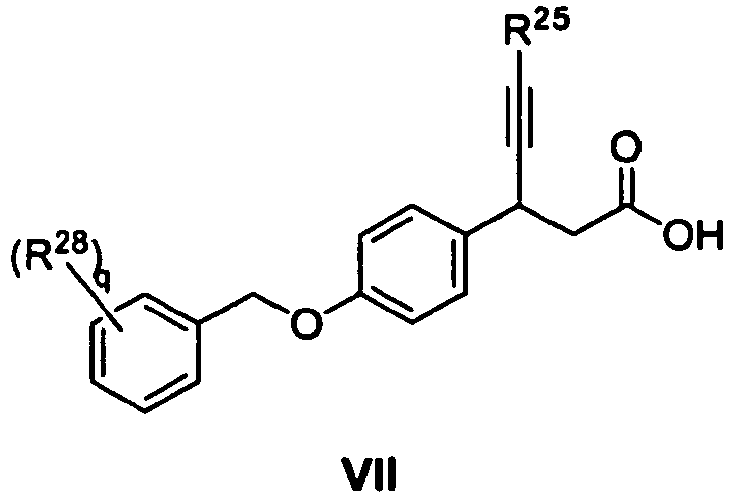
R25 is -H, -(C1-C5)alkyl, -(C1-C5)oxyalkyl, substituted or unsubstituted aryl, or substituted or unsubstituted heteroaryl;
each R28 is independently selected from the group consisting of phenyl, methoxyphenyl, methylphenyl, trihalomethylphenyl, benzyl, phenoxy, ethoxyphenyl, cyanophenyl, halophenyl, halobenzyl, pyridyl, methoxybenzyl, or pyryl group; and
the subscript q is 1 or 2. - Preferred embodiments are set forth in the subclaims.
- The terms "treat", "treating" and "treatment", as used herein, are meant to include alleviating or abrogating a condition or disease and/or its attendant symptoms and alleviating. The terms "prevent", "preventing" and "prevention", as used herein, refer to a method of delaying or precluding the onset of a condition or disease and/or its attendant symptoms, barring a subject from acquiring a condition or disease or reducing a subject's risk of acquiring a condition or disease.
- The term "therapeutically effective amount" refers to that amount of the compound that will elicit the biological or medical response of a tissue, system, or subject that is being sought. The term "therapeutically effective amount" includes that amount of a compound that, when administered, is sufficient to prevent development of, or alleviate to some extent, one or more of the symptoms of the condition or disorder being treated in a subject. The therapeutically effective amount in a subject will vary depending on the compound, the disease and its severity and the age, weight, etc., of the subject to be treated.
- The "subject" is defined herein to include animals such as mammals, including primates (e.g., humans), cows, sheep, goats, horses, dogs, cats, rabbits, rats, mice and the like. In preferred embodiments, the subject is a human.
- The terms "modulate", "modulation" and the like refer to the ability of a compound to increase or decrease the function or activity of GPR40 either directly or indirectly. Inhibitors are compounds that, for example, bind to, partially or totally block stimulation, decrease, prevent, delay activation, inactivate, desensitize, or down regulate signal transduction, such as, for instance, antagonists. Activators are compounds that, for example, bind to, stimulate, increase, activate, facilitate, enhance activation, sensitize or up regulate signal transduction, such as agonists for instance. Modulation may occur in vitro or in vivo.
- As used herein, the term "GPR40-mediated condition or disorder" and the like refer to a condition or disorder characterized by inappropriate, for example, less than or greater than normal, GPR40 activity. A GPR40-mediated condition or disorder may be completely or partially mediated by inappropriate GPR40 activity. However, a GPR40-mediated condition or disorder is one in which modulation of GPR40 results in some effect on the underlying condition or disease (e.g., a GPR40 modulator results in some improvement in patient well-being in at least some patients). Exemplary GPR40-mediated conditions and disorders include cancer and metabolic disorders, e.g., diabetes, type II diabetes, obesity, hyperglycemia, glucose intolerance, insulin resistance, hyperinsulinemia, hypercholesterolemia, hypertension, hyperlipoproteinemia, hyperlipidemia, hypertriglylceridemia, dyslipidemia, ketoacidosis, hypoglycemia, thrombotic disorders, metabolic syndrome, syndrome X and related disorders, e.g., cardiovascular disease, atherosclerosis, kidney disease, nephropathy, diabetic neuropathy, diabetic retinopathy, sexual dysfunction, dermatopathy, dyspepsia and edema.
- The term "alkyl", by itself or as part of another substituent, means, unless otherwise stated, a straight or branched chain, or cyclic hydrocarbon radical, or combination thereof, which is fully saturated, having the number of carbon atoms designated (e.g., C1-C10 means one to ten carbons). Examples of alkyl groups include methyl, ethyl, n-propyl, isopropyl, n-butyl, t-butyl, isobutyl, sec-butyl, cyclohexyl, (cyclohexyl)methyl, cyclopropyl, cyclopropylmethyl, homologs and isomers of, for example, n-pentyl, n-hexyl, n-heptyl, n-octyl and the like.
- The term "alkenyl", by itself or as part of another substituent, means a straight or branched chain, or cyclic hydrocarbon radical, or combination thereof, which may be mono- or polyunsaturated, having the number of carbon atoms designated (i.e., C2-C8 means two to eight carbons) and one or more double bonds. Examples of alkenyl groups include vinyl, 2-propenyl, crotyl, 2-isopentenyl, 2-(butadienyl), 2,4-pentadienyl, 3-(1,4-pentadienyl) and higher homologs and isomers thereof.
- The term "alkynyl", by itself or as part of another substituent, means a straight or branched chain hydrocarbon radical, or combination thereof, which may be mono- or polyunsaturated, having the number of carbon atoms designated (i.e., C2-C8 means two to eight carbons) and one or more triple bonds. Examples of alkynyl groups include ethynyl, 1- and 3-propynyl, 3-butynyl and higher homologs and isomers thereof.
- The term "alkylene" by itself or as part of another substituent means a divalent radical derived from alkyl, as exemplified by -CH2CH2CH2CH2-. Typically, an alkyl (or alkylene) group will have from 1 to 24 carbon atoms, with those groups having 12 or fewer carbon atoms being preferred in the present invention. A "lower alkyl" or "lower alkylene" is a shorter chain alkyl or alkylene group, generally having eight or fewer carbon atoms.
- The terms "alkoxy," "alkylamino" and "alkylthio" (or thioalkoxy) are used in their conventional sense, and refer to those alkyl groups attached to the remainder of the molecule via an oxygen atom, an amino group, or a sulfur atom, respectively. Similarly, the term dialkylamino refers to an amino group having two attached alkyl groups that can be the same or different.
- The term "heteroalkyl," by itself or in combination with another term, means, unless otherwise stated, a stable straight or branched chain, or cyclic hydrocarbon radical, or combinations thereof, consisting of carbon atoms and from one to three heteroatoms selected from the group consisting of O, N and S, and wherein the nitrogen and sulfur atoms may optionally be oxidized and the nitrogen heteroatom may optionally be quaternized. The heteroatom(s) O, N and S may be placed at any position of the heteroalkyl group. Examples include -CH2-CH2-O-CH3, -CH2-CH2-NH-CH3, -CH2-CH2-N(CH3)-CH3, -CH2-S-CH2-CH3, -CH2-CH2-S(O)-CH3, -CH2-CH2-S(O)2-CH3, and -CH2-CH=N-OCH3. Up to two heteroatoms may be consecutive, such as, for example, -CH2-NH-OCH3. When a prefix such as (C2-C8) is used to refer to a heteroalkyl group, the number of carbons (2 to 8, in this example) is meant to include the heteroatoms as well. For example, a C2-heteroalkyl group is meant to include, for example, -CH2OH (one carbon atom and one heteroatom replacing a carbon atom) and -CH2SH.
- To further illustrate the definition of a heteroalkyl group, where the heteroatom is oxygen, a heteroalkyl group is a oxyalkyl group. For instance, (C2-C5)oxyalkyl is meant to include; for example -CH2-O-CH3 (a C3-oxyalkyl group with two carbon atoms and one oxygen replacing a carbon atom), -CH2CH2CH2CH2OH, and the like.
- The term "heteroalkylene" by itself or as part of another substituent means a divalent radical derived from heteroalkyl, as exemplified by -CH2-CH2-S-CH2CH2- and -CH2-S-CH2-CH2-NH-CH2-. For heteroalkylene groups, heteroatoms can also occupy either or both of the chain termini (e.g., alkyleneoxy, alkylenedioxy, alkyleneamino, alkylenediamino, and the like). Still further, for alkylene and heteroalkylene linking groups, no orientation of the linking group is implied.
- The terms "cycloalkyl" and "heterocycloalkyl," by themselves or in combination with other terms, represent, unless otherwise stated, cyclic versions of "alkyl" and "heteroalkyl," respectively. Thus, the terms "cycloalkyl" and "heterocycloalkyl" are meant to be included in the terms "alkyl" and "heteroalkyl," respectively. Additionally, for heterocycloalkyl, a heteroatom can occupy the position at which the heterocycle is attached to the remainder of the molecule. Examples of cycloalkyl include cyclopentyl, cyclohexyl, 1-cyclohexenyl, 3-cyclohexenyl, cycloheptyl, and the like. Examples of heterocycloalkyl include 1-(1,2,5,6-tetrahydropyridyl), 1-piperidinyl, 2-piperidinyl, 3-piperidinyl, 4-morpholinyl, 3-morpholinyl, tetrahydrofuran-2-yl, tetrahydrofuran-3-yl, tetrahydrothien-2-yl, tetrahydrothien-3-yl, 1-piperazinyl, 2-piperazinyl, and the like.
- The term "cycloalkylene" and "heterocycloalkylene," by themselves or in combination with other terms, represent, unless otherwise stated, cyclic versions of "alkylene" and "heteroalkylene," respectively. Thus, the terms "cycloalkylene" and "heterocycloalkylene" are meant to be included in the terms "alkylene" and "heteroalkylene," respectively. Additionally, for heterocycloalkylene, one or more heteroatoms can occupy positions at which the heterocycle is attached to the remainder of the molecule. Typically, a cycloalkylene or heterocycloalkylene will have from 3 to 9 atoms forming the ring, more typically, 4 to 7 atoms forming the ring, and even more typically, 5 or 6 atoms will form the cycloalkylene or hetercycloalkylene ring.
- The terms "halo" or "halogen," by themselves or as part of another substituent, mean, unless otherwise stated, a fluorine, chlorine, bromine, or iodine atom. Additionally, terms such as "haloalkyl", are meant to include alkyl substituted with halogen atoms which can be the same or different, in a number ranging from one to (2m'+1), where m' is the total number of carbon atoms in the alkyl group. For example, the term "halo(C1-C4)alkyl" is meant to include trifluoromethyl, 2,2,2-trifluoroethyl, 4-chlorobutyl, 3-bromopropyl, and the like. Thus, the term "haloalkyl" includes monohaloalkyl (alkyl substituted with one halogen atom) and polyhaloalkyl (alkyl substituted with halogen atoms in a number ranging from two to (2m' + 1) halogen atoms). The term "perhaloalkyl" means, unless otherwise stated, alkyl substituted with (2m'+1) halogen atoms, where m' is the total number of carbon atoms in the alkyl group. For example, the term "perhalo(C1-C4)alkyl", is meant to include trifluoromethyl, pentachloroethyl, 1,1,1-trifluoro-2-bromo-2-chloroethyl, and the like.
- The term "aryl" means, unless otherwise stated, a polyunsaturated, typically aromatic, hydrocarbon substituent which can be a single ring or multiple rings (up to three rings) which are fused together or linked covalently. The term "heteroaryl" refers to aryl groups (or rings) that contain from one to four heteroatoms selected from the group consisting of N, O and S, wherein the nitrogen and sulfur atoms are optionally oxidized, and the nitrogen atom(s) are optionally quatemized. A heteroaryl group can be attached to the remainder of the molecule through a heteroatom. Non-limiting examples of aryl and heteroaryl groups include phenyl, 1-naphthyl, 2-naphthyl, 4-biphenyl, 1-pyrrolyl, 2-pyrrolyl, 3-pyrrolyl, 1-pyrazolyl, 3-pyrazolyl, 5-pyrazolyl, 2-imidazolyl, 4-imidazolyl, pyrazinyl, 2-oxazolyl, 4-oxazolyl, 2-phenyl-4-oxazolyl, 5-oxazolyl, 3-isoxazolyl, 4-isoxazolyl, 5-isoxazolyl, 2-thiazolyl, 4-thiazolyl, 5-thiazolyl, 2-furyl, 3-furyl, dibenzofuryl, 2-thienyl, 3-thienyl, 2-pyridyl, 3-pyridyl, 4-pyridyl, 2-pyrimidyl, 4-pyrimidyl, 2-pyrimidinyl, 4-pyrimidinyl, 5-pyrimidinyl, 3-pyridazinyl, 4- pyridazinyl, 5-benzothiazolyl, 2-benzoxazolyl, 5-benzoxazolyl, benzo[c][1,2,5]oxadiazolyl, purinyl, 2-benzimidazolyl, 5-indolyl, 1H-indazolyl, carbazolyl, α-carbolinyl, β-carbolinyl, γ-carbolinyl, 1-isoquinolyl, 5-isoquinolyl, 2-quinoxalinyl, 5-quinoxalinyl, 2-quinolyl, 3-quinolyl, 4-quinolyl, 5-quinolyl, 6-quinolyl, 7-quinolyl and 8-quinolyl.
- Preferably, the term "aryl" refers to a phenyl or naphthyl group which is unsubstituted or substituted. Preferably, the term "heteroaryl" refers to a pyrrolyl, pyrazolyl, imidazolyl, pyrazinyl, oxazolyl, isoxazolyl, thiazolyl, furyl, thienyl, pyridyl, pyrimidyl, benzothiazolyl, purinyl, benzimidazolyl, indolyl, isoquinolyl, quinoxalinyl or quinolyl group which is unsubstituted or substituted.
- For brevity, the term "aryl" when used in combination with other terms (e.g., aryloxy, arylthioxy, arylalkyl) includes both aryl and heteroaryl rings as defined above. Thus, the term "arylalkyl" is meant to include those radicals in which an aryl group is attached to an alkyl group (e.g., benzyl, phenethyl, pyridylmethyl and the like) including those alkyl groups in which a carbon atom (e.g., a methylene group) has been replaced by, for example, an oxygen atom (e.g., phenoxymethyl, 2-pyridyloxymethyl, 3-(1-naphthyloxy)propyl, and the like).
- Each of the above terms (e.g., "alkyl," "heteroalkyl," "aryl" and "heteroaryl") is meant to include both substituted and unsubstituted forms of the indicated radical, unless otherwise indicated. Preferred substituents for each type of radical are provided below.
- Substituents for the alkyl and heteroalkyl radicals (as well as those groups referred to as alkylene, alkenyl, heteroalkylene, heteroalkenyl, alkynyl, cycloalkyl, heterocycloalkyl, cycloalkenyl and heterocycloalkenyl) can be a variety of groups selected from: -OR', =O, =NR', =N-OR', -NR'R", -SR', halogen, -OC(O)R', -C(O)R', -CO2R', -CONR'R", -OC(O)NR'R", -NR"C(O)R', -NR'-C(O)NR"R"', -NR'-SO2NR"R"', -NR"CO2R', -NH-C(NH2)=NH, -NR'C(NH2)=NH, -NH-C(NH2)-NR', -SiR'R"R'", -S(O)R', -SO2R', -SO2NRR", -NR"SO2R, -CN and -NO2, in a number ranging from zero to three, with those groups having zero, one or two substituents being particularly preferred. R', R" and R"' each independently refer to hydrogen, unsubstituted (C1-C8)alkyl and heteroalkyl, unsubstituted aryl, aryl substituted with one to three halogens, unsubstituted alkyl, alkoxy or thioalkoxy groups, halo(C1-C4)alkyl, or aryl-(C1-C4)alkyl groups. When R' and R" are attached to the same nitrogen atom, they can be combined with the nitrogen atom to form a 5-, 6- or 7-membered ring. For example, -NRR" is meant to include 1-pyrrolidinyl and 4-morpholinyl.
- Typically, an alkyl or heteroalkyl group will have from zero to three substituents, with those groups having two or fewer substituents being preferred in the present invention. More preferably, an alkyl or heteroalkyl radical will be unsubstituted or monosubstituted. Most preferably, an alkyl or heteroalkyl radical will be unsubstituted. From the above discussion of substituents, one of skill in the art will understand that the term "alkyl" is meant to include groups such as trihaloalkyl (e.g., -CF3 and -CH2CF3).
- Preferred substituents for the alkyl and heteroalkyl radicals are selected from: -OR', =O, -NR'R", -SR', halogen, -OC(O)R', -C(O)R', -CO2R', -CONR'R", -OC(O)NR'R", -NR"C(O)R', -NR"CO2R', -NR'-SO2NR"R'", -S(O)R', -SO2R', -SO2NR'R", -NR"SO2R, -CN and -NO2, where R' and R" are as defined above. Further preferred substituents are selected from: -OR', =O, -NR'R", halogen, -OC(O)R', -CO2R', -CONR'R", -OC(O)NR'R", -NR"C(O)R', -NR"CO2R', -NR'-SO2NR"R'", -SO2R', -SO2NR'R", -NR"SO2R, -CN and -NO2.
- Similarly, substituents for the aryl and heteroaryl groups are varied and are selected from: -halogen, -OR', -OC(O)R', -NR'R", -SR', -R', -CN, -NO2, -CO2R', -CONR'R", -C(O)R', -OC(O)NRR", -NR"C(O)R', -NR"C(O)2R', -NR'-C(O)NR"R"', -NH-C(NH2)-NH, -NR'C(NH2)=NH, -NH-C(NH2)=NR', -S(O)R', -S(O)2R', -S(O)2NR'R" -N3, -CH(Ph)2, perfluoro(C1-C4)alkoxy, and perfluoro(C1-C4)alkyl, in a number ranging from zero to the total number of open valences on the aromatic ring system; and where R', R" and R'" are independently selected from hydrogen, (C1-C8)alkyl and heteroalkyl, unsubstituted aryl and heteroaryl, (unsubstituted aryl)-(C1-C4)alkyl, and (unsubstituted aryl)oxy-(C1-C4)alkyl.
- Two of the substituents on adjacent atoms of the aryl or heteroaryl ring may optionally be replaced with a substituent of the formula -T-C(O)-(CH2)q-U-, wherein T and U are independently -NH-, -O-, -CH2- or a single bond, and q is an integer of from 0 to 2. Alternatively, two of the substituents on adjacent atoms of the aryl or heteroaryl ring may optionally be replaced with a substituent of the formula -A-(CH2)r-B-, wherein A and B are independently -CH2-, -O-, -NH-, -S-, -S(O)-, -S(O)2-, -S(O)2NR'- or a single bond, and r is an integer of from 1 to 3. One of the single bonds of the new ring so formed may optionally be replaced with a double bond. Alternatively, two of the substituents on adjacent atoms of the aryl or heteroaryl ring may optionally be replaced with a substituent of the formula -(CH2)s-X-(CH2)t-, where s and t are independently integers of from 0 to 3, and X is -O-, -NR-, -S-, -S(O)-, -S(O)2-, or -S(O)2NR'-. The substituent R' in -NR'- and -S(O)2NR'- is selected from hydrogen or unsubstituted (C1-C6)alkyl. Otherwise, R' is as defined above.
- As used herein, the term "heteroatom" is meant to include oxygen (O), nitrogen (N), and sulfur (S).
- As used herein, the phrase "bioisostere of -CO2H" is meant that the the substituent -CO2H may be optionally replaced with bioisosteric replacements such as:


- The term "pharmaceutically acceptable salt" is meant to include a salt of the active compound which is prepared with relatively nontoxic acids or bases, depending on the particular substituents found on the compound described herein. When a compound of the invention contains relatively acidic functionalities, a base addition salt can be obtained by contacting the neutral form of such compound with a sufficient amount of the desired base, either neat or in a suitable inert solvent. Examples of pharmaceutically acceptable base addition salts include sodium, potassium, calcium, ammonium, organic amino, or magnesium salt, or a similar salt. When a compound of the invention contains relatively basic functionalities, an acid addition salt can be obtained by contacting the neutral form of such compound with a sufficient amount of the desired acid, either neat or in a suitable inert solvent. Examples of pharmaceutically acceptable acid addition salts include those derived from inorganic acids like hydrochloric, hydrobromic, nitric, carbonic, monohydrogencarbonic, phosphoric, monohydrogenphosphoric, dihydrogenphosphoric, sulfuric, monohydrogensulfuric, hydriodic, or phosphorous acids and the like, as well as the salts derived from relatively nontoxic organic acids like acetic, propionic, isobutyric, maleic, malonic, benzoic, succinic, suberic, fumaric, mandelic, phthalic, benzenesulfonic, p-tolylsulfonic, citric, tartaric, methanesulfonic, and the like. Also included are salts of amino acids such as arginine and the like, and salts of organic acids like glucuronic or galacturonic acids and the like (see, for example, Berge et al. (1977) J. Pharm. Sci. 66:1-19). Certain specific compounds of the invention contain both basic and acidic functionalities that allow the compounds to be converted into either base or acid addition salts.
- The neutral forms of the compounds may be regenerated by contacting the salt with a base or acid and isolating the parent compound in the conventional manner. The parent form of the compound differs from the various salt forms in certain physical properties, such as solubility in polar solvents, but otherwise the salts are equivalent to the parent form of the compound for the purposes of the invention.
- As used herein, "solvate" refers to a compound of the present invention or a salt thereof, that further includes a stoichiometric or non-stoichiometric amount of solvent bound by non-covalent intermolecular forces. Where the solvent is water, the solvate is a hydrate.
- Certain compounds of the invention may exist in multiple crystalline or amorphous forms. In general, all physical forms are equivalent for the uses contemplated by the invention and are intended to be within the scope of the invention.
- Certain compounds of the invention possess asymmetric carbon atoms (optical centers) or double bonds; the racemates, enantiomers, diastereomers, geometric isomers and individual isomers are all intended to be encompassed within the scope of the invention.
- As used herein and unless otherwise indicated, the term "stereoisomer" or "stereomerically pure" means one stereoisomer of a compound that is substantially free of other stereoisomers of that compound. For example, a stereomerically pure compound having one chiral center will be substantially free of the opposite enantiomer of the compound. A stereomerically pure a compound having two chiral centers will be substantially free of other diastereomers of the compound. A typical stereomerically pure compound comprises greater than about 80% by weight of one stereoisomer of the compound and less than about 20% by weight of other stereoisomers of the compound, more preferably greater than about 90% by weight of one stereoisomer of the compound and less than about 10% by weight of the other stereoisomers of the compound, even more preferably greater than about 95% by weight of one stereoisomer of the compound and less than about 5% by weight of the other stereoisomers of the compound, and most preferably greater than about 97% by weight of one stereoisomer of the compound and less than about 3% by weight of the other stereoisomers of the compound. It should be noted that if the stereochemistry of a structure or a portion of a structure is not indicated with, for example, bold or dashed lines, the structure or portion of the structure is to be interpreted as encompassing all stereoisomers of it.
- Various compounds of the invention contain one or more chiral centers, and can exist as racemic mixtures of enantiomers, mixtures of diastereomers or enantiomerically or optically pure compounds. This invention encompasses the use of stereomerically pure forms of such compounds, as well as the use of mixtures of those forms. For example, mixtures comprising equal or unequal amounts of the enantiomers of a particular compound of the invention may be used in compositions of the invention. These isomers may be asymmetrically synthesized or resolved using standard techniques such as chiral columns or chiral resolving agents. See, e.g., Jacques, J., et al., Enantiomers, Racemates and Resolutions (Wiley-Interscience, New York, 1981); Wilen, S. H., et al. (1997) Tetrahedron 33:2725; Eliel, E. L., Stereochemistry of Carbon Compounds (McGraw-Hill, NY, 1962); and Wilen, S. H., Tables of Resolving Agents and Optical Resolutions p. 268 (E.L. Eliel, Ed., Univ. of Notre Dame Press, Notre Dame, IN, 1972).
- The compounds of the invention may also contain unnatural proportions of atomic isotopes at one or more of the atoms that constitute such compounds. For example, the compounds may be radiolabeled with radioactive isotopes, such as for example tritium (3H), iodine-125 (125I) or carbon-14 (14C). Radiolabled compounds are useful as therapeutic or prophylactic agents, research reagents, e.g., GPR40 assay reagents, and diagnostic agents, e.g., in vivo imaging agents. All isotopic variations of the compounds of the invention, whether radioactive or not, are intended to be encompassed within the scope of the invention.
- In one aspect, a class of compounds that modulate GPR40 is described herein. Depending on the biological environment (e.g., cell type, pathological condition of the subject, etc.), these compounds can modulate, e.g., activate or inhibit, the actions of GPR40. By modulating GPR40, the compounds find use as therapeutic agents capable of regulating insulin levels in a subject. The compounds find use as therapeutic agents for modulating diseases and conditions responsive to modulation of GPR40 and/or mediated by GPR40 and/or mediated by pancreatic β cells. As noted above, examples of such diseases and conditions include diabetes, obesity, hyperglycemia, glucose intolerance, insulin resistance, cancer, hyperinsulinemia, hypercholesterolemia, hypertension, hyperlipoproteinemia, hyperlipidemia, hypertriglylceridemia, dyslipidemia, ketoacidosis, hypoglycemia, metabolic syndrome, syndrome X, cardiovascular disease, atherosclerosis, kidney disease, nephropathy, thrombotic disorders, diabetic neuropathy, diabetic retinopathy, dermatopathy, dyspepsia and edema. Additionally, the compounds are useful for the treatment and/or prevention of complications of these diseases and disorders (e.g., type II diabetes, sexual dysfunction, dyspepsia and so forth).
- While the compounds of the invention are believed to exert their effects by interacting with GPR40, the mechanism of action by which the compounds act is not a limiting embodiment of the invention.
- In one aspect, the present invention provides a compound having the formula (VII):

- In other embodiments, R25 is methyl.
- In certain embodiments, the compound of formula VII comprises a stereomerically pure S-enantiomer. In other embodiments, the compound of formula VII comprises a stereomerically pure R-enantiomer. In yet other embodiments, the compound of formula VII comprises a mixture of S- and R-enantiomers.
- In other embodiments, the formula is selected from the group consisting of


- In some embodiments, the compound has the formula:

- The compounds of the invention can be prepared by a variety of synthetic or semisynthetic techniques. The Examples in Section 6 below provide a variety of synthesis routes to the compounds provided herein. Appropriate starting materials can be prepared by techniques known or apparent to those of skill in the art or the starting materials may be commercially available. One of skill in the art will understand that the synthetic routes can be modified to use different starting materials or alternative reagents and that suitable adjustments in conditions (e.g., temperatures, solvents, etc.) can be made to accomplish the desired transformations. Additionally, one of skill in the art will recognize that protecting groups may be necessary for the preparation of certain compounds and will be aware of those conditions compatible with a selected protecting group. Accordingly, the exemplary methods and the examples described herein are illustrative of the present invention.
- In another aspect, the invention provides pharmaceutical compositions suitable for pharmaceutical use comprising one or more compounds of the invention and a pharmaceutically acceptable carrier, excipient or diluent.
- The term "composition" as used herein is intended to encompass a product comprising the specified ingredients (and in the specified amounts, if indicated), as well as any product which results, directly or indirectly, from combination of the specified ingredients in the specified amounts. By "pharmaceutically acceptable" it is meant that the carrier or excipient is compatible with the other ingredients of the formulation and not deleterious to the recipient thereof.
- Composition formulation may improve one or more pharmacokinetic properties (e.g., oral bioavailability, membrane permeability) of a compound of the invention (herein referred to as the active ingredient).
- The pharmaceutical compositions for the administration of the compounds of this invention may conveniently be presented in unit dosage form and may be prepared by any of the methods well known in the art. All methods include the step of bringing the active ingredient into association with the carrier which constitutes one or more accessory ingredients. In general, the pharmaceutical compositions are prepared by uniformly and intimately bringing the active ingredient into association with a liquid carrier or a finely divided solid carrier or both, and then, if necessary, shaping the product into the desired formulation. In the pharmaceutical composition the active object compound is included in an amount sufficient to produce the desired effect upon the process or condition of diseases.
- The pharmaceutical compositions containing the active ingredient may be in a form suitable for oral use, for example, as tablets, troches, lozenges, aqueous or oily suspensions, dispersible powders or granules, emulsions, hard or soft capsules, or syrups or elixirs. Compositions intended for oral use may be prepared according to any method known to the art for the manufacture of pharmaceutical compositions. Such compositions may contain one or more agents selected from sweetening agents, flavoring agents, coloring agents and preserving agents in order to provide pharmaceutically elegant and palatable preparations. Tablets contain the active ingredient in admixture with other non-toxic pharmaceutically acceptable excipients which are suitable for the manufacture of tablets. These excipients may be, for example, inert diluents, such as calcium carbonate, sodium carbonate, lactose, calcium phosphate or sodium phosphate; granulating and disintegrating agents, for example, corn starch, or alginic acid; binding agents, for example starch, gelatin or acacia, and lubricating agents, for example magnesium stearate, stearic acid or talc. The tablets may be uncoated or they may be coated by known techniques to delay disintegration and absorption in the gastrointestinal tract and thereby provide a sustained action over a longer period. For example, a time delay material such as glyceryl monostearate or glyceryl distearate may be employed. They may also be coated by the techniques described in
U.S. Patent Nos. 4,256,108 ;4,166,452 and4,265,874 to form osmotic therapeutic tablets for control release. - Formulations for oral use may also be presented as hard gelatin capsules wherein the active ingredient is mixed with an inert solid diluent, for example, calcium carbonate, calcium phosphate or kaolin, or as soft gelatin capsules wherein the active ingredient is mixed with water or an oil medium, for example peanut oil, liquid paraffin, or olive oil.
- Aqueous suspensions contain the active materials in admixture with excipients suitable for the manufacture of aqueous suspensions. Such excipients are suspending agents, for example sodium carboxymethylcellulose, methylcellulose, hydroxypropylmethylcellulose, sodium alginate, polyvinyl-pyrrolidone, gum tragacanth and gum acacia; dispersing or wetting agents may be a naturally-occurring phosphatide, for example lecithin, or condensation products of an alkylene oxide with fatty acids, for example polyoxy-ethylene stearate, or condensation products of ethylene oxide with long chain aliphatic alcohols, for example heptadecaethyleneoxycetanol, or condensation products of ethylene oxide with partial esters derived from fatty acids and a hexitol such as polyoxyethylene sorbitol monooleate, or condensation products of ethylene oxide with partial esters derived from fatty acids and hexitol anhydrides, for example polyethylene sorbitan monooleate. The aqueous suspensions may also contain one or more preservatives, for example ethyl, or n-propyl, p-hydroxybenzoate, one or more coloring agents, one or more flavoring agents, and one or more sweetening agents, such as sucrose or saccharin.
- Oily suspensions may be formulated by suspending the active ingredient in a vegetable oil, for example arachis oil, olive oil, sesame oil or coconut oil, or in a mineral oil such as liquid paraffin. The oily suspensions may contain a thickening agent, for example beeswax, hard paraffin or cetyl alcohol. Sweetening agents such as those set forth above, and flavoring agents may be added to provide a palatable oral preparation. These compositions may be preserved by the addition of an anti-oxidant such as ascorbic acid.
- Dispersible powders and granules suitable for preparation of an aqueous suspension by the addition of water provide the active ingredient in admixture with a dispersing or wetting agent, suspending agent and one or more preservatives. Suitable dispersing or wetting agents and suspending agents are exemplified by those already mentioned above. Additional excipients, for example sweetening, flavoring and coloring agents, may also be present.
- The pharmaceutical compositions of the invention may also be in the form of oil-in-water emulsions. The oily phase may be a vegetable oil, for example olive oil or arachis oil, or a mineral oil, for example liquid paraffin or mixtures of these. Suitable emulsifying agents may be naturally-occurring gums, for example gum acacia or gum tragacanth, naturally-occurring phosphatides, for example soy bean, lecithin, and esters or partial esters derived from fatty acids and hexitol anhydrides, for example sorbitan monooleate, and condensation products of the said,partial esters with ethylene oxide, for example polyoxyethylene sorbitan monooleate. The emulsions may also contain sweetening and flavoring agents.
- Syrups and elixirs may be formulated with sweetening agents, for example glycerol, propylene glycol, sorbitol or sucrose. Such formulations may also contain a demulcent, a preservative and flavoring and coloring agents.
- The pharmaceutical compositions may be in the form of a sterile injectable aqueous or oleagenous suspension. This suspension may be formulated according to the known art using those suitable dispersing or wetting agents and suspending agents which have been mentioned above. The sterile injectable preparation may also be a sterile injectable solution or suspension in a non-toxic parenterally acceptable diluent or solvent, for example as a solution in 1,3-butane diol. Among the acceptable vehicles and solvents that may be employed are water, Ringer's solution and isotonic sodium chloride solution. In addition, sterile, fixed oils are conventionally employed as a solvent or suspending medium. For this purpose any bland fixed oil may be employed including synthetic mono- or diglycerides. In addition, fatty acids such as oleic acid find use in the preparation of injectables.
- The pharmaceutical compositions may also be administered in the form of suppositories for rectal administration of the drug. These compositions can be prepared by mixing the drug with a suitable non-irritating excipient which is solid at ordinary temperatures but liquid at the rectal temperature and will therefore melt in the rectum to release the drug. Such materials are cocoa butter and polyethylene glycols.
- For topical use, creams, ointments, jellies, solutions or suspensions, etc., containing the compounds of the invention are employed. As used herein, topical application is also meant to include the use of mouthwashes and gargles.
- The pharmaceutical compositions and compounds for use of the invention may further comprise other therapeutically active compounds, as noted herein, useful in the treatment of type II diabetes, obesity, hyperglycemia, glucose intolerance, insulin resistance, hyperinsulinemia, hypercholesterolemia, hypertension, hyperlipoproteinemia, hyperlipidemia, hypertriglylceridemia, dyslipidemia, metabolic syndrome, syndrome X, cardiovascular disease, atherosclerosis, kidney disease, ketoacidosis, thrombotic disorders, nephropathy, diabetic neuropathy, diabetic retinopathy, sexual dysfunction, dermatopathy, dyspepsia, hypoglycemia, cancer and edema.
- The present specification discloses methods of treating or preventing a disease or condition selected from the group consisting of type II diabetes, obesity, hyperglycemia, glucose intolerance, insulin resistance, hyperinsulinemia, hypercholesterolemia, hypertension, hyperlipoproteinemia, hyperlipidemia, hypertriglylceridemia, dyslipidemia, metabolic syndrome, syndrome X, cardiovascular disease, atherosclerosis, kidney disease, ketoacidosis, thrombotic disorders, nephropathy, diabetic neuropathy, diabetic retinopathy, sexual dysfunction, dermatopathy, dyspepsia, hypoglycemia, cancer and edema, comprising administering to a subject in need thereof a therapeutically effective amount of a compound or composition of the invention.
- In one embodiment, the disease or condition is type II diabetes.
- The present specification discloses a method for treating a disease or condition responsive to the modulation of GPR40 comprising administering to a subject in need thereof a therapeutically effective amount of a compound or composition of the invention.
- In some embodiments, the disease or condition is selected from the group consisting of type II diabetes, obesity, hyperglycemia, glucose intolerance, insulin resistance, hyperinsulinemia, hypercholesterolemia, hypertension, hyperlipoproteinemia, hyperlipidemia, hypertriglylceridemia, dyslipidemia, metabolic syndrome, syndrome X, cardiovascular disease, atherosclerosis, kidney disease, ketoacidosis, thrombotic disorders, nephropathy, diabetic neuropathy, diabetic retinopathy, sexual dysfunction, dermatopathy, dyspepsia, hypoglycemia, cancer and edema.
- In certain embodiments, the disease or condition is type II diabetes.
- In some embodiments, the disease or condition is obesity.
- In some embodiments, the disease or condition is hyptertension.
- In some embodiments of administering the compounds or compositions or the invention, the compound or composition is administered orally.
- In other embodiments, the compound or composition is administered parentally.
- In other embodiments, the compound or composition is administered in combination with a second therapeutic agent.
- In other embodiments, the second therapeutic agent is an insulin sensitizing agent, such as metformin or a thiazolidinedione, for example.
- The present specification discloses methods of treating or preventing a disease or disorder responsive to modulation of GPR40 comprising administering to a subject having such a disease or disorder, a therapeutically effective amount of one or more of the subject compounds or compositions.
- The present specification discloses methods of treating or preventing a GPR40-mediated condition, disease or disorder comprising administering to a subject having such a condition, disease or disorder, a therapeutically effective amount of one or more of the subject compounds or compositions.
- The present specification discloses methods of modulating GPR40 comprising contacting a cell with one or more of the subject compounds or compositions.
- For example, in some embodiments, a cell that constitutively expresses GPR40 is contacted with one or more of the subject compounds or compositions.
- In certain embodiments, a cell to be contacted can be made to express or overexpress GPR40, for example, by expressing GPR40 from heterologous nucleic acid introduced into the cell or, as another example, by upregulating the expression of GPR40 from nucleic acid endogenous to the cell.
- Depending on the disease to be treated and the subject's condition, the compounds of the invention may be administered by oral, parenteral (e.g., intramuscular, intraperitoneal, intravenous, ICV, intracisternal injection or infusion, subcutaneous injection or implant), inhalation, nasal, vaginal, rectal, sublingual, or topical (e.g., transdermal, local) routes of administration and may be formulated, alone or together, in suitable dosage unit formulations containing conventional non-toxic pharmaceutically acceptable carriers, adjuvants and vehicles appropriate for each route of administration. The invention also contemplates administration of the compounds of the invention in a depot formulation, in which the active ingredient is released over a defined time period.
- In the treatment or prevention type II diabetes, obesity, hyperglycemia, glucose intolerance, insulin resistance, hyperinsulinemia, hypercholesterolemia, hypertension, hyperlipoproteinemia, hyperlipidemia, hypertriglylceridemia, dyslipidemia, metabolic syndrome, syndrome X, cardiovascular disease, atherosclerosis, kidney disease, ketoacidosis, thrombotic disorders, nephropathy, diabetic neuropathy, diabetic retinopathy, sexual dysfunction, dermatopathy, dyspepsia, hypoglycemia, cancer and edema or other conditions or disorders associated with GPR40, an appropriate dosage level will generally be 0.001 to 100 mg per kg patient body weight per day which can be administered in single or multiple doses. Preferably, the dosage level will be 0.01 to 25 mg/kg per day; more preferably 0.05 to 10 mg/kg per day. A suitable dosage level may be 0.01 to 25 mg/kg per day, 0.05 to 10 mg/kg per day, or 0.1 to 5 mg/kg per day. Within this range the dosage may be 0.005 to 0.05, 0.05 to 0.5 or 0.5 to 5.0 mg/kg per day. For oral administration, the compositions are preferably provided in the form of tablets containing 1.0 to 1000 milligrams of the active ingredient, particularly 1.0, 5.0, 10.0, 15.0. 20.0, 25.0, 50.0, 75.0, 100.0, 150.0, 200.0, 250.0, 300.0, 400.0, 500.0, 600.0, 750.0, 800.0, 900.0, and 1000.0 milligrams of the active ingredient for the symptomatic adjustment of the dosage to the patient to be treated. The compounds may be administered on a regimen of 1 to 4 times per day, preferably once or twice per day.
- It will be understood, however, that the specific dose level and frequency of dosage for any particular patient may be varied and will depend upon a variety of factors including the activity of the specific compound employed, the metabolic stability and length of action of that compound, the age, body weight, general health, sex, diet, mode and time of administration, rate of excretion, drug combination, the severity of the particular condition, and the host undergoing therapy.
- The compounds of the invention can be combined or used in combination with other agents useful in the treatment, prevention, suppression or amelioration of the diseases or conditions for which compounds of the invention are useful, including type II diabetes, obesity, hyperglycemia, glucose intolerance, insulin resistance, hyperinsulinemia, hypercholesterolemia, hypertension, hyperlipoproteinemia, hyperlipidemia, hypertriglylceridemia, dyslipidemia, metabolic syndrome, syndrome X, cardiovascular disease, atherosclerosis, kidney disease, ketoacidosis, thrombotic disorders, nephropathy, diabetic neuropathy, diabetic retinopathy, sexual dysfunction, dermatopathy, dyspepsia, hypoglycemia, cancer and edema. Such other agents, or drugs, may be administered, by a route and in an amount commonly used therefor, simultaneously or sequentially with a compound of the invention. When a compound of the invention is used contemporaneously with one or more other drugs, a pharmaceutical composition containing such other drugs in addition to the compound of the invention is preferred. Accordingly, the pharmaceutical compositions of the invention include those that also contain one or more other active ingredients or therapeutic agents, in addition to a compound of the invention.
- Examples of other therapeutic agents that may be combined with a compound of the invention, either administered separately or in the same pharmaceutical compositions, include: (a) cholesterol lowering agents such as HMG-CoA reductase inhibitors (e.g., lovastatin, simvastatin, pravastatin, fluvastatin, atorvastatin and other statins), bile acid sequestrants (e.g., cholestyramine and colestipol), vitamin B3 (also known as nicotinic acid, or niacin), vitamin B6 (pyridoxine), vitamin B12 (cyanocobalamin), fibric acid derivatives (e.g., gemfibrozil, clofibrate, fenofibrate and benzafibrate), probucol, nitroglycerin, and inhibitors of cholesterol absorption (e.g., betasitosterol and acylCoA-cholesterol acyltransferase (ACAT) inhibitors such as melinamide), HMG-CoA synthase inhibitors, squalene epoxidase inhibitors and squalene synthetase inhibitors; (b) antithrombotic agents, such as thrombolytic agents (e.g., streptokinase, alteplase, anistreplase and reteplase), heparin, hirudin and warfarin derivatives, β-blockers (e.g., atenolol), β-adrenergic agonists (e.g., isoproterenol), ACE inhibitors and vasodilators (e.g., sodium nitroprusside, nicardipine hydrochloride, nitroglycerin and enaloprilat); and (c) anti-diabetic agents such as insulin and insulin mimetics, sulfonylureas (e.g., glyburide, meglinatide), biguanides, e.g., metformin (Glucophage ®), α-glucosidase inhibitors (acarbose), insulin sensitizers, e.g., thiazolidinone compounds, rosiglitazone (Avandia ®), troglitazone (Rezulin ®), ciglitazone, pioglitazone (Actos ®) and englitazone.
- The weight ratio of the compound of the invention to the second active ingredient may be varied and will depend upon the effective dose of each ingredient. Generally, an effective dose of each will be used. Combinations of a compound of the invention and other active ingredients will generally also be within the aforementioned range, but in each case, an effective dose of each active ingredient should be used.
- The present specification discloses a method for modulating circulating insulin concentration in a subject, comprising administering a compound or composition of the invention.
- In some embodiments, the insulin concentration is increased.
- In other embodiments, the insulin concentration is decreased.
- The following examples are offered by way of illustration. Those of skill in the art will readily recognize a variety of noncritical parameters that could be modified to yield essentially similar results.
- This example illustrates the preparation of (3S)-3-(4-Hydroxy-phenyl)-hex-4-ynoic acid methyl ester.

- 5-(4-Hydroxy-benzylidene)-2,2-dimethyl-[1,3]dioxane-4,6-dione (1.1). Condensation with Meldrum's acid is carried out according to the method of Bigi et. al. (2001) Tetr. Lett. 42: 5203-5205. A 2L pear-shaped flask was charged with 4-hydroxybenzaldehyde (50 g, 409 mmol) and water (400 mL). The flask was placed in a water bath at 75 °C and Meldrum's acid (62 g, 430 mmol) was added as a slurry in 400 mL of water. The reaction mixture was agitated for 2h then cooled in an ice bath for 2 hours. The product was collected by filtration and rinsed with cold water. After drying thoroughly, 95 g (94%) of adduct 1.1 was obtained as a fine yellow powder. 1H NMR(500MHz)(DMSO-d6 ) δ 9.75 (br s, 1H); 8.27 (s, 1H); 8.24 (d, 2H, J=10 Hz); 6.98 (d, 2H, J=10 Hz);. 1.76 (s, 6H). MS ESI (pos.) m/e: 519.0 (2M + Na).
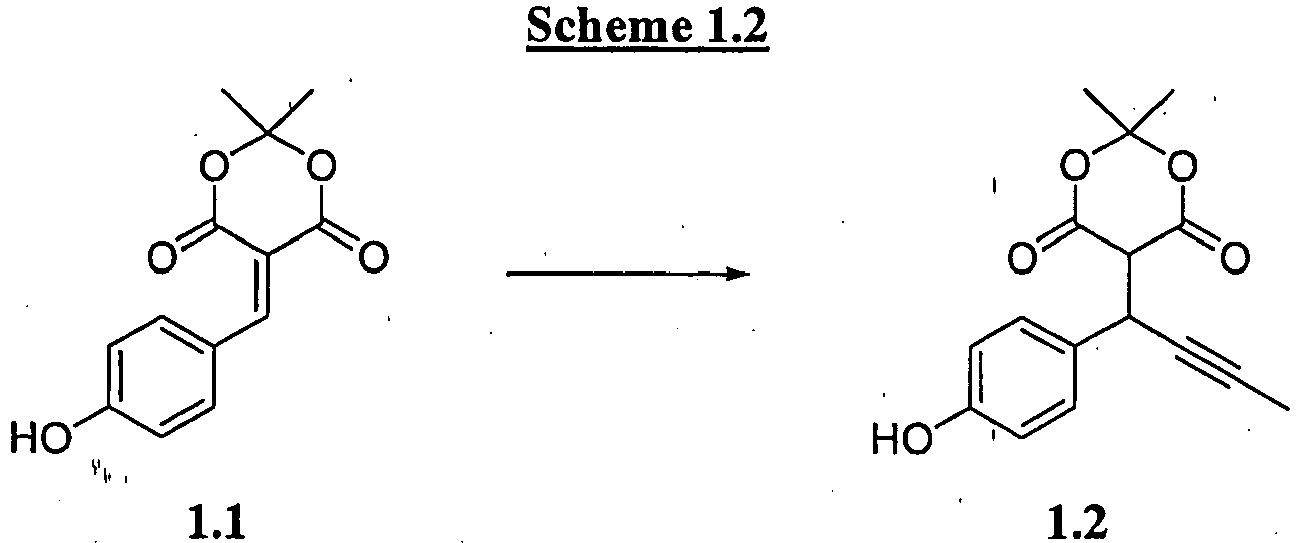
- (+/-)-5-[1-(4-Hydroxy-phenyl)-but-2-ynyl]-2,2-dimethyl-[1,3] dioxane-4,6-dione (1.2). An oven-dried 3L 3-neck flask equipped with a mechanical stirrer, nitrogen inlet, nitrogen outlet and placed in a room-temperature water bath. After purging with nitrogen for 20 minutes, a solution of 1-propynylmagnesium bromide in THF (0.5 N, 600 mL) was added by cannula. In a separate oven-dried and nitrogen-flushed 500 mL RB flask, compound 1.1 (35 g, 142 mmol) was dissolved in anhydrous THF (350 mL) with gentle warming. The solution of 1.1 was then added over 15 minutes. Over the course of the addition, the reaction mixture changed to a thick, yellow suspension. After the addition was complete, the reaction mixture was stirred for 15 minutes and then quenched with aqueous NH4Cl (0.6N, 750 mL) and diluted with hexanes (800 mL). The layers were separated and the organic layer discarded. The aqueous layer was acidified to pH ~2 with saturated aqueous KHSO4 and extracted with ethyl acetate (2 x 400 mL). The combined extracts were washed with saturated brine, dried over MgSO4, filtered, and concentrated to a light yellow solid (37 g, 91%). 1H NMR(500MHz)(acetone-d 6) δ 8.26 (s, 1H); 7.39 (d, 2H, J=8.5 Hz); 6.76 (d, 2H, J=8.4 Hz); 4.73 (br s, 1H); 4.46 (d, 1H, J=2.4 Hz); 1.82 (s, 3H); 1.81 (s, 3H); 1.64 (s, 3H). MS ESI (pos.) m/e: 599.0 (2M + Na).

- (+/-)-3-(4-Hydroxy-phenyl)-hex-4-ynoic acid (1.3). A 1L RB flask was charged with compound 1.2 (37 g), diethyl ketone (160 mL), and water (80 mL). The suspension was heated to reflux for 48h. After cooling, the aqueous layer was saturated with NaCl(s) and separated. The organic layer was dried over MgSO4, filtered, and concentrated to a light brown oil which was crystallized from hot ethyl acetate:hexanes (1:2). After collecting and drying, the product was obtained as an off-white powder (20.3 g, 77%).1H NMR(500MHz)(DMSO-d 6) δ 12.2 (s, 1H); 9.27 (s, 1H); 7.12 (d, 2H, J=8.5 Hz); 6.67 (d, 2H, J=8.6 Hz); 3.87 (m, 1H); 2.54 (m, 2H); 1.82 (d, 3H, J=2.4 Hz). MS ESI (pos.) m/e: 205:1 (M + H); 227.1 (M + Na).

- (3S)-3-(4-Hydroxy-phenyl)-hex-4-ynoic acid (1.4). A 5L RB flask was charged with compound 1.3 (66.4 g, 325 mmol) and 2-propanol (1 L) and then heated to 70 °C. (1S, 2R)-1-amino-2-indanol (46.1 g, 309 mmol) was dissolved in 2-propanol (1 L) with gentle warming. The solution of amine was added to the dissolved carboxlic acid and the resulting solution was allowed to cool to room temperature. After 16h, the crystals were collected and dried. The salt was re-suspended in 2 L of 2-propanol and dissolved by heating to reflux. After allowing to cool to room temperature, the salt was collected after 16h. A small sample of the salt was decomposed with aqueous acid and the free carboxylic acid was analyzed by chiral HPLC (Daicel ChiralPAK AD-H column, eluant: 0.1% TFA in 90:10 hexanes:2-propanol) and was found to have 75% ee. The salt was re-suspended in 1.5 L of 2-propanol and dissolved by heating to reflux. After allowing to cool to room temperature, the salt was collected after 16h. This material was found to have 96% ee by chiral HPLC. This material was suspended in ethyl acetate (300 mL) and water (100 mL). Saturated aqueous KHSO4 (100 mL) was added with vigorous mixing. After two clear layers were obtained, the layers were separated and the aqueous layer extracted with ethyl acetate (100 mL). The combined extracts were washed with saturated brine, dried over MgSO4, filtered, and concentrated to a light yellow oil which crystallized on drying in vacuo. Compound 1.4 was obtained as an off-white solid (23.5 g, 35%).

- (3S)-3-(4-Hydroxy-phenyl)-hex-4-ynoic acid methyl ester (1). Phenol 1.4 (23.5 g, 115 mmol) was dissolved in acetone (230 mL) and treated with KHCO3 (11.5 g, 115 mmol). After 15 minutes, methyl iodide (5 mL, 80 mmol) was added, and the reaction stirred at 40 °C for 14h. An additional portion of methyl iodide (3 mL, 48 mmol) was added and heating was continued for 24h. Potassium salts were removed by filtration and thoroughly rinsed with acetone. The filtrate was concentrated to an oil which was purified by filtration through a 1 cm plug of silica gel. Elution with 2.5% MeOH in dichloromethane followed by concentration provided phenol 1 (21.5 g, 85%) as a light yellow oil. 1H NMR(500MHz)(acetone-d 6) δ 8.2 (br s, 1H); 7.20 (d, 2H, J=9.5 Hz); 6.77 (d, 2H, J=9.0 Hz); 3.98 (m, 1H); 3.60 (s, 3H); 2.65 (m, 2H); 1.78 (d, 3H, J=2.5 Hz). MS ESI (pos.) m/e: 219.1 (M + H); 241.1 (M + Na).
- This example illustrates the preparation of (3S)-3-[4-(4'-Trifluoromethyl-biphenyl-3-ylmethoxy)-phenyl]-hex-4-ynoic acid sodium salt.

- 3-(4-Trifluoromethylphenyl)-benzoic acid (2.1). The Suzuki coupling was carried out according to the method of Dyer et al. (2001) Tetrahedron Letters 42: 1765-1767. Commercially available 4-(Trifluoromethyl)phenylboronic acid (15g, 78.7 mmol) and 3-bromobenzoic acid (15.1g, 75 mmol) were suspended in 2-propanol:water (1:4, 72 mL). 10% Pd/C (1.5g) was added followed by aqueous Na2CO3 (39 mL, 20% by wt.). The resulting mixture was heated at 70°C for 4 hours. The precipitate was filtered and rinsed with 20% aqueous Na2CO3 solution. The filtrate was diluted with water and acidified to pH=2. The white solid was filtered and dried in vacuo. The crude material (2.1) (19.69g) was used in the next step without further purification.

- 3-(4-Trifluoromethylphenyl)-benzyl alcohol (2.2). The carboxylic acid 2.1 (13.3g, 50mmol) in anhydrous THF (100mL) was added dropwise to LiAlH4 (2.9g, 75 mmol) in anhydrous THF (150mL) at 0°C over 30 minutes. The resulting mixture was slowly warmed to room temperature and stirred for 4 hours. The reaction was slowly quenched with water (2.9mL) at 0°C, 15% NaOH aqueous solution (2.9mL) and another portion of water (8.7mL). The mixture was dried over Na2SO4 and concentrated to give a white solid (11.9g). The crude product (2.2) was used in the next step without further purification.

- 3-(4-Trifluoromethylphenyl)-benzyl chloride (2.3). The alcohol 2.2 (15g, 59.5mmol) was dissolved in anhydrous dichloromethane (100mL). Thionyl chloride (10mL was slowly added dropwise to the above solution. The resulting mixture was stirred at room temperature for 24 hours. The organic solvent was removed under vacuo. The residue was then purified by flash chromatography (SiO2 gel 60, eluted with 20% DCM in hexanes). Fractions containing the desired product 2.3 were combined and concentrated to a white solid (14.0 g). 1H NMR (400MHz) (CDCl3) δ 7.73 (4H, s); 7.65 (1H, s); 7.58 (1H, s); 7.52-7.28 (2H, m); 4.69 (2H, s).

- (3S)-3-[4-(4'-Trifluoromethyl-biphenyl-3-ylmethoxy)-phenyl]-hex-4-ynoic acid methyl ester (2.4). Benzyl chloride 2.3 (28.0 g, 103 mmol) and phenol 1 (21.5 g, 98 mmol) were dissolved in acetone (150 mL) and treated with Cs2CO3 (39.9 g, 122 mmol). The reaction was stirred at 50 °C for 16 h then filtered and concentrated to an pale yellow oil which was purified by column chromatography (silica gel, 33% to 66% dichloromethane in hexanes). Eluant containing compound 2.4 was concentrated to a colorless oil (40.0 g, 92%).

- (3S)-3-[4-(4'-Trifluoromethyl-biphenyl-3-ylmethoxy)-phenyl]-hex-4-ynoic acid sodium salt (2). Methyl ester 2.4 was dissolved in diethyl ether (50 mL). Sodium trimethylsilanolate (0.78 g, 7 mmol) was added in one portion and the reaction mixture stirred for 48h. The precipitate was collected by filtration and recrystallized from ethyl acetate:hexanes. After drying in vacuo, the desired sodium salt was obtained as a white powder (1.3 g). 1H NMR (500MHz) (CD3OD) δ 7.82 (d, 2H, J=8.5 Hz); 7.75-7.73 (m, 3H); 7.62 (m, 1H); 7.32 (d, 2H, J=8.5 Hz); 6.94 (d, 2H, J=8.5 Hz); 5.15 (s, 2H); 4.03 (m, 1H); 2.52 (dd, 1H, J=8.2, 14.5 Hz); 2.45 (dd, 1H, J=7.0, 14.0 Hz); 1.79 (d, 3H, J=2.5 Hz).
-

- (3S)-3-[4-(4-Methyl-2-p-tolyl-thiazol-5-ylmethoxy)-phenyl]-hex-4-ynoic add methyl ester (3.2). Compound 3.1 was prepared according to the method described in Example 2 starting from the commercial available 4-methyl-2-(4-methylphenyl)-1,3-thiazole-5-carboxylic acid. The chloride 3.1 (250 mg, 1.1 mmol) and phenol 1 (230 mg, 1.1 mmol) were dissolved in anhydrous DMF (5 mL). Finely powdered Cs2CO3 (650 mg, 2.2 mmol) was then added and the reaction mixture was stirred at room temperature for 14 h. The reaction was poured into water and extracted with ethyl acetate (15mL) x 3). The organic phases were combined, dried over Na2SO4, and concentrated in vacuo to a residue which was used in the next step without further purification.

- (S)-3-[4-(4-Methyl-2-p-tolyl-thiazol-5-ylmethoxy)-phenyl]-hex-4-ynoic acid (3). Ester3.2 was dissolved in THF/MeOH/10% NaOH(aq) (1:1:1) solution (15mL). After stirring at room temperature over 30 minutes, the mixture was acidified with 1N HCl (aq.) until pH = 4. The aqueous phase was extracted with ethyl acetate and the combined organic phases were dried over Na2SO4 and concentrated. The crude residue was triturated with 20% ethyl acetate in hexanes (20 mL). The precipitate was filtered and compound 3 was acquired as a pale yellow powder (315 mg, 0.8 mmol). MS ESI m/e: 406 (M-H). 1H NMR (500MHz) (CDCl3) δ 7.86 (2H, d, J=7.5 Hz); 7.36 (2H, d, J=9 Hz); 7.26 (2H, d, J=8 Hz); 6.96 (2H, d, J=8.5 Hz); 5.18 (2H, s); 4.1 (1H, m); 2.77 (2H, m); 2.52 (3H, s); 2.42 (3H, s); 1.86 (3H, s).
- This example illustrates the preparation of 3-{4-[2-(2,6-Dichloro-benzyl)-thiazol-4-ylmethoxy]-phenyl}-hex-4-ynoic acid.

- 3-{4-[2-(2,6-Dichloro-benzyl)-thiazol-4-ylmethoxy]-phenyl}-hex-4-ynoic acid (4). Preparation of thiazole 4.1 was carried out according to the method of Bordwell et al. (1990) J. Amer. Chem. Soc. 112: 792-797. Compound 4.1 (58 mg, 0.2 mmol) and phenol 1 (43.6 mg, 0.2 mmol) were dissolved in anhydrous DMF (2 mL) and treated with finely powdered Cs2CO3 (65 mg, 0.22 mmol). The reaction mixture was stirred at room temperature for 14 hours. The reaction was poured into water and extracted with ethyl acetate (10 mL × 3). The combined organic phases were dried over Na2SO4, concentrated in vacuo and the residue dissolved in THF/MeOH/10% NaOH(aq) (1:1:1) solution (6 mL). The resulting mixture was stirred at room temperature for 30 minutes. The mixture was acidified with 1N HCl(aq.) until pH = 4. The aqueous phase was extracted with ethyl acetate. The organic phases were combined, dried over Na2SO4, and concentrated in vacuo. The crude residue was triturated with 20% ethyl acetate in hexanes (10 mL). The precipitate was filtered and acid 4 was acquired as a pale yellow powder (55 mg, 0.12 mmol). MS ESI m/e: 460 (M-H). 1H NMR (400MHz) (CDCl3) δ 7.40-7.19 (6H, m); 6.94-6.79 (2H, m); 5.18 (2H, s); 4.73 (2H, s); 4.1-4.06 (1H, m); 2.77 (2H, m); 1.85 (3H, s).
- This example illustrates the preparation of 3-[4-(2-Methyl-5-phenyl-furan-3-ylmethoxy)-phenyl]-hex-4-ynoic acid.

- 3-[4-(2-Methyl-5-phenyl-furan-3-ylmethoxy)-phenyl]-hex-4-ynoic acid (5). The Mitsunobu reaction was carried out according to the method of Mikó et al. (2003) J. Med. Chem.46: 1523-1530. Commercially available 5.1 (37.6 mg, 0.2 mmol), PPh3 (52 mg, 0.2 mmol) and phenol 1.3 (43.6 mg, 0.2 mmol) were added to anhydrous THF (3 mL). DEAD (45 µL, 0.22 mmol) was then added dropwise. The reaction mixture was stirred at room temperature over 14 hours. The reaction was then extracted with ethyl acetate (10mL × 3). The organic phases were combined, dried over Na2SO4, and concentrated in vacuo. The resulting residue was dissolved in THF/MeOH/10% NaOH(aq) (1:1:1) solution (6 mL). The resulting mixture was stirred at room temperature over 30 minutes. The resulting mixture was stirred at room temperature for 30 minutes. The mixture was acidified with 1N HCl(aq.) until pH = 4. The aqueous phase was extracted with ethyl acetate. The organic phases were combined, dried over Na2SO4, and concentrated in vacuo. The crude product was triturated in 20% ethyl acetate in hexanes (10 mL). The precipitate was filtered and compound 5 was obtained as a white powder (35 mg, 0.9 mmol). MS ESI m/e: 375 (M-H). 1H NMR (500MHz) (CDCl3) δ 7.65 (2H, d, J=8 Hz); 7.40-7.24 (5H, m); 6.96 (2H, d, J=8.5 Hz); 6.68 (1H, s); 4.88 (2H, s); 4.1 (1H, s); 2.77 (2H, m); 2.4 (3H, s); 1.86 (3H, s).
- The following compounds were prepared by methods similar to those described in Example 2.
TABLE 1 
Compound R1 R2 R3 R4 R5 R6 6.1 H H H H H H 6.2 OC2H5 H H H H H 6.3 H H OC2H5 H H H 6.4 H -OCH2O- H H H 6.5 H H CF3 H H H 6.6 H CN H H H H 6.7 H H CN H H H 6.8 CF3 H H H H H 6.9 H CF3 H H H H 6.10 H H OCF3 H H H 6.11 H H CF3 H H OC2H5 6.12 OCH3 H CF3 H H H - NMR and MS data for compounds 6.13 and 6.14 are as follows:

- 1H NMR (400MHz) ((CD3)2SO) δ 12.4 (s, 1H), 7.52 (d, 2H, J = 8.1 Hz), 7.48 (d, 2H, J = 8.1 Hz), 7.28-7.34 (m, 3H), 7.17 (s, 1H), 7.08 (d, 1H, J = 8.1 Hz), 6.98 (d, 2H, J = 8.2 Hz), 5.12 (s, 2H), 4.08 (q, 2H, J = 7.0 Hz), 3.95 (m, 1H), 2.50-2.60 (m, 2H), 1.78 (s, 3H), 1.27 (t, 3H, J = 7.0 Hz). [M+H]+ Calculated for C27H25ClO4: 449.1. Found 4.49.1.

- 1H NMR (400MHz) ((CD3)2SO) δ 12.4 (s, 1H), 7.52 (d, 2H, J = 8.0 Hz), 7.46 (d, 2H, J = 8.6 Hz), 7.30 (d, 2H, J = 8.8 Hz), 7.46 (d, 2H, J = 6.0 Hz), 6.98-7.01 (m, 3H), 6.91-6.98 (m, 3H), 5.13 (s, 2H), 3.92-4.04 (m, 3H), 2.61 (d, 2H, J = 7.6 Hz), 2.29 (s, 3H), 1.79 (d, 2H, J = 2.0 Hz), 1.59-1.66 (m, 2H), 1.34-1.40 (m, 2H), 0.88 (t, 3H, J = 7.6 Hz). [M+Na]+ Calculated for C30H32O4: 471.1. Found 471.1.
- The following compounds were prepared by methods similar to those described in Example 2.
TABLE 2 
Compound R1 R2 R3 R4 R5 R6 7.1 H H H H H H 7.2 CN H H H H H 7.3 H H H H H CH3 7.4 CN H H H H CH3 7.5 OC2H5 H H H H CH3 7.6 Cl H H H H CH3 7.7 F H H H H CH3 7.8 H OC2H5 H H H CH3 7.9 H H OC2H5 H H CH3 7.10 H H CF3 H H CH3 7.11 H -OCH2O- H H CH3 7.12 OCH3 OCH3 H H H CH3 7.13 H OCH3 H H H CH3 7.14 H CN H H H CH3 7.15 H H CN H H CH3 - The following compounds were prepared by methods similar to those described in Example 3.
TABLE 3 
Compound R1 R2 R3 R4 R5 8.1 H H CF3 H H 8.2 H H H H H 8.3 H H Cl H H 8.4 H H OCH3 H H 8.5 H H CH3 H H 8.6 H OCH3 OCH3 H H 8.7 Cl Cl H H H - The following compounds were prepared by methods similar to those described in Example 3.
TABLE 4 
Compound R1 R2 R3 R4 R5 9.1 H H CF3 H H 9.2 H H CH3 H H 9.3 H H H H H 9.4 H OCH3 OCH3 H H 9.5 H H Cl H H 9.6 Cl H H H H - The following compounds were prepared by methods similar to those described in Examples 3-5. The carboxylic acids corresponding to 10.2 and 10.5 were prepared according to the method of Huang et al. (2003) J. Amer. Chem. Soc. 22: 6653-6655, and Admas et al. (1973) Org. Synth. Coll. Vol. V: 107, 109, respectively.
TABLE 5 
(Compounds 10.1, 10.2, 10.4, 10.5, 10.7 and 10.14 are Reference Examples) Compound X Compound X 10.1 3-C(O)Ph 10.8 3-(2)-pyridyl 10.2 3-N(C2H5)Ph 10.9 3-(3)-pyridyl 10.3 3-Phenoxy 10.10 3-(4)-pyridyl 10.4 4-C(O)Ph 10.11 4-(2)-pyridyl 10.5 4-SO2Ph 10.12 4-(3)-pyridyl 10.6 4-CH2Ph 10.13 4-(4)-pyridyl 10.7 4-C2H4PH 10.14 4-Pyrrol-1-yl - The following compounds were prepared by methods similar to those described in Examples 3-5.
TABLE 6 
Compound R Compound R 11.1 
11.5 
11.2 
11.6 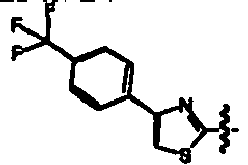
11.3 
11.7 
11.4 
11.8 
- This example illustrates the preparation of (+/-)-3-(4-[(4-methoxyphenyl)methoxy]- phenyl)-hex-4-ynoic acid.

- 4-[(4-methoxyphenyl)methoxy]benzaldehyde (12.1). A 500 mL round bottom flask was charged with 4-hydroxybenzaldehyde (40 g, 328 mmol) and DMF (250 mL). 4-methoxybenzyl chloride (57.8 mL, 426 mmol) was added, followed by potassium carbonate (90 g, 656 mmol). The reaction mixture was stirred at room temperature for 5h then poured into ice water (2.5 L). The product was collected by filtration and rinsed with water. After drying thoroughly, 78 g (98%) of aldehyde 12.1 was obtained as a light yellow powder. 1H NMR(400MHz)(DMSO-d6) δ 9.88 (s, 1H); 7.88 (d, 2H, J=8.7 Hz); 7.42 (d, 2H, J=8.8 Hz); 7.21 (d, 2H, J=8.8 Hz); 6.97 (d, 2H, J=8.6 Hz); 5.16 (s, 2H); 3.77 (s, 3H). MS ESI (pos.) m/e: 243.1 (M + H).

- 5-[[4-[(4-methoxyphenyl)methoxy]phenyl]methylene]-2,2-dimethyl-[1,3]dioxane-4,6-dione (12.2). Condensation with Meldrum's acid is carried out according to the procedure of DeWolf et al. (1989) Biochemistry 28: 3833-3842. A solution of Meldrum's acid (18 g, 124 mmol) compound 12.1 (30 g, 124 mmol) in toluene (100 mL) was treated with glacial acetic acid (4 mL) and piperidine (2 mL). The reaction mixture was stirred and heated at reflux until the removal of water with a Dean-Stark trap was complete. The reaction mixture was cooled to room temperature and the resulting solid was filtered and washed with cold toluene to yield 28g (62%) of 12.2 as a bright yellow powder.
1H NMR(400MHz)(DMSO-d 6) δ 8.32 (s, 1H); 8.24 (d, 2H, J=8.9 Hz); 7.42 (d, 2H, J=8.6 Hz); 7.17 (d, 2H, J=9.0 Hz); 6.97 (d, 2H, J=8.7 Hz); 5.18 (s, 2H) 3.75 (s, 6H) 1.75 (s, 6H).
- (+/-)-3-(4-[(4-methoxyphenyl)methoxy]phenyl)-hex-4-ynoic add (12). To a stirring THF (120 mL) solution of compound 12.2 (13.8 g, 37.5 mmol) under nitrogen was added 1-propynylmagnesium bromide in THF (0.5 N, 97.5 mL) over a period of 20 minutes. After the addition was complete, the reaction mixture was stirred for 20 minutes, quenched with saturated aqueous NH4Cl (50 mL) and extracted with ethyl acetate (3 x 50 mL). The combined extracts were washed with water, dried over MgSO4, filtered, and concentrated to a brown oil. A solution of this brown oil in 5:1 pyridine-water (360 mL) was heated at 100 °C for 36h. The reaction mixture was cooled to room temperature and put in an ice-water bath. Concentrated HCl was carefully added to pH -2. The resulting suspension was extracted with ethyl acetate (200 mL x 3), dried over MgSO4, filtered, and concentrated to an off-white solid. Recrystalization from ethanol gave 9.5 g (78%) of compound 12 as a white powder. 1H NMR(500MHz)DMSO-d 6) δ 12.2 (s, 1H); 7.37 (d, 2H, J=8.5 Hz); 7.27 (d, 2H, J=8.5 Hz); 6.95 (d, 2H, J=8.0 Hz); 6.94 (d, 2H, J=8.5 Hz); 4.99 (s, 2H); 3.95 (m, 1H); 3.76 (s, 3H); 2.60 (m, 2H); 1.78 (d, 3H, J=1.5 Hz). MS ESI (neg.) m/e: 323.0 (M -1).
- This example illustrates the preparation of (3S)-3-[4-(2-Methyl-benzyloxy)-phenyl]-hex-4-ynoic acid sodium salt.

- (3S)-3-[4-(2-Methyl-benzyloxy)-phenyl]-hex-4-ynoic acid methyl ester (13.1). 2-Methylbenzyl bromide (0.98 g, 5.3 mmol) and phenol 1 (0.97 g, 4.4 mmol) were dissolved in acetone (9 mL) and treated with Cs2CO3 (1.45 g, 4.4 mmol). The reaction was stirred at room temperature for 16 h then filtered and concentrated to an oil which was purified by radial chromatography (2 mm silica gel plate, 10% ethyl acetate in hexanes). Eluant containing compound 13.1 was concentrated to a colorless oil (1.37 g, 96%). This material was analyzed by chiral HPLC (Daicel ChiralPAK AD-H column, eluant: 0.1 % TFA in 95:5 hexanes:2-propanol) and was found to have 94% ee. 1H NMR(500MHz)(MeOH-d 4) δ 7.39 (d, 1H, J=7 Hz); 7.28 (d, 2H, J=8.5 Hz); 7.25-7.15 (m, 3H); 5.05 (s, 2H); 4.02 (m, 1H); 3.64 (s, 3H); 2.68 (m, 2H); 2.36 (s, 3H); 1.80 (d, 3H, J=2.5 Hz). MS ESI (pos.) m/e: 323.0 (M + H); 245.1 (M + Na).

- (3S)-3-[4-(2-Methyl-benzyloxy)-phenyl]-hex-4-ynoic acid sodium salt (13). 2N KOH(aq) (3.2 mL) was added to a solution of 13.1 (1.37 g, 4.25 mmol) in methanol (30 mL). The reaction was stirred at room temperature overnight and then taken up in copious water. The aqueous solution was adjusted to pH = 2.0 with 1N HCl(aq) and extracted with ethyl acetate. The combined organic layers were washed with water, followed by brine. The solvent was removed under reduced pressure and the resulting residue dissolved in ethanol (4 mL) and treated with 1 equiv. of aqueous sodium bicarbonate. The solvents were removed under reduced pressure and the residue triturated with diethyl ether. After collecting by filtration and drying, sodium salt 13 (1.1 g) was obtained as a fine white powder. 1H NMR(500MHz)(D2O) δ 7.34-7.18 (m, 6H); 6.95 (d, 2H, J=6.5 Hz); 5.05 (s, 2H); 3.88 (m, 1H); 2.47 (d, 2H, J=8.5 Hz); 2.28 (s, 3H); 1.72 (d, 3H, J=2.5 Hz). MS ESI (pos.) m/e: 309.1 (M + H); 331.0 (M + Na). [α]D = +20.6°.
- The following compounds were prepared using similar methods to those described in Example 12.
TABLE 7 
Compounds R Compounds R 14.1 
14.4 Me 14.2 
14.5 
14.3 Et 14.6 
- This example illustrates the preparation of (3S)-3-[4-(2-Methyl-benzyloxy)-phenyl]-hex-4-ynoic acid.
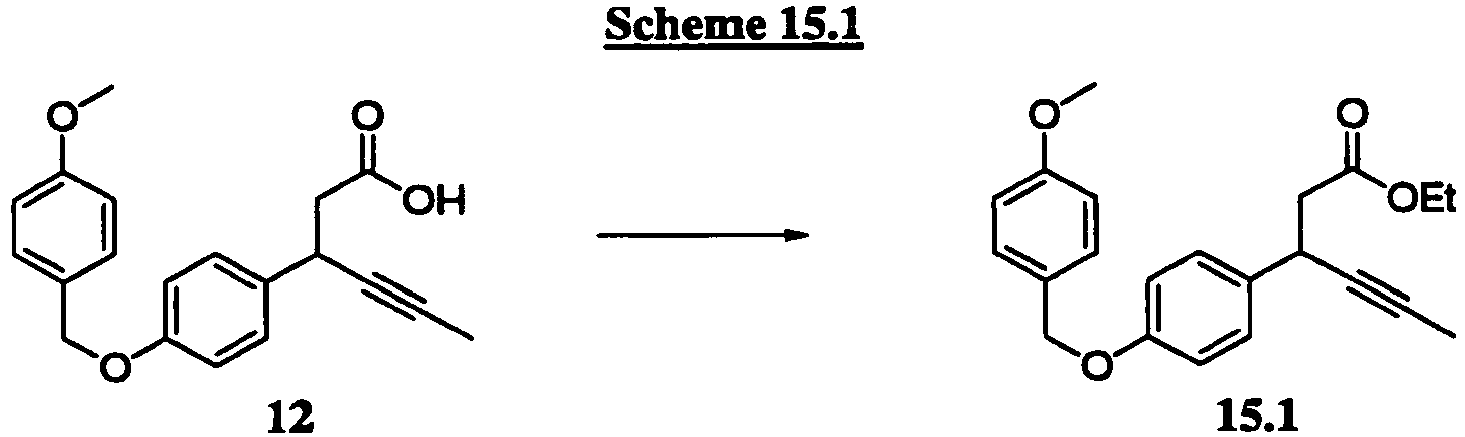
- (+/-)-[4-(4-Methoxy-benzyloxy)-phenyl]-hex-4-ynoic add ethyl ester (15.1). A 100 mL RB flask was charged with compound 12 (3.00 g, 9.25 mmol), 1-(3-dimethylaminopropyl)-3-ethylcarbodiimide hydrochloride (2.67 g, 13.9 mmol), 4-dimethylaminopyridine (1.13 g, 9.25 mmol) and dichloromethane (30 mL), the mixture was stirred into a solution. After 15 min, ethyl alcohol (absolute, 1.00 mL) was added. After 2 h, the reaction was quenched with aqueous NaHCO3 (sat., 100 mL). The layers was separated, and the organic layer was washed with aqueous NaHCO3 (2 X 100 mL), dried over MgSO4 and concentrated to a white powder (3.19 g, 98%) which was used without further purification.

- (+/-)-[4-(2-Methyl-benzyloxy)-phenyl]-hex-4-ynoic acid ethyl ester (15.2). Ester 15.1 (3.19 g, 9 mmol) was taken up in glacial acetic acid (100 mL) in a 250 mL RB Flask, and the suspension was heated to reflux for 16h. The solvent was removed under reduced pressure, and the residue was re-dissolved in ethyl acetate (200 mL). The solution was washed with 1 N HCl(aq) (200 mL) and saturated brine (200 mL), dried over MgSO4 and concentrated to a thick yellow oil, to which was added 2-methylbenyl bromide (2.57 g, 13.9 mmol), cesium carbonate (6.03 g, 18.5 mmol) and DMF (20 mL). The suspension was heated to 80 °C for overnight. After cooling, the reaction was quenched with water (200 mL) and extracted with ethyl acetate (2 X 100 mL). The combined organic layers were washed with NaHCO3 (sat. 2 X 100 mL), and NaCl (sat. 3 X 100 mL), dried over MgSO4, and concentrated to a white powder (2.41 g, 79%).

- (3S)-3-[4-(2-Methyl-benzyloxy)-phenyl]-hex-4-ynoic acid (15). Compound 15.2 was dissolved in a mixture of 24 mL methanol and 24 mL isopropanol with the aid of sonication. The solution was filtered into a 50 mL glass vial. The racemic 15.2 was resolved with chiral normal phase HPLC using a ChiralTech AD semi-preparative column (2.0 cm X 25.0 cm), eluting isocratically with hexane/isopropanol (92:8) at a flow rate 20 mL/min. Each injection contained 50 mg of ester 15 (1 mL). The absorbance at 220 nm was used for detection. Both enantiomers were collected. After 36 injections, the separated enantiomers were dried to give white solids. Analytical chiral HPLC (Chiraltech AD-H column, 0.4 cm X 25.0 cm, 8% isopropanol/hexane, 1 mL/min) indicated both compounds were optically pure. The enantiomers were referred to as A (retention time = 11.5 min) and B (retention time = 15.6 min).
- A RB flask was charged with enantiomer A (0.65 g), ethanol (10 mL) and 2N KOH (0 mL), and was stirred for 2 h at room temperature. After acidification to pH-2 with citric acid, the product was extracted into ethyl acetate (100 mL). The organic layers were washed with saturated brine(2 X 50 mL), dried over MgSO4 and concentrated to a yellow oil (0.59 g, 42% overall). An aliquot (12.0 mg) was made into a 1 mL DMF solution, and optical rotation was measured. This enantiomer was assigned to ( S ) according to DeWolf Jr. et al. (1989) Biochemistry 28: 3833-3842.
- 1HNMR (400 MHz, acetone-d6) δ 7.45 (d, 1H, J=7.15 Hz); 7.37 (d, 2H, J=8.66 Hz); 7.25 (d, 1H, J=1.42 Hz); 7.24 (m, 2H); 7.00 (d, 2H, J=8.74 Hz); 5.11 (s, 2H); 4.05 (m, 1H); 2.70 (m, 2H); 2.39 (s, 3H); 2.10 (s, 1H); 1.80 (d, 3H, J=2.41). MS-ESI (neg.) m/e: 307.1 (M-H); 637.2 (2M-H). [α]D 20: +16.32 (c1.2, DMF).
- This example illustrates the preparation of 3-(4-Hydroxy-phenyl)-hex-4-ynoic acid ethyl ester.

- 3-(4-Hydroxy-phenyl)-hex-4-ynoic add ethyl ester (16). Phenol 1.2 (1.2 g, 4 mmol) was dissolved in pyridine (3 mL) and ethanol (1 mL). The mixture was heated to 90 °C for 16h and then concentrated to an oil which was purified by column chromatography (elution with 1-3% MeOH in dichloromethane). Phenol 16 (0.88 g, 91%) was obtained as an oil. 1H NMR(500MHz)(acetone-d 6) δ 8.24 (s, 1H); 7.21 (d, 2H, J=9.5 Hz); 6.78 (d, 2H, J=9.0 Hz); 4.06 (m, 2H); 3.98 (m, 1H); 2.68-2.59 (m, 2H); 1.78 (d, 3H, J=2.5 Hz); 1.75 (t, 3H, J=7.0 Hz). MS ESI (pos.) m/e: 233.1 (M + H); 255.1 (M + Na).
- The following compounds were prepared by methods similar to those of Examples 12 and 15.
TABLE 8 
(Reference Examples with the exception of compounds 17.30 and 17.34) Compound R Compound R Compound R 17.1 
17.14 
17.27 
17.2 
17.15 
17.28 
17.3 
17.16 
17.29 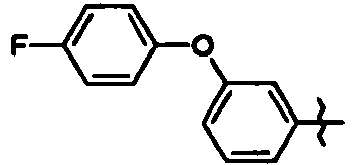
17.4 
17.17 
17.30 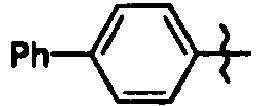
17.5 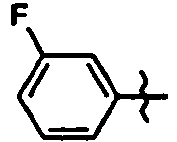
17.18 
17.32 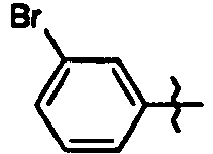
17.6 
17.19 
17.33 
17.7 
17.20 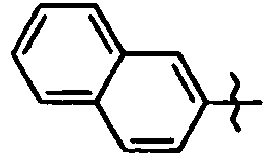
17.34 
17.8 
17.21 
17.35 
17.9 
17.22 
17.36 
17.10 
17.23 
17.37 
17.11 
17.24 
17.38 
17.12 
17.15 
17.39 
17.13 
17.26 
17.40 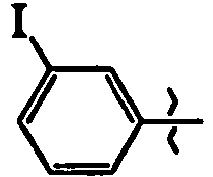
- This example illustrates the preparation of 3-{4-[5-Methyl-2-(4-trifluoromethyl-phenyl)-oxazol-4-ylmethoxy]-phenyl}-hex-4-ynoic acid.

- 4,5-dimethyl-2-(4-triDuoromethyl-phenyl)-oxazole-3-oxide (18.1). A 100 mL pear-shaped flask was charged with butane-2,3-dione monooxime (2.1 g, 20.4 mmol), 4-(trifluoromethyl)benzaldehyde (3.0 mL, 22.4 mmol), and acetic acid (20 mL). The mixture was cooled to 0° C. A solution of 4N HCl in dioxane (7.0 mL, 28.0 mmol) was added dropwise to the reaction and the resultant mixture was stirred at 0° C for 20 minutes. Diethyl ether (30 mL) was added to the reaction and the mixture was allowed to warm to room temperature overnight. The solvent was removed under reduced pressure and the resulting residue was taken up in water (300 mL). Conc. NH4OH(aq) was added to adjust the pH to 9.0. The mixture was extracted with ethyl acetate (2 x 75 mL), and the combined organic layers were washed with water (100 mL), followed by saturated brine (100 mL). The organic layer was dried (Na2SO4) and the solvent removed under reduced pressure. The resulting residue was purified via radial chromatography (3% MeOH in DCM) to yield 1.8 g (35%) of 4,5-dimethyl-2-(4-trifluoromethyl-phenyl)-oxazole-3-oxide as a white solid. LC/MSD m/e: 258.1 (M+H); 1H NMR (400 MHz) (Acetone-d6 ) δ 8.68 (d, 2H, J=8.0 Hz), 7.89 (d, 2H, J=8.0 Hz), 2.45 (s, 3H), 2.16 (s, 3H).

- 4-chloromethyl-5-methyl-2-(4-trifluoromethyl-phenyl)-oxazole (18.2). Phosphorous oxychloride (0.72 mL, 7.8 mmol) was added dropwise to an oven-dried 100 mL pear-shaped flask charged with 18.1 (1.8 g, 7.00 mmol) and dichloromethane (20 mL). The reaction was refluxed under nitrogen atmosphere for 30 minutes and then cooled to room temperature. The reaction was washed with water (2 x 250 mL) and the combined aqueous layers were back extracted with DCM (2 x 25 mL). The combined organic layers Were washed with brine and dried (Na2SO4). The solvent was removed under reduced pressure and the resulting residue was purified via radial chromatography (15% diethyl ether in hexanes) to yield 216 mg (15%) of 4-chloromethyl-5-methyl-2-(4-trifluoromethyl-phenyl)-oxazole as a white solid. LC/MSD m/e: 276.0 (M+H); 1H NMR (400 MHz) (CDCl3) δ 8.15 (2H, d, J=8.0 Hz), 7.73 (2H. d, J=8.0 Hz), 4.59 (2H, s), 2.48 (2H, s).

- 3-{4-[5-Methyl-2-(4-trifluoromethyl-phenyl)-oxazol-4-ylmethoxy]-phenyl}-hex-4-ynoic acid ethyl ester (18.3). Cesium carbonate (0.51 g, 1.57 mmol) was added to a solution of 18.2 (216 mg, 0.79 mmol) and phenol 16 (220 mg, 0.79 mmol) in DMF (8 mL). The reaction was stirred at room temperature overnight and then taken up in water (500 mL). The solution was adjusted to pH = 4.0 with 1N HCl(aq) and extracted with ethyl acetate (2 x 25 mL). The combined organics were washed with water, followed by brine. The solvent was removed under reduced pressure and the resulting residue was purified via radial chromatography (20% diethyl ether in hexanes) to yield 304 mg (82%) of 3-{4-[5-Methyl-2-(4-trifluoromethyl-phenyl)-oxazol-4-ylmethoxy]-phenyl}-hex-4-ynoic acid ethyl ester. LC/MSD m/e: 472.0 (M+H); 1H NMR (400 MHz) (CDCl3) δ 8.16 (2H, d, J=8.0 Hz), 7.73 (2H, d, J=8.0 Hz), 7.33 (2H, m), 6.99 (2H, m), 5.01 (2H, s), 4.14 (3H, m), 2.72 (2H, m), 2.48 (3H, s), 1.85 (3H, s), 1.26 (3H, t, J=8.0 Hz).

- 3-{4-[5-Methyl-2-(4-trifluoromethyl-phenyl)-oxazol-4-ylmethoxy]-phenyl}-hex-4-ynoic add (18). 2N KOH(aq) was added to a solution of 18.3 (304 mg, 0.65 mmol) in ethanol (5 mL). The reaction was stirred at room temperature overnight and then taken up in copious water. The aqueous solution was adjusted to pH = 2.0 with 1N HCl(aq) and extracted with ethyl acetate (2 x 25 mL). The combined organic layers were washed with water, followed by brine. The solvent was removed under reduced pressure and the resulting residue was purified via radial chromatography (40% ethyl acetate in Hexanes + 0.1% AcOH) to yield 150 mg (52%) of compound 18 as a glass. LC/MSD m/e: 444.0 (M+H); 1H NMR (400 MHz) (acetone) ∂ 8.21 (2H, m), 7.89 ( 2H, d, J=8.0 Hz), 7.38 (2H, m), 7.03 (2H, m), 5.06 (2H, s), 4.06 (1H, m), 2.70 (2H, m), 2.52 (3H, s), 1.81 (3H, s).
- Examples 19-22 were prepared using methods similar to those described in Example 18.

- 3-{4-[5-Methyl-2-(4-chloro-phenyl)-oxazol-4-ylmethoxy]-phenyl}-hex-4-ynoic add (19). LC/MSD m/e: 410.0 (M+H). 1H-NMR (400 MHz) (acetone-d6 ) δ 8.02 (2H, m), 7.49 (2H, m), 7.35 (2H, m), 7.01 (2H, m), 5.04 (2H, s), 4.09 (1H, m), 2.77 (2H, m), 2.48 (3H, s), 1.86 (3H, s).
-

- 3-{4-[5-Methyl-2-(4-methyl-phenyl)-oxazol-4-ylmethoxy]-phenyl}-hex-4-ynoic add (16). LC/MSD m/e: 390.2 (M+H). 1H NMR (400 MHz) (CDCl3) δ 7.96 (2H, m), 7.34 (2H, m), 6.70 (2H, m), 5.02 (2H, s), 4.09 (1H, m), 2.80 (2H, m), 2.47 (3H, s), 1.85 (3H, s).
-

- 3-{4-[5-Methyl-2-(4-methoxy-phenyl)-oxazol-4-ylmet6oxy]-phenyl}-hex-4-ynoic acid (21). LC/MSD m/e: 406.1 (M+H). 1H NMR (400 MHz) (acetone-d6 ) δ 7.89 (2H, d, J=9.0 Hz) 7.30 (2H, m), 7.09 (2H, d, J=9.0 Hz), 7.00 (2H, m), 4.97 (3H, s), 3.90 (1H, m), 3.84 (3H, s), 2.44 (3H, s), 1.79 (3H, s).
-

- 3-{4-[5-Methyl-2-(3-cyano-phenyl)-oxazol-4-ylmethoxy]-phenyl}-hex-4-ynoic add (22). LC/MSD m/e: 401.2 (M+H). 1H NMR (400 MHz) (acetone-d6 ) δ 8.33 (2H, m), 7.91 (1H, m), 7.79 (1H, m), 7.38 (2H, m), 7.08 (2H, m), 5.06 (2H, s), 4.06 (1H, m), 2.70 (2H, m), 2.51 (3H, s), 1.81 (3H, s).
- The following example illustrates the synthesis of 5-{2-[4-(2-Methyl-benzyloxy)-phenyl]-pent-3-ynyl}-1H tetrazole.

- 3-[4-(2-Methyl-benzyloxy)-phenyl]-hex-4-ynoic add amide (23.2). Carbonyl diimidazole (0.46 g, 2.84 mmol) was added to a solution of 3-[4-(2-Methyl-benzyloxy)-phenyl]-hex-4-ynoic acid (See Example 13) (0.73 g, 2.37 mmol) in anhydrous THF (10 mL). The mixture was stirred at room temperature for 2 hours. Concentrated NH4OH (10 mL) was then added to the mixture, and the reaction was stirred at room temperature overnight. The reaction mixture was poured into water (300 mL) and the solution was adjusted to pH = 7 with conc. HCl. The aqueous layer was then extracted with 3 x 25 mL ethyl acetate. The combined organic layers were washed with water, followed by brine. The organic layer was then dried (Na2SO4) and concentrated under reduced pressure to yield 0.48 g (70%) of 3-[4-(2-Methyl-benzyloxy)-phenyl]-hex-4-ynoic acid amide (23.2) as a light yellow solid. LC/MSD m/e: 308.4 (M+H)

- 3-[4-(2-Methyl-benzyloxy)-phenyl]-hex-4-ynenitrile (233). An oven-dried 50 mL round-bottomed flask was charged with DMF (8 mL) and a stir bar. The solution was cooled to 0 °C in an ice bath. Thionyl chloride (160 µL, 1.0 mmol) was added slowly via syringe. The mixture was stirred at 0 °C for an additional 45 minutes. Nitrile 23.2 (300 mg, 0.98 mmol) was then added to the mixture as a solution in DMF (2 mL). The reaction was stirred at 0° C for an hour, and was then allowed to gradually warm to room temperature overnight. The reaction mixture was partitioned between ice water and ethyl acetate. The aqueous layer was extracted 2 additional times with 25 mL ethyl acetate. Saturated NaHCO3 was then added to the aqueous layer and the aqueous layer was extracted a third time with ethyl acetate. The combined organic layers were washed with saturated NaHCO3 and concentrated under reduced pressure. The resulting residue was purified via radial chromatography (15% ethyl acetate in hexanes) to yield 203 mg (72%) of 3-[4-(2-Methyl-benzyloxy)-phenyl]-hex-4-ynenitrile (23.3). 1H NMR (400 MHz) (acetone-d6 ) δ 7.44 (3H, m), 7.24 (3H, m), 7.05 (2H, m), 5.13 (2H, s), 4.09 (1H, m), 2.89 (2H, m), 2.39 (3H, s), 1.88 (3H, s).

- 5-{2-[4-(2-Methyl-benzyloxy)-phenyl]-pent-3-ynyl}-1H-tetrazole (23). To a solution of 23.3 (200 mg, 0.51 mmol) in DMF (5 mL) was added sodium azide (35 mg, 0.54 mmol) and ammonium chloride (29 mg, 0.54 mmol). The solution was stirred at 110° C for 48 hours. The reaction mixture was poured into 50 mL of water and extracted with ethyl acetate (2 x 25 mL). The combined organic layers were concentrated under reduce pressure, and the resulting residue was purified via HPLC to yield 5 mg (3%) of 5-{2-[4-(2-Methyl-benzyloxy)-phenyl]-pent-3-ynyl}-1H-tetrazole (23) as a film. LC/MSD m/e: 333.1 (M+H). 1H NMR (400 MHz) (acetone-d6 ) δ 7.45 (1H, m), 7.34 (2H, m), 7.25 (3H, m), 7.00 (2H, m), 5.11 (2H, s), 4.17 (1H, m), 3.37 (2H, d, J=7 Hz), 2.39 (3H, s), 1.79 (3H, s).
- The following example illustrates the synthesis of 3-[4-(4-Methoxy-benzyloxy)-phenyl]-hex-4-ynoic acid thiazol-2-ylamide.

- 3-[4-(4-Metboxy-benzyloxy)-phenyl]-hex-4-ynoic add thiazol-2-ylamide (24). A pear-shaped flask was charged with a stir bar, compound 12 (50 mg, 0.154 mmol), carbonyl diimidazole (25 mg, 0.154 mmol) and THF (4 mL). The mixture was refluxed for 1 hour, and 2-amino thiazole (16 mg, 0.154 mmol) was then added. The reaction was refluxed for 48 hours, poured into water and extracted with ethyl acetate. The organic layer was concentrated and the resulting residue was purified via HPLC to yield 1.0 mg (2%) of 3-[4-(4-Methoxy-benzyloxy)-phenyl]-hex-4-ynoic acid thiazol-2-ylamide (24) as a film. 1H NMR (400 MHz) (acetone-d6 ) δ 7.39 (4H, m), 7.11 (1H, s), 6.95 (3H, m), 5.03 (2H, s), 3.82 (3H, s), 2.95 (2H, m), 1.79 (3H, s).
- The compounds in the following table were prepared using the method described in Example 24.
TABLE 9 
Compound HAR 25.1 Tetrazole-5-yl 25.2 pyrimidin-2-yl 25.3 Pyridin-2-yl - The following example illustrates the preparation of 3-[4-(5-Methyl-2-phenyl-2H-[1,2,3]triazol-4-ylmethoxy)-phenyl]-hex-4-ynoic acid (26).

- 3-[4-(5-Methyl-2-phenyl-2H-[1,2,3]triazol-4-ylmethoxy)-phenyl]-hex-4-ynoic acid ethyl ester (26.2). Cesium carbonate (107 mg, 0.33 mmol) was added to a solution of 16 (60 mg, 0.22 mmol) in DMF (5 mL). The mixture was stirred at room temperature for 5 minutes, and 4-Chloromethyl-5-methyl-2-phenyl-2H-[1,2,3]triazole (55 mg, 0.22 mmol) was added. The reaction was heated to 60° C and stirred overnight. The reaction mixture was then poured into copious water. 1N HCl(aq) was added to adjust the pH to 4.0. The aqueous layer was extracted with ethyl acetate. The organic layer was then washed with water, followed with brine. The organic layer was dried (Na2SO4) and concentrated. The resulting residue was purified via radial chromatography (20% ethyl acetate in hexanes) to yield 60 mg (66%) of 3-[4-(5-Methyl-2-phenyl-2H-[1,2,3]triazol-4-ylmethoxy)-phenyl]-hex-4-ynoic acid ethyl ester (26.2). LC/MSD m/e: 404.2 (M+H).

- 3-[4-(5-Methyl-2-phenyl-2H-[1,2,3]triazol-4-ylmethoxy)-phenyl]-hex-4-ynoic acid (26). 2N KOH(aq) (1 mL) was added to a solution of 26.2 (68 mg, 0.17 mmol) in EtOH (2 mL). The reaction was stirred at room temperature overnight and then poured into water. The aqueous mixture was acidified to pH = 2 with 1N HCl(aq), and then extracted with ethyl acetate. The organic layer was washed with water, followed by brine. The organic layer was then concentrated under reduced pressure and the resulting residue was purified via radial chromatography (20% ethyl acetate in hexanes) to yield 60.3 mg (95%) of compound 26 as a colorless oil. LC/MSD m/e: 374.0 (M-H); 1H NMR (400 MHz) (acetone-d6 ) δ 8.05 (2H, d, J=8.0 Hz), 7.56 (2H, t, J=8.0 Hz), 7.40 (3H, t, J=8.0 Hz), 7.06 (2H, d, J=8.0 Hz), 5.28 (2H, s), 4.05 (1H, m), 2.70 (2H, m), 2.44 (3H, s), 1.80 (3H, s).
- The compounds in the following table were prepared using methods similar to those described in Example 26.
TABLE 10 
Compound HAR 27.1 
27.2 
27.3 
- The following example illustrates the preparation of 3-[4-(2-Methyl-benzylsulfanyl)-phenyl]-hex-4-ynoic acid (28).

- 4-(2-Methyl-benzylsulfanyl)-benzaldehyde (28.1). 4-fluoro-benzaldehyde (1.16 g, 9.32 mmol) was added dropwise over 2 minutes to a solution of o-tolyl-methanethiol (1.35 g, 9.79 mmol) and Cesium carbonate (3.19 g, 9.79 mmol) in DMF (20 mL). The solution was stirred at 40 °C overnight and then poured into copious water. The pH of the solution was adjusted to 4 with 1N HCl(aq), and the aqueous solution was extracted with ethyl acetate (2 x 35 mL). The combined organic layers were washed with water, followed by brine. The combined organic layers were then dried (Na2SO4) and the solvent removed under reduced pressure. The resulting residue was purified via radial chromatography (15% ethyl acetate in hexanes) to yield 1.29 g (54%) of 4-(2-Methyl-benzylsulfanyl)-benzaldehyde (28.1). LC/MSD m/e: 243.0 (M+H).

- 2,2-Dimethyl-5-[4-(2-methyl-benzylsulfanyl)-benzylidene]-[1,3]dioxane-4,6-dione (28.2). Pyrrolidine (0.45 mL, 5.27 mmol) was added to a solution of aldehyde 28.1 in diethyl ether (20 mL) and the mixture was sonicated for 5 minutes. The mixture was then added to a solution of Meldrum's acid (0.73 g, 5.08 mmol) in diethyl ether (20 mL) and the resultant mixture was sonciated for 5 minutes, forming a solid. The solid was filtered, rinsed with diethyl ether, and then suspended in DCM (10 mL). p-Toluenesulfonic acid (0.97 g, 5.10 mmol) was then added to the suspension and the suspension was sonicated until clear. The solvent was removed under reduced pressure, and the resulting residue was taken up in diethyl ether and partitioned between water and ethyl acetate. The aqueous layer was extracted 2 additional times with ethyl acetate. The combined organic layers were washed with water, dried (Na2SO4), and concentrated in vacuo to yield 1.05 g (54%) of 2,2-Dimethyl-5-[4-(2-methyl-benzylsulfanyl)-benzylidene]-[1,3]dioxane-4,6-dione (28.2) as a yellow oil The resulting yellow oil was used without further purification. LC/MSD m/e: 391.1 (M+Na).

- 2,2-Dimethyl-5-{1-[4-(2-methyl-benzylsulfanyl)-phenyl]-but-2-ynyl}-[1,3]dioxane-4,6-dione (28.3). An oven-dried 100 mL pear-shaped flask, fitted with an oven-dried stir bar, was charged with a 0.5 M solution of 1-propynyl magnesium bromide in THF (12.5 mL, 6.27 mmol) via cannula. The solution was cooled to 0° C, and then a solution of 28.2 (1.05 g, 2.85 mmol) in anhydrous THF (6 mL) was added over 3 minutes via cannula. The reaction was stirred at 0° C for 5 minutes and then stirred at room temperature for 1.5 hours. The reaction mixture was poured into saturated NH4Cl(aq) and extracted with ethyl acetate. The combined organic layers were washed with water, followed by brine. The combined organic layers were dried (Na2SO4) and concentrated in vacuo. The resulting residue was purified via radial chromatography (20% ethyl acetate in hexanes) followed by recrystalization from hot ethyl acetate and hexanes to yield 162 mg (15%) of 2,2-Dimethyl-5-{1-[4-(2-methyl-benzylsulfanyl)-phenyl]-but-2-ynyl}-[1,3]dioxane-4,6-dione (28.3). LC/MSD m/e: 409.1 (M+H).

- 3-[4-(2-Methyl-benzylsulfanyl)-phenyl]-hex-4-ynoic acid (28). A solution of 28.3 (20 mg, 0.05 mmol) in 5:1 pyridine:water (6 mL) was heated to 80° C for 72 hours. The reaction was poured into 500 mL of water and the solution was acidified with 1N HCl(aq) (65 mL). The aqueous solution was extracted with ethyl acetate and the combined organic layers were washed with water, followed by brine. The combined organic layers were then dried (Na2SO4) and concentrated in vacuo. The resultant residue was then purified via radial chromatography (30% ethyl acetate in hexanes) to yield 18 mg (quantitative) 3-[4-(2-Methyl-benzylsulfanyl)-phenyl]-hex-4-ynoic acid (28). LC/MSD m/e: 323.1 (M-H).
- The following example illustrates the preparation of 3-(4-o-Tolylmethanesulfinyl-phenyl)-hex-4-ynoic acid.

- 2,2-Dimethyl-5-[1-(4-o-tolylmethanesulfinyl-phenyl)-but-2-ynyl]-[1,3]dioxane-4,6-dione (29.1). Hydrogen peroxide (20 µL, 0.05 mmol) was added to a 0° C solution of 28.3 (20 mg, 0.05 mmol) in AcOH (2 mL). The reaction was stirred at 80° C for 1.5 hours, then cooled to room temperature and stirred for 16 hours. The reaction mixture was poured into cold water and the resulting solution was acidified to pH = 2 with 6N HCl(aq). The aqueous layer was extracted with ethyl acetate and sec-butanol. The combined organic layers were concentrated to yield 10 mg (50%) of 2,2-Dimethyl-5-[1-(4-o-tolylmethanesulfinyl-phenyl)-but-2-ynyl]-[1,3]dioxane-4,6-dione (29.1). LC/MSD m/e: 383.0 (consistent with di-acid-H).

- 3-(4-o-Tolylmethanesulfinyl-phenyl)-hex-4-ynoic acid (29). 29.1 (10.0 mg, 0.025 mmol) was hydrolyzed using the methods described in Example 28 to yield 3.0 mg (25%) of 3-(4-o-Tolylmethanesulfinyl-phenyl)-hex-4-ynoic acid (29). LC/MSD m/e: 339.1 (M-H); 1H NMR (400MHz) (acetone-d6 ) δ 7.60 (2H, m), 7.49 (2H, m), 7.21 (2H, m), 7.04 (2H, m), 5.63 (2H, s), 4.17 (1H, m), 2.81 (2H, m), 2.22 (3H, s), 1.88 (3H, s).
-

- 3-(4-o-Tolylmethanesulfonyl-phenyl)-hex-4-ynoic acid (30) was prepared using methods similar to those described in Example 29.LC/MSD m/e: 357.2 (M+H); 1H NMR (400MHz) (acetone-d6 ) δ 7.69 (3H, m), 7.50 (1H, m), 7.17 (4H, m), 4.53 (2H, s), 4.22 (1H, m), 2.79 (2H, m), 2.27 (3H, s), 1.82 (3H, s).
- The following example illustrates the preparation of 3-[2-Methyl-4-(2-methyl-benzyloxy)-phenyl]-hex-4-enoic acid (31).

- 2-(2-methyl-benzyloxy)toluene (31.1). α-bromo-o-xylene (2.0 g, 10.81 mmol) was added to a solution of 2-methyl-phenol (1.06 g, 9.82 mmol) and cesium carbonate (7.99 g, 24.55 mmol) in DMF (20 mL). The reaction was stirred at 80° C overnight. The reaction mixture was acidified with 25 mL 1N HCl(aq) and poured into copious water. The aqueous layer was extracted with ethyl acetate and the organic layer was dried (Na2SO4) and concentrated in vacuo. The resulting residue was purified via radial chromatography (20% ethyl acetate in hexanes) to yield 1.82 g (88%) of 2-(2-methyl-benzyloxy)toluene (31.1). L.C/MSD m/e: 213.2 (M+H).

- 2-(2-methyl-benzyloxy)-5-bromotoluene (31.2). NBS (1.46 g, 8.23 mmol) was added to a solution of 31.1 (1.59 g, 7.48 mmol) in carbon tetrachloride (8 mL). The reaction was stirred at 60° C overnight and filtered to remove succinimide. The filtrate was concentrated in vacuo and purified via radial chromatography (15% diethyl ether in hexanes) to yield 0.65g (25%) of 2-(2-methyl-benzyloxy)-5-bromotoluene (31.2). LC/MSD m/e: 314.2 (M+Na).

- 2-Methyl-4-(2-methyl-benzyloxy)-benzaldehyde (31.3). A 2.5M solution of n-BuLi (2.1 mL, 5.26 mmol) in THF was added dropwise to a -78° C solution of 31.2 (1.46 g, 5.01 mmol) in THF (25 mL). The reaction was stirred at -78° C for 15 minutes and then DMF (3.3 mL) was added. Cooling was removed after 5 minutes and the reaction was allowed to warm to room temperature. The reaction was partitioned between ethyl acetate and water and the aqueous layer was extracted 1 additional time with ethyl acetate. The combined organic layers were dried (Na2SO4) and concentrated. The resulting residue was purified via radial chromatography (5% ethyl acetate in hexanes0 to yield 269 mg (22%) of 2-Methyl-4-(2-methyl-benzyloxy)-benzaldehyde (31.3). LC/MSD m/e: 241.2 (M+H).
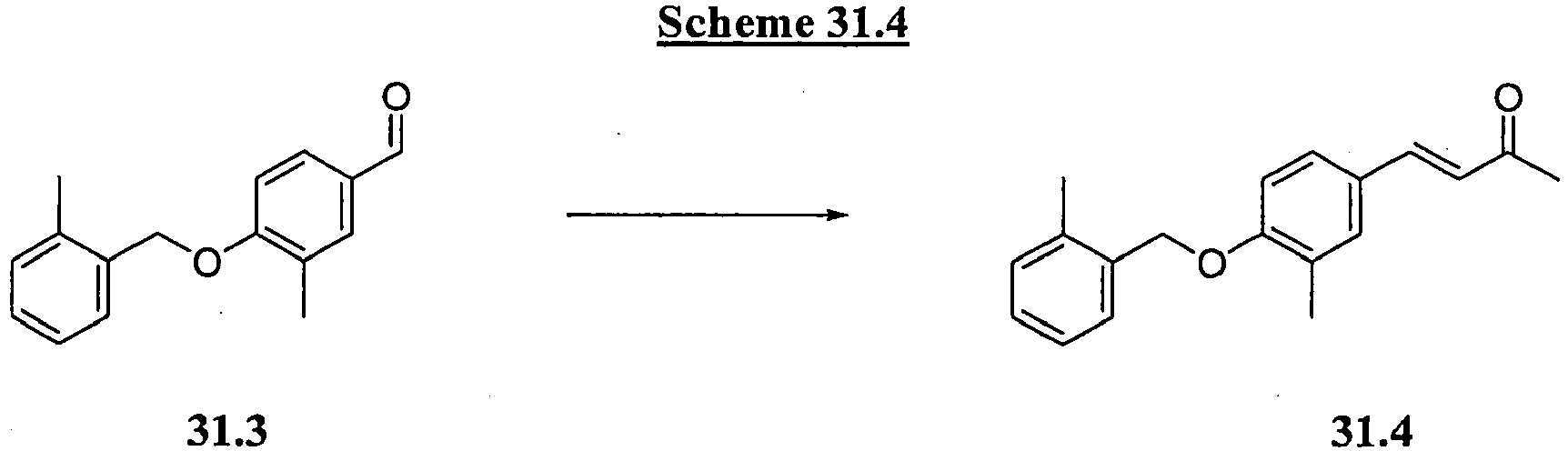
- 4-[2-Methyl-4-(2-methyl-benzyloxy)-phenyl]-but-3-en-2-one (31.4). 2N NaOH(aq) (0.6 mL) was added to a solution of 31.3 (100 mg, 0.42 mmol) in acetone (1 mL). The reaction was stirred at room temperature overnight and then taken up in water. The aqueous solution was acidified with 1N HCl(aq) (1.5 mL) and extracted with ethyl acetate. The organic extracts were washed with brine, dried (Na2SO4), and concentrated in vacuo. The resultant residue was purified via radial chromatography (20% ethyl acetate in hexanes) to yield 74 mg (63%) of 4-[2-Methyl-4-(2-methyl-benzyloxy)-phenyl]-but-3-en-2-one (31.4). LC/MSD m/e: 281.4 (M+H); 1H NMR (400 MHz) (acetone-d6 ) δ 7.83 (1H, d, J=16), 7.70 (1H, m), 7.46 (1H, m), 7.25 (3H, m), 6.96 (2H, m), 6.63 (1H, d, J=16 Hz).

- 4-[2-Methyl-4-(2-methyl-benzyloxy)-phenyl]-but-3-en-2-ol (31.5). NaBH4 (20 mg, 0.51 mmol) was added to a 0.4 M solution of CeCl3 in MeOH (0.65 mL, 0.26 mmol), 31.4 (74 mg, 0.26 mmol), and THF (1 mL). The reaction was stirred, uncaped, until gas evolution ceased. The reaction was quenched with water (1.5 mL) and partitioned between water and diethyl ether. The aqueous layer was extracted 2 times with diethyl ether and the combined organic layers were washed with brine and concentrated in vacuo to yield 69 mg (93%) of 4-[2-Methyl-4-(2-methyl-benzyloxy)-phenyl]-but-3-en-2-ol (31.5). LC/MSD m/e: 266.3 (M-OH); 1H NMR (400 MHz) (DMSO-d6 ) δ 7.44 (2H, m), 7.25 (3H, m0, 6.86 (2H, m), 6.75 (1H, m), 6.08 (1H, m), 5.11 (2H, s), 4.40, (1H, m), 2.38 (3H, s), 2.32 (3H, s), 1.29 (3H, m).

- 3-[2-Methyl-4-(2-methyl-benzyloxy)-phenyl]-hex-4-enoic acid ethyl ester (31.6). Propionic acid (cat.) was added to a solution of 31.5 (69 mg, 0.24 mmol) in 1,1,1-triethoxy-ethane (440 µL, 2.4 mmol). The reaction was stirred at 105° C overnight. The solvent was removed under reduced pressure and the resulting residue was purified via radial chromatography (5% ethyl acetate in hexanes) to yield 33 mg (39%) of 3-[2-Methyl-4-(2-methyl-benzyloxy)-phenyl]-hex-4-enoic acid ethyl ester (31.6). LC/MSD m/e: 375.0 (M+Na).
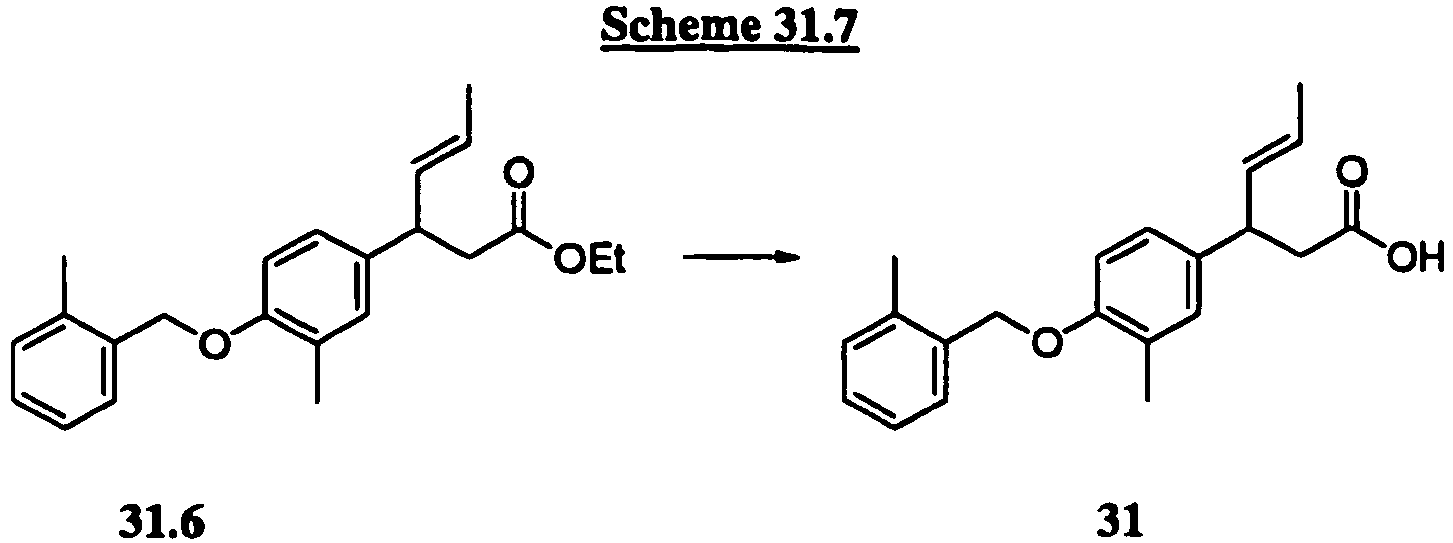
- 3-[2-Methyl-4-(2-methyl-benzyloxy)-phenyl]-hex-4-enoic acid (31). The hydrolysis of 31.6 (33 mg, 0.094 mmol) was carried out using methods similar to those described in Example 26 to yield 5.7 mg (19%) of 3-[2-Methyl-4-(2-methyl-benzyloxy)-phenyl]-hex-4-enoic acid (31). 1H NMR (400 MHz) (acetone) ∂ 7.44 (2H, m), 7.25 (3H, m), 6.86 (2H, m), 6.73 (1H, m), 6.10 (1H, m), 5.64 (2H, s), 4.42 (1H, m), 2.38 (3H, s), 2.32 (3H, s), 1.29 (3H, d, J=7.0 Hz).
- The following compounds were made using methods similar to those described in Examples 28 and 31.
TABLE 11 
Compound R1 R2 R3 R4 R5 32.1 Me H Me H 
32.2 H Ph H H 
32.3 Me Me H H 
32.4 Ph H H H 
- The following example illustrates the preparation 3-[4-(3-Methoxy-benzyloxy)-phenyl]-5-methyl-hex-4-enoic acid (33).

- 2-[4-(3-Methoxy-benzyloxy)-benzylidene]-malonic add dimethyl ester (33.1). K2CO3 was added to a solution of 4-hydroxybenzylidene-malonic acid dimethyl ester (6.95 mmol) and 4-methyoxybenzyl chloride (7.64 mmol) in DMF (15 ml). It was stirred at room temperature overnight. The reaction was poured into water, and the product was extracted with ethyl acetate twice. The organic layer was washed with water and saturated brine, dried over Na2SO4, and concentrated in vacuo. The resulting residue was purified using silica gel column chromatography (hexane/ethyl acetate = 2/1) to give compound 33.1 as a white solid (3.2 mmol).

- 2-{1-[4-(3-Methoxy-benzyloxy)-phenyl]-3-methyl-but-2-enyl}-malonic add dimethyl ester (33.2). 2-methyl-1-propenylmagnesium bromide (3 mL, 0.5 M in THF) was added dropwise to a solution of compound 33.1 (1.0 mmol) in THF. The reaction mixture was stirred at room temperature for 1hr and then quenched with saturated NH4Cl(aq) and the aqueous layer extracted with ethyl acetate twice. The combined organic layers were washed with water and saturated brine, dried over Na2SO4, and concentrated in vacuo. The resulting residue was purified using silica gel column chromatography (hexane/ethyl acetate = 2/1) to give compound 33.2 as a white solid (0.93 mmol).

- 2-{1-[4-(3-Methoxy-benzyloxy)-phenyl]-3-methyl-but-2-enyl}-malonic acid (33.3). To a solution of compound 33.2 (0.50g, 1.21 mmol) in THF (5 ml), methanol (5 ml) and water (2.5 ml) was added lithium hydroxide monohydrate (1.17g, 28 mmol). The reaction mixture was stirred at room temperature overnight. The reaction mixture was acidified with 1N HCl to pH 2-3, and then extracted with ethyl acetate twice. The organic layer was washed with water and brine, dried over Na2SO4, and concentrated in vacuo. The resulting residue was used for the next reaction without purification.

- 3-[4-(3-Methoxy-benzyloxy)-phenyl]-5-methyl-hex-4-enoic acid (33). A suspension of compound 33.3 (0.136 mmol) in toluene was refluxed for 16 h. After removing the solvent, the residue was purified using silica gel column chromatography (TFA/ Dichloromethane/ ethyl acetate = 1/5/40) to give compound 33 as a white solid (0.088 mmol). MS ESI m/e: 339 (M-H) 1H NMR (500MHz) (DMSO-d6) δ 11.97 (1H, s); 7.31 (1H, t, J=10 Hz); 7.14 (2H, d, J=11 Hz); 6.99 (2H, m); 6.87 (3H, m); 5.22 (1H, m); 5.03 (2H, s); 3.75 (1H, m); 3.75 (3H, s); 2.44-2.53 (2H, m); 1.63 (3H, s); 1.62 (3H, s).
- The following compounds were made using the method described in Example 33.
TABLE 12 
Compound X Y 34.1 4-Methoxy 1-Propenyl 34.2 4-Methoxy 3-Propenyl 34.3 4-Methoxy Vinyl 34.4 4-Methoxy 2-Propenyl 34.5 4-Methoxy 2-Methyl-1-propenyl 34.6 4-Methoxy 1-Methyl-1-propenyl 34.7 4-Methoxy Thiophen-2-yl 34.9 2-Methoxy 2-Methyl-1-propenyl 34.10 3-Methoxy 1-Propynyl 34.11 3-Ethoxy 2-Methyl-1-propenyl - Compound 34.1. MS ESI m/e: 325 (M-H). 1H NMR (500MHz) (DMSO-d6) δ 12.05 (1H, s); 7.36 (2H, d, J=10 Hz); 7.16 (2H, d, J=10 Hz); 6.94 (2H, d, J=10 HZ); 6.90 (2H, d, J=5 Hz); 5.48-5.58 (1H, m); 5.39-5.43 (1H, m); 4.98 (2H, s); 3.99-4.03 (1H, m); 3.76 (3H, s); 2.46-2.60 (2H, m); 1.64 (3H, d, J=5 HZ).
- Compound 34.2. MS ESI m/e: 325 (M-H). 1H NMR (500MHz) (DMSO-d6) δ 11.98 (1H, s); 7.38 (2H, d, J=10 Hz); 7.13 (2H, m); 6.95 (2H, m); 6.09 (2H, m); 5.63 (1H, m); 4.97 (2H, s); 4.92 (2H, d, J=10 Hz); 3.76 (3H, s); 3.03 (1H, m); 2.28-2.56 (4H, m).
- Compound 34.3. MS ESI m/e: 311 (M-H). 1H NMR (500MHz) (DMSO-d6) δ 12.06 (1H, s); 7.37 (2H, d, J=10 Hz); 7.14 (2H, d, J=10 Hz); 6.92-6.95 (4H, m); 5.92 (1H, m); 5.00 (2H, m); 4.98 (2H, s); 3.76 (3H, s); 3.35 (1H, m); 2.54-2.64 (2H, m).
- Compound 34.4. MS ESI m/e: 325 (M-H). 1H NMR (500MHz) (DMSO-d6) δ 12.03 (1H, s); 7.37 (2H, d, J=10 Hz); 7.09-7.19 (4H, m); 6.91-6.99 (4H, m); 4.97 (2H, s); 3.76 (3H, s); 3.63 (1H, m); 2.57-2.71 (2H, m); 2.09 (3H, s).
- Compound 34.5. MS ESI m/e: 339 (M-H). 1H NMR (500MHz) (DMSO-d6) δ 11.97 (1H, s); 7.36 (2H, d, J=10 Hz); 7.14 (2H, d, J=10 Hz); 6.94 (2H, d, J=10 Hz); 6.89 (2H, d, J=5 Hz); 5.24 (2H, d, J=10 Hz); 3.85-3.90 (1H, m); 3.76 (3H, s); 2.44-2.57 (2H, m); 1.68 (3H, s); 1.63 (3H, d, J=10 Hz). (2H, d, J=5 Hz); 5.24 (2H, d, J=10 Hz); 3.85-3.90 (1H, m); 3.76 (3H, s); 2.44-2.57 (2H, m); 1.68 (3H, s); 1.63 (3H, d, J=10 Hz).
- Compound 34.6. MS ESI m/e: 339 (M-H). 1H NMR (500MHz) (DMSO-d6) δ 11.97 (1H, s); 7.37 (2H, d, J=8.5 Hz); 7.10 (2H, d, m); 6.90-6.95 (4H, m); 5.23 (1H, d, J=6.5 Hz); 4.97 (2H, s); 4.29 (1H, m); 3.76 (3H, s); 2.47-2.75 (2H, m); 1.71 (3H, d, J=6 Hz); 1.56 (3H, s).
- Compound 34.7. MS ESI m/e: 367 (M-H). 1H NMR (500MHz) (DMSO-d6) δ 12.18 (1H, s); 7.37 (2H, d, J=5 Hz); 7.32 (1H, m); 7.21 (2H, d, J=10 Hz); 6.92-6.95 (6H, m); 4.98 (2H, s); 4.58 (1H, m); 3.76 (3H, s); 3.01 (1H, m); 2.94 (1H, m).
- Compound 34.9. MS ESI m/e: 339 (M-H). 1H NMR (500MHz) (DMSO-d6) 811.99 (1H, s); 7.37 (2H, m); 7.14 (2H, d, J=10 Hz); 7.04 (2H, d, J=10 Hz); 6.96 (1H, t, J=10 Hz); 6.88 (2H, d, J=10 Hz); 5.24 (2H, d, J=10 Hz); 5.00 (2H, s); 3.87 (1H, m); 3.87(3H, s); 2.45-2.55 (2H, m); 1.63 (3H, s).
- Compound 34.10. MS ESI m/e: 323 (M-H). 1H NMR (500MHz) (DMSO-d6) δ 12.10 (1H, s); 7.25-7.32 (3H, m); 7.01 (2H, d, J=9 Hz); 6.94 (2H, d, J=10 Hz); 6.88 (1H, m); 5.05 (2H, s); 3.92-3.95 (1H, m); 3.75 (3H, s); 2.58 (2H, d, J=10 Hz); 1.77 (3H, s).
- Compound 34.11. MS ESI m/e:353.0 (M-H).

- 1H NMR (400MHz) ((CD3)2SO) δ 11.95 (s, 1H), 7.49 (d, 2H, J= 8.2 Hz), 7.15 (d, 2H, J= 8.6 Hz), 7.08-7.10 (m, 2H), 6.91-6.98 (m, 3H), 5.25 (d, 1H, 9.0 Hz), 5.07 (s, 2H), 3.78-3.94 (m, 3H), 2.44-2.59 (m, 2H), 2.26 (s, 3H), 1.55-1.63 (m, 8H), 1.30-1.38 (m, 2H), 0.85 (t, 3H, J = 7.3 Hz). [M+1]+ Calculated for C31H36O4: 473.3. Found 473.5.
- The following example illustrates the preparation 3-[4-(3-Methoxy-benzyloxy)-phenyl]-5-methyl-hex-4-enoic acid.
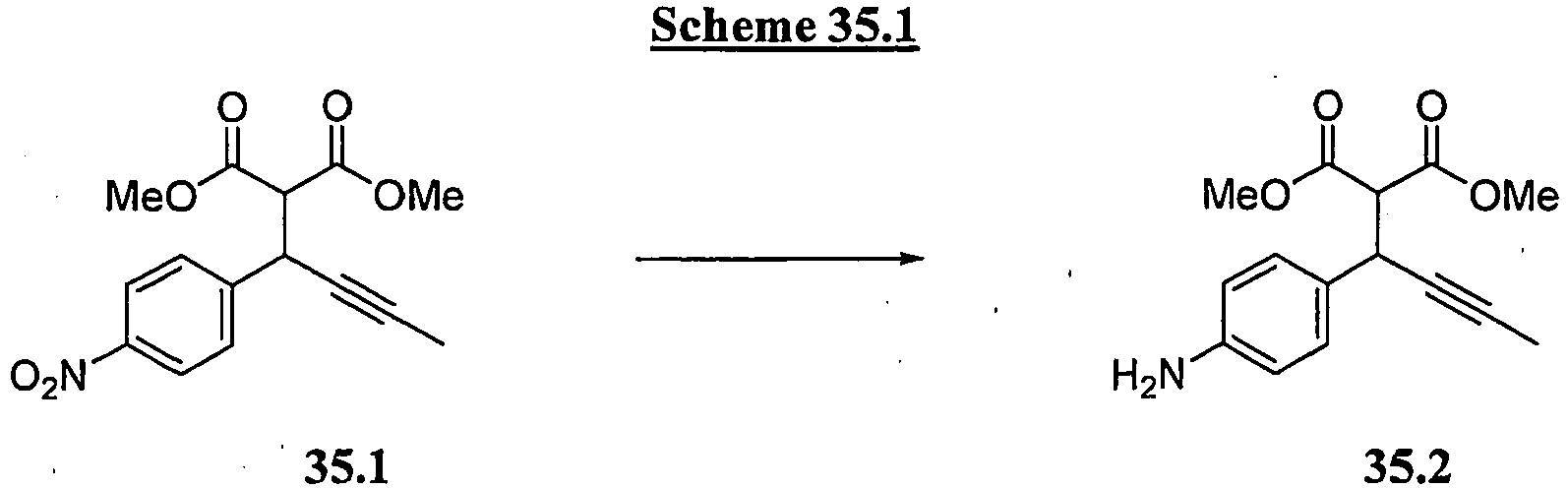
- 2-[1-(4-Amino-phenyl)-but-2-ynyl]-malonic acid dimethyl ester (35.2). Tin chloride dihydrate (46 mmol) was added to solution of compound 35.1 (15.3 mmol, prepared from commercially available dimethyl-4-nitrobenzylidinemalonate and 1-propynylmagnesium bromide according to the method in Example 33) in ethanol (200 ml). The mixture was stirred at 70 °C for 17 h. After removing solvent under reduced pressure, aqueous sodium carbonate solution was added and the aqueous layer was extracted with ethyl acetate twice. The combined organic layers were washed with water and brine, dried over Na2SO4, concentrated in vacuo. The resulting residue was filtered through short plug of silica gel, eluting with ethyl acetate. The eluant was concentrated to obtain compound 35.2 (12.8 mmol).

- 2-(1-{4-[(Biphenyl-3-ylmethyl)-amino]-phenyl}-but-2-ynyl)-malonic acid dimethyl ester (35.3). A mixture of compound 35.2 (1.0 mmol), 3-(bromomethyl)biphenyl (1.3 mmol) and K2CO3 (2.0 mmol) in DMF (10 ml) was stirred at 90 °C for 19 h. After diluting with ethyl acetate, the mixture was washed with aqueous Na2CO3 and then with brine, dried over Na2SO4, and concentrated in vacuo. The resulting residue was purified using silica gel column chromatography (hexane/ethyl acetate = 2/1) to give compound 35.3.

- 3-{4-[(Biphenyl-3-ylmethyl)-amino]-phenyl-hex-4-ynoic acid (35). Compound 35 was prepared from compound 35.3 by hydrolysis with base and decarboxylation as described in Example 33. MS ESI m/e: 368 (M-H). 1H NMR (500MHz) (DMSO-d 6) δ 7.63-7.66 (2H, m); 7.51(1H, m); 7.34-7.44 (6H, m); 7.05 (2H, d, J=10 Hz); 6.60 (2H, d, J=10 Hz); 4.33 (2H, s); 3.79-3.83 (1H, m); 2.44-2.53 (2H, m); 2.09 (1H, s); 1.74 (3H, s).
- The following compounds were prepared according to the methods described in Example 35.
TABLE 13 
Compound x Y Z 36.1 3-Methoxy H 1-Propynyl 36.2 3-Methoxy 3-Methoxy-benzyl 1-Propynyl 36.3 4-Phenyl H 1-Propynyl 36.4 4-(2-cyanophenyl) H 1-Propynyl - This example illustrates the preparation of (+/-)-3-(4-[(4-methoxyphenyl)methoxy]- phenyl)-propanoic acid.

- (+/-)-3-(4-[(4-methoxyphenyl)methoxy]phenyl)-propanoic add (37). To a stirring ethyl acetate (100mL) solution of 5-[[4-[(4-methoxyphenyl)methoxy]phenyl]-methylene]-2,2-dimethyl-[1,3]dioxane-4,6-dione (200 mg, 0.543 mmol) was added EtOH (4 mL), followed by NaBH4 (62 mg, 1.63 mmol). The reaction mixture was stirred at room temperature for 15 minutes, quenched with water (5 mL), extracted with EtOAc (10 mL). The extract was washed with brine, dried over MgSO4, filtered, and concentrated to a white solid. A solution of this white solid in 3:1 pyridine-water (5 mL) was heated at 100 °C for 24h. The reaction mixture was cooled to room temperature and put in an ice-water bath. Concentrated HCl was carefully added to pH -2. The resulting suspension was extracted with ethyl acetate (10mL x 3), dried over MgSO4, filtered, and concentrated to an off-white solid. Preparative HPLC gave compound 37 as a white solid. MS ESI (neg.) m/e: 285.0 (M -1).
- This example illustrates the preparation of (+/-)-3-(4-[(4-methoxyphenyl)methoxy]- phenyl)-3-cyano-propanoic acid.

- (+/-)-3-(4-[(4-methoxyphenyl)methoxy]phenyl)-3-cyano-propanoic acid (38). To a stirred DMF (10mL) solution of 2-[4-[(4-Methoxyphenyl)methoxy]phenyl]-acetonitrile (500 mg, 1.97 mmol) was added ethyl bromoacetate (330 µL, 2.96 mmol), followed by K2CO3 (820 mg, 5.9 mmol). The reaction mixture was stirred at room temperature for 2h, poured into ice water (100 mL), filtered, and dried to a white solid. 20 mg of this white solid in 1:1 THF/1N NaOH in MeOH (4 mL) was stirred for 5h. The reaction mixture was concentrated, diluted with water (10mL), washed with EtOAc (5mL x 2). The aqueous layer was acidified with 3N HCl to pH -2, extracted with EtOAc (10mL x 2), dried over MgSO4, filtered, and concentrated to a white solid. MS ESI (neg.) m/e: 310.0 (M -1).
- The following compounds were prepared by the methods described in Example 15 using the enantiomer with the shorter retention time from the chiral HPLC resolution.
TABLE 14 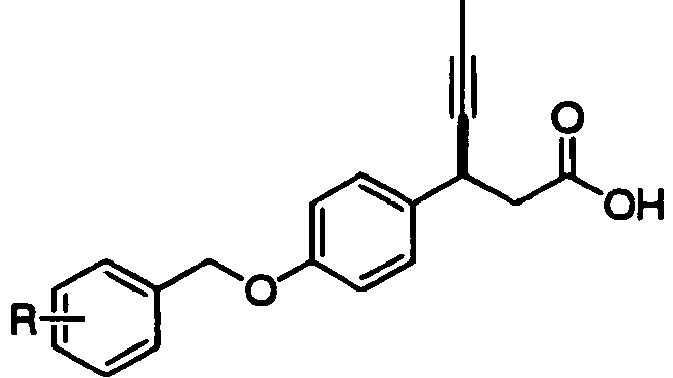
Compounds R Compounds R 15 2-CH3 39.4 4-(2-CN)Ph 39.1 3-CH3 39.5 3-CF3 39.2 3-CF3O 39.6 4-Br 39.3 3-Cl 39.7 4-CH3O - (3S)-3-[4-(3-Methyl-benzyloxy)-phenyl]-hex-4-ynoic acid (39.1). MS-ESI (neg.) m/e: 307.1 (M-H). [α]20: +21.26 (c0.188, DMF).
- (3S)-3-[4-(3-Trifluoromethoxy-benzyloxy)-phenyl]-hex-4-ynoic acid (39.2). MS-ESI (neg.) m/e: 377.0 (M-H). [α]20: +18.30 (c0.259, DMF).
- (3S)-3-[4-(3-chlorobenzyloxy)-phenyl]-hex-4-ynoic acid (39.3). MS-ESI (neg.) m/e: 327.1 (M-H). [α]20: +14.36 (c0.440, DMF).
- (3S)-3-[4-(2'-Cyano-biphenyl-4-ylmethoxy)-phenyl]-hex-4-ynoic acid (39.4). MS-ESI (neg.) m/e: 394.1 (M-H). [α]20: +16.07 (c0.331, DMF).
- (3S)-3-[4-(2-Tirfluoromethyl-benzyloxy)-phenyl]-hex-4-ynoic acid (39.5). MS-ESI (neg.) m/e: 361.1 (M-H). [α]20: +12.80 (c0.285, DMF).
- (3S)-3-[4-(4-Bromobenzyloxy)-phenyl]-hex-4-ynoic add (39.6). MS-ESI (neg.) m/e: 371.0, 373.0 (M-H). [α]20: +19.19 (c0.238, DMF).
- (3S)-3-[4-(4-Methoxy-benzyloxy)-phenyl]-hex-4-ynoic add (39.7). MS-ESI (neg.) m/e: 323.0 (M-H). [α]20: +23.30 (c0.329, DMF).
- The following compounds were prepared by the methods described in Example 15 using the enantiomer with longer retention time from the chiral HPLC resolution.
TABLE 15 
Compounds R Compounds R 40.1 2-CH3 40.4 3-CF3 40.2 3-Cl 40.5 4-CH3O 40.3 4-(2-CN)Ph - (3R)-3-[4-(2-Methyl-benzyloxy)-phenyl]-hex-4-ynoic acid (40.1). 1HNMR (400 MHz, acetone-d6) δ 7.45 (d, 1H, J=7.11 Hz); 7.37 (d, 2H, J=8.58 Hz); 7.26 (d, 1H, J=1.62 Hz); 7.22-7.27 (m, 2H); 7.00 (d, 2H, J=8.76 Hz); 5.11 (s, 2H); 4.05 (m, 1H); 3.33 (s, 1H); 2.69 (m, 2H); 2.38 (s, 3H); 1.80 (d, 3H, J=2.44). MS-ESI (neg.) m/e: 307.1 (M-H). [α]20: -19.78 (c0.286, DMF).
- (3R)-3-[4-(3-chlorobenzyloxy)-phenyl]-hex-4-ynoic add (40.2). MS-ESI (neg.) m/e: 327.0 (M-H). [α]20: -20.50 (c0.158, DMF).
- (3R)-3-[4-(2'-Cyano-biphenyl-4-ylmethoxy)-phenyl]-hex-4-ynoic acid (40.3). MS-ESI (neg.) m/e: 394.1 (M-H). [α]20: -25.04 (c0.143, DMF).
- (3R)-3-[4-(2-Tirfluoromethyl-benzyloxy)-phenyl]-hex-4-ynoic add (40.4). MS-ESI (neg.) m/e: 361.0 (M-H). [α]20: -14.69 (c0.286, DMF).
- (3R)-3-[4-(4-Methoxy-benzyloxy)-phenyl]-hex-4-ynoic add (40.5). MS-ESI (neg.) m/e: 323.0 (M-H). [α]20: -27.20 (c0.324, DMF).
- The following compounds were prepared by the methods similar to those of Example 15.

- (3S)-3-[4-(4-Methoxy-benzyloxy)-phenyl]-pent-4-ynoic add (41.1). MS-ESI (pos.) m/e: 333.1 (M+H). [α]20: +11.80 (c0.166, DMF).
- (3R)-3-[4-(4-Methoxy-benzyloxy)-phenyl]-pent-4-ynoic add (41.2). MS-ESI (pos.) m/e: 333.1 (M+H). [α]20: -10.20 (c0.206, DMF).
- Scheme 42.1 presents a general procedure for preparation of diaryl ether compounds.
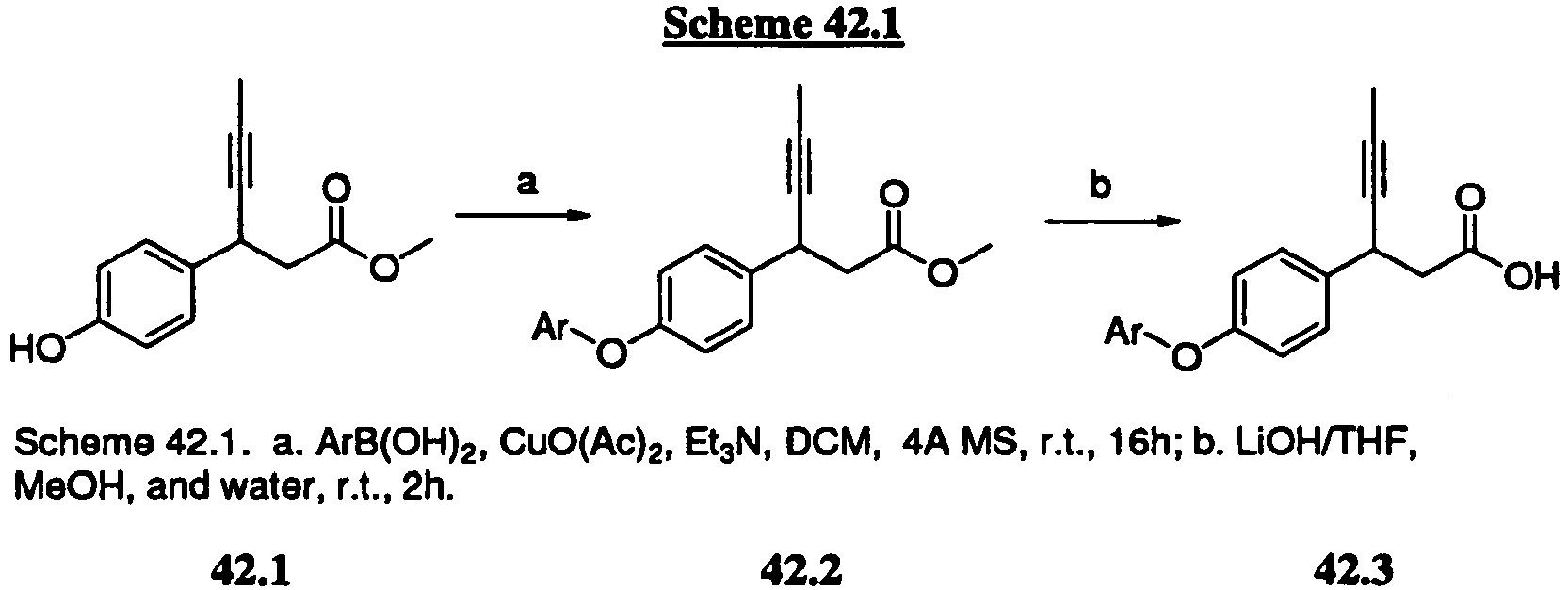
- General procedure for preparation of diaryl ether compounds: A flask is charged with phenol (1.0 equiv.), Cu(OAc)2 (1.0 equiv.), arylboronic acid (1.0-3.0 equiv.), powdered 4 Å molecular sieves. The reaction mixture was diluted with CH2Cl2 to yield a solution approximately 0.1 M in phenol, and Et3N (5.0 equiv.) is added. After stirring the heterogeneous reaction mixture for 16h at 25 °C under ambient atmosphere, the resulting slurry is filtered and the diaryl ether is isolated from the organic filtrate by flash chromatography. The resulted ester was then hydrolyzed with LiOH (2.0 equiv.) in a 1:1:1 mixture of MeOH, THF, and water for 2h at 25 °C. The reaction mixture was acidified with 1N HCl, extracted with CH2Cl2 and concentrated to give the pure acid.

- 3-[4-(Biphenyl-4-yloxy)-phenyl]-hex-4-ynoic acid (42.4). MS ESI m/e: 357.0 (M + H). 1H NMR (500 MHz) (CDCl3) δ 7.60-7.57 (4H, m); 7.46 (2H, dd, J=8.0, 8.0 Hz); 7.39 (2H, d, J=8.5 Hz); 7.36 (1H, d, J=7.3 Hz); 7.09 (2H, d, J=8.6 Hz); 7.04 (2H, d, J=8.6 Hz); 4.2-4.1 (1H, m); 2.87 (1H, dd, J=15.8, 8.6 Hz); 2.77 (1H, dd, J=15.8, 6.7 Hz); 1.88 (3H, d, J=2.3 Hz).

- 3-[4-(4-Phenoxy-phenoxy)-phenyl]-hex-4-ynoic acid (42.5). MS ESI m/e: 373.0 (M + H). 1H NMR (500 MHz) (CDCl3) δ 7.37-7.32 (5H, m); 7.12 (2H, dd, J=8.0, 8.0 Hz); 7.03 (2H, d, J=7.5 Hz); 7.02 (2H, s); 6.97 (2H, d, J=8.6 Hz); 4.1 (1H, m); 2.85 (1H, dd, J=15.8, 8.6 Hz); 2.75 (1H, dd, J=15.8, 6.7 Hz); 1.87 (3H, d, J=2.3 Hz).

- 3-[4-(4-Benzyloxy-phenoxy)-phenyl]-hex-4-ynoic add (42.6). MS ESI m/e: 387.0 (M + H). 1H NMR (500 MHz) (CDCl3) δ 7.47 (2H, d, J=7.2 Hz); 7.42 (2H, dd, J=7.5, 7.5 Hz); 7.37 (1H, d, J=7.3 Hz); 7.33 (2H, d, J=8.7 Hz); 6.98 (4H, br. s); 6.93 (2H, d, J=9.7 Hz); 5.07 (2H, s); 4.10 (1H, m); 2.84 (1H, dd, J=15.7, 8.5 Hz); 2.75 (1H, dd, J=15.7, 6.7 Hz); 1.86 (3H, d, J=2.3 Hz).

- (S)-3-tert-Butoxycarbonylamino-3-{4-[3-(4-fluoro-phenoxy)-benzyloxy]-phenyl}-propionic add (42.11). 3-Boc-amino-3(4-hydroxyphenyl)-propanoic acid (42.7) (703 mg, 2.5 mmol) in 25mL of MeOH/Benzene (4:1) was slowly added 2.5 mL of 2M solution of trimethylsilyldiazomethane in hexane at 25 °C. The reaction mixture was stirred for 1h and concentrated in vacuo to give the methyl ester. MS ESI m/e: 296.0 (M + H). To a solution of the methyl ester 42.8 (2.5 mmol) and 4-fluorophenoxybenzyl bromide 42.9 (700 mg, 2.5 mmol) in DMF (10 mL), was added K2CO3 (414 mg, 3 mmol) and the resulting mixture was stirred overnight (14~16h) at 25 °C. The solution was diluted with water (20mL0 and extracted with EtOAc twice (20 mL). The organic extraction was concentrated and the product was purified by flash chromatography. MS ESI m/e: 518.0 (M + Na). The methyl ester 42.10 (39mg, 0.08 mmol) was hydrolyzed with LiOH (10 mg, 0.25 mmol) in a 1.5 mL of 1:1:1 mixture of MeOH, THF, and water for 2h at 25 °C. The reaction mixture was acidified with 1N HCl, extracted with CH2Cl2 and concentrated to give the pure acid (42.11). MS ESI m/e: 504.0 (M+Na). 1H NMR (400MHz) (CDCl3) δ 8.5 (1H, br. s); 7.34 (1H, dd, J=8.0, 8.0 Hz); 7.24 (2H, d, J=8.8 Hz); 7.16 (1H, d, J=7.7 Hz); 7.07-6.98 (5H, m); 6.93 (2H, d, J=11.7 Hz); 6.92 (1H, d); 5.3 (1H, br. s); 5.03 (2H, s); 3.0-2.8 (2H, m); 2.1-1.9 (1H, m); 1.44 (9H, s).

- 3-Dimethylamino-3-{4-[3-(4-fluoro-phenoxy)-benzyloxy]-phenyl}-propionic add (42.14). (S)-3-tert-Butoxycarbonylamino-3-{4-[3-(4-fluoro-phenoxy)-benzyloxy]-phenyl}-propionic acid methyl ester (42.10) (1.0 g, 2 mmol) was treated with 10 mL of 10% TFA solution in CH2Cl2 at 25 °C for 1h. The solvent was concentrated in vacuo to give the free amine (42.12). MS ESI m/e: 418.0 (M + Na). The amine (60 mg, 0.15 mmol) was treated with excess formaldehyde (2 equiv.), NaBH(OAc)3 (85 mg, 0.4 mmol) and catalytic amount of AcOH in DMF overnight (14~16h) at 25 °C. The product was purified by reverse phase HPLC. MS ESI m/e: 424.1 (M + H). The methyl ester was hydrolyzed with LiOH (19mg, 0.45 mmol) in a 3 mL of 1:1:1 mixture of MeOH, THF, and water for 2h at 25 °C. The reaction mixture was acidified with 1N HCl, extracted with CH2Cl2 and concentrated to give the pure acid (42.14) (23 mg). MS ESI m/e: 410.2 (M + H). 1H NMR (500MHz) (CDCl3) δ 9.46 (1H, br. s); 7.72 (1H, d, J=16.0 Hz); 7.51 (2H, d, J=8.7 Hz); 7.36 (1H, dd, J=8.0, 8.0 Hz); 7.17 (2H, d, J=7.0 Hz); 7.08-6.98 (5H, m); 6.94 (1H, d, J=8.2 Hz); 6.34 (1H, d, J=16.0 Hz); 5.10 (2H, s); 3.4-2.9 (2H, m); 2.73 (6H, s); 2.1-1.9 (1H, m).
-

- 3-[2-(4'-Trifluoromethyl-biphenyl-3-yl)-benzooxazol-5-yl]-hex-4-ynoic acid (43.3). 3-(4-Hydroxy-phenyl)-hex-4-ynoic acid methyl ester (1.32 g, 6 mmol) was treated with HNO3 (0.30 mL, 7.2 mmol) in AcOH (10 mL) at 80 °C for 3h. The solvent was concentrated in vacuo and 3-(3-nitro-4-hydroxy-phenyl)-hex-4-ynoic acid methyl ester (613 mg, 2.3 mmol) was isolated from flash chromatography. MS ESI m/e: 264.0 (M + H). The nitro group was then reduced with SnCl2 (2.62 g, 11.6 mmol) in EtOH (10 mL0 and EtOAc (10 mL) at 70 °C for 3h. The reaction mixture was cooled to 25 °C, washed with saturated aqueous Na2CO3, water, brine, dried over MgSO4, filtered and concentrated in vacuo. The crude product was then purified by reverse phase HPLC to give 3-(3-amino-4-hydroxy-phenyl)-hex-4-ynoic acid methyl ester (174 mg, 0.74 mmol). MS ESI m/e: 234.0 (M + H). 3-(3-amino-4-hydroxy-phenyl)-hex-4-ynoic acid methyl ester (174 mg, 0.74 mmol) and 3-bromobenzaldehyde (278 mg, 1.5 mmol) in DMF (3 mL) was treated with DDQ (204 mg, 0.9 mmol) for 2h at 25 °C. The producted was purified by reverse phase HPLC. MS ESI m/e: 398.0 (M + H). 3-[2-(3-Bromo-phenyl)-benzooxazol-5-yl]-hex-4-ynoic acid methyl ester (19.6 mg, 0.05 mmol) and trifluorophenylboronic acid (38 mg, 0.2 mmol) in DME (1 mL) and 0.2 mL of 2M solution of aqueous Na2CO3 was treated with Pd(PPh3)4 at 80 °C for 14h. The product was isolated from flash chromatography. MS ESI m/e: 464.0 (M + H). The methyl ester (7.8 mg, 0.017 mmol) was hydrolyzed with LiOH (4mg, 0.1 mmol) in a 1 mL of 1:1:1 mixture of MeOH, THF, and water for 2h at 25 °C. The reaction mixture was acidified with 1N HCl, extracted with CH2Cl2 and concentrated to give the pure acid (7.6 mg). MS ESI m/e: 450.1 (M + H). 1H NMR (500 MHz) (CDCl3) δ 8.52 (1H, s); 8.30 (1H, d, J=7.8 Hz); 7.91 (1H, s); 7.83 (2H, d, J=8.2 Hz); 7.82 (1H, s); 7.78 (2H, dd, J=8.0,8.0 Hz); 7.67 (1H, dd, J=7.8, 7.8 Hz); 7.58 (2H, d, J=8.4 Hz); 7.46 (1H, dd, J=8.4,1.5 Hz); 4.29 (1H, m); 2.94 (1H, dd, J=15.8, 8.1 Hz); 2.84 (1H, dd, J=15.8, 6.9 Hz); 1.89 (3H, d, J=2.3 Hz).
-

- General procedure for the preparation of aryl benzyl ethers: 3-(4-Hydroxy-phenyl)-hex-4-ynoic acid in EtOH (0.4M) was added 1N NaOH solution (3 equiv.) in water at 25 °C and stirred fro 5 minutes at 70 °C. ArCH2X (X = Br, Cl, 1 equiv.) in EtOH (0.2M) was slowly added, stirred for 3h at 70 °C. The reaction mixture was acidified with 1N HCl and purified from reverse phase HPLC.

- 3-[4-(4-Ethoxy-2-trifluoromethyl-quinolin-6-ylmethoxy)-phenyl]-hex-4-ynoic acid (44.3). MS ESI m/e: 458.0 (M + H). 1H NMR (400 MHz) (DMSO-d 6) δ 12.6 (1H, br. s); 8.31 (1H, s); 8.12 (1H, d, J=8.7 Hz); 7.95 (1H, dd, J=8.7, 1.3 Hz); 7.41 (1H, s); 7.31 (2H, d, J=8.5 Hz); 7.03 (2H, d, J=8.5 Hz); 5.36 (2H, s); 4.47 (2H, q, J=8.0 Hz); 3.96 (1H, m); 2.62 (2H, d, J=7.6 Hz); 1.79 (3H, d, J=1.9 Hz); 1.21 (3H, t, J=8.0 Hz).

- 3-(4-{3-[4-(3-Trifluoromethyl-pyridin-2-yl)-piperazine-1-carbonyl]-benzyloxy}-phenyl)-hex-4-ynoic add. MS ESI m/e: 552.0 (M + H). 1H NMR (400 MHz) (DMSO-d 6) δ 12.5 (1H, br. s); 8.57 (1H, d, J=3.5 Hz); 8.12 (1H, dd, J=7.9, 1.6 Hz); 7.56-7.48 (3H, m); 7.41 (1H, d, J=7.5 Hz); 7.30-7.25 (3H, m); 6.98 (2H, d, J=8.7 Hz); 5.16 (2H, s); 3.95 (1H, m); 3.2 (4H, m); 2.60 (2H, d, J=7.6 Hz); 2.52 (4H, m); 1.77 (3H, d, J=2.4 Hz).
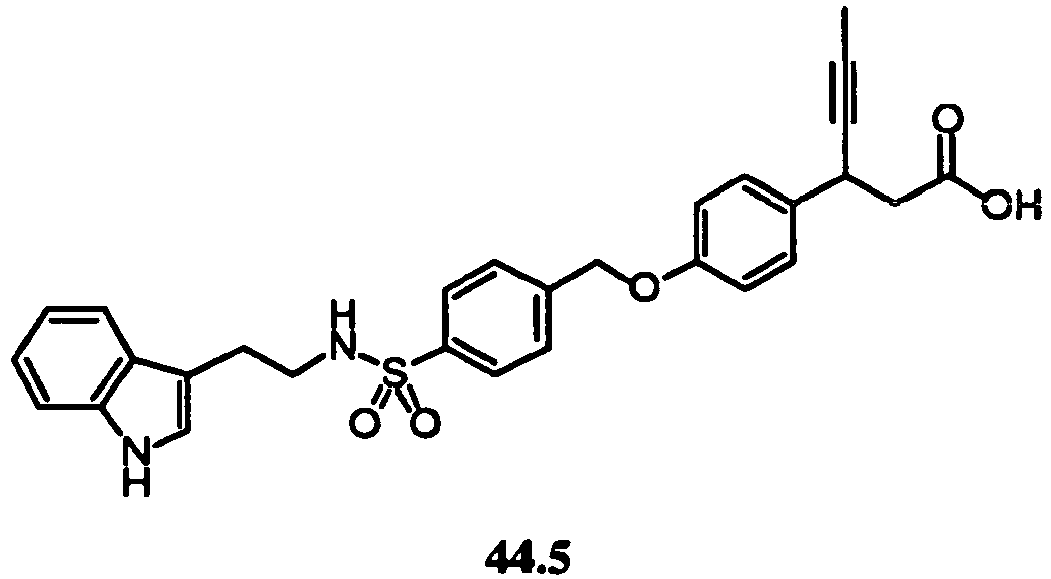
- 3-(4-{4-[2-(1H-Indol-3-yl)-ethylsulfamoyl]-benzylozy}-phenyl)-hex-4-ynoic add. MS ESI m/e: 517.2 (M + H). 1H NMR (400 MHz) (DMSO-d 6) δ 12.5 (1H, br. s); 10.82 (1H, s); 7.83 (2H, d, J=8.3 Hz); 7.77 (1H, dd, J=7.8, 7.8 Hz); 7.39 (1H, d, J=8.0 Hz); 7.32 (1H, d, J=8.0 Hz); 7.29 (2H, d, J=8.7 Hz); 7.13 (1H, d, J=2.2 Hz); 7.06 (1H, dd, J=7.0, 8.0 Hz); 6.97 (2H, d, J=8.7 Hz); 5.19 (2H, s); 3.95 (1H, m); 3.02 (2H, t, J=7.6 Hz); 2.81 (2H, t, J=7.6 Hz); 2.61 (2H, d, J=8.0 Hz); 1.78 (3H, d, J=2.4 Hz).
- This example illustrates the preparation of (+/-)-3-[4-(2'-butoxy-5'-methyl-biphenyl-4-ylmethoxy)-phenyl]-3-(4-fluorophenyl)-propionic acid (45).

- Ethyl 3-(4-fluorophenyl)-3-(4-hydroxyphenyl)-acrylate (45.1). A solution of lithium hexamethyldisilazide (23.1 mL, 1M in THF) was added to a stirred solution of ethyl (trimethylsilyl)acetate (2.53 mL, 13.9 mmol) in THF (15 mL) in 10 min. at -78°C. The reaction mixture was further stirred at this temperature for 20 min. A solution of (4-fluorophenyl)-(4-hydroxyphenyl)-methanone (2 g, 9.2 mmol) in THF (30 mL) was slowly added to the reaction mixture. The reaction mixture was brought to 0 °C in 5 h. The reaction mixture was quenched with saturated ammonium chloride solution, extracted into ethyl acetate and washed with dilute ammonium chloride solution. The organic layer was dried over magnesium sulfate. The solvent was removed under vacuum and product was purified flash chromatography on silica gel, giving 45.1 as an oil (1.405 g).
- 3-(4-Fluorophenyl)-3-(4-hydroxyphenyl)-propionic acid ethyl ester (45.2). A solution of 45.1 (385 mg) in ethanol (12 mL) and ethyl acetate (10 mL) was stirred with 10% Pd-C (50 mg) under a hydrogen atmosphere at room temperature for 3 h. The reaction mixture was filtered and concentrated to provide 45.2 (350 mg).
- 3-[4-(2'-Butoxy-5'-methyl-biphenyl-4-ylmethoxy)-phenyl]-3-(4-fluorophenyl)-propionic acid ethyl ester (45.3). A mixture of 45.2 (48 mg, 0.166 mmol), 4'-Bromomethyl-2-butoxy-5-methyl-biphenyl (67 mg, 0.2 mmol) and cesium carbonate (81 mg, 0.25 mmol) in DMF (2 mL) was stirred at room temperature overnight. The reaction mixture was diluted with water, acidified with dilute HCl, extracted into ethyl acetate, washed with water and dried over magnesium sulfate. The residue obtained after concentration was flash chromatographed on silica gel to obtain 45.3 (71 mg).
- (+/-)-3-[4-(2'-Butoxy-5'-methyl-biphenyl-4-ylmethoxy)-phenyl]-3-(4-fluorophenyl)-propionic acid (45). A mixture of 45.3 (56 mg, 0.1 mmol) and 2N NaOH(aq) solution (0.31 mL, 0.62 mmol) in THF (3 mL) was stirred at room temperature overnight. The reaction mixture was concentrated, treated with dilute HCl, and extracted into ethyl acetate. The organic layer washed with water and concentrated to yield product which was purified by flash chromatography to give compound 45 (40 mg). 1H NMR (500 MHz, CDCl3, ppm), δ 0.9 (t, 3H), 1.4 (m, 2H), 1.65 (m, 2H), 2.35 (s, 3H), 3.05 (m, 2H), 3.9 (t, 2H), 4.5 (t, 1H), 5.05 (s, 2H), 6.8-7.5 (m, 15H). MS ESI (neg.) m/e: 511.0 (M-H).
- The following compounds were prepared according to methods analogous to those described in Example 45: 3-(4-fluorophenyl)-3-[4-(4'-trifluoromethyl-biphenyl-3-ylmethoxy)-phenyl]-propionic acid (46.1), 3-(4-fluorophenyl)-3-[4-(4-methyl-2-p-tolyl-thiazol-5-ylmethoxy)-phenyl]-propionic acid (46.2) and 3-(4-fluorophenyl)-3-{4-[2-(3-trifluoromethyl-phenoxy)-ethoxy]-phenyl}-propionic acid (46.3).
- Starting from (4-hydroxyphenyl)-phenyl-methanone, the following compounds were prepared according to methods analogous to those described in Example 45: 3-[4-(2-methyl-benzyloxy)-phenyl]-3-phenyl-propionic acid (46.4), 3-[4-(2'-butoxy-5'-methyl-biphenyl-4-ylmethoxy)-phenyl]-3-phenyl-propionic acid (46.5), 3-[4-(4-methyl-2-p-tolyl-thiazol-5-ylmethoxy)-phenyl]-3-phenyl-propionic acid (46.6), 3-phenyl-3-{4-[2-(3-trifluoromethyl-phenoxy)-ethoxy]-phenyl}-propionic acid (46.7), 3-[4-(2'-cyano-biphenyl-4-ylmethoxy)-phenyl]-3-phenyl-propionic acid (46.8) and 3-phenyl-3-[4-(4'-trifluoromethyl-biphenyl-3-ylmethoxy)-phenyl]-propionic acid (46.9).
- Starting from (4-hydroxyphenyl)-pyridin-4-yl-methanone, the following compounds were prepared according to methods analogous to those described in Example 45: 3-[4-(2'-butoxy-5'-methyl-biphenyl-4-ylmethoxy)-phenyl]-3-pyridin-4-yl-propionic acid (46.10) and 3-pyridin-4-yl-3-[4-(4'-trifluoromethyl-biphenyl-3-ylmethoxy)-phenyl]-propionic acid (46.11).
- This example illustrates the preparation of (+/-)-3-(4-[3-(4-chloro-2-methylphenyl) benzyloxy]phenyl)-3-(4-fluorophenyl)-propanoic acid (47).


- Ethyl 3-(4-(3-iodobenzyloxy)phenyl)-3-(4-fluorophenyl)propanoate (47.1). Cs2CO3 (4.89g 15mmol) and 1-(bromomethyl)-3-iodobenzene (4.45g, 15mmol) were added successively to a dry DMF (20 mL) solution of 45.2 (2.88g, 10mmol). The reaction mixture was stirred at room temperature overnight, diluted with ethyl acetate (200mL), washed with water (100 mL x 2) and brine (100 mL), and dried over Na2SO4. The solvent was removed under vacuum and the residue was purified by flash chromatography to give compound 47.1 as a colorless oil. MS ESI (pos.) m/e: 505.0 (M+H).
- 3-(4-[3-(4-Chloro-2-methylphenyl)benzyloxy]phenyl)-3-(4-fluorophenyl)-propanoate (47.2). CsF (96 mg, 0.6mmol), 4-chloro-2-methylphenylboronic acid (102 mg, 0.6 mmol) and Pd(PPh3)4 (70 mg, 0.06mmol) were added successively to a dry 1,2-dimethoxyethane (DME, 2 mL) solution of 47.1 (108 mg, 0.2 mmol) with stirring under a nitrogen atmosphere. The reaction mixture was stirred at 80 °C overnight. The solvent was removed under nitrogen flow and the residue was dissolved in CH2Cl2 (2 mL) and purified by flash chromatography. Compound 47.2 was obtained as a colorless oil. MS ESI (pos.) m/e 503.0 (M+1).
- (+/-)-3-{4-[3-(4-Chloro-2-methylphenyl)phenyl]-methoxyl)phenyl}-3-(4-fluorophenyl)-propanoic acid (47). LiOH (48 mg, 2 mmol) was added to the THF-H2O (1/1, 4mL) solution of compound 47.2 (104 mg, 0.2 mmol). The reaction mixture was stirred at room temperature overnight. 1N HCl(aq) was added to acidify the mixture to pH 3 at 0 °C. The mixture was extracted with ethyl acetate (20 mL x 2), washed with water and brine, dried over Na2SO4, and purified by flash chromatography to obtain compound 47 (82 mg) as colorless oil. 1H NMR (400 MHz)(CDCl3) δ 2.22 (s, 3H), 3.05 (dd, J = 7.8, 1.1 Hz, 2H), 4.49 (t, J = 8.0 Hz, 1H), 5.09 (s, 2H), 6.92-7.43 (m, 12H). MS ESI (neg.) m/e 473.0 (M-H).
- The following compounds were prepared according to the methods described in Example 47.
Table 16 
Compound X 48.1 4-iodo 48.2 3-iodo 48.3 4-(3-benzyloxyphenyl) 48.4 4-(3-butoxyphenyl) 48.5 4-(5-ethoxy-2-fluorophenyl) 48.6 4-(2-ethoxy-6-fluorophenyl) 48.7 4-(2-butoxy-5-fluorophenyl) 48.8 4-(3-isopropoxyphenyl) 48.9 4-(2-fluoro-5-propoxyphenyl) 48.10 4-(4-chloro-2-methylphenyl) 48.11 4-(4-methoxy-2-methylphenyl) 48.12 4-(4-methoxy-2,6-dimethylphenyl) 48.13 4-(2,4,6-trimethylphenyl) 48.14 4-(4-chloro-2-ethoxyphenyl) 48.15 4-(4-fluoro-2-ethoxyphenyl) 48.16 4-(2-isopropoxyphenyl) 48.17 3-(2,5-dimethylphenyl) 48.18 3-(3-benzyloxyphenyl) 48.19 3-(5-ethoxy-2-fluorophenyl) 48.20 3-(4-chloro-2-methylphenyl) 48.21 3-(2-ethoxy-5-methylphenyl) 48.22 3-(4-chloro-2-ethoxyphenyl) 48.23 3-(2-butoxy-5-methylphenyl) 48.24 3-(2-butoxy-5-fluorophenyl) 48.25 3-(4-ethoxyphenyl) 48.26 3-(5-fluoro-2-methoxyphenyl) 48.27 3-(3-isopropoxyphenyl) - This example illustrates the preparation of (+/-)-3-(4-(3-(4-(trifluoromethyl)phenyl) benzyloxy)phenyl)-4-(diethylamino)-3-methyl-4-oxobutanoic acid.

- N-Allyl-2-(4-hydroxyphenyl)propanamide (49.1). N,N'-Carbonyldiimidazole (22.65g, 140mmol) was added to commercially available 2-(4-hydroxyphenyl)propionic acid (21 g, 127mmol) in THF (100mL). Gentle warming and gas evolution was observed. The resulting mixture was stirred for 3 h. Allylamine (10.9 g, 190.5 mmol) and Et3N (19.2 mL, 190.5 mmol) were added dropwise, and the mixture was stirred overnight. The reaction was quenched with water (200mL) and the organic phase was extracted with ethyl acetate (50 mL×3). The combined organic extracts were dried over MgSO4 and concentrated in vacuo. The product was purified by flash chromatography (elution with ethyl acetate). Phenol 49.1 was obtained as a white solid. MS ESI m/e: 206 (M-H).

- 2-(4-(3-(4-(Trifluoromethyl)phenyl)benzyloxy)phenyl)-N-allylpropanamide (49.3). Cs2CO3 (23.1g, 71 mmol) was added to a mixture of compound 49.2 (20.33g, 64.5mmol) and phenol 49.1 (13.23g 64.5mmol) in DMF (50mL). The resulting mixture was stirred overnight. The reaction was quenched with water (500mL). The organic phase was extracted with ethyl acetate (75mL×3). The combined organic phases were dried over MgSO4 and the solvent was removed under reduced pressure. The resulting residue was purified via flash chromatography (10% Acetone in dichloromethane) to yield 15.9 g of 49.3. MS ESI m/e: 440 (M-H).

- 2-(4-(3-(4-(Trifluoromethyl)phenyl)benzyloxy)phenyl)-2-methylpent-4-enenitrile (49.4). The 3-aza-claisen reaction was carried out according to the method of Walters et al. (1991) Tetrahedron Lett. 2: 179-182. Amide 49.3 (15.9g, 36.2mmol) and PPh3 (21g, 80mmol) were dissolved in anhydrous dichloromethane (160 mL). Et3N (12g, 119.5mmol) and CCl4 (18.4g, 119.5mmol) were added dropwise. The resulting mixture was stirred at room temperature overnight. The reaction was quenched with saturated brine (250 mL). The organic phase was extracted with ethyl acetate (50mL×3). The combined organic phases were dried over MgSO4 and concentrated under reduced pressure. The resulting residue was purified via flash chromatography (25% ethyl acetate in hexanes) to yield 12.3 g of 49.4. 1H NMR (400MHz) (CDCl3) δ 7.73 (4H, s); 7.70 (1H, s); 7.61-7.51 (3H, m); 7.41 (2H, d, J=8.9Hz); 7.05 (2H, d, J=8.9Hz); 5.76-5.72 (1H, m); 5.21-5.17 (4H, m); 2.71-2.59 (2H, m); 1.72 (3H, s).

- 2-(4-(3-(4-(Trifluoromethyl)phenyl)benzyloxy)phenyl)-2-methylpent-4-enoic acid (49.5). 49.4 was added to a mixture of ethylene glycol (8 mL), H2O (0.25 mL) and KOH (750 mg). The resulting mixture was heated to 190°C for 6 h. The reaction mixture was cooled to room temperature. The aqueous phase was extracted with ethyl acetate (10 mL×3). The extracts were combined, dried over MgSO4 and concentrated under reduced pressure. The resulting residue was purified via flash chromatography (10% acetone in dichloromethane) to yield 632 mg of 49.5. MS ESI m/e: 441 (M-H).

- 2-(4-(3-(4-(Trifluoromethyl)phenyl)benzyloxy)phenyl)-N,N-diethyl-2-methylpent-4-enamide (49.6). Oxalyl chloride (57.7mg, 0.45mmol) was added dropwise to 49.5 (100 mg, 0.23 mmol) in anhydrous dichloromethane (4 mL). The resulting mixture was refluxed in a sealed tube at 50 °C overnight. The dichloromethane was removed under a stream of N2. Anhydrous ether (2 mL) was added dropwise, followed by diethyl amine (50 mg, 0.69 mmol) and Et3N (70 mg, 0.69 mmol). The mixture was refluxed overnight. The reaction mixture was concentrated under reduced pressure, and the resulting residue was purified via flash chromatography (25% ethyl acetate in hexanes). 82 mg of 49.6 was obtained. MS ESI m/e: 496 (M-H). 1H NMR (500MHz) (CDCl3) δ 7.72 (4H, s); 7.69 (1H, s); 7.6-7.5 (3H, m); 7.14 (2H, d, J=8.5Hz); 7.05 (2H, d, J=8.5Hz); 5.7-5.6 (1H, m); 5.15 (2H, s); 5.03-5 (2H, m); 3.5-3.2 (2H, m); 3.0-2.9 (2H, m); 2.74-2.64 (2H, m); 1.62 (3H, s); 1.13 (3H, s); 0.72 (3H, s).

- (+/-)-3-(4-(3-(4-(Trifluoromethyl)phenyl)benzyloxy) phenyl)-4-(diethylamino)-3-methyl-4-oxobutanoic acid (49). The oxidation reaction was carried out according to the method of Henry et al. (1993) J. Org. Chem. 58: 4745. A catalytic amount of OsO4 was added to a solution of 49.6 (50 mg, 0.1 mmol) in acetone (4 mL), followed by an excess of Jones reagent (0.25 mL). The reaction mixture was stirred at room temperature overnight. The reaction was quenched with water (2 mL), and the aqueous phase was extracted with dichloromethane (2 mL×3). The combined organic extracts were dried over MgSO4 and removed under reduced pressure. The resulting residue was purified on reversed phase HPLC. MS ESI m/e: 514 (M-H).
- This example illustrates the preparation of 3-{4-[4'-(1,1-difluoro-ethyl)-biphenyl-3-ylmethoxy]-phenyl}-N,N-dimethyl-succinamic acid.

- [4-(4'-Trifluoromethyl-biphenyl-3-ylmethoxy)-phenyl]-acetic add methyl ester (50.1). Compound 49.2 (15.8 g, 50.1 mmol) was added to methyl 4-hydroxyphenylacetate (8.3 g 50 mmol) in DMF (30 mL), followed by Cs2CO3 (17.9 g, 55 mmol). The resulting mixture was stirred overnight. The reaction was quenched with water (300 mL). The organic phase was extracted with ethyl acetate (50 mL × 3). The combined organic phase was rinsed with saturated brine, dried over MgSO4, and concentrated under reduced pressure. The product (16.3 g) was used in the next step without further purification. MS ESI (pos.) m/e: 423 (M+Na).

- 2-{4-[4'-Trifluoromethyl-biphenyl-3-ylmethoxyl-phenyl}-succinic acid 4-tert-butyl ester 1-methyl ester (50.2). Compound 50.1 (4 g, 10mmol) in THF (12 mL) was added dropwise to LDA in THF (1M, 12 mL) at -78°C. The resulting mixture was stirred for 30 min. before tert-butyl bromoacetate (2.15 g, 11 mmol) in THF (2 mL) was added over 10 min. The reaction mixture was stirred for 2 h at -78 °C and allowed to warm slowly to 0 °C. The reaction was quenched with saturated aqueous NH4Cl (20 mL). The organic phase was extracted with ethyl acetate (25 mL×3). The organic extracts were combined, dried over MgSO4 and concentrated under reduced pressure. The resulting residue was purified via flash chromatography (50% ethyl acetate in hexanes) to yield 3.3 g of 50.2. MS ESI (pos.) m/e: 537 (M+Na). 1H NMR (400MHz) (CDCl3) δ 7.72 (4H, s); 7.68 (1H, s); 7.58-7.49(3H, m); 7.25-7.24 (2H, m); 6.98-6.97 (2H, m); 5.14 (2H, s); 4.04-4.0 (1H, m); 3.7 (3H, s); 3.1 (1H, m); 2.63 (1H, m); 1.42 (9H, s).

- 2-{4-[4'-Trifluoromethyl-biphenyl-3-ylmethoxy]-phenyl}-succinic acid 4-tert-butyl ester (50.3). Lithium hydroxide (121mg, 5mmol) was added to a solution of 50.2 in MeOH/THF/H2O (1:1:1, 90mL). The resulting mixture was stirred at room temperature overnight. The organic solvent was removed under reduced pressure. The reaction mixture was extracted with dichloromethane (10 mL×3). The organic extracts were combined, dried over MgSO4 and concentrated under reduced pressure. The resulting residue was purified via flash chromatography (50% ethyl acetate in hexanes) to yield acid 50.3 (860 mg). MS ESI (pos.) m/e: 523 (M+Na). 1H NMR (400MHz)) (CDCl3) δ 7.72 (4H, s); 7.67 (1H, s); 7.59-7.47 (3H, m); 7.29-7.25 (2H, m); 6.98-6.97 (2H, m); 5.14 (2H, s); 4.04-4.0 (1H, m); 3.1-3.053 (1H, m); 2.64-2.60 (1H, m); 1.4 (9H, s).

- 3-{4-[4'-Trifluoromethyl-biphenyl-3-ylmethoxy]-phenyl}-N,N-dimethyl-succinamic acid tert-butyl ester (50.4). A solution of compound 50.3 (50mg, 0.1 mmol) in dichloromethane (2mL) was treated with 1-hydroxybenzotriazole (15 mg, 0.11 mmol) and EDC (21 mg, 0.11 mmol) sequentially. The resulting mixture was stirred for 1 h. before dimethylamine (9 mg, 0.2mmol) was added dropwise. The reaction was quenched 30 min. later with water (5 mL). The reaction mixture was extracted with dichloromethane (2 mL×3). The organic extracts were combined, dried over MgSO4 and concentrated under reduced pressure to yield amide 50.4 (48 mg). The product was used in the next step without further purification. MS ESI (pos.) m/e: 527 (M+).

- (+/-)-3-{4-[4'-Trifluoromethyl-biphenyl-3-ylmethoxy]-phenyl}-N,N-dimethyl-succinamic acid (50). Ester 50.4 (48mg, 0.09mmol) was dissolved in dichloromethane/TFA solution (3:1, 2 mL). The resulting mixture was stirred at room temperature for 2 h. The solvent removed under reduced pressure, and the product was purified on reserve phase HPLC to yield acid 50 (30mg). MS ESI (pos.) m/e: 472 (M+H). 1H NMR (400MHz) (CDCl3) δ 7.72 (4H, s); 7.67 (1H, s); 7.59-7.28 (3H, m); 7.2 (2H, d, J=8.6Hz); 7.0 (2H, d, J=8.6Hz,); 5.13 (2H, s); 4.24-4.21 (1H, m); 3.20-3.13 (1H, m); 3.0 (3H, s); 2.95 (3H, s); 2.76-2.71 (1H, m).
- This example illustrates the preparation of 3-(4-methyl-thiazol-2-yl)-3-[4-(4'-trifluoromethyl-biphenyl-3-ylmethoxy)-phenyl]-propionic acid.

- 3-[4-(4'-Trifluoromethyl-biphenyl-3-ylmethoxy)-phenyl]-succinamic acid tert-butyl ester (51.1). 1-hydroxybenzotriazole (225 mg, 1.65 mmol) and EDC (315 mg, 1.65 mmol) were added sequentially to compound 50.3 (750 mg, 1.5 mmol) in dichloromethane (25 mL). The resulting mixture was stirred for 1 h before ammonium hydroxide (25% in water, 630 mg, 4.5 mmol) was added dropwise. The reaction was quenched after 30 min. with water (10 mL). The reaction mixture was extracted with dichloromethane (10 mL×3). The organic extracts were combined, dried over MgSO4 and concentrated under reduced pressure. The product was purified via flash chromatography (50% ethyl acetate in hexanes) to yield 51.1 (720 mg) as a white solid. MS ESI (pos.) m/e: 500 (M+H). 1H NMR (400MHz) (CDCl3) δ 7.72 (4H, s); 7.68 (1H, s); 7.57-7.48 (3H, m); 7.29-7.25 (2H, m); 7.0-6.97 (2H, d, J=6,8Hz); 5.14 (2H, s); 3.91-3.88 (1H, m); 3.19-3.13 (1H, m); 2.60-2.55 (1H, m); 1.4 (9H, s).

- 3-Thiocarbamoyl-3-[4-(4'-trifluoromethyl-biphenyl-3-ylmethoxy)-phenyl]-propionic acid tert-butyl ester (51.2). Lawesson's reagent (81 mg, 0.2 mmol) was added to a solution of compound 51.1 (50 mg, 0.1 mmol) in THF (2mL). The resulting mixture was stirred at room temperature for 6 h. The reaction was quenched with water (5 mL). The reaction mixture was extracted with dichloromethane (3 mL×3). The organic extracts were combined, dried over MgSO4 and concentrated under reduced pressure. The product was purified via flash chromatography (50% ethyl acetate in hexanes) to yield compound 51.2 (40 mg) as a clear film. MS ESI (pos.) m/e: 516 (M+H). 1H NMR (400MHz) (CDCl3) δ 7.72 (4H, s); 7.67 (1H, s); 7.51-7.48 (3H, m); 7.31-7.28 (2H, m); 7.0-6.97 (2H, m); 5.14 (2H, s); 4.25-4.22 (1H, m); 3.51-3.46 (1H, m); 2.78-2.72 (1H, m); 1.38 (9H, s).

- Ethyl 3-(4-Methyl-thiazol-2-yl)-3-[4-(4'-trifluoromethyl-biphenyl-3-ylmethoxy)-phenyl]-propanoate (51.3). A solution of 51.2 (100 mg, 0.19 mmol) in EtOH (3 mL) was treated with chloroacetone (88mg, 0.95mmol). The resulting mixture was refluxed for 5 h. Aqueous HCl (6N, 25 µL) was added into above reaction mixture and the reaction was heated at 50 °C overnight. The solvent was removed under reduced pressure. The product was purified via flash chromatography (50% ethyl acetate in hexanes) to yield 51.3 (50mg). MS ESI (pos.) m/e: 526 (M+H).

- (+/-)-3-(4-Methyl-thiazol-2-yl)-3-[4-(4'-trifluoromethyl-biphenyl-3-ylmethoxy)-phenyl]-propionic add (51). Compound 51.3 (50 mg, 0.1 mmol) was dissolved in MeOH/THF/H2O (1:1:1, 3 mL). The resulting mixture was stirred at room temperature for 2 h. The reaction mixture was acidified to PH=4 and extracted with dichloromethane (3 mL×3). The product was purified on reverse phase HPLC to yield compound 51 (40 mg). MS ESI (pos.) m/e: 498 (M+H). 1H NMR (400MHz) (DMSO) 8 7.92 (2H, d, J=8.1Hz); 7.84 (3H, d, J=8.8Hz); 7.71 (1H, t, J=5.1Hz); 7.54 (2H, d, J=7Hz); 7.29 (2H, d, J=8.7Hz); 7.09 (1H, s); 7.01 (2 H, d, J=8.7Hz); 5.18 (2H, s); 4.66 (1H, m); 3.2 (1H, m); 2.93 (1H, m); 2.33 (3H, s).
- This example illustrates the preparation of (+/-)-3-(4-((4-methyl-2-p-tolylthiazol-5-yl)methoxy)phenyl)-3-(thiophen-2-yl)propanoic acid.

- 2,2-Dimethyl-5-[4-(tetrahydro-pyran-2-yloxy)-benzylidene]-[1,3]dioxane-4,6-dione (52.1). Protection of the phenol with dihydropyran was carried out based on the method given in Miyashita et al. (1977) J. Org. Chem. 42: 3772. Compound 1.1(500 g, 2mol) was dissolved in dichloromethane (4 L). 3,4-Dihydro-2H-pyran (250 g, 3 mol) was added to the suspension followed by PPTS (5 g, 20 mmol). The reaction mixture heated to a gentle reflux (3.5 h). HPLC showed ~90% completion of the reaction. The reaction was concentrated under reduced pressure to ~2L of volume. 1 L of acetone was added, and 2 L of solvent was removed under reduced pressure. 1 L of acetone was added, and 1 L of solvent was removed under reduced pressure. 0.5 L of acetone was added, and 0.5 L of solvent was removed under reduced pressure. The resulting slurry of very fine, light yellow crystals was filtered and rinsed sequentially with two 500 mL portions of acetone. The product was dried in a vacuum oven at 50 °C until no further solvent collected in the traps. Compound 52.1 (528 g) was obtained as fine, light yellow crystals. 1H NMR(400MHz)(DMSO-d6 ) δ 8.29 (s, 1H); 8.18 (d, 2H, J=8.9 Hz); 7.13 (d, 2H, J=8.9 Hz);. 5.67 (m, 1H); 3.70 (m, 1H); 3.60 (in, 1H).1.9-1.5 (m, 12H). MS ESI (pos.) m/e: 355.1 (M + Na).

- (+/-)-Methyl 3-(4-hydroxyphenyl)-3-(thiophen-2-yl)propanoate (52.2). A 500 mL flask was equipped with a magnetic stir bar, nitrogen inlet, nitrogen outlet and placed in a room temperature water bath. Compound 52.1 (5.00 g, 15.1 mmol) was added to the flask along with anhydrous THF (150 mL). After purging with nitrogen for 30 min, a solution of thiophene-2-yl-magnesium bromide in THF (1 M, 18.1 mL) was added by cannula. After the addition was complete, the reaction mixture was stirred for 1.5 h and quenched with aqueous NH4Cl (1 M, 100 mL) diluted with ethyl acetate (100 mL). The aqueous layer was acidified to pH ~2 with Conc. HCl and extracted with ethyl acetate (150 mL x 2). The extract was washed with brine and concentrated. The residue was dissolved in 100 mL of 10:1 DMF-water heated,to 100°C for 8 h. The reaction was cooled and the diluted with 500 mL water and extracted with ethyl acetate (150 mL x 3). The organic was dried with MgSO4, filtered, and concentrated on a rotary evaporator. The residue was dissolved in MeOH (200 mL) and 5 drops of conc. H2SO4 were added and the solution was refluxed for 24 h. The solution was concentrated to a residue on a rotary evaporator and purified using flash column chromatography with 30% ethyl acetate/hexanes as the eluant. The fractions were combined and concentrated to afford 2.69 g (10.3 mmol) of 52.2 as a viscous oil.

- (+/-)-3-(4-((4-Methyl-2-p-tolylthiazol-5-yl)methoxy)phenyl)-3-(thiophen-2-yl)propanoic acid (52). Thiazole chloride 3.1 (108 mg, 0.457 mmol) and phenol 52.2 (100 mg, 0.381 mmol) were dissolved in DMF (1 mL) and treated with Cs2CO3 (371 mg, 1.14 mmol). The reaction was stirred at 50°C for 16 h diluted with water (15 mL) and methylene chloride (15 mL). The organic layer was washed with water, dried with MgSO4, filtered, and concentrated. The residue was purified by column chromatography (silica gel, 33% to 66% ethyl acetate in hexanes). Eluant containing desired compound was concentrated dissolved in a THF/MeOlV2N LiOH(aq) (1:1:1) solution (2 mL). The mixture was stirred at room temperature for 90 min., and the solution was poured into 0.65 N HCl (aq.) (2 mL). The aqueous phase was extracted with dichloromethane (3 x 10 mL) and the combined organic phases were dried over Na2SO4. After filtration and drying, 156 mg (0.323 mmol) of carboxylic acid 52 was obtained. 1H NMR (400MHz) (CDCl3) δ 7.77 (d, 2H, J = 8.1 Hz), 7.23-7.30 (m, 5H), 6.89-6.97 (m, 4H), 5.24 (s, 2H), 4.58 (t, 1H, J = 7.8 Hz), 3.02 (m, 1H), 2.92 (m, 1H), 2.40 (s, 3H), 2.33 (s, 3H).
- This example illustrates the preparation of (+/-)-3-[4-(4'-trifluoromethyl-biphenyl-3-ylmethoxy)-phenyl]-3-(thiazol-2-yl)-propionic acid.

- (+/-)-Methyl 3-(4-hydroxyphenyl)-3-(thiazol-2-yl)propanoate (53.1). A 500 mL flask was equipped with a magnetic stir bar, nitrogen inlet, nitrogen outlet and placed in a room temperature water bath. Compound 52.1 (5.00 g, 15.1 mmol) was added to the flask along with anhydrous THF (150 mL). After purging with nitrogen for 30 min, a solution of thiozole-2-yl-magnesium bromide in THF (1 M, 18.1 mL) was added by cannula. After the addition was complete, the reaction mixture was stirred for 1.5 h, quenched with aqueous NH4Cl (1 M, 100 mL) diluted with ethyl acetate (100 mL). The aqueous layer was acidified to pH ~2 with conc. HCl and extracted with ethyl acetate (150 mL x 2). The extract was washed with brine and concentrated. The residue was dissolved in 100 mL of 10:1 DMF-water and heated to 100 °C for 8 h. The reaction was cooled and the diluted with 500 mL water and extracted with ethyl acetate (150 mL x 3). The organic was dried with MgSO4, filtered, and concentrated on a rotary evaporator. The residue was dissolved in MeOH (200 mL) and 5 drops of Conc. H2SO4 were added and the solution was refluxed for 24 h. The solution was concentrated to a residue on a rotary evaporator and purified using flash column chromatography with 50% ethyl acetate/hexanes as the eluant. The fractions were combined and concentrated to afford 1.90 g (7.25 mmol) of 53.1 as a viscous oil.

- (+/-)-3-[4-(4'-Trifluoromethyl-biphenyl-3-ylmethoxy)-phenyl]-3-(thiazol-2-yl)-propionic acid (53). Benzyl chloride 2.3 (123 mg, 0.456 mmol) and phenol 53.1 (100 mg, 0.380 mmol) were dissolved in acetone (1 mL) and treated with Cs2CO3 (371 mg, 1.14 mmol). The reaction was stirred at 50 °C for 16 h, filtered and concentrated. The residue was purified by column chromatography (silica gel, 30% to 70% ethyl acetate in hexanes). Eluant containing desired compound was concentrated and dissolved in a THF/MeOH/2N LiOH(aq) (1:1:1) solution (2 mL). The mixture was stirred at room temperature for 90 min., and the solution was poured into 0.65 N HCl (aq.) (2 mL). The aqueous phase was extracted with dichloromethane (3 x 10 mL) and the combined organic phases were dried over Na2SO4. After filtration and drying, 150 mg (0.311 mmol) of carboxylic acid 53 was obtained. 1H NMR (400MHz) (CDCl3) δ 7.47-7.77 (m, 9H), 7.24-7.27 (m, 3H), 6.99-7.00 (m, 2H), 5.14 (s, 2H), 4. 78 (dd, 1H, J = 6.8, 4.4 Hz), 3.47 (dd, 1H, J = 12.8, 6.8 Hz), 3.09 (dd, 1H, J = 12.8, 4.4 Hz).
- This example illustrates the preparation of (+/-)-3-[4-(4'-Trifluoromethyl-biphenyl-3-ylmethoxy)-phenyl]-3-(3-methylthiophen-2-yl)-propionic acid.

- (+/-)-Methyl 3-(4-hydroxyphenyl)-3-(3-methylthiophen-2-yl)propanoate (54.1). A 500 mL flask was equipped with a magnetic stir bar, nitrogen inlet, nitrogen outlet and placed in a room temperature water bath. Compound 52.1 (5.00 g, 15.1 mmol) was added to the flask along with anhydrous THF (150 mL). After purging with nitrogen for 30 min, a solution of 3-methylthiophen-2-yl-magnesium bromide in THF (1 M, 18.1 mL) was added by cannula. After the addition was complete, the reaction mixture was stirred for 1.5 h, quenched with aqueous NH4Cl (1 M, 100 mL) and diluted with ethyl acetate (100 mL). The aqueous layer was acidified to pH ~2 with Conc. HCl and extracted with ethyl acetate (150 mL x 2). The extract was washed with brine and concentrated. The residue was dissolved in 100 mL of 10:1 DMF-water and heated to 100 °C for 8 h. The reaction mixture was cooled, diluted with 500mL water, and extracted with ethyl acetate (150 mL x 3). The combined organic layers were dried with MgSO4, filtered, and concentrated on a rotary evaporator. The residue was dissolved in MeOH (200 mL) and 5 drops of Conc. H2SO4 were added and the solution was refluxed for 24 h. The solution was concentrated to a residue on a rotary evaporator and purified using flash column chromatography with 30% ethyl acetate/hexanes as the eluant. The fractions were combined and concentrated to afford 2.33 g (7.25 mmol) of 54.1 as a viscous oil.

- (+/-)-3-[4-(4'-Trifluoromethyl-biphenyl-3-ylmethoxy)-phenyl]-3-(3-methylthiophen-2-yl)-propionic add (54). Benzyl chloride 2.3 (113 mg, 0.434 mmol) and phenol 54.1 (100 mg, 0.362 mmol) were dissolved in acetone (1 mL) and treated with Cs2CO3 (371 mg, 1.14 mmol). The reaction was stirred at 50 °C for 16 h, filtered and concentrated. The residue was purified by column chromatography (silica gel, 30% to 60% ethyl acetate in hexanes). Eluant containing desired compound was concentrated and dissolved in a THF/MeOH/2N LiOH(aq) (1:1:1) solution (2 mL). The mixture was stirred at room temperature for 90 min., the solution was poured into 0.65 N HCl (aq.) (2 mL). The aqueous phase was extracted with dichloromethane (3 x 10 mL) and the combined organic phases were dried over Na2SO4. After filtration and drying, 154 mg (0.311 mmol) of carboxylic acid 54 was obtained. 1H NMR (400MHz) (CDCl3) δ 7.43-7.70 (m, 8H), 7.21 (d, 2H, J = 8.6 Hz), 7.05 (d, 1H, J = 5.0 Hz), 6.92 (d, 2H, J = 8.6 Hz), 6.76 (d, 1H, 5.0 Hz), 5.09 (s, 2H), 4.74 (t, 1H, J = 7.8 Hz), 3.05 (d, 2H, J = 7.8 Hz), 2.15 (s, 3H).
- This example illustrates the preparation of methyl 3-(4-hydroxyphenyl)-3-(1H-pyrrol-1-yl)propanoate.

- 3-(4-Hydroxyphenyl)-3-(1H-pyrrol-1-yl)propanoic acid (55.1). At 100 °C, 2,5-dimethoxytetrahydrofuran (8.5 mmol) was added to a mixture of 3-amino-3-(4-hydroxyphenyl) propanoic acid (7.7 mmol) and sodium acetate (46 mmol) in acetic acid (34 mL). After stirring for 1 h, acetic acid was removed under reduced pressure. The residue was extracted with ethyl acetate (300 mL). The organic layer was washed with brine and dried over anhydrous Na2SO4 and concentrated. The residue was purified via column chromatography (10% methanol in dichloromethane) to compound 55.1. LC-MS (neg.) m/e: 230.2 (M-H).

- (+/-)-Methyl 3-(4-hydroxyphenyl)-3-(1H-pyrrol-1-yl)propanoate (55). Trimethysilyldiazomethane (8 mL, 2M in diethyl ether, 16 mmol) was added to a solution of compound 55.1 (7 mmol) in methanol (25 mL). After 10 min., the solvent was removed to yield methyl compound 55. MS ESI (pos.) m/e: 246.1 (M+H).
- The following compounds were prepared from compound 55 according to the methods described in Example 18.
Table 17 
Compound R Compound R 56.1 
56.6 
56.2 
56.7 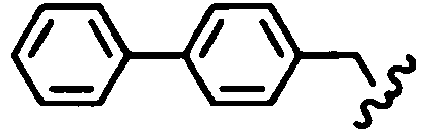
56.3 
56.8 
56.4 
56.9 
56.5 
- Compound 56.1. MS ESI (neg.) m/e: 431 (M-H). 1H NMR (500MHz) (DMSO-d6) δ 12.3 (1H, s); 7.81 (2H, d, J=8 Hz); 7.30 (4H, m); 6.99 (2H, d, J=9Hz); 6.92 (2H, m); 5.98 (2H, m); 5.56 (1H, t, J=8Hz), 5.29 (2H, s); 3.18 (2H, m); 2.44 (3H, s); 2.38 (3H, s).
- Compound 56.2. MS ESI (neg.) m/e: 464 (M-H). 1H NMR (500MHz) (DMSO-d6) δ 7.92 (2H, m); 7.84 (3H, m); 7.72 (1H, d, J=8Hz); 7.53 (2H, m); 7.26 (2H, d, J=9Hz); 7.00 (2H, d, J=9Hz), 6.91 (2H, m); 5.55 (1H, d, J=8Hz); 5.19 (2H, s); 3.16 (2H, m).
- Compound 56.3. MS ESI (neg.) m/e: 396 (M-H). 1H NMR (500MHz) (DMSO-d6) δ 12.37 (1H, s); 7.65-7.77 (4H, m); 7.41-7.51 (5H, m); 67.27 (2H, m); 7.01 (2H, d, J=5Hz)); 6.92 (2H, m); 5.99(2H, m), 5.56 (1H, m); 5.18 (2H, s), 3.21 (2H, m).
- Compound 56.4. MS ESI (neg.) m/e: 350 (M-H). 1H NMR (500MHz) (DMSO-d6) δ 12.4 (1H, s); 7.30-7.34 (1H, t, J=8Hz); 7.26 (2H, d, J=9Hz); 7.01 (2H, m); 6.96 (2H, d, J=9Hz)); 6.90-6.92 (3H, m); 5.98 (2H, m), 5.55 (1H, t, J=8Hz); 5.07(2H, s); 3.78 (3H, s); 3.21(2H, m).
- Compound 56.5. MS ESI (neg.) m/e: 364 (M-H). 1H NMR (500MHz) (DMSO-d6) δ 7.24-7.31 (3H, m); 6.99 (2H, m); 6.88 (3H, m); 5.97 (2H, s); 5.55 (1H, m); 5.06(2H, s), 4.04 (2H, q, J=7Hz); 3.16 (2H, m); 1.34 (3H, t, J=7Hz).
- Compound 56.6. MS ESI (neg.) m/e: 412 (M-H). 1H NMR (500MHz) (DMSO-d6) δ 7.40-7.43 (3H, m); 7.16-7.26 (4H, m); 7.08 (1H, s); 7.03 (2H, d, J=8Hz)); 6.90-6.97 (5H, m); 5.98(2H, s), 5.54 (1H, t, J=8Hz); 5.09 (2H, s); 3.17 (2H, m)
- Compound 56.7. MS ESI (neg.) m/e: 396 (M-H). 1H NMR (500MHz) (DMSO-d6) δ 7.70-7.71 (4H, m); 7.41-7.55 (4H, m); 7.39 (1H, m); 7.25 (2H, d, J=8Hz)); 6.98 (2H, d, J=9Hz); 6.89 (2H, s), 5.97 (2H, s); 5.55 (1H, t, J=8Hz); 5.12 (2H, s); 3.10 (2H, m).
- Compound 56.8. MS ESI (neg.) m/e: 421 (M-H). 1H NMR (500MHz) (DMSO-d6) δ 8.19 (1H, s); 8.05 (1H, d, J=8Hz); 7.87 (1H, d, J=8Hz); 7.80 (2H, d, J=8Hz); 7.71 (1H, t, J=8Hz); 7.56 (2H, d, J=8Hz); 7.26 (2H, d, J=8Hz); 6.98 (2H, d, J=8Hz); 6.90 (2H, d, J=8Hz); 5.98 (2H, m); 5.55 (2H, t, J=8Hz)); 5.17 (2H, s); 3.13 (2H, m).
- Compound 56.9. MS ESI (neg.) m/e: 421 (M-H). 1H NMR (500MHz)) (DMSO-d6) δ 7.99 (1H, d, J=8Hz); 7.84 (1H, t, J=8Hz); 7.68 (1H, d, J=8Hz); 7.58-7.64 (5H, m); 7.17 (2H, d, J=8Hz); 6.96 (2H, d, J=8Hz); 6.81 (2H, m); 5.95 (2H, m); 5.55 (1H, t, J=7Hz); 5.18 (2H, s); 2.73 (2H, d, J=7Hz).
- The following compounds were prepared according to the methods described in Examples 55 and 56.
Table 18 
Compound R Compound R 57.1 
57.4 
57.2 
57.5 
57.3 
57.6 
- Compound 57.1. MS ESI (neg.) m/e: 431 (M-H). 1H NMR (500MHz) (DMSO-d6) δ 7.81 (2H, m); 7.28-7.32 (4H, m); 7.00 (2H, d, J=8Hz); 6.92 (2H, s); 5.99 (2H, s); 5.57 (1H, m); 5.30 (2H, s); 3.23 (2H, m); 2.44(3H, s); 2.38 (3H, s).
- Compound 57.2. MS ESI (neg.) m/e: 464 (M-H). 1H NMR (500MHz) (DMSO-d6) δ 7.93 (2H, d, J=8Hz); 7.83-7.86 (3H, m); 7.72 (1H, d, J=8Hz); 7.56 (2H, m); 7.27 (2H, d, J=9Hz); 7.01 (2H, d, J=9Hz); 6.91 (2H, m); 5.98 (2H, s); 5.55 (1H, d, J=8Hz); 3.14 (2H, m).
- Compound 57.3. MS ESI (neg.) m/e: 396 (M-H). 1H NMR (500MHz) (CDCl3) δ 7.63-7.76 (4H, m); 7.39-7.59 (5H, m); 7.15 (2H, d, J=8Hz); 6.77 (2H, s); 6.19 (2H, s); 5.64 (1H, s); 5.13 (2H, s); 3.22-3.26 (2H, m).
- Compound 57.4. MS ESI (neg.) m/e: 350 (M-H). 1H NMR (500MHz)) (DMSO-d6) δ 7.33 (1H, t, J=8Hz); 7.25 (2H, d, J=8Hz); 7.01 (2H, m); 6.95 (2H, d, J=9Hz); 6.90 (3H, m); 5.98 (2H, s); 5.55 (1H, t, J=8Hz); 5.07 (2H, s); 3.78 (3H, s); 3.16 (2H, m).
- Compound 57.5. MS ESI (neg.) m/e: 412 (M-H). 1H NMR (500MHz) (DMSO-d6) δ 7.40-7.43 (3H, m); 7.24-7.26 (3H, m); 7.20 (1H, m); 7.10 (1H, s); 7.03 (2H, d, J=9Hz); 6.90-6.93 (5H, m); 5.98 (2H, m); 5.55 (1H, m); 5.10 (2H, s); 3.18 (2H, m).
- Compound 57.6. MS ESI (neg.) m/e: 421 (M-H). 1H NMR (500MHz) (DMSO-d6) δ 7.99 (1H, d, J=8Hz); 7.81(1H, m); 7.68 (1H, d, J=8Hz); 7.61-7.65 (5H, m); 6.92 (2H, m); 5.99 (2H, s); 5.56 (1H, t, J=8Hz); 5.20(2H, s); 3.19 (2H, m).
- This example illustrates the preparation of (+/-)-3-(-4-(Benzyloxy)phenyl)-3-(1H-pyrazol-1-yl)propanoic acid (58.3).

- 1-(4-(Benzyloxy)benzyl)-1H-pyrazole (58.1). After a mixture of pyrazole (7.73 mmol) and potassium hydroxide (7.73 mmol) in DMF (35 mL) was stirred at room temperature for 30 min., a solution of 1-(benzyloxy)-4-(chloromethyl)benzene (6.44 mmol) in DMF (7 mL) was added dropwise. The reaction mixture was stirred at room temperature overnight and the product obtained from a standard aqueous work up. Column chromatography (1:2 ethyl acetate / hexane) of the residue yielded compound 58.1 as a white solid. LC-MS ESI (pos.) m/e: 265 (M+H); 1H NMR (500MHz) (DMSO-d6) δ 7.79 (1H, m); 7.46 (3H, m); 7.40 (2H, m); 7.36 (1H, m); 7.21 (2H, d, J=9Hz)); 5.27 (2H, s); 5.11 (2H, m).

- 1-(4-(Benzyloxy)phenyl)but-3-enyl)-1H-pyrazole (58.2). To a solution of compound 58.1 (3.41 mmol) in THF (30 mL) at -78 °C was added dropwise n-butyllithium in hexanes (3.75 mmol). The mixture was stirred for 10 min. followed by addition of allyl bromide (3.75 mmol). The reaction mixture was allowed to warm to room temperature overnight, quenched by addition of water. After extraction with ethyl acetate, the organic layer was washed with brine, dried over Na2SO4, and concentrated under reduced pressure. Column chromatography (1:3 ethyl acetate/hexane) of the residue yielded compound 58.2 as a white solid. LC-MS ESI (pos.) m/e: 305 (M+H).

- 3-(-4-(Benzyloxy)phenyl)-3-(1H-pyrazol-1-yl)propanoic acid (58.3). A solution of KMnO4 (1.68 mmol) in water (19 mL) was added dropwise to a mixture of compound 58.2 (1.08 mmol), NaIO4 (2.2 mmol), acetone (6mL), and acetic acid (6mL). After stirring at room temperature for 1 h, ethylene glycol (2 mL) was added and stirred for additional 1 h. MnO2 was removed by filtration through silica gel (eluting with 1:9 methanol: dichloromethane). After concentration under reduced pressure, the residue was purified by column chromatography (1:9 methanol: dichloromethane), yielding compound 58.3 (243 mg, 0.75 mmol). LC-MS ESI (pos.) m/e: 323 (M+H).

- Methyl 3-(4-(benzyloxy)phenyl)-3-(1H-pyrazol-1-yl)propanoate (58.4). Compound 58.3 was esterified similarly to the method discussed in connection with Scheme 55.2.

- (+/-)-Methyl 3-(4-hydroxyphenyl)-3-(1H-pyrazo-1-I)propanoate (58). A mixture of compound 58.4 (0.37 mmol) and a small amount of Pd-C in methanol (8 mL) was stirred at room temperature under hydrogen atmosphere for 20 min. After filtration and concentration, the residue was purified by column chromatography. Compound 58 was obtained (81 mg, 0.33 mmol). LC-MS ESI (pos.) m/e: 247 (M+H).
- The following compounds were prepared from compound 58 according to the methods described in Example 18.
Table 19 
Compound R R' 59.1 
H 59.2 
H 59.3 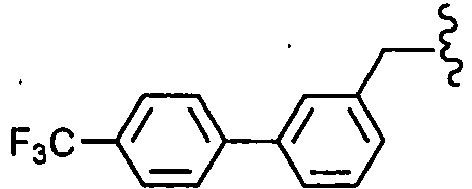
H 59.4 
3-Methyl 59.5 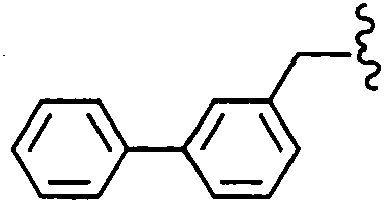
3-Methyl 59.6 
5-Methyl 59.7 
5-Methyl - Compound 59.1. MS ESI (neg.) m/e: 321 (M-H). 1H NMR (500MHz) (DMSO-d6) δ 7.84 (1H, d, J=2Hz); 7.40-7.50 (5H, m); 7.35 (1H, m); 7.27(2H, d, J=9Hz); 6.97 (2H, d, J=9Hz); 6.24 (1H, s); 5.79 (1H, m); 5.06 (2H, s); 3.3(1H, m); 3.12 (1H, m).
- Compound 59.2. MS ESI (neg.) m/e: 397 (M-H). 1H NMR (500MHz) (DMSO-d6) δ 7.85 (1H, s); 7.64-7.77 (4H, m); 7.41-7.50 (6H, m); 7.29(2H, d, J=8Hz); 7.01 (2H, d, J=9Hz); 6.24 (1H, s); 5.80 (1H, m); 5.18 (2H, s); 3.3(1H, m); 3.12 (1H, m).
- Compound 59.3. MS ESI (neg.) m/e: 465 (M-H). 1H NMR (500MHz) (DMSO-d6) δ 7.93 (2H, d, J=8Hz); 7.85 (4H, m); 7.73 (1H, d, J=7Hz); 7.54(2H, m); 7.29 (1H, s); 7.28 (2H, m); 7.00 (2H, m); 6.23(1H, s); 5.80 (1H, m); 5.20 (2H, s); 3.3(1H, m); 3.14 (1H, m).
- Compound 59.4. MS ESI (neg.) m/e: 479 (M-H). 1H NMR (500MHz) (DMSO-d6) δ 7.92 (2H, m); 7.82-7.86 (3H, m); 7.72 (1H, m); 7.52-7.56 (2H, m); 7.36 (1H, s); 7.20 (2H, d, J=9Hz); 6.99 (2H, d, J=9Hz); 6.02 (1H, m); 5.69 (1H, m); 5.14 (2H, s); 3.3 (1H, m); 2.98 (1H, m); 2.24 (3H, s).
- Compound 59.5. MS ESI (neg.) m/e: 411 (M-H). 1H NMR (500MHz) (DMSO-d6) δ 7.63-7.73 (4H, m); 7.36-7.52 (6H, m); 7.20 (2H, d, J=8Hz); 6.99 (2H, d, J=8Hz); 6.01 (1H, s); 5.70 (1H, m); 5.17 (2H, s); 3.3 (1H, m); 2.99 (1H, m); 2.24 (3H, s).
- Compound 59.6. MS ESI (neg.) m/e: 479 (M-H). 1H NMR (500MHz) (DMSO-d6) δ 7.93 (2H, m); 7.84 (3H, m); 7.71 (2H, m); 7.55 (2H, m); 7.26(2H, d, J=9Hz); 7.00 (2H, d, J=9Hz); 6.00 (1H, s); 5.69 (1H, m); 5.19 (2H, s); 3.3 (1H, m); 3.05 (1H, m); 2.15 (3H, s).
- Compound 59.7. MS ESI (neg.) m/e: 411 (M-H). 1H NMR (500MHz) (DMSO-d6) δ 7.64-7.74 (5H, m); 7.39-7.52 (5H, m); 7.26 (2H, d, J=9Hz); 6.99 (2H, d, J=9Hz); 5.99 (1H, s); 5.68 (1H, m); 5.17 (2H, s); 3.3 (1H, m); 3.06 (1H, m); 2.15 (3H, s).
- This example illustrates the preparation of ethyl 3-(4-hydroxyphenyl)-3-(5-methyloxazol-2-yl)propanoate.

- 2-(4-(Benzyloxy)phenyl)-N-(prop-2-ynyl)acetamide (60.1). A mixture of 4-(benzyloxy)phenylacetic acid (20.7 mmol), 1-hydroxybenzotrizole hydrate (37 mmol), 1-(3-dimethylaminopropyl)-3-ethylcarbodiimide (37 mmol), propargylamine (20.7mmol) and N-methylmorpholine (62 mmol) in DMF (60 mL) were stirred at room temperature overnight. The reaction mixture was diluted with ethyl acetate (400 mL), washed with 1N HCl, water, saturated Na2CO3 solution, brine and dried over Na2SO4. After removing solvent under reduced pressure, the residue was triturated with dichloromethane. Compound 60.1 was obtained as a white solid after filtration and drying. LC-MS ESI (pos.) m/e: 280 (M+H).

- 2-(4-Benzyloxy)benzyl)-5-methyl oxazole (60.2). A mixture of compound 60.1 (10.1 mmol), AuCl3 (1 mmol) in dichloromethane (100 mL) was stirred at room temperature overnight. Additional dichloromethane (100 L) was added and the reaction mixture was washed with NaHCO3 solution and saturated brine. After drying over Na2SO4 and concentration under reduced pressure, the residue was purified by column chromatography (1:2 ethyl acetate-hexanes) to obtain compound 60.2. LC-MS ESI (pos.) m/e: 280 (M+H).

- Ethyl 3-(4-(benzyloxy)phenyl)-3-(5-methyloxazol-2-yl)propanoate (60.3). Compound 60.3 was obtained from compound 60.2 according to the method of Example 58.

- (+/-)-Ethyl 3-(4-hydroxyphenyl)-3-(5-methyloxazol-2-yl)propanoate (60). Compound 60 was obtained from compound 60.3 according to the method of Example 58.
- The following compounds were prepared from compound 60 according to the methods described in Example 18.
Table 20 
Compound R Compound R 61.1 
61.4 
61.2 
61.5 
61.3 
- Compound 61.1. MS ESI (neg.) m/e: 336 (M-H). 1H NMR (500MHz) (DMSO-d6) δ 7.41-7.46 (4H, m); 7.36 (1H, m); 7.17 (2H; d, J=9Hz); 6.97 (2H, d, J=9Hz); 6.73 (1H, s); 5.09 (2H, s); 4.44 (1H, m); 3.08 (1H, m); 2.71 (1H, m); 2.22 (3H, s).
- Compound 61.2. MS ESI (neg.) m/e: 480 (M-H). 1H NMR (500MHz) (DMSO-d6) δ 7.91-7.93 (2H, m); 7.82-7.85 (3H, m); 7.72 (2H, d, J=7Hz); 7.54 (2H, m); 7.18 (2H, d, J=8Hz); 6.99 (2H, d, J=8Hz); 6.72 (1H, s); 5.17 (2H, s); 4.44 (1H, m); 3.08 (1H, m); 2.74 (1H, m); 2.21 (3H, s).
- Compound 61.3. MS ESI (neg.) m/e: 447 (M-H). 1H NMR (500MHz) (DMSO-d6) δ 7.80 (2H, d, J=8Hz); 7.30 (2H, d, J=8Hz); 7.19 (2H, d, J=8Hz); 7.00 (2H, d, J=8Hz); 6.73 (1H, s); 5.27 (2H, s); 4.44 (1H, m); 3.10 (1H, m); 2.73 (1H, m); 2.43 (3H, s); 2.34 (3H, s); 2.21 (3H, s).
- Compound 61.4. MS ESI (neg.) m/e: 366 (M-H). 1H NMR (500MHz) (DMSO-d6) δ 7.32 (1H, t, J=8Hz); 7.16 (2H, d, J=8Hz); 7.00(2H, m); 6.96 (2H, m); 6.89 (1H, m); 6.72 (1H, s); 5.05 (2H, s); 4.42 (1H, m); 3.76 (3H, s); 3.06 (1H, m); 2.76 (1H, m); 2.21 (3H, s).
- Compound 61.5. MS ESI(pos.) m/e: 500 (M+H). 1H NMR (500MHz) (DMSO-d6) δ 7.50 (2H, d, J=8Hz); 7.44 (2H, d, J=8Hz); 7.11-7.18 (4H, m); 6.97 (3H, m); 6.71 (1H, s); 5.10 (2H, s); 4.43 (1H, m); 3.93 (2H, t, J=7Hz); 3.06 (1H, m); 2.70 (1H, m); 2.20 (3H, s); 1.61 (2H, m);1.36 (2H, m); 0.86 (3H, t, J=7Hz).
- This example illustrates the preparation 3-(4-(3-(4-(trifluoromethyl)phenyl) benzyloxy)phenyl)-3-(isoxazol-5-yl)propanoic acid (62).

- 5-(4,4-Diethoxy-1-(4-(tetrahydro-2H-pyran-2-yloxy)phenyl)but-2-ynyl)-2,2-dimethyl-1,3-dioxane-4,6-dione (62.1). Propiolaldehyde diethyl acetal (5 g, 39 mmol) in anhydrous THF (65 mL) was cooled to -5°C and treated with ethylmagnesium bromide (39 mmol in 14 mL of anhydrous THF) dropwise over 10 min. After 45 min., the solution of Grignard reagent was added to compound 52.1 in anhydrous THF (50 mL). After stirring 1 h, the reaction was quenched with saturated NH4Cl(aq) (20 mL) and diluted with hexanes (100 mL). After mixing vigorously, the layers were separated and the organic layer discarded. The aqueous layer was acidified and extracted twice with diethyl ether. The combined organic layers were washed with saturated brine, dried over Na2SO4, filtered, and concentrated under reduced pressure. The residue was used immediately without further purification. MS ESI (pos.) m/e: 478.3 (M+NH4)+.

- Ethyl 6,6-diethoxy-3-(4-(tetrahydro-2H-pyran-2-yloxy)phenyl)hex-4-ynoate (62.1). Ethanolysis and decarboxylation was carried out according to the method of Example 16. Ester 62.2 was obtained as a light yellow oil (8 g).

- Ethyl 3-(4-hydroxyphenyl)-3-(isoxazol-5-yl)propanoate (62.3). Compound 62.2 (1 g, 2.5 mmol) and hydroxylamine hydrochloride (0.43 g, 6.2 mmol) were dissolved in a mixture of ethanol (10 mL) and water (1 mL). After refluxing 2 h, the reaction mixture was diluted with 200 mL of water and extracted with diethyl ether (2 x 100 mL). The combined organic layers were washed with saturated brine, dried over MgSO4, filtered, and concentrated under reduced pressure. The residue was purified by flash chromatography (silica gel, 5% methanol in dichloromethane eluant). Compound 62.3 was obtained as a thick oil (0.38 g). 1H NMR (500MHz) (CDCl3) δ 8.14 (d, J=1.5 Hz, 1H); 7.12 (d, J=8.5 Hz, 2H); 6.77 (d, J=8.5, 2H); 5.98 (d, J=1.0 Hz, 1H); 5.30 (s, 1H); 4.64 (t, J= 8.0 Hz, 1H); 4.06 (m, 2H); 3.15 (dd, J=16, 7.5 Hz, 1H); 2.95 (dd, J=16, 8.0 Hz, 1H); 1.17 (t, J= 7.2 Hz, 3H).

- Ethyl 3-(4-(3-(4-(trifluoromethyl)phenyl)benzyloxyloxy)phenyl)-3-(isoxazol-5-yl)propanoate (62.4). Compound 62.3 was alkylated according to the procedure of Example 2. LC-MS ESI (pos.) m/e: 496.1 (M+H). 1H NMR (500MHz)) (CDCl3) δ 8.14 (s, 1H); 7.70 (s, 4H); 7.66 (s, 1H); 7.56 (d, J= 7.5 Hz, 1H); 7.50-7.45 (m, 2H); 7.22 (d, J=8.5 Hz, 2H); 6.96 (d, J=8.5, 2H); 5.99 (s, 1H); 5.12 (s, 2H); 4.67 (t, J= 7.7 Hz, 1H); 4.08 (m, 2H); 3.16 (dd, J=16, 7.5 Hz, 1H); 2.95 (dd, J=16, 8.0 Hz, 1H); 1.17 (t, J= 7.2 Hz, 3H).

- (+/-)-3-(4-(3-(4-(Trifluoromethyl)phenyl)benzyloxy)phenyl)-3-(isoxazol-5-yl)propanoic acid (62). Compound 62.4 was dissolved in glacial acetic acid (1 mL) and water (0.3 mL) and heated to 95 °C for 16 h. 1N HCl (0.1 mL) was added and the reaction mixture was heated for another 16 h. The reaction mixture was poured into deionized water (50 mL) and extracted twice with diethyl ether. The combined organic layers were washed with saturated brine, dried over Na2SO4, filtered, and concentrated under reduced pressure. The residue was purified by flash chromatography (silica gel, 5% methanol in dichloromethane eluant). Compound 62 was obtained as a thick oil (26 mg). LC-MS ESI (pos.) m/e: 468.1 (M+H). 1H NMR (500MHz) (CDCl3) δ 8.14 (s, 1H); 7.70 (s, 4H); 7.66 (s, 1H); 7.56 (d, J= 7.5 Hz, 1H); 7.50-7.45 (m, 2H); 7.22 (d, J=8.5 Hz, 2H); 6.96 (d, J=8.5, 2H); 5.99 (s, 1H); 5.12 (s, 2H); 4.67 (t, J= 7.7 Hz, 1H); 4.08 (m, 2H); 3.16 (dd, J=16, 7.5 Hz, 1H); 2.95 (dd, J=16, 8.0 Hz, 1H); 1.17 (t, J= 7.2 Hz, 3H).
- This example illustrates the preparation 3-[4-(2'-butoxy-5'-methyl-biphenyl-4-ylmethoxy)-phenyl]-3-(1-methyl-1H-pyrazol-5-yl) propionic acid and 3-[4-(2'-butoxy-5'-methyl-biphenyl-4-ylmethoxy)-phenyl]-3-(1-methyl-1H-pyrazol-3-yl) propionic acid.

- Ethyl 3-(4-hydroxyphenyl)-3-(1-methyl-1H-pyrazol-5-yl)propanoate (63.1) and ethyl 3-(4-hydroxyphenyl)-3-(1-methyl-1H-pyrazol-3-yl)propanoate (63.2). Compound 62.2 was dissolved in abs. Ethanol (6 mL). A solution of methylhydrazine (173 mg, 3.7 mmol) in 6N HCl(aq) (0.6 mL) was added and the reaction mixture heated to reflux. After 2 h, the reaction mixture was diluted with 200 mL of water, neutralized with saturated aqueous NaHCO3, and extracted with diethyl ether (2 x 100 mL). The combined organic layers were washed with saturated brine, dried over MgSO4, filtered, and concentrated under reduced pressure. The residue was purified by flash chromatography (silica gel, 5% methanol in dichloromethane). Compounds 63.1 and 63.2 were obtained as an inseparable mixture in a ~4:5 ratio by 1H-NMR. LC-MS ESI (pos.) m/e: 275.2 (M+H).

- Ethyl 3-[4-(2 -Butoxy-5'-methyl-biphenyl-4-ylmethoxy)-phenyl]-3-(1-methyl-1H-pyrazol-5-yl) propionic (63.3) and Ethyl 3-[4-(2'-butoxy-5'-methyl-biphenyl-4-ylmethoxy)-phenyl]-3-(1-methyl-1H-pyrazol-3-yl) propanoate (63.4). The mixture of 63.1 and 63.2 was alkylated with 4-(2-butoxy-5-methyl)phenyl)benzyl bromide according to the method of Example 2. Separation of 63.3 and 63.4 could be accomplished by flash chromatography (silica gel, 3% acetone in dichloromethane).

- (+/-)-3-[4-(2'-Butoxy-5'-methyl-biphenyl-4-ylmethoxy)-phenyl]-3-(1-methyl-1H-pyrazol-5-yl) propionic acid (63.5). A 25 mL pear-shaped flask was charged with ethanol (1 mL), compound 63.3 (20 mg, 0.04 mmol), and 2N NaOH(aq) (2 mL, 4.0 mmol). The resulting mixture was stirred overnight at room temperature. The mixture was acidified to a pH of 3 with 1N HCl and extracted with ethyl acetate (2 x 10 mL). The combined extracts were washed with brine and concentrated. The resulting residue was purified via preparatory TLC (30% Acetone in dichloromethane) to yield compound 63.5 (4.0 mg). 1H NMR(400MHz)(CDCl3) δ 7.55 (d, 2H, J=2 Hz); 7.42 (d, 2H, J=2 Hz); 7.29 (m, 1H); 7.19-7.08 (m, 4H); 6.95-6.86 (m, 3H); 5.98 (s, 1H); 5.05 (s, 2H); 4.46 (m, 1H); 3.94 (s, 3H); 3.31 (m, 1H); 3.01 (m, 1H); 2.33 (s, 3H); 1.67 (m, 3H); 1.40 (m, 3H); 0.90 (t, 3H, J=6 Hz). MS ESI (neg.) m/e: 497.2 (M - H).

- (+/-)-3-[4-(2'-Butoxy-5'-methyl-biphenyl-4-ylmethoxy)-phenyl]-3-(1-methyl-1H-pyrazol-3-yl) propionic acid (63.6). Hydrolysis of 63.4 was carried out as described above. MS ESI (neg.) m/e: 497.2 (M - H).
- The following compounds were prepared from compounds 63.1 and 63.2 according to the methods described in Example 63.

- (+/-)-3-(1-Methyl-1H-pyrazol-3-yl)-3-(4-((4-methyl-2-p-tolylthiazol-5-yl)methoxy)phenyl) propanoic add (64.1). 1H NMR (400MHz) (CDCl3) δ 7.84 (m, 2H); 7.12 (m, 5H); 6.89 (m, 2H); 5.92 (s, 1H); 5.13 (s, 2H); 4.46 (q, 1H, J=6 Hz); 3.88 (s, 3H); 3.23 (m, 1H); 2.98 (m, 1H); 2.50 (s, 3H); 2.39 (s, 3H). MS ESI (neg.) m/e: 446.2 (M - H).

- (+/-)-3-(1-Methyl-1H-pyrazol-5-yl)-3-(4-((4-methyl-2-p-tolylthiazol-5-yl)methoxy)phenyl) propanoic add (64.2). MS ESI (neg.) m/e: 446.2 (M - H).

- (+/-)-3-(1-Methyl-1H-pyrazol-3-yl)-3-[4-(4'-trifluoromethyl-biphenyl-3-ylmethoxy)-phenyl]-propionic acid (64.3). 1H NMR (400MHz) (CDCl3) δ 7.69-7.46 (m, 8H); 7.26-6.92 (m, 5H); 5.96 (s, 1H); 5.01 (s, 2H); 4.47 (m, 1H); 3.91 (s, 3H); 3.25 (m, 1H); 2.99 (m, 1H). MS ESI (neg.) m/e: 479.2 (M - H).
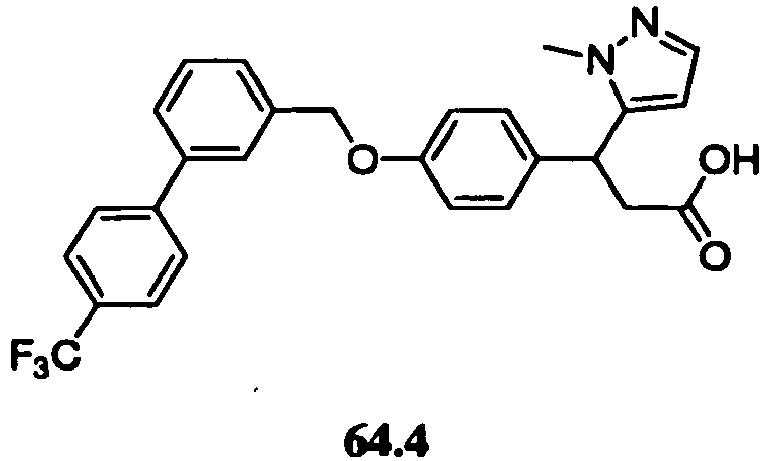
- (+/-)-3-(1-Methyl-1H-pyrazol-5-yl)-3-[4-(4'-trifluoromethyl-biphenyl-3-ylmethoxy)-phenyl]-propionic acid (64.4). 1H NMR (400MHz) (CHCl3-d3) δ 7.85-7.44 (m, 8H); 7.06 (d, 2H, J=6 Hz); 6.92 (s, 1H); 5.10 (s, 2H); 4.46 (m, 1H); 3.71 (s, 3H); 3.05 (m, 1H); 2.96 (m, 1H). MS ESI (neg.) m/e: 479.2 (M - H).
- A cell-based aequorin assay may be employed to characterize the modulatory activity of compounds on the GPR40 signaling pathway. In an exemplary assay, CHO cells are transfected in a 15 cm plated containing 14 million cells with 5 µ of GPR40 expression vector and 5 µg of Aequorin expression vector (Euroscreen) using Lipofectamine 2000 (Invitrogen). After 17-24 hours post-transfection, cells are washed with phosphate buffered saline (PBS) and detached from the tissue culture dish with 2 mL of trypsin (0.25%(w/v)). Trypsinization is halted with 28 mL of Hanks Buffered Salt Solution containing 20 mM Hepes (H/HBSS) and 0.01% fatty acid-free bovine serum albumin (BSA) or 0.625% fatty acid-free human serum albumin (HSA). Coelantrazine is added to 1 ug/mL and the cells are incubated for 2 hours at room temperature. Cells are gently mixed every 15 minutes. Compounds are dissolved in dimethyl sulfoxide for preparation of 10 mM stock solutions. Compounds are diluted in H/HBSS containing either 0.01% BSA or 0.625% HSA. Serial dilutions of the test compounds are prepared to determine dose response.
- Aequorin luminescence measurements are made using an EG&G Berthold 96-well luminometer and the response is measured over a 20 second interval after cells and compounds were mixed. The area-under-curve from 2-20 seconds is plotted to determine dose reponse. The EC50 (effective concentration to reach 50% maximal response) is determined from the dose response plot.
- Table 21 presents representative data (EC50 values) obtained for exemplary compounds of the invention for the relative activation of human GPR40.
- The stereoismers in Table 21 are as specified, i.e., S-enantiomers or R-enantiomers, and if not specified, are mixtures of S-enantiomers and R-enantiomers. In addition, the present invention provides the S-enantiomers, the R-enantiomers, and mixtures of both S-enantiomers and R-enantiomers including racemates of each compound prepared according to the synthetic methods described herein or adapted with the necessary minor modifications from these methods.
- C57/B16 mice are euthanized with carbon dioxide gas. The pancreatic bile duct is clamped proximal to the duodenum and then cannulated. H/HBSS containing 0.75 mg/ml collagenase XI (Sigma) is then infused into the pancreas through the cannula. The pancreas is excised and then incubated at 37°C for 13 minutes to complete enzymatic digestion. The collagenase digestion is quenched in H/HBSS containing 1% BSA and washed once in the same buffer. Islets can be purified using density gradient centrifugation using Histopaque (Sigma) and are hand-picked under a stereomicroscope.
- Islets are cultured overnight in Roswell Park Memorial Institute (RMPI) media containing 10% fetal bovine serum and 50 uM beta-mercaptoethanol. Following overnight culture, islets are incubated in Dulbecco's Modifcation of Eagle's medium (DMEM) containing 2.8 mM glucose for one hour.
- For determination of insulin secretion, islets are incubated in DMEM containing 12.5 mM glucose and test compounds for one hour. Insulin released into the culture medium from the islets is measured using an insulin ELISA.
TABLE 21 Aequorin Assay Using Human GPR40 No. Structure Relative EC50 a 2 
++++ 3 
+++++ 5 
++++ 6.1 
++++ 6.2 
++++ 6.3 
++++ 6.5 
++++ 6.7 
++++ 6.8 
++++ 6.9 
++++ 7.3 
++ 7.5 
++++ 7.8 
+++ 7.9 
+++ 7.10 
+++ 7.15 
++++ 8.1 
++++ 8.2 
++++ 8.3 
++++ 8.4 
++++ 8.5 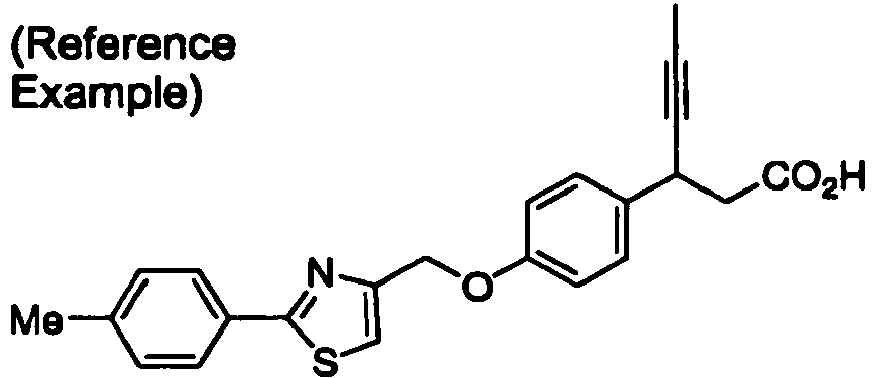
++++ 8.6 
+++ 9.1 
++++ 9.2 
+++++ 9.3 
++++ 9.4 
++++ 10.2 
++++ 10.3 
++++ 10.4 
++++ 10.5 
+++ 10.6 
++++ 10.7 
+++ 10.8 
+++ 10.9 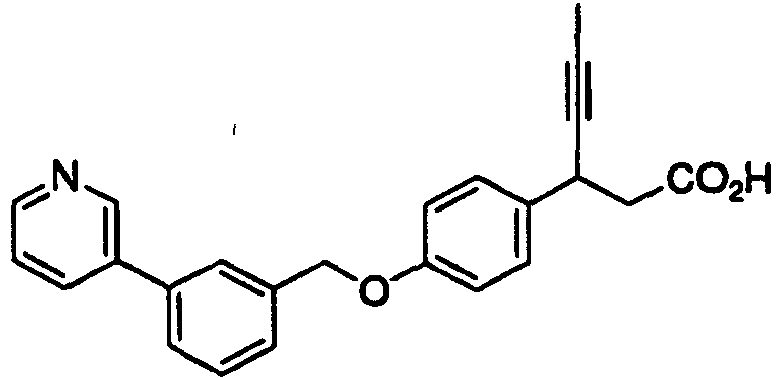
+++ 10.10 
+++ 10.12 
++ 10.13 
+++ 10.14 
++++ 11.1 
+++ 12 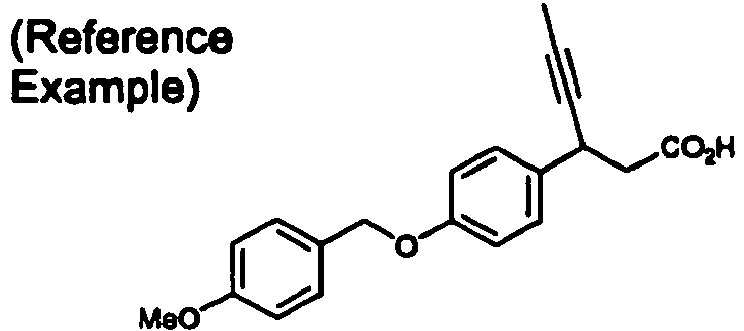
+++ 14.1 
++ 14.2 
+++ 14.3 
++ 14.4 
+ 14.5 
++ 14.6 
++ 15 
++++ 17.6 
+++ 17.8 
++ 18 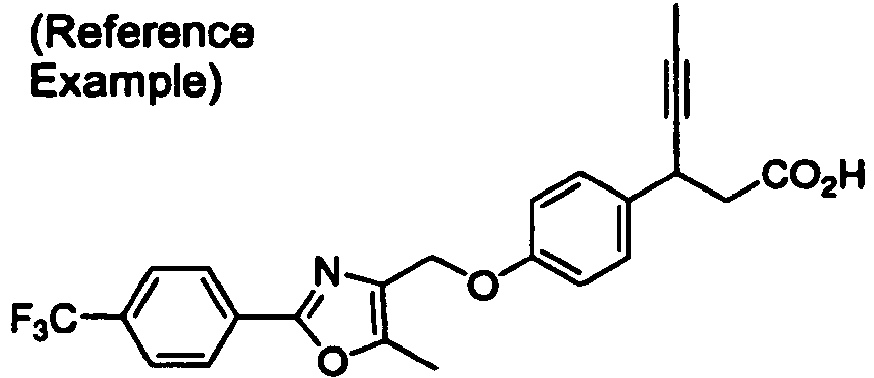
++++ 23 
++ 24 
+++ 25.1 
++ 26 
++++ 27.1 
+++ 28 
+++ 34.4 
++ 34.5 
+++ 36.1 
+++ 36.2 
+++ 39.7 
++++ 40.5 
++ 41 
+++ 42.11 
+++ 42.14 
+++ 46.1 
+++ 53 
++++ 56 
+++ 62.3 
++++ 66.5 
+++ 70.1 
++ 70.2 
+++ 71 
+++ 72 
+++ 73 
++ 74 
++ 75 
+ 76 
++ 77 
+++ 78 
++ 79 
++ 80 
+++++ 81 
++ 82.1b 
++++ + 82.2b 
++++ + 82.3b 
++++ + 82.4b 
+++ + 82.5b 
++++ + 82.6b 
++++ + 82.7b 
+++++ + 82.8b 
+++++ + 83 
++ 84.1 
++++ 84.2 
++ 84.3 
+++ 84.4 
+++ 84.5 
+++ 84.6 
+++ 84.7 
+++ 84.8 
+++ 85.1 
++ 85.2 
+++ 86 
+++++ 87 
+ 88.1 
+ 88.2 
+ 88.3 
+ 88.4 
+ 88.5 
+ 88.6 
+ 88.7 
++ 89 
++ 90 
++ 91 
++ a EC50 Ranges: + EC50 > 10 µM ++ 1 µM ≤ EC50 ≤ 10 µM +++ 0.1 µM ≤ EC50 < 1 µM ++++ 0.01 µM ≤ ECso < 0.1 µM +++++ EC50 < 0.01 µM b Each relative EC50 range indicated for this compound reflects the range for an observed EC50 for the compound when determined in seperately performed assays.
Claims (13)
- A compound having the formula (VII):

R25 is -H, -(C1-C5)alkyl, -(C1-C5)oxyalkyl, substituted or unsubstituted aryl, or substituted or unsubstituted heteroaryl;
each R28 is independently selected from the group consisting of phenyl, methoxyphenyl, methylphenyl, trihalomethylphenyl, benzyl, phenoxy, ethoxyphenyl, cyanophenyl, halophenyl, halobenzyl, pyridyl, methoxybenzyl, or pyryl group; and
the subscript q is 1 or 2. - The compound of claim 1, wherein R25 is methyl.
- Pharmaceutical composition, comprising a pharmaceutically acceptable carrier, diluent or excipient and the compound of claim 1 or 2.
- The compound of claim 1 or 2 for use in treating a disease or condition selected from the group consisting of type II diabetes, obesity, hyperglycemia, glucose intolerance, insulin resistance, hyperinsulinemia, hypercholesterolemia, hypertension, hyperlipoproteinemia, hyperlipidemia, hypertriglylceridemia, dyslipidemia, metabolic syndrome, syndrome X, cardiovascular disease, atherosclerosis, kidney disease, ketoacidosis, thrombotic disorders, nephropathy, diabetic neuropathy, diabetic retinopathy, sexual dysfunction, dermatopathy, dyspepsia, hypoglycemia, cancer and edema.
- The compound for use according to claim 4, wherein said disease or condition is type II diabetes.
- The compound of any of claims 1 or 2 for use in treating a disease or condition responsive to the modulation of GPR40.
- The compound for use according to claim 6, wherein said disease or condition is selected from the group consisting of type II diabetes, obesity, hyperglycemia, glucose intolerance, insulin resistance, hyperinsulinemia, hypercholesterolemia, hypertension, hyperlipoproteinemia, hyperlipidemia, hypertriglylceridemia, dyslipidemia, metabolic syndrome, syndrome X, cardiovascular disease, atherosclerosis, kidney disease, ketoacidosis, thrombotic disorders, nephropathy, diabetic neuropathy, diabetic retinopathy, sexual dysfunction, dermatopathy, dyspepsia, hypoglycemia, cancer and edema.
- The compound for use according to any one of claims 4-7, wherein said compound is formulated to be administered orally, parenterally or topically.
- Pharmaceutical composition, comprising the compound of claim 1 or 2 and a second therapeutic agent as a combined preparation.
- The composition of claim 9, wherein said second therapeutic agent is a metformin or a thiazolidinedione.
- The compound of claim 1 or 2 for use in modulating circulating insulin concentration in a subject.
- The compound for use according to claim 11, wherein the medicament increases insulin concentration.
- The compound for use according to Claim 11, wherein the medicament decreases insulin concentration.
Applications Claiming Priority (3)
| Application Number | Priority Date | Filing Date | Title |
|---|---|---|---|
| US54874104P | 2004-02-27 | 2004-02-27 | |
| US60157904P | 2004-08-12 | 2004-08-12 | |
| PCT/US2005/005815 WO2005086661A2 (en) | 2004-02-27 | 2005-02-24 | Compounds, pharmaceutical compositions and methods for use in treating metabolic disorders |
Publications (3)
| Publication Number | Publication Date |
|---|---|
| EP1737809A2 EP1737809A2 (en) | 2007-01-03 |
| EP1737809A4 EP1737809A4 (en) | 2007-10-17 |
| EP1737809B1 true EP1737809B1 (en) | 2013-09-18 |
Family
ID=34976072
Family Applications (1)
| Application Number | Title | Priority Date | Filing Date |
|---|---|---|---|
| EP05723623.4A Expired - Lifetime EP1737809B1 (en) | 2004-02-27 | 2005-02-24 | Compounds, pharmaceutical compositions and methods for use in treating metabolic disorders |
Country Status (19)
| Country | Link |
|---|---|
| US (2) | US7816367B2 (en) |
| EP (1) | EP1737809B1 (en) |
| JP (1) | JP5299810B2 (en) |
| KR (1) | KR20070004769A (en) |
| CN (1) | CN1946666A (en) |
| AR (1) | AR048306A1 (en) |
| AU (1) | AU2005220728B2 (en) |
| BR (1) | BRPI0508098A (en) |
| CA (1) | CA2558585C (en) |
| CR (1) | CR8642A (en) |
| EA (1) | EA011010B1 (en) |
| EC (1) | ECSP066887A (en) |
| ES (1) | ES2433466T3 (en) |
| IL (1) | IL177717A0 (en) |
| IS (1) | IS8542A (en) |
| MA (1) | MA28466B1 (en) |
| NO (1) | NO20064362L (en) |
| TW (1) | TW200539854A (en) |
| WO (1) | WO2005086661A2 (en) |
Families Citing this family (114)
| Publication number | Priority date | Publication date | Assignee | Title |
|---|---|---|---|---|
| GB0319069D0 (en) * | 2003-08-14 | 2003-09-17 | Glaxo Group Ltd | Therapeutically useful compounds |
| EA011010B1 (en) | 2004-02-27 | 2008-12-30 | Эмджен, Инк. | Compounds modulating of gpr40 receptor, pharmaceutical composition, method for treating diseases responsive to the modulation of gpr40 receptor (embodiments), method for modulating gpr40 function (embodiments) and method for modulating circulating insulin concentration |
| US7262318B2 (en) * | 2004-03-10 | 2007-08-28 | Pfizer, Inc. | Substituted heteroaryl- and phenylsulfamoyl compounds |
| EP2253315A1 (en) * | 2004-03-30 | 2010-11-24 | Takeda Pharmaceutical Company Limited | Alkoxyphenylpropanoic acid derivatives |
| US20050288340A1 (en) * | 2004-06-29 | 2005-12-29 | Pfizer Inc | Substituted heteroaryl- and phenylsulfamoyl compounds |
| MX2007008290A (en) | 2005-01-07 | 2008-02-15 | Synta Pharmaceuticals Corp | Compounds for inflammation and immune-related uses. |
| GB0505437D0 (en) * | 2005-03-17 | 2005-04-20 | Merck Sharp & Dohme | Therapeutic agents |
| US7465804B2 (en) * | 2005-05-20 | 2008-12-16 | Amgen Inc. | Compounds, pharmaceutical compositions and methods for their use in treating metabolic disorders |
| US8097610B2 (en) | 2005-08-26 | 2012-01-17 | Shionogi & Co., Ltd. | Derivative having PPAR agonistic activity |
| EP1924546A1 (en) * | 2005-09-14 | 2008-05-28 | Amgen, Inc | Conformationally constrained 3- (4-hydroxy-phenyl) - substituted-propanoic acids useful for treating metabolic disorders |
| AU2006290442B2 (en) | 2005-09-16 | 2010-07-29 | Arrow Therapeutics Limited | Biphenyl derivatives and their use in treating hepatitis C |
| KR100968705B1 (en) * | 2005-10-27 | 2010-07-06 | 주식회사유한양행 | Novel 2-phenylpyrimidine derivatives and preparation methods thereof |
| UA95613C2 (en) * | 2005-11-09 | 2011-08-25 | Уеллстат Терепьютикс Корпорейшн | Compounds for the treatment of metabolic disorders |
| CN101378740A (en) * | 2006-02-02 | 2009-03-04 | 维尔斯达医疗公司 | Compounds for the treatment of metabolic disorders |
| CA2646430A1 (en) * | 2006-03-14 | 2007-09-20 | Amgen Inc. | Bicyclic carboxylic acid derivatives useful for treating metabolic disorders |
| TW200815377A (en) | 2006-04-24 | 2008-04-01 | Astellas Pharma Inc | Oxadiazolidinedione compound |
| AU2007293028B2 (en) * | 2006-09-07 | 2012-05-31 | Amgen Inc. | Heterocyclic GPR40 modulators |
| US7687526B2 (en) * | 2006-09-07 | 2010-03-30 | Amgen Inc. | Benzo-fused compounds for use in treating metabolic disorders |
| US7750048B2 (en) * | 2006-11-15 | 2010-07-06 | Janssen Pharmaceutica Nv | GPR40 agonists |
| TW200838526A (en) | 2006-12-01 | 2008-10-01 | Astellas Pharma Inc | Carboxylic acid derivatives |
| AU2008218951B2 (en) | 2007-02-22 | 2011-11-17 | Irm Llc | Compounds and methods for modulating g protein-coupled receptors |
| CA2683751C (en) * | 2007-04-16 | 2013-01-08 | Amgen Inc. | Substituted biphenyl phenoxy-, thiophenyl- and aminophenylpropanoic acid gpr40 modulators |
| KR20100090249A (en) | 2007-10-10 | 2010-08-13 | 암젠 인크 | Substituted biphenyl gpr 40 modulators |
| ME02338B (en) * | 2007-10-26 | 2013-02-28 | Japan Tobacco Inc | SPIRO RING CONNECTION AND ITS USE FOR MEDICAL PURPOSES |
| WO2009055932A1 (en) * | 2007-11-02 | 2009-05-07 | Prometic Biosciences Inc. | Substituted phenylpropionic acids as stimulators of hematopoiesis and erythropoiesis |
| EP2674417A3 (en) * | 2007-11-21 | 2014-04-09 | Decode Genetics EHF | Biaryl PDE4 inhibitors for treating inflammation |
| US8450522B2 (en) * | 2008-03-06 | 2013-05-28 | Amgen Inc. | Conformationally constrained carboxylic acid derivatives useful for treating metabolic disorders |
| US8633245B2 (en) * | 2008-04-11 | 2014-01-21 | Institute Of Medicinal Molecular Design, Inc. | PAI-1 inhibitor |
| CN102137837A (en) * | 2008-04-11 | 2011-07-27 | 株式会社医药分子设计研究所 | PAI-1 inhibitor |
| CA2727340A1 (en) | 2008-06-25 | 2009-12-30 | Daiichi Sankyo Company, Limited | Carboxylic acid compound |
| WO2010012650A1 (en) | 2008-07-28 | 2010-02-04 | Syddansk Universitet | Compounds for the treatment of metabolic diseases |
| US8748462B2 (en) | 2008-10-15 | 2014-06-10 | Amgen Inc. | Spirocyclic GPR40 modulators |
| JP2012506386A (en) * | 2008-10-21 | 2012-03-15 | メタボレックス, インコーポレイテッド | Aryl GPR120 receptor agonist and uses thereof |
| AR074760A1 (en) | 2008-12-18 | 2011-02-09 | Metabolex Inc | GPR120 RECEIVER AGONISTS AND USES OF THE SAME IN MEDICINES FOR THE TREATMENT OF DIABETES AND METABOLIC SYNDROME. |
| JP2012136438A (en) * | 2009-04-22 | 2012-07-19 | Astellas Pharma Inc | Tetrazole compound |
| AR078522A1 (en) | 2009-10-15 | 2011-11-16 | Lilly Co Eli | SPIROPIPERIDINE COMPOUND, PHARMACEUTICAL COMPOSITION THAT INCLUDES IT, ITS USE TO PREPARE A USEFUL MEDICINAL PRODUCT TO TREAT DIABETES AND INTERMEDIARY COMPOUND FOR SYNTHESIS |
| DE102009046115A1 (en) | 2009-10-28 | 2011-09-08 | Bayer Schering Pharma Aktiengesellschaft | Substituted 3-phenylpropanoic acids and their use |
| JPWO2011052756A1 (en) | 2009-10-30 | 2013-03-21 | 持田製薬株式会社 | Novel 3-hydroxy-5-arylisoxazole derivatives |
| AR078948A1 (en) | 2009-11-30 | 2011-12-14 | Lilly Co Eli | SPYROPIPERIDINE COMPOUNDS, PHARMACEUTICAL COMPOSITION THAT INCLUDE IT AND ITS USE TO PREPARE A USEFUL MEDICINAL PRODUCT TO TREAT DIABETES |
| EP2332427A1 (en) | 2009-12-07 | 2011-06-15 | Nestec S.A. | low caloric fat replacers |
| PH12012501456A1 (en) | 2009-12-25 | 2012-10-29 | Mochida Pharm Co Ltd | Novel 3-hydroxy -5- arylisothiazole derivative |
| US8299117B2 (en) | 2010-06-16 | 2012-10-30 | Metabolex Inc. | GPR120 receptor agonists and uses thereof |
| US8530413B2 (en) * | 2010-06-21 | 2013-09-10 | Sanofi | Heterocyclically substituted methoxyphenyl derivatives with an oxo group, processes for preparation thereof and use thereof as medicaments |
| TW201215387A (en) | 2010-07-05 | 2012-04-16 | Sanofi Aventis | Spirocyclically substituted 1,3-propane dioxide derivatives, processes for preparation thereof and use thereof as a medicament |
| TW201221505A (en) * | 2010-07-05 | 2012-06-01 | Sanofi Sa | Aryloxyalkylene-substituted hydroxyphenylhexynoic acids, process for preparation thereof and use thereof as a medicament |
| TW201215388A (en) * | 2010-07-05 | 2012-04-16 | Sanofi Sa | (2-aryloxyacetylamino)phenylpropionic acid derivatives, processes for preparation thereof and use thereof as medicaments |
| JP5809157B2 (en) | 2010-10-08 | 2015-11-10 | 持田製薬株式会社 | Cyclic amide derivative |
| SG190296A1 (en) | 2010-12-07 | 2013-06-28 | Bayer Ip Gmbh | Substituted 1-benzylcycloalkylcarboxlic acids and use thereof |
| GB201104153D0 (en) | 2011-03-11 | 2011-04-27 | Glaxo Group Ltd | Novel compounds |
| CN104470886A (en) | 2011-04-08 | 2015-03-25 | 赛丹思科大学 | Ortho-fluoro substituted compounds for the treatment of metabolic diseases |
| DE102011007272A1 (en) | 2011-04-13 | 2012-10-18 | Bayer Pharma Aktiengesellschaft | Branched 3-phenylpropionic acid derivatives and their use |
| TW201247636A (en) | 2011-04-27 | 2012-12-01 | Mochida Pharm Co Ltd | Novel 3-hydroxyisothiazole 1-oxide derivatives |
| EP2716636A4 (en) | 2011-04-28 | 2014-11-26 | Mochida Pharm Co Ltd | Cyclic amide derivative |
| AR087451A1 (en) | 2011-08-17 | 2014-03-26 | Lilly Co Eli | DERIVED FROM 1,2,3,4-TETRAHYDROQUINOLINE USEFUL FOR TREATMENT OF DIABETES |
| WO2013057743A1 (en) * | 2011-10-21 | 2013-04-25 | Connexios Life Sciences Pvt. Ltd | Process for the preparation of an aryl oxime and salts thereof |
| WO2013102626A1 (en) * | 2012-01-04 | 2013-07-11 | Sanofi | 3-[4-(phenylaminooxalylamino)phenyl]hex-4-ynoic acids, process for preparation thereof and use thereof as a medicament |
| TW201341356A (en) * | 2012-02-28 | 2013-10-16 | 皮拉馬爾企業有限公司 | Phenyl alkanoic acid derivatives as GPR agonists |
| DE102012208530A1 (en) | 2012-05-22 | 2013-11-28 | Bayer Pharma AG | Substituted piperidinoacetamides and their use |
| WO2014022528A1 (en) | 2012-08-02 | 2014-02-06 | Merck Sharp & Dohme Corp. | Antidiabetic tricyclic compounds |
| TWI692469B (en) * | 2012-11-09 | 2020-05-01 | 南韓商Lg化學股份有限公司 | GPR40 receptor agonist, method for manufacturing the agonist, and pharmaceutical composition containing the agonist as an active agent |
| HUE032401T2 (en) | 2012-11-16 | 2017-09-28 | Bristol Myers Squibb Co | Dihydropyrazole gpr40 modulators |
| WO2014086704A1 (en) | 2012-12-03 | 2014-06-12 | F. Hoffmann-La Roche Ag | Substituted isoxazole amide compounds as inhibitors of stearoyl-coa desaturase 1 (scd1) |
| DE102013201104A1 (en) * | 2013-01-24 | 2014-07-24 | H.C. Starck Gmbh | Process for the production of chromium nitride-containing spray powders |
| WO2014130608A1 (en) | 2013-02-22 | 2014-08-28 | Merck Sharp & Dohme Corp. | Antidiabetic bicyclic compounds |
| KR101735787B1 (en) * | 2013-02-28 | 2017-05-16 | 주식회사 티움바이오 | Tricyclic compound and use thereof |
| CN104109115B (en) * | 2013-04-16 | 2016-11-23 | 中国科学院上海药物研究所 | Phenylpropionic acid compound, its pharmaceutical composition, preparation method and the purposes of a kind of nitrogen heterocyclic ring link |
| AR096041A1 (en) | 2013-04-17 | 2015-12-02 | Piramal Entpr Ltd | CARBOXYLIC ACID DERIVATIVES RENT REPLACED AS RPG AGONISTS |
| KR101569522B1 (en) * | 2013-04-18 | 2015-11-17 | 현대약품 주식회사 | Novel 3-(4-(benzyloxy)phenyl)hex-4-inoic acid derivative, preparation method thereof, and pharmaceutical composition for use in preventing or treating metabolic diseases containing the same as an active ingredient |
| CN104507921B (en) * | 2013-07-02 | 2017-02-22 | 四川海思科制药有限公司 | Benzocyclobutene derivative and preparation method and pharmaceutical application thereof |
| CN104418801B (en) * | 2013-08-19 | 2016-10-05 | 上海润诺生物科技有限公司 | Benzo piperidine ring and benzo morpholine cyclics, its preparation method and medical applications |
| WO2015051496A1 (en) | 2013-10-08 | 2015-04-16 | Merck Sharp & Dohme Corp. | Antidiabetic tricyclic compounds |
| EP3068788A1 (en) | 2013-11-14 | 2016-09-21 | Cadila Healthcare Limited | Novel heterocyclic compounds |
| US10519115B2 (en) | 2013-11-15 | 2019-12-31 | Merck Sharp & Dohme Corp. | Antidiabetic tricyclic compounds |
| EP3076959B1 (en) | 2013-12-04 | 2018-07-04 | Merck Sharp & Dohme Corp. | Antidiabetic bicyclic compounds |
| TW201609722A (en) * | 2013-12-13 | 2016-03-16 | 美國禮來大藥廠 | A novel triazolo-pyridine compound |
| WO2015089809A1 (en) | 2013-12-19 | 2015-06-25 | Merck Sharp & Dohme Corp. | Antidiabetic substituted heteroaryl compounds |
| CN105899509B (en) * | 2014-01-10 | 2018-01-02 | 伊莱利利公司 | Isopropyl triazolopyridine compounds |
| KR20160095117A (en) * | 2014-01-10 | 2016-08-10 | 일라이 릴리 앤드 캄파니 | Phenyl-triazolo-pyridine compounds |
| US10059667B2 (en) | 2014-02-06 | 2018-08-28 | Merck Sharp & Dohme Corp. | Antidiabetic compounds |
| AU2015220427B2 (en) | 2014-02-19 | 2017-09-21 | Piramal Enterprises Limited | Compounds for use as GPR120 agonists |
| WO2015176267A1 (en) | 2014-05-22 | 2015-11-26 | Merck Sharp & Dohme Corp. | Antidiabetic tricyclic compounds |
| EP3172185B1 (en) | 2014-07-25 | 2020-03-04 | Piramal Enterprises Limited | Substituted phenyl alkanoic acid compounds as gpr120 agonists and uses thereof |
| EP3177282B1 (en) | 2014-08-08 | 2021-10-06 | Merck Sharp & Dohme Corp. | Antidiabetic bicyclic compounds |
| EP3177287B1 (en) | 2014-08-08 | 2022-02-23 | Merck Sharp & Dohme Corp. | Antidiabetic bicyclic compounds |
| WO2016019587A1 (en) | 2014-08-08 | 2016-02-11 | Merck Sharp & Dohme Corp. | [7, 6]-fused bicyclic antidiabetic compounds |
| WO2016022446A1 (en) | 2014-08-08 | 2016-02-11 | Merck Sharp & Dohme Corp. | [5,6]-fused bicyclic antidiabetic compounds |
| US10214521B2 (en) | 2014-09-11 | 2019-02-26 | Piramal Enterprises Limited | Fused heterocyclic compounds as GPR120 agonists |
| TW201629033A (en) | 2014-10-08 | 2016-08-16 | 健生藥品公司 | Substituted benzothiophenyl derivatives as GPR40 agonists for the treatment of type II diabetes |
| CA2960944C (en) | 2014-10-17 | 2019-09-10 | Hyundai Pharm Co., Ltd. | Use of 3-(4-(benzyloxy)phenyl)hex-4-inoic acid derivatives in combination with a secondary active ingredient for the treatment of metabolic diseases |
| CA2970987A1 (en) | 2014-12-18 | 2016-06-23 | Bayer Pharma Aktiengesellschaft | Substituted pyridyl-cycloalkyl-carboxylic acids, compositions containing them and medical uses thereof |
| US9920040B2 (en) | 2015-08-12 | 2018-03-20 | Janssen Pharmaceutica Nv | GPR40 agonists for the treatment of type II diabetes |
| WO2017027312A1 (en) | 2015-08-12 | 2017-02-16 | Janssen Pharmaceutica Nv | Gpr40 agonists for the treatment of type ii diabetes |
| US9908873B2 (en) | 2015-08-12 | 2018-03-06 | Janssen Pharmaceutica Nv | GPR40 agonists for the treatment of type II diabetes |
| CN105198826A (en) * | 2015-10-08 | 2015-12-30 | 中国药科大学 | 3,5-dimethyl isoxazole derivatives, preparation method of derivatives, and application of derivatives as drugs |
| WO2017172505A1 (en) | 2016-03-29 | 2017-10-05 | Merck Sharp & Dohme Corp. | Antidiabetic bicyclic compounds |
| WO2017180571A1 (en) * | 2016-04-11 | 2017-10-19 | Janssen Pharmaceutica Nv | Substituted benzothiophenyl derivatives as gpr40 agonists for the treatment of type ii diabetes |
| WO2017180457A1 (en) | 2016-04-11 | 2017-10-19 | Janssen Pharmaceutica Nv | Gpr40 agonists in anti-diabetic drug combinations |
| CU24576B1 (en) | 2016-05-04 | 2022-02-04 | Centro De Investig Y Desarrollo De Medicamentos Cidem | PHENOLIC COMPOUND AND COMBINATION THEREOF WITH A BENZODIAZEPINE FUSED TO 1,4-DIHYDROPYRIDINE FOR THE TREATMENT OF DISORDERS OF THE CENTRAL AND VASCULAR NERVOUS SYSTEM |
| US11072602B2 (en) | 2016-12-06 | 2021-07-27 | Merck Sharp & Dohme Corp. | Antidiabetic heterocyclic compounds |
| KR102007633B1 (en) * | 2016-12-15 | 2019-08-06 | 일동제약(주) | Novel phenyl propionic acid derivatives and uses thereof |
| EP3558298B1 (en) | 2016-12-20 | 2026-03-11 | Merck Sharp & Dohme LLC | Antidiabetic spirochroman compounds |
| CN109666027A (en) * | 2017-10-17 | 2019-04-23 | 中国科学院上海药物研究所 | GPR40 agonist compound of a kind of amide structure and application thereof |
| US11225471B2 (en) | 2017-11-16 | 2022-01-18 | Merck Sharp & Dohme Corp. | Antidiabetic bicyclic compounds |
| WO2019134984A1 (en) | 2018-01-08 | 2019-07-11 | Celon Pharma S.A. | 3-phenyl-4-hexynoic acid derivatives as gpr40 agonists |
| CN110092774B (en) * | 2018-01-29 | 2022-04-08 | 中国科学院上海药物研究所 | Aromatic propionic acid derivatives, preparation method and use thereof |
| US10905667B2 (en) | 2018-07-24 | 2021-02-02 | Bayer Pharma Aktiengesellschaft | Orally administrable modified-release pharmaceutical dosage form |
| EP3927693B1 (en) | 2019-02-21 | 2026-05-06 | Nanjing Ruijie Pharma Co., Ltd. | 2-phenyl-3,5-dioxo-2,3,4,5-tetrahydro-1,2,4-triazine-6-carbonitrile derivatives and similar compounds as thyroid hormone receptor agonists for the treatment of e.g. obesity |
| CA3173731A1 (en) | 2020-02-28 | 2021-09-02 | Kallyope, Inc. | Gpr40 agonists |
| CA3173732A1 (en) * | 2020-02-28 | 2021-09-02 | Kallyope, Inc. | Gpr40 agonists |
| CN117835981A (en) * | 2021-06-21 | 2024-04-05 | 尹诺卫医药有限公司 | Methods of controlling blood sugar levels and treating diabetes and related disorders |
| WO2023080299A1 (en) * | 2021-11-08 | 2023-05-11 | 일동제약(주) | Novel salt of phenyl propionic acid derivative, method for producing same, and pharmaceutical composition containing same |
| CN116924906A (en) * | 2022-03-31 | 2023-10-24 | 广东药科大学 | Novel long-acting FFA1 agonist, preparation method thereof and application thereof as medicine |
| JP2025110317A (en) * | 2024-01-15 | 2025-07-28 | 信越化学工業株式会社 | Composition for forming organic film, method for forming organic film, and method for forming pattern |
| WO2025253265A1 (en) * | 2024-06-03 | 2025-12-11 | 현대약품 주식회사 | Pharmaceutical composition for preventing or treating diabetes |
Family Cites Families (65)
| Publication number | Priority date | Publication date | Assignee | Title |
|---|---|---|---|---|
| SE305216B (en) | 1965-09-17 | 1968-10-21 | Astra Apotekarnes Kem Fab | |
| FR2359135A1 (en) | 1976-07-22 | 1978-02-17 | Hexachimie | Heterocyclyl substd. phenoxy-propanolamine - with cardio:selective beta-adrenergic blocking activity |
| US4760089A (en) | 1985-09-09 | 1988-07-26 | Smithkline Beckman Corporation | Irreversible dopamine-β-hydroxylase inhibitors |
| PT85081A (en) | 1986-06-19 | 1987-07-01 | Smithkline Beckman Corp | Irreversible dopamine-beta-hydroxylase inhibitors |
| GB8917069D0 (en) | 1989-07-26 | 1989-09-13 | Merck Sharp & Dohme | Therapeutic agents |
| AU668180B2 (en) | 1992-05-20 | 1996-04-26 | Merck & Co., Inc. | 17-ethers and thioethers of 4-aza-steroids |
| CA2135173A1 (en) | 1992-05-20 | 1993-11-25 | Bruce E. Witzel | Ester derivatives of 4-aza-steroids |
| DE4241632A1 (en) | 1992-12-10 | 1994-06-16 | Thomae Gmbh Dr K | Carboxylic acid derivatives, medicaments containing these compounds and process for their preparation |
| US6071970A (en) | 1993-02-08 | 2000-06-06 | Nps Pharmaceuticals, Inc. | Compounds active at a novel site on receptor-operated calcium channels useful for treatment of neurological disorders and diseases |
| JP3894949B2 (en) | 1993-06-30 | 2007-03-22 | ザ、ウェルカム、ファンデーション、リミテッド | Anti-atherosclerotic diaryl compounds |
| US5463063A (en) | 1993-07-02 | 1995-10-31 | Celgene Corporation | Ring closure of N-phthaloylglutamines |
| BR9510360A (en) * | 1994-12-23 | 1997-12-23 | Thomae Gmbh Dr K | Piperazine derivatives medicines containing these compounds their application and process for their preparation |
| US6037367A (en) | 1995-07-14 | 2000-03-14 | Smithkline Beecham Corporation | Substituted-pent-4-ynoic acids |
| DK0859608T3 (en) | 1995-09-18 | 2004-06-14 | Ligand Pharm Inc | Treatment of NIDDM with RXR agonists |
| US5795900A (en) | 1995-10-03 | 1998-08-18 | Abbott Laboratories | Symmetrical bis-heteroaryl-methoxy-phenylalkyl carboxylates as inhibitors of leukotriene biosynthesis |
| BR9610875A (en) | 1995-10-06 | 1999-07-13 | Ligand Pharm Inc | Selective rxr modules - dimers and processes for your use |
| US5771109A (en) * | 1996-05-17 | 1998-06-23 | Pixar | Method and apparatus for digitizing films using a stroboscopic scanning system |
| JPH10316641A (en) | 1997-03-14 | 1998-12-02 | Sankyo Co Ltd | Carboxylic acid derivative |
| WO1999011255A1 (en) | 1997-08-28 | 1999-03-11 | Ono Pharmaceutical Co., Ltd. | Peroxisome proliferator-activated receptor controllers |
| US6645939B1 (en) | 1997-11-24 | 2003-11-11 | Merck & Co., Inc. | Substituted β-alanine derivatives as cell adhesion inhibitors |
| AU736026B2 (en) | 1997-12-17 | 2001-07-26 | Merck & Co., Inc. | Integrin receptor antagonists |
| JP4345230B2 (en) | 1998-03-10 | 2009-10-14 | 小野薬品工業株式会社 | Carboxylic acid derivatives and drugs containing the derivatives as active ingredients |
| MA26634A1 (en) | 1998-06-04 | 2004-12-20 | Astra Ab | NOVEL 3-ARYL PROPIONIC ACID DERIVATIVES AND THE LIKE |
| DE19941567A1 (en) | 1998-09-05 | 2000-04-20 | Merck Patent Gmbh | New liquid crystal compounds containing 3-hydroxyacrylic acid ester units, having high clear point, dielectric anisotropy and double refraction, useful e.g. in displays or (electro)optical components |
| WO2000049005A1 (en) * | 1999-02-16 | 2000-08-24 | Aventis Pharma Limited | Bicyclic compounds and their use as integrin receptor ligands |
| WO2000063196A1 (en) | 1999-04-20 | 2000-10-26 | Novo Nordisk A/S | New compounds, their preparation and use |
| PT1177176E (en) | 1999-04-28 | 2006-08-31 | Aventis Pharma Gmbh | DERIVATIVES OF TRIARILIC ACIDS AS LIGANDS OF PPAR RECEPTORS. |
| EP1177186B1 (en) | 1999-05-05 | 2004-03-31 | Aventis Pharma Limited | Ureas and their use as cell adhesion modulators |
| US6262118B1 (en) | 1999-06-04 | 2001-07-17 | Metabolex, Inc. | Use of (-) (3-trihalomethylphenoxy) (4-halophenyl) acetic acid derivatives for treatment of insulin resistance, type 2 diabetes and hyperlipidemia |
| GB9914977D0 (en) | 1999-06-25 | 1999-08-25 | Glaxo Group Ltd | Chemical compounds |
| GB9927056D0 (en) | 1999-11-17 | 2000-01-12 | Karobio Ab | Thyroid receptor antagonists for the treatment of cardiac and metabolic disorders |
| AU1624801A (en) | 1999-11-19 | 2001-05-30 | Corvas International, Inc. | Plasminogen activator inhibitor antagonists related applications |
| JP2001242165A (en) | 2000-02-25 | 2001-09-07 | Dai Ichi Seiyaku Co Ltd | Reagent for collecting blood |
| JP2002003368A (en) | 2000-06-23 | 2002-01-09 | Saitama Daiichi Seiyaku Kk | Pharmaceutical preparation for percutaneous absorption or absorption through mucous membrane |
| GB0031107D0 (en) * | 2000-12-20 | 2001-01-31 | Glaxo Group Ltd | Chemical compounds |
| GB0031527D0 (en) | 2000-12-22 | 2001-02-07 | Smithkline Beecham Plc | New use |
| DE60139025D1 (en) | 2000-12-28 | 2009-07-30 | Takeda Pharmaceutical | ALKANIC ACID DERIVATIVES, PROCESS FOR THEIR PRODUCTION AND THEIR USE |
| TWI311133B (en) | 2001-04-20 | 2009-06-21 | Eisai R&D Man Co Ltd | Carboxylic acid derivativeand the salt thereof |
| EA200400011A1 (en) | 2001-06-07 | 2004-06-24 | Эли Лилли Энд Компани | MODULATORS OF RECEPTORS ACTIVATED BY PROLIFERATORS PEROXIS (PRAR) |
| CA2475434C (en) | 2002-02-07 | 2011-04-05 | Hitoshi Endou | Aromatic amino acid derivatives and medicinal compositions |
| US7214495B2 (en) | 2002-02-14 | 2007-05-08 | Takeda Pharmaceutical Company Limited | Screening method |
| US20030207924A1 (en) * | 2002-03-07 | 2003-11-06 | Xue-Min Cheng | Compounds that modulate PPAR activity and methods of preparation |
| US6875780B2 (en) | 2002-04-05 | 2005-04-05 | Warner-Lambert Company | Compounds that modulate PPAR activity and methods for their preparation |
| US20060148858A1 (en) | 2002-05-24 | 2006-07-06 | Tsuyoshi Maekawa | 1, 2-Azole derivatives with hypoglycemic and hypolipidemic activity |
| GB0214149D0 (en) * | 2002-06-19 | 2002-07-31 | Glaxo Group Ltd | Chemical compounds |
| WO2004000915A2 (en) | 2002-06-24 | 2003-12-31 | Tufts University | Silk biomaterials and methods of use thereof |
| US7553867B2 (en) | 2002-09-06 | 2009-06-30 | Takeda Pharmaceutical Company Limited | Furan or thiophene derivative and medicinal use thereof |
| JP4594611B2 (en) * | 2002-11-08 | 2010-12-08 | 武田薬品工業株式会社 | Receptor function regulator |
| EP1559422B1 (en) | 2002-11-08 | 2014-04-30 | Takeda Pharmaceutical Company Limited | Receptor function controlling agent |
| WO2004092117A1 (en) | 2003-04-07 | 2004-10-28 | Kalypsys, Inc. | Para-sulfonyl substituted phenyl compounds as modulators of ppars |
| EP1630152A4 (en) | 2003-05-30 | 2009-09-23 | Takeda Pharmaceutical | CONNECTION WITH CONDENSED RING |
| WO2005051890A1 (en) | 2003-11-19 | 2005-06-09 | Smithkline Beecham Corporation | Aminophenylcyclopropyl carboxylic acids and derivatives as agonists to gpr40 |
| AU2004299456B2 (en) | 2003-12-17 | 2010-10-07 | Merck Sharp & Dohme Corp. | (3,4-disubstituted)propanoic carboxylates as S1P (Edg) receptor agonists |
| CA2551610A1 (en) | 2003-12-25 | 2005-07-14 | Takeda Pharmaceutical Company Limited | 3-(4-benzyloxyphenyl)propanoic acid derivatives |
| JP4855777B2 (en) | 2003-12-26 | 2012-01-18 | 武田薬品工業株式会社 | Phenylpropanoic acid derivatives |
| EA011010B1 (en) | 2004-02-27 | 2008-12-30 | Эмджен, Инк. | Compounds modulating of gpr40 receptor, pharmaceutical composition, method for treating diseases responsive to the modulation of gpr40 receptor (embodiments), method for modulating gpr40 function (embodiments) and method for modulating circulating insulin concentration |
| WO2005087710A1 (en) * | 2004-03-15 | 2005-09-22 | Takeda Pharmaceutical Company Limited | Aminophenylpropanoic acid derivative |
| EP2253315A1 (en) * | 2004-03-30 | 2010-11-24 | Takeda Pharmaceutical Company Limited | Alkoxyphenylpropanoic acid derivatives |
| JP2007269630A (en) | 2004-06-23 | 2007-10-18 | Toudai Tlo Ltd | Insulin secretagogue |
| US20060003344A1 (en) | 2004-06-30 | 2006-01-05 | Pfizer Inc. | Methods related to a single nucleotide polymorphism of the G protein coupled receptor, GPR40 |
| JP2007284350A (en) | 2004-07-27 | 2007-11-01 | Takeda Chem Ind Ltd | Diabetes treatment |
| JP2008528590A (en) | 2005-01-28 | 2008-07-31 | メルク エンド カムパニー インコーポレーテッド | Antidiabetic bicyclic compound |
| US7759493B2 (en) | 2005-01-31 | 2010-07-20 | Merck Sharp & Dohme Corp. | Antidiabetic bicyclic compounds |
| US7465804B2 (en) | 2005-05-20 | 2008-12-16 | Amgen Inc. | Compounds, pharmaceutical compositions and methods for their use in treating metabolic disorders |
| AU2007293028B2 (en) * | 2006-09-07 | 2012-05-31 | Amgen Inc. | Heterocyclic GPR40 modulators |
-
2005
- 2005-02-24 EA EA200601388A patent/EA011010B1/en not_active IP Right Cessation
- 2005-02-24 US US10/591,214 patent/US7816367B2/en active Active
- 2005-02-24 AU AU2005220728A patent/AU2005220728B2/en not_active Ceased
- 2005-02-24 JP JP2007500959A patent/JP5299810B2/en not_active Expired - Fee Related
- 2005-02-24 KR KR1020067019713A patent/KR20070004769A/en not_active Withdrawn
- 2005-02-24 WO PCT/US2005/005815 patent/WO2005086661A2/en not_active Ceased
- 2005-02-24 CA CA2558585A patent/CA2558585C/en not_active Expired - Fee Related
- 2005-02-24 ES ES05723623T patent/ES2433466T3/en not_active Expired - Lifetime
- 2005-02-24 BR BRPI0508098-3A patent/BRPI0508098A/en not_active IP Right Cessation
- 2005-02-24 CN CNA2005800127092A patent/CN1946666A/en active Pending
- 2005-02-24 EP EP05723623.4A patent/EP1737809B1/en not_active Expired - Lifetime
- 2005-02-25 US US11/067,377 patent/US7649110B2/en active Active
- 2005-02-28 AR ARP050100748A patent/AR048306A1/en unknown
- 2005-03-01 TW TW094106166A patent/TW200539854A/en unknown
-
2006
- 2006-08-27 IL IL177717A patent/IL177717A0/en unknown
- 2006-09-13 MA MA29319A patent/MA28466B1/en unknown
- 2006-09-20 CR CR8642A patent/CR8642A/en not_active Application Discontinuation
- 2006-09-26 NO NO20064362A patent/NO20064362L/en not_active Application Discontinuation
- 2006-09-27 EC EC2006006887A patent/ECSP066887A/es unknown
- 2006-09-27 IS IS8542A patent/IS8542A/en unknown
Also Published As
| Publication number | Publication date |
|---|---|
| CA2558585A1 (en) | 2005-09-22 |
| ECSP066887A (en) | 2006-11-24 |
| WO2005086661A2 (en) | 2005-09-22 |
| EA011010B1 (en) | 2008-12-30 |
| NO20064362L (en) | 2006-11-22 |
| AR048306A1 (en) | 2006-04-19 |
| BRPI0508098A (en) | 2007-07-17 |
| JP5299810B2 (en) | 2013-09-25 |
| CA2558585C (en) | 2010-10-12 |
| CN1946666A (en) | 2007-04-11 |
| MA28466B1 (en) | 2007-03-01 |
| IL177717A0 (en) | 2006-12-31 |
| JP2007525516A (en) | 2007-09-06 |
| KR20070004769A (en) | 2007-01-09 |
| AU2005220728B2 (en) | 2009-08-06 |
| EP1737809A4 (en) | 2007-10-17 |
| US20060004012A1 (en) | 2006-01-05 |
| IS8542A (en) | 2006-09-27 |
| AU2005220728A1 (en) | 2005-09-22 |
| ES2433466T3 (en) | 2013-12-11 |
| US20070142384A1 (en) | 2007-06-21 |
| AU2005220728A2 (en) | 2005-09-22 |
| EA200601388A1 (en) | 2007-02-27 |
| WO2005086661A3 (en) | 2006-05-04 |
| US7816367B2 (en) | 2010-10-19 |
| TW200539854A (en) | 2005-12-16 |
| US7649110B2 (en) | 2010-01-19 |
| CR8642A (en) | 2008-11-28 |
| EP1737809A2 (en) | 2007-01-03 |
Similar Documents
| Publication | Publication Date | Title |
|---|---|---|
| AU2005220728B2 (en) | Compounds, pharmaceutical compositions and methods for use in treating metabolic disorders | |
| CA2607848C (en) | 3-substituted (3-phenyl)-propionic acid derivatives for the treatment of metabolic disorders | |
| US7687526B2 (en) | Benzo-fused compounds for use in treating metabolic disorders | |
| EP2139843B1 (en) | Substituted biphenyl phenoxy-, thiophenyl- and aminophenylpropanoic acid gpr40 modulators | |
| US8003648B2 (en) | Heterocyclic GPR40 modulators | |
| US7582803B2 (en) | Conformationally constrained 3-(4-hydroxy-phenyl)-substituted-propanoic acids useful for treating metabolic disorders | |
| JP2007508382A (en) | Phenoxyether derivatives as PPAR modulators | |
| JP2009514964A (en) | Compounds and compositions as PPAR modulators | |
| MXPA06009793A (en) | Compounds, pharmaceutical compositions and methods for use in treating metabolic disorders | |
| ZA200607579B (en) | Compounds, pharmaceutical compositions and methods for use in treating metabolic disorders |
Legal Events
| Date | Code | Title | Description |
|---|---|---|---|
| PUAI | Public reference made under article 153(3) epc to a published international application that has entered the european phase |
Free format text: ORIGINAL CODE: 0009012 |
|
| 17P | Request for examination filed |
Effective date: 20060926 |
|
| AK | Designated contracting states |
Kind code of ref document: A2 Designated state(s): AT BE BG CH CY CZ DE DK EE ES FI FR GB GR HU IE IS IT LI LT LU MC NL PL PT RO SE SI SK TR |
|
| AX | Request for extension of the european patent |
Extension state: AL BA HR LV MK YU |
|
| RIC1 | Information provided on ipc code assigned before grant |
Ipc: A61K 31/19 20060101ALI20070123BHEP Ipc: A61K 31/215 20060101ALI20070123BHEP Ipc: C07C 277/00 20060101ALI20070123BHEP Ipc: A61K 31/42 20060101ALI20070123BHEP Ipc: C07C 213/00 20060101ALI20070123BHEP Ipc: C07C 53/132 20060101AFI20070123BHEP |
|
| A4 | Supplementary search report drawn up and despatched |
Effective date: 20070918 |
|
| RIC1 | Information provided on ipc code assigned before grant |
Ipc: A61K 31/19 20060101ALI20070910BHEP Ipc: A61P 3/10 20060101ALI20070910BHEP Ipc: C07C 53/132 20060101ALI20070910BHEP Ipc: C07C 277/00 20060101ALI20070910BHEP Ipc: A61K 31/215 20060101ALI20070910BHEP Ipc: A61K 31/42 20060101ALI20070910BHEP Ipc: C07D 277/24 20060101AFI20070910BHEP Ipc: C07C 213/00 20060101ALI20070910BHEP |
|
| REG | Reference to a national code |
Ref country code: HK Ref legal event code: DE Ref document number: 1102437 Country of ref document: HK |
|
| RIN1 | Information on inventor provided before grant (corrected) |
Inventor name: WANG, YINGCAI Inventor name: SCHMITT, MICHAEL J. Inventor name: LIU, JINQAIN Inventor name: MA, ZHIHUA Inventor name: ZHU, LIUSHENG Inventor name: ZHANG, JIAN Inventor name: SUN, YING Inventor name: SHUTTLEWORTH, STEPHEN, J. Inventor name: REAGAN, JEFFREY, D. Inventor name: QIU, WEI Inventor name: MEDINA, JULIO, C. Inventor name: LUO, JIAN Inventor name: LIU, JIWEN Inventor name: LIN, DANIEL, C., H. Inventor name: HOUZE, JONATHAN Inventor name: AKERMAN, MICHELLE Inventor name: SHARMA, RAJIV |
|
| 17Q | First examination report despatched |
Effective date: 20120315 |
|
| GRAP | Despatch of communication of intention to grant a patent |
Free format text: ORIGINAL CODE: EPIDOSNIGR1 |
|
| INTG | Intention to grant announced |
Effective date: 20130418 |
|
| GRAS | Grant fee paid |
Free format text: ORIGINAL CODE: EPIDOSNIGR3 |
|
| GRAA | (expected) grant |
Free format text: ORIGINAL CODE: 0009210 |
|
| AK | Designated contracting states |
Kind code of ref document: B1 Designated state(s): AT BE BG CH CY CZ DE DK EE ES FI FR GB GR HU IE IS IT LI LT LU MC NL PL PT RO SE SI SK TR |
|
| AX | Request for extension of the european patent |
Extension state: AL BA HR LV MK YU |
|
| REG | Reference to a national code |
Ref country code: GB Ref legal event code: FG4D |
|
| REG | Reference to a national code |
Ref country code: HK Ref legal event code: WD Ref document number: 1102437 Country of ref document: HK |
|
| REG | Reference to a national code |
Ref country code: CH Ref legal event code: EP Ref country code: CH Ref legal event code: NV Representative=s name: KIRKER AND CIE S.A., CH |
|
| REG | Reference to a national code |
Ref country code: IE Ref legal event code: FG4D |
|
| REG | Reference to a national code |
Ref country code: AT Ref legal event code: REF Ref document number: 632710 Country of ref document: AT Kind code of ref document: T Effective date: 20131015 |
|
| REG | Reference to a national code |
Ref country code: DE Ref legal event code: R096 Ref document number: 602005041260 Country of ref document: DE Effective date: 20131114 |
|
| REG | Reference to a national code |
Ref country code: ES Ref legal event code: FG2A Ref document number: 2433466 Country of ref document: ES Kind code of ref document: T3 Effective date: 20131211 |
|
| PG25 | Lapsed in a contracting state [announced via postgrant information from national office to epo] |
Ref country code: SE Free format text: LAPSE BECAUSE OF FAILURE TO SUBMIT A TRANSLATION OF THE DESCRIPTION OR TO PAY THE FEE WITHIN THE PRESCRIBED TIME-LIMIT Effective date: 20130918 Ref country code: LT Free format text: LAPSE BECAUSE OF FAILURE TO SUBMIT A TRANSLATION OF THE DESCRIPTION OR TO PAY THE FEE WITHIN THE PRESCRIBED TIME-LIMIT Effective date: 20130918 Ref country code: CY Free format text: LAPSE BECAUSE OF FAILURE TO SUBMIT A TRANSLATION OF THE DESCRIPTION OR TO PAY THE FEE WITHIN THE PRESCRIBED TIME-LIMIT Effective date: 20130717 |
|
| REG | Reference to a national code |
Ref country code: NL Ref legal event code: VDEP Effective date: 20130918 |
|
| REG | Reference to a national code |
Ref country code: AT Ref legal event code: MK05 Ref document number: 632710 Country of ref document: AT Kind code of ref document: T Effective date: 20130918 |
|
| REG | Reference to a national code |
Ref country code: LT Ref legal event code: MG4D |
|
| PG25 | Lapsed in a contracting state [announced via postgrant information from national office to epo] |
Ref country code: GR Free format text: LAPSE BECAUSE OF FAILURE TO SUBMIT A TRANSLATION OF THE DESCRIPTION OR TO PAY THE FEE WITHIN THE PRESCRIBED TIME-LIMIT Effective date: 20131219 Ref country code: FI Free format text: LAPSE BECAUSE OF FAILURE TO SUBMIT A TRANSLATION OF THE DESCRIPTION OR TO PAY THE FEE WITHIN THE PRESCRIBED TIME-LIMIT Effective date: 20130918 Ref country code: SI Free format text: LAPSE BECAUSE OF FAILURE TO SUBMIT A TRANSLATION OF THE DESCRIPTION OR TO PAY THE FEE WITHIN THE PRESCRIBED TIME-LIMIT Effective date: 20130918 |
|
| PG25 | Lapsed in a contracting state [announced via postgrant information from national office to epo] |
Ref country code: CY Free format text: LAPSE BECAUSE OF FAILURE TO SUBMIT A TRANSLATION OF THE DESCRIPTION OR TO PAY THE FEE WITHIN THE PRESCRIBED TIME-LIMIT Effective date: 20130918 Ref country code: BE Free format text: LAPSE BECAUSE OF FAILURE TO SUBMIT A TRANSLATION OF THE DESCRIPTION OR TO PAY THE FEE WITHIN THE PRESCRIBED TIME-LIMIT Effective date: 20130918 |
|
| PG25 | Lapsed in a contracting state [announced via postgrant information from national office to epo] |
Ref country code: IS Free format text: LAPSE BECAUSE OF FAILURE TO SUBMIT A TRANSLATION OF THE DESCRIPTION OR TO PAY THE FEE WITHIN THE PRESCRIBED TIME-LIMIT Effective date: 20140118 Ref country code: SK Free format text: LAPSE BECAUSE OF FAILURE TO SUBMIT A TRANSLATION OF THE DESCRIPTION OR TO PAY THE FEE WITHIN THE PRESCRIBED TIME-LIMIT Effective date: 20130918 Ref country code: EE Free format text: LAPSE BECAUSE OF FAILURE TO SUBMIT A TRANSLATION OF THE DESCRIPTION OR TO PAY THE FEE WITHIN THE PRESCRIBED TIME-LIMIT Effective date: 20130918 Ref country code: RO Free format text: LAPSE BECAUSE OF FAILURE TO SUBMIT A TRANSLATION OF THE DESCRIPTION OR TO PAY THE FEE WITHIN THE PRESCRIBED TIME-LIMIT Effective date: 20130918 Ref country code: NL Free format text: LAPSE BECAUSE OF FAILURE TO SUBMIT A TRANSLATION OF THE DESCRIPTION OR TO PAY THE FEE WITHIN THE PRESCRIBED TIME-LIMIT Effective date: 20130918 Ref country code: CZ Free format text: LAPSE BECAUSE OF FAILURE TO SUBMIT A TRANSLATION OF THE DESCRIPTION OR TO PAY THE FEE WITHIN THE PRESCRIBED TIME-LIMIT Effective date: 20130918 |
|
| PG25 | Lapsed in a contracting state [announced via postgrant information from national office to epo] |
Ref country code: AT Free format text: LAPSE BECAUSE OF FAILURE TO SUBMIT A TRANSLATION OF THE DESCRIPTION OR TO PAY THE FEE WITHIN THE PRESCRIBED TIME-LIMIT Effective date: 20130918 Ref country code: PL Free format text: LAPSE BECAUSE OF FAILURE TO SUBMIT A TRANSLATION OF THE DESCRIPTION OR TO PAY THE FEE WITHIN THE PRESCRIBED TIME-LIMIT Effective date: 20130918 |
|
| REG | Reference to a national code |
Ref country code: DE Ref legal event code: R097 Ref document number: 602005041260 Country of ref document: DE |
|
| PG25 | Lapsed in a contracting state [announced via postgrant information from national office to epo] |
Ref country code: PT Free format text: LAPSE BECAUSE OF FAILURE TO SUBMIT A TRANSLATION OF THE DESCRIPTION OR TO PAY THE FEE WITHIN THE PRESCRIBED TIME-LIMIT Effective date: 20140120 |
|
| PLBE | No opposition filed within time limit |
Free format text: ORIGINAL CODE: 0009261 |
|
| STAA | Information on the status of an ep patent application or granted ep patent |
Free format text: STATUS: NO OPPOSITION FILED WITHIN TIME LIMIT |
|
| 26N | No opposition filed |
Effective date: 20140619 |
|
| PG25 | Lapsed in a contracting state [announced via postgrant information from national office to epo] |
Ref country code: MC Free format text: LAPSE BECAUSE OF FAILURE TO SUBMIT A TRANSLATION OF THE DESCRIPTION OR TO PAY THE FEE WITHIN THE PRESCRIBED TIME-LIMIT Effective date: 20130918 Ref country code: DK Free format text: LAPSE BECAUSE OF FAILURE TO SUBMIT A TRANSLATION OF THE DESCRIPTION OR TO PAY THE FEE WITHIN THE PRESCRIBED TIME-LIMIT Effective date: 20130918 Ref country code: LU Free format text: LAPSE BECAUSE OF FAILURE TO SUBMIT A TRANSLATION OF THE DESCRIPTION OR TO PAY THE FEE WITHIN THE PRESCRIBED TIME-LIMIT Effective date: 20140224 |
|
| REG | Reference to a national code |
Ref country code: DE Ref legal event code: R097 Ref document number: 602005041260 Country of ref document: DE Effective date: 20140619 |
|
| REG | Reference to a national code |
Ref country code: IE Ref legal event code: MM4A |
|
| PG25 | Lapsed in a contracting state [announced via postgrant information from national office to epo] |
Ref country code: IE Free format text: LAPSE BECAUSE OF NON-PAYMENT OF DUE FEES Effective date: 20140224 |
|
| REG | Reference to a national code |
Ref country code: FR Ref legal event code: PLFP Year of fee payment: 11 |
|
| PGFP | Annual fee paid to national office [announced via postgrant information from national office to epo] |
Ref country code: IT Payment date: 20150217 Year of fee payment: 11 Ref country code: ES Payment date: 20150113 Year of fee payment: 11 Ref country code: CH Payment date: 20150213 Year of fee payment: 11 Ref country code: DE Payment date: 20150218 Year of fee payment: 11 |
|
| PGFP | Annual fee paid to national office [announced via postgrant information from national office to epo] |
Ref country code: GB Payment date: 20150218 Year of fee payment: 11 Ref country code: FR Payment date: 20150210 Year of fee payment: 11 |
|
| PG25 | Lapsed in a contracting state [announced via postgrant information from national office to epo] |
Ref country code: BG Free format text: LAPSE BECAUSE OF FAILURE TO SUBMIT A TRANSLATION OF THE DESCRIPTION OR TO PAY THE FEE WITHIN THE PRESCRIBED TIME-LIMIT Effective date: 20130918 |
|
| PG25 | Lapsed in a contracting state [announced via postgrant information from national office to epo] |
Ref country code: TR Free format text: LAPSE BECAUSE OF FAILURE TO SUBMIT A TRANSLATION OF THE DESCRIPTION OR TO PAY THE FEE WITHIN THE PRESCRIBED TIME-LIMIT Effective date: 20130918 Ref country code: HU Free format text: LAPSE BECAUSE OF FAILURE TO SUBMIT A TRANSLATION OF THE DESCRIPTION OR TO PAY THE FEE WITHIN THE PRESCRIBED TIME-LIMIT; INVALID AB INITIO Effective date: 20050224 |
|
| REG | Reference to a national code |
Ref country code: DE Ref legal event code: R119 Ref document number: 602005041260 Country of ref document: DE |
|
| REG | Reference to a national code |
Ref country code: CH Ref legal event code: PL |
|
| GBPC | Gb: european patent ceased through non-payment of renewal fee |
Effective date: 20160224 |
|
| PG25 | Lapsed in a contracting state [announced via postgrant information from national office to epo] |
Ref country code: LI Free format text: LAPSE BECAUSE OF NON-PAYMENT OF DUE FEES Effective date: 20160229 Ref country code: CH Free format text: LAPSE BECAUSE OF NON-PAYMENT OF DUE FEES Effective date: 20160229 |
|
| REG | Reference to a national code |
Ref country code: FR Ref legal event code: ST Effective date: 20161028 |
|
| PG25 | Lapsed in a contracting state [announced via postgrant information from national office to epo] |
Ref country code: IT Free format text: LAPSE BECAUSE OF NON-PAYMENT OF DUE FEES Effective date: 20160224 |
|
| PG25 | Lapsed in a contracting state [announced via postgrant information from national office to epo] |
Ref country code: DE Free format text: LAPSE BECAUSE OF NON-PAYMENT OF DUE FEES Effective date: 20160901 Ref country code: GB Free format text: LAPSE BECAUSE OF NON-PAYMENT OF DUE FEES Effective date: 20160224 Ref country code: FR Free format text: LAPSE BECAUSE OF NON-PAYMENT OF DUE FEES Effective date: 20160229 |
|
| PG25 | Lapsed in a contracting state [announced via postgrant information from national office to epo] |
Ref country code: ES Free format text: LAPSE BECAUSE OF NON-PAYMENT OF DUE FEES Effective date: 20160225 |