EP1737216A1 - Object determination device, imaging device and monitor - Google Patents
Object determination device, imaging device and monitor Download PDFInfo
- Publication number
- EP1737216A1 EP1737216A1 EP06253195A EP06253195A EP1737216A1 EP 1737216 A1 EP1737216 A1 EP 1737216A1 EP 06253195 A EP06253195 A EP 06253195A EP 06253195 A EP06253195 A EP 06253195A EP 1737216 A1 EP1737216 A1 EP 1737216A1
- Authority
- EP
- European Patent Office
- Prior art keywords
- face
- information recording
- faces
- image
- detected
- Prior art date
- Legal status (The legal status is an assumption and is not a legal conclusion. Google has not performed a legal analysis and makes no representation as to the accuracy of the status listed.)
- Granted
Links
Images



Classifications
-
- G—PHYSICS
- G06—COMPUTING OR CALCULATING; COUNTING
- G06V—IMAGE OR VIDEO RECOGNITION OR UNDERSTANDING
- G06V40/00—Recognition of biometric, human-related or animal-related patterns in image or video data
- G06V40/10—Human or animal bodies, e.g. vehicle occupants or pedestrians; Body parts, e.g. hands
- G06V40/16—Human faces, e.g. facial parts, sketches or expressions
- G06V40/161—Detection; Localisation; Normalisation
- G06V40/166—Detection; Localisation; Normalisation using acquisition arrangements
-
- H—ELECTRICITY
- H04—ELECTRIC COMMUNICATION TECHNIQUE
- H04N—PICTORIAL COMMUNICATION, e.g. TELEVISION
- H04N23/00—Cameras or camera modules comprising electronic image sensors; Control thereof
- H04N23/60—Control of cameras or camera modules
- H04N23/61—Control of cameras or camera modules based on recognised objects
- H04N23/611—Control of cameras or camera modules based on recognised objects where the recognised objects include parts of the human body
Definitions
- the present invention relates to a technique for determining a target face from a still image or moving image including plural faces.
- a face detecting technique is applied to an imaging device or the like and realizes a convenient function.
- the face detecting technique is applied to a digital camera, for example, the camera can automatically focus the detected face. Therefore, a photograph in which the face of the subject is in focus can more simply be taken, compared to a technique for bringing the subject positioned at the center of the screen into focus.
- the face that agrees with the face recorded beforehand as the face to be detected and that has the highest priority can be specified as the face that should be in focus.
- the conventional technique forces a user to do a complicated operation for registering beforehand the information relating to looks of the face to be detected and the priority of this face. If the user does not do this operation, the face to which attention should be given cannot consequently be specified.
- herein is provided a technique for specifying a target face among plural faces in an image without a need for a user to do a complicated registration operation beforehand.
- a first aspect of the present invention is an object determining device that selects a face, which is an object of the process, among plural faces included in an image.
- the process here may be, for example, a focusing or exposure control in an imaging device, an image process such as color correction or outline enhancement in an image processing device, or any other processes.
- the first embodiment of the present invention has a face detecting unit, face information recording unit and face selecting unit.
- the face detecting unit detects a face from an inputted image.
- the face detecting unit may be realized by any existing face detecting techniques so long as they can detect plural faces in the image.
- the face information recording unit records the face previously detected by the face detecting unit and the detection history of this detection as associated with each other.
- the face selecting unit selects a target face for processing, from the faces included in the image based upon the detection history. For example, the face selecting unit obtains, for each face detected from the image, the detection history agreeing with the face from the face information recording unit, and may select the face that is to be an object based upon the obtained detection history. In case where the detected face is not registered to the face information recording unit, the detection history of being not detected (the number of times of the detection is zero) is used.
- the methods for selecting a face that is to be an object based upon the detection history include, as a simple example, a method for selecting a face based upon the number of times of the detection.
- a method for selecting a face based upon the number of times of the detection there is a method in which weighting is carried out for each detection by utilizing the date of the detection, the size of the face, the number of faces in the image, etc., and a face that is to be processed is selected based upon the detection frequency obtained as a result of the weighting.
- it is considered that the weighting is increased in case where the face is recently detected, where the size of the face is great, where there are a few faces in the image, etc, in order to calculate the detection frequency.
- One or more embodiments of the invention may also include a face information updating unit that performs a new registration and updating to the face information recording unit.
- the face that is to be processed is selected and the new registration of the detected face and the updating of the detection history of the detected face can automatically be executed, whereby a user can use the function of the object determining device without doing a complicated registering operation.
- Another embodiment includes an imaging device provided with the object determining device according to the first embodiment of the present invention.
- the imaging device has an imaging unit and a control unit.
- the object determining device selects a target face to be processed, from the image captured by the imaging unit based upon the detection history as described above. Then, the control unit performs a control to the imaging device such as bringing the selected face into focus, adjusting an exposure through the control of a shutter speed or diaphragm, or changing an angle of view through the control of a zoom lens.
- the second embodiment may include a mode changing unit, allowing the user to select from multiple modes. For example a first mode in which the shooting condition is adjusted to the face selected by the face selecting unit or a second control mode where the user selects the face for which the shooting condition is adjusted.
- a mode changing unit allowing the user to select from multiple modes. For example a first mode in which the shooting condition is adjusted to the face selected by the face selecting unit or a second control mode where the user selects the face for which the shooting condition is adjusted.
- a monitor provided with the object determining device according to the first embodiment, wherein the monitor has an imaging unit and a notification unit.
- Another embodiment of the invention is an object determining method for determining a target face for processing, from plural faces included in an image.
- An information processing device includes a step of detecting faces from an image; and a step of selecting a target face for processing, from the detected faces on the basis of the face information database in which the past detected faces and the detection history relating to the detections are stored as associated with each other
- Another embodiment present invention is a program for determining a target face for processing, from plural faces included in an image.
- This program causes an information processing device to detect faces from an image and to select a target face for processing, from the detected faces on the basis of the face information database in which the past detected faces and the detection history relating to the detections are stored as associated with each other.
- the first embodiment of the present invention is an imaging device provided with an object determining device.
- FIG. 1 is a functional block diagram of an imaging device 2.
- the imaging device 2 is constituted by an object determining device 1, imaging section 21, control section 22, and image recording section 23.
- the imaging device 2 records an image captured by the imaging section 21 into the image recording section 23 as digital data.
- the imaging device 2 is a so-called digital camera.
- the digital camera includes, in addition to a digital still camera, a digital video camera including a still image capturing function, or a camera attached to (incorporated into) a cellular phone, PDA (Personal Digital Assistance), personal computer, or the like.
- the imaging section 21 is constituted by an imaging lens, image sensor, frame memory, mechanical unit, motor, etc.
- the imaging lens includes, for example, a zoom lens for realizing a zoom function, a focus lens for bringing an optional subject into focus, etc.
- the motor includes a zoom lens motor, focus motor, shutter motor, etc.
- a photoelectric conversion device such as CCD (Charge Coupled Device) or CMOS (Complementary Metal Oxide Semiconductor) is used as the image sensor.
- the image formed through the imaging lens including the focus lens is converted into an electrical signal and stored in the frame memory as a digital image.
- the control section 22 controls the imaging section 21, i.e., it performs to the imaging device a control for bringing a subject into focus, a control for adjusting an exposure through the control of a shutter speed or diaphragm, or a control for changing an angle of view through the control of the zoom lens.
- control section 22 performs the focusing control as its representative function.
- the control section 22 uses, for example, a contrast system wherein the zoom lens at the imaging section 21 moves successively at a predetermined pitch and the focusing is made by obtaining the contrast of the captured image.
- the object that is to be in focus is a face selected by the later-described object determining device 1
- the other is a method (auto-focusing) wherein the object that is to be in focus is a subject present in a predetermined area (focus area) in a screen.
- the image recording section 23 is constituted by a non-volatile memory such as flash memory, FeRAM (Ferroelectric Random Access Memory), EPROM (Erasable Programmable Read Only Memory), or the like, or a magnetic disk such as a hard disk.
- a non-volatile memory such as flash memory, FeRAM (Ferroelectric Random Access Memory), EPROM (Erasable Programmable Read Only Memory), or the like, or a magnetic disk such as a hard disk.
- the image recording section 23 may be constituted with the use of a recording medium detachable to the imaging device 2.
- the image recording section 23 records the image data captured by the imaging section 21 and stored in the frame memory.
- the object determining device 1 selects the face, which should be in focus, in the image captured by the imaging section 21. When the face that should be in focus is selected, the object determining device 1 reports the position of this face in the image to the control section 22.
- the control section 22 performs a control for bringing the face into focus.
- the object determining device 1 is constituted by a face detecting section 11, face information recording section 12, face information updating section 13, and face selecting section 14.
- the object determining device 1 realizes its function by the execution of the program stored in the memory. The function of each section of the object determining device 1 will be explained below.
- the face detecting section 11 detects a human face in the inputted image and outputs the number and position of the detected face.
- the face detecting section 11 detects a face according to a template matching based upon the parts of the face (eyes, nose, ears, etc.).
- a face may be detected by utilizing any techniques so long as they are existing face detecting techniques such as a method for detecting the area having a skin color as the face area, a method for detecting the face area based upon the difference between light and shade, a method using a neutral network, etc.
- the face information recording section 12 is constituted by a memory. It records the face detected by the face detecting section 11 with the history involved with the detection.
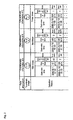
- FIG. 2 is a table for explaining the data structure of the data recorded by the face information recording section 12, wherein information relating to three persons A, B and C is recorded.
- the face information recording section 12 holds the information of the characteristic of the face, thumbnail image, and detection history for each face.
- the positional relationship of the characteristic points such as an organ of the face (nose, eyebrows, eyes, mouth, cheeks, etc.) or the periodicity and orientation of the variable density value in the vicinity of the characteristic point is used.
- the use of the information about the characteristic of the face makes it possible to specify a person from the face image.
- the detection history includes the date and time when each detection is made, the size of the detected face image, the number of persons included in the image, and the operation mode of the imaging device 2 when the detection is made, in addition to the accumulated number of times of the detection. Since not only the accumulated number of times of the detection but also the information relating to each detection are held as described above, the selection of a face based upon the detection history can be carried out considering a later-described degree of attention to the detected face.
- the face information recording section 12 also holds the thumbnail image of the detected face.
- the thumbnail image is displayed together with the detection history, whereby the user easily grasps that the displayed detection history is for which face. Therefore, the convenience for the user is enhanced.
- the face information updating section 13 updates the face information recording section 12 by using the detection history and the information about the characteristic of the face detected by the face detecting section 11.
- the face information updating section 13 newly registers this face to the face information recording section 12.
- the face selecting section 14 selects a face that is to be an object from the faces detected by the face detecting section 11.
- the face selecting section 14 extracts the information about the characteristic of the detected face, compares the information about the characteristic of the detected face and the information about the characteristic of the face recorded in the face information recording section 12 by using a face identification technique, and obtains the detection history of the detected face.
- the usable techniques for the face identification include a template matching method, subspace method, neutral network method, etc.
- the face selecting section 14 selects the face that is to be an object based upon the obtained detection history. In case where only one face is included in the image, the face selecting section 14 selects this face.
- FIG. 3 is a flowchart showing a process in the mode for selecting the face, which should be in focus by the object determining device 1, from the image captured by the imaging section 21.
- the imaging section 21 captures an image, and stores the image data to the frame memory.
- the face detecting section 11 receives the captured image data and detects the number and position (range) of the faces present in the image.
- the face selecting section 14 determines whether the face information and detection history are registered in the face information recording section 12 for each of the detected faces.
- step S104 When it is determined at step S104 that the detected face has already been registered in the face information recording section 12, the program proceeds to step S105.
- the face selecting section 14 obtains the detection history of the detected face.
- the face information updating section 13 updates the information of the characteristic of the face stored in the face information recording section 12 by using the information of the characteristic of the detected face.
- the identification precision is enhanced, so that the face can correctly be recognized even under various conditions such as an expression, a direction of a face, illumination, etc.
- the face information updating section 13 updates the detection history stored in the face information recording section 12 by using the information relating to this-time detection.
- step S104 When it is determined at step S104 that the detected face has not been registered in the face information recording section 12, the program proceeds to step S108 where the face selecting section 14 obtains the information of "no detection history" as the detection history.
- the face information updating section 13 newly registers the information of the characteristic of the face and detection history to the face information recording section 12. Therefore, the detection history can be utilized for this face at the next and following detections.
- the face selecting section 14 obtains the detection history for all the detected faces at step S105 or step S108 as described above. Then, at step S110, the face selecting section 14 selects the face having the highest detection frequency as the face that is to be an object.
- the detection frequency is obtained from the detection history.
- the number of times of the past detection can be obtained as it is as the detection frequency.
- the detection frequency considering the degree of attention to the face in the past detection (image-capture). is calculated.
- weighting is performed according to the degree of attention for each of the past detections, and the number of times of detection obtained by weighting is used as the detection frequency.
- the weighting is increased for the face whose detected date is the latest. This is because the degree of attention is considered to be high as the image-capture is of recent date. Moreover, the weighting is increased as the size of the face occupied in the image upon the detection is great. This is because the degree of attention is considered to be high as the close-up photo of the face is taken, and the degree of attention is considered to be low as the face is small in the captured image.
- the weighting is increased as the number of persons in the image is a few upon the detection. This is because the degree of attention of the face of the image-captured single person is considered to be high, and the degree of attention of each face of many image-captured faces in a group photo is considered to be low.
- the weighting may be performed in accordance with the operation mode upon the detection.
- the face detected in the mode (later-described second operation mode) in which a user manually determines the face that is to be in focus is the face that the user voluntarily selects, so that the degree of attention of this face is considered to be higher than that of the face selected by the object determining device.
- weightings are can be used in combination.
- the face selecting section 14 obtains the coordinate in the image of the selected face, and reports the same to the control section 22.
- the control section 22 performs a focusing control for bringing the subject present at the reported coordinate into focus.
- the imaging device 2 can determine the face, which should be in focus, based upon the detection history, even if there are plural faces in the image. Further, the detection history is updated every time a face is detected.
- the face identification precision is automatically enhanced as the repeated use.
- the faces stored in the face information recording section 12 as being different from each other are sometimes turned out to be the face of the same person.
- the face turning to the left and the face turning to the right of the same person happen to be determined as the faces of different persons and stored in the face information recording section 12 as being different from each other.
- the face identification can be precisely performed for the face in various directions. Therefore, the face turning to the right and the face turning to the left determined at the beginning to be the faces of different persons are turned out to be the faces of the same person.
- the object determining device 1 performs, at a predetermined timing, a process for confirming whether or not the faces of the same person are registered as being different from each other in the face information recording section 12.
- the information of the characteristic of the face and the detection history for the each face are collected and these faces are re-registered as a single face.
- the faces of the same person registered as being different from each other are re-registered as a single face as described above, with the result that the precision in the face identification is enhanced. Since the detection history is correctly stored, the precision in the selecting process based upon the detection history is also enhanced. It is to be noted that the process executed by the object determining device 1 for confirming whether or not the faces of the same person are registered as being different from each other is executed every time the face information updating section 13 updates the information of a characteristic of a face, or every time the face information updating section 13 updates predetermined number of times, or when the execution is issued by a user.
- the object determining device 1 may perform, at a predetermined timing, a process for confirming whether or not the faces of plural persons are registered as a single face in the face information recording section 12. In case where the faces of plural persons are registered as a single face, the information of a characteristic of a face and detection history for each face are separated, and these faces are re-registered as plural faces.
- the second operation mode is a mode in which the control section 22 brings the subject present at a predetermined position (e.g., the center of the screen) in the image into focus.
- a user once catches the subject, which the user intends to bring into focus, in a focusing area, decides the composition with the focus-lock state, and takes an image.
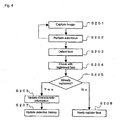
- FIG. 4 is a flowchart showing a process of the imaging device 2 and the object determining device 1 in the second operation mode.
- the imaging section 21 captures an image
- the control section 22 controls the imaging section 21 such that the subject in the focus area is in focus.
- the program proceeds to step S203 where a face is detected from the image (step S203), and then, it is determined whether the detected face is registered in the face information recording section 12 (steps S204 to S205).
- the object determining device 1 In the second operation mode, a user manually determines the subject that is to be in focus, so that the object determining device 1 is not required to determine the face that should be in focus. Therefore, the object determining device 1 does not obtain the detection history from the face information recording section 12. However, it updates the face information recording section 12. Specifically, in case where the detected face is registered in the face information recording section 12, the information about the characteristic of the face and the detection history are updated (steps S206, 207). In case where the detected face is not registered in the face information recording section 12, the detected face is newly registered in the face information recording section 12 (step S208).
- a user can manually determine the subject that is to be in focus and the object determining device 1 can accumulate the information about the characteristic of the face and the detection history. Specifically, even in case where the face information is not recorded in the face information recording section 12, the face information can be accumulated during the normal use as a digital camera. Accordingly, while a user uses the object determining device 1 as a normal digital camera, the user can utilize the face selecting function using the function of the object determining device 1 without doing beforehand a complicated registering operation for the face selection.
- the third operation mode is a mode in which the object determining device 1 selects the face, which is to be brought into focus, based upon the detection history, but it does not perform the registration and updating of the face information.
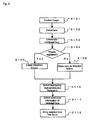
- FIG. 5 is a flowchart showing the operation of the imaging device 2 and the object determining device 1 in the third operation mode.
- the third operation mode is approximately the same as the first operation mode.
- the difference between the third operation mode and the first operation mode is that steps S106, S107, and S109 are omitted from the third operation mode.
- This operation mode can be selected for example, in the case where the imaging device 2 is used temporarily or in the case where the user considers that the face information recording section 12 is in an optimum state and it is unnecessary to update it.
- the following functions may be added to the imaging device 2 according to the first embodiment.
- One of the functions is to delete the unnecessary information of the face information stored in the face information recording section 12, which is a face information deleting function for securing the memory capacity.
- the object determining device 1 calculates, at a predetermined timing, the detection frequency of the face recorded in the face information recording section 12, and when the detection frequency is less than the predetermined frequency, it automatically deletes this face information.
- the detection frequency can be calculated by various methods as explained above. It is to be noted that the predetermined frequency may be a frequency given beforehand, or may dynamically be changed according to the free memory capacity.
- This face information deleting function may be performed at the timing when the user instructs its execution, or may be performed when the free memory capacity becomes small. Further, in order to prevent the face information, whose deletion is not desired by the user, from being automatically deleted, a function for inhibiting the deletion of the registered face given by a user may be added.
- Another function is a face information database selecting function in which the face information recording section 12 is constituted by plural databases and a user can select the database that is to be used by the user.
- the detection history different for every database is held, whereby even if the imaging device 2 is used by plural persons, the face selection according to the history of use of each person can be made. Even if a single person uses the imaging device 2, the face selection suitable for the purpose is made possible by switching the database for every purpose of the use.
- the second embodiment of the present invention is a monitor provided with the object determining device.
- FIG. 6 is a functional block diagram of a monitor 3.
- the monitor 3 has the object determining device 1, imaging section 21, notification section 24, and image recording section 23.
- the components same as those in the first embodiment are designated by the same numerals, and the description thereof will not be repeated.
- the monitor 3 records the moving image captured by the imaging section 21 to the image recording section 23, and when a predetermined person is captured, the notification section 24 gives a report.
- the monitor 3 according to this embodiment is, for example, installed to the place to which only a specific person makes a visit, and can be used for giving notification when a suspicious person comes to this place.
- the monitor 3 according to this embodiment is, for example, installed to the place where an unspecified number of persons make a visit, such as a store, and can be used for giving notification when a regular customer comes to this place.
- the notification section 24 gives notification to a user when the object determining device 1 selects a face. It attracts user's attention by light or sound, and reproduces the captured moving image.
- the object determining device 1 selects the face that is to be an object from the image captured by the imaging section 21 based upon the detection history. In case where there are plural faces present in the image, it may select two or more faces as an object to be processed. Further, in case where there is no face present that should be selected as the object to be processed even if there are faces in the image, it does not execute the face selection. Specifically, the object determining device 1 according to this embodiment selects the face as an object to be processed only when there is a face in the image whose detection frequency satisfies the predetermined condition.
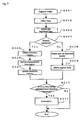
- FIG. 7 is a flowchart showing a flow of the process of the monitor 3.
- the imaging section 21 captures a moving image.
- a man's face is detected from the captured image. Since the image captured by the imaging section 21 is a moving image, the face detection is performed at predetermined time interval.
- step S303 to step S309 are the same as those in the first embodiment, so that these processes will be briefly explained. It is checked whether or not the detected face is registered in the face information recording section 12 (steps S303 to S304), the detection history is obtained (steps S305, S308), and updates (steps S306, S307) or newly registers (step S309) the face information.
- the face selecting section 14 obtains the detection frequency of the detected face, and determines at step S310 whether or not the face satisfying the predetermined detection frequency is present in the image. If the monitor 3 is used at a store for giving notification when a regular customer makes a visit, the face selecting section 14 determines whether the face having the detection frequency higher than the predetermined value is present or not. On the contrary, if the monitor 3 is used for sensing a suspicious person, the face selecting section 14 determines whether the face having the detection frequency lower than the predetermined value is present or not.
- the monitor 3 notifies a user of the situation in case where the face having the predetermined detection frequency is present in the image.
- the monitor 3 updates the detection history while monitoring, whereby it can make a suitable determination of notification based upon the detection history. For example, as for the monitor for a store that gives notification when a regular customer makes a visit, it does not give notification at the beginning since the detection history is not registered to the face information recording section 12, but the face information is accumulated as the detection of the face is increased, and hence, it can give notification when detecting a regular customer who makes a frequent visit.
- a registration and updating of face information are only performed at the beginning with the function for giving notification when a suspicious person is sensed turned off, whereby face information (characteristic information and detection history) of a specific person, not a suspicious person, is accumulated. Then, the notification function is turned on when face information is accumulated to some degree, whereby it functions as a monitor for sensing a suspicious person.
- the object determining device may be mounted to a digital video camera that captures a moving image wherein a face that is to be an object of a control such as focusing may be selected.
- the detection of the face may be performed during the recording of the moving image at a predetermined interval.
- the registration of the detection history of the face may be performed for example, only when the face tums generally to the front. This is because the face turning to the front is considered to be the face having the high degree of attention.
Landscapes
- Engineering & Computer Science (AREA)
- Multimedia (AREA)
- Theoretical Computer Science (AREA)
- Signal Processing (AREA)
- Human Computer Interaction (AREA)
- Physics & Mathematics (AREA)
- General Physics & Mathematics (AREA)
- General Health & Medical Sciences (AREA)
- Health & Medical Sciences (AREA)
- Oral & Maxillofacial Surgery (AREA)
- Image Processing (AREA)
- Studio Devices (AREA)
- Processing Or Creating Images (AREA)
- Image Analysis (AREA)
- Eye Examination Apparatus (AREA)
- Geophysics And Detection Of Objects (AREA)
Abstract
Description
- The present invention relates to a technique for determining a target face from a still image or moving image including plural faces.
- Conventionally, a face detecting technique is applied to an imaging device or the like and realizes a convenient function. When the face detecting technique is applied to a digital camera, for example, the camera can automatically focus the detected face. Therefore, a photograph in which the face of the subject is in focus can more simply be taken, compared to a technique for bringing the subject positioned at the center of the screen into focus.
- However, in case where plural faces are present in the image, a problem arises in which the face in the image that should be in focus cannot be specified.
- In order to solve this problem, a method has conventionally been known in which information relating to looks of the face that should be detected and the priority of this face are recorded, and the focusing is carried out by utilizing these factors (refer to,
Japanese Patent Application Laid-Open No. 2002-333652 - According to this method, even if plural faces are present in the image, the face that agrees with the face recorded beforehand as the face to be detected and that has the highest priority can be specified as the face that should be in focus.
- However, the conventional technique forces a user to do a complicated operation for registering beforehand the information relating to looks of the face to be detected and the priority of this face. If the user does not do this operation, the face to which attention should be given cannot consequently be specified.
- In general, herein is provided a technique for specifying a target face among plural faces in an image without a need for a user to do a complicated registration operation beforehand.
- A first aspect of the present invention is an object determining device that selects a face, which is an object of the process, among plural faces included in an image. The process here may be, for example, a focusing or exposure control in an imaging device, an image process such as color correction or outline enhancement in an image processing device, or any other processes.
- The first embodiment of the present invention has a face detecting unit, face information recording unit and face selecting unit.
- The face detecting unit detects a face from an inputted image. The face detecting unit may be realized by any existing face detecting techniques so long as they can detect plural faces in the image.
- The face information recording unit records the face previously detected by the face detecting unit and the detection history of this detection as associated with each other.
- The face selecting unit selects a target face for processing, from the faces included in the image based upon the detection history. For example, the face selecting unit obtains, for each face detected from the image, the detection history agreeing with the face from the face information recording unit, and may select the face that is to be an object based upon the obtained detection history. In case where the detected face is not registered to the face information recording unit, the detection history of being not detected (the number of times of the detection is zero) is used.
- The methods for selecting a face that is to be an object based upon the detection history include, as a simple example, a method for selecting a face based upon the number of times of the detection. As another method, there is a method in which weighting is carried out for each detection by utilizing the date of the detection, the size of the face, the number of faces in the image, etc., and a face that is to be processed is selected based upon the detection frequency obtained as a result of the weighting. In this method, it is considered that the weighting is increased in case where the face is recently detected, where the size of the face is great, where there are a few faces in the image, etc, in order to calculate the detection frequency.
- One or more embodiments of the invention may also include a face information updating unit that performs a new registration and updating to the face information recording unit.
- As described above, the face that is to be processed is selected and the new registration of the detected face and the updating of the detection history of the detected face can automatically be executed, whereby a user can use the function of the object determining device without doing a complicated registering operation.
- Another embodiment includes an imaging device provided with the object determining device according to the first embodiment of the present invention. The imaging device has an imaging unit and a control unit.
- The object determining device selects a target face to be processed, from the image captured by the imaging unit based upon the detection history as described above. Then, the control unit performs a control to the imaging device such as bringing the selected face into focus, adjusting an exposure through the control of a shutter speed or diaphragm, or changing an angle of view through the control of a zoom lens.
- The second embodiment may include a mode changing unit, allowing the user to select from multiple modes. For example a first mode in which the shooting condition is adjusted to the face selected by the face selecting unit or a second control mode where the user selects the face for which the shooting condition is adjusted.
- In yet another embodiment a monitor provided with the object determining device according to the first embodiment, wherein the monitor has an imaging unit and a notification unit.
- Another embodiment of the invention is an object determining method for determining a target face for processing, from plural faces included in an image.
- An information processing device includes a step of detecting faces from an image; and a step of selecting a target face for processing, from the detected faces on the basis of the face information database in which the past detected faces and the detection history relating to the detections are stored as associated with each other
- Another embodiment present invention is a program for determining a target face for processing, from plural faces included in an image. This program causes an information processing device to detect faces from an image and to select a target face for processing, from the detected faces on the basis of the face information database in which the past detected faces and the detection history relating to the detections are stored as associated with each other.
- In the drawings
- FIG. 1 shows a diagram of configurations of an imaging device and object determining device according to the first embodiment;
- FIG 2 shows a view of a data structure of face information according to an embodiment of the invention;
- FIG. 3 shows a flowchart illustrating a flow of a process of the imaging device according to an embodiment of the invention;
- FIG. 4 shows a flowchart illustrating a flow of a process of the imaging device according an embodiment of the invention;
- FIG. 5 shows a flowchart illustrating a flow of a process of the imaging device according to an embodiment of the invention;
- FIG. 6 shows a diagram of configurations of a monitor and object determining device according to an embodiment of the invention; and
- FIG. 7 shows a flowchart illustrating a flow of a process of the monitor according to an embodiment of the invention.
- Several embodiments of the present invention will illustratively be explained in detail hereinafter with reference to drawings.
- The first embodiment of the present invention is an imaging device provided with an object determining device. FIG. 1 is a functional block diagram of an
imaging device 2. Theimaging device 2 is constituted by anobject determining device 1, imaging section 21,control section 22, andimage recording section 23. - The
imaging device 2 records an image captured by the imaging section 21 into theimage recording section 23 as digital data. Specifically, theimaging device 2 according to this embodiment is a so-called digital camera. The digital camera includes, in addition to a digital still camera, a digital video camera including a still image capturing function, or a camera attached to (incorporated into) a cellular phone, PDA (Personal Digital Assistance), personal computer, or the like. - The function of each section will be explained below.
- The imaging section 21 is constituted by an imaging lens, image sensor, frame memory, mechanical unit, motor, etc.
- The imaging lens includes, for example, a zoom lens for realizing a zoom function, a focus lens for bringing an optional subject into focus, etc.
- The motor includes a zoom lens motor, focus motor, shutter motor, etc. A photoelectric conversion device such as CCD (Charge Coupled Device) or CMOS (Complementary Metal Oxide Semiconductor) is used as the image sensor.
- At the imaging section 21, the image formed through the imaging lens including the focus lens is converted into an electrical signal and stored in the frame memory as a digital image.
- The
control section 22 controls the imaging section 21, i.e., it performs to the imaging device a control for bringing a subject into focus, a control for adjusting an exposure through the control of a shutter speed or diaphragm, or a control for changing an angle of view through the control of the zoom lens. - The following explanation is made supposing that the
control section 22 performs the focusing control as its representative function. In case where the focusing is made, thecontrol section 22 uses, for example, a contrast system wherein the zoom lens at the imaging section 21 moves successively at a predetermined pitch and the focusing is made by obtaining the contrast of the captured image. - There are two methods about the object that is to be in focus, one is a method wherein the object that is to be in focus is a face selected by the later-described
object determining device 1, and the other is a method (auto-focusing) wherein the object that is to be in focus is a subject present in a predetermined area (focus area) in a screen. - These methods can be changed over by a user's selection of the function. It is to be noted that the so-called auto-focusing function is referred to as "manual" focusing method in this specification, since the user is required to catch the subject that is to be in focus in the focusing area, and the focusing method by the
object determining device 1 is referred to as "automatic" focusing method in this specification. - The
image recording section 23 is constituted by a non-volatile memory such as flash memory, FeRAM (Ferroelectric Random Access Memory), EPROM (Erasable Programmable Read Only Memory), or the like, or a magnetic disk such as a hard disk. - The
image recording section 23 may be constituted with the use of a recording medium detachable to theimaging device 2. Theimage recording section 23 records the image data captured by the imaging section 21 and stored in the frame memory. - The
object determining device 1 selects the face, which should be in focus, in the image captured by the imaging section 21. When the face that should be in focus is selected, theobject determining device 1 reports the position of this face in the image to thecontrol section 22. - The
control section 22 performs a control for bringing the face into focus. - The
object determining device 1 is constituted by aface detecting section 11, faceinformation recording section 12, faceinformation updating section 13, and face selecting section 14. Theobject determining device 1 realizes its function by the execution of the program stored in the memory. The function of each section of theobject determining device 1 will be explained below. - The
face detecting section 11 detects a human face in the inputted image and outputs the number and position of the detected face. In this embodiment, theface detecting section 11 detects a face according to a template matching based upon the parts of the face (eyes, nose, ears, etc.). - A face may be detected by utilizing any techniques so long as they are existing face detecting techniques such as a method for detecting the area having a skin color as the face area, a method for detecting the face area based upon the difference between light and shade, a method using a neutral network, etc.
- The face
information recording section 12 is constituted by a memory. It records the face detected by theface detecting section 11 with the history involved with the detection. FIG. 2 is a table for explaining the data structure of the data recorded by the faceinformation recording section 12, wherein information relating to three persons A, B and C is recorded. - The face
information recording section 12 holds the information of the characteristic of the face, thumbnail image, and detection history for each face. As the information about the characteristic of the face, the positional relationship of the characteristic points such as an organ of the face (nose, eyebrows, eyes, mouth, cheeks, etc.) or the periodicity and orientation of the variable density value in the vicinity of the characteristic point is used. - The use of the information about the characteristic of the face makes it possible to specify a person from the face image.
- The detection history includes the date and time when each detection is made, the size of the detected face image, the number of persons included in the image, and the operation mode of the
imaging device 2 when the detection is made, in addition to the accumulated number of times of the detection. Since not only the accumulated number of times of the detection but also the information relating to each detection are held as described above, the selection of a face based upon the detection history can be carried out considering a later-described degree of attention to the detected face. - The face
information recording section 12 also holds the thumbnail image of the detected face. When the user edits or deletes the recorded information, the thumbnail image is displayed together with the detection history, whereby the user easily grasps that the displayed detection history is for which face. Therefore, the convenience for the user is enhanced. - The face
information updating section 13 updates the faceinformation recording section 12 by using the detection history and the information about the characteristic of the face detected by theface detecting section 11. - In case where the detected face is not recorded in the face
information recording section 12, the faceinformation updating section 13 newly registers this face to the faceinformation recording section 12. - The face selecting section 14 selects a face that is to be an object from the faces detected by the
face detecting section 11. The face selecting section 14 extracts the information about the characteristic of the detected face, compares the information about the characteristic of the detected face and the information about the characteristic of the face recorded in the faceinformation recording section 12 by using a face identification technique, and obtains the detection history of the detected face. The usable techniques for the face identification include a template matching method, subspace method, neutral network method, etc. - The face selecting section 14 then selects the face that is to be an object based upon the obtained detection history. In case where only one face is included in the image, the face selecting section 14 selects this face.
- Now, a process executed by the
object determining device 1 and theimaging device 2 will be explained with reference to flowcharts shown in FIGS. 3 to 5. - FIG. 3 is a flowchart showing a process in the mode for selecting the face, which should be in focus by the
object determining device 1, from the image captured by the imaging section 21. - At step S101, the imaging section 21 captures an image, and stores the image data to the frame memory. At step S102, the
face detecting section 11 receives the captured image data and detects the number and position (range) of the faces present in the image. - At step S103, the face selecting section 14 determines whether the face information and detection history are registered in the face
information recording section 12 for each of the detected faces. - In this case, it determines whether the detected face has already been registered or not by using the face identification technique as described above.
- When it is determined at step S104 that the detected face has already been registered in the face
information recording section 12, the program proceeds to step S105. - At step S105, the face selecting section 14 obtains the detection history of the detected face. At step S106, the face
information updating section 13 updates the information of the characteristic of the face stored in the faceinformation recording section 12 by using the information of the characteristic of the detected face. - As the information of the characteristic of the face increases, the identification precision is enhanced, so that the face can correctly be recognized even under various conditions such as an expression, a direction of a face, illumination, etc.
- At step S107, the face
information updating section 13 updates the detection history stored in the faceinformation recording section 12 by using the information relating to this-time detection. - When it is determined at step S104 that the detected face has not been registered in the face
information recording section 12, the program proceeds to step S108 where the face selecting section 14 obtains the information of "no detection history" as the detection history. - Then, at step S109, the face
information updating section 13 newly registers the information of the characteristic of the face and detection history to the faceinformation recording section 12. Therefore, the detection history can be utilized for this face at the next and following detections. - The face selecting section 14 obtains the detection history for all the detected faces at step S105 or step S108 as described above. Then, at step S110, the face selecting section 14 selects the face having the highest detection frequency as the face that is to be an object.
- Notably, various methods can be employed for obtaining the detection frequency from the detection history. For example, the number of times of the past detection can be obtained as it is as the detection frequency. Further, in one or more embodiments the detection frequency considering the degree of attention to the face in the past detection (image-capture). is calculated.
- Specifically, weighting is performed according to the degree of attention for each of the past detections, and the number of times of detection obtained by weighting is used as the detection frequency.
- For example, the weighting is increased for the face whose detected date is the latest. This is because the degree of attention is considered to be high as the image-capture is of recent date. Moreover, the weighting is increased as the size of the face occupied in the image upon the detection is great. This is because the degree of attention is considered to be high as the close-up photo of the face is taken, and the degree of attention is considered to be low as the face is small in the captured image.
- Further, the weighting is increased as the number of persons in the image is a few upon the detection. This is because the degree of attention of the face of the image-captured single person is considered to be high, and the degree of attention of each face of many image-captured faces in a group photo is considered to be low.
- The weighting may be performed in accordance with the operation mode upon the detection. The face detected in the mode (later-described second operation mode) in which a user manually determines the face that is to be in focus is the face that the user voluntarily selects, so that the degree of attention of this face is considered to be higher than that of the face selected by the object determining device.
- It is to be noted that these weightings are can be used in combination.
- At step S111, the face selecting section 14 obtains the coordinate in the image of the selected face, and reports the same to the
control section 22. At step S112, thecontrol section 22 performs a focusing control for bringing the subject present at the reported coordinate into focus. - As described above, the
imaging device 2 can determine the face, which should be in focus, based upon the detection history, even if there are plural faces in the image. Further, the detection history is updated every time a face is detected. - Therefore, a user can select the face, which should be in focus, without manually doing a complicated registering operation. Moreover, the information of a characteristic of a face is updated for every detection, whereby the face identification precision is automatically enhanced as the repeated use.
- When the information of the characteristic of a face is updated at step S106, the faces stored in the face
information recording section 12 as being different from each other are sometimes turned out to be the face of the same person. For example, the face turning to the left and the face turning to the right of the same person happen to be determined as the faces of different persons and stored in the faceinformation recording section 12 as being different from each other. - In this case, as the information of the characteristic of the face of this person increases, the face identification can be precisely performed for the face in various directions. Therefore, the face turning to the right and the face turning to the left determined at the beginning to be the faces of different persons are turned out to be the faces of the same person.
- It is inconvenient that the faces of the same person are registered in the face
information recording section 12 as being different from each other. Therefore, theobject determining device 1 performs, at a predetermined timing, a process for confirming whether or not the faces of the same person are registered as being different from each other in the faceinformation recording section 12. - In case where the faces of the same person are registered as being different from each other, the information of the characteristic of the face and the detection history for the each face are collected and these faces are re-registered as a single face.
- The faces of the same person registered as being different from each other are re-registered as a single face as described above, with the result that the precision in the face identification is enhanced. Since the detection history is correctly stored, the precision in the selecting process based upon the detection history is also enhanced. It is to be noted that the process executed by the
object determining device 1 for confirming whether or not the faces of the same person are registered as being different from each other is executed every time the faceinformation updating section 13 updates the information of a characteristic of a face, or every time the faceinformation updating section 13 updates predetermined number of times, or when the execution is issued by a user. - Further, the
object determining device 1 may perform, at a predetermined timing, a process for confirming whether or not the faces of plural persons are registered as a single face in the faceinformation recording section 12. In case where the faces of plural persons are registered as a single face, the information of a characteristic of a face and detection history for each face are separated, and these faces are re-registered as plural faces. - The second operation mode is a mode in which the
control section 22 brings the subject present at a predetermined position (e.g., the center of the screen) in the image into focus. In the second operation mode, a user once catches the subject, which the user intends to bring into focus, in a focusing area, decides the composition with the focus-lock state, and takes an image. - FIG. 4 is a flowchart showing a process of the
imaging device 2 and theobject determining device 1 in the second operation mode. - At step S201, the imaging section 21 captures an image, and at step S202, the
control section 22 controls the imaging section 21 such that the subject in the focus area is in focus. When the subject in the focus area is in focus, the program proceeds to step S203 where a face is detected from the image (step S203), and then, it is determined whether the detected face is registered in the face information recording section 12 (steps S204 to S205). - In the second operation mode, a user manually determines the subject that is to be in focus, so that the
object determining device 1 is not required to determine the face that should be in focus. Therefore, theobject determining device 1 does not obtain the detection history from the faceinformation recording section 12. However, it updates the faceinformation recording section 12. Specifically, in case where the detected face is registered in the faceinformation recording section 12, the information about the characteristic of the face and the detection history are updated (steps S206, 207). In case where the detected face is not registered in the faceinformation recording section 12, the detected face is newly registered in the face information recording section 12 (step S208). - As described above, a user can manually determine the subject that is to be in focus and the
object determining device 1 can accumulate the information about the characteristic of the face and the detection history. Specifically, even in case where the face information is not recorded in the faceinformation recording section 12, the face information can be accumulated during the normal use as a digital camera. Accordingly, while a user uses theobject determining device 1 as a normal digital camera, the user can utilize the face selecting function using the function of theobject determining device 1 without doing beforehand a complicated registering operation for the face selection. - The third operation mode is a mode in which the
object determining device 1 selects the face, which is to be brought into focus, based upon the detection history, but it does not perform the registration and updating of the face information. FIG. 5 is a flowchart showing the operation of theimaging device 2 and theobject determining device 1 in the third operation mode. - The third operation mode is approximately the same as the first operation mode. The difference between the third operation mode and the first operation mode is that steps S106, S107, and S109 are omitted from the third operation mode. This operation mode can be selected for example, in the case where the
imaging device 2 is used temporarily or in the case where the user considers that the faceinformation recording section 12 is in an optimum state and it is unnecessary to update it. - The following functions may be added to the
imaging device 2 according to the first embodiment. - One of the functions is to delete the unnecessary information of the face information stored in the face
information recording section 12, which is a face information deleting function for securing the memory capacity. Theobject determining device 1 calculates, at a predetermined timing, the detection frequency of the face recorded in the faceinformation recording section 12, and when the detection frequency is less than the predetermined frequency, it automatically deletes this face information. The detection frequency can be calculated by various methods as explained above. It is to be noted that the predetermined frequency may be a frequency given beforehand, or may dynamically be changed according to the free memory capacity. - This face information deleting function may be performed at the timing when the user instructs its execution, or may be performed when the free memory capacity becomes small. Further, in order to prevent the face information, whose deletion is not desired by the user, from being automatically deleted, a function for inhibiting the deletion of the registered face given by a user may be added.
- Another function is a face information database selecting function in which the face
information recording section 12 is constituted by plural databases and a user can select the database that is to be used by the user. The detection history different for every database is held, whereby even if theimaging device 2 is used by plural persons, the face selection according to the history of use of each person can be made. Even if a single person uses theimaging device 2, the face selection suitable for the purpose is made possible by switching the database for every purpose of the use. - The second embodiment of the present invention is a monitor provided with the object determining device. FIG. 6 is a functional block diagram of a
monitor 3. Themonitor 3 has theobject determining device 1, imaging section 21, notification section 24, andimage recording section 23. The components same as those in the first embodiment are designated by the same numerals, and the description thereof will not be repeated. - The
monitor 3 records the moving image captured by the imaging section 21 to theimage recording section 23, and when a predetermined person is captured, the notification section 24 gives a report. Themonitor 3 according to this embodiment is, for example, installed to the place to which only a specific person makes a visit, and can be used for giving notification when a suspicious person comes to this place. Altemately, themonitor 3 according to this embodiment is, for example, installed to the place where an unspecified number of persons make a visit, such as a store, and can be used for giving notification when a regular customer comes to this place. - The notification section 24 gives notification to a user when the
object determining device 1 selects a face. It attracts user's attention by light or sound, and reproduces the captured moving image. - The
object determining device 1 selects the face that is to be an object from the image captured by the imaging section 21 based upon the detection history. In case where there are plural faces present in the image, it may select two or more faces as an object to be processed. Further, in case where there is no face present that should be selected as the object to be processed even if there are faces in the image, it does not execute the face selection. Specifically, theobject determining device 1 according to this embodiment selects the face as an object to be processed only when there is a face in the image whose detection frequency satisfies the predetermined condition. - FIG. 7 is a flowchart showing a flow of the process of the
monitor 3. At step S301, the imaging section 21 captures a moving image. At step S302, a man's face is detected from the captured image. Since the image captured by the imaging section 21 is a moving image, the face detection is performed at predetermined time interval. - The processes from step S303 to step S309 are the same as those in the first embodiment, so that these processes will be briefly explained. It is checked whether or not the detected face is registered in the face information recording section 12 (steps S303 to S304), the detection history is obtained (steps S305, S308), and updates (steps S306, S307) or newly registers (step S309) the face information.
- As described above, the face selecting section 14 obtains the detection frequency of the detected face, and determines at step S310 whether or not the face satisfying the predetermined detection frequency is present in the image. If the
monitor 3 is used at a store for giving notification when a regular customer makes a visit, the face selecting section 14 determines whether the face having the detection frequency higher than the predetermined value is present or not. On the contrary, if themonitor 3 is used for sensing a suspicious person, the face selecting section 14 determines whether the face having the detection frequency lower than the predetermined value is present or not. - At step S311, the
monitor 3 notifies a user of the situation in case where the face having the predetermined detection frequency is present in the image. - As described above, the
monitor 3 updates the detection history while monitoring, whereby it can make a suitable determination of notification based upon the detection history. For example, as for the monitor for a store that gives notification when a regular customer makes a visit, it does not give notification at the beginning since the detection history is not registered to the faceinformation recording section 12, but the face information is accumulated as the detection of the face is increased, and hence, it can give notification when detecting a regular customer who makes a frequent visit. - As for a monitor for sensing a suspicious person, a registration and updating of face information are only performed at the beginning with the function for giving notification when a suspicious person is sensed turned off, whereby face information (characteristic information and detection history) of a specific person, not a suspicious person, is accumulated. Then, the notification function is turned on when face information is accumulated to some degree, whereby it functions as a monitor for sensing a suspicious person.
- As described above, even if a user does not register beforehand the information of the face that should be detected, a suitable detection can be made possible with a repeated use of a monitor.
- Although the first embodiment illustrates the case where the object determining device is mounted to a digital camera for selecting the face that should be brought into focus, the object determining device may be mounted to a digital video camera that captures a moving image wherein a face that is to be an object of a control such as focusing may be selected. In this case, the detection of the face may be performed during the recording of the moving image at a predetermined interval. Further, the registration of the detection history of the face may be performed for example, only when the face tums generally to the front. This is because the face turning to the front is considered to be the face having the high degree of attention.
Claims (14)
- An object determining device (1) for selecting a target face for processing from plural faces included in an image, characterized by comprising:face detecting means (11) that detects faces from an image;face information recording means (12) that records the face detected in the past by said face detecting means (11) and the detection history relating to this detection as associated with each other; andface selecting means (14) that selects a target face for processing from the faces included in said image based upon said detection history.
- An object determining device (1) according to claim 1, characterized by comprising:face information updating means (13) that, in case where the face detected by said face detecting means (11) is not present in said face information recording means (12), newly registers said detected face to said face information recording means (12), and in case where said detected face is present in said face information recording means (12), updates the detection history of this face recorded to said face information recording means (12).
- An object determining device (1) according to claim 2, characterized in that:said face information recording means (12) records the characteristic information obtained from the image of the face detected by said face detecting means (11); andsaid face information updating means (13) updates the detection history of the face recorded to said face information recording means (12), and further updates the characteristic information of this face, in case where the face detected by said face detecting means (11) is present in said face information recording means (12).
- An object determining device according to claim 3, characterized by comprising:face information re-registering means that checks whether plural faces recorded to said face information recording means (12) are the faces of a same person, and when it is determined that they are the faces of the same person, re-registers said plural faces to said face information recording means (12) as a single face.
- An object determining device according to claim 3, characterized by comprising:face information re-registering means that checks whether the same faces recorded to said face information recording means (12) are the faces of plural persons, and when it is determined that they are the faces of the plural persons, re-registers said same faces to said face information recording means (12) as plural faces.
- An object determining device according to claim 1, characterized by comprising:face information deleting means that calculates, for the face recorded to said face information recording means (12), the detection frequency based upon the detection history of this face, and when the detection frequency is lower than a predetermined frequency, deletes this face from said face information recording means (12).
- An object determining device(1) according to claim 1, characterized in that:said face information recording means (12) records the face detected by said face detecting means (11) together with the image of the face.
- An object determining device (1) according to claim 1, characterized in that:said face information recording means (12) includes plural databases, andthe object determining device (1) comprises face information database selecting means that causes a user to select a database to be used.
- An imaging device (2) provided with the object determining device (1) according to claim 1 characterized by comprising:imaging means (21); andcontrol means (22) that controls a shooting condition of said imaging device (2) to the face selected by said object determining device (1) from the image captured by said imaging means (21).
- An imaging device (2) according to claim 9, characterized in that:said face selecting means (14) calculates the detection frequency from the detection history of the detected face, and selects the face having the highest detection frequency as a face that is to be an object to be processed.
- An imaging device (2) according to claim 9, characterized by further comprising:control mode changing means that can change a first control mode in which the shooting condition is adjusted to the face selected by said face selecting means (14) and a second control mode in which a user determines the face to which the shooting condition is adjusted, whereinduring the use of said second operation mode, in case where the face determined by the user as the face to which the shooting condition is adjusted is not present in said face information recording means (12), this face is newly registered to said face information recording means (12), and in case where this face is present in said face information recording means (12), the detection history of the face recorded to said face information recording means (12) is updated.
- A monitor (3) provided with an object determining device (1) according to claim 1, characterized by comprising:imaging means (21); andnotification means (24) that gives notification to a user when said object determining device (1) determines a target face to be processed from the image captured by said imaging means (21).
- An object determining method for selecting a target face for processing from plural faces included in an image, characterized in that:an information processing device comprises:a step of detecting faces from the image; anda step of selecting a target face for processing from the detected faces based upon a face information database in which the face detected in the past and the detection history relating to this detection are recorded as associated with each other.
- A program for selecting a target face for processing from plural faces included in an image, characterized in that:this program causes an information processing device todetect faces from the image; andselect a target face for processing from the detected faces based upon a face information database in which the face detected in the past and the detection history relating to this detection are recorded as associated with each other.
Applications Claiming Priority (1)
| Application Number | Priority Date | Filing Date | Title |
|---|---|---|---|
| JP2005182405A JP4577113B2 (en) | 2005-06-22 | 2005-06-22 | Object determining device, imaging device, and monitoring device |
Publications (2)
| Publication Number | Publication Date |
|---|---|
| EP1737216A1 true EP1737216A1 (en) | 2006-12-27 |
| EP1737216B1 EP1737216B1 (en) | 2009-05-20 |
Family
ID=37026008
Family Applications (1)
| Application Number | Title | Priority Date | Filing Date |
|---|---|---|---|
| EP06253195A Not-in-force EP1737216B1 (en) | 2005-06-22 | 2006-06-21 | Object determination device, imaging device and monitor |
Country Status (6)
| Country | Link |
|---|---|
| US (1) | US7889891B2 (en) |
| EP (1) | EP1737216B1 (en) |
| JP (1) | JP4577113B2 (en) |
| CN (1) | CN100563304C (en) |
| AT (1) | ATE431993T1 (en) |
| DE (1) | DE602006006883D1 (en) |
Cited By (13)
| Publication number | Priority date | Publication date | Assignee | Title |
|---|---|---|---|---|
| EP1912432A1 (en) * | 2006-10-12 | 2008-04-16 | Nikon Corporation | Digital camera |
| WO2009094109A1 (en) * | 2008-01-21 | 2009-07-30 | Eastman Kodak Company | Enabling persistent recognition of individuals in images |
| EP2104058A1 (en) * | 2008-03-14 | 2009-09-23 | Omron Corporation | Priority target determining device, electronic equipment, priority target determining method, program, and recording medium |
| EP2187624A1 (en) * | 2008-11-18 | 2010-05-19 | Fujinon Corporation | Autofocus system |
| EP2187623A1 (en) * | 2008-11-14 | 2010-05-19 | Fujinon Corporation | Autofocus system |
| EP2187625A1 (en) * | 2008-11-12 | 2010-05-19 | Fujinon Corporation | Autofocus system |
| WO2011039184A3 (en) * | 2009-10-02 | 2011-06-16 | Fraunhofer-Gesellschaft zur Förderung der angewandten Forschung e.V. | Method and device for managing object view data in an object database |
| CN102498712A (en) * | 2009-07-29 | 2012-06-13 | 索尼公司 | Control device, image-capturing system, control method, and program |
| US8339448B2 (en) | 2009-01-26 | 2012-12-25 | Panasonic Corporation | Imaging apparatus |
| CN103905717A (en) * | 2012-12-27 | 2014-07-02 | 联想(北京)有限公司 | Switching method and device and electronic device |
| WO2016045086A1 (en) | 2014-09-26 | 2016-03-31 | SZ DJI Technology Co., Ltd. | System and method for automatic focusing based on statistic data |
| WO2019022828A1 (en) * | 2017-07-28 | 2019-01-31 | Qualcomm Incorporated | Detecting prevalent faces in real-time media |
| EP3893490A4 (en) * | 2019-01-03 | 2022-05-25 | Huawei Technologies Co., Ltd. | Photographing method and electronic device |
Families Citing this family (41)
| Publication number | Priority date | Publication date | Assignee | Title |
|---|---|---|---|---|
| EP1962497B1 (en) | 2005-11-25 | 2013-01-16 | Nikon Corporation | Electronic camera and image processing device |
| JP5124994B2 (en) * | 2006-06-06 | 2013-01-23 | 株式会社ニコン | Image reproduction system, digital camera, and image reproduction apparatus |
| JP4819001B2 (en) * | 2006-07-25 | 2011-11-16 | 富士フイルム株式会社 | Imaging apparatus and method, program, image processing apparatus and method, and program |
| US9596401B2 (en) * | 2006-10-02 | 2017-03-14 | Sony Corporation | Focusing an image based on a direction of a face of a user |
| KR101310230B1 (en) * | 2007-01-17 | 2013-09-24 | 삼성전자주식회사 | Digital photographing apparatus, method for controlling the same, and recording medium storing program to implement the method |
| JP4899982B2 (en) * | 2007-03-28 | 2012-03-21 | カシオ計算機株式会社 | Imaging apparatus, captured image recording method, and program |
| JP5043100B2 (en) * | 2007-04-23 | 2012-10-10 | シャープ株式会社 | IMAGING DEVICE AND COMPUTER-READABLE RECORDING MEDIUM RECORDING CONTROL PROGRAM |
| JP4952920B2 (en) * | 2007-06-04 | 2012-06-13 | カシオ計算機株式会社 | Subject determination apparatus, subject determination method and program thereof |
| JP2009010777A (en) * | 2007-06-28 | 2009-01-15 | Sony Corp | Imaging apparatus, imaging control method, program |
| JP2009017038A (en) * | 2007-07-02 | 2009-01-22 | Fujifilm Corp | Digital camera |
| JP2009027393A (en) * | 2007-07-19 | 2009-02-05 | Hitachi Ltd | Video search system and person search method |
| WO2009016833A1 (en) * | 2007-07-31 | 2009-02-05 | Panasonic Corporation | Video analysis apparatus and method for calculating inter-person evaluation value using video analysis |
| JP5099488B2 (en) * | 2007-08-31 | 2012-12-19 | カシオ計算機株式会社 | Imaging apparatus, face recognition method and program thereof |
| JP5137622B2 (en) * | 2008-03-03 | 2013-02-06 | キヤノン株式会社 | Imaging apparatus and control method thereof, image processing apparatus and control method thereof |
| JP5043736B2 (en) * | 2008-03-28 | 2012-10-10 | キヤノン株式会社 | Imaging apparatus and control method thereof |
| CN101588450B (en) | 2008-05-19 | 2013-08-14 | 株式会社日立制作所 | Recording and reproducing device and method |
| JP2009284270A (en) * | 2008-05-22 | 2009-12-03 | Sony Corp | Image processing apparatus, imaging device, image processing method, and program |
| KR101542436B1 (en) * | 2008-07-29 | 2015-08-06 | 후지필름 가부시키가이샤 | Imaging apparatus and imaging method |
| JP5452055B2 (en) * | 2009-03-31 | 2014-03-26 | 株式会社バンダイナムコゲームス | Network system, server, program, and information storage medium |
| JP2010251866A (en) * | 2009-04-10 | 2010-11-04 | Canon Inc | Image processing apparatus, control method therefor, and computer program |
| JP5404172B2 (en) * | 2009-05-12 | 2014-01-29 | キヤノン株式会社 | Image processing apparatus, control method thereof, and program |
| JP5733934B2 (en) * | 2009-11-04 | 2015-06-10 | キヤノン株式会社 | Image distribution apparatus and image distribution method |
| KR20110056099A (en) * | 2009-11-20 | 2011-05-26 | 삼성전자주식회사 | Digital recording device, its control method and recording medium storing program for executing same |
| CN102111535B (en) * | 2009-12-23 | 2012-11-21 | 华晶科技股份有限公司 | Method for improving human face identification rate |
| JP2011152328A (en) * | 2010-01-28 | 2011-08-11 | Ims:Kk | Photograph seal putting-out device |
| JP5616819B2 (en) * | 2010-03-10 | 2014-10-29 | 富士フイルム株式会社 | Shooting assist method, program thereof, recording medium thereof, shooting apparatus and shooting system |
| KR101794350B1 (en) * | 2011-02-08 | 2017-12-04 | 삼성전자주식회사 | Method for capturing picture in a portable terminal |
| JP5921236B2 (en) * | 2012-02-09 | 2016-05-24 | キヤノン株式会社 | Image processing apparatus and method, photographing apparatus |
| JP5895624B2 (en) * | 2012-03-14 | 2016-03-30 | オムロン株式会社 | Image processing apparatus, image processing method, control program, and recording medium |
| JP5990951B2 (en) * | 2012-03-15 | 2016-09-14 | オムロン株式会社 | Imaging apparatus, imaging apparatus control method, imaging apparatus control program, and computer-readable recording medium recording the program |
| JP5971712B2 (en) * | 2012-09-20 | 2016-08-17 | 株式会社東芝 | Monitoring device and method |
| JP6098318B2 (en) * | 2013-04-15 | 2017-03-22 | オムロン株式会社 | Image processing apparatus, image processing method, image processing program, and recording medium |
| JP6295534B2 (en) * | 2013-07-29 | 2018-03-20 | オムロン株式会社 | Programmable display, control method, and program |
| JP6701512B2 (en) * | 2013-09-24 | 2020-05-27 | ソニー株式会社 | Imaging device, imaging method, and program |
| CN105704360A (en) * | 2014-11-25 | 2016-06-22 | 索尼公司 | Auxiliary automatic focusing method, device and electronic device |
| CN106713734B (en) * | 2015-11-17 | 2020-02-21 | 华为技术有限公司 | Autofocus method and device |
| CN108292417A (en) * | 2016-03-09 | 2018-07-17 | 麦克赛尔株式会社 | Portable information terminal and information processing method used therefor |
| CN108805111A (en) * | 2018-09-07 | 2018-11-13 | 杭州善贾科技有限公司 | A kind of detection of passenger flow system and its detection method based on recognition of face |
| CN109474785A (en) * | 2018-11-27 | 2019-03-15 | 三星电子(中国)研发中心 | Electronic device and focus tracking photographing method of electronic device |
| JP2022503373A (en) * | 2019-09-29 | 2022-01-12 | 北京市商▲湯▼科技▲開▼▲發▼有限公司 | Data processing methods, devices and storage media |
| JP7614819B2 (en) * | 2020-12-14 | 2025-01-16 | キヤノン株式会社 | Information processing device, image processing method, and program |
Citations (4)
| Publication number | Priority date | Publication date | Assignee | Title |
|---|---|---|---|---|
| US20020113862A1 (en) * | 2000-11-10 | 2002-08-22 | Center Julian L. | Videoconferencing method with tracking of face and dynamic bandwidth allocation |
| US20030071908A1 (en) | 2001-09-18 | 2003-04-17 | Masato Sannoh | Image pickup device, automatic focusing method, automatic exposure method, electronic flash control method and computer program |
| EP1471455A2 (en) | 2003-04-15 | 2004-10-27 | Nikon Corporation | Digital camera |
| JP2005227957A (en) * | 2004-02-12 | 2005-08-25 | Mitsubishi Electric Corp | Optimal face image recording apparatus and optimal face image recording method |
Family Cites Families (7)
| Publication number | Priority date | Publication date | Assignee | Title |
|---|---|---|---|---|
| JP4296451B2 (en) * | 1998-06-22 | 2009-07-15 | 株式会社日立製作所 | Image recording device |
| JP2002333652A (en) | 2001-05-10 | 2002-11-22 | Oki Electric Ind Co Ltd | Imaging device and playback device |
| JP2003323619A (en) * | 2002-04-30 | 2003-11-14 | Nippon Signal Co Ltd:The | Reception assistance system |
| JP4314016B2 (en) * | 2002-11-01 | 2009-08-12 | 株式会社東芝 | Person recognition device and traffic control device |
| JP2004302644A (en) * | 2003-03-28 | 2004-10-28 | Sony Corp | Face identification device, face identification method, recording medium, and robot device |
| JP2004320286A (en) * | 2003-04-15 | 2004-11-11 | Nikon Gijutsu Kobo:Kk | Digital camera |
| TW200539046A (en) | 2004-02-02 | 2005-12-01 | Koninkl Philips Electronics Nv | Continuous face recognition with online learning |
-
2005
- 2005-06-22 JP JP2005182405A patent/JP4577113B2/en not_active Expired - Fee Related
-
2006
- 2006-06-21 EP EP06253195A patent/EP1737216B1/en not_active Not-in-force
- 2006-06-21 AT AT06253195T patent/ATE431993T1/en not_active IP Right Cessation
- 2006-06-21 DE DE602006006883T patent/DE602006006883D1/en active Active
- 2006-06-21 US US11/471,575 patent/US7889891B2/en active Active
- 2006-06-22 CN CNB200610093123XA patent/CN100563304C/en not_active Expired - Fee Related
Patent Citations (4)
| Publication number | Priority date | Publication date | Assignee | Title |
|---|---|---|---|---|
| US20020113862A1 (en) * | 2000-11-10 | 2002-08-22 | Center Julian L. | Videoconferencing method with tracking of face and dynamic bandwidth allocation |
| US20030071908A1 (en) | 2001-09-18 | 2003-04-17 | Masato Sannoh | Image pickup device, automatic focusing method, automatic exposure method, electronic flash control method and computer program |
| EP1471455A2 (en) | 2003-04-15 | 2004-10-27 | Nikon Corporation | Digital camera |
| JP2005227957A (en) * | 2004-02-12 | 2005-08-25 | Mitsubishi Electric Corp | Optimal face image recording apparatus and optimal face image recording method |
Non-Patent Citations (2)
| Title |
|---|
| LONGBIN CHEN ET AL: "Face annotation for family photo management", INTERNATIONAL JOURNAL OF IMAGE AND GRAPHICS, WORLD SCIENTIFIC PUBLISHING CO., SINGAPORE, SG, vol. 3, no. 1, 30 December 2002 (2002-12-30), pages 81 - 94, XP002361519, ISSN: 0219-4678 * |
| PATENT ABSTRACTS OF JAPAN vol. 2003, no. 12 5 December 2003 (2003-12-05) * |
Cited By (23)
| Publication number | Priority date | Publication date | Assignee | Title |
|---|---|---|---|---|
| EP1912432A1 (en) * | 2006-10-12 | 2008-04-16 | Nikon Corporation | Digital camera |
| US8379103B2 (en) | 2006-10-12 | 2013-02-19 | Nikon Corporation | Digital camera that uses object detection information at the time of shooting for processing image data after acquisition of an image |
| US7973824B2 (en) | 2006-10-12 | 2011-07-05 | Nikon Corporation | Digital camera that uses object detection information at the time of shooting for processing image data after acquisition of an image |
| WO2009094109A1 (en) * | 2008-01-21 | 2009-07-30 | Eastman Kodak Company | Enabling persistent recognition of individuals in images |
| US8180112B2 (en) | 2008-01-21 | 2012-05-15 | Eastman Kodak Company | Enabling persistent recognition of individuals in images |
| EP2104058A1 (en) * | 2008-03-14 | 2009-09-23 | Omron Corporation | Priority target determining device, electronic equipment, priority target determining method, program, and recording medium |
| EP2187625A1 (en) * | 2008-11-12 | 2010-05-19 | Fujinon Corporation | Autofocus system |
| EP2187623A1 (en) * | 2008-11-14 | 2010-05-19 | Fujinon Corporation | Autofocus system |
| EP2187624A1 (en) * | 2008-11-18 | 2010-05-19 | Fujinon Corporation | Autofocus system |
| US8339448B2 (en) | 2009-01-26 | 2012-12-25 | Panasonic Corporation | Imaging apparatus |
| US9197818B2 (en) | 2009-01-26 | 2015-11-24 | Panasonic Intellectual Property Corporation Of America | Imaging apparatus |
| CN102498712A (en) * | 2009-07-29 | 2012-06-13 | 索尼公司 | Control device, image-capturing system, control method, and program |
| EP2461570A4 (en) * | 2009-07-29 | 2013-12-18 | Sony Corp | CONTROL DEVICE, IMAGE CAPTURE SYSTEM, CONTROL METHOD, AND PROGRAM |
| WO2011039184A3 (en) * | 2009-10-02 | 2011-06-16 | Fraunhofer-Gesellschaft zur Förderung der angewandten Forschung e.V. | Method and device for managing object view data in an object database |
| CN103905717A (en) * | 2012-12-27 | 2014-07-02 | 联想(北京)有限公司 | Switching method and device and electronic device |
| CN103905717B (en) * | 2012-12-27 | 2018-07-06 | 联想(北京)有限公司 | A kind of switching method, device and electronic equipment |
| EP3061237A4 (en) * | 2014-09-26 | 2016-11-02 | Sz Dji Technology Co Ltd | SYSTEM AND METHOD FOR AUTOMATIC FOCUSING BASED ON STATISTICAL DATA |
| US9509898B2 (en) | 2014-09-26 | 2016-11-29 | SZ DJI Technology Co., Ltd. | System and method for automatic focusing based on statistical data |
| WO2016045086A1 (en) | 2014-09-26 | 2016-03-31 | SZ DJI Technology Co., Ltd. | System and method for automatic focusing based on statistic data |
| WO2019022828A1 (en) * | 2017-07-28 | 2019-01-31 | Qualcomm Incorporated | Detecting prevalent faces in real-time media |
| US10706265B2 (en) | 2017-07-28 | 2020-07-07 | Qualcomm Incorporated | Scanning a real-time media stream to detect one or more faces that are prevalent among a set of media files stored on a user equipment |
| EP3893490A4 (en) * | 2019-01-03 | 2022-05-25 | Huawei Technologies Co., Ltd. | Photographing method and electronic device |
| AU2019418925B2 (en) * | 2019-01-03 | 2023-06-29 | Huawei Technologies Co., Ltd. | Photographing method and electronic device |
Also Published As
| Publication number | Publication date |
|---|---|
| ATE431993T1 (en) | 2009-06-15 |
| JP4577113B2 (en) | 2010-11-10 |
| CN100563304C (en) | 2009-11-25 |
| JP2007006033A (en) | 2007-01-11 |
| DE602006006883D1 (en) | 2009-07-02 |
| US20070171296A1 (en) | 2007-07-26 |
| CN1885911A (en) | 2006-12-27 |
| EP1737216B1 (en) | 2009-05-20 |
| US7889891B2 (en) | 2011-02-15 |
Similar Documents
| Publication | Publication Date | Title |
|---|---|---|
| US7889891B2 (en) | Object determining device, imaging device and monitor | |
| JP5056061B2 (en) | Imaging device | |
| US7672580B2 (en) | Imaging apparatus and method for controlling display device | |
| US8823861B2 (en) | Imaging apparatus, image display apparatus, imaging method, method of displaying image and method of correcting position of focusing-area frame | |
| US7433586B2 (en) | Camera with an auto-focus function | |
| US8493493B2 (en) | Imaging apparatus, imaging apparatus control method, and computer program | |
| JP4613724B2 (en) | Imaging apparatus and imaging method | |
| JP7695276B2 (en) | Subject tracking device | |
| JP4624947B2 (en) | Image trimming method, apparatus and program | |
| JP4577275B2 (en) | Imaging apparatus, image recording method, and program | |
| JP4871231B2 (en) | Imaging apparatus and imaging method | |
| JP4577445B2 (en) | Imaging apparatus, image recording method, and program | |
| JP4895205B2 (en) | Image processing apparatus and program thereof | |
| JP5108696B2 (en) | Imaging device | |
| JP2021027522A (en) | Imaging apparatus and control method for the same | |
| JP5217843B2 (en) | Composition selection apparatus, composition selection method and program | |
| JP2008017169A (en) | Electronic camera | |
| JP5404172B2 (en) | Image processing apparatus, control method thereof, and program | |
| JP5383207B2 (en) | Information processing apparatus, control method, computer program, and storage medium | |
| JP5293769B2 (en) | Imaging apparatus and program thereof | |
| JP2006174022A (en) | Image processing apparatus and method | |
| JP2010183565A (en) | Image capturing apparatus, image retrieval device, and program | |
| JP4915264B2 (en) | Imaging apparatus and program thereof | |
| JP2008103850A (en) | Camera, image retrieval system, and image retrieving method | |
| JP2015170945A (en) | Imaging apparatus, method for controlling the same, and program |
Legal Events
| Date | Code | Title | Description |
|---|---|---|---|
| PUAI | Public reference made under article 153(3) epc to a published international application that has entered the european phase |
Free format text: ORIGINAL CODE: 0009012 |
|
| 17P | Request for examination filed |
Effective date: 20060710 |
|
| AK | Designated contracting states |
Kind code of ref document: A1 Designated state(s): AT BE BG CH CY CZ DE DK EE ES FI FR GB GR HU IE IS IT LI LT LU LV MC NL PL PT RO SE SI SK TR |
|
| AX | Request for extension of the european patent |
Extension state: AL BA HR MK YU |
|
| 17Q | First examination report despatched |
Effective date: 20070712 |
|
| AKX | Designation fees paid |
Designated state(s): AT BE BG CH CY CZ DE DK EE ES FI FR GB GR HU IE IS IT LI LT LU LV MC NL PL PT RO SE SI SK TR |
|
| GRAP | Despatch of communication of intention to grant a patent |
Free format text: ORIGINAL CODE: EPIDOSNIGR1 |
|
| RIN1 | Information on inventor provided before grant (corrected) |
Inventor name: MATSUOKA, MIKIC/O OMRON CORP. 801 Inventor name: KINOSHITA, KOICHIC/O OMRON CORP. Inventor name: TSUKIJI, SHUICHIROC/O OMRON CORP. 801 |
|
| GRAS | Grant fee paid |
Free format text: ORIGINAL CODE: EPIDOSNIGR3 |
|
| GRAA | (expected) grant |
Free format text: ORIGINAL CODE: 0009210 |
|
| AK | Designated contracting states |
Kind code of ref document: B1 Designated state(s): AT BE BG CH CY CZ DE DK EE ES FI FR GB GR HU IE IS IT LI LT LU LV MC NL PL PT RO SE SI SK TR |
|
| REG | Reference to a national code |
Ref country code: GB Ref legal event code: FG4D |
|
| REG | Reference to a national code |
Ref country code: CH Ref legal event code: EP |
|
| REG | Reference to a national code |
Ref country code: IE Ref legal event code: FG4D |
|
| REF | Corresponds to: |
Ref document number: 602006006883 Country of ref document: DE Date of ref document: 20090702 Kind code of ref document: P |
|
| PG25 | Lapsed in a contracting state [announced via postgrant information from national office to epo] |
Ref country code: PT Free format text: LAPSE BECAUSE OF FAILURE TO SUBMIT A TRANSLATION OF THE DESCRIPTION OR TO PAY THE FEE WITHIN THE PRESCRIBED TIME-LIMIT Effective date: 20090920 Ref country code: LT Free format text: LAPSE BECAUSE OF FAILURE TO SUBMIT A TRANSLATION OF THE DESCRIPTION OR TO PAY THE FEE WITHIN THE PRESCRIBED TIME-LIMIT Effective date: 20090520 Ref country code: ES Free format text: LAPSE BECAUSE OF FAILURE TO SUBMIT A TRANSLATION OF THE DESCRIPTION OR TO PAY THE FEE WITHIN THE PRESCRIBED TIME-LIMIT Effective date: 20090831 Ref country code: AT Free format text: LAPSE BECAUSE OF FAILURE TO SUBMIT A TRANSLATION OF THE DESCRIPTION OR TO PAY THE FEE WITHIN THE PRESCRIBED TIME-LIMIT Effective date: 20090520 Ref country code: FI Free format text: LAPSE BECAUSE OF FAILURE TO SUBMIT A TRANSLATION OF THE DESCRIPTION OR TO PAY THE FEE WITHIN THE PRESCRIBED TIME-LIMIT Effective date: 20090520 |
|
| NLV1 | Nl: lapsed or annulled due to failure to fulfill the requirements of art. 29p and 29m of the patents act | ||
| PG25 | Lapsed in a contracting state [announced via postgrant information from national office to epo] |
Ref country code: NL Free format text: LAPSE BECAUSE OF FAILURE TO SUBMIT A TRANSLATION OF THE DESCRIPTION OR TO PAY THE FEE WITHIN THE PRESCRIBED TIME-LIMIT Effective date: 20090520 Ref country code: IS Free format text: LAPSE BECAUSE OF FAILURE TO SUBMIT A TRANSLATION OF THE DESCRIPTION OR TO PAY THE FEE WITHIN THE PRESCRIBED TIME-LIMIT Effective date: 20090920 Ref country code: SI Free format text: LAPSE BECAUSE OF FAILURE TO SUBMIT A TRANSLATION OF THE DESCRIPTION OR TO PAY THE FEE WITHIN THE PRESCRIBED TIME-LIMIT Effective date: 20090520 Ref country code: PL Free format text: LAPSE BECAUSE OF FAILURE TO SUBMIT A TRANSLATION OF THE DESCRIPTION OR TO PAY THE FEE WITHIN THE PRESCRIBED TIME-LIMIT Effective date: 20090520 Ref country code: LV Free format text: LAPSE BECAUSE OF FAILURE TO SUBMIT A TRANSLATION OF THE DESCRIPTION OR TO PAY THE FEE WITHIN THE PRESCRIBED TIME-LIMIT Effective date: 20090520 Ref country code: SE Free format text: LAPSE BECAUSE OF FAILURE TO SUBMIT A TRANSLATION OF THE DESCRIPTION OR TO PAY THE FEE WITHIN THE PRESCRIBED TIME-LIMIT Effective date: 20090820 |
|
| PG25 | Lapsed in a contracting state [announced via postgrant information from national office to epo] |
Ref country code: DK Free format text: LAPSE BECAUSE OF FAILURE TO SUBMIT A TRANSLATION OF THE DESCRIPTION OR TO PAY THE FEE WITHIN THE PRESCRIBED TIME-LIMIT Effective date: 20090520 Ref country code: RO Free format text: LAPSE BECAUSE OF FAILURE TO SUBMIT A TRANSLATION OF THE DESCRIPTION OR TO PAY THE FEE WITHIN THE PRESCRIBED TIME-LIMIT Effective date: 20090520 Ref country code: EE Free format text: LAPSE BECAUSE OF FAILURE TO SUBMIT A TRANSLATION OF THE DESCRIPTION OR TO PAY THE FEE WITHIN THE PRESCRIBED TIME-LIMIT Effective date: 20090520 Ref country code: CZ Free format text: LAPSE BECAUSE OF FAILURE TO SUBMIT A TRANSLATION OF THE DESCRIPTION OR TO PAY THE FEE WITHIN THE PRESCRIBED TIME-LIMIT Effective date: 20090520 Ref country code: MC Free format text: LAPSE BECAUSE OF NON-PAYMENT OF DUE FEES Effective date: 20090630 |
|
| PG25 | Lapsed in a contracting state [announced via postgrant information from national office to epo] |
Ref country code: BE Free format text: LAPSE BECAUSE OF FAILURE TO SUBMIT A TRANSLATION OF THE DESCRIPTION OR TO PAY THE FEE WITHIN THE PRESCRIBED TIME-LIMIT Effective date: 20090520 Ref country code: SK Free format text: LAPSE BECAUSE OF FAILURE TO SUBMIT A TRANSLATION OF THE DESCRIPTION OR TO PAY THE FEE WITHIN THE PRESCRIBED TIME-LIMIT Effective date: 20090520 |
|
| PLBE | No opposition filed within time limit |
Free format text: ORIGINAL CODE: 0009261 |
|
| STAA | Information on the status of an ep patent application or granted ep patent |
Free format text: STATUS: NO OPPOSITION FILED WITHIN TIME LIMIT |
|
| PG25 | Lapsed in a contracting state [announced via postgrant information from national office to epo] |
Ref country code: BG Free format text: LAPSE BECAUSE OF FAILURE TO SUBMIT A TRANSLATION OF THE DESCRIPTION OR TO PAY THE FEE WITHIN THE PRESCRIBED TIME-LIMIT Effective date: 20090820 |
|
| 26N | No opposition filed |
Effective date: 20100223 |
|
| PG25 | Lapsed in a contracting state [announced via postgrant information from national office to epo] |
Ref country code: IE Free format text: LAPSE BECAUSE OF NON-PAYMENT OF DUE FEES Effective date: 20090621 |
|
| PG25 | Lapsed in a contracting state [announced via postgrant information from national office to epo] |
Ref country code: GR Free format text: LAPSE BECAUSE OF FAILURE TO SUBMIT A TRANSLATION OF THE DESCRIPTION OR TO PAY THE FEE WITHIN THE PRESCRIBED TIME-LIMIT Effective date: 20090821 |
|
| REG | Reference to a national code |
Ref country code: CH Ref legal event code: PL |
|
| PG25 | Lapsed in a contracting state [announced via postgrant information from national office to epo] |
Ref country code: CH Free format text: LAPSE BECAUSE OF NON-PAYMENT OF DUE FEES Effective date: 20090630 Ref country code: LI Free format text: LAPSE BECAUSE OF NON-PAYMENT OF DUE FEES Effective date: 20090630 |
|
| PG25 | Lapsed in a contracting state [announced via postgrant information from national office to epo] |
Ref country code: CH Free format text: LAPSE BECAUSE OF NON-PAYMENT OF DUE FEES Effective date: 20100630 Ref country code: LI Free format text: LAPSE BECAUSE OF NON-PAYMENT OF DUE FEES Effective date: 20100630 Ref country code: LU Free format text: LAPSE BECAUSE OF NON-PAYMENT OF DUE FEES Effective date: 20090621 |
|
| PG25 | Lapsed in a contracting state [announced via postgrant information from national office to epo] |
Ref country code: HU Free format text: LAPSE BECAUSE OF FAILURE TO SUBMIT A TRANSLATION OF THE DESCRIPTION OR TO PAY THE FEE WITHIN THE PRESCRIBED TIME-LIMIT Effective date: 20091121 |
|
| PG25 | Lapsed in a contracting state [announced via postgrant information from national office to epo] |
Ref country code: TR Free format text: LAPSE BECAUSE OF FAILURE TO SUBMIT A TRANSLATION OF THE DESCRIPTION OR TO PAY THE FEE WITHIN THE PRESCRIBED TIME-LIMIT Effective date: 20090520 |
|
| PG25 | Lapsed in a contracting state [announced via postgrant information from national office to epo] |
Ref country code: CY Free format text: LAPSE BECAUSE OF FAILURE TO SUBMIT A TRANSLATION OF THE DESCRIPTION OR TO PAY THE FEE WITHIN THE PRESCRIBED TIME-LIMIT Effective date: 20090520 |
|
| REG | Reference to a national code |
Ref country code: FR Ref legal event code: PLFP Year of fee payment: 11 |
|
| REG | Reference to a national code |
Ref country code: FR Ref legal event code: PLFP Year of fee payment: 12 |
|
| REG | Reference to a national code |
Ref country code: FR Ref legal event code: PLFP Year of fee payment: 13 |
|
| PGFP | Annual fee paid to national office [announced via postgrant information from national office to epo] |
Ref country code: IT Payment date: 20220510 Year of fee payment: 17 Ref country code: GB Payment date: 20220428 Year of fee payment: 17 Ref country code: FR Payment date: 20220510 Year of fee payment: 17 Ref country code: DE Payment date: 20220505 Year of fee payment: 17 |
|
| REG | Reference to a national code |
Ref country code: DE Ref legal event code: R079 Ref document number: 602006006883 Country of ref document: DE Free format text: PREVIOUS MAIN CLASS: H04N0005232000 Ipc: H04N0023600000 |
|
| REG | Reference to a national code |
Ref country code: DE Ref legal event code: R119 Ref document number: 602006006883 Country of ref document: DE |
|
| GBPC | Gb: european patent ceased through non-payment of renewal fee |
Effective date: 20230621 |
|
| PG25 | Lapsed in a contracting state [announced via postgrant information from national office to epo] |
Ref country code: DE Free format text: LAPSE BECAUSE OF NON-PAYMENT OF DUE FEES Effective date: 20240103 Ref country code: GB Free format text: LAPSE BECAUSE OF NON-PAYMENT OF DUE FEES Effective date: 20230621 |
|
| PG25 | Lapsed in a contracting state [announced via postgrant information from national office to epo] |
Ref country code: FR Free format text: LAPSE BECAUSE OF NON-PAYMENT OF DUE FEES Effective date: 20230630 |
|
| PG25 | Lapsed in a contracting state [announced via postgrant information from national office to epo] |
Ref country code: IT Free format text: LAPSE BECAUSE OF NON-PAYMENT OF DUE FEES Effective date: 20230621 |