EP1737021A2 - Doped dysprosia discharge vessel - Google Patents
Doped dysprosia discharge vessel Download PDFInfo
- Publication number
- EP1737021A2 EP1737021A2 EP06012283A EP06012283A EP1737021A2 EP 1737021 A2 EP1737021 A2 EP 1737021A2 EP 06012283 A EP06012283 A EP 06012283A EP 06012283 A EP06012283 A EP 06012283A EP 1737021 A2 EP1737021 A2 EP 1737021A2
- Authority
- EP
- European Patent Office
- Prior art keywords
- discharge vessel
- polycrystalline
- dysprosium oxide
- emission
- hollow body
- Prior art date
- Legal status (The legal status is an assumption and is not a legal conclusion. Google has not performed a legal analysis and makes no representation as to the accuracy of the status listed.)
- Ceased
Links
Images


Classifications
-
- C—CHEMISTRY; METALLURGY
- C04—CEMENTS; CONCRETE; ARTIFICIAL STONE; CERAMICS; REFRACTORIES
- C04B—LIME, MAGNESIA; SLAG; CEMENTS; COMPOSITIONS THEREOF, e.g. MORTARS, CONCRETE OR LIKE BUILDING MATERIALS; ARTIFICIAL STONE; CERAMICS; REFRACTORIES; TREATMENT OF NATURAL STONE
- C04B35/00—Shaped ceramic products characterised by their composition; Ceramics compositions; Processing powders of inorganic compounds preparatory to the manufacturing of ceramic products
- C04B35/50—Shaped ceramic products characterised by their composition; Ceramics compositions; Processing powders of inorganic compounds preparatory to the manufacturing of ceramic products based on rare-earth compounds
-
- H—ELECTRICITY
- H01—ELECTRIC ELEMENTS
- H01J—ELECTRIC DISCHARGE TUBES OR DISCHARGE LAMPS
- H01J61/00—Gas-discharge or vapour-discharge lamps
- H01J61/02—Details
- H01J61/30—Vessels; Containers
- H01J61/302—Vessels; Containers characterised by the material of the vessel
-
- H—ELECTRICITY
- H01—ELECTRIC ELEMENTS
- H01J—ELECTRIC DISCHARGE TUBES OR DISCHARGE LAMPS
- H01J61/00—Gas-discharge or vapour-discharge lamps
- H01J61/82—Lamps with high-pressure unconstricted discharge having a cold pressure > 400 Torr
- H01J61/827—Metal halide arc lamps
-
- C—CHEMISTRY; METALLURGY
- C04—CEMENTS; CONCRETE; ARTIFICIAL STONE; CERAMICS; REFRACTORIES
- C04B—LIME, MAGNESIA; SLAG; CEMENTS; COMPOSITIONS THEREOF, e.g. MORTARS, CONCRETE OR LIKE BUILDING MATERIALS; ARTIFICIAL STONE; CERAMICS; REFRACTORIES; TREATMENT OF NATURAL STONE
- C04B2235/00—Aspects relating to ceramic starting mixtures or sintered ceramic products
- C04B2235/02—Composition of constituents of the starting material or of secondary phases of the final product
- C04B2235/30—Constituents and secondary phases not being of a fibrous nature
- C04B2235/32—Metal oxides, mixed metal oxides, or oxide-forming salts thereof, e.g. carbonates, nitrates, (oxy)hydroxides, chlorides
- C04B2235/3224—Rare earth oxide or oxide forming salts thereof, e.g. scandium oxide
-
- C—CHEMISTRY; METALLURGY
- C04—CEMENTS; CONCRETE; ARTIFICIAL STONE; CERAMICS; REFRACTORIES
- C04B—LIME, MAGNESIA; SLAG; CEMENTS; COMPOSITIONS THEREOF, e.g. MORTARS, CONCRETE OR LIKE BUILDING MATERIALS; ARTIFICIAL STONE; CERAMICS; REFRACTORIES; TREATMENT OF NATURAL STONE
- C04B2235/00—Aspects relating to ceramic starting mixtures or sintered ceramic products
- C04B2235/02—Composition of constituents of the starting material or of secondary phases of the final product
- C04B2235/30—Constituents and secondary phases not being of a fibrous nature
- C04B2235/32—Metal oxides, mixed metal oxides, or oxide-forming salts thereof, e.g. carbonates, nitrates, (oxy)hydroxides, chlorides
- C04B2235/3224—Rare earth oxide or oxide forming salts thereof, e.g. scandium oxide
- C04B2235/3229—Cerium oxides or oxide-forming salts thereof
-
- C—CHEMISTRY; METALLURGY
- C04—CEMENTS; CONCRETE; ARTIFICIAL STONE; CERAMICS; REFRACTORIES
- C04B—LIME, MAGNESIA; SLAG; CEMENTS; COMPOSITIONS THEREOF, e.g. MORTARS, CONCRETE OR LIKE BUILDING MATERIALS; ARTIFICIAL STONE; CERAMICS; REFRACTORIES; TREATMENT OF NATURAL STONE
- C04B2235/00—Aspects relating to ceramic starting mixtures or sintered ceramic products
- C04B2235/02—Composition of constituents of the starting material or of secondary phases of the final product
- C04B2235/30—Constituents and secondary phases not being of a fibrous nature
- C04B2235/32—Metal oxides, mixed metal oxides, or oxide-forming salts thereof, e.g. carbonates, nitrates, (oxy)hydroxides, chlorides
- C04B2235/3231—Refractory metal oxides, their mixed metal oxides, or oxide-forming salts thereof
- C04B2235/3232—Titanium oxides or titanates, e.g. rutile or anatase
-
- C—CHEMISTRY; METALLURGY
- C04—CEMENTS; CONCRETE; ARTIFICIAL STONE; CERAMICS; REFRACTORIES
- C04B—LIME, MAGNESIA; SLAG; CEMENTS; COMPOSITIONS THEREOF, e.g. MORTARS, CONCRETE OR LIKE BUILDING MATERIALS; ARTIFICIAL STONE; CERAMICS; REFRACTORIES; TREATMENT OF NATURAL STONE
- C04B2235/00—Aspects relating to ceramic starting mixtures or sintered ceramic products
- C04B2235/02—Composition of constituents of the starting material or of secondary phases of the final product
- C04B2235/30—Constituents and secondary phases not being of a fibrous nature
- C04B2235/32—Metal oxides, mixed metal oxides, or oxide-forming salts thereof, e.g. carbonates, nitrates, (oxy)hydroxides, chlorides
- C04B2235/3231—Refractory metal oxides, their mixed metal oxides, or oxide-forming salts thereof
- C04B2235/3239—Vanadium oxides, vanadates or oxide forming salts thereof, e.g. magnesium vanadate
-
- C—CHEMISTRY; METALLURGY
- C04—CEMENTS; CONCRETE; ARTIFICIAL STONE; CERAMICS; REFRACTORIES
- C04B—LIME, MAGNESIA; SLAG; CEMENTS; COMPOSITIONS THEREOF, e.g. MORTARS, CONCRETE OR LIKE BUILDING MATERIALS; ARTIFICIAL STONE; CERAMICS; REFRACTORIES; TREATMENT OF NATURAL STONE
- C04B2235/00—Aspects relating to ceramic starting mixtures or sintered ceramic products
- C04B2235/02—Composition of constituents of the starting material or of secondary phases of the final product
- C04B2235/30—Constituents and secondary phases not being of a fibrous nature
- C04B2235/32—Metal oxides, mixed metal oxides, or oxide-forming salts thereof, e.g. carbonates, nitrates, (oxy)hydroxides, chlorides
- C04B2235/3231—Refractory metal oxides, their mixed metal oxides, or oxide-forming salts thereof
- C04B2235/3241—Chromium oxides, chromates, or oxide-forming salts thereof
-
- C—CHEMISTRY; METALLURGY
- C04—CEMENTS; CONCRETE; ARTIFICIAL STONE; CERAMICS; REFRACTORIES
- C04B—LIME, MAGNESIA; SLAG; CEMENTS; COMPOSITIONS THEREOF, e.g. MORTARS, CONCRETE OR LIKE BUILDING MATERIALS; ARTIFICIAL STONE; CERAMICS; REFRACTORIES; TREATMENT OF NATURAL STONE
- C04B2235/00—Aspects relating to ceramic starting mixtures or sintered ceramic products
- C04B2235/02—Composition of constituents of the starting material or of secondary phases of the final product
- C04B2235/30—Constituents and secondary phases not being of a fibrous nature
- C04B2235/32—Metal oxides, mixed metal oxides, or oxide-forming salts thereof, e.g. carbonates, nitrates, (oxy)hydroxides, chlorides
- C04B2235/327—Iron group oxides, their mixed metal oxides, or oxide-forming salts thereof
- C04B2235/3275—Cobalt oxides, cobaltates or cobaltites or oxide forming salts thereof, e.g. bismuth cobaltate, zinc cobaltite
-
- C—CHEMISTRY; METALLURGY
- C04—CEMENTS; CONCRETE; ARTIFICIAL STONE; CERAMICS; REFRACTORIES
- C04B—LIME, MAGNESIA; SLAG; CEMENTS; COMPOSITIONS THEREOF, e.g. MORTARS, CONCRETE OR LIKE BUILDING MATERIALS; ARTIFICIAL STONE; CERAMICS; REFRACTORIES; TREATMENT OF NATURAL STONE
- C04B2235/00—Aspects relating to ceramic starting mixtures or sintered ceramic products
- C04B2235/02—Composition of constituents of the starting material or of secondary phases of the final product
- C04B2235/30—Constituents and secondary phases not being of a fibrous nature
- C04B2235/32—Metal oxides, mixed metal oxides, or oxide-forming salts thereof, e.g. carbonates, nitrates, (oxy)hydroxides, chlorides
- C04B2235/327—Iron group oxides, their mixed metal oxides, or oxide-forming salts thereof
- C04B2235/3279—Nickel oxides, nickalates, or oxide-forming salts thereof
-
- C—CHEMISTRY; METALLURGY
- C04—CEMENTS; CONCRETE; ARTIFICIAL STONE; CERAMICS; REFRACTORIES
- C04B—LIME, MAGNESIA; SLAG; CEMENTS; COMPOSITIONS THEREOF, e.g. MORTARS, CONCRETE OR LIKE BUILDING MATERIALS; ARTIFICIAL STONE; CERAMICS; REFRACTORIES; TREATMENT OF NATURAL STONE
- C04B2235/00—Aspects relating to ceramic starting mixtures or sintered ceramic products
- C04B2235/02—Composition of constituents of the starting material or of secondary phases of the final product
- C04B2235/30—Constituents and secondary phases not being of a fibrous nature
- C04B2235/32—Metal oxides, mixed metal oxides, or oxide-forming salts thereof, e.g. carbonates, nitrates, (oxy)hydroxides, chlorides
- C04B2235/3281—Copper oxides, cuprates or oxide-forming salts thereof, e.g. CuO or Cu2O
-
- C—CHEMISTRY; METALLURGY
- C04—CEMENTS; CONCRETE; ARTIFICIAL STONE; CERAMICS; REFRACTORIES
- C04B—LIME, MAGNESIA; SLAG; CEMENTS; COMPOSITIONS THEREOF, e.g. MORTARS, CONCRETE OR LIKE BUILDING MATERIALS; ARTIFICIAL STONE; CERAMICS; REFRACTORIES; TREATMENT OF NATURAL STONE
- C04B2235/00—Aspects relating to ceramic starting mixtures or sintered ceramic products
- C04B2235/02—Composition of constituents of the starting material or of secondary phases of the final product
- C04B2235/30—Constituents and secondary phases not being of a fibrous nature
- C04B2235/32—Metal oxides, mixed metal oxides, or oxide-forming salts thereof, e.g. carbonates, nitrates, (oxy)hydroxides, chlorides
- C04B2235/3293—Tin oxides, stannates or oxide forming salts thereof, e.g. indium tin oxide [ITO]
-
- C—CHEMISTRY; METALLURGY
- C04—CEMENTS; CONCRETE; ARTIFICIAL STONE; CERAMICS; REFRACTORIES
- C04B—LIME, MAGNESIA; SLAG; CEMENTS; COMPOSITIONS THEREOF, e.g. MORTARS, CONCRETE OR LIKE BUILDING MATERIALS; ARTIFICIAL STONE; CERAMICS; REFRACTORIES; TREATMENT OF NATURAL STONE
- C04B2235/00—Aspects relating to ceramic starting mixtures or sintered ceramic products
- C04B2235/02—Composition of constituents of the starting material or of secondary phases of the final product
- C04B2235/30—Constituents and secondary phases not being of a fibrous nature
- C04B2235/32—Metal oxides, mixed metal oxides, or oxide-forming salts thereof, e.g. carbonates, nitrates, (oxy)hydroxides, chlorides
- C04B2235/3294—Antimony oxides, antimonates, antimonites or oxide forming salts thereof, indium antimonate
-
- C—CHEMISTRY; METALLURGY
- C04—CEMENTS; CONCRETE; ARTIFICIAL STONE; CERAMICS; REFRACTORIES
- C04B—LIME, MAGNESIA; SLAG; CEMENTS; COMPOSITIONS THEREOF, e.g. MORTARS, CONCRETE OR LIKE BUILDING MATERIALS; ARTIFICIAL STONE; CERAMICS; REFRACTORIES; TREATMENT OF NATURAL STONE
- C04B2235/00—Aspects relating to ceramic starting mixtures or sintered ceramic products
- C04B2235/02—Composition of constituents of the starting material or of secondary phases of the final product
- C04B2235/30—Constituents and secondary phases not being of a fibrous nature
- C04B2235/32—Metal oxides, mixed metal oxides, or oxide-forming salts thereof, e.g. carbonates, nitrates, (oxy)hydroxides, chlorides
- C04B2235/3296—Lead oxides, plumbates or oxide forming salts thereof, e.g. silver plumbate
-
- C—CHEMISTRY; METALLURGY
- C04—CEMENTS; CONCRETE; ARTIFICIAL STONE; CERAMICS; REFRACTORIES
- C04B—LIME, MAGNESIA; SLAG; CEMENTS; COMPOSITIONS THEREOF, e.g. MORTARS, CONCRETE OR LIKE BUILDING MATERIALS; ARTIFICIAL STONE; CERAMICS; REFRACTORIES; TREATMENT OF NATURAL STONE
- C04B2235/00—Aspects relating to ceramic starting mixtures or sintered ceramic products
- C04B2235/02—Composition of constituents of the starting material or of secondary phases of the final product
- C04B2235/30—Constituents and secondary phases not being of a fibrous nature
- C04B2235/32—Metal oxides, mixed metal oxides, or oxide-forming salts thereof, e.g. carbonates, nitrates, (oxy)hydroxides, chlorides
- C04B2235/3298—Bismuth oxides, bismuthates or oxide forming salts thereof, e.g. zinc bismuthate
-
- C—CHEMISTRY; METALLURGY
- C04—CEMENTS; CONCRETE; ARTIFICIAL STONE; CERAMICS; REFRACTORIES
- C04B—LIME, MAGNESIA; SLAG; CEMENTS; COMPOSITIONS THEREOF, e.g. MORTARS, CONCRETE OR LIKE BUILDING MATERIALS; ARTIFICIAL STONE; CERAMICS; REFRACTORIES; TREATMENT OF NATURAL STONE
- C04B2235/00—Aspects relating to ceramic starting mixtures or sintered ceramic products
- C04B2235/70—Aspects relating to sintered or melt-casted ceramic products
- C04B2235/94—Products characterised by their shape
-
- C—CHEMISTRY; METALLURGY
- C04—CEMENTS; CONCRETE; ARTIFICIAL STONE; CERAMICS; REFRACTORIES
- C04B—LIME, MAGNESIA; SLAG; CEMENTS; COMPOSITIONS THEREOF, e.g. MORTARS, CONCRETE OR LIKE BUILDING MATERIALS; ARTIFICIAL STONE; CERAMICS; REFRACTORIES; TREATMENT OF NATURAL STONE
- C04B2235/00—Aspects relating to ceramic starting mixtures or sintered ceramic products
- C04B2235/70—Aspects relating to sintered or melt-casted ceramic products
- C04B2235/96—Properties of ceramic products, e.g. mechanical properties such as strength, toughness, wear resistance
- C04B2235/9646—Optical properties
Definitions
- Metal halide discharge lamps have been favored for their high efficacies and high color rendering properties which result from the complex emission spectra generated by their rare-earth chemistries.
- Particularly desirable are ceramic metal halide lamps which offer improved color rendering, color temperature, and efficacy over traditional quartz arc tube types. This is because ceramic materials can operate at higher temperatures than quartz and are less prone to react with the various metal halide chemistries.
- the preferred ceramic material has been polycrystalline alumina (PCA).
- Polycrystalline dysprosium oxide (dysprosia), Dy 2 O 3 , may also be used as a material for making ceramic discharge vessels for metal halide lamps.
- polycrystalline dysprosia has a cubic structure and therefore has the ability to make transparent discharge vessels for lighting applications requiring high optical throughput and consequently high-luminance sources.
- Polycrystalline dysprosia also has several intrinsic absorption bands in the range of 275-475nm which are not present in PCA. As a result, the body color of the discharge vessel is slightly yellow compared to the whitish PCA vessels.
- the strong blue and UV absorption of the polycrystalline dysprosia filters the short-wavelength radiation emitted by the arc discharge and reduces the color temperature of the light generated by the lamp. For example, a conventional 3000K metal halide chemistry will produce a color temperature of approximately 2500K when used in a polycrystalline dysprosia discharge vessel.
- the strongly absorbed ultraviolet radiation may be converted into visible light by doping polycrystalline dysprosia with one or more of rare-earth metals such as cerium, terbium, and europium.
- rare-earth metals such as cerium, terbium, and europium.
- Other luminescent dopants may include praseodymium, neodymium, samarium, erbium, ytterbium, holmium and thulium.
- Non-rare-earth metals such as Mn, Cr, Ti, V, Co, Ni, Cu, Bi, Pb, Sn and Sb represent additional possible luminescent dopants.
- cerium (Ce 3+ ) may be used to enhance the yellow emission
- terbium (Tb 3+ ) to enhance the green
- europium (Eu 3+ ) to add more red.
- the added visible emissions from the body of the discharge vessel should also enhance the efficacy of the lamp since more of the radiation emitted by the arc discharge is converted into visible light.
- Supplemental emission from the discharge vessel would have the effect of an extended mantle around the arc core similar to the emission from the orange sodium mantle observed in quartz metal halide lamps.
- the reduced UV output would ameliorate the need for the UV-absorbing shroud that is usually placed around the discharge vessel to protect people against over-exposure to UV radiation.
- Fig. 1 is a cross-sectional illustration of a ceramic metal halide discharge vessel according to this invention.
- Fig. 2 is a graph of the in-line transmittance of a polished polycrystalline dysprosia disk.
- Fig. 3 is an emission spectrum for polycrystalline dysprosia doped with 1 wt.% Eu 2 O 3 .
- the excitation source was 270 nm ultraviolet radiation.
- Fig. 4 is an emission spectrum for polycrystalline dysprosia doped with 1 wt.% Tb 2 O 3 .
- the excitation source was 270 nm ultraviolet radiation.
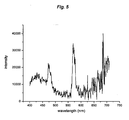
- Fig. 5 is an emission spectrum for polycrystalline dysprosia doped with 1 wt.% Ce 2 O 3 .
- the excitation source was 270 nm ultraviolet radiation.
- Fig. 1 there is shown a cross-sectional illustration of a discharge vessel for a metal halide lamp.
- the discharge vessel 1 is bulgy-shaped with hemispherical end wells 17.
- the bulgy-shaped vessel has a hollow, axially symmetric body 6 which encloses a discharge chamber 12.
- the body of the discharge vessel is comprised of polycrystalline dysprosium oxide that has been doped with one or more elements preferably selected from cerium, terbium, and europium.
- the amount of the dopant in the dysprosia body preferably may range from about 0.1 to about 10 percent by weight and is more preferably about 1 weight percent (wt.%) based on an oxide of the metal.
- Two opposed capillary tubes 2 extend outwardly from the body 6 along a central axis.
- the capillary tubes in this embodiment have been integrally molded with the arc tube body.
- the discharge chamber 12 of the arc tube contains a buffer gas, e.g., 30 torr to 20 bar Xe, Kr, Ar, or mixtures thereof, and a metal halide fill 8, e.g., mercury plus a mixture of metal halide salts, e.g., Nal, Cal 2 , Dyl 3 , Hol 3 , Tml 3 , and Tll, or metallic mercury alone at a sufficient quantity to achieve 200 bar pressure during operation.
- a buffer gas e.g., 30 torr to 20 bar Xe, Kr, Ar, or mixtures thereof
- a metal halide fill 8 e.g., mercury plus a mixture of metal halide salts, e.g., Nal, Cal 2 , Dyl 3 , Hol 3 , Tml 3
- Electrodes assemblies 14 are sealed to capillaries 2.
- the electrode assemblies are constructed of a niobium feedthrough, a tungsten electrode, and a molybdenum coil that is wound around a molybdenum or Mo-Al 2 O 3 cermet rod that is welded between the tungsten electrode and niobium feedthrough.
- a tungsten coil or other suitable means of forming a point of attachment for the are may be affixed to the end of the tungsten electrode.
- the frit material 9 creates a hermetic seal between the electrode assembly 14 and capillary 2. In metal halide lamps, it is usually desirable to minimize the penetration of the frit material into the capillary to prevent an adverse reaction with the corrosive metal halide fill.
- excitation via internally disposed electrodes is preferred, other configurations are also possible.
- the excitation may be externally applied by capacitive electrodes, microwave cavities, or induction methods wherein an electrodeless lamp is realized.
- these configurations may be more desirable when using more aggressive fills that could attack the electrode structures, e.g., in the case of chloride salts.
- the in-line transmittance of a polished polycrystalline dysprosium disk is shown in Fig. 2.
- the strong UV and blue absorption of the polycrystalline dysprosia is indicated by the low transmittance values from 200 to about 475 nm.
- Polycrystalline dysprosium oxide disks were made with 1 wt.% Eu 2 O 3 , 1 wt.% Tb 2 O 3 and 1 wt.% Ce 2 O 3 , respectively.
- the disks ( ⁇ 10 mm in diameter by 1.3 mm thick) were exposed to ultraviolet radiation (270nm) and the visible emissions were measured.
- the emission spectra for the three disks are shown in Figs. 3-5.
- Each of the disks emitted at least one emission peak in the visible wavelength region from 400nm to 700nm.
- the disk containing 1 wt.% Eu 2 O 3 exhibited a characteristic red Eu 3+ emission at about 614 nm (Fig.
- the disk containing 1 wt.% Tb 2 O 3 exhibited a characteristic green Tb 3+ emission peak at about 545 nm (Fig. 4); and the disk containing 1 wt.% Ce 2 O 3 exhibited a yellow Ce 3+ emission at about 573 nm (Fig. 5).
- the disk containing 1 wt.% Eu 2 O 3 exhibited the most intense emission. This is particularly useful for metal halide lamps since it is frequently necessary adjust the metal halide fill chemistry in order to increase the lamp's red emission in order to obtain a higher specific, R 9 ,color rendering index.
Landscapes
- Engineering & Computer Science (AREA)
- Chemical & Material Sciences (AREA)
- Ceramic Engineering (AREA)
- Manufacturing & Machinery (AREA)
- Materials Engineering (AREA)
- Structural Engineering (AREA)
- Organic Chemistry (AREA)
- Luminescent Compositions (AREA)
- Vessels And Coating Films For Discharge Lamps (AREA)
- Discharge Lamp (AREA)
Abstract
Description
- Metal halide discharge lamps have been favored for their high efficacies and high color rendering properties which result from the complex emission spectra generated by their rare-earth chemistries. Particularly desirable are ceramic metal halide lamps which offer improved color rendering, color temperature, and efficacy over traditional quartz arc tube types. This is because ceramic materials can operate at higher temperatures than quartz and are less prone to react with the various metal halide chemistries. The preferred ceramic material has been polycrystalline alumina (PCA).
- Various shapes have been proposed for ceramic discharge vessels ranging from a right circular cylindrical shape to an approximately spherical (bulgy) shape. Examples of these types of arc discharge vessels are given in
European Patent Application No. 0 587 238 A1 andU.S. Patent No. 5,936,351 , respectively. The bulgy shape with its hemispherical ends is preferred because it yields a more uniform temperature distribution, resulting in reduced corrosion of the discharge vessel by the metal halide fill materials. - Polycrystalline dysprosium oxide (dysprosia), Dy2O3, may also be used as a material for making ceramic discharge vessels for metal halide lamps. Unlike PCA, polycrystalline dysprosia has a cubic structure and therefore has the ability to make transparent discharge vessels for lighting applications requiring high optical throughput and consequently high-luminance sources. Polycrystalline dysprosia also has several intrinsic absorption bands in the range of 275-475nm which are not present in PCA. As a result, the body color of the discharge vessel is slightly yellow compared to the whitish PCA vessels. The strong blue and UV absorption of the polycrystalline dysprosia filters the short-wavelength radiation emitted by the arc discharge and reduces the color temperature of the light generated by the lamp. For example, a conventional 3000K metal halide chemistry will produce a color temperature of approximately 2500K when used in a polycrystalline dysprosia discharge vessel.
- It has been discovered that the strongly absorbed ultraviolet radiation may be converted into visible light by doping polycrystalline dysprosia with one or more of rare-earth metals such as cerium, terbium, and europium. Other luminescent dopants may include praseodymium, neodymium, samarium, erbium, ytterbium, holmium and thulium. Non-rare-earth metals such as Mn, Cr, Ti, V, Co, Ni, Cu, Bi, Pb, Sn and Sb represent additional possible luminescent dopants.
- This introduces the possibility for adjusting the spectrum of the metal halide lamp without having to adjust the chemistry of the complex metal halide fill. For example, cerium (Ce3+) may be used to enhance the yellow emission, terbium (Tb3+) to enhance the green, and europium (Eu3+) to add more red. The added visible emissions from the body of the discharge vessel should also enhance the efficacy of the lamp since more of the radiation emitted by the arc discharge is converted into visible light. Supplemental emission from the discharge vessel would have the effect of an extended mantle around the arc core similar to the emission from the orange sodium mantle observed in quartz metal halide lamps. In addition, the reduced UV output would ameliorate the need for the UV-absorbing shroud that is usually placed around the discharge vessel to protect people against over-exposure to UV radiation.
- Fig. 1 is a cross-sectional illustration of a ceramic metal halide discharge vessel according to this invention.
- Fig. 2 is a graph of the in-line transmittance of a polished polycrystalline dysprosia disk.
- Fig. 3 is an emission spectrum for polycrystalline dysprosia doped with 1 wt.% Eu2O3. The excitation source was 270 nm ultraviolet radiation.
- Fig. 4 is an emission spectrum for polycrystalline dysprosia doped with 1 wt.% Tb2O3. The excitation source was 270 nm ultraviolet radiation.
- Fig. 5 is an emission spectrum for polycrystalline dysprosia doped with 1 wt.% Ce2O3. The excitation source was 270 nm ultraviolet radiation.
- For a better understanding of the present invention, together with other and further objects, advantages and capabilities thereof, reference is made to the following disclosure and appended claims taken in conjunction with the above-described drawings.
- Referring now to Fig. 1, there is shown a cross-sectional illustration of a discharge vessel for a metal halide lamp. The discharge vessel 1 is bulgy-shaped with
hemispherical end wells 17. The bulgy-shaped vessel has a hollow, axially symmetric body 6 which encloses adischarge chamber 12. According to this invention, the body of the discharge vessel is comprised of polycrystalline dysprosium oxide that has been doped with one or more elements preferably selected from cerium, terbium, and europium. The amount of the dopant in the dysprosia body preferably may range from about 0.1 to about 10 percent by weight and is more preferably about 1 weight percent (wt.%) based on an oxide of the metal. - Two opposed
capillary tubes 2 extend outwardly from the body 6 along a central axis. The capillary tubes in this embodiment have been integrally molded with the arc tube body. Thedischarge chamber 12 of the arc tube contains a buffer gas, e.g., 30 torr to 20 bar Xe, Kr, Ar, or mixtures thereof, and a metal halide fill 8, e.g., mercury plus a mixture of metal halide salts, e.g., Nal, Cal2, Dyl3, Hol3, Tml3, and Tll, or metallic mercury alone at a sufficient quantity to achieve 200 bar pressure during operation. - Electrodes assemblies 14 are sealed to
capillaries 2. In a preferred structure, the electrode assemblies are constructed of a niobium feedthrough, a tungsten electrode, and a molybdenum coil that is wound around a molybdenum or Mo-Al2O3 cermet rod that is welded between the tungsten electrode and niobium feedthrough. A tungsten coil or other suitable means of forming a point of attachment for the are may be affixed to the end of the tungsten electrode. Thefrit material 9 creates a hermetic seal between theelectrode assembly 14 andcapillary 2. In metal halide lamps, it is usually desirable to minimize the penetration of the frit material into the capillary to prevent an adverse reaction with the corrosive metal halide fill. - While excitation via internally disposed electrodes is preferred, other configurations are also possible. For example, the excitation may be externally applied by capacitive electrodes, microwave cavities, or induction methods wherein an electrodeless lamp is realized. In fact, these configurations may be more desirable when using more aggressive fills that could attack the electrode structures, e.g., in the case of chloride salts.
- The in-line transmittance of a polished polycrystalline dysprosium disk is shown in Fig. 2. The strong UV and blue absorption of the polycrystalline dysprosia is indicated by the low transmittance values from 200 to about 475 nm.
- Polycrystalline dysprosium oxide disks were made with 1 wt.% Eu2O3, 1 wt.% Tb2O3 and 1 wt.% Ce2O3, respectively. The disks (~10 mm in diameter by 1.3 mm thick) were exposed to ultraviolet radiation (270nm) and the visible emissions were measured. The emission spectra for the three disks are shown in Figs. 3-5. Each of the disks emitted at least one emission peak in the visible wavelength region from 400nm to 700nm. The disk containing 1 wt.% Eu2O3 exhibited a characteristic red Eu3+ emission at about 614 nm (Fig. 3); the disk containing 1 wt.% Tb2O3 exhibited a characteristic green Tb3+ emission peak at about 545 nm (Fig. 4); and the disk containing 1 wt.% Ce2O3 exhibited a yellow Ce3+ emission at about 573 nm (Fig. 5). Of the three, the disk containing 1 wt.% Eu2O3 exhibited the most intense emission. This is particularly useful for metal halide lamps since it is frequently necessary adjust the metal halide fill chemistry in order to increase the lamp's red emission in order to obtain a higher specific, R9,color rendering index.
- These results demonstrate that a polycrystalline dysprosia discharge vessel that has been doped with luminescent ions may be used to adjust the emission spectrum of a metal halide lamp by enhancing different portions of the spectrum. This imparts an increased flexibility into the lamp design since the lamp spectrum may be varied according to the concentration and type of ion (or combination of ions) that is doped into the ceramic material.
- While there have been shown and described what are presently considered to be the preferred embodiments of the invention, it will be apparent to those skilled in the art that various changes and modifications can be made herein without departing from the scope of the invention as defined by the appended claims.
Claims (13)
- A ceramic discharge vessel comprising a hollow body for enclosing a discharge, the hollow body comprising a polycrystalline dysprosium oxide having a luminescent dopant that emits one or more visible light wavelengths when stimulated by radiation generated by the discharge.
- The discharge vessel of claim 1 wherein the visible emission from the luminescent dopant is a red emission.
- The discharge vessel of claim 1 wherein the visible emission from the luminescent dopant is a green emission.
- The discharge vessel of claim 1 wherein the visible emission from the luminescent dopant is a yellow emission.
- The discharge vessel of claim 2 wherein the red emission from the luminescent dopant is sufficient to provide an increased R9 value for light emitted from a lamp incorporating the discharge vessel as compared to an R9 value for light emitted from a similar lamp incorporating a polycrystalline dysprosium oxide discharge vessel that does not contain the luminescent dopant.
- A ceramic discharge vessel comprising a hollow body for enclosing a discharge, the hollow body comprising polycrystalline dysprosium oxide containing one or more metals selected from Ce, Tb, Eu, Pr, Nd, Sm, Er, Yb, Ho, Tm, Mn, Cr, Ti, V, Co, Ni, Cu, Bi, Pb, Sn, and Sb.
- The ceramic discharge vessel of claim 6 wherein the polycrystalline dysprosium oxide contains from about 0.1 to about 10 percent by weight of the metal based on an oxide of the metal.
- The ceramic discharge vessel of claim 6 wherein the polycrystalline dysprosium oxide contains about 1 percent by weight of the metal based on an oxide of the metal.
- The ceramic discharge vessel of claim 6 wherein the polycrystalline dysprosium oxide contains one or more of Ce, Tb, Eu, Pr, Nd, Sm, Er, Yb, Ho, and Tm.
- The ceramic discharge vessel of claim 9 wherein the polycrystalline dysprosium oxide contains from about 0.1 to about 10 percent by weight of the metal based on an oxide of the metal.
- A ceramic discharge vessel comprising a hollow body for enclosing a discharge, the hollow body comprising polycrystalline dysprosium oxide containing one or more metals selected from europium, cerium and terbium.
- The ceramic discharge vessel of claim 11 wherein the polycrystalline dysprosium oxide contains from about 0.1 to about 10 percent by weight of the metal based on an oxide of the metal.
- The ceramic discharge vessel of claim 12 wherein the polycrystalline dysprosium oxide contains about 1 percent by weight of the metal based on an oxide of the metal.
Applications Claiming Priority (1)
| Application Number | Priority Date | Filing Date | Title |
|---|---|---|---|
| US11/160,452 US7420331B2 (en) | 2005-06-24 | 2005-06-24 | Doped dysprosia discharge vessel |
Publications (2)
| Publication Number | Publication Date |
|---|---|
| EP1737021A2 true EP1737021A2 (en) | 2006-12-27 |
| EP1737021A3 EP1737021A3 (en) | 2007-08-15 |
Family
ID=34988983
Family Applications (1)
| Application Number | Title | Priority Date | Filing Date |
|---|---|---|---|
| EP06012283A Ceased EP1737021A3 (en) | 2005-06-24 | 2006-06-14 | Doped dysprosia discharge vessel |
Country Status (5)
| Country | Link |
|---|---|
| US (1) | US7420331B2 (en) |
| EP (1) | EP1737021A3 (en) |
| JP (1) | JP2007048743A (en) |
| CN (1) | CN1885477A (en) |
| CA (1) | CA2541526A1 (en) |
Families Citing this family (3)
| Publication number | Priority date | Publication date | Assignee | Title |
|---|---|---|---|---|
| US20060290285A1 (en) * | 2005-06-24 | 2006-12-28 | Osram Sylvania Inc. | Rapid Warm-up Ceramic Metal Halide Lamp |
| US7923908B2 (en) * | 2007-09-27 | 2011-04-12 | Osram Sylvania Inc. | Metal halide reflector lamp with beam color homogenizer |
| CN105800666B (en) * | 2016-05-23 | 2017-12-01 | 河北科技大学 | The preparation method of doped yttrium dysprosia nanometer rods |
Family Cites Families (12)
| Publication number | Priority date | Publication date | Assignee | Title |
|---|---|---|---|---|
| EP0587238B1 (en) | 1992-09-08 | 2000-07-19 | Koninklijke Philips Electronics N.V. | High-pressure discharge lamp |
| DE19645960A1 (en) | 1996-11-07 | 1998-05-14 | Patent Treuhand Ges Fuer Elektrische Gluehlampen Mbh | Ceramic discharge tube |
| JP3399763B2 (en) | 1996-12-26 | 2003-04-21 | ウシオ電機株式会社 | Ceramic high-pressure mercury discharge lamp for LCD backlight |
| JP4316699B2 (en) | 1997-07-25 | 2009-08-19 | ハリソン東芝ライティング株式会社 | High pressure discharge lamp and lighting device |
| JPH11147757A (en) | 1997-09-12 | 1999-06-02 | Konoshima Chemical Co Ltd | Translucent ceramics, arc tube made of translucent ceramics, high pressure discharge lamp using the arc tube, and method for producing translucent ceramics |
| CA2255983C (en) | 1997-12-16 | 2007-10-23 | Konoshima Chemical Co., Ltd. | A corrosion resistant ceramic and a production method thereof |
| JP2000086283A (en) * | 1998-09-08 | 2000-03-28 | Ohara Inc | Luminescent glass |
| US6294871B1 (en) | 1999-01-22 | 2001-09-25 | General Electric Company | Ultraviolet and visible filter for ceramic arc tube body |
| JP2001322867A (en) | 2000-05-09 | 2001-11-20 | Matsushita Electric Ind Co Ltd | Translucent sintered body, arc tube and discharge lamp using the same |
| WO2003004437A1 (en) | 2001-07-05 | 2003-01-16 | Konoshima Chemical Co., Ltd. | Translucent rare earth oxide sintered article and method for production thereof |
| US6921730B2 (en) * | 2002-03-14 | 2005-07-26 | Matsushita Electric Industrial Co., Ltd. | Glass composition, protective-layer composition, binder composition, and lamp |
| EP1573777A2 (en) | 2002-12-13 | 2005-09-14 | Koninklijke Philips Electronics N.V. | High-pressure discharge lamp |
-
2005
- 2005-06-24 US US11/160,452 patent/US7420331B2/en not_active Expired - Fee Related
-
2006
- 2006-03-31 CA CA002541526A patent/CA2541526A1/en not_active Abandoned
- 2006-06-14 EP EP06012283A patent/EP1737021A3/en not_active Ceased
- 2006-06-26 CN CNA2006100908248A patent/CN1885477A/en active Pending
- 2006-06-26 JP JP2006175827A patent/JP2007048743A/en active Pending
Also Published As
| Publication number | Publication date |
|---|---|
| JP2007048743A (en) | 2007-02-22 |
| US20050212435A1 (en) | 2005-09-29 |
| CN1885477A (en) | 2006-12-27 |
| EP1737021A3 (en) | 2007-08-15 |
| CA2541526A1 (en) | 2006-12-24 |
| US7420331B2 (en) | 2008-09-02 |
Similar Documents
| Publication | Publication Date | Title |
|---|---|---|
| JP2829339B2 (en) | High pressure mercury vapor discharge lamp | |
| US5572091A (en) | Quartz glass with reduced ultraviolet radiation transmissivity, and electrical discharge lamp using such glass | |
| US20090160341A1 (en) | Discharge lamp comprising uv-phosphor | |
| US6501220B1 (en) | Thallium free—metal halide lamp with magnesium and cerium halide filling for improved dimming properties | |
| JP2887410B2 (en) | Electrodeless pressure mercury vapor discharge lamp | |
| US6906475B2 (en) | Fluorescent lamp and high intensity discharge lamp with improved luminous efficiency | |
| US20030020408A1 (en) | Metal halide lamp | |
| US6819050B1 (en) | Metal halide lamp with trace T1I filling for improved dimming properties | |
| JP4279122B2 (en) | High pressure discharge lamp and lighting device | |
| EP1659613B1 (en) | Metal halide lamp chemistries with magnesium and indium | |
| US7420331B2 (en) | Doped dysprosia discharge vessel | |
| JP4279120B2 (en) | High pressure discharge lamp and lighting device | |
| US20060290285A1 (en) | Rapid Warm-up Ceramic Metal Halide Lamp | |
| US7847484B2 (en) | Mercury-free and sodium-free compositions and radiation source incorporating same | |
| CA1207372A (en) | High pressure sodium lamp having improved efficacy | |
| EP0968520A1 (en) | Low-pressure mercury discharge lamp | |
| CA2111426A1 (en) | Electrodeless lamp bulb | |
| CN100382228C (en) | metal halide lamp | |
| JP2006221928A (en) | High pressure discharge lamp | |
| JP2008500691A (en) | Low pressure discharge lamp with metal halide | |
| JP2007087767A (en) | High-pressure discharge lamp | |
| JP2011060475A (en) | Method of manufacturing low-pressure discharge lamp | |
| JP2000133204A (en) | Fluorescent lamp and light source device | |
| JP2010044877A (en) | High-pressure discharge lamp and lighting system |
Legal Events
| Date | Code | Title | Description |
|---|---|---|---|
| PUAI | Public reference made under article 153(3) epc to a published international application that has entered the european phase |
Free format text: ORIGINAL CODE: 0009012 |
|
| AK | Designated contracting states |
Kind code of ref document: A2 Designated state(s): AT BE BG CH CY CZ DE DK EE ES FI FR GB GR HU IE IS IT LI LT LU LV MC NL PL PT RO SE SI SK TR |
|
| AX | Request for extension of the european patent |
Extension state: AL BA HR MK YU |
|
| PUAL | Search report despatched |
Free format text: ORIGINAL CODE: 0009013 |
|
| AK | Designated contracting states |
Kind code of ref document: A3 Designated state(s): AT BE BG CH CY CZ DE DK EE ES FI FR GB GR HU IE IS IT LI LT LU LV MC NL PL PT RO SE SI SK TR |
|
| AX | Request for extension of the european patent |
Extension state: AL BA HR MK YU |
|
| 17P | Request for examination filed |
Effective date: 20070910 |
|
| 17Q | First examination report despatched |
Effective date: 20071012 |
|
| AKX | Designation fees paid |
Designated state(s): AT BE BG CH CY CZ DE DK EE ES FI FR GB GR HU IE IS IT LI LT LU LV MC NL PL PT RO SE SI SK TR |
|
| STAA | Information on the status of an ep patent application or granted ep patent |
Free format text: STATUS: THE APPLICATION HAS BEEN REFUSED |
|
| 18R | Application refused |
Effective date: 20101028 |