EP1733724A1 - Amino alcohol compound - Google Patents
Amino alcohol compound Download PDFInfo
- Publication number
- EP1733724A1 EP1733724A1 EP05710577A EP05710577A EP1733724A1 EP 1733724 A1 EP1733724 A1 EP 1733724A1 EP 05710577 A EP05710577 A EP 05710577A EP 05710577 A EP05710577 A EP 05710577A EP 1733724 A1 EP1733724 A1 EP 1733724A1
- Authority
- EP
- European Patent Office
- Prior art keywords
- methyl
- group
- compound
- pharmaceutical composition
- amino
- Prior art date
- Legal status (The legal status is an assumption and is not a legal conclusion. Google has not performed a legal analysis and makes no representation as to the accuracy of the status listed.)
- Withdrawn
Links
- 0 *[C@@](CCc1ccc[n]1*)(CO)N Chemical compound *[C@@](CCc1ccc[n]1*)(CO)N 0.000 description 2
- LZYLKXKDWCDLMR-HSZRJFAPSA-N CC(C)c1ccc(CCCC(c2ccc(CC[C@](C)(CO)N)[n]2C)=O)cc1 Chemical compound CC(C)c1ccc(CCCC(c2ccc(CC[C@](C)(CO)N)[n]2C)=O)cc1 LZYLKXKDWCDLMR-HSZRJFAPSA-N 0.000 description 1
- XRIKESJANHLVBM-UHFFFAOYSA-N CC(CCc1ccc(C(CCCCc2ccccc2)=O)[s]1)(CO)N Chemical compound CC(CCc1ccc(C(CCCCc2ccccc2)=O)[s]1)(CO)N XRIKESJANHLVBM-UHFFFAOYSA-N 0.000 description 1
- YSWQIILRANCRAZ-HXUWFJFHSA-N C[C@@](CCc1ccc(C(CCCc2ccccc2)=O)[n]1C)(CO)N Chemical compound C[C@@](CCc1ccc(C(CCCc2ccccc2)=O)[n]1C)(CO)N YSWQIILRANCRAZ-HXUWFJFHSA-N 0.000 description 1
Classifications
-
- C—CHEMISTRY; METALLURGY
- C07—ORGANIC CHEMISTRY
- C07D—HETEROCYCLIC COMPOUNDS
- C07D207/00—Heterocyclic compounds containing five-membered rings not condensed with other rings, with one nitrogen atom as the only ring hetero atom
- C07D207/02—Heterocyclic compounds containing five-membered rings not condensed with other rings, with one nitrogen atom as the only ring hetero atom with only hydrogen or carbon atoms directly attached to the ring nitrogen atom
- C07D207/30—Heterocyclic compounds containing five-membered rings not condensed with other rings, with one nitrogen atom as the only ring hetero atom with only hydrogen or carbon atoms directly attached to the ring nitrogen atom having two double bonds between ring members or between ring members and non-ring members
- C07D207/32—Heterocyclic compounds containing five-membered rings not condensed with other rings, with one nitrogen atom as the only ring hetero atom with only hydrogen or carbon atoms directly attached to the ring nitrogen atom having two double bonds between ring members or between ring members and non-ring members with only hydrogen atoms, hydrocarbon or substituted hydrocarbon radicals, directly attached to ring carbon atoms
- C07D207/33—Heterocyclic compounds containing five-membered rings not condensed with other rings, with one nitrogen atom as the only ring hetero atom with only hydrogen or carbon atoms directly attached to the ring nitrogen atom having two double bonds between ring members or between ring members and non-ring members with only hydrogen atoms, hydrocarbon or substituted hydrocarbon radicals, directly attached to ring carbon atoms with substituted hydrocarbon radicals, directly attached to ring carbon atoms
- C07D207/337—Radicals substituted by carbon atoms having three bonds to hetero atoms with at the most one bond to halogen, e.g. ester or nitrile radicals
-
- A—HUMAN NECESSITIES
- A61—MEDICAL OR VETERINARY SCIENCE; HYGIENE
- A61K—PREPARATIONS FOR MEDICAL, DENTAL OR TOILETRY PURPOSES
- A61K31/00—Medicinal preparations containing organic active ingredients
- A61K31/33—Heterocyclic compounds
- A61K31/395—Heterocyclic compounds having nitrogen as a ring hetero atom, e.g. guanethidine or rifamycins
- A61K31/40—Heterocyclic compounds having nitrogen as a ring hetero atom, e.g. guanethidine or rifamycins having five-membered rings with one nitrogen as the only ring hetero atom, e.g. sulpiride, succinimide, tolmetin, buflomedil
-
- A—HUMAN NECESSITIES
- A61—MEDICAL OR VETERINARY SCIENCE; HYGIENE
- A61P—SPECIFIC THERAPEUTIC ACTIVITY OF CHEMICAL COMPOUNDS OR MEDICINAL PREPARATIONS
- A61P1/00—Drugs for disorders of the alimentary tract or the digestive system
- A61P1/04—Drugs for disorders of the alimentary tract or the digestive system for ulcers, gastritis or reflux esophagitis, e.g. antacids, inhibitors of acid secretion, mucosal protectants
-
- A—HUMAN NECESSITIES
- A61—MEDICAL OR VETERINARY SCIENCE; HYGIENE
- A61P—SPECIFIC THERAPEUTIC ACTIVITY OF CHEMICAL COMPOUNDS OR MEDICINAL PREPARATIONS
- A61P17/00—Drugs for dermatological disorders
-
- A—HUMAN NECESSITIES
- A61—MEDICAL OR VETERINARY SCIENCE; HYGIENE
- A61P—SPECIFIC THERAPEUTIC ACTIVITY OF CHEMICAL COMPOUNDS OR MEDICINAL PREPARATIONS
- A61P17/00—Drugs for dermatological disorders
- A61P17/06—Antipsoriatics
-
- A—HUMAN NECESSITIES
- A61—MEDICAL OR VETERINARY SCIENCE; HYGIENE
- A61P—SPECIFIC THERAPEUTIC ACTIVITY OF CHEMICAL COMPOUNDS OR MEDICINAL PREPARATIONS
- A61P19/00—Drugs for skeletal disorders
- A61P19/02—Drugs for skeletal disorders for joint disorders, e.g. arthritis, arthrosis
-
- A—HUMAN NECESSITIES
- A61—MEDICAL OR VETERINARY SCIENCE; HYGIENE
- A61P—SPECIFIC THERAPEUTIC ACTIVITY OF CHEMICAL COMPOUNDS OR MEDICINAL PREPARATIONS
- A61P25/00—Drugs for disorders of the nervous system
-
- A—HUMAN NECESSITIES
- A61—MEDICAL OR VETERINARY SCIENCE; HYGIENE
- A61P—SPECIFIC THERAPEUTIC ACTIVITY OF CHEMICAL COMPOUNDS OR MEDICINAL PREPARATIONS
- A61P29/00—Non-central analgesic, antipyretic or antiinflammatory agents, e.g. antirheumatic agents; Non-steroidal antiinflammatory drugs [NSAID]
-
- A—HUMAN NECESSITIES
- A61—MEDICAL OR VETERINARY SCIENCE; HYGIENE
- A61P—SPECIFIC THERAPEUTIC ACTIVITY OF CHEMICAL COMPOUNDS OR MEDICINAL PREPARATIONS
- A61P37/00—Drugs for immunological or allergic disorders
-
- A—HUMAN NECESSITIES
- A61—MEDICAL OR VETERINARY SCIENCE; HYGIENE
- A61P—SPECIFIC THERAPEUTIC ACTIVITY OF CHEMICAL COMPOUNDS OR MEDICINAL PREPARATIONS
- A61P37/00—Drugs for immunological or allergic disorders
- A61P37/02—Immunomodulators
- A61P37/06—Immunosuppressants, e.g. drugs for graft rejection
-
- A—HUMAN NECESSITIES
- A61—MEDICAL OR VETERINARY SCIENCE; HYGIENE
- A61P—SPECIFIC THERAPEUTIC ACTIVITY OF CHEMICAL COMPOUNDS OR MEDICINAL PREPARATIONS
- A61P37/00—Drugs for immunological or allergic disorders
- A61P37/08—Antiallergic agents
-
- A—HUMAN NECESSITIES
- A61—MEDICAL OR VETERINARY SCIENCE; HYGIENE
- A61P—SPECIFIC THERAPEUTIC ACTIVITY OF CHEMICAL COMPOUNDS OR MEDICINAL PREPARATIONS
- A61P7/00—Drugs for disorders of the blood or the extracellular fluid
Definitions
- the present invention relates to an amino alcohol compound having superior immunosuppressive activity or a pharmacologically acceptable salt thereof, and to a pharmaceutical composition having peripheral blood lymphocyte count lowering activity that demonstrates superior physical properties and pharmacokinetics.
- Non-Patent Document 1 a drug has yet to be developed capable of correcting these abnormalities.
- compound (d) has two oxymethyl groups (-CH 2 OH) substituted on the same carbon atom as essential substituents
- the compound of the present invention differs from compound (d) in that it has a -CH 2 OH group and a methyl or ethyl group substituted on the same carbon atom as the corresponding groups thereto.
- compound (d) has a substituted phenyl group in its basic backbone as an essential group
- the compound contained in the pharmaceutical composition differs from compound (d) in that the corresponding group is a heterocyclic group in the form of a pyrrole group or pyrrole group having a substituent on the nitrogen atom.
- Patent Document 6 a compound of the general formula (e) that has immunosuppressive activity is disclosed by the present applicant in Japanese Patent Application (Kokai) No. 2002-167382 (Patent Document 6): [wherein R 1 and R 2 represent a hydrogen atom or an amino protecting group; R 3 represents a hydrogen atom or a hydroxyl protecting group; R 4 represents a lower alkyl group; n.
- R 5 represents an aryl group or substituted aryl group
- R 6 and R 7 represent a hydrogen atom, provided that when R 5 is a hydrogen atom, Y is not a single bond or a linear C 1 -C 10 alkylene group].
- Patent Document 7 a compound of the general formula (f) that has immunosuppressive activity is disclosed by the present applicant in Japanese Patent Appication (Kokai) No. 2003-267950 (Patent Document 7): [wherein R 1 and R 2 represent a hydrogen atom, an amino protecting group or the like; R 3 represents a hydrogen atom or a hydroxyl protecting group; R 4 represents a lower alkyl group; n represents an integer of 1 to 6; X represents an oxygen atom or an unsubstituted nitrogen atom or a nitrogen atom substituted with a lower alkyl group or the like; Y represents an ethylene group or the like; Z represents an alkylene group having 1 to 10 carbon atoms or the like; R 5 represents an aryl group or substituted aryl group or the like; and R 6 and R 7 represent a hydrogen atom or the like, provided that when R 5 is a hydrogen atom, Z is not a single bond or linear alkylene group having 1 to 10 carbon atoms].
- autoimmune diseases or other immunity-related diseases such as systemic lupus erythematosus, rheumatoid arthritis, polymyositis, fibrositis, skeletal myositis, arthrosteitis, osteoarthritis, dermatomyositis, scleroderma, Behcet's disease, Crohn's disease, ulcerative colitis, autoimmune hepatitis, aplastic anemia, idiopathic thrombocytopenic purpura, autoimmune hemolytic anemia, multiple sclerosis, autoimmune pomphus, psoriasis vulgaris, angiitis, Wegener's granuloma, uveitis, Sjogren's syndrome, idiopathic interstitial pneumonia, Goodpasture'
- an object of the present invention is to provide a pharmaceutical composition containing a novel amino alcohol compound having low toxicity and superior immunosuppressive activity, a pharmacologically acceptable salt thereof or a pharmacologically acceptable ester thereof.
- a problem to be solved by the present invention is to provide a pharmaceutical composition that is useful for the aforementioned diseases, has low toxicity, and demonstrates superior physicochemical properties and superior pharmacokinetics.
- a pharmaceutical composition containing an amino alcohol compound having general formula (I) or (I') of the present invention or a pharmacologically acceptable salt thereof has low toxicity and superior immunosuppressive activity, and is particularly useful as a prophylactic or therapeutic (and preferably a therapeutic) in warm-blooded animals (and particularly humans) against rejection reactions during various organ transplants or skin transplants, autoimmune diseases or other immunity-related diseases such as systemic lupus erythematosus, rheumatoid arthritis, polymyositis, fibrositis, skeletal myositis, arthrosteitis, osteoarthritis, dermatomyositis, scleroderma, Behcet's disease, Crohn's disease, ulcerative colitis, autoimmune hepatitis, aplastic anemia, idiopathic thrombocytopenic purpura, autoimmune hemolytic anemia, multiple sclerosis, autoimmune pomphus, psoriasis vulgaris, angiitis
- the pharmaceutical composition of the present invention since the pharmaceutical composition of the present invention has low toxicity, demonstrates superior physical properties and superior pharmacokinetics, and demonstrates satisfactory peripheral blood lymphocyte count lowering activity through oral administration, it is useful as an oral prophylactic or oral therapeutic (and preferably an oral therapeutic) for the aforementioned autoimmune diseases and so forth, or as an oral prophylactic or oral therapeutic (and preferably an oral therapeutic) for other diseases caused by abnormal peripheral blood lymphocyte count.
- the amino alcohol compound serving as the active ingredient of the pharmaceutical composition of the present invention has the following general formula (I) or (I').
- halogen atom in the definition of R 3 is a fluorine atom, chlorine atom, bromine atom or iodine atom, preferably a fluorine atom or chlorine atom, and most preferably a chlorine atom.
- a "lower alkyl group" in the definition of R 3 is a linear or branched alkyl group having 1 to 6 carbon atoms such as a methyl, ethyl, propyl, isopropyl, butyl, isobutyl, s-butyl, t-butyl, pentyl, isopentyl, 2-methylbutyl, neopentyl, 1-ethylpropyl, hexyl, isohexyl, 4-methylpentyl, 3-methylpentyl, 2-methylpentyl, 1-methylpentyl, 3,3-dimethylbutyl, 2,2-dimethylbutyl, 1,1-dimethylbutyl, 1,2-dimethylbutyl, 1,3-dimethylbutyl, 2,3-dimethylbutyl, 1-ethylbutyl or 2-ethylbutyl group, preferably an alkyl group having 1 to 4 carbon atoms such as a
- a "cycloalkyl group" in the definition of R 3 is a cyclic alkyl group having 3 to 6 carbon atoms such as a cyclopropyl, cyclobutyl, cyclopentyl or cyclohexyl group, preferably a cyclopropyl or cyclobutyl group, and most preferably a cyclopropyl group.
- a "lower alkoxy group” in the definition of R 3 indicates a group in which the aforementioned "lower alkyl group” is bonded to an oxygen atom, and is a linear or branched alkoxy group having 1 to 6 carbon atoms such as a methoxy, ethoxy, propoxy, isopropoxy, butoxy, isobutoxy, s-butoxy, t-butoxy, pentoxy, isopentoxy, 2-methylbutoxy, 1-ethylpropoxy, 2-ethylpropoxy, neopentoxy, hexyloxy, 4-methylpentoxy, 3-methylpentoxy, 2-methylpentoxy, 3,3-dimethylbutoxy, 2,2-dimethylbutoxy, 1,1-dimethylbutoxy, 1,2-dimethylbutoxy, 1,3-dimethylbutoxy or 2,3-dimethylbutoxy group, preferably an alkoxy group having 1 to 4 carbon atoms, more preferably an alkoxy group having 1 or 2 carbon
- a "halogeno lower alkyl group" in the definition of R 3 indicates a group in which a halogen atom is substituted in the aforementioned "lower alkyl group", and is an alkyl group having 1 to 6 carbon atoms in which a halogen atom has been substituted such as a trifluoromethyl, trichloromethyl, difluoromethyl, dichloromethyl, dibromomethyl, fluoromethyl, 2,2,2-trifluoroethyl, 2,2,2-trichloroethyl, 2-bromoethyl, 2-chloroethyl, 2-fluoroethyl, 2-iodoethyl, 3-chloropropyl, 4-fluorobutyl, 6-iodohexyl or 2,2-dibromoethyl group, preferably an alkyl group having 1 to 4 carbon atoms in which a halogen atom has been substituted, more preferably an alky
- a "lower aliphatic acyl group" in the definition of R 3 is a linear or branched lower aliphatic acyl group having 1 to 6 carbon atoms such as a formyl, acetyl, propionyl, butyryl, isobutyryl, pivaloyl or hexanoyl group, preferably an aliphatic acyl group having 1 to 4 carbon atoms, more preferably an acetyl or propionyl group, and most preferably an acetyl group.
- aforementioned "pharmacologically acceptable salt thereof” refers to a salt of a compound having general formula (I) or (I') of the present invention since said compound has a basic group in the manner of an amino group and can be converted to a salt by reacting with acid.
- Preferable examples of pharmacologically acceptable salts of a compound having general formula (I) or (I') of the present invention normally include salts of halogenated hydroacids such as hydrofluorides, hydrochlorides, hydrobromides and hydroiodides, salts of inorganic acids such as nitrates, perchlorates, sulfates and phosphates; salts of lower alkane sulfonic acids such as methane sulfonates, trifluoromethane sulfonates and ethane sulfonates, salts of aryl sulfonic acids such as benzene sulfonates and p-toluene sulfonates, salts of organic acids such as acetates, malates, fumarates, succinates, citrates, ascorbates, tartrates, oxalates and maleates; and salts of amino acids such as glycine, lysine, arg
- a preferable salt is determined in consideration of the physical properties, solubility, hygroscopicity, thermal stability and melting point and so forth of the salt itself, and the stability when mixing with a vehicle or diluent and so forth during formulation and so forth (including not reacting with that mixture along with the physical properties, solubility, hygroscopicity, thermal stability and melting point and so forth of the preparation).
- a pharmacologically acceptable salt of a compound having general formula (I) or (I') serving as the active ingredient of the present invention is preferably a salt of an organic acid and more preferably a fumarate.
- esters refers to an ester of a compound having general formula (I) or (I') of the present invention since said compound can be converted to an ester, an example of such an ester being an "ester of a hydroxyl group", and such esters refer to esters in which each ester residue is an "ordinary protecting group” or a "protecting group that can be cleaved by a biological method such as hydrolysis in the body".
- An "ordinary protecting group” refers to protecting groups that can be cleaved by a chemical method such as hydrogenolysis, hydrolysis, electrolysis or photolysis.
- an "ordinary protecting group" in an "ester of a hydroxyl group” include "aliphatic acyl groups” including alkanoyl groups such as a formyl, acetyl, propionyl, butyryl, isobutyryl, pentanoyl, pivaloyl, valeryl, isovaleryl, octanoyl, nonanoyl, decanoyl, 3-methylnonanoyl, 8-methylnonanoyl, 3-ethyloctanoyl, 3,7-dimethyloctanoyl, undecanoyl, dodecanoyl, tridecanoyl, tetradecanoyl, pentadecanoyl, hexadecanoyl, 1-methylpentadecanoyl, 14-methylpentadecanoyl, 13,13-dimethyltetradecanoyl, heptadecanoyl, 15-methyl
- a "protecting group that can be cleaved by a biological method such as hydrolysis in the body” refers to a protecting group that generates a free acid or salt thereof as a result of being cleaved by a biological method such as hydrolysis in the body, and whether or not it is a derivative thereof can be determined by administering to a laboratory animal such as a rat or mouse by intravenous injection, subsequently investigating a body fluid of the animal, and detecting the original compound or pharmacologically acceptable salt thereof.
- a "protecting group that can be cleaved by a biological method such as hydrolysis in the body” in an "ester of a hydroxyl group” include a 1-(acyloxy) "lower alkyl group” such as a 1-("lower aliphatic acyl”oxy) "lower alkyl group”, e.g.
- a cyclopentylcarbonyloxymethyl cyclohexylcarbonyloxymethyl, 1-cyclopentylcarbonyloxyethyl, 1-cyclohexylcarbonyloxyethyl, 1-cyclopentylcarbonyloxypropyl, 1-cyclohexylcarbonyloxypropyl, 1-cyclopentylcarbonyloxybutyl or 1-cyclohexylcarbonyloxybutyl group, a 1-("aromatic acyl"oxy) "lower alkyl group” e.g. a benzoyloxymethyl group; a "carbonyloxy alkyl group” such as a (lower alkoxycarbonyloxy)alkyl group, e.g.
- a compound having general formula (I) or (I') serving as an active ingredient of the present invention, a pharmacologically acceptable salt thereof or a pharmacologically acceptable ester thereof may be in the form of a hydrate by allowing to stand in air, recrystallizing, absorbing water or having adsorbed water, and such hydrates are also included in the present invention.
- a compound having general formula (I) or (I') serving as an active ingredient of the present invention, a pharmacologically acceptable salt thereof, a pharmacologically acceptable ester thereof, or a pharmacologically acceptable other derivative thereof has optical isomers since it has an asymmetric carbon atom within its molecule.
- preferred examples of compound (I) or (I') serving as an active ingredient of the present invention include Exemplary Compound Nos. 17 to 24, 40 to 47, 54 to 63, 72, 73, 90 to 97, 113 to 120, 127 to 136, 145, 146, 163 to 170, 186 to 193, 200 to 209, 218, 219, 236 to 243, 259 to 266, 273 to 282, 291 and 292, more preferably Exemplary Compound Nos. 17 to 24, 54 to 63, 72, 73, 163 to 170, 192, 203, 208 and 219, and even more preferred examples include Exemplary Compound No.
- a compound having general formula (I) serving as an active ingredient of the present invention can be produced according to the processes described below.
- Process A is a process by which a compound having general formula (I) is produced from a compound having general formula (II) or general formula (III).
- R 1 , R 2 and R 3 are the same as previously defined, R 4 and R 5 may be the same or different and represent an amino protecting group, R 6 represents a "hydroxyl protecting group" and Q represents a leaving group.
- amino protecting group in the definition of R 4 and R 5 provided it is an amino protecting group used in the field of organic synthetic chemistry, and examples include lower aliphatic acyl groups and lower alkoxycarbonyl groups, and preferably an acetyl group or t-butoxycarbonyl group.
- hydroxyl protecting group in the definition of R 6 provided it is a hydroxyl protecting group used in the field of organic synthetic chemistry, and examples include lower aliphatic acyl groups, and preferably an acetyl group.
- the leaving group in the definition of Q is a leaving group used in the field of organic synthetic chemistry, and examples include halogen groups such as a chlorine, bromine or iodine atom and sulfonate groups such as a methane sulfonate group or p-toluene sulfonate group, and preferably a chlorine atom.
- Step A1 a compound having general formula (V) is produced, and this is carried out by reacting a compound having general formula (II) and a compound having general formula (IV) in an inert solvent in the presence of a base.
- inert solvent used in the aforementioned reaction provided it does not react with the compound having general formula (IV), and examples include aliphatic hydrocarbons such as hexane, heptane, ligroin or petroleum ether; aromatic hydrocarbons such as toluene, benzene or xylene; halogenated hydrocarbons such as dichloromethane, chloroform, carbon tetrachloride, dichloroethane, chlorobenzene or dichlorobenzene; ethers such as diethyl ether, diisopropyl ether, tetrahydrofuran, dioxane, dimethoxyethane or diethylene glycol dimethyl ether; lower alkyl nitriles such as acetonitrile or propionitrile; and, lower alkyl ketones such as acetone or methyl ethyl ketone, preferably aromatic hydrocarbons, and more preferably benzene, tol
- the base used in the aforementioned reaction activates the compound having general formula (IV), and examples include organic amines such as triethylamine, tributylamine, diisopropylethylamine, N-methylmorpholine, pyridine, 4-(N,N-dimethylamino)pyridine, 4-pyrrolidinopyridine, N,N-dimethylaniline, N,N-diethylaniline, 1,5-diazabicyclo[4.3.0]non-5-ene, 1,4-diazabicyclo[2.2.2]octane (DABCO) or 1,8-diazabicyclo[5.4.0]-7-undecene (DBU), and preferably 4-(N,N-dimethylaminopyridine) or 4-pyrrolidinopyridine.
- organic amines such as triethylamine, tributylamine, diisopropylethylamine, N-methylmorpholine, pyridine, 4-(N,
- reaction temperature varies depending on the type of raw material compound, solvent, base and so forth, it is normally from 0 to 200°C and preferably from room temperature to 150°C.
- reaction time varies depending on the type of raw material compound, base, solvent, reaction temperature and so forth, it is normally from 15 minutes to 7 days, and preferably from 6 hours to 3 days.
- Step A2 a compound having general formula (VI) is produced, and this is carried out using the same method as Step A1 using a compound having general formula (III) and a compound having general formula (IV).
- Step A3 a compound having general formula (I) is produced, and this is carried out by hydrolyzing a compound having general formula (V) or general formula (VI) in an inert solvent in the presence of a base.
- inert solvent used in the aforementioned reactions, and examples include ethers such as diethyl ether, diisopropyl ether, tetrahydrofuran, dioxane, dimethoxyethane, or diethylene glycol dimethyl ether; aromatic hydrocarbons such as toluene, benzene or xylene; halogenated hydrocarbons such as dichloromethane, chloroform, carbon tetrachloride, dichloroethane, chlorobenzene or dichlorobenzene; lower alkyl nitriles such as acetonitrile or propionitrile; amides such as formamide, N,N-dimethylformamide, N,N-dimethylacetamide or hexamethyl phosphoric triamide; lower alkyl alcohols such as methanol, ethanol, propanol or butanol; and water, preferably alcohols or ethers, and more preferably a mixed solvent of
- alkaline metal carbonates such as lithium carbonate, sodium carbonate or potassium carbonate
- alkaline metal bicarbonates such as lithium hydrogencarbonate, sodium hydrogencarbonate or potassium hydrogencarbonate
- alkaline metal hydrides such as lithium hydride, sodium hydride or potassium hydride
- alkaline metal hydroxides such as lithium hydroxide, sodium hydroxide or potassium hydroxide
- alkaline metal alkoxides such as lithium methoxide, sodium methoxide, sodium ethoxide or potassium t-butoxide, preferably alkaline metal hydroxides, and more preferably lithium hydroxide or sodium hydroxide.
- reaction temperature varies depending on the type of raw material compound, solvent, base and so forth, it is normally from -78 to 200°C and preferably from -50 to 150°C.
- reaction time varies depending on the type of raw material compound, base, solvent, reaction temperature and so forth, it is normally from 15 minutes to 48 hours, and preferably from 30 minutes to 8 hours.
- the desired compounds of each step of Process A are recovered from the reaction mixture in accordance with ordinary methods.
- an organic solvent such as ethyl acetate that is not miscible with water is added after removing the impurities by filtration, and after washing with water and so forth, the organic layer containing the desired compound is separated, and after drying with anhydrous magnesium sulfate or anhydrous sodium sulfate, the desired compound is obtained by distilling off the solvent.
- the resulting desired compound can be separated and purified as necessary by suitably combining ordinary methods, such as recrystallization, reprecipitation or other method commonly used for separation and purification of organic compounds, examples of which include absorption column chromatography using a carrier such as silica gel, alumina or magnesium-silica gel-based Florisil; a method using a synthetic adsorbent such as partition column chromatography using a carrier such as Sephadex LH-20 (Pharmacia), Amberlite XAD-11 (Rohm and Haas) or Diaion HP-20 (Mitsubishi Chemical), a method using ion exchange chromatography, and a forward-phase, reverse-phase column chromatography method using silica gel or alkylated silica gel (and preferably high-performance liquid column chromatography), and eluting with a suitable eluent.
- absorption column chromatography using a carrier such as silica gel, alumina or magnesium-silica gel-based Florisil
- isomers can be separated by the aforementioned separation and purification means at a suitable time either following completion of the reaction of each step or following completion of a desired step.
- Process B is an alternative process of Process A in which a compound having general formula (I) is produced from a compound having general formula (II) or general formula (III).
- R 1 , R 2 , R 3 , R 4 , R 5 and R 6 are the same as previously defined.
- Step B1 a compound having formula (V) is produced, and this is carried out by reacting a compound having general formula (II) and a compound having general formula (VII) in an inert solvent in the presence of phosphorus oxychloride or oxalyl chloride. This reaction is carried out in accordance with a known method (such as the method described in J. Med. Chem., 40, 3381 (1997 )).
- inert solvent used in the aforementioned reaction, and examples include aliphatic hydrocarbons such as hexane, heptane, ligroin or petroleum ether; aromatic hydrocarbons such as toluene, benzene or xylene; halogenated hydrocarbons such as dichloromethane, chloroform, carbon tetrachloride, dichloroethane, chlorobenzene or dichlorobenzene; ethers such as diethyl ether, diisopropyl ether, tetrahydrofuran, dioxane, dimethoxyethane or diethylene glycol dimethyl ether; lower alkyl nitriles such as acetonitrile or propionitrile; and lower alkyl ketones such as acetone or methyl ethyl ketone, preferably aromatic hydrocarbons, and more preferably benzene or toluene.
- aliphatic hydrocarbons such as hexane
- reaction temperature varies depending on the type of raw material compound, solvent, base and so forth, it is normally from 0 to 200°C and preferably from room temperature to 150°C.
- reaction time varies depending on the type of raw material compound, base, solvent, reaction temperature and so forth, it is normally from 15 minutes to 7 days, and preferably from 6 hours to 3 days.
- Step B2 a compound having general formula (VI) is produced, and this is carried out using the same method as Step B1 using a compound having general formula (III) and a compound having general formula (VII).
- Step B3 a compound having general formula (I) is produced, and this is carried out by hydrolyzing a compound having general formula (V) or a compound having general formula (VI) in an inert solvent in the presence of a base.
- inert solvent used in the aforementioned reactions examples include ethers such as diethyl ether, diisopropyl ether, tetrahydrofuran, dioxane, dimethoxyethane, or diethylene glycol dimethyl ether; alcohols such as methanol, ethanol, n-propanol, isopropanol, n-butanol, isobutanol, t-butanol, isoamyl alcohol, diethylene glycol, glycerin, octanol, cyclohexanol or methyl cellosolve; amides such as formamide, N,N-dimethylformamide, N,N-dimethylacetamide or hexamethyl phosphoric triamide; water; or mixed solvents of the aforementioned solvents or mixed solvents of the aforementioned solvents and water, preferably mixed solvents of alcohols and ethers and water or mixed solvents of alcohols
- alkaline metal carbonates such as lithium carbonate, sodium carbonate or potassium carbonate
- alkaline metal bicarbonates such as lithium hydrogencarbonate, sodium hydrogencarbonate or potassium hydrogencarbonate
- alkaline metal hydrides such as lithium hydride, sodium hydride or potassium hydride
- alkaline metal hydroxides such as lithium hydroxide, sodium hydroxide or potassium hydroxide
- alkaline metal alkoxides such as lithium methoxide, sodium methoxide, sodium ethoxide or potassium t-butoxide, preferably alkaline metal hydroxides, and more preferably sodium hydroxide.
- reaction temperature varies depending on the type of raw material compound, solvent, base and so forth, it is normally from -78 to 150°C, preferably from -50 to 100°C, and more preferably in the vicinity of room temperature.
- reaction time varies depending on the type of raw material compound, base, solvent, reaction temperature and so forth, it is normally from 15 minutes to 48 hours, and preferably from 30 minutes to 6 hours.
- the desired compounds of each step of Process B are collected from the reaction mixture in accordance with ordinary methods.
- an organic solvent such as ethyl acetate that is not miscible with water is added after removing the impurities by filtration, and after washing with water and so forth, the organic layer containing the desired compound is separated, and after drying with anhydrous magnesium sulfate or anhydrous sodium sulfate, the desired compound is obtained by distilling off the solvent.
- the resulting desired compound can be separated and purified as necessary by suitably combining ordinary methods, such as recrystallization, reprecipitation or other method commonly used for separation and purification of organic compounds, examples of which include absorption column chromatography using a carrier such as silica gel, alumina or magnesium-silica gel-based Florisil; a method using a synthetic adsorbent such as partition column chromatography using a carrier such as Sephadex LH-20 (Pharmacia), Amberlite XAD-11 (Rohm and Haas) or Diaion HP-20 (Mitsubishi Chemical), a method using ion exchange chromatography, and a forward-phase, reverse-phase column chromatography method using silica gel or alkylated silica gel (and preferably high-performance liquid column chromatography), and eluting with a suitable eluent.
- absorption column chromatography using a carrier such as silica gel, alumina or magnesium-silica gel-based Florisil
- isomers can be separated by the aforementioned separation and purification means at a suitable time either following completion of the reaction of each step or following completion of a desired step.
- Process C is a process for producing a compound having general formula (III).
- R 1 , R 2 , R 4 , R 5 , R 6 and Q are the same as previously defined.
- R 7 represents an alkyl group having 1 to 20 carbon atoms, an alkyl group having 2 to 20 carbon atoms interposed with a hetero atom, an alkyl group having 1 to 20 carbon atoms substituted with an aryl group or aromatic heterocyclic group, an alkynyl group having 2 to 20 carbon atoms, an alkynyl group having 3 to 20 carbon atoms interposed with a hetero atom, an alkynyl group having 2 to 20 carbon atoms substituted with an aryl group or aromatic heterocyclic group, an alkenyl group having 2 to 20 carbon atoms, an alkenyl group having 3 to 20 carbon atoms interposed with a hetero atom, an alkenyl group having 2 to 20 carbon atoms substituted with an aryl group or aromatic heterocyclic group, an alkyl group having 2 to 20 carbon atoms substituted with an aryl group or aromatic heterocyclic group and interposed with a hetero atom, or a cycloalkyl group having 3 to
- alkyl group having 1 to 20 carbon atoms in the definition of R 7 includes linear or branched alkyl groups having 1 to 20 carbon atoms such as the aforementioned "lower alkyl group", or a heptyl, 1-methylhexyl, 2-methylhexyl, 3-methylhexyl, 4-methylhexyl, 5-methylhexyl, 1-propylbutyl, 4,4-dimethylpentyl, octyl, 1-methylheptyl, 2-methylheptyl, 3-methylheptyl, 4-methylheptyl, 5-methylheptyl, 6-methylheptyl, 1-propylpentyl, 2-ethylhexyl, 5,5-dimethylhexyl, nonyl, 3-methyloctyl, 4-methyloctyl, 5-methyloctyl, 6-methyloctyl, 1-propylhexyl, 2-ethylheptyl, 6,6-di
- an "alkyl group having 2 to 20 carbon atoms interposed with a hetero atom” in the definition of R 7 indicates groups in which an "alkyl group having 2 to 20 carbon atoms" of the aforementioned “alkyl groups having 1 to 20 carbon atoms” may be the same or different, and are interposed with 1 or 2 sulfur atoms, oxygen atoms or nitrogen atoms, examples of which include alkyl groups having 2 to 20 carbon atoms interposed with 1 or two sulfur atoms such as methylthiomethyl, 1-methylthioethyl, 2-methylthioethyl, ethylthiomethyl, 1-methylthiopropyl, 2-methylthiopropyl, 3-methylthiopropyl, 2-ethylthioethyl, 2-methyl-2-methylthioethyl, 1-methylthiobutyl, 2-methylthiobutyl, 3-methylthiobutyl, 2-ethylthiopropyl, 3-methyl-3-methylthiopropyl
- an "alkyl group having 1 to 20 carbon atoms substituted with an aryl group or aromatic heterocyclic group" in the definition of R 7 is a group in which the aforementioned "alkyl group having 1 to 20 carbon atoms" may be the same or different, and is substituted with 1 to 3 "aryl groups” or "aromatic heterocyclic groups", and preferably an alkyl group having 2 to 5 carbon atoms substituted with an aryl group or aromatic heterocyclic group.
- aryl groups include aromatic hydrocarbon groups having 5 to 14 carbon atoms such as a phenyl, indenyl, naphthyl, phenanthrenyl or anthracenyl group, and preferably a phenyl group.
- aryl group may also be condensed into a ring with a cycloalkyl group having 3 to 10 carbon atoms such as a 2-indanyl group.
- aromatic heterocyclic group indicates a "5- to 7-member aromatic heterocyclic group” containing 1 to 3 sulfur atoms, oxygen atoms or nitrogen atoms, examples of which include aromatic heterocyclic groups such as a furyl, thienyl, pyrrolyl, azepinyl, pyrazolyl, imidazolyl, oxazolyl, isoxazolyl, thiazolyl, isothiazolyl, 1,2,3-oxadiazolyl, triazolyl, tetrazolyl, thiadiazolyl, pyranyl, pyridyl, pyridazinyl, pyrimidinyl or pyrazinyl group, and preferably a "5- to 7-member heterocyclic group” that contains at least one nitrogen atom and optionally contains an oxygen atom or sulfur atom, examples of which include a pyrrolyl, azepinyl, pyrazolyl, imidazolyl
- the aforementioned "5- to 7-member heterocyclic group” may be condensed into a ring with other cyclic groups, examples of which include isobenzofuranyl, chromenyl, xanthenyl, phenoxathiinyl, indolizinyl, isoindolyl, indolyl, indazolyl, prinyl, quinolizinyl, isoquinolyl, quinolyl, phthalazinyl, naphthyridinyl, quinoxalinyl, quinazolinyl, carbazolyl, carbolinyl, acridinyl and isoindolinyl, preferably isobenzofuranyl, chromenyl, xanthenyl, phenoxathiinyl, isoindolizinyl, isoindolyl, indolyl or indazolyl, and preferably isobenzofuranyl, chromenyl, xantheny
- an "alkynyl group having 2 to 20 carbon atoms" in the definition of R 7 is a linear or branched alkynyl group having 2 to 20 carbon atoms, examples of which include ethynyl, 2-propynyl, 1-methyl-2-propynyl, 1-ethyl-2-propynyl, 2-butynyl, 1-methyl-2-butynyl, 1-ethyl-2-butynyl, 3-butynyl, 1-methyl-3-butynyl, 2-methyl-3-butynyl, 1-ethyl-3-butynyl, 2-pentynyl, 1-methyl-2-pentynyl, 3-pentynyl, 1-methyl-3-pentynyl, 2-methyl-3-pentynyl, 4-pentynyl, 1-methyl-4-pentynyl, 2-methyl-4-pentynyl, 2-hexynyl, 3-hexyny
- an "alkynyl group having 3 to 20 carbon atoms interposed with a hetero atom” in the definition of R 7 indicates a group in which an "alkynyl group having 3 to 20 carbon atoms" of the aforementioned “alkynyl groups having 2 to 20 carbon atoms” may be the same or different, and is interposed with 1 or 2 sulfur atoms, oxygen atoms or nitrogen atoms, examples of which include an alkynyl group having 3 to 20 carbon atoms interposed with 1 or 2 sulfur atoms such as 2-methylthioethynyl, 1-methylthio-2-propynyl, 3-methylthio-1-propynyl, 1-methylthio-3-butynyl, 2-methylthio-3-butynyl, 1-ethylthio-2-propynyl, 3-methyl-3-methylthio-1-propynyl, 4-methylthio-2-pentynyl, 3-methylthio-4-pentynyl,
- an "alkynyl group having 2 to 20 carbon atoms substituted with an aryl group or aromatic heterocyclic group” in the definition of R 7 indicates a group in which the aforementioned "alkynyl group having 2 to 20 carbon atoms” may be the same or different, and is substituted with 1 to 3 of the aforementioned "aryl groups” or the aforementioned "aromatic heterocyclic groups", and is preferably an alkynyl group having 2 to 5 carbon atoms substituted with an aryl group or aromatic heterocyclic group, examples of which include 2-phenylethynyl, 3-phenyl-1-propynyl, 1-phenyl-2-propynyl, 3-(4-methylphenyl)-1-propynyl, 4-phenyl-2-butynyl, 3-phenyl-1-butynyl, 4-(4-methylphenyl)-2-butynyl, 5-phenyl-3-pentynyl, 4-phenyl-2-
- an "alkenyl group having 2 to 20 carbon atoms" in the definition of R 7 is a linear or branched alkenyl group having 2 to 20 carbon atoms, examples of which include ethenyl, 2-propenyl, 1-methyl-2-propenyl, 2-methyl-2-propenyl, 2-ethyl-2-propenyl, 2-butenyl, 1-methyl-2-butenyl, 2-methyl-2-butenyl, 1-ethyl-2-butenyl, 3-butenyl, 1-methyl-3-butenyl, 2-methyl-3-butenyl, 1-ethyl-3-butenyl, 2-pentenyl, 1-methyl-2-pentenyl, 2-methyl-2-pentenyl, 3-pentenyl, 1-methyl-3-pentenyl, 2-methyl-3-pentenyl, 4-pentenyl, 1-methyl-4-pentenyl, 2-methyl-4-pentenyl, 2-hexenyl, 3-hexenyl, 4-he
- an "alkenyl group having 3 to 20 carbon atoms interposed with a hetero atom” in the definition of R 7 indicates a group in which an "alkenyl group having 3 to 20 carbon atoms" of the aforementioned “alkenyl groups having 2 to 20 carbon atoms” may be the same or different, and is interposed with 1 or 2 sulfur atoms, oxygen atoms or nitrogen atoms, examples of which include an alkenyl group having 3 to 20 carbon atoms interposed with one or two sulfur atoms such as 1-methylthioethenyl, 2-methylthioethenyl, 1-methylthio-2-propenyl, 2-methylthio-2-propenyl, 3-methylthio-1-propenyl, 2-ethylthioethenyl, 2-methyl-2-methylthioethenyl, 1-methylthio-3-butenyl, 2-methylthio-3-butenyl, 3-methylthio-3-butenyl, 2-ethylthio
- an "alkenyl group having 2 to 20 carbon atoms substituted with an aryl group or heterocyclic group" in the definition of R 7 is a group in which the aforementioned "alkenyl group having 2 to 20 carbon atoms" may be the same or different, and is substituted with 1 to 3 of the aforementioned "aryl groups” or the aforementioned "aromatic heterocyclic groups", examples of which include 2-phenylethenyl, 3-phenyl-1-propenyl, 1-phenyl-2-propenyl, 3-(4-methylphenyl)-1-propenyl, 4-phenyl-2-butenyl, 3-phenyl-1-butenyl, 4-(4-methylphenyl)-2-butenyl, 5-phenyl-3-pentenyl, 4-phenyl-2-pentenyl and 3-phenyl-1-pentenyl.
- an "alkyl group having 1 to 20 carbon atoms substituted with an aryl group or aromatic heterocyclic group and interposed with a hetero atom" in the definition of R 7 indicates a group in which the aforementioned "alkyl group having 2 to 20 carbon atoms interposed with a hetero atom” may be the same or different, and is substituted with 1 or 3 of the aforementioned "aryl groups” or the aforementioned "aromatic heterocyclic groups", examples of which include an alkyl group having 2 to 20 carbon atoms interposed with 1 or sulfur atoms substituted with an aryl group such as 1-phenylthioethyl, 2-phenylthioethyl, 1-phenylthio-2-propyl, 2-phenylthio-2-propyl, 3-phenylthio-1-propyl, 2-(4-methylphenyl)thioethyl, 2-methyl-2-phenylthioethyl, 1-phenylthio-3-butyl,
- a "cycloalkyl group having 2 to 20 carbon atoms" in the definition of R 7 is a lower cycloalkyl group, examples of which include the aforementioned "cycloalkyl group", cyclopropyl, cyclobutyl, cyclopentyl or cyclohexyl group, and preferably a cyclopropyl group.
- Step C1 a compound having general formula (X) is produced, and this is carried out by selectively acylating only one of the hydroxyl groups of a compound having general formula (VIII) using a compound having general formula (IX) in the presence or absence or an inert solvent and in the presence of lipase.
- the lipase used in the aforementioned reaction is preferably a lipase originating in Pseudomonas sp., Pseudomonas fluorescens, Pseudomonas cepacia, Chromobacterium viscosum, Aspergillus niger, Aspergillus oryzae, Candida antarctica, Candida cylindracea, Candida lipolytica, Candida rugosa, Candida utilis, Penicillium roqueforti, Rhizopus arrhizus, Rhizopus delemar, Rhizopus javanicus, Rhizomucor miehei, Rhizopus niveus, Humicola lanuginosa, Mucor javanicus, Mucor miehei, Thermus aquaticus, Thermus flavus, Thermus thermophilus, etc.
- pancreas or human pancreas, hog pancreas, porcine pancreas and wheat germ, and more preferably one which is immobilized from Pseudomonas sp., an example of which is immobilized lipase from Pseudomonas sp. (Toyobo).
- the enzyme being able to be used either partially or completely purified, it can also be used in the immobilized form.
- examples of compounds having general formula (IX) used in the aforementioned reaction preferably include vinyl esters of linear aliphatic carboxylic acids such as n-hexanoic acid vinyl ester, n-heptanoic acid vinyl ester, n-pentanoic acid vinyl ester and acetic acid vinyl ester, and more preferably, n-hexanoic acid vinyl ester.
- a compound having general formula (IX) may be used alone, or, although the optimum inert solvent varies depending on the type of raw material compound, various types of organic solvents and water-containing organic solvents can be used, preferred examples of which include ethers such as diisopropyl ether, t-butyl methyl ether, diethyl ether or tetrahydrofuran; aliphatic hydrocarbons such as n-hexane or n-heptane; aromatic hydrocarbons such as benzene or toluene; or halogenated hydrocarbons such as dichloromethane or 1,2-dichloroethane, more preferably ethers, and particularly preferably diisopropyl ether or t-butyl methyl ether.
- ethers such as diisopropyl ether, t-butyl methyl ether, diethyl ether or tetrahydrofuran
- aliphatic hydrocarbons such as n-
- reaction temperature is normally from -50 to 50°C, and preferably from 0 to 40°C.
- reaction time is normally from 15 minutes to 150 hours, and preferably from 30 minutes to 24 hours.
- Step C2 a compound having general formula (XI) is produced, and this is carried out by oxidizing a compound having general formula (X) in an inert solvent in the presence of an oxidizing agent.
- oxidation reaction in which an aldehyde is formed from a primary alcohol
- examples of oxidation reactions include Collins oxidation which is carried out in dichloromethane using pyridine and chromic acid; PCC oxidation which is carried out in dichloromethane using pyridinium chlorochromate (PCC); PDC oxidation which is carried out in dichloromethane using pyridinium dichromate (PDC); DMSO oxidation such as Swern oxidation which is carried out in dichloromethane using an electrophilic agent (such as acetic anhydride, trifluorobutyric anhydride, thionyl chloride, sulfuryl chloride, oxalyl chloride, dicyclohexyl carbodiimide, diphenylketene-p-tolylimine, N,N-diethylaminoacetylene or sulfur trioxide-pyridine complex
- an electrophilic agent such as acetic anhydride, trifluoro
- reaction temperature is normally from -78 to 80°C, and preferably from - 78 to 30°C.
- reaction time is normally from 10 minutes to 48 hours, and preferably from 30 minutes to 24 hours.
- Step C3 a compound having general formula (XIII) is produced, and this is carried out by reacting a compound having general formula (XI) with a compound having general formula (XII) in an inert solvent in the presence of a base.
- Examples of the inert solvent used in the aforementioned reaction include ethers such as diethyl ether, diisopropyl ether, tetrahydrofuran, dioxane, dimethoxyethane or diethylene glycol dimethyl ether; aromatic hydrocarbons such as toluene, benzene or xylene; halogenated hydrocarbons such as dichloromethane, chloroform, carbon tetrachloride, dichloroethane, chlorobenzene or dichlorobenzene; and amides such as formamide, N,N-dimethylformamide, N,N-dimethylacetamide or hexamethyl phosphoric triamide, preferably ethers, and more preferably tetrahydrofuran.
- ethers such as diethyl ether, diisopropyl ether, tetrahydrofuran, dioxane, dimethoxyethane or diethylene glycol dimethyl ether
- alkyl lithiums such as methyl lithium, ethyl lithium, propyl lithium or butyl lithium
- alkaline metal carbonates such as lithium carbonate, sodium carbonate or potassium carbonate
- alkaline metal bicarbonates such as lithium bicarbonate, sodium bicarbonate or potassium bicarbonate
- alkaline metal hydrides such as lithium hydride, sodium hydride or potassium hydride
- alkaline metal hydroxides such as lithium hydroxide, sodium hydroxide or potassium hydroxide
- alkaline metal alkoxides such as lithium methoxide, sodium methoxide, sodium ethoxide or potassium t-butoxide, preferably alkaline metal hydroxides
- organic amines such as trimethyl amine, tributyl amine, diisopropyl ethyl amine, N-methyl morpholine, pyridine, 4-(N,N-dimethylamino)pyridine, N,N-
- reaction temperature is normally from -78 to 200°C, preferably from -50 to 150°C, and more preferably 0°C.
- reaction time is normally from 15 minutes to 48 hours, and preferably from 30 minutes to 8 hours.
- Step C4 a compound having general formula (XIV) is produced, and this is carried out by hydrolyzing a compound having general formula (XIII) in an inert solvent in the presence of a base.
- inert solvent used in the aforementioned reaction examples include ethers such as diethyl ether, diisopropyl ether, tetrahydrofuran, dioxane, dimethoxyethane or diethylene glycol dimethyl ether; alcohols such as methanol, ethanol, n-propanol, isopropanol, n-butanol, isobutanol, t-butanol, isoamyl alcohol, diethylene glycol, glycerin, octanol, cyclohexanol or methyl cellosolve; amides such as formamide, N,N-dimethylformamide, N,N-dimethylacetamide or hexamethyl phosphoric triamide; water; or mixed solvents of the aforementioned solvents or mixed solvents of the aforementioned solvents and water, preferably mixed solvents of alcohols, ethers and water or mixed solvents of alcohols and
- reaction temperature is normally from -78 to 150°C, preferably from -50 to 100°C and more preferably in the vicinity of room temperature.
- reaction time is normally from 15 minutes to 48 hours, and preferably from 30 minutes to 6 hours.
- Step C5 a compound having general formula (XV) is produced, and this is carried out by reacting a compound having general formula (XIV) with base in an inert solvent.
- inert solvent used in the aforementioned reaction examples include ethers such as diethyl ether, diisopropyl ether, tetrahydrofuran, dioxane, dimethoxyethane and diethylene glycol dimethyl ether; alcohols such as methanol, ethanol, n-propanol, isopropanol, n-butanol, isobutanol, t-butanol, isoamyl alcohol, diethylene glycol, glycerin, octanol, cyclohexanol and methyl cellosolve; amides such as formamide, N,N-dimethyl formamide, N,N-dimethylacetamide and hexamethyl phosphoric triamide; water; or mixed solvents of the aforementioned solvents or mixed solvents of the aforementioned solvents and water, preferably ethers or amides, and more preferably tetrahydrofuran
- reaction temperature is normally from -78 to 150°C, preferably from -50 to 100°C and more preferably 0°C to room temperature.
- reaction time is normally from 15 minutes to 48 hours, and preferably from 30 minutes to 8 hours.
- Step C5 can also be carried out by de-protecting the amino group of a compound having general formula (XIV), and then reacting with an acylating agent such as N,N-carbonyl diimidazole, dimethyl carbonate or diethyl carbonate.
- an acylating agent such as N,N-carbonyl diimidazole, dimethyl carbonate or diethyl carbonate.
- Step C6 a compound having general formula (II) is produced, and this is carried out by reducing a compound having general formula (XV) in an inert solvent in the presence of a reducing agent, and preferably, by catalytic reduction in a hydrogen atmosphere.
- inert solvent used in the aforementioned reaction, and examples include aliphatic hydrocarbons such as hexane, heptane, ligroin or petroleum ether; aromatic hydrocarbons such as toluene, benzene or xylene; halogenated hydrocarbons such as dichloromethane, chloroform, carbon tetrachloride, dichloroethane, chlorobenzene or dichlorobenzene; esters such as methyl acetate, ethyl acetate, propyl acetate, butyl acetate or diethyl acetate; ethers such as diethyl ether, dioxane, tetrahydrofuran, dimethoxyethane or diethylene glycol dimethyl ether; amides such as formamide, N,N-dimethylformamide, N,N-dimethylacetamide or hexamethylphosphoric triamide; alcohols such as methanol,
- the reducing agent used in the aforementioned reaction there are no particular limitations on the reducing agent used in the aforementioned reaction provided it is used in ordinary catalytic reduction reactions, and examples include palladium black, palladium-carbon, Raney nickel, platinum oxide, platinum black, rhodium-aluminium oxide, triphenyl phosphine-rhodium chloride or palladium-barium sulfate, preferably palladium-carbon or triphenyl phosphine-rhodium chloride, and more preferably 10% palladium carbon.
- the hydrogen pressure is normally 1 to 10 atmospheres and preferably 1 atmosphere.
- reaction temperature varies depending on the type of raw material compound, solvent, type of reducing agent and so forth, it is normally from -20 to 200°C, preferably from 0 to 100°C, and more preferably from 20 to 30°C.
- reaction time varies mainly depending on the reaction temperature as well as the raw material compound, reaction reagents, type of solvent used and so forth, it is normally from 5 minutes to 96 hours, preferably 15 minutes to 24 hours, and more preferably from 30 minutes to 2 hours.
- Step C7 a compound having general formula (XVI) is produced, and this is carried out by hydrolyzing a compound having general formula (II) in an inert solvent in the presence of a base.
- inert solvent used in the aforementioned reaction examples include the same solvents as used in the previously described Step A3, preferably mixed solvents of alcohol and ether or mixed solvents of alcohol and water, and more preferably a mixed solvent of methanol and tetrahydrofuran or a mixed solvent of methanol and water.
- reaction temperature varies depending on the type of raw material compound, solvent, type of base and so forth, it is normally from -78 to 200°C, preferably from 0 to 180°C, and more preferably from 20 to 120°C.
- reaction time varies depending on the raw material compound, base, solvent, reaction temperature and so forth, it is preferably from 15 minutes to 10 days, and more preferably from 2 hours to 5 days.
- Step C8 a compound having general formula (III) is produced, and this is carried out by protecting a hydroxyl group and an amino group of a compound having general formula (XVI) in an inert solvent.
- Protection of the hydroxyl group and amino group can typically be carried out according to a commonly known method in the art of organic synthesis chemistry, such as Protective Groups in Organic Synthesis (Third Edition, 1999, John Wiley & Sons, Inc. ).
- An example of a method for protecting the amino group consists of reacting a compound having general formula (XVI) with the following compound: R 4 -Q or R 5 -Q (wherein R 4 , R 5 and Q are the same as previously defined) in an inert solvent (preferably an ether such as diethyl ether, diisopropyl ether, tetrahydrofuran, dioxane, dimethoxyethane or diethylene glycol dimethyl ether; or an alcohol such as methanol, ethanol, n-propanol, isopropanol, n-butanol, isobutanol, t-butanol, isoamyl alcohol, diethylene glycol, glycerin, octanol, cyclohexanol or methyl cellosolve), in the presence or absence of a base (preferably an organic amine such as trimethyl amine, tributyl amine, diisopropyl ethyl
- An example of a method for protecting the hydroxyl group includes reacting compound (XVI) with the following compound: R 6 -Q (wherein R 6 and Q are the same as previously defined) in an inert solvent (preferably a halogenated hydrocarbon such as chloroform, dichloromethane, 1,2-dichloroethane or carbon tetrachloride; an amide such as formamide, dimethylformamide, dimethylacetamide or hexamethyl phosphoric triamide; or a sulfoxide such as dimethyl sulfoxide), in the presence of a base (preferably an alkaline metal hydroxide such as lithium hydroxide, sodium hydroxide or potassium hydroxide; or an organic amine such as trimethyl amine, tributyl amine, diisopropyl ethyl amine, N-methyl morpholine or pyridine), and at a reaction temperature of -78 to 150°C, preferably -50 to 100°C and most preferably in the vicinity of room temperature,
- Amino group protection and hydroxyl group protection can be carried out in any order, and the desired reactions can be carried out sequentially.
- the desired compounds of each step of Process C are recovered from the reaction mixture in accordance with ordinary methods.
- an organic solvent such as ethyl acetate that is not miscible with water is added after removing the impurities by filtration, and after washing with water and so forth, the organic layer containing the desired compound is separated, and after drying with anhydrous magnesium sulfate or anhydrous sodium sulfate, the desired compound is obtained by distilling off the solvent.
- the resulting desired compound can be separated and purified as necessary by suitably combining ordinary methods, such as recrystallization, reprecipitation or other method commonly used for separation and purification of organic compounds, examples of which include absorption column chromatography using a carrier such as silica gel, alumina or magnesium-silica gel-based Florisil; a method using a synthetic adsorbent such as partition column chromatography using a carrier such as Sephadex LH-20 (Pharmacia), Amberlite XAD-11 (Rohm and Haas) or Diaion HP-20 (Mitsubishi Chemical), a method using ion exchange chromatography, and a forward-phase, reverse-phase column chromatography method using silica gel or alkylated silica gel (and preferably high-performance liquid column chromatography), and eluting with a suitable eluent.
- absorption column chromatography using a carrier such as silica gel, alumina or magnesium-silica gel-based Florisil
- isomers can be separated by the aforementioned separation and purification means at a suitable time either following completion of the reaction of each step or following completion of a desired step.
- Raw materials in the form of the compounds having general formula (VIII) and general formula (IX) are either known or can be easily produced by a known method or method similar thereto.
- Process D is a process for producing a compound having general formula (XII), and can be carried out in accordance with a method described in the literature ( J. Org. Chem., 52, 19 (1987 )).
- R 2 and Q are the same as previously defined.
- Step D1 a compound having general formula (XVIII) is produced, and this is carried out by reacting a compound having general formula (XVII) with formalin and dimethylamine hydrochloride in accordance with a known method (such as the method described in J. Am. Chem. Soc., 73, 4921 (1951 )).
- Step D2 a compound having general formula (XIX) is produced, and this is carried out by reacting a compound having general formula (XVIII) with a methyl halide such as methyl iodide to obtain a quaternary salt.
- a compound having general formula (XIX) is produced, and this is carried out by reacting a compound having general formula (XVIII) with a methyl halide such as methyl iodide to obtain a quaternary salt.
- inert solvent used in the aforementioned reaction, and examples include aliphatic hydrocarbons such as hexane, heptane, ligroin or petroleum ether; aromatic hydrocarbons such as toluene, benzene or xylene; halogenated hydrocarbons such as dichloromethane, chloroform, carbon tetrachloride, dichloroethane, chlorobenzene or dichlorobenzene; ethers such as diethyl ether, diisopropyl ether, tetrahydrofuran, dioxane, dimethoxyethane or diethylene glycol dimethyl ether; lower alkyl nitriles such as acetonitrile or propionitrile; lower alkyl alcohols such as methanol, ethanol, propanol or butanol; or lower alkyl ketones such as acetone or methyl ethyl ketone, and preferably alcohols.
- reaction temperature varies depending on the raw material compound, type of solvent and so forth, it is normally from -10 to 200°C and preferably from 0 to 50°C.
- reaction time mainly varies depending on the reaction temperature as well as raw material compound and type of solvent used, it is normally from 5 minutes to 96 hours, preferably from 15 minutes to 48 hours, and more preferably from 1 to 8 hours.
- Step D3 a compound having general formula (XII) is produced, and this is carried out by reacting a compound having general formula (XIX) with triphenyl phosphine in an inert solvent.
- inert solvent used in the aforementioned reaction, and examples include aliphatic hydrocarbons such as hexane, heptane, ligroin or petroleum ether; aromatic hydrocarbons such as toluene, benzene or xylene; halogenated hydrocarbons such as dichloromethane, chloroform, carbon tetrachloride, dichloroethane, chlorobenzene or dichlorobenzene; ethers such as diethyl ether, diisopropyl ether, tetrahydrofuran, dioxane, dimethoxyethane or diethylene glycol dimethyl ether; lower alkyl nitriles such as acetonitrile or propionitrile; lower alkyl alcohols such as methanol, ethanol, propanol or butanol; or lower alkyl ketones such as acetone or methyl ethyl ketone, preferably ethers or
- reaction temperature varies depending on the raw material compound, type of solvent and so forth, it is normally from room temperature to 200°C, preferably from 0 to 150°C, and more preferably from 20 to 100°C.
- reaction time mainly varies depending on the reaction temperature as well as raw material compound and type of solvent used, it is normally from 5 minutes to 96 hours, preferably from 15 minutes to 48 hours, and more preferably from 1 to 8 hours.
- the desired compounds of each step of Process D are recovered from the reaction mixture in accordance with ordinary methods.
- an organic solvent such as ethyl acetate that is not miscible with water is added after removing the impurities by filtration, and after washing with water and so forth, the organic layer containing the desired compound is separated, and after drying with anhydrous magnesium sulfate or anhydrous sodium sulfate, the desired compound is obtained by distilling off the solvent.
- the resulting desired compound can be separated and purified as necessary by suitably combining ordinary methods, such as recrystallization, reprecipitation or other method commonly used for separation and purification of organic compounds, examples of which include absorption column chromatography using a carrier such as silica gel, alumina or magnesium-silica gel-based Florisil; a method using a synthetic adsorbent such as partition column chromatography using a carrier such as Sephadex LH-20 (Pharmacia), Amberlite XAD-11 (Rohm and Haas) or Diaion HP-20 (Mitsubishi Chemical), a method using ion exchange chromatography, and a forward-phase, reverse-phase column chromatography method using silica gel or alkylated silica gel (and preferably high-performance liquid column chromatography), and eluting with a suitable eluent.
- absorption column chromatography using a carrier such as silica gel, alumina or magnesium-silica gel-based Florisil
- isomers can be separated by the aforementioned separation and purification means at a suitable time either following completion of the reaction of each step or following completion of a desired step.
- a raw material in the form of the compound having general formula (XVII) is either known or can be easily produced by a known method or method similar thereto.
- Process E is a process for increasing the optical purity of a compound having general formula (XVI).
- R 1 and R 2 are the same as previously defined.
- Step E1 the optical purity of.a compound having general formula (XVI) is increased, and this is carried out by treating a compound having general formula (XVI) with an optically active organic acid in an inert solvent to form a salt followed by increasing the optical purity by recrystallizing as necessary, and treating with base to obtain a compound having general formula (XVI).
- the inert solvent used in the aforementioned reaction dissolves the raw material
- examples include aromatic hydrocarbons such as toluene, benzene or xylene; halogenated hydrocarbons such as dichloromethane, chloroform, carbon tetrachloride, dichloroethane, chlorobenzene or dichlorobenzene; esters such as methyl acetate, ethyl acetate, propyl acetate, butyl acetate or diethyl acetate; ethers such as diethyl ether, diisopropyl ether, tetrahydrofuran, dioxane, dimethoxyethane or diethylene glycol dimethyl ether; alcohols such as methanol, ethanol, n-propanol, isopropanol, n-butanol, isobutanol, t-butanol, isoamyl alcohol, diethylene glycol,
- optically active organic acid used in the aforementioned reaction, and examples include tartaric acid, mandelic acid or camphor-10-sulfonic acid, and preferably tartaric acid.
- the resulting salt can be easily returned to the free form (XVI) by an ordinary extraction procedure using organic solvent and base.
- the desired compounds of each step of Process D are recovered from the reaction mixture in accordance with ordinary methods.
- an organic solvent such as ethyl acetate that is not miscible with water is added after removing the impurities by filtration, and after washing with water and so forth, the organic layer containing the desired compound is separated, and after drying with anhydrous magnesium sulfate or anhydrous sodium sulfate, the desired compound is obtained by distilling off the solvent.
- the resulting desired compound can be separated and purified as necessary by suitably combining ordinary methods, such as recrystallization, reprecipitation or other method commonly used for separation and purification of organic compounds, examples of which include absorption column chromatography using a carrier such as silica gel, alumina or magnesium-silica gel-based Florisil; a method using a synthetic adsorbent such as partition column chromatography using a carrier such as Sephadex LH-20 (Pharmacia), Amberlite XAD-11 (Rohm and Haas) or Diaion HP-20 (Mitsubishi Chemical), a method using ion exchange chromatography, and a forward-phase, reverse-phase column chromatography method using silica gel or alkylated silica gel (and preferably high-performance liquid column chromatography), and eluting with a suitable eluent.
- absorption column chromatography using a carrier such as silica gel, alumina or magnesium-silica gel-based Florisil
- an active ingredient of the present invention in the form of a compound having general formula (I), a pharmacologically acceptable salt thereof or a pharmacologically acceptable ester thereof as the aforementioned therapeutic or prophylactic, the active ingredient itself, or a mixture with a suitable pharmacologically acceptable vehicle or diluent and so forth can be administered orally in the form of, for example, a tablet, capsule, granules, powder or syrup, or parenterally in the form of an injection or suppository and so forth, and preferably administered orally in the form of a tablet or capsule.
- a vehicle examples of which include sugar derivatives such as lactose, sucrose, glucose, mannitol or sorbitol; starch derivatives such as corn starch, potato starch, ⁇ -starch or dextrin; cellulose derivatives such as crystalline cellulose; organic vehicles such as pullulan; and, inorganic vehicles such as light silicic anhydride, synthetic aluminium silicate, calcium silicate or magnesium metasilicate aluminate), a lubricant (examples of which include stearic acid and stearic acid metal salts such as calcium stearate or magnesium stearate; talc; colloidal silica; waxes such as bee gum or spermaceti; boric acid; adipic acid; sulfates such as sodium sulfate; glycol; fumaric acid; sodium benzoate; DL-leucine; fatty acid sodium salts; lau
- a vehicle examples of which include sugar derivatives such as lactose
- the human adult dosage of the active ingredient in the form of an amino alcohol compound is 0.0001 mg/kg to 1.0 mg/kg, and preferably 0.001 mg/kg/day to 0.1 mg/kg.
- the number of administrations is normally from one to three times per day to once per week depending on the case, since the pharmaceutical composition of the present invention has satisfactory physicochemical stability, biological absorptivity and pharmacokinetics (including blood half-life), it has the advantage of enabling the number of administrations to be lower than normal, and the number of administrations thereof is from once per day to once per week, and preferably from once per day to once in three days.
- Methyl iodide (7.7 mL, 124 mmol) was added to a solution of 2-(N,N-dimethylaminomethyl)-1-ethylpyrrole (15.6 g, 102 mmol) in ethanol (150 mL) under ice-cooling and the mixture was stirred at room temperature for 3 hours. Ethyl acetate (150 mL) was added to the reaction mixture and the precipitated crystal was collected by filtration. After the crystal was washed with ethyl acetate and dried to obtain (1-ethylpyrrol-2-yl)methyltrimethylammonium iodide (20.0 g, yield: 66%).
- Triethylamine (17.0 mL, 122 mmol), acetic anhydride (7.6 mL, 80.4 mmol) and 4-dimethylaminopyridine (20 mg, 0.16 mmol) were added to a solution of (2R)-2-amino-2-methyl-4-(1-ethylpyrrol-2-yl)butan-1-ol 1/2 D-(-)-tartrate (2.70 g, 7.80 mmol) obtained in Reference example 3 (3e) in methylene chloride (30 mL) and the mixture was stirred at room temperature for 3 hours and 30 minutes. Water and methylene chloride were added to the reaction mixture to separate it.
- a saturated aqueous ammonium chloride solution and ethyl acetate were added to the reaction mixture to separate it.
- the thus obtained organic phase was separated, washed with water and a saturated aqueous NaCl solution and dried over anhydrous magnesium sulfate. After filtration, the solvent was evaporated under reduced pressure and the residue was purified by silica gel chromatography (hexane:ethyl acetate, 15:1-10:1) to obtain a crude product (29.9 g).
- 10% Palladium-carbon (3.01 g, 50% hydrous) was added to a solution of the obtained crude product (29.9 g) in methanol (300 mL) and the mixture was stirred at room temperature under hydrogen atmosphere for 2 hours.
- the mixture was concentrated under reduced pressure, a 8N aqueous sodium hydroxide solution was added thereto to bring pH to 11 and ether was added thereto to separate it.
- a 12N aqueous hydrochloric acid solution was added to an aqueous phase to bring pH to 2 and ethyl acetate was added thereto to separate it.
- the thus obtained organic phase was separated, washed with water and a saturated aqueous NaCl solution and dried over anhydrous magnesium sulfate.
- the reaction mixture was evaporated under reduced pressure and ethyl acetate and a 1N aqueous hydrochloric acid solution were added to the residue to separate it.
- the thus obtained organic phase was separated, washed with a 1N aqueous hydrochloric acid solution, a saturated aqueous sodium hydrogencarbonate solution and a saturated aqueous NaCl solution and dried over anhydrous magnesium sulfate.
- the solvent was evaporated under reduced pressure and the residue was purified by silica gel chromatography (hexane:ethyl acetate, 4:1-3:1) to obtain 4-(4-cyclopropylphenyl)but-3-yn-1-ol (30.2 g, yield: 90%).
- a 6N aqueous sulfuric acid solution 250 mL was added to a solution of the obtained 4-(4-cyclopropylphenyl)but-3-yn-1-ol (27.8 g, 149 mmol) in methanol (300 mL) and the mixture was heated under reflux for 6 hours. After it was left to stand, methanol of the reaction mixture was evaporated under reduced pressure and ethyl acetate was added thereto to separate it. The thus obtained organic phase was separated, washed with a saturated aqueous NaCl solution and dried over anhydrous magnesium sulfate. After filtration, the solvent was evaporated under reduced pressure.
- TEMPO 2,2,6,6-tetramethylpiperidine 1-oxyl free radical
- a sodium hydrogenphosphate buffer solution 300 mL, 0.67M, pH 6.7
- acetonitrile 300 mL
- aqueous sodium chlorite solution (16.4 g, water 80 mL) was added to the reaction mixture
- a 2% aqueous hypochlorous acid solution (42.3 mL) was further added dropwise thereto and the mixture was stirred at 35°C for 2 hours.
- a 1N aqueous sodium hydroxide solution 250 mL was added to the reaction mixture and the mixture was poured into ice-water (300 mL) added with sodium sulfite (30 g), followed by stirring of the mixture for 5 minutes.
- Ether was added thereto to separate it.
- An aqueous phase was taken, concentrated hydrochloric acid was added thereto to acidify it and ether was added thereto to separate it.
- Blood samples were collected from the descending vena cava under ether anesthesia 3 hours after administration of the solvent or suspended compounds, and then transferred to tubes containing EDTA.
- the absolute lymphocyte counts were measured for the collected blood samples using a hematology testing device. Lymphocyte count lowering activity of the test compounds was calculated as a relative value (%) based on a value of 100% for the lymphocyte count of the normal control group. Compound Lymphocyte Count (Relative Value Based on a value of 100% for Normal Control Group) (%) Example 1 8 Example 11 11 Comparative Compound 1 30 Comparative Compound 2 31
- the compounds of the present invention demonstrated superior activity.
- Comparative Compound 1 is a compound described in Japanese Patent Application (Kokai) No. 2002-167382 (Exemplary Compound No. 1-1344, Example 19), while Comparative Compound 2 is an optical isomer of a compound described in Japanese Patent Application (Kokai) No. 2003-267950 (Exemplary Compound No. 1-1082).
- LEWIS rats males, age 6 weeks, Japan Charles River
- 1 to 3 rats were used for each compound.
- (2) Administration of Compounds The compounds were dissolved in an aqueous physiological saline solution containing 4% (w/v) sulfobutyl ether ⁇ -cyclodextrin.
- the rats were administered the dissolved compounds directly into the stomach using a metal gastric tube in a dose of 2 mL per kg of body weight.
- Measurement of Blood Compound Concentrations Blood samples were collected at 0.1 mL/animal/collection from the jugular vein using heparin as anticoagulant under ether anesthesia at predetermined times after administering the compounds.
- the pharmaceutical composition of the present invention was determined to demonstrate satisfactory pharmacokinetics.
Landscapes
- Health & Medical Sciences (AREA)
- Chemical & Material Sciences (AREA)
- Animal Behavior & Ethology (AREA)
- Pharmacology & Pharmacy (AREA)
- Veterinary Medicine (AREA)
- Public Health (AREA)
- General Health & Medical Sciences (AREA)
- Medicinal Chemistry (AREA)
- Life Sciences & Earth Sciences (AREA)
- Organic Chemistry (AREA)
- General Chemical & Material Sciences (AREA)
- Nuclear Medicine, Radiotherapy & Molecular Imaging (AREA)
- Engineering & Computer Science (AREA)
- Chemical Kinetics & Catalysis (AREA)
- Bioinformatics & Cheminformatics (AREA)
- Immunology (AREA)
- Epidemiology (AREA)
- Rheumatology (AREA)
- Dermatology (AREA)
- Neurology (AREA)
- Biomedical Technology (AREA)
- Pulmonology (AREA)
- Neurosurgery (AREA)
- Pain & Pain Management (AREA)
- Hematology (AREA)
- Orthopedic Medicine & Surgery (AREA)
- Physical Education & Sports Medicine (AREA)
- Transplantation (AREA)
- Diabetes (AREA)
- Pharmaceuticals Containing Other Organic And Inorganic Compounds (AREA)
- Acyclic And Carbocyclic Compounds In Medicinal Compositions (AREA)
- Pyrrole Compounds (AREA)
Abstract

Description
- The present invention relates to an amino alcohol compound having superior immunosuppressive activity or a pharmacologically acceptable salt thereof, and to a pharmaceutical composition having peripheral blood lymphocyte count lowering activity that demonstrates superior physical properties and pharmacokinetics.
- Conventionally in the treatment of immunity-related diseases such as rheumatoid arthritis and other autoimmune diseases, anti-inflammatory drugs such as steroids have been used against inflammatory reactions caused by an abnormal immune response. However, this treatment is merely a nosotropic therapy, and does not constitute a fundamental cure.
- In addition, whilst abnormalities of the immune system have also been reported to be involved in the onset of diabetes and nephritis (see, for example, Non-Patent Document 1), a drug has yet to be developed capable of correcting these abnormalities.
- On the other hand, development of a method for suppressing the immune response is extremely important for preventing rejection reactions during organ and cell transplants, and for treating and preventing various autoimmune diseases. However, conventionally known immunosuppressants such as Cyclosporin A (CsA) and Tacrolimus (TRL) are known to demonstrate toxicity to the kidneys and liver, and although therapies combining their use with steroids are widely used to diminish such adverse side effects, these drugs are still unable to demonstrate adequate immunosuppressive effects without causing adverse side effects.
- In view of these circumstances, attempts have been made to discover compounds having low toxicity and superior immunosuppressive activity.
- The following lists examples of known immunosuppressants.
- (1) A compound of the general formula (a) is known as an immunosuppressant (see, for example, Patent Document 1):

Although compound (a) of the prior art has as essential substituents two oxymethyl groups substituted on the same carbon atom (namely, -CH2ORx 4 and -CH2ORx 5), the compound of the present invention differs from compound (a) in that it has a -CH2OH group and a methyl or ethyl group substituted on the same carbon atom as the corresponding groups thereto. - (2) A compound of the general formula (b) is known as an immunosuppressant (see, for example, Patent Document 2):
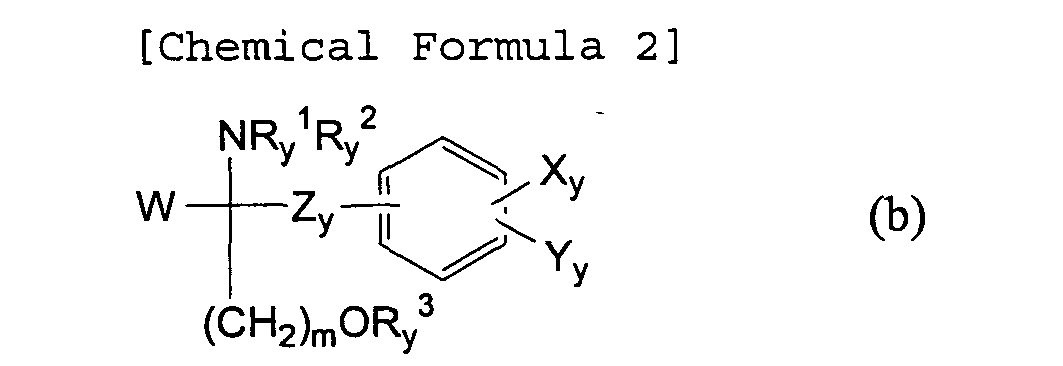
Although it is essential that compound (b) has a phenyl group in its basic backbone, the compound contained in the pharmaceutical composition of the present invention differs from compound (b) in that the corresponding group is a heterocyclic group in the form of a pyrrole group having a substituent on the nitrogen atom.
Moreover, a compound having a structure that resembles the structure of the compound contained in the pharmaceutical composition of the present invention is not disclosed whatsoever in this publication. - (3) A compound of the general formula (c) is known as an immunosuppressant (see, for example, Patent Document 3):

Although compound (c) has two oxymethyl groups (namely, - CH2ORz 3 and -CH2ORz 4) substituted on the same carbon atom as essential substituents, the compound of the present invention differs from compound (c) in that it has a -CH2OH group and a methyl or ethyl group substituted on the same carbon atom as the corresponding groups thereto. In addition, although compound (c) has an essential group in the form of a phenyl group between the -(CH2)2- group and -CO-(CH2)4- group in the basic backbone thereof, the compound contained in the pharmaceutical composition of the present invention differs from compound (c) in that the corresponding group is a heterocyclic group in the form of a pyrrole group having a substituent on the nitrogen atom. - (4) A compound of the general formula (d) is known as an immunosuppressant (see, for example, Patent Documents 4 and 5):


- Although compound (d) has two oxymethyl groups (-CH2OH) substituted on the same carbon atom as essential substituents, the compound of the present invention differs from compound (d) in that it has a -CH2OH group and a methyl or ethyl group substituted on the same carbon atom as the corresponding groups thereto. In addition, although compound (d) has a substituted phenyl group in its basic backbone as an essential group, the compound contained in the pharmaceutical composition differs from compound (d) in that the corresponding group is a heterocyclic group in the form of a pyrrole group or pyrrole group having a substituent on the nitrogen atom.
- On the other hand, a compound of the general formula (e) that has immunosuppressive activity is disclosed by the present applicant in
Japanese Patent Application (Kokai) No. 2002-167382 
- In addition, a compound of the general formula (f) that has immunosuppressive activity is disclosed by the present applicant in
Japanese Patent Appication (Kokai) No. 2003-267950 
- In view of these circumstances, it is desired to discover a pharmaceutical composition having low toxicity and superior immunosuppressive activity.
- [Patent Document 1] International Publication
WO94/0894 EP627406 - [Patent Document 2]
International Publication WO96/06068 - [Patent Document 3]
International Publication WO98/45249 - [Patent Document 4] International Publication
WO03/029184 WO03/029205 Japanese Patent Application (Kokai) No. 2002-167382 - [Patent Document 7]
Japanese Patent Application (Kokai) 2003-267950 - [Non-Patent Document 1] Kidney International, vol.51, 94 (1997); Journal of Immunology, vol.157, 4691 (1996)
- As a result of conducting extensive studies over many years on pharmaceutical compositions, the present inventors found a novel pharmaceutical composition having low toxicity and superior immunosuppressive activity, that is useful against rejection reactions during various organ transplants or skin transplants, autoimmune diseases or other immunity-related diseases such as systemic lupus erythematosus, rheumatoid arthritis, polymyositis, fibrositis, skeletal myositis, arthrosteitis, osteoarthritis, dermatomyositis, scleroderma, Behcet's disease, Crohn's disease, ulcerative colitis, autoimmune hepatitis, aplastic anemia, idiopathic thrombocytopenic purpura, autoimmune hemolytic anemia, multiple sclerosis, autoimmune pomphus, psoriasis vulgaris, angiitis, Wegener's granuloma, uveitis, Sjogren's syndrome, idiopathic interstitial pneumonia, Goodpasture's syndrome, sarcoidosis, allergic granulomatous angiitis, bronchial asthma, myocarditis, cardiomyopathy, aortitis syndrome, postmyocardial infarction syndrome, primary pulmonary hypertension, lipoid nephrosis, membranous nephropathy, membranoproliferative glomerulonephritis, focal glomerular sclerosis, crescenteric nephritis, myasthenia gravis, inflammatory neuropathy, atopic dermatitis, chronic photosensitive dermatitis, hyperphotosensitivity, decubitis ulcer, Sydenham's chorea, sclerosis, adult-onset diabetes, insulin-dependent diabetes, juvenile diabetes, atherosclerosis, glomerulonephritis, IgA nephropathy, tubulointerstitial nephritis, primary biliary cirrhosis, primary sclerosing cholangitis, fulminant hepatitis, viral hepatitis, GVHD, contact dermatitis and septicemia, infections such as fungal, mycoplasma, viral and protozoan infections, cardiovascular diseases such as cardiac failure, cardiomegaly, arrhythmia, angina pectoris, cardiac ischemia, arterial embolism, aneurysm, varix and circulatory disorders, central nervous system diseases such as Alzheimer's disease, dementia, Parkinson's disease, stroke, cerebral infarction, cerebral ischemia, depression, manic depression, schizophrenia, Huntington's chorea, epilepsy, convulsion, hyperactivity disorder, encephalitis, meningitis, anorexia and bulimia, and various diseases such as lymphoma, leukemia, polyuria, thamuria and diabetic retinopathy (and particularly against rejection reactions during various organs transplants and skin transplants, and autoimmune diseases such as systemic lupus erythematosus, rheumatoid arthritis, multiple sclerosis and atopic dermatitis).
- Thus, an object of the present invention is to provide a pharmaceutical composition containing a novel amino alcohol compound having low toxicity and superior immunosuppressive activity, a pharmacologically acceptable salt thereof or a pharmacologically acceptable ester thereof.
- In addition, since it is desired to discover a pharmaceutical composition that is useful for diseases caused by abnormal peripheral blood lymphocyte count and so forth, a problem to be solved by the present invention is to provide a pharmaceutical composition that is useful for the aforementioned diseases, has low toxicity, and demonstrates superior physicochemical properties and superior pharmacokinetics.
- The present invention will be described specifically.
- (1) The amino alcohol compound contained in the pharmaceutical composition of the present invention has the following general formula (I'):

The present invention provides a pharmaceutical composition containing a compound having general formula (I'), a pharmacologically acceptable salt thereof or a pharmacologically acceptable ester thereof. - (2) In (1), a compound wherein R1 is a methyl group, or a pharmacologically acceptable salt thereof;
- (3) in (1) or (2), a compound wherein R2 is a methyl group, or a pharmacologically acceptable salt thereof;
- (4) in (1) to (3), a compound wherein R3 is a phenyl group substituted with 1 to 3 groups selected from the group consisting of a lower alkyl group, a cycloalkyl group and a lower alkoxy group, or a pharmacologically acceptable salt thereof;
- (5) in (1) to (3), a compound wherein R3 is a phenyl group substituted with 1 to 3 groups selected from the group consisting of a lower alkyl group and a lower alkoxy group, or a pharmacologically acceptable salt thereof;
- (6) in any one selected from (1) to (3), a compound wherein R3 is a phenyl group substituted with 1 to 3 groups selected from the group consisting of a methyl group and a methoxy group, or a pharmacologically acceptable salt thereof; and,
- (7) in (1), any compound selected from the following compounds, or a pharmacologically acceptable salt thereof:
- 2-amino-2-methyl-4-{1-methyl-5-[4-(2-methylphenyl)butanoyl]pyrrol-2-yl}butan-1-ol,
- 2-amino-2-methyl-4-{1-methyl-5-[4-(3-methylphenyl)butanoyl]pyrrol-2-yl}butan-1-ol,
- 2-amino-2-methyl-4-{1-methyl-5-[4-(4-methylphenyl)butanoyl]pyrrol-2-yl}butan-1-ol,
- 2-amino-2-methyl-4-{1-methyl-5-[4-(2,3-dimethylphenyl)butanoyl]pyrrol-2-yl}butan-1-ol,
- 2-amino-2-methyl-4-{1-methyl-5-[4-(2,4-dimethylphenyl)butanoyl]pyrrol-2-yl}butan-1-ol,
- 2-amino-2-methyl-4-{1-methyl-5-[4-(2,5-dimethylphenyl)butanoyl]pyrrol-2-yl}butan-1-ol,
- 2-amino-2-methyl-4-{1-methyl-5-[4-(3,4-dimethylphenyl)butanoyl]pyrrol-2-yl}butan-1-ol,
- 2-amino-2-methyl-4-{1-methyl-5-[4-(3,5-dimethylphenyl)butanoyl]pyrrol-2-yl}butan-1-ol,
- 2-amino-2-methyl-4-{1-methyl-5-[4-(4-ethylphenyl)butanoyl]pyrrol-2-yl}butan-1-ol,
- 2-amino-2-methyl-4-{1-methyl-5-[4-(4-isopropylphenyl)butanoyl]pyrrol-2-yl}butan-1-ol,
- 2-amino-2-methyl-4-{1-methyl-S-[4-(4-cyclopropylphenyl)butanoyl]pyrrol-2-yl}butan-1-ol,
- 2-amino-2-methyl-4-{1-methyl-5-[4-(4-t-butylphenyl)butanoyl]pyrrol-2-yl}butan-1-ol,
- 2-amino-2-methyl-4-{1-methyl-5-[4-(4-methoxyphenyl)butanoyl]pyrrol-2-yl}butan-1-ol,
- 2-amino-2-methyl-4-{1-methyl-5-[4-(3,4-dimethoxyphenyl)butanoyl]pyrrol-2-yl}butan-1-ol,
- 2-amino-2-methyl-4-{1-methyl-5-[4-(3-methyl-4-methoxyphenyl)butanoyl]pyrrol-2-yl}butan-1-ol,
- 2-amino-2-methyl-4-{1-methyl-5-[4-(3-methoxy-4-methylphenyl)butanoyl]pyrrol-2-yl}butan-1-ol,
- 2-amino-2-methyl-4-{1-methyl-5-[4-(4-fluorophenyl)butanoyl]pyrrol-2-yl}butan-1-ol,
- 2-amino-2-methyl-4-{1-methyl-5-[4-(4-chlorophenyl)butanoyl]pyrrol-2-yl}butan-1-ol,
- 2-amino-2-methyl-4-{1-methyl-5-[4-(4-trifluoromethylphenyl)butanoyl]pyrrol-2-yl}butan-1-ol,
- 2-amino-2-methyl-4-{1-methyl-5-[4-(4-cyanophenyl)butanoyl]pyrrol-2-yl}butan-1-ol,
- 2-amino-2-ethyl-4-{1-methyl-5-[4-(2-methylphenyl)butanoyl]pyrrol-2-yl}butan-1-ol,
- 2-amino-2-ethyl-4-{1-methyl-5-[4-(3-methylphenyl)butanoyl]pyrrol-2-yl}butan-1-ol,
- 2-amino-2-ethyl-4-{1-methyl-5-[4-(4-methylphenyl)butanoyl}pyrrol-2-yl}butan-1-ol,
- 2-amino-2-ethyl-4-{1-methyl-5-[4-(2,3-dimethylphenyl)butanoyl]pyrrol-2-yl}butan-1-ol,
- 2-amino-2-ethyl-4-{1-methyl-5-[4-(2,4-dimethylphenyl)butanoyl]pyrrol-2-yl}butan-1-ol,
- 2-amino-2-ethyl-4-{1-methyl-5-[4-(2,5-dimethylphenyl)butanoyl]pyrrol-2-yl}butan-1-ol,
- 2-amino-2-ethyl-4-{1-methyl-5-[4-(3,4-dimethylphenyl)butanoyl]pyrrol-2-yl}butan-1-ol,
- 2-amino-2-ethyl-4-{1-methyl-5-[4-(3,5-dimethylphenyl)butanoyl]pyrrol-2-yl}butan-1-ol,
- 2-amino-2-ethyl-4-{1-methyl-5-[4-(4-ethylphenyl)butanoyl]pyrrol-2-yl}butan-1-ol,
- 2-amino-2-ethyl-4-{1-methyl-5-[4-(4-isopropylphenyl)butanoyl]pyrrol-2-yl}butan-1-ol,
- 2-amino-2-ethyl-4-{1-methyl-5-[4-(4-cyclopropylphenyl)butanoyl]pyrrol-2-yl}butan-1-ol,
- 2-amino-2-ethyl-4-{1-methyl-5-[4-(4-t-butylphenyl)butanoyl]pyrrol-2-yl}butan-1-ol,
- 2-amino-2-ethyl-4-{1-methyl-5-[4-(4-methoxyphenyl)butanoyl]pyrrol-2-yl}butan-1-ol,
- 2-amino-2-ethyl-4-{1-methyl-5-[4-(3,4-dimethoxyphenyl)butanoyl]pyrrol-2-yl}butan-1-ol,
- 2-amino-2-ethyl-4-{1-methyl-5-[4-{3-methyl-4-methoxyphenyl}butanoyl]pyrrol-2-yl}butan-1-ol,
- 2-amino-2-ethyl-4-{1-methyl-5-[4-(4-fluorophenyl)butanoyl]pyrrol-2-yl}butan-1-ol,
- 2-amino-2-ethyl-4-{1-methyl-5-[4-(4-chlorophenyl)butanoyl]pyrrol-2-yl}butan-1-ol,
- 2-amino-2-ethyl-4-{1-methyl-5-[4-(4-trifluoromethylphenyl)butanoyl]pyrrol-2-yl}butan-1-ol and
- 2-amino-2-ethyl-4-{1-methyl-5-[4-(4-cyanophenyl)butanoyl]pyrrol-2-yl}butan-1-ol.
In addition, the present invention includes the following inventions.
- (8) A pharmaceutical composition containing a compound having the following general formula (I):

- (9) a pharmaceutical composition according to (8) wherein R1 is a methyl group;
- (10) a pharmaceutical composition according to (8) or (9) wherein R2 is a methyl group;
- (11) a pharmaceutical composition according to any of (8) to
- (10) wherein R3 is a phenyl group substituted with 1 to 3 substituents selected from the group consisting of a lower alkyl group, a cycloalkyl group and a lower alkoxy group;
- (12) a pharmaceutical composition according to any of (8) to (10) wherein R3 is a phenyl group substituted with 1 to 3 substituents selected from the group consisting of a lower alkyl group and a lower alkoxy group;
- (13) a pharmaceutical composition according to any of (8) to (10) wherein R3 is a phenyl group substituted with 1 to 3 substituents selected from the group consisting of a methyl group and a methoxy group;
- (14) a pharmaceutical composition containing any compound selected from the following compounds, or a pharmacologically acceptable salt thereof:
- (2R)-2-amino-2-methyl-4-{1-methyl-5-[4-(3-methylphenyl)butanoyl]pyrrol-2-yl}butan-1-ol,
- (2R)-2-amino-2-methyl-4-{1-methyl-5-[4-(4-methylphenyl)butanoyl]pyrrol-2-yl}butan-1-ol,
- (2R)-2-amino-2-methyl-4-{1-methyl-5-[4-(3,4-dimethylphenyl)butanoyl]pyrrol-2-yl}butan-1-ol,
- (2R)-2-amino-2-methyl-4-{1-methyl-5-[4-(4-methoxyphenyl)butanoyl]pyrrol-2-yl}butan-1-ol and
- (2R)-2-amino-2-methyl-4-{1-methyl-5-[4-(3-methyl-4-methoxyphenyl)butanoyl]pyrrol-2-yl}butan-1-ol;
- (15) a pharmaceutical composition according to any of (8) to
- (14) wherein the pharmacologically acceptable salt is a fumarate;
- (16) a pharmaceutical composition according to any of (8) to
- (15) that has peripheral blood lymphocyte count lowering activity;
- (17) a pharmaceutical composition according to any of (8) to
- (15) that is a peripheral blood lymphocyte count lowering agent;
- (18) a pharmaceutical composition according to any of (8) to
- (15) that inhibits increases in peripheral blood lymphocyte count;
- (19) a pharmaceutical composition according to any of (8) to
- (15) for treatment or prophylaxis of diseases caused by abnormal peripheral blood lymphocyte count;
- (20) a pharmaceutical composition according to any of (8) to
- (15) for prophylaxis or treatment of diseases for which symptoms can be improved by lowering peripheral blood lymphocyte count;
- (21) a pharmaceutical composition according to any of (8) to
- (15) that exhibits immunosuppressive effects through peripheral blood lymphocyte count lowering activity;
- (22) a pharmaceutical composition according to any of (8) to (15) for suppressing rejection reactions during skin transplants or organ transplants;
- (23) a pharmaceutical composition according to any of (8) to (15) for prophylaxis or treatment of autoimmune diseases;
- (24) a pharmaceutical composition according to (23) wherein the autoimmune diseases are one or more types selected from the group consisting of rheumatoid arthritis, psoriasis, atopic dermatitis, multiple sclerosis, ulcerative colitis and Crohn's disease;
- (25) a pharmaceutical composition according to any of (8) to (24) for administering orally at a dose of the active ingredient of 0.00042 mg/kg/day to 0.84 mg/kg/day;
- (26) a pharmaceutical composition according to any of (8) to
- (25) wherein the number of administrations is once per one to three days; and,
- (27) a pharmaceutical composition according to any of (8) to
- (25) wherein the number of administrations is once per day.
- A pharmaceutical composition containing an amino alcohol compound having general formula (I) or (I') of the present invention or a pharmacologically acceptable salt thereof has low toxicity and superior immunosuppressive activity, and is particularly useful as a prophylactic or therapeutic (and preferably a therapeutic) in warm-blooded animals (and particularly humans) against rejection reactions during various organ transplants or skin transplants, autoimmune diseases or other immunity-related diseases such as systemic lupus erythematosus, rheumatoid arthritis, polymyositis, fibrositis, skeletal myositis, arthrosteitis, osteoarthritis, dermatomyositis, scleroderma, Behcet's disease, Crohn's disease, ulcerative colitis, autoimmune hepatitis, aplastic anemia, idiopathic thrombocytopenic purpura, autoimmune hemolytic anemia, multiple sclerosis, autoimmune pomphus, psoriasis vulgaris, angiitis, Wegener's granuloma, uveitis, Sjogren's syndrome, idiopathic interstitial pneumonia, Goodpasture's syndrome, sarcoidosis, allergic granulomatous angiitis, bronchial asthma, myocarditis, cardiomyopathy, aortitis syndrome, postmyocardial infarction syndrome, primary pulmonary hypertension, lipoid nephrosis, membranous nephropathy, membranoproliferative glomerulonephritis, focal glomerular sclerosis, crescenteric nephritis, myasthenia gravis, inflammatory neuropathy, atopic dermatitis, chronic photosensitive dermatitis, hyperphotosensitivity, decubitis ulcer, Sydenham's chorea, sclerosis, adult-onset diabetes, insulin-dependent diabetes, juvenile diabetes, atherosclerosis, glomerulonephritis, IgA nephropathy, tubulointerstitial nephritis, primary biliary cirrhosis, primary sclerosing cholangitis, fulminant hepatitis, viral hepatitis, GVHD, contact dermatitis and septicemia, infections such as fungal, mycoplasma, viral and protozoan infections, cardiovascular diseases such as cardiac failure, cardiomegaly, arrhythmia, angina pectoris, cardiac ischemia, arterial embolism, aneurysm, varix and circulatory disorders, central nervous system diseases such as Alzheimer's disease, dementia, Parkinson's disease, stroke, cerebral infarction, cerebral ischemia, depression, manic depression, schizophrenia, Huntington's chorea, epilepsy, convulsion, hyperactivity disorder, encephalitis, meningitis, anorexia and bulimia, and various diseases such as lymphoma, leukemia, polyuria, thamuria and diabetic retinopathy (and particularly against rejection reactions during various organs transplants or skin transplants, and autoimmune diseases such as systemic lupus erythematosus, rheumatoid arthritis, multiple sclerosis and atopic dermatitis).
- In addition, since the pharmaceutical composition of the present invention has low toxicity, demonstrates superior physical properties and superior pharmacokinetics, and demonstrates satisfactory peripheral blood lymphocyte count lowering activity through oral administration, it is useful as an oral prophylactic or oral therapeutic (and preferably an oral therapeutic) for the aforementioned autoimmune diseases and so forth, or as an oral prophylactic or oral therapeutic (and preferably an oral therapeutic) for other diseases caused by abnormal peripheral blood lymphocyte count.
- The following provides a specific explanation of the present invention.
- The amino alcohol compound serving as the active ingredient of the pharmaceutical composition of the present invention has the following general formula (I) or (I').

- In the above formulae, a "halogen atom" in the definition of R3 is a fluorine atom, chlorine atom, bromine atom or iodine atom, preferably a fluorine atom or chlorine atom, and most preferably a chlorine atom.
- In the above formulae, a "lower alkyl group" in the definition of R3 is a linear or branched alkyl group having 1 to 6 carbon atoms such as a methyl, ethyl, propyl, isopropyl, butyl, isobutyl, s-butyl, t-butyl, pentyl, isopentyl, 2-methylbutyl, neopentyl, 1-ethylpropyl, hexyl, isohexyl, 4-methylpentyl, 3-methylpentyl, 2-methylpentyl, 1-methylpentyl, 3,3-dimethylbutyl, 2,2-dimethylbutyl, 1,1-dimethylbutyl, 1,2-dimethylbutyl, 1,3-dimethylbutyl, 2,3-dimethylbutyl, 1-ethylbutyl or 2-ethylbutyl group, preferably an alkyl group having 1 to 4 carbon atoms, more preferably a methyl or ethyl group, and most preferably a methyl group.
- In the above formulae, a "cycloalkyl group" in the definition of R3 is a cyclic alkyl group having 3 to 6 carbon atoms such as a cyclopropyl, cyclobutyl, cyclopentyl or cyclohexyl group, preferably a cyclopropyl or cyclobutyl group, and most preferably a cyclopropyl group.
- In the above formulae, a "lower alkoxy group" in the definition of R3 indicates a group in which the aforementioned "lower alkyl group" is bonded to an oxygen atom, and is a linear or branched alkoxy group having 1 to 6 carbon atoms such as a methoxy, ethoxy, propoxy, isopropoxy, butoxy, isobutoxy, s-butoxy, t-butoxy, pentoxy, isopentoxy, 2-methylbutoxy, 1-ethylpropoxy, 2-ethylpropoxy, neopentoxy, hexyloxy, 4-methylpentoxy, 3-methylpentoxy, 2-methylpentoxy, 3,3-dimethylbutoxy, 2,2-dimethylbutoxy, 1,1-dimethylbutoxy, 1,2-dimethylbutoxy, 1,3-dimethylbutoxy or 2,3-dimethylbutoxy group, preferably an alkoxy group having 1 to 4 carbon atoms, more preferably an alkoxy group having 1 or 2 carbon atoms, and most preferably a methoxy group.
- In the above formulae, a "halogeno lower alkyl group" in the definition of R3 indicates a group in which a halogen atom is substituted in the aforementioned "lower alkyl group", and is an alkyl group having 1 to 6 carbon atoms in which a halogen atom has been substituted such as a trifluoromethyl, trichloromethyl, difluoromethyl, dichloromethyl, dibromomethyl, fluoromethyl, 2,2,2-trifluoroethyl, 2,2,2-trichloroethyl, 2-bromoethyl, 2-chloroethyl, 2-fluoroethyl, 2-iodoethyl, 3-chloropropyl, 4-fluorobutyl, 6-iodohexyl or 2,2-dibromoethyl group, preferably an alkyl group having 1 to 4 carbon atoms in which a halogen atom has been substituted, more preferably an alkyl group having 1 or 2 carbon atoms in which a halogen atom has been substituted, and most preferably a trifluoromethyl group.
- In the above formulae, a "lower aliphatic acyl group" in the definition of R3 is a linear or branched lower aliphatic acyl group having 1 to 6 carbon atoms such as a formyl, acetyl, propionyl, butyryl, isobutyryl, pivaloyl or hexanoyl group, preferably an aliphatic acyl group having 1 to 4 carbon atoms, more preferably an acetyl or propionyl group, and most preferably an acetyl group.
- The aforementioned "pharmacologically acceptable salt thereof" refers to a salt of a compound having general formula (I) or (I') of the present invention since said compound has a basic group in the manner of an amino group and can be converted to a salt by reacting with acid.
- Preferable examples of pharmacologically acceptable salts of a compound having general formula (I) or (I') of the present invention normally include salts of halogenated hydroacids such as hydrofluorides, hydrochlorides, hydrobromides and hydroiodides, salts of inorganic acids such as nitrates, perchlorates, sulfates and phosphates; salts of lower alkane sulfonic acids such as methane sulfonates, trifluoromethane sulfonates and ethane sulfonates, salts of aryl sulfonic acids such as benzene sulfonates and p-toluene sulfonates, salts of organic acids such as acetates, malates, fumarates, succinates, citrates, ascorbates, tartrates, oxalates and maleates; and salts of amino acids such as glycine, lysine, arginine, ornithine, glutamates and aspartates, and more preferably salts of halogenated hydroacids.
- In the present invention, a preferable salt is determined in consideration of the physical properties, solubility, hygroscopicity, thermal stability and melting point and so forth of the salt itself, and the stability when mixing with a vehicle or diluent and so forth during formulation and so forth (including not reacting with that mixture along with the physical properties, solubility, hygroscopicity, thermal stability and melting point and so forth of the preparation). A pharmacologically acceptable salt of a compound having general formula (I) or (I') serving as the active ingredient of the present invention is preferably a salt of an organic acid and more preferably a fumarate.
- The aforementioned "ester" refers to an ester of a compound having general formula (I) or (I') of the present invention since said compound can be converted to an ester, an example of such an ester being an "ester of a hydroxyl group", and such esters refer to esters in which each ester residue is an "ordinary protecting group" or a "protecting group that can be cleaved by a biological method such as hydrolysis in the body".
- An "ordinary protecting group" refers to protecting groups that can be cleaved by a chemical method such as hydrogenolysis, hydrolysis, electrolysis or photolysis.
- Preferable examples of an "ordinary protecting group" in an "ester of a hydroxyl group" include "aliphatic acyl groups" including alkanoyl groups such as a formyl, acetyl, propionyl, butyryl, isobutyryl, pentanoyl, pivaloyl, valeryl, isovaleryl, octanoyl, nonanoyl, decanoyl, 3-methylnonanoyl, 8-methylnonanoyl, 3-ethyloctanoyl, 3,7-dimethyloctanoyl, undecanoyl, dodecanoyl, tridecanoyl, tetradecanoyl, pentadecanoyl, hexadecanoyl, 1-methylpentadecanoyl, 14-methylpentadecanoyl, 13,13-dimethyltetradecanoyl, heptadecanoyl, 15-methylhexadecanoyl, octadecanoyl, 1-methylheptadecanoyl, nonadecanoyl, eicosanoyl or heneicosanoyl group, halogenated alkyl carbonyl groups such as a chloroacetyl, dichloroacetyl, trichloroacetyl or trifluoroacetyl group, lower alkoxy alkyl carbonyl groups such as a methoxyacetyl group, and unsaturated alkyl carbonyl groups such as an acryloyl, propionoyl, methacryloyl, crotonoyl, isocrotonoyl or (E)-2-methyl-2-butenoyl group (and preferably lower aliphatic acyl groups having 1 to 6 carbon atoms); "aromatic acyl groups" including aryl carbonyl groups such as a benzoyl, α-naphthoyl or β-naphthoyl group, halogenated aryl carbonyl groups such as a 2-bromobenzoyl, 4-chlorobenzoyl or 2,4,6-trifluorobenzoyl group, lower alkylated aryl carbonyl groups such as a 2,4,6-trimethylbenzoyl or 4-toloyl group, lower alkoxylated aryl carbonyl groups such as a 4-anisoyl group, nitrated aryl carbonyl groups such as a 4-nitrobenzoyl or 2-nitrobenzoyl group, lower alkoxycarbonylated aryl carbonyl groups such as a 2-(methoxycarbonyl)benzoyl group, and arylated aryl carbonyl groups such as a 4-phenylbenzoyl group; "alkoxycarbonyl groups" including lower alkoxycarbonyl groups such as a methoxycarbonyl, ethoxycarbonyl, propoxycarbonyl, butoxycarbonyl, s-butoxycarbonyl, t-butoxycarbonyl or isobutoxycarbonyl group, and lower alkoxycarbonyl groups substituted with a halogen atom or tri-lower alkylsilyl group such as a 2,2,2-trichloroethoxycarbonyl or 2-trimethylsilyl ethoxycarbonyl group; "tetrahydropyranyl or tetrahydrothiopyranyl groups" such as a tetrahydropyran-2-yl, 3-bromotetrahydropyran-2-yl or 4-methoxytetrahydrothiopyran-4-yl group; "tetrahydrofuranyl or tetrahydrothiofuranyl" groups such as a tetrahydrofuran-2-yl or tetrahydrothiofuran-2-yl group; "silyl groups" including tri-lower alkyl silyl groups such as a trimethylsilyl, triethylsilyl, isopropyl dimethylsilyl, t-butyl dimethylsilyl, methyl diisopropylsilyl, methyl di-t-butylsilyl or triisopropylsilyl group, and tri-lower alkyl silyl groups substituted with 1 to 2 aryl groups such as a diphenyl methylsilyl, diphenyl butylsilyl, diphenyl isopropylsilyl or phenyl diisopropylsilyl group; "alkoxymethyl groups" including lower alkoxymethyl groups such as a methoxymethyl, 1,1-dimethyl-1-methoxymethyl, ethoxymethyl, propoxymethyl, isopropoxymethyl, butoxymethyl or t-butoxymethyl group, lower alkoxylated lower alkoxymethyl groups such as a 2-methoxyethoxymethyl group, and halogeno lower alkoxymethyl groups such as a 2,2,2-trichloroethoxymethyl or bis(2-chloroethoxy)methyl group; "substituted ethyl groups" including lower alkoxylated ethyl groups such as a 1-ethoxyethyl or 1-(isopropoxy)ethyl group, and halogenated ethyl groups such as a 2,2,2-trichloroethyl group; "aralkyl groups" including lower alkyl groups substituted with 1 to 3 aryl groups such as a benzyl, α-naphtylmethyl, β-naphthylmethyl, diphenylmethyl, triphenylmethyl, α-naphthyldiphenylmethyl or 9-anthrylmethyl group, and lower alkyl groups substituted with 1 to 3 aryl groups in which the aryl ring is substituted with a lower alkyl, lower alkoxy, nitro, halogen or cyano group such as a 4-methylbenzyl, 2,4,6-trimethylbenzyl, 3,4,5-trimethylbenzyl, 4-methoxybenzyl, 4-methoxyphenyldiphenylmethyl, 2-nitrobenzyl, 4-nitrobenzyl, 4-chlorobenzyl, 4-bromobenzyl or 4-cyanobenzyl group; "alkenyloxycarbonyl groups" such as a vinyloxycarbonyl or allyloxycarbonyl group; and, "aralkyloxycarbonyl groups" in which the aryl ring is optionally substituted with 1 to 2 lower alkoxy groups or nitro groups such as a benzyloxycarbonyl, 4-methoxybenzyloxycarbonyl, 3,4-dimethoxybenzyloxycarbonyl, 2-nitrobenzyloxycarbonyl or 4-nitrobenzyloxycarbonyl group.
- A "protecting group that can be cleaved by a biological method such as hydrolysis in the body" refers to a protecting group that generates a free acid or salt thereof as a result of being cleaved by a biological method such as hydrolysis in the body, and whether or not it is a derivative thereof can be determined by administering to a laboratory animal such as a rat or mouse by intravenous injection, subsequently investigating a body fluid of the animal, and detecting the original compound or pharmacologically acceptable salt thereof.
- Preferable examples of a "protecting group that can be cleaved by a biological method such as hydrolysis in the body" in an "ester of a hydroxyl group" include a 1-(acyloxy) "lower alkyl group" such as a 1-("lower aliphatic acyl"oxy) "lower alkyl group", e.g. a formyloxymethyl, acetoxymethyl, dimethylaminoacetoxymethyl, propionyloxymethyl, butyryloxymethyl, pivaloyloxymethyl, valeryloxymethyl, isovaleryloxymethyl, hexanoyloxymethyl, 1-formyloxyethyl, 1-acetoxyethyl, 1-propionyloxyethyl, 1-butyryloxyethyl, 1-pivaloyloxyethyl, 1-valeryloxyethyl, 1-isovaleryloxyethyl, 1-hexanoyloxyethyl, 1-formyloxypropyl, 1-acetoxypropyl, 1-propionyloxypropyl, 1-butyryloxypropyl, 1-pivaloyloxypropyl, 1-valeryloxypropyl, 1-isovaleryloxypropyl, 1-hexanoyloxypropyl, 1-acetoxybutyl, 1-propionyloxybutyl, 1-butyryloxybutyl, 1-pivaloyloxybutyl, 1-acetoxypentyl, 1-propionyloxypentyl, 1-butyryloxypentyl, 1-pivaloyloxypentyl or 1-pivaloyloxyhexyl group, a 1-("cycloalkyl" carbonyloxy) "lower alkyl group", e.g. a cyclopentylcarbonyloxymethyl, cyclohexylcarbonyloxymethyl, 1-cyclopentylcarbonyloxyethyl, 1-cyclohexylcarbonyloxyethyl, 1-cyclopentylcarbonyloxypropyl, 1-cyclohexylcarbonyloxypropyl, 1-cyclopentylcarbonyloxybutyl or 1-cyclohexylcarbonyloxybutyl group, a 1-("aromatic acyl"oxy) "lower alkyl group" e.g. a benzoyloxymethyl group; a "carbonyloxy alkyl group" such as a (lower alkoxycarbonyloxy)alkyl group, e.g. a methoxycarbonyloxymethyl, ethoxycarbonyloxymethyl, propoxycarbonyloxymethyl, isopropoxycarbonyloxymethyl, butoxycarbonyloxymethyl, isobutoxycarbonyloxymethyl, pentyloxycarbonyloxymethyl, hexyloxycarbonyloxymethyl, cyclohexyloxycarbonyloxymethyl, cyclohexyloxycarbonyloxy, (cyclohexyl)methyl, 1-(methoxycarbonyloxy)ethyl, 1-(ethoxycarbonyloxy)ethyl, 1-(propoxycarbonyloxy)ethyl, 1-(isopropoxycarbonyloxy)ethyl, 1-(butoxycarbonyloxy)ethyl, 1-(isobutoxycarbonyloxy)ethyl, 1-(t-butoxycarbonyloxy)ethyl, 1-(pentyloxycarbonyloxy)ethyl, 1-(hexyloxycarbonyloxy)ethyl, 1-(cyclopentyloxycarbonyloxy)ethyl, 1-(cyclopentyloxycarbonyloxy)propyl, 1-(cyclohexyloxycarbonyloxy)propyl, 1-(cyclopentyloxycarbonyloxy)butyl, 1-(cyclohexyloxycarbonyloxy)butyl, 1-(cyclohexyloxycarbonyloxy)ethyl, 1-(ethoxycarbonyloxy)propyl, 1-(methoxycarbonyloxy)propyl, 1-(ethoxycarbonyloxy)propyl, 1-(propoxycarbonyloxy)propyl, 1-(isopropoxycarbonyloxy)propyl, 1-(butoxycarbonyloxy)propyl, 1-(isobutoxycarbonyloxy)propyl, 1-(pentyloxycarbonyloxy)propyl, 1-(hexyloxycarbonyloxy)propyl, 1-(methoxycarbonyloxy)butyl, 1-(ethoxycarbonyloxy)butyl, 1-(propoxycarbonyloxy)butyl, 1-(isopropoxycarbonyloxy)butyl, 1-(butoxycarbonyloxy)butyl, 1-(isobutoxycarbonyloxy)butyl, 1-(methoxycarbonyloxy)pentyl, 1-(ethoxycarbonyloxy)pentyl, 1-(methoxycarbonyloxy)hexyl, or 1-(ethoxycarbonyloxy)hexyl group; an oxodioxolenyl methyl group, e.g. a (5-phenyl-2-oxo-1,3-dioxolen-4-yl)methyl, [5-(4-methylphenyl)-2-oxo-1,3-dioxolen-4-yl]methyl, [5-(4-methoxyphenyl)-2-oxo-1,3-dioxolen-4-yl]methyl, [5-(4-fluorophenyl)-2-oxo-1,3-dioxolen-4-yl]methyl, [5-(4-chlorophenyl)-2-oxo-1,3-dioxolen-4-yl]methyl, (2-oxo-1,3-dioxolen-4-yl)methyl, (5-methyl-2-oxo-1,3-dioxolen-4-yl)methyl, (5-ethyl-2-oxo-1,3-dioxolen-4-yl)methyl, (5-propyl-2-oxo-1,3-dioxolen-4-yl)methyl, (5-isopropyl-2-oxo-1,3-dioxolen-4-yl)methyl, or (5-butyl-2-oxo-1,3-dioxolen-4-yl)methyl group: a "phthalidyl group" such as a phthalidyl, dimethylphthalidyl, or dimethoxy phthalidyl group: the above-mentioned "lower aliphatic acyl group": the above-mentioned "aromatic acyl group": a "half ester salt residue of succinic acid": a "phosphate ester salt residue": an "ester formation residue such as amino acid": a carbamoyl group: a carbamoyl group substituted with 1 or 2 lower alkyl groups: and a pivaloyloxymethyloxycarbonyl group, and preferably a "carbonyloxyalkyl group".
- A compound having general formula (I) or (I') serving as an active ingredient of the present invention, a pharmacologically acceptable salt thereof or a pharmacologically acceptable ester thereof may be in the form of a hydrate by allowing to stand in air, recrystallizing, absorbing water or having adsorbed water, and such hydrates are also included in the present invention.
- A compound having general formula (I) or (I') serving as an active ingredient of the present invention, a pharmacologically acceptable salt thereof, a pharmacologically acceptable ester thereof, or a pharmacologically acceptable other derivative thereof has optical isomers since it has an asymmetric carbon atom within its molecule.
- In a compound having general formula (I) serving as an active ingredient of the present invention, all optical isomers and mixtures of optical isomers are represented by a single formula, namely the (R) isomer. Although the present invention mainly includes (R) isomers among the optical isomers thereof, it also includes a small amount of the (S) isomer for reasons attributable to the production process and so forth.
- Although specific examples of a compound having general formula (I) or (I') serving as an active ingredient of the present invention include, for example, the compounds described in the following Table 1, the present invention is not limited to these compounds.
- The following abbreviations are used in the table.
- Ac :
- acetyl group
- tBu :
- t-butyl group
- Et :
- ethyl group
- EtO :
- ethoxy formula
- Me :
- methyl group
- MeO :
- methoxy group
- Ph :
- phenyl group
- cPr :
- cyclopropyl group
- iPr :
- isopropyl group
- In the above Table 1, preferred examples of compound (I) or (I') serving as an active ingredient of the present invention include Exemplary Compound Nos. 17 to 24, 40 to 47, 54 to 63, 72, 73, 90 to 97, 113 to 120, 127 to 136, 145, 146, 163 to 170, 186 to 193, 200 to 209, 218, 219, 236 to 243, 259 to 266, 273 to 282, 291 and 292, more preferably Exemplary Compound Nos. 17 to 24, 54 to 63, 72, 73, 163 to 170, 192, 203, 208 and 219, and even more preferred examples include
Exemplary Compound No. 17: 2-amino-2-methyl-4-{1-methyl-5-[4-(2-methylphenyl)butanoyl]pyrrol-2-yl}butan-1-ol,
Exemplary Compound No. 18: 2-amino-2-methyl-4-{1-methyl-5-[4-(3-methylphenyl)butanoyl]pyrrol-2-yl}butan-1-ol,
Exemplary Compound No. 19: 2-amino-2-methyl-4-{1-methyl-5-[4-(4-methylphenyl)butanoyl]pyrrol-2-yl}butan-1-ol,
Exemplary Compound No. 20: 2-amino-2-methyl-4-{1-methyl-5-[4-(2,3-dimethylphenyl)butanoyl]pyrrol-2-yl}butan-1-ol,
Exemplary Compound No. 21: 2-amino-2-methyl-4-{1-methyl-5-[4-(2,4-dimethylphenyl)butanoyl]pyrrol-2-yl}butan-1-ol,
Exemplary Compound No. 22: 2-amino-2-methyl-4-{1-methyl-5-[4-(2,5-dimethylphenyl)butanoyl]pyrrol-2-yl}butan-1-ol,
Exemplary Compound No. 23: 2-amino-2-methyl-4-{1-methyl-5-[4-(3,4-dimethylphenyl)butanoyl]pyrrol-2-yl}butan-1-ol,
Exemplary Compound No. 24: 2-amino-2-methyl-4-{1-methyl-5-[4-(3,5-dimethylphenyl)butanoyl]pyrrol-2-yl}butan-1-ol,
Exemplary Compound No. 57: 2-amino-2-methyl-4-{1-methyl-5-[4-(3-methyl-4-methoxyphenyl)butanoyl]pyrrol-2-yl}butan-1-ol,
Exemplary Compound No. 62: 2-amino-2-methyl-4-{1-methyl-5-[4-(3-methoxy-4-methylphenyl)butanoyl]pyrrol-2-yl}butan-1-ol and Exemplary Compound No. 73: 2-amino-2-methyl-4-{1-methyl-5-[4-(4-dicyanophenyl)butanoyl]pyrrol-2-yl}butan-1-ol. - A compound having general formula (I) serving as an active ingredient of the present invention can be produced according to the processes described below.
- Process A is a process by which a compound having general formula (I) is produced from a compound having general formula (II) or general formula (III).


- In the aforementioned formulae, R1, R2 and R3 are the same as previously defined, R4 and R5 may be the same or different and represent an amino protecting group, R6 represents a "hydroxyl protecting group" and Q represents a leaving group.
- There are no particular limitations on the "amino protecting group" in the definition of R4 and R5 provided it is an amino protecting group used in the field of organic synthetic chemistry, and examples include lower aliphatic acyl groups and lower alkoxycarbonyl groups, and preferably an acetyl group or t-butoxycarbonyl group.
- There are no particular limitations on the "hydroxyl protecting group" in the definition of R6 provided it is a hydroxyl protecting group used in the field of organic synthetic chemistry, and examples include lower aliphatic acyl groups, and preferably an acetyl group.
- There are no particular limitations on the leaving group in the definition of Q provided it is a leaving group used in the field of organic synthetic chemistry, and examples include halogen groups such as a chlorine, bromine or iodine atom and sulfonate groups such as a methane sulfonate group or p-toluene sulfonate group, and preferably a chlorine atom.
- In Step A1, a compound having general formula (V) is produced, and this is carried out by reacting a compound having general formula (II) and a compound having general formula (IV) in an inert solvent in the presence of a base.
- There are no particular limitations on the inert solvent used in the aforementioned reaction provided it does not react with the compound having general formula (IV), and examples include aliphatic hydrocarbons such as hexane, heptane, ligroin or petroleum ether; aromatic hydrocarbons such as toluene, benzene or xylene; halogenated hydrocarbons such as dichloromethane, chloroform, carbon tetrachloride, dichloroethane, chlorobenzene or dichlorobenzene; ethers such as diethyl ether, diisopropyl ether, tetrahydrofuran, dioxane, dimethoxyethane or diethylene glycol dimethyl ether; lower alkyl nitriles such as acetonitrile or propionitrile; and, lower alkyl ketones such as acetone or methyl ethyl ketone, preferably aromatic hydrocarbons, and more preferably benzene, toluene or xylene.
- There are no particular limitations on the base used in the aforementioned reaction provided it activates the compound having general formula (IV), and examples include organic amines such as triethylamine, tributylamine, diisopropylethylamine, N-methylmorpholine, pyridine, 4-(N,N-dimethylamino)pyridine, 4-pyrrolidinopyridine, N,N-dimethylaniline, N,N-diethylaniline, 1,5-diazabicyclo[4.3.0]non-5-ene, 1,4-diazabicyclo[2.2.2]octane (DABCO) or 1,8-diazabicyclo[5.4.0]-7-undecene (DBU), and preferably 4-(N,N-dimethylaminopyridine) or 4-pyrrolidinopyridine.
- Although the reaction temperature varies depending on the type of raw material compound, solvent, base and so forth, it is normally from 0 to 200°C and preferably from room temperature to 150°C.
- Although the reaction time varies depending on the type of raw material compound, base, solvent, reaction temperature and so forth, it is normally from 15 minutes to 7 days, and preferably from 6 hours to 3 days.
- In Step A2, a compound having general formula (VI) is produced, and this is carried out using the same method as Step A1 using a compound having general formula (III) and a compound having general formula (IV).
- In Step A3, a compound having general formula (I) is produced, and this is carried out by hydrolyzing a compound having general formula (V) or general formula (VI) in an inert solvent in the presence of a base.
- There are no particular limitations on the inert solvent used in the aforementioned reactions, and examples include ethers such as diethyl ether, diisopropyl ether, tetrahydrofuran, dioxane, dimethoxyethane, or diethylene glycol dimethyl ether; aromatic hydrocarbons such as toluene, benzene or xylene; halogenated hydrocarbons such as dichloromethane, chloroform, carbon tetrachloride, dichloroethane, chlorobenzene or dichlorobenzene; lower alkyl nitriles such as acetonitrile or propionitrile; amides such as formamide, N,N-dimethylformamide, N,N-dimethylacetamide or hexamethyl phosphoric triamide; lower alkyl alcohols such as methanol, ethanol, propanol or butanol; and water, preferably alcohols or ethers, and more preferably a mixed solvent of methanol and tetrahydrofuran. The reaction speed may be increased by adding water as co-solvent.
- There are no particular limitations on the base used in the aforementioned reactions provided it only acts in the desired hydrolysis reaction, and examples include alkaline metal carbonates such as lithium carbonate, sodium carbonate or potassium carbonate; alkaline metal bicarbonates such as lithium hydrogencarbonate, sodium hydrogencarbonate or potassium hydrogencarbonate; alkaline metal hydrides such as lithium hydride, sodium hydride or potassium hydride; alkaline metal hydroxides such as lithium hydroxide, sodium hydroxide or potassium hydroxide; and, alkaline metal alkoxides such as lithium methoxide, sodium methoxide, sodium ethoxide or potassium t-butoxide, preferably alkaline metal hydroxides, and more preferably lithium hydroxide or sodium hydroxide.
- Although the reaction temperature varies depending on the type of raw material compound, solvent, base and so forth, it is normally from -78 to 200°C and preferably from -50 to 150°C.
- Although the reaction time varies depending on the type of raw material compound, base, solvent, reaction temperature and so forth, it is normally from 15 minutes to 48 hours, and preferably from 30 minutes to 8 hours.
- The desired compounds of each step of Process A are recovered from the reaction mixture in accordance with ordinary methods. For example, in the case of suitably neutralizing the reaction mixture or when impurities are present, an organic solvent such as ethyl acetate that is not miscible with water is added after removing the impurities by filtration, and after washing with water and so forth, the organic layer containing the desired compound is separated, and after drying with anhydrous magnesium sulfate or anhydrous sodium sulfate, the desired compound is obtained by distilling off the solvent. The resulting desired compound can be separated and purified as necessary by suitably combining ordinary methods, such as recrystallization, reprecipitation or other method commonly used for separation and purification of organic compounds, examples of which include absorption column chromatography using a carrier such as silica gel, alumina or magnesium-silica gel-based Florisil; a method using a synthetic adsorbent such as partition column chromatography using a carrier such as Sephadex LH-20 (Pharmacia), Amberlite XAD-11 (Rohm and Haas) or Diaion HP-20 (Mitsubishi Chemical), a method using ion exchange chromatography, and a forward-phase, reverse-phase column chromatography method using silica gel or alkylated silica gel (and preferably high-performance liquid column chromatography), and eluting with a suitable eluent.
- Furthermore, when it is necessary to separate isomers, isomers can be separated by the aforementioned separation and purification means at a suitable time either following completion of the reaction of each step or following completion of a desired step.
- Process B is an alternative process of Process A in which a compound having general formula (I) is produced from a compound having general formula (II) or general formula (III).

- In the above formulae, R1, R2, R3, R4, R5 and R6 are the same as previously defined.
- In Step B1, a compound having formula (V) is produced, and this is carried out by reacting a compound having general formula (II) and a compound having general formula (VII) in an inert solvent in the presence of phosphorus oxychloride or oxalyl chloride. This reaction is carried out in accordance with a known method (such as the method described in J. Med. Chem., 40, 3381 (1997)).
- There are no particular limitations on the inert solvent used in the aforementioned reaction, and examples include aliphatic hydrocarbons such as hexane, heptane, ligroin or petroleum ether; aromatic hydrocarbons such as toluene, benzene or xylene; halogenated hydrocarbons such as dichloromethane, chloroform, carbon tetrachloride, dichloroethane, chlorobenzene or dichlorobenzene; ethers such as diethyl ether, diisopropyl ether, tetrahydrofuran, dioxane, dimethoxyethane or diethylene glycol dimethyl ether; lower alkyl nitriles such as acetonitrile or propionitrile; and lower alkyl ketones such as acetone or methyl ethyl ketone, preferably aromatic hydrocarbons, and more preferably benzene or toluene.
- Although the reaction temperature varies depending on the type of raw material compound, solvent, base and so forth, it is normally from 0 to 200°C and preferably from room temperature to 150°C.
- Although the reaction time varies depending on the type of raw material compound, base, solvent, reaction temperature and so forth, it is normally from 15 minutes to 7 days, and preferably from 6 hours to 3 days.
- In Step B2, a compound having general formula (VI) is produced, and this is carried out using the same method as Step B1 using a compound having general formula (III) and a compound having general formula (VII).
- In Step B3, a compound having general formula (I) is produced, and this is carried out by hydrolyzing a compound having general formula (V) or a compound having general formula (VI) in an inert solvent in the presence of a base.
- There are no particular limitations on the inert solvent used in the aforementioned reactions, and examples include ethers such as diethyl ether, diisopropyl ether, tetrahydrofuran, dioxane, dimethoxyethane, or diethylene glycol dimethyl ether; alcohols such as methanol, ethanol, n-propanol, isopropanol, n-butanol, isobutanol, t-butanol, isoamyl alcohol, diethylene glycol, glycerin, octanol, cyclohexanol or methyl cellosolve; amides such as formamide, N,N-dimethylformamide, N,N-dimethylacetamide or hexamethyl phosphoric triamide; water; or mixed solvents of the aforementioned solvents or mixed solvents of the aforementioned solvents and water, preferably mixed solvents of alcohols and ethers and water or mixed solvents of alcohols and water, and more preferably a mixed solvent of methanol, tetrahydrofuran and water or a mixed solvent of methanol and water.
- There are no particular limitations on the base used in the aforementioned reactions provided it only acts in the desired hydrolysis reaction, and examples include alkaline metal carbonates such as lithium carbonate, sodium carbonate or potassium carbonate; alkaline metal bicarbonates such as lithium hydrogencarbonate, sodium hydrogencarbonate or potassium hydrogencarbonate; alkaline metal hydrides such as lithium hydride, sodium hydride or potassium hydride; alkaline metal hydroxides such as lithium hydroxide, sodium hydroxide or potassium hydroxide; and, alkaline metal alkoxides such as lithium methoxide, sodium methoxide, sodium ethoxide or potassium t-butoxide, preferably alkaline metal hydroxides, and more preferably sodium hydroxide.
- Although the reaction temperature varies depending on the type of raw material compound, solvent, base and so forth, it is normally from -78 to 150°C, preferably from -50 to 100°C, and more preferably in the vicinity of room temperature.
- Although the reaction time varies depending on the type of raw material compound, base, solvent, reaction temperature and so forth, it is normally from 15 minutes to 48 hours, and preferably from 30 minutes to 6 hours.
- The desired compounds of each step of Process B are collected from the reaction mixture in accordance with ordinary methods. For example, in the case of suitably neutralizing the reaction mixture or when impurities are present, an organic solvent such as ethyl acetate that is not miscible with water is added after removing the impurities by filtration, and after washing with water and so forth, the organic layer containing the desired compound is separated, and after drying with anhydrous magnesium sulfate or anhydrous sodium sulfate, the desired compound is obtained by distilling off the solvent. The resulting desired compound can be separated and purified as necessary by suitably combining ordinary methods, such as recrystallization, reprecipitation or other method commonly used for separation and purification of organic compounds, examples of which include absorption column chromatography using a carrier such as silica gel, alumina or magnesium-silica gel-based Florisil; a method using a synthetic adsorbent such as partition column chromatography using a carrier such as Sephadex LH-20 (Pharmacia), Amberlite XAD-11 (Rohm and Haas) or Diaion HP-20 (Mitsubishi Chemical), a method using ion exchange chromatography, and a forward-phase, reverse-phase column chromatography method using silica gel or alkylated silica gel (and preferably high-performance liquid column chromatography), and eluting with a suitable eluent.
- Furthermore, when it is necessary to separate isomers, isomers can be separated by the aforementioned separation and purification means at a suitable time either following completion of the reaction of each step or following completion of a desired step.
- Process C is a process for producing a compound having general formula (III).


- In the above formulae, R1, R2, R4, R5, R6 and Q are the same as previously defined.
- R7 represents an alkyl group having 1 to 20 carbon atoms, an alkyl group having 2 to 20 carbon atoms interposed with a hetero atom, an alkyl group having 1 to 20 carbon atoms substituted with an aryl group or aromatic heterocyclic group, an alkynyl group having 2 to 20 carbon atoms, an alkynyl group having 3 to 20 carbon atoms interposed with a hetero atom, an alkynyl group having 2 to 20 carbon atoms substituted with an aryl group or aromatic heterocyclic group, an alkenyl group having 2 to 20 carbon atoms, an alkenyl group having 3 to 20 carbon atoms interposed with a hetero atom, an alkenyl group having 2 to 20 carbon atoms substituted with an aryl group or aromatic heterocyclic group, an alkyl group having 2 to 20 carbon atoms substituted with an aryl group or aromatic heterocyclic group and interposed with a hetero atom, or a cycloalkyl group having 3 to 20 carbon atoms.
- An "alkyl group having 1 to 20 carbon atoms" in the definition of R7 includes linear or branched alkyl groups having 1 to 20 carbon atoms such as the aforementioned "lower alkyl group", or a heptyl, 1-methylhexyl, 2-methylhexyl, 3-methylhexyl, 4-methylhexyl, 5-methylhexyl, 1-propylbutyl, 4,4-dimethylpentyl, octyl, 1-methylheptyl, 2-methylheptyl, 3-methylheptyl, 4-methylheptyl, 5-methylheptyl, 6-methylheptyl, 1-propylpentyl, 2-ethylhexyl, 5,5-dimethylhexyl, nonyl, 3-methyloctyl, 4-methyloctyl, 5-methyloctyl, 6-methyloctyl, 1-propylhexyl, 2-ethylheptyl, 6,6-dimethylheptyl, decyl, 1-methylnonyl, 3-methylnonyl, 8-methylnonyl, 3-ethyloctyl, 3,7-dimethyloctyl, 7,7-dimethyloctyl, undecyl, 4,8-dimethylnonyl, dodecyl, tridecyl, tetradecyl, pentadecyl, 3,7,11-trimethyldodecyl, hexadecyl, 4,8,12-trimethyltridecyl, 1-methylpentadecyl, 14-methylpentadecyl, 13,13-dimethyltetradecyl, heptadecyl, 15-methylhexadecyl, octadecyl, 1-methylheptadecyl, nonadecyl, eicosyl or 3,7,11,15-tetramethylhexadecyl group and preferably alkyl groups having 2 to 10 carbon atoms.
- In the above, an "alkyl group having 2 to 20 carbon atoms interposed with a hetero atom" in the definition of R7 indicates groups in which an "alkyl group having 2 to 20 carbon atoms" of the aforementioned "alkyl groups having 1 to 20 carbon atoms" may be the same or different, and are interposed with 1 or 2 sulfur atoms, oxygen atoms or nitrogen atoms, examples of which include alkyl groups having 2 to 20 carbon atoms interposed with 1 or two sulfur atoms such as methylthiomethyl, 1-methylthioethyl, 2-methylthioethyl, ethylthiomethyl, 1-methylthiopropyl, 2-methylthiopropyl, 3-methylthiopropyl, 2-ethylthioethyl, 2-methyl-2-methylthioethyl, 1-methylthiobutyl, 2-methylthiobutyl, 3-methylthiobutyl, 2-ethylthiopropyl, 3-methyl-3-methylthiopropyl, 4-methylthiopentyl, 3-methylthiopentyl, 2-methylthiopentyl, 1-methylthiopentyl, 3,3-dimethylthiobutyl, 2,2-dimethylthiobutyl, 1,1-dimethylthiobutyl, 1-methyl-2-methylthiobutyl, 1,3-dimethylthiobutyl, 2,3-dimethylthiobutyl, 2-ethylthiobutyl, 1-methylthiohexyl, 2-methylthiohexyl, 3-methylthiohexyl, 4-methylthiohexyl, 5-methylthiohexyl, 1-propylthiobutyl, 4-methyl-4-methylthiopentyl, 1-methylthioheptyl, 2-methylthioheptyl, 3-methylthioheptyl, 4-methylthioheptyl, 5-methylthioheptyl, 6-methylthioheptyl, 1-propylthiopentyl, 2-ethylthiohexyl, 5-methyl-5-methylthiohexyl, 3-methylthiooctyl, 4-methylthiooctyl, 5-methylthiooctyl, 6-methylthiooctyl, 1-propylthiohexyl, 2-ethylthioheptyl, 6-methyl-6-methylthioheptyl, 1-methylthiononyl, 3-methylthiononyl, 8-methylthiononyl, 3-ethylthiooctyl, 3-methyl-7-methylthiooctyl, 7,7-dimethylthiooctyl, 4-methyl-8-methylthiononyl, 3,7-dimethyl-11-methylthiododecyl, 4,8-dimethyl-12-methylthiotridecyl, 1-methylthiopentadecyl, 14-methylthiopentadecyl, 13-methyl-13-methylthiotetradecyl, 15-methylthiohexadecyl, 1-methylthioheptadecyl or 3,7,11-trimethyl-15-methylthiohexadecyl; alkyl groups having 2 to 20 carbon atoms interposed with 1 or 2 oxygen atoms such as methyloxymethyl, 1-methyloxyethyl, 2-methyloxyethyl, ethyloxymethyl, 1-methyloxypropyl, 2-methyloxypropyl, 3-methyloxypropyl, 2-ethyloxyethyl, 2-methyl-2-methyloxyethyl, 1-methyloxybutyl, 2-methyloxybutyl, 3-methyloxybutyl, 2-ethyloxypropyl, 3-methyl-3-methyloxypropyl, 4-methyloxypentyl, 3-methyloxypentyl, 2-methyloxypentyl, 1-methyloxypentyl, 3,3-dimethyloxybutyl, 2,2-dimethyloxybutyl, 1,1-dimethyloxybutyl, 1-methyl-2-methyloxybutyl, 1,3-dimethyloxybutyl, 2,3-dimethyloxybutyl, 2-ethyloxybutyl, 1-methyloxyhexyl, 2-methyloxyhexyl, 3-methyloxyhexyl, 4-methyloxyhexyl, 5-methyloxyhexyl, 1-propyloxybutyl, 4-methyl-4-methyloxypentyl, 1-methyloxyheptyl, 2-methyloxyheptyl, 3-methyloxyheptyl, 4-methyloxyheptyl, 5-methyloxyheptyl, 6-methyloxyheptyl, 1-propyloxypentyl, 2-ethyloxyhexyl, 5-methyl-5-methyloxyhexyl, 3-methyloxyoctyl, 4-methyloxyoctyl, 5-methyloxyoctyl, 6-methyloxyoctyl, 1-propyloxyhexyl, 2-ethyloxyheptyl, 6-methyl-6-methyloxyheptyl, 1-methyloxynonyl, 3-methyloxynonyl, 8-methyloxynonyl, 3-ethyloxyoctyl, 3-methyl-7-methyloxyoctyl, 7,7-dimethyloxyoctyl, 4-methyl-8-methyloxynonyl, 3,7-dimethyl-11-methyloxydodecyl, 4,8-dimethyl-12-methyloxytridecyl, 1-methyloxypentadecyl, 14-methyloxypentadecyl, 13-methyl-13-methyloxytetradecyl, 15-methyloxyhexadecyl, 1-methyloxyheptadecyl or 3,7,11-trimethyl-15-methyloxyhexadecyl;
alkyl groups having 2 to 20 carbon atoms interposed with 1 or 2 nitrogen atoms such as N-methylaminomethyl, 1-(N-methylamino)ethyl, 2-(N-methylamino)ethyl, N-ethylaminomethyl, 1-(N-methylamino)propyl, 2-(N-methylamino)propyl, 3-(N-methylamino)propyl, 2-(N-ethylamino)ethyl, 2-(N,N-dimethylamino)ethyl, 1-(N-methylamino)butyl, 2-(N-methylamino)butyl, 3-(N-methylamino)butyl, 2-(N-ethylamino)propyl, 3-(N,N-dimethylamino)propyl, 4-(N-methylamino)pentyl, 3-(N-methylamino)pentyl, 2-(N-methylamino)pentyl, 1-(N-methylamino)pentyl, 3-(N,N-dimethylamino)butyl, 2-(N,N-dimethylamino)butyl, 1-(N,N-dimethylamino)butyl, 1-methyl-2-(N-methylamino)butyl, 1,3-di(N-methylamino)butyl, 2,3-di(N-methylamino)butyl, 2-(N-ethylamino)butyl, 1-(N-methylamino)hexyl, 2-(N-methylamino)hexyl, 3-(N-methylamino)hexyl, 4-(N-methylamino)hexyl, 5-(N-methylamino)hexyl, 1-(N-propylamino)butyl, 4-methyl-4-(N-methylamino)pentyl, 1-(N-methylamino)heptyl, 2-(N-methylamino)heptyl, 3-(N-methylamino)heptyl, 4-(N-methylamino)heptyl, 5-(N-methylamino)heptyl, 6-(N-methylamino)heptyl, 1-(N-propylamino)pentyl, 2-(N-ethylamino)hexyl, 5-methyl-5-(N-methylamino)hexyl, 3-(N-methylamino)octyl, 4-(N-methylamino)octyl, 5-(N-methylamino)octyl, 6-(N-methylamino)octyl, 1-(N-propylamino)hexyl, 2-(N-ethylamino)heptyl, 6-methyl-6-(N-methylamino)heptyl, 1-(N-methylamino)nonyl, 3-(N-methylamino)nonyl, 8-(N-methylamino)nonyl, 3-(N-ethylamino)octyl, 3-methyl-7-(N-methylamino)octyl, 7,7-di(N-methylamino)octyl, 4-methyl-8-(N-methylamino)nonyl, 3,7-dimethyl-11-(N-methylamino)dodecyl, 4,8-dimethyl-12-(N-methylamino)tridecyl, 1-(N-methylamino)pentadecyl, 14-(N-methylamino)pentadecyl, 13-methyl-13-(N-methylamino)tetradecyl, 15-(N-methylamino)hexadecyl, 1-(N-methylamino)heptadecyl or 3,7,11-trimethyl-15-(N-methylamino)hexadecyl, preferably alkyl groups having 2 to 10 carbon atoms interposed with a hetero atom, and more preferably alkyl groups having 2 to 5 carbon atoms interposed with a hetero atom. - In the above, an "alkyl group having 1 to 20 carbon atoms substituted with an aryl group or aromatic heterocyclic group" in the definition of R7 is a group in which the aforementioned "alkyl group having 1 to 20 carbon atoms" may be the same or different, and is substituted with 1 to 3 "aryl groups" or "aromatic heterocyclic groups", and preferably an alkyl group having 2 to 5 carbon atoms substituted with an aryl group or aromatic heterocyclic group.
- Examples of "aryl groups" include aromatic hydrocarbon groups having 5 to 14 carbon atoms such as a phenyl, indenyl, naphthyl, phenanthrenyl or anthracenyl group, and preferably a phenyl group.
- The aforementioned "aryl group" may also be condensed into a ring with a cycloalkyl group having 3 to 10 carbon atoms such as a 2-indanyl group.
- An "aromatic heterocyclic group" indicates a "5- to 7-member aromatic heterocyclic group" containing 1 to 3 sulfur atoms, oxygen atoms or nitrogen atoms, examples of which include aromatic heterocyclic groups such as a furyl, thienyl, pyrrolyl, azepinyl, pyrazolyl, imidazolyl, oxazolyl, isoxazolyl, thiazolyl, isothiazolyl, 1,2,3-oxadiazolyl, triazolyl, tetrazolyl, thiadiazolyl, pyranyl, pyridyl, pyridazinyl, pyrimidinyl or pyrazinyl group, and preferably a "5- to 7-member heterocyclic group" that contains at least one nitrogen atom and optionally contains an oxygen atom or sulfur atom, examples of which include a pyrrolyl, azepinyl, pyrazolyl, imidazolyl, oxazolyl, isoxazolyl, thiazolyl, isothiazolyl, 1,2,3-oxadiazolyl, triazolyl, tetrazolyl, thiadiazolyl, pyridyl, pyridazinyl, pyrimidinyl or pyrazinyl group.
- The aforementioned "5- to 7-member heterocyclic group" may be condensed into a ring with other cyclic groups, examples of which include isobenzofuranyl, chromenyl, xanthenyl, phenoxathiinyl, indolizinyl, isoindolyl, indolyl, indazolyl, prinyl, quinolizinyl, isoquinolyl, quinolyl, phthalazinyl, naphthyridinyl, quinoxalinyl, quinazolinyl, carbazolyl, carbolinyl, acridinyl and isoindolinyl, preferably isobenzofuranyl, chromenyl, xanthenyl, phenoxathiinyl, isoindolizinyl, isoindolyl, indolyl or indazolyl, and preferably isobenzofuranyl, chromenyl, xanthenyl, phenoxathiinyl, indolizinyl, isoindolyl, indolyl or indazolyl.
- In the above, an "alkynyl group having 2 to 20 carbon atoms" in the definition of R7 is a linear or branched alkynyl group having 2 to 20 carbon atoms, examples of which include ethynyl, 2-propynyl, 1-methyl-2-propynyl, 1-ethyl-2-propynyl, 2-butynyl, 1-methyl-2-butynyl, 1-ethyl-2-butynyl, 3-butynyl, 1-methyl-3-butynyl, 2-methyl-3-butynyl, 1-ethyl-3-butynyl, 2-pentynyl, 1-methyl-2-pentynyl, 3-pentynyl, 1-methyl-3-pentynyl, 2-methyl-3-pentynyl, 4-pentynyl, 1-methyl-4-pentynyl, 2-methyl-4-pentynyl, 2-hexynyl, 3-hexynyl, 4-hexynyl, 5-hexynyl, 2-heptynyl, 3-heptynyl, 4-heptynyl, 5-heptynyl, 6-heptynyl, 1-methyl-5-hexynyl, 2-methyl-5-hexynyl, 3-methyl-5-hexynyl, 4-methyl-5-hexynyl, 5-methyl-3-hexynyl, 1-propyl-3-butynyl, 4,4-dimethyl-2-pentynyl, 7-octynyl, 1-methyl-6-heptynyl, 2-methyl-6-heptynyl, 3-methyl-6-heptynyl, 4-methyl-6-heptynyl, 5-methyl-6-heptynyl, 6-methyl-4-heptynyl, 1-propyl-4-pentynyl, 2-ethyl-5-hexynyl, 5,5-dimethyl-3-hexynyl, 7-nonynyl, 3-methyl-7-octynyl, 4-methyl-7-octynyl, 5-methyl-7-octynyl, 6-methyl-7-octynyl, 1-propyl-5-hexynyl, 2-ethyl-6-heptynyl, 6,6-dimethyl-4-heptynyl, 9-decynyl, 1-methyl-8-nonynyl, 3-methyl-8-nonynyl, 8-methyl-6-nonynyl, 3-ethyl-7-octynyl, 3,7-dimethyl-4-octynyl, 7,7-dimethyl-5-octynyl, 10-undecynyl, 4,8-dimethyl-6-nonynyl, 11-dodecynyl, 12-tridecynyl, 13-tetradecynyl, 14-pentadecynyl, 3,7,11-trimethyl-9-dodecynyl, 15-hexadecynyl, 4,8,12-trimethyl-10-tridecynyl, 1-methyl-14-pentadecynyl, 14-methyl-12-pentadecynyl, 13,13-dimethyl-12-tetradecynyl, 16-heptadecynyl, 15-methyl-13-hexadecynyl, 17-octadecynyl, 1-methyl-16-heptadecynyl, 18-nonadecynyl, 19-eicosynyl or 3,7,11,15-tetramethyl-13-hexadecynyl group, preferably an alkynyl group having 2 to 10 carbon atoms, and more preferably an alkynyl group having 2 to 5 carbon atoms.
- In the above, an "alkynyl group having 3 to 20 carbon atoms interposed with a hetero atom" in the definition of R7 indicates a group in which an "alkynyl group having 3 to 20 carbon atoms" of the aforementioned "alkynyl groups having 2 to 20 carbon atoms" may be the same or different, and is interposed with 1 or 2 sulfur atoms, oxygen atoms or nitrogen atoms, examples of which include an alkynyl group having 3 to 20 carbon atoms interposed with 1 or 2 sulfur atoms such as 2-methylthioethynyl, 1-methylthio-2-propynyl, 3-methylthio-1-propynyl, 1-methylthio-3-butynyl, 2-methylthio-3-butynyl, 1-ethylthio-2-propynyl, 3-methyl-3-methylthio-1-propynyl, 4-methylthio-2-pentynyl, 3-methylthio-4-pentynyl, 2-methylthio-3-pentynyl, 1-methylthio-3-pentynyl, 3,3-dimethylthio-1-butynyl, 2,2-dimethylthio-3-butynyl, 1,1-dimethylthio-3-butynyl, 1-methyl-2-methylthio-3-butynyl, 2-ethylthio-3-butynyl, 1-methylthio-5-hexynyl, 2-methylthio-5-hexynyl, 3-methylthio-5-hexynyl, 4-methylthio-5-hexynyl, 5-methylthio-3-hexynyl, 1-propylthio-2-butynyl, 4-methyl-4-methylthio-2-pentynyl, 1-methylthio-6-heptynyl, 2-methylthio-6-heptynyl, 3-methylthio-6-heptynyl, 4-methylthio-6-heptynyl, 5-methylthio-6-heptynyl, 6-methylthio-4-heptynyl, 1-propylthio-4-pentynyl, 2-ethylthio-5-hexynyl, 5-methyl-5-methylthio-3-hexynyl, 3-methylthio-7-octynyl, 4-methylthio-7-octynyl, 5-methylthio-7-octynyl, 6-methylthio-7-octynyl, 1-propylthio-5-hexynyl, 2-ethylthio-6-heptynyl, 6-methyl-6-methylthio-4-heptynyl, 1-methylthio-8-nonynyl, 3-methylthio-8-nonynyl, 8-methylthio-6-nonynyl, 3-ethylthio-7-octynyl, 3-methyl-7-methylthio-4-octynyl, 7,7-dimethylthio-5-octynyl, 4-methyl-8-methylthio-6-nonynyl, 3,7-dimethyl-11-methylthio-9-dodecynyl, 4,8-dimethyl-12-methylthio-10-tridecynyl, 1-methylthio-14-pentadecynyl, 14-methylthio-12-pentadecynyl, 13-methyl-13-methylthio-11-tetradecynyl, 15-methylthio-13-hexadecynyl, 1-methylthio-16-heptadecynyl or 3,7,11-trimethyl-15-methylthio-13-hexadecynyl; an alkynyl group having 3 to 20 carbon atoms interposed with 1 or 2 oxygen atoms such as 2-methyloxyethynyl, 1-methyloxy-2-propynyl, 3-methyloxy-1-propynyl, 2-ethyloxyethynyl, 1-methyloxy-3-butynyl, 2-methyloxy-3-butynyl, 1-ethyloxy-2-propynyl, 3-methyl-3-methyloxy-1-propynyl, 4-methyloxy-2-pentynyl, 3-methyloxy-4-pentynyl, 2-methyloxy-4-pentynyl, 1-methyloxy-4-pentynyl, 3,3-dimethyloxy-1-butynyl, 2,2-dimethyloxy-3-butynyl, 1,1-dimethyloxy-3-butynyl, 1-methyl-2-methyloxy-3-butynyl, 2-ethyloxy-3-butynyl, 1-methyloxy-5-hexynyl, 2-methyloxy-5-hexynyl, 3-methyloxy-5-hexynyl, 4-methyloxy-5-hexynyl, 5-methyloxy-3-hexynyl, 1-propyloxy-3-butynyl, 4-methyl-4-methyloxy-2-pentynyl, 1-methyloxy-6-heptynyl, 2-methyloxy-6-heptynyl, 3-methyloxy-6-heptynyl, 4-methyloxy-6-heptynyl, 5-methyloxy-6-heptynyl, 6-methyloxy-6-heptynyl, 1-propyloxy-6-pentynyl, 2-ethyloxy-5-hexynyl, 5-methyl-5-methyloxy-3-hexynyl, 3-methyloxy-7-octynyl, 4-methyloxy-7-octynyl, 5-methyloxy-7-octynyl, 6-methyloxy-7-octynyl, 1-propyloxy-5-hexynyl, 2-ethyloxy-6-heptynyl, 6-methyl-6-methyloxy-4-heptynyl, 1-methyloxy-8-nonynyl, 3-methyloxy-8-nonynyl, 8-methyloxy-6-nonynyl, 3-ethyloxy-7-octynyl, 3-methyl-7-methyloxy-6-octynyl, 7,7-dimethyloxy-5-octynyl, 4-methyl-8-methyloxy-6-nonynyl, 3,7-dimethyl-11-methyloxy-9-dodecynyl, 4,8-dimethyl-12-methyloxy-10-tridecynyl, 1-methyloxy-14-pentadecynyl, 14-methyloxy-12-pentadecynyl, 13-methyl-13-methyloxy-11-tetradecynyl, 15-methyloxy-13-hexadecynyl, 1-methyloxy-14-heptadecynyl or 3,7,11-trimethyl-15-methyloxy-13-hexadecynyl;
an alkynyl group having 3 to 20 carbon atoms interposed with 1 or 2 nitrogen atoms such as 2-(N-methylamino)ethynyl, 1-(N-methylamino)-2-propynyl, 3-(N-methylamino)-1-propynyl, 2-(N-ethylamino)ethynyl, 2-(N,N-dimethylamino)ethynyl, 1-(N-methylamino)-3-butynyl, 2-(N-methylamino)-3-butynyl, 3-(N-methylamino)-1-butynyl, 3-(N-ethylamino)-1-propynyl, 3-(N,N-dimethylamino)-1-propynyl, 4-(N-methylamino)-2-pentynyl, 3-(N-methylamino)-4-pentynyl, 2-(N-methylamino)-4-pentynyl, 1-(N-methylamino)-4-pentynyl, 3-(N,N-dimethylamino)-1-butynyl, 2-(N,N-dimethylamino)-3-butynyl, 1-(N,N-dimethylamino)-3-butynyl, 1-methyl-2-(N-methylamino)-3-butynyl, 2-(N-ethylamino)-3-butynyl, 1-(N-methylamino)-5-hexynyl, 2-(N-methylamino)-5-hexynyl, 3-(N-methylamino)-5-hexynyl, 4-(N-methylamino)-5-hexynyl, 5-(N-methylamino)-3-hexynyl, 1-(N-propylamino)-3-butynyl, 4-methyl-4-(N-methylamino)-2-pentynyl, 1-(N-methylamino)-6-heptynyl, 2-(N-methylamino)-6-heptynyl, 3-(N-methylamino)-6-heptynyl, 4-(N-methylamino)-6-heptynyl, 5-(N-methylamino)-6-heptynyl, 6-(N-methylamino)-6-heptynyl, 1-(N-propylamino)-4-pentynyl, 2-(N-ethylamino)-5-hexynyl, 5-methyl-5-(N-methylamino)-5-hexynyl, 3-(N-methylamino)-7-octynyl, 4-(N-methylamino)-7-octynyl, 5-(N-methylamino)-7-octynyl, 6-(N-methylamino)-7-octynyl, 1-(N-propylamino)-5-hexynyl, 2-(N-ethylamino)-6-heptynyl, 6-methyl-6-(N-methylamino)-6-heptynyl, 1-(N-methylamino)-8-nonynyl, 3-(N-methylamino)-8-nonynyl, 8-(N-methylamino)-6-nonynyl, 3-(N-ethylamino)-7-octynyl, 3-methyl-7-(N-methylamino)-5-octynyl, 7,7-di(N-methylamino)-5-octynyl, 4-methyl-8-(N-methylamino)-6-nonynyl, 3,7-dimethyl-11-(N-methylamino)-9-dodecynyl, 4,8-dimethyl-12-(N-methylamino)-10-tridecynyl, 1-(N-methylamino)-14-pentadecynyl, 14-(N-methylamino)-14-pentadecynyl, 13-methyl-13-(N-methylamino)-11-tetradecynyl, 15-(N-methylamino)-13-hexadecynyl, 1-(N-methylamino)-16-heptadecynyl or 3,7,11-trimethyl-15-(N-methylamino)-15-hexadecynyl, preferably an alkynyl group having 3 to 10 carbon atoms interposed with a hetero atom, and more preferably an alkynyl group having 3 to 5 carbon atoms interposed with a hetero atom. - In the above, an "alkynyl group having 2 to 20 carbon atoms substituted with an aryl group or aromatic heterocyclic group" in the definition of R7 indicates a group in which the aforementioned "alkynyl group having 2 to 20 carbon atoms" may be the same or different, and is substituted with 1 to 3 of the aforementioned "aryl groups" or the aforementioned "aromatic heterocyclic groups", and is preferably an alkynyl group having 2 to 5 carbon atoms substituted with an aryl group or aromatic heterocyclic group, examples of which include 2-phenylethynyl, 3-phenyl-1-propynyl, 1-phenyl-2-propynyl, 3-(4-methylphenyl)-1-propynyl, 4-phenyl-2-butynyl, 3-phenyl-1-butynyl, 4-(4-methylphenyl)-2-butynyl, 5-phenyl-3-pentynyl, 4-phenyl-2-pentynyl, and 3-phenyl-1-pentynyl.
- In the above, an "alkenyl group having 2 to 20 carbon atoms" in the definition of R7 is a linear or branched alkenyl group having 2 to 20 carbon atoms, examples of which include ethenyl, 2-propenyl, 1-methyl-2-propenyl, 2-methyl-2-propenyl, 2-ethyl-2-propenyl, 2-butenyl, 1-methyl-2-butenyl, 2-methyl-2-butenyl, 1-ethyl-2-butenyl, 3-butenyl, 1-methyl-3-butenyl, 2-methyl-3-butenyl, 1-ethyl-3-butenyl, 2-pentenyl, 1-methyl-2-pentenyl, 2-methyl-2-pentenyl, 3-pentenyl, 1-methyl-3-pentenyl, 2-methyl-3-pentenyl, 4-pentenyl, 1-methyl-4-pentenyl, 2-methyl-4-pentenyl, 2-hexenyl, 3-hexenyl, 4-hexenyl, 5-hexenyl, 6-heptenyl, 1-methyl-5-hexenyl, 2-methyl-5-hexenyl, 3-methyl-5-hexenyl, 4-methyl-5-hexenyl, 5-methyl-5-hexenyl, 1-propyl-3-butenyl, 4,4-dimethyl-2-pentenyl, 7-octenyl, 1-methyl-6-heptenyl, 2-methyl-6-heptenyl, 3-methyl-6-heptenyl, 4-methyl-6-heptenyl, 5-methyl-6-heptenyl, 6-methyl-6-heptenyl, 1-propyl-4-pentenyl, 2-ethyl-5-hexenyl, 5,5-dimethyl-3-hexenyl, 8-nonenyl, 3-methyl-7-octenyl, 4-methyl-7-octenyl, 5-methyl-7-octenyl, 6-methyl-7-octenyl, 1-propyl-5-hexenyl, 2-ethyl-6-heptenyl, 6,6-dimethyl-4-heptenyl, 9-decenyl, 1-methyl-8-nonenyl, 3-methyl-8-nonenyl, 8-methyl-8-nonenyl, 3-ethyl-7-octenyl, 3,7-dimethyl-7-octenyl, 7,7-dimethyl-7-octenyl, 10-undecenyl, 4,8-dimethyl-8-nonenyl, 9-dodecenyl, 12-tridecenyl, 13-tetradecenyl, 14-pentadecenyl, 3,7,11-trimethyl-11-dodecenyl, 15-hexadecenyl, 4,8,12-trimethyl-12-tridecenyl, 1-methyl-14-pentadecenyl, 14-methyl-14-pentadecenyl, 13,13-dimethyl-13-tetradecenyl, 16-heptadecenyl, 15-methyl-15-hexadecenyl, 17-octadecenyl, 1-methyl-16-heptadecenyl, 18-nonadecenyl, 19-eicosenyl or 3,7,11,15-tetramethyl-15-hexadecenyl group and preferably an alkenyl group having 2 to 10 carbon atoms.
- In the above, an "alkenyl group having 3 to 20 carbon atoms interposed with a hetero atom" in the definition of R7 indicates a group in which an "alkenyl group having 3 to 20 carbon atoms" of the aforementioned "alkenyl groups having 2 to 20 carbon atoms" may be the same or different, and is interposed with 1 or 2 sulfur atoms, oxygen atoms or nitrogen atoms, examples of which include an alkenyl group having 3 to 20 carbon atoms interposed with one or two sulfur atoms such as 1-methylthioethenyl, 2-methylthioethenyl, 1-methylthio-2-propenyl, 2-methylthio-2-propenyl, 3-methylthio-1-propenyl, 2-ethylthioethenyl, 2-methyl-2-methylthioethenyl, 1-methylthio-3-butenyl, 2-methylthio-3-butenyl, 3-methylthio-3-butenyl, 2-ethylthio-2-propenyl, 3-methyl-3-methylthio-1-propenyl, 4-methylthio-4-pentenyl, 3-methylthio-4-pentenyl, 2-methylthio-4-pentenyl, 1-methylthio-4-pentenyl, 3,3-dimethylthio-1-butenyl, 2,2-dimethylthio-3-butenyl, 1,1-dimethylthio-3-butenyl, 1-methyl-2-methylthio-3-butenyl, 1,3-dimethylthio-3-butenyl, 2,3-dimethylthio-3-butenyl, 2-ethylthio-3-butenyl, 1-methylthio-5-hexenyl, 2-methylthio-5-hexenyl, 3-methylthio-5-hexenyl, 4-methylthio-5-hexenyl, 5-methylthio-5-hexenyl, 1-propylthio-3-butenyl, 4-methyl-4-methylthio-4-pentenyl, 1-methylthio-6-heptenyl, 2-methylthio-6-heptenyl, 3-methylthio-6-heptenyl, 4-methylthio-6-heptenyl, 5-methylthio-6-heptenyl, 6-methylthio-6-heptenyl, 1-propylthio-4-pentenyl, 2-ethylthio-5-hexenyl, 5-methyl-5-methylthio-5-hexenyl, 3-methylthio-7-octenyl, 4-methylthio-7-octenyl, 5-methylthio-7-octenyl, 6-methylthio-7-octenyl, 1-propylthio-5-hexenyl, 2-ethylthio-6-heptenyl, 6-methyl-6-methylthio-6-heptenyl, 1-methylthio-8-nonenyl, 3-methylthio-8-nonenyl, 8-methylthio-8-nonenyl, 3-ethylthio-7-octenyl, 3-methyl-7-methylthio-7-octenyl, 7,7-dimethylthio-7-octenyl, 4-methyl-8-methylthio-8-nonenyl, 3,7-dimethyl-11-methylthio-11-dodecenyl, 4,8-dimethyl-12-methylthio-12-tridecenyl, 1-methylthio-14-pentadecenyl, 14-methylthio-14-pentadecenyl, 13-methyl-13-methylthio-13-tetradecenyl, 15-methylthio-15-hexadecenyl, 1-methylthio-16-heptadecenyl or 3,7,11-trimethyl-15-methylthio-15-hexadecenyl;
an alkenyl group having 3 to 20 carbon atoms interposed with 1 or 2 oxygen atoms such as;
1-methyloxyethenyl, 2-methyloxyethenyl, 1-methyloxy-2-propenyl, 2-methyloxy-2-propenyl, 3-methyloxy-2-propenyl, 2-ethyloxyethenyl, 2-methyl-2-methyloxyethenyl, 1-methyloxy-3-butenyl, 2-methyloxy-3-butenyl, 3-methyloxy-3-butenyl, 2-ethyloxy-2-propenyl, 3-methyl-3-methyloxy-2-propenyl, 4-methyloxy-4-pentenyl, 3-methyloxy-4-pentenyl, 2-methyloxy-4-pentenyl, 1-methyloxy-4-pentenyl, 3,3-dimethyloxy-3-butenyl, 2,2-dimethyloxy-3-butenyl, 1,1-dimethyloxy-3-butenyl, 1-methyl-2-methyloxy-3-butenyl, 1,3-dimethyloxy-3-butenyl, 2,3-dimethyloxy-3-butenyl, 2-ethyloxy-3-butenyl, 1-methyloxy-5-hexenyl, 2-methyloxy-5-hexenyl, 3-methyloxy-5-hexenyl, 4-methyloxy-5-hexenyl, 5-methyloxy-5-hexenyl, 1-propyloxy-3-butenyl, 4-methyl-4-methyloxy-4-pentenyl, 1-methyloxy-6-heptenyl, 2-methyloxy-6-heptenyl, 3-methyloxy-6-heptenyl, 4-methyloxy-6-heptenyl, 5-methyloxy-6-heptenyl, 6-methyloxy-6-heptenyl, 1-propyloxy-4-pentenyl, 2-ethyloxy-5-hexenyl, 5-methyl-5-methyloxy-5-hexenyl, 3-methyloxy-7-octenyl, 4-methyloxy-7-octenyl, 5-methyloxy-7-octenyl, 6-methyloxy-7-octenyl, 1-propyloxy-5-hexenyl, 2-ethyloxy-6-heptenyl, 6-methyl-6-methyloxy-6-heptenyl, 1-methyloxy-8-nonenyl, 3-methyloxy-8-nonenyl, 8-methyloxy-8-nonenyl, 3-ethyloxy-7-octenyl, 3-methyl-7-methyloxy-7-octenyl, 7,7-dimethyloxy-7-octenyl, 4-methyl-8-methyloxy-8-nonenyl, 3,7-dimethyl-11-methyloxy-11-dodecenyl, 4,8-dimethyl-12-methyloxy-12-tridecenyl, 1-methyloxy-14-pentadecenyl, 14-methyloxy-14-pentadecenyl, 13-methyl-13-methyloxy-11-tetradecenyl, 15-methyloxy-15-hexadecenyl, 1-methyloxy-16-heptadecenyl or 3,7,11-trimethyl-15-methyloxy-15-hexadecenyl;
an alkenyl group having 3 to 20 carbon atoms interposed with 1 or 2 nitrogen atoms such as;
1-(N-methylamino)ethenyl, 2-(N-methylamino)ethenyl, 1-(N-methylamino)-2-propenyl, 2-(N-methylamino)-2-propenyl, 3-(N-methylamino)-2-propenyl, 2-(N-ethylamino)ethenyl, 2-(N,N-dimethylamino)ethenyl, 1-(N-methylamino)-3-butenyl, 2-(N-methylamino)-3-butenyl, 3-(N-methylamino)-3-butenyl, 2-(N-ethylamino)-2-propenyl, 3-(N,N-dimethylamino)-2-propenyl, 4-(N-methylamino)-4-pentenyl, 3-(N-methylamino)-4-pentenyl, 2-(N-methylamino)-4-pentenyl, 1-(N-methylamino)-4-pentenyl, 3-(N,N-dimethylamino)-3-butenyl, 2-(N,N-dimethylamino)-3-butenyl, 1-(N,N-dimethylamino)-3-butenyl, 1-methyl-2-(N-methylamino)-3-butenyl, 1,3-di(N-methylamino)-3-butenyl, 2,3-di(N-methylamino)-3-butenyl, 2-(N-ethylamino)-3-butenyl, 1-(N-methylamino)-5-hexenyl, 2-(N-methylamino)-5-hexenyl, 3-(N-methylamino)-5-hexenyl, 4-(N-methylamino)-5-hexenyl, 5-(N-methylamino)-5-hexenyl, 1-(N-propylamino)-3-butenyl, 4-methyl-4-(N-methylamino)-4-pentenyl, 1-(N-methylamino)-6-heptenyl, 2-(N-methylamino)-6-heptenyl, 3-(N-methylamino)-6-heptenyl, 4-(N-methylamino)-6-heptenyl, 5-(N-methylamino)-6-heptenyl, 6-(N-methylamino)-6-heptenyl, 1-(N-propylamino)-4-pentenyl, 2-(N-ethylamino)-5-hexenyl, 5-methyl-5-(N-methylamino)-3-hexenyl, 3-(N-methylamino)-7-octenyl, 4-(N-methylamino)-7-octenyl, 5-(N-methylamino)-7-octenyl, 6-(N-methylamino)-7-octenyl, 1-(N-propylamino)-5-hexenyl, 2-(N-ethylamino)-6-heptenyl, 6-methyl-6-(N-methylamino)-6-heptenyl, 1-(N-methylamino)-8-nonenyl, 3-(N-methylamino)-8-nonenyl, 8-(N-methylamino)-8-nonenyl, 3-(N-ethylamino)-7-octenyl, 3-methyl-7-(N-methylamino)-7-octenyl, 7,7-di(N-methylamino)-5-octenyl, 4-methyl-8-(N-methylamino)-8-nonenyl, 3,7-dimethyl-11-(N-methylamino)-11-dodecenyl, 4,8-dimethyl-12-(N-methylamino)-12-tridecenyl, 1-(N-methylamino)-14-pentadecenyl, 14-(N-methylamino)-14-pentadecenyl, 13-methyl-13-(N-methylamino)-13-tetradecenyl, 15-(N-methylamino)-15-hexadecenyl, 1-(N-methylamino)-16-heptadecenyl or 3,7,11-trimethyl-15-(N-methylamino)-15-hexadecenyl and preferably an alkenyl group having 3 to 10 carbon atoms interposed with a hetero atom. - In the above, an "alkenyl group having 2 to 20 carbon atoms substituted with an aryl group or heterocyclic group" in the definition of R7 is a group in which the aforementioned "alkenyl group having 2 to 20 carbon atoms" may be the same or different, and is substituted with 1 to 3 of the aforementioned "aryl groups" or the aforementioned "aromatic heterocyclic groups", examples of which include 2-phenylethenyl, 3-phenyl-1-propenyl, 1-phenyl-2-propenyl, 3-(4-methylphenyl)-1-propenyl, 4-phenyl-2-butenyl, 3-phenyl-1-butenyl, 4-(4-methylphenyl)-2-butenyl, 5-phenyl-3-pentenyl, 4-phenyl-2-pentenyl and 3-phenyl-1-pentenyl.
- In the above, an "alkyl group having 1 to 20 carbon atoms substituted with an aryl group or aromatic heterocyclic group and interposed with a hetero atom" in the definition of R7 indicates a group in which the aforementioned "alkyl group having 2 to 20 carbon atoms interposed with a hetero atom" may be the same or different, and is substituted with 1 or 3 of the aforementioned "aryl groups" or the aforementioned "aromatic heterocyclic groups", examples of which include an alkyl group having 2 to 20 carbon atoms interposed with 1 or sulfur atoms substituted with an aryl group such as 1-phenylthioethyl, 2-phenylthioethyl, 1-phenylthio-2-propyl, 2-phenylthio-2-propyl, 3-phenylthio-1-propyl, 2-(4-methylphenyl)thioethyl, 2-methyl-2-phenylthioethyl, 1-phenylthio-3-butyl, 2-phenylthio-3-butyl, 3-phenylthio-3-butyl, 2-(4-methylphenyl)thio-2-propyl, 3-methyl-3-phenylthio-1-propyl, 4-phenylthio-4-pentyl, 3-phenylthio-4-pentyl, 2-phenylthio-4-pentyl, 1-phenylthio-4-pentyl, 3,3-diphenylthio-1-butyl, 2,2-diphenylthio-3-butyl, 1,1-diphenylthio-3-butyl, 1-methyl-2-phenylthio-3-butyl, 1,3-diphenylthio-3-butyl, 2,3-diphenylthio-3-butyl, 2-(4-methylphenyl)thio-3-butyl, 1-phenylthio-5-hexyl, 2-phenylthio-5-hexyl, 3-phenylthio-5-hexyl, 4-phenylthio-5-hexyl, 5-phenylthio-5-hexyl, 1-(4-ethylphenyl)thio-3-butyl, 4-methyl-4-phenylthio-4-pentyl, 1-phenylthio-6-heptyl, 2-phenylthio-6-heptyl, 3-phenylthio-6-heptyl, 4-phenylthio-6-heptyl, 5-phenylthio-6-heptyl, 6-phenylthio-6-heptyl, 1-(4-ethylphenyl)thio-4-pentyl, 2-(4-methylphenyl)thio-5-hexyl, 5-methyl-5-phenylthio-5-hexyl, 3-phenylthio-7-octyl, 4-phenylthio-7-octyl, 5-phenylthio-7-octyl, 6-phenylthio-7-octyl, 1-(4-ethylphenyl)thio-5-hexyl, 2-(4-methylphenyl)thio-6-heptyl, 6-methyl-6-phenylthio-6-heptyl, 1-phenylthio-8-nonyl, 3-phenylthio-8-nonyl, 8-phenylthio-8-nonyl, 3-(4-methylphenyl)thio-7-octyl, 3-methyl-7-phenylthio-7-octyl, 7,7-diphenylthio-7-octyl, 4-methyl-8-phenylthio-8-nonyl, 3,7-dimethyl-11-phenylthio-11-dodecyl, 4,8-dimethyl-12-phenylthio-12-tridecyl, 1-phenylthio-14-pentadecyl, 14-phenylthio-14-pentadecyl, 13-methyl-13-phenylthio-13-tetradecyl, 15-phenylthio-15-hexadecyl, 1-phenylthio-16-heptadecyl or 3,7,11-trimethyl-15-phenylthio-15-hexadecyl; an alkyl group having 2 to 20 carbon atoms interposed with 1 or 2 oxygen atoms substituted with an aryl group such as 1-phenyloxyethyl, 2-phenyloxyethyl, 1-phenyloxy-2-propyl, 2-phenyloxy-2-propyl, 3-phenyloxy-2-propyl, 2-ethyloxyethyl, 2-methyl-2-phenyloxyethyl, 1-phenyloxy-3-butyl, 2-phenyloxy-3-butyl, 3-phenyloxy-3-butyl, 2-ethyloxy-2-propyl, 3-methyl-3-phenyloxy-2-propyl, 4-phenyloxy-4-pentyl, 3-phenyloxy-4-pentyl, 2-phenyloxy-4-pentyl, 1-phenyloxy-4-pentyl, 3,3-diphenyloxy-3-butyl, 2,2-diphenyloxy-3-butyl, 1,1-diphenyloxy-3-butyl, 1-methyl-2-phenyloxy-3-butyl, 1,3-diphenyloxy-3-butyl, 2,3-diphenyloxy-3-butyl, 2-(4-methylphenyl)oxy-3-butyl, 1-phenyloxy-5-hexyl, 2-phenyloxy-5-hexyl, 3-phenyloxy-5-hexyl, 4-phenyloxy-5-hexyl, 5-phenyloxy-5-hexyl, 1-(4-ethylphenyl)oxy-3-butyl, 4-methyl-4-phenyloxy-4-pentyl, 1-phenyloxy-6-heptyl, 2-phenyloxy-6-heptyl, 3-phenyloxy-6-heptyl, 4-phenyloxy-6-heptyl, 5-phenyloxy-6-heptyl, 6-phenyloxy-6-heptyl, 1-(4-ethylphenyl)oxy-4-pentyl, 2-(4-methylphenyl)oxy-5-hexyl, 5-methyl-5-phenyloxy-5-hexyl, 3-phenyloxy-7-octyl, 4-phenyloxy-7-octyl, 5-phenyloxy-7-octyl, 6-phenyloxy-7-octyl, 1-(4-ethylphenyl)oxy-5-hexyl, 2-(4-methylphenyl)oxy-6-heptyl, 6-methyl-6-phenyloxy-6-heptyl, 1-phenyloxy-8-nonyl, 3-phenyloxy-8-nonyl, 8-phenyloxy-8-nonyl, 3-(4-methylphenyl)oxy-7-octyl, 3-methyl-7-phenyloxy-7-octyl, 7,7-diphenyloxy-7-octyl, 4-methyl-8-phenyloxy-8-nonyl, 3,7-dimethyl-11-phenyloxy-11-dodecyl, 4,8-dimethyl-12-phenyloxy-12-tridecyl, 1-phenyloxy-14-pentadecyl, 14-phenyloxy-14-pentadecyl, 13-methyl-13-phenyloxy-11-tetradecyl, 15-phenyloxy-15-hexadecyl, 1-phenyloxy-16-heptadecyl or 3,7,11-trimethyl-15-phenyloxy-15-hexadecyl; and
an alkyl group having 2 to 20 carbon atoms interposed with 1 or 2 nitrogen atoms substituted with an aryl group such as 1-(N-phenylamino)ethyl, 2-(N-phenylamino)ethyl, 1-(N-phenylamino)-2-propyl, 2-(N-phenylamino)-2-propyl, 3-(N-phenylamino)-2-propyl, 2-[N-(4-methylphenyl)amino]ethyl, 2-(N,N-diphenylamino)ethyl, 1-(N-phenylamino)-3-butyl, 2-(N-phenylamino)-3-butyl, 3-(N-phenylamino)-3-butyl, 2-[N-(4-methylphenyl)amino]-2-propyl, 3-(N,N-diphenylamino)-2-propyl, 4-(N-phenylamino)-4-pentyl, 3-(N-phenylamino)-4-pentyl, 2-(N-phenylamino)-4-pentyl, 1-(N-phenylamino)-4-pentyl, 3-(N,N-diphenylamino)-3-butyl, 2-(N,N-diphenylamino)-3-butyl, 1-(N,N-diphenylamino)-3-butyl, 1-methyl-2-(N-phenylamino)-3-butyl, 1,3-di(N-phenylamino)-3-butyl, 2,3-di(N-phenylamino)-3-butyl, 2-[N-(4-methylphenyl)amino]-3-butyl, 1-(N-phenylamino)-5-hexyl, 2-(N-phenylamino)-5-hexyl, 3-(N-phenylamino)-5-hexyl, 4-(N-phenylamino)-5-hexyl, 5-(N-phenylamino)-5-hexyl, 1-[N-(4-ethylphenyl)amino]-3-butyl, 4-methyl-4-(N-phenylamino)-4-pentyl, 1-(N-phenylamino)-6-heptyl, 2-(N-phenylamino)-6-heptyl, 3-(N-phenylamino)-6-heptyl, 4-(N-phenylamino)-6-heptyl, 5-(N-phenylamino)-6-heptyl, 6-(N-phenylamino)-6-heptyl, 1-[N-(4-ethylphenyl)amino]-4-pentyl, 2-[N-(4-methylphenyl)amino]-5-hexyl, 5-methyl-5-(N-phenylamino)-3-hexyl, 3-(N-phenylamino)-7-octyl, 4-(N-phenylamino)-7-octyl, 5-(N-phenylamino)-7-octyl, 6-(N-phenylamino)-7-octyl, 1-[N-(4-ethylphenyl)amino]-5-hexyl, 2-[N-(4-methylphenyl)amino]-6-heptyl, 6-methyl-6-(N-phenylamino)-6-heptyl, 1-(N-phenylamino)-8-nonyl, 3-(N-phenylamino)-8-nonyl, 8-(N-phenylamino)-8-nonyl, 3-[N-(4-methylphenyl)amino]-7-octyl, 3-methyl-7-(N-phenylamino)-7-octyl, 7,7-di(N-phenylamino)-5-octyl, 4-methyl-8-(N-phenylamino)-8-nonyl, 3,7-dimethyl-11-(N-phenylamino)-11-dodecyl, 4,8-dimethyl-12-(N-phenylamino)-12-tridecyl, 1-(N-phenylamino)-14-pentadecyl, 14-(N-phenylamino)-14-pentadecyl, 13-methyl-13-(N-phenylamino)-13-tetradecyl, 15-(N-phenylamino)-15-hexadecyl, 1-(N-phenylamino)-16-heptadecyl or 3,7,11-trimethyl-15-(N-phenylamino)-15-hexadecyl.
In the above, a "cycloalkyl group having 2 to 20 carbon atoms" in the definition of R7 is a lower cycloalkyl group, examples of which include the aforementioned "cycloalkyl group", cyclopropyl, cyclobutyl, cyclopentyl or cyclohexyl group, and preferably a cyclopropyl group. - In Step C1, a compound having general formula (X) is produced, and this is carried out by selectively acylating only one of the hydroxyl groups of a compound having general formula (VIII) using a compound having general formula (IX) in the presence or absence or an inert solvent and in the presence of lipase.
- There are no particular limitations on the lipase used in the aforementioned reaction, and although the optimum lipase varies depending on the type of raw material compound, it is preferably a lipase originating in Pseudomonas sp., Pseudomonas fluorescens, Pseudomonas cepacia, Chromobacterium viscosum, Aspergillus niger, Aspergillus oryzae, Candida antarctica, Candida cylindracea, Candida lipolytica, Candida rugosa, Candida utilis, Penicillium roqueforti, Rhizopus arrhizus, Rhizopus delemar, Rhizopus javanicus, Rhizomucor miehei, Rhizopus niveus, Humicola lanuginosa, Mucor javanicus, Mucor miehei, Thermus aquaticus, Thermus flavus, Thermus thermophilus, etc. or human pancreas, hog pancreas, porcine pancreas and wheat germ, and more preferably one which is immobilized from Pseudomonas sp., an example of which is immobilized lipase from Pseudomonas sp. (Toyobo). In addition to the enzyme being able to be used either partially or completely purified, it can also be used in the immobilized form.
- While the optimum compound varies depending on the type of raw material compound, examples of compounds having general formula (IX) used in the aforementioned reaction preferably include vinyl esters of linear aliphatic carboxylic acids such as n-hexanoic acid vinyl ester, n-heptanoic acid vinyl ester, n-pentanoic acid vinyl ester and acetic acid vinyl ester, and more preferably, n-hexanoic acid vinyl ester.
- Although there are no particular limitations on the inert solvent used in the aforementioned reaction, a compound having general formula (IX) may be used alone, or, although the optimum inert solvent varies depending on the type of raw material compound, various types of organic solvents and water-containing organic solvents can be used, preferred examples of which include ethers such as diisopropyl ether, t-butyl methyl ether, diethyl ether or tetrahydrofuran; aliphatic hydrocarbons such as n-hexane or n-heptane; aromatic hydrocarbons such as benzene or toluene; or halogenated hydrocarbons such as dichloromethane or 1,2-dichloroethane, more preferably ethers, and particularly preferably diisopropyl ether or t-butyl methyl ether.
- Although varying depending on the raw material compound, solvent used and type of lipase used and so forth, the reaction temperature is normally from -50 to 50°C, and preferably from 0 to 40°C.
- Although varying depending on the raw material compound, solvent used, type of lipase used, reaction temperature and so forth, the reaction time is normally from 15 minutes to 150 hours, and preferably from 30 minutes to 24 hours.
- In Step C2, a compound having general formula (XI) is produced, and this is carried out by oxidizing a compound having general formula (X) in an inert solvent in the presence of an oxidizing agent.
- There are no particular limitations on the oxidation reaction in the aforementioned reaction provided it is an oxidation reaction in which an aldehyde is formed from a primary alcohol, and examples of oxidation reactions include Collins oxidation which is carried out in dichloromethane using pyridine and chromic acid; PCC oxidation which is carried out in dichloromethane using pyridinium chlorochromate (PCC); PDC oxidation which is carried out in dichloromethane using pyridinium dichromate (PDC); DMSO oxidation such as Swern oxidation which is carried out in dichloromethane using an electrophilic agent (such as acetic anhydride, trifluorobutyric anhydride, thionyl chloride, sulfuryl chloride, oxalyl chloride, dicyclohexyl carbodiimide, diphenylketene-p-tolylimine, N,N-diethylaminoacetylene or sulfur trioxide-pyridine complex) and dimethyl sulfoxide (DMSO); or manganese dioxide oxidation which is carried out in dichloromethane or benzene using manganese dioxide, and preferably PCC oxidation, PDC oxidation or Swern oxidation.
- Although varying depending on the raw material compound, solvent, type of oxidizing agent and so forth, the reaction temperature is normally from -78 to 80°C, and preferably from - 78 to 30°C.
- Although varying depending on the raw material compound, solvent, type of oxidizing agent, reaction temperature and so forth, the reaction time is normally from 10 minutes to 48 hours, and preferably from 30 minutes to 24 hours.
- In Step C3, a compound having general formula (XIII) is produced, and this is carried out by reacting a compound having general formula (XI) with a compound having general formula (XII) in an inert solvent in the presence of a base.
- Examples of the inert solvent used in the aforementioned reaction include ethers such as diethyl ether, diisopropyl ether, tetrahydrofuran, dioxane, dimethoxyethane or diethylene glycol dimethyl ether; aromatic hydrocarbons such as toluene, benzene or xylene; halogenated hydrocarbons such as dichloromethane, chloroform, carbon tetrachloride, dichloroethane, chlorobenzene or dichlorobenzene; and amides such as formamide, N,N-dimethylformamide, N,N-dimethylacetamide or hexamethyl phosphoric triamide, preferably ethers, and more preferably tetrahydrofuran.
- There are no particular limitations on the base used in the aforementioned reaction, and examples include alkyl lithiums such as methyl lithium, ethyl lithium, propyl lithium or butyl lithium; alkaline metal carbonates such as lithium carbonate, sodium carbonate or potassium carbonate; alkaline metal bicarbonates such as lithium bicarbonate, sodium bicarbonate or potassium bicarbonate; alkaline metal hydrides such as lithium hydride, sodium hydride or potassium hydride; alkaline metal hydroxides such as lithium hydroxide, sodium hydroxide or potassium hydroxide; and, alkaline metal alkoxides such as lithium methoxide, sodium methoxide, sodium ethoxide or potassium t-butoxide, preferably alkaline metal hydroxides; and organic amines such as trimethyl amine, tributyl amine, diisopropyl ethyl amine, N-methyl morpholine, pyridine, 4-(N,N-dimethylamino)pyridine, N,N-dimethylaniline, N,N-diethylaniline, 1,5-diazabicyclo[4.3.0]nona-5-ene, 1,4-diazabicyclo[2.2.2]octane (DABCO) or 1,8-diazabicyclo[5.4.0]-7-undecene (DBU), preferably alkaline metal alkoxides, and more preferably potassium t-butoxide.
- Although varying depending on the raw material compound, solvent, type of base and so forth, the reaction temperature is normally from -78 to 200°C, preferably from -50 to 150°C, and more preferably 0°C.
- Although varying depending on the raw material compound, solvent, base, reaction temperature and so forth, the reaction time is normally from 15 minutes to 48 hours, and preferably from 30 minutes to 8 hours.
- In Step C4, a compound having general formula (XIV) is produced, and this is carried out by hydrolyzing a compound having general formula (XIII) in an inert solvent in the presence of a base.
- There are no particular limitations on the inert solvent used in the aforementioned reaction, and examples include ethers such as diethyl ether, diisopropyl ether, tetrahydrofuran, dioxane, dimethoxyethane or diethylene glycol dimethyl ether; alcohols such as methanol, ethanol, n-propanol, isopropanol, n-butanol, isobutanol, t-butanol, isoamyl alcohol, diethylene glycol, glycerin, octanol, cyclohexanol or methyl cellosolve; amides such as formamide, N,N-dimethylformamide, N,N-dimethylacetamide or hexamethyl phosphoric triamide; water; or mixed solvents of the aforementioned solvents or mixed solvents of the aforementioned solvents and water, preferably mixed solvents of alcohols, ethers and water or mixed solvents of alcohols and water, and more preferably a mixed solvent of methanol, tetrahydrofuran and water or a mixed solvent of methanol and water.
- There are no particular limitations on the base used in the aforementioned reaction provided it only acts in the desired hydrolysis reaction, and examples include those similar to the bases used in the aforementioned Step A3 of Process A, preferably alkaline metal hydroxides, and more preferably sodium hydroxide.
- Although varying depending on the raw material compound, solvent, type of base and so forth, the reaction temperature is normally from -78 to 150°C, preferably from -50 to 100°C and more preferably in the vicinity of room temperature.
- Although varying depending on the raw material compound, solvent, base, reaction temperature and so forth, the reaction time is normally from 15 minutes to 48 hours, and preferably from 30 minutes to 6 hours.
- In Step C5, a compound having general formula (XV) is produced, and this is carried out by reacting a compound having general formula (XIV) with base in an inert solvent.
- There are no particular limitations on the inert solvent used in the aforementioned reaction, and examples include ethers such as diethyl ether, diisopropyl ether, tetrahydrofuran, dioxane, dimethoxyethane and diethylene glycol dimethyl ether; alcohols such as methanol, ethanol, n-propanol, isopropanol, n-butanol, isobutanol, t-butanol, isoamyl alcohol, diethylene glycol, glycerin, octanol, cyclohexanol and methyl cellosolve; amides such as formamide, N,N-dimethyl formamide, N,N-dimethylacetamide and hexamethyl phosphoric triamide; water; or mixed solvents of the aforementioned solvents or mixed solvents of the aforementioned solvents and water, preferably ethers or amides, and more preferably tetrahydrofuran.
- There are no particular limitations on the base used in the aforementioned reaction provided it is used as a base in ordinary reactions, and examples include those similar to the bases used in the aforementioned Step A3 of Process A, preferably alkaline metal hydroxides, and more preferably potassium t-butoxide.
- Although varying depending on the raw material compound, solvent, type of base and so forth, the reaction temperature is normally from -78 to 150°C, preferably from -50 to 100°C and more preferably 0°C to room temperature.
- Although varying depending on the raw material compound, solvent, base, reaction temperature and so forth, the reaction time is normally from 15 minutes to 48 hours, and preferably from 30 minutes to 8 hours.
- Step C5 can also be carried out by de-protecting the amino group of a compound having general formula (XIV), and then reacting with an acylating agent such as N,N-carbonyl diimidazole, dimethyl carbonate or diethyl carbonate.
- In Step C6, a compound having general formula (II) is produced, and this is carried out by reducing a compound having general formula (XV) in an inert solvent in the presence of a reducing agent, and preferably, by catalytic reduction in a hydrogen atmosphere.
- There are no particular limitations on the inert solvent used in the aforementioned reaction, and examples include aliphatic hydrocarbons such as hexane, heptane, ligroin or petroleum ether; aromatic hydrocarbons such as toluene, benzene or xylene; halogenated hydrocarbons such as dichloromethane, chloroform, carbon tetrachloride, dichloroethane, chlorobenzene or dichlorobenzene; esters such as methyl acetate, ethyl acetate, propyl acetate, butyl acetate or diethyl acetate; ethers such as diethyl ether, dioxane, tetrahydrofuran, dimethoxyethane or diethylene glycol dimethyl ether; amides such as formamide, N,N-dimethylformamide, N,N-dimethylacetamide or hexamethylphosphoric triamide; alcohols such as methanol, ethanol, n-propanol, isopropanol, n-butanol, isobutanol, t-butanol, isoamyl alcohol, diethylene glycol, glycerin, octanol, cyclohexanol or methyl cellosolve; organic acids such as formic acid or acetic acid; aqueous inorganic acid solutions such as aqueous hydrochloric acid or aqueous sulfuric acid; or water or mixed solvents of the aforementioned solvents and water. These examples preferably include alcohols or ethers, and more preferably methanol.
- There are no particular limitations on the reducing agent used in the aforementioned reaction provided it is used in ordinary catalytic reduction reactions, and examples include palladium black, palladium-carbon, Raney nickel, platinum oxide, platinum black, rhodium-aluminium oxide, triphenyl phosphine-rhodium chloride or palladium-barium sulfate, preferably palladium-carbon or triphenyl phosphine-rhodium chloride, and more preferably 10% palladium carbon.
- Although there are no particular limitations on the hydrogen pressure, it is normally 1 to 10 atmospheres and preferably 1 atmosphere.
- Although the reaction temperature varies depending on the type of raw material compound, solvent, type of reducing agent and so forth, it is normally from -20 to 200°C, preferably from 0 to 100°C, and more preferably from 20 to 30°C.
- Although the reaction time varies mainly depending on the reaction temperature as well as the raw material compound, reaction reagents, type of solvent used and so forth, it is normally from 5 minutes to 96 hours, preferably 15 minutes to 24 hours, and more preferably from 30 minutes to 2 hours.
- In Step C7, a compound having general formula (XVI) is produced, and this is carried out by hydrolyzing a compound having general formula (II) in an inert solvent in the presence of a base.
- There are no particular limitations on the inert solvent used in the aforementioned reaction, and examples include the same solvents as used in the previously described Step A3, preferably mixed solvents of alcohol and ether or mixed solvents of alcohol and water, and more preferably a mixed solvent of methanol and tetrahydrofuran or a mixed solvent of methanol and water.
- There are no particular limitations on the base used in the aforementioned reaction provided it only acts in the desired hydrolysis reaction, and examples include the same bases used in the previously described Step A3 of Process A, preferably alkaline metal hydroxides, and more preferably potassium hydroxide or sodium hydroxide.
- Although the reaction temperature varies depending on the type of raw material compound, solvent, type of base and so forth, it is normally from -78 to 200°C, preferably from 0 to 180°C, and more preferably from 20 to 120°C.
- Although the reaction time varies depending on the raw material compound, base, solvent, reaction temperature and so forth, it is preferably from 15 minutes to 10 days, and more preferably from 2 hours to 5 days.
- In Step C8, a compound having general formula (III) is produced, and this is carried out by protecting a hydroxyl group and an amino group of a compound having general formula (XVI) in an inert solvent.
- Protection of the hydroxyl group and amino group can typically be carried out according to a commonly known method in the art of organic synthesis chemistry, such as Protective Groups in Organic Synthesis (Third Edition, 1999, John Wiley & Sons, Inc.).
- An example of a method for protecting the amino group consists of reacting a compound having general formula (XVI) with the following compound:
R4-Q or R5-Q
(wherein R4, R5 and Q are the same as previously defined) in an inert solvent (preferably an ether such as diethyl ether, diisopropyl ether, tetrahydrofuran, dioxane, dimethoxyethane or diethylene glycol dimethyl ether; or an alcohol such as methanol, ethanol, n-propanol, isopropanol, n-butanol, isobutanol, t-butanol, isoamyl alcohol, diethylene glycol, glycerin, octanol, cyclohexanol or methyl cellosolve), in the presence or absence of a base (preferably an organic amine such as trimethyl amine, tributyl amine, diisopropyl ethyl amine, N-methyl morpholine or pyridine), and at a reaction temperature of -78 to 150°C, preferably -50 to 100°C and particularly preferably in the vicinity of room temperature, for 15 minutes to 48 hours and preferably for 30 minutes. - An example of a method for protecting the hydroxyl group includes reacting compound (XVI) with the following compound:
R6-Q
(wherein R6 and Q are the same as previously defined) in an inert solvent (preferably a halogenated hydrocarbon such as chloroform, dichloromethane, 1,2-dichloroethane or carbon tetrachloride; an amide such as formamide, dimethylformamide, dimethylacetamide or hexamethyl phosphoric triamide; or a sulfoxide such as dimethyl sulfoxide), in the presence of a base (preferably an alkaline metal hydroxide such as lithium hydroxide, sodium hydroxide or potassium hydroxide; or an organic amine such as trimethyl amine, tributyl amine, diisopropyl ethyl amine, N-methyl morpholine or pyridine), and at a reaction temperature of -78 to 150°C, preferably -50 to 100°C and most preferably in the vicinity of room temperature, for 15 minutes to 48 hours and preferably for 30 minutes. - Amino group protection and hydroxyl group protection can be carried out in any order, and the desired reactions can be carried out sequentially.
- The desired compounds of each step of Process C are recovered from the reaction mixture in accordance with ordinary methods. For example, in the case of suitably neutralizing the reaction mixture or when impurities are present, an organic solvent such as ethyl acetate that is not miscible with water is added after removing the impurities by filtration, and after washing with water and so forth, the organic layer containing the desired compound is separated, and after drying with anhydrous magnesium sulfate or anhydrous sodium sulfate, the desired compound is obtained by distilling off the solvent. The resulting desired compound can be separated and purified as necessary by suitably combining ordinary methods, such as recrystallization, reprecipitation or other method commonly used for separation and purification of organic compounds, examples of which include absorption column chromatography using a carrier such as silica gel, alumina or magnesium-silica gel-based Florisil; a method using a synthetic adsorbent such as partition column chromatography using a carrier such as Sephadex LH-20 (Pharmacia), Amberlite XAD-11 (Rohm and Haas) or Diaion HP-20 (Mitsubishi Chemical), a method using ion exchange chromatography, and a forward-phase, reverse-phase column chromatography method using silica gel or alkylated silica gel (and preferably high-performance liquid column chromatography), and eluting with a suitable eluent.
- Furthermore, when it is necessary to separate isomers, isomers can be separated by the aforementioned separation and purification means at a suitable time either following completion of the reaction of each step or following completion of a desired step.
- Raw materials in the form of the compounds having general formula (VIII) and general formula (IX) are either known or can be easily produced by a known method or method similar thereto.
- Process D is a process for producing a compound having general formula (XII), and can be carried out in accordance with a method described in the literature (J. Org. Chem., 52, 19 (1987)).


- In the above formulae, R2 and Q are the same as previously defined.
- In Step D1, a compound having general formula (XVIII) is produced, and this is carried out by reacting a compound having general formula (XVII) with formalin and dimethylamine hydrochloride in accordance with a known method (such as the method described in J. Am. Chem. Soc., 73, 4921 (1951)).
- In Step D2, a compound having general formula (XIX) is produced, and this is carried out by reacting a compound having general formula (XVIII) with a methyl halide such as methyl iodide to obtain a quaternary salt.
- There are no particular limitations on the inert solvent used in the aforementioned reaction, and examples include aliphatic hydrocarbons such as hexane, heptane, ligroin or petroleum ether; aromatic hydrocarbons such as toluene, benzene or xylene; halogenated hydrocarbons such as dichloromethane, chloroform, carbon tetrachloride, dichloroethane, chlorobenzene or dichlorobenzene; ethers such as diethyl ether, diisopropyl ether, tetrahydrofuran, dioxane, dimethoxyethane or diethylene glycol dimethyl ether; lower alkyl nitriles such as acetonitrile or propionitrile; lower alkyl alcohols such as methanol, ethanol, propanol or butanol; or lower alkyl ketones such as acetone or methyl ethyl ketone, and preferably alcohols.
- Although the reaction temperature varies depending on the raw material compound, type of solvent and so forth, it is normally from -10 to 200°C and preferably from 0 to 50°C.
- Although the reaction time mainly varies depending on the reaction temperature as well as raw material compound and type of solvent used, it is normally from 5 minutes to 96 hours, preferably from 15 minutes to 48 hours, and more preferably from 1 to 8 hours.
- In Step D3, a compound having general formula (XII) is produced, and this is carried out by reacting a compound having general formula (XIX) with triphenyl phosphine in an inert solvent.
- There are no particular limitations on the inert solvent used in the aforementioned reaction, and examples include aliphatic hydrocarbons such as hexane, heptane, ligroin or petroleum ether; aromatic hydrocarbons such as toluene, benzene or xylene; halogenated hydrocarbons such as dichloromethane, chloroform, carbon tetrachloride, dichloroethane, chlorobenzene or dichlorobenzene; ethers such as diethyl ether, diisopropyl ether, tetrahydrofuran, dioxane, dimethoxyethane or diethylene glycol dimethyl ether; lower alkyl nitriles such as acetonitrile or propionitrile; lower alkyl alcohols such as methanol, ethanol, propanol or butanol; or lower alkyl ketones such as acetone or methyl ethyl ketone, preferably ethers or nitriles, and more preferably acetonitrile.
- Although the reaction temperature varies depending on the raw material compound, type of solvent and so forth, it is normally from room temperature to 200°C, preferably from 0 to 150°C, and more preferably from 20 to 100°C.
- Although the reaction time mainly varies depending on the reaction temperature as well as raw material compound and type of solvent used, it is normally from 5 minutes to 96 hours, preferably from 15 minutes to 48 hours, and more preferably from 1 to 8 hours.
- The desired compounds of each step of Process D are recovered from the reaction mixture in accordance with ordinary methods. For example, in the case of suitably neutralizing the reaction mixture or when impurities are present, an organic solvent such as ethyl acetate that is not miscible with water is added after removing the impurities by filtration, and after washing with water and so forth, the organic layer containing the desired compound is separated, and after drying with anhydrous magnesium sulfate or anhydrous sodium sulfate, the desired compound is obtained by distilling off the solvent. The resulting desired compound can be separated and purified as necessary by suitably combining ordinary methods, such as recrystallization, reprecipitation or other method commonly used for separation and purification of organic compounds, examples of which include absorption column chromatography using a carrier such as silica gel, alumina or magnesium-silica gel-based Florisil; a method using a synthetic adsorbent such as partition column chromatography using a carrier such as Sephadex LH-20 (Pharmacia), Amberlite XAD-11 (Rohm and Haas) or Diaion HP-20 (Mitsubishi Chemical), a method using ion exchange chromatography, and a forward-phase, reverse-phase column chromatography method using silica gel or alkylated silica gel (and preferably high-performance liquid column chromatography), and eluting with a suitable eluent.
- Furthermore, when it is necessary to separate isomers, isomers can be separated by the aforementioned separation and purification means at a suitable time either following completion of the reaction of each step or following completion of a desired step.
- A raw material in the form of the compound having general formula (XVII) is either known or can be easily produced by a known method or method similar thereto.
- Process E is a process for increasing the optical purity of a compound having general formula (XVI).

- In the above formulae, R1 and R2 are the same as previously defined.
- In Step E1, the optical purity of.a compound having general formula (XVI) is increased, and this is carried out by treating a compound having general formula (XVI) with an optically active organic acid in an inert solvent to form a salt followed by increasing the optical purity by recrystallizing as necessary, and treating with base to obtain a compound having general formula (XVI).
- There are no particular limitations on the inert solvent used in the aforementioned reaction provided it dissolves the raw material, and examples include aromatic hydrocarbons such as toluene, benzene or xylene; halogenated hydrocarbons such as dichloromethane, chloroform, carbon tetrachloride, dichloroethane, chlorobenzene or dichlorobenzene; esters such as methyl acetate, ethyl acetate, propyl acetate, butyl acetate or diethyl acetate; ethers such as diethyl ether, diisopropyl ether, tetrahydrofuran, dioxane, dimethoxyethane or diethylene glycol dimethyl ether; alcohols such as methanol, ethanol, n-propanol, isopropanol, n-butanol, isobutanol, t-butanol, isoamyl alcohol, diethylene glycol, glycerin, octanol, cyclohexanol or methyl cellosolve; nitriles such as acetonitrile or propionitrile; water or mixed solvents of the aforementioned solvents and water, and preferably alcohols or mixed solvents of alcohols and water.
- There are no particular limitations on the optically active organic acid used in the aforementioned reaction, and examples include tartaric acid, mandelic acid or camphor-10-sulfonic acid, and preferably tartaric acid.
- The resulting salt can be easily returned to the free form (XVI) by an ordinary extraction procedure using organic solvent and base.
- The desired compounds of each step of Process D are recovered from the reaction mixture in accordance with ordinary methods. For example, in the case of suitably neutralizing the reaction mixture or when impurities are present, an organic solvent such as ethyl acetate that is not miscible with water is added after removing the impurities by filtration, and after washing with water and so forth, the organic layer containing the desired compound is separated, and after drying with anhydrous magnesium sulfate or anhydrous sodium sulfate, the desired compound is obtained by distilling off the solvent. The resulting desired compound can be separated and purified as necessary by suitably combining ordinary methods, such as recrystallization, reprecipitation or other method commonly used for separation and purification of organic compounds, examples of which include absorption column chromatography using a carrier such as silica gel, alumina or magnesium-silica gel-based Florisil; a method using a synthetic adsorbent such as partition column chromatography using a carrier such as Sephadex LH-20 (Pharmacia), Amberlite XAD-11 (Rohm and Haas) or Diaion HP-20 (Mitsubishi Chemical), a method using ion exchange chromatography, and a forward-phase, reverse-phase column chromatography method using silica gel or alkylated silica gel (and preferably high-performance liquid column chromatography), and eluting with a suitable eluent.
- In the case of using an active ingredient of the present invention in the form of a compound having general formula (I), a pharmacologically acceptable salt thereof or a pharmacologically acceptable ester thereof as the aforementioned therapeutic or prophylactic, the active ingredient itself, or a mixture with a suitable pharmacologically acceptable vehicle or diluent and so forth can be administered orally in the form of, for example, a tablet, capsule, granules, powder or syrup, or parenterally in the form of an injection or suppository and so forth, and preferably administered orally in the form of a tablet or capsule.
- These preparations can be produced by commonly known methods using an additive such as a vehicle (examples of which include sugar derivatives such as lactose, sucrose, glucose, mannitol or sorbitol; starch derivatives such as corn starch, potato starch, α-starch or dextrin; cellulose derivatives such as crystalline cellulose; organic vehicles such as pullulan; and, inorganic vehicles such as light silicic anhydride, synthetic aluminium silicate, calcium silicate or magnesium metasilicate aluminate), a lubricant (examples of which include stearic acid and stearic acid metal salts such as calcium stearate or magnesium stearate; talc; colloidal silica; waxes such as bee gum or spermaceti; boric acid; adipic acid; sulfates such as sodium sulfate; glycol; fumaric acid; sodium benzoate; DL-leucine; fatty acid sodium salts; lauryl sulfates such as sodium lauryl sulfate or magnesium lauryl sulfate; silicic acids such as silicic anhydride or silicic hydride; and, the aforementioned starch derivatives), a binder (examples of which include hydroxypropyl cellulose, hydroxypropyl methyl cellulose, polyvinylpyrrolidone, Macrogol and compounds similar to the aforementioned vehicles), a disintegrant (examples of which include cellulose derivatives such as lowly substituted hydroxypropyl cellulose, carboxymethyl cellulose, calcium carboxymethyl cellulose or internally crosslinked sodium carboxymethyl cellulose; and, chemically modified starches and celluloses such as carboxymethyl starch, sodium carboxymethyl starch and crosslinked polyvinylpyrrolidone), a stabilizer (examples of which include paraoxybenzoic acid esters such as methyl p-hydroxybenzoate or propyl p-hydroxybenzoate; alcohols such as chlorobutanol, benzyl alcohol or phenyl ethyl alcohol; phenols such as benzalkonium chloride, phenol or cresol; thimerosal; dehydroacetic acid; and, sorbic acid), or a diluent.
- Although varying depending on symptoms, age and so forth, the human adult dosage of the active ingredient in the form of an amino alcohol compound, regardless of whether by oral administration or intravenous administration, is 0.0001 mg/kg to 1.0 mg/kg, and preferably 0.001 mg/kg/day to 0.1 mg/kg.
- In the case of oral administration, although the number of administrations is normally from one to three times per day to once per week depending on the case, since the pharmaceutical composition of the present invention has satisfactory physicochemical stability, biological absorptivity and pharmacokinetics (including blood half-life), it has the advantage of enabling the number of administrations to be lower than normal, and the number of administrations thereof is from once per day to once per week, and preferably from once per day to once in three days.
- In the following, Examples and Test examples are shown and the present invention is explained in more detail but the scope of the present invention is not limited thereto.
-

- Thionyl chloride (9.0 mL, 123 mmol) and N,N-dimethylformamide (50 µL) were added to a solution of 4-(4-methylphenyl)butyric acid (11.0 g, 62.0 mmol) in benzene (220 mL) and the mixture was stirred at 80°C for 2 hours. After cooling the mixture to room temperature, the solvent was evaporated under reduced pressure to obtain 5-(4-methylphenyl)butyric chloride. A solution of 4-dimethylaminopyridine (15.2 g, 124 mmol) and 4-(4-methylphenyl)butyric chloride (12.2 g, 62.0 mmol) in toluene (50 mL) was added to a solution of (2R)-1-acetoxy-2-acetylamino-2-methyl-4-(1-methylpyrrol-2-yl)butane (5.00 g, 18.8 mmol) obtained in Reference example 1 in toluene (150 mL) and the mixture was stirred at 110°C for 48 hours. The temperature of the mixture was returned to room temperature and ethyl acetate and water were added to the reaction mixture to separate it. The thus obtained organic phase was separated, washed with water and a saturated aqueous NaCl solution and dried over anhydrous sodium sulfate and the solvent was evaporated under reduced pressure. The residue was purified by silica gel chromatography (ethyl acetate:hexane, 3:2-2:1) to obtain the title compound (5.15 g, yield: 47%).
- (2R)-1-Acetoxy-2-acetylamino-2-methyl-4-{1-methyl-5-[4-(4-methylphenyl)-1-(4-(4-methylphenyl)butanoyloxy)but-1-enyl]pyrrol-2-yl}butane (5.15 g, 8.80 mmol) obtained in Example 1 (1a) was dissolved in a mixture of tetrahydrofuran (52 mL) and methanol (52 mL), and water (52 mL) and lithium hydroxide monohydrate (3.68 g, 87.7 mmol) were added thereto, followed by stirring of the mixture at 50°C for 4 hours. After cooling, water and methylene chloride were added to the reaction mixture to separate it. The thus obtained organic phase was separated, washed with a saturated aqueous NaCl solution and dried over anhydrous sodium sulfate, and the solvent was evaporated under reduced pressure. The residue was purified by basic silica gel (NH type) chromatography (methylene chloride:metahanol, 100:1) to obtain (2R)-2-amino-2-methyl-4-{1-methyl-5-[4-(4-methylphenyl)butanoyl]pyrrol-2-yl}butan-1-ol (2.51 g). A 4N hydrochloric acid-dioxane solution (0.42 mL, 1.68 mmol) was added to a solution of the thus obtained (2R)-2-amino-2-methyl-4-{1-methyl-5-[4-(4-methylphenyl)butanoyl]pyrrol-2-yl}butan-1-ol (600 mg, 1.80 mmol) in methanol (9 mL) under ice-cooling and the mixture was stirred for 10 minutes. The mixture was concentrated under reduced pressure, ethyl acetate was added thereto and the precipitated crystal was collected by filtration. The crystal was washed with ethyl acetate and dried under reduced pressure to obtain the title compound (500 mg, yield: 86%).
Mp: 165-166°C;
[α]D -4.848 (c 1.00, MeOH);
1H NMR (CD3OD, 400 MHz): δ 7.06-7.05 (m, 4H,), 6.96 (d, 1H, J = 4.0 Hz), 6.02 (d, 1H, J = 4.0 Hz), 3.86 (s, 3H), 3.65 (d, 1H, J = 11.7 Hz), 3.55 (d, 1H, J = 11.7 Hz), 2.74 (t, 2H, J = 6.2 Hz), 2.72-2.65 (m, 2H), 2.61 (t, 2H, J = 7.7 Hz), 2.29 (s, 3H), 2.03 (ddd, 1H, J = 13.9, 9.5, 7.3 Hz), 1.94 (t, 1H, J = 6.6 Hz), 1.92-1.86 (m, 2H), 1.35 (s, 3H);
IR υmax cm-1 (KBr) : 3345, 3019, 2946, 2919, 2900, 1645, 1499, 1481, 1462, 1381, 1362, 1174, 1067, 1043, 770;
MS (FAB) m/z : 343 ((M+H)+; free body);Elementary analysis (% for C21H30N2O2·HCl·0.5 H2O), Calculated: C : 65.01, H : 8.31 , N : 7.22; Found: C : 64.58, H : 8.44 , N : 7.26. -

- The reaction was carried out in the similar manner to Example 1 (1a) using 4-(3,4-dimethylphenyl)butyric acid obtained in Reference example 4 and (2R)-1-acetoxy-2-acetylamino-2-methyl-4-(1-methylpyrrol-2-yl)butane obtained in Reference example 1 to obtain the title compound (yield: 65%). (2b) (2R)-2-Amino-2-methyl-4-{1-methyl-5-[4-(3,4-dimethylphenyl)butanoyl]pyrrol-2-yl}butan-1-ol hydrochloride
- The reaction was carried out in the similar manner to Example 1 (1b) using (2R)-1-acetoxy-2-acetylamino-2-methyl-4-{1-methyl-5-[4-(3,4-dimethylphenyl)-1-(4-(3,4-dimethylphenyl)butanoyloxy)but-1-enyl]pyrrol-2-yl}butane obtained in Example 2 (2a) to obtain the title compound (yield: 64%).
1H NMR (CD3OD, 400 MHz): δ 6.99 (d, 1H, J = 7.7 Hz), 6.96 (d, 1H, J = 4.0 Hz), 6.93 (s, 1H), 6.87 (d, 1H, J = 7.7 Hz), 6.02 (d, 1H, J = 4.0 Hz), 3.86 (s, 3H), 3.65 (d, 1H, J = 11.7 Hz), 3.55 (d, 1H, J = 11.7 Hz), 2.76-2.63 (m, 4H), 2.57 (t, 2H, J = 7.3 Hz), 2.21 (s, 3H), 2.21 (s, 3H), 2.07-2.01 (m, 1H), 1.93 (t, 1H, J = 7.3 Hz), 1.99-1.86 (m, 2H), 1.35 (s, 3H);
IR υmax cm-1 (KBr) : 3354, 2947, 2898, 1645, 1502, 1480, 1380, 1354, 1174, 1066, 986, 911, 769;
MS (FAB) m/z: 357 ((M+H)+; free body);Elementary analysis (% for C21H30N2O2 · HCl), Calculated: C : 67.24, H : 8.46 , N : 7.13; Found: C : 67.09, H : 8.41 , N : 7.29. -

- The reaction was carried out in the similar manner to Example 1 (1a) using 4-(2,3-dimethylphenyl)butyric acid obtained in Reference example 5 and (2R)-1-acetoxy-2-acetylamino-2-methyl-4-(1-methylpyrrol-2-yl)butane obtained in Reference example 1 to obtain the title compound (yield: 69%). (3b) (2R)-2-Amino-2-methyl-4-{1-methyl-5-[4-(2,3-dimethylphenyl)butanoyl]pyrrol-2-yl}butan-1-ol hydrochloride
- The reaction was carried out in the similar manner to Example 1 (1b) using (2R)-1-acetoxy-2-acetylamino-2-methyl-4-{1-methyl-5-[4-(2,3-dimethylphenyl)-1-(4-(2,3-dimethylphenyl)butanoyloxy)but-1-enyl]pyrrol-2-yl}butane obtained in Example 3 (3a) to obtain the title compound (yield: 84%).
1H NMR (CD3OD, 400 MHz): δ 6.97 (d, 1H, J = 4.3Hz), 6.95-6.91 (m, 3H), 6.05 (d, 1H, J = 4.3 Hz), 3.85 (s, 3H), 3.64 (d, 1H, J = 11.3 Hz), 3.54 (d, 1H, J = 11.3 Hz), 2.78 (t, 2H, J = 7.4 Hz), 2.73-2.63 (m, 4H), 2.24 (s, 3H), 2.19 (s, 3H), 2.07-1.98 (m, 1H), 1.94-1.84 (m, 3H), 1.34 (s, 3H);
IR υmax cm-1 (KBr): 3387, 3104, 2948, 2896, 1641, 1589, 1481, 1462, 1384, 1362, 1072, 769;
MS (FAB) m/z: 357 ((M+H)+; free body);Elementary analysis (% for C22H33N2O2·HCl), Calculated: C : 67.24, H : 8.75, N : 6.84, Cl : 9.02; Found: C : 67.10, H : 8.75, N : 6.89, Cl : 8.84. -

- The reaction was carried out in the similar manner to Example 1 (1a) using 4-(2,4-dimethylphenyl)butyric acid obtained in Reference example 6 and (2R)-1-acetoxy-2-acetylamino-2-methyl-4-(1-methylpyrrol-2-yl)butane obtained in Reference example 1 to obtain the title compound (yield: 63%). (4b) (2R)-2-Amino-2-methyl-4-{1-methyl-5-[4-(2,4-dimethylphenyl)butanoyl]pyrrol-2-yl}butan-1-ol hydrochloride
- The reaction was carried out in the similar manner to Example 1 (1b) using (2R)-1-acetoxy-2-acetylamino-2-methyl-4-{1-methyl-5-[4-(2,4-dimethylphenyl)-1-(4-(2,4-dimethylphenyl)butanoyloxy)but-1-enyl]pyrrol-2-yl}butane obtained in Example 4 (4a) to obtain the title compound (yield: 62%).
1H NMR (CD3OD, 400 MHz): δ 6.99 (d, 1H, J = 4.4 Hz), 6.98 (d, 1H, J = 8.4 Hz), 6.92 (s, 1H), 6.88 (d, 1H, J = 8.4 Hz), 6.03 (d, 1H, J = 4.4 Hz), 3.87 (s, 3H), 3.65 (d, 1H, J = 11.7 Hz), 3.55 (d, 1H, J = 11.7 Hz), 2.78 (t, 2H, J = 7.3 Hz), 2.75-2.65 (m, 2H), 2.61 (t, 2H, J = 7.3 Hz), 2.24 (s, 3H), 2.24 (s, 3H), 2.07-1.99 (m, 1H), 1.94-1.85 (m, 3H), 1.35 (s, 3H);
IR νmax cm-1 (KBr) : 3353, 3014, 2974, 2948, 2918, 2898, 1645, 1501, 1480, 1461, 1381, 800;
MS (FAB) m/z: 357 ((M+H)+; free body);Elementary analysis (% for C21H30N2O2·HCl), Calculated: C : 67.24, H : 8.46 , N : 7.13; Found: C : 64.75, H : 8.36 , N : 6.95. -


- The reaction was carried out in the similar manner to (1a) using 4-(4-t-butylphenyl)butyric acid obtained in Reference example 7 and (2R)-1-acetoxy-2-acetylamino-2-methyl-4-(1-methylpyrrol-2-yl)butane obtained in Reference example 1 to obtain the title compound (yield: 59%). (5b) (2R)-2-Amino-2-methyl-4-{1-methyl-5-[4-(4-t-butylphenyl)butanoyl]pyrrol-2-yl}butan-1-ol hydrochloride
- The reaction was carried out in the similar manner to Example 1 (1b) using (2R)-1-acetoxy-2-acetylamino-2-methyl-4-{1-methyl-5-[4-(4-t-butylphenyl)-1-(4-(4-t-butylphenyl)butanoyloxy)but-1-enyl]pyrrol-2-yl}butane obtained in Example 5 (5a) to obtain the title compound (yield: 62%).
1H NMR (CD3OD, 500 MHz): δ 7.29 (d, 2H, J = 8.3 Hz), 7.10 (d, 2H, J = 8.3 Hz), 6.96 (d, 1H, J = 3.9 Hz), 6.02 (d, 1H, J = 3.9 Hz), 3.86 (s, 3H), 3.65 (d, 1H, J = 11.2 Hz), 3.55 (d, 1H, J = 11.2 Hz), 2.75 (t, 2H, J = 7.3 Hz), 2.65-2.71 (m, 2H), 2.62 (t, 2H, J = 7.3 Hz), 1.86-2.06 (m, 4H), 1.35 (s, 3H), 1.30 (s, 9H);
IR υmax cm-1 (KBr): 3369, 2956, 1647, 1479, 1460, 1382, 1063, 1041;
MS (FAB) m/z: 385 ((M+H)+; free body);Elementary analysis (% for C21H30N2O2·HCl), Calculated: C : 68.47, H : 8.86, N : 6.65; Found: C : 67.89, H : 9.04, N : 6.64. -

- The reaction was carried out in the similar manner to Example 1 (1a) using 4-(4-isopropylphenyl)butyric acid obtained in Reference example 8 and (2R)-1-acetoxy-2-acetylamino-2-methyl-4-(1-methylpyrrol-2-yl)butane obtained in Reference example 1 to obtain the title compound (yield: 58%). (6b) (2R)-2-Amino-2-methyl-4-{1-methyl-5-[4-(4-isopropylphenyl)butanoyl]pyrrol-2-yl}butan-1-ol hydrochloride
- The reaction was carried out in the similar manner to Example 1 (1b) using (2R)-1-acetoxy-2-acetylamino-2-methyl-4-{1-methyl-5-[4-(4-isopropylphenyl)-1-(4-(4-isopropylphenyl)butanoyloxy)but-1-enyl]pyrrol-2-yl}butane obtained in Example 6 (6a) to obtain the title compound (yield: 59%).
1H NMR (CD3OD, 400 MHz) : δ 7.13 (d, 1H, J = 8.1 Hz), 7.11 (d, 1H, J = 7.3 Hz), 7.11 (d, 1H, J = 7.3 Hz), 7.09 (d, 1H, J = 8.1 Hz), 6.97 (d, 1H, J = 4.4 Hz), 6.10 (d, 1H, J = 4.4 Hz), 3.86 (s, 3H), 3.65 (d, 1H, J = 11.3 Hz), 3.55 (d, 1H, J = 11.3 Hz), 2.85 (tt, 1H, J = 7.3, 7.3 Hz), 2.75 (t, 2H, J = 7.3 Hz), 2.72-2.67 (m, 2H), 2.63 (t, 2H, J = 7.3 Hz), 2.07-2.00 (m, 1H), 1.98-1.85 (m, 1H), 1.94 (t, 1H, J = 8.1 Hz), 1.34 (s, 3H), 1.22 (d, 3H, J = 7.3 Hz), 1.22 (d, 3H, J = 7.3 Hz);
IR νmax cm-1 (KBr) : 3348, 3208, 3008, 2956, 2897, 1646, 1480, 1460, 1382, 1175, 1057, 1041, 987, 917, 811, 771;
MS (FAB) m/z : 371 ((M+H)+; free body);Elementary analysis (% for C21H30N2O2·HCl), Calculated: C : 66.12, H : 8.73 , N : 6.71; Found: C : 65.93, H : 8.76 , N : 6.77 -

- The reaction was carried out in the similar manner to Example 1 (1a) using 4-(4-cyclopropylphenyl)butyric acid obtained in Reference example 9 and (2R)-1-acetoxy-2-acetylamino-2-methyl-4-(1-methylpyrrol-2-yl)butane obtained in Reference example 1 to obtain the title compound (yield: 54%). (7b) (2R)-2-Amino-2-methyl-4-{1-methyl-5-[4-(4-cyclopropylphenyl)butanoyl]pyrrol-2-yl}butan-1-ol hydrochloride
- The reaction was carried out in the similar manner to Example 1 (1b) using (2R)-1-acetoxy-2-acetylamino-2-methyl-4-(1-methyl-5-{4-(4-cylopropylphenyl)-1-[4-(4-cyclopropylphenyl)butanoyloxy]but-1-enyl}pyrrol-2-yl}butane obtained in Example 7 (7a) to obtain the title compound (yield: 84%) .
1H NMR (CD3OD, 400 MHz): δ 7.05 (d, 2H, J = 8.3Hz), 6.98-6.95 (m, 3H), 6.02 (d, 1H, J = 3.9 Hz), 3.86 (s, 3H), 3.65 (d, 1H, J = 11.7 Hz), 3.55 (d, 1H, J = 11.7 Hz), 2.75-2.67 (m, 4H), 2.60 (t, 2H, J = 7.3Hz), 2.07-2.00 (m, 1H), 1.97-1.82 (m, 4H), 1.35 (s, 3H), 0.93-0.87 (m, 2H), 0.64-0.60 (m, 2H);
MS (FAB) m/z: 369 ((M+H)+; free body);Elementary analysis (% for C23H32N2O2·HCl·0.5H2O), Calculated: C : 66.73, H : 8.28 , N : 6.77; Found: C : 66.85, H : 8.14 , N : 6.89. -

- The reaction was carried out in the similar manner to Example 1 (1a) using 5-(4-fluorophenyl)butyric acid obtained in Reference example 10 and (2R)-1-acetoxy-2-acetylamino-2-methyl-4-(1-methylpyrrol-2-yl)butane obtained in Reference example 1 to obtain the title compound (yield: 17%). (8b) (2R)-2-Amino-2-methyl-4-{1-methyl-5-[4-(4-fluorophenyl)butanoyl]pyrrol-2-yl}butan-1-ol hydrochloride
- The reaction was carried out in the similar manner to Example 1 (1b) using (2R)-1-acetoxy-2-acetylamino-2-methyl-4-{1-methyl-5-[4-(4-fluorophenyl)-1-(4-(4-fluorophenyl)butanoyloxy)but-1-enyl]pyrrol-2-yl}butane obtained in Example 8 (8a) to obtain the title compound (yield: 29%).
1H NMR (DMSO-d6, 400 MHz): δ 7.24-7.20 (m, 2H,), 7.11-7.07 (m, 2H,), 6.99 (d, 1H, J = 4.0 Hz), 5.94 (d, 1H, J = 4.0 Hz), 5.50 (s, 1H,), 3.79 (s, 3H), 3.48 (d, 1H, J = 11.2 Hz), 3.43 (d, 1H, J = 11.2 Hz), 2.71 (t, 2H, J = 7.6 Hz), 2.64-2.57 (m, 4H), 1.88-1.79 (m, 4H), 1.21 (s, 3H);
IR υmax cm-1 (KBr) : 3366, 3175, 2942, 2688, 2573, 1636, 1509, 1483, 1459, 1381, 1217, 1059, 988, 775;
MS (FAB) m/z : 347 ((M+H)+; free body);Elementary analysis (% for C20H27N2O2F·HCl) , Calculated: C : 62.74, H : 7.37 , N : 7.32; Found: C : 62.68, H : 7.07 , N : 7.37. -

- The reaction was carried out in the similar manner to Example 1 (1a) using 4-(4-trifluoromethylphenyl)butyric acid obtained in Reference example 11 and (2R)-1-acetoxy-2-acetylamino-2-methyl-4-(1-methylpyrrol-2-yl)butane obtained in Reference example 1 to obtain the title compound (yield: 28%).
- The reaction was carried out in the similar manner to Example 1 (1b) using (2R)-1-acetoxy-2-acetylamino-2-methyl-4-{1-methyl-5-[4-(4-trifluoromethylphenyl)-1-(4-(4-trifluoromethylphenyl)butanoyloxy)but-1-enyl]pyrrol-2-yl}butane obtained in Example 9 (9a) to obtain the title compound (yield: 56%) .
1H NMR (CDCl3, 400 MHz): δ 7.51 (d, 2H, J = 8.6 Hz), 7.28 (d, 2H, J = 8.6 Hz), 6.79 (d, 1H, J = 4.1 Hz), 5.92 (d, 1H, J = 4.1 Hz), 3.83 (s, 3H), 3.68 (s, 2H), 2.76-2.65 (m, 6H), 2.05-1.95 (m, 4H), 1.60 (bs, 3H), 1.38 (s, 3H);
IR υmax cm-1 (KBr): 3362, 2947, 1645, 1480, 1325, 1174, 1129, 1067;
MS (FAB) m/z: 397 ((M+H)+; free body);Elementary analysis (% for C21H27N2O2F3·HCl·H2O), Calculated: C : 55.94, H : 6.71 , N : 6.21; Found: C : 55.99, H : 6.51 , N : 6.28. -

- The reaction was carried out in the similar manner to Example 1 (1a) using 4-(4-cyanophenyl)butyric acid obtained in Reference example 12 and (2R)-1-acetoxy-2-acetylamino-2-methyl-4-(1-methylpyrrol-2-yl)butane obtained in Reference example 1 to obtain the title compound (yield: 74%).
- (2R)-1-Acetoxy-2-acetylamino-2-methyl-4-{1-methyl-5-[4-(4-cyanolphenyl)-1-(4-(4-cyanophenyl)butanoyloxy)but-1-enyl]pyrrol-2-yl}butane (4.10 g, 6.90 mmol) obtained in Example 10 (10a) was dissolved in a mixture of tetrahydrofuran (10 mL) and methanol (10 mL), and water (10 mL) and lithium hydroxide monohydrate (2.90 g, 69 mmol) were added thereto, followed by stirring of the mixture at 80°C for 1 hour. After cooling, water and methylene chloride were added to the reaction mixture to separate it. The thus obtained organic phase was separated, washed with a saturated aqueous NaCl solution and dried over anhydrous sodium sulfate. The solvent was evaporated under reduced pressure and the residue was purified by basic silica gel (NH type) chromatography (methylene chloride:methanol, 100:1) to obtain (2R)-2-amino-2-methyl-4-{1-methyl-5-[4-(4-cyanophenyl)butanoyl]pyrrol-2-yl}butan-1-ol (1.90 g, yield: 79%). A solution of fumaric acid (0.630 g, 5.40 mmol) in methanol (10 mL) was added to a solution of the thus obtained (2R)-2-amino-2-methyl-4-{1-methyl-5-[4-(4-cyanophenyl)butanoyl]pyrrol-2-yl}butan-1-ol (1.90 g, 5.40 mmol) in methanol (10 mL) under ice-cooling. After methanol was evaporated under reduced pressure, the residue was dissolved in a small amount of methanol, ethyl acetate was added thereto and recrystallization was carried out to obtain a crude crystal (1.29 g) of the title compound. Recrystallization of the thus obtained crude crystal (1.29 g) was carried out again using methanol to obtain the title compound (1.01 g, yield: 45%) as a white crystal.
1H NMR (CD3OD, 500 MHz): δ 7.62 (d, 2H, J = 8.3 Hz), 7.39 (d, 2H, J = 8.3 Hz), 6.99 (d, 1H, J = 3.9 Hz), 6.65 (s, 1H), 6.02 (d, 1H, J = 3.9 Hz), 3.85 (s, 3H), 3.62 (d, 1H, J = 11.7 Hz), 3.54 (d, 1H, J = 11.7 Hz), 2.65-2.80 (m, 6H), 1.96-2.04 (m, 3H), 1.85-1.93 (m, 1H), 1.32 (s, 3H);
IR υmax cm-1 (KBr): 3402, 3275, 2582, 2228, 2135, 1644, 1567, 1548, 1381, 1361;
MS (FAB) m/z: 354 ((M+H)+; free body);Elementary analysis (% for C21H27N3O2·0.5(C4H4O4)·H2O), Calculated: C : 64.32, H : 7.27 , N : 9.78; Found: C : 64.67, H : 6.92 , N : 9.82. -

- The reaction was carried out in the similar manner to Example 1 (1a) using 4-(3-methyl-4-methoxyphenyl)butyric acid obtained in Reference example 13 and (2R)-1-acetoxy-2-acetylamino-2-methyl-4-(1-methylpyrrol-2-yl)butane obtained in Reference example 1 to obtain the title compound (yield: 37%). (11b) (2R)-2-Amino-2-methyl-4-{1-methyl-5-[4-(3-methyl-4-methoxyphenyl)butanoyl]pyrrol-2-yl}butan-1-ol hydrochloride
- The reaction was carried out in the similar manner to Example 1 (1b) using (2R)-1-acetoxy-2-acetylamino-2-methyl-4-{1-methyl-5-[4-(3-methyl-4-methoxyphenyl)-1-(4-(3-methyl-4-methoxyphenyl)butanoyloxy)but-1-enyl]pyrrol-2-yl}butane obtained in Example 11 (11a) to obtain the title compound (yield: 64%). 1H NMR (DMSO, 400 MHz): δ 8.00 (br, 3H), 6.98-6.95 (m, 3H), 6.81 (d, 1H, J = 8.1 Hz), 5.94 (d, 1H, J = 3.7 Hz), 5.53 (t, 1H, J = 5.1Hz), 3.80 (s, 3H), 3.77 (s, 3H), 3.52-3.42 (m, 2H), 2.72-2.63 (m, 4H), 2.60-2.48 (m, 2H), 2.11 (s, 3H), 1.89-1.78 (m, 4H), 1.23 (s, 3H);
IR υmax cm-1 (KBr): 3365, 2999, 2837, 1630, 1505, 1486, 1463, 1375, 1253, 1228, 1133, 1067, 1032, 904;
MS (FAB) m/z: 373 ((M+H)+; free body);Elementary analysis (% for C21H30N2O2·HCl) , Calculated: C : 64.61, H : 8.13 , N : 6.85; Found: C : 63.78, H : 8.16 , N : 6.69. -

- A solution of 4-dimethylaminopyridine (1.17 g, 11.8 mmol) and 4-(4-methylphenyl)butyric chloride (1.06 g, 5.90 mmol) in toluene (5 mL) was added to a solution of (2R)-1-acetoxy-2-acetylamino-2-ethyl-4-(1-methylpyrrol-2-yl)butane (444 mg, 1.60 mmol) obtained in Reference example 2 in toluene (15 mL) and the mixture was stirred at 110°C for 72 hours. The temperature of the mixture was returned to room temperature and ethyl acetate and water were added to the reaction mixture to separate it. The thus obtained organic phase was separated, washed with water and a saturated aqueous NaCl solution and dried over anhydrous sodium sulfate. After filtration, the solvent was evaporated under reduced pressure and the residue was purified by silica gel chromatography (ethyl acetate:hexane, 3:2-2:1) to obtain the title compound (377 mg, yield: 40%).
- (2R)-1-Acetoxy-2-acetylamino-2-ethyl-4-{1-methyl-5-[4-(4-methylphenyl)-1-(4-(4-methylphenyl)butanoyloxy)but-1-enyl]pyrrol-2-yl}butane (372 mg, 0.620 mmol) obtained in Example 12 (12a) was dissolved in a mixture of tetrahydrofuran (5 mL) and methanol (5 mL), and water (5 mL) and lithium hydroxide monohydrate (260 mg, 6.20 mmol) were added thereto, followed by stirring of the mixture at 50°C for 4 hours. After cooling, water was added to the reaction mixture and methylene chloride was added thereto to separate it. The thus obtained organic phase was separated, washed with a saturated aqueous NaCl solution and dried over anhydrous sodium sulfate. After filtration, the solvent was evaporated under reduced pressure and the residue was purified by basic silica gel (NH type) chromatography (methylene chloride:methanol, 100:1) to obtain crude (2R)-2-amino-2-ethyl-4-{1-methyl-5-[4-(4-methylphenyl)butanoyl]pyrrol-2-yl}butan-1-ol (206 mg). A 4N hydrochloric acid-dioxane solution (0.135 mL, 0.54 mmol) was added to a solution of the thus obtained crude product in methanol (5.0 mL) under ice-cooling and the mixture was stirred for 10 minutes. The mixture was concentrated under reduced pressure, ethyl acetate was added thereto and the precipitated crystal was collected by filtration. The crystal was washed with ethyl acetate and dried under reduced pressure to obtain the title compound (212 mg, yield: 88%).
1H NMR (CD3OD, 400 MHz): δ 7.06 (m, 4H), 6.97 (d, 1H, J = 3.9 Hz), 6.02 (d, 1H, J = 3.9 Hz), 3.86 (s, 3H), 3.65 (d, 1H, J = 11.7 Hz), 3.61 (d, 1H, J = 11.7 Hz), 2.74 (t, 2H, J = 7.4 Hz), 2.69-2.64 (m, 2H), 2.61 (t, 2H, J = 7.4 Hz), 2.28 (s, 3H), 2.04-1.90 (m, 4H) 1.81-1.71 (m, 2H), 1.01 (t, 3H, J = 7.4 Hz);
MS (FAB) m/z: 357 ((M+H)+; free body). -

- A solution of 4-dimethylaminopyridine (1.30 g, 10.6 mmol) and 4-(4-methylphenyl)butyric chloride (1.05 g, 5.3 mmol) in tolunen (10 mL) was added to a solution of (2R)-1-acetoxy-2-acetylamino-2-methyl-4-(1-ethylpyrrol-2-yl)butane (500 mg, 1.80 mmol) obtained in Reference example 3 in toluene (20 mL) and the mixture was stirred at 110°C for 78 hours. The temperature of the mixture was returned to room temperature and ethyl acetate and water were added to the reaction mixture to separate it. The thus obtained organic phase was separated, washed with water and a saturated aqueous NaCl solution and dried over anhydrous sodium sulfate. After filtration, the solvent was evaporated under reduced pressure and the residue was purified by silica gel chromatography (ethyl acetate:hexane, 3:2) to obtain the title compound (751 mg, yield: 70%).
- (2R)-1-Acetoxy-2-acetylamino-2-methyl-4-{1-ethyl-5-[4-(4-methylphenyl)-1-(4-(4-methylphenyl)butanoyloxy)but-1-enyl]pyrrol-2-yl}butane (750 mg, 1.20 mmol) obtained in Example 13 (13a) was dissolved in a mixture of tetrahydrofuran (7 mL) and methanol (7 mL), and water (7 mL) and lithium hydroxide monohydrate (530 mg, 12.6 mmol) were added thereto, followed by stirring of the mixture at 50°C for 7 hours. After cooling, water and methylene chloride were added to the reaction mixture to separate it. The thus obtained organic phase was separated, washed with a saturated aqueous NaCl solution and dried over anhydrous sodium sulfate. After filtration, the solvent was evaporated under reduced pressure and the residue was purified by basic silica gel (NH type) chromatography (methylene chloride:methanol, 97:3) to obtain crude (2R)-2-amino-2-methyl-4-{1-ethyl-5-[4-(4-methylphenyl)butanoyl]pyrrol-2-yl}butan-1-ol (251 mg). A 4N hydrochloric acid-dioxane solution (0.360 mL, 1.40 mmol) was added to a solution of the thus obtained crude product in ethanol (5 mL) under ice-cooling and the mixture was stirred for 10 minutes. The mixture was concentrated under reduced pressure, ethyl acetate was added thereto and the precipitated crystal was collected by filtration. The crystal was washed with ethyl acetate and dried under reduced pressure to obtain the title compound (215 mg, yield: 44%).
1H NMR (DMSO-d6, 400 MHz): δ 7.90 (br s, 2H), 7.11-7.04 (m, 4H), 7.00 (d, 1H, J = 3.7 Hz), 5.95 (d, 1H, J = 3.7 Hz), 5.53 (br s, 1H), 4.30 (q, 2H, J = 7.0 Hz), 3.53-3.39 (m, 2H), 2.72 (t, 2H, J = 7.3 Hz), 2.64 (t, 2H, J = 8.4 Hz), 2.55 (t, 2H, J = 7.3 Hz), 2.26 (s, 3H), 1.95-1.78 (m, 4H), 1.22 (s, 3H), 1.18 (t, 3H, J = 7.0 Hz);
MS (FAB) m/z : 357 ((M+H)+; free body). -

- Fumaric acid (94.9 mg, 0.82 mmol) was added to a solution of (2R)-2-amino-2-methyl-4-{1-methyl-5-[4-(4-methylphenyl)butanoyl]pyrrol-2-yl}butan-1-ol (560 mg, 1.6 mmol) obtained in Example 1 (1b) in ethanol (18 mL) at room temperature and the mixture was left to stand for 15 hours. The precipitated crystal was collected by filtration to obtain the title compound (622.7 mg, yield: 95%).
1H NMR (CD3OD, 400 MHz): δ 7.08-7.03 (m, 4H,), 6.96 (d, 1H, J = 3.7 Hz), 6.65 (s, 0.5x2H), 6.01 (d, 1H, J = 4.3 Hz), 3.85 (s, 3H), 3.62 (d, 1H, J = 11.0 Hz), 3.54 (d, 1H, J = 11.0 Hz), 2.73 (t, 2H, J = 7.3 Hz), 2.69 (t, 2H, J = 8.4 Hz), 2.60 (t, 2H, J = 7.8 Hz), 2.28 (s, 3H), 2.01-1.84 (m, 4H), 1.32 (s, 3H);
MS (FAB) m/z: 343 ((M+H)+; free body);Elementary analysis (% for C21H30N2O2. 0.5C4H4O4), Calculated: C : 68.97, H : 8.05 , N : 6.99; Found: C : 69.06, H : 7.82 , N : 7.08. -

- (2R)-1-Acetoxy-2-acetylamino-2-methyl-4-{1-methyl-5-[4-(3,4-dimethylphenyl)-1-(4-(3,4-dimethylphenyl)butanoyloxy)but-1-enyl]pyrrol-2-yl}butane (29.6 g, 48.1 mmol) obtained in Example 2 (2a) was dissolved in a mixture of tetrahydrofuran (100 mL) and methanol (100 mL), and water (100 mL) and lithium hydroxide monohydrate (20.2 g, 481 mmol) were added thereto, followed by stirring of the mixture at 60°C for 5 hours. After cooling, water and methylene chloride were added to the reaction mixture to separate it. An organic phase was separated and after it was washed with a saturated aqueous NaCl solution, it was dried over anhydrous sodium sulfate. The solvent was evaporated under reduced pressure and the residue was purified by basic silica gel (NH type) chromatography (methylene chloride:methanol, 100:1) to obtain (2R)-2-amino-2-methyl-4-{1-methyl-5-[4-(3,4-dimethylphenyl)butanoyl]pyrrol-2-yl}butan-1-ol (13.2 g, yield: 77%). A solution of fumaric acid (244 g, 2.10 mmol) in methanol (5 mL) was added to a solution of the obtained (2R)-2-amino-2-methyl-4-{1-methyl-5-[4-(3,4-dimethylphenyl)butanoyl]pyrrol-2-yl}butan-1-ol (1.50 g, 4.21 mmol) in methanol (16 mL) under ice-cooling. After methanol was evaporated under reduced pressure, the residue was dissolved in a small amount of methanol, ethyl acetate was added thereto and recrystallization was carried out to obtain a crude crystal (1.51 g) of the title compound. The obtained crude crystal (1.51 g), was subjected again to recrystallization using methanol and ethyl acetate to obtain the title compound (1.23 g, yield: 71%) as a white crystal.
1H NMR (CD3OD, 400 MHz): δ 6.98 (d, 1H, J = 7.8 Hz), 6.93 (d, 1H, J = 3.9 Hz), 6.91 (s, 1H), 6.86 (d, 1H, J = 7.8 Hz), 6.63 (s, 1H), 6.00 (d, 1H, J = 4.0 Hz), 3.84 (s, 3H), 3.62 (d, 1H, J = 11.3 Hz), 3.53 (d, 1H, J = 11.3 Hz), 2.74-2.66 (m, 4H), 2.57 (t, 2H, J = 7.4 Hz), 2.21 (s, 3H), 2.21 (s, 3H), 2.06-1.83 (m, 4H), 1.32 (s, 3H);
IR υmax cm-1 (KBr) : 3276, 2945, 2900, 1645, 1543, 1411, 1355, 1216, 1157, 986, 804, 669, 536;
MS (FAB) m/z : 357 ((M+H)+; free body);Elementary analysis (% for C22H32N2O2 · 0.5 (C4H4O4)), Calculated: C : 69.54, H : 8.27, N : 6.76; Found: C : 69.40, H : 8.44 , N : 6.73. - 2-t-Butoxycarbonylamino-2-methylpropane-1,3-diol (20.0 g, 97.4 mmol) was suspended in isopropyl ether (200 mL), and 16.3 mL (0.100 mol) of vinyl hexanoate and lipase [Immobilized lipase from Pseudomonas sp., manufactured by TOYOBO Co., Inc., 0.67 U/mg] (0.8 g) were added thereto, followed by stirring of the mixture at room temperature for 2 hours. After the reaction mixture was filtered, the filtrate was evaporated under reduced pressure. The residue was purified by silica gel column chromatography (hexane:ethyl acetate, 10:1-2:1) to obtain the title compound (25.0 g, yield: 85%).
- The thus obtained (2R)-2-t-butoxycarbonylamino-3-n-hexanoyloxy-2-methyl-1-propanol was analyzed by optical active HPLC column for analysis [ChiralCel OF (0.46 cm X 25 cm), manufactured by Daicel Chemical Industries, eluting solvent hexane:2-propanol, 70:30, flow rate 0.5 mL/min] and optical purity (85%ee) was determined. The retention time of 2S form was 8.2 minutes and the retention time of 2R form was 10.5 minutes.
[α]D -8.5 (c 1.86, CHCl3);
1H NMR (CDCl3, 400 MHz): δ 4.86 (s, 1H), 4.25 (d, 1H, J = 11.2 Hz), 4.19 (d, 1H, J = 11.2 Hz), 3.86 (br s, 1H), 3.70-3.55(m, 2H), 2.36 (t, 2H, J = 7.4 Hz), 1.44 (s, 9H), 1.40-1.30 (m, 4H), 1.25 (s, 3H), 0.90 (t, 3H, J = 7.0 Hz);
IR νmax cm-1 (Liquid Film): 3415, 3380, 2961, 2935, 2874, 1721, 1505, 1458, 1392, 1368, 1293, 1248, 1168, 1076;
MS (FAB) m/z: 304 ( (M+H)+) .
(1b) (2S)-2-t-Butoxycarbonylamino-3-n-hexanoyloxy-2-methyl-1-propanal - Molecular sieve 4A (220 g) and pyridinium chlorochromate (43.6 g, 0.202 mol) were added to a solution of (2R)-2-t-butoxycarbonylamino-3-n-hexanoyloxy-2-methyl-1-propanol (30.7 g, 0.101 mol) obtained in Reference example 1 (1a) in methylene chloride (600 mL) under ice-cooling and the mixture was stirred at room temperature for 2 hours. Ether was added to the reaction mixture, the mixture was filtered and the filtrate was evaporated under reduced pressure. The residue was purified by silica gel chromatography (hexane:ethyl acetate, 10:1-5:1) to obtain the title compound (28.8 g, yield: 95%).
1H NMR (CDCl3, 400 MHz): δ 9.45 (s, 1H), 5.26 (br s, 1H), 4.44 (d, 1H, J = 11.2 Hz), 4.32 (d, 1H, J = 11.2 Hz), 2.32 (t, 2H, J = 7.46 Hz), 1.70-1.55 (m, 2H), 1.45 (s, 9H), 1.38 (s, 3H), 1.40-1.25 (m, 4H), 0.90 (t, 3H, J = 7.0 Hz);
IR υmax cm-1 (Liquid Film): 3367, 2961, 2935, 2874, 1742, 1707, 1509, 1458, 1392, 1369, 1290, 1274, 1254, 1166, 1100, 1078;
MS (FAB) m/z: 302 ((M+H)+). - A mixture of 35% aqueous formaldehyde solution (20.8 mL, 264 mmol) and dimethylamine hydrochloride (22.7 g, 278 mmol) was added to 1-methylpyrrole (21.4 g, 264 mmol) under ice-cooling with stirring over 1 hour and 30 minutes and the mixture was stirred at room temperature for 6 hours. A 10% aqueous sodium hydroxide solution (150 mL) and ether were added to the reaction mixture to separate it. The thus obtained organic phase was separated, washed with a saturated aqueous NaCl solution and dried over anhydrous sodium sulfate. After filtration, the solvent was evaporated under reduced pressure and the residue was purified by silica gel chromatography (methylene chloride:methanol, 10:1) to obtain 2-(N,N-dimethylaminomethyl)-1-methylpyrrole (31.5 g, yield: 86%). Methyl iodide (16.2 mL, 260 mmol) was added to a solution of 2-(N,N-dimethylaminomethyl)-1-methylpyrrole (30.0 g, 217 mmol) in ethanol (220 mL) under ice-cooling and the mixture was stirred at room temperature for 2 hours. Ethyl acetate (220 mL) was added to the reaction mixture, the precipitated crystal was collected by filtration, washed with ethyl acetate and dried to obtain (1-methylpyrrol-2-yl)methyltrimethylammonium iodide (55.3 g, yield: 91%).
- (1-Methylpyrrol-2-yl)methyltrimethylammonium iodide (55.3 g, 198 mmol) was suspended in acetonitrile (400 mL) and triphenylphosphine (62.2 g, 237 mmol) was added thereto, followed by stirring of the mixture at 80°C for 10 hours. After cooling, the mixture was concentrated to about 1/2 under reduced pressure, ethyl acetate (200 mL) was added thereto, and the precipitated crystal was collected by filtration. The crystal was washed with ethyl acetate and dried under reduced pressure to obtain the title compound (77.1 g, yield: 81%).
- (1-Methylpyrrol-2-yl)methyltriphenylphosphonium iodide (58.0 g, 120 mmol) obtained in Reference example 1 (1c) was suspended in tetrahydrofuran (300 mL) and a solution of potassium t-butoxide (13.5 g, 120 mmol) in tetrahydrofuran (180 mL) was added thereto under ice-cooling with stirring over 30 minutes, followed by further stirring of the mixture under ice-cooling for 80 minutes. A solution of (2S)-2-t-butoxycarbonylamino-3-n-hexanoyloxy-2-methyl-1-propanal (30.3 g, 101 mmol) obtained in Reference example 1 (1b) in tetrahydrofuran (120 mL) was added to the reaction mixture over 30 minutes and the mixture was stirred under ice-cooling for 30 minutes. A saturated aqueous ammonium chloride solution was added to the reaction mixture to stop the reaction and the temperature of the liquid was returned to room temperature. The mixture was concentrated under reduced pressure and water and ethyl acetate were added thereto to separate it. The thus obtained organic phase was separated, washed with water and a saturated aqueous NaCl solution and dried over anhydrous sodium sulfate. After filtration, the solvent was evaporated under reduced pressure and the residue was purified by silica gel chromatography (hexane:ethyl acetate, 9:1) to obtain the title compound (37.0 g, yield: 97%).
1H NMR (CDCl3, 400 MHz): δ 6.60 (t, 1H, J = 2.3 Hz), 6.57 (t, 1H, J = 2.3 Hz), 6.38 (d, 1H, J = 16.1 Hz), 6.30-6.26 (m, 2H), 6.27 (d, 1H, J = 12.5 Hz), 6.11 (t, 1H, J = 3.2Hz), 6.08 (t, 1H, J = 3.2Hz), 5.99 (d, 1H, J =16.1 Hz), 5.58 (d, 1H, J = 12.5 Hz) 5.04 (br s, 1H), 4.81 (br s, 1H), 4.34-4.16 (m, 4H), 3.60 (s, 3H), 3.54 (s, 3H), 2.36-2.30 (m, 4H), 1.67-1.22 (m, 36H), 0.92-0.87 (s, 6H);
MS (EI) m/z: 280 (M+), 249, 224, 193 (base), 164, 149, 132, 108, 94, 57. - (2R)-2-t-butoxycarbonylamino-1-n-hexanoyloxy-2-methyl-4-(1-methylpyrrol-2-yl)-3-butene (37.0 g, 97.8 mmol) obtained in Reference example 1 (1d) was dissolved in a mixture of tetrahydrofuran (100 mL) and methanol (100 mL) and a 2N aqueous sodium hydroxide solution (100 mL) was added thereto, followed by stirring of the mixture at room temperature for 1 hour. Water and methylene chloride were added to the reaction mixture to separate it. The thus obtained organic phase was separated, washed with a saturated aqueous NaCl solution and dried over anhydrous sodium sulfate. After filtration, the solvent was evaporated under reduced pressure to obtain a crude product (28.8 g, yield: quantitative). A solution of potassium t-butoxide (13.2 g, 117 mmol) in tetrahydrofuran (80 mL) was added to a solution of the crude product in tetrahydrofuran (320 mL) under ice-cooling over 10 minutes and the mixture was stirred at the same temperature for 20 minutes. Acetic acid (6.7 mL, 117 mmol) was added to the reaction mixture to neutralize it and the mixture was concentrated under reduced pressure. Water and ethyl acetate were added thereto to separate it. The thus obtained organic phase was separated, washed with a saturated aqueous NaCl solution and dried over anhydrous sodium sulfate. After filtration, the solvent was evaporated under reduced pressure and the residue was purified by silica gel chromatography (hexane:ethyl acetate, 1:1-1:2) to obtain the title compound (20.3 g, yield: quantitative).
1H NMR (CDCl3, 400 MHz): δ 6.67 (t, 1H, J = 2.1 Hz), 6.62 (t, 1H, J = 1.5 Hz), 6.48 (d, 1H, J = 15.7 Hz), 6.36 (dd, 1H, J =3.7, 1.5Hz), 6.31 (d, 1H, J = 12.2 Hz), 6.14-6.10 (m, 2H), 6.07 (br d, 1H, J = 3.6Hz), 5.99 (d, 1H, J =15.7 Hz), 5.65 (d, 1H, J = 12.2 Hz), 5.46 (br s, 1H), 5.11 (br s, 1H), 4.31 (d, 1H, J = 8.2 Hz), 4.22 (d, 1H, J = 8.2 Hz), 4.17 (d, 1H, J = 8.2 Hz), 4.16 (d, 1H, J = 8.2 Hz), 3.62 (s, 3H), 3.55 (s, 3H), 1.59 (s, 3H), 1.57 (s, 3H);
MS (EI) m/z: 206 (M+, base), 191, 176, 161, 147, 132, 120, 106, 94, 81, 77. - 10% Palladium-carbon (2.02 g, 50% hydrous) was suspended in methanol (40 mL) and a solution of (4R)-4-methyl-4-[2-(1-methylpyrrol-2-yl)ethenyl]-1,3-oxazolidin-2-one (20.3 g, 97.8 mmol) obtained in Reference example 1 (1e) in methanol (360 mL) was added thereto, followed by stirring of the mixture under hydrogen atmosphere at room temperature for 60 minutes. After the palladium-carbon in the reaction mixture was Celite-filtered, the filtrate was evaporated under reduced pressure. The residue was purified by silica gel chromatography (hexane:ethyl acetate, 3:2) to obtain the title compound (18.8 g, yield: 88%).
- The thus obtained (4R)-4-methyl-4-[2-(1-methylpyrrol-2-yl)ethyl]-1,3-oxazolidin-2-one was analyzed by an optically active HPLC column for analysis [ChiralCel OJ (0.46 cm X 25 cm), manufactured by Daicel Chemical Industries, eluting solvent n-hexane:2-propanol, 70:30, flow rate 1.0 mL/min] to determine the optical purity (75%ee). The retention time of 4S form was 12.5 minutes and the retention time of 4R form was 15.5 minutes.
1H NMR (CDCl3, 400 MHz): δ 6.58 (t, 1H, J = 2.4 Hz), 6.05 (dd, 1H, J = 3.2 Hz, 2.4 Hz), 5.88 (br d, 1H, J = 3.2 Hz), 5.15 (br s, 1H), 4.14 (d, 1H, J = 8.3 Hz), 4.07 (d, 1H, J = 8.3 Hz), 2.70-2.58 (m, 2H), 2.00-1.87 (m, 2H), 1.42 (s, 3H);
IR υmax cm-1 (KBr) : 3289, 3103, 2977, 2938, 1759, 1713, 1495, 1397, 1381, 1309, 1281, 1231, 1032, 945, 928, 776, 718, 706, 656;
MS (EI) m/z: 208 (M+), 108 (base), 94, 81, 56, 42. - (4R)-4-Methyl-4-[2-(1-methylpyrrol-2-yl)ethyl]-1,3-oxazolidin-2-one (17.9 g, 86.0 mmol) obtained in Reference example 1 (1f) was dissolved in a mixture of tetrahydrofuran (250 mL) and methanol (125 mL) and a 5N aqueous potassium hydroxide solution (125 mL) was added thereto, followed by heating under reflux of the mixture for 4 days. After cooling, water and methylene chloride were added to the reaction mixture to separate it. The thus obtained organic phase was separated and dried over anhydrous sodium sulfate. After filtration, the solvent was evaporated under reduced pressure and the residue was dissolved in ethanol (260 mL). D-(-)-tartaric acid (6.45 g, 43.0 mmol) was added thereto and the mixture was stirred for 2 hours. The precipitated crystal was collected by filtration to obtain a crude crystal (20.7 g). The crude crystal (18.7 g) was recrystallized from a mixture of ethanol (370 mL) and water (37 mL) and the thus obtained crystal was recrystallized again from a mixture of ethanol (300 mL) and water (30 mL). Further, the obtained crystal was recrystallized again from a mixture of ethanol (240 mL) and water (24 mL) to obtain the title compound (10.5 g, yield: 53%) as a colourless scaly crystal.
- The optical purity of the obtained title compound was determined as shown below.
- The obtained (2R)-2-amino-2-methyl-4-(1-methylpyrrol-2-yl)butan-1-ol 1/2 D-(-)-tartrate (41.4 mg, 0.16 mmol) was suspended in methylene chloride (1.6 mL) and di-t-butyl dicarbonate (0.176 g, 0.810 mmol), triethylamine (0.225 mL, 1.62 mmol) and 4-dimethylaminopyridine (2.0 mg, 0.016 mmol) were added thereto, followed by stirring of the mixture at room temperature for 30 minutes. The solvent was evaporated under reduced pressure and the residue was purified by silica gel chromatography (hexane:ethyl acetate 3:2-2:1) to obtain (4R)-4-methyl-4-[2-(1-methylpyrrol-2-yl)ethyl]-1,3-oxazolidin-2-one (17.7 mg, yield: 53%).
- The thus obtained (4R)-4-methyl-4-[2-(1-methylpyrrol-2-yl)ethyl]-1,3-oxazolidin-2-one was analyzed by an optically active HPLC column for analysis [ChiralCel OJ (0.46 cm x 25 cm), manufactured by Daicel Chemical Industries, eluting solvent n-hexane:2-propanol, 70:30, flow rate 1.0 mL/min] similarly to Reference example (1f) to determine the optical purity (99.7%ee).
Mp: 198-199°C;
[α]D -13.3 (c 1.00, H2O);
1H NMR (CD3OD, 400 MHz): δ 6.54 (t, 1H, J = 2.3 Hz), 5.91 (dd, 1H, J = 3.7 Hz, 2.3 Hz), 5.82 (br d, 1H, J = 3.7 Hz), 4.32 (s, 1H), 3.61 (d, 1H, J = 11.3 Hz), 3.55 (s, 3H), 3.54 (d, 1H, J = 11.3 Hz), 2.69-2.57 (m, 2H), 1.97 (ddd, 1H, J = 13.8, 9.4, 7.6 Hz), 1.88 (ddd, 1H, J = 13.8, 11.0, 6.3 Hz), 1.28 (s, 3H);
IR υmax cm-1 (KBr): 3480, 3430, 2926, 2634, 2545, 1586, 1516, 1389, 1359, 1309, 1291, 1105, 1039, 710, 690;
MS (FAB) m/z : 183 ((M+H)+; free body);Elementary analysis (% for C10H18N2O·1/2C4H6O6), Calculated: C : 56.01, H : 8.23 , N : 10.89; Found: C : 55.81, H : 8.22 , N : 10.89. - (2R)-2-Amino-2-methyl-4-(1-methylpyrrol-2-yl)butan-1-ol 1/2 D-(-)-tartrate (3.98 g, 15.5 mmol) obtained in Reference example 1 (1g) was suspended in a mixture of methylene chloride (50 mL) and water (12.5 mL) and an aqueous sodium hydroxide solution (3.20 g of 97% sodium hydroxide was dissolved in 12.5 mL of water) was added thereto, followed by stirring of the mixture at room temperature for 20 minutes. Methylene chloride was added to the reaction mixture to separate it. The thus obtained organic phase was separated and dried over anhydrous sodium sulfate. After filtration, the solvent was evaporated under reduced pressure and the residue was dissolved in methylene chloride (78 mL). Triethylamine (21.5 mL, 155 mmol), acetic anhydride (7.30 mL, 77.4 mmol) and 4-dimethylaminopyridine (0.189 g, 1.55 mmol) were added thereto and the mixture was stirred at room temperature for 1 hour. Methanol was added thereto to stop the reaction and the solvent was evaporated under reduced pressure. Ethyl acetate and water were added to the residue to separate it. The thus obtained organic phase was separated, washed with water, a saturated aqueous sodium hydrogencarbonate solution and a saturated aqueous NaCl solution and dried over anhydrous sodium sulfate. After filtration, the solvent was evaporated under reduced pressure and the residue was purified by silica gel chromatography (ethyl acetate) to obtain the title compound (4.23 g, yield: quantitative).
1H NMR (CDCl3, 400 MHz): δ 6.54 (t, 1H, J = 2.4 Hz), 6.04 (t, 1H, J = 2.4 Hz), 5.88 (d, 1H, J = 2.4 Hz), 5.39 (br s, 1H), 4.33 (d, 1H, J = 11.2 Hz), 4.20 (d, 1H, J = 11.2 Hz), 2.60-2.51 (m, 2H), 2.26-2.19 (m, 1H), 2.09 (s, 3H), 1.97-1.89 (m, 4H), 1.38 (s, 3H);
MS (FAB) m/z: 267 ((M+H)+), 266 (M+). - 2-t-Butoxycarbonylamino-2-ethylpropane-1,3-diol (52.9 g, 241 mmol) was suspended in isopropyl ether (1.0 L) and vinyl hexanoate (41.0 mL, 254 mmol) and lipase [Immobilized lipase from Pseudomonas sp., manufactured by TOYOBO Limited, 0.67 U/mg] (2.1 g) was added thereto, followed by stirring of the mixture at room temperature for 4 hours. After the reaction mixture was filtered, the filtrate was evaporated under reduced pressure. The residue was purified by silica gel column chromatography (hexane:ethyl acetate, 7:1-4:1-2:1) to obtain the title compound (66.8 g, yield: 87%).
- The thus obtained (2R)-2-t-butoxycarbonylamino-2-ethyl-3-n-hexanoyloxy-1-propanol was analyzed by an optically active HPLC column for analysis [ChiralCel OF (0.46 cm X 25 cm), manufactured by Daicel Chemical Industries, eluting solvent hexane:2-propanol, 80:20, flow rate 0.5 mL/min] to determine the optical purity (93%ee). The retention time of 2S form was 7.4 minutes and the retention time of 2R form was 7.9 minutes.
1H NMR (CDCl3, 400 MHz): δ 4.76 (br s, 1H), 4.24 (d, 1H, J = 11.0 Hz), 4.10 (d, 1H, J = 11.0 Hz), 3.65-3.62 (m, 2H), 2.35 (t, 2H, J = 7.7 Hz), 1.78-1.69 (m, 1H), 1.63-1.53 (m, 4H), 1.44 (s, 9H), 1.30-1.25 (m, 4H), 0.87-0.83 (m, 6H);
MS (FAB) m/z: 340 ((M+Na)+) , 318 ((M+H)+). - Molecular sieve 4A (117 g) and pyridinium dichromate (117 g, 311 mmol) were added to a solution of (2R)-2-t-butoxycarbonylamino-2-ethyl-3-n-hexanoyloxy-1-propanol (66.7 g, 210 mmol) obtained in Reference example 2 (2a) in methylene chloride (700 mL) under ice-cooling and the mixture was stirred at room temperature for 2 hours. Ether was added to the reaction mixture and the mixture was filtered. The filtrate was evaporated under reduced pressure and the residue was purified by silica gel chromatography (hexane:ethyl acetate, 10:1-5:1) to obtain the title compound (45.9 g, yield: 69%).
1H NMR (CDCl3, 400 MHz): δ 9.34, (s, 1H), 5.30 (br s, 1H), 4.60 (d, 1H, J = 11.4 Hz), 4.40 (d, 1H, J = 11.4 Hz), 2.28 (t, 2H, J = 7.3 Hz), 2.18-2.06 (m, 1H), 1.79-1.69 (m, 1H), 1.62-1.55 (m, 2H), 1.44 (s, 9H), 1.34-1.22 (m, 4H), 0.90 (t, 3H, J = 7.3 Hz), 0.81 (t, 3H, J = 7.3 Hz);
MS (FAB) m/z: 338 ((M+Na)+), 316 ((M+H)+). - The reaction was carried out in the similar manner to Reference example 1 (1d) using (1-methylpyrrol-2-yl)methyltriphenylphosphonium iodide obtained in Reference example 1 (1c) and (2S)-2-t-butoxycarbonylamino-3-n-hexanoyloxy-2-ethyl-1-propanal obtained in Reference example 2 (2b) as starting materials to obtain the title compound (yield: 69%).
1H NMR (CDCl3, 400 MHz): δ 6.61-6.54 (m, 1H), 6.39-6.21 (m, 2H), 6.13-6.05 (m, 1H), 5.89-5.37 (m, 1H), 4.39-4.20 (m, 2H), 3.65-3.52 (m, 3H), 2.31 (t, 2H, J = 7.3 Hz), 1.99-1.23 (m, 17H), 0.97-0.85 (t, 6H, J = 7.3 Hz);
MS (FAB) m/z: 392 (M+) . - The reaction was carried out in the similar manner to Reference example 1 (1e) using (2R)-2-t-butoxycarbonylamino-2-ethyl-1-n-hexanoyloxy-4-(1-methylpyrrol-2-yl)-3-butene obtained in Reference example 2 (2c) as a starting material to obtain the title compound (yield: 74%).
1H NMR (CDCl3, 400 MHz): δ 6.66-6.57 (m, 1H), 6.48 (d, 1H, J = 15.7 Hz), 6.35-6.30 (m, 1H), 6.12-6.05 (m, 1H), 5.90 (d, 1H, J = 15.7 Hz), 4.30-4.15 (m, 2H,) 3.55-3.50 (m, total 3H), 1.90-1.72 (m, 2H), 0.95-1.05 (m, 3H);
MS (EI) m/z: 220 (M+) .
(2e) (4R)-4-Ethyl-4-[2-(1-methylpyrrol-2-yl)ethyl]-1,3-oxazolidin-2-one - The reaction was carried out in the similar manner to Reference example 1 (1f) using (4R)-4-ethyl-4-[2-(1-methylpyrrol-2-yl)ethenyl]-1,3-oxazolidin-2-one obtained in Reference example 2 (2d) as a starting material to obtain the title compound (yield: 96%). The thus obtained (4R)-4-ethyl-4-[2-(1-methylpyrrol-2-yl)ethyl]-1,3-oxazolidin-2-one was analyzed by an optically active HPLC column for analysis [ChiralCel OJ-H (0.46 cm X 25 cm), manufactured by Daicel Chemical Industries, eluting solvent n-hexane:2-propanol, 60:40, flow rate 1.0 mL/min] to determine the optical purity (94%ee). The retention time of 2S form was 8.5 minutes and the retention time of 2R form was 11.3 minutes.
1H NMR (CDCl3, 400 MHz): δ 6.58 (t, 1H, J = 2.4 Hz), 6.06 (dd, 1H, J = 3.2 Hz, 2.4 Hz), 5.88 (m, 1H), 4.15 (d, 1H, J = 8.8 Hz), 4.10 (d, 1H, J = 8.8 Hz), 3.54 (s, 3H), 2.63-2.59 (m, 2H), 1.96-1.91 (m, 2H), 1.75-1.56 (m, 2H), 0.98 (t, 3H, J = 7.3Hz).
IR υmax cm-1 (liquid film): 3270, 2969, 2938, 1748, 1495, 1400, 1302, 1271, 1049, 709;
MS (EI) m/z: 222 (M+).
(2f) (2R)-1-Acetoxy-2-acetylamino-2-ethyl-4-(1-methylpyrrol-2-yl)butane - The reaction was carried out in the similar manner to Reference example 1 (1g) and (1h) using (4R)-4-ethyl-4-[2-(1-methylpyrrol-2-yl)ethyl]-1,3-oxazolidin-2-one obtained Reference example 2 (2e) as a starting material to obtain the title compound (yield: 77%).
1H NMR (CDCl3, 400 MHz): δ 6.54 (t, 1H, J = 2.4 Hz), 6.04 (t, 1H, J = 2.4 Hz), 5.89-5.87 (m, 1H), 4.32 (s, 2H), 3.53 (s, 3H), 2.52 (dd, 2H, J = 8.8, 8.3Hz), 2.17-1.72 (m, 4H), 2.08 (s, 3H), 1.94 (s, 3H), 0.88 (t, 3H, J = 7.3Hz);
MS (FAB) m/z: 281 ( (M+H)+) . - A mixture of a 35% aqueous formaldehyde solution (9.0 mL, 105 mmol) and dimethylamine hydrochloride (9.0 g, 110 mmol) was added to 1-ethylpyrrole (10.0 g, 105 mmol) under ice-cooling with stirring over 1 hour and 30 minutes and the mixture was stirred at room temperature for 6 hours. A 10% aqueous sodium hydroxide solution (150 mL) and ether were added to the reaction mixture to separate it. The thus obtained organic phase was separated, washed with a saturated aqueous NaCl solution and dried over anhydrous sodium sulfate. After filtration, the solvent was evaporated under reduced pressure and the residue was purified by silica gel chromatography (methylene chloride:methanol, 9:1) to obtain 2-(N,N-dimethylaminomethyl)-1-ethylpyrrole (15.6 g, yield: 97%).
- Methyl iodide (7.7 mL, 124 mmol) was added to a solution of 2-(N,N-dimethylaminomethyl)-1-ethylpyrrole (15.6 g, 102 mmol) in ethanol (150 mL) under ice-cooling and the mixture was stirred at room temperature for 3 hours. Ethyl acetate (150 mL) was added to the reaction mixture and the precipitated crystal was collected by filtration. After the crystal was washed with ethyl acetate and dried to obtain (1-ethylpyrrol-2-yl)methyltrimethylammonium iodide (20.0 g, yield: 66%).
- (1-Ethylpyrrol-2-yl)methyltrimethylammonium iodide (20.0 g, 68.0 mmol) was suspended in acetonitrile (200 mL) and triphenylphosphine (22.0 g, 83.9 mmol) was added thereto, followed by stirring of the mixture at 80°C for 9 hours. After cooling, the mixture was concentrated to about 1/2 under reduced pressure and ethyl acetate (100 mL) was added thereto. The precipitated crystal was collected by filtration, washed with ethyl acetate and dried under reduced pressure to obtain the title compound (27.5 g, yield: 81%).
1H NMR (CDCl3, 400 MHz): δ 7.94-7.89 (m, 3H), 7.78-7.71 (m, 6H), 7.64-7.57 (m, 6H), 6.82-6.79 (m, 1H), 5.96-5.92 (m, 1H), 5.51-5.47 (m, 1H), 5.10 (d, 2H, J = 13.9Hz), 3.35 (q, 2H, J = 7.3 Hz), 0.96 (t, 3H, J = 7.3 Hz). - (1-Ethylpyrrol-2-yl)methyltriphenylphosphonium iodide (19.8 g, 39.8 mmol) obtained in Reference example 3 (3a) was suspended in tetrahydrofuran (100 mL) and a solution of potassium t-butoxide (4.47 g, 39.8 mmol) in tetrahydrofuran (70 mL) was added thereto under ice-cooling with stirring over 30 minutes, followed by further stirring of the mixture under ice-cooling for 1 hour and 30 minutes. Then, a solution of (2S)-2-t-butoxycarbonylamino-1-n-hexanoyloxy-2-methyl-3-propanal (10.0 g, 33.2 mmol) obtained in Reference example 1 (1b) in tetrahydrofuran (50 mL) was added to the mixture over 30 minutes and the mixture was stirred under ice-cooling for 1 hour and 30 minutes. A saturated aqueous ammonium chloride solution was added to the reaction mixture to stop the reaction and the temperature of the mixture was returned to room temperature. The mixture was concentrated under reduced pressure and water and ethyl acetate were added thereto to separate it. The thus obtained organic phase was separated, washed with water and a saturated aqueous NaCl solution and dried over anhydrous sodium sulfate. After filtration, the solvent was evaporated under reduced pressure and the residue was purified by silica gel chromatography (hexane:ethyl acetate, 4:1) to obtain the title compound (11.7 g, yield: 90%).
1H NMR (CDCl3, 400 MHz): δ 6.67-6.62 (m, 2H), 6.42-6.36 (m, 1H,), 6.31-6.26 (m, 3H), 6.13-6.08 (m, 2H), 6.02-5.96 (m, 1H), 5.63-5.58 (m, 1H), 4.35-4.08 (m, 4H), 3.96-3.86 (m, 4H), 2.85-2.81 (m, 4H), 1.67-1.58 (m, 4H), 1.48-1.24 (m, 38H), 0.93-0.86 (m, 6H) . - (2R)-2-t-Butoxycarbonylamino-2-methyl-4-(1-ethylpyrrol-2-yl)-1-n-hexanoyloxy-3-butene (11.7 g, 29.8 mmol) obtained in Reference example 3 (3b) was dissolved in a mixture of tetrahydrofuran (40 mL) and methanol (40 mL) and a 2N aqueous sodium hydroxide solution (40 mL) was added thereto, followed by stirring of the mixture at room temperature for 1 hour and 30 minutes. Acetic acid (1.5 mL) was added to the reaction mixture to stop the reaction and water and ethyl acetate were added thereto to separate it. The thus obtained organic phase was separated, washed with water and a saturated aqueous NaCl solution and dried over anhydrous sodium sulfate. After filtration, the solvent was evaporated under reduced pressure to obtain a crude product (8.7 g). A solution of potassium t-butoxide (4.0 g, 35.6 mmol) in tetrahydrofuran (30 mL) was added to a solution of the crude product (8.7 g) in tetrahydrofuran (100 mL) under ice-cooling over 10 minutes, followed by stirring of the mixture at the same temperature for 1 hour. Acetic acid (2 mL) was added to the reaction mixture to neutralize it, and the mixture was concentrated under reduced pressure and water and ethyl acetate were added thereto to separate it. The thus obtained organic phase was washed with a saturated aqueous NaCl solution and dried over anhydrous sodium sulfate. After filtration, the solvent was evaporated under reduced pressure and the residue was purified by silica gel chromatography (hexane:ethyl acetate, 3:2) to obtain the title compound (5.7 g, yield: 86%).
1H NMR (CDCl3, 400 MHz): δ 6.73-6.65 (m, 2H), 6.52-6.46 (m, 1H,), 6.36-6.29 (m, 2H), 6.15-6.10 (m, 2H), 6.05-5.97 (m, 2H), 5.69-5.65 (m, 2H), 4.31-4.09 (m, 4H), 3.97-3.83 (m, 4H), 1.60-1.53 (m, 6H), 1.39-1.31 (m, 6H). - 10% Palladium-carbon (500 mg, 50% hydrous) was suspended in ethanol (10 mL) and a solution of (4R)-4-methyl-4-[2-(1-ethylpyrrol-2-yl)ethenyl]-1,3-oxazolidin-2-one (5.7 g, 25.9 mmol) obtained in Reference example 3 (3c) in ethanol (50 mL) was added thereto, followed by stirring of the mixture at room temperature under a hydrogen atmosphere for 1 hour. After the palladium-carbon in the reaction mixture was Celite-filtered, the filtrate was evaporated under reduced pressure. The residue was purified by silica gel chromatography (hexane: ethyl acetate, 3:7) to obtain the title compound (5.0 g, yield: 87%).
- The thus obtained (4R)-4-methyl-4-[2-(1-ethylpyrrol-2-yl)ethyl]-1,3-oxazolidin-2-one was analyzed by an optically active HPLC column for analysis (ChiralPak OJ (0.46 cm X 25 cm), manufactured by Daicel Chemical Industries, eluting solvent n-hexane:2-propanol, 70:30, flow rate 1.0 mL/min) to determine the optical purity (84%ee). The retention time of 4S form was 7.5 minutes and the retention time of 4R form was 8.3 minutes. 1H NMR (CDCl3, 400 MHz): δ 6.66-6.63 (m, 1H), 6.10-6.07 (m, 1H), 5.89-5.86 (m, 1H), 5.00 (br s, 1H), 4.15 (d, 1H, J = 8.1 Hz), 4.08 (d, 1H, J = 8.1 Hz), 3.84 (q, 2H, J = 7.3 Hz), 2.67-2.61 (m, 2H), 1.99-1.92 (m, 2H), 1.43 (s, 3H), 1.87 (t, 3H, J = 7.3 Hz).
- (4R)-4-Methyl-4-[2-(1-ethylpyrrol-2-yl)ethyl]-1,3-oxazolidin-2-one (4.90 g, 22.0 mmol) obtained in Reference example 3 (3d) was dissolved in a mixture of tetrahydrofuran (80 mL) and methanol (40 mL) and a 5.5N aqueous potassium hydroxide solution (40 mL) was added thereto, followed by heating under reflux of the mixture for 4 days. After cooling, water and methylene chloride were added to the reaction mixture to separate it. The thus obtained organic phase was separated and dried over anhydrous sodium sulfate. After filtration, the solvent was evaporated under reduced pressure and the residue was dissolved in 200 mL of ethanol. After a solution of D-(-)-tartrate (1.59 g, 10.5 mmol) in ethanol (20 mL) was added thereto and the mixture was left to stand for 4 hours, the precipitated crude crystal was recrystallized from a mixture of ethanol (100 mL) and water (10 mL). The obtained crystal was recrystallized again from a mixture of ethanol (50 mL) and water (5 mL) to obtain the title compound (2.80 g, yield: 37%) as a colourless plate-like crystal.
- The thus obtained (2R)-2-amino-2-methyl-4-(1-ethylpyrrol-2-yl)butan-1-ol 1/2 D-(-)-tartrate (55.5 mg, 0.160 mmol) was suspended in methylene chloride (1.6 mL) and di-t-butyl dicarbonate (0.17 g, 0.78 mmol), triethylamine (0.22 mL, 1.58 mmol) and 4-dimethylaminopyridine (3.0 mg, 0.025 mmol) were added thereto, followed by stirring of the mixture at room temperature for 20 minutes. Water and ethyl acetate were added thereto to separate it. The thus obtained organic phase was separated and dried over anhydrous sodium sulfate. The solvent was evaporated under reduced pressure and the residue was purified by silica gel chromatography (hexane:ethyl acetate, 1:1) to obtain (4R)-4-methyl-4-[2-(1-ethylpyrrol-2-yl)ethyl]-1,3-oxazolidin-2-one (18.0 mg, yield: 58%).
- The thus obtained (4R)-4-methyl-4-[2-(1-ethylpyrrol-2-yl)ethyl]-1,3-oxazolidin-2-one was analyzed by an optically active HPLC column for analysis [ChiralPak OJ (0.46 cm X 25 cm), manufactured by Daicel Chemical Industries, eluting solvent n-hexane:2-propanol, 70:30, flow rate 1.0 mL/min] to determine the optical purity (99.9%ee).
1H NMR (DMSO-d6, 400 MHz): δ 6.58-6.54 (m, 1H), 5.93-5.89 (m, 1H), 5.79-5.76 (m, 1H), 4.27 (s, 1H), 3.85 (q, 2H, J = 7.3 Hz), 3.68 (d, 1H, J = 11.7 Hz), 3.51 (d, 1H, J = 11.7 Hz), 2.62-2.56 (m, 2H), 1.99-1.82 (m, 2H), 1.29 (t, 3H, J = 7.3 Hz), 1.27 (s, 3H) . - Triethylamine (17.0 mL, 122 mmol), acetic anhydride (7.6 mL, 80.4 mmol) and 4-dimethylaminopyridine (20 mg, 0.16 mmol) were added to a solution of (2R)-2-amino-2-methyl-4-(1-ethylpyrrol-2-yl)butan-1-ol 1/2 D-(-)-tartrate (2.70 g, 7.80 mmol) obtained in Reference example 3 (3e) in methylene chloride (30 mL) and the mixture was stirred at room temperature for 3 hours and 30 minutes. Water and methylene chloride were added to the reaction mixture to separate it. The thus obtained organic phase was separated, washed with water and a saturated aqueous NaCl solution and dried over anhydrous sodium sulfate. After filtration, it was concentrated to dryness under reduced pressure and the residue was purified by silica gel chromatography (ethyl acetate) to obtain the title compound (2.2 g, yield: 96%).
1H NMR (CDCl3, 400 MHz): δ 6.62-6.59 (m, 1H), 6.09-6.06 (m, 1H), 5.89-5.87 (m, 1H), 5.41 (br s, 1H), 4.34 (d, 1H, J = 11.0 Hz), 4.21 (d, 1H, J = 11.0 Hz), 3.85 (q, 2H, J = 7.3 Hz), 2.60-2.51 (m, 2H), 2.26-2.18 (m, 1H), 2.08 (s, 3H), 1.98-1.93 (m, 1H), 1.92(s, 3H), 1.38 (s, 3H), 1.37 (t, 3H, J = 7.3 Hz). - [2-(1,3-Dioxolan-2-yl)ethyl]triphenylphosphonium bromide (99.2 g, 224 mmol) was suspended in tetrahydrofuran (200 mL) and a solution of potassium t-butoxide (25.1 g, 224 mmol) in tetrahydrofuran (200 mL) was added thereto under nitrogen atmosphere over 30 minutes, followed by stirring of the mixture under ice-cooling for 30 minutes. A solution of 3,4-dimethylbenzaldehyde (20.2 g, 151 mmol) in tetrahydrofuran (100 mL) was added thereto over 20 minutes and the mixture was stirred under ice-cooling for 20 minutes. A saturated aqueous ammonium chloride solution and ethyl acetate were added to the reaction mixture to separate it. The thus obtained organic phase was separated, washed with water and a saturated aqueous NaCl solution and dried over anhydrous magnesium sulfate. After filtration, the solvent was evaporated under reduced pressure and the residue was purified by silica gel chromatography (hexane:ethyl acetate, 15:1-10:1) to obtain a crude product (29.9 g). 10% Palladium-carbon (3.01 g, 50% hydrous) was added to a solution of the obtained crude product (29.9 g) in methanol (300 mL) and the mixture was stirred at room temperature under hydrogen atmosphere for 2 hours. After the palladium-carbon in the reaction mixture was Celite-filtered, the filtrate was evaporated under reduced pressure. The residue was purified by silica gel chromatography (hexane:ethyl acetate, 10:1) to obtain [1-(1,3-dioxolan-2-yl)-3-(3,4-dimethylphenyl)propane (29.6 g, yield: 98%). Water (250 mL) was added to a solution of the obtained [1-(1,3-dioxolan-2-yl)-3-(3,4-dimethylphenyl)]propane (29.6 g, 134.4 mmol) in tetrahydrofuran (250 mL) and OXONE™ (248 g, 403 mmol) was added thereto with stirring at room temperature over 20 minutes, followed by stirring of the mixture at room temperature for 18 hours. The insolubles were separated by filtration and a 1N aqueous sodium hydroxide solution was added thereto to bring the pH to 11. Ether was added thereto to separate it. A 1N aqueous hydrochloric acid solution was added to an aqueous phase to bring the pH to 2 and ethyl acetate was added thereto to separate it. The thus obtained organic phase was separated, washed with water and a saturated aqueous NaCl solution and dried over anhydrous magnesium sulfate. After filtration, the solvent was evaporated under reduced pressure to obtain the title compound (26.1 g, yield: 98%).
- The reaction was carried out in the similar manner to Reference example 4 using 2,3-dimethylbenzaldehyde to obtain the title compound (yield: 87%).
- (2-Carboxyethyl)triphenylphosphonium bromide (150 g, 361 mmol) was suspended in tetrahydrofuran (500 mL) and 2,4-dimethylbenzaldehyde (55.4 mL, 397 mmol) was added thereto. A solution of potassium t-butoxide (81.1 g, 722 mmol) in tetrahydrofuran (300 mL) was added thereto under nitrogen atmosphere over 10 minutes and the mixture was stirred under ice-cooling for 3 hours. Water was added to the reaction mixture to stop the reaction and the temperature of the liquid was returned to room temperature. The mixture was concentrated under reduced pressure, a 8N aqueous sodium hydroxide solution was added thereto to bring pH to 11 and ether was added thereto to separate it. A 12N aqueous hydrochloric acid solution was added to an aqueous phase to bring pH to 2 and ethyl acetate was added thereto to separate it. The thus obtained organic phase was separated, washed with water and a saturated aqueous NaCl solution and dried over anhydrous magnesium sulfate. After filtration, the solvent was evaporated under reduced pressure and the residue was purified by silica gel chromatography (hexane:ethyl acetate, 10:1-6:1) to obtain 4-(2,4-dimethylphenyl)-3-butenoic acid (37.0 g, yield: 54%). 10% Palladium-carbon (7.96 g, 50% hydrous) was added to a solution of the obtained 4-(2,4-dimethylphenyl)-3-butenoic acid (37.0 g, 195 mmol) in methanol (400 mL) and the mixture was stirred at room temperature under a hydrogen atmosphere for 3 hours. After the palladium-carbon in the reaction mixture was Celite-filtered, the filtrate was evaporated under reduced pressure. The residue was purified by silica gel chromatography (hexane:ethyl acetate, 10:1) to obtain the title compound (64.4 g, yield: 84%).
- The reaction was carried out in the similar manner to Reference example 4 using 4-t-butylbenzaldehyde to obtain the title compound (yield: 85%).
- The reaction was carried out in the similar manner to Reference example 6 using 4-isopropylbenzaldehyde to obtain the title compound (yield: 34%).
- Bromine (12.5 mL, 244 mmol) was dropwise added to a solution of cyclopropylbenzene (25.0 g, 212 mmol) in chloroform (430 mL) with stirring at -78°C and the mixture was stirred for 45 minutes. A 10% aqueous sodium sulfite solution and water were added to the reaction mixture at -78°C and chloroform was added thereto to separate it. The thus obtained organic phase was separated, washed with a saturated aqueous NaCl solution and dried over anhydrous magnesium sulfate. After filtration, the solvent was evaporated under reduced pressure and the residue was purified by silica gel chromatography (hexane) to obtain 1-bromo-4-cyclopropylbenzene (35.5 g, yield: 85%). Tetrakis-(triphenylphosphine)palladium (5.33 g, 4.61 mmol) and 3-butyn-1-ol (31.5 g, 450 mmol) were added to a solution of the obtained 1-bromo-4-cyclopropylbenzene (35.5 g, 180 mol) in piperidine (345 mL) and the mixture was stirred at 80°C under nitrogen atmosphere for 3 hours. The reaction mixture was evaporated under reduced pressure and ethyl acetate and a 1N aqueous hydrochloric acid solution were added to the residue to separate it. The thus obtained organic phase was separated, washed with a 1N aqueous hydrochloric acid solution, a saturated aqueous sodium hydrogencarbonate solution and a saturated aqueous NaCl solution and dried over anhydrous magnesium sulfate. After filtration, the solvent was evaporated under reduced pressure and the residue was purified by silica gel chromatography (hexane:ethyl acetate, 4:1-3:1) to obtain 4-(4-cyclopropylphenyl)but-3-yn-1-ol (30.2 g, yield: 90%). A 6N aqueous sulfuric acid solution (250 mL) was added to a solution of the obtained 4-(4-cyclopropylphenyl)but-3-yn-1-ol (27.8 g, 149 mmol) in methanol (300 mL) and the mixture was heated under reflux for 6 hours. After it was left to stand, methanol of the reaction mixture was evaporated under reduced pressure and ethyl acetate was added thereto to separate it. The thus obtained organic phase was separated, washed with a saturated aqueous NaCl solution and dried over anhydrous magnesium sulfate. After filtration, the solvent was evaporated under reduced pressure. The thus obtained residue was purified by silica gel chromatography (hexane:ethyl acetate, 4:1-2:1) to obtain 1-(4-cyclopropylphenyl)-4-hydroxybutan-1-one (18.7 g, yield: 61%). Hydrazine monohydrate (10.4 mL) and potassium hydroxide (14.4 g) were added to a solution of the obtained 1-(4-cyclopropylphenyl)-4-hydroxybutan-1-one (17.5 g, 85.8 mmol) in ethylene glycol (90 mL) and the mixture was heated under reflux at 180°C for 6 hours. Water was added to the reaction mixture to dilute it and ethyl acetate was added thereto to separate it. The thus obtained organic phase was separated, washed with a saturated aqueous NaCl solution and dried over anhydrous magnesium sulfate. After filtration, the solvent was evaporated under reduced pressure and the obtained residue was purified by silica gel chromatography (hexane:ethyl acetate, 5:1-3:1) to obtain 4-(4-cyclopropylphenyl)butan-1-ol (15.8 g, yield: 97%). TEMPO (2,2,6,6-tetramethylpiperidine 1-oxyl free radical) (905 mg, 5.79 mmol) and a sodium hydrogenphosphate buffer solution (300 mL, 0.67M, pH 6.7) were added to a solution of the obtained 4-(4-cyclopropylphenyl)butan-1-ol (15.7 g, 83.0 mmol) in acetonitrile (300 mL) and the mixture was stirred at 35°C for 10 minutes. After an aqueous sodium chlorite solution (16.4 g, water 80 mL) was added to the reaction mixture, a 2% aqueous hypochlorous acid solution (42.3 mL) was further added dropwise thereto and the mixture was stirred at 35°C for 2 hours. A 1N aqueous sodium hydroxide solution (250 mL) was added to the reaction mixture and the mixture was poured into ice-water (300 mL) added with sodium sulfite (30 g), followed by stirring of the mixture for 5 minutes. Ether was added thereto to separate it. An aqueous phase was taken, concentrated hydrochloric acid was added thereto to acidify it and ether was added thereto to separate it. The thus obtained organic phase was separated and dried over anhydrous magnesium sulfate. After filtration, the solvent was evaporated under reduced pressure to obtain 4-(4-cyclopropylphenyl)butyric acid (15.8 g, yield: 88%) as a white solid.
- The reaction was carried out in the similar manner to Reference example 6 using 4-fluorobenzaldehyde to obtain the title compound (yield: 71%).
- The reaction was carried out in the similar manner to Reference example 4 using 4-(trifluoromethyl)benzaldehyde to obtain the title compound (yield: 53%).
- The reaction was carried out in the similar manner to Reference example 4 using 4-cyanobenzaldehyde to obtain the title compound (yield: 79%).
- [2-(1,3-Dioxolan-2-yl)ethyl]triphenylphosphonium bromide (28.2 g, 63.8 mmol) was suspended in tetrahydrofuran (100 mL) and a solution of potassium t-butoxide (7.15 g, 63.8 mmol) in tetrahydrofuran (100 mL) was added thereto under nitrogen atmosphere over 30 minutes, followed by stirring of the mixture under ice-cooling for 30 minutes. A solution of 4-methoxy-3-methylbenzaldehyde (8.2 mL, 60.6 mmol) in tetrahydrofuran (100 mL) was added thereto over 20 minutes and the mixture was stirred under ice-cooling for 20 minutes. A saturated aqueous ammonium chloride solution was added to the reaction mixture to stop the reaction and ethyl acetate was added thereto to separate it. The thus obtained organic phase was separated, washed with water and a saturated aqueous NaCl solution dried over anhydrous magnesium sulfate. After filtration, the solvent was evaporated under reduced pressure and the residue was purified by silica gel chromatography (hexane:ethyl acetate, 15:1-10:1) to obtain a crude product (14.9 g). 10% Palladium-carbon (5.00 g, 50% moisture) was added to a solution of the obtained crude product (14.9 g) in ethanol (100 mL) and the mixture was stirred at room temperature under a hydrogen atmosphere for 2 hours. After the palladium-carbon in the reaction mixture was Celite-filtered, the filtrate was evaporated under reduced pressure. The residue was purified by silica gel chromatography (hexane:ethyl acetate, 10:1) to obtain [1-(1,3-dioxolan-2-yl)-3-(4-methoxy-3-methylphenyl)]propane (12.8 g, yield: 85%). A 3N aqueous hydrochloric acid solution was added dropwise to a solution of the obtained [1-(1,3-dioxolan-2-yl)-3-(4-methoxy-3-methylphenyl)]propane (12.8 g, 54.0 mmol) in THF (200 mL) and the mixture was stirred for 2 hours. Water (400 mL) and ethyl acetate (300 mL) were added to the reaction mixture to separate it. The thus obtained organic phase was separated, washed with water and a saturated aqueous NaCl solution and dried over anhydrous sodium sulfate. After filtration, the solvent was evaporated under reduced pressure to obtain 4-(3-methyl-4-methoxyphenyl)butanaldehyde (8.42 g, 81%). An aqueous solution (50 mL) of sulfamic acid (7.8 g, 0.08 mol) and an aqueous solution (50 mL) of sodium chlorite (9.2 g, 0.10 mol) were added to a solution of 4-(3-methyl-4-methoxyphenyl)butanaldehyde (8.42 g, 43.8 mmol) in dioxane (100 mL) under ice-cooling and the mixture was stirred at room temperature for 1 hour. Ethyl ether (200 mL) was added to the reaction mixture to separate it. After the pH of the aqueous phase was brought to 3 to 4 by 1N hydrochloric acid, ethyl acetate was added thereto to separate it. The thus obtained organic phase was separated, washed with a saturated aqueous NaCl solution and dried over anhydrous sodium sulfate. After filtration, the solvent was evaporated under reduced pressure to obtain 4-(3-methyl-4-methoxyphenyl)butyric acid (5.38 g, yield: 60%) .
-
- (1) LEW rats (males, age 5 weeks, Japan Charles River) were used in groups of 5 animals per group.
- (2) Administration of Compounds
The compounds were suspended in 1% tragacanth liquid (solvent). The suspended compounds were orally administered to the rats using a gastric tube in a dose of 5 mL per kg of body weight. Furthermore, the solvent was administered instead of the suspended compounds to a normal control group. - (3) Measurement of Peripheral Blood Lymphocyte Count
- Blood samples were collected from the descending vena cava under ether anesthesia 3 hours after administration of the solvent or suspended compounds, and then transferred to tubes containing EDTA.
- The absolute lymphocyte counts were measured for the collected blood samples using a hematology testing device. Lymphocyte count lowering activity of the test compounds was calculated as a relative value (%) based on a value of 100% for the lymphocyte count of the normal control group.
Compound Lymphocyte Count (Relative Value Based on a value of 100% for Normal Control Group) (%) Example 1 8 Example 11 11 Comparative Compound 1 30 Comparative Compound 2 31 - The compounds of the present invention demonstrated superior activity.
- Furthermore, Comparative Compound 1 is a compound described in
Japanese Patent Application (Kokai) No. 2002-167382 Japanese Patent Application (Kokai) No. 2003-267950 
- Measurement of ID50 of Rat Peripheral Blood Lymphocyte Count (mg/kg)
- The inhibition rates for each compound dose group at each dosage were calculated according to the equation below.

The dosage of the compound that yielded a value of 50% for the inhibition rate was calculated as the ID50 value.Compound ID50 (mg/kg) Example 1 0.21 Example 2 0.42 Example 11 0.39 Comparative Compound 2 0.78 -
(1) LEWIS rats (males, age 6 weeks, Japan Charles River) were used after acclimating for 1 week. 1 to 3 rats were used for each compound.
(2) Administration of Compounds
The compounds were dissolved in an aqueous physiological saline solution containing 4% (w/v) sulfobutyl ether β-cyclodextrin. The rats were administered the dissolved compounds directly into the stomach using a metal gastric tube in a dose of 2 mL per kg of body weight.
(3) Measurement of Blood Compound Concentrations
Blood samples were collected at 0.1 mL/animal/collection from the jugular vein using heparin as anticoagulant under ether anesthesia at predetermined times after administering the compounds. The blood samples were promptly treated with methanol after collection, and were placed in frozen storage until the time of measurement treatment. After treating the resulting blood samples by solid phase extraction, blood compound concentrations were measured with a high-performance liquid chromatograph-quadropole mass spectrometer. Various pharmacokinetic parameters were then calculated using pharmacokinetics analysis software (Winnonlin Professional) from the resulting blood concentrations.Compound AUC (0-24 h) (ng/mL·h) Cmax (ng/mL) T1/2 (h) Example 1 288 19.4 15.6 Example 2 123 8.4 8.50 Example 11 71.7 5.38 6.04 - On the basis of these test results, the pharmaceutical composition of the present invention was determined to demonstrate satisfactory pharmacokinetics.

 |
| Compound No. | R1 | R2 | R3 |
| 1 | Me | Me | 2-F-Ph |
| 2 | Me | Me | 3-F-Ph |
| 3 | Me | Me | 4-F-Ph |
| 4 | Me | Me | 2,3-di-F-Ph |
| 5 | Me | Me | 2,4-di-F-Ph |
| 6 | Me | Me | 2,5-di-F-Ph |
| 7 | Me | Me | 3,4-di-F-Ph |
| 8 | Me | Me | 3,5-di-F-Ph |
| 9 | Me | Me | 2-Cl-Ph |
| 10 | Me | Me | 3-Cl-Ph |
| 11 | Me | Me | 4-Cl-Ph |
| 12 | Me | Me | 2,3-di-Cl-Ph |
| 13 | Me | Me | 2,4-di-Cl-Ph |
| 14 | Me | Me | 2,5-di-Cl-Ph |
| 15 | Me | Me | 3,4-di-Cl-Ph |
| 16 | Me | Me | 3,5-di-Cl-Ph |
| 17 | Me | Me | 2-Me-Ph |
| 18 | Me | Me | 3-Me-Ph |
| 19 | Me | Me | 4-Me-Ph |
| 20 | Me | Me | 2,3-di-Me-Ph |
| 21 | Me | Me | 2,4-di-Me-Ph |
| 22 | Me | Me | 2,5-di-Me-Ph |
| 23 | Me | Me | 3,4-di-Me-Ph |
| 24 | Me | Me | 3,5-di-Me-Ph |
| 25 | Me | Me | 2-Et-Ph |
| 26 | Me | Me | 3-Et-Ph |
| 27 | Me | Me | 4-Et-Ph |
| 28 | Me | Me | 2-cPr-Ph |
| 29 | Me | Me | 3-cPr-Ph |
| 30 | Me | Me | 4-cPr-Ph |
| 31 | Me | Me | 2-iPr-Ph |
| 32 | Me | Me | 3-iPr-Ph |
| 33 | Me | Me | 4-iPr-Ph |
| 34 | Me | Me | 2-tBu-Ph |
| 35 | Me | Me | 3-tBu-Ph |
| 36 | Me | Me | 4-tBu-Ph |
| 37 | Me | Me | 2-tBu-Ph |
| 38 | Me | Me | 3-tBu-Ph |
| 39 | Me | Me | 4-tBu-Ph |
| 40 | Me | Me | 2-MeO-Ph |
| 41 | Me | Me | 3-MeO-Ph |
| 42 | Me | Me | 4-MeO-Ph |
| 43 | Me | Me | 2,3-di-MeO-Ph |
| 44 | Me | Me | 2,4-di-MeO-Ph |
| 45 | Me | Me | 2,5-di-MeO-Ph |
| 46 | Me | Me | 3,4-di-MeO-Ph |
| 47 | Me | Me | 3,5-di-MeO-Ph |
| 48 | Me | Me | 2-EtO-Ph |
| 49 | Me | Me | 3-EtO-Ph |
| 50 | Me | Me | 4-EtO-Ph |
| 51 | Me | Me | 2-iPrO-Ph |
| 52 | Me | Me | 3-iPrO-Ph |
| 53 | Me | Me | 4-iPrO-Ph |
| 54 | Me | Me | 2-Me-3-MeO-Ph |
| 55 | Me | Me | 2-Me-4-MeO-Ph |
| 56 | Me | Me | 2-Me-5-MeO-Ph |
| 57 | Me | Me | 3-Me-4-MeO-Ph |
| 58 | Me | Me | 3-Me-5-MeO-Ph |
| 59 | Me | Me | 2-MeO-3-Me-Ph |
| 60 | Me | Me | 2-MeO-4-Me-Ph |
| 61 | Me | Me | 2-MeO-5-Me-Ph |
| 62 | Me | Me | 3-MeO-4-Me-Ph |
| 63 | Me | Me | 3-MeO-5-Me-Ph |
| 64 | Me | Me | 2-CF3-Ph |
| 65 | Me | Me | 3-CF3-Ph |
| 66 | Me | Me | 4-CF3-Ph |
| 67 | Me | Me | 3,5-di-CF3-Ph |
| 68 | Me | Me | 2-Ac-Ph |
| 69 | Me | Me | 3-Ac-Ph |
| 70 | Me | Me | 4-Ac-Ph |
| 71 | Me | Me | 2-CN-Ph |
| 72 | Me | Me | 3-CN-Ph |
| 73 | Me | Me | 4-CN-Ph |
| 74 | Me | Et | 2-F-Ph |
| 75 | Me | Et | 3-F-Ph |
| 76 | Me | Et | 4-F-Ph |
| 77 | Me | Et | 2,3-di-F-Ph |
| 78 | Me | Et | 2,4-di-F-Ph |
| 79 | Me | Et | 2,5-di-F-Ph |
| 80 | Me | Et | 3,4-di-F-Ph |
| 81 | Me | Et | 3,5-di-F-Ph |
| 82 | Me | Et | 2-Cl-Ph |
| 83 | Me | Et | 3-Cl-Ph |
| 84 | Me | Et | 4-Cl-Ph |
| 85 | Me | Et | 2,3-di-Cl-Ph |
| 86 | Me | Et | 2,4-di-Cl-Ph |
| 87 | Me | Et | 2,5-di-Cl-Ph |
| 88 | Me | Et | 3,4-di-Cl-Ph |
| 89 | Me | Et | 3,5-di-Cl-Ph |
| 90 | Me | Et | 2-Me-Ph |
| 91 | Me | Et | 3-Me-Ph |
| 92 | Me | Et | 4-Me-Ph |
| 93 | Me | Et | 2,3-di-Me-Ph |
| 94 | Me | Et | 2,4-di-Me-Ph |
| 95 | Me | Et | 2,5-di-Me-Ph |
| 96 | Me | Et | 3,4-di-Me-Ph |
| 97 | Me | Et | 3,5-di-Me-Ph |
| 98 | Me | Et | 2-Et-Ph |
| 99 | Me | Et | 3-Et-Ph |
| 100 | Me | Et | 4-Et-Ph |
| 101 | Me | Et | 2-cPr-Ph |
| 102 | Me | Et | 3-cPr-Ph |
| 103 | Me | Et | 4-cPr-Ph |
| 104 | Me | Et | 2-iPr-Ph |
| 105 | Me | Et | 3-iPr-Ph |
| 106 | Me | Et | 4-iPr-Ph |
| 107 | Me | Et | 2-tBu-Ph |
| 108 | Me | Et | 3-tBu-Ph |
| 109 | Me | Et | 4-tBu-Ph |
| 110 | Me | Et | 2-tBu-Ph |
| 111 | Me | Et | 3-tBu-Ph |
| 112 | Me | Et | 4-tBu-Ph |
| 113 | Me | Et | 2-MeO-Ph |
| 114 | Me | Et | 3-MeO-Ph |
| 115 | Me | Et | 4-MeO-Ph |
| 116 | Me | Et | 2,3-di-MeO-Ph |
| 117 | Me | Et | 2,4-di-MeO-Ph |
| 118 | Me | Et | 2,5-di-MeO-Ph |
| 119 | Me | Et | 3,4-di-MeO-Ph |
| 120 | Me | Et | 3,5-di-MeO-Ph |
| 121 | Me | Et | 2-EtO-Ph |
| 122 | Me | Et | 3-EtO-Ph |
| 123 | Me | Et | 4-EtO-Ph |
| 124 | Me | Et | 2-iPrO-Ph |
| 125 | Me | Et | 3-iPrO-Ph |
| 126 | Me | Et | 4-iPrO-Ph |
| 127 | Me | Et | 2-Me-3-MeO-Ph |
| 128 | Me | Et | 2-Me-4-MeO-Ph |
| 129 | Me | Et | 2-Me-5-MeO-Ph |
| 130 | Me | Et | 3-Me-4-MeO-Ph |
| 131 | Me | Et | 3-Me-5-MeO-Ph |
| 132 | Me | Et | 2-MeO-3-Me-Ph |
| 133 | Me | Et | 2-MeO-4-Me-Ph |
| 134 | Me | Et | 2-MeO-5-Me-Ph |
| 135 | Me | Et | 3-MeO-4-Me-Ph |
| 136 | Me | Et | 3-MeO-5-Me-Ph |
| 137 | Me | Et | 2-CF3-Ph |
| 138 | Me | Et | 3-CF3-Ph |
| 139 | Me | Et | 4-CF3-Ph |
| 140 | Me | Et | 3,5-di-CF3-Ph |
| 141 | Me | Et | 2-Ac-Ph |
| 142 | Me | Et | 3-Ac-Ph |
| 143 | Me | Et | 4-Ac-Ph |
| 144 | Me | Et | 2-CN-Ph |
| 145 | Me | Et | 3-CN-Ph |
| 146 | Me | Et | 4-CN-Ph |
| 147 | Et | Me | 2-F-Ph |
| 148 | Et | Me | 3-F-Ph |
| 149 | Et | Me | 4-F-Ph |
| 150 | Et | Me | 2,3-di-F-Ph |
| 151 | Et | Me | 2,4-di-F-Ph |
| 152 | Et | Me | 2,5-di-F-Ph |
| 153 | Et | Me | 3,4-di-F-Ph |
| 154 | Et | Me | 3,5-di-F-Ph |
| 155 | Et | Me | 2-Cl-Ph |
| 156 | Et | Me | 3-Cl-Ph |
| 157 | Et | Me | 4-Cl-Ph |
| 158 | Et | Me | 2,3-di-Cl-Ph |
| 159 | Et | Me | 2,4-di-Cl-Ph |
| 160 | Et | Me | 2,5-di-Cl-Ph |
| 161 | Et | Me | 3,4-di-Cl-Ph |
| 162 | Et | Me | 3,5-di-C1-Ph |
| 163 | Et | Me | 2-Me-Ph |
| 164 | Et | Me | 3-Me-Ph |
| 165 | Et | Me | 4-Me-Ph |
| 166 | Et | Me | 2,3-di-Me-Ph |
| 167 | Et | Me | 2,4-di-Me-Ph |
| 168 | Et | Me | 2,5-di-Me-Ph |
| 169 | Et | Me | 3,4-di-Me-Ph |
| 170 | Et | Me | 3,5-di-Me-Ph |
| 171 | Et | Me | 2-Et-Ph |
| 172 | Et | Me | 3-Et-Ph |
| 173 | Et | Me | 4-Et-Ph |
| 174 | Et | Me | 2-cPr-Ph |
| 175 | Et | Me | 3-cPr-Ph |
| 176 | Et | Me | 4-cPr-Ph |
| 177 | Et | Me | 2-iPr-Ph |
| 178 | Et | Me | 3-iPr-Ph |
| 179 | Et | Me | 4-iPr-Ph |
| 180 | Et | Me | 2-tBu-Ph |
| 181 | Et | Me | 3-tBu-Ph |
| 182 | Et | Me | 4-tBu-Ph |
| 183 | Et | Me | 2-tBu-Ph |
| 184 | Et | Me | 3-tBu-Ph |
| 185 | Et | Me | 4-tBu-Ph |
| 186 | Et | Me | 2-MeO-Ph |
| 187 | Et | Me | 3-MeO-Ph |
| 188 | Et | Me | 4-MeO-Ph |
| 189 | Et | Me | 2,3-di-MeO-Ph |
| 190 | Et | Me | 2,4-di-MeO-Ph |
| 191 | Et | Me | 2,5-di-MeO-Ph |
| 192 | Et | Me | 3,4-di-MeO-Ph |
| 193 | Et | Me | 3,5-di-MeO-Ph |
| 194 | Et | Me | 2-EtO-Ph |
| 195 | Et | Me | 3-EtO-Ph |
| 196 | Et | Me | 4-EtO-Ph |
| 197 | Et | Me | 2-iPrO-Ph |
| 198 | Et | Me | 3-iPrO-Ph |
| 199 | Et | Me | 4-iPrO-Ph |
| 200 | Et | Me | 2-Me-3-MeO-Ph |
| 201 | Et | Me | 2-Me-4-MeO-Ph |
| 202 | Et | Me | 2-Me-5-MeO-Ph |
| 203 | Et | Me | 3-Me-4-MeO-Ph |
| 204 | Et | Me | 3-Me-5-MeO-Ph |
| 205 | Et | Me | 2-MeO-3-Me-Ph |
| 206 | Et | Me | 2-MeO-4-Me-Ph |
| 207 | Et | Me | 2-MeO-5-Me-Ph |
| 208 | Et | Me | 3-MeO-4-Me-Ph |
| 209 | Et | Me | 3-MeO-5-Me-Ph |
| 210 | Et | Me | 2-CF3-Ph |
| 211 | Et | Me | 3-CF3-Ph |
| 212 | Et | Me | 4-CF3-Ph |
| 213 | Et | Me | 3,5-di-CF3-Ph |
| 214 | Et | Me | 2-Ac-Ph |
| 215 | Et | Me | 3-Ac-Ph |
| 216 | Et | Me | 4-Ac-Ph |
| 217 | Et | Me | 2-CN-Ph |
| 218 | Et | Me | 3-CN-Ph |
| 219 | Et | Me | 4-CN-Ph |
| 220 | Et | Et | 2-F-Ph |
| 221 | Et | Et | 3-F-Ph |
| 222 | Et | Et | 4-F-Ph |
| 223 | Et | Et | 2,3-di-F-Ph |
| 224 | Et | Et | 2,4-di-F-Ph |
| 225 | Et | Et | 2,5-di-F-Ph |
| 226 | Et | Et | 3,4-di-F-Ph |
| 227 | Et | Et | 3,5-di-F-Ph |
| 228 | Et | Et | 2-Cl-Ph |
| 229 | Et | Et | 3-Cl-Ph |
| 230 | Et | Et | 4-Cl-Ph |
| 231 | Et | Et | 2,3-di-Cl-Ph |
| 232 | Et | Et | 2,4-di-Cl-Ph |
| 233 | Et | Et | 2,5-di-C1-Ph |
| 234 | Et | Et | 3,4-di-Cl-Ph |
| 235 | Et | Et | 3,5-di-Cl-Ph |
| 236 | Et | Et | 2-Me-Ph |
| 237 | Et | Et | 3-Me-Ph |
| 238 | Et | Et | 4-Me-Ph |
| 239 | Et | Et | 2,3-di-Me-Ph |
| 240 | Et | Et | 2,4-di-Me-Ph |
| 241 | Et | Et | 2,5-di-Me-Ph |
| 242 | Et | Et | 3,4-di-Me-Ph |
| 243 | Et | Et | 3,5-di-Me-Ph |
| 244 | Et | Et | 2-Et-Ph |
| 245 | Et | Et | 3-Et-Ph |
| 246 | Et | Et | 4-Et-Ph |
| 247 | Et | Et | 2-cPr-Ph |
| 248 | Et | Et | 3-cPr-Ph |
| 249 | Et | Et | 4-cPr-Ph |
| 250 | Et | Et | 2-iPr-Ph |
| 251 | Et | Et | 3-iPr-Ph |
| 252 | Et | Et | 4-iPr-Ph |
| 253 | Et | Et | 2-tBu-Ph |
| 254 | Et | Et | 3-tBu-Ph |
| 255 | Et | Et | 4-tBu-Ph |
| 256 | Et | Et | 2-tBu-Ph |
| 257 | Et | Et | 3-tBu-Ph |
| 258 | Et | Et | 4-tBu-Ph |
| 259 | Et | Et | 2-MeO-Ph |
| 260 | Et | Et | 3-MeO-Ph |
| 261 | Et | Et | 4-MeO-Ph |
| 262 | Et | Et | 2,3-di-MeO-Ph |
| 263 | Et | Et | 2,4-di-MeO-Ph |
| 264 | Et | Et | 2,5-di-MeO-Ph |
| 265 | Et | Et | 3,4-di-MeO-Ph |
| 266 | Et | Et | 3,5-di-MeO-Ph |
| 267 | Et | Et | 2-EtO-Ph |
| 268 | Et | Et | 3-EtO-Ph |
| 269 | Et | Et | 4-EtO-Ph |
| 270 | Et | Et | 2-iPrO-Ph |
| 271 | Et | Et | 3-iPrO-Ph |
| 272 | Et | Et | 4-iPrO-Ph |
| 273 | Et | Et | 2-Me-3-MeO-Ph |
| 274 | Et | Et | 2-Me-4-MeO-Ph |
| 275 | Et | Et | 2-Me-5-MeO-Ph |
| 276 | Et | Et | 3-Me-4-MeO-Ph |
| 277 | Et | Et | 3-Me-5-MeO-Ph |
| 278 | Et | Et | 2-MeO-3-Me-Ph |
| 279 | Et | Et | 2-MeO-4-Me-Ph |
| 280 | Et | Et | 2-MeO-5-Me-Ph |
| 281 | Et | Et | 3-MeO-4-Me-Ph |
| 282 | Et | Et | 3-MeO-5-Me-Ph |
| 283 | Et | Et | 2-CF3-Ph |
| 284 | Et | Et | 3-CF33-Ph |
| 285 | Et | Et | 4-CF3-Ph |
| 286 | Et | Et | 3,5-di-CF3-Ph |
| 287 | Et | Et | 2-Ac-Ph |
| 288 | Et | Et | 3-Ac-Ph |
| 289 | Et | Et | 4-Ac-Ph |
| 290 | Et | Et | 2-CN-Ph |
| 291 | Et | Et | 3-CN-Ph |
| 292 | Et | Et | 4-CN-Ph |
Claims (18)
- A pharmaceutical composition containing a compound having general formula (I):

- A pharmaceutical composition according to claim 1, wherein R1 is a methyl group.
- A pharmaceutical composition according to claim 1 or 2, wherein R2 is a methyl group.
- A pharmaceutical composition according to any of claims 1 to 3, wherein R3 is a phenyl group substituted with 1 to 3 substituents selected from the group consisting of a lower alkyl group, a cycloalkyl group and a lower alkoxy group.
- A pharmaceutical composition according to any of claims 1 to 3, wherein R3 is a phenyl group substituted with 1 to 3 substituents selected from the group consisting of a lower alkyl group and a lower alkoxy group.
- A pharmaceutical composition according to any of claims 1 to 3 wherein R3 is a phenyl group substituted with 1 to 3 substituents selected from the group consisting of a methyl group and a methoxy group.
- A pharmaceutical composition containing any one of the compounds selected from the following or a pharmacologically acceptable salt thereof:(2R)-2-amino-2-methyl-4-{1-methyl-5-[4-(3-methylphenyl)butanoyl]pyrrol-2-yl}butan-1-ol,(2R)-2-amino-2-methyl-4-{1-methyl-5-[4-(4-methylphenyl)butanoyl]pyrrol-2-yl}butan-1-ol,(2R)-2-amino-2-methyl-4-{1-methyl-5-[4-(3,4-dimethylphenyl)butanoyl]pyrrol-2-yl}butan-1-ol,(2R)-2-amino-2-methyl-4-{1-methyl-5-[4-(4-methoxyphenyl)butanoyl]pyrrol-2-yl}butan-1-ol and(2R)-2-amino-2-methyl-4-{1-methyl-5-[4-(3-methyl-4-methoxyphenyl)butanoyl]pyrrol-2-yl}butan-1-ol.
- A pharmaceutical composition according to any of claims 1 to 7 wherein the pharmacologically acceptable salt is a fumarate.
- A pharmaceutical composition according to any of claims 1 to 8 having peripheral blood lymphocyte count lowering activity.
- A pharmaceutical composition according to any of claims 1 to 8 that is a peripheral blood lymphocyte count lowering agent.
- A pharmaceutical composition according to any of claims 1 to 8 that inhibits increases in peripheral blood lymphocyte count.
- A pharmaceutical composition according to any of claims 1 to 8 for treatment or prophylaxis of diseases caused by abnormal peripheral blood lymphocyte count.
- A pharmaceutical composition according to any of claims 1 to 8 for prophylaxis or treatment of diseases for which symptoms can be improved by lowering peripheral blood lymphocyte count.
- A pharmaceutical composition according to any of claims 1 to 8 that exhibits immunosuppressive effects through peripheral blood lymphocyte count lowering activity.
- A pharmaceutical composition according to any of claims 1 to 8 for suppressing rejection reactions during skin transplants or organ transplants.
- A pharmaceutical composition according to any of claims 1 to 8 for prophylaxis or treatment of autoimmune diseases.
- A pharmaceutical composition according to claim 16 wherein the autoimmune diseases are one or more types selected from the group consisting of rheumatoid arthritis, psoriasis, atopic dermatitis, multiple sclerosis, ulcerative colitis and Crohn's disease.
- A pharmaceutical composition according to any of claims 1 to 17 for administering orally to human adults at a dose of the active ingredient of 0.0001 mg/kg/day to 1 mg/kg/day.
Applications Claiming Priority (2)
| Application Number | Priority Date | Filing Date | Title |
|---|---|---|---|
| JP2004048205 | 2004-02-24 | ||
| PCT/JP2005/002884 WO2005079788A1 (en) | 2004-02-24 | 2005-02-23 | Amino alcohol compound |
Publications (2)
| Publication Number | Publication Date |
|---|---|
| EP1733724A1 true EP1733724A1 (en) | 2006-12-20 |
| EP1733724A4 EP1733724A4 (en) | 2010-07-07 |
Family
ID=34879501
Family Applications (1)
| Application Number | Title | Priority Date | Filing Date |
|---|---|---|---|
| EP05710577A Withdrawn EP1733724A4 (en) | 2004-02-24 | 2005-02-23 | Amino alcohol compound |
Country Status (15)
| Country | Link |
|---|---|
| US (1) | US7910617B2 (en) |
| EP (1) | EP1733724A4 (en) |
| JP (1) | JP2005272453A (en) |
| KR (2) | KR101182619B1 (en) |
| CN (1) | CN1921847B (en) |
| AU (1) | AU2005215320B2 (en) |
| BR (1) | BRPI0507944A (en) |
| CA (1) | CA2557536C (en) |
| IL (1) | IL176988A (en) |
| NO (1) | NO337072B1 (en) |
| NZ (1) | NZ549162A (en) |
| RU (1) | RU2332212C2 (en) |
| TW (1) | TWI355934B (en) |
| WO (1) | WO2005079788A1 (en) |
| ZA (1) | ZA200607059B (en) |
Cited By (2)
| Publication number | Priority date | Publication date | Assignee | Title |
|---|---|---|---|---|
| EP2149549A4 (en) * | 2007-05-25 | 2012-01-04 | Daiichi Sankyo Co Ltd | PHARMACEUTICAL COMPOSITION FOR THE PREVENTION OR TREATMENT OF HEPATITIS |
| WO2012015758A3 (en) * | 2010-07-30 | 2012-03-22 | Saint Louis University | Methods of treating pain |
Families Citing this family (23)
| Publication number | Priority date | Publication date | Assignee | Title |
|---|---|---|---|---|
| RU2330839C2 (en) * | 2002-01-11 | 2008-08-10 | Санкио Компани, Лимитед | Amino alcohol derivatives or phosphoric acid derivatives and pharmaceutical compositions containing specified derivatives |
| ATE502630T1 (en) | 2004-07-16 | 2011-04-15 | Kyorin Seiyaku Kk | METHOD FOR EFFECTIVE USE OF A MEDICATION AND METHOD FOR PREVENTING SIDE EFFECTS |
| TW200611687A (en) * | 2004-07-29 | 2006-04-16 | Sankyo Co | Pharmaceutical compositions used for immunosuppressant |
| AU2005292984B2 (en) * | 2004-10-12 | 2011-01-20 | Kyorin Pharmaceutical Co., Ltd. | Process for producing 2-amino-2-[2-[4-(3-benzyloxyphenylthio)-2-chlorophenyl]ethyl]-1,3-propanediol hydrochloride or hydrate thereof and intermediate for the same |
| RU2421214C2 (en) * | 2005-10-07 | 2011-06-20 | Киорин Фармасьютикал Ко., Лтд. | Therapeutic agent for treating hepatitis, and method of treating hepatitis |
| TWI389683B (en) * | 2006-02-06 | 2013-03-21 | Kyorin Seiyaku Kk | A therapeutic agent for an inflammatory bowel disease or an inflammatory bowel disease treatment using a 2-amino-1,3-propanediol derivative as an active ingredient |
| US8232319B2 (en) | 2006-08-08 | 2012-07-31 | Kyorin Pharmaceutical Co., Ltd. | Amino phosphate derivative and S1P receptor modulator having same as an active ingredient |
| JP5140593B2 (en) * | 2006-08-08 | 2013-02-06 | 杏林製薬株式会社 | Amino alcohol derivatives and immunosuppressants containing them as active ingredients |
| TW200946105A (en) | 2008-02-07 | 2009-11-16 | Kyorin Seiyaku Kk | Therapeutic agent or preventive agent for inflammatory bowel disease containing amino alcohol derivative as active ingredient |
| HRP20161133T1 (en) | 2008-07-23 | 2016-12-02 | Arena Pharmaceuticals, Inc. | DERIVATIVES OF SUBSTITUTED 1,2,3,4-TETRAHYDROCYCLOPENT [b] INDOL-3-IL-ACETIC ACIDS USED IN THE TREATMENT OF AUTOIMMUNE AND INFLAMMATORY DISORDERS |
| CN105816453B (en) | 2008-08-27 | 2021-03-05 | 艾尼纳制药公司 | Substituted tricyclic acid derivatives as S1P1 receptor agonists for the treatment of autoimmune and inflammatory disorders |
| CA2786994C (en) | 2010-01-27 | 2018-01-16 | Arena Pharmaceuticals, Inc. | Processes for the preparation of (r)-2-(7-(4-cyclopentyl-3-(trifluoromethyl)benzyloxy)-1,2,3,4-tetrahydrocyclopenta[b]indol-3-yl)acetic acid and salts thereof |
| CN105503882B (en) | 2010-03-03 | 2019-07-05 | 艾尼纳制药公司 | The method for preparing S1P1 receptor modulators and its crystal form |
| KR20130133198A (en) * | 2010-12-02 | 2013-12-06 | 다이이찌 산쿄 가부시키가이샤 | Pyrrole derivative and process for production thereof |
| US9120935B2 (en) * | 2011-06-21 | 2015-09-01 | Bluestar Silicones France Sas | Hydrosilylation reaction inhibitors, and use thereof for preparing stable curable silicone compositions |
| GB201318886D0 (en) * | 2013-10-25 | 2013-12-11 | Givaudan Sa | Improvements i or relating to organic compounds |
| AU2016205361C1 (en) | 2015-01-06 | 2021-04-08 | Arena Pharmaceuticals, Inc. | Methods of treating conditions related to the S1P1 receptor |
| PL3310760T3 (en) | 2015-06-22 | 2023-03-06 | Arena Pharmaceuticals, Inc. | Crystalline l-arginine salt of (r)-2-(7-(4-cyclopentyl-3-(trifluoromethyl)benzyloxy)-1,2,3,4-tetrahydrocyclo-penta[b]indol-3-yl)acetic acid for use in s1p1 receptor-associated disorders |
| JP2020507610A (en) | 2017-02-16 | 2020-03-12 | アリーナ ファーマシューティカルズ, インコーポレイテッド | Compounds and methods for the treatment of inflammatory bowel disease with parenteral symptoms |
| KR20190116416A (en) | 2017-02-16 | 2019-10-14 | 아레나 파마슈티칼스, 인크. | Compounds and Methods for Treating Primary Bile Cholangitis |
| AU2019280822A1 (en) | 2018-06-06 | 2021-01-07 | Arena Pharmaceuticals, Inc. | Methods of treating conditions related to the S1P1 receptor |
| EP3847158A1 (en) | 2018-09-06 | 2021-07-14 | Arena Pharmaceuticals, Inc. | Compounds useful in the treatment of autoimmune and inflammatory disorders |
| TW202131921A (en) | 2019-10-31 | 2021-09-01 | 瑞士商愛杜西亞製藥有限公司 | Combination of a cxcr7 antagonist with an s1p1 receptor modulator |
Family Cites Families (108)
| Publication number | Priority date | Publication date | Assignee | Title |
|---|---|---|---|---|
| GB1134687A (en) | 1966-04-28 | 1968-11-27 | Beecham Group Ltd | Acetylenic compounds |
| IL36730A0 (en) | 1970-05-28 | 1971-06-23 | Chemagro Corp | Phosphonamidothioates,their preparation and their use as herbicides and/or plant growth regulators |
| DK150068C (en) | 1978-06-02 | 1987-06-29 | Pfizer | METHOD OF ANALOGUE FOR THE PREPARATION OF AMINOTHIAZOLES |
| FR2460919A1 (en) | 1979-07-11 | 1981-01-30 | Prod Synthese Ste Indle | AMINO-ETHERS OXIDES, PROCESS FOR PREPARING THEM AND THEIR THERAPEUTIC APPLICATION |
| US4363918A (en) | 1979-09-11 | 1982-12-14 | Janssen Pharmaceutica N.V. | Method of preparing 1-alkyl-3-carboxy-1H pyrrole-2-acetic acids |
| SE8107537L (en) | 1980-12-22 | 1982-06-23 | Delalande Sa | NEW DERIVATIVES OF HETEROCYCLIC AMINOALCOYLES, THEIR PREPARATIONS AND THEIR THERAPEUTIC APPLICATIONS |
| US4716155A (en) | 1981-12-24 | 1987-12-29 | E. R. Squibb & Sons, Inc. | Phosphorus containing compounds and hypotensive use thereof |
| IT1190793B (en) | 1982-04-27 | 1988-02-24 | Magis Farmaceutici | ACTIVE COMPOUNDS IN THE TREATMENT OF THE ULCER AND ALLERGIC SKIN SYMPTOMS |
| US4536601A (en) | 1982-09-28 | 1985-08-20 | Dainippon Pharmaceutical Co., Ltd. | Optically active N-substituted phenylalaninols and use thereof |
| JPS5988467A (en) | 1982-11-09 | 1984-05-22 | Yoshitomi Pharmaceut Ind Ltd | Phenoxyaminopropanol derivative |
| DK302185A (en) | 1984-07-05 | 1986-01-06 | Rolland Sa A | 2-AMINO-OXAZOLINES AND PROCEDURES FOR THEIR PREPARATION |
| US4634689A (en) | 1985-10-31 | 1987-01-06 | Schering Corporation | Phosphinylalkanoyl imino acids |
| US4667038A (en) | 1985-12-02 | 1987-05-19 | Syntex (U.S.A.) Inc. | Tetrahydroisoquinoline derivatives |
| US4792568A (en) | 1986-04-14 | 1988-12-20 | Rorer Pharmaceutical Corporation | Aryl pyrroles as useful antiallergy compounds |
| JPS63126897A (en) | 1986-05-02 | 1988-05-30 | Yoshitomi Pharmaceut Ind Ltd | Immunosuppressive factor |
| US5135947A (en) | 1987-04-09 | 1992-08-04 | Eli Lilly And Company | 1-phenyl-3-naphthalenyloxypropanamines and their use as selective serotonin reuptake inhibitors |
| GB8712694D0 (en) | 1987-05-29 | 1987-07-01 | Scras | Tetrahydrofurans etc |
| IL86740A (en) | 1987-06-30 | 1992-11-15 | Tanabe Seiyaku Co | Thiphene derivatives,their preparation and pharmaceutical compositions containing them |
| EP0300688A1 (en) | 1987-07-21 | 1989-01-25 | FISONS plc | Pyrrole derivatives, process for their preparation and pharmaceutical compositions containing them |
| CA1334975C (en) | 1987-11-13 | 1995-03-28 | James H. Holms | Furan and pyrrole containing lipoxygenase inhibiting compounds |
| US5039706A (en) | 1987-11-30 | 1991-08-13 | Du Pont Merck Pharmaceutical Company | Antiinflammatory PLA2 inhibitors |
| NZ227365A (en) | 1987-12-18 | 1990-10-26 | Glaxo Group Ltd | Aromatic amino ethers and pharmaceutical compositions |
| US4977171A (en) | 1988-06-09 | 1990-12-11 | Yashima Chemical Industrial Co., Ltd. | Oxa- or thia-zoline derivative |
| WO1990002727A1 (en) | 1988-09-14 | 1990-03-22 | Yoshitomi Pharmaceutical Industries, Ltd. | Immunosuppressant |
| US5266599A (en) | 1989-02-20 | 1993-11-30 | Jouveinal S.A. | Use of (+)-1-[(3,4,5-trimethoxy)-benzyloxymethyl]-1-phenyl-N,N-dimethyl-n-propylamine to increase gastric discharge in a subject |
| US5068247A (en) | 1989-07-07 | 1991-11-26 | Yoshitomi Pharmaceutical Industries, Ltd. | 2-aminopentanoic acid compounds and their use as immunosuppressants |
| US5234934A (en) | 1989-08-25 | 1993-08-10 | Egis Gyogyszergyar | Aminopropanol derivatives, process for their preparation and pharmaceutical compositions comprising the same |
| HU212415B (en) | 1989-08-25 | 1996-06-28 | Egyt Gyogyszervegyeszeti Gyar | Process for producing new cyclic oxym derivatives and pharmaceutical compositions containing them as active components |
| FR2655043B1 (en) | 1989-11-24 | 1992-02-07 | Adir | NOVEL THIOPHENE DERIVATIVES, THEIR PREPARATION PROCESS AND THE PHARMACEUTICAL COMPOSITIONS CONTAINING THEM. |
| US5037853A (en) | 1989-12-28 | 1991-08-06 | Abbott Laboratories | Cyclopropyl derivative lipoxygenase inhibitors |
| GB9000644D0 (en) | 1990-01-11 | 1990-03-14 | Erba Carlo Spa | New ureido derivatives of poly-4-amino-2-carboxy-1-methyl compounds |
| US5274113A (en) | 1991-11-01 | 1993-12-28 | Molecular Probes, Inc. | Long wavelength chemically reactive dipyrrometheneboron difluoride dyes and conjugates |
| US5723218A (en) | 1990-04-16 | 1998-03-03 | Molecular Probes, Inc. | Dipyrrometheneboron difluoride labeled flourescent microparticles |
| US5648270A (en) | 1995-02-06 | 1997-07-15 | Molecular Probes, Inc. | Methods of sensing with fluorescent conjugates of metal-chelating nitrogen heterocycles |
| US5433896A (en) | 1994-05-20 | 1995-07-18 | Molecular Probes, Inc. | Dibenzopyrrometheneboron difluoride dyes |
| US5501980A (en) | 1994-05-20 | 1996-03-26 | Molecular Probes, Inc. | Benzazolylcoumarin-based ion indicators |
| US5326692B1 (en) | 1992-05-13 | 1996-04-30 | Molecular Probes Inc | Fluorescent microparticles with controllable enhanced stokes shift |
| US5260322A (en) | 1990-10-08 | 1993-11-09 | Merck & Co., Inc. | Angiotension II antagonists in the treatment of hyperuricemia |
| GB9027055D0 (en) | 1990-12-13 | 1991-02-06 | Sandoz Ltd | Organic compounds |
| DK0492497T3 (en) | 1990-12-24 | 1997-01-06 | Hoechst Ag | Process for acylating alcohols with an immobilized pseudomonas lipase |
| CA2071621C (en) | 1991-06-19 | 1996-08-06 | Ahihiko Hosoda | Aldehyde derivatives |
| NL9101623A (en) | 1991-09-26 | 1993-04-16 | Dsm Nv | PROCESS FOR PREPARING AN ALCOHOL. |
| ES2143993T3 (en) | 1991-12-11 | 2000-06-01 | Yoshitomi Pharmaceutical | PHARMACY TO TREAT AN AUTOIMMUNE DISEASE. |
| ATE154800T1 (en) | 1992-08-25 | 1997-07-15 | Searle & Co | N-(ALKANOYLAMINO-2-HYDROXYPROPYL)-SULFONAMIDES USABLE AS RETROVIRAL PROTEASE INHIBITORS |
| EP0627406B1 (en) | 1992-10-21 | 1998-10-28 | Yoshitomi Pharmaceutical Industries, Ltd. | 2-amino-1,3-propanediol compound and immunosuppressant |
| US5288751A (en) | 1992-11-06 | 1994-02-22 | Abbott Laboratories | [(Substituted) phenyalkyl]furylalkynyl-and [substituted) phenyalkyl] thienylalkynyl-N-hydroxyurea inhibitors or leukotriene biosynthesis |
| GB9304589D0 (en) | 1993-03-05 | 1993-04-21 | Erba Carlo Spa | Biologically active ureido derivatives useful as antimetastic agents |
| GB9306473D0 (en) | 1993-03-29 | 1993-05-19 | Bioglan Lab Ltd | Pharmaceutically useful compounds |
| US5641783A (en) | 1993-11-12 | 1997-06-24 | Cell Therapeutics, Inc. | Substituted amino alcohol compounds |
| US5837703A (en) | 1993-03-31 | 1998-11-17 | Cell Therapeutics, Inc. | Amino-alcohol substituted cyclic compounds |
| RU2109513C1 (en) * | 1993-11-09 | 1998-04-27 | Уральский научно-исследовательский институт дерматовенерологии и иммунопатологии | Method to treat atopic dermatitis |
| JP3870419B2 (en) | 1994-08-22 | 2007-01-17 | 三菱ウェルファーマ株式会社 | Benzene compounds and their use as pharmaceuticals |
| US5948820A (en) | 1994-08-22 | 1999-09-07 | Yoshitomi Pharmaceutical Industries, Ltd. | Benzene compound and pharmaceutical use thereof |
| ATE279185T1 (en) | 1995-12-28 | 2004-10-15 | Mitsubishi Pharma Corp | 2-AMINO-2-(2-(4-OCTYLPHENYL)ETHYL)PROPANE-1,3-DI L CONTAINING MEDICINAL PRODUCT FOR TOPICAL USE FOR THE TREATMENT OF DISEASES CAUSED BY A DISRUPTION OF THE IMMUNE SYSTEM |
| US6686353B1 (en) | 1996-05-20 | 2004-02-03 | Teijin Intellectual Property Center Limited | Diarylalkyl cyclic diamine derivatives as chemokine receptor antagonists |
| JPH11209277A (en) | 1998-01-19 | 1999-08-03 | Yoshitomi Pharmaceut Ind Ltd | Pharmaceutical composition |
| US6476004B1 (en) | 1996-07-18 | 2002-11-05 | Mitsubishi Pharma Corporation | Pharmaceutical composition |
| DE69734215T2 (en) | 1996-07-22 | 2006-06-29 | Novo Nordisk A/S | Compounds with growth hormone-releasing properties |
| US6077954A (en) | 1996-08-01 | 2000-06-20 | Isis Pharmaceuticals, Inc. | Substituted heterocyclic compounds |
| EP0946180A4 (en) | 1996-10-07 | 2003-07-23 | Smithkline Beecham Corp | Method for stimulating bone formation |
| US5891892A (en) | 1996-10-29 | 1999-04-06 | Warner-Lambert Company | Small molecule biaryl compounds as inhibitors of endothelin converting enzyme |
| GB9624038D0 (en) | 1996-11-19 | 1997-01-08 | Sandoz Ltd | Organic compounds |
| DE69840169D1 (en) | 1997-02-27 | 2008-12-11 | Novartis Ag | MEDICAMENT PREPARATION CONTAINING 2-AMINO-2-Ä2- (4-OCTYLPHENYL) ETHYL PROPANE-1,3-DIOL, A LECITHIN AND A Saccharide |
| CA2286315C (en) | 1997-04-04 | 2007-03-06 | Yoshitomi Pharmaceutical Industries Ltd. | 2-aminopropane-1,3-diol compound, pharmaceutical use thereof and synthetic intermediates therefor |
| WO1999001420A1 (en) | 1997-07-03 | 1999-01-14 | Taito Co., Ltd. | Process for the preparation of 2-aminomalonic acid derivatives and intermediates used in the process |
| NZ502872A (en) | 1997-08-28 | 2002-10-25 | Novartis Ag | Mevinolin and compaction as LFA-1 antagonists for treating autoimmune diseases |
| JPH1180026A (en) | 1997-09-02 | 1999-03-23 | Yoshitomi Pharmaceut Ind Ltd | Novel immunosuppressants, methods of use and methods of identification thereof |
| ES2237850T3 (en) | 1997-10-14 | 2005-08-01 | Mitsubishi Pharma Corporation | PIPERAZINE COMPOUNDS AND THEIR MEDICINAL USE. |
| DE19817459A1 (en) | 1998-04-20 | 1999-10-21 | Basf Ag | New heterocyclic amide derivatives useful as cysteine protease inhibitors for treating neurodegenerative diseases, neuronal damage, stroke, cranial trauma, Alzheimer's disease, etc. |
| CN1332726A (en) | 1998-11-02 | 2002-01-23 | 卫福有限公司 | Pyrrolidine compounds and pharmaceutical use thereof |
| ATE288414T1 (en) | 1998-11-11 | 2005-02-15 | Novartis Pharma Gmbh | PREPARATION OF 2-AMINO-2(2-(4-ALKYLPHENYL)ETHYL)PROPANE-1,3-DIOLS |
| AU2164300A (en) | 1998-12-04 | 2000-06-26 | N.V. Organon | Substituted thiazoles for treatment of human diseases involving modulators of p-, l- and e- selectin |
| ATE302005T1 (en) | 1998-12-18 | 2005-09-15 | Bristol Myers Squibb Pharma Co | N-UREIDOALKYLPIPERIDINES AS MODULATORS OF CHEMOKINE RECEPTOR ACTIVITY |
| US6525069B1 (en) | 1998-12-18 | 2003-02-25 | Bristol-Myers Squibb Pharma Co. | N-ureidoalkyl-piperidines as modulators of chemokine receptor activity |
| KR100659007B1 (en) | 1999-02-10 | 2007-02-28 | 미츠비시 웰파마 가부시키가이샤 | Amide Compounds and Their Uses as Pharmaceuticals |
| CN1144779C (en) | 1999-03-11 | 2004-04-07 | 杭州中美华东制药有限公司 | Process for the preparation of 2-[2-(4-alkylphenyl)-ethyl]-2-amino-propanediol and intermediates produced therein |
| DE19915465A1 (en) * | 1999-04-06 | 2000-10-19 | Apotech Res & Dev Ltd | Use of a caspase inhibitor to inhibit cell proliferation and use of one or more caspase inhibitors to treat diseases based on lymphocyte hyperproliferation or to suppress an immune response by lymphocytes |
| JP4627356B2 (en) | 1999-06-30 | 2011-02-09 | 昭 松森 | Drugs for preventing or treating viral myocarditis |
| MXPA02001095A (en) | 1999-07-30 | 2002-08-20 | Vertex Pharma | Acyclic and cyclic amine derivatives. |
| US6451823B1 (en) | 1999-09-23 | 2002-09-17 | G.D. Searle & Co. | Use of substituted N-phenoxy-N-phenyl aminoalcohol compounds for inhibiting cholesteryl ester transfer protein activity |
| EP1244657B1 (en) | 1999-12-31 | 2004-12-29 | Encysive Pharmaceuticals Inc. | Sulfonamides and derivatives thereof that modulate the activity of endothelin |
| US6803375B1 (en) | 2000-01-06 | 2004-10-12 | The Regents Of The University Of California | Non-peptide inhibition of T-lymphocyte activation and therapies related thereto |
| SK13652002A3 (en) | 2000-03-31 | 2004-01-08 | Pfizer Products Inc. | Piperazine Derivatives |
| KR20030017502A (en) | 2000-04-28 | 2003-03-03 | 에프. 호프만-라 로슈 아게 | P-(sulfonyl)aryl and heteroaryls |
| JP2004516237A (en) | 2000-06-21 | 2004-06-03 | ブリストル−マイヤーズ・スクイブ・ファーマ・カンパニー | Piperidine amides as modulators of chemokine receptor activity |
| NZ533997A (en) | 2000-07-13 | 2005-11-25 | Sankyo Co | Amino alcohol derivatives |
| JP2002053575A (en) | 2000-08-09 | 2002-02-19 | Sankyo Co Ltd | Aminoalcohols |
| AU8533101A (en) | 2000-08-31 | 2002-03-13 | Merck & Co Inc | Phosphate derivatives as immunoregulatory agents |
| DE10049483A1 (en) | 2000-09-29 | 2002-05-02 | Gruenenthal Gmbh | Substituted 1-aminobutan-3-ol derivatives |
| DE10048714A1 (en) | 2000-09-30 | 2002-04-11 | Gruenenthal Gmbh | 5-amino-1-penlen-3-ol derivatives |
| CA2435739A1 (en) | 2001-02-22 | 2002-09-06 | Novartis Ag | Use of accelerated lymphocyte homing agents for the manufacture of a medicament for the treatment of delayed graft function |
| US7326801B2 (en) | 2001-03-26 | 2008-02-05 | Novartis Ag | 2-amino-propanol derivatives |
| JP2002316985A (en) | 2001-04-20 | 2002-10-31 | Sankyo Co Ltd | Benzothiophene derivative |
| CN1236831C (en) | 2001-05-21 | 2006-01-18 | 茵捷特数码浮质有限公司 | Compositions for protein delivery via the pulmonary route |
| GB0117921D0 (en) | 2001-07-23 | 2001-09-12 | Novartis Ag | Organic compounds |
| GB0119172D0 (en) | 2001-08-06 | 2001-09-26 | Melacure Therapeutics Ab | Phenyl pyrrole derivatives |
| ATE463478T1 (en) | 2001-09-27 | 2010-04-15 | Kyorin Seiyaku Kk | DIARYL ETHER DERIVATIVE, ITS ADDITION SALT AND IMMUNOSUPPRESSANT |
| AU2002332289B2 (en) | 2001-09-27 | 2007-05-10 | Kyorin Pharmaceutical Co., Ltd. | Diaryl sulfide derivative, addition salt thereof, and immunosuppressant |
| GB0125443D0 (en) | 2001-10-23 | 2001-12-12 | Novartis Ag | Organic Compounds |
| US7361671B2 (en) | 2001-11-15 | 2008-04-22 | The Institute For Pharmaceutical Discovery, Inc. | Substituted heteroarylalkanoic acids |
| JP2003267974A (en) | 2002-01-11 | 2003-09-25 | Sankyo Co Ltd | Medicine composition containing aminoalcohol derivative |
| RU2330839C2 (en) * | 2002-01-11 | 2008-08-10 | Санкио Компани, Лимитед | Amino alcohol derivatives or phosphoric acid derivatives and pharmaceutical compositions containing specified derivatives |
| JP4771511B2 (en) * | 2003-07-08 | 2011-09-14 | 第一三共株式会社 | Pharmaceutical composition containing amino alcohol derivative or phosphonic acid derivative |
| US20040058894A1 (en) | 2002-01-18 | 2004-03-25 | Doherty George A. | Selective S1P1/Edg1 receptor agonists |
| CA2483594C (en) | 2002-05-16 | 2011-02-15 | Novartis Ag | Use of edg receptor binding agents in cancer |
| AU2003273865A1 (en) | 2002-09-13 | 2004-04-30 | Novartis Ag | Amino-propanol derivatives |
| MXPA05003254A (en) | 2002-09-24 | 2005-06-08 | Novartis Ag | Sphingosine-1-phosphate receptor agonists in the treatment of demyelinating disorders. |
| TW200611687A (en) | 2004-07-29 | 2006-04-16 | Sankyo Co | Pharmaceutical compositions used for immunosuppressant |
-
2005
- 2005-02-23 TW TW094105413A patent/TWI355934B/en not_active IP Right Cessation
- 2005-02-23 EP EP05710577A patent/EP1733724A4/en not_active Withdrawn
- 2005-02-23 CA CA2557536A patent/CA2557536C/en not_active Expired - Fee Related
- 2005-02-23 JP JP2005047784A patent/JP2005272453A/en active Pending
- 2005-02-23 WO PCT/JP2005/002884 patent/WO2005079788A1/en not_active Ceased
- 2005-02-23 RU RU2006130466/15A patent/RU2332212C2/en not_active IP Right Cessation
- 2005-02-23 KR KR1020067016943A patent/KR101182619B1/en not_active Expired - Fee Related
- 2005-02-23 US US10/588,818 patent/US7910617B2/en not_active Expired - Fee Related
- 2005-02-23 KR KR1020117027976A patent/KR20110136901A/en not_active Withdrawn
- 2005-02-23 CN CN2005800059127A patent/CN1921847B/en not_active Expired - Fee Related
- 2005-02-23 BR BRPI0507944-6A patent/BRPI0507944A/en not_active IP Right Cessation
- 2005-02-23 AU AU2005215320A patent/AU2005215320B2/en not_active Ceased
- 2005-02-23 NZ NZ549162A patent/NZ549162A/en not_active IP Right Cessation
-
2006
- 2006-07-20 IL IL176988A patent/IL176988A/en not_active IP Right Cessation
- 2006-08-23 ZA ZA2006/07059A patent/ZA200607059B/en unknown
- 2006-09-22 NO NO20064297A patent/NO337072B1/en not_active IP Right Cessation
Cited By (5)
| Publication number | Priority date | Publication date | Assignee | Title |
|---|---|---|---|---|
| EP2149549A4 (en) * | 2007-05-25 | 2012-01-04 | Daiichi Sankyo Co Ltd | PHARMACEUTICAL COMPOSITION FOR THE PREVENTION OR TREATMENT OF HEPATITIS |
| WO2012015758A3 (en) * | 2010-07-30 | 2012-03-22 | Saint Louis University | Methods of treating pain |
| JP2013533286A (en) * | 2010-07-30 | 2013-08-22 | セントルイス ユニバーシティ | How to treat pain |
| US8747844B2 (en) | 2010-07-30 | 2014-06-10 | Saint Louis University | Methods of treating pain |
| US8945549B2 (en) | 2010-07-30 | 2015-02-03 | Saint Louis University | Methods of treating antinociceptive tolerance |
Also Published As
| Publication number | Publication date |
|---|---|
| AU2005215320B2 (en) | 2008-04-17 |
| CA2557536A1 (en) | 2005-09-01 |
| JP2005272453A (en) | 2005-10-06 |
| ZA200607059B (en) | 2008-01-08 |
| CA2557536C (en) | 2010-07-13 |
| AU2005215320A1 (en) | 2005-09-01 |
| EP1733724A4 (en) | 2010-07-07 |
| BRPI0507944A (en) | 2007-07-24 |
| IL176988A0 (en) | 2006-12-10 |
| CN1921847A (en) | 2007-02-28 |
| RU2332212C2 (en) | 2008-08-27 |
| US7910617B2 (en) | 2011-03-22 |
| KR101182619B1 (en) | 2012-09-18 |
| TWI355934B (en) | 2012-01-11 |
| NO337072B1 (en) | 2016-01-18 |
| KR20110136901A (en) | 2011-12-21 |
| NZ549162A (en) | 2009-12-24 |
| RU2006130466A (en) | 2008-02-27 |
| CN1921847B (en) | 2010-06-16 |
| NO20064297L (en) | 2006-11-23 |
| KR20070022646A (en) | 2007-02-27 |
| TW200533343A (en) | 2005-10-16 |
| US20070191468A1 (en) | 2007-08-16 |
| IL176988A (en) | 2015-06-30 |
| WO2005079788A1 (en) | 2005-09-01 |
Similar Documents
| Publication | Publication Date | Title |
|---|---|---|
| CA2557536C (en) | Amino alcohol compound | |
| EP1234582B1 (en) | Concomitant drugs for treating glaucoma | |
| HK1094316A (en) | Amino alcohol compound | |
| JP2003267936A (en) | Benzene ring compound | |
| FI115197B (en) | Use of a compound in the manufacture of an ophthalmic medicine in combination with a beta-blocker and drug made in the form of eye drops and suitable for local use in the eyes | |
| MXPA06009610A (en) | Amino alcohol compound | |
| PL200009B1 (en) | Intra eyeball pressure reducing compound as well as application of angiotensin ii antagonist for reduction of intra eyeball pressure | |
| JP2004292331A (en) | Chroman-analogous compound | |
| JP2826077B2 (en) | Ocular hypotensive | |
| JPH08217731A (en) | Quinone derivative | |
| JP2004018499A (en) | Medicinal composition containing amide derivative | |
| HK1042050B (en) | Ocular tension lowering composition for topical adminstration | |
| JP2002338496A (en) | Medicinal composition containing bile acid transporter inhibitor | |
| HK1032780B (en) | Spiropiperidine derivatives | |
| HK1035485A1 (en) | Ocular tension lowering agent | |
| HK1035485B (en) | Ocular tension lowering agent | |
| HK1055894A (en) | Combined angiotensin ii antagonists and carbonic anhydrase inhibitors for treatment of glaucoma |
Legal Events
| Date | Code | Title | Description |
|---|---|---|---|
| PUAI | Public reference made under article 153(3) epc to a published international application that has entered the european phase |
Free format text: ORIGINAL CODE: 0009012 |
|
| 17P | Request for examination filed |
Effective date: 20060725 |
|
| AK | Designated contracting states |
Kind code of ref document: A1 Designated state(s): AT BE BG CH CY CZ DE DK EE ES FI FR GB GR HU IE IS IT LI LT LU MC NL PL PT RO SE SI SK TR |
|
| REG | Reference to a national code |
Ref country code: HK Ref legal event code: DE Ref document number: 1094316 Country of ref document: HK |
|
| DAX | Request for extension of the european patent (deleted) | ||
| A4 | Supplementary search report drawn up and despatched |
Effective date: 20100607 |
|
| 17Q | First examination report despatched |
Effective date: 20100810 |
|
| 17Q | First examination report despatched |
Effective date: 20101119 |
|
| GRAP | Despatch of communication of intention to grant a patent |
Free format text: ORIGINAL CODE: EPIDOSNIGR1 |
|
| RIC1 | Information provided on ipc code assigned before grant |
Ipc: A61K 31/40 20060101AFI20150914BHEP Ipc: A61P 37/06 20060101ALI20150914BHEP Ipc: A61P 17/06 20060101ALI20150914BHEP Ipc: C07D 207/335 20060101ALI20150914BHEP Ipc: A61P 25/00 20060101ALI20150914BHEP Ipc: A61P 19/02 20060101ALI20150914BHEP Ipc: C07D 207/337 20060101ALI20150914BHEP Ipc: A61P 1/04 20060101ALI20150914BHEP |
|
| INTG | Intention to grant announced |
Effective date: 20151002 |
|
| STAA | Information on the status of an ep patent application or granted ep patent |
Free format text: STATUS: THE APPLICATION IS DEEMED TO BE WITHDRAWN |
|
| 18D | Application deemed to be withdrawn |
Effective date: 20160213 |
|
| REG | Reference to a national code |
Ref country code: HK Ref legal event code: WD Ref document number: 1094316 Country of ref document: HK |